electricaltimes.co.uk
Electrifying content since 1891
November 2026
Why lever connectors are the electrician’s connector of choice – page 8 01_ET-Nov_FC.indd 1
30/10/2026 16:01:01
ET - A4.pdf 1 20/07/2026 11:20:57
The leading trade body for electrotechnical contractors
C
M
Y
CM
MY
CY
CMY
K
STRENGTHEN YOUR BUSINESS THROUGH ECA MEMBERSHIP
Recognised professional credibility across public and private sector clients Technical and business-critical expertise to support compliance, reduce risk and protect margins Tailored savings and services that deliver measurable value Access to a powerful peer network, shaping industry standards and policy For electrotechnical contractors committed to excellence, resilience, and growth, ECA membership is essential. Discover more at eca.co.uk/unlock
XX_ET-Oct_Advert.indd 9
01/10/2026 12:02:15
CONTENTS
3
30 8 Welcome
14 4
News – Electrical Industry Awards 2026 – ‘And the winners are…’
30 A Letter from America – The long road to the Next service call
Contractor Corner – Andy Burnham’s plans for technical education & sustainable construction
31 A Letter from Europe – Harnessing DSO data to unlock flexibility
7
The Electrical Times Podcast – E.ON’s ReIndustrial Revolution
32 Viewpoints – Where electrical engineering meets lightning protection
8
Cover Story – Lever connectors: electrician’s connector of choice
6
10 Switched On – Scotstoun Stadium floodlight replacement 14 Lighting – Circular Lighting Live 2026 16 Fire, Safety, & Security – Designing safety into infrastructure 20 Test & Measurement – Your 12-step guide to safe isolation
38 Procurement – Automating procurement via live data integrations 40 Products 42 Closing Argument – Don’t build a business that can’t survive without you
Production designer Lorna Reekie lorna.reekie@purplems.com
Sales manager Haydon Rainsford haydon.rainsford@purplems.com
Production designer Rob Tremain rob.tremain@purplems.com
Managing director Ed Hunt Post Purple Media Solutions St Stephen’s St, Tonbridge, Kent, TN9 2AD, UK. T: 01732 371570
The views, opinions, positions or strategies expressed by the authors and those providing comments are theirs alone, and do not necessarily those of Purple Media Solutions.
The winners and finalists of the 2026 Electrical Industry Awards were revealed just as we were getting set to go to press, and we’re pleased to be able to fill you in on who has taken home the trophies overleaf on page 4. This news really is hot off the press! On behalf of everybody here at Electrical Times, I’d like to congratulate everyone who entered this year’s Electrical Industry Awards, as the quality was extremely high. Well done to all those shortlisted, and a mega congratulations to everyone named as a finalist, highly commended and, of course, a winner! A huge thanks also goes to our esteemed, independent judging panel, comprising Stephen Melton, Darren Crannis, Dan Woods, Paul Collins, and Dan Griffiths. And of course, not forgetting our sponsors, who enable the awards to happen: LUCKINSlive, and category sponsors WISKA and Surge Protection Devices.
34 EV – Time for EVs to ditch corrugated tubes
Editor James Cooke james.cooke@purplems.com
Forget the upcoming film and television awards season – the world of electrical contracting has already started popping champagne corks and clinking glasses.
We have a lot more in store for you this issue, including an incredible interview with E.ON’s Vijay Tank about their recently released ReIndustrial Revolution report. Read a preview of the interview on page 7, and then head over to electricaltimes.co.uk/podcast to watch the full conversation. Enjoy the magazine! James Cooke james.cooke@purplems.com
Subscriptions
Online
Electrical Times, Perception, PO Box 304, London Road Uckfield, East Sussex, TN22 9EZ T: 01825 701520 Email: purplems@my-subs.co.uk https://purplems.my-subs.co.uk
Scan to explore Electrical Times back catalogue online or visit www.electricaltimes. co.uk/back-issue/
Subscription rates: UK £95 per year; Overseas £200 (€310, US$370) Electrical Times is published by Purple Media Solutions Ltd and printed by Buxton Press. Registered in England. Company registration number 5949065.
@electricaltimes electricaltimes electricaltimes.co.uk
For advertising enquiries please contact Haydon Rainsord, haydon.rainsford@purplems.com
@ElectricalTimes | www.electricaltimes.co.uk
03_ET-Nov_Contents.indd 3
November 2026
30/10/2026 16:02:27
4
NEWS | LOG ONTO www.electricaltimes.co.uk FOR MORE
Electrical Industry Awards 2026: winners revealed EvoEnergy, NAPIT and C&B Electrical Contractors each took home two awards as the winners of the 2026 Electrical Industry Awards were revealed across 13 categories PRESENTED BY ELECTRICAL Times and W&ED, with main sponsor Luckins Live and category sponsors WISKA and Surge Protection Devices, the awards celebrated the best of the sector. Entries were judged by Stephen Melton (NAPIT)*, Darren Crannis (ECA), Dan Woods (JIB), Paul Collins (NICEIC) and Dan Griffiths (LIA).
Products and services Commercial/Industrial Product of the Year went to EvoEnergy’s Chronos O&M Software, which brings performance data, predictive modelling, field activity and client reporting into one platform. The judges said it “combines innovation with clear, proven impact”. Residential/Domestic Product of the Year went to Electrismo’s Time
Saving Adapters, which restore stripped lugs on metal back boxes. The judges called it “an excellent example of innovation focused on solving a real industry problem”. Enkin’s battery-free Kinetic Collection switches were Highly Commended. Lighting Product of the Year went to CU Phosco’s Brighton Heritage Lantern, a 1980s design re-engineered for modern performance while keeping its original look. Zumtobel’s Amphibia was Highly Commended. Safety Product of the Year, new for 2026, went to PlugShield, a UK-made intumescent sleeve that expands at around 180°C to help contain fires that start at the plug.
Instantaneous water heaters built for hard water Our bare wire technology means longer product life and better sustained performance even in hard water areas. With a range from 3-27kW we have every job covered. Faster heat up time Can take pre-heated water Resistant to limescale = better sustained performance and longer product life Faster to react to changes in water pressure and voltage to maintain constant water temperatures Highly compact and efficient
Example product video
www.stiebel-eltron.co.uk/instant sales@stiebel-eltron.co.uk | 0151 346 2300
November 2026
04_ET-Nov_News.indd 4
Trade Tool of the Year (including Test & Measurement) went to NAPIT’s FastTest, a certification platform supporting more than 25 certificate types, with AI tools that generate board and circuit data from a photo. Training Resource/Provider of the Year went to NAPIT Training for its blend of classroom and online learning. JTL’s LEDA platform was Highly Commended for the second year running.
Projects and installations Renewable Installation of the Year went to Metcor Electrical for the Boldon Retail and Leisure Park EV Charging Hub in Tyne and Wear. On an electrically blank site below the water table, Metcor built a new 1,000kVA substation feeding 24 charging bays. EvoEnergy’s Principality Stadium solar PV installation in Cardiff was Highly Commended. Electrical Project of the Year went to EvoEnergy for an 8MW rooftop solar installation at Aldi’s Bardon Distribution Centre. A bespoke control system lets the array run alongside diesel generators on the site’s private 11kV network. The judges said its “sheer size, scale, complexity and quality” made it “the standout winner”. Thorn Lighting’s Powerleague Nottingham Arnold floodlighting upgrade was Highly Commended.
Contractor of the Year – Staff development (inc. apprenticeships) went to Darke & Taylor. More than 500 school leavers have started their careers there, and this year it opened its own training centre, Elevate Building Services Training. AC Electrical Services was Highly Commended. Contractor of the Year – Community involvement went to C&B Electrical Contractors for its use of local suppliers, support for youth sport and fundraising for Milton Keynes University Hospital Charity. JR Revell was Highly Commended. C&B made it a double in Contractor of the Year (Turnover under £5 Million), recognised for its specialist work in hospitals and other life-safety environments. Elec Side was Highly Commended. Contractor of the Year (Turnover over £5 Million) went to Laser Electrical Services in what the judges called an extremely close category. They said Laser presented “the most complete picture of what it means to be an outstanding electrical contractor in today’s industry”. EvoEnergy was Highly Commended. Congratulations to all the winners, Highly Commended entries and finalists. *Stephen Melton had no involvement in judging the two categories won by NAPIT.
Contracting and wholesaling Wholesaler of the Year went to Segen, which set up its own academy so customers could complete the renewable courses required under the new Electrotechnical Assessment Specification. TEP Electrical Distributors, was Highly Commended.
Watch the full 2026 Electrical Industry Awards presentation – scan the QR code now!
www.electricaltimes.co.uk | @ElectricalTimes
30/10/2026 16:03:01
LOG ONTO www.electricaltimes.co.uk FOR MORE | NEWS
5
Regulation, responsibility and risk top agenda as Electrical Product Safety Conference returns to Westminster Electrical Safety First’s 18th annual conference on 26 November will bring regulators, manufacturers, retailers and lawyers together to debate the Product Regulation and Metrology Act, emerging technologies and the safety of repaired and reused products. ELECTRICAL SAFETY FIRST’S annual Electrical Product Safety Conference returns to Church House, Westminster, on Thursday 26 November 2026, with new legislation, emerging technologies and the circular economy set to dominate the day. Tickets are still available. Now in its 18th year, the one-day event is expected to draw more than 200 delegates from government, manufacturing, retail, importing, legal services, fire and rescue and test houses. This year’s theme, “Regulation, Responsibility, Risk”, will examine how regulation works in practice, where responsibility sits along the supply chain, and how risk is managed across products.
New law in focus A central strand of the programme will be the changing legislative landscape and the likely impact of the Product Regulation and Metrology Act on how electrical products are policed in the UK. Delegates will hear from Kate Dearden MP, appointed Minister of State (Minister for the Future of Work) in July, alongside Graham Russell MBE, chief executive of the Office for Product Safety and Standards (OPSS), the UK’s national product regulator. Euan Fraser, head of innovative product regulation at OPSS, will bring the regulator’s perspective on AI, robotics and batteries, and on tools such as regulatory sandboxes designed to help innovators bring new products to market safely. John Herriman, chief executive of the Chartered Trading Standards Institute, will represent the enforcement community. Lesley Rudd, chief executive of Electrical Safety First, said: “Our conference comes at a pivotal moment for product safety.” She added that, with regulation evolving and new technologies arriving in homes at pace, it was vital that safety kept up, and that collaboration between government, industry and specialists would help keep the UK’s product safety framework robust, responsive and fit for the future.
Technology meets safety The programme will explore how emerging technologies are reshaping product safety from design through to real-world use, and what happens
@ElectricalTimes | www.electricaltimes.co.uk
05_ET-Nov_News.indd 5
when innovation meets UK electrical safety requirements. Speakers include Dr Catherine Menon of the University of Hertfordshire, who researches the ethics and safety of AI and autonomous systems, and Irma Rustemi of UL Solutions, who leads cybersecurity and regulatory compliance operations across Europe. Hannah Gibson, founder of accessibility consultancy Diverse Integration, will make the case for designing accessibility into connected and battery-powered products from the outset. Sessions will also consider hazard-based approaches to high-risk products, with Greg Childs, certification director at Intertek, bringing more than 20 years’ experience of conformity assessment and international standards.
The circular economy challenge Safety within circular models is another major theme, as more products are repaired, refurbished and resold. Inés
Alberico, campaign manager for the Right to Repair Europe coalition, which represents more than 190 organisations, will share the platform with Stefan Hay, CEO of appliance manufacturers’ body AMDEA, and Nick Jays, R&D product sustainability lead for the Kenwood brand at De’Longhi Group. Hannah Hilliard, regulatory compliance manager at Currys, will bring the retailer’s view.
Liability and recalls With responsibility a core theme, the legal profession is well represented. Speakers include Sarah-Jane Dobson, global head of product liability and product risk at Ashurst; Sylvie Gallage-Alwis, partner at Signature Litigation; Claire Temple, partner at Cooley; and Dr Farah Ahmed, managing director at Secretariat. Chris Occleshaw, international recall director at Sedgwick, will draw on his experience of managing complex cross-border recalls. Electrical Safety First’s own team will also contribute, including technical director
Luke Osborne and director of policy and public affairs Wayne Mackay.
Format and booking The day combines presentations, panels and fireside chats, hosted by Rudd and broadcaster Susannah Streeter, head of money and markets at Hargreaves Lansdown. UL Standards & Engagement is headline sponsor, with CTSI, ICPHSO and Sedgwick as sponsors and OPSS as a supporter. Tickets include lunch, post-event drinks and networking time, and twofor-one offers are available. Tickets are non-refundable but can be passed to a colleague. Full details and booking are at electricalsafetyfirst.org.uk/conference.
Sources
• •
Electrical Product Safety Conference 2026 – event page Charity tackles regulation and emerging tech at annual Conference – press release
November 2026
30/10/2026 16:03:30
6
CONTRACTOR CORNER
What Andy Burnham’s plans for technical education mean for sustainable construction The Copper Sustainability Partnership (CuSP) welcomes Andy Burnham’s plans to expand technical education opportunities for secondary school students, building on the success of the Manchester Baccalaureate (MBacc).
B
ody The new pathways will give 14-year-olds access to technical skills, work experience, and connections with local employers. His goal is to put technical education on equal footing with the traditional academic route, thereby giving young people the skills needed to succeed in adult life. CuSP believes the expansion of technical education pathways will play a role in encouraging more young people to consider careers in plumbing and electrics. This new generation of tradespeople can popularise the usage of eco-friendly materials and sustainable building if this becomes a key part of their training. The organisation is particularly pleased with the MBacc’s Construction and Green Economy pathway, which aligns closely with CuSP’s advocacy for sustainable construction practices that will make it easier to reach net-zero goals. As the construction sector deals with an ageing workforce, it is incredibly important for a new, younger generation to get involved in the profession. 750,000 workers are expected to retire from the industry by 2036 and there is an insufficient number of young tradespeople to replace them.
November 2026
06_ET-Nov_ContractorCorner.indd 6
Furthermore, according to the Chartered Institute of Building, nearly two thirds of the workforce are over 35 and the total number of construction workers under the age of 30 have seen the biggest decrease. Introducing students to technical careers at an earlier stage will hopefully inspire more youth to pursue trades and government apprenticeships. Electrical apprenticeship starts are falling to less than 7,000, significantly below the estimated 12,500 starts needed per year to keep the workforce at the levels needed for demand. CuSP also sees the programme as an opportunity to educate this wave of young people on the benefits of copper. Copper is infinitely recyclable, highly durable, and heat resistant, making it an indispensable tool in sustainable building practices and eco-friendly plumbing skills, as well as being essential for electrical applications. CuSP remains committed to supporting education and training initiatives that champion young people and create a skilled ecoconscious workforce that is prepared to challenge environmentally harmful practices in the sector.
Oliver Lawton, Co-Founder of CuSP said: “Andy Burnham’s commitment to expanding technical education opportunities for young people is a welcome development for both the construction sector and the wider economy. This move can help inspire the next generation of plumbers, electricians and tradespeople while addressing the industry’s growing skills gap and promoting sustainability in the sector. With the growing demand for heat pumps and air conditioning in buildings across the UK, more than ever the plumbing and electrical trades are needing to work together to make the country’s heating and cooling practices more sustainable. We look forward to seeing the impact this initiative will have.” Founded by Lawton Tubes and Mueller Europe (Wednesbury Tube), CuSP comprises of two competing copper tube manufacturers who have joined forces to promote the environmental benefits of copper and speak out against the plastic greenwash. More information is available at www.cuspuk.com
www.electricaltimes.co.uk | @ElectricalTimes
30/10/2026 16:06:25
PODCAST | ELECTRICAL TIMES
7
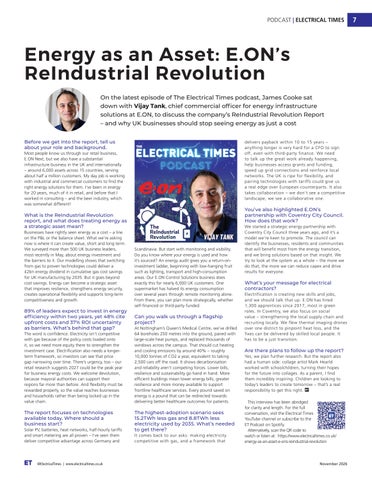
Energy as an Asset: E.ON’s ReIndustrial Revolution On the latest episode of The Electrical Times podcast, James Cooke sat down with Vijay Tank, chief commercial officer for energy infrastructure solutions at E.ON, to discuss the company’s ReIndustrial Revolution Report – and why UK businesses should stop seeing energy as just a cost Before we get into the report, tell us about your role and background.
delivers payback within 10 to 15 years – anything longer is very hard for a CFO to sign off, even with third-party finance. We need to talk up the great work already happening, help businesses access grants and funding, speed up grid connections and reinforce local networks. The UK is ripe for flexibility, and pairing technologies with tariffs could give us a real edge over European counterparts. It also takes collaboration – we don’t see a competitive landscape, we see a collaborative one.
Most people know us through our retail business, E.ON Next, but we also have a substantial infrastructure business in the UK and internationally – around 6,000 assets across 15 countries, serving about half a million customers. My day job is working with industrial and commercial customers to find the right energy solutions for them. I’ve been in energy for 20 years, much of it in retail, and before that I worked in consulting – and the beer industry, which was somewhat different!
You’ve also highlighted E.ON’s partnership with Coventry City Council. How does that work?
What is the ReIndustrial Revolution report, and what does treating energy as a strategic asset mean? Businesses have rightly seen energy as a cost – a line on the P&L or the balance sheet. What we’re asking now is where it can create value, short and long term. We surveyed more than 500 UK business leaders, most recently in May, about energy investment and the barriers to it. Our modelling shows that switching from gas to proven technologies could deliver a £2bn energy dividend in cumulative gas cost savings for UK manufacturing by 2035. But it goes beyond cost savings. Energy can become a strategic asset that improves resilience, strengthens energy security, creates operational flexibility and supports long-term competitiveness and growth.
89% of leaders expect to invest in energy efficiency within two years, yet 48% cite upfront costs and 37% ROI uncertainty as barriers. What’s behind that gap? The word is confidence. Electricity isn’t competitive with gas because of the policy costs loaded onto it, so we need more equity there to strengthen the investment case. Electrification also needs a longerterm framework, so investors can see that price gap narrowing over time. There’s urgency, too – our retail research suggests 2027 could be the peak year for business energy costs. We welcome devolution, because mayoral authorities can support their regions far more than before. And flexibility must be rewarded properly, so the value reaches businesses and households rather than being locked up in the value chain.
The report focuses on technologies available today. Where should a business start? Solar PV, batteries, heat networks, half-hourly tariffs and smart metering are all proven – I’ve seen them deliver competitive advantage across Germany and
@ElectricalTimes | www.electricaltimes.co.uk
07_ET-Oct_Podcast.indd 7
Scandinavia. But start with monitoring and visibility. Do you know where your energy is used and how it’s sourced? An energy audit gives you a return-oninvestment ladder, beginning with low-hanging fruit such as lighting, transport and high-consumption areas. Our E.ON Control Solutions business does exactly this for nearly 6,000 UK customers. One supermarket has halved its energy consumption over several years through remote monitoring alone. From there, you can plan more strategically, whether self-financed or third-party funded.
Can you walk us through a flagship project? At Nottingham’s Queen’s Medical Centre, we’ve drilled 64 boreholes 250 metres into the ground, paired with large-scale heat pumps, and replaced thousands of windows across the campus. That should cut heating and cooling emissions by around 40% – roughly 10,000 tonnes of CO2 a year, equivalent to taking 2,500 cars off the road. It shows decarbonisation and reliability aren’t competing forces. Lower bills, resilience and sustainability go hand in hand. More efficient buildings mean lower energy bills, greater resilience and more money available to support frontline healthcare services. Every pound saved on energy is a pound that can be redirected towards delivering better healthcare outcomes for patients.
The highest-adoption scenario sees 15.2TWh less gas and 8.8TWh less electricity used by 2035. What’s needed to get there? It comes back to our asks: making electricity competitive with gas, and a framework that
We started a strategic energy partnership with Coventry City Council three years ago, and it’s a model we’re keen to promote. The council can identify the businesses, residents and communities that will benefit most from the energy transition, and we bring solutions based on that insight. We try to look at the system as a whole – the more we do that, the more we can reduce capex and drive results for everyone.
What’s your message for electrical contractors? Electrification is creating new skills and jobs, and we should talk that up. E.ON has hired 1,300 apprentices since 2017, most in green roles. In Coventry, we also focus on social value – strengthening the local supply chain and recruiting locally. We flew thermal imaging drones over one district to pinpoint heat loss, and the fixes can be delivered by skilled local people. It has to be a just transition.
Are there plans to follow up the report? Yes, we plan further research. But the report also had a human side: collage artist Mark Hearld worked with schoolchildren, turning their hopes for the future into collages. As a parent, I find them incredibly inspiring. Children are looking to today’s leaders to create tomorrow – that’s a real responsibility to get this right. This interview has been abridged for clarity and length. For the full conversation, visit the Electrical Times YouTube channel or subscribe to the ET Podcast on Spotify. Alternatively, scan the QR code to watch or listen at: https://www.electricaltimes.co.uk/ energy-as-an-asset-e-ons-reindustrial-revolution
November 2026
30/10/2026 16:06:59
8
COVER STORY | IDEAL ELECTRICAL
Why lever connectors are the electrician’s connector of choice In today’s electrical industry, contractors are under constant pressure to deliver projects faster, maintain the highest safety standards, and minimise costly rework. Whether installing lighting systems, wiring smart buildings, or delivering large-scale commercial projects, every component must contribute to efficiency and reliability. Increasingly, lever wire connectors are helping electricians achieve exactly that. Among the options available, IDEAL Electrical’s lever connector range stands out through its blend of speed, versatility, inspection capability, and installation confidence.
O
ne of the primary drivers behind the growing adoption of lever connectors is ease of installation. Unlike traditional connection methods that require connections to be screwed into place, lever connectors use a spring-clamp mechanism that opens when the lever is lifted and securely locks conductors into place when closed. This design simplifies wire termination and reduces the physical effort required during installation. IDEAL’s 4mm2 lever connectors go a step further by allowing electricians to insert solid conductors without lifting the lever first, helping speed up installations and reduce strain on the user. Speed, however, means little without reliability. Electrical contractors need confidence that every connection is secure. IDEAL lever connectors incorporate two-stage latching technology and clear inspection windows, enabling installers and inspectors to verify that conductors are fully seated and stripped to the correct length. This visual confirmation reduces uncertainty and helps prevent installation errors before systems are energised. The inspection benefits become particularly valuable in demanding environments such as data centres, where electrical installations face intense scrutiny and uptime requirements are extremely high. The inspection window allows immediate verification of conductor placement, while integrated test ports enable voltage testing without disconnecting wiring. These features make
November 2026
troubleshooting, commissioning, and inspections significantly more efficient, helping contractors meet stringent quality standards while reducing disruption. Flexibility is another key advantage. Modern electrical installations are rarely limited to a single conductor type, and electricians frequently encounter combinations of solid, stranded, and flexible wires. IDEAL lever connectors are designed to accommodate a broad wire range and multiple conductor types, making them suitable for applications ranging from residential wiring to commercial and industrial projects. Their versatility allows contractors to standardise on fewer connection products while maintaining compliance across a wide variety of installations. Lighting installations represent a particularly strong use case. Working overhead often makes it difficult to apply force when inserting conductors into conventional connectors. IDEAL’s lever connectors eliminate this challenge because the ports provide virtually no resistance when open. Electricians can insert wires with one hand, making installations easier and more efficient when working on ceilingmounted fixtures. The easy insertion process also helps protect fine-stranded and flexible conductors from damage during installation. The reusability of lever connectors delivers another important productivity benefit. As buildings become smarter and more connected, electrical systems are increasingly subject to upgrades, modifications, and expansions. Smart home controls, intelligent lighting systems, and connected devices frequently require circuit changes as technologies evolve. Because lever connectors allow conductors to be removed and reconnected without damage, electricians can perform modifications quickly and efficiently without repeatedly cutting and re-stripping wires. This same reusability is valuable in prefabricated construction, where assemblies are often built off-site before being installed
on location. Lever connectors simplify the final assembly process by supporting a wide range of conductor sizes and types. Their ability to provide consistent and dependable connections helps contractors maintain productivity while meeting demanding project schedules.
Training and workforce development also benefit from lever connector technology. As the industry works to address skills shortages and bring new apprentices into the trade, products that promote consistency can help reduce installation errors. IDEAL’s lever connectors use a factory-set spring clamping force that delivers repeatable performance regardless of the user’s experience level. Combined with clear inspection windows and an audible click when properly engaged, they provide immediate feedback that supports learning and improves installation quality. Beyond their installation advantages, IDEAL lever connectors are engineered for demanding conditions. The company’s 4mm² connectors are rated to 32A, 450V and, while the 6mm² versions are rated to 41A, 450V and 85°C. Features such as protective side walls, secure lever positioning and integrated test ports contribute to long-term connection security and simplify maintenance activities throughout the life of the installation. For contractors seeking greater productivity, easier inspections, reduced rework, and dependable performance, lever connector technology offers clear advantages. By combining installation speed with inspection visibility, reusability, and broad application flexibility, IDEAL Electrical’s lever connectors provide a practical solution for the challenges facing today’s electricians. From residential upgrades to large-scale commercial projects, they are helping professionals work smarter, faster, and with greater confidence. For more information visit http://idealelectricalinc.com
www.electricaltimes.co.uk | @ElectricalTimes
ET Dec 2 08_ET-Nov_CoverStory-Ideal.indd 8
30/10/2026 16:08:04
IDEAL 4MM2 LEVER CONNECTORS INTUITIVE TO USE. ENGINEERED FOR SAFETY.
Fast installation: Simply strip solid conductors and push them in - no need to open the lever.
Secure hold: Two stage locking mechanism ensures reliable retention of all conductor types
No accidental release: Lever opens and closes in the opposite direction to the conductor entry point.
Convenient test ports: Located on both sides for quick continuity checks in any position.
Wide compatibility: Suitable for solid, stranded, and flexible conductors from 0.14 mm² to 4.0 mm², rated up to 32 A.
Maximum visibility: Transparent window and strip length guide for easy visual inspection.
Compact design Perfect for installations in tight / crowded spaces.
At IDEAL Electrical, we build products with professionals, for professionals. For more than a century,
At IDEAL Electrical, weearned build their products with professionals. our solutions have place on jobprofessionals, sites across thefor world - making everyday electrical work faster, safer, and more reliable. For more than a century, our solutions have earned their place on job sites across the world - making everyday electrical work faster,today. safer, and more reliable. Upgrade your connections
Find out more:
idealelectricalinc.com Own every connection
ET Dec 2026_4mm lever.indd 1 08_ET-Nov_CoverStory-Ideal.indd 9
22/10/2026 16:27:15 30/10/2026 16:08:06
10 SWITCHED ON LOG ONTO www.electricaltimes.co.uk FOR MORE LIGHTING – SOLUTIONS FOR TODAY & TOMORROW
Sequencing an electrical package when you don’t control the site At Scotstoun Stadium, which columns could come down was decided each morning. Matthew Bonner, COO of EGG Lighting, on what that does to a floodlight replacement — and two specif ication decisions worth borrowing
O
n most jobs you build a programme and work through it. On some jobs you find out each morning which part of it you are allowed to do. Scotstoun Stadium in Glasgow needed 96 floodlight heads replaced across four masts at 25 metres, to a date that could not move. Venue operator Glasgow Life appointed EGG Lighting as electrical contractor for the lighting. The installation being replaced had as-installed drawings dating to 2010. The electrical scope was easy to write down: safe isolation of each column, removal of the 96 existing heads, installation of 96 Abacus Challenger luminaires — 1500W, 5700K, DMX-driven — then testing, certification and aiming. The existing switching arrangement was retained, and so were the four legacy columns; Abacus, as manufacturer, replaced the bracketry and carried out remedial works with their engineers on site alongside our team for much of the programme. What made it difficult had nothing to do with lighting. In the summer of 2025, Scotstoun was not a lighting site. It was a track site. The old Athletics track had been stripped out, and the sub-base prepared. Asphalt was going down ahead of a MONDO track installation, and DYNAMIK Sport was running the site as principal contractor. We were a guest on somebody else’s programme — inducted onto site, signing in and out of their logbook, agreeing access every morning. Which columns we could lower was decided each morning, not in advance, depending on where the track-laying team had reached. We negotiated permission to lower two at a time where it would speed things up, but only with the site manager’s agreement on the day. And a lowered 25-metre column lies right across the track, so where new surface was already down, 18mm plywood protection went down first. The telehandler needed for the bracket work couldn’t go on a wet track — in Glasgow, in August — and couldn’t be left on it overnight under any circumstances. None of that was negotiable, and none of it was going to move the date. The answer was to build a sequence that could be reordered rather than queued. If the track team’s progress ruled out a column that morning, the crew moved to another rather than standing down. That sounds obvious written down. In practice it means every column has to be independently ready to start — materials staged, isolation planned, certification
November 2026
10&12_ET-Oct_SwitchedOn.indd 10
paperwork open — rather than the job progressing along a single critical path. It is more preparation for the same amount of work, and it is the difference between a crew working and a crew waiting. Two specification decisions came out of it that are worth borrowing. The cabling was specified on site rather than at order stage. The runs between luminaire and driver could only be settled once the masts were surveyed, and lengths and terminations simply aren’t knowable when the order goes in. We specified 8-core H07RN-F 8×1.0mm². It is a small thing that becomes a large thing if you find it in week three with a track going down around you — and on a job with no float, finding it early was worth more than the specification itself. The drivers sit at the base of each column, not at the head. The columns had a weight limit, which made low-level mounting the sound structural choice. But the more useful consequence is maintenance: a driver failure can be attended from ground level, without lowering a mast or booking a lift. Over a service life, that is the difference between a call-out and an operation. The drivers are DMX compatible, so the installation is not locked to one luminaire either. On procedure, nothing clever. Every column was isolated before anyone touched it — point of isolation identified, locked off, labelled, key retained by the operative doing the work, and proved dead across every combination
of line, neutral and earth, with the test equipment itself proved before and after. No live working was permitted on the project under any circumstances, and the risk assessment said so in terms. Every electrician on site worked to 18th Edition, with an SSSTS operative present throughout. Every day closed the same way: circuits made safe, plant stored clear of the track works, a handover to the site manager setting out the next day’s working area. Testing followed the full sequence — continuity, insulation resistance, polarity, earth fault loop impedance, prospective fault current, RCD and phase sequence — with Minor Works Certificates and lux readings required at handover. On verification: the design document specified 1,500 lux across the field of play with a tolerance of 10%. The team walked the arena at night, taking readings against the design figures. Every reading fell inside the tolerance. It took an evening, and it is the difference between believing a specification and knowing it. Phase 1 went on site on 28 July 2025 and handed over that September, in time for Glasgow Warriors’ 2025/26 season and for the Athletics clubs who use the track year-round. Phase 2 followed in early 2026. The stadium stayed open throughout — no season lost, no fixtures moved. The lighting performed throughout the Games. The transferable part isn’t the lighting. It’s that on a site you don’t control, the programme is not a plan you execute. It’s a set of options you keep ready.
www.electricaltimes.co.uk | @ElectricalTimes
30/10/2026 16:09:11
NVC LIGHTING A NVC PART OF THE PROe RANGE
GREENLAND PRO HIGH‑PERFORMANCE IP66 NON‑CORROSIVE CORROSIVE
A BETTER WAY TO INSTALL. 2 FIX. DESIGNED AROUND THE WAY PROJECTS WORK.
GREENLAND PRO’s 2 FIX architecture separates installation into first-fix and second-fix stages, providing greater flexibility around project sequencing on site.
1
BASE FIRST FIX
2 MOVABLE TERMINAL BLOCK icons 1 - Greenland 27 August 2026 16:23:07
PREPARED CABLE ENTRIES
LIGHT ENGINE SECOND FIX
DETACHABLE LIGHT ENGINE
SEE NON-CORROSIVE. THINK GREENLAND PRO. icons11--Greenland Greenland icons 27August August2026 202616:23:07 16:23:07 27
+44 (0)121 457 6340 I sales@nvcuk.com I www.nvcuk.com
GREENLAND PRO - ET AD - AUG 2026 - 244x315mm.indd 1 XX_ET-Oct_Advert.indd 3
28/08/2026 12:45:18 01/10/2026 11:34:07
12 SWITCHED ON
London Aquatics Centre upgrades to next-generation LED lighting with Signify to boost fan experience and enhance energy efficiency
S
ignify has delivered a landmark LED lighting upgrade at the London Aquatics Centre to drive performance, energy saving, efficiency, and long-term sustainability at one of the UK’s most iconic sporting venues, also known to be the most technologically advanced and stunning swimming facility in the world. Designed by Zaha Hadid, the London Aquatics Centre was built in 2012 and immediately took its place on the world stage as a venue for that summer’s elite swimming and diving events. More than a decade later, operator Everyone Active undertook a major modernisation project to replace the venue’s legacy lighting system with energyefficient LED technology. A key requirement was achieving the stringent World Aquatics (formerly FINA) television broadcast standard of 1,500 lux Ev. To achieve this, Signify partnered with DC Electrical Supply to deploy a lighting system designed for the unique demands of the venue’s architecture. With luminaires suspended up to 40 metres above water, access, precise aiming and adjustment using conventional methods were challenging and time-consuming. Signify deployed a proprietary solution designed to translate an on-paper lighting design into real-world accuracy. By combining its advanced ArenaVision LED gen3.5 luminaires with an innovative Augmented Reality (AR) aiming system, Signify enabled installers to accurately align each luminaire, even at heights of up to 40 metres above the pool.
A detailed grid over the pool area enabled installers to align each luminaire precisely with the original lighting design. Instead of relying on a visual aiming scope, the installers used a smartphone attached to the luminaire to aim the lights directly at the grid. This approach reduced time spent working at height, improved installation accuracy, and ensured the final lighting performance matched the design intent. Any subsequent adjustments could be made quickly and precisely, delivering measurable and repeatable results. The installation includes 168 ArenaVision luminaires providing the main competition lighting, complemented by 16 UniFlood Flat luminaires that add additional flexibility. The luminaires are paired with a DMX control system to enable immersive and adaptable lighting scenes that enhance sporting events and audience experiences while meeting the requirements of elite competition. The new lighting provides excellent visibility for athletes and fully complies with the World Aquatics broadcast standards, helping the venue maintain its status as a top destination for televised sporting events. Compared with
the previous HID lighting system, the LED solution delivers significant energy savings of upto 60% when used in full capacity. The addition of DMX controls also gives venue operators greater flexibility to create engaging experiences for spectators and support a wider range of events. “Having the new LED lighting at the London Aquatics Centre for elite sport is an absolute game changer,” said Mark Basker, Regional Contract Manager at Everyone Active. “Everyone Active has invested £685,000 in the lighting upgrade, working in partnership with global lighting specialist Signify and electrical contractor DC Electrical Supply. With individual control of each light, we can black out the pool, introduce coloured lighting, and follow athletes during events. This gives the venue flexibility to host many more events while future-proofing the facility and maintaining its reputation as a world-class aquatics venue.” Mark Camley, Executive Director for Estate & Neighbourhoods at London Legacy Development Corporation, said: “The new energy efficient lighting upgrade is a welcome addition to London Aquatics Centre as we embark on the next phase of Queen Elizabeth Olympic Park, focussing on shaping sustainable communities while supporting the Mayor’s ambitions for a greener, cleaner and healthier capital.” Darren Clark, Director at DC Electrical Supply Ltd., said “Given the complexity of access and adjustment within the venue, the solution installed allows for ensuring results to be measurable and repeatable. The key point of difference is how they translate on-paper lighting design into real-world accuracy.”
B.E.G. boosts building security with KNX secure to protect against unauthorised access
L
ighting controls specialist B.E.G. has strengthened the security capabilities of its KNX building automation range with an updated push-button interface module. The German manufacturer has introduced ‘KNX Secure’ to selected products using a device which connects ordinary wall switches or push buttons to a KNX building automation system allowing them to control functions such as lighting, blinds or other building systems. The new technology is designed to help protect communications between connected devices against unauthorised access and manipulation. B.E.G. says KNX Secure will ‘help safeguard control messages exchanged between devices’ which will provide an ‘additional layer of protection’ for intelligent building installations. The updated switch interface module combines enhanced communication security with four individually configurable channels, allowing conventional push buttons, switches and indicator lights to be integrated into KNX building automation systems. Dan Glynn, Sales Director for B.E.G. UK & Ireland, said: “As buildings become increasingly connected, protecting the systems that control lighting, blinds and other functions is an important consideration for building owners, installers and system integrators. “Protecting communication between devices helps reduce the risk of unauthorised interference and
November 2026
10&12_ET-Oct_SwitchedOn.indd 12
supports greater confidence in the systems that building owners and occupants rely on. “By introducing KNX Secure support to this interface, we’re combining an additional layer of communication security with the flexibility installers need when designing building control solutions.” Designed for installation in standard switch back box, the interface features four individually configurable channels. Each can operate as an input for potentialfree push-button or switch contacts, or as a binary output for controlling indicator lights. B.E.G. insists this allows installers to integrate conventional controls into a KNX system while benefiting from the wider capabilities of building
automation. Its compact design also provides ‘flexibility’ when specifying devices for new installations or incorporating controls into wider automation projects. Configuration is carried out using the Engineering Tool Software (ETS), the standard configuration tool for KNX installations. Each channel supports a range of functions, including switching, dimming, blinds control, scenes, forced operation, percentage control, sequencer, HVAC mode, edge functions and counter functions. Compatibility with standard switch ranges gives installers and specifiers additional flexibility when selecting controls to suit the requirements and interior design of a building. Mr Glynn added: “Security and functionality need to work together in modern building automation. Installers need solutions that help protect system communications without compromising the flexibility required to meet different project specifications. “The four configurable channels allow a wide range of control requirements to be accommodated within one compact device, making it a versatile option for residential and commercial applications “The updated interface forms part of our wider portfolio at B.E.G. of building automation solutions, designed to support intelligent, efficient and secure building operation across offices, hotels, educational facilities, industrial premises and residential developments.” www.beg-luxomat.com
www.electricaltimes.co.uk | @ElectricalTimes
30/10/2026 16:09:28
EPDs
Environmental Product Declarations are becoming a specification requirement. Recolight’s EPD service is designed to maximise the number of products covered by an EPD, as cost effectively as possible.
RE-USE Recolight partner with organisations to pass on new, unused, or surplus stock.
1 2
4 3 RECYCLE
If you can’t reuse or remanufacture, Recolight recycle. Recolight operate the UK's largest collection network for fluorescent and LED lamps. Carbon footprint data is available for every waste collection.
A remanufacturing service from Recolight, upgrading used luminaires to reduce embodied carbon and improve efficiency.
Make your lighting more sustainable. Make it circular. Recolight is the UK’s leading not-for-profit WEEE compliance scheme for the lighting industry. With an extensive network of collection points and a proven track record of environmental responsibility, Recolight enables lighting manufacturers and their customers to meet regulatory requirements. But we don’t stop there, we work with the lighting industry to accelerate the shift to a Circular Economy. With Recolight Revive and the Circular Lighting Live Conference, to workshops, webinars, and environmental metrics.
www.
XX_ET-Nov_Advert.indd 1
.co.uk
30/10/2026 12:36:45
14 LIGHTING | RECOLIGHT
Beyond the next new fitting: lighting’s circular future takes shape
Remanufacture, reuse and new commercial models are moving from the margins to the mainstream of the lighting sector – as Circular Lighting Live 2026 made clear
F
or decades, the lighting industry has run on a simple cycle: specify, install, remove, replace. When a fit-out comes round or a light source becomes obsolete, the fittings come down and new ones go up. That cycle is now being challenged – not in theory, but on real projects and at real scale. That was the clear message from Circular Lighting Live 2026, held in the City of London on 8 October. Organised by Recolight, the lighting industry’s compliance scheme, the conference brought together case studies in which luminaires were retained and refurbished rather than replaced – and speakers were candid about what is still hard. Gary Thornton of Nulty summarised the event well: “We must continue to normalise reuse. As far as we have come, the industry is approaching a tipping point. Continue to push forward repair and regeneration rather than new at every opportunity!”
The projects are getting bigger. DRK Lighting presented the remanufacture of 8,000 client luminaires, demonstrating that circular principles can be applied at scale. At Leadenhall Market, Light Projects Evolve took a different route, remanufacturing historic fittings and developing a bespoke LED light source to preserve the site’s Victorian character. Recolight used the event to launch its own contribution: Recolight Revive, a specialist remanufacturing service that will upgrade and re-warranty luminaires to minimise waste and embodied carbon and maximise energy efficiency.
Reuse is harder than it looks If remanufacture is maturing, straightforward reuse remains a work in progress. Hattie Emerson of the Finishes and Interiors Sector shared lessons from attempts to redistribute thousands of good-quality fittings removed during Cat A fit-outs. Recovering a luminaire, she showed, is not simply a matter of taking it out of a ceiling and finding a buyer: creating a functioning market for second-hand products throws up practical obstacles the industry is now starting to solve.
Making the business model work
Remanufacturing comes of age The most mature circular approach, remanufacturing, has been practised for decades. What has changed is the pressure behind it. High energy costs and the phase-out of fluorescent light sources have left buildings with fittings whose housings are sound, but where light sources are not. Upgrading those fittings, rather than removing them, is increasingly the logical choice.
November 2026
14_ET-Nov_Lighting-Recolight.indd 14
Delegates heard that commercial arrangements are where circularity will succeed or fail. Reuse, remanufacture and leasing all point to models in which value stays in the product, rather than being lost when it is replaced. Keynote speaker John McRae, director of architectural practice Orms, challenged the industry to imagine a future beyond the conventional take-make-use-waste model. “The industry has been guilty of an addiction to selling new,” he said, “but this year disassembly and take-back schemes were amongst the examples shared.” He was realistic about the road ahead. “It’s clear that making the business model work is challenging at this stage, but there were lots of great examples
on show and the passion to do the right thing was clear to all of us that attended.” Sabine De Schutter, founder of Studio De Schutter, offered a designer’s perspective, arguing that reuse and upcycling could become starting points for creative lighting design rather than constraints.
Regulation and materials The programme also looked at what is coming down the line. Speakers examined Environmental Product Declarations (EPDs), updates to the TM66 circularity metric and legislation expected to place greater emphasis on product repairability and upgradeability. Embodied carbon looks set to sit alongside energy efficiency in every good specification. Further ahead, sessions explored lower-impact materials and manufacturing, including bio-based plastics and robotic additive manufacturing using recycled materials.
What it means for the electrical sector For contractors, wholesalers and specifiers, the implications are practical. Existing luminaires deserve to be assessed as assets before they are written off. Remanufactured fittings carrying a fresh warranty are becoming a credible option on mainstream projects. And clients are likely to ask more questions about repairability, EPDs and what happens to products at end of life. The direction of travel is clear: preserve the value of what is already installed, extend its useful life, and build the commercial models that make circularity pay. Or, as McRae put it: “The future of lighting is not brighter. It is wiser.”
www.electricaltimes.co.uk | @ElectricalTimes
30/10/2026 16:10:10
beg-luxomat.com
Aleum Glow HIGHLIGHT YOUR HOME THROUGH MOTION Timeless, clear design, high-quality technology Available in two colour variants ‘Glow’, selectable ambient lighting 3 m to 16 m range Electronically and mechanically adjustable range
NEW CATALOGUE OUT NOW M U FOR
Launching new and exciting products across the range
SCAN TO DOWNLOAD
NS
TIO OLU
S ING
HT
LIG
11.2
+44 (0)161 359 4949 | info@forumlightingsolutions.com
forumlightingsolutions.com
XX_ET-Nov_Advert.indd 2
30/10/2026 12:41:10
16 FIRE, SAFETY & SECURITY | SWIVELPOLE
Designing safety into infrastructure: Why maintenance access belongs in the design phase
W
hen infrastructure projects move through design and into construction, access for future maintenance is rarely on the critical path. Equipment gets specified, civil works get scoped, poles get ordered, and the question of how a maintenance crew will safely reach that lighting fixture or pole-mounted instrument five or ten years from now goes unasked until the asset is already in the ground. The consequences play out across the life of the asset. Every time pole-mounted equipment needs attention, whether a luminaire replaced, a camera inspected or an instrument calibrated, crews face an elevated access task that could have been engineered out at the design stage. Mobile Elevated Work Platforms (MEWPs), scaffolding, fall arrest systems, traffic management, permit administration: all of it repeated, cycle after cycle, for the life of the installation. Safety by design addresses this at the source. The principle is straightforward: hazards should be eliminated through design decisions made early, before they become embedded in the infrastructure. For asset owners, engineers and HSE professionals, this reframes access planning as a structural safety obligation, one that belongs in the design phase, not the operational one.
The Hierarchy of Controls Applied to Access The hierarchy of controls is well established in occupational health and safety. Elimination sits at the top: remove the hazard entirely. Below that come substitution, engineering controls, administrative controls and finally PPE. In practice, working at height risk associated with polemounted equipment maintenance is frequently managed through the lower tiers. Procedures are written, PPE is issued, permits are developed, training is delivered. The exposure itself, the need to climb to reach a lighting fitting, a sensor or a camera, remains unchanged. This is where design teams have the greatest opportunity to intervene. Applying the hierarchy of controls to access decisions during early design is consistent with sound engineering practice and with the direct requirements of the Work at Height Regulations 2005 in the UK. It is also where the decision is cheapest to make.
The Work at Height Regulations 2005 in the UK The Work at Height Regulations 2005 apply across all industries and all workplaces in the UK where people are required to work at height. The duty is clear: employers and those who control work must avoid work at height where reasonably practicable, and where it cannot be avoided, must take all reasonably practicable steps to prevent falls. The regulations place emphasis on prevention through planning and proper equipment, not on managing risk after the fact through procedural controls. For industrial asset owners and engineers, this has a direct implication for how maintenance access to lighting and pole-mounted equipment is approached at the design stage. Pole-mounted lighting and equipment that requires routine maintenance creates a foreseeable, recurring work at height requirement across the operational life of the asset. That foreseeability is precisely what makes it addressable at the design stage, and what makes deferring it to operational procedure a weaker response than the regulations intend.
November 2026
16_ET-Nov_FSS-Swivelpole.indd 16
The Lifecycle Cost Argument
by Amy Olsen, Group General Managerat Swivelpole
Designing out the elevated access requirement entirely, so that lighting and equipment maintenance is carried out at ground level as standard, is the most direct way to meet the duty to avoid work at height where reasonably practicable. It is an engineering decision, and it is most effectively made before civil works are committed.
The financial case is more direct than it is sometimes presented. The difference in capital cost between a fixed pole and a lowering pole system is measurable. The difference in ongoing maintenance cost is substantially larger. Every elevated access event carries direct cost: platform hire, crew time, traffic management, permit administration and associated downtime. On sites with significant numbers of lighting columns and pole-mounted equipment, and across a maintenance lifecycle, those costs accumulate considerably. Asset owners in energy, utilities, water treatment and industrial sectors who have moved to specifying lowering pole systems as standard report safety performance improvement and maintenance cost reduction as the primary commercial drivers. The two outcomes are the same decision.
Why Routine Access Is a Sustained Risk Falls from height have been the leading cause of fatal workplace injury in the UK for over two decades, accounting for around a quarter of worker deaths in the most recent reporting year. Pole-mounted equipment maintenance sits squarely within this broader category of elevated access work. Maintenance of pole-mounted lighting and equipment is precisely this kind of task: repetitive, often underestimated and carried out by rotating crews under varying site conditions. Familiarity tends to reduce perceived risk rather than actual risk. Permit processes get abbreviated for jobs that feel routine. Equipment checks get skipped when time is short. The task appears identical to the last one, until the conditions, the crew or the circumstances are slightly different. The exposure is also cumulative. A single industrial or infrastructure site may have dozens or hundreds of poles carrying lighting, cameras, sensors or communications equipment. Across a maintenance lifecycle spanning 25 years or more, the number of individual elevated access events is substantial. Each one carries the same fundamental risk profile.
What Early Access Planning Looks Like The engineering solution is well established: lowering pole systems that bring lighting and equipment to ground level or walkway level for every maintenance event. No elevated platform, no fall arrest equipment, no additional crew requirement. The access method is built into the infrastructure from the outset. The decision to specify a lowering pole system rather than a fixed pole is most straightforward, and most cost-effective, when it is made during concept or early detailed design. At that stage, civil works requirements are comparable, installation is similar, and the footprint on site is the same. What differs is the maintenance outcome delivered across the full life of the asset. Ground-level access does not depend on budget availability at the next maintenance cycle, or on the availability of specialist equipment at a remote or constrained site. The capability is there every time, by design. For project engineers and asset owners, this question is straightforward to address in early design. It becomes significantly more complex and expensive once civil works are committed.
Alinta Energy’s Loy Yang B Power Station in Victoria, Australia, is a useful illustration of the scale this reaches in practice. The site’s existing light poles were rigidly fixed to guardrail stanchions, and much of it is a multi-level layout where ladders aren’t an option. Every fixture replacement meant scaffolding, a scissor lift or a boom lift. Rather than replace the poles outright, the site has converted over 1,200 of them to Swivelpole systems as part of an LED upgrade, with another 1,000 in progress. It’s worth noting this was a retrofit, not a decision made at design stage which matters, because the UK duty to avoid work at height where reasonably practicable doesn’t stop applying just because the asset is already built. Where the original design missed the opportunity, the hazard can still be removed later, without a full rebuild.
Designing In Access as Standard Practice Swivelpole is a specialist manufacturer of lowering pole systems, engineered to bring lighting and pole-mounted equipment to ground level for maintenance, eliminating the elevated access requirement entirely. Systems have been supplied across offshore platforms, chemical processing facilities, mining operations and water treatment infrastructure, where the consequences of working at height are well understood and the case for engineering out that risk is well established. For project designers, engineers and asset owners, the access question is straightforward to resolve during design and increasingly difficult to address afterwards. Bringing it into the design process as a standard consideration, alongside product and vendor specification, structural design criteria and civil works, is the most effective point at which to act. Under the Work at Height Regulations 2005 in the UK, the duty to avoid foreseeable work at height where reasonably practicable begins at the design stage. That is precisely where it is most cost-effective to act on it.
www.electricaltimes.co.uk | @ElectricalTimes
30/10/2026 16:11:03
C-TEC | FIRE, SAFETY & SECURITY 17
Switch Swift
F
astConvert, C-TEC’s new conventional to addressable zone converter, has saved thousands of pounds on a school project. North Road Academy, a thriving Islamic primary school in Stoke-on-Trent, initially considered a complete replacement of its fire system. However, following a site survey, specialist electrical company, W R Fire & Security, recognised the potential to enhance the existing conventional system by converting it to an addressable system using FastConvert. Prior to opting for FastConvert, three possible upgrade options were considered. The first was a new conventional panel, which would have allowed the zones to be separated out and additional zones created. However, this would have required extra cabling and left the school with a conventional system limited to only being able to report zonal fire and fault information. The second was a full re-cable of the system, ruled out by budget as it would have added an estimated £10,000 in materials and additional labour, along with far greater disruption and a longer installation timescale. The third was to convert the remaining six zones into loops, which would have added around a week to the installation for two engineers, plus additional cabling, materials and disruption, at an estimated extra cost of £3,000-£4,000.
@ElectricalTimes | www.electricaltimes.co.uk
17_ET-Nov_FSS-C-Tec.indd 17
FastConvert was the only option that avoided all three drawbacks at once – reusing the existing wiring, delivering a genuine loop-based addressable system rather than a conventional one and doing it without the extra cost, labour or disruption. This, therefore, made it the obvious choice for the school. By utilising the old system’s wiring, FastConvert quickly and easily upgraded the school’s legacy conventional system into a powerful open-protocol CAST addressable system capable of lockdown alert functionality, internet connectivity and accommodating C-TEC’s award-winning CAST-PRO false alarm resistant combined fire detection and alarm devices. To achieve this, two radials were combined into a single loop with a dedicated two-loop panel installed for FastConvert.
Wayne Riley, MD of W R Fire & Security, said: “We are very impressed with FastConvert – it is extremely innovative in terms of what it can do. Against a full re-cable, which would have added around £10,000 to the job or converting the zones into loops, which would have cost an extra £3,000-£4,000 and a week’s extra labour for two engineers, FastConvert was the clear winner. It massively reduced installation time, site disruption and labour costs. “We also really like the new CAST-PRO devices and feel they are far superior to other manufacturers as they have the sounder/VADs and multi-sensors built into the heads so you don’t need separate sounder bases.”
November 2026
30/10/2026 16:11:51
18 FIRE, SAFETY & SECURITY | AICO
The Hidden Dangers of Radon
M
ost people rarely think about radon. This invisible, odourless noble gas is impossible to detect without specialist equipment, yet it is estimated to cause around 1,100 deaths in the UK each year. For context, that is equivalent to roughly two-thirds of the number of people killed on roads in Great Britain during 2025. With awareness growing and regulatory scrutiny increasing, housing providers are under pressure to have a clear strategy for managing radon. Here, we explore the risks, how landlords are monitoring and reducing radon, and the regulatory changes they need to consider.
An Invisible Killer Radon is a radioactive gas produced naturally as uranium in rocks and soil decays, particularly in areas with granite or shale. As a result, levels vary significantly across the country. Housing providers can assess potential risk using the UKHSA radon map or commission testing for individual properties. Radon can accumulate inside homes, particularly during winter when heating draws air upwards from the ground and windows remain closed. Long-term exposure increases the risk of lung cancer, with Cancer Research UK estimating that around 5% of UK lung cancers are linked to radon. The risk is substantially higher for smokers. The average radon level in UK homes is around 20 Bq/ m³. UKHSA sets an Action Level of 200 Bq/m³, above which remediation is recommended, and a Target Level of 100 Bq/m³ for preventative and remedial work. Where levels fall between these thresholds, remediation should still be considered.
How Housing Providers Are Managing Radon Because radon cannot be seen or smelled, landlords need monitoring systems to identify elevated levels. One common approach is single-use radon detectors. These are typically left in a property for three months before being sent to a certified laboratory, providing an average reading over the testing period.
November 2026
18_ET-Nov_FSS-Aico.indd 18
by Luke NorcrossEvans, Product Development Executive at AICO
Another option is continuous radon monitoring. These systems remain installed and provide ongoing readings, giving landlords greater visibility of seasonal changes while reducing the need for repeated contractor visits and multiple single-use detectors. However, sensor quality matters. Consumer-grade devices may not always provide the accuracy, reliability or level of detail required for professional housing management. Where high radon levels are identified, landlords must take steps to reduce them. One of the most common solutions is a radon sump, which uses a fan to extract radon from beneath the building, although other ventilation measures can also be used.
Looking Towards Awaab’s Law Radon falls within the Radiation hazard category under the Housing Health and Safety Rating System (HHSRS). As a result, it is expected to be covered by Phase 3 of Awaab’s Law in England, currently anticipated in 2027. Awaab’s Law requires social landlords to investigate and address specified hazards within defined timescales. Phase 1 currently focuses on damp and mould and emergency hazards, creating significant operational demands for many housing providers. Some landlords are already using environmental monitoring technologies, such as Aico’s HomeLINK, to identify higher-risk properties and intervene proactively. Although radon is less immediately visible than damp or mould, publicly available risk data and increasingly
common air-quality sensors mean landlords may face growing expectations to demonstrate how they identify and manage it. They will also need to show that remediation has worked. Traditionally, this may involve retesting a property with a separate detector after measures such as a radon sump have been installed.
The Benefits of Continuous Monitoring Continuous monitoring can complement traditional testing by showing how radon levels change over time rather than providing a single snapshot. For housing providers, this can help identify properties requiring further investigation, support remediation decisions and provide ongoing evidence of whether interventions are working. It can also reduce repeated contractor visits and help landlords take a more proactive, portfolio-wide approach to managing radon. As awareness and regulatory scrutiny increase, reliable information about radon levels will become increasingly important. Continuous monitoring could therefore play an important role in helping landlords move from periodic testing towards a more informed and proactive approach to radon management.
www.electricaltimes.co.uk | @ElectricalTimes
30/10/2026 16:12:54
BECOME AN AICO
GOLD STANDARD
INSTALLER
At Aico, we understand what a huge responsibility it is to provide home life safety devices into UK homes, which is why we hold both ourselves and the partners we work with to such a high standard. Gold Standard Installers are another way to ensure the safety of UK homes and their residents.
How can I become Gold Standard? Complete our free FIA accredited Expert Installer Training Join thousands of others in our rewards-based Installer Community Expand your knowledge with our free City & Guilds Training
I’m Gold! If you believe you are already Gold Standard, scan here.
Be a member of NICEIC, NAPIT, Select or FIA
Any questions regarding the Gold Standard rating, please contact your local Relationship Manager.
www.aico.co.uk
18_ET-Nov_FSS-Aico.indd 19
30/10/2026 16:12:55
20 TEST & MEASUREMENT | DILOG
Free professional upgrade with every ALVA MFT purchase Get more from your next multifunction tester with free bonus test equipment
A
t Di-LOG, we understand that investing in new test equipment is an important decision for electrical professionals. You need equipment that meets the demands of the job, supports your dayto-day work and offers long-term value. That’s why, until 30 November 2026, we’re giving customers the opportunity to receive free bonus test equipment with selected ALVA MFT purchases. Purchase and register an ALVA MFT to receive a FREE ALVABAT2 Recharge Kit for your NiMH batteries. Alternatively, choose the ALVA MFT Pro and receive a FREE DLEVLite EVSE Adaptor, adding even more value to your new test equipment.
Let’s Talk about Supporting your ALVA Purchase for the foreseeable future For added peace of mind, the ALVA Support Plan provides five years of protection for your investment, including an extended warranty, annual calibration, servicing and firmware updates through Re-CAL, free collection, SmartWater® forensic marking and replacement test leads in years two and four. You’ll also benefit from a fixed £179.99 + VAT accidental damage repair fee, helping keep unexpected costs under control. Available for £499 + VAT upfront or £43.99 + VAT per month for 12 months, it’s a cost-effective way to keep your ALVA MFT maintained, protected and ready for the job.
Is Your Test Equipment Ready for the EV Market? Electric vehicle adoption is creating new opportunities for electricians, from domestic
charge point installations to commercial charging infrastructure. As demand for EV charging grows, having the right test equipment is becoming increasingly important for professionals who want to take on this work with confidence. The ALVA MFT Series has been developed with modern electrical testing requirements in mind, including options for electricians looking to expand into EV installations. With EV-ready variants available, the range gives professionals the flexibility to choose equipment suited to their current work while preparing for new opportunities in the industry. For electricians already carrying out general installation testing, investing in an appropriate MFT and compatible EVSE testing accessories can help broaden the services they offer. It is also an opportunity to build EV testing capability without necessarily replacing an entire collection of existing equipment.
Get More from the ALVA MFT Pro with a FREE EVSE Adaptor One of the key benefits of this promotion is the free DLEVLite EVSE Adaptor included with an eligible ALVA MFT Pro purchase. Even if you choose the standalone ALVA MFT Pro rather than a complete EV kit, the adaptor gives you an additional option for testing compatible electric vehicle charging equipment. This can be a particularly cost-effective choice for electricians looking to expand into EV installations. Instead of immediately investing in a complete kit, you can purchase the ALVA MFT Pro and receive the DLEVLite adaptor free as part of the promotion.
This helps you build your testing capabilities while keeping the initial cost down, with the essential equipment for compatible EVSE testing available alongside your multifunction tester. For those who are already considering the ALVA MFT Pro, this is an opportunity to get more from the purchase. You benefit from the Pro model’s additional testing functions while gaining an EVSE accessory that can support your work as your installation requirements develop.
Di-LOG: Supporting Electrical Professionals At Di-LOG, we develop test and measurement equipment around the needs of electrical professionals, with a focus on practical functionality, accessibility and value. We understand that reliable test equipment is an essential part of working safely and efficiently, whether you’re carrying out routine installation testing or developing your skills in emerging areas such as EV charging. Our commitment to the industry has also been recognised at the Electrical Wholesaler (EW) Awards, where Di-LOG has won Best Safety and Security for six consecutive years. This recognition reflects our continued presence in the electrical trade and our focus on providing equipment that supports professionals in their everyday work. As the industry evolves, we’re continuing to develop solutions that help electricians meet changing requirements without losing sight of the practical demands of the job. The ALVA MFT Series is part of that approach, combining modern testing capabilities with an accessible design and a choice of models to suit different needs.
Don’t Miss Out on Your Free Upgrade With free bonus test equipment available on eligible purchases until 30 November 2026, now is an ideal time to explore the ALVA range and consider which model best suits your work. Discover the full ALVA range at dilog.co.uk/alva. For more information, call 0161 877 0322 or email sales@dilog.co.uk.
November 2026
20_ET-Nov_T&M-DiLog.indd 20
www.electricaltimes.co.uk | @ElectricalTimes
30/10/2026 16:13:41
20_ET-Nov_T&M-DiLog.indd 21
30/10/2026 16:13:42
22 TEST & MEASUREMENT | SURGE PROTECTION DEVICES LTD
Testing of Surge Protection Devices
W
ith the increase in the application of surge protection devices to our electrical installations, we have seen an increase in testers being marketed as able to test an SPD. This raises the question: Should we test SPDs? The simple answer is no. Any test on an SPD will involve passing voltage though the device to ensure activation, this passing of the voltage will degrade the components within the SPD and therefore shorten the lifespan of the device. The SPD does not know the difference between voltage for test purposes and a surge which it is designed to remove from circuits. SPDs have certificates of conformity to demonstrate that they are built to the relevant part of the BS EN 61643 series for that type of device. If the SPD is unable to provide protection, whether this is due to a fault within the device itself or that the device has come to the end of its life span, the indication on the device will show the failure. From a technical point of view, SPDs from each manufacturer are designed slightly differently, with different lengths between components and a
November 2026
22_ET-Nov_T&M-Surge.indd 22
by Kirsty Johnson, Technical Director at Surge Protection Devices Ltd
varying level of components used within the SPD. This will mean that every manufacturer would have to give test data for you to work with, not only this, but they would also need to give you test data for each individual device within their range, again due to the same reasons. So, every SPD would have its own test ratings. Not only this, but SPD components are also designed to degrade over time, this is not the device failing, it is doing its job correctly. An SPD works by varying its resistance depending on the voltage across it, so as the voltage goes up on the DB, the resistance goes down through the SPD to create an earth path for the over voltage. When the voltage lowers on the DB, the resistance
comes back up, which is what we call the SPD “resetting” itself, ready for the next surge. Every time an SPD does this, the components degrade slightly, this is why an SPD is not a fit and forget item and the indication should be checked, but this is just a visual inspection. So, even if individual test parameters were given with each SPD, it would only be useful on the day of installation, if you came to test it a year later, the components would have started to degrade, even if the SPD is still protecting the installation, and will likely fail the test. This is why EICR forms only ask for a visual inspection of the SPD, there is no need to do any electrical testing on surge protection devices, this is why they are designed to have indication built in. Realistically, any simple tester that can apply voltage will demonstrate that the SPD will activate when required, just because you can do something, does not necessarily mean that you should. We hope this has been useful to you, if you wish to discuss this further, or for further information on the use of surge protection devices contact your surge protection specialists on 01484 851747, or email us at info@surgedevices.co.uk.
www.electricaltimes.co.uk | @ElectricalTimes
30/10/2026 16:14:34
22_ET-Nov_T&M-Surge.indd 23
30/10/2026 16:14:35
24 TEST & MEASUREMENT | KEWTECH
Your 12 Step Guide to Safe Isolation A safe electrical isolation procedure is vital to ensure that any item of electrical equipment or plant is electrically disconnected from all sources of electrical supply, to prevent danger to anyone who needs to work on or near it. The consequences of failing to undertake safe electrical isolation can be life changing or fatal! Safe Isolation: A Practical 12-Step Procedure Safe isolation is a fundamental part of electrical work. Before working on or near electrical equipment, the objective is simple: ensure that the equipment is disconnected from all sources of electrical supply and cannot inadvertently become energised while work is taking place. However, simply switching off a circuit breaker isn’t enough. A safe isolation procedure should positively identify the correct circuit, secure the means of isolation and, crucially, prove that the circuit is dead at the point of work.
Here are the 12 steps to follow. 1. Obtain permission Before isolation, check with the Duty Holder or Senior Engineer that the circuit or equipment can safely be isolated. Consider what else may be affected by the shutdown before proceeding. 2. Identify the supply characteristics Establish the type of supply and therefore which conductors need to be isolated. The procedure distinguishes between TN-S/TN-C-S systems, where phase isolation is identified, and TT systems, where all live conductors are to be isolated. Appropriate risk assessment and method statements should also be in place. 3. Identify the circuit and isolation device Locate and positively identify the circuit or equipment being worked on and its means of isolation. Check for alternative sources of supply, using drawings, schematics and labelling where necessary. 4. Select the correct voltage indicator Use a suitable two-pole voltage indicator complying with BS EN 61243-3 and GS38 requirements. (For more information on what makes a GS38 compliant voltage tester click here). Inspect its condition before use and verify that it operates correctly using a proving unit.
November 2026
24_ET-Nov_T&M-Kewtech.indd 24
5. Verify that the circuit is functional Before isolation, establish that the circuit or equipment is live and functioning. If it is already dead, don’t simply assume you’ve found the correct circuit – refit any covers removed and re-identify the source of supply and means of isolation. 6. Identify a suitable means of isolation Confirm that the selected isolation point is suitable for the purpose. The guide specifically refers to the definition of isolation within BS 7671 Table 537.4. 7. Switch off the isolation point Operate the identified device to disconnect the circuit or equipment from its supply. 8. Lock off the isolation device Fit an appropriate lock-off device and safety lock to prevent the supply being inadvertently restored. The person carrying out the work should retain control of the safety-lock key. To view Kewtech’s comprehensive range of lock-off devices and kits click here. 9. Fit warning labels Place an appropriate caution notice at the point of isolation so others are aware that the circuit has been deliberately isolated and must not be re-energised. 10. Prove dead at the point of work This is a critical part of the procedure. Using the BS EN 61243-3 voltage indicator, test between all relevant conductors at the actual point where work will take place. The required tests depend on the circuit. For a single-phase circuit, the guide specifies three tests: L-E, L-N and N-E. For a three-phase circuit with neutral and earth, it specifies ten: L1-L2, L1-L3, L2-L3, N-L1, N-L2, N-L3, E-L1, E-L2, E-L3 and N-E.
For a three-phase motor, six tests are shown: the three phase-to-phase combinations and each phase to earth. The required result is 0V at the point of work. 11. Re-prove the voltage indicator Once the circuit has been proved dead, test the voltage indicator on the proving unit again. This confirms that the indicator was still functioning correctly when the dead test was performed. If it fails this second check, the previous result cannot be relied upon: stop work, select another voltage indicator and repeat the process. This is the basis of the important PROVE – TEST – PROVE principle. 12. Commence work – but remain vigilant Safe isolation doesn’t end when the tools come out. Remain alert to other potential sources or inputs, including borrowed neutrals and control inputs. The guide also recommends rechecking with the voltage indicator and proving device if you leave the circuit or equipment and subsequently return to it.
Safe isolation is more than switching off! A robust safe isolation procedure provides a systematic way of establishing that the correct circuit has been identified, isolated, secured against reconnection and proved dead where the work is actually taking place. The key principle to remember is simple: never assume a circuit is dead. Prove it. The 12-step procedure in Kewtech’s On-Site Guide to Safe Isolation Procedures is based on the process recommended by the HSE and Electrical Safety First’s Safe Isolation BestPractice Guide – 4th Edition.
www.electricaltimes.co.uk | @ElectricalTimes
30/10/2026 16:15:25
F
GET A TESTER
FREE
WITH ANY KEWTECH MFT
Claim a free tester of your choice when you purchase a Kewtech MFT
between 1st October and 30th November 2026.
CHOOSE YOUR FREE TESTER WORTH UP TO £185
BUY
Any Kewtech MFT from participating stores
CLAIM
Register your purchase at kewtechcorp.com
RECEIVE
Your FREE tester
SCAN TO CLAIM
kewtechcorp.com
Plus, get 3 months free certification software with
T’s & C’s apply. Offer available on qualifying purchases made between 1st October and 30th November 2026. Claim your free tester before 12th December 2026. Tradecert software offer available to new Tradecert customers only. Visit https://kewtechcorp.com/get-a-tester-free-with-any-kewtech-mft/ for more details.
24_ET-Nov_T&M-Kewtech.indd 25
30/10/2026 16:15:27
26 TEST & MEASUREMENT | MARTINDALE
Socket Testers - Choosing the Right Solution Socket testers have become an established part of the electrical test and inspection toolkit, but choosing the right one for your application is not always as straightforward as it may initially appear, explains Martindale Electric MD, Steve Dunning
T
o identify if a socket is functioning, the range of available units varies significantly in terms of the faults they can find and the additional tests they can perform. Selecting an appropriate tester therefore requires an understanding of the differences between basic wiring checks, earth testing, RCD testing and the more comprehensive requirements associated with installation verification. Socket testers can be divided into three categories: Simple, Advanced and Professional. All three are designed to verify that the basic wiring connections within a socket have been correctly installed. However, Advanced and Professional models offer additional functionality for assessing the quality of the protective earth.
What a Simple Socket Tester Can Detect At its most fundamental level, a socket tester verifies the basic wiring condition of an outlet. This includes checking for live and earth reverse conditions, live and neutral reverse conditions, and confirming that an earth connection is present. It is important to understand the limitation of this type of instrument. A simple socket tester can establish that an earth connection is present, but it cannot determine whether the socket is adequately earthed from a safety perspective. Additional features may be incorporated into individual models. Some testers like the Martindale BZ101 use audible indicators alongside LED indicators to confirm correct operation, while others employ specific combinations of indicators to identify individual fault conditions.
impedance testing confirms that over-current protective devices can achieve a sufficiently rapid disconnection time to prevent the risk of electrocution.
The Earth-Neutral Interchange Limitation There is a particular wiring fault that cannot be easily identified by a socket tester and, in practice, cannot be readily detected by any other piece of test equipment. This occurs when the earth and neutral conductors have been interchanged. The reason for this limitation is that the earth and neutral conductors are common at the substation, or potentially at another point within the electrical distribution system. Consequently, the two conductors are electrically indistinguishable during testing.
The ‘Supply Reversed’ Test This is a cross-polarity test and addresses a different condition from the normal socket wiring checks. This is a serious fault condition in which the L-NE connections have been reversed at the supply and requires a special additional test. Within the Martindale range, for example, the BZ701 unit incorporates this test feature.
What a Socket Tester Can Tell You About an RCD
Advanced/Professional socket testers Where protective earth performance needs to be assessed rather than simply confirming the presence of an earth connection, units like the Martindale EZ365 indicate the earth loop impedance value either by numeric value or by using LED indicators. This measurement is important because accurate earth loop
November 2026
26_ET-Nov_T&M-Mattindale.indd 26
A socket tester can generally only verify the basic functionality of a residual current device (RCD), specifically its ability to trip. This should not be confused with comprehensive RCD testing. Full RCD testing requires either a dedicated RCD tester or a multifunction installation tester with integrated RCD testing capability.
Socket Testers and 18th Edition Installation Testing Socket testers should not be regarded as an alternative to the full verification of an electrical
wiring installation. Where an installation needs to be tested in accordance with the 18th Edition Wiring Regulations, single function testers and multifunction testers capable of carrying out all the tests required to verify the safety of domestic, commercial and industrial wiring installations are required.
Testing Industrial Sockets Socket testing is not limited to conventional domestic 13A outlets, with dedicated industrial units available for applications involving industrial electrical systems. These devices perform many of the same fundamental tests as standard socket testers while accommodating alternative pin configurations, different voltage levels and three-phase electrical systems. A socket tester is best regarded as a first-line diagnostic tool for identifying potentially unsafe installations and wiring faults. When correctly specified, it provides a fast and effective method of identifying potential problems. The simplicity and speed of this initial check make socket testers a practical addition to the electrical toolkit. The choice available reflects the equally wide range of applications in which they are used. The key consideration is therefore not simply whether a socket tester can identify a wiring fault, but whether the particular instrument provides the level of testing required for the application. When correctly selected and applied, they provide a rapid first-line method of identifying potentially unsafe wiring conditions across domestic, commercial and industrial environments, while more comprehensive installation and RCD testing remains the responsibility of the appropriate dedicated test equipment. For additional guidance reference the Electrical SafetyFirst guidance note Best Practice Guide 8: Selection and Use of Plug In Socket Testing Devices.
www.electricaltimes.co.uk | @ElectricalTimes
30/10/2026 16:16:09
The Future of Lighting Specification Scan the QR code for future announcements and registration
lightexpo.london
XX_ET-Oct_Advert.indd 16
01/10/2026 12:27:13
28 TEST & MEASUREMENT | POWER PROVE
Powering resilience in UK water treatment plants How load bank testing proves backup systems under real demand
F
rom drinking water and sanitation to industrial processes, water and wastewater services are essential services. But treatment plants rely on electrically driven systems that must operate continuously to maintain supply and protect public health. As ageing infrastructure, extreme weather and rising demand place increasing pressure on operations, reliable power is becoming critical to resilience. Here, Andrew Keith, division director of load bank manufacturer Power Prove, explains how load bank testing helps validate backup systems and maintain continuity during mains power disruption. Recent events have shown how quickly disruption can affect essential water services. In January 2026, a major incident was declared after thousands of properties across Kent and Sussex experienced no water, intermittent supply or low pressure. South East Water attributed the disruption to a combination of Storm Goretti, freezing conditions, burst pipes and power cuts, which affected its ability to treat raw water at the normal rate. Ofwat later opened an investigation following repeated outages, including further supply problems linked to freeze-thaw events and Storm Goretti. The incident underlined the importance of resilience across the systems that keep water moving, treated and available to customers. The wider resilience challenge is reflected in recent industry data. CCW’s Water Mark 2025 found that “supply interruptions across the water industry increased by 58 per cent compared with the previous year, with average interruption times rising above regulatory targets”.
The power behind water infrastructure Water treatment plants rely on a complex combination of pumps, filtration processes, chemical dosing systems and monitoring equipment. Each of these components depends on stable electrical supply. When grid power is interrupted, even for a short period, the impact can extend beyond operational inconvenience. Reduced treatment capacity can affect service continuity, while disruption to wastewater processes may introduce environmental and regulatory risks. For operators, maintaining continuity is not simply a performance target but a regulatory expectation, with increasing focus on resilience and customer protection.
November 2026
28_ET-Nov_T&M-PowerProve.indd 28
Why backup power needs to be proven To mitigate these risks, many facilities depend on standby generators to support operations during outages. However, installing backup power is only part of the solution. In many cases, generators are tested through routine start-up checks or low load runs that confirm the system can switch on. While this provides reassurance at a basic level, it does not fully demonstrate how the system will behave under sustained demand. A generator that starts successfully is not necessarily a generator that can support the full operational load of a treatment plant. Water infrastructure presents a challenging electrical environment, with large motors, fluctuating demand and continuous operating requirements. Pumps in particular can create significant load variations during start-up and operation. These conditions place stress on voltage regulation, frequency stability and cooling systems. Weaknesses in any of these areas may remain hidden until the generator is required to operate under real conditions.
Understanding the hidden risks This creates a critical gap in resilience planning. Systems may appear ready but have not been proven under the conditions they are expected to handle during an actual outage. Issues such as voltage instability, frequency drift or inadequate cooling response can develop when load increases, leading to performance limitations or failure at the point they are most needed.
Load bank testing provides a way to close this gap by applying a controlled electrical demand that simulates real operating conditions. By progressively increasing load to reflect plant requirements, engineers can assess how a generator performs across its full operating range. This includes verifying output capacity, monitoring voltage and frequency behaviour and evaluating thermal performance during sustained operation. Testing in this way allows operators to identify and address issues before they affect critical services. It also provides a clearer understanding of how backup systems will respond during extended outages, when treatment processes must continue without interruption. Rather than relying on assumptions, operators gain measurable evidence of system capability. As expectations around infrastructure resilience continue to grow, particularly in sectors that support public health and environmental protection, validating backup power performance is becoming an essential part of maintenance strategy. For water and wastewater operators, confidence in standby systems is not simply about reliability but about ensuring continuity of service under the most challenging conditions. Power Prove provides load bank solutions designed to support critical infrastructure operators in testing and validating backup power systems under realistic conditions. Get in touch with the team today to learn how load bank testing can help strengthen resilience across water treatment applications.
www.electricaltimes.co.uk | @ElectricalTimes
30/10/2026 16:16:44
XX_ET-Nov_Advert.indd 3
30/10/2026 12:44:13
30 LETTER FROM | AMERICA
The Long Road to the Next Service Call
by David Bannerman, Founder, Bannerman US LLC
A
s a fire alarm technician based in Casper, Wyoming, Monday mornings often begin with a simple question: where will the road lead this week? The first stop is the office to collect service tickets, gather the equipment needed and load everything into the vehicle. Some weeks are spent moving between service calls; others begin with a long drive to a contract project and several nights in a hotel before heading home for the weekend. Out here, the drive is very much part of the job. Wyoming is a place where distance takes on a different meaning. Interstate speed limits are typically 80 mph, and once Casper disappears in the rear-view mirror, there are stretches where the cruise control can remain set for hours. Traffic can become sparse enough that passing drivers occasionally exchange a wave, simply acknowledging another person on the road. There is plenty of other traffic, however. Pronghorn frequently gather beside the highways, while mule deer provide another reason to keep an eye beyond the pavement. Winter changes everything. A route that is effortless in July can become impossible a few months later. Snow, wind and highway closures are realities of working here. I’ve had trips where getting home meant driving south into Colorado to get around closed highways before turning north again into Wyoming. At some remote jobsites, when the roads close, there simply isn’t another route. The hotel points, at least, accumulate quickly.
November 2026
30_ET-Nov_LetterfromEurope.indd 30
Eventually, those roads can lead almost anywhere. One week might take me to a coal mine, another to a data center, prison, distribution warehouse or military facility. No two environments are quite alike, and neither are the systems waiting inside. Even the title “fire alarm technician” doesn’t completely describe the work. Fire alarms may be the specialty, but access control, sound systems and other technologies can all become part of the day’s assignment. Working in the field means wearing several different hats. Distance also changes the way problems get solved. When a technician is several hours from the office, someone can’t simply walk over and take a look. Manufacturer technical support helps, but sometimes the most valuable resource is another technician who has encountered the problem before. Although much of the working day is spent alone, solving problems often becomes a team effort from many miles apart. Being independent doesn’t necessarily mean working alone. Technology has increasingly become the bridge between the two. At 64, experience has provided me with a fairly large mental toolbox, but technology has become just as important for keeping information organized and accessible. GPS navigation, smartphones, digital manuals, photographs, cloud-based documents and instant communication allow a technician to carry resources that once would have remained back at the office. That experience also led me somewhere unexpected: becoming an app developer.
After years of arriving at jobsites and needing information about the building, I began thinking differently about location itself. In Wyoming, some facilities are so remote that a conventional street address isn’t particularly useful, and occasionally there isn’t one at all. An address may be absent, but a geographic location is not. That realization helped shape FireVault Pro, an iPhone application I developed around location-based information retrieval. If a phone already knows that a technician has arrived at a particular location, why should the technician have to search for that location again? The service history, photographs, documents and notes associated with the site should be able to meet the technician there. I’m not sure which parts of a Wyoming working week would seem most unusual to an electrical contractor in Britain—the open highways, pronghorn beside the road, weeks spent in hotels or occasionally traveling through another state simply to get home. The geography may be very different, but I suspect the work itself is surprisingly familiar. Wherever we work, the challenge is much the same: arrive prepared, adapt to whatever is waiting for us and find a way to solve the problem. After all these years in the trade, that’s still what keeps the work interesting. The tools keep getting smarter, the technology keeps changing, and I’m still learning. And on Monday morning, there’s always another road waiting.
www.electricaltimes.co.uk | @ElectricalTimes
30/10/2026 16:18:08
EUROPE | LETTER FROM 31
The Grid’s New Gold: Harnessing DSO Data to Unlock Flexibility Irene Macchiarelli is a Partner in Arthur D. Little’s Energy, Utilities and Resources practice, based in the Rome office. She has over 20 years of experience in the energy and utilities sector, with a particular focus on energy grids and energy transition topics
T
he energy transition is putting unprecedented pressure on DSO networks. Local flexibility can optimize CAPEX, but most DSOs lack the intelligence to use it confidently. Despite rich smart meter, GIS, and SCADA data, information remains siloed and underused. A data-as-a-product approach turns that data into planning insight, regulatory evidence, and flexibility value.
The DSO’s Double Bind: Navigating the “flexibility era” EVs, heat pumps, induction cooking, and distributed PV systems are reshaping low-voltage demand into volatile, bidirectional flows. Traditional forecasting and reinforcement cycles struggle to anticipate where stress will emerge and how quickly it will become an issue. Regulation is pushing DSOs to prepare granular development plans aligned with TSO scenarios, quantify electrification drivers and flexible resources, and prove investment choices are efficient and futureproof. This turns DSOs into local system managers: they must connect more load and distributed generation while using flexibility to phase CAPEX, manage temporary constraints, and avoid reinforcing every bottleneck by default.
The Data Paradox: Rich in data, poor in actionable insight DSOs already hold the ingredients: smart meter readings, asset registers, GIS, SCADA, maintenance history, POD records, and power-quality measures. The issue is not data volume, but planning readiness. Most datasets were created for billing, reporting, or operations, not predictive planning. They often remain in a “bronze” state: fragmented, incomplete, poorly aligned with topology, and uneven where smart meter penetration is limited. The first mile is decisive: raw signals must become trusted inputs for investment and flexibility decisions. Moving to a gold standard requires more than a new platform. DSOs need data engineering discipline: cleansing, validating, enriching, and versioning information at the micro level and transforming it into reusable layers that feed forecasting, network planning, and flexibility assessment. Hyperlocal weather, mobility data, demographics, and EV charging patterns can enrich internal DSO data via APIs, making local scenarios more realistic and forward-looking. Many DSOs are investing in modern data platforms and scalable compute, but value comes when tools are paired with governance, ownership, and a clear view of the decisions the data must improve.
An Industrial Approach To Data Intelligence To convert data into strategic insight, DSOs should move from isolated analytics projects to a data-as-aproduct model: curated, documented, reusable assets built for specific business consumers, with owners, quality standards, and service levels. A practical architecture uses three refinement layers: 1. Bronze — governed raw ingestion from GIS, AMI, SCADA, and other sources 2. Silver — cleansed, validated, harmonized, and enriched data 3. Gold — reusable products for analytics, planning, and decisions External specialists should extend the DSO’s data science and planning teams, while the DSO defines operational rules, thresholds, and business logic.
Unlocking Flexibility Value Through Grid Intelligence Gold-layer data products create value by showing future load growth, asset stress, and flexibility needs at customer segment, feeder, transformer, and local-cluster level. For network planning, bottom-up scenarios replace generic assumptions, improving regulatory granularity, forecast accuracy, and reinforcement targeting where electrification evolves unevenly and a few assets can drive local peaks. AI models can infer the energy signatures of EVs, heat pumps, or PV generation from validated load profiles, even when customers have not declared those assets. These inferred signatures also support more transparent scenario building because planners can link future peaks to observable adoption patterns. For flexibility, a local flexibility-potential product enables CAPEX/OPEX comparison by substation and time window. Planners can distinguish structural congestion from short localized peaks, estimate the kW and hours needed, and identify where flexibility can defer investment.
Building A Flexibility-Ready, DataCentric DSO For DSO leaders, the priority is to turn data from an operational byproduct into a strategic asset for planning, investment, and market facilitation. The transformation should start with business decisions, not technology alone, and requires sponsorship across network, IT, and regulatory functions. 1. Make data governance a C-level priority. Manage ownership, quality, lineage, and accountability as business requirements.
2.
3.
Choose products over projects. Build durable data products that serve multiple use cases and compound value. Build a data-driven culture. Validate decisions with reliable, explainable information understood by business teams.
Case Study: Turning Flexibility From A Technical Concept Into An Investment Decision As electrification accelerated, a DSO needed to distinguish structural bottlenecks requiring upgrades from localized, time-bound constraints manageable through flexibility. Traditional planning identified load growth but not always the economic nature of the constraint. ADL helped build a bottom-up flexibility business case at secondary-substation level, projecting reconstructed 2024 load patterns to 2029. Reconstructed POD profiles were aggregated to MV/LV transformers, creating high-resolution loading simulations and enabling consistent stress comparison across substations. Flexibility potential was identified by comparing load profiles with technical capacity thresholds. A 75% saturation level acted as an early stress indicator; each threshold violation was then classified according to duration and severity. Short overloads of two to four hours per day below full capacity were treated as nonstructural and addressable through flexibility. Persistent or severe overloads were classified as structural and linked to reinforcement. For each nonstructural gap, the model translated network stress into flexibility requirements expressed in MWh and hours. Nonstructural overloads rose from 56 substations, 1,600 violation hours, and 19 MWh in 2024 to 122 substations, 7,800 hours, and 163 MWh in 2029, showing that constraints were expanding but often remained localized and time-bound. The lesson is strategic: the DSO shifted from uniform reinforcement to a portfolio approach in which infrastructure investment, operational flexibility, and scenario planning are evaluated together. This provides a fact base for discussions with regulators, market participants, and investment committees.
Conclusion: Strategic Priorities For DSOs Flexibility is becoming a core planning lever for DSOs, but its value depends on trusted, business-ready data. DSOs that industrialize reusable data products will be better positioned to optimize investment, manage grid stress, and support the energy transition.
@ElectricalTimes | www.electricaltimes.co.uk
30_ET-Nov_LetterfromEurope.indd 31
30/10/2026 16:18:10
32 VIEWPOINT | DOWN TO EARTH
Where Electrical Engineering Meets Lightning Protection by Lewis Berry — Founder of the Down-to-Earth Group and Author of the Down-to-Earth Guide to Lightning Protection Testing & Inspection
T
he electrical industry is evolving at a faster rate than perhaps ever before. Today’s electrician has the mammoth task of being expected to understand an ever changing and growing complex set of electrical systems. From smart homes to EV charging, solar, surge protection, and more, the range of knowledge required has expanded tremendously in recent years. Out of this list, there has been a rather illusive subject lurking for quite some time, something that is sometimes regarded as a bit of a ‘Dark Art’. Lightning protection: It has been around for centuries however there has always been a disconnect between the electrical and LP industry even though there is considerable overlap between the two. As our buildings become increasingly reliant on electrical and electronic systems, understanding that crossover is becoming more important than ever.
Two specialist disciplines, one structure Electrical contractors are responsible for some of the most critical systems within any modern building. Lightning protection engineers have a similarly specific responsibility: providing a controlled path for lightning current and reducing the risks associated with a lightning event. A lightning protection system falls under the remit of a safety critical electrical system. Earthing, bonding, surge protection, metallic services, cable routes, rooftop electrical equipment and building alterations can all create situations where electrical installations and lightning protection systems interact. For the electrical contractor, having a basic understanding of that relationship can therefore be extremely valuable. It is not about turning electricians into lightning protection specialists, but about recognising when the two disciplines meet.
Surge protection has brought the industries closer together Perhaps the clearest example is surge protection. SPDs are now a familiar part of electrical installation work, and lightning protection and surge protection are closely related. In fact an SPD is a vital component of all modern day lightning protection systems. A direct lightning strike to a structure can introduce enormous currents, while nearby lightning activity can also produce transient overvoltages capable of affecting electrical and electronic systems. This means protecting a modern building is no longer simply about the network of conductors visible on the roof and elevations, external lightning protection and internal surge protection form different
November 2026
32_ET-Nov_Viewpoint-DTE.indd 32
parts of the overall protection strategy. For electrical contractors, this represents an important crossover between BS 7671 and the BS EN IEC 62305 series.
The changing rooftop The modern rooftop also looks very different from the rooftop of twenty years ago. Solar PV installations, air-conditioning equipment, antennas, communications equipment, extract systems and other electrical or metallic plant are increasingly common. At the same time, many commercial and residential buildings already have lightning protection systems installed. An electrician working on rooftop plant may therefore find themselves working immediately alongside an air-termination network or down conductor. That is where awareness becomes particularly useful. The question is no longer simply whether the new equipment has been installed correctly electrically. We also need to consider whether its installation has changed the relationship between the building and its existing lightning protection system. • Could separation distance be affected? • Does additional metallic equipment require consideration? • Has a cable route been installed close to a lightning conductor? • Could alterations affect the existing protection arrangement? These are specialist lightning protection questions, but an electrically knowledgeable contractor is often ideally placed to recognise when those questions need to be asked.
Electrical contractors can be the first line of awareness This is where we believe the electrical industry has an important role to play. Electricians frequently spend more time interacting with the electrical infrastructure of a building than almost anyone else. That puts electrical professionals in an excellent position to notice when something involving the lightning protection system may require specialist attention. Nobody expects an electrician to carry out a full lightning protection inspection simply because they notice a conductor running down the side of a building, in exactly the same way, a lightning protection engineer should not assume the role of an electrician when specialist electrical work is required. Good engineering is about understanding both your own discipline and where it interfaces with somebody else’s.
A specialist industry worth understanding I have spent much of my career working specifically within lightning protection testing and inspection. One thing that becomes apparent very quickly is just how much crossover exists between our industry and the wider electrical sector. The terminology may be different and the standards may be different, but ultimately we are working towards many of the same objectives: protecting people, property, electrical systems and the continued operation of buildings. That crossover was one of the reasons I wrote The Down-to-Earth Guide to Lightning Protection Testing & Inspection. The aim was to take a specialist subject and explain it in a practical, accessible way, not only for those already working in lightning protection, but for engineers, facilities professionals and electrical professionals who may encounter these systems as part of their wider work. Lightning protection will always require specialist knowledge, but that doesn’t mean it needs to feel like a mysterious corner of the construction industry.
Better understanding benefits everyone The electrical industry has an extraordinary depth of technical knowledge, bringing a little more lightning protection awareness into that existing knowledge base can only strengthen it and ultimately enhance the industry.
www.electricaltimes.co.uk | @ElectricalTimes
30/10/2026 16:19:06
CLEARCOURSE | VIEWPOINT 33
Why the £450m red tape cut is only the first step for UK field services
T
he government’s proposed £450m cut to red tape and paperwork for business reporting is good news for field services SMEs. The plan to swap paper reporting for digital-first communication encourages SMEs to start thinking about where else they could work more efficiently. While this is welcome news, policy alone won’t be enough for field service businesses to truly unlock longterm efficiencies. To build real, lasting growth, business owners need to look at how their whole operation runs, not just how they report to government.
The true cost of business admin Manual admin is still one of the biggest things holding SMEs back. The American Express SME Barometer found that SME owners lose an average of 11 hours a week to admin and financial tasks. For field service businesses, those are hours that could be spent on paying work. Small tasks add up across the year, quietly eating into profit margins, and as businesses grow, paper diaries and scattered calendars start causing real problems: double-booked jobs, mixed-up schedules, and gaps in communication between office and site. An electrician working from a paper diary will struggle to keep pace with competitors using digital tools to manage jobs and customers. For businesses like these,
by Billy Price, Managing Director, Field Services
moving to digital tools isn’t optional anymore, it’s how they stay competitive. The right technology takes the weight off tradespeople’s shoulders. It cuts the admin burden and makes everyday tasks, from invoicing to booking appointments, quicker and simpler. That gives business owners hours back each week, time they can put towards growing the business instead of running it.
Solving the everyday headaches To grow sustainably, field service businesses need technology that works with them day to day, not systems bolted onto the side of the business. When tools don’t talk to each other, staff end up doing the joining-up themselves, copying information between systems and chasing details that should already be there.
Cut, Strip, Connect
Good technology does that joining-up instead. When a job is finished, it can update the customer’s record, adjust stock levels so nothing gets over-ordered, and raise an invoice automatically, all without anyone touching a keyboard. It can also chase payments automatically, saving hours spent following up on overdue invoices. That matters: late payments cost the UK economy £11 billion a year and contribute to 38 business closures every day. Sorting this out means technicians can stay focused on the work that earns money, whether that’s on-site or in the workshop, rather than stuck at a desk doing paperwork.
Winning on service, not just on price Competing on price alone is a losing game. Winning work today is all about service: customers expect booking, customer service, and payment to feel simple and professional from start to finish. When business owners can see real-time information about schedules, jobs and margins, instead of estimates that are weeks out of date, planning gets easier. They can take bookings and payments securely while on-site, taking on more work without adding extra admin. Cutting red tape is a good start, but it’s technology, joined-up and built around how field service businesses actually work, that will do the heavy lifting in removing the admin holding this sector back.
ADVERTISEMENT FEATURE
Three KNIPEX tools built for larger cable work
S
upply cables to distribution boards, EV wall boxes and inverters are getting bigger and the tools that prepare them need to keep up. A crushed conductor or nicked insulation can undermine a connection before it’s even
made. KNIPEX has introduced three new and improved tools that make cutting and stripping larger cables faster, cleaner and easier on the hands. First up is the improved KNIPEX Cable Shears (95 16 165). An optimised joint and blade design means 20% less effort than the previous model, so one-handed cutting is easy, even for smaller hands. The handle sleeves now sit closer to the joint, letting the jaws open wider for easier cable insertion without changing hand position. A slimmer head reaches into tight spaces, laser-hardened cutting edges give a long service life and a concealed closing stop minimises the risk of pinching. They cut copper and aluminium cables up to Ø 16 mm (50 mm²) cleanly, without crushing, and are VDE tested to 1000 V. Next, the new KNIPEX ErgoStrip® XL (16 95 11) brings the ErgoStrip® concept to large cables. It removes the sheathing from round cables of Ø 12 - 28 mm, such as NYM or NYY, handling circumferential cuts, longitudinal cuts and splitting in one compact tool. Three blades reduce wrist rotation and a splitting aid easily opens the cut sheath. Stripping holes with location ridges take individual conductors from 2.5 to 25 mm² and integrated scales ensure consistent lengths, making it ideal for precise work in confined spaces. Finally, the new KNIPEX Precision Insulation Stripper (12 12 15) delivers highprecision stripping of
PVC-insulated cables in 6, 10 and 16 mm². Two pairs of interchangeable form-fit blades, matched to each cross-section, cut evenly around the full circumference and leave the insulation free from pressure marks. An adjustable length stop (5 - 20 mm) gives consistently repeatable stripping lengths. Backed by more than 140 years of German engineering, these three new tools give installers clean cuts and precise strips on even the largest cable jobs. To view these and full KNIPEX range of new products, visit https://www.knipex.com
November 2026
33_ET-Nov_Clearcourse+Knipex.indd 33
30/10/2026 16:19:52
34 EV | HUBER+SUHNER
Why it’s time for EVs to ditch corrugated tubes
F
or Original Equipment Manufacturers (OEMs), the race to improve electric vehicle (EV) performance is on. No longer defined solely by battery chemistry or motor efficiency, engineers are constantly searching for new ways to improve range, efficiency, and packaging by rethinking the components that surround vehicle powertrain. Combined with growing pressure to reduce weight, improve thermal management, and lower costs, every element of high voltage architecture is now under scrutiny. One particular area attracting renewed attention is the protective corrugated tubing traditionally installed around high voltage (HV) cables. Long regarded as essential for mechanical protection, questions are emerging over whether these once ever present elements are now surplus to requirements for modern EVs.
Breaking with tradition Historically, corrugated tubes provided a simple way to protect HV cables from abrasion, moisture, chemicals, and other harsh environmental conditions. Their rugged construction ensured they became the standard for many years, especially at a time when cable materials alone could not consistently withstand demanding automotive environments. Times are changing, however. Today, one of the biggest drawbacks of corrugated tubing is its effect on heat dissipation: by enclosing the cable, the tube traps heat and reduces airflow around the conductor. Higher operating temperatures increase electrical resistance, which in turn generates additional heat and power losses. Left unchecked, this cycle accelerates thermal ageing and can reduce long term cable reliability. The relationship between temperature and cable lifetime is well known – according to the widely accepted Arrhenius rule, every 10°C increase in operating temperature can reduce insulation lifetime by approximately 50%, showing how even relatively modest
November 2026
34_ET-Nov_H+S.indd 34
by Jonathan Kaegi, Product Manager Automotive Wire and Cable at HUBER+SUHNER
improvements in cooling can therefore have a significant impact on durability. The rapid advancement of cable technology is quickly making corrugated tubing redundant. Advances in insulation and jacket materials specifically now allow many cables to deliver high levels of mechanical protection without relying on additional external tubing, and this is creating opportunities to simplify cable systems while improving thermal performance.
Prioritising thermal management Modern cable technologies, including electronbeam cross-linked insulation systems such as the RADOX® product range from HUBER+SUHNER, demonstrate this transition. Integrating mechanical robustness and thermal performance into the cable itself, modern solutions provide excellent resistance to abrasion, automotive fluids, UV exposure, and continuous operating temperatures of up to 150°C. Consequently, the need for external protection in many applications is reduced. Paired with free-air routing capabilities, OEMs now have an effective way of maximising thermal performance by allowing heat to dissipate naturally. Without corrugated tubing restricting heat transfer, conductors can operate at lower steady state temperatures while maintaining the same electrical performance, and demonstrating compliance with demanding automotive requirements. This improved thermal behaviour can also influence conductor sizing. Rather than compensating for trapped heat by selecting larger cables, engineers can optimise conductor dimensions based on real installation
conditions. As a result, manufacturers benefit from enhanced current-carrying capacity, reduced electrical losses and greater design flexibility.
Smaller cables, lighter vehicles This improved heat dissipation delivers benefits beyond just thermal performance too. For example, if cables can safely operate without oversized conductors or protective tubing, overall cable dimensions can be reduced – a critical need given the pressure on OEMs to reduce vehicle weight and unlock greater vehicle range. In areas such as battery-to-inverter connections, where large conductors must carry significant current through increasingly congested vehicle architectures, this capability is especially important. By reducing the cable diameter and weight, routing flexibility can be immediately improved, allowing engineers to package lighter electrical systems more efficiently. Such savings become invaluable when considered across an entire vehicle platform. Engineers note that a 10% reduction in vehicle mass can translate to an approximate 6-8% improvement in driving range, highlighting how incremental weight reductions across multiple systems can contribute to meaningful gains in vehicle efficiency. Some advanced cable solutions have even demonstrated weight reductions of up to 30% when compared against equivalent corrugated tube assemblies, while also reducing material usage and installation costs. Although the savings made will vary depending on the application, the overall direction is clear: lighter cable systems support lighter vehicles.
Moving beyond corrugated tubes Corrugated tubes have played an important role in protecting high voltage cables for decades, but they increasingly represent a legacy approach to a rapidly changing engineering challenge. Advances in high performance cable materials, such as RADOX®, will continue to pave the way for a new era of cable design, demonstrating how mechanical robustness and high temperature capability can coexist within a single cable design to unlock the next wave of evolution for EVs.
www.electricaltimes.co.uk | @ElectricalTimes
30/10/2026 16:21:07
CHARGEPOINT EUROPE | EV 35
The residential charging challenge behind fleet EV growth Ore Oluwatudimu, Director Solutions Engineering at ChargePoint Europe, explores why reliable, scalable home charging infrastructure is becoming crucial for fleet electrification
T
he conversation around fleet electrification has evolved significantly over the past few years. Questions about vehicle range and charging availability, once major barriers to adoption, have largely been answered by advances in vehicle technology and investment in infrastructure. Today, a different challenge could determine whether businesses fully realise the benefits of electrification: home charging. UK government data has shown that fleets are continuing to lead the UK’s shift towards electric mobility; 78% of the new EVs registered in 2025 were business-owned. As a result, more employees are taking company EVs home and relying on residential charging to support their daily driving needs. This trend makes sense, as home charging is often the most convenient and cost-effective option available. However, what appears simple from the driver’s perspective can become surprisingly complex behind the scenes. For many businesses, the success of an electrification programme depends not only on providing their drivers with vehicles, but on creating a corporate home charging system that is reliable, scalable, and capable of supporting a growing fleet.
The economics of charging One of the most compelling arguments for encouraging home charging is cost. Public charging infrastructure plays an essential role in supporting electric mobility, particularly for long-distance travel and drivers without access to off-street parking. However, frequent reliance on public charging can significantly increase operational costs compared with residential electricity tariffs. Across a fleet of dozens, hundreds, or even thousands of vehicles, those additional charging costs can have a significant impact on overall fleet spending. Reliable home charging helps fleet managers maximise return on investment by reducing energy costs. However, making home charging available at scale requires more than merely installing charging stations. Every property poses different challenges, including available electrical capacity and installation logistics, as well as driver requirements, and so scalability must be a critical consideration throughout.
@ElectricalTimes | www.electricaltimes.co.uk
35_ET-Nov_EV-ChargePoint.indd 35
Building infrastructure that can scale A potential challenge associated with residential EV charging installations is available electrical capacity. In the past, some properties simply haven’t had the spare capacity to accommodate EV charging infrastructure that offers the charging speeds required to support reasonable day-to-day vehicle usage. Drivers were left to choose between adjusting their driving style, avoiding an installation altogether, or exploring a supply upgrade which would increase costs and make the process more complex. However, advances in smart charging technology are helping to address this challenge. For example, Dynamic Load Management, enabled through smart meter integration, efficiently utilises any available capacity by adjusting charging power in real-time, helping to reduce the need for costly electrical upgrades while maintaining safe and reliable charging performance. Such technology can streamline deployments, reduce disruption for drivers, and support faster rollouts across large home charging programmes. Compliance must also remain an important consideration. Charging infrastructure is becoming increasingly connected to wider fleet management systems, meaning businesses must be confident that installations meet relevant regulatory and metrology requirements. Accurate charging data is crucial, not only for reporting and reimbursement purposes, but also for ensuring transparency and accountability across fleet operations.
Don’t overlook driver experience Successful fleet electrification still depends on driver acceptance. Many company car schemes, including salary sacrifice programmes, rely on creating a positive ownership experience. If charging becomes complicated, unreliable, or inconvenient, enthusiasm for electric vehicles can quickly diminish. Employees should not have to become energy experts or worry about the technical complexities behind their charging infrastructure. The most successful fleet programmes are those that remove friction from the driver journey. Simplicity is key – all the way through from installation to charging.
Put plainly, fleets with a desire of expanding their EV uptake need to view home charging as a strategic part of their infrastructure and not an afterthought. That means considering several key factors from the outset, including: • Reliable residential charging hardware that can support long-term use • Straightforward installation processes that minimise user disruption • Smart energy management capabilities that support a wide range of residential electrical environments • Compliance with relevant industry and metrology standards • Connected management platforms that provide visibility into charging activity When these elements work together, businesses can create a charging experience that benefits drivers, installers, and fleet operators alike.
A competitive advantage In this landscape, businesses that successfully navigate the operational challenges of home charging will be better positioned to maximise the value of their investment. Technology is already helping to simplify many of the pain points. Solutions like ChargePoint’s Flex Plus, paired with the ChargePoint Driver Management Solution (DMS), can support more efficient deployment, simplify charging management, and provide greater visibility into charging activity across fleets. Features such as Dynamic Load Management, simplified installation processes, and automated reimbursement capabilities are helping businesses create a more seamless charging experience across the board. Ultimately, our goal isn’t just providing employees with a home charge; it’s creating a seamless charging system that is reliable, scalable, and easy to support over the long term. To find out more about ChargePoint Flex Plus DMS, visit https://www.chargepoint.com/en-gb/ products/stations/residential-charging.
November 2026
30/10/2026 16:21:59
36 EV | EVFM
The apartment EV charging decisions that cannot be left until installation Harry Capewell, a Director at EVFM, explains how designing effective EV charging networks in apartment developments requires looking beyond space and static capacity – success depends on building around real-world resident behavior, early connectivity planning, and clear operational management.
A
lot of the problems we see with EV charging networks can be traced back to decisions that were made, or sometimes simply not made, before installation started. That is particularly true in apartment developments. EV charging cannot be designed effectively by looking only at how many spaces a development has or how many chargers might eventually be required. The more important question is how the building, its parking and its charging network are actually going to be used. That is where the design process should begin.
Design around behaviour, not assumptions There is no standard charging pattern across residential developments. A city-centre scheme with limited parking may behave very differently from a larger development where most apartments have an allocated space. Uptake will differ, residents will charge in different ways and demand will develop at different rates. This is where managing live residential charging networks gives us a useful perspective when designing new ones. We can see how residents actually use charging infrastructure once they move in, how demand develops over time and where problems tend to emerge. That operational experience can then inform decisions on new developments rather than relying entirely on assumptions made during the design process. It is an important distinction as designing around what could theoretically happen can lead to unnecessary cost, while designing only for what is needed at launch risks leaving a development unable to respond when more residents switch to EVs - the aim is to find the point between the two.
Available power and actual demand are not the same thing Power is a good example, one of the first questions on any development is what capacity is available and how much of it can realistically be allocated to EV charging. But the next question should be whether the site genuinely needs more. We still see systems that have been over-engineered because the design has been based on a very cautious view of future demand. That can result in expensive electrical upgrades when there may be other ways to make better use of the capacity already available. Load management can play an important role here, allowing charging demand to be controlled rather than assuming every charger will require its maximum power at exactly the same time.
November 2026
36_ET-Nov_EV-EVFM.indd 36
This is another area where real-world usage matters. The closer the design reflects the way residents are actually likely to charge, the easier it becomes to avoid both under-provision and unnecessary investment.
Connectivity cannot be an afterthought The same principle applies to connectivity. Basement and multi-storey car parks can be difficult environments for communications, but connectivity is fundamental to the operation of a modern charging network. Chargers need to communicate so that usage can be monitored, electricity can be billed correctly and the network can be managed. It is easy for this to become an issue that is discovered too late, finding out during commissioning that chargers cannot communicate reliably can turn what should have been a straightforward handover into a problem-solving exercise. Considering the communications environment early means the solution can be built into the design rather than dealt with once the equipment is already in place.
Handover needs to be designed too Perhaps the biggest gap is between the people delivering the development and the people who will eventually operate it. Billing, for example, can look like something to deal with once residents begin charging. In reality, the model
needs to be understood much earlier. Who is paying for the electricity? How will individual usage be measured? How does the resident pay for what they use? We still see sites where EV electricity effectively finds its way into wider building costs. That may attract relatively little attention while usage is low, but as EV adoption grows and electricity consumption rises, those arrangements are likely to come under much greater scrutiny from residents. The same is true of responsibility for the network itself. Once the construction team leaves, someone needs to monitor the chargers, resolve faults, support residents and make sure the electricity being consumed is properly accounted for. That is why we believe managing agents, or whoever will ultimately be responsible for operating the building, should be involved earlier. They are inheriting the system, so the way it is going to work should not be decided entirely without them. The decisions behind a successful EV charging installation therefore start well before equipment arrives on site. Understanding likely usage, making sensible decisions about available power, resolving connectivity, agreeing how residents will be billed and establishing who takes responsibility after handover all make the installation itself simpler. More importantly, they mean the network has been designed around the people who are actually going to use and manage it, rather than around assumptions made before they arrive.
www.electricaltimes.co.uk | @ElectricalTimes
30/10/2026 16:23:11
SEVADIS | EV 37
The devil’s in the detail Part S of the Building Regulations is still something of a mystery to many M&E contractors, says Cris Chapman, managing director of Sevadis. Here, he provides an overview of the regulations and explains why failing to meet the requirements could add significant time and cost to projects
T
he transition to electrification is no longer a vague ambition, it’s a regulatory, commercial and infrastructural reality reshaping the built environment. For developers of housing estates, business parks and retail schemes, the introduction of Part S to the Building Regulations marks a significant shift in expectations around electric vehicle (EV) infrastructure. Yet, despite its importance, understanding of the regulation remains uneven across the industry.
Milestones to electrification The trajectory toward EV-ready buildings began with the UK government’s 2019 announcement outlining its intention to mandate EV charge point provision in all new developments. This policy direction was designed to support the broader decarbonisation of transport and prepare the built environment for mass EV adoption. This ambition has since been reinforced at a European level. The 2025 update to the Energy Performance of Buildings Directive (EPBD) introduces more stringent requirements for EV infrastructure across member states, signalling a continent-wide alignment on the issue, even as the UK operates outside the EU framework. A key domestic milestone followed in June 2022, when Part S of the Building Regulations was formally introduced. However, a delayed implementation period and transitional provisions for projects already in the pipeline have led to gaps in awareness and compliance. Many developments currently reaching completion were started before Part S was fully understood, creating friction around initial design intent and current regulatory expectation. The ‘honeymoon period’ is definitely over – and developers need to demonstrate a clear understanding of the principles and practices of Part S.
Lack of infrastructure? The urgency behind Part S becomes clearer when viewed against market data. According to the Society of Motor Manufacturers and Traders (SMMT), the ratio of public charge points to EVs in the UK is actually declining. While charge point numbers are increasing in absolute terms, EV adoption is accelerating at a faster rate. To put it another way, while the European average is six EVs per charge point, the UK is currently lagging behind with 17 EVs per charge point. This imbalance is precisely what policymakers are seeking to address. Without intervention, infrastructure shortfalls risk undermining consumer confidence and slowing the transition. Looking ahead, projected EV sales growth suggests that pressure on infrastructure will only intensify. For developers, this translates into a clear expectation: new buildings must not only accommodate current demand, but anticipate future capacity requirements.
@ElectricalTimes | www.electricaltimes.co.uk
Understanding Part S: core requirements
M&E considerations
For such an apparently innocuous part of the Building Regulations that has been somewhat overlooked by many, the practical implementation of Part S is far from simple. It requires careful consideration as it can apply to a range of development scenarios, each with distinct obligations. Below is a broad outline of the key requirements of the regulations. New residential buildings with associated parking must include at least one EV charge point per dwelling. This requirement applies whether the parking is within the curtilage or in a nearby allocated space. However, for commercial buildings, the regulation not only requires at least one charge point, but also cable routes for a defined proportion of parking spaces. This ensures both immediate provision and future scalability. Where a building is subject to significant works and includes more than 10 parking spaces, developers must install charge points and enabling infrastructure, subject to feasibility and cost thresholds. Change of use is another aspect of the regulations which has been overlooked by some developers. Buildings undergoing a material change of use (typically office to residential) are also captured under Part S, triggering similar requirements to new-build scenarios. It should also be noted that mixed used developments, combining residential and commercial, must meet the relevant requirements for each component, often creating complex compliance scenarios within a single project.
Compliance is not simply about installing charge points, it is about delivering systems that meet technical standards. This includes adequate power output to support modern EV charging, dedicated electrical circuits and adherence to BS EN 61851 (which governs charging system safety and performance). These requirements have significant implications for electrical design, load management and coordination with distribution network operators. Subterranean parking presents additional challenges, including ventilation, fire safety, and cable routing. Integrating EV infrastructure into these environments often requires early-stage design coordination and can have cost and programme impacts if addressed too late.
Read the small print While the headline requirements may appear straightforward, Part S is defined by its nuances and it is here that many developers encounter difficulties. One example concerns the interpretation of a “major renovation”. Here, the definition hinges on whether works affect a significant proportion of the building envelope or technical systems. However, readings of the regs can vary, particularly in phased developments or partial refurbishments. Certain buildings are exempt, including those without associated parking, small-scale developments, and some listed or conservation-sensitive properties. Determining eligibility requires careful reading of both Part S and associated planning constraints. A key provision is the £3,600 per charge point cost cap, intended to prevent disproportionate financial burden. In practice, this cap includes not just the hardware, but also enabling works such as cabling and grid connection. For sites with constrained power supply or complex layouts, costs can quickly exceed this threshold, raising questions about how much infrastructure must be delivered.
A changing compliance landscape One of the most significant developments since the introduction of Part S is the increasing scrutiny applied during the approval process. The fledgling Building Safety Regulator (BSR) and building control bodies are now more rigorously assessing EV infrastructure compliance. As a result, projects are beginning to fail at gateway stages due to inadequate or poorly evidenced adherence to Part S. In many cases, the issue is not outright non-compliance but a lack of detailed documentation or misunderstanding of the requirements. The realities of Part S are far more complex than many developers initially assumed. What might appear to be a straightforward requirement (installing EV charge points) quickly becomes a multidisciplinary challenge involving planning, electrical engineering, cost management and regulatory interpretation. With EV adoption continuing to accelerate and scrutiny increasing, developers can no longer afford to treat EV infrastructure as a secondary consideration. Instead, it must be embedded into the design process from the outset. Crucially, successful delivery increasingly depends on collaboration. Working in partnership with experienced EV infrastructure providers, those with a deep understanding of Part S and related standards, can help developers navigate the regulatory landscape, avoid costly redesigns and ensure projects meet both current requirements and future demand. In an industry defined by detail, Part S is a reminder that compliance is not just about meeting minimum standards, it is about understanding the system as a whole. For more information about Sevadis, its extensive range of EV charging solutions and the team’s in-depth knowledge of Part S Building Regulations, visit www.sevadis.com
November 2026
38 PROCUREMENT | TRIMBLE
The Cost of the wrong part: Automating procurement via live data integrations
November 2026
38-39_ET-Nov_Trimble.indd 38
www.electricaltimes.co.uk | @ElectricalTimes
30/10/2026 16:25:18
TRIMBLE | PROCUREMENT 39
F
ew things kill site productivity faster than the “wrong part error.” A site crew unboxes an item on a Tuesday morning only to discover it has the wrong IP rating, incorrect dimensions, or an incompatible connection type for the bracketry provided. The installation stalls, labour hours are wasted, and the project manager scrambles to arrange an emergency collection from a local distributor. When you trace these errors back to their root cause, they rarely start on-site. They almost always stem from a breakdown in communication between the initial design file, the estimation software, and the wholesaler’s procurement desk. Manual data entry is the weak link.
2.
3.
Manual Estimating Input Flawed Purchase Order On-Site Rejection
The Power of the API vs. The Static CSV Many contracting firms attempt to fix this data gap by importing massive, static CSV spreadsheets of parts lists directly into their enterprise resource planning (ERP) platforms. However, static file imports are out of date almost immediately. They create disjointed silos where the design team thinks they are specifying one component, but the purchasing team orders an older or mismatched variation. The modern solution is a connected supply chain built on live Application Programming Interfaces
@ElectricalTimes | www.electricaltimes.co.uk
38-39_ET-Nov_Trimble.indd 39
(APIs). Because LUCKINSlive is part of the Trimble MEP system, its data doesn’t sit isolated on a webpage. It serves as a dynamic data engine that plugs straight into standard estimation and project management solutions, such as Trimble Estimation MEP and simPRO.
Synchronising Contractor Workflows with Wholesaler ERPs 1.
Graphical Takeoff & Estimation: Step 1: Direct Design Pull. The estimator performs a digital takeoff using connected software. Instead of typing item
descriptions manually, they pull verified, live product information directly from the Trimble Luckins database. Automated TSI Code Generation: Step 2: Universal Identification. Every specified item automatically carries its unique numeric TSI code. This ensures the technical specifications, physical dimensions, and list pricing are locked in with zero dataentry errors. Direct Procurement Link: Step 3: Seamless Wholesaler Sync. The bill of materials is exported directly as an electronic purchase order. Because the TSI code is recognised across roughly 86% of UK wholesaler ERP networks, the distributor’s sales order processing system identifies the exact components instantly.
The Bottom Line on Speed By automating the flow of item parameters through live database integrations, your purchasing department stops typing descriptions and starts clicking buttons. Data entry fields drop to zero, material verification happens instantly, and the risk of ordering incorrect site items disappears entirely. Connect your supply chain to Trimble Luckins, and let verified data do the heavy lifting. To learn more, visit luckinslive.com today.
November 2026
30/10/2026 16:25:23
40 PRODUCTS | TOP PICKS Leading lighting and smart controls manufacturer, Forum has launched catalogue 11.2, its largest catalogue to date.
Click Scolmore unveils three new additions to its new media range
At 280 pages, the new edition brings together the company’s latest products
fittings all also feature in the 11.2. Check out the digital version online.
Click Scolmore has expanded its New Media range with three products offering installers greater flexibility, improved functionality and stylish finishes for modern media cabling installations. Enhanced Hotel Key Card Switch Module The improved module gives hotels an energy- and cost-saving way to manage guest room power. It provides a simple ON/OFF mechanism that accepts standard hotel key cards, so it suits a wide range of hospitality environments. A frosted card slider with LED indication, lit when the module is not in use, makes it easy to find in low light. It can be paired with several Click Scolmore ranges, including Deco, Deco+, Define, Definity and Mode, which simplifies specification and installation while keeping a consistent look. USB Type C Throughput Module This module answers growing demand for USB Type C connectivity. Available in White, Black and Grey, it is a robust, versatile option that fits residential, commercial and industrial settings. Antique Brass 8 and 16 New Media Plates The 8 and 16 New Media Plates now come in an antique brass finish, offering the same trusted functionality with a timeless look that complements a wide range of interiors. It brings the total number of finishes to ten, alongside Polished Brass, Polished Chrome, Satin Chrome, Satin Brass, Black Nickel, Pearl Nickel, Brushed Stainless, Stainless Steel and Polar White. Together, the three additions reinforce Click Scolmore’s aim of delivering durable, compliant and stylish solutions for today’s installation requirements. For more information, visit https://scolmore.com/products/new-media or download
www.forumlightingsolutions.com
the Scolmore Group app. www.scolmore.com/products/new-media
ESP sets new benchmark with industry - first two year on-site warranty for Espire range
Elucian expands single phase protection range with five new device additions
ESP has announced the immediate launch of its new two-year on-site warranty for eligible products within the Espire fire and carbon monoxide alarm range, setting a new standard for aftersales support in the domestic fire safety market. Believed to be the only warranty of its kind currently offered in the sector, the new initiative reinforces ESP’s commitment to supporting contractors beyond the point of installation by providing direct on-site assistance in the unlikely event of a product fault. The Espire range has been developed to deliver reliable fire and CO protection solutions for residential applications. While product warranties are commonplace within the industry, ESP’s new on-site warranty goes a step further by offering practical support at the installation location, helping contractors minimise disruption, save valuable time and maintain confidence in completed projects. Neil Baldwin, Managing Director of ESP, part of Scolmore Group, commented: “The Espire range has established a strong reputation for performance, reliability and ease of installation. With the launch of our new two-year on-site warranty, we’re taking customer support a step further. We understand that contractors value not only dependable products, but also the reassurance of knowing they’ll receive support should an issue arise. To our knowledge, no other manufacturer in this sector currently offers this level of on-site warranty support, making this a significant benefit for installers choosing Espire.” To activate the warranty, customers must register eligible Espire products via the dedicated online registration portal. The on-site warranty applies only to products and sites that have been successfully registered. The registration page also provides full details of eligibility requirements, terms and conditions, and an overview of how the warranty process operates. Eligible products can be registered at: https://espireuk.com/on-site-warranty For further information about the Espire range, visit the website.
Elucian has expanded its single-phase
across lighting control, outdoor, indoor and bathroom lighting, alongside its wider decorative lighting range. Putting usability first Forum’s catalogue is a practical day-to-day tool with clear sizing information presented across all product listings for fast reference, logical layout to make browsing effortless, range finder pages added for quick navigation and pages that have been cross referenced, making it clear which products work together. New products There is an expanded selection of kinetic wireless lighting controls. The battery-free switches generate energy when pressed and send a radio-frequency signal to a receiver, offering a way to add or relocate a control point without wiring between the switch and receiver. New products include BG grid and satin chrome mini grid switches, a universal push dimmer, an RF range extender, mini receivers and pre-paired starter kits. The catalogue also introduces the new Premium outdoor range. This 17-piece collection represents a bold leap into ‘statement luxury,’ blending oversized architectural designs with the rugged durability required for the British climate. With styles ranging from classic traditional to sleek contemporary, the collection is curated to meet the growing demand for high-end, oversized aesthetic statements in both residential and commercial landscaping. Features which make sure fitting is easy and simple include: • Fast-fit connectors: streamlining the electrical connection process • Generous wiring space: ensuring that even the largest, most statement fittings remain easy. New track lighting, ceiling fan lights, adjustable bathroom spotlights and ribbed-glass bathroom
www.espireuk.com
November 2026
40-41_ET November_Products.indd 40
consumer unit and protective device range with five new products, giving contractors and wholesalers greater choice and convenience. The new products comprise: - Bell Transformers - Digital Time Switches - Type 1 Surge Protection Devices - Type 1+2 Surge Protection Devices - Additional protective device options The additions respond to market demand for a broader selection of protection and control devices from one trusted source, as contractors increasingly look to specify more of their key components from a single manufacturer. The Type 1 and Type 1+2 Surge Protection Devices offer effective protection against transient overvoltages, helping safeguard electrical systems and connected equipment. Digital time switches and bell transformers add commonly specified products that can be sourced alongside consumer units and circuit protection devices, simplifying procurement. For wholesalers, the expansion reduces the need to source complementary devices from multiple brands. For contractors, it streamlines installations and helps maintain consistency across projects. The launch forms part of Elucian’s ongoing investment in a comprehensive range of consumer units, distribution boards and circuit protection devices. www.elucianuk.com
www.electricaltimes.co.uk | @ElectricalTimes
30/10/2026 16:48:08
TOP PICKS | PRODUCTS 41
Ovia makes lighting design simple swith online calculator Ovia’s advanced Lighting Design Calculator is an easy-to-use online tool developed to support contractors, wholesalers, and specifiers in designing effective, regulation-compliant lighting schemes with ease and efficiency. Free to use and accessible to electrical contractors, M&E consultants and industry professionals, the Lighting Design Calculator can be used on Ovia’s website – www.oviauk.com/ lighting-design-calculator. The calculator allows users to generate accurate lighting calculations and layout in minutes. By simply inputting room dimensions, the tool delivers a luminaire plan, including the required quantity and optimal layout. Results can be downloaded or emailed, offering flexibility and easy reference for project planning and on-site installation. It will help contractors quickly determine the optimal number and placement of luminaires for a wide range of residential, commercial, and industrial applications. Complementing this is the Energy Calculator, designed to help users assess the benefits of upgrading existing lighting systems. The tool calculates annual energy savings in KWH, CO2 emissions, and costs, highlighting the environmental and financial benefits. Results can be downloaded or emailed for easy tracking and sharing. In addition, Ovia offers a free lighting and connection design service. The aim is to provide expertise in choosing the right products and solutions to create a scheme that meets all the requirements and objectives of the project in question, and that is compliant with all the relevant regulations and standards. During the process all the required information for each project is gathered by the lighting design team. This may involve a site visit and will include a full set of scaled drawings in either DWG or PDF, which should include elevations/sections, plus specifications that cover all aspects of lighting including emergency lighting and luminaire selection. Whether it’s a new construction project or a retrofit, Ovia works directly with contractors to provide efficient, code-compliant lighting plans that minimise project delays and maximise customer satisfaction. www.oviauk.com/lighting-design-calculator
Unicrimp expands OB1 range with new tool free 80ml squeezy tubes Unicrimp has expanded its OB1 sealants and adhesives range with new 80ml OB1 Multi-Surface construction sealant & adhesive squeezy tubes, available in clear and white. Designed to complement the 290ml cartridge range, the compact tubes offer a gun-free solution for smaller sealing and bonding jobs, ideal for contractors carrying out maintenance, installation and repair work. OB1 has built a strong reputation among tradespeople over the last 15 years as a highperformance hybrid construction sealant and adhesive. Suitable for interior and exterior use, the 80ml tube bonds and seals virtually all common construction materials, including metals, plastics, glass, fibreglass and wood. It can even be applied to damp surfaces and used underwater. Typical applications include sealing cable entry points, fixing trunking and conduit components, bonding trims and fixtures, sealing around windows and doors, and general building, bathroom, kitchen and outdoor repairs. Key benefits include: - No sealant gun required - Permanently elastic formulation - Free from isocyanates, solvents and silicones - Resistant to UV, moisture, mould and weathering - Adheres without primer on most surfaces - Neutral curing and almost odourless - Non-corrosive to metals - Very low VOC emissions www.unicrimp.com/products/ob1
Electrical Times
FOLLOW US ON INSTAGRAM instagram.com/electricaltimes
@ElectricalTimes | www.electricaltimes.co.uk
40-41_ET November_Products.indd 41
November 2026
30/10/2026 16:48:22
42 CLOSING ARGUMENT
Don’t build a business that can’t survive without you
O
ne of the most common conversations I have with business owners starts with the same sentence - “I’m thinking about selling in the next year or two.” My response is almost always the same. ‘I wish we’d been having this conversation three to five years ago.’ It’s not that owners want to sell too early, it’s that they prepare too late. After spending years building a successful electrical business, many discover that what they’ve really created is a job for themselves, rather than a business that can thrive without them. And if you are planning on exiting the business in the future, from an investor’s perspective, preparation is everything. People often assume investors are buying turnover. We’re not. Turnover might grab attention, but it doesn’t complete a deal. What we’re really investing in is predictable profit, capable people and confidence that the business will continue to perform after the founder has stepped away. That’s where many otherwise successful businesses fall short. If every customer only wants to deal with the owner, if every important decision lands on their desk, or if they can’t take a proper holiday without the phone ringing every five minutes, the business is heavily dependent on one person. That represents risk, and risk affects value. The same applies to weak financial reporting, poor cashflow forecasting, undocumented processes or an over-reliance on one major customer. Investors also look carefully at management. If one key employee walked out tomorrow, would the business continue to operate? If the answer is no, there’s work to do. As a business owner, could you disappear for three months and come back to find the business had continued to grow? If not, your priority isn’t preparing to sell. It’s building a business that can stand on its own two feet. The companies that attract the strongest interest usually have recurring maintenance income, experienced managers making day-to-day decisions, reliable financial reporting, meaningful KPIs and a diversified customer base. They have documented systems that allow quality and consistency regardless of who’s in the office.
November 2026
42_ET-Nov_ClosingArgument.indd 42
by Emre Yilmaz, UK-based private investor and award-winning M&A professional
Those improvements don’t just make a business easier to sell; they make it more profitable and less stressful to run long before any sale takes place. Better businesses naturally command stronger valuations because investors are buying certainty rather than hoping everything will continue as before. And when the time does come to sell, remember that the highest offer isn’t always the best offer. For many owners, their business represents decades of hard work, loyal employees and longstanding customer relationships, and that’s a legacy worth protecting. Ask yourself who will look after your people, who will preserve your reputation and who genuinely wants to grow what you’ve built rather than simply strip out its value. The human side of every deal is just as important as the financial one because successful acquisitions are built on relationships, not contracts alone. Almost every deal includes a transition period, and the experience of the owner is invaluable. The best outcomes happen when both sides work together, not when one side simply hands over the keys and disappears.
My advice isn’t just for larger companies either. I also meet many sole traders who have reached what I call the ‘glass ceiling’. They’re brilliant electricians but they’ve never been taught how to raise investment, scale a business or build management systems. That doesn’t mean they need
to sell to grow. Sometimes they simply need the right support around them. Whether that’s mentoring, strategic advice, introductions or joining forces to become part of a larger group with back-office support, there are often ways to grow without giving away complete control. I often say that 100% of a lemon isn’t as valuable as 75% of a watermelon. Meaning, that sometimes owning a slightly smaller piece of something much bigger creates far greater wealth, freedom and opportunity. So, whether you’re thinking about selling in five years’ time, looking for investment today or simply wanting to build on or be part of a stronger company, my advice is straightforward, start preparing now. Even if you never sell, you’ll create a more valuable business, give yourself greater freedom and build something that works because of you, not only with you. And if you’re not sure where to begin, ask. I’m always happy to have an informal, free conversation, share what investors genuinely look for and help business owners understand the next steps. Sometimes a coffee and an honest conversation can save years of missed opportunity. Emre is a UK-based business investor and acquirer focused on helping established businesses achieve their next stage of growth and enabling the owners have time and financial freedom. He is actively looking to acquire businesses in the electrical contracting, Hearing & Plumbing, renewables, facilities management, property services, HVAC and manufacturing sectors. For owners considering retirement, succession, a partial exit or simply a different work-life balance, Emre welcomes confidential, no-obligation conversations about their future options. Contact Emre at emreyilmaz.co.uk
www.electricaltimes.co.uk | @ElectricalTimes
30/10/2026 16:25:58
ELECTRICAL INDUSTRY A WEAL ER CDTSR I C A L
I2026 NDUSTRY AWARDS
2026
REWARDING EXCELLENCE FOR 34 YEARS
REWARDING EXCELLENCE FOR 34 YEARS
CONGRATULATIONS TO ALL OF THIS YEAR’S WINNERS! Awards announcement available to view now at: www.electricaltimes.co.uk
CONGRATULATIONS TO ALL OF THIS YEAR’S WINNERS!
MAIN SPONSOR:
CATEGORY SPONSORS:
Awards announcement available to view now at: XX_ET-Nov_Advert.indd 4 ET Awards_FP_Congrats to the winners.indd 1
30/10/2026 12:48:29 16/10/2026 12:25:37
Kraus & Naimer
LEADING SWITCHGEAR SPECIALIST EST.1907
ISOLATORS Your choice of enclosure, size, ampage, poles, aux, handle type & accessories.
The expert technical guidance, high reliability & recognised quality workmanship, of course come as standard.
Our most popular KG series consists of switchdisconnectors in high strength durable plastic enclosures which are also designed with extra space for ease of wiring.
ENCLOSURES ARE IP66/67 PROTECTED. Available in a variety of options to suit different application needs, including indoor and outdoor installations, high UV exposure and harsh operating environments.
www.krausnaimer.com t 01635 26 26 26
XX_ET-Nov_Advert.indd 5
e sales-uk@krausnaimer.com
30/10/2026 12:51:01