CPN
Community Pharmacy News – January 2015
Lost in the Drug Tariff? Find your way around with our factsheet
EPS Troubleshooting | Focus on patient safety | PSNC Resources Roundup
psnc’s work
funDing anD statistics
contract anD it
PharmOutcomes NSAID audit highlights extent of patient safety issues Audit confirms role pharmacies can play in improving safety and adds to weight of evidence for the application of dispensing checks. Pharmacies taking part in an audit of patients prescribed non-steroidal antiinflammatory drugs (NSAIDs) have identified more than 2,800 patients at risk of potentially serious complications. The NSAID audit is available on the PharmOutcomes electronic recording system and was developed by the NHS Specialist Pharmacy Services (SPS) Medicines Use and Safety Team, and PSNC.
The NSAID audit in figures 1,669 high-risk older patients identified 14% of patients referred for review
40% of patients not co-prescribed gastro-protection 10,467 patients given advice
Last year it was used by 1,278 community pharmacies who between them audited 16,366 patients prescribed NSAIDs, looking to see whether they had also been prescribed gastro-protection in line with NICE standards. In an analysis of the audit results the SPS found that: • 6,475 (40%) of patients prescribed NSAIDs had not been co-prescribed gastro-protection; • 1,669 (10%) were aged over 65, meaning they were at particular risk of gastro-intestinal damage, and had not been prescribed gastro-protection and • 2,838 (27.5%) of patients who had used NSAIDs regularly for more than two months had no gastro-intestinal protection. This means 27.5% of prescriptions for NSAIDs may not be meeting clinical guidelines which state that patients regularly prescribed an oral NSAID or COX2 inhibitor on a long-term basis should be coprescribed gastro-protection; putting some patients at risk of complications. Pharmacies offered 65% of the patients they audited advice on their medicines and 2,138 patients not prescribed gastroprotection were referred to their GPs. The audit is the first of its kind to be carried out on a national scale and is still available for pharmacies to use via PharmOutcomes.
2 Community Pharmacy News – January 2015
16,366 patients audited
£6,825 cost of admission for a gastro-intestinal bleed
NSAID audit: PSNC comment
Gary Warner is an independent community pharmacy contractor and Chair of PSNC’s Service Development Subcommittee
This audit is the first of its kind to be carried out all over the country and the collation and analysis of the data that PharmOutcomes has made possible gives us some good evidence for the difference that pharmacies can make. In particular the evidence supports our belief, as set out in our vision last year, that the introduction of dispensing point checks could make a significant difference to the NHS, helping patients and saving other services time and money. We continue to make the case for these and other developments to the pharmacy service.
NSAID audit Q&A Q. What is the NSAID audit? The NSAID audit is a readymade audit available on PharmOutcomes for all pharmacy contractors (or NHS England Area Teams) to use. It can be used as pharmacies’ annual clinical audit and has been designed to be as straightforward as possible to help busy pharmacies. Q. How much time will the audit take? To collect a useful sample for this audit it is suggested that data is collected over approximately two weeks or until you have seen at least 10 patients.
Q. How can I use it in my pharmacy? You can record the details of each patient that presents a prescription for an NSAID or COX2 inhibitor straight onto PharmOutcomes, to save time and effort. Alternatively you can use the audit data collection sheet and then enter the data on PharmOutcomes at a later time. If you need to refer a patient back to their GP, PharmOutcomes will create a referral letter for you to use. Q.Where do I go for more information? More information about the audit can be found at psnc.org.uk/nsaidaudit.
Dispensing anD supply
services anD commissioning
the healthcare lanDscape
lpcs
Settlement 2014/15 update: patient safety incident reporting Patient safety incident reporting changes will not be brought in until dispensing error legislation work is complete. Changes to the way in which community pharmacies report patient safety incidents to the National Reporting and Learning System (NRLS) will now not be brought in until dispensing errors have been decriminalised, NHS England has confirmed. Pharmacies have been required since 2005 to report patient safety incidents to the NRLS and contractors may recall that as part of the 2014/15 funding settlement it was agreed that these reports would no longer be anonymous and would have to identify the pharmacy making the report. A key concern for many pharmacists in reporting errors has always been the laws surrounding dispensing errors and the fact that the errors remain a criminal offence. Work is currently being carried out (by the Rebalancing Medicines Legislation and Pharmacy Regulation Programme Board) to change medicines legislation, with a key aim being to decriminalise dispensing errors. But this work is taking some time and is now not expected to be completed before early 2016. In light of this delay and the consequences of the current legislation, NHS England has now decided not to implement the requirement to report incidents on a nonanonymised basis until the relevant legislation is in place. NHS England said this was because it was keen to avoid a
situation where the contractual requirements are not fully supported by legislative requirements. NHS England has confirmed that it will make the changes to the Approved Particulars, which set out the requirements on incident reporting, to require nonanonymised reporting as soon as the new legislative framework covering dispensing errors is in place. PSNC will issue full guidance on the requirements and the changes to the Approved Particulars in due course. Improving patient safety While the recording of dispensing and prescribing errors is an everyday occurrence in the majority of pharmacies, the number of incidents reported to the NRLS has historically been very low.
ensure that they are meeting their contractual requirements. PSNC Guidance More details on the changes to patient safety incident reporting, including FAQs explaining why the changes were agreed, what changes will be made to the Approved Particulars, and how PSNC represented contractors’ interests in the negotiations, can be found in PSNC Briefing 015/14: Changes to Contractual Requirements 2014/15 (psnc.org.uk/briefings) Updated information, including PSNC Briefing 034/14, which explains how to report a patient safety incident to the NRLS, is available on our patient safety page (psnc.org.uk/patientsafety)
Contractors may recall that as well as the changes to the nature of the reports as outlined above, it was agreed as part of the 2014/15 funding settlement that there must be an increase in the number of patient safety incidents reported by community pharmacies to the NRLS. This was to help to meet broader NHS objectives to improve patient safety (see FAQs in PSNC Briefing 015/14). This requirement still stands, and PSNC encourages all contractors to review their current approach to reporting incidents to
Important Reminder: IG deadline approaching Contractors are reminded that no exemption has been granted this year. The deadline for pharmacy contractors to submit their completed Information Governance (IG) Toolkit for 2014/15 is 31st March 2015.
Detailed guidance on the requirements including templates to support meeting each requirement can be found in our dedicated website section: psnc.org.uk/ig.
In particular contractors are reminded that this year no exemption has been granted for the business continuity requirements and pharmacies will need to have these plans in place.
Also look out for further guidance due to be published on the PSNC website towards the end of January/ beginning of February.
psnc.org.uk 3
psnc’s work
funDing anD statistics
contract anD it
PSNC resources round up As well as Drug Tariff support (CPN, page 8 onwards), PSNC publishes a range of resources to help pharmacies and LPCs. Here are some recent highlights. 1 PSNC Briefings Every month PSNC publishes briefings designed to help contractors and LPCs to carry out their roles. This month topics have included: Patient safety incident reports (Briefing 034/14): explaining how to report incidents to the NRLS. Increasing use of vitamin D supplements (Briefing 033/14): giving background information on vitamin D and why it is important for at-risk groups to take supplements. The Briefing summarises recent NICE guidance and gives details of the UK-wide Healthy Start initiative. NHS action planning (Briefing 032/14): providing details of The Forward View into action: Planning for 2015/16 – guidance published by NHS leaders, which sets out the steps to be taken by national and local organisations during 2015/16. The Briefing highlights the points that are most relevant to community pharmacy. Funding settlement and your payments (Briefing 031/14): guiding contractors through the changes that are occurring following the 2014/15 funding settlement, and highlighting the payment fluctuations they are likely to see as a result of these changes.
You can download and read all the briefings from psnc.org.uk/briefings 2 Facts and figures for LPCs The following data and guidance may be of use to LPCs as supporting evidence in their local discussions and service negotiations. Health Survey for England (HSE) 2013 (tinyurl.com/HSEsurvey2013) Published by the Health & Social Care Information Centre (HSCIC); the HSE is an annual survey monitoring the health of the population. It highlights trends in health; estimates the proportion of people in England who have specified conditions; and estimates the occurrence of certain risk factors. Each year the survey covers a range of topics. For 2013 these included smoking, social care, eye care, end of life care, shift work, medicines, obesity, and fruit and vegetable consumption. Trend tables
4 Community Pharmacy News – January 2015
include data on alcohol consumption, general health, longstanding illness and well-being. Hospital referral to community pharmacy: an innovator’s toolkit (tinyurl.com/referraltoolkit) Published by the Royal Pharmaceutical Society (RPS), the hospital referral toolkit is endorsed by the Royal College of Physicians (RCP) and explores ways to set up an electronic referral system to ensure community pharmacists are provided with information about a patient’s medicines when they are discharged from hospital.
3 CPPE e-learning programmes The Centre for Pharmacy Postgraduate Education (CPPE) has launched two new elearning programmes covering repeat dispensing and urgent care.
Repeat dispensing: suitable for all pharmacists, pre-registration pharmacists and pharmacy technicians, this course will support users to provide a safe and efficient repeat dispensing service; explain the service and its benefits to patients and prescribers; and use paper-based and electronic repeat dispensing. This will support community pharmacy teams in fulfilling the planned requirements agreed in the 2014/15 funding settlement. See: dld.bz/d4Uaw Urgent care: this provides information, videos and signposts to useful links to support community pharmacy teams in understanding their role in urgent care; to develop services that could help relieve pressure on urgent care services; and to integrate into local plans to improve urgent and emergency care pathways. See: cppe.ac.uk/programmes/l/urgent-e-01/
Dispensing anD supply
services anD commissioning
the healthcare lanDscape
lpcs
Alcohol intervention role for pharmacies As Public Health England (PHE) launches its Dry January campaign, MPs have been considering the success of local pharmacy services on this important health issue. A New Year brings resolutions and, for many people, these are about improving their health. PHE is supporting people in their efforts by promoting Alcohol Concern’s “Dry January”; a campaign which sees people committing to an alcohol-free month. Following a period of indulgence, it is hoped that Dry January can act as “a reset button concerning alcohol use for months afterwards, not only helping people to drink less per drinking day but also to drink less frequently”, says Professor Kevin Fenton, Director of Health and Wellbeing at PHE. People who sign up for Dry January at dryjanuary.org.uk can register for tips and tools to help them stay alcohol-free for the month. Pharmacy teams can of course signpost people to this support; but they may have a bigger role to play as well. The All-Party
Pharmacy Group (APPG) met last month to discuss the need to use community pharmacies to tackle problem drinking. They heard just how successful pharmacy alcohol intervention and brief advice (IBA) services can be. For example, the ‘What’s In Your Glass?’ campaign in Berkshire launched in 2013 used a kit designed to help patients reappraise their drinking and included an alcohol unit measure cup, calorie and unit wheel, and information booklet. Pharmacy teams found these kits really helped start conversations and inspired patients with their practicality, and of those the service reached, more than 60% reduced the amount of alcohol they were drinking. The campaign is being repeated again this month. If you would like to help get the ball rolling for an alcohol IBA service in your area, your LPC’s contact details can be found via the LPC Portal: lpc-online.org.uk.
LPC members may be also interested to know that PHE’s Healthier Lives website has recently added an alcohol section. This online tool shows the prevalence of alcohol and drug use in your area compared to the national average, which may then serve as evidence to support the commissioning of related pharmacy services in these areas.
Berkshire’s ‘What’s In Your Glass?’ campaign 2013 More than of users cut back on
60%
the number of alcohol units they drank
Two-thirds cut down on the calories they consumed through alcohol
Over half switched to lower-strength drinks
52% said the kit helped them reduce the number of days they drank on
1 2 3 4 5 6 7 8 9 10 11 12 13 14 15 16 17 18 19 20 21 22 23 24 25 26 27 28 29 30 31
Four in five respondents said that they had started keeping better track of their drinking after using the kit
Upcoming campaign: drug driving legislation change Pharmacy teams are being asked to help make patients aware of new drug driving legislation coming into force on 2nd March 2015. A government awareness campaign starts in February with contractors being asked to display campaign materials both in their pharmacies and online or via their social media accounts. These materials will be made available via the PSNC website.
Contractors will also need to ensure their pharmacy team understands the implications of the legislation change for patients. The following guidance has been published to assist healthcare professionals: tinyurl.com/drugdriveguide Background information and details of the campaign itself can be found in the following partner pack: tinyurl.com/drugdrivepack
PSNC website For up to date information and news on community pharmacy issues, visit the PSNC website at psnc.org.uk PSNC Community Pharmacy News is published by: The Pharmaceutical Services Negotiating Committee, Times House, 5 Bravingtons Walk, London N1 9AW Community Pharmacy News is edited by: Zoe Smeaton who can be contacted at the above address or by email at: zoe.smeaton@psnc.org.uk PSNC Office: 0844 381 4180 or 0203 122 0810
© PSNC
contract anD it
Dispensing anD supply
services anD commissioning
PSNC highlights significant role pharmacies can play in relieving pressure on urgent care As pressure on hospitals increases, PSNC has written to the Times and the Health Secretary calling for the NHS to make the most of community pharmacy. With a number of hospitals declaring ‘major incidents’ in the last few weeks, PSNC has once again stressed the need for the NHS to ensure that it is making the most out of community pharmacy. In a letter, an extract of which was published in the Times newspaper on Saturday 10th January, PSNC Chief Executive Sue Sharpe expressed concern about the current situation and outlined the role community pharmacy could play in relieving the pressure on urgent care. The full letter pointed out that pharmacy is an under-used resource despite welldocumented evidence showing the effect that pharmacy services, if commissioned, could have on health in the community. A similar letter was sent to the Secretary of State for Health. PSNC hopes that local commissioners will increasingly recognise the pivotal role that community pharmacy can play in supporting patients and meeting their needs, preventing many from needing to visit hospitals or GP practices. This could
result in cost savings for the NHS, as well as offering patients more convenient care, closer to their homes. PSNC has worked on a number of resources to help LPCs on this topic, and these can be accessed at psnc.org.uk/urgentcare. PSNC is interested to hear from any LPCs who have successfully introduced these services in their local regions. PSNC Chief Executive Sue Sharpe said: “Community pharmacies are at the very heart of the NHS and local communities and, as we continue to stress to policy makers and commissioners, we believe that the NHS must make the most of them if it is survive the ongoing demand and financial pressures. As set out in our Vision and response to last year’s Call to Action, we have a wealth of evidence showing just how much pharmacy could do to help. We now need the NHS and commissioners to put in place the enablers that will allow us to do so.”
Reminder: EPS business continuity As Electronic Prescription Service (EPS) usage continues to rapidly rise, it’s critical that pharmacies plan ahead and are prepared to deal with any problems which could arise and affect their ability to access or use the system. Here is a three step guide to being prepared:
The PSNC website provides a wealth of resources and information designed to help pharmacy teams and LPCs carry out their roles. Over the next few weeks we will be making a number of improvements to the site so look out for our special container and Is it allowed databases; new printable pages; and a searchable database of PSNC Briefings.
Visit psnc.org.uk for more. 6 Community Pharmacy News – January 2015
1. Make a business continuity plan: this should be accessible to staff, and cover a wide range of possible scenarios and the actions you would take to address them. (More information about Business Continuity is available at psnc.org.uk/epscontingency). 2. Sign up for alerts: the national Spine has recently been upgraded. It is highly resilient, but it is still important that you sign up to receive Higher Severity Service Incident alerts from the Health and Social Care Information Centre
(HSCIC). Download the signup form at tinyurl.com/spinealerts 3. Back-up your data: Speak to your system provider and make sure you have a robust system for backing up and restoring data. If you already do regular back-ups, then consider doing a dry run to check that the process you would follow to reinstate data actually works in practice. See the adjacent page for a troubleshooting plan.
th
he healthcare lanDscape
lpcs
psnc’s work
funDing anD statistics
EPS RELEASE 2 TROUBLESHOOTING (Please check with pharmacy owner and system supplier before switching anything off)
Here the HSCIC, who are the organisation responsible for the implementation and management of EPS, identify some of the common problems which can arise when using EPS and the key steps that should be followed to resolve them. Dispensing system not working
1. Check if other programmes work. 2. Check internet/telephone connection. If mobile reception consider speaking to your system supplier about a backup 3G connection to help mitigate broadband outages. 3. Call the system supplier helpdesk.
Smartcard reader failure
1. Ask another person to try their Smartcard. 2. Try your Smartcard in a different reader. 3. Call your system supplier helpdesk.
Smartcards
Unlocking Smartcards If you lock your Smartcard by accidentally entering an incorrect passcode three times, it can be unlocked if two smartcard readers are present and there is a user who EITHER: • Has an RA role (i.e. Sponsor, Agent or Manager) on their card OR • Has been granted the activity B0263 ‘unlock smartcard’. Any user with the relevant access rights will be able to unlock any card except their own. View the December CPN (psnc.org.uk/cpn) for full details of upcoming changes to the background IT system which checks and manages Smartcards in the next few months. This will take place during an overnight transition, older background authentication and management software will be replaced with the new Care Identity Service (CIS).
Barcode scanner
1. Check the cable. 2. Try a different scanner. 3. Type in prescription/token barcode (if available). 4. Call the system supplier help desk.
Electronic prescriptions cannot be retrieved (in no particular order – professional judgment required)
• • • • • •
Dispensing token and label printer isn't working
1. Check toner, cables and power supply. 2. Try a different printer. 3. Call the system supplier help desk.
Options if unable to resolve any of the above issues (in no particular order – professional judgment required to ascertain urgency and best option for patient)
• • • • •
Contacting your system supplier
1. Register to receive text or email alerts when there are incidents affecting the NHS components that support EPS systems.hscic.gov.uk/eps/dispensing/help 2. Ensure you understand the escalation route. 3. Have a lead at each site with responsibility for progressing issues. 4. Obtain a reference number – allowing you to track the issue and get updates. Record the name of the person dealing with your issue and the date and time when you spoke to them. 5. Ask for an estimated time to resolve it – to decide what action to take. 6. Keep a specific log of issues raised.
Check the internet connection. Can you send/receive emails? Have you received any other electronic prescriptions today? Have you done a manual download to request prescriptions from EPS? Check with the GP practice that the prescription has been signed and sent Call the system supplier help desk.
Patient to return to the pharmacy at a later time (if script not required immediately). Deliver prescriptions to patient when systems are resumed. Emergency supply at the request of the prescriber. Paper FP10 prescriptions printed by arrangement with the GP surgery. Referral to another pharmacy (not suitable for some scenarios).
For more about EPS, visit hscic.gov.uk/epspharm and psnc.org.uk/eps Follow HSCIC EPS team @EPSnhs Sign up to receive the EPS bulletin systems.hscic.gov.uk/eps/contacts/signup This factsheet was produced by HSCIC
Electronic Prescription Service
psnc.org.uk 7
Dispensing anD supply
services anD commissioning
the healthcare lanDscape
GSK supply webpage launched Contractors have reported a number of issues recently with some GSK lines, including Betnovate Cream and Bactroban Nasal Ointment. To assist pharmacies GSK has set up a page on their website with supply information for medicines and vaccines. GSK advise that the information will be updated weekly and is designed to help provide an up to date picture of the supply situation of their products. For the latest information on real time availability of products, pharmacies should continue to contact wholesalers Alliance and/or AAH. To visit the new GSK supply page go to hcp.gsk.co.uk/supply.html For further queries contact the GSK Customer Care Team on; freephone: 0800 221 441 or email customercontactuk@gsk.com
Each week our Health and Care Review summarises key news from across health and social care to help pharmacies and LPCs to stay on top of current trends and developments. This month we cover the A&E crisis and how pharmacies might help, as well as access to medical records and funding backlogs. Read the latest at psnc.org.uk.
Is it allowed? When pharmacies receive NHS prescriptions they must check whether the items prescribed are allowed on the NHS before dispensing. If they are not allowed, the pharmacy may not be paid for them. Pharmacies can check whether medicinal products and medical devices are allowed using the Drug Tariff: Medicinal products: assuming the prescriber has the appropriate prescribing rights, any food, drug, toiletry or cosmetic may be prescribed on an NHS prescription unless the product is listed in Part XVIIIA of the Drug Tariff (the ‘blacklist’). Medical devices: If a product has been registered as a medical device (also known as an appliance), it can only be prescribed on an NHS prescription if it is listed in Part IX of the Drug Tariff. Registered medical devices can be identified by a ‘CE’ mark on the product’s packaging. Dispensers may wish to check PSNC’s Disallowed Appliance List (psnc.org.uk/disallowedappliances) for medical devices they are unsure about, and we have listed some products below that we have recently received queries about: Product
Is the item listed in the Drug Tariff?
Does it have a ‘CE’ mark?
Is it in the blacklist?
Can it be dispensed on the NHS
Additional information
Jobst Bellavar class 2, thigh, open toe with silicone band
Yes
Yes
n/a
Yes
Jobst Bellavar class 2, thigh, open toe with silicone band is a registered medical device and appears in Part IXA of the Drug Tariff so it is allowed on FP10.
ICaps One A Day tablets
No
No
No
Yes
Although ICaps One A Day tablets are not listed in the Drug Tariff they are not CE marked therefore they are allowed on FP10.
Nebuliser Mask
No
Yes
No
No
Nebuliser Mask is CE marked and is not listed in Part IXA of the Drug Tariff, so it is not allowed on FP10.
Gaviscon Cool chewable tablets
No
No
No
Yes
Although Gaviscon Cool chewable tablets are not listed in the Drug Tariff they are not CE marked either, therefore they are allowed on FP10.
Please note: If the prescription is one of the following form types, pharmacies will need to check the relevant sections of the Drug Tariff/PSNC website: • FP10CN or FP10PN (community nurse prescriber) – Part XVIIB • FP10D (dental prescriber) – Part XVIIA • FP10MDA (instalment dispensing) – psnc.org.uk/mda
All details correct at time of printing. No part of this publication may be reproduced without the written permission of the PSNC. Produced for the PSNC by Communications International Group. ©. PSNC. Colour repro and printing by Truprint Media, Margate. The publishers accept no responsibility for any statement made in signed contributions or in those reproduced from any other source.
8 Community Pharmacy News – January 2015
Distributed for PSNC by:
Communications International Group Linen Hall, 162-168 Regent Street, London W1B 5TB Tel: 020 7434 1530 Fax: 020 7437 0915
lpcs
psnc’s work
funDing anD statistics
contract anD it
Drug Tariff Watch Your monthly summary of any additions, amendments and deletions being made to the Drug Tariff to help with dispensing and endorsements. The first section of the Drug Tariff is the Preface. This contains valuable information relevant for both the current edition and the next. It lists additions, deletions and any other alterations to the Drug Tariff. The Preface should ideally be checked each month to identify products which are entering or being removed from the Tariff as well as those products changing between categories or in the case of Category C items, changes to the brand used for pricing. It is especially important to note which are Drug Tariff listed products as well as which category products are entering and the pack sizes being included in these entries, as reimbursement will be based on this classification and its endorsement requirements. Incorrect endorsement can lead to incorrect payment for items. It is also important to know the category of an item when claiming certain payments (e.g. OOP expenses) as these are not allowed in particular categories. See psnc.org.uk/oop Below is a quick summary of the changes due to take place from February 2015. Part VIIIA Additions Category C Additions: • Colecalciferol 800unit tablets (30) – Desunin • Colecalciferol 880unit/Calcium carbonate 2.5g chewable tablets (30) – TheiCal-D3 Part VIIIA Deletions If a medicinal product has been removed from Part VIIIA and has no other pack sizes listed, it can continue to be dispensed, but it will need to be endorsed fully (i.e. brand/manufacturer or supplier name, pack size and price per pack) in future. • Calcium glubionate 1.09g/5ml / Calcium lactobionate 727mg/5ml oral solution (300ml) Category C – Calcium-Sandoz • Emulsifying wax (500g) Category C – Alliance Healthcare (Distribution) Ltd • Salicylic acid 2% solution (177ml) Category C – Acnisal
Part VIIIB Deletions • Sodium Chloride 5% eye drops preservative free – 10ml (refer to page 187 in the January 2015 Drug Tariff) Note: Prescriptions will only be passed for payment when endorsed with one of the products listed in Part IXA. Part IX Deletions Make careful note of removals from Part IX because if you dispense a deleted product, prescriptions will be returned as disallowed and therefore payment will not be made for dispensing the item. • Vaginal Contraceptive Diaphragm – Reflexions Flat Spring Diaphragm • Tracheostomy and Laryngectomy Appliances – Blom-Singer HumidiFilter HME System – Adhesive Foam Discs Standard Thin BE6047 • Tracheostomy and Laryngectomy Appliances – Blom-Singer HumidiFilter HME System – Adhesive Foam Discs Large Thin BE6049 • Tracheostomy and Laryngectomy Appliances – Prim-Air – Phon I (Tinted, for normal breathing) 71-0952-29 H • Tracheostomy and Laryngectomy Appliances – Prim-Air – Phon I High Flow (Tinted, low breathing resistance, for sport and first time users) 71-0952-29 HL • Tracheostomy and Laryngectomy Appliances – Prim-Air Strip – Firm Oval (Transparent with strong adhesive) 71-0974-00 R • Tracheostomy and Laryngectomy Appliances – Prim-Air Strip – Special Oval (Skin tone with shower resistant adhesive) 71-0978-00 O • Tracheostomy and Laryngectomy Appliances – Prim-Air Strip – Special Round (Skin tone with shower resistant adhesive) 71-0978-00 R • Tracheostomy and Laryngectomy Appliances – Prima-Resist hands free voice prosthesis valve 71-0952-18H • Tracheostomy and Laryngectomy Appliances – Prima-LowResist hands free voice prosthesis valve 71-0952-20H • Leg Bags – Teleflex – Rusch Leg Bag 750ml, 10cm tubing slide tap 850361-000750 • Leg Bags – Teleflex – Rusch Leg Bag 750ml, 30cm tubing slide tap 850362-000750
AMCo distribution change Amdipharm, Mercury Pharma Ltd and Mercury Pharma Intl Ltd. (jointly known as AMCo, Amdipharm Mercury Group) have confirmed that with effect from 1st January 2015, Alliance Healthcare (Distribution) Limited became the sole distributor of selected AMCo products to pharmacies, dispensing doctors and hospitals in England, Scotland, Wales and Northern Ireland. For more information on how this will affect your spend targets and other information such as what the selected AMCo products are please visit the medicines distribution page on our website: psnc.org.uk/distribution
Removal from Part VIIIB of Drug Tariff Sodium Chloride 5% eye drops preservative free 10ml have been removed from Part VIIIB of the January 2015 Drug Tariff without notice. This product is now available as a registered medical device and can be found in Part IXA of the Drug Tariff. Prescriptions need to be endorsed with one of the products listed in Part IXA.
psnc.org.uk 9
Dispensing anD supply
services anD commissioning
the healthcare lanDscape
Ask PSNC The PSNC Dispensing and Supply Team can give pharmacies support and advice on a range of topics related to the Drug Tariff and reimbursement. Questions the team have been asked by pharmacies in recent months have included: 1. I have a prescription for “4 Voltarol Gel Patch 1% medicated plasters”; how will I be paid for this? This product is available in a pack of 10 with 2 sub-packs of 5 patches. The subpack of 5 patches has been granted special container status. In the scenario described, the contractor would be reimbursed for dispensing one sub-pack of 5. This rule is applied automatically but it is best practice for contractors to endorse the prescription form with the packs (or, as in this case, sub-packs) used to dispense from. 2. I normally source my specials through a wholesaler – how will I be paid for (and how should I endorse) my specials? Wholesalers typically categorise products as being either a “standard line” or “special obtain” item. Items classified by wholesalers as “special obtains” are those which the wholesaler may not have readily available in stock and has to “obtain specially” on an adhoc basis e.g. food products, stoma or incontinence appliances, or vitamin supplement products. To identify an unlicensed special medicine, pharmacy staff should look for the wholesaler’s MHRA specials licence number on the product’s packaging and invoice. For unlicensed imports the invoice
will state the wholesaler’s MHRA importer’s licence number. Where the unlicensed special medicine is listed in Part VIIIB, the contractor will be paid this price regardless of how the product was sourced. However, for those unlicensed specials and imports not listed in Part VIIIB, the contractor will be paid according to how the product was manufactured. Where the product is manufactured under an MHRA specials licence, pharmacy contractors need to endorse: • Amount dispensed over pack size used; • Invoice price per pack size from which the order was supplied less any discount or rebate; • Manufacturers’/importers’ MHRA licence number; • Batch number of the product supplied; • SP Where the product is manufactured under the section 10 exemption of the Medicines Act 1968 (when a product can be made on a pharmacy premises without the need for a licence), pharmacy contractors need to endorse the names, quantities and cost of the ingredients used in preparing the product, ED. Along with payment for the product, the
contractor will also be paid the appropriate additional payment depending on whether the product was manufactured by an MHRA licensed specials manufacturer under their licence (they must endorse SP) or manufactured under the section 10 exemption by the contractor or by a 3rd party (they must endorse ED). Look out for more frequently asked questions next month… If you would like more information on any of the topics covered, the PSNC Dispensing & Supply Team will be happy to help (0844 381 4180 or 0203 1220 810 or e-mail info@psnc.org.uk).
For the latest on endorsements and prescription submissions, visit
psnc.org.uk/dispensing-supply
Drug Tariff changes to Cavilon Durable Barrier Cream range 3M has made some changes to their Cavilon Durable Barrier Cream range, to reflect these changes a three month notice of deletion was given to a number of products in the October 2014 Drug Tariff.
The manufacturer 3M, has replaced the two old products with a single product Cavilon Durable Barrier Cream. For further information on this new product range refer to the 3M letter at tinyurl.com/qeya6ol.
As of 1st January 2015 the following codes have been deleted from the Drug Tariff:
The January 2015 Drug Tariff lists the following product:
problem with the NHSBSA who has agreed that prescriptions for Cavilon Durable Barrier Cream with the old codes (3392S, 3391E, 3392E) dispensed in the month of January 2015 will be passed for payment. Contractors will need to ensure that subsequent prescriptions are amended to reflect these changes.
Cavilon Durable Barrier Cream • 3392S (20 pack of 2g sachets) • 3391E (28g) • 3392E (92g)
Cavilon Durable Barrier Cream • 3392GS (20 pack of 2g sachets) • 3391G (28g) • 3392G (92g)
Note: prescriptions for Cavilon Durable Barrier Cream issued without a code will be reimbursed based on the items listed in the Drug Tariff.
Cavilon Durable Barrier Cream + Honey • 3392HS (20 pack of 2g sachets) • 3391H (28g) • 3392H (92g)
Due to a delay in prescribing and dispensing systems being updated with this Drug Tariff change at the end of December 2014, PSNC has discussed this
For tables to help you understand the status for each code see the PSNC website: psnc.org.uk/cavilon-durablebarrier-cream/
10 Community Pharmacy News – January 2015
lpcs
psnc’s work
funDing anD statistics
contract anD it
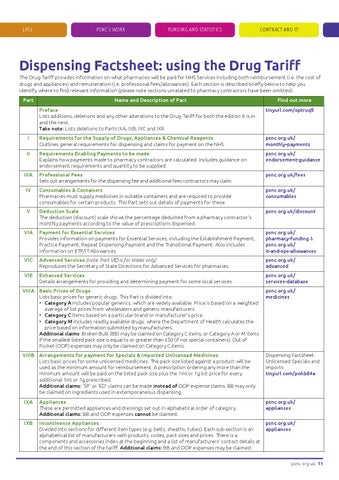
Dispensing Factsheet: using the Drug Tariff The Drug Tariff provides information on what pharmacies will be paid for NHS Services including both reimbursement (i.e. the cost of drugs and appliances) and remuneration (i.e. professional fees/allowances). Each section is described briefly below to help you identify where to find relevant information (please note sections unrelated to pharmacy contractors have been omitted). Part
Name and Description of Part
Find out more
Preface Lists additions, deletions and any other alterations to the Drug Tariff for both the edition it is in and the next. Take note: Lists deletions to Parts IXA, IXB, IXC and IXR.
tinyurl.com/optruq5
I
Requirements for the Supply of Drugs, Appliances & Chemical Reagents Outlines general requirements for dispensing and claims for payment on the NHS.
psnc.org.uk/ monthly-payments
II
Requirements Enabling Payments to be made Explains how payments made to pharmacy contractors are calculated. Includes guidance on endorsement requirements and quantity to be supplied.
psnc.org.uk/ endorsement-guidance
IIIA
Professional Fees Sets out arrangements for the dispensing fee and additional fees contractors may claim.
psnc.org.uk/fees
IV
Consumables & Containers Pharmacies must supply medicines in suitable containers and are required to provide consumables for certain products. This Part sets out details of payments for these.
psnc.org.uk/ consumables
V
Deduction Scale The deduction (discount) scale shows the percentage deducted from a pharmacy contractor’s monthly payments according to the value of prescriptions dispensed.
psnc.org.uk/discount
VIA
Payment for Essential Services Provides information on payments for Essential Services, including the Establishment Payment, Practice Payment, Repeat Dispensing Payment and the Transitional Payment. Also includes information on ETP/IT Allowances.
psnc.org.uk/ pharmacy-funding & psnc.org.uk/ it-and-eps-allowances
VIC
Advanced Services (note: Part VID is for Wales only) Reproduces the Secretary of State Directions for Advanced Services for pharmacies.
psnc.org.uk/ advanced
VIE
Enhanced Services Details arrangements for providing and determining payment for some local services.
psnc.org.uk/ services-database
VIIIA Basic Prices of Drugs Lists basic prices for generic drugs. This Part is divided into: • Category A includes popular generics, which are widely available. Price is based on a weighted average of list prices from wholesalers and generic manufacturers. • Category C items based on a particular brand or manufacturer’s price. • Category M includes readily available drugs, where the Department of Health calculates the price based on information submitted by manufacturers. Additional claims: Broken Bulk (BB) may be claimed on Category C items, or Category A or M items if the smallest listed pack size is equal to or greater than £50 (if not special containers). Out of Pocket (OOP) expenses may only be claimed on Category C items.
psnc.org.uk/ medicines
VIIIB Arrangements for payment for Specials & Imported Unlicensed Medicines Lists basic prices for some unlicensed medicines. The pack size listed against a product will be used as the minimum amount for reimbursement. A prescription ordering any more than the minimum amount will be paid on the listed pack size plus the 1ml or 1g list price for every additional 1ml or 1g prescribed. Additional claims: ‘SP’ or ‘ED’ claims can be made instead of OOP expense claims. BB may only be claimed on ingredients used in extemporaneous dispensing.
Dispensing Factsheet: Unlicensed Specials and Imports tinyurl.com/pokb84a
IXA
Appliances These are permitted appliances and dressings set out in alphabetical order of category. Additional claims: BB and OOP expenses cannot be claimed.
psnc.org.uk/ appliances
IXB
Incontinence Appliances Divided into sections for different item types (e.g. belts, sheaths, tubes). Each sub-section is an alphabetical list of manufacturers with products, codes, pack sizes and prices. There is a components and accessories index at the beginning and a list of manufacturers’ contact details at the end of this section of the tariff. Additional claims: BB and OOP expenses may be claimed.
psnc.org.uk/ appliances
psnc.org.uk 11
Dispensing anD supply
Part
services anD commissioning
the healthcare lanDscape
Name and Description of Part
Find out more
IXC
Stoma Appliances Has a similar layout to the Incontinence Appliances section. Also includes an index and manufacturers’ contact details. Additional claims: BB and OOP may be claimed.
psnc.org.uk /appliances
IXR
Chemical Reagents These are the only chemical reagents allowed on an NHS prescription. Only the pack sizes stated will be allowed. Additional claims: BB and OOP cannot be claimed.
psnc.org.uk /appliances
Home Oxygen Therapy Service Discusses the Home Oxygen Therapy Service, including details of suppliers.
See Part X of the Drug Tariff ppa.org.uk/ppa/ edt_intro.htm
XII
Essential Small Pharmacies Local Pharmaceutical Services (ESPLPS) Provides information on the Essential Small Pharmacies Scheme. Although the scheme continues in Wales, it ceased in England on 31st March 2006 and was replaced by a standard LPS Contract.
psnc.org.uk /esplps
XIII
Payments in respect of Pre-Registration Trainees Outlines the grant payable to contractors training pharmacy graduates.
psnc.org.uk/prereg
X
XIVA Reward Scheme – Fraudulent Prescription forms Details the reward paid when a pharmacy correctly identifies a fraudulent prescription.
nhsbsa.nhs.uk/ protect
XIVB Arrangements for Contractors Concerning Prescription Pricing Errors Explains how pharmacy contractors can request a pricing recheck for one or more of their prescription bundles.
psnc.org.uk/recheck
XIVC Devolving the Global Sum – Temporary Safeguarding Payments Provides information on temporary safeguarding of payments made to protect pharmacy contractors from prescription volume changes beyond their control.
psnc.org.uk/ temporarysafeguarding-payments/
XV
Borderline Substances Sets out the foods and toiletry preparations which may be regarded as drugs. List A is an alphabetical index of accepted products and List B is an alphabetical index of conditions and those products suitable for the conditions.
psnc.org.uk/ medicines
XVI
Notes on Charges Covers prescription charges, exemptions and examples of the application of charges. Also includes instructions on the Prescription Charge Refund Procedure.
psnc.org.uk/charges
XVIIA Dental Prescribing The Dental Prescribing Formulary is the list of substances permitted on Form FP10D. Although products are listed generically, a product may be ordered by brand name providing that the brand is not listed in Part XVIIIA of the Drug Tariff (the ‘blacklist’).
psnc.org.uk/ prescribing
XVIIB (i) Nurse Prescribers’ Formulary for Community Practitioners Community Practitioner Nurse Prescribers are only entitled to prescribe medicines from this list or appliances from Part IX of the Drug Tariff. (ii) Nurse, Pharmacist, Optometrists, Physiotherapists and Chiropodists Independent Prescribing Details on what each Independent Prescriber is able to prescribe.
psnc.org.uk/ prescribing
XVIIC National out-of-hours formulary Sets out the minimum list of drugs that patients should be able to access; exact mechanisms for the provision of these drugs are decided locally.
Speak to your LPC psnc.org.uk/lpcs
XVIIIA Drugs not to be ordered under a GMS Contract Commonly known as the ‘blacklist’. Items listed are not permitted on NHS prescription.
psnc.org.uk/ medicines
XVIIIB Drugs that may be ordered only in certain circumstances The Selected List Scheme lists items that may only be prescribed under certain conditions. Prescriptions must be marked ‘SLS’ by the prescriber. Please note there are separate lists for English and Welsh prescribers to follow.
Dispensing and Supply Factsheet: Is This Item Allowed? tinyurl.com/o6y7ag6
XVIIIC Criteria notified under the Transparency Directive Outlines criteria originally used in selecting products for inclusion in the Blacklist/ Selected List.
psnc.org.uk/ medicines
XIX
Payments to Chemists Suspended by the NHS Commissioning Board Details payments to chemists suspended by NHS England or under the direction of the NHS FirstTier Tribunal.
See Part X Electronic Drug Tariff ppa.org.uk/ppa/ edt_intro.htm
XX
Requisitions and Private Prescriptions for Controlled Drugs Outlines legal requirements for controlled drug requisitions and private prescriptions.
psnc.org.uk/cdforms
For the online version of the Drug Tariff, please visit: psnc.org.uk/dt