FALL 2020 | VOL 25 | NO 1
How Do We Get More People to Talk About Race? PAGE 36
Did I Make the Right Decision Majoring in Psychology? PAGE 22
Graduate Education in Contemporary Society PAGE 26
CONTENTS –––––––––––––––––––––––––––––––––––––––––––––––––––––––––––––––––––––––––––––––––––––––––––––––––––––––––––––––––––––––––––––––––––––––––––––––––––––––––––––––––––––––––––––––––––––––––––––––––––––––––––––––––––––––––––––––––––––––––––––––––––––––––––––––––––––––––––––––––––––––––––
WWW.PSICHI.ORG FALL 2020 | VOLUME 25 | NUMBER 1 EDITOR
Susan Iles susan.iles@psichi.org
Features
EDITORIAL ASSISTANT
Bradley Cannon bradley.cannon@psichi.org DESIGNER
Taylor Brown-Stone taylor.stone@psichi.org Published by Psi Chi, the International Honor Society in Psychology. Founded September 4, 1929, at the Ninth International Congress of Psychology, Yale University, New Haven, Connecticut. Member of the Association of College Honor Societies. Eye on Psi Chi, ISSN 1092-0803 (print) and ISSN 2164-9812 (online), is published quarterly by Psi Chi, the International Honor Society in Psychology. All contents ©2020 by Psi Chi. The publication schedule follows the academic year: fall, winter, spring, and summer. All opinions expressed in signed articles are those of the author(s) and do not necessarily reflect those of the editors and/or Psi Chi. EDITORIAL OFFICE:
Psi Chi Central Office Street Address: 651 East 4th St., Suite 600 | Chattanooga, TN 37403 Telephone: +1-423-756-2044 | Fax: +1-423-265-1529 Email: psichieye@psichi.org | Website: www.psichi.org Permission must be obtained from Psi Chi to reprint or adapt a table or figure; to reprint quotations exceeding the limits of fair use from one source, and/or to reprint any portion of poetry, prose, or song lyrics. All persons wishing to utilize any of the above materials must write to the publisher to request nonexclusive world rights in all languages to use copyrighted material in the present article and in future print and nonprint editions. All persons wishing to utilize any of the above materials are responsible for obtaining proper permission from copyright owners and are liable for any and all licensing fees required. All persons wishing to utilize any of the above materials must include copies of all permissions and credit lines with the article submission. Advertisements that appear in Eye on Psi Chi do not represent endorsement by Psi Chi of the advertiser or the product. Psi Chi neither endorses nor is responsible for the content of third-party promotions. PSI CHI Board of Directors SOCIETY PRESIDENT
Deborah Harris O'Brien, PhD presidentelect@psichi.org PAST-PRESIDENT
Regan A. R. Gurung , PhD presidentelect@psichi.org PRESIDENT-ELECT
Ngoc H. Bui, PhD presidentelect@psichi.org EASTERN REGIONAL VICE-PRESIDENT
Marianne Fallon, PhD easternvp@psichi.org
MIDWESTERN REGIONAL VICE-PRESIDENT
Lindsey Root Luna, PhD midwesternvp@psichi.org
ROCKY MOUNTAIN REGIONAL VICE-PRESIDENT
Leslie D. Cramblet Alvarez, PhD rockymtnvp@psichi.org
SOUTHEASTERN REGIONAL VICE-PRESIDENT
Darren Bernal, PhD southeasternvp@psichi.org
SOUTHWESTERN REGIONAL VICE-PRESIDENT
Lisa Rosen, PhD southwesternvp@psichi.org
WESTERN REGIONAL VICE-PRESIDENT
Jill Yamashita, PhD westernvp@psichi.org EXECUTIVE DIRECTOR
Martha S. Zlokovich, PhD martha.zlokovich@psichi.org
36 . DISTINGUISHED LECTURER
How Do We Get More People to Talk About Race? An Interview With Beverly Daniel Tatum, PhD Bradley Cannon and Beverly Daniel Tatum, PhD 22 . FIELDS OF PSYCHOLOGY
Did I Make the Right Decision by Majoring in Psychology? Part 1: Pros and Cons of Choosing Psychology David E. Copeland, PhD, and Jeremy Ashton Houska, PhD 26 . GRADUATE SCHOOL
Graduate Education in Contemporary Society Traditional and Distance Education Options and Opportunities Tony Crespi, EdD, AbPP, and Michael Amico, PhD 32 . PERSONAL GROWTH
Building Bridges of Understanding and Respect The Country Needs What You Have to Offer Keith Allred, PhD, and Patrick Boduch 42 . DISTINGUISHED LECTURER
ABBREVIATIONS APA APS EPA MPA NEPA RMPA SEPA SWPA WPA
American Psychological Association Association for Psychological Science Eastern Psychological Association Midwestern Psychological Association New England Psychological Association Rocky Mountain Psychological Association Southeastern Psychological Association Southwestern Psychological Association Western Psychological Association
2
EYE ON PSI CHI FALL 2020
A Problem in the Study of Psychology, An Interview With Antonio Puente, PhD Bradley Cannon
COPYRIGHT © 2020 PSI CHI
����������������������������������������������������������������������������������������������������������������������������������������������������������������������������������������������������������������������������������������������������������������������������������������� CONTENTS
Columns
Departments
06 . PSYCHOLOGY IN THE HEADLINES
04
President's Message
05
Psi Chi Board of Directors
10
Psi Chi Central Office
46
Chapter Activities
I'm Not Even Going to Try and Guess Where We Are Right Now Shawn R. Charlton, PhD 11 . CONTEMPORARY PSYCHOLOGY
Quantitative Psychology Using Numbers to Bring Order Out of Chaos! Ethan A. McMahan, PhD 14 . THREE HEADS ARE BETTER THAN ONE
Questions (and Answers) About Your First Semester in Graduate School R. Eric Landrum, PhD; Scott VanderStoep, PhD; and Mitchell M. Handelsman, PhD 18 . CAREER ADVICE
Wisdom From the Workplace A Data-Driven Context for Baccalaureate Psychology Graduates
Advertisements 13
APA Grad Study
13 PSYCAS 16
Psi Chi Webinars
17
Alliant International University
20
APA Publishing
20
West Liberty University
21
Psi Chi eBook
25
Psi Chi Learning Resources
58
Psi Chi Store
Paul Hettich, PhD
10 . PSI CHI CENTRAL OFFICE
46 . CHAPTER ACTIVITIES
Psi Chi COVID-19 Member Support Fund
Psi Chi Chapters Remain Social While Distancing
Cynthia Wilson, MPA, CFRE
New Jersey City University
COPYRIGHT © 2020 PSI CHI
FALL 2020 EYE ON PSI CHI
3
PRESIDENT'S MESSAGE –––––––––––––––––––––––––––––––––––––––––––––––––––––––––––––––––––––––––––––––––––––––––––––––––––––––––––––––––––––––––––––––––––––––––––––––––––––––––––––––––––––––––––––––––––––––––––––––––––––––––––––––––––––––––––––––––––––––––––––––––––––––––––––––––––
Psychological Science: We Have Answers Deborah Harris O'Brien, PhD Psi Chi President
“We are now faced with the fact that tomorrow is today. We are confronted with the fierce urgency of now . . . This is no time for apathy or complacency. This is a time for vigorous and positive action.” Martin Luther King, Jr.
A
lthough these words were written more than 50 years ago, they apply to 2020. This has been a year of tremendous challenges for everyone. We have been forced to confront uncomfortable situations in every aspect of our lives. We have a pandemic the nature of which the world has not experienced for more than 100 years. The political turmoil of this year has been nearly unprecedented. The inequalities and injustices of America’s past and present can no longer be swept under the rug. Although the racial injustices have been all too clear to people of color, Whites in the United States are starting to grasp the magnitude of the problem. Because this is an extremely stressful time, psychology is needed more than ever. For my Presidential year, I have chosen the theme “Psychological Science: We Have Answers” as a call to action for all of us in the field of psychology—whether faculty, students, practitioners or others associated with psychology. This theme was chosen to build upon the initiatives Psi Chi has undertaken during the tenure of several past presidents of the Society. Three years ago, President Eric Landrum concentrated on “Help Helped Me” to destigmatize help-seeking behaviors; the following year, President Melanie Domenech Rodríguez centered the Society on diversity. This past year, President Regan Gurung began “#PsychEverywhere” to direct attention to the place of psychology in all people’s everyday lives. We are continuing these important ideas and concentrating on psychology as a “hub” science (Cacioppo, 2007) with a vast accumulation of empirical research that can help the world
4
EYE ON PSI CHI FALL 2020
understand why the situations we are dealing with arose and how human behavior can be changed to benefit all. Psi Chi is proud of our discipline and the knowledge it holds, and we hope to, in the words of APA President George Miller, “give psychology away” (Miller, 1969). As the COVID-19 pandemic continues, we have all seen our lives fundamentally changed. Some of us are once again teaching and learning online instead of being physically present on our campuses. What can psychological science tell us about why this virus continues to spread? Psychology tells us that, in addition to the biological forces at work, human behavior impacts how widespread COVID-19 is among communities. • Research by Sailer and colleagues (2020) on the correlates of individuals’ behaviors in response to the pandemic found that the two biggest factors related to people heeding guidance from public health is whether they have scientific knowledge and their trust of medical professionals. • Jordan et al. (2020) also looked at COVID-19 prevention messages to determine what type of message is most likely to be followed by the public. They found that perceived public threat of coronavirus predicted intentions to use preventive measures more strongly than the perceived personal threat. • Using this along with knowledge from studies of altruism and prosocial behavior (see, for example, Stocks et al., 2008), psychologists can collaborate with public health efforts to most effectively increase prevention of the virus in the community.
COPYRIGHT © 2020 PSI CHI
����������������������������������������������������������������������������������������������������������������������������������������������������������������������������������������������������������������������������������������������������������������� PRESIDENT'S MESSAGE
Just as psychology can help change behavior in response to coronavirus, psychological science leads the social sciences in understanding prejudice, discrimination, bias and intergroup relationships which can help address issues of racial injustice and inequality. Psychologist Jennifer Eberhardt, in her recent book Biased (2019), synthesizes past and current research on the psychological associations between race and crime. Among her research’s findings: African Americans are often dehumanized which leads to violent treatment by law enforcement, police were more likely to identify Black faces as criminal than White faces, and defendants who appeared more stereotypically Black received harsher sentences. Dr. Eberhardt is working with law enforcement to improve policing and build trust within communities, as well as merging technology with concepts from social psychology to improve the criminal justice system. One thing we know is that racism cannot be eradicated just through changing individuals’ biases; institutional and cultural processes must also be changed. As Psi Chi members, you can become involved in transforming your own campus to eliminate monuments to white supremacy, encourage greater diversity of faculty and students, and provide information from psychological science to help those outside our field understand social inequality and its consequences. At an individual level, we know from psychological science that positive contact with others as well as cooperation between groups for a common goal can change biased attitudes and behaviors. Remember the classic “Robbers’ Cave” (Sherif et al., 1961) experiment you learned about in Introductory Psychology? What can you do on your campus and within your network to encourage contact and cooperation between members of diverse groups? In the social sciences in general there is a “last mile” problem; research findings can point to solutions for real life situations, but there is a gap between research and implementation. Psychology IS everywhere, and psychological science DOES have answers. Please join me and Psi Chi to spread our knowledge and help both institutions and individuals use that knowledge to change the world. In the year 2020, we must find ways to meet “the fierce urgency of now.”
References Cacioppo, J. T. (2007, September). Psychology is a hub science. APS Observer, 20(8), 42. Eberhardt, J. L. (2019). Biased: Uncovering the hidden prejudice that shapes what we see, think, and do. Penguin Books. Jordan, J. J., Yoeli, E., & Rand, D. G. (2020, April 3). Don’t get it or don’t spread it? Comparing self-interested versus prosocially framed COVID-19 prevention messaging. https://doi.org/10.31234/osf.io/yuq7x King, M. L. (2001). Beyond Vietnam: A time to break silence. In C. Carson & K. Shepard (Eds), A call to conscience: The landmark speeches of Dr. Martin Luther King, Jr. Grand Central Publishing. Miller, G. A. (1969). Psychology as a means of promoting human welfare. American Psychologist, 24(12), 1063–1075. https://doi.org/10.1037/h0028988 Sailer, M., Stadler, M., Botes, E., Fischer, F., & Greiff, S. (2020, April 9). Science knowledge and trust in medicine affect individuals’ behavior in pandemic crises. https://doi.org/10.31234/osf.io/tmu8f Sherif, M., Harvey, O. J., White, B. J., Hood, W. R., & Sherif, C. W. (1961). Intergroup conflict and cooperation: The Robbers Cave experiment. University Book Exchange. Stocks, E. L., Lishner, D. A., & Decker, S. K. (2008). Altruism or psychological escape: Why does empathy promote prosocial behavior? European Journal of Social Psychology, 39(5), 649–665. https://doi.org/10.1002/ejsp.561
COPYRIGHT © 2020 PSI CHI
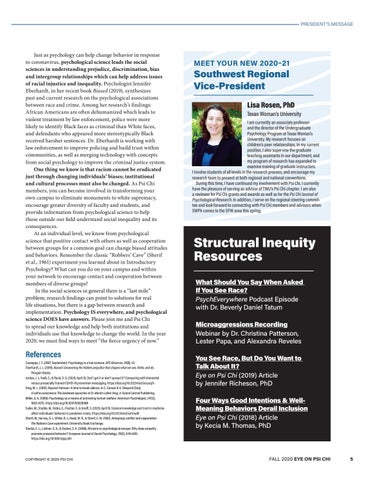
MEET YOUR NEW 2020–21
Southwest Regional Vice-President
Lisa Rosen, PhD Texas Woman's University I am currently an associate professor and the director of the Undergraduate Psychology Program at Texas Woman's University. My research focuses on children’s peer relationships. In my current position, I also supervise the graduate teaching assistants in our department, and my program of research has expanded to examine training of graduate instructors. I involve students of all levels in the research process, and encourage my research team to present at both regional and national conventions. During this time, I have continued my involvement with Psi Chi. I currently have the pleasure of serving as advisor of TWU’s Psi Chi chapter. I am also a reviewer for Psi Chi grants and awards as well as for the Psi Chi Journal of Psychological Research. In addition, I serve on the regional steering committee and look forward to connecting with Psi Chi members and advisors when SWPA comes to the DFW area this spring.
Structural Inequity Resources What Should You Say When Asked If You See Race? PsychEverywhere Podcast Episode with Dr. Beverly Daniel Tatum Microaggressions Recording Webinar by Dr. Christina Patterson, Lester Papa, and Alexandra Reveles You See Race, But Do You Want to Talk About It? Eye on Psi Chi (2019) Article by Jennifer Richeson, PhD Four Ways Good Intentions & WellMeaning Behaviors Derail Inclusion Eye on Psi Chi (2018) Article by Kecia M. Thomas, PhD
FALL 2020 EYE ON PSI CHI
5
PSYCHOLOGY IN THE HEADLINES ––––––––––––––––––––––––––––––––––––––––––––––––––––––––––––––––––––––––––––––––––––––––––––––––––––––––––––––––––––––––––––––––––––––––––––––––––––––––––––––––––––––––––––––––––––––––––––––––––––––––––––––––––––––––––––––––––––––––––––––––
Psychology in the Headlines
I'm Not Even Going to Try to Guess Where We Are Right Now Shawn R. Charlton, PhD University of Central Arkansas
T
RECURRING CONTRIBUTORS:
Bradley Cannon Psi Chi Central Office
he summer Psychology in the Headlines column required a rewrite between completion and publication. My original column included a headline about uncertainty and the stock market that referenced worries about a new virus in Asia, COVID-19. By the time that column was published, COVID had pushed the world into a pandemic that disrupted lives across the globe. At the suggestion of the Eye on Psi Chi editors, I adjusted the column to acknowledge the magnitude of COVID-19’s impact. After making that change, I began outlining the fall column as a retrospective on life after the pandemic. Unfortunately, just as I underestimated the spread of COVID-19 back in March, I—like so many others—underestimated its duration. Never did I imagine that we would still be struggling with this pandemic when I wrote the fall column in July. Of course, COVID-19 was not the only unanticipated event between March and July 2020. As if the occurrence of an extended
6
EYE ON PSI CHI FALL 2020
Seungyeon Lee, PhD University of Arkansas, Monticello
global pandemic—with its economic, personal, physical, and psychological costs—were not enough uncertainty, a renewed reckoning of the struggles of our past began with the death of George Floyd on May 25, 2020. The United States and countries across the globe erupted in protests over racial and social inequalities, police tactics, and how to interpret and represent our past. Tensions, traumas, and troubles that had gone unaddressed for far too long were suddenly unignorable. As I write this column, health, economic, political, and social uncertainty is the norm. So, where will we be when this column publishes in the fall? Well, given the uncertainty of the past four months, I choose not to make any guesses in this column. However, I will say that no matter where we are, I hope we are more accepting of the many different experiences that make up each person’s story, evaluating the origins and biases in our perspectives, and critically examining the information that constantly bombards us.
COPYRIGHT © 2020 PSI CHI
Photo Credit: iStockphoto.com/ Olha Khorimarko
SECTION EDITOR:
���������������������������������������������������������������������������������������������������������������������������������������������������������������������������������������������������������������������������������������������� PSYCHOLOGY IN THE HEADLINES
Psychology in the Headlines So, given the uncertainty of our current situation, what news should we review in this column? Although the goal of this column is to highlight new findings, events, and advances in psychology, our first headline focuses on the role of psychology in the headlines. Creating titles that capture the reader’s attention is essential to any written work (something I was very aware of as I considered how to title this column). The sheer quantity of information delivered to consumers at any given moment increases the importance of short, catchy headlines (check out this article from Entrepreneur for some ideas on how this is accomplished: https://www.entrepreneur. com/article/345700). A recent study demonstrated the influence of headlines:
Photo Credit: iStockphoto.com/ CSA-Archive, iStockphoto.com/ Jayesh
Thomas J. Smelter and Dustin P. Calvillo (2020) of California State University, San Marcos, reported four experiments demonstrating the impact of headline characteristics (i.e., pictures, exposure, and perceptual clarity) on judgments of accuracy. Participants correctly identified correct headlines over false but showed differences in accuracy based on the presentation of the headline. Smelter and Calvillo stated, “According to a common notion suggesting that humans are completely rational beings, we should therefore be able to make objective decisions based on reading news headlines, free from influences such as visual stimuli, perceptual clarity, and repeated exposure. However, our results suggest that visual information (i.e., images) and repeated exposure have a pervasive effect on accuracy judgments of headlines…” (pg. 9) Smelter and Calvillo’s work is a continuation of previous studies that have identified the impact of headlines on the processing of information contained in the articles (see Ecker et al., 2014, for another excellent example of this kind of research). As advocates of psychological science, we should be extra aware of the need for critical thinking and the degree to which the presentation and context of an argument influence our interpretation.
COPYRIGHT © 2020 PSI CHI
Psychology Organizations in the United States Address Racism The deaths of Ahmoud Arbery, Breonna Taylor, George Floyd, and Trayvon Martin reignited social equality, justice, and reform conversations in the United States and throughout the world. Psychology is critical to understanding the cause, origin, and solution to these challenges. Evaluating the response of major psychological organizations to racism and social inequality both clarifies the role of psychology and where we stand as a scientific discipline and practice. A complete listing of reactions is not possible, so I include below a sampling of 10 responses. These samples were selected based primarily on my familiarity with the sponsoring organizations: • The American Psychological Association’s (APA) action plan for addressing inequality • The Association for Psychological Science’s statement on confronting racism and discrimination • Psi Chi's response to structural inequity • The Association of Black Psychologist’s official statement • The National Latinx Psychological Association statement on racism • The Society for Personality and Social Psychology statement against racism • The Society for Industrial/Organizational Psychology’s statement against racism • School Psychology unified anti-racism statement and call to action • American Counseling Association’s statements and resources on racism • Association for Behavior Analysis, International’s commitment to equity I have read these responses and letters several times. I am impressed by both the clarity and solidarity present in the psychological communities’ response to racism and inequality. As highlighted by these statements, psychological tendencies are involved in our social challenges, and psychological science/practice can help solve them. FALL 2020 EYE ON PSI CHI
7
PSYCHOLOGY IN THE HEADLINES ––––––––––––––––––––––––––––––––––––––––––––––––––––––––––––––––––––––––––––––––––––––––––––––––––––––––––––––––––––––––––––––––––––––––––––––––––––––––––––––––––––––––––––––––––––––––––––––––––––––––––––––––––––––––––––––––––––––––––––––––
As adults, we often find it difficult to talk about racism and other forms of social inequalities. A further challenge is deciding when to begin communicating with children about these topics. Psychological research can provide insights on this topic, as suggested by the following headline: Living with a pandemic takes an emotional toll on everyone. Racism and related issues have also been a growing concern, but how adults explain this to young children can be difficult. Studies suggest that racial understanding starts at five years, with developmental milestones. Sangrigoli and de Schonen (2004) found that babies recognize faces that match theirs by three months, although no difference was seen in recognizing their own vs. other races. By two, children use race to identify human behavior (Hirschfeld, 2008); by five, they can acquire racial bias, as taught by primary caregivers and families (Kinzler, 2016). According to some studies, this is not too young to discuss race. Caregivers also play an essential role in creating unbiased attitudes, while our social skills can mitigate self-quarantine and become intrinsically rewarding. Caregivers and communities are responsible for deciding when and how we address racism with children. Psychological science can help inform the timing and content of these conversations.
Submit to This Series 8
EYE ON PSI CHI FALL 2020
U.S. Survey on the Mental Health Impact of COVID-19 As I stated in the introduction to this column, I am uncertain what the world-wide state of COVID-19 will be when this column publishes. However, I am confident that we will be just beginning to explore the significant and long-term mental health impact of the pandemic. Some of this research has already begun. For example: An online study (Palsson, 2020) conducted by researchers at the UNC School of Medicine and Harvard School of Medicine was recently released directly to the public about the mental impact of COVID-19. Of 1,500 participants surveyed in May, women and men reported similar levels of worry. Older adults tended to worry less than younger people. Among ethnic groups, the Hispanic population seemed to be most impacted emotionally (University of North Carolina, 2020). Health psychologists such as Dr. Ruth Hackett (2020) suggest evidence-based tips for maintaining mental health fitness while social distancing such as (a) establishing home-work boundaries, (b) making time for relaxation, and (c) focusing on the positive. Mental health researchers and providers—including psychologists and counselors—will play an essential role in addressing the consequences of COVID-19. The American Psychological Association has collected articles that help provide additional context on the role of psychology in understanding COVID-19 and its impact (https://www.apa.org/pubs/highlights/covid-19-articles).
Do you know about a major contemporary event related to one of the many areas of psychology?
Share it with us for potential publication in this series! Recurring Contributors are also wanted. For full submission guidelines, visit www.psichi.org/page/PsychologyInTheHeadlines
COPYRIGHT © 2020 PSI CHI
Photo Credit: iStockphoto.com/ monkeybusinessimages, iStockphoto.com/ Tempura
Teaching Children About Race
���������������������������������������������������������������������������������������������������������������������������������������������������������������������������������������������������������������������������������������������� PSYCHOLOGY IN THE HEADLINES
Cognitive Dissonance and the Pandemic Over the past several months we have observed the full spectrum of social, emotional, and psychological reactions to the pandemic. From an academic perspective—which has been difficult to maintain with the strength of my own reactions—it has been an absolutely fascinating time to be an observer of human behavior. An article in The Atlantic explained how we can understand these reactions through cognitive dissonance:
The Educational Impact of COVID-19 As stated previously, we will not understand the social, physical, mental, and psychological impact of COVID-19 for decades. Neither will we be able to understand the full extent of the educational effects. In May 2020, Tori DeAngelis wrote an APA Monitor article exploring some of the immediate educational impacts for psychology graduate students: DeAngelis (2020) identified several challenges for psychology graduate students in the United States, including transitioning to online classwork, continuing research, completing internship requirements, and communicating with classmates and faculty. Social distancing requirements forced students to switch to online communication tools, such as Zoom, for learning, working, and connecting. DeAngelis describes the experience of Zarina Giannone as “a fourth-year PhD candidate in the University of British Columbia (UBC) counseling psychology program. During the first month of the pandemic, she faced the possibility of not being able to meet her internship requirements in time to graduate (a worry eventually addressed by her internship site). Now, she wonders how her job prospects will be affected by the fallout.”
Photo Credit: iStockphoto.com/ solarseven
Zarina Giannone’s worries are very representative of the concerns experienced by students (at all levels) across the globe over the past months. The global response to COVID-19 forced students and faculty into online teaching/learning, forced changes in the graduate school application process (such as the GRE Online: https://www.ets.org/s/cv/ gre/institutions/update/), and how we conduct psychological research and internships. We have yet to fully appreciate the degree to which these changes will become permanent features of the educational experience.
Shawn R. Charlton, PhD, earned a BA degree from Utah State University (2001) and a MS and PhD from the University of California, San Diego (2006). His research interests explore decision-making in a variety of contexts. Research on professional development in higher education is a growing emphasis for his Behavioral and Social Decisions Laboratory.
COPYRIGHT © 2020 PSI CHI
Elliot Aronson and Carol Tavris, pioneers in the study of cognitive dissonance and authors of Mistakes Were Made (But Not by Me), explain that dissonance—emotional distress caused by conflicting attitudes, behaviors, and cognitions—can be a motivator in people’s reactions toward the pandemic. Motivations to reduce dissonance may result in increased support for authority figures, limiting exposure to opposing ideas, and creating cognitive justifications. In contrast to these reactions, Aronson and Tavris recommend we address dissonance by asking, “Why am I believing this? Why am I behaving this way? Have I thought it through or am I simply taking a short cut, following the party line, or justifying the effort I put in to join the group?” (emphasis in original). A large portion of the world’s population has been directly impacted by changes in how we interact with each other triggered by COVID-19. As we look to psychology to understand the impact of these changes on individual behavior, we better understand the conflict and distress that we are experiencing in our communities, nations, and across the globe.
Final Thoughts As I conclude this installment of Psychology in the Headlines, I continue to encourage you to send me highlights from your area of psychology. My choice of topics reflects what I see from where I stand. There are ideas, perspectives, and work that deserve to be highlighted as headlines but are outside my sight. I encourage you to help me address this! Please review the guidelines below and send me reflections on what you see from your perspective.
References Aronson, E., & Tavris, C. (2020, July 12). The role of cognitive dissonance in the pandemic. The Atlantic. https:// www.theatlantic.com/ideas/archive/2020/07/role-cognitive-dissonance-pandemic/614074/ DeAngelis, T. (2020, May). Grad students navigate the unknown. Monitor on Psychology, 51(4). http://www.apa.org/ monitor/2020/06/covid-grad-students Ecker, U. K. H., Lewandowsky, S., Chang, E. P., & Pillai, R. (2014). The effects of subtle misinformation in news headlines. Journal of Experimental Psychology: Applied, 20(4), 323–335. https://doi.org/10.1037/xap0000028 Hackett, R. (2020, July 2). A health psychologist’s guide to working from home. The Guardian. https:// www.theguardian.com/guardian-masterclasses/guardian-masterclass-blog/2020/jul/02/a-healthpsychologists-guide-to-working-from-home-dr-ruth-hackett-psychology-wellbeing-blog Hirschfeld, L. A. (2008). Children’s developing conceptions of race. In S. M. Quintana & C. McKown (Eds.), Handbook of race, racism, and developing child (p. 37–54). John Wiley & Sons, Inc. Kinzler, K. D. (2016, October 21). How kids learn prejudice. The New York Times. https://www.nytimes. com/2016/10/23/opinion/sunday/how-kids-learn-prejudice.html Palsson, O. S., Ballou, S., & Gray, S. (2020). The U.S. National Pandemic Emotional Impact Report. https://www. pandemicimpactreport.com/report/PalssonBallouGray_2020_PandemicImpactReport.pdf Sangrigoli, S., & de Sconen, S. (2004). Recognition of own-race and other-race faces by three-month-old infants. Journal of Child Psychology and Psychiatry, 45(7), 1219–1227. https://doi.org/10.1111/j.1469-7610.2004.00319.x Smelter, T. J., & Calvillo, D. P. (2020). Pictures and Repeated Exposure Increase Perceived Accuracy of News Headlines. Applied Cognitive Psychology, 2020, 1–11. https://doi.org/10.1002/acp.3684 University of North Carolina School of Medicine. (2020, June 26). UNC research leads national survey on mental health impact of COVID-19 pandemic. News(wise). https://www.newswise.com/coronavirus/ unc-researcher-leads-national-survey-on-mental-health-impact-of-covid-19-pandemic/?article_id=733819
FALL 2020 EYE ON PSI CHI
9
PSI CHI CENTRAL OFFICE –––––––––––––––––––––––––––––––––––––––––––––––––––––––––––––––––––––––––––––––––––––––––––––––––––––––––––––––––––––––––––––––––––––––––––––––––––––––––––––––––––––––––––––––––––––––––––––––––––––––––––––––––––––––––––––––––––––––––––––––––––––––––––––––––
Cynthia Wilson, MPA, CFRE Psi Chi Central Office
10
EYE ON PSI CHI FALL 2020
That means that we are an extremely strong Society as our members too are dedicated to excellence. It is times like these that try even the most dedicated students. Therefore, Psi Chi hopes that, via its Member Support Fund, we can make things just a little easier for students who are faced with mounting challenges. As a reminder to all members: • Psi Chi membership is a lifetime one. • Whether you are an undergraduate student, a graduate student, faculty of psychology, or an alumni member, you are eligible for Psi Chi’s awards, grants, and scholarships. • Our Career Center is something that is always available to aid members who are looking for work in their field. • Our online Store is a great place to find your favorite Psi Chi memorabilia while supporting the Society. • And, there are many research opportunities available to members. All this information can be found at www.psichi.org. In the initial phase of the pandemic, there was only time to react, but now, we are faced with being proactive during a time in which it is difficult to plan for next week, let alone next year. However, the Society is moving forward with plans for a Fall Membership Drive and Chapter Challenge. The Chapter Challenge is a peer-to-peer fundraising campaign as part of which students fundraise on behalf of Psi Chi. This year, proceeds will benefit our Psi Chi COVID-19 Member Support Fund. I am excited to share that this year, in fall 2020, Psi Chi will split the proceeds of funds raised with each chapter 50/50; meaning, if your chapter raises $1,000 together as a team, then we’ll send you a check back for $500 to benefit your local chapter. We feel that now, more than ever, is a time to give back. And, in the true spirit of excellence, we will give back so that local chapters can thrive. COVID-19 has presented some difficult and unusual circumstances. But at Psi Chi, we are continuing to work toward our mission. We hope to serve our members in every way possible. If you have ideas for how Psi Chi can do more to serve our members, please reach out to me directly at cynthia.wilson@psichi. org. I’d love to hear from you and learn about your chapter. Thank you for your devotion to excellence. All the best for a successful fall term. To give to the Psi Chi COVID-19 Member Support Fund, please visit: donate.psichi.org
COPYRIGHT © 2020 PSI CHI
Photo Credit: iStockphoto.com/ Smiljana Aleksic
I
t seems the only thing one can do in the face of a pandemic is react. During COVID-19, nothing prepared us for months of sheltering in place or distancing ourselves from others. Reacting was our only option. And, as many have stated: The only control we have is how we react to what life throws at us. How Psi Chi chose to react was important for both the present and the future of our Society. The Psi Chi Board of Directors acted swiftly in response to COVID-19. Their focus—our members. The Psi Chi COVID-19 Member Support Fund was enacted in late March. The response was a thoughtful one geared toward helping students who were negatively affected by COVID-19. Many students lost jobs and many more, after years of working toward a degree, found their commencements postponed or cancelled. The Psi Chi COVID-19 Member Support Fund is raising funds to support student members during these unusual times. The Psi Chi Board identified ways to support members. One was to provide some small way to celebrate the milestone of a graduation and that was to provide an honor cord free of charge to deserving students graduating in 2020. In line with our dedication to members, Psi Chi has agreed to match $25,000 when raised to put its complete support behind the Fund. It is our hope that all Psi Chi faculty advisors know they can take advantage of our Fund to benefit students. One other way was to help those students who were eligible to join but could not afford the cost of a Psi Chi lifetime membership to our Society. This is an opportunity to become a part of a unique population of students and professionals dedicated to excellence in psychology. And, it would afford them all the benefits associated with being a member of Psi Chi. Response thus far to our Member Support Fund has been modest. We have found that getting the word out about how to take advantage of our Psi Chi COVID-19 Member Support Fund is a challenge in and of itself given that so many faculty advisors are still working remotely. However, good news is that during the Psi Chi Summer Board Meeting, the Board members voted to continue the COVID-19 Member Support Fund through fall 2020. This will enable Psi Chi to continue to raise funds to directly help members and reach a broader audience of our members. It is important to point out that Psi Chi continues to dedicate itself to members. Our mission states that we both “recognize and promote excellence in the science and application of psychology.”
������������������������������������������������������������������������������������������������������������������������������������������������������������������������������������������������������������������������������������������������ CONTEMPORARY PSYCHOLOGY
Quantitative Psychology
Using Numbers to Bring Order Out of Chaos! Ethan McMahan, PhD Western Oregon University
Photo Credit: iStockphoto.com/ Vladyslav Bobuskyi
T
his world is a very complicated and confusing place. And, people are very complicated and confusing beings. To verify this, just carefully observe and attempt to understand the behavior of politicians in the United States. You will (or at least should) be completely befuddled. But, the complexity of human behavior is not only evident in the actions of seemingly power hungry “public servants” who elevate their own political interests above the needs of their constituents; everyone’s behavior is difficult to understand. This is because, at any one given time, there are numerous influences on our behavior. We are aware of some of these influences but unaware of many others. Moreover, these influences operate over time, such that both previous events and the anticipation of future conditions impact current behavior. Thus, one’s behavior is impacted by what has occurred in the past, current circumstances, and future conditions, with that behavior then eventually becoming past behavior, bringing about a new current reality that shapes our expectations of the future. This is the dynamic nature of human experience—more complex and confusing than a 19-sided Rubik’s “cube” with 32 different colors that constantly change based on your move. Although complicated, this is not, in a strict sense, chaos. Theoretically, if we could
COPYRIGHT © 2020 PSI CHI
understand and account for all the inputs, outputs, feedback loops, etc., in the system, we would understand and be able to predict human behavior. We are not there yet, but we do have a method that is moving us in that direction. What is that method, you ask? Get your groan ready—that method is math. I know what you are thinking: “I hate math.” You shouldn’t. You may find performing mathematical operations difficult, boring, frustrating, or whatever. But, math is perhaps an unrivalled route to understanding the complexity of our world. By using measurement, assigning conditions a numerical value, and then analyzing those values, we can (and have) answered some of the most knotty questions. This is the case in not only psychology, but all scientific fields. Yet, in psychology we have a unique challenge. First, and as noted above, humans are super-complex. Second, much of what we wish to measure, analyze, and ultimately understand is not directly observable (e.g., emotion, thought). So, the development and application of quantitative methods to study human thought and behavior can be quite challenging. Fortunately, there exists a field in psychology with experts who specialize in this sort of thing. That field is quantitative psychology, and that field is also the subject of this edition of Contemporary Psych! FALL 2020 EYE ON PSI CHI
11
CONTEMPORARY PSYCHOLOGY ––––––––––––––––––––––––––––––––––––––––––––––––––––––––––––––––––––––––––––––––––––––––––––––––––––––––––––––––––––––––––––––––––––––––––––––––––––––––––––––––––––––––––––––––––––––––––––––––––––––––––––––––––––––––––––––––––––––––––––––––––
If Math Is Boring, How About Some Math History? Quantitative psychology is a field of study that focuses on research methods and design, statistical analyses, and mathematical modeling of human psychological processes and behavior. The field has its roots in part in early experimental psychology. The list of significant early contributions to this field reads like a who’s who of foundational sensation and perception researchers with Weber, Helmholtz, and Fechner all developing specialized mathematical procedures to study their topics of interest. But, perhaps more influential were developments in psychometrics, a more specific but related field focused on the measurement of psychological processes. In the late 19th century, many researchers became preoccupied with measuring individual differences in psychological characteristics, such as personality traits and intelligence, and how variation in these characteristics might be related to other factors (e.g., physical characteristics, life outcomes). In the process, several major approaches to measurement and analysis were developed. Finally, development of various procedures and tests in the fields of statistics and quantitative analysis more broadly were adopted by psychologists, despite the fact that, at least initially, these procedures and tests were used for very different purposes. For example, did you know that our beloved t test was first developed to ensure the consistently high quality of Guinness beer? True story. Eventually, disparate efforts to better measure and analyze psychological processes (. . . and beer) coalesced into the field of quantitative psychology (see Byrne, 1996). As noted, this field focuses on the development of research methodologies, statistical procedures, and mathematical models that are applied specifically to better understanding human behavior. Through the efforts of early and contemporary quantitative psychologists, we now have a vast toolbox of methodological and analytic techniques that allow us to bring order out of seeming chaos, to make sense of people . . . who oftentimes seemingly make no sense.
Specializing in Things Nobody Else Understands One nice thing about being a quantitative psychologist: There is a good chance that only a few other people truly understand what you study. As a result, quantitative psychologists are often in high demand. In fact, not too long ago, the American Psychological Association (APA) organized a special task force to address a shortage of qualified quantitative psychologists in the United States (APA, 2009). Even though efforts to increase the number of quantitative psychologists have yielded promising results, most professional psychologists don’t have a firm understanding of not only cutting edge statistical procedures, but also the conventional concepts and procedures that have been used for decades. To see this for yourself, go ask a psychologist to explain what an analysis of variance is—not when to use it, but what it is. Chances are, you will not get a satisfactory answer; and by that, I mean the correct answer. Quantitative psychologists, while having a strong and broad understanding of math and statistics, typically focus on a specific area. For example, one quantitative psychologist
12
EYE ON PSI CHI FALL 2020
might focus on structural equation modeling, another might focus on meta-analytic procedures, and yet another on time series analysis. A psychometrics-oriented individual might focus on item response theory, and another on advancing computer adaptive testing. The specific types of quantitative analyses one is interested in might have a relatively narrow application, while others might apply more broadly to numerous situations. Regardless, as anyone who has ventured beyond the typical research designs prescribed by our undergraduatelevel research methods textbooks can attest to, having many options for analyzing data is highly advantageous. Quantitative psychologists explore and develop these options.
For Those Who Don’t Think Math Is Boring: Training and Careers For those who are interested in pursuing a future in this field, I have wonderful news. You can work pretty much anywhere. And, even better, those who have a strong background in quantitative analysis are in short supply, so there are many opportunities for those with the right training. Quantitative psychologists work at colleges and universities, private organizations, the government, businesses, and research firms, among other settings. So, how does one get into the field, you ask? Most professionals in this area hold master’s degrees and/ or PhDs. But, you can start your training as an undergraduate student. There are not many undergraduate majors dedicated specifically to quantitative psychology, but completing courses in psychology, mathematics, and other quantitatively oriented disciplines (e.g., economics, computer science) will provide ample preparation at this level. Additionally, many schools offer minors that are relevant to quantitative psychology, and working on research projects, either your own or as a research assistant, provides practical experience that many graduate programs are looking for. At the graduate level, students should specialize in quantitative methods and seek admittance to graduate programs that focus on quantitative methods. This is an interdisciplinary and varied field, so relevant graduate programs can be in different departments, emphasizing different aspects of the field. Many graduate programs are in psychology departments, as you might expect. But, quantitative methods are also used heavily in education, particularly those related to testing and psychometrics, and a program may thus be located in the college/department of education at a particular school. Moreover, many programs may be housed in mathematics and/ or statistics departments. The best way to gain admittance to these programs is to determine what area of quantitative analysis you are interested in and seek graduate programs that fit your interests. For example, if you are interested in computer adaptive testing, make sure you have a strong background in psychology, math, education, and computer science; seek graduate programs that focus in these areas, knowing that they might be housed in different departments (e.g., education, computer science; see Counsell et al., 2016). Once you have your degrees, you can do lots of different things—professionally speaking, that is. Of course, one can
COPYRIGHT © 2020 PSI CHI
��������������������������������������������������������������������������������������������������������������������������������������������������������������������������������������������������������������������������������������������������������������� CONTEMPORARY PSYCH
do research and teach quantitative methods at a university or college. But, you can also serve as a research specialist in both the public and private sectors. Quantitative psychologists often serve as consultants, providing feedback on existing research methods and developing new methods to address areas of interest. With expertise in psychometrics, many quantitative psychologists work for testing companies, such as Pearson, ECS, and the College Board. In short, with the appropriate training and background, there are many opportunities available to you.
The Appropriate Analysis Can Make Sense of Anything I hope the above (qualitative) analysis of quantitative psychology helps you understand this exciting field. For those who are not bored, who have not nodded off, and who are now quite interested in pursuing a career in quantitative psychology, I strongly encourage you to take a look at some of the additional resources provided below. For those who are still bored or have nodded off, wake up and get something to eat—perhaps a sandwich—no white bread. Until next time!
References American Psychological Association, Task Force for Increasing the Number of Quantitative Psychologists (2009). Report of the Task Force for Increasing the Number of Quantitative Psychologists: Final report. American Psychological Association. http://www.apa.org/research/tools/quantitative/quant-task-force-report.pdf Byrne, B. M. (1996). The status and role of quantitative methods in psychology: Past, present, and future perspectives. Canadian Psychology/Psychologie Canadienne, 37(2), 76–80. https://doi.org/10.1037/0708-5591.37.2.76 Counsell, A., Cribbie, R. A., & Harlow, L. L. (2016). Increasing literacy in quantitative methods: The key to the future of Canadian psychology. Canadian Psychology/Psychologie Canadienne, 57(2), 193–201. https://doi.org/10.1037/cap0000056
Ethan A. McMahan, PhD, is an associate professor in the Department of Psychological Sciences at Western Oregon University where he teaches courses in research methods, advanced research methods, and positive psychology. He is passionate about undergraduate education in psychology and has served Psi Chi members in several ways over the last few years, including as a faculty advisor, Psi Chi Western Region Steering Committee Member, Grants Chair, and most recently, as the Western Regional VicePresident of Psi Chi. His research interests focus on hedonic and eudaimonic approaches to well-being, folk conceptions of happiness, and the relationship between nature and human well-being. His recent work examines how exposure to immersive simulations of natural environments impact concurrent emotional state and, more broadly, how regular contact with natural environments may be one route by which individuals achieve optimal feeling and functioning. He has published in the Journal of Positive Psychology, the Journal of Happiness Studies, Personality and Individual Differences, and Ecopsychology, among other publications. He completed his undergraduate training at the University of Colorado at Colorado Springs and holds a PhD in experimental psychology from the University of Wyoming.
Additional Resources and Further Reading Division 5 of the American Psychological Association, Quantitative and Qualitative Methods. www.apa.org/about/division/div5 Psychometric Society. www.psychometricsociety.org Quantitative Psychology. American Psychological Association, Science in Action. www.apa.org/action/science/quantitative/ Society of Multivariate Experimental Psychology. www.smep.org/general-information/about-smep
ADVERTISEMENT
Make an
IMPACT. FIND THE PSYCHOLOGY GRADUATE PROGRAM THAT’S RIGHT FOR YOU. Finding the right graduate program to meet your goals is the first step toward a career in psychology. Search and compare nearly 1,600 graduate psychology programs at more than 400 schools in the United States and Canada with APA’s Graduate Study in Psychology.
READY TO APPLY TO GRAD SCHOOLS? PSYCAS centralizes and streamlines the grad school application process so you don’t have to spend hours filling out individual applications. Is your program of choice using PSYCAS?
Create a free account and start applying today. Subscribe today. gradstudy.apa.org
COPYRIGHT © 2020 PSI CHI
on.apa.org/joinpsycas
FALL 2020 EYE ON PSI CHI
13
THREE HEADS ARE BETTER THAN ONE –––––––––––––––––––––––––––––––––––––––––––––––––––––––––––––––––––––––––––––––––––––––––––––––––––––––––––––––––––––––––––––––––––––––––––––––––––––––––––––––––––––––––––––––––––––––––––––––––––––––––––––––––––––––––––––––––––––
Three Heads Are Better Than One
Questions (And Answers) About Your First Semester in Graduate School R. Eric Landrum, PhD, Boise State University (ID) Scott VanderStoep, PhD, Hope College Mitchell M. Handelsman, PhD, University of Colorado Denver
How much time should I set aside in order to do well in grad school? Eric: This is such a good question, and so impossible to answer. I want to say “as much time as needed.” The graduate program you are applying to should be able to tell you the typical/modal amount of time it takes for their students to graduate successfully. But there are too many variables at play to give a definitive answer. 14
EYE ON PSI CHI FALL 2020
Are you going to go full time every semester? Is the graduate program designed for full-time or part-time attendance? About doing well—I think it is generally accepted that every student is expected to do well in graduate school (this is not the case in undergraduate education). Some graduate programs will frown on students having employment outside of a departmental assistantship. The modal GPA for graduate students is often 4.0. In some graduate programs, if a student earned two C grades, they had to leave that graduate program. Under these conditions, it really does make sense to invest “as much time as needed” to be successful. Scott: It is hard for me to imagine thriving in graduate school if I had other obligations. Nonwork activities such as relationships, volunteerism, religious activity, recreation will provide plenty of other meaningful life experiences. This is particularly true for research-oriented grad programs. Obviously, if you’re attending grad school on a part-time basis, then you would have other obligations, including a job. But you’ll do better work and develop better habits if you treat grad school as a full-time job. Mitch: Just one thought in addition to my colleagues’ wonderful advice: Set aside enough time to fulfill the promises you made to the program in your application materials, including your personal statement, in which you discussed how much effort you would put into the program if you got accepted.
COPYRIGHT © 2020 PSI CHI
Photo Credit: Psi Chi Central Office / Taylor Brown-Stone
I
s this your first semester as a graduate school student? If so, you may be wondering “What have I gotten myself into?!” However, put aside any feelings of imposter syndrome that you may be experiencing; your acceptance was no mere accident or coincidence. You were carefully selected as the result of your hard work as an undergraduate and because your graduate school admissions committee determined that you have the skills necessary to become a distinguished and well-respected professional in your field. Of course, the road ahead will require you to push yourself to new heights of academic understanding. But there is help available, if you take the time to ask! In this issue of Eye on Psi Chi’s Three Heads ARE Better Than One series, Drs. Handelsman, VanderStoep, and Landrum each share their thoughts and wisdom about some common questions that you may have during your first semester in graduate school.
������������������������������������������������������������������������������������������������������������������������������������������������������������������������������������������������������������������������������������ THREE HEADS ARE BETTER THAN ONE
How many loans and how much debt can I accumulate in grad school before I should start to worry? Eric: The answer, I believe, is a personal choice. Many individuals are loan- or risk-adverse, which in general is probably a good position to hold. However, we know from U.S. Census Bureau data and other sources that educational attainment is a very good investment, and generally speaking, the more education a person attains, the more salary they will make on an annual basis and the more income they will accrue over the course of a lifetime. For federal financial student aid, there is a debt cap—that is, a maximum amount that you can borrow, which combines the debt of an undergraduate and graduate education. So there are limits with regard to federal financial aid. These specifics will certainly vary from person to person, but I would encourage you to try to take the smallest amount of loans as possible each semester/year, because that will mean less to pay back in the future. I had 10 years of student loan payments to make after I received my PhD; that was a long time and a lot of money, but it was also a great investment, in my opinion. Scott: I would give a two-fold answer. If you are pursuing a degree in psychological science, I would borrow very little. You should look for a program that offers assistantships and tuition waivers. You might need to borrow a little for living expenses in a big city, but no more than $500/month. If you are pursuing a professional degree that will result in industry or clinical practice (MBA, clinical psychology), I think you’ll need to borrow the full tuition plus a very prudent living expense, perhaps $1,200/month. Mitch: It’s not about how many loans you should take out, but when you should start to worry. According to my mother, you should start to worry now.
How do I ensure that my advisor and I have a strong and productive relationship? Scott: Early in the relationship, I would ask her a lot of content and method questions. For example, “Do you know of or have met any scholars who are studying [fill in blank]?” “Can I set up a meeting with you so you can look over my analysis of covariance?” After the relationship has developed, say after the first 100 days of working together, I would ask for feedback. And all throughout the relationship, I would come to meetings very prepared. If you come prepared for research meetings, your advisor will learn to trust you and give you more responsibility. For example, you will get a stronger and more detailed letter of recommendation, recommendations and referrals for other research and writing opportunities, and many other trickle-down positive effects. In short, ask questions, get feedback, and be indispensable. Your advisor will then begin to see you as indispensable, and I would argue that being indispensable is the key to success in most organizations and relationships. Eric: First, you will not be able to ensure a strong and productive relationship, no matter how hard you work. I think Scott’s advice is all spot-on; I can’t find any way to argue with any of it. Second, all you can do is your best, but you are only one part of this
COPYRIGHT © 2020 PSI CHI
academic coupling—your advisor has to want to do their part too. This is an important relationship for sure, but you have little control over the part that is not left up to you. And let me add here to be sure to protect yourself. I want every graduate student–faculty mentor relationship to be deep, meaningful, and inspiring; but we know of situations where graduate faculty have misbehaved in numerous ways. If something seems like it isn’t going right in that advising/mentoring relationship, then trust your feelings and find an authority figure in the graduate program that you trust, tell them, and do you best to find advocates to ensure corrective action is taken. If you feel that way, it’s likely others do too. Mitch: Advisors have some tough balancing acts—that’s why they make the big bucks in academia. For example, they need to keep their labs running, stay (or get) productive, and support their students’ professional development at the same time. Of course, you have some tough balancing acts as well! For example, you need to be open to feedback from your advisor, supervisors, and others. At the same time, you need to assert your needs and viewpoints. You need to put your best foot forward and show your best work. At the same time, you need to be honest about those skills you need to develop and ask for help. You need to trust the faculty to have your interest in mind at the same time you are trying to help the faculty. And, of course, you want your advisor to hold your feet to the fire, but you don’t want to get burned. Too much in either direction, for any of these balancing acts, runs the risk of exploitation, wasted time, and other poor outcomes. But when all parties can be mindful of these motivations, pressures, opportunities and constraints, and lines of communication are open and respectful, the experience can be amazing. The relationship I had with my advisor, Rick Snyder, provided me with experiences, principles, and wisdom that have lasted me for my entire career (see https://www.psychologytoday.com/us/blog/ the-ethical-professor/201509/best-ethics-ever-0).
What if I find out later that my graduate advisor isn’t right for me? Is it okay to switch advisors along the way? Scott: If you are in a doctoral program, I think that would be OK, especially if the switch happens early in your career. I would say that it is a low-risk move if the move is made for content reasons— you found someone else who does work in which you are more interested. If the move is based on interpersonal conflict, though, that could be more delicate. Before you do anything, I would take two actions. First, I would recommend talking to other wise and senior graduate students to find out the culture of the program. If such a move will get you banned from all department benefits and resources, it’s not going to work and it’s probably not worth it. Second, you should probably have as honest a conversation as you feel comfortable with your current advisor. It might be that she does not have the same ill feelings about the relationship. Or maybe his interpersonal skills are bad. Whatever the case, I think you will learn a lot from this conversation. I would approach the conversation with humility and an eagerness to learn rather than being taking an accusatory or a “what am I doing wrong” approach. FALL 2020 EYE ON PSI CHI
15
THREE HEADS ARE BETTER THAN ONE –––––––––––––––––––––––––––––––––––––––––––––––––––––––––––––––––––––––––––––––––––––––––––––––––––––––––––––––––––––––––––––––––––––––––––––––––––––––––––––––––––––––––––––––––––––––––––––––––––––––––––––––––––––––––––––––––––––
ADVERTISEMENT
Eric: I think we need to be clear about what you mean by “advisor.” It’s pretty common for a first-year graduate student to be assigned to be a teaching assistant (TA) for a particular course (which will have a specific faculty member as supervisor) or to be assigned as a research assistant (RA) to a specific faculty member. Optimally, those research assistant assignments were made based on match and fit between the graduate student and their interests, the faculty member and their interests, the faculty member’s lab, perhaps grant funding, and so on. In this case, I think the TA scenario is easier to change regarding advisors than the RA scenario. If you mean advisor as in who you go to advice for, I would hope you go to multiple faculty members for advice on a regular basis. Whatever your path after graduate school, it’s good to be networking and you will need at least three references and/or letters of recommendation. If you mean advisor as in thesis or dissertation advisor, that personnel decision is usually very difficult to change unless a very unusual situation has occurred. Again, having multiple trusted individuals throughout your department is good, because they can advise you if you are ever in these difficult situations. Mitch: I like this question (and my colleagues’ answers) because it’s honest about the potential for problems and the possibility of solutions. I believe it’s a wonderful question to ask of your potential advisors when you are applying to programs, because policies vary so much across programs and across individuals. Along with the previous question, this speaks to the desirability of open communication from the beginning. You might want to ask a potential advisor something like, “What are your three major principles about mentoring students.” If they say something like, “Respect, challenge, and support,” that’s different than if they say something like, “Publications, publications, publications.” Of course, both of these are better than if they say, “I don’t understand the question.” Mitch Handelsman is Professor of Psychology and CU President’s Teaching Scholar at the University of Colorado Denver, having earned his PhD in clinical psychology from the University of Kansas in 1981. He has coauthored two ethics books, Ethics for Psychotherapists and Counselors: A Proactive Approach (2010; with Sharon Anderson), and Ethical Dilemmas in Psychotherapy: Positive Approaches to Decision Making (2015; with Sam Knapp and Michael Gottlieb). He is an associate editor of the APA Handbook of Ethics in Psychology (2012). His blog for PsychologyToday.com (“The Ethical Professor”) focuses on ethical and teaching issues. R. Eric Landrum is a Professor in the Department of Psychological Science at Boise State University, receiving his PhD in cognitive psychology from Southern Illinois University-Carbondale. He is a research generalist, broadly addressing the improvement of teaching and learning, including the long-term retention of introductory psychology content, skills assessment, improving help-seeking behavior, advising innovations, understanding student career paths, the psychology workforce, successful graduate school applications, and more. Scott VanderStoep is Professor of Psychology and Dean for Social Sciences at Hope College (MI). He received his master’s in social psychology from the University of Illinois at Urbana-Champaign and his PhD from the University of Michigan. His research articles have largely been in the area of reasoning and problem solving, college student thinking, and psychology and religion. He is the coauthor of two editions of Learning to Learn: The Skill and Will of College Success and Research Methods for Everyday Life: Blending Qualitative and Quantitative Approaches and editor of Science and the Soul: Christian Faith and Psychological Research.
16
EYE ON PSI CHI FALL 2020
PSI CHI WEBINAR
COVID-19's Impact on Graduate School Admissions Watch a free recording of the candid special Q&A live webinar hosted by Eye on Psi Chi magazine’s Three Heads Columnists: Drs. Landrum, Vanderstoep, and Handelsman. All comment questions and answers from the live event are also available! Visit https://www.psichi.org/page/Webinar05222020. Panelists in this event include the following the graduate admissions experts: • DR. SARA WITMER School Psychology, Michigan State University
• DR. MELANIE M. DOMENECH RODRÍGUEZ Clinical/Counseling Psychology, Utah State University
• DR. NESTOR LOPEZ-DURAN Clinical Psychology, University of Michigan
• DR. REGAN A. R. GURUNG General Psychology Program Oregon State University
• DR. AMY WACHHOLTZ Clinical Health Psychology, University of Colorado Denver
COPYRIGHT © 2020 PSI CHI
ADVERTISEMENT
A Legacy of Impact in Professional Psychology GRADUATE DEGREE PROGRAMS
visit us
Clinical Psychology
PSICHI.ALLIANT.EDU
PhD & PsyD | APA-accredited
Marriage and Family Therapy MA & PsyD | COAMFTE-accredited
Clinical Counseling MA | For LPCC licensure
Organizational Psychology MA, PhD & PsyD
San Diego San Francisco Los Angeles Fresno Sacramento Irvine Online 866.825.5426 admissions@alliant.edu
The California School of Professional Psychology’s Clinical Psychology programs are accredited by the Commission on Accreditation of the American Psychological Association (APA). Not all programs are available online or to residents in all states. Programs vary by location and modality; see the Academic Catalog for detail. Alliant is a private university accredited by the WASC Senior College and University Commission (WSCUC). We are an equal opportunity employer and educator. For more information about our graduation rates, the median debt of students who completed the program, and other important information visit alliant.edu/consumer.
COPYRIGHT © 2020 PSI CHI
FALL 2020 EYE ON PSI CHI
17
CAREER ADVICE –––––––––––––––––––––––––––––––––––––––––––––––––––––––––––––––––––––––––––––––––––––––––––––––––––––––––––––––––––––––––––––––––––––––––––––––––––––––––––––––––––––––––––––––––––––––––––––––––––––––––––––––––––––––––––––––––––––––––––––––––––––––––––––––––––––––––––––––––
Wisdom From the Workplace A Data-Driven Context for Baccalaureate Psychology Graduates*
A sixth section on “Special Topics” has specific advice for returning adult students, students working while in college, and students considering a double major. And many chapters have been updated by the authors to include the latest application trends and information. This eBook was released in spring 2020, and we are proud to offer a special discount to all Psi Chi members. Purchase your copy at https://store.psichi.org/digital-downloads 18
EYE ON PSI CHI FALL 2020
Introduction by Bradley Cannon
Data from the APA Center for Workforce Studies (CWS) indicate that approximately 3.5 million people in the United States held a bachelor’s degree in psychology in 2017; for 56% of them, that was their highest degree. Thirty percent obtained graduate degrees in nonpsychology fields, and 14% obtained graduate degrees in psychology (APA, 2018a). Of the estimated 1.9 million persons who held a bachelor’s as the highest degree in 2017, 24% were not in the workforce, but 72% were employed, and only 4% were unemployed. The employed baccalaureate graduates worked in 92 (71%) of the 129 different occupational categories; 62% of them believed that their jobs related to psychology, and 27% claimed that their jobs were closely related to psychology (APA, 2018b). These findings suggest that • most psychology baccalaureates will join the workforce after graduation, not attend graduate school in psychology; • most of them are likely to find jobs in one of the 92 occupational categories in which psychology baccalaureates work, or possibly in new or existing occupational categories which are undergoing change; and • about 90% are likely to find their jobs either related or closely related to psychology. But what will graduates experience in the workforce once they are on board? Additional data from the CWS expands the context of work for individuals with degrees in psychology. Conroy, Lin, and Christidis's (2019) chart compares psychology bachelor’s, master’s, and doctoral levels job satisfaction to “All other fields” across 10 dimensions (see https://www.apa.org/monitor/2019/06/datapoint). Space does not permit an in-depth analysis of the numerous possible comparisons. Besides, a healthy discussion in class, at a Psi Chi or Psychology Club meeting, or in other venues may reveal more insights than we could articulate here. However, here are a few ways that students could approach this data.
COPYRIGHT © 2020 PSI CHI
Photo Credit: PsiChi.org / Taylor Brown-Stone
D
o good jobs exist for people with a bachelor's degree in psychology? We’d like to answer this question with a resounding “yes,” but we cannot at this time. Millions of Americans remain out of work. Thousands of businesses have closed, many permanently. Good jobs will be hard to find, and the competition for them will be fierce. Many college graduates will likely be underemployed, having to settle for low paying jobs that don’t require a college education and barely pay the bills. And we do not know how long these conditions will last. For the next few pages of this issue in Eye on Psi Chi, you are invited to read a sample chapter from Psi Chi’s latest eBook, An Eye on the Workplace: Achieving a Career With a Bachelor’s Degree in Psychology. Although this book was released March 2020, prior to the spread of COVID-19, we firmly believe that the information, advice, and insights shared by our authors will help you prepare for the uncertainties of the rapidly changing workplace and give you an edge on individuals who do not have access to this resource. Eighteen psychology career experts contributed to this eBook, which includes 30 articles of Psi Chi’s best advice previously published in Eye on Psi Chi. In 31 chapters, this eBook will help you create a results-driven plan to pursue and achieve a meaningful career that is right for you. Five sections of the book include: 1. Demystifying the College-to-Workplace Transition 2. Preparing for the Workforce During College 3. The Skills and Experiences Employers Seek 4. Resumés and Letters of Reference 5. Acing Interviews
Paul Hettich, PhD DePaul University (IL)
�������������������������������������������������������������������������������������������������������������������������������������������������������������������������������������������������������������������������������������������������������������������������������� CAREER ADVICE
• Scan the left column and mark the three or four dimensions of job satisfaction that are most important to you now as a student; then mark what you foresee will be the most important elements for you in three to five years from now. Why are they important to you? Are there some dimensions you could delay gaining satisfaction from (e.g., contributing to society) until job security and solid benefits are established? • When you note, somewhat sadly, that psychology is below “All other fields” on all dimensions, are you aware that those other fields would likely include high demand, higher salaried careers in engineering, IT, accounting, finance, nursing, and other career-specific occupations for which liberal arts disciplines such as psychology are not intended to prepare you? Are you aware that your liberal arts skills are often more in demand in the middle to higher levels of an organization than in entry levels? • What are the major differences (tentatively defined here as greater than 4%) between a psychology bachelor’s and master’s level education, and how important are those differences to you now? Three to five years from now? • Have you established goals that will require graduate education in psychology or some other profession? If not, could you help establish your career goals by taking a job with your bachelor’s degree, whether in a health field, business, or other sectors? These are just a few of the issues you might consider as you wrestle with this data. The statistics from the APA CWS are important to consider as you plan your future, and in response to the tendency of some pundits, politicians, and professors to denigrate the value of the psychology major at the bachelor’s level. Well-paying jobs for bachelor’s level psychology graduates will likely be hard to obtain, as they are for most liberal arts graduates, unless there is a career component in their studies. In short, although some students seek a career in psychology that requires a graduate degree, most psychology majors choose to leave college seeking a career that uses their psychology major. Many will argue that these students should receive as much career planning support from their departments and advisors as those who plan to enter graduate school in psychology. Finally, the fact that 30% of psychology baccalaureate graduates enter graduate or professional programs not in psychology suggests that the psychology major is a highly valued and versatile liberal arts discipline that serves as a gateway to several careers and professions.
Challenges Graduates who enter the workforce with a bachelor’s degree in psychology face several challenges. For example, they no longer operate within the academic structure (safety net) of semesters or quarters with clear beginning and end dates; their efforts are not encapsulated by courses, grades, and regular feedback. They are “freshmen” again but without a syllabus to guide them. They may work in diverse and often fluid environments characterized by uncertainty and ambiguity, and amid three or four generations of coworkers. Although college emphasized self-development, their job is to contribute to the organization’s development, and they better have well-developed teamwork skills. Finally, a workplace organizational culture will differ markedly from their earlier
COPYRIGHT © 2020 PSI CHI
academic world, and they must adapt quickly if they are to succeed. So, what can students and teachers do to educate themselves about critical workplace issues—genuine concerns often not addressed in psychology coursework, advising, and publications?
What Psi Chi Does It is our intention that this eBook, An Eye on the Workplace: Achieving a Career with a Bachelor’s in Psychology, serve as a resource for addressing a variety of job, career, and workplace issues for psychology graduates. Psi Chi is proud to lead efforts that prepare baccalaureate psychology majors for diverse jobs and careers. The Psi Chi website (www.psichi.org), Psi Chi publications (www.psichi.org/news; magazine, blog, and journal), online Career Center (https://jobs.psichi.org/), private Psi Chi LinkedIn group (http://linkd.in/HSiVA3), local Psi Chi chapter meetings, and Psi Chi regional convention programs (www.psichi.org/regions) are diverse resources for informing and instructing students about careers and jobs at the bachelor’s level as well as graduate school. During the economic crash of 2008 and its slow recovery, millions of people, including recent college graduates, found themselves unemployed, underemployed, or left only with undesirable part-time jobs (the kinds their critics blamed on their academic major) that didn’t pay the bills, including their student loans. College career services and academic advising provide important yet limited support for students and recent graduates. To provide additional support, Eye on Psi Chi magazine had been publishing articles on career topics for years, however, most career articles were focused on graduate school in psychology. In 2010, Eye on Psi Chi editor Susan Iles and Professor Emeritus Paul Hettich discussed the need for articles directed to workforce-bound psychology baccalaureates entering a cut-throat competitive job market. Each of us had spent several years working in nonacademic organizations, and so, to address the challenges we had witnessed, we created a column for Eye on Psi Chi entitled “Wisdom From the Workplace.” Topics would address varied workplace-related issues that students and teachers were unlikely to encounter in standard professional psychology sources. We believed that it was important to go directly to employers and learn what they look for in new college graduates. Consequently, several articles from “Wisdom From the Workplace” are anchored to employer-based surveys and informal interviews with professionals in the field. Then, in 2019, we reviewed these articles (30 to date), along with many other career-related articles written by psychology colleagues since 2008, for potential inclusion in An Eye on the Workplace.
The Selections Ultimately, we selected 31 articles that we thought were the most compelling, and then organized them into six sections. Although there is some overlap in topics within and between the sections, we believe that the authors’ perspectives justify any repetition. We chose to limit the number of articles for each section to six (Sections 1 and 2), devote one segment to the critical issue of skills and experiences that employers seek (Section 3), and to separate the components of the job search process into Sections 4 and 5. Important topics that didn’t seem to fit with the themes in the first five sections formed Section 6, Special Topics. Some Eye articles that focused on job search issues (e.g., resumés, letters FALL 2020 EYE ON PSI CHI
19
CAREER ADVICE ––––––––––––––––––––––––––––––––––––––––––––––––––––––––––––––––––––––––––––––––––––––––––––––––––––––––––––––––––––––––––––––––––––––––––––––––––––––––––––––––––––––––––––––––––––––––––––––––––––––––––––––––––––––––––––––––––––––––––––––––––––––––––––––––––––––––––––––––––
ADVERTISEMENT
APA Publishing Insider Helping you advance your career with monthly tips on publishing! SUBSCRIBE: TO.APA.ORG/INSIDER
ADVERTISEMENT
MASTER OF ARTS IN
CLINICAL PSYCHOLOGY Save time and money by spending less on your education and allowing entry into the job market more quickly. The Bureau of Labor Statistics projects Psychology to grow 14 percent from 2016 to 2026. HRSA has determined that there are 127 Mental Health Professional Shortage Area designation sites within WV. Fulfill a vital need for mental health practitioners where WV lacks behavioral health providers. Licensure available 21 states LEARN MORE: westliberty.edu/macp
20
EYE ON PSI CHI FALL 2020
of reference, and interviews) were omitted because they appeared specific to graduate school, leaving us with a dearth of articles appropriate for corporate settings. The six sections of articles include • Demystifying the College-to-Workplace Transition • Preparing for the Workforce During College • The Skills and Experiences Employers Seek • Resumés and Letters of Reference • Acing Interviews • Special Topics Of course, space did not permit inclusion in this eBook of all 80+ career-related articles from Eye on Psi Chi. Therefore, part way through our review, we decided that articles that address specific fields in psychology should be placed in a separate e-book about careers, which will be forthcoming. Further, due to the high number of students who enter a career in business, the creation of an eBook specifically addressing that career choice also underway. A special sample chapter from that publication is available at the end of the book you’re reading now. We believe that An Eye on the Workplace will become a valuable resource for students, teachers, advisors, department chairs, and career counselors. However, in situations where the job search process and the nature of work itself are driven further and faster by advances in technology (e.g., the use of software in business and health fields), some topics may change or require updating in coming years. Consequently, we invite Psi Chi alumni and teachers to keep their eye on the workplace and contribute their special knowledge of transition issues to Eye on Psi Chi magazine (submit at www.psichi. org/eye_feature). We also believe that these are exciting times for psychology majors, despite some statistics above, whether they enter the workplace directly after graduation, or use their major as a base for graduate work in psychology or in other fields. Perhaps the most important characteristic needed by workplace-bound psychology baccalaureates is their ability to recognize change and know how to deal with it using their educational experiences. “The only person who is educated is the person who has learned how to learn; the person who has learned how to adapt and change; the person who has realized that no knowledge is secure, that the process of seeking knowledge gives us a basis of security.” Adapted from Carl Rogers 1902–1987
References American Psychological Association. (2018a). Degree Pathways in Psychology [Interactive data tool]. Retrieved from http://www.apa.org/workforce/data-tools/degrees-pathways.aspx American Psychological Association. (2018b). Careers in Psychology [Interactive data tool]. Retrieved from http:// www.apa.org/workforce/data-tools/careers-psychology.aspx Conroy, J., Lin, L., & Christidis, P. (2019). How satisfied are psychology degree-holders with their jobs. Monitor on Psychology, 50(6) 19. Retrieved from https://www.apa.org/monitor/2019/06/datapoint
* Adapted by permission from Paul Hettich, An Eye on the Workplace: Achieving a Career With a Bachelor’s in Psychology. ©2020 by Psi Chi, the International Honor Society in Psychology. Paul Hettich, PhD, Professor Emeritus at DePaul University (IL), was an Army personnel psychologist, program evaluator in an education R&D lab, and a corporate applied scientist—positions that created a “real world” foundation for his career in college teaching and administration. He was inspired to write about college-to-workplace readiness issues by graduates and employers who revealed a major disconnect between university and workplace expectations, cultures, and practices. You can contact Paul at phettich@depaul.edu
COPYRIGHT © 2020 PSI CHI
ADVERTISEMENT
ONLY AT THE PSI CHI STORE
30 Articles From Psychology Career Experts on College to Career Transition Let Psi Chi’s latest digital anthology guide your transition from college to career! Psi Chi Members: Remember to log-in before purchasing to get $15 off!
DOWNLOAD TODAY Store.PsiChi.org
LOOKING FOR COLLABORATIVE RESEARCH EXPERIENCE? Join the Psi Chi CROWD! Students and faculty within the United States and beyond are invited to participate in the CROWD, which is Psi Chi’s annual, guided cross-cultural research project. Specific benefits of joining the CROWD include • a reduced burden of having to solicit large numbers of participants, • increased diversity of student samples, • accessible materials and protocols for participating researchers, and • a convenient platform to engage students in the scientific research process. Contributing to the CROWD provides unique data collection and publication experiences that can be used to strengthen any student’s CV. For more information, visit https://www.psichi.org/Res_Opps or contact the NICE Chair, Mary Moussa Rogers, at nicechair@psichi.org
COPYRIGHT © 2020 PSI CHI
FALL 2020 EYE ON PSI CHI
21
Did I Make the Right Decision by Majoring in Psychology? Part 1: Pros and Cons of Choosing Psychology
W
e are going to start with a story: Elijah was a junior and had taken a handful of psychology courses. Similar to a lot of students, he chose the psychology major because he loved learning about psychological disorders. At this point, though, he started questioning his choice of major when his parents started asking what he was going to do with his degree. Until now, Elijah had not thought that far ahead, but now that he was more than halfway through college, the reality of life after graduation was becoming more real. He knew that accounting majors were likely to work as accountants, and nursing majors would work as nurses—but did that mean that he would likely be a psychologist after graduation? In our experience as professors, there are a lot of students out there like Elijah. Students who choose psychology because they enjoy learning about it, but who then have questions about
22
EYE ON PSI CHI FALL 2020
Jeremy Ashton Houska, PhD Univaersity of La Verne (CA) whether it is the right fit for them. In this article (Part 1 of 2), we are going to walk you through some considerations for determining whether psychology is the right major for you—the path to becoming a major, your connection to the topics of psychology, and then the realities of how psychology prepares you for careers (see Copeland & Houska, 2020). If, by the end of this article, you think that you made the right choice, we encourage you to read further as we will provide tips to get the most out of the psychology major in Part 2.
Different Paths to Psychology When it comes to choosing a major, different students have different paths. Some know what they want to do right away, others may sample courses from a few different areas before deciding on a major, and then there are those who move through more than one major before discovering psychology.
COPYRIGHT © 2020 PSI CHI
Photo Credit: iStockphoto.com/ Anna_Isaeva
David E. Copeland, PhD University of Nevada, Las Vegas
FIELDS OF PSYCHOLOGY
For those of you who fit the latter group, we were there with you. Back when we were both just starting college, we had no idea what major was right. One of us started out considering chemistry and then a pre-med path before taking the plunge into psychology. The other one of us explored kinesiology, business, and communications before landing in psychology. The point here is that it does not matter how (or when) you arrived. Regardless of which path brought you to psychology, you may have questions as to whether psychology is the right choice for you. It should not matter that psychology is one of the most popular college majors (U.S. Department of Education, 2018), you need to determine whether it is a good fit for you.
Do You Enjoy Learning About Psychology Topics? Many students choose to study psychology because they find the topics fascinating. Can we trust our memories? Do violent movies or video games lead to violent behavior? How can I interpret my dreams? Why do some people behave in a different way than others? And even if you do not find every topic to be interesting, many psychology programs allow you to sample from a variety of courses or to focus your electives on a particular psychological subfield. Some students are surprised to learn that the field has a scientific foundation (and that research involves statistics). Although this might cause pangs of anxiety for some students, do not let it scare you away. The fact that psychology has a scientific basis is a very good thing. It means that psychologists are interested in separating evidence-based ideas from gut-level assumptions or speculations (e.g., “we only use 10% of the brain”; for more myths see Lilienfeld et al., 2010). Also, learning about the field of psychology can help you to distinguish between the realities and the embellishments of how psychological topics are depicted in television shows and movies. For example: How well can experts detect lies? Does all therapy involve Freudian references? Can you become a criminal profiler? Learning about the science of psychology has other benefits, such as a chance to take part in the research process. For
COPYRIGHT © 2020 PSI CHI
In other words, it is okay to simply like the topics—you do not have to love them. One misconception some students have is that they are supposed to have some ingrained passion about a field that they want to pursue, but the reality is that passion is something that can develop over time (O'Keefe et al., 2018). many students, this can be as a participant in an experiment or survey. For others, it can be as part of a team that actually conducts research, and if you do well enough, you might even have a chance to design your own study (often under the supervision of a professor)! When it comes to choosing psychology, one word of caution is to be careful about picking this major because you want to diagnose or figure out yourself. Although the field of psychology can provide a lot of insights about human thinking and behavior, be careful about trying to do something like “analyzing yourself” (Pillay, 2010). Remember that diagnoses should be left to properly trained professionals; also, please note that it has been shown that people can be very poor evaluators of themselves (Kruger & Dunning, 1999). One final point here is that it is okay if you are not passionate or obsessed with psychological topics. In other words, it is okay to simply like the topics—you do not have to love them. One misconception some students have is that they are supposed to have some ingrained passion about a field that they want to pursue, but the reality is that passion is something that can develop over time (O’Keefe et al., 2018). For example, consider something or someone that you really enjoy now such as a musician, artist, or perhaps a movie or television series. In most cases,
you probably started with a hint that you would enjoy it, and then you likely developed a stronger interest (or passion) as you experienced more.
Can Psychology Prepare You for a Career That You Want? When it comes to career preparation, there can be good news and bad news for the psychology major, depending on your perspective (Copeland & Houska, 2020). For example, you might consider it bad news that you will not be qualified to work as a psychologist, psychiatrist, counselor, or therapist when you complete your undergraduate degree. However, the good news is that the major can prepare you to pursue graduate school training that can move you along into one of those career paths. One piece of good news is that there are a wide variety of career possibilities that are open to you. Of course you can choose to pursue a career in a mental health “helping” profession such as the careers just mentioned previously. However, that is just the tip of the iceberg when it comes to career possibilities. The reason for this is that liberal arts majors like psychology tend to provide opportunities for students to develop important professional skills such as oral communication (e.g., presenting), writing, critical thinking, working productively with FALL 2020 EYE ON PSI CHI
23
FIELDS OF PSYCHOLOGY
24
EYE ON PSI CHI FALL 2020
How Does Psychology Fit YOUR Interests and Goals? In this article, we covered a lot of angles about why people might choose to major in psychology. We also covered some perspectives as to why psychology might (or might not) be a good fit for students in general. The next step is for you to think about this: • Is it the right fit for YOU (not your friends, parents, or others)? • Do the psychology course topics interest you? • Are you happy with the career possibilities available to you after you graduate? • Are you willing to explore career possibilities and then try to decide on one? • And finally, are you willing to put in the work to map out your path to your desired career? If psychology is not the best fit for you, that is okay. It might not be a perfect fit for everyone. The good news, though, is that if you decide against the psychology path, you have options. Some might choose to leave your psychology courses behind and move into an entirely different field—perhaps criminal justice, education, or biology is more appealing to you. Others might choose to combine psychology with another field by opting for a major and minor, or perhaps going for a double major. Combining psychology with another field can lead to very fruitful outcomes. For example, imagine learning about people, groups, and persuasion in your psychology courses and then enriching that background with business courses.
Our hope is that you decide that psychology is indeed the right fit for you. If you determine this, then please watch for part 2 of this article (coming soon). We will cover some of the steps you can follow to take full advantage of the psychology major!
References Copeland, D. E., & Houska, J. A. (2020). Success as a psychology major. Sage. Hart Research Associates. (2018). Fulfilling the American dream: Liberal education and the future of work. Hart Research Associates conducted on behalf of the Association of American Colleges & Universities. Retrieved from https://www.aacu.org/sites/default/files/files/ LEAP/2018EmployerResearchReport.pdf Kruger, J., & Dunning, D. (1999). Unskilled and unaware of it: How difficulties in recognizing one’s own incompetence lead to inflated self-assessments. Journal of Personality and Social Psychology, 77(6), 1121–1134. http://dx.doi.org/10.1037/0022-3514.77.6.1121 Lilienfeld, S. O., Lynn, S. J., Ruscio, J., & Beyerstein, B. L. (2010). 50 great myths of popular psychology: Shattering widespread misconceptions about human behavior. Wiley-Blackwell. O’Keefe, P. A., Dweck, C. S., & Walton, G. M. (2018). Implicit theories of interest: Finding your passion or developing it? Psychological Science, 29(10), 1653–1664. https://doi.org/10.1177/0956797618780643 Pillay, S. (2010, May 3). The dangers of self-diagnosis. Psychology Today. https://www.psychologytoday.com/us/blog/ debunking-myths-the-mind/201005/the-dangers-self-diagnosis U.S. Department of Education, National Center for Education Statistics. (2018). Digest of education statistics, 2016 (NCES 2017-094). https://nces.ed.gov/pubs2017/2017094.pdf
David Copeland, PhD, is one of the authors of the book Success as a Psychology Major, a powerful resource for psychology students. David earned his PhD in cognitive psychology from the University of Notre Dame in 2003 and is currently an associate professor at the University of Nevada, Las Vegas (UNLV). He has been recognized with three teaching awards, an outstanding mentorship award, and an outstanding Psi Chi Faculty Advisor Award (for the UNLV Psi Chi Chapter). He has been the Undergraduate Director for the Department of Psychology and has taught a variety of psychology courses; in particular, he designed and teaches the Introduction to the Psychology Major course for psychology students at UNLV. Jeremy Ashton Houska, PhD, is an author of the book Success as a Psychology Major, a practical primer for current (and future) psychology majors. Jeremy is the director of Educational Effectiveness at the University of La Verne. Prior to that, he enjoyed serving in a variety of roles including vice president for Institutional Research, Effectiveness and Design, director of Institutional Research and Assessment, as well as an associate professor of psychology. His teaching has been recognized with a number of awards, including the Society for the Teaching of Psychology’s (Division 2 of the American Psychological Association) Wilbert J. McKeachie Teaching Excellence Award in 2009. He has taught a variety of courses in the psychology curriculum, including the Introduction to the Psychology Major course for first-year students and a section of Introductory Psychology specially designed for psychology majors. As an advisor to organizations such as Psi Chi, he partners with students to design opportunities that foster their professional growth and leadership development. He earned his PhD in experimental psychology from the University of Nevada, Las Vegas; MA in general-experimental psychology from California State University, San Bernardino; and BS in psychology from the University of La Verne.
COPYRIGHT © 2020 PSI CHI
Photo Credit: iStockphoto.com/ Anna_Isaeva
others (e.g., groups or teams), celebrating diversity, and cultivating inclusion. Students who develop these competencies can potentially work in a variety of professional settings (Hart Research Associates, 2018). At the most basic level, you can use your bachelor’s degree so that you are qualified for jobs that simply require a college degree. But there is so much more that you can do! You can work in the mental health field in a variety of roles. You can explore a research career. You can plot out a professional path and apply for medical school or law school. You can sell your well-developed skills in communication, critical thinking, and working with groups to lead teams in businesses or nonprofit organizations. You can apply your knowledge of memory, learning, and development as an educator. There are also possibilities in tech companies. These companies do not just need programmers, they need people to lead projects. As you can see, there really are many paths that you can pursue as a psychology major! Unfortunately, the fact that there are a variety of career possibilities for psychology majors can be considered a bad thing by some students. Majors in applied fields such as nursing, accounting, or engineering focus their curriculum and student experiences on preparing students for those particular career paths. However, in psychology, the onus is on you to figure out what path you want to pursue. And keep in mind that the idea of, “I want to be a psychologist” needs more specification. What kind of psychologist? Clinical? Counseling? Cognitive? Developmental? This means that, in order to be prepared to take steps forward after you graduate, then you need to spend time exploring career possibilities while you are in college. You can do this by taking a course such as Introduction to the Psychology Major or Careers in Psychology, attending campus events about career possibilities (some Psi Chi chapters hold events like this), looking into internships, reading books that discuss career possibilities and how to get the most out of the major, or utilizing a campus career center. The key idea is that you must put in a little effort to choose a path and prepare for that path. You are not simply going to be handed a job the day after graduation— you actually have to go after one!
ADVERTISEMENT
COPYRIGHT © 2020 PSI CHI
FALL 2020 EYE ON PSI CHI
25
Graduate Education in Contemporary Society Traditional and Distance Education Options and Opportunities
C
Michael Amico, PhD Housatonic Community College
hoosing an MA or PhD program is not the time for a last minute scramble, or apply or die approach. In fact, if someone tells you it’s not important, go tune my grandfather’s violin. Truly, choosing a graduate program should take more energy then a casual evening shooting hoops. After all, program decisions can drive future employment, faculty advisors can facilitate career pathways, and lifestyle choices can often flip as a result of graduate education. At best, you hope to find a graduate program that, well, compliments your aesthetic. At worst, you can encounter what can feel like an epic fail.
The Perks (and Problems?) of Traditional Education Sometimes, a campus and location can bring, well, brand loyalty. Some campuses offer sleek granite floors in modern glass buildings. Others may offer restored wooden floorboards housed in historic structures. City smells can contrast with ocean waves. More likely than not, many applicants live somewhat near universities. But not always. A licensed professional counselor or marriage and family therapist on Nantucket Island, for instance, faces a long ferry ride solely to reach the mainland! From Hawaii to Maine individuals interested in an MA or PhD must often accept a geographic relocation to pursue a traditional graduate program. Whether negotiating a challenging mountain roadway in the Rocky Mountains, or accepting a long ferry ride off an island, graduate education can often impose travel or life altering challenges. This alone can cause a working professional to hesitate from pursuing a PhD.
26
EYE ON PSI CHI FALL 2020
Online Learning— Not as New as It May Seem In your research to identify the educational experience that is best for you, there is a chance that you have been steered away from nontraditional, distance-education PhD experiences. Especially in the past, as you likely know, many academics have looked on distance education PhDs with a jaundiced eye. In contrast, nontraditional options can negate the traditional education challenges addressed above. And yet, many “traditionalist” academics have seemed unaware that there are people with family obligations, financial obligations, geographic restrictions, and medical challenges, which prevent the pursuit of a traditional graduate education. At conference presentations, the first author of this article has often had individuals ask about these options. One person was living in an isolated area! It was the sole possibility! Very recently the COVID-19 pandemic crisis threatened traditional educational delivery models, while elevating distance education into the national spotlight. For the first time, from elite institutions in the “Ivy League” (e.g., Yale University, Harvard University, and Columbia University) to community colleges, virtually every university in the country implemented online educational delivery models. Still, this is not a new model. Lederman (2018) found that more than two-thirds of public university students were already enrolled in distance learning courses! With virtually every public school and university now offering distance education, has the conversation changed?
Photo Credit: iStockphoto.com/ Drazen_
Tony D. Crespi, EdD, ABPP The University of Hartford
COPYRIGHT © 2020 PSI CHI
GRADUATE SCHOOL
Additional Considerations Despite the care faculty typically expend in helping guide students toward graduate programs, it takes more than a wink to understand and explain the complex tapestry of graduate programs, which includes both traditional and nontraditional
COPYRIGHT © 2020 PSI CHI
options. A student who trickled into one of our offices a few years ago had developed a solid career in school psychology complimented by significant coursework toward a PhD in marriage and family therapy before encountering a family challenge, which necessitated withdrawal from her PhD program. Fundamentally, she couldn’t stop working, and so she couldn’t finish her degree. More globally,
geographic isolation, medical challenges, and family obligations can sometimes create an impassible roadblock in the pursuit of a traditional MA or PhD.
Ability to Transfer Graduate school transfers pose another challenge. The closing of Argosy University, as example, with large numbers of students in multiple APAaccredited programs, looms as illustration of a seemingly insurmountable blockade to multiple students’ pursuits of an advanced degree. With nationally diverse locations, that shuttering raised complex questions. For students close to graduation, the closing was painful. For students in internships, the repercussions seemed overwhelming. With a midsemester closing, students from coast to coast reeled. Understandably, universities are typically reluctant to grant unequivocal transfer credits to unknown students. Many students winced and flinched from large student debt and limited options.
FALL 2020 EYE ON PSI CHI
27
GRADUATE SCHOOL
When we speak about the impact of differing cultures in counseling psychology and school psychology, and although we know universities also offer divergent cultures and choices, many applicants bring a rich fabric of past work and life experience to their career map. Debt Vs. Pay Increases The National Center for Education Statistics (2018b) published a look at student loan debt from 1999–2016 in its Spotlight section updated May (2018b). A PhD in 1999 had an average student loan debt of $48,400, and in 2016, that number had risen to $98, 800. A medical doctor student loan debt had risen from $124,700 in the same time frame to $246,000. At the master’s level, student loan debt has risen from $44,000 dollars in 1999 to $72,800 in 2016. This financial burden in conjunction with the transfer credit question has created a need for other options, and nontraditional programs offer an alternative. At the postbaccalaureate level, information reported by the National Center for Education Statistics (2018a) showed that, as of fall 2017, 1.1 million students at the graduate level took some type of distance education course and 868,000 took their graduate education exclusively online. A year ago, one PhD spoke about their progress prior to their withdrawal into another program. With a forced family relocation imminent, and after contacting traditional programs in hopes of an advanced transfer status, and after weighing the importance of APA accreditation, they chose to complete a PhD through a nontraditional program. Understand, because many certifications and licenses 28
EYE ON PSI CHI FALL 2020
can be acquired at the master’s degree level (certified school psychologist, certified school counselor, licensed professional counselor, and licensed marriage and family therapist) credentialing as a licensed psychologist could be circumnavigated. Their newly minted PhD granted a pay increase.
Degree Type and Accreditation In perspective, graduate education, in some respects, is a strange new place in these complex times. It’s also a place you need to know and better understanding to make an informed choice. Some choices, such as a traditional PhD from a major university can offer maximum employment flexibility. Some students, though, cannot move. As comparison, a student interested in a career in medicine in the state of Maine quickly learns that the sole medical school in the state offers a DO rather than an MD degree. If interested in remaining in Maine, there is only one choice in medical education: The DO degree. With respect to PhD and PsyD options, it’s easy to understand why students and faculty in elite traditional brick and mortar universities hesitate to speak about options utilizing distance education delivery paradigms. After all, only one program offering a distributed format is
approved by APA in clinical psychology. For some, though, a distance model offers a compelling alternative. Geographic limitations, family obligations, or medical challenges may brand traditional options as untenable. What is your career trajectory? What are your goals? These questions—as well as the smorgasbord of program options— make a wicked puzzle out of the different pieces involved in graduate education. What will higher education look like in 25 years? What degrees will be welcome? What will be hurtful? What will be helpful? Who will be welcome at the table?
School–Work Balance In talking at conferences to undergraduates, graduates, as well as PhDs facing a difficult market, we hear and think a lot about these issues. We also hear unique and complex stories. One attendee made inquiry about the possibility of balancing work as a commercial ship’s captain with a graduate program in clinical psychology. Although her work as a captain on the New England waterways was a world of which I was unfamiliar, we discussed options which might also suit professional pilots, travel writers, and professionals looking into graduate education while balancing challenging careers with specific geographic and family constraints. When we speak about the impact of differing cultures in counseling psychology and school psychology, and although we know universities also offer divergent cultures and choices, many applicants bring a rich fabric of past work and life experience to their career map. The ship’s captain plying our nation’s waterways, the professional pilot flying with a charter company or regional airline carrier, or the adventure travel writer may each possess unique occupational demands not typically seen by university advisors. In this article, we’re hoping to help you make sense of many of the choices available in graduate education. In many ways, we know that life’s about complex choices. Sometimes, these have pushback. Sometimes, it’s about rejection. Sometimes it’s not therapeutic. But we’re fortunate. As far as we can tell, we have options. That’s what we’re here to discuss. Hopefully, no one reading this will feel marginalized. Hopefully, we’ll speak to everyone’s voice.
COPYRIGHT © 2020 PSI CHI
GRADUATE SCHOOL
Higher Education: Options and Opportunities 1. Is it possible to develop a vibrant career without a PhD or PsyD from an APA approved program? Yes. Critically, unknown to many, APA (2016) has indicated that only 42% of doctorates are awarded in clinical psychology. Although a career as a clinical psychologist typically requires an APA-approved doctoral program, as well as approved internships and postdoctoral residencies, one sole program—Fielding Graduate University—utilizes a distributed education delivery system. Perhaps more critically, though, multiple paths exist which do not require this accreditation. As example, a PhD in research design and statistical analysis might construct a vigorous career in data analysis with multiple employers including a State Department of Education or a State Department of Emergency Services and Public Protection.
professional counselor and a licensed mental health counselor. None of these credentials are negated with subsequent acquisition of either a traditional or nontraditional PhD or PsyD. In fact, as illustration, a licensed professional counselor who subsequently acquires a PhD in organizational development or industrial-organizational psychology might develop a career as a consultant with either a traditional or nontraditional degree.
4. Are distance education programs well-attended? Yes. Distance education programs are attended by millions of students. Lederman (2018) reported, for instance, that more then two-thirds of public university student were enrolled in distance learning courses, and Seaman at al. (2018) reported that more than 6 million students in the United States were engaged in distance education with approximately one-half solely enrolled in online courses.
5. Are many students studying mental health in distance programs and are there viable options to attend accredited programs which are delivered using a distance education model? Yes. Snow et al. (2018) reported that more than a quarter of counseling students attend distance education programs. Equally noteworthy, the Council for the Accreditation of Counseling and Related Educational Programs (CACREP, n.d.) reported that there are 69 master’s programs that are considered distance education.
6. Will employers recognize both a traditional and nontraditional PhD? Yes. Although there is a “pedigree” factor (or implicit bias) about university status, which sometimes lessens the perceived status of online degrees, the COVID-19 pandemic crisis created a moment wherein virtually every university in the United States provided online education.
2. Is university accreditation and association accreditation important? Yes. University accreditation can be important. State accreditation (or approval) is typically the first entry level of educational approval, followed by regional accreditation. Beyond this, program accreditation from such entities as the American Psychological Association (APA), National Association of School Psychologists (NASP), and American Association of Marriage and Family Therapy (AAMFT) are illustrations of approvals often critical for state certification and/or licensure. Critically, though, such designations ensure program continuance. The closure of Argosy University’s multiple campuses, which held APA approval, looms as an illustration of the changing financial challenges confronting higher education. Applicants should thoughtfully weigh these markers in making a final decision.
Photo Credit: iStockphoto.com/ Geber86
3. Are certifications and licenses available for clinicians without pursuing a doctorate? Yes. Credentialing options at a nondoctoral entry can include that of a certified school psychologist, certified school counselor, licensed marriage and family therapist, as well as that of a licensed
COPYRIGHT © 2020 PSI CHI
FALL 2020 EYE ON PSI CHI
29
GRADUATE SCHOOL
With this crisis, nontraditional, online, education became a normative facet to educational delivery. Still, not all employers will perceive each degree as equivalent, though not every student can choose every program. Just as a medical student in the state of Maine has only one medical school offering, providing the DO degree, so each individual must craft choices based on a complex tapestry of life facets.
7. Can both traditional and nontraditional degrees lead to university posts?
8. Is there a role at community colleges for those with traditional and nontraditional graduate degrees? Yes. Fain (2014) found that Statistics from the Center for Community College Student Engagement reported 45% of undergraduate students are at community colleges. So, with that many students at the community college in their undergraduate years, there is a need for faculty at these institutions. Woodruff (2018) found that the Bureau of Labor Statistics projected employment for community college professors to grow 15% from 2016– 2026. Although these positions might be 30
EYE ON PSI CHI FALL 2020
viewed as less prestigious, they can be rewarding and may possess less pressure and emphasis for a more esteemed academic pedigree.
9. Can a nontraditional PhD lead to personal fulfillment? Yes. Personal fulfillment is an aspect of growth that can develop over time. Personal fulfillment has to do with achieving one’s goals. This goal can be both intrinsically or extrinsically motivated and can propel an individual through challenging times. Given the potential family, financial, or medical situations that have been highlighted, a nontraditional PhD can offer an opportunity to work toward a goal while not losing a heartbeat regarding family, financial, or health obligations.
10. Can a nontraditional PhD lead to professional fulfillment? Yes. Professional fulfillment is an aspect of growth that can satisfy internal and external drives. This can include goals involving professional presentations, promotions, and the fulfillment of teaching the next generation of psychologists. Although many submissions for leadership positions in professional organizations, as illustration, include title, degree, and educational background, the delineation of traditional versus nontraditional pedigree is not routinely factored into outcome. Journal submissions are blind reviewed! Regarding promotion, in some states such as Connecticut, the contract for the 4Cs union, the union that collectively bargains for the rights of those in the community college system, is written in a way that an individual
with a doctorate is eligible to apply for promotion on average 2 years earlier without delineation as to whether it is traditional or nontraditional (http://the4cs. org/wp-content/uploads/sites/9/2019/06/ FINALCongress2021Contract061119.pdf).
Conclusions and Educational Career Planning Research and selecting a graduate program requires a dedication to action. Whether interested in an MA or PhD, or an MS or PsyD, this may be a time for acceleration. For students who prefer to carry a featherlight backpack on campus, the range of traditional and nontraditional graduate offerings can seem like a disorganized and somewhat overstuffed backpack of offerings. Sifting through the layers means jamming more options than might easily fit into a now overstuffed duffel. The thing is that we actually praise the effort involved in laying out more packing essentials—more programs—than will comprise our short list. Over the past 20 years, a number of students with bachelor’s degrees, master’s degrees, as well as PhD’s and PsyD’s have attended our workshops on graduate education. Many had solid positions including careers as a certified school psychologist, certified school counselor, or licensed marriage and family therapist but were interested in new career trajectories or wished to augment their careers with a clinical practice or university teaching. A number also held positions which did not require state certifications or licensure in areas including forensic counseling and child protective services. A few PhD’s were employed as adjunct faculty but felt stymied securing full-time tenure track
COPYRIGHT © 2020 PSI CHI
Photo Credit: iStockphoto.com/ AnnaStills
Yes. Notably, the National Center for Education Statistics (2019) indicates that there are 1.5 million faculty in the United States. With approximately 70% of faculty in nontenure-track positions (American Association of University Professors, 2018), part-time positions certainly are the most plentiful option. Students interested in full-time positions might simply peruse faculty degrees to gain a more complete understanding of degrees held by faculty. With positions also available in counseling centers, residential life, student advising offices, and in a veritable myriad of facets critical to university life, there are multiple paths and pathways for those interested in university posts. Finally, a rich area of both quantitative and qualitative research still can be conducted on graduates, careers, and perceived value of graduates of nontraditional programs. Those individuals with both degrees can add depth to our understanding. I have spoken with two individuals who each possessed two doctoral degrees: each possessed a traditional doctorate as well as a nontraditional PhD. These narratives could add to our appreciation of the “lived” experience of graduates.
Photo Credit: iStockphoto.com/ FreshSplash
GRADUATE SCHOOL
faculty positions. Some had acquired prestigious degrees from revered universities. Others had attended nontraditional programs. Virtually every individual was interested in pursuing either a different career track or was interested in gaining further depth and breadth of knowledge involving certification, licensure, career opportunities, and graduate education. These conversations illuminated the complex web that blends graduate education with career employability. Many students will make application to traditional programs and relocate to pursue advanced degrees. This path can provide many opportunities post-degree but still necessitates thoughtful planning regarding degree choice (PhD vs PsyD) and specialty (school psychology, counseling psychology, clinical psychology, or social psychology as example). These students need to weigh market forces and future employment projections. The Occupational Outlook Handbook (U.S. Bureau of Labor Statistics, 2020) projects that, for psychologists from 2018–2028, the job outlook is growing much faster than average. It is this type of information that is so critical to a student making a decision that involves both time and treasure. Many students will make applications to nontraditional programs. Applicants unable to relocate, especially in geographically restricted locations such as on islands or in the mountains, or those with family obligations or health restrictions may find nontraditional programs the only viable choice. We have met individuals who left traditional programs for myriad reasons but still wished to complete their degree. Others had family, medical, or geographic impediments which blocked traditional educational paradigms. As we examine educational opportunities, it is evident that both traditional and nontraditional degrees can be effective in certain situations and for certain aspirations. At the same time, neither can guarantee employment nor access to all employment possibilities. Just as weather conditions can prevent airlines from reaching certain destinations, and just as a ship’s captain must thoughtfully plot and plan a course when traversing challenging water conditions, so too should graduate school applicants compare and contrast
COPYRIGHT © 2020 PSI CHI
multiple options in plotting their educational course of action. Putting it together, perhaps at no time in history have so many options been available. Traditional degree? Nontraditional degree? Truly, balancing a graduate degree in this contemporary market is challenging. Although no one can see into the future, we can choose degrees and certifications that can maximize career interests. For many applicants, nondoctoral credentials as a certified school psychologist, certified school counselor, licensed professional counselor or licensed marriage and family therapist offer greater post-masters options in PhD programs. For others a PhD and credentialing as a licensed psychologist is important. Don’t stagger under the weight of indecision. Lest one forget, research widely, weigh the options, and consider programs that can help propel your career in the trajectory that can support the life to which you most aspire. For most of us, with advice and guidance, we tend to cobble together a plan. For now, as you consider your options, we hope this material can help. You may know this: There can be joy in learning. We hope your journey will bring you joy.
References American Association of University Professors. (2018, October 11). Data snapshot: Contingent faculty in US higher ed. https://www.aaup.org/ news/data-snapshot-contingent-faculty-us-higher-ed American Psychological Association. (2016). Psychology master’s and doctoral degrees awarded by broad field, subfield, institution type, and state (2004–2013). Findings from the integrated Postsecondary Education Data System.
Council for the Accreditation of Counseling and Related Educational Programs. (n.d.). Directory of accredited programs. https://cacrep.org/directory Fain, P. (2014, April 7). Low Expectations, High Stakes. Inside Higher Ed. https://www.insidehighered.com/news/2014/04/07/part-timeprofessors-teach-most-community-college-students-report-finds Lederman, D. (2018, January 5). Who is studying online (and where)? Inside Higher Ed. https://wwwinsidehighere d.com/digital-learning/ article/2018/01/05new-us-data-show-continued-growth-collegestudents-studying National Center for Education Statistics, U.S. Department of Education. (2018a). Digest of Education Statistics. Table 311.15. National Center for Education Statistics, U.S. Department of Education. (2018b). The condition of education 2018: Trends in student loan debt for graduate school completers (NCES 2018). National Center for Education Statistics, U.S. Department of Education. (2019). The condition of education 2019: Characteristics of postsecondary faculty. (NCES 2019-144). U.S. Bureau of Labor Statistics. (2020). Occupational outlook handbook. https://www.bls.gov/ooh/ Snow, W. H., Lamar, M. R., Hinkle, J. S., & Speciale, M. (2018). Current practices in online education. The Professional Counselor, 8(2), 131–145. https://doi.org/10.15241/whs.8.2.131 Seaman, J. E., Allen, I. E., & Seaman, J. (2018). Grade increase: Tracking distance education in the United States. Babson Survey Research Group. https://onlinelearningsurvey.com/reports/gradeincrease.pdf Woodruff, J. (2018, July 24). Community College Professor: Average Salary by Field and Location. Chronicles of Higher Education. https://work. chron.com/fulltime-community-college-professor-salary-9576.html
Tony D. Crespi, EdD, ABP, is professor of psychology at The University of Hartford. With credentials as a licensed psychologist, licensed marriage and family therapist, certified school counselor, certified school psychologist, and nationally certified school psychologist, he also holds board certification from the American Board of Professional Psychology. He is a past president of Trainers of School Psychologists. Michael Amico, PhD, is professor of psychology at Housatonic Community College. Armed with multiple master’s degrees in both counseling and clinical psychology, he earned his PhD in general-experimental psychology. He frequently teaches in a range of online and hybrid formats and is equally invested in both traditional and nontraditional delivery models. He is deeply involved with the Board of Directors of the New England Psychological Association.
FALL 2020 EYE ON PSI CHI
31
Building Bridges of Understanding and Respect The Country Needs What You Have to Offer Keith Allred, PhD, and Patrick Boduch National Institute for Civil Discourse
Photo Credit: iStockphoto.com/ cienpies
T
his year is unlike any other that Psi Chi members, or many of us alive today, have experienced. The challenges that our country has faced this year include a deadly pandemic, a severe economic recession, anger and unrest regarding the state of race relations, and the prospect of a contentious election this fall. The causes behind these events are unlikely to disappear any time soon, and the potential for further divisiveness in our country remains high. Yet as Americans, we are hungry for change and many of us hold a conviction that engaging our differences constructively is essential to fulfilling the unfulfilled promise of our nation. And in this moment, we have meaningful possibilities to move closer to the realization of our founding promise of liberty and justice for all. This is why now, more than ever, we sorely need young leaders like you all to leverage your skillsets and embrace your calling to serve one another in this time of historic need. For me, the divisions that our country faces are not just a curious intellectual exercise, but are deeply personal, and have
32
EYE ON PSI CHI FALL 2020
in large part defined my life. I grew up as a fifth-generation Idahoan, working summers on the family cattle ranch. From that childhood, as you may imagine, it was a bit eye-opening to enroll for my freshman year at Brown University (RI). Going from one of the most politically conservative states in the union to one of the most liberal campuses was very challenging, but it also marked the beginning of my lifetime interest in bridging divides and finding common ground across differences. That journey has ultimately led me to my current role, where I’m fortunate to serve as the Executive Director of the National Institute for Civil Discourse (NICD). At NICD, our mission is to encourage bipartisanship and reduce the effects of polarization at work in our country. The basic idea is that we have far more in common than what separates us, and by having the courage to reach out across our differences and engage each other with dignity, respect, humility, and empathy, we can not only solve some of the most urgent policy challenges facing our country, but also weave a more humane and inclusive social fabric.
COPYRIGHT Š 2020 PSI CHI
PERSONAL GROWTH
COPYRIGHT © 2020 PSI CHI
FALL 2020 EYE ON PSI CHI
33
PERSONAL GROWTH
Reflecting In large part due to the historic events swirling around us, this current moment offers a chance for reflection and action. College students in particular have been affected by campus closures, in most cases taking Psi Chi members away from campus and back home. This home environment may or may not be quieter than life on campus, but the mere act of returning to a home base offers a chance to evaluate your journey thus far, particularly where and how you might be called to serve going forward. Further, the ongoing racism, protests, and unrest in our country around race relations calls us all to reflect on our identities and what role we have in creating a more just society for everyone. Finally, the upcoming fall election offers us all a chance to discern and weigh in on the direction of our country by exercising our right to vote. With these prompts for reflection in mind, I’d invite you to consider the particular gifts you have to offer in this moment for the people closest to you, your communities, your campus, and your country. Psychology majors and those pursuing a career in psychology have unique capabilities to understand the motivations, feelings, decisions, and personal stories of others. You are adept at reaching out and connecting with others, from close family and friends to total strangers. Indeed, many who enter this field are particularly drawn to the idea of getting to know others who are different, and understanding them not just on the surface, but at a deeper and more profound level. All of this contributes to make those in the field of psychology the ideal bridge builders that we need in this particular moment. It is understandable to feel overwhelmed by the challenges we face, but the good news is that none of us have to try and tackle them alone. I’d suggest starting where you are, which means, start with your campus. Whether it’s in person or virtual in this moment, there is no better place than a college campus to encounter others of different perspectives, backgrounds, and interests. There is also no better incubator of new ideas and innovations to reshape our
34
EYE ON PSI CHI FALL 2020
society. What you choose to do through your campus community today will help shape what our country looks like a few years from now. If you choose to use your gifts to connect with others, particularly those who are different from you, in a meaningful and personal way, then our country will be that much more able to do the same as we go forward together. Before we get into what that might look like practically and specifically, let us take a moment to acknowledge that this fall semester will be unlike any other you’ve experienced. Whether you’re back in the classroom full-time, continuing your education remotely, or some mixture of the two, it won’t be the same as normal, and things may very well change as the fall progresses. Still, regardless of the situation at your particular school and whether you will be interacting with classmates in person or virtually, there will be opportunities for engaging across differences and bridging divides. And perhaps because of the distinct moment of reflection we find ourselves in, folks may be more open to dialogue than ever before.
Service and Action So then, what might engaging across differences look like on a practical and specific level? To start, oftentimes, the most helpful truths are the ones which are so fundamental that we sometimes forget about them. The Golden Rule is one of these fundamental truths, and it can be found in nearly every faith tradition. In Christianity, the Gospel of Matthew says “In everything, do to others as you would have them do to you.” The Buddhist Udānavarga states “Hurt not others with that which pains yourself.” In Islam, it’s phrased as “No one of you is a believer until he wishes for his brother what he wishes for himself.” Regardless of the specific faith tradition, the moral mandate is clear: We must treat each other as human beings with the same dignity and respect with which we want to be treated. College campuses are a great place to practice this ideal. On campus, each person comes with their own viewpoints and moral priorities, formed by their unique personal background and experiences. Everyone has their particular academic and social gifts, as well as the subjects where they’d rather not find themselves in a 400-level course. Everyone comes to campus with
We engage differences more constructively when we recognize that just because we have a different perspective, does not mean we are more intelligent or more moral than another. COPYRIGHT © 2020 PSI CHI
PERSONAL GROWTH
their own hopes, dreams, uncertainties, anxieties, fears, and ideals. In particular, most everyone hopes that they will meet others who will want to get to know them in this sort of holistic way. Not just as the guy sitting quietly in the back row during Monday–Wednesday Developmental Psychology class, or just as the activist on campus who sometimes seems to neglect other viewpoints on a particular issue, but as a complex, nuanced human being who is worth the time and effort to get to know. For you all, gifted as you are with empathy and the ability to reach out to others, this is an area where you can thrive. Perhaps this means sitting next to someone in class who you usually don’t and asking her about her thoughts on the class so far. Maybe it means asking a classmate to grab a cup of coffee (or a dinner over Zoom) and then chatting about his family background. It could look like e-mailing the student journalist who wrote the article last year that rubbed you the wrong way; asking to discuss it more with curiosity and exploratory questions to help you understand the issue and the writer more deeply. Or perhaps you could organize a socially distant dinner with friends you know from different circles of campus, just as a chance to connect your worlds a bit better. In the lead up to the election, you could organize a biweekly small group with folks across the political spectrum, each person committed to practicing the Golden Rule in your discussions about different political issues. You probably have better ideas than these yourself, and maybe have just been waiting for the right moment to put yourself out there. Well, now’s the perfect time to do it.
COPYRIGHT © 2020 PSI CHI
Best Practices When you do, here are some best practices we’ve learned to help with these sort of conversations (in addition to the fundamental tenet of the Golden Rule). First, practice humility. We engage differences more constructively when we recognize that just because we have a different perspective, does not mean we are more intelligent or more moral than another. It helps to recognize that other reasonable and moral people can reach different conclusions than us. Recognize that you likely can only see part of the full picture. Second, listen for understanding. It helps to enter the conversation with curiosity and an open mind, to really listen to what the other person is saying. Ask respectful, clarifying questions for the purpose of learning more rather than to invalidate the merit of the other person’s perspective. Third, be honest with your own views. Empathy and humility are different from just going along to get along. Simply accommodating others’ views with which we genuinely disagree violates our own conscience and robs them of the opportunity to benefit from our honest views. Fourth, seek common ground. Although it’s easy to fixate on our differences, it helps to acknowledge shared values, aspirations, experiences and to call out points of agreement. These are just starters, and you’ll likely figure out other best practices for yourself as you go on. The National Institute of Civil Discourse has other resources to assist you as well, which can be found on our websites: https:// engagingdifferences.org/, https://goldenrule2020.org/ and www.commonsenseamerican.org/.
Observing the events of this year and recognizing the magnitude of the challenges we face, you’ve likely asked yourself over the past few months what you can do to help. You can do an extraordinary amount with your special skills to be those bridge builders we need right now. Reaching out to others to start and host conversations about the things that truly matter (e.g., issues we’re facing now, politics, school life or family) and dialoguing in an intentional way, is an exemplary public service. Your gifts are well-suited and this historic moment well-primed for this work of unification, resolution, and deeper understanding. Thank you for your willingness to step up and offer your services for your campuses and for our country. Keith Allred, PhD, became the Executive Director of the National Institute for Civil Discourse on January 1, 2019. He was recruited to lead NICD because he had recently launched CommonSense American, an organization that brings Republicans, Democrats, and Independents together from across the country to find and champion solutions with broad support. CommonSense American is resonating with everyday Americans and Members of Congress as a way to advance common sense solutions at the federal level. It dovetails with NICD’s other programs like NextGen, Engaging Differences, and Golden Rule 2020 that are designed to engage people across differences, deepen their listening and civil discourse skills, and enhance problem solving across the partisan divide. Keith earned a PhD in organizational behavior from UCLA and BA in American history from Stanford. He started his academic teaching career at Columbia University and then became the first professor of negotiation and conflict resolution at Harvard’s Kennedy School of Government. He has also served in a variety of business leadership roles, was nominated to run for Governor in Idaho, and as a fifth-generation Idahoan who grew up working summers on the family cattle ranch, he is the proud father of three children with his wife Christine. Patrick Boduch is working with the National Institute for Civil Discourse while pursuing a master in public affairs degree from Princeton University, where he is concentrating in domestic policy. Before graduate school, Patrick worked in management consulting for several years and spent a year serving with Mercy Volunteer Corps, a Catholic, faithbased service program.
FALL 2020 EYE ON PSI CHI
35
Photo Credit: iStockphoto.com/ [INSERT ARTIST]
How Do We Get More People to Talk About Race? An Interview With Beverly Daniel Tatum, PhD Bradley Cannon Psi Chi Central Office 36
EYE ON PSI CHI FALL 2020
COPYRIGHT © 2020 PSI CHI
DISTINGUISHED LECTURER
I
Photo Credit: Shutterstock.com/ Prostock-studio
n a recent interview on YouTube, Dr. Beverly Daniel Tatum shared a brief story about a Black parent who goes to his child’s school at the beginning of the semester. There, the parent asked his child’s teacher, “My kid is the only Black kid in this classroom, so what are you going to do to make sure that my kid feels included?” Unfortunately, the teacher basically just said this: “I’m colorblind. I don’t see race, so you don’t need to worry.” Of course, as many people know, saying that you are colorblind is actually the incorrect answer. Being colorblind is basically unachievable, because you can’t “not see” race. And, it also leads to negative outcomes because you obviously can’t fix an issue if you pretend like you can’t even see it. However, if this is the wrong answer, then what should this teacher have said? For this special interview, we had the privilege of speaking with Dr. Tatum about this question and many others like it. Dr. Tatum is an expert on race and the author of the popular book, Why Are All the Black Kids Sitting Together in the Cafeteria? And Other Conversations About Race. For those interested, an audio version of this interview is also available on Psi Chi’s PsychEverywhere podcast at https://www. psichi.org/page/PodcastSeason1.
Dr. Tatum, what exactly should you say if somebody asks you whether or not you can see race? You know, if someone said, “do you see race?” the answer would be “of course I do. Why wouldn’t I?” I mean everybody does. It’s like saying, “Do you notice that I have red hair?” Well, of course I notice. I see a physical difference, and I understand that in a race conscious society that those physical differences have meaning. That doesn’t mean I want to discriminate. You know, saying that you see race doesn’t mean that you’re discriminating. It means that you’re acknowledging the reality of somebody’s life. You know, it’s like saying, “I don’t notice that you’re in a wheel chair.” Well, if you don’t notice that I’m in a wheelchair, then you might not make a ramp. You know, I need a ramp.”
What should the teacher have said with regard to how he was going to watch after that child? So, to use that particular example of a Black parent talking to a teacher about a child’s experience in what is otherwise an all-White classroom, I think the first thing that the teacher might do is to ask
I see a physical difference, and I understand that in a race conscious society that those physical differences have meaning. That doesn’t mean I want to discriminate. You know, saying that you see race doesn’t mean that you’re discriminating. It means that you’re acknowledging the reality of somebody’s life. COPYRIGHT © 2020 PSI CHI
the parent more specifically, “tell me more about what your concerns are.” And, the parent might say, “Well, I’m concerned that my child’s not going to see himself in the textbooks or in the curriculum that you’re providing.” And, then the teacher might say, “I understand that concern and here’s what I’m doing about it. You know, here are the ways in which I’m trying to diversify our curriculum. Here are the ways in which I want to make sure that all of my students see themselves represented in the classroom. You may notice that I have posters up around the classroom that depict children of all backgrounds. I have been working on improving the book resources in our classroom library so that not just your child but that every kid will have exposure to the wide range of human diversity as part of their educational experience. But, I would be very interested to know what you think would be most helpful based on your experience. You may have been in the same position that your child is in as one of few kids of color in a classroom. What was most helpful to you?” To be open to a conversation, I think, would be very helpful.
So, are younger generations like millennials and even the students now less likely to be racist than in the past? I think it depends on what you mean by racist. In my book, Why Are All the Black Kids Sitting Together in the Cafeteria? And Other Conversations About Race, I am very intentional in defining terms. And, if we mean, “Are they less likely to be actively prejudiced?” They might be. There’s evidence that suggests that, over time, only 10% to 15% of Americans openly express prejudice against Black Americans. So, it’s less common, for example, for people to use racial slurs, though of course we see, still, plenty of examples on social media and we read about examples in the news about teachers and students exercising bad judgment in these areas. Generally speaking, overtly expressed prejudice is less common today than let’s say 25 to 30 years ago. But, there is concern that, since the national 2016 election, organizations like the Southern Poverty FALL 2020 EYE ON PSI CHI
37
DISTINGUISHED LECTURER
Law Center have reported a rise in racial harassment as well as anti-Semitic and anti-Muslim harassment of individuals. And, most of that harassment is occurring in schools, which suggests that young people are participating in it. That said, we do know that, for example, surveys show that this youngest generation certainly is the most diverse generation in the United States and is more accepting, for example, of interracial dating or things like that. But, we also know that there’s still a lot of implicit bias—attitudes that may not be part of our conscious awareness but that still lead to discriminatory behavior. And, that seems to be widespread across all demographics. 38
EYE ON PSI CHI FALL 2020
I think that there are certainly places where you do see kids of all backgrounds engaging with one another, and developmentally there are times when you see that. So, the challenge of course is that, in American society today, there are very few places where all those kids are in the same place together. Sadly, even though state-sanctioned school segregation was outlawed by the 1954 Brown v. Board of Education Supreme Court decision, we know that today, public education is actually more segregated than it was in the 1990s. There are lots of reasons for that, but the primary reason is that we increasingly rely on neighborhood-based school assignments, and neighborhoods remain racially segregated. So, if you’re a White kid growing up in an all-White neighborhood, you’re not going to have much opportunity to intermingle with Black kids and Latinx kids. If you’re a Black or Latinx kid going to a school that is basically just Black and Latinx kids going to school together, in urban environments for example, then you’re not going to have much opportunity to mingle with White kids. But, in those few places where there is a very diverse student body and the children are young, as in elementary school, you often see kids connecting across lines of difference pretty easily. The separation that we are talking about when we talk about the phenomenon of Black kids or other kids sitting together in the cafeteria is typically something that is observed in adolescence. As children are entering puberty, not only are their bodies physically changing, but their brains are changing too in the sense of their ability to think in more complex ways and start to ask questions about identity. And, as those identity questions are being explored, we find that the separations start to occur because young people are recognizing the ways in which they are treated differently because of their group membership.
It might even be in their school that they are being tracked differently, so that more of the White kids in the interracially mixed schools are being sent to the upper tracks, the honors track, the AP track in high school, while a lot of the Black and Latinx kids are not being put in those upper level classes even when they have similar academic profiles. The structural separation that occurs in schools often results in the same way as the social separation that occurs in the cafeteria. If we were doing things differently at the structural level, we might see things differently at the social level as well.
Are there any other ways that we can get people to talk about race so that they’ll hopefully better embrace and understand one another? If you ask young people to have conversations about race, what you’ll find is that they often want to have those conversations. My experience as a college professor was that my students really relished the opportunity to have a conversation when that opportunity was created for them like in a course on the psychology of racism. But, I found that, in working with students in that context, many of them would say, “We didn’t have these conversations when I was in high school.” When I speak to audiences, which I do regularly, I always ask people to think back to an early race-related memory, something that they recall from their childhood. Almost everyone can think of something pretty quickly, and if you ask them how old they were at the time of their memory, they will usually say somewhere between four and eight years of age. A lot of people will say five, six, seven. Clearly, they’re remembering something that happened maybe in elementary school, first or second grade. Then, I always ask them if they had a feeling attached, like an emotion, that they remember being part of this experience. And, they’ll often say they remember feeling angry or sad or embarrassed or ashamed or confused or disappointed. Not everyone will say words like that; some will say that they felt happy or loved because it was in the context of a friendly or caring relationship. But, most people remember it as an unpleasant experience that had some negative feeling attached to it.
COPYRIGHT © 2020 PSI CHI
Photo Credit: Unsplash.com / Gemma Chua Tran
Playing off the title of your book, do you think that there will ever come a time when all of the kids will intermingle completely together in the cafeteria? If so, what can we do to encourage that outcome?
DISTINGUISHED LECTURER
Then, I ask, did you talk to anyone about it? If we think about the five, six, and seven year olds we know, one of the things we observe is that they are pretty chatty, generally speaking. They don’t filter much. They say what is on their minds. But, almost always, you’ll find that the majority of people in my audiences will say, “I didn’t talk to anybody about it.” When you ask them why not, they’ll say, “I don’t know. I just knew I wasn’t supposed to talk about it.” So, I use that as an example to say that people have these experiences from an early age. They encounter the social messages associated with racism in our society in one way or another, and yet, when they do have those experiences, they are also getting a message from the wider world that this is not to be discussed. It’s not something that we’re supposed to talk about with each other. We’re supposed to just maybe pretend that it didn’t happen and keep moving. And as a consequence, many people grow up feeling very uncomfortable about the conversations because they’ve learned, at a very early age, that this is a taboo topic. You have to help people get past that early socialization in order to be able to move forward with a conversation. I find that people want to have it. They’re just nervous about it. But, you can’t solve a problem if you can’t talk about it, as we said earlier.
Photo Credit: Pexels.com / Ketut Subiyanto
What can we do to make these conversations less uncomfortable? I don’t think you can make them less uncomfortable. I think they’re going to be uncomfortable. We just have to acknowledge that. But, there are lots of things that we do that we know are going to be uncomfortable, like going to the dentist. But, we do those things because we know it’s in our best interest to do those things. It’s not the case that every conversation about race will be uncomfortable, but often they are because there’s pain associated with racism. And, anytime you’re talking about painful topics, discomfort is likely to be generated. It is also important to acknowledge that joy can come from moving beyond pain, right? If I am working on a hard problem, I might feel frustrated and get a headache working on that hard problem. But, if I can
COPYRIGHT © 2020 PSI CHI
You can’t have a two-minute soundbite and have a meaningful conversation. You can’t have a meaningful conversation with all the nuance that it needs in 280 characters on Twitter. solve that problem, I’m going to feel great. I’m going to feel excited about it. If I feel like I’m making progress, that’s going to energize me. And, that’s been my experience as someone who has taught about this for a long time. People who have not been having the conversation but get the opportunity to have it in a supportive learning environment feel energized by that.
I’m kind of thinking about the media here. How do we talk about race more, but without causing resistance to progress? Or, is that the wrong way to look at it entirely? I do think we need to have conversations, and those conversations need to be structured in a way that allow for progress. I think one of the problems with media, whether we’re thinking about social media or television, is that not enough time is given to really make that progress. You can’t have a two-minute soundbite and have a meaningful conversation. You can’t have a meaningful conversation with all the nuance that it needs in 280 characters on Twitter. It takes time to sit with someone and have a conversation and seek understanding. You can’t do that if you have four heads in a screenshot, and they’re talking over each other. The way we structure conversations has a lot to do with some of the frustration that people feel about the unpleasantness of it. You have to be willing to share what you’re thinking, but you also have to be willing to listen to somebody else, even if what they’re saying doesn’t agree with what you’re thinking, and even if what they’re saying makes you feel uncomfortable. You have to sit with that discomfort. FALL 2020 EYE ON PSI CHI
39
DISTINGUISHED LECTURER
So, if someone had made a hashtag for #OrphanLivesMatter, and maybe they have, I don’t know. But, if they had, probably no one would have ever stepped forward and said, “Hey, wait a minute, I’m not an orphan, but my life matters too” and argued about that. Yeah.
That being the case, why have people sort of resisted the #BlackLivesMatter hashtag and movement? I think everyone wants to feel included. A couple years ago at the height of the Black Lives Matter controversy, I was giving a talk, and an older White Jewish man asked a question at the end. He said, “When I hear Black Lives Matter, I feel like I’m being left out, like my life doesn’t matter.” And, I said, “Well, when someone
says Black Lives Matter, it sounds like you’re hearing that person say, “Only Black Lives Matter.” But, when I hear somebody say it, I hear them say, “Black Lives Matter Too.” I think how you respond to that phrase has everything to do with how you hear it. Do you hear it as “Only Black Lives Matter?” I don’t think anyone who’s saying it means it in that way. But, some people hear it in that way. I think there is a way that White people in particular are accustomed to being at the center of a conversation. You know, that just comes with the territory of living in a country that has, for a long time, been a White majority country. If I tell you, a man walked in the room, and I don’t use an adjective, you are likely to assume it was a White man. You might not assume that in a conscious way; if I asked you if I was talking about a White man or a Black man, you might say, “I don’t really know.” But, if I’m just having a conversation with you about someone I interacted with, and if I don’t specify, the default definition is typically White. When you say Black Lives Matter, you
If I tell you, a man walked in the room, and I don’t use an adjective, you are likely to assume it was a White man. You might not assume that in a conscious way; if I asked you if I was talking about a White man or a Black man, you might say, “I don’t really know.” But, if I’m just having a conversation with you about someone I interacted with, and if I don’t specify, the default definition is typically White.
40
EYE ON PSI CHI FALL 2020
are centering Blackness, right? You are putting it at the center of the conversation. For some people, that might feel uncomfortable. They’ve been moved out of the center.
Do you think that helping people to understand why they resist something like that hashtag might help them to better overcome and even move away from that resistance entirely? I do think that helping people see the ways that their own socialization filters how they hear and see things is useful. There’s a really excellent book that came out about a year ago titled, White Fragility: Why It’s So Hard for White People to Talk About Racism, by a sociologist whose name is Robin DiAngelo. Robin herself is a White person, and she has studied this topic for most of her academic career. I think she has a lot of insight about the ways in which many White people have been socialized that makes it hard for them to take in information about White supremacy, about the ways that policies and practices lift up and privilege White people, while placing others at a disadvantage. Some of that information is hard to hear if you’re used to thinking of yourself as living in a society where race doesn’t matter or shouldn’t matter. When I’m in conversations with people about this subject, I often suggest that they read that book, and the feedback I’ve gotten from people who have read it is that it does open their eyes to their own experience in a way that is helpful to them.
Let’s imagine a person who has said and written things on social media that were totally inappropriate, but now that person wants to turn a new leaf and be sensitive and knowledgeable about race. What would you say to that person? Do you have any tips for how they can become better informed? There are plenty of resources to educate oneself, certainly.
COPYRIGHT © 2020 PSI CHI
Photo Credit: Unsplash.com / Kiana Bosman
DISTINGUISHED LECTURER
What I’m reading right now is a book titled Rising Out of Hatred: The Awakening of a Former White Nationalist. It’s by a man named Eli Saslow, and he’s writing about a young man named Derek Black, who is the son of the man who founded Stormfront.org, which is a White Nationalist online site that many would call a hate site. Derek attended New College of Florida, and as a result of his experiences in college, he renounced his father’s White Nationalist ideology. If we use the example of Derek, one of the things that happened to him was that he came to college where he made friends with people who were Jewish and people of color, and it was largely through those relationships that he started to question some of the things that he had been taught. The fact of the matter is that there are lots of examples like that where people come to understand. Often, when people have the attitudes that they have, those are often attitudes developed in a vacuum without any actual daily interaction with others. Social psychology tells us that when people come together and have the opportunity to work together cooperatively toward a shared goal, you often improve relationships between those two groups. That’s a principle that goes back to the book The Nature of Prejudice by Gordon Allport that was published in the 1950s. That principle is seen, for example, on sports teams when people of different backgrounds play together. They’re all working toward the same goal trying to win the game and supporting each other in that effort, and relationships and friendships often develop across those lines of difference. When we think about someone who says, “You know, I really didn’t know about blackface. I just thought it was a cool thing to do for a Halloween party. I didn’t know that history. How do I learn more?” there are plenty of books to read. A great one that I will lift up because it is another book that I have read not long ago is titled Stamped From the Beginning. It is an award winning book by a historian, Ibram X. Kendi. The subtitle of that book is The Definitive History of Racist Ideas in America, which goes back to the questions, “Where did these ideas
COPYRIGHT © 2020 PSI CHI
come from? And how have they evolved in our culture?” There are so many ways to educate oneself, and not just from reading. There are plenty of videos and educational programs, and many sources of information for the person who says, “I just don’t know.” Beverly Daniel Tatum, PhD, is a renowned expert on race. Over the years, she has published many journal articles and books, including Why Are All the Black Kids Sitting Together in the Cafeteria? And Other Conversations About Race. From 2002 to 2015, Dr. Tatum was the ninth president of Spelman College, which is the oldest historically black women’s college in the United States. Prior to serving at Spelman, she was the former acting president of Mount Holyoke College in South Hadley, Massachusetts, where she was also a professor of psychology and education, and later chair of the department. Before that, she was a faculty member at Westfield State University and earlier a lecturer at the University of California Santa Barbara. Dr. Tatum earned a Bachelor of Arts degree at Wesleyan University and a Master of Arts and Doctor of Philosophy in clinical psychology from the University of Michigan. She also earned a Master of Arts in religious studies from Hartford Seminary.
FALL 2020 EYE ON PSI CHI
41
A Problem in the Study of Psychology
An Interview With Antonio Puente, PhD Is psychology limited by the framework of behaviorism? Dr. Antonio Puente thinks so and that opening up the “status quo” to different methods could lead to new discoveries that will help psychology become more applicable for all!
Photo Credit: iStockphoto.com/ [INSERT ARTIST]
D
r. Antonio Puente sees a problem in the study of psychology. Specifically, he believes that the scientific method that was so important to the development of psychology has become confused. This behavioral methodology, initiated by John Watson and expanded upon and codified by the likes of B. F. Skinner and others, is the foundation for experimental psychology and is widely used today. However, this is not the same as behaviorism, which was also initiated by Watson and expanded upon by Skinner and others. This approach is a theoretical framework most recently applied to behavior analysis. Dr. Puente says, “Behaviorism takes a perspective of how to understand psychological processes. It is, in some ways, one of the most important theories in the history of psychology, and maybe the most important one, certainly along the lines of the cognitive movement and even the psychanalytic movement, as well as the humanistic and others.” Unfortunately, as Dr. Puente points out, confusion between behavioral methodology and behaviorism has resulted in behaviorism becoming the primary philosophical and theoretical foundation for behavioral methodology. “All things
42
EYE ON PSI CHI FALL 2020
being equal,” he says, “We have taught one with the other, which I think needs to be backtracked. Specifically, we should make sure that the ideas of behaviorism do not get confounded with the methodology of behaviorism, which in some ways is now viewed as the methodology of psychological science, or at least the most important measure.”
Psychology’s Roots Dr. Antonio Puente specializes in neuropsychology, having edited a journal and a 33-book series on the topic. To show how some of psychology’s roots have been poorly acknowledged or misremembered over time, he uses the field of neuropsychology as an example. He says, “Not to confound with countries, but Russia, Germany, and the United States were the most important in the development of psychology in its early days. The origins of psychology started with the founding of the laboratories • in Leipzig, Germany, in 1879; • in Russia in the early 1900s; and • in Cambridge, Massachusetts, in 1874.” “All of those events,” he explains, “were basically the outgrowth of the work of ‘physicians’ psychologists,’ if you will, who had MDs and PhDs.”
Dr. Puente believes that probably the most interesting story about psychology’s beginnings was that of Wundt. “Wundt couldn’t find a job in medicine, so his first and only job turned out to be as a faculty of philosophy where he started merging the ideas of physiology and medicine, though in those days, medicine was closer to physiology than it is to the practice of medicine as we know it today.” His first journal, Philosophical Studies, was where he, his students, and some Americans published a lot of their introspective research. “As a consequence,” Dr. Puente says, “This became the very early roots of psychology in the three big areas of Russia, Germany, and the United States— all focused in this particular area.” Across all three groups, what Dr. Puente found in their respective textbooks was a deep dive into how it is that the brain and the mind come together. For example, he says, “In William James’s book, Principles of Psychology among others, you will see as early as Chapter 3 a discussion about the cerebral hemispheres. Right from the start, there’s the question of how the brain and the mind come together to produce things like consciousness.” However, what fascinated Dr. Puente about this particular situation was how some of this work has been misconstrued over time. He exclaims, “We’ve sort of
COPYRIGHT © 2020 PSI CHI
Photo Credit: iStockphoto.com / Sloop Communications
Bradley Cannon Psi Chi Central Office
DISTINGUISHED LECTURER
COPYRIGHT © 2020 PSI CHI
FALL 2020 EYE ON PSI CHI
43
DISTINGUISHED LECTURER
"It seems like half a century is long enough for us to produce some alternative to the existing rules that are present." 44
EYE ON PSI CHI FALL 2020
How We Got Here “One wonders why did we take this particular road?” Dr. Puente continues, “And, I think it’s very simple. The importance of making psychology a science was paramount to the early efforts of the development of our discipline. I think we’re all very happy that psychology is indeed now perceived as science—maybe not as strongly as we’d like, but certainly much stronger than it has been perceived historically.” However, having made those efforts, Dr. Puente fears that we have unfortunately also forgotten about psychology’s origins. He says, “What we did early on in our history was to replace the concept of consciousness and mind with empiricism, and in doing so, we did injustice to how psychology should be considered. We sort of moved away from schools or theories of psychology, and we have become a methodology.” Dr. Puente believes that methodology is critical. “No science can exist without a strong methodology, especially an empirical one.” But, in putting it on such a pedestal, he also believes that we have failed to remember that the reason we have the methodology is to ask questions of importance. He says, “Along the way, these questions of the mind, awareness, and consciousness have taken sidesteps, and we have not produced significant theories of psychology in maybe the last half century. We have gotten lots of meta-reviews of one thing or another. But, at this point, we still have a long way to go to produce a viable school of psychology that is considered to be as important as the psychanalytical, the behavioral, the humanistic, and to a degree, the cognitive.” In response to this challenging perspective, Dr. Puente thinks that some people will say, “Well, we’ve got some good theories already. Why don’t we work with them?” To this, Dr. Puente states, “Yes, no question about it. But, goodness gracious! It seems like half a century is long enough for us to produce some alternative to the existing rules that are present.”
Breaking the “Status Quo” In order to change and grow new theories of psychological science, first one must ask an important question: What is science, anyway?
When Dr. Puente was a student, he asked this very question to none other than Dr. Roger Sperry, who many readers will recognize as the first psychologist to receive a Nobel Prize of Medicine. Dr. Sperry responded without missing a beat, and Dr. Puente has remembered his answer ever since. He said, “External verification.” Simply put. Nothing more. With that straightforward definition in mind, Dr. Puente says, “The answer for how to break up the status quo of our perception of psychology boils down to how we go about external verification. So, if we can see it, we can measure it, we can test it, and we can manipulate it. But, we are not very good at measuring covert behavior. Things like feeling hate and so forth. How do we go about doing that? That, I think, is the challenge.”
Why Doesn’t Psychology Apply to Everyone? Dr. Puente urges you to consider ways that you can begin to open up psychology such as implementing qualitative approaches. He asks, “Do we open up what we study to other areas such as the subjective or the unseen or certainly the lack of understanding? As the famous book Even the Rat Was White suggests, we have made psychology a very, very narrow science. But, when we talk about the application of this methodology, it has to be to all people and all questions.” Years ago, Dr. Puente spent some time with the Maasai warriors in Kenya. There, he asked them if they knew about psychology, but they said that psychology did not apply to them. Alarmed, he naturally asked, “Why is that?!” And they replied, “Among other things, you measure things. But, here we don’t measure.” This interested Dr. Puente. So, he said, “But, if you don’t measure, then how do you compare one thing with another?” And this was their response: “There are different ways, but measurement and objective comparison really does not fit into the way that we live.” According to Dr. Puente, we need to be thinking about how we can we expand the application of scientific methodology so that we can identify different sets of questions that will apply to larger groups
COPYRIGHT © 2020 PSI CHI
Photo Credit: iStockphoto.com/ [INSERT ARTIST]
forgotten! One of the best examples comes from the work of Pavlov. Specifically, as a young undergraduate, I was taught that Pavlov was one of the great learning theorists of the history of psychology and that we owe a great deal of homage to him for his classical conditioning or, as we sometimes call it, Pavlonian conditioning.” But here’s the kicker. “If you read his book, Conditional Reflexes, or essentially 25 years of studying the cerebral processes according to Pavlov, there is nothing in the index regarding classical or Pavlonian conditioning. Instead, it is all about reflex. So, what we’ve done is we’ve taken a tiny portion of his treatise out of context and, in doing so, we’ve bought the concept that Pavlov is a great learning theorist.” However, according to one of Pavlov’s intellectual grandchildren, Professor Meerson, this view is inaccurate. In fact, the Russian professor explained to Dr. Puente that Pavlov didn’t even allow the word learning to be used in his laboratory! Dr. Puente chuckles. “Pavlov thought the word learning was inappropriate and that he was studying something much more complicated. So, it came as a surprise to me to understand that my original interpretation of Ivan Pavlov had been incorrect, so to speak, and that the truth was much more complex. Or, to put it in another way, if you really want to know, go to the primary source. In this case, I visited the laboratory, spent time there, and realized that my knowledge of Pavlov as a learning theorist was incomplete.”
DISTINGUISHED LECTURER
Photo Credit: iStockphoto.com/ [INSERT ARTIST]
of individuals. He says, “A psychological science that applies primarily to wellto-do White individuals from industrialized countries is not a science destined for longevity. We cannot have psychology grow only in North America or for that matter in Europe. Psychology has to be as important to us in the United States as it should be in Latin and South America where psychology shows, in my perspective, greater promise than the psychology that we have at the present time in the United States.”
Revising the Academic World
As an example, he tells this brief story: “We built a beautiful psychology building in UNC Wilmington where I’m located. Outside that building, a young man once asked me if he could become a student someday. But he was a guy doing the landscaping. He didn’t speak English, and he didn’t have any money. The likelihood of him ever walking into our doors was beyond slim to none. How is it that we can have a psychology that really encapsulates all of us, not just those of us who are privileged enough to have bright intellects and enough resources to be able to pursue a career that never seems to end?”
Dr. Puente believes that psychologists don’t value history as much as they should. He says, “Just as it’s important to emphasize methodology, we should also understand history.” But that is only the first step. In addition, he feels that changes to the tenure system are also needed, which currently emphasizes publication. He explains, “In many ways, a publication adds one more rung to a ladder that we’re not entirely sure where it goes. Especially for the early stages of one’s career, we don’t give credit or sufficiently encourage people to bend the rules, search for new horizons, or take risks that might, in the long run, be very fruitful for our discipline.” Look at individuals who have done big things in psychology, Dr. Puente encourages. For example, consider two individuals who influenced him greatly and who have done well for themselves and the field: Dr. Roger Sperry in the United States and Alexander Luria in Moscow. He says, “These two have different views of psychology. Luria, for example, suggested that you should apply psychology in the way that he called romantic science such as qualitative approaches. Sperry applied psychology through issues of social importance. As a rule, we don’t worry about either of those two things, and yet both of these people broke boundaries.” It is for this reason that Dr. Puente has come to realize that taking risks, encouraging risks, and even rewarding risks will allow the field to have greater robustness and generalizability to the entire world. Another thing psychologists might want to do is to reconsider who becomes a psychologist. Why is it, Dr. Puente asks, that we have a selection process that excludes certain groups of people by design?
Dr. Puente’s call to action is as follows. “We need to make sure that the theory of behaviorism and the methodology of psychology are understood as two separate enterprises. They’re mutually exclusive. And yet, although they are both independent, they are interrelated and they need to stay related.” For the longest time, he says, the people in his own department who have taught experimental psychology have been experimental psychologists, and many of them happen to be behaviorists. “But why not have a clinician? Why not have a social psychologist? Why not have someone who has more of a qualitative rather than a quantitative focus? I think that we need to expand the methodology of psychology in ways that we have not considered in order to address the subjective areas that we have done such a poor job with over the years.” “Maybe, just maybe, separating behaviorism from empirical methodology, and pushing experimental methodology in new directions that we have not historically attended to, might bring a robustness of psychology.” For the record, Dr. Puente adds, he thinks psychologists have done a great job of measuring the overt, but not a great job measuring the covert. He urges, “We need to expand our horizons!” To do this, people will have to be willing and encouraged to take more risks, and this includes young people too. Personally, when Dr. Puente was first starting out, he took very little risk in his home life, but he took unbelievably large risk in his professional life. In fact, he says, “I don’t think I would have bet on myself. No chance in hell was I going to make it. But I didn’t have anything to lose. So, I pursued avenues and horizons that were not available at that time.”
COPYRIGHT © 2020 PSI CHI
Connecting the Dots (Or Rather, Separating Them)
His advice to readers now is simple: “Stick true to your roots, and don’t be conservative in that part of your life. This is not a time where we want people to act by the ‘status quo.’ If there was ever a time in our history that we need new ways of thinking, this is it. So, I hope readers of this article will say, ‘This is my time, this is my turn.’ ” COVID-19 has uprooted countless people’s daily routines and ways of thinking. And the death of George Floyd has opened up new discussions and perspectives about social injustice across the country. If these events show anything, it is that many global challenges exist, and that people can work together to expose and correct these problems if they are willing to try different things. Dr. Puente wishes you success beyond your wildest dreams. “Dream outside the boundaries of what you have been taught!” he says. “Because we are certainly in need of it. We need new theories of psychology to carry us forward, we need new findings, we need new solutions, and I hope that one of you will be the one to deliver those.” Antonio Puente, PhD, is a professor of psychology at the University of North Carolina Wilmington (UNCW), and was elected 2017 president of the American Psychological Association. Born in La Habana, Cuba, Puente received his undergraduate degree in psychology from the University of Florida and his master’s degree and PhD from the University of Georgia. He has lectured in more than a dozen foreign countries and holds appointments as a visiting professor at the Universidad de Granada (Spain) and University of California Los Angeles. Puente founded and edited the journals Neuropsychology Review and Journal of Interprofessional Education & Practice as well as a book series (33 books) in neuropsychology. He is the author of 8 books, 79 book chapters, and 106 journal articles (in English, Spanish, and Russian). In addition to activities at UNCW, Puente maintains a private practice in clinical neuropsychology, ranging from clinical to forensic assessments.
FALL 2020 EYE ON PSI CHI
45
Submission Guidelines With more than 1,180 chapters, Psi Chi members can make a significant impact in their communities. Reviewing Chapter Activities in Eye on Psi Chi is a great way to find inspirational ideas for your chapter and keep in touch with your chapter after you graduate. Activities are listed in the following categories: • COMMUNITY SERVICE • CONVENTION/CONFERENCE • FUND-RAISING • INDUCTION CEREMONY • MEETING/SPEAKER EVENT • RECRUITMENT • SOCIAL EVENT Share your chapter’s accomplishments with others in the next issue of Eye on Psi Chi! Chapter officers and advisors are encouraged to visit www.psichi.org/ default.asp?page=chapter_activities Submission deadlines* Fall: June 30 Winter: September 30 Spring: December 15 Summer: February 28 Reports received (postmarked) after the deadline will appear in the next issue of Eye on Psi Chi.
*
CHAPTER ACTIVITIES ––––––––––––––––––––––––––––––––––––––––––––––––––––––––––––––––––––––––––––––––––––––––––––––––––––––––––––––––––––––––––––––––––––––––––––––––––––––––––––––––––––––––––––––––––––––––––––
East Albright College (PA)
MEETING/SPEAKER EVENT: The
chapter organized and advertised for an informational session open to all members of the Albright community but specifically targeted to students interested in attending graduate study in a psychology-related field. Three psychology faculty (Drs. Keith Feigenson, Bridget Hearon, and Julia Heberle) discussed strategies and advice for what to expect when applying to different psychology programs. The event lasted over an hour and was attended by more than 20 students.
FUND-RAISER: Throughout the last
three weeks of the fall semester, members sat in the college commons area for hour-long shifts to try and raise cash donations. A GoFundMe link was shared on the chapter’s Facebook pages and members’ personal social media. Members publicized the event to families and by word of mouth to other students. In a short amount of time, the chapter raised enough to send 10 care packages out for Christmas. Plans are already in place for next year with an increased goal of 30 packages and to also send handmade Christmas cards.
MEETING/SPEAKER EVENT: The chapter
sponsored a talk by Dr. Judith Grinspan (biology, research professor of neurology, Mahoney Institute for Neurological ABBREVIATIONS ACHS APA APS EPA MPA NEPA RMPA SEPA SWPA WPA
Science, University of Pennsylvania) open to the entire Albright community. Dr. Grinspan spoke to around 50 students about her research studying the importance of myelination in health and disease, and some of the more cuttingedge advances in the field. Buffalo State College, SUNY
CONVENTION/CONFERENCE: Eight
members presented their research studies at the first annual Western New York Undergraduate Psychology Conference, held April 19, 2020, which was moved to an online setting. Members’ experiments examined the effects of repetition on jury decisions; relations between screen time on social media and mental well-being; the relation between salivary alpha amylase and identifying as a stress eater; predictors of love of learning, anxiety, and college grades; and memory for song lyrics. The chapter’s coadvisors also served as judges for best poster awards. INDUCTION CEREMONY: On May 15, 2020, the chapter welcomed 15 members and recognized meritorious members at their virtual induction ceremony celebration on Zoom. They also honored 17 graduating seniors, who received honor cords underwritten by the psychology department and a celebratory Psi Chi balloon in a mailed package. Family, friends, and faculty congratulated the students on their terrific achievements and resilience.
Eastern University (PA)
COMMUNITY SERVICE: In February,
the chapter hosted an event featuring a discussion about senior adult mental health issues and a Valentine’s cardmaking activity for a local senior center. The event was facilitated by Psi Chi officers and attended by chapter members and other psychology department students.
COMMUNITY SERVICE: In November,
the chapter organized a group to volunteer at the Special Olympics held at Villanova University. Psi Chi officers, members, and psychology department students volunteered together. Fordham University at Lincoln Center (NY) MEETING/SPEAKER EVENT: The chapter had another active spring semester in 2020, with eight diverse activities with Fordham Psychology Association and Graduate Schools of Education and Social Service. The first of these eight was a January 31 law psychology tour of the Bronx Criminal Court—with Officer Veatrice Mangham and Detectives Lionel Holman and Tony Telesco. On February 11, the D’Allesandro family (Rosemarie, John, Michael) spoke about their work on “protecting our children” and how they started the Joan D’Allesandro Foundation after seven-year-old Joan was murdered by a neighbor in 1973. On February 21, the chapter hosted the 10th Fordham Forum on Forensic Psychology, featuring a
Association of College Honor Societies American Psychological Association Association for Psychological Science Eastern Psychological Association Midwestern Psychological Association New England Psychological Association Rocky Mountain Psychological Association Southeastern Psychological Association Southwestern Psychological Association Western Psychological Association
Upper left: Buffalo State College, SUNY member Kristin Czajka’s virtual poster at the first annual Western New York Undergraduate Psychology Conference. Upper right: Fordham University at Lincoln Center (NY) participates in a law-psychology tour of the Bronx Criminal Court. Lower left: On February 21, the Fordham University at Lincoln Center (NY) Chapter hosted the 10th Fordham Forum on Forensic Psychology. Lower right: A forum on “protecting our children” with the Fordham University at Lincoln Center (NY) Chapter.
46
EYE ON PSI CHI FALL 2020
COPYRIGHT © 2020 PSI CHI
����������������������������������������������������������������������������������������������������������������������������������������������������������������������������������������������������������������������������������������������������������������������� CHAPTER ACTIVITIES
Upper left: Students gearing up for the Lasell University (MA) Chapter’s Psi Chi Jeopardy: All Things Psychology Event. Upper right: Lasell University (MA) Chapter members: (from left) Zane Zheng (advisor), Madison Kasperski (member), Anna Milan (secretary), Parker Sheridan (president), Alexis Desjardins (treasurer), and Chloe Paoletta (vice-president). Upper middle-left: The Lasell University (MA) Chapter setting up shop for pizza deliveries to students’ dorm rooms. Lower middle-left: Panelists (from left) Daniel Antunes (student assistant for New Student Program and president of the Beta Beta Beta Biology Honor Society), Cristian Vergara (academic advisor), and Gerry Lopez (academic advisor) participating in New Jersey City University’s Career Conversation Circle I: Tips for Undergraduate Success and Beyond. Middle right: The New Jersey City University Chapter hosting a community Zoom event to unwind and ponder about the meaning of life and beyond with a virtual cup of poetry, organized by Tripti Misir (vice-president) and moderated by Dr. Peri Yuksel (advisor). Bottom: Panelists (from left): Dr. Frank Nascimento (associate professor of psychology), Christina Strusa (vice-president of the NJCU Psychology Society), and Bilal Ataman (school psychologist) participating in the New Jersey City University’s Career Conversation Circle II: Tips for Applying to Graduate School and Beyond.
panel of five experts on diverse topics: Matthew Haicken, JD; Cory H. Morris, JD, MA; Sandra B. Haber, PhD; Thomas A. Caffrey, PhD; and Samuel Cabassa. On February 25, the chapter hosted the 30th Fordham Forum on careers in applied psychology, featuring eight experts. Lasell University (MA)
CONVENTION/CONFERENCE: The
chapter came together to present and discuss the newly established “Psi Chi Club” on campus at Lasell ConnectedLearning Symposium. The chapter provided a brief history of Psi Chi and showcased the chapter’s events. Officers shared their story of perseverance and hard work in successfully securing funding for the chapter’s events. The chapter also touched upon what sets them apart and why they believe that bringing everybody together and fostering a tightknit community is the best way to understand human behaviors and promote the fun of psychology. SOCIAL EVENT: The chapter brought the Lasell community together for an end-of-semester review transformed into a Psychology Edition of Jeopardy. The chapter was worried about the turnout of the event due to being a brand-new club on campus. However, the officers worked together to reach COPYRIGHT © 2020 PSI CHI
out to professors to broadcast the event to all students. The chapter focused on welcoming first-year students in order to create a supportive and mentor/ mentee-type community for students. This event was successful in bringing students together to learn, review, and exhibit their psychology knowledge in a fun and engaging way. FUND-RAISER: The chapter’s first event was a fund-raiser to help fund future chapter events. Members worked in teams to help deliver pizza to students across campus. While delivering pizza, members came across the muchappreciated campus police who were working tirelessly all night. The chapter decided to honor the hard work and dedication of these women and men who keep the campus safe by donating a pizza to them, free of charge. The chapter president later received an email from the lieutenant expressing their gratitude. Marywood University (PA)
MEETING/SPEAKER EVENT: After the
success of the chapter’s fall Halloween and Psychology event, the chapter hosted a Psychology of Love event in February. The student board organized with professors of the Psychology & Counseling Department to present on topics ranging from psychological
theories of love, creating the perfect date using social psychology, and (mis)communication in romantic relationships. The chapter also sold psychology Valentine’s Day cards (think: “If you’re an axon, I would be your myelin sheath”) to fund-raise for chapter activities. New Jersey City University
MEETING/SPEAKER EVENT: On January
30, 2020, the Drs. Peri Yuksel and Wei Zhang (advisors), along with Tripti Misir (vice-president), Jason Tapia (treasurer), and Haydee Soriano (communication director), hosted a career-oriented event, entitled “Career Conversation Circle I: Tips for Undergraduate Success and Beyond.” Invited panelists Gerry Lopez, Cristian Vergara (academic advisors), and Daniel Antunes (student assistant for New Student Program & president of the Beta Beta Beta Biology Honor Society) shared their expertise and insights on how to navigate the wealth of offerings on campus and utilize the resources beyond college settings. The speakers all agreed that a final degree never ends but contributes to personal growth, which is a life-long process. Their words of wisdom and knowledge encouraged students to find their own stories for personal and professional success. The student audience was
beyond impressed. Interacting with the panelists pushed them to value the time in college and to seek support.
MEETING/SPEAKER EVENT: On January 30, 2020, Dr. Peri Yuksel (advisor) hosted a second career-oriented event, entitled “Career Conversation Circle II: Tips for Applying to Graduate School and Beyond.” Invited panelists Dr. Frank Nascimento (associate professor of psychology), Christina Strusa (vicepresident of the NJCU Psychology Society), Bilal Ataman (school psychologist, NCSP) discussed the nuts and bolts of graduate application and provided a wide range of tools to career opportunities beyond the BA. The panel demonstrated to the student audience that each path to personal and professional success is unique and requires three Ps: passion, preparation, and persistence. The panel engaged in a lively Q&A discussion on ethical guidelines and conduct in the field of mental health and stressed the importance of transparency and recordkeeping. The students were impressed with the panelists’ purpose in their professional pursuits. For making the evening event a very pleasant experience, the chapter thanked the panelists in their native languages: Tanemmirt! Dyakuyu! Obrigado! FALL 2020 EYE ON PSI CHI
47
CHAPTER ACTIVITIES ––––––––––––––––––––––––––––––––––––––––––––––––––––––––––––––––––––––––––––––––––––––––––––––––––––––––––––––––––––––––––––––––––––––––––––––––––––––––––––––––––––––––––––––––––––––––––––––––––––––––––––––––––––––––––––––––––––––––––––––––––––––––––––––––––––––––
MEETING/SPEAKER EVENT: Officers
Upper left: Rochester Institute of Technology’s (NY) Matt, Sheema, Anjali, and Jessica handing out candy during the event Upper right: The Rochester Institute of Technology (NY) Chapter’s sign with horse facts. Lower left: Rochester Institute of Technology (NY) psychology students, including Sheema (member) and Anjali (treasurer), painting flowerpots.
SOCIAL EVENT: On May 1, 2020, the
chapter hosted a wellness Zoom session for the community to unwind from stress before finals week. Organized by Tripti Misir (vice-president), the Psi Chi event, Detox Time With Tea & Poetry, was well-visited. Volunteers read aloud self-written poems to celebrate their strong bonds with their friends and discussed the meaning of experiencing Covid-19. Although some community members were fasting during the Ramadan, they still joined to a virtual cup of poetry and listened to inspirational lines by Pablo Nerudo, Rumi, or Winnie the Pooh. Kitty O’Meara’s recent poem, “And the people stayed home,” also received center stage. The chapter plans to organize more virtual community events throughout fall 2020. Quinnipiac University (CT)
FUND-RAISER: Hamden’s AFSP Out of
the Darkness walk is an annual fundraiser that the chapter participates in to kick off the academic year’s activities. This year, the chapter placed 20th of 116 teams of schools, organizations, and 48
EYE ON PSI CHI FALL 2020
local community members for fundraising in support of the AFSP! This is an opportunity for a day of recognition, remembrance, and support through activities such as sharing memories and pictures, a beading ceremony with each color bead representing a different relation to someone lost to suicide, and a walk decorated in beads celebrating the lives of those lost and efforts to prevent future battles.
SOCIAL EVENT: Fresh Check Day is an
extremely popular event at Quinnipiac allowing students and faculty an opportunity to relax, detach, and reflect through a number of activities. The chapter donated a “relaxation” basket to the event’s raffle consisting of herbal teas, fidget toys, face masks, candles, etc. This year, the chapter also co-led a booth titled, “The Elephant in the Room.”—a reflection-based activity of writing down current struggles or worries one is fearful of facing on a printed elephant notecard and clipping it onto a board alongside others. The goal is recognition of one’s own elephant, encouraging it to be faced.
successfully trialed a meeting activity and wanted to share it with other chapters. Officers hosted a Words of Wisdom discussion during the final member meeting where senior members shared advice for coursework, internships, and general lessons learned during their undergraduate careers. The discussion benefitted both graduating seniors and returning students involved because it was an opportunity for brief mentoring. Returning students asked questions and provided positive feedback that the session was helpful for future decision making. The chapter’s success with this activity will hopefully encourage others to incorporate more intimate discussions during future member meetings. Rochester Institute of Technology (NY)
COMMUNITY SERVICE: The chapter
and Psychology Club members ran a horse-themed station at Lollypop Farm’s Tails and Treats Fund-raiser on October 26, 2019. At this annual fundraiser, children come to learn about their favorite animals while also trick or treating and playing fun games. This is the second year in a row that the chapter and Psychology Club volunteered at this event, and members look forward to returning next year!
COMMUNITY SERVICE: The chapter
helped support the third annual departmental midterm stress relief event for psychology students, faculty, and Psi Chi members. Activities included yoga classes, chair massages, coloring, and painting flowerpots. There was also information about biofeedback, nutrition, and relaxation techniques.
SOCIAL EVENT: The chapter and
Psychology Club collaborated for a night filled with cookie decorating, games, and other Halloween treats. This was a fun event for students of both organizations to socialize with each other while celebrating the spooky holiday.
The College of New Jersey
SOCIAL EVENT: The chapter hosted
the first Graduate Admissions Fair on Wednesday, November 13, in the Social Sciences Building atrium. Students were able to network with and ask questions to graduate school admissions counselors and students from the following local graduate school programs: Chestnut Hill College, Lehigh University, Monmouth University, Montclair State University, Philadelphia College of Osteopathic Medicine, The College of New Jersey, University of Delaware, and Widener University. Towson University (MD) SOCIAL EVENT: Once a semester the chapter sponsors De-Stress Therapy Dog event. Around midterms or finals, about five or six dogs from a local therapy pet organization called Pets on Wheels come to visit. In a large classroom, students stop by to spend a small part of their day hanging out with some sweet dogs. It’s everyone’s favorite event of the year, and a great way to de-stress during stressful times of the semester. University at Buffalo, SUNY SOCIAL EVENT: The chapter kicked off the semester with Board Game Night. This event was aimed at bringing psychology students together to get to know one another and enjoy various board games along with free pizza and refreshments. MEETING/SPEAKER EVENT: Many psychology majors are interested in the field of clinical psychology, although they may have little understanding or awareness of what clinical practice actually looks like. Thus, the chapter hosted a panel of graduate students from the Clinical Psychology PhD program who were currently involved in clinical work at the department’s Psychological Services Center. Panelists shared their experiences of working with clients and informed students of what to expect in clinical settings. COPYRIGHT © 2020 PSI CHI
����������������������������������������������������������������������������������������������������������������������������������������������������������������������������������������������������������������������������������������������������������������������� CHAPTER ACTIVITIES
COMMUNITY SERVICE: The chapter
requested students to donate gently used winter clothing items such as boots, scarves, gloves, and coats in order to give back to families in need during the winter season. More than three storage bins worth of winter clothing items were donated. These donations went to the Hearts for Homeless Donations Center, which is a local nonprofit organization in the Western New York area. Union College (NY)
COMMUNITY SERVICE: In the fall,
chapter members visited COCOA house in Schenectady, an after-school program for under-served local youth. There, members taught the young students about psychology and emotions.
COMMUNITY SERVICE: In the winter,
members participated in Campus Kitchens, a program in which students reheat food from the dining halls and deliver it to a local soup kitchen. Through both of these events, members had the opportunity to teach the local community more about Psi Chi while providing them with meaningful service. Wilkes University (PA)
COMMUNITY SERVICE: To celebrate
Love Your Body Day, the chapter set up a table in the student union building to hand out information on body positivity. A large number of informational packets talked about varying topics such as eating disorders and counseling. The chapter also took the time to make all natural, homemade lip scrubs to pass out to those who stopped by their table. Coloring sheets were also available. Members sought to promote body positivity, give students mindful activities to take part in, and also normalize the idea of talking about tough issues and mental health.
COMMUNITY SERVICE: Several times
throughout the school year, the chapter held pop-up food pantries. The food
for these stands is provided by a local food bank. Members set their table up in the student union building and passed out fresh, healthy produce to all of the students passing by. During this time, they also handed out quick, easy recipes the students can make with this food and short surveys to measure food insecurity and eating habits among college students. This information was later returned to the food pantry to help them update their records and determine how much food to get in the future. These pop-up food stands are always extremely successful, and students usually clear out all of the produce. While students are picking up the food, members talk to them about food insecurity and its prevalence in the college student population. Not only does this event help feed students, but it also brings awareness to an important, yet often ignored topic.
INDUCTION CEREMONY: The chapter’s
annual induction ceremony was left in question when the school closed its doors and moved to virtual learning for the remainder of the semester. To still honor those students who worked so hard to gain membership in the honor society, the officers chose to hold a virtual induction. Instead of using the video that was created by the Psi Chi organization, the chapter stuck to the usual script and chose to read it virtually. On April 14, the day that had been previously selected for the induction ceremony, officers invited all inductees and psychology faculty to join them on Zoom for the induction. The advisor spoke a few words to the group, and then the president and vice-preseident inducted the new members. This event not only gave students the chance to celebrate their accomplishment, but also an opportunity to catch up with their peers and faculty members. This ceremony was a glint of light during these difficult times and made many members happy.
Upper right: The Towson University (MD) Chapter’s De-Stress Therapy Dog Event! Middle right: One of the dogs at the Towson University (MD) Chapter’s De-Stress Therapy Dog Event! Lower left: University at Buffalo, SUNY, students at the chapter’s Board Game Night. Lower right: University at Buffalo, SUNY, graduate students (from left: Ashley Dowd, Eve Rosenfeld, Miriam Stotsky, Abby Cheesman, and Kathleen Paige) share their clinical training experience with undergraduate students. COPYRIGHT © 2020 PSI CHI
FALL 2020 EYE ON PSI CHI
49
CHAPTER ACTIVITIES ––––––––––––––––––––––––––––––––––––––––––––––––––––––––––––––––––––––––––––––––––––––––––––––––––––––––––––––––––––––––––––––––––––––––––––––––––––––––––––––––––––––––––––––––––––––––––––––––––––––––––––––––––––––––––––––––––––––––––––––––––––––––––––––––––––––––
Midwest Drury University (MO)
COMMUNITY SERVICE: Members
volunteered at Convoy of Hope’s World Distribution Center in Springfield, Missouri, where they packaged food items for disaster relief. Convoy of Hope’s mission: “Convoy of Hope is a faith-based, nonprofit organization with a driving passion to feed the world through children’s feeding initiatives, community outreaches, and disaster response.”
in a community walk at Millennium Park in Grand Rapids, Michigan. This walk raised funds for the American Foundation for Suicide Prevention, and the chapter helped raise awareness for suicide prevention through campus advertisement.
services are critical for college students of all ages and backgrounds. The chapter hosted a presentation and guest speaker from the University Counseling and Psychological Services (CAPS). CAPS services were presented and students were able to discuss topics and ask questions.
Kansas State University FUND-RAISER: The chapter held a practice GRE fund-raiser in which students had the opportunity to pay to take a practice GRE in an environment similar to the actual test environment. Along with the practice exam, the chapter hosted a speaker from the university’s Career Center to discuss GRE basics such as how to best prepare. MEETING/SPEAKER EVENT: In collaboration with a local womenin-STEM organization, the chapter hosted a speaker on how to excel as a woman in STEM. This was a part of a week-long celebration of International Women’s Day.
COMMUNITY SERVICE: The chapter
Lindenwood University (MO)
Eastern Michigan University
MEETING/SPEAKER EVENT: Counseling
participated in the two university service activities. Members assisted with a firstyear move-in event, helping first-year students move into dorms and answering questions for new students and parents. The chapter also conducted a fund-raiser for the university food pantry. Hope College (MI)
COMMUNITY SERVICE: The chapter
sponsored a group to participate in an Out of the Darkness walk where students fund-raised and participated
INDUCTION CEREMONY: The chapter
inducted 19 members this spring. In addition to the inductees, family, friends, and faculty members attended the ceremony. The induction ceremony was hosted on February 29, 2020, followed by a reception for family and friends.
SOCIAL EVENT: The chapter also
hosted a GRE preparation event, service events (e.g., Alzheimer’s Walk), and university-related activities (e.g., International Festival).
Far upper left: Union College (NY) Chapter students teach psychology to the children of COCOA house. Upper left: The Wilkes University (PA) Chapter celebrating Love Your Body Day. Middle left: The Wilkes University (PA) Chapter giving students fresh produce at a pop-up farmer's market. Lower left: Despite the nationwide shift to remote learning, the Wilkes University (PA) Chapter still celebrated their new Psi Chi inductees. Middle right: Drury University (MO) members and friends volunteering at Convoy of Hope. Lower right: The Hope College (MI) Chapter sponsoring a group to participate in the Out of the Darkness walk.
50
EYE ON PSI CHI FALL 2020
COPYRIGHT © 2020 PSI CHI
����������������������������������������������������������������������������������������������������������������������������������������������������������������������������������������������������������������������������������������������������������������������� CHAPTER ACTIVITIES
SOCIAL EVENT: The chapter attended
a basketball game together as a social event. At the University of Michigan, basketball is well-loved and an important part of the student body’s institutional pride, so the chapter found it to be a meaningful bonding event. It fostered a lot of networking! It was useful to consult the University’s offices about student organization deals for sporting events, and to communicate the opportunity to as many chapter members as possible. University of Missouri-Columbia Upper: New members inducted on February 29, 2020, at Lindenwood University (MO). Lower: The Lindenwood University (MO) Chapter’s Abby Right (president) and Bek Johnes (vice-president) at the International Festival.
CONVENTION/CONFERENCE: Members
were also involved in presenting research. In the fall, three students presented at Mid-Brains Midwest Regional Neuroscience Conference, and six students presented at PsycNado 2.0 at sister campus Lindenwood University Belleville. Seven members were accepted to present at the Midwestern Psychological Association convention and eight at the Student Research Conference at Lindenwood University; however, both events were cancelled due to COVID-19. Several Psi Chi members also won awards: Samantha Ebert received the Psychology Research Award and notable two university-level awards, Nam Nguyen received the Ryan Guffey International Student Award, and Isabelle Martin received the Easton Award. The chapter also met all criteria for the national Model Chapter Award this year. The Ohio State University at Newark Campus
COMMUNITY SERVICE: Community
service was the theme for this year’s Psi Chi officers. The team volunteered at the local humane society, conducted supply-drive fund-raisers for local nonprofit organizations, and worked with organizations on campus to make support services more visible to students. Members focused on mental health this year, hosting several oncampus events to help students de-stress throughout the academic year. COPYRIGHT © 2020 PSI CHI
University of British Columbia– Vancouver (Canada) COMMUNITY SERVICE: This year, the chapter hosted its third annual I am Psyched! lab tour for prospective psychology students in high school. Graduate students from five labs demonstrated psychological paradigms and shared their research with 75+ high school students among six Vancouverarea high schools. The chapter’s executive team assembled a panel of students and alumni (Hiro Ito and Jean Dong; previous Psi Chi executives) to offer personalized advice and answer students’ questions on university life and research. Students then enjoyed a lecture on video game psychology by Dr. Benjamin Cheung, offering a look into what it is like to attend a UBC lecture. University of Michigan
INDUCTION CEREMONY: The chapter’s
induction ceremony featured guest speaker Susannah Chandhok, a Psi Chi member with a bachelor’s in psychology from Yale University, who is currently pursuing a PhD in social psychology at the University of Michigan. She shared a brief and informative presentation about social behavior in the digital age, and highlighted her important findings, as well as potential next steps in research. The chapter found it useful to ask the speaker to explain her career trajectory, and what choices and opportunities led her to where she is today.
FUND-RAISER: This past year, the
chapter implemented a greater focus on fund-raising. The organization held three different fund-raisers during the fall 2019 semester. Two of these consisted of profit shares with local restaurants: Shakespeare’s Pizza and Chipotle. These profit shares were scheduled during the usual chapter meeting times, and members met at the locations, grabbed some food and socialized. The third fund-raiser was a bake sale put on by the executive board members. In total, the chapter raised around $350 from all the events and donated $300 to the 2019 Psi Chi Chapter Challenge.
COMMUNITY SERVICE: The chapter
visited Centro Latino this February to volunteer their services and help deep clean the establishment. Centro Latino is a community center that offers free services to Latino immigrants and refugee families. Anna (secretary) had volunteered at the center previously and was able to help the chapter schedule a time to visit. University of Nebraska–Lincoln
COMMUNITY SERVICE: The chapter
participated in UNL’s Green Bandana Event in which green bandanas (along with cards on mental health resources) were handed out to students. Students tied the green bandana to their bags to signify their participation in fighting mental health stigma. Additionally, the bandanas mark an individual who has a list of resources for others who need help.
MEETING/SPEAKER EVENT: The chapter
hosted a meeting in which the career coaches from the university’s College of Arts and Sciences advising department came and discussed the interviewing process for graduate school, research assistant positions, and other jobs. MEETING/SPEAKER EVENT: The chapter hosted its semesterly Research Night event where professors and graduate students from different labs in the department come and discuss their research. The primary goal of these presentations is to recruit undergraduates to join the labs as research assistants. Individuals also mingled informally after the presentations to learn more about each opportunity. University of Toronto, Scarborough (Canada) SOCIAL EVENT: The chapter’s first social event of the academic year brought together members to meet one another over pizza, baked goods, coffee, and tea. Members who were most recently inducted learned more information about the awards and grants that they could apply to throughout the year in a PowerPoint presentation. The executive team provided an overview on how to apply, deadlines, and monetary amounts associated with the awards and grants. Attendees also shared their ambitions gaining research experience. Once the presentation concluded, members had the time and space to chat about other interests and activities, outside of academia. MEETING/SPEAKER EVENT: Psi Chi Research Talks Vol. I was the first of the chapter’s two new speaker events where two undergraduate student researchers and one graduate student provided information on their research interests, explained how they entered the field of research as an undergraduate student, and answered questions from attendees. The three speakers were Olivia Marie Najdovski (HBSc from the University of Toronto, social psychology), Morgaine Westin (HBSc 2020 Candidate at the University of Toronto, neuropsychology), and Candice Richardson (HBSc from the University of Toronto, MPH candidate at the University of Toronto, eating FALL 2020 EYE ON PSI CHI
51
CHAPTER ACTIVITIES ––––––––––––––––––––––––––––––––––––––––––––––––––––––––––––––––––––––––––––––––––––––––––––––––––––––––––––––––––––––––––––––––––––––––––––––––––––––––––––––––––––––––––––––––––––––––––––––––––––––––––––––––––––––––––––––––––––––––––––––––––––––––––––––––––––––––
disorders and public health). While enjoying pizza, attendees asked about how to find a research assistantship, how to develop a “research path,” the processes of writing a thesis, and lab culture. Overall, this speaker event was a large success.
COMMUNITY SERVICE: A community
service event was held to introduce high school students to Psi Chi and provide insight about pursuing psychology as a research science as opposed to a broader social science. In spring 2020, members corresponded with a local high school to share information about Psi Chi and the prospects of studying psychology as an undergraduate degree. On the day of the event, members commuted to the school and gave an interactive presentation to 60 students regarding psychology as a science. Furthermore, this inaugural event allowed members to divulge on the diversity of psychology courses in the upper years and served as an exciting opportunity to inspire young, prospective applicants to become future members. Many of these high school students had great questions surrounding concerns of eligibility, post-graduate career opportunities, and they also shared their interests in research topics. University of Victoria (Canada)
COMMUNITY SERVICE: This past
December, the chapter organized an event to support the Victoria Shoe Box Project, an organization that helps build self-esteem and reduce the isolation of women impacted by homelessness. The chapter led collaborative efforts to collect donated items, including unused toiletries, warm accessories, and gift cards, to fill shoeboxes for homeless women during the holiday season. The chapter hosted a holiday mixer where the shoeboxes were filled, wrapped and finalized with personalized cards made by students. The chapter filled 14 shoeboxes in total that were donated to this initiative.
CONVENTION/CONFERENCE: Every year the chapter hosts The Making Waves Research Conference for undergraduate researchers and academics from Canadian and American universities. This year, the conference was successfully transitioned online in light of COVID-19. The chapter utilized a virtual platform that granted open access to the conference, showcasing submissions via video presentations and virtual posters. Making Waves 2020 offered an opportunity to learn more about psychological research processes, acquaint oneself with contemporary studies, and connect the psychological community during this time of uncertainty. MEETING/SPEAKER EVENT: The chapter hosted a panel discussion on “How to Get Into Grad School.” The panel consisted of professors and 52
EYE ON PSI CHI FALL 2020
graduate students in various streams of psychology including social, clinical, clinical-neuro, and cognition and brain science. The speakers were able to provide advice and share their unique experiences about finding a supervisor, doing research, taking the GRE, admissions, and life as a graduate student. The event was well-attended and provided students with a personal perspective into what graduate school in psychology is like.
Rocky Mountain Adams State University (CO)
MEETING/SPEAKER EVENT: The
chapter hosted a presentation at the school’s Kindred Spirits Luncheon, which featured prominent Hispanic psychologists. The presentation, “Beyond Freud: Latinx Psychology Pioneers and Their Contributions to the Science,” included biographies, educational backgrounds, and contributions of psychologists like Martha Bernal, Lillian ComasDias, and Santiago Ramon Y Cajal. Presenters included undergraduate Psi Chi members Brenna Oakey, Deanna Floriani, Victoria Jaramillo, Jazsmin Paulk, Vanessa Thong, Erika Medina, Zoe Moses, and Adela Valencia Lucero. Because some of the most famous psychologists are White men, the chapter highlighted the essential contributions of psychology’s minority, Hispanic population for Hispanic Heritage month. SOCIAL EVENT: The 2019 homecoming theme for Adams State University was the Olympics. Psychology Club and the chapter contributed to the homecoming festivities. For the SLV ASU parade, members made a float featuring psychologists on an Olympic podium. Members also performed a skit showcasing the harmful effects of drugs on Olympic athletes. Undergraduate participants included Vanessa Thong, Brenna Oakey, Deanna Floriani, Victoria Jaramillo, Zoe Moses, Adela Valencia Lucero, Trina DeHerrera, Terrell Russel, Isaac Serrano, Katy Plumb, Erika Medina, Becca Wood, and Jazsmin Paulk. The chapter’s participation provided community members and the university with unique psychological knowledge. Colorado State University
INDUCTION CEREMONY: For the fall
2019 semester, chapter officers accepted 29 new Psi Chi members. The officers hosted an induction ceremony and candlelight ceremony on November 14, 2019. That night, 24 of the new members were inducted. Forty-seven people attended including officers and advisors, as well as one guest per inductee. The officers provided a free dinner for inductees and their guests, which included both vegan and glutenfree options.
Far upper right: University of Victoria (Canada) psychology students with 14 completed shoeboxes for homeless women in Victoria. Upper right: Colorado State University officers and advisors pose for induction night. Middle right: Dr. K. Anders Ericsson guest lecturing to Colorado State University students and faculty about his research. Lower right: Colorado State University students and Psi Chi officers before the showing of Silence of the Lambs for Psychological Thriller Night. COPYRIGHT © 2020 PSI CHI
����������������������������������������������������������������������������������������������������������������������������������������������������������������������������������������������������������������������������������������������������������������������� CHAPTER ACTIVITIES
Upper left: Solving a puzzle together as part of the treasure hunt during the HELP University (Malaysia) Psi Chi Retreat. Upper right: The Agnes Scott College (GA) Chapter hosting a group chat via Zoom. Upper middle right: Game Night at the Agnes Scott College (GA) Chapter. Middle left: HELP University’s (Malaysia) Sarah Anne John (president) conducting the APA Workshop. Middle: One of the social media posts shared by HELP University (Malaysia) for Autism Awareness Month. Lower left: Agnes Scott College (GA) officer meeting.
from a local pizza parlor as well as popcorn and drinks donated from a local grocery store. The officers also provided drinks such as water and hot chocolate to members. The movie night was a great success, with 45 members in attendance, not including chapter officers. Utah State University
COMMUNITY SERVICE: A chapter goal
MEETING/SPEAKER EVENT: Officers
hosted a prestigious guest speaker: Dr. K. Anders Ericsson on Monday, February 24. Dr. Ericsson is a Conradi Eminent Scholar, and Professor of Psychology at Florida State University. Dr. Ericsson gave a talk in the Lory Student Center Theater on his research, which centers on expert performance, focusing on purposeful and deliberate practice. The officers hosted this event with the help of the student government COPYRIGHT © 2020 PSI CHI
and the Psychology Department. About 250 students and faculty attended. Additionally, the night before Dr. Ericsson’s talk, officers were honored to have dinner with him.
SOCIAL EVENT: On October 24, 2019, officers hosted Psychological Thriller Night featuring Silence of the Lambs in a big lecture hall in honor of the fall season. The fund-raising chair was able to get twelve pizzas donated
this spring was to find a way to better serve the university community. There was an opportunity to write for a small grant through the university’s office of sustainability, which the chapter did with the intent to pay for water bottle filling stations in the Psychology Department, which is visited by students, faculty, and staff. At the end of the semester, members were notified that their grant proposal was partially funded and that the department would provide the remaining balance to fully fund the water bottle filling stations. Interestingly enough, this was pursued prior to the outbreak of COVID-19, but now when people are all able to return to campus, the chapter will have provided a more sanitary option for people to have access to water within the psychology department.
HELP University (Malaysia)
COMMUNITY SERVICE: The Autism
Project was a one-week event initially planned in collaboration with MPU (Mata Pelajaran Umum or General Education subjects) students to raise awareness among members of the university and the larger community. Due to the pandemic situation, the event was shifted to an online platform in a campaign form whereby awareness posters such as the myths and facts on autism were uploaded and shared through the chapter’s Instagram account. Dr. Prihadi Ditto Kususanto, an educational psychology lecturer, was invited and provided a short video on the educational psychologist perspective on learners with autism through social media to raise the awareness of the general public about autism.
MEETING/SPEAKER EVENT: APA
Workshop is a training held every semester to brief and guide students, specifically Year 1 students, with writing following the Publication Manual of the American Psychological Association (6th edition). The workshop was conducted by Psi Chi officers. General guidelines, rules, and common error were provided for participants to take note. FALL 2020 EYE ON PSI CHI
53
CHAPTER ACTIVITIES ––––––––––––––––––––––––––––––––––––––––––––––––––––––––––––––––––––––––––––––––––––––––––––––––––––––––––––––––––––––––––––––––––––––––––––––––––––––––––––––––––––––––––––––––––––––––––––––––––––––––––––––––––––––––––––––––––––––––––––––––––––––––––––––––––––––––
Upper left: A flier for a special escape room created by the Milligan College (TN) Chapter! Upper middle: Milligan College (TN) member giving instructions at the chapter’s escape room. Middle left: Families who escaped from Milligan College (TN) Chapter’s escape room. Middle right: Saint Leo University (FL) tabling to promote student research projects! Lower: New inductees at the University of Mary Washington (VA).
SOCIAL EVENT: Psi Chi Retreat was a
two-day event held at El Sanctuary, Alor Gajah. This was an annual retreat to provide a platform for lecturer–student interaction, and a short gateway for participants to release some stress in the midst of the semester. The theme of the retreat was resilience, with activities designed for participants to have fun, set the thought of work and studies aside, and provide a safe space to share their thoughts and experiences. Participants played games including capture the flag and treasure hunt and did a short hike through the forest surrounding the retreat venue. There was also a session for participants to share their thoughts, experiences and some insights on how they have dealt with hardships.
Southeast Agnes Scott College (GA)
SOCIAL EVENT: The chapter met for a
game night. The department has a closet full of donated games and toys from alums, so members selected the games 54
EYE ON PSI CHI FALL 2020
they liked from their childhoods. Then, they ate snacks and played games for a couple of hours.
SOCIAL EVENT: Everyone had to leave
campus because of the virus, so the members met via Zoom to talk about how everyone was doing and provide social support. The president had prompts and asked members questions. The questions helped members to reflect on how things have changed and to focus on coping techniques.
MEETING/SPEAKER EVENT: The officers met to plan activities for the semester. They talked about ideas for potential service projects, social activities, speakers, and the induction. Then, they developed a schedule of events for the semester. After the meeting, they posed for a group photo. Charleston Southern University (SC)
COMMUNITY SERVICE: The chapter
and Psychology Club collaborated with Rotaract Club for a Valentine’s Day community service at the Bridge program for assisted living. Students
were welcomed to join a Valentine’s card decorating event for the residences. Forty-seven cards, filled with messages of encouragement, were then hand-delivered by members of both clubs during a party for residences at the Bridge. This service was a wonderful opportunity to show love and give back to a part of the community who is less reached.
MEETING/SPEAKER EVENT: Brooke
Williams was an honored speaker for the chapter and Psychology Club. She is a licensed professional counselor with a master’s degree in counseling, and she is the director of the “Your Story” clinical counseling program within Journey Church. Brooke discussed clinical counseling concepts and how one can practice being clinically sound while keeping the Christian faith. Charleston Southern University is a Christian-affiliated school, so the message encouraged students to be both a practitioner of science and faith. The attendance of 65 people was the highest yet for this year.
MEETING/SPEAKER EVENT:
Dr. Emmi Scott, a postdoctoral researcher at the Medical University of South Carolina, was an honored speaker for the chapter and Psychology Club. She discussed the research process and her research on neurological imaging for Alzheimer’s disease. Students from a variety of majors were able to network with someone conducting research as well as gain valuable information about Alzheimer’s. Milligan College (TN)
SOCIAL EVENT: The chapter designed
and held a psychology-themed escape room. The puzzle to solve was how to free the three participants who were in unethical studies (Little Albert, Seligman’s dog, and Zimbardo’s prisoner). The chapter ran the room two times for families coming to homecoming and encouraged them to donate to a student mission trip if they had fun. Several members were active in developing, practicing, and running the escape room. COPYRIGHT © 2020 PSI CHI
����������������������������������������������������������������������������������������������������������������������������������������������������������������������������������������������������������������������������������������������������������������������� CHAPTER ACTIVITIES
Saint Leo University (FL)
MEETING/SPEAKER EVENT: The chapter collaborated with other Saint Leo University organizations to sponsor the Panel to Success. This biannual event offers an opportunity for all Saint Leo students to ask alumni about “life after Leo.” This year the chapter invited a diverse panel of alumni from various majors to speak. Copley Gerdes (religion, ’06), Briana Vila (psychology, ’13), Taylor Ormrod (criminalistics concentration, ’17), Dawn Farrier (masters in criminal justice, ’16), Major Michael Farrier (masters in criminal justice, ’16), Salvatore Christlieb (history, ’14), and Shaleena Lott (psychology, ’08) discussed personal experiences and recommended specific behaviors and opportunities that can lead to success.
RECRUITMENT: The chapter set up a
table outside the campus dining hall to collect responses for the various studies members have been conducting. This facilitated a conversation between the group and students who didn’t necessarily know anything about the chapter or about the research being conducted. This produced a greater number of participants beyond the typical scope for these projects, helped educate the community about Psi Chi’s mission, and also led to a greater involvement in the campus at large.
COMMUNITY SERVICE: Every month
the chapter held a Help Week. This event was open to all university students with the goal of helping others with any aspect of psychology education. If an individual does not understand formatting in APA, wishes to practice a presentation, needs some practice problems for statistics, or just wants to discuss a certain area of psychology, Psi Chi members were there to help. University of Mary Washington (VA)
INDUCTION CEREMONY: The chapter
hosted a spring induction ceremony on February 18. The chapter was excited
to welcome 14 members! Dr. McWaters gave the new members advice on how to make the most of their futures. University of Tennessee at Chattanooga
FUND-RAISER: Members worked
together to host a Halloween bake sale at the student university. Students made a collection of treats including frozen brains, chocolate rats, and bloody red velvet cupcakes, raising a total of $100 for the chapter.
MEETING/SPEAKER EVENT: The chapter invited a local professor, Dr. Graham, to speak about the topics of graduate school, counseling psychology, and I-O psychology. Students were able to have an open and transparent conversation about psychology in the real world and possible career options for psychology majors.
MEETING/SPEAKER EVENT: The chapter hosted a QPR training session led by a local mental health professional and advocate Tricia Henderson. Students were educated on ways to approach difficult conversations regarding mental health by taking the certified QPR approach (Question, Persuade, Respond). Students also received a QPR certification for attending the meeting.
Upper right: University of Mary Washington’s (VA) Dr. McWaters with officers. Middle right: University of Tennessee at Chattanooga Chapter bake sale. Lower left: University of Tennessee at Chattanooga hosting a special event: Psychology in Perspective. Lower right: QPR Training at the University of Tennessee at Chattanooga. COPYRIGHT © 2020 PSI CHI
FALL 2020 EYE ON PSI CHI
55
CHAPTER ACTIVITIES ––––––––––––––––––––––––––––––––––––––––––––––––––––––––––––––––––––––––––––––––––––––––––––––––––––––––––––––––––––––––––––––––––––––––––––––––––––––––––––––––––––––––––––––––––––––––––––––––––––––––––––––––––––––––––––––––––––––––––––––––––––––––––––––––––––––––
Upper right: West Virginia University’s Morgan Simpson (left, president) and Ben Canfield (right) walked in shirts reflecting their honor bead colors to promote suicide prevention. Upper left: Andrea Ochoa Lopez, a University of Houston (TX) Psi Chi alumnus, sharing her perspective as a first-year graduate student. Middle left: University of Houston (TX) members posing with the “Cougar Paw” school sign by the San Antonio Riverwalk. Lower left: University of Houston (TX) members who volunteered at the Children’s Assessment Center.
West Virginia University
University of Houston (TX)
COMMUNITY SERVICE: The chapter
MEETING/SPEAKER EVENT: This past
Southwest
CONVENTION/CONFERENCE: This
coordinated an Out of the Darkness Campus walk with the American Foundation for Suicide Prevention. Members were able to fund-raise and walk for suicide prevention on April 18, 2020, in socially distant ways. The walk exceeded its goal in raising $5,357 for research on suicide and resources for those impacted by suicide. MEETING/SPEAKER EVENT: Chapter and Psychology Club current and future leaders came together virtually on May 8, 2020, to debrief from the pandemic year and plan for the upcoming 2020–2021 year. The meeting allowed previous officers to “pass the torch” and mentor their replacements. There was team-building for the new officers, and encouragement from the faculty advisor.
University of Central Arkansas SOCIAL EVENT: The chapter celebrated its 50th anniversary! The chapter’s 50 years include so many memories and lives changed. The chapter planned to end the 2019–20 academic year with a special edition of its “Psi Chi and Pi(e)” event (pizza pie at the beginning of the year; dessert pies at the end of the year). Unfortunately, COVID-19 forced the rescheduling of the anniversary celebration until fall 2020. The chapter and its members look forward to recognizing this important anniversary together—while following best-practice physical-distancing guidelines—once it is safe for the chapter members and their communities. 56
EYE ON PSI CHI FALL 2020
fall, the chapter hosted a Graduate School in Psychology Panel. This panel sought to provide a forum for discussion regarding insight and recommendations for prospective graduate students. Panelists discussed their academic/career experiences and trajectories. A range of panelists from different specialties at the University of Houston were invited consisting of Andrea Ochoa Lopez (clinical neuropsychology), Autena Torbati (counseling psychology), Syed Rizvi (school psychology), Drake Van Egdom (industrial/organizational psychology), and Maya Zegel (clinical psychology). This panel enabled undergraduate students to engage with graduate students in an approachable manner. past fall, the chapter coordinated a trip to the Texas Psychological Association 2019 Convention in San Antonio, TX. This convention was a fantastic opportunity for members to gain exposure to the field. Eleven members attended this trip together, and the chapter hosted a scholarship competition to fully fund the trip and increase accessibility for four attendees. Scholarship recipients were selected in a masked review process based on their chapter participation points and a writing prompt about their interest in attending. This scholarship competition is a chapterfunded tradition that the organization aims to maintain for future years. COPYRIGHT © 2020 PSI CHI
����������������������������������������������������������������������������������������������������������������������������������������������������������������������������������������������������������������������������������������������������������������������� CHAPTER ACTIVITIES
Far upper left: San Diego State University (CA) members proudly holding the rope dog toys that they created. Upper: A group photo of all San Diego State University (CA) members and officers who participated in a service event. Middle left: Four San Diego State University (CA) members collaborating to make a blanket for therapy dogs. Middle right: The Pacific Lutheran University (WA) Chapter hosts a study session. Lower: Purrfect Second Stringers rocking out at Pacific Lutheran University (WA). Far lower: Pacific Lutheran University (WA) Chapter’s ice cream social!
COMMUNITY SERVICE: Once a
semester, the chapter volunteers at The Children’s Assessment Center (CAC). The CAC is an advocacy center for children of sexual abuse in the Harris County area. During the chapter’s time at the CAC, they cleaned and disinfected playroom toys and waiting rooms used by children awaiting therapy. They also decorated the playroom with themed crafts and organized clothing donations received by the center. Members look forward to visiting the CAC each semester as a way to give back to such an impactful organization and make a small difference in the lives of the children.
West Pacific Lutheran University (WA)
SOCIAL EVENT: The chapter hosted
a concert for the Purrfect Second Stringers. PSS is a band that focuses on lyrics about open science and scientific transparency in a rock and roll fashion. The band itself is headed by the vice-president and faculty advisor! The chapter hosted this concert free to all PLU students and faculty after the capstone presentations and provided snacks as well as sodas and good company.
SOCIAL EVENT: The chapter hosted a
study session one month into the school year to create an uplifting environment for learning, where students came for support, got advice from peers, studied for tests, and chipped away at homework. Psychology students came together over popcorn and soft drinks, and left with a new community ready to support them through a new year.
SOCIAL EVENT: The chapter hosted
an ice cream social that invited all psychology majors to familiarize themselves with Psi Chi. Not only was it an opportunity to get information about Psi Chi, psychology professors attended. This was a great chance for students to get to know their professors and future professors in a social setting. Ice cream, cookies, and brain games were provided in order to facilitate interaction between students and professors. San Diego State University (CA)
COMMUNITY SERVICE: Chapter
members made toys and blankets for San Diego therapy dogs. This event awarded members a service point, which went toward achieving active status for the fall 2019 semester. Not only was this a point-gaining opportunity, but it was also a safe space for members to collaborate with each other and socialize. COPYRIGHT © 2020 PSI CHI
FALL 2020 EYE ON PSI CHI
57
The Smart Look Made Easy
®
Get Your Psych Gear at Store.PsiChi.org
Check online for additional items and special discount codes. Supplies are limited.