winemaking New range of pneumatic presses, New models crushers & a selection of grape equipment
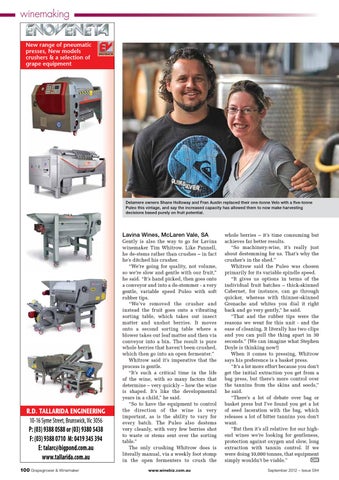
Delamere owners Shane Holloway and Fran Austin replaced their one-tonne Velo with a five-tonne Puleo this vintage, and say the increased capacity has allowed them to now make harvesting decisions based purely on fruit potential.
Lavina Wines, McLaren Vale, SA
R.D. TALLARIDA ENGINEERING
10-16 Syme Street, Brunswick, Vic 3056 P: (03) 9388 0588 or (03) 9380 5438 F: (03) 9388 0710 M: 0419 345 394 E: talarc@bigpond.com.au www.tallarida.com.au 100 Grapegrower & Winemaker
Gently is also the way to go for Lavina winemaker Tim Whitrow. Like Pannell, he de-stems rather than crushes – in fact he’s ditched his crusher. “We’re going for quality, not volume, so we’re slow and gentle with our fruit,” he said. “It’s hand picked, then goes onto a conveyor and into a de-stemmer - a very gentle, variable speed Puleo with soft rubber tips. “We’ve removed the crusher and instead the fruit goes onto a vibrating sorting table, which takes out insect matter and unshot berries. It moves onto a second sorting table where a blower takes out leaf matter and then via conveyor into a bin. The result is pure whole berries that haven’t been crushed, which then go into an open fermenter.” Whitrow said it’s imperative that the process is gentle. “It’s such a critical time in the life of the wine, with so many factors that determine – very quickly – how the wine is shaped. It’s like the developmental years in a child,” he said. “So to have the equipment to control the direction of the wine is very important, as is the ability to vary for every batch. The Puleo also destems very cleanly, with very few berries shot to waste or stems sent over the sorting table.” The only crushing Whitrow does is literally manual, via a weekly foot stomp in the open fermenters to crush the www.winebiz.com.au
whole berries – it’s time consuming but achieves far better results. “So machinery-wise, it’s really just about destemming for us. That’s why the crusher’s in the shed.” Whitrow said the Puleo was chosen primarily for its variable spindle speed. “It gives us options in terms of the individual fruit batches – thick-skinned Cabernet, for instance, can go through quicker, whereas with thinner-skinned Grenache and whites you dial it right back and go very gently,” he said. “That and the rubber tips were the reasons we went for this unit - and the ease of cleaning. It literally has two clips and you can pull the thing apart in 30 seconds.” (We can imagine what Stephen Doyle is thinking now!) When it comes to pressing, Whitrow says his preference is a basket press. “It’s a lot more effort because you don’t get the initial extraction you get from a bag press, but there’s more control over the tannins from the skins and seeds,” he said. “There’s a lot of debate over bag or basket press but I’ve found you get a lot of seed laceration with the bag, which releases a lot of bitter tannins you don’t want. “But then it’s all relative: for our highend wines we’re looking for gentleness, protection against oxygen and slow, long extraction with tannin control. If we were doing 10,000 tonnes, that equipment simply wouldn’t be viable.” September 2012 – Issue 584