JULY / AUGUST 2026
www.timberbiz.com.au
WOOD FIBRE ACTION PLAN Round Table
I n c o r p o r a t i n g A U S T R A L A S I A N F O R E S T L O G G E R & S AW M I L L E R
MULTI-USE
TRAILER
SOLUTION Build your own
Move the Office into the Yard
Real-time visibility for real-world timber operations. Replace paper with real-time mobile scanning. Connect your yard and office with accurate inventory and faster operational decisions.
Pack Tracking & Serialization
See every movement. Make every decision with confidence
Mobile Scanning Integration Live Inventory Visibility Multi-UOM Management
TimberSmart delivers fully integrated Enterprise Resource Planning and mobile solutions that streamline operations from log intake to dispatch. We help sawmillers, wholesalers, and re-processors run more efficiently with real-time data, greater visibility, and reduced manual processes.
Use real-time data and industry-specific functionality to gain the visibility you need to reduce errors, and make effective decisions.
Greater Visibility. Better Operational Control. 1300 664 064
www.timbersmart.com.au
sales@timbersmart.com.au
News
Leading Tasmanian processor puts ban on old-growth logs Neville Smith Group moving to plantataion-only supply
T
asmania’s Neville Smith Group has announced it will no longer take old-growth logs and has called for an immediate end to oldgrowth logging in the State. Instead, the Mowbraybased company, one of Tasmania’s biggest hardwood processors, will transition to plantation supply. Andrew Walker, CEO of Neville Smith Group, confirmed the company’s full support for the Forest Congress Shared Vision Statement, joining Palawa Elders, scientists, environmentalists, industry and community leaders in a common position on the future of Tasmania’s forests. The Forest Congress’s “shared vision statement” is a peace accord brokered by MONA (Museum of Old and New Art) that calls for an end to old-growth forest logging in Tasmania. It opens with the declaration “no generation owns a forest” and was signed by over 30 First Nations leaders, conservationists, and sawmillers The statement calls for an immediate end to oldgrowth logging, responding to a Palawa-led call to protect these forests as enduring cultural treasures, alongside the ongoing, responsible management of Tasmania’s native forest resources. “After three years of collaborative Forest Congress stakeholder engagement, the Neville Smith Group (NSG) has formalised its commitment to the shared future vision
for Tasmanian forestry,” Mr Walker said. Neville Smith Forest Products has operated within Tasmania since 1924 and is one of the most advanced processors of sustainably grown, harvested, and replanted regrowth and plantation Tasmanian Oak in Australia. “We support a Palawaled, whole-of-landscape, pragmatic, science-backed, long-term proposition for native forestry in Tasmania, not an ideological one,” Mr Walker said. “Indigenous voices were absent from previous agreements, including the Tasmanian Forest Agreement, and Palawa leadership belongs at the centre of forest management going forward, alongside forest scientists, growers, landowners, processors and local communities. “This finds the right balance between protecting old-growth forests as cultural and ecological treasures, whilst securing the long-term future for native forestry, meeting national timber demand, and supporting regional Tasmanian communities.” Mr Walker said that NSG was a majority plantation and ongoing regrowth native business, established 25 years ago, on the basis of processing smaller, younger certified logs. The Plantation Nitens logs were previously destined only for wood chip export, now elevated up the value chain via cutting edge technology. After a deliberate fouryear transition period to
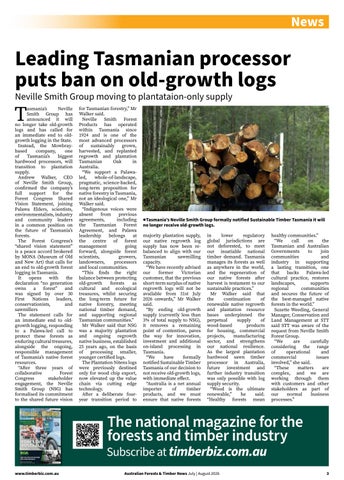
●Tasmania’s Neville Smith Group formally notified Sustainable Timber Tasmania it will no longer receive old-growth logs. majority plantation supply, our native regrowth log supply has now been rebalanced to align with our Tasmanian sawmilling capacity. “We have recently advised our former Victorian customer, that the previous short-term surplus of native regrowth logs will not be available from 31st July 2026 onwards,” Mr Walker said. “By ending old-growth supply (currently less than 3% of total supply to NSG), it removes a remaining point of contention, paves the way for innovation, investment and additional on-island processing in Tasmania. “We have formally notified Sustainable Timber Tasmania of our decision to not receive old-growth logs, with immediate effect. “Australia is a net annual importer of timber products, and we must ensure that native forests
in lower regulatory global jurisdictions are not deforested, to meet our insatiable national timber demand. Tasmania manages its forests as well as anywhere in the world, and the regeneration of our native forests after harvest is testament to our sustainable practices.” Mr Walker said that the continuation of renewable native regrowth and plantation resource bases underpinned the perpetual supply of wood-based products for housing, commercial projects, manufacturing sector, and strengthens our national resilience. As the largest plantation hardwood sawn timber processor in Australia, future investment and further industry transition was only possible with log supply security. “Wood is the ultimate renewable,” he said. “Healthy forests mean
healthy communities.” “We call on the Tasmanian and Australian Governments to join communities and industry in supporting a lasting transition, one that backs Palawa-led cultural practice, restores landscapes, supports regional communities and secures the future of the best-managed native forests in the world.” Suzette Weeding, General Manager, Conservation and Land Management at STT said STT was aware of the request from Neville Smith Forest Group. “We are carefully considering the range of operational and commercial issues involved,” she said. “These matters are complex, and we are working through them with customers and other stakeholders as part of our normal business processes.”
The national magazine for the forests and timber industry
Subscribe at timberbiz.com.au www.timberbiz.com.au
Australian Forests & Timber News July | August 2026
3
News JULY | AUGUST 2026 Issue 4 – Volume 37 Established 1991 News My View Obituary Bio waste Plantations
3-14 8 12 18-19 24-25
Front Cover: ANC Forestry Group needed a trailer which could carry logs and woodchips, but couldn't find one anywhere. So the company created its own. Story pages 22-23 Publisher and Chief Executive: Hartley Higgins General Manager: Robyn Haworth Editor: Bruce Mitchell b.mitchell@ryanmediapl.com.au Adelaide Office: (08) 8369 9521 Advertising: Jamie Richardson j.richardson@winetitles.com.au Adelaide Office: (08) 8369 9514 Creative Services: Robyn Haworth Trader classifieds: Jamie Richardson Adelaide Office: (08) 8369 9514 Subscriptions: subs@forestsandtimber.com.au Adelaide Office: (08) 8369 9500 Subcription rates One-year (6 editions) $44.65 Two-years (12 editions) $77.65 Accounts: ar@winetitles.com.au Adelaide Office: (08) 8369 9500 Postal Address: 630 Regency Road, Broadview South Australia 5083 Phone: (08) 8369 9500 Melbourne Office: Suite 207/19 Milton Parade, Malvern VIC 3144 Phone: 0402 494 041 Website www.timberbiz.com.au Printed by Lane Print, Adelaide, SA
Conditions
The opinions expressed in Australian Forests & Timber News are not necessarily the opinions of or endorsed by the editor or publisher unless otherwise stated. All articles submitted for publication become the property of the publisher. All material in Australian Forests & Timber News copyright 2026 © Ryan Media. All rights reserved. No part may be reproduced or copied in any form or by any means (graphic, electronic, or mechanical including information and retrieval systems) without written permission of the publisher. While every effort has been made to ensure the accuracy of information, the published will not accept responsibility for errors or omissions, or for any consequences arising from reliance on information published.
MEDIA
INDEPENDENT & AUSTRALIAN OWNED
4
New-look ForestFit wins foundation sponsor F orestFit has launched a new technology platform and welcomed insurance company ArtesMobius as a Foundation Sponsor. The launch of ForestFit’s new website and Forest Services Portal marks an important step in the development of Australia’s Forest Services Standard and Certification Scheme. The platform gives businesses undertaking harvesting, haulage, civil and silviculture operations clearer access to the certification pathway, practical resources and information to strengthen their management systems and demonstrate safer, more sustainable and professionally governed operations. ForestFit CEO Dionne Olsen said the scheme is designed to evolve alongside the businesses it supports. “ForestFit is built on continuous improvement,” she said. “Our role is to keep strengthening the Forest Services Standards and Certification Scheme so forest service businesses can strengthen their own systems, manage critical risks more effectively and demonstrate measurable progress over time. “The credibility of the accredited scheme provides
confidence in the integrity of the ForestFit Standards, while independent certification gives growers, workers and the broader supply chain confidence in the capability, governance and performance of certified businesses.” This commitment is closely aligned with inaugural Foundation Sponsor ArtesMobius. Their support reflects a shared understanding that resilience is built through sustained investment in equipment, workforce capability, management systems, risk controls and appropriate insurance. Chris Thomas, CEO of Artes Specialty, said insurance should be recognised as part of a broader strategy for protecting businesses and supporting long-term continuity. “Insurance is not simply a response when something goes wrong; it is an investment in protecting people, assets and operations,” he said. “Supporting the industry means more than underwriting its risks. It means recognising and encouraging the investment businesses make in modern machinery, operator training, fire suppression technology and safer ways of working.” He said that those
●Artes Specialty CEO Chris Thomas with Mobius Insurance director Tom Richards.
investments helped prevent losses, strengthened resilience and supported the long-term sustainability of the industry. “We see first-hand how forest service businesses are investing in safer equipment, better technology and stronger operating practices,” Tom Richards, Director of Mobius Insurance, said. “Supporting ForestFit is
a practical way for us to recognise that progress and contribute to a more resilient industry.” ForestFit will reach another significant milestone when its newly established Board of Directors holds its inaugural meeting to develop the strategic plan for the Scheme’s next phase.
Plantation v farming; debate goes on
I
t’s been a debate that has been waging in New Zealand for some time now. And now it has begun – again – in Australia; should highly-productive farming land be turned over plantations. It’s not new. A similar debate raged around 60 years ago in Western Victoria when prime farming land was being sold to pine plantation operators. It recently raised its
head again with the sale of 22,000 hectares of dairy and beef country in Tasmania’s north-east to be transformed into pine plantations. The proponents claimed the property was “lowquality, degraded land” and not currently being used for food production; the opponents – the loudest of
which was the TasFarmers group – claimed the sale had nothing to do with pine plantations and more to do with cashing in on carbon credits. TasFarmers claimed the sale at Rushy Lagoon was a threat to Australia’s food security. But it’s a fact Australia desperately needs more trees in the ground, and we need to feed ourselves. As forestry industry expert Rob de Fegely said at a meeting on the
Australian Forests & Timber News July | August 2026
farm/plantation issue in Bombala, despite the fact Australia is the seventh most forested country in the world, it is a net importer of wood products. His opinion is that pine and forestry and farming have worked together well in the past and should continue to do so in the future. He is of course right. But it’s a debate that is not going to go away any time soon.
www.timberbiz.com.au
News
Forestry Corp cuts jobs via email M ore than 50 jobs at New South Wales’ Forestry Corporation, including more than 30 in Coffs Harbour alone, are being cut as a result of the State Government’s proposed Great Koala National Park. Forestry Corporation informed employees and unions at the end of June of the proposed changes to its workforce. It said that the proposed changes reflected “significant shifts in operational requirements and broader industry conditions”. The jobs are to be a mix of management, office and field roles. The decision to axe jobs has been met with anger and frustration from industry leaders including key State Nationals MPs who have slammed the decision, claiming the jobs will go at a time when regional communities and local economies are already under enormous economic pressure. The Corporation said that the proposed reduction of 32 roles was directly related to the proposed GKNP and
the associated moratorium on harvesting within the park assessment area. It said the proposal would reduce harvest volumes and operations, and transition the management of 176,000 hectares from State forests to national parks. The corporation said that these roles were predominantly located on the North Coast. “A further proposed reduction of 19 roles responds to financial challenges currently affecting the organisation, including the impacts of a weakened softwood timber market,” the corporation said. “These roles are distributed across the state.” According to an ABC report, a NSW government spokesperson said in a statement that it was working to move affected Forestry Corporation staff to suitable roles in the National Parks and Wildlife Service. It said the creation of the Great Koala National Park (GKNP) would add 100 new roles. In a joint statement NSW Nationals Leader and
Member for Coffs Harbour Gurmesh Singh, Member for Clarence Richie Williamson and Member for Oxley Michael Kemp said that before the 2023 State Elections Premier Chris Minns had promised to help regional workers transition out of forestry. “Today, they’re putting politics over people and science,” the MPs said. Critics of the GKNP have included the Timber, Furnishing and Textiles Union, which has publicly declared the carbon method funding the Great Koala National Park should be dumped because it rewards locking forests away instead of managing them. “There shouldn’t be an incentive for future governments to lock up land simply to fill government coffers without solid scientific rationale,” the MPs said in a statement. “With timber harvesting already halted under the moratorium, as well as this current round of job cuts, it’s unclear how the government will be able to claim any carbon credits
for this project. “The NSW timber industry is among the most sustainable in the world, operating under some of the highest environmental standards while providing a resource that is desperately needed during a housing crisis. “Chris Minns said it himself – he does not understand regional communities. And he never will. “Today is yet another sad day for the hardworking men and women at Forestry Corporation who are paying the price for Labor’s budget mismanagement.” The decision to axe jobs has been met with anger and frustration from industry leaders, who claim the government has failed to provide sufficient support or certainty for the future. The decision comes as Pentarch Forestry announced it will slash 25 jobs and close one of its mills at Herons Creek, south-west of Port Macquarie. Director Steven Dadd said the company had been relying on dwindling stockpiles, which had now
run out. ‘We haven’t had any wood supply coming in from Forest Corporation since last July, when the wood supply stopped,’ he said.The Forestry Corporation said it would work closely with affected staff to “identify and explore redeployment opportunities where possible”. The NSW Government has also offered a Forestry Worker Support Package for staff affected by the proposed GKNP. A consultation period will take place during which time, staff will have the opportunity to provide feedback, which will be carefully considered before any final decisions are made. Employees affected by the proposed changes will have access to support through the organisation’s Employee Assistance Program, ensuring confidential and professional assistance during this period of change for them and their families.
Victoria launches $12m innovation fund
T
he Victorian State Government has announced a new $12 million Timber and Fibre Innovation Fund, with the Victorian Forest Products Association describing it as a strong commitment to the future of Victoria’s forestry, plantation and wood fibre industries. The new fund will support innovation, advanced manufacturing and future investment across the sector. VFPA Chief Executive Officer Andrew White said the new fund represented an important step towards growing and strengthening Victoria’s wood fibre industries, but further investment was also needed to make the significant transformational changes needed over the next www.timberbiz.com.au
decade. “This is a positive investment in Victoria’s wood fibre manufacturing sector and a strong signal that our industry has a critical role in delivering housing and wood fibre products that Victorians need,” Mr White said. “The Timber and Fibre Innovation Fund recognises the critical role Victoria’s plantation forestry and wood fibre manufacturing industries play in regional economic development, housing, advanced manufacturing and the transition to a lower-carbon economy.” “Importantly, this fund moves beyond supporting industry transition and focuses on supporting transformation, innovation and growth within the sector, through equipment upgrades,
process improvements and new innovations.” The TFIF expands on previous government funded programs by opening eligibility to businesses and organisations involved with both softwood and hardwood manufacturing across Victoria. The fund will provide grants during the second half of 2026, ranging up to $1 million per grant, and support projects that improve productivity, develop new products, commercialise innovative ideas and strengthen domestic manufacturing capability. “Victoria is home to Australia’s largest plantation estate and a diverse range of timber processors, but we need to bring down costs and support these businesses
to be successful given the current tough market conditions facing the industry,” Mr White said. “Investment in innovation helps ensure more of that value is created here in Victoria, supporting regional jobs, sovereign manufacturing capability and stronger domestic timber supply chains. “Creating new markets and new manufacturing opportunities for innovative product types, at the same time as supporting our existing manufacturing base is critical,” he said. While welcoming the announcement, VFPA said the fund should form part of a broader long-term vision for Victoria’s wood fibre sector. “The Timber and Fibre Innovation Fund is an
Australian Forests & Timber News July | August 2026
important first investment that aligns strongly with our call for a new Victorian Governmentled 10-Year Wood Fibre ‘Action Plan’ and Strategy,” Mr White said. “Victoria has the resource base, the manufacturing capability and the expertise to become a national leader in sustainable wood fibre production and advanced timber manufacturing.” “With the right longterm policy settings, there is a huge opportunity to grow regional jobs and increase plantation investment to ensure we can meet Victoria’s future housing, packaging and construction needs.” Pages 10, 11: Industry Round Table 5
News
Good plan for Bombala: de Fegely A recent community meeting in Bombala to address a growing concern of local farmland sales to corporate entities for carbon forestry projects (both environmental plantings and plantation forestry methods) featured guest speaker, forestry industry expert, Rob de Fegely. Other speakers at the June meeting were local farmers John Murdoch, John Jeffreys and Ben Mooney. Together they spoke to the community about concerns relating to a loss of productive farmland, reduced rural employment, outside corporate involvement and uncertainty bbout longterm impacts. Mr de Fegely provided an insight into the regional forestry hubs established under the National Forestry Industry Plan 2018. Mr de Fegely is the manager of the South East Forestry Hub, which supports forestry industries in southern NSW and the ACT to help grow a positive future for the
●Forestry industry expert Rob de Fegely. region’s communities and environment. He also sits on the board of Forestry Corporation NSW and chairs the Public Forest Agency in Tasmania. There are 11 regional forestry hubs across Australia. These hubs work with industry, state and local governments, and other key stakeholders to prepare and provide the government with strategic planning, technical assessments and analyses
that aim to support growth in the forest industries in their region. Mr de Fegely began his career on the Monaro in 1980 growing radiata pine in the Coolangubra, Bucky Springs, Pericoe and Rockton areas. “In my time as a career forester over 40 years, the challenge between farming and forestry has been around for a long time and it’s history that we haven’t actually blended together,” he said. “In Scandinavian countries and parts of Europe, you’ll find that forestry and farming are very close neighbours and they work together really well.” He recalled however the years he spent in Bombala were productive and produced good outcomes. “In the eight-and-a-half years I was here, when we were planting blocks that were basically cleared as farmland under early development in the late 1800s and early 1900s and for a raft of reasons those farms had become quite marginal mainly
due to rabbits, the first World War, the loss of a generation of farm workers and then the Depression and again the second World War ... those poorer quality farms fell away and were purchased by a corporate entity from the Philippines. “That was an interesting process as when redeveloping those old farms in the mid-80s - by clearing all the tea trees and wattles – it suddenly looked like a farm again, but it was all granite soil and very low nutrient, so turning it back into forest was probably a sensible land use decision. “I don’t think in the eight-and-a-half years I was here, anyone seriously said to me I shouldn’t be planting that pine. So pine and forestry and Bombala and farming had worked together really well in those early years,” he said. Mr de Fegely then pointed out challenges within the industry. “The challenge has always been, despite the fact Australia is the
seventh most forested country in the world, it is a net importer of wood products,” he said. “We import more than $7 billion worth of wood products a year. A lot comes from New Zealand, particularly pine framing. We get hardwood, particularly from Malaysia and the tropical rain forest, and we import paper products as well because all our paper mills have shut.” He said there are two drivers pushing the carbon debate. The first is a demand to be self-sufficient and secondly, achieving net zero such as carbon credits and cheap wood. As South East NSW Forestry hub manager, Mr de Fegely said this government funded scheme is designed to improve wood production, as Australia is not producing enough. He said within the South East hub, 60 per cent of the land is forest and 50 per cent of those forests are in national parks - by international standards a very high percentage.
TFPA appoints Drew Freeman new CEO
T
he Tasmanian Forest Products Association has appointed Drew Freeman as its new Chief Executive Officer. Mr Freeman has had executive leadership experience across several of Tasmania’s key industries, including retail, transport, logistics and forestry. Most recently, he served as Chief Executive Officer of Tasmanian Independent Retailers, where he led statewide advocacy, policy engagement and industry representation on behalf of more than 150 retailers. TFPA Independent Chair Sarah Courtney Mr Freeman brings a wealth of experience in political engagement, policy development, stakeholder management, leadership and industry advocacy. “Drew is an experienced senior executive, industry advocate and regional
6
●New Tasmanian Forest Products Association CEO Drew Freeman. leader with more than 25 years’ experience leading complex, multi-stakeholder organisations across Tasmania,” she said. “He has an unwavering commitment to evidencebased advocacy and longterm industry sustainability, together with a collaborative and solutions-focused approach.” Ms Courtney said Mr
Freman’s previous senior roles within the forestry sector provided him with a strong understanding of the forestry value chain, market dynamics and regulatory environment. “Drew has demonstrated an exceptional ability to build trusted relationships with government, industry, regional communities and peak bodies,” she said. “His experience and leadership make him exceptionally well placed to lead TFPA into its next chapter.” Drew will start with TFPA on July 27, working alongside outgoing CEO Nick Steel during a planned one-month transition period. Mr Steel, who announced earlier this year he intended to leave TFPA, will finish his tenure with TFPA on August 21, following a structured handover that will ensure
continuity for members, stakeholders and the organisation. Ms Courtney thanked Mr Steel for his outstanding leadership and significant contribution to the Association. “Nick has played a pivotal role in strengthening TFPA’s position as the trusted voice of Tasmania’s forest industry,” she said. “Under his leadership, the Association has built strong relationships across government, industry and the broader community, creating a solid foundation for the future." Mr Freeman said he was excited to return to the forestry sector and work alongside TFPA’s members. “I am looking forward to once again working across the forest industry alongside our members and the Tasmanian businesses and communities connected to
Australian Forests & Timber News July | August 2026
it,” he said. “With the ever-increasing demand for sustainable, high-quality Tasmanian timber, I am committed to uniting the full forestry value chain as the industry continues to evolve and advance towards a bright and sustainable future.” Mr Freeman said he was committed to building on the strong legacy established by Mr Steel. “Nick has done a tremendous job developing deep and trusted relationships across industry, government and the community. I look forward to building on that work by continuing to strengthen member representation, enhancing collaboration with State and Federal Governments, and helping our members navigate the significant regulatory changes facing the sector,” he said. www.timberbiz.com.au
News
Tasmania's sawmills are not some pop-up operation I t is a peculiar kind of politics that pretends to be cautious and frugal while doing something deeply mischievous. The latest call from environmental campaigners, backed by the Greens and independents Peter George, Helen Burnet and Kristie Johnston, for Tasmania to halt long-term native forest timber contracts is exactly that. It is being dressed up as fiscal responsibility. It is not. It is a blatant attempt to close regional sawmills by stealth. The argument sounds simple enough – do not sign contracts until there is “certainty”. But anyone who has ever run, financed or worked in a real business knows that certainty is precisely what contracts are designed to provide. Without them, businesses cannot borrow, invest, employ, maintain equipment, train apprentices or plan production. Forestry is no different to any other capital-intensive industry. Dairy processors, farmers, freight companies and manufacturers all rely on long-term contracts to have the confidence to invest, employ and expand, often while policy and regulation shift around them. Our sawmills should be applauded for continuing to invest and adapt in uncertain conditions, not undermined by political slogans and activist pressure. A sawmill is not a pop-up operation. It is a specialised, high-cost regional business carrying expensive machinery, kilns, drying sheds, log yards, maintenance crews, safety systems, power costs, transport arrangements, finance costs and skilled workers who cannot simply be switched on and off at the convenience of an activist media release or political opportunity. A sawmiller needs to know that logs will arrive next year, and the year after that, just as builders and the community need to know that the timber they rely on will be there, 8
MY VIEW Tony Price
year after year. Without that confidence, banks will not lend. Owners will not invest. Workers will leave. Apprenticeships will not be offered. Customers will look elsewhere. Equipment will not be replaced. And eventually, a business that took generations to build will quietly close. This campaign is focused on making it impossible for the industry to function. Starve processors of supply certainty. Frighten government away from contracts. Create enough sovereign risk that investment disappears. Then, when sawmills shut, claim it was the market. Tasmanians should see through that and through the politicians who stand by activists whose whole fundraising model appears to be built on closing down local Tasmanian industries. Of course, governments should manage risk. Of course, contracts should be responsible, lawful and based on sustainable supply. But the idea that the responsible course is to freeze the industry until every political and regulatory question is settled is naive in the extreme. In the real world, uncertainty is not solved by paralysis. It is managed through clear rules, proper planning and durable agreements that give both taxpayers and businesses confidence. In any case, should any government shut an industry down, the lesson from Victoria is that transition costs extend far beyond sawmill supply contracts.
●Sawmills should be applauded for continuing to invest and adapt in uncertain conditions.
T
asmania’s priority should be maintaining certainty, backing regional jobs and avoiding unnecessary costs to taxpayers
Compensation there included forestry transition programs, community support packages, business support, worker support, plant and equipment compensation, redundancy top-ups and loss-of-income payments. Tasmania’s priority should be maintaining certainty, backing regional jobs and avoiding unnecessary costs to taxpayers. Which is why it is disappointing seeing elected representatives lend their names to this campaign as though there
are no consequences to their communities beyond sawmill contracts. These are not abstract debates. They affect workers in regional towns, contractors with mortgages, familyowned businesses, truck drivers, mechanics, mill hands, foresters, fabricators and the communities built around them. Politicians who stand shoulder-to-shoulder with activist organisations, while pretending they are merely protecting the budget are disingenuous and should be honest about what they are really doing. They are putting thousands of Tasmanian jobs at risk. They are undermining confidence in local businesses. They are jeopardising timber supply. And they are sending a message that any industry disliked by a well-organised pressure group can have its commercial foundations pulled away by political ambush. The irony is that this is happening at the very moment Australia is desperate for timber. We have a housing shortage. Builders need reliable supplies. Families need homes.
Australian Forests & Timber News July | August 2026
Governments talk endlessly about housing targets, affordability and supply chain resilience, yet some of the same political voices are willing to weaken a local industry that produces renewable building materials, and support the importing of timbers from highly questionable sources, such as Indonesia, Russia and East Africa. That is hypocritical and makes no sense. If Tasmania wants regional employment, domestic manufacturing, lower reliance on imports and enough timber to help build the homes we need, then it cannot treat sawmills as disposable. It cannot ask businesses to invest without contracts. It cannot demand jobs without giving employers the confidence to employ. Long-term supply contracts are not a favour to sawmillers. They are the basic commercial foundation that allows them to operate. Pull that foundation away and the result will be devastatingly obvious and entirely avoidable. Tony Price is a professional forester with more than 40 years of experience in forestry across Australia.
www.timberbiz.com.au
PERFORMANCE ENHANCED FORESTRY WELCOME TO THE NEW H SERIES 25% Larger load capacity and 50% faster driving speed* improve hauling efficiency, delivering unmatched productivity. Our game changing IBC automation comes standard - providing optimal loading, while longer reaching booms and new frame lock ensure stable full-load forwarding, and improved operational efficiency. Modernised cabins provide exceptional comfort, improving operator well-being and ensuring productivity stays high from first to last load. H Series Forwarders... time to get ahead of the game.
deere.com.au/en/forestry/h-series/ *Gear 1, comparison G vs H series
1790JHNDRE
News table Round
Q&A
The Victorian State Government’s decision to announce a new $12 million Timber and Fibre Innovation Fund is an important step towards growing and strengthening Victoria’s wood fibre industries. But is it enough?
Cr Karen Stephens President Timber Towns Victoria
Andrew White Chief Executive Officer Victorian Forest Products Association
Steve Dobbyns BSc (Forestry), Chairman Forest & Wood Communities Australia
We asked three industry leaders for their views on the need for a 10-Year Wood Fibre Action Plan, what it might achieve and what it might look like in 10 years.
Q
Should the next Victorian Government commit to developing a 10-Year Wood Fibre Action Plan?
Cr Karen Stephens Yes, and the commitment would formalise a position Timber Towns Victoria has already placed on the public record. In May our delegation briefed Labor, the Liberals, the Nationals, One Nation, the Shooters, Fishers and Farmers and the Libertarians on our 2026 Government Brief, which called for a whole-of-government forestry and fibre growth strategy aligned with the Commonwealth’s Timber Fibre Strategy. A 10-Year Wood Fibre Action Plan is the right vehicle to deliver that strategy, because it would give the sector what advocacy alone cannot: a timeframe, funded actions and a minister accountable for delivery. Forestry operates on investment horizons no other land use matches, with a softwood rotation established in 2027 unlikely to reach a sawmill before the 2050s, whilst the policy settings governing land access, approvals and infrastructure can shift with every electoral cycle. The consequences are measurable, because the estate has fallen from 421,700 hectares in 201617 to 382,000 hectares today, and the welcome Gippsland plantings that began in 2023 remain a softwood program with no hardwood equivalent. Other jurisdictions have 10
already moved, with the Commonwealth releasing its Timber Fibre Strategy, Queensland delivering a 25year Future Timber Plan to supply one million homes by 2044, South Australia operating under its Wood Fibre and Timber Industry Master Plan and Victorian industry completing the evidence base through the Roadmap to 2050. Victoria has nothing equivalent for the plantation industry it retained after native harvesting ended on 1 January 2024. From a local government perspective, the plan must be practical to earn support. It should set plantation expansion targets and streamline planning and environmental approvals for plantation and processing projects, consistent with the position our members have already endorsed. Multi-year funding must follow for the councilmanaged roads and bridges that carry every load, because logs in this state cannot move by rail, alongside completion of the statewide AI fire detection network that has identified 86 unplanned fires across the past two seasons. Above all, the plan must be bipartisan, publicly reviewed and developed with local government at the table, because our member councils approve the permits, maintain the
freight routes and live with the outcomes. Our communities have already experienced what policy made without long-term planning delivers, and a 10year commitment agreed across the Parliament is the strongest safeguard against that uncertainty returning. Andrew White Victoria has many of the ingredients needed to be a global leader in sustainable wood fibre. We have Australia’s largest plantation estate, world-class processors, innovative manufacturers and skilled regional workforces. Despite the current downturn in housing demand and the surge in imported timber products placing significant pressure on local manufacturers, the long-term outlook for renewable, low-carbon building materials remains strong overall. The challenge is not one of potential—it is one of coordination. Too often, policy affecting the wood fibre industry is developed in isolation across different parts of government. What has been missing is a cohesive, whole-ofgovernment approach that aligns investment, regulation, housing, manufacturing, climate and regional development policy behind a shared long-term vision. A Victorian 10-Year Wood
Fibre Action Plan would provide that direction. It should be governmentowned, developed in partnership with industry, and recognise the significant contribution wood fibre makes across housing, regional development, sovereign manufacturing, climate policy and the circular economy. The Action Plan should focus on practical reforms that improve investment confidence, streamline regulation, encourage plantation establishment, strengthen freight infrastructure and build workforce capability. Just as importantly, it must help Victoria move further up the wood fibre value chain by supporting investment in advanced processing technologies, new engineered wood products and innovative bio-based manufacturing. The growing reliance on imported products such as laminated veneer lumber (LVL) demonstrates there is strong market demand. Rather than relying on imports, Victoria should be creating the policy settings that enable more of these products to be designed, manufactured and supplied locally. The wood fibre industry makes investment decisions measured in decades, not election cycles. Plantation rotations extend well beyond 25
Australian Forests & Timber News July | August 2026
years, while new processing facilities require significant long-term capital investment. Businesses need policy certainty before committing to new manufacturing capability and innovation. A Victorian 10-Year Wood Fibre Action Plan would send a clear signal that Victoria is serious about building a modern, innovative wood fibre industry that supports regional communities, strengthens sovereign manufacturing and helps deliver the homes, jobs and low-carbon economy Victoria needs over the coming decade. Steve Dobbyns At least 10 years for industry to make the level of investment in processing. They need resource security at a minimum of 10 years. Ideally, it would be a rolling 20 years for them to make the types of investment, and particularly the R&D involved with trying to manufacture engineer wood products from low quality pulpwood resource, which is about the only thing that’s currently available, they need to be able to basically redesign their business completely, and also be able to do the R&D, so that they’re using appropriate glues, etc. to buy material, immaterial, and things that they haven’t ever tried before. www.timberbiz.com.au
Round News table
Q
What role can the wood fibre industry play in helping Victoria meet its housing, manufacturing and sustainability objectives?
Cr Karen Stephens Housing is the clearest entry point, because the Victorian Government has committed to 800,000 new homes this decade and 2.24 million by 2051, with 425,600 of those in regional Victoria. Timber framing is used in close to three in four detached homes built in Australia, which makes every housing target a timber target whether or not the policy names it. Demand is moving in one direction, with Forest & Wood Products Australia projecting national housing requirements to rise from 183,000 dwellings a year to 259,000 by 2050, increasing timber demand by close to 50 per cent. Imports already supply 20 per cent of Australia’s housing timber, a share forecast to double without new plantings, so a state that secures its fibre supply is a state that protects its housing program. Victoria is well placed to respond, because it holds the nation’s largest plantation estate at 382,000 hectares, the Green Triangle is the country’s largest contiguous plantation fibre base and the softwood estates of Gippsland and the Murray Valley supply Australia’s biggest sawmilling businesses. The industry already generates $9 billion in annual revenue and supports 17,000 direct jobs, most of them in regional communities. Manu f a c t u r i n g investment is demonstrating what fibre security makes possible, with THE PRECINCT feasibility work at Portland examining engineered
Q
wood products and prefabricated housing built from plantation fibre, supported by up to 200 regional jobs. HAMR Energy’s $1.8 billion Portland Renewable Fuels project would convert wood residues and green hydrogen into 300,000 tonnes of low-carbon methanol a year, whilst in Gippsland the Maryvale mill and Australia’s largest hardwood manufacturer at Heyfield continue to anchor regional employment. On sustainability, wood remains the only structural material Victoria can grow, storing carbon in every frame, floor and beam whilst substituting for higher-emission alternatives, all produced under third-party certification. The social dimension matters just as much to our member councils, because economic research commissioned by Timber Towns Victoria found one job lost in Melbourne is equivalent to five lost in a small rural community. A wood fibre industry with long-term certainty keeps schools enrolled, brigades staffed and young families in towns like Heyfield, Yarram and Morwell, which is the contribution this industry offers: building the houses, supplying the manufacturers and sustaining the communities that do both. Andrew White Wood fibre sits at the intersection of housing, manufacturing and sustainability, making it one of the few industries that can make a meaningful contribution to all three. Timber remains one
of the most sustainable, renewable and versatile construction materials available. As trees grow, they remove carbon dioxide from the atmosphere, and that carbon remains stored throughout the life of timber products. Using timber in place of more emissions-intensive materials such as steel and concrete can also significantly reduce the embodied carbon of buildings. Just as importantly, timber can help Victoria build more homes. As governments work towards ambitious housing targets, there is an opportunity to increase the use of locally grown and manufactured timber products across residential, commercial and public buildings. Modern methods of construction—including engineered timber, prefabricated and panelised building systems—will play an increasingly important role in improving productivity and reducing build times. At the same time, Victoria’s established lightweight timber framing industry will remain fundamental to delivering the detached homes that continue to make up the majority of new housing. The future is not one solution over another—it is about supporting a diverse range of timber products that help build more homes, more efficiently and more affordably. That matters because the broader housing system is under pressure. The Productivity Commission has highlighted declining housing construction productivity, while
Australian Bureau of Statistics data shows homes are taking longer to complete than in previous years. The Housing Industry Association has also identified taxes, government charges and regulatory costs as significant barriers to housing affordability and supply. Improving housing productivity will be critical if Victoria is to meet its housing targets. Beyond housing, the wood fibre industry is already a major contributor to Victoria’s manufacturing economy. Our industry members produce structural timber, engineered wood products, pulp, paper, packaging, poles, landscaping products, bioenergy and an expanding range of innovative bioproducts. Continued investment in innovation will enable Victorian manufacturers to develop new products, adopt advanced processing technologies and respond to changing market demand, ensuring more value is created from every cubic metre of locally grown wood fibre. If Victoria is serious about delivering more homes, strengthening manufacturing and achieving its climate objectives, the wood fibre industry should be recognised as a strategic partner in delivering those outcomes. Steve Dobbyns I think the work that’s been done out of the University of Queensland and others shows that over the past couple of decades, Australia’s displaced native forestry production
has been substituted by imports by over 80%. So for every 1000 cubic meters of foregone native forest timber harvesting due to reservation in Australia, we have displaced our hardwood requirements by the level of 81.3% to imports. Now that doesn’t include when state jurisdictions close down native forestry in their state, as Victoria and the recent ABC Four Corners program highlighted the displacement of Victoria’s hardwood demand to Tasmanian forests, and it doesn’t account for production just moving into other jurisdictions, like on a private property. So, when you close down native forestry in Australia, you don’t get rid of demand, and people recognize that timber, whether it’s embodied carbon or its ability to store carbon, is better than the other building alternatives. So, whilst the world is moving increasingly towards use of timber, we’re restricting our ability to produce it domestically and reducing our sovereign capacity and shifting all that demand overseas. You can’t simply replace hardwood with softwood. There’s different requirements, different needs, different durability and strength required. So, a third of the timber we use in our housing is hardwood, and we’ve got to get it from somewhere. Currently, we’re exporting our environmental conscience to other countries and importing timber from there.
What would success look like for Victoria’s wood fibre industry in 10 years’ time
Cr Karen Stephens Success in 2036 should be defined by measurable outcomes rather than aspiration, and the markers our member councils would apply are practical ones. www.timberbiz.com.au
The first is resource, with the state’s plantation estate growing again after a decade of decline, the Gippsland softwood program delivering its full 16 million trees on schedule and a dedicated hardwood
program addressing the gap identified in the Roadmap to 2050, which found Central Gippsland’s hardwood plantation supply falls to negligible levels from 2035 without replanting. Softwood
supply should be positioned for the mid-2030s window, when Central Gippsland and Murray Valley volumes can carry the annual harvest from between 3 and 4 million cubic metres towards 5 million.
Australian Forests & Timber News July | August 2026
Processing comes second, with THE PRECINCT at Portland operating rather than sitting in feasibility, prefabricated housing manufactured at scale from Green Triangle fibre and every log grown 11
Round table in Victoria processed in Victoria rather than exported unprocessed. Maryvale should remain the manufacturing anchor of the Latrobe Valley, supported by nextgeneration fibre products and a secure long-term resource. C o m m u n i t y infrastructure is the third marker, with councilmanaged haulage roads and bridges funded through multi-year agreements, the AI fire detection network completed statewide and timber specified as standard in Victorian schools, social housing and public buildings. Regional Victoria carries a 425,600-home share of the state’s housing target, and those homes should be framed with fibre grown and processed within the regions building them. Behind all three markers sits investment confidence, because a 10-Year Wood Fibre Action Plan that has survived an election cycle gives a bank the assurance to lend against a mill, gives institutional capital the assurance to plant trees and gives a young person in
Heyfield the assurance that an apprenticeship in this industry is a career. Ten years from now, success is a plantation industry so settled in policy, so invested in processing and so clearly part of how Victoria houses its people that no incoming government would consider planning without it. That outcome would reverse the drift of the past decade, and it is achievable if the next Parliament commits early and holds the course. Andrew White Success would be a Victorian wood fibre industry that is recognised as an essential contributor to the state’s economy, housing supply, regional communities and transition to a lower-carbon future. It would mean increased investment in new plantations and greater confidence for landholders to establish long-term wood fibre resources, ensuring domestic supply keeps pace with future demand. It would also mean Victoria moving further up the wood fibre value
chain. Rather than relying on imported engineered wood products, we would be manufacturing more high-value products locally—including engineered timber, prefabricated building systems, packaging, renewable energy and next-generation bio-based products. Victoria would be recognised as a leader in wood fibre innovation, with businesses investing in advanced processing technologies and developing new products that respond to changing domestic and international market demand. From a policy perspective, success must include longterm policy certainty, an enabling regulatory environment and genuine collaboration between government, industry and research organisations. Together, these foundations would give businesses the confidence to invest in new facilities, advanced manufacturing capability and regional communities. Perhaps most importantly, wood fibre would be be recognised as a genuinely circular
industry. Every part of the harvested resource would be used to its highest value, with residues increasingly transformed into renewable energy, engineered wood products and emerging biobased manufacturing opportunities. Success would also mean timber becoming an increasingly common choice for mid-rise homes, apartments, schools, hospitals and commercial buildings because it is recognised as one of the most practical, costeffective and low-carbon construction solutions available. By combining Victoria’s established lightweight timber framing industry with advanced engineered timber products manufactured locally, the industry can help governments deliver more homes while creating new, skilled regional jobs and reducing emissions. Ultimately, success will be measured by whether the wood fibre industry is recognised not simply as a forestry sector, but as an essential partner in delivering Victoria’s
future—building more homes, supporting advanced manufacturing, creating regional jobs and helping the state transition to a lower-carbon, circular economy. That future is well within reach, provided government and industry work together with a shared long-term vision. Steve Dobbyns Well, it would be still sitting there waiting for the trees to grow. The best time to plant a tree to produce saw logs and material for housing was 40 to 60 years ago. The second-best time to plant is today. That’s the thing about forestry; we don’t work in election cycles. We work in 80 to 100year planting horizons, and if it’s softwood, maybe 35 to 40 years. But we need trees in the ground, and they need to be planted at scale, the right tree in the right location, not just throwing trees in the ground on prime agricultural land, but in partnership with the farming community, identifying marginal areas on farms to expand the plantation resource.
Timber matriarch remembered A former president of NSW Forest Products Association, now Timber NSW, Lexie Hurford passed away late last month aged 86 after a short illness. “She is a legend of our industry,” Maree McCaskill, chief executive of Timber NSW, said. Ms McCaskill said Mrs Hurford had made an outstanding contribution to the development of forestry policy, environmental management, and sustainable resource governance in Australia over a distinguished career spanning more than 60 years. “Throughout her adult life, Lexie Hurford has been recognised as one of Australia’s most influential forestry policy advocates, combining practical
12
●Former NSW Forest Products Association president Lexie Hurford. industry experience, and strategic public policy expertise to advance the sustainable management of Australia’s forests and natural resources. “In addition to this, Lexie has remained grounded in the Northern Rivers community with a particular interest in
investment attraction and job creation for the region and an understated role as an advocate and leader of women’s roles in business.” Her work had been instrumental in shaping contemporary approaches to forest management, balancing environmental stewardship, biodiversity conservation, community expectations, and the economic needs of regional Australia. Through senior leadership positions across government, industry and advisory organisations, she had consistently advocated for evidence-based policy development and longterm stewardship of Australia’s forest estate. As the first woman elected as Chairperson of the NSW Forest Products Association in 1999, Mrs Hurford broke new ground
in the Australian forestry sector, providing visionary leadership to the state’s peak timber industry body while championing sustainable forest management, regional employment, industry innovation and greater participation of women in forestry. A passionate advocate for sustainable forestry, Mrs Hurford worked to strengthen the relationship between environmental outcomes and productive land management and was a strong supporter of scientific research, innovation and best-practice forest management, helping to ensure that Australia’s forestry sector remains internationally respected for its environmental standards and
Australian Forests & Timber News July | August 2026
sustainability credentials. She served as Chair of the Regional Development Board from 1995 to 2003, providing strategic leadership during a period of significant economic and community change in regional NSW. Through her stewardship, the Board worked to strengthen regional industries, support employment growth, and promote sustainable economic development across rural communities. The significance of the Hurford family’s contribution to regional industry and investment was recognised by senior New South Wales government leaders, including Premier Bob Carr during his term of office from 1995 to 2005. www.timberbiz.com.au
News
Timber Queensland joins forces with farmers’ group T ●Timber Queensland CEO Mick Stephens agricultural sector, including biosecurity, secure access to productive land, awareness and attraction for a workforce with diverse skilling requirements, and managing rising input costs, including fuel. “There are also significant
opportunities for this industry – growing demand both domestically and globally for timber as a construction material, carbon markets, bioenergy and other opportunities to add value to waste streams, and the State Government’s 25-year Queensland Future Timber Plan. “It will be fantastic to have Timber Queensland at the table as part of the QFF peak body membership and QFF looks forward to working alongside Timber Queensland to proactively navigate these challenges and opportunities to position the industry and its supply chain for a profitable, productive and sustainable future. “QFF is a great vehicle that enables agricultural peak bodies to come together
and work collaboratively on policy and cutting-edge projects. It is so important – we cannot do it alone and we are stronger together.” Timber Queensland CEO Mick Stephens said it is important to acknowledge that forestry and wood products are an integral part of the food and fibre supply chain, making it logical to work collaboratively with other peak agricultural industry bodies through QFF. “Many of the issues and opportunities for the timber industry are the same as for broader agriculture, such as workforce development and training, regulation, market access and resource security,” Mr Stephens said. “In particular, we are excited by the opportunities for better integration of
forest assets and wood production trees with farming as additional sources of income through timber, carbon and related natural capital markets. “The Queensland Government has also set an ambitious goal of revitalising and growing the timber industry as part of the Queensland Future Timber Plan, including through plantation expansion and related agroforestry activities. Forestry and downstream processing can provide a broad range of on-farm benefits such as shade and shelter for livestock, improved soil and water quality and business resilience as well as much needed timber to build our growing demand for homes and public infrastructure." J004971 DEVCICH.CO.NZ
imber Queensland has joined The Queensland Farmers’ Federation as its newest peak body member. QFF CEO Jo Sheppard said QFF welcomed the opportunity to work alongside a critical industry which is deeply embedded in regional communities, and which contributes significantly to the Queensland economy. “As an industry with a well-established local manufacturing base, timber contributes almost $4 billion to the state economy and supports around 23,000 jobs, 70 percent of which are regionally based,” Ms Sheppard said. “We also know that the forest and timber industry faces many of the same challenges as the broader
www.timberbiz.com.au
Australian Forests & Timber News July | August 2026
13
News
ABP bushland project named for outgoing CEO T he Green Triangle’s plantation community has formally recognised one of its most respected leaders by naming a bushland restoration project at Australian Bluegum Plantations’ (ABP) Les Johnson Plantation, near Dergholm, in honour of outgoing CEO Russ Hughes. The dedication of the Russ Hughes Bushland Project acknowledges Mr Hughes’ decade long commitment to biodiversity, conservation and sustainable land management - values that underpin the Red-tailed Black Cockatoo habitat restoration being delivered at the conservation site. Throughout his tenure with ABP, Mr Hughes championed environmental stewardship, strengthened relationships with local
14
●Outgoing ABP CEO Russ Hughes (centre) with ABP team members Dambar Mahato and Neil Turner planting new native vegetation at the Russ Hughes Bushland Project. communities, and embedded conservation prin-ciples into everyday operational practice. Those commitments
helped lay the foundation for initiatives such as the Russ Hughes Bushland Project, which directly supports the recovery of one of the region’s most threatened species. Delivered in partnership with BirdLife Australia and Greening Australia, the project focuses on restoring critical habitat, improving food availability and increas-ing nesting opportunities for the critically endangered Redtailed Black Cockatoos. Mr Hughes joined ABP in 2015 building on his experience working with industry and First Nations communities as a professional forester in Canada. Incoming CEO Darren Shelden, who worked closely with Mr Hughes during his
tenure, said the naming of the project was a fitting acknowledgement of his influence and work ethos. “Russ has always believed plantation forestry is about more than growing wood fibre - it’s about people, landscapes, and the legacy we leave behind. His leadership has set a benchmark for how industry can work hand-in-hand with nature,” Mr Shelden said. “This bushland restoration will stand as a living reminder of Russ’ passion for biodiver-sity and his deep respect for the environment. It’s a place where staff, families and visi-tors can connect with the landscape he cares so deeply about, including the precious stringybark and buloke habitats that support the Red-tailed Black Cockatoo.”
Australian Forests & Timber News July | August 2026
The Russ Hughes Bushland Project forms part of ABP’s broader environmental en-hancement program, which includes native species plantings, habitat protection, wet-land restoration and long-term conservation planning across the estate. Mr Shelden said Mr Hughes’ influence extended well beyond operational leadership. “Russ has been a mentor, a passionate industry advocate, and a trusted colleague to so many of us. His legacy is woven into the culture of this organisation. He is thoughtful, principled, and always looking to the future and supporting the next generation of foresters,” he said.
www.timberbiz.com.au
H216
PRECISION FORESTRY. TACKLE IT ALL WITH EASE.
1825 kg
Weight (option dependent) Includes Top Saw, Rotator & Link
750 mm
Max Cutting Capacity
18-25 metric ton Carrier Size
16-25 metric ton Carrier Size
waratah.com
PARTS CATALOGUE
ORDER GENUINE PARTS ONLINE 24/7 FIND YOUR EXACT PART BY MODEL & SERIAL NUMBER. 1. Delimber Part Number Quantity
F729943
1. Delimber Part Number Quantity
F727796
2. Delimber Part Number Quantity
F729942
-
1
+
-
1
+
-
1
+
partscatalog.waratah.com/jdrc STOCKISTS AND SUPPLIERS OF
03 9747 4200 waratahaushelpdesk@waratah.com
Bio waste
BRIEFS Trees on farms Landholders across Victoria are being supported to integrate more trees into their farming systems, following an extension of the Victorian Trees on Farms Program. The program and Professional Service Provider Register has been extended to 1 November 2026. Through the Victorian Trees on Farms Program, landholders can access grants of up to $40,000 to deliver on-ground works such as shelterbelts, riparian planting and revegetation projects. For more information visit the Victorian Trees on Farms Program page online. Business merger Two of New Zealand’s leading forestry businesses have merged with the launch of a new name and brand identity to support ambitious growth plans. PF Olsen and Forest360 will unite under the Stand brand. Tree bark theory Eucalyptus bark, usually treated as waste, could be repurposed to help clean polluted water, filter dirty air and capture carbon dioxide, according to new research at RMIT University. Researchers at RMIT have shown the bark can be converted into a highly porous form of carbon that traps pollutants as water or air flows through it. The findings point to a practical way of turning a common forestry by product into a useful environmental material using a relatively simple processing method. Vocational training New Zealand’s forestry sector has confirmed it will align its workplace vocational training with the new Engineering and Manufacturing Private Training Establishment, operating under Competenz. The decision follows extensive consultation with employers, contractors and training providers, led by the New Zealand Forest Owners Association (NZFOA) and Forest Industry Contractors Association (FICA) joint Forestry Training Committee (FTC). The NZFOA and FICA have endorsed the move. 18
$32m investment boost for Green Triangle jet fuel scheme L ow-carbon liquid fuels company HAMR Energy, which is planning to turn Green Triangle forestry residues into jet fuel, has received a $32 million investment boost from the Australian Renewable Energy Agency (ARENA). Under the scheme residue from plantation forestry residues in the Green Triangle will be turned into green methanol in Portland. The green methanol will then be processed into sustainable aviation fuel at a facility in Gillman in Adelaide. It plans to process 300,000 tons of biomass per year from the Green Triangle to produce 200,000 tonnes of green methanol per year. The methanol would be then shipped to Melbourne and bunkered at the Port of Melbourne for use as fuel by the international shipping industry. OneFortyOne and HAMR Energy have entered into a Memorandum of Understanding to collaborate on the supply of sustainable biomass. ARENA’s funding is in two stages, with $12.5 million available for the early Front End Engineering Design phase, and a further $19.5 million subject to HAMR Energy securing the necessary co-funding to commence the detailed design phase. Liquid fuels make up around half of Australia’s national energy use, and replacing these fossil fuels with cleaner alternatives can deliver a significant climate and economic opportunity. Sustainable aviation fuel is one of the best ways of reducing emissions from aviation, particularly on long-haul flights where alternatives are limited. Crucially, this volume of SAF could displace approximately 140 million litres of fossil fuels, abate
around 390,000 tonnes of CO2 equivalent per annum and also facilitate approximately 4.5 million economy passenger trips between Adelaide and Melbourne each year. Feasibility work has been completed, and HAMR Energy is progressing into Front-End Engineering Design and further development activities across the supply chain. ARENA will provide $12.5 million for the initial phase, with a further $19.5 million to support detailed FEED once HAMR has secured required project co-funding. HAMR Energy expects to create hundreds of construction jobs and more than 200 ongoing roles, while supporting new opportunities across plantation forestry, renewable energy, engineering, manufacturing and regional supply chains. HAMR Energy estimates that SAF produced from plantation forestry residues through its projects could reduce emissions by approximately 85 per cent compared with fossil fuels, offering some of the best carbon abatement of any feedstock. “This funding is a significant milestone in Australia building globally competitive domestic SAF industry,” HAMR Energy’s Co-founder, David Stribley, said. “Our projects bring together plantation forestry residues from the Green Triangle, Australian renewable energy and hydrogen, and proven methanol and refining technologies to produce lower-emissions aviation fuel at commercial scale. “The projects have the potential to strengthen Australia’s fuel security, reduce aviation emissions and create skilled jobs across construction, engineering,
●An artists impressing of the sustainable aviation fuel facility to be built in Gillman in Adelaide. manufacturing and regional supply chains,” he said “We thank ARENA and the Australian Government for supporting the next stage of engineering and development work required to bring this nationally significant and strategically critical project closer to delivery.” SA Premier Peter Malinauskas said many were familiar with the substantial investments the state government had made in the Green Triangle and across the South East to ensure “every last ounce” of fibre produced was used productively and efficiently. “Taking that biomass and turning it into sustainable aviation fuel represents one of the front end peak opportunities that we have to see yet more economic value added not just in regional South Australia but across the state more broadly using our incredible renewable energy resource,” Mr Malinauskas said. “This is using our fibre from the South East, trees being grown in and around Mount Gambier combining with our renewable energy to produce sustainable aviation fuel here in South Australia fuelling long-term
Australian Forests & Timber News July | August 2026
jobs and a better outcome for our environment, so it ticks every box. “The idea that a pine tree in Mount Gambier can be transformed into jet fuel to power planes is amazing.” He said Australia could not afford to rely indefinitely on imported liquid fuels with developing sovereign and sustainable aviation fuel production about “building greater national resilience” while also supporting the aviation industry and ensuring more of the “economic benefits” from the energy transition which would be created here at home. Federal minister for Agriculture, Fisheries and Forestry Julie Collins said Australia’s foresters have always been innovators. “That is why our Government is backing new opportunities through significant investments in low-carbon liquid fuel,” Ms Collins said. “This will mean more opportunities taking flight for our proud forestry industry, backing jobs in regional communities. “Producing more lowcarbon liquid fuels right here in Australia doesn’t just benefit our fuel security and emissions reduction, it supports Australian foresters and our regions.” www.timberbiz.com.au
Bio waste
Transforming wood waste into profitable products F ollowing the successful 2025 Wood Residues and Bioeconomy Innovations combined event in Rotorua we are pleased to announce more innovative speakers for our return to Australia with our Residuesto-Revenues Conference at VOCO Hotel in Brisbane on 23-24 September. This month we highlight more biomass technology speakers spearheading further innovations including: • Gareth Forde, Principal Engineer, All Energy • Jacob Kohn, CEO & Co-founder, Futurity Bio Ventures Gareth Forde, from All Energy will deliver a presentation on Utilisation of Biomass for Renewable Fuel and Low Emissions Fertiliser Manufacturing. It will include several case study projects including blending boiler feedstocks of woodchips combined with other organic waste streams for a major meat processing company for thermal energy production. Also results from a pilot program to develop and test the potential for biomass boilers to provide sustainable fuel options for Australia’s meat processing facilities has successfully produced heat at a supply cost of below $3 per gigajoule (GJ), at JBS Riverina’s Yanco facility in New South Wales. Instigated by the Australian Meat Processor Corporation (AMPC), the trial demonstrated how different types of biomass, such as the partially digested grain and grass found in an animal’s paunch, woodchip, nut shells and sawdust, could be blended and processed in a boiler to supply thermal energy. Bioenergy is currently the third most common source of energy used by meat processing facilities behind grid electricity and grid gas, with coal in fourth place. Multi-fuel biomass can compare favourably with traditional forms of thermal energy such as on-site coal at $10/ GJ and grid gas at $25/GJ. The Australian Beef Sustainability Framework highlights the high cost of energy as one of the factors that puts pressure on processors to be price competitive in global markets. Profitability across the value chain is a key pillar of the Framework, as is a commitment to achieve carbon neutrality by 2030 (CN30). Conversion of waste into bioenergy is one option for www.timberbiz.com.au
processors to reduce production, processing and consumption waste, and research is continuing into the use of renewables within the energy mix to achieve CN30. Jacob Kohn from Futurity Bio Ventures will explain how lignin is being converted into low-emission alternatives for road bitumen. LIMA is a proprietary lignin formulation developed by Futurity to improve the performance of bitumen binders within asphalt surfacing. Futurity Bio-Ventures has developed LIMA™, a proprietary lignin-based additive designed to enhance bitumen binders in asphalt, improving properties like durability and moisture resistance. The LIMA™ additive is part of a growing focus on sustainable materials in road construction, including fiber-based innovations. Futurity Bio-Ventures LIMA™ Development: Futurity’s LIMA™ (Lignin-Modified Asphalt) acts as a high-performance bitumen binder enhancement, offering superior fatigue and oxidation resistance compared to traditional additives. The global bitumen additives market is shifting toward sustainable materials, driven by infrastructure growth. Jacob’s team is working with Oji Fibre Solutions (OjiFS), a major New Zealand producer of kraft pulp. OjiFS focuses on circular bioeconomy, converting pulp into products. They are also working on projects with Opal Melbourne (Opal ANZ). Opal operates as a separate Australasian manufacturer, focusing on tailored fibre packaging and sustainability. Finally on Pyrolysis & Carbon Markets, Melissa Rebbeck from Metamorf Engineering examines how pyrolysis is converting waste biomass into biochar while creating new opportunities through carbon removal. Her team received very favourable feedback from wood producers throughout Australasia earlier this year following their involvement at WoodTECH conferences in June in New Zealand and Queensland. Melissa is also Chair of the Australia & NZ Biochar Industry Group. The Residues-2-Revenues Conference in Brisbane on 2324 September is, focused on
●Waste biomass is being transformed into biochar creating new opportunities through carbon removal. transforming wood waste into profitable biofuels, bioenergy, and
Australian Forests & Timber News July | August 2026
renewable bioproducts.
19
Native forests
Former CSIRO scientists question case for native forest bans F our of Australia’s most senior forest scientists have questioned the evidence underpinning native forest harvesting bans. In a new paper in the peerreviewed journal Australian Forestry, they argue that closures of commercial native forest harvesting on public land in Victoria and Western Australia, and the push to extend such bans into New South Wales and Tasmania, rest on contested science. The lead author is Dr John Raison, a former Chief Research Scientist at CSIRO who has spent nearly five decades studying native forests. He is joined by former CSIRO scientists Dr Sadanandan Nambiar AO, Dr Glen Kile, and University of Melbourne hydrologist Associate Professor Leon Bren. The paper examines the scientific literature
●Australian Forestry managing editor Dr Mohammad Ghaffariyan. on six common claims made against native forest harvesting, spanning forest loss, water, fire and wildlife. They find a far more complex and nuanced picture than what is commonly portrayed
to the public and in political discourse. "A national ban ... is unlikely to deliver benefits for biodiversity and other environmental values. It comes at a high cost,
increases imports of wood and results in a loss of forest and fire management resources, skills and capacity, that will ultimately have negative impacts on management for multiple forest values," the paper says. " There is no scientific basis for imposing a total ban on harvesting in all native forests in Australia. In fact, there is a case for reversing the current ban on harvests in some jurisdictions and for a modest increase in annual harvestable areas elsewhere in carefully selected forests to meet our urgent needs for wood. Much of the science drawn upon to justify native forest harvesting closures comes from a singular narrow viewpoint that does not encompass or recognise the breadth of local and landscape-scale research that provides a counterperspective. Blanket bans on
harvesting, the authors warn, are only deepening the challenges Australia already confronts regarding maintaining the skills, capacity and resourcing needed to manage forests for their ongoing health and resilience and to meet domestic demand for wood products through locally sourced wood products. Australian Forestry managing editor Dr Mohammad Ghaffariyan said the paper brought together more than two centuries of combined research experience to ask a straightforward question about what the published evidence shows. “Australian Forestry exists to put work of this calibre in front of the people making decisions about our forests. Readers will weigh the findings for themselves, but the debate is better for having the evidence on the table,” he said.
2026
STATE OF THE INDUSTRY F oresty Now ADREPORT
IN AUSTRALIAN FORESTS & TIMBER NEWS COMING Sept/Oct 2026 20
Australian Forests & Timber News July | August 2026
www.timberbiz.com.au
Native forests
Native forest carbon method falls short, creates risks F orestry Australia has raised concerns following the Australian Government’s approval of the Improved Native Forest Management in Multipleuse Public Native Forests Method, warning that the method creates risks that could undermine confidence in Australia’s carbon market. The method was approved by Assistant Minister for Climate Change and Energy Josh Wilson and will help fund the New South Wales Great Koala National, by stopping native timber harvesting in multipleuse public native forests. Forestry Australia President Dr Michelle Freeman said the organisation is very supportive of high-integrity carbon crediting for native forests, but that the method as approved had significant problems. “Forestry Australia strongly supports the development of high-integrity carbon methods for native forests. Our concern is that this method, as approved, falls short in a number of areas, including additionality, leakage and low ability to generate carbon outcomes.” At a time when media reports are highlighting that native hardwood previously sourced from Victoria is now being supplied from Tasmania, it is deeply concerning that the method will substantially underestimate the real leakage that occurs when harvesting stops. “If approved methods fail to fully account for leakage, or do not properly distinguish between genuine carbon abatement and policy-driven land-use change, such as in the case of the Great Koala National Park, then confidence in the ACCU Scheme is put at risk. Carbon markets must be grounded in science, transparency and integrity.” Forestry Australia also has concerns regarding the future stewardship of these forests. “Although the method allows for broader management activities in principle, the relevant provisions are so restrictive that they would, in effect, largely prevent active forest management for fire risk mitigation, forest health and longterm resilience. Despite the name, the method does not represent genuinely improved native forest management.” Healthy, resilient and actively managed forests play an important role in storing carbon, reducing emissions and supporting biodiversity, cultural, social and economic outcomes. Improved
www.timberbiz.com.au
●Forestry Australia CEO Jacquie Martin with Forestry Australia president Dr Michelle Freema. outcomes could come from a range of evidence-based activities rather than from ceasing a single activity, Dr Freeman said. “Healthy forests require active management. Improved outcomes can come from restoration, ecological thinning, cultural burning, fuel management, assisted regeneration, more selective silviculture and other evidence-based interventions. Australia needs a carbon method that supports active, adaptive and science-based forest management across all tenures, not a one-off mechanism focused on stopping one activity in a very small part of the native forest estate.” Forestry Australia strongly supports investment in native forest management and the development of credible carbon methods that recognise the climate value of healthy, resilient forests, and has called for the risks in the approved method to be transparently addressed so that the ACCU Scheme can maintain the confidence of the market and th community. Forest & Wood Communities Australia wants the Australian Greens to support the proposed Senate disallowance of method ahead of the expected Senate vote in August. FWCA says the vote on August 18 will expose whether the party genuinely opposes carbon offsets or only opposes them when they deliver its preferred anti-forestry outcome. FWCA Chair and Director Steve Dobbyns said the method is not simply a conservation measure. It is a carbon-crediting mechanism that monetises the closure and restriction
of sustainable native forestry. “This disallowance motion is a test of principle,” Mr Dobbyns said.
“The Greens can vote to disallow this method, or they can admit they are prepared to support forest offsets when those offsets are used to shut down sustainable native forestry. “They cannot condemn carbon credits as a licence for big polluters one day, then defend the same offset mechanism when it is used to bankroll their preferred political outcome.” Mr Dobbyns said the INFM method raised serious concerns that FWCA and others had warned about from the beginning. “If the Greens vote to disallow the method, they are standing by their stated opposition to forest offsets for polluters,” Mr Dobbyns said. “If they vote to protect it, they are not opposing dirty offsets. They are simply choosing which regional communities; workers and industries should be sacrificed to create them. “The Greens now have to choose – principle or politics.”
Skills, Knowledge, Performance
SPecialiSt training for the foreSt and timber ProceSSing induStrieS Wood Machinists
Forest Products Diploma
Saw Technicians
Workplace Assessments
Certificates II, III and IV
Sawmilling, including portable sawmilling
OH&S and Environmental Care
Grading
Chainsaw Courses
Timber Drying
Pole saw
Truss Fabrication, Estimating and Detailing
SES and Fire Services Chainsaws, Rescue Saw, Pole Saw
Forest Growing and Management
Australian Forests & Timber News July | August 2026
for course Programs
03 5345 2018
www.timbertrainingcreswick.com.au
rto id 4168
21
Haulage
When necessity becomes the mother of invention F or many, necessity is seen as the mother of invention. For others it can sometimes come down to stubborn determination to never say that it can’t be done. For Gippsland-based ANC Forestry Group managing director Daryl Hutton it was a bit of both. But then, not all plans – no matter how good – pan out the way they were meant to. Daryl Hutton has been there, and back again. ANC currently employs 45 staff harvesting and hauling the company’s own timber and servicing other customers in Tasmania and New South Wales as well Victoria. ANC Forestry Group Pty Ltd was formed in late 2006 when two Canadians and the Sargison family from NZ purchased two cable logging operations and four trucks from Cable Logging Ltd in Morwell Victoria to work for HVP Plantations. The name ANC stands for Australia, New Zealand, Canada. The departure of Alex and Wayne (Canadian Partners) after 18 months saw the arrival of Daryl (another Kiwi) who, with over 15 years’ logging experience, specialising in cable logging in steep terrain, ground based harvesting and log haulage, brought a third cable yarder plus four other pieces of forestry equipment with him from NZ, to now make the company evenly shared between the Sargison Family and himself. The closure of the native timber industry in Victoria on January 1, 2024, after the state government brought forward the ban from 2030 hit companies like ANC hard. “Out of that, we have got a couple of government contracts which was part of the transition program out native timber,” Daryl said. The contracts were for five years. “That’s something you can play around for a bit, anyway,” Daryl said. 22
●Inside the custom-built trailer designed to carry logs and wood chips, with a load of logs already stacked.
●The custom-built trailer with a load of woodchips. Australian Forests & Timber News July | August 2026
www.timberbiz.com.au
Haulage
T
hey all told me it can’t be done
ANC also picked up what was supposed to be a long-term contract carting logs 400 kilometres from Morwell to a sawmill at Bombala, unloading the logs and bringing woodchips back. But Daryl said the problem was he had two trucks passing each other empty or loaded going in opposite directions. What he needed was a trailer which could carry the logs to the mill and bring the woodchips back. And the trailer needed to be a tipper to unload the woodchips. “I went to lots of walking floor manufacturers because of the length of the logs that I needed to put in, but it meant that we couldn’t tip,” he said “We were going to be too long for a tipper. “They all told me it can’t be done. “So, I scoped around for the right walking floor configuration with the right sides on it, sides that I could put doors into, and I could modify in our own workshop.” “It’s quite a cool concept. We engineered it all ourselves.” The project got underway about five years ago. “It took me probably eight months to build them. I had to go to Perth during COVID to get a second-hand set of walking floors, which meant I wasn’t allowed to fly over and have a look at them. “So I had to buy them sight unseen, and I ended up paying a bit of a bit of ‘COVID tax’ on them because they weren’t quite what I what I was hoping for. They were in worse condition.” As luck would have it Daryl got the trailers successfully working, www.timberbiz.com.au
●One of the converted log trailers designed to carry logs or freight. and then the contract “fell over”. “The contract actually never happened. I had handshake agreement that it was going to happen. “They honoured it for a year because I’d gone to the effort of building the trailers.” Daryl still has the trailers. “We use them now for carting woodchips around. Sometimes we cart silage with them,” he said. “We did trials to other sawmills too, and it was definitely going to work. The system was going to work, but just the downturn of the whole housing market has probably been what’s really sort of killed it in the last three years.” Daryl has also converted two old log trailers into flat decks to carry logs or freight. “They were set up to once again to do a long-distance cartage of logs to Eden and pallet material back. “We’re always looking to backload. This way is reducing the need for drivers, trucks, reducing your carbon footprint. “It’s ticking so many boxes, and they’re efficient. “I’ve seen times when we’ve carted pine logs 1000 kilometres one way, for example, and the only efficient way to do that for a long term, is to be loaded both ways, and log trucks aren’t the easiest to load in the opposite direction. “So we’ve just tried to create something that I can look for multiple types of freight to cart and bring logs back at a at a net competitive rate for the for the sawmills.”
PROFITS INCREASE
ENVIRONMENT SAVINGS SAFETY IMPROVED
COST NOTHINGTO RUN REDUCES MAINTENANCE COST
GENUINE AIR CTI GIVES YOU GREATER TRACTION AT THE PUSH OF A BUTTON. Safer for you, the road & the environment. Guaranteed for 3 years or 500,000km 10 Holmes Rd Morwell VIC 3840 (03) 5127 6128 Sales M: 0409 899 916 sales@aircti.com www.aircti.com Open Mon to Fri 8.30am – 5pm
Australian Forests & Timber News July | August 2026
23
Plantation forestry
Plantation Logging expands into microchip with the Peterson 4310B A new product is creating fresh opportunities for Plantation Logging, with the Western Australian contractor becoming the first business in Australia to deploy a Peterson 4310B drum chipper for commercial microchip production supplied by Komatsu Forest Pty Ltd. The investment has enabled the company to enter the potting mix market, producing a consistent five-millimetre wood chip from whole logs at production rates that make the process commercially viable. For Managing Director Dave Hughan, the project began with a challenge. A customer approached Plantation Logging seeking a woodchip product suitable for potting mix, but their existing equipment could not deliver the fine, uniform specification required. Traditional chippers are typically designed to produce larger material for biomass, export markets and other bulk applications. Producing microchips at scale was a different proposition altogether. After investigating available technology, Plantation Logging identified the Peterson 4310B as a potential solution. The machine’s 12-pocket drum configuration provides significantly more cutting points than conventional chippers, allowing it to create a much finer and more consistent product. The results were immediate. Despite initial uncertainty about whether the machine could achieve the required specification and production rates, the 4310B quickly demonstrated its capability. Whole logs are now being processed into chips small enough to pass through a five-millimetre screen, while throughput has exceeded original 24
expectations. Rather than the 30 tonnes per hour initially anticipated, production has reached approximately 45 tonnes per hour, making the operation both practical and profitable. The new capability has given Plantation Logging access to a specialised market while complementing its existing operations. Potting Mix: 5mm Wood Chip Founded more than 30 years ago, the company employs more than 100 staff and subcontractors and manages harvesting, haulage and resource management operations throughout southern Western Australia’s plantation estate. Across its various activities, Plantation Logging handles more than one million tonnes of material each year and has expanded into road construction, farming and pastoral enterprises. Chipping has long formed part of the business, particularly in biomass and export markets. The addition of the Peterson 4310B, however, has increased both flexibility and production capacity. The machine can be configured with a sixpocket drum for larger export and biomass chips, allowing Plantation Logging to switch between products depending on market demand. The capability has already proven valuable, enabling the company to continue production while its existing chipper undergoes maintenance. In export applications, the 4310B has processed reject power poles at rates exceeding 100 tonnes per hour, demonstrating that it can efficiently handle both specialised and highvolume work. As biomass demand continues to grow, the ability to move between different product streams
●The powerful Peterson 4310B drum chipper in full flight, blasting out a steady stream of microchips and delivering game-changing performance for Plantation Logging.
●Ultra-fine five-millimetre microchips that have opened a new potting mix market for Plantation Logging. is becoming increasingly important. The company can now service emerging markets such as potting mix while maintaining its established export and biomass operations. Support from Komatsu Forest and local service agent Matt Pratico has
also contributed to the successful rollout. Parts availability and technical support have minimised downtime, with the machine delivering reliable performance since entering service. For Plantation Logging, the investment represents more than the purchase of
Australian Forests & Timber News July | August 2026
a new chipper. It has created a pathway into a market that previously seemed unattainable, transforming a customer enquiry into a commercially viable operation and broadening the company’s future opportunities. www.timberbiz.com.au
Plantation forestry
Rushy Lagoon not a choice between ‘food and forestry’ T he new owners of one of Tasmania’s largest farms which they plan to turn over to a pine plantation claim the property is “low-quality, degraded land” and not currently being used for food production. Federal Treasurer Jim Chalmers recently announced the approval of the sale of Tasmania’s largest farm, Rushy Lagoon, to UK-based forestry investor Gresham House. The 22,000-hectare property will be converted from an agricultural estate into a $142 million pine plantation and carbon project. The Australian Forest Products Association has welcomed the sale, saying the plantation project will expand Australia’s sovereign capability in sustainable timber production. The project will combine commercial softwood plantations on low productive land with large-scale conservation and ecological restoration and sustainable grazing. This is expected to provide a major boost to Tasmania’s forestry industry. The Radiata Pine trees produced by the project are expected to be processed locally by Tasmanian-based sawmills and supplied into the Australian market. This will alleviate some of Tasmania’s wood supply pressures and help divert harvesting away from native forests. It is expected to stimulate the local economy, creating jobs for contractors, sawmill operators, field surveyors and planting crews. In addition, sustainable agricultural activities will continue in designated areas across the property. Direct benefits are expected to include: • More than 190 new jobs over the life of the project. • Production of approximately five million tonnes of timber and 3.2 million ACCUs. • Timber will be grown under Forestry Stewardship Council (FSC) certificawww.timberbiz.com.au
tion or Programme for the Endorsement of Forest Certification (PEFC) and be processed by Tasmanian sawmills to help offset a critical shortage of construction timber in the Australian housing market.
However, farmers groups have criticised approval of the sale, claiming the project would turn productive farmland into a monoculture pine plantation in return for carbon credits. The National Farmers’ Federation has questioned the approval process behind the sale which it says has left stakeholders questioning the logic behind the decision. “We’re concerned that there were buyers that were potentially disadvantaged in the process of allowing the sale to a foreign forestry fund,” Mr Guerin said. Mr Guerin said the community’s desires had not been respected. “We echo TasFarmers’ concerns that the decision goes against what 99% per cent of surveyed Tasmanians wanted for Rushy Lagoon,” Mr Guerin said. “Australian farmers must be consulted, given choices, and listened to. “There must be a balance between emissions goals, food security, and farm profitability." Tasmania’s Primary Industries and Water Minister Gavin Pearce said Federal Minister for Agriculture Julie Collins had run from her responsibilities on Rushy Lagoon. Mr Pearce said Ms Collins had confirmed she had delegated her responsibility to review the project to her department. He said that “faceless bureaucrats” in Canberra should not be making decision about the future of Tasmania’s biggest farm and Ms Collins needed to “do the right thing, and veto this project”. Tasmanian Forest Products Association Chief Executive Officer Nick Steel said while there has been
●The 22,000-hectare Rushy Lagoon property in Tasmania’s North East will be converted from an agricultural estate into a $142 million pine plantation and carbon project.
A
griculture and forestry are not competing land uses, they are complementary industries public debate surrounding the transaction and the Foreign Investment Review Board process, the conversation also provides an opportunity to recognise that agriculture and forestry are not mutually exclusive industries. “Tasmania’s future prosperity is dependent on evidence-based land use decisions that recognised the strengths of both industries,” Mr Steel said. “Agriculture and forestry are not competing land uses, they are complementary industries that have successfully coexisted across Tasmania for generations.” A spokesman for the Tasmania Natural Asset Trust, an investment platform managed by UK forestry giant Gresham House, said: “This is low-quality, degraded agricultural land,
not prime farmland, and it isn’t currently in broad food production: dairy operations have historically used around 14 per cent of the property, with current use around 5 per cent of the land.” The areas proposed for plantation forestry on Rushy Lagoon are on areas classified as marginal, Class 5 and 6 under the Tasmanian Land Capability Classification System (Class 7 being the poorest), by the Department of Natural Resources and Environment, Tasmania.” The spokesman said the operation would combine commercial softwood (Radiata Pine) plantations on low-productivity land with large-scale conservation, ecological restoration, sustainable grazing and potentially other agricultural
Australian Forests & Timber News July | August 2026
opportunities. The spokesman said agriculture would remain an important part of the property. “Sustainable grazing will continue on land best suited to farming, and additional agricultural opportunities are also being explored. “This is not a choice between food and timber – Australia needs both.” The spokesman also addressed claims that a local buyer was locked out of the sales process for the 21,744ha property. “The property was widely marketed to the agricultural sector on several occasions from 2018 onwards. However, the vendor [the estate of New Zealand farmer Allan Pye] was unable to secure a sale at independently assessed market value,” he said. “Following these unsuccessful sales processes, Gresham House entered into a purchase agreement with the vendor. “Gresham House itself did attempt a separate sale process for the dairy operation but received no conforming bids.” 25
Supply management
Challenges facing wood procurement teams today W ood procurement has always been about balancing competing priorities, but the margin for error has narrowed. Procurement teams are expected to secure a reliable fiber or log supply at a competitive cost while responding to shifting market conditions, changing mill demand, transportation constraints, natural disaster events, and increasing scrutiny around sustainability. At the same time, leadership expects procurement decisions to be backed by data, not just experience. Experience and relationships remain essential in this business. However, they’re no longer enough on their own. Markets move faster than they once did, and the factors influencing delivered wood costs are more interconnected than ever. The challenge isn’t simply reacting to what’s happening today—it’s recognizing where the market
is heading before those changes begin affecting procurement costs. Price volatility
Timber markets have always been cyclical, but today’s volatility is increasingly regional. Two procurement teams operating only a few counties apart can face very different pricing dynamics based on mill expansions, harvest activity, weather, export demand, or shifts in local fiber and log consumption. That makes benchmarking more difficult — and more important. Many organizations still rely primarily on their own purchasing history to evaluate whether they’re paying competitive prices and word of mouth from suppliers for market intelligence. The problem is that internal data only tells you what you’ve paid; it doesn’t tell you whether the broad-
er market has moved and word of mouth is not a verifiable market transaction. Without visibility into transaction-level market activity, procurement teams can miss emerging trends until they’re already reflected in supplier negotiations. By then, opportunities to lock in favorable pricing or adjust sourcing strategies may have passed. Local knowledge has limits Strong supplier relationships and local market knowledge remain competitive advantages, but they don’t always reveal what’s happening beyond a procurement team’s immediate operating area. Questions that matter today often extend beyond a single wood basket: • Are neighboring mills becoming more aggressive buyers? • Are fiber and logs beginning to move across traditional procurement boundaries?
• Which regions are experiencing tightening supply? • How do our delivered costs compare with similar facilities? These aren’t questions suppliers can always answer, nor are they visible in an organization’s ERP system. They require marketwide visibility that connects individual transactions to broader regional trends. Freight no longer just a transportation issue Transportation has evolved from a cost center into a strategic procurement variable. Rising diesel prices, driver availability, equipment constraints, and longer average haul distances have changed the economics of wood procurement. In many markets, freight now accounts for a growing share of delivered wood costs, making transportation efficiency just as important as stumpage price. The lowest stumpage
price doesn’t always result in the lowest delivered cost. Procurement teams increasingly need to evaluate sourcing decisions based on the full delivered economics—not just what they’re paying at the contract. Understanding average haul distances, freight trends, and delivered-cost benchmarks can uncover opportunities that aren’t immediately obvious when procurement and logistics are viewed separately. Balancing short-term needs with long-term supply Procurement teams rarely have the luxury of optimizing for today’s needs alone. They must keep mills supplied today while preserving relationships with landowners, contractors, and suppliers that will sustain operations months or years from now. Chasing the lowest available price may reduce costs in the short term, but it can also create instability if trusted suppliers shift their business elsewhere. The challenge is finding the balance between responding to current market conditions and maintaining a resilient supply network. That requires more than operational visibility. It requires confidence in where the market is likely headed and an understanding of how procurement decisions made today will affect supply flexibility tomorrow. Procurement is increasingly expected to be strategic Executive leadership is asking procurement teams different questions than it did a decade ago. Instead of simply asking, “Did we secure enough wood?” they’re asking: • Are we buying competitively relative to the market? • Where are our biggest cost opportunities?
●Rising diesel prices, driver availability, equipment constraints, and longer average haul distances have changed the economics of wood procurement. 26
Australian Forests & Timber News July | August 2026
• How exposed are we to future market shifts? • Can we support budgeting www.timberbiz.com.au
Supply management with market-based forecasts instead of historical averages? What mills are at risk of closure based on finished product costs, current market demand, and forecasted demand? Procurement has become a strategic contributor to financial performance. As a result, teams are expected to support decisions with objective market intelligence rather than anecdotal evidence or historical norms. Sustainability reporting is no longer limited to environmental teams. Procurement organizations are increasingly expected to demonstrate responsible sourcing, understand carbon implications, and contribute to broader ESG initiatives. This doesn’t necessarily change how fiber or logs are purchased day to day, but it does change the information procurement teams need. Supply chain transparency, sourcing patterns, and forest management data are becoming important business inputs along-
side price and volume. Organizations that can combine commercial and sustainability data will be better positioned to meet evolving customer and regulatory expectations without compromising operational performance. Better decisions start with better market intelligence The common thread across these challenges is visibility. That’s where market intelligence platforms such as SilvaStat360 can make a meaningful difference. By bringing together transaction-level pricing, delivered wood costs, freight analysis, benchmarking, and regional market trends, procurement teams can evaluate their performance against the broader market instead of relying solely on internal history. The goal isn’t to replace experience—it’s to complement it with objective data that helps procurement professionals make faster, more informed decisions in an increasingly dynamic market.
●Strong supplier relationships and local market knowledge remain competitive advantages. Turning insight into action The challenges facing wood procurement today aren’t entirely new. What’s changed is the pace at which markets evolve and the amount of information re-
quired to stay ahead of them. Organizations that combine industry expertise with timely, independent market intelligence are better equipped to anticipate change rather than react to
it. In an environment where even small procurement decisions can have significant financial consequences, that perspective has become a competitive advantage.
More news... more often with Daily Timber News The leading industry news service for forest management and timber products, brought to you FREE by Australia’s leading industry publications.
Daily Timber News australasian
www.timberbiz.com.au
I n c o r p o r a t i n g A U S T R A L A S I A N F O R E S T L O G G E R & S AW M I L L E R
magazine
Subscribe for FREE at timberbiz.com.au www.timberbiz.com.au
Australian Forests & Timber News July | August 2026
27
Timber yards
Why modern timber operations move the office into the yard From clipboards to real-time visibility — how purpose-built technology is transforming timber yards
F
or decades, timber yards have relied on paper-based processes to manage daily operations. Clipboards, handwritten notes, printed pick lists and manual stock updates have been part of the job for so long that many businesses simply accept them as “the way it’s is.” But as customer expectations increase, labour becomes harder to find, and operations grow more complex, traditional methods are creating unnecessary delays, duplicated effort and costly mistakes. Today’s most efficient timber businesses are taking a different approach. They’re moving the office into the yard. Hidden cost of paper-based processes In many operations, information still travels slower than the timber itself. A forklift operator completes a task in the yard, writes it on paper, hands it to the office, where someone later enters the information into the system. During that time, inventory levels may already be inaccurate, dispatch teams may be working with outdated information, and sales staff may unknowingly promise stock that is no longer available. These small delays quickly add up. Paper-based workflows often result in: • Delays between yard activities and office updates
• Double handling of information • Dispatch errors • Outdated inventory visibility • Increased tion time
administra-
• Reduced confidence in operational data When every department 28
is working from different information, decisionmaking becomes reactive instead of proactive. What does a modern timber yard look like? Modern timber operations are replacing paper processes with purposebuilt mobile technology designed specifically for timber environments. Rather than returning to the office to update records, staff capture information where the work actually happens—in the yard. Using handheld devices running purposebuilt mobile applications, operators can scan timber packs, record movements, confirm transactions and update inventory instantly. The result is simple but powerful. Information is captured once, at the source, and immediately becomes available across the business. The office no longer waits for the yard. The yard becomes part of the office. Real-time visibility creates better decisions Real-time data changes the way timber businesses operate. When inventory is updated immediately, sales teams have greater confidence in stock availability. Dispatch teams can prepare loads with accurate information. Production managers gain better visibility of material movements, while management has access to current operational data instead of yesterday’s reports. Rather than chasing paperwork or correcting errors after the fact, busi-
●Modern timber operations are replacing paper processes with purpose-built mobile technology designed specifically for timber environments. nesses can focus on improving productivity and serving customers. This level of visibility creates smoother workflows across sales, inventory, production and logistics—without adding unnecessary administrative work. Purpose-built technology makes the difference Generic software often struggles to support the unique workflows found in timber operations. Purpose-built mobile applications are designed around the realities of timber yards, allowing businesses to digitise everyday processes such as stock movements, load picking, order picking, proof of delivery and inventory management. The result isn’t simply replacing paper with a screen. It’s creating connected operations where information flows seamlessly from the yard to the office, giving every team access to accurate, realtime data.
●Modern timber operations are replacing paper processes with purpose-built mobile technology. The future of timber operations is already here The timber industry continues to embrace smarter, more connected ways of working. Businesses that modernise their yard operations are reducing administration, improving invento-
Australian Forests & Timber News July | August 2026
ry accuracy, minimising dispatch errors and giving their teams the information they need—when they need it. Moving away from clipboards isn’t just about adopting new technology. It’s about creating a more efficient, more connected business that’s ready for the future. www.timberbiz.com.au
Mill profile
Seventy years among the cypress pines in Queensland Keith Smiley
F
or more than 70 years, Mungallala Sawmill has stood as one of the enduring pillars of Queensland’s timber industry. Set among the cypress pine forests of the Maranoa region in southwest Queensland, the family-owned operation has weathered fire, economic change and shifting markets to become one of Australia’s longestrunning native cypress sawmills. Across successive generations of ownership, each custodian has inherited more than a timber business. They have accepted responsibility for preserving a regional industry built on skilled workmanship, sustainable forestry and continual investment. That philosophy has enabled the mill not merely to survive, but to evolve. Today, under the stewardship of John Shelswell, who acquired the business in 2014, Mungallala Sawmill combines traditional values with modern technology. Processing around 19,000 tonnes of timber each year, the operation sources native cypress pine from Queensland’s managed forests recruiting local employees and workers from Vanuatu and Russia to meet workforce needs. After amalgamating with its Augathella operation, the Mungallala business has strengthened its position as a major supplier of structural and appearancegrade timber throughout Australia. For the township of Mungallala, the sawmill is more than an employer: It has shaped generations of local families, providing skilled jobs, apprenticeships and economic stability in a region where forestry and agriculture have worked hand in hand for decades. When employees, contractors, former workers and community www.timberbiz.com.au
●Mungallala Sawmill has invested heavily in modern manufacturing including a Finnish-built R250 HewSaw, twin-saw edgers and one-man recovery benches. members gathered recently to celebrate the mill’s 70th anniversary, they were celebrating not simply a business milestone, but a shared legacy woven into the fabric of western Queensland. Central to that legacy is the enduring appeal of Queensland cypress pine, renowned for its natural termite resistance, strength and longevity. “It’s a natural product with termite resistance, strength and longevity,” John says. “Our cypress pine has been used in countless structures that continue to stand the test of time. Its unique qualities and versatility have built its reputation.” While preserving those traditions, Shelswell has continued investing heavily in modern manufacturing. Advanced equipment, including the Finnishbuilt R250 HewSaw, twinsaw edgers and one-man recovery benches, has transformed productivity, improved timber recovery and enabled the mill to extract maximum value from every log.
“The HewSaw is our future,” John says. “It allows us to process medium and large logs efficiently in a single pass while producing a consistent, high-quality product.” The story began in 1953 when Frank Hodson, of Hodson & Hodson, secured a valuable allocation of cypress pine in the Redford district, south-east of Mungallala. Recognising the opportunity, Frank Hodson, George Bramley and John HodsonCornford combined their engineering knowledge and practical experience to design and construct a sawmill capable of servicing Queensland’s growing demand for quality timber. Construction was completed in November 1955, and by January 1956 the mill was in full production. Under the management of Mark Zeller, and later John Hodson-Cornford, the operation quickly expanded through the installation of new machinery, innovative milling techniques and custom-built saw benches
designed to maximise recovery from every log. Like many pioneering regional industries, the mill endured its share of adversity. A devastating fire in 1962 tested both the business and the community. Rather than retreat, the owners rebuilt, expanded and continued investing, establishing a culture of resilience that has defined the operation ever since. A major milestone came in 1970 when N.K. Collins Pty Ltd acquired the business. Production shifted from supplying flooring timber for the Sydney market to manufacturing structural framing for the Queensland Housing Commission, positioning the mill to support the state’s rapidly expanding housing industry. At its peak, timber from Mungallala contributed enough material to help construct the equivalent of up to 150 homes across Queensland at any one time. The 1980s brought another period of growth as Mungallala became one of Australia’s pioneering
Australian Forests & Timber News July | August 2026
exporters of native cypress pine, supplying premium timber to customers in the United States, Japan and Europe. Continued investment in technology ensured the mill remained competitive while maintaining its reputation for quality and sustainable utilisation of Queensland’s native forest resource. Reflecting on the business today, John remains characteristically practical. “I’m just an Aussie bloke who’s driven by productivity, but I also understand safety,” he says. “If we make a mistake, we’ve got to fix it. You never stop looking for better ways to do things. I always say, enough is never enough.” Although he still runs several hundred head of cattle, John sees the sawmill as his life’s work. “I am pretty honoured in this part of our journey, proud also to see our logs keep growing, a good asset for the State. It takes a lot of work to lead a company but we have a go by listening to people and to see what difference we can make.” 29
Sawmill safety
Sawmill codes of practice update S afeWork NSW has updated eight Codes of Practice, including the Code of Practice for the sawmilling industry, with the revised documents now officially in effect across New South Wales. The updates form part of SafeWork NSW’s ongoing efforts to support businesses in managing workplace health and safety risks and ensuring safety controls remain current and effective. For the timber processing sector, the updated Sawmilling Industry Code of Practice serves as an important reference point for businesses reviewing their existing safety systems, procedures and risk controls. SafeWork NSW is encouraging all persons conducting a business or undertaking (PCBUs) to review the updated codes and assess whether their
30
current practices continue to meet the required standards. The eight updated Codes of Practice now in force are: • Work on roofs – commercial and industrial buildings
• Working safely when cutting, drilling and grinding concrete and masonry products • Worker accommodation • Work near overhead and underground electric lines • Transport and delivery of cash and valuable goods • Sawmilling industry • How to manage bloodborne virus exposure risks in the workplace – hepatitis B, hepatitis C and HIV • Safe use and design of bulk storage silos and bins While Codes of Practice
do not replace work health and safety legislation, they provide practical guidance on achieving compliance with obligations under the Work Health and Safety Act 2011. Importantly, inspectors may refer to a Code of Practice when issuing improvement or prohibition notices, and courts can use them as evidence of what is known about a hazard, risk or appropriate control measure when determining what is considered “reasonably practicable” in a workplace. The updates also come ahead of significant regulatory changes scheduled to took effect from 1 July 2026. From that date, businesses will be required to either comply with an applicable Code of Practice or demonstrate that they have implemented an equivalent or higher standard of health and
●The Industry Code of Practice serves as an important reference point for sawmills reviewing their existing safety systems. safety. For sawmill operators and timber processors, the release of the updated code presents a timely opportunity to review workplace procedures, consult with workers, and ensure risk management systems remain aligned
Australian Forests & Timber News July | August 2026
with current best-practice guidance. Access the updated Codes of Practice on the SafeWork NSW website and review any changes that may affect your operation ahead of the new compliance requirements took effect on 1 July 2026.
www.timberbiz.com.au
Sell your used equipment, advertise your tender, offer your real estate or find your next employee. For rates and deadlines call Jamie Richardsonon (08) 8369 9514 or email: j.richardso@winetitles.com.au
More news... more often... Daily Timber News
Scan to subscribe
Classifieds AUSTRALIAN FORESTS & TIMBER NEWS
Classifieds
BUY • HIRE • SELL
Australian Forests & Timber News has been the go-to market place to sell new new and second hand equipment for over 30 years. It’s a one-stop-shop in print and online for fast results.
Daily Timber News Subscribe for FREE at
timberbiz.com.au
Now fully digital and delivered to your inbox
For advertising opportunities contact Jamie Richardson T: +61 (8) 8369 9514 E: j.richardson@ winetitles.com.au Scan to subscribe for
FREE or visit timberbiz.com.au
www.timberbiz.com.au
Australian Forests & Timber News July | August 2026
31
Komatsu 895.3
Komatsu with Bigger Crane & Smart Forestry The Komatsu 895.3 offers new larger Komatsu 205F Crane with G85H Grapple supported by Smart Forest technology; • XT Transmission......for 307kN torque • Reinforced Frame.....for heavier loads • Enhanced Load Space.....for increased productivity The new 895.3 for higher productivity in tough conditions Komatsu Forest Pty Ltd. 11/4 Avenue of Americas Newington NSW 2127 Australia T: +61 2 9647 3600 E: info.au@komatsuforest.com