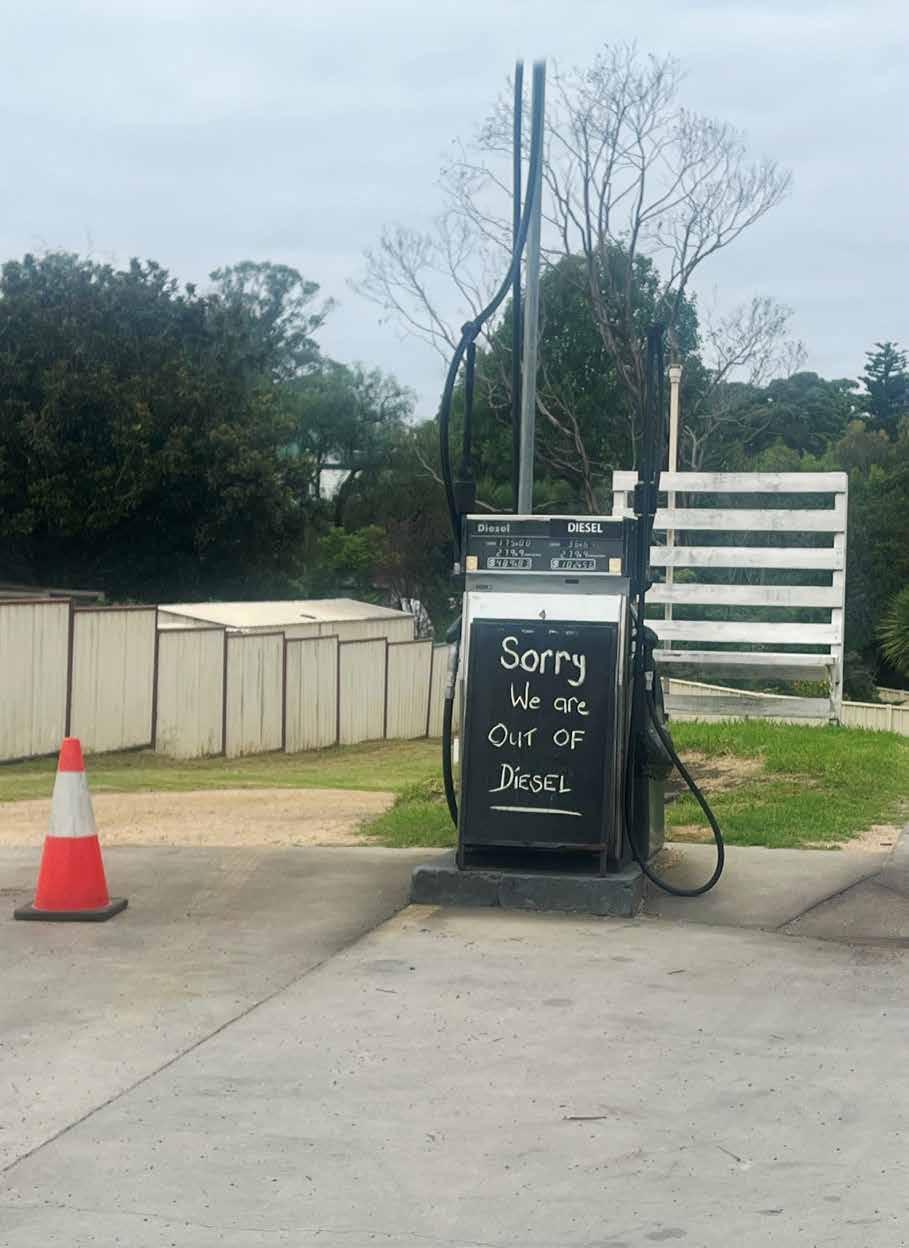
DIESEL CRISIS HITTING HARD





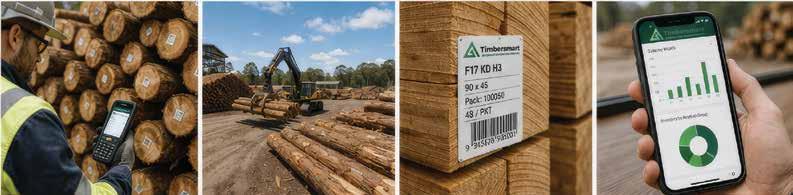
TimberSmart delivers fully integrated Enterprise Resource Planning and mobile solutions that streamline operations from log intake to dispatch. We help sawmillers, wholesalers, and re-processors run more efficiently with real-time data, greater visibility, and reduced manual processes.
Use real-time data and industry-specific functionality to gain the visibility you need to reduce errors, and make effective decisions.
PRODUCTS
• TimberSmartOne ERP - end-to-end operations
• Forestry, Log & Inventory Management
• Sawmilling, Wholesaling & Manufacturing
• Finance Integrations & TimberXchange (EDI)
• Consulting & Implementation
• Mobile Apps & Handheld Scanning
• Custom Development & Integrations
• Data, Reporting & Hardware Solutions


Forest and Wood Communities Australia want the Federal and State governments to act on the fuel crisis after one of the New South Wales’ largest timber haulage operators revealed he is spending $200,000 more every month in additional fuel costs — and can no longer guarantee his business will survive.
FWCA is calling on the Government to temporarily cut the fuel excise by removing the Road User Charge (RUC) and GST for heavy vehicle users.
According to the Nationals more than 107 service stations in NSW alone have reported diesel shortages, with similar patterns across Australia.
New modelling tabled in NSW Parliament warns diesel could peak at $8.00 a litre unless federal and state governments take urgent action. The timber industry is not classed as an essential service by the Federal Government.
Denis Greensill runs more than 35 trucks across New South Wales, moving between 5,000 and 10,000 cubic metres of hardwood every month — timber going into flooring, decking, pallets, posts, piles and mine shafts that underpin Australian value chains.
He said fuel prices have risen 58% in recent weeks, adding 86 cents a litre to his operating costs.
The numbers are stark. At 43 to 45 cents per kilometre in fuel costs and 50,000 litres consumed weekly across the fleet, Mr Greensill is losing $4 on every tonne he moves.
He is unable to immediately pass the costs on because his customer is the NSW Government (Forestry Corporation) and under his contract, he is only entitled to a quarterly review.
“I need to find $40,000 every week or $200,000 of additional money every month,” he said. “Otherwise, it comes out of my bank account, and I go out the door.”
In Bulahdelah on the Mid
● Monthly fuel spends that once ran between $200,000 and $220,000 before February 28 have reportedly blown out for logging contractors to $400,000.
is compounding the price shock. Harvest and haulage agreements are reviewed quarterly, meaning the full weight of February’s price surge will not flow through to contract adjustments for months. While Forestry Corporation NSW has indicated it will move to monthly fuel levy reviews, for a business now carrying $400,000 in monthly fuel costs, that cannot come quickly enough.
“If they don’t reduce the excise — effectively the tax they’re taking off fuel — they’re double dipping. They take a fuel excise plus they take GST off the top. We’re supposedly in a housing crisis, and you’re passing on the cost of building materials via the diesel.”
North Coast of New South Wales a fifth-generation family operation is absorbing a $7,800 weekly fuel surge to keep hardwood moving to Australia’s cities.
Anthony Dorney and his brothers operate two hardwood sawmills — SA Relf and Newells Creek — as the fifth generation of a family that has been cutting timber in north-east NSW for more than a century.
The two mills supply a large share of north-east NSW’s hardwood – running supply chains south to Sydney and the Central Coast, west to Canberra, and north to Brisbane.
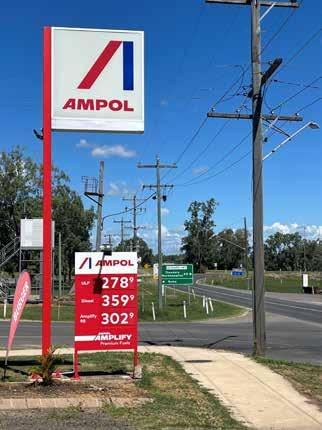
A monthly fuel spend that once ran between $200,000 and $220,000 before February 28 has blown out to $400,000, with Dorney warning it could reach $500,000 if prices keep climbing and no government relief is forthcoming.
“It just gets bigger and bigger and bigger. So to try and find some extra money to pay for that when we
can’t recover that — all our customers can’t accept the fuel levy, and we’re struggling to recoup some of that money. And on top of having very high workers’ comp this year. And other very high insurance, power, and all that. There’s no spare money to pay this.”
In a single week, daily fuel costs across the two operations have climbed by more than $7,800. Every tonne of Tallowwood, Ironbark and Blackbutt that leaves Bulahdelah does so on the back of a fuel-powered truck. The two mills employ more than ten per cent of the local town’s population and supply a large share of north-east NSW’s hardwood — running supply chains south to Sydney and the Central Coast, west to Canberra, and north to Brisbane. “It’s not a case of panic buying,” Dorney said. “It’s all due to a critical shortage at the bowser and growing rationing between customers.”
The structural problem
“You just can’t wait that long for your money,” Dorney said.
Mills are already responding; some have stopped accepting timber from private landholders altogether, others have raised prices, and those locked into contracts without fuel levy provisions have no room to move.
“It’s already started. There are mills not taking timber. And not only that, mills have put up their prices. Some people said, we just can’t take the timber. Because some people have got contracts where they haven’t got a fuel levy built into their pricing.”
Steve Dobbyns, Executive Officer of Forest and Wood Communities Australia, said the federal government is effectively double-dipping on the crisis — collecting excise plus GST as prices climb, reaping more revenue from the same tank with every dollar prices rise.
His remedy is a freeze — locking the per-litre excise at February 28 levels so the government’s take does not grow as prices do.
“If they were taking, say, 55 cents — and the price of fuel keeps going up — fix it at 55 cents,” he said.
Timber NSW CEO Maree McCaskill confirmed the downstream consequences are already in motion.
“As Master Builders said, the fuel crisis will have a flow-on effect to the cost of housing and the other parts of the building and construction value chain over the coming months,” she said.
Australian Forest Contractors Association chairman Lloyd Martin said that he was hearing there were some shortages of diesel in Victoria.
He said the situation depended on individual contractors’ own contractual arrangements.
He said these prices were generally adjusted monthly, or in some cases quarterly, so contractors would have to wear immediate price increases.
|
Issue 2 – Volume 37
Established 1991 News 3-13
My View 12 Fire fighting 18-21 New technology 22-25 Mill Profile 29
Front Cover: As new modelling warns diesel could peak at $8.00 a litre unless federal and state governments take urgent action, and more than 107 service stations in NSW alone reporting diesel shortages with similar patterns across Australia, some mills have stopped accepting timber from private landholders altogether.
Picture: Steve Dobbyns
Story Page 3
Publisher and Chief Executive:
Hartley Higgins
General Manager: Robyn Haworth
Editor:
Bruce Mitchell
b.mitchell@ryanmediapl.com.au
Adelaide Office: (08) 8369 9521
Advertising:
Jamie Richardson
j.richardson@winetitles.com.au
Adelaide Office: (08) 8369 9514
Creative Services: Robyn Haworth
Trader classifieds:
Jamie Richardson
Adelaide Office: (08) 8369 9514
Subscriptions:
subs@forestsandtimber.com.au
Adelaide Office: (08) 8369 9500
Subcription rates
One-year (6 editions) $44.65
Two-years (12 editions) $77.65
Accounts: ar@winetitles.com.au
Adelaide Office: (08) 8369 9500
Postal Address: 630 Regency Road, Broadview South Australia 5083
Phone: (08) 8369 9500
Melbourne Office: Suite 207/19 Milton Parade, Malvern VIC 3144
Phone: 0402 494 041
Website www.timberbiz.com.au
Printed by Lane Print, Adelaide, SA
Conditions
The opinions expressed in Australian Forests & Timber News are not necessarily the opinions of or endorsed by the editor or publisher unless otherwise stated. All articles submitted for publication become the property of the publisher. All material in Australian Forests & Timber
Dr Ruth Schubert has been appointed as its new independent Chair of The Green Triangle Forest Industries Hub, bringing to the role a distinguished career spanning education leadership, and governance.
A highly respected executive and strategic leader, Dr Schubert’s career has spanned senior roles with TAFE SA, Department of Education SA, and the University of Melbourne’s LH Martin Institute, where she was Associate Professor and Associate Director.
The Mt Gambier-based academic, who now works as an independent consultant, brings strong governance credentials, with extensive experience across boards, audit and risk committees, and independent advisory roles.
Hub Deputy Chair Laurie Hein said the appointment of an Independent Chair reflected the Board’s commitment to “strong governance, strategic clarity and disciplined oversight” as it continued to mature.
“Ruth brings an exceptional depth of experience in leadership and govern-
ance alongside a strong understanding of our regional communities. Her ability to guide strategic discussion, support effective board performance and ensure robust governance will add significant value to the Hub,” Mr Hein said.
“As our industry navigates complex policy, sustainability and market challenges, having an Independent Chair provides confidence to our members, partners and government stakeholders that the Hub operates with clear accountability and strategic focus.”
Mr Hein acknowledged and thanked outgoing Chair Cameron MacDonald, who has led the organisation since 2021.
“Cameron has been an outstanding Chair and a tireless champion for the Green Triangle forest industries,” Mr Hein said.
“Under his leadership, the Hub has further grown into a strong, unified collaboration, progressing important research on wood optimisation, water and engagement with government and the community. We are extremely grateful for his commitment and service.”
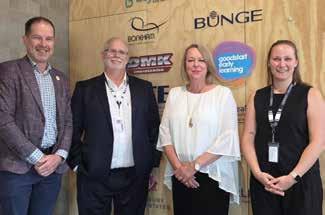
Dr Schubert said she was honoured to be appointed Chair and looked forward to building on the strong foundations already in place.
“The Green Triangle Forest Industries Hub plays a vital role in strengthening collaboration, capability and long-term sustainability across one of Australia’s most important regional industry clusters,” Dr Schubert said.
“I’m looking forward to working with the board, industry and stakeholders
to support the Hub’s strategic priorities and ensure it continues to deliver value for both the sector and the communities it supports.” She also paid tribute to her predecessor.
“I would like to acknowledge Cameron MacDonald for his leadership and dedication to the Hub. He has helped position the organisation as a respected and effective voice for the Green Triangle forest industries, and I look forward to building on that legacy,” she said.
The information came like a bolt of lightning.
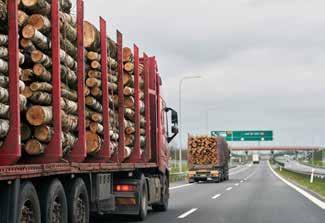
With diesel topping $3.51 a litre and NSW Parliament warning of an $8.00 peak, Bulahdelah’s biggest employer is liquidating assets to keep 25 trucks on the road — and mills are already turning away private timber
the
of information, the
will not accept responsibility for errors or omissions, or for any consequences arising from reliance on information published.
&
The price of diesel – because of US President Trump’s war with Iranmeans Anthony Dorney - the fourth of five generations of his family to run timber trucks out of the NSW hinterland - has resorted to selling cattle to pay for the fuel needed to transport timber to mills.
His monthly fuel spend that once ran between $200,000 and $220,000 before February 28 has blown out to $400,000.
To date, the Federal Government has been caught totally flat-footed, with the Prime Minister Mr Albanese and his Energy Minister Mr Bowen looking like rabbits caught in the headlights of an on-coming timber truck. Neither seem to have the ability to grapple with the crsis, let alone understand it.
Of the duo Mr Bowen has been found the most wanting. First he insisted there is no fuel crisis. He said it was “un-Australian” to top up your tank or use culturally inappropriate Jerry cans to store fuel if there are actual shortages, especially in diesel, and people
don’t know if they are affected or not.
He has also gone out of his way to accuse the Coalition of being negative, unco-operative, and talking Australia down.
As The Australian commented “surely the serious response from a responsible energy minister at the beginning of a global energy crisis was to address it from the beginning as a crisis, to offer transparency to control panic buying, not to be patronising, and turn the release of daily figures – as was the case in the pandemic – into a sober, politically free and factual exercise”.
Running 25 trucks across routes to Sydney, the Central Coast, Canberra and Brisbane, Dorney is the engine room of Bulahdelah’s
economy. With each truck burning between $1,500 and $2,000 of extra fuel every single day, keeping the fleet on the road has become, in his own words, impossible.
Steve Dobbyns, Executive Officer of Forest and Wood Communities Australia, has pointed out that the federal government is effectively double-dipping on the crisis — collecting excise plus GST as prices climb, reaping more revenue from the same tank with every dollar prices rise. But the Federal Government is not going to be cutting the fuel excise any time soon as the cash rolls in.
Meanwhile, Anthony Dorney has trucks he can barely afford to fill, and cattle he has to sell.
Anew $800m production facility which will convert 300,000 tonnes of low carbon methanol made from plantation forestry residues and hydrogen into sustainable aviation fuel will be built in South Australia.
HAMR Energy’s facility will be the first-of-its kind in Australia, utilising global engineering firm Honeywell’s world-leading technology and site selection is a key part of HAMR Energy’s strategy to produce SAF to decarbonise air travel and create hundreds of jobs in the region.
The facility, when up and running, will convert 300,000 tonnes of low carbon methanol, made from plantation forestry residues and hydrogen in Portland in Victoria, into
approximately 140 million litres of SAF.
That is enough to decarbonise around 4.5 million economy-class passenger trips between Adelaide and Melbourne each year and will help close the estimated global SAF supply shortfall 10 million tonnes by 2030.
The project will create hundreds of construction jobs and dozens of longterm operational roles, attracting hundreds of millions of dollars of investment to the state. It will support state and federal government priorities to establishing a domestic SAF industry, strengthening fuel security while helping the aviation industry meet emission reductions targets.
The South Australian gov-
ernment and HAMR Energy have both recognised the significant contribution low carbon liquid fuels can make to the state’s economy. Plantation forestry residues from the Green Triangle, centred around Mount Gambier, will be converted into fuel by HAMR Energy after it signed supply agreements with local sustainable forestry firms including OneFortyOne.
This in turn will provide an additional revenue source for the forestry industry, supporting the regional economy.
HAMR Energy is now undertaking due diligence on sites suitable for major industrial developments with the support for the South Australian Government.
“We are proud to be strengthening fuel secu-

rity for the nation, while contributing to the South Australian economy and creating local jobs,” David Stribley, Co-founder of HAMR Energy, said.
“The state’s world class infrastructure, commitment to clean energy, and proximity to sustainable feedstock sources make it
an excellent location to accelerate decarbonisation in aviation.”
The announcement comes after HAMR Energy’s AUD 10 million Series A funding garnering support from partners Airbus, Qantas and thyssenkrupp Uhde.

Changes to the Environment Protection Act would eliminate the Regional Forest Agreements with nothing yet put in place to replace them, according to testimony before the Senate Environment and Communications Legislation Committee from Timber NSW legal advisor Stuart Coppock.
The existing exemption for RFA forestry activities will formally end on 1 July 2027, at which point forestry operations will require EPBC assessment, approval and compliance with National Environmental Standards that are yet to be finalised.
The Federal Government Commonwealth is believed to working on three separate pathways for businesses that operate under RFAs to continue working in forests after the exemptions end but Mr Coppock believes there is a major problem with this because of the way the constitutional powers work under the legislation.
“Will the Commonwealth laws override the states? We don’t know,” he said.
“So we’re heading into a literal maelstrom of legal nonsense.”
Mr Coppock said that there was in place “a very good system” under the RFAs.
“They’ve been around for a long time. The full Federal Court has got a very solid judgement which sets out the procedure and why they work.They deal with the constitutional federalism of Australia, and they do work. The only comment you might make is the fact they do not cover all forest areas in Australia.
“They are of selected areas, and that’s an issue that should be talked about. But where we’re heading is literally no man’s land, and there’s been no communication in terms of New South Wales hardwood forests.”
Mr Coppock said the legislation had been drafted around environment.
He said the Prime Minister Mr Albanese had talked about how business friendly
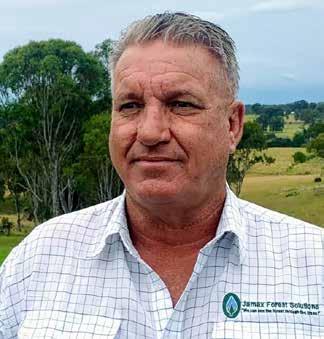

the legislation was.
“That’s fine. You go back to the legislation and try and find that in the legislation,”
Mr Coppock said.
“It’s not there. It’s implicit. It’s not explicit.
“The implicit bit refers to codes and standards of a profession or a business or industry, which may be put into the consent conditions around an action, and then it’s full stop.
“So, where you land is that this legislation is about a decision-making process (of business). The problem is that the legislation does not refer to business. It uses the word ‘economic’.
Mr Coppock said that case needed to be taken when dealing with “statutory interpretations”.
Forest and Wood Communities Australia wants Federal Environment Minister Murray Watt to act on a fix to the RFA framework that it says has been sitting in plain sight since 2021 — debated in the Senate, recommended by a crossparty committee, backed by Labor, backed by the union, and then killed by Coalition politics on the eve of an election.
With the EPBC reform process now under his stewardship, FWCA says Senator Watt has the precedent, the numbers, and the mechanism to finally get it done.
“Australia’s forest industries and the regional communities that rely on them to put food on the table and keep the lights on, deserve the certainty that such a legal fix can provide,” Forest & Wood Communities Australia chairman Steve Dobbyns said.
S o we’re heading into a literal maelstrom of legal nonsense
The fix, according to the FWCA, is the business judgment rule — the same mechanism at the heart of director duties under section 180(2) of the Corporations Act 2001, and the same principle drawn on for the Gillard government’s 2011 workplace health and safety harmonisation. It is not a new idea and it is not a radical one. It is settled law with three decades of precedent
behind it.
FWCA says the problem it solves is straightforward.
Stuart Coppock put it plainly to the Senate in April 2021: the RFAs, as currently drafted, leave field operators legally exposed even when they have done everything the agreement requires of them. The business judgment rule provides a litigation defence where conduct met the highest standard of skill and care. Courts already understand the framework.
The Senate Environment and Communications Legislative Committee’s 2021 inquiry into the EPBC Amendment (Regional Forest Agreements) Bill 2020 put a clear recommendation on the table.
Recommendation 2 called on the Government to expedite amendments to both the EPBC Act and the Regional Forest Agreements Act 2002, applying a judgment test drawn directly from the Corporations Act.
Senior Labor Senator Raff Ciccone was among its strongest advocates. Outside the chamber, the thenCFMEU Manufacturing Division — now the TFTU — was pushing for the same outcome.
It went nowhere. Maree McCaskill, CEO of Timber NSW — who helped shape the NSW hardwood industry’s submission to the bill — explained why. Then-Nationals Senate leader Bridget McKenzie had her own private members bill. Coalition Environment Minister Sussan Ley — since deposed as Liberal leader — refused to support it because it fell outside Coalition policy. The recommendation died with it.
“Our proposal differed significantly from the McKenzie approach,” Ms McCaskill said. “Had it been adopted, we would not be in the legal mire we find ourselves today.”
The numbers have changed. The Coalition holds fewer seats. The Albanese government has the caucus support, the union backing, the cross-party Senate record, and a minister already on record committing to modernise the framework so that it is fit for purpose. There is no plausible argument left for delay.
“The business judgement rule is not about shirking responsibility; it’s designed to ensure businesses are protected from lawfare if they can demonstrate that they have exercised “due diligence,” Mr Dobbyns said.
The South Austral ian Government has committed $400,000 in funding to support the completion of the Logging Investigation and Training Association’s new training base.
This funding recognises the critical and enduring role the Mount Gambierbased LITA plays not only in supporting the forest industries, but in deliver ing essential skills train ing that underpins all pri mary industries, trades, emergency services, First Nations groups, commu nity bus drivers and many other regional occupa tions.
Completion of the new training base will deliver modern, fit-for-purpose facilities that reflects con temporary industry needs and emerging technolo

stone of practical, industry-aligned training, equipping apprentices, trainees and existing workers with the skills required to operate safely, productively and sustainably. While its contribution to the forest industries has been significant, its impact extends well beyond
Without LITA’s presence in the South East, people seeking this training would be required to travel to Adelaide, or even as far as Port Lincoln, to access training that is currently delivered locally. The training delivered through LITA underpins workforce capability across the broader Limestone Coast economy and
National issues impacting forest business viability prioritised for AFCA focus
Cost escalation without indexation
Increasing costs without price keeping pace
Visible today with the current fuel crisis
Imbalanced risk allocation
AFCA continues to work collaboratively industry partners and government departments - Victoria and Tasmania have started talks with AFCA on these member issues identified
Strength in numbers and a seat at the table
SPONSORS
Help drive the change our sector needs

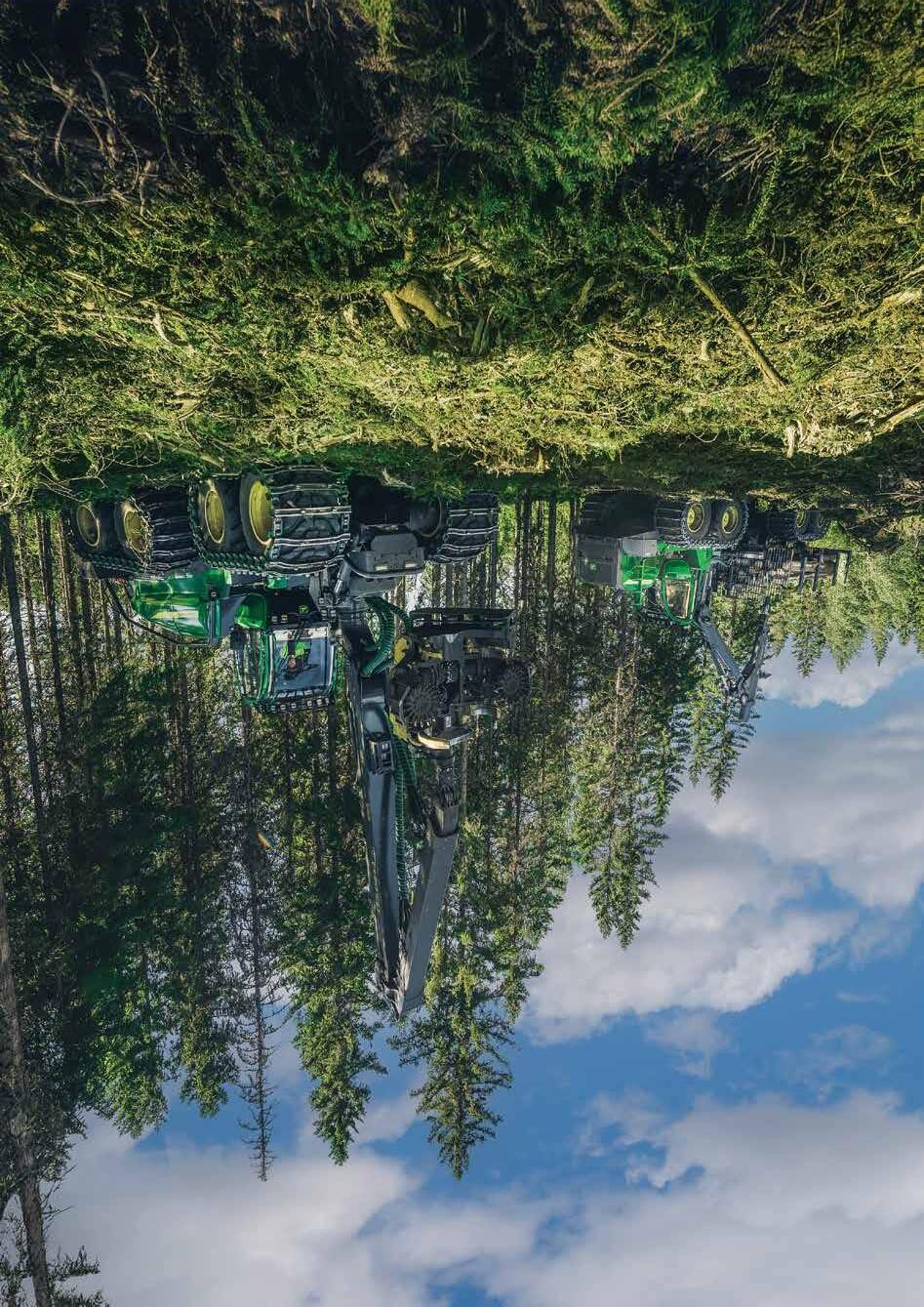
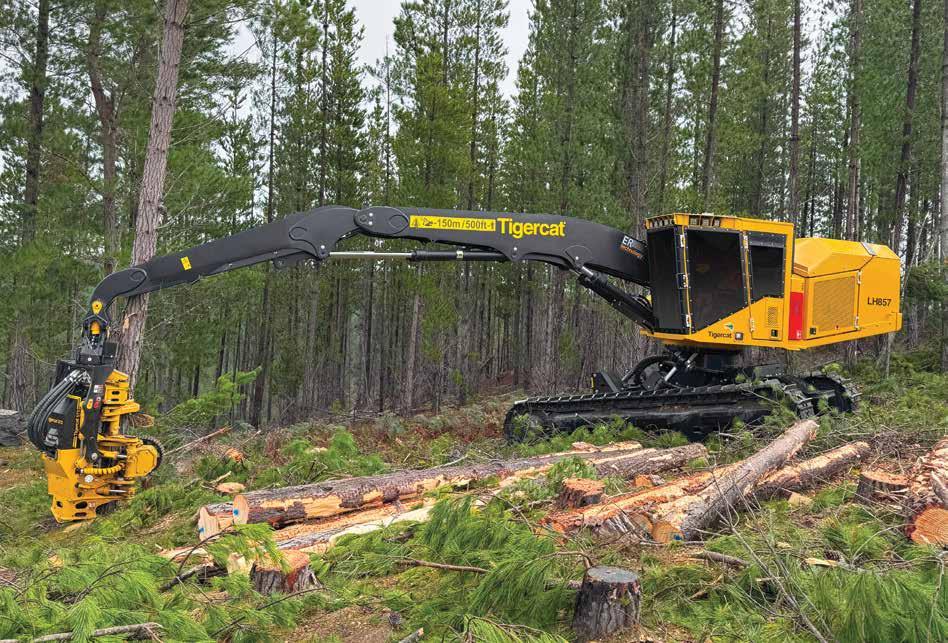
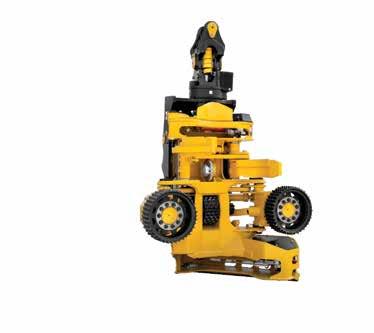
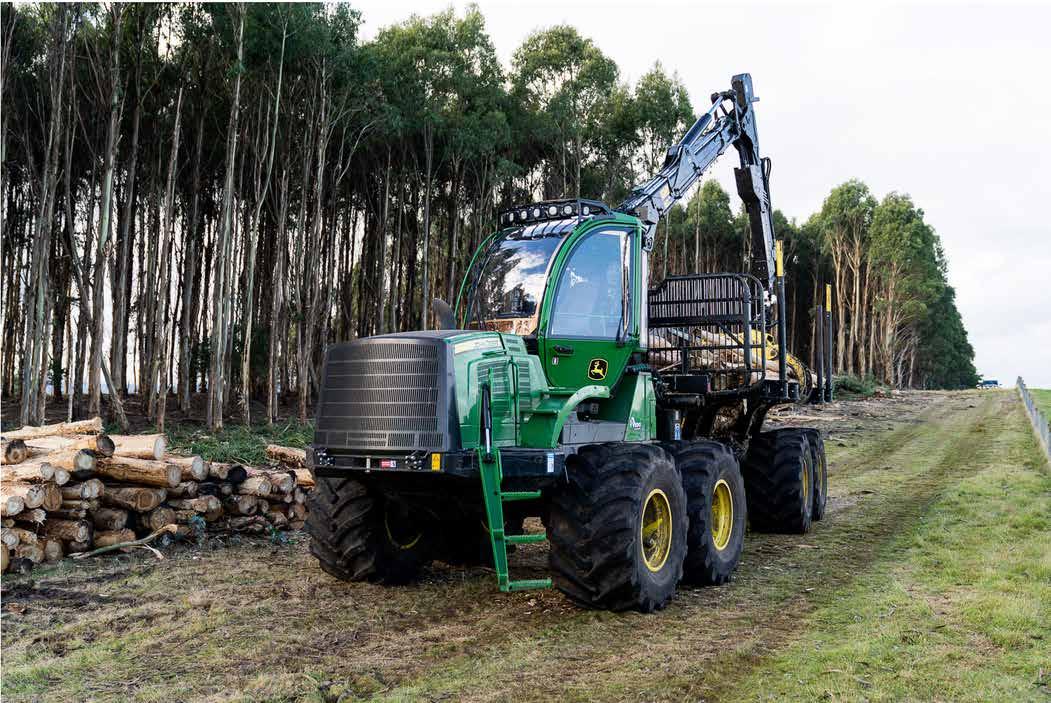
H-Series logging machines harvest at the highest level, working seamlessly as a system to deliver unmatched productivity and fuel efficiency.
Our game changing IBC automation comes standard - providing smooth, precision boom control while Active Frame Lock increases harvesting stability on steep terrain. 25% more load capacity, longer reach booms, and the new frame lock ensure stable full-load forwarding, improving operational efficiency.
Modernised cabs provide exceptional comfort, improving operator well-being and ensuring productivity stays high from first cut to last load.
Make that power play with John Deere H-Series.


deere.com.au/en/forestry/h-series/



Rotorua-based heavy transport trailer and equipment manufacturer Patchell Group has entered into a joint venture with Australian manufacturer Kennedy Trailers to provide access to specialised forestry equipment.
The partnership will see the companies collaborate to provide specialised forestry and heavy transport trailer solutions, combining Kennedy Trailers’ manufacturing expertise with Patchell’s longstanding presence in the New Zealand market.
Patchell Group says the move “recognises the benefits of aligning with other like-minded companies to be able to offer products that suit a range of transport solutions”.
“The Patchell Group has always been at the forefront of design and technology but recognises the benefits of aligning with other likeminded companies to be able to offer products that suit a range of

transport solutions,” the company said.
Victorian-based Kennedy Trailers is a family-owned business with more than 40 years’ experience manufacturing logging, mining and heavy transport equipment.
The company was founded by Garry Kennedy in 1980, initially operating as a mobile welding contractor servicing logging operations before expanding into the design and manufacture of purpose-built transport equipment.
Over the decades the business has developed a range of custom log and folding trailers, producing more than 20 different trailer configurations for forestry and heavy haulage applications.
Through the joint venture Patchell will offer Kennedy Trailer products, such as the company’s specialised folding trailer design incorporating proven Kennedy technology and reliability into
Patchell-designed and -manufactured trailers that meet the tare and operational requirements unique to the New Zealan log transport task.
By working with an established manufacturer rather than duplicating proven designs, The Patchell Group aims to ensure customers have access to the most appropriate equipment – supported locally by a team that understands New Zealand conditions and long-term performance requirements.
Patchell Group has entered into a joint venture with Australian manufacturer Kennedy Trailers to provide access to specialised forestry equipment.
“The Patchell Group has always been at the forefront of design and technology but recognises the benefits of aligning with other likeminded companies to be able to offer products that suit a range of transport solutions,” the company said.
Through the joint venture Patchell will offer Kennedy Trailer products, such as the company’s specialised folding trailer design incorporating proven Kennedy technology and reliability into Patchell-designed and -manufactured trailers that meet the tare and operational requirements unique to the New Zealan log transport task.
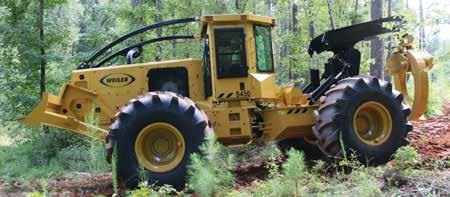
By working with an established manufacturer rather than duplicating proven designs, The Patchell Group aims to ensure customers have access to the most appropriate equipment – supported locally by a team that understands New Zealand conditions and long-term performance requirements.

“Our industry is evolving, and operators and forest owners are looking for smarter, more efficient ways to do business,” said Brent Whibley, Patchell CEO.
“This partnership allows us to introduce a proven solution to the New Zealand market, backed by local support and engineering. We believe it represents a meaningful step forward in lifting productivity and performance in some specific need areas.”
Kennedy Trailers, a familyowned-and-operated business, provides more than 40 years’ experience in the manufacturing of logging, mining and heavy transport equipment.
CEO Garry Kennedy started in 1980 as a mobile welding contractor, servicing logging operations through the manufacture and re-
pair of machinery and log jinkers. His focus and passion was always trucks and log jinkers, and the business progressed from repairs to design and manufacture of its own purpose built equipment.
Over the decades, Kennedy Trailers has developed and produced a wide-range of custom log and folding trailers for forestry and heavy haulage applications, with more than 20 different trailer configurations built since its first log trailer entered service.
T he Patchell Group has always been at the forefront of design and technology but recognises the benefits of aligning with other likeminded companies to be able to offer products that suit a range of transport solutions
Garry said the company is excited to be involved with this joint venture with the Patchell Group in New Zealand to offer trusted solutions for the New Zealand market.
“This partnership brings together Kennedy Trailers’ proven Australian engineering and manufacturing expertise with Patchell’s strong local knowledge and established reputation in New Zealand,” he said.
“By working collaboratively, we are confident we can deliver innovative, high-quality folding log trailers that are purpose-built for local conditions and provide longterm value to New Zealand operators.”
Patchell brings more than 50 years of experience in the manufacture and supply of forestry equipment, with products that have operated successfully in New Zealand conditions over many years. Patchell will continue to design, build, and sell its own range of Patchell-branded products.
Amajor new benchmark for the forestry valuation sector has been launched by Forestry Australia and the New Zealand Institute of Forestry.
The Australia & New Zealand Forest Valuation Standard, a joint NZIF and Forestry Australia initiative, is the result of nearly a decade’s work by the national associations to bring together their country-level forest standards into a single document capable of representing plantation and native forests.
The first Australia & New Zealand Forest Valuation Standard was developed in consultation with forest professionals, researchers, industry and practitioners on both sides of the Tasman. It reflects the latest thinking and best practice in forest valuation across
both countries and is designed to assist valuation practitioners, forest managers, investors, and those reporting forest values.
“The merging of the separate country-level standards held by Forestry Australia and New Zealand Institute of Forestry is a significant milestone,” Dr Michelle Freeman, President of Forestry Australia, said.
“It reflects the strength and value of ongoing collaboration and partnership between our countries, our industries and professional organisations.
“Importantly, while the ANZ Forest Valuation Standard is intended to address common interests of our national forest industries, it is flexible enough to allow for differences. The Standard will be an evolving tool to help shape the forest sector’s future and
support continued innovation and improvement, as markets, reporting expectations, and sustainability considerations continue to evolve.”
Concurrent with the new Standard, Forestry Australia has launched the Australian Carbon Standard Exposure Draft, to sit alongside the existing New Zealand Carbon Standard.
Forestry Australia has also recently examined the implications for Australian reporting entities arising from the newly mandated Australian Accounting Standards Board Climate Related Disclosures (AASB S2).
“Our members have contributed voluntary time and expertise to forest valuation standards for more than three decades,”
James Treadwell, President of the New Zealand
Institute of Forestry, said.
“The first New Zealand standard was developed in the 1990s and has been continually refined since then as markets, reporting expectations, and forest management practices have evolved.
“This joint Standard is an important step forward. It reflects the strong professional relationship between the New Zealand Institute of Forestry and Forestry Australia and provides a consistent framework which will strengthen valuation practice across both countries,” he said.
“I would like to acknowledge the many members, in particular Bruce Manley (convenor since 1993) and Bill Liley, who have contributed their time over the years to developing and maintaining these standards. Their voluntary work
Forestry Corporation NSW (FCNSW) has been convicted in the Land and Environment Court for four offences under the Forestry Act 2012 for breaching conditions of the Coastal Integrated Forestry Operations Approval (CIFOA) during forestry operations in Wild Cattle Creek State Forest between June and July 2020.
FCNSW breached the CIFOA by failing to identify, map and record six giant trees and three hollow-bearing trees during broad area habitat searches conducted prior to forestry operations in Wild Cattle Creek State Forest. As a result, these nine trees were unlawfully felled by FCNSW’s logging contractors, so causing harm to the environment.
The prosecution was brought by the NSW Environment Protection Authority (the EPA) and FCNSW pleaded guilty to the offences. On 13 March 2026 the Court convicted FCNSW of each offence and determined that FCNSW should pay a monetary penalty totalling $450,000. The Court ordered FCNSW to pay the amount of the monetary penalty in lieu of a fine to undertake restorative justice activities and bio-cultural repair of the affected locations. The Court also ordered FCNSW undertake an audit of its internal procedures, instruction and training relating to the identification and retention of giant trees and hollow-bearing trees and implement the recommendations of the audit. FCNSW was ordered to pay the EPA’s legal costs as agreed or assessed and publish this notice in State-wide, local and industry publications.
underpins confidence in how forest assets are valued and reported.”
The development of the Standard has been supported by Forest & Wood Products Australia (FWPA), Jodie Mason, Head of Forest Research at FWPA remarked that, “FWPA is proud to have supported the finalisation of the Standard and development of the Australian Carbon Standard Exposure Draft. The Standard was unpacked at the Forest Valuation Summit in Melbourne in March.
“The release of the Standard is more than just a launch,” Dr Freeman said.
“It is a practical step toward stronger valuation practices, better reporting, and greater confidence in forestry’s role in investment, sustainability, and the economy."
Forestry hasn’t always been associated with balance. Tradition ally, it’s been seen as a hard hat and high-vis industry, shaped by longstanding perceptions about who be longs in the sector.
Like many stereotypes, that picture is outdated — and it certainly doesn’t reflect the business we’ve built at SFM.

This year’s UN Women Australia International Women’s Day theme, Balance the Scales, resonates with me because balance in our context isn’t symbolic; it’s practical. Today, our team sits at approximately 50:50 men and women. In forestry, that’s still relatively uncommon, but for us it hasn’t been about chasing a number. It has been about hiring capable people, building a strong culture, and ensuring the best ideas rise to the surface. When you focus on merit and remove outdated assumptions about who “fits” in forestry, balance tends to follow.
And they’re tangible. Forestry is a long-horizon business where decisions made today shape landscapes, investments and communities for decades to come. We operate at the intersection of climate change, biodiversity, global capital and regional economies. In that environment, diversity is not a social add-on; it is a commercial and strategic advantage. A team with
varied perspectives is better at challenging assumptions, identifying risk and navigating complexity. It improves the quality of debate around the table and reduces the likelihood of blind spots that can undermine long-term outcomes.
I see this play out in our discussions every week. The strength of our team lies not just in technical capability, but in the breadth of thinking that informs our decisions — from forest management and compliance through to investment strategy, stakeholder engagement and innovation. There is healthy challenge, respectful disagreement and a shared commitment to getting the outcome right. From a Managing Director’s perspective, that makes for better decisions — and occasionally keeps me on my toes.
Modern forestry bears little resemblance to the industry of a generation ago. Today we are managing carbon markets, responding to evolving ESG expectations,

deploying technology in sustainable land management and engaging with sophisticated institutional investors. That complexity demands skills across environmental science, finance, operations, communications and governance. Talent in those areas is not defined by gender, and our workforce shouldn’t be either.
Importantly, balance strengthens our credibility. Clients increasingly view diversity as an indicator of governance quality and organisational resilience. Communities expect inclusive leadership. Young professionals considering careers in sustainability or land management want to see pathways that are genuinely open to them. If for-
estry is to remain relevant and competitive in a decarbonising economy, we must ensure opportunity is accessible and visible.
Of course, achieving balance requires more than good intentions. It depends on how we recruit, how we develop leaders and how we support people across different stages of their careers. It also requires an environment where diverse voices are not just present, but heard. Culture is shaped in the everyday interactions — in meetings, in field operations, in project teams — where inclusion either becomes real or remains rhetoric.
At SFM, I’m proud of the balance we’ve achieved because it has made us a stronger business. It sharp-
ens our thinking, strengthens our governance and enhances our ability to deliver sustainable, longterm value for investors and communities alike. That outcome is far more meaningful than any headline statistic.
International Women’s Day offers an opportunity to reflect on progress, but it also reminds us that maintaining balance requires ongoing attention. For our part, we remain committed to building a forestry business where capability is recognised, opportunity is equitable and leadership reflects the diversity of the world in which we operate. That, to me, is what it truly means to balance the scales.

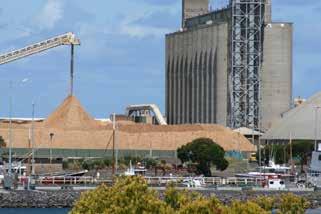
For more than a decade, Australia has been a significant supplier of hardwood and softwood chips to North Asia’s pulp and paper producers.
Strong plantation resources, established trade routes, and deep relationships with China and Japan supported consistent export flows.
But now the data is telling a different story – one of slowing demand, shifting trade patterns, and rising competitiveness.
Australia’s hardwood chip exports hit a peak of 6.8 million bdmt in 2018.
Since then, according to a leading provider of pricing, market intelligence and sustainability solutions, ResourceWise, exports have dropped significantly.
By 2025, total hardwood
chip volumes fell by 45% from the 2018 peak, and shipments to China decreased by 33%. Japan’s imports from Australia dropped even more dramatically – down 65% between 2018 and 2025.
However, these are not circular dips; instead, they indicate deeper structural shifts in the region’s pulp and paper industry, which are transforming fiber demand patterns throughout the Pacific Rim.
China has long been the anchor market for Australian hardwood chips. However, rapid and ongoing expansion in China’s pulp and paper industry has created overcapacity and structural imbalance.
As mills ramped up production, fiber procurement strategies evolved.
At the same time, China
has increased the availability of domestic wood fiber — including woodchips — reducing dependence on imports.
The result is a measurable shift in trade flows. Demand for imported hardwood chips from Australia has softened, and pricing has come under pressure.
In the second half of 2025, the average export price for Australian hardwood chips was 5% lower year-overyear, with prices to China down 3% compared to the prior year.
For exporters already grappling with declining volumes, pricing weakness compounds the challenge.
The factors influencing the market—such as overcapacity in China, increased domestic fiber supplies, price competition, rising demand in South-
east Asia, and heightened regional rivalry—indicate more than just short-term fluctuations.
They suggest a fundamental shift in the structure of Asia’s wood fiber trade.
For producers, exporters, traders, and investors, un-
derstanding these shifts is critical. Where will sustainable demand growth come from? How durable is China’s structural surplus? Can emerging markets offset North Asian declines? And what do pricing trends signal for 2026 and beyond?
The Australian Forest and Wood Innovations (AFWI) Centre for Sustainable Futures, housed at the University of the Sunshine Coast (UniSC), has awarded $1.5 million in funding to support a new research project that will accelerate automation in Australia’s plantation forestry sector.
The project, titled SilvaNaut: Incorporating Autonomous Operation into Australian Forest Machinery – Robotic Weed Control Conditions, directly supports AFWI’s theme of making the most of our available wood fibre by enabling safer, more efficient and higher-yield forest operations.
SilvaNaut will develop and field-test ‘The Autonomous Forest Navigator,’ a bolt-on autonomous navigation module that retrofits existing forestry machinery to operate hands-free between plantation rows. Designed initially for young (0-3 years old), opencanopy plantations, the system will replace manual joystick control with precise autonomous navigation capable of operating in rough, real-world forest terrain.
Project Lead Daryl Killin said the core challenge the project addresses is safe, reliable navigation in environments that are far more complex than agricultural settings. The project will be delivered through Daryl’s company, Native Conifers Carbon Sink, who registered the first tree planting project for carbon credits in Australia under the Carbon Farming Initiative in December 2012. The company has been exploring remote-controlled weed control for a decade.
“There’s a real need for an autonomous vehicle that can do weed control in place of humans or human-driven machinery... but unlike driverless cars or broad-acre agriculture, we’re talking about remote locations, uneven ground, harvest residue, and a very high need for preci-
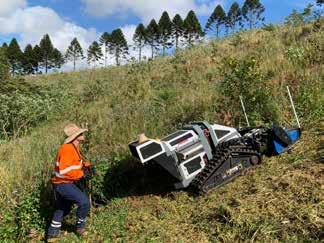
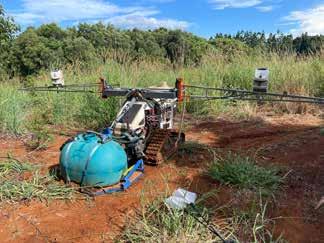
sion, because if you spray the wrong chemical in the wrong place, you can kill the tree,” Daryl said.
The technology integrates high-resolution Global Navigation Satellite Systems (GNSS), LiDAR, inertial sensors (IMU), and AI-based obstacle detection, building on proven control technology developed by project partners.
This geospatial backbone will enable not only robotic weed control, but also future applications such as inventory assessment, fire management, and forest monitoring.
Australia’s forestry sector is under growing pressure from labour shortages, rising operational costs, safety risks, and increasingly stringent environmental expectations. Daryl said manual weed control is labour-intensive and often undertaken in hazardous conditions, particularly in the early years of plantation establishment.
“Not many people want to put on a knapsack and work in remote areas with snakes, spiders and rough terrain anymore,” he says, “And even when people are available, you’re limited by human constraints; you can’t work at night, reliability varies, and safety risks are always present.”
The Autonomous Forest Navigator removes operators from high-risk terrain while improving consist-
ency and efficiency. Importantly, it enables round-theclock operation, allowing growers to target optimal spraying windows that are often missed under current manual systems.
“Weeds in the first two years are critical,” Daryl said.
“If you lose 200 trees out of 1,000 per hectare early on, you’ve lost future options for wood volume, and you can’t put those trees back later. That loss shows up 25 or 30 years down the track, right when the return on investment really matters.”
While automation is well advanced in agriculture, Daryl said many existing solutions are over-engineered, too costly, or poorly suited to forestry conditions.
“Agricultural systems are often designed for flat land and annual crops,” he said. “Forestry is a much longer game. We needed a forestry-specific solution that’s cost-effective, robust, and fit for purpose, not something adapted from agriculture that doesn’t quite work.”
The SilvaNaut project aims to fills this gap by providing a vehicle-agnostic, bolt-on autonomous system, compliant with international technical standards and designed for mid-sized forestry equipment. The system is also being developed to work
alongside drones, enabling smart task allocation between aerial and groundbased weed control.
“There’s still an important role for ground-based rigs... our system is designed to work with drones, not compete with them, choosing the right tool for the right job,” Daryl said.
The project is being delivered through co-design with seven major Australian forestry companies, ensuring strong industry relevance and a clear pathway to adoption.
Project partners include:
• HQ Plantations
• HVP Plantations
• Australian Bluegum Plantations
• Australian Carbon Farming
• Forestry Corporation NSW
• Forest Products Corporation
• Midway Limited
In addition to the commercial forestry partners, Native Conifers Carbon Sink – with support from the Regional University Industry Collaboration Program – engaged James Cook University to develop a complementary aspect of the technology’s development, which is training the SilvaNaut to identify young plantation trees from weed species, and to be interoperable with current indus-
try drone-spraying technology. The project also has a Trans-Tasman element, supported by New Zealand-based companies Lincoln Agritech and Wrybill Robotics, who have significant existing technology that will be fast-tracked in Australia, as well as the New Zealand Forest Research sector.
Field trials will commence in Queensland, with additional trials planned across Australia. Performance will be evaluated against navigation accuracy, labour savings, safety outcomes, fuel use, and overall cost-benefit compared with manual operations.
Professor Mark Brown, Director of the AFWI Centre for Sustainable Futures and UniSC’s Forest Research Institute, said this project meets a key AFWI goal of making the most of Australia’s available wood fibre by supporting our national capacity to meet growing demand for sustainable timber and wood products.
“By improving early-stage plantation management, this project will help narrow the 30-40 percent gap between biological potential and realised wood yield, bringing together industry experience, AI expertise and real-world testing, to build something foresters can actually use,” Mark said.
Australia’s plantation estate has contracted by nearly 300,000 hectares, native forest supply has reduced, and the level of forest product imports is increasing significantly.
And a new paper by the Rozetta Institute says these trends now limit Australia’s ability to support housing, advanced manufacturing, renewable carbon and industrial decarbonisation.
With decisive, coordinated leadership, the Rozetta Institute research paper says a Next Generation Perennial Plantations program will transform Australia’s plantation sector into a strategic enabler of the renewable-carbon economy.
Steve Walker, Principal of Terrafolia Advisory and lead author of the Rozetta Institute’s white paper, A National Pathway for HighProductivity Forestry and Renewable Carbon Supply,
says Australia’s plantation estate has contracted by nearly 300,000 hectares, native forest supply has reduced and the level of forest product imports is increasing significantly.
“At the same time, global markets are reshaping the value of plantation landscapes,” Mr Walker says.
“By aligning species to industrial demand, driving productivity through advanced genetics and precision silviculture, and integrating plantations with emerging clean-industry precincts, Australia can grow more value, more carbon and more fibre on less land,” Mr Walker says.
“This is not just forestry, it is a national strategy for energy transition, regional prosperity, industrial resilience and national sovereign capability.”
Mr Walker says in the paper that Australia is at a critical turning point.
Demand for renewable materials, engineered timber, biogenic carbon and low-emissions industrial inputs is rising sharply, yet national wood supply is declining.
Engineered wood manufacturers, renewable carbon producers, bioenergy developers and emerging biofuel pathways all require reliable, large-scale fibre supply.
“Australia has the land, climate and industrial base to meet this demand, but only if productivity is lifted significantly,” Mr Walker says.
“The most immediate and lowest-risk opportunity lies in doing more with what is already planted.”
He says Australian plantations typically achieve 15 to 18 cubic metres per hectare per year, while best in class international systems routinely deliver 30 to 50 cubic metres per hectare per year
using modern genetics, clonal propagation, precision silviculture and sitematched species selection.
Next Generation Perennial Plantations (NGPP) apply these technologies to double or triple biomass production within a single rotation and can be deployed without major land-use change, or within integrated agricultural landscapes.
NGPP is not a new species, crop or land use.
It’s a system that applies precision genetics and silviculture to existing species and landscapes.
Mr Walker says three complementary pathways underpin Australia’s ability to rebuild its wood basket:
1. Do more with the existing harvest: improve recovery, expand engineered wood processing and generate higher-value products from small-
diameter logs and residues.
2. Do more with the existing land base: deploy NGPP systems to lift productivity two to three times on suitable softwood and hardwood sites.
3. Do more with new land: pursue targeted expansion once productivity gains and secure offtake are in place.
NGPP offers substantial national benefits. A 50,000 hectare estate operating at two to three times productivity can supply one to two million tonnes of biomass each year, supporting major renewable carbon facilities, strengthening engineered wood capability, enhancing regional manufacturing and displacing high-emission industrial inputs.






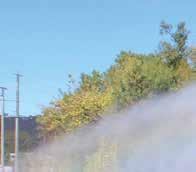
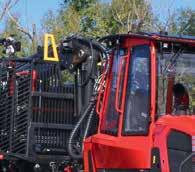
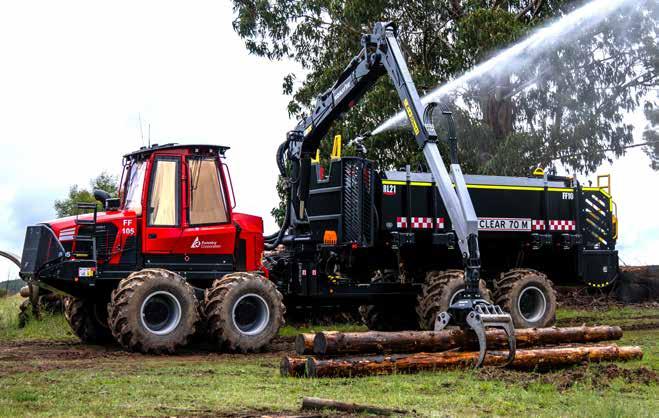
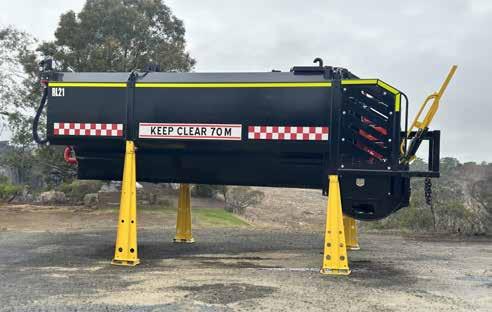
There are currently five Komatsu 895 Forwarders and one Komatsu 890 equipped with RL21 Firefighting Kits operating across southern forest regions along the NSW and Victorian eastern borders.
These areas include Orbost, Bega, Bombala, Canberra, Tumut, and Albury/ Wodonga with the units operated by Rodwell Logging (Bombala), Retreev Pty Ltd (Wodonga), West Terrain P/L (Andy Westaway), and Forest Corp NSW (Tumut).
The RL21 Firefighting Kit was designed and developed by Peter and Mark Rodwell of Rodwell Logging, with grant assistance from the Federal Government’s Disaster Resilience Program supporting research and development.
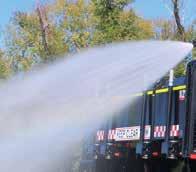
The resulting unit features a custom-built 21,000-litre tank, including a 3,000-litre emergency safety reserve, a highvelocity pump, dual water cannons, and a range of auxiliary firefighting equipment. All functions are controlled from within the safety of the forwarder cabin.
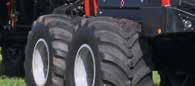
Rodwell Logging, which has been operating out of Bombala since the 1950s, already operated a Komatsu 895 Forwarder, making it the natural choice as the carrier platform. As a result, the RL21 was engineered to fit tightly onto the standard Komatsu 895 rear chassis and can be mounted or removed in less than two hours.
Rodwell Logging currently has two Komatsu 895 Firefighters operational, with a third unit coming online. These machines are available for deployment across forest areas from the south-eastern Victorian border, including Bondi State Forest, through southern NSW and across to ACT Parks in the Canberra region.
During recent periods of extreme weather, one unit was placed on standby in the Canberra region while
another was stationed in Bombala, following activation by Forestry Corporation NSW.
“The ability of these machines to respond to earlystage fire starts in remote areas significantly reduces the likelihood of major disasters,” said Peter Rodwell.
He cited a recent incident in Bondi State Forest near the Victorian border, where a lightning strike ignited a fire during the night. Early warning systems alerted crews, allowing rapid deployment of the Komatsu 895 Firefighter alongside a bulldozer, quickly suppressing what could have become a major fire event.
Peter’s longer-term vision is for contractors within each forest area to form cooperative firefighting groups, creating teams of forwarder owners capable of rapidly mounting firefighting units to suppress fires in their earliest stages.
Outside the fire season, one of Rodwell Logging’s Komatsu 895 Firefight-
ers is operated part time for road spraying with the large tank proving to be a very efficient system compared to conventional systems. Otherwise the two 895’s work in their Visy pine harvesting contract.
Retreev Pty Ltd is a major harvesting contractor operating primarily in the Shelley Forest region of Victoria, near the NSW/ Victorian border. The company experienced first-hand the devastating plantation losses during the 2020 fire disasters. As a result, owner Dean Venturoni began investigating mechanised firefighting solutions to help protect future plantations.
This search led him to Peter Rodwell, who already had an operational RL21 unit. After observing its capabilities, Dean finalised the purchase and took delivery of an RL21 Firefighting Kit in October 2024, ahead of the fire season. The unit was fitted to Dean’s existing Komatsu
895 Forwarder, which had accumulated over 5,000 operating hours.
Dean’s unit was involved in several minor fire incidents before being deployed during the major Walwa River Road fires last in January. These fires burned approximately 130,000 hectares, including 11,000 hectares of pine plantation. The Komatsu 895 Firefighter was used extensively in native forest areas for back-burning and control line establishment and black-outing, ultimately helping large areas of native forest.
The presence of nearby dams enabled rapid tank refilling cycles of 20–30 minutes. In one critical incident, the unit’s large water capacity was instrumental in saving three parked utility vehicles and a bulldozer.
Despite their efforts in the native forest areas, Dean lost four of his forest machines while parked in a firebreak within a pine plantation. Over a threeweek period, the Komatsu
895 Firefighter operated for nearly 400 hours on a 24/7 basis and was pivotal in protecting an additional 2,000 hectares of young pine plantations in the later stages.
“Unfortunately, many people are yet to fully appreciate and understand the capabilities of the Firefighter, its efficiency in blacking-out areas, the advantages it brings in rugged terrain with the sheer volume of water, the rate of water delivery, and mobility,” said Dean. “It’s vitally important to have experienced forwarder operator who understands how to best use the unit for optimal results.”
He believes that deploying multiple units within each forest area would significantly reduce fire impacts during severe summer conditions, a view echoed by Peter Rodwell. West Terrain Pty Ltd took delivery of an RL21 Firefighter Kit in December 2024, which was fitted to an existing forwarder, an older Komatsu 890.3. Re-
markably, the only modification required was the replacement of the existing bolsters with Komatsu 895 bolsters, which owner Andy Westaway sourced from a fire-damaged machine.
Andy’s machine is based in Orbost, Victoria, and operates throughout the Snowy River National Park region. Fortunately, the crew has had a quiet summer so far, with no call outs to date.
In late 2024, Forestry Corporation NSW strengthened its firefighting capability in southern NSW pine plantations by acquiring a new Komatsu 895 Firefighter for the Tumut forest region. The unit was funded through the NSW Government’s Plantation Fire Protection Package.
“The fire forwarder is an excellent piece of machinery in terms of both firefighting capacity and firefighter safety,” said Roger Davies, Forestry Corporation NSW Regional Man-
ager, Tumut. “It enhances our ability to reduce fuel loads during hazard reduction operations and suppress fires, lowering wildfire severity across the region. As an investment, this machine has already prevented a fire in the Tumut area from escalating into a major plantation event, delivering significant benefits to the local economy.”
Mr Davies added that the unit has been tested and used in blacking-out and mopping-up operations on active firegrounds as Forestry Corporation evaluates its most effective deployment. Two operators are currently accredited, with plans to expand this capability across the forest industry.
The NSW Government’s package represents a collaborative effort between local government, National Parks and Wildlife Service, Forestry Corporation NSW, and private forestry companies. Together, these initiatives aim to strengthen resilience in the softwood industry, pro-
tect communities, and enhance firefighting capacity across southern forest regions.
Distribution
Komatsu Forest Pty Ltd has entered into a marketing agreement with Rodwell Logging to distribute the RL21 Firefight-


ing Kit. The kit has been specifically designed to fit snugly onto the Komatsu 895.1/895.2 rear chassis while maintaining full crane functionality and standard bolsters, allowing for efficient mounting and dismounting of the complete RL21 unit. Fortunately, the new Komatsu
895.3 requires only a small modification to its new style bolsters.
At present Komatsu Forest has a Komatsu 895.2 fitted with the RL21 in stock and three RL21 Kits for customers wishing to fit to their existing forwarders.
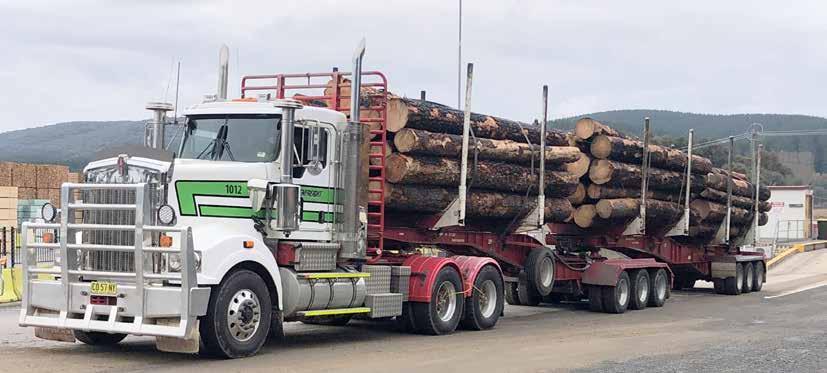
Up to 50% of the HVP Plantations estate damaged by fire should be salvageable and converted into timber and paper products, with the Upper Murray region bracing for up to seven times more truck activity over the next 10 months as crews race to recover 10-year’s worth of firedamaged timber.
That is according to Carlie Porteous, manager of the Murray Region Forestry Hub Softwoods Working Group, who revealed the recovered trees will have their burnt bark removed before being transported to mills in Wangaratta, Benalla and Tumbarumba, where they will be turned into furniture and structural timber, or to Visy’s Tumut mill, where they will be used for paper and packaging.
“Salvaged trees will be used for medium-density fibreboard, structural timber and paperboard used for cardboard packaging,” Ms Porteous said. “These are the normal markets for these trees from this region, and the processors are well established to complete a salvage plan
in the short period of time required.”
Speaking to local media, Ms Porteous said the Working Group had already met with the federal government and is busy assisting the Towong, Snowy Valleys and Greater Hume councils in lobbying for additional funding to support local roads that will carry the increased haulage task.
“The salvage operation will take place over the next 10 months and will lead to an increased heavy-vehicle haulage task on our local and regional roads,” she said, pointing to routes like the Shelley–Walwa Road, which is in major need of continual improvement.
Much of the salvageable timber includes high quality sawlog which will be processed at the Hyne Timber sawmill in Tumbarumba.
Site Manager, Kristina Kaminski said the team at the Mill were ready to do their bit and salvage as much of this timber as possible over coming months,
“We have been here before and the team knows
what to do. We are part of a whole of industry, as well as community, coordinated effort and we will certainly be doing our bit here in Tumba,” she said.
“Once we get the burnt bark off the logs, we can process this into quality, sawn timber for housing construction.
“We very much value the ongoing support of our customers who proudly back Aussie timber first and are very much part of our economic value-add to the Australian economy,” Ms Kaminski said.
“It is expected the salvage operation could take several months with the local community seeing trucks carrying burnt logs throughout this time.”
HVP corporate fire and silviculture manager Richard Mailer told the ABC the fire burnt 80 per cent of the 13,500-hectare Shelley plantation.
“That [was] 10,500 hectares of plantations that varied from one year old to 37 years old,” he said.
“We also lost some specialised forest harvesting equipment and our shelling works centre.”
Mr Mailer told the ABC
the other 20 per cent of the plantation was burnt in the 2019-2020 Black Summer bushfires.
“We must salvage what we can very quickly, because timber does degrade quite quickly after fires,”
Mr Mailer said.
HVP grows trees on a 25year rotation and the first harvest begins when the trees are at least 10 years old.
“Unfortunately, over half of the burnt trees were less than 10 years old and that timber is basically lost,” Mr Mailer said.
“[Plantations] usually have a second thinning operation around about 17 or 18 years of age and then we’ll clear-fell the site at 25 years of age.”
Recovery efforts also include land rehabilitation, rebuilding, and clearing hundreds of kilometres of roads that are essential for transportation.
The whole plantation will then be replanted, which will take about five years to complete.
“To replace what was burnt will require approximately 13 million trees,”
Mr Mailer told the ABC.
“We will start the re-estab-
lishment this winter.”
“Our nursery has already put in an extra million [seeds] to start that replant project.”
Mr Mailer said they were still working out what impact the January fire would have on timber supply.
“It’s a pretty challenging time also with the slowdown in building activity,” he said.
“We’re currently going through the process trying to work out what this means for the longer term with supply.”
As for disaster recovery, Ms Porteous said the industry will continue working with all levels of government to ensure timber processors and growers have access to the same support as other primary industries.
“Trees take 30 years to grow, and therefore the impact of the fires on this industry is longer term than, say, cropping or livestock,” she said.
“And whilst the fires occurred in Victoria, the economic impact of the recovery will be felt primarily in southern NSW, where much of the timber processing occurs.”
Fighting fires could be done remotely without the need to place firefighting crews directly in potentially dangerous situations by using collaborative teams of artificial intelligence-powered robots with extinguishing equipment on board, with an initial soft trial of the technology proving successful.
Led by Cyborg Dynamics Engineering with Griffith University and funded by Queensland Defence Science Alliance (QDSA), the team demonstrated the technology in both simulated and hybrid simulation-physical demonstrations using an unmanned ground vehicle (UGV), simulating real fires for a team of up to five robots to extinguish. In the trial, the UGV successfully navi-
gated around physical obstacles and teamed up with its simulated robot team members to locate and work together to extinguish multiple simulated fires.
Dr Zhe Hou, project Lead Chief Investigator from Griffith University’s School of Information and Communication Technology, said the results demonstrated a 99.67 per cent success rate in navigating and extinguishing two fires, suggesting strong potential for real-world deployment.
“We demonstrated that multiple real and simulated UGVs, trained through a structured three-stage AI learning curriculum, could learn to perform both lowlevel navigation and highlevel collaborative tasks,” Dr Hou said. “This confirms the operational po-
tential of our approach for practical case studies such as autonomous navigation and firefighting.”
The research team adopted an artificial intelligence technique called multi-agent reinforcement learning to build neuralnetwork-based AI ‘agents’ trained through a customdesigned curriculum, progressing from simple tasks such as single-robot navigation, to multi-robot navigation around obstacles, then finally to completing a complex firefighting scenario involving multiple robots and fires with obstacles.
The team said the ability of the robots to selforganise and allocate tasks autonomously – such as splitting into teams to handle multiple fire outbreaks
– reduced the cognitive load on human operators, offering increased safety and operational efficiency in emergency situations.
“We have developed the control systems for firefighting UGVs that are currently deployed on mine sites across Australia,” Cyborg Dynamics Engineering General Manager Ryan Marple said. “These units are remotely controlled by a human.
“They have been an extremely effective measure in removing human firefighters from dangerous situations and enabling high-value assets to be saved from fires.
“The future of these kinds of vehicles – and the focus of this research – is the automation of low-level control and swarming be-
haviour across multiple agents. Such autonomous swarms can respond to complex situations in a way that just isn’t possible with direct manual control.
“By ingesting data from a wide variety of sensors, these systems can make decisions quickly, which just isn’t possible by the very limited situational awareness of a human looking at a screen.”
Looking ahead, the research team envisioned further advancements in both the design of neural networks and sim-to-real transfer methodologies.
The study ‘Multi-agent reinforcement curriculum learning for real unmanned ground vehicles’ has been published in Engineering Applications for Artificial Intelligence.



Nina Garlo-Melkas Forestry.fi
Artificial intelligence is rapidly reshaping forestry—from remote data collection to strategic decision-making.
At Finland’s National Forest Days, experts highlighted how digital tools have revolutionised forest monitoring in developing countries and paved the way for large-scale AI adoption.
“Just 10–15 years ago, forest data was collected in many countries using pen and paper,” recalled Andreas Vollrath, forestry expert at the Food and Agriculture Organisation of the United Nations (FAO).
“The introduction of digital tools, such as the Open Foris platform, has enabled developing countries to transition to electronic data collection and advanced remote sensing analysis, which opened the door to the large-scale use of artificial intelligence in forestry.”
A panel discussion titled “Shaping Forest Futures with AI” was held at the Finnish Forest Days (Metsäpäivät) event at the Finlandia Hall in Helsinki. The event, organised by the Forest Academy for Decision Makers, explored, among other topics, the impact of artificial intelligence on the forest sector, from data collection to strategic decision-making.
The discussion highlighted the role of artificial intelligence in, for instance, forest inventorying, emissions reporting, and land use monitoring, as well as its growing importance in supporting policymaking and resource management.
Andreas Vollrath of the FAO, one of the three panel speakers, noted that artificial intelligence is only one part of a broader digital transformation evident in the forestry sector.
“The FAO has been using machine learning in remote sensing for a long time, but recent breakthroughs have significantly improved the way we access the data and turn it into valuable information,” he said.
According to Vollrath, a particularly promising development is the use of AIpowered embedding fields, which allow vast amounts of satellite data to be condensed into easily searchable formats.
“It works in much the same way as Facebook’s content recommendation feature, i.e., based on similarities,” explained Vollrath.
“When you mark an area of deforestation, the system is able to immediately find similar patterns from around the world.”
Such models are opening new opportunities for forest monitoring, restoration, and policy support.
“The FAO has been using machine learning in remote sensing for a long time, but recent breakthroughs have significantly improved the way we access the data and turn it into valuable information,” said Andreas Vollrath.
Artificial intelligence the forest industry value chain
Karoliina Hagman, Head of Artificial Intelligence and Data at Accenture Nordic, emphasised in the panel discussion the enormous, yet largely untapped potential of artificial intelligence in the forestry sector.
“Artificial intelligence is a huge change that affects all industries, and forestry is no exception,” she said.
Although forestry companies already use AI in areas such as human resources management, financial processes, and procurement, Hagman believes that the real opportunity lies in optimising the entire value chain.
She highlighted predictive maintenance, demand forecasting, and dynamic pricing as key areas of application where AI can bring significant added value by utilising methods that have already proven effective in manufacturing, logistics, and the mining industry.
Toward a new wave of forest intelligence
Sixten Sunabacka, Senior Advisor at MW Group AB—a
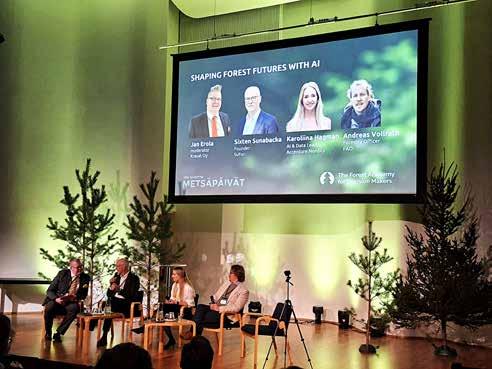
● At the National Forest Days event, a panel discussion, “Shaping Forest Futures with AI,” was organised by the Finnish Forest Association’s Forest Academy for Decision Makers.
Nordic company specialising in defence and security services—views Sweden as a frontrunner in applying artificial intelligence to forestry.
“Finland and Sweden have very similar starting points,” he noted, “but Sweden stands out with its vibrant startup ecosystem.” According to Sunabacka, venture capital support for AI-driven projects is stronger in Sweden, though Finland is beginning to catch up.
For him, the key question is whether artificial intelligence will spark the next major transformation in the forest sector.
“Looking back on four decades of development, the forest industry has moved forward in powerful waves. Artificial intelligence may well be the next one,” said Sunabacka, who also serves as Chairman of the Board at the Finnish geospatial technology company Arbonaut.
Sunabacka traced those waves: mechanisation in the late 1980s and early 1990s, with timber-measuring harvesters marking the actual breakthrough. In the 1990s, Nokia mobile phones and expanding mobile networks

enabled decentralised forest information systems and optimised wood logistics. By the early 2000s, growing competition for wood made reliable data on forest owners and timber resources essential, driving the transition from field inventories to LiDAR-based remote sensing.
“Soon, the entire country was scanned,” Sunabacka recalled, “and the quality of these scans improved further through the 2010s.”
The 2020s have brought
new scanning technologies, drones (UAS), and sharper satellite imagery, he stated.
“Free satellite accuracy improved, making it especially useful for mapping forest losses and damages.”
Today, AI and machine learning are central to forest applications—but only with solid data, Sixten Sunabacka said.
“Even AI needs a huge amount of training material and accurate data. If you feed it garbage, you’ll get garbage out that only looks

great.” High-density LiDAR and data from forest machines are, therefore, crucial, Sunabacka stressed.
Sweden is already testing scanners with 1,500 laser points per square meter, while Finland has chosen 20-point scanners for national use. In Sweden, progress is driven not just by the need for accurate forest data, but also by the desire to know more about individual trees, how easy the terrain is to move through, forest damage, biodiversity, and cultural values.
Sunabacka believes the convergence of dense scanning, UAS, AI and diverse data sources will soon provide “increasingly accurate, coherent, and broad information about our forests.”
Challenge of scaling AI in fragmented forest environments
Promoting artificial intelligence in forestry is not a one-size-fits-all solution, especially when ecosystems are fragmented and land ownership is decentralised.
“It all depends on who we work with and what the purpose of the work is,” Vollrath pointed out in the discussion.
Vollrath highlighted the global significance of Open Foris tools. Developed with Finnish funding and expert support, Open Foris is an open-source platform of the FAO, used for forest measurement, monitoring, and reporting in over 190 countries – mainly developing nations. It has become a key tool in, for example, REDD+ emissions reporting under the UN Climate Convention, and it has also brought forest data collection within reach of smallholders, using mobile devices.
For smallholders, the FAO is also developing easy-to-use mobile tools, such as WISP and Crown, to detect deforestation and report plantings in accordance with EU regulations.
“Collecting forest data using software is much easier than using pen and paper,” Vollrath said.
The audience at the Forest Days
panel discussion brought an essential perspective to the debate: forests are messy, living systems, not spreadsheets. Vollrath agreed emphasising the importance of high-quality data. He noted that advances in LiDAR remote sensing technology enable reliable observations even in complex forest environments.
LiDAR (Light Detection and Ranging) is a laser-based technology that generates highly accurate threedimensional models of terrain and vegetation. In forestry, it allows for precise mapping of tree structure, height, and density. By capturing millions of laser points from aircraft, drones, or satellites, LiDAR reveals forest details that are often invisible to the human eye or traditional field methods.
“When we have scientifically validated algorithms and accurate data at our disposal, we can trust what we see in the office. Only in special cases do we need to go into the forest,” Vollrath said.
The panel ended with bold predictions for the next five to ten years. Experts predict that artificial intelligence will accelerate research and development work on new forest-based materials and more intelligent customer interaction, for example, through chatbots and agent-based user interfaces.
Artificial intelligence is also becoming increasingly prominent in production. Factories are already seeing a shift towards more efficient operations: fewer downtime incidents and higher quality. With AI and automation, production processes are being optimised, disruptions are being reduced, and quality control is being improved, which strengthens the competitiveness of the entire forest sector.
The panellists expressed the hope that artificial intelligence would soon surpass human capabilities in

interpreting satellite imagery. Although development has not yet reached that level, according to the panellists, artificial intelligence has significant potential to learn to visually perceive complex forest data more accurately and extensively, even better than humans. This could open new opportunities for global forest monitoring, analytics, and decision-making.
The discussion culminated in a
call for deeper integration of AI into politics and the understanding of ecosystems. According to the panellists, artificial intelligence can offer new perspectives on how natural systems work, and generate added value not only for industry but also for society as a whole.
This is particularly relevant in the Nordics, where forests are an integral part of everyday life and culture.


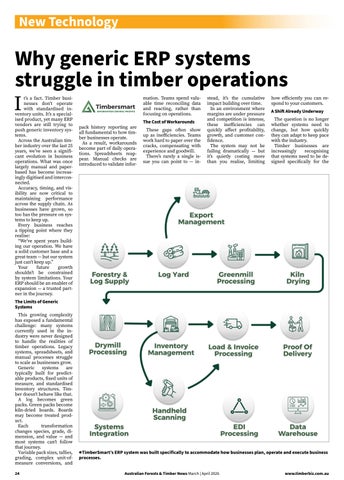
It’s a fact. Timber businesses don’t operate with standardised inventory units. It’s a specialised product, yet many ERP vendors are still trying to push generic inventory systems.
Across the Australian timber industry over the last 25 years, we’ve seen a significant evolution in business operations. What was once largely manual and paperbased has become increasingly digitised and interconnected.
Accuracy, timing, and visibility are now critical to maintaining performance across the supply chain. As businesses have grown, so too has the pressure on systems to keep up.
Every business reaches a tipping point where they realise:
“We’ve spent years building our operation. We have a solid customer base and a great team — but our system just can’t keep up.”
Your future growth shouldn’t be constrained by system limitations. Your ERP should be an enabler of expansion — a trusted partner in the journey.
The Limits of Generic Systems
This growing complexity has exposed a fundamental challenge: many systems currently used in the industry were never designed to handle the realities of timber operations. Legacy systems, spreadsheets, and manual processes struggle to scale as businesses grow.
Generic systems are typically built for predictable products, fixed units of measure, and standardised inventory structures. Timber doesn’t behave like that.
A log becomes green packs. Green packs become kiln-dried boards. Boards may become treated product.
Each transformation changes species, grade, dimension, and value — and most systems can’t follow that journey.
Variable pack sizes, tallies, grading, complex unit-ofmeasure conversions, and

pack history reporting are all fundamental to how timber businesses operate. As a result, workarounds become part of daily operations. Spreadsheets reappear. Manual checks are introduced to validate infor-
mation. Teams spend valuable time reconciling data and reacting, rather than focusing on operations.
These gaps often show up as inefficiencies. Teams work hard to paper over the cracks, compensating with experience and goodwill. There’s rarely a single issue you can point to — in-
stead, it’s the cumulative impact building over time.
In an environment where margins are under pressure and competition is intense, these inefficiencies can quickly affect profitability, growth, and customer confidence.
The system may not be failing dramatically — but it’s quietly costing more than you realise, limiting
how efficiently you can respond to your customers.
The question is no longer whether systems need to change, but how quickly they can adapt to keep pace with the industry.
Timber businesses are increasingly recognising that systems need to be designed specifically for the
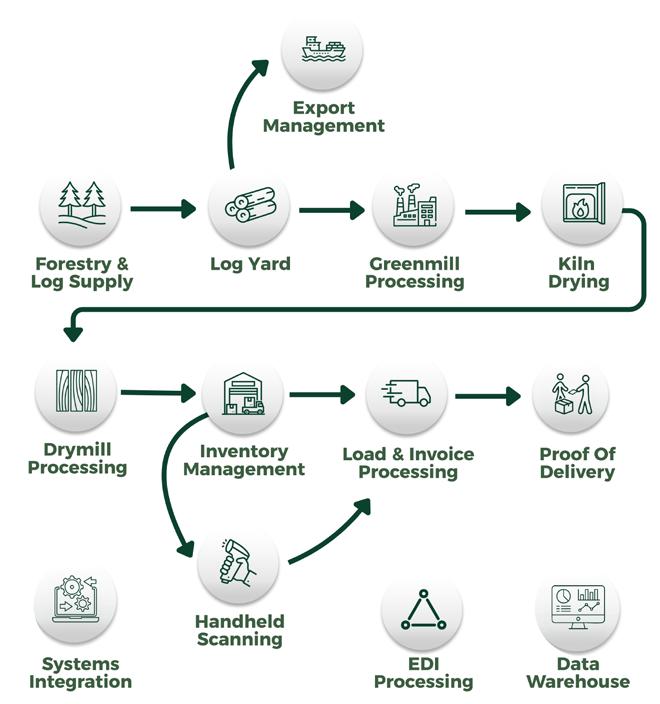
way timber operates.
Technology itself shouldn’t be the hardest part. The right solution connects people, processes, and systems in a way that reflects real operations.
Before a vendor writes a single line of code, they should ask:
How does timber actually move through your business?
Where does information get lost between receipt and dispatch?
What does your sales team need to know before committing to a customer?
Those answers should shape the system — not the other way around.
For many businesses, this shift represents more than a technology upgrade. It’s a move toward greater control, efficiency, and confidence in daily operations.
Supporting the Industry’s Next Chapter
With over 25 years of experience working alongside timber businesses, TimberSmart has listened to and addressed real-world challenges across the supply chain.
Designed specifically for timber operations, TimberSmart reflects the complexities of inventory, processing, and logistics in a way that aligns with how businesses actually work — bringing people, systems, and processes together.
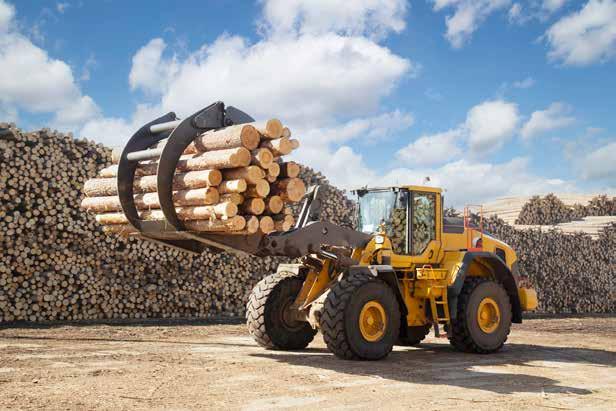
● Timber businesses are increasingly recognising that systems need to
way timber operates.
If you step back and ask, “What does a system look like that was built specifically around the timber industry, by a team that lives
in the industry?”
The answer is simple. It’s TimberSmart.
TimberSmart delivers fully integrated Enterprise Resource Planning and mobile solutions that streamline operations from log intake to dispatch. We help sawmillers, wholesalers, and re-processors run more efficiently with real-time data, greater visibility, and reduced manual processes.
Use real-time data and industry-specific functionality to gain the visibility you need to reduce errors, and make effective decisions.
PRODUCTS
• TimberSmartOne ERP - end-to-end operations
• Forestry, Log & Inventory Management
• Sawmilling, Wholesaling & Manufacturing
• Finance Integrations & TimberXchange (EDI)
SERVICES
• Consulting & Implementation
• Mobile Apps & Handheld Scanning
• Custom Development & Integrations
• Data, Reporting & Hardware Solutions


Email: sales@timbersmart.com.au
www.timbersmart.com.au


An increasing number of timber harvesting contractors are choosing to maintain their forest machines through service agreements.
At Ponsse, this has been reflected in a significant increase in agreement volumes over the last three years. At the same time, the company is continuing to systematically develop its service network in Finland – improving customer service and making everyday operations easier than ever.
“It’s important to us that our customers can focus on their core business – efficient and productive timber harvesting. The 47% growth in service agreements shows that our customers have found these agreements to be a practi-
cal solution for simplifying their work. Interest in service agreements has grown steadily in recent years,” Jani Liukkonen, Country Manager for Ponsse Finland said.
With the Active Care service agreement, customers outsource all scheduled maintenance of their forest machines directly to Ponsse.
Contractors do not need to remember the details of each service, and services such as the Maintenance Call alerts ensure the correct maintenance timing.
Agreements tailored to the customer’s individual requirements always ensure the right service level, operating hours and content.
“The planning of each service agreement is al-
ways based on the customer’s business and operating environment. This ensures that the service is carried out correctly and at the right time. At the same time, the contractor knows the service costs in advance,” Pertti Rönkkö, After Sales Manager for Ponsse Finland, said.
It’s important to us that our customers can focus on their core business
The core of Ponsse’s service agreements consists of scheduled services de-
signed for each customer and machine. On top of them, customers can select a wide range of preventive maintenance actions and additional services, depending on the machine and operating environment. They may include battery replacement, automatic greaser refills or machine washing.
“Service agreements can be purchased for both new and used forest machines.
A typical agreement duration is three years. Regular servicing keeps the machine reliable and productive, and fuel consumption stays at the right level. Proper and timely maintenance also helps preserve the machine’s value for resale,” Rönkkö adds.
Ponsse offers the most extensive service network
in Finland. The newest addition is the service centre that opened in Loppi in February. Today, Ponsse serves Finnish customers through 26 locations across the country. Around 200 forest machine professionals work within the network, supported by 40 service vans that support customers directly on logging sites.
“The continued development of Finland’s most extensive service network –as well as our maintenance and spare parts services –remains a strong focus for Ponsse. We manufacture the world’s best forest machines, and we also want to offer our customers and their machines world-class service and spare parts services from morning to evening,” Liukkonen said.


Tigercat Industries has released the first 5185B fixed felling saw with the new head branded TCi.
Updates and enhancements are targeted at further improving the performance and productivity in large timber falling applications.
Cutting capabilities have been increased by enlarging the saw box to fit a longer 45 in bar.
The key improvement is the new Tigercat 750RP saw unit with a full 240 degree bar feed angle, enabling single-side back cuts.
This greatly reduces machine travel when felling large trees to enhance overall productivity, reduce potential tree damage, minimize ground disturbance, and improve fuel efficiency.
The Tigercat 750RP is an evolution of the proven Tigercat 750, incorporating a ring-and-pinion hydraulic drive instead of the external cylinder, while retaining other proven service parts.
New Tigercat-programmed carrier saw control gains saw home and saw position sensors, proportional bar feed, and electronic saw motor control. The result is enhanced overall productivity, with from-theseat tuning, on-display feedback, and operator-selectable saw functions to tailor performance.
The top horn can be equipped with different styles of interchangeable grip plates to customize for different applications and seasons.
Tigercat has also released the new Tigercat 6440, a heavy-duty drum chipper designed for high production and ease of operation.
The high horsepower engine uses a through-drive and belt system where the rotor drive belt is driven off the motor using a flex drive coupling and drive adapter. The engine base extends and retracts to engage or disengage the drive belts, eliminating the need for a clutch.
The discharge chute is on a low 25° angle to allow for high volume output without the need for a chip accelerator. An optional chip accelerator is available for microchip applications. The discharge end chute pivots side to side, and up and down. Discharge end outrigger cylinders provide 620 mm (24.5
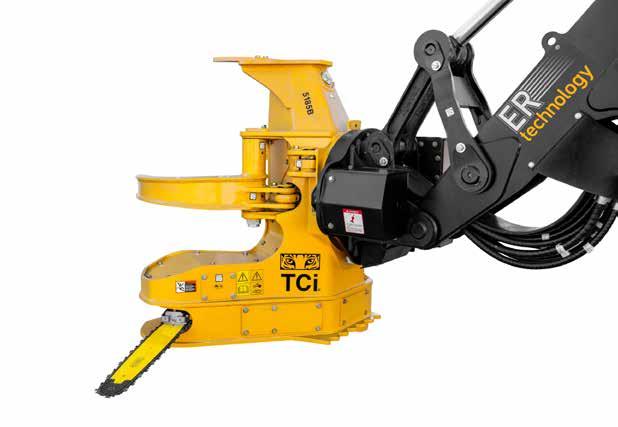

in) of stroke to adjust the height. Infeed outriggers provide 355 mm (14 in) of stroke to stabilize the machine.
The standard chip rotor consists of eight staggered knives, and the optional microchip rotor has sixteen knives. Chip pockets are lined with replaceable wear plates. An easily accessible platform and large pivoting rotor hood provide for a comfortable work area when changing knives. A large storage box located nearby holds tools and replacement knives.
The front belt cover may be removed in three separate pieces. The side access door on the middle cover allows for belt inspection and tensioning. A sonic belt tensioner is supplied with the 6440.
Access doors located at the bottom feed roll, infeed head pulley, side doors, and top slide plate allow for effective debris clearing. Platforms and steps are located around the machine at maintenance and service point areas to access engine air filters, hydraulic oil filters, and the fuel fill. A centralized service area in the centre of the machine provides access to hydraulics, electrical components, and engine filters.
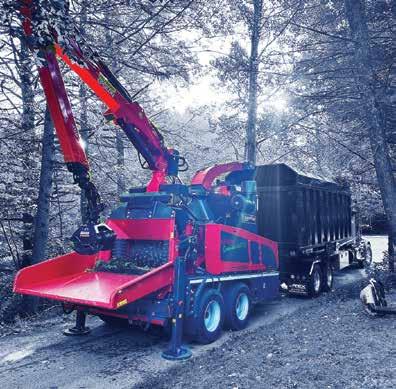
75hp to 908hp, 12 to 36 inch wood chippers. Wheels, tracks, PTO, or bin and chipper combinations. All chippers come with biomass screens.
Different options are crane fed, in-feed chain, splitter, & extra side rollers.
Contact: Jor Boogaart
Info@ufkes-greentec.com.au
www.ufkes-greentec.com.au 0458 047 132
New heavy vehicle app
The National Heavy Vehicle Regulator (NHVR) has released Freight PASS, a new online tool designed to help users compare the productivity, asset impact, safety and sustainability trade-offs of different heavy vehicle configurations.
The new web app enables users to compare a range of safety, productivity, pavement wear and sustainability outcomes when different vehicle types are used to undertake a particular freight task.
Chief Safety and Productivity Officer Matt d’Abbs said the NHVR had invested in the digital tools to support both governments and industry in filling ‘information gaps’.
Firefighter training
Training for forest firefighters will be a step closer to being standardised across the Green Triangle through one of two new projects funded as part of the South Australian Wood Fibre and Timber Industry Master Plan.
Currently there are differences in the training requirements for firefighters depending on which side of the South Australian Victorian border they are on, causing unnecessary barriers in the Green Triangle.
Award for ABP
Australian Bluegum Plantations has taken out the Platinum Award for Best Leadership Development Program at the LearnX Awards for its flagship Growing Leaders program.
The international accolade celebrates ABP’s commitment to investing in its people and building leadership capability across its operations, with special recognition for the leadership of Sheri Tarr, ABP’s Human Resources General Manager, who has played a central role in the program’s design and evolution.
NRA revision
FSC International has launched the revision of the Australian Controlled Wood National Risk Assessment (NRA), first published in 2019.
The NRA evaluates the risks associated with sourcing timber and forest products from non-FSC-certified forests and establishes mitigation measures to address identified risks.
The revision is being undertaken following the release of the updated FSC Risk Assessment Framework in 2024.
The Komatsu excavator platform provides a robust and versatile foundation for a wide range of forestry applications, particularly due to its advanced compensated load-sensing hydraulic system.
This highly responsive hydraulic technology delivers precise control, improved efficiency, and consistent performance under varying load conditions, critical factors in demanding forest environments.
Recognising the platform’s capability Komatsu Forest Australia collaborated closely with the Komatsu Osaka Factory to co-develop the specialised Xtreme Series base models; Komatsu PC270HW, Komatsu PC300HW, and Komatsu PC400HW.
This partnership has resulted in factory-engineered forestry carriers designed specifically for the harsh operating conditions typical of Australian plantation and native forest operations.
As a result, the Osaka Factory now supplies a comprehensive range of forestryspecific components directly from the production line.
These include a certified Forest Safety Cab, Hide/Wide undercarriage, purpose-built forest booms, heavy-duty bump rails, reinforced track guards, and extensive HD guarding packages. Factory integration ensures optimal structural integrity, compliance with safety standards, and seamless compatibility across attachments and configurations.
The three Xtreme base carriers are engineered to accommodate a broad array of forestry attachments, including feller bunchers, loading grapples, heel/shovel configurations, processors, and harvester heads.
Their adaptability allows them to serve as the foundation for additional specialised derivatives such as the PC270LL, PC300FX, PC300TL, PC300LL, and PC400HL, further expanding operational flexibility across harvesting, processing, and log handling applications. Recently, Komatsu Forest delivered three PC270HW
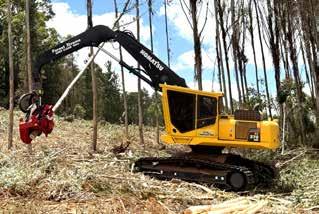
Harvesters to Total Harvesting Pty Ltd in Western Australia.
Total Harvesting is a locally owned and operated family business with over 40 years of experience in the forestry industry.
Founded in 2004 by Chris Jensen, Matt Leov, and Sarah Leov, the company has grown to become a well-established and highly respected name in the sector
. With a dedicated team of approximately 140 personnel, Total Harvesting operates across Western Australia, with operations in Albany, Bunbury, Yornup and Esperance.
The company specialises in the harvesting, hauling, and chipping of various plantation timbers, including Radiata Pine (Pinus Radiata) and Blue Gum (Eucalyptus Globulus), offering highquality services to meet the needs of forest owners and the timber industry.
The integration of factoryengineered forestry carriers such as the PC270HW, backed by established regional service networks, aligns closely with Total Harvesting’s operational priorities and longterm business strategy.
This is Total Harvesting’s first investment in the Komatsu Forest Xtreme Series, complementing their substantial existing fleet of Komatsu harvesters and forwarders, as well as multiple Peterson chippers.
The new PC270HW units are replacing equipment acquired through Total Harvesting’s takeover of Wilson Forestry Services in late 2023.
This acquisition resulted in
a combined WAPRES plantation hardwood contract volume of approximately 350,000 cubic metres annually.
Delivered in December, the new PC270HW machines commenced at-the-stump harvesting operations in January.
Following completion of this phase, they will transition into roadside processing operations, demonstrating the carrier’s operational versatility.
The PC270HW-8 is the most compact model within the Xtreme carrier range; however, it retains the full structural strength and forestry specification of its larger counterparts. Total Harvesting’s units are equipped with the complete Osaka factory forestry option package, including a certified ROPS/ FOPS/OPS cabin, high-wide undercarriage fitted with 600 mm double bar grousers for improved traction and stability, heavy-duty track guards, and protective bump rails.
The machines also feature the Working Gear forest boom set with internally routed crane tip hosing, providing enhanced hose protection and compatibility with a range of attachments.
According to Managing Director Matt Leov, it’s a very stable, versatile unit with a great cooling package, fuel efficient, the cab provides good visibility, operator comfort and very quiet.
The most significant feature influencing their purchasing decision was the PC270HW’s certified forestry cabin.
Fully compliant ROPS/
FOPS/OPS protection remains relatively uncommon in hydraulic excavator-based forestry carriers, and he considers it an essential safety requirement within their operations.
In addition, Matt’s longstanding relationship with Komatsu Forest, spanning more than twenty years has been underpinned by consistent service support and reliability, reinforcing confidence in their investment decisions.
Matt emphasised the value of continuity in personnel and service relationships, noting that the company continues to work with many of the same Komatsu Forest representatives who supported their operations from the outset.
He also highlighted Komatsu Forest’s practical approach to commissioning new equipment, prioritising machine uptime and operational readiness before addressing minor adjustments. This proactive support model, including assistance with occasional out-of-warranty matters, has further strengthened the partnership.
To enhance regional service capability Komatsu Forest appointed Pratico Mechanical Services as its authorised service and spare parts agent for the Bunbury and Manjimup regions.
Under the direction of owner Matt Pratico, the business has expanded its workforce by employing two additional mechanics, ensuring responsive field service and parts availability.
In the Albany and Esperance regions, Al Curnow Hydraulics continues to provide spare parts and technical support, drawing on more than a decade of experience representing Komatsu Forest.
The collaboration between Pratico Mechanical Services and Al Curnow Hydraulics ensures comprehensive service coverage across southern Western Australia.
Keith Smiley
With more than twenty-five years of timber history behind it, Lobb Street Sawmill near Ipswich in Queensland continues to supply milled timber to a wide catchment that reaches into Brisbane and surrounding districts.
The operation provides a steady flow of quality hardwood and pine to builders, landscapers and tradespeople who rely on dependable local supply.
Husband-and-wife team Mark and Barbara Werner oversee the day-to-day running of the business, maintaining the high standards customers have come to expect. Alongside operations and sourcing other supplies, they also run a complementary timber and hardware outlet, allowing clients to purchasing everything they need in one place — from structural timber to finishing materials — making the yard a practical hub for both professionals and home builders alike.
“My parents owned a sawmill in Toogoolawah—its name meaning ‘bend in the river’ in the local Aboriginal language. I grew up helping around the mill, and by the time I reached adulthood, Barbara and I were ready to take the next step in the industry. In 2001, when Kim Roberts decided to step away from the business, we seized the opportunity to purchase Lobb St Sawmills. We made the investment and, ever since, we’ve never looked back,” said Mark Werner, who is also celebrating his fortieth wedding anniversary with his wife, Barbara. At various times their three children have lent a hand in the business. Their two sons, Justin and Gary, eventually chose careers in the public service, while their daughter Shannon has worked part-time at Lobb St. Over the years, Barbara and Mark have often swapped roles, re-
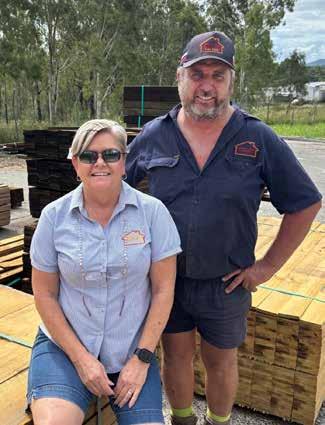
flecting the flexibility and strength of a long and productive partnership.
“We enjoy working with timber and helping our customers understand hardwood—offering advice and pointing them in the right direction. Experience really counts in this business, and we’re involved in every part of it. Since childhood I’ve worked the bench, the planing machines, the treatment plant and the breakdown, all while learning what customers actually need. It’s been a matter of doing a bit of everything.
“We also run land with about 150 cattle at Mt Byron, on the western side of the Brisbane Valley. Sawmilling always has its challenges—especially from sourcing logs, and the shortage of staff, which can be a major problem—but these days we’re fairly fortunate and things are running smoothly. Even Bunnings sends customers our way for hardwood supply and the expertise we can
offer.”
Ipswich was first settled by Europeans in 1826, surrounded at the time by hills, forests and a growing timber industry that supported both local needs and regional trade. Today, Ipswich has evolved into a major urban centre in South East Queensland, situated on the Bremer River. In earlier days, a railway line ran from the Lobb St sawmill, complete with its own station—an artefact of that era which is now preserved as part of Queensland’s rail heritage at the Queensland Museum of Rail Workshops.
Mark takes a relaxed approach to life and business, saying he doesn’t worry about too many things and prefers to take life as it comes. His wife Barbara, by contrast, is more intense. “You’ve got to have variety,” he laughs. “We can’t both be the same.”
The Lobb St facility supplies fencing and a wide range of timber products,
most of which are sourced from Queensland businesses—from Maryborough in the north to Yatala in the south. They also stock selected imported products, including treated pine and decking from New Zealand. Their range includes building-grade timber, mouldings and a selection of hardware.
“We also source hardwood from places like Beaudesert, Bundaberg, Gympie and Miriam Vale, with some material coming through treatment plants,” Mark said. “You never quite know what’s around the corner in this business. Sawmillers even complain about the workers coming in from overseas who don’t always seem keen to take on the work.”
The Lobb St business also provides services like resizing, dressing and docking timber—something customers increasingly value.
“People often want something a bit different, so being able to do it on the spot really helps,” he said.
Now approaching sixty, Mark acknowledges that change will eventually come: “I’ll move on one day, but the kids aren’t showing much interest in taking over,” he said. For now, the combination of timber supply and hardware remains a sound approach. “Having a mill and the outlet together works well because everything is close at hand.” Perhaps one day the property will evolve to include a full bench again, with plenty of room available for future expansion.
Away from the yard, Mark still enjoys working on the family property.
“We’ve still got the cattle, which is really my hobby,” he said. “We mainly breed weaners.” For Mark and Barbara Werner, life continues much the same— steady, invested and largely unstressed.
Australia’s first electric log truck has arrived in Mount Gambier, as Fennell Forestry cuts a new path towards a carbon-free future for the sector.
The truck is just the second electric log truck in the world and has been commissioned by the Green Triangle-based local harvest and haulage company to provide a realistic carbon reduction solution for the heavy transport industry.
Fennell Forestry unveiled the truck to stakeholders, government and industry representatives at an exclusive preview event in Mount Gambier.
Salvaging burnt softwood timber in New South Wales is set to expand rapidly, while only small amounts of burnt native forest is being harvested as assessments of the damage continue, according to Forest Corporation of NSW.
Fires hit more than five million hectares of NSW this season across national parks, State forests and private property. About 890,000ha of native State forests and 65,000 ha of State forest timber plantations were affected by fire, which is about half the state forest estate.
And in Victoria VicForests has begun harvesting roadside timber along the Princes Highway in East Gippsland, employing contractors previously put out of work.
Victoria’s peak forestry and timber organisation has fired a broadside at what it terms as continuing misinformation being published about the industry.
“A recent article in The Age “Highlands logging halt may be worth $30m a year” (20/1/2015) misses a few key points when talking about carbon abatement in the forest and wood products industry in Victoria,” said Victorian Association of Forest Industries (VAFI) chief executive officer Tim Johnston.
He said the Victorian industry produced half a billion dollars of carbon storing products, employed more than 20,000 Victorians, supported another 40,000 to 50,000 local jobs, and generated sales and service income of more than $6.5 billion.
The KMC forestry equipment brand, known to loggers across the Pacific Northwest and other parts of North America for its rugged and dependable log loaders and skidders, is entering a new era with the launch of KMC MAX.
KMC MAX follows the acquisition of KMC-Kootrac by a Uruguayan industrial group led by CIR, which has extensive experience in heavy equipment manufacturing, in partnership with North American company USAmericas.
The group is relaunching the brand with a new international manufacturing platform, modernized engineering, and a longterm commitment to global growth — and a solid continued commitment to service. The company will be broadening the market for KMC equipment — which will feature the KMC platform/chassis, recognized as
one of the best in the world — to include firefighting, construction, agriculture and energy services.
As part of this transition, KMC MAX has established a new, modern manufacturing facility in Montevideo, Uruguay, where all production is now based.
The facility has been built to support large-scale manufacturing, export logistics, and next-generation machine design, positioning the KMC MAX brand for long-term growth across North and South America, and international markets.
In addition to marketing and providing full support to North American customers, KMC MAX Global will be extending its reach beyond North America, and is already in advanced negotiations with European equipment distributors.
Australia is considered as a priority market however a company spokesman said KMC MAX was still deter-
mining “what the needs are”.
“The KMC log loaders and skidders are impressive and high performing pieces of logging equipment, and we are looking to revitalize the company, and increase machine production to a broader audience,” said Alejo Maisonnave, CEO of KMC MAX.
Alex Gorissen will be in charge of developing the international distribution partner, KMC MAX Global.
“We are now relocating manufacturing into a modern facility in Uruguay and upgrading the machines to 21st-century standards. There is a need for robust and dependable multi-platforms in the market, and we are making sure we supply the very best out there,” said Maisonnave.
The company expects the first KMC Max machines to be delivered by mid-August. They will go to customers in South America,
the U.S. and Europe.
KMC MAX machines will feature the full range of Volvo Penta engines, offering a power range from 185 horsepower to 800 horsepower, along with modern operator cabins, updated hydraulics, and contemporary manufacturing standards designed to meet today’s safety, emissions, and performance expectations.
While production has moved to Uruguay, the heritage of KMC remains central to the brand’s identity. The machines’ design philosophy, durability, and real-world logging performance continue to be rooted in the brand’s DNA (see the KMC MAX Fact Sheet with attached news release). But more than that, the company will also be using the KMC MAX chassis, one of the best in the world, as a multi-platform for other industries where the need is great for such equipment.
Alejo Maisonnave, CEO of KMC MAX, is leading the global manufacturing and engineering operation from Uruguay, while Alex Gorissen is responsible for KMC MAX Global, with global sales, distribution, and dealer development across continents.
The official market launch of KMC MAX is taking place at the 2026 Oregon Logging Conference in Eugene, Oregon, where the company will introduce the brand’s new direction, product roadmap, and international growth strategy to the North American and international industries.
“This is not just a restart — it is a true relaunch,” say both Alejo Maisonnave and Alex Gorissen. “KMC MAX now has the production capacity, engineering resources, and global backing to build these machines at scale while staying true to what made KMC respected in the first place."
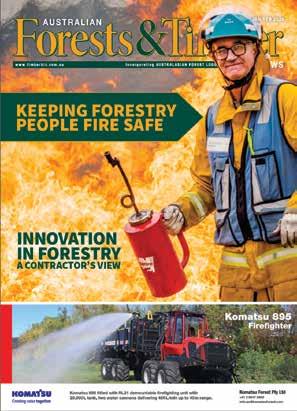
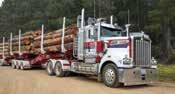
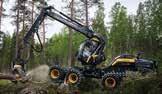
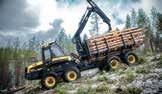
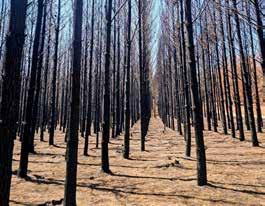
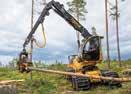
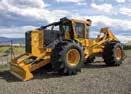
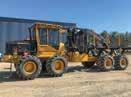
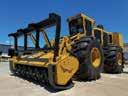
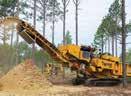
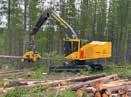
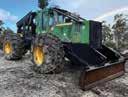
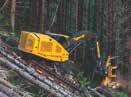


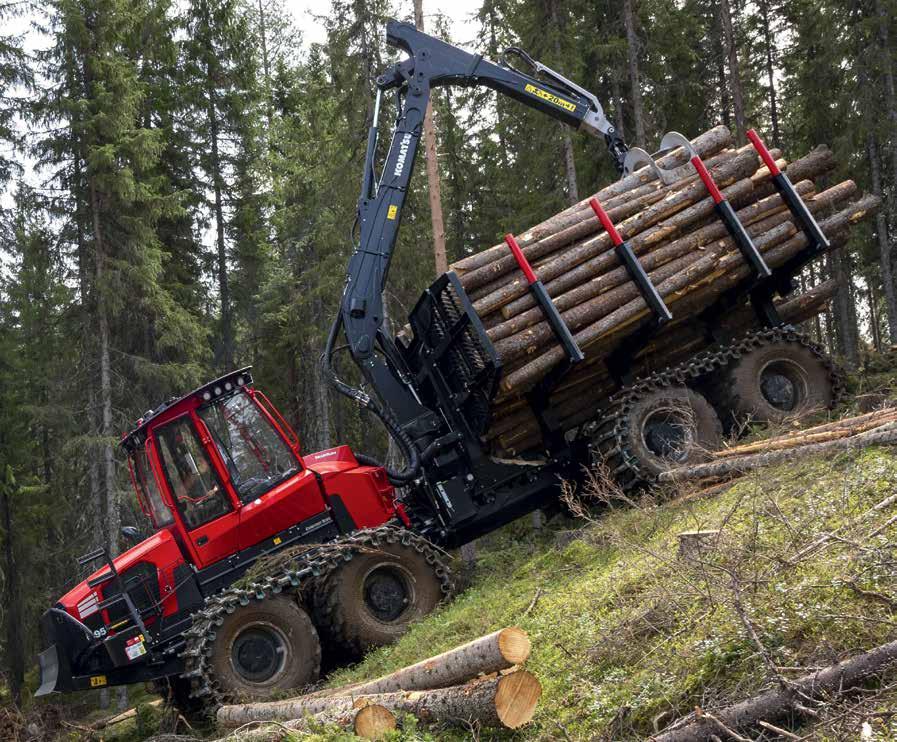
The Komatsu 895.3 offers new larger Komatsu 205F Crane with G85H Grapple supported by Smart Forest technology;
• XT Transmission......for 307kN torque
• Reinforced Frame.....for heavier loads
• Enhanced Load Space.....for increased productivity
The new 895.3 for higher productivity in tough conditions