INNOVATION SPOTLIGHT LEFT: Baneco uses agricultural banana waste to make fibre moulded packaging. Credit: Baneco.
being in smaller, independent shops, where somebody’s going to be prepared to talk about it and engage with customers, than it being lost in a melee of lots of other things and the story behind it not being very visible,” commented Sarah. Telling the story of the paper is exactly what Little Coffee Cup does, in the form of a children’s book made from recycled coffee cups. Little Coffee Cup and the Big Surprise, follows the tale of a coffee cup from its coffee shop origins, to becoming litter by the side of a road, and being rescued by a litter picker before being taken to the James Cropper paper mill and recycled into the very book you’re reading. In fact, each copy contains 13 former coffee cups, given a new purpose instead of ending up as landfill. With a background working at waste company, Biffa, author, Hayley Slack, is using the Little Coffee Cup as an educational mascot to teach people about effective and accurate recycling, getting children involved and forging an understanding of where things come from and the responsibility that entails. Coffee cups are far from the only alternative material source James Cropper is exploring. Josh Holland, business development manager at James Cropper explained that the mill has trialled cotton fibres from recycled textiles such as jeans, as well as hemp, and even waste from food like pineapples. James Cropper also offers ‘inclusion’ paper, utilising coffee and cocoa waste, reducing the percentage of wood pulp needed. “We’re always exploring what we can do for alternative fibres, just in case; a lot of it is around safeguarding the planet, the mill, and what we do here,” said Josh, asking “How can we take something away from landfill, and
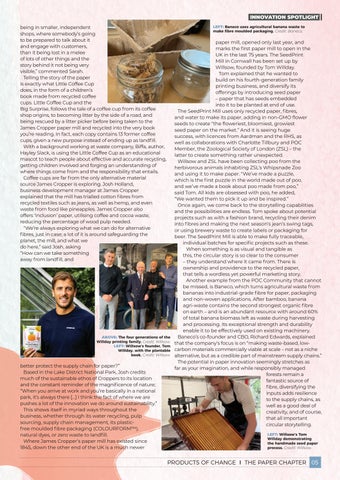
ABOVE: The four generations of the Willday printing family. Credit: Willsow. LEFT: Willsow’s founder, Tom Willday, with the plantable book. Credit: Willsow.
better protect the supply chain for paper?” Based in the Lake District National Park, Josh credits much of the sustainable ethos of Croppers to its location and the constant reminder of the magnificence of nature; “When you arrive at work and you’re basically in a national park, it’s always there […] I think the fact of where we are pushes a lot of the innovation we do around sustainability.” This shows itself in myriad ways throughout the business, whether through its water recycling, pulp sourcing, supply chain management, its plasticfree moulded fibre packaging (COLOURFORM™), natural dyes, or zero waste to landfill. Where James Cropper’s paper mill has existed since 1845, down the other end of the UK is a much newer
paper mill, opened only last year, and marks the first paper mill to open in the UK in the last 75 years. The SeedPrint Mill in Cornwall has been set up by Willsow, founded by Tom Willday. Tom explained that he wanted to build on his fourth-generation family printing business, and diversify its offerings by introducing seed paper – paper that has seeds embedded into it to be planted at end of use. The SeedPrint Mill uses only recycled paper, fibres, and water to make its paper, adding in non-GMO flower seeds to create “the floweriest, bloomiest, growiest seed paper on the market.” And it is seeing huge success, with licences from Aardman and the RHS, as well as collaborations with Charlotte Tillbury and POC Member, the Zoological Society of London (ZSL) – the latter to create something rather unexpected. Willsow and ZSL have been collecting poo from the herbivorous animals inhabiting ZSL’s Whipsnade Zoo and using it to make paper. “We’ve made a puzzle, which is the first puzzle in the world made out of poo, and we’ve made a book about poo made from poo,” said Tom. All kids are obsessed with poo, he added, “We wanted them to pick it up and be inspired.” Once again, we come back to the storytelling capabilities and the possibilities are endless. Tom spoke about potential projects such as with a fashion brand, recycling their denim into fibres and making the next season’s jean’s swing tags, or using brewery waste to create labels or packaging for beer. The SeedPrint Mill is able to make fully traceable, individual batches for specific projects such as these. When something is as visual and tangible as this, the circular story is so clear to the consumer – they understand where it came from. There is ownership and providence to the recycled paper, that tells a wordless yet powerful marketing story. Another example from the POC Community that cannot be missed, is Baneco, which turns agricultural waste from bananas into industrial-grade fibre for paper, packaging and non-woven applications. After bamboo, banana agri-waste contains the second strongest organic fibre on earth – and is an abundant resource with around 60% of total banana biomass left as waste during harvesting and processing. Its exceptional strength and durability enable it to be effectively used on existing machinery. Baneco’s co-founder and CBO, Richard Edwards, explained that the company’s focus is on “making waste-based, lowcarbon materials commercially viable at scale – not as a niche alternative, but as a credible part of mainstream supply chains.” The potential in paper innovation seemingly stretches as far as your imagination, and while responsibly managed forests remain a fantastic source of fibre, diversifying the inputs adds resilience to the supply chains, as well as a good deal of creativity, and of course, that all important circular storytelling. LEFT: Willsow’s Tom Willday demonstrating the handmade seed paper process. Credit: Willsow.
PRODUCTS OF CHANGE I THE PAPER CHAPTER 05
04-05_Alt Fibres_Paper_v4.indd 25
22/07/2026 15:05