Taking the wheel
Lina Goodman, CEO, Tyre Stewardship Australia, bringing Australia’s circular tyre economy across the line

FEATURES
To insure or not to insure
Mobilising the industry
Plenty left in the tank Cigarette butts: waste or resource?
PROUDLY SUPPORTED BY:
JULY 2023
PMS 380 PMS 376 PMS 355





TAKING THE WHEEL
Lina Goodman, Chief Executive Officer, Tyre Stewardship Australia, draws inspiration from global schemes to bring Australia’s circular tyre economy across the line.
“THE WORLD IS GETTING MUCH SMALLER AND THE GREAT THING ABOUT THESE INTERNATIONAL ORGANISATIONS IS THAT WE’RE NOT COMPETING AGAINST EACH OTHER. AUSTRALIA’S GOT EVERYTHING TO GAIN AND NOTHING TO LOSE.”
In this issue
40 MOBILISING INDUSTRY
What’s behind Mobile Muster’s success?
42 THE FUTURE OF E-WASTE
ANZRP looks at plans to expand the national e-waste scheme.
44 CHANGING LIVES
BINGO Industries is giving First Nations offenders a second chance.
47 FROM THE GROUND UP
Tasmania diverts more waste from landfill to benefit the state’s industry and environment.
50 PLENTY IN THE TANK
Innovation has always been a driving factor for Polymaster.
52 ON TOP OF THE PILE
Eriez helps to increase recovery in the waste-to-energy industry.
54 A HIGHER REALM
ifm toolbox protects wastewater treatment facilities.
56 SCREEN IDOLS
Specialist melt filter designer
FIMIC helps transform postconsumer plastics.
59 CIRCUIT BREAKER
GTR builds a transparent solution for e-waste.
62 CUTTING TRANSPORT COSTS
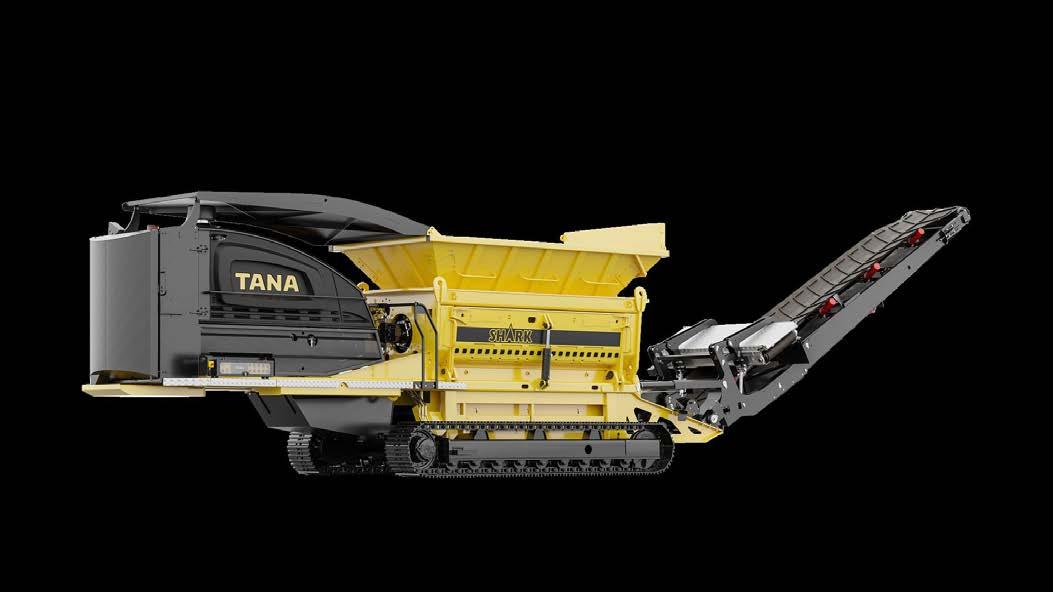
TANA Shark is proving to be a big fish in a big pond.
66 RULE THE ROAD
STG Global wants its waste trucks to be the Queens of the road.
68 FUTURE LOOKS BRIGHT
Why manufacturer support for equipment is just as important as performance.
70 NO TIME TO WASTE
The Australasian Waste and Recycling Expo is right around the corner, and Isuzu Australia Limited will be there.
72 MADE TOUGH
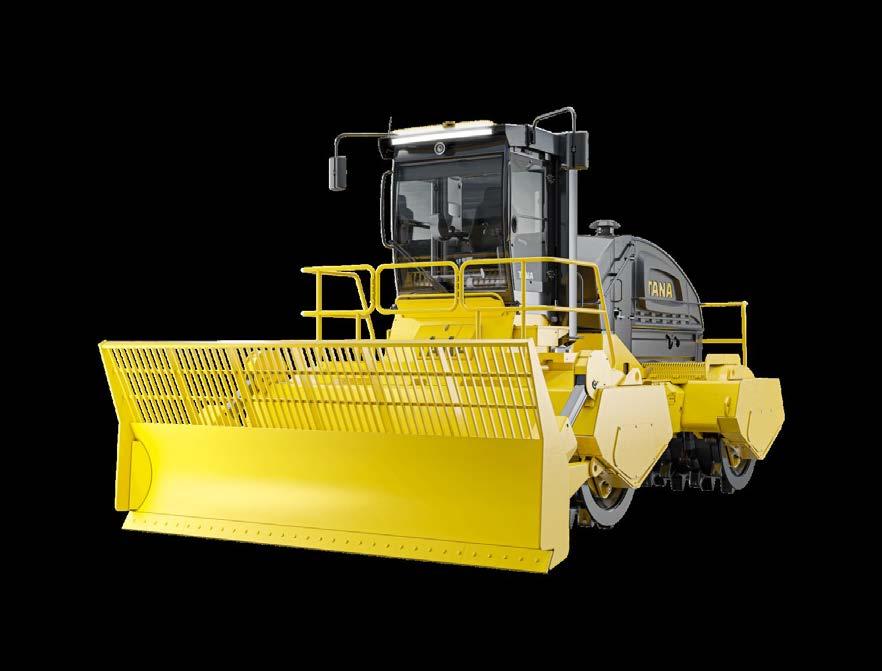
The BOMAG Landfill Compactor range is made to tackle even the toughest landfill sites. Regulars
74 EVENTS
79 PRODUCT SPOTLIGHT
81 LAST WORD
4 / WMR / July 2023 17 TO INSURE OR NOT TO INSURE A look at insurance challenges for waste and recycling operators. 20 THE BREAKOUT Industry leaders have their say on current issues. 26 A REAL CIRCULAR ECONOMY MRA Consulting talks circular economy. 28 PLANET ARK Is collaboration towards a circular economy happening? 30 ALL IN THE CONTENT WRISA develops a partnership to promote recycled content. 32 PLASTIC STRATEGY Aerofloat is pivotal in helping recyclers clean and reuse wash water. 34 RECYCLING AND COMPOSTING
quiet achievers who are making a difference. 37 AMPED UP
Stewardship Council calls for industry action to tackle EV batteries.
The
Battery
22
COVER STORY
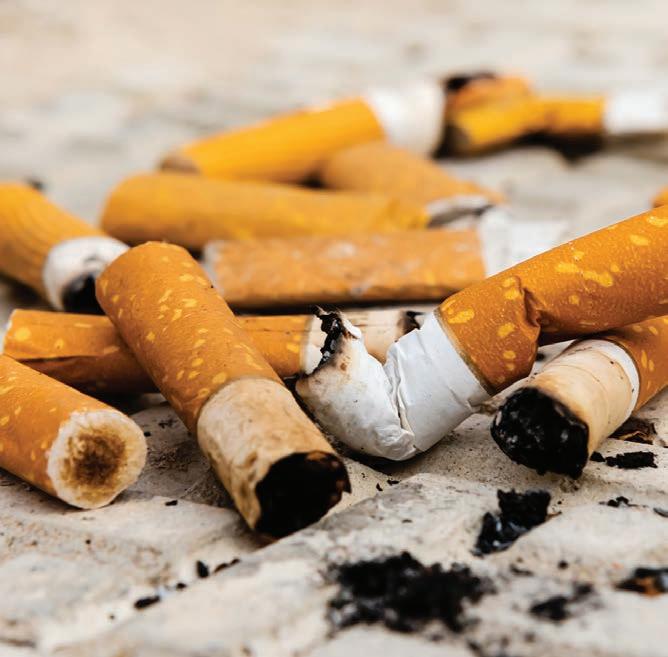
Is recycling cigarette butts a waste of time, or a waste resource? 81 BUTT WHAT IF?
- Lina Goodman, Chief Executive Officer, Tyre Stewardship Australia
Features
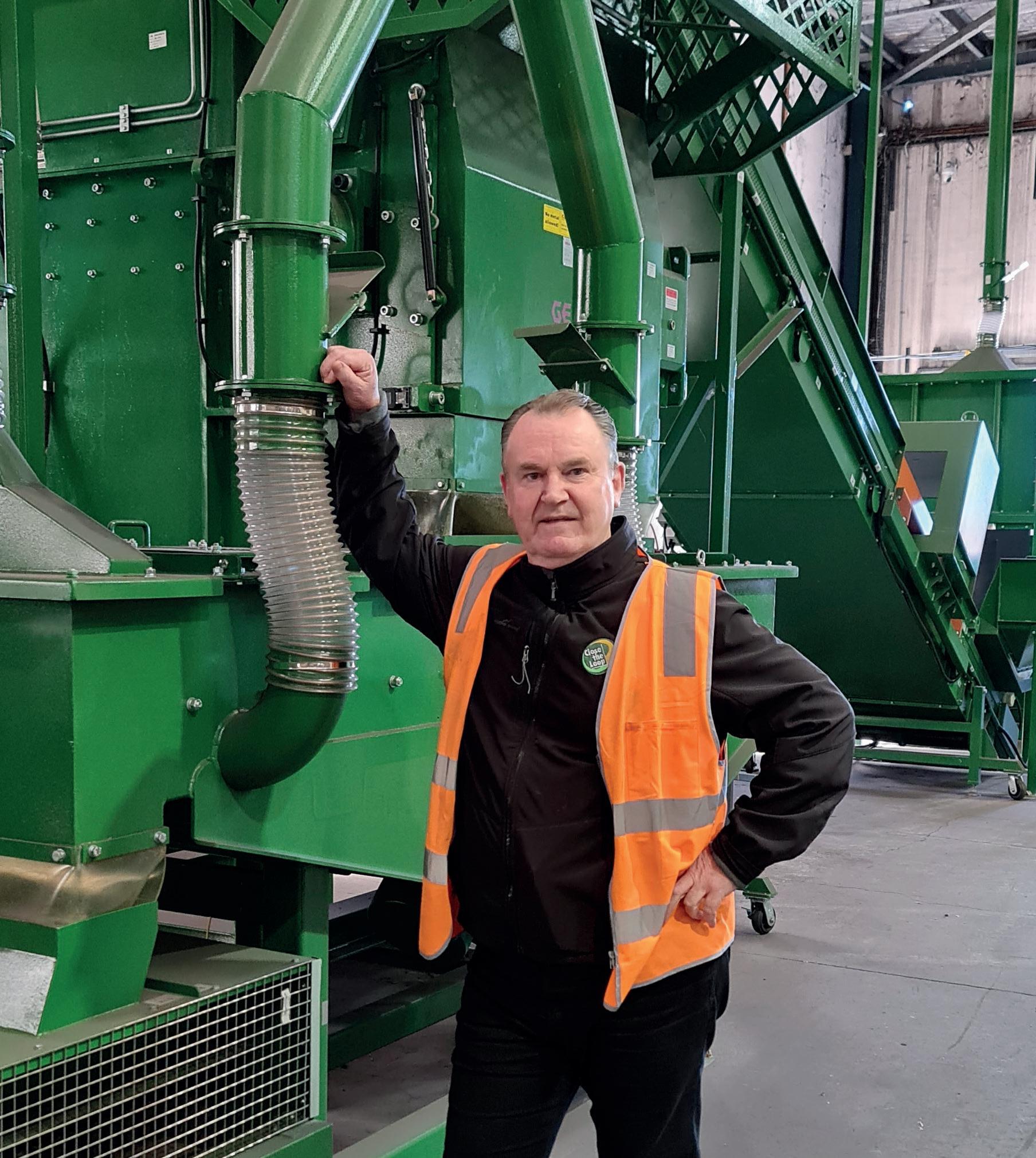
Call: Email: Visit: 03 9706 8066 sales@appliedmachinery.com.au appliedmachinery.com.au genoxmachinery.com.au At Applied, our number one priority is ensuring that our customers across the country get the machinery they need, with the support they expect. With nearly 30 years’ experience, and thousands of satisfied customers across the country we’re here for the long term. We’re a true machinery partner – just ask Steve Morriss. Real Service. Real Support. Real People. That’s Applied Thinking. “ANY ISSUE IS FIXED STRAIGHT AWAY. THAT’S
OF
WITH
THE BENEFIT
A LOCAL SUPPLIER
FULL TECHNICAL SUPPORT AND BACK-UP.” STEVE MORRISS, CLOSE THE LOOP, SOMERTON, VIC
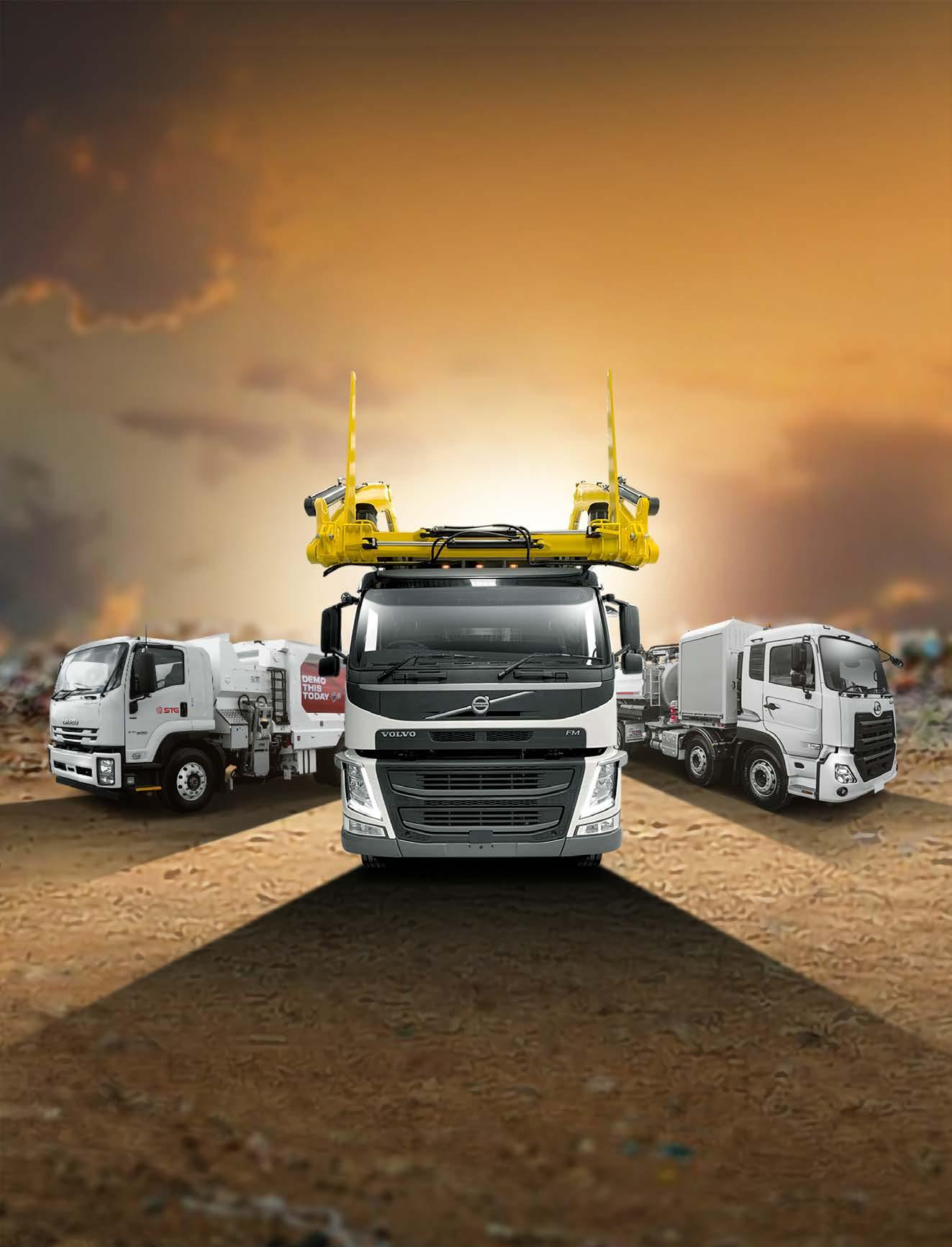
Garbage guts. Carry bigger payloads than the competition.



















Isuzu’s FVY Dual Control





We’re about to make a big splash in trash, because we’ve just launched a new range of dual control trucks. With lower tare weights than similar models from our competitors, these new trucks can carry bigger payloads. Up to 300kgs per trip! Apply that across a fleet and you’ll see huge boosts in e ciency and reduced operating costs. Visit isuzu.com.au/waste

FSA/ISZS1059















































































From the Editor
No need to reinvent the wheel
While researching stories for Waste Management Review there’s been many times that I’ve heard Australia is decades behind Europe or the United States in everything from introduction of waste-to-energy, organics processing, even refund rates for container deposit schemes.
It’s frustrating for those in the waste management and resource recovery industries, but it’s also an opportunity. One that Lina Goodman, Chief Executive Officer of Tyre Stewardship Australia, is seizing.

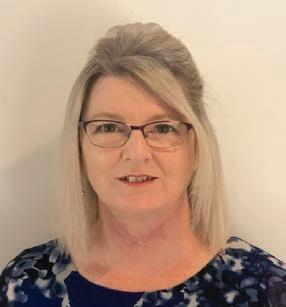
Lina’s been steering the TSA for the past four years and has had success in market development, research, and projects to advance end-of-life tyre recycling and the use of tyre-derived material.
But, she says, the TSA hasn’t been able to create an environment in which opportunistic players can disappear. The more Australia is unable to eliminate rogue operators from collecting and dumping tyres and storing material in factories or creek beds, the less likely it is to achieve the Nirvana of being able to be custodians of its own waste.
End-of-life tyres were added to the Minister’s Product Stewardship Priority List in October 2022. At the time, Tanya Plibersek, Minister for the Department of Climate Change, Energy, the Environment and Water, said the priority list made it clear, if industry doesn’t act, government will. The government doubled down at the June Environment Minister’s meeting, agreeing to fast-track a review of a tyre stewardship framework.
Tyre stewardship is happening around the world, with or without Australia. In this month’s cover story, we talk with leaders of some international tyre stewardship schemes to gain insights into what works and what doesn’t. Australia has made great strides in encouraging a circular economy, but it is still a pup. There’s a great opportunity to cherry pick the best ideas and incorporate them at home, not just for tyres, but all product stewardship schemes.
Happy reading
Lisa Korycki
CHIEF OPERATING OFFICER
Christine Clancy christine.clancy@primecreative.com.au

GROUP MANAGING EDITOR
Sarah Baker sarah.baker@primecreative.com.au
MANAGING EDITOR
Mike Wheeler mike.wheeler@primecreative.com.au
EDITOR
Lisa Korycki lisa.korycki@primecreative.com.au
8 / WMR / July 2023
PUSHING FOR A WASTE FREE AUSTRALIA
Learn more about how we are Transforming our Business, Industry and World.
Three new organic recycling infrastructure projects in Perth, Western Australia, are expected to divert about 275,000 tonnes of the state’s food organic and garden organic (FOGO) waste from landfill annually and convert it into compost.
The new facilities will be located to the north, east and south of Perth and will receive $11.25 million in co-funding from state and federal governments.
Eastern Metropolitan Regional Council will receive $2 million to build a new FOGO processing plant, northeast of Midland, at the Red Hill Waste Management Facility, which processes organic waste from five councils. The total $18 million project is initially set
to process 60,000 tonnes of organic waste each year, scaled up over time to eventually process 100,000 tonnes of organics waste.
C-Wise Holdings Pty Ltd, will receive $5.75 million to build a new organic carbon recycling facility in East Keralup, near Mandurah. The $28.61 million facility is expected to process 100,000 tonnes of organic waste each year.
Joint funding of $3.5 million will expand the existing Go Organics facility at Boonanarring, north of Gingin. The $7.42 million project will support the rollout of FOGO north of Perth and process 75,000 tonnes of organic waste each year. The three projects will support WA’s move
toward a circular economy and will support 146 construction jobs and 98 ongoing positions.
Tanya Plibersek, Federal Minister for the Environment and Water, said the three projects are a step toward a circular economy in Australia.
“The increased composting capability in Western Australia will help us reach our national target of halving the amount of organic waste sent to landfill by 2030.

“We’re not only reducing landfill waste and greenhouse gas emissions, but we are making Western Australian soils more productive.”
The facilities are expected to be complete by June 2025.
$11.25M funding for new Perth organic projects Visy completes $48M upgrade on Queensland recycling facility
Visy closes the loop for mixed paper recycling in Queensland with completion of a $48 million upgrade to the Gibson Island facility.
The recycling and remanufacturing campus was unveiled with Queensland Premier Annastacia Palaszczuk and Deputy Premier Steven Miles on 30 May.
The upgrade is part of Visy Executive Chairman Anthony Pratt’s commitment to invest $2 billion over the next decade – $700 million of that in Queensland – to reduce landfill, cut emissions and create
thousands of green collar Australian manufacturing jobs.
Pratt said it was a proud day because the company is not only a manufacturer but in the landfill avoidance business.
“Recycling is an important weapon against climate change,” he said.
The Gibson Island project will divert up to 39,000 tonnes of material from landfill – covering the equivalent of about 2500 Suncorp stadiums – using a new paper optical sorting plant.
Visy will recycle and remanufacture this kerbside waste from hundreds
of thousands of Queensland homes into 100 per cent recycled paper and corrugated boxes for the state’s farmers, and iconic food and beverage companies.
The upgrade was made possible thanks to co-investment support from the Queensland Government and is set to reduce landfill by up to 20 kilograms per Queensland household annually.
The 100 per cent recycled paper will then be sent to Visy’s corrugated box plants, including a new one at Hemmant.
10 / WMR / July 2023 News
Where to from here?
AUSTRALIA IS ON THE CUSP OF BEING THE ONLY CONTINENT TO BE FULLY COVERED BY DRINK CONTAINER REFUND SCHEMES. A SESSION AT THE RECENT WASTE 2023 CONFERENCE IN COFFS HARBOUR LOOKED AT THE EVOLUTION OF THE NATION’S CONTAINER DEPOSIT SCHEME LANDSCAPE.
South Australia has led the way in Australia with a Container Deposit Scheme (CDS) operating since 1977.
It took 35 years before other states began to follow suit, with the Northern Territory introducing a scheme in 2012. Over the decades other states have adopted their own refund schemes, offering a cash incentive for people to return used drink containers to be recycled.
With the rollout of Victoria’s Container Deposit Scheme in November 2023, and Tasmania’s version taking shape, Australia is on the cusp of being the only continent to be fully covered.
Alex Young, Director of the Container Deposit Scheme at the New South Wales Environment Protection Authority (EPA), said while the objective of the NSW scheme when it was introduced in 2017 was to reduce litter, it was also about recycling and encouraging users to keep coming back.
The scheme was designed to be cost effective, at no cost to government – a “proper, extended producer responsibility model where the industry paid for the cost of the scheme”.
It also had to complement the kerbside system and have a robust tracking and verification system to both monitor the scheme’s success and manage the risk of fraud.
Six years on and the scheme is ticking all the boxes, Alex said.
“The proof’s in the pudding.
“We’ve got more than 600 return points, which is significantly more than the minimum required in the legislation, so we know that we’re driving that convenience. We’ve collected over 9.3 billion containers, so we’re seeing good collection rates, we’ve reduced litter by 53 per cent and we’ve doubled the resource recovery rate compared to kerbside prior to the scheme.
“Not only that, but what we’ve seen is really high-quality recycling – bottleto-bottle recycling.”
Alex said the EPA is mindful of scheme’s plateauing and is working with partners Exchange for Change and TOMRA Cleanaway to drive more convenience and improve recovery rates.
However, there could be trouble brewing on the horizon. A recent announcement by Queensland that it
would expand its CDS to include glass wine and spirit bottles this year had changed the landscape when it comes to harmonisation of schemes across Australia – a facet that some in the industry are keen to see, sooner rather than later.
Danielle Smalley, Chief Executive Officer of Exchange for Change, said the Queensland announcement had not sent a strong message about the commitment to harmonisation.
She said participation in schemes needs to be made easier for beverage suppliers who are frustrated by having to navigate the different eligible containers, reporting methods, invoices, and pricing of various jurisdictions.
Despite the difficulties, she said there had been a change in mindset from suppliers. Initially the beverage industry wasn’t happy about a compulsory product stewardship scheme, however, it has realised it’s here to stay and is looking at ways to optimise the benefits.
There’s also now a consumer shift to circular economy outcomes.
Danielle used the example of Asahi and Coke partnering with Cleanaway and Pact Group to build a facility
FEATURE NEWS
12 / WMR / July 2023
Increased refunds, expanded schemes and national harmonisation were on the table for discussion.
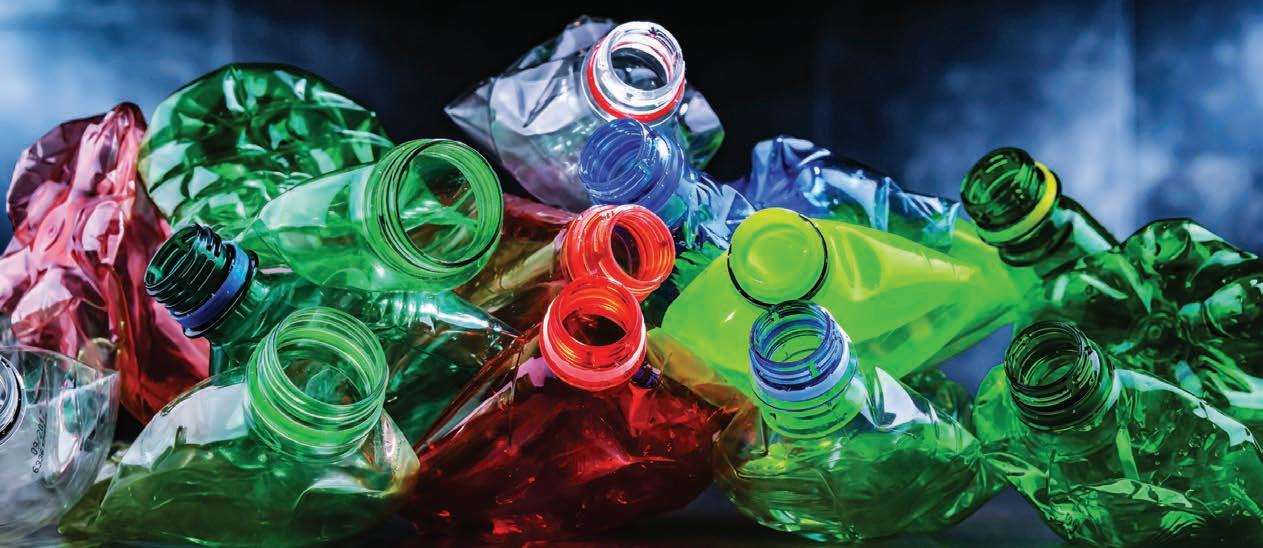
that processes 100 per cent of the Polyethylene terephthalate (PET) in New South Wales.

“We can talk about a bottle-to-bottle journey there with great confidence,” she said. “Consumers are making this effort to return the material through the return points. And with examples like the plant in Albury, we can provide tangible, concrete examples of what happens to that material, which makes them realise that the effort is absolutely worth it.”
Moving forward, she flagged whether there’s an opportunity to influence choices in the materials that suppliers use for their products to align with government objectives, such as glass that is infinitely recyclable, and tapping into existing infrastructure to expand what recyclables can be dropped off at collection points.
“How much further we can we take it?” Danielle asked.
Michelle Mandl, General Manager of Communications at TOMRA
Cleanaway, the network operator in NSW, said the state’s scheme had activated local communities and leveraged a retail model that aligns to existing consumer behaviours.
TOMRA Cleanaway has been appointed one of the network operators for the Victorian scheme and plans to deliver a similar, technologybased system with robust audits and
verifications. But Michelle said while the system is proven, when looking at future risks, there needs to be a discussion about increasing the deposit value from 10 cents and targeting the next generation of recyclers.
She said 10 cents is a hard sell, even for someone within the industry.
“I reflect on doing things like taking my 13-year-old to Harry Styles and paying $6.70 for a bottle of water at the stadium,” Michelle said. “Even I, as a participant in the scheme, found it a hard sell, to think ‘will I take that home with me? Will I put it in my bins and participate in return and earn?’
“If you multiply that across the community, redemption rate is a lever that will increase participation which in turn, delivers a higher value, clean stream of product for the circular economy locally.”
She said schemes are currently aimed at adults because they predominantly buy the beverages, but in five to 10 years’ time, it will be the teenagers of today that need to be engaged in the scheme.
“We need to get their mindset around this environmental benefit because we know that that appeals to them now.”
Rob Kelman, Director of Reloop Platform, believes the community
www.wastemanagementreview.com.au / WMR / 13
A10-cent refund for eligible containers is a ‘hard sell’ according to industry insiders.
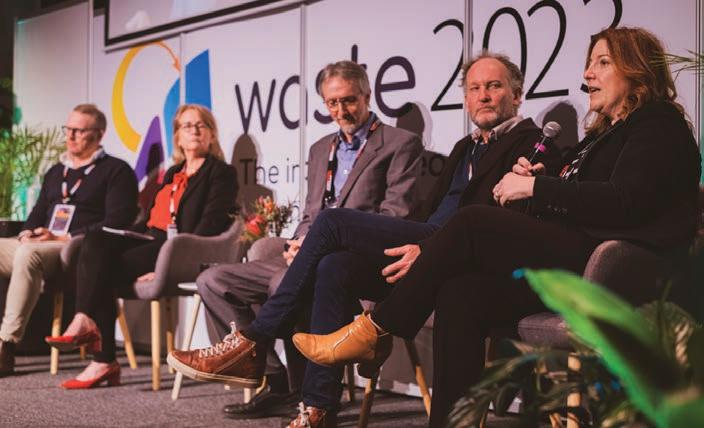
The CDS panel: Shaun Fraser, Container Exchange QLD; Danielle Smalley, Exchange for Change; Alex Young, Director CDS, NSW EPA; Rob Kelman, Reloop Platform; and Michelle Mandl, TOMRA Cleanaway.
is already insufficiently engaged and existing schemes are stagnant in terms of recovery rates. He said that’s only going to worsen because of the inflationary effect on the refund value.
Return rates nationally average about 65 to 68 per cent, according to Rob, but Australia could do a whole lot better, because there’s still about three to four billion drink containers being littered or landfilled every year.
He pointed to Europe as an example, where the refund value is equivalent to 40 Australian cents. Germany has a recovery rate of 98 per cent, and most of Northern Europe is more than 90 per cent.
“It’s convenient and is a big motivation to get 40 cents back,” Rob said. “We could do a whole lot better. We need to reform our schemes.”
Part of that reform should include increasing convenience for consumers to participate in schemes.
The ratio of collection points to people across Europe is about one per 1000, where in Australia it varies from one per 12,000 to one per 20,000, depending on the state and region.
“Analysis shows that a refund increase will have an impact,” Rob said. “We need a proper reform agenda.
“Could we think about incorporating a refill agenda into the existing scheme? We’ve got the infrastructure; we’ve got a refund venue and there’s a community appetite for reuse. Is that something we can start to look at?”
Danielle agreed that an increase in redemption rate is motivation for people to participate in a scheme but it’s not the only motivation. There are also other barriers to participation, such as access.
She said just changing the redemption rates is a knee jerk reaction.
“Our view is that there is still room for growth,” Danielle said.
“We know it looks like growth has plateaued, but we haven’t had a normal period for a long time. We’ve had fires and COVID-19 and floods, we had REDcycle collapse, which may have impacted on people’s willingness to participate in this scheme, and we’ve also had huge supply in New South Wales.
“We need to wait and see when that all settles down are we then able to raise the redemption rate?”
Shaun Fraser, General Manager of Operations at Container Exchange, said raising the refund amount from 10 cents is a matter for regulators.
While Queensland’s recovery rate had stabilised, he said there’s room to grow and agreed that there needs to be solutions to other barriers such as providing opportunities for those who can’t access a scheme.
14 / WMR / July 2023 FEATURE NEWS
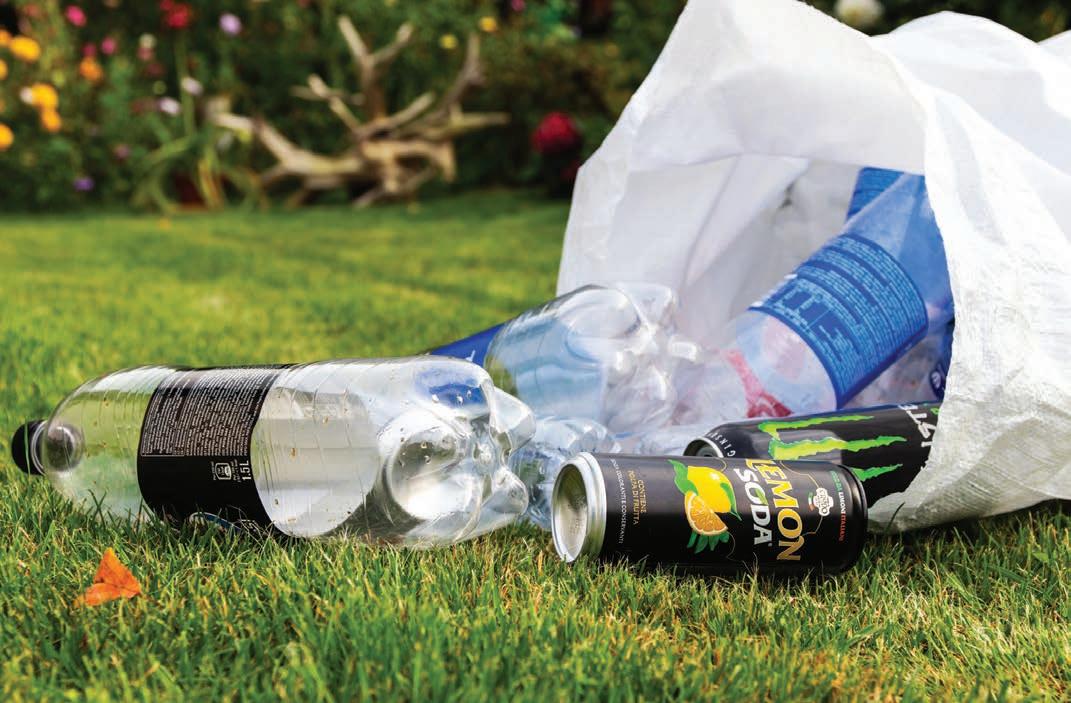
Three to four billion drink containers are still littered or landfilled every year.







Do you produce or import small household appliances or solar PV systems?
You may soon be required to recycle your e-waste under the government’s expanding NTCRS scheme.
ANZRP has 12 years of experience providing a premium service to parties liable under the NTCRS and are preparing to expand into these new areas of e-waste management.

We serve over 50 global IT manufacturers to meet their liability as well as deliver tailored collection programs.
As a not-for-profit, we always act with integrity and with our members as our top priority.
Join ANZRP to take your e-Stewardship to the next level.
Contact us at estewardship@anzrp.com.au
ANZRP has partnered with CRDC to deliver a groundbreaking plastic recycling solution in Australia.
The process converts mixed plastic waste into RESIN8 – a high performance construction aggregate.
Our new plant is being installed in Melbourne with operations due to commence in August.
Contact us at shane@crdc.global to find out more
To insure or not to insure
DR
GEORGINA DAVIS,
FORMER CHIEF EXECUTIVE OFFICER OF THE WASTE RECYCLING INDUSTRY ASSOCIATION QUEENSLAND, LOOKS AT THE PROPERTY INSURANCE CHALLENGES FOR WASTE AND RECYCLING OPERATORS.
igh-profile losses and a perceived frequency of fire claims have led to a significant reduction in underwriting capacity and an increased scrutiny of the risk profile associated with all treatment and disposal processes.
Against a backdrop of catastrophic losses, including the 2022 flooding events on the east coast of Australia and the record-breaking hurricane Ian, in the Northern Hemisphere – insurers will continue to focus on quality, well managed risks.
It is clear however, from discussions with insurers, that the waste and recycling sector has some work to do in improving the perception of operators’ risk profiles and, ultimately, attracting new insurer capacity to the market.
How do we as a sector manage the possible risk to sudden and ‘knee-jerk’ policy solutions and political interference to address emerging and future issues arising from an increasing incidence of site fires that are known to cause environmental pollution, result in a loss of resources, lead to community disruption and community outrage, and are resource intensive and costly to address?
How does the sector adopt different risk treatments or transfer those risks, and how prepared are we, the waste management and recycling sector, if insurance is no longer available?
Coverage for waste and recycling operations is still available in the
insurance market, but the number of insurers willing to deploy their capacity is limited, with a handful of specialist insurers driving pricing and coverage positions.
This imbalance in the purchasing power of insurance for waste and recycling operators is not unlike other industries that have suffered frequent losses with insurers focused on well riskmanaged, good claims performing assets with lower risk exposures. For these select insurers, understanding fire protections and other key risk management policies are critical, and therefore strong engagement with underwriters and differentiating renewal submissions every year has become critical to minimising any pricing or coverage impacts.
The reduction in the number of insurers working in the sector, coupled with an increase in losses and claims, has resulted in insurers looking to significantly increase their premiums across the sector. However, insurers have not only been seeking to impose premium rating increases; they have also increased the level of policy deductibles.
As a result, some operators have reduced insurance cover, or simply not renewed. In some cases, particular insurance products such as public liability is simply no longer available to businesses (particularly small operators). This poses issues as operating commercial businesses, running contracts and even tendering for work requires appropriate
insurance, not to mention the increased risks imposed onto the business and its directors.
Recently, there has also been requests from lenders to provide evidence of insurance, and in one known example, a bank requiring fire insurance on an inflammable asset.
For existing locations, insurers are strongly focused on operators adhering to strong risk management guidelines and, in many cases, the insurer driven risk management guidelines over and above those that exist for the sector, by building codes and other regulators.
Having a solid understanding of the key insurable exposures is vital,
INDUSTRY INSIGHT www.wastemanagementreview.com.au / WMR / 17
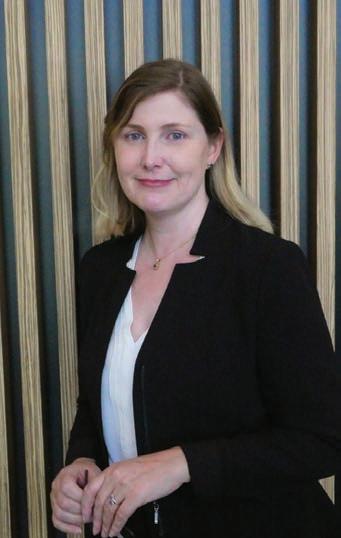
Dr Georgina Davis, Former Chief Executive Officer of the Waste Recycling Industry Association Queensland.
and it is strongly recommended that for any new waste operation builds or renovations, risk engineers are engaged with experience of insurer risk management requirements to ensure the work is mitigating key risks of concern to insurers. As wasterelated fire is a big focus of insurers (and a cause of insurer losses), a strong risk management commitment and investment will be required to encourage insurer participation.
Given the growing risks associated with the insurance market and member feedback, Waste Recycling Industry Association Queensland (WRIQ) commenced work with WTW (Willis Towers Watson) and the University of Southern Queensland which will quantify insurance products available to the sector, compare our markets with those available overseas, and identify existing supply and demand-side barrier drivers to the uptake of both existing and potential products. Ultimately, we
need fit-for-purpose, affordable insurance products for the sector and availability of products to businesses of all sizes.
It is also essential, that we as a sector, can clearly articulate to insurer partners the true position on fire losses, risk management and the future direction of waste and recycling operations.
Our sector is rapidly adopting new technologies, we lead best practice in materials recovery, and we are the future of meeting carbon emission targets and delivering a circular economy. We need to communicate this better.
It is apparent that attracting new capacity (new insurers) to underwriting of waste and recycling operations will only occur when the pricing and risk management across the sector is at a level to offset sectorwide losses.
To drive premium reductions, we need to be able to demonstrate an improving risk profile and a reduction in losses and not just limited to fire.
More information is available at memberservices@wriq.com
18 / WMR / July 2023 INDUSTRY INSIGHT
“Clearly articulate to insurer partners the true position on fire losses, risk management and the future direction of waste and recycling operations.”
Georgina Davis Former CEO, Waste Recycling Industry Association Queensland
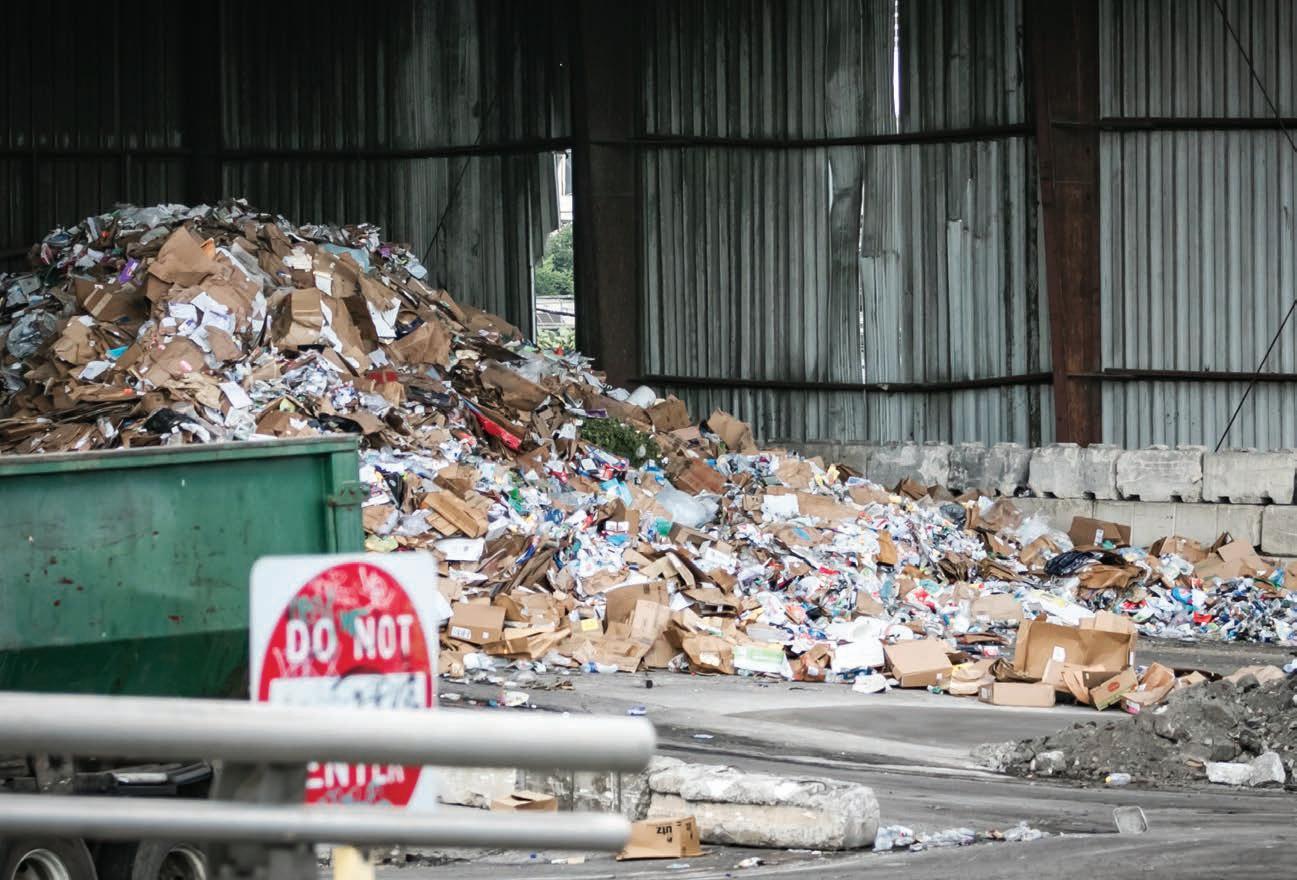
Reduction in the number of insurers working in the waste and recycling sector, coupled with an increase in losses and claims, has resulted in insurers looking to significantly increase their premiums.
The Breakdown
‘The Breakdown’ is a regular column giving industry leaders and decision makers a chance to share their views on topics central to the sector.
This month we asked industry leaders and decision-makers: “What does a circular economy mean to you?”
In my mind, a circular economy is one in which purchase decisions and disposal decisions are interconnected and dependent – whatever you buy or use, you do so with the full awareness that you wish to reduce any waste and loss as a result of your decisions. Organics recycling is an exemplar of the circular economy at its best, a natural process. Unlike most recycling streams, the nature of the organic feedstock and products requires a strong emphasis on localised supply chains: much of the product is sourced, processed and utilised within the same community. This is important, as organics make up the largest part of the Australian waste stream.
For me, circular economy means eliminating waste and pollution through closed loop resource recovery. Contrast to the traditional linear economy, which uses resources and creates waste, a circular economy demands reusing products and extracting new resource. Australia’s transformation into a circular economy demands more innovative measures of recycling and waste aversion. Supporting circular economy and diverting as much waste from landfills will preserve our finite natural resources. Changing perception of unwanted waste into something that can be beneficially recovered and reused will deliver a positive environmental, social and economic outcome to our local communities and the environment.
Recycling is part of a circular economy, but a circular economy is much more than recycling.
In a circular future, we maximise the use of materials already in the economy and reduce reliance on virgin materials. We do this by designing for longevity, making smart material choices, emphasising repair, reuse and refilling opportunities and establishing efficient recycling systems with robust end markets.
All levels of government commit to ‘upstream’ interventions including brave targets, multi-pronged circular policies, financial mechanisms and regulatory instruments.
Industry makes products to last, while consumers value and revalue products throughout their multiple lifecycles.
If you or someone at your organisation is an industry leader and would like to be a part of this monthly column in 2023, please get in touch with Editor, Lisa Korycki lisa.korycki@primecreative.com.au

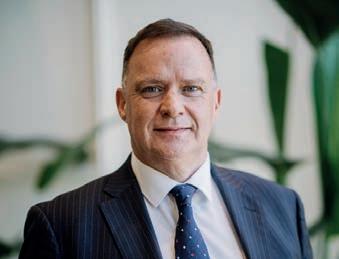
 John McKew National Executive Officer Australian Organics Recycling Association
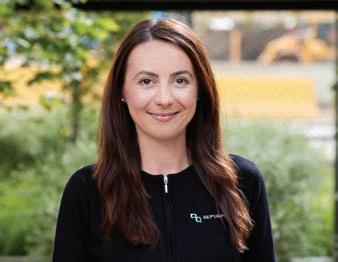
Jelena Hercegovac General Manager Environment & Sustainability Repurpose It
Maša Vahldieck CE Manager 2023 MRA Consulting
John McKew National Executive Officer Australian Organics Recycling Association
Jelena Hercegovac General Manager Environment & Sustainability Repurpose It
Maša Vahldieck CE Manager 2023 MRA Consulting
OPINION 20 / WMR / July 2023
Brett Lemin Executive Officer Victorian Waste Management Association
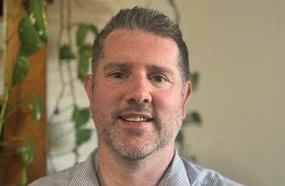
To me, a circular economy represents a fundamental shift in how we produce, consume, and manage resources. It is a regenerative system that aims to minimise waste, maximise resource efficiency, and create closed-loop cycles for materials. It emphasises sustainable product design, recycling, and recovery to keep resources in circulation. A circular economy fosters collaboration, innovation, and the development of new business models that prioritise longevity, reuse, and sharing. It offers economic and social benefits by reducing environmental impact, enhancing resource security, and creating a more resilient and sustainable future for generations to come.
Chief Executive Officer Australian Council

A circular economy means breaking down the economic and regulatory barriers to reducing, reusing and recycling. Right now, our market and regulatory systems incentivise a linear economy, insofar as it’s easier and cheaper to ‘take’, ‘make’ and ‘waste’ virgin and raw materials, rather than make the very most out of what we have. In doing so, we’re kicking the can down the road and passing the cost of resource inefficiency and waste onto future generations. The best start would be with real extended producer responsibility for all products placed on market, and a nationally harmonised approach to ‘end of waste’, to remove the regulatory barriers to resource recovery and recycling.

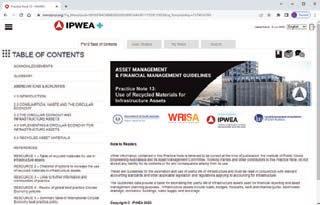
NEW RESOURCE FOR THE CIRCULAR ECONOMY AND USE OF RECYCLED MATERIALS FOR INFRASTRUCTURE ASSETS NEW RELEASE


Introducing the latest addition to the IPWEA Library, Practice Note 13 - The Circular Economy and Use of Recycled Materials for Infrastructure Assets provides guidance to boost the use of recycled material in infrastructure assets.
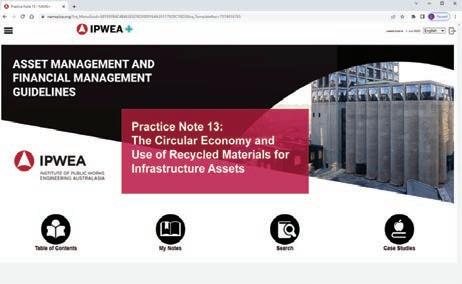
Filling a gap in practical application, Practice Note 13 provides detailed information, summaries, links, checklists, case studies and other supporting tools to enable circular economy principles and procurement to be embeded into the built environment.
Technical information including relevant standards, environmental impacts, recyclability, benefits and uses is provided for asphalt, coal ash, concrete, glass, metal, organics, tyres, plastics, wood and other commonly used materials in over 200 assets.
Suzanne Toumbourou
of Recycling
www.ipwea.org/ebookshop
Taking the wheel
LINA GOODMAN, CHIEF EXECUTIVE OFFICER, TYRE STEWARDSHIP AUSTRALIA, IS DRAWING INSPIRATION FROM GLOBAL SCHEMES TO BRING AUSTRALIA’S CIRCULAR TYRE ECONOMY ACROSS THE LINE.
The tyre industry has said loud and clear that Tyre Stewardship Australia (TSA) is doing the best it can, but it’s not enough. More needs to be done.
At the helm of Australia’s product stewardship scheme for the past four years, TSA Chief Executive Officer Lina Goodman absolutely agrees more needs to be done, but she questions how much more can be achieved under the current construct.
“Government has wanted industry to do this on their own and take
responsibility for the product that they’re distributing to the sector,” Lina says. “And I think that just hasn’t been able to be achieved. We’ve tried and we’ve come a long way. But it hasn’t worked.”
TSA was established as a voluntary product stewardship scheme to create productive outcomes for end-of-life tyres. In almost a decade it has accredited 1700 participants and committed $9 million to projects to advance the use of tyre-derived material.
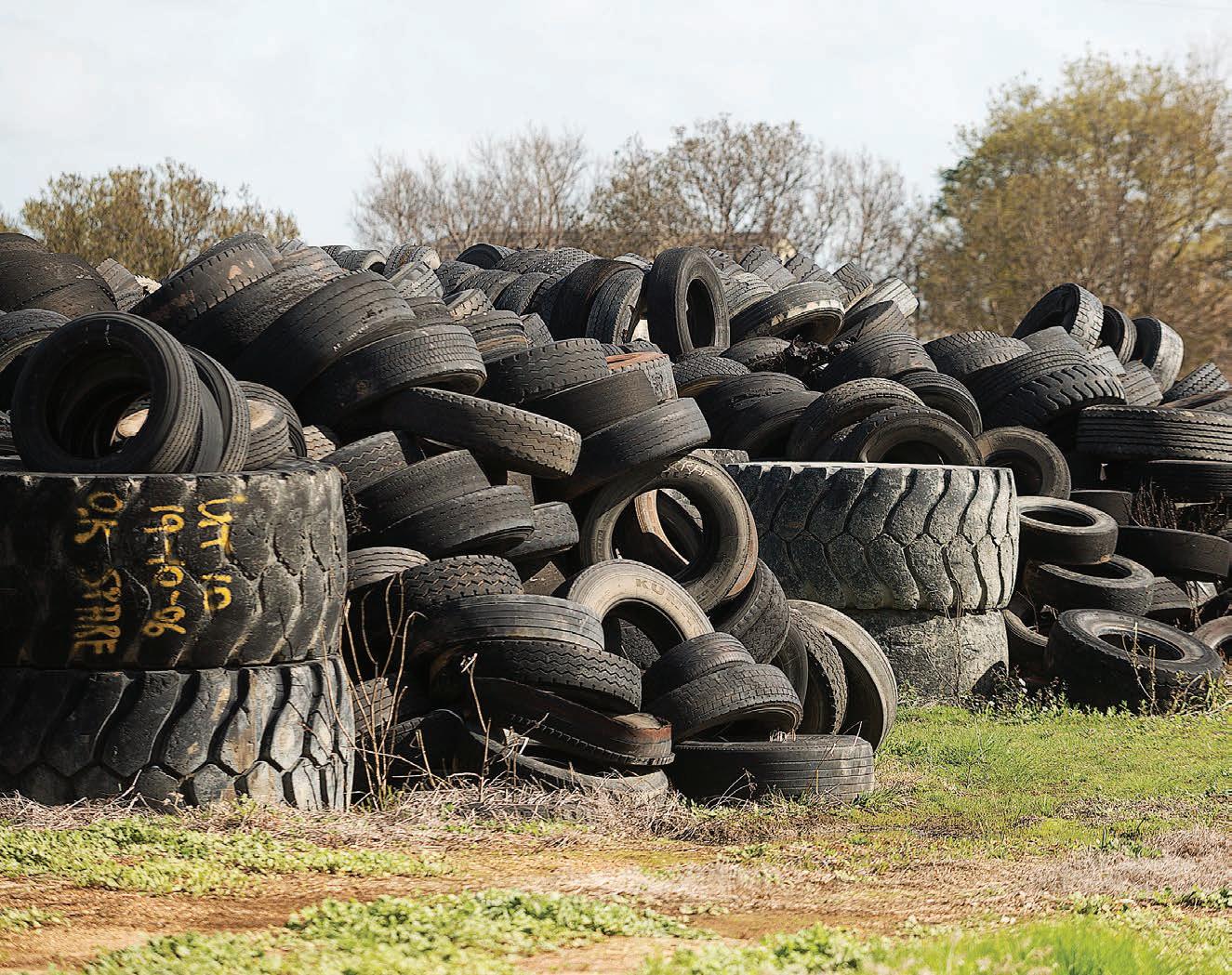
What it hasn’t been able to achieve is stamp out free riders, with only a five
per cent increase in participation by passenger and truck tyre manufacturers since the scheme began.
In July 2022, after deep consultation across the tyre industry, an independent review, mandated by the Australian Competition and Consumer Commission (ACCC), indicated the scheme had run out of bite.
End-of-life tyres were added to the Minister’s Product Stewardship Priority List in October 2022. At the time, Tanya Plibersek, Minister for the Department of Climate Change,
COVER STORY 22 / WMR / July 2023
Energy, the Environment and Water, said the priority list made it clear, if industry doesn’t act, government will. The government doubled down at the June Environment Minister’s meeting, agreeing to fast-track a review of a tyre stewardship framework.
Lina says it’s a strong signal to the market that it’s time to get serious about circular economy for used tyres in Australia.
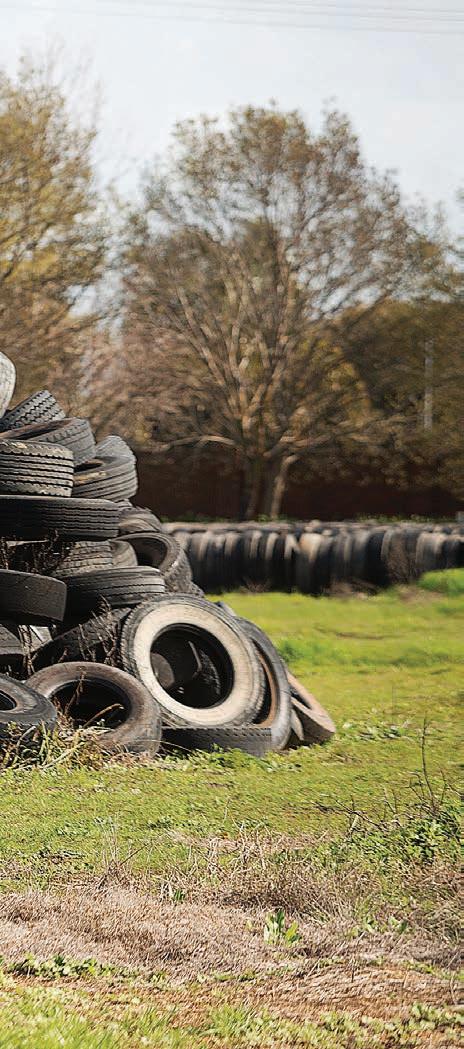
“A regulatory process means that we do away with the environmental disaster that we’ve seen here in Australia over the past years whether it’s stockpiling, illegal dumping or fires,” Lina says.
“All these things, we hope, will be mitigated because tyres will not have the chance to fall into the hands of rogue

operators, but have a proper pathway that they must go through.”
The Minister’s priority list requires three actions by October 2023 – increase the consumption of tyre-derived material in Australia; all retailers need to be participating in the scheme; and all tyre importers bringing tyres into Australia need to be part of the scheme.
Lina says that just several months away from the deadline, none of the requirements have been met.
“Government responded quickly to this lack of action by the industry,” she says. “The government is now asking, ‘does there need to be a regulatory response to make these actions happen? And what does that look like?”
Lina says a circular economy cannot succeed in a vacuum, it must be supported by regulation and be in line with other operators in the global economy.
TYREWISE – NEW ZEALAND
It’s been a lengthy journey for New Zealand’s tyre stewardship scheme, Tyrewise, from the first phase of the project in 2012 to a declaration of priority product status for tyres in 2020.
The scheme is being implemented in 2022-23 and, unlike TSA, never operated as a voluntary scheme.
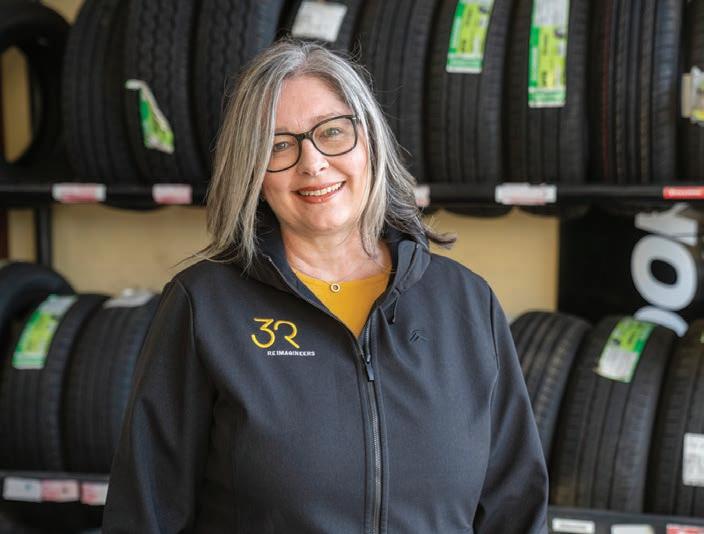
Adele Rose, Chief Executive Officer of 3R Group, implementation project managers for Tyrewise, says the country’s tyre industry was clear from the start that it wanted a mandatory framework so that there was a level playing field and no free riders.
3R worked closely with the industry to keep the Tyrewise Working Group together after tyres were not declared as a priority product in 2015. Adele says the change of government in 2017-20 renewed hopes of regulation when tyres were declared a priority product in 2020.
Adele says communicating with industry to maintain relationships and “hold the line” is important.
“You need an organisation that’s willing to lead,” she says. “3R Group, as project managers of Phase One, was willing to do that despite there being no funding. We believed regulation was the right thing for Aotearoa New Zealand and we were willing to hold those relationships over the years.
“The industry was always clear in its view that Tyrewise would not progress as a voluntary scheme. That meant that maintaining critical contacts within government during the design years was equally important to ensure that the scheme did not end up in the too hard basket.”
There’s been a few lessons learned along the way. During the scheme’s design phase several methods of declaration of tyre volumes were explored. The main differences were declaration direct to the product stewardship organisation or declaration via first point of import or registration. For import, this would be via NZ Customs on loose tyres or non-road registered vehicles, and for registration via NZ Transport Agency for vehicles upon initial registration for on-road use.
Adele says the method of brand owner first importer via first point of
www.wastemanagementreview.com.au / WMR / 23
Adding end-of-life tyres to the Minister’s Product Stewardship Priority List is a signal that it’s time to get serious about circular economy for used tyres in Australia.
Hervé Domas, Aliapur Managing Director.
import was initially preferred by the industry. The view was that this would be administratively efficient and there would be less risk of any leakage of market sector information.
She says with hindsight, brand owner first importer declarations to the product stewardship organisation would have been preferable. However, New Zealand’s current Waste Minimisation Act 2008 is not designed for this type of declaration at first point of entry to market and has required some work arounds.
“This means additional agencies beyond the Ministry for the Environment, which is responsible for the Act, have had to be involved, including Treasury as the advanced stewardship fee is treated as public funds, the same way as a tax,” Adele says.
“The reality is that having government collect fees and data, and then find a mechanism to provide those funds and data to a scheme is administratively heavy.
“Data is unable to be passed to a nongovernment entity, therefore significantly restricting the useful flow of data to the managing entity. This would have allowed further checks and balances.”
Adele says that over the journey, success for all involved was to achieve a level playing field that removed the risk of free riders. That hasn’t changed, but an unexpected benefit has been the way that the collection, transport, and processing sectors have matured since the declaration of tyres as a priority product in 2020.
Despite a clear direction, there continues to be challenges, including changing governments. New Zealand’s three-year term is too short, Adele says, to achieve much and there is a lack of public consensus on environmental action.
Government processes also take time, especially when implementing regulated product stewardship for the first time – Tyrewise is the first of six product categories declared priority product and will be the first “cab off the rank”.
“This part of the regulatory toolkit hasn’t been used before and that of course throws up challenges,” Adele says.
Adele offers some advice to Australia and TSA on its journey: Keep up the communication and involve all of the key stakeholders at the highest level right from the start; leverage the strengths
of what has already been achieved, such as end market verification; design the scheme around brand owner first importer declarations to the product stewardship organisation, rather than to government; and watch out for the variabilities in tariff code versus actual tyre size when setting up the payments system.
TIRE STEWARDSHIP BC –BRITISH COLUMBIA
Rosemary Sutton, Executive Director of Tire Stewardship BC, agrees communication is key to any successful tyre stewardship scheme.
“Consult, consult and consult, and if you think you’re done, consult again,” Rosemary says.
“Everybody’s vision and objectives in the end are the same. If you can layer in collaboration, co-operation, and harmonisation, it’s going to make all the difference.”
Tire Stewardship BC is in the enviable position that its program has matured and reached what Rosemary describes as a steady state. For several years demand for tyre-derived material has exceeded supply.
“It’s an incredible situation to be in,” Rosemary says. “We lucked out with the recycler in our province. They saw the scheme as their business and that they needed to be the ones investing equipment and finding end markets.”
Tire Stewardship BC began as a government-run program in 1991 in response to a fire at a tyre recycling facility near Hagersville, Ontario. The fire of 14 million tyres burned for 17 days.
Rosemary says the British Columbia Government wanted to avoid a similar

24 / WMR / July 2023 COVER STORY
Adele Rose, CEO of 3R Group, implementation project manager for Tyrewise, New Zealand.
environmental disaster and implemented a fee that the consumer paid when purchasing tyres. The fee went to the government, which in turn was used to fund tyre recycling.
In 1994, the tyre industry pushed for the scheme to be under government regulation but for tyre producers to manage it. At the time the ministry was looking at other product stewardships, such as beverage containers, so the framework already existed.
In 2006, tyres were added to regulation, extending the scope of the program. That was the catalyst for change, Rosemary says.
“Once the scheme reached a steady state, we saw the recyclers start to invest,” Rosemary says. “They realised they had something concrete. They had stability and they really started to invest in their businesses.
“You need to ensure recyclers are compensated for what they do.”
She says the scheme now has evolved into a continuous mode of improvement, with more focus and research into finding new markets for recycled rubber.
In the early days, success was measured by the number of tyres collected and recycled. Rosemary
says success now is seeing the progression, innovation, and investment in the industry.
“Regulation gave us the ability to know that this program was a level playing field,” she says. “What we have seen is a huge shift in industry, especially at tyre manufacture level, going from being a little bit more outside looking in and not wanting to dip their big toe in, to a complete 180 and they’re the ones pushing and looking for alternatives and trying to hit environmental targets.
“Some of that is external forces, the world is changing, but it’s so nice to see them at the table, taking responsibility and them wanting to come up with solutions.”
ALIAPUR – FRANCE
The aim of the French extended producer responsibility scheme, Aliapur, was always to ensure that every tyre in France was collected and recycled at end-of-life.
Created by tyre manufacturers Bridgestone, Continental, Goodyear, Michelin, and Pirelli in 2003, the scheme is financed by an eco-tax, paid by tyre manufacturers or importers.
In 2021, Aliapur processed 388,109 tonnes of end-of-life tyres, or the
equivalent of 48.2 million passenger vehicle tyres, representing 80 per cent of the total volume to be processed annually in France.
Hervé Domas, Aliapur Managing Director, says the scheme was regulated from its beginning, so there was always the political will to do things properly. Something, he says, Australia’s government should take note of.
“They have to implement such regulation if they seriously want all the tyres to be collected,” he says.
“If producers do not have to pay a fee, nothing will be done seriously. You need some money to collect, to shred the tyres, and you need some money to deliver the shred to end markets – if you don’t receive subsidies and it’s not mandatory you have no possibility to work in good conditions.
“I have a feeling TSA is just waiting for this regulation to have better results for end-of-life tyres.”
Hervé says Australia is close to the perfect situation. TSA has done the leg work and has a ready set of proven industry applications for recycled rubber. He believes tyre manufacturers worldwide want tyre stewardship to be a success.
“Tyre manufacturers absolutely don’t want that their product finishing its life in nature,” he says.
Lina agrees Australia is in a great position. She says the success, and failures, of international schemes allows Australia to cherry pick what will work best for the nation.
“The world is getting smaller and the great thing about these international organisations is that we’re not competing against each other,” Lina says. “We’re all working for the same thing. It’s wonderful because we can work together.
“Australia’s got everything to gain and nothing to lose.”
For more information, visit: www.tyrestewardship.org.au
www.wastemanagementreview.com.au / WMR / 25
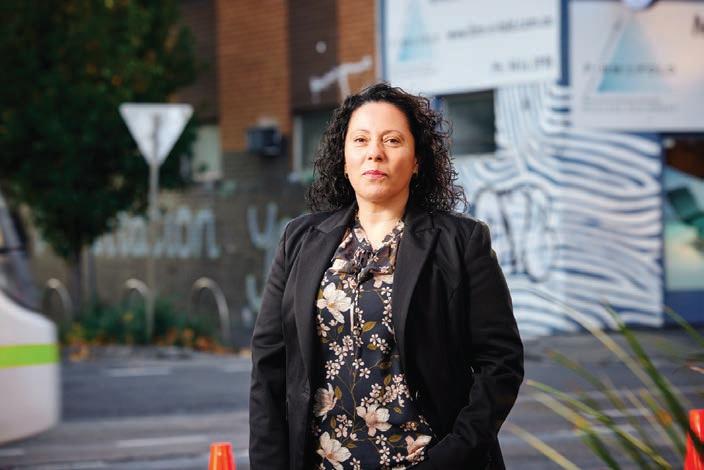
Lina Goodman, CEO Tyre Stewardship Australia says Australia can learn from international stewardship schemes.
Creating a real circular economy
THE WORLD IS HEADING INTO A +1.5ºC EXISTENCE. EMISSIONS, RESOURCE CONSUMPTION AND BIODIVERSITY NEED TO BE MANAGED, MIKE RITCHIE, MANAGING DIRECTOR MRA CONSULTANCY GROUP, DELVES INTO RESOURCE CONSUMPTION AND THE CREATION OF A MORE CIRCULAR ECONOMY.
So what does a circular economy look like? Try this:
“In a circular future, we maximise the use of materials already in the economy and reduce reliance on virgin materials. We do this by designing for longevity, making smart material choices, emphasising repair, reuse, and refilling opportunities and by establishing efficient recycling systems with robust end markets.
All levels of government commit to ‘upstream’ interventions including
brave targets, multi-pronged circular policies, financial mechanisms and regulatory instruments.
Industry makes products to last, while consumers value and revalue products throughout their multiple life cycles.
Recycling is part of a circular economy but a circular economy is much more than recycling.”
– Maša Vahldieck MRA CE Manager 2023.
It is hard to disagree.
Such an approach demands that recycling be seen in its proper context. As an end-of-life solution when other (reuse, repurpose, repair) options have been exhausted.
A circular economy aspires to near 100 per cent recovery of materials for productive reuse in the economy.
A circular economy aspires to maximum product life, maximum repair and reuse, moderate need for recycling and minimum landfill.
FEATURED TOPIC – CIRCULAR ECONOMY 26 / WMR / July 2023
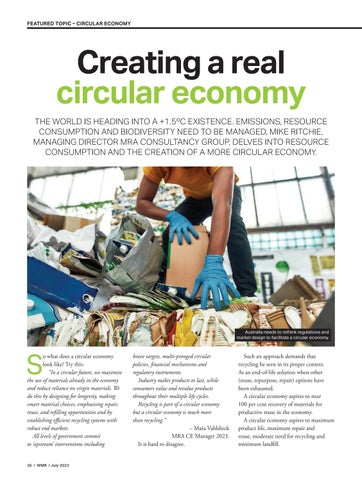
Australia needs to rethink regulations and market design to facilitate a circular economy.
However, our current economic and regulatory framework is driving us the other way. The statistics tell us so.
Unfortunately, we still landfill more than 40 per cent of the waste material generated by our economy because it is either cheaper or more convenient to do so. We generate 67 million tonnes of waste and recycle 40MT of it. More than 27MT is landfilled.
A circular economy demands we get waste generation down by designing it out and recycling rates as a percentage, up (towards 100 per cent).
Our current recycling target is 80 per cent by 2030, and we have almost no chance of achieving it.
We need to immediately lift recycling rates, as an interim measure, while we build the policy incentives to reduce the generation of waste in the first place.
To the credit of most state governments, they have lifted recycling rates from only seven per cent in 1997, to about 60 per cent today through changes to regulations and market signals (mainly landfill levies).
But we need to go so much further. One hundred per cent is a long way away.
If we want to create a circular economy, we need to walk and chew gum at the same time.
We need to put in place the circular economy policy framework and grow recycling at the same time.
It is not complicated.
But it requires will.
Will on the part of governments to change those settings and will on the part of voters to demand them.
So, where are we at with creating a circular economy? I hear you ask.
Mainly what we have from governments are ‘wish’ statements – objectives and aims but not much actionable CE policy.
Never mind the things Maša is talking about – brave targets, circular policies, financial mechanisms and regulatory instruments.
As Maša and her team put it in a recent report (in consultant speak):
“States and the Commonwealth are currently in the ‘start-up’ phase of their circular economy transition (based on a four-step process: 1. Predevelopment, 2. Start up, 3. Acceleration and 4. Stabilisation). Although they are aware of the importance of upstream interventions, few governments have shown commitment in their policy and funding commitments. Although there are ‘grants’ named as circular economy, the focus is still on the use of recycled material, ie. on downstream solutions rather than on designing out waste, reuse, repair, reselling or on refurbishing.”
To put it in my language, there is not a single dedicated CE Act or regulation in Australia. There are lots of goals and aspirations, targets and not much else. Most of our current reform relates to recycling. Which is no bad thing while we still landfill 40 per cent of material. But we must do better. Governments must do better.
There is not a single law in Australia that requires product developers to consider the end-of-life fate – reuse, recycling, landfill – of their products. Not one. That would be a good place to start.
Here are some examples of European actions to drive CE:
EU – Minimum recycled content rules in construction and products, packaging design standards, mandated recyclability, bans on non-recyclable products and mandatory return systems.
France – Bans on products, mandated reuse requirements, right to repair legislation and repairability requirements.
Scotland – Packaging fees for producers who make packaging that cannot be reused or recycled.
We need to rethink our regulations and market design to facilitate CE. To reduce waste generation in the first place, by designing it out.
Finally, we must move beyond ministers simply opening new businesses that are branded (and rebranded) as CE initiatives. That is OK as far as it goes, but it is inadequate. There is too much rebadging and greenwash in this space.
Of course, we should strongly support start-up CE businesses, but this is not enough. As the wise Bard once said; “One swallow does not a summer make”.
Don’t confuse one entrepreneur’s good idea with a market shift to a circular economy. The latter requires scale. Scalability is what separates the entrepreneurial business enterprise from the ‘economy’. We need both.
We need governments to get beyond the circular ecology rhetoric and to implement CE action plans that are real and achieve change, at scale.
And we need to do so quickly, or our +1.5ºC world, will become +2ºC, or worse.
For more information, contact: info@mraconsulting.com.au
www.wastemanagementreview.com.au / WMR / 27
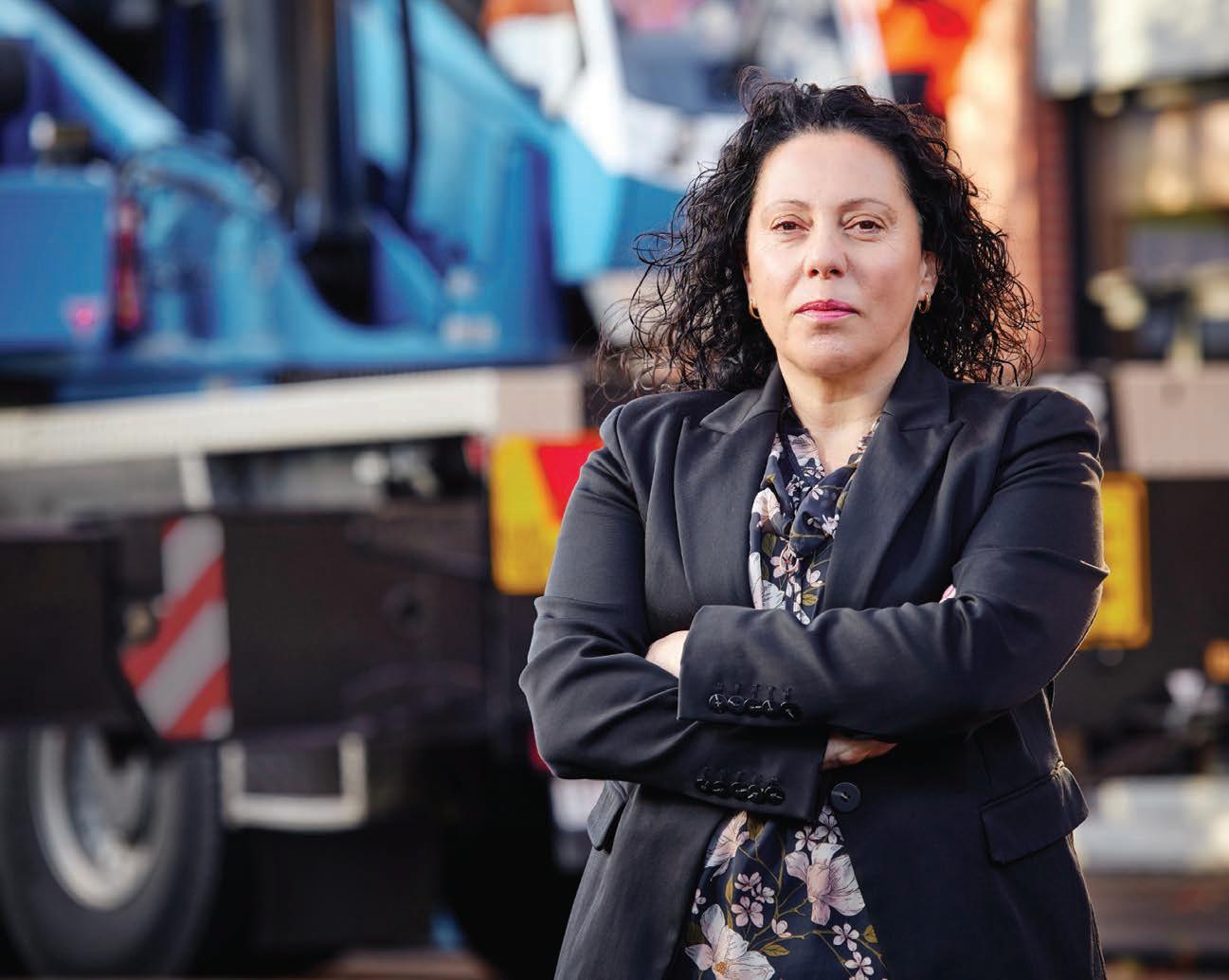
Mike Ritchie, Managing Director, MRA Consulting Group.
Collaboration is critical
RYAN COLLINS, HEAD OF CIRCULAR ECONOMY PROGRAMS, PLANET ARK ASKS: IS COLLABORATION TOWARDS A CIRCULAR ECONOMY HAPPENING?
Governments talk about it. Circular economy practitioners present on its importance. Some industry leaders discuss it. Planet Ark’s Australian Circular Economy Hub (ACE Hub) is always banging on about it. It’s collaboration.
Anyone part of the movement driving our circular economy transition would agree that no single organisation, region, state or country can transition alone. Collaboration is required across all stakeholders – many of whom may not traditionally interact.
The ACE Hub’s State of Circularity in Australia report, released last year, highlighted that effective collaboration is dependent on the right individuals being engaged to address and affect change.
The report itself is also an example of collaboration in action. Its development was a year-long process of co-creation involving six different consultancies (yes, competitors) and Planet Ark including 19 individual researchers/authors, with each chapter focusing on the experience and knowledge of these contributors.
WHY COLLABORATE?
Resource efficiency is not enough. Circular economy thinking needs to focus on people’s wellbeing and protecting ecosystems as well as replacing linear economy processes. Critical to this is a redistribution of knowledge.
And with the increasing frequency of disruptive events (think COVID, war in Ukraine, catastrophic weather events),
value chain collaboration is the key to finding solutions, flexibility, mutual trust and measurable impact. Collaborative partnerships can also include customers. And what business does not want longer, deeper relationships with its customers?
IS IT HAPPENING?
In a word, yes. From research to innovation to knowledge sharing to government-business co-investment to product stewardship to governance to working groups to procurement. Here are some specific examples:
Cartridges 4 Planet Ark is one of the oldest product stewardship schemes in Australia, turning 20 this year.
Worn Up collaborated with UNSW’s SMaRT centre and the NSW Government to transform old school uniforms into new products, such as desks, that can be used again by students.
The City of Greater Bendigo developed one of the first circular procurement policies in the country through collaboration with colleagues from all departments, state and federal government organisations, other councils, suppliers, contractors and the community.
X-Frame, a manufacturer of sustainable construction products supported by Green Industries South Australia, KiwiNet and Wellington University Ventures, transitioned its selling relationship with customers to a product-as-a-service model.
The ANZPAC Plastics Pact has brought together key players across Australia, New Zealand and the Pacific Islands region
in a shared vision of a circular economy for plastic.
WHERE DO I START?
One way to start or value-add to your collaboration journey is to connect with others who are doing just that.
The ACE Hub Portal provides a free online meeting place for anyone who wants to engage and collaborate on topics within the circular economy. With more than 1500 active members, the platform is already connecting governments and businesses within Australia and overseas.
The ACE Hub also facilitates connections between (and within) industries and governments through its working groups, technical supporters, collaboration partners, curated events (Circularity 2023 is the biggest of our events) and education programs.
Facilitators of collaboration are not the transition experts – people working in companies in each industry are. But we can educate and bring people together to find out what’s needed.

FEATURED TOPIC – CIRCULAR ECONOMY 28 / WMR / July 2023
Ryan Collins, Head of Circular Economy Programs, Planet Ark.
Boosting recycled material in infrastructure

THE WASTE AND RECYCLING INDUSTRY ASSOCIATION IN SOUTH AUSTRALIA (WRISA) HAS DEVELOPED A UNIQUE PARTNERSHIP TO PROMOTE, EDUCATE, AND RAISE AWARENESS OF THE CIRCULAR ECONOMY.
South Australia has a great track record in achieving enviable diversion rates from landfill and resource recovery objectives, says Adam Gray, Executive Officer Waste and Recycling Industry Association in South Australia (WRISA).
The success, he says, has largely been the result of a population raised to appreciate the ‘value’ in recycled materials through the early adoption of product stewardship such as the container deposit scheme on beverage containers in the 1970s. However, waste volumes and the complexity of
materials continue to grow, and carbon emissions have become an increasingly important measure. To address the problem, governments and industry have embraced more complex targets than just landfill diversion and shifted focus to a circular economy.
Adam says different approaches and strategic partnerships are necessary if South Australia is to build a circular economy.
A circular economy requires endof-life options for assets to be reused, repaired, recycled, redesigned, and returned to the economy in a continual
loop to prolong their useful life and maintain their highest value.
WRISA has developed a partnership, funded via a Circular Economy Market Development Grant from Green Industries SA, that brings together the Institute of Public Works and Engineering Australasia (IPWEA) and the Local Government Association of SA. Together they have developed the IPWEA Practice Note 13 – The Circular Economy and Use of Recycled Materials in Infrastructure Assets supporting training module and additional tools and resources
FEATURED TOPIC – CIRCULAR ECONOMY 30 / WMR / July 2023
WRISA and industry partners are developing a guide to drive use of recycled materials in infrastructure.
Fast Fact
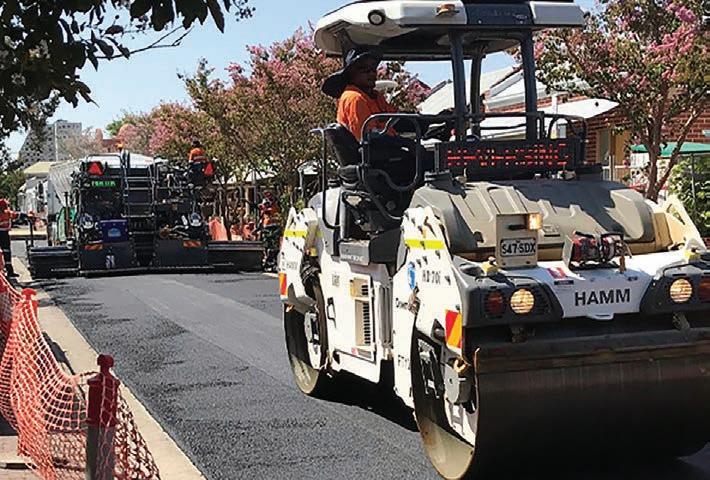
One of the best ways to prevent valuable resources going to landfill is to recycle materials into roads. Regular asphalt roads use tonnes of raw materials – Australia uses about 200 million tonnes of quarried sand, rock and gravel each year, but recycled road base can incorporate crumb rubber, crushed concrete, recycled asphalt, plastic bags, waste toner from used printer cartridges, glass and more.
Reclaimed asphalt pavement (RAP) is among the most popular recycled materials. Georges River Council, the City of Tea Tree Gully, Redland City Council, the City of Mitcham, City of Salisbury and Latrobe City Council have all used RAP in their local roads, in volumes ranging from ten to 75 per cent. Campbelltown City Council has used RAP since 1990.
Tasmania is also expanding the use of recycled materials in new roads, following on from the use of recycled truck tyres used on the Bass, East Tamar and West Tamar highways.
for the use of recycled materials in infrastructure assets.
“One of the challenges raised by industry, and acknowledged by governments, is the complexity of markets for recycled content materials, both domestic and international, and increasing the demand for recycled materials,” Adam says.
“The new Practice Note 13, training module and supporting tools and resources will build collaborative links, extend knowledge, address barriers and give practitioners confidence to extend their use of recycled materials into infrastructure assets.”
Dr Jacqueline Balston, IPWEA’s Director of Sustainability, says the project will leverage South Australia’s world-leading circular economy practices to boost the use of recycled material in infrastructure assets by producing an industry-led, best practice guidance for asset managers, engineers, local government, and consultants.
According to the World Bank, infrastructure accounts for about 70 per cent of global greenhouse gas emissions, and half of all resources used, and waste created, globally.
Australia’s Local Government 2021 National State of the Assets Report identified that Australian local government currently has control of a $523 billion dollar asset portfolio that is growing at a rate of 6.4 per cent and being consumed at a rate of 1.6 per cent per annum. In addition, it is projected that 60-70 per cent of the 2050 infrastructure is not yet built.
“Local Government and asset management staff are in the first line of planning and construction for much of Australia’s infrastructure, and so are well placed to implement recycling practices,” Jacqueline says.
“The new Practice Note 13 addresses gaps in technical knowledge, procurement options and practical training by producing resources that summarise in practical language the very latest in recycled materials research and link it to potential uses in infrastructure assets.”
The use of recycled asphalt, concrete, steel, glass, tyres, plastics, PVC, and organics in more than 200 assets
including roads, bridges, buildings, footpaths, curbing, water treatment, water supply and stormwater assets, fencing and outdoor furniture are assessed in the Practice Note.
Adam says that it is well known that the incorporation of recycled material into infrastructure assets has the potential to increase asset life, market demand for recycled materials, innovation, new market opportunities, and reduce impacts to the environment.
“However, we still have a challenge in growing market and product confidence,” he says. “By investing in innovative collaborations and providing tools and resources to help address market confidence we are hoping to see recycled content markets grow substantially into the future.”
The new IPWEA Practice Note 13 follows the 2020 development of Practice Note 12.1, “Climate change impacts on the useful life of infrastructure” which was launched as a manual for asset managers wanting to reduce the risks from climate change and develop sustainable and resilient assets.
For more information visit: www.ipwea.org
www.wastemanagementreview.com.au / WMR / 31
Recycled road being laid in Chatham Street.
Circular economy strategy for plastics
WHEN WE THINK ABOUT PLASTIC RECYCLING, MINIMISING WATER USAGE IS AN IMPORTANT PART OF THE PROCESS. AEROFLOAT HAS BEEN PIVOTAL IN HELPING AUSTRALIAN RECYCLERS CLEAN AND REUSE THEIR WASH WATER.
“The joint venture has created a complete supply chain of recycled plastic in Australia on a scale that has never been seen before,” says Michael. “You start with mums, dads, and kids dropping off bottles for Container Deposit Schemes (CDS). Cleanaway has been picking up those bottles and transporting them to Albury. Circular Plastics Australia then recycles the plastic bottles before CocaCola and Asahi take the new bottles for re-use.”
Cleanaway also provides raw materials for the plant through its Material Recovery Facilities (MRF), which support the CDS.
The plastics recycling industry has boomed in Australia since the National Plastics Plan came into effect in 2021. Michael Anderson, General Manager of wastewater treatment company Aerofloat says the aim of the plan was to ensure Australia becomes a major player in the global network for recycling plastics into consumer products.
Aerofloat has been working in the plastics recycling industry for eight years, designing major wash water and wastewater solutions that meet the specific criteria of multiple companies and councils across the eastern board. The company has won awards for its
innovative designs and is now the industry’s go-to wastewater engineering company in Australia.
Following the announcement of the National Plastics Plan; Pact Group, Cleanaway, Asahi Beverages, and Coca-Cola Europacific Partners formed a joint venture known as Circular Plastics Australia.
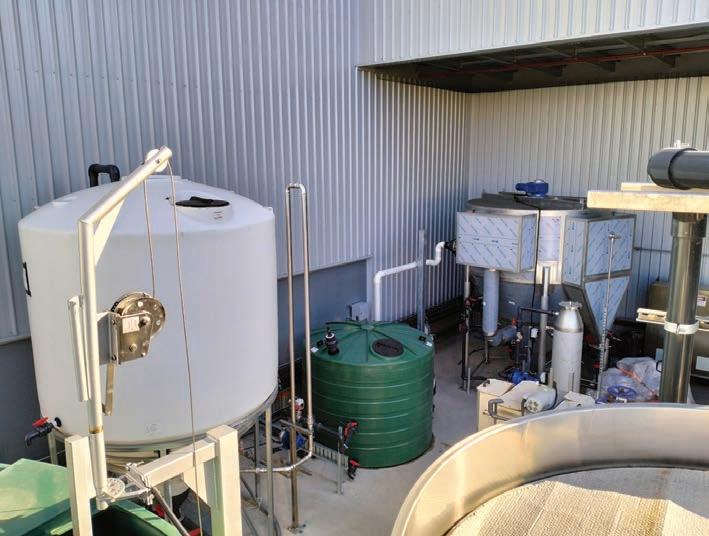
Aerofloat designed and built the wastewater treatment system for Circular Plastics Australia’s first plant, located in Albury New South Wales. The plant processes up to four tonnes of PET plastic every hour, which is equal to around one billion 600ml PET plastic bottles a year.
The recycled PET these facilities produce will be used to create new beverage bottles for Asahi Beverages and Coca-Cola Europacific Partners. It also provides new food and beverage packaging for Pact Group’s customers.
“Aerofloat’s design ensured a sustainable, long-term solution for Circular Plastics Australia in Albury. Clean wastewater from the system is reused as wash water within the plastics recycling facility or discharged to the sewer,” says Michael.
Circular Plastics Australia has enlisted Aerofloat again to deliver wastewater and wash water systems in its two new Melbourne plastics recycling facilities. A plant in Altona North is due for completion later in 2023.
FEATURED TOPIC – CIRCULAR ECONOMY 32 / WMR / July 2023
Aerofloat designed and built the wastewater treatment plant for Circular Plastics Australia.
Another plant at Laverton will focus on high-density polyethylene (HDPE) and polypropylene (PP).
“The new plant in Laverton can process two tons of HDPE and two tons of PP per hour. That means it’s going to process over 20,000 tonnes a year,” Michael says.
Adam Kornhauser, Site Lead for the Laverton facility in Melbourne, says the ventures will significantly contribute to ensuring a circular economy that benefits its local community.
“Australians want packaging that is recycled and recyclable and this venture will significantly increase that opportunity for consumers,” says Adam. “Our Melbourne plants support our vision of creating a circular economy by recycling plastic into plastic flakes and resin, which can be further processed into plastic containers.”
While the Melbourne plants advance Australia towards meeting its National Plastics Plan goals, the facilities must still meet the city’s strict water regulations.
“The wastewater treatment plants discharge into the Greater Western Water (GWW) municipal sewer, so all parameters must meet the requirements for discharge of trade wastes from industrial premises as a minimum,” says Adam.
Michael agrees that benefits to the environment must be considered across all areas.
“Our jobs at the Laverton and Altona North plants will be to treat the wash water generated from shredding and cleaning the bottles. Once it’s done its job, that wash water needs to be safely discharged into the Greater Western Water sewer network,” Michael says.
Aerofloat’s design engineers develop 3D modelling skills to ensure clients can envisage the solution prior to manufacturing and installation. Given the challenges at the Melbourne site differed to Albury, Aerofloat offered its 3D modelling to show how the sites’ specific needs would be met.
“We’ve developed wastewater and wash water solutions for the plastics recycling industry in both rural and metropolitan settings,” says Michael.
“The location of the site can significantly impact the design. For example, in regional New South Wales, water economy is essential to the design given scarce water availability. In Melbourne, one of the biggest challenges for us was the lack of space for wastewater treatment.
“By drawing on our project history, we are able to model and design the future set-up within 90 per cent of the final design.”
Aerofloat and Circular Plastics Australia have worked collaboratively on the major projects to ensure the objectives of the plants are met. Ensuring a design that would meet the specific requirements of the Melbourne sites was imperative.
“Circular Plastics Australia has worked with Aerofloat on previous projects,” says Adam.
“Aerofloat’s design engineers therefore understood our needs and were able to bring that knowledge from existing plants to ensure a robust design that would meet our requirements.”
With significant production volumes at the sites, wastewater flows are expected to be equally high.
“We are expecting average daily flows of around 120 cubic metres per day at Altona North and 400 cubic metres per day at Laverton,” says Adam. “Aerofloat’s design is expected to more than meet that demand.”
While installation is well underway in Melbourne, Michael has been proactive in growing the opportunities for further sustainable operations at the plants in Albury, Laverton and Altona North.
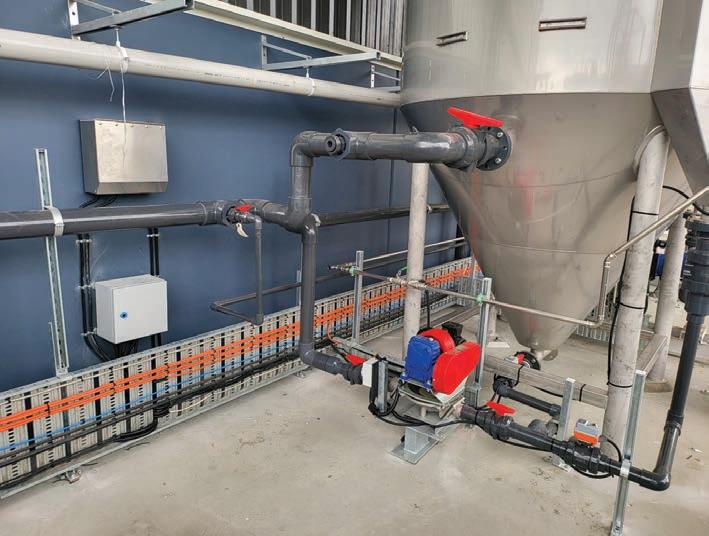
“At the moment, ensuring Circular Plastics Australia meets its recycling volumes is the first priority, however we have set up the plants ready for additional water re-use. That will be something we can address in the future if they want to reduce their water output further.”
Michael says Aerofloat has affirmed its place in providing sustainable solutions to the growing plastics recycling industry.
“Our knowledge,” he says, “helps us grow and remain the industry’s go-to wastewater engineering company.”
For more information, visit: www.aerofloat.com.au
www.wastemanagementreview.com.au / WMR / 33
Location of a site can impact the design of wastewater treatment systems.
Partnership drives recycling, composting
INVESTING IN KOMPTECH CEA MACHINES HAS SUPPORTED THE GROWTH OF NORF AND THE TAKING CARE GROUP IN SOUTH AUSTRALIA. COLIN MILLER EXPLAINS WHY THE RELATIONSHIP IS VITAL.
“We are quiet achievers, and we’re very proud of what we’ve been able to do.”
That’s Colin Miller, the Director of Rosmech, North Organic Repurposing Facility (NORF), and Taking Care Group. He’s been involved in wastewater management since 1997. Working with the Patawalonga and Torrens Catchment boards, his team removed gross pollutant traps (GPTs) from water drains.
“Over time, the boards became more knowledgeable and wanted us to recycle the organic material being pulled out of the GPTs,” he says.
“In this early stage, the recycling industry was still in its infancy. It was hard to get to the locations, and they were charging more than the local dumps were.”
Colin and his team started investing in new equipment, primarily road sweepers. It led to winning a contract with the City of Norwood Payneham and St Peters. This contract helped snowball the road-sweeping services to be what is believed to be the largest road-sweeping company in the Southern Hemisphere.
Pushing out more than 200 road sweepers daily, Colin decided to buy Rosmech, the importer of road sweeping machines, into Australia.
“When we bought Rosmech, it had about two per cent of the
Australian market. It’s now closer to 40 per cent,” Colin says.
RECYCLING AND COMPOSTING
In the past few years, Rosmech has expanded into the composting and recycling sectors by purchasing a 50 per cent share in Taking Care of Trees. This led to a series of opportunities for Colin and his companies.
“When we bought the share in Taking Care of Trees, we took advantage of new opportunities for grinding material,” he says. “As we increased the amounts of organic material from the road sweepers and now tree mulch, I wanted to do something with it all. I’ve always valued this material as a resource.”
To expand the business, Colin and the Taking Care Group bought a company located on a 143-acre property in the north of Adelaide. They renamed it the Northern Organics Repurposing Facility, or NORF.
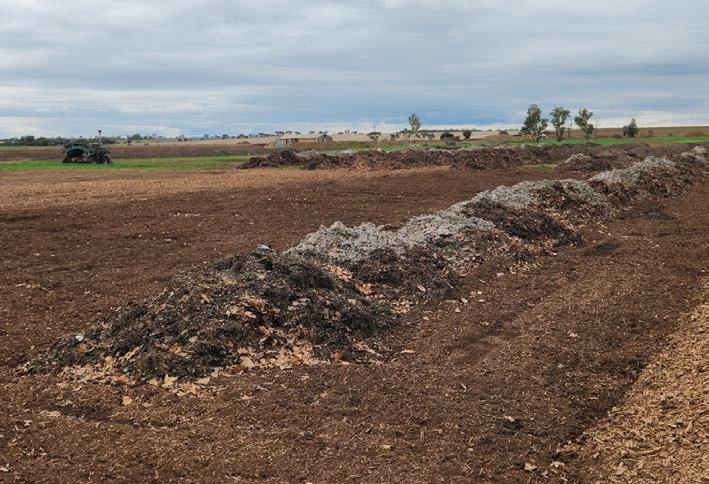
“We have thousands of tonnes of material that we create on-site and a sales arm, New Earth, that sells the soils, mulches, and composts we make. As a set of companies, we are firmly entrenched in the circular economy and working towards total immersion in it,” Colin says.
RiGHT MACHINES FOR THE JOB
NORF and Taking Care Group were looking for the right machine, so spoke
FEATURED TOPIC - CIRCULAR ECONOMY 34 / WMR / July 2023
Rosmech has expanded into composting and recycling sectors.
with Komptech CEA. The Terminator shredder was ideal for the large pieces of waste they wanted to repurpose.
“The Terminator is a slow-speed device,” says Colin. “When we changed to it from a high-speed machine, we were really impressed. The support and understanding from Komptech CEA ensured that we continue to invest in their products.”
More machines came from Komptech CEA: a Crambo for shredding with variable screens and an X53 windrower for turning over the raw material windrowed stockpiles. These three products required servicing but led to positive conversations with Komptech CEA.
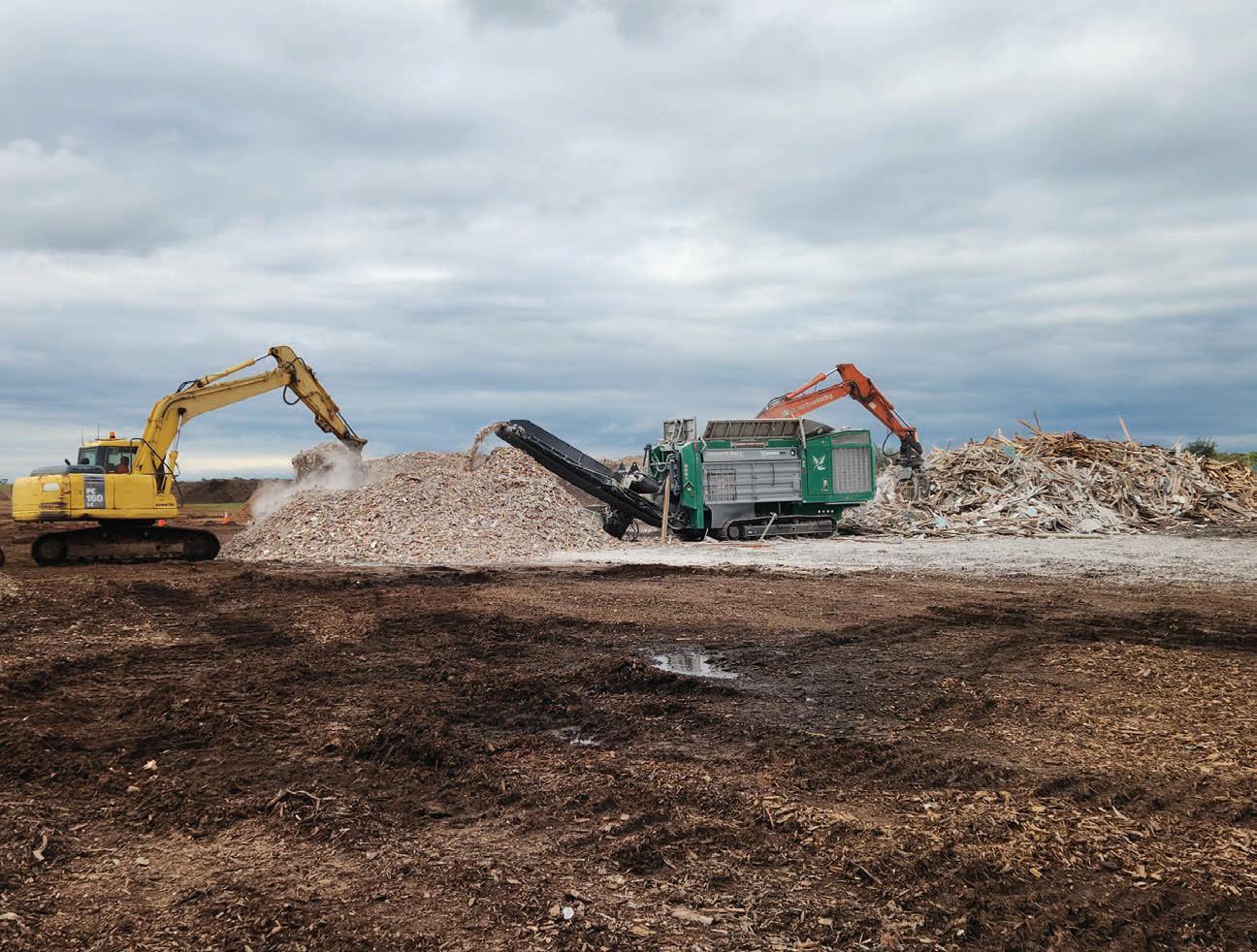
“Previously, we relied exclusively on Komptech CEA to service the machines. However, we talked with them about our
business ability to service and maintain the machines,” Colin says. “I was pleased that the service manager at CEA grabbed that opportunity with both hands. The importance of clear communication of our capabilities ensured that he knew our experienced team would do a good job of looking after the machines.”
SERVICE AND SUPPORT
CEA has provided information about service intervals, workshop manuals and after-sales support. This internal support has extended to training staff to perform higher levels of the Terminator and Crambo service and maintenance.
“What made us buy the Terminator was that the machines transport weight was reduced,” Colin says. “That meant the costs were lower for freighting it to different sites. We didn’t need a lot
of specialist equipment to move the machine. It was far simpler and safer.”
The local support and the ability to buy spare parts was another critical consideration for Colin. While a specific part was outside Adelaide, it was definitely in Australia. That security was vital for continuing to work with Komptech CEA.
“During our regular maintenance schedules, we could place an order and know the part would arrive within a certain time frame,” Colin says. “It would allow us to take that machine offline to replace the part, and we would build that into our scheduled servicing timetable. That’s a big plus for us.”
For more information, visit: www.komptechcea.com.au or www.takingcareoftrees.com.au
www.wastemanagementreview.com.au / WMR / 35
Komptech CEA has provided three machines for NORF and the Taking Care Group.

Amped up
ABOUT 1.6 MILLION TONNES OF ELECTRIC VEHICLE BATTERIES WILL REQUIRE RECYCLING IN AUSTRALIA BY 2050. THE BATTERY STEWARDSHIP COUNCIL IS CALLING FOR INDUSTRY ACTION TO DEVELOP A PATHWAY TO BATTERY STEWARDSHIP.
Increasing the uptake of electric vehicles (EV) is a keystone to Australia reducing its road transport emissions.
Releasing Australia’s first National Electric Vehicle Strategy in April 2023, Chris Bowen, Minister for Climate Change and Energy, described the strategy as a framework to get more EVs on the road, and give Australians access to the benefits that come with them – cheaper to run and better for the climate.
Battery stewardship is a crucial element in the drive to increase EV uptake, as outlined in the strategy.
Libby Chaplin, Chief Executive Officer of the Battery Stewardship Council (BSC), says while some companies have take-back schemes, the rapid increase in used EV batteries
requires an industry wide national stewardship plan.
“The EV industry is facing a golden opportunity to take the lead in designing a scheme that is cost effective and fit for purpose,” she says.
“While many individual companies in the industry have committed to taking back used batteries for reuse, recycling and processing, long-term plans that apply industry-wide are needed. It’s the only way to develop the necessary infrastructure for a sustainable industry in time for this rapidly expanding waste stream.”
Electric vehicle uptake in Australia is lagging compared to other countries, accounting for 3.8 per cent of car sales nationally in 2022, according to the National Electric Vehicle Strategy
However, research commissioned by the BSC in 2022 and conducted by the Institute for Sustainable Futures at the University of Technology Sydney presents new insight into batteries being used in EVs and how many of those batteries will reach their end of life and require recycling.
The research, to be published in July 2023, considered the year-on-year growth of the number of end-of-life EV batteries in Australia and projections based on import data from 2021.
Preliminary findings show the number of used EV batteries entering the waste stream will grow exponentially to almost 30,000 tonnes by 2030, and 1.6 million tonnes by 2050. “It’s a massive uptake,” Libby says. “EV batteries present
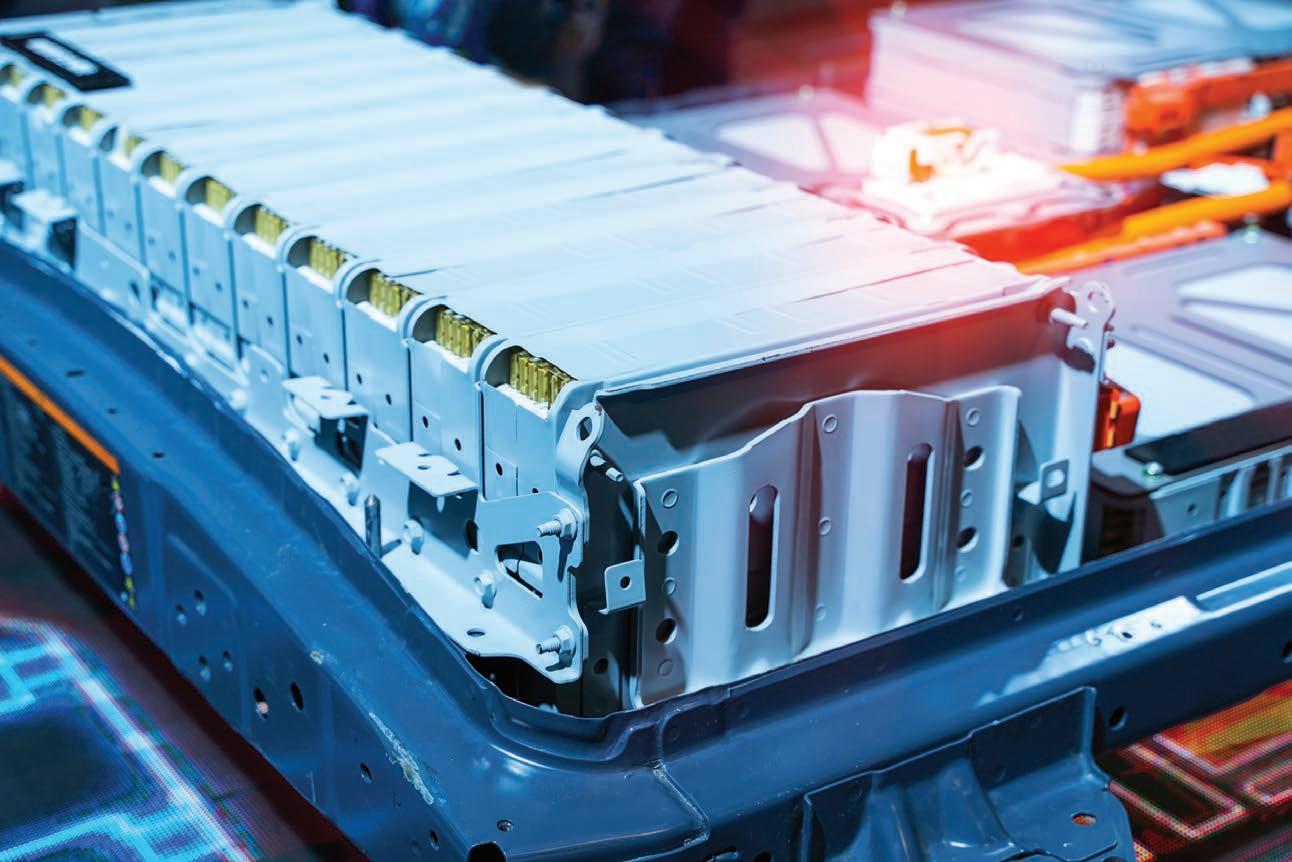
FEATURED TOPIC – PRODUCT STEWARDSHIP www.wastemanagementreview.com.au / WMR / 37
Battery Stewardship Council is leading the conversation about how to deal with electric vehicle batteries at their end of life.
increasing risks and opportunities that the vehicle industry is yet to deal with at scale.
“Establishing robust stewardship takes time and we can learn from the experience of other schemes, such as B-cycle and from other industries about the importance of planning ahead. For example, we still don’t have a solution for solar panels and there are significant stockpiles of those around the country. We don’t want to be in that situation when EV batteries reach their end-of-life.
“It’s essential that this work starts now, while it is in its infancy, to explore and establish the infrastructure needed to recover precious resources and avoid the major property and public health issue of stockpiling and fires into the future.”

If incorrectly disposed of, EV batteries pose a fire risk and can cause environmental and health hazards if toxic materials leech.
But there is also potential to develop a circular economy and reduce reliance on fossil fuels – the plastic, aluminium, wires, and casings of EV batteries can be recycled, as well as the precious metals, such as lithium and copper.
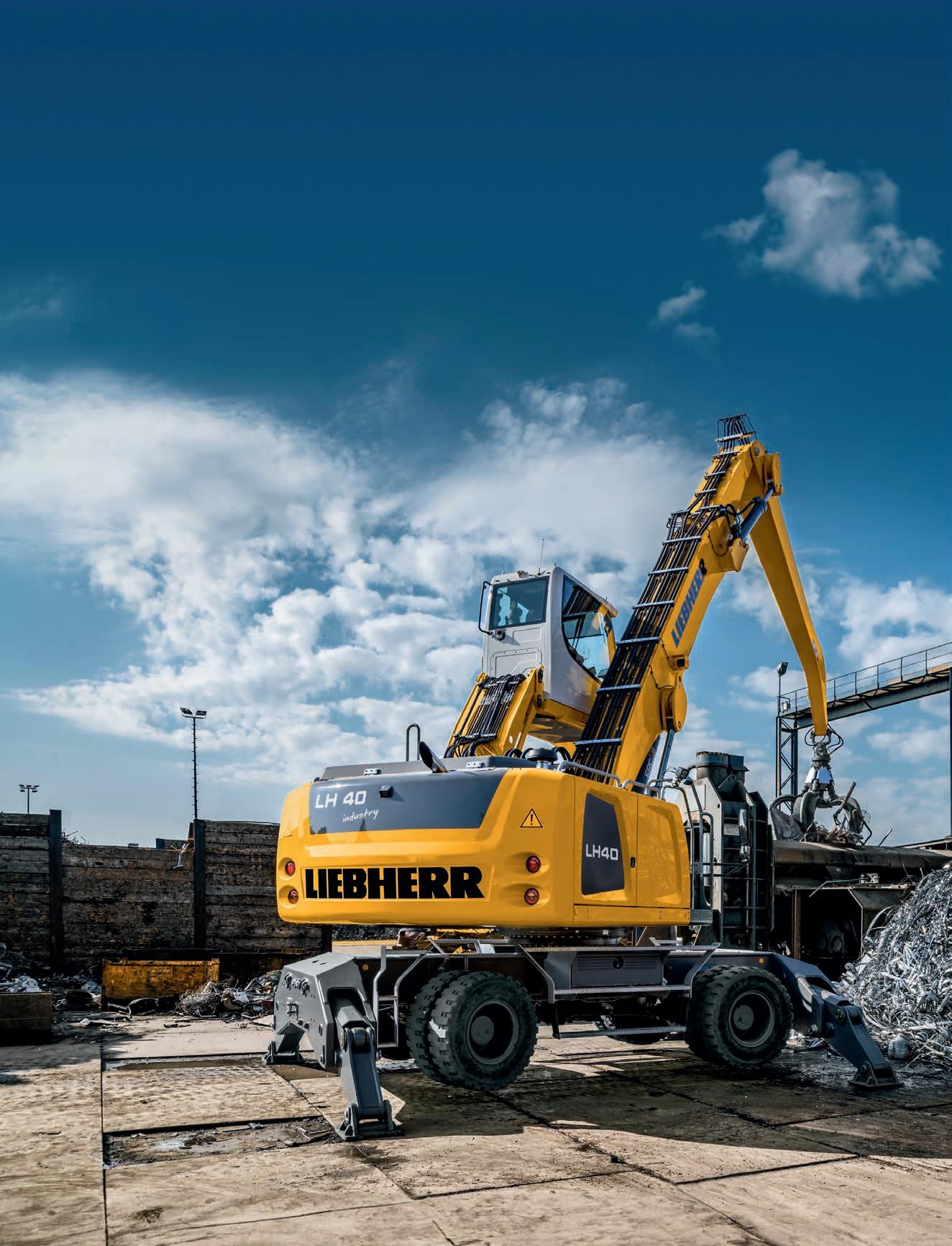
The BSC has been commissioned by the Federal Government to lead industry consultation around the development of EV battery stewardship. In June, the
EV industry contributed to a Discussion Paper, delivered in collaboration with the Federal Chamber of Automotive Industries (FCAI) and the Motor Trades Association of Australia (MTAA).
Consultation will continue throughout 2023, with industry feedback contributing to proposed First Options and Final Options Discussion Papers on EV battery stewardship. Libby urges industry to continue to prioritise the discussion of end-of-life processes.
“How the solution shapes up, depends very much on industry sitting around the table to identify the gaps and come up with innovative ideas for a scheme that delivers both for industry and the community.”
BSC has an established record on delivering battery stewardship for smaller batteries. In its first year of operation the scheme collected 1.9 million kilograms of batteries – equivalent to 81 million AA battery units.
Libby says learnings from the B-cycle scheme will play an important role in the conversation surrounding an EV stewardship. However, while there are similarities – the same battery recyclers are involved and the requirements around safety, compliance and traceability would transfer nicely – there are other requirements to consider, including the sale and collection channels.
She says a high degree of traceability brings a cost in administration that would need to be built into any scheme.
While battery chemistries in EV are similar, but on a larger scale, the
dismantling process for EV batteries needs to be in a controlled environment because of the risk to workers. Economics and transport will also be different. Libby says there could be the opportunity to tap into reverse logistics with battery brands to make transport more cost effective.
“We’re just asking those questions that we don’t yet have answers for,” Libby says.

“It’s important the industry works together to really understand what the challenges are and how we might overcome those.”
Libby says the BSC also has a strong global network from which to draw experience. “With our International Advisory Panel, BSC has access to global best practice regarding EV battery stewardship and international stewardship models,” she says.

BSC will collate responses to the EV stewardship discussion paper and expects to host several workshops to allow further discussion around what direction industry wants to take.
“Whether there’s a whole of electric vehicle scheme that we work in partnership with or whether it’s a standalone scheme, those are the questions we want to explore,” Libby says. “We’re very open to what an EV Battery Stewardship Scheme could look like, but we see it as important to start working now and building up the necessary systems and infrastructure in advance of major stockpiles of EV batteries.
For more information, visit: www.bcycle.com.au
38 / WMR / July 2023 FEATURED TOPIC – PRODUCT STEWARDSHIP
“How the solution shapes up, depends very much on industry sitting around the table to identify the gaps and come up with innovative ideas.”
Libby Chaplin Chief Executive Officer, Battery Stewardship Council
LIbby Chaplin, CEO Battery Stewardship Council.


Liebherr-Australia Pty Ltd • Phone 1800 033 300 • em-sales.las@liebherr.com www.facebook.com/LiebherrConstruction • www.linkedin.com/company/liebherranz • www.liebherr.com.au Powerhouse
Maximum performance with lower fuel consumption. Our patented energy recovery system makes this material handler an absolute dream combination of power and efficiency. www. liebherr.com Material handling machine Visit us at: The Australasian Waste & Recycling Expo 26 – 27 July 2023 ICC Sydney Site C18
The LH 40 M Industry Litronic
Mobilising the industry
MOBILE MUSTER IS ONE OF AUSTRALIA’S MOST RECOGNISED PRODUCT STEWARDSHIP SCHEMES. LOUISE HYLAND, CHIEF EXECUTIVE OFFICER OF THE AUSTRALIAN MOBILE TELECOMMUNICATIONS ASSOCIATION, EXPLAINS WHAT’S BEHIND THE SCHEME’S SUCCESS.
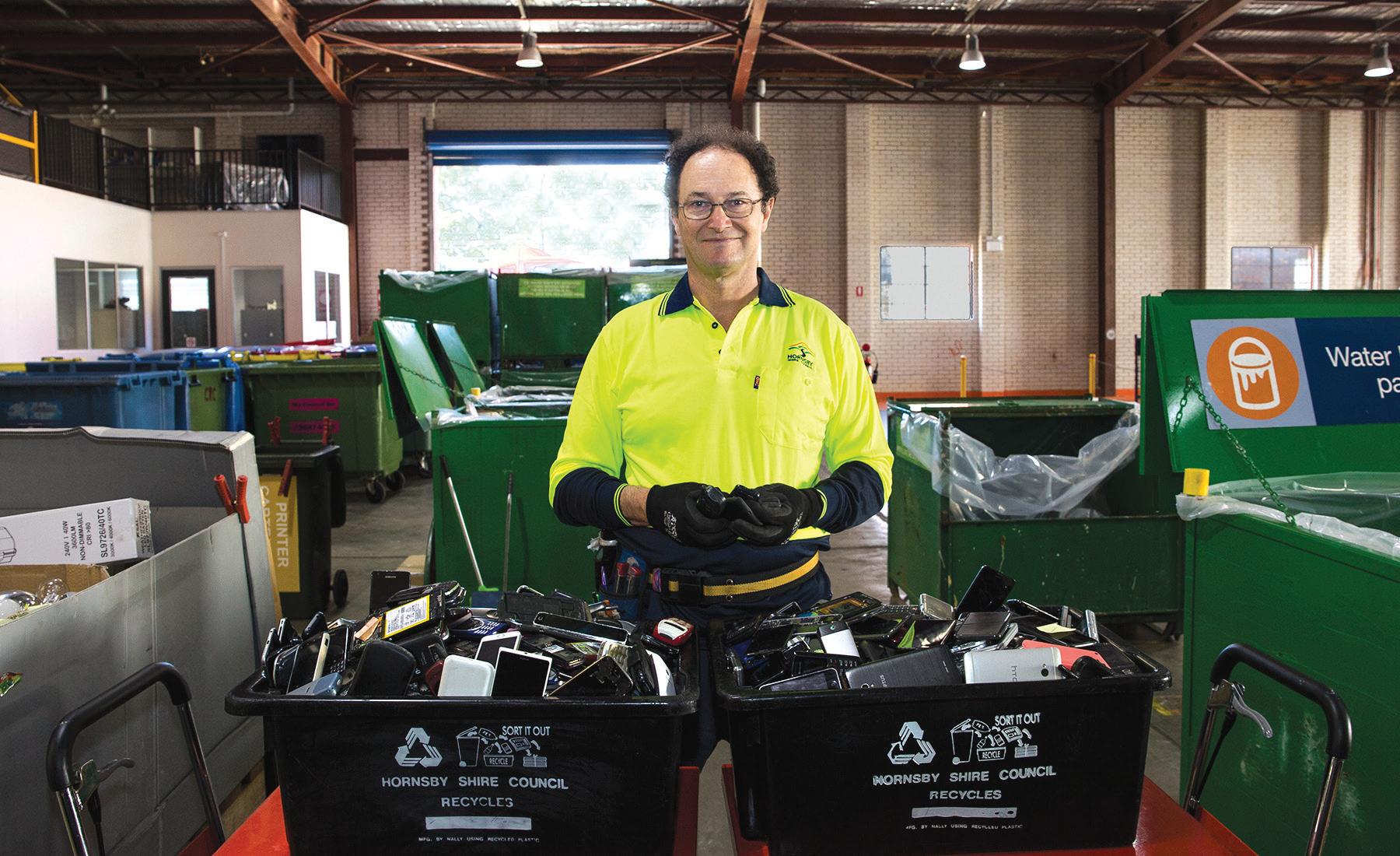
Most people fondly remember their first mobile. The novelty, the power, the convenience of being able to make (and receive) a phone call from anywhere. Mobile phones were, quite simply, a game changer.
It feels like they have been part of our lives for so long, but it’s only been a few decades. In 1990 just one per cent of Australians owned a mobile phone, by 1995 this rate had increased to 13 per cent and by 1999, about 45
per cent of Australians owned a mobile phone. Millions of devices were already in circulation.
As the mobile phone business took off in Australia, the biggest telecommunications companies of the time (Nokia, Motorola, and Telstra) came together, voluntarily, to create and fund a product stewardship program called The Mobile Phone Industry’s Recycling Program, as part of the broader industry association, AMTA
This scheme would manage their products through their full life cycle, reducing the environmental impact of discarded mobile phones and educating Australians on the importance of repairing, reusing, and recycling technology.
Starting in 1998, the program has been incredibly successful; renamed the catchier MobileMuster in 2005.
(Australian Mobile Telecommunications Association).
FEATURED TOPIC – PRODUCT STEWARDSHIP 40 / WMR / July 2023
MobileMuster partnerships provide more than 3000 drop-off locations nationwide,
This year MobileMuster celebrates 25 years of providing a free, environmentally responsible, and sustainable recycling program for mobile phones and their accessories to all Australians.
It’s also the first voluntary product stewardship scheme in Australia to be accredited by the Federal Government under the Product Stewardship Act 2011.
Louise Hyland, Chief Executive Officer of the Australian Mobile Telecommunications Association, says the program was ahead of its time and its success is worth studying to see if other sectors, whether it be e-waste or end-of-life solar panels, can benefit.
“MobileMuster has been successful for a number of reasons. The voluntary collaboration between almost all players in the telecommunications industry in Australia has been a key factor,” Louise says.
“Telcos, manufacturers, and other mobile related service providers have all come together, ensuring that 96 per cent of all mobile waste is diverted from landfill, and more than 99 per cent of it is recycled.
“MobileMuster also ensures it meets Australian government accreditation standards for product stewardship and is certified carbon neutral. Transparency, communication, and a genuine desire to do good are key.”
Since its inception, MobileMuster has grown from just three to 20 members, achieving a 97 per cent industry participation rate for mobile manufacturers and a 90 per cent participation rate for network carriers.
The scheme was first accredited in 2011 and Louise says has regularly exceeded the annual KPIs set forward by the Federal Government, recycling more than 2000 tonnes of e-waste and diverting more than 96 per cent of donated materials from landfill –equivalent to 5000 tonnes of carbon dioxide being removed from the atmosphere, or planting more than 80,000 trees.
A smartphone contains many materials, and significant emissions of carbon dioxide are produced in first extracting them. This includes cobalt, nickel, and lithium as well as small amounts of gold, silver, palladium, copper, and platinum. When mobile
phones are recycled these materials are available for use in new products, which reduces the need for virgin mining of finite, and increasingly contested, resources.
Louise says the stewardship program has resulted in manufacturers designing recyclability into their products, ensuring 99 per cent of all materials are recovered, including glass and plastic.
At first, MobileMuster focused on recycling mobile phones, chargers, and accessories. However, with the rise of smart accessories and home technology, the program has since expanded to include wearable devices, landline phones, smart speakers, VR headsets, TV streaming devices, and smartwatches.
To encourage and enable easy recycling of mobile phones that might otherwise end up in landfill, MobileMuster is partnered with some of Australia’s biggest retailers, as well as more than 400 local councils.
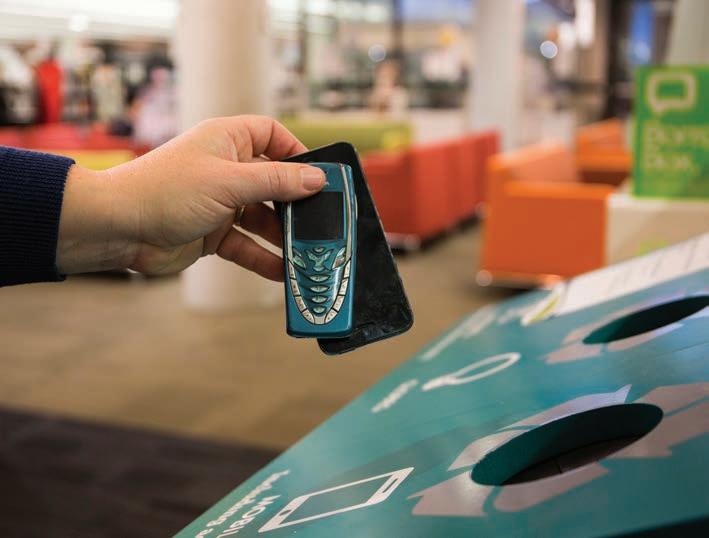
These partnerships allow MobileMuster to provide more than 3000 drop-off locations nationwide, resulting in 96 per cent of the country’s population living within 10 kilometres of a collection point. Consumers can also choose to donate their device via post with a free post-back label option.
Louise says providing clear and compelling explanations of what happens when a mobile device is recycled is central to the success of the scheme.
“It has never been more important that the public has trust in the process, and efficacy, of recycling modern consumer goods,” she says.
MobileMuster will continue to provide its free service and is looking to partner with as many businesses as possible in the coming months to ensure the continued success of the program.
For more information, visit: www.mobilemuster.com.au
www.wastemanagementreview.com.au / WMR / 41
Ninety-six per cent of the country lives within 10 kilometres of a collection point.
Future of e-waste in Australia
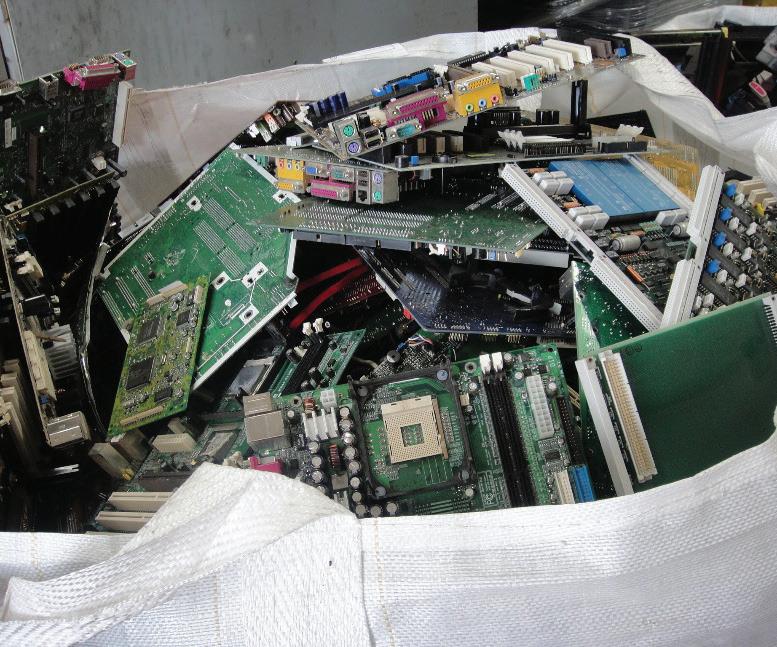
SHAUN SCALLAN, PRODUCT STEWARDSHIP PROGRAM DEVELOPMENT MANAGER FOR THE AUSTRALIA NEW ZEALAND RECYCLING PLATFORM, TALKS ABOUT PLANS TO EXPAND THE NATIONAL E-WASTE SCHEME AND WHAT IT WILL MEAN.
e-waste by June 2025 and has engaged e-waste industry stakeholders in a series of pre-consultation papers and online webinars for feedback. Public consultation will also help inform the overall scheme design.
Shaun Scallan, Product Stewardship Program Development Manager for the Australia New Zealand Recycling Platform (ANZRP), says the addition of what is called the small household category of e-waste, which includes things such as toasters, irons, and kettles, will more than double the volume of regulated e-waste in Australia.
“An expanded e-waste scheme will require significant investment in infrastructure to collect and recycle the increased volume that will be regulated by government,” he says.
Waste from electrical and electronic equipment (WEEE), commonly referred to as e-waste, is the fastest growing waste category globally.
More than 53 million tonnes of e-waste is generated worldwide, according to the Global E-waste Monitor 2020. Some predictions indicate the volume of e-waste produced will more than double by 2050.
The National Waste Report 2022 provides a snapshot of the problem
closer to home – of the 500,000 tonnes of e-waste in Australia in 202021, roughly 54 per cent was sent to recyclers, who recovered 35 per cent of the material inputs.
Two new categories of e-waste are on the Australian Environment Minister’s Priority List 2021-22 – photovoltaic systems and small household appliances.
The Federal Department of Climate Change, Energy, the Environment and Water (DCCEEW) has been tasked with regulating these categories of
“The scheme expansion will also provide an opportunity to improve upon the already successful National Television and Computer Recycling Scheme (NTCRS).”
Shaun says the government is taking a product stewardship view of e-waste and so the term e-stewardship is being used to describe the overall policy direction.
Currently, the NTCRS collects e-waste from televisions, computers, computer parts and peripherals. In 2020-21 the NTCRS collected and recycled 50,500 tonnes of e-waste, with
FEATURED TOPIC – PRODUCT STEWARDSHIP 42 / WMR / July 2023
E-waste from televisions, computers, computer parts and peripherals, including printers, are collected within the National Television and Computer Recycling Scheme.
the highest recovery rates of more than 90 per cent achieved.
ANZRP is a not-for-profit NTCRS co-regulatory arrangement established in 2011 under the Recycling and Waste Reduction Act (RAWR). Since formation, the organisation has recycled more than 240,000 tonnes of e-waste on behalf of its 57 members.
Under the current NTCRS, those businesses who cause electrical and electronic equipment to be sold, or more specifically, Placed on Market (POM) in Australia have a liability to recycle a volume of e-waste. These businesses are referred to as Liable Parties. The volume they are required to recycle is based on import data collected by the DCCEEW, supplemented by any local manufacturing.
The Liable Party pays an approved service provider (a Co-reg or Coregulatory arrangement), to carry out collection and recycling of e-waste. Mandatory annual reporting by Coregs confirms what volumes have been
Key takeaways for stakeholders
Consumers – no more disposal of small household appliances in the red-lidded bin
Councils – reduction in waste management costs
Recyclers – more capacity required PV or small household appliance manufacturers or importers – will have to start paying for e-waste recycling by FY26
Government – A robust, fair, and transparent e-stewardship scheme will deliver the next significant step on the way to the Circular Economy
that when their products reach end-oflife they are responsibly managed.”
collected and recycled. For clarity, volume is reported in weight, not a volumetric measure.
Shaun says it seems likely that a similar process will be used to assess liability for an expanded scheme.
While the low-level details and minutiae are far from settled, the high-level scheme design has progressed in the past six months. What then are the key elements of an expanded scheme that will be the model for all regulated product stewardship schemes going forward?
“It is important to note there are many roles in product stewardship,” Shaun says. “Co-regs manage the collection and recycling services that form part of the product stewardship ecosystem, for example.
“The Liable Parties are key to the scheme’s success as they are the product stewards. Committed companies drive best practice and ensure that the scheme is delivering on its required outcomes. A key outcome is ensuring
Shaun says many Liable Parties are responsible for their ‘brand’ position and the current focus on sustainability has called them to go beyond compliance. This means any scheme must allow for continuous improvement over time rather than a lowest common denominator approach to scheme development.
He says consumers also must be engaged to ensure that the scheme is simple and accessible, so education is key.
“Local government is a connection to the community for waste management and can form a key element of the collection stage of the e-stewardship ecosystem,” Shaun says.
“The waste management and resource recovery industry are also key and must be supported in this transition. E-stewardship expansion will generate more business and provide certainty for investment.
“Most of all, a level and fair playing field for all participants, supported by requirement for high standards, will be some hallmarks of a successful e-stewardship scheme.”
For more information, email: estewardship@anzrp.com.au
0 20 40 60 80 100 120 140 160 Other large equipment Temperature exchange equipment Large household appliances Lighting equipment Mobile phones TV and computing equipment Solar PV and battery storage Other small equipment '000 tonne e-waste Volume of e-Waste by category (2019) e-waste categories being added in new scheme e-waste categories covered by existing schemes e-waste categories not covered by existing or new scheme
www.wastemanagementreview.com.au / WMR / 43
Categories of e-waste and where they stand in product stewardship schemes.
Changing lives
BINGO INDUSTRIES IS HELPING FIRST NATIONS’ OFFENDERS GAIN EMPLOYMENT THROUGH A WORK RELEASE PROGRAM WITHIN CORRECTIVE SERVICES NSW AND PROVIDING SUPPORT AS THEY TRANSITION BACK INTO LIFE AFTER PRISON.
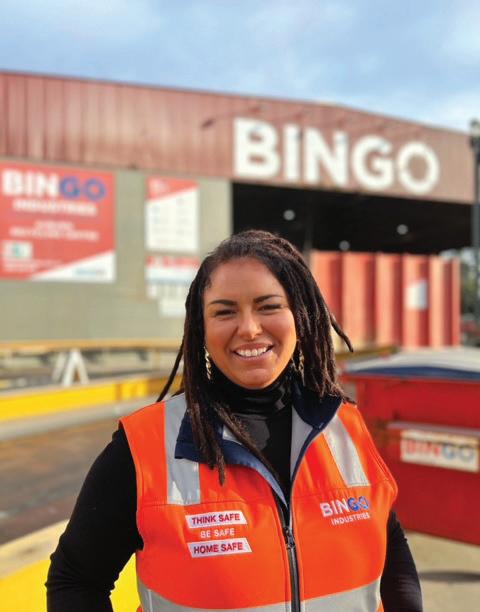
Natalie Davies knows how it feels to have someone show you kindness when you need it most.
She also recalls the words of the person who helped her; “Don’t repay me. When you can, help someone else”.
They’re powerful words that have resonated with the now Indigenous Engagement Manager for BINGO Industries.
“Being shown kindness and having someone show you a good example of living; it’s worth a million dollars,” Natalie says.
She is paying it forward, leading a program at BINGO Industries that is giving rehabilitated offenders employment and additional support to help with the transition back into life after prison.
Under the REvive prison release program, First Nations prisoners serving the last one to two years of their sentence are employed at BINGO and complete certificate III training in process manufacturing.
Natalie says the aim is for the participants to become full-time employees when their sentence is finished. Following nearly 12 months of working with the Work Readiness team at Corrective Services NSW to get the program started, there are now several First Nations offenders taking part.
You can hear the pride in Natalie’s voice when she speaks of the success of the program and the impact it’s having.
She recalls the first participant being nervous and nauseous.
“When I showed her the toilet she said: ‘That’s the first time I’ve opened the door for myself in a long time,” Natalie says. “It broke me.”
“When I went to see her at the end of that first shift the nerves were gone. She still wasn’t 100 per cent confident but she wasn’t shaking or nauseous.
“By the end of the fourth shift she was beaming and talking about future goals. She was a new person.”
The REvive program is a joint initiative with the Yalagan Group, a leading Indigenous national Registered Training Organisation (RTO) and Group Training Organisation (GTO) that works closely with BINGO. The two companies have joined together to establish an Indigenous recycling and waste management business, Djurwa.
Natalie says BINGO and Yalagan have collaborated for several years to improve the lives of First Nations people. The REvive program had support from the BINGO executive team from the beginning, but the company wanted to ensure employees were also on board.
The wellbeing of participants and employees has been a priority, Natalie says. Placement of participants within the company was also important. Work sites where participants could likely be placed were visited and employees were given an opportunity to air any concerns.
The program is open to prisoners who have a security classification C3 (males) and a Category 1 (females) –

and are ready to be integrated back into the community. The first participant was released on home detention after commencing employment but is still considered part of the correctional system.
Participants apply for the program through the Aboriginal Offender Employment Officer who is a part of the Work Readiness Team and are then interviewed by Yalagan and BINGO.
Applicants who are successful in the interview are then given a site tour and undergo medicals. Once this has been completed, participants are signed up with Global Skills as part of the Prerelease Prisoners initiative to provide the necessities and resources to successfully get to work. This can include required work wear, a laptop to complete their traineeship studies post release and a mobile phone with a sim card and credit.
WASTE MANAGEMENT IN ACTION – SOCIAL ENGAGEMENT 44 / WMR / July 2023
Natalie Davies, BINGO Industries Indigenous Engagement Manager.
Natalie says she was impressed with employee feedback to the program.
“They were proud to be working for a company that is looking at helping people who have been disadvantaged,” she says.
“BINGO has built up a lot of genuine relationships in our community and a good reputation for looking after First Nations people.
“The executive team understands that this is organic work. It’s peoplebased, not money-based but it’s equally as important.”
When Natalie’s position was created two years ago, BINGO had four First Nations employees, one of them was in a management position. Today, Natalie, affectionately known as ‘auntie’ to some of BINGO’s younger employees, is a mentor and advocate for 31 First
Nations staff, five of them managers. She says it’s about empowering and advancing the lives of First Nations people. And REvive is empowering its participants. Natalie says they are thriving and are valuable team members at BINGO.
She has no doubt they will become long-term staff at BINGO who “end up soaring through the heights”.
“These participants have the ability to go far, they have talent and the right attitude combined,” she says. “Often you can get far with just one, but they have both.”
She says one of the main takeaways from the program is that you don’t need to implement something on a large scale to have meaningful impact.
By the end of 2023 up to six participants will be part of the REvive




program, and BINGO, Yalagan and Djurwa intend to replicate the program in Victoria and Queensland. Each of those participants is going to have a positive influence on up to 10 other people in their lives whether that be children, parents, brothers, sisters, or even neighbours.
“It’s a domino effect,” Natalie says. “They’re showing their families and community that no matter what happened in your past, it is possible to turn your life around and become a great role model.
“We’re changing lives, and this makes my heart sing.”
For more information, visit: www.bingoindustries.com.au; www.yalagangroup.com or www.djurwa.com.au ARE
YOU READY FOR THE SKILLS: FRONTAL DISCHARGE VALVE 2000 KG/H PRODUCTION CAPACITY 3796 CM2 FILTERING SURFACE NEW SUPERHERO LOADING... fimic.it
Are you relying
on
data to inform decisions at your treatment facilty? Stand out from the rest with livestream analytics.
ifm’s moneo is an easy to use, self service software platform that simplifies the integration of Industry 4.0 concepts into existing systems.
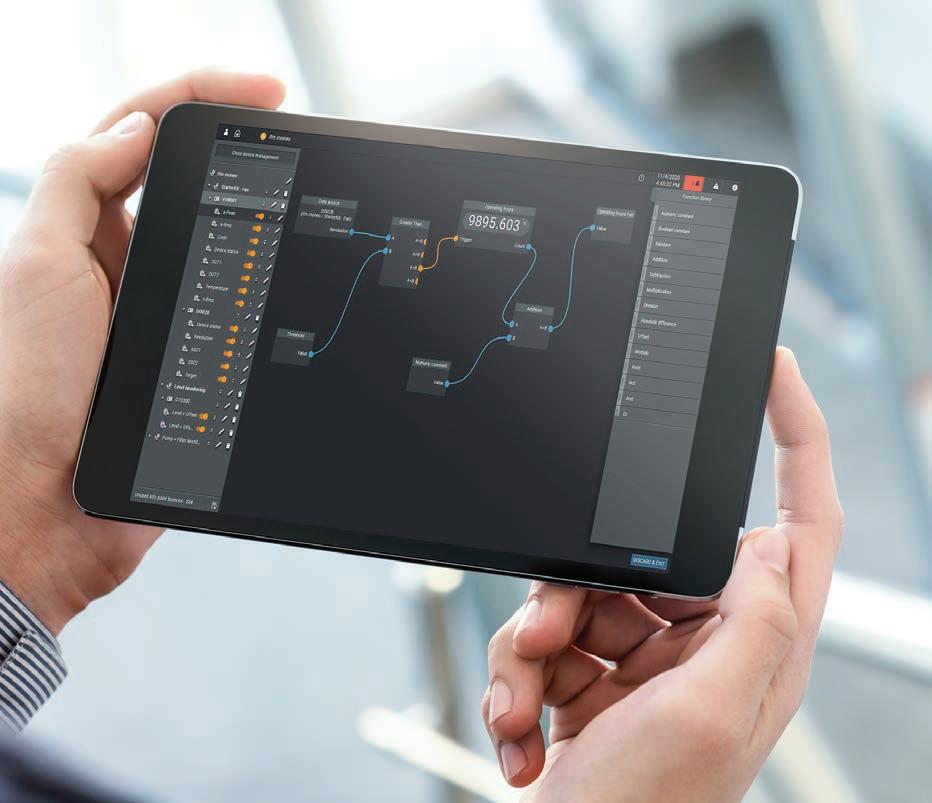
The in-built DataScience Toolbox enables operators and engineers to leverage their knowledge of equipment with the benefits of AI-assisted predictive analytics and machine-learning techniques. This empowers businesses to identify and remedy anomalies before they become expensive, big problems.
Pump stations and submersible pumps face many challenges causing unplanned breakdowns. The moneo solution can detect the following issues:
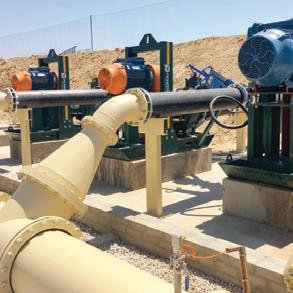
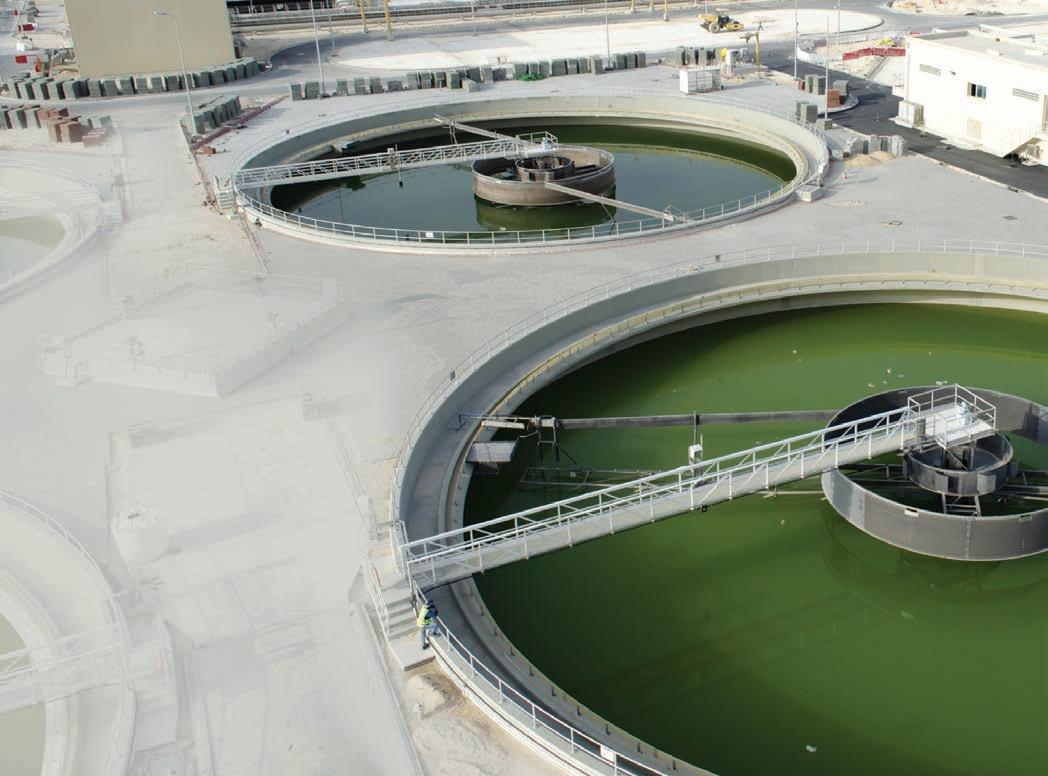
n Predictive monitoring of bearings, gears and electric motors
n Rotating pump parts
n Pumps rotor and valves
n Water pressure, temperature and flow rate at the pumps outlets
n Faulty or damaged bearings
n Faulty or damaged seals
n Wear issues and rub issues
n Imbalance
n Cavitation
n Looseness
n Unusually high signatures in grinders and macerators 1300 365 088
| www.ifm.com/au
sales.au@ifm.com
solely
historical
Sustainability from the ground up
AN UPGRADE AT A TASMANIAN COMPOST FACILITY TO DIVERT MORE WASTE FROM LANDFILL
organic process three-fold to a 28-day composting cycle.
“Going from an outdoor operation to an enclosed indoor operation was always going to be better than the previous solution,” Mitchell says. “And being under a roof in an in-vessel system, we’ve got full control over the environment.
“We can manage rainwater on the product (which was a problem when it was outdoors), moisture, odour and noise emissions and temperature. It will fast track the organic process dramatically because you can keep it in an optimal temperature and moisture range.”
Tasmania’s largest composting facility is harnessing new technology as part of a multimillion-dollar upgrade.
Dulverton Waste Management has capacity to divert up to 50,000 tonnes of organic material away from landfill each year. The material is largely green waste from councils in the Cradle Coast region and industry organics from across Tasmania.
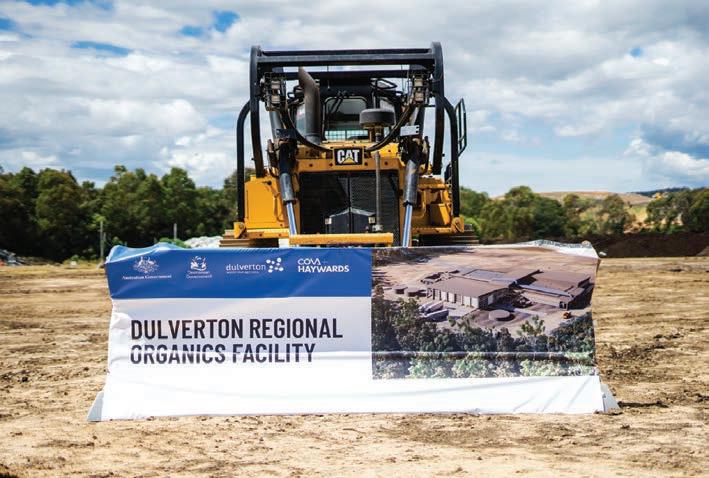
The upgrade is designed to improve how the facility makes compost. It will transform Dulverton from an open-air windrow process to a covered in-vessel facility and allow it to accept a wide range of feedstocks it otherwise couldn’t process.
Orez and design and construction company COVA joined forces during the tender process. The winning bid proposed a complete enclosed solution with COVA in the role of head contractor and Orez, formerly CEA Environmental Solutions, as a technology partner.
Orez drew on years of technical experience in delivering waste management solutions to design and construct pre-treatment and feedstock mixing systems, in-vessel composting with integrated air and water management systems and compost refining for the project.
Mitchell Giles, Orez Solution Specialist, says when complete, the Dulverton facility will fast track the
The original scope for the project was to construct an industrial shed over the existing windrow system with associated aeration and water management systems to provide best practice leachate control while eliminating rainfall.
Mitchell says Orez suggested an invessel system and together with COVA worked through various concepts with Dulverton Waste Management to achieve its goal. He says the result is cost efficient, on a smaller footprint and is a qualitycontrolled process.
The compost facility upgrade also creates potential for DWM to process new industry and municipal input stock including food and garden organics (FOGO) collected via kerbside services. Although permitted under the facility’s Environment Protection Authority licence, FOGO composting hasn’t
IS SET TO BENEFIT THE STATE’S INDUSTRY AND ENVIRONMENT.
WASTE MANAGEMENT IN ACTION – ORGANICS www.wastemanagementreview.com.au / WMR / 47
The Dulverton Waste Management upgrade will improve how compost is made for the state’s agricultural sector.
been undertaken at the site because of limitations with the existing open-air windrow system.
Mitchell says that to accommodate the varied feedstocks, Orez proposed a slow-speed shredder that breaks up larger particles but, because of its speed, doesn’t tear any contaminants. The fine fractions are screened, and any oversized pieces go through a picking station. Mitchell says the process decreases the amount of handpicking required for a clean material stream.
The upgrade also includes a depackaging system to enable spoiled packaged food waste to be mixed into the organic stream for processing where previously it would have to be landfilled. The technology has been proven to be effective overseas for several years.
The Australian Government has developed the National Food Waste Strategy with an ambitious target to halve food waste by 2030. In Tasmania, the waste strategy aims to reduce the volume of organic waste sent to landfill by 25 per cent by 2025 and 50 per cent by 2030.
Sean Galdermans, Orez National Stationary Projects Manager, says the Dulverton project is exciting to be part of and, he believes, will set an example of what regional recycling facilities can achieve when investing in in-vessel composting tunnels, allowing a wide range of organic feedstocks in addition to FOGO, maximising returns.
“Ultimately, the organisations that are processing FOGO are going to want to control emissions from their facilities, look at combining this with other organic waste streams such as liquid and sludges, and have more control of the process so they can guarantee that everything’s pasteurised,” he says.


“With these controls these facilities can be built close to city centres and in metropolitan areas, which also saves on transport costs and emissions.
“It will be the way of the future.”
John McKew, National Executive Officer of the Australian Organics Recycling Association (AORA), says the DWM project will transform organic processing in Tasmania into a state-of-the-
art processing facility, especially to achieve the waste strategy aims within Tasmania to reduce the volume of organic waste sent to landfill by 25 per cent by 2025 and 50 per cent by 2030.
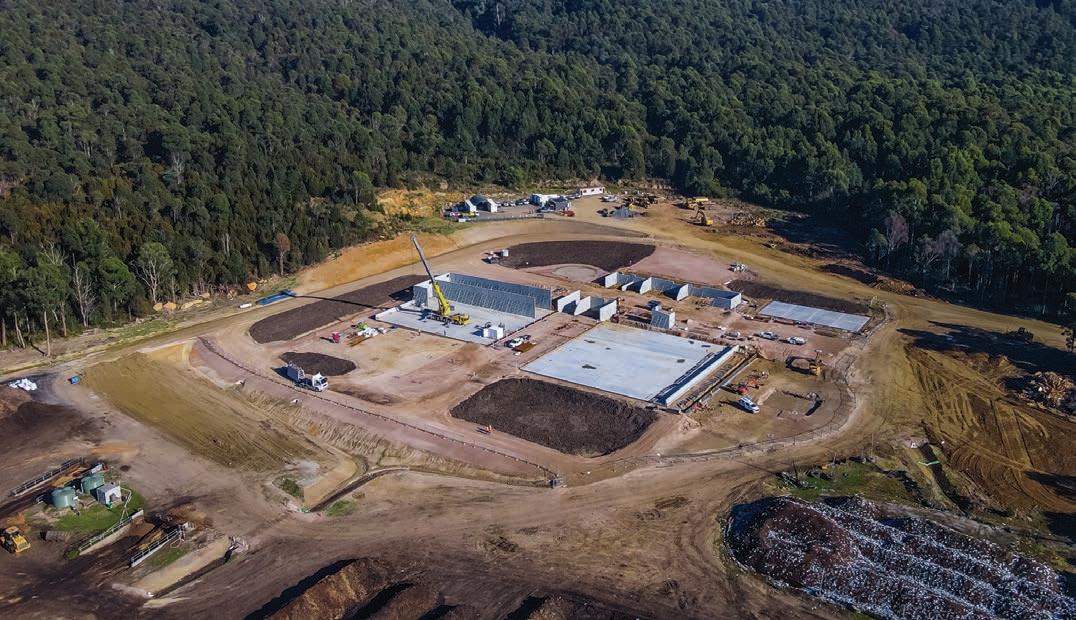
“What is particularly exciting about this project, aside from the new technology and processing capabilities, will be the products that are produced,” John says.
“Tasmanian agriculture, renowned the world over, will have access to high-quality compost that have been demonstrated to improve soil health and productivity. That is great news for Tasmanian farmers – readily available, quality compost that can enhance production of the wide-range of crops grown in Tasmania, including fruit, vegetables, cereals and beyond is fundamentally important.
“Tasmania has the potential to become an agriculture case study of the circular economy in action thanks to the DWM project and compost.”
For more information, visit: www.aora.com.au
48 / WMR / July 2023 WASTE MANAGEMENT IN ACTION – ORGANICS
An aerial view of the Dulverton facility.
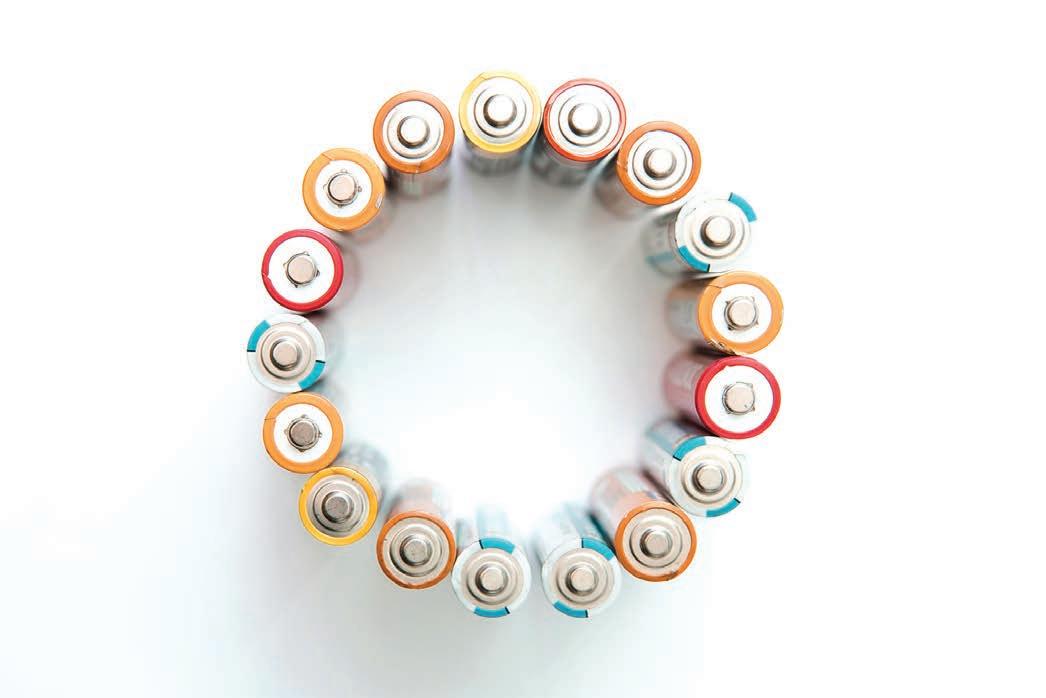
Plenty left in the tank
POLYMASTER GENERAL MANAGER DANIEL STEELE EXPLAINS HOW INNOVATION HAS MADE THE THIRD-GENERATION COMPANY A LEADER IN WASTEWATER AND CHEMICAL STORAGE SOLUTIONS.
Polymaster’s design and engineering department has spearheaded industry innovation since the company’s inception, says Daniel Steele, General Manager.
Since 1994, the family-owned business has been manufacturing liquid storage solutions for industries including water authorities, food and beverage, mining and agriculture. Ten years ago, the business invested in the establishment of a purposebuilt facility that specialised in the manufacture of chemical and wastewater tanks.
This facility took a different approach to everyday tank manufacture, which included a research and development division that studied liquid chemicals and how they react when stored.
“It has always been important to us to understand how the chemical or any liquid will behave,” Daniel says.
Innovation is the key. One of Polymaster’s first products launched all those years ago – a self-bunded chemical tank, still leads the industry in its unique design and inherent cost-saving to the waste industry. The range has been expanded, now incorporating chemical dosing skids, wastewater sludge, dewatering and clarification products, as well as cone-bottom tanks.
“That’s the genius of our design department,” Daniel says. “They saw a need and a way of improving what has been done traditionally.
“We saw a lot of technological advancements in water treatment and waste treatment but one thing
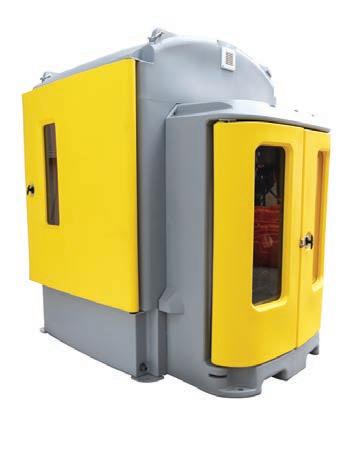
that hadn’t changed in decades was chemical storage.”
Bunding, also known as a bund, is a spill containment system that forms a secondary perimeter around stored liquids. Any leaks or escapes that occur can be captured more easily with bunding. Traditionally bunds have been concrete structures.
A self-bunded tank is a tank within a tank. The space between the two will capture any leaks, effectively removing the chances of environmental contamination or loss of product.
Daniel says the self-bunded tanks also provide economic benefits as they’re cheaper than traditional types of bunding and don’t require the civil works and permits.
The tanks have become popular in the wastewater and water treatment sector because they give installers flexibility around the type and size of tanks, including the fittings integrated into them.
Daniel says the new division won some good projects early on, including the Dungog Wastewater Treatment Plant upgrade, which helped cement its place in the industry.
The Dungog Wastewater Treatment Plant services a township of just over 2000 residents, situated north of Newcastle. The more than 80-year-old plant was acquired by Hunter Water Corporation in 2008 and underwent an upgrade in 2021 to replace ageing infrastructure.
The project brief was to build a temporary plant to the side while the old
plant was demolished to build a modern wastewater treatment facility without disrupting the treatment plant.
Daniel says dosing of sodium hydroxide into the wastewater was a critical component. The design team had the added challenge of shoe-horning a new plant on the same site as the existing plant.
“We provided two 30,000-litre self-bunded chemical tanks with a dosing system to help dose sodium hydroxide into the wastewater,” Daniel says. “A fully integrated dosing system was housed within each cabinet of the tanks. As sodium hydroxide is suitable for our polyethylene tanks, it was a perfect solution.
“The designers provided us with a detailed piping and instrumentation diagram for the dosing system to ensure they received a system that ideally suited
WASTE MANAGEMENT IN ACTION – CHEMICAL STORAGE 50 / WMR / July 2023
The ENIBC (Enclosed IBC Bund) is the latest Polymaster development, designed in conjunction with customers to fill a gap in the market.
their application. Our self-bunded tanks comply with AS3780 (bund capacity of 110 per cent), so the installation crew did not require the expensive and unnecessary construction of a concrete bund.
“Ultimately, the end solution Polymaster provided is cost-effective and efficient – saving time and money.”
Polymaster offers both permanent and mobile liquid storage. The mobile tanks are often used by companies involved in remediation projects, such as PFAS removal, because they can be used to store liquid waste and the chemicals required for the job.
Daniel says Polymaster has tested materials at every point in the design and manufacture process of the tanks to ensure a variety of chemicals can be stored.
“Sulphuric acid is not suitable to be stored inside the standard-grade polyethylene,” Daniel says. “We’ve developed a special chemical grade with a different molecular make-up
that is suitable.” The benefit he says, is that polyethylene is more cost effective than other materials. There are different types and grades so a larger range of chemicals can be stored, and it can withstand the harsh Australian climate. An extra additive makes the polyethylene UV resistant, giving the tanks a longer lifespan.
The wall thickness of the tanks is designed to give them a higher weight loading, and because they are moulded in one piece, there is less chance of leakage.
“You only get one chance with chemical storage,” Daniel says. “The whole design process for chemical storage tanks is critical.
“Polymaster has a lot of checks in place throughout the design and build stage to ensure the tanks are up to standard. We want to set the industry benchmarks.”
Setting those benchmarks means Polymaster is always watching industry trends and challenges.
Are the chemicals being used in the industry changing? Are the materials used to store them still sufficient? What are the environmental hazards?
Sustainability and environment concerns, Daniel says, are becoming more important for customers and the bar is always being lifted with regulatory protections.
“We want to make sure we’re making safe solutions, from a people and an environment point of view,” Daniel says.
“It’s important that we keep innovating and providing something new. The DNA of the business is around innovation and contributing to a better future.
“We’ve always had a passion for innovation, a part of that is a little bit of adventure. We can’t always see the end, but we’re going down an exciting path.”
For more information, visit: www.polymaster.com.au
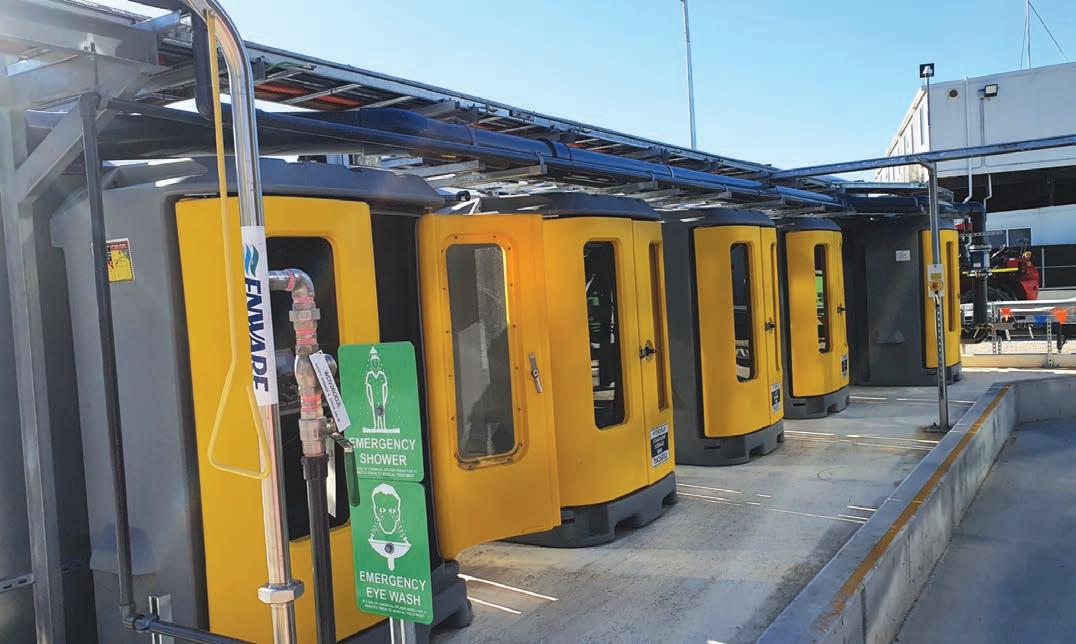
www.wastemanagementreview.com.au / WMR / 51
A row of chemical selfbunded tanks on site.
On top of the waste-to-energy pile
ERIEZ RECYCLING EQUIPMENT IS HELPING TO INCREASE RECOVERY IN THE WASTE-TO-ENERGY INDUSTRY.
Waste-to-energy facilities (WtE) are sometimes designed to integrate with municipal solid waste (MSW) systems to maximise the recovery of energy via a complete combustion process.
The bottom ash that remains after combustion contains valuable ferrous and nonferrous metals that can be easily recovered rather than being sent to landfill.
Some of the world’s largest owners and operators of facilities dedicated to recovering energy from waste are using
the latest in recycling equipment from Eriez to separate ferrous and nonferrous metals from bottom ash residue.
Jonathan Schulberg, Business Development Manager for EriezAustralia – Heavy Industry, says the company has tested and refined its range of recycling equipment to maximise metals recovery.
There are now Eriez designed and built eddy current separators (ECS) in numerous factories around the globe, including WtE plants, where ferrous and nonferrous metals need to be recovered.
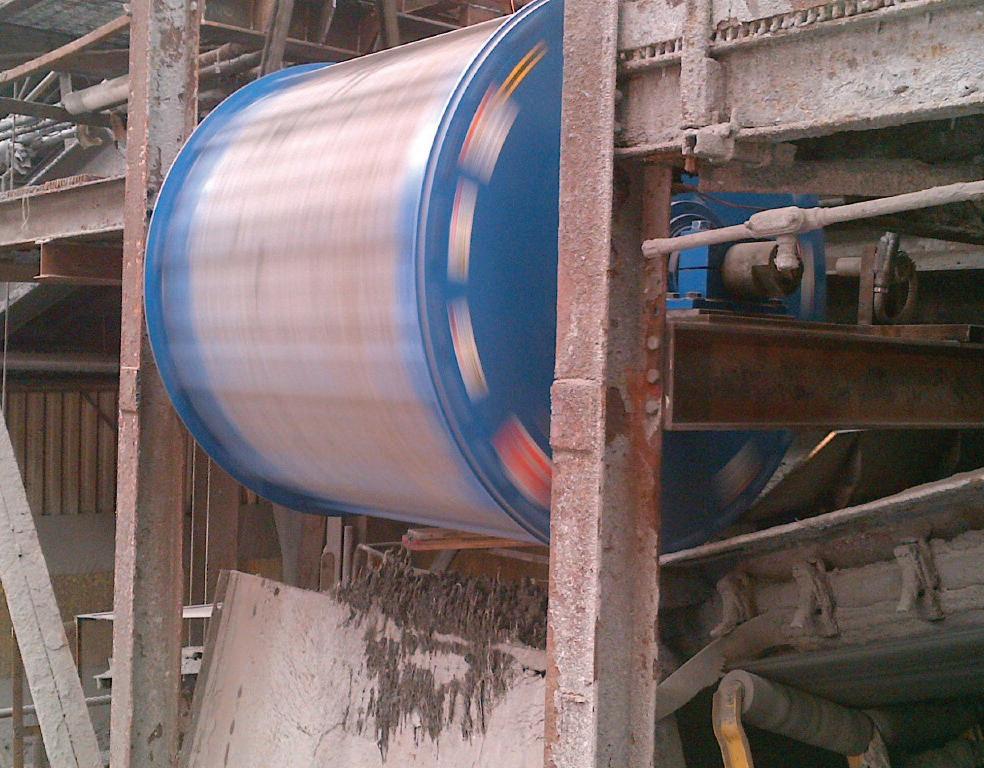
The range of eddy current rotor designs maximise nonferrous recovery in industries as diverse as auto shredding and scrap recycling, foundry sand, plastics, PET flake, electronic scrap (E-Scrap), aluminium can (UBC) and soil remediation.
Jonathan says one piece of equipment seeing a substantial uptick in sales is the RevX-E Eddy Current Separator, which is suited for nonferrous recovery from bottom ash.
This latest generation combines the high-performance separation of previous ECS models with a variety of maintenance-friendly enhancements, including a cantilever frame design that enables 10-minute belt changes.
The unit features an eccentrically mounted magnetic rotor within a nonconductive larger diameter shell. This eccentric rotor concentrates its eddy current forces into a zone of separation at the end of the belt.
The eccentric rotor design effectively reduces any potential long-term wear caused by heated ferrous build up which occurs in concentric rotor designs.
RevX-E is offered in two models for fines or coarse material separation. For nonferrous fines, typically measuring less than one-inch, Model ST22 has a high-frequency rotor configuration that concentrates the eddy currents closer to the belt’s surface, improving separation of difficult material typically found in a waste-to-energy application.
WASTE MANAGEMENT IN ACTION – METAL RECOVERY 52 / WMR / July 2023
Covanta Energy had a 50 per cent improvement in recovery after installing an Eriez P-Rex permanent rare earth magnet.
For coarse material greater than one inch, Model LT2 has a deep field rotor designed for maximum trajectory.
The eccentric design incorporated into both rotor options protects against potential damage from ferrous contamination in the material stream while maintaining a high level of separation performance.
Another piece of equipment used in waste-to-energy applications is the Eriez Ultra High-Frequency (UHF) Eddy Current Separator. It can recover nonferrous metals as small as two-three millimetres in size, which can be missed by traditional machines.
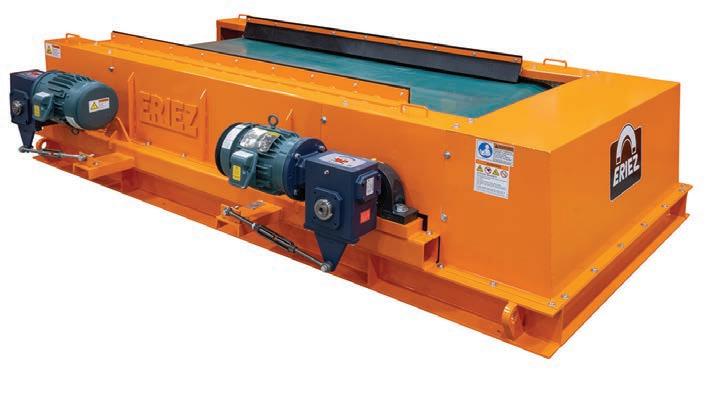
Jonathan says the UHF Eddy Current Separator’s design is the key to its performance.
“A rotor designed to produce exceptionally high gauss on the belt surface, combined with the highfrequency changes of the permanent magnetic poles, give this unit the ability to consistently recover the smaller nonferrous materials,” he says.
Eriez recently expanded its line of recycling equipment with the introduction of the dynamic pulley separator, designed to liberate weakly magnetic fines from waste-to-energy bottom ash.
Positioned upstream from an eddy current separator, the high-strength dynamic pulley separator uses a rare earth permanent magnet pulley rotating at an off-set speed from the belt, creating an agitating magnetic field.
This improves the removal of fine ferrous material such as ferritic dirt that will allow the eddy current separator to work at a higher efficiency and provide higher nonferrous metal recoveries.
A CASE STUDY
Covanta Energy – a subsidiary of the publicly owned Covanta Holding Corporation – owns and/ or operates waste-to-energy facilities
that produce electricity for about one million homes in communities across North America.
Covanta-operated facilities are covering a lot of ground: its WtE plants in North America are converting 19 million tonnes of waste and residuals annually into nine million megawatt-hours of clean, renewable energy and more than nine billion pounds of steam sold to a variety of industries.
The bottom ash that remains after combustion – which comprises about 10 per cent of the original waste stream by volume – contains valuable ferrous and nonferrous metals.
One Covanta facility stood out among the others as having less ferrous content in its bottom ash – the Delaware Valley plant in Chester, Pennsylvania.
The plant had upgraded its ferrous recovery in recent years, having previously installed an Eriez P-Rex permanent rare earth magnetic scrap drum. Based on the experience in Delaware Valley and knowledge of how
the Eriez P-Rex drum performed and the desire to pull material in a way they could maintain a proper working gap to avoid operational issues, Covanta purchased another rare earth magnetic scrap drum for its Niagara Falls, New York, facility.
Engineers saw a 50 per cent improvement in recovery after the upgrade. The results at the two facilities enabled Covanta to purchase additional Eriez P-Rex magnetic drums for other locations.
A key advantage of the Eriez P-Rex magnetic drum is driven by the more than 40 per cent higher magnetic strength that it provides in comparison to standard electromagnetic or other permanent magnetic drums.
This provides the ability of the drum to work at higher working gaps while still providing ferrous metal recovery at over 99 per cent from the bottom ash.
For more information, visit: www.eriez.com.au
www.wastemanagementreview.com.au / WMR / 53
“The eccentric rotor design effectively reduces long-term wear caused by heated ferrous build-up.”
Jonathan Schulberg Eriez Business Development Manager for Australia – Heavy Industry
Eriez has expanded its line of recycling equipment to include the Dynamic Pulley Separator.
A higher realm
IFM’S FREDDIE COERTZE EXPLAINS HOW MOTOR PROTECTION IS MADE EASY WITH MONEO WIZARD.
a predictive maintenance plan –without the fuss and complexity that is often associated with this process. Because you’re starting just with the motor monitoring.”
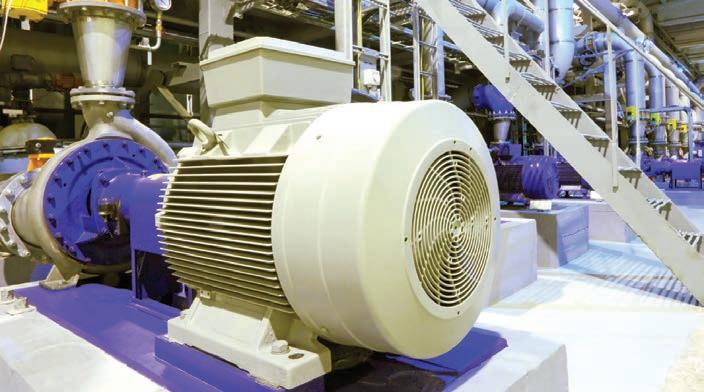
“It’s very easy to set up. Basically, the wizard tool will talk you through the steps so you can do everything yourself without the need for an IT or analytics expert,” says Freddie.
Imagine having Gandalf, the wizard from J. R. R. Tolkien’s Lord of the Rings, protect your wastewater treatment facility motors. It would be a formidable force to reckon with.
Well, according to Freddie Coertze, the ifm moneo Data Science Toolbox has a wizard that can provide just that type of protection – by predicting motor issues through the use of advanced vibration analysis (AVA).
“A unique aspect of moneo is that this wizard can help users determine the vibration limits of their motor and predict failure well in advance, so there is enough time to act,” says Freddie, the National IoT Business Development Manager for ifm Australia.
“It’s a great way for an industrial business of any size to start implementing
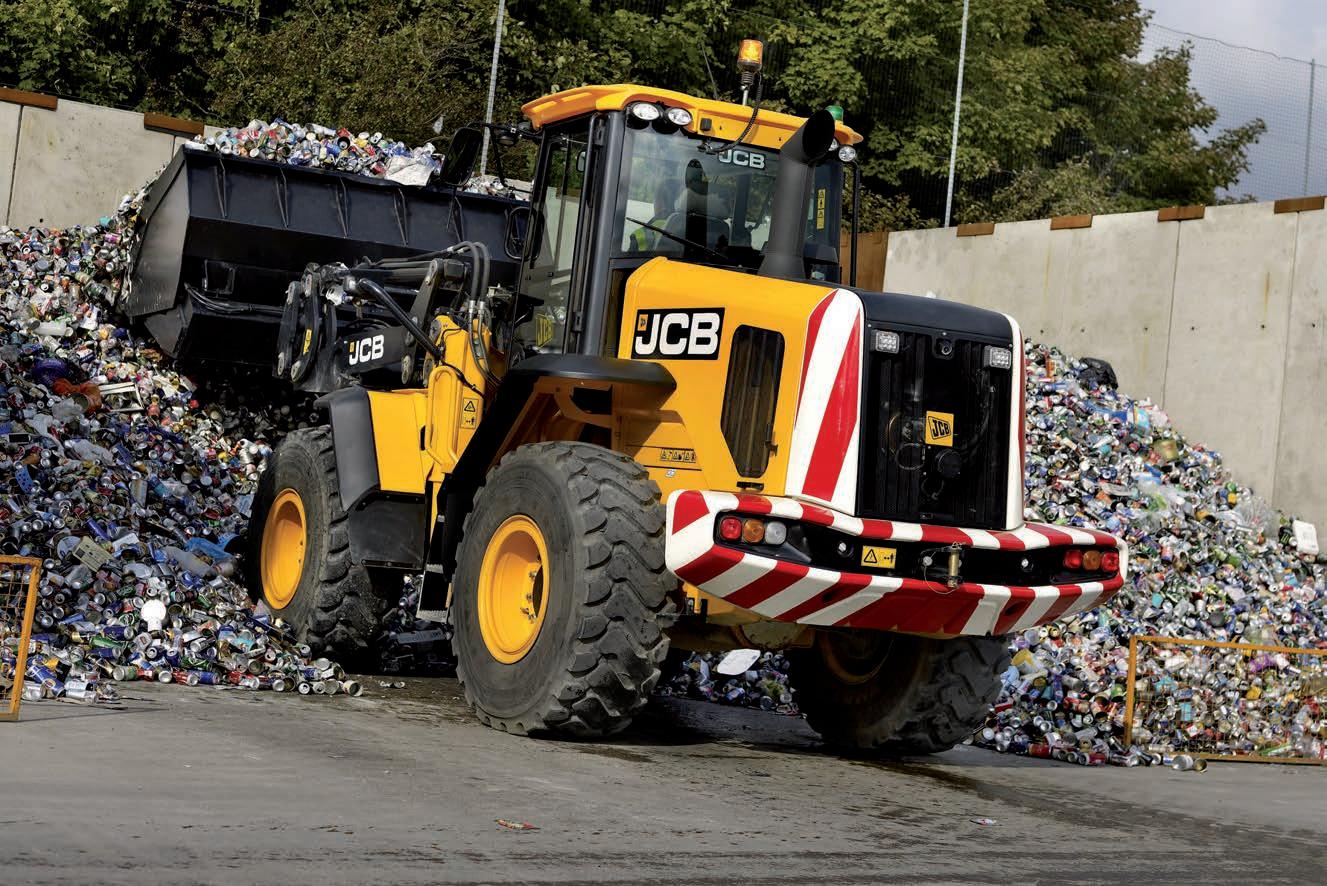

Unlike other condition monitoring solutions, moneo has been designed for ease-of-use. It is a self-service IIoT platform where the hardware, software and smarts – along with data science tools – that come in the one package.
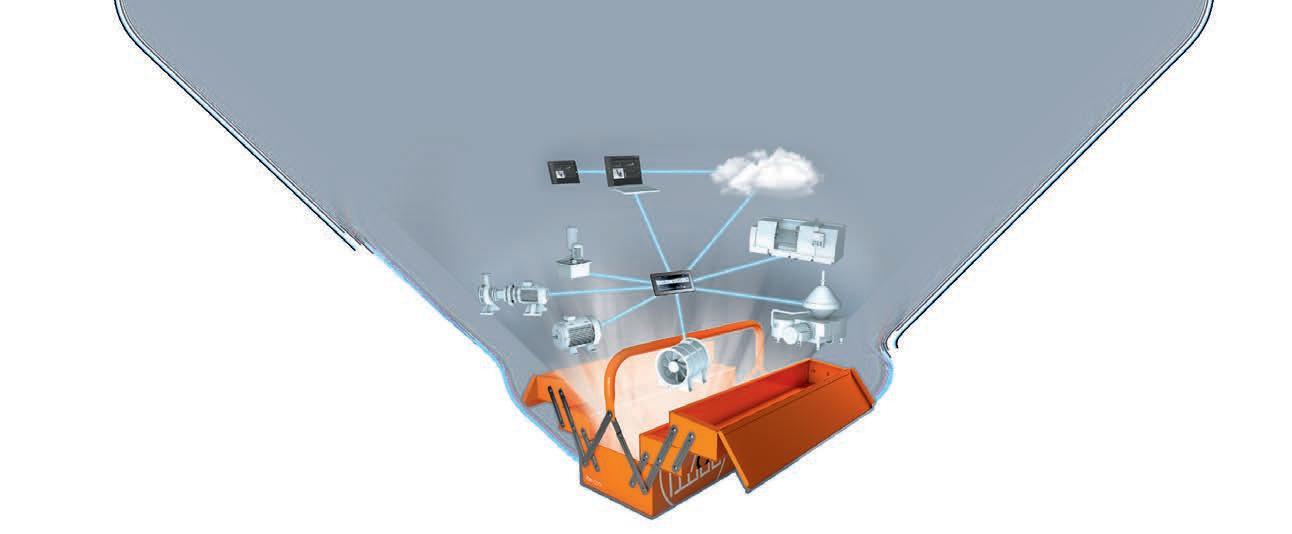
The AVA wizard is a tool that comes with moneo and can be used as a simple way to start monitoring and protecting motors.
“It’s a matter of connecting your sensor, dragging and dropping that into the moneo dashboard, selecting the motor configuration, and then moneo has an inbuilt AI tool that will create baselines for you in regards to what the acceptable limits of motor vibration will be for that configuration.”
Users can then start seeing the vibration levels of their motor installation on the dashboard. The
WASTE MANAGEMENT IN ACTION – TECHNOLOGY 54 / WMR / July 2023
The ifm moneo Data Science Toolbox is like having a wizard at your disposal.
The moneo Data Science Toolbox helps determine the vibration limits of a motor.
moneo offers a self-service IIoT platform where the hardware, software and smarts come in the one package.
set limits suggested by moneo appear as red and yellow dots to indicate if the motor is running outside of its determined limits.
“If vibration levels exceed the yellow, you have early notification that your motor needs attention and if it reaches red, it goes into alarm,” says Freddie. “It’s the difference between having a warning that something is about to fail, and having early notification that is predicting a failure later on.

“Essentially, this wizard gives you time to fix motor issues before they become bigger problems. As we say, to protect, you need to predict, and this wizard helps you do that.”
Importantly, moneo has been designed to keep it simple for users, but also to expand as requirements change.

“You can extend on this form of motor protection by adding a device
that provides a more intensive vibration and into other aspects of predictive maintenance as well,” says Freddie.
“But if we think about businesses just wanting a starting point, this is a great way to begin. You might have an asset such as a conveyor where if it breaks down due to a motor failure
PROVEN RELIABLE AND PRODUCTIVE
the whole production of a facility might come to a halt. So having this tool will let you know in advance if the motor has issues, and you can save it before any event like that occurs.”
For more information, visit: www.ifm.com.au
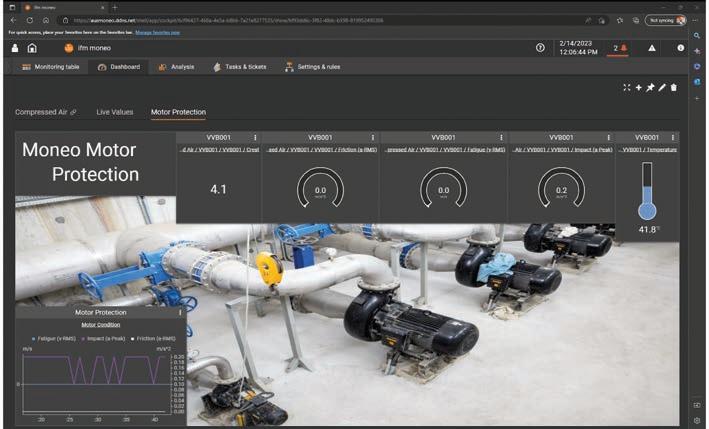
JCB WHEEL LOADERS 1300 522 232 jcbcea.com.au
An inbuilt AI tool helps set up machine baselines on the moneo dashboard.
The JCB range of wheel loaders are built to be strong, reliable and provide comfort for long days in the cab. Designed for ultimate productivity, and offering superb performance the JCB wheel loader range features best-in-class comfort, visibility, safety ergonomics and superior serviceability plus a whole lot more.
Screen idols
SPECIALIST MELT FILTER DESIGNER FIMIC IS HELPING TRANSFORM POST-CONSUMER PLASTICS AROUND THE WORLD.
The level of contamination in plastic recycling has increased over the years as the demand for recycling surges.
The Australian plastic recycling market was 2.96 million tonnes in 2020 and is expected to hit 3.99 million tonnes by 2030, according to the Australian Plastics Recycling Market Analysis 2022.
Paola Crea, Regional Sales Manager for FIMIC, says the growing market has forced recyclers to look for new sources of feedstock, such as postconsumer plastics, that often have high contamination that can weaken the final product.
FIMIC specialises in the design and manufacture of automatic and selfcleaning melt filters for plastic recycling. Each filter is adaptable to any extrusion system, considering the material to be processed, hourly production target and the contamination to be removed.
“Filtering nowadays is critical for the quality of recycled material,” Paola says.
“The type of waste and the contaminants are changing all the time. Our technology helps a lot with the ability to remove contaminants.
“We want to address the contamination as easily as possible. The objective is to help our customers reach the highest quality of their product, so they can sell it for a good price.”
FIMIC is a third-generation family business founded in Italy about 60 years ago. It entered the field of recycling through the manufacture of guillotines for cutting industrial waste bales and rolls.
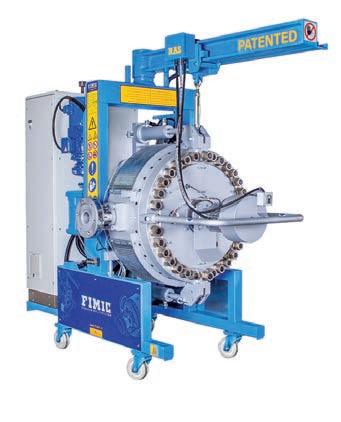
In 1996, the company decided to improve the filtration method which, at the time, was fully done by hand. The first FIMIC backflush entered the market the next year. One year later, the ‘scraping’ system came into fruition.
Paola says the filters are aimed at improving the efficiency of recycling lines and the quality of plastic melt.
“We’re very focused on simplicity of process because we know recycling is already complicated,” Paola says.
“Post-consumer plastic can have a lot of different contaminants, from paper and wood through to other types of plastics. FIMIC filters screen material based on consistency – whatever is not melt is contamination.”
Paola says the RAS filter, FIMIC’s flagship product, is the most popular. It covers applications such as blown film, injection, and injection moulding. The non-auger valve means even aggressive contaminants such as iron and sand, can be processed without damaging blades and screens.
So how does it work?
Two blades scrape the contamination collected by the filter while the scraper traps it inside and then automatically discharges what it has collected via a front valve.
Paola says it is possible to set the pressure mode on a touchscreen. When the chosen pressure has been reached, the scraper collects the contamination inside it, opening the front valve only when the cycle is complete.
In case of large amounts of contamination, the continuous mode can be selected, and the scraper will continue to slowly scrape the screen.
FIMIC screens have a large filtering surface to help stop processed material being degraded. It’s one of the reasons, Paola says, the company has had success in the plastics recycling industry.
Too small a filtration area and the material is pushed through to the other side, taking contaminants with it.
WASTE MANAGEMENT IN ACTION – PLASTIC RECYCLING 56 / WMR / July 2023
Paola Crea, Regional Sales Manager, FIMIC.
FIMIC filters are aimed at improving plastic recycling efficiency and quality.
Filtration down to 80 microns is possible because FIMIC screens are punched or lasered. Laser drilling means the screen can be thicker with more holes, resulting in a better output and higher resistance on the screens. Paola says the FIMIC laser screens are a quality, high-performance component, and are believed to be the lowest priced in the market.
A punched screen can normally last from three days up to seven days, while a laser one can last from one week to a maximum of 12 days. It can be reused, after it has been cleaned in a pyrolytic oven, up to four times.
Cost and time savings are a key selling point of FIMIC screens.
“The time spent by a single operator changing a screen does not exceed 30 minutes. This translates into optimising production and
reducing downtimes,” Paola says. “Our filters do not require any operator’s intervention. Therefore, they allow a further optimisation of the workflow while keeping high quality levels.”
FIMIC has surpassed 520 units installed on all continents, from South America to New Zealand, with several in operation in Australia.
While FIMIC products have been proven in the field, the company’s global success can also be attributed to its customer support.
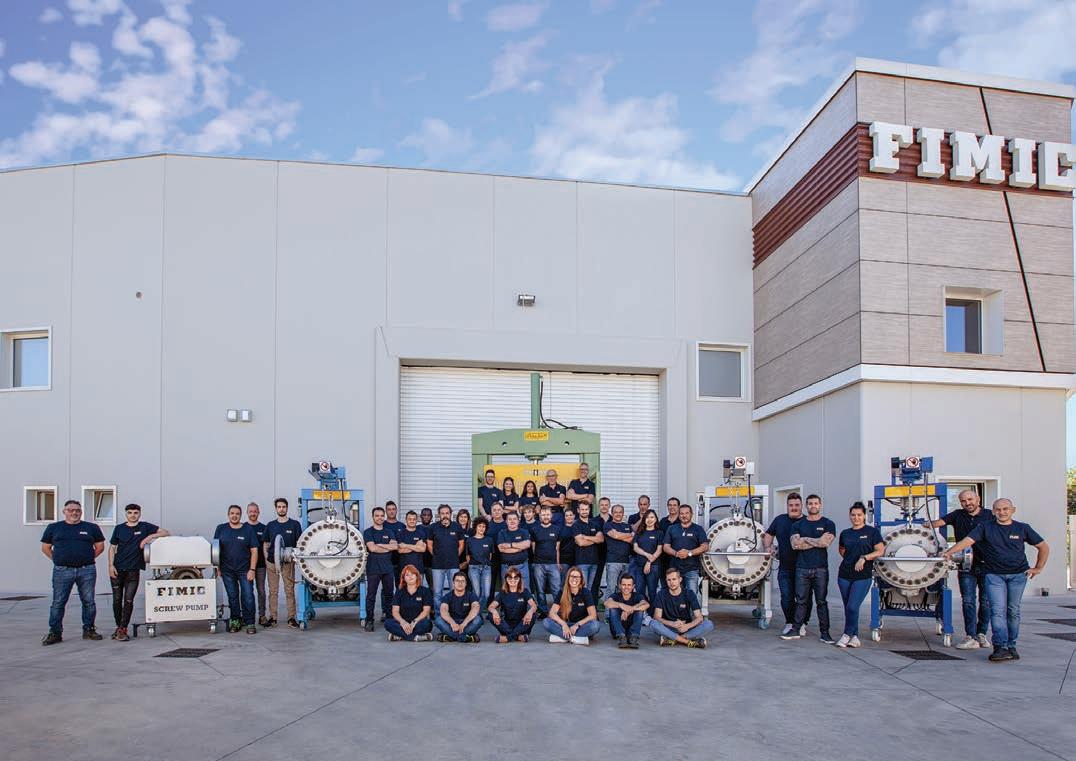
A spare parts portal means any spare part is a click, and worldwide shipment away. The customised warehouse guarantees a 24-hour shipment within Europe and two to three days in nonEU countries.
Customer service is available seven days a week.
Dedicated sales managers, agents and representatives are spread world-wide throughout the United States, South America, Europe, Africa, and Asia to provide constant and quick support.
“FIMIC is very much focused on serving the customer,” Paola says.
“Recycling is a difficult business; things change all the time. When our customers face new problems, we can’t just say ‘oh well’. We must be in the field all the time, listening to our customers and respecting their feedback.”
FIMIC will be at the Australasian Waste and Recycling Expo to be held in Sydney in July sharing with visitors, at Stand H24, its solutions for plastic recycling and celebrating its 60th anniversary with a special gadget.
For more information, visit: www.fimic.it
www.wastemanagementreview.com.au / WMR / 57
The third-generation business has a global reputation.
Greener Infrastructure Conference 2023

18–20 September 2023
Registration is now open.
Victoria’s infrastructure industry is joining forces to create a greener future and deliver purposely greener projects. Be part of the change.
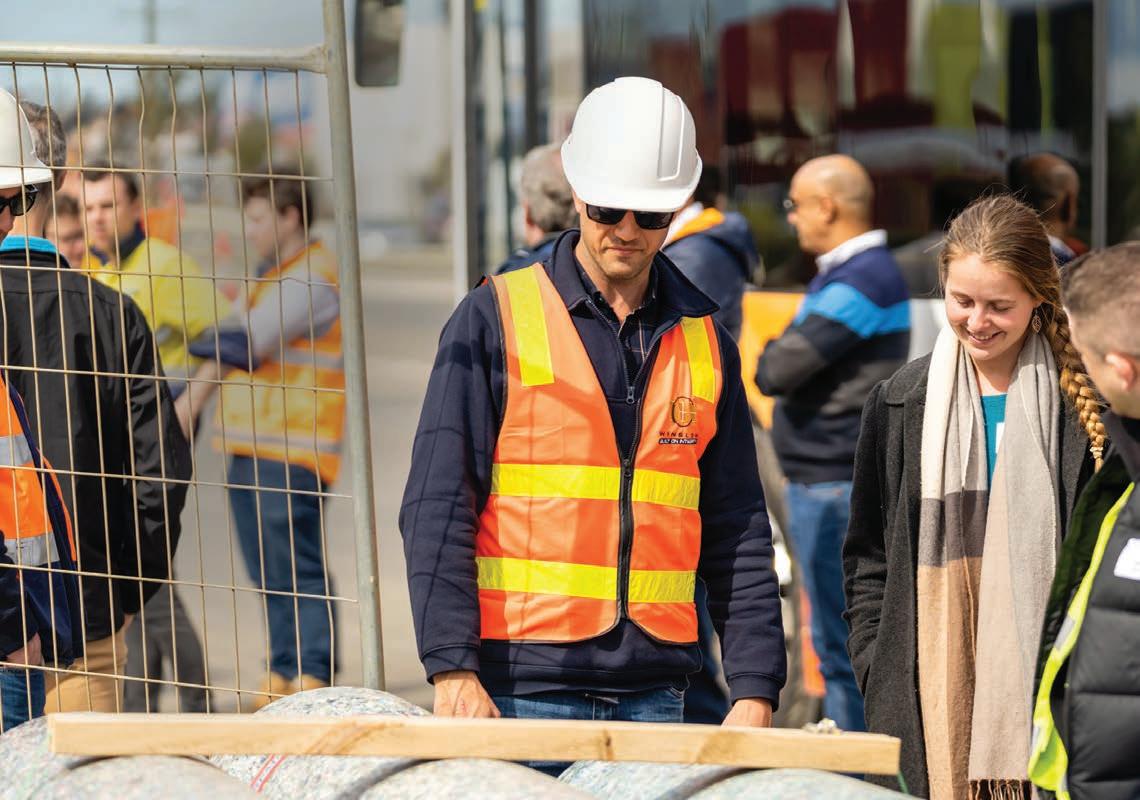
The three-day conference will feature industryleading speakers, expert panels, networking events and a trade hall that’s bigger and better than ever.
Scan code to register ecologiq.vic.gov.au/conference-2023

6333
Melbourne Convention & Exhibition Centre
Circuit breaker
GREEN TECHNOLOGY RECYCLING DIRECTOR MARK LI IS BUILDING A TRANSPARENT, SUSTAINABLE SOLUTION FOR E-WASTE, NO MATTER THE VOLUME.
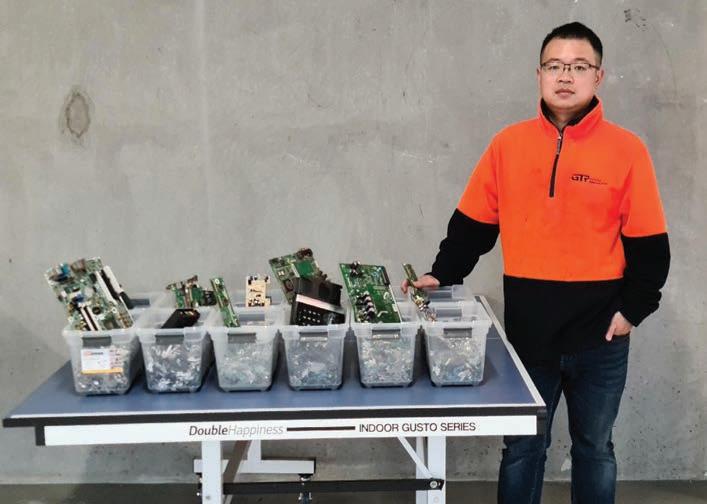
In 2014, a friend of Mark Li’s had a batch of electronic devices to dispose of but couldn’t find a recycling company to handle them. In the end, they had no choice but to send the devices to landfill.
The result didn’t sit well. The plastics, metal, mercury, and toxic substances contained in e-waste are an environmental hazard when disposed incorrectly.
Mark says he knew there was a better answer. He began researching collection, transportation, sorting, and disposal of electronic waste and in 2016 established Green Technology Recycling in New South Wales.
His goal – to provide customised e-waste recycling solutions for everybody.
“In New South Wales there has always been a demand to dispose of electronic waste, but it was a one-size-fits all approach,” Mark says.
“GTR can provide customised solutions, whether it’s for councils, big corporations, small businesses or even individuals.
“It’s what make us different to other e-waste companies.”
GTR focuses on dismantling electronic waste items and distributing the various components for processing and recycling.
One of the challenges early on was how to identify the recycling value of materials and build a solution chain for all kinds of e-waste.
Mark has since built a relationship with a global partner, a refinery in Japan,
and GTR is one of only a few Australian companies to have a permit from Japan’s Minister and Basel Convention to transfer dismantled e-waste components for further processing.
The refinery accurately identifies the maximum recovery value of any e-waste Mark sends. This value is then stored in a database and is used to compare the past, present, and future recovery value
for clients. The database is used for every one of GTR’s clients to accurately match their needs and is constantly updated.
“One of the big challenges of recycling is pricing,” Mark says.
“A 10-year-old modem is different from today’s modem and will be different from a modem built two years from now. With an accurate e-waste recovery analysis stored in the database,
WASTE MANAGEMENT IN ACTION – E-WASTE www.wastemanagementreview.com.au / WMR / 59
“With an accurate e-waste recovery analysis stored in the database, we can provide customised solutions for every client.”
Mark Li Director, Green
Technology
Recycling
Mark Li, Director, Green Technology Recycling, provides customised e-waste recycling solutions.
we can provide customised solutions for every client.”
The GTR team is currently working on a hospital project with 15,000 units of medical equipment. Mark says that with a value analysis report expected soon, he’s confident GTR will be able to find the right home for the equipment at reasonable
cost – a benefit for the hospital and the environment.
In the past eight years, GTR’s recycling technique has found a way to divert thousands of tons of discarded electronic devices from landfill.

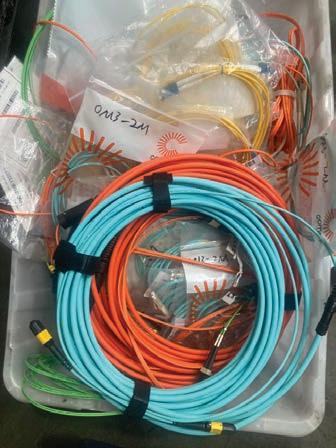
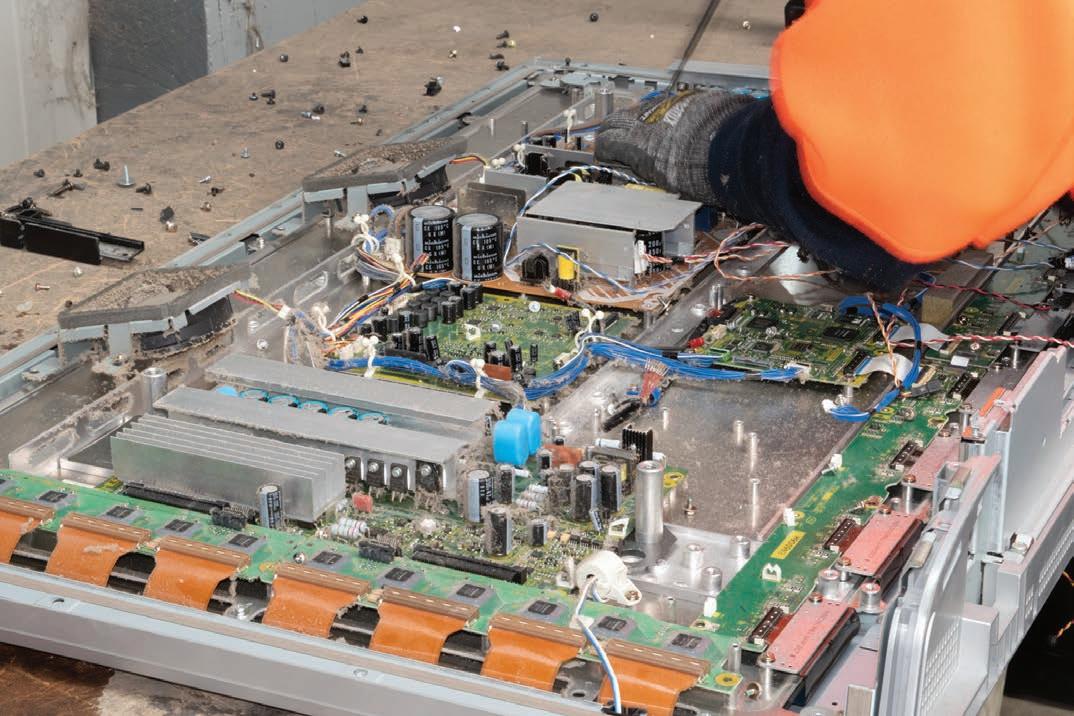
Inflation, labour shortages and a shift in manufacturing has added a degree of difficulty.

“Not all electronic waste can be recycled and there is a growing trend where manufacturers are either using less recyclable materials, or very low quality recyclable materials, resulting in very low recovery value,” Mark says.
“Take a TV for example. TVs are getting bigger but when you open it up, the circuit board is smaller and thinner and has fewer precious metals. People question why a computer had a recovery value of $20 last year and this year has a value of $10. That’s why we consistently send e-waste for analysis. The database provides evidence of costs.”
Transparency, value analysis, database build-up and a national collection
network are the core values at Green Technology Recycling. Mark is aware there are other e-waste recyclers but says he’s proud GTR can back up its claims of providing environmentally friendly recycling solutions.
“GTR is able to provide assurance to its customers that the e-waste components go to a country that is approved and recognised to further process it correctly,” he says.
“GTR achieves this through documentation transparency and building trust.”
Mark believes that accurate e-waste recycling presents an opportunity to create a circular economy. He’s dedicated to providing innovative service in this domain and aims to protect the environment through sustainable development as well as minimising disposal of e-waste into the landfill.
For more information, visit: www.greentechnologyrecycling.com.au
60 / WMR / July 2023
WASTE MANAGEMENT IN ACTION – E-WASTE
GTR dismantles electronic waste items and distributes various components for processing and recycling.
Non-recyclable material from e-waste.
Less Landfill Less Carbon Less Traffic Greener Roads greenroads.com.au Alex Fraser’s recycled construction materials can cut the carbon footprint of new infrastructure by up to 65%. Building greener roads asphalt . aggregates . roadbase . sand phone: 136 135
Tyre shredding cuts transport costs
THE TANA SHARK IS PROVING TO BE A BIG FISH IN A BIG POND.
Sam Hamdan thought he knew shredders. In this instance, he’s happy to be proven wrong.
The Manager at Tempe Tyres in Sydney, Sam has been running the factory floor for the past 25 years and thought he had a handle on the biggest and the best machines for the job.
He admits to being apprehensive when the company brought in a TANA Shark for its tyre recycling service. But after 500
hours devouring heavy-duty tyres, the Shark has Sam’s allegiance.
“I was shocked,” he says, “but this is the right choice.”
“It’s a tough machine and the quality of the final product is better than we were previously getting. TANA is the best machine for this job.”
Tempe Tyres offers a tyre disposal and recycling service as an adjunct to its retail business. It processes passenger, light vehicle and 4WD tyres into 150mm
shred for export. Sam says it’s a highvolume operation, churning out 10-15 containers a week. The TANA Shark is doing it with ease, while maintaining the quality of the shred.
“I was worried, but I was wrong,” he says. “In this instance, I’m happy to be wrong.”
One person not surprised by the biting power of the TANA Shark is Adam Krajewski, Marketing Manager for GCM Enviro, an Australian distributor of waste management equipment.
The Shark, Adam says, is the most versatile waste shredder on the market and can cut through the most challenging materials from tyres to commercial and industrial waste through to ragger wire.
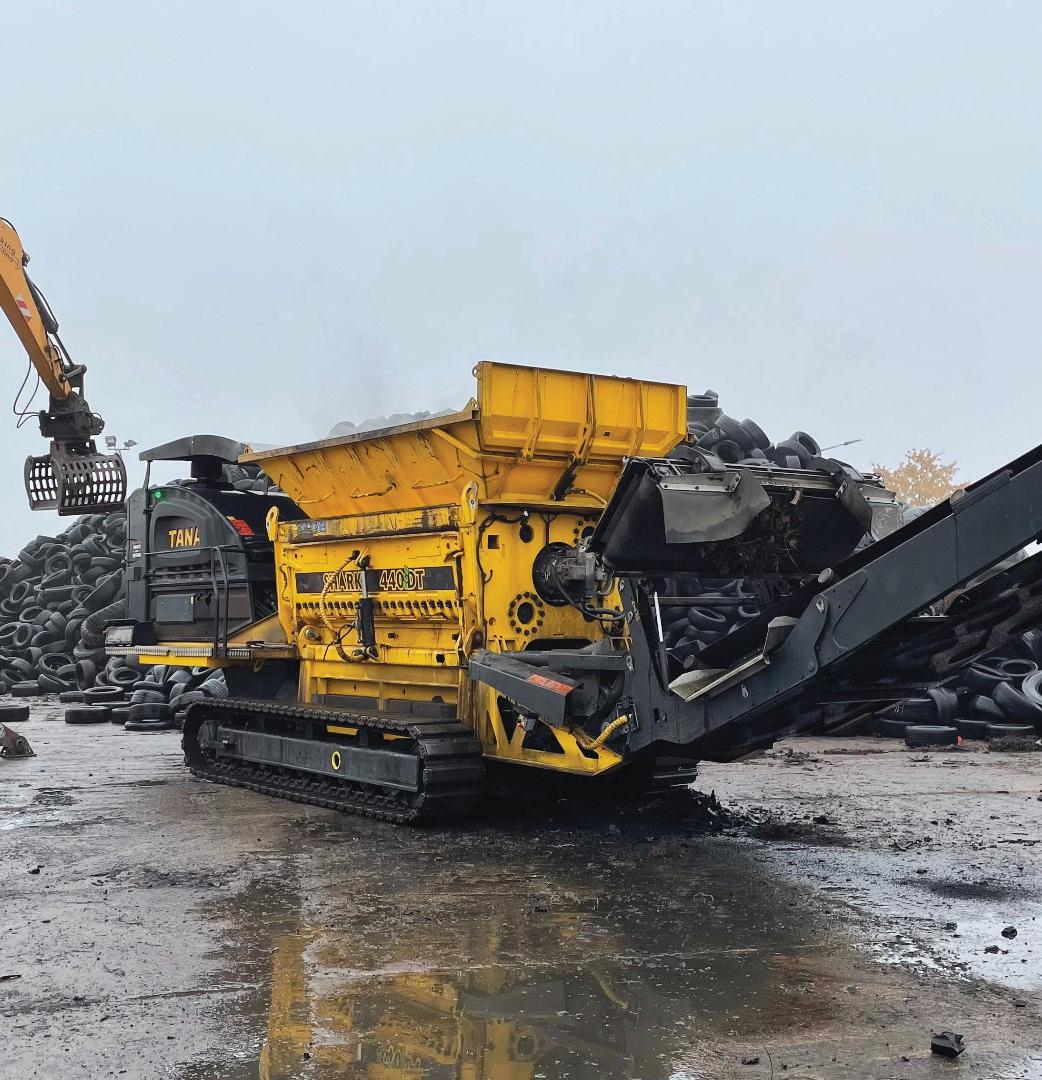
Adam says the TANA Shark enables full control over the particle size, from 50 to 500mm, which means time and cost savings because it’s possible to perform shredding in just one pass. It only takes 10 minutes to add or remove screen sizes.
TANA Control System (TCS) monitors and controls the machine functions. There are 12 pre-programmed operating programs for different types of materials and purposes of shredding.
Adam says extra customer-specified programs can also be added.
“The programs adjust the machine functions to optimal level for achieving the wanted output,” he says. “If a noncrushable object blocks the rotor, TCS makes the machine reverse and try a few times until the object either goes through or the machine stops. When the machine stops the non-crushable object can
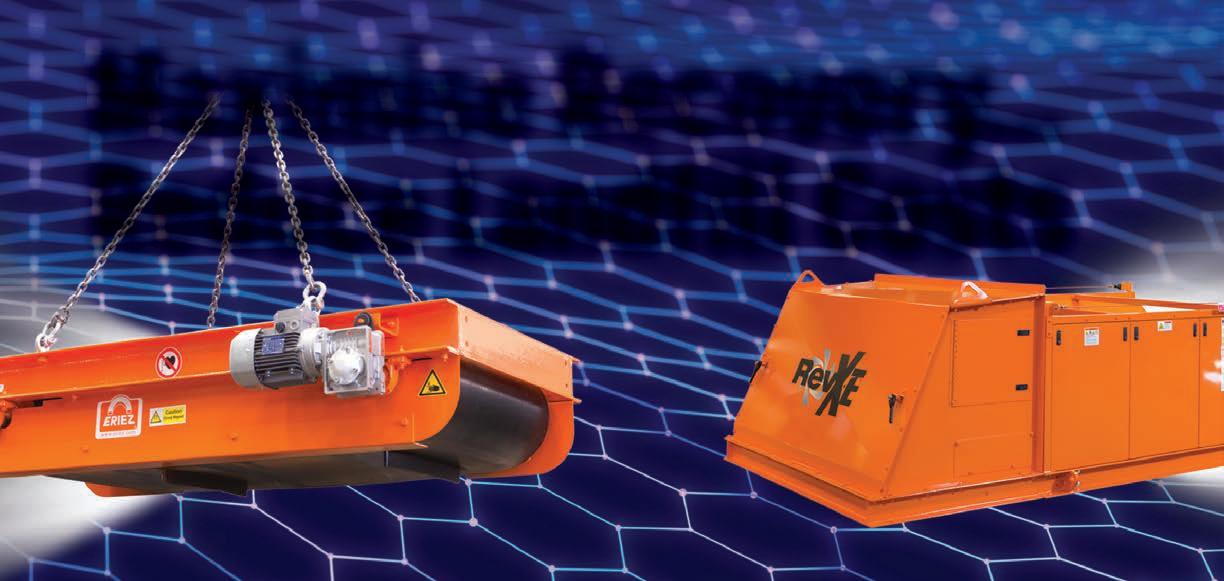
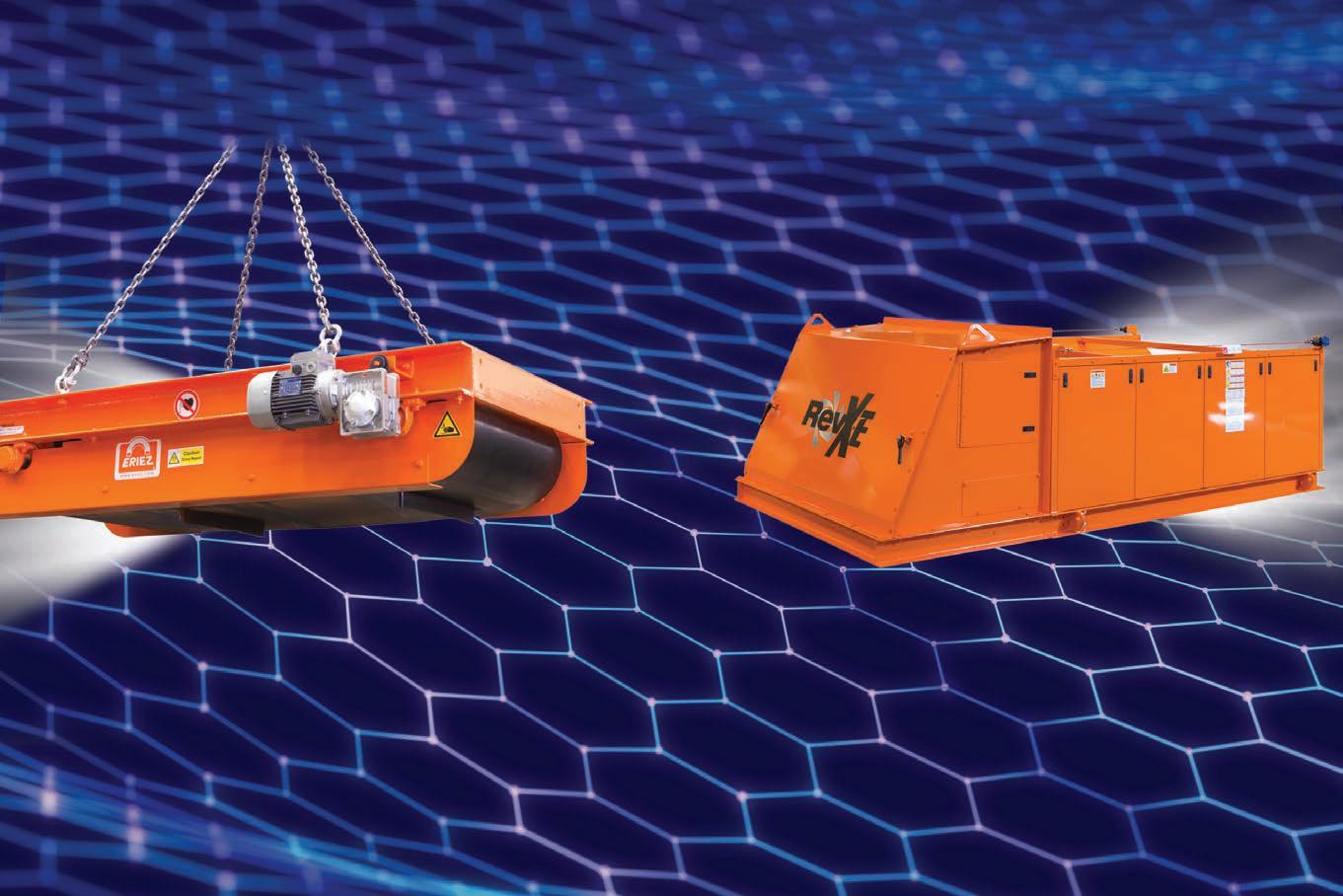
WASTE MANAGEMENT IN ACTION – SHREDDERS 62 / WMR / July 2023
The TANA Shark enables full control of the particle size.
easily be removed through an opening side wall.”


TANA Shark operates on a hydrostatic power transmission identical to the one used in TANA landfill compactors, including a patented swing-frame system, which protects the gears.
While Sam’s won over by the TANA Shark’s capabilities, he says the economic benefits and GCM Enviro’s service and professionalism is another reason Tempe Tyres made the switch.
Transporting tyres intact is very expensive, most of the airspace is lost due to the form of the tyre, which is far from ideal and reduces profits. With the price of freight increasing, the Shark allows four times the amount of material to be loaded for one trip which reduces transportation costs by 75 per cent.
“And GCM Enviro is local,” Sam says. “Whatever you want, the parts are available in Australia. That’s very

important when you’re running a business like this.









“You don’t want equipment to be idle for days while you’re waiting for parts.”

Adam says customer service is a big part of GCM Enviro’s ethos.
For almost three decades it’s been helping customers turn waste to wealth with equipment built for the job including landfill compactors, compost windrow tuners and sorting and screening equipment.
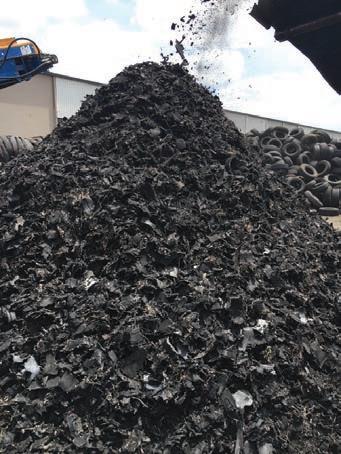
The company has stayed ahead of the game through constant dialogue between manufacturers and clients to ensure machines meet changing industry requirements.










As a case in point, Adam points out that the TANA Shark is heavier in weight than competitors because of its steel structure.
The material of the wearing parts is tailor-made for TANA, as a result of years of testing, analysis and customer trials.


For more information, visit: www.gcmenviro.com

613 8401 7400 | Eriez.com.au Maximise Recovery... Reduce Landfill Costs EDDY CURRENT SEPARATOR • Powerful rare earth magnets • Greater launch force • High frequency pole change rate • Superior fine & micro fine separation OVER BELT SUSPENDED MAGNETS • Effectively recover ferrous metals • Twin pole design • High strength magnetic circuit • 12’ Suspension height
waste. See us at Australasian Waste & Recycling Expo 26-27 July, Sydney Stand D39 ERIEZ_ TP_ECSAd_WMR6_23.qxp_Layout 1 5/8/23 4:49 PM Page 1
The TANA Shark can cut through the most challenging material from tyres to industrial waste.
Eriez
equipment provides the recycling industry with the necessary tools to recover mixed metals from comingled
Crushing e-cigarette battery risks
LITHIUM-ION BATTERIES PRESENT A UNIQUE DANGER TO THE RECYCLING AND WASTE MANAGEMENT INDUSTRIES THAT REQUIRES A SPECIALISED FIRE SUPPRESSION SOLUTION.
E-cigarettes and their lithium batteries are hazardous once they are disposed of. They pose an even bigger potential issue when not disposed of correctly.
Batteries have always presented a unique danger for waste management facilities and require specialised fire suppression solutions. Wastech Engineering provides clients with fire suppression systems that can significantly reduce fire risk.
Wastech was founded in 1993 and is an Australian design, engineering and manufacturing company servicing the waste management and resource recovery sectors across Australia and New Zealand. Under the leadership of Garreth Dorey,
General Manager of Sales and Marketing, Wastech is building on its partnership with Fire Rover out of North America. Fire Rover sought to partner with a local provider, and Wastech met this need.
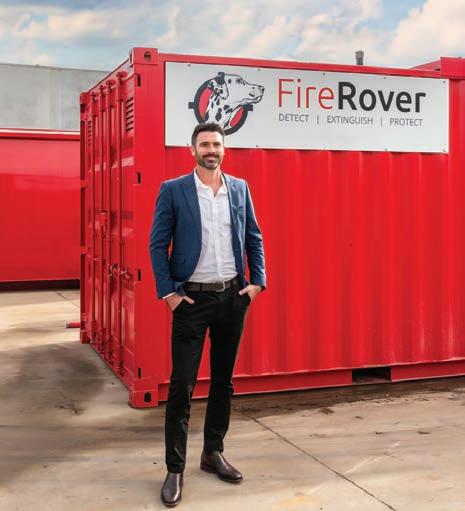
“Partnering with us made perfect sense for Fire Rover,” Garreth says. “We are one of Australia and New Zealand’s leading companies focusing on waste management equipment and solutions. Wastech is Australian-owned and operated, and we have a proud 30-year history. Our goal is to become a one-stop shop for the waste management and resource recovery sector.”
Battery-related fires tend to result from unsafe handling of batteries at waste and resource recovery facilities. Compacting, shredding, and exposure to other components within the waste stream can cause batteries to become damaged, which can quickly lead to fires.
“The big problem around lithium batteries and e-cigarettes is that they are often mixed in with other waste and can self-ignite,” Garreth says. “This can quickly spread to surrounding material within the waste stream. Once this occurs, it does not take much for a fire to burn down a truck or facility in just minutes.
“We estimate that lithium-ion-related fires cost the Australian waste industry in excess of $200M annually. As well as the direct financial cost, fires pose a considerable business interruption risk.”
Existing fire sprinkler systems are not always effective for battery fires. Lithium,
the major component in consumer batteries and electronic vehicles (EVs), reacts explosively with water. The reaction forms lithium hydroxide and hydrogen, the latter being extremely flammable. As a result, Garreth says, trying to extinguish a battery fire with water can only worsen it.
“This is the big difference between encapsulating agents, water, and foams. Water alone is not the right approach. Our environmentally safe encapsulating agent is 150 times ‘wetter’ than water alone and with our remote intervention is the first respondent, suppressing the fire and soaking the material surrounding the outbreak to minimise further risk,” he says.
“The Fire Rover encapsulating agent does not contain PFAS and encapsulates the fire to suppress and put it out. When we watched a staged firefight against a tyre fire, it was seen to put the fire out within 10 seconds. Traditional firefighting foam took over two minutes to extinguish the same fire.
“The other factor to consider from this example is re-ignition risk. Traditional methods did put the fire out; however, the fire reignited later that night, that caused another risk on-site that could have been prevented. The key to success is early intervention for several reasons. A lower-intensity fire means less risk to lives and infrastructure, which is what Fire Rover assists with. We are monitoring remotely, so we can see what the human eye can’t, act fast
WASTE MANAGEMENT IN ACTION – FIRE SUPPRESSION 64 / WMR / July 2023
Garreth Dorey, Wastech General Manager of Sales and Marketing, says the Fire Rover can detect fires before they take hold.
to suppress the fire and alert the site and authorities,” Garreth says.
He says Fire Rover is now located at more than 400 facilities in the US and recently expanded into France and the UK. Advanced thermal cameras are equipped to detect even the slightest rise in temperature, and these are combined with smoke and flame analytics. A 24/7 remote monitoring team identifies the threat. It instantly deploys an encapsulating agent at the base of the hotspot to cool it down and cut off the oxygen supply. During 2022 there were nearly 400 significant fires in facilities across the US, none on sites with Fire Rover.
“The 24/7 monitoring is a vital feature of the system. It’s designed to support the site, emergency services and facility management while preventing a fire from taking place. Alerting the site and authorities while being part of early suppression reduces the risk of the fire developing and reduces risk. We are a crucial part of the onsite intervention and the logical choice for early intervention,” Garreth says.
Traditional fire suppression systems are also only effective in a small area. While
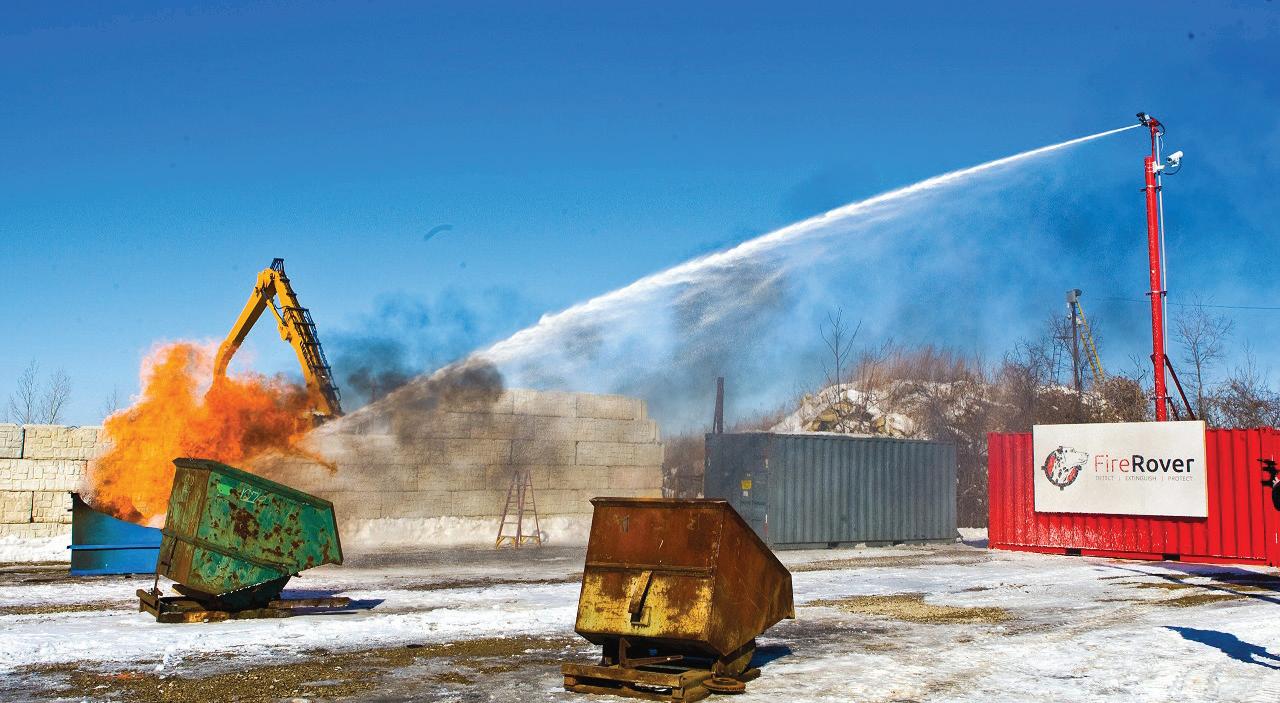
they may put out a small battery fire, they cannot deal with overheating batteries in the vicinity without the presence of flames. Ineffective fire suppression means that the danger of a fire is present even after the system has deployed its fire-suppressing system. The Fire Rover system detects all abnormal thermal signatures in real time and extinguishes them immediately.
The systems are customised to facility requirements and provide 24/7, realtime monitoring.
“Fire Rover is suppressing fires fast through its detection before they take hold,” Garreth says. “A fire can engulf a facility in minutes, particularly when lithium batteries and other combustible materials exist. Fires can grow exponentially and double in intensity every 30 seconds, so preventing the fire from taking hold is key. As Fire Rover is controlled remotely, we also reduce the risk to employees and firefighters who would traditionally be the first to respond.”
By identifying all batteries that may be on the verge of thermal runaway, a fire incident is safer for firefighters who avoid the risk of entering a facility where
batteries are about to ignite. Militarygrade thermal imaging means the facility is safe from sudden combustion.
One of the biggest challenges for waste management companies is that most insurers will not provide coverage to waste management companies.
Garreth believes only one or two insurance companies are willing to insure waste management companies.
However, the premiums can be exorbitant, encouraging the facilities to calculate the risk around prevention or to self-insure.
“Cost is a huge factor for some of these facilities,” he says. “They can be running on really low margins. The difference between profit and loss can be finite.
“Risk within these waste and resource streams comes with the territory. These facilities would rather have a system that can detect any potential risk before it happens. There has been no significant loss in the US where Fire Rover has been installed.
“Fire Rover can fill this gap for waste management facilities.”
For more information, visit www.wastech.com.au
www.wastemanagementreview.com.au / WMR / 65
The Fire Rover detects all abnormal thermal signatures in real time and extinguishes them.
Rule the road
STG GLOBAL IS TAKING WASTE TRUCK MANUFACTURING AND DESIGN TO NEW HEIGHTS, WITH ADVANCED TECHNOLOGY AND INNOVATION THE CROWNING GLORY.
Muhammad S. Alam wants STG Global waste trucks to be considered the Queens of the road.
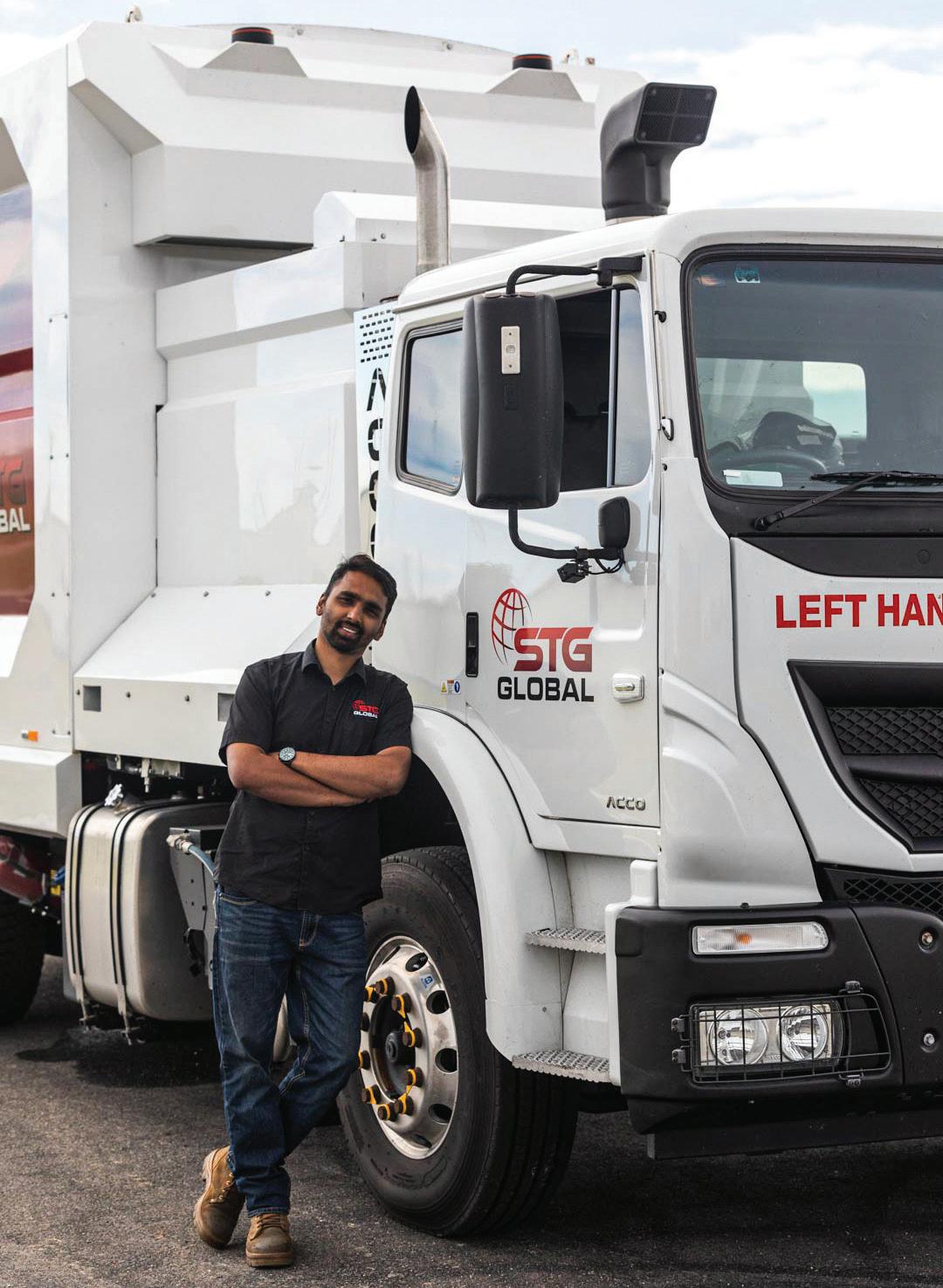
The Head of Engineering and General Manager for Waste Sector at STG, Muhammad has the credentials to get them there. He previously worked on Boeing 747s – dubbed the Queen of the Skies.
By his own admission, Muhammad’s work with aircrafts has made him particular about aesthetics and smart engineering. Since joining STG Global three years ago, he’s focused that penchant on lifting the already recognised specialised truck body manufacturer to new heights.
With an emphasis on customer service, he has integrated advanced technology and innovations into the next generation of STG trucks.
“We wanted to make these trucks future-proof and build something customers can take pride in,” Muhammad says.
For the past 30 years, STG Global has delivered ground-breaking waste trucks including The Bandit Side Loader, Tusk Frontloader, Vacuum Jetter trucks as well as partnered with international companies such as Aebi Schmidt and NewWay Trucks.
Muhammad says the latest STG Global trucks are ‘smart trucks’, with advanced functionality including a single digital screen and selfdiagnostic capabilities.
The single screen, an iPad Pro that connects with the STG Global app, has everything a truck operator would need
WASTE MANAGEMENT IN ACTION – WASTE COLLECTION AND TRANSPORT 66 / WMR / July 2023
Muhammad S. Alam is using his aviation background to introduce new technology to STG Global’s waste trucks.
at the tip of their finger. If there’s a fault, the truck’s self-diagnostic system will alert STG Global technicians, who can dial in and fix it remotely.
The trucks are also aesthetically pleasing with a modern shape and ‘futuristic’ outer cladding that makes the truck body stronger, giving waste collectors more payload.
An in-house design team has spent several years designing the modifications. Most of the changes have been developed by listening to what customers want and then integrating those features into the truck.
“One of the rules we had when designing the waste trucks was to spend time on the road with operators,” Muhammad says.
“We would listen to what they like and what they don’t like and then try to improve our design to address their concerns.
“The operators have the most knowledge about what works for them. We really wanted to harness that and improve the design to give them the truck they’ve always wanted.”
Muhammad says the iPad is a big selling feature of the trucks. Most trucks currently have three to four screens in
the dashboard including cameras, data management and system interfaces that can be distracting for operators. The STG Global app incorporates everything into the iPad.
The use of an iPad also means it can be regularly updated, is easily replaced, or can be used outside of the truck.
“If you look at modern cars such as Tesla, they’ve gone away from traditional physical buttons for their HMI (Human Machine Interface) and are using digital screen in the dashboard for all the infographics they need, just like what we do with an iPad in our truck cabins,” Muhammad says.
“The single screen interface in waste trucks is the way forward.”
He says STG Global’s capability to dial into a truck anywhere in the world and the system to run diagnostics on sensors and outputs also sets them apart.
It’s already having an impact in the industry with several waste management companies using the trucks in remote or regional areas of Western Australia and Queensland where previously they couldn’t get after-sales support and service.
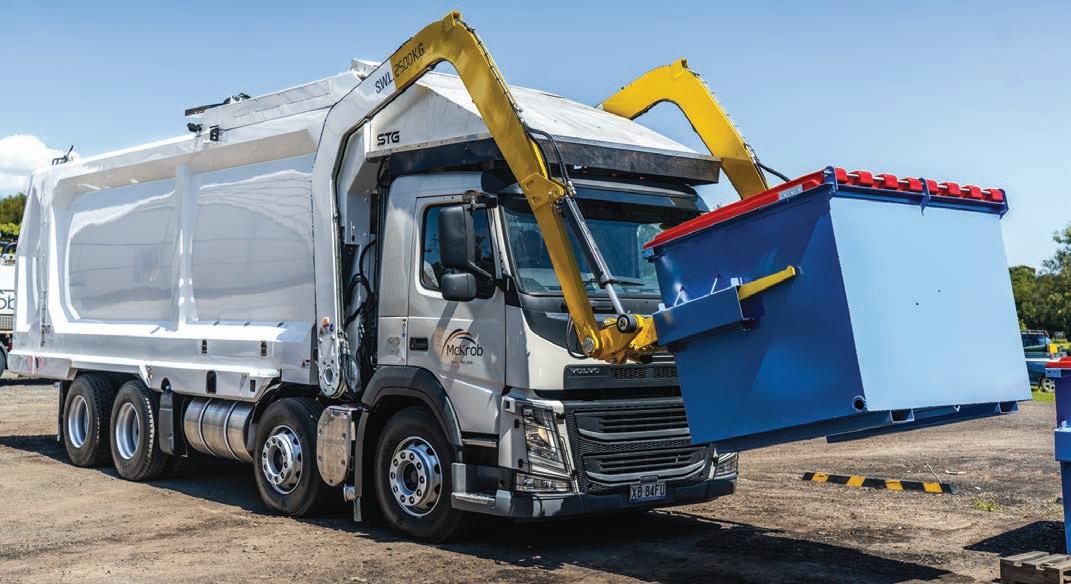
“We’re confident in our trucks and our product and want to be able to support
regional councils and companies,” Muhammad says.
“When you’re managing a small council with only two trucks and one breaks down, the bins don’t get picked up and it gets very messy. That’s what we’ve tried to solve; the frustrations of our customers by having a modular design on our waste trucks.
“Our ability to remote dial in to support customers is already streamlining processes for some remote areas.”
STG Global’s onshore manufacturing is also streamlining processes. The company currently has a four-to-sixweek lead time for trucks and has a large stock of critical spare parts.
Muhammad describes the past three years as an exciting journey, but it doesn’t stop there.
“It’s an ongoing process,” he says.
“At STG Global, we have been able to achieve such heights by working together as a team. Our spirit is driven by a, One Team One Dream philosophy. Only with teamwork, we can achieve new horizons. We won’t settle. We really want these trucks to go international.”
For more information, visit: www.stgglobal.net
www.wastemanagementreview.com.au / WMR / 67
STG Global’s Tusk Frontloader with the newly designed truck body.
Future looks bright
FUTURE RECYCLING MANAGING DIRECTOR TYRONE LANDSMAN EXPLAINS WHY MANUFACTURER SUPPORT FOR EQUIPMENT IS JUST AS IMPORTANT AS PERFORMANCE.
Like many ‘overnight’ success stories, Tyrone Landsman’s began more than 30 years ago.
He cut his teeth in the waste and recycling sector as a salesman, taking on various roles along the way. He’s now at the helm of Future Recycling, a burgeoning waste management company with metal recycling and waste transfer centres across Victoria.
Future Recycling has built a presence in resource recovery in Melbourne’s south-eastern suburbs. Key to its success is Tyrone’s ability to pivot the company to stay focused in the everchanging environment in the waste and recycling industry.
“One of the key aspects of the business was always looking forward,” Tyrone says. “Over the journey we’ve grown substantially.”
Future Recycling began as Fletcher Metals, in Shepparton, country Victoria. It was purchased by Tom Garret and Stuart Miller in 2007 and Tyrone came on board in 2008 as the company looked to break into the Melbourne market.
National Metals was welcomed into the fold in 2008. In line with a strategy of diversification and growth, Pakenham Transfer Station was next in 2016.
In 2018, Future Metals, Cardinia Transfer Station and Pak Bin Hire became Future Recycling, with Tyrone as the sole director.
Tyrone has invested in infrastructure and equipment to ensure best practice at each of the facilities. In November 2022, a new Future Recycling Waste
Transfer Station was opened next door to the original metal recycling facility at Hallam.
One of the key components of running a successful facility is equipment you can rely on. And for the heavy lifting required at both the Hallam and Dandenong sites, Tyrone
called in Liebherr. A Liebherr LH 22 M material handler will be deployed to Hallam, while a larger, LH 40 M will be used at the Dandenong scrap yard.
“We want to make sure we’re running top material handlers,” Tyrone says. “When it comes to quality of the build, Liebherr is one of the best.”
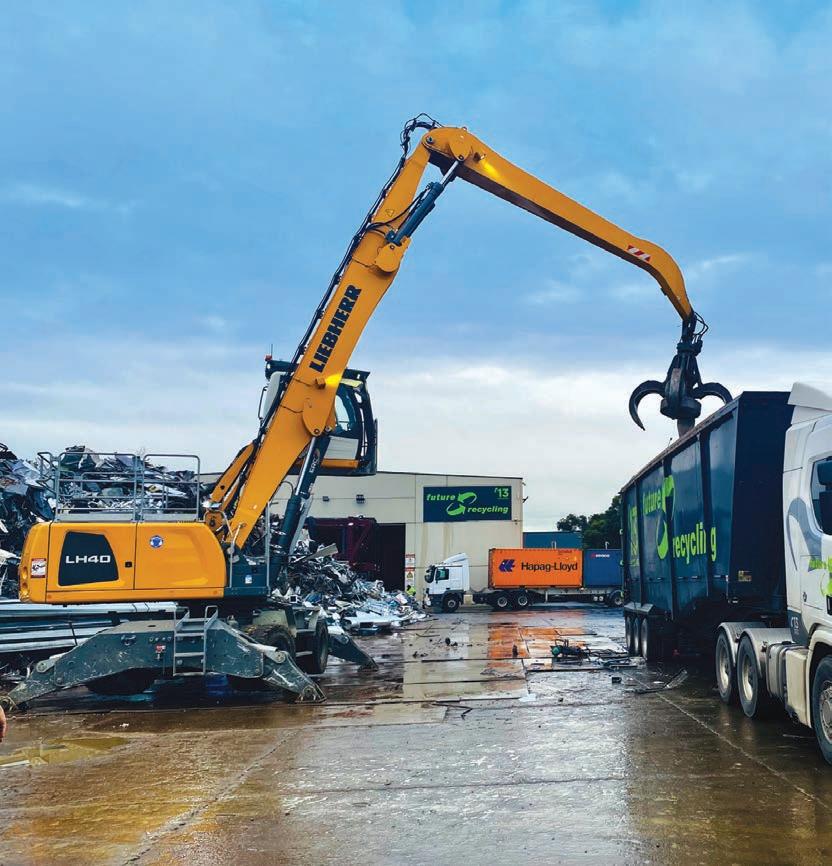
WASTE MANAGEMENT IN ACTION – MATERIAL HANDLERS 68 / WMR / July 2023
Future Recycling’s LH 40 M has a grab attachment with a magnet to lift scrap metal.
The LH 22 M has a compact design, which makes it suitable for deployment in waste management and recycling. With the latest engine and hydraulics technology, a focus is on fuel efficiency while at the same time enhancing material handling performance.
Future Recycling has previously used excavators to move material around the yards, however Tyrone says operators had restricted vision. With material handlers, cabins are designed to be raised up to six metres, giving operators a clear view of the work site.
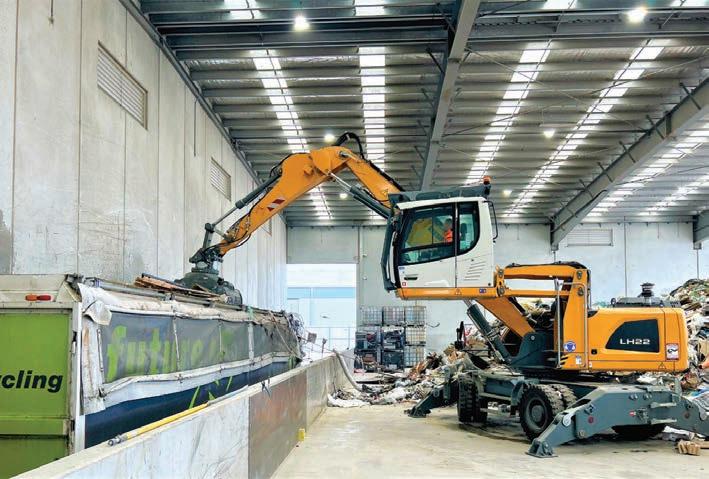
Another benefit is the ability to compact truckloads of material, helping achieve optimum carrying weight.
“If your optimum truck weight is 22 tonnes and you miss it by two tonnes every load for 11 trips, that’s an extra load you’re having to do,” Tyrone says.
“It’s important you can get your optimum weight every time.”
The LH 40 M is considered a top performing material handler. Its patented Energy Recovery System (ERS) ensures maximum handling capacity while at the same time lowering overall fuel consumption. This enables a more powerful, homogeneous, and faster work cycle.
The attachment of the machine is also available in a variety of versions. Future Recycling’s LH 40 M has a grab attachment with a magnet that enables an increase in lifting capacity of an additional three to four tonnes.
Tyrone says both material handlers are easy to use, efficient and reliable. But while performance is important, for Tyrone, manufacturer support is just as important.
Tyrone always buys new equipment and ensures it is maintained to minimise downtime at his sites. He says one of the attractions of the Liebherr material handlers was the location of the service centre – just down the road.
Future Recycling has full maintenance contracts with Liebherr for both the LH 22 M and LH 40 M, which means they are regularly serviced and maintained over a five-year period.
“Our core business is scrap metal recycling, it’s not running these machines,” Tyrone says.
“We use them to handle our material. We don’t want any downtime and we don’t want to run old machines or have spare parts lying around.
“With the price of major equipment, you want to make sure you have optimum use of them.”
Tyrone has built up a good rapport with the Liebherr Earthmoving and Material Handling team in Victoria.
He says while the LH 22 M and LH 40 M are relatively new additions to the Future Recycling stable, he’s keen to continue the relationship and build on the company’s position as a recognised waste management provider.
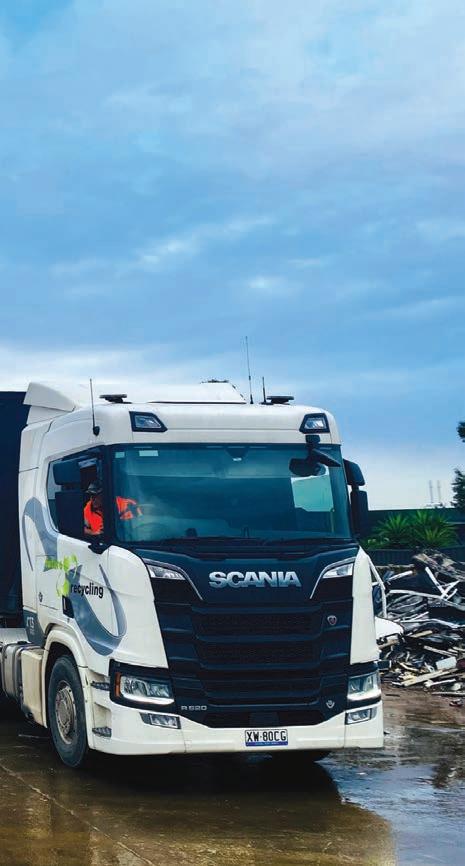
“Who knows,” Tyrone says, ”there could be more material handlers added down the track.”
For more information, visit: www.liebherr.com.au
www.wastemanagementreview.com.au / WMR / 69
The Liebherr LH 22 M has a compact design, making it suitable for waste management and recycling facilities.
No opportunity to waste
THE AUSTRALASIAN WASTE AND RECYCLING EXPO (AWRE) IS RIGHT AROUND THE CORNER, AND ISUZU AUSTRALIA LIMITED (IAL) IS THRILLED TO TAKE PART IN THE TWO-DAY EXHIBITION.
It’s all about promoting ideas and opportunities for Australia’s waste and recycling community at AWRE and Isuzu Trucks is back with transport and aftercare service solutions for businesses to build a stable and sustainable truck fleet.
On the stand at AWRE, Isuzu Trucks will be displaying a side-loading FVY 240–300 Auto MWB, ideally suited for urban waste and refuse applications.
Loaded with safety features such as Isuzu’s Advanced Driver Assistance Systems and the comfort of an Isri 6860 air suspension seat, this FVY promises to give operators a safer and more comfortable experience during long shifts.
It’s the newest incarnation of Isuzu’s hard-wearing, medium-duty trucks to hit the streets, cementing a broader model line-up of city-smart trucks as the brand enjoys its 34th consecutive year at the top of Australia’s truck market.
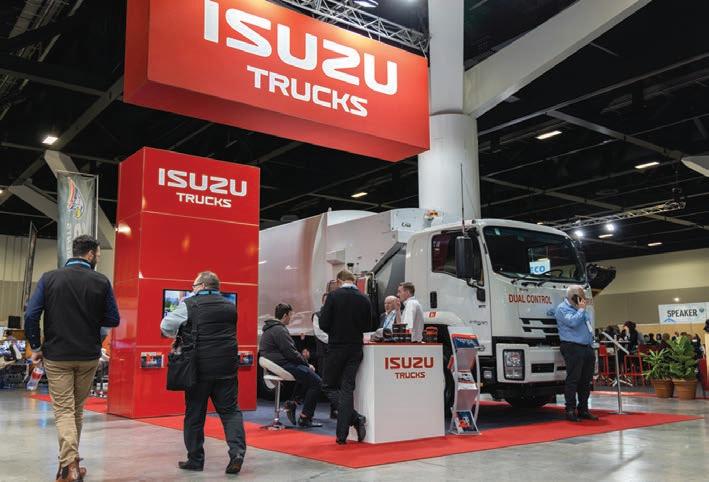
GREEN MACHINE
Change always starts at home, and in keeping with the spirit of AWRE, in 2022 Isuzu began working with the Australian Packaging Covenant Organisation (APCO) to create a strategy for recycling and repurposing targets. APCO is a not-for-profit organisation leading the development of a circular economy for more sustainable packaging strategy in Australia.
Like many companies charged with the distribution of products with large amounts of freight packaging, Isuzu
has taken the pledge to meet APCO’s 2025 targets and is making solid strides towards this goal.

APCO’s 2025 target include: 100 per cent reusable, recyclable or compostable packaging; 70 per cent of plastic packaging being recycled or composted; 50 per cent of average recycled content included in packaging; and the phase-out of unnecessary single-use plastics packaging.
The Isuzu Parts operation picks, packs, and ships about 7300 tonnes of parts every year, with the volume growing annually as the company continues to break sales records.
Isuzu’s Parts department has reused or recycled about 90 per cent of all packaging that comes in from overseas, which is a sizeable quantity of material being
kept out of landfill and in circulation. Outbound bubble wrap is now made up of 30 per cent recycled material while itself remaining fully recyclable. With biodegradable packaging tape and recyclable shrink wrap to be introduced this year, Isuzu’s newly formed supply chain department is challenging itself to go as green as possible.
Well ahead of the intended goal, Isuzu has no plans to slip into complacency.
NOTHING RUBBISH HERE
Jari Maatta is one of many happy customers supported by Isuzu Trucks in the business of waste removal.
He’s the industrious owner-operator of AAA Skip Bins, located in Bundaberg, north Queensland. In 2016, Jari took the
WASTE MANAGEMENT IN ACTION – TRANSPORTATION 70 / WMR / July 2023
Isuzu Trucks will return to the Australasian Waste and Recycling Expo in July.
business on when he saw an opportunity while renovating and managing a housing project.
Starting out with just the one 1990 Isuzu FRR 500 – purchased along with the business from the original owner – Jari has taken AAA Skip Bins to the next level.
From a fresh new colour scheme, the clever name which stands for Affordable, Anytime, Anywhere, and an overall expansion of the business’s capacity and customer service, Jari has personified innovation at every turn.
The newest edition to the fleet of mostly hook-lift trucks is a 2022 Isuzu NQR 87-190 which is already pulling its weight for Jari.
Bundaberg is just one regional city in Queensland that has begun experiencing a population boom, with an influx of residents from capital cities relocating to outer centres for work, family, and
housing affordability. Waste removal businesses such as AAA Skip Bins play a major role in keeping rural and regional cities clean.
Business has boomed for Jari thanks to the increase in population and new housing developments being built.
With a GVM of 8700 kg and sporting Isuzu’s 4-cylinder, 16-valve 4HK1-TCC engine, Jari’s need for more bang-for-buck has been realised.
“My NQR is a medium wheelbase which is exactly what I needed because we do a lot of inside access work in the city and around construction sites,” says Jari.
“The overall size and manoeuvrability were a really important factor when purchasing it.
“All my trucks are automatic; I find the automated manual transmission fantastic.”
The six-speed AMT on the NQR 87190 makes manoeuvring between houses
and tight streets that much easier for Jari, making it the ideal upgrade for the AAA fleet.
WHEN WASTE DUTY CALLS
The waste industry is changing rapidly, as are the businesses that use waste services –both in and out of city centres.

From supplying trucks for regional Australian businesses to manage rubbish removal, to reducing its own packaging and amping up recycling activities, Isuzu is committed to responsible waste management and supporting the sector with smarter transport solutions.
Visit Isuzu Trucks at stand C28 at AWRE, from the 26-27 July at ICC Sydney and explore the offerings available to the waste and recycling industry.
For more information, visit: www.isuzu.com.au
Working together towards a truly Circular Economy Go Circular C all 02 8541 6169 or email info@mraconsulting.com.au mraconsulting.com.au MRA’s award-winning team can deliver waste audits, material flow analysis and Circular Economy action plans for your business.
Made tough
THE BOMAG LANDFILL COMPACTOR RANGE IS MADE TO TACKLE EVEN THE TOUGHEST LANDFILL SITES.
Today’s landfills are carefully engineered structures designed to contain waste and its byproducts. Dozers, excavators, wheel loaders and especially compactors are used mostly for the special demands and safety requirements of this work.
John Glossat, National Business Development Manager from Tutt Bryant Equipment, says there is more to successful compaction than just having a compactor.
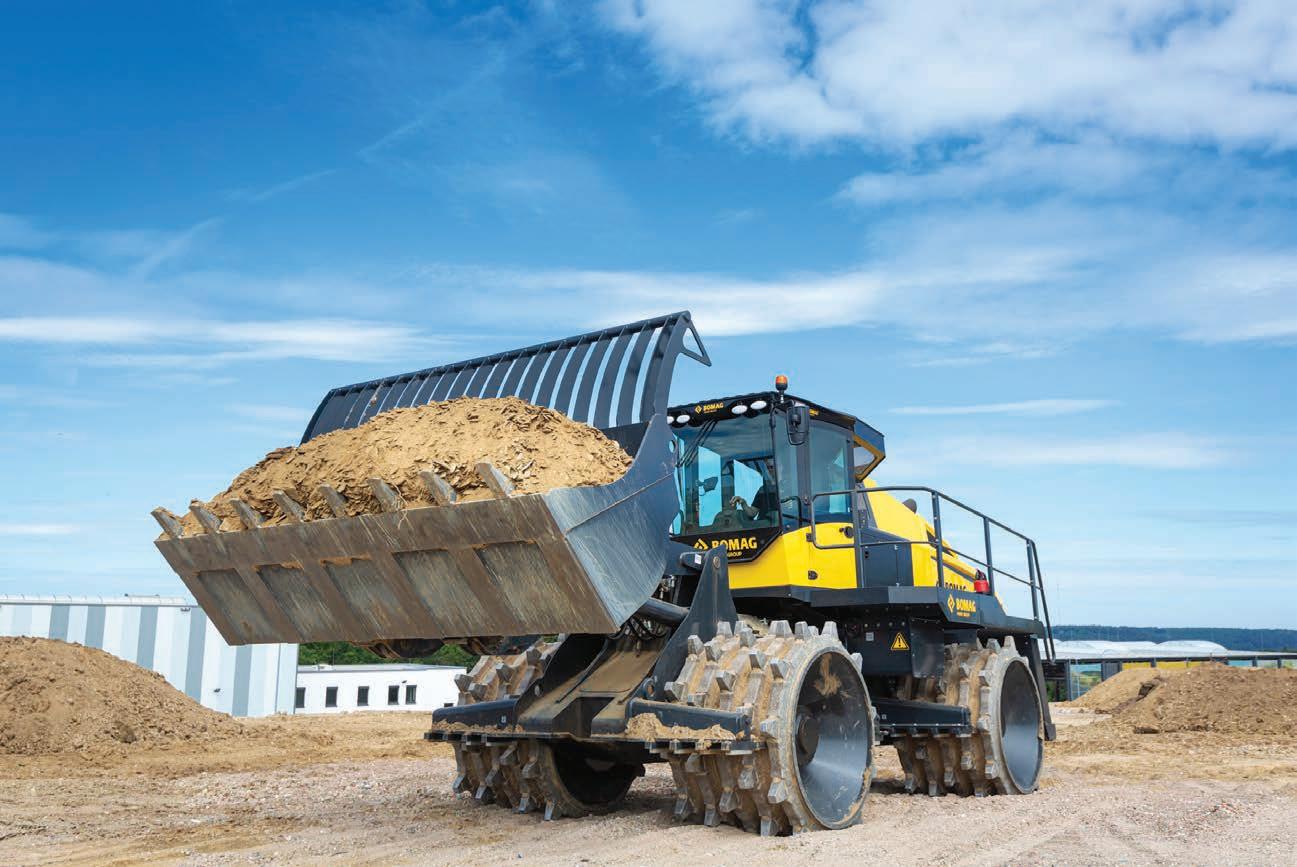
“There is a general assumption that most landfills will automatically be equipped with a compactor. But there’s so much more to getting the job done right than just having a compactor –
you must have the right machine for the job and provide your team with the training and resources they need to use it productively,” he says.
Tutt Bryant Equipment, together with compaction technology manufacturer BOMAG, are using their specialist employees and machinery to tackle one landfill at a time.
BOMAG is a recognised name in compaction technology, it provides a range of machines for the compaction of soil, asphalt, and refuse. It also offers professional solutions supporting roadworks, construction, earthmoving, horticultural and recycling industries.
Its landfill compactor line spans a range of abilities to tackle tasks from soil to landfill compaction. The landfill compactors are one line of BOMAG machines that, John says, has stamped a footprint in the Australian market.
“BOMAG has developed its compactors in conjunction with operators from around the world to achieve the best possible outcome for landfill owners and operators,” he says.
“These machines are specifically designed with technologies to operate in even the toughest conditions.”
BOMAG landfill compactors are designed to work in difficult
WASTE MANAGEMENT IN ACTION – LANDFILL COMPACTORS 72 / WMR / July 2023
BOMAG landfill compactors make light work of even the hardest to compact material.
conditions. John says the effort of the machine depends on several factors.
“The type of waste, the moisture content, the size and type of machine, operator technique, slope and many other factors all contribute to the effort of the machine. Some material reaches optimum density in one or two passes, other material might take six or more,” he says.
The key to success is knowing the machine you’re working with and choosing the right option for the job. Environmental factors and the type of machine also need to be considered.
“Many factors come into play when selecting equipment, things such as maximum waste tonnage and working hours per day, pushing distance in meters, percentage of biodegradable material, operation mode (whether it be uphill or downhill) and what blade is being used should all be considered,” John says.
“Let’s face it, if you don’t have the right compactor on site, no proper compaction takes place. Waste would simply pile up and you’re left with a large pile of rubbish that a dozer could
spread but not deliver the density required. The BOMAG compaction capabilities work to get the best results, not only out of the waste materials, but the operators as well.”
While the machine’s main purpose is for the spread and compaction of waste materials on landfill sites, John says there are many other features that make them unique.
“The oscillating and articulating joint keeps all wheels firm on the ground to deliver consistent ground contact and pressure at all times,” he says.
“Other benefits include the scraper at the front and rear and the offset from front of rear wheels. Standard side cutters also clear or cut debris that may get tangled such as cables or wires.
“The landfill compactors also have a high air intake some four plus metres above ground, allowing clean air to flow through the machine with ease anytime.”
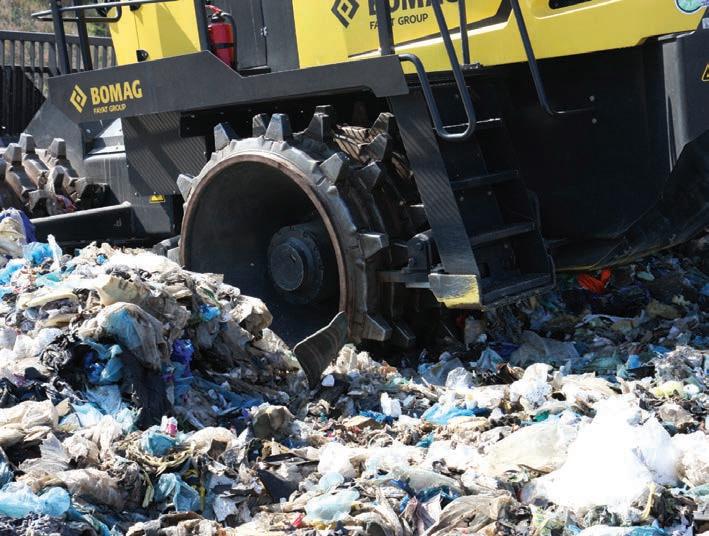
John says that Tutt Bryant Equipment is the sole National Dealer for BOMAG, and jointly, they hope to continue to support landfills Australia wide with their compaction needs.
“It’s important to us that these machines allow landfill owners and operators to complete their daily tasks,” he says.
“Since 1986, BOMAG has had a strong presence within Australia with us, we gain more strength year in and year out.”
For more information, visit: www.tuttbryant.com.au
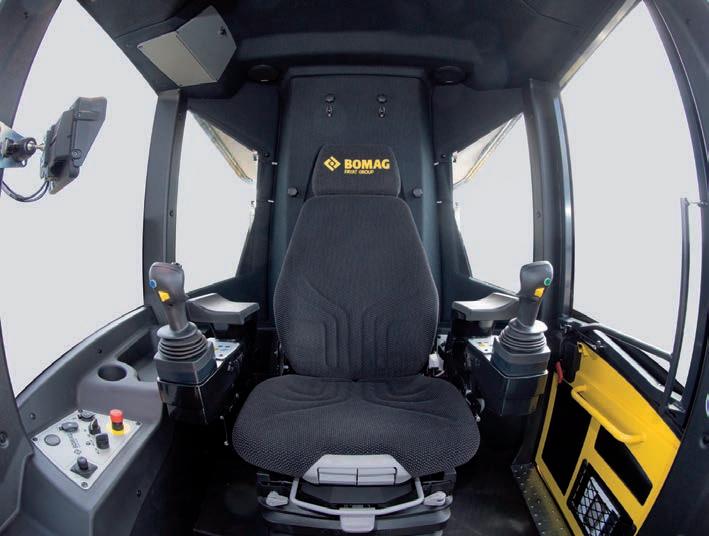
www.wastemanagementreview.com.au / WMR / 73
The BOMAG offers optimised comfort for any operator needs.
BOMAG is pushing the boundaries of landfill compaction.
Recycling, residuals reality check
THE AUSTRALASIAN WASTE AND RECYCLING EXPO IS TAKING PLACE AT THE END OF JULY. AWRE’S EDUCATIONAL PROGRAM IS STEPPING UP A GEAR AS PART OF THIS ANNUAL EVENT.
AWRE is where the best of the waste and recycling industry comes together to drive positive change. It’s the premier business event for the industry, as it seeks to join forces for a world of solutions towards a cleaner, more sustainable future.
It has always been an opportunity to discover an exciting showcase of full-circle innovative products and sustainable solutions, displaying the newest innovations in waste collection, processing, and recycling more smartly.
The Seminar Program is a highlight of the expo, as industry leaders focus on the latest challenges, developments, strategies, and policies. There is a critical need to shape and reshape Australasia’s waste and recycling industry.
RECYCLING AND RESIDUALS
The “Australia’s Reality Check – Recycling and Residuals” summit will be a full day of high-level collaboration between industry, government, and waste generators. The summit will feature keynote sessions, panel discussions and catered networking breaks. It offers delegates a unique opportunity to meet with the speakers and associations that have brought this event together.
Hosted by the National Waste and Recycling Industry Council (NWRIC), Waste Contractors and Recyclers Association of New South Wales (WCRA) and Australian Council of Recycling (ACOR), the summit will
cover topical areas, such as the state of Australia’s resource recovery system. It will also touch on the reality, roadblocks, and solutions to help progress towards national targets and the challenges and policies surrounding residual management in Australia.
There is no ignoring that the resource recovery sector is a constant and essential service in Australia. The hard truth in the 2022 National Waste Report is that Australia has moved backwards, despite increased urgency for an efficient resource recovery system.
This year the AWRE Summit is poised to be a reality check for the industry. It is a much-needed wake-up call on the state of the current resource recovery system in Australia. The Summit will be a crucial platform for exploring solutions to overcome the existing hurdles and drive leadership for effective structural reform. It will explore the roadblocks hindering investment, residual management, and infrastructure challenges.
WHO IS SPEAKING?
The emcee for the Summit has been announced as Rebecca Levingston, the well-loved Mornings presenter on ABC Radio Brisbane. Following a government keynote address, the summit’s first session will delve into the state of the resource recovery system, pointing out that we’ve regressed. It will be an opportunity to hear from four state representatives who will highlight the current roadblocks
and challenges, such as inadequate data collection and analysis and insufficient infrastructure and investment in the industry.
Tony Khoury, the Executive Director of the Waste Contractors and Recyclers Association of NSW, will lead this session. He has been involved in the waste and recycling industry since January 1990. Tony is aware of the many and varied challenges business operators face across the waste management sector. Also
EVENTS 74 / WMR / July 2023
The 2023 AWRE Summit is poised to be a wake-up call on the state of resource recovery.
joining this session will be Brett Lemin, Executive Officer of the Victorian Waste Management Association and Adam Gray, Executive Officer, Waste and Recycling Industry of South Australia (WRISA).
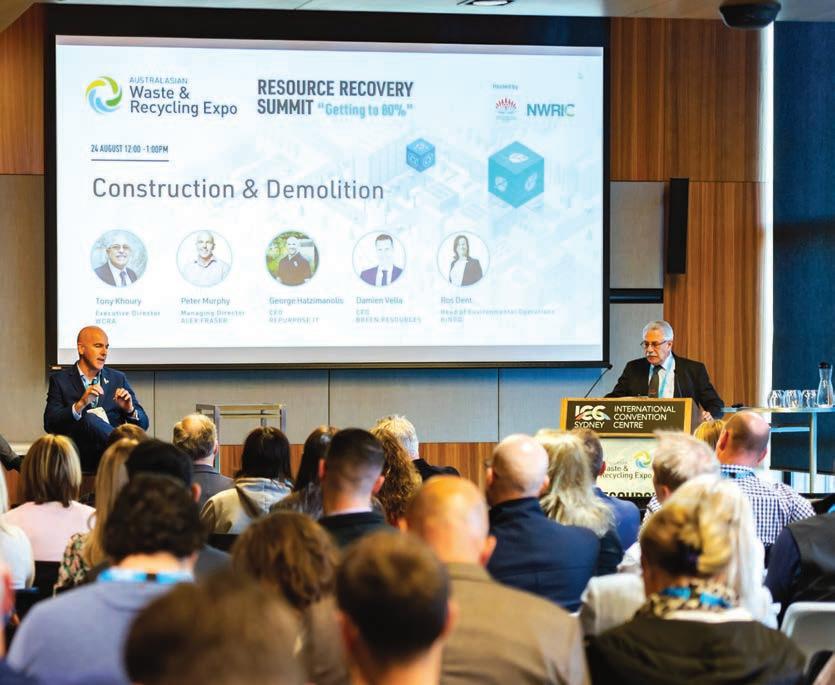

Ross Fox, a Principal of Fishburn Watson O’Brien Lawyers and accredited planning and environmental law specialist, will join him. Fox has a multidisciplinary perspective on the resource recovery sector.
The second session at the summit, curated by Suzanne Toumbourou, CEO of the Australian Council of Recycling (ACOR), will address how to support a thriving resource recovery and recycling sector. Moderated by Jelena Hercegovac, General Manager of Environment and Sustainability at Repurpose It, panellists will include Jim Fairweather, CEO of Tyrecycle.
Given the importance of the circular economy, Graham Knowles from iQ Renew will be an unmissable presentation. Recognising that a circular economy cannot be achieved without an efficient resource recovery and recycling sector, this session will delve into the current state of Australia’s resource recovery and recycling systems. Graham
will review the recent export bans and their impact and explore the challenges and opportunities. He will also discuss practical steps and innovative solutions that need to be taken to drive progress and ensure that Australia is moving forward in this crucial area.
Another significant challenge is the proper use of residual waste instead of sending it to landfill. It is of critical importance for Australia’s waste and resource recovery industry. This session shall be led by moderator Rick Ralph, CEO of the National Waste and Recycling Industry Council (NWRIC). He will be joined by panellists, including Richard Pittard, Head of Sustainability at Cleanaway and Philip Manners, an economist specialising in government policy development and infrastructure from The CIE. The panel will address the challenges of managing residual waste streams and explore topics such as landfill and waste-to-energy solutions, social license and infrastructure hurdles. They will also examine the need for effective national policies and regulations.
INDUSTRY BREAKFAST
New to 2023, AWRE will host an Industry Breakfast on the morning of Thursday, 27 July, with a keynote address by Senator Peter Whish-Wilson representing the Australian Greens. Tickets are limited, so don’t miss your chance to be part of an intimate inconversation session with the senator and a key industry representative as they discuss the state of the waste and recycling industry, what needs to be done now and the outlook for the future.
HOW TO GET TO AWRE?
There is still time to register, get your ticket for the summit, exhibit what you and your organisation offer, sponsor a stream, or lock in a digital opportunity.
For more information, visit: www.awre.com.au
www.wastemanagementreview.com.au / WMR / 75
Bill Hare, Commercial Director, AWRE, addresses the 2022 Summit.
Three cheers
CIRCULARITY, COLLABORATION, AND CONNECTEDNESS – WASTE 2023 PUTS A SPOTLIGHT ON THE THREE Cs NEEDED TO DRIVE CHANGE AND MOVE AUSTRALIA’S WASTE AND RESOURCE RECOVERY INDUSTRY FORWARD.
The Coffs Harbour Waste Conference remit has always been to try and reflect where the waste and resource recovery industry sits.
Greg Freeman, Conference Convenor, couldn’t have been more on target when he set the Waste 2023 theme of Working Together for a Better Future.
Collaboration and connectedness were common threads among keynote speakers and presenters during the
three-day conference. Both are essential if Australia is to reach its circular economy goals to design out waste, keep materials in use and be carbon neutral.
In the words of Rebecca Gilling, Chief Executive Officer of Planet Ark, it will require the greatest feat of collaboration the world has ever seen.
During the conference’s opening session, Rebecca outlined Planet Ark’s ambition to help Australia transition to both a circular and carbon neutral
economy by connecting the dots between governments, businesses, communities, and individuals.
But why a carbon neutral circular economy?
Consensus is that to keep global temperatures below 1.5 degrees the world needs to get to net zero greenhouse gas emissions by 2050. Switching to 100 per cent renewable energy will achieve 55 per cent, the remaining 45 per cent will be achieved by changing the way materials are
EVENTS 76 / WMR / July 2023
The Superfy marquee gave companies a dedicated space to showcase operational equipment.
sourced, used, and recovered – by transitioning to a circular economy.
Rebecca says that alarmingly, most of the important measures are going the wrong way. More greenhouse gases are being emitted every year, although the rate of increase is reducing in some sectors and in some countries; more than 100 billion tonnes of materials are being extracted every year, and the amount of circularity is reducing. In the past two years consumption jumped by more than eight per cent but circularity of materials fell from 9.1 per cent in 2018 to 7.2 per cent in 2023.
“Sadly, we can’t recycle our way out of this,” Rebecca says.
“I don’t want to suggest that recycling is not important, but it is a downstream solution to problems that have been created upstream. We need a whole of system change.”
Cate McQuillen, Creative Producer and Owner of mememe productions, agreed there was a need to challenge the status quo to drive change. Waste 2023 offered the ideal platform.
“There’s a difference between collaborating, and just wanting to do something, and actually coming together to work on a goal together with purpose and value,” Cate says.

“That’s what the challenge is now. It’s not just business collaborations and doing business with somebody, it’s elevating that.
“This is what we’re here to do. We’re not here to do same old, same old. When we collaborate, we get access to new perspectives, knowledge and skills that can help us find innovative solutions to complex problems.”
The theme of collaboration continued through the conference sessions which included a look at education, container deposit schemes, landfill, social enterprise, disaster waste management, soft plastics, and waste service procurement.
Greg says the program reflected current challenges within the waste and resource recovery industry.
“As an industry, we do create the future, we are the future,” Greg says. “When we listen to the speakers here, we’ll understand what the future holds.”
A marquee sponsored by Superfy, returned for a second year to provide companies a dedicated space to showcase operational equipment.
And, for the first time in 10 years, the Excellence in Innovation Awards were back. Sponsored by the Battery Stewardship Council, the
awards acknowledge key people in councils and the non-government sector who work behind the scenes to improve sustainability in the community.
Presenting the awards, Libby Chaplin, Chief Executive Officer of the Battery Stewardship Council, said collaboration is key to innovation. By listening to each other and working together, innovation can be moved to the next level where anything is possible.
“Each of the finalists had the courage to do something differently and create something new,” Libby said.
The Outstanding Council Project Award was won by Canterbury Bankstown Council for developing an artificial intelligence program that detects waste bin contamination.
The Innovative Product or Technology Award was won by Surface Active Foam Fractionation which removes PFAS contamination; while Revolve ReCYCLING was named Revolutionary New Start-up for its program to recover, recycle, repair, and redeploy used bikes.
For more information, visit: www.coffswasteconference.com.au
www.wastemanagementreview.com.au / WMR / 77
Rebecca Gilling, Chief Executive Officer of Planet Ark, during the conference’s opening session.
The RecycleSmart team embraced the 60s theme for the conference dinner.
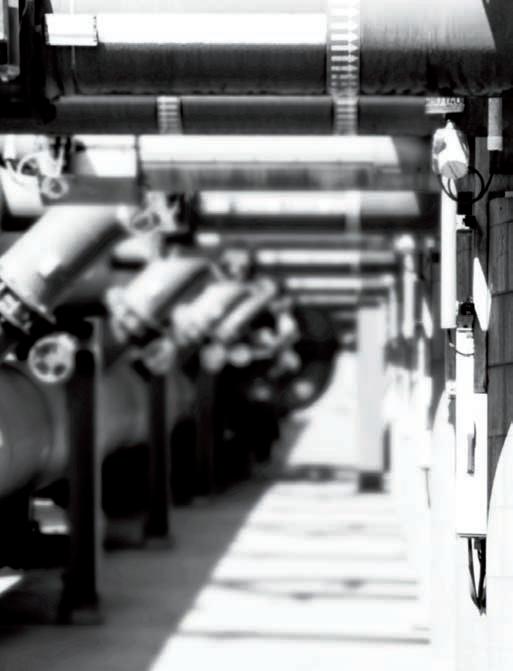
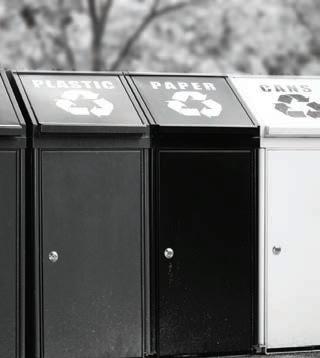



Recognising excellence across the waste, resou rce recovery and recycling sectors. 2023 NOMINATIONS ARE NOW OPEN www.wasteawards.com.au/nominations To nominate visit 25 OCTOBER 2023 SPONSORS HELD IN CONJUNCTION WITH
CEA, KOMPTECH NEMUS
The Komptech Nemus is a powerful and reliable machine designed to handle a range of screening tasks. Known for its quality and reliability, it’s a popular choice for waste management, composting, and biomass processing.
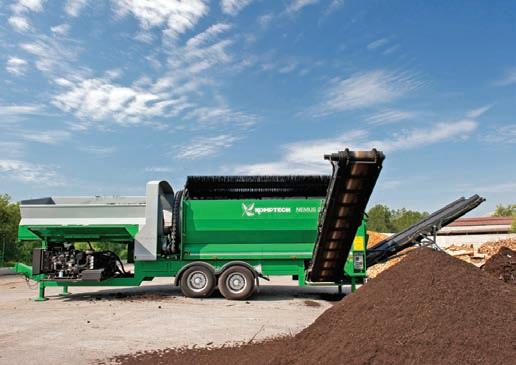
Built to last, the Nemus is designed to withstand the demands of challenging screening applications. Made from quality materials and featuring advanced components that ensure optimal performance, it’s been rigorously tested for quality and reliability.
Equipped with features that enhance its performance and reliability, the Nemus has a large screening surface that provides excellent separation capabilities, allowing it to handle large volumes of material quickly and efficiently.
One of the unique features of the Komptech Nemus is its drum design. With a spiral pattern and punch plate screens available in various sizes and hole patterns, it helps prevent clogging and increases screening efficiency. This means the machine can handle large volumes of material without any issues, which is the
CJD EQUIPMENT, ECR145E EXCAVATOR
Maximise productivity with the Volvo 15-tonne ECR145E excavator. The ECR145E offers a compact design, with a reduced swing radius of under 1.5m, allowing easy manoeuvrability in confined spaces, without compromising on performance.
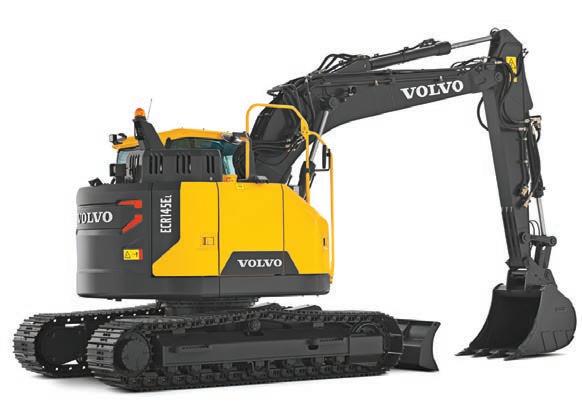
The machine’s system design, specific to the ECR145E, offers a durable under carriage that provides more power for greater traction when climbing gradients and travelling over rough or soft terrain.
The ECR145E has two hydraulic circuits which are proportionately controlled and bi-directional. This allows them to run all kinds of functions and attachments including augers, plate compactors, tilting heads, tilting rotators and anything that functions in multiple directions.
Featuring advanced technology and built on decades of experience, the ECR145E features Volvo’s robust Stage V engine (122hp). These efficient engines are environmentally conscious, with numerous benefits including reduced emissions, a lower total cost of ownership, increased reliability, and reduced maintenance.
Other digital services, such as Volvo’s Dig Assist system, can also be optioned to aid in performing fine
ideal choice for industries requiring high throughput. Versatile enough to handle a wide range of materials and rugged enough to handle even the toughest tasks.
control, highly detailed trimming functions. Used in conjunction with the reduced swing radius, the ability to limit the range of motion available improves safety and reduces the risk of costly repairs as a result of working in tight quarters.
www.wastemanagementreview.com.au / WMR / 79
PRODUCT SPOTLIGHT Contact – CEA P 1300 788 757 E marketadmin@cea.net.au W www.komptechcea.com.au Contact – CJD Equipment P 1300 139 804 W www.cjd.com.au E enquiries@cjd.com.au
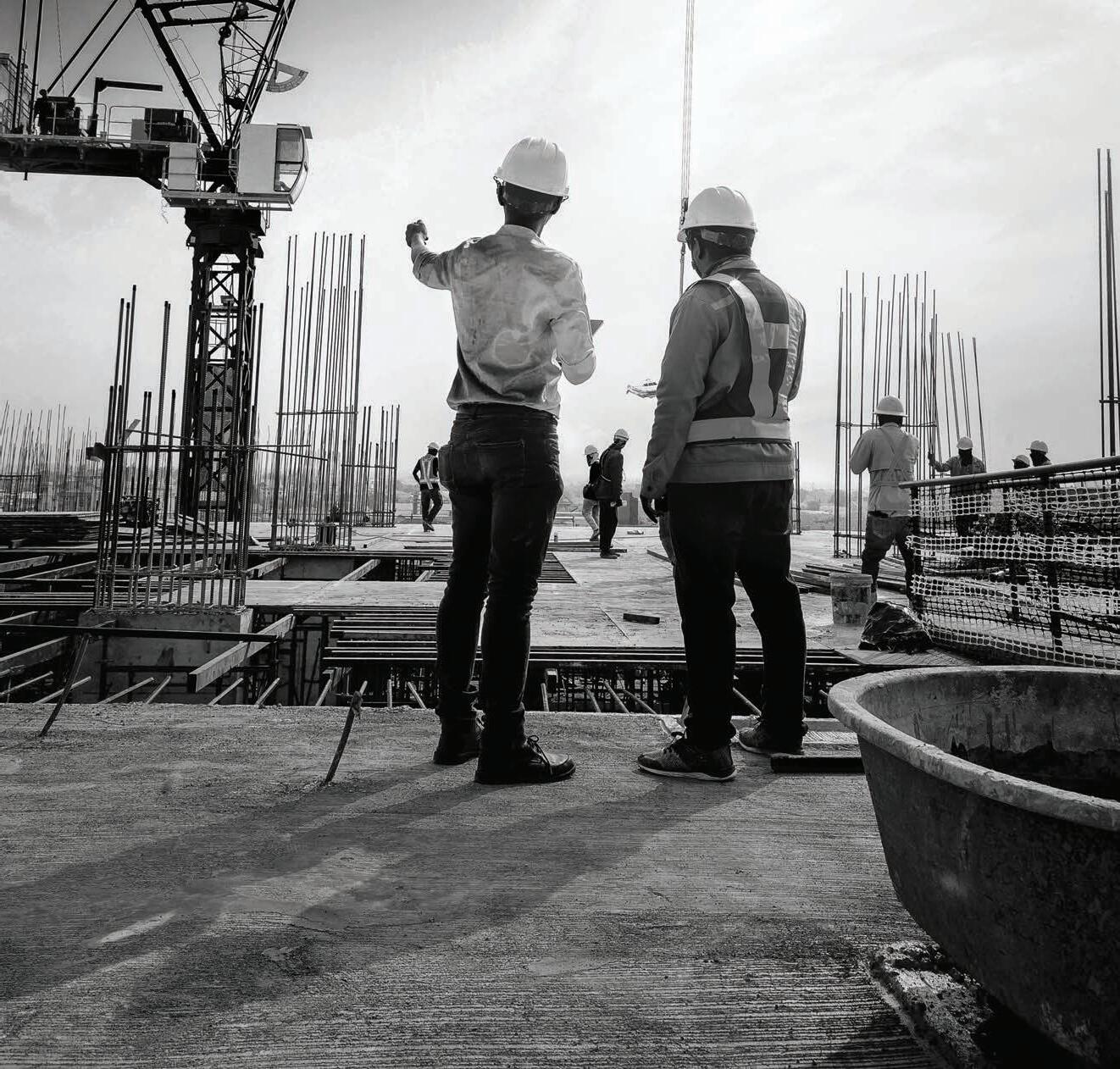
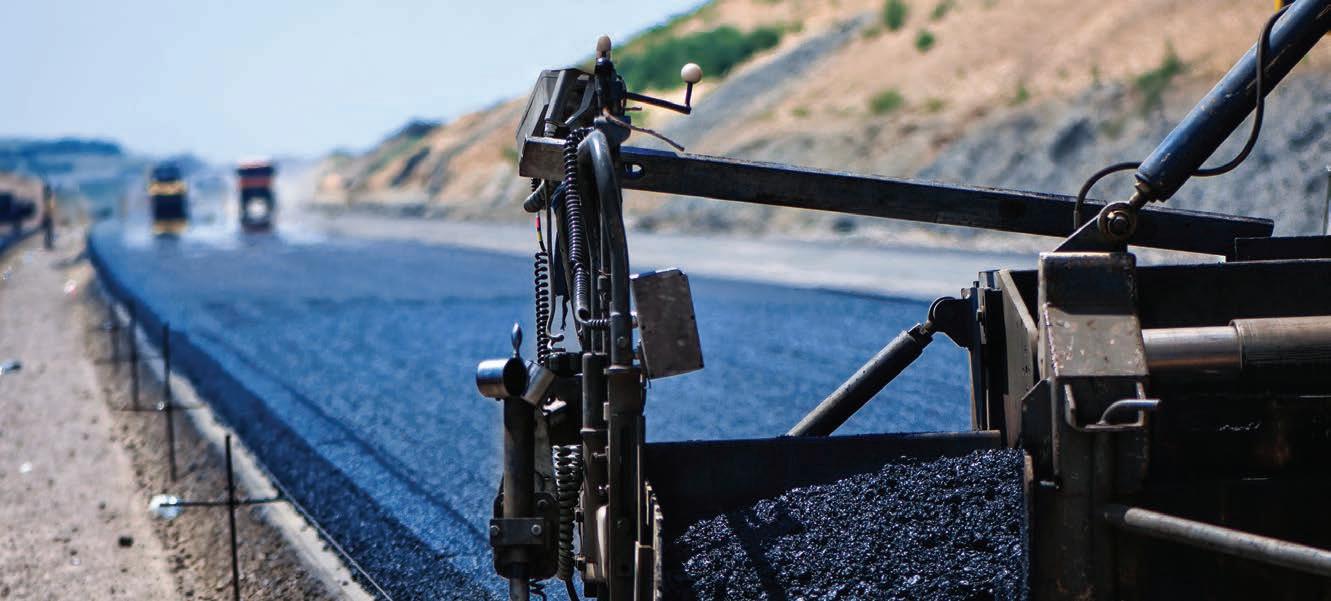






Melbourne Convention and Exhibition Centre 20-21 Sept 2023 CONFERENCE SPONSORS ASSOCIATION PARTNERS SUPPORTING SPONSOR EXHIBITION SPACE NOW ON SALE Melbourne’s leading construction and major infrastructure event insideconstructionexpo.com.au Get your share of major infrastructure projects
Butt what if?
SHANNON MEAD, EXECUTIVE DIRECTOR, NO MORE BUTTS LTD ASKS THE QUESTION: IS RECYCLING CIGARETTE BUTTS A WASTE OF TIME, OR A WASTE RESOURCE?
Cigarette butts. Not only are they unsightly, strewn haphazardly in gutters or, worse, in piles next to the bin, but they are made of cellulose acetate, a plastic that can take up to 15 years to break down.
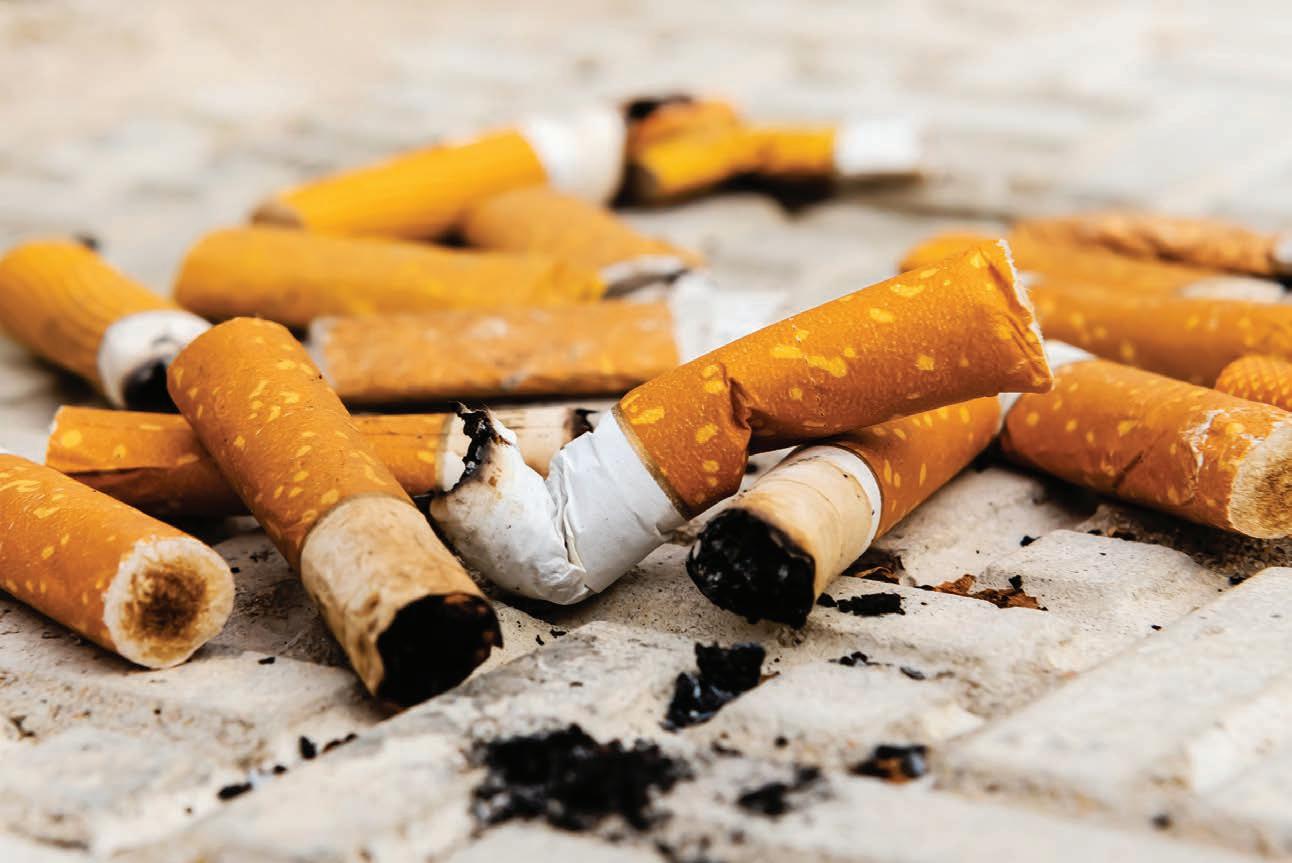
It is estimated that up to 8.9 billion butts are littered in Australia annually. For years, environmental and land care groups have found cigarette butts to be their number one item collected in litter audits.
Data shows that many people still are not aware that tobacco filters are a problem. About 12,000 fibrous strands of cellulose acetate are wrapped in a tipping paper, as part of the construction of the modern-day cigarette. Almost all cigarette sticks sold commercially have with a plastic filter end.
Cigarette butts absorb several heavy metal toxins that immediately leach into
our waterways and soil systems. What’s more is our birds and wildlife often mistake the little white poison tips for their next nibble. If you have ever seen a picture of an animal suffering from the ingestion of plastics, cigarette butts will certainly be among the rubbish.
COULD BUTTS BE USEFUL?
Over three years ago, when I returned from a holiday to Greece, decimated by the unsightly impact of (cigarette) butts on the beach, I wondered if anyone had thought about using these butts for something else.
“Do they have a value?” I asked myself. I quizzed our incoming board, “Can we solve another problem, while creating a solution for this one?” That led me down many rabbit holes into the world of science and academia, a world far removed from mobile phone sales and hospitality!
CAN THEY BE RECYCLED?
Technically, yes. Several years ago, TerraCycle Australia was involved in an initiative to recycle cigarette butts, sending millions of them overseas for processing, using a method known as plastic extrusion.
They were turned into plastic pellets (feedstock), which was then sold overseas to be used to create items such as ash trays and park benches. In more recent times, an Australian company used recycled plastic to make furniture, producing its own proof-of-concept bench, made from cigarette butts, but this never scaled.
Over the past couple of years, some Australian councils have continued to pay to have their cigarette butts be recycled, but there is limited visibility into the methods being used to recycle them now.
Professor Abbas from RMIT dedicated years to researching if shredded cigarette
LAST WORD www.wastemanagementreview.com.au / WMR / 81
It is estimated that up to 8.9 billion cigarette butts are littered in Australia annually. The plastic they contain can take up to 15 years to break down.
butts could be used as a composite material in clay-fired bricks. Using these insights and conclusions, No More Butts worked with Boral and RMIT over the past couple of years to investigate various programs and methods to deal with cigarette butt litter and waste, by identifying the percentage of butts per cubic tonne without any impact on the structural integrity of the concrete or creating leachate or other future issues from the composite product. We are seeking nominations for our first field test location.
No More Butts partnered with Fungi Solutions again this year to expand on leadership and research in a program funded by Sustainability Victoria. The purpose of the program is to create a supply chain from participating businesses and aims to investigate the toxic profile of mycelium-remediated cigarette butts as a replacement product for items such as expanded polystyrene (waffle pods, or insulation panels), or other outside-thebox ideas such as a natural biodegradable box that consumers and businesses could collect their butts in.
PYROLYSIS – A HOT TOPIC
We think another potential method warrants investigation. From our provisional research through a RMIT student program, it looks like biochar could be created from cigarette butts.
Biochar is a type of coal with various different applications, including
regenerating nutrient-poor soil. This is done through pyrolysis which deconstructs bio-polymers through extreme heat. This transformation of cigarette butts can help sequester atmospheric carbon over the next several centuries.
Pyrolysis seems to be caught up in the pros and cons of advanced recycling for other plastics.
RETURN SCHEME PUSH
In February 2023, the South Australian Greens introduced a Bill that would hold tobacco companies responsible to establish a recycling program to address cigarette butt waste, similar to the state’s current bottle and can recycling scheme.
Spain has recently passed legislation putting the onus onto ‘Big Tobacco’ to collect and transport cigarette butt waste for treatment. Cigarette butt recycling programs and government initiatives have also been put in place across countries such as Canada and Ireland.
DO BUTTS HAVE A VALUE?
Do cigarette butts actually have a value? Is
a smoked butt more valuable, or cheaper, than other feedstock and raw materials?
We are now all acutely aware that we cannot simply hope that problematic plastics go away by setting up a collection scheme and hope the rest will fall into place. Any cigarette butt recycling scheme would need a market ready to receive butts on a large scale before it is operationalised.
Even if passionate businesses and councils could work out the logistics and the whole process didn’t create high emissions, the jury is still out on the best way to deal with the cocktail of compostable and non-biodegradable items, such as the paper and residual tobacco, in addition to the plastic filter.
While it is clear that they don’t belong in the environment, will the benefits of a scheme that creates a valuable commodity out of this waste stream be more impactful than simply leaving them in landfill?
Will any of the options above be the answer? Or will our dream of creating a high value product from cigarette butts go up in smoke?
82 / WMR / July 2023 LAST WORD
A cigarette butt and biochar experiment after 48 hours.
An RMIT student program suggests biochar could be created from cigarette butts.