


THE FIRST PRIORITY FOR AUSTRALIA’S MINING INDUSTRY ISSUE 26 - JUL-AUG 2023 Mental health Collision avoidance Workplace culture Protective gear
MEDIA
OFFICIAL
PARTNERS with smart digital solutions
Take a data-driven approach to safety
PUT OUR INNOVATION TO WORK
The new standard in steel cap boots. Packed with next-gen features, RotoFlex Steel is our toughest and most advanced range yet. We have 17 steel cap boots to choose from, including eight brand new styles.
BLUNDSTONE.COM.AU/ROTOFLEX @blundstoneworkau
COO CHRISTINE CLANCY
MANAGING EDITOR PAUL HAYES
Tel: (03) 9690 8766
Email: paul.hayes@primecreative.com.a
ASSISTANT EDITOR
TIMOTHY BOND
Tel: (03) 9690 8766
Email: tim.bond@primecreative.com.au
Technology at our fingertips
Safety technology can often sound more complicated than it really is.
Sure, it can refer to things like digital mining, Industrial Internet of Things, wireless connectivity, and the like. But safety technology can also mean a new lightweight safety boot, a more breathable body harness, better-fitting personal protective equipment (PPE), and any number of seemingly innocuous gear on a site.
The idea of technology, it seems, is not limited to bits and bytes and one of the primary ways in which mining operations can achieve optimum safety is to utilise the most effective safety technology on the market.
And that’s why this edition of Safe to Work will showcase some of the latest safety technology products, services and innovations that help keep mines functioning safely and efficiently.
JOURNALISTS ALEXANDRA EASTWOOD
Tel: (03) 9690 8766
Email: alexandra.eastwood@primecreative.com.au
OLIVIA THOMSON
Tel: (03) 9690 8766
Email: olivia.thomson@primecreative.com.au
CLIENT SUCCESS MANAGER
JANINE CLEMENTS
Tel: (02) 9439 7227
Email: janine.clements@primecreative.com.au
From collision avoidance and proximity detection to fire suppression to riskmanagement software to the gear workers wear on-site, we run the gamut of what safety technology can offer.
Using technology to ensure safety can also lead to greater levels of productivity, as Martin Engineering president emeritus Todd Swinderman explains in the context of conveyor safety. Looking beyond physical safety, we also examine some areas of mental health. We sat down with veteran paramedic and trauma counsellor Paul Spinks, who delivers mental health presentations and workshops at mining operations across the country.
But Spinks is not your run-ofthe-mill corporate speaker. He describes his presentations as no nonsense and extremely raw.
“These textbook university discussions about wellness and glass-half-full kind of stuff, it just loses people pretty quickly,” he
RESOURCES GROUP LEAD
JONATHAN DUCKETT
Mob: 0498 091 027
Email: jonathan.duckett@primecreative.com.au
DESIGN PRODUCTION MANAGER
Michelle Weston
ART DIRECTOR
Blake Storey
GRAPHIC DESIGNERS
Kerry Pert, Louis Romero, Michelle Weston
said. “It’s real-life experience that hooks people.”
This issue also takes a look at some recent funding announcements from the Federal Government. The 2023–24 Budget tackled one of the most insidious threats to mine workers, silicosis, as well as a number of other safety issues such as psychosocial hazards, workplace culture, compliance, and workers’ rights.
Paul Hayes Managing Editor

SUBSCRIPTION RATES
Australia (surface mail)
$140.00 (incl GST)
New Zealand A$148.00
Overseas A$156.00
For subscriptions enquiries
please call 03 9690 8766
PRIME CREATIVE MEDIA
379 Docklands Drive Docklands, VIC 3008 Australia www.primecreative.com.au
© Copyright Prime Creative Media, 2016
All rights reserved. No part of the publication may be reproduced or copied in any form or by any means without the written permission of the publisher.
SAFETOWORK.COM.AU 3 JUL—AUG 2023
IN AN INDUSTRY AS IMPORTANT AND DYNAMIC AS MINING, IT MAKES SENSE TO UTILISE EVERYTHING AT OUR DISPOSAL TO ENSURE PEOPLE ARE KEPT SAFE.
Comment
PAUL HAYES
FRONT COVER Image: Epiroc
Features
12 Digitisation is key to safety
Epiroc understands that digital solutions can help to ensure safety on a mine site without compromising production or workflow.

14 Spending big on mine safety
The 2023–24 Federal Budget tackled one of the most insidious threats to mine workers, silicosis, among a number of other safety issues.
16 Wake-up call
Paul Spinks takes his experience as a paramedic and trauma counsellor and spins it into gold, delivering mental health and leadership presentations to mine sites across the country.
24 Bringing a rounded view to safety
Hexagon’s Collision Avoidance System has added upgrades to make mines safer than ever before.
30 Safety in close proximity
Matrix Design Group’s IntelliZone proximity-detection system is a leading safety solution for underground mobile equipment in coal, metal and non-metal mining operations.
36 Looking Forwood to a safer future
Forwood’s critical risk management software is one of the only solutions with a proven track record of sustainably eliminating fatalities across 60 countries.

38 From top to bottom
Honeywell believes zero harm to workers should not be the goal of a mining operation, but the minimum safety standard.


44 Stamping out sexual harassment
Safe to Work sat down with Safetrac to discuss what constitutes sexual harassment – and what companies can do to prevent it in the workplace.
50 Improving efficiency through conveyor safety
Martin Engineering president emeritus Todd Swinderman examines how using equipment designed for safety also helps to improve efficiency.
SAFETOWORK.COM.AU 4 JUL—AUG 2023
REGULARS 3 COMMENT 6 NEWS 10 PRODUCTS 62 EVENTS
26 38 In this issue 14
Take the data-driven path to safety
United. Inspired.
Digital solutions for increased health and safety in the mine
Awareness is the first step toward safer and more productive mining operations. With our digital solutions, you can work with mixed fleets, existing equipment, and existing partners to increase mine health, reduce risk and strengthen regulatory compliance. With the real-time information at hand, you can make smart decisions faster and avoid dangerous situations. Together, we can find the solution that works for you.
epiroc.com/en-au
Rare earths magnets spark safety warning
An underground coal mine in Queensland recently reported a spark incident after a drill steel impacted a rare earth magnet. The magnet, which is part of the drill steel holder for storage when not in use, was normally imbedded in a polyurethane assembly but became exposed due to wear and tear of the polyurethane.
Testing was undertaken on the equipment following found that when struck by hardened steel, sparks were generated that were capable of igniting a flammable gas atmosphere.
The NSW Resources Regulator outlined several recommendations to avoid sparking:

• Designers of equipment intended for use in underground coal mines must ensure that if rare earth magnets are used, they are provided with suitable protection from impact
• Operators should identify if these magnets are installed on underground equipment
• Risk assessments should be undertaken to consider the suitability of existing control measures and determine if more are required
• Maintenance and inspection procedures should be undertaken to ensure magnets are mechanically protected and, where protection is compromised, the magnet
Don’t vape and mine: Safety bulletin
The NSW safety bulletin has warned mine operators to crack down on hazardous contraband in underground coal mines, including vapes and e-cigarettes, discarded batteries, and even court-ordered ankle monitors. The warning comes after five separate contraband items were found on underground coal miners during May, including three vapes, discarded alkaline batteries from electrical test equipment, and a monitoring and tracking ankle bracelet.
In one instance, a continuous miner was caught with a vape in the hazardous zone of a coal mine. And it’s more than a concern for people’s lung health that sparked the warning. Contraband, like vapes, has the potential to ignite flammable gasses and dust, or add fuel to existing fires. In an environment as sensitive as a coal mine, the outcome could be potentially catastrophic. The bulletin makes a list of recommendations for mine operators
should be removed from service
• Operators should implement controls that prevent the unauthorised introduction of rare earths magnets on underground equipment. If sparks from faulty equipment cause a fire, operators could be fined upwards of $50,000.

to reduce the risks of contraband:
• Portable electrical apparatus (PEA) systems must cover the use of battery-powered apparatus; battery-powered apparatus that has not gone through the PEA system is considered contraband
• An effective system to manage the use of PEA must be implemented at all underground mines and around surface locations that have been identified as hazardous areas due to explosion risk
SAFETOWORK.COM.AU 6 JUL—AUG 2023
News
The consequences of sparking a fire in an underground mine are potentially calamitous.
• A review of the risk assessment associated with the PEA system should be conducted, ensuring that controls have been implemented and remain effective. This should include confirming hazards have been identified and risks assessed for equipment/ apparatus being taken underground; permits are in place;
underground and before accessing surface hazardous areas
• A documented system to search for contraband must be in place. These searches should include both scheduled and random searches and results must be documented. The safety bulletin also provides a list of potential contraband of
• Watches
• Torches and commercial headlamps
• Hearing aids
• Radio frequency cards and transponders
• Batteries and non-certified batterypowered equipment
Non-electrical contraband:
• Cigarettes, tobacco used for
TETRA+LTE Hybrid critical communications

Sepura's broadband products combine powerful mobile data with TETRA mission critical voice capability, supporting safe, efficient operations
For further information visit www.sepura.com
Worker experiences serious burns
A worker was using an angle grinder to cut the top section off a 1000L plastic intermediate bulk container (IBC) when chemical vapours ignited, causing serious burns. The safety incident occurred at the processing plant of Northparkes mine on 4 April 2023.
The NSW Resources Regulator has commenced an investigation to determine the cause and circumstances of the incident. Contract workers were undertaking maintenance work at the mine’s processing plant as part of a planned shutdown.
To facilitate the removal of waste product from the processing plant, workers obtained what they believed to be empty IBCs from a nearby storage area and cut the top portion off the container so they could be used as waste bins.
A forklift operator retrieved a 1000L plastic IBC, which was supported by an external aluminium cage-like frame, from a nearby storage area and placed it an open area outside the processing plant. It had not been cut and appeared to be empty.
The IBC bore a label indicating the product that had been stored in it was Fisherchem C503, a caustic alkali liquid used as a flotation reagent.
The product is classified as dangerous goods and is a hazardous chemical in accordance with the Globally Harmonised System of Classification and Labelling of Chemicals (GHS). The products label contained GHS pictograms indicating that the product was an environmental and corrosive hazard.
A crane operator involved in the maintenance work obtained an angle
grinder and began cutting the top of the IBC.
A short time later, workers in the area reported hearing a rush of air and a loud bang and observed the worker laying on the ground several metres from the IBC.
The angle grinder the worker had been using was also on the ground a short distance away.

The worker was pulling at his shirt, which was smouldering. Several nearby workers removed the worker’s shirt and requested assistance. Responders saw the worker had suffered burns to his arms and face and rendered first aid before the worker was transported to hospital for specialist burns treatment.
Following the incident, safety recommendations for mine operators and contractors include:
• the implementation of a hot work permit system requiring all potential hazards associated with cutting containers and drums to be identified and controlled
• identification and control of all risks (including physical or chemical reaction) in relation to the use,
handling and storage of hazardous chemicals, having regard to the products safety data sheets
• ensuring that containers previously used for the handling and storage of hazardous chemicals are appropriately cleaned and are free of such chemicals (including residues and vapours) when they cease being used for that purpose.
In particular, workers must:
• refer to and consider product safety data sheets when undertaking tasks involving the use, handling or storage of hazardous chemicals, including the repurposing of chemical storage containers
• be aware that liquids and vapours not classified as flammable may ignite upon contact with a heat source
• ensure they comply with mine operators’ hot work procedures, hazard identification and risk management processes, and inform supervisors whenever hazardous conditions are encountered or task procedures have changed from those originally planned.

SAFETOWORK.COM.AU 8 JUL—AUG 2023 News
An angle grinder caused a spark that ignited a dangerous chemical.

© 2023 Komatsu Ltd. or one of its subsidiaries. All rights reserved. Controlling dust is challenging and there are a variety of options to help you meet that challenge. With experience in a variety of mitigation efforts, we can help you employ a system that helps meet your unique application’s needs. Talk to a team member today to learn more about the various dust control options available. Minimise dust exposure Get in touch komatsu.com
SC23 HAND-PORTABLE TETRA RADIO

Sepura has introduced the SC23, a robust TETRA hand-portable radio with a reduced keypad and streamlined feature set of core functionality, providing an ideal option for pool or temporary users who do not need extended functionality to perform their roles. The SC23 boasts essential safety features such as enhanced audio, easy-to-locate emergency buttons, water porting technology and dust protection. The streamlined capability, including a smaller keypad and grayscale screen, means the device is well-suited for operators in industries such as mining, utilities, transport, and airport baggage handling who may not always require advanced features. Available in both UHF and VHF frequency bands, the SC23 range provides coverage across expansive outdoor environments and complex built-up environments, whether over or underground. Additional safety features include protection and reassurance for lone or remote workers and provides user location and status updates, through highly sensitive GNSS positioning, including compatibility with GPS.
• bit.ly/3C9xQuW
THE WISDOM 6A MINERS CAP LAMP SHINES THE WAY
The Wisdom 6A cordless LED cap lamp from Perfect Image is a water-resistant, USB-rechargeable unit that has a nickel-adjustable bracket and is powered by two Panasonic 3.5-volt Li-ion batteries.
The lamp is ATEX ia Ma and IECEx Ex ia Ma certified and features a high (240 lumens) and low (50 lumens) lighting mode. It has rated capacity of 7000mAh, and a highbeam distance of 220m and low-beam distance of 85m. The lamp’s run time is 13 hours in high mode and 60 hours in low mode, with a battery lifecycle of 1200 cycles, a charge time of 5.5 hours and a weight of 169g.
The Wisdom 6A is distributed by Perfect Image, which is continually expanding its product range and, by directly importing its product line, can meet the needs of small and large customers.
• pii.net.au/

SAFETY-FIRST APPROACH DRIVES REMOTE DOZER SOLUTION
For WesTrac, Rio Tinto and Caterpillar, this tele-remote dozing system (TDS) at Rio Tinto’s iron ore operations in Western Australia is wholly focused on operator safety.

The solution utilises the Cat MineStar Command for Dozing technology and a dedicated operator control centre, allowing for non-line-of site-operation of dozers working in high-risk areas. There is also an over-the-shoulder console that allows operators to work within visual range, typically used for temporary or one-off movements of machines. The remote operator control centre is similar to a simulator, with all of the in-cab controls replicated. Rio Tinto’s unit also incorporates a vision kit, making use of four cameras on board each dozer and relaying machine information and visuals in real time via a Wi-Fi network.
• westrac.com.au
MAKING MINING SAFE WITH THE BOLTEC M BATTERY


Epiroc is leading the charge towards sustainable mining with the Boltec M, a fully mechanised bolting rig with battery driveline. Capable of handling most bolt types between 1.5–3.5m, including friction, inflatable, mechanically anchored and rebar bolts, the Boltec M is among the most advanced and productive fully mechanised rock bolting machine in its size class.

The optimised bolting unit with reduced feed length enables reduced drive sizes while retaining the same bolt lengths used previously. Boltec M series machines share a common 4WD articulated carrier design with their Simba mining and exploration (M&E) and Boomer M&E stablemates, which ensures easy maintenance. Standard and optional features are designed to ensure operator safety and comfort, while the battery driveline reduces footprint and creates a healthier work environment.
• epiroc.com/en-au
SAFETOWORK.COM.AU 10 JUL—AUG 2023 Products


Best Compliance Program for 12+ years Australian-made and owned for over 20 years Visit us at safetrac.com.au safetrac.com.au/respect-at-work This December, the Australian Human Rights Commission (AHRC) gains vital powers to ensure compliance with Respect@Work legislation. It's time to stamp out workplace sexual harassment Start your Respect@Work compliance journey today. Employers must show that they have implemented preventative measures by . Educate your staff and create a safe and respectful workplace for all. 12th December
Digitisation is key to safety
EPIROC UNDERSTANDS THAT DIGITAL SOLUTIONS CAN HELP TO ENSURE SAFETY ON A MINE SITE WITHOUT COMPROMISING PRODUCTION OR WORKFLOW.
According to Safe Work Australia, the country is on the right track in terms of improving the number of fatalities in the workplace.
Forty-five such fatalities were recorded in 2023 as of late April, a notable drop from 66 at the same time in 2022.
Regardless of the decrease, it remains vital that the resources sector, specifically mining operations, has safety measures at the forefront of all activities to reduce – and ultimately eliminate – hazards so fatality numbers do not increase.
One of the best ways to reduce hazards is through the implementation of digital safety solutions.
If a hazard or an emergency presents itself, the mining operator
can use digital solutions to trace how the risk came about before using that data to address the issue and introduce measures to avoid the risk from reoccurring.
Original equipment manufacturer (OEM) Epiroc encourages a holistic approach in creating digital safety solutions. The company’s digital solutions allow a mine to work with mixed fleets, existing equipment, and existing partners to increase health and safety for operations, reduce risk and support regulatory compliance.
Epiroc offers a variety of safety solutions to help organisations make potentially life-saving decisions and to better understand why incidents occurred in the first place.
Safe to Work spoke with Epiroc business line manager digitalisation
Andreas Prill about the development of the digital safety solutions.
“The core objective for our solution development always was and always will be to make working at a mine safer than ever before, and we believe we have contributed to that with our solutions,” Prill said. “We aim to be at the forefront and to provide something that nobody else has ever done before and something that nobody else will probably be capable of doing in the same way in the foreseeable future.”
Given the inherent risks of working in the mining industry, Prill said Epiroc has a very clear focus on safety.
“As an OEM to the mining industry, we play an important role and have a responsibility to contribute to the highest possible safety in mining,” Prill said.

Safety technology SAFETOWORK.COM.AU 12 JUL—AUG 2023
Mobilaris helps workers receive messages and navigate situations while underground.
“True innovation and acceleration of the mining industry to make mining safer, greener and more productive is very important to Epiroc.”
MOBILARIS SITUATIONAL AWARENESS
Epiroc’s Mobilaris Situational Awareness acts as an underground radar, lifting the lid on underground mines to gain visibility and transparency of assets, personnel, vehicles and objects in real-time.
This information is displayed through a three-dimensional visualisation of the mine and everything underground. By knowing the position of people and machinery, operators using Mobilaris Situational Awareness can quickly and accurately make missioncritical decisions.
The solution acts as a learning tool as the geofences mark areas as safe or unsafe, and occurrences that led to unsafe situations can be replayed and analysed.
In addition, Mobilaris Situational Awareness allows traffic to be managed in and around risk areas, and alerts can be raised when certain thresholds are reached and ventilation can be triggered on machines or personal entering certain areas, all with the aim to have a safer and more controlled mine operation.
MOBILARIS EMERGENCY SUPPORT
In an emergency, every second counts.
Epiroc’s Mobilaris Emergency Support application acts as a ‘toolbox’ to facilitate safe, efficient and synchronised mine evacuations.
It alerts rescue personnel of people’s location within the site during an evacuation through the use of the Mobilaris Virtual tag board and a three-dimensional interactive visualisation of the mine.
The application features emergency messaging through various channels so relevant personnel can be informed about an emergency, and those personnel can acknowledge when that communication has been received.
Epiroc said having the system in place has been proven to shorten overall emergency response time by as much as 50 per cent.
Due to the application automating a significant portion of the response process, the emergency crew has the chance to focus on those in danger and prioritise who needs help first.
Emergency personnel can use the system to customise checklists and conduct an evacuation analysis by using the history viewer.
The system can be used to determine the assets to search for, which can then be viewed and followed in real-time. This allows valuable information to be gathered by understanding traffic patterns and investigating evacuation events and accidents.
MOBILARIS ONBOARD
Epiroc’s Mobilaris Onboard application is currently the only digital safety solution that displays similar navigation to Google Maps for an underground mine.
With a precision of 5–10m without the use of a global positioning system or any other dedicated infrastructure, Mobilaris Onboard can be used to search for a destination, a point of interest or a refuge chamber, while also providing turn-by-turn navigation and traffic awareness.
A vehicle that is running Mobilaris Onboard or is equipped with a tag can easily be seen by other drivers, allowing them to move out of the way well before the vehicle has come to a stop and backs up to give way, thus helping to reduce collisions and other accidents.
The application provides additional information such as the type of vehicle that is incoming and its speed. In the event of an emergency, the driver of a light or heavy vehicle can quickly choose the shortest route to one of the closest refuge chambers.
MOBILARIS POCKETMINE
Miners can use Mobilaris PocketMine to access critical safety information such as the location of every asset, staff member and vehicle on the go with their smart phone.
In a pressure-filled emergency scenario, determining which direction to follow in order to reach the nearest refuge chamber can create an especially stressful, and potentially very dangerous, situation.
With the Mobilaris PocketMine on a smartphone, the button can be pressed to gain a list of the three closest refuge chambers. Once a chamber has been found, the operator can see the progress of the mine evacuation in real-time.
According to Prill, all of Epiroc’s digital safety solutions are developed in close collaboration with the company’s clients, ensuring they are relevant and applicable to a specific mining operation.
“Some of the feedback (we receive from our clients) includes improved mine efficiency, utilisation and safety through reducing time to get key personnel to key areas within the mine, or via simple asset-tagging underground – being able to find assets quickly,” Prill said.
“We value all feedback and requests for improvements to make our solutions better and use agile solution development to incorporate change requests into our solutions in a timely manner.
“Epiroc aims to provide best in class safety with all our products and solutions.”
SAFETOWORK.COM.AU 13 JUL—AUG 2023
Spending big on mine safety
THE 2023–24 FEDERAL BUDGET TACKLED ONE OF THE MOST INSIDIOUS THREATS TO
The threat of silicosis is nothing new for the mining industry – it’s an issue that has affected the resources sector for years.
A long-term lung disease caused by inhaling unsafe levels of silica dust, exposure can lead to lung cancer, kidney failure and chronic obstructive pulmonary disease.
Silicosis is one of the two main types of pneumoconiosis that affect mine workers – the other being coal workers’ pneumoconiosis, also known as black lung.
Modelling from Curtin University predicts that 10,000 Australians will develop lung cancer and up to 103,000 workers will be diagnosed as the result of workplace exposure to silica dust.
Curing these diseases is a long and arduous process, which makes preventing them – through controlling respirable dust exposure – essential.
In an effort to tackle the rising cases of silicosis in Australia, the Federal Government announced additional funding of $10 million in its 2023–24 Budget that will go toward promoting a safer mining industry.

A total of $4.2 million of this will go toward expanding the functions of the Asbestos Safety and Eradication Agency (ASEA) to include silicosis and silica-related diseases.
The ASEA was created in 2013 to develop the National Strategic Plan for Asbestos Management and Awareness and continues to coordinate, monitor and report on the plan’s implementation. The new function will allow the ASEA to address the rise of silicosis and silicarelated diseases.
As part of the Budget, the Government will also support Safe Work Australia social partners to engage in national awareness and behaviour-change initiatives.
This announcement came on the heels of measures announced earlier this year in collaboration with states and territories, which include exploring the possibility of banning engineered stone products.
But, according to Federal Minister for Employment and Workplace Relations Tony Burke, the silicosisrelated focus should not solely be on the commonly reported issue of kitchen benchtops.
“There’s been a big conversation all around Australia that’s been growing for some time about the dangers of silica in the workplace and what that means for silicosis and other lung diseases,” Burke said.
“Silicosis is not only relevant to kitchen benchtops. A huge percentage of the earth’s crust is silica, and some people will say, ‘Oh, well, silica is a natural product. It’s naturally occurring.’ So is asbestos.
SAFETOWORK.COM.AU 14 JUL—AUG 2023
Safety funding
MINE WORKERS, SILICOSIS, AMONG A NUMBER OF OTHER SAFETY ISSUES.
The rates of silica dust exposures are rising, prompting the Government to act quickly to combat the issue.
“There are products that when they’re in high levels of concentration create unacceptable levels of risk.
“There has been an understandable focus, therefore, on kitchen benchtops even though that’s not the whole story in respect to risk of silica.
“Kitchen benchtops can be in the order of 97–98 per cent silica, and while there are methods that have been used for not dry-cutting – making sure whenever it’s cut, that it’s wet – experience has been that all too often, no matter what rules are in place, we still end up with situations of dry-cutting, we still end with situations of unacceptable risk.
“We have now tasked Safe Work Australia to do the work to scope out what regulations are required for all workplaces where you deal with silica dust and to also scope out specifically with respect to our engineered stone and engineered-stone benchtops, to do the work starting now on what a ban would look like.”
Looking beyond these respiratory issues, the Federal Government is also putting mental health at the forefront of its policy.
“The Government will provide $2 million over two years to support new Commonwealth Work Health and Safety Regulations on managing psychosocial hazards at work,” Burke said.
“Funding will go towards educating the providers who train health and safety representatives to perform their statutory functions in relation to psychosocial hazards.”
Psychosocial hazards include factors that increase the risk of work-related stress and can lead to psychological and physical harm. They could include poor supervisor support, long work hours or exposure to work-related violence.
The Government will also spend $4.4 million to establish the National Construction Industry Forum, set to commence after July 2023.

“(The forum) will provide advice on key challenges facing the building and construction industry, including workplace safety, culture, skills, productivity and gender equality,” Burke said.
For critical minerals, which are crucial component in the race to net-zero, funding has included $57.1
million for the established Critical Minerals International Partnerships Program, and $21.1 million to ensure the ongoing operation of the Critical Minerals Office.
“Critical minerals, including rare earths, are crucial components of low-emissions technologies such as batteries, electric vehicles and solar panels. They will be increasingly important to global efforts to decarbonise and reach Paris commitments,” Federal Minister for Resources Madeleine King said in a statement.

“Australia has vast reserves of critical minerals. Building the sector by generating new downstream industries and diversifying global supply chains will help Australia achieve net zero commitments.”
A total of $2.2 million has been budgeted to track compliance in the critical minerals sector, while $12 million will go toward a review of the environmental management regime for offshore petroleum and greenhouse gas storage activities.
The 2023–24 Budget also allocates $27.3 million to the Fair Work Ombudsman to ensure workers’ rights are protected; $760,000 for a review of modern awards to be conducted by the Fair Work Commission; and $5.6 million in funding over five years for employment services in Broome, in the mining-rich Kimberley area of WA.
SAFETOWORK.COM.AU 15 JUL—AUG 2023
Silica dust can lead to lung cancer, kidney failure and chronic obstructive pulmonary disease.
The Federal Budget will tackle physical and psychosocial hazards.
Lessons learned in your darkest hour
PAUL SPINKS TAKES HIS EXPERIENCE AS A PARAMEDIC AND TRAUMA COUNSELLOR AND SPINS IT INTO GOLD, DELIVERING MENTAL HEALTH AND LEADERSHIP PRESENTATIONS TO MINE SITES AND WORKPLACES ACROSS THE COUNTRY.
Veteran paramedic and trauma counsellor Paul Spinks has seen a lot in his professional life, and he’s able to use those experiences as a means to contextualise people’s struggles.
“I got a call out to a motorbike accident where a young bloke had been killed,” he said.

“I was on-site with the family, who were all out riding their motorbikes together. It was a really tough day at the office.”
“The boy’s father told me that he got up his young bloke for dyeing his hair green only days before. ‘It didn’t f@#*ing matter, did it?’ the father told me at the scene.
“So I always ask people: what’s your green hair story? What are you worried about right now that doesn’t really matter?”
Spinks has had a 20-year career as a paramedic in metropolitan and regional Australia. When he spoke with Safe to Work, Spinks called in from far north Queensland, where he works remotely in the ambulance service as a single paramedic officer response with a catchment area of around 300km.
“Working remote has been a fascinating part of my career,” he said. “You’re dealing with cattle stations, grey nomads coming to grief on the highway, and taipan bites in the middle of nowhere.”
And in between all that, Spinks manages to find the time to deliver mental health presentations and workshops all across the country through his business, The Wake-Up Call.
Spinks has delivered countless presentations to mining industry organisations in the last 15 years, since the time he first presented an early form of his content to the Australian Mining Association in Tasmania.
Since then, he’s said his piece to all of the biggest names in the industry, including across multiple Glencore sites.
“Organisations will typically reach out and book me whenever they’ve had a recent accident, or an explosion
Mental health SAFETOWORK.COM.AU 16 JUL—AUG 2023
The Wake-Up Call draws from real stories of strife to deliver real strategies for handling mental health and wellbeing.
in mental health, or a suicide on-site,” Spinks said.
“But more often I’m seeing organisations start to be really proactive about mental health, that will hunt down people like myself every six months or so and put the troops in front of somebody to keep a watch over their mental health and wellbeing.”
Spinks is not your run-of-the-mill corporate speaker. He describes his presentations as ‘no BS’ and cutting straight to the core.
“These textbook university discussions about wellness and glass-half-full kind of stuff, it just loses people pretty quickly,” Spinks said.
“It’s real-life experiences – the audience knowing you’ve actually been there inside their lounge rooms at their time of crisis and the learning outcomes that are derived from those experiences – that’s what people want.
“And crisis does not mean just responding to accidents – ambulance attends to broken people in all forms. Most of the people I have saved in my career is in the coaching of my words and wisdom shared, not from a toolkit full of drugs where we treat the symptom but never the cause.

“My presentations aren’t meant to just make you feel good in the moment. That’ll wash off a week later. The main aim is to create a way for people to see the problem coming long before it arrives and get in early.
“So many people are on remote control, just getting up each morning and doing what they do. Kiss the wife or husband and kids, go to work, run around like a mad thing for 12 hours, come home, eat, shower, stare aimlessly into somebody else’s life on social media, fall to sleep, and do it over again.
“And if you’re running on remote control, you’re running high levels of
cortisol, so your stress levels are up, immunity down. You’ve got chemical changes happening in your head and slowly but surely managing your health into oblivion. Unchecked repetition is where the cracks set in.
“So you’ve got to slow down and you’ve got to have a look inside and instead of asking a colleague or a friend if they’re okay, first ask if you’re okay. The world is full of people trying to help others who can’t help themselves.
“Try and catch yourself thinking for the next month. Get a sticky note pad and write the letters CYT – catch yourself thinking – and place one on the dashboard of the car, another on your computer and another on the back of the toilet, and find out where your predominant thoughts lie.
“If they are in the gutter or always worrying, Houston, we have a problem.”
The Wake-Up Call challenges people to check themselves, and gives them the tools they need to get serious about mental health.
“Self-awareness is key. Once you know who you are and what’s going on in your head all day then you can
start to look for some of the strategies we can apply to try and stop the rot, so to speak,” Spinks said.
“I give my audience something to go home and apply today to address their own mental health. I give them the tools to do something right now.”
Spinks also offers workshops, building on the fundamental knowledge gained in the presentation and taking things one step further.
Workshopping affords more time and interaction, allowing his audience members to roll up their sleeves and get their hands dirty.
The Wake-Up Call has met with particular success in the mining industry, where long hours, remote locations, and fly-in, fly-out work can take a toll on people’s mental and physical health.
And according to those who have experienced his presentations, including major miner Glencore, it is Spinks’ realness, compassion and thick catalogue of stories that helps him cut through to miners and this cohort of people so easily.
“We reached out to renowned speaker Paul Spinks to support the health and wellbeing of
SAFETOWORK.COM.AU 17 JUL—AUG 2023
Paul Spinks has worked as a paramedic and trauma counsellor for two decades.
Mental health
our Oaky Creek Coal (OCC) employees and of the entire Tieri community in Queensland,” Oaky Creek general manager Damien Wynn told Safe to Work
“Paul presented to every crew on site, as well as a community session for the people of Tieri.
“The beauty of these presentations is that they aren’t just applicable to the mining industry. They help to create a network of empathy and resilience, strengthening not only our mines but also our local communities.”
Spinks addressed Glencore’s OCC employees over a course of 90-minute talks held in an openair venue.
With the fans going full blast in the searing March heat of the Bowen Basin, it was no simple task to keep the attention of 150 miners, but Paul managed it with ease.


“The presentations were well received by all,” Glencore said. “Paul shared some confronting but valuable stories from his paramedic work to
reinforce the seriousness of lifestyle and mental health issues.
“There was a lot of feedback about the impact of drugs and the discussion around relationships and attempting not to get upset about things that don’t really matter.
And The Wake-Up Call isn’t just aimed at employees.
Many of the Spinks’ lessons on leadership and mental health resound all the way up to the executive level.
“So what’s in it for the employer to take mental and physical health seriously?” Spinks said.
“A happy workforce, a huge return in productivity, and you as a boss feeling good around your troops.
“It’s one thing to be a boss, but it’s quite rewarding to go home at night and know that you played a big role in helping your people become better versions of themselves.”
Spinks has touched the lives of countless people through his work
in and out of the ambulance. He recounted the time a man wrote to him from a mine site.
“He told me he’d planned to kill himself that week and was getting all his affairs in order,” Spinks said. “For whatever reason, he came into work the day I was presenting, and he told me it saved him.”
These types of interactions are definitely not isolated occurrences for Spinks.
“I get a lot of that: turning people around when they’re trapped in black holes,” he said.
“I can help them because I’ve been in people’s black holes thousands of times and faceto-face with people negotiating crisis and trauma for 20 years. No university in the land could have ever taught me that skill set.
“Life lessons come in many forms but have never been told like this. Most inspirational messages wash off after a few days, this one will last a lifetime.”
SAFETOWORK.COM.AU 18 JUL—AUG 2023
Paul Spinks delivering his presentation to employees at Glencore’s Oaky Creek Coal.
MUSTER INNOVATING FOR MINE SAFETY
Muster Fire Suppression systems by JSG Industrial Systems are specifically designed to elevate fire safety standards in mine sites. These systems help ensure the safety of workers and protection of valuable equipment in challenging environments. Our suite of tools, 24/7 integrity monitoring, easy-to-read diagnostics, and Muster 360 a cloud-based portal, provide a robust framework for conducting fire risk assessments, defining system requirements, and enhancing overall fire safety.
Our strength comes from high-quality distribution partners who manage installation, service, technical support & training nationwide.
JSG Industrial Systems | jsgindustrial.com | 1300 574 463 Quality Engineered Systems
Management | Flow Management | Fire Suppression
Lubrication
Safety gets future-focused
AT
“Our people see and want to do things differently. We have a duty of care to manage that well,” he said at during his speech at the ‘Innovation frontier – moving the dial on the technology adoption’ panel. “There’s a new generation that’s coming and that is helping us with change.”
North-west Tasmanian mining magnate Dale Elphinstone put forward a similar viewpoint during his appearance on the ‘Mining equipment, technology and services’ discussion.
Across two days in Adelaide in early May, Austmine 2023 brought together some of the mining industry’s best thinkers.
In a series of informative keynote speeches and panel discussions, these leaders brainstormed over a range of issues like technology, safety and the environment.
Safety remains a key focus for the sector, with a strong emphasis on workplace culture as well as providing further technology, equipment and services to boost workers’ health and wellbeing.
Mark Cutifani, director and executive business advisor – non-executive director at TotalEnergies, explained some of the environmental, social and governance (ESG) initiatives at Anglo American that have reduced fatalities and environmental impact.
“We doubled productivity, our costs improved by more than 40 per cent in real terms,” he said. “Those numbers
and our performance improvement are connected.
“ESG is the heart and soul of the business because it’s about people.
“The world is changing and we’ve got to get ahead of that curve. We’ve got to get young kids in to make a difference.”
Recent years have seen the mining industry spend considerable time and energy investing in strategies and resources to ensure young people are kept safe at work. Examples of these efforts include the introduction of stronger anti-wage-theft laws and greater levels of funding to help prevent youth suicide.
Aside from these initiatives, speakers at the Austmine conference reiterated that there was plenty to learn from the next generation of miners.

The subject was a key focus of many panels and keynote speeches.
South32 general manager of innovation and technology development Flavia Xavier said the industry had a “duty of care” to younger workers.
Elphinstone said it has been an honour and privilege to work with a group of talented people who’d developed a range of products and services that it offers to its customers across many countries in the world.
“Sometimes we debate who are the most important people in your business out of employees and customers and you just can’t win that argument,” he said. “Then comes suppliers because you can’t function without good suppliers, then of course it’s the communities in which you operate.”
Kal Tire people and ESG manager Dominique Kesler gave a presentation on how the industry can turn waste mining tyres into value.
“We could probably all agree that there has been a spotlight shone on the mining industry and its ESG performance,” Kesler said during her presentation. “This spotlight, combined with possible regulation, is pushing our industry to take another look at the possibility of tyre recycling, whilst hopefully quelling that common misconception that tyre recycling is just an additional operating expense.
SAFETOWORK.COM.AU 20 JUL—AUG 2023
Industry events
AUSTRALIA’S MAJOR MINING PLAYERS DID NOT SHIRK THE SAFETY ISSUES
THE RECENT AUSTMINE 2023 CONFERENCE.
Austmine CEO Christine Gibbs Stewart. (Image: Austmine)
“But what is the problem with used tyres? The mining industry consumes an enormous number of tyres to move the required overburden and ore at site.
“As many of you here know, used tyres create a significant waste stream for mining operations The problem remains – tyres don’t degrade.”
The discussion was one of many highlights from the second day’s agenda, which also focused on issues such as applications behind mining and technology adaption.
Elizabeth Lewis-Gray, co-founder, chair and managing director of Gekko Systems, was the facilitator of the ‘Mining equipment, technology and services’ discussion and introduced Elphinstone, the executive of mining equipment supplier Elphinstone, who believes his namesake company has a wide-ranging responsibility to its workers and community.
“When you start on life’s journey, you want to secure financial security for yourself and pretty soon you’re surrounded by a big group of employees and you then have responsibility for them,” he said.
“As your business gets larger, you become responsible for things in your community and the wellbeing of people in the community. This is very different to just running a business.”
Culture was a major focus of Austmine 2023, with clear links to how it can help improve the workplace and work safety.


Professor Michael Goodsite led a panel discussion on technology and how the industry is traditionally known for being quite conservative, and asked how it can create a culture that embraces disruption. Dr Paul Lever, Anglo American’s head of innovation for mining, was also a speaker on the panel and said the sector needed to reward workers who set out to change the industry and improve its culture.
“I think we have to clearly put out a message that innovation and thinking about things and changing is part of your everyday job, and we need to reward and incentivise people to be part of the process,” Lever said.
Increasing the visibility of women and improving their safety at work was a key talking point. The mining industry has been working hard on increasing its diversity after several reports, including from the Electrical Trade Unions in 2021, revealed more accessibility needs to be provided to women. The report
suggested ways to make women feel safer including minimum requirements for amenities on the worksite.
Meanwhile, the Workplace Gender Equality Agency’s 2022 scorecard found mining remained one of the most maledominated industries in the country.
Brockman 4 and Rio Tinto mines operation manager Nicole Prochnau offered her insights into how the industry could diversify.
“If we want to attract females, we need to make sure that they feel safe at work and they feel respected,” she said at the conference.
Austmine chief executive Christine Gibbs Stewart included culture as one of the “big challenges” the industry faced. However, she believes the industry has the talented people needed to address the issue.
“As we look into the future and think about the actions needed around such issues as climate change, skills, technology, adoption, innovation and culture, our conference did not focus on the why – as we know why,” she said in her opening address.
“We have some big challenges and many questions to answer as we embark on a massive transformation the size of the industrial revolution at the speed of the digital age.
“It focused on the what and the how, as it is only collectively that we can create a positive and proud legacy for generations to come.”
SAFETOWORK.COM.AU 21 JUL—AUG 2023
Safety was among the key focus areas at the conference. (Image: Austmine)
The conference featured several keynote speeches and panel discussions. (Image: Austmine)
Safety technology
Streamlining communications
First, does the network cover every operational point on the site? Second, how much radio traffic will there be based on users, and how many talk groups, operational teams, control rooms and so on will you be operating?
This is crucial to understanding how much infrastructure you require and where it should be positioned.
and so on. If the network is down, operations cease and this affects profit.
How important is the choice of technology for the customer?
Mine often span thousands of hectares of the Australian landscape, and these sites need reliable communications solutions. Safe to Work spoke to two key suppliers to get an inside look at what sites should consider when implementing new solutions.
Ronan Rafferty recently joined Sepura as country manager for Australia. Sepura is a proven supplier of TETRA (Terrestrial Trunked Radio) and LTE (Long-Term Evolution) radios, trusted in mining around the world. Mark Wood is the sales director at DAMM, a partner of mining organisations and a provider of the private TETRA network infrastructure to power critical communications.
What factors should be considered when a planning a critical communications network?
MW: Two of the obvious elements to consider are coverage and capacity.
RR: Reliability is crucial. Thought must be given to the environment where radios will be used and where infrastructure will be located. Both need to keep working in dusty, hot environments, in heavy rainfall or in flooded areas. The radios need to survive heavy treatment and not be affected by environmental hazards.
MW: Migration is a big element. Users will be used to analogue radios and networks from the early stages of exploring a site. When operations and numbers on site increase, you need to be effortlessly able to upgrade to a more complex network with minimal impact on operations.
What are the key concerns for miners when planning their network?
RR: The two key considerations are staff safety and maintenance of operations.
Staff safety speaks for itself – it is essential to keep everyone safe and aware of any issues on site.
The second main consideration is to ensure that operations always continue. This means the network must always be available, there must be no single point of failure, there must be an emergency communication channel,
MW: It is a key decision for the customer to make. Mining organisations must prioritise safe operations and efficiency – they need a solution that can support this. A TETRA system gives the reliability and coverage that mining organisations require, with proven, robust devices that will work in demanding environments.
RR: Despite being a narrowband technology, TETRA provides powerful safety features, including GPS tracking and resource management capability.
In addition, TETRA is an open standard technology, meaning users have a choice of which supplier they use and can even mix and match their fleets. This enables them to build a solution based around their specific needs.
What innovations will soon be available to support mining organisations?


RR: There has been a lot of excitement in the market about the potential of LTE, utilising 4G/5G or Wi-Fi connectivity to enable powerful data for function such as video streaming and mapping tools.
At present, there is not a missioncritical voice communication solution available over LTE, but the first hybrid solutions, featuring TETRA for mission-critical voice and LTE modules enabling the use of network-intensive applications, are available. This will be the next significant step in the delivery of critical communications solutions.
SAFETOWORK.COM.AU 22 JUL—AUG 2023
SEPURA’S NEW TETRA HAND-PORTABLE RADIO COMBINES THE CLASSIC TETRA FUNCTIONALITY WITH A MORE STREAMLINED DESIGN.
C M Y CM MY CY CMY K
Sepura radios need to keep working in dusty, hot environments.


® ™
Bringing a rounded view to safety
HEXAGON’S COLLISION AVOIDANCE SYSTEM HAS ADDED UPGRADES TO HELP MAKE MINES SAFER THAN EVER BEFORE.

When it comes to safety, workers can always use another set of eyes to protect themselves on the mine site.
HxGN MineProtect Collision Avoidance System (CAS) offers that exact type of security to miners where they need it with added upgrades delivering improved performance.
The latest version of Hexagon’s CAS gives operators a 360° view of their surroundings via a non-
intrusive display, with the goal of eliminating collisions, speeding incidents and metal-on-metal contact on a mine site.
The new system has been equipped with global navigation satellite system (GNSS) and radio frequency (RF) technologies, as well as Wi-Fi and real-time radio antennae to provide users with more data than ever.
Operators will have all of the information they need to make the most informed safety decisions.
According to Josh Savit, global manager, MineProtect, Hexagon’s mining division, the improvements have been enabled by the company’s dedication to pursue new technology upgrades like the optional tracking radar.
“The original CAS was really defined in multiple pieces. You had an antenna, you had a computer and multiple other pieces, but the CAS uses what we call a smart antenna,” he told Safe to Work
SAFETOWORK.COM.AU 24 JUL—AUG 2023
Safety technology
Hexagon’s CAS has been upgraded to make miners safer.
“The computing and all components are contained in one unit, which provides more context for the on the display.
“The display provides a lot more information to the operators, so they can understand their surroundings, and where imminent risks may exist.”
Improvements in the new system come after the prevalence of vehiclerelated incidents and fatalities came to light in recent years.
A report from the Department of Mines, Industry Regulation and Safety found that parked or stationary vehicles were the leading cause of crashes, while reversing was the second leading factor in Western Australia in 2019. Vehiclerelated incidents accounted for almost a quarter of fatalities in 2019 across WA mining sites.
Hexagon understood from conversations with its clients that they, along with the resources sector more broadly, were after a smarter system to help ensure miners could get home safely, one that was more informative and more cutting-edge but also allowed for more streamlined decision-making on the mine sites.
With this focus in mind, Hexagon has improved the CAS display to show visual icons of vehicles that are commonplace on a mining operation.
They system can provide positional information on every vehicle fitted with the system within 500m, enabling real-time updates and alerts. The zone protection feature works in addition to predicting potential collisions in advance to alert drivers.
Savit said the new display’s capabilities would help improve the safety decision-making process on-site.
“If you’re approaching a haul truck, you will see a haul truck
on the display, so you have that intersection of information and know about vehicles coming towards you that you may not be able to see yet,” he said.
“You’ll actually know what kind of vehicle is approaching, which adds a lot of context for operators to understand the risks and potential mitigations they need to take.”
Hexagon has taken a customerorientated approach to the integration of CAS and its analytics program by decluttering and improving its usability ahead of the move to the company’s Power of One platform.
The Power of One, according to Hexagon, will increase the accessibility of CAS and associated programs.
“Before, using this data before would have involved three or four reporting programs and a full-time
employee to be able to do anything with it,” Savit said.
“We’ve been able to collate it in a much more streamlined, informative manner.
“The idea as we move to the Hexagon Power of One platform, which will be one platform that operates our hardware platform and pushes to our analytics platform, is we’re decluttering the cab.

“We’re creating a non-salient world in that way.”
The initial results have been promising, with clients “excited” about CAS’s potential to improve safety.
“These technologies are about decision-making and to helping operators make better decisions, to keep them aware,” Savit said.
“We’re offering them context, so that decision-making becomes easier.”
SAFETOWORK.COM.AU 25 JUL—AUG 2023
Hexagon’s CAS allows users to know what kind of vehicle is approaching.
Paces ahead in safety
KAMU COMBINES 50 YEARS OF PPE EXPERIENCE WITH LEADING MODERN TECHNOLOGIES TO CREATE THE ULTIMATE FATIGUE-FIGHTING WORK SHOE.
Even thought it gets worn every day, footwear often gets taken for granted.
“Until my feet fail me” is a common expression of hard work, because the feet are usually the first thing to go after a gruelling day.
But what if it didn’t have to be this way? To take care of anything, you’ve got to first take care of yourself. And that starts from the ground up –with the feet.
Lusy Hartanu, founder and global head of sales for the safety footwear company KAMU, put it best.
“If your mind is on the heaviness in your feet, the chafing, the pressure points, your mind is not 100 per cent on the job,” she told Safe to Work.
An ill-fitting shoe causes the feet to roll, which puts stress on the knees, hips and spine – an easy ticket to long-lasting pain.
Any good builder begins with the foundations, and that’s why KAMU has
made it its mission to supply intelligent, empowering work footwear to the heavy industries. Designed specifically for harsh Australian conditions, KAMU footwear is keeping workers protected while also fighting fatigue.

Recently founded by three sisters in Australia, KAMU is a new name on the market, but its history goes back generations. It started in Indonesia in the 1970s with Berkat Safety, which has grown to be a leading distributor of personal protective equipment (PPE) across Asia. Today, the Berkat Group is a designer and manufacturer of premium-quality safety footwear brands like Krushers and Aetos.
“When we decided to venture into the Australian market, we had a firm foundation of knowledge ready to go. We had honed our skills in all the departments of our parents’ companies before taking the leap,” Luvy Hartanu, another founding sister and business development director, said.
So what is it that makes KAMU so special? The heart of KAMU’s footwear design is its energy-efficiency, which combats fatigue.
“It’s simple,” Lusy Hartanu said. “People get their motivation from their energy, and we believe that the right footwear makes the job easier and the day more agreeable.”
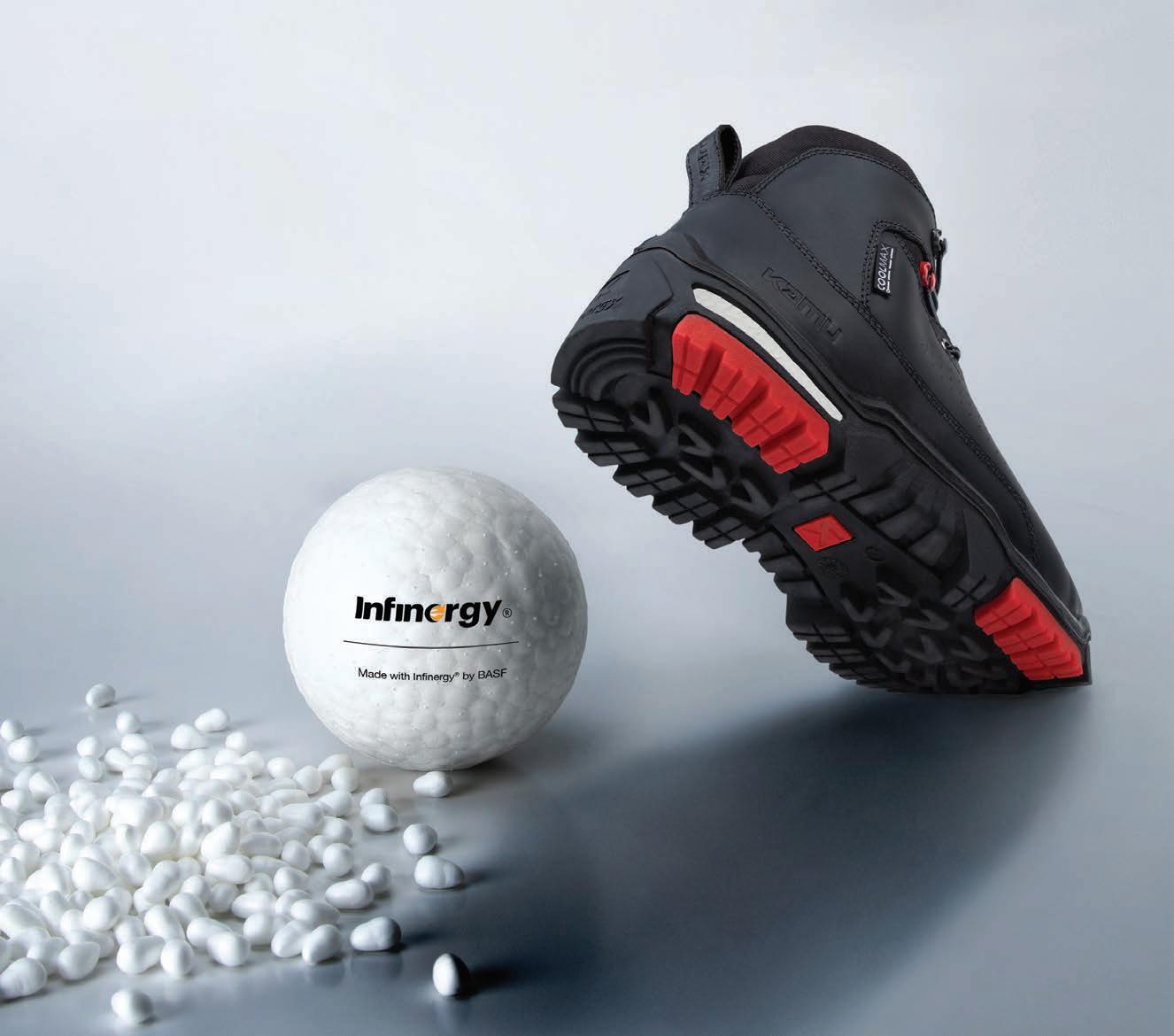
Unlike other brands, KAMU utilises a four-layer sole design, incorporating an anti-fatigue layer of Infinergy as an additional midsole.
“The Infinergy technology has come to world fame for use in top-performance running shoes, empowering movement with a 57 per cent return on the energy we put into every step,” Lusy Hartanu said.
The effect of this is a shoe that not only keeps the wearer safe, but also helps reclaim spent energy, comfortably powering workers through the day.
“Nothing drains your energy levels and focus quite as much as discomfort”, Lusy Hartanu said.
“There’s the physical fatigue that starts in the feet and legs, and over the course of a long day will tire your whole body out. Then there’s the mental fatigue, too.
“People buy boots that feel comfortable when they try them on for three minutes because their main focus is on the short-term underfoot comfort.
“What’s just as important is the longterm comfort, and there are a variety of components and factors, not just the sole, in the construction that will contribute to that.”
KAMU footwear is developed for the Australian workforce through
SAFETOWORK.COM.AU 26 JUL—AUG 2023
Safety technology
KAMU footwear comes in a range of designs tailored to the demands of each job.
a collaboration of experts across Australia, Germany and Indonesia, combining local R&D to meet the Australian market needs, performance material science, and leadership in footwear manufacturing.
KAMU takes a holistic approach to its design process, tackling fatigue from every angle.
The footwear comes with a range of base and optional technologies, such as Coolmax, a breathable internal lining to help moisture evaporate while also making the boot more durable; or Sympatex, a waterproof, breathable membrane. The boots also come with a slew of safety features and customisable options, like metallic or non-metallic composite toecaps rated to 200 joules; non-metallic perforation resistant inserts; and more.
“The KAMU footwear range is engineered with ultimate comfort technologies to keep you dry, cool and energised,” Lusy Hartanu said.
“It lets you feel cooler in hot environments like a mine site in the scorching Pilbara. This reduces sweating in the feet, which translates to fewer blisters and bacterial infections. In cold conditions, this helps keep your feet from getting wet and clammy.
“The boots also have excellent slipresistance. Our certification exceeds SRC (Safety, Rehabilitation and Compensation Act 1988 ) standards by 10 to 38 per cent.
“Another big achievement for KAMU is that, even with the extra Infinergy midsole, we’ve managed to lower the overall boot weight – they’re lighter than comparable models by other brands.”
KAMU designs its footwear from beginning to end, with the mouldmaking done in-house. This gives the company control over the entire process, from inception to finished product.
“Australia has established iconic footwear brands, all the true-blue Aussie names which have offered comfortable and solid boots for decades,” Lusy Hartanu said.
“We still see a great opportunity to enter the market with a new concept that takes the performance and comfort of safety footwear to a new level. We have learned from our research that the needs and wants of the younger generations of Australian workers have changed and will change quite significantly.
“In Europe, we can see very interesting developments in safety footwear technology. So much has happened in the outdoor and athletic footwear industry, too, innovations that can be transferred into workwear and footwear.

“And since a lot of Australian and international mining and energy companies like Rio Tinto, Orica, Newmont and Thiess already trust us
with products that were perfected for South-East Asia, it was the logical next step for us to offer them, with KAMU, a new product range custom designed for Australian work conditions.”
KAMU offers industry-specific work boots, tailored to different demands.
“Mining work often requires traversing uneven terrain,” Lusy Hartanu said. “Our higher cut models such as the Edison 170 and the Volta 270 high-leg rigger are designed to provide better support in the ankle and arch areas.
“We have also developed our rubber nitrile outsole specifically for mining boots. It’s heat resistant to 300 degrees, resistant to oil, acids and chemicals as well as anti-static.
“This outsole features pronounced lugs and a durable rubber compound to provide exceptional traction on various terrains encountered in mining operations. The unique lug design helps shed mud and debris, reducing the risk of slips and falls.
SAFETOWORK.COM.AU 27 JUL—AUG 2023
KAMU footwear helps workers reclaim their energy and fight fatigue.
Safety technology

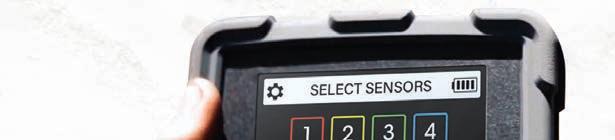
“Mining boots require an extra level of durability, while at the same time, due to the environment on-site and the long travel times, extreme breathability. We solve this issue with highperformance materials like Coolmax and waterproof full-grain leathers of premium quality.”

And the customisation doesn’t stop there. KAMU also offers footwear tailored specifically to women.
“We set out to build Australia’s most technologically advanced safety footwear brand, and that naturally comprises women as much as men,” Lusy Hartanu said.
“We want to empower women in the resources and energy industries to reach their full potential with boots specifically developed to suit the female anatomy.
“We feel that to overcome the skill shortage and attract more female workers, the industry needs
more than just hiring and training initiatives for women and a choice of pink high-vis vests.
“It’s a matter of feeling valued as an individual with unique needs for protection and comfort, and that means not having to make do with PPE that is tailored to men.”

Just as the industry is evolving to more environmentally conscious practices, sustainability is something close to the heart for KAMU. The company makes low-impact design choices such as its Infinergy midsoles and thermoplastic polyurethane (TPU) outsoles, which are recyclable. Sympatex is also 100 per cent recyclable and carbon-neutral, and the OrthoLite insole are made with recycled rubber.

“We choose premium materials for longevity, as nothing reduces environmental impact as much as a longer product lifespan,” Lusy Hartanu
said. “We are constantly looking at ways to make our products better and lower the impact on our planet. For this, we have now are looking at other bio-based materials with a low environmental footprint that don’t sacrifice performance and durability.”
Utilising intelligent, modern technologies, KAMU is working to revolutionise work footwear in Australia. High-performance materials and biomechanical design features come together to create a durable, comfortable shoe that can give its wearer a strong boost of energy with every step – helping people worker harder for longer, without the fatigue.
Clearly, the Hartanu sisters can fit an awful lot into a pair of boots.
“Good safety footwear helps prevent injuries,” Lusy Hartanu said. “But great safety footwear can do so much more.”
SAFETOWORK.COM.AU 28 JUL—AUG 2023
KAMU puts a focus on fighting fatigue with enhanced breathability.
ELIMINATE LIVE WORK













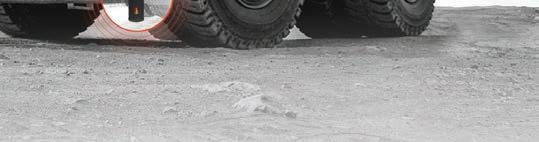
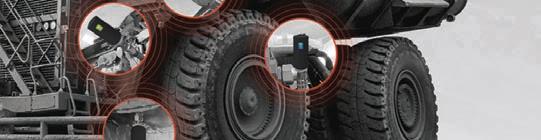
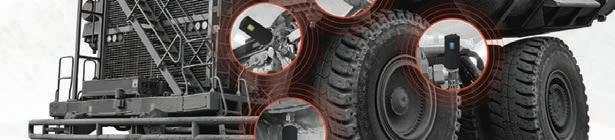
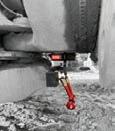
SafeGauge wireless technology removes technicians from the machine footprint during routine maintenance tests; elevating safety and delivering significant productivity gains.


Contact us to learn more.


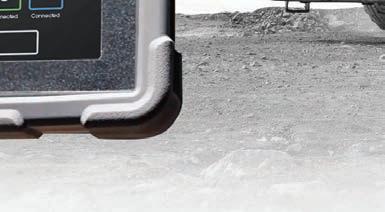
The SafeTest Tachometer enables measurement of RPM (speed) of fans, pumps, drill heads and other rotating machinery components.
The SafeTest Pressure Transducer allows technicians to safely and efficiently monitor high-pressure hydraulic and pneumatic systems.


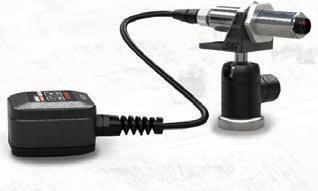




The SafeTest Dial Indicator is designed to remotely measure clearances, tolerances and wear on machine.


safegauge.com













Purpose Built for Heavy Industry Eliminate Live Work Wireless up to 50m Maximise Safety
Safety in close proximity
MATRIX DESIGN GROUP’S INTELLIZONE PROXIMITY-DETECTION SYSTEM IS A LEADING SAFETY SOLUTION FOR UNDERGROUND MOBILE EQUIPMENT IN COAL, METAL AND NON-METAL MINING OPERATIONS.
Mine safety has always been the core business of US-based Matrix Design Group, which has been providing operations-friendly applications that meet ever-changing industry regulations since 2006.
As part of efforts to expand its reach, Matrix Design Group founded its Australian branch in March 2022 as a means to support the Australian and New Zealand markets with its leading proximitydetection technologies. And those technologies, according to Matrix vice president of international operations Wes Chitwood, are always being further developed.
“Matrix develops, distributes and supports innovative and operatorfriendly technology solutions that enhance productivity and improve safety in underground mining environments across the world,” Chitwood told Safe to Work
Through its Queensland and New South Wales offices, Matrix provides underground mining customers with sophisticated safety solutions, including the IntelliZone proximitydetection system (PDS).
IntelliZone features patented SharpZone technology and was designed to be implemented across various types of underground mobile equipment. This allows users to create customisable caution, shutdown and operator zones.
Since 2018, IntelliZone has been fully IECEx-certified (International Electrotechnical Commission explosive atmospheres) for underground coal mining in Australia.
IntelliZone technology works by detecting workers in low-visibility or obscured line-of-sight locations and zones, automatically extending or contracting based on mobile equipment speed.

Unlike bubble-zone systems, IntelliZone’s shaped-zone technology minimises nuisance alerts, maximising safety and productivity.
“For the Australian market, it is clear that IntelliZone represents an ideal third-party PDS technology solution for use on underground mobile equipment regardless of the OEM (original equipment manufacturer),” Matrix Design Group Australia and New Zealand general manager Pieter De Klerk told Safe to Work
“Mine regulators are recommending that PDS technology be fitted on underground mining equipment, and we believe IntelliZone is the best choice for mine operators given not only its advanced capabilities, but also due to its lowest-in-industry downtime, ease of maintenance and repair, and data-rich log files and reporting.
“The ability for IntelliZone to generate zones within the system’s software gives us capabilities that are impossible with other systems, which require the installation of physical cables to establish zones. Not only can IntelliZone generate dozens of zones on and around the machine, but it can even create zones in free space off the machines if needed.
“And our patented ability to shape and customise the zones means that we can reduce the distance an operator must stand from the machine without reducing the size of the zone in other more hazardous areas, such as the front or back.
SAFETOWORK.COM.AU 30 JUL—AUG 2023
Safety
IntelliZone allows users to create customisable zones in an underground mining environment.
technology
“The ability for a continuous miner operator to stand close to the machine and remain in a safe area while undertaking work is a huge advantage of the IntelliZone PDS technology.”
In 2021 Matrix won the US National Institute for Occupational Health and Safety’s Mine Safety and Health Technology Innovation Award for its enhanced IntelliZone system, which is now standard on the PDS.
All components of the IntelliZone system are purpose-built for the underground mining environment and are extremely durable and simple to operate.

The IntelliZone system ships with a range of key components, including a machine-mounted locator (MML) that provides crucial diagnostics and positional feedback when mounted on articulating or standard mobile equipment. The MML is also used to
create zones that move in sync with articulating equipment.
An enhanced status screen provides advanced system diagnostics, as well as a quick visual report, showing whether system drivers and locators are working properly. This device simplifies troubleshooting and drastically reduces downtime. It additionally provides in-cab directional zonebreach information for mobile equipment operators.
With inputs from the machine, IntelliZone can be configured to change zones according to the operating mode.
For continuous miners, zones around the machine can be enabled to automatically shrink while in cutting mode and expand while tramming, with zones around the tail set to articulate with the tail swing.
These zones can also be configured to dynamically activate with the direction of travel and extend or retract with the speed of the machine. For middle-pivot vehicles, IntelliZone zones can also articulate with the machine.
IntelliZone is already the industry’s most implemented PDS solution in the US and is now expanding around the world, rapidly in emerging markets such as Europe, Asia and South America.
“As we expand into new markets, we learn, and as we learn, we innovate and improve, which is benefit to all of our customers globally,” Chitwood said. “With their incredible achievements and innovations in mining, we are very excited to partner with Australian mining companies to help enhance safety and continue the advancement of PDS technologies.”
SAFETOWORK.COM.AU 31 JUL—AUG 2023
The IntelliZone PDS has been designed to be used alongside various types of underground mobile equipment.
Getting real about fire suppression
When suppressing a fire, every second counts. In an industry like mining, fires can start and spread very quickly and for a number of reasons. And once a fire spreads, it immediately compromises the safety of workers and equipment.
According to a recent report from the New South Wales Resources Regulator, there has been a slight decrease in incidents involving fire on mobile plant for the period since amendments were made to the Work Health and Safety (Mines and Petroleum Sites) Regulation 2014 in February 2020.

This is no doubt a positive step in the right direction; however, it remains vital that a mining operation has the appropriate safety equipment in place.
One of the leaders in providing safety products is JSG Industrial Systems, which supplies Muster fire suppression systems to the market.
Muster’s products are designed to minimise harm to mining operators and equipment by suppressing and controlling a fire, giving any workers in danger an opportunity to retreat.
Muster’s fire suppression systems include features that have been touted by customers around the world, such as 24–7 integrity monitoring and easy-toread system diagnostics.
The fire suppression system range features a foam-based system, an aerosol system, an impulse powder system, the transferable unit for fire fighting (TUFF) system, and portable fire extinguishers and accessories.
At the heart of every system is the Muster alarm panel, which monitors the integrity and automatic activation of the fire suppression system.
Safe to Work spoke with MusterFire International product manager Vince Atkinson, who said JSG including fire products in its portfolio was a natural way for the company to expand.
“JSG worked very closely with a lot of earthmoving companies with lubrication, fuel and flow products, and it seemed like a natural progression for that offering to include fire as well,” Atkinson said.
“The drive behind this is that it provides a frontline safety system for operators and owners of equipment to protect their equipment from the threat of fire, which is ever present in
SAFETOWORK.COM.AU 32 JUL—AUG 2023
JSG INDUSTRIAL SYSTEMS POSSESSES A RANGE OF SAFETY SYSTEMS TO MAXIMISE PRODUCTIVITY, REDUCE DOWNTIME AND OPERATIONAL COSTS AND, ABOVE ALL, KEEP PEOPLE SAFE.
Safety technology
The fire suppression system helps to reduce downtime.
the types of environments that these machines operate in.”
Atkinson said the fire system helps to provide customers with muchneeded peace of mind.
“The primary objective is safety for the people who are operating the equipment and making sure that everyone gets to go home at the end of the day,” he said.
“The secondary objective is that if the system is designed well, it will in most cases provide extinguishment of a fire and therefore protect the asset from experiencing significant damage because of a fire event.
“Largely, if the system is designed right through the fire risk assessment process, then we do manage to not only protect the operator but also save companies from investing a lot of money in repairs
According to JSG Industrial Systems national product sales manager of fire suppression Dale Sharpe, the fire suppression system range from Muster is extremely reliable.


“One thing a customer doesn’t like is if they have a third-party system fitted to their machine and it causes them

“The Muster fire suppression system is reliable. Customers are going to be able to operate day-in, day-out with very minimal downtime caused by the fire system.”
Sharpe said a stand-out feature of the fire suppression system is its panel and data-
MusterFire’s products are designed to minimise harm to mining operators and equipment.
Safety technology
“The actual panel will store a log of information about what’s happening to the system, whether it is changes in pressure or battery percentage, or whether somebody opens the panel and changes the settings on it,” he said. “All these things that happened with the panel are data-logged.
“In the event of an incident or if there is a problem with the system, we can go in and interrogate the panel and see what’s been happening.”
Muster 360 is a dedicated cloudbased portal used exclusively with Muster systems. It provides a framework for conducting a fire risk assessment, detailing system requirements and defining a bill of materials.
“Muster360 allows for the user to initially design a system layout, and to complete the commissioning paperwork following a system installation,” Sharpe said.
The Muster fire suppression system has more than proved its worth on a

number of occasions, including one incident when a mine’s wheel loader caught fire very quickly.
“A fairly large wheel loader had a catastrophic turbo failure, which caused a catastrophic fire event in terms of its physical size, the intensity of the fire and the time in which it happened,” Sharpe said.

“The Muster system detected the fire automatically. It put the fire out and limited the amount of damage to a minimum, reducing the amount of downtime experienced following the fire event.”
Even with all the success Muster’s fire suppression system has seen, Atkinson said there will always be room for growth and improvement.
“Since these sorts of systems were first introduced, the actual mechanics of how they operate haven’t changed a lot over time, from the mechanical and pneumatic side of the system,” he said.
“Where it has developed has been from the electronic side.
“Dale works very closely with his customers, as do each of our regions globally. We get a lot of that feedback back into the Muster team, which we will look at and use in developing new products.
“We’re always looking at that continual improvement process with what we can do based on feedback coming from the field.
“It’s not just about engineers sitting in a room and coming up with an idea and saying it’s a fantastic idea in theory.”
Both Atkinson and Sharpe believe the fire suppression system complements each company’s portfolio.
“The largest product range JSG has is the lubrication and flow products, which is all industrial-related,” Sharpe said. “The Muster fire suppression product just slips in there very nicely.
“If there’s a fire system being installed, there’s always going to be an automatic lubrication system, so they all complement each other.”
SAFETOWORK.COM.AU 34 JUL—AUG 2023
C M Y CM MY CY CMY K
The fire suppression system range features products such as foam-based systems.
The Power of One for Underground
Enhancing safety in underground mining
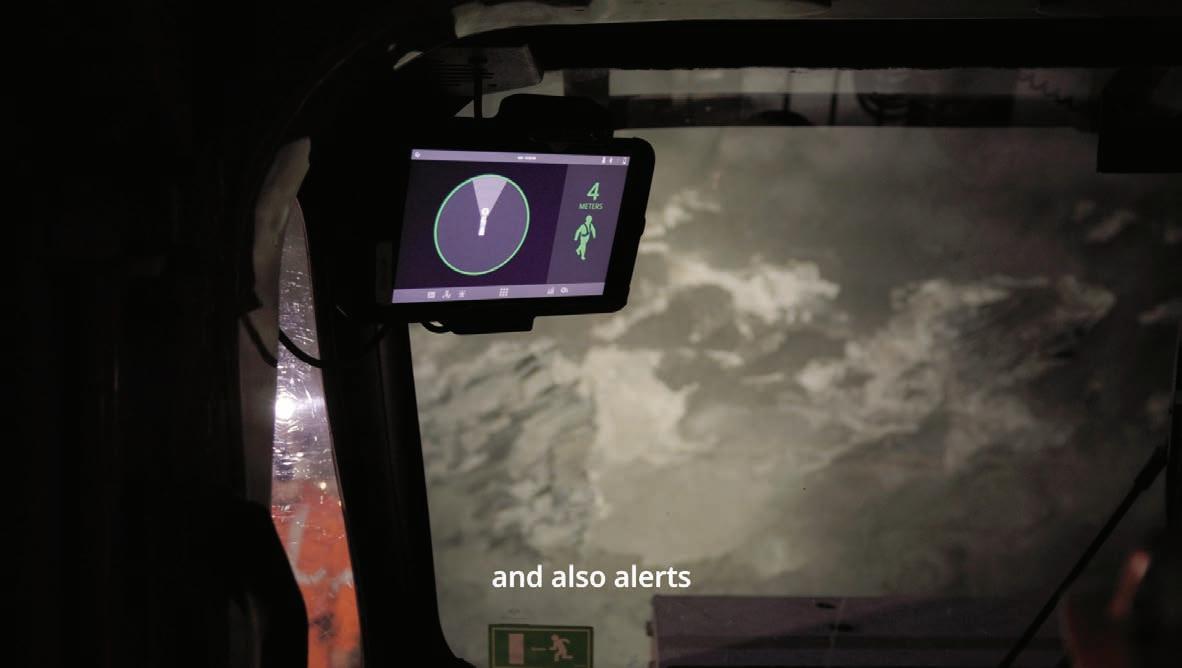
Streamline your underground operations with Hexagon's Collision Avoidance System (CAS) for underground. Used in more than 40,000 vehicles worldwide, Hexagon's CAS is a proven safety solution. With 360-degree visibility, improve your underground safety measures by eliminating blind spots and heightening situational awareness.
One platform. One partner. For the life of your mine.
Scan to learn more:
| Visit hexagon.com/mining

Looking Forwood to a safer future
FORWOOD’S CRITICAL RISK MANAGEMENT SOFTWARE IS ONE OF THE ONLY SOLUTIONS WITH A PROVEN TRACK RECORD OF SUSTAINABLY ELIMINATING FATALITIES ACROSS 60 COUNTRIES WITH ALL CLIENT COMPANIES.
It might be a hard task to find anyone as passionate about workplace safety as Thorsten Scholz.
As chief technology officer at Forwood Safety, a specialist fatality prevention service provider, Scholz has helped make the company’s critical risk management (CRM) software one of the most trusted in the resources industry.
“Our key focus for CRM is fatality and serious injury prevention in the workplace,” he told Safe To Work. “Everything we do, all
of our technology and methodology, our training material and our plans, everything is built to support that one single goal.”
Forwood’s CRM has been designed to provide a laser focus on fatality prevention in the workplace. Through focused checklists and standardised tools, CRM enables everyone to participate in this critical activity across all departments, from contractors to executive management.
“We need to be very clear on what prevents people from serious harm or death,” Scholz said.
“So for someone working at heights, we know there are five critical factors that can lead to death if they are not in place. CRM ensures these are in place, so people will not die performing that specific task.
“Rather than preventing every single minor safety issue, like a hand injury when not wearing gloves, CRM focuses on the critical controls that prevent death.”
Scholz is adamant that every person at a job site should be empowered to easily identify such critical risks in their work area and test that effective critical controls are in place to protect them. With live data on compliance and critical control failures, CRM makes it easy for managers to identify hot spots and act before incidents occur.
“It is crucial that we give people on the frontline the tools to verify and the power to stop work if a critical control is not in place,” Scholz said. “Safety and risk management only works when everyone is involved.”

Not only does Forwood’s CRM give all workers the ability to control their own safety, it does so in a language that is easy to understand. And the numbers speak for themselves.
“No other solution has achieved a sustainable year-on-year fatality free result,” Scholz said.
From 2012–20, International Council on Mining and Metals
SAFETOWORK.COM.AU 36 JUL—AUG 2023
Safety technology
Forwood’s CRM promotes proper safety practices by not letting workers cut corners.
(ICMM) member companies that had not implemented Forwood’s CRM suffered 792 workplace fatalities. Forwood member companies that had fully implemented and maintained the CRM Solution during the same period experienced zero fatalities.
Scholz said Forwood’s CRM promotes proper safety practices by not letting workers cut corners.
The CRM approach ensures the required critical controls are in place, but more importantly it requires the operator to test that these controls are effective and that they will work as expected in the event of a failure. This is one fundamental difference in the Forwood approach.
“With CRM, there are multiple checks and balances – one for operators, one for supervisors, one for managers. They all look at different aspects of the work to ensure the critical controls are robust and effective at all levels.
“By doing this, you can be sure that multiple people have checked you have the right equipment for the job, and no one has missed anything.”
Helping mine sites move from reactive to proactive risk management has been of particular importance for Scholz. One of the ways this can be done is through Forwood’s analytical self-service tool known as ‘FAST’.
A data analysis platform, FAST is designed to examine, predict and understand risk data. Comprising of the most advanced fatality analytics on the market, FAST gives users live data on critical control compliance and helps them discover trends.
“CRM comes out of the box with a number of predefined reports and analytical components,” Scholz said. “FAST works with that as a reporting solution.
“With FAST, users can build their own dashboards and metrics, and import data from a survey system to make it seamless.
“It’s basically a self-service reporting capability which empowers you to integrate even further into the ways you’re keeping your workplace safe.
“It’s incredibly user-friendly because one of the biggest issues we have found is that usability plays a big role in how people engage with data – if they don’t know how to use the tools, they either won’t do it right or they won’t do it at all.
“Using FAST, users can interact and query the reports using voice to text and their natural language. This massively improves the end user experience and gets supervisors and managers to where the next potential fatality could occur much quicker and action improvements together with the front-line workers.”
Scholz understands no safety system is perfect, but he’s proud that Forwood’s CRM is as close as it gets.
“The problem we have in safety is that everybody believes they have a silver bullet,” Scholz said. “I believe that what we do at Forwood makes a huge difference, but it’s by no means a silver bullet. It has to work together with other cultural and leadership movements in safety.
“For example, if you do not have good leadership and you do not have supervisors leading by example in the front line when it comes to safety, no safety program can succeed. There is no faster way to disconnect workers from an initiative than if leadership are not following through when improvements are identified.
“Safety and risk management are not new ideas. They have been around for many years. The increased focus on critical control management has shown profound results in the mining industry.”

“CRM should be best practice and, in the mining industry, should be a baseline expectation. If it does not exist on a site, there needs to be more outward pressure to implement systems like CRM.
“It is usually not that people do not want to implement safety systems like CRM, it is that they don’t know about it. So I think the real hurdle we need to overcome is more education around what could happen if you do not put it into practice.
“Mining is a high-risk industry, and we have to do everything in our power to ensure every worker gets home safely. We want everyone to come home to their families every day. When working together we can achieve this goal and make mining a fatality-free workplace.”
SAFETOWORK.COM.AU 37 JUL—AUG 2023
Forwood’s CRM helps prevent fatality and serious injury on a mine site.
From top to bottom
HONEYWELL BELIEVES ZERO HARM TO WORKERS SHOULD NOT BE THE GOAL OF A MINING OPERATION, BUT THE MINIMUM SAFETY STANDARD.
According to Safe Work
Australia, the country’s resources sector has seen a substantial reduction in the number of deaths and injuries caused by incidents on mining operations in recent years.
However, the mining industry still has one of the highest rates of fatalities of any sector in Australia, with an average of nine per year.
To work towards a zero-harm safety standard, mining operations have turned to technological advances to identify and eliminate hazards, while also taking the time to understand possible risks and dangers on a deeper level.
A key method via which hazards and risks can be reduced on a mine site is the use of effective personal protective equipment (PPE), an area in which Honeywell is a leading global manufacturer.
“We want to build a culture of safety with our customers, and in doing so support them in minimising the risk of accidents and
injuries, as well as make workplaces safer and more productive,” Honeywell’s mining national business manager in Australia Phil Cartwright told Safe to Work. “For decades, we’ve created comprehensive safety solutions designed to protect the lives of 500 million workers every day.
“As environments change and new worker needs emerge, Honeywell continues to innovate for a safer future.
“In this future, safety solutions adapt to changing needs and environments. They increase productivity and efficiency, instead of getting in the way. And above all, they don’t stop working until the last worker clocks out.”
Built for demanding industries such as mining, Honeywell’s comprehensive PPE solutions have been developed with the resources industry – and its busy work sites – firmly in mind.
“Honeywell is the only manufacturer that supplies a range of PPE that provides a full head-to-toe solution,” Cartwright said.
“This means everything from head, eye and face protection to hearing and respiratory protection, body and fall protection, hand protection and, of course, footwear.”

Safe to Work took a closer look at the PPE range Honeywell offers to support the resources industry.
FROM GREAT HEIGHTS
Honeywell’s Miller Aircore Harness is a lightweight full-body unit featuring a breathable, open-core padding technology that provides optimal air flow and reduces heat and moisture entrapment to keep mine workers cooler and drier.
Given PPE is often worn over the top of other clothing, it is essential that fall protection equipment is lightweight, comfortable and breathable.

BREATHE EASIER
The significant risks posed by dust on a mine site are well established and understood.
Honeywell’s respiratory protection range is designed to protect workers from breathing in dust and chemicals without compromising on performance.
SAFETOWORK.COM.AU 38 JUL—AUG 2023
The Miller AirCore Harness has breathable and opencore padding technology.
Safety
Oliver has become a preferred safety footwear choice for mining and drilling crews in tough conditions.
technology
The Honeywell North 7600 features high-class comfort and a polycarbonate lens with 200° field of vision. The North 7700 series is the company’s lightest silicone half mask that is made with 100 per cent medical-grade silicone and for premium fit and comfort.
Workers looking for a disposable particulate respirator can find their answer in the Honeywell H801 Plus Particulate Respirator, which features a large breathing chamber to accelerate airflow for easier breathing.
A HELPING HAND (AND WRIST)
Safe Work Australia has reported that hand and wrist-related injuries are the most common kind of injury on a mine site. To combat this issue, Honeywell created its Rig Dog gloves, which feature an ergonomic design and CoreNest technology that, according to the company, offers enhanced impact protection and energy absorption on the back of the hand without compromising comfort.
Mine workers wearing comfortable gloves is essential in preventing injuries involving abrasions, cuts and lacerations, which can happen from handling tools, moving materials, or fixing equipment.

SOUNDS GOOD
As it is one of the five senses, safeguarding hearing is vital on a mine site.
A study published in the Journal of Occupational and Environmental Hygiene found that approximately 90 per cent of miners have developed a hearing impairment by the time they are 50 years old. And with mining such a large employer, that’s a lot of people experiencing work-related hearing issues.
To help protect miners against hazardous noise, Honeywell has created its VeriShield 100 Series Passive Earmuffs to keep ears safe and comfortable all day.
The earmuffs feature wider cup openings to accommodate larger ears or hearing aids, in addition to a lightweight cushioned headband and memory foam ear cushions for even greater ease.
FROM THE NECK UP
With so many moving parts across a mine site, workers must wear eye and face protection when they can be exposed to risk such as flying particles, molten metal and liquid chemicals, to name a few.
Standard lenses can fog up when they are worn in hot and humid environments, but Honeywell’s DuraMaxx goggles feature anti-fog lens coating lenses that are designed to make it easier to see despite any sticky environments.
These lenses can be worn over most prescription glasses and with respirator half-masks.
Moving away from the eyes, Honeywell’s hard hats help to protect the head from falling objects, collision impact and debris.
Available in a variety of styles, colours and materials, the sleek and lightweight ABS vented hard hat is ideal for mining sites, and easily integrates with Honeywell face shields and eyewear. An unvented version is also available.
Honeywell’s Seethru polycarbonate hard hat range is UV400-rated for outdoor use to protect miners from harmful UV exposure.
ON THE BODY
A miner wearing the right coveralls can ensure they are protected from the heat, chemicals and mechanical hazards, or extreme weather conditions through shielding their body from the environment.
Honeywell’s Spacel C4 and Spacel C Medium are lightweight and comfortable single-use protective coveralls that offer total body protection. The Spacel C4 coverall offers type 4B, 5 and 6 chemical protection to guard against spray and
particles, while the Spacel C Medium offers Type 3B, 4, 5 and 6 chemical protection to safeguard against liquid in the form of jets, sprays and particles.
ON THE GROUND
It might sound obvious, but it’s vital for a miner’s feet to be protected from the industry’s inherently tough working and environmental conditions. Thankfully, Honeywell offers a wideranging collection of mining boots from Oliver Footwear.
The Oliver 65 series, which includes a range of 100 per cent waterproof full grain leather boots, was specifically designed to support harsh and demanding work environments within industries such as mining.
The Oliver 65-791 black lacedin zip mining boot was specifically developed to address underground mining needs, offering waterproof protection for long periods in underground drilling environments.
As environments, technology and workplace safety needs change, Honeywell will continue to innovate its PPE solutions for safer mine sites.
“When customers are considering their PPE requirements, their safety agenda includes everything from apparel to footwear, to the PPE requirements of the job functions that they manage,” Cartwright said.
“Honeywell’s PPE solutions and safety portfolio is well aligned to support our customers with this agenda.”
SAFETOWORK.COM.AU 39 JUL—AUG 2023
Rig Dog gloves feature CoreNest technology that offers enhanced impact protection and energy absorption.
Inside looking out
Do you believe you are going to get hurt every morning when you get out of your car at your workplace?
That is the first question Dave Holland asks the frontline crews he works with.
For over 15 years, Holland has been working as an occupational health and safety (OHS) consultant, teaching the mining industry about risk and hazard assessment. His programs are designed to develop effective consultation processes and build risk awareness. But this wasn’t always his path.
In 2004, Holland was working as a geotechnical soil technician when his life changed forever.
Working alone on a development site, Holland was using a drill to test the soil in a paddock when his long hair got caught in a drill’s auger, taking his right ear and scalp with it. Holland broke his neck in three different places, and had serious head and facial injuries as his skin was ripped from his face.
“The truth is that people bring me to give presentations because I tell an awful story,” Holland told Safe to Work.
“I tell a story about my experience and around that story I put in learning outcomes. You’ve got a whole lot of academic discussion around you in these events. When I step forward, I ground the conversation.”
Holland has shared his experience in a bid to keep others safe.
“I guess the thing that stands out about me is passion. The passion is very real,” he said. “I bring energy to the table, and I bring in a capacity or a symbol that initiates a different kind of thinking in one’s mind.
“When I appear, the first thing is shock. And the next thing I do is start to talk, and it turns out that I’m not a stupid person.”
Holland will be speaking at this year’s Queensland Mining Industry Health and Safety Conference (QMIHSC), to be held on the Gold Coast from 20–23 August. The event has been promoting
health and safety in the mining industry for more than three decades, and this year’s event promises to be bigger and better than ever. The conference provides opportunities to exchange information, form connections and foster proactive health and safety management techniques.

Holland’s OHS-focused presentation will open with him sharing the story of his accident. It will expand to cover a range of ideas and topics, including physical, psychological and cultural risk, hazard management, mental health issues, and how a workplace accident can affect family and friends.
“The discussion of what risk is and then being able to soften it down to say, ‘Let’s be realistic about what we do. Everything we do has risk’,” Holland said. “Is it about removing any risk or being present when we take the risk?
“There are several different learning outcomes that I weave throughout the presentation. It’s not about me stepping up and selling myself. It’s about
SAFETOWORK.COM.AU 40 JUL—AUG 2023
THE 2023 QUEENSLAND MINING INDUSTRY HEALTH AND SAFETY CONFERENCE IS LOOKING BEYOND ITS OWN INDUSTRY TO SEE WHAT PROGRAMS, SYSTEMS AND INITIATIVES ARE TRANSFERABLE TO THE RESOURCES SECTOR.
Safety technology
The 2023 speakers include Dave Holland and Dr Catherine Ball.
influencing attendees to reconsider their own perceptions.”
This year’s QMIHSC has a very specific theme, ‘inside looking out’, where the mining industry will explore initiatives, programs and innovations from other “forward-thinking” industries.
Safe to Work spoke to conference chair Larnie Mackay about what people can expect in 2023.
“The conference is for anybody who is involved in the mining industry, to provide information and education, as well as opportunities to expand networks, to spread great news stories and to be able to spread learnings across industries,” Mackay said.

Mackay spoke about this year’s diverse group of speakers and how the program reflects the event’s theme.
“This year we have keynote speakers that are from various different industries, such as defence, air traffic control and psychology,” Mackay said.
“I have someone presenting who has a trade background, but she has transitioned across into psychology. Her presentation provides a really great oversight about looking at people with neurodiverse backgrounds and what it means to be able to bring different ways of thinking into a business or industry.”
When selecting the range of speakers, the committee was after people who had hands-on experience across heavy or high-risk industries.
“We were looking for people who can put the theory into practice,” Mackay said. “We had speakers in the past that could very much talk about the theory behind why we do what we do or why we should do things in a certain way, but they weren’t able to provide the tools that some of our delegates needed to be able to transition that theory into practice.
“This year, we have gone for quite a diverse range of keynote speakers. There will be theory and there will be practical, and there’s some in the
middle that can take the theory and put it into practice.”
Holland wants to examine the meaning of the word ‘safety’.
“I have spent 15 years speaking about safety and, unfortunately, safety is a negative word,” she said. “Safety, if you peel it back, means to care.”
Delegates taking information from QMIHSC and implementing it into their work, Mackay said, is the next step towards change.
An example is the high reliability organisation (HRO) theory being applied to the mining industry.
QMIHSC speaker Mike Lockwood, who works in air traffic control, will discuss how he works to implement HRO theory all over the world.
“The mining industry has spoken about HRO theory for quite some time, saying that we really need to adopt the principles of HRO,” Mackay said. “Lockwood will give some very practical examples as to how HRO has been implemented in air traffic control.
“Looking at things you’re auditing in a different way isn’t a bad thing. Auditing and having that culture of putting your hand up to say, ‘I’ve made a mistake. This is what I’ve done, this is why I did it, and this was the outcome’, to then identify that there was a potential problem with that process.
“It’s a really positive culture of finding and fixing the problems, as opposed to, ‘I’m not going to report that or tell anybody’, because then history just keeps repeating itself.”
Another key speaker at QMIHSC will be Dr Catherine Ball, who has an extensive history in the infrastructure, utilities and resources sector.
“The culture of health and safety is now ingrained in me,” Ball told Safe to Work. “Any conversation about improving health and safety statistics is a conversation worth having.”
Ball will discuss the fact technology is not to be feared, and she wants people to walk away feeling more confident.
Technology can do so much; we must use it where we can,” she said.
“We should be engaging with emerging technologies and working out problems we are trying to solve. We need to ask better questions.”
Mackay hopes attendees will take away knowledge they can implement into their own workplaces, regardless of their position within a company.
“Change can happen at any rung on the ladder,” she said.
“If everybody takes back some positive change, or a way of improving the way people work to make things healthier and safer, we can start to make those incremental changes.”
SAFETOWORK.COM.AU 41 JUL—AUG 2023
This theme of this year’s event is ‘inside looking out’.
Getting ahead of dust control
KOMATSU IS COMMITTED TO HELPING MINE SITES GET CONTROL OF THEIR DUST AND AIR QUALITY THROUGH MITIGATION MEASURES AND SPECIALISED EQUIPMENT.
Australian mine sites are facing increasingly tighter restrictions on air quality and dust control – which means they need to turn to the experts for help.
Komatsu product manager – miners
Darryl Parry sat down with Safe to Work to discuss how the company can help miners get control of dust and dust exposure.
“Dust control is important on every mine site, but it’s especially important to the coal industry,” Parry said.
“Dust control regulations have changed for Queensland and New South Wales, so mines need to tighten up their control measures. The main issue is from a health point of view.
“Black lung (pneumoconiosis) or silicosis have always been a threat to operators, so it’s of the utmost importance that we get on top of these issues.”
To help mines control onsite dust, Komatsu can install a range of products including water surfactant systems and specialised spray systems.
Water surfactant systems lower the surface tension of the water, allowing coal particles to come into contact with it, and specialised sprays create a mist for more efficient dust particle removal.
“We’re seeing a lot of mines being really proactive about their dust control,” Parry said.

“They are going out and doing research into mitigation measures for their specific application.
“Komatsu aids them in fitting those measures onto the equipment that they use.”
The company has also made it possible for mines that buy Komatsu equipment to have these mitigation measures pre-installed.
“We have remote capability and automation in our machines that can help operators keep out of a dusty area,” Parry said.
According to a report prepared by the Cancer Council Queensland in 2021, underground coal miners are more likely to contract lung disease compared to surface coal miners.

Regardless, any rate of lung disease is too high, and Komatsu has committed itself to helping bring the total down.
“Aiding mines in installing dustcontrol measures in their equipment is its own reward,” Parry said.
“The fact that companies keep coming to us for installation and our help is a testimony in itself.”
Stories about silicosis and lung disease can be easier to focus on than the positive news, but Komatsu is dedicated to changing that narrative.
“Protecting your most important assets – your people – should be top of mind for every mine,” Parry said.
“And dust-control mitigation measures go a long way in protecting every employee.”
SAFETOWORK.COM.AU 42 JUL—AUG 2023
Dust control
Dust control is a vital consideration for all mining operations.



Protecting our people and our planet 800+ 60+ sites globally Countries Verifications 100M+ Eliminate fatalities and serious injuries Data driven insights Industry Benchmarking Out of the box Mission Zero Visit our website forwoodsafety.com
Stamping out sexual harassment
SAFE TO WORK SAT DOWN WITH SAFETRAC TO DISCUSS WHAT CONSTITUTES SEXUAL HARASSMENT – AND WHAT COMPANIES CAN DO TO PREVENT IT IN THE WORKPLACE.
Sexual harassment in the resources sector has been mentioned in the news, as workplace claims continue to be reported. Power imbalances caused in part by gender diversity issues are prevalent within the mining industry and cultural shifts are required to modify behaviours. But challenges in making these changes remain. Safetrac director and chief executive officer Deborah Coram spoke to Safe to Work about what sexual harassment is and how companies can prevent it.
Can you provide an overview of what constitutes sexual harassment?
Under the definition provided by the Respect@Work legislation, sexual harassment is any behaviour that is sexual in nature and that a reasonable person would anticipate would make another person feel offended, humiliated or intimidated.
While people are familiar with concepts such as unwelcome physical contact, other forms of sexual harassment such as verbal abuse, harassment and displays of offensive materials may be concepts some people and companies might not be so familiar with.
What are some less obvious forms of sexual harassment?
A sexual comment, innuendo, joke, insult or slur can all be classed as sexual harassment.
Intrusive questions about a person’s private life or physical appearance that made them feel offended, or someone staring or leering inappropriately at someone in a way that made them feel intimidated can also be classified as sexual harassment.
It can also include less offensive displays of sexual behaviour. A picture of a person posing in a provocative position displayed for everyone to see could be viewed as conduct that makes someone feel uncomfortable.
The definition of sexual harassment is broad enough that any behaviour that could cause offence, humiliation or intimidation to someone is now classified as sexual harassment.
Defining sexual harassment is difficult as the behaviour is not about a specific person being harassed; it’s behaviour that could lead a reasonable person feel harassed.
Sexual harassment can be committed by anyone in the workplace. It could be a supervisor or manager, but not necessarily. It could be a colleague, a customer or a client.
What does the law say regarding sexual harassment?
There are a number of laws that prohibit sexual harassment in workplaces, including the Sex Discrimination Act 1984, the Gender Equality Act 2020, Work Place Health and Safety Laws, and the Fair Work Act 2009
Combined, these legislative codes make clear that all workplaces are required to take positive steps to prevent sexual harassment and other forms of sex-based discrimination from occurring in the workplace.
As sexual harassment has now been classified as a psychosocial risk, its prevention is essential in order to maintain a safe workplace.
Where sexual harassment events are reported to occur in a workplace, if that workplace did not take adequate steps to prevent that event from occurring, the workplace could be liable under multiple codes of legislation.
What about sexual harassment within the mining industry?
Recent reports, including the Enough is Enough report and the Respect@ Work: Sexual Harassment National Inquiry Report by the Australian Human Rights Commission, clearly showed that sexual harassment has long been, and continues to be, prevalent across the mining industry.
A survey by the Mining Energy Union showed that 43 per cent of women and 18 per cent of men said they have experienced or witnessed some form of sexual harassment within the last 12 months.
We know that workplace sexual harassment and discrimination occur in almost all sectors and occupations in Australia and around the world. However, the mining industry is
Workplace
SAFETOWORK.COM.AU 44 JUL—AUG 2023
safety
particularly highlighted as a high-risk industry due to its male-dominated workforce, isolated environments and patriarchal hierarchical structures.
What has become clear from various reports is that the issues of reported sexual harassment are not isolated incidents of misconduct, but rather organisational matters which stem from power imbalances caused from male-dominated cultures and environments where gender inequality has created a breeding ground for sexual harassment.

What is the new Respect@Work bill and what will it mean for businesses?
The Australian Human Rights Commission (AHRC) has been granted powers of enforcement to enforce the positive duty obligation imposed under the Sex Discrimination Act
Essentially, they have been granted the powers of a standard regulator
and will be looking at what steps organisations are doing or have done to eliminate sexual harassment from the workplace.
The AHRC will have the ability to enquire and report on issues of systemic unlawful discrimination or suspected systemic unlawful discrimination. They have highlighted the mining industry as one that they will likely investigate.
The new AHRC powers will come into effect 12 months after the Respect@Work Act received Royal Assent. This effectively gives companies up until December 2023 to be able to demonstrate that, in the event they are investigated by the AHRC, they understand and comply with the positive duty to prevent sexual harassment.
It is therefore imperative that mining companies are taking all reasonable measures to stamp out sexual
harassment in their businesses and actively prevent it from occurring.
What are the consequences of noncompliance?
The consequences and cost of not addressing workplace sexual harassment are far-reaching.
They include consequences for the perpetrator such as job loss, reputational harm, career damage and potential exposure to personal liability.
For the workplace, they include being vicariously liable to their workers for any sexual harassment that occurs in the workplace.
Consequences include fines, penalties and damages, reputation damage, short-term and long-term shareholder value, difficulty in staff attraction and retention, loss of productivity and increased operational costs such as insurance premiums.
SAFETOWORK.COM.AU 45 JUL—AUG 2023
Safetrac director and chief executive officer Deborah Coram.
Workplace safety
What should an organisation do if it has a problem with sexual harassment?
Putting together goals and an appropriate framework to eliminate the gender imbalance in a workplace is a great start, but what organisations need to remember is that the problem will not disappear overnight.
Whilst at Safetrac we provide clients with high-quality engaging online training for management and staff, a training course is just one step in the process of preventing sexual harassment.
Sexual harassment exists where the culture allows it to. The Respect@Work report emphasises the importance of workplace culture in tackling sexual harassment: “building of cultures of trust and respect, that minimise the risk of sexual harassment occurring and, if it does occur, ensure it is dealt with in a way that minimises harm to workers”.
Transforming culture requires ongoing and persistent efforts from all levels of the business. It requires a workplace to recognise and address power imbalances, benchmark status quo, build policies, implement robust, repeated and reportable training, ensure there are multiple avenues for reporting, and that there are appropriate repercussions for perpetrators and support for victims established and clearly communicated.
It is essential that all organisations communicate their values and behavioural expectations. Training activities should include not only management and staff but also volunteers and contractors. Even suppliers and customers should be aware of acceptable codes of behaviour. Training must be ongoing and repeated and not a one-off activity.
And while having appropriate policies and training is a great start, you must have leaders and a culture that are going to lead by example.
Leadership plays a critical role in creating safe and respectful workplaces. Leaders set the framework for preventing and responding to sexual harassment, and they should also model a diverse, inclusive, trusted, and gender-equal culture. Ideally, targets around gender equality, diversity and inclusion should form a part of a leader’s key performance indicators (KPIs).
Organisations whose leadership teams demonstrate diversity and inclusion help illuminate power imbalances that so often enable sexual harassment to thrive.

Leaders should have a strong understanding of the key drivers of workplace sexual harassment and prioritise gender equality. They need to be trained to understand how to respond appropriately to situations, ideally be trained in trauma-informed reporting, and empower all staff to work together in stamping out sexual harassment from the workplace.
How can businesses prepare for Respect@Work coming into effect?
As a starting point, businesses need to benchmark themselves as to what issues staff may currently be experiencing.
Providing staff with an anonymised survey is a great way to start because it gives them the opportunity to indicate behaviours and culture that they have experienced or witnessed that could indicate or enable sexual harassment in the workplace.
From that you can identify what the issues are and what priorities need to be addressed and any amendments and adjustments to policies and procedures and be made. Policies then need to be distributed to all staff and, ideally, every staff member should sign off on that policy to say that they’ve read, understood and agree to comply with that policy.
Safetrac can work with a business to identify and suggest appropriate training courses to address any issues that have been identified in that survey.
Compliance training shouldn’t just be about checking a box to show a regulator that staff have been trained. It is essential that the training delivered is engaging to the learner audience for whom it is intended.
The better the training, the better the learner outcome. Training is an opportunity to teach staff and ensure they understand what they can and can’t do in the workplace. If a learner undertakes a course on sexual harassment that is interesting and relevant, the learner is much more likely to understand the topic and what is and is not acceptable behaviour.
It is also essential that the training provided is updated alongside changes in the law; every couple of months, we’re seeing changes come through the law in this area and courses are currently requiring frequent updates.
It is also important to remember that training is not a one-off occurrence. It needs to be an ongoing and repetitive cycle whereby we can show repeated and ongoing efforts to ensure staff understand what they can and cannot do.
It is crucial for mining companies to stamp out sexual harassment from occurring and to prioritise the prevention of it in the workplace. They must work meaningfully and deliberately to create a culture of respect and provide a safe and inclusive work environment for all employees. By ensuring leaders oversee cultural shifts that incorporate diversity and inclusion and take proactive measures to address incidents promptly, the mining industry can work towards eliminating sexual harassment and promoting a more equitable workplace.
SAFETOWORK.COM.AU 46 JUL—AUG 2023
QUEENSLAND MINING INDUSTRY DATE VENUE Sunday 20—Wednesday 23 August 2023 www.qmihsconference.org.au #QMIHSC2023 Natalee Johnston Former RNA pilot, qualified helicopter instructor, operations and safety leader. James Wood Safety speaker and workplace accident survivor. Wayne Schwass Former AFL player and founder of Puka Up. Neryl Joyce Former Military Police Officer and author of Mercenary Mum. Rachael Robertson Leadership and teamwork speaker, author and expert. + many more The Star Gold Coast HEALTH AND SAFETY CONFERENCE 2023 Inside looking out PRINCIPAL SPONSOR SCAN NOW AND REGISTER SPEAKER HIGHLIGHTS
Screening for safety
MITIGATING IMPAIRMENT RISKS, INCLUDING DRUG USE, IS CRUCIAL TO ENSURING A SAFE WORK ENVIRONMENT ACROSS THE MINING INDUSTRY.
Drug Alert offers innovative solutions that are designed to empower mining companies to enhance workplace safety and safeguard the wellbeing of their employees.
A mining operation is a busy place that encompass heavy machinery, exposure to hazardous materials and complex processes, necessitating employees’ utmost focus, skill and attention. Impairment, including as a result of drug use, poses a substantial threat to safety and elevates the risks of accidents, injuries, and even fatalities.

But Drug Alert testing kits are designed to provide mining companies with a way to help ensure the safety of their operation.
By leveraging technology the company describes as comparable to professional screening laboratories, Drug Alert offers noninvasive testing kits capable of detecting a wide range of illicit and prescription substances.
These testing kits facilitate a thorough screening process, promptly identifying potential impairment factors.
The tests provide a preliminary result, acting as a guide for whether further alternative chemical testing is required.
By providing immediate, onthe-spot results, the testing kits eliminate the need to send samples away for analysis. This in turn creates a safer work environment and the risk of accidents and injuries is significantly reduced.
Drug Alert’s non-invasive testing process is also designed to be less intrusive, promoting greater employee compliance with drug testing programs, as traditional collection methods can be offputting and hinder participation.
According to the company, Drug Alert’s approach is designed to eliminate these concerns, fostering a culture of safety and responsibility within an organisation.
With advanced technology, mining companies can have confidence in the reliability and accuracy of the results obtained from the testing kits. The data gathered is dependable, Drug Alert said, which means a mining operation can make informed decisions regarding employee safety and workplace policies.
By utilising accurate information, companies can proactively identify potential impairment issues and take appropriate measures to protect their employees.
Drug Alert is in compliance with the required quality and safety standards in Australia and New Zealand.

“Choosing Drug Alert demonstrates a company’s commitment to adhering to regulatory requirements, reducing the risk of non-compliance and associated legal repercussions, and safeguarding the organisation’s reputation and financial stability,” the company said.
Designed for ease of use and seamless integration into existing safety protocols, Drug Alert’s testing
process ensures minimal disruption to operations while delivering accurate and reliable results.
Implementing Drug Alert’s technology requires little training, allowing for efficient adoption across operations.
Safety remains paramount in the Australian mining industry, and by incorporating Drug Alert’s innovative testing kits into existing protocols, mine operations can be empowered to enhance workplace safety, protect employee wellbeing, and foster a culture of responsibility.
An investment in Drug Alert is an investment in the future of mining operations, helping to ensure a safer and more secure industry.
SAFETOWORK.COM.AU 48 JUL—AUG 2023
Safety technology
The testing kits screen for illicit and prescription drugs.


www.safetowork.com.au OFFICIAL MEDIA PARTNERS SAFETOWORK.COM.AU THE FIRST PRIORITY FOR AUSTRALIA’S MINING INDUSTRY ISSUE 25 MAY-JUN 2023 Bulk material handling Collision avoidance Safety materials Protective gear OFFICIAL MEDIA PARTNERS a new generation of maintenance specialists Gauging SAFETOWORK.COM.AU 2023 JUL-AUG ISSUE 26 THE FIRST PRIORITY FOR AUSTRALIA’S MINING INDUSTRY ISSUE 26 JUL-AUG 2023 Mental health Collision avoidance Workplace culture Protective gear OFFICIAL MEDIA PARTNERS with smart digital solutions Take a data-driven approach to safety Safe to Work is a high-quality, multiplatform publication for the Australian mining sector with safety being the key priority. It is a communication channel within the Australian mining industry that exclusively focuses on safety products and services. Visit www.safetowork.com.au, select Magazines > Subscribe and use our easy online form to subscribe today! SUBSCRIBE TODAY
Improving efficiency through conveyor safety
MARTIN ENGINEERING PRESIDENT EMERITUS TODD SWINDERMAN EXAMINES HOW USING EQUIPMENT DESIGNED FOR SAFETY ALSO HELPS TO IMPROVE EFFICIENCY.
Conveyors are among the most dynamic and potentially dangerous pieces of equipment in a mine or quarry.
Even though safety and performance of conveyors are critical to the operation’s success, their contribution to overall efficiency can be unrecognised by management and workers alike. As such, the operational basics of belt conveyor systems –regarding the hardware installed and the performance required from the components – are often a mystery to many employees.
This knowledge gap also creates a safety gap.
DESIGNING FOR SAFETY
Since people are the single most important resource of any industrial
operation, Australian work health and safety (WHS) standards continue to tighten. To meet these standards, the consensus among safety professionals is to design a hazard out of the component or system, which historically yields more cost-effective and durable results.
Engineers often recommend operators retain an outside firm to examine requirements and design new equipment to address bulk handling safety and efficiency issues. Getting this kind of outside viewpoint can identify overlooked issues.
Before the drafting phase, designers should:
• establish the goals of reducing injuries and exposure to hazards (dust, spillage, etc)

• increase conveyor uptime and productivity
• seek more effective approaches to ongoing operating and maintenance challenges. Designs should be forward-thinking, which means exceeding compliance standards and enhancing operators’ ability to cost-effectively incorporate upgrades by taking a modular approach. This method alleviates several workplace hazards, minimises clean-up and maintenance, reduces unscheduled downtime, and extends the life of the belt and the system.

COMBINING SAFETY AND PRODUCTIVITY
To meet the demands for greater safety and improved production, some manufacturers have introduced equipment designs that are not only engineered for safer operation and servicing, but also reduced maintenance time.
Examples if such equipment include the Martin QC1 Cleaner HD/XHD STS (Safe-to-Service) primary cleaner and the Martin SQC2S STS secondary cleaner, both of which are designed so the blade cartridge can be pulled away from the belt for safe access and replacement by a single worker.
The same slide-out technology has been applied to impact cradle designs. Systems like the Martin slider cradle are engineered so operators can safely work on the equipment without breaking the plane of motion. External servicing reduces the need to
Safety and efficiency SAFETOWORK.COM.AU 50 JUL—AUG 2023
Martin guarding is designed to protect workers from reach-in injuries and unauthorised access.
enter confined spaces and eliminates reach-in maintenance while facilitating faster replacement.
The result is greater safety and efficiency with less downtime.

An example of a safer belt cleaner is the CleanScrape, which features a patented design that reduces the need for bulky urethane blades altogether. It delivers extended service life and low belt wear and significantly reduced maintenance, which improves safety and lowers the cost of ownership.
Unlike conventional belt cleaners that are mounted at an angle to the belt, the CleanScrape is installed diagonally across the discharge pulley, forming a three-dimensional curve beneath the discharge area that conforms to the pulley’s shape. The novel approach


has been so effective that, in many operations, previously crucial secondary belt cleaners have been rendered unnecessary, saving further on belt cleaning costs and service time.
LIFECYCLE COST
Maximising the volume of cargo and minimising the price of the system usually means choosing the narrowest feasible belt operating at the highest possible speed. This leaves little margin for error and, in many cases, can result in chute-plugging, excessive spillage, reduced equipment life and unsustainable amounts of unscheduled downtime.
When companies buy on price, the benefits are often short-lived and costs increase over time, ultimately resulting
in losses. In contrast, when purchases are made based on the lowest long-term cost (ie lifecycle cost), benefits usually continue to accrue and costs are lower, resulting in a net savings over time.
DESIGN HIERARCHY
To safely maximise production, designers and engineers are urged to approach a project with a specific set of priorities. Rather than meeting minimum compliance standards, the conveyor system should exceed all code, safety and regulatory requirements using global best practices.
By designing the system to minimise risk and the escape and accumulation of fugitive material, the workplace is made safer and the equipment is easier to maintain.
The Martin SQC2S STS secondary cleaner allows for safe external maintenance by a single worker.
The track-mounted slider cradle can be serviced quickly and safely, with no reach-in maintenance.
You are not a super hero... Stay Safe! Secures itself does not fall off Stays in position when used overhead The spring washers keep the Safewrench secure on the bolt or nut. Even when working overhead! Operate the Safewrench with 1 person! Now available Safewrench Non-sparking! IMPACT TOOLS 1300 103 104 sales@impacttools.com.au
The CleanScrape forms a 3D curve beneath the discharge that conforms to the pulley’s shape.
Safety and efficiency
Lifecycle costing should play into all component decisions.
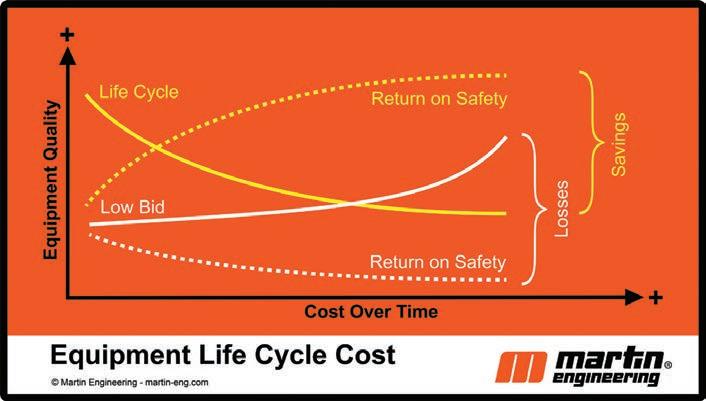
Operators should be aware of specifications on project components that state, for example, “specific manufacturer name or equal”. Vaguely written “or equal” specifications are there for competitive reasons and allow contractors to purchase on price without adequate consideration for construction or performance.
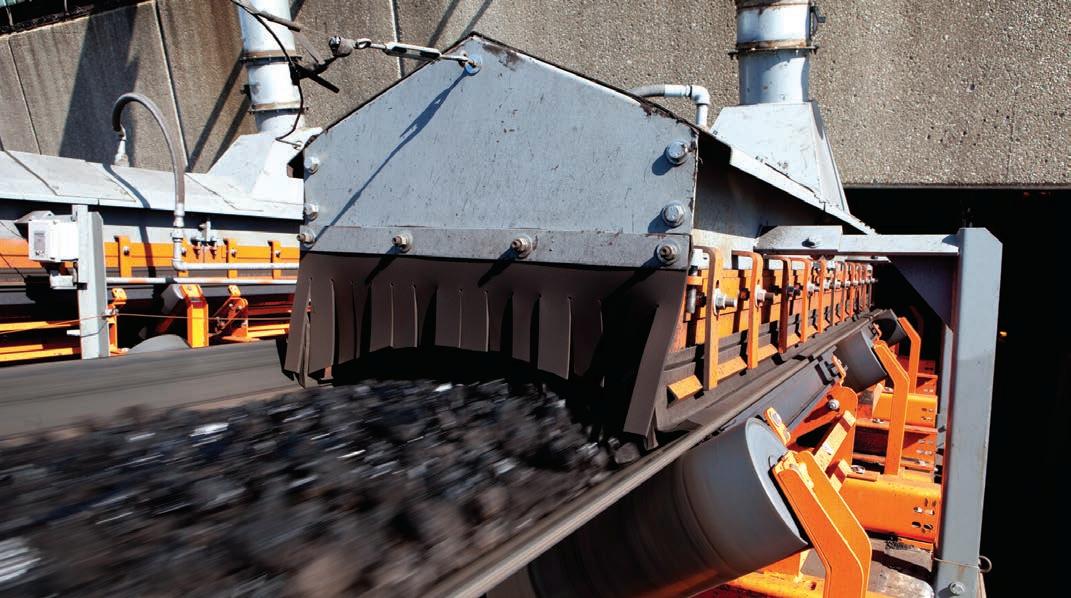 Return on better design and quality is realised over the extended life and safety of the system.
C M Y CM MY CY CMY K
THERE’S A FINE LINE BETWEEN OK AND NOT. TEST

YOURSELF,
NOT YOUR LIFE OR THE LIFE OF OTHERS.
Drug Alert kits use the same technology as that found in professional screening laboratories, without the need to send them away to obtain results.

Available from:

Respect in the workplace
COMPANIES FOR
PROMOTING A RESPECTFUL
Respect for underrepresented groups within Australia’s mining sector has been a huge focus for the industry following a number of high-profile workplace issues leading to a Parliamentary Inquiry.

Through this dialogue, it has become clear that embedding a culture where every individual, regardless of background, gender and sexuality, should be respected equally in the workplace, and feel respected, engaged and included is the key to ensuring the industry remains safe and attractive to all participants.
As a means of promoting a healthy, safe and respectful workplace, Gold Fields has commenced a movement called the Respectful Workplaces campaign.
Gold Fields is a truly global mining company. With headquarters in Johannesburg, South Africa, the
company’s Australian assets include a 100 per cent interest in the St Ives, Agnew and Granny Smith mines, and a 50 per cent interest in the Gruyere JV project with Gold Road Resources in the Yilgarn area of Western Australia.
Gold Fields’ Respectful Workplace campaign is one of four core elements of the company’s worldwide cultural program, the Gold Fields Way, which focuses on the goal of being ‘stronger together’
Safe to Work spoke to Gold Fields Australia’s vice-president, people and engagement Karen Bradshaw, who said the campaign is about encouraging and empowering the company’s people to have safe and respectful conversations with one another about what respect means to them.
“We know that conversations and regular dialogue build positive relationships between people and
over time create an environment of psychological safety and trust,” Bradshaw said.
“When people know and trust each other, they feel much safer to speak up, to listen to each other and understand how their behaviour impacts others.”
Bradshaw said the campaign has been put together based on two years of listening-based consultations with Gold Fields’ employees and employees of business partners. These consultations helped shape a broad range of measures.
“These measures range from policy (such as) enforcing our zero-tolerance approach to disrespectful behaviours through to practical initiatives like providing a better standard of facilities to all employees and free sanitary products across our sites,” Bradshaw said.
Gold SAFETOWORK.COM.AU 54 JUL—AUG 2023
GOLD FIELDS, ONE OF THE WORLD’S LEADING GOLD MINING
OVER A CENTURY, IS LAUNCHING A NEW CAMPAIGN
WORKPLACE CULTURE.
Achieving a respectful workplace culture, Bradshaw said, requires a multifaceted approach.
“We keep front of mind that people need to speak, be heard and feel respected in different ways, and our campaign is flexible enough to accommodate these needs,” Bradshaw said. “It is also important to keep in mind that our workforce is diverse and that we look at all diversity attributes to address issues which impact our whole workforce, including bullying, discrimination and racism.”
In addition to a multi-faceted approach, the Respectful Workplaces campaign has taken a behaviourchange-based and leader-led approach that aims to prevent harm before it occurs.
“Our leaders are accountable for our culture. We are working with our leaders to improve their capability to lead culture, including equipping them with the tools and understanding to have more conversations around sensitive issues early before they escalate,” Bradshaw said.
“We would like to make our business a more open place for people to talk and listen to sensitive issues and to be able to let others know how they would like to be treated in our workplace.
“We know these issues can be difficult and uncomfortable for both leaders and team members. So we are also putting in place the support needed to create safe spaces designed with care so that people feel heard and supported.
“The more people we empower to speak up and listen to these issues, the safer and more inclusive our work environments will become.
“Ultimately, it is about creating workplace environments that people can be their best in.”
While in its early stages, Gold Fields’ Respectful Workplace campaign has so far had a positive impact. The company said it is seeing more people speak up about behaviour they find disrespectful, both in terms of those who are experiencing it themselves and bystanders who have witnessed poor behaviour towards others.


“We have created an education kit for leaders,” Bradshaw said.
“(This includes) 10 conversation modules, a handbook and supporting conversation cards that assist leaders in having conversations with their teams
about respectful behaviour, unwelcome behaviour, the difference between intent and impact, how to speak up, and how to be an ally.”
A new visual campaign modelling respectful and disrespectful interactions for Gold Fields’ site villages has also been introduced, as has a series of training courses.
“Wrapped around this are all the physical changes we have made across the business and on our sites, like improving camp security, modernising ablution facilities and diversifying our range of personal protective equipment (PPE) clothing and equipment,” Bradshaw said.
Gold Fields is also collaborating with industry organisations such as Gold Industry Group and working closely with its business partners to share the messaging of the campaign.
“We know that behaviour change must be felt across our business and more broadly across the industry,” Bradshaw said.
“This is a long-term ambition which requires a long-term commitment and collaboration across the industry.
“Through our Respectful Workplaces campaign, and our wider work (in creating) a more caring, courageous and inclusive culture, we will get there.”
Emma Purvis (left) is an exploration geologist at Gold Fields’ Agnew mine.
SAFETOWORK.COM.AU 55 JUL—AUG 2023
Elaine Murphy (left) is Gold Fields’ first female geology manager at Agnew.
A safer slogger
WHILE THE SLOGGING WRENCH MIGHT BE TRIED AND TESTED ON THE WORKSITE, A NEW PRODUCT FROM IMPACT TOOLS IS SET TO MAKE IT SAFER THAN EVER BEFORE.
Traditional slogging wrenches, known as short and stubby spanners, are able to remove hard-to-move bolts. Impact Tools has brought a new and improved version to market with safety in mind.

Company owner Colin Turci found the inspiration for the Safewrench, made by Ampco, in Germany five years ago.
The key to the new product is the two integrated spring washers it has inside. The two washers provide a firmer grip on the nut or bolt and can effectively hold the spanner on the nut.
The concept is to reduce the risk of injury from holding both the hammer and slogging wrench, which allows for more focus and precision on the task.
“Because it can hold itself on the nut, you can concentrate on using the hammer to hit the spanner rather than trying to have one hand on the spanner or someone else holding the spanner,” Turci told Safe to Work
“I was really surprised to see how many traditional wrenches were still being sold, especially when you think about how they are used.
“Traditional wrenches are definitely not the safest option and, on top of that, users are sometimes focusing so much on not hurting themselves that they’re not focussing on the job at hand.”
Safety is crucial on the worksite, especially in the mining sector, with hand safety at the top of the list.
A recent report from the WA Government, ‘Safety Performance in the West Australian Mineral Industry’, showed hand injuries were in the top three most common serious injuries reported in 2020–21.
Turci said the Safewrench helps minimise potential hand injuries on the work site.
“You can have this spanner upside down and it won’t fall off the nut, you can safely hit it with a hammer without
putting another person in the line of an unfortunate accident,” he said.

“With a traditional wrench, two people are involved, one holding the spanner and one hitting it with a hammer. Our product removes two people from the line of fire.”
While the company still sells traditional slogging wrenches, the advantages of the Safewrench have been accepted by more and more of Impact Tools’ clients, with some
Equipment SAFETOWORK.COM.AU 56 JUL—AUG 2023
The slogging wrench has had a safety upgrade with the Safewrench.
remote mining operations making it a standard product across sites.
As evidenced by sales over the past 18 months, the company has seen more operations looking for ways to improve safety and picking the Safewrench as a solution.
reversing THE SPIRAL
SPINKS
“With most of these mine sites, the focus on safety is a powerful thing,” Turci said. “We’ve come across people that have really liked the idea and taken it onboard.”
One of the key parts of the Safewrench’s improved safety is its non-sparking capability.
The Safewrench comes in two ranges, including the non-sparking range that takes advantage of Ampco’s ability to make tools in different alloys.


“We have the full non-sparking range available as well.” Turci said.
“For example, in areas where a spark is very hazardous, where you need something that if you drop it on the ground or hit it, it won’t create a spark or ignite any fumes or liquid.”
Impact Tool believes the Safewrench is ready to make a dent in workplace safety.
“We carry the Safewrench in stock so there are no big lead times,” Turci said.
“I think the market is still quite huge to get these to the right people in a lot of remote areas.
“Even when we’ve received some really large orders, we’ve been able to fill them because
we carry the stock. Spanners are such typical tools that everyone sells, but I think what sets us apart is that we’ve looked at them from a different angle and asked, how can we make these safer?”
Mental Health and Wellness. Resilience. Leadership and Innovation.
Paramedic, trauma counsellor and international speaker, Paul Spinks shares his unique insight and solutions on reversing the spiral of mental health, maximising human performance, growth and self-worth.
When was your last normal? A life crisis can happen to anyone regardless of position or wealth. What is the point of success if we lose ourselves and the connection to the things and people we love?
Most inspirational presentations wash off quickly. This one will last a lifetime.
Life Lessons Learned from our darkest hours
Book Paul as your next speaker. 0458 269 222. thewakeupcall.me
The Safewrench helps to remove workers from the line of fire.
The Safewrench is available in a non-sparking range.
Gauging the line of fire
MACKELLAR GROUP HAS IMPLEMENTED SAFEGAUGE PRODUCTS ACROSS ITS OPERATIONS IN A BID TO IMPROVE SAFETY AND EFFICIENCY.
MacKellar Group has a long history in mining. Since its inception in 1966, the company has seen its share of safety products come and go, but none have stood the test of time like the range from SafeGauge.

“Without SafeGauge’s products, our workers would be in the line of fire,” MacKellar Group managing director Stuart Arndell told Safe to Work. “The products
allow us to get our people right out from in front of the machines; without them, there’s a chance of them getting injured or burned.”
While it might come as no surprise that SafeGauge’s products enhanced safety, MacKellar also found that its efficiency was improving.
“Taking measurements and values has been quicker, because everything is recorded digitally,” Arndell said.
“Having electronic readings and storage means we make far less mistakes, and we can pass all maintenance records on much quicker.”
It’s generally accepted that any time a business implements a new suite of products, it can be expected that the process will involve a few challenging learning curves – but it wasn’t that way for MacKellar.
SAFETOWORK.COM.AU 58 JUL—AUG 2023
Safety technology
SafeGauge’s products put fitters outside the line of fire.
“The adoption has been immediate,” Arndell said. “Our team picked it up and ran with it.
“The products are now basically part of their lives, and our maintenance improvements have been immediate.”
The live-testing products that MacKellar adopted include the sixchannel pressure test gauge and the four-channel dial indicator testing kit.
The SafeTest Dial Indicator is a Bluetooth-enabled device that remotely measures clearances, tolerances and wear on a machine, while the pressure test kit allows the user to measure gas or fluid from a distance of up to 50m.
While these products have become staples for MacKellar, it was the service the company received from SafeGauge that really sealed the deal.
“The owner of SafeGauge actually came to our office to tell us his story and to answer any questions we had,” Arndell said.
“I could see we needed this tooling, and they made the whole process so easy.
“There was a seamless transition from getting a quote to actually getting the products delivered to our office.
“Seeing that personal touch that SafeGauge has was great.”
MacKellar uses SafeGauge products across its dump trucks, dozers and excavators, and the company said it is yet to encounter a problem.
“The remote tools that monitor hydraulic pressure were particularly handy on the excavators,” Arndell said.


“Without them, our teams would be stationed literally under the machines while they checked them and if something moved, it would be a horrible end to that story.
“A good thing about SafeGauge is that it is working toward future safety products, too. Instead of just sitting
back and going, ‘yeah, we have a great product’ and that’s the end, the company is actively working on making sure it continues to have a great product.
“I can see us using SafeGauge for a long time yet.”
Not only do SafeGauge products improve safety, but they also increase efficiency.
SAFETOWORK.COM.AU 59 JUL—AUG 2023
The SafeTest Dial Indicator remotely measures machine wear.
Mining equipment
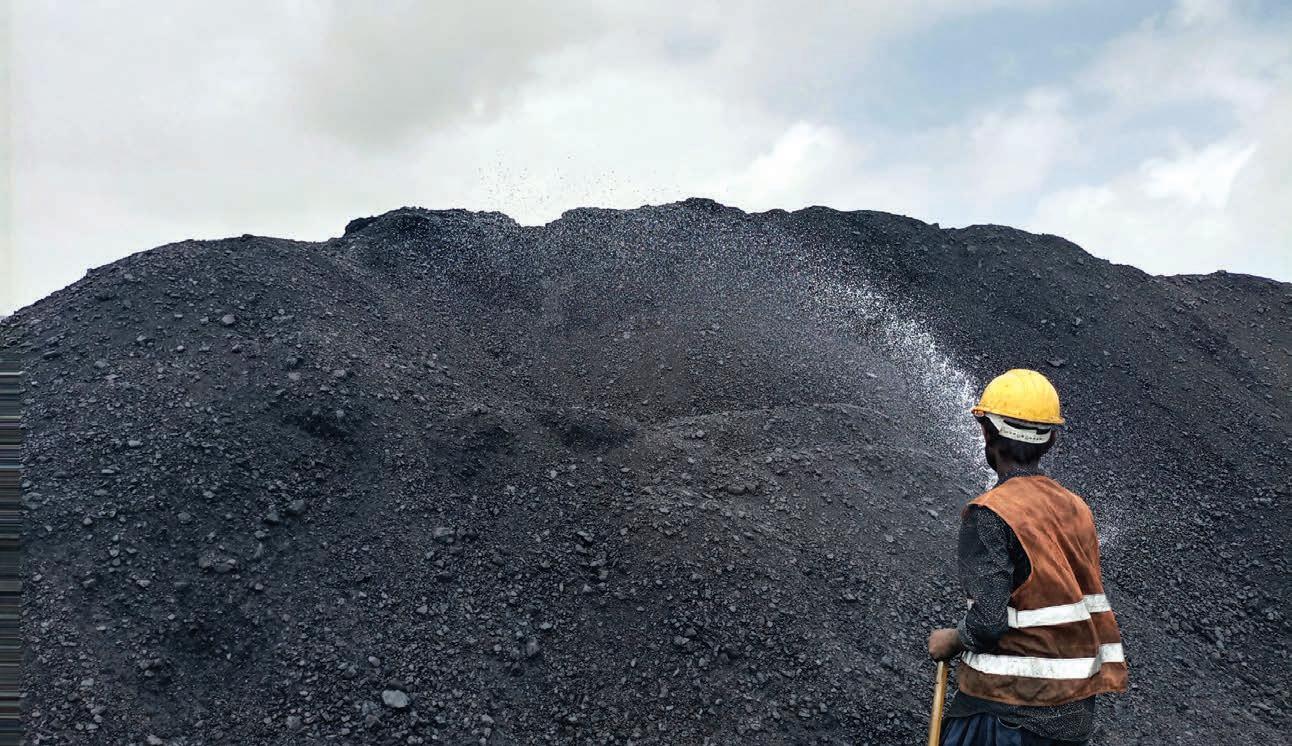
Home and hosed
SAFETY REGULATORS HAVE MADE SEVERAL RECOMMENDATIONS FOR WHAT SEEMS LIKE AN UNLIKELY ON-SITE THREAT: HOSES.
It may seem obvious, but hoses are a major staple on mine sites, used for dozers, drill rigs, and longwall systems. They are such regular fixtures, in fact, that most people rarely give them a second glance.
While it may be easy to ensure the correct hose is selected for a job, or to stay on top of maintenance and servicing, the safety hazards they present can escape notice just as easily.
And hoses can indeed pose a safety threat. More specifically, hoses fitted with lever handle ball valves, which are common on mine sites and have injured workers on multiple occasions.
The lever on the business end of the hose is easy to snag and inadvertently activate, suddenly releasing pressurised water or air and causing the hose — with its heavy metal head — to flail dangerously.
A recent safety bulletin from the New South Wales
Government reported two such hoserelated incidents.
“A deputy was filling a load haul dump (LHD) with water on 20 April 2023,” the bulletin reported. “While passing the hose across the LHD, the handle of the ball valve attached to the free end of the hose activated, causing the hose and valve to flick back (and) striking the deputy’s nose and glasses. The deputy suffered a laceration to the nose.”
And in the same week, another worker was injured by a hose while washing out a concrete kibble.
“The worker turned the hose off at the ball valve, placed it on the kibble and while climbing onto the kibble, the hose moved, activating the ball valve,” the bulletin stated.
“The hose and valve flung back, cutting the person’s forearm.”
Part of the issue is that the level-style handle of ball valves requires only 90° of rotation to achieve full flow.
This style of hose is designed for being fixed to solidly mounted pipework, which allows for quick activation.
But workers aren’t isolating hoses at the fixed valve and dissipating pressure from the hose. Instead, they’re typically turning off the valve at the discharge end of the hose, and leaving the hoses charged with pressure.
Some ball valves are fitted with a slider lock; however, this is a gravity slide and the orientation of the valve may render this control ineffective.
A similar hose incident occurred in South Australia when a jumbo operator installed a dewatering pump.
The operator ran over the dewatering pump link hose, causing the hose connection to fail. This in turn made the hose to fling back under pressure, striking a worker and leading to serious facial injuries.
In extremely serious cases, hoses that carry chemicals may
SAFETOWORK.COM.AU 60 JUL—AUG 2023
Hoses are a staple on a mine site but carry with them the risk of serious injury.
fail and cause significant burns. Such an incident occurred in 2015 when a worker in Western Australia was involved in a routine purging operation as part of scheduled maintenance of an ammonia storage area of a processing plant.
The worker connected a flexible rubber hose via coupling to a purge connection point, and the hose was charged with nitrogen as the valve was slowly opened. The hose ruptured above the connection point, spraying the worker and enveloping him in a cloud of ammonia.
The worker was subsequently airlifted to hospital and treated for chemical burns.
So what can mine operators do to combat the tyranny of hoses?
The NSW Government makes several recommendations, including:
• identify ball valve hoses as a known hazard
• review alternatives to the use of ball valves attached to the free end of hoses
• retrain supervisors and workers in hazards associated with hose whip from inadvertent activation of a hose
• ensure workers check the operating condition and function of the hose valves before use
• depressurise hoses when not in use.
Safe Work SA also recommends that hoses are installed as per manufacturer’s instruction, hoses that have exceeded service life are replaced, and that the hose itself is free of twists.
To prevent hose fitting injury, Safe Work SA recommends the hose is:

• not subjected to excessive pressure surges
• free of crimping
• installed correctly
• not bent below the recommended minimum radius
• free of wear and tear
• not exposed to high temperature surfaces.
If these recommendations are impractical, the Safe Work SA bulletin recommends fitting hoses with nozzles that will not engage without direct involvement by a worker such as trigger handles or twohanded controls.
While hoses may seem like an unlikely threat on a mine site, the fact remains that they can cause serious injury and proper precaution must be taken to ensure worker safety.
SAFETOWORK.COM.AU 61 JUL—AUG 2023
Lever handle ball valves are particularly dangerous if not handled properly.
CONFERENCES, SEMINARS & WORKSHOPS

EVENT SUBMISSIONS CAN BE EMAILED TO EDITOR@SAFETOWORK.COM.AU
LIFE OF MINE CONFERENCE 2023 BRISBANE | AUGUST 2–4
AusIMM and the University of Queensland’s Sustainable Minerals’ Centre for Mined Land Rehabilitation (CMLR) are welcoming attendees back to the highly successful Life of Mine Conference 2023.
The conference welcomed a record number of attendees from over 15 countries in 2021 and is set to bring a wider global audience in 2023. Join professionals, researchers, government, and academia from a diverse range of sectors as the program explores the full lifecycle of a mine, from exploration to rehabilitation.
Delivered in-person and online, this technical conference addresses current and future challenges affecting the mining value chain and will present leading examples of sustainability in mining.
• ausimm.com/conferences-and-events/ mine-waste-and-tailings
MECHANICAL ENGINEERING SAFETY SEMINAR 2023 SYDNEY | AUGUST 2–3
The Mechanical Engineering Safety Seminar (MESS) is returning in 2023. The NSW Resource Regulator is proud to be hosting the 31st annual event and is seeking experienced and enthusiastic presenters. The seminar will be held on August 2–3 at the Hyatt Regency Sydney. Delegates will only be able to attend in person; there will be no online broadcast of this event.
This is an excellent opportunity to share experience, insight and learnings with
mechanical engineers from across the NSW mining industry.
• resourcesregulator.nsw.gov.au/newsarticles/call-for-speakers-mess-2023
DIGGERS & DEALERS KALGOORLIE | AUGUST 7–9
Diggers & Dealers combines 70 corporate presentations by listed mining and exploration companies with a large exhibition housing more than 150 exhibitors from the sector.
Delegates include miners, explorers, brokers, bankers, investors, financiers and mining service industries from around the world.
The event provides a unique opportunity for industry professionals to meet and network, visit regional mine sites, engage with media, raise finance, invest in projects and engage with the resources sector at an executive level.
An entertainment program ensures delegates experience the best of the style and hospitality of Kalgoorlie, the unofficial gold mining capital of Australia.
• diggersndealers.com.au
AUSTRALIAN MINING PROSPECT AWARDS BRISBANE | NOVEMBER 9
Taking place in Brisbane in 2023, the Australian Mining Prospect Awards are a great opportunity to recognise and acknowledge the people and companies in the mining sector for their outstanding work. Having celebrated the 2022 Prospect Awards winners, nominations are now
open for 2023, with awards in categories such as Indigenous and Community Engagement, Mine Project Success of the Year, Outstanding Mine Performance, Sustainability Project of the Year, Discovery of the Year, and more.
Some 2022 award winners included Kestrel Coal for Australian Mine of the Year, Roy Hill for Mine Project Success of the Year, and Flexco Australia for Excellence in IIoT Application.
The awards return to Brisbane in appreciation of the vibrancy of the state’s mining industry.
• prospectawards.com.au
CRITICAL MINERALS CONFERENCE 2023 PERTH | NOVEMBER 21–23
Critical minerals are essential components in many of today’s rapidly growing clean energy technologies – from wind turbines and electricity networks to electric vehicles.
The increasing appetite and rapid pace of the transition to cleaner energy sources continues to drive the growth in demand for these minerals, and in response the supporting industries are also growing at unprecedented rates.
To address this rapid growth, AusIMM will launch its inaugural Critical Minerals Conference in 2023.
The event will include a multi-stream format and seek to engage with a larger audience from multiple disciplines as well as a wide range of industry representatives.
• ausimm.com/conferences-and-events/ critical-minerals/
SAFETOWORK.COM.AU 62 JUL—AUG 2023
Events
BEAT FATIGUE FROM THE GROUND UP
Reduce stress, maximise safety & productivity with anti-fatigue soles
Stay dry inside out with COOLMAX® waterproof breathable lining
Arch support, comfort & hygiene with washable Ortholite® insoles
RECLAIM YOUR ENERGY kamusafety.com.au / 1300 30 76 79 Follow us!
LIGHTWEIGHT SAFETY / DURABLE CUSHIONING / MAXIMUM ENERGY RETURN
/
IntelliZone® is a user-friendly proximity detection system that creates shaped and dynamic shutdown/ caution/operator zones to enhance miner safety while maintaining productivity.
• IECEx-certified for underground coal in Australia and Queensland since 2018 and EMESRT Level 7 & 9 compliant.
• Shaped-zone technology minimises nuisance alertsworks on standard or articulating equipment.
• Continuous miner operator can stand close to the machine and remain in a safe area.
• Purpose-built for underground mining and can be installed on all mobile equipment.
• 2021 U.S. NIOSH Safety and Health Technology Innovation Award winner.
Matrix Design Australia • +61 428 899 778 Queensland • New South Wales • MatrixTeam.com
