Industry Organisations
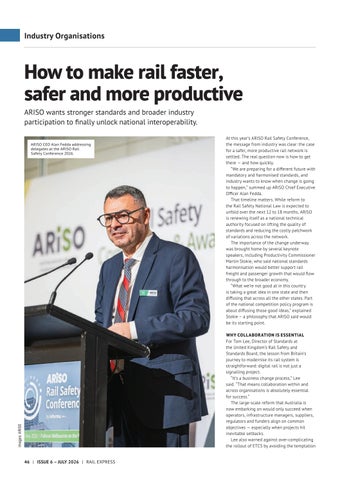
How to make rail faster, safer and more productive ARISO wants stronger standards and broader industry participation to finally unlock national interoperability. ARISO CEO Alan Fedda addressing delegates at the ARISO Rail Safety Conference 2026.
At this year’s ARISO Rail Safety Conference, the message from industry was clear: the case for a safer, more productive rail network is settled. The real question now is how to get there — and how quickly. “We are preparing for a different future with mandatory and harmonised standards, and industry wants to know when change is going to happen,” summed up ARISO Chief Executive Officer Alan Fedda. That timeline matters. While reform to the Rail Safety National Law is expected to unfold over the next 12 to 18 months, ARISO is renewing itself as a national technical authority focused on lifting the quality of standards and reducing the costly patchwork of variations across the network. The importance of the change underway was brought home by several keynote speakers, including Productivity Commissioner Martin Stokie, who said national standards harmonisation would better support rail freight and passenger growth that would flow through to the broader economy. “What we’re not good at in this country is taking a great idea in one state and then diffusing that across all the other states. Part of the national competition policy program is about diffusing those good ideas,” explained Stokie – a philosophy that ARISO said would be its starting point.
Images: ARISO
WHY COLLABORATION IS ESSENTIAL For Tom Lee, Director of Standards at the United Kingdom’s Rail Safety and Standards Board, the lesson from Britain’s journey to modernise its rail system is straightforward: digital rail is not just a signalling project. “It’s a business change process,” Lee said. “That means collaboration within and across organisations is absolutely essential for success.” The large-scale reform that Australia is now embarking on would only succeed when operators, infrastructure managers, suppliers, regulators and funders align on common objectives — especially when projects hit inevitable setbacks. Lee also warned against over-complicating the rollout of ETCS by avoiding the temptation 46 | ISSUE 6 – JULY 2026 | RAIL EXPRESS