Speeding towards the future
After being talked about for decades, real progress is being made to bring high speed rail to Australia – with 2026 set to be one of the busiest years yet for the High Speed Rail Authority.
Delivering from day one
PAGE 24
The global rail revolution PAGE 26
Metro Tunnel makes an impact
PAGE 30


From the Editor
Published by:
379 Docklands Drive
Docklands, VIC 3008
T: 03 9690 8766
www.primecreativemedia.com.au
Chairman
John Murphy E: john.murphy@primecreative.com.au
CEO Christine Clancy E: christine.clancy@primecreative.com.au
Managing Editor Lisa Korycki E: lisa.korycki@primecreative.com.au
Editor Kayla Walsh E: kayla.walsh@primecreative.com.au
Business Development Manager
Arron Reed M: 0466 923 194 E: arron.reed@primecreative.com.au
Client Success Manager
Ben Sammartino
E: ben.sammartino@primecreative.com.au
Head of Design
Blake Storey
E: blake.storey@primecreative.com.au
Designer Apostolos Topatsis
Subscriptions subscriptions@primecreative.com.au
www.RailExpress.com.au
The Publisher reserves the right to alter or omit any article or advertisement submitted and requires indemnity from the advertisers and contributors against damages or liabilities that may arise from material published. © Copyright – No part of this publication may be reproduced, stored in a retrieval system or transmitted in any means electronic, mechanical, photocopying, recording or otherwise without the permission of the Publisher.

Kayla Walsh Editor - Rail Express
Welcome to the February edition of Rail Express
Welcome back readers – we hope you all had a wonderful holiday season and are feeling refreshed and ready for another big year!
With the new Sydney Metro extension from Sydenham to Bankstown set to open in 2026, as well as Auckland’s City Rail Link, we're excited to see the progress being made across Australia and New Zealand’s rail networks.
This issue includes plenty of interesting insight about the future of our industry –with one of the highlights being our cover story. High-speed rail has been talked about in Australia for more than three decades, and according to Tim Parker, Chief Executive Officer (CEO) of the High Speed Rail Authority (HSRA), it’s finally moving from a “vague concept to a definitive plan”. He shared an update on the HSRA’s progress at AusRAIL PLUS – read all about it on page 10.
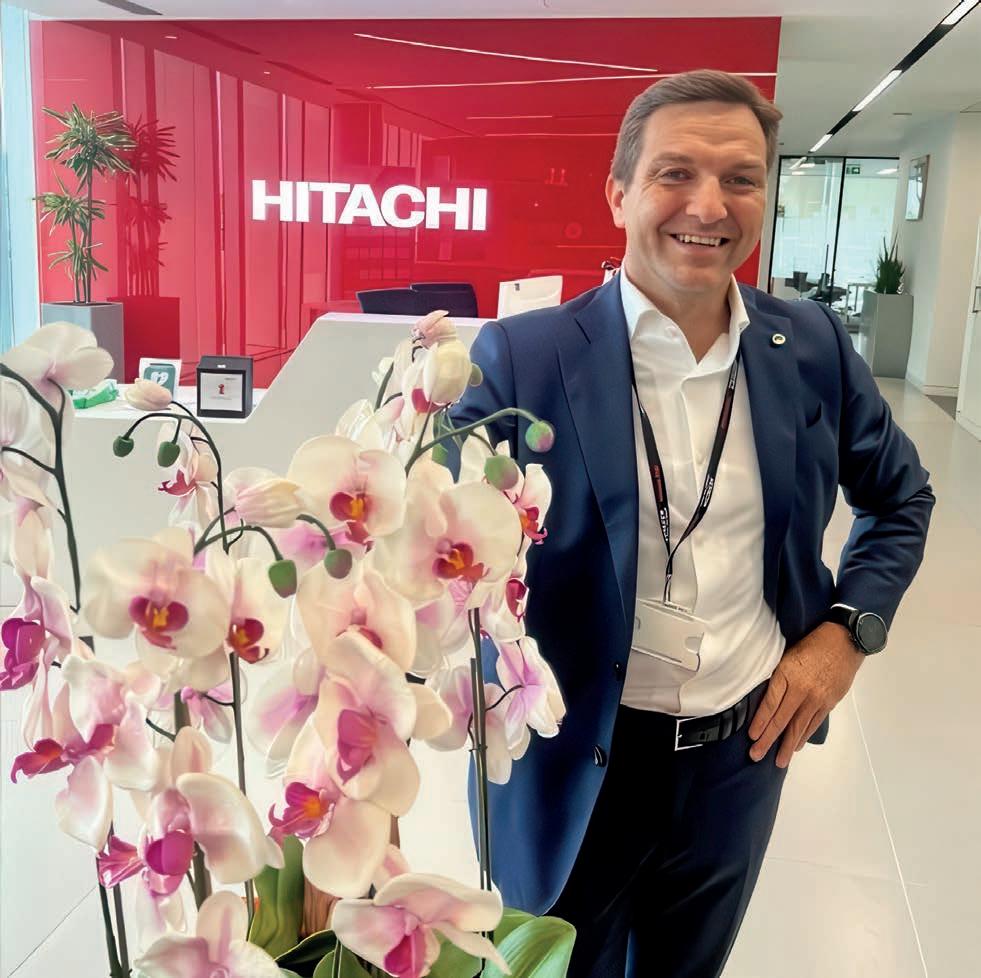
Hitachi Rail also weighs in on high-speed rail, with its global CEO Giuseppe Marino speaking about the company’s bold vision to transform mobility in Australia.
Another prominent rail leader to share his thoughts in this issue is Alstom's CEO Henri Poupart-Lafarge. Henri flew all the way from Paris to Melbourne to address the crowd at AusRAIL about the global rail revolution and the part Alstom has to play. Also at AusRAIL, CEO of Unipart Darren Leigh gave a
fascinating talk on the rail supply chain and how to deliver the resilient and sustainable rail network that Australia needs.
Elsewhere in this issue, rail maintenance tools specialist Enerpac spoke about its new partnership with Harrybilt, as well as some of the innovative rail solutions it offers. Over in the light rail space, Systematiq told how it provides support from project mobilisation to final delivery.
Siemens Mobility shared how it is helping rail operators unlock new levels of performance through proactive maintenance, and Martinus explained the importance of governance and constructability when delivering complex brownfield rail projects.
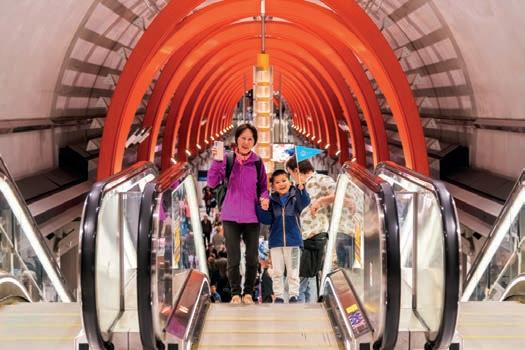
We've also brought you an update on Melbourne’s Metro Tunnel now that the full timetable has been rolled out.
Plus we’ve got our regular columns from the Permanent Way Institution, the Australasian Railway Association, the National Transport Commission and the Rail Industry Safety and Standards Board, which has rebranded as the Australian Rail Industry Standards Organisation.
Happy reading!
kayla.walsh@primecreative.com.au
Construction begins at Beveridge
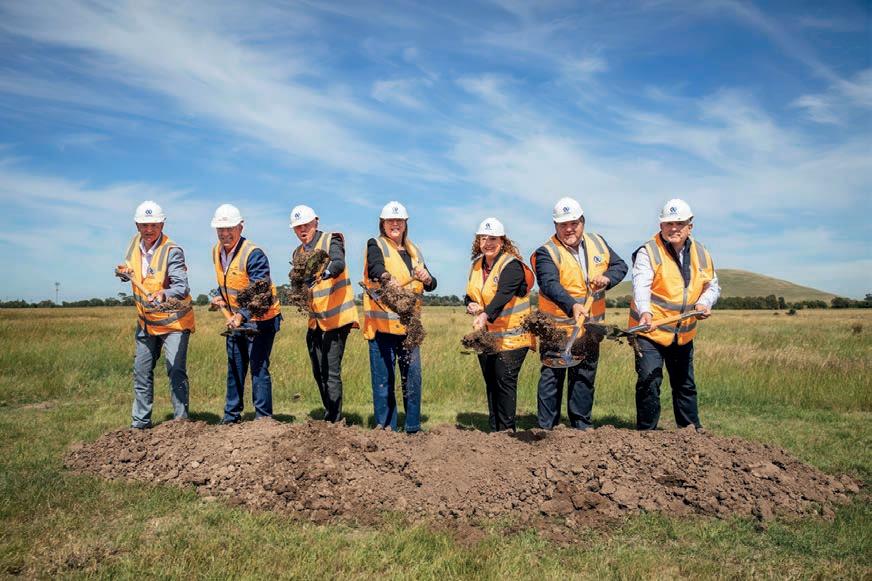
Construction has begun on what will be Australia’s largest logistics hub, the $1.62 billion Beveridge Intermodal Precinct in Melbourne.
The first sods have been turned and key approvals are in place for site preparation works to get underway, paving the way for major construction to start.
Located at the southern terminus of the Inland Rail freight corridor, the openaccess Beveridge Intermodal Precinct will reduce freight costs, ease road congestion and boost supply chain efficiency and competition, the Victorian Government said.
The first stage of the project will also deliver the only Melbourne terminal capable of receiving and servicing double-stacked
Inland Rail trains, targeting mid-2028 operations with capacity for up to 200,000 20-foot-equivalent units annually.
Once operational, double-stacked trains will be able to run between Melbourne and Perth, via Parkes in New South Wales central west.
The intermodal terminal precinct is intended to help shift freight from road to rail, removing 167,000 truck trips from roads each year when the Beveridge Intermodal Precinct is fully developed. Each train pulling into the Intermodal will replace up to 110 trucks.
This modal shift is expected to reduce emissions by 12.1 million tonnes of carbon dioxide over 25 years and cut particulate
pollution by 92 per cent compared to road freight.
Around 500 hectares of land will be preserved for green wedge and other longterm environmental and social benefits.
Federal Infrastructure, Transport, Regional Development and Local Government Minister Catherine King said: “This marks a major milestone as the Beveridge Intermodal Precinct moves from planning to delivery.
“As we work to move more freight from our roads to rail, Beveridge will play a key role in marshalling freight from the port and across Victoria, sending it onto destinations across the country via our rail network.
“Strong local supply chains often go unnoticed, but they are vital to ensure goods make it to shelves and shopfronts.”
National Intermodal Chief Executive Officer James Baulderstone said: “The Beveridge Intermodal Precinct is a oncein-a-generation opportunity to reshape how freight moves across Australia.
“We’re ready to deliver a nationally significant project that will not only drive $14 billion in economic uplift in Victoria and create more than 17,000 jobs, but also deliver real environmental benefits, including taking 167,000 truck trips off our roads each year and cutting emissions by more than 12 million tonnes.”

Melbourne station scoops top award
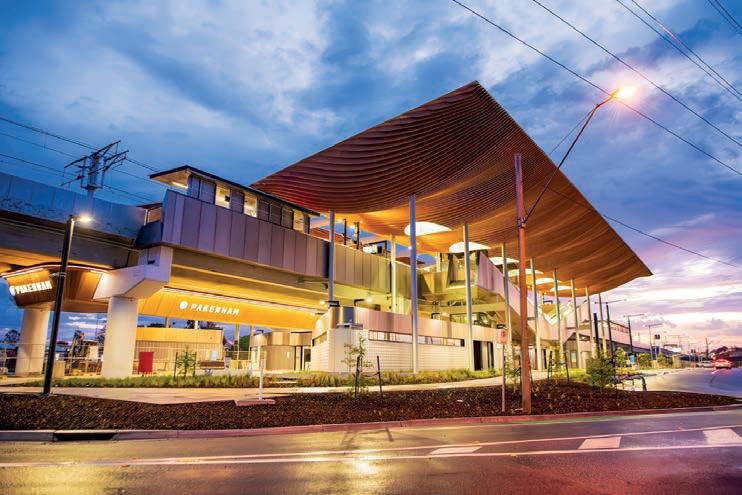
Pakenham Station in Melbourne has been recognised as part of the Victorian Premier’s Design Award.
The award honoured the station precinct for its open-air structure and enhanced public spaces, with the judges commenting that the station’s wave-like roof has become a “landmark gateway” to Gippsland.
The judges also praised the station’s sustainable construction methodology and buildings – in particular the use of digital fabrication technology to construct the station canopy.
The accolade follows the project receiving one of the highest Infrastructure Sustainability Council’s “As-Built” ratings, scoring 97.98 for its commitment to sustainability through a 52.1 per cent reduction in energy use, and a 35 per cent reduction in emissions from materials.
Built as part of level crossing removals at McGregor Road, Main Street and Racecourse Road, Pakenham Station opened in 2024, along with a new East Pakenham Station.
Elevating the rail line over the roads at Pakenham Station has created a large
open space, including walking and cycling paths, a barbecue area, a playground, a half basketball court, soccer net and exercise equipment. Across the entire project, more than 330,000 grasses, trees and shrubs were planted.
The first sods have been turned at the Beveridge Intermodal Precinct.
Image: James Baulderstone
Image: Victorian Government
Pakenham Station opened to passengers in 2024.
Contactless payments come to Perth
Perth passengers can now tap on and off public transport with their credit or debit cards, digital wallets and other wearable devices.
Those travelling on public transport in Bunbury, Busselton, Kalgoorlie, Esperance, Albany, Geraldton, Karratha, and Port Hedland are also able to use the new payment options.
According to the Western Australian Government, this marks the biggest change to the state’s public transport system since SmartRider reusable smart cards were introduced 18 years ago.
The official introduction of the new system follows successful trials across buses, trains and ferries in Perth.
It marks a step forward in the SmartRider Upgrade Project, which includes a range of improvements across the transport network.
For passengers paying using the new options, fares are not displayed on a
validator or calculated throughout the day. Instead, a single charge will be calculated and applied at the end of the day.
Concession fares will be available only by using SmartRider or cash.
Station parking must be paid for using pay-by-plate machines, as SmartParker machines will not accept contactless payments.
Transport Minister Rita Saffioti said the changes make public transport in Western Australia more convenient and flexible.
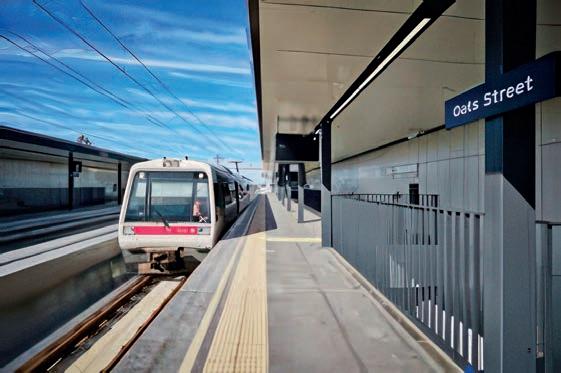
“This is an incredible development, and our government is very proud to continue improving WA’s public transport system for the community,” she said.
“This will also make it easier for visitors and tourists, who might not want to get a SmartRider for the few days they are here, and for people who only use public transport occasionally.
“It’s another way our government is working to deliver a world-class public transport network, making it more accessible and affordable for Western Australians.”

Public transport users are now able to tap on and off with their debit cards and other devices.
Image: METRONET
A first for Western Australia
METRONET’s Morley-Ellenbrook Line project is the first rail infrastructure project in Western Australia to earn a Platinum rating from the Infrastructure Sustainability Council (ISC), under the IS v2.0/2.1 scheme. This rating recognises achievements at Morley, Noranda, Ballajura, Whiteman Park and Ellenbrook stations and reflects the project’s performance in social, economic and environmental outcomes.
The Morley-Ellenbrook Line, which officially opened at the end of 2024, introduced several innovations that are new to Western Australia.
These include modular pool covers placed over construction dams, which reduced water use by around 15 per cent.
The project team also used Reptail ballast box spreaders imported from Finland, which made laying ballast faster and more efficient.
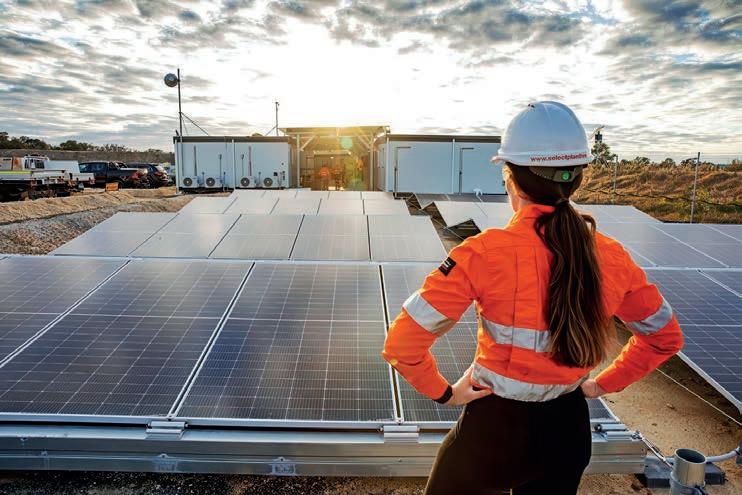
Whiteman Park Station became the state’s first solar-powered construction site, running almost entirely on renewable energy with 44 kilowatts of solar panels and a 50 kilovolt-ampere hybrid battery.
Inland Rail gets green light
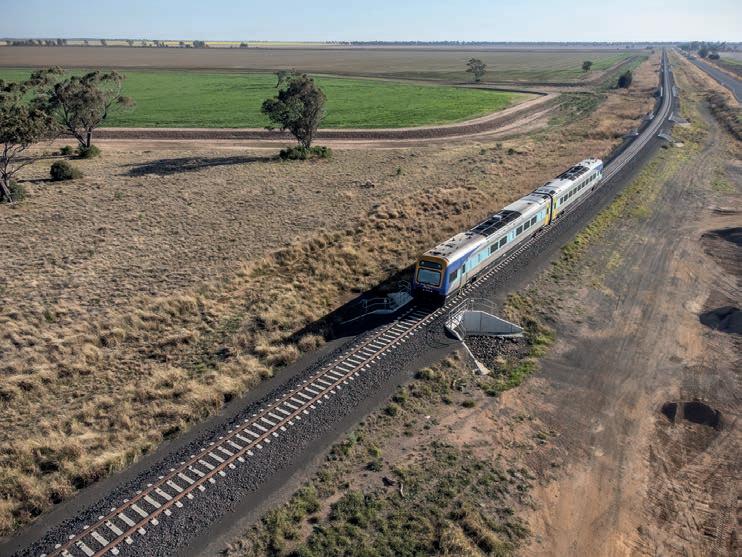
The New South Wales Government has granted approval for the Narrabri to North Star Phase 2 section of Inland Rail.
The New South Wales Minister for Planning and Public Spaces approved the Critical State Significant Infrastructure application for the Narrabri to North Star Phase 2 project under the NSW Environmental Planning and Assessment Act 1979.
This marks a milestone for the project, with all sections within the state now formally approved.
services agreement to joint venture partners Arcadis BG&E to complete a package of design work from Moree to Camurra, including the Narrabri to North Star Phase 2 project.
In the coming months, Inland Rail will work with Arcadis to refine the design of the Narrabri to North Star Phase 2 project, which includes the upgrade of approximately 14 kilometres of existing rail track and formation across the Gwydir Valley
organics compost for native plants.
METRONET said early results are already influencing other projects and they will continue monitoring for two more years to see the longterm impact.
Floodplain, and the construction of around 1.6 kilometres of new rail track to bypass the existing Camurra Hairpin.
The proposal also includes a 1.3 kilometre spur to maintain connection to the Weemelah Line.
Key rail design elements will include upgraded and new rail alignments, new rail bridges, additional culverts across floodplains and waterways, level crossings and earthworks.
Major construction of the Narrabri to North Star Phase 1 section is now complete, with upgrades carried out to 163 kilometres of existing rail corridor.
“This section is now much safer, allowing freight trains to travel faster after loading at facilities at Milguy, Croppa Creek and North Star,” a spokesperson for Inland Rail said in a statement.
The Narrabri to North Star Phase 2 project is now under Commonwealth assessment under the Environment Protection and Biodiversity Conservation Act 1999.
Future decisions by the Federal Government on the delivery of Inland Rail sections north of Narromine will be considered when the government has “more certainty” as to the delivery and full cost of Inland Rail.
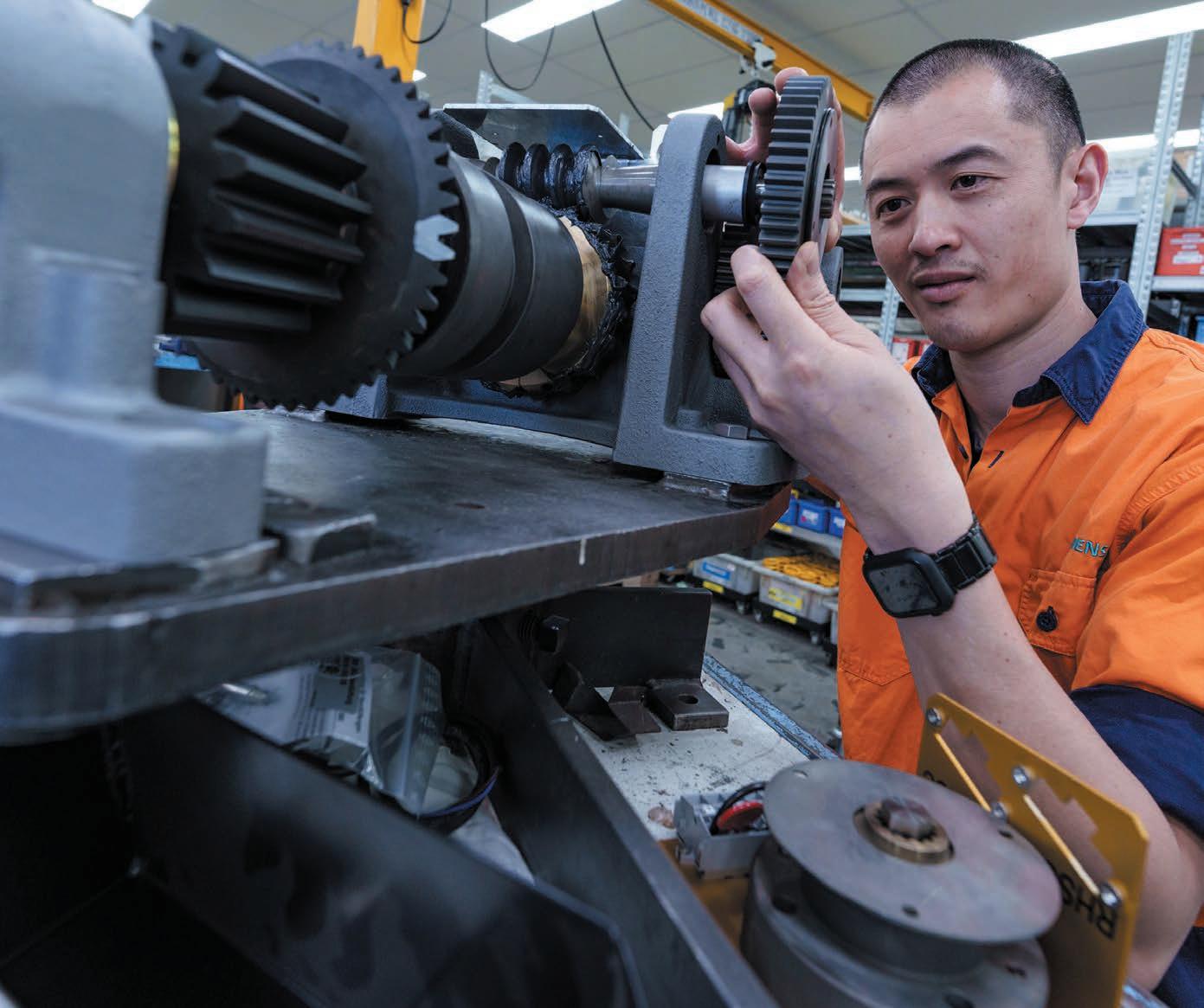
The Morley-Ellenbrook Line introduced several innovations.
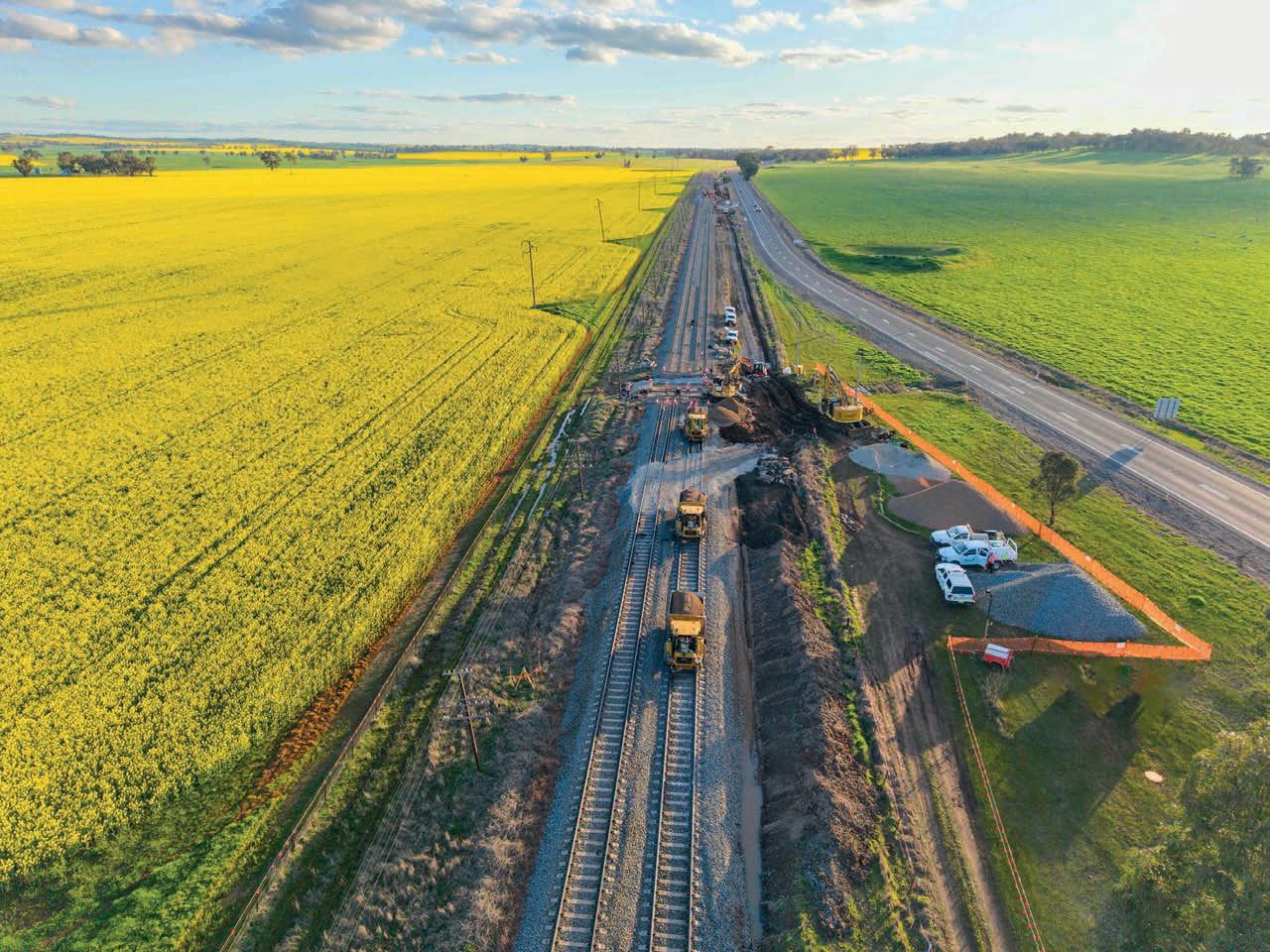
Upgrades were carried out along 163 kilometres of existing rail corridor as part of Narrabri to North Star Phase 1.
Image:
100% SYSTEM AVAILABILITY
Transform the way we travel
At Siemens Mobility, we value our local manufacturing facilities and engineering teams for their innovative and sustainable ways of working, as they are the key to revitalizing old and new rail technology that will #transformtheeveryday and change the way we travel globally.
Full speed ahead Cover Story
Tim Parker, CEO of the High Speed Rail Authority, says a high-speed rail network for Australia has evolved from a “vague concept to a definitive plan”.
High-speed rail has been talked about in Australia for more than three decades.
Some may have dismissed the idea as a pipe dream – but in the past few years, tangible progress has been made to take it from dream to reality.
The proposed future network would involve high-speed trains running from Brisbane to Melbourne, through Sydney and Canberra, while also serving regional communities across the East Coast.
The first stage would allow passengers to travel between Newcastle and Sydney in about one hour, and from the Central Coast to either city in about 30 minutes. Travel time between Sydney and Canberra would be about 90 minutes, and it would take approximately four hours to get from Sydney to Melbourne.
But high-speed rail isn’t just about saving time for commuters and holidaymakers, as Tim Parker, Chief Executive Officer of the High Speed Rail Authority pointed out at the AusRAIL PLUS rail industry conference in Melbourne.
“One of the first things I discovered on this project was that it’s not a rail project or a transport project,” he told the audience. “It’s a regional economic project.
“So often we get fixated on what [highspeed rail] is rather than what it does, but this is a project that will unlock more housing, create more jobs, and support the development of our regional areas.”
A WORK IN PROGRESS
Parker said that in the past few years, high-speed rail has evolved from a “vague concept to a definitive plan”.
Progress has been seen in recent developments such as the Federal Government assessment body Infrastructure Australia giving the green light to the business case for the section of high-speed rail between Sydney and Newcastle.
It supported the project moving into the development phase – a two-year period to engage with contractors and firm up at least 40 per cent of the design.
In parallel, it recommended that further work and consultation progress on the entire East-Coast National High Speed Rail project, building on the analysis that was developed alongside the business case.
It also asked that the existing business case, including economic appraisal, be updated to capture the outputs of the development phase and be provided
to the Federal Government, including Infrastructure Australia, to inform a final investment decision for delivery of the Newcastle to Sydney section.
“Infrastructure Australia mark the homework – they do the assurance to government on every big project,” explained Parker.
“We’re now waiting for a direction from the government, but Infrastructure Australia saying our business case passes muster is an important piece of the puzzle.”
FACING CHALLENGES
The Newcastle to Sydney high-speed rail network is planned to run from central Newcastle through the Central Coast into Sydney CBD before heading west, with stations at Newcastle, Lake Macquarie, Central Coast, Sydney Central, Paramatta and Western Sydney Airport.
“This will provide fantastic connectivity, not just to Newcastle, but to the new asset, which is Western Sydney Airport,” said Parker.
“Passengers will be able to go from Sydney Central to Western Sydney Airport –a journey which takes just over an hour and a half by car – in 25 minutes.”
Parker said the HSRA will adopt lessons learned from high-speed rail networks around the world.
Parker said the HSRA is intending to run high-speed trains similar to those already in operation around the world, with top speeds of 320 kilometres an hour.
However, there are technical challenges associated with the Sydney to Newcastle section of the project as existing rail lines cannot be used.
“We have to build a dedicated highspeed rail line, and this will involve a lot of tunnelling,” he explained.
“The tunnelling will probably take us from Sydney Central almost as far as Central Coast.”
Another challenge is the topography of the region.
“We have water crossings, we have hills, we have valleys, and we have a very important national park, so tunnelling seems to be the most appropriate course of action,” Parker added.
The Infrastructure Australia report released in November 2025 revealed the expected tunnel diameter between Sydney and the Central Coast would prevent trains from travelling above 200 kilometres per hour in that section.
Parker said that while this might “sound slow”, it’s still about twice as fast as a Sydney Metro train.
“Also, if you're going at 320 kilometres an hour it takes 16 kilometres to stop,” he pointed out.
“We've sized the tunnels not around getting the highest speed possible, but to get the speeds we need for travel times that we think are competitive with other forms of transport.”
He said that while some people would prefer the train ran direct between major cities, there are many benefits to stopping along the way.
“The economics are driven by what it does, but also how it impacts the region,” he said.
A COMPETITIVE ADVANTAGE
Parker listed reliability and comfort as additional benefits of travelling via highspeed rail.
“I’m not going to ask for a show of hands from the crowd to see who had a problem flying into Melbourne for AusRAIL, because I’m sure many of you would put your hands up,” he quipped to the audience during the conference.
“And of course, another great thing about trains is that you’re productive. Our trains will have high-speed wireless internet. You can grab a drink or some food during your journey. It's a different form, but very competitive to air travel, and incredibly
competitive compared to, say, driving your car.”
Parker also reckons high-speed rail will help to boost tourism in Australia.
“Overseas, the connection between highspeed rail and airlines is very strong,” he said. “You fly in somewhere and you get on a train.
“Also because when you fly into Australia, if you’re coming from Europe you’ve probably been on planes for 24 hours.
“If you then wanted to travel around Australia and see the sights, wouldn’t it be great to have an alternative to getting on another plane?”
He said high-speed rail would also play a major role in reducing Australia’s carbon emissions, with a high-speed train from Sydney to Melbourne emitting just one per cent of the carbon of a flight between the cities.
NO SMALL FEAT
Parker said high-speed rail is a huge project that’s going to take a long time to complete.
“This is not a project that will be delivered in a few years,” he said. “It’s a multi-generational project.
“We’ve got quite good at delivering mega projects in Melbourne, Sydney and Brisbane, but the most challenging part is delivering those projects on time and on budget.
“Often, people are really keen to put a shovel in the ground, but my view is that you should know where to put that shovel first.”
He emphasised that the development phase for the high-speed rail project doesn’t just mean more studies. “It's actually starting the procurement of a
number of the major packages,” he said. “But more importantly, it's reducing risk by getting planning approval and making sure we get the land we need to actually do the construction.
“The result is that once the development period is over, you've got increased certainty on costs and timeline, making a decision from the government much easier to make.”
NEXT STEPS
Parker said the HSRA wants to embrace innovation without being on the “bleeding edge” of technology.
“We want to take advantage of the technology that exists and is being developed in Australia and internationally, working with industry to co-develop the right product.
“We want to continue to be open to new ideas, while taking on board lessons from high-speed rail in Europe and Asia.
“Communities and stakeholders will be key to everything we do, and sustainability and net zero, both in construction and operation, has got to be a key consideration.”
After awarding advisor contracts, the HSRA will hold an industry briefing and then invite expressions of interest for a number of major packages.
Parker said the HSRA is prioritising early contractor involvement for a more effective approach, offering more opportunities to refine the project’s design over time.
The HSRA is looking for at least two but no more than three entities per package.
After the Expression of Interest process is complete, Parker said the HSRA will run a competitive Early Contractor Involvement process before awarding an incentivised target cost contract.
Another early package will be the design, build and operation of an advanced manufacturing facility.
“What we'd like to get in the end is a kit of parts for high-speed rail, where they're manufactured, taken to site and assembled, rather than constructing on site,” he said.
Looking ahead, Parker said 2026 is going to be one of the HSRA’s busiest years yet.
“The pre-development phase is close to being finalised, and the timing of the development phase is subject to approval from government.
“It’s their prerogative, but we’re not going to rush things. We’ve spent the last few months getting ready, so once we get a direction from the government, we can move quickly.
“It's the next stage of a very exciting journey for high-speed rail.”
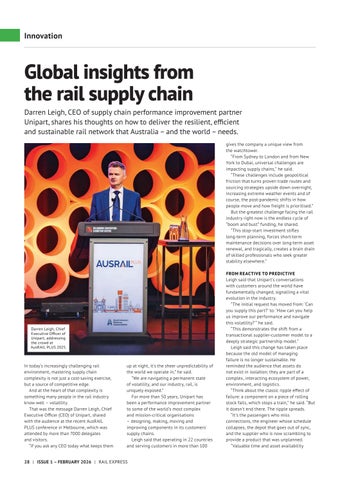
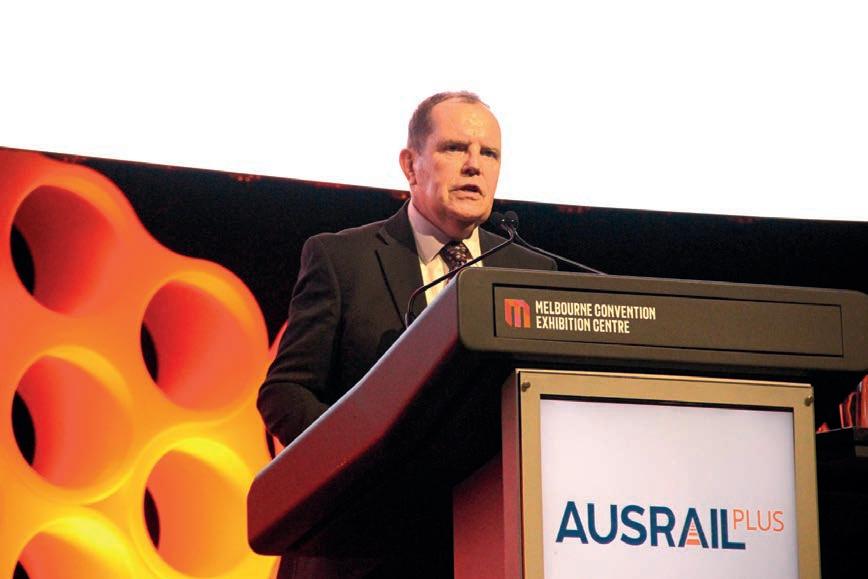
Tim Parker, CEO of the High Speed Rail Authority, addressing the crowd at AusRAIL PLUS 2025.
Image: Pri me Creative Media
Shaping Australia’s urban rail future
FCC Construction Australia and Martinus Group share the important role governance
As Australia’s urban rail projects increasingly move into dense, brownfield environments, success hinges on more than scale and speed – it relies on strong governance and smart constructability.
For major rail infrastructure player Martinus Group and global construction company FCC Construction Australia, who recently entered into a dedicated partnership known as AlignWide Alliance, these disciplines aren’t buzzwords. They are central factors in reshaping how major rail programs are planned and delivered.
We spoke to Travis Rawling, General Manager of Major Projects at Martinus, as well as FCC’s Managing Director Matthew Dinnison, to find out more.
A CONSTRUCTION-LED SOLUTION
In simple terms, constructability is the practice of planning, designing and reviewing a project with the practical construction process in mind.
But Rawling said that in recent years, constructability has evolved from simply confirming that a project can actually be
Applying constructability thinking early and embedding cross-disciplinary collaboration ensures projects are buildable, safe, and delivered efficiently.
built, to focusing on ensuring that the front-end development process enables the most efficient, safe and reliable construction possible.
When it comes to delivering brownfield urban rail projects, he added that there are some additional constraints that must be worked around.
“These include items such as access limitations, impacts on live operations, existing asset conditions and interfacing and integrating with existing rail systems and networks,” he explained.
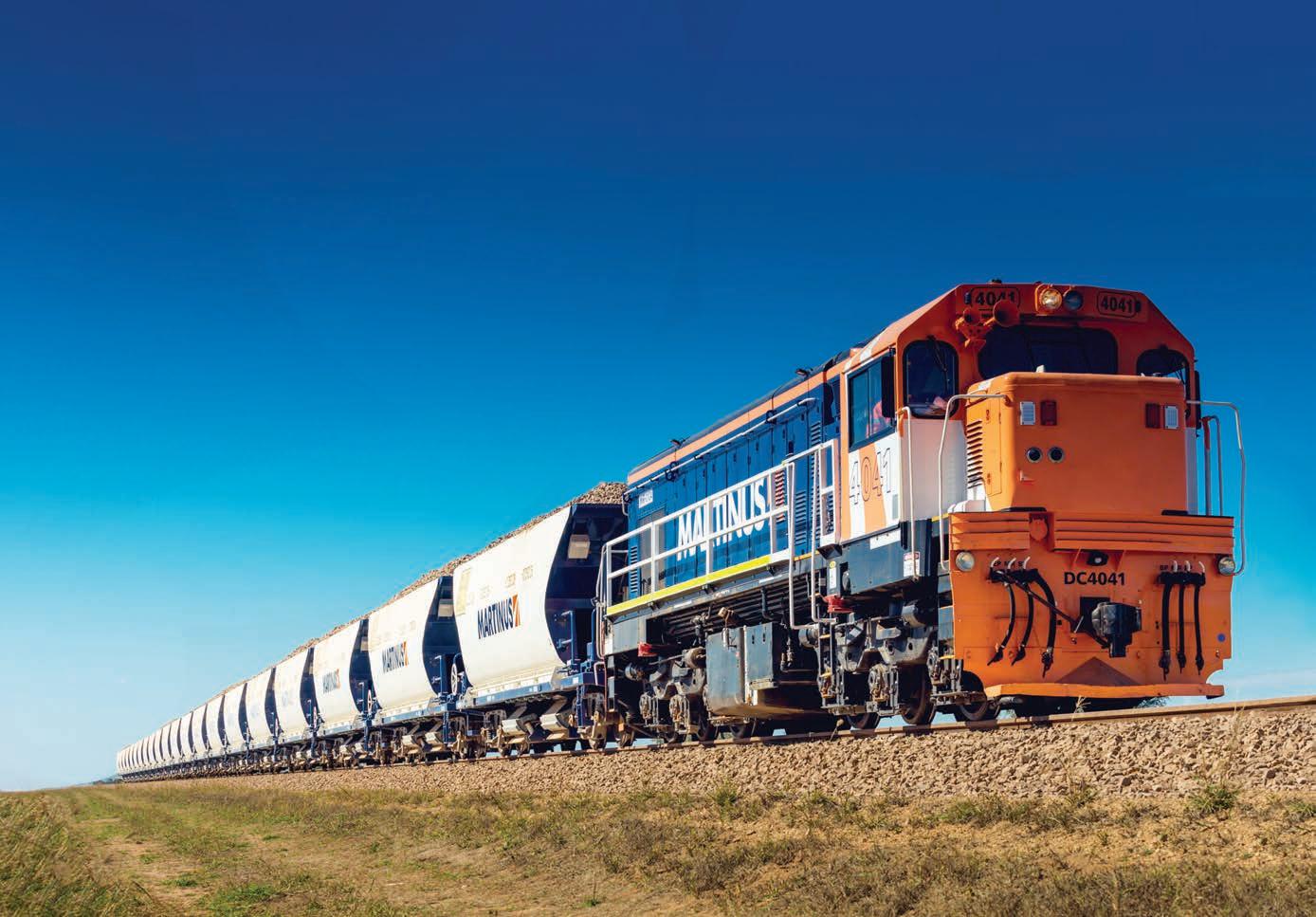
Images: Martinus
“That’s not to say these things don't exist on a greenfield project, but the combination of these elements within a brownfield project certainly influences constructability thinking.
“Quite often we see this environment driving our teams to develop new and innovative solutions and methods.”
He shared an example of one such innovation from Martinus on the Sydney Metro Southwest Metro Conversion and Station Works project.
“Our team created an off-structure beam solution, which eliminated the need for
major structural upgrades to an existing aged bridge asset,” he explained. “The bridge had been identified as a high risk earlier in the project.”
This creative solution avoided the relocation of a water pipeline and the potential for delays due to extra approvals being needed.
“The alternative delivery methodology overcame challenges associated with site access and associated impacts to the live adjacent rail corridor and road network,” said Rawling.
“Both of these elements had been identified through early constructor-led constructability reviews of concept designs as impediments to successfully delivering the project using more traditional construction methods.”
For undertakings as complex as major brownfield rail projects, Rawling said constructability thinking needs to be in place from day one.
“You probably need a lighter touch at first, with constructability thinking progressively increasing as the project concept evolves,” he said.
For Martinus and FCC, constructability and governance are more than just buzzwords.
Major Projects
“But the best success we see is when the delivery and construction process is considered early, and in some instances actually leading the way during initial planning and design.
“That’s what we call a true constructionled solution.”
GOVERNANCE THAT GOES BEYOND OVERSIGHT
At its core, governance is the framework that coordinates multiple delivery packages, contractors, systems and stakeholders across the full lifecycle of a project.
It is sometimes thought of as a layer of reporting or compliance with boxes that must be ticked, but when done well, Dinnison said it becomes an active, embedded function that supports day-today delivery rather than sitting above it.
“Effective governance is embedded within the daily operations of the project – not treated as a separate workstream or outsourced to a third party,” he explained.
“Integration teams work alongside delivery teams, with engineering and interface
managers actively resolving issues in real time. The integration function owns the integrated programme, driving coordinated sequencing and proactive risk management across packages.”
Reflecting on FCC Construction’s work on some of the world’s biggest metro projects in Saudi Arabia, Canada and Spain, he said valuable lessons in governance and integration were learned.
Sharing an example of FCC’s leadership of the FAST Consortium in delivering Lines 4, 5 and 6 of the Riyadh Metro in Saudi Arabia, he said a standout feature was FCC spearheading the implementation of a hands-on project integrator model.
“This FCC team was embedded directly within work package teams and was responsible for both technical and nontechnical interface management,” he said.
“By integrating engineering managers and interface managers into delivery teams, FCC ensured that interface and integration issues were addressed proactively and in detail, rather than being outsourced or siloed into separate workstreams.”
The integration team took a technical-first approach, focusing early on clearly defining and resolving integration issues, stakeholder requirements, and interface risks, well before handover.
Systems and safety assurance, together with testing and commissioning, were built in from the outset, allowing progressive assurance and supporting a strong safety case for day-one operations.
Dinnison added that a central part of this governance model was the establishment of a Project Management Office (PMO), led by FCC and supported by specialised technical working groups.
These groups convened subject matter experts from across the project to drive alignment and stakeholder buy-in across design coordination, testing, commissioning, handover, systems assurance, configuration, RAM, and requirements management.
“The PMO was accountable for managing critical integration milestones and the overall integrated programme, enabling rapid issue resolution by those closest to the work,” said Dinnison.

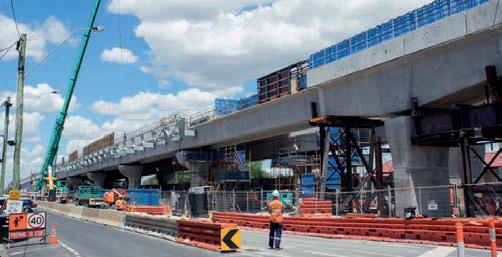
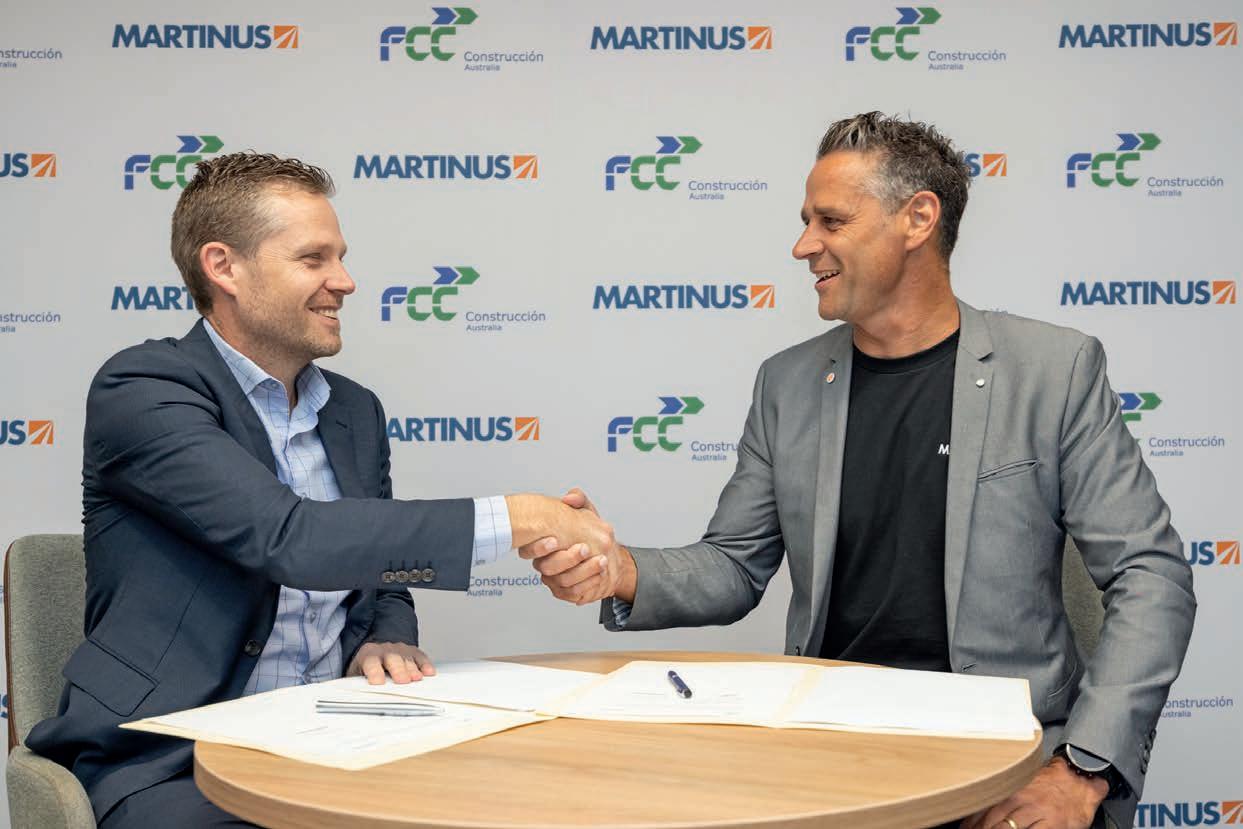
The AlignWide Alliance between FCC and Martinus builds on their 2023 global partnership.
“This integrated governance approach delivered exceptional outcomes – FCC’s consortium was the first to hand over its lines for operation.”
This model has since influenced FCC’s approach to current metro projects, where the company continues to prioritise direct involvement, technical rigour, and collaborative problem-solving over outsourcing.
“This ensures that the complex challenges of multidisciplinary metro delivery are addressed with precision and agility.”
WHERE GOVERNANCE AND CONSTRUCTABILITY INTERSECT
Both Rawling and Dinnison agreed that the strongest outcomes emerge when governance and constructability work together rather than as separate disciplines.
Effective governance creates an environment where constructability insights can influence sequencing, access planning and interface management, while constructability feedback helps governance
teams understand what is realistically achievable on site.
“When governance structures are embedded into day-to-day project operations, decisions are made by those closest to the work, fostering ownership and accelerating issue resolution,” Dinnison said.
Rawling echoed this sentiment, noting that collaboration across designers, planners and delivery partners is key.
“Without collaboration there is no constructability, or if there is, all the benefit will be lost as the thinking won't get embedded into the solution,” he said.
APPLYING GLOBAL LESSONS LOCALLY
The AlignWide Alliance between FCC and Martinus builds on their 2023 global partnership, combining international governance experience with local constructability expertise.
The aim is not to replace existing delivery models, but to strengthen them by embedding integration discipline and construction-led thinking into complex urban rail projects.
Dinnison said the stakes are particularly high on brownfield rail projects, where community disruption and stakeholder expectations are intense.
“Governance strategies often fall short by focusing narrowly on isolated elements of integration, such as systems or assurance, without addressing the full scope,” he explained.
“By treating integration as a central, cross-cutting function, rather than a downstream activity, projects are better equipped to manage complexity, reduce risk, and deliver more predictable outcomes.”
Rawling echoed this sentiment.
“Applying constructability thinking early and embedding cross-disciplinary collaboration ensures these projects aren’t just designed well on paper, but are buildable, safe, and delivered efficiently.”
As Australia’s urban rail programs continue to expand within increasingly constrained environments, that combination may prove decisive in delivering the next generation of cityshaping infrastructure.
MOVING OUR CLIENTS FORWARD
RAIL CONSULTING AND PROJECT MANAGEMENT SOLUTIONS.
At Systematiq, we deliver light rail project success by navigating complex challenges with precision and expertise. We partner with governments, consortiums, and transport entities to deliver innovative, best practice solutions that enhance safety and efficiency of light rail infrastructure.
Our comprehensive services, from project management to safety assurance and systems engineering, ensures your program success, from mobilisation to delivery.
• Training support including safety and compliance course development and delivery.
• Systems Engineering support including risk and hazard management, RCM consulting, Logistics Support Analysis, and Through Life Capability Management.
Our experience, attention to detail and knowledge of industry-leading practices ensure our clients achieve their goals. Talk to us about moving your project forward.
Operations and Maintenance
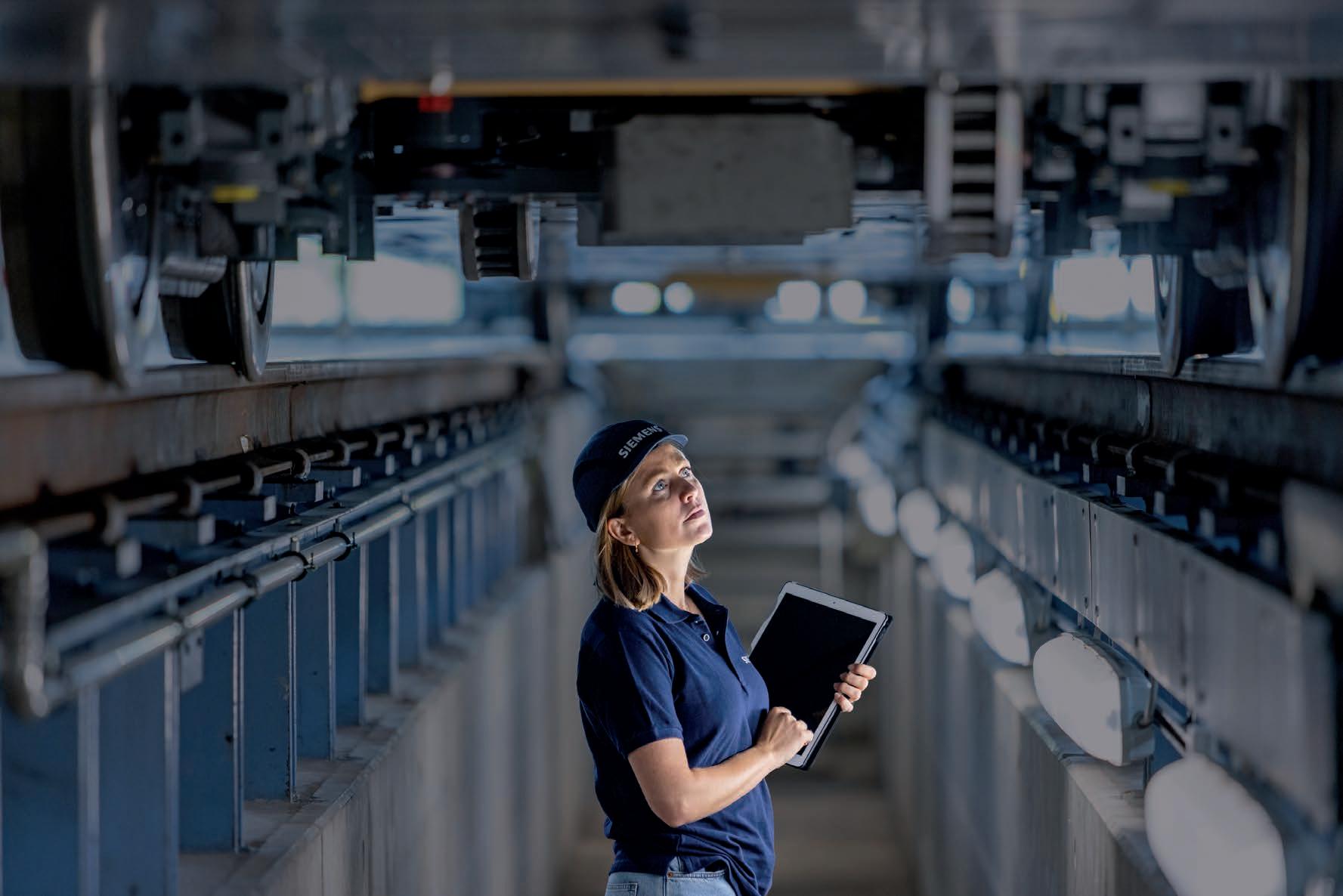
Future-proofing services through proactive maintenance
By integrating its skilled engineers within customer organisations, providing robust local training and 24/7 support and monitoring, Siemens Mobility is helping rail operators unlock new levels of performance.
The rail industry in Australia and New Zealand is undergoing a transformation as it moves beyond one of the largest capital investments in rail infrastructure and assets in recent years to focus on the operational spend connected to progress.
This has led operators to seek out ways to harness the power of data and innovative service solutions to enhance the efficiency, reliability, and longevity of their assets.
Siemens Mobility stands at the forefront of this shift, offering a flexible and customercentric approach that combines cutting-edge data intelligence with tailored support.
We spoke to Gonzalo Martinez Delgado, Siemens Mobility’s Head of Customer Service for Australia and New Zealand, and Andrew Cooke, Customer Service Manager for Rail Infrastructure at Siemens Mobility Australia and New Zealand to find out more.
FLEXIBLE SUPPORT
Today’s rail industry is in the midst of a transition from manpower-driven maintenance to data-driven maintenance to improve reliability and efficiency.
Operators are keen to reap the benefits of high-tech condition monitoring and predictive maintenance solutions –from lower maintenance costs to more efficient and longer-lasting assets, as well as increased safety and an improved passenger experience.
But before they can benefit from the data gathered by these solutions, they need to know how to extract it, interpret it, and translate it into actionable next steps.
“We work in collaboration with our
customers, to make sure they know what data is available to them and understand how to gain insights from that data,” said Cooke.
“We also help them clarify what their goals are – what do they want to gain, or what challenges do they want to mitigate?
“Many of our customers are looking for ways to improve maintenance schedules, processes, and gain more from their investment in maintenance solutions to ensure their systems are always available whilst improving the passenger experience and throughput of their services.”
To achieve this, Siemens Mobility emphasises a flexible approach, from remote monitoring and diagnostics tools and offering a 24/7 local Support Centre for remote support to embedding engineers and support staff within customers’ operations.
“Embedding our service engineers into our clients’ organisations means our engineers really understand the day-to-day of their operations,” said Cooke.
“We can flag that an issue is forming sooner with a customer, or proactively resolve that issue for them on-site or remotely.”
Cooke shared an example of this, in which Siemens Mobility identified a problem with the communications network of a heavy haul customer. Network congestion was resulting in unexpected behaviour on the Train Control System solution Siemens Mobility had implemented for them, as the bandwidth was continuously beingconsumed.
“Thankfully, with our team there on site using remote monitoring and diagnostic tools to continuously monitor the system,
we realised this was going to cause an issue before it occurred,” Cooke explained.
“We informed the customer of what we noticed, and they identified that they had inadvertently connected another service to the dedicated communications network for their train control. They were able to remove that before their train control system went down.”
Martinez Delgado said that if the customer's train control system had gone down, the trains would have completely stopped running until the problem could be fixed – leading to a potential $1 million loss of revenue per hour for the customer.
He said Siemens Mobility’s support is scalable, depending on what the customer needs.
“Sometimes the customer just has a quick question that can be answered via our Support Centre, and sometimes they need a full service.
“For one of our customers, we are planning to provide a large team of 45 Siemens employees in addition to our Railigent X solution (an artificialintelligence-powered digital platform) to maintain the full scope of works, from train maintenance to traction power and SCADA (Supervisory Control and Data Acquisition), signalling, train control and platform screen doors.”
Cooke said Siemens Mobility’s dedicated 24/7 Support Centre is based in Australia, and ensures customers have the immediate expert local support needed to maintain their critical services effectively on a global scale.
Siemens Mobility offers a flexible approach to service support, with the option to have engineers and support staff embedded within its customers’ teams.
“You can call the support centre any time of the day or night and you’ll get through to a local subject matter expert – a real, qualified person on the other end of the phone, not a Chatbot or an automated service – who is ready to help solve your problem,” he said.
“Because the team is supporting customers throughout Australia and New Zealand, as well as globally in countries such as Finland, they can take learnings from one customer and apply them to benefit another.”
CUSTOMISED TRAINING
Siemens Mobility also has a dedicated training team within its customer service department, which works directly with customers as well as project teams when new products and systems are deployed.
“The training team makes sure our customers have the required knowledge and understanding of maintenance procedures and how the system works, so they’re fully prepared before they go into operation,” said Cooke.
“But they also have the opportunity to come back to us and receive continuous training updates. Whether we have made some small changes and need to make sure they’re informed, or they need refresher training to keep up with the competencies of their role, we’re there to support them with that.”
Cooke said that training can also be tailored for the customer, based on what is needed.
“For one of our customers in Adelaide,
we were able to run a number of workshops through our support team, to connect their maintenance organisation with their operations organisation and give them a holistic picture of how the different Siemens systems were interacting,” he shared.
“We were then able to define each person’s role in relation to the system, and run very specific, dedicated training for them.”
EASING TRANSITIONS
When it comes to financial transitions, like moving from CapEx (capital expenditure) to OpEx (operational expenditure), Siemens Mobility offers support every step of the way.
“It’s common that the organisation that has funded a rail project isn't the operator that will eventually take ownership of and use the system,” Cooke said. “We carefully ensure that through our service offering, we're able to engage early with the operator.
“We go beyond standard training to make sure that they not only understand our products but start to work more hand-inhand with their maintainers prior to the system going live, to make sure that those maintainers are ready to do their jobs.”
Martinez Delgado added that Siemens Mobility acts as a go-between for the body funding the project and the operator/ maintainer, but it can also help even when the same company has funded the project and then goes on to operate and maintain it.
“When it's the same company, they typically have a specific department in charge of new projects, and a different
Siemens Mobility has seen growing customer demand for actionable data insights to support their operations and maintenance.
department later doing operations and maintenance,” he explained. “For one of our customers in Queensland, the project team that had been working together for more than four years had to slowly transition to the future operators.
“The operators were not involved in the renewal of the assets or the upgrades that took place as part of this project, and a change like that can be stressful.
“We had to build trust with the operations and maintenance team, to overcome any scepticism and make sure they understood and were comfortable with the new system.”
DATA-DRIVEN FUTURE
The rail industry in Australia is increasingly reliant on data intelligence to drive efficiency and extend asset life. As a result, Siemens Mobility has seen a direct and growing demand from customers and rail operators for actionable data insights to support their maintenance strategies and operational decision-making due to rising costs for asset management and service maintenance of rail networks.
One of Siemens Mobility’s solutions to this is Railigent X, a suite of applications that advances sustainable transportation by digitally increasing the capacity of rail systems with less resources. The specially curated, open ecosystem enables rail operators, maintainers, and asset owners to better understand data, analyse assets, and derive actions, resulting in enhanced operation and maintenance for full system availability.
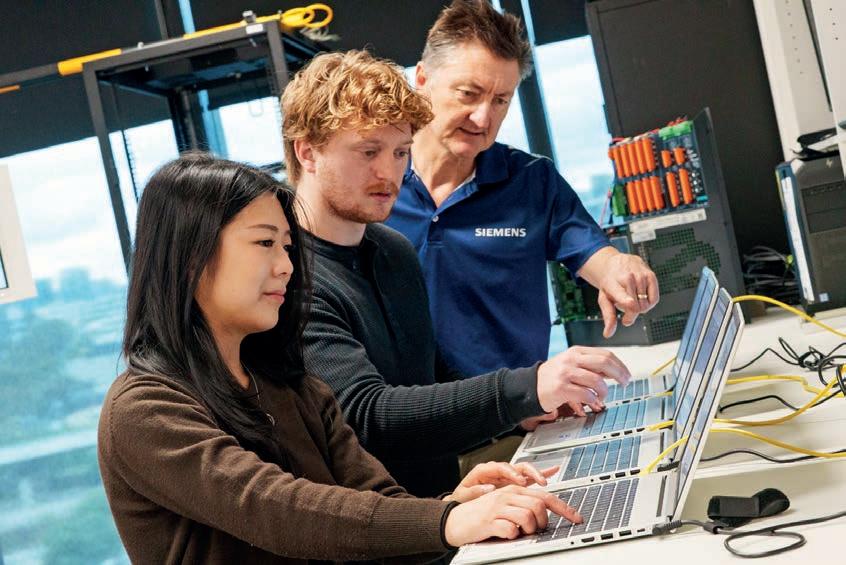
“Railigent X is used in 400 projects by over 80 customers across 35 countries to help rail operators deliver added value across their processes and networks, and will soon be implemented in Australia,” said Martinez Delgado.
In addition to embedded engineers within customers’ operations, Siemens Mobility’s Railigent X platform ensures the reliability and availability of assets.
“One of the main benefits is the impact of lifecycle cost. Operators can become more sustainable through the optimisation of cost investment by maintaining assets proactively rather than reactively.”
Cooke added that the future of customer service in rail is progressing towards expertise that is supported by dedicated, data-driven maintenance models.
“As a team and organisation, we are committed to adding value and highly specific support for our customers, now and in the future. The way to do that is through a balanced blend of people, expertise and data.”
Plant and Equipment
Rail maintenance made easy
Rail maintenance tools specialist Enerpac tells us more about its new partnership with Harrybilt, as well as some of the innovative rail solutions it has on offer.
Enerpac, a global market leader in high pressure hydraulic tools, has partnered with family-owned Ballarat business Harrybilt to distribute its products throughout Victoria and beyond.
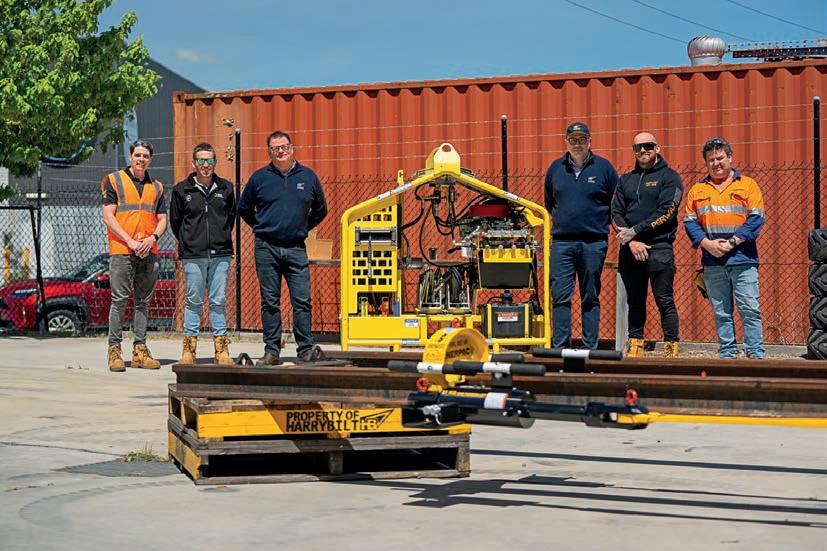
We caught up with Beau Nash, Asia-Pacific Vertical Market Manager – Rail at Enerpac, at a recent demonstration of its new TL248 track lift system and RP70A rail tensor for one of its customers, Keolis Downer.
Nash said Enerpac is delighted to team up with Harrybilt because of the distributor’s excellent reputation.
“In the past few months, we’ve put in some hard work to bring them on as a rail stocking distributor,” he said. “This will really benefit the rail industry in Victoria and throughout Australia as well.”
Alexander Heiden, Business Development Manager at Harrybilt, said Enerpac’s products complement the range of rail equipment the business already has on offer.
“We want to become a one-stop-shop for the rail industry,” he said.
“Enerpac’s customers are similar to our customers, so it made sense to add value for our existing customers by expanding our offering.”
Harrybilt’s Ballarat base spans 4000 square metres, with dedicated facilities for production and stock storage.
Heiden said that while the business is initially focusing on Enerpac’s rail offering, it has access to the entire range and there is potential to expand the partnership in the future.
“We’ve had a fantastic experience working with Enerpac so far,” he said. “They’ve been great during the onboarding process – very structured and taking a step-bystep approach.
“They flew in their international product support team for the AusRAIL conference and they will be giving our sales team a technical rundown on their products, so we will be confident we can answer any questions from customers.
“They are always thinking about how to make products safer throughout the design process, which is very important to us, so our values also align there. The partnership is a win-win all round.”
THE TL248 TRACK LIFT SYSTEM
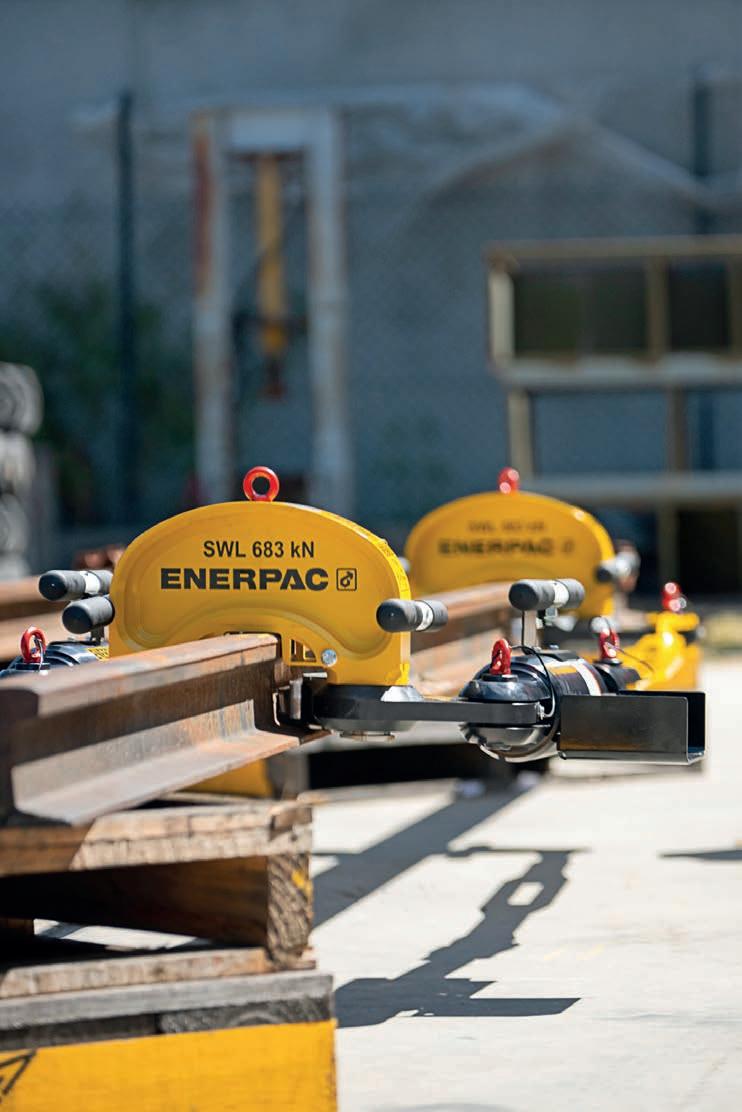
New to Australia, the Enerpac TL248 track lift system is a compact, powerful, and precise hydraulic solution for lifting and supporting rail tracks during track maintenance.
Compared to traditional track maintenance methods that rely on bulky, expensive heavy lift equipment, the portable, self-contained TL248 system enables safer, faster work with greater precision and shorter, less disruptive possessions.
“This product has already been rolled out in the United States and the United Kingdom, and there’s a lot of interest in it here in Australia,” said Nash.
“It’s specifically engineered to lift track from below and designed with integrated fork pockets and lifting hooks.
“The system is easy to transport and deploy, even in tight spaces and remote environments.”
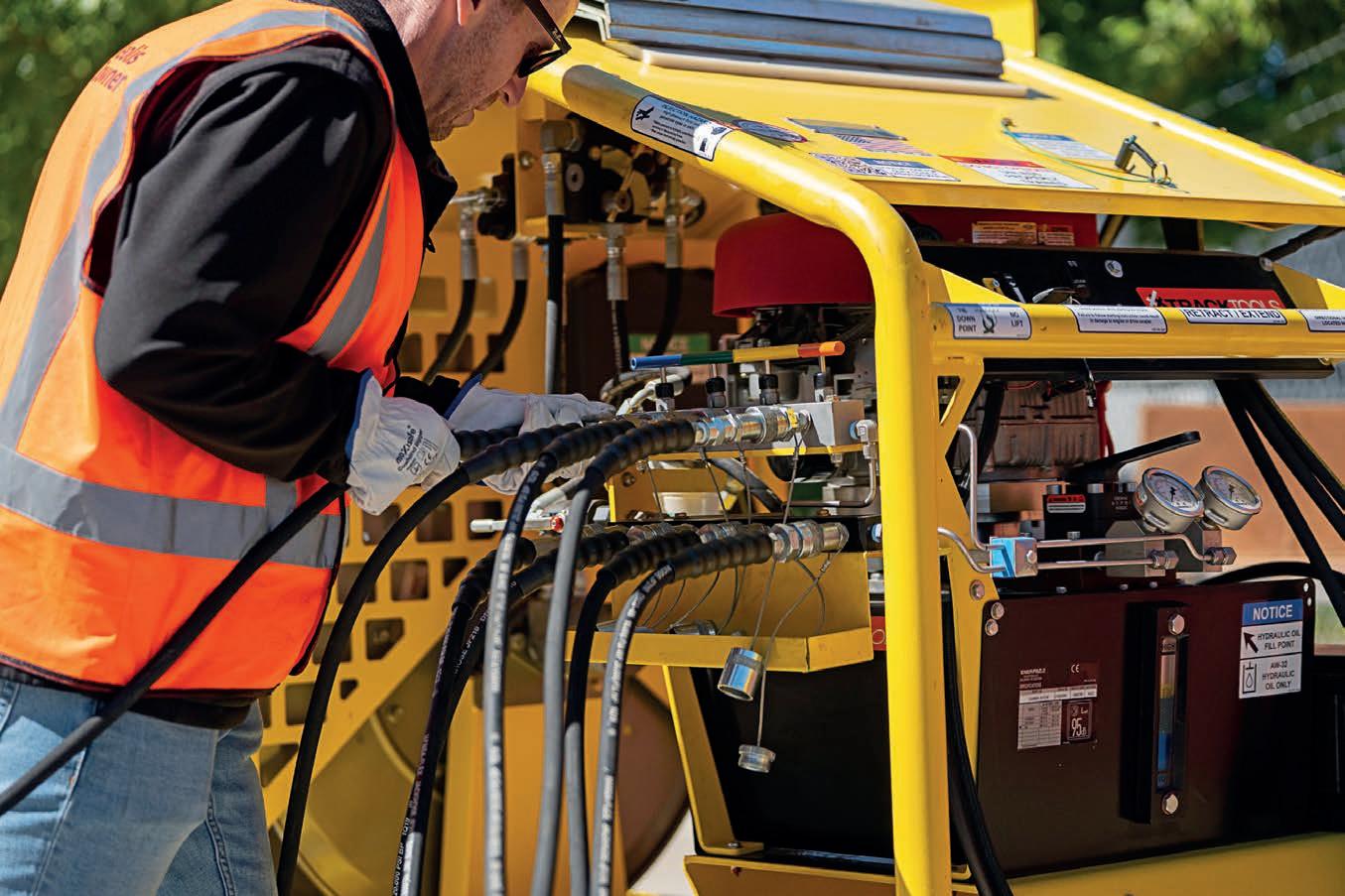
The TL248 is equipped with four independent hydraulic jacks, each rated at 62 tonnes, providing a combined lifting capacity of 248 tonnes.
These jacks deliver highly accurate lifts with 3.2-millimetre precision – critical for maintaining track switches, crossings, turnouts, retarders, and for securely supporting bridge ends.
In addition, the TL248 includes an intuitive, colour-coded central control panel illuminated by built-in LED lighting for clear visibility in all conditions.
Redundant safety features, such as manual needle valves and pilot-operated
Enerpac’s RP70A rail tensor enables rail contractors to apply the necessary tension safely and efficiently to continuously welded rail during installation and maintenance.
check valves, protect against jack drift and ensure safe operation under load.
It is a fully self-contained power unit so there is no need for external power sources, which provides teams with more flexibility on-site and in remote areas.
Nash said that by lifting the track from underneath, the TL248 avoids the usual challenges that come with working around overhead structures and power cables.
“This setup not only bypasses clearance restrictions but also keeps the track steady so maintenance equipment can roll straight over it when it is sitting on the ballast,” he said.
“All of this dramatically cuts possession times and reduces the impact on rail services.”
Because the unit is compact and the jacks are placed in optimal positions, track excavation times are also shortened significantly.
“It is easy to bring the TL248 to site on the back of a ute thanks to its small footprint, so there is no need for bulky crane trucks,” said Nash.
With these efficiencies, the TL248 can help maintenance teams lift up to four diamond crossings or six turnouts in a single day.
THE RP70A RAIL TENSOR
Enerpac’s RP70A rail tensor is engineered to deliver controlled, high-force rail stressing with unmatched accuracy.
With a capacity of 70 tonnes and a stroke of 200 millimetres, it enables rail contractors to apply the necessary tension safely and efficiently to continuously welded rail (CWR) during installation and maintenance.
Nash said the tensor’s lightweight, modular design allows for easy transport and setup, even in remote or constrained environments – a key advantage for rail teams working across Australia’s vast and varied terrain.
“It’s one of the most lightweight rail tensors on the market, and can be operated by just two people,” he said.
“The unit is also very robust and has a corrosion-resistant finish, which makes it ideal for harsh outdoor conditions – ensuring a long service life and minimal maintenance.”
One of the standout features of the RP70A is its integrated gauge and stroke limiter, which gives users precise control over the stressing process.
“This not only improves operational safety but also reduces the risk of over-stressing, which can lead to rail damage or long-term performance issues,” Nash added.
“The RP70A rail tensor is already making a difference in major Australian rail projects, helping teams meet tight deadlines while maintaining the highest standards of safety and quality.
“Whether it’s for new track construction, CWR maintenance, or emergency repairs, the RP70A delivers the reliability and precision that rail professionals demand.”
Representatives from Enerpac, Harrybilt and Keolis Downer at a demonstration of some of Enerpac's rail equipment.
The Enerpac TL248 is a portable, hydraulic track lift system that transforms lifts of turnouts, diamond crossings, switches, retarders, and bridge ends.


September 2026
EXHIBIT IN 2026. BE SEEN. BE HEARD. BE CHOSEN.
A golden future for rail
Hitachi Rail has shared its bold vision to transform mobility in Australia, creating smarter, more sustainable and efficient networks.
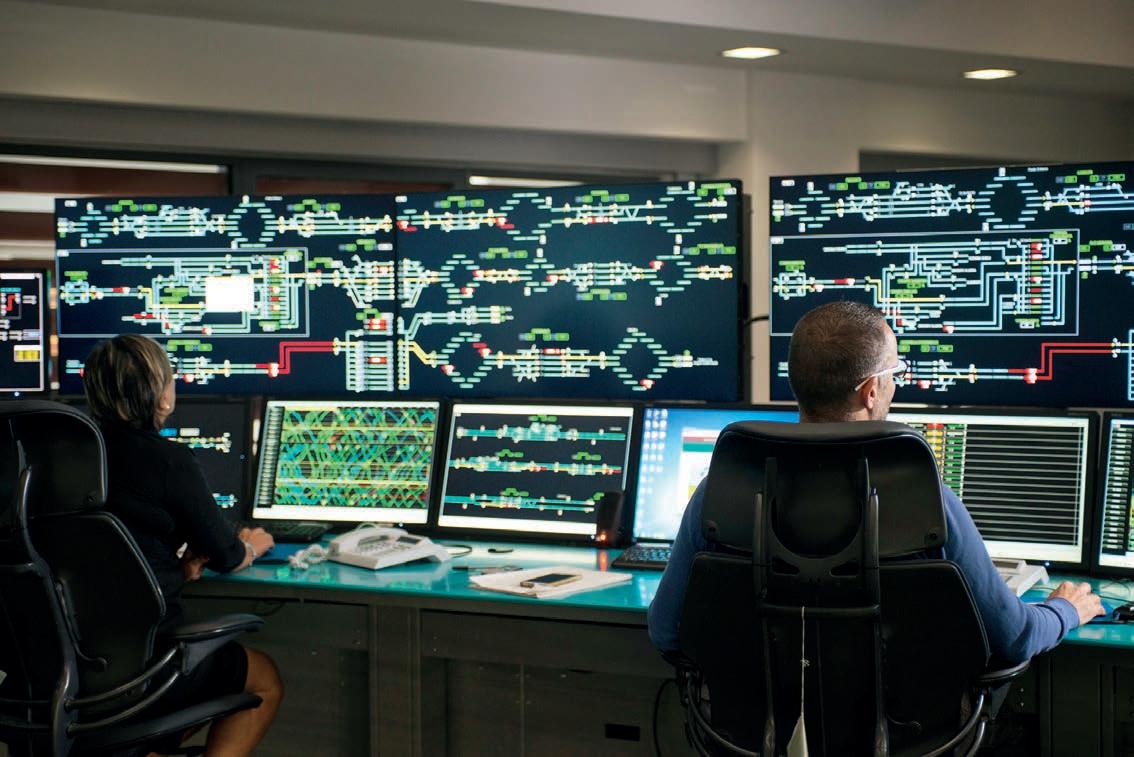
to work towards a smarter, more efficient and modern network to the benefit of the country.”
Samnakay, Managing Director for Hitachi Rail Australia and New Zealand.
Hitachi Rail is a trusted partner to operators around the world, delivering every part of the railway value chain, from commitment to shaping the future of rail
With an Australian legacy dating back five decades and more than 650 team members spread across its bases in Brisbane, Perth expand its capabilities across passenger,
AusRAIL PLUS conference in Melbourne, Hitachi Rail’s Global Chief Executive Officer
sustainable and resilient rail network that aligns with national economic, social and
“Australia stands at a pivotal crossroads,” he told the audience. “Population growth,
and extraordinary opportunities, that can be leveraged by Australian leadership in digitalisation and innovation.
“Globally, railways are powering the transition to more sustainable and connected societies, and Australia is combining its strong vision and capabilities
Here, we share some of the key takeaways from his speech, along with some insights from Christian Andi, Head of Signalling Rail Solutions at Hitachi Rail, and Sarfaraz
AUSTRALIA’S SIGNALLING FUTURE
Hitachi Rail is a trusted partner to rail operators around the world.
Images:
Hitachi Rail
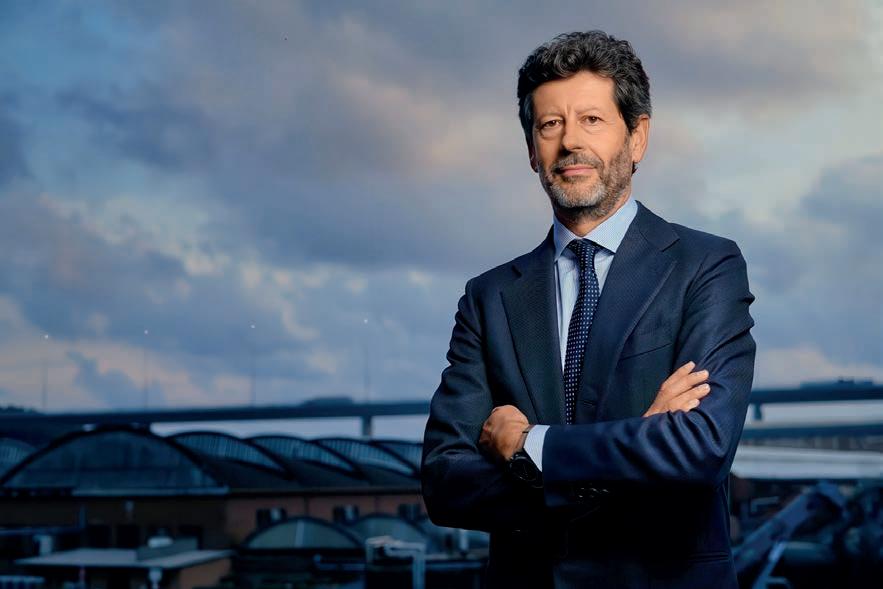
Guiseppe Marino, Global Chief Executive Officer, Hitachi Rail.
High-speed rail
manufacturing high-speed trains to digital signalling infrastructure, and operations and maintenance.
Its technology enables more than 18 billion passenger journeys and helps to transport millions of tonnes of freight every year.
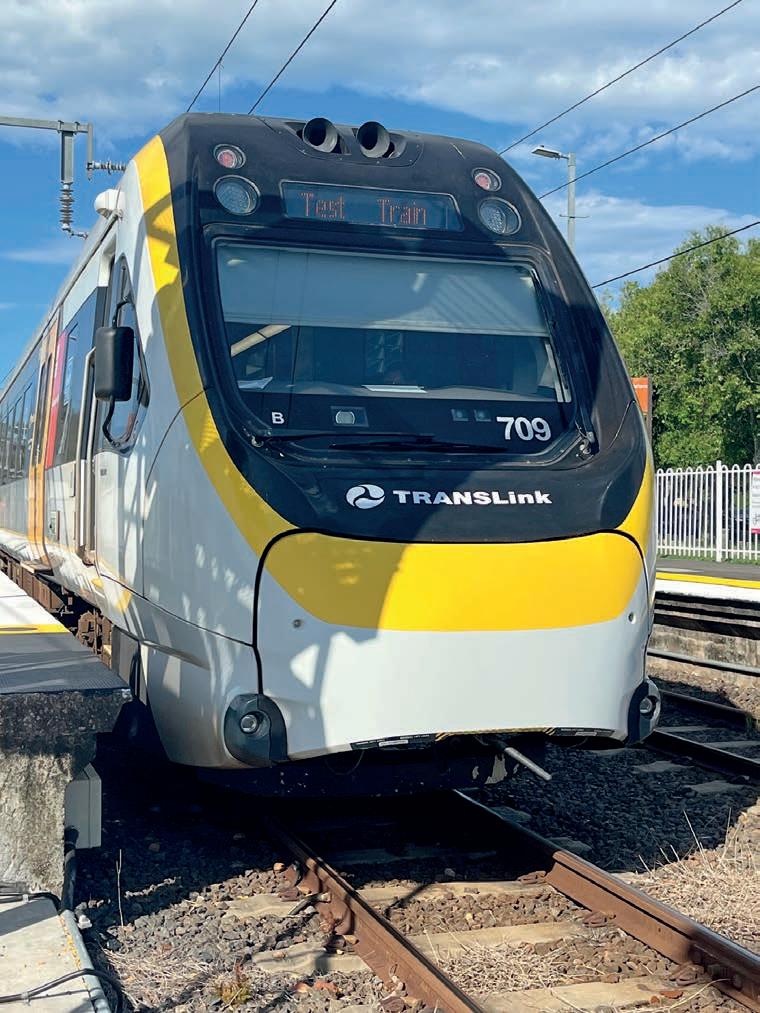
In Australia, the company successfully delivered the control, communication and signalling systems that are enabling seamless operations across more than 100 kilometres of Sydney Metro, and continues to play an important role in the Paramatta Light Rail Project, bringing new connectivity to Sydney. In Queensland, it is deploying the European Train Control System (ETCS) Level 2 as a next-generation signalling platform
within the Cross River Rail program and across South East Queensland.
“ETCS is revolutionising the rail network as Brisbane prepares to host the 2032 Olympic and Paralympic Games – increasing capacity, convenience, efficiency and reliability, while maintaining the highest level of passenger benefit,” said Marino.
“It will allow more services to run more often, connecting with new roads and busways, supporting other transport projects in easing congestion. This will help to meet the challenges of population growth and to bring prosperity to the region.”
In August 2025, Australia’s infrastructure and transport ministers agreed to align signalling technology across Australia’s major connected freight and passenger network, known as the National Network for Interoperability (NNI). All digital signalling introduced on the NNI in the future must meet mandatory ETCS standards.
Christian Andi, Head of Signalling Rail Solutions at Hitachi Rail, explained: “This is very important and positive news for Australia’s rail industry, because ETCS is a global standard that increases reliability, punctuality and capacity on rail networks without the need for new infrastructure.
“It contributes to sustainability – moving more people from private cars to trains –because you have a much more effective public transport system.
“This is a great opportunity for Hitachi, as we have a strong presence in Australia
with local competencies to deliver this technology.”
Hitachi Rail has successfully implemented ETCS in several projects in Australia and has a global track record for excellence in this area.
“We have ETCS technology running across Italy, France, Spain and Germany, with both high-speed lines and conventional lines using the same technology,” said Andi.
“In the United Arab Emirates (UAE), we have a huge deployment of state-of-theart ETCS technology across some 480 kilometres including integration with existing freight-control centres, to deliver the UAE’s first-ever passenger line.”
A MORE CONNECTED RAIL NETWORK
Through its innovative digital solutions, Hitachi Rail is embracing a more connected future for Australia’s rail industry.
“Hitachi is one of the most diversified corporations in the world, with access to more than 107,000 digital and software engineers,” said Andi.
“Through our partnerships, we also have access to every kind of support – from the power engines of Artificial Intelligence (AI)based solutions from NVIDIA, to applications for autonomous driving and intelligent traffic management from Google.”
He highlighted HMAX – Hitachi’s new digital all-in-one asset management platform, which can bring together data from trains, onboard signalling, wayside signalling, infrastructure, power lines and more.
Christian Andi, Head of Signalling Rail Solutions at Hitachi Rail.
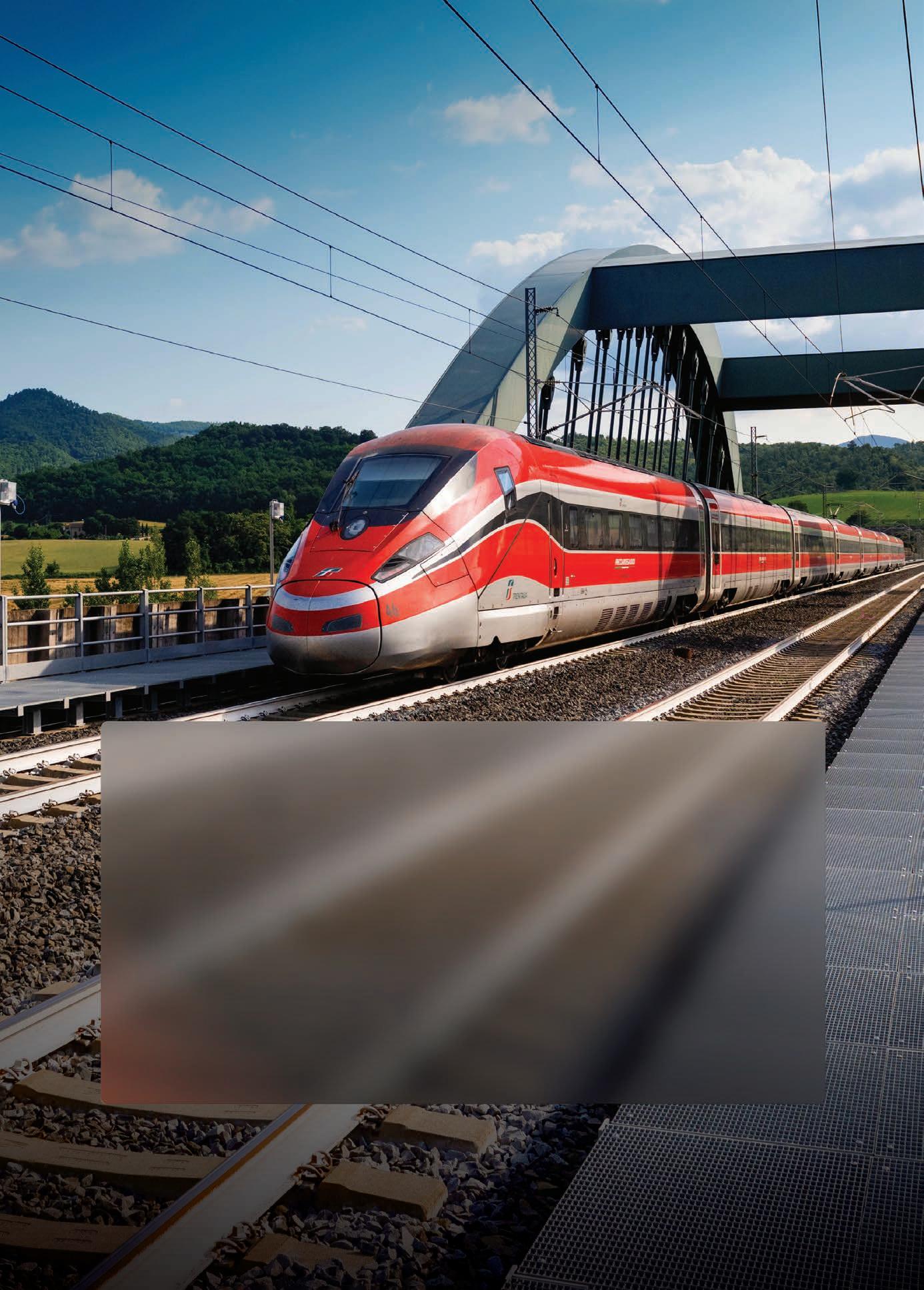
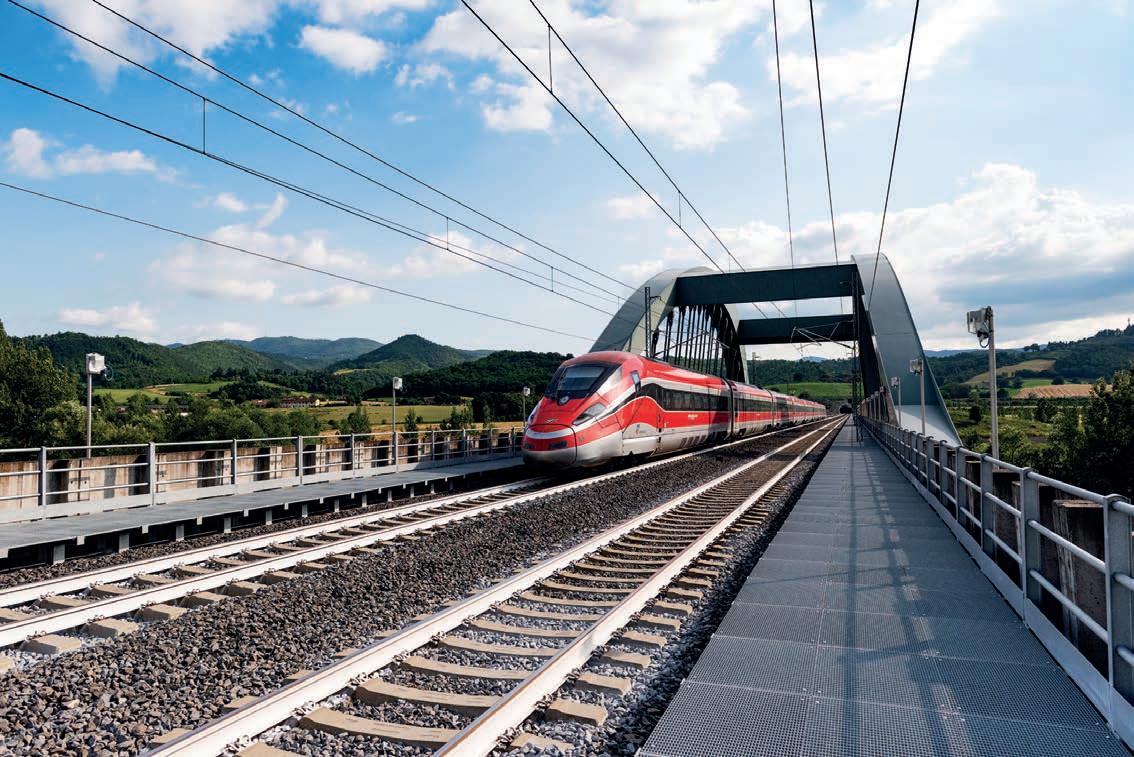
Hitachi has a proud global legacy in high-speed rail.
“HMAX creates a digital twin of your entire rail ecosystem – harmonising software and data from customers’ core systems, additional sensors, and third parties to enable more informed and faster decision-making,” he said.
“Thanks to its predictive maintenance and intelligent asset and traffic management capabilities, it allows operators to reduce their energy consumption and operating costs, and increase punctuality and reliability using its intelligent traffic
connectivity challenges, population growth and housing pressures – improving productivity, boosting tourism and creating local jobs, as well as contributing to decarbonisation.
He sees similar opportunities for Australia and warns against calculating return on investment based on potential revenue from ticket sales.
“The tangible and intangible benefits that this kind of investment brings to a society are incredible,” he said.
Sarfaraz Samnakay, Managing Director for Hitachi Rail Australia and New Zealand, said Hitachi Rail has gained a lot of knowledge from its global experience in high-speed rail, and is ready to apply its learnings in Australia.
“In addition to our established local team based here, we have the bandwidth and the expertise of the global team which can come here and share that expertise.”
He continued: “Making ETCS a mandatory standard was a significant step forward, harmonising these ETCS standards across the NNI to enable a truly interoperable network will deliver substantial benefits to the rail sector.
“We’ve been talking about high-speed rail for a long time, and there are still a lot of challenges to overcome, but we are optimistic about the future.”
A GREENER RAIL INDUSTRY
From 2015 to 2050, the number of people travelling in Australia is projected to double, Marino said.
“These people need to travel in a more efficient way – and rail is eight times more efficient than travelling by private car,” he said. “So, modal shift is a very important factor when we’re talking about how rail can contribute to Australia’s decarbonisation goals.”
Hitachi Rail is helping to transport more people, more efficiently by deploying cutting-edge signalling technology, and is constantly innovating to create more sustainable rolling stock.
“Our trains achieve low CO2 emissions,
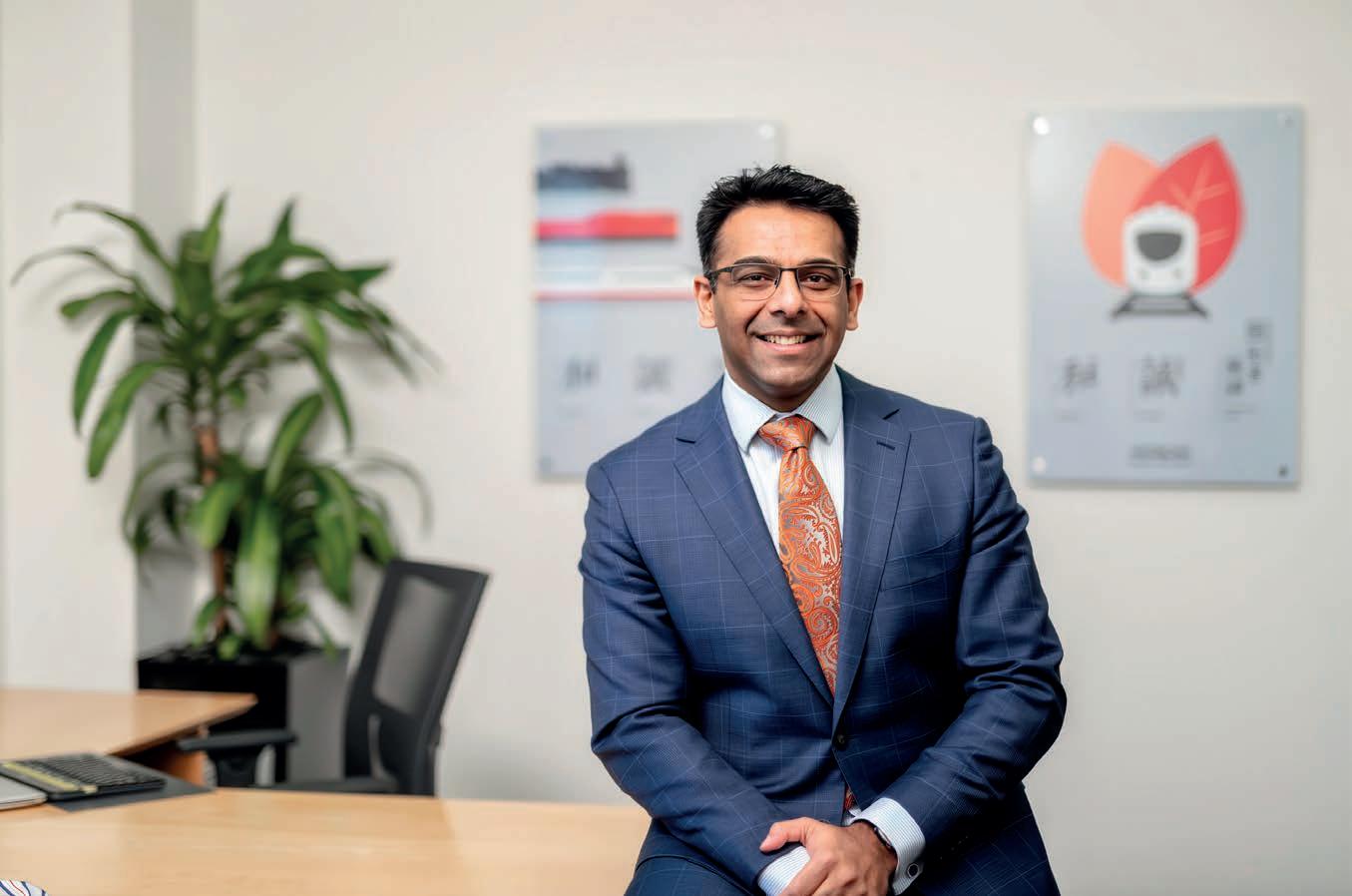
Sarfaraz Samnakay, Managing Director for Hitachi Rail Australia and New Zealand.
Hitachi Rail is deploying ETCS Level 2 as a next-generation signalling platform across key projects in Queensland.
Light Rail
Delivering success from day one
Bringing together defence-honed systems engineering with deep rail industry expertise, Systematiq provides seamless support from project mobilisation to final delivery.
For more than 15 years, Systematiq has helped to shape the success of some of Australia’s most ambitious infrastructure projects.
Drawing from its deep roots in the defence sector, the consultancy brings a disciplined, holistic systems engineering approach to the rail industry.
From light rail to metro networks, and from mobilisation right through to project completion, it ensures everything from safety protocols to technical documentation is meticulously planned and executed.
With a unique combination of specialist industry expertise, thorough risk mitigation processes, and commitment to strong client partnerships, Systematiq is striving to set a new standard for excellence in project delivery.
We spoke to Rhiannon Stratford, Capability Manager of Systems Engineering and Integrated Logistics Support at Systematiq, to find out more.
PROVEN EXPERIENCE
When it comes to light rail, Systematiq has a strong track record.
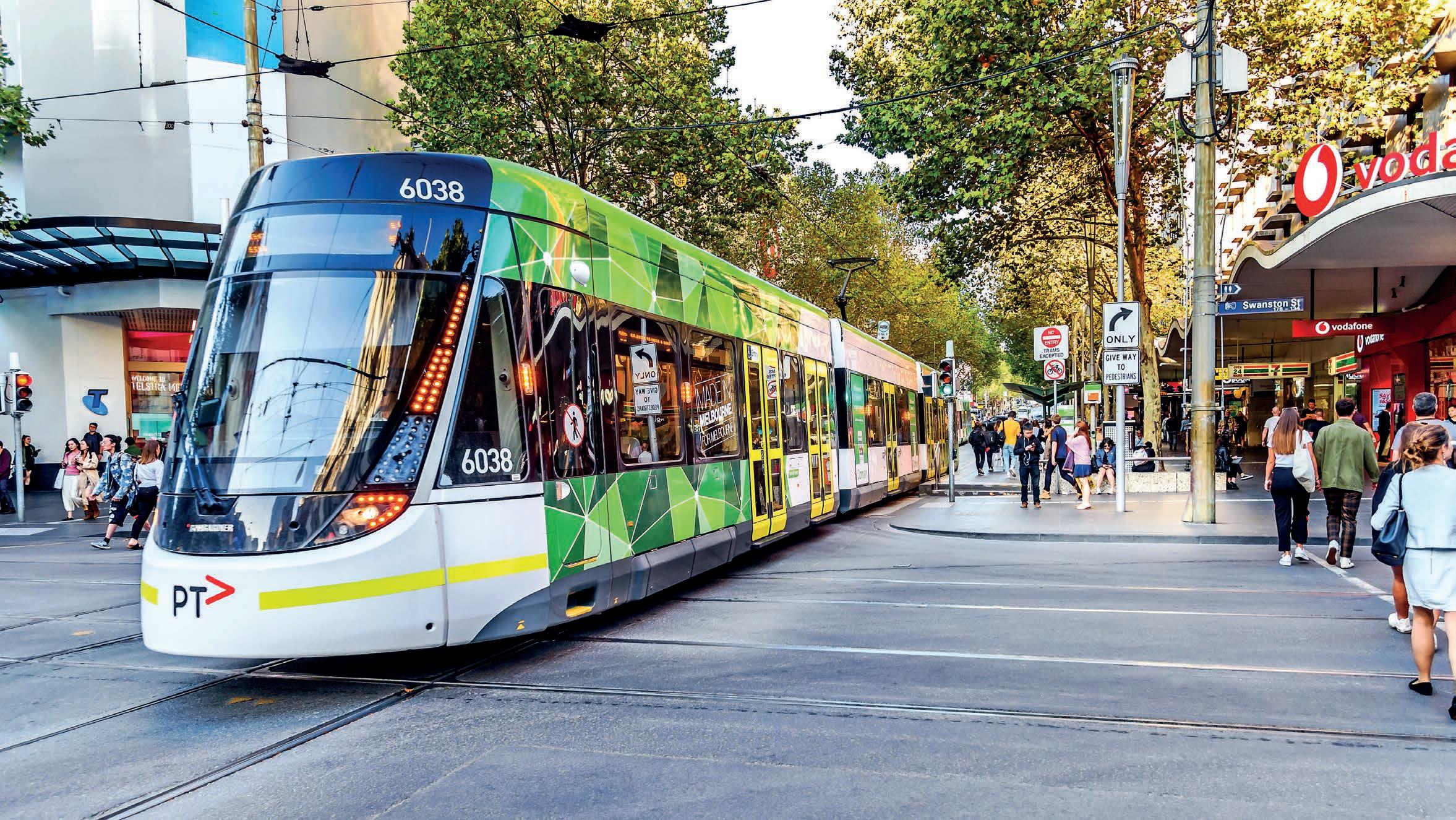
The consultancy has provided systems engineering services for multiple Yarra Trams projects in Melbourne, working both remotely and on-site.
In collaboration with the operator, it delivered reliability and lifecycle cost modelling to enhance asset management
and support ISO55001 certification, and developed a compliant Systems Engineering Management Plan and Competency Guidelines, as required by the MR4 franchise agreement with the Department of Transport.
It also conducted a technical review of Asset Condition Assessment Guidelines (ACAGs), with its consultants mobilising quickly to assess the technical accuracy and operational relevance of 88 guidelines across key asset classes.
“Our consultants worked closely with Yarra Trams’ engineers and maintainers to classify parts, gather failure rates, and assess asset condition,” explained Stratford.
“That’s really the bread and butter of our integrated logistics team. They know the tools, they know the processes, the systems and the terminology.
“They can come into any rail project with that mindset and methodology to easily provide the client with a set of data to go forward with – so they know exactly what needs to be done in terms of maintenance, for example, and how much it’s going to cost them.”
Stratford said Yarra Trams gained some clear benefits from its work with Systematiq.
“When it came to developing their systems engineering framework, we leveraged our past experience to audit the plan they had at the time, developed an Engineering Competency Framework, and compiled technical guidelines and product
templates to meet ISO standards,” she said. “With our help, Yarra Trams was able to demonstrate compliance to the Victorian Department of Transport, strengthening operational frameworks and technical documentation across the project lifecycle.”
Using some of the cutting-edge technology at its disposal, Systematiq also assisted the operator to improve its maintenance planning and asset health by developing models to predict its maintenance needs, inform investment strategies, and ensure service reliability.
“Our experts demonstrated the impact of effective asset management to the customer, helping them to meet the requirements of their contract while strengthening their operational decisionmaking,” Stratford added.
STANDING OUT FROM THE CROWD
Many of Systematiq’s consultants have spent their entire careers in the industry, while others come from varied backgrounds, with specialised expertise in everything from engineering to safety and assurance.
The team’s broad base of experience means Systematiq can quickly mobilise consultants with the right combination of technical skills and adaptive thinking, ready to make an impact on complex light rail projects from day one.
However, Stratford said what really sets the company apart from its competitors is

its cross-industry experience in defence and rail.
“Defence is a very rigorous, structured and process-driven industry, with milestones that need to be hit and standards that need to be met,” she explained.
“For every step taken, you must look at how that fits in the overall plan for the project and what the flow-on effect will be.”
Stratford said Systematiq’s consultants apply this same approach to light rail projects, ensuring that the holistic package comes together as intended.
“Sometimes engineers can get lost in the weeds – they can get bogged down in the design of a seat, for example, and forget to think about the bigger picture,” she said. “We make sure one decision doesn’t
negatively impact on another, so you don’t end up with situations like a train not fitting in a tunnel.”
SUPPORT ACROSS THE LIFECYCLE
Systematiq’s consultants are skilled in supporting project teams through every stage of the lifecycle.
At the project mobilisation stage, they are there to help with key project management planning and interim service engineering support while teams are being established.
“Our consultants can step in from day one, often before a full operational team is in place, to establish project frameworks, clarify requirements, and begin immediate risk assessment and schedule planning,” said Stratford.
Stratford said early involvement from Systematiq’s experts comes with many advantages.
“If a project team isn’t getting things right from the start, they’re going to be picking up the pieces later on,” she explained.
“Sometimes we’ll come in halfway through a project and find mistakes and it’s too late to fix them.
“In other cases, fixing those mistakes is going to lead to delays and cost blowouts.”
Stratford shared an example of this that she personally experienced during a project for the defence industry.
“The company brought us in when they were already halfway through their design, and they were starting to struggle,” she said.
“Unfortunately, they hadn’t properly looked at the requirements for the project –they were focusing on designing something that looked great.
“That’s where our systems engineering experience comes in, because we could point out straight away that they hadn’t actually met the requirements of the client and end user.”
While embedding Systematiq’s team from the start works well, its consultants provide value at any stage of a project.
As projects progress into delivery, they excel in supporting verification and validation (V&V), risk evaluation, and system testing – phases where technical rigour, communication, and consistency are crucial.
“Our approach is flexible – we will provide the manpower the client needs when and where they need it,” Stratford added.
She said that often a client will intend to use Systematiq’s services for a couple of months, only to end up keeping the consultant on the project team for several years.
“We have one consultant that has stayed with a rail operator for over three years – he’s even moved up the ranks there,” she said.
“We always work with what the client wants. They might just be looking for short-term guidance, or for us to send in a specialist to work on something specific.
“We can also swap out our consultants to find the best fit for what’s needed as the project progresses. We always do a thorough handover if this is the case to make sure the process is beneficial to the client.”
As light rail projects become more complex and the demands on networks intensify, Systematiq stands as a trusted partner – ready to meet the transport challenges of tomorrow.
Systematiq has provided systems engineering services for multiple Yarra Trams projects in Melbourne.
As light rail projects become more complex and the demands on networks intensify, Systematiq stands as a trusted partner to operators.
Image: Thapana Onphalai/iStock
Image: Adam Calaitzis/iStock
From tracks to transformation
Alstom’s
CEO Henri
Poupart-Lafarge flew from Paris to Melbourne to attend the AusRAIL PLUS event, sharing some key insights about the global rail revolution.
The world is in a golden age of rail transport, with growth across all continents.
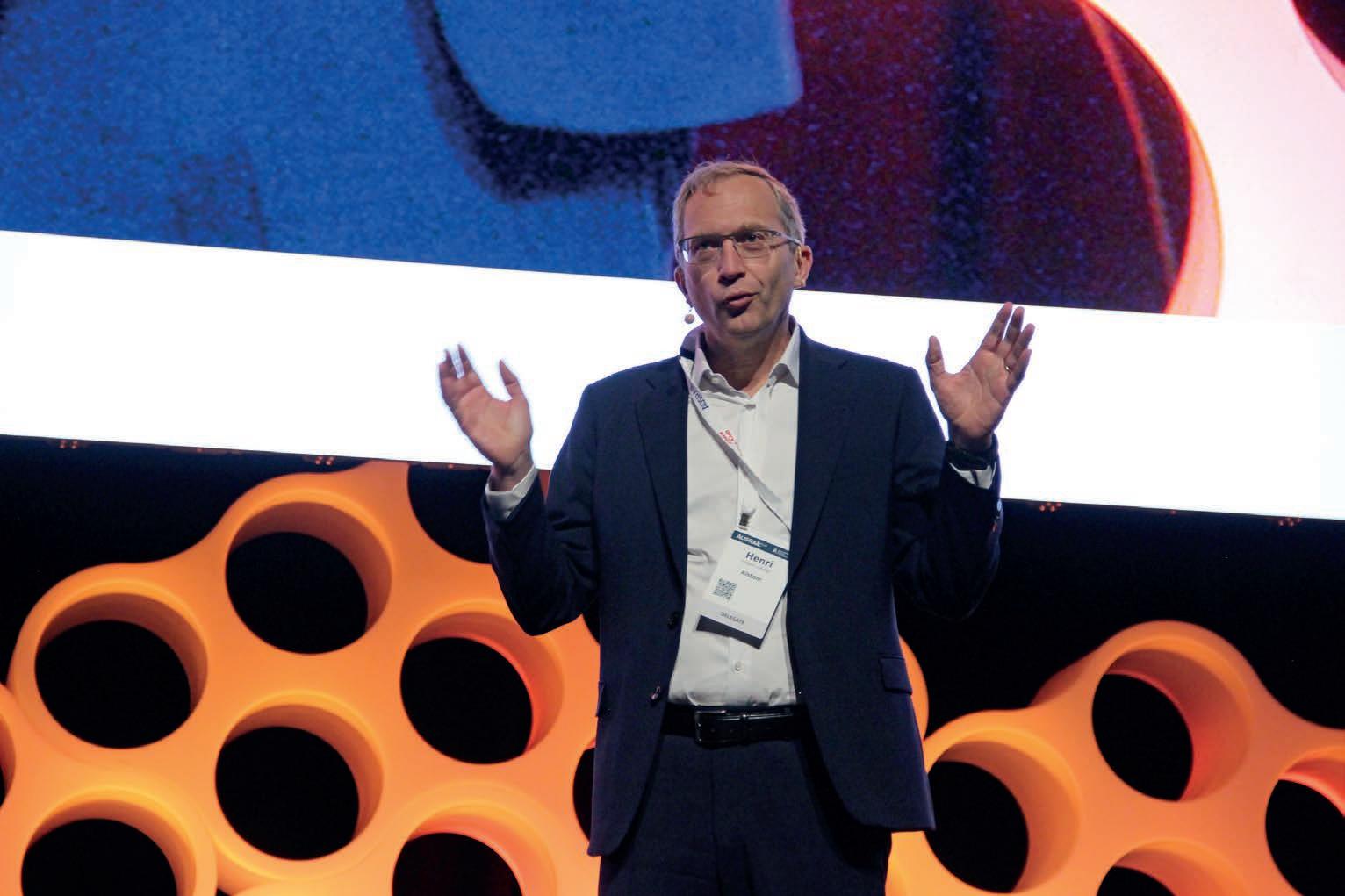
That’s the message Henri PoupartLafarge, Chief Executive Officer of Alstom, delivered to an auditorium full of delegates from the rail industry at the AusRAIL PLUS conference in Melbourne.
In his keynote speech, Poupart-Lafarge highlighted Australia’s opportunity within the “global rail revolution”.
He said: “Fundamentally, rail transport is about bringing communities together.
“It’s improving the quality of life in cities around the world, it’s improving the ways we connect with our work and our families, and it’s doing so in a sustainable way.
“This is why we’re seeing such growth in the market – it’s predicted to grow by three per cent per year.”
Poupart-Lafarge said he is pleased to see the increasing role rail transportation is playing in efforts to combat climate change, both in Australia and globally.
“I was at the COP [United Nations Climate Change Conference] in Paris in 2015, and there wasn’t a single word said about rail transport or even transport in general – it was all about energy production,” he shared.
“I was so pleased that for the first time, at the COP in Belém, Brazil this year, there was a full pavilion dedicated to transport.”
He said this was recognition of the fact that rail transportation is a solution, but it’s also a problem.
“If you look back over the past 10 years, the share of carbon dioxide emitted by mobility compared to total emissions has actually increased.
“This is to say that we have a fantastic future with so much growth, but we also have a huge responsibility to bring transport emissions down to the level we want to be at.”
THE CHALLENGES FACING RAIL
Poupart-Lafarge said it may come as a surprise that Australia’s rail network is much larger and more developed than Europe’s, but aside from this, there are some interesting similarities between the two.
“Both networks are extremely scattered, with the same challenges in terms of harmonisation and interoperability,” he explained.
“Historically in Europe, they didn’t want the network to be interoperable because of war – to make it harder for armies to travel between different countries.
“And of course, in Australia there are different gauges, different signalling systems. So in both Europe and Australia, our big challenge is to connect the different systems.”
Another challenge for both Australian and European rail networks is electrification.
“Europe’s network is more electrified than Australia’s, but 50 per cent of its network is still not electrified,” he said.
“So, we have a similar challenge in terms of green traction – what to do with all the diesel trains in Europe, which is 25 per cent of all passenger trains.”
There’s also ongoing work in both continents to build infrastructure to improve the quality of life for city residents and create better rail connections between cities.
“If you look at large cities in Europe, only 25 per cent of inhabitants have cars,” he said.
“The challenge is to get people out of their cars, but once they don’t have a car, they use public transportation more often, including for intercity travel.
“There has been a huge jump in very high-speed rail travel in Europe due to this phenomenon, as well as limitations on air traffic and the liberalisation of the high-speed market, with private operators getting involved.”
THE GROWTH OF HIGH-SPEED RAIL
Poupart-Lafarge said he is a passionate advocate for high-speed rail as a solution to global decarbonisation challenges.
“Today the very high-speed rail network is concentrated in a few countries – we talk about China, first and foremost, as well as France, Japan, Italy, and Spain.
“But it’s interesting to see how very highspeed rail is growing around the world.”
Alstom is proud to have played a key role in the first high-speed rail line in the United
Henri Poupart-Lafarge, CEO of Alstom, addressing the crowd at AusRAIL PLUS 2025.
Image: Prime Creative Media
States, from Washington to Boston, with the delivery of its new generation of Acela trains.
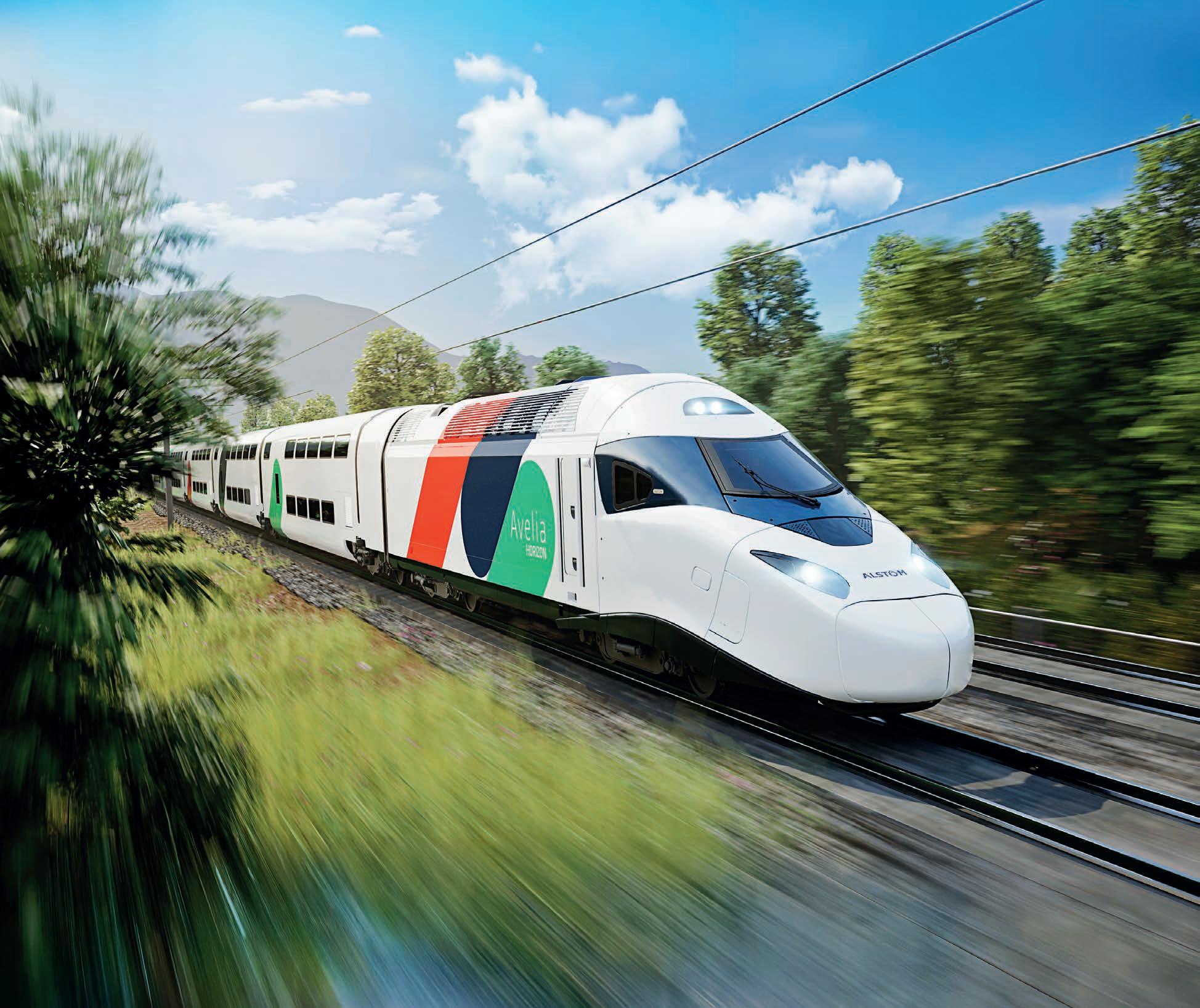
The manufacturer has also delivered new double-decker Avelia Horizon trains as part of Morocco’s very high-speed expansion.
When it comes to building a high-speed rail network, Poupart-Lafarge observed that the “magic number” is about 700 kilometres.
“If you look at the densest traffic on these networks – for example, from Washington to Boston or from Marseille to Paris, it corresponds to about 700 kilometres or two or three hours of rail traffic.
“This distance, running between large population centres, seems to be an ideal situation for high-speed rail. This fits perfectly to the geography here in Australia.
“We all know that these infrastructure projects take a long time to be developed but we are very pleased to see that progress is being made, and Alstom is more than ready to participate and invest.”
CHAMPIONING INNOVATION
Poupart-Lafarge said Alstom’s number one way to contribute to decarbonisation is by limiting the energy consumption of its fleets, many of which are electric trains and trams.
“As a rule of thumb, whenever we produce a new generation of trains or trams – about every 10 to 15 years – we are decreasing energy consumption by 20 to 25 per cent,” he said.
“Our new generation of high-speed train has 20 per cent more seats than the previous generation, and it consumes 20 per cent less energy.
“It’s a 35 to 40 per cent decrease in energy per seat, which is a huge gain.”
He said that as Alstom continues its development of battery electric trains, it’s important to recognise that there are supply chain challenges and the technology is still evolving.
“We are heavily investing in research and design in this area, to integrate newly developed technologies from our suppliers,” he added.
When it comes to digital technology, Poupart-Lafarge said Alstom’s goal is to make rail networks more efficient, creating a seamless experience for passengers.
“To enable 24-hour rail operations, we have a new generation of automated, driverless metro trains.
“We’ve also started to experiment
with driverless regional locomotives in Germany.
“So, we are moving in that direction, to improve the flexibility of operations as well as efficiency and sustainability.”
THE WISH LIST
To conclude, Poupart-Lafarge shared his wish list for the future of rail transportation. This includes predictable pipelines in manufacturing, engineering and development.
“Globally we have a pattern of projectbased business with ups and downs, but I think predictable pipelines help everybody to move in the right direction,” he said.
He reiterated his hopes for more progress towards high-speed rail in Australia, and further steps towards standardisation across rail networks, as well as striking the right balance between localisation and a national/ international approach.
Finally, he highlighted the responsibility that the rail industry has to embrace decarbonisation and work together to build more sustainable rail networks for the future.
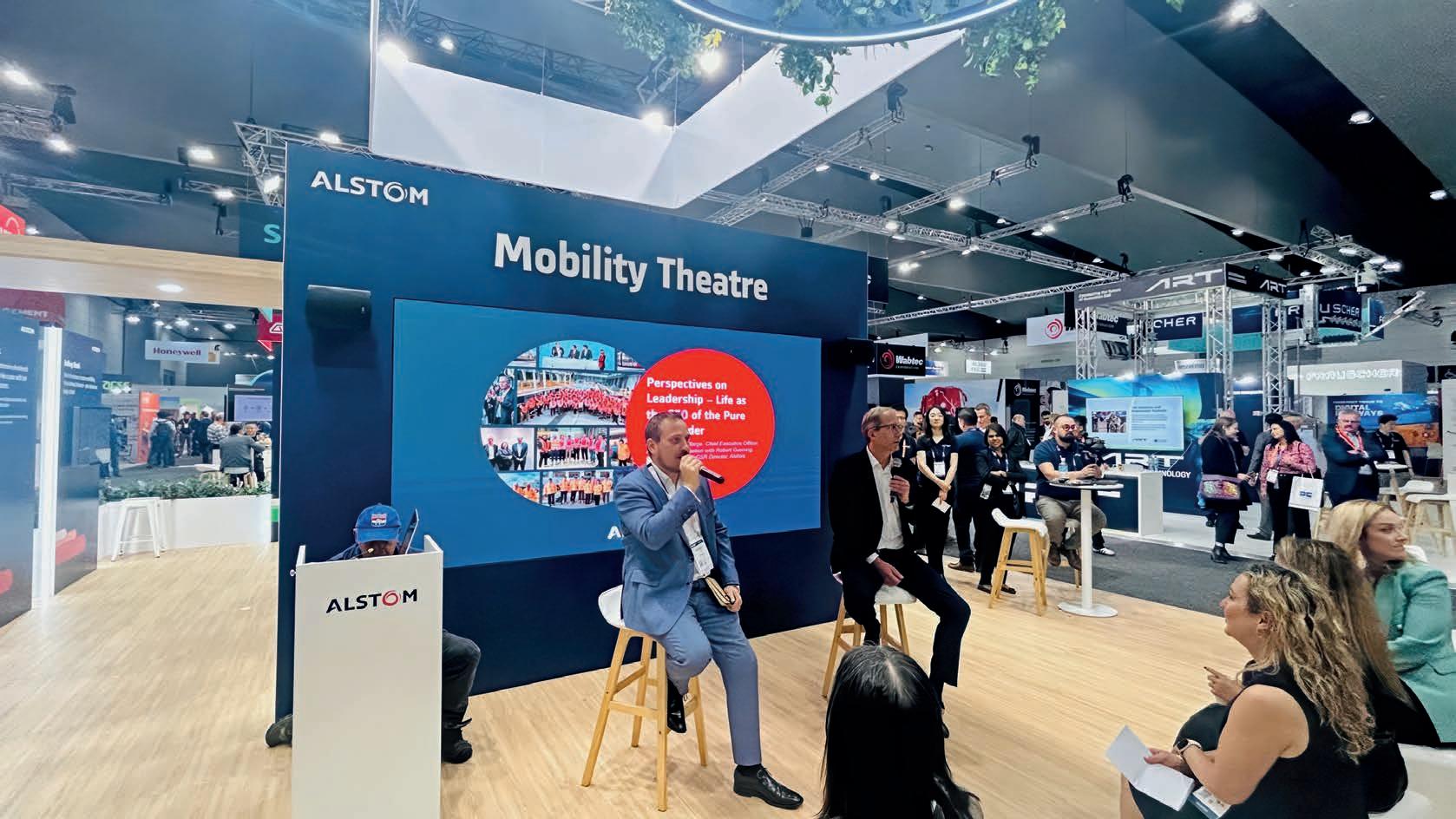
Henri Poupart-Lafarge speaks to Robert Gunning, Director of Communications and Corporate Social Responsibility at Alstom, as part of Alstom’s Mobility Theatre at AusRAIL PLUS.
Image: Alstom
Global insights from the rail supply chain Innovation
Darren Leigh, CEO of supply chain performance improvement partner Unipart, shares his thoughts on how to deliver the resilient, efficient and sustainable rail network that Australia – and the world – needs.
In today’s increasingly challenging rail environment, mastering supply chain complexity is not just a cost-saving exercise, but a source of competitive edge.
And at the heart of that complexity is something many people in the rail industry know well – volatility.
That was the message Darren Leigh, Chief Executive Officer (CEO) of Unipart, shared with the audience at the recent AusRAIL PLUS conference in Melbourne, which was attended by more than 7000 delegates and visitors.
“If you ask any CEO today what keeps them
up at night, it's the sheer unpredictability of the world we operate in,” he said.
“We are navigating a permanent state of volatility, and our industry, rail, is uniquely exposed.”
For more than 50 years, Unipart has been a performance improvement partner to some of the world’s most complex and mission-critical organisations – designing, making, moving and improving components in its customers' supply chains.
Leigh said that operating in 22 countries and serving customers in more than 100
gives the company a unique view from
“From Sydney to London and from New York to Dubai, universal challenges are impacting supply chains,” he said.
“These challenges include geopolitical friction that turns proven trade routes and sourcing strategies upside down overnight, increasing extreme weather events and of course, the post-pandemic shifts in how people move and how freight is prioritised.”
But the greatest challenge facing the rail industry right now is the endless cycle of “boom and bust” funding, he shared.
“This stop-start investment stifles long-term planning, forces short-term maintenance decisions over long-term asset renewal, and tragically, creates a brain drain of skilled professionals who seek greater
FROM REACTIVE TO PREDICTIVE
Leigh said that Unipart’s conversations with customers around the world have fundamentally changed, signalling a vital evolution in the industry.
“The initial request has moved from: ‘Can you supply this part?’ to: ‘How can you help us improve our performance and navigate this volatility?’” he said.
“This demonstrates the shift from a transactional supplier-customer model to a deeply strategic partnership model.”
Leigh said this change has taken place because the old model of managing failure is no longer sustainable. He reminded the audience that assets do not exist in isolation; they are part of a complex, interacting ecosystem of power, environment, and logistics.
“Think about the classic ripple effect of failure: a component on a piece of rolling stock fails, which stops a train,” he said. “But it doesn't end there. The ripple spreads.
“It's the passengers who miss connections, the engineer whose schedule collapses, the depot that goes out of sync, and the supplier who is now scrambling to provide a product that was unplanned.
“Valuable time and asset availability
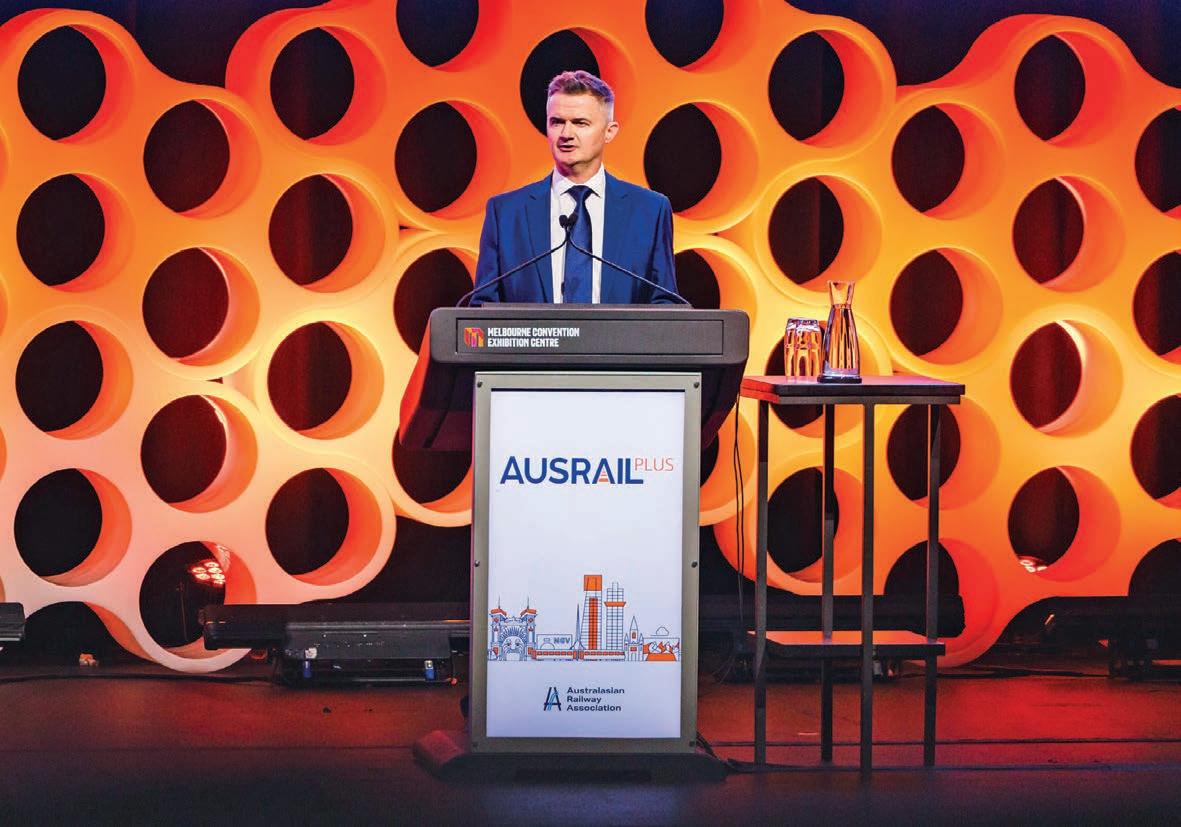
Darren Leigh, Chief Executive Officer of Unipart, addressing the crowd at AusRAIL PLUS 2025.
“If you ask any CEO today what keeps them up at night, it's the sheer unpredictability of the world we operate in.”
Darren Leigh, Chief Executive Officer of Unipart
are lost, because when monitoring and maintenance aren’t perfectly aligned, it’s like trying to solve a jigsaw puzzle with half the pieces missing.”
Leigh said Unipart’s customers are no longer just looking for a better product, but data-driven insights to help them find the missing pieces of the jigsaw.
“They need a system that doesn't just react to failure but anticipates it, and then instantly mobilises the entire support ecosystem around that prediction.”
THE CONDITION-BASED SUPPLY CHAIN
Many people in the rail industry will be familiar with predictive maintenance –when tools and technology are used to predict failures before they happen.
Leigh said the “next great leap” in supply chain performance involves taking insights from predictive maintenance and
transforming them into automated action across the entire service chain.
This system, which he called “the Condition-Based Supply Chain”, means data is streamed in real-time from assets, and artificial intelligence predicts not just if it will fail, but when and why.
“This prediction automatically triggers the entire supply chain: the right part, the right tool, and the right engineer are deployed, precisely when and where they are needed,” he said.
“This is where the supply chain moves from a cost centre to a source of network resilience.”
Leigh said the Condition-Based Supply Chain delivers a complete loop: from sensor, to insight, to logistics, to component refurbishment.
“It’s a unified system of anticipation, precision, and resilience that allows you to manage assets based on real-world need, not arbitrary timetables.
“The benefits are profound – from reduced costs due to eliminating unnecessary maintenance and downtime, to enhanced reliability and improved sustainability thanks to the optimisation of energy use and extending the life of critical assets.”
He shared an example of the power of real-time condition monitoring insights from Unipart’s work with Northern Trains, one of the largest rolling stock operators in the United Kingdom.
Unipart deployed remote condition monitoring across the customer’s Porterbrook Class 170 Turbostar fleet, using sensor technology to install systems that continuously monitor things such as oil
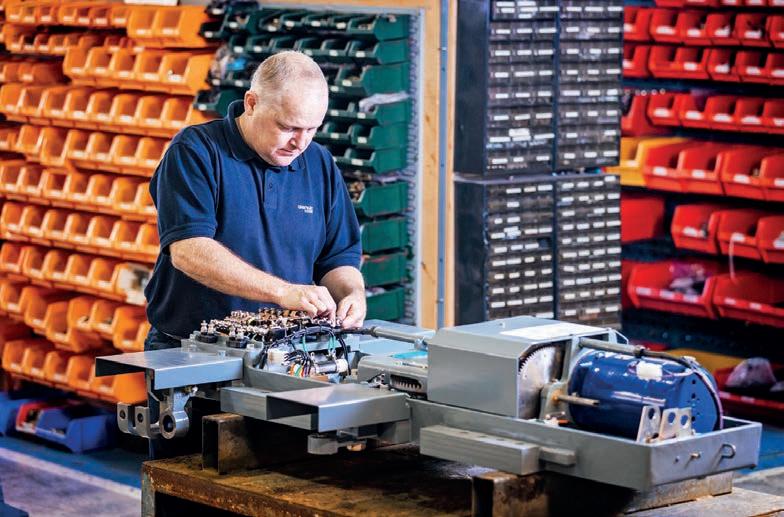
pressure and coolant levels.
Leigh said the result was “immediate and measurable”, with issues now detected early and diagnosed precisely.
“The result was fewer faults, reduced maintenance time, and significantly increased availability because assets spend more time in service,” he said.
To demonstrate the power of logistics, MRO (maintenance, repair and operations) and supply working together, he shared a further example from Network Rail, the organisation that owns, operates, maintains, and develops the railway infrastructure in England, Scotland, and Wales.
Unipart supplied new point machines to Network Rail, but its work didn’t end there.
“We created an end-to-end refurbishment process that re-engineered old point machines in-house,” said Leigh.
“The result was a 50 per cent cost saving versus buying new units, a 15-month warranty – longer than a new machine –and better availability, as components could be returned to service quickly.”
CULTURE AND COLLABORATION
Leigh stressed that although technology brings many benefits for the rail industry, it’s not going to fix everything.
He said that the Condition-Based Supply Chain (CBSC) is a framework, and every framework requires firm foundations. For Unipart, these are based on culture and collaboration.
“At Unipart, we call culture ‘The Unipart Way’,” he said. “It is a proprietary business system, and a unique culture of continuous improvement built over five decades.
Unipart designs, makes, moves and improves components in its customers' supply chains.
“It’s what empowers every single colleague – from the shop floor to the boardroom –to challenge the norm and continuously drive improvements.
“It is this culture that allows us to not just embrace new technology, but to pioneer it, and to partner with our customers to build the future skills needed to support it.”
Turning to collaboration, Leigh said the rail industry must move away from short-term, transactional procurement if it is to become truly resilient, sustainable and connected.
“We must embrace long-term partnership models that foster trust, share risk, and create genuine win-win scenarios,” he said.
“It requires open data sharing. It requires long-term commitment. And it requires the courage to innovate together.”
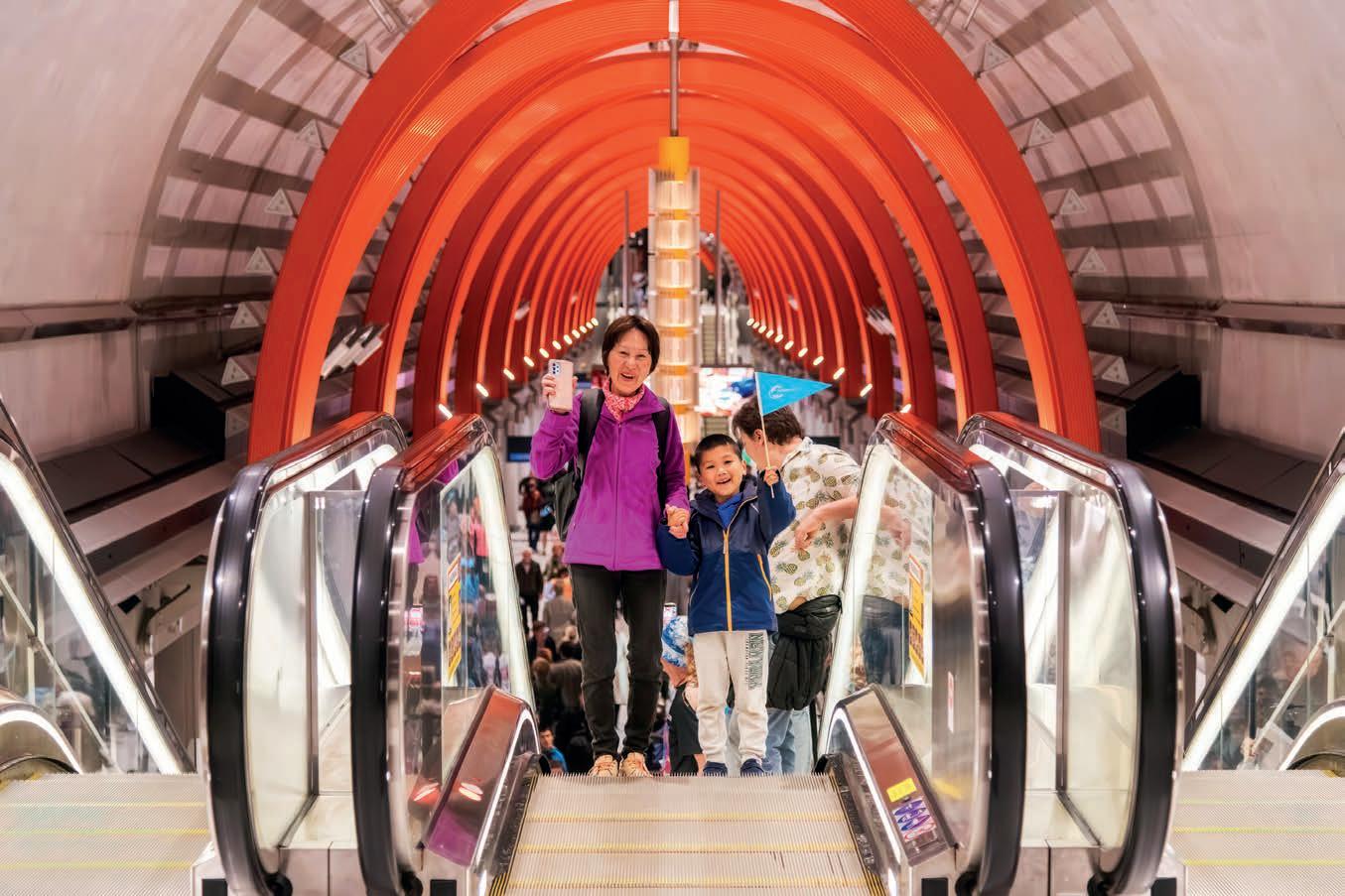
The Big Switch
We share what Melburnians think of the new Metro Tunnel, and what they can expect now that 1000 extra weekly services have been added to the network.
Melbourne's Metro Tunnel is now running a full timetable, with more than 1000 extra weekly services added to the network.
As of “The Big Switch” on February 1, 2026, the twin nine-kilometre tunnels and five new stations – Arden, Parkville, State Library, Town Hall, and Anzac –are fully integrated into Victoria's wider train network. The way that half of all commuters move around Melbourne
has changed, with changes across metropolitan and regional trains as well as trams and buses.
All services on the Sunbury, Cranbourne and Pakenham lines have switched to run exclusively through the new tunnel, with trains arriving at each of the new Metro Tunnel stations as often as every three minutes during peak times. Trains will run at least every 10 minutes between
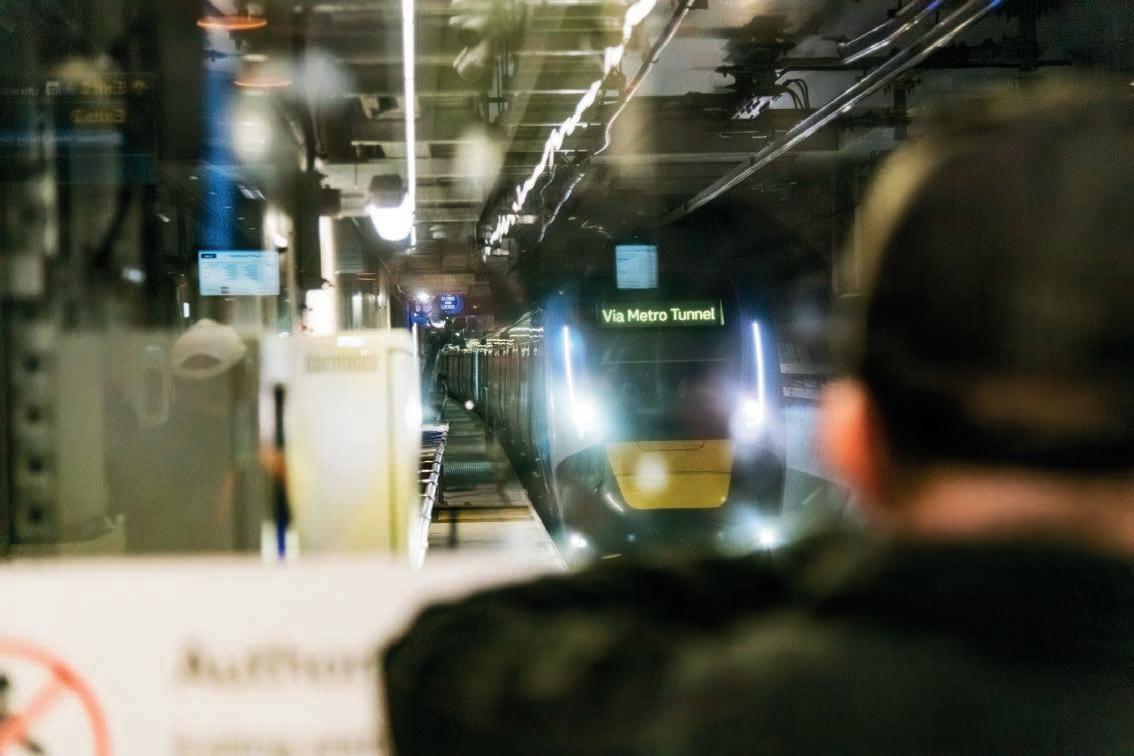
Watergardens and Dandenong stations in both directions from 6am to 9pm through the Metro Tunnel.
The Big Switch will also mark Frankston Line services returning to the City Loop, improving access to the CBD for thousands of passengers on one of Melbourne’s busiest lines.
Meanwhile the Werribee and Williamstown lines will temporarily run directly to Flinders Street, before connecting with the Sandringham line later in the year to form a new cross-city service.
Regional passengers will also benefit from additional services, including 18 additional services on the Traralgon Line, 10 new services along the Seymour Line and four new services on the Echuca Line.
More services will be added to the network from the middle of 2026, including on the Werribee, Sandringham, Craigieburn and Upfield lines.
Minister for Public and Active Transport Gabrielle Williams said: “We’re excited for passengers to be able to enjoy more of the benefits of the Metro Tunnel with more than 1000 extra services being added from February in the biggest change to our network in 40 years.”
Since it opened to the public on November 30, 2025 in a soft launch known as “The Summer Start”, the Metro Tunnel has been used by more than 500,000 passengers.
High-capacity signalling, delivered by Alstom, enables more trains to run more often on the network.
State Library saw the most passengers through its doors out of all the new stations on launch day.
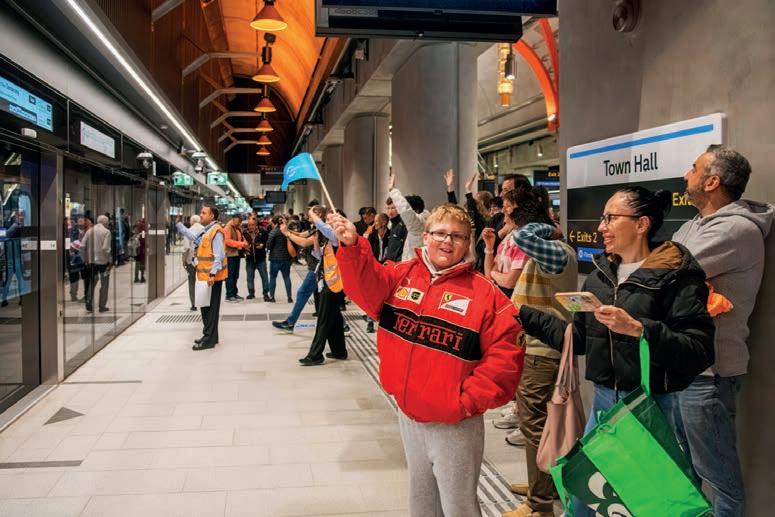
The first services departed East Pakenham at 9.03am and Sunbury at 9.28am on Sunday November 30, arriving a minute apart at Town Hall Station in the CBD before continuing their journeys.
More than 70,000 passengers turned out to experience the Metro Tunnel on opening day, and more than 1100 customer service staff were out in force to help passengers as 54 trains travelled a total of 486 kilometres through the tunnel.
State Library had the most passengers through its doors out of all the stations at 22,000, followed by Town Hall Station with more than 16,000, Anzac Station with around 13,000, Parkville Station around 12,000 and Arden Station at more than 8000.
The Summer Start introduced more than 240 extra and extended services that ran alongside the existing Metro Trains timetable.
Passengers on the Cranbourne, Pakenham and Sunbury lines could choose between existing services or a Metro Tunnel train.
This allowed the new infrastructure and technology to be tested in real world conditions, with the intention that bugs could be ironed out with minimal disruption to the rest of the train network.
WHAT PASSENGERS HAD TO SAY
“I like the automatic doors to the trains, and it’s now easier for me to get from the north side of the CBD to the western suburbs.”
“I've used the tunnel once. The platforms and concourses are huge, far bigger than anything I have seen anywhere else in the world when it comes to underground stations.”
“I usually drive to work but I went out of my way to take a Metro Tunnel train just because I was curious to see what it was like! It was pretty cool, I like that the trains are clean and new.”
Victorians are encouraged to consult the new timetables for public transport and plan their journeys using the Transport Victoria website at transport.vic.gov.au.
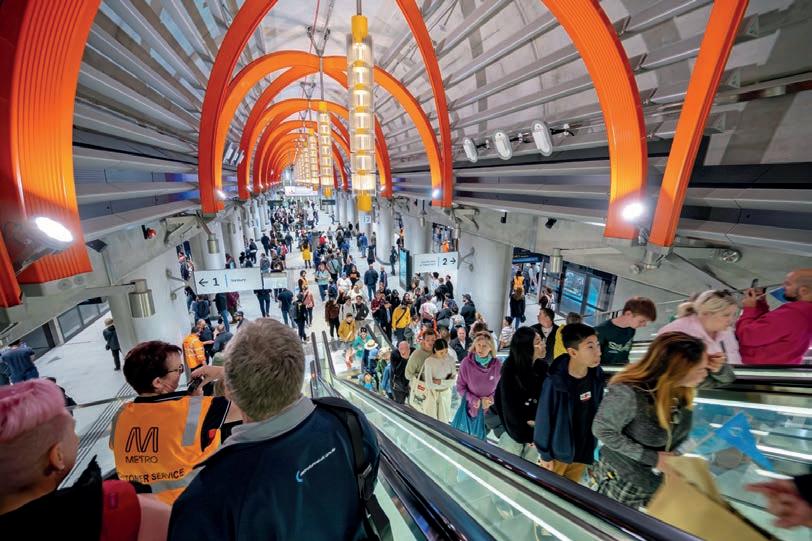
“I like the full-length doors separating the platform from the tracks, it makes it look more modern and safer.”
“I think the connection between the CBD stations is excessively long – maybe that’s just me!”
“The orange ribs at State Library Station are striking and I also like the lamps to the side – they give an Art Deco feel that reminds me of classic rail stations.”
Young and old alike were excited to take the new trains for the first time.
More than 70,000 passengers turned out to experience the Metro Tunnel on opening day.
Young Professionals
On track for success
A team of students from Monash University is gearing up to do Australia proud at the 2026 IMechE Railway Challenge in the United Kingdom.
When student Katherine Bilic applied for a short course in railway engineering at Monash University, she didn’t know much about rail.
“I saw there were some spots available and I thought ‘I’ve got nothing on next week, I might as well go,’” she said.
“But I ended up finding it fascinating and wanting to learn more.”
Unable to specialise in railway engineering within her broader engineering degree, she decided to take matters into her own hands.
“They don’t teach it beyond the odd elective, so I spoke with some people from the Monash Institute of Railway Technology to figure out what we could do to get more students involved.”
This initial spark led to Monash’s first ever student rail team competing in the annual Institution of Mechanical Engineers (IMechE) Railway Challenge in the United Kingdom, a competition that involves designing and building a locomotive that is one-fifth the size of a regular locomotive.
The team, led by Bilic and dubbed Monash Railway Express (MREx), competed in the
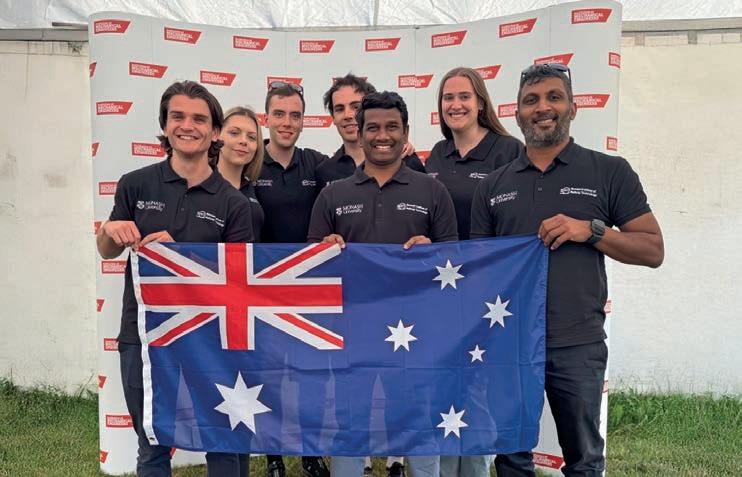
Entry Level Challenge in 2025 and ended up coming in second place, just five points behind the top spot.
“We were a close second and we learned so much from the competition,” said Bilic.
“It was such a great experience, with everyone willing to help each other – like if we asked another team about their
locomotive they would literally pull it apart to show us.”
Back in Melbourne, the team is energised and gearing up to take part in the competition again in 2026.
“We came back from the competition and revised our locomotive’s design a bit, based on what we learned,” she said.
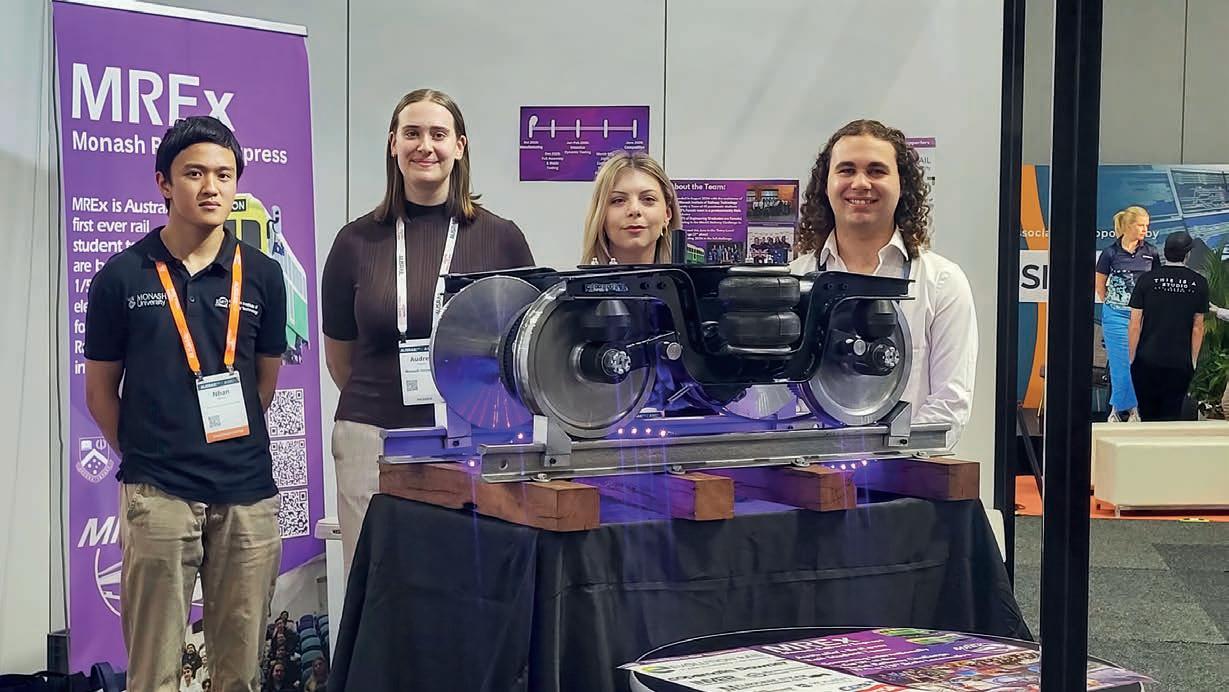
The team competed at the annual IMechE Railway Challenge in Leicestershire in 2025.
Members of the Monash Rail Express team exhibiting their locomotive at AusRAIL PLUS 2025 (left to right): Nhan Nguyen, Audrey Tasevski, Katherine Bilic and Lachie Clements.
“We’re really looking forward to going back and hopefully winning something this year!”
MREx’s design, known as Wallaby, is a battery-electric locomotive inspired by Melbourne’s iconic W-class trams.
“We’re dedicated to designing an innovative locomotive that champions sustainability, safety and efficiency,” Bilic said.
She added that some of the other locomotives at last year’s IMechE didn’t perform as well as hoped after sitting out in the sun for a few weeks – but she reckons the Australian team has an advantage.
“A few of the other locos suffered from reliability issues with their electronics,
but we think if ours holds up after being tested in the heat here it should be OK over in England.”
Since Bilic first started recruiting for MREx a year ago, the number of students on the team has grown to 45 – and 38 per cent are women.
“I wanted there to be a positive, welcoming culture for everyone from the start, as we were building the team from the ground up,” she said.
“More women have gotten involved because their female friends on the team have recommended it to them, which is amazing.”
She thinks projects like this are a great way to get more young people interested in
joining the rail industry, which is suffering from a skills shortage and a retirement cliff.
“We had over 220 applications for the team – the interest in rail is definitely out there,” she said.
“We want to start a similar competition to IMechE here in Australia, to build on that interest and potentially encourage more engineers to go into rail in the future.”
She’s very proud of what the team has achieved so far and excited about what the future holds.
“The team has put so much effort into this project, and it’s great to see the tangible results from our work,” she said.
“Seeing it all come together, piece by piece, is what keeps us coming back.”
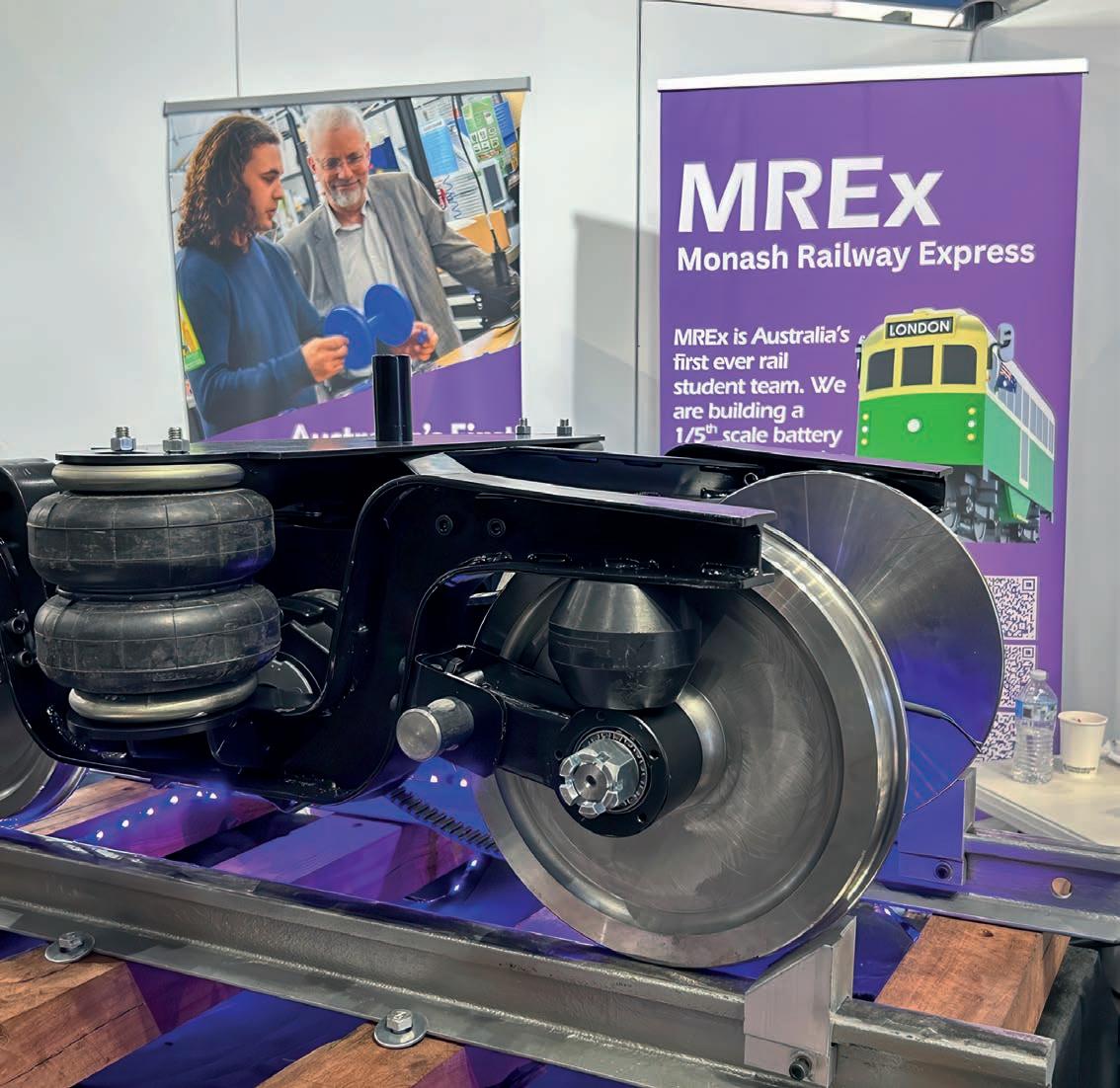
The team has worked hard to design and build a miniature locomotive.
Great Australian odysseys
Storyteller Jim Haynes shares a slice of Australia’s rail history and why he can’t resist the magic of a long train journey.
Jim Haynes has always been interested in Australia’s railways – and admits he’s sentimental for a time when long train journeys across the continent brought plenty of opportunities for adventure.
The author and radio host has written and compiled many stories, songs and poems featuring trains over the years, and shared a few lines from a favourite old poem of his that sums up his feelings of nostalgia.
Perhaps I’m sentimental, but in my mind I seem to remember childhood journeys through a veil of smoke and steam.
How lucky we were to be alive when a train trip meant a ride behind an engine like a living thing, with its insides all outside.
You don’t meet many people in a car or bus or plane, but there was many a friendship made to the rhythm of a train.
If you dream of steam, card games and conversation, well perhaps you’re sentimental too. I’ll see you at the station!

Haynes is nostalgic for a time when train journeys were through a veil of "smoke and steam”.
Haynes’ latest book, Great Australian Odysseys, compiles tales of the extraordinary journeys that have shaped Australia’s history – from the bravery of sailors to the resilience of the truckies crossing the Nullarbor, and from the great age of rail to the aviation pioneers who turned the skies into a new frontier.
The rail section of the book includes a story from legendary American author Mark Twain, who visited Australia in 1895 as part of a world lecture tour.
“Mark Twain and his wife invested in a new printing mechanism, and before they could get it off the ground, the Linotype printing press was invented – so they more or less went bankrupt," said Haynes.
“Twain needed to make some dough, and as the most famous author in the world at the time, the best way for him to cash in on his fame was to do a world tour. It’s an amazing piece of history!”
Twain’s story, To Melbourne by Train, details his travels from Sydney to Melbourne – including his disdain at having to change trains at the border between Victoria and New South Wales.
“He sums the whole business of the colonies choosing different rail gauges as perhaps only Mark Twain could –describing it as a ‘paralysis of intellect’,” Haynes laughed.
“We’re still dealing with the repercussions of those early decisions around the railways made by the colonies today.”
Haynes said the idea for the book came from contemplating the tyranny of distance – not just across Australia, but between Australia and the rest of the world.
“Until World War 2 and commercial aviation, you really couldn’t get to Australia without taking a very long sea journey,” he said.
“Starting with the First Fleet and going right up to the post-war ‘populate or perish’ times, the people who came to Australia made incredible progress in developing the railways.
“We had people from Scotland, England and all around the world building railways here. The railways employed more people than any other industry in Australia for about six decades, and because a lot of those people were migrants, they were also building up Australian society.”
Haynes said that back in the 1980s and 1990s, he thought rail’s heyday was well and truly over.
“I was living in Inverell in New South Wales and they closed the railway there – the town was very sad to lose it,” he said. “I even wrote a song called Sleepers and Rails about the fact that the railways seemed to be disappearing, but I’m glad to have been proved wrong.
“We still don’t have trains coming to Inverell, but things have improved in other areas of regional New South Wales.
“I hope we’ll have another great golden age of rail in Australia – with high-speed trains allowing us to move between our cities with ease.”
Jim Haynes, author of Great Australian Odysseys Image: Allen and Unwin
IN EVERY ISSUE
Major Projects and Infrastructure, Operations and Maintenance, Technology, Plant and Equipment, Rolling Stock and Manufacturing, Passenger Rail, Freight Rail and more.
FEBRUARY
High Speed Rail and Light Rail
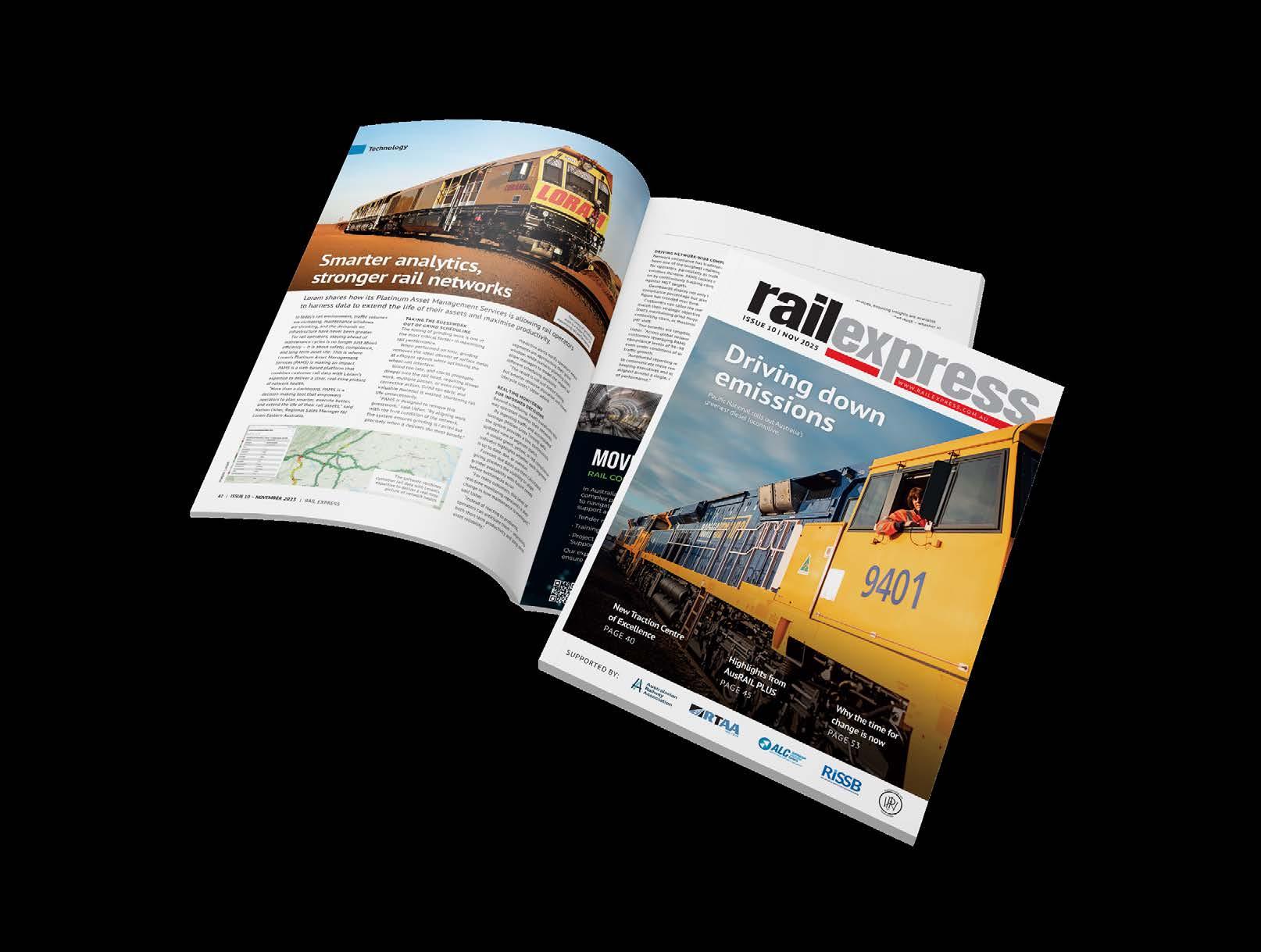
MARCH Manufacturing
APRIL
Heavy Haul and Signalling & turnouts
MAY
Intermodal and Safety
JUNE
Passenger Rail
JULY
Workforce and Decarbonisation
AUGUST
Digitalisation and Digital twins
SEPTEMBER
Condition monitoring and Maintenance
OCTOBER
Plant & Equipment
NOVEMBER
AusRAIL
DECEMBER
Sustainability and Innovation
For
Events
Expo bulks up
The Australian Society for Bulk Solids Handling will bring its expert insights to Bulk Expo in 2026.
The Bulk Handling Technical Conference & Expo (Bulk Expo) is proud to announce the Australian Society for Bulk Solids Handling (ASBSH) as an official association partner for the event.
Through this partnership, ASBSH will oversee the development of the technical conference program, bringing deep industry expertise and specialist insight to the agenda.
The conference, curated by senior experts from ASBSH, will present the latest research, real-world case studies, and emerging industrial innovations shaping the future of bulk materials handling.
This technical forum will attract engineers, researchers, consultants, and global specialists, reinforcing Bulk Expo’s position as a leading destination for industry knowledge, innovation, and professional exchange.
"We’re thrilled to partner with Bulk Expo again to shape the technical program,” said ASBSH Director Mark Jones. “This collaboration brings fresh research, practical insights, and innovations from industry
and academia to Australia’s bulk-handling professionals, showcasing real-world solutions and fostering idea exchange.
“Bulk Expo remains a vital meeting point, and we look forward to delivering a program that drives smarter design, stronger technical knowledge, and better outcomes across the sector.
"Some of the key conference themes include material handling challenges, storage and handling, conveying, environmental considerations, transportation, modelling and simulation as well as dust monitoring and control.”
Bulk Expo organisers Prime Creative Media also shared their enthusiasm for the partnership.
“Partnering with ASBSH allows Bulk Expo to deliver a conference program that is truly relevant and valuable to the industry,” said Siobhan Rocks, General Manager – Events at Prime Creative Media.
“The association’s deep understanding of the challenges and opportunities within bulk storage and handling will ensure delegates
walk away with actionable insights and strategies to improve operations, efficiency, and safety.”
Abstract submissions for the conference are now open and will close on February 27, 2026.
Submissions are to be sent to danielle.harris@newcastle.edu.au, with a 200-word summary including title and author.
Bulk Expo 2026 returns to Melbourne on September 16-17, 2026, at the Melbourne Convention and Exhibition Centre, bringing together suppliers, operators, and decision makers from across Australia.
Attendees can expect a dynamic mix of exhibition, networking, and conference sessions designed to showcase the future of bulk materials handling.
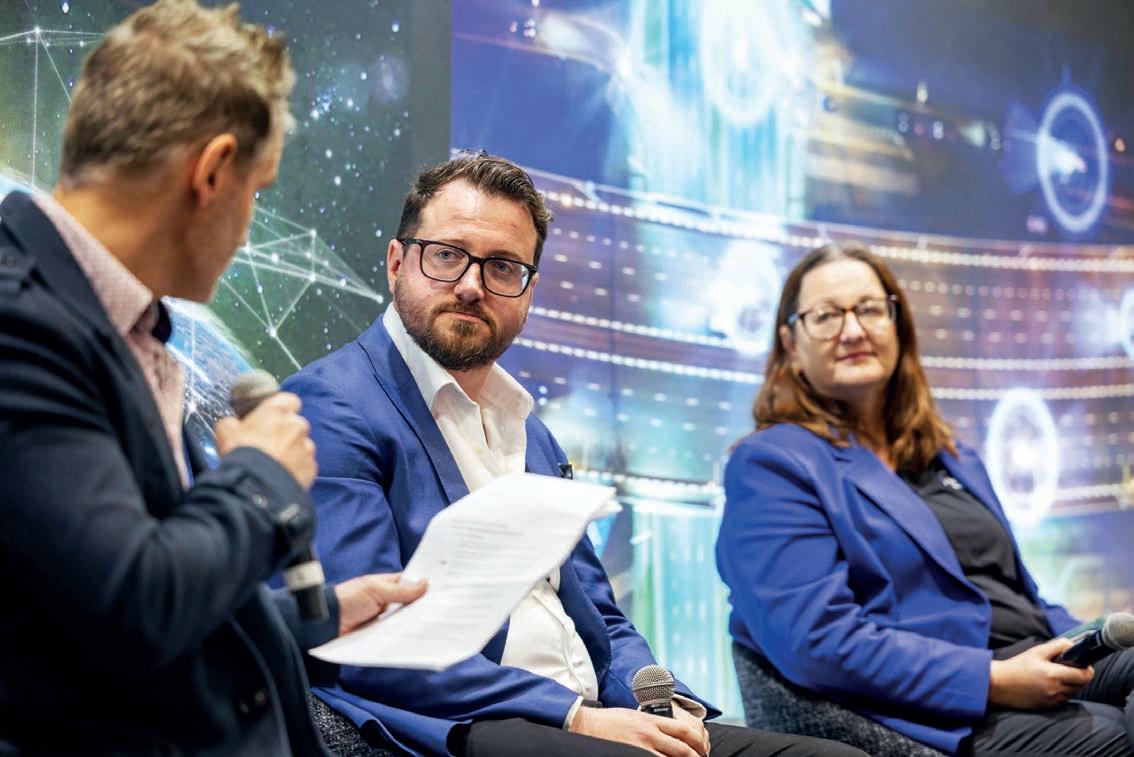
Bulk Expo 2026 returns to Melbourne on September 16-17, 2026.
Nominations open for 2026 Endeavour Awards
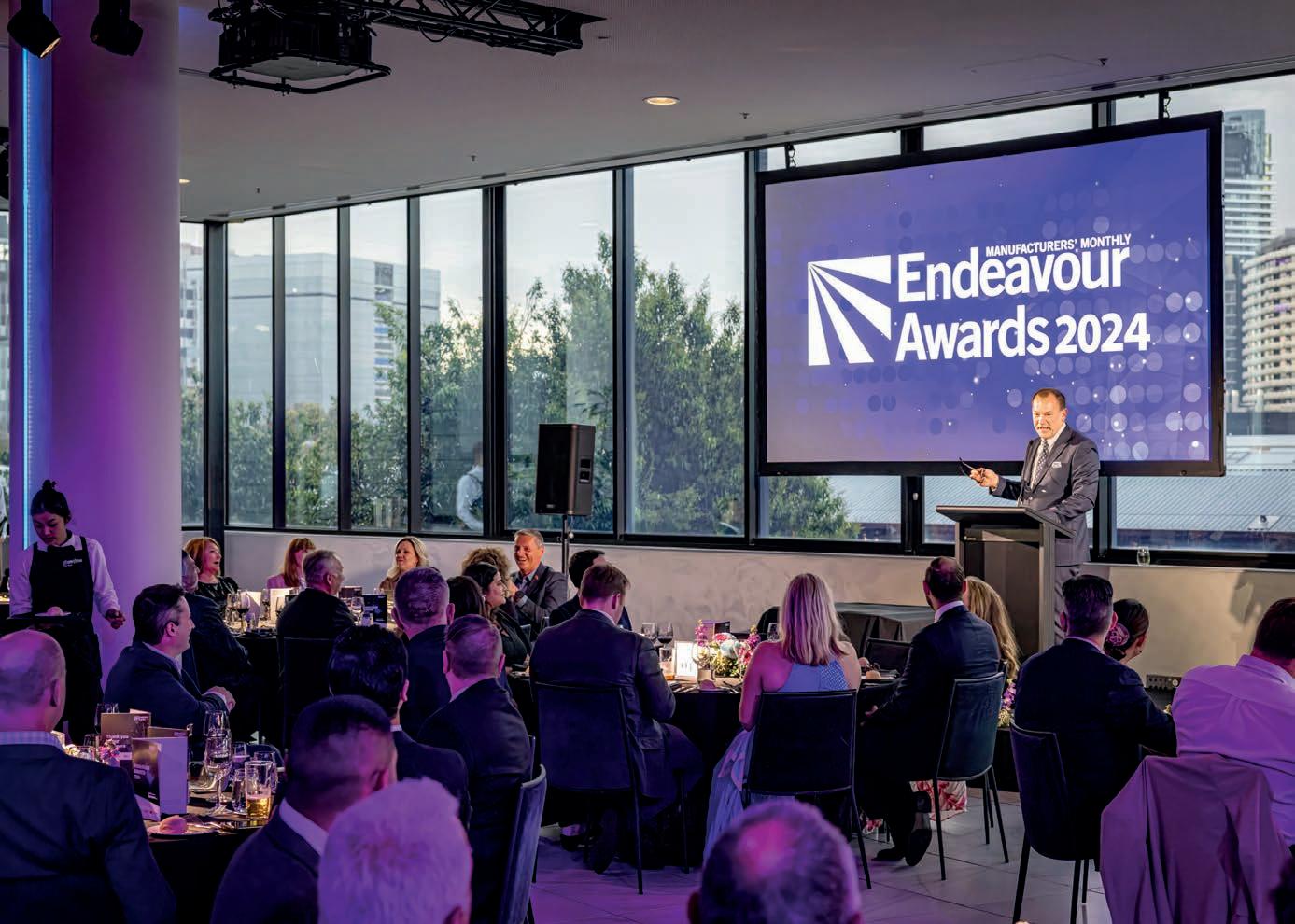
The Endeavour Awards bring together leaders, innovators, and rising stars in manufacturing.
The awards celebrate those shaping the future of Australia’s manufacturing industry.
Nominations are now open for the 2026 Endeavour Awards, Australia’s premier celebration of excellence and innovation in manufacturing.
Presented annually by Manufacturers’ Monthly magazine and held in conjunction with Australian Manufacturing Week, the Endeavour Awards honour the achievements of the individuals and organisations who are driving Australian manufacturing forward.
The annual gala dinner will take place on May 13, 2026 during Australian Manufacturing Week at the Westin Brisbane.
Recognised as the manufacturing industry’s night of nights, the Endeavour Awards bring together leaders, innovators, and rising stars to celebrate success, share stories, and connect with peers shaping the future of Australian manufacturing.
Awards will be presented across the following categories:
INNOVATION IN TRANSPORT
Highlighting innovation in transport, this category is for businesses enhancing vehicle manufacturing, public transport, or sustainable mobility solutions.
OUTSTANDING START-UP AWARD
This award recognises an Australian manufacturing start-up that has introduced a new product to the market, filling a clear gap.
LEADER OF THE YEAR – SPONSORED BY BDO AUSTRALIA
This category celebrates a leader who holds a senior position (executive, manager, director, or equivalent) in a private, notfor-profit, or government organisation. Successful nominees will have shaped their business's success, delivered financial growth, and positively impacted the culture at their organisation, as well as championing their industry more broadly.
INNOVATION IN AEROSPACE
Celebrating advancements in aerospace technology, this category is for companies driving innovation in aircraft, space, and defence aircraft manufacturing.
INNOVATION IN HEALTH TECHNOLOGY
This award recognises technologies that improve healthcare and medical manufacturing.
INNOVATION IN FOOD & BEVERAGE MANUFACTURING
Recognising advancements that enhance food and beverage production, this category is open to businesses developing innovative processing, packaging, automation, or sustainability solutions for the industry.
ADVANCED MANUFACTURING EXCELLENCE AWARD
For the first time in the Endeavour Awards' history, the event will feature an
Advanced Manufacturing Excellence Award, celebrating outstanding achievement in precision engineering, automation, or digital manufacturing technologies.
RISING STAR OF THE YEAR AWARD
The Rising Star of the Year Award is a new award recognising an emerging leader who has demonstrated exceptional talent, innovation, and commitment within Australia’s manufacturing industry in the early stages of their career (under 30 years of age).
EXCELLENCE IN SUSTAINABILITY AWARD
This new category celebrates a manufacturing business that has demonstrated leadership and innovation in environmental sustainability.
MANUFACTURER OF THE YEAR –SPONSORED BY WELD AUSTRALIA
The Manufacturer of the Year Award is chosen from the winners of the other awards categories. This category is not open for nomination.
Companies and individuals from across the manufacturing sector are invited to showcase the projects, technologies, and people making an impact on the industry’s growth and resilience.
Industry Organisations
More than a name change
The Rail Industry Safety and Standards Board (RISSB) has officially changed its name to the Australian Rail Industry Standards Organisation (ARISO). Chief Executive Officer Alan Fedda tells us what it means for the future.
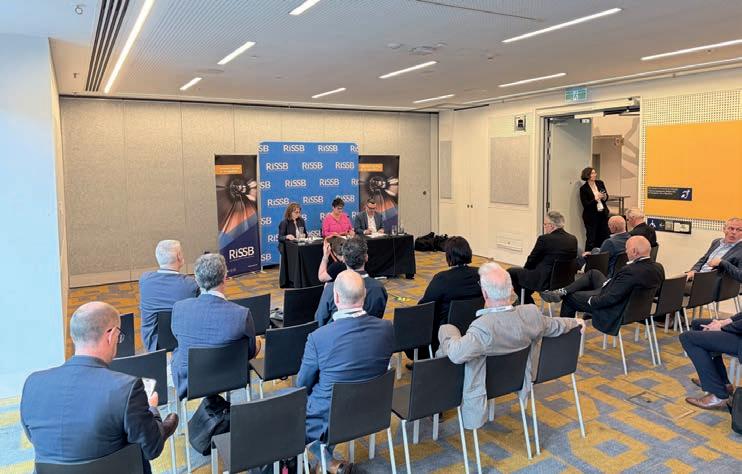
ARISO’s AGM, where
The Rail Industry Safety and Standards Board (RISSB) has officially changed its name to the Australian Rail Industry Standards Organisation (ARISO), signifying a “new era” in its service to members and the wider rail industry.
ARISO said it will have a stronger focus on supporting the development of mandatory standards, leading harmonised standards and assisting the industry where local standards are required.
The change was approved by members of the organisation at its Annual General Meeting (AGM) on November 27, 2025.
It comes after Australia’s rail industry, infrastructure and transport ministers made the historic decision to nominate European Train Control Systems (ETCS) as the future technology pathway for the National Network for Interoperability (NNI), meaning any digital train control and signalling system introduced on the NNI must comply with ETCS mandatory standards.
Progress on the national pathway for streamlining rolling stock approvals has also been endorsed by ministers, who support a national approach to the procurement of passenger rolling stock to maximise local industry participation, grow manufacturing capability and strengthen supply chain resilience.
In addition, ministers agreed to consider a package of reform options to implement elements of the National Rail Procurement and Management Strategy, including nationally harmonised standards for manufacturing rolling stock.
Alan Fedda, Chief Executive Officer of ARISO, said he’s delighted by the current appetite for change in the rail industry.
“It’s been a fantastic time because you can really feel that momentum, from a policy perspective but also more broadly across the industry,” he said.
“There’s a sense that we need to do something different if we’re going to drive greater productivity and safety outcomes nationally.”
Fedda said that until now, adopting standards was on more of a voluntary basis, but this hasn’t resulted in the necessary levels of consistency.
“We have been working hard to drive harmonisation across the rail sector.
“In 2023, we co-sponsored a report, along with the National Transport Commission (NTC), the Office of National Rail Industry Coordination (ONRIC) and the Australasian Railway Association (ARA), to look at the barriers to harmonisation, and one of the main barriers was that voluntary environment. Now there’s real momentum
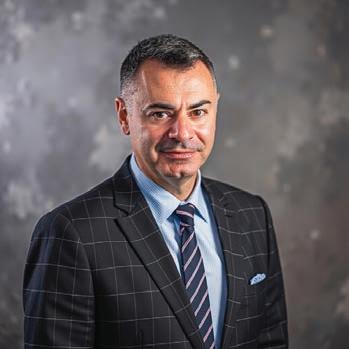
to create a stronger standards body to drive that harmonisation, especially on critical standards of national importance.”
THE CONSEQUENCES OF INCONSISTENCY
Across Australia, different jurisdictions use different rail gauges, technologies, signalling systems, driver training requirements – even different high-vis vests.
The consequences of these inconsistent standards include inefficiencies and lower productivity, slower approval processes, higher costs and increased safety risks.
A freight driver going from Perth to Sydney, for example, could travel through four different Rail Infrastructure Managers (RIMs) – four territories where the rules are different.
“That driver will have to do four different lots of training, carry four different colour vests in the cabin and change four times along the way,” said Fedda. “It’s just not efficient.
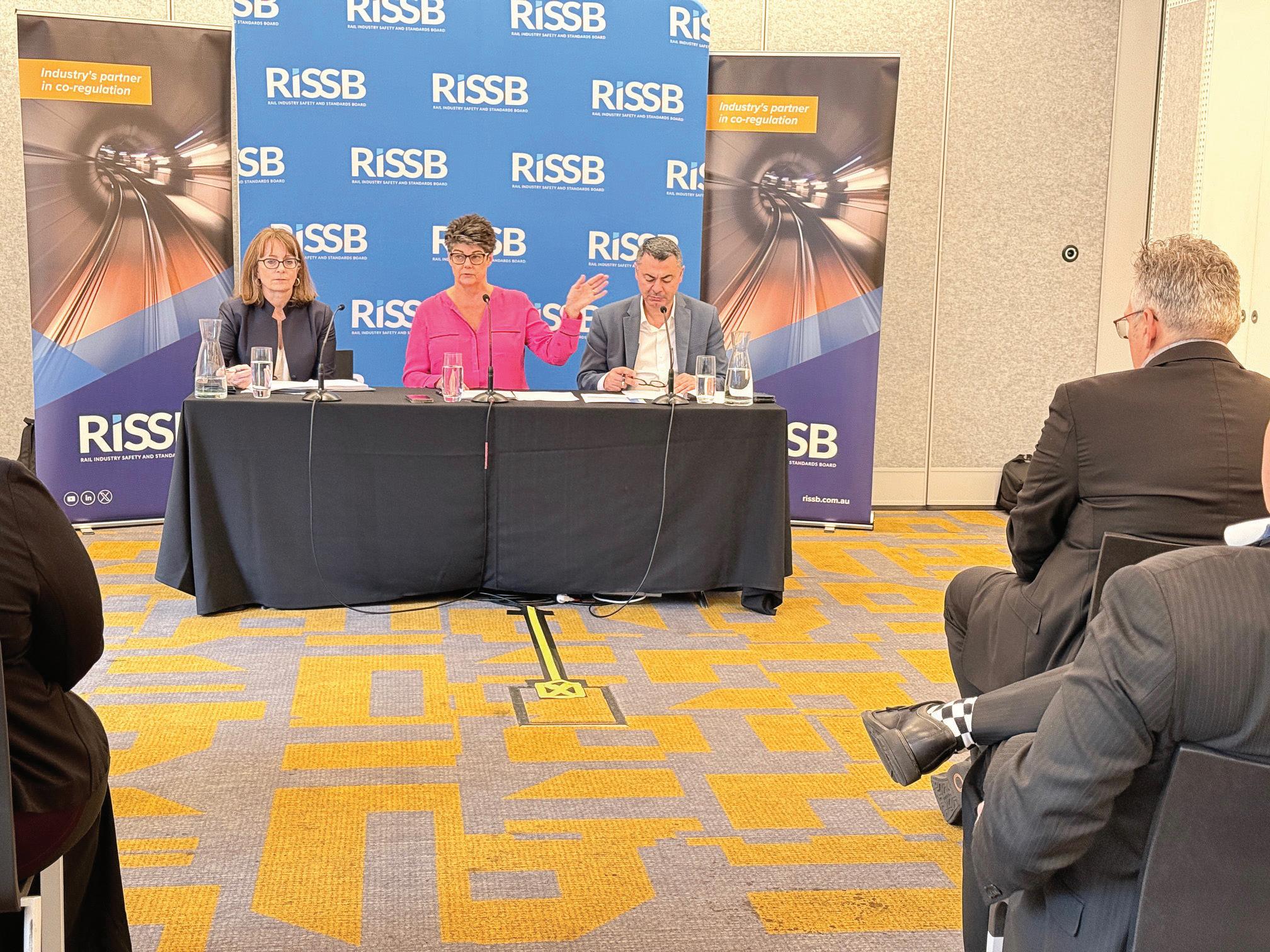
“But the inconsistencies go from simpler things like that to very important decisions around what signalling systems to implement.
“Historically, there hasn’t been the agreement we need in the industry on what the standards are that we should adopt moving forward.”
With reform now occurring for the Rail Safety National Law and the NTC entering consultation in 2026 around changes to the law, Fedda said this is a crucial time.
“This is an opportunity to think about exactly how standards fit in that regulatory environment,” he said.
ADVANCING SAFETY AND PRODUCTIVITY
Fedda said ARISO’s new name sums up what the organisation does, and who it serves.
“We are the Australian Rail Industry Standards Organisation – and that ‘industry’ in the middle of our name is so important,” he said. “We continue to be an industry-led organisation, and everything we do is driven by industry input.”
the name change was decided.
Some eagle-eyed members of the rail sector have pointed out that the word “safety” has been dropped from ARISO’s name. However, Fedda said this certainly does not signify that safety is any less important to the organisation than it has been.
“Safety is at the heart of our culture in rail, and the clear objectives of the new organisation is to advance safety and productivity,” he said.
“Through harmonisation of standards, not only do you drive safety outcomes, but you also drive those productivity benefits for the economy and for operators and suppliers.”
NEXT STEPS
A critical priority for ARISO is progressing its Standards Prioritisation Framework.
“This is really important, because it will define what the work plan will be for the new ARISO,” Fedda said.
“It will determine what those standards of national importance are that we want to drive harmonisation on.”
He said these standards will look at the key objectives for the rail industry, such as increasing local manufacturing, enhancing infrastructure to improve safety, streamlining infrastructure supply chains, and the implementation of procedures to improve efficiency and safety.
“There is also something that we don't talk about enough in the industry, which is training and skills accreditation,” he continued.
“If you’re a train driver in one jurisdiction, that doesn't mean you're accredited to be a train driver in another jurisdiction.
That limits the movement of skills and career opportunities. And it’s not just drivers – we don’t have standardisation around skills and accreditation for many different roles in the rail industry.”
After ARISO completes the consultation process with its members and finalises its Standards Prioritisation Framework, the industry will begin to see more changes.
“Industry needs to be part of the development and assurance of our standards before they're completed, so that we have that real assessment around their technical feasibility and about the ability to adopt those standards.
“Because if we're going to get the real benefit realisation out of creating ARISO, it has to be through greater adoption.
“It’s one thing to have good standards, but if they're not adopted, we're not going to drive harmonisation.”
At ARISO’s AGM, new board governance was also approved for a transitional period of two years.
For the transition period, the board will consist of seven members, comprising the elected independent chair and independent directors, two industry directors and two government-appointed directors.
It has been announced that Jeroen Weimar, Secretary of the Department of Transport and Planning Victoria and Sally Stannard, the Director General of the Queensland Department of Transport and Main Roads, will join the board as the government-appointed directors in 2026.
“The new board is for a transitional period of two years because our remit is changing, the way we work is changing, and what we need to deliver for the industry is changing,” said Fedda.
“This is about creating a credible standards body that the industry will continue to have faith in.
“We want the industry to support us, to be invested enough that they are at the table developing these standards with us – and, more importantly, invested in adopting these standards when they are in place.”
He said the industry can expect a lot of change in the next 12 months.
“It will take time to build our new organisation, but we have the right people in place with the competency in reform, in organisational change, and in driving process improvement that is needed to deliver on harmonisation outcomes.
“We’re excited for what 2026 will bring.”
For more information, visit: ariso.org.au
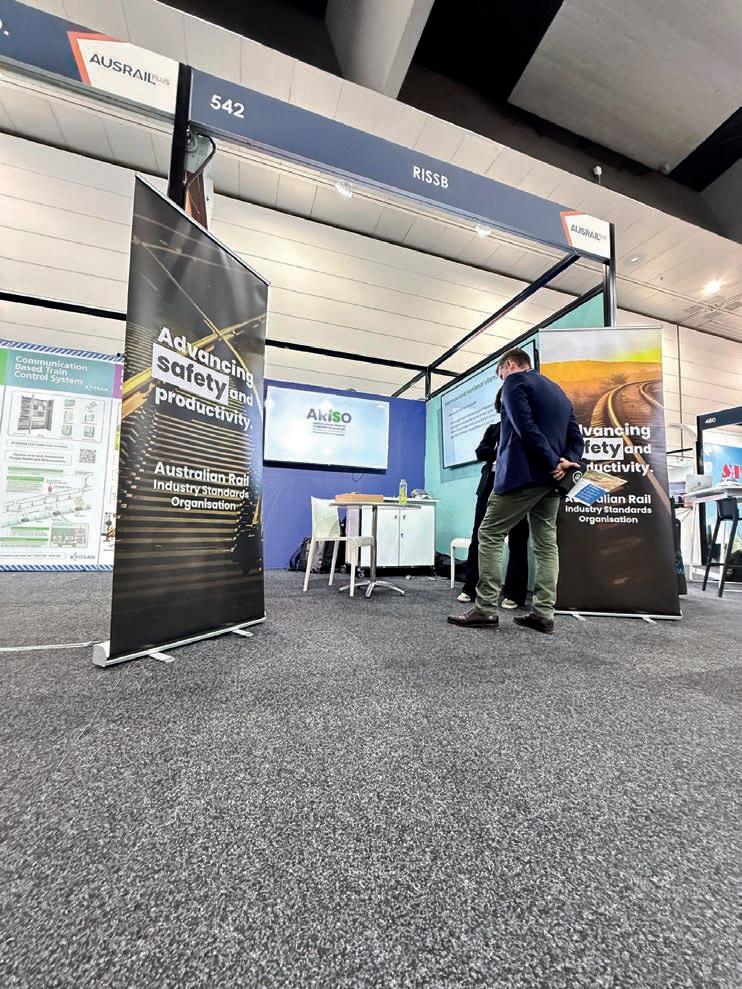
Clare Stanwix, ARISO Company Secretary, with Dr Gillian Miles, ARISO Chair, and Alan Fedda, ARISO CEO.
RISSB’s booth at AusRAIL PLUS 2025. The organisation changed its branding during the event to reflect the name change after the AGM.
endeavourawards.com.au




A skilled workforce for rail’s digital future
Different approaches to training and competency management across Australia’s
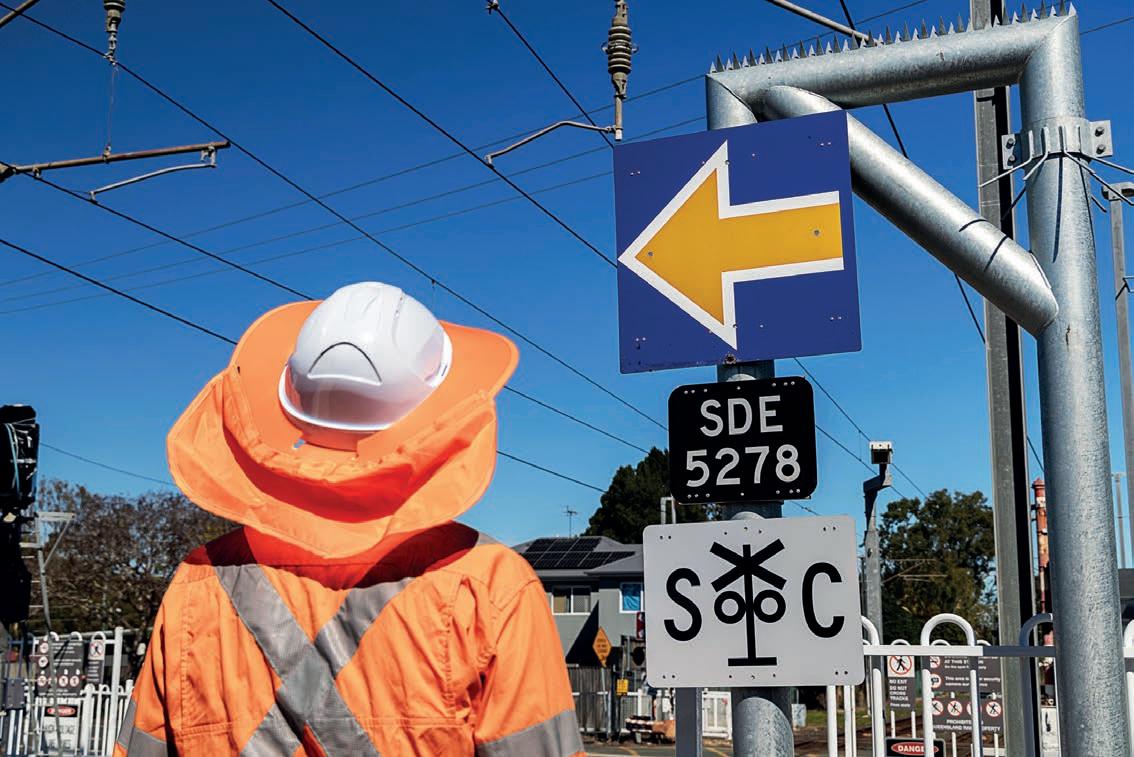
As digitalisation gains momentum across Australia’s rail networks, one obstacle looms over every major project: the lack of a nationally recognised system of skills and competency accreditation that allows workers to move easily between jobs on different networks. Without this, states will struggle to train the large number of signalling and digital systems specialists needed for their most significant technology upgrades in decades.
In Queensland, the pressure is already mounting. As the state prepares for the 2032 Olympic and Paralympic Games, crews are rolling out European Train Control System (ETCS) across the South East Queensland network – an upgrade essential for running more trains through the busy corridor.
“Getting access to systems engineers, signalling designers, signalling testers is challenging especially as other jurisdictions start to roll out ETCS,” said Nathan Angus,
General Manager (Passenger Rollingstock and Signalling) at the Department of Transport and Main Roads in Queensland.
“Having ETCS in place will mean we can safely run more trains over existing infrastructure, which will help to meet the Olympic demand.
“However, post the opening of the Cross River Rail tunnel, getting ETCS delivered across the entire Sector One network (between the Gold Coast and the Sunshine Coast) will present more of a challenge.”
Queensland is not alone. Five years ago, Victoria hit a similar wall during its Big Build program. To keep the Metro Tunnel and associated projects on track, it rapidly upskilled dozens of engineers in digital signalling.
With that workload now easing, Victoria’s highly trained workforce could, in theory, help accelerate Queensland’s rollout. In practice, moving between states is rarely straightforward.
A WORKFORCE HELD BACK BY FRAGMENTED TRAINING
Portability of skills remains one of the rail industry’s biggest barriers, with workers – even experienced engineers and technicians – often needing to re-train and be re-assessed in basic competencies when crossing borders or even moving between operators within the same state.
Under Rail Safety National Law, rail safety workers must be assessed as competent to carry out their work. This was aligned to the Australian Qualifications Framework, with the intention of supporting skills recognition and portability across Australia. However, operators have extensively customised their training programs, creating a patchwork of local courses, curricula and competencies.
“These are so embedded into the specifics of an employer group that you can’t take that (qualification) somewhere else,” Fiona Love, Head of Workforce Development at the Australasian Railway Association (ARA)
Crews prepare for ETCS testing on the Queensland Rail network.
Images: National Transport Commission
Industry Organisations
told the National Transport Commission’s (NTC) Future Rail Skills Forum. “Rail is the biggest user of skillsets in the country. We need to build generic curriculum.”
This fragmentation is becoming critical. Analysis through the National Rail Action Plan (NRAP) shows that over the next decade, Australia will need an estimated 70,000 additional workers to build, operate, and maintain expanding rail networks, including more than 13,000 roles specific to digital systems.
“Building meaningful capability and capacity requires governments and industry to work together,” said NTC Chief Executive Officer Michael Hopkins. “We have a very fragmented training and competency management framework in Australia, and that needs to change.”
Love agreed, noting that national training can be supplemented with training relevant to a specific corridor or employer.
“As a doctor doing a medical degree, you’re not just trained for one hospital – you learn that after you graduate,” she said. “Rail needs to operate in this way.”
WHAT PORTABILITY CAN LOOK LIKE
The ARA has been working with industry to build a national "Safely Access the Rail Corridor" course that is relevant at a generic level to every rail corridor. When people are required to work in a specific rail corridor, the onus is then on the rail infrastructure manager and/or operator to have a local induction that is relevant to their specific risks.
Another example of getting mutual
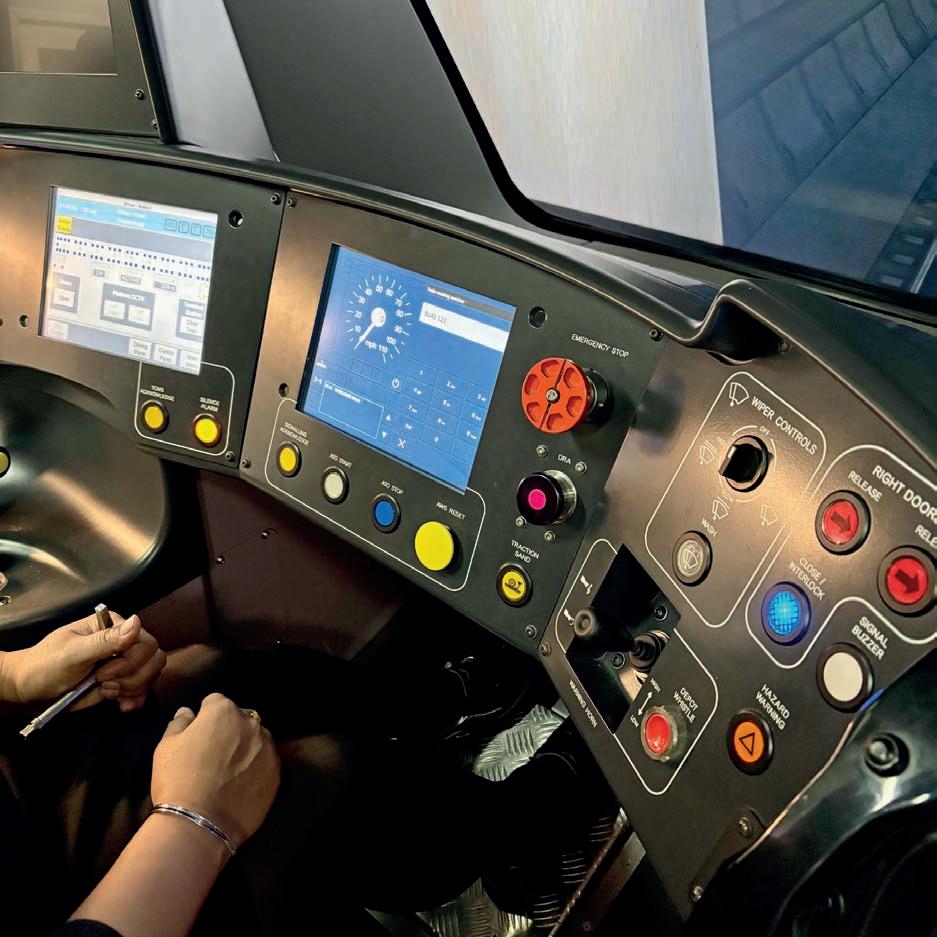
skills needed to deliver its major rail builds. The taskforce streamlined how engineers move between Metro Trains Melbourne and V/Line by creating training and competency standards recognised across both networks. It also developed new courseware aligned with the ARA’s National Signalling Assessment Framework, and the United Kingdom’s Institution of Railway Signal Engineers (IRSE) licensing credentials.
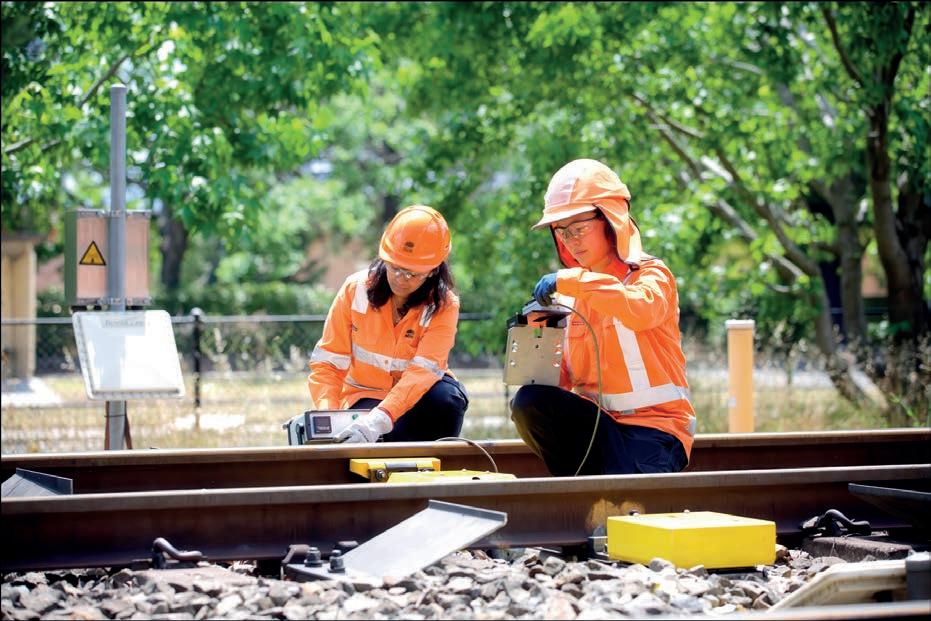
Achieving nationally recognised competencies in existing areas can be challenging.
strengthening the talent pipeline.
“Portability improves opportunities for people to build their skills and careers,” said David Ness, Executive Director of Network Signalling Services – Rail at the Victorian Infrastructure Delivery Authority.
“If we don’t help people do this, we lose them from the sector. Retention of skills, especially those that take a long time to develop, should be of paramount importance.”
SST has discussed expanding these reforms nationally, but uptake from other jurisdictions has been cautious. Operators want rock-solid confidence that training delivered outside their own registered training organisation meets the required standards.
“It’s all about the chain of evidence,” said Jane Copperthwaite, Chair of the Institution of Railway Signal Engineers (IRSE), Australasian Section.
“Networks want to know the assessment criteria and how they can get certainty in the outcome. The question is, how do you transition from where you are today to where you need to be?”
Angus agreed: “Currently it goes back to the respective rail infrastructure managers’ accreditation and their assessment of supporting evidence that allows that mobility.
“Getting this process right is going to be important.”
The NTC is partnering with governments and industry to ensure the skills required to design, build, operate and maintain Australia’s new ETCS technologies are nationally recognised.
A RARE CHANCE TO GET IT RIGHT FROM DAY ONE
While the sector works through these broader questions, the NTC is partnering with governments and industry to ensure the skills required to design, build, operate and maintain Australia’s new ETCS technologies are nationally recognised from day one.
Infrastructure and transport ministers have asked the NTC to develop a single ETCS training curriculum for the country to prevent the fragmentation that has plagued other areas of rail training.
With ETCS standards now mandated on the major interstate freight and passenger networks – and with New South Wales and Queensland well into their deployment –establishing mutually recognised entry-level competencies has become an urgent priority.
“We’re seeing the adoption of ETCS as an opportunity to get curriculum for the digital technologies in place early, before people can invent their own,” said NTC Chair Carolyn Walsh.
“Achieving nationally recognised competencies in existing areas is often challenging because you have to unwind long-standing arrangements. ETCS offers a rare greenfield opportunity to be consistent from the start.”
As the first mover in rolling out ETCS Level 2 on the National Network for Interoperability, Transport for New South Wales (TfNSW) has proposed leveraging its European Union-modelled, foundational ETCS curriculum nationally, offering a roadmap. This was supported by eastern seaboard jurisdictions and the Australian Rail Track Corporation in September.
Further work is being undertaken by the NTC to determine how the product can be ensured fit for purpose for different networks, and to work through governance arrangements such as resourcing and who will lead the development, ownership and maintenance of the product, as well as implementation and uptake.
“Developing a national ETCS curriculum now and rolling it out across the entire
country helps us to develop the level of expertise that we can rely on,” said Mary Hetherington, TfNSW Director of Competency and Learning.
“A person who builds up that expertise should be able to apply it to other railways so we can move with the peaks and troughs of where different jurisdictions are at with their design and development life cycle.
“That transferability will help us address some of the labour shortages that we have within the rail industry.”
A TURNING POINT FOR INDUSTRY
For workers who operate across multiple networks, national competencies cannot come soon enough.
“We have over 150 competencies to keep an eye on day to day. Some staff have five or six they have to maintain,” said Richard Mifsud, Executive General Manager, Engineering (Australia and New Zealand) at railway design and construction company JDMR. “With so many operators and systems that are all slightly different, it’s a real minefield.”
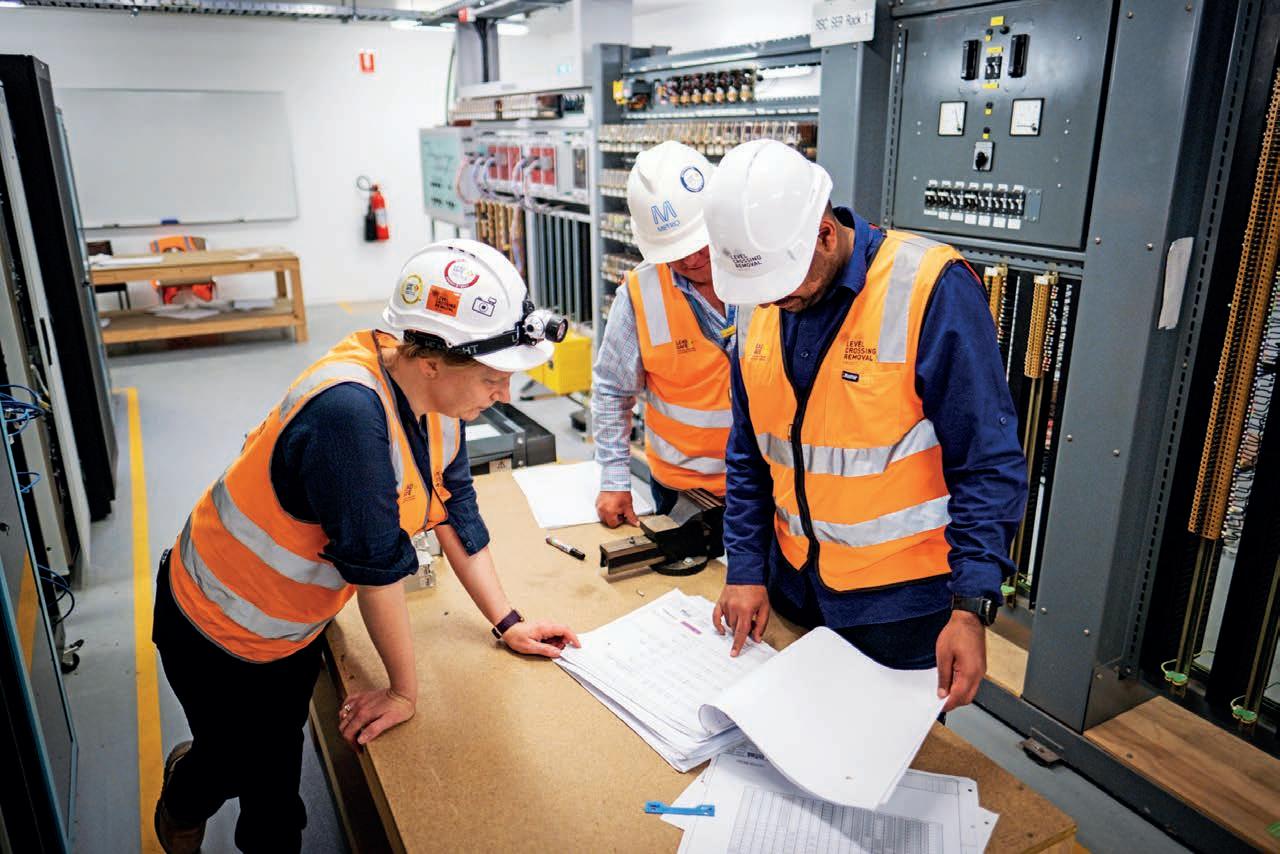
While the ARA’s national signalling assessment framework is an important starting point, Mifsud said organisations will need stronger assurance that national standards align with local requirements.
“It’s a matter of setting the system up in a way that gives them confidence that they’ve covered themselves and their organisation. This can be done, but it’s going
Australia’s rail sector stands at a pivotal moment. Billions of dollars are being invested in digital signalling, major expansions, and new rolling stock. The technology is ready, but what is missing is a coordinated approach to deployment and a truly mobile, national workforce capable of delivering it.
“Harmonising and standardising a national competency framework is not just a simple administrative reform,” Hopkins said.
“It requires a deeper shift in perspective and really needs all states and rail infrastructure managers to think nationally, align on the same framework, and find pathways to get to that desired state of
To find out more about how the NTC is working with governments and industry to develop a rail workforce for the future, visit the National Rail www.ntc.gov.au/transport-reform/
Victoria's Signalling Strategy Taskforce streamlined how engineers move between the state's metro and regional networks.
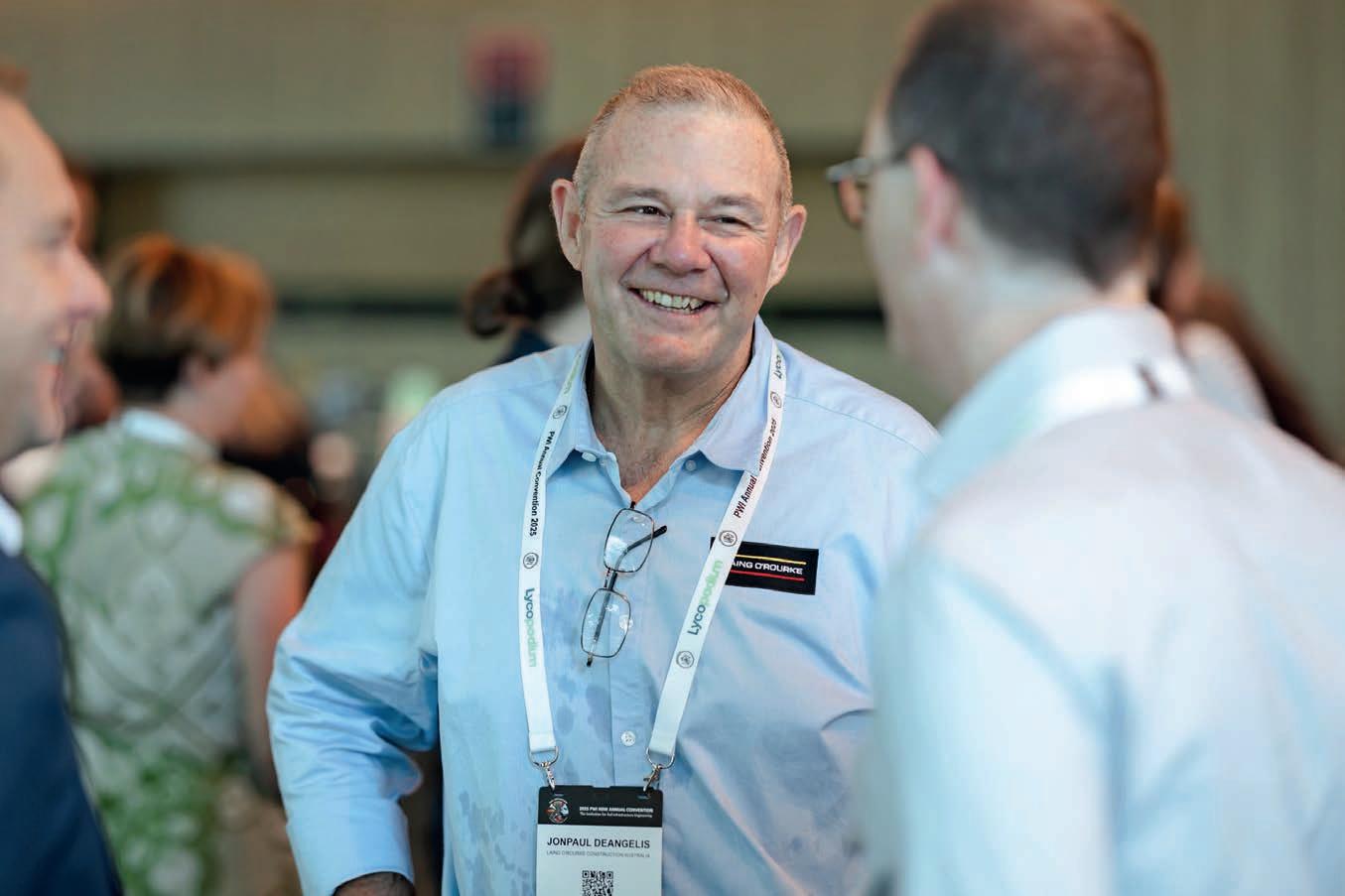
Community, participation and purpose
As we move further into 2026, the Permanent Way Institution of New South Wales is focusing on reconnection and collaboration.
For the Permanent Way Institution New South Wales (PWI NSW), 2025 was a year of steady progress. Widely recognised as one of the largest and most active sections of the PWI worldwide, the New South Wales section continues to raise the standard for technical content, networking, and value across its annual program of events.
That momentum was clearly visible in Newcastle at PWI NSW's 51st Annual Convention, and again on the synthetic pitches of Caringbah for the inaugural Railway Soccer Cup. Both events showcased what the institution does best: uniting the rail infrastructure community to address serious industry questions, while also providing opportunities to reconnect as colleagues and friends.
As we roll further into 2026, PWI NSW is framing the year as one of connection and collaboration. A year in which the industry is encouraged not just to participate in events, but to help shape the conversations that will define the next decade of rail in New South Wales.
AT THE CROSSROADS
OF FREIGHT AND PASSENGER RAIL
The 2025 PWI NSW Annual Convention, held at the Newcastle Exhibition and Convention Centre (NEX) on 3031 October, 2025, focused on the theme “At the Crossroads – Freight v Passenger”.
Over two days, attendees discussed a key issue for the network: how to balance the long-term needs of freight and passenger services on a limited rail system, while still providing safe, reliable, and affordable services for the communities reliant on rail.
The program included keynote speeches, technical papers, and panel discussions, with a practical element. A pre-registration and networking event at the Australian Rail Track Corporation (ARTC)’s Port Waratah Provisioning Centre in Carrington gave delegates a chance to see how heavy haul operations are managed first-hand, setting the tone for a convention focused on real-world practice rather than theory.
The keynote speakers emphasised a mix of strategy and practice. Jacqueline Linke, Director of Greater Sydney Client Engagement and Delivery IT at Transport for NSW, started the event with a breakfast address that challenged attendees to rethink leadership, influence, and the so-called “soft” skills that help technical professionals drive change across complex organisations.
Later in the day, Wayne Johnson, Chief Executive Officer and Managing Director of the ARTC, drew on more than 15 years of experience in resources, freight, and logistics to examine the freight/passenger balance from a national perspective. His address anchored the debate in the realities of interstate freight corridors, regional export supply chains, and the sustained capital needed to keep those assets fit for purpose.
Throughout the sessions, several themes kept emerging: • T he need to move beyond “either/or” thinking and develop integrated solutions that acknowledge the mutual value of freight and passenger networks.
The PWI’s 51st Annual Convention in Newcastle provided opportunities for networking and connection.
• T he importance of systems thinking –viewing rail not as a stand-alone asset but as part of broader city-shaping, freight, energy, and land-use systems.
• T he necessity to build and retain skills, especially in track and rail systems disciplines, as major projects transition into long-term operations and maintenance phases.
What elevated the Newcastle convention was not just the calibre of speakers, but the depth of engagement – asset owners, contractors, consultants, suppliers, and government agencies used breaks, networking events, and question and answer sessions to challenge assumptions and test ideas.
That culture of open, respectful debate is increasingly characteristic of PWI NSW conventions and is vital to the institution’s role as a neutral forum where the entire industry can collaborate to tackle the big questions.
SOCCER BOOTS AND CONVERSATION
If Newcastle was traditionally where the industry gathered to debate the future of rail, Caringbah was where it came to reconnect on a different level.
On Friday, 10 October 2025 – fittingly, International Mental Health Day – PWI NSW and the Rail Track Association Australia (RTAA) co-hosted the inaugural Railway Soccer Cup at 5Sports in Caringbah. The five-a-side tournament invited teams from across the rail industry to swap their hi-vis for the football jerseys.
The event was intentionally more than just a social gathering. In partnership with industry groups and health charities, the cup aimed to promote mental health and wellbeing through sport, encouraging meaningful conversations and providing a relaxed setting for colleagues to check in with each other.
Each team selected a charity of their choice, and at the end of the tournament, the organisers pledged a $500 donation to the winning team’s charity. RTAA and PWI then matched that amount, adding an extra $1000, turning a day of sport into a tangible support for community groups.
Additionally, heart health checks were available on-site, emphasising the connection between physical health, mental wellbeing, and long-term fitness – a message that struck a chord in an industry where shift work, risky environments, and ongoing pressure are everyday realities.
Feedback from teams was straightforward and consistent: it was a fantastic day. Players shared their joy at donning a jersey
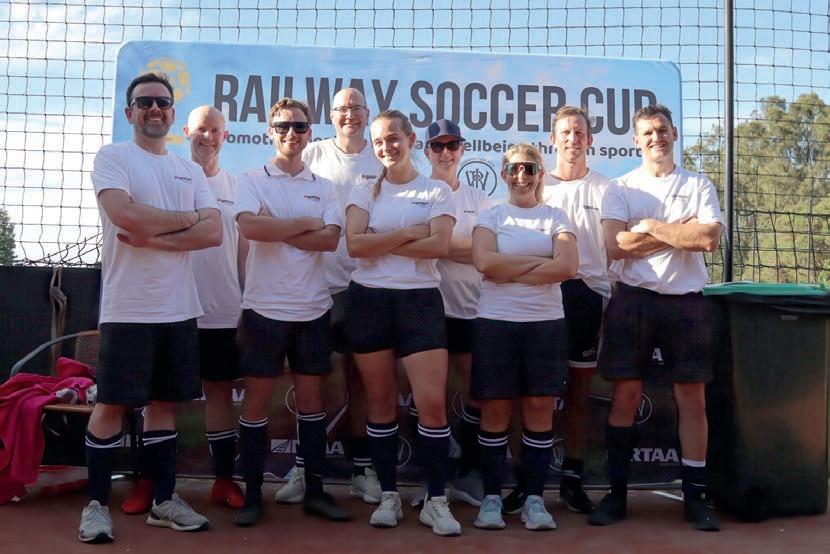
alongside colleagues they usually only see on Teams, meeting competitors in a different setting, and involving younger staff in an inclusive, fun, and relaxed way. For many, the Soccer Cup became a highlight of the year and an immediate “must-do” on the events calendar.
ANCHORING 2026
PWI NSW is gearing up for a 2026 program shaped by intentional reconnection and deeper collaboration across the industry. This isn’t a change in direction, but rather an enhancement of what already makes the institution distinctive: its capacity to bring people together in meaningful, practical, and forward-looking ways.
The 2026 events calendar again features the key gatherings that have become synonymous with PWI NSW.
• February – PWI Awards
• A pril – Golf Day
• May – Executive Breakfast
• June – Winter Dinner
• August – PWI Annual General Meeting
• S eptember/October – Railway Soccer Cup
• O ctober – Annual Convention
These flagship events are supported by a consistent series of technical meetings, regional visits, online sessions, site tours, and networking opportunities. Together, they establish a rhythm that encourages members and partners to stay engaged all year round, rather than only at major events.
As major New South Wales projects progress through construction, commissioning, and operational transition, and as the pipeline of future works develops, the need for open, crossorganisational collaboration becomes even more critical.
The technical meetings, site visits, and online learning sessions held throughout the
year will continue to be crucial in providing industry members with insights, knowledge, and exposure to real-world applications. In 2026, the institution aims to diversify its topics, locations, and contributors, ensuring the program stays aligned with the changing needs of a modern rail sector.
The Annual Convention will again serve as the culmination of these discussions. While the 2025 theme focused on freight versus passenger priorities, the 2026 convention will continue to explore strategic questions that require collective input. The goal is not just to convey information but to bring together the people who can turn it into action.
A YEAR DRIVEN BY COMMUNITY, PARTICIPATION, AND PURPOSE
As New South Wales rail embarks on another year of major infrastructure projects, network reform, and operational changes, PWI NSW’s role in building community becomes even more critical.
The institution’s strength lies in connecting people — from track and civil workers to systems engineers, planners, executives, and emerging leaders.
2026 will build on that strength by encouraging members to participate more broadly, contribute more openly and reconnect more intentionally. Whether through a technical paper, a conversation during a site tour, a table at the Winter Dinner or a five-a-side match in the Soccer Cup, each interaction strengthens the fabric of the industry.
PWI NSW starts 2026 with confidence, clarity, and purpose. The message to the industry is clear: this year is about reconnecting, collaborating, and supporting the community that has backed rail professionals for over 50 years.
The Ingenium Soccer Team at the inaugural Railway Soccer Cup. Images:

It is launched every year at the Southern Hemisphere’s largest rail event, AusRAIL. Copies are distributed to all delegates at the event, as well as being sent to all Rail Express subscribers.
Need a copy for your office?
Email kayla.walsh@primecreative.com.au
Did you miss out on this year’s directory?
You can still update your free listing on the Rail Express website – or if you want to stand out from the crowd, get in touch with our Business Development Manager Arron Reed (arron.reed@primecreative.com.au)
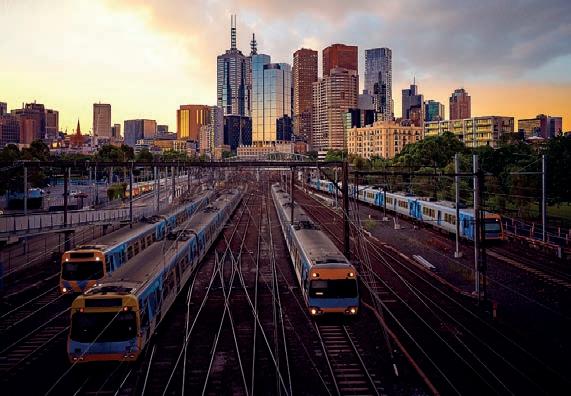
Advocating for Australian
The South East Melbourne Manufacturers Alliance has been standing up for local manufacturers for the past 23 years. Here, the group shares its priorities for the future.
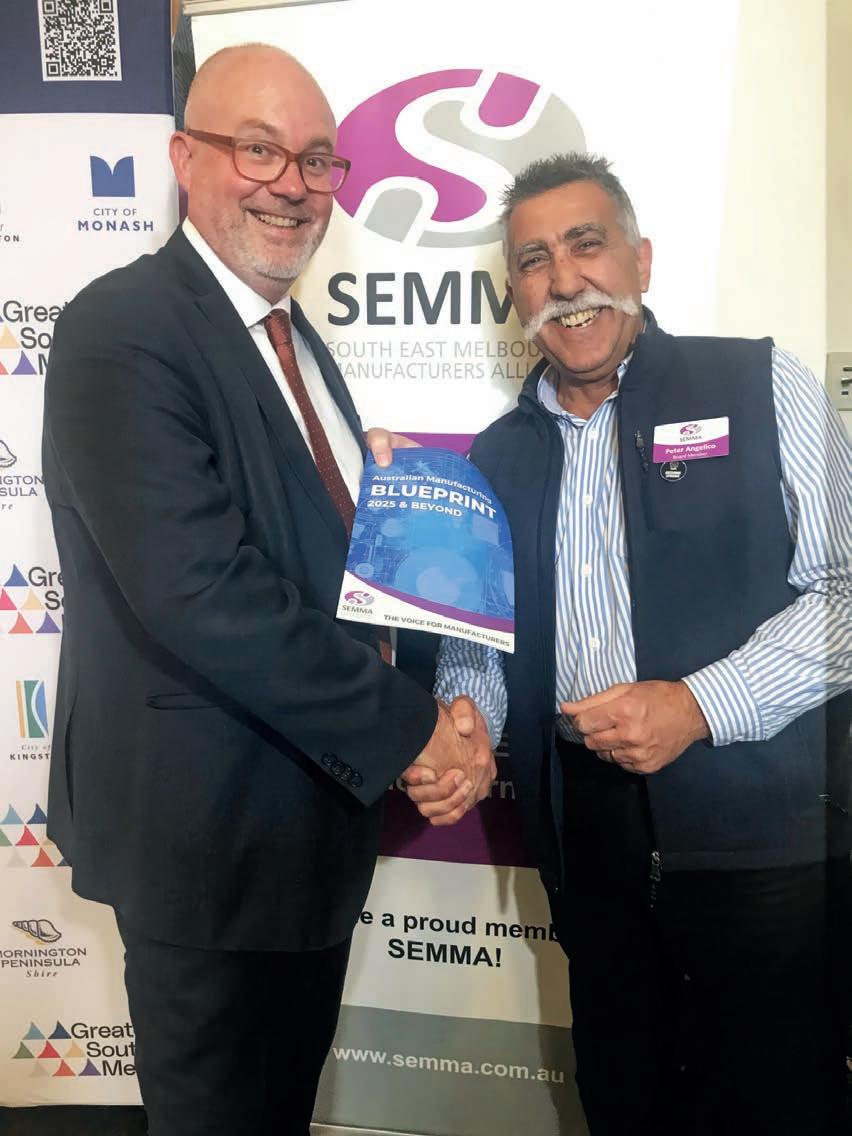
Manufacturers and the supply chain have been part of the Australian industrial landscape since the 1830s, when the first blast furnace was introduced.
In the 1960s, Australia peaked with a Gross Domestic Product (GDP) input of 25 per cent – now it’s below six per cent.
In 2025, the South East Melbourne Manufacturers Alliance (SEMMA) launched the Australian Manufacturing Blueprint.
This is our policy platform, which has enabled us to have stronger conversations
with policy makers about legislative reform.
Our Five Pillars of Growth – Economic, Energy, Educate, Expand, Evolve – focus on key areas where manufacturing can continue to add value and increase our GDP from 5.9 per cent to 10 per cent in five years. We believe goals are necessary to get results.
SEMMA was established by a group of manufacturers determined to keep the rolling stock manufacturing supply chain in Dandenong, Victoria. Now 23 years later, our advocacy continues as we make
our members’ needs known at all levels of government.
We are a-political, bi-partisan, memberfunded, not-for-profit organisation.
We support the Australasian Railway Association with its important work for the rail sector.
For all manufacturers, SEMMA will continue to advocate for a freeze on land tax, payroll tax and work cover premiums for small-to-medium enterprises (SMEs). We will continue to ask the regulators to do their job when it comes to Local Jobs First content and to toughen anti-dumping laws.
We are also known for our ability to connect businesses – our members do not feel the need to compete.
SEMMA’s network gives members complementary channels that enable them to engage like-minded businesses, so they can build up strong partnerships, bounce ideas off each other and learn.
With manufacturing playing a foundational role in supporting the economy for many decades, it is time to recognise and acknowledge the significant contribution of the industry to the Australian way of life.
While SEMMA is based in the southeast of Melbourne, we have an eye on the national economy and our place in it.
Recently, the southeast of Melbourne was acknowledged as the manufacturing powerhouse of Australia in a report from Deloitte.
The southeast region contributes $89 billion to the economy, employing 75,400 people through 3801 manufacturers.
Nationally, manufacturing is the sixth largest industry, generating $137 billion in value-added output and employing 930,000 people. It contributes 12.4 per cent of Australia’s exports and 7.9 per cent of capital expenditure (AI Group, 2024).
We believe there is enough manufacturing opportunity to go around – but government policy must help, not hinder, our smart, secure and sustainable manufacturers.
SEMMA hosted Senator Tim Ayres at a recent industry roundtable with SEMMA President Peter Angelico.
Image: SEMMA
Industry Organisations
The rising value of rail
Promising new findings from the Australasian Railway Association have shown major growth in both passenger and freight rail –but continuing to increase mode shift is more urgent than ever.
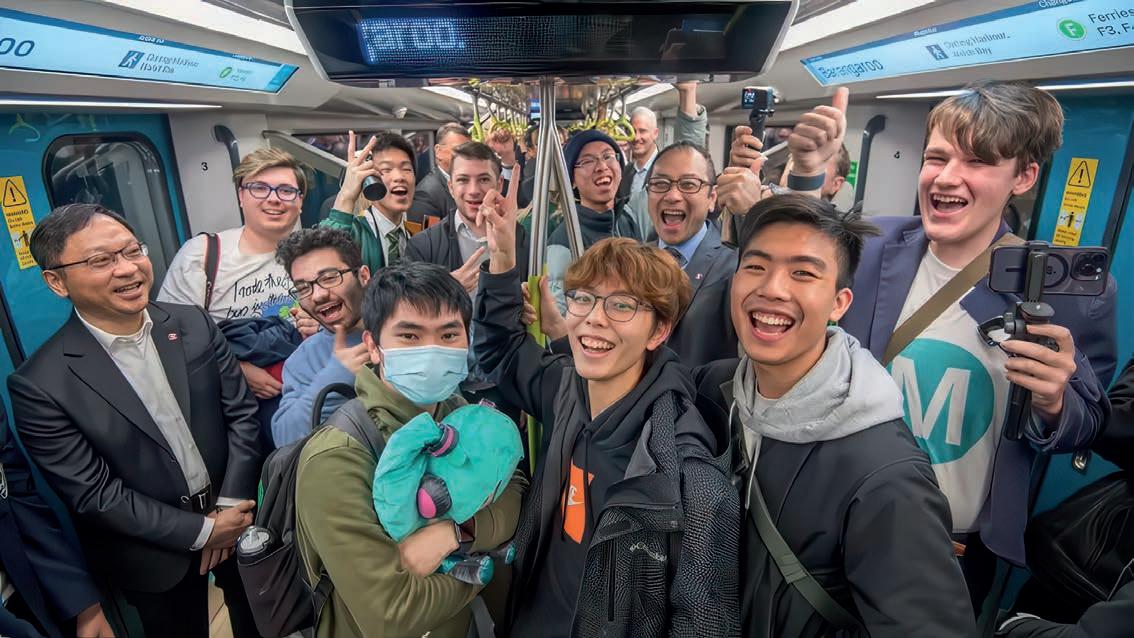
New Australasian Railway Association (ARA) research has confirmed the rail industry’s contribution is growing across Australia.
The Value of Rail 2025 report was released in December 2025, confirming the industry generates $38.8 billion for the economy – an increase of 30 per cent over the past five years.
The number of jobs generated by the industry also rose to almost 200,000, up 14 per cent from five years ago.
The report confirms the growing role the rail industry is playing in Australia to support a productive, efficient and sustainable transport network.
RAIL INVESTMENT DRIVING GROWTH
The rail industry has seen rising levels of rail infrastructure investment in the past five years, as governments have recognised the importance of rail as a key part of our transport networks.
Investment in passenger networks has been a feature, with a range of major projects across the country well underway or nearing completion.
as well as the delivery of Western Australia’s METRONET, are just a few examples of this significant investment.
The report found rail’s share of the value of infrastructure work surged from about four per cent in 2015 to 12 per cent in 2024 – effectively tripling its economic footprint – as projects like these were delivered.
This trend demonstrates how targeted investment and construction in the rail industry have been increasingly central to Australia’s long-term economic prosperity and makes the case for a sustainable investment pipeline in the future.
This provides a timely insight as we prepare to enter a new phase of the investment cycle.
PASSENGER RAIL REBOUNDING AFTER COVID-19
The report found passenger rail has rebounded after COVID-19, with 627 million train journeys and 227 million light rail journeys in 2023-24.
Sydney and Melbourne are our main public transport hubs, accounting for 83.2 per cent of all passenger journeys in Australia.
However, the purpose of rail travel has shifted – with fewer journeys as part of the work commute and more social and recreational journeys.
The rail industry has responded to meet this changing demand, delivering a range of customer service enhancements to support greater use of rail for a wider range of trip purposes.
Network expansion has also had an impact, with Sydney recording the highest growth in patronage in 202324, at 26.8 per cent compared to the previous year. This was in part due to the delivery of the new Sydney Metro project, making rail a more convenient choice for more people.
This growth prefaces what we can expect to see in other states as major projects are delivered, making it easier and more convenient for people to make rail their mode of choice.
The opening of the Sydney Metro and the Metro Tunnel in Melbourne,
Sydney recorded a 26.8 per cent increase in patronage in 2023-24 compared to the previous year, partly due to the new Sydney Metro project.
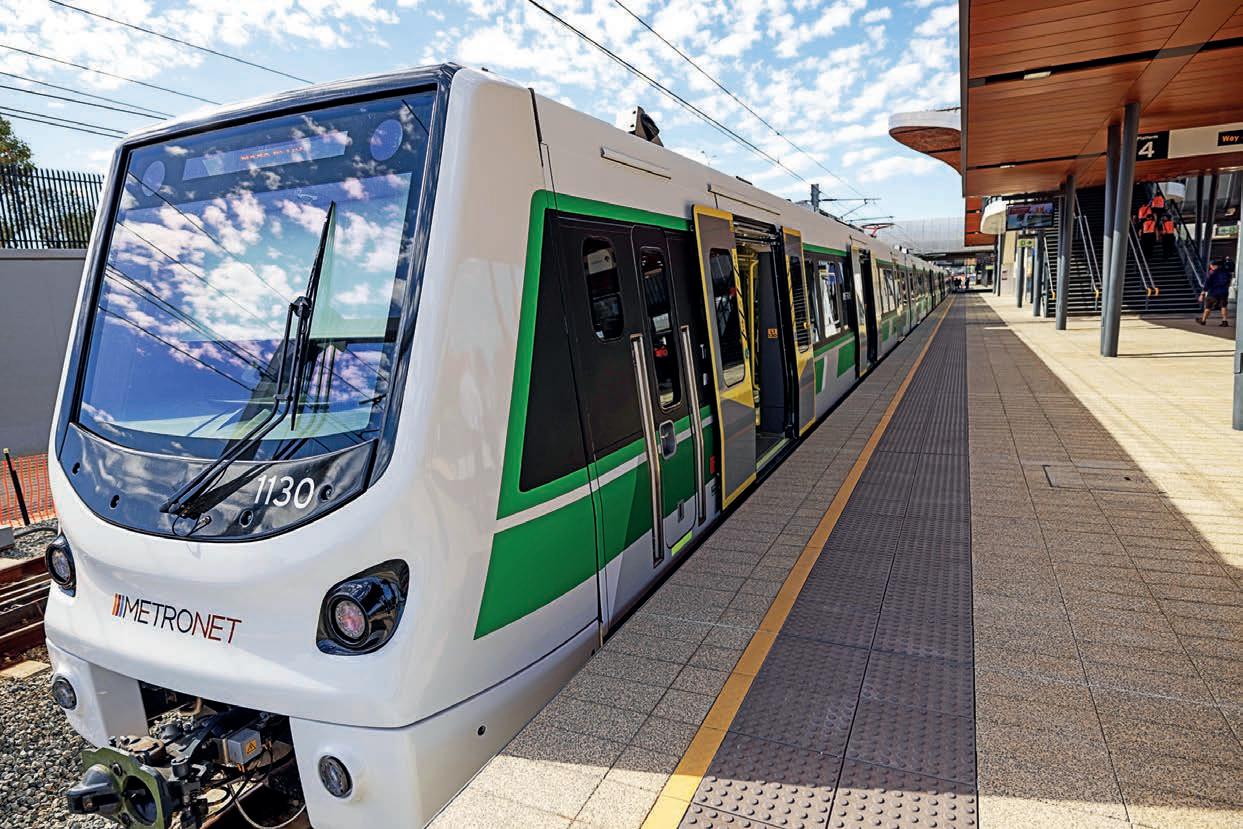
THE RAIL FREIGHT TASK IS GROWING, DRIVEN BY BULK COMMODITIES
Rail has met 71 per cent of the growth in freight demand since 2014, demonstrating the essential role the industry plays to support Australia’s economy and supply chain.
Rail is now responsible for moving five times more freight than road.
However, much of this growth has been in the transport of bulk commodities such as iron ore and coal, with bulk freight accounting for 90 per cent of all freight moved on rail.
Containerised freight has not seen the same growth, with systemic challenges facing the sector.
The ARA outlined these challenges in its Future of Freight Report and is advocating for policy reforms to improve rail freight productivity, efficiency and competitiveness.
While the completion of Inland Rail represents an important opportunity to achieve greater use of rail, further investment in rail freight will be needed to ensure Australia can make the best use of all
freight modes across the national network, and deliver a sustainable national freight network that meets current and future needs.
PROMOTING MODE SHIFT TO DRIVE SUSTAINABLE OUTCOMES
The report confirms that rail remains critical to our net zero future, generating significantly reduced emissions compared to road.
Passenger rail generates 40 per cent less carbon pollution compared to road transport, while rail freight is 16 times less carbon intensive than road.
In addition, rail generates less particulate matter – or PM10 emissions – minimising air pollution. In fact, rail freight generates 90 per cent less PM10 compared to road.
With transport set to become Australia’s largest source of emissions by 2030 if no action is taken, achieving mode shift is more urgent than ever.
This will require a fundamental shift in how we plan and deliver infrastructure across the country, and continued investment in rail infrastructure to expand
access to rail and support more efficient, resilient and convenient passenger and freight services.
MAXIMISING THE VALUE OF RAIL
The Value of Rail 2025 highlights the significant and wide-ranging benefits rail delivers to the economy and the community. In 2026, the ARA will be focused on four key issues to ensure Australia can continue to maximise the value rail has to offer:
1. S ecuring a sustainable investment pipeline to ensure the rail industry can continue to meet Australia’s needs as our population grows.
2. Achieving mode shift to promote greater use of both passenger and freight rail services.
3. Improving productivity to maximise the benefits rail delivers.
4. Supporting the transport sector’s journey to net zero, with rail playing a leading role in the transition.
We look forward to advocating for the industry on these issues to further build the value of rail in the future.
Investment in passenger networks has been a major feature of the past five years.
Contracts, Tenders, EOIs
Latest contract updates
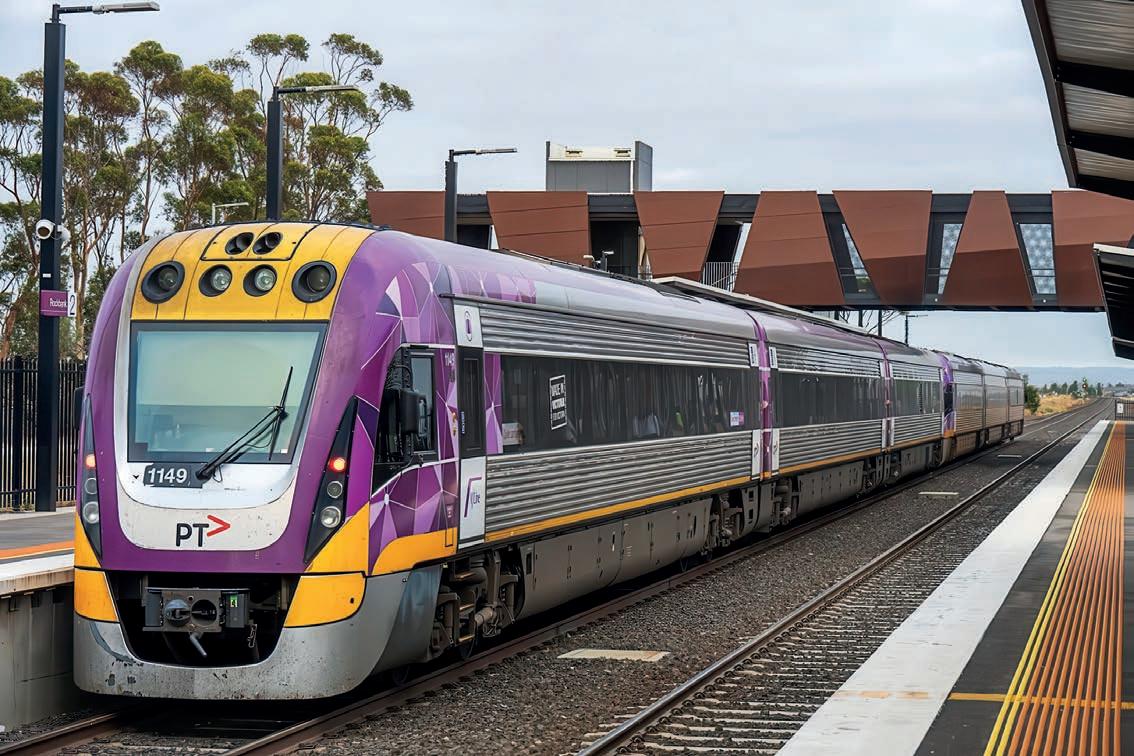
SUBURBAN RAIL LOOP EAST – LINEWIDE PACKAGE
STATUS: AWARDED
Global consortium TransitLinX has been awarded the contract for the $6.7 billion linewide package of Suburban Rail Loop East works.
TransitLinX – which will be known as the Linewide Alliance during construction –comprises Alstom, RATP Dev, John Holland, KBR and WSP.
The contract includes the design, manufacture, installation and testing of all the systems required to run the new network – such as signalling, platform screen doors, passenger information displays, communications systems, CCTV and security systems, and tunnel ventilation.
There is also a separate 15 year agreement to operate and maintain the network, as well as construction of the train stabling and operational control centre in Heatherton.
Rail transport systems company Alstom has been awarded a $1.8 billion share of the contract, with its scope covering rolling stock, digital infrastructure, signalling and maintenance, as well as overall system integration.
It will manufacture 13 new four c ar SRL East trains at its site in Dandenong, Victoria. These Metropolis metro trains will be automated, running under Grade
of Automation 4 (GOA4) and supported by Alstom’s Urbalis Forward Communications Based Train Control – a fully integrated signalling system.
This is the first time automated trains will be built in Australia.
Alstom will also provide its FlexCare Perform full maintenance solution for a period of 15 years for the Metropolis fleet, as well as signalling and infrastructure, to ensure the metro system has high availability and reliability.
MELTON LINE UPGRADE STATUS: AWARDED
The contract for the Melton Line Upgrade in Victoria has been awarded to John Holland, Kellogg Brown and Root (KBR), Metro Trains Melbourne and V/Line, in partnership with the Level Crossing Removal Project.
Early works are underway on the $650 million project, which will include platform extensions at Cobblebank, Rockbank, Caroline Springs and Deer Park, allowing nine c ar VLocity trains to run on the line and increasing passenger capacity by 50 per cent on peak services from 2027 onwards.
The federal and state governments have each committed $325 million to the project, which also includes a new train stabling yard at Cobblebank, “future proofed” for electrification of the line to Melton.
NETWORK INVESTMENT PROGRAM TRACK REHABILITATION PROJECT BALLAST RENEWAL EARLY WORKS
STATUS: AWARDED
Swietelsky Rail Australia (SRA) has been awarded a contract by the Australian Rail Track Corporation (ARTC) to deliver the ballast renewal and track rehabilitation works on the Picton‑Tahmoor corridor of the New South Wales rail network.
The scope of work includes 10 kilometres of full‑depth ballast replacement, track realignment, tamping and regulating, drainage remediation and material recycling, which will be completed across three weekend possessions, concluding in May 2026.
SRA will mobilise its specialist plant for the project, including its RM95 ballast cleaner and MFS spoil wagons, and deploy its delivery team to ensure compliance with ARTC’s rigorous safety, quality and operational standards.
“SRA is proud to be selected by ARTC for this important program of work,” said SRA Managing Director Anne Connors. “This contract showcases our depth of experience working in live rail corridors and our capability to deliver complex ballast renewals within possession windows while maintaining operational reliability and stakeholder confidence.”
Image: Victorian Government
A train arriving at Rockbank Station.
RAIL EXPRESS is compulsory reading and a vital tool for all people working in and around the rail sector.
Rail Express is Australia’s authoritative business to business rail publication.
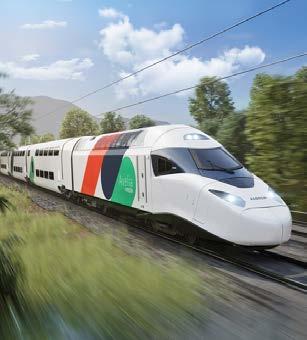

Combining the resources of our respected journalism team and our unparalleled industry contacts and affiliations, Rail Express provides extensive, comprehensive and balanced coverage of breaking news and trends in key areas like infrastructure, investment, government policy, regulatory issues and technical innovation.
Published both in print and digitally every month, Rail Express is the only publication to have both the official endorsement and active participation of the main railway associations in Australia and the broad support of the rail industry.
The only way to ensure you get every copy of Rail Express is to subscribe today. Visit railexpress.com.au/subscribe.

Driving the Mobility Transition