ROAD SURFACE TECHNOLOGY www.globalhighways.com Q4 2026 ISSUE 12
A N A LY S I N G
T H E
L AT E S T
T E C H N O L O G Y,
P R O D U C T S
&
S E R V I C E S
READY FOR TAKE OFF Inside TRBA’s high-speed EuroAirport runway rebuild
RST1026 Cover.indd 1
12/10/2026 1:20 pm
From pioneering the first stringless 3D paving solutions in 1996 to today’s connected, digital workflows – for 30 years, Leica Geosystems has helped move the paving industry forward. And we’re only just getting started.
Scan to explore 30 years of paving innovation
2-3 Comment and Contents.indd 2
12/10/2026 1: 2 pm
WELCOME Cover image: TRBA
ROAD E CGY FOA R SU CHN LO s.com
www.globalhighway
TE A N A LY S I N
H
G
T H E
L AT E S T
T E C H N O L
O G Y,
P R O D U C T
S
12 Q4 2026 ISSUE
&
S E R V I C E S
READY FOR TAKE OFF
ighway authorities want the best assets they can afford, with quality and longevity of the asphalt surface high on the agenda. In this issue of Road Surface Technology, we once again look at some of thesid latest thinking around bitumen enhancement and the In e TRBA’s technologies to improve pavement performance. eed gh-spdeveloped hibeing t Sripath discusses itsor ButaPhalt crosslinking additive for polymer EuroAirp ild Iterchimica explores how fibres can rebuwhile modified bitumen (PMB), runway improve a pavement’s resistance to thermal and fatigue cracking. ARRB Systems has demonstrated how traffic-speed technology can provide continuous structural data across busy road networks. We also look at developments beyond the materials themselves. Leica Geosystems, part of Hexagon, examines the evolution of onsite surveying, while Italian manufacturer Simex presents its ART 1000, a solution designed to make fast and cost-effective temporary surface repairs.
5 BITUMEN ADDITIVES
16 RUNWAY REFURBISHMENT
12 ASPHALT REGENERATION
22 PAVEMENT ASSESSMENT
Sripath’s crosslinking additive ButaPhalt is helping asphalt manufacturers produce high-performance PMB products.
An upgraded Simex ART 1000 attachment has demonstrated its roadrestoration capabilities in a small Italian town.
Editor: David Arminas Contributing editor: Mike Woof Designers: Deborah Pilarinos, Danielle Harris, Jacqueline Buckmaster Publisher: Paul Hayes Chief operating officer: Andrew Barriball ADVERTISEMENT SALES Sales director: Graeme McQueen Tel: +44 7833 445592 Email: graeme.mcqueen@ primeglobalpublishing.com
TRBA explains how its runway refurbishment in France relied on wellplanned strategic risk management.
ARRB Systems has demonstrated trafficspeed pavement assessment on an Indian highway.
Sales director: Dan Emmerson Tel: +44 7979 911819 Email: dan.emmerson@ primeglobalpublishing.com Italy: Fulvio Bonfiglietti Tel: +39 339 1010833 Email: bonfiglietti@tiscali.it
Our feature from TRBA takes a different look at what goes into a successful paving project. While the quality of the paving itself is critical, the planning and logistics behind the operation can be just as key. Whether the job involves a road, bridge, tunnel or, in TRBA’s case, an airport runway, getting the logistics right is essential. And TRBA’s work at EuroAirport provides a particularly good example. The planning behind the project was a large part of what won the Belgian company the work. Its approach shows how logistics is ultimately about risk mitigation: everyone needs to know their role and timing, while backup processes need to be ready to keep the programme on track if something changes. We hope you enjoy this year’s Road Surface Technology. David Arminas EDITOR david.arminas@primeglobalpublishing.com
26 ASPHALT TECHNOLOGY
34 DIGITALISATION
30 SURVEYING
36 ROAD INSPECTIONS
Iterchimica explores the use of fibres to enhance pavement’s resistance to thermal and fatigue cracking. As stringless paving turns 30, the most interesting story is in what had to change before automation became worthwhile, according to Leica Geosystems.
The future of roadbuilding is rapidly emerging – and it is most certainly a digital one, according to Associated Asphalt.
Parsons X explores the shift from collecting roadway data to turning it into actionable intelligence.
ADDRESS: Prime Global Publishing Capitol Square, 4–6 Church Street, Epsom, KT17 4NR, United Kingdom Global Outlook Road Surface Technology ISSN 3033-3377 (Print) ISSN 3033-3385 (Online) COVER IMAGE: TRBA
GLOBAL PUBLISHING
GLOBAL OUTLOOK ROAD SURFACE TECHNOLOGY 2026
2-3 Comment and Contents.indd 3
3 12/10/2026 1: 2 pm
produzionepropria.com illustrazione benedetta fasson 2024
COLOURED ASPHALTS, CYCLE PATHS
-18° REDUCTION OF THE TEMPERATURE OF THE PAVEMENT BY UP TO 18°C
INCREASED VISIBILITY AND ROAD SAFETY
REDUCTION OF THE “HEAT ISLAND EFFECT” IN URBAN AREAS
ENVIRONMENTAL PRESERVATION
ARCHITECTURAL INTEGRATION
iteroxid
Oxides for the colouring of asphalt mixtures
Roads towards sustainability
www.iterchimica.it
road september 2025.indd 3 4-11 surface Sripath.indd 4
24/09/251: 18:00 12/10/2026 2 pm
BITUMEN ADDITIVES
CROSSLINKING PMB ADDITIVE: BUTAPHALT
Sripath’s crosslinking additive is helping asphalt manufacturers produce essential high-performance polymer modified bitumen products.
M
odern road networks are facing heavier traffic volumes and increasingly volatile climate patterns and, as a result, the demand for highly durable polymer modified bitumen (PMB) binders has never been greater. Integrating polymers such as styrenebutadiene-styrene (SBS) into asphalt can improve rutting resistance, elasticity and overall pavement service life. However, because polymers do not naturally remain uniformly dispersed within the bitumen matrix, manufacturers must rely on chemical crosslinking agents to lock the polymer chains into a stable interconnected network.
The industry’s default crosslinker has for decades been elemental sulphur. But while sulphur successfully bridges the polymer–bitumen gap, its use inflicts clear operational penalties. At typical hot-mix production temperatures of 150–180°C, sulphur reacts with hydrocarbons, which triggers the release of the highly toxic gases hydrogen sulfide (H2S) and sulphur dioxide (SO2). These emissions create hazardous breathing zones for plant operators and paving crews and require expensive environmental monitoring, not to mention prompt complaints from nearby neighbourhoods concerned about the unpleasant odour.
In addition, sulphur vulcanisation is notoriously difficult to control. A minor dosing error or localised hot spot in the storage tank can trigger over-crosslinking, which can lead to gelation, an irreversible spike in viscosity that can ruin entire batches and clog plant plumbing.¹ In the presence of moisture, sulphurous gas emissions create a highly acidic environment within blending units and storage tanks, rapidly corroding infrastructure and driving up maintenance overheads. The long, weak polysulfide chains formed by elemental sulphur are also
GLOBAL OUTLOOK ROAD SURFACE TECHNOLOGY 2026
18:00
4-11 Sripath.indd 5
5 12/10/2026 1: 2 pm
BITUMEN ADDITIVES
Sulphur as Crosslinking Additive
ButaPhalt as Crosslinking Additive
Simplified schematic of ButaPhalt crosslinking chemistry. • ButaPhalt liquid grades (L60 and L120) – a stable, pumpable liquid suspension that allows for fully automated, closedloop dosing
highly vulnerable to thermo-oxidative and ultraviolet (UV) degradation. These bonds can also break down during PMB production and may lead to increased viscosity and, in extreme cases, gelation. To overcome these challenges, Sripath Technologies introduced ButaPhalt, an innovative crosslinking additive designed to enhance PMB performance and manufacturing efficiency. This additive enhances the ability of sulphur to form the bridge between the polymer and the bitumen, helping to ensure a more stable crosslinked network, deliver the desired PMB performance faster, and promote PMB thermal stability.
and polymer-to-polymer interfaces into a highly resilient and stable network. By eliminating thermodynamic weak spots, ButaPhalt prevents phase separation and polymer degradation during hot storage. Furthermore, because its proprietary chemistry is designed to ensure a highly efficient reaction that cleanly consumes sulphur, the generation of hazardous gaseous by-products is neutralised at the molecular level.
INNOVATION IN CHEMISTRY ButaPhalt represents a fundamental shift in how polymer networks are bound to bitumen. Rather than relying on fragile, multisulphur chains that easily break under thermal stress, ButaPhalt alters the reaction pathway to establish short, high-energy, direct monosulfide linkages. These tight, localised bridges connect bitumen-to-bitumen, bitumen-to-polymer
Impact of ButaPhalt on a PMB based upon a PG 58-28 binder with 3.5% SBS and 0.15% ButaPhalt S50.
Property
Unit
Temp (°C)
G*/sinδ
kPa
76 82
To suit diverse plant infrastructures, this technology is supplied in two distinct physical formats: • ButaPhalt solid grades (S50 and S100) – dust-free, free-flowing powder designed to eliminate the inhalation hazards associated with traditional dusty powders
Tests have evaluated rheology, storage stability and storage-ageing for ButaPhalt-dosed PMB.
6 4-11 Sripath.indd 6
RAPID NETWORK DEVELOPMENT Using a baseline PG 58-28 binder dosed with 0.15% ButaPhalt S50, researchers tracked, across an extended hot-storage window, the evolution of the Time after ButaPhalt addition 2 hr 8 hr 20 hr
1.221 o.811
1.352 0.965
1.265 0.908
dynamic shear rheometer (DSR) parameter G*/sinδ. This is a key metric for hightemperature performance.² The data reveals the network reached its optimal structure well within eight hours and remained highly stable through 20 hours. This flat performance curve shows the binder resists thermal degradation during extended storage. Furthermore, multiple stress creep recovery (MSCR) testing yielded non-recoverable creep compliance Jnr3.2 values of 0.184kPa-1 at 64°C and 0.382kPa-1 at 70°C, validating the binder’s superior resistance to permanent deformation and ability to achieve hightraffic designation grades. MSCR
Temp (°C)
ButaPhalt
Jnr3.2 [kPa-1]
64 70
0.184 o.382
MSCR data with PG 58-28 binder +3.5% SBS 0.15% ButaPhalt.
GLOBAL OUTLOOK ROAD SURFACE TECHNOLOGY 2026
12/10/2026 1: 2 pm
4-11 Sripath.indd 7
12/10/2026 1: 2 pm
BITUMEN ADDITIVES
Data type PG grading data
Binder 0.1% ButaPhalt PG 64-22 sulphur 0.1% S50
0.2% L60
Unit
Property
°C
True HT PG grade
67
77
77
77
°C
True LT PG grade
-26
-27
-27
-26
°C
ΔTc
-0.27
-0.33
0.23
-1.01
Comparative study with PG 64-22 binder +3.5% SBS + crosslinking additive. The difference becomes clearer when ButaPhalt is compared directly with elemental sulphur. A comparative evaluation was performed using a stiffer PG 64-22 binder modified with 3.5% SBS, comparing 0.1% elemental sulphur against 0.1% ButaPhalt S50 and 0.2% ButaPhalt L60 additions. All three crosslinkers successfully increased the true high-temperature performance grade from 67–77°C. This maintained excellent pumpability, with viscosities well below the maximum 3.0 Pa.s (Pascal-second) limit. PHASE SEPARATION: CIGAR TUBE TEST³ In unstable PMB systems, the denser polymer-rich phase tends to settle to the bottom of storage tanks. The lighter bitumenrich phase remains at the top. This phase separation results in non-uniform binder properties throughout the storage vessel and leads to inconsistent binder delivery. In contrast, both the 0.1% ButaPhalt S50 and 0.2% ButaPhalt L60 formulations demonstrated excellent storage stability. There were minimal differences in the viscoelastic parameter G*/sinδ between the top and bottom portions of the conditioned tube. At 70°C, the measured top-to-bottom variation is only 0.7% for ButaPhalt S50 and 1.3% for ButaPhalt L60. These differences remain similarly small at 76°C, decreasing to 1% and 0.6%, respectively. This consistency is further reflected in the true high-temperature performance grades, where the maximum difference between the top and bottom sections is limited to just 0.2°C.
Test Temp (°C) Cigar tube samples G*/sinδ kPa 70 G*/sinδ 76 Grade °C -
Property Unit
The speed of the crosslinking reaction also matters, particularly in high-throughput asphalt plants. In a high-throughput asphalt plant, the speed at which a crosslinker reacts directly dictates batch turnover, energy consumption and storage tank availability. By tracking the time required to reach specific Jnr3.2 stiffness thresholds (using a PG 64-22 binder modified with 5% SBS and 0.1% crosslinker), the kinetic advantages of ButaPhalt become clear.
Sulphur
4-11 Sripath.indd 8
ButaPhalt
Jnr versus reaction time of PG 64-22 binder +5% SBS +0.1% ButaPhalt during PMB manufacture. ButaPhalt demonstrated a significantly faster rate of polymer network development than traditional sulphur, which allowed critical performance thresholds to be reached in substantially less time. For the initial specification threshold of Jnr3.2 ≤
PMB + ButaPhalt 0.1% S50
PMB + ButaPhalt 0.2% S60
Top 2.55 1.44 79.8
Top 2.45 1.37 79.3
Bottom Diff. 2.57 0.7% 1.46 1.0% 80.0 -
Cigar tube testing of PG 64-22 binder +3.5% SBS + ButaPhalt.
8
3.2 kPa−1, traditional sulphur did not meet the requirement after one hour of reaction (Jnr3.2 = 3.556), reaching compliance after only two hours. In contrast, ButaPhalt exceeded this threshold within the first hour (Jnr3.2 = 3.146), effectively reducing early-stage batch hold times by 50%. At the more stringent high-MSCR threshold of Jnr3.2 < 2.0 kPa−1, sulphur required 10 hours of continuous heating and agitation. ButaPhalt achieved the same target in only four hours. Even at the ultra-MSCR threshold of Jnr3.2 < 1.0 kPa−1, ButaPhalt maintained a processing advantage, reaching the target in 16 hours compared with 20 hours for sulphur. These results demonstrate that ButaPhalt accelerates crosslinking kinetics, enabling faster
Bottom Diff. 2.48 1.3% 1.38 0.6% 79.3 -
production cycles while achieving equivalent or superior rheological performance. Ultimately, ButaPhalt can accelerate the overall curing curve. Plant operators can release completed batches more quickly while lowering the thermal energy required to maintain the reaction. ENVIRONMENTAL AND WORKER SAFETY Beyond improving raw material throughput, ButaPhalt serves as an active hydrogen sulfide H2S scavenger, protecting plant personnel and nearby communities. In a head-to-head emission study (PG 58-28 binder with 3.5% SBS and 0.12% crosslinker over 180 minutes), the cumulative H2S evolution was measured. The sulphur-only control released 1261 parts per million (ppm) of cumulative H2S.
GLOBAL OUTLOOK ROAD SURFACE TECHNOLOGY 2026
12/10/2026 1: 2 pm
4-11 Sripath.indd 9
12/10/2026 1: 2 pm
Images: Sripath Technologies
BITUMEN ADDITIVES
High-performance binders are an important part of developing more durable road networks.
Hours to Jnr using PG 64-22 binder +5% SBS +0.1% ButaPhalt during PMB manufacture.
Hydrogen sulphide evolution during manufacture of PMB blends after three hours.
A blend using sulphur +0.3% Zinc Octoate, a common industry scavenger, reduced emissions to only 1010ppm. Using just 0.12% ButaPhalt slashed cumulative emissions to 504ppm, representing a 60% reduction compared to sulphur alone and a 50.1% reduction compared to the zinc octoate alternative.
ButaPhalt suppresses toxic fumes and foul odours to create a safer, more compliant working environment for plant crews and paving operators alike. In shifting the chemical bridging mechanism from erratic polysulfide chains to stable, short monosulfide linkages, ButaPhalt addresses a persistent pain point by eliminating storage separation, mitigating
10
H2S safety hazards, reducing equipment fouling and accelerating plant throughput. For PMB producers who are looking to optimise operations while improving environmental safety, ButaPhalt offers a fieldproven, high-performance crosslinker, and will keep the neighbours happy. Sripath Technologies: https://sripath.com
GLOBAL OUTLOOK ROAD SURFACE TECHNOLOGY 2026
4-11 Sripath.indd 10
12/10/2026 1: 2 pm
BITUMEN ADDITIVES
I F
YOU ' R E T I R E D OF PATCH I N G YOU KNOW T HE AN S WER
ABOUT THE AUTHORS Deepak Madan is chief operating officer at Sripath. He received his PhD from the Rensselaer Polytechnic Institute in the city of Troy, New York. Jill McConaghie and Dennis Krivohlavek are Sripath business development specialists. McConaghie received her BA in English literature from Richard Stockton College in New Jersey; Krivohlavek received his BSc in chemistry from Northeastern State University in Oklahoma.
FOOTNOTES [1] In polymer chemistry, gelation (or gel transition) is the formation of a gel from a system with polymers. Branched polymers can form links between the chains, which lead to progressively larger polymers. As the linking continues, larger branched polymers are obtained and at a certain extent of the reaction, links between the polymer result in the formation of a single macroscopic molecule. At that point in the reaction – defined as gel point – the system loses fluidity and viscosity becomes very large. The onset of gelation, or the gel point, is accompanied by a sudden increase in viscosity. This infinite-sized polymer is called the gel or network. It does not dissolve in the solvent; rather, it can swell within it. [2] The PG (performance grade) system grades asphalt binders based upon the temperatures where they will actually perform. The first number represents the high temperature limit in Celsius. The second number shows the low temperature limit. For example, a binder of PG 64–22 means it resists rutting at pavement temperatures up to 64°C and resists thermal cracking at temperatures down to -22°C. This matters because pavement temperatures differ significantly from air temperatures. On a 35° day, dark asphalt surfaces can reach 60–60.5°C or higher. The PG system accounts for these real conditions rather than relying on lab tests that do not reflect field performance. [3] A common method for testing asphalt stability is the cigar-type tube test. A cigar-type tube is filed with modified asphalt binder and sealed. The sealed tube is heated in an oven to 163°C for two days. The sealed tube is then frozen and cut into three sections. The top and bottom sections are heated to 163°C for standard testing. A drawback to the test is that it does not take into account agitation of the modified asphalt binder. In the field, modified asphalt binder is mixed before it is applied. Further, the thermal history of the modified asphalt binder is altered by freezing.
ART1000 ASPHALT REPAIR TECHNOLOGY Designed for cold rehabilitation of small patches of road surface directly on site 100% asphalt regeneration without producing waste material Ideal for 30-60 mm road surface rehabilitation Immediate reopening to traffic Limited obstruction of the roadway Technology accessible even on city streets with heavy traffic and hard-to-access roads Made for those who work outside every day.
WATCH IT IN ACTION
SIMEX.IT
GLOBAL OUTLOOK ROAD SURFACE TECHNOLOGY 2026
4-11 Sripath.indd 11
11 12/10/2026 1: 2 pm
ASPHALT REGENERATION
THE ART OF IN-SITU ROAD REPAIR An upgraded Simex ART 1000 attachment has demonstrated its road-restoration capabilities in a small Italian town. Riccardo Vincenzi of Simex explains the technology.
The ART 1000 is making repairs after the mini-trenching for the installation of underground utilities in Pisciotta.
12
GLOBAL OUTLOOK ROAD SURFACE TECHNOLOGY 2026
12-15 Simex.indd 12
12/10/2026 1: 1 pm
ASPHALT REGENERATION
P
Images: Simex
isciotta is a picturesque town of around 3000 inhabitants in the province of Salerno, southern Italy. The beauty of the Cilento Mountains area is outstanding, and it has been matched by the work of a GEN II ART 1000 road restorer in the hillside village. The ART 1000 is an in-situ asphalt repair and regeneration technology for cold recycling of surface asphalt layers. It is designed to restore superficial road damage, such as branched cracks, bumps and ripples, potholes and detachments. It does so by processing and regenerating the existing asphalt directly on site. The ART 1000 is also ideal for temporary repairs following mini-trenching for the installation of underground utilities, as the unit has been proving in Pisciotta. The work is being carried out by IGAP, a company based in the village Vallo Scalo, which sits within the municipality of Casal Velino in Salerno. IGAP is owned by Angelo Gorga and specialises mainly in excavation and reinstatement works for underground utilities and fibre-optic networks. In this particular case, IGAP’s ART 1000, attached to a skid-steer, is reinstating the road surface following the installation of fibre-optic cables. The process involves excavating a narrow trench, either a minitrench or micro-trench, installing the cable and then closing the trench with cementitious mortar. The work leaves a step between the existing asphalt surface and the newly filled section. The municipalities and Salerno province require the contractor to carry out a further superficial reinstatement of the road surface,
The ART 1000 eliminates the height differences between the existing road surface and the surface of the trench that has been closed with cementitious mortar. generally to a depth of around 3cm and over at least 1m in width, depending on the requirements of the individual road. The objective is to eliminate the step and restore a safe, continuous and trafficable road surface. For this application, IGAP uses the ART 1000 for the first three stages of the process: the machine first mills and granulates the existing asphalt surface; it then injects a rejuvenating additive into the milled material before mixing it thoroughly, regenerating the material directly in place; the processed material is then ready for the final spreading and compaction stages. The skid-steer operator then disconnects the ART 1000 and connects the Simex ST 200 asphalt float, which is used to spread and level the regenerated material across the repaired section before final compaction. This combination of attachments allows the entire operation to be carried out as a compact, integrated process that uses existing road material rather than removing it and replacing it with new asphalt. The cold in-situ regeneration process produces no excavated asphalt waste that would require disposal.
Surface interventions are relatively narrow and affect only part of the carriageway.
It also avoids the need to transport large quantities of material to and from the jobsite. IGAP purchased a Simex ART 1000 GEN II together with a Simex ST 200 in 2025 through Simex dealer Lucana Tractors, specifically with these types of reinstatement works in mind. The investment was driven by productivity and the potential to reduce the environmental impact of road repairs. The ability to work directly on the existing road surface is particularly useful for these applications. The surface interventions are relatively narrow and affect only part of the carriageway, which means there is no need to bring large machinery onto the site or completely close the road to traffic. Once the ART 1000 and ST 200 have completed their work and the surface has been compacted, the treated section can be immediately reopened to traffic. Traffic itself also plays a role: vehicle passage contributes to the maturation of the rejuvenating additive and helps accelerate the hardening of the repaired surface. The ART 1000 has already been used extensively by the company for similar fibre-optic reinstatement works in the Cilento area. Before the current project in Pisciotta, the machine had worked in several municipalities, including Pollica, Casal Velino, Ascea and Vallo della Lucania, reinstating road surfaces following trenching operations for fibre-optic installation. The experience gained from these projects has allowed IGAP to integrate the ART 1000 into its standard workflow for road reinstatement. This is a particular advantage where a narrow intervention is required and maintaining traffic flow is important. THE TECHNOLOGICAL EDGE The latest version of the ART 1000 – GEN II – was officially launched in 2025 at bauma, the international construction equipment exhibition in Munich, Germany.
GLOBAL OUTLOOK ROAD SURFACE TECHNOLOGY 2026
12-15 Simex.indd 13
13 12/10/2026 1: 1 pm
ASPHALT REGENERATION
The patented technology developed by Simex is designed for in-situ regeneration of deteriorated asphalt. It focuses on surfacelevel interventions for the functional recovery of road deterioration. Specifically, Simex has continuously enhanced the onboard electronics of the ART 1000 to better meet the daily needs of road construction sites. The GEN II ART 1000 does not require removal of milled material or the addition of virgin bituminous mix; it instead uses the existing on-site material. Most importantly, it avoids the complete interruption of vehicular traffic, ensuring the road is immediately passable after restoration. During the milling phase, the equipment uses an eco-friendly chemical rejuvenator to cold-recycle the bituminous aggregate produced. ART consists of two drums: the first for milling and mixing; and the second for crushing and disintegration. In its working phase, the ART 1000 combines the following processes: • Milling of the deteriorated road section • Controlled injection of rejuvenators proportional to the working depth and the carrier’s speed • Reduction of the milled material to the correct grain size • Final mixing to create the recycled bituminous mix ready for compaction
14
The new interface displays realtime values such as linear metres, litres per metre and actual litres. After regeneration, the bituminous mix is deposited directly into the milled track and is ready to be levelled and compacted with a roller or vibrating plate. It should also be noted that, as in the case of repairs after the installation of fibre-optic cables, the presence of cement mortars in limited proportions compared to the total volume of milled asphalt does not compromise the success of the final restoration. In addition to the logistical advantages on-site and in terms of traffic flow, the ART 1000 technology offers a number of other key benefits.
By using the bituminous mix available on-site, there is a reduction of costs associated with the purchase and transport of new raw materials, while recovering and regenerating 100% of the existing material. This also reduces construction traffic associated with the supply of new materials and removal of excavated material. The technology enables fast and durable surface restoration, allowing interventions to be planned efficiently and delivered at sustainable costs.
GLOBAL OUTLOOK ROAD SURFACE TECHNOLOGY 2026
12-15 Simex.indd 14
12/10/2026 1: 1 pm
ASPHALT REGENERATION
As the LED light scale gradually lights up, the first two indicate speed that is too low, the last two lights indicate speed that is too high.
FULL CONTROL Simex has also upgraded the ART 1000’s onboard electronics with a new video interface designed to improve connectivity between the operator and the machine. The interface provides real-time information on key operating parameters, including linear metres (progress), litres per metre (additive dosage) and actual litres (additive consumption). It is possible to manually set a precise amount of rejuvenator according to the manufacturer’s specifications and the site’s environmental conditions. Simex software calibrates and adjusts the rejuvenator dosage according to the change in the carrier’s speed, based on parameters entered by the operator at the start of the job. The control display is paired with an LED indicator installed above the equipment in an ergonomic position; it is easy for the operator to monitor and ensure the correct speed for effective material mixing. As the eight-LED light scale gradually lights up, the first two indicate a speed that is too low and the last two lights indicate a
•
Mitigates Hydrogen Sulfide Gas Emissions
•
Improves Speed of Crosslinking Reaction
•
Improves Stability of PMB Binder
•
Highly Dosage Efficient Crosslinking Additive
•
Prevents Fouling of Equipment
speed that is too high. The middle range, highlighted in green, suggests the ideal speed for proper regeneration of the milled material. The 100L rear tank is now removable from the side and, thanks to a drainage cap located at the bottom, can be easily emptied if necessary. In addition, the lateral movement of the tank allows access to the second drum compartment – the crusher – from above for cleaning and maintenance. The grille that determines the correct grain size of the material exiting under the second drum is also easily removable from the side for proper maintenance and cleaning at the end of the day. The removable tank and grille have been designed to ensure safe and easy access to the crusher drum of the equipment. By combining in-situ material regeneration with improved control and ease of use, the ART 1000 provides a practical approach to efficient and sustainable road reinstatement. Simex: www.simex.it/en
Tested. Proven. Trusted. Worldwide.
ButaPhalt®
Innovative Crosslinking Additive ReLIXER® • PGXpand® • PHALANX® • ButaPhalt® • NuMIXER®• ReNUBIT® info@sripath.com
1-201-721-7562
Learn More At Sripath.com GLOBAL OUTLOOK ROAD SURFACE TECHNOLOGY 2026
12-15 Simex.indd 15
15 12/10/2026 1: 1 pm
RUNWAY REFURBISHMENT
The works focused on rehabilitation of the central section of the runway.
A RUNWAY SUCCESS TRBA chief technical officer Filip Covemaeker explains how the company’s runway refurbishment in France relied on well-planned strategic risk management.
E
uroAirport selected the consortium TRBA–Walo largely due to our detailed planning and ability to anticipate and mitigate risks that could delay completion. Precision on-site execution coupled with the ability to ensure clearly defined strategies to overcome equipment failure and material delays allowed the work to be completed on schedule. Much of the planning was done well before the runway closure period when construction work was to begin. TRBA, based in Belgium, was in charge of refurbishing the runway’s 24.2m-wide central area over a length of 1.35km. Walo, based in Switzerland, completed refurbishment on either side of the central area. To help make sure the work would be completed on time, we mobilised exceptionally robust concrete paving resources. We installed two large on-site concrete batching plants, each equipped with a 4.5m³ mixer, providing a very high and reliable production capacity throughout the project. This allowed us to place concrete over a 12.1m paving width while achieving production rates of up to 250m³ per hour.
16
Another key factor was that the concrete works were carried out almost entirely with TRBA’s own teams and equipment. We used our own batching plants, our own plant operators and our own laboratory technicians. We also had our own transport fleet and highly experienced paving crews who regularly perform large-scale airport and infrastructure projects. This integrated organisation created a well-coordinated team, ensuring smooth operations and minimising interfaces between different contractors. Risk mitigation constituted an integral part of the project through extensive redundancy measures. We had spare parts available for all critical equipment, including the batching plants. In addition, a reserve concrete paver was permanently available on site. To further reduce the risk of delays, a telescopic crane was kept ready to remove any disabled paving machine and immediately replace it with the standby paver. This contingency planning helped to ensure that even in the event of a major equipment failure, production could continue with minimal interruption.
CONTRACT SIGNED The contract was signed in January 2025 and the preparatory phase started in March, lasting for an entire year. This year-long preparatory phase was due to the exceptional complexity of the project and the very limited runway closure period available for execution. The first key task was the development of a highly detailed project schedule. Rather than preparing a conventional construction programme, we developed a plan down to an hourly level. This required significant effort but enabled us to analyse every operation, every interface and every potential risk in advance. The result was a construction sequence where every activity was coordinated and optimised to fit within the tight closure window. The second major activity was the preparation of detailed work procedures. Given every hour on site was critical, all operations had to be analysed and documented in specific execution procedures. This meant teams knew exactly how each task
GLOBAL OUTLOOK ROAD SURFACE TECHNOLOGY 2026
16-21 TRBA.indd 16
12/10/2026 1: 0 pm
RUNWAY REFURBISHMENT
would be performed and how potential issues would be managed. Uncertainty was greatly reduced during construction. A third key aspect was the development of the concrete mix design. The technical requirements for the runway concrete were extremely demanding, so in order to achieve the required performance levels TRBA carried out an extensive research and testing programme involving more than 140 concrete mix designs and over 1200 laboratory tests. Finally, the preparatory year was used to select and coordinate all specialised subcontractors and suppliers involved in the project, including fencing, lighting systems, grinding, grooving, pavement marking, demolition and 3D milling activities. Extensive negotiations and planning sessions were required to allow each partner the ability to mobilise the necessary resources and complete their work within the demanding project timeframe. The one-year preparatory phase was not a delay; it was a crucial investment in planning, engineering, testing and coordination. It enabled the project team to execute the runway rehabilitation safely and efficiently within the exceptionally tight airport closure period. ADVANCE WORKS The objective of the advance works phase was to prepare the site, logistics and infrastructure so the runway rehabilitation could begin immediately once the airport closure period started. All personnel, equipment, materials and logistics had to be in place. A major part of this phase involved setting up the construction site base. The two on-site concrete batching plants were transported and assembled and site offices and housing and community accommodations were installed. The entire construction compound was made operational well before the start of the runway works. We also organised the supply chain and associated logistics. Large quantities of aggregates and sand were delivered and stockpiled on site in advance, so all essential materials were available nearby from day one. This eliminated the risk of supply interruptions during the critical runway closure period and guaranteed continuous concrete production throughout the project. In parallel, several preparatory activities were carried out on and around the airfield. These works were designed to ensure the transition into the main construction phase
could take place smoothly during the night of the airport closure. Every detail was carefully planned to avoid delays once the closure period began. A particularly critical aspect of the preparation phase was the transition of the security-restricted area into an operational airside construction zone. This was essential to ensure smooth circulation of the large fleet of construction equipment mobilised for the project. The operation required close coordination between the airport, security and the construction teams, ensuring personnel, vehicles and machinery could move efficiently while maintaining full compliance with airport safety and security requirements An additional challenge was to keep the secondary runway operational, which intersects the closed-off main runway. This required specific preparatory measures, careful coordination with airport operations and the implementation of temporary arrangements to maintain safe aircraft movements while allowing construction preparations to proceed. MOBILE LABORATORY The laboratory played a critical role in the success of the project. Its primary task was to develop and validate the concrete mix design that would meet the demanding technical requirements of an airport runway. The design also had to be suitable for slipform paving operations.
For this type of construction, the balance between aggregates, sand, cement and admixtures is extremely important, directly influencing workability, paving quality, strength development and long-term durability. The laboratory, therefore, spent months studying and refining the optimum concrete composition. The concrete was particularly challenging due to the high performance requirements. In addition to meeting strict durability criteria, the concrete had to achieve very demanding mechanical properties, including high tensile strength and flexural strength. These requirements were imposed because the client wanted to have a safety margin in the event of unforeseen circumstances during construction. Meanwhile, the tender specifications required the concrete to reach specific strength levels after only three days, tensile strength of 3.3MPa and flexural strength of 6MPa which meant the airport could potentially reopen even if the pavement was created relatively recently. However, this also significantly increased the complexity of the mix design and saw the laboratory carry out its extensive programme of concrete formulations and individual tests. Even very small changes in the mixture could affect the results. For example, adding or removing only a few kilograms of sand could influence strength development, workability or durability performance. Each parameter had to be carefully analysed and optimised.
The sawing of existing concrete by night during the preparation phase.
GLOBAL OUTLOOK ROAD SURFACE TECHNOLOGY 2026
16-21 TRBA.indd 17
17 12/10/2026 1: 0 pm
RUNWAY REFURBISHMENT
Once a promising formulation had been identified, the team had to assess how the mix would behave under real production conditions. A concrete mix that performs well in a laboratory does not always behave identically when produced in a large-scale batching plant equipped with a 4.5m³ mixer. For this reason, additional testing was performed with the actual production equipment, and several parameters had to be fine-tuned to achieve consistent results. Following the laboratory and plant trials, a full-scale test section was constructed in November 2025.
This trial provided valuable feedback on paving characteristics, surface quality and strength development under realistic conditions. The results showed that further adjustments to certain parameters and admixtures were still required before the final mix could be approved. The concrete was not simply fastsetting; it was designed to achieve very high early-age stability while simultaneously meeting stringent long-term durability requirements. Another key factor was the selection of the cement. The final mix was based on a CEM II/A 52.5 R cement, a rapid-hardening
product that promotes early strength development within a short period of time. Choosing a CEM II/A 52.5 R cement was risk management. The client wanted assurance that the runway could be safely reopened in the event of unforeseen delays during construction. Indeed, the project team created this additional safety margin and increased the overall resilience of the construction schedule. As previously noted, using a rapidhardening cement alone was not enough. The challenge was to combine fast strength gain with excellent workability for slipform paving and long-term durability performance.
On-site works were carried out entirely with TRBA’s batching plants, plant operators and laboratory technicians.
18
GLOBAL OUTLOOK ROAD SURFACE TECHNOLOGY 2026
16-21 TRBA.indd 18
12/10/2026 1: 0 pm
RUNWAY REFURBISHMENT
PRODUCTION BASE The project required the creation of a dedicated 50,000m² construction and production base, the logistical heart of the project, which was located immediately adjacent to the airport infrastructure and provided direct access to the runway work zone. The client prepared the site in advance, carrying out earthworks and delivering a large crushed-stone platform on which TRBA could install all its facilities. Additional temporary access roads connecting the construction site base to the runway were completed during the advance works phase. As a result, when the runway closure period began, all
equipment, personnel and materials could move efficiently between the worksite and the construction area. The site housed the two concrete batching plants, material storage areas, site offices, workshops, maintenance facilities and welfare units for the workforce. Large stocks of aggregates, sand, cement and other material were stored on site to guarantee uninterrupted production throughout the runway rehabilitation. Several project-specific items were also manufactured, assembled and stored there before the start of the main works. These included steel templates for paving operations and various pieces of custom equipment. Having these elements prepared and ready on site significantly reduced risks during runway closure. The objective was simple: the entire construction operation was fully installed, tested and supplied by the time the airport closed the runway. TRBA could start work immediately and continually maintain maximum productivity. RUNWAY WORKS The works focused on rehabilitation of the central section of the runway over a width of 24.2m along around 1350m. The area was reconstructed in two adjacent 12.1m lanes that form the runway’s crown profile, which is essential for water drainage. Before reconstruction could begin, about 37,500m² of existing 35cm concrete pavement had to be demolished and removed. The extensive resources deployed on the project meant this was completed in only 32 hours. The new runway pavement was 38cm thick and constructed using a two-layer wet-on-wet paving process. The first layer consisted of 31cm of concrete, followed immediately by a 7cm layer of concrete. Both layers were placed continuously in order to bond together and form a monolithic pavement structure. Constructing the pavement in two layers offered significant technical advantages, enabling faster and more efficient production while also improving quality. The dowel bars, which transfer loads between concrete slabs, could be inserted mechanically into the fresh lower layer using the slipform paver rather than being positioned manually on support chairs. This increased productivity and improved installation accuracy. The second concrete layer was then placed immediately onto the fresh first layer. This
wet-on-wet technique helped eliminate any potential voids or imperfections that might have been created during the dowel insertion process. It also contributed to a more homogeneous and durable pavement structure. Because the runway closure period was extremely limited, concrete paving was organised to achieve very high production rates (up to 3400m3 per day). Each 12.1m lane was paved in around 2.5 working days, with operations running up to 16 hours per day. These production rates were made possible by the dedicated on-site batching plants, specialised slipform paving equipment and highly experienced TRBA personnel. Work was carried out from Monday– Saturday in two shifts, typically from 6.00am–2.00pm and 2.00pm–10.00pm, with night work available when required. This organisation maximised productivity while ensuring the demanding project schedule could be maintained. DEMOLITION Removal of the existing runway pavement was engineered to avoid damaging underlying foundation layers and existing concrete pavement edges, which were to remain in place and serve as part of the new structure. Unnecessary damage would have resulted in more repairs, delays and costs. To achieve this approach, TRBA used two 100-tonne crawler cranes with specially designed lifting attachments. Instead of breaking the existing pavement into small fragments, the equipment allowed large concrete slabs to be lifted and removed in a controlled manner, minimising the physical impact on the foundation. Demolition was carried out at very high production rates, averaging about 1180 tonnes of concrete per hour. This performance was necessary to meet the runway closure schedule and to allow the reconstruction works to start immediately after demolition was completed. Once removed, the concrete slabs were loaded onto dump trucks and transported to the construction site base. Because the slabs were very large and heavy, the storage operation itself required significant planning. Concrete recycling is common in infrastructure projects, but at the airport the production rates and the short execution window did not allow sufficient time to crush, process and certify the material for reuse within the project itself. This meant none of the removed runway concrete was recycled and reused in the
GLOBAL OUTLOOK ROAD SURFACE TECHNOLOGY 2026
16-21 TRBA.indd 19
19 12/10/2026 1: 0 pm
RUNWAY REFURBISHMENT
construction of the new runway pavement. Instead, 90-tonne cranes handled and stockpiled the concrete safely on the installation site until the material was handed over to the airport client for future use or processing outside the scope of the runway project. A particularly important aspect of the project was the level of integrated redundancy. Critical equipment was backed up with spare parts, an additional standby paver and dedicated lifting equipment. This was designed to ensure production could continue with minimal interruption even in the event of a major and unexpected machine failure. The equipment: • Two on-site concrete batching plants, each equipped with a 4.5m³ mixer; transport of one concrete plant required 32 vehicle trips • Storage facilities with a capacity of around 1000 tonnes of cement • Two Volvo L180 wheel loaders for feeding the batching plants • One Wirtgen SP 1500 slipform paver with dowel bar inserter; used for the first concrete layer • One Wirtgen SP 1200 slipform paver, used for the second layer • One additional Wirtgen SP 1500 kept as a standby paver, providing full redundancy in case of equipment failure • One Wirtgen TCM 180i texture-curing machine used for surface texturing, brushing and curing operations In addition to the equipment, TRBA mobilised its own specialised personnel: • Four batching plant operators • Four loader operators • Five laboratory technicians • Experienced concrete paving crews • TRBA’s own transport and logistics teams
20
END-OF-DAY JOINTS At the conclusion of each paving day, the team had to construct an ‘end-of-day construction joint’. As a critical element of a concrete runway, this forms the connection between one day’s concrete placement and the next. It has to be executed with extreme precision to ensure proper load transfer, durability and a perfectly smooth riding surface for flight operations. One of the main challenges was that the joint had to incorporate the dowel bars, which transfer loads between adjacent concrete slabs. These dowels must be positioned with a very high degree of accuracy; small deviations could affect the long-term performance of the pavement. The project schedule was particularly demanding because paving resumed only a few hours after the previous day’s work had ended. In practice, the end-of-day construction joint was often created during the evening and had to be ready for fresh concrete placement shortly afterwards. Any delay or defect in this operation could have had a direct impact on productivity and quality. TRBA’s teams developed an innovative custom-made formwork system for this project. It allowed the joint to be installed quickly and accurately while allowing perfect alignment of the dowels and an excellent surface finish. This was done faster, more reliably and with a higher level of quality than traditional methods. Given the high production rates – up to 250m³ of concrete per hour, operating for as much as 16 hours per day – quality assurance had to keep pace with production without compromising accuracy or reliability. TRBA established a comprehensive on-site quality control organisation combining its own laboratory technicians with the support
of an independent external laboratory. This provided continuous monitoring of the concrete production process and full compliance with the project specifications. Quality controls were performed on fresh and hardened concrete. Fresh concrete testing included parameters such as workability, air content, temperature and other characteristics that directly influence paving quality and durability. These tests were carried out continuously throughout the concrete production process. In addition, many specimens were produced and tested to verify the mechanical and durability properties of the concrete. These included tests for compressive strength, tensile strength, flexural strength and durability performance. For each sampling series, multiple specimens were prepared and tested at different stages, typically after three days, seven days and 28 days, in order to monitor early-age and long-term performance. The specimens were tested in groups of three to obtain representative average values. Additional reserve specimens were produced as a safeguard in case supplementary testing was required. The scale of the testing programme was considerable. Over the course of the project, more than 800 cubes and prisms of concrete were produced and tested to verify strength, durability and long-term performance. Beyond concrete testing, quality control also included topographical surveys, pavement level checks, surface regularity measurements and all documentation required for the final handover dossier and compliance with the European Aviation Safety Agency (EASA). The objective was to not only build a runway quickly, but to demonstrate through measurement
Images: TRBA
Removal of the existing runway pavement was carefully done to avoid damaging the underlying foundation layers.
GLOBAL OUTLOOK ROAD SURFACE TECHNOLOGY 2026
16-21 TRBA.indd 20
12/10/2026 1: 1 pm
RUNWAY REFURBISHMENT
THE CLIENT: EUROAIRPORT
and testing that every aspect of the work complied with the strict standards applicable to a major international airport. SURVEYING TEAM The surveying team played a fundamental role throughout the entire construction process, with accuracy measured in millimetres rather than centimetres. During the execution phase, TRBA mobilised nine surveyors who maintained a continuous presence whenever critical operations were taking place, verifying that every stage of work complied with strict geometrical requirements. Immediately after demolition and before reconstruction could begin, surveyors checked the position and elevation of existing layers to confirm the required levels had been achieved. These measurements acted as formal hold points, so the next phase could only start once compliance had been verified. The surveying team was also responsible for setting the formworks, control lines and paving references used in concrete placement. Every alignment, joint location and elevation had to be accurately established before paving commenced. The surveyors continuously monitored the completed pavement throughout construction. Detailed measurements were carried out to demonstrate compliance with the project’s requirements, including final surface levels and regularity of the runway. The finished concrete pavement had to meet demanding tolerances; in some areas, this was as low as ±5mm to ensure safe aircraft operations. The team also surveyed and set out other key elements such as joints and airfield lighting systems. Once construction was complete, they performed a comprehensive as-built survey of the works, collecting more than 10,000 survey points for the final documentation package. LOGISTICS TRBA remained fully in control of logistics planning and coordination of all machine movements to and from the site. This direct management enabled the project team to react quickly whenever schedules needed to be adjusted, helping to ensure mobilisation and demobilisation activities were completed according to plan. The scope of the transport operation extended from the initial mobilisation and demobilisation of equipment to the movement of personnel, vehicles and materials throughout the project.
Basel–Mulhouse International Airport is commercially known as EuroAirport BaselMulhouse-Freiburg, or simply EuroAirport. The main runway has been repeatedly modernised since its construction in 1953. A runway extension to the north was completed in 1978, followed by a refurbishment of the southern section of the runway in 1991.
Refurbishment works within the northern runway section were done in 2011. As part of this long-term modernisation effort, the central section of main runway 15/33, as well as Taxiway Bravo, were refurbished in the spring of 2026. The main runway was completely closed during the construction phase and reopened on May 16, 2026, five days ahead of schedule.
Before and after the project: • Transport and assembly of two concrete batching plants • Transport of one washout basin to avoid dust on the worksite • Delivery of 24 shipping containers • Mobilisation and demobilisation of around 40 construction machines • 129 abnormal-load transports for oversized equipment • 45 standard transports for equipment, materials and ancillary items During the project: • 24 drivers; • Four eight-wheel tipper trucks (20-tonne) • Eight wheel tipper trucks (30-tonne) • One concrete mixer • One heavy-haul transport trailer • One crane truck • Two water and fuel tanker trucks The importance of TRBA operating its own trucks on site cannot be overstated. This gave the project team direct control over internal logistics and allowed resources to be redeployed immediately whenever operational priorities changed. The only major exception was the demolition phase. Around 25 articulated dump trucks were hired to cope with the high production rates required for runway removal. Because these are very large machines, each unit had to be transported to and from the nearby city of Mulhouse by heavy and oversized transport. Moving this fleet alone represented a significant logistical operation before and after the works. The combination of detailed logistical planning, direct control of on-site transport resources and the successful mobilisation of more than one hundred heavy and oversized transports ensured materials and equipment were always available when needed.
Beyond the technical performance achieved during the rehabilitation works, the project also delivered a major operational success. Originally scheduled to reopen on May 21, the airport was able to welcome aircraft again May 16, five days ahead of schedule. Such an achievement was made possible through meticulous planning, strong coordination between stakeholders and the commitment of all teams involved. Among the key factors behind this success was the carefully managed transition of the security-restricted area into a temporary airside construction zone. The declassification of this sector proved essential in maintaining the fluid movement of the extensive fleet of equipment required during the closure period, ensuring uninterrupted progress while fully respecting airport safety and security constraints. TRBA: www.trba.eu Walo: www.walo.ch/de-ch/projekte/ euroairport-basel
ABOUT THE AUTHOR Filip Covemaeker is a civil engineer and chief technical officer of TRBA. He has nearly two decades of professional experience working on major infrastructure, industrial and logistics construction projects. His expertise combines technical leadership, project delivery, innovation, business strategy and operational excellence.
GLOBAL OUTLOOK ROAD SURFACE TECHNOLOGY 2026
16-21 TRBA.indd 21
21 12/10/2026 1: 1 pm
PAVEMENT ASSESSMENT
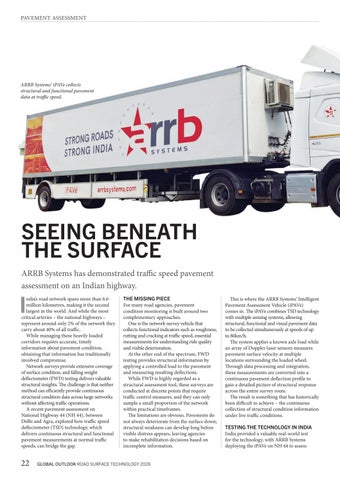
ARRB Systems’ iPAVe collects structural and functional pavement data at traffic speed.
SEEING BENEATH THE SURFACE ARRB Systems has demonstrated traffic speed pavement assessment on an Indian highway.
I
ndia’s road network spans more than 6.6 million kilometres, making it the second largest in the world. And while the most critical arteries – the national highways – represent around only 2% of the network they carry about 40% of all traffic. While managing these heavily loaded corridors requires accurate, timely information about pavement condition, obtaining that information has traditionally involved compromise. Network surveys provide extensive coverage of surface condition, and falling weight deflectometer (FWD) testing delivers valuable structural insights. The challenge is that neither method can efficiently provide continuous structural condition data across large networks without affecting traffic operations. A recent pavement assessment on National Highway 44 (NH 44), between Delhi and Agra, explored how traffic speed deflectometer (TSD) technology, which delivers continuous structural and functional pavement measurements at normal traffic speeds, can bridge the gap.
22
THE MISSING PIECE For many road agencies, pavement condition monitoring is built around two complementary approaches. One is the network survey vehicle that collects functional indicators such as roughness, rutting and cracking at traffic speed, essential measurements for understanding ride quality and visible deterioration. At the other end of the spectrum, FWD testing provides structural information by applying a controlled load to the pavement and measuring resulting deflections. While FWD is highly regarded as a structural assessment tool, these surveys are conducted at discrete points that require traffic control measures, and they can only sample a small proportion of the network within practical timeframes. The limitations are obvious. Pavements do not always deteriorate from the surface down; structural weakness can develop long before visible distress appears, leaving agencies to make rehabilitation decisions based on incomplete information.
This is where the ARRB Systems’ Intelligent Pavement Assessment Vehicle (iPAVe) comes in. The iPAVe combines TSD technology with multiple sensing systems, allowing structural, functional and visual pavement data to be collected simultaneously at speeds of up to 80km/h. The system applies a known axle load while an array of Doppler laser sensors measures pavement surface velocity at multiple locations surrounding the loaded wheel. Through data processing and integration, these measurements are converted into a continuous pavement deflection profile to gain a detailed picture of structural response across the entire survey route. The result is something that has historically been difficult to achieve – the continuous collection of structural condition information under live traffic conditions. TESTING THE TECHNOLOGY IN INDIA India provided a valuable real-world test for the technology, with ARRB Systems deploying the iPAVe on NH 44 to assess
GLOBAL OUTLOOK ROAD SURFACE TECHNOLOGY 2026
22-25 ARRB.indd 22
12/10/2026 1: 0 pm
PAVEMENT ASSESSMENT
its ability to deliver consistent structural measurements at traffic speed and compare the results with conventional FWD testing. NH 44 is India’s longest national highway, extending more than 4100km from Srinagar in the north to Kanyakumari in the south. The study focused on a 15km six-lane section located on the Delhi–Agra corridor, one of the country’s most important freight and passenger transport routes. The survey programme consisted of two key components. The first involved repeatability testing over an initial 5km segment. Multiple runs were
conducted in both directions to assess the consistency of the measurements. The second component involved structural validation, with iPAVe measurements collected across all traffic lanes and compared directly with conventional FWD testing. FWD measurements were undertaken at 50m intervals using a target load of 50kN. Importantly, all surveys were conducted under normal traffic conditions. Vehicle speed variations, lateral wander and the practical realities of operating on a busy national highway created a challenging environment that closely reflected real-world deployment conditions. With the field data collected, the evaluation first examined whether iPAVe could produce consistent results across repeated survey runs. Repeatability is critical for any networklevel structural assessment technology. If successive measurements cannot reliably reproduce the same result, confidence in the data quickly erodes. The NH 44 trial demonstrated a high degree of repeatability in pavement deflection measurements. The key structural indicator, D0 deflection at the load centre, showed remarkably consistent profiles between survey runs. Analysis produced an overall coefficient of determination (R²) of 0.96, indicating very strong agreement between repeat measurements despite changes in vehicle speed and positioning that naturally occur in live traffic environments. For pavement engineers, this result is significant in that it demonstrates the system is responding to actual changes in pavement structure rather than measurement noise. In practical terms, it means road agencies
can confidently identify locations of genuine structural weakness and monitor their progression over time. The next step was to compare the trafficspeed measurements with an established structural assessment method. While repeatability is important, validation against established methods remains essential. The study therefore compared iPAVe outputs against FWD measurements across all surveyed lanes. Overall, the datasets displayed strong agreement in overall magnitude and deflection trends (Figure 1). Perhaps more interestingly, the iPAVe revealed localised variations in structural response that were not visible in the FWD data. This is a direct consequence of measurement density. A typical FWD survey collects information every 50m. A TSD system, however, effectively measures continuously, capturing subtle changes that can occur between traditional test points. Some reduction in correlation was observed at sensor locations furthest from the load application point. This was expected. Deflections at these positions are often extremely small, approaching the practical measurement limits of conventional FWD equipment. Differences in dynamic versus static loading behaviour, particularly in asphalt pavements under elevated temperatures, also contribute to minor variations between the two methods. Despite these factors, the overall correlation was strong and provided confidence in the structural measurements obtained at traffic speed.
Figure 1: D0 deflection comparison between FWD and iPAVe. GLOBAL OUTLOOK ROAD SURFACE TECHNOLOGY 2026
22-25 ARRB.indd 23
23 12/10/2026 1: 0 pm
PAVEMENT ASSESSMENT
Figure 2: Hawkeye Insight platform showing uniform section highlighted in red.
24
Figure 3: GPR derived layer thicknesses and iPAVe 90th percentile deflection. Most importantly, however, the study highlighted a shift in how pavement condition can be understood at the network level. Rather than relying solely on visible surface distress or isolated structural sampling points, agencies now have the opportunity to view pavement performance continuously and comprehensively. As transport authorities around the world seek to maximise the value of increasingly constrained maintenance budgets, technologies that reveal developing structural issues before they become visible failures will play an increasingly important role.
The clear message is that the future of pavement management lies not just in measuring what can be seen on the surface. Rather, it lies in understanding what is happening beneath it. The NH 44 results suggest that trafficspeed structural assessment could play an increasingly important role in India’s pavement evaluation framework, providing road agencies with a way to collect detailed structural information across a network while maintaining normal traffic operations. ARRB Systems: https://arrbsystems.com/ service/ipave
ABOUT THE AUTHORS ARRB Systems global business development manager Clint Bradley has more than 20 years’ experience in road data collection, project management and global business development.
ARRB Systems operations project manager Kapil Hariparsaad has more than 10 years’ experience in road asset management and pavement engineering.
Images: ARRB Systems
MORE THAN DEFLECTION DATA The most powerful aspect of the iPAVe is its ability to collect multiple datasets simultaneously. The NH 44 survey demonstrated this capability through the integration of ground penetrating radar (GPR) with structural response measurements. While the TSD component measured pavement deflection, the GPR system assessed subsurface layer thicknesses by identifying dielectric contrasts between pavement materials. When these datasets are combined, engineers assess not only how the pavement responded to loading but also why it behaved that way. The information was further processed through the ARRB Systems’ Hawkeye Insight platform, where automated segmentation tools identified 31 uniform structural sections across the survey area (Figure 2 and Figure 3). Each section represented pavement lengths exhibiting similar structural characteristics, providing a practical framework for maintenance planning and future investigations. Combining continuous deflection data with pavement layer thickness information enables back-calculation of layer stiffnesses and estimation of remaining service life. This creates a far richer understanding of pavement performance than reliance on functional indicators alone. After all, roughness, rutting and cracking describe symptoms, and structural assessment helps identify the underlying cause. The NH 44 pilot showed that traffic-speed structural assessment can be successfully deployed on one of the world’s busiest highways. The results showed excellent repeatability in deflection and roughness measurements, strong correlation with conventional FWD testing, and advantages in spatial coverage and operational efficiency.
GLOBAL OUTLOOK ROAD SURFACE TECHNOLOGY 2026
22-25 ARRB.indd 24
12/10/2026 1: 0 pm
International ADVANCED TECHNOLOGY FOR TRAFFIC MANAGEMENT AND URBAN MOBILITY
International
The proven platform to reach global decision makers
November/December 2025 | www.itsinternational.com
International GT
HE ITS IND
SUPPO
IN
U
FOR RY ST
RT
ADVANCED TECHNOLOGY FOR TRAFFIC MANAGEMENT AND URBAN MOBILITY
International
ES
T. 1 9 9 5
Manhattan project
Inside New York’s congestion relief zone
Also… ITS Project Analysis: Talking Traffic in the Netherlands Why is AI suddenly supercharging ITS? Ghostbusters unmask ANPR’s phantom menace
www.itsinternational.com
22-25 ARRB.indd 25
12/10/2026 1: 0 pm
ASPHALT TECHNOLOGY
BEYOND STABILISATION: FIBRES FOR ASPHALT MODIFICATION
Iterchimica’s Loretta Venturini explores the use of fibres to enhance pavement’s resistance to thermal and fatigue cracking.
C
limate change, increasing traffic loads and even higher tyre inflation pressures are taking their toll on the world’s highways. These factors have led pavement engineers to modify conventional dense-graded asphalt mixtures toward porous asphalt and stone mastic asphalt (SMA). Porous asphalt pavement facilitates water drainage and reduces water spray generated by vehicles, particularly at high speeds on motorways, thereby improving driving safety under wet conditions. In contrast, SMA mixtures provide high resistance to permanent deformation under heavy traffic and elevated tyre pressures. Both mixture types require specific design considerations and the incorporation of additional components, such as stabilising fibres. Due to their discontinuous aggregate gradation (low sand content), these mixtures are prone to binder drainage (bleeding) if not properly stabilised with fibres. Furthermore, their gradation characteristics result in
26
reduced cohesion and increased susceptibility to cracking, which ultimately decreases pavement durability. For these reasons, in addition to polymer modified bitumen or the use of polymeric compounds for the structural modification of bituminous mixtures, the use of fibres is considered an effective technical solution. Besides mixture stabilisation, fibres will enhance resistance to thermal and fatigue cracking.¹ STABILISING FIBRES Fibres in asphalt mixtures usually play two important roles: they act as an asphalt stabiliser to decrease the bitumen draindown; and they are a reinforcing additive that will enhance the mechanical performance of asphalt mixtures. The most common type of the fibres used for SMA and porous asphalt mixtures are cellulose (organic), mineral (eg glass) and/or synthetic fibres.²
The fibres can be produced from different sources, including various plants when natural cellulose fibre is needed. But synthetic fibres primarily come from three sources: polypropylene, polyester and carbon. Research indicated the addition of such conventional fibres does not necessarily enhance the asphalt mixture properties; they are used mainly to control binder drain-down. But they can also indirectly contribute to durability of asphalt pavements. In this case, the typical dosage for both types of fibres is 0.3–0.4% of the weight of the aggregates.³,4 It should also be noted that excessive use of these fibres could perform conversely and impact the cohesion of the mixture. MULTI-FUNCTIONAL MODIFIED FIBRES Besides controlling binder drain-down – the primary function of fibres in asphalt mixtures – recent studies have demonstrated the capability of stabilising fibres to enhance
GLOBAL OUTLOOK ROAD SURFACE TECHNOLOGY 2026
26-29 Interchimica.indd 26
12/10/2026 1: 0 pm
Images: Iterchimica
ASPHALT TECHNOLOGY
the performance and mechanical properties of asphalt mixtures. In this context, polyfunctional fibres modified with polymers (including recycled plastics) or rubber have even shown promising results for improving various asphalt mixture properties. Modified asphalt fibres, sometimes referred to as polyfunctional polymeric systems (PPS), are specialised natural or synthetic fibres that contain polymers such as plastomers and elastomers, including rubber or styrene-butadienestyrene (SBS). These polymers may or may not have been subjected to chemical treatments in order that they better interact with the asphalt mix. Pre-bitumen treatment is sometimes essential for controlling the absorption or digestion of the fibres. These fibres are used not only to reinforce stone mastic asphalt and porous asphalt mixtures but to enhance the performance of dense-graded asphalt mixtures.
Depending on the type of polymer or modifier, these fibres can form a threedimensional network within the binder, enhancing rutting resistance, fatigue endurance, tensile strength and the overall durability of the asphalt mixture. Multifunctional fibres are typically incorporated at higher dosages than conventional stabilising fibres, providing binder stabilisation and the desired enhancement of the asphalt mixture’s performance. The growing range of modified fibres reflects a broader shift towards using additives not only to stabilise asphalt mixtures but also to enhance their longterm performance As sustainable asphalt production is growing more common, innovative additives and products, including modified asphalt fibres, have been introduced to the pavement industry. Depending upon the required technical specifications, certain types of the modified fibre can be incorporated into the mix. Based on the type of the adjacent component, Iterchimica’s stabilising and polyfunctional fibres are classified into several groups: • ITER-PPS 1000 C – composed of cellulose fibres and plastomeric polymers as modifier constituent • ITER-PPS 1000 C/S – composed of synthetic and cellulose fibre and plastomeric polymers as modifier constituent • ITER-PPS 1000 C/V – composed of glass fibres, cellulose fibre and plastomeric polymers as modifier constituent • ITER-PPS 1000 CG – composed of rubber powder, cellulose fibre and plastomeric polymers as modifier constituent
• ITER-PPS 2000 ELAST-S – composed of elastomeric polymer, cellulose fibre and plastomeric polymers as modifier constituent • ITER-PPS 5000-K – composed of mineral fibres (glass), cellulose fibre and plastomeric polymers as modifier constituent The recommended dosage typically ranges from 0.4–0.6% by weight of aggregates, depending on the target performance requirements and the type of asphalt mixture. The introduced modified fibres have been extensively investigated (mix-design) and compared with control and reference mixtures under various temperature conditions and loading regimes. Findings reported in several peer-reviewed scientific publications have demonstrated the effectiveness of these modified fibres.5,6 They have enhanced the mechanical and functional properties of asphalt mixtures besides stabilising and controlling binder drain-down of the mixture. MALTA CASE STUDY The project involved the construction of a 40–50mm-thick layer of 14mm stone mastic asphalt surface course on an urban street in 2023. The asphalt mixture was produced using a 50/70 penetration grade neat bitumen and 0.6% PPS 1000 polyfunctional fibre by weight of aggregates. The additive was introduced directly into the hot aggregates prior to bitumen addition. The only modification to the standard production process was a slight extension of the dry-mixing time by a few seconds, allowing the fibres to separate and disperse uniformly throughout the asphalt matrix. The combination of plastic polymer and cellulose fibres resulted in a stable modified SMA, particularly suitable for the hot climatic conditions of Malta.
The final compacted SMA containing PPS fibre.
GLOBAL OUTLOOK ROAD SURFACE TECHNOLOGY 2026
26-29 Interchimica.indd 27
27 12/10/2026 1: 0 pm
ASPHALT TECHNOLOGY
Test
Standard
Unit
Avg. test results
Specs
Binder content
EN 12697-1
%
5.1
5–6.6
Air void
EN 12697-8
%
3.3
3–6
Stiffness modulus
EN 12697-26
MPa
8067
≥ 4000
ITS
EN 12697-23
MPa
1.78
–
Binder drainage
EN 12697-18
%
0.12
≤ 0.3
Post-production test results. The above table summarises the results of post-production quality control tests conducted during the project. For these tests, material collected from the jobsite was reheated and compacted using a gyratory compactor applying 120 gyrations. Based on the test results, it can be understood that the mixture complied with the project’s requirements and specifications. Notably, these specifications are typically applied to stone mastic asphalt mixtures incorporating SBS polymermodified bitumen. The findings, therefore, serve to demonstrate the potential of this alternative lower-carbon solution to meet the required performance criteria without compromising material quality. ITALIAN PROJECT The A53 motorway is located in northern Italy, south of Milan. Constructed in 2015 and 2016, the pavement incorporates a semi-dense asphalt mixture for the wearing course containing 0.5% PPS (by weight of aggregates) and 50/70 penetrationgrade bitumen. The primary objective of incorporating the modified fibre was not bitumen stabilisation but to produce a high-performance asphalt mixture capable of withstanding heavy motorway traffic. According to a published study concerning the post-production mechanical properties of the asphalt mixture and the pavement performance, the pavement exhibited excellent long-term performance,6 with no significant signs of distress. The pavement condition assessments included structural evaluation using a falling weight deflectometer (FWD), skidresistance measurements using a sidewayforce coefficient routine investigation machine (SCRIM) and transverse rut depth
28
measurements obtained manually with a rutting bar. These results, together with latest pavement condition monitoring completed this autumn, confirm the quality of the asphalt after 11 years (see images above and below right). It is noteworthy that, during approximately 11 years of service, apart from localised maintenance and crack sealing, no rehabilitation or resurfacing interventions were required. The long-term performance further demonstrates the potential of fibres to produce durable, highperformance asphalt pavements for heavy traffic loading. From the ecological perspective, the environmental product declaration indicates that the global warming potential (GWP) of standard asphalt fibres is not substantially different from that of their modified counterparts, PPS fibres. However, compared with conventional bitumen modifiers such as styrene-butadiene-styrene (SBS), which has a GWP of 2890kg CO2-eq/ tonne according to the Asphalt Institute, the modified fibres exhibit a substantially lower carbon footprint, an estimated GWP of approximately 170kg CO2-eq/tonne.7 Furthermore, PPS fibres are incorporated into asphalt mixtures using the dry method, whereby the fibres are added directly into the mixer with the aggregates. This eliminates the need for the energyintensive pre-blending of polymers with bitumen required to produce polymermodified bitumen. Consequently, asphalt mixtures containing PPS fibres are expected to result in lower greenhouse gas emissions and a reduced overall environmental impact than mixtures produced with SBS-modified bitumen. Iterchimica: https://iterchimica.it/en
ABOUT THE AUTHOR Loretta Venturini, Ph.D., is scientific development director at Iterchimica. She has more than 20 years’ experience improving road and airport pavement. References [1] Devulapalli, L et al., (2021). Characteristics of aggregate gradation, drain down and stabilising agents in stone matrix asphalt mixtures: A state-of-the-art review, Journal of Traffic and Transportation Engineering, https://doi.org/10.1016/j. jtte.2021.10.007 [2] Guo, Y., Tataranni, P., Sangiorgi, C. (2023). The use of fibres in asphalt mixtures: A state of the art review, Constr. Build. Mater. (390), https://doi.org/10.1016/j. conbuildmat.2023.131754 [3] Slebi-Acevedo, C. J., Lastra-González, P., Pascual-Muñoz, P., Castro-Fresno, D. (2018). Mechanical performance of fibres in hot mix asphalt: A review, Constr. Build. Mater. (200), https:// doi.org/10.1016/j.conbuildmat.2018.12.171 [4] Akbari Motlagh, A., Mirzaei, E. (2016). Effect of using Fibre on the Durability of Asphalt Pavement. Civil Engineering Journal (2), https://doi.org/10.28991/cej-2016-00000013 [5] Eskandarsefat, S., Dondi, G., Sangiorgi, C. (2019). Recycled and rubberised SMA modified mixtures: A comparison between polymer modified bitumen and modified fibres, Constr. Build. Mater. (202). https://doi.org/10.1016/j. conbuildmat.2019.01.045 [6] Eskandarsefat, S., Venturini, L., Ciarlitti, A., Sogno, E., & Ottonelli, I. (2022). Asphalt Concrete Modification with Plastomers: A Case Study Conducted 7 Years after Construction. Infrastructures, 7(3), 29. https://doi.org/10.3390/ infrastructures7030029 [7] Life Cycle assessment of styrene-butadiene-styrene block copolymer. Asphalt Institute, 2022.
GLOBAL OUTLOOK ROAD SURFACE TECHNOLOGY 2026
26-29 Interchimica.indd 28
12/10/2026 1: 0 pm
ASPHALT TECHNOLOGY
The A53 motorway and asphalt pavement in 2026.
GLOBAL OUTLOOK ROAD SURFACE TECHNOLOGY 2026
26-29 Interchimica.indd 29
29 12/10/2026 1: 0 pm
SURVEYING
Milling under way on expansion of the Route Centre–Europe Atlantique.
30
GLOBAL OUTLOOK ROAD SURFACE TECHNOLOGY 2026
30-33 Hexagon:Leica.indd 30
12/10/2026 1:29 pm
SURVEYING
THIRTY YEARS WITHOUT A STRINGLINE Stringless paving turns 30 this year, but the most interesting story is in what had to change before automation became worthwhile, according to Leica Geosystems’ Mark Bryant.
A
paving crew’s problem in 1996 is recognisably the same problem it has today. Put material down to a specified line and level in one pass, and do it at a rate that keeps the plant and the haulage economical, on a job whose tolerances are set by someone else – in the UK, by the Standards for Highways – and whose margin will not survive being done twice. What makes that process unforgiving is the financial structure. In a paving operation, the production cost is dominated by material rather than labour or plant, which means thickness is money in a very direct way. A few millimetres of surplus across a carriageway becomes tonnes of surplus asphalt. Meanwhile, a few millimetres short becomes planing and relaying. Comparisons of what a kilometre of road costs are of limited use in this situation. The European Commission’s own review of road infrastructure costs cautions against comparing new-capacity costs between countries because terrain, structures and specification swamp everything else. However, the ratio between materials and everything else holds up wherever you are working. So the case for every technology rests on a single question: how much of the work is done right the first time? CHANGE ONE: THE REFERENCE LEFT THE SITE For most of the 20th century, the answer to line and level was a physical one. A stringline was staked out manually and the machine followed it mechanically. Skilled crews got good results this way – and some still do. But a stringline has three properties that cap what it can deliver: it has to exist before the paving train arrives, which puts a survey task on the critical path; it is the only version of the truth on that job, so any error in
setting it out is reproduced faithfully in the finished surface; and it physically occupies the corridor that is needed by machinery and haulage vehicles. The first jobs to break that model were those where a wire could not be strung at all. On Germany’s Frankfurt–Cologne highspeed rail line in 1997, paving had to be executed inside confined tunnels and under overhead cables. Working with Wirtgen, Leica Geosystems developed a 3D solution for that project, building on a positioning system it had introduced the year before. The requirement was set by the site, not by the technology: hold line and level with no physical reference present. The general release of the technology for concrete and asphalt paving followed in 1999, guiding the machine to specified elevations, slopes and widths taken from the digital design. The consequential change was not that machine hydraulic deviations were automated; it was that the authoritative version of the geometry moved from something built on site to something published in the office, where it can be reviewed, versioned and corrected before any material is ordered. CHANGE TWO: SENSORS DIVIDED THE WORK The 3D machine control describes several different measurement strategies. Distinctions matter when a contractor is specifying a system rather than buying a brand. Paving tolerances are asymmetric – the vertical tolerance is the tight one, horizontal position is more forgiving. Satellite positioning is at its weakest on precisely the axis that matters most for a screed, which is why high-accuracy paving takes its height from a robotic total station tracking a prism on the machine and uses global navigation satellite system (GNSS) for heading and position, where it performs well.
Because paving is continuous rather than static, instruments are leapfrogged ahead along the alignment so control never lapses as the machine runs out of range. The direction of travel in hardware since then has been to do the same job with less on the ground. In 2015, Leica Geosystems patented the 1UP configuration for curb and gutter work. This hardware uses a single total station for height with dual GNSS for heading in place of a dual-mast, total-station-only set-up, which removes the dependency on real-time kinematic (RTK) or an external correction service. Where satellite reception is compromised, such as in an urban canyon where there is tree cover or due to general interference, a second total station can be substituted to keep production moving. The practical benefit is not a specification improvement but fewer instruments to set up, calibrate, transport and lose. Leica Geosystems is extending the same approach into grading and dozer applications. CHANGE THREE: MILLING NOT COPYING THE OLD ROAD Cold planers came into the same workflow in 2006, and milling is where the logic of a digital reference is easiest to demonstrate. A machine that takes its level from the surface on which it is standing will reproduce that surface’s defects, pass after pass. This is called the copying effect. A machine referencing a design model removes to the level the design specifies, regardless of what it is sitting on, eliminating the inherited defect and limiting over-milling, which is where the material and haulage savings sit. Coverage of the paving side was completed in stages, brought under 3D control step by step rather than all at once. That is 3D autosteering and edge control on asphalt pavers from 2013.
GLOBAL OUTLOOK ROAD SURFACE TECHNOLOGY 2026
30-33 Hexagon:Leica.indd 31
31 12/10/2026 1:29 pm
SURVEYING
Two stations set together at a changeover point.
This may be unglamorous, but it is the reason a third-generation platform released in 2018 was more useful than a firstgeneration one with comparable sensors would have been.
The authoritative version of the geometry now lives in the office. The first 3D-controlled crown profile on a slipform paver, crown geometry that had always been set manually, was incorporated into the model in 2024. CHANGE FOUR: DATA BECAME PORTABLE The least visible change is probably the one that mattered most. Early workflows depended on point files and comma-delimited exports, and someone had to coax these into a machine-readable model. Every one of those translations was
32
a chance to introduce an error and, in this industry, an error in translation arrives on site as a surface. Standardised model formats removed most of that step. Design data now moves to the machine with minimal reformatting. This shortens handovers and, for a contractor running a mixed fleet, means the same model drives machines of different makes. Standardisation also made sensor solutions portable across applications, so a system bought for grading is not stranded when the work changes to paving.
WHAT IS CHANGING NOW Leica Geosystems integrated safety awareness technology directly into a paving and milling solution for the first time in 2023. That is worth noting not because crews were previously unsafe but because it was the first time a paving control platform was asked to solve something that was not fundamentally a geometry problem. The positioning infrastructure that keeps a screed on grade already knows where machines and people are relative to one another. Using it for proximity awareness was a matter of connection rather than invention. That is a reasonable description of where the next increment generally lies. Most paving operations already generate more data than they use. Machines log as-built position and thickness; production logging is done through Leica ConX, our telematics platform which sends the data to the office in close to real-time; scheduling systems hold what is supposed to happen; safety systems hold what is happening around the machine. These remain largely separate records, reconciled after the fact.
GLOBAL OUTLOOK ROAD SURFACE TECHNOLOGY 2026
30-33 Hexagon:Leica.indd 32
12/10/2026 1:29 pm
SURVEYING
ABOUT THE AUTHOR Mark Bryant studied mechanical engineering at Waikato Polytechnic in New Zealand and is now senior product manager for paving solutions at Leica Geosystems, part of Hexagon. As head of the paving portfolio within the machine control division, he is responsible for defining product direction and requirements through to launch, customer training and field support.
Year
Milestone
1996
A new machine positioning system is developed
1997 1999 2006
Pave Smart 3D replaces LMGS, cold planer support added
2013
3D auto-steering and edge control supported on asphalt pavers
Leica Geosystems: https://leica-geosystems.com
2018 2023 2024
Patented 1UP sensor configuration takes 3D curb and gutter control to a new level of accuracy Third-generation stringless paving and milling platform, iCON pave, released First integration of safety awareness technology into a paving and milling solution First 3D-controlled crown profile on a slipform paver
Working to a model rather than a physical reference is what turns thickness into a design decision instead of a field correction.
GLOBAL OUTLOOK ROAD SURFACE TECHNOLOGY 2026
30-33 Hexagon:Leica.indd 33
Images: Hexagon/Leica Geosystems
2015 The industry’s next task is to join this data and information together so programme, cost and safety inform one another during the job, rather than in a subsequent report. If achieved, this would go a long way in machine learning earning its place. Users would do well to treat vendor claims in that area, including Leica Geosystems’ own, the way they treat a new mix design. Ask what data it was trained on, what will be done when the data is missing, and what specifically it is expected to change on site. A platform that cannot answer those questions is not ready, whatever it is called. Thirty years on, the pattern is consistent enough to predict the next step of development. Each step has replaced a local, manual interpretation of the design with a shared, checkable one. Each step has been driven by a site requirement rather than by the availability of a new sensor. The stringline was a reference you could put your hands on. Its replacement is a model you can audit. What follows is a live picture of the job from which everybody is working. At this point, the question stops being how precisely a paver can hold a line; it is how quickly the whole site can agree on where the actual work stands against the model.
Frankfurt–Cologne high-speed rail: a 3D solution developed jointly with Wirtgen for paving inside confined tunnels and beneath overhead cables where stringlines were not feasible First release of the Leica Machine Guidance System for concrete and asphalt paving
33 12/10/2026 1:29 pm
Image: Elnur/Dreamstime
DIGITALISATION
The volume and variety of data generated across the roadbuilding lifecycle is growing rapidly.
THE FOUNDATIONS FOR A DIGITAL FUTURE
The future of roadbuilding is rapidly emerging – and it is most certainly digital, Associated Asphalt technical director Dr Paul Phillips writes.
I
n today’s increasingly connected world, the pace of digitalisation has redefined how infrastructure is designed, delivered and maintained. Across construction, technologies such as building information modelling, digital twins and carbonfootprint modelling continue to replace traditional approaches. Gone are the days of relying on paper drawings, separate teams and physical models that show only part of the picture. Instead, everyone from architects to contractors now works within shared digital environments, where information is connected in real-time and accessible throughout the project lifecycle. This shift is about more than saving time or money. It enables infrastructure to be more resilient, efficient and sustainable. By effectively test-running projects before construction even begins, teams can identify potential problems and assess performance. Integrating environmental data into models also makes it easier to implement decisions that directly reduce emissions and environmental impact. Greater visibility across the asset lifecycle also enables performance prediction, improving maintenance strategies, extending overall longevity and reducing cost. Given these advantages, one might expect a similar digital-first approach to be firmly established across roadbuilding. However, the reality is rather different. Indeed, the volume and variety of data generated across
34
the roadbuilding lifecycle is growing rapidly, from design and material production to construction, quality assurance and asset management. Thanks to technologies such as light detection and ranging (LiDAR), connected vehicles and increasingly sophisticated sensors, we also now have access to more detailed information about our road network and its condition. But data collected after the event – once a road has been surfaced – can help only so much. It is far more beneficial to use that data to develop predictive insights that inform planning, improve efficiency and spot issues before they arise. At the same time, the need for a smarter, more resilient and sustainable approach to modern roadbuilding has never been greater. Urban densification, freight-reliance and growing congestion are pushing road networks worldwide to the limit. In addition to achieving net-zero goals, electrification and autonomous vehicles will introduce further demands on infrastructure performance. The big question is, therefore, how can roadbuilding make better use of its data to truly establish the roads of the future? FROM INFORMATION TO IMPACT Road construction has traditionally prioritised short-term fixes and cost over any whole-life asset performance. Maintenance activities have often been delivered in organisational silos, with limited
consideration of network-wide impacts, asset interdependencies and long-term lifecycle costs. The result has been recurrent defects, accelerated asset deterioration and diminished network resilience. I believe the real opportunity presented by digitalisation lies in addressing these limitations through greater visibility of the bigger picture. Look at any one of several leading industries – manufacturing, aerospace, advanced engineering – and a common theme emerges: decisions are increasingly driven by high-quality, real-time data. Components are tracked, performance is continuously monitored and maintenance is planned using integrated digital systems that link design intent with operational reality. Perhaps a more relevant precedent, however, can be found in the ‘Golden Thread’ model embedded within the UK’s wider building safety regulatory reform. This approach requires a continuous digital record of a building’s design, materials, decisions and modifications, enabling stakeholders to maintain safety, traceability and accountability throughout the asset lifecycle. Applied to roadbuilding, this type of approach could be transformative. Imagine if, akin to the Golden Thread model, we were able to carry a continuous, digital record of an asset from design through construction and into maintenance. It would capture not just what was built, but how, with what
GLOBAL OUTLOOK ROAD SURFACE TECHNOLOGY 2026
34-35 Associated Asphalt.indd 34
12/10/2026 1:29 pm
DIGITALISATION
This means understanding where information originates, how it is recorded, how different datasets relate to one another, and how they are maintained over time. Without these fundamentals, there is a risk of generating increasing volumes of information without necessarily improving the decisions that depend on it. This is particularly important in roadbuilding, where design, materials, construction, quality assurance and asset condition data are often held separately across different organisations. Connecting this information across the asset lifecycle would provide a stronger evidence base for understanding performance, assessing whole-life cost and carbon, and making better-informed maintenance and investment decisions. As stakeholders become more familiar with what is required to derive meaning and, in turn, value from that data, projects evidenced by thorough analytics will move from a ‘nice-to-have’ to a necessity. This shift will likely also necessitate significant cultural and organisational changes across the sector, including upskilling and retraining staff, restructuring teams and evolving business models.
Equally critical is the cybersecurity issue. Digital approaches and tools will have to comply with appropriate standards, and the information will have to be protected against unauthorised access, misuse or disruption. Rapid urbanisation, soaring demand, sustainability and changing operating dynamics continue to challenge the traditional roadbuilding model, but they also reinforce the case for digitalisation. The full extent of data’s role in the future is not yet clear at this early stage, but we do know that it is coming. My hope for the future is that, as an industry, we begin to shift our perspective and stop looking at the short to medium term. Amid tight deadlines, budget constraints and growing complexity, it is too easy to become absorbed in the immediate demands of delivery and lose sight of the bigger picture. Taking the time to question established practices and strengthen the way we use data to create greater visibility across the roadbuilding chain could help us achieve a smarter and more sustainable approach, not only on today’s projects but for the roads that will serve future generations. Associated Asphalt Contracting: https://associatedasphalt.biz
ABOUT THE AUTHOR Dr Paul Phillips is technical director at Associated Asphalt, bringing extensive expertise in asphalt technology and polymer modified bitumen. His work focuses on the development and application of high-performance asphalt materials.
GLOBAL OUTLOOK ROAD SURFACE TECHNOLOGY 2026
34-35 Associated Asphalt.indd 35
Image: Associated Asphalt
materials, under what conditions, and its performance over time. Executed well, this would enable a more intelligent, efficient and sustainable approach to asset management. With full lifecycle visibility, the road network could be managed as a connected system rather than a series of isolated interventions, supporting better planning, more targeted maintenance and clearer insight into performance and carbon impact. It would also help bring sustainability strategies to life. Today’s operators are under growing pressure to reduce carbon and energy use without compromising the quality, speed or cost of the operation. Better data would make it easier to assess the whole-life performance of different materials and methods, enabling clearer comparison of the long-term savings and benefits of lower-carbon alternatives. With better knowledge extending far beyond the job at hand, decision-making could shift meaningfully, prioritising considered and durable sustainable options over reactive short-term fixes. And this is just the beginning. As digitalisation matures, closer integration between authorities, contractors, material suppliers and technology providers could further extend the value of this approach. Materials and construction methods could be digitally represented within modelling environments, enabling road authorities and contractors to assess potential interventions against real-world network conditions before deployment. The resulting performance data could provide manufacturers with valuable feedback over time, informing product development and accelerating innovation in line with practical needs. This would in turn support and drive further industry innovation between design, construction and operation – and do so in a virtuous knowledge cycle. However, the digitalisation of roadbuilding will not be without challenges. While the potential of data to improve decision-making is considerable, its value ultimately depends on the quality, consistency and context of the information available. Yet there remains a significant gap across contracting between the volume of data being generated and its effective use. If we look to other sectors, a common mistake is to rush into the excitement of data and artificial intelligence (AI) without first understanding the governance challenge of ensuring data integrity.
Image: Igor Borisenko/Dreamstime
How can roadbuilding make better use of its data to truly establish the roads of the future?
35 12/10/2026 1:29 pm
ROAD INSPECTIONS
FROM DETECTION TO INFRASTRUCTURE INTELLIGENCE Parsons X vice president Jodie Bare explores the shift from collecting roadway data to turning it into actionable intelligence.
M
eeting the road asset management challenge increasingly requires operational intelligence, connected ecosystems and data-driven decision-making. Advances in vehicle sensing and other data-gathering technologies are creating new opportunities to understand roadway conditions, but the value of that information depends on how effectively it can be turned into action. Today’s transportation agencies have access to data from connected vehicles, advanced driver assistance systems (ADAS), mobile mapping technologies, light detection and ranging (LiDAR) surveys, intelligent infrastructure and emerging crowdsourced sources. Modern vehicles can continuously monitor their surroundings, creating opportunities to gather roadway observations at a scale and frequency that was previously difficult to achieve. At the same time, agencies, maintenance organisations and industry partners are under pressure to manage
36
ageing infrastructure with constrained resources while meeting expectations for safe, reliable and high-performing transportation networks. The challenge, therefore, is no longer simply collecting information about roadway conditions. It is determining which observations matter, validating them, putting them into context, and connecting them to the processes that guide maintenance and asset management decisions. Roadway condition assessments have historically relied heavily on periodic inspections, windshield surveys and scheduled data collection programmes. These practices remain essential, but they were developed when condition information was expensive to collect and available only at specific points in time. The emergence of connected and increasingly sophisticated sensing technologies creates the potential for a more continuous understanding of asset condition and performance.
The Ohio Department of Transportation (ODoT), in collaboration with Honda, Parsons and the University of Cincinnati, is exploring this potential through a multiphased, vehicle-based roadway monitoring pilot launched in 2024. The project is examining whether sensor-derived roadway observations can complement established inspection programmes and support more proactive asset maintenance. PUTTING VEHICLE DATA TO WORK The ODoT–Honda pilot examines how sensors already deployed in modern vehicles, combined with advanced analytics and processing techniques, can contribute to roadway asset maintenance and condition reporting. The project has focused on several roadway and roadside asset categories, including pavement condition, roadway roughness, shoulder and berm conditions, pavement markings, guardrails and roadway signs. Rather than replacing established inspection
GLOBAL OUTLOOK ROAD SURFACE TECHNOLOGY 2026
36-39 Parsons.indd 36
12/10/2026 1:2 pm
Image: Rainer Klotz/Dreamstime
Image: Parsons
ROAD INSPECTIONS
programmes, the project is investigating how emerging sources of condition awareness can complement existing asset management practices and improve the timeliness of condition reporting. One area of interest is the potential of sensors originally developed for advanced driver assistance systems. Honda’s onboard Lane Keep Assist system, which automatically applies steering torque or brakes if the car drifts, was also used to provide lane marking data. This enabled the detection of non-existent or faded line striping. The example illustrates the opportunity and the limitations of using vehicle-based sensing for infrastructure management. Vehicle manufacturers continue to deploy increasingly sophisticated perception systems, creating a potentially valuable source of information for transportation agencies. However, vehicle sensors were not specifically designed to operate as roadway asset management systems. Using these systems for infrastructure monitoring therefore raises technical and operational questions around data quality, validation, context and integration into existing agency processes.
A pavement marking deficiency identified on a low-volume roadway, for example, may warrant a different response from a similar condition observed along a high-speed corridor. Likewise, an isolated observation may not justify intervention, while a pattern identified across multiple observations could indicate an emerging maintenance need. This means automated detection does not remove the need for human expertise. People remain important for confirming observations, assessing severity and determining the appropriate response. Modernisation is not about replacing maintenance personnel or inspectors but giving them better information with which to make decisions. The combination of automated awareness and human judgement can provide a more scalable approach to asset management than either can deliver independently. CONNECTING CONDITION TO OPERATIONS The implications extend beyond individual maintenance decisions. Transportation agencies already operate within a complex environment of asset inventories, maintenance management systems, geographic information systems (GIS), capital planning tools, performance dashboards, work management platforms and field operations. Each plays a role in maintaining roadway networks, yet condition information can remain fragmented across systems and stakeholders. As a result, observations may be delayed, duplicated or disconnected from the actions required to address them. This creates an opportunity to bring infrastructure condition and transportation operations closer together. Asset maintenance and traffic operations have traditionally been treated as separate disciplines. Asset management programmes
have focused on preserving infrastructure condition, while transportation operations have concentrated on mobility, reliability and safety. As transportation systems become increasingly connected and data-driven, that distinction is beginning to blur. Infrastructure condition is an operational variable as well as an asset management concern. Pavement quality, pavement markings, roadside assets, work zones and infrastructure reliability can all influence how travellers and vehicles move through a network. Maintenance activities can likewise affect congestion, travel-time reliability, incident risk and network performance. As agencies adopt more sophisticated transportation systems management and operations (TSMO) strategies, infrastructure condition intelligence can become an increasingly important input to operational decision-making. Viewed this way, asset management becomes part of a broader infrastructure intelligence ecosystem. Condition awareness can sit alongside mobility performance, traffic operations, construction activity and enterprise business systems to provide a more complete picture of network health and performance. That broader role places greater emphasis on what happens to condition data after it has been collected. For condition information to support this broader role, it needs to be incorporated into the operational framework already used by transportation organisations. Observations need to be validated and contextualised before they can inform decisions. They then need to be prioritised and connected to maintenance planning, asset inventories, work management processes and performance measurement. The objective is therefore not only to identify defects more efficiently, but to establish a repeatable process through
GLOBAL OUTLOOK ROAD SURFACE TECHNOLOGY 2026
36-39 Parsons.indd 37
37 12/10/2026 1:2 pm
ROAD INSPECTIONS
Roadway observations are increasingly generated through a growing ecosystem of sensing technologies.
BUILDING AN ADAPTABLE ECOSYSTEM The future of infrastructure management will not depend on a single sensor, vehicle platform or data source. As new sources of condition intelligence emerge, agencies will need to incorporate information from connected vehicles, mobile mapping platforms, agency fleets, maintenance vehicles, commercial trucks, intelligent infrastructure and other sensing technologies. The ability to accommodate those sources will depend on flexible and interoperable systems. Transportation organisations already work across multiple vendors, technologies and platforms, and future infrastructure intelligence ecosystems will need to incorporate additional data without disrupting established workflows. This also applies to vehicle-based sensing. As manufacturers continue to expand ADAS, connected-vehicle capabilities and on-board
38
sensing technologies, roadway condition information could increasingly come from everyday fleet vehicles and other vehicles operating throughout the transportation network rather than solely from specialised survey vehicles. However, production vehicle sensor suites were not specifically engineered to function as roadway asset management systems. Turning their observations into information that transportation organisations can trust will require sensor fusion, edge processing, validation and operational context. The same principle applies to other emerging data sources. More information does not automatically produce better infrastructure outcomes. Its value depends on how effectively it can be connected to the systems and decisions that govern maintenance, mobility and network performance. These developments point to a broader change in how transportation infrastructure can be monitored and managed. Transportation infrastructure is entering a period in which condition awareness can become more continuous, connected and closely linked to operations.
The ODoT–Honda pilot demonstrates how vehicle-based sensing can contribute to that shift while highlighting the broader challenge facing the industry: moving from the collection of roadway observations to their effective use within infrastructure management and transportation operations. As the range and volume of available data grows, agencies will need to determine how information from different sources can be validated, interpreted and incorporated into existing workflows. The focus will increasingly be on creating systems that can adapt as new sensing capabilities emerge while maintaining clear links between condition information and decisions. The long-term opportunity is a more connected infrastructure intelligence lifecycle in which observations inform decisions, decisions lead to actions and the resulting outcomes can inform future strategies. For transportation organisations, that provides a pathway from periodic condition assessment towards a proactive approach to managing infrastructure, maintenance resources and network performance. Parsons X: www.parsons.com/X
ABOUT THE AUTHOR Jodie Bare is vice president of Parsons X, Parsons’ digital transformation division, specialising in AI-driven innovation, data strategy and digital transformation for critical infrastructure. She advises public-sector organisations on using data, analytics and emerging technologies to modernise infrastructure operations and decision-making.
Images: Parsons
which condition observations can lead to appropriate maintenance action and, ultimately, measurable outcomes. This represents a shift from inspectiondriven asset management towards intelligence-driven infrastructure management and operations. Instead of relying solely on information collected at specific points in time, agencies can increasingly draw on observations generated across the transportation network. The ODoT–Honda pilot provides an example of this transition. Its work with vehicle-based sensing demonstrates the potential to expand roadway condition awareness while also highlighting the importance of determining how those observations can be trusted, interpreted and used.
C + gr
GLOBAL OUTLOOK CROAD SURFACE TECHNOLOGY 2026
36-39 Parsons.indd 38
A s v a O in la a
12/10/2026 1:29 pm
Aggregates Business is a go-to source for up-to-date news and views on the American aggregates and building materials sectors. Our wide-ranging features line-up includes in-depth articles on the latest loading, hauling, and crushing and screening machines. Contact: Graeme McQueen +44 7833 445 592 graeme.m@primeglobalpublishing.com
36-39 Parsons.indd 39
www.aggbusiness.com 12/10/2026 1:29 pm
A WIRTGEN GROUP COMPANY
THE LEGEND ON WHEELS SUPER 1803-5 X – The Powerful Wheeled Paver
CLOSE TO OUR CUSTOMERS The SUPER 1803-5 X is VÖGELE’s most powerful wheeled paver. It perfectly combines rugged, reliable material management and a pave width of up to 8.25 m with the outstanding manoeuvrability and ease of transport of a wheeled paver. As a “Dash 5”-generation paver, this wheeled model from the successful 1800 series sets new standards of user-friendliness, automation and cost efficiency. wirtgen-group.com/super1803-5x-voegele
RST1026 Cover.indd 40
12/10/2026 1:20 pm