Installer-centred engineering











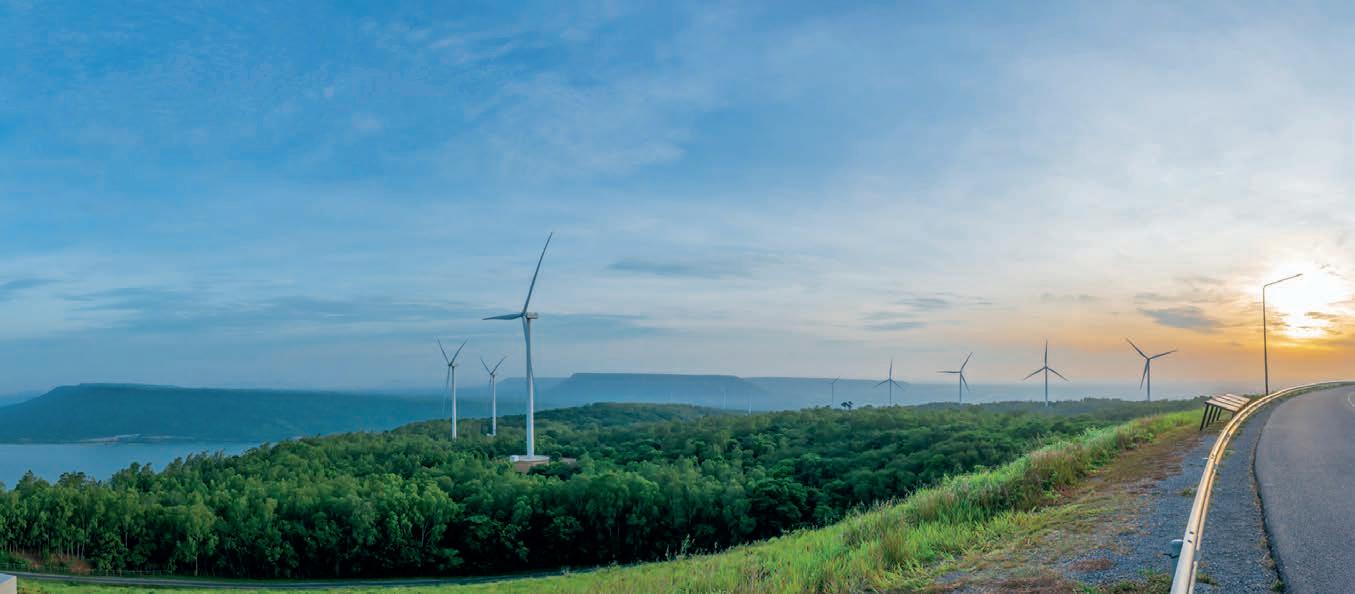
Across Australia, wind, solar and battery storage projects are being commissioned at record levels, signalling the national shift towards a modern renewable electricity system.
In this edition of ecogeneration, the Clean Energy Council (CEC) provides an industry update, highlighting the surge in renewable generation, battery deployment and project investment recorded in the final months of 2025.
Much of that momentum has been evident in Queensland. During the final quarter of 2025, CEC reports that Queensland had four large-scale renewable generation and storage projects reach the commissioning stage; including, Clarke Creek Wind Farm, Broadsound Solar Farm and Battery, Tarong Battery Energy Storage System, and Swanbank Battery Energy Storage System.
Queensland’s significant progress across its utility-scale projects demonstrates how other Australian states can follow suit to scale infrastructure as Australia’s population grows.
Emerging technologies are also gaining attention. The draft 202526 GenCost modelling and report by the Commonwealth Scientific and Industrial Research Organisation and the Australian Energy Market Operator, suggests hydrogen will play a specialised role in future energy systems, particularly in heavy industry sectors that are difficult to electrify.
This edition also brings a global perspective. In his capacity as Co-Chair of the Energy Transitions Commission, Lord Adair Turner, Member of the House of Lords of the United Kingdom, shares his learnings about renewable energy deployment on a global scale. Reflecting on his recent visit to Australia, he sits down with ecogeneration to provide exclusive insights into his engagements with Australian policymakers and industry leaders, including the Minister for Climate Change and Energy, the Hon Chris Bowen MP.
Notably, Lord Adair Turner positions Australia’s energy transition as a global case study for rapid renewable deployment and a model for what a low-emissions future could look like. To shine a light on those making an impact towards Australia’s net zero future, this edition showcases emerging women in renewables, alongside the country’s high-performing operational leadership, engineering and field teams.
ecogeneration Editor

ecogeneration acknowledges the Cammeraygal people, traditional custodians of the land on which this publication is produced, and we pay our respects to their elders past and present. We extend that respect to all Aboriginal and Torres Strait Islander people today.
Chief Executive Officer: Christine Clancy Chairman: John Murphy
Editor: Lavinia Hulley lavinia.hulley@primecreative.com.au
Business Development Manager: Nick Lovering , +61 414 217 190 nick.lovering@primecreative.com.au
Client Success Manager: Karyssa Arendt karyssa.arendt@primecreative.com.au
Head of Design: Blake Storey
Designers : Apostolos Topatsis & Deborah Pilarinos
Subscriptions : T: +61 3 9690 8766 subscriptions@primecreative.com.au
ABN: 51 127 239 212 379 Docklands Drive
Melbourne VIC 3008, Australia T: +61 3 9690 8766 www.primecreativemedia.com.au
www.ecogeneration.com.au Published by: PRIME
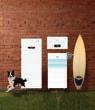
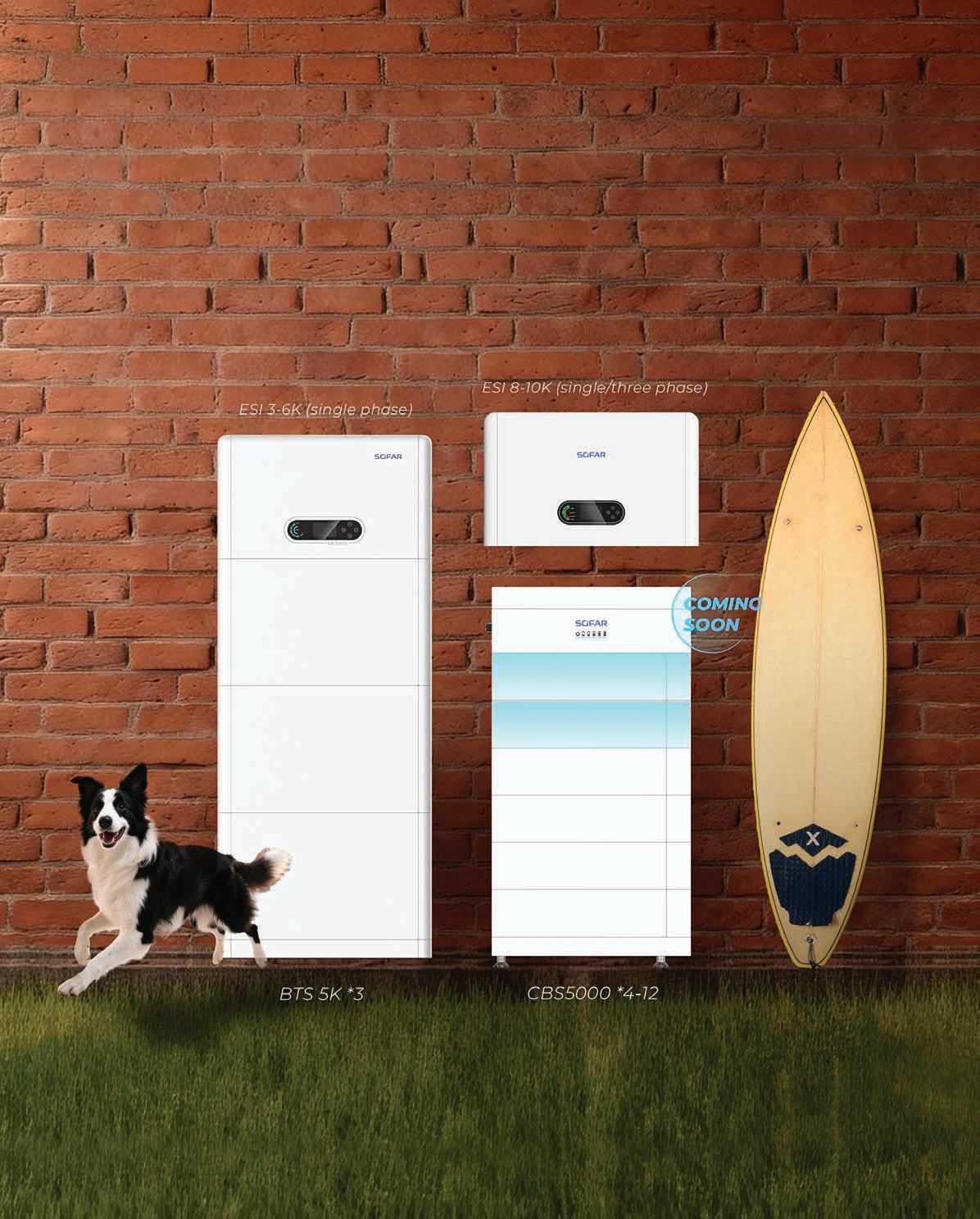
Cover image: SOFAR
ecogeneration is printed on Lumi paper which is PEFC-certified and manufactured in an ISO 14001-certified mill. Lumi paper also contains premium white waste paper, reducing matter going into landfill. This magazine is available to interested parties throughout Australia and overseas. The magazine is also available by subscription. The publisher welcomes editorial contributions from interested parties, however, the publisher and the Editorial Board accept no responsibility for the content of these contributions and the views contained therein are not necessarily those of the publisher or of the Editorial Board. The publisher and the Editorial Board do not accept responsibility for any claims made by advertisers. Unless explicitly stated otherwise in writing, by providing editorial material to Prime Creative Media, including text and images, you are providing permission for that material to be subsequently used by Prime Creative Media, whole or in part, edited or unchanged, alone or in combination with other material in any publication or format in print or online or howsoever distributed, whether produced by Prime Creative Media and its agents and associates or another party to who Prime Creative Media has provided permission.

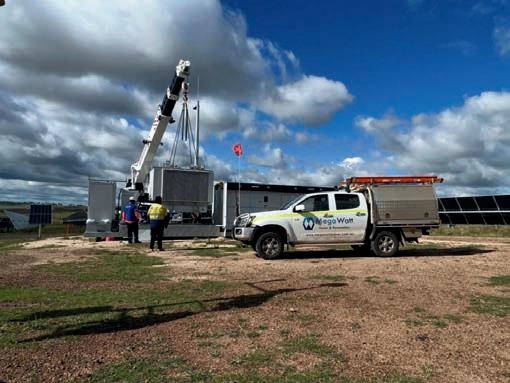
Mega Watt Power is a family-owned Australian business specialising in renewable energy design, installation, construction, and maintenance.
Based in Coffs Harbour, NSW, we operate across three specialist business units:
Utility-scale renewable electrical construction and servicing
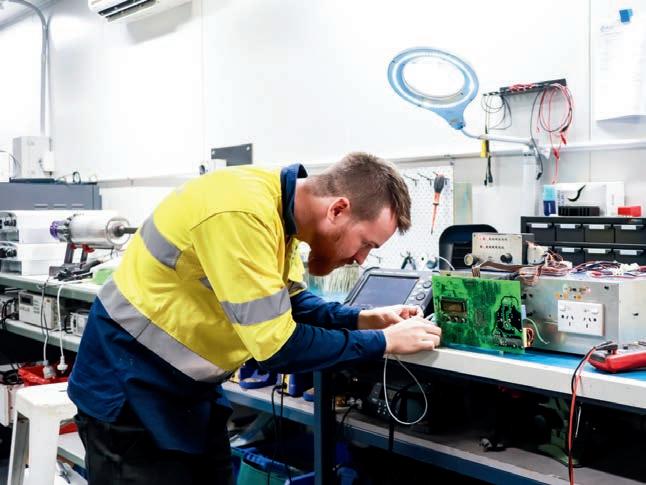
Electronics hardware repairs and maintenance
Solar power systems sales, installation and services
We employ a full-time local and remote FIFO workforce of around 50, supported by additional project staff as required. We deliver projects ranging from kilowatt systems to large-scale installations of hundreds of megawatts and bring over 36 years of proven experience in the renewable energy industry.
DC, LV & HV TEST & COMMISSIONING
SOLAR FARM ELECTRICALS
RECTIFICATION & REPAIRS
STATCOM CONSTRUCTION
HV SWITCHING & PLANNING
HV TERMINATIONS
IV-CURVE TESTING
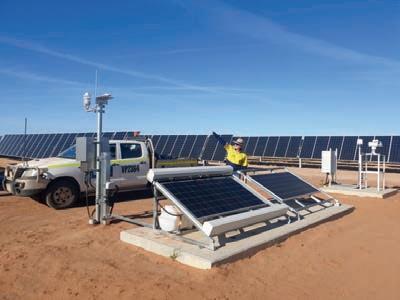
WEATHER STATIONS
O&M SUPPORT
SUBSTATION O&M
TRANSFORMER TESTING


BESS, INSTALLATION & MAINTENANCE
Australia’s clean energy transition accelerated sharply in the final months of 2025, with a record surge in renewable energy generation, battery storage and project investment.
More renewable electricity was switched on in the final quarter of 2025 than in any other quarter on record.
The Clean Energy Council’s Quarterly Investment Report: Large-scale renewable generation and storage (Quarter Four, 2025), found nine large-scale wind and solar projects were commissioned during Quarter Four, 2025, delivering 2.1 gigawatts (GW) of new generation capacity, which is the equivalent to powering at least 1.4 million homes, or Greater Brisbane approximately 1.5 times. The strong result broke the previous quarterly record of 1.3 GW in Quarter Three, 2021.
Utility-scale battery deployment also hit an all-time high. The quarter added one GW / 2.3 gigawatt-hours (GWh) of new storage capacity – more than tripling the previous record set just one quarter earlier (541 megawatts / 1766 megawatt-hours) and pushing the 2025 annual battery total (1.9 GW / 4.9 GWh) above the combined output of the previous eight years (2.2 GW / 3.8 GWh).
Investment momentum strengthened in the last quarter of the year, with five renewable generation projects reaching financial close in Quarter Four. These projects represent 1.2 GW of new capacity and $3.5 billion in value – an uplift from more subdued investment in the prior three quarters. It’s the second highest investment total recorded in a single quarter, behind Quarter Four, 2022 ($4.3 billion). The surge in project delivery and boost to investment in Quarter Four, 2025, coincided with major milestones across the National Electricity Market (NEM) towards
the end of last year.
The final quarter of last year saw many new renewables records broken. Sixty-three per cent of total renewable generation capacity that was switched on in 2025 was delivered in Quarter Four (2.1 GW). That scale of projects being commissioned in a single quarter is an Aussie first. In addition, renewable energy supplied over half (51 per cent) of all electricity in the NEM for the first time during Quarter Four, 2025, and reached up to 77 per cent of peak demand when the grid was pushed to its limits during January’s extreme heatwaves, according to the Australian Energy Market Operator.
As more renewable projects come online, we’re seeing them do exactly what they’re designed to do: Stabilise the energy system as coal-fired generators retire. It’s more evidence that Australia’s transition to renewables is well underway.
Australia is in a critical handover period from coal to renewables. Maintaining positive investment momentum will require faster planning approvals and grid connection across jurisdictions.
The seasonal rush to close out on projects before years’ end, together with more political stability in the second half of 2025, ended the year on a stronger note than how it started.
However, there’s still much work to be done to accelerate future investment in large-scale generation. This must include streamlining planning and approval processes and delivering the transmission infrastructure required to connect projects to the NEM. Combined with the world-leading uptake of
rooftop solar and home batteries, large-scale renewable projects across Australia are already making our energy system more reliable and resilient.
We’re now approaching half of our electricity consistently being supplied from renewables, and the construction pipeline is further solidifying this shift.
Among Australian states and territories, the report found South Australia led the nation with the fastest average time from financial commitment to commissioning – 19 months for solar farms and 23 months for onshore wind. South Australia and Victoria were tied for the quickest battery development timelines, averaging 20 months. Queensland commissioned four clean energy projects in Quarter Four last year (the most amongst Australian states).As projects approved under the former Queensland Government came online, clean energy projects continued to have the longest delivery timelines: 23 months for solar, 37 months for wind, and 28 months for utility-scalew batteries, against a backdrop of major energy policy reforms introduced by the current State Government in 2025. In 2026, the energy transition is being driven by households, businesses and investors - panel by panel and battery by battery.
Jackie Trad Chief Executive Officer Clean Energy Council


Australian households installed as many home batteries in the second half of 2025 as they did across the previous five years combined, underscoring a sharp acceleration in the shift towards home energy independence.
The Clean Energy Council’s bi-annual Rooftop Solar and Storage Report (JulyDecember 2025) found 183,245 battery units were sold in the last six months of 2025. This is a four-fold increase on the same period in 2024 and the equivalent to 99 per cent of total sales recorded between 2020 and 2024.
Total household battery installations now stand at 454,753 nationwide.
Rooftop solar remains strong, with 254,664 systems installed in 2025, including 139,080 in the back half of the year. Rooftop solar photovoltaic contributed 14.2 per cent of national electricity supply in 2025, which is up from 7.2 per cent in 2020. Australia added 2.6 gigawatts (GW) of rooftop capacity last year, bringing total installed rooftop solar to 28.3 GW. This surpasses the nation’s 22.5 GW coal fleet.
Jackie Trad, Chief Executive Officer at Clean Energy Council, affirmed that Federal
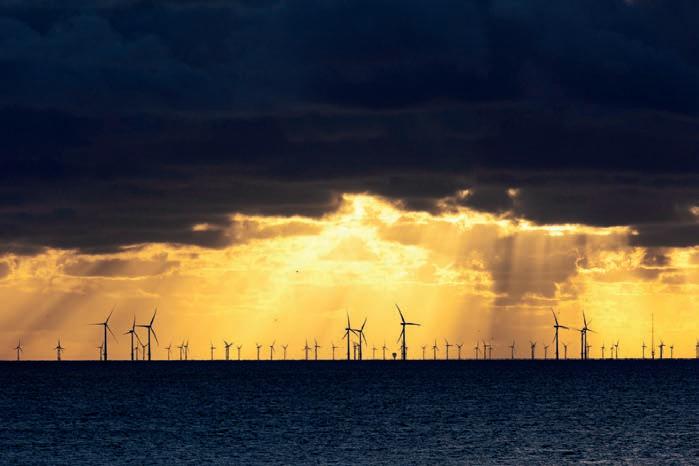
advanced its offshore wind ambitions, confirming that the state’s first offshore wind auction will proceed later this year. The process will seek proposals for two gigawatts (GW) of offshore wind
construction and long-term operation. This could support thousands of jobs across Victoria’s growing clean energy supply chain. The Clean Energy Council (CEC) welcomed the announcement.
Jackie Trad, Chief Executive at the CEC, shared that the auction marks a critical step in advancing Victoria’s offshore wind industry and progressing more projects into the delivery phase. She added that offshore wind will play an important role in maintaining system security and reliability as coal-fired power exits the grid.
Beyond electricity supply, offshore wind is projected to be a major employment driver. Victoria’s energy workforce is forecast to exceed 67,000 workers by 2040, more than double its current size in 2026. Offshore wind alone is expected to support a peak construction workforce of around 2370 jobs, alongside more than 4200 roles in onshore wind, with additional flow-on benefits for the workforce across manufacturing, ports, logistics and ongoing operations. The Victorian Government’s announcement follows recent offshore wind developments in Western Australia, underscoring national momentum for wind generation.
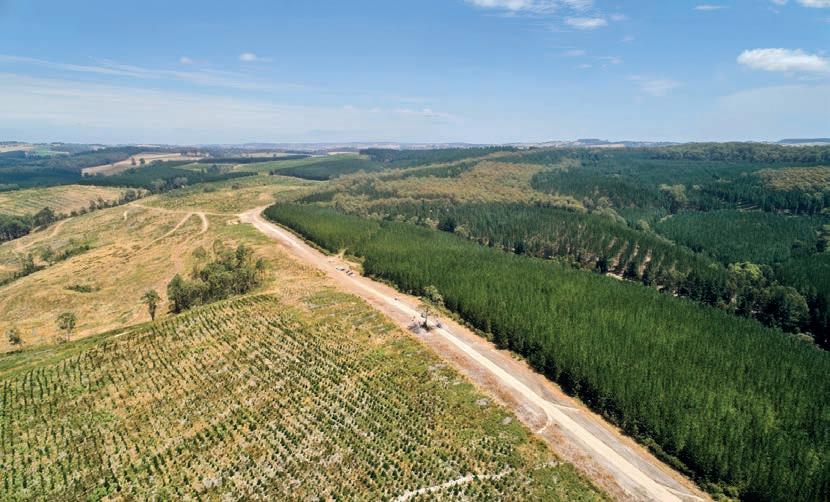
Preliminary works have begun on the State Electricity Commission’s (SEC) Delburn Wind Farm in Victoria’s Gippsland region, marking an early project milestone in the development of the state’s first publicly owned utilityscale wind project.
Located near the Latrobe Valley in south-east Victoria, the Delburn Wind Farm is expected to generate up to 205 megawatts of renewable electricity by 2028 – enough power to supply more than 130,000 homes.
The early stage of construction includes site preparation and the installation of five 130,000-litre firefighting water tanks, forming part of a comprehensive bushfire risk management strategy for both construction and long-term operation.
Initial works involve harvesting sections of pine plantation to create a construction compound to install the water tanks. These activities began in mid-February 2026 near Smiths Road and the Strzelecki Highway at Delburn, largely using existing access roads to minimise disruption.
Fire safety planning is a central design feature of the project. In addition to
water storage tanks, the wind farm will include fire detection and suppression systems within each of the 33 turbines, as well as fire-monitoring camera networks across the site. The project is also expected to deliver more than 300
construction jobs and over $22 million in community benefit programs, with upcoming information sessions across Gippsland set to connect local businesses and suppliers with project work opportunities.
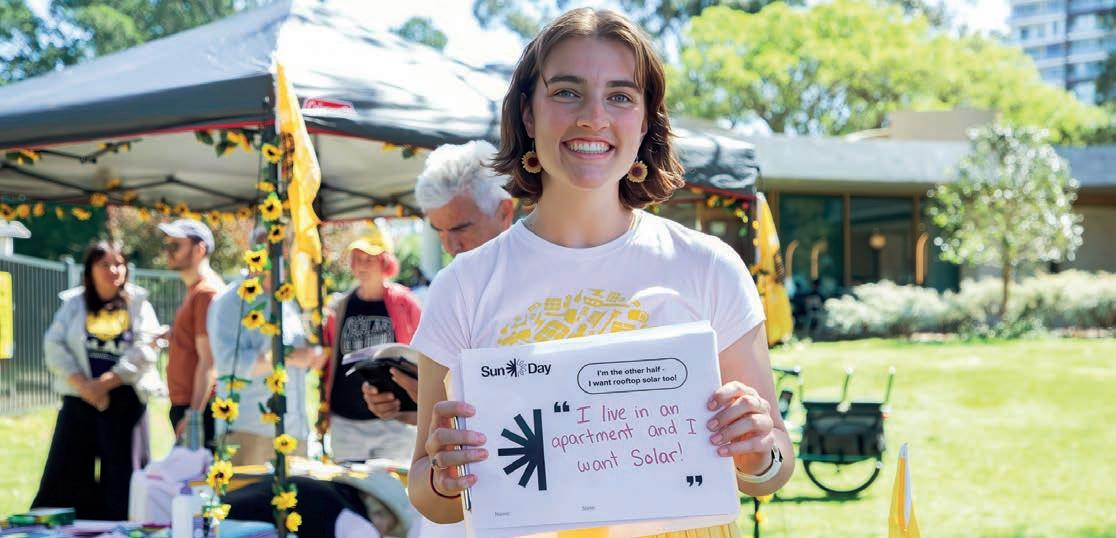
Advocacy group Solar Citizens has outlined a series of policy proposals in its Federal Government Pre-Budget submission, aimed at improving access to rooftop solar and shared renewable home energy and storage for renters and apartment dwellers.
The submission notes that rooftop solar adoption continued to grow in 2025, with more than 4.2 million households and businesses hosting solar systems and over 200,000 have installed home batteries. However, approximately one-third of
Australians are still unable to access home clean energy technologies.
Heidi Lee Douglas, Chief Executive at Solar Citizens, said the challenge is driven by the “split incentive” between landlords and tenants, where property owners fund upgrades while tenants receive the resulting energy bill savings.
For rental properties, Solar Citizens recommends linking state minimum efficiency standards with a federal tax incentive, including accelerated depreciation for solar, batteries, insulation and heat pumps, while protecting tenant
Solar Citizens also calls for $100 million towards Urban Renewable Energy Zone pilots backed by the Australian Renewable Energy Agency (ARENA) to unlock up to 28 gigawatts of commercial rooftop potential
The submission also highlights electric vehicles (EV) as a potential source of future energy storage capacity. ARENA estimates vehicle-to-grid charging could account for more than one-third of total energy storage by 2030, potentially deferring up to $94 billion in large-scale battery investment. Therefore, Solar Citizens proposed a $300 million incentive to support the uptake of bidirectional EV chargers through the Smallscale Renewable Energy Scheme.
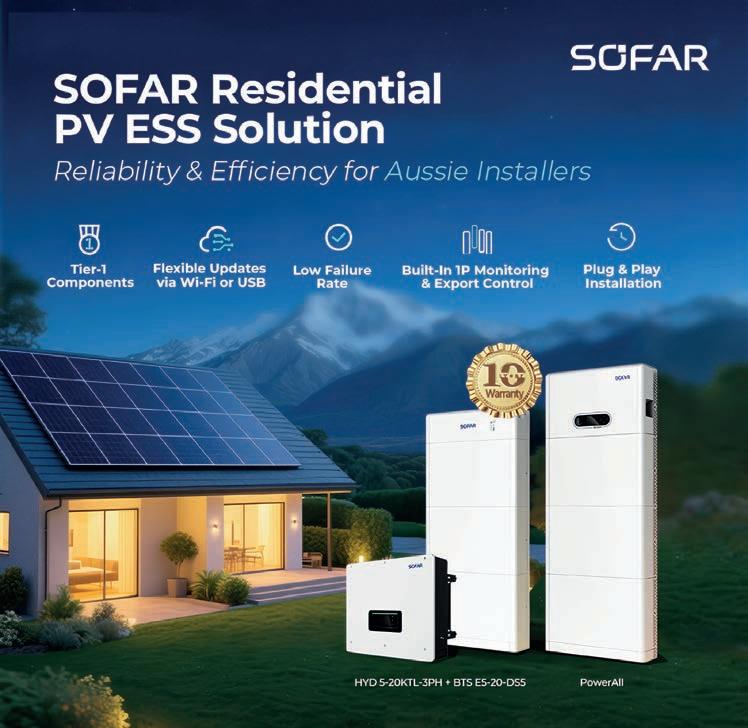
Queensland’s rooftop solar growth will hinge on engineering that reduces friction across design, logistics, installation and maintenance. As exemplified by SOFAR Solar, industry efforts must support installers, including skilled female professionals making an impact.
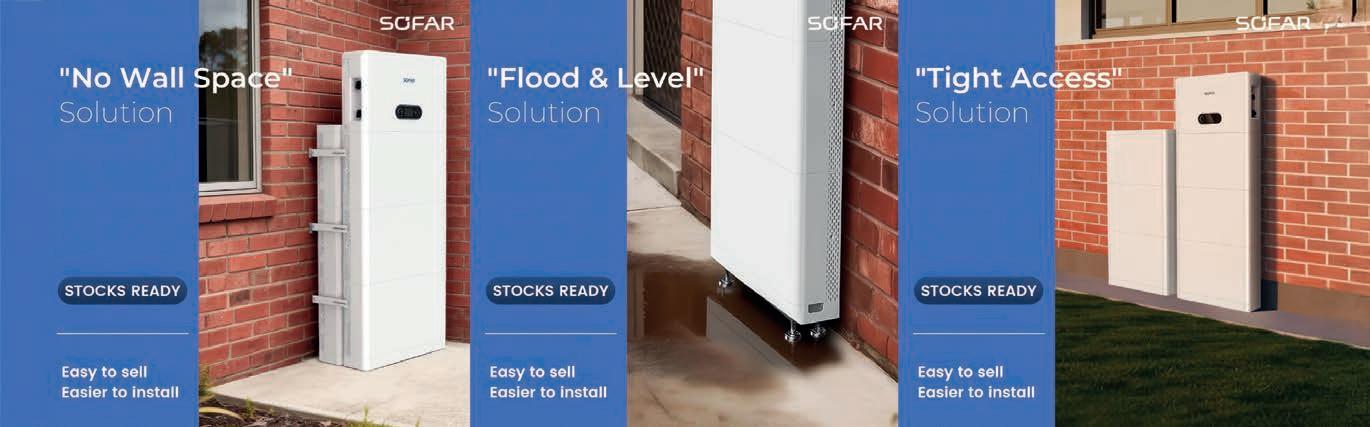
Australia’s rooftop solar success story is now well established. More than four million small-scale solar systems have been installed nationwide, with around one in three Australian homes hosting rooftop photovoltaic (PV), according to the Clean Energy Regulator and the Department of Climate Change, Energy, the Environment and Water.
Queensland sits at the centre of this transformation. The state consistently records some of the highest levels of smallscale solar capacity in the country, leading national installation figures in multiple reporting periods.
As distributed solar grows, the role of residential battery storage is shifting. The Australian Energy Market Operator (AEMO) notes in its 2024 Integrated System Plan that orchestrated distributed energy resources (DER), including household batteries, will be critical to maintaining grid stability as renewable penetration accelerates.
For installers however, delivering this gridsupporting future depends on overcoming four persistent bottlenecks: Design, logistics,
installation, and long-term maintenance.
SOFAR’s latest innovations provide a case study on how engineering decisions can address these constraints, particularly within Queensland’s demanding climate and network conditions, while supporting a more inclusive installer workforce.
Queensland’s electricity network faces increasing complexity as rooftop solar exports continue to rise. AEMO has repeatedly highlighted voltage management and minimum demand challenges in states with Distributed Energy Resources, including Queensland and South Australia.
In this environment, residential batteries are evolving from optional add-ons to grid assets, absorbing excess solar generation and supporting voltage stability. For installers, safety and reliability are paramount.
SOFAR integrates Arc Fault Circuit Interrupter detection aligned with IEC 63027 standards, enabling rapid detection and interruption of direct current arc faults. In Queensland’s high-temperature roof spaces
and switchboards, rapid fault detection reduces escalation risk, particularly during summer peak periods when thermal stress is elevated.
Linda Lu, Australia Sales Head at SOFAR Australia, one of the experienced female technical leaders at the company shares: “In high-solar states like Queensland, operational certainty is everything. Rapid fault detection protects both the technician’s reputation and the customer’s home.”
Physical separation between battery modules and electrical components further reduces concentrated heat risk within enclosures. This is a practical response to Australia’s operating conditions.
For women entering technical and engineering roles, robust safety architecture also builds confidence onsite. As the Clean Energy Council’s Women in Renewables initiative continues to highlight, improving participation in technical roles requires workplaces and equipment designed with safety and accessibility in mind.
In turn, this enables installer trust in highdemand environments.
Scaling storage across Queensland’s geography
Australia’s scale introduces a common constraint shared among the state’s energy sector: Distribution efficiency.
Queensland’s dispersed population centres, from metropolitan Brisbane to regional hubs such as Townsville and Cairns, create logistical complexity. Stock management inefficiencies quickly erode installer margins, particularly for small and regional businesses.
Battery storage uptake is expected to accelerate further following the Federal Government’s Cheaper Home Batteries Program, which provides financial support for eligible battery installations through the Small-scale Renewable Energy Scheme framework. As incentive-driven demand fluctuates, distributors require flexible inventory systems.
Historically, batteries held in storage required periodic recharge cycles to prevent state-of-health degradation. SOFAR’s low-consumption Hibernation Mode allows extended storage without recharge, addressing this operational friction.
For Queensland installers that regularly service regional communities, site-ready stock can effectively reduce travel risk and pre-install uncertainty.
“Regional logistics can erode margins quickly. Having site-ready storage that requires zero maintenance in the warehouse is critical for our project profitability,” says Sid Shaheed, General Manager at Sunsavers Group (SOFAR’s key partner).
As AEMO’s Integrated System Plan forecasts continued growth in distributed batteries through to 2030, logistical resilience will be essential to scaling deployment beyond urban centres.
Installation workforce realities
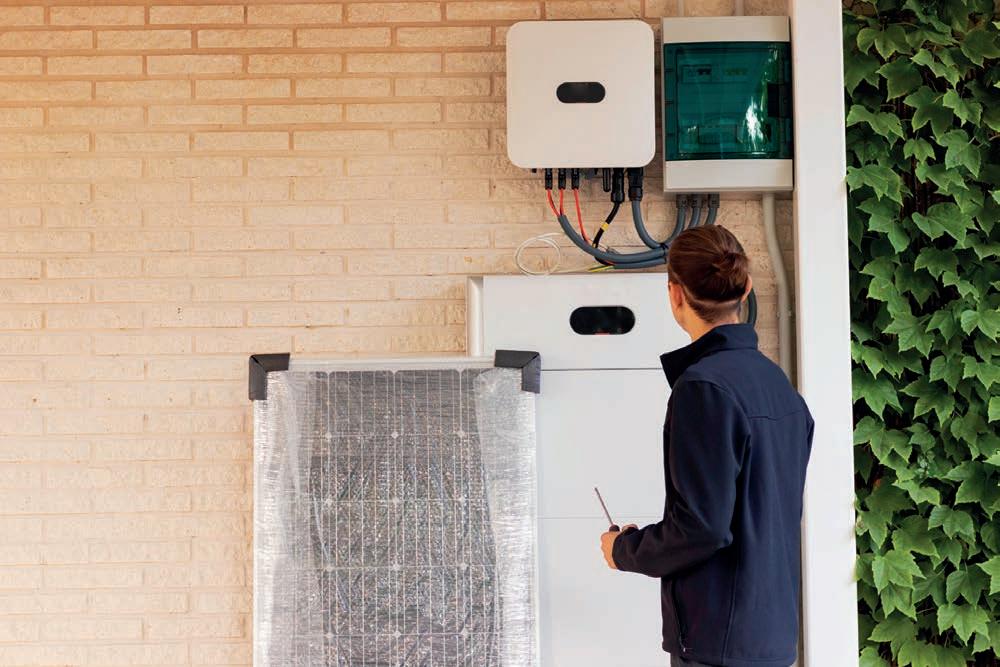
Workforce capability is an emerging issue in Australia’s clean energy transition. The Clean Energy Council repeatedly identified skills shortages across solar and storage trades, emphasising the importance of increasing female participation to meet workforce demand. Equipment design directly influences and safely onsite is a factor. SOFAR caps inverter weights at 35 kilograms and incorporates tool-free quick connectors and pre-assembled cabling, reducing commissioning time and physical strain. These design choices are particularly relevant in Queensland, where installers often work in elevated temperatures and on confined roof spaces. Commissioning
efficiency also supports participation in Virtual Power Plants (VPPs).
The AEMO identifies VPPs as increasingly important for grid orchestration and peak demand management.
“In 35-degree heat, every kilogram counts. Lighter systems and tool-free connectors make high-quality installs safer and more

accessible for everyone,” says Sarah Jenkins, Australian Field Technician for SOFAR Solar. Reducing ergonomic strain broadens accessibility within the trade. As the women in renewables movement continues gaining momentum nationally, product design that respects physical diversity supports workforce expansion. Inclusion, in this context, is not abstract, it is engineered.
Australia’s early models of residential solar adopters are now entering upgrade cycles. Many households are expanding battery capacity to accommodate electric vehicle charging, electrified heating and growing clean energy demand.
The Clean Energy Regulator reports consistent growth in battery installations year-on-year, reflecting increasing consumer interest in storage integration alongside rooftop PV.
However, system expansion has historically presented technical challenges. Mixing new and older battery modules can result in performance constraints driven by differing states of health.
SOFAR’s Active Equalisation technology enables modules with varying states of charge and health to operate cohesively within a single system. For installers, this
simplifies future expansion without forcing premature replacement.

corridors, where new housing developments frequently integrate solar from the outset, scalable storage solutions are becoming an expected upgrade pathway.
“Home energy systems must evolve. Our goal was to enable installers to expand capacity years later without the risks of battery unbalancing,” says Lei Yan, Technical Professional at SOFAR.
For regional service technicians, predictable harmonisation also reduces diagnostic complexity and return visits.
This is a significant advantage in geographically dispersed markets.
From bottlenecks to ecosystem Queensland’s renewable energy trajectory continues to accelerate.
The state’s Energy and Jobs Plan targets 70 per cent renewable energy by 2032 and 80 per cent by 2035.
Achieving these targets will depend on both large-scale generation and coordinated distributed resources.
AEMO’s modelling confirms that orchestrated household batteries will form a growing share of Australia’s firming capacity in coming decades.
For manufacturers, this shift demands
reported that SOFAR shipped more than 37 gigawatts globally and invested significantly in research and development.
In Australia, however, competitive differentiation increasingly hinges on field performance rather than shipment volume.
“Engineering for the field means designing for high heat and complex logistics,” says Andrea Cao, Engineering Professional at SOFAR.
“Inclusive and intuitive design is what will ultimately scale Australia’s decarbonisation from 2026 and beyond.”
As women in renewables initiatives continue building visibility and leadership pathways, inclusive engineering becomes a strategic advantage.
Lightweight architecture, simplified commissioning and predictable diagnostics support a broader installer base.
In a market where distributed energy resources are central to national decarbonisation targets, reliability is no longer aspirational, it is foundational.
The four installer bottlenecks remain real. But with design-led innovation grounded in Australia’s regulatory and operational environment, they are increasingly solvable.
For Queensland’s installers, and the women shaping the next chapter of the industry, engineering certainty is a defining metric of progress.
9-12 June 2026
9-12 June 2026
Over 100 speakers, including:










Melbourne Convention and Exhibition Centre
Melbourne Convention and Exhibition Centre
Australian Energy Week has established itself as the leading conference and exhibition for the entire energy value chain, bringing together leaders from generators, transmission & distribution, retailers, renewables & BESS developers, government and large energy users.
If you want to get across what’s happening in Australia’s energy sector, or meet those shaping it, then this is the place to be.
Australian Energy















































































































































This year, the 8 streamed sessions at Energy Week will


Grid (Transmission)
Optimising major transmission projects to minimise cost
Optimising major transmission projects to minimise cost and maximise system benefit Grid (Distribution)
Exploring how DNSPs can solve major grid challenges, with less infrastructure build Retail Strategies
Generation
Grid (Distribution)
Orchestrating flexibility to manage a highly volatile grid - gas peakers, firming and large users
Navigating the shift to flexible demand and customer-side participation
Retail Strategies
Optimising major transmission projects to minimise cost and maximise system benefit
Commercial models, long duration storage, and grid supporting opportunities










Navigating the shift to flexible demand and customer-side participation
Content with clear commercial value


Renewables Development
Funding, connections & project approvals - finding ways to build more, faster



















the entire energy value distribution, retailers, If you want to get across shaping it, then this Australian Energy Week is From industry leaders to emerging

This year, the 8 streamed sessions at Energy Week will cover: Why attend?
Australian Energy Week is the premier annual event that brings together key players from across the entire energy supply chain. From industry leaders to emerging innovators.
Renewables Development
Renewables Development
The only event spanning The energy transition can’t developers, investors, users outcomes.
Funding, connections & project approvals - finding ways to build more, faster
Retail CER/DER
Batteries
entire energy supply chain. The energy transition can’t be delivered in silos. Energy Week brings together leaders from generation, networks, retail, storage, developers, investors, users and government - all under one roof - to accelerate collaboration and deliver real commercial outcomes.
Funding, connections & project approvals - finding ways to build more, faster The
Generation
Networking designed to deliver meaningful connections
Exploring how DNSPs can solve major grid challenges, with less infrastructure build
Driving the energy transition with consumers and unlocking value through participation
Retail CER/DER
Driving
Driving the energy transition with consumers and unlocking value through participation
Beyond BESS; how batteries at the grid edge (including VPPs, V2G and home & community batteries) can change the grid
Generation
Commercial models, long duration storage, and grid supporting opportunities Batteries
Beyond
Orchestrating flexibility to manage a highly volatile grid - gas peakers, firming and large users Australian Energy
The only event The energy transition developers, investors, outcomes.
Content with clear commercial With 100+ sessions across takeaways; helping you find Networking designed to Energy Week is a concentrated than any other event, you
and government outcomes.
With 100+ sessions across a main stage and eight focused streams, the agenda offers both strategic insight and practical takeaways; helping you find the ideas, case studies and perspectives you need to make better business decisions.
Orchestrating flexibility to manage a highly volatile grid - gas peakers, firming and large users
Beyond BESS; how batteries at the grid edge (including VPPs, V2G and home & community batteries) can change the grid
Content with clear commercial value With 100+ sessions across a main stage and takeaways; helping you find the ideas, case Networking designed to deliver meaningful Energy Week is a concentrated gathering than any other event, you are guaranteed
Energy Week is a concentrated gathering of energy professionals where you can meet the people that matter. With more CEOs than any other event, you are guaranteed access to a senior group of energy leaders.
Content with With 100+ sessions takeaways; helping Networking designed Energy Week than any other Generation
Orchestrating flexibility to manage a highly volatile grid - gas peakers, firming and large users
Orchestrating flexibility to manage a highly volatile grid - gas peakers, firming and
Organised by:
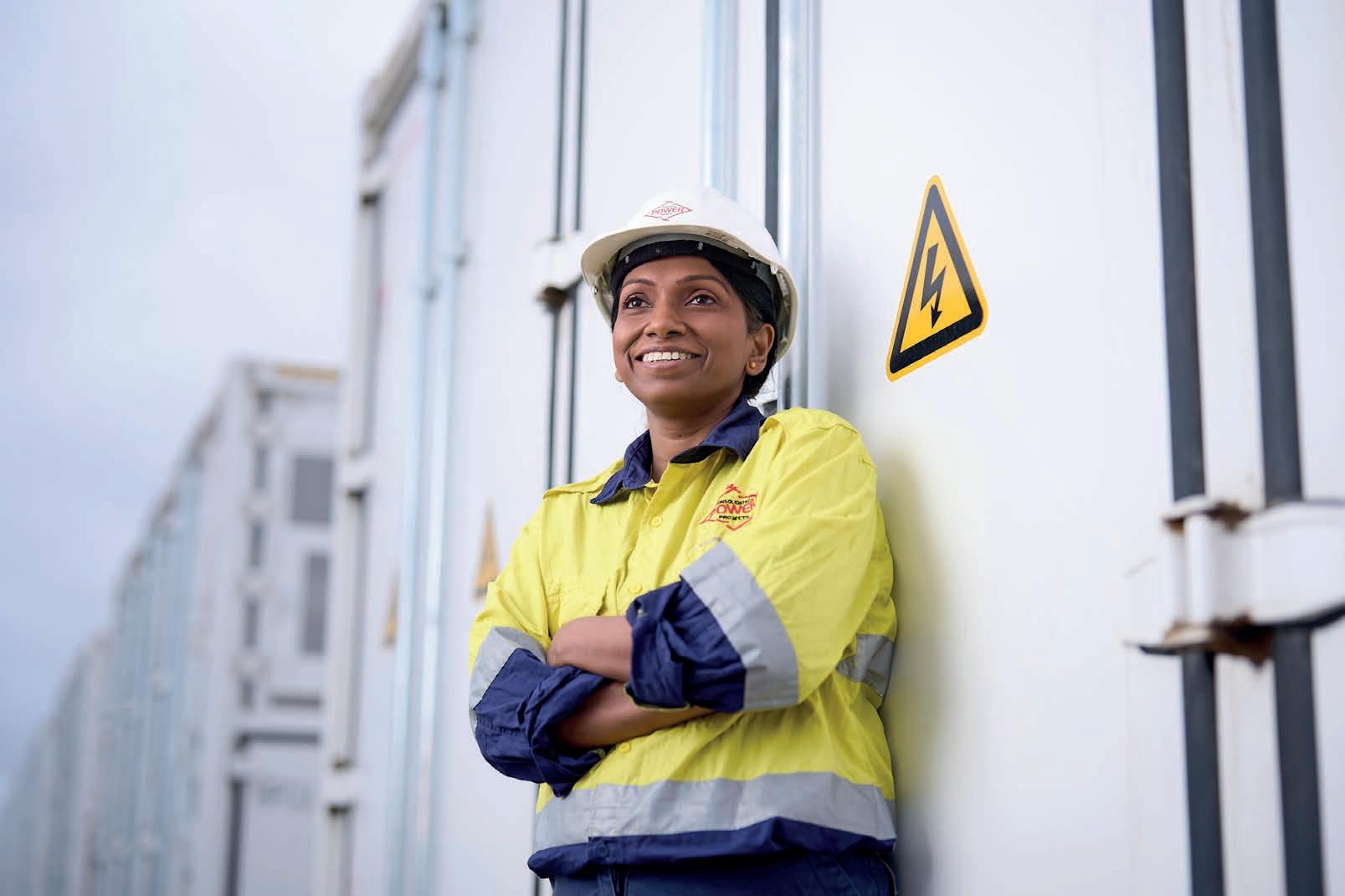
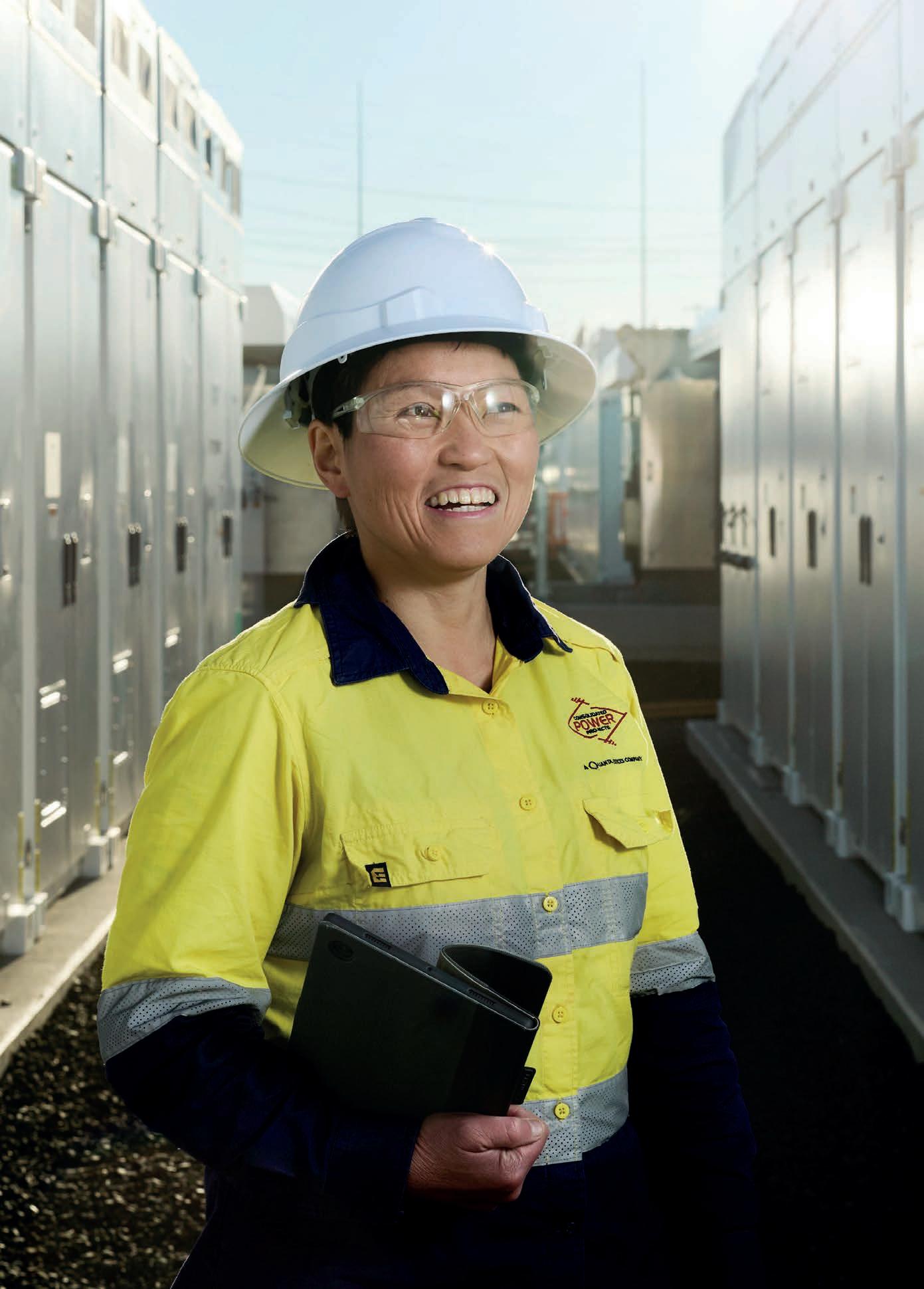
Behind every renewable energy project lies the high-voltage infrastructure that allows electricity to reach the grid. At Consolidated Power Projects Australia Pty Ltd, women are increasingly contributing to the engineering, design and delivery of these systems.
Large-scale wind farms, solar projects and battery energy storage systems rely on high-voltage substations and transmission lines to export renewable electricity into the network.
Organisations delivering this infrastructure therefore play a critical role in enabling the clean energy transition. Among them is Consolidated Power Projects Australia Pty Ltd (CPP), an engineering, procurement and construction company specialising in high-voltage electrical infrastructure. Established in 2008 and operating as part of the global infrastructure group Quanta Services since 2014, CPP delivers substations, transmission lines and grid-connection infrastructure across
Australia. Recent projects include balanceof-plant electrical delivery for Akaysha Energy’s Orana Battery Energy Storage System, engineering services for Stage Two of the Golden Plains Wind Farm, transmission upgrades at Cressy Terminal Station, and grid-connection infrastructure for the Hawkesdale Wind Farm.
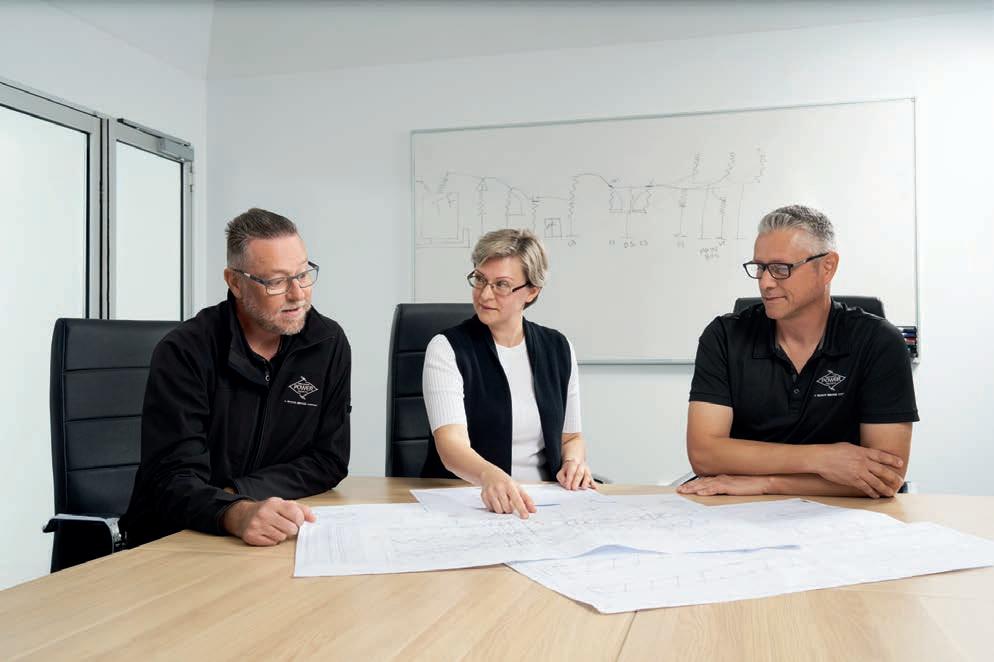
Running these projects are multidisciplinary teams of engineers who coordinate complex design and construction work that connects renewable generation to the grid. The experiences of two female engineers in the field – Kokila N Adamnathan and Natasha Bryksin – provide insight into the practical challenges of delivering large-scale energy infrastructure.
Kokila N Adamnathan, Design Manager at CPP, works across projects that require coordination between engineers, designers and project teams.
High-voltage infrastructure projects typically involve multiple engineering inputs and tight delivery timelines. Therefore, maintaining structure across teams is an essential part of the role.
“Our projects are time-sensitive and have a lot of inputs that are needed to complete designs. And so, it’s important that I’m able to manage my time and work with the team members to ensure they’re on task to ultimately deliver a successful project on time and on budget,” Kokila says.
Developing strong organisational habits early in her career helped prepare her for managing these environments.
“One of the lessons I learnt early in my career was to be organised and very clear about what I need to achieve in my day. In this fast-moving sector, you must set yourself up for the next day, the week after, and the month after in unison,” Kokila says.
Kokila’s career pathway has also involved working across multiple engineering sectors before moving into renewable infrastructure.
“I’ve worked across different sectors like offshore wastewater and power, which gave me early exposure to the vast engineering disciplines,” Kokila says.
“Graduates new to the industry should try to get exposure across different projects. Project workstreams include site works, commissioning and drafting. That helps you understand what’s involved in different stages of complex projects.”
Collaboration across teams is also central to delivering large infrastructure projects.
“What I really enjoy about working at CPP is the culture. We’ve built good rapport within our teams and know we have each other’s backs during busy periods. At the same time, everyone takes accountability for their individual responsibilities within projects because they’re passionate about what they do,” Kokila says.
This shared commitment is particularly critical because renewable energy projects often involve multiple technical disciplines and stakeholders.
Designing transmission links
Natasha Bryksin, Senior Transmission Line Designer at CPP, has spent the past 15 years helping to design the infrastructure that connects renewable energy projects to the electricity grid. Transmission lines play a critical role in this process, forming the physical link that allows renewable power to flow from generation sites into the network.
“Typically, we have a developer for a wind or solar farm that needs to be connected to the grid. A transmission line is constructed between the project substation and the grid substation. We build the transmission line, with poles, towers and conductors that connect the two,” Natasha says.
Transmission design involves modelling terrain, determining conductor tensions and analysing structural loads using specialised engineering software.
Natasha shares that technical variation across projects keeps the work engaging.
“You might think designing transmission
lines would be fairly typical, but it isn’t. There’s different clients, terrains and structures,” she says.
She also values the tangible outcome of the work.
“We don’t only design something as a concept. We have a chance to make it a reality. Later on, you can look at the transmission line and proudly say, I helped build that,” Natasha says.
Another distinctive aspect of the job is the close relationship between design and construction teams.
“We’re not just producing concepts. What we design is what we build. There’s close collaboration between the design and construction teams. We discuss how things will be built during the design stage so that the design can be constructed effectively by other teams,” Natasha says.
Both engineers highlight the importance of knowledge sharing and collaboration within engineering teams.
“The knowledge base we have at CPP is extensive. The many Principal Engineers know what they’re doing and are willing to share that knowledge with young engineers. Throughout my time with the company, I have never had requests for training or development declined. Management understands that people are the most valuable asset,” Natasha says.
The multidisciplinary structure of the organisation also supports collaboration across engineering disciplines.
“We have primary, structural, civil, construction and commissioning teams under one umbrella. Talking to people from different teams gives you a broader understanding of how projects work,”
Natasha says.
Kokila and Natasha both say that women are understandably attracted to careers as engineers in renewable energy infrastructure for a combination of reasons: Purposedriven work, strong career opportunities, collaborative workplace culture, and visible representation within the sector.
“What excites me in this renewables era are the many opportunities and hybrid projects coming out,” Natasha says.
“Working with clients and navigating project delivery challenges with our teams makes it a very interesting time to be the industry,” Natasha adds.
“Being a woman in the industry is not a limitation, it’s the norm. You don’t have to look far to see capable women leading teams,” Kokila says.
Natasha offers similar encouragement to young engineers entering the sector, whether that be women or men.
“Ask questions, be curious and be passionate about what you do. If you give it 100 per cent, you’ll learn, grow, and go far in this sector,” she says.

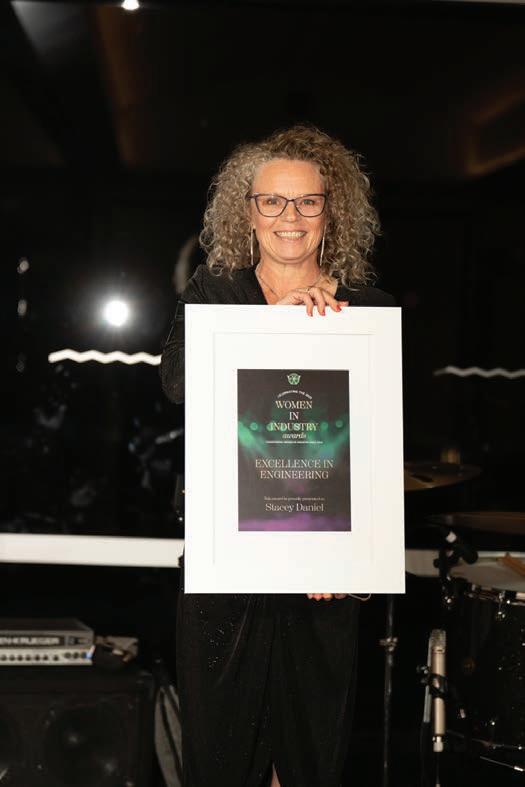
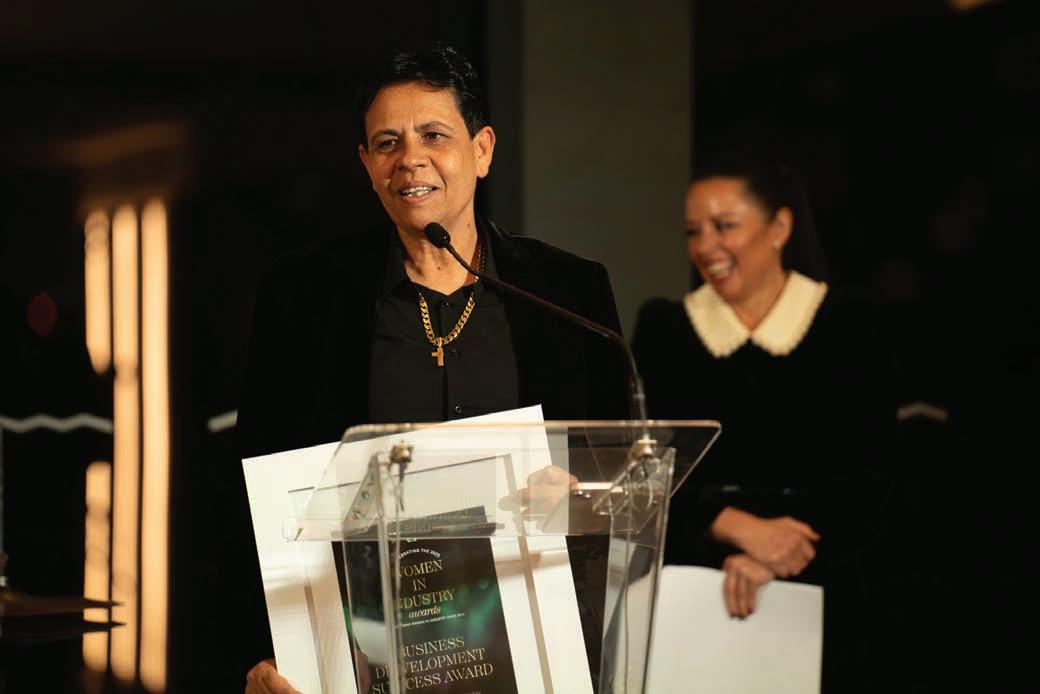
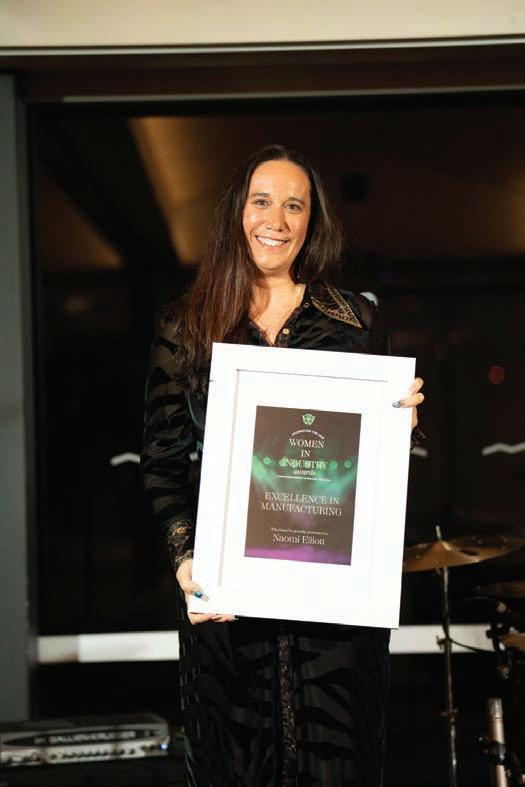
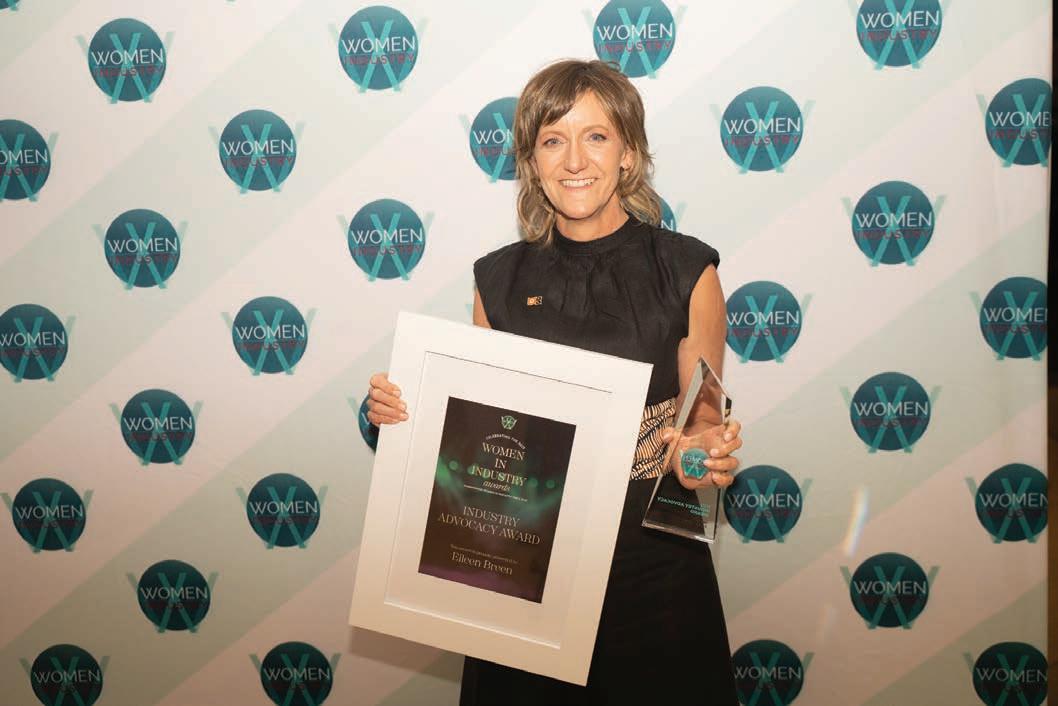
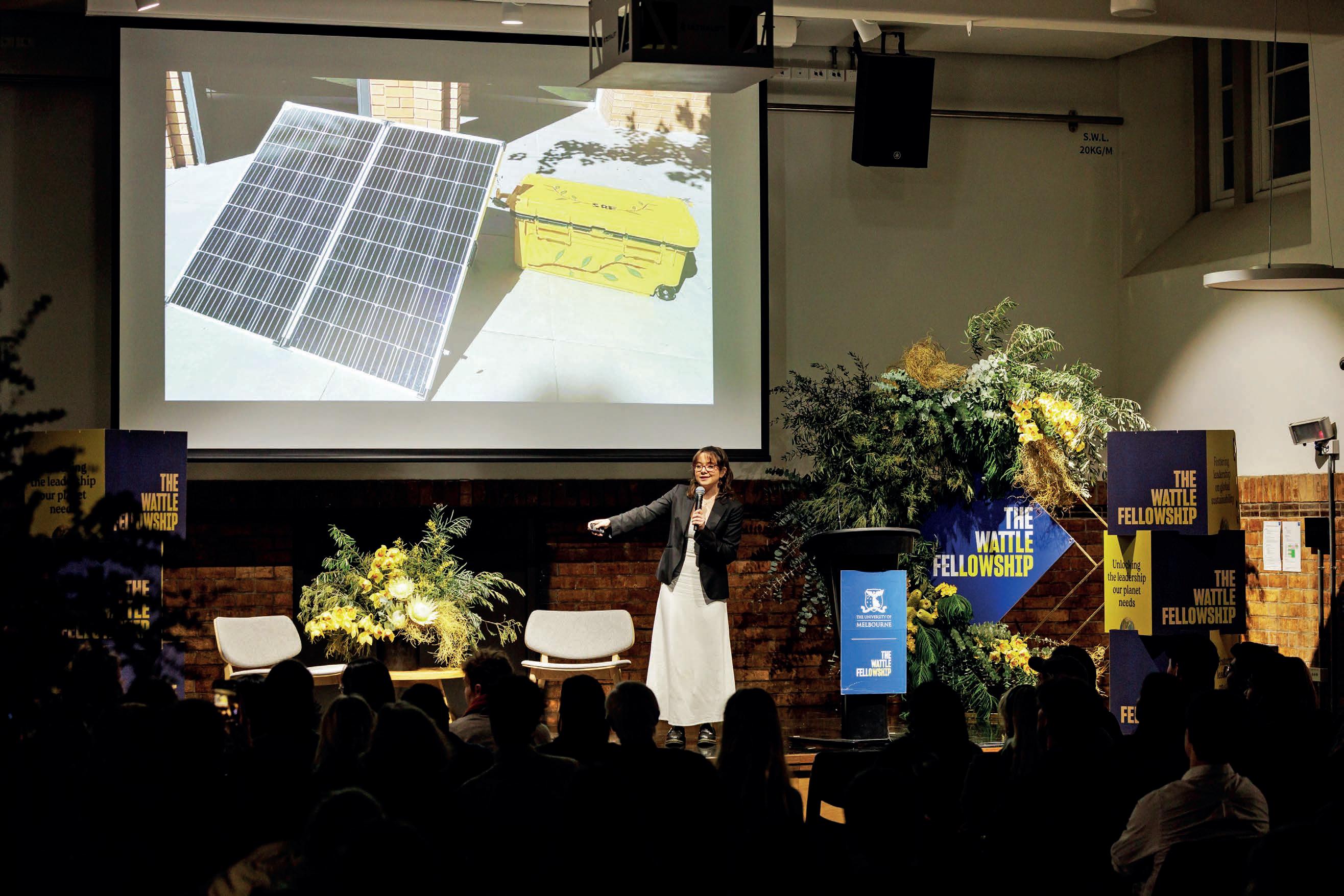
At 22-years-old, Jacinta Fitzgerald, Grid Connections Engineering Intern at the Australian Energy Market Operator, is one of the emerging women in renewables showing the value of diversity in meeting ambitious net zero goals.
Through initiatives such as the Equality in Energy Transitions Initiative and the global Equal by 30 Campaign, Federal and State governments alongside industry are aiming to close the gender gap in clean energy by expanding pathways for women in technical and engineering roles.
One example of this shift can be seen inside the Australian Energy Market Operator (AEMO), where internship and graduate programs are helping to develop the next generation of energy system specialists responsible for integrating renewable energy into the grid.
At a time when only about one-third
of Australia’s clean energy workforce are women, particularly under-represented in technical roles, young engineers like Jacinta Fitzgerald, a Grid Connections Engineer Intern, illustrate how policy ambitions are translating into real workforce change.
Working on the technical assessments that determine how wind, solar and battery projects connect safely to the National Electricity Market, Fitzgerald’s role highlights the growing importance of her grid engineering expertise, and the opportunity for more women to shape the infrastructure underpinning Australia’s energy transition.
To address the low representation of women in engineering, construction and technical roles needed to design, build and operate renewable energy infrastructure, organisations such as AEMO are increasingly seeing gender representation not only as a diversity objective, but also as a workforce strategy.
As a signatory to the Equal by 30 Campaign, AEMO is actively working to improve female participation and leadership representation across its workforce. Early-career programs have become one of the most practical mechanisms for achieving this.
AEMO’s internship program offers university students the opportunity to work part-time alongside their studies while gaining hands-on experience across Australia’s energy markets. Available to undergraduate and postgraduate students, internships are typically offered across AEMO offices in Melbourne, Sydney, Brisbane, Adelaide, Hobart and Perth, and often serve as a pathway into the organisation’s two-year Graduate Development Program.
For Fitzgerald, joining the organisation in November 2025 provided an opportunity to connect her academic studies with realworld energy system challenges.
“I first became interested in working in energy in high school,” she says.
“I’ve always cared about the environment and climate change, and came to the belief that we needed to stop burning fossil fuels. To play my part, I chose to work in renewable energy.”

“I’ve always been STEM-minded and therefore considered engineering the natural career path for me,” she says.
scholarship program, which supports university students interested in power systems engineering.
“I was fortunate to be placed at AEMO over summer 2025-26 in the Onboarding and Connections Team. I’ll continue to work with the team part-time while completing my degree,” Fitzgerald says.
“In my team at AEMO, we’re responsible for enabling the connection of new energy projects and alterations. This currently means a lot of battery energy storage system and hybrid projects.”
“In my role, I’m learning how to conduct grid studies using power systems software to make sure that grid connections comply with their generator performance standards and the National Energy Rules so that our grid can operate safely and securely long-term.”
Now 22 years old, Fitzgerald is currently studying a Master of Engineering, specialising in Low-Carbon Power Systems, at the University of Melbourne.
After moving from Brisbane to Melbourne to begin her studies, Fitzgerald secured her internship through the Australian Power Institute’s Power Up
Grid-connection engineering has become a critical part of Australia’s renewable energy rollout, particularly as the electricity system transitions away from large centralised power stations towards geographically dispersed renewable generation.

“Grid connections are often described as a bottleneck in the grid-connection process, but are so important in ensuring we have a safe future energy system that’s resilient to blackouts,” Fitzgerald says.
The workforce needed for net zero While workforce diversity is improving, engineering remains one of the most maledominated professions in Australia.
“I do certainly notice the lack of female representation in technical engineering roles. However, I don’t let this deter me because the female engineers I’m
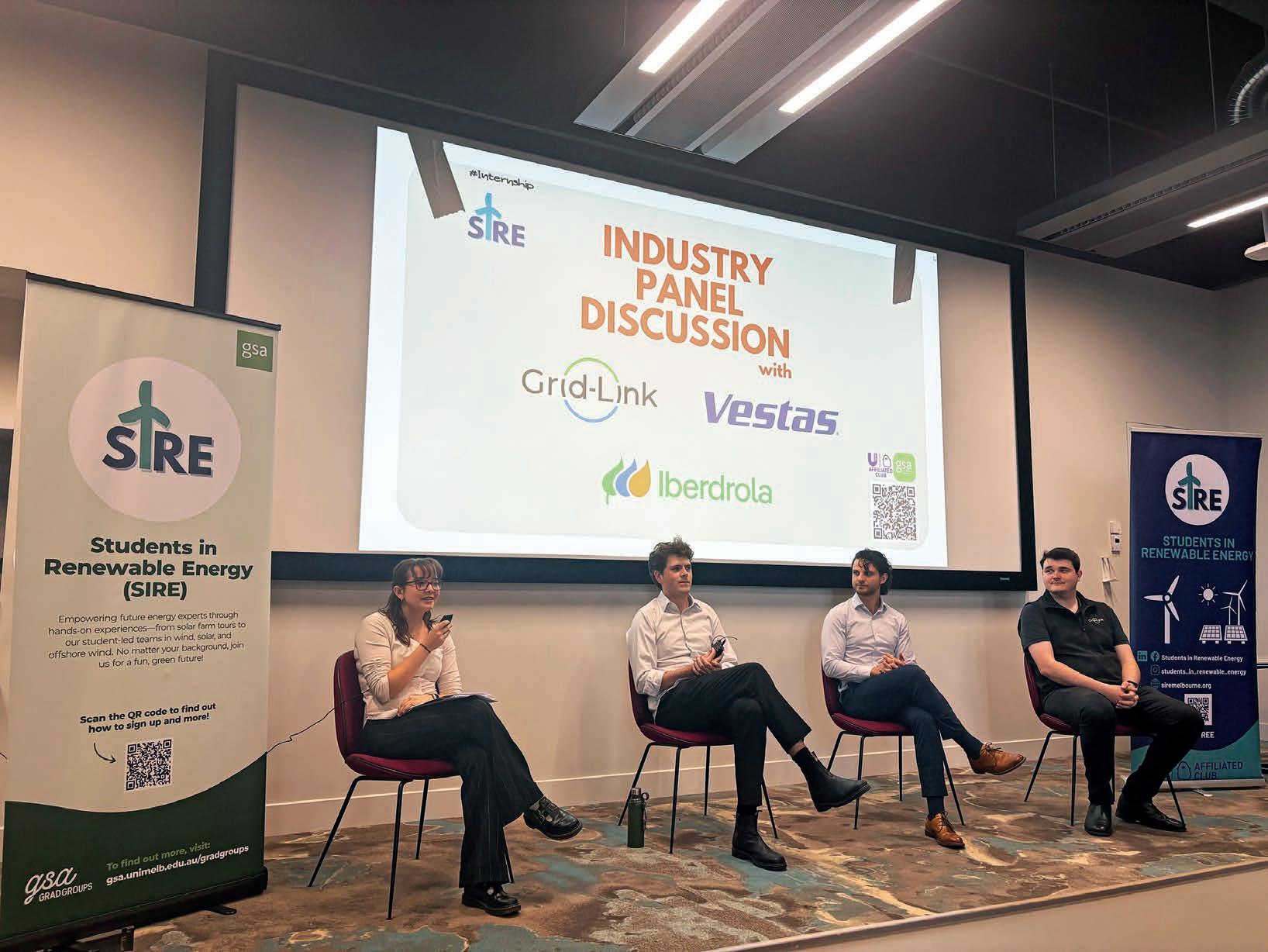
Beyond her internship, Fitzgerald is also involved with Students in Renewable Energy (SiRE), a university organisation designed to connect students with the renewable energy industry through projects, workshops and networking opportunities with industry.
Through the initiative, she helped launch the SiRE Casual Coffee Catch-Ups program, which pairs students with professionals working in the energy sector.
“The idea is to enable simple conversations between young students and industry role models that can have the power to change perspectives and show students who they
At the same time, Fitzgerald believes the next generation of engineers will need to develop new skills to navigate the rapidly evolving energy landscape.
“I think adaptability is one of the most important skills for young engineers in the workforce,” she says.
Fitzgerald adds that strong communication and collaboration skills will also be essential.
These soft skills are particularly important in the energy sector as large-scale projects often involve coordination across various regulators, network operators, developers
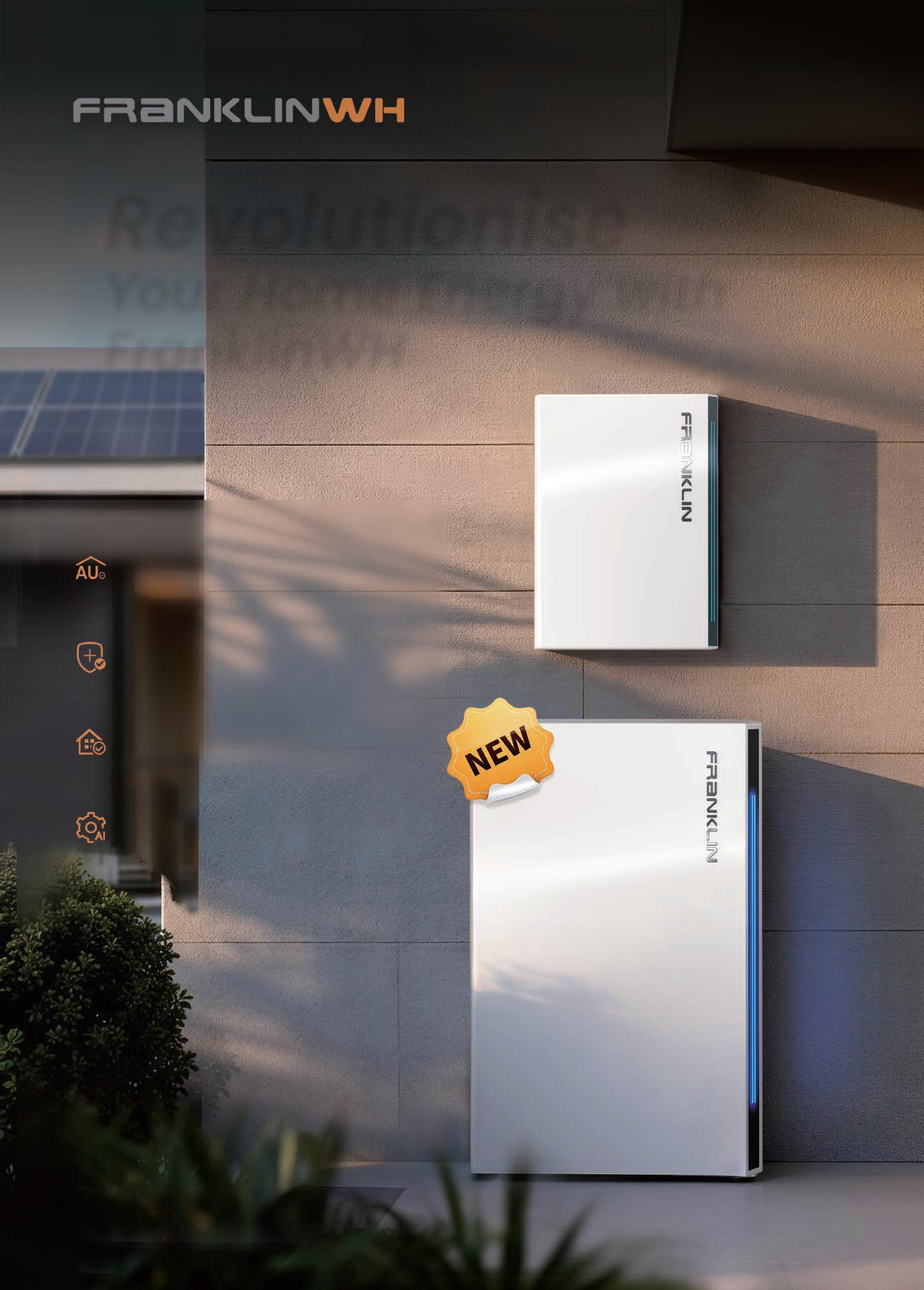
Amid intensifying competition in Australia’s home battery market, FranklinWH is advocating for greater attention to product engineering, reliability and long-term system performance.
Competition is intensifying in Australia’s rapidly expanding home battery market.
Industry observers warn this environment may create long-term risks for homeowners and installers, including launched products that result in avoidable recalls, contributing to increased home battery waste.
Industry observers also note that the home battery market is entering a ‘race to the bottom’ on price and kilowatt-hours. This trend is partly sparked by the Federal Government’s Cheaper Home Batteries Program, as manufacturers compete to capture consumer demand ahead of the 1 May rebate change, accompanied by ‘fear-ofmissing-out’ marketing that is influencing rushed purchasing decisions.
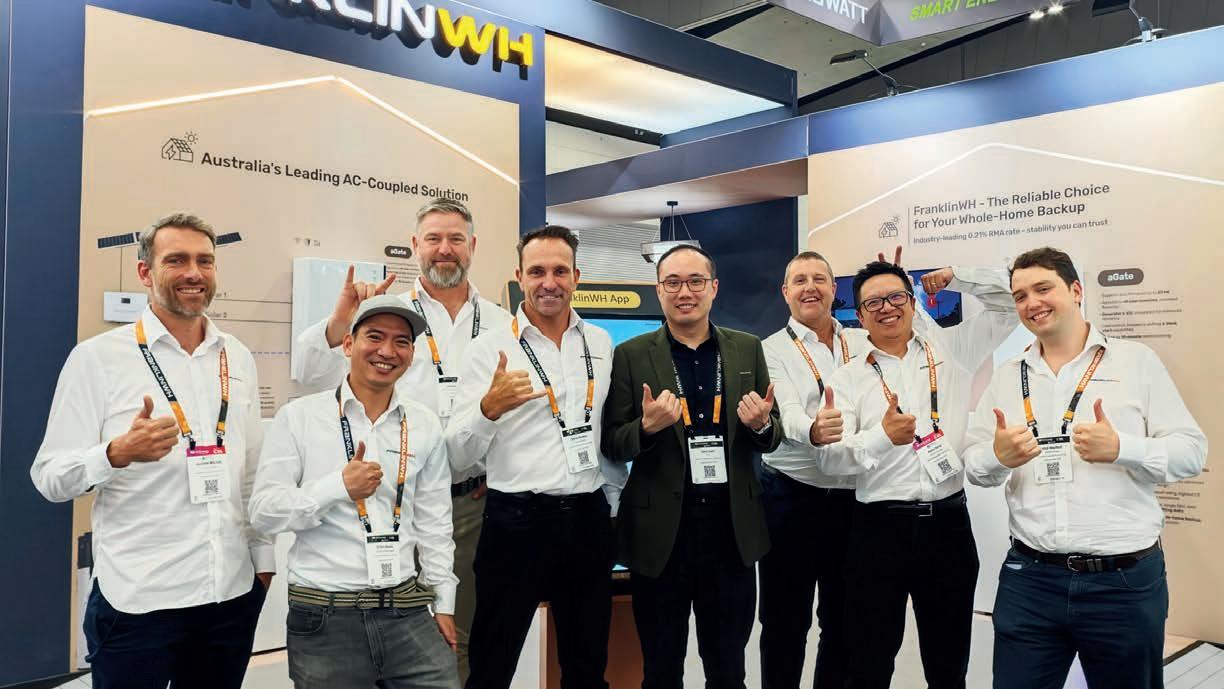
Established in 2019 and headquartered in California, United States, FranklinWH was
founded by a team with extensive experience in battery energy systems engineering and power electronics. Backed by venture capital investors, the company aims to reshape the residential energy management and storage market globally and in Australia through battle-tested, premium, fully-integrated home energy solutions.
Rather than competing in the home battery market through lowered prices or reduced kilowatt-hour capacity, FranklinWH is leveraging its established distribution and installer network in Australia to position itself as a thought leader, advocating for higher-quality, longer-lasting home energy systems. In line with this strategy, the company continues to invest heavily in research and development, engineering robustness and transparent product design for its local home energy customers.
Steve Ruskin, General Manager at FranklinWH Australia, shares how current market conditions is creating pressure for manufacturers to prioritise low upfront product prices over long-term reliability.
“There’s a significant volume of products and brands entering the Australian market. That doesn’t automatically indicate poor quality, but it does increase the importance of due diligence for households and installers around home energy management and battery product design, as well as warranty coverage during operation,” Ruskin says.
Ruskin adds that the strong demand created by battery incentives can sometimes shift attention away from long-term performance considerations.
For homeowners and installers, overlooking these considerations can bring lasting implications.
“Residential battery systems should be designed to operate for many years, as they form the backbone of integrated household energy solutions encompassing rooftop solar generation and backup power reliability, which are critical during volatile weather conditions or grid disruptions,” Ruskin says.
“That’s why households see installing a home battery as a long-term investment. For installers, there’s also a long-term customer relationship with their serviced households at stake. The quality and long-term reliability of the home energy systems they install for customers affects their reputation.”
Residential energy management and battery storage systems are increasingly being integrated into broader household energy solutions that combine rooftop solar generation, backup power capability and greater household energy independence.
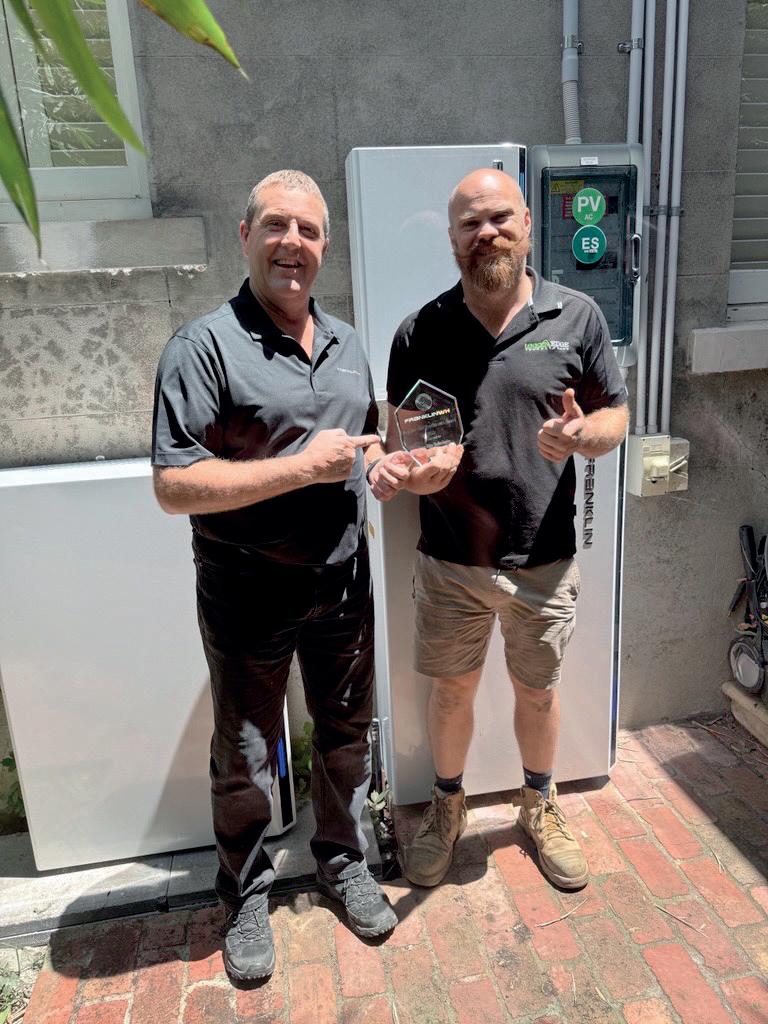
That is why the FranklinWH system combines the aPower battery with the aGate energy management gateway, enabling whole-home energy management and flexible integration with rooftop solar systems.
While the aPower remains a premium battery in the Australian market through its robust all-metal casing, enhanced safety features and superior IP67 and C5 weatherproofing, the aGate is proving to be popular with households. With two solar inputs and brand agnostic architecture, homeowners do not have to throw out their old solar to upgrade. This reduces costs for the homeowner, and helps prevent waste
and smart circuit modules gives the system comprehensive features to accommodate any home from here to the Nullarbor.
Ruskin says this approach is particularly relevant as some homeowners look to replace earlier rooftop solar system models to accommodate newer battery technologies.
“One of the issues emerging in the market is unnecessary asset turnover. There are cases where solar systems still have many productive years remaining but are being replaced to suit a particular product architecture. That raises questions about both customer value and material waste,” Ruskin says.
As an alternating-current-coupled system with an integrated gateway, the FranklinWH System is designed to work with existing solar installations while enabling future system expansion.
“The goal for household battery sizing should be to align storage capacity and system design with the energy profile and reliability needs of the home,” Ruskin says.
Battery pack engineering is being recognised as an important determinant of the safety and longevity of residential energy management and storage systems.
Andrew Mitchell, Senior Product Manager at FranklinWH Australia, shares that upcoming engineering challenges to overcome involves managing the natural expansion of lithium iron phosphate battery cells during lifetime operations.
“Lithium iron phosphate cells expand and contract during charge and discharge cycles. If that expansion isn’t managed properly, it can lead to internal misalignment, higher resistance, heat build-up and accelerated degradation,” Mitchell says.
Over thousands of charge-discharge cycles, lithium-ion battery cells can increase in thickness by around 10 per cent due to electrochemical processes. As these changes accrue, the mechanical forces generated inside a battery pack can become significant.
Managing these forces requires careful structural design. One method used by engineers at FranklinWH is preload, the controlled compressive force applied to battery cells during assembly to stabilise them inside the pack.
“You can think of preload like strapping down cargo in a trailer. If the cells aren’t held securely, small movements can accumulate over thousands of cycles, effecting electrical contact and reducing battery lifespan,” Mitchell says. FranklinWH’s aPower battery incorporates
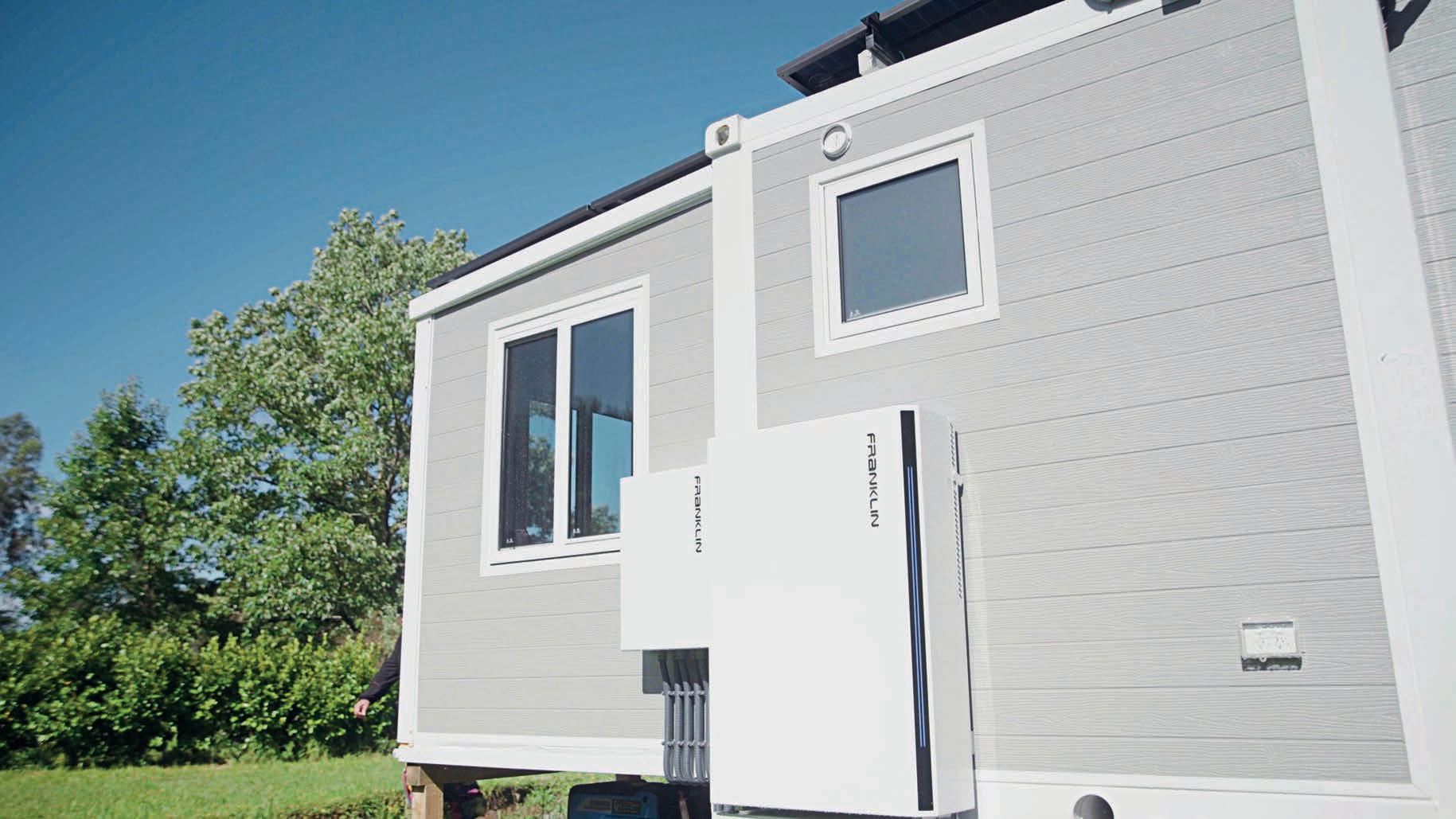
what Mitchell describes as a fundamental preload system, designed to maintain consistent compression while allowing cells to expand and contract as they age.
“The engineering aim should be holding the cells securely while still allowing for natural dimensional changes. That balance between firmness and flexibility helps maintain structural integrity throughout the battery’s lifespan,” Mitchell says.
FranklinWH’s home battery design uses end plates, threaded rods and steel straps that provide controlled elasticity. This allows the battery pack to maintain stable compression while accommodating changes in cell size over time.
Testing during FranklinWH’s rigorous research and development stages indicates that the structure of the batteries can withstand mechanical forces of 100 kilonewtons. This is the equivalent to 10 tonnes of at earth’s gravity. This helps maintain pack integrity under long-term operating conditions.
“These features might not appear in simple product comparisons, but they’re critical to how a battery performs over time,” Mitchell says.
“As the home battery industry matures, so should the attention to engineering decisions that influence durability and safety,” Mitchell adds.
Both Ruskin and Mitchell believe that as households increasingly adopt batteries to support clean energy electrification, the industry should also place greater emphasis on long-term performance rather than short-term incentives to drive product sales.
“There’s a strong opportunity to build a battery market that delivers lasting value for both consumers and installers, as part of Australia’s broader energy transition,” Ruskin says.
“That means focusing on product quality, supporting installer capability, understanding of product warranties, and ensuring systems are appropriately specified for each home.”
As the home battery market grows, FranklinWH believes it is important for installers and customers to look beyond headline pricing and consider the reliability and long-term suitability of the home system they are installing.
“FranklinWH’s long-term goal in Australia isn’t simply just growth,” Mitchell says.
“It’s about helping build a home energy management sector that remains reliable, trusted and sustainable for decades, while
contributing to the engineering, standards and industry dialogue required to achieve it.”
“That’s what we mean when declaring our intention to be a thought leader in the sector,” Mitchell concludes.
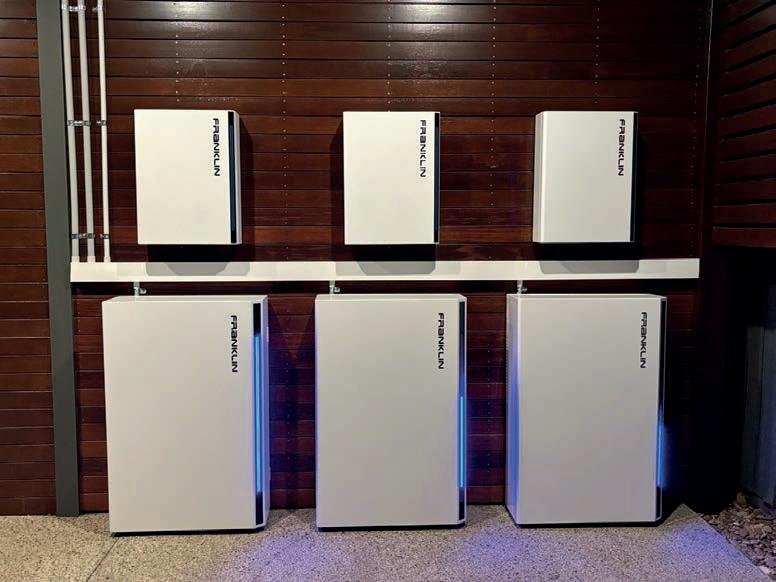
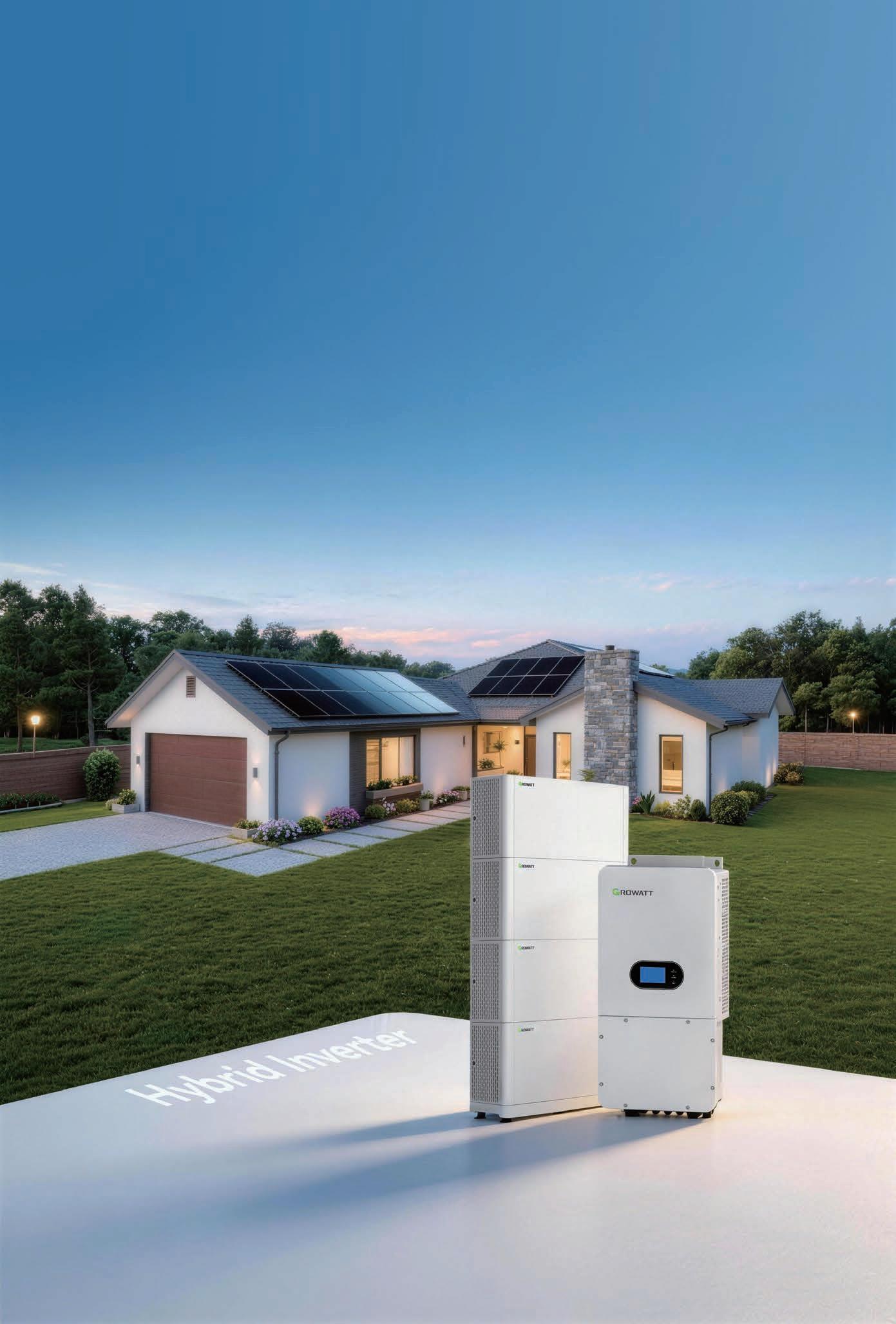
Australia’s high rooftop solar surge is driving interest in residential battery systems, with hybrid inverters and modular storage technologies enabling households to capture more value from the electricity they generate.
Australia’s rooftop solar market is maturing. Therefore, attention is turning to how households can store and manage the electricity they generate.
For technology providers and installers, they have been focused on deploying photovoltaic systems to deliver integrated solar-plus-storage solutions that improve self-consumption and support a more flexible electricity grid.
Against this backdrop, Growatt is expanding its presence in Australia’s residential solar-storage sector. This expansion is marked by the introduction of new hybrid inverter and battery technologies, alongside initiatives aimed at strengthening installer engagement.
Founded in 2011 and headquartered in Shenzhen, China, Growatt develops photovoltaic inverters, battery storage
systems, electric chargers and digital monitoring platforms for distributed energy systems. The company supplies its technologies to more than 100 countries and has established an early presence in Australia’s residential solar market through partnerships with local distributors and installers.
“Australia remains an important market for distributed energy solutions due to the scale of rooftop solar deployment and the increasing interest in residential storage,” says Lisa Zhang, Vice President at Growatt.
Central to Growatt’s current offering is the SPM 8000-10000TL-HU hybrid inverter, designed for residential and small commercial solar-plus-storage systems.
wThe single-phase inverter enables solar generation, battery storage and grid interaction within one device.
“The aim of hybrid inverter technology is to allow solar generation, battery charging and grid interaction to operate within a unified platform. This simplifies system integration and provides households with greater control over how solar energy is used,” Zhang says.
The inverter offers an output capacity of 8-10 kilowatts and incorporates three maximum power point tracking inputs to optimise energy generation from rooftop arrays. With a peak efficiency of around 97.5 per cent, the system is designed to support both new solar installations and retrofit battery additions through direct current or alternating current coupled configurations.
The unit also includes uninterruptible
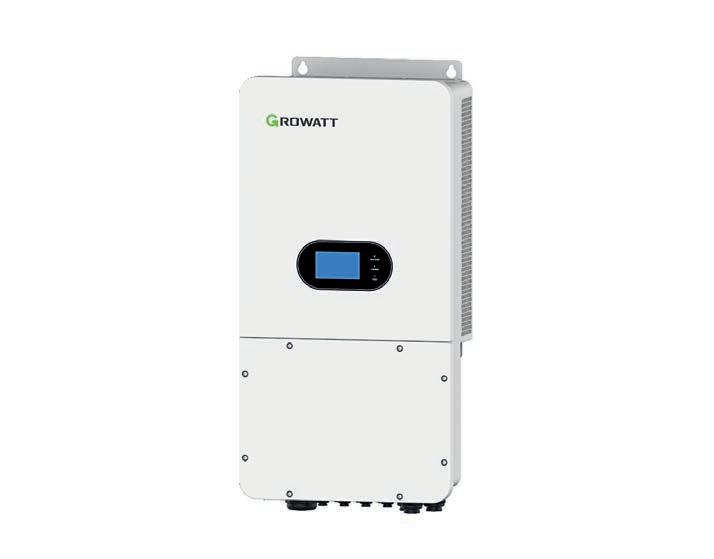


power supply functionality with a switching time of approximately 10 milliseconds, allowing systems to provide backup power during grid outages. Up to six inverters can be connected in parallel, enabling larger residential or small commercial installations.
“The flexibility to operate across different installation scenarios is an important design consideration,” Zhang says.
“Installers require systems that can adapt to varying household energy requirements and rooftop configurations.”
Modular battery storage and installer engagement
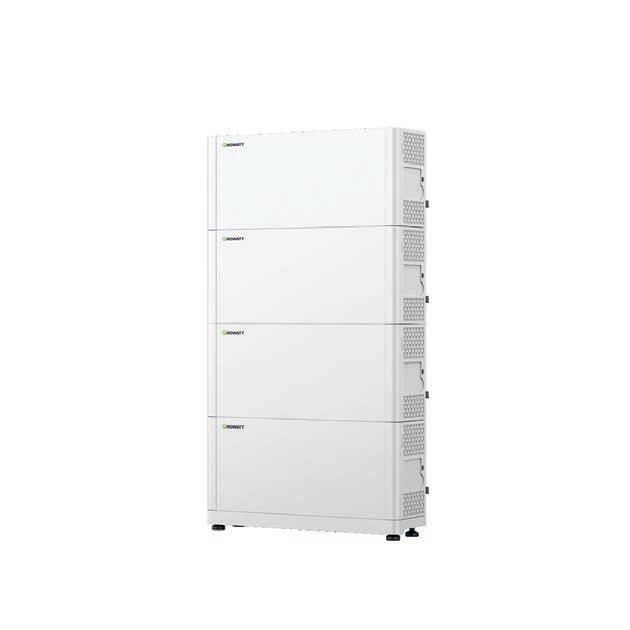
Complementing the inverter is Growatt’s ALP 5.0L-E2 lithium iron phosphate battery module, a modular storage system intended for residential energy storage.
Each battery module provides five kilowatt-hour (kWh) of nominal capacity and approximately 4.6 kWh of usable energy. Multiple units can be connected in parallel, allowing storage systems to scale from smaller residential installations through to larger household storage configurations.
“The modular design allows storage capacity to expand as household energy
consumption evolves,” Zhang says.
The battery uses cobalt-free lithium iron phosphate (LiFePO₄) chemistry, which is widely used in residential energy storage due to its thermal stability and long cycle life. Growatt states the system is capable of more than 6000 cycles under standard operating conditions.
An integrated battery management system monitors temperature, voltage and current to maintain safe operation. The battery also carries an IP66 rating, enabling both indoor and outdoor installation. Beyond hardware, Growatt is also focusing on digital tools designed to support installers during commissioning and system management.
Through the ShineTools platform, installers can configure and activate systems via a mobile application that connects devices to Growatt’s monitoring ecosystem, including ShinePhone and ShineServer.
“Digital commissioning tools help streamline installation and enable installers to monitor system performance remotely. This can improve operational efficiency and provide better visibility of system performance,” Zhang says.
The digital platform is linked to Growatt’s
installer incentive program introduced in Australia to encourage battery deployment. Under the program, installers receive rewards each time a Growatt battery is installed and activated through the ShineTools application. Incentives vary depending on the monthly campaign and are credited once the system is commissioned and connected to the monitoring platform.
“Installers play a central role in the adoption of residential battery systems. Providing commissioning tools alongside incentive programs is intended to support installers and encourage wider uptake of storage technologies,” Zhang says.
Growatt’s approach reflects a broader trend in Australia’s solar industry, where increasing battery adoption is expected to complement the country’s high rooftop solar penetration.
“As distributed energy resources continue to expand, integrated solar and storage systems will play an increasingly important role in how households manage electricity,” Zhang says.
“Technology development and installer engagement will both be important factors in supporting this current transition in battery storage across Australia.”

FOX ESS is part of the momentous shift in the residential storage sector, from simply deploying systems to ensuring they perform reliably, integrate with the grid, and deliver long-term value for households, installers and distributors.
In 2026, FOX ESS is placing greater emphasis on local execution in key markets such as Australia.
“Our priorities revolve around marketaligned innovation, strengthening local presence and customer support, as well as deepening our brand trust through industry engagement. These areas are critical for delivering meaningful outcomes in the Australian market,” says Brooks Richard, Managing Director of APAC and the Middle East at Fox ESS.
Founded in 2019, Fox ESS designs and manufactures solar inverters, battery storage
systems and smart energy management technologies for residential and commercial applications. The company now operates in more than 70 countries, with hundreds of thousands of systems installed globally.
“Australia is one of the world’s most dynamic residential solar markets, with strong rooftop photovoltaic adoption and surging uptake in home batteries,” Richard says.
Diversification across states
Australia’s residential energy market remains highly regionalised, shaped by differing policy frameworks, grid conditions and consumer
behaviour across states. Understanding state and regional differences is central to Fox ESS’s Australian growth strategy.
“New South Wales, Victoria and Queensland are our core growth markets in Australia. A one-size-fits-all approach simply doesn’t work here,” Richard says.
In New South Wales, the company sees strong opportunity across both residential and grid-scale storage.
“New South Wales is Australia’s most populated state and has significant demand for residential, commercial and grid-scale energy storage,” Richard says.
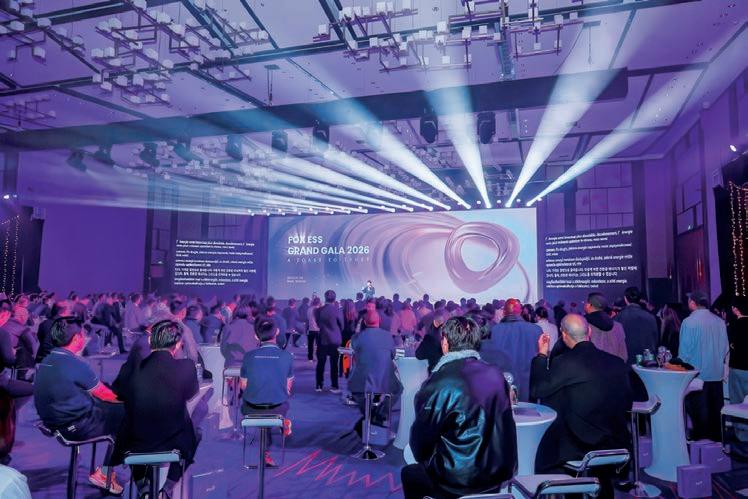
“Our approach is to support household battery adoption while also leveraging our grid-forming battery energy storage technology to participate in large-scale storage opportunities linked to the state’s long-term energy storage tenders.”
Victoria presents a different market profile, where intelligent energy management and integration with broader energy systems are becoming more important.
“Victoria already has one of the highest renewable energy penetration rates in the country, exceeding 51 per cent in early 2026,” Richard says.
“Users here increasingly focus on intelligent energy management solutions, including Virtual Power Plant (VPP) integration and electric vehicle charging. Our strategy is therefore centred around intelligent integration, which means ensuring our systems can connect seamlessly with VPP platforms and other home energy tech.”
In contrast, Queensland remains one of the strongest regional residential solar markets in Australia.
“Queensland leads the nation in rooftop solar penetration and battery adoption, with average rooftop systems around 10.2 kilowatts,” Richard says.
“The priority in Queensland is therefore delivering reliable, easy-to-install storage solutions and ensuring installers have the support they need to serve both metropolitan and regional markets.”
Partnerships and installer capability
Strengthening local support infrastructure is a key pillar of Fox ESS’s strategy in Australia. Earlier this year, the company opened its second Australian office in Sydney, complementing its presence in Melbourne.
“The Sydney office strengthens our technical support capability, logistics coordination and partner engagement across the eastern states,” Richard says.
Richard affirms that collaborations with distributors allows the company to reach installers across the country while maintaining regional flexibility.
“Partners such as Solar Juice and OSW have extensive distribution networks and deep local knowledge, which enables us to deliver products quickly across the country,” Richard says.
“At the same time, they provide valuable market insights. They know what installers in Queensland need, what Victorian customers are looking for in intelligent energy systems, and what grid requirements are emerging in New South Wales.”
This feedback loop plays a key role in shaping product development.
“We don’t simply push products into the market. We listen closely to our partners and incorporate their feedback into product design and service improvements. This allows us to balance national scale with local responsiveness,” Richard says.
Installer capability is another area receiving greater attention as solar and storage systems become more technologically sophisticated.
“We organise installer roadshows across multiple regions where we combine product training with practical market and policy insights so installers can stay ahead of industry changes,” Richard says.
“Onsite technical support is also a core part of our service culture. Our teams work directly with installers in the field to resolve issues quickly and transfer knowledge in real world installation environments.”
Local logistics infrastructure also supports installer efficiency.
“With warehouses now established in Melbourne and Sydney, we can reduce delivery times and improve responsiveness nationwide, ensuring installers can access products and spare parts when they need them,” Richard says.
As Australia’s solar and storage market becomes increasingly competitive, Fox ESS believes long-term trust will become a defining differentiator.
“For us, building trust is more of a marathon than a milestone. In a competitive market, trust comes from how reliably we support installers, empower distributors and stand behind our products in the field,” says Michelle Li, Global Marketing and Brand Director at Fox ESS.
That philosophy was reinforced at the company’s 2026 Global Summit, held under the theme ‘A Toast to Trust.’
“The summit reinforced our commitment to long-term partnership, transparency and shared growth across our global partner network,” Li says.
“For our Australian partners, it provided a valuable opportunity to engage directly with our engineering teams, and for teams to see our research and development and manufacturing processes first-hand.”
“These experiences strengthen confidence in our technology and deepen long-term collaboration with our valued distributors and installers.”
Additionally, Fox ESS is also expanding its focus beyond hardware toward broader energy ecosystem integration.
As Australia’s distributed energy resources continue to grow, VPPs are playing an important role by enabling smarter energy use and greater grid flexibility.
“Our systems are already compatible with major VPP platforms, allowing customers to optimise energy consumption and unlock additional economic value from their systems,” Li says.
“By enabling participation in these broader energy ecosystems, we’re helping households become active participants in the energy transition, while contributing to a more resilient electricity network.”
As Australia’s residential storage market continues to expand, Fox ESS believes the companies that will succeed will be those savvy enough to combine global technology capability with strong local execution across regions and states.
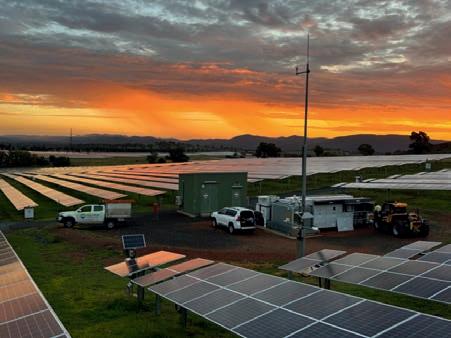
Mega Watt Power is carving out a specialised niche in advanced transformer diagnostics to protect the multi-million-dollar substation assets that underpin grid connection and long-term asset reliability.
As renewable assets scale in size and complexity, Mega Watt Power is advancing specialised transformer diagnostics at utility-scale substations to reduce risk and strengthen grid-connection resilience across Australia.
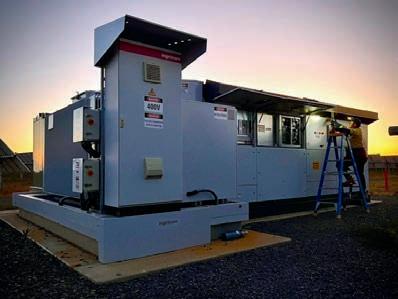
For wind, solar and battery energy storage system (BESS) projects, the substation serves as the purpose-built connection point to the transmission network – stepping up voltage, coordinating protection systems and maintaining grid compliance. At the centre of that infrastructure sits the transformer, a high-value asset that can make or break a utility-scale project.
“Everything becomes exponentially more critical as the voltages go up,” says Peter Bulanyi, Founder and Managing Director at Mega Watt Power.
“When you’re working in substations, you’re dealing with assets that can’t be allowed to fail quietly.”
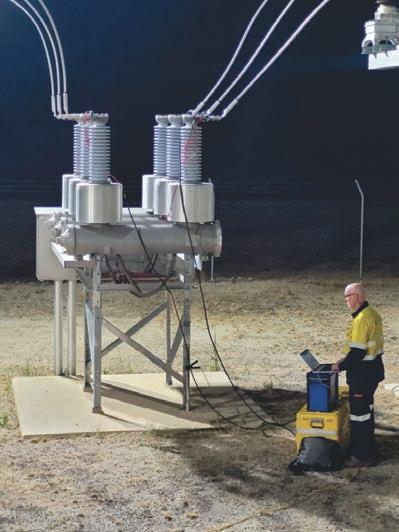
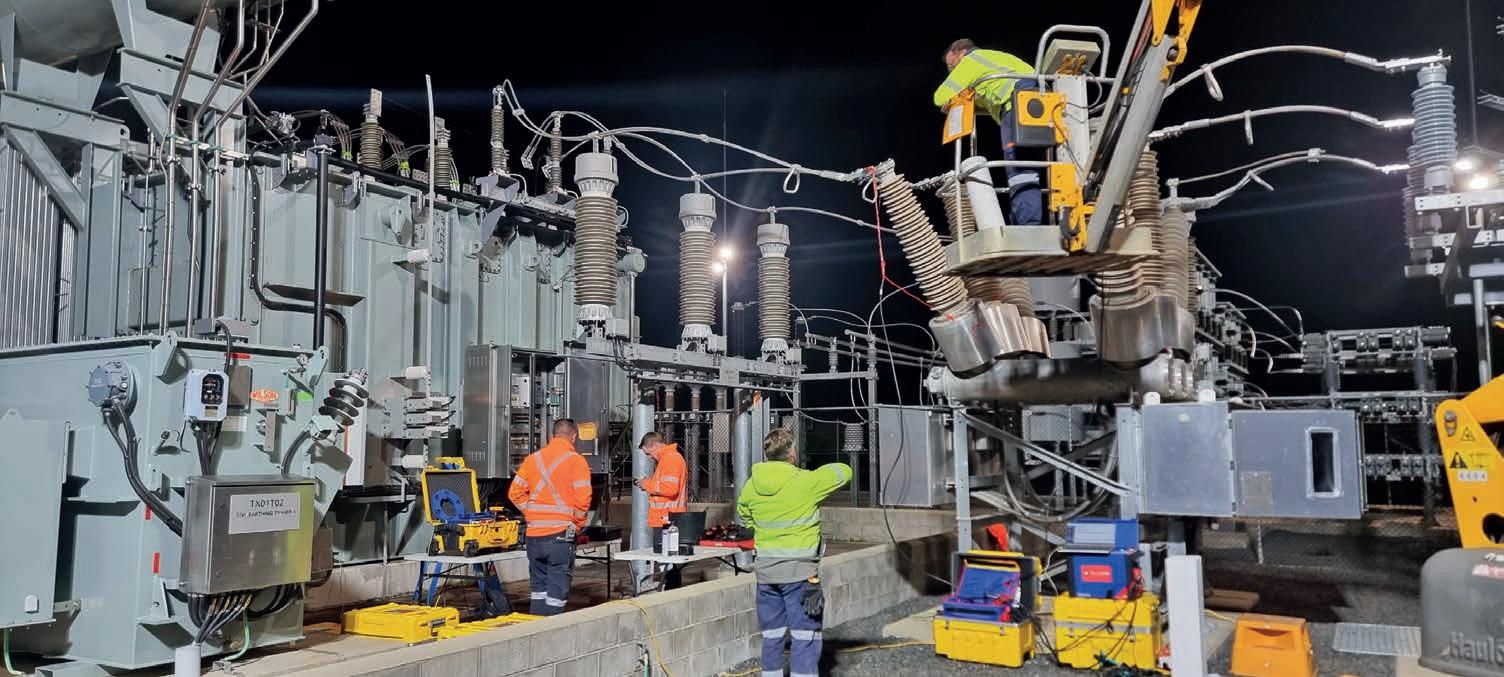
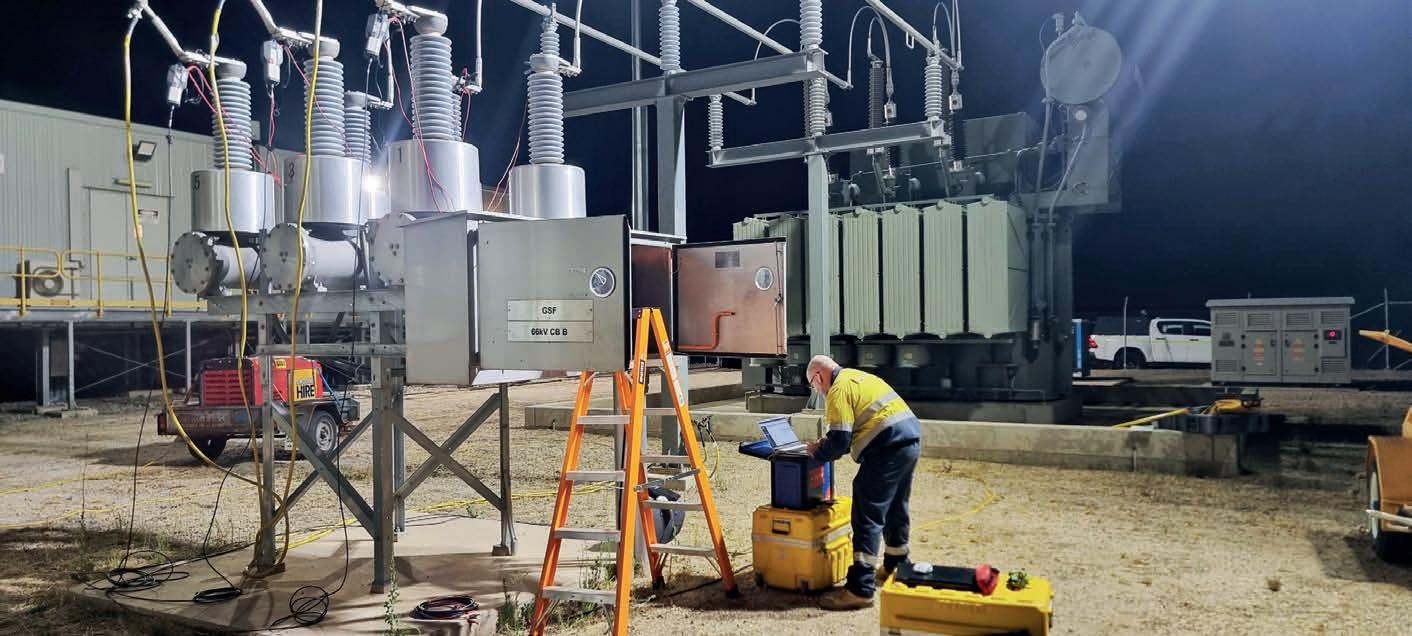
Coffs Harbour based Mega Watt Power is operating in a specialised corner of this highvoltage environment through the delivery of advanced transformer diagnostics, specifically Sweep Frequency Response Analysis (SFRA) and Dielectric Frequency Response (DFR), alongside broader substation maintenance programs.
“These things are next-level testing. They’re quite specialised,” Bulanyi says.
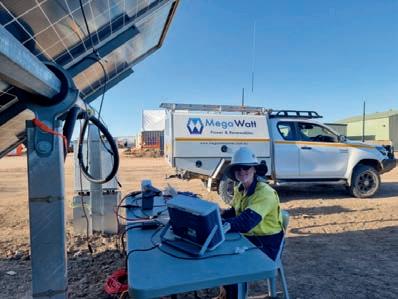
Mega Watt Power typically undertakes substation diagnostic work as a subcontractor to operations and maintenance (O&M) contractors. Engagements are tightly programmed, often spanning three to four nights. These projects incorporate a series of circuit breaker testing, switchgear inspection, earthing verification, protection relay testing and transformer assessments.
“For the substation work, we’re generally working for the O&M contractor and providing subcontract services to come in and do a full range of specialised tests and checks. We might be there for three or four days, typically,” Bulanyi explains.
Much of the work is conducted overnight to avoid interrupting generation.
“When the sun goes down, the solar stops. That’s when we can go in and work. We want to be finished by about 4am so no production gets lost,” Bulanyi says.
“The operating conditions highlight the stakes. These are high-value, continuously operating assets that underpin project revenue. Maintenance and diagnostics must be delivered safely, efficiently and without introducing unnecessary downtime.”
SFRA is designed to verify the mechanical integrity of transformer windings and
the core or supports, that curve will change.
SFRA equipment to the transformer, sweeps a range of frequencies through the asset and
Early detection provides asset owners with the opportunity to investigate and mitigate before the issue escalates.
“These tests are very revealing. They’re arguably undervalued in the market,” Bulanyi says.
DFR focuses on the cellulose insulation condition, with particular emphasis on moisture content and ageing within transformer insulation systems. “DFR performs a power factor versus frequency response,” Bulanyi explains.
“The result is a curve, and the shape and dimensions of that curve are crossreferenced to the CIGRÉ reference chart.”
CIGRÉ provide an internationally recognised benchmark used to interpret transformer insulation condition.
“That chart can tell a great deal about the moisture content of the transformer insulation,” Bulanyi says.
Moisture is a critical reliability factor in high-voltage transformers. Elevated moisture levels accelerate insulation degradation and increase the likelihood of long-term failure.
“The advantage is additional insight. It’s more knowledge about what’s happening inside your transformer,” Bulanyi says.
For renewable asset owners, that insight feeds directly into ongoing condition monitoring and asset management
strategies, supporting trend analysis and predictive maintenance planning.
“It’s about establishing trends over time. We would much rather prevent problems before they actually happen,” Bulanyi adds.
While advanced transformer diagnostics are well established in broader utility engineering sectors, only a limited subset of renewable-focused contractors deliver SFRA and DFR capability in-house at utility scale.
“There’s not many who do that. It’s not a garden variety offer in the market,” Bulanyi says.
Part of the reason lies in the level of expertise required.
“The SFRA test is really an electronicsstyle test. It’s more than regular electrical testing. It requires specialised equipment and results interpretation,” Bulanyi says.
Cost considerations can also play a role in decision-making.
“The garden variety tests are much lower cost and easier to perform, and of course, we provide all these too,” Bulanyi says.
“SFRA and DFR add more to a stock standard testing regime. From a budget perspective, they can be overlooked.”
Yet he argues that context matters.
“Transformers are big devices. If there’s a failure, that creates a lot of pain and downtime. They’re not easy to replace,” Bulanyi says. Utility-scale transformers, such as those serving 200-megawatt substations,
represent significant capital investments, with extended procurement lead times. In that environment, early-warning diagnostics become a form of risk mitigation rather than discretionary expenditure.
“We’re trying to predict if there’s an issue and catch it before it becomes a bigger problem,” Bulanyi says.
Substation diagnostic work is typically delivered by compact, highly skilled teams.
“These teams are always pretty small – about four to six people – made up of electricians, technicians and engineers,” Bulanyi says.
Protection relay testing, transformer diagnostics and circuit breaker assessments may run concurrently, depending on scope. Mega Watt Power explains why experience and adaptability are central to delivery.
“Nothing stands still in renewable energy. There’s new techniques, new equipment, new brands year to year. And so, every substation is different to a degree, and requires resourcefulness,” Bulanyi says.
Maintaining technical currency is an ongoing process.
“We stay on top by remaining passionate about what we’re doing. We’re constantly reading, learning, staying up to date with manufacturing partners, and attending courses. It’s not just a job, it’s a passion,” Bulanyi says.
As Australia’s renewable assets mature, focus is shifting from rapid deployment towards long-term reliability and lifecycle performance. Advanced diagnostics such as SFRA and DFR provide deeper visibility into transformer conditions – strongly supporting asset management decisions and reducing uncertainty around gridconnection equipment.
“The value of these tests is insight. It’s understanding what’s happening inside the transformer before it turns into a failure,” Bulanyi says.
In a market where renewable generation supplies more than 35 per cent of Australia’s electricity and large-scale batteries are being commissioned at record pace, downtime carries escalating commercial consequences, making the protection of high-value substation assets an obvious priority for asset owners. As Bulanyi sees it, that begins with the right specialist testing that ensures infrastructure needed to power Australia’s path to net zero remains functional and connected to the grid.
Inside the leadership engine powering Specialised Energy Solutions and driving large-scale renewable projects forward through hands-on delivery, disciplined execution, and a commitment to getting it right from day one.
Renewable generation has more than doubled across the National Electricity Market over the past decade, according to the Clean Energy Council, as Australia transitions from coal-fired power toward wind, solar photovoltaic, and utility-scale battery energy storage systems (BESS). As deployment of renewables accelerates, rigorous quality assurance, verification and on-theground delivery are becoming critical to ensure assets perform reliably long after commissioning.
This is where Specialised Energy Solutions (SES) operates, providing technical delivery and asset services across solar, wind and BESS projects. The qualified SES team also support developers and asset owners from construction through to long-term operations and performance optimisation.
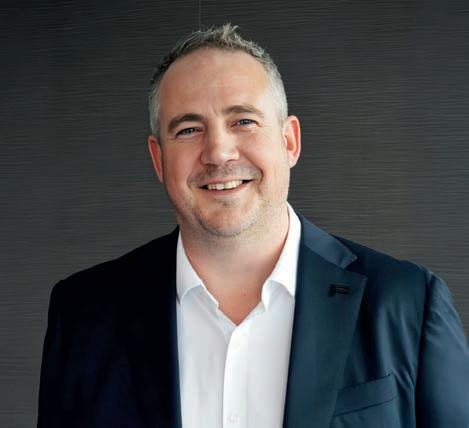
Led by Chief Executive Officer Aaron Mulhall, SES has evolved into a national team of more than 100 specialists delivering utility-scale electrical solutions across construction, commissioning and operations throughout Australia. At the heart of this
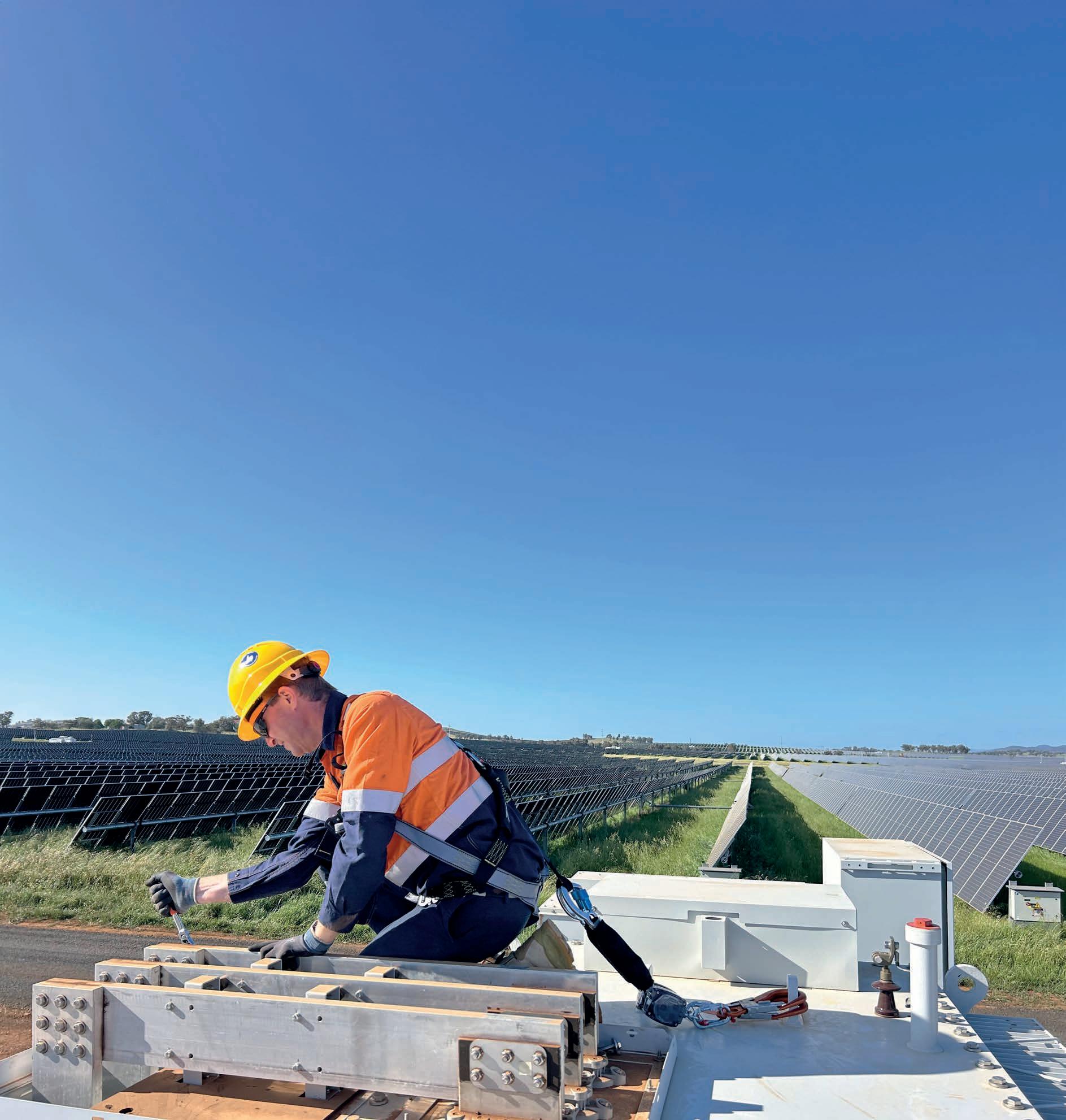
growth is the company’s Senior Operational Leadership Team – Adam Gifford, Kane Williams and David Ross.
SES’s senior operational leadership model unites engineering, construction delivery, and long-term operations and asset management into one integrated engine. It reflects a maturing industry that recognises that true success lies in ensuring those assets perform safely, reliably and efficiently for decades to come.
Adam Gifford, Executive General Manager – Engineering at SES, joined the company in September 2025, with a background that spans from trades to being an asset owner.
“I like the applied end of engineering. You get to see something physical at he end of all the effort. That’s really rewarding,” says Gifford.
Kane Williams, Executive General Manager – Construction Operations at SES, joined the team in June 2024 after working with international engineering, procurement, and construction contractors. Since then, the company has grown to 8.2 GW of projects, including 44 projects nationwide, and operates across six states.
“Moving to a smaller private business gives you freedom to move quickly. More project partners are calling us directly, which shows the sector is recognising the high impact work we’re doing,” says Williams.
David Ross, Operations and Maintenance Manager at SES, joined the team in December 2025. Previously with Power Services, Ross managed approximately 700 megawatts of solar and battery assets, including the Melbourne Renewable Energy Hub, Queanbeyan BESS, the Capital BESS in Canberra and another site in Queensland.
“The renewable industry is big in Australia, but it’s also small. Everyone knows everyone. I’d heard a lot of good things about SES through the grapevine,” says Ross.
Within SES, Gifford focuses on strengthening technical capability, quality, and implementing scalable systems to accommodate the company’s rapid growth.
Williams leads construction delivery and operational execution within the EPC phase. And, Ross oversees the ever-growing company’s expanding operations and maintenance portfolio nationwide.
Operating across multiple states, SES functions as a coordinated national team that constantly travels to remote sites, rather than working from a centralised office.
The most expensive job is the one you do twice
Clean energy investment is reaching record levels. However, Gifford says that the level of quality assurance (QA) required for utility-scale renewable projects is often underestimated across the sector.
“Many items need to be confirmed with asset owners before we can get started on a project. This ensures that what we build for them aligns with governance, compliance, design standards and client expectations.”
“We do a lot of rework and rectification for clients. When we deliver something, we make sure it’s done right the first time and properly documented so we don’t have to return,” Williams says.
Gifford summarises SES’s preventative project delivery philosophy simply:
“The most expensive job is the one that you do twice.”
From an operations and maintenance (O&M) perspective, Ross emphasises that inherited manufacturer serial defects, EPC design or installation errors, equipment incompatibilities, and early-stage construction decisions can have lasting impacts on asset reliability and lifecycle performance. This is precisely why SES integrates both construction and long-term operations and maintenance capabilities – to reduce operational risk at its source and protect asset value over the long term.
“If the handover between Construction and O&M, including all QA and verification processes, isn’t completed to the highest standard from the outset, those issues inevitably resurface during maintenance. You end up managing equipment that has been compromised from day one,” Ross says.
Through detailed documentation and faster diagnostics, efficient and effective long-term operations are enabled.
“When installation is executed to the highest standard and documentation is completed accurately from day one,
maintenance becomes faster, safer and significantly more effective. Rectifying issues later is always more complex and costly than getting it right the first time,” Ross says.
Closing the gap with manufacturers SES also works closely with equipment manufacturers, feeding site-based insights back into the supply chain.
“We’re effectively their arms and legs on site,” Gifford says.
“We go above and beyond to help manufacturers understand what actually happens when equipment arrives and is installed onsite. That feedback helps improve future deployments.”
“The industry is evolving quickly. Technology in the renewables sector keeps improving year after year,” Gifford says.
“We’re in the midst of a fundamental transformation in how electricity is generated in Australia. Much of the existing conventional infrastructure is reaching end-of-life and must be replaced with reliable, future-focused energy systems.”
“Our role is to help build, commission and maintain that next generation of assets – ensuring the transition delivers not just new capacity, but dependable power that keeps the lights on.”
In an industry driven by speed and scale, SES’s operational leadership believes that true success is not defined by how fast assets are built, but by how well they perform over decades.
Long-term value is secured through disciplined delivery, rigorous systems, and teams that remain accountable and handson from construction through to sustained operation. These principles form the foundation of what the company defines as the #SESStandard – a commitment to ensuring every asset is built to perform, endure, and power Australia’s net zero future with confidence.
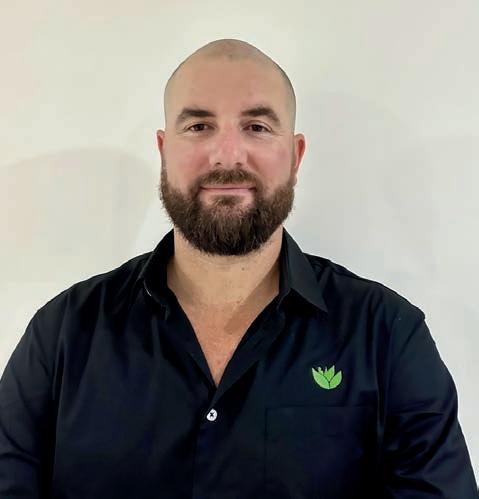
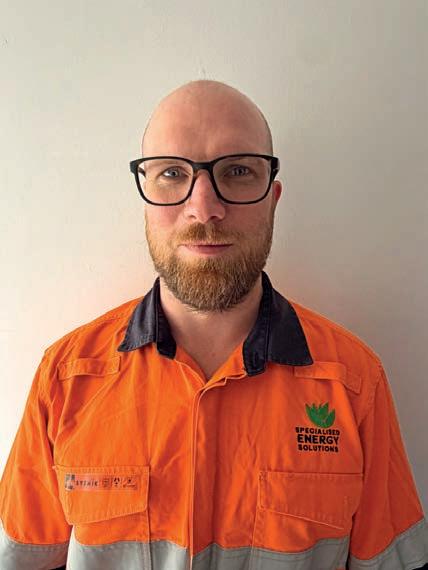
Keynote Speaker at Australian Energy Week 2026: Marc England, Chief Executive Officer at Ausgrid, turns his attention to the role of regulated distribution networks, in lowering consumer costs, system reliability risk and easing the pathway to net zero.
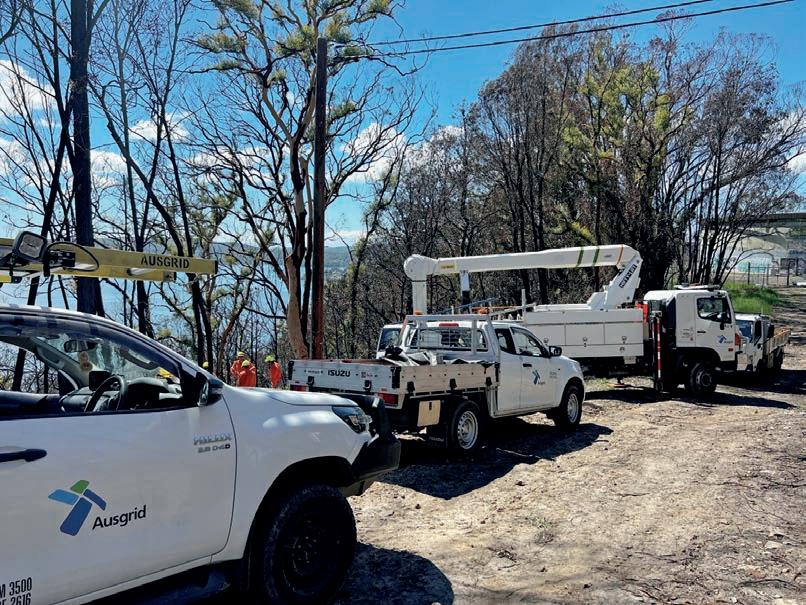
When leaders from across the clean energy sector gather at Australian Energy Week 2026 in Melbourne, the agenda will reflect the scale and complexity of the nation’s energy transition across the supply chain.
Amid these discussions, some industry leaders argue that one critical part of the system often receives less attention: The distribution network service providers that connect generation to consumers.
For Marc England, Chief Executive Officer at Ausgrid and keynote speaker at Australian Energy Week, this “missing middle” will be central to his message at the conference.
“A lot of the energy transition narrative focuses on large-scale wind, solar and high-voltage transmission. Another part of the conversation talks about what happens behind the meter with solar panels, batteries and electric vehicles. The missing middle in the narrative is the role distribution
networks can play, that sits between those two,” England says.
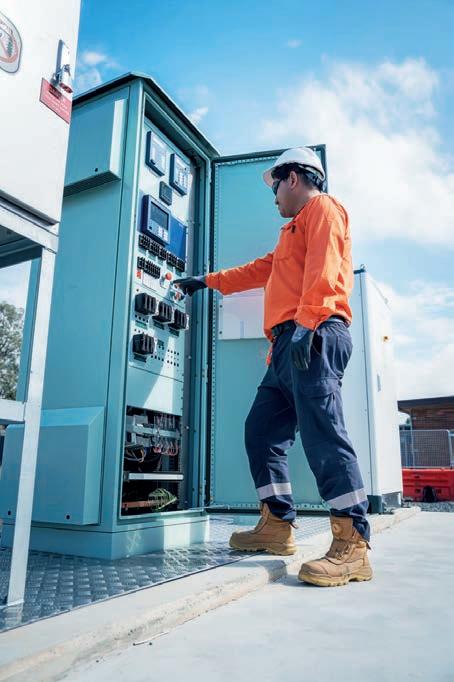
He argues that effective use of distribution infrastructure, including sub-transmission, community batteries and local charging infrastructure, could reduce costs, speed up delivery, and address consequences for consumers and communities.
“Distribution networks are under-utilised in many parts of the system. However, it could provide lower-cost alternatives to some of the infrastructure we’re currently planning. This results in opportunities being missed to lower the cost of the transition,” England says.
Sub-transmission, batteries and EV Ausgrid is a regulated network business that owns and operates the poles, wires and substations that deliver electricity to around 1.8 million customers across Sydney, the Central Coast and the Hunter.
Interestingly, the network’s ownership model is partly state-owned and partly private-owned: New South Wales Government (49.6 per cent), AustralianSuper (8.4 per cent), IFM Investors (25.2 per cent), and APG Asset Management (16.8 per cent).
This ownership structure combines private sector investment discipline with public oversight, positioning the network well to invest in modern infrastructure and deliver reliable, cost-efficient electricity for millions of homes and businesses.
“Our number one priority is to run a reliable, safe and low-cost network at scale,” England says.
“What I see inside Ausgrid is a bunch of very motivated people rolling up their sleeves to deliver power from the transmission system downstream for Australians at the lowest possible price for customers.”
England explains that the rules and assumptions that shaped the sector
decades ago are being stress-tested by new technology and two-way energy flows.
“The system we operate in today was designed more than 35 years ago, when electricity demand was stable and generation was dispatchable and controllable,” he says.
England is careful about framing the debate as “education,” but says parts of the sector still view regulated networks through the wrong lens.
“There are deeply ingrained paradigms in the wider industry about how regulated networks work and what our motivations are. I think there needs to be more discussion about the actual modern issues we’re facing, and how networks can drive costs down,” he says.
A key plank of Ausgrid’s argument is that the sub-transmission layer within distribution has been missed. However, sub-transmission can help lower the cost of renewables in the right locations.
“In the distribution networks in Australia, we go up to 132 kilovolts. Sub-transmission is a critical, but often underappreciated, layer within the grid,” England says.
He points to the Hunter-Central Coast Renewable Energy Zone as an example.

“We’re building that at about one-third of the typical cost of transmission per gigawatt of renewables. The lower cost comes from using existing infrastructure. It’s brownfield development rather than greenfield.”
England says this is not an argument against large-scale transmission or Renewable Energy Zones, it is a case for using what already exists first to de-risk the bigger more complex projects.
“Recent work by all three New South Wales (NSW) networks as part of a Distribution Systems Plan estimated that if we do more in the sub-transmission network, we’ll de-risk transition timeframes by two to five years,” he says.
In addition, England also argues for greater use of network batteries positioned between large grid-scale storage and behind-the-meter systems across Australia.
“If networks were allowed to put more battery storage into the system, it would de-risk and reduce the cost of the energy transition overall,” he says.
“Ausgrid has already been deploying community batteries in its low-voltage network to reduce peak loads at substations. This effectively protects against future stress to the grid, and future costs for repair or replacement.”
England believes the economics of using community batteries for households and businesses is compelling.
“The cost per kilowatt-hour of a community battery is about 40 per cent less than a home battery,” England says.
“We’re not saying there shouldn’t be home batteries, but this middle layer is missing out on real opportunity to stabilise the system and de-risk the transition with lower-cost solutions,” he adds.
The risk of mini monopolies
Electric vehicle charging is one area where England believes the current market structure may not deliver the best consumer outcomes.
“Although regulated monopolies sometimes get a bad wrap, our prices are regulated with great oversight. However, it’s often missed that competitive markets sometimes create monopolistic outcomes, which creates pricing power that isn’t always in the best interest of customers,” England says.
“For example, electric vehicle charge point operators can charge three or four times more than you pay at home for electricity. That price is not regulated, and a mini monopoly is created because there’s
no incentive to put a second charger on the same street and halve its utilisation,” England adds.
Ausgrid and other distribution networks are proposing an alternative model; made up of, low-power kerbside charging delivered on existing electricity poles, with infrastructure deployed by distribution networks under regulated returns.
Under this model, England argues the customer experience should be compelling.
“As a customer, you should be able to plug in and have your retailer bill you at your home electricity price,” England says.
“Some suggest we want to be a retailer – we don’t. We’re just saying that we’re best positioned to provide that low-cost ubiquitous infrastructure as a platform others can compete from, just like the network has always done historically,” England adds.
Ausgrid’s perspective is partly informed by its membership of the global Energy Transitions Commission. Chaired by Member of the House of Lords of the United Kingdom, Lord Adair Turner, the Energy Transitions Commission is made up of a coalition of leaders from across the traditional and renewable energy landscape committed to achieving net zero emissions by mid-century.
“We receive their publications, analysis and thinking, which helps us maintain a global perspective on the transition,” England says.
However, he emphasises that solutions must reflect local conditions.
“Australia as a continent, and the state of NSW have their own unique characteristics. We can all learn by what’s going on in other jurisdictions, however, the energy transition must be considered with local context in the interest of consumers,” England says.
Since joining Ausgrid in 2023, England’s focus has been two-fold: Ensuring the network delivers its core service safely and reliably, while advocating for reforms that reduce costs and risks for customers.
“The role of distribution networks in enabling that has historically been missing but is beginning to be better understood as many of us make the case,” England says.
Ultimately, England says the sector must focus on a single important question:
“How do we transition at the lowest possible cost for customers? That should define our choices. Some of the answer is sitting in our distribution networks. Paradigms and policy just need to adjust to enable it.”
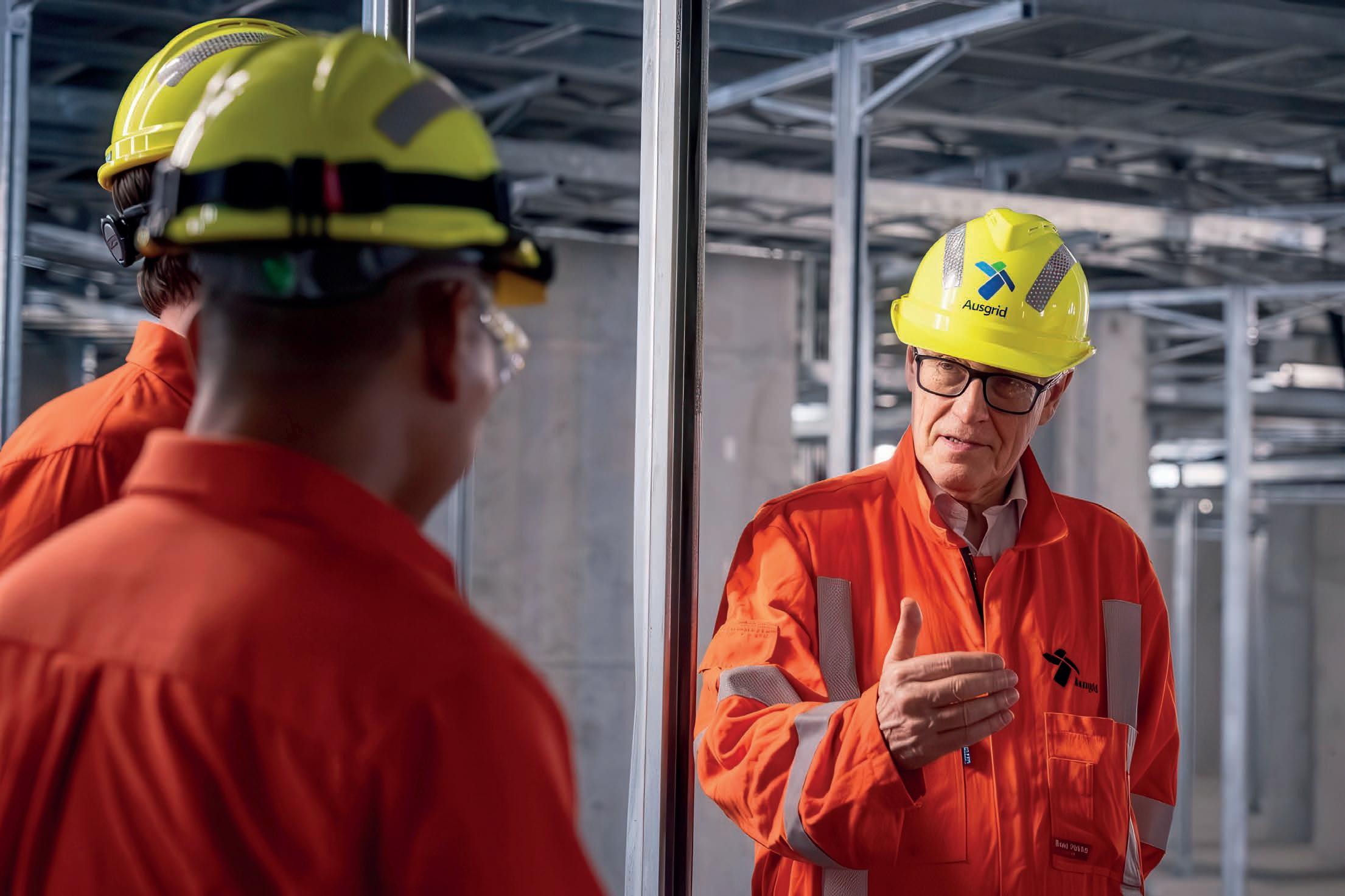
In March 2026, Lord Adair Turner visited Sydney, where he met with Ausgrid, the Minister for Climate Change and Energy of Australia, policymakers and industry leaders, tapping into his global insights to inform Australia’s pathway to net zero.
When asked about his title as a Member of the House of Lords of the United Kingdom, Lord Adair Turner is quick to move past the formality.
Rather than dwell on the status of being a life peer, appointed by the British monarch on the advice of the Prime Minister, he shifts the conversation to the work that matters most to him. That being his work as CoChair of the Energy Transitions Commission (ETC) to help shape practical pathways forward to net zero on a global scale. It is a telling response. For all the weight of his public roles in finance, business and British
policymaking, Turner comes across as someone less interested in ceremony, and more focused on the real-world mechanics of decarbonisation.
Collaboration between policymakers and industry leaders
Lord Turner’s expansive career includes formerly serving as Director-General of the Confederation of British Industry and chairing the United Kingdom’s Financial Services Authority during the global financial crisis. In climate policy circles, he is best known as the first Chair of the United
Kingdom’s Climate Change Committee, where he helped develop the analytical framework underpinning Britain’s legally binding decarbonisation targets.
Now as the Co-Chair of the ETC, he leads global research into how different countries can reach net zero emissions, while maintaining economic growth and industrial competitiveness.
Through the ETC, Turner contributes research and policy insights to international climate forums, including the United Nations Climate Conference of the Parties (COP). At recent summits such as COP26
in Glasgow and COP28 in Dubai, the ETC has worked with governments to translate technical research into practical strategies for decarbonising energy systems.
“Our work is essentially techno-economic analysis. We look at central sectors of the economy – such as power, transport and infrastructure – and ask what mix of technologies and policies can actually deliver net zero emissions,” Lord Turner says.
The ETC brings together more than 50 organisations across renewable energy, industrial and financial sectors. Companies such as Ausgrid and ClimateWorks Centre contribute insights from Australia, representing the nation as one of the world’s fastest-evolving energy systems.
Australia’s unique opportunities and challenges were front and centre during Lord Turner’s visit to Sydney, Australia in March 2026. Hosted by Ausgrid, the trip included meetings with organisations such as the Australian Energy Market Operator and the Australian Renewable Energy Agency, as well
as discussions with federal policymakers, including the Minister for Climate Change and Energy, the Hon Chris Bowen MP.
For Australia, the visit provided an opportunity to connect international perspectives on decarbonisation with the practical realities of building and operating energy infrastructure.
One theme emerging from these discussions was the critical role electricity networks play in enabling the transition.
Industry debates often focus on generation technologies such as wind, solar and batteries. Yet, the infrastructure connecting these assets remains equally important.
“The energy transition is not just an abstract academic debate. It’s a physical transformation of the systems that power our cities and communities,” Lord Turner says.
Higher penetrations of renewable energy will require upgrades across electricity infrastructure, including distribution networks, substations and transmission lines. However, large transmission projects are
complex and often expensive, with global shortages of equipment such as transformers and high-voltage cables adding further pressure to project timelines.
“Transmission expansion is essential, but it takes time and can be costly. So anything that allows us to make better use of existing networks is valuable,” Lord Turner says.
One potential solution involves integrating batteries within distribution networks to manage peak demand and reduce pressure on higher-voltage infrastructure.
“We have been discussing some very interesting ideas with Ausgrid about how batteries integrated into the distribution system can help optimise the network,” Lord Turner says.
Such approaches could help lower the cost of the transition while maintaining reliability for electricity customers.
Across its research portfolio, the ETC highlights that the most effective way to reduce global emissions is to decarbonise electricity systems and electrify as many critical industries as possible. Turner says this understanding emerged gradually through decades of climate policy analysis.
According to ETC analysis, clean energy and electrification could deliver roughly 60 per cent of the emissions reductions required globally. This includes electrifying road transport, residential heating and large portions of industrial energy demand.
“We know how to electrify transport. We know how to electrify residential heat. And we increasingly know how to electrify lowertemperature industrial processes as well,” Lord Turner says.
Crucially, he adds, decarbonising electricity is one of the few elements of the transition that can ultimately lower energy costs.
“After a period of investment, clean electricity could deliver power at a much lower cost. That means electrification is not just about climate – it’s also about economic efficiency,” Lord Turner says.
For the ETC, Australia represents a compelling case study in how electricity systems can evolve during the transition.
Few countries combine strong renewable resources with widespread adoption of rooftop solar.
“The best thing Australia has going for it is its geography,” Lord Turner says.
“You’re blessed with extraordinary sunshine, large amounts of land and strong
wind resources, meaning you should be one of the cheapest places in the world to produce clean energy,” Lord Turner adds.
Australia already leads the world in rooftop solar adoption, with millions of homes installing photovoltaic systems that contribute to the creation of one of the most decentralised electricity systems globally.
“That level of rooftop solar penetration is unique. It creates both challenges and opportunities for how electricity networks are managed,” Lord Turner says.
The rapid growth of rooftop solar is increasingly being paired with distributed battery storage.
The current sector trend of rapid growth in residential storage seen in Australia is expected to reshape how electricity networks operate.
“The combination of rooftop solar and batteries can dramatically increase renewable energy penetration. But it also requires smarter management of electricity grids,” Lord Turner says.
For network operators such as Ausgrid, which covers one of Australia’s largest electricity distribution networks across Sydney, the Central Coast and the Hunter region, these developments highlight the need to modernise infrastructure.
need to maintain network reliability.
Despite growing momentum behind clean energy, Lord Turner emphasises that electrification alone will not solve the entire climate challenge.
Heavy industry sectors such as aviation, shipping and infrastructure remain difficult to electrify and will require additional solutions, including hydrogen, sustainable fuels or carbon-capture technologies.
“We know that electrification will deliver about 60 per cent of the emissions reductions we need. The hard to electrify sectors that remain will require different approaches,” Lord Turner says.
Nevertheless, accelerating the deployment of renewable electricity remains the single most important step in reducing emissions on a world scale.
“Turbo-charging clean electricity and electrification is absolutely central,” Lord Turner says.
For Australia, this presents both an opportunity and a responsibility. The country’s natural advantages weather and land position it to become one of the world’s lowest-cost producers of renewable electricity. If managed effectively, these resources could support domestic decarbonisation while enabling new export
potential will require sustained investment in infrastructure, careful planning and collaboration across the energy sector.
For Ausgrid, hosting Lord Turner underscored the value of linking global research with local expertise. As a member of the ETC, the distribution network service provider contributes to international discussions on how energy systems can evolve during the transition to net zero. Lord Turner believes those exchanges work both ways.
“We come to countries like Australia to share what we see globally. But we also learn a huge amount from the particular challenges and innovations happening here,” he says.
Australia’s experience with rooftop solar, distributed batteries and high renewable penetration is already attracting global attention. In that sense, the country’s transition is not only about domestic decarbonisation, but is also helping shape the future design of electricity systems across the world.
“Australia is an incredibly important test case. This lessons learned here about integrating renewables, managing distributed energy and operating electricity
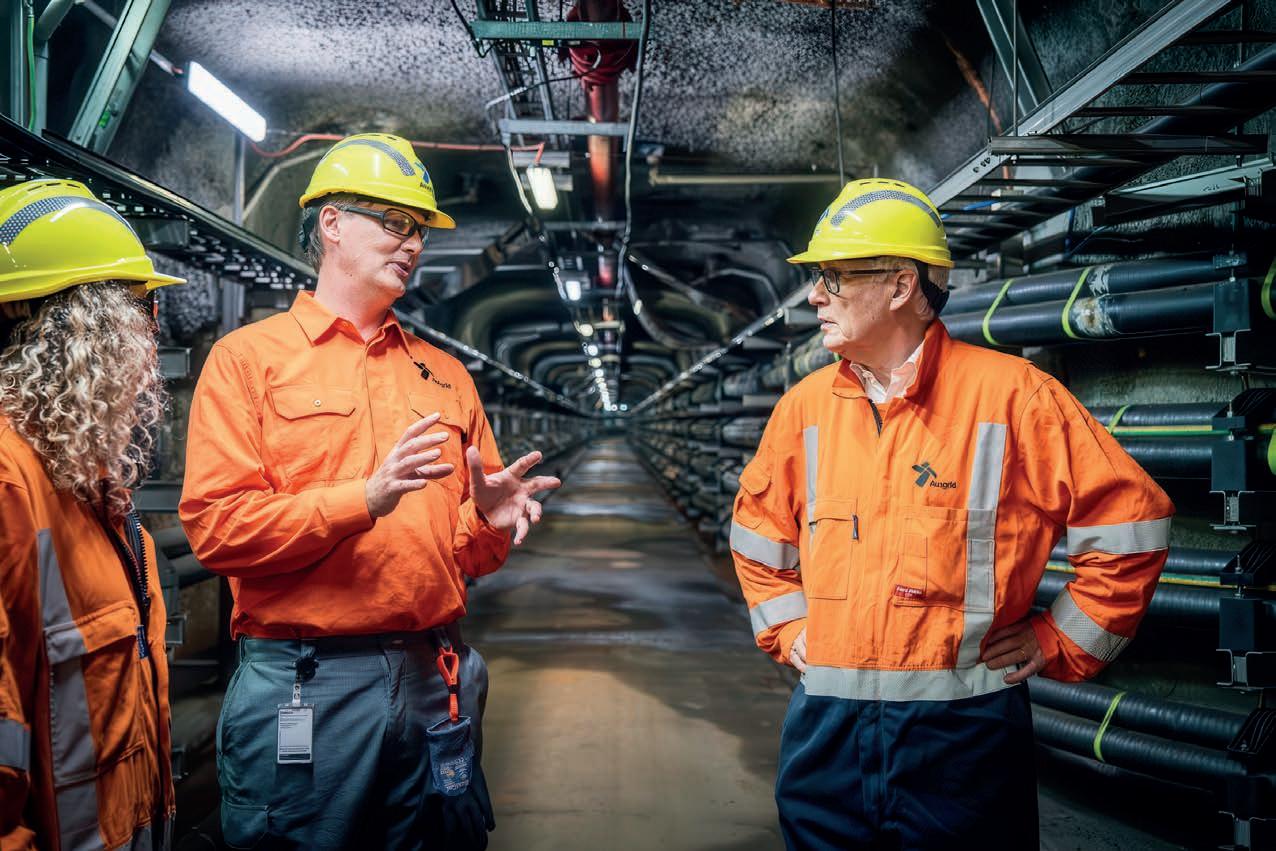
The pace of clean energy deployment is no longer solely determined by the speed of which wind farms, solar farms and battery systems can be built, but also by how effectively electricity networks can connect them to the system.
According to the latest analysis from the International Energy Agency (IEA), the world is entering what it describes as the ‘Age of Electricity.’
Global power demand growth continues to rise rapidly as the Age of Electricity gathers pace, supported by the increasing electrification of sectors across the economy, including transportation, construction and manufacturing. Growing consumption is coming from some of the most dynamic segments of global economies, such as artificial intelligence, data centres and innovative technologies.
The IEA’s Electricity 2026 report provides a comprehensive assessment of how power systems will evolve between 2026 and 2030, examining trends in electricity demand, supply, emissions, prices and reliability across global markets, including Australia.
A central finding of the report is that electricity grids are quickly emerging as a critical barrier to the global energy transition. Across the world, more than 2500 gigawatts of renewable generation, large industrial loads and battery storage projects are waiting in grid connection queues. In many markets, grid infrastructure is simply not expanding at the pace required to match the surge of new energy projects seeking to connect, according to the IEA.
This challenge is particularly relevant for Australia. As wind, solar and battery installations continue to expand, the country’s electricity network – that was originally designed around large, centralised coal-fired power stations – must now accommodate a far more decentralised system. Renewable Energy Zones, rooftop solar systems, community batteries and electric vehicles are all reshaping how electricity flows through the network.
Organisations such as the Australian Energy Market Operator and distribution
network operators such as Ausgrid are increasingly seeing grid modernisation as one of the defining challenges of the clean energy transition. Without sufficient transmission capacity to connect renewable energy zones to population centres, or distribution networks capable of integrating distributed energy resources, even the most ambitious renewable energy projects cannot reach consumers.
The IEA’s report highlights a mismatch in infrastructure timelines. Renewable energy projects, such as solar or wind farms, can typically be planned and built within one to five years. Electric vehicle charging infrastructure may take only one to two years to deploy. By contrast, planning, permitting and constructing new grid infrastructure can take between five to 15 years. This mismatch is already contributing to congestion in many electricity markets and could slow the pace of decarbonisation if left unaddressed.
IEA’s report also outlines several pathways to unlock additional grid capacity more quickly. While large-scale transmission investment remains essential, the IEA emphasises that significant hosting capacity can also be created by using existing networks more efficiently. Grid-enhancing technologies, such as dynamic line rating,
advanced power flow control and topology optimisation, can increase network utilisation without requiring the construction of entirely new infrastructure.
Regulatory reforms are also playing an important role. Measures such as conditional non-firm connection agreements allow new generation, storage or demand assets to connect to the grid faster, while accepting that their output may occasionally be curtailed during periods of congestion. Meanwhile, policies that allow multiple assets (such as renewable generation and battery energy storage systems) to share a single connection point can further ease pressure on constrained networks.
Taken together, IEA’s report suggests these solutions could unlock the capacity needed to connect between 1200 and 1600 gigawatts of advanced-stage energy projects currently waiting in queues worldwide. The IEA’s message to Australia is clear: As the energy transition gathers pace, building more renewable generation will only be part of the equation. Ensuring the grid can move that energy reliably and efficiently from where it is produced to where it is most needed will ultimately determine how quickly the country can realise its clean energy ambitions.
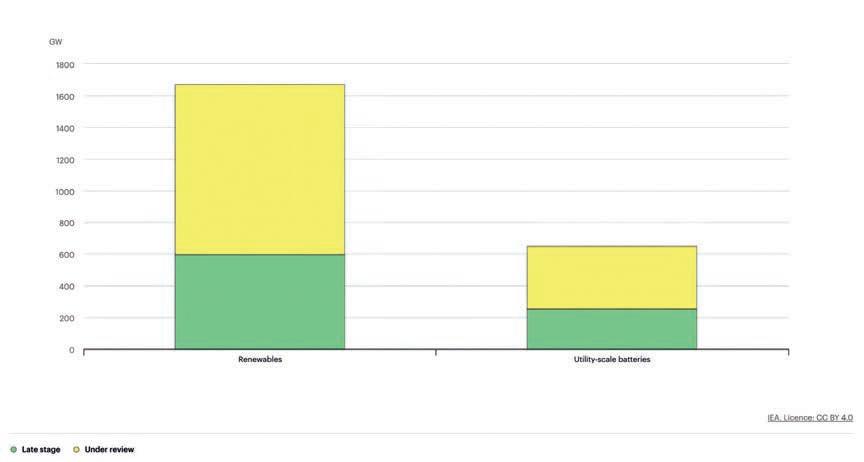
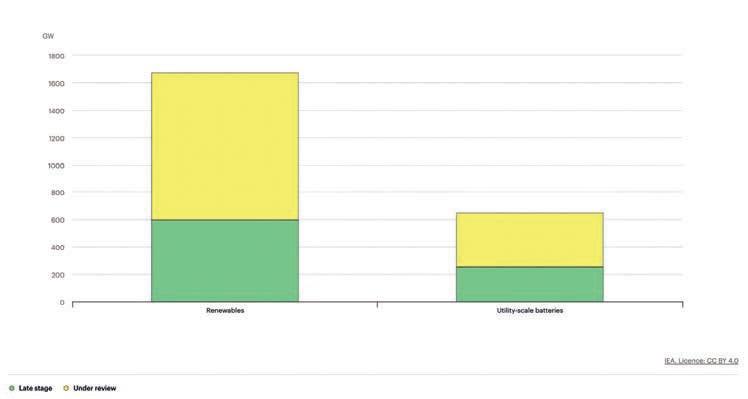
Queensland recorded the highest grid connections and commissioned the most clean energy projects in 2025.
Queensland has emerged as the most active state in Australia for connecting new renewable generation and storage to the grid.
In 2025, the state recorded the highest number of new energy generation and storage connections in the country, highlighting the growing momentum behind large-scale renewable projects and the infrastructure needed to support them.
Transmission network operator Powerlink connected 11 new projects to Queensland’s electricity system during 2025, representing almost three gigawatts (GW) of additional generation and storage capacity. Furthermore, Clean Energy Council records show Queensland commissioned the most energy projects amongst Australian states for Quarter Four of 2025. These four commissioned projects include: Broadsound Solar Farm, Clarke Creek Wind Farm, Swanbank Battery Energy Storage System (BESS), and Tarong BESS.
The scale of these connections reflects a broader transformation underway in Queensland’s energy mix, as large-scale wind, solar and battery storage increasingly complement existing generation assets.
Queensland Treasurer and Minister for Energy David Janetzki shared that the state’s pace of grid connections demonstrates the State Government’s ambition to deliver affordable, reliable and sustainable electricity through a market-led approach.
The Energy Roadmap, set out by the Queensland Government, outlines a diverse technology pathway for the state’s power system. While coal-fired generation will continue to play a role in the near-term, the plan also calls for expanded wind and solar capacity, alongside dispatchable technologies (such as gas turbines, pumped hydro and batteries to maintain reliability). Looking ahead, Queensland’s energy system is expected to see significant additional capacity over the next decade.By 2030, the roadmap forecasts 6.8 GW of new wind and solar, 600 megawatts of gas-fired generation, and 3.8 GW of battery storage.
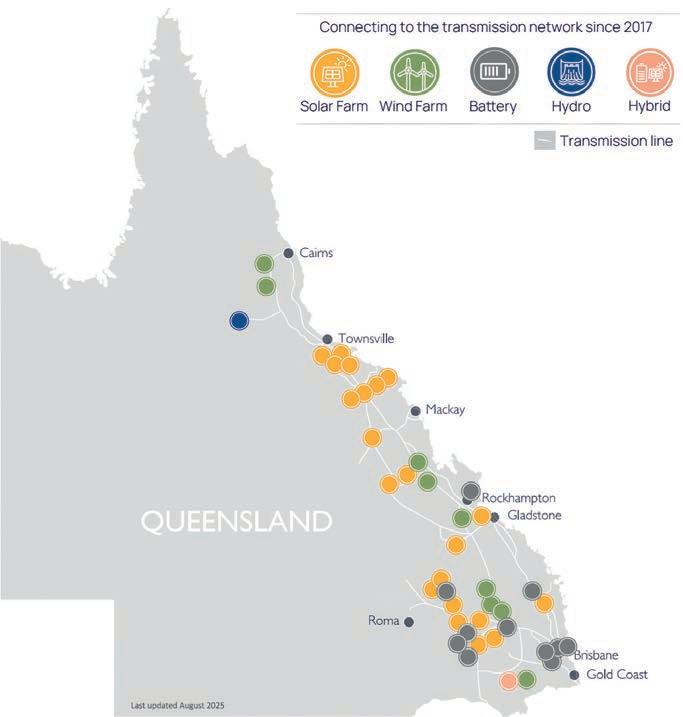
Battery storage is set to play an increasingly important role in balancing the state’s growing renewable fleet. The State Government’s projections suggest Queensland will have at least 3.1 GW of short-duration batteries by 2030. By 2035, the state could also add up to 3.4 GW in medium-duration battery storage. During 2025, four additional connection agreements were signed, representing a further 850 MW of capacity (once delivered). All four connection projects reflect the growing importance of grid-scale storage as the electricity generation mix evolves.
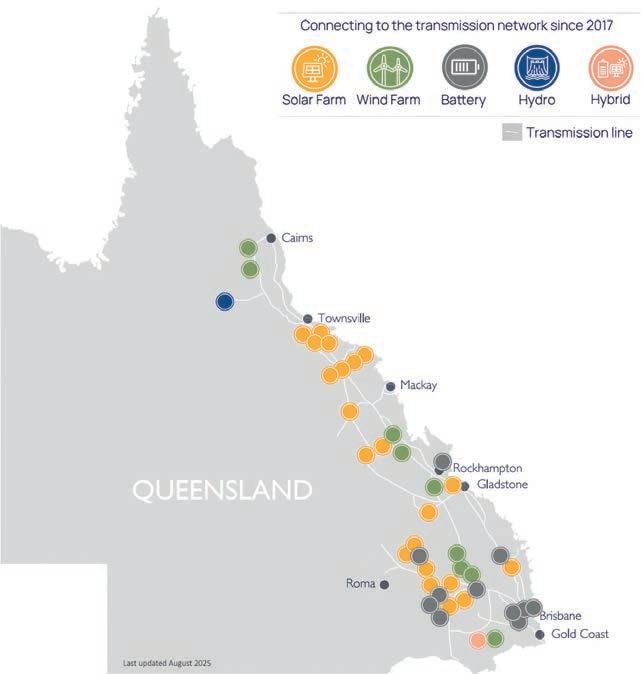
“Batteries will prove vital in maintaining strength and stability in the grid as the generation mix evolves.”
“They also allow us to store Queensland’s abundant solar generation during the day and use it during evening energy demand peaks,” Rowell adds.
Darryl Rowell, Interim Chief Executive at Powerlink Queensland, shares that the pace of new project connections positions Queensland as a highly attractive destination for private investment in renewable energy infrastructure projects.
“Powerlink Queensland’s work will connect Queenslanders to affordable, reliable and sustainable power into the future,” Rowell says.
Beyond the projects already committed to commissioning, Powerlink Queensland’s longer-term pipeline remains substantial. The transmission operator is currently processing connection applications representing more than 43 GW of generation and storage capacity.
As Australia continues to electrify its economy and expand renewable energy deployment, the ability to connect new projects efficiently will remain a defining factor in the pace of the transition.
Queensland’s strong run of connections in 2025 suggests the state is positioning itself as a key hub for the next phase of Australia’s clean energy expansion.
Clean Energy Council presents
Onshore performance. Offshore potential. One national platform.
As Australia’s wind sector enters a defining period, the Australian Wind Industry Forum has never been more critical to attend.
Join the Hon. Lily D’Ambrosio MP and key industry leaders from onshore and offshore sectors in Melbourne this May to examine the challenges, opportunities and innovations shaping our wind-powered future.
Join us at Centrepiece, Melbourne, to explore three core themes:
• Challenges with reaching FID: Building certainty in an evolving landscape.
• Transforming technology: Harnessing the latest innovations and grid solutions.
cleanenergycouncil.org.au/events
• Planning and place: Creating the conditions for project success and social performance.
Don’t miss the opportunity to connect with peers during the post-forum Networking Drinks.
With electricity demand rising alongside Queensland’s expanding population, these wind, solar and battery projects are helping advance the state’s Energy and Jobs Plan target of 80 per cent renewable energy by 2035.
Queensland’s clean energy transition accelerated in the final quarter of 2025, with four largescale renewable generation and storage projects reaching commissioning stage.
Unlike states where electricity demand is concentrated around a single metropolitan centre, Queensland’s energy needs are distributed across multiple super cities, including Brisbane, Gold Coast, Townsville, and Cairns.
With ten of Australia’s 30 largest cities located within the Queensland, delivering reliable and affordable electricity for the state presents a unique geographic planning and infrastructure challenge.
According to the Clean Energy Council, Queensland has rapidly expanded its wind, solar and battery projects, alongside its distributed energy and gridscale investments. The commissioning of Clarke Creek Wind Farm, the grid energisation of the Broadsound Solar Farm and Battery, and the progress of the Tarong and Swanbank Battery Energy Storage Systems mark the
significant expansion of Queensland’s energy infrastructure, coinciding with the Queensland Government’s Energy and Jobs Plan targets of 70 per cent renewable energy by 2032 and 80 per cent by 2035.
Wind generation expands Among the most significant achievements for Queensland’s wind power is the stage one completion of the Clarke Creek Wind Farm. Developed by Squadron Energy, part of Tattarang group, the project reached final commissioning in Quarter Four of 2025, following more than three years of development and construction.
Located approximately 150 kilometres north-west of Rockhampton between Rockhampton and Mackay, the project sits on the lands of the Barada Kabalbara Yetimarala peoples and forms part of a growing renewable energy precinct in the region. The first stage of the wind farm includes 100 turbines with a generation capacity of 450 megawatts (MW). This makes the project the largest wind project commissioned in Australia during 2025.
Notably, the now fully operational Clarke Creek Wind Farm can generate enough electricity to power approximately 330,000 homes.
Andrew Forrest, Owner of Squadron Energy, emphasises the economic and system benefits of renewable generation.
“Renewable energy is now the cheapest form of power on Earth – and the more we make of it, firmed with batteries, the cheaper it becomes,” Forrest says.
“Clarke Creek will power the equivalent of 330,000 homes with reliable, affordable, green electricity made right here in regional Queensland,” Forrest adds.
He also highlights the economic impact for regional communities, noting that renewable projects can deliver both investment and local benefits.
“Projects like this show that renewables aren’t just good for our planet – they’re good economics. They lower power bills, strengthen our energy system, and keep jobs and investment in regional communities,” Forrest says.
Solar and storage integration strengthens Queensland marked another renewable energy achievement in the fourth quarter of 2025, with Powerlink’s energisation of Broadsound Solar Farm and Battery.
The mega 377 MW project was developed by Iberdrola Australia in Central Queensland’s Renewable Energy Zone.
The energisation of this project allows Iberdrola to begin testing both the solar facility and its associated 180 MW / 360 megawatt-hour (MWh) battery system before the project’s final commissioning.
Darryl Rowell, Interim Chief Executive at Powerlink, says the project involved years of collaboration between developers and network operators.
“Powerlink has energised the connection to Iberdrola’s Broadsound Solar Farm ahead of schedule, an important step in delivering more power generation in Central Queensland,” Rowell says.
“Achieving energisation of the connection allows Iberdrola Australia to proceed to testing before being able to export solar energy to the grid.”
Rowell adds that more than 350 people were involved in delivering the connection works, despite flooding caused by Tropical Cyclone Alfred in February.
Batteries support energy reliability
At the Tarong power station precinct near Nanango, the 300 MW / 600 MWh Tarong BESS progressed through to commissioning, achieving full output capability in the fourth quarter of 2025. Owned and operated by Stanwell Corporation, this project is the government-owned generator’s first gridscale battery.
Michael O’Rourke, Chief Executive Officer at Stanwell, shares that the Tarong Battery Energy Storage System is constructed to effectively manage the variability of renewable generation across Queensland.
“The 300 MW battery will store energy during periods of high generation and release it to the grid during peak demand, responding within fractions of a second to provide essential firming capacity and reliability,” O’Rourke says.
Meanwhile, the Swanbank Battery Energy Storage System near Ipswich also entered commissioning in the fourth quarter of 2025. Developed by CleanCo Queensland, the project forms part of the transformation of the former Swanbank power station into a modern energy hub, with a generation output of 250 MW / 500 MWh.
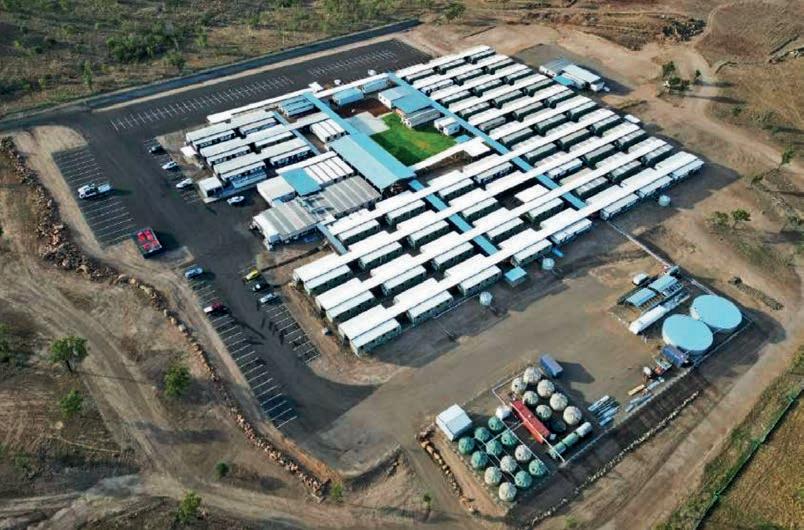
“The Swanbank Battery is a critical addition to CleanCo’s portfolio, providing greater flexibility to supply reliable, lower-emissions energy to customers when it’s needed most.”
Through the combined expansion of wind and solar generation and the deployment of grid-scale battery storage, Queensland shows it is laying the foundations for a reliable clean energy system to support its rapidly growing cities in a state-wide move towards net zero.
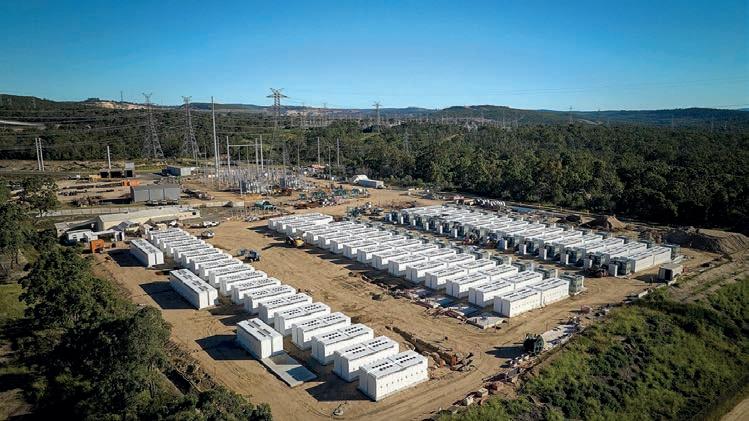
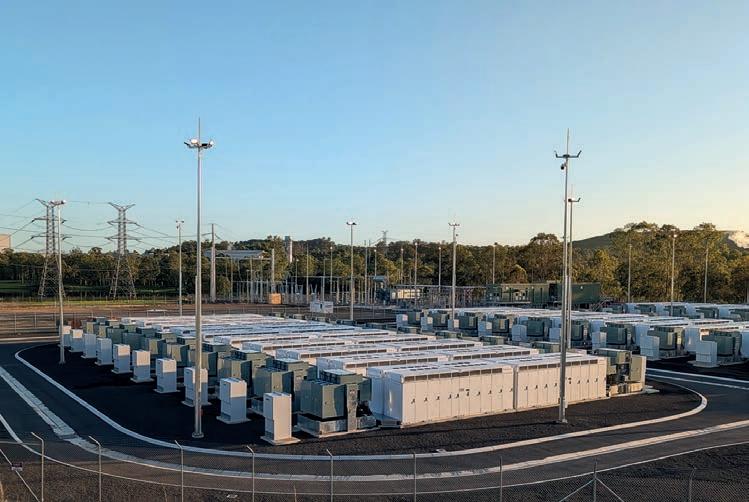
Modelling from the draft GenCost report 2025-26 shows hydrogen is increasingly being viewed as a bridge between Australia’s expanding renewable energy resources and sectors of the economy that are difficult to decarbonise.
The Commonwealth Scientific and Industrial Research Organisation (CSIRO) is Australia’s national science agency that has operated as a statutory authority under the Federal Government for over 50 years.
Each year, CSIRO works with the Australian Energy Market Operator (AEMO) to produce GenCost, Australia’s most comprehensive modelling of the current and future costs of electricity generation, energy storage and hydrogen technologies.
Updated annually, the GenCost report provides an independent benchmark for policymakers, investors and industry assessing the economics of Australia’s evolving energy system. The report combines latest technology cost data with stakeholder consultation to ensure projections reflect national and global market conditions.
CSIRO released the 2025-26 GenCost as a draft report for public consultation between December 2025 and February 2026, enabling industry stakeholders, researchers and policymakers to review the modelling assumptions and cost data underpinning electricity generation and storage technologies. The consultation process helps refine the modelling and improve the report’s transparency, accuracy and relevance before the findings are finalised.
In the draft GenCost 2025-26 report, CSIRO and AEMO examines the projected costs, performance and deployment outlook of renewable generation across solar, wind, storage, hydrogen and emerging technologies to inform Australia’s future energy investment and planning decisions.
As Australia and other countries pursue net zero emissions targets, hydrogen is increasingly being recognised as a key energy carrier for decarbonising hard-to-electrify sectors across heavy industry, such as shipping and chemical production. The draft GenCost 2025-26 modelling places hydrogen
within the broader global energy transition, highlighting how production technologies (particularly electrolysis) could play a more active role in future energy systems alongside wind, solar and energy storage.
The draft GenCost 2025-26 modelling developed by the CSIRO and AEMO examines a couple scenarios across varying levels of climate policy ambition; including, current national Australian policies and global policies that aim to reach net zero emissions by 2050.
Each scenario developed by CSIRO and AEMO includes different assumptions about electrification, hydrogen production and the role of carbon capture technologies.
Across these scenarios, the modelling indicates that hydrogen demand increases significantly as economies pursue deeper decarbonisation pathways. This is particularly evident in hard-to-abate sectors across heavy industry.
Heavy industry includes sectors such as steelmaking, cement, refining and chemicals, which rely on high-temperature processes and energy-intensive equipment that currently depend on fossil fuels. According to GenCost analysis, hydrogen is increasingly being explored as a lowemissions fuel and feedstock capable of supporting large-scale industrial production while reducing emissions.
Overall, the GenCost modelling shows that the scale of hydrogen deployment and the relative role of different production pathways depends heavily on the strength of global decarbonisation policies and the availability of low-cost renewable electricity.
Central to hydrogen’s growth trajectory in the GenCost modelling is the cost and performance of electrolysers – the
equipment used to split water into hydrogen and oxygen using electricity. GenCost modelling includes updated capital cost projections for the twp primary electrolyser technologies currently deployed globally: Alkaline electrolysers and proton exchange membrane electrolysers. According to the modelling, both technologies are expected to experience cost reductions over time as global deployment increases and manufacturing supply chains mature.
These projected reductions reflect the same ‘learning-by-doing’ dynamics that have historically driven cost declines in solar photovoltaic systems and battery storage technologies. As cumulative deployment increases, equipment costs tend to fall due to improvements in manufacturing processes, supply chains and economies of scale.
The modelling suggests that the pace of these cost reductions will depend partly on the strength of global climate policy and the scale of hydrogen deployment. In scenarios where governments pursue stronger decarbonisation policies, higher levels of investment and faster deployment of electrolysers accelerate technological learning, expand manufacturing capacity and strengthen supply chains.
Conversely, under weaker climate policy settings, hydrogen production grows more slowly, limiting the scale benefits that typically drive technology cost reductions.
The draft GenCost 2025-26 modelling also examines how hydrogen could operate within a future electricity system dominated by different variants of renewable energy.
According to the modelling produced by CSIRO and AEMO, the lowest-cost electricity systems in Australia’s National Electricity Market primarily rely on a combination of solar photovoltaic generation, onshore wind, energy storage and flexible generation technologies.
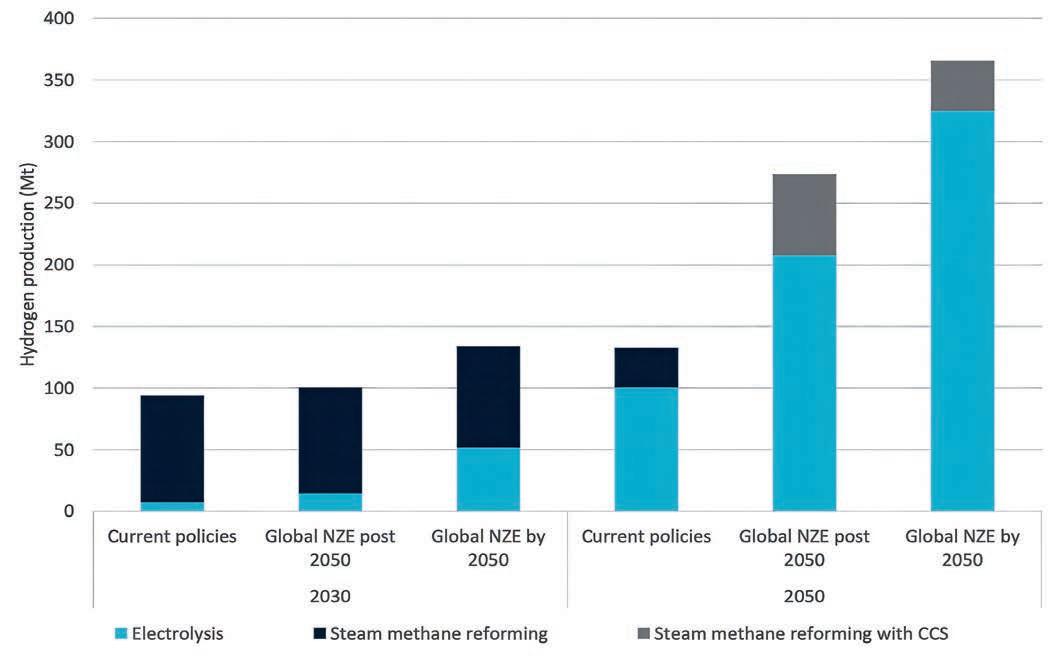
(CCS) continues to appear in some scenarios within the modelling.
Within this framework, hydrogen-fuelled generation could provide a flexible resource to complement variable renewable energy. Hydrogen-capable turbines, alongside gas turbines, may operate as balancing technologies that help maintain reliability during periods of low renewable output.
GenCost modelling also notes that many new gas turbines are increasingly being designed with the capability to operate on hydrogen blends. This design approach allows future conversion to hydrogen fuel as supply becomes more widely available.
The draft GenCost modelling also compares renewable hydrogen production via electrolysis with fossil-based hydrogen pathways incorporating carbon capture and energy storage.
In scenarios aligned with global net zero emissions targets, the modelling shows hydrogen production through electrolysis expanding rapidly as deployment scales and costs decline.
Under these conditions, electrolysis could become the dominant low-emissions hydrogen production pathway globally by around mid-century.
However, fossil-based hydrogen production (particularly steam methane reforming with Carbon Capture Storage
This pathway could play a transitional role in regions where natural gas infrastructure already exists or where renewable electricity supply remains constrained.
According to the GenCost analysis, the long-term competitiveness of renewable hydrogen will depend heavily on the cost and effectiveness of carbon capture technologies, as well as the policy frameworks governing emissions reduction.
A key conclusion highlighted in the draft GenCost modelling is that hydrogen technologies remain subject to significant cost uncertainty.
While electrolysers are expected to benefit from technological learning and manufacturing scale, the pace of these reductions will depend on global deployment rates and supply-chain development.
The report also emphasises that hydrogen production costs are not determined solely by electrolyser capital costs.
The price of renewable electricity remains the largest driver of renewable hydrogen production costs.
As a result, continued reductions in the cost of solar and wind generation are expected to play a critical role in improving the competitiveness of renewable hydrogen.
Overall, the draft 2025-26 GenCost report finds that Australia’s abundant renewable resources, particularly large-scale solar and wind potential, positions the country favourably to produce renewable hydrogen at globally competitive costs over time.
The report also finds that large-scale renewable generation combined with comparatively low land costs could support future hydrogen production hubs designed to serve both domestic industry and international export markets
However, GenCost modelling shows that the timing and scale of this opportunity will depend on multiple factors, including technology cost reductions, global climate policy alignment, and the development of international hydrogen supply chains.
GenCost modelling ultimately signals that hydrogen is unlikely to replace renewable electricity as the primary energy source in the near-term.
Instead, hydrogen is expected to play a more specialised role in decarbonising hard-to-abate sectors across heavy industry, while also offering potential value as long-duration energy storage and flexible generation in power systems with high shares of wind and solar.
To read the draft GenCost 2025-26 modelling and report, visit www.csiro.au
With ambitious renewable energy and emissions reduction targets now in place, Victoria is increasingly turning to renewable hydrogen as a strategic opportunity to support its next phase of clean energy investment.
The Victorian Government estimates the state will require around 25 gigawatts of new generation and storage capacity by 2035 to meet rising electricity demand and support economywide electrification. In alignment, the State Government legislated renewable energy targets of 40 per cent by 2025, 65 per cent by 2030 and 95 per cent by 2035, alongside a broader commitment to reach net zero emissions by 2045. Within this transition, renewable hydrogen is being recognised as a complementary technology. Produced using renewable electricity to split water through electrolysis, hydrogen can be stored, transported and used in sectors where direct electrification is difficult.
Vanya Kumar, Executive Director of Innovation, Commercial and Investment Attraction at the Victorian Department of Energy, Environment and Climate Action, spoke at the Australian Hydrogen Research Conference 2026, held in Melbourne in February. While speaking at the conference, Kumar emphasised the important role of industry and research collaboration to form practical renewable energy solutions, especially for hydrogen.
“Hydrogen is an area where collaboration really matters. Progress depends on trusted science, strong research capability and close partnerships between researchers, industry and government,” Kumar says.
Victoria’s geographic and industrial characteristics make it particularly suited to host the renewable hydrogen industry. The state offers access to sustainable water sources, significant renewable energy resources (including wind and solar), and strong transport infrastructure through four deepwater ports and major aviation hubs. These assets create both the inputs needed to produce renewable hydrogen and the demand centres capable of consuming it.
One region receiving particular attention by the State Government is south-west Victoria, where a combination of renewable energy resources, forestry industries and industrial infrastructure provides a strong foundation for hydrogen-based fuels.
According to the Victorian Government, the nearby Green Triangle forestry region offers potential sources of sustainable carbon that can be combined with renewable hydrogen to produce green methanol and other low-carbon fuels.
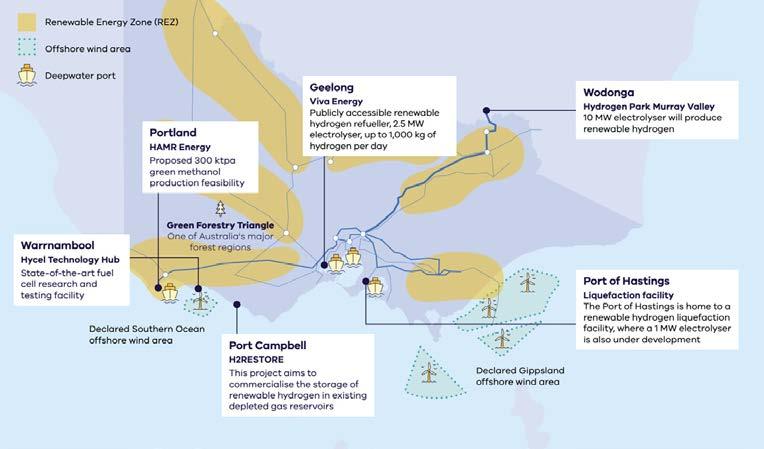
Concurrently, Victoria has significant potential for underground hydrogen storage using depleted gas fields in western parts of the state. If it is succesfully developed, underground hydrogen storage could provide long-duration energy storage that supports electricity system reliability, while enabling large-scale hydrogen supply, according to the Victorian Government.
At Wodonga, the Hydrogen Park Murray Valley project is developing a 10 megawatt (MW) electrolyser capable of producing renewable hydrogen for blending into the gas network and potential application to transportation. In Geelong, the Viva Energy Hub features a 2.5 MW electrolyser that can produce enough hydrogen to fuel a fleet of heavy vehicles, making it one of Australia’s first commercially scaled public hydrogen refuelling stations.
To amplify support for the emerging hydrogen sector, the Victorian Government is also investing in research and workforce development. Facilities such as Deakin University’s Hycel Hydrogen Technology Hub, and the Victorian Hydrogen Hub led by Swinburne University of Technology in partnership with the Commonwealth Scientific and Industrial Research Organisation, are focused on accelerating technology development and commercialisation. National policy is also driving progress. The Federal Government’s updated National Hydrogen Strategy targets up to 15 million tonnes of hydrogen production per year by 2050, with a stretch goal of 30 million tonnes. Meanwhile, programs such as Hydrogen Headstart and the $6.7 billion hydrogen production tax incentive aim to support start-up hydrogen projects to reach commercial scale.
For hydrogen investment opportunities, visit the Victorian Government website: www.energy.vic.gov.au/businesses/ investment-opportunities
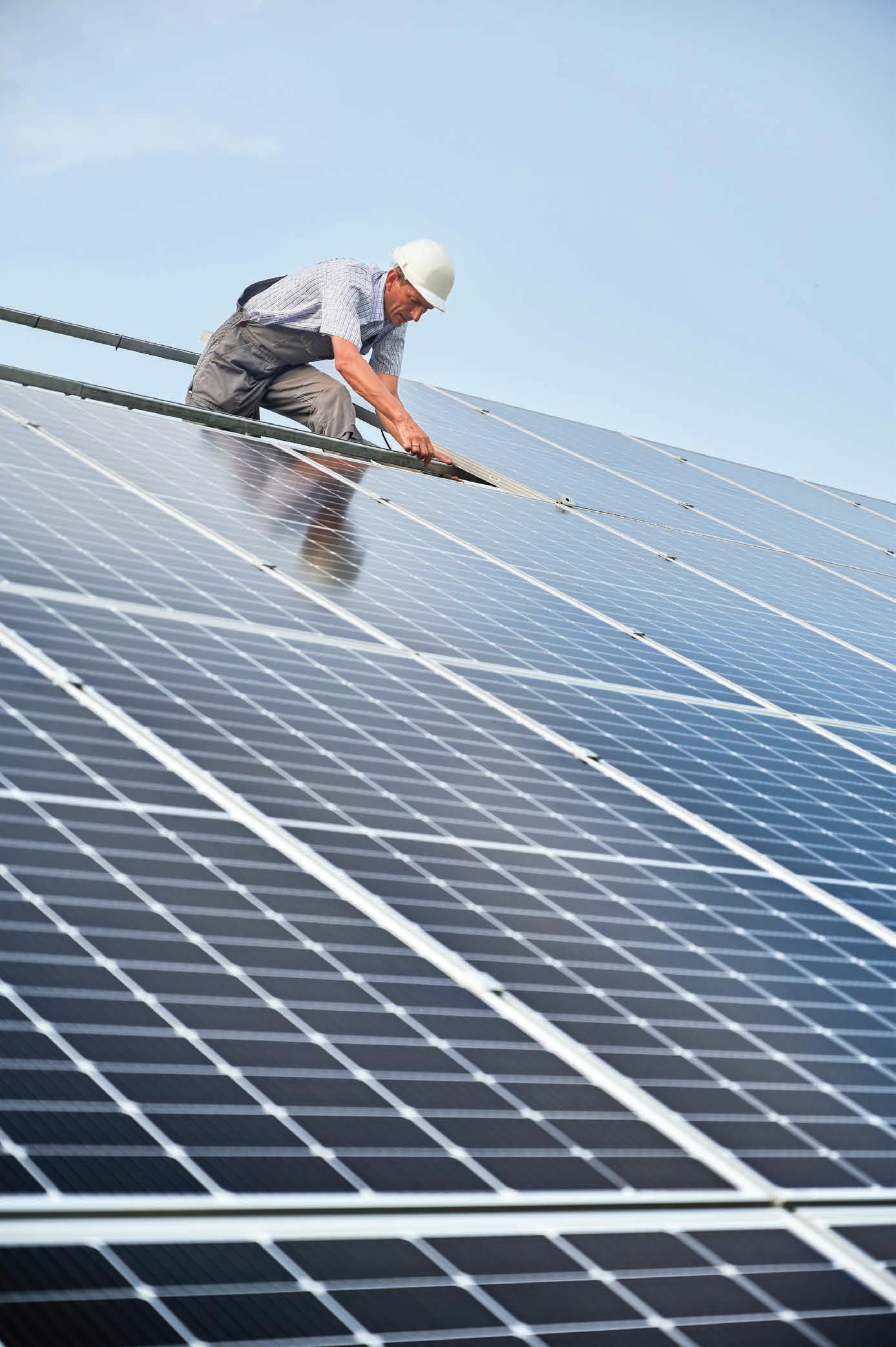


ADVERTISE IN
EXPERT COVERAGE OF THE PROJECTS AND DEVELOPMENTS THAT ARE RESHAPING THE AUSTRALIAN ENERGY MARKET.
23,000+ COMBINED CIRCULATION
Our magazine, e-newsletters and website are valued at all levels of the industry, from financiers and developers to installers and suppliers. As the energy market transitions to renewables, our readers look to ecogeneration.
ecogeneration is the only title in Australia to cover all aspects of the clean energy industry; delivered across print, online and email. The bi-monthly magazine, officially endorsed by the Clean Energy Council, keeps the industry informed from the boardroom to the work van.
The print and digital magazine, and pass on rate, has a combined circulation of more than 23,0000, as well as receiving extra distribution at important industry events.
For more information, please contact: Nick Lovering Business
Development Manager
nick.lovering@primecreative.com.au 0414 217 190


On 9-12 June, Australian Energy Week will take place at the Melbourne Convention and Exhibition Centre, bringing together clean energy leaders and stakeholders across generation, networks, retail, storage, investment, and government.
First established in 2012 as the Eastern Australia’s Energy Markets Outlook, Australian Energy Week has evolved into one of the country’s largest crosssector energy gatherings. The 2026 event is expected to attract more than 1250 attendees, 100 speakers and over 400 organisations, alongside 60+ exhibitors from across the energy value chain.
Today, the conference spans the entire energy supply chain, bringing together stakeholders from generation, transmission and distribution networks, retailers, renewable developers, investors, regulators and government agencies.
This year’s Australian Energy Week takes place at a critical moment in the evolution of Australia’s electricity system.
Renewable energy has expanded rapidly in recent years, with solar, wind and battery storage collectively supplying more than 50 per cent of electricity in the National Electricity Market (NEM) at periods during late 2025.
At the same time, coal-fired generation continues to retire, creating both opportunities and challenges for the sector. Scaling renewable energy deployment while maintaining system reliability and affordability is now a central priority.
Australian Energy Week aims to provide a platform for addressing these issues, bringing together senior decision-makers to share insights, debate policy settings and explore investment pathways.
The conference agenda reflects the increasingly interconnected nature of the energy transition.
More than 100 sessions will be delivered across a main stage and eight specialised streams, combining strategic discussion with practical insights for industry stakeholders from across Australia.
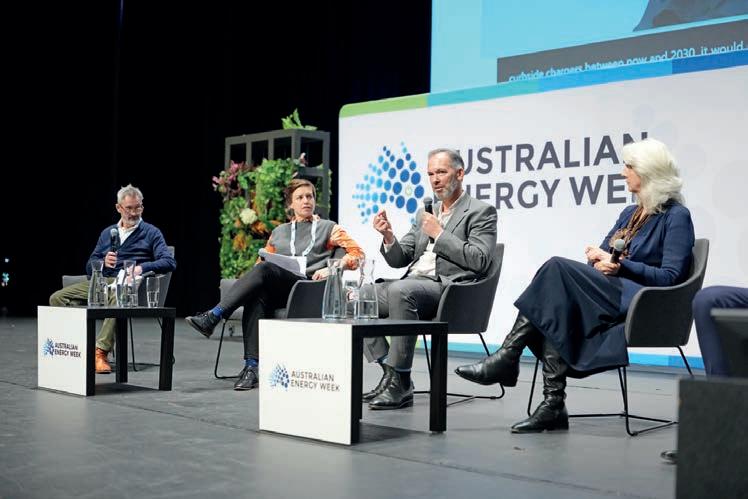
The first day of the event will focus on several core pillars of the energy transition. Sessions on transmission infrastructure will examine how major grid projects can be optimised to deliver system benefits while managing cost pressures. Retail discussions will explore how energy providers are adapting to flexible demand and greater customer participation.
Battery energy storage systems will also feature prominently, with panels addressing commercial models, long-duration storage and the growing role of batteries in supporting grid stability.
Renewable project development is another major theme, with industry leaders discussing project financing, grid connections and ways to accelerate project pipelines.
The second day of the event will turn attention to distribution networks and consumer participation.
Sessions will examine how Distribution Network Service Providers can address grid constraints through smarter network operations and digital technologies. The growing role of distributed energy resources will also be explored, including virtual power plants, vehicle-to-grid technologies and the integration of home and community batteries.
Discussions on generation will focus on managing a more volatile energy system, with firming solutions such as batteries and flexible demand expected to play an increasing role.
The conference will feature keynote addresses from several influential figures across the energy sector, spanning regulatory agencies, government and industry leaders.
and Consumer Commission, and more. Industry executives will also take part; including, Mark Collette, Managing Director – EnergyAustralia, Marc England, CEO –Ausgrid, Simon Emms, CEO – ElectraNet, Krystal Skinner, CEO – Horizon Power, and Nick Carter, CEO – Akaysha Energy, and more. Other speakers include: Edward Northam, Global Head of Green Investments at Macquarie Asset Management ; Deidre Willmott, Strategic Advisor at Fortescue; Daniel Kammen, Bloomberg Distinguished Professor of Energy and Climate Justice –Johns Hopkins University.
With more CEOs and senior leaders attending than most industry events, the conference is designed to facilitate meaningful connections. Networking events such as the Energy Week Gala Dinner and the Women in Energy Breakfast provide additional opportunities for industry engagement.
To find out more, visit: www.energyweek.com.au
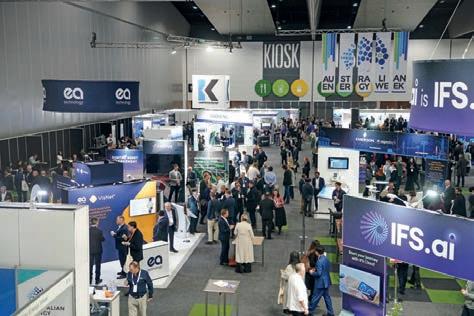
Endeavour Awards returns for 2026 to celebrate the manufacturers, leaders and innovations shaping Australia’s industrial sector, with tickets on sale for the gala event on 13 May 2026.
Australian manufacturing is being asked to do more than ever: Lift productivity, build sovereign capability, and compete on a global stage. The Endeavour Awards, hosted by Manufacturers’ Monthly, stand as a powerful reminder of what the sector can achieve when innovation, leadership and collaboration come together to deliver impact.
Against the backdrop of Australia’s energy transition, the manufacturing sector is playing a critical role in delivering the infrastructure that underpins renewable energy systems –from grid equipment, batteries and electrical components to advanced materials and precision-engineered technologies.
Presented annually by Manufacturers’
Monthly, the Endeavour Awards have become one of the industry’s most respected celebrations, recognising the individuals and organisations driving progress across Australia’s manufacturing landscape.
With tickets now on sale, the awards return in 2026 for a gala dinner on 13 May at the Westin Brisbane.
More than just a black-tie event, the Endeavour Awards offer a rare opportunity for the sector to pause, reflect and celebrate success. Leaders, innovators and emerging talent from across the country will gather under one roof to share stories, strengthen networks and acknowledge the achievements shaping Australia’s industrial future.
The 2026 awards feature a refreshed suite
of categories designed to reflect the increasing breadth and sophistication of Australian manufacturing. While flagship honours such as ‘Manufacturer of the Year’ and ‘Leader of the Year’ remain central, additional categories highlight excellence across aerospace, transport, health technology, sustainability, advanced manufacturing, and food and beverage manufacturing.
Together, the categories paint a picture of a sector evolving rapidly – embracing automation, digital technologies and higher standards, while continuing to underpin Australia’s economy and national resilience.
According to the Platinum Awards Sponsor, the Manufacturing Industry Skills Alliance, celebrating these achievements publicly is
essential to sustaining momentum in the manufacturing sector.
“The future of Australian manufacturing will be shaped by the next generation of skilled workers, innovators and leaders entering the industry today,” says Sharon Robertson, Chief Executive Officer at Manufacturing Industry Skills Alliance.
Robertson observes that sustainable practices, clean manufacturing, advanced technologies and new production methods are currently reshaping what manufacturers make and how they make it.
“As the manufacturing sector evolves, the skills our workforce will need to succeed will change too,” Robertson says.
“The Endeavour Awards recognise the best of what Australian manufacturing can achieve, and so we’re proud to sponsor the Rising Star Award as the Jobs and Skills Council for the sector.”
The Rising Star Award recognises emerging talent in the manufacturing industry – people who are not only developing the skills needed for today’s jobs, but also thinking about what is required for the sector to grow, innovate and compete in the decades ahead.
“At Manufacturing Industry Skills Alliance, we work with employers, unions, training providers and governments to ensure that workforce planning and the skills system align with industry needs,” Robertson says
Supporting initiatives like Endeavour Awards is part of that commitment.
“By recognising and encouraging emerging talent today, we’re helping strengthen the capability, resilience and long-term competitiveness of Australian manufacturing,” Robertson says.
For attendees, the evening offers far more than awards alone. It is a chance to connect with peers, meet collaborators, and gain insight into the ideas and approaches shaping the next chapter of Australia’s manufacturing industry.
For more information, visit: endeavourawards.com.au
Established over a decade ago, the Women in Industry Awards is returning for 2026 to celebrate the outstanding contributions of women across Australia’s industrial sectors – including renewable energy.
As Australia’s clean energy transition accelerates, the demand for skilled professionals across engineering, energy infrastructure, manufacturing and construction continues to grow.
Recognising the women helping to drive this transformation, the 2026 Women in Industry Awards will again celebrate the leaders, innovators and advocates shaping the future of Australia’s industrial sectors. Represented sectors include: renewable energy, manufacturing, mining, engineering, construction, and infrastructure.
Returning in 2026 with a new Sydney location and additional award categories, the program highlights the diverse talent contributing to industries that underpin the energy transition and the broader Australian economy.
Moving from Melbourne to Sydney in 2026, the awards will be held at the Doltone House Darling Island Wharf in Sydney on 18 June.
“This move makes sense for the direction of the awards; the industry is growing so naturally we wanted to expand the awards
program to accommodate to a wider audience,” says Caitlyn Douglas – Prime Creative Media Head of Awards and Conferences.
The four new award categories include: Marketer of the Year, Excellence in Health and Medical of the Year, Tradeswoman of the Year, and the Rising Women in Leadership - C-Suite Executive Award.
“To accompany the new location, these new award categories were created to align with the growing industry and will bring more opportunity to celebrate success,” Douglas says.
A total of 16 award categories at the 2026 Women in Industry Awards have been announced, including:
• R ising Star of the Year (those under 30 years of age)
• Business Development Success of the Year
• Industry Advocacy Award
• Mentor of the Year
• Safety Advocacy Award
• Excellence in Manufacturing
• Excellence in Transport
• Excellence in Engineering
• Excellence in Mining
• Excellence in Construction
• Excellence in Energy
• Woman of the Year (chosen from winners of the other award categories)
• Marketer of the Year (new in 2026)
• Excellence in Health and Medical of the Year (new in 2026)
• Tradeswomen of the Year (new in 2026)
• R ising Women in Leadership: C-Suite Executive Award (new in 2026).
For more information, visit: womeninindustry.com.au

endeavourawards.com.au



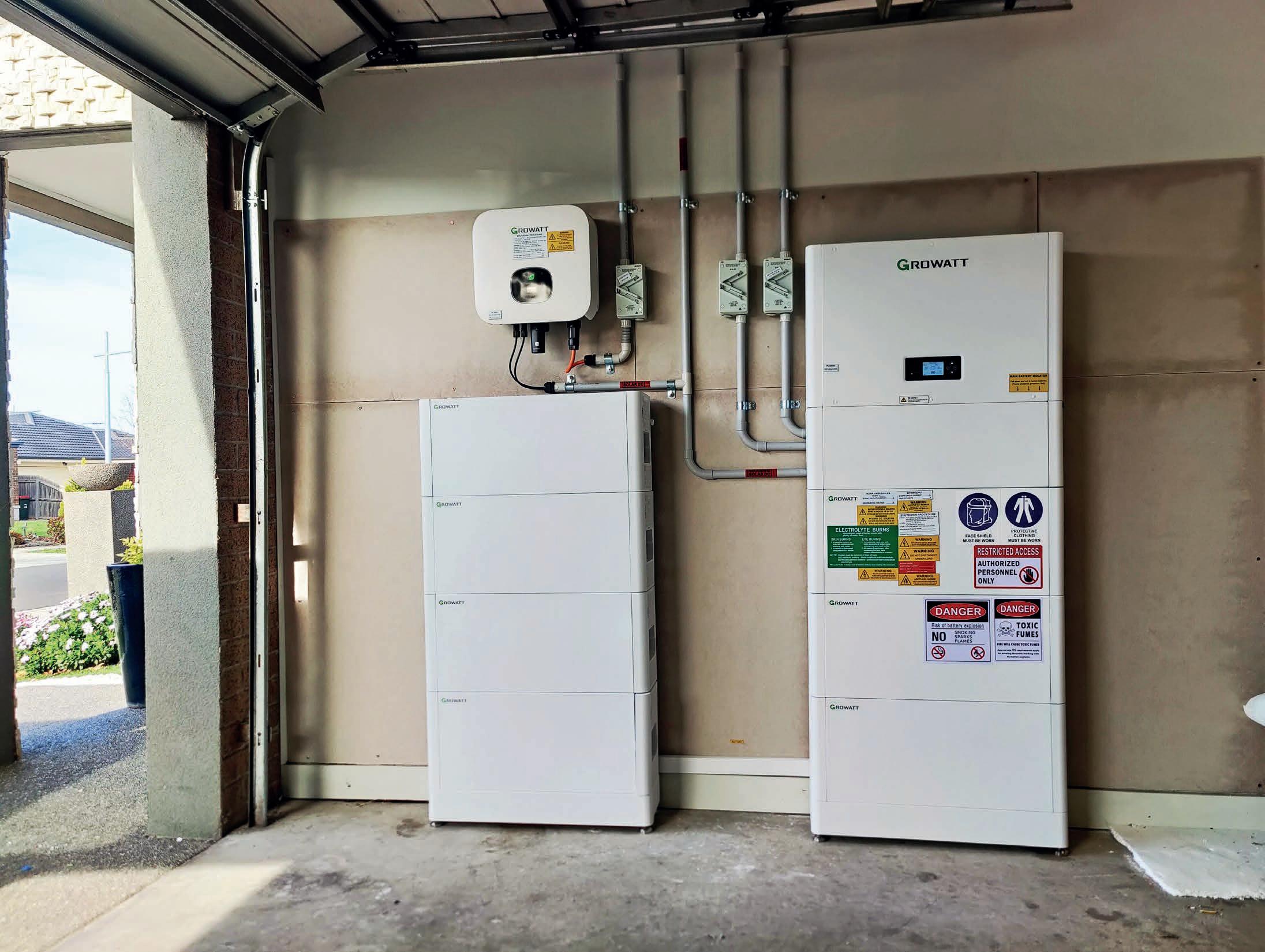



A surge in demand for large home battery systems ahead of changes to the Federal Government’s Cheaper Home Batteries Program has left many installers fully booked out through to 1 May 2026, when the revised rebate structure takes effect.
Installers report capacity is tightening rapidly as households rush to secure systems under current settings, which favour larger battery installations. Rob Moffa from SolarQuotes said that pre-May installation slots are largely exhausted.
Local installers across Australia agree with Moffa’s claims.
From 1 May, the battery rebate will shift to a tiered structure, with support tapering off more quickly for larger systems.
Troy Coburn, Owner of Reef Solar and Electrical in Queensland, revealed that enquiries surged immediately after the December 2025 battery rebate announcement. He explained that the issue is not interest, it’s capacity. He also noted that battery installs require longer
installation and commissioning times than solar-only systems. Industry stakeholders are urging households to secure written confirmation of installation dates. This includes ensuring equipment is available, clarifying compliance requirements, and carefully reviewing deposit terms. While some solar-only capacity remains, high battery demand is also effecting broader scheduling. Coburn adds there can be merit in installing solar first and sizing a battery later on based on real usage data.
With looming changes to the Cheaper Home Batteries Program, installer capacity is tightening.
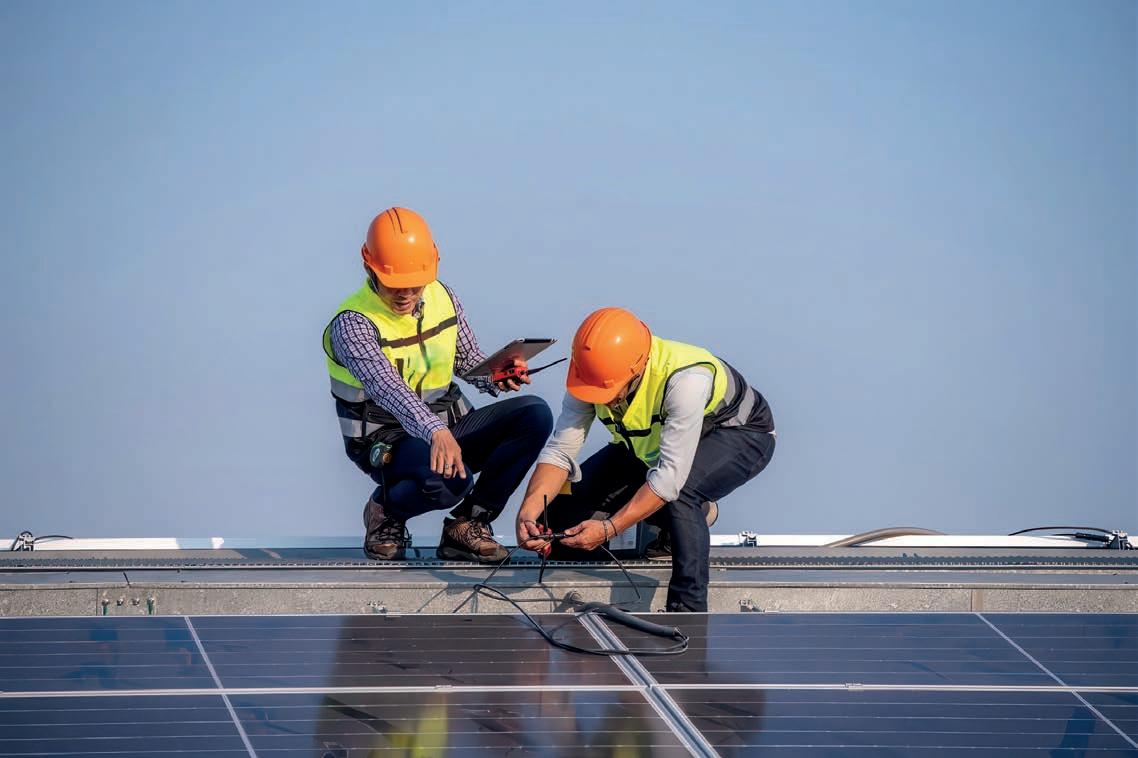
As rooftop solar uptake surpasses 3.6 million Australian homes, attention is shifting to the technology that governs system performance – the inverter. While panel efficiency often dominates purchasing decisions, installers have shared that inverter selection is critical to long-term flexibility, battery compatibility and blackout capability.
A Managing Director at a Queenslandbased installer explained that solar panels generate power, while the inverter controls how that power is used, stored, exported and reserved. Ultimately, inverters determine whether a home energy system can operate during a blackout, whether a battery can be added later, and how it performs in real-world conditions. Standard gridconnect inverters remain common, particularly for daytime energy users. However, they cannot support batteries and shut down during outages.
Alternating current coupled battery systems provide a pathway for retrofitting storage to existing arrays, however, careful design is required, particularly for three-phase properties.
According to SolarQuotes, hybrid inverters are gaining interest as Australian households plan for future electrification. When paired with compatible batteries, they can deliver overnight supply and backup to essential circuits.
For complex roofs, micro-inverters and direct current optimised systems
offer panel-level performance management, though battery compatibility and costs vary.
Installers across Australia affirmed that inverter choice should reflect current consumption, future plans and desired backup capability, positioning it as a central design decision rather than a secondary component.
Queensland-based solar installer 3D Energy reported that inverters are important for maintaining stable rooftop solar generation.
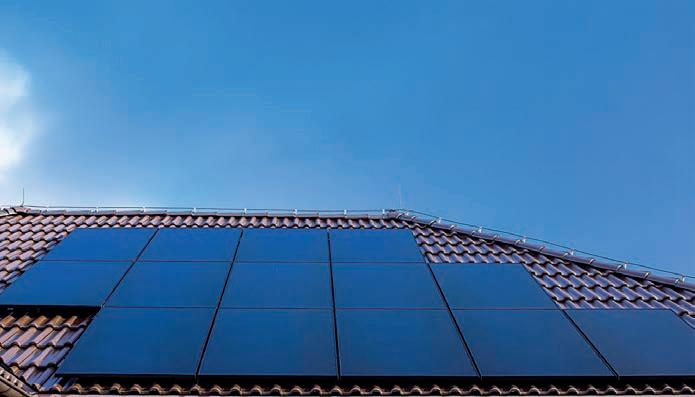

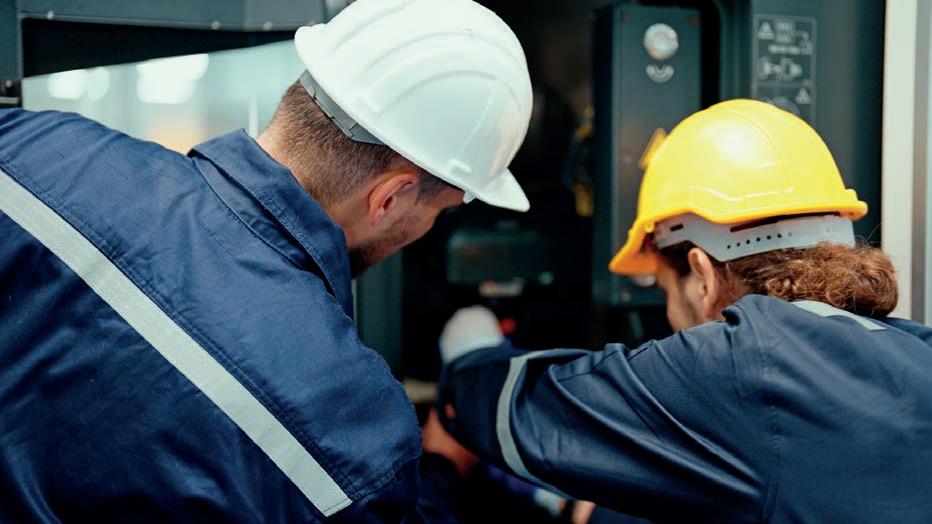
For solar installers working on Victoria’s rapidly growing rooftop solar and battery systems, the Victorian Government’s Energy Safety Roadmap sets out how safety regulations and
workforce standards will evolve as the state’s energy system becomes increasingly decentralised.
Released in December 2025 by the Victorian Department of Energy,
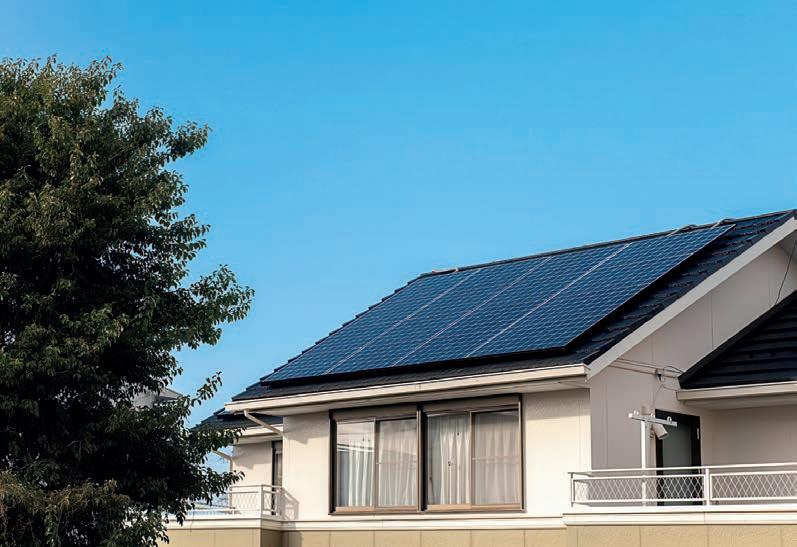
According to Solutions4Solar, increasing climate volatility is sharpening focus on how weather patterns effect rooftop solar system performance. Australia’s high solar irradiance remains a structural advantage,
delivering strong annual yields and attractive payback periods, particularly in new housing developments designed with solar integration in mind. However, extreme heat can reduce panel efficiency.
Environment and Climate Action, the Roadmap outlines how the state will safely deploy new technologies, while supporting the state-wide renewable energy transition.
The Roadmap proposes reforms under three key pillars.
The first pillar focuses on protecting consumers as more households adopt technologies such as solar panels, batteries, electric vehicle chargers, e-bikes, and e-scooters. The State Government’s measures include stronger product standards and labelling, improved recall processes, and clearer guidance on the safe installation and maintenance of distributed clean energy technologies. The second pillar centres around modernising regulation to better manage emerging risks. This includes reviewing legislation and strengthening the powers and resources of Energy Safe Victoria to oversee a rapidly evolving energy landscape. The third pillar addresses workforce capability, with plans to review licensing requirements and ensure electricians and other trades receive the training needed to safely install and maintain new clean energy technologies.
Solar modules generate electricity from light, not heat, and elevated cell temperatures during heatwaves can lower output. In response, installers are prioritising improved airflow, elevated mounting systems and panels with lower temperature coefficients.
Manufacturers are also enhancing heat tolerance in next-generation designs.
Storms, cloud cover and hail can disrupt generation or pose physical risks, but modern modules feature reinforced glass, higher wind-load ratings and stronger racking systems.
Growing battery adoption further smooths variability, maintaining supply during short-term shortfalls.
Cooler southern climates can improve panel efficiency, partially offsetting reduced winter daylight hours, while advances in low-light performance support output under diffuse conditions.
Dust, smoke and coastal corrosion highlight the need for maintenance and climate-specific engineering.
Overall, findings from Solutions4Solar show ongoing innovation and integrated storage solutions have strengthened solar resilience, reinforcing rooftop photovoltaic as a reliable, cost-effective energy solution for Australian households.
From 1 May 2026, the Western Australian Government will introduce new connection requirements for solar and battery systems on the Western Power network, reshaping how distributed energy resources (DER) are installed across the South West Interconnected System.
Published through an updated Wholesale Electricity Market Procedure, the changes apply to Standard Small User Facilities below 1000 volt and up to 30 kilovoltamperes (kVA) aggregate DER capacity.
The State Government reforms allow greater flexibility in inverter design up to 30 kVA under a standard connection, across single and three-phase systems. This creates a pathway for larger rooftop solar and battery systems to access flexible export arrangements and virtual power plant participation.
All systems must comply with AS/NZS 4777.2 using Australian Region B settings. Systems participating in export products, such as the Distributed Energy Buyback
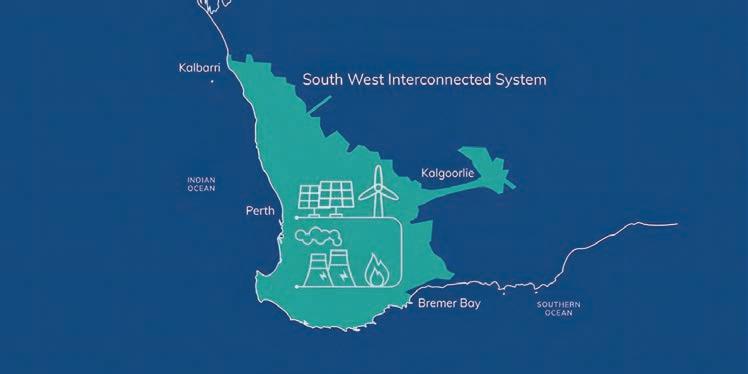
Scheme, must support remote disconnection and reconnection, with retailers nominating the required technical solution. Systems without remote capability must be export limited to 1.5 kilowatt.
For Synergy customers, commissioning must align with Synergy’s Distributed
The Cheaper Home Batteries Program has entered a new phase.
Energy Resource Functionality Requirements and Interconnection Handbook, including CSIP-AUS protocol. The changes respond to the operational challenges of the world’s largest isolated grid. Installers are encouraged to review the procedure ahead of commencement.
Home Batteries Program commencing 1 May 2026.
Administered by the Clean Energy Regulator, the program supports household and business battery systems between 5 and 100 kilowatt-hour (kWh), delivering an upfront discount of around 30 per cent through Small-scale Technology Certificates (STCs) under the Small-scale Renewable Energy Scheme (SRES).
years, with the aim to support more than two million installations by 2030 and add 40 gigawatt-hours of storage capacity nationwide.
From 1 May 2026, two regulatory changes will reshape how the discount is calculated.
Firstly, the STC factor, which determines how many certificates a battery can generate per kilowatt-hour of usable capacity, is due to decline
taper off every six months through to 2030.
Secondly, support will be determined by system size. Capacity up to 14 kWh will attract 100 per cent of the STC factor, 14-28 kWh will attract 60 per cent, and 28-50kWh will attract 15 per cent.
The program operates within the SRES framework, with accredited products and installers required.

ecogeneration
Get
To