
EMAIL: PPISyEN@PPI-Int.com
Dear Readers,
EDITORIAL STAFF
Editor
John Fitch
Editor-in-Chief
Robert Halligan
Managing Editor
René King
PRODUCTION STAFF
Marketing Manager
Benjamin Bryant
Graphic Designer
Matthew Wong
Marketing Coordinator
Rebeca Carneiro
Publishing Assistants
Trudy King
Shalani De Silva
PUBLISHER

Welcome to our latest edition of the Newsjournal, where we embark on an exciting journey through the ever-evolving landscape of systems engineering. It is with pleasure that we bring you the most recent developments, insightful articles, and opportunities for professional growth in this dynamic field.
In this issue's feature article, John Fitch takes center stage with the fourth part in his series of articles on Decision Patterns. Explore the extension of the LML to enable decision patterns and traceability and learn how incorporating the Decision Pattern framework can empower systems engineers to make informed choices and track their progress with precision.
Diving into the digital era, INCOSE has launched the anticipated Digital Engineering process model and a new eBook: "Realizing Relevance: Stories of Our Digital Era,” which encapsulates inspiring narratives from industry leaders who have harnessed the power of digital technologies to drive success.
Amidst the buzz of conferences, meetings, and webinars, we highlight key events such as the Australaisan Simulation Congress (ASC 2023) and the Energy & Mobility Conference and EXPO. These gatherings provide a platform for networking, knowledge exchange, and collaboration among systems engineering enthusiasts.
Project Performance International

2 Parkgate Drive
Ringwood, Vic 3134 Australia
Tel: +61 3 9876 7345
Tel Brazil: +55 12 9 9780 3490
Tel UK: +44 20 3608 6754
Tel USA: +1 888 772 5174
Tel China: +86 188 5117 2867 www.ppi-int.com
© 2012-2022 Project Performance
International (Australia) Pty Ltd, trading as Project Performance International
PPI SyEN (PPI Systems Engineering Newsjournal) is published monthly.
Archived editions and subscriptions to future editions are available for free at: https://www.ppi-int.com/syennewsjournal/
Our resources section is brimming with valuable content. From Carnegie Mellon's Systems & Software Engineering Lunch & Learn Webinars to thought-provoking conversations with AI on requirements engineering, we provide a wealth of knowledge to fuel your professional growth. Delve into the INCOSE Guide to Writing Requirements (GtWR) and uncover a treasure trove of best practices, or explore the fascinating world of system dynamics through the System Dynamics Review.
Lastly, we turn our attention to the societal impact of systems engineering. Join us in exploring the recordings from the Smart Cities Council's Sustainability Innovations Summit, where groundbreaking initiatives are transforming cities into thriving, sustainable hubs. Discover the Optimisin3 Smart City Journeys, where communities and technology intertwine to create a brighter future.
We hope this edition of the Newsjournal ignites your curiosity, inspires your creativity, and broadens your horizons. Thank you for picking up this PPI SyEN edition to gain insights and updates from the forefront of systems engineering.
Regards, René Managing Editor, PPI SyEN
WELCOME
PPI SyEN
By John Fitch (PPI Presenter and Principal Consultant)
START A NEW CHAPTER IN YOUR CAREER?
Are you a very experienced practitioner of systems engineering? Have you considered helping to make the world a better place, in a way “giving back”, by delivering systems engineering training and consulting? If you have, PPI would love to hear from you, regardless of where you are based – email recruiting@ppiint.com All communication will be acknowledged – expect to hear from us within a few days at the most.
Interested in SysML v2? Ask us about openings for SysML v2 courseware development, training delivery and consulting.
Is anything more rewarding than empowering others to do better?
“I learned a lot from the training. It inspired me to propose a complete framework adapted to my organization on not only the "what" but also the “how" to implement the process.” – participant, automotive sector, France.
PPI Systems Engineering Newsjournal (PPI SyEN) seeks:
➢ To advance the practice and perceived value of systems engineering across a broad range of activities, responsibilities, and job-descriptions
➢ To influence the field of systems engineering from an independent perspective
➢ To provide information, tools, techniques, and other value to a wide spectrum of practitioners, from the experienced, to the newcomer, to the curious
➢ To emphasize that systems engineering exists within the context of (and should be contributory toward) larger social/enterprise systems, not just an end within itself
➢ To give back to the Systems Engineering community
PPI defines systems engineering as: an approach to the engineering of systems, based on systems thinking, that aims to transform a need for a solution into an actual solution that meets imperatives and maximizes effectiveness on a whole-of-life basis, in accordance with the values of the stakeholders whom the solution is to serve. Systems engineering embraces both technical and management dimensions of problem definition and problem solving.
June 2023 [Contents] 3 PPI SyEN EDITION 125 | JUNE 2023 CONTENTS SYSTEMS ENGINEERING NEWS ........................................................................................................4 Recent events and updates in the field of systems engineering CONFERENCES, MEETINGS & WEBINARS .....................................................................................15 Events of relevance to systems engineering FEATURE ARTICLE.............................................................................................................................22 Extending the Lifecycle Modeling Language (LML) to Enable Decision Patterns and Traceability ...................................................................................................................................22
SYSTEMS ENGINEERING RESOURCES............................................................................................36 Useful artifacts to improve your SE effectiveness SYSTEMS ENGINEERING IN SOCIETY.............................................................................................45 Expanding applications of SE across the globe FINAL THOUGHTS FROM SYENNA ................................................................................................48 Views expressed in externally authored articles are not necessarily the views of PPI nor of its professional staff.
SYSTEMS ENGINEERING NEWS

INCOSE Launches Digital Engineering Process Model
INCOSE has launched the Digital Systems Engineering Process Model which offers clear, interactive access to all aspects of the systems engineering life cycle processes, providing a template that people can use to meet organizational and product needs for model-based systems engineering of enterprises. The model, designed to help individuals and organizations implement systems engineering techniques in processes, is available in the ISO 15288:2015 standard and the INCOSE handbook v4.
The model was originally developed by the Terminology Working Group of German Chapter of INCOSE (Gesellschaft für Systems Engineering, GfSE) and improved in the Knowledge Management and Ontologies Working Group of INCOSE. Alexander Efremov, CSEP, led the development.
To support convenient tailoring, the process model has been developed in multiple editable formats. Versions are available for the Archi modeling tool and also as Open Exchange Format XML and CSV files.
Download the Digital Engineering Process Model from the INCOSE online store.

See introductory video.
Learn more about the Digital Systems Engineering Process Model Check it out on social media:
• #SystemsEngineering
• #DigitalEngineering
• #enterprisearchitecture
INCOSE eBook Released - Realizing Relevance: Stories for Our Digital Era

INCOSE has launched an eBook, Realizing Relevance: Stories for Our Digital Era: The Business Value of Thinking in Systems, intended as a guide for maximizing business and client value by unleashing the relevance and performance of digital solutions, products and services with fit-for-use systems engineering and thinking.
Developed by the INCOSE Systems and Software Interfaces Working Group, the eBook supports their mission of increasing the relevance of systems engineering and systems thinking in business settings that are software and data intensive. The ultimate goal of this working group is to enable the resilience of organizations and the products, systems, and services that these organizations produce.
The eBook is an interactive resource that:
• Links to video clips where the authors tell the real-life stories of how they used systems engineering and thinking to solve problems.
June 2023 [Contents] 4
Recent events and updates in the field of systems engineering
SYSTEMS ENGINEERING NEWS
• Illustrates the significant advantages of taking a systems engineering approach at the beginning of a project.
Real-life stories span multiple industries and technology domains:
• Healthcare: Aligning business & tech to compete with digitally disruptive startups.
• Ecommerce: Fast cycle time fo app release, to scale in a competitive environment.
• Startups: Remedying small team operational challenges that impede mission.
• Aerospace: Overcoming “glue code” challenges of underbid software contract.
• Automotive (Autonomous vehicles): Resolving overlooked ecoSYSTEM requirements for navigation software to work & Resolving software disconnects and quality with SYSTEM digital threads for traceability
Access the eBook: Realizing Relevance: Stories for Our Digital Era. Learn more about the Systems and Software Interfaces working group.
OMG Announces its Sponsorship Agreement with Dassault Systèmes

On 15 May, the Object Management Group (OMG) announced a sponsorship agreement with Dassault Systèmes. Dassault Systèmes will provide modeling, simulation, and collaboration applications that OMG Standards Development Organization (SDO) teams can use in developing model-driven standards and specifications. OMG will promote Dassault Systèmes at its quarterly technical meetings and during the year.


Under the agreement, OMG’s teams can use Dassault Systèmes’ CATIA Magic Power’By on the 3DEXPERIENCE platform and Cameo suites of model-based systems engineering (MBSE) applications to manage and simplify standards development. These applications offer modeling capabilities from system-of-systems to systems to software to concept modeling, plus plug-ins for model integration and simulation.
OMG teams can use Dassault Systèmes’ 3DEXPERIENCE platform on cloud for collaborative project management and knowledge sharing with features like communities, messaging, conversations, posts, wiki, shared storage, and more.
Learn more here.
OMG SysML v1. 7 Released
The Object Management Group (OMG) adopted Version 1.7 of the Systems Modeling Language™ Version 1.7 in December 2022. The specification is available here. The SysML v1.7 specification is the first SysML specification that was built entirely with a model. SysML v1.7 is expected to be the final version of the SysML v1.x specifications before proceeding to SysML v2.
The v1.7 update includes the following changes:
• The non-normative Annex H was added to define the precise execution semantics for a subset of the SysML stereotypes. These semantics are built on top of the Semantics of a Foundational Subset for Executable UML Models (fUML) and its Precise Semantics of UML
June 2023 [Contents] 5
SYSTEMS ENGINEERING NEWS
• Composite Structure (PSCS) extension.
• Object Constraint Language (OCL) specifications were added to most of the stereotype constraints to formalize the interpretation of their textual description.
• The port conjugation mechanism which reverses the direction of the port features was modified to apply to the port type instead of to the port usage to ensure consistency with SysML proxy and full ports.
Learn more information about SysML releases here.
Call for Submissions - MDPI Special Issues on Systems Engineering
The mission of MDPI, based in Basel, Switzerland, is to foster open scientific exchange in all forms, across all disciplines. To support this mission MDPI publishes over ~100 highly ranked open access journals.

MDPI has issued a Call for Submissions for two special issues that are relevant to the systems engineering community.
Decision Making with Model-Based Systems Engineering
This special issue, to be published in the journal Systems, seeks submissions that emphasize the use of models to facilitate system design, analysis, and decision making throughout a system's life cycle. Decision making is a critical aspect of MBSE, as it enables engineers to make informed choices based on the models that they have created.

The role of decision making in MBSE is to use models to evaluate different alternatives and select the best course of action. MBSE models can represent a wide range of system elements, including system requirements, functions, behavior, and performance. By modeling and simulating a system's behavior and performance under different conditions, engineers can use MBSE to evaluate trade-offs and make decisions concerning the best design choices.
The models used in MBSE also enable engineers to explore “what-if” scenarios, allowing them to model, simulate, and evaluate different options without committing to a particular design. This helps to reduce risk and uncertainty in the decision-making process, as engineers can test the implications of their decisions before implementing them.
The deadline for manuscript submissions is 15 November 2023.
Advances and Challenges in Model- and Data-Based Software and Systems Engineering for Complex Systems
This special issue, to be published in the journal Electronics, addresses the dramatically increasing demands placed on software and system engineers as the systems they develop have increased in complexity, size, and criticality. Novel system types, such as autonomous systems or cyber physical systems, and new technologies, such as Artificial Intelligence, are changing the technology landscape. Thus, supporting and mastering the development and evolution of such complex, software-intensive systems by new approaches is an important and growing research field in software and systems engineering.
This special issue welcomes technical papers presenting research and practical results, position Papers, survey papers addressing the key problems, and solutions on topics of interest including the

June 2023 [Contents] 6
following:
• New modeling concepts in software and systems engineering
• Knowledge-based and data-driven methods
• Learning- and feedback-based approaches
• Model-based requirements engineering
• Traceability of requirements (modeling and analysis)
• Domain-specific models and their integration into meta-models
• Automated generation of different views in development of complex systems
• Architecture evaluation and quality aspects of software and system architectures
• Model-driven engineering
• Component-based software engineering
• Automatic extraction and generation of architecture descriptions
• Refactoring and evolving architecture design decisions and solutions
• Architecture conformance
The deadline for manuscript submissions is 20 January 2024.
12th Anniversary of the Resilience Engineering Association

The Resilience Engineering Association (REA), celebrated its 12th anniversary on 8 June 2023. Founded in France, the REA was built upon the foundation laid by early meetings in 2004 and initial publications in 2006.
Resilience Engineering (RE) is a trans-disciplinary perspective that focuses on developing on theories and practices that enable the continuity of operations and societal activities to deliver essential services in the face of ever-growing dynamics and uncertainty. As a distinct field, RE emerged from the safety science community. RE addresses complexity, non-linearity, inter-dependencies, emergence, formal and informal social structures, threats, and opportunities.
Learn more about the REA here
Join the REA.
Tom Sawyer Perspectives New Release
Tom Sawyer Perspectives is a low-code graph visualization and analysis development platform. Integrated design and preview interfaces and extensive API libraries allow developers to quickly create custom applications.

Perspectives 11.0.0 builds upon previous releases that made it easy to build and deploy applications with the following features:
Drag-and-drop View Layout editor
Creates dashboard arrangement of data visualization views.
June 2023 [Contents] 7
NEWS
SYSTEMS ENGINEERING
Resulting dashboard of views in an example application built using Perspectives


Generate Web Application Code feature
Automatically creates the files needed to build and run a Perspectives application or to package the application for deployment to a web server.
June 2023 [Contents] 8 SYSTEMS ENGINEERING NEWS
View Layout editor in Perspectives
Readme file generated by the Generate Web Application Code feature

Perspectives 11.0.0 includes new capabilities that speed deployment of these scalable applications to Docker, Kubernetes, and Terraform environments. These features, together with Perspectives lowcode application Designer, make it faster than ever to create high-precision graph visualization and analysis applications.
Perspectives 11.0.0 also adds new features that make it easier for end users of Perspectives applications to view and interact with their data and visualizations:
• The new database query builder enables users to create database queries without the need to know Gremlin or Cypher.
• The new magnification tool allows users to see even more details in their graph visualizations.
• Improvements to Hierarchical layout for nested drawings provide reduced inter-graph edge crossings.
• New options for sorting disconnected nodes on a grid provide users control over how nodes are ordered, such as alphabetical sorting.
June 2023 [Contents] 9 SYSTEMS ENGINEERING NEWS
Graph visualization with magnification tool
For additional details, see the Perspectives release notes. Learn more about Tom Sawyer Software technologies, products, and services.
SE Tools Database (SETDB) Updates
Additions and updates are made almost weekly to the Systems Engineering Tools Database (SETDB), developed by PPI in partnership with INCOSE. Recent SETDB updates, including both new tools and updates to existing tools, include:

Vendor: Enalean
• Tuleap Enterprise: Set of highly customizable open source tools for Scrum, Kanban, SAFe®, DevOps or a Helpdesk intended for multi-disciplinary teams to continuously deliver valuable, compliant software adopting Agile and DevOps practices and enabling industry compliance to CMMI, SPICE, ISO.
Vendor: Hexagon AB
• SimManager: Web-based Simulation Data and Process Management system that manages all simulation data and processes from project initiation through final report generation. Its

June 2023 [Contents] 10 SYSTEMS ENGINEERING NEWS
SYSTEMS ENGINEERING NEWS
advanced design analysis functionalities allow experts to refine product models using computer simulation tools.
• Intergraph Smart® 3D: Provides all capabilities needed to design facilities and then maintain their 3D “as-built” representations for downstream uses in the lifecycle. It is specifically designed to deliver mission-critical project requirements and provides all the capabilities to design and maintain facilities
Vendor: IncQuery Labs
• IncQuery Desktop: Add-on to CATIA No Magic MagicDraw / Cameo Systems Modeler that lets you write and evaluate structured model queries right inside the SysML environment.
• IncQuery Cloud: An enterprise-class, scalable application framework that helps you break the silos by maintaining a vendor-neutral and open knowledge graph as representation of all digital engineering data and metadata.
• IncQuery Validator: Devops-ready solutions that provide automated model quality reports based on a CI/CD pipeline, powered by standard and custom rules
Vendor: OpCloud Ltd.
• OPCloud: Cloud-based collaborative MBSE software-as-a-service that features an innovative cloud-based framework that enables companies to architect, design, develop, test, and deliver their products faster resulting in significant cost reduction and time-to-market shortening.
Vendor: Open Source Initiative
• Archi: A modelling toolkit for all levels of Enterprise Architects and Modelers. It is a low cost entry solution for users making their first steps in the ArchiMate modelling language, or are looking for an open source, cross-platform ArchiMate modelling tool for their company or institution.
Vendor: UNICOM Systems, Inc.
• System Architect®: Enterprise architecture solution featuring a robust collection of models and analytics for model analysis, team collaboration and deployment of business initiatives. System Architect includes all aspects of modeling and execution of architecture models and frameworks.
• Focal Point™: Flexible, web-based solution enabling you to perform product and portfolio management driven by market needs and your business objectives. It is configured to your processes and methods so you can prioritize product development and business investments.
• Digital Transformation Toolkit (UDTT ™): Development environment with design templates intended for the retail banking industry. It provides runtime infrastructure based on IBM WebSphere Application Server to deliver targeted multichannel marketing campaigns for retail banking.
• Intelligence: Suite of products helps survey and market researchers gain a deeper understanding of people's attitudes, preferences and opinions.
• PurifyPlus™: Suite of run-time analysis tools for ensuring application reliability and performance by analyzing the behavior of a program based on what it does when it is executed.
• solidDB®: In-memory database optimized for extreme speed and extreme availability. It is
June 2023 [Contents] 11
a fully featured, relational in-memory database that meets the performance and reliability demands of real-time applications.
Vendor: U.S. Environmental Protection Agency
• AirQuality: A collection of EPA resources for reviewing and interacting with air quality monitoring, modeling and emissions data, air trends and emissions sources. This suite includes:
• Daily Air Quality Tracker: The most recent AQI values are available ozone and PM2.5 data from AirNow. This shows the range of the highest and lowest daily max AQI values on each date. The 5-year average is based on AQS data from 2015-2019. It shows the average of daily max AQI values on each date.
• Air Data Multiyear & Single Year Plots: Plot daily AQI values for a specific location and time period. Each square or “tile” represents one day of the year and is color-coded based on the highest daily AQI value at the selected monitor - or among all monitors in a geographic area if "All Sites (Highest Daily AQI)" is selected.
• Air Data AQI Plot: Compare AQI values for multiple pollutants for a specific location and time period. This tool displays an entire year of AQI values - two pollutants at a time - and is useful for seeing how the number of unhealthy days can vary throughout the year for each pollutant.
• Air Data Concentration Plot: Displays daily air quality summary statistics for the criteria pollutants by monitor. You can plot all monitors in a city or county, or you can select a specific monitor.
• BenMap: BenMAP-CE is an open-source program that calculates the number and economic value of air pollution-related deaths and illnesses. The software incorporates a database that includes concentration-response relationships, population files, and health and economic data needed to quantify these impacts.
• Water Data and Tools: Discover how data and tools help EPA protect and restore our waters to ensure that they are drinkable, fishable and swimmable. Includes quality modeling, drinking water tools, air quality tools, community financing tools and water analysis tools.
• WATERS GeoViewer: EPA GeoPlatform based web mapping application that provides access to spatial datasets, watershed level reports, linked data information with up and down searching and interactive watershed delineation.
• NHDPLUS: National Hydrography Dataset Plus (NHDPlus) is a national geospatial surface water framework. Geospatial analysts and modelers use this framework to support water resources applications. The U.S. EPA developed and maintains NHDPlus in partnership with the U.S. Geological Survey.
• BEACON 2.0: The BEach Advisory and Closing Online Notification (BEACON) system meets the Agency's requirement to provide to the public a database of pollution occurrences for coastal recreation waters. EPA's response to this requirement, BEACON, contains statereported beach monitoring and notification data.
• HAWQS: The Hydraulic and Water Quality System is a web based system that models and evaluates the impacts of management alternatives, pollution control scenarios and climate change scenarios that can assist states with water quality
• protection decision-making
• ATTAINS: The Assessment, Total Maximum Daily Load (TMDL) Tracking and Implementation System (ATTAINS) is an online system for accessing information about the conditions in the Nation’s surface waters.
June 2023 [Contents] 12
NEWS
SYSTEMS ENGINEERING
SYSTEMS ENGINEERING NEWS
• How's My Waterway: Provides the general public with information about the condition of their local waters based on data that states, federal, tribal, local agencies and others have provided to EPA.
• CREAT: Assists water sector utilities in assessing climate-related risks to utility assets and operations. Throughout CREAT’s five modules, users consider climate impacts and identify adaptation options to increase resilience.
• ARC-X: An interactive resource to help local governments effectively deliver services to their communities. Decision makers can create an integrated package of information tailored specifically to their areas of interest, and find information about: the risks posed by climate change to their concerns.
SyEN readers are encouraged to check out these new and updated systems engineering tool offerings.
Access the SETDB website.
ISO/IEC/IEEE 15288:2023 has been Published
ISO/IEC/IEEE 15288:2023 Systems and software engineering System life cycle processes was released by ISO last month, May 2023. The standard supersedes ISO/IEC/IEEE 15288:2015, on which the INCOSE Systems Engineering Handbook 4th Edition is based, as is, indirectly, the current INCOSE Certified Systems Engineering Professional (SEP) knowledge exam. The soon-to-be-published INCOSE Systems Engineering Handbook 5th Edition is based on the new standard.
This revised standard aims to establish a common framework of process descriptions for describing the life cycle of systems created by humans, defining a set of processes and associated terminology from an engineering viewpoint. These processes are intended to be applied to systems of interest, their system elements, and to systems of systems. Selected sets of these processes are intended to be applied throughout the stages of a system's life cycle. This is intended to be accomplished through the involvement of stakeholders, with the ultimate goal of achieving customer satisfaction.
The standard defines a set of processes intended to facilitate system development and information exchange among acquirers, suppliers, and other stakeholders in the life cycle of a system.
The standard specifies processes intended to support the definition, control, and improvement of the system life cycle processes used within an organization or a project. Organizations and projects can use these processes when acquiring and supplying systems. The standard can be applied to organizations in their roles as both acquirers and suppliers.
The standard is intended for application to the full life cycle of systems, including conception, development, production, utilization, support and retirement of systems, and to the acquisition and supply of systems, whether performed internally or externally to an organization. The life cycle processes of the standard can be applied iteratively and concurrently to a system and recursively to the system elements. The standard is intended for application to one-of-a-kind systems, massproduced systems, and customised, adaptable systems. ISO states that the standard can also be applied to a complete stand-alone system, although in the view of PPI, there is no such system, except, arguably, the universe.
A guide for the application of the new standard in the form of ISO/IEC/IEEE Draft International Standard - Systems and software engineering -Life cycle management - Part 2: Guidelines for the application of ISO/IEC/IEEE 15288 (System life cycle processes) is in development. This will supersede
June 2023 [Contents] 13
ISO/IEC/IEEE 24748-2:2018.
PPI will publish an application guide to the new standard, initially available only to clients. This guide will complement PPI’s guide to ISO/IEC/IEEE 15288:2015, which is available at https://www.ppiint.com/articles-systems-engineering/application-guidance-on-iso-iec-ieee-152882015-2/
INCOSE Systems Engineering Handbook Fifth Edition to be Published in July 2023
The highly anticipated release of the INCOSE Systems Engineering Handbook Fifth Edition is just around the corner, scheduled for July 2023. The INCOSE Systems Engineering Handbook serves as a comprehensive guide that encapsulates the state-of-the-good-practice of systems engineering. Its content covers a broad range of topics and offers insights into various systems engineering activities applicable to diverse projects. Readers can expect elaboration on the key systems life cycle processes described in the latest ISO/IEC/IEEE 15288:2023 standard and a wealth of information on key engineering concepts such as tailoring and application considerations, and real-world applications of systems engineering and much more.
Pre-order your copy of the INCOSE SEH Fifth Edition today and prepare to enhance your understanding and appreciation of systems engineering with this invaluable reference.
Upcoming PPI Live-Online ™ Systems Engineering Five Day Courses
Click here to view the full schedule or register for an upcoming course.

June 2023 [Contents] 14
NEWS
SYSTEMS ENGINEERING
CONFERENCES, MEETINGS & WEBINARS
Australasian Simulation Congress (ASC 2023)

Registration is open for the Australasian Simulation Congress (ASC 2023) that will be held in Adelaide, South Australia on 21-24 August 2023. The theme of this conference is Life between reality and simulation. Jointly hosted by SESA and ITEA, ASC 2023 will serve as an integrated, transdisciplinary forum, looking at the use of system thinking, modeling and simulation to deal with contemporary societal challenges. The ASC 2023 program will feature keynote speeches, full-paper and paperless oral and poster presentations, as well as masterclasses/tutorials, special interest panels and workshops delivered by leading experts in their respective simulation fields.

The keynote speakers for ASC 2023 will be:
Vicki LeBlanc, PhD:
Chair and Professor of the Department of Innovation in Medical Education at the University of Ottawa. She has over 20 years’ experience leading research into a) optimizing the use of simulation in health professions education and b) the effects of emotions and stress on the performance of health professionals and front-line workers. Dr. LeBlanc has authored over 100 peer-reviewed publications, and regularly presents her work nationally and internationally. In addition to her research program, she works with numerous national and international organizations to advance simulation-based education and serves on the editorial boards of the journals Advances in Health Sciences Education and Simulation in Healthcare.
Professor Dave Snowden:
Creator of the Cynefin Framework and originated the design of SenseMaker®, the world’s first distributed ethnography tool. He is the lead author of Managing complexity (and chaos) in times of crisis: A field guide for decision-makers, a shared effort between the Joint Research Centre, the European Commission’s science and knowledge service, and the Cynefin Centre. His work is international in nature and covers government and industry looking at complex issues relating to strategy and organizational decision-making. He has pioneered a science-based approach to organizations drawing on anthropology, neuroscience, and complex adaptive systems theory. He is a popular and passionate keynote speaker on a range of subjects and is well known for his pragmatic cynicism and iconoclastic style.
Jorge Fainstein Day Gastrell (SGP)
Experienced senior manager, expert in security and law enforcement strategic planning and capacity building and training at national, regional, and international level, to which he has dedicated most of his 29-year career. Seconded from the Argentinean Federal Police, where he is a Commissioner, he currently serves as the Acting Director of the INTERPOL Capacity Building and Training Directorate, based in Singapore. There, he leads targeted capacity building initiatives for law enforcement in INTERPOL’s 194 member countries and sets the Organization’s training standards. He has also successfully driven INTERPOL’s digital training transformation, resulting in the launch of the INTERPOL Virtual Academy in April 2020.
June 2023 [Contents] 15
CONFERENCES, MEETINGS & WEBINARS
Dr. Katerina Agostino: Chief Human and Decision Sciences within DSTG. The Division undertakes scientifically based analysis to enable robust evidence-based decision making by Defense and elements of National Security. The Division also conducts rigorous research into human cognition and behavior, human performance, and social science to enhance ADF capability. Previously, as Chief Aerospace Division, Dr. Agostino was responsible for delivering innovative and effective science and technology in the Australian military aerospace domain.
Learn more about ASC 2023. Register here.
Registration Open for RISK 2023
The Risk Engineering Society of Engineers Australia is hosting the Risk 2023 Conference in South Brisbane, Queensland, Australia on 7-8 September. The conference theme is Risk engineering for a resilient 2030, targeting engineering professionals who practice risk management, risk analysis and risk-based decision-making processes in an engineering context.
The conference hopes to address the unique a range of challenges in this time of global uncertainty and a push toward net zero emissions by 2050, including:
• skills shortages
• energy transition
• defense and security issues
• critical infrastructure
• budgetary constraints
• digital transformation
• ESG requirements
Keynote speakers identified include:
• Professor Maureen Hassall (Director of Industry Safety and Health Centre, University of Queensland)
• Astrid Kauffman (Manager Delivery Safety, Major Transport Infrastructure Authority)
• Dr. Kourosh Kayvani (Head of Engineering, HKA)
• David Rubens (Executive Director, Institute of Strategic Risk Management)
• Professor Liz Varga (Complex Systems - Environmental & Geomatic Engineering, UCL)
Presentations will be arranged in three concurrent tracks:
• PMO, project controls, project risks and contingency

• Global warming, net zero emission, resilience and innovation
• Infrastructure, defense and energy natural resources
View the conference program
Learn more about Risk 2023.
June 2023 [Contents] 16
Register here
CONFERENCES, MEETINGS & WEBINARS
Registration Open for SWISSED 2023
The Swiss Society of Systems Engineering (SSSE), an INCOSE chapter chartered in 2011, is hosting the annual Swiss Systems Engineering Day 2023 (SWISSED23) in Zurich on 18 September. The conference theme is Team of teams. System of systems Keynote lecturers include:
• David Endler (former Tech. Director INCOSE)
• Ralf Hartmann (President-Elect INCOSE)
Learn more about SWISSED 2023 Register here.
Follow SSEE on LinkedIn.

Extended Call for Presentations: Energy and Mobility Conference and Expo
The 2023 edition of the Energy & Mobility Technology, Systems and Value Chain Conference & Expo will be held in Cleveland, Ohio, USA on 12-15 September 2023. This multi-industry international conference is focused on energy and modern mobility, with an emphasis on advanced technologies, the challenges of systems integration, autonomy, and related product value chains and business models that enable the transition to a robust, decentralized and resilient energy sector, the security of critical infrastructure, and the evolution of mobility towards energy-efficient, cost-effective and sustainable solutions.
The organizers have issued an extended call for presentations (oral only; no paper required) with a particular emphasis on presentations and panels that create awareness and help advance the practice of systems engineering in the area of Energy and Mobility.
Submit an abstract here.
View the planned technical program
Learn more about the conference here. Register for the Energy & Mobility Conference & Expo.

INCOSE Western States Regional Conference
The INCOSE Western States Regional Conference (WSRC 2023) will be held in Richland, Washington, USA on 14-16 September 2023. The theme of this conference is Energy – Information – Sustainability.
The keynote speaker for WSRC 2023 will be Puesh Kumar from the Office of Cybersecurity, Energy Security, and Emergency Response at the U.S. Department of Energy. Puesh leads DOE’s mission to address cyber, physical, and natural hazards and threats to the U.S. energy infrastructure. Puesh has over 15 years of experience in grid modernization, cybersecurity, and emergency response within the energy sector. Puesh is speaking on the new National Cyber-Informed Engineering (CIE) Strategy.

June 2023 [Contents] 17
CONFERENCES, MEETINGS & WEBINARS
WSRC 2023 has added a Student Poster Session that will take place on 16 September. Undergraduate, graduate, and doctoral-level submissions are sought that support the conference theme. Download the WSRC 2023 poster template.
Submit a Student Poster abstract (Poster Title, Author, Abstract/main points) in EasyChair.
Learn more about WSRC 2023
Registration Open for PDMA Inspire Innovation Conference
The Product Development Management Association (PDMA) has opened registration for its Inspire Innovation Conference to be held on 16-19 September 2023 in New Orleans, Louisiana, USA.. Held in conjunction with the Journal of Product Innovation Management (JPIM) Research Forum, this four-day in-person event will focus on:

• Product Innovation Processes: Discover the systematic frameworks, tools and approaches that organizations utilize to effectively manage and drive the development and introduction of new products. Unleash the potential for successful innovation in new and established companies.
• Customer Insights: Join interactive discussions and demonstrations on capturing and leveraging the Voice of the Customer. Develop customer-centric offerings and transform qualitative preference information into actionable data for informed decision-making, while considering customers along the entire product life cycle.
• Portfolio Management: Unlock the power to effectively manage your organization's product portfolio. Make informed decisions on resource allocation, risk management, and prioritization, while maximizing overall value in traditional and digital products.
The top-level schedule for this combined event is shown below:
am – 5:00 pm
17 September 8:00 am – 12:00 pm
The Bridge Session on Sunday, 17 September will include presentations by the finalists for PDMA’s Global Student Innovation Challenge.
Keynote speakers and their topics include:
• Aline Sorescu (Professor of Marketing, Texas A&M University) - JPIM Research Forum Keynote
• Radhika Dutt (Radical Product) - Radical Product Thinking: Transforming your organization to build world-changing products
• Matt Phillips - The Mindsets of Breakthrough Innovators
June 2023 [Contents] 18
16 September 8:00
JPIM
Research Forum
JPIM
Research Forum
JPIM
PDMA’s
8:00
5:30
PDMA’s 2023 Inspire Innovation Conference
17 September 12:00 pm – 3:30 pm
Research Forum and
2023 Inspire Innovation Conference Bridge Session 18 September
am –
pm
PDMA’s 2023 Inspire Innovation Conference
19 September 8:00 am – 12:30 pm
CONFERENCES, MEETINGS & WEBINARS
• Shawn Hauser-Fedor (The Hershey Company) and Michael Bauer (Sopheon) -Creating a Recipe for Innovation Success: Hershey Chocolate Company's InnovationOps Story
Register here.
INCOSE Los Angeles - Problem Solving & Root Cause Analysis
In July 2023, the INCOSE Los Angeles chapter will be hosting two hybrid events that will focus on the learning the important skills associated with Problem Solving and Root Cause Analysis.
On 11 July, as part of the INCOSE-LA Speaker Meeting series, Professor Randolph Willard, Defense Acquisition University, will present an overview of problem solving and root cause analysis, including:
• Background/history of root cause analysis
• Characteristics and development of an appropriate problem statement
• Types of problem solving tools
• How to use problem solving tools to identify a root cause
Randolph Willard is a retired career nuclear submarine officer with over twenty years of active-duty U.S. Navy experience operating, testing, and evaluating Fast Attack and Strategic Ballistic Missile submarines. Since retiring from active duty, Mr. Willard has spent over twenty years in executive and leadership positions in the defense industry and as Professor of Program Management at the Defense Acquisition University, Western Region, San Diego, CA.
Register here.
On 22 July, Professor Willard will lead a three-hour workshop that introduces problem solving and root cause analysis. Participants will create an optimal problem statement for an actual industry issue, and then use problem solving tools to identify several potential root causes. Once several potential root causes have been identified, participants will use additional tools to down select to the most likely root cause. As time allows, participants will work through more than one example, from creation of a problem statement through identification of several potential causes, to down-select to a most likely root cause.
Register here.
Learn more about the INCOSE Los Angeles chapter.

Podcast: How to Perform Risk Management for Software As a Medical Device (SaMD)
In this podcast interview, Monir El Azzouzi, founder and CEO of Easy Medical Device Consulting discusses risk management for software pertaining to medical devices with PPI’s Bijan Elahi, a specialist in safety risk management for medical devices. Bijan has over 30 years of experience in the medical device industry and has focused his work on teaching risk management and advising others in the field.

June 2023 [Contents] 19
CONFERENCES, MEETINGS & WEBINARS
In the interview, Bijan explains that software can be classified as embedded software in a medical device, or software as a medical device (SaMD), both of which are governed by ISO 14971. Bijan highlights the challenges of risk management for SaMD, including the frequent updates and changes that software undergoes compared to hardware, as well as the complex environment in which SaMD operates, involving hardware, operating systems, and other applications.
Bijan emphasizes the importance of incorporating risk management from the beginning of software development to ensure safety. He discusses the advantages of software, such as low-cost design changes and rapid mass distribution for updates, as well as the ability to monitor and improve software based on user feedback.
Regarding risks specific to software as a medical device, Bijan explains that software itself is not a hazard but can indirectly cause harm. For example, SaMD may provide advisory services to clinicians, and if the software makes a mistake, it could lead to harm. He emphasizes the need for understanding the functionality, inputs, and outputs of SaMD to identify potential harms.
The conversation also touches on the pitfalls and issues faced by manufacturers when working with SaMD and risk management. Bijan warns against complacency and overreliance on software, using examples like Tesla's autopilot to illustrate how users can become habituated and blindly trust software. He advises manufacturers to prioritize usability engineering and ensure that users can understand and interact with the software correctly.
The discussion also briefly touches on the growing usage of software in medical devices and the importance of considering cybersecurity risks in risk management. Bijan notes that cybersecurity threats have been increasing and highlights the vulnerability of SaMD due to their presence on general computing platforms. Bijan stresses the need to address cybersecurity risks and incorporate them into risk management practices.
Bijan concludes by highlighting the importance of a team approach to risk management, involving systems engineering, quality personnel, medical safety clinicians, and software engineers. He dispels the misconception that risk management should solely be owned by the quality department and emphasizes the need for collaboration and shared responsibility.
Listen to the full interview here
Bijan is the corporate expert on risk management at Medtronic. In this capacity, he offers education and consulting on risk management to all Medtronic business units worldwide. Bijan is also a lecturer at Delft University of Technology, and Eindhoven University of Technology in the Netherlands, where he teaches risk management to doctoral students in engineering. Bijan is a frequently invited speaker at international professional conferences, and is also a contributor to ISO 14971, the international standard on the application of risk management to medical devices. He is the author of the book Safety Risk Management for Medical Devices.
If you’re interested in having Bijan share his expertise on safety risk management for medical devices, please contact PPI’s Business Development Manager René King.
June 2023 [Contents] 20
Look for PPI at IS2023
CONFERENCES, MEETINGS & WEBINARS
Project Performance
International (PPI) will be large as life at the INCOSE IS in Hawaii, showcasing in the exhibition hall our novel, valueadding training and consulting services.

Come say aloha, discuss advanced systems engineering techniques, and attend the tutorials, presentations and panel contributions by PPI leaders!
PPI helps professionals and companies like yours, even the most experienced, reach new levels of engineering capability. Our clients range from small start-ups to Fortune 100 (18% of them!). With PPI training alumni of 19,000+ professionals across six continents and 41 countries, professionals like you and your staff can benefit from our depth and breadth of experience. Even very experienced engineers and teams acquire valuable new knowledge and skills, guaranteed.
We’re also proud to announce that PPI is again a sponsor and exhibitor of the IS. Gain valuable insights from discussions at the PPI booth, and during/after these IS sessions by PPI staff:
• Tutorial: Leveraging Decision Patterns to Power Digital Engineering – Presented by John Fitch
• Saturday 15th July 08:00–17:00 HST
• Extending the Lifecycle Modeling Language (LML) to Enable Decision Patterns and Traceability
– Presented by John Fitch
• Monday 17th July 10:00–10:20 HST
• Panel Session: The Innovative Edge of Participatory Methods in Systems Engineering –Featuring Randall Iliff
• Tuesday 18th July 13:30–14:55 HST
June 2023 [Contents] 21
“
Design description is the product of recording solution decisions.
SYSTEMS ENGINEERING NEWS
Robert Halligan
Extending the Lifecycle Modeling Language (LML) to Enable Decision Patterns and Traceability
by John Fitch Project Performance International
Introduction
This article is the fourth in a series that introduces SyEN readers to a novel pattern-based Decision Management methodology. The author hopes to stimulates engineering practitioners to exploit the principles and practices described in this series in order to deliver more value to stakeholders, in less time and with less resources.
The first article, Introduction to Decision Patterns (SyEN edition #107, December 2021), recounted the author’s 30+ year journey concerning the discovery, use and refinement of decision patterns, the conceptual basis behind this construct, and the extensive variety of use cases in which decision patterns have been applied. The article introduced simplified examples of decision patterns for Enterprise Strategy, System/Product Design, Process Capability Design, Service Design and Curriculum/Courseware Design. The message: Decision patterns are real and have created value.

Building on that foundation, the second article, Decision Patterns – So What? (SyEN edition #111, April 2022), dove more deeply into the potential value created by eight different aspects of a decisioncentric information architecture (aka information metamodel) which, taken together, comprise a novel form of the Digital Thread. Each construct, e.g., the Decision Breakdown Structure (DBS) or Requirement-to-Decision (R-D) traceability, was explored in terms of its representation as class-based entities, attributes and relationships, how this connected thread of knowledge creates new or improved systems engineering capability, and the practical challenges that have been observed when applying this model to the engineering of diverse types of systems. The message: A Digital Thread that overlooks decision traceability is incomplete.
The third article, Reverse Engineering Stakeholder Decisions from Their Requirements (SyEN edition #113, June 2022), focused on how to apply decision patterns and decision-to-everything traceability to a specific front-end use case common to any project or strategic initiative. The Decision Blitz process was explained, i.e., how to use a decision pattern to quickly capture your stakeholders’ decisions and to explicitly trace how these decisions have created the boundary conditions for your project. This process provides the engine for a set of project jump-start services that PPI offers our clients. The message: An explicit, context-aware decision model is a great way to jump-start requirements analysis, requirements validation and solution design.
The principles and practices shared in the first three articles can be used on solution development projects of any type, supported by only the most rudimentary tooling. However, the ability to fully exploit pattern-based Decision Management at enterprise scale and applied to complex systems demands better software solutions. And the foundation for such tooling is a well-documented and sufficiently complete and rigorous modeling language that supports capture of the essential data
June 2023 [Contents] 22
Copyright © 2023 by Project Performance International. All rights reserved. Authored for PPI SyEN
required to identify decisions, plan their analysis, inform decision-making, and capture and communicate decision rationale and the downstream consequences of the solution (alternative) that has been chosen for implementation. The message: Houston, we have a problem!
No widely-accepted system modeling language or out-of-the-box software toolset fully supports the Decision Management methods, information metamodel, and viewpoints that are advocated in these articles. PPI wants to change this fact by helping standards organizations and engineering tool vendors to fully incorporate the power of decision-centric systems engineering into their offerings.
The content of this article explores an in-progress effort to infuse the Lifecycle Modeling Language (LML) standard [1, 2] with a more comprehensive, yet lean decision-centric information metamodel and to support implementation of that metamodel in the Innoslate MBSE software [3] from SPEC Innovations.
Our Approach
At PPI, we pride ourselves on “walking the talk”, i.e., we use the principles and practices that we teach our clients when we develop our products and services. Therefore, we chose the design of our Project Decision Jump-Start Services as the demonstration example that would:
• Highlight the decision-focused extensions (classes, attributes and relationships) needed in the LML.
• Communicate the characteristics (requirements and goals) that PPI desires in a Service Delivery Platform (SDP) for our evolving portfolio of Decision Management services.
• Prototype multiple high-value decision-centric digital threads by capturing requirements, decisions, solutions, etc. in Innoslate.
• Create viewpoints to visualize these digital threads, leveraging the existing capabilities of Innoslate.
• Iterate the proposed information metamodel and viewpoints to maximize the value that can be delivered without significant modifications to LML and Innoslate.
• Define the requirements and goals that would fill key language and tool gaps in the support of our vision of a pattern-based Decision Management capability with decision-to-everything traceability.
We used the Service Design decision pattern [4] and conducted a quick Decision Blitz [5] to frame the decisions that have been made (reflecting our desire for a Decision Management services portfolio) and are yet to-be-made (the design of the service flows and service delivery platform).
June 2023 [Contents] 23
FEATURE ARTICLE
Service Design decision pattern; our starting point
Prior to conducting the Decision Blitz, an initial set of schema extensions were added to Innoslate, including:
• Creation of a new Design Decision class, a subclass of LML’s Action class.
• Creation of a new Alternative class, a subclass of LML’s Asset class.
• Various Design Decision and Alternative attributes and relationships.
The Service Design decision pattern was imported into Innoslate from Excel and used as the questioning framework for conducting the Decision Blitz. The Decision Blitz yielded a Decision Breakdown Structure (DBS). The DBS was captured in an Innoslate database query, i.e., a saved/named/retreivable viewpoint, and exported to Excel to share with PPI team members for validation and refinement.


June 2023 [Contents] 24 FEATURE ARTICLE
Figure 1 –
Figure 2 – Decision Blitz Results (partial) exported from Innoslate
FEATURE ARTICLE
Because the Design Decision class was created as a subclass of Action, the DBS is not limited to a hierarchical decomposition of thinking tasks. Connecting design decisions with LML’s control flow constructs (Sequential, Parallel/SYNC, Selection/OR and LOOP) transforms the DBS into a network of serial or parallel thinking tasks and branching logic that can be visualized as a Action Diagram. When coupled with the Task subclass, another subclass of Action, this model can support the assignment of resources and dates/durations to create a comprehensive Trade Study (Decision Analysis) Plan for the project.
The Decision Blitz identified two services as central to PPI’s Decision Management services portfolio; therefore worthy of designing/modeling in more detail:

• Requirements Validation
• Project Decision Planning
June 2023 [Contents] 25
Figure 3 – Decision Breakdown Structure – Trade Study Plan as an Action Diagram
FEATURE ARTICLE
The PPI team originally worked through the Requirements Validation service engagement flow as a simple N-Squared Diagram captured in Excel.
Mapping the service steps as Actions and the items (work products) flowing between the steps as the LML Input/Output class was a good fit for modeling the engagement flow of each service. Figure 4b shows how a portion of the the engagement flow model appears within an Innoslate Action Diagram. Green trapezoids represent required inputs/outputs; gray trapezoids are optional items that provide as-needed feedback to earlier steps.

Although it takes more time and user interface actions to populate and lay out the Action Diagram when compared with the equivalent Excel N-Squared Diagram, the Action Diagram provides additional value by:

June 2023 [Contents] 26
Figure 4a – Requirements Validation Service – Original N-squared Diagram
Figure 4b – Requirements Validation Service – Action Diagram
FEATURE ARTICLE
• Modeling the control flow (branching logic) of the Action Diagram by defining serial and parallel (or conditional, iterative or looping) actions.
• Providing the ability to hide (by filtering) or to abstract (by roll-up) details that are important to one audience, but not another.
• Supporting capture of additional attributes associated with the Action or Input/Output entities.
• Creating entities that may participate in other views based on relationships not shown in the NSquared Diagram.
• Supporting model consistency checking, e.g., detecting dangling actions, inputs or outputs.
Figure 4c illustrates a manually-generated definition of both service flows combined in a single diagram. It is included to illustrate the fact that views generated from system models within MBSE tools will likely never fully replace hand-drawn customized art used for communication purposes. However, the graphical richness and flexibility of MBSE tools continues to improve such that they may be an effective 80%-20% solution and reduce the need for many costly and hard-to-maintain handdrawn artifacts.
The alignment of the information metamodel with desired stakeholder viewpoints has been an iterative process; one filled with tradeoffs in which current tool limitations in visualizing knowledge influences the selection of classes, subclasses, relationships and attributes. For example, Innoslate enables the definition of database queries that generate tabular views of entities based on their class and relationships; however, filtering out entities in traceability “columns” by their attribute values is not supported at present. This creates the need for more relationships than might be desired. For example, three relationships (analyzes, chooses, rejects) are required between a design decision and an alternative to capture the evolution of thinking that occurs during the Decision Analysis process. It would be simpler if the value of an enumerated Preference attribute (Legacy, Committed, Recommended, Current favorite, Worth considering, Consider but rejected, Just an idea) on each alternative provided the ability to filter unwanted alternatives from various decision-focused views.

June 2023 [Contents] 27
Figure 4c – Combined Engagement Flows – Hand-drawn graphics [6]
Filtering traceability (tabular) views and hierarchical decompositions is also limited to “left-to-right” relationship logic. This limits the ability to view the Requirement-to-Decision-to-Requirement (R-D-R) traceability [7] in which the “decision-in-the-middle” is the starting point and where stakeholders want to see in one view how many requirements/goals influence a single decision, which then creates multiple derived requirements. This points to the need for a many-to-one-to-many diagramming topology (fan-in/fan-out), instead of a long serial thread or simple expanding hierarchy.
Figure 5: Requirement-Decision-Requirement (R-D-R) Traceability Model
Figure 6 illustrates the iterative process of information metamodeling and viewpoint definition, using the data model for decision analysis and typical methods for visualizing decision analysis logic. LML and Innoslate support the ability to visualize Radar Diagrams that show the performance (effectiveness) of alternatives against a set of evaluation criteria. Risks may be represented in a colorized matrix form. However, there is no convenient out-of-the-box ability to define richlystructured tables that place Performance information in “cells” defined by relationships with Criterion (the rows) and Alternatives (the columns). This prevents auto-generation of a typical Evaluation Matrix with an associated Risk Table for the leading alternatives.


June 2023 [Contents] 28
FEATURE ARTICLE
Figure 6 – Iteration between Information Metamodel and Viewpoints
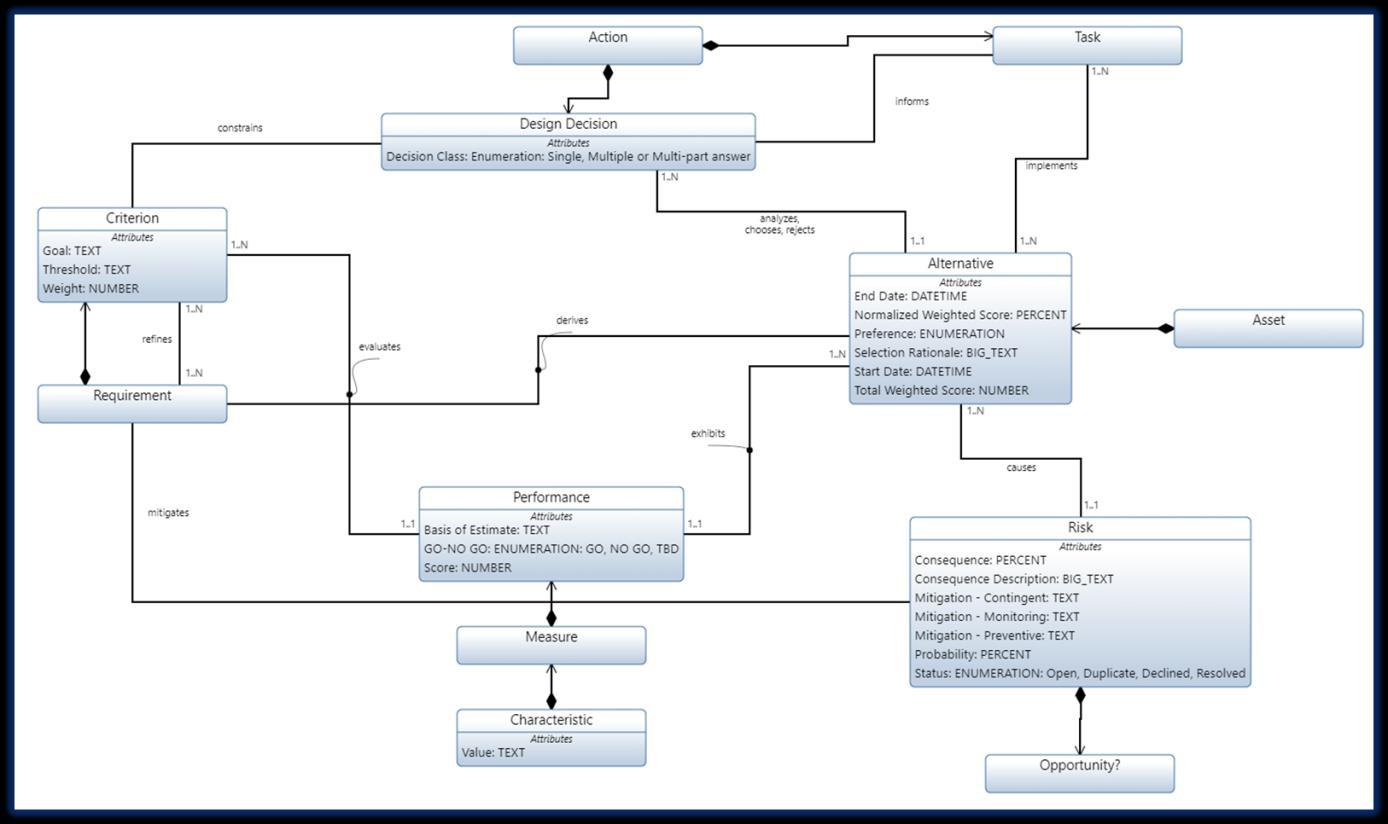
The author’s experience in defining and extending the schema of other software tools enabled a first cut at mapping the prior art to the LML. The information metamodel shown in Figure 7 is the result of multiple iterations and schema-vs-viewpoint tradeoffs and represents an initial proposal to the LML Steering Committee.
Proposed Metamodel/Schema Extensions
A brief overview of the proposed LML extensions follows.
Design Decision
LML includes a Decision class, but a review of its attributes, relationships and uses indicate that this class was suitable for operational decisions, i.e., conditional branching points in an operational process flow. It was not designed for representing a system design or strategy decision, which are defined in the pattern-based Decision Management methodology as “A fundamental question or issue that demands an answer or solution. A subset of the overall problem to be solved”.
As noted earlier, the Design Decision class was created as a subclass of LML’s Action class; as a result it inherited useful decision planning attributes such as Start (date), Duration and Percent Complete and relationships such as:
• generates or receives -> Input/Output
• depends on -> Action
• consumes -> Resource
• performed by -> Asset
It was relatively simple to add attributes and relationships (that have proven useful in past Decision Management engagements) to the Design Decision class. Figure 8 illustrates how those extensions appear within the Innoslate Schema Editor.
June 2023 [Contents] 29
FEATURE ARTICLE
Figure 7 – Proposed LML Extensions to Support Decision Management
Figure 8 – Design Decision class attributes and relationships

Criterion
A Criterion is a subclass of Requirement used to evaluate (screen and score) the value delivered by an alternative in a design decision. A Criterion clarifies the intent of a system requirement (and its associated goal value) in the context of a specific decision. Beyond the attributes inherited from the Requirement class, a Criterion includes:
• Threshold
• Goal
• Weight
These attributes support the screening and weighted scoring processes that are central to multicriteria decision-making.
A Criterion has several unique relationships that support decision analysis:
• constrains -> Design Decision
• evaluates -> Performance
• refines -> Requirement
Alternative
The Alternative class, a subclass of Asset, represents a possible solution to the question posed by a design decision. Alternative attributes include:
• Preference
• Selection Rationale
• Start Date
• End Date
June 2023 [Contents] 30 FEATURE ARTICLE
• Total Weighted Score
• Normalized Weighted Score
Alternative relationships include:
• analyzed by, chosen by, or rejected by -> Design Decision
• exhibits -> Performance
• derives -> Requirement
• implemented by -> Task
Performance
Performance, a subclass of Measure (a subclass of Characteristic), represents the estimated or measured effectiveness of an alternative in a design decision, as evaluated against the threshold and goal values for a specific criterion. Performance may be expressed as qualitative text or as quantitative real number estimates (with units). Performance attributes include:
• Basis of Estimate
• GO-NO GO
• Score
As stated earlier, Performance entities populate the cells in an Evaluation Matrix at the “intersection” formed by two relationships:
• exhibited -> Alternative
• evaluated by -> Criterion
The Evaluation Matrix for a design decision with ten criteria and five alternatives would, if fully populated, have fifty Performance entities. In practice, some alternatives may be eliminated from further evaluation when they fail to meet the Threshold value specified in a Criterion; therefore, not every Alternative-Criterion pair must have a Performance entity. Some decisions may have more than one Performance entity for each Alternative-Criterion pair if multiple estimates are made by different methods (extrapolation from expert experience, back-of-the-envelope calculation, math model, simulation, prototype testing, or system testing).
Risk (and Opportunity)
LML’s Risk class was well matched with the common usage of risk as the expression of uncertainty, i.e., a potential tie-breaker between alternatives in decision-making. Because Alternative was defined as a subclass of Asset (which possesses an Asset -> causes -> Risk relationship), no additional schema changes were required to associate risks with alternatives. Three additional attributes were proposed for a risk to provide the ability to describe a general strategy on how a risk might be mitigated:
• Mitigation – Preventive
• Mitigation – Contingent
• Mitigation – Monitoring
The existing relationship, i.e., Risk -> mitigated by -> Action, Asset or Characteristic, may then be leveraged as a method to detail the risk mitigation strategy in terms of process steps, new components or mitigation requirements.
Though less often considered in decision analysis, an Opportunity class (subclass of Risk) which expresses how an alternative might perform better than expected, would be a useful addition to LML. Opportunity attributes that express how to improve the odds (probability) and positive impact (consequence) might include:
June 2023 [Contents] 31
FEATURE ARTICLE
FEATURE ARTICLE
• Growth – Promoting
• Growth – Exploiting
• Growth – Monitoring
Thoughts on Data Visualization (Viewpoints)
The LML standard defines a set of Mandatory diagrams including:
• Action Diagram (Mandatory for Action entities with children)
• Asset Diagram (Mandatory for Asset entities with children)
• Spider Diagram (Mandatory for traceability across classes)
Additional useful diagrams that commonly support full lifecycle engineering and relevant to Decision Management include:
• Class and Entity Relationship Diagrams (to model information architecture alternatives)
• Timelines (to model the Trade Study plan that sequences decision analysis and associated modeling, simulation, prototyping and testing tasks that inform decision-making)
• Hierarchy Diagram (to model any decomposition structure)
• Risk Matrix (to map risks to a probability and consequence grid)
Innoslate supports the rendering of the content of most of the diagrams mentioned above in tabular form, both within the application canvas and as Excel file reports.
Beyond the visualizations defined in the LML standard, Innoslate supports a Radar Diagram that may be used to represent the relative effectiveness of an alternative against the criteria in a design decision. This is possible “out-of-the-box” because:

• The Radar Diagram is implemented to display Characteristics associated with Assets
• Characteristic is parent class of Measure, the parent class of Performance.
• Asset is the parent class of Alternative.
June 2023 [Contents] 32
Figure 9 – Radar Diagram of Effectiveness of Innoslate as a Service Delivery Platform Alternative
Gaps to Fill
From the “chosen” alternatives in Decision Jump-Start Services decision model, the PPI team captured a set of derived requirements and design goals for a proposed Service Delivery Platform. To date, ~40 requirements have been identified, mostly functional and performance. An example of these requirements, associated with Step DS.9 in the Requirements Validation service flow, are shown in Figure 10, below. These requirements address the two ways that a decision (through the alternative chosen) creates new “derived” requirements that constrain the design of the system of interest, i.e., the Decision-to-Requirement traceability aspect of the Digital Thread.

Note that significant communication value can be provided by populating the Rationale attribute for each requirement. This illustrates how a lean, Entity-Relationship-Attribute (ERA) information metamodel can improve communication and alignment between stakeholders and solution developers.
The following is an initial wish list of LML extensions and Innoslate enhancements that would most significantly improve our ability to support a rich set of Decision Management services on this platform:
• General purpose entity -> instantiates -> entity relationship with one-to-multiple and branch entity instantiation tools to accelerate the creating of a DBS from a decision/criteria pattern. Distinguish pattern instantiation from other traceability relationships.
• Requirement-Decision-Requirements (R-D-R) traceability viewpoints (graphical and tabular) with a decision-in-the-middle (many-to-one-to-many topology) built on a general fan-in/fanout traceability engine.
• Configurable multiple-panel “boxes” for displaying user-selectable attributes, relationships and relationship targets for any class of entity. Supports visualization of a Decision Breakdown Structure in two or three-panel box format (Decision, Alternatives analyzed or chosen, Decision Status or the performed by relationship).
• Evaluation Matrix viewpoint that supports direct input of Performance entities and associated attributes in the cells formed by rows (Criterion) and columns (Alternatives). Ability to generate and display weighted scores and total weighted scores.
June 2023 [Contents] 33
FEATURE ARTICLE
Figure 10: Functional and Performance Requirements (with Rationale) associated with an Action.
FEATURE ARTICLE
• Ability to overlay and selectively compare the Radar Diagrams of multiple Alternatives (Assets).
Numerous other language and tool extensions may be discovered through on-going engagement between the PPI and LML/SPEC Innovations teams.
Conclusions
Approximately 50 hours of effort has been invested by PPI in:
• From-scratch learning of LML and the Innoslate MBSE software.
• Extending the LML information metamodel and Innoslate schema by 5 classes and associated attributes and relationships.
• Using the extensions to create an Innoslate Decision Pattern Services project with ~700 entities – decisions, requirements, actions, etc. with ~20 views and reports
• Summarizing an initial set of proposed requirements for supporting pattern-based Decision Management in the language and software.
Next steps include:
• Completing the definition of proposed requirements for full support of the Decision Analysis process to enable a Decision Coaching service that will follow the Decision JumpStart services.
• Continuing engagement with the Lifecycle Modeling Organization and SPEC Innovations to negotiate the best implementation of extensions to the standard and enhancements to the software.
The process used in this language/software extension project can be generalized to other language standards and MBSE tools. Plans are underway to begin engagement with the SysML community so that future SysML tools will fully support advanced pattern-based Decision Management capabilities in their native form.
In the meantime, please inquire if you have interest in building any of these capabilities into your products or using them on your projects. Contact the author at jfitch@ppi-int.com or PPISyEN@ppiint.com to communicate your interest.
References
[1] Lifecycle Modeling Organization, 2022. Lifecycle Modeling Language (LML) Specification, Version 1.3, http://www.lifecyclemodeling.org/spec/1.3, 16 June 2022.
[2] Vaneman, W., Sellers, J. and Dam, Steven, 2018. Essential LML – Lifecycle Modeling Language (LML): A Thinking Tool for Capturing, Connecting and Communicating Complex Systems. https://specinnovations.com/download-essential-lml-ebook. SPEC Innovations. Manassas, Virginia, USA, 2018.
[3] SPEC Innovations, 2023. Innoslate Product Overview. https://specinnovations.com/innoslate.
[4] Fitch, J.A., 2021. Introduction to Decision Patterns, Project Performance International Systems Engineering Newsjournal, PPI SyEN 107, December 2021.
[5] Fitch, J.A., 2022. Reverse Engineering Stakeholder Decisions from Their Requirements, Project Performance International Systems Engineering Newsjournal, PPI SyEN 113, June 2022
[6] Project Performance International, 2023. Project Decision Jump-Start Services, https://www.ppiint.com/corporate-services/project-decision-jump-start-services/.
[7] Fitch, J.A., 2022. Decision Patterns – So What?, Project Performance International Systems
June 2023 [Contents] 34
FEATURE ARTICLE
Engineering Newsjournal, PPI SyEN 111, April 2022.
About the Author
John Fitch is a Principal Consultant and Course Presenter for Project Performance International. John brings over four decades of systems engineering, engineering management, consulting and training experience to the PPI team. In 2012, John was certified by INCOSE as an Expert Systems Engineering Professional (ESEP). Within the field of systems engineering, John’s career has focused on decision management, requirements management, risk management, systems design & architecture, product/technology road-mapping and innovation. In addition to defense/aerospace, John has guided initiatives in domains such as communications systems, software, energy, nanotechnology, medical devices, manufacturing systems, knowledge management and business process improvement.
PPI RESOURCES
PPI offers a multitude of resources available to all of our clients, associates and friends! Click on any of the links below to access these resources today.
Systems Engineering FAQ: https://www.ppi-int.com/resources/systems-engineering-faq Industry-related questions answered by PPI Founder and Managing Director Robert Halligan.

Key downloads: https://www.ppi-int.com/keydownloads/ Free downloadable presentations, short papers, specifications and other helpful downloads related to requirements and the field of Systems Engineering.
Conferences: https://www.ppi-int.com/resources/conferences-and-meetings/ Keep track of systems engineering-relevant conferences and meeting dates throughout the year.
Systems Engineering Goldmine: https://www.ppi-int.com/se-goldmine/ A free resources with over 4GB of downloadable information relevant to the Engineering of systems and a searchable database of 7,800+ defined terms. You can expect the content of the SE Goldmine to continue to increase over time.
Systems Engineering Tools Database (requires SEG account to log in from the Systems Engineering Goldmine): https://www.systemsengineeringtools.com/ A resource jointly developed and operated by Project Performance International (PPI) and the International Council on Systems Engineering (INCOSE). The SETDB helps you find appropriate software tools and cloud services that support your systems engineering-related activities. As a PPI SEG account holder, you have ongoing free access to the SETDB.
PPI SyEN Newsjournal (actually a substantial monthly SE publication): https://www.ppiint.com/systems-engineering-newsjournal/ You’re already reading our monthly newsjournal! However click on the link to access the history of 100+ monthly newsjournals containing excellent articles, news and other interesting topics summarizing developments in the field of systems engineering.
June 2023 [Contents] 35
SYSTEMS ENGINEERING RESOURCES

Carnegie Mellon Systems and Software Engineering Lunch and Learn Webinars

In partnership with the 12 chapters that comprise the INCOSE Great Lakes North-Central (GLNC) Region, the Carnegie Mellon University (CMU) Software Engineering Institute (SEI) has completed delivery of a series of webinars in its Lunch and Learn Series. The recordings for nine of the these twelve events have been posted on the INCOSE GLNC YouTube Channel
Moving Machine Learning into Production Systems, Dr. Jeffrey Chrabaszcz, CMU SEI Machine learning (ML) components are increasingly becoming indispensable parts of software systems in every sector. Various sources agree on a compound annual growth rate of about 40% in global ML market by 2029. Yet, Gartner estimates that about 85% of ML projects fail. Among top reasons of failures is disconnect of data science and software engineering. In this talk, I will discuss my experience in and research on building software systems with an ML component.
SEI CERT’s Zero Trust Journey: Systems Engineering for Cybersecurity, Timothy Morrow, CMU SEI Zero trust (ZT) is the term for an evolving set of cybersecurity paradigms that move defenses from static, network-based perimeters to focus on users, assets, and resources. A ZT architecture (see NIST SP 800-207) uses ZT principles to plan industrial and enterprise infrastructure and workflows. SEI’s CERT Division is a leader in cybersecurity, partnering with government, industry, law enforcement, and academia to improve the security and resilience of computer systems and networks. This presentation describes the development of SEI’s Zero Trust Journey, which provides a transition path to apply ZT tenets across an organization. It is a systems approach that combines Mission/Business Threads, Systems Security Engineering (NIST SP 800-160 volumes 1 & 2, in conjunction with ISO/IEC/IEEE 15288), Model-based Systems Engineering (MBSE), Continuous Authorization (cATO) concepts, and Cybersecurity Engineering Assessments that identify risks and provide decision makers with important insights. The Zero Trust Journey activities guide the development of the infrastructure required for the implementation of the ZT transition roadmap and focuses on continuous monitoring of operations and changes.
Practical Proven Software Architecture Analysis and Evaluation Fundamentals, Philip Bianco, CMU SEI Architecture is critical for business success. A solid architecture helps prevent defects and system failures. It helps a development effort save money and get quality products to the market faster. Most software-reliant systems are required to be modifiable and reliable. They may also need to be secure, interoperable, and portable. Many organizations are struggling with the results of making poor architectural choices and inadequately managing architectural decisions. How do you know whether your software architecture is suitable or at risk relative to its target system qualities? This session covers practical and proven architecture analysis and evaluation fundamentals that should be incorporated into any software architecture evaluation process. We will demonstrate these principles that identify risks early in the development lifecycle using fundamentals and techniques from the Architecture Tradeoff Analysis Method (ATAM), a tested process that has been used in many evaluations over the past 20 years.
June 2023 [Contents] 36
to improve your SE effectiveness
Useful artifacts
SYSTEMS ENGINEERING RESOURCES
Meeting Software Development Challenges with SEI’s "CREW" Risk Assessment Process, M. Riley, CMU SEI
In a webinar from January of 2021 titled “The Cost of Poor Software Quality in the US: A 2020 Report” the Consortium for IT Software Quality (CISQ) estimated that poor software quality costs the US economy about $2 trillion dollars. This is number slightly less than 10% of the US GDP. CISQ attributes this staggering loss to operational software failures, poor quality legacy systems, and unsuccessful projects. Both functional and structural quality attributes exist in source code. Traditional V&V methods measure functional software quality in terms of meeting requirements or goals. Structural code quality has been more difficult to understand. SEI has developed a method to estimate the quality risk of embedded mission/safety critical source code. We call this process the Code Risk Estimation Worksheet or CREW. In this Lunch ‘n Learn session I’ll present an overview of the SEI CREW process. Particularly, we’ll discuss how we identify risk associated with the modern software development challenges.
Benefits of Integrating Requirements into Your MBSE Modeling Environment, N. Shevchenko, CMU SEI Model-based systems engineering (MBSE) is a formalized methodology that supports the requirements, design, analysis, verification, and validation associated with the development of complex systems. MBSE in a digital-modeling environment provides advantages that document-based systems engineering cannot. Even though these advantages make MBSE digital modeling a desirable strategy, adopting it is a challenging task. This presentation will provide an overview of how MBSE digital modeling addresses the first of system engineering domains: requirements. The objective of bringing requirements into the MBSE digital model is to combine the benefits of a digital-modeling environment and systems engineering practices in support of requirements engineering, requirements traceability through conceptual and solution architectures, and testing. Also, the presentation will show how to model requirements for a socio-technical or process-based system, such as DevSecOps.
Model-Based Systems Engineering (MBSE): An Architectural Perspective, Dionisio de Niz, Jerome Hugues and Sam Procter (CMU SEI)
Model-Based Development has found application in a range of engineering disciplines, including systems engineering, where it enables rigorous analysis of systems before they are fully specified and implemented. In Lunch ‘n Learn Session 6 we will provide an overview of recent and ongoing work in Model-Based Systems Engineering, and describe its suitability for use in a number of application domains. We will focus primarily on architecture-centric modeling and its role in different system development tasks, such as requirements specification and virtual integration, as well as different analyses in safety, scheduling, and other areas.
Facing the Challenges of AI: Building the Discipline of AI Engineering, Dr. John Lee, CMU SEI Artificial Intelligence (AI) is continuing to make headlines, by beating the best humans in competitive games, generating large-language models that trigger debates on sentience, and enabling new applications on our mobile devices. The field is growing rapidly, with rapid advances not only in capabilities, but in the practices and tools used to create it. In this talk, we’ll talk about where AI is now, some of the big challenges around AI, and discuss some of the efforts being done at the Software Engineering Institute around building the discipline of AI Engineering.
Increasing Your Velocity by Fixing Software Architecture Design Debt, Rick Kazman, Ph.D., CMU SEI
In this talk I will discuss a common and pernicious form of technical debt called design debt, or architecture debt. I will briefly present the theoretical foundation behind this form of debt and present a broad set of evidence demonstrating its dramatic effects on project outcomes. That is the
June 2023 [Contents] 37
bad news. The good news is that we can automatically pinpoint the causes and scope of such debt. I will describe how we can automatically locate it, measure it, and create the business case for removing it. Finally, I will explain how we can remove pay down this debt via refactoring. I will also sketch some of my experiences doing all of this in real-world projects, along with the outcomes.
The Nature of DevSecOps and its Relationship to Digital Engineering, Hasan Yasar, CMU SEI
There is some confusion about how the paradigms of DevSecOps and Digital Engineering fit together. Both terms are usually mentioned in different settings and end up creating different organizational silos, including creating different platforms, individual team or units’ roles and responsibilities. However, in the case of software-intensive systems, DevSecOps practices can be utilized as an enabler for Digital Engineering, from end-to-end product lifecycle management from the infrastructure layer, with practicing authoritative source of truth, to establishing common organizational value for the product to be built. In this talk, attendees will learn (a) Digital Engineering and DevSecOps intersection, (b) Common Roles and responsibilities for Digital Engineering and DevSecOps, (c) Where to start and how to implement DevSecOps with Digital Engineering in mind, and (d) Connecting the Digital Engineering concept with operational settings outcomes.
Advancing Cybersecurity Risk Management with OCTAVE FORTE, Brett Tucker, CMU SEI
Many organizations struggle with communicating their greatest concerns regarding risk. If by definition, risks are potential threats to the accomplishment of a strategy, then organizations must make effective risk-based decisions to be more resilient to disruption. This presentation will discuss how organizations might improve their risk-based decision-making process by crafting and applying a risk appetite statement. Furthermore, this presentation will help cyber professionals characterize their risks in the same terms as all other risks found in an enterprise risk register. NOTE: The content in this session is part of a broader set of hallmark risk management practices. For an enhanced learning experience view/download the full OCTAVE FORTE process model description document, available from CMU SEI’s on-line digital library AT NO COST.
Cybersecurity Assessments: First Step Towards Improving Your Operational Resilience, Mary Beth Chrissis, CMU SEI
Confucius wrote, “If you don’t know where you are going, any road will do.” Watts Humphrey, an SEI fellow, adapted the quote to “If you don’t know where you are, a map won’t help.” Many organizations try to define and manage their organizational risks without a roadmap or context of industry best practice. Cybersecurity assessments provide a means for organizations to evaluate their ability to protect information and information systems from cyber threats. The Cybersecurity and Infrastructure Security Agency (CISA) offers a range of cybersecurity assessments that evaluate operational resilience, cybersecurity practices, organizational management of external dependencies, and other key elements of a robust and resilient cyber framework. These professional, no-cost assessments are provided upon request on a voluntary basis, and help any organization manage risk and strengthen the cybersecurity of our Nation's critical infrastructure. This presentation provides an overview of these assessments and discusses common cyber hygiene practices that help organizations be more resilient.
How to Conduct a Simple (4-Step) Yet More Effective Design Review, Felix H. Bachmann and Stephany Bellomo, CMU SEI.
Few would disagree that it’s beneficial to find and correct bad design decisions early, but who has time for traditional design reviews? In this talk we’ll share a lightweight approach to conducting effective design reviews that also integrates well with an iterative lifecycle. We’ll present a simple fourstep design review process and share strategies for figuring out the minimal set of materials needed for an effective review.
June 2023 [Contents] 38
SYSTEMS ENGINEERING RESOURCES
SyEN readers are encouraged to take advantage of this excellent content and to check back on the INCOSE GLNC YouTube Channel to catch the final three webinars in this series when they are posted. Learn more about the Software Engineering Institute and its Digital Library.
Requirements Engineering: Conversation with an artificial intelligence
The vision of the International Requirements Engineering Board (IREB) is to create an international, professional basis for Requirements Engineering (RE) and to improve the knowledge in RE and its application, commensurate with the value that RE provides to industry. The IREB is the developer and the holder of the CPRE (Certified Professional for Requirements Engineering) certification scheme, which stands for an elaborated three level certification concept.

In support of this vision, the IREB publishes the Requirements Engineering (RE) Magazine multiple times per year. Articles are welcome from Business Analysis and Requirements Engineering professionals, regardless of IREB membership status. Publication is free of charge for the authors.
In a recent edition, Dr. Camille Salinesi of the Université Paris 1 Panthéon – Sorbonne authored an article titled “Conversation with an Artificial Intelligence - What does OpenAI’s ChatGPT say about RE?”.
To explore that capabilities of ChatGPT, Dr. Salinesi posed multiple questions to the AI in several categories:
Requirements specification:
• How are requirements specified?
• Can you give me examples of requirements specifications?
• Please give the full requirements specification of a simple software system.
• What are the top ten requirements for an ATM?
• What is the problem if a system is designed to let system administrators access users' personal data and to protect personal data at the same time?
RE:
• What is RE?
• What are the challenges of RE?
• Is RE a scientific discipline?
• What are the typical challenges faced by project managers and prime contractors[x] in RE?
• What are the links between design and RE?
• What role does RE play in innovation processes?
Professional RE:
• What are the professions in which it is important to master RE?
• Is it useful to master RE in the business of Business Analyst or Product Owner?
• What is the typical curriculum for an RE course?
• What is the leading certification body for RE?
ChatGPT on itself:
• What are the 10 main requirements implemented by ChatGPT?
June 2023 [Contents] 39
SYSTEMS ENGINEERING RESOURCES
SYSTEMS ENGINEERING RESOURCES
SyEN readers are encouraged to check out ChatGPT’s answers to these questions and Dr. Salinesi’s insights on the near and long-term potential of AI-for-RE based on the quality of these answers. View other RE Magazine articles such as:
• Why Your Agile Organization Needs a High-Performing Requirements Engineering Competency. How Product Owners (POs), Business Analysts and Requirements Engineers Use Agile Requirements Engineering (RE) to optimize the work of the team and maximize the value delivered to stakeholders.
• Classical requirements and test analysis a discontinued model? Endeavours to improve the situation are finally rewarded.
• Mission Possible - Concept for the successful handling of integral NFRs in Scaled Agile Environments.
See guidelines for contributing to the RE Magazine as an author.
System Dynamics Review
The System Dynamics Review, published quarterly by Wiley on behalf of the System Dynamics Society (SDS), typically provides non-member access to a select set of journal articles. Two recent open access articles focused on the dynamic modeling of healthcare concerns, while providing insights into modeling techniques:

Modeling distribution parameters in system dynamics: an application in childhood obesity
Authors: Simon K Chiu, Louise Freebairn, Louise A Baur, L. Kurt Kreuger, Adam Skinner, Jo-An Occhipinti
Abstract: System dynamics models are increasingly being used to understand the underlying dynamics of populations and hypothesize causal system structures that can account for changes in a population's disease burden. A considerable challenge for public health modeling is understanding how changes in underlying determinants of a problem impact a population's measure of public health, such as the prevalence of a disease. Additionally, it is common to have limited insights and data for the dynamics of these determinants. This article presents an analytical method of estimating underlying distributions using model-generated prevalence relying on a minimum number of model stratum. This method models the evolution of the underlying distribution parameters by combining statistical distribution theory and system dynamics models. This article provides general equations for various applications and an in-depth example using body mass index.
As simple as possible but not simpler: structural sensitivity testing of a dynamic model of adolescent overweight and obesity
Authors: Eduard Romanenko, Jack Homer, Nanna Lien
Abstract: We recently published results from an SD model of adolescent overweight and obesity using data from 31 European countries that participate in the Health Behavior in School-Aged Children (HBSC) study. During model development, we sought to identify a feedback structure with high explanatory power that avoided speculative relationships. Expert reviewers generally agreed with our modeling decisions, but two decisions did raise questions: (1) excluding the influences of food environment and built environment, for which HBSC provided no data; and (2) including five causal links that were supported statistically but might be considered disputable. To address the reviewers' questions, we created four possible model structures and performed automated calibration followed by intervention testing and ranking. We then compared the goodness-of-fit and intervention results.
June 2023 [Contents] 40
SYSTEMS ENGINEERING RESOURCES
We discuss implications for how to move forward with the model, including through additional data gathering.
The latest edition of the Review (Volume 39, Issue 2 – April-June 2023) include three additional articles that are available to members only:
Improving Loops that Matter
Authors: William Schoenberg, John Hayward, Robert Eberlein
Abstract: The Loops that Matter (LTM) approach to understanding behavior has proven easy to use and broadly applicable, but it has a shortcoming in its original formulation. This is because the original formulation treats the impact of a flow on a stock relative to the net flow, so that all scores tend to get very large in magnitude as a stock approaches equilibrium, but how big depends strongly on how the flows are specified. By reformulating the link scores from a flow to a stock, this topological dependency is removed. The mathematics behind this approach makes clear the relationship of LTM to the Pathway Participation and Loop Impact analysis methods. The result of this, when applying the analysis to a variety of models, is that the determination of the structure responsible for behavior is clearer, and more clearly tied to work already documented using other techniques.
Mental models, cognitive maps, and the challenge of quantitative analysis of their network representations
Authors: Sumaiya Haque, Hesam Mahmoudi, Navid Ghaffarzadegan, Konstantinos Triantis
Abstract: Cognitive maps, or mental maps, are externalized portrayals of mental models - people's mental representations of reality and their presumptions about how the world works. They are often used as the intermediary step toward uncovering individuals' presumptions of the outside world. Yet, the next step is often vague: once one's understanding of the real world is mapped, how can we systematically evaluate the maps and compare and contrast them? In this note, we review several common approaches to analyzing cognitive maps, some rooted in network theories, and apply them to a dataset of 30 graduate students who analyzed a complex socioenvironmental problem. Our analysis shows that these methods provide inconsistent results and often fall short of capturing variations in mental models. The analysis points to a lack of effective methods for examining such maps and helps articulate a major research problem for systems-thinking scholars.
The four main elements of dynamic complexity
Author: Hakan Yasarcan
Abstract: Accumulation processes, feedback loops, nonlinearities, and delays are the four main elements of dynamic complexity. Knowing about and understanding these elements is necessary in conceptualizing and constructing dynamic feedback models. Therefore, the elements are major topics when teaching system dynamics. This short note aims to explain the relations of these elements with each other in the hope of providing a perspective that can help improve the understanding of students of system dynamics. We also suggest an order of presentation of these elements in teaching based on the relations between them.
Learn more about the System Dynamics Review here. Join the SDS to gain full access to the System Dynamics Review.
June 2023 [Contents] 41
SYSTEMS ENGINEERING RESOURCES
INCOSE Guide to Writing Requirements (GtWR)
The INCOSE Requirements Working Group (RWG) is in the process of completing version 4 of the Guide to Writing Requirements (GtWR), which is planned to be available in the INCOSE store prior to INCOSE IS2023. On 6 May 2023, Lou Wheatcraft, co-chair of the INCOSE RWG, gave a presentation on Section 4 of the GtWR during a seminar on writing requirements sponsored by the INCOSE ChicagoLand Chapter.

The presentation, titled "Rules for Writing Well-Formed Need and Requirement Statements and Sets of Needs and Requirements", includes guidance gleaned from the latest version 4 draft of the GtWR. Additional presentations concerning the GtWR are available on the INCOSE RWG YouTube channel:
• GtWR Introduction and Key Underlying Concepts
• GtWR Section 2 - Characteristics of Individual Need and Requirement Statements
• GtWR Section 3 - Characteristics of Sets of Needs and Sets of Requirements
Learn more about the RWG and its many resources.
Book: The Practioner's Handbook of Project Performance: Agile, Waterfall and Beyond

Part of the five-book Project and Programme Management
Practitioner Handbooks series, The Practitioner’s Handbook of Project Performance: Agile, Waterfall and Beyond combines the insights of more than 35 authors from 15 countries in addressing best practices and practitioner experiences that are associated with project success. Editor Mark Phillips has pulled together experiences and lessons learned from diverse projects such as software, large-scale infrastructure, finance and health care into a single 448-page volume.
Description:
Practitioners operate in a necessary reality. We work in a space where project performance is above theory or methodology. In the best environments, delivery and an affirmative culture are what matter most. In the worst, it is politics and survival. In any environment, we are challenged to adopt best practices and adapt our style to the environment in which the project is occurring. This is a book about those best practices and practitioner experiences. It is a must-have reference and guidebook for project managers, general managers, business leaders and project management researchers.
The handbook is divided into four sections:
• Individual and interactions
• Processes, tools and techniques
• Experience
• Responding to change
Each section includes an extensive bibliography to support further research.
Published 20 November 2019 by Routledge (Taylor & Francis Group)
ISBN-13 978-1138288225
See LinkedIn review by Glen Alleman, co-author of the Risk Management chapters. See details and purchase options here
June 2023 [Contents] 42
SYSTEMS ENGINEERING RESOURCES
New e-Book - The 5 Whys
KaiNexus provides services, educational resources, and a software platform for supporting Lean and Continuous Improvement projects. They recently published a brief e-Book titled “The 5 Whys - A Ridiculously Simple Yet Essential Problem Solving Tool”.
Abstract: There are a lot of parallels between the beautiful simplicity of Japanese art and the simple, yet strikingly powerful business management ideas employed by Japan’s great business thinkers. Kaizen, Gemba walks, Hoshin Kanri, and other principles and techniques introduced to the west by Toyota and other Japanese manufacturing companies re like art in that they are elegantly uncomplicated but profoundly effective. The 5 Whys is an approach to problem solving that belongs in this camp.
Download The 5 Whys from TradePub.com.
View other free KaiNexus resources such as:

• Techniques for Combatting each of the 7 Wastes of Lean
• The Definitive Guide to the Leadership Behaviors that Create a Culture of Continuous Improvement
• 5 Principles of a High Reliability Organization (HRO)
• 29 Questions to Get You on the Road to Rapid Continuous Improvement
Access the KaiNexus blog.
Manufacturing System Design Pattern
PPI’s John Fitch has co-authored a paper titled MSDD 10.0: a design pattern for sustainable manufacturing systems, published in December 2022 in the journal of Production & Manufacturing Research. The paper addresses the convergence of research and practice that have formed the basis for version 10 of the Manufacturing System Design Decomposition (MSDD), a resource developed and refined by co-authors Dr. David Cochran and Joseph Smith of the Center of Excellence in Systems Engineering at Purdue University Fort Wayne (Indiana, USA).
Abstract:
This paper develops a pattern that guides manufacturing system designers and engineers in the identification of requirements and solutions throughout the systems engineering lifecycle. The presented design pattern guides decision-making about the requirements and solutions related to the design and operation of manufacturing plants, lines, cells, and workstations. The research presented in this paper builds on a prior version of the Manufacturing System Design Decomposition, Version 9.2 (MSDD 9.2), which established the requirements and solutions for making effective manufacturing system design decisions. By incorporating decision-centric design and model-based systems engineering tools, MSDD 9.2 is expanded to Manufacturing System Design Decomposition, Version 10.0 (MSDD 10.0) which offers innovative design capabilities in being able to capture and relate all applicable manufacturing system design information as a single source of truth. The design pattern seeks to guide the objective evaluation and introduction of new manufacturing systems, technologies, and products for the manufacturing enterprise.
June 2023 [Contents] 43
Streams of research and industry trends leading to MSDD 10.0.
Four streams of thought and practice have fed into the latest manufacturing system design pattern:
• Manufacturing Domain Trends, e.g. Toyota Production System/Lean.
• Axiomatic Design and its evolution into Collective System Design
• Design Decision Patterns. See parallel articles in PPI SyEN Editions 107 (December 2021) and 111 (April 2022).
• SE Tools (aka MBSE).
Download the paper from ResearchGate.
INCOSE Transportation Working Group (TWG) Collaborations

The INCOSE Transportation Working Group (RWG) is maintains a productive collaborative relationship with numerous other organizations. These collaborations have generated a rich set of resources made available in the TWG’s YouTube channel
The TWG’s most frequent collaboration partners are:
• American Public Transportation Association (APTA) Systems Engineering Subcommittee
• INCOSE UK Railway Interest Group (RIG)
Over a dozen joint TWG-APTA-RIG videos are available on topics such as:
• Connecting the Dots: Interoperability between your favorite Systems Engineering tools (to be posted soon)
• Agile & Systems Engineering - The Good, The Bad, The Ugly
• Systems Thinking and Customer Focus for Railway Projects
• European Train Control System + APTA SE Lifecycle Standard
• MBTA Boston Electric Buses & Infrastructure Modernization
• Decarbonization & Electrification - Panacea or Pandora's Box?
• Early System Lifecycle: Systems Engineering is Missing!
Learn more about TWG and its many resources.

June 2023 [Contents] 44
ENGINEERING RESOURCES
SYSTEMS
SYSTEMS ENGINEERING IN SOCIETY

Smart Cities Council - Recordings from Sustainability Innovations Summit
On 26 April 2023 the Smart Cities Council hosted the Sustainability Innovations Summit in Washington, D.C. Recordings and associated slides are available from the various public and private sector speakers and panel sessions. Topics addressed included:

Energy and the IRA Funding Programs
Chris Castro, Chief of Staff Office of State and Community Energy Programs, U.S. Department of Energy
View the slides.
Safe, Smart & Sustainable Buildings
Moderator: Lisa Brown, Senior Director, Municipal Infrastructure & Smart Communities, Johnson Controls
Panel:
• Scott MacRitchie, North American Director of Sales and Marketing, FireM
• Whitney Austin Gray, Senior VP, International WELL Building Institute (IWBI)
• Pat Edouard, Borough Manager, Collingdale, PA
• John Brooks, CEO Americas, Globetom
Safe, Smart, Sustainable Buildings & Infrastructure: The Why
Corey Gray, Global CEO, Smart Cities Council
Building Cities on the Cloud
Steve Cercone, Senior Business Development Executive Justice & Public Safety – Homeland Security, Ingram Micro
Ali Hasan, BD, IoT-Smart Cities Partnerships, AWS
View the slides.
Making Smart Cities A Reality: Funding solutions to put strategy into action
Lisa Brown, Senior Director, Municipal Infrastructure & Smart Communities, Johnson Controls
Cyber Security: Protecting Data, Smart City Infrastructure and More from Cybercrime
Moderator: Alby Bocanegra, Futurist in Residence, Smart Cities Council;
Panel:
• Katie Savage, Secretary, Department of Information Technology, Maryland
• Brian Wane, CEO, XQ Message
• Mark Wheeler, CIO of Philadelphia
• Neal Jardine, Global Cyber Risk Intelligence & Claims Director, BOXX Insurance Inc.
Priorities for the State of Maryland
Katie Savage, Secretary, Department of Information Technology, Maryland
June 2023 [Contents] 45
Expanding applications of SE across the globe
Digital Twins in Action: Smart Transportation Hubs
Moderator: Corey Gray, Global CEO, Smart Cities Council
Panel:
• George Reed, SVP, Sales and Marketing, Siradel
• David Sprinzen, VP of Marketing, Vantiq
• Kevin McCaffrey, Tr3dent
From places to buildings – how can we use data to create more efficient and environmentally friendly solutions
Moderator: Corey Gray, Global CEO, Smart Cities Council
Panel:
• Leon Wurfel, Founder, Bueno
• Dan Witt, VP Global Technology Commercialization, Valmont
• Larry Tittle, CEO, ClearWorld, LLC
Digital Twins in Action: SCC & EB Research Partnerships
Michael Hund, CEO, EB Research Partnership
Dave Levy, Global Public Sector Lead, AWS
View the slides.
Global Partnerships & Initiatives - City and Nation Building
Alby Bocanegra, Futurist in Residence, Smart Cities Council
Jeffrey Mason, Research Manager, Charter Cities Institute
Henry Shterenberg, President of World Trade Center, Kyiv
View the slides.
Learn more about the Smart Cities Council and the SCC Task Forces.

Smart Cities Council - Optimizing Smart City Journeys
In April and May 2023, Smart Cities Council and Global Affairs Canada co-hosted a three-event webinar series that focused on accelerating and optimizing smart city journeys. Led by Alby Boccanegra, Futurist in Residence with Smart Cities Council, each webinar focused on introducing Canadian solution providers to the US market.
Speakers included:
• Alby Bocanegra, Futurist In Residence, Smart Cities Council
• Dakota Korth, Trade Commissioner, Consulate General of Canada in Detroit
• Cyrus Tehrani, Chief Digital Officer & Director of Innovation – City of Hamilton
• Shirook Ali, P.Eng., Ph.D., CEO & Founder, Ecosystem Informatics Inc. (ESI)
• Hugh O'Reilly, Executive Director, Innovative Cities
• Neal Jardine, Global Cyber Risk Intelligence & Claims Director, BOXX Insurance Inc.
• Jonathan Wedekind, Manager, Road Compliance and Contracts, City of Brantford
• Mike Andrews, Account Manager, Smart Cities, LED Roadway Lighting
• Mark Majewski, Director - Strategic Alliances, Locomobi World
• Dan Mathers, Co-Founder, President & CEO, eleven-x
June 2023 [Contents] 46
ENGINEERING IN SOCIETY
SYSTEMS
SYSTEMS ENGINEERING RESOURCES
• Emil Sylvester Ramos, Co-Founder, IRIS
• Jean Paré, Leader, Stratégie, Preteckt Inc.
• Michael Duench, Vice President Marketing, Miovision
• Brent Ives, Director of Information Systems, Spruce Grove, Alberta.
View the recordings on YouTube:
• Episode 1 (27 April)
• Episode 2 (2 May)
• Episode 3 (16 May)
Slides are available for the following presentations:

• Episode 1: The Power of Data-driven Decision Making, Shirook Ali
• Episode 1: CityShield - Innovate Cities' Data Trust, Hugh O'Reilly
• Episode 1: Cyber protection purpose-built for municipalities, Neal Jardine
• Episode 2: IRIS Accelerating and optimizing smart city journeys, Emil Sylvester Ramos
• Episode 2: Liveable Cities Micro-Sensing, Mike Andrews
• Episode 2: AI Driven Predictive Maintenance, Jean Pare
Learn more about the Government of Canada’s smart cities sector initiatives
June 2023 [Contents] 47
FINAL THOUGHTS FROM SYENNA
Systems Engineering: The Ultimate Buzzkill
Ah, systems engineering, the party pooper of the engineering world. While engineers may be dreaming up grand ideas and wild inventions, systems engineering is there to bring them back down to earth. With its focus on organization, analysis, and improvement, it's no wonder that systems engineering has gained a reputation as the ultimate buzzkill.
First and foremost, systems engineering insists on a structured approach. Gone are the days of impulsive design decisions. Systems engineering swoops in like a strict chaperone, demanding that engineers follow a well-defined process. "Plan, analyze, design, implement, and test," it says with a disapproving frown. Let’s not forget about the constant need for documentation. Systems engineering wants engineers to meticulously document requirements, specifications, and design decisions. It's like having an extra job as a professional scribe.
But wait, there's more! Systems engineering has this nagging habit of insisting on teamwork and collaboration. Gone are the days of lone wolf engineers toiling away in solitude. Now, you're forced to endure group discussions, and even share credit for your brilliant ideas.
And the biggest buzzkill of all? Systems engineering actually wants you to consider the end user. Engineers used to be able to build whatever they pleased without a care for who would actually use their creations. But systems engineering comes along and asks pesky questions like, "Is it userfriendly?" and "Does it meet their needs?" It's like having a party pooper at your grand unveiling, pointing out all the flaws and demanding revisions.
But here's the twist, despite all its buzzkilling tendencies, systems engineering actually improves the overall engineering process. Systems engineering ensures that projects are well-organized, requirements are met, and risks are mitigated. It brings structure, clarity, and reliability to engineering endeavors. In other words, it's the voice of reason in a world of wild ideas and impractical dreams.
So, while systems engineering may rain on your parade, steal your spontaneity, and force you to consider the needs of stakeholders, it's all for a good cause. The next time you find yourself grumbling about the demands of systems engineering, remember that there is a method to the madness. Systems engineering – the unexpected hero disguised as a buzzkill, keeping us engineers grounded and our projects on track!
Syenna
June 2023 [Contents] 48
