2025
BUSINESS JETS GUIDE ADVERTISEMENT
© 2025 ELITE WINGS MEDIA
Issue 08 | 2025
EL ITE W I N G S
AVAILABLE 2025 PRE-OWNED GUIDE Scan the QR code for the latest Pre-owned guide
Issue 08 | 2025
MAGAZINE
ELITE-WINGS.COM
2025
PURPOSE-BUILT
BUSINESS JETS GUIDE © 2025 ELITE WINGS MEDIA
© 2 0 2 5 E L IT E W I N G S M AGA Z I N E / 3
ABOUT E L IT E W I N G S ELITE WINGS MAGAZINE ISSN 2816-4040
Elite Wings publishes timely, structured, validated, unbiased, and relevant business aviation intelligence.
ELITE-WINGS.COM
EDITOR-IN-CHIEF Abdelmajid Jlioui abdelmajid.jlioui@elite-wings.com
DIRECTOR CONTENT STRATEGY Viswanath Tata viswanath.tata@elite-wings.com
EDITORIAL DIRECTOR Jane Stanbury jane.stanbury@elite-wings.com
SENIOR EDITOR Mark Lowe mark.lowe@elite-wings.com
CONTACTS Editorial: editorial@elite-wings.com General Inquiries: info@elite-wings.com Advertising: ads@elite-wings.com
Cover Image: Bombardier Global 8000 © Bombardier
ELITE WINGS MAGAZINE (ISSN 2816-4040) IS PUBLISHED BY ELITE WINGS MEDIA INC, MONTREAL, CANADA. Any information of a technical nature contained in this document may contain inaccuracies and is subject to change and should never be relied upon for operational use. Copyright © 2024 All rights reserved. Reproduction in whole or in part without permission of Elite Wings Media is strictly prohibited.
WELCOME TO T H E 2 0 2 5 B U S I N E S S J ET S G U I D E F RO M E L IT E W I N G S 2023 NBAA-BACE ©NBAA
Recent years have seen the entry into service of more than ten new business jet models. Optimizing a business jet delivers many advantages. It can increase company efficiencies, support corporate road shows or provide a convenient, discrete, secure means of travel for high-profile figures. For heads of state and government users, executive aviation enables streamlined itineraries, enabling the wheels of global politics to turn, and for captains of industry, it delivers a valuable resource that drives economies.
Majid
The global portfolio of business jets is expanding, so it is essential to do your research when selecting the right model for your mission, not just in terms of the airframe itself but also in terms of professional legal knowledge, operational management, maintenance, and upkeep. The acquisition is just the beginning of the ownership investment and operational journey. We created this guide to provide a trusted resource full of relevant and timely knowledge from industry leaders, shapers, and analysts intensely familiar with this complex landscape. It covers all aspects of business jet selection and ownership and enables readers to make informed decisions when selecting, acquiring, and managing an executive aircraft or fleet.
Vis
We know that it’s a dynamic market, so we’ll be publishing this resource annually; however, if you have questions about an article, find information lacking or would like to read more about the subject, please let us know. These guides are for you and our industry colleagues, and your feedback is most welcome.
Jane
© 2 0 2 5 E L IT E W I N G S M AGA Z I N E / 1
2025 PURPOSE-BUILT
BUSINESS JETS GUIDE I N T E RV I E W S
04
CLAY LACY AVIATION Why Management Companies Matter
32
SKY-STYLE YACHT & AVIATION DESIGN The Maverick Project
12
PLANESENSE Navigating The Future Of Cost-Efficient Fractional Aviation With Planesense
38
TITAN AVIATION FUELS INTERNATIONAL The Challenges Of Sustainable Aviation Fuel Adoption
16
BOMBARDIER GLOBAL8000 The new reference in Speed, Range, and Ultimate comfort
40
INSAT Accelerating The Green Transformation Of The Canadian Aerospace Industry
20
Gulfstream G400 Redefining the Large-Cabin Category
44
FL3XX Accelerating The Digitalisation Of The Industry
24
CITATION ASCEND The New Generation 560XL Platform
48
CAE INSTRUCTORS’ CORNER Taking On The Challenge
28
AVJET GLOBAL State Of The Industry
2 / E L IT E W I N G S M AGA Z I N E © 2 0 2 5
2025 BUSINESS JETS GUIDE VERY LIGHT
LARGE
58
VISION JET G2+
74
CHALLENGER 650
59
PHENOM 100EX
75
FALCON 2000LXS
60
CESSNA CITATION M2 GEN3
76
FALCON 900LX
61
HONDAJET ELITE II
77
G400
LIGHT
LONG RANGE
62
CITATION CJ3 GEN3
78
FALCON 6X
63
HONDAJET ECHELON
79
G500
64
CITATION CJ4 GEN3
80
GLOBAL 5500
65
PC-24
81
FALCON 8X
66
PHENOM 300E
82
GLOBAL 6500
83
G600
84
GLOBAL 7500
85
G700
MIDSIZE
86
FALCON 10X
68
CITATION LATITUDE
87
G800
69
PRAETOR 500
88
GLOBAL 8000
SUPER LIGHT
67
CITATION ASCEND
SUPER MIDSIZE
TURNKEY BIZLINERS
70
CITATION LONGITUDE
89
ACJ TWOTWENTY
71
PRAETOR 600
90
BBJ SELECT
72
CHALLENGER 3500
73
G300 © 2 0 2 5 E L IT E W I N G S M AGA Z I N E / 3
BUSINESS JET OWNERSHIP SIMPLIFIED
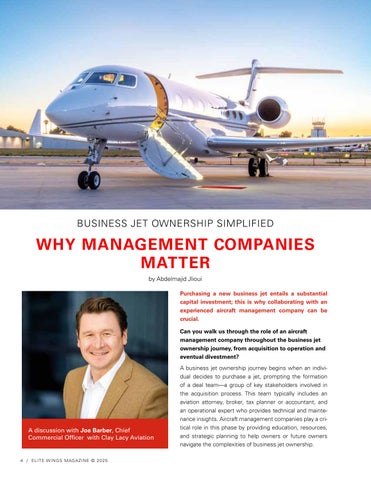
WHY MANAGEMENT COMPANIES MATTER by Abdelmajid Jlioui Purchasing a new business jet entails a substantial capital investment; this is why collaborating with an experienced aircraft management company can be crucial. Can you walk us through the role of an aircraft management company throughout the business jet ownership journey, from acquisition to operation and eventual divestment?
A discussion with Joe Barber, Chief Commercial Officer with Clay Lacy Aviation
4 / E L IT E W I N G S M AGA Z I N E © 2 0 2 5
A business jet ownership journey begins when an individual decides to purchase a jet, prompting the formation of a deal team—a group of key stakeholders involved in the acquisition process. This team typically includes an aviation attorney, broker, tax planner or accountant, and an operational expert who provides technical and maintenance insights. Aircraft management companies play a critical role in this phase by providing education, resources, and strategic planning to help owners or future owners navigate the complexities of business jet ownership.
B U SIN ESS JET OWN ERSH IP SIMPLIFIED | CLAY LAC Y AVIATION
Our primary goal in this phase is to educate owners on the realities of acquiring, operating, and maintaining an aircraft. Since many new owners recognize that they lack in-depth industry knowledge, we provide them with essential materials and insights to help them make informed decisions. High-net-worth individuals and corporate clients often engage in long-term planning, but they will not always develop detailed three- to five-year cash flow projections. We encourage a broader perspective, advocating for a total asset lifecycle approach to ownership. From the outset, we provide unbiased guidance on ownership alternatives, helping clients understand our role, our differentiator, and the long-term value we bring to the relationship. Much like conducting due diligence on a potential business acquisition, this process goes beyond simply hiring a vendor—it’s about investing in a strategic partnership. Most of the time, when dealing with first-time aircraft owners, they will have already decided to outsource the oversight of their airplane instead of building their own flight department because of the high level of expertise that an aircraft management company brings and most of the time, we will also accompany these owners when it’s time to transition to another business jet. According to research conducted over the last few years, the average time a jet stays with one of our owners is only 4.5 years. At each of these transition events, we need to help these owners answer the new questions they will have about their business jet ownership journey and plan for the next four to five years ahead. At Clay Lacy, we are proud that some of our customers have been with us through six or seven airplane transitions, which represent 35 to 40 years of relationship. Why will business jet owners decide to transition from one business jet model to another? Several factors influence aircraft ownership and transition, including advancements in technology and modernization. Many business jet owners view their aircraft as a depreciating asset, but we encourage them to see it as an evolving investment—one that can be enhanced over time. For example, owners with a legacy Gogo connectivity system, based on terrestrial technology, may seek an upgrade to more advanced satellite-based connectivity. We assist in evaluating this transition, exploring available © 2 0 2 5 E L IT E W I N G S M AGA Z I N E / 5
B USI NE S S J ET OW N E RSHIP S IMP L IF IE D | CL AY L ACY AV IATION
alternatives, and ensuring the aircraft continues to improve. Beyond technology, modernization also extends to the aircraft’s interiors. As wear and tear become evident, we provide assessments and recommend strategic upgrades, such as reupholstering PSUs and carpeting during major maintenance inspections, so the aircraft remains optimized throughout its lifecycle. There is also a significant aspect of consumer behavior that plays a crucial role. As aircraft manufacturers introduce newer and more advanced aircraft models to the market, such as the Bombardier Global 7500 and the Gulfstream G700, many owners will seek to acquire these newer models, especially if their current aircraft is out of warranty. This dynamic nature of ownership reinforces the importance of proactive planning and continuous improvement. A few years ago, Clay Lacy decided to divest the aircraft sales activities. Why do you believe this was the right decision? Approximately eight years ago, Clay Lacy was a highly active player in the aircraft acquisition and sales market. We then decided to conduct an extensive assessment of where we wanted to be and identified any potential conflicts of interest that may arise from our activities. During that assessment, we met a large number of industry executives and leadership teams, and we inquired about what aircraft management entails and what its boundaries should be. We quickly identified that the aircraft sales and 6 / E L IT E W I N G S M AGA Z I N E © 2 0 2 5
transaction space is not the right place for us if we want to remain a focused and unbiased aircraft and asset manager. This decision was crucial for us, as we want to maintain that long-term relationship with our customers. We are pleased to offer our expertise freely during aircraft transactions and support customers throughout this critical phase of their business jet ownership journey. Still, we don’t want to be driving the transaction. Many times, it's about earning the relationship and helping keep loyalty to that relationship. Our services begin after our customers have identified their business jet. We will then assign an onboarding project manager who will lead a formal project management process for the onboarding of the aircraft. This process includes about 180 checklist items. We will then operate the airplane, stabilize it, and manage it. When our customers decide it's time for them to divest that asset, they will typically use a broker they've already known, or they will ask us for a recommendation. We're always happy to provide a few contacts and do a warm introduction. In addition to a deep understanding of the cost structure, long-term forecasting of aircraft ownership costs is essential when selecting a business jet. How do you help buyers navigate through the complexity of these financial models?
B U SIN ESS JET OWN ERSH IP SIMPLIFIED | CLAY LAC Y AVIATION
We highly respect and recommend industry resources like Aircraft Cost Calculator and Conklin & de Decker, as they have been instrumental in establishing aviation analytics, particularly for forecasting operating costs. Many of their methodologies remain effective today—for example, utilizing 10-year cycles to determine average costs is still a powerful and reliable approach.
applying well-founded assumptions and consistently tracking them. Each month, clients receive an updated financial snapshot that shows their budget and actual expenditures as a prorated portion of the forecast. This system has proven highly effective, providing clients with real-time access to their financial insights while reinforcing our active management of every transaction.
Building on these foundations, we have developed an internal tool that not only incorporates third-party verified averages but also blends them with actual operational data. Having these large sample sets allows us to obtain very accurate cost figures, which is particularly helpful in the planning phase.
This forecasting tool is something we are particularly passionate about. Over the past eight years, we have continually refined and enhanced it, incorporating more operational data to maximize its accuracy. One of its most impactful applications is during comparative analysis sessions. For example, when a client is evaluating aircraft options, such as a Challenger 300, Challenger 350, or Challenger 3500, we can input identical mission profiles, fuel purchases, hangar locations, and other operational factors. As we display these insights on a large screen, clients can visually compare and assess the effects of various decisions, such as hiring a specific pilot, relocating their base, or introducing charter revenues.
We also take a more precise approach by identifying similar aircraft serial numbers within our managed fleet that are comparable to those our customers are acquiring, and adjusting some cost sensitivities to develop highly accurate cost forecasting. On an annual basis, and as we approach the final quarter of the year, we engage with clients to assess their aircraft usage plans for the following year. Using a historical lens, we review past usage patterns and determine whether they are likely to be repeated. We then integrate key financial factors, such as contract escalations, inflation, and fuel price fluctuations, ensuring a precise and tailored forecast. Our approach treats our customers’ aircraft as a strategic business asset, much like a company would evaluate a departmental budget. We strive for granular accuracy,
Rather than focusing solely on costs, this process helps clients deepen their understanding of how different operational choices influence their aircraft’s overall financial and functional performance. Notably, younger clientele, accustomed to mobile banking and digital financial tools, expect a higher level of visualization than what is traditionally available in the aviation sector. In response, we have been experimenting with new ways to present net operating expenses, using a telescopic, category-based breakdown to enhance clarity and comprehension.
© 2 0 2 5 E L IT E W I N G S M AGA Z I N E / 7
B USI NE S S J ET OW N E RSHIP S IMP L IF IE D | CL AY L ACY AV IATION
Apart from the significant element of cost, what are some of the key factors to consider when selecting a business jet?
the few airplanes that are capable of performing this mission in a safe and reliable manner.
During the aircraft evaluation phase, we spend a significant amount of time understanding the customer's mission needs and the expected business jet usage. Clay Lacy has a large number of experts who can be involved during the evaluation phase. These experts include our fleet planning team, our aircraft operations team, and our assistant chief pilots.
Our ability to involve actual type-rated pilots for mission planning represents a significant edge for our customers. Usually, when they initially start talking to us, they seek a simple answer: Which aircraft can make the journey nonstop? However, as we work through their request, additional considerations often emerge, such as travel dates, passenger counts, and departure airports. Seasonality and wind patterns also play a significant role, highlighting the importance of aviation expertise in making informed decisions.
To illustrate, we had a customer based in Northern California who utilized a fractional aircraft ownership program. This customer had a unique mission that represented only 20% of his total annual flying needs. That mission required the capability to fly non-stop from the San Francisco Bay Area down to Fiji, which is around 5,000 nm. Eighty percent of their missions were US domestic flights, typically between two and three hours in duration. In the business aircraft brokerage and dealer community, they will often suggest that you purchase an aircraft that does about 80% of your mission and use alternative resources for the other 20%.
To streamline mission planning, we also utilize an internal scheduling system that enhances efficiency by leveraging data from previous flights. Since many trips can be coordinated across our large fleet, we incorporate lessons learned from past operations to enhance future flight mission planning and execution. For instance, during a flight to Nairobi, a previous route through Turkey required a significant deviation to avoid restricted airspace. Six months later, when another dispatcher planned a similar trip, they were able to reference this experience and opt for an alternative route through Italy or France, ensuring a more efficient flight path.
This particular customer wanted to know the best pragmatic airplane based on its flying requirements, as well as which airplane could perform that specific long-range mission. Most of the time, brokers don’t have the subject matter expertise to run the real performance on a specific route. In this case, our assistant chief pilot can run real routing scenarios and associated flight plans to identify
Operational challenges like these underscore the dynamic nature of global aviation. To maintain precision, we conduct daily risk assessments in addition to morning and evening operations reviews, analyzing ongoing and upcoming flights for potential adjustments. Our operations control center plays a vital role in monitoring flights and optimizing mission profiles, ensuring that every journey is executed with maximum efficiency and safety.
The primary factor will be the business jet's mission capability, especially in terms of range.
8 / E L IT E W I N G S M AGA Z I N E © 2 0 2 5
B U SIN ESS JET OWN ERSH IP SIMPLIFIED | CLAY LAC Y AVIATION
For some owners, charter revenues are a critical element in the financial equation of a business jet acquisition, as they can help offset some of the costs associated with it. What are some of the parameters that can influence these revenues? Within our financial planning tool, we incorporate a revenue calculator that allows owners to assess profitability by factoring in both revenue and expenses, essentially following a typical profit and loss (P&L) format. Many new owners enter the industry with unrealistic revenue expectations, often drawing comparisons to shared economy models seen in industries such as Airbnb and yacht chartering. Historically, business aviation has also operated within a similar framework, dating back to the 1970s, when owners would charter their aircraft to offset costs. However, despite its longevity, this model has remained somewhat antiquated.
Sustaining this model over a three- to five-year horizon will also depend on several factors, including fuel prices, charter demand, maintenance reliability, and pilot retention. By highlighting these constraints, owners often shift toward an optimized approach, aiming for 350 to 400 annual flight hours —a balance between personal use, charter revenue, and asset longevity. This structured strategy enables better financial outcomes while preserving the aircraft’s long-term value. Ultimately, our goal is to provide owners with side-by-side comparisons, helping them make informed decisions and recognize that optimization often leads to stronger asset management and financial stability.
To guide owners through this process, we start by asking a fundamental question: What are your goals for the aircraft? If charter revenue is a key factor in making ownership financially viable, we evaluate whether this approach aligns with their broader investment and divestment strategy. For example, if an owner has a low-flight-time G450 and wants to maximize usage to improve financial viability, we analyze supply and demand constraints and create a realistic forecast. A common pitfall in the industry is making broad assumptions, such as estimating 600 charter hours per year for a G450 without first considering actual usage. Our approach begins with the owner's anticipated utilization. If they plan to fly 150 hours personally, we assess if their aircraft is based in a high-demand charter market, which significantly impacts revenue potential. From there, we present two paths: 1. A high-volume charter model, which requires incremental costs to sustain increased utilization. 2. An optimized approach, where fewer hours result in a better net expense. By modeling both scenarios side by side, owners gain a clear understanding of trade-offs. For instance, over a 500hour charter model, fixed costs—such as salaries for four pilots—increase significantly, along with some variable maintenance expenses. While this approach generates more revenue, wear and tear on the aircraft accelerates, potentially leading to a significant increase in refurbishment costs within two to three years of operations.
Does the aircraft model influence the charter revenues? Yes, absolutely. A specific aircraft model in a specific market can highly influence charter demand. We have observed that some aircraft models are more attractive in certain markets than others. To better assess the demand, we usually conduct market surveys. For instance, when evaluating a Challenger 350 based in Dallas, we will analyze the current charter rates for similar Challenger 350s in the area and compare them with those of other comparable super-midsize jets, such as the Praetor 600 and Gulfstream G280, to establish competitive pricing. While posted rates provide a partial picture, collecting a large enough sample allows us to create a scatter plot of charter pricing trends for aircraft within the region. This process is very similar to home valuation, where market comparisons help determine the most accurate pricing based on location and demand. The owner’s © 2 0 2 5 E L IT E W I N G S M AGA Z I N E / 9
B USI NE S S J ET OW N E RSHIP S IMP L IF IE D | CL AY L ACY AV IATION
strategy influences aircraft charter pricing, whether they opt for a high-volume approach or an optimized revenue model. Those pursuing a volume-based strategy typically price their aircraft at or below the market average to compete for market share. In contrast, owners who focus on optimization can set premium pricing while selectively choosing higher-quality charter trips. Additionally, our market analysis considers key constraints, including the aircraft's age and the timing of its last interior refurbishment, as these factors significantly influence charter clients' decision-making process. Clay Lacy offers many customizable aircraft management solutions tailored to each owner’s needs. Can you walk us through some of these solutions? Our clients span a wide spectrum of net worth, ranging from $300 million to several billion dollars, as confirmed by our recent market research. These individuals are accustomed to a high level of personalization in their financial and lifestyle management, whether through their family office, estate manager, yacht company, or art advisor. Yet, when working with an aircraft management company, they also seek the benefits of scale, leveraging our buying power, industry expertise, and proven operational efficiency. Balancing scale and customization presents a unique challenge. Many management companies delegate significant responsibilities to flight crews, a long-standing industry practice. However, our owner and chairman Brian Kirkdoffer’s experience flying Learjets and Gulfstreams for Clay Lacy throughout the 1990s and early 2000s revealed that a strong ground-based support team creates a 10 / E L IT E W I N G S M AGA Z I N E © 2 0 2 5
far superior customer experience. This structure enables direct, personalized engagement, fostering relationships that make clients feel their service is truly tailored to their needs. We prioritize customization by adapting to each client’s preferred communication style—whether via text, email, or direct calls—and modifying best practices accordingly. From flight scheduling to monthly financial summaries, we ensure our processes align with their expectations. Often, it’s these small touchpoints—the seamless engagement moments—that matter most. While we offer flexibility in many areas, safety and compliance remain non-negotiable. For example, if a client requests a 16-hour duty day for crew members, we have no hesitation in saying no, because ensuring operational integrity is part of the trust they place in us. Clients rely on us to make informed, responsible decisions. To maintain consistency, we diligently track each client's preferences—how they prefer to receive updates, how they would like their flights to be handled, and any unique requirements they may have. This effort helps prevent single points of failure and ensures a seamless, personalized experience tailored to their specific needs. While it requires meticulous coordination, it’s a fundamental part of delivering a service that is both adaptable and reliable. New business jets are designed with sustainability in mind, focusing on fuel efficiency, sustainable fuel usage, and many eco-friendly features. Can you give us an overview of Clay Lacy’s sustainability program and how you can help owners achieve the highest levels of carbon neutrality?
B U SIN ESS JET OWN ERSH IP SIMPLIFIED | CLAY LAC Y AVIATION
For us, sustainability aligns with our core values of being Thoughtfully Better, Striving for Excellence, and Doing the Right Thing. To stay ahead, we engage in leading-edge initiatives, and have built employee resource groups that strengthen our company and elevate our standards. Sustainability is a key component of this forward-thinking approach and thoughtful service to our customers. We explored why sustainability matters to us, identifying three core reasons: 1. Preparing for the future is smart business – Long-term success in our industry requires foresight, investment, and adaptability. Embracing sustainability ensures we remain positioned for growth and resilience. 2. It provides a competitive advantage – Public companies must report on sustainability efforts, and corporate flight departments are increasingly following suit. While it may not be our primary differentiator, integrating best practices in sustainability strengthens our position within the industry. 3. It’s simply the right thing to do – Looking toward future generations and workforce expectations, we recognize that customers care about sustainability, even if it isn’t yet a widespread priority. We’ve partnered with 4Air to offer a comprehensive portfolio of sustainability solutions for our customers and provide them with better emission reporting tools. We are also embedding these sustainability options into our business model discussions during our annual budgeting process with our clients. We are proud to be the first company to receive independent audits of our sustainability standards from highly respected third-party organizations, including 4Air, the EPA, NBAA, and NATA. Since 2019, all our facilities have been built to green standards and have been operating carbon neutral, and we continue this commitment with every new facility and hangar development. When entering new communities, we prioritize environmental, social, and economic stewardship, knowing that regulatory requirements may eventually mandate these initiatives. Rather than waiting for compliance-driven change, we proactively integrate sustainability into our operations, ensuring that it remains an essential part of who we are.
In recent years, fractional ownership programs have significantly influenced market trends, and we’ve seen increased discussions about flight departments, particularly as this historically successful operating model is now being challenged. This shift underscores the industry’s need to provide greater redundancy and overlap to better serve its customers, a concept we refer to as a portfolio approach. Many aircraft owners maintain backup aviation options, whether through charter services they’ve used before or by retaining a fractional share program. This strategy proves valuable, particularly for those with prior aviation experience and an understanding of the available alternatives. However, first-time owners may not always be familiar with fractional ownership or other contingency plans. We educate owners on the importance of backup solutions, especially during extended maintenance periods—whether a one-month refurbishment project or a 96-month scheduled inspection. While we provide charter services, we find that experienced owners—often on their second or third aircraft—proactively plan for redundancy, ensuring they always have access to flight options. For major maintenance events lasting several months, we even assist clients in securing block charter arrangements and guaranteed lift solutions to maintain continuity in their travel plans. As asset managers, our role extends beyond managing an individual aircraft—it’s about optimizing the entire aviation experience. By ensuring seamless access to reliable flight solutions, we help owners maintain control and flexibility, avoiding reliance on unpredictable market conditions.
© 2 0 2 5 E L IT E W I N G S M AGA Z I N E / 11
N AV I GAT I N G T H E F UT U R E O F C O ST- E F F I C I E N T F R AC T I O N A L AV I AT I O N W IT H P L A N E S E N S E by Abdelmajid Jlioui As PlaneSense celebrates 30 years of success, its unique approach to cost-efficient fractional aviation continues to resonate with many private travelers. By prioritizing training, optimizing fleet operations, and expanding service offerings, PlaneSense remains at the forefront of modern business aviation. In this exclusive conversation, George Antoniadis, CEO of PlaneSense, discusses the company’s journey, the advantages of fractional ownership, the evolution of its Pilatus PC-12 and PC-24 fleet, and the broader challenges facing the aviation industry. PlaneSense is celebrating 30 years in business. What inspired the company’s founding in 1995?
A Q&A with George Antoniadis, CEO of PlaneSense
12 / E L IT E W I N G S M AGA Z I N E © 2 0 2 5
When fractional ownership was gaining traction in the early 1990s, most programs focused on jets. But I saw an opportunity—why not bring the efficiency and reliability of single-engine turboprops into the fractional model? That’s when we partnered with Pilatus and their newly certified PC-12 to launch PlaneSense.
COST-EFFIC IEN T FR AC TION A L AVIATION | PLA N ESEN SE
Fractional ownership offers a strong cost-effective alternative to full aircraft ownership. It’s simple: you buy only what you need. Instead of investing in an entire aircraft—which comes with maintenance, crew costs, and logistics—you own a fraction of a professionally managed fleet. Our aircraft fly over 1,000 hours per year, meaning costs are optimized across operations, making it much more efficient and cost-effective than full ownership. Our efficient business model has helped us stay resilient during challenging times like the 2008 financial crisis and the COVID pandemic. We believe that the PC-12 is the most cost-effective aircraft solution, so even in difficult times, clients see the value in fractional ownership versus full ownership. How did PlaneSense adapt its ownership structure over time? We initially offered 1/8 and 1/4 shares, but during the 2008 financial crisis, we introduced 1/16 shares to make fractional ownership even more accessible. Today, clients choose the share size that best fits their flying needs. PlaneSense initially focused on the PC-12. What led to adding the Pilatus PC-24 jet to your fleet? Our PC-12 fleet has been incredibly successful, but we wanted to offer more flexibility to clients seeking longer-range and higher-speed options. The PC-24 is perfect because, like the PC-12, it excels at short-field perfor-
mance and can access airports that other jets cannot reach. I love to call it the PC-12 of jets—offering great cargo space, runway versatility, and efficiency. The PC-24 exceptional short-field performance allows us for instance to land at places like Steamboat Springs (SBS) in the Rockies, Provincetown (PVC) in Massachusetts, and Scotland Cay (MYXI) in the Bahamas—locations where many jets simply can’t operate due to runway length or surface conditions. Our PC-24 features eight executive-style seats. Which we believe is the optimal configuration for maximum comfort, the soft leather seats fully recline and swivel, adding a touch of luxury to the flight. In fact, many of our passengers are surprised to step aboard and find a remarkably large cabin. We also find that every small detail has been well thought out on the PC-24, even for the pets that fly privately with their human companions. Dogs, especially, find that the flat floor provides ultimate comfort during flights. Unlike the dropped aisle configuration in most business or light jet aircraft, the flat floors allow dogs to stretch, often helping them to remain calmer and more relaxed en route to their destination. How has the PC-24 fleet grown? PlaneSense was the launch customer for the PC-24. We took delivery of our first super-versatile PC-24 jet in February 2018, and today we operate 17, with two more arriving this year. The demand is strong, and it’s exciting to see our fleet grow.
© 2 0 2 5 E L IT E W I N G S M AGA Z I N E / 13
C O ST- E F F I C I E N T F R AC T IONAL AV IAT ION | P L ANE S E NS E
Pilot and technician shortages have been widely discussed in the industry. Does PlaneSense face similar challenges? Attracting and retaining great talent is always a priority. PlaneSense is known for prioritizing a positive and supportive company culture, focusing on fostering a sense of family and valuing employee well-being. In addition to our strong company culture that we have developed over the 30 years of our successful operations, we are now able to offer pilots 43 base locations across the U.S., so they don’t have to relocate. Our in-house training programs also ensure our teams are highly skilled. Speaking of training, PlaneSense recently introduced the first PC-12 NGX full-flight simulator. What prompted this investment? Training is a core part of our business. By investing in our own PC-12 simulator, we provide pilots with industry-leading instruction. Excellence in pilot training has been a strategic priority for PlaneSense since its inception 30 years ago. And as far as I know, this is the only full-flight PC-12 NGX Level D simulator in the world—a testament to our commitment to excellence. Last year, PlaneSense launched PC-12 and PC-24 jet cards. Can you explain your new CobaltPass program?
14 / E L IT E W I N G S M AGA Z I N E © 2 0 2 5
First, I must emphasize that fractional ownership is and will remain PlaneSense’s core offering. The CobaltPass is our new jet card program, allowing clients to purchase 25-hour flight packages without committing to fractional ownership. It’s a great alternative for those who fly less frequently or want to try the PlaneSense experience before buying a share. The CobaltPass program has no blackout dates—but there are select days where flights may be adjusted by a few hours. It’s a flexible and accessible solution compared to many other jet card programs. After 30 years, what do you believe is PlaneSense’s biggest achievement? I’m incredibly proud of the long-term loyalty of our clients. Many have been with us for over 20 years, and some even across multiple generations—grandparents, parents, and now their children flying with us. That level of trust is rare in private aviation. What’s next for PlaneSense? We will continue to expand our fleet, optimize operations, and look for innovative ways to enhance fractional aviation. We believe in intelligent, cost-effective solutions, and our focus remains on offering the best possible experience for our clients.
B UY WI TH CON F I D EN CE , W E ' V E G OT YOU COVE R ED.
Don’t let surprises ground your investment. Trust in the industry's largest independent provider of maintenance services and financial solutions. At JSSI, we offer unparalleled maintenance protection and peace of mind, ensuring your aircraft is always ready for takeoff. We are unique in the industry to work across virtually all business jet makes and models: offering customized financial structures and technical support for engines, airframes, and APUs regardless of aircraft type. Benefit from our industry-leading expertise and scale - supporting over 30% of the global business jet fleet. With JSSI, you can focus on your journey while we take care of the rest.
Make an informed decision about maintenance and costs - before you buy. Get in touch to speak with an unbiased advisor.
© 2025 JSSI® - All rights reserved.
© 2 0 2 5 E L IT E W I N G S M AGA Z I N E / 15
Photo courtesy of Vistajet
S P E E D, R A N G E A N D U LT I M AT E C O M F O RT: E X P E C T N O C O M P RO M I S E S W IT H B O M BA R D I E R’ S G L O BA L 8 0 0 0 B U S I N E S S J ET by Viswanath Tata
Excitement is building in the business aviation industry as Bombardier is on track for the entry-into-service of what will be the fastest civilian jet since the Concorde, the incomparable ultra-long-range Global 8000 business jet.
“We are well on track to meet our objectives for this incredible aircraft – the industry’s fastest and most impressive ultra-long-range business aircraft,” said David Murray, Executive Vice
The first production aircraft is now being assembled at Bombardier’s state-of-the-art Global manufacturing centre in Toronto, where components from company facilities are being joined to the fuselage. The manufacturer says the next big milestone is the production aircraft’s inaugural flight.
President, Manufacturing, IT, and Bombardier Operational
16 / E L IT E W I N G S M AGA Z I N E © 2 0 2 5
Excellence System. “Our engineering and produc-
tion teams continue to display unmatched levels of commitment, innovation and expertise at all stages of the manufacturing process.”
U LTRA -LON G RA N G E BU SIN ESS JETS | G LOBA L 80 0 0
As production continues, pilots in the Global 8000 Flight Test Vehicle (FTV) have reported remarkable responsiveness and high-speed performance due to increased thrust at higher speeds, as well as the best field performance in its class thanks to its unique wing design. The aircraft’s proprietary Smooth Flĕx Wing has been engineered to deliver an exceptionally smooth ride and has been described as “two wings in one” – offering both high-speed and high-lift characteristics to deliver the ultimate performance – and safe access to more airfields than its closest competitor. The Global 8000 will be the only business aircraft with an 8,000 nautical mile range and the spaciousness of four separate and distinct living and work spaces for maximum productivity, rest and relaxation. The Global 8000 is also the first purpose-built business jet to break the sound barrier during testing and is the fastest civil aircraft since the Concorde. Bombardier’s nimble Global 8000 can access smaller airports, making the Global 8000 the perfect choice for discerning owners and operators who prioritize convenience and flexibility.
Built with a “no compromise” mindset, the Global 8000 leverages more than eight decades of Bombardier innovation and expertise to deliver blistering speed, unparalleled range and supreme comfort. For passengers, this means non-stop travel between more city pairs than ever before, including Dubai-Houston, Singapore-Los Angeles, London-Perth and many others.
“Bombardier’s Global 8000 possesses outstanding short-field capabilities, with the ability to access smaller airports other aircraft in its category can’t access. This helps make it the clear choice for discerning owners and operators who prioritize convenience and flexibility,” said Stephen McCullough, Senior Vice President, Engineering and Product Development, Bombardier. “This impressive aircraft will be the fastest and longest-range purpose-built business aircraft ever built and its rare combination of innovation, performance, and comfort will allow our customers to reach new heights in their business aviation experience.
© 2 0 2 5 E L IT E W I N G S M AGA Z I N E / 17
ULTR A - L O N G R A N G E B U S INE S S JET S | GL OBAL 8 0 0 0
PRIORITIZING PASSENGER WELLNESS The Global 8000 builds on a proven track record while raising the bar on passenger wellness. Passengers will arrive at their destination refreshed and relaxed, thanks to an internal cabin altitude of 2,900 feet when flying at 41,000 feet. Additionally, Bombardier’s Pũr Air system with advanced hospital-grade HEPA filter technology ensures fast fresh air replacement as well as heating and cooling for maximum passenger comfort. The Global 8000’s stunning cabin also boasts a host of notable features including the industry’s first 55-inch 4K OLED TV, Bombardier’s l’Opéra audio system with adjustable sweet spot technology, Soleil circadian-based cabin lighting system, and available sound synchronization for an immersive lightshow. Cabin control and connectivity are accessed at the touch of a button, through the intuitive NICE Touch cabin management system (CMS) and OLED touch dial – another industry first. Passengers can get down to business in the six-seat Conference Suite, kick back and relax in the four-place Club Suite, watch a movie in the Entertainment Suite, or retire to the Principal Suite with full-size bed and private en suite lavatory with available stand-up shower. Passengers can also enjoy delicious meals prepared in the Global 8000’s exquisite galley, and total zero-gravity 18 / E L IT E W I N G S M AGA Z I N E © 2 0 2 5
comfort while reclined in Bombardier’s patented Nuage seat. Bombardier’s Nuage is the first completely redesigned seat in business aviation in more than 30 years, designed to deliver a zero-gravity position. Pilots who are lucky enough to fly the Global 8000 will experience the impressive Bombardier Vision flight deck, featuring state-of-the-art avionics and fly-by-wire technology, as well as an available dual Head-Up Display (HUD), Enhanced Vision Systems (EVS) and Synthetic Vision System (SVS). When it’s time to take a break during a long-haul flight, off-duty crew members can rest and recharge in their own dedicated Crew Suite, a private space equipped with a Nuage seat, power outlets and storage. For added convenience and extra-long range, Bombardier also offers a unique bunk bed option in the crew suite for two additional pilots. In a world where time is a precious commodity, Bombardier’s Global 8000 aircraft will combine near-supersonic speed across vast distances with unparalleled convenience, four-zone comfort and safety. When it is scheduled to enter into service later this year, the Global 8000 will be in its own class. Welcome to the era of no compromises.
PUT YOUR TRUST IN EXPERT PARTNERS
THOUGHTFULLY BETTER AIRCRAFT MANAGEMENT
SINCE 1968
MANAGEMENT
CHARTER
MAINTENANCE
FBO © 2 0 2 5 E L IT E W I N G S M AGA Z I N E / 19
T H E A L L- N E W G U L F ST R E A M G 4 0 0 R E D E F I N I N G T H E L A RG E - C A B I N C AT E G O RY by Abdelmajid Jlioui When launching the G400 in October 2021, Gulfstream announced its objective to redefine the large-cabin market segment. Can you walk us through some of the technologies and capabilities this all-new business jet offering introduces? The technology and cabin comfort the G400 offers simply does not exist in its segment. The aircraft features Gulfstream’s award-winning Symmetry Flight Deck with active control sidesticks, business aviation’s most extensive use of touch-screen technology and Phase-of-Flight Intelligence that greatly reduces pilot workload.
A conversation with Scott Neal, Senior Vice President, Worldwide Sales, Gulfstream
2 0 / E L IT E W I N G S M AGA Z I N E © 2 0 2 5
With its 4,200 nautical mile (7,778 kilometers) range and maximum operating speed of Mach 0.90, the G400 fills a range void that has long existed in its category and occupies a sweet spot in Gulfstream’s product line, a key component in the fulfillment of our vision to offer a fleet for every mission.
LARG E-CA B IN B U SINESS J ETS | G 40 0
The G400 offers customers a choice of three floorplans. Can you provide more details about these cabin configurations? In the cabin, the G400 features spaciousness and flexibility also not seen in its class – three floorplan options with seating for up to nine, 11 or 12 passengers over two or three living areas. G400 customers will also benefit from all the elements of the Gulfstream Cabin Experience of 100% fresh, never recirculated air; a plasma ionization clean air system; the lowest cabin altitude in its class; and abundant natural light from 10 Gulfstream Panoramic Oval Windows. The G400’s spacious and flexible interior will allow customers to move easily from their aircraft to work and personal lives on the ground. In 2023, Gulfstream announced a significant expansion of its manufacturing and completion facilities to support the G400 and long-range G500 and G600 production. Can you share more details about this expansion and how it will help align production rates with the growing demand? The 2023 expansion of Gulfstream’s next-generation manufacturing operations grew the facility that houses G400,
G500 and G600 production by 142,000 square feet (13,192 square meters). The commonalities of the fleet allow us to have the flexibility to easily expand the production lines within the facility to meet growing demand and optimize safety and efficiency. Production methods for the next-generation fleet were designed with Gulfstream’s Savannah-based research and development team and include advanced automation, 3D model designs and robotic and bonding techniques that result in unprecedented quality and precision. These are mature, high-quality production processes that have already delivered more than 300 G500 and G600 aircraft. The industry has been facing major supply chain challenges in recent years. Do you foresee any impact on your capability to ramp up the G400 production? Gulfstream has managed its supply chain interruptions well and is seeing improvements. Gulfstream brought a great deal of third-party supplier work in-house years ago, including wing and empennage production, to take control of key elements within our supply chain to further ensure oversight of safety and quality measures.
© 2 0 2 5 E L IT E W I N G S M AGA Z I N E / 2 1
LA RGE- C A B I N B U S I N E S S JET S | G4 0 0
In September 2024, Gulfstream announced DC Aviation as the G400 European launch customer for dedicated charter operations. Do you expect that this type of operation will be highly appealing? Absolutely – the G400 is ideal for all types of operations with its speed and range capabilities, operational flexibility, safety features and cabin size. The G400 was designed to have large operational commonalities with the long-range G500 and G600. How can these commonalities benefit fleet operators regarding maintenance and flight crew efficiency? When Gulfstream set out to create our next-generation family of aircraft, we intentionally designed a fleet with commonalities across the board. The G400, G500 and G600 share the same Pratt & Whitney engine series, flight deck systems, cabin cross-section and cabin environment. This allows fleet operators to move seamlessly from one aircraft to the other for optimal operational efficiency and flexibility. From a maintenance perspective, the commonalities enhance safety and efficiency, ultimately resulting in less downtime for scheduled maintenance.
2 2 / E L IT E W I N G S M AGA Z I N E © 2 0 2 5
COMPLETE BUSINESS AIRCRAFT SERVICES Aircraft Sales & Acquisitions | Airframe Maintenance | Avionics Installation | Duncan Manufacturing Solutions (DMS) | Emergency Assistance (AOG) | Engine & APU | Engineering & Certification Services | FBO Services | Government & Special Programs | Paint & Interior | Parts, Avionics, Instruments & Accessories Experience. Unlike any other. | www.DuncanAviation.aero
T H E C I TAT I O N AS C E N D T H E N E W G E N E R AT I O N 5 6 0 X L P L AT F O R M by Viswanath Tata
In an exclusive interview, Elite Wings sat down with Jimmy Beeson, Vice President, Product Development Textron Aviation to discuss the much-anticipated Citation Ascend program. The aircraft, based on the successful 560XL series, was announced in May 2023 with significant advancements in cockpit technology, performance, and cabin comfort.
A conversation with Jimmy Beeson, Vice President, Product Development Textron Aviation 2 4 / E L IT E W I N G S M AGA Z I N E © 2 0 2 5
We covered various aspects of the Ascend program, including avionics enhancements, interior refinements, flight test progress, fleet integration, and market response. With Cessna’s commitment to customer-focused innovation, the Citation Ascend marks an exciting evolution in business aviation.
SU PER-LIG HT B U SIN ESS JETS | C ITATION ASC EN D
Cockpit Advancements and Technologies
Cabin Comfort and Interior Refinements
Jimmy, when Cessna launched the Citation Ascend program in May 2023, the company emphasized its commitment to delivering an improved cockpit experience, enhanced performance, and a luxurious cabin. Could you walk us through some of the most notable advancements?
That’s a remarkable avionics upgrade. Let’s shift focus to the cabin. What interior changes distinguish the Citation Ascend from previous 560XL variants?
Absolutely. One of the standout upgrades is the transition to the Garmin G5000 avionics suite. This is a game-changer for pilots, offering a cutting-edge flight deck that aligns seamlessly with the broader Citation lineup. Many operators transition from smaller Citation jets, such as the CJ series, and now they’ll find familiarity in the Ascend cockpit. For fleet operations, the G5000 commonality provides significant advantages. Corporate flight departments and fractional ownership fleets often include multiple Citation models, and this system ensures a smoother pilot transition across various aircraft. By integrating the latest Garmin hardware and software, the Ascend is positioned as one of the most technologically advanced aircraft in its class. Beyond familiarity and fleet efficiency, the G5000 suite enhances navigation accuracy, pilot workload management, and situational awareness. It’s a significant leap forward, ensuring that pilots enjoy greater efficiency and operational confidence.
A lot of thought went into refining the passenger experience. Since this aircraft builds upon the XLS Gen 2 platform, we’ve incorporated a range of premium features, such as all-new ambient lighting, illuminated window rings, and USB charging. One of the most exciting updates is the flat floor configuration. This subtle yet impactful change maximizes seated comfort, allowing passengers to adjust their seats freely and enjoy a more spacious cabin. The drop aisle remains an available option, catering to customers who prefer additional headroom in the aisle space. Cabin technology upgrades include an enhanced touchscreen bulkhead monitor, which allows passengers to control entertainment, lighting, cabin temperature, and audio/video settings effortlessly. Wireless charging ports and additional USB outlets ensure passengers remain connected and powered throughout their journey. The goal was simple—to create an inviting, comfortable, and customizable space, tailored to the needs of both corporate executives and charter operations.
© 2 0 2 5 E L IT E W I N G S M AGA Z I N E / 2 5
SUPER - L I G HT B U S I N E S S JET S | CITAT ION AS CE ND
Flight Testing and Certification Progress Moving on to flight testing—by June 2024, the second flight test aircraft (P1) had completed its first flight. At that point, Cessna had reported accumulating approximately 400 hours. Can you share an update on the program’s progress since then? Certainly. With the second flight test aircraft entering the program, we’ve now surpassed 1000 flight hours across various testing campaigns. The testing phase is meticulous, covering everything from performance validation to avionics assessments. This aircraft introduces substantial enhancements, so we need to ensure every system performs flawlessly. While we can’t yet disclose specific objectives realized, I can confidently say that progress is on track, and the Ascend is performing beautifully. Certification remains a top priority for us. Our team is working diligently to meet every safety and performance requirement before we deliver this aircraft to our customers.
2 6 / E L IT E W I N G S M AGA Z I N E © 2 0 2 5
Entry Into Service and Deployment Strategy That’s exciting progress! Do you have any specifics on the expected entry into service timeline? While I can’t provide exact details, what I can say is that we are moving at the pace necessary to ensure safety and reliability. The certification phase is critical, and our commitment to doing things the right way remains paramount. We know customers are eager to receive the Ascend, and we share their enthusiasm. However, our approach is focused on precision and quality, ensuring that when we do enter service, we meet and exceed expectations.
Customization and Cabin Configuration Options The Citation Ascend introduces several new cabin customization features. Could you detail some of the available configurations and optional equipment? Absolutely. Customers now have multiple options, starting with the side-facing seat configuration at the front. First introduced on the M2 Gen 2, the new folding side-facing
SU PER-LIG HT B U SIN ESS JETS | C ITATION ASC EN D
seat is particularly popular. This seat provides either additional seating or extra baggage storage, with the ability to accommodate up to 100 pounds of luggage.
Finally, the Citation brand’s reputation for reliability and efficiency ensures that fleet operators maximize utilization while delivering premium service.
We also offer multiple seat padding options, allowing customers to select from firmer, medium, or softer cushioning to best suit their preferences.
Final Thoughts and Looking Ahead
Another highlight is the Bongiovi audio system, which transforms the entire cabin into a surround sound speaker using strategically placed transducers. This ensures uniform, premium sound quality, regardless of where passengers are seated. Beyond these features, customers can customize their interior to align with their mission needs, whether for corporate transport, private ownership, or charter operations.
Market Reaction and Fleet Adoption The Citation Ascend was included in NetJets’ recordbreaking order of up to 1500 Cessna Citation jets in 2023. What makes this aircraft so appealing for fractional ownership and charter operations? Several factors contribute to its appeal. First, the cockpit commonality with other Citation models means fleet operators can streamline pilot training and transitions, reducing operational costs. Second, the enhanced cabin experience ensures that passengers enjoy comfort, connectivity, and customization, making the Ascend attractive for corporate travel.
As we conclude, is there anything else you’d like to share with our readers? The Citation Ascend is not just another aircraft—it’s a new generation of the 560XL platform. While it retains familiar operational benefits, it introduces modernized technologies for pilots and passengers alike. By maintaining continuity within the Citation lineup while integrating next-gen features, we ensure customers can continue growing with Textron Aviation, whether within the 560XL family or transitioning to larger Citation models like the Latitude and Longitude.
Conclusion With cutting-edge avionics, enhanced passenger comfort, and strong fleet appeal, the Citation Ascend reinforces Cessna’s dedication to innovation and customer satisfaction. As it progresses through certification, excitement continues to build for what promises to be one of the most versatile and advanced midsize business jets in its class. Elite Wings appreciates Jimmy Beeson’s insights and looks forward to seeing the Citation Ascend enter service soon. © 2 0 2 5 E L IT E W I N G S M AGA Z I N E / 2 7
M A RC F OU L K RO D, C E O O F AV J ET G L O BA L ,
S H A R E S I N S I G HT I N TO T H E AV I AT I O N I N D U ST RY A N D T H E JOU R N E Y O F AV J ET by Abdelmajid Jlioui Can you tell us about the origins of Avjet and your involvement with the company?
STATE OF THE INDUSTRY With Marc Foulkrod, CEO of Avjet Global
2 8 / E L IT E W I N G S M AGA Z I N E © 2 0 2 5
Avjet started initially as a personal travel company, and when the aircraft were not in use, they were chartered. At the time, I was with Flying Tigers and assisted them with some charters. Eventually, I joined the company, which was relatively small at that time, with only five or six people. Despite not being a marketing person, I agreed to help, leveraging my experience working at Boeing and McDonnell Douglas. So, in 1981, I joined Avjet under a contract, and in 1986, I purchased the company from its owner and began diversifying its operations. We expanded from charter services to aircraft management, maintenance with a Part 145 repair station, and then aircraft brokerage.
STATE OF TH E IN D U STRY | AVJ ET G LOBA L
Avjet was based in Burbank, CA. We started all our divisions there, including the brokerage division. The first transaction I handled for them was the acquisition of an IAI Westwind II business jet. This transaction marked the beginning of our growth and expansion into various aviation services. We continued to grow by adding more airplanes and expanding our services. We also undertook extensive consulting work for major companies, including Citibank, JP Morgan, and H.J. Heinz. Additionally, we began operating internationally, with airplanes based in Nigeria, Europe, and Japan. In April 2016, General Dynamics acquired the company’s aircraft management, charter, and MRO divisions, while I retained the FBO, the sales and brokerage division, and the consulting services under the Avjet Global name. In 2016, Avjet had 37 years of experience in aircraft management and charter services, along with an impressive fleet of 45 aircraft. This transaction made sense as it allowed us to continue expanding our global sales, acquisition, and brokerage services, while enabling Jet Aviation to uphold Avjet's tradition of excellence in aircraft management and charter services. Can you share some notable memories from your time at Avjet? We achieved many significant milestones, including flying former president Bill Clinton to North Korea to secure the release of two imprisoned American journalists in 2009. From our Burbank Airport base in the heart of the Hollywood fame belt, Avjet became the go-to charter provider for challenging trips. We managed to complete 400 hours of charter flights on a Boeing Business Jet (BBJ) in one year, flying clients to various destinations around the world. One memorable trip involved ferrying a BBJ to the Philippines, picking up clients, taking them to London, and then ferrying back. These experiences highlight the diverse and challenging nature of our operations.
our ability to adapt to changing market conditions, and our focus on building strong relationships with clients. Our diverse range of services, encompassing charter and aircraft management, maintenance, and brokerage, has also played a crucial role in our growth. Additionally, our willingness to take on challenging projects and our focus on innovation have helped us stay ahead in the industry. What do you think are some of the challenges facing the business aviation industry today? In my opinion, the biggest challenge is the lack of space at airports. There are no hangars, and ramp spaces are overcrowded. Large jets occupy an increasing amount of space, and FBOs are charging excessive fees. The industry needs to develop additional airports and expand existing ones urgently to accommodate the growing number of large jets. Investing in infrastructure to accommodate the increasing number of private jets is becoming crucial for our industry. Advancements in technology and increasing demand for private travel are driving the industry forward, but the infrastructure needs to keep pace to support this growth. Furthermore, the trend towards larger and more luxurious aircraft is evident, but it also presents logistical challenges that must be managed effectively. Avjet Global Sales (AGS) was the initial launch customer of the BBJ Max 8 in 2014 and has since delivered multiple variants of this latest-generation Business Jet. Can you walk us through your experience with this type? First, having worked at Boeing as an aerospace engineer, I enjoyed a good relationship with the company. We were one of the first to negotiate a purchase contract for a Boeing Business Jet (BBJ). This relationship allowed us
We also built a hangar specifically for Boeing Business Jets, which was the first platinum-rated LEED-certified hangar. What are some of the key factors that have contributed to Avjet's success over the years? Several factors have contributed to Avjet's success, including our commitment to providing excellent service, © 2 0 2 5 E L IT E W I N G S M AGA Z I N E / 2 9
STATE O F T H E I N D U ST RY | AV JET GL OBAL
to offer our clients a high-quality aircraft with tailored interiors that met their specific needs. Our collaboration with Boeing has been a significant factor in our success in the Bizliner market. AGS is now the market leader in Boeing BBJ sales, with over four decades of experience in BBJ and BBJ Max sales. In addition to our unique relationship with Boeing Corporation, I believe that our previous real-world experience operating and maintaining the BBJ product line gives AGS an unparalleled expertise for its clients worldwide. Avjet Global announced the successful delivery of two ultra-long-range Gulfstream G700s in 2024. Could you provide more information about this significant milestone? The first-ever G700 was delivered to Qatar Executive, and we were the first to register one in the US. It was a tight second for us. In my opinion, the G700 is the best business jet Gulfstream has ever built, with phenomenal range, cabin noise, and cabin altitude. Our first flight had a 15.5-hour duration, and the client loved it. Gulfstream has done a great job with the aircraft, and it performs better than advertised. The G700 represents a significant advancement in business aviation, offering unparalleled comfort and performance. 3 0 / E L IT E W I N G S M AGA Z I N E © 2 0 2 5
What role do you envision technology playing in the future of business aviation? Technology will play a crucial role in the future of business aviation. Advancements in aircraft design, materials, and avionics will continue to improve the performance, safety, and comfort of private jets. Additionally, innovations in areas such as sustainable aviation fuels and electric propulsion systems will help reduce the environmental impact of aviation. The industry must embrace these technological advancements to remain competitive and meet the evolving needs of its clients. What advice would you give to someone looking to enter the business aviation industry? My advice would be to gain as much experience as possible and be willing to take on diverse roles. The aviation industry is dynamic and requires a broad skill set. Building strong relationships and maintaining a high level of professionalism are also crucial. Additionally, staying up to date with the latest industry trends and technological advancements will always help you stay ahead.
For a connected experience that’s truly out of this world
Eutelsat OneWeb’s high speed, low latency Low Earth Orbit (LEO) satellite connectivity delivers seamless, uninterrupted, and reliable broadband experience in the sky. Built for Mobility The OneWeb constellation was designed specifically for mobility, which means consistent, high-speed, low-latency inflight connectivity around the globe – even over the north pole.
Guaranteed Performance As an enterprise-grade network, bandwidth is not shared with residential users and performance rates are guaranteed.
Aviation Expertise Eutelsat OneWeb has selected world-class, trusted aviation partners to deliver hardware and service.
Are you ready to really connect? Visit OneWeb.net
Elite Wings 2025_8.5x11.indd 1
11/04/2025 10:20:19
T H E M AV E R I C K P RO J E C T S H A P I N G T H E F UT U R E O F B U S I N E S S J ET C A B I N S T H ROU G H I N N OVAT I O N I N T E C H N O L OG Y A N D D E S I G N By Abdelmajid Jlioui
3 2 / E L IT E W I N G S M AGA Z I N E © 2 0 2 5
The Maverick Project, a joint collaboration between Rosen Aviation, KiPcreating, and Sky-Style, shattered previous expectations of what’s possible in an aircraft cabin. By leveraging Rosen’s unique, cuttingedge technologies with Sky-Style’s bold, contemporary design, all brought to life by KiPcreating’s lifelike 3D visualization, the Maverick cabin was a game-changing vision that is both sought after and imitated since its original release five years ago.
TH E MAVER ICK PROJEC T | SKY-STYLE YACHT & AVIATION D ESIG N
A conversation with Lucas Colombo Carbone Design Director & Co-Founder at Sky-Style Yacht & Aviation Design
Sky-Style is a design studio focused on advanced aviation conceptual design, aimed at bringing innovative vision to redesign the executive aviation world. Working with aviation giants such as Boeing, Sky-Style has been at the forefront of executive interior design and continues to test the boundaries of what’s possible in an aircraft cabin.
Sky-Style design studio has been at the forefront of executive interiors design, continuously pushing the boundaries of what’s possible in aircraft cabins. Can you give us a quick overview of your work? My career began in automotive design, where I worked with Mercedes-Benz Advanced Design in Europe. For over 18 years, I focused on shaping vehicle aesthetics before founding Sky-Style in 2018. Sky-Style specializes in aviation and yacht interiors. I’m also the founder of the Advanced Design Innovation Studio, which focuses on automotive and product design. My team and I draw inspiration from both industries, merging technical precision with artistic storytelling. How did you approach shaping the Maverick’s concept into a self-explanatory experience? Design is about storytelling; The key is crafting a timeless aesthetic rooted in emotional resonance. It’s not just about styling or engineering—it’s the balance of art and technology. It’s important to highlight that advanced concepts require a different approach compared to customer-specific projects where guidelines already exist. For Maverick, we defined core values first, then shaped the design to reflect them visually.
Image: The Maverick Project Courtesy of KiPcreating and Sky-Style
The Maverick project centers on the future traveler persona—someone in the 2030 to 2035 timeframe—expecting a more intuitive, personalized experience. Our approach considered current consumer behaviors, sustainability preferences, and the rise of touchless technology. These factors shaped Maverick’s futuristic yet functional appeal. © 2 0 2 5 E L IT E W I N G S M AGA Z I N E / 3 3
THE M AV E R I C K P RO J E C T | S K Y-ST Y L E YACHT & AV IAT ION D ESIG N
What sets the Maverick project apart is its seamless technology integration. How did you ensure electronic components became a natural part of the interior rather than add-ons? That was one of our biggest challenges. Traditional aircraft interiors often treat technology as separate modules. Instead, Maverick incorporates electronic elements into the materials and forms themselves. The speakers, for instance, are embedded in the seats, creating immersive soundscapes without external components. Similarly, cabin management systems are integrated rather than merely plugged in. Another feature was the rotating OLED screen within the headrest. At the press of a button, the screen emerges, offering a private display for each passenger. This approach maintains a sleek aesthetic while enhancing comfort. And while the Maverick concept retains conventional windows, an alternative version integrates full-screen side panels, offering passengers customizable environments from serene landscapes to futuristic displays. We also have now OLED screen technology capable of transparency that could bridge the gap between traditional windows and immersive technology.
3 4 / E L IT E W I N G S M AGA Z I N E © 2 0 2 5
TH E MAVER ICK PROJEC T | SKY-STYLE YACHT & AVIATION D ESIG N
What aircraft size formed the basis of this concept? The Maverick Project is designed for an ultra-long-range cabin, similar in size to a Gulfstream G600 or G650 fuselage tube, with the added adaptability to accommodate smaller aircraft as well. The design would also require some adjustments if scaled up to a larger bizliner, such as an Airbus ACJ or Boeing BBJ, but the core principles would remain intact. The interior concept featured three distinct zones, starting with an elegant galley area at the entrance. This led to the creation of a dynamic seating area that incorporated cutting-edge technology. The design philosophy prioritized a seamless user experience, one that was minimalistic yet infused with interactive features. Looking ahead, where do you see aviation design evolving, particularly with projects like Maverick? I believe that we are reaching the limits of traditional aircraft tubes. Future designs will explore blended-wing configurations, larger integrated spaces, and advanced
interactive environments. As business aircraft manufacturers continue to explore new innovations. The Maverick concept philosophy will highly influence the development of new aircraft designs. Bringing new design ideas to aviation comes with regulatory challenges. How do you see Maverick transitioning from concept to reality? The key is collaboration between designers, OEMs, and regulators. Rosen Aviation is continuously refining its skylight screens, making them thinner and more adaptable. Within five years, I believe we’ll see major advancements. Given Maverick’s heavy reliance on screens, how do you address issues like glare and readability? Rosen Aviation has addressed this by refining screen partitions and developing OLED panels specifically designed for curved surfaces. Upcoming advancements will provide glare-free clarity while maintaining visibility in varying lighting conditions.
© 2 0 2 5 E L IT E W I N G S M AGA Z I N E / 3 5
THE M AV E R I C K P RO J E CT | S K Y-ST Y L E YACHT & AV IAT IO N D ESIG N
All technologies in the Maverick cabin are based on real Rosen Aviation products currently in use, or highly advanced prototypes, some of which have been the subject of university studies in passenger reception and design. List of Rosen Aviation technology enablers: ` Curvable OLED displays ` Digital windows and digital skylights ` Augmented reality with Point of Interest engagement ` Carbon composite chassis ` Personalized in-seat audiosphere ` Hologram controllers ` Smart heat/cool cupholders ` Transparent OLED displays ` Electronic films and projection films ` Intelligent system preferences
" The impact of The Maverick Project on our brand has been tremendous, opening the door to many new opportunities and relationships, ultimately re-shaping the collective imagination of private and VIP aircraft owners, operators and designers." Justin Watson, Customer Success Manager with Rosen Aviation
3 6 / E L IT E W I N G S M AGA Z I N E © 2 0 2 5
KiPcreating played a crucial role in the Maverick Project, collaborating with Rosen Aviation and Sky-Style to bring this futuristic cabin concept to life. Their expertise in 3D visualization and virtual reality helped shape the project's immersive design, particularly in creating realistic renderings of the windowless cabin and its advanced technological features. As rendering plays a crucial role in conveying a concept’s realism. Nolan Kiely, Director of Marketing and Business Development with KiPcreating elaborates on the innovations KiPcreating developed for Maverick.
"The challenge was achieving photorealistic visuals. Early renderings lacked the depth we now achieve using Unreal Engine. Expressa, our rendering platform, lets us create highly cinematic lighting effects that closely mimic reallife environments. By incorporating imperfections like natural wrinkles in leather, we enhance realism." As visualization technology advances, digital design storytelling will play a bigger role in shaping customer expectations. Expressa is already helping clients envision aircraft interiors with unprecedented realism.
© 2 0 2 5 E L IT E W I N G S M AGA Z I N E / 3 7
THE CHALLENGES O F S U STA I N A B L E AV I AT I O N F U E L A DO P T I O N by Mark Lowe
Sustainable aviation fuel (SAF) was conceived as a replacement for traditional jet fuel. It is derived from non-petroleum sources, including vegetable oil, animal fat, municipal waste, and algae. SAF offers a significant reduction in greenhouse gas emissions, compared to jet fuel, over its lifecycle (including production) and is a big part of the aviation industry’s efforts to reach net-zero carbon emissions by 2050. It is usually blended with traditional jet fuel, with some newer aircraft designed to operate on up to 50% SAF. The two biggest challenges facing SAF adoption have been cost and scarcity. The cost gap has narrowed in recent years, but remains significant with SAF costing up to three times more than ‘Jet-A’ fuel in some locations. Prices are expected to drop further as worldwide production gradually increases, which brings us to the bigger challenge – scarcity. There is simply not enough SAF on the market today to satisfy the regulatory targets that govern business aviation. To better understand the complexities surrounding SAF production and regulation, we sat down with Daniel Coetzer, CEO of Titan Aviation Fuels International, a leading supplier of fuel to the business aviation industry.
3 8 / E L IT E W I N G S M AGA Z I N E © 2 0 2 5
Daniel Coetzer, CEO of Titan Aviation Fuels International
What is your view on SAF adoption – specifically in business aviation? The potential for SAF is enormously beneficial and its emergence in recent years proves that the industry is serious about sustainability. We all acknowledge that business aviation needs to evolve and adapt. The biggest challenge is supply. To accelerate widespread adoption, worldwide production of SAF must increase dramatically. An additional challenge faced by business aviation is that most of the SAF produced today is immediately acquired by commercial aviation airlines. These companies can commit to large volumes, so it makes sense but it also further compounds scarcity for business aviation operators. How is the EU promoting SAF adoption and can you explain the recent ReFuelEU mandate? The ReFuelEU mandate was introduced by the European Union in January 2025. Essentially, it requires operators that fly more than 500 flights annually to uplift a 2% SAF blend at designated airports across the continent. Of course, it is a good idea for the EU to promote SAF because of its sustainability benefits but the roll-out has been complicated for operators because it varies from region to region and airport to airport. So, how has ReFuelEU impacted your clients? Our European clients generally fit into three categories. First, operators who must comply with the mandate because of the number of missions they fly per year. Second, operators who do not have to comply but may be forced to do so depending on the airports they use.
SU STA IN AB ILITY | TITA N AVIATION FU ELS IN TER N ATION A L
We would like to see some kind of claim-back mechanism for these operators because the current situation is unfair to them. Unfortunately, the EU is not there yet. The third group are operators who would like to uplift an even higher percentage of SAF but cannot source it. This group is trying to do the right thing. But again, it all comes down to the limited supply of SAF. How do you help clients confront these operational challenges? We are constantly monitoring which airports in Europe must supply 2% SAF and advising our clients about when and where they need to be compliant. Also, we are being as transparent as possible by generating invoices that delineate the cost of the 2% uplift, which contributes directly to better budget management. Additionally, we are identifying airports that provide standard Jet-A for outof-scope (less than 500 missions/year) operators who are exempt from this mandate. We are witnessing changes in flight plans by smaller operators who are using alternate airports to avoid unnecessary costs. Obviously, we support compliance, but we also need to provide guidance and options for clients who are legitimately exempt.
This sounds complicated! Do you see conditions getting clearer and simpler? Yes. The mandate is well-intended but compliance is complicated. Businesses and regulatory frameworks must co-exist in relative harmony. This will happen in time. For example, the mandate is expected to grow to cover most airports and close current loopholes. Furthermore, a portion of tax revenues collected by the EU will go towards funding research and development. That research will ultimately drive new and innovative solutions for aviation and sustainability. That’s a win-win for the environment and the industry. So, ultimately, you are optimistic? Yes, of course. We share the same objectives. All parties need to work together. Communication is essential, so are patience and flexibility. Regulations evolve over time and SAF production will eventually increase to ease the supply challenges we currently face. For example, Neste recently began producing SAF at its refinery in Rotterdam and has plans to scale production rapidly. Also, airports such as Farnborough have taken leadership positions as providers of SAF to business aviation. On balance, I think SAF has a very significant role to play in the industry’s net zero objectives in the next 25 years. © 2 0 2 5 E L IT E W I N G S M AGA Z I N E / 3 9
I N IT I AT I V E F O R S U STA I N A B L E AV I AT I O N T E C H N O L OG Y - I N SAT
AC C E L E R AT I N G T H E G R E E N T R A N S F O R M AT I O N O F T H E C A N A D I A N A E RO S PAC E I N D U ST RY by Viswanath Tata
In 2023, the Canadian Ministry of Innovation, Science and Industry announced a $350 million investment in the Initiative for Sustainable Aviation Technology (INSAT), a program designed to accelerate the green industrial transformation of Canada’s aerospace industry. In an exclusive interview, Elite Wings sat down with Denis Godin, Director of Programs and Deputy Director General of INSAT, to discuss this much-anticipated joint industry-government initiative. We covered various aspects of the
Denis Godin, Director of Programs and Deputy Director General of INSAT 4 0 / E L IT E W I N G S M AGA Z I N E © 2 0 2 5
new program’s mission and vision.
SU STAINA B ILITY | IN SAT
Can you describe the Mandate, Mission, and Vision of INSAT? INSAT has been created in June 2023 when Mr. François Champagne, then Minister of Industry, Science and Economic Development, announced an investment of $350M under the Strategic Innovation Fund to the Initiative for Sustainable Aviation Technology (INSAT) to establish an industry-led, collaborative, pan-Canadian innovation network. Our Mission aims to coordinate and accelerate the development of sustainable aviation technologies in Canada by fostering cross-industry collaboration and driving innovation toward a more environmentally conscious future. As for INSAT’s Vision, we have an unwavering focus on leading Canadian aerospace toward environmental sustainability. We strongly believe that developing sustainable technologies is the key to the future of aviation, and we are committed to transforming this vision into a tangible reality. In November 2024, INSAT announced a contribution of CAD$28 million towards the first five R&D projects selected for the program, for a total project value of CAD$101 million. Is there an accompanying long-term strategy or vision to implement the findings from these projects towards specific new or currently in-development Canadian aircraft projects? INSAT aims to accelerate crossover innovations in transportation, energy, and information technology, with an
objective to accelerate the technology development and commercialization across four key pillars: Hybrid and Alternative Propulsion; Aircraft Architecture and Systems Integration; Transition to Alternative Fuels; and Aircraft Support Infrastructure and Operations. In addition, INSAT is currently investigating mechanisms to provide participants of the ecosystem streamlined access to several flight demonstrator platforms to test the technologies funded for development under INSAT or independently. These could include various activities such as the integration of technology into flight demonstrators, assisting with certification requirements for experimental flight purposes, flight test services, data acquisition and processing, digital twins, and modeling and simulation. Furthermore, by anchoring future production mandates and jobs in Canada, INSAT aims to bolster the aerospace sector's growth and contribute to the country's economic prosperity. Our commitment to promoting sustainable aviation also places Canada at the forefront of global leadership in this intersectional industry. Can you describe how the collaboration between OEM’s, SME’s and academic institutions is being facilitated? For the moment INSAT relies on a strong team including Program Portfolio Managers, who are strategically distributed across Canada to connect more effectively
Image Courtesy of Pratt & Whitney
© 2 0 2 5 E L IT E W I N G S M AGA Z I N E / 4 1
SUSTA IN A B I L IT Y | I N SAT
In terms of safeguards, INSAT has developed an IP policy based on the requirements of the Federal Strategic Innovation Fund program, with the goal of ensuring appropriate handling of background and foreground IP, for the benefit of Canada. This policy highlights the requirements on ownership and exploitation of IP generated during the project and one of those key requirements is that the foreground IP must be own and exploited in Canada for a minimum of five years following project completion. The next few years will likely see the certification and entry-into-service of some AAM companies onto the world stage, led by EVTOLS and hybrid aircraft for cargo transport. For Canada to continue our legacy as aviation leaders, how can the work of INSAT members be rapidly deployed to retain our competitive advantage? with various actors of the ecosystem. They are involved in aerospace activities and events in their regions and are contributing to building a strong network of OEM’s, SME’s and academic institutions who share the same goal of greening the aviation sector in Canada. INSAT also plans to organize its own events, in collaboration with other significant and relevant ecosystems and industry groups where practical, to stimulate partnerships and exchanges between participants. Annual events, generally coinciding with a general meeting of the members, will be designed for building the network, generating collaborative project ideas and educating participants, on technical as well as commercial matters. One of the listed criteria in the selection of eligible projects is the potential to attract foreign investment. Does this imply a potential INSAT interest to commercialize and export some of the project findings? If so, are there any IP concerns that must be addressed? The funding provided by INSAT will always be in support of Canadian entities participating in a given project only. That being said, attracting foreign investments through INSAT projects could take various forms such as the participation of foreign companies who contribute their own resources to the project, or follow-on funding for a project to capitalize on the results and further exploit the technology in Canada and abroad.
4 2 / E L IT E W I N G S M AGA Z I N E © 2 0 2 5
Clearly the largest contribution of INSAT members towards maintaining Canada’s competitive advantage is through technology advancement and commercialization projects. In addition from benefiting from a very qualified workforce, Canada is one of the few countries where you can develop a technology from scratch to entry-into-service, including the certification, without having to rely on external resources, we need to capitalize on that advantage. In addition, the aerospace sector in Canada is well known for its high degree of collaboration among key players and funders to maximize their program impacts, and it’s through such collaboration that the country can keep punching above its weight in aerospace research and innovation. The recent announcement of Espace Aero in Quebec is just one example of various organizations of the ecosystem (OEMs, SMEs, airports, etc.) coming together to find and implement solutions to key issues and challenges. Lastly, in order to fully capitalize on provincial or regional initiatives described above, and to ensure that all Canadian capabilities are maximized regardless of geographic location, Canada needs an organization able to connect with and leverage those initiatives and capabilities for the benefit of its members. Stay tune for an exciting announcement in the near future…
FL3XX BUSINESS AVIATION AUTOMATION SOLUTIONS
ACCELERATING THE DIGITALISATION OF THE INDUSTRY By Jane Stanbury Since its foundation in 2010, Austria-based FL3XX company has been on a mission to digitalise the business aviation industry and improve its operational efficiency through the introduction of game-changing software platforms. In an exclusive interview, Elite Wings sat down with Stefan Oberender, Co-Founder and COO of FL3XX, to discuss the state of digitalisation of our industry. Can you walk us through FL3XX’s journey since its foundation in 2010? FL3XX was founded in 2010, and looking back, it might seem like a straight path to success—but it never is, especially in a startup. We initially started as an optimizer company, developing fleet and schedule optimizers. However, just before launching with our first customers, we realized that all the boundary conditions needed for flight optimization—airport opening hours, flight time limitations, schedule information, and airport slots—weren’t digital back then.
Stefan Oberender, Co-Founder and COO of FL3XX
4 4 / E L IT E W I N G S M AGA Z I N E © 2 0 2 5
These crucial details were scattered across Post-it notes, office folders, and Excel sheets. So, instead of optimizing, we set out to digitalize the industry—a significant shift that shaped FL3XX into what it is today.
BU SIN ESS AVIATION D IG ITALISATION | FL3XX
What’s the typical workflow sequence for a charter operator—from sale to flight? Business aviation is fast-paced, and disconnected systems slow operations down. FL3XX streamlines everything into a closed-loop process: 1. Request & Quote: Flight requests often come from online marketplaces (like FlyEasy). FL3XX automatically imports the request, calculates pricing, and checks feasibility across 15–20 operational parameters instantly. Who are some of your main customers? We work with leading business aviation operators worldwide. In Europe, companies like Valtech in Paris use FL3XX for charter operations. We cover multiple segments—including charter, medevac, and cargo. For medevac, one of the world's largest operators, FAI Aviation Group is on our platform. In Australia, we serve major aviation operators. In Canada, fractional operators use FL3XX extensively. In the U.S., Clay Lacy Aviation, a highly respected company with hundreds of aircraft, has been instrumental in our expansion into the American market. FL3XX simplifies and connects every aspect of business aviation operations. How many different software programs does a typical business aviation operator use? Business aviation operators often rely on dozens of specialized software solutions and hundreds of Excel sheets. When we first engage with a company, our priority is eliminating unnecessary manual work—copy-pasting data, handling spreadsheets, and tracking information via post-its. Instead of replacing every system, we focus on integration. FL3XX connects over 100 different aviation tools, serving as the core data hub—ensuring information flows smoothly and automatically. Business aviation flights undergo an average of 36 changes from booking to departure. Without integration, operators manually enter updates across multiple systems, which can lead to errors, such as catering being scheduled at the wrong airport.
2. Approval & Documentation: Once a customer accepts the quote, additional details (passports, catering, accommodations, etc.) are collected and instantly forwarded to relevant departments. 3. Flight Execution & Adjustments: During flight operations, FL3XX continuously tracks real-time updates. If crew duty times change or a delay occurs, it instantly flags potential conflicts and suggests solutions. 4. Post-Flight Review: Once the flight concludes, FL3XX records pilot duty time, compliance checks, and accounting integrations—closing the loop efficiently. This automation ensures seamless coordination, eliminating redundant tasks and reducing errors. What are the main challenges facing digitalization in the business aviation industry? Two significant challenges are the legacy systems and resistance to change. Many essential aviation data sources (airport opening hours, NOTAMs, flight plans) still exist in outdated formats—PDFs, text documents, or handwritten notes. While AI is improving data readability today, these legacy systems slow down digitalization efforts. The second challenge is operator reluctance to adopt new technology. While FL3XX has 200 operators onboard, many companies still use older, non-cloud-based systems. In Europe, regulatory hurdles add complexity, while the U.S. is more open to innovation. However, fear of AI and automation persists. Companies willing to embrace digital transformation will gain a competitive edge, while others may struggle.
FL3XX solves this problem by providing real-time, automated updates across all platforms, drastically reducing mistakes and manual workload. © 2 0 2 5 E L IT E W I N G S M AGA Z I N E / 4 5
B USI N E S S AV I AT I O N D IGITAL ISAT ION | F L 3 X X
With extensive integrations and data exchanges, how does FL3XX handle cybersecurity vulnerabilities? Data protection is a top priority. Our system stores confidential information, including high-net-worth individuals, head-of-state flights, military, and medical operations. There is zero margin for compromise. To ensure security: ` We obtained ISO 27001 and SOC 2 Type 2 certifications. ` We conduct two external penetration tests annually— hiring ethical hackers to stress-test our system. ` Internally, we perform multiple penetration tests and audits. Regarding AI concerns: FL3XX’s AI models never train on customer data—all data privacy regulations (GDPR compliance) are strictly upheld. How does digitalization in business aviation compare to commercial aviation? Business aviation and commercial aviation face very different digitalization challenges. Commercial aviation is highly standardized, with schedules fixed months in advance. However, legacy systems and outdated software infrastructure create bottlenecks, making digital transformation even slower. Business aviation is highly dynamic, with flight schedules changing daily, requiring more real-time automation. But unlike commercial aviation, we don’t have to rely on legacy platforms. FL3XX designs modern, cloud-based solutions that empower operators with speed, flexibility, and automation.
While breaking into commercial aviation is tough due to established global players, FL3XX thrives in business aviation by offering cutting-edge automation for a fast-moving industry. What do you believe makes FL3XX the perfect partner through the digitalization journey? Several compelling arguments make us the ideal partner to support business aviation operators’ digital journey: First, we have a truly global reach. FL3XX is expanding worldwide—opening offices in Australia, with a strong presence in Europe and the U.S. We support global regulations, regional aviation laws, and localized workflows. We also offer a complete scope coverage: Unlike competitors that focus only on scheduling or dispatch, FL3XX manages the whole workflow—sales, dispatch, crew management, maintenance, reporting, and accounting integrations. And finally, we have very deep integration capabilities: Today, we integrate over 100 aviation tools, with unparalleled depth. For example, our DocuSign integration is fully embedded—allowing instant contract execution within FL3XX, unlike other solutions that rely on manual steps. Our mission is to eliminate manual inefficiencies—removing copy-paste errors, outdated spreadsheets, and disconnected workflows. Instead, we enable fully integrated operations with real-time intelligence. And most importantly, we’re focused on cybersecurity, compliance, and customer data protection—ensuring FL3XX is not only the most advanced aviation platform but also the safest.
Business aviation has long been hesitant toward digitalization. FL3XX represents the new wave of scheduling systems—revolutionizing aviation operations with automation, real-time data, and seamless integrations.
4 6 / E L IT E W I N G S M AGA Z I N E © 2 0 2 5
The people you trust. The experience you deserve. Expert-led training delivered worldwide. Across our entire network, highly qualified instructors with real-life experience commit daily to enhancing your team’s performance and safety. By leveraging CAE’s innovation in simulation and advanced learning technologies, our instructors ensure expert delivery of CAE’s industry-leading pilot and maintenance technician training programs—efficiently, effectively, and to levels unsurpassed in our industry.
Explore CAE’s more streamlined paths to pilot and maintenance technician excellence.
Today and tomorrow, we make sure you’re ready for the moments that matter. © 2 0 2 5 E L IT E W I N G S M AGA Z I N E / 4 7
CAE INSTRUCTORS’ CORNER
PILOTS TRAINING TAKING ON THE CHALLENGE by Jane Stanbury
Treacherous terrain, infrastructure limitations, and unpredictable weather can all necessitate sophisticated skills, intense pre-planning, and smart piloting. Jane Stanbury talks with Domenic Di Iorio, Global Head of Training, Transport Canada at CAE, about how his team prepares pilots for these challenging conditions.
Domenic Di Iorio, Global Head of Training, Transport Canada at CAE
4 8 / E L IT E W I N G S M AGA Z I N E © 2 0 2 5
C A E IN STRU C TORS’ C ORN ER | TAKIN G ON T H E C H A LLEN G E
Gulfstream G280 at Samedan St. Moritz Airport, in Switzerland. The highest-altitude airport in Europe is located 5km from the famous St. Moritz ski resort. © Gulfstream
In terms of training executive pilots, what defines a challenging airport, and how does this affect the pilot training process? I imagine this changes according to aircraft type, not just the airport itself.
operating in and out of these types of airports. Limitations are often affected by aircraft performance and regulations, as well as the more recognizable challenges noted above.
Challenging business aviation airports can be defined by a single element or a combination of operational, environmental, regulatory, and infrastructural factors. There can be any number of factors, from short or narrow runways to sloping or uneven airstrips that may also be surrounded by mountains, hills, or urban structures. Some airports are particularly susceptible to storms, fog, or high temperatures, and with airports at elevation, the aircraft performance may be reduced. These local phenomena will all have an impact on how the pilot operates the aircraft into the airport. We know that analyzing the airport, familiarity with local procedures, understanding the aircraft capabilities, and thorough training in the simulator will enable the pilot to be prepared for challenges. To support their professional capabilities, we will always train for the operation that hopefully never has to be executed.
Could you provide a couple of examples and describe how you help pilots prepare for their first flight into these conditions? Are pilots trained on specific airports, or is it a general part of their training?
In addition, some airports require specific training before a pilot can fly into them. These airports mandate initial and annual recurrent training. The training uses airport guidance to tailor training events, if not mandated by the operator’s own operational specifications. Each aircraft operator has its own particularities and limitations when
There are actually quite a number of challenging business aviation airports that all have different requirements. Courchevel, France, is known for its high altitude and an extremely short, sloped runway built into a mountain. There are no go-around procedures, and no instrument approaches, and the French regulations mandate that pilots have a special mountain certification. Flying into the airport is generally limited to very experienced pilots and invariably smaller aircraft. In the USA, Aspen is known for its complexity. Located at a high altitude, with tight mountainous terrain and a short one-directional runway, there are strict operational and aircraft limitations. Pilots flying into the airport require special training. In Mexico, the dedicated business aviation airport Toluca is surrounded by mountainous terrain, which creates volatile weather. The thin air reduces engine performance, which © 2 0 2 5 E L IT E W I N G S M AGA Z I N E / 4 9
C A E I NST RU C TO RS ’ C O RNE R | TAK ING ON T HE CHAL L E NG E
limits climb rates and performance margins during takeoff and landing. It also gets very hot and, combined with its high elevation, can change the density altitude from the actual 8,500 feet to more than 10,000 feet. There’s a good reason that operators require special airport briefings and crew pairing limitations. One flight crew member must have had previous Toluca experience. These are great examples of the diverse conditions that pilots have to manage. Once a pilot has completed the initial type rating, we then address the specific needs of these airports. Operators will normally request the additional training, as they are not always an automatic requirement. How do you train pilots to manage steep approaches and sharp ascents, such as those at London City or Lugano? Or short runway operations or highelevation airports like Aspen, Addis Ababa, or Telluride? Are these sessions an integrated part of the overall pilot training, or does it depend on the aircraft the pilot will be operating? London City Airport is a popular destination for business
aviation and is renowned for its steep approach and short runway. Surrounded by tall buildings and situated adjacent to the River Thames, it also has strict noise abatement procedures. Pilots must undergo specific simulator training, check rides, and receive an official endorsement from London City operations. CAE provides a special tailored training program for such airports, which is specific to the aircraft type. For London City, we train for the very steep approach and missed approach climb gradients following OEM operational procedures. CAE provides training sessions to meet the requirements of these types of airports and the associated regulatory requirements. Flying into these airports is not possible until all regulatory requirements have been met. Additionally, CAE training may be just one part of the overall requirements needed to fly into these very demanding airports. How do weather conditions at difficult airports change your instructional approach? How can you train for such changeable events and what skills are essential?
The Dassault Falcon 8 X is one of many business jets certified for operation at the London City Airport. This short runway airport requires steep-approach operations capability ©Dassault Aviation
5 0 / E L IT E W I N G S M AGA Z I N E © 2 0 2 5
C A E IN STRU C TORS’ C ORN ER | TAKIN G ON T H E C H A LLEN G E
Training for dynamic weather environments covers practical skills but also the human elements of pilot training. We can teach technical proficiency, which includes having the right skills, how to handle an aircraft, and knowledge of the environment. Instructors also have to teach non-technical elements that are more related to human performance. CAE’s programs include situational awareness guidelines, advise on decision making, communication, and cooperation techniques, as well as sharing details about how to recognize signs of stress, pressure, and fatigue, and how to manage workload. Pilots must use a combination of all these technical skills and human analysis to prepare for and manage complex flying environments. CAE instructors brief their students on these elements in a classroom before simulator training. The specific modules are subsequently debriefed to ensure the lessons learned are continually fostered. Technology is evolving at a rapid pace, and pilots have numerous tools on the flight deck to make important decisions. What are the human factors involved that can be incorporated into the training to support the best use of technology? It’s important that pilots realise that blindly relying on technology is not enough. They must be aware of its limitations and train for the skills necessary to manage the aircraft in case technology fails. Our training, as described above, provides pilots with the best possible preparation to manage diverse conditions, environments, and regulations. What role does simulator training play in preparing for difficult airport operations, and how realistic is it? Simulators are crucial for training challenging maneuvers with as much fidelity and realism as possible in a risk-free environment. Error mitigation can be trained, identifying and reducing risky behaviour and adapting training to focus on individual needs are all possible in a simulator. Simulators can also generate realistic adverse conditions. Managing foggy days or nights, summer heat, winter icing, reduced visibility, different aircraft weights and failures, and much more, are all part of our program offering. How can pilots optimize situational awareness and performance under pressure in constrained or unfamiliar airport environments?
As mentioned before, a good briefing always helps to build situational crew awareness and supports threat analysis. Once identified, the threats have to be mitigated and discussed. Crew resource management, which enhances safety by improving communications, teamwork, and decision-making skills, helps minimise human error. It effectively maximizes the available resources to prevent incidents and improve flight safety. Effective threat and error management always applies. Aviate-Navigate-Communicate is the mantra, and always the first priority. We also teach pilots to manage time to allow for both normal and abnormal flying tasks. This reduces pressure and optimizes situational awareness for a positive flight experience every time. © 2 0 2 5 E L IT E W I N G S M AGA Z I N E / 5 1
2024-2025 BUSINESS AVIATION GUIDES
elite-wings.com/guides/
2025 Pre-Owned Guide
PURPOSE-BUILT BUSINESS JETS
CONNECTIVITY
BIZLINERS
SUSTAINABILITY
CORPORATE HELICOPTERS
5 2 / E L IT E W I N G S M AGA Z I N E © 2 0 2 5
2025 BUSINESS JETS GUIDE
© 2 0 2 5 E L IT E W I N G S M AGA Z I N E / 5 3
2 0 2 5 P U R P O S E - B U I LT | B U S I N E S S J ET S G U I D E
M A N U FAC T U R E RS O F F E R I N G M A P
VERY LIGHT ENTRY LEVEL CIRRUS AIRCRAFT
HQ: Duluth, Minnesota Founded in 1984
LIGHT VLJ
LIGHT
HONDAJET ELITE II
HONDAJET ECHELON 2028 Expected
SUPER LIGHT
VISION JET G2+ 2016 | 2021
HONDA AIRCRAFT HQ: Greensboro, North Carolina Founded in 2006
2015 | 2022
PILATUS AIRCRAFT
PC-24
HQ: Stans, Switzerland Founded in 1939
2018
EMBRAER
PHENOM 100EX
HQ: Sao Paulo, Brazil Founded in 1969
2008 | 2023
PHENOM 300E 2009 | 2020
CITATION CJ3 GEN3
TEXTRON AVIATION CESSNA
CITATION M2 GEN3 1992 | 2027 Expected
HQ: Wichita, Kansas Founded in 1927
2004 | 2027 Expected
CITATION CJ4 GEN3
CITATION ASCEND 2025 Expected
2010 | 2026 Expected
DASSAULT AVIATION HQ: Paris, France Founded in 1929
BOMBARDIER
HQ: Montreal, Canada Founded in 1942
GULFSTREAM
HQ: Savannah, Georgia Founded in 1958
BUSINESS JET MODEL Year 1 | Year 2
5 4 / E L IT E W I N G S M AGA Z I N E © 2 0 2 5
Year 1: Original model certification year Year 2: Latest updated model certification year
2 0 2 5 P U R P O S E - B U I LT | B U S I N E S S J ET S G U I D E
M A N U FAC T U R E RS O F F E R I N G M A P
MEDIUM MIDSIZE
SUPER MIDSIZE
PRAETOR 500
PRAETOR 600
CITATION LATITUDE
CITATION LONGITUDE
2015 | 2019
2015
LONG RANGE LARGE
5,000 nm <
6,000 nm <
7,000 nm <
8,000 nm <
FALCON 6X
FALCON 8X 2016
FALCON 10X 2027 Expected
GLOBAL 5500
GLOBAL 6500
GLOBAL 7500 2018
GLOBAL 8000 2025 Expected
G600
G700
G800
2015 | 2019
2019
FALCON 2000LXS
1995 | 2013
FALCON 900LX
2023
1986 | 2010
CHALLENGER 3500
CHALLENGER 650
G300 2027 Expected
G400 2025 Expected
2004 | 2022
1980 | 2015
2005 | 2019
G500 2018
1999 | 2019
2019
2024
2025
© 2 0 2 5 E L IT E W I N G S M AGA Z I N E / 5 5
I N - P RO D U C T I O N B U S I N E S S J ET S
2024 DELIVERIES H1, 2025
Very Light – Entry Level
101
44
SF50 Vision Jet Very Light
22
11
12
10 6
3 HondaJet
Phenom 100EX
Citation M2
65 Light
51 29 21
PC-24
Phenom 300E
26
24 14
12
Citation CJ3
Citation CJ4
Super-Light
15 9
Citation XLS+ 40
Midsize
23
28
11
Praetor 500 5 6 / E L IT E W I N G S M AGA Z I N E © 2 0 2 5
Citation Latitude
I N - P RO D U C T I O N B U S I N E S S J ET S
2024 DELIVERIES* 60
H1, 2025
Super Midsize
27
26
23
18
15 9 Praetor 600
Citation Longitude Challenger 3500
13
G280 Large
14 9
7 4
Falcon 2000LXS
2
0
Falcon 900LX
Challenger 650 23
Long Range | 5,000 nm
13 10
9
7 4
Falcon 6X
Global 5500
G500 34 Long Range | 6,000 nm
20 11
11
7 2
Falcon 8X
Global 6500
G600 Long Range | 7,000 nm
30
34
29
12
G650
41
13
G700
Global 7500
* Deliveries data from Swiss aviation intelligence provider ch-aviation | www.ch-aviation.com
© 2 0 2 5 E L IT E W I N G S M AGA Z I N E / 5 7
VERY LIGHT PERFORMANCE
CIRRUS AIRCRAFT VISION JET G2+ MODEL YEAR BASE PRICE
2021 $ 3,500,000
The all-composite single-engine Vision Jet was launched in 2006 and achieved certification a decade later. This jet was originally designed to offer owner-pilots of piston-powered aircraft an easy step-up to a very light personal jet. The vision jet is also Part 135 approved for operators seeking to offer air taxi services. The Cirrus’ signature airframe parachute system is unique to the Vision Jet, deploying from the aircraft nose. In 2018, the Vision Jet was awarded the Collier Trophy for developing the world’s first single-engine general aviation personal jet aircraft with a whole-airframe parachute system. In 2020, Cirrus Aircraft introduced Safe Return, a revolutionary emergency auto-land system allowing passengers to turn the Vision Jet into a fully autonomous vehicle with just a touch of a button. The 2021 G2+ version introduced a more optimized FJ33-5A engine thrust profile that provides up to 20% increased performance during take-off, allowing for shorter runway operations, increased payload/range, and improved takeoff safety margins, especially on hot and high airports.
Max Range*
1,275 nm
Max Cruise Speed
311 kts
Takeoff Distance
2,036 ft
Landing Distance
1,628 ft
Max Cruise Altitude
31,000 ft
Initial Cruise Altitude
-
*3 Occupants, 240 kts, NBAA IFR reserves, Single Pilot
WEIGHTS Max Takeoff
6,000 lbs
Max Landing
5,550 lbs
Max Zero Fuel
4,900 lbs
Usable Fuel
2,000 lbs SYSTEMS AVIONICS
Manufacturer Model
Garmin G3000 ENGINES
Manufacturer
Williams International
Model
FJ33-5A
Thrust
1,846 lbf CABIN
Max Passengers
6 + 1 Pilot
Cabin Volume
163 cu.ft
Cabin Height
4 ft 1 in
Cabin Width
5 ft 1 in
Cabin Length
12 ft
BAGGAGE STORAGE Internal
24 cu.ft
External
30 cu.ft
In 2023, Cirrus introduced an Auto Radar function powered by avionics supplier Garmin® and Cirrus IQ ™ LTE-based connectivity. Auto Radar allows the pilot to select the desired radar range which then automatically scans the area ahead with the most optimal horizontal and vertical tilt combination. Cirrus IQ ™ adds LTE-enabled hardware allowing real-time aircraft data access on the ground. 5 8 / E L IT E W I N G S M AGA Z I N E © 2 0 2 5
VERY LIGHT PERFORMANCE
EMBRAER PHENOM 100EX MODEL YEAR BASE PRICE
2023 $ 4,995,000
The Phenom 100EX is the fourth iteration of Embraer’s successful EMB-500 Very Light Jet (VLJ) model marketed under the Phenom 100 designation. The Brazilian manufacturer decided to enter what was then a booming VLJ market in 2005. Thanks to flawless program execution, the first Phenom 100 prototype completed its first flight on July 26th, 2007, at São José dos Campos in Brazil, pathing the way to the first delivery in December 2008. A seven-time winner of the Robb Report Best of the Best award in its segment, Phenom’s roomy cabin can comfortably carry up to seven passengers. The 2023 EX model introduces a touchscreen flight deck powered by the Garmin G3000 avionics suite and several performance improvements thanks to a more powerful Pratt & Whitney Canada PW617F1-E engine. The updated Phenom 100EX introduces enhanced cabin comfort and new pilot-centric avionics features to deliver the ultimate flying experience for those in the cockpit and the cabin.
Max Range*
1,178 nm
Max Cruise Speed
406 kts
Takeoff Distance
3,190 ft
Landing Distance
2,430 ft
Max Cruise Altitude
41,000 ft
Initial Cruise Altitude
-
*4 Occupants, LRC, NBAA IFR reserves
WEIGHTS Max Takeoff
10,703 lbs
Max Landing
9,998 lbs
Max Zero Fuel
9,072 lbs
Usable Fuel
2,804 lbs SYSTEMS AVIONICS
Manufacturer Model
Garmin G3000 ENGINES
Manufacturer
Pratt & Whitney
Model
PW671F1-E
Thrust
1,730 lbf CABIN
Max Passengers
7 + 1 Pilot
Cabin Volume
212 cu.ft
Cabin Height
4 ft 11 in
Cabin Width
5ft 1 in
Cabin Length
11 ft
BAGGAGE STORAGE Internal
4 cu.ft
External
60 cu.ft
The Phenom 100EX cabin enhancements include new upper control panels, a new seat design, and flush-to-the-wall tables that maximize the workspace in addition to a baseline side-facing fifth seat and belted lavatory for additional passenger capacity. The 100EX is also introducing Runway Overrun Awareness and Alerting System (ROAAS) and a large number of new avionics features. © 2 0 2 5 E L IT E W I N G S M AGA Z I N E / 5 9
VERY LIGHT
TEXTRON AVIATION CESSNA CITATION M2 GEN3 MODEL YEAR BASE PRICE
2027 Expected $ 6,800,000
The Citation M2 is the latest iteration of the original 1992 Citation 525 model. The single-pilot Very Light Jet (VLJ) offering from Cessna shares the same fuselage cross-section, cockpit, and engines with 2 other larger Cessna Citation CJ models, the CJ3 and CJ4. The M2 is developed around an all-aluminum airframe with a T-tail and a straight wing with room for two crew members and up to six passengers. Since its first delivery in March 1993, the Citation M2 has changed marketing designations two times, first marketed under CitationJet designation then Citation CJ1, and enhanced CJ1+. The latest M2, recognizable with the small winglets’ addition, introduces more powerful FJ44-1AP-21 engines and Garmin G3000 avionics in replacement of the Collins Aerospace Pro Line 21 on previous versions. The 2022 Citation M2 Gen2 version introduces a new cabin experience with enhanced styling and updated functionalities. The latest GEN3 upgrade introduces Garmin's revolutionary Emergency Autoland capability, in addition to several other enhancements to the flight deck and cabin.
PERFORMANCE Max Range*
1,550 nm
Max Cruise Speed
404 kts
Takeoff Distance
3,210 ft
Landing Distance
2,590 ft
Max Cruise Altitude
41,000 ft
Initial Cruise Altitude
-
*Ferry mission, LRC, NBAA IFR reserves
WEIGHTS Max Takeoff
10,700 lbs
Max Landing
9,900 lbs
Max Zero Fuel
8,500 lbs
Usable Fuel
3,296 lbs SYSTEMS AVIONICS
Manufacturer Model
Garmin G3000 ENGINES
Manufacturer
Williams International
Model
FJ44-1AP-21
Thrust
1,965 lbf CABIN
Max Passengers
7 + 1 Pilot
Cabin Volume
199 cu.ft
Cabin Height
4 ft 9 in
Cabin Width
4 ft 10 in
Cabin Length
11 ft
BAGGAGE STORAGE Internal
-
External
45.6 cu.ft
On October 13, 2023, Textron Aviation announced the introduction of Garmin autothrottles to its renowned VLJ Cessna Citation M2 Gen2 with deliveries planned to begin in mid-2025. The new capability will be fully integrated with the Citation M2 Gen2’s Garmin G3000® avionics suite. 6 0 / E L IT E W I N G S M AGA Z I N E © 2 0 2 5
VERY LIGHT PERFORMANCE
HONDA AIRCRAFT HONDAJET ELITE II MODEL YEAR BASE PRICE
2022 $ 6,950,000
The HA-420 HondaJet is the first aircraft developed by Honda Aircraft Company, a wholly owned subsidiary of Japanese Honda Motor Company. Developed in Japan, the airplane is assembled in Greensboro, North Carolina. Launched in 2004, the first HondaJet prototype took to the sky on December 20, 2010. The FAA certification was received in December 2015 following many years of development and certification delays. The low-wing very light jet is recognizable by the unique engine mounting configuration above the wing. The improved HondaJet Elite entered service in 2018 introducing many flight deck and cabin new functionalities together with a set of airfield performance enhancements. The 2021 Elite S came with an increased maximum takeoff weight of 200 lbs, allowing for an up to 120 nm range increase. The jet was updated again in 2022, with the certification of the HondaJet Elite II upgraded version featuring a host of key advancements in performance and comfort. The Elite II pushes the range to 1,547 nm with increased fuel capacity and a 200 lbs MTOW increase.
Max Range*
1,547 nm
Max Cruise Speed
422 kts
Takeoff Distance
3,639 ft
Landing Distance
2,795 ft
Max Cruise Altitude
43,000 ft
Initial Cruise Altitude
-
*4 Occupants, LRC, NBAA IFR reserves
WEIGHTS Max Takeoff
11,100 lbs
Max Landing
10,360 lbs
Max Zero Fuel
9,100 lbs
Usable Fuel
3,165 lbs SYSTEMS AVIONICS
Manufacturer Model
Garmin G3000 ENGINES
Manufacturer
GE-Honda
Model
HF120
Thrust
2,050 lbf CABIN
Max Passengers
7 + 1 Pilot
Cabin Volume
238 cu.ft
Cabin Height
4 ft 10 in
Cabin Width
5 ft
Cabin Length
17 ft 9 in
BAGGAGE STORAGE Internal
-
External
66 cu.ft
The HondaJet Elite II received type certification from the FAA in November 2022 and its European EASA certification on May 23, 2023. The updated model made its public debut at EBACE 2023. © 2 0 2 5 E L IT E W I N G S M AGA Z I N E / 6 1
LIGHT
TEXTRON AVIATION CESSNA CITATION CJ3 GEN3 MODEL YEAR BASE PRICE
2027 Expected $ 10,500,000
The Citation CJ3 (Model 525B) is a stretched version of the original 1992 Citation 525 model. The single-pilot light jet offering from Cessna shares the same fuselage, cross-section, cockpit, and engines with two other Cessna Citation CJ models, the shorter M2, and the stretched CJ4. The Citation CJ3 is developed around an all-aluminum airframe with a T-tail and a straight wing with room for two crew and up to eight passengers. The Citation CJ3 first flew on April 17, 2003, and deliveries began in December of the same year. The Enhanced Citation CJ3+ model introduced Garmin G3000 avionics, replacing the Collins Aerospace Pro Line 21 on the precedent CJ3 model. In 2023, Textron Aviation announced the introduction of an updated version, marketed under the Citation CJ3 Gen2 designation, featuring new avionics functions, including Garmin Autothrottle, an optional Enhanced Vision System (EVS), an intuitive touchscreen interface, and GDL60 for aircraft connectivity. The latest GEN3 upgrade introduces Garmin's revolutionary Emergency Autoland capability, in addition to several other enhancements to the flight deck and cabin.
PERFORMANCE Max Range*
2,040 nm
Max Cruise Speed
416 kts
Takeoff Distance
3,180 ft
Landing Distance
2,770 ft
Max Cruise Altitude
45,000 ft
Initial Cruise Altitude
-
*Ferry mission, LRC, NBAA IFR reserves
WEIGHTS Max Takeoff
13,870 lbs
Max Landing
12,750 lbs
Max Zero Fuel
10,675 lbs
Usable Fuel
4,710 lbs SYSTEMS AVIONICS
Manufacturer Model
Garmin G3000 ENGINES
Manufacturer
Williams International
Model
FJ44-3A
Thrust
2,820 lbf CABIN
Max Passengers
9
Cabin Volume
284 cu.ft
Cabin Height
4 ft 9 in
Cabin Width
4 ft 10 in
Cabin Length
15 ft 8 in
BAGGAGE STORAGE Internal
-
External
65 cu.ft
The Citation CJ3 Gen2 introduces a more modern luxury cabin designed with inputs from a Textron Aviation customer advisory board made up of owners, pilots, and mechanics. One of the most notable changes in the Gen2 cockpit is an added 4.5 inches of legroom for the pilot. 6 2 / E L IT E W I N G S M AGA Z I N E © 2 0 2 5
LIGHT
HONDA AIRCRAFT HONDAJET ECHELON MODEL YEAR BASE PRICE
2028 Expected $10 - $12 million USD
First introduced at the 2021 NBAA Business Aviation Convention & Exhibition (NBAA-BACE) as a concept for a new transcontinental light jet, leveraging HondaJet’s success in the Very Light Jets category. The HondaJet Echelon has been approved for commercialization with target type certification in 2028. The new aircraft is planned to surpass the performance, comfort, and efficiency of typical light jets by providing a medium-sized equivalent jet experience. With a 2,625 nm nominal range, the new jet is designed to be the world’s first light jet capable of nonstop transcontinental flight across the United States. The HondaJet Echelon will feature a quiet and spacious cabin suited for long-range travel and the ability to accommodate up to 11 occupants. The aircraft is also designed for single-pilot operation. Honda Aircraft Company has already identified critical suppliers for the new light jet, entering into strategic supplier agreements with Aernnova for aerostructures and components, Garmin for avionics, Spirit AeroSystems for the fuselage, and Williams International for engines.
PERFORMANCE Max Range*
2,625 nm
Max Cruise Speed
450 kts
Takeoff Distance
3,300 ft
Landing Distance
2,500 ft
Max Cruise Altitude
47,000 ft
Initial Cruise Altitude
-
*1 Crew + 4 Pax, LRC, NBAA IFR reserves
WEIGHTS Max Takeoff
17,500 lbs
Max Landing
-
Max Zero Fuel
-
Usable Fuel
SYSTEMS AVIONICS
Manufacturer Model
Garmin G3000 ENGINES
Manufacturer
Williams International
Model
FJ44-4C
Thrust
3,600 lbf CABIN
Max Passengers
10 + 1 Pilot
Cabin Volume
-
Cabin Height
5 ft 2 in
Cabin Width
5 ft 1 in
Cabin Length
14 ft 1 in (seating area)
BAGGAGE STORAGE Internal
-
External
120 cu.ft
© 2 0 2 5 E L IT E W I N G S M AGA Z I N E / 6 3
LIGHT
TEXTRON AVIATION CESSNA CITATION CJ4 GEN3 MODEL YEAR BASE PRICE
2026 Expected $ 12,000,000
The Citation CJ4 (Model 525C) is the final stretched version of the original 1992 Citation 525 model. The single-pilot light jet offering from Cessna shares the same fuselage cross-section, cockpit, and engines with the other Cessna Citation CJ models, the VLJ M2, and the shorter CJ3. Instead of the straight wing of the M2 and CJ3 models, the CJ4 uses a higher speed moderately swept wing. The Citation CJ4 first flew on May 5, 2008, and deliveries began in 2010. Introduced in 2021, the Gen2 features several enhancements including a new airstair and handrail, premium seating options, a wireless cabin management system, and enhanced cabin ambiance lighting. The new Citation CJ4 Gen3 will introduce the new next-generation Garmin G3000 PRIME avionics. The all-new avionics will feature many new capabilities, including interactive multi-touch technology in all primary displays and a 40% larger secondary display.
PERFORMANCE Max Range*
2,165 nm
Max Cruise Speed
451 kts
Takeoff Distance
3,410 ft
Landing Distance
2,940 ft
Max Cruise Altitude
45,000 ft
Initial Cruise Altitude
-
*Ferry mission, LRC, NBAA IFR reserves
WEIGHTS Max Takeoff
17,110 lbs
Max Landing
15,660 lbs
Max Zero Fuel
12,500 lbs
Usable Fuel
5,828 lbs SYSTEMS AVIONICS
Manufacturer Model
GARMIN G3000 PRIME ENGINES
Manufacturer
Williams International
Model
FJ44-4A
Thrust
3,621 lbf CABIN
Max Passengers
10
Cabin Volume
313 cu.ft
Cabin Height
4 ft 9 in
Cabin Width
4 ft 10 in
Cabin Length
17 ft 4 in
BAGGAGE STORAGE Internal
-
External
77.1 cu.ft
On April 25, 2023, Textron Aviation announced the delivery of the 400th Cessna Citation CJ4 Gen2. The milestone jet was delivered to Koch Holdings, a car dealership holding in Easton, in Pennsylvania. 6 4 / E L IT E W I N G S M AGA Z I N E © 2 0 2 5
LIGHT PERFORMANCE
PILATUS AIRCRAFT PC-24 MODEL YEAR BASE PRICE
2018 $ 13,995,000
Beginning with new aircraft deliveries in 2024, Pilatus has extended the PC-24's payload-range capability to achieve a maximum range with six passengers of 2,000 nautical miles. The PC24 is the first and only jet-powered offering from the Swiss-based Pilatus Aircraft company. Launched in 2007, the PC-24 first flew on May 11, 2015, prior to entering service in February 2018. With the PC-24, the turboprop leader Pilatus succeeded to introduce a new generation of “off-road” business jets by combining the airfield versatility of a turboprop with the cabin comfort and performance of a light jet. The PC-24 is designed to operate from short and rough airstrips and incorporates an advanced wing design, with a large double-slotted flap system allowing for an outstanding low-speed approach. The PC-24’s cabin volume and design allow for exceptional interior configuration versatility. A unique feature is the quick reconfiguration capability, with each passenger seat featuring a quick-change function allowing its addition or removal in just a few minutes. The aft partition is also movable, to easily enlarge the passenger cabin section or the baggage compartment prior to each flight.
Max Range*
2,040 nm
Max Cruise Speed
440 kts
Takeoff Distance
3,090 ft
Landing Distance
2,410 ft
Max Cruise Altitude
45,000 ft
Initial Cruise Altitude
-
4 Passengers, 1 Pilot, LRC, NBAA IFR reserves
WEIGHTS Max Takeoff
18,740 lbs
Max Landing
17,340 lbs
Max Zero Fuel
14,220 lbs
Usable Fuel
14,660 lbs SYSTEMS AVIONICS
Manufacturer Model
Honeywell Primus EPIC 2.0 ENGINES
Manufacturer
Williams International
Model
FJ44-4A
Thrust
3,420 lbf CABIN
Max Passengers
11 + 1 Pilot
Cabin Volume
501 cu.ft
Cabin Height
5 ft 1 in
Cabin Width
5 ft 7 in
Cabin Length
23 ft
BAGGAGE STORAGE Internal
90 cu.ft
External
-
The enhanced PC-24 version also incorporated an array of new interior amenities, including a large side-facing divan that can be converted into a bed. Pilatus partnered with Lufthansa Technik to incorporate a new integrated Cabin Management System (iCMS) featuring a 10" touchscreen controller with a 3D moving map, four high-fidelity cabin speakers with a sub-woofer option, mood lighting, USB ports, and a media storage server. All PC-24s from serial number 501 onwards are now equipped with an automated data transmission system, enabling Pilatus to offer predictive maintenance recommendations. © 2 0 2 5 E L IT E W I N G S M AGA Z I N E / 6 5
LIGHT PERFORMANCE
EMBRAER PHENOM 300E MODEL YEAR BASE PRICE
2020 $ 12,800,000
Following the great success of the Phenom 100 VLJ model, the Brazilian aircraft manufacturer Embraer decided to launch the bigger model 505, marketed under the Phenom 300 designation. The light jet first flew on April 29, 2008, with the first delivery taking place in December 2009. The 2020 enhanced Phenom 300E offers a spectacular performance boost, with a maximum speed pushed to Mach 0.80. This version introduces the Garmin G3000 Prodigy® Touch flight deck, bringing not only an instinctive interface between the pilot and the aircraft but also a large set of new safety enhancement functions. This enhanced version is powered by an increased thrust Pratt & Whitney Canada PW535E1 engine. In 2020, Embraer and Porsche decided to create Duet, a limited-edition, limited-quantity Embraer Phenom 300E aircraft, and Porsche 911 Turbo S style pairing offer priced at $11M. Each pairing features a special badge, representing one of only ten delivered and the customer position among the ten units.
Max Range*
2,010 nm
Max Cruise Speed
464 kts
Takeoff Distance
3,209 ft
Landing Distance
2,212 ft
Max Cruise Altitude
45,000 ft
Initial Cruise Altitude
-
*5 Occupants, LRC, NBAA IFR reserves
WEIGHTS Max Takeoff
18,552 lbs
Max Landing
17,273 lbs
Max Zero Fuel
14,264 lbs
Usable Fuel
5,404 lbs SYSTEMS AVIONICS
Manufacturer Model
Garmin G3000 ENGINES
Manufacturer
Pratt & Whitney
Model
PW535E1
Thrust
3,478 lbf CABIN
Max Passengers
10 + 1 Pilot
Cabin Volume
324 cu.ft
Cabin Height
4 ft 11 in
Cabin Width
5ft 1 in
Cabin Length
17 ft
BAGGAGE STORAGE Internal
10 cu.ft
External
74 cu.ft
In January 2023, Embraer announced the FAA and EASA certification of the Phenom 300MED. The new STC package converts the Phenom 300 to a Medevac Jet with a customized aeromedical interior with one or two stretchers capability. The Phenom 300MED can be converted from an executive to a Medevac configuration in less than 5 hours. 6 6 / E L IT E W I N G S M AGA Z I N E © 2 0 2 5
SUPER LIGHT
TEXTRON AVIATION CESSNA CITATION ASCEND MODEL YEAR BASE PRICE
2025 Expected $ 16,725,000
The Citation Ascend will be the third iteration of the very successful 1998 Citation Excel (Model 560XL). The 2025 model will feature enhanced performance capabilities enabled by new higher-thrust Pratt & Whitney Canada PW545D engines. The state-of-the-art cockpit will feature a Garmin G5000 avionics suite similar to the Cessna Latitude and Longitude. A significant upgrade from the older Citation XLS+ Collins Aerospace Pro Line 21. The Citation Ascend will be powered by a new Pratt & Whitney Canada PW545D engine designed to deliver better fuel efficiency, increased thrust and longer time-on-wing. The engines use new materials and technology — including a more efficient high-pressure compressor, an enhanced single stage high-pressure turbine module, and an upgraded exhaust mixer. The PW545D engines are also equipped with a Full Authority Digital Engine Control (FADEC), enabling the new autothrottle technology and ensuring they operate at their maximum efficiency and with reduced pilot workload. In September 2023, Textron announced NetJets as the fleet launch customer for the new updated model.
PERFORMANCE Max Range*
1,900 nm
Max Cruise Speed
441 kts
Takeoff Distance
3,660 ft
Landing Distance
-
Max Cruise Altitude
45,000 ft
Initial Cruise Altitude
45,000 ft
*4 Passengers, LRC, NBAA IFR reserves
WEIGHTS Max Takeoff
20,200 lbs
Max Landing
-
Max Zero Fuel
-
Usable Fuel
6,740 lbs SYSTEMS AVIONICS
Manufacturer Model
Garmin G5000 ENGINES
Manufacturer
Pratt & Whitney
Model
PW545D
Thrust
4,213 lbf CABIN
Max Passengers
12
Cabin Volume
501 cu.ft
Cabin Height
60 in / 68 in Optional
Cabin Width
5 ft 6 in
Cabin Length
18 ft 6 in
BAGGAGE STORAGE Internal
10 cu.ft
External
80 cu.ft
Textron Aviation announced in September 2024 that the Garmin G5000 featured on the Citation Ascend is available as an avionics upgrade to the previous models’ Citation XLS+ and XLS Gen2. The retrofit is certified under an FAA Supplemental Type Certification (STC) and is available for installation at Textron service centers. © 2 0 2 5 E L IT E W I N G S M AGA Z I N E / 6 7
MIDSIZE
TEXTRON AVIATION CESSNA CITATION LATITUDE MODEL YEAR BASE PRICE
2015 $ 20,500,000
The midsize Citation Latitude (Model 680A) offers a newly developed state-of-the-art wide, stand-up, flat-floor cabin shared with the super-midsize Citation Longitude model. The design of the Citation Latitude is based on this new clean sheet wider cabin, combined with the wings, the PW306D engines, and the cruciform tail of the Citation Sovereign (Model 680). The Latitude received its FAA certification in June 2015. The Citation Latitude jet offers a wide, flat floor and a 6-foot stand-up cabin. The standard seating arrangement accommodates eight passengers with a forward side-facing couch and six seats with 180-degree swiveling capability. The wide cabin is complemented by a standard refreshment center installed on the forward left-hand side of the cabin and an aft large lavatory with an externally serviceable flushing toilet separated from the cabin by sliding divider doors. Ten large windows are optimally located throughout the cabin for enhanced light and viewing.
PERFORMANCE Max Range*
2,700 nm
Max Cruise Speed
446 kts
Takeoff Distance
3,580 ft
Landing Distance
2,480 ft
Max Cruise Altitude
45,000 ft
Initial Cruise Altitude
-
*4 Passengers, HSC, NBAA IFR reserves
WEIGHTS Max Takeoff
30,800 lbs
Max Landing
27,575 lbs
Max Zero Fuel
21,430 lbs
Usable Fuel
11,394 lbs SYSTEMS AVIONICS
Manufacturer Model
Garmin G5000 ENGINES
Manufacturer
Pratt & Whitney
Model
PW306D1
Thrust
5,907 lbf CABIN
Max Passengers
9
Cabin Volume
701 cu.ft
Cabin Height
6 ft
Cabin Width
6 ft 5 in
Cabin Length
21 ft 9 in
BAGGAGE STORAGE Internal
-
External
127 cu.ft
In September 2025, Textron Aviation announced the certification of new avionics features, including Synthetic Vision Guidance System (SVGS) for improved approach capabilities down to 150 feet, GDL 60 Datalink for connectivity, and a new taxiway routing feature. 6 8 / E L IT E W I N G S M AGA Z I N E © 2 0 2 5
MIDSIZE PERFORMANCE
EMBRAER PRAETOR 500 MODEL YEAR BASE PRICE
2019 $ 20,500,000
The Praetor 500 is the new marketing designation of the Embraer EMB-545 model previously marketed under the Legacy 450 designation. Part of a fly-by-wire midsize aircraft family offering positioned then between the light Phenom 300 and the large Legacy 650. The EMB-545 was launched in 2008 and first flew on December 28, 2013, prior to the first delivery in August 2015. The enhanced Praetor 500, recognizable by its taller and wider winglets, pushes the range performance of its predecessor by over 400 nm. The Praetor 500 features a best-in-class 6-foot tall, flat-floor cabin. The interior can accommodate six or seven seats including four fully reclining club seats that can be berthed into two beds. The highly functional and sophisticated midsize cabin offers a refreshment center at the entrance, a rear private lavatory with a vacuum toilet and one of the largest in-flight accessible baggage holds.
Max Range*
3,340 nm
Max Cruise Speed
466 kts
Takeoff Distance
4,222 ft
Landing Distance
2,086 ft
Max Cruise Altitude
45,000 ft
Initial Cruise Altitude
-
*4 Passengers, LRC, NBAA IFR reserves
WEIGHTS Max Takeoff
37,567 lbs
Max Landing
34,172 lbs
Max Zero Fuel
25,959 lbs
Usable Fuel
13,051 lbs SYSTEMS AVIONICS
Manufacturer Model
Collins Aerospace Pro Line Fusion ENGINES
Manufacturer
Honeywell
Model
HTF7500E
Thrust
6,540 lbf CABIN
Max Passengers
9
Cabin Volume
705 cu.ft
Cabin Height
6 ft
Cabin Width
6 ft 10 in
Cabin Length
24 ft
BAGGAGE STORAGE Internal
40 cu.ft
External
110 cu.ft
In May 2023, Embraer and NetJets announced a deal for up to 250 Praetor 500 with deliveries expected to begin in 2025 and will be NetJets’ first time offering the midsize Praetor 500 to its customers. © 2 0 2 5 E L IT E W I N G S M AGA Z I N E / 6 9
SUPER MIDSIZE
TEXTRON AVIATION CESSNA CITATION LONGITUDE MODEL YEAR BASE PRICE
2019 $ 29,995,000
Launched in 2012, the Citation Longitude (Model 700) combines a one-seat-row stretched version of the newly designed Citation Latitude stand-up, flat floor-wide cabin with a large winglet equipped Hawker 4000 similar wing and T-tail. Following the first flight on October 8, 2016, and well over 2 years delay, the Citation Longitude received its FAA certification in September 2019 paving the way for its entry into service with fractional operator NetJets holding a large 175 aircraft order of this model. The standard cabin arrangement of the Longitude accommodates eight passenger seats in a double club configuration, offering very generous legroom for maximum comfort, complemented by a large forward wet galley offering plenty of room for food preparation and a large aft walk-in baggage compartment fully accessible in flight.
PERFORMANCE Max Range*
3,500 nm
Max Cruise Speed
483 kts
Takeoff Distance
4,810 ft
Landing Distance
3,170 ft
Max Cruise Altitude
45,000 ft
Initial Cruise Altitude
-
*4 Passengers, M 0.80, NBAA IFR reserves
WEIGHTS Max Takeoff
39,500 lbs
Max Landing
33,500 lbs
Max Zero Fuel
26,800 lbs
Usable Fuel
14,511 lbs SYSTEMS AVIONICS
Manufacturer Model
Garmin G5000 ENGINES
Manufacturer
Honeywell
Model
HTF7700L
Thrust
7,665 lbf CABIN
Max Passengers
12
Cabin Volume
761 cu.ft
Cabin Height
6 ft
Cabin Width
6 ft 5 in
Cabin Length
25 ft 2 in
BAGGAGE STORAGE Internal
112 cu.ft
External
-
On May 2024, Textron Aviation announced the development of new Garmin G5000 avionics enhancements including the introduction of a Synthetic Vision Guidance System (SVGS) that couples with Synthetic Vision Technology (SVT) to support approach minima as low as 150 ft. The improved avionics version will be available in 2025 for the Citation Latitude and in 2026 for the Citation Longitude. 7 0 / E L IT E W I N G S M AGA Z I N E © 2 0 2 5
SUPER MIDSIZE PERFORMANCE
EMBRAER PRAETOR 600 MODEL YEAR BASE PRICE
2019 $ 23,500,000
The Praetor 600 is the new marketing designation of the Embraer EMB-550 model previously marketed under the Legacy 500 designation. Part of a fly-by-wire midsize aircraft family offering positioned then between the light Phenom 300 and the large Legacy 650. The EMB-550 was launched in 2008 and first flew on November 27, 2012, prior to the first delivery in October 2014. The enhanced Praetor 600, recognizable by its taller and wider winglets pushes the range performance of its predecessor by almost 900 nm, achieving a best-in-class 4,018 nm range capability. The Praetor 600 features a 6-foot tall, flat-floor cabin, configured on an eight seats double club configuration, the fully reclining seats may be berthed into four beds. The highly functional and sophisticated super-midsize cabin offers a refreshment center at the entrance, a rear private lavatory with a vacuum toilet, and an in-flight accessible baggage hold.
Max Range*
4,018 nm
Max Cruise Speed
466 kts
Takeoff Distance
4,717 ft
Landing Distance
2,165 ft
Max Cruise Altitude
45,000 ft
Initial Cruise Altitude
-
*4 Passengers, LRC, NBAA IFR reserves
WEIGHTS Max Takeoff
42,857 lbs
Max Landing
37,478 lbs
Max Zero Fuel
28,660 lbs
Usable Fuel
16,145 lbs SYSTEMS AVIONICS
Manufacturer Model
Collins Aerospace Pro Line Fusion ENGINES
Manufacturer
Honeywell
Model
HTF7500E
Thrust
7,528 lbf CABIN
Max Passengers
12
Cabin Volume
826 cu.ft
Cabin Height
6 ft
Cabin Width
6 ft 10 in
Cabin Length
26 ft 10 in
BAGGAGE STORAGE Internal
45 cu.ft
External
110 cu.ft
© 2 0 2 5 E L IT E W I N G S M AGA Z I N E / 7 1
SUPER MIDSIZE PERFORMANCE
BOMBARDIER CHALLENGER 3500 MODEL YEAR BASE PRICE
2022 $ 29,000,000
The Challenger 3500 is the third iteration of the 2004 Challenger 300 model. Launched as the Challenger Continental in 1999, the then clean-sheet supercritical wing, wide midsize cabin airplane is becoming one of the most successful jets in the Bombardier portfolio. The 2022 edition introduced a redesigned interior featuring Bombardier exclusive and patented Nuage seats, a lower cabin altitude, and a long-overdue baseline autothrottle system. The standard configuration of the challenger 3500 accommodates eight passengers in a highly comfortable double club seating configuration. The cabin can also be configured with an optional three places divan pushing the total passenger capacity to ten. The 2022 edition benefits also from some of the Global 7500 developed technologies like the highly improved sound insulation. The edition is also introducing the industry’s first voice-controlled cabin system to manage lighting, temperature, and entertainment systems.
Max Range*
3,400 nm
Max Cruise Speed
M 0.83
Takeoff Distance
4,835 ft
Landing Distance
2,364 ft
Max Cruise Altitude
45,000 ft
Initial Cruise Altitude
43,000 ft
*4 Passengers, 2 Crew, M 0.77 , NBAA IFR reserves
WEIGHTS Max Takeoff
40,600 lbs
Max Landing
34,150 lbs
Max Zero Fuel
28,200 lbs
Usable Fuel
14,150 lbs SYSTEMS AVIONICS
Manufacturer Model
Collins Aerospace Pro Line 21 Advanced ENGINES
Manufacturer
Honeywell
Model
HTF7350
Thrust
7,323 lbf CABIN
Max Passengers
10
Cabin Volume
862 cu.ft
Cabin Height
6 ft
Cabin Width
7 ft 2 in
Cabin Length
25 ft 2 in
BAGGAGE STORAGE Internal
106 cu.ft
External
-
In May 2023, Bombardier announced making Collins Aerospace’s new Iridium Certus satcom system, a baseline feature on the Challenger 3500. The new LEO-based connectivity solution offers a top speed of 704 kbps. 7 2 / E L IT E W I N G S M AGA Z I N E © 2 0 2 5
SUPER MIDSIZE PERFORMANCE
GULFSTREAM G300 MODEL YEAR BASE PRICE
2027 Expected $ 28,700,000
The Gulfstream G300 will be the second iteration of the original IAI Astra Galaxy business jet, which became the Gulfstream G200 following Gulfstream's acquisition of the program in 2001. The Israel assembled super-midsize jet will incorporate even more Gulfstream design elements, including the company’s signature panoramic oval windows as well as an all-new Harmony Flight Deck, which includes next-generation avionics to enhance safety and operational efficiency. The G300 combines trans-Atlantic range with short-field agility, covering 3,600 nautical miles at Mach 0.80. The aircraft features a maximum cruise altitude of 45,000 feet and the lowest cabin altitude in its class at 4,800 ft when flying at 41,000 ft. This comes alongside 100% fresh air, a plasma ionization air purification system and 10 Gulfstream Panoramic Oval Windows. With the longest cabin in its class and two living areas, the G300 accommodates up to 10 passengers. The G300 cabin is stretched by two feet in comparison with its G280 predecessor. The G300 Harmony Flight Deck, powered by Honeywell Epic 2 avionics suite, features six touchscreen displays, synthetic vision, and Gulfstream’s award-winning predictive landing performance system. A pilot-side HUD is available as an option.
Max Range*
3,600 nm
Max Cruise Speed
M 0.85
Takeoff Distance
4,780 ft
Landing Distance
2,720 ft
Max Cruise Altitude
45,000 ft
Initial Cruise Altitude
43,000 ft
*4 Passengers, 2 Crew, M 0.80 , NBAA IFR reserves
WEIGHTS Max Takeoff
39,750 lbs
Max Landing
32,700 lbs
Max Zero Fuel
28,200 lbs
Usable Fuel
14,620 lbs SYSTEMS AVIONICS
Manufacturer Model
Honeywell Primus Epic 2.0 ENGINES
Manufacturer
Honeywell
Model
HTF7250G
Thrust
7,624 lbf CABIN
Max Passengers
10
Cabin Volume
1,005 cu.ft
Cabin Height
6 ft 1 in
Cabin Width
6 ft 11 in
Cabin Length
27 ft 7 in
BAGGAGE STORAGE Internal
120 cu.ft
External
-
© 2 0 2 5 E L IT E W I N G S M AGA Z I N E / 7 3
LARGE PERFORMANCE
BOMBARDIER CHALLENGER 650 MODEL YEAR BASE PRICE
2015 $ 34,000,000
The Challenger 650 is the last iteration of the 1986 Challenger 600 game-changing large-cabin business jet. Launched in 1975 as the LearStar 600 by industry pioneer Bill P Lear, the program was taken over by Canadian manufacturer Canadair which succeeded after several delays and development cost overruns to bring an exceptional airplane to market. The challenger 600 is the only business aircraft that evolved into an airliner with the successful CRJ regional jets family. The 2015 Challenger 650 builds on the already highly improved Challenger 605 that was introduced in early 2006, with an updated airframe featuring larger cabin windows and an updated cockpit featuring Collins Aerospace Pro Line 21 avionics. The latest iteration introduces a completely restyled, modern-looking cabin and improved GE engines offering a 5% thrust increase. With up to twelve passengers seating capacity, the wide Challenger 650 cabin allows for upscaled seats, a large aisle, spacious galleys, and in-flight access to a 112 cu.ft baggage compartment.
Max Range*
4,000 nm
Max Cruise Speed
M 0.85
Takeoff Distance
5,640 ft
Landing Distance
2,402 ft
Max Cruise Altitude
41,000 ft
Initial Cruise Altitude
37,000 ft
-
WEIGHTS Max Takeoff
48,200 lbs
Max Landing
38,000 lbs
Max Zero Fuel
32,000 lbs
Usable Fuel
20,000 lbs SYSTEMS AVIONICS
Manufacturer Model
Collins Aerospace Pro Line 21 ENGINES
Manufacturer
GE Aerospace
Model
CF34-3B
Thrust
9,220 lbf CABIN
Max Passengers
9
Cabin Volume
971 cu.ft
Cabin Height
6 ft
Cabin Width
7 ft 11 in
Cabin Length
25 ft 7 in
BAGGAGE STORAGE
74 / E L IT E W I N G S M AGA Z I N E © 2 0 2 5
Internal
112 cu.ft
External
-
LARGE PERFORMANCE
DASSAULT AVIATION FALCON 2000LXS MODEL YEAR BASE PRICE
2013 $ 37,000,000
The Falcon 2000 is a wide-body transcontinental twin-engine aircraft from French aircraft manufacturer Dassault Aviation. Developed as a twin-engine version of the Falcon 900 trijet, the Falcon 2000 inherited the Falcon 900’s fuselage diameter and wing design. The first aircraft flew on March 4, 1993, prior to entering service in 1994. The falcon 2000 saw incremental improvements that pushed the range to 4,000 nm with the addition in 2009 of Aviation Partner blended winglets. In 2011 Dassault Aviation highly enhanced the twin-jet airfield performance with the addition of full-length inboard slats. With seating arrangements for up to ten passengers, the Falcon 2000 features a wide cabin cross-section configured in two flexible seating zones. Dassault Aviation has been transferring a few Falcon 2000 components manufacturing to India since 2018, as part of its offset obligations, linked to India’s contract for the purchase of 36 Dassault Rafale fighters.
Max Range*
4,000 nm
Max Cruise Speed
M 0.82
Takeoff Distance
4.675 ft
Landing Distance
2,260 ft
Max Cruise Altitude
47,000 ft
Initial Cruise Altitude
-
-
WEIGHTS Max Takeoff
42,800 lbs
Max Landing
39,300 lbs
Max Zero Fuel
29,700 lbs
Usable Fuel
16,660 lbs SYSTEMS AVIONICS
Manufacturer Model
Honeywell Primus Epic ENGINES
Manufacturer
Pratt & Whitney
Model
PW308C
Thrust
7,000 lbf CABIN
Max Passengers
10
Cabin Volume
1,024 cu.ft
Cabin Height
6 ft 2 in
Cabin Width
7 ft 8 in
Cabin Length
26 ft 2 in
BAGGAGE STORAGE Internal
130,6 cu.ft
External
-
© 2 0 2 5 E L IT E W I N G S M AGA Z I N E / 7 5
LARGE PERFORMANCE
DASSAULT AVIATION FALCON 900LX MODEL YEAR BASE PRICE
2010 $ 45,500,000
The Falcon 900LX is the last iteration of the 1979 Falcon 50 game-changing long-range business trijet from French military and civilian aircraft manufacturer Dassault Aviation. The Falcon 900 derivative entered service in 1986 featuring a wider and longer fuselage compared to the original Falcon 50. The 900 model saw a long series of improvements from FADEC-controlled state-ofthe-art Honeywell engine integration to the latest generation of avionics powering the Dassault signature EASy II flight deck. The 2010 Falcon 900LXS introduced Aviation Partners blended winglets extending the range to 4,750 nm. The Falcon 900LX cabin offers standard configurations for between 12 and 19 passengers in three distinct seating areas. The redesigned cabin offers the latest cabin technologies, including high-speed internet and telephone, a convenient and capacious baggage compartment, and a large forward galley.
Max Range*
4,750 nm
Max Cruise Speed
M 0.87
Takeoff Distance
5,360 ft
Landing Distance
2,415 ft
Max Cruise Altitude
51,000 ft
Initial Cruise Altitude
-
WEIGHTS Max Takeoff
49,000 lbs
Max Landing
44,500 lbs
Max Zero Fuel
30,864 lbs
Usable Fuel
20,905 lbs SYSTEMS AVIONICS
Manufacturer Model
Honeywell Primus Epic ENGINES
Manufacturer
Honeywell
Model
TFE731-60
Thrust
5,000 lbf CABIN
Max Passengers
14
Cabin Volume
1,264 cu.ft
Cabin Height
6 ft 2 in
Cabin Width
7 ft 2 in
Cabin Length
33 ft 2 in
BAGGAGE STORAGE
76 / E L IT E W I N G S M AGA Z I N E © 2 0 2 5
Internal
127 cu.ft
External
-
LARGE PERFORMANCE
GULFSTREAM G400 MODEL YEAR BASE PRICE
2025 Expected $ 34,500,000
Launched in October 2021, the all-new G400 will extend the successful long-range G500/G600 family offering into the large jets category. With a five feet shorter fuselage than the G500, this new offering will change the game in the medium-size cabin category by introducing unprecedented capabilities and comfort levels only found so far in the long-range categories. With up to 2.5 living zones, the G400 can seat up to 12 passengers with all the comfort and elegance introduced by Gulfstream in the G500 / G600 family of long-range jets. Equipped with 10 Gulfstream signature panoramic oval windows and the all-new plasma-ionization clean air system, the advanced G400 cabin will be offered in three floorplan configurations.
Max Range*
4,200 nm
Max Cruise Speed
M 0.90
Takeoff Distance
5,000 ft
Landing Distance
3,000 ft
Max Cruise Altitude
51,000 ft
Initial Cruise Altitude
41,000 ft
WEIGHTS Max Takeoff
69,850 lbs
Max Landing
60,000 lbs
Max Zero Fuel
47,150 lbs
Usable Fuel
25,350 lbs SYSTEMS AVIONICS
Manufacturer Model
Honeywell Primus Epic ENGINES
Manufacturer
Pratt & Whitney
Model
PW812GA
Thrust
15,144 lbf CABIN
Max Passengers
12
Cabin Volume
1,441 cu.ft
Cabin Height
6 ft 2 in
Cabin Width
7 ft 7 in
Cabin Length
36 ft 4 in
BAGGAGE STORAGE Internal
175 cu.ft
External
-
The G400 successfully completed its first flight on August 15, 2024, officially launching the flight test program. The G400 flight test vehicle departed Savannah/ Hilton Head International Airport at 9:04 a.m. and returned 2 hours, 54 minutes later, having reached a speed of Mach 0.85 and altitude of 41,000 feet. The aircraft accomplished this mission using a blend of sustainable aviation fuel from Gulfstream’s Savannah campus. © 2 0 2 5 E L IT E W I N G S M AGA Z I N E / 7 7
LONG RANGE | 5,0 0 0 NM PERFORMANCE
DASSAULT AVIATION FALCON 6X MODEL YEAR BASE PRICE
2023 $ 57,000,000
Launched in 2017 as a successor of the abandoned Snecma Silvercrest-powered Falcon 5X, the Falcon 6X retains the 5X wide cross-section fuselage and replaces the delayed engines with proven Pratt & Whitney Canada new generation PW800 family engines. The Falcon 6X introduces a new generation of ultra-efficient wings capable of both Mach 0.90 high-speed cruising and enhanced low-speed performance allowing for London City steep approach and a large number of short-field airport operations. The three-zone Falcon 6X cabin features the largest cross-section in the industry marketed by Dassault Aviation as the first ultra-widebody purpose-built business jet. The 6X cabin is 20 inches longer that the original 5X allowing for greater configuration flexibility, especially in the forward galley and the aft lounge areas. Featuring 30 extra-large windows, the 6X cabin’s most noticeable feature is the addition of the unique skylight, a ceiling-mounted window in the entrance area allowing the cabin to be flooded with natural light.
Max Range*
5,900 nm
Max Cruise Speed
M 0.90
Takeoff Distance
5,115 ft
Landing Distance
2,440 ft
Max Cruise Altitude
51,000 ft
Initial Cruise Altitude
-
-
WEIGHTS Max Takeoff
77,500 lbs
Max Landing
62,400 lbs
Max Zero Fuel
45,900 lbs
Usable Fuel
33,800 lbs SYSTEMS AVIONICS
Manufacturer Model
Honeywell Primus Epic ENGINES
Manufacturer
Pratt & Whitney
Model
PW812D
Thrust
13,500 lbf CABIN
Max Passengers
16
Cabin Volume
1,843 cu.ft
Cabin Height
6 ft 6 in
Cabin Width
8 ft 6 in
Cabin Length
40 ft 4 in
BAGGAGE STORAGE Internal
155 cu.ft
External
-
The world's first Falcon 6X was delivered to Switzerland based charter operator Cat Aviation in February 2024. 7 8 / E L IT E W I N G S M AGA Z I N E © 2 0 2 5
LONG RANGE | 5,0 0 0 NM PERFORMANCE
GULFSTREAM G500 MODEL YEAR BASE PRICE
2018 $ 49,500,000
The G500 is part of a new Gulfstream GVII family offering launched in 2014. This new family introduces a newly designed wide cabin, coupled with a G650 derivative high-speed supercritical wing allowing for Mach 0.925 maximum speed. The G500 is powered by the latest generation PW800 engines from Pratt & Whitney Canada. The shorter fuselage G500 first flew on May 8, 2015, prior to entering service in September 2018. The G500 wide cabin benefits from the highly optimized four circular arcs cross-section fuselage design complemented with fourteen Gulfstream signature large panoramic oval windows. The three living zones allow for great configuration flexibility, with the option of a forward or an aft galley and an aft fully enclosed stateroom. The G500 offers the most advanced flight deck of any business or commercial aircraft. The Symmetry Flight Deck™ features active control sidesticks that provide visual and tactile feedback. An industry first on this cockpit is the three overhead touchscreen panels replacing traditional bulky switch panels.
Max Range*
5,200 nm
Max Cruise Speed
M 0.925
Takeoff Distance
5,300 ft
Landing Distance
3,100 ft
Max Cruise Altitude
51,000 ft
Initial Cruise Altitude
43,000 ft
-
WEIGHTS Max Takeoff
79,600 lbs
Max Landing
64,350 lbs
Max Zero Fuel
52,100 lbs
Usable Fuel
30,250 lbs SYSTEMS AVIONICS
Manufacturer Model
Honeywell Primus Epic ENGINES
Manufacturer
Pratt & Whitney
Model
PW814GA
Thrust
15,144 lbf CABIN
Max Passengers
19
Cabin Volume
1,715 cu.ft
Cabin Height
6 ft 2 in
Cabin Width
7 ft 7 in
Cabin Length
41 ft 6 in
BAGGAGE STORAGE Internal
175 cu.ft
External
-
© 2 0 2 5 E L IT E W I N G S M AGA Z I N E / 7 9
LONG RANGE | 5,0 0 0 NM PERFORMANCE
BOMBARDIER GLOBAL 5500 MODEL YEAR BASE PRICE
2019 $ 49,000,000
The Global 5500 is the second iteration of the 2005 short-cabin Global 5000. Taking advantage of the latest generation Rolls-Royce Pearl 15 engine, the Global 5500 offers a 700 nm range increase coupled with 13% lower fuel burn compared to its predecessor. The 2019 three zones cabin Global 5500, combines transcontinental long-range and high-speed capabilities with exceptional short-field performance. With its steep approach certification, the Global 5500 aircraft is capable of landing at London City Airport. It can also operate in and out of other challenging airports like Aspen and Lugano. The elegantly redefined Global 5500 interior lines create an aesthetic masterpiece and benefit from the new generation of Bombardier Nuage seats, designed to maximize comfort and relaxation on long-haul flights. The shorter cabin Global 5500 offers flexible seating arrangements that can accommodate up to sixteen passengers.
Max Range*
5,900 nm
Max Cruise Speed
M 0.90
Takeoff Distance
5,340 ft
Landing Distance
2,207 ft
Max Cruise Altitude
51,000 ft
Initial Cruise Altitude
41,000 ft
-
WEIGHTS Max Takeoff
92,500 lbs
Max Landing
78,600 lbs
Max Zero Fuel
58,000 lbs
Usable Fuel
39,250 lbs SYSTEMS AVIONICS
Manufacturer Model
Collins Aerospace Pro Line Fusion ENGINES
Manufacturer
Rolls-Royce
Model
Pearl 15
Thrust
15,125 lbf CABIN
Max Passengers
16
Cabin Volume
1,589 cu.ft
Cabin Height
6 ft 2 in
Cabin Width
7 ft 11 in
Cabin Length
40 ft 9 in
BAGGAGE STORAGE Internal
195 cu.ft
External
-
In August 2023, Bombardier and Collins Aerospace announced the availability of a new advanced avionics upgrade for in-service jets with the Global Vision Flight Deck (GVFD). The new avionics and software are already available for in-production jets and enable new features such as Combined Vision System (CVS), ADS-B in traffic display (CDTI) in addition to a new state-of-the-art weather radar. 8 0 / E L IT E W I N G S M AGA Z I N E © 2 0 2 5
LONG RANGE | 6,0 0 0 NM PERFORMANCE
DASSAULT AVIATION FALCON 8X MODEL YEAR BASE PRICE
2016 $ 67,500,000
The Dassault Aviation flagship Falcon 8X is a 3.5-feet longer derivative of the 2007 Falcon 7X model featuring slightly improved wings and engines. Announced in 2014, the Falcon 8X first flew on February 6, 2015, prior to entering service in October 2016. Introducing a 5% thrust increase on a 2% more fuel-efficient Pratt & Whitney Canada PW307D and a redesigned ultra-efficient wing coupled with redesigned winglets. The Falcon 8X offers a 500 nm range increase compared to the 7X with improved fuel efficiency. The Falcon 8X cabin is three feet longer compared to the Falcon 7X allowing for greater cabin configuration flexibility, especially for long-haul operations. The three spacious seating areas can now be complemented with an optional crew rest section, bigger galleys, and aft stand-up shower installation, all part of the over 30 cabin layouts offered by Dassault Aviation.
Max Range*
6,450 nm
Max Cruise Speed
M 0.90
Takeoff Distance
5,880 ft
Landing Distance
2,240 ft
Max Cruise Altitude
51,000 ft
Initial Cruise Altitude
-
-
WEIGHTS Max Takeoff
73,000 lbs
Max Landing
62,400 lbs
Max Zero Fuel
41,000 lbs
Usable Fuel
35,141 lbs SYSTEMS AVIONICS
Manufacturer Model
Honeywell Primus Epic ENGINES
Manufacturer
Pratt & Whitney
Model
PW307D | X3
Thrust
6,722 lbf CABIN
Max Passengers
16
Cabin Volume
1,695 cu.ft
Cabin Height
6 ft 2 in
Cabin Width
7 ft 8 in
Cabin Length
42 ft 8 in
BAGGAGE STORAGE Internal
140 cu.ft
External
-
© 2 0 2 5 E L IT E W I N G S M AGA Z I N E / 8 1
LONG RANGE | 6,0 0 0 NM PERFORMANCE
BOMBARDIER GLOBAL 6500 MODEL YEAR BASE PRICE
2019 $ 60,000,000
The Global 6500 is the 4th generation of the 1999 Bombardier high-speed intercontinental Global Express private jet BD-700 model. Prior to the Global 7500, the Global Express was the Canadian manufacturer’s flagship jet and one of the best offerings in the new class of ultra-long-range large-cabin business jets designed to fly at a high speed between any two points on the globe with no more than one refueling stop. The Global Express was officially launched on December 20, 1993, and first flew on October 13, 1996, achieving certification in 1998 and first customer delivery in 1999. The Global 6500 introduced in 2019, offers a 600 nm range increase coupled with a 13% lower fuel burn compared to its predecessor thanks to the latest generation Pearl 15 engine from Rolls-Royce.
Max Range*
6,600 nm
Max Cruise Speed
M 0.90
Takeoff Distance
6,145 ft
Landing Distance
2,236 ft
Max Cruise Altitude
51,000 ft
Initial Cruise Altitude
41,000 ft
-
WEIGHTS Max Takeoff
99,500 lbs
Max Landing
78,600 lbs
Max Zero Fuel
58,000 lbs
Usable Fuel
45,050 lbs SYSTEMS AVIONICS
Manufacturer Model
Collins Aerospace Pro Line Fusion ENGINES
Manufacturer
Rolls-Royce
Model
Pearl 15
Thrust
15,125 lbf CABIN
Max Passengers
17
Cabin Volume
1,690 cu.ft
Cabin Height
6 ft 2 in
Cabin Width
7 ft 11 in
Cabin Length
43 ft 3 in
BAGGAGE STORAGE Internal
195 cu.ft
External
-
In August 2023, Bombardier and Collins Aerospace announced the availability of a new advanced avionics upgrade for in-service jets with the Global Vision Flight Deck (GVFD). The new avionics and software are already available for in-production jets and enable new features such as Combined Vision System (CVS), ADS-B in traffic display (CDTI) in addition to a new state-of-the-art weather radar. 8 2 / E L IT E W I N G S M AGA Z I N E © 2 0 2 5
LONG RANGE | 6,0 0 0 NM PERFORMANCE
GULFSTREAM G600 MODEL YEAR
2019
BASE PRICE
$ 60,500,000
The G600 is part of a new Gulfstream GVII family offering launched in 2014. This new family introduces a newly designed wide cabin, coupled with a G650 design-based high-speed supercritical wing allowing for Mach 0.925 maximum speed. The G600 is powered by the latest generation PW800 engines from Pratt & Whitney Canada. The longer fuselage G600 first flew on December 17, 2016, prior to entering service in August 2019. The G600 wide cabin benefits from the highly optimized four circular arcs cross-section fuselage design complemented with 14 Gulfstream signature larges panoramic oval windows. The interior can be configured in three living zones with a crew rest area optimized for long-haul operations or a generous four living zones for increased seating capacity. The wide and long cabin allows for great configuration flexibility, with the option of a forward or an aft galley and an optional aft fully enclosed stateroom.
Max Range*
6,500 nm
Max Cruise Speed
M 0.925
Takeoff Distance Landing Distance
5,700 ft 2,900 ft
Max Cruise Altitude
51,000 ft
Initial Cruise Altitude
41,000 ft
-
WEIGHTS Max Takeoff
94,600 lbs
Max Landing
76,800 lbs
Max Zero Fuel
57,440 lbs
Usable Fuel
41,500 lbs SYSTEMS AVIONICS
Manufacturer Model
Honeywell Primus Epic ENGINES
Manufacturer
Pratt & Whitney
Model
PW815GA
Thrust
15,680 lbf CABIN
Max Passengers
19
Cabin Volume
1,884 cu.ft
Cabin Height
6 ft 2 in
Cabin Width
7 ft 7 in
Cabin Length
45 ft 2 in
BAGGAGE STORAGE Internal
175 cu.ft
External
-
On May 7, 2024, Gulfstream Aerospace announced that the U.S. Federal Aviation Administration (FAA) had certified the G600 for steep approach to landing. The G600 has successfully demonstrated its steep-approach capabilities with low-speed handling and short-field landings at London City Airport in England and Lugano Airport in Switzerland. © 2 0 2 5 E L IT E W I N G S M AGA Z I N E / 8 3
LONG RANGE | 7,0 0 0 NM PERFORMANCE
BOMBARDIER GLOBAL 7500 MODEL YEAR BASE PRICE
2018 $ 80,000,000
The ultra-long-range Global 7500 originally launched as the Global 7000 is the top-end offering from Canadian-based aircraft manufacturer Bombardier. Combining a unique four zones cabin, stateof-the-art transonic wing, and advanced fly-by-wire technology. Launched in 2010, the prototype flew on November 4, 2016, and achieved certification only in December 2018 with a two years delay due to a mid-certification wing redesign. The Global 7500 is the only business jet powered by the General Electric (GE) Passport engine. This 20,000 lbf class engine combines the latest technologies from GE’s extensive portfolio of commercial and military engine programs. The four-zone cabin of the Global 7500 offers limitless customization possibilities ranging from a fully private master en-suite with a stand-up shower in the En-Suite to the elegant six-seating conference suite, allowing for business lunch or family dinner.
Max Range*
7,700 nm
Max Cruise Speed
M 0.925
Takeoff Distance
5,760 ft
Landing Distance
2,237 ft
Max Cruise Altitude
51,000 ft
Initial Cruise Altitude
43,000 ft
-
WEIGHTS Max Takeoff
114,850 lbs
Max Landing
87,600 lbs
Max Zero Fuel
67,500 lbs
Usable Fuel
51,850 lbs SYSTEMS AVIONICS
Manufacturer Model
Collins Aerospace Pro Line Fusion ENGINES
Manufacturer
GE Aerospace
Model
Passport
Thrust
18,920 lbf CABIN
Max Passengers
19
Cabin Volume
2,633 cu.ft
Cabin Height
6 ft 2 in
Cabin Width
8 ft
Cabin Length
54 ft 5 in
BAGGAGE STORAGE Internal
195 cu.ft
External
-
In October 2022, Bombardier launched an Executive Cabin configuration featuring three workspace areas designed to enhance corporate collaboration and meeting productivity during long flights. The new open-office interior offering is further enhanced with the innovative Nuage Cube, a versatile piece of furnishing that can be used as a seat, stool, or small table around the cabin. 8 4 / E L IT E W I N G S M AGA Z I N E © 2 0 2 5
LONG RANGE | 7,0 0 0 NM PERFORMANCE
GULFSTREAM G700 MODEL YEAR BASE PRICE
2024 $ 82,000,000
The new G700 flagship jet will allow Gulfstream to restore its position at the highest end of the business jet offering. This stretched G650 derivative features a new advanced high-speed winglet combined with higher thrust next-generation engines from Rolls-Royce. Gulfstream introduced the G700 in October 2019 with a full-scale cabin mock-up and an aircraft taxiing under its own power. The G700 brings the best in Gulfstream technologies combining the innovation of the G500 and G600 award-winning Symmetry Flight Deck with the legendary performance of the G650ER. The G700 features the longest, widest and tallest cabin in the industry with 20 Gulfstream panoramic oval windows and up to five living areas. The aircraft introduces many all-new interior differentiators, including an ultragalley with more than 10 feet of counter space and a crew compartment or passenger lounge; the industry’s only ultra-high-definition circadian lighting system; speakerless surround sound; and a master suite with shower.
Max Range*
7,750 nm
Max Cruise Speed
M 0.935
Takeoff Distance
6,250 ft
Landing Distance
3,250 ft
Max Cruise Altitude
51,000 ft
Initial Cruise Altitude
41,000 ft
*8 Passengers, 4 Crew, M 0.85, NBAA IFR reserves
WEIGHTS Max Takeoff
107,600 lbs
Max Landing
83,500 lbs
Max Zero Fuel
62,750 lbs
Usable Fuel
49,400 lbs SYSTEMS AVIONICS
Manufacturer Model
Honeywell Primus Epic ENGINES
Manufacturer
Rolls-Royce
Model
Pearl 700
Thrust
18,250 lbf CABIN
Max Passengers
19
Cabin Volume
2,603 cu.ft
Cabin Height
6 ft 3 in
Cabin Width
8 ft 2 in
Cabin Length
56 ft 11 in
BAGGAGE STORAGE Internal
195 cu.ft
External
-
In September 2023, Gulfstream announced improved performance capabilities for the G700. During flight tests, the new Gulfstream flagship jet was able to demonstrate increases in range and speed as well as improvements in cabin altitude. The range gained 250 nm and the maximum speed was increased to Mach 0.935 from Mach 0.925. The cabin altitude was lowered to 2,840 feet when flying at 41,000 ft. © 2 0 2 5 E L IT E W I N G S M AGA Z I N E / 8 5
LONG RANGE | 7,0 0 0 NM PERFORMANCE
DASSAULT AVIATION FALCON 10X MODEL YEAR BASE PRICE
2027 Expected $ 75,000,000
The new Dassault Aviation flagship Falcon 10X is the most ambitious business jet program launched by the French-based manufacturer. When entering service in 2025, the 10X would become the largest and most capable purpose-built business jet, offering over 150 cubic feet more volume than its closest competitors from Gulfstream and Bombardier. Designed with the latest aerodynamics advancements, the 10X will be capable of a top speed of Mach 0.925 and exceptional low-speed performance allowing for London City airport operations. With an 8-inch wider cabin than its closest competitors, the falcon 10X will bring unprecedented flexibility to the purpose-built business jet offering, allowing passengers straight stand-up even well off the cabin centerline. The baseline arrangement separates the interior into four equal sections of eight feet, 10 inches, and four windows a side each. The 10X stateroom can be equipped with a full-size queen bed.
Max Range*
7,500 nm
Max Cruise Speed
M 0.925
Takeoff Distance
<6,000 ft
Landing Distance
<2,500 ft
Max Cruise Altitude
51,000 ft
Initial Cruise Altitude
-
-
WEIGHTS Max Takeoff
1115,00 lbs
Max Landing
-
Max Zero Fuel
67,800 lbs
Usable Fuel
51,700 lbs SYSTEMS AVIONICS
Manufacturer Model
Honeywell Primus Epic ENGINES
Manufacturer
Rolls-Royce
Model
Pearl 10X
Thrust
18,000 lbf CABIN
Max Passengers
19
Cabin Volume
2,780 cu.ft
Cabin Height
6 ft 8 in
Cabin Width
9 ft 1 in
Cabin Length
56 ft 10 in
BAGGAGE STORAGE Internal
198 cu.ft
External
-
On April 2024, Rolls-Royce announced the start of the flight test campaign of the Pearl 10X engine on the company's Boeing 747-200 flying test bed in Tucson, Arizona. Flight testing will include engine performance and handling checks at various speeds and altitudes, in-flight relights, tests of the nacelle’s anti-icing system, as well as fan vibration tests at various altitudes. 8 6 / E L IT E W I N G S M AGA Z I N E © 2 0 2 5
LONG RANGE | 8,0 0 0 NM PERFORMANCE
GULFSTREAM G800 MODEL YEAR BASE PRICE
2025 $ 76,500,000
Launched in October 2021, the ultra long-range Gulfstream G800 combines all the G700 developed advancements with a shorter G650-sized fuselage. The G800 will allow for unprecedented mission flexibility with up to 8,000 nm nonstop city-pairs connection at Mach 0.85 or 7,000 nm range at Mach 0.90 high-speed allowing up to 1.5 hours of flight time savings. The G800 cabin will be similar in size to the G650 with seatings for up to 19 passengers in four living areas or three areas with a crew rest compartment. With sixteen Gulfstream signature panoramic oval windows, the G800 cabin will highly benefit from all the innovations introduced with the G700 such as the lower cabin altitude (2,916 ft at 41,000 ft cruising altitude), the high-definition circadian lighting system; and the award-winning G700 seat design with advanced ergonomics.
Max Range*
8,000 nm
Max Cruise Speed
M 0.925
Takeoff Distance
6,000 ft
Landing Distance
3,250 ft
Max Cruise Altitude
51,000 ft
Initial Cruise Altitude
41,000 ft
*8 Passengers, 4 Crew, M 0.85, NBAA IFR reserves
WEIGHTS Max Takeoff
105,600 lbs
Max Landing
83,500 lbs
Max Zero Fuel
60,500 lbs
Usable Fuel
49,400 lbs SYSTEMS AVIONICS
Manufacturer Model
Honeywell Primus Epic ENGINES
Manufacturer
Rolls-Royce
Model
Pearl 700
Thrust
18,250 lbf CABIN
Max Passengers
19
Cabin Volume
2,138 cu.ft
Cabin Height
6 ft 3 in
Cabin Width
8 ft 2 in
Cabin Length
46 ft 10 in
BAGGAGE STORAGE Internal
195 cu.ft
External
-
© 2 0 2 5 E L IT E W I N G S M AGA Z I N E / 8 7
LONG RANGE | 8,0 0 0 NM PERFORMANCE
BOMBARDIER GLOBAL 8000 MODEL YEAR BASE PRICE
2025 Expected $ 83,000,000
In 2010 Bombardier launched a new flagship, ultra-long-range global aircraft family with a four-zone cabin Global 7000 and a 7,900 nm three-zone cabin Global 8000. The Global 7000 achieved certification in December 2018 and was able to demonstrate a 300 nm higher range capability. With a 7,700 nm range, the 7000 model was re-branded to the Global 7500. The Global 8000 was put on hold for several years until May 2022 when Bombardier decided to re-launch the program as a higher-speed, longer-range version of the Global 7500. The new Global 8000 will leverage the capabilities of the Global 7500 high-speed transonic wing that was able to demonstrate a Mach 0.94 MMO speed. Expected to enter service in 2025, the Global 8000 aircraft development is ongoing. For current Global 7500 operators, the performance enhancements on the Global 8000 will be retrofittable when the aircraft enters service in 2025.
Max Range*
8,000 nm
Max Cruise Speed
M 0.94
Takeoff Distance
5,760 ft
Landing Distance
2,237 ft
Max Cruise Altitude
51,000 ft
Initial Cruise Altitude
43,000 ft
*8 Passengers, 4 Crew, M 0.85, NBAA IFR reserves
WEIGHTS Max Takeoff
-
Max Landing
-
Max Zero Fuel
-
Usable Fuel
SYSTEMS AVIONICS
Manufacturer Model
Collins Aerospace Pro Line Fusion ENGINES
Manufacturer
GE Aerospace
Model
Passport
Thrust
18,920 lbf CABIN
Max Passengers
19
Cabin Volume
2,236 cu.ft
Cabin Height
6 ft 2 in
Cabin Width
8 ft
Cabin Length
54 ft 5 in
BAGGAGE STORAGE
8 8 / E L IT E W I N G S M AGA Z I N E © 2 0 2 5
Internal
195 cu.ft
External
-
TURNKEY BIZLINERS
AIRBUS CORPORATE JETS ACJ TWOTWENTY MODEL YEAR BASE PRICE
2023 ~$ 80,000,000
The ACJ TwoTwenty combines the wide cabin of a large airliner airframe with a modular business jet interior offering. The interior completion catalog offers a large selection of pre-engineered cabin layouts and options that reduce time and costs over a typical bizliner completion process.
PERFORMANCE Max Range*
5,650 nm
Max Cruise Speed
M 0.82
Takeoff Distance
5,370 ft
Landing Distance
4,750 ft
Max Cruise Altitude
41,000 ft
Initial Cruise Altitude
-
-
WEIGHTS Max Takeoff
140,500 lbs
Max Landing
112,500 lbs
Max Zero Fuel
108,000 lbs
Based on the Airbus A220-100 aircraft, which generally would carry 120 passengers, the ACJ TwoTwenty cabin is configured to carry up to 19 passengers comfortably. The new aircraft aims to create a new market segment marketed by Airbus Corporate Jets under the Xtra Large Bizjet by emphasizing cabin space, range, and technology at a similar price point to ultra-long-range purpose-built business jets.
Usable Fuel
50,585 lbs
Manufacturer
Pratt & Whitney
The range of 5,650 nm is achieved through the addition of up to five auxiliary fuel tanks.
Model
PW1500G
Thrust
24,400 lbf
The ACJ TwoTwenty is powered by ultra-efficient geared turbofan engines from Pratt & Whitney.
SYSTEMS AVIONICS Manufacturer Model
Collins Aerospace Pro Line Fusion ENGINES
CABIN Max Passengers
19 + 3 Pilot
Cabin Volume
5,120 cu.ft
Cabin Height
6 ft 11 in
Cabin Width
10 ft 8 in
Cabin Length
78 ft 1 in
BAGGAGE STORAGE Internal
-
External
837 cu.ft
Thanks to its Bombardier origins as the CSeries CS100, the ACJ TwoTwenty features a Pro Line Fusion powered flight deck and a fly-by-wire system that shares a lot of technologies with Bombardier's ultra-long range Global 7500. © 2 0 2 5 E L IT E W I N G S M AGA Z I N E / 8 9
TURNKEY BIZLINERS
BOEING BUSINESS JET BBJ SELECT MODEL YEAR BASE PRICE
2025 Expected ~$ 95,000,000
With the BBJ Select, Boeing is taking the best of the business jet and the bizliner worlds, combining a wide airliner airframe with a modular interior design approach. Designed in collaboration with award-winning business jet completion centers Aloft AeroArchitects and Greenpoint Technologies, the new BBJ Select offering has been exclusively developed for the BBJ 737-7. It offers a comprehensive catalog of pre-designed cabin layouts and configurations to accelerate installation while lowering the total purchase price of the airplane.
PERFORMANCE Max Range*
6,810 nm
Max Cruise Speed
M 0.82
Takeoff Distance
6,820 ft
Landing Distance
-
Max Cruise Altitude
41,000 ft
Initial Cruise Altitude
-
-
WEIGHTS Max Takeoff
177,000 lbs
Max Landing
145,600 lbs
Max Zero Fuel
138,700 lbs
Usable Fuel
67,690 lbs SYSTEMS AVIONICS
Manufacturer
BBJ Select offers 144 unique modular cabin combinations in three different color palettes, covering the spectrum of personal, business, and head-of-state airplane requirements.
Model
All BBJ Select configurations feature fixed elements, including the crew rest, galley, and VIP lavatory in the forward section and the stateroom and en-suite shower room in the back section.
Boeing Integrated Boeing Integrated ENGINES
Manufacturer
CFM
Model
LEAP-1B27
Thrust
26,400 lbf CABIN
Max Passengers
19 + 3 Pilot
Cabin Volume
-
Cabin Height
7 ft 1 in
Cabin Width
11 ft 7 in
Cabin Length
85 ft 8 in
BAGGAGE STORAGE Internal
-
External
274 cu.ft (with ACT)
The BBJ Select is 6 ft 4 in longer than the original BBJ1 based on the 737-700HGW and features a 445 nm additional range over the original BBJ1 thanks to its ultra-efficient CFM LEAP-1B engines, which have a 15% better fuel burn than the original CFM56-7B on the previous generation. 9 0 / E L IT E W I N G S M AGA Z I N E © 2 0 2 5
Had enough of empty speed promises? Viasat’s JetXP unleashes the full power of our global network for business aviation customers to deliver an even more reliable, consistent and snappy Wi-Fi experience. Anytime. Anywhere.
JetXP. Experience more than fast.
ELITE WINGS MONTREAL 2026
AV I AT I O N S U M M I T
MONTREAL 2026 JUNE 16 – 18
Visit ELITE-WINGS.COM/EWAS2026