4 Thermodynamics 4.2 Heat, Work, and the First Law of Thermodynamics
P2320600
Joule-Thomson effect
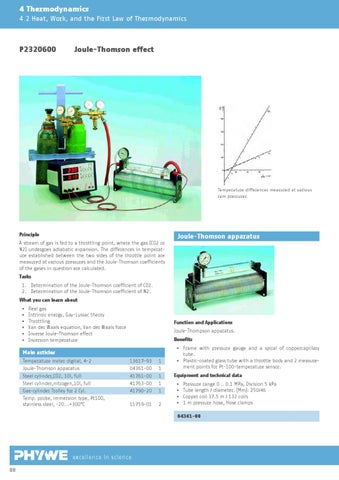
Temperature differences measured at various ram pressures.
Principle
Joule-Thomson apparatus
A stream of gas is fed to a throttling point, where the gas (CO2 or N2) undergoes adiabatic expansion. The differences in temperature established between the two sides of the throttle point are measured at various pressures and the Joule-Thomson coefficients of the gases in question are calculated. Tasks 1. Determination of the Joule-Thomson coefficient of CO2. 2. Determination of the Joule-Thomson coefficient of N2. What you can learn about ▪ ▪ ▪ ▪ ▪ ▪
Real gas Intrinsic energy, Gay-Lussac theory Throttling Van der Waals equation, Van der Waals force Inverse Joule-Thomson effect Inversion temperature
Function and Applications Joule-Thompson apparatus. Benefits
Main articles Temperature meter digital, 4-2 Joule-Thomson apparatus Steel cylinder,CO2, 10l, full Steel cylinder,nitrogen,10l, full Gas-cylinder Trolley for 2 Cyl. Temp. probe, immersion type, Pt100, stainless steel, -20...+300°C
13617-93 04361-00 41761-00 41763-00 41790-20
1 1 1 1 1
11759-01
2
▪ Frame with pressure gauge and a spiral of coppercapillary tube. ▪ Plastic-coated glass tube with a throttle body and 2 measurement points for Pt-100-temperature sensor. Equipment and technical data ▪ ▪ ▪ ▪
Pressure range 0 .. 0.1 MPa, Division 5 kPa Tube length / diameter. (Mm): 250/46 Copper coil 37.5 m / 132 coils 1 m pressure hose, Hose clamps
04361-00
excellence in science 88