Provenance Ewan Phillips, London Frank and Ivy Avray Wilson, England and France (acquired in 1955) Acquired from the above by the present owner on August 29, 1996 Exhibited Hempstead, Hofstra Museum, Hofstra University; University Park, Museum of Art, The Pennsylvania State University; Philadelphia, Arthur Ross Gallery, University of Pennsylvania; The Baltimore Art Museum, Mother and Child: the Art of Henry Moore, September 10, 1987 - April 17, 1988, no. 31, pp. 138, 141 (another example exhibited and illustrated, p. 54) Literature David Sylvester, ed., Henry Moore: Volume 1, Complete Sculpture 1921-48, London, 1957, no. 267, p. 16 (another example illustrated, p. 149) Erich Neumann, The Archetypal World of Henry Moore, New York, 1959, no. 53, p. xi (another example illustrated, p. 86) Will Grohmann, The Art of Henry Moore, London, 1960, no. 122, p. 8 (another example illustrated, p. 168) John Hedgecoe, ed., Henry Moore, New York, 1968, no. 3, p. 528 (another example illustrated, p. 176) Ionel Jianou, Henry Moore, Paris, 1968, no. 251, p. 75 Robert Melville, Henry Moore: Sculpture and Drawings 1921-1969, London, 1970, no. 364, p. 353 (another example illustrated, p. 170) Alan G. Wilkinson, Henry Moore Remembered: The Collection at the Art Gallery of Ontario in Toronto, Toronto, 1987, fg. 61, p. 129 (another example illustrated)
Henry Moore’s Family Group sculptures made between 1946 and 1947 represent a pivotal moment in his career. In these works such as the present one, he abandoned the naturalistic approach he took in 1944 and 1945 in favor of a more abstracted arrangement of the fgural group. Depicting a mother, father and two children in sofly rounded forms angled towards each other, the present example was cast at a critical point in Moore’s life both personally and professionally. In 1946, just one year before this work’s creation, Moore and his wife, Irina, gave birth to their only child, a daughter named Mary, making the subject of family an even more profound statement. In 1948, a year afer this work was conceived, Moore would be awarded frst prize for sculpture at the Venice Biennale, cementing his international prominence as a leading post-war artist.
Originally carved from a single piece of stone, this fourfgure arrangement captures a unique sense of familial harmony. As the mother and father fgures gaze inward, their arms join to form the two children, creating a sheltering recess for their embrace. As Moore said of his uniquely abstract, yet representational approach to the subject of family units, “If both abstract and human elements are welded together in a work, it must have a fuller, deeper meaning” (Henry Moore, quoted in Philip James, ed., Henry Moore on Sculpture, London, 1966, p. 72). This motif of internal forms cacooned within an external shape would serve as the genesis for a completely abstract series of sculptures and drawings he would embark upon beginning in the early 1950s, such as Upright Internal/External Form housed in the collection of Tate, London.
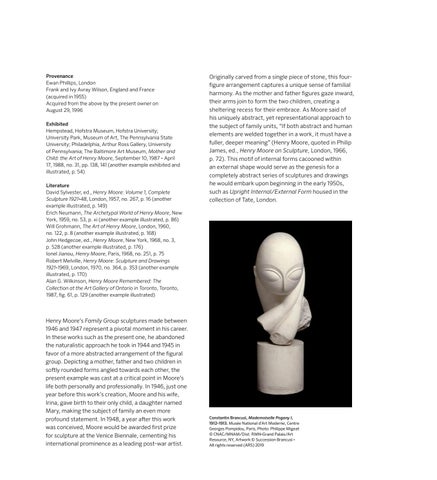
Constantin Brancusi, Mademoiselle Pogany I, 1912-1913. Musée National d’Art Moderne, Centre Georges Pompidou, Paris, Photo: Philippe Migeat © CNAC/MNAM/Dist. RMN-Grand Palais/Art Resource, NY, Artwork © Succession Brancusi All rights reserved (ARS) 2019