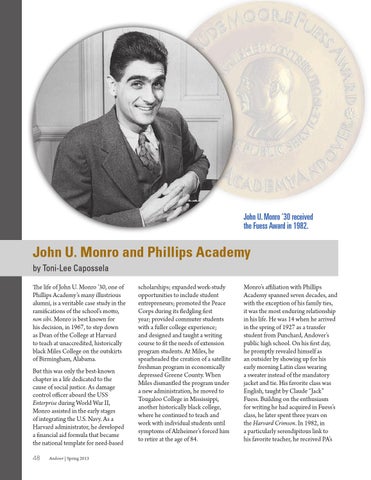
John U. Monro ’30 received the Fuess Award in 1982.
John U. Monro and Phillips Academy by Toni-Lee Capossela The life of John U. Monro ’30, one of Phillips Academy’s many illustrious alumni, is a veritable case study in the ramifications of the school’s motto, non sibi. Monro is best known for his decision, in 1967, to step down as Dean of the College at Harvard to teach at unaccredited, historically black Miles College on the outskirts of Birmingham, Alabama. But this was only the best-known chapter in a life dedicated to the cause of social justice. As damage control officer aboard the USS Enterprise during World War II, Monro assisted in the early stages of integrating the U.S. Navy. As a Harvard administrator, he developed a financial aid formula that became the national template for need-based 48
Andover | Spring 2013
scholarships; expanded work-study opportunities to include student entrepreneurs; promoted the Peace Corps during its fledgling first year; provided commuter students with a fuller college experience; and designed and taught a writing course to fit the needs of extension program students. At Miles, he spearheaded the creation of a satellite freshman program in economically depressed Greene County. When Miles dismantled the program under a new administration, he moved to Tougaloo College in Mississippi, another historically black college, where he continued to teach and work with individual students until symptoms of Alzheimer’s forced him to retire at the age of 84.
Monro’s affiliation with Phillips Academy spanned seven decades, and with the exception of his family ties, it was the most enduring relationship in his life. He was 14 when he arrived in the spring of 1927 as a transfer student from Punchard, Andover’s public high school. On his first day, he promptly revealed himself as an outsider by showing up for his early morning Latin class wearing a sweater instead of the mandatory jacket and tie. His favorite class was English, taught by Claude “Jack” Fuess. Building on the enthusiasm for writing he had acquired in Fuess’s class, he later spent three years on the Harvard Crimson. In 1982, in a particularly serendipitous link to his favorite teacher, he received PA’s