THE SYNTH


THE MUSICIAN’S RESOURCE
2023 FREE
SPRING
ISSUE brought to you by
focusrite.com/scarlett

focusrite.com/scarlett
When you choose to record with Scarlett, you join a community of over 5.5 million musicians and artists worldwide who trust the world’s best-selling audio interface to capture their true sound.
With features across the range like speaker switching, talkback mic, MIDI, ADAT, and many analog IO options; the Scarlett 3rd Gen range has an interface for any creative workflow.
Whether you need up to 16-inputs to record the entire band, or a single input to record yourself, Scarlett will inspire you to create, which is sure to put a smile on your face!


A Versatile Sampler for Making and Performing Beats. Record samples directly to the hardware, then slice, sculpt and resample your sounds e ortlessly. Capture your groove quantised or o -grid into the sequencer, and layer up across eight sample tracks. Invigorate your live set with performance FX like Beat Repeat, Reverser, Vinyl Simulation and many more. Find out


Introducing SSL 12, a new class of interface from Solid State Logic. Featuring 12-in/8-out in a portable USB bus powered design, SSL 12 presents professional features and workflow, perfect for songwriters, musicians, and content creators looking for the sound that has been at the heart of music making for over five decades.


Access Every SSL Plug-in 3 MONTHS INCLUDED
#WhatWillYouCreate www.solidstatelogic.com
4. LETTER FROM THE EDITOR
5.

Book Review: 50 Years of Roland History

9. Best Synths From NAMM 2023
12. SYNTHESIZER BUYER’S GUIDE
16. What is Wavetable Synthesis?
20. Hooked on Phonics: the Polyphonic vs. Paraphonic Debate
23.
30. Envelope Basics
36. Simplifying Analog Synthesis
40.
GEAR REVIEWS: Donner, Jamstik, ASM and more…

47.
FLASHBACK: Vintage KORG Mono/Poly Ad by sid4rtproduction is used under a CC BY 2.0 license Cover
Hey gang,
We’re back at it with another themed issue, this time exploring all things synth-related. We first broached this topic a few years back in a jampacked issue, much of which is still relevant today (and can still be found on Issuu.com if you don’t have the old print copy handy). But we wanted to expand upon our earlier issue and provide more synth content that we hope you’ll find useful both on stage and in the studio in 2023.
Inside you’ll find expert articles on wavetable synthesis, the debate over paraphonic vs. polyphonic terminology, a primer for getting started in the modular and Eurorack worlds, as well as helpful tips for buying and maintaining vintage synths PLUS an exhaustive look at the building blocks of analog synthesis and waveforms for newcomers.
Whew! As if that weren’t enough, we just got back from our annual NAMM show pilgrimage, and
we’ve devoted a few pages to some of the cooler synths and keyboard instruments we saw on the show floor this year.
As with the special Pedal Issue last time around, we have supplemental artist videos showcasing some of our sponsor’s new gear PLUS a free streaming sampler of the new tracks they’ve created up on our Bandcamp page. Make sure you hit up our YouTube to catch the videos and give the sampler a listen, as well, to hear the synths and controllers in a real-world mix.
HUGE THANKS to Donner, Jamstik, IK Multimedia and Novation for helping us make this issue and companion mixtape a reality.
Enjoy!
PS – for those keeping score at home, Spurs are now on their third manager of the year, have been booted from the League Cup, the FA Cup and the Champions League, and just suffered a humiliating 6-1 loss to Newcastle in the Premiership. It’s looking like they might not play in Europe next season, and the summer transfer window will likely be as useless as ever. So yeah…things are going about as Spursy as you would have expected.
850 Post Rd Suite 8385
Warwick, RI 02888
CONTACT
Phone: 617-627-9200
Fax: 617-627-9930
PUBLISHER
William House
Phone: 617-627-9919
bill@performermag.com
EDITOR Benjamin Ricci ben@performermag.com
DESIGN & ART DIRECTION Cristian Iancu
EDITORIAL ASSISTANT Bob Dobalina editorial@performermag.com

CONTRIBUTING WRITERS
Benjamin Ricci, David Rancourt, Gary Johnson, Joel Cummins, Kris Baha, Marc Doty, Quinn Grodzins, Sam Mims, Stephen B. Ward, Steve Joslin
CONTRIBUTING PHOTOGRAPHERS
David Rancourt, Yev Geniya, Chris Devine, 1010music LLC, Gary Johnson
ADVERTISING SALES
William House
Phone: 617-627-9919 bill@performermag.com
© 2023 by Performer Publications, Inc. All rights reserved. No part of this publication may be reproduced by any method whatsoever without the written permission of the publisher.
The magazine accepts no responsibility for unsolicited recordings, manuscripts, artwork or photographs and will not return such materials unless requested and accompanied by a SASE.
Annual Subscription Rate is $30 in the U.S.; $45 outside the U.S.
ABOUT US / Performer Magazine, a nationally distributed musician’s trade publication, focuses on independent musicians, those unsigned and on small labels, and their success in a DIY environment. We’re dedicated to promoting lesser-known talent and being the first to introduce you to artists you should know about.
MUSIC SUBMISSIONS / We listen to everything that comes into the office. We prefer physical CDs, cassettes and vinyl over downloads. If you do not have a physical copy, send download links to editorial@performermag.com. No attachments, please.
Send CDs to: Performer Magazine, Attn: Reviews, PO BOX 348, Somerville, MA 02143

CORRECTIONS / Did we make a heinous blunder, factual error or just spell your name wrong? Contact editorial@ performermag.com and let us know, cuz we’re big enough to say, “Baby, I was wrong.”
EDITORIAL SUBMISSIONS / In the words of our esteemed forefathers at CREEM: “NOBODY WHO WRITES FOR THIS RAG’S GOT ANYTHING YOU AIN’T GOT, at least in the way of credentials. There’s no reason why you shouldn’t be sending us your stuff: reviews, features, photos, recording tips, DIY advice or whatever else you have in mind that might be interesting to our readers: independent and DIY musicians. Who else do ya know who’ll publish you? We really will...ask any of our dozens of satisfied customers. Just bop it along to us to editorial@performermag.com and see what comes back your way. If you have eyes to be in print, this just might be the place. Whaddya got to lose? Whaddya got?”
If you’ve got a synth nerd in your family of friend-sphere, this might just be the perfect gift. Or, if you’re like me, and you’re a synthobsessed nerd yourself, you’ll need this for your own bookshelf or coffee table.
We’ve been super impressed by everything BJOOKS has published to date, and this exhaustive history of Roland, from the 70’s to today, might just be the feather in their cap. Beautifully printed, featured a treasure trove of information, background history, technical details and an amazing array of vault photos, “Inspire The Music” takes you behind the scenes and through the decades to celebrate Roland’s impressive achievements in the world of musical instrument innovation.


You start the journey looking at the detailed history of Roland drum machines and their importance in the world of dance and pop music, then quickly segue to drum controllers and effects pedals before getting to the highlight of the book: the synthesizers and keyboards. Everything you’d ever want to know is here, including background an analysis on all the Junos, Jupiters, Vocoders, Modular ‘Systems,’ rackmount modules, sampling synthesizers,
keytars, boutique modules all the way to currentday production synths and grooveboxes.
It’s a testament to Roland’s inspiring commitment to pushing boundaries that at nearly 400 pages, you never feel tired of learning a new nugget of info with each turn of the page.


It’s a wonderfully designed book jam-packed with the incredible history Roland has paved out for
themselves over the past 50 years. Hopefully BJOOKS will continue their excellent work with future installments focused on other important companies in the synth world. *Cough*SequentialPlease*Cough*
As if it weren’t evident, this book comes highly recommended.
FOR MORE INFO, PLEASE VISIT https://bjooks.com
The 1484 Twin Twelve™ Pedal
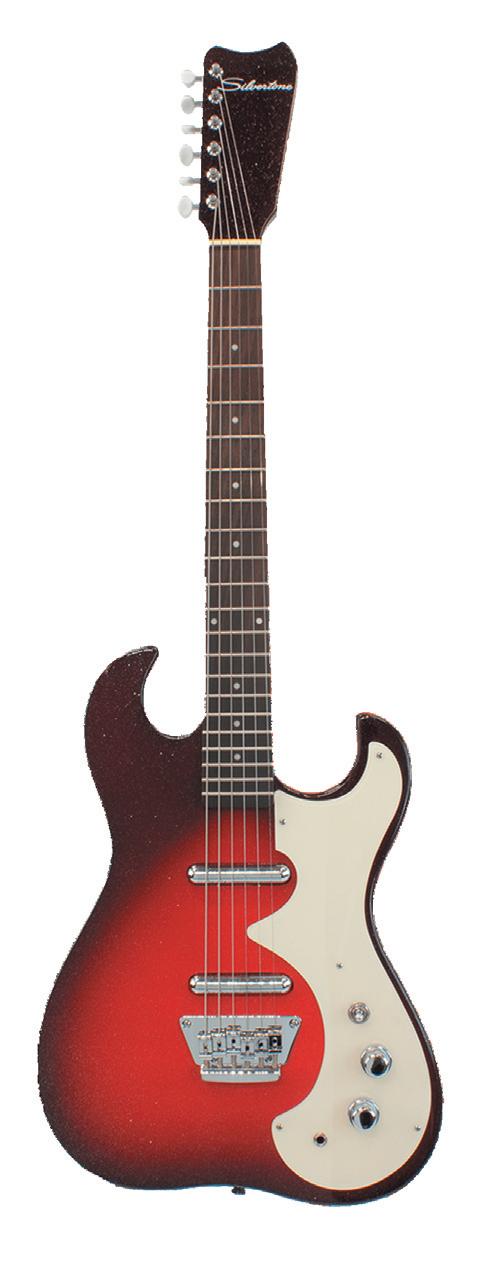

Meticulously designed and engineered from scratch to recreate the renown Silvertone “Twin Twelve™” model 1484 guitar amp, both in sound and looks. Use it as a studio grade preamp, booster, e Q or overdrive. Played side by side... you can’t tell which is the original amp and which is the new pedal.

With over 70 years of insurance expertise, K&K provides affordable liability coverage for individual musicians and bands, often required by facilities and events. And when claims occur, our colleagues are here to respond quickly and effectively.
Visit our website to quote and buy online.

When
2012 Cardioid Mic

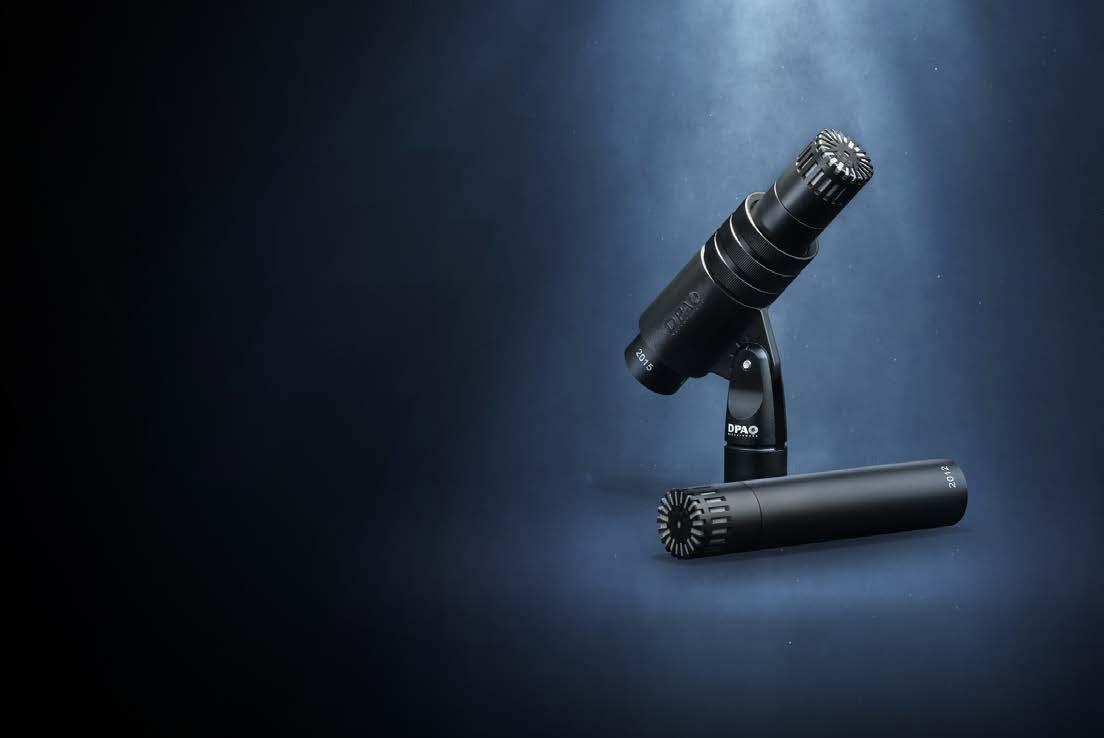
Excellent close-miking results on any instrument


2015 Wide Cardioid Mic
Amazing overhead ambient pick up of instruments

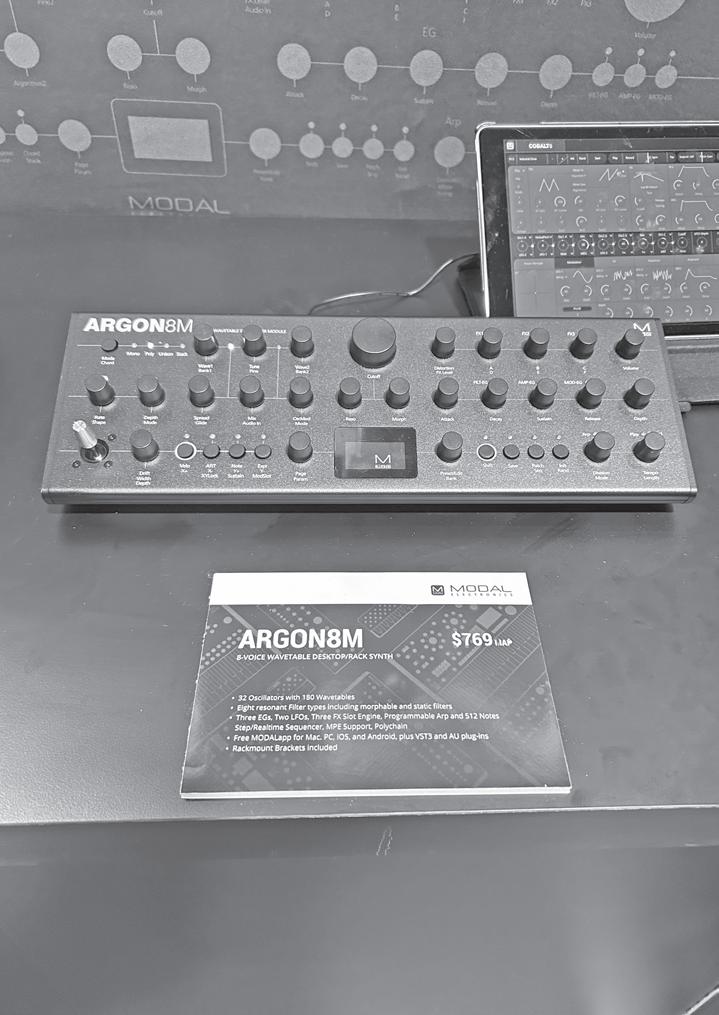
While NAMM was certainly underwhelming again this year (the “big three” guitar brands seem to be done with the show altogether, as are heavy hitters like Zildjian were noticeably absent) there was still a fair amount of activity in the ever-evolving synth world. Big names and small modular creators alike showed up, and we wanted to share some of our favorite pieces from the show. See you next year…maybe?

Nords, Nords, Nords as far as the eye can see!
Verbos Electronics showed off a number of modules at NAMM, including the Real World Interface, an external processing module that packs a whole lot of features into a channel strip-like interface. Coming this August…


OK, it’s not technically a synth. But you’ve gotta love a good old electric piano, and no one’s ever done it better than Rhodes. If you’ve got the cash, their modern machines are heavenly.

The ‘Nina’ comes from Melbourne Electronics and is an incredibly cool hybrid polyphonic synth module. Offering 12 voices, we dug the retro Microsoft Model M keyboard aesthetic.

Robkoo demonstrated a very impressive wind synthesizer at NAMM. We’ve only had brief flirtations with some Roland units, but this knocked our socks off.


‘The Centre’ was another small-format module that offers wavetable capabilities from the folks at 1V/Oct. Seems like this was a Kickstarter project that actually came to life!
And finally, the super impressive C15 from Nonlinear Labs, a lovingly-crafted instrument for the serious performer. This small German company has built a flagship synth that features an amazing keybed and a bevy of sound-shaping options that’ll keep you tweaking knobs for hours on end.
If The Office taught us anything, it’s that we as a society love awards. I mean, who wouldn’t want a shiny new Dundee for their mantlepiece? So this year, we’re handing out “Synthy Awards,” our version of the Dundees, to some of the coolest products in the following categories we came up with while filter-tweaking
our brains out one late Friday afternoon in the office.
So, without further ado, may I present this year’s Synthy recipients…
Most Slept-On Synth: Novation Peak

When it comes to flagship synths from the big players in the industry, the Peak has piqued our
interest for years (see what we did there?) The Peak is sort of the desktop version of the Summit (which essentially packs two Peaks + more inside its chassis) but if you don’t need the keyboard and are OK with a few less voices, you owe it to yourself to get your hands on one. The amount of modulation options, tone-shaping parameters and hell, even the built-in patches are all top of class.

With 8 voices of gorgeous goodness, it does everything under the sun. Bass lines, pads, melodies, blistering, overdriven solos and it does it all effortlessly. It’s almost impossible to get a bad sound out of the Peak, and too many synth-heads are sleeping on this, which comes in at half the cost of most new Sequential or Oberheim products. Add to that on-board fx that are actually useful, an arpeggiator, crossmodulation routing, limitless patch storage,
wavetables and more, and you’ve got the makings of a true end-game instrument for your rig. Period.

Biggest Bargain: IK Multimedia Uno Synth PRO

We loved the small desktop version of the UNO Synth when it first dropped, and we loved the keyboard-equipped PRO model even more when that came out not too long ago. One of the most eye-catching aspects of both models is the price. Just $199 for the original, and only $499 for the PRO model (current Sweetwater promo pricing) with the 37-key full-size layout.

With two easy to access wheels and a matrix/grid style tone shaping panel, the UNO

PRO is dead-simple to use, and the digitallycontrolled analog architecture ensures rocksolid performance and tuning. Again, an on-board arpeggiator and sequencer add to the value, and the plethora of I/O options make this another slept-on synth that is criminally underpriced.
Pro Tip: match it with the UNO DRUM machine for a killer pairing that’ll basically give you an entire production suite for under $800.
Biggest Surprise: Jamstik Classic MIDI Guitar
We’ve been dubious of guitar-based MIDI and synth solutions ever since they first started appearing on the market many moons ago. From a guitar player’s perspective, they never
Biggest

quite got the nuances of performance just right when translated to MIDI data, and from a synthesist’s perspective they were sort of an unwieldly method of input control, compared to a traditional keyboard.

That said, we’ve fully entered a new era of MIDI-equipped guitars, thanks to companies like Jamstik. To say the performance and tracking of the Classic MIDI guitar was a surprise is the understatement of the year. No longer relegated to a bulky, dust-covered curiosity, MIDI-first guitars that work well, have no latency issues, and can handle the dynamics and nuance of a guitarist’s touch are finally here in full effect. The pure joy of throwing down string parts and filtered synth lines using the guitar as an input method put a big smile on our face. This is MIDI done right. Finally.
Best Instant EDM Setup: Donner’s DMK25, Starry PAD and B1.
You can find individual reviews of each of these pieces later in this issue (and check out the videos we put together on our YouTube and socials to hear them in action, hell you can even check out the Bandcamp sampler we’re putting
up to accompany the issue to listen to them in a mix, performed by some very talented artists).
Anyway, one of the toughest things about getting into beatmaking and production is finding what gear you actually need, and budgeting for everything accordingly. Thankfully, Donner has made it their mission to deliver critical rigworthy gear at price points that even the mere synth-curious can swallow. For around $300 brand-new, you can get an instant producer/EDM setup complete with a killer MIDI controller for bass lines, pads and melodies, a 16x16 drum pad controller for triggering samples and laying down percussion, as well as s true analog bass synth to fill out the bottom end without needing any additional software.
All told, these products all hold up well, come in at ridiculously affordable prices, and offer just about everything you’d need to make a complete track from scratch, including some helpful software and DAW-mapping capabilities. If you’re looking to dive into electronic music production, pick up one of each and get going instantly.
Plus, they all look cool together – the product
team at Donner is really doing a great job on its industrial design.

Best Pedal for Hardware Synths: TC Electronic JUNE-60
This has long been the secret weapon in our synth arsenal. If you’ve ever had the pleasure of playing a real vintage Roland Juno, you’ll no doubt recognize the importance of the on-board chorus. Without it, Junos can actually sound kind of lame and thin. Yeah, I know it’s heresy to say that, but it’s what everyone’s thinking. How many Juno players keep either Chorus I or II engaged at all times? More than you think (us included).
So, if your synth doesn’t have a built-in chorus effect, what can you do to thicken things up a bit and add some motion to the works? Drop $50 on Reverb and plug it into one of these JUNE-60 pedals from the folks at TC Electronic, that’s what. Featuring true analog circuitry and BBD chips and whatnot, the JUNE-60 is stupid-simple to operate. Just two buttons, like the classic Juno synths, to select either one of two Chorus modes. That’s it – no speed settings, no depth, no nonsense. Just Chorus I or II (or depress both at once to go into bonkers hidden
“Chorus III” mode – not recommended for the faint of heart).
And hey, the wood housing is a nice nod to the old wood paneling you used to get on classic synths, amirite? Can be used with a standard guitar pedal power supply or 9v battery. Don’t worry too much about ohms, impedance and all that stuff that people obsess over when it comes to using guitar pedals with synths. Just plug it in and enjoy. You’ll be fine.
So far, we haven’t touched too much upon the hot topic of clones in the synth industry, and by clones we are basically only talking about Behringer here. Let’s not dance around the subject, their MO is to provide today’s artists modern ‘takes’ on vintage instruments at fair prices. With so many classic brands refusing to faithfully reproduce their classic and lustedafter products, how can you truly get mad at a company like Behringer? If KORG won’t put out a new Mono/Poly, and if Behringer can legally put out their version 30+ years after the fact, what’s the problem?
They’re filling a true need that the likes of the ‘heavy hitters’ can’t or won’t fill on their own. I’m not sure from a technical standpoint what’s stopping Roland from putting out a real Juno-60 instead of one of their oft-maligned (and limited) ‘boutique’ offerings, but nothing seems to be stopping Behringer from recreating synths from a bygone era.
If my choices are an affordable Behringer Clone or a $5000 vintage unit on eBay that probably needs a re-cap and new voice chips, the choice is clear. My personal $400 VC340 Vocoder is a testament to that.
Anyway, that’s a long-winded way to get to what we’re currently digging, which is the newly-unveiled TORO bass synth. Basically, it’s
a clone of the old Moog Taurus, just without the price tag or headaches associated with old, used and abused examples. It takes the cumbersome old floor units, puts them on the desktop (and in a Eurorack-compatible enclosure) and gives modern appointments like USB and 5-pin MIDI.
They’ve even faithfully recreated the old presets, if you’re into that sort of thing. If not, and you just want a killer mono synth to create bottomfeeding bass lines, here’s your new favorite toy. Enjoy it. At just $249, you’d be a fool not to add one to your studio or live rig.

Coolest Clone: Behringer TORO


Wavetable synthesis is an application of digital sound synthesis that uses multiple waveforms stored together in a table to generate sounds. Wavetable synthesis dates back to the very early days of computer music in the 1970s. Max Mathews invented Wavetable Synthesis in 1958 as part of his MUSIC II computer program. If you are unfamiliar with Max, take a moment to Google his name and prepare to be fascinated by his incredible contributions.
Among the first well-known examples of wavetable synthesizer hardware is the PPG Waveterm, created by Wolfgang Palm of Palm Products GmbH in the late 1970s. Since then, Ensoniq, Access, Waldorf, and even the small company I work for, 1010music, have all created variations of hardware or software that employ wavetable synthesis. The list of developers who have created wavetable hardware or software is exhaustive and too long for this article.
Many artists and composers used wavetable synthesis, including David Bowie, The Fixx, Trevor Horn, Jean Michel Jarre, Art of Noise, Rush, Yes, Depeche Mode, Gary Numan, Robert Palmer, Psychedelic Furs, Talk Talk, The Cars, Ultravox, Steve Winwood, Stevie Nicks, Thomas Dolby, Pet Shop Boys, Mike and the Mechanics, Stevie Wonder, and Tangerine Dream. And this barely scratches the surface.
You can typically create a single sine, square, triangle, saw, or other complex waveform using an analog oscillator. A wavetable comprises many individual waveforms with different shapes that can be individually triggered and even morphed or cross-faded in real-time. The 1010music nanobox | fireball (fig.1) offers two independent oscillators, each holding up to 256 unique waves as a single wavetable. That is like having 512 oscillators at your fingertips.


When creating a sound with wavetable synthesis, the composer loads a wavetable and then adjusts the various parameters to create the desired sound. The fireball offers several options for altering the wavetable in realtime using MIDI CCs, envelopes, filters, Low-Frequency Oscillator (LFO), a modulation sequencer, delay, and reverb to produce a unique sound (fig. 2). However, the most interesting parameter is the Position control in both oscillators. Position determines which of the 256 waves in the wavetable is currently playing.
You can use various modulation types to change the position on the fly. For example, suppose you assign an envelope or LFO to the position parameter (fig. 3). In that case, the fireball oscillator will move through the wavetable, constantly generating interesting and evolving sounds. You can also use any variety of external MIDI controllers and send CC messages to the fireball to modulate a long list of parameters in real time. Suppose you have a free hand — or finger — during a performance. In that case, you can assign the internal XY pad (fig. 4) to modulate various parameters. Or, you can use MIDI CCs to control the XY pad. There are lots of options for using the fireball in any setup.
The fireball is an excellent addition to any setup for studio work or live applications. Because wavetable synthesis is adept at recreating a wide array of sounds, the fireball is great for mono bass or synth leads, rich pads, arpeggiated textures, and even some emulations of real instruments like guitars, gongs, marimba, and organ, to name only a few.
Wavetable synthesis has become essential for professional and hobbyist producers, musicians, and sound designers, offering various sound design and manipulation options. The ability to create complex and evolving sounds has resulted in some truly innovative music and sound design.
One notable use of wavetable synthesis is in electronic dance music. It has been used to create highly modulated and evolving sounds integral to the genre. Arpeggiators, for example, often use wavetable synthesis to create highly energetic arpeggios that help define the sound of many electronic dance tracks.
Another prominent use of wavetable synthesis is in film and television soundtracks. The technique has been used extensively in creating sound effects, such as the sound of digital scanning or the hum of a spaceship’s engines. Wavetable synthesis has become a valuable tool for sound designers in creating intricate and unique soundscapes for film and television projects.
Ultimately, wavetable synthesis offers producers and musicians a powerful sound creation and manipulation tool. Its ability to create complex, evolving sounds has made it an essential technique for electronic music, sound design, and other audio applications. With its continued evolution and development, wavetable synthesis will remain necessary for creative sound design and music production for many years.
Beyond all the sonic possibilities discussed here, the fireball is tiny. At just under 3 x 4 inches (fig. 5), you can find the room almost anywhere to add wavetable synthesis to your setup. You can trigger the fireball using any MIDI controller. You can add pads or textures to your set or even bass sounds with a foot pedal.
If you want more in-depth information about wavetable synthesis, and specifically the nanobox | fireball, we encourage you to visit 1010music. com.


Steve Joslin is a percussionist, who performs and composes in Algorithmic, Electronic, and Progressive Rock genres. His work ranges from meditative to visceral and incorporates technology in interesting ways.
Steve earned a BFA in Performing Arts Technology and MA in Media Arts from the University of Michigan and completed his DMA in Music Performance - in Data-Driven Instruments at the University of Oregon.


Talking about, or learning about, synthesizers can be a challenge in general, but the situation is made worse by the fact that synthesizer culture lacks firm, codified terminology. Whether it’s because of the strange, immediate, and recent history of the synthesizer, or the way that social media corrupts terminology, it’s not always exactly clear what the terms thrown around in regard to synthesizers specifically mean.
Take, for example, the terms associated with how many notes a synthesizer can play at once. There is a tremendous amount of confusion about how to use these terms, and what they mean. This confusion is further complicated by companies who are using them in various, self-serving, and different ways.

Here is a short exploration of the terms associated with synthesizer note count… polyphony, monophony, duophony, and paraphony… and the history of how they came to be used.
Traditionally, keyboard-based instruments like the piano played a note per key, and each of these notes had their own natural independent progression of timbral and amplitude change as the note played, irrespective of what was happening with other notes played. These changes were natural to the design and can be described using the term “articulation.” Culturally, we’re very accustomed to this behavior from traditional keyboard instruments and have some expectation that all instruments with keyboards are going to behave in this way. But with synthesizers, we may not want to make that assumption.
There were many keyboard-controlled electronic instruments created between 1897 and 1964. In each of them, there was always the challenge of note count and articulation. Myriad concessions were made due to the fact that technological limitations and great expense were inherent in the process.
Bob Moog ran into these challenges as he was initially envisioning the groundbreaking transistorized voltage-controlled modular electronic studio he was creating for Herb Deutsch. For the instrument to play more than one articulated note at a time, he would need to have a full synthesizer available per note. In addition to that, his keyboard controller would have to have some means of allocating each note played to an individual synthesizer signal chain. Trying to solve this technological puzzle took away from the thrill of creating an electronic music studio instrument, so he designed the instrument to play one note at a time per keyboard controller. Synthesis was more important than note count and articulation to him at that point.
When typical musicians played Bob’s keyboardcontrolled instrument, they often tried to play more than one note at a time, expecting that it would work like a piano or organ. But, it didn’t. It was necessary to coin the term “monophonic (one note)” in the synthesizer industry so that there wasn’t confusion about this implementation of the keyboard.
The fact that musicians wanted to be able to play multiple synthesizer notes simultaneously inspired the coinage of another synthesizer term:
“polyphonic (many notes).” It was the envisioning of a synthesizer that could play multiple (and hopefully articulated) notes simultaneously.
In 1969, a clever keyboard design allowed for the sensing of two different note voltages. These voltages could be applied to two different oscillators, allowing two frequencies (single articulation) to be played simultaneously from the keyboard. The outcome came to be described as “duophonic (two notes).” The ARP Odyssey was one of the first to feature this function.
Synthesizer companies recognized performing musicians’ desire for a polyphonic product in the early 70s, and a sort of race to create one began.
An engineer named Dave Luce was hired at Moog Music in 1973 to try his hand at creating an affordable polyphonic synthesizer for the company. He used an old polyphony trick that required only 12 oscillators (The trick is one where the oscillators of the top octave are divided to provide the notes for the subsequent octaves.), and directed them through a single filter, amp, and envelope (called an “articulative structure”). So, playing chords sounded great, but it didn’t play like a piano if you played chords, passing notes, melodies, etc. together. Still, it was useful. This creation was called the “Moog Apollo,” but Moog wasn’t happy with it, and it didn’t become a product. However, ARP created a similar keyboard concept in the ARP Omni, and it became one of the best-selling synthesizers of the 1970s.
Dave Rossum of E-mu came up with a way to digitally scan a keyboard, allowing the ability to assign different notes to oscillators and different note events to envelopes, making it so that synthesizers could create multiple note events with independent filter and amp articulations.
Companies took the digital-scanning keyboard concept and applied it to a new polyphonic synthesizer concept. Instead of having full polyphony directed through a single filter, amp, and envelope, they took a limited number of oscillators and directed them through the same amount of filters, amps, and envelopes. While the polyphony was comparatively very limited, it allowed each note to have its own articulation, and the digital scanning keyboard made it possible. Musicians seemed more willing to take very limited polyphony with full articulation than to take full polyphony with limited articulation. Bob Moog suggested that this architecture wasn’t full polyphony due to the limited note count, and that it should have a different name…

perhaps something like “multiphonic.”
As components became less expensive, a couple of companies did put full polyphony through full articulation, which essentially required a synthesizer-per-key. But this architecture was never given a name, likely due to the fact that it was uncommon. The Polymoog, often considered “the first modern polyphonic synthesizer,” went this route with some success.
These types of polyphonic synthesizers defined how note count and articulation was implemented for a number of years. As digital synthesizers became more prevalent, it became easier to design fully-polyphonic synthesizers with full articulation per note of polyphony. Terms related to polyphonic architecture stopped being necessary.
But analog polyphonic architecture made a reappearance in the 2010s, and suddenly, there is the need for terms for these different configurations, again. Unfortunately, time, user misuse, marketing misuse, and general confusion has blurred some of the meaning.
But what does “paraphonic” mean? In the late 1970s, companies were making all-purpose polyphonic performance synthesizers that allowed live musicians to have a string sound, an organ sound, a monophonic synthesizer, etc. Roland made
one of these multiple-synths-stacked-together instruments called the “Paraphonic 505.” The term was coined to mean the equivalent of “parallel sound.” In the mid 1990s, synthesizer players started to miss analog synthesizers. A fanship of them arose, and those interested would get together on Internet usergroups and talk about them. At some point, Roland’s marketing term “paraphonic” was misused and came to be used to describe top-octavedivide polyphonic synths with a single articulative structure. This was kind of a good thing, as this term came to describe a whole category of polyphonic synths that came out in the 1970s, like the ARP Omni.
Several companies have tried to change the definition of the term again, as a term that just indicates “limited articulation polyphony,” but examples of this careless misapplication have led users to think that paraphony, an articulation paradigm, is different from polyphony, a note count number. This is why clarification of these terms and their history helps.

Today, synthesizer fans are interested in the vintage synths of the past, the modern reproductions of classic synths from the past, and modern analog synths that have the structural designs that require the terminology we’ve been discussing. Since some of this history is 50 years in the past, or more, it’s important to preserve useful terminology in order to accurately and effectively describe the instruments
we use. So, here are terms related to synthesizer polyphony and synthesizer polyphonic articulation that are useful in the categorization of polyphonic instruments:
Polyphonic/Polyphony: Capable of producing multiple notes simultaneously when played.
Monophonic/Monophony: Capable of producing one single (usually articulated) note at a time when played. Example: Moog Minimoog
Duophonic/Duophony: Capable of producing two notes (unarticulated or articulated) at a time when played. Example: ARP Odyssey
Paraphonic: Multiple notes, often full polyphony, directed through a single articulative structure. Example: ARP Omni
Multiphonic: Limited note count (4, 6, or 8, usually) where each note is fully articulated with its own filter, amp, and at least one envelope. Example: Yamaha CS-80
Variophonic: Proposed term to describe polyphony with more than one articulation structure, but less articulation than the full note count. Example: Arturia MatrixBrute
Montreal three-piece Ghost Love is led by David Rancourt. The band delivers a soundscape of enigmatic moods and upbeat drum machine grooves influenced heavily by 80s synth-pop . The push and pull between pop and experimental is an overarching theme on Ghost Love’s latest album “Mourners Disco.”
MAKE & MODEL:
2017 Dave Smith Prophet Rev 2
WHAT IT MEANS TO ME:

It’s a great go-to synth for everything from pads to arpeggiators. It sounds great going through an Echocord Super 65 or Space Echo R-201!
FEATURED ON:
The main arpeggiator can be heard on ‘Cycle Down,’ and the Juno-ish riffs on ‘Temple in the Sky.’

LISTEN NOW at https://soundcloud.com/ ghostloveband
I play keyboards for progressive improv rock band Umphrey’s McGee. My arsenal includes a Roland V Piano, MiniMoog Voyager, Hammond B3, Sequential Prophet 6, Fender Rhodes and Mellotron M4000d. I’m based in Los Angeles and hail from Chicago.
MAKE & MODEL: 2005 MiniMoog Voyager
WHAT IT MEANS TO ME:
The MiniMoog Voyager is my lead synth and creative voice, with its wide array of tones and sounds. It’s a monophonic synth which means it only produces one note at a time. It’s an analog synth at heart and the quality of all of its components are what makes its three oscillators really shine. From sounds that can compete with guitars to avant-garde bleeps and bloops, the Voyager does it all.

SPECIAL FEATURES:
The Voyager has a digital interface but the guts are all analog, giving you the best of both worlds. For a live setting, the Voyager is incredibly user-friendly. You can toggle all of the controls and variable settings right on the panel, without endless menus to scroll through. It also has plenty of onboard memory so it’s easy to save sounds and create sounds with small variations depending on your needs. A couple features I really enjoy doing live: 1) flipping the octave switches on the oscillators while holding a note to create a very glitchy vibe as the pitches quickly shift up and down and 2) the assignable pathways of the LFOs and VCAs give you a ton of flexibility when creating a sound so that it really feels alive.
PRO TIP:
Add a guitar tuner to the output chain for a couple reasons… as an analog instrument, the overall pitch of the instrument can vary pretty wildly depending on conditions and temperature. I’m always making subtle shifts with the fine tuning on the instrument throughout our shows to make sure I’m in tune. The added bonus is that you can then use the pitch bend to slowly approach notes and confidently play them to create as much tension as you’d like.
FEATURED ON:
Staircase - recent UM single, Small Strides - Asking For a Friend, Escape Goat - Asking For a Friend, Can’t Rock My Dream Face - Zonkey, Red Tape - Mantis
LISTEN NOW at www.umphreys.com
The Queer Australian/Italian-Armenian has been bending the lines of artistry with his own skewed, mutant industrial productions for 13 years, touring as a DJ, musician and in various projects, like Ghosts In The Machine, a future-cyber-wave-sci-fi concept about AI stripping human souls, becoming Ghosts In The Machine.

MAKE & MODEL:
Tonus Model ARP 2600 Synthesizer (1972) + Industrial Music Piston Honda MK3 (2018)
WHAT IT MEANS TO YOU:
The synth layout encourages sonic exploration which resonates with my own musical approach to try to create new sounds that have yet to be unearthed. It sounds like “Liquid Cyborg Body Music.”
SPECIAL FEATURES:
It has all of the infamous Moog circuitry.
CUSTOM TWEAKS:
I use the Piston Honda as an additional oscillator so the synth becomes a mutant analog and wavetable hybrid.
CAN BE HEARD ON:
‘Revolting’ on In Your Arms along with my remix for Boy Harsher - Electric.
LISTEN NOW at https://soundcloud.com/ krisbaha

AKA Modular is Not a Dirty Word

ello, my name is Quinn, I make music under the name Wyram, and I love working with Eurorack Modular Synthesizers. Not only do I think Eurorack modular manufacturers are creating some of the most interesting music technology of today, but I also find that using them leads you to creative decisions about music you otherwise wouldn’t have ever explored. If you’re interested in getting into modular synthesis, but the thought of keeping track of that many patch cables scares you a bit, fear not! This guide should help you get on the right track to building your first modular system.
How does a Eurorack system work anyway, you might ask?
Well, the biggest difference between modular systems and regular hardware or software is that you won’t be able to make any music with them right out of the box. Your system will be made up of individual modules that need to be mounted in a case with a power supply, and you have to physically create the signal flow for both audio and control sources manually with patch cables. The modules can range wildly based on their functionality, with some of them converting MIDI messages to control voltage or converting your signal to a line-level output, to traditional synthesizer building blocks like oscillators, filters, and envelopes, to bizarre devices like probabilistic sequencers and bioelectricity interfaces. The biggest advantage of working with a modular system is because you can reconfigure the signal flow however you like, you can alter the sounds and functionality of your system drastically all while using the same set of modules.
The main thing to remember about modular systems is the difference between control voltage signals (and the various types of them) and audio signals. Let’s imagine a simple system with a MIDI to CV interface, oscillator, filter, voltagecontrolled amplifier, envelope generator, and an output module. The MIDI module will at the very least have an output for pitch (usually labeled 1volt/octave) that you’ll need to patch to the pitch input on the oscillator, and one for gate messages (whether the note is on or off) that you’ll want to patch into the gate input of the envelope generator module. Your oscillator might have a single audio output jack, or separate ones for each waveform it can produce, but you’ll have to patch one of these to the audio input of your filter module, and then out of the filter into the audio input of your VCA, and again out from there into the input of your output module to convert it to line level. There are just a couple more things to
Hpatch to get sound to come out of your system, which are patching the envelope output of your envelope generator into the CV inputs on both the VCA and filter module. Now, your gate signal has been converted into a more complex envelope shape, and you should be able to play the mono synth you’ve just built!
Now that I’ve introduced you to how it all works, here are the steps that I’d take if I were starting my modular journey today:
Step 0: Try a software emulation first.
VCV Rack 2 is the one that I use most often, and it just so happens to be mostly free! There are other popular emulations like Voltage Modular and Reaktor Blocks you can try as well. I call this step 0 because it’s a low-stakes way to begin to wrap your head around the workflow of modular synthesis, so you can see if it actually works well with your creative process before making the financial investment of building a hardware system.
The software emulations can technically be even more powerful than a physical system, but so many people choose to build hardware systems because physically interacting with them is such a big part of the experience (and it’s certainly more pleasant that navigating one with a mouse and keyboard).
Step 1: Choose a purpose for your system.
The most important question you want to answer when diving into Eurorack is; what’s the purpose of my modular system? Are you trying to build a fantastic sounding mono synth with tons of modulation options? Are you creating a custom groovebox or performance-oriented sequencer/synth combo? Are you making a sound design station to discover new tones? Or are you making an infinitely generative ambient machine to be played by mushrooms? If you can answer this question as specifically as possible, you can choose your modules with a sense of purpose and efficiency. I wouldn’t suggest picking all of the modules you want to use quite yet, because you have to make sure you have enough room in your case for them, but I would definitely look into your options in order to build your system. If you also want to keep your budget in check for your first system, you can still find a ton of awesome but inexpensive modules from manufacturers like Ladik.eu, Tesseract Modular, Blue Lantern, and Doepfer.
Step 2: Choose a case.
Eurorack cases present your first big financial investment, but there are a ton of reasonably priced options to get your foot in the door. The biggest thing to consider when
choosing a case is its size, which in Eurorack terms is measured in HP (width) and U (Height). You probably noticed that Eurorack modules come in only two heights (3U and 1U) but can vary wildly when it comes to width (anywhere from 2 HP to 64 HP), and that cases can be as small as a single 3U row with 84 HP up to monster 21 U walls. Fortunately, there are a good number of inexpensive starter options available these days, like the Intellijel 4U Palette Case, Tiptop Audio Mantis, or Crea8 Audio Nifty Case, which are all great starter options because of their built-in power supplies, and in the case of the Palette and Nifty Cases their built-in utilities for things like MIDI and audio outputs.
Step 3: Plan things out first using Modulargrid.net.
This website is one of the best resources out there for building your own modular system, because it lets you make sure the modules you want will actually all fit in the case you’ve chosen, as well as making sure your modules don’t exceed the limitations of your power supply! You can create a virtual representation of whichever case you’ve purchased, and then fill it up with the website’s database of nearly every module ever created using the super flexible search function. Be aware that some of the modules you’ll find on modular grid are discontinued or not yet available, so you may have to do some editing based on what you’ll actually be able to get your hands on.
Step 4: Don’t forget accessories.
This one might seem obvious, but you’re going to need patch cables for your system, and probably a lot more than you think. It’s also pretty important to get a lot of cables of different lengths to actually reach modules that are far from each other, or not to get in the way of the knobs and switches of modules that are closer. You might also want to grab a few stackable cables and splitters, especially if you didn’t have room for enough mult modules in the system itself. Also, if you want the whole thing to be portable, a bag or road case that fits your system definitely can’t hurt!
ADDITIONAL HELPFUL RESOURCES:
http://ladik.ladik.eu
https://vcvrack.com
https://www.modulargrid.net
https://www.tesseractmodular.com
https://www.bluelanternstore.com
https://doepfer.de/home_e.htm
https://tiptopaudio.com/mantis
https://intellijel.com/shop/cases/4u/4upalette-eurorack-case
https://www.cre8audio.com/niftycase


Envelope Generators, or EGs, create a control signal that rises and falls over time when a note is triggered. In a synthesizer, that signal can control an amplifier to shape loudness changes over time. It’s also common to raise and lower a filter’s cutoff frequency, so brightness changes over time. Pitch envelopes are great for creating realistic drums and interesting synth patches. But there are dozens of other things we can control with EGs and having multiple envelope generators allows control of multiple parameters in different ways.
Three common kinds of Envelope Generators are ADSR, A-Gate-R, and Decay.

An ADSR EG gives you full control over attack time, decay time, sustain level, and release time. Attack controls the time it takes to go from 0 to 100% level. Decay controls the time it takes to go from 100% level to the sustain level. Sustain controls the level where the note settles; set it low for more punch, or higher for a more compressed sound. Release controls the time it takes to go from the sustain level back to minimum after the note is over.

An A-Gate-R EG allows control of attack and release times and assumes sustain level at maximum. Some EGs of this type allow you to switch from gate to trigger mode and will begin to release as soon as the attack is over.
A Decay EG assumes an instant attack time and no sustain; you only control decay time. For 90% of percussion sounds and plucked stringed instruments, that’s really all you need. The classic Acid House bass machine, the Roland
TB-303, had a simple Decay EG. Decay EGs are also great for filters.
Let’s think for a moment about the physics of how acoustic instruments produce sound. You can divide them into two camps: instruments that allow players to keep feeding energy into them so they can sustain, and those that only allow energy at the beginning of the note. Wind instruments, such as woodwinds, brass, pipe organs, and the human voice, can all sustain as long as the wind keeps coming. Similarly, bowed stringed instruments, can sustain as long as the bow keeps moving. Electronic instruments keep sustaining as long as you pay the electricity bill!
Electric organs use a gate-type envelope, with minimum attack and release times, and maximum sustain level. If you are using an ADSR envelope, the decay setting is arbitrary, because sustain is at maximum. Pipe organs are similar, but because the air in the pipe has inertia, it takes a few milliseconds to get it to move and to stop moving. For this reason, use short attack and release times—and a ton of reverberation. Since the lower-pitched pipes are longer, they have longer attack times than higher pitches.
Wind instruments also have a column of air to move—a trumpet uses about five feet of tubing, for example. Once the air gets going, it doesn’t take as much force to keep it sustaining, so there tends to be a slight drop in level during the note’s sustain as compared to its attack. Start with medium-short attack and release times, set the sustain level relatively high, say 70–85 percent, and match the decay to the release time. Again, lower instruments have longer air columns, so lengthen the attack, decay, and release times. Tuba is two octaves below the trumpet, so the air column is four times longer and times should increase proportionally.
For plucked, hammered, or strummed strings, mallet instruments, and most percussion sounds, all the energy is put in at the start of the note and loudness necessarily decreases over time. There is an instant attack time, and no sustain level. Because decay time is the only thing you need to adjust, you can use a Decay EG, or if using an ADSR EG, set attack and sustain to minimum, and match the release time to the decay time. That way, it won’t matter whether you hold the note, or let it go early. For Bass, Guitar, and Piano sounds, you probably want long decay and relatively short release times. This simulates damping by the player at the end of the note.
These are just some examples of how to manipulate your synth’s envelope generators to approximate sounds of instruments you know and love – but of course half the fun of playing synthesizers is to experiment and come up with brand-new sounds.
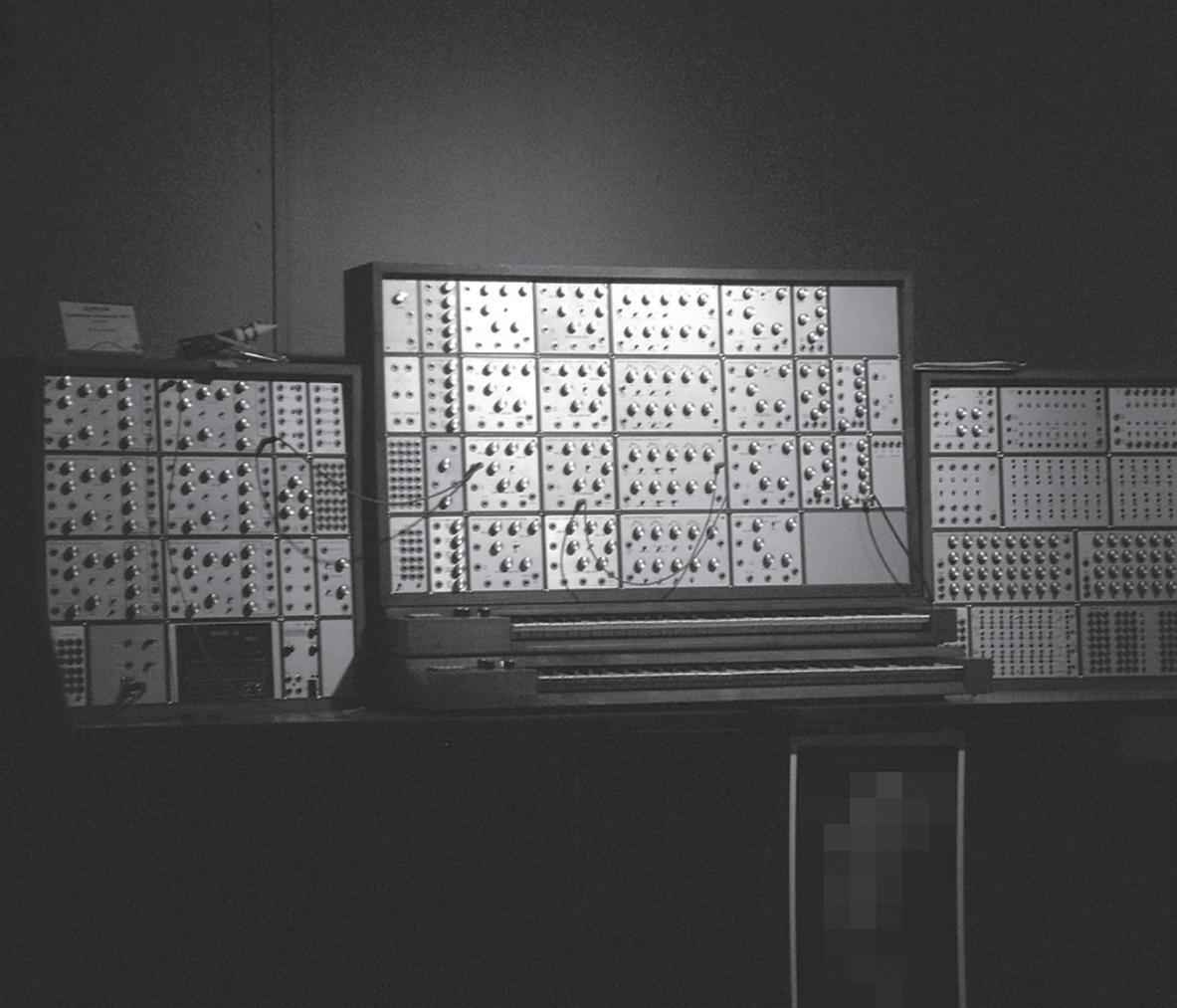
Vintage analog synths are all the rage these days - and for good reason. They sound fat and gorgeous!


But the downside is that when a vintage synth goes haywire, or stops working altogether, who will be able to fix it? Many parts for old synths have been obsolete for years, and techs who know their way around this sort of gear are getting few and far between.
Fortunately, we are in a golden era for analog! Not only are so many new ones being made, but IC chips that haven’t been manufactured for decades are now back on the market, and there are companies like us, Syntaur, that specialize in vintage synthesizer parts.
Surprisingly, much of what a vintage synth needs in maintenance and repair is easy to do. And even the more daunting issues can often be solved with a little detective work. For synths with J-wire key triggers (the Minimoog and the Arp Odyssey are two popular examples), a good maintenance tip is to simply play them! When they sit unused for long periods, the wire contacts can oxidize, resulting in keys that won’t sound at all, or that wobble around in pitch in a crazy fashion.
If this happens, just give the offending keys a lot of exercise - play them repeatedly - and see if the trouble goes away. If not, you will need to clean the bus bars and J-wires with rubbing alcohol on a cotton swab, being very careful not
to bend the fragile J-wires. Just one word of caution: Make sure the synth is unplugged from power before getting inside it!
One J-wire issue that is pretty common is a synth that plays only one note, no matter which key you press, or that keeps on sustaining a note forever. This can be a very easy fix, as it is often caused by a J-wire that is stuck on the bus bar, usually because it somehow got pressed too far and ended up on the wrong side of the bar. If you can get to the bottom of the keybed, it will be obvious if a J-wire is in the wrong place - it will look different from the contacts on every other key. Just gently nudge it to its correct orientation, and the problem should be solved.
For polyphonic synths, you may experience a dead voice, or a voice that just sounds wrong. Usually, the voices cycle as you play notes, so on a 6-voice synth, for instance, just count along as you play single notes. If every sixth note is goofy, you know that the problem is with one particular voice. And by consulting the service manual (the manuals for most vintage synths can be found online for free), you can usually determine which
exact voice is the culprit.
Often, a calibration will cure such woes. But a word of caution: calibrations usually require some electronic test equipment and tech skills. And while the procedure should be outlined in the service manual, the procedures are often hard to decode. Unless you are pretty confident in your abilities, know that a calibration gone bad can make your synth sound much worse! So, you might want to consult a pro (like us!) for this.
If you have a dead voice in a polysynth, take advantage of the fact that you have several other working voices right next to it! The individual voices are usually designated on the circuit board, making it easy to see all of the components in each voice. If chips are socketed, you can easily swap a chip from the dead voice to a working voice, and see if the problem stays where it was, or moves to the other voice. When it jumps to another voice, you know you have found a faulty chip, and you can go on the hunt for a replacement.
Another common issue with synths is wiring connections that have become loose. If

something is not working correctly, unplugging and re-plugging wiring connections is often all that is needed. The same can happen with IC chips that are socketed. While you can pull them and then reseat them, there is danger of bending a pin under, or of harming fragile chips with static electricity. It is much safer to simply leave the chips in their sockets, press down firmly on them, and make sure they are all the way seated.
A final thing to mention is the power supply. This can be a common source of failure on synths, and if you turn on the power switch and get no response at all, the power supply is the first thing to check. If there is a fuse, be sure and check that it is not blown (a continuity tester is great for this).
If you have a voltmeter, you can measure the output voltages from the power supply and compare these to what the service manual specifies. But this requires working around dangerous voltages, and is only a job for someone with some tech experience. The good news here, though, is that power supplies are typically rather simple, and use common components. So,

if there is trouble here, it should be easy for just about any competent electronics tech to fix, even if they know nothing about synthesizers.
Once you know some of the tips and tricks, owning a vintage analog synth can be much easier on the brain and the budget!


Sam Mims is the owner of Syntaur, a company dedicated to providing repair parts for just about every synthesizer ever made. He is the director of ‘Synth Wizards,’ a highly acclaimed YouTube series that is a bit like ‘American Pickers’ for synthesizers. Learn more at https://syntaur. com


In an era where creative or commercial success is possible without the need for physical hardware beyond a computer running the right application, one could be forgiven for believing there is no longer a need for seemingly antiquated analog technology in music production. However, increasing numbers of musicians are enjoying the unique experience of exploring the distinctive properties and authenticity analog synthesizers have to offer.
While aimlessly tweaking knobs, sliders and switches can unquestionably be fun, it is of course massively advantageous to understand both the core principles at work, and what tools are on offer to assist in crafting any specific tone that might be envisioned. To fully grasp the intricate workings of the analog synthesizer it helps to comprehend and visualize the signal path on its journey from input to output, and how this flow utilizes various elements of the circuitry which generate and shape sound waves.
Analog synthesis begins with at least one Oscillator to produce a repeating waveform, the frequency of which is determined by voltage. The most fundamental waveform any Oscillator generates is the most uniform wave possible. Made up of a single element, Sine Waves are smooth and clean, creating whistling tones.
A Voltage-Controlled Oscillator (VCO) can also introduce harmonics or other elements to offer alternative waveform shapes, each augmenting the underlying sound. Square waves generate a harsh tone heard in things like smoke alarms, Triangle waves deliver bright yet hollow timbres, and Sawtooth waves produce an unmistakable buzzing sound.
Especially useful in machines with only one Oscillator, a Sub-Oscillator duplicates and halves the frequency of its parent Oscillator and is responsible for much of the warmth found in the bottom end of analog synths. A random waveform with equal energy across all frequencies can also
be generated resulting in a hissing or static sound known simply as Noise.
By varying the Control Voltage (CV) to the VCO, the frequency of the waveform alters the pitch of the tone. CV can be provided from an external source, but the standard for most modern synths was set in 1970 with the release of the Minimoog, the first commercially available synthesizer to provide proportional voltage to VCOs via a built-in piano-style keyboard.
An alternative to VCOs, DCOs (DigitallyControlled Oscillators) set frequencies by dividing down a digital timing signal usually generated by a microprocessor. Despite being digital in nature, it is not uncommon to find DCOs in analog synthesizers. VCOs produce subtle variations in frequency and waveform due to factors such as temperature, aging of components, and power supply fluctuations. This results in a slightly more organic, dynamic tone. It’s not uncommon for VCOs to have to warm up, and periodically drift out of tune. VCOs are often preferred by musicians who value more character in the sounds they produce, whereas the consistent nature of DCOs are commonly preferred by those who strive for a more precise and stable sound.
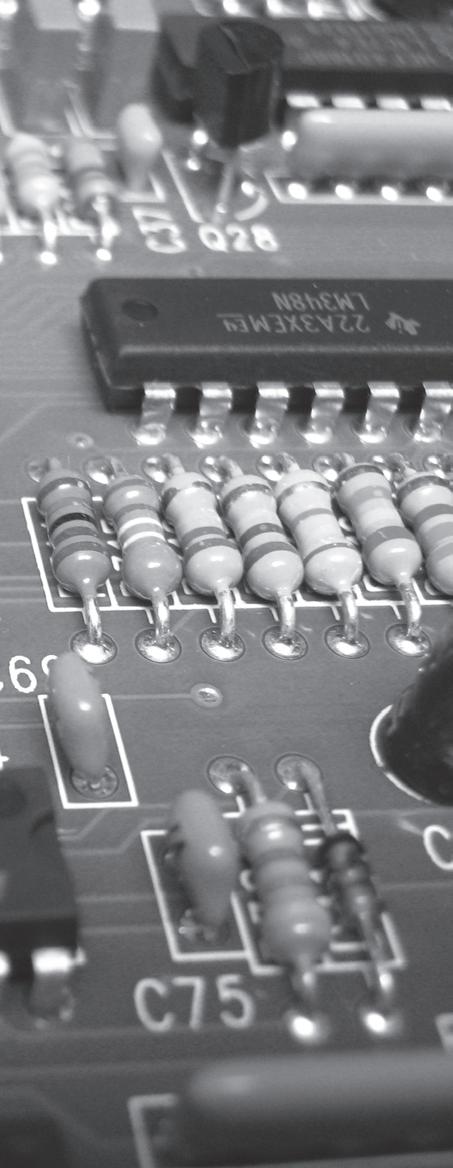
Once the initial waveform is selected it is common to shape it further, usually by means of a filter. These allow certain frequencies to pass through unaltered while attenuating or cutting others completely, hence the term Subtractive Synthesis. By manipulating the frequency response of a waveform, musicians can shape the embryonic sound in unique and creative ways.
The most common type of filter found in analog synthesizers is the VCF or VoltageControlled Filter. A VCF shapes the waveform by altering the amplitude of different frequency components within the signal. There are several types of VCFs, each with unique characteristics. Of these the most common is unquestionably the Low-Pass Filter (LPF) which permits lower frequencies to pass through while cutting higher ones, helping to create a warmer, more mellow sound.
Predictably, a High-Pass Filter (HPF) allows higher frequencies to pass through and reduces lower frequencies. HPFs help sculpt brighter, more attention-grabbing sounds that can more easily cut through a mix, such as those used for riffs in electronic dance and pop music. Band-Pass Filters (BPF) preserve a range of frequencies known as the passband and reduce those. The opposite of a BPF would be a BandStop Filter. Notch Filters (NF) reduce a precise frequency range, the control of which is dictated
by a controllable algorithm called the Quality Factor (Q Factor).
Amplifiers allow for a more dynamic performance by providing control over the volume and sustain of the now filtered signal and are the final building block in any analog synthesizer. The most common amplifier found in analog instruments is the Voltage-Controlled Amplifier (VCA) which responds to a control voltage to adjust the overall amplitude of a sound.


In addition to VCAs, many analog synthesizers also include Envelope Generators (EG) to supply a Control Voltage that changes over time. Not always limited to amplitude, this CV can be used to influence the frequency or other parameters of a sound. Envelope generators typically have four stages: Attack, Decay, Sustain, and Release (sometimes simply labeled ADSR). During the Attack stage, the voltage rises from zero to its maximum level. A fast or short attack time produces a more percussive start to a sound, where a longer attack generates a swelling sound that gets progressively louder. At the decay stage, the CV falls from its maximum level to that set by the upcoming Sustain stage, which holds the Control Voltage at a constant level until a Gate signal is received by a sequencer, arpeggiator or by the release of a key. It is at this point the Release stage begins, and the Control Voltage falls back to zero at the chosen rate.

EGs can also be used to modulate the frequency or filter cutoff of a sound, often employing a Low Frequency Oscillator (LFO) to add fluctuations in pitch (vibrato), amplitude (tremolo) and/or for more dramatic filter sweeps. Their flexibility and versatility make them extremely valuable when it comes to modulation, allowing for the creation of complex, evolving and expressive sounds.

The sonic exploration and performance possibilities of analog synthesizers are practically endless. It is hoped that the above provides a foundation in understanding, and in doing so may help to demystify this truly powerful and compelling area of sound design.
We reviewed the original Hydrasynth from ASM when it debuted in “the before times,” and now we’ve had the pleasure of going hands-on with two new iterations of the HS engine in the Deluxe and Explorer versions.
So, what’s new? Let’s start with the Deluxe model. For starters, it’s clear this is meant to be ASM’s flagship entry in the lineup. We’re treated to a well-constructed and solid chassis, and a deluxe 73-key layout with poly-aftertouch and two wheels (mod/pitch) with great travel and movement. The most striking feature is the increased polyphony, now basically packing in two Hydrasynths in one case for a 16-voice powerhouse that’s not your grandpa’s old subtractive synth machine.
While the Hydrasynth line can certainly do old-school Moog sounds, its genius lies in its unique engine, combining wave shaping capabilities, modulation routing and filter controls that mix analog and digital in a delightful, engaging, and surprising way. This is all easy to understand, even for those new to the ASM architecture, because the UI is so intuitive that you’ll never be scratching your head wondering which parameters you’re affecting.
The ribbon controller is a great touch and feels smooth, adding even more expressive capabilities than the already impressive mod matrix, and the ability to split and layer are welcome here, as well. All in all, at this price point, the Hydrasynth Deluxe’s competition is likely to be the Korg Prologue series, or one of the entry-level Sequential models. And for our money, this competes incredibly well
against either. It even puts up a good fight against the Novation Summit, which was out pick for best flagship synth the last time we did a big shootout.
If big, 6-octave beasts aren’t your bag, there’s the Explorer model. Now, we did enjoy this littlesibling version. But the move to include tiny keys may didn’t sit well with us, as anyone wishing to play with keys will undoubtedly be using a better MIDI controller, or would wish for real, fullsized keys (hence ASM’s other offerings in the HS range). Perhaps this would have been better served in a Eurorack format, or desktop module at the same price, sans keys?

That quibble aside, this is a helluva bargain, almost too much so. Many users may simply opt for the $599 Explorer is they just want access to the Hydrasynth sound engine without extra polyphony or bells and whistles, especially if space is at a premium. If anything, it might be priced a bit too low for all you get in this package. We had to double check the price twice to ensure we were reading it correctly.

At the end of the day, you can’t go wrong with either one depending on your needs. The sound-design capabilities inherent to both are simply outstanding. ASM have clearly thought through not only the sound design aspect, but the physical, tactile control aspects as well, to make a lineup of killer synth machines that fit just about any budget.
Kudos for doing something new, offering it as a reasonable price, and putting it all in attractive housing. Totally recommended.
Benjamin RicciPROS
excellent soundshaping capabilities, unique and intuitive control interface, well-priced
mini keys on Explorer aren’t great
STREET PRICE
CONS $599 (Explorer) and $1799 (Deluxe)


featuring brand new tracks recorded with the generous help of our amazing sponsors


If you want to see just how much fun the Jamstik Classic MIDI guitar is, stop reading this and head over to your YouTube channel. We sent one to the awesome Kal The Guitar Hero from the band Color 8 out of Phoenix. Just look at Kal’s face light up as he turns the guitar into a bass synth machine, or adds piano runs to his song using the guitar as a controller. It’s inspiring, and you can see on-camera how the creative spark took off once he realized the power that a MIDIequipped guitar could afford him.
So, don’t take our word for it, but….well, also take our word for it. Because we got to spend a little time with it before we packaged it back up and shipped it off to Kal. And boy were we impressed. Past MIDI guitar designs were OK, but things like the Roland pickup system were bulky, had proprietary connectors and sometimes the tracking of notes was…let’s just say not super great, at least to start. Thankfully, technology has gotten much better, and the folks behind the Jamstik Classic MIDI Guitar really have a winner on their hands.
Turning a traditional guitar (yes, with traditional pickups, a 5-way switch and output) into a MIDI controller is no mean feat, but the ease with which you can get set up is astonishing. Simply plug into your computer from the USB or 3.5mm TRS-MIDI port and you’re off and running. Open up your DAW or the included software package to browse countless sounds, start playing the guitar, and listen as your picking is transformed into synths, strings, keys and more.
Latency is solid, with no major noticeable lag time, and best of all the processing power inside the system tracks things like bends and slides like you’ve been hoping for, for years. It even handles finger tapping and hammer-ons/pull offs.
We were a bit skeptical at first, having been let down by guitar-based controllers in the past. But if you want a new secret weapon for your studio rig or stage setup, picking up one of these might just be the ticket to a new world of sonic possibilities.
Benjamin Riccifeels like a real guitar, awesome MIDI control and tracking, easy setup.
Donner sent us one of these to check out and do some video work with (check out a killer track that Kyle Andrews made for us on our YouTube channel), and we were super impressed with this small format, yet ultra-cool, bass synth.
We’ve always reached for our tried-and-true Novation Bass Station for bass synth stuff here in the office studio, but this $159 B1 was no slouch! If the tactile silicone keyboard isn’t your jam, you’ve got traditional MIDI I/O on tap so you can connect it to any of the devices you’ve already got in the studio. The other cool thing is it’s got a built-in step sequencer, as well, so you can craft a sequence and start tweaking it on-the-fly as it runs, in order to fulfill all those house and acid dreams.

The filter, envelope and other settings are dead-simple, including the on-board effects like delay and saturation, so if you’re just getting your feet wet into making electronic music, this might be the ideal way to start. No overly complicated rows of knobs or confusing menus to navigate. You can be up and running immediately, making EDM and dance tracks with convincing bass sequences from the jump.
Build quality is surprisingly good for the price, and it includes standard line outs and headphone ports, as well. Considering the price, getting a true hardware analog bass synth and sequencer for under $200, you just can’t go wrong.
Benjamin RicciPROS
excellent soundshaping capabilities, compact, super affordable
CONS $159
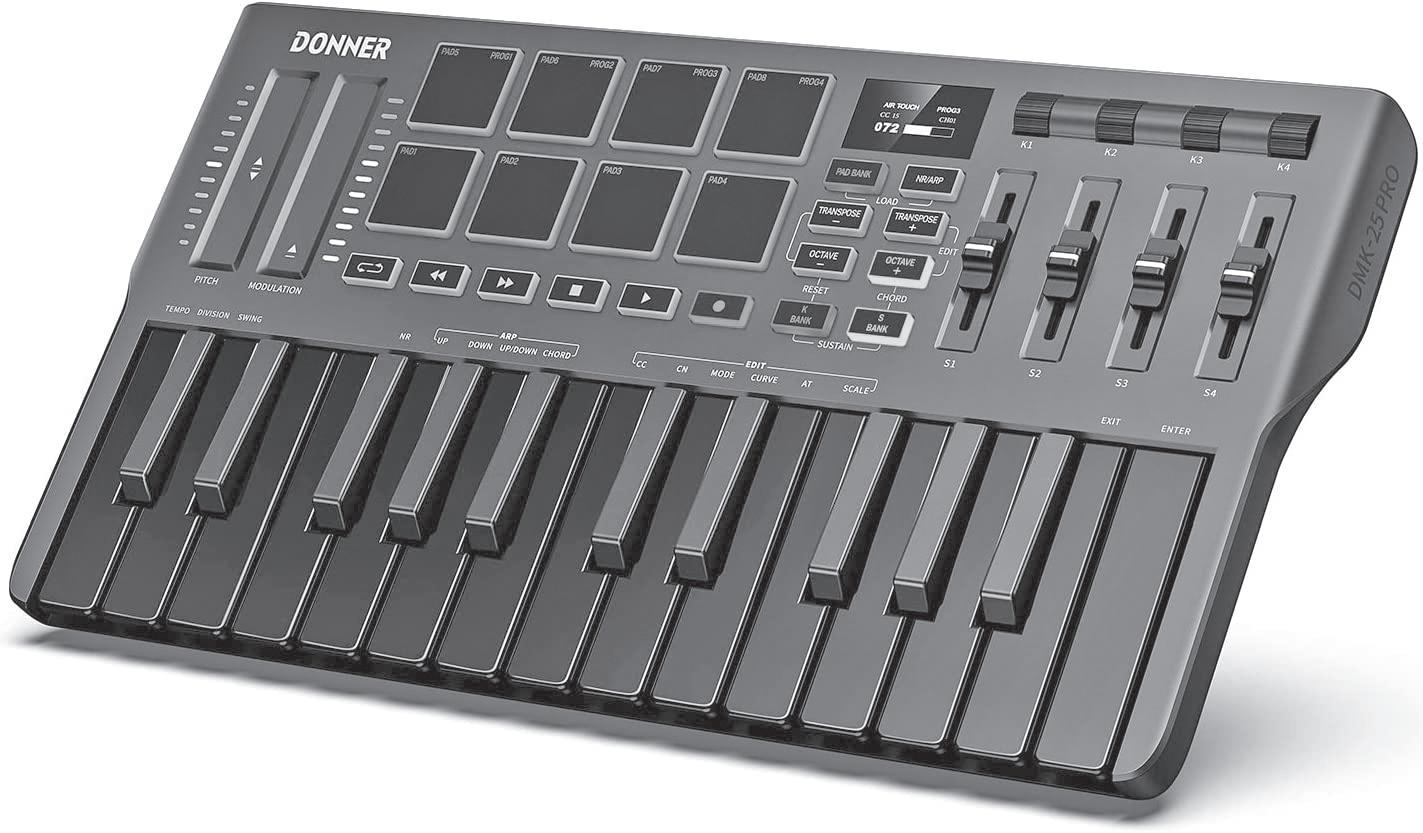
The DMK-25 PRO comes in an attractive blacked-out finish, and a two-octave keyboard that’ll get any budding artist or music producer started, whether it’s adding bass lines, melodies, drum samples or chord changes to their tracks.
It’s all USB powered, so you can plug it into your computer without the need for big ol’ power bricks. From there, control the soft synths and drums in your DAW using the comfortable keyed, or the built-in pad controls. There are also faders and assignable sliders to help control some of your most frequently used parameters, which makes tactile control over your sound a breeze.
The OLED screen is super nice and bright, and easy to read which means navigating
menus isn’t a chore. Once you’ve got your sounds loaded, both the keybed itself and the drum pads are velocity sensitive, so they’ll respond to light and heavy touches accordingly over MIDI. Meaning you can add more dynamics to your music in the way you would on a traditional keyboard or drum set.
Finally, you’ve got the ability to use the arpeggiator, chord functions, and map the keyboard to scales as opposed to the standard chromatic keyboard, making soloing and melodic playing easy for everyone.
The new MIDI controller from Donner is ultra-affordable, compact and a joy to play. We recommend it for a backpack rig, or the starter piece for your first home studio.
 Benjamin Ricci
PROS
great functionality, excellent OLED display and options for DAW mapping
CONS under $100 USD
We hate to keep comparing things, but since our go-to pad controller in the studio is the PreSonus Atom, it would be dishonest to say we didn’t draw comparisons when testing out the Starry Pad. For reference, this comes in about $50 cheaper than the PreSonus unit.
For starters, both sets of 16x16 pads feel great. The Donner is no slouch even though it’s about 2/3 the price. While it may not offer up as many tactile DAW controls as the Atom (many of which are only super useful if you’re in the Studio One world), it does provide a fair amount of transport buttons, assignable rotary knobs and two special faders (the Atom doesn’t have any faders, though in fairness does feature two additional rotary knobs). For such an affordable unit, the knobs, pads and buttons all feel good, and everything connects to your rig over a standardized USB-C connector.
BUT! And here’s the big selling point for us, it also features real MIDI output, which means through an adapter you can physically connect
it to your other hardware over MIDI to control external synths, drum machines, samplers and more -- which is much more complicated with the Atom, that features no such MIDI output. In order to control an external synth or device with the Atom, you’ve got to route it into your DAW first, then route the MIDI from your DAW to an external product either over USB or through your interface’s MIDI ports (if you’ve got them). So in that regard, we give a big thumbs up to the Starry Pad for allowing more control out of the box without configuring more DAW settings.
Playing the velocity-sensitive pads and controlling drum sounds, samples and triggers in an MPC-like fashion was a breeze, and the Starry Pad is just fun to play around with and make beats. You also get some easy-to-use program editing software in the bundle.
If you’re looking for grid controller and the flagship MPC offerings are outside your budget, try your hand at the Starry Pad and begin making beats without any fuss right away.
Benjamin RicciPROS
plays great, true MIDI output, gives the Atom Controller a run for its money.

CONS
None. STREET PRICE under $100 USD
Editor’s note: In this vintage ad from KORG for the legendary Mono/Poly synthesizer, we can see that 40+ years later some of the key features that sold analog synths back in the day are just as relevant today! Looking for a Mono/Poly without the vintage price tag? Check out Behringer’s modern clone for under $600 USD.
 FLASHBACK TO 1982

/ AT2020USB-X Cardioid Condenser USB Microphone


The latest addition to the iconic 20 Series – the microphone line that made professional audio accessible to all – the AT2020USB-X combines the studio-quality articulation and intelligibility of it's predecessor, the AT2020USB+. Featuring USB-C output, silent mute switch, rugged desk stand, and hi-res operation (up to 24-bit/96 kHz) the versatile AT2020USB-X is ideal for musicians, streamers, podcasters, and other content creators. Your personal studio is here.




A passion for playing means that inspiration can strike anytime, anywhere. With Elixir® Strings you know that when you pick up your guitar it’s going to sound great—time and time again. That’s because our featherweight coating protects your strings from the elements, keeping corrosion away and allowing your tone to sound great for longer, in any environment.

Elixir Strings. Performance-ready with long-lasting tone.


