
3 minute read
Getting Started

(High-Z) or line-level (Low-Z) input, and a “Low-Z” output on the other end.
DI Box for Guitars
Advertisement
The most common use for DI boxes are with guitars. In a studio setting, these are most often used to track a clean guitar signal at the same time as an affected signal through an amplifier. This helps the performer play and react to the sound being recorded while preserving the original signal should that need to be altered or reamped later. This can save a lot of time without having to re-record or perform already recorded parts.
DI Box vs Reamp Box
These two are often confused for each other, or at least why each must exist independently. The reason you want to use a designated Reamp box for any reamp functions is because it’s built to perform the opposite function, taking a low impedance signal and converting it to a high impedance signal that guitar amplifiers are supposed to receive. Reamp boxes can also be useful in very complex live setups where you send the guitar through a DI into line-level processing that then needs to be converted back to instrument-level to feed into an amplifier on stage. With so many players opting for digital and computer processing, that kind of setup continues to grow in popularity.
What is a Wet/Dry Signal?
In guitar terminology, a “wet” signal is a fully affected sound. If you have your guitar running through pedals, effects, amplifiers, or anything that alters the original clean signal out of the guitar, that is considered a “wet” signal. The “dry” signal is the unaffected signal from your guitar.
DI boxes allow you to preserve your “dry” signal even while manipulating it with other pieces of equipment.
Passive vs Active DI Boxes
If you’ve spent any time looking at DI box options, you’ll have noticed there are “active” and “passive” options. The most common DI boxes are passive, which use an internal transformer to isolate ground-level voltages and eliminate any ground loops. The impedance will be matched to that of a low-Z microphone preamp. Passive DI boxes are straightforward and simple in design, making them the less expensive option.
Active DI boxes, on the other hand, include an active preamp, creating more headroom than passive DI boxes. This includes a “signal boost” for the preamp, which also helps preserve a stronger signal for very long cable runs, though any boost will often be accompanied by some kind of sound “coloration”. Active DI boxes can be a favorable option for keyboard players or instruments that use active electronics. These will require power, whether in the form of a battery or external power supply.
Things to Look For in DI Boxes
DI boxes perform a relatively limited function, so there’s not much deviation between models. However, here are things you would most commonly see and what function they perform.
Ground Lift
Balanced signals are designed to cancel noise by carrying 2 duplicate signals with reversed polarity. However, introducing more equipment and even the environment itself can add hums and noise to balanced signals. The “ground lift” on a DI box disconnects pin 1 of the XLR on the output in order to break the ground loop, if necessary. As a general rule, the switch should be left in the “ground lifted” position unless otherwise needed.
Thru/Bypass
Sometimes referred to as “throughput”, this output is for the unaffected signal to pass. This is necessary for any guitar tracking where you need a “wet” and “dry” signal to be recorded simultaneously, or you have multiple signal paths. On the Hosa DIB-443 Sidekick Passive DI Box this would simply be called the “output”.
Pad
This is a built-in attenuation on any DI box, reducing the levels somewhere around -20db. A pad is especially valuable to keyboard players that use line-level outputs rather than instrument level. Typically, this would mostly be reserved for any active electronics going into the DI box.

Cables You’ll Need With a DI Box
While there is some variation, most common uses begin with instrument cables. Instrument cables are shielded to resist noise and interference since they carry unbalanced signals. If you are using the thru/bypass, you would need another instrument cable running to your signal chain.

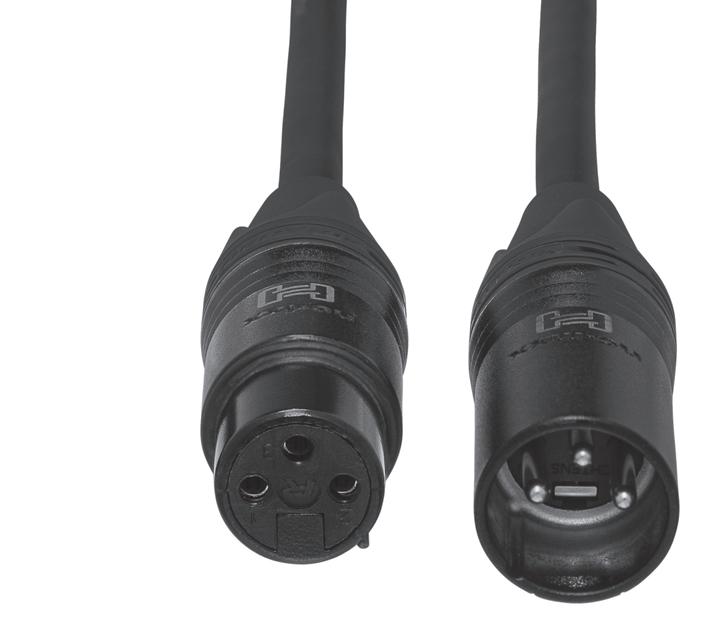
While the outputs in a DI box are usually XLR, once the DI box has converted the high impedance signal to low impedance, you’d need a balanced interconnect with the proper connector types for your equipment.
To purchase the Hosa Sidekick Passive DI Box or learn about the functions and features, visit the product page at https://hosatech.com/ products/analog-audio/instrument-interfaces/ dib-443.
[Editor’s note – big thanks and appreciation to the HOSA team for allowing us to share this how-to guide article which was originally published on their website. To learn more, please head to www.hosatech.com]

