OPTIMISED PRODUCTION PROCESS

CONSISTENT CONTENT OF MANNANS AND β-GLUCANS










COST-EFFECTIVE GUT HEALTH SUPPORT


40 SPECIFIC R&D PROGRAM
Tel: 07827 228 161
SUSTAINABILITY:





The





us to discuss reducing your carbon footprint.
Contact
trouwnutrition.co.uk/sustainability
“At Trouw Nutrition we are committed to working with our customers to make dairy farming more sustainable. We have a range of products and programmes that can make a real difference.”
Dr Liz Homer
Nutrition
Ruminant Technical Development Manager Trouw
GB
BEYOND NET ZERO
opportunity to improve efficiency
Daily
Goal Stages Target Trouw Nutrition products & programmes Optimise Lifetime Daily Yield Calf 0-16 weeks EPIGENETICS Unlocking genetic potential ENERGIZED CALF MILK OSMOFIT Heifer 16 weeks to 6 weeks pre-calving DEVELOPMENT Age at First Calving 22-24 months MAXCARE NUTRIOPT: HEIFER INTELLIBOND OPTIMIN Transition Dry cow to calving RESILIENCE Reduced incidence of challenge REVIVA NUTRIOPT: DRY COW INTELLIBOND OPTIMIN AO MIX Milking cow Early lactation to 305 days PRODUCTIVITY Sustained peak yield reached at 50-70 DIM LACTIBUTE PRIME NUTRIOPT: DAIRY INTELLIBOND OPTIMIN FYTERA BALANCE Multiple lactations 5th lactation LONGEVITY Complete a healthy 5th lactation with minimal interventions
by optimising Lifetime
Yield
United Kingdom

Tel: +44 (0) 1994 240002


Web site: www.feedcompounder.com E-mail: mail@feedcompounder.com

CONSULTANT/RESEARCHER:



SUBSCRIPTION RATES:
Print and On-Line
One year: £80
Two years: £150
Three years: £200
On-Line Only (No Print Copy)
One year: £60
Two years: £114 Three
£153
Feed Compounder July/August 2023 PAge 1 Opinion: No Space For Weak Links 2 Ryan Mounsey: Feed Production Update 4 Colin Ley: View from Europe 10 Christine Pedersen: Milk Matters 14 Matthew Wedzerai: Scientifically Speaking … 16 Robert Ashton: 10 Ways to Get Results Without Getting Angry 18 Ruminations: 20 By Rob Daykin Green Pages 22 Feed Trade Topics From the Island of Ireland £4m Upgrade of Mole Valley Farmers’ Lifton Feed Mill 25 Copper in Ruminants 26 By Dr. Rahma Balegi & Leandro Royo New Yeast Cell Wall Product Promises Consistency 28 With Mark McFarland Alternatives to Antibiotics in Pig Production 30 By Ian Hands Poultry Vitamin Recommendations For Productive and Sustainable Farming 33 By José-María Hernández Solutions for Sustainable Pig and Poultry Producers 38 With Richard Remmer & Chloe Paine Early Grass Silages Show Impact of Growing Season 41 Supporting Sustainability Requires Holistic Individual Approach 42 By Norman Downey Spotlight on Feed Mill Process Engineering 44 Products Influencing Feed Characteristics 46 In Brief 50 Wynnstay Group Plc Reports Record Interim Results 51 People 52 Buyers’ Guide 54 COMMENT COMPOUNDE
EED Contents July/August 2023 Vol. 43 No. 4
R F
ISSN 0950-771X Views expressed by contributors are not necessarily
© Feed Compounder 2023 DEPUTY EDITOR: Ryan Mounsey
MANAGER: Fiona Mounsey EDITOR: Andrew Mounsey
years:
those of the Publisher.
ADVERTISEMENT/SALES
Roger W. Dean
PUBLISHED BY: Pentlands Publishing Ltd Plas Y Coed Velfrey Road Whitland SA34 0RA
NO SPACE FOR WEAK LINKS
The various links in the feed-to-food chain appear to be particularly reliant on the health and prosperity of each other at present as all parties battle together to emerge from tight raw material supplies, high inflation, rising interest rates, and stubborn cost-of-living pressures. It is easy to assume that today’s problems are the most damaging ever, or at least the most uncomfortable in a decade or so. Let’s settle, therefore, with the comment that this year’s woes are up there with the very worst many in the industry have seen and see where that takes us.
Keeping each and every member of a competitive supply chain satisfied is rarely achievable. Often, for example, if things are good for farmers, then agri-input providers or retailers will see their margins being squeezed. Equally, good returns at the input or retail ends of the chain will produce on-farm complaints that the people who are actually growing livestock are being short-changed.
In more ‘normal’ times than currently exist, there will inevitably be periods when input providers have to draw on their reserves to get them through a tough time. Farmers may need to do the same when the balance shifts against them, behaving much like under-fed dairy cows which are required to ‘live of their backs’ when producers decide to trim feed rations for a period. These are often short-term measures to keep businesses afloat for a little longer, but they happen, or have in the past.
The difference today, or so it would appear, is that business reserves and on-farm feed rations are already pretty close to their sustainable operating limits, which is why feed-to-food chain members are currently ultra-dependent on the economic health of each other.
Listening recently to a Dorset pig farmer talking about how his decision to cut sow numbers over the last few years has resulted in better sale prices for the pigs he still has, it was clear that his decision made perfect sense for him personally. It certainly doesn’t add up for domestic pig supplies in total, as referenced by the fact that homeproduced bacon in the UK is operating on a market share of below 55%. UK producers could and should be grasping more of their own market than that, to the benefit of all input providers, feed compounders included. The time for action on this, however, was before sows were put off in the first place, albeit for very sound economic reasons at the time. Building back numbers now is so much more challenging and costly.
The frustration, of course, is that the slimmed down Dorset pig herd would now be filling some profitable gaps in the local market if sow
numbers hadn’t been cut two or three years ago. Crisis point decisions to enable a business to survive long term can easily result in a ‘what if we hadn’t’ scenario when the market turns up again. By the same token, businesses that hold on too long when the figures don’t add up, as has often been the case for pig farmers in recent years, can find they’ve opened a door to bankruptcy which is impossible to close.
At the end of the day, selling fewer pigs is better than selling none. However, those fewer pigs will be eating less feed, on a herd basis, than in the past. Nobody wins, therefore: producer, input provider or retailer.
A similar warning on the need for action in dealing with future red meat breeding shortages was issued on the eve of the Royal Highland Show, near Edinburgh, by the Scottish Association of Meat Wholesalers (SAMW).
If cattle numbers keep dropping as they have done in recent years, Scotland will reach a point where there won’t be sufficient critical mass to sustain the number of abattoirs which currently exist across the country, according to SAMW President, Ian Bentley. He also said this could ultimately threaten the very existence of the Scotch brand, describing it as ‘a hard-earned global status which, once lost, will not be easy to revive’.
Suggesting there are probably no more than two to three years left to address the current cattle numbers’ decline, he added that without prompt action the industry will shrink. This will impact everyone involved in the feed-to-food chain.
There’s no need to search hard for evidence of feed company commitment to farmers, of course. It’s a given of good business. Mission statements abound in pledging support for the feed customer part of the chain. The challenge today is to drive that support home in such a way that the entire chain is strengthened by what the industry in total is going through, rather than weakened, as could so easily happen.
There will always be winners and losers in the sort of high-pressure global conditions which exist at present. This is part and parcel of the normal cut and thrust of business. But with Russia’s war on Ukraine continuing, complete with all the human and economic fall-out that generates, this remains a dangerous time for us all.
There is no scope whatsoever to allow any weak links in the feed-to-food chain to be created. As with reducing sow numbers and a Scottish cattle population decline which SAMW says is ‘entering its final phase’, damage done now will take a long time to repair.
PAge 2 July/August 2023 Feed Compounder Comment section is sponsored by Compound Feed Engineering Ltd www.cfegroup.com opinion
£13,035* increase in production profitability 647-tonne* CO2e reduction 3% improvement in feed efficiency 21% saving on soybean meal use Optigen® is a superior non-protein nitrogen source that can help you overcome the protein challenge by managing fluctuating feed costs and improving the sustainability of your business. Backed by more than two decades of research, Optigen enables partial replacement of plant protein sources in ruminant rations. Ask Alltech how Optigen can help you get the most out of your protein. Boosting of your protein stocks * within a 1,000-cow dairy herd (Salami et al., 2021) the limits Call: 01780 764512 Alltech.com/uk RUMEN FUNCTION
Feed Production Update
By Ryan Mounsey
GREAT BRITAIN Monthly Update – May

Total production of compounds, blends and concentrates, including integrated poultry units, during the month of May 2023 declined for the second year in succession to 979,100 tonnes, a decrease from the corresponding month a year earlier of 5,600 tonnes or 0.6 per cent. Moreover, this reduction dropped the current production even further below the 10 year average for the month which it fell 32,400 tonnes or 3.3 per cent below.
Total feed production during the month of May 2023 was made up of: 46.2 per cent poultry feed, 30.5 per cent cattle and calf feed, 14.5 per cent pig feed, 4.8 per cent sheep feed, 1.5 per cent horse feed and 2.5 per cent other feed.
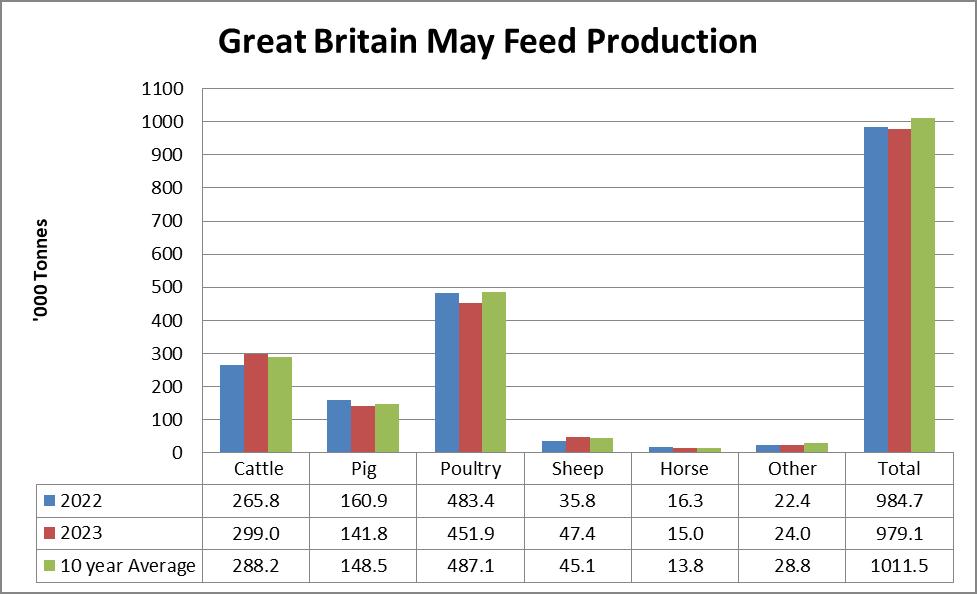
After reaching a record high for the month in the May of 2021, total poultry feed production has fallen year on year. The current total, of 459,100 tonnes, was 31,500 tonnes or 7.0 per cent down on a year previous and the lowest output for the month since 2009. Furthermore, the total under review was 28,000 tonnes or 5.9 per cent lower than the decade long average for May.
Apart from the production of integrated poultry units, which rose from a year previous by 500 tonnes or 0.5 per cent to 161,500 tonnes, and turkey compounds, which increased by 500 tonnes or 10.6 per cent, all poultry feed subsectors fell below their year earlier returns. Output of broiler chicken compounds fell markedly from 2022 levels to 144,700 tonnes, a drop of 26,100 tonnes or 15.3 per cent; chick rearing compounds fell 1,500 tonnes or 13.4 per cent to its lowest May return since 2006 of 9,700 tonnes. Both layer compounds and poultry breeding and rearing compounds also declined notably from year earlier levels, the former did so by 8,700 tonnes or 9.7 per cent to 81,400 tonnes and the latter by 2,100 tonnes or 8.6 per cent to 22,400 tonnes. Once again, there were no statistics provided for the all other poultry compounds
and poultry protein concentrates subsectors.
For the first time in 13 months, total cattle and calf feed surpassed its year previous output. May cattle and calf feed production bettered its corresponding 2022 return by 33,200 tonnes or 12.5 per cent and rose to 299,000 tonnes, the fifth highest for the month on record. In addition, this increase resulted in the current total outpacing the 10 year average for the month by 10,800 tonnes or 3.7 per cent.
The entire cattle and calf feed sector bettered their year earlier returns. Cattle protein concentrates, at 6,900 tonnes, were at their highest output for the month since 2001 and 700 tonnes or 11.3 per cent up on a year previous. In addition, the production of blends for dairy cows were at their highest level since 2015 of 54,500 tonnes, an increase of 9,600 tonnes or 21.4 per cent from a year earlier. Following a significant reduction in output a year previously, production from the sector’s largest element, compounds for dairy cows, increased by a substantial 15,400 tonnes or 10.0 per cent to 169,300 tonnes. Total calf feed followed a similar pattern and its current May production of 12,500 tonnes was 700 tonnes or 5.9 per cent greater than a year previous. The two remaining sectors both also outstripped their year previous counterparts by considerable amounts: all other cattle compounds rose by 3,800 tonnes or 11.9 per cent to 35,600 tonnes, and all other cattle blends grew by 3,000 tonnes or 17.4 per cent to 20,200 tonnes.
At 141,800 tonnes, total pig feed production was at its lowest level for the month under review since 2013. Current production was 19,100 tonnes or 11.9 per cent down on a year previous and 6,700 tonnes or 4.6 per cent below the 10 year average for May.
Despite this sizeable downturn, pig protein concentrates matched their year earlier output of 300 tonnes but this was the only category to do so. Pig starters and creep feed, at 3,500 tonnes, and pig growing compounds, at 21,400 tonnes, were both at their lowest levels for the month since records were kept in their current form, following respective declines of 300 tonnes or 7.9 per cent and 5,900 tonnes or 21.6 per cent. Production of pig breeding compounds was also at a historically low level for May of 31,200 tonnes, its lowest return for the month since 2009 and 2,300 tonnes or 6.9 per cent lower than a year previous. Although pig finishing feed for the month under review was 9,800 tonnes or 11.2 per cent down on its corresponding year earlier production, its output of 77,900 tonnes was nevertheless the second highest on record for May. Pig link and early grower feed had also fallen from a record high output for the month from a year earlier, doing so by 1,000 tonnes or 11.9 per cent to 7,400 tonnes.
An 11,600 tonnes or 32.4 per cent increase from the historically low May production of a year previous brought total sheep feed output up to 47,400 tonnes. This caused the total under review to rise 2,300 tonnes or 5.0 per cent above the decade long average for May.
Production of compounds for breeding sheep, at 10,800 tonnes, had more than doubled from the historically low output of a year previous, outstripping it by 5,600 tonnes or 107.7 per cent. Similarly, the output of blends for growing and finishing sheep rebounded from its second lowest May total in the past decade by 1,600 tonnes or 45.7 per cent to 5,100 tonnes. Blends for breeding sheep were at their
PAge 4 July/August 2023 Feed Compounder Comment section is sponsored by Compound Feed Engineering Ltd www.cfegroup.com
UK & IRELAND PREMIER SUPPLIER

- Feed Phosphates

- Feed Grade Urea
- Sodium Bicarbonate
- Oyster Shell Grits
- Magnesium Oxide
- Emulsifiers

- Caustic Soda Pearl
- Cubicle Liners
- Protected Fats
highest level for May in five years of 1,200 tonnes, an increase of 300 tonnes or 33.3 per cent from a year earlier. Finally, at 29,900 tonnes of production, compounds for growing and finishing sheep were at their fourth highest level for the month under review having surpassed its year previous return by 3,900 tonnes or 15.0 per cent.
Total horse feed production for May had fallen 1,300 tonnes or 8.0 per cent from the record high output for the month from a year previous to 15,000 tonnes of production. However, the current total was still 1,200 tonnes or 8.3 per cent in excess of the 10 year average for the month.
At 24,000 tonnes, total other feed production surpassed its year earlier output for May by 1,600 tonnes or 7.1 per cent. Nevertheless, in spite of this upturn, the current total was still 4,800 tonnes or 18.2 per cent lower than the decade long average for month under review.
NORTHERN IRELAND First Quarter Overview
Total production of compounds, blends and concentrates during the first quarter of 2023 in Northern Ireland increased from the corresponding period a year earlier by 15,700 tonnes or 2.2 per cent to 722,700 tonnes, a record high for the timeframe. Moreover, the total under review was 46,500 tonnes or 6.9 per cent in excess of the decade long average for the timeframe.
Total feed production during the first quarter of 2023 was made up of: 53.9 per cent cattle and calf feed, 30.9 per cent poultry feed, 8.0 per cent pig feed, 4.1 per cent sheep feed and 3.1 per cent other feed.
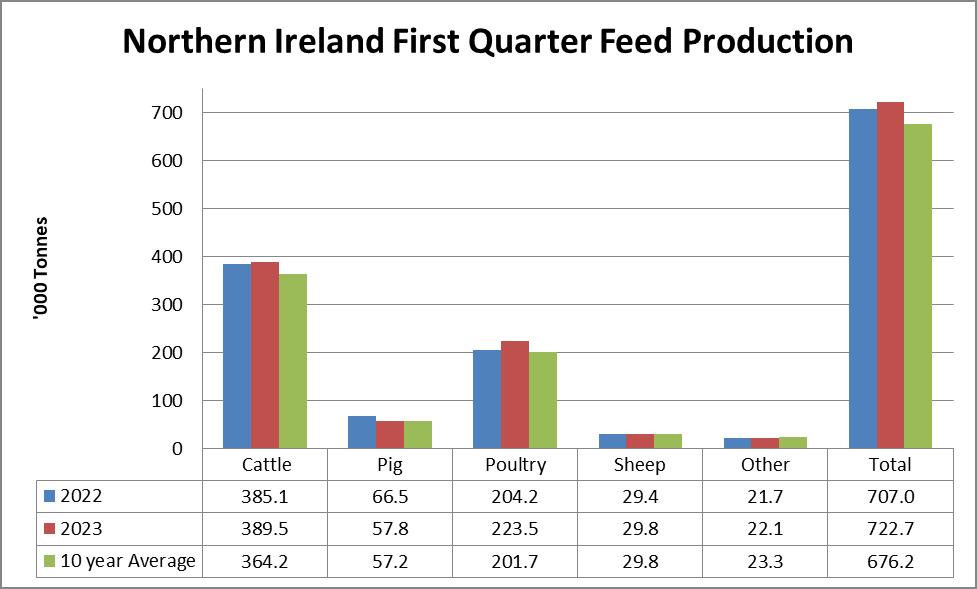
At 389,500 tonnes, total first quarter cattle and calf feed was also at record levels for the timeframe under review. The current total surpassed its year previous output by 4,400 tonnes or 1.1 per cent and bettered the 10 year Q1 average by 25,300 tonnes or 6.9 per cent.
There was a distinct split between the beef and dairy sectors in terms of first quarter feed outputs. Production of both beef coarse mixes or blends and beef cattle compounds fell significantly from year previous levels: the former decreased by 7,500 tonnes or 10.0 per cent to 67,900 tonnes and the latter by 5,700 tonnes or 12.1 per cent to 41,600 tonnes. All other cattle compounds output also fell below its corresponding year earlier return by 200 tonnes or 15.1 per cent to 1,400 tonnes; similarly, production of protein concentrates for cattle and calves, at 800 tonnes of production for the quarter, was 200 tonnes or 20.0 per cent down on a year previous. In contrast, the sector’s largest element, dairy cow compounds, had surpassed its year
previous production by 7,100 tonnes or 4.4 per cent to a record high of 170,000 tonnes. Furthermore, dairy coarse mixes or blends were also at an unparalleled output for the quarter of 81,800 tonnes which was 9,000 tonnes or 23.0 per cent in excess of the production for the period from a year earlier. Production of all other calf compounds had increased from the Q1 a year previous by 2,000 tonnes or 8.3 per cent to another record first quarter total of 26,000 tonnes.
For the second first quarter in succession, total poultry feed surpassed its year previous output. The current output for the period of 223,500 tonnes was a significant 19,400 tonnes or 9.5 per cent in excess of its 2022 return and a record high for Q1. Additionally, the total under review outpaced the decade long average for the timeframe by 21,800 tonnes or 10.8 per cent.
All poultry subsectors exceeded their previous totals for the quarter and half of them were also at unmatched levels for the period. Both layer and breeder feed production, at 87,800 tonnes, and chick rearing feed, at 7,700 tonnes, were at record levels for the timeframe, bettering their year earlier returns by 2,700 tonnes or 3.2 per cent and 600 tonnes or 8.0 per cent respectively. Broiler feed output for the first quarter of 2023 surpassed its year previous output by 12,400 tonnes or 11.4 per cent and rose to 121,200 tonnes, the second highest total since records were kept in their current form. Turkey and other poultry feed Q1 output more than doubled from a year earlier to 6,900 tonnes, an increase of 3,600 tonnes or 110.8 per cent.
Having been at roughly the same level of production over the past three first quarters, total pig feed production decreased by 8,700 tonnes or 13.1 per cent from a year earlier to 57,800 tonnes. Despite the sizeable drop, the current output was 600 tonnes or 1.1 per cent in excess of the decade long average for the timeframe.
The downturn in first quarter production was consistent throughout the entirety of the sector. First quarter production of pig breeding feed had fallen by 1,100 tonnes or 13.0 per cent to its lowest return for the period since 2013 of 7,400 tonnes. Moreover, pig finishing feed and pig growing feed had both fallen for the second Q1 in succession with the former declining from the corresponding period a year previous by 2,600 tonnes or 9.4 per cent to 24,100 tonnes of output, and the latter by 2,000 tonnes or 15.7 per cent to 10,500 tonnes. Having recorded an all-time high output in the period under review in 2022, pig link and early grower feed output dropped by 1,400 tonnes or 13.7 per cent to 9,000 tonnes. Pig starter and creep feed production also fell sharply from a year previously to 6,700 tonnes, a decline of 1,600 tonnes or 19.3 per cent.
At 29,800 tonnes, total Q1 sheep feed output marginally bettered its year earlier return by 400 tonnes or 1.3 per cent. This increase also brought the total under review above the decade long average for the quarter by 100 tonnes 0.2 per cent.
There was a mixed picture presented from across the sheep feed production sector; breeding sheep feed compounds output decreased sharply for the second first quarter in a row to 15,300 tonnes, a drop of 1,300 tonnes or 7.9 per cent, whereas production of coarse mixes or blends for sheep increased markedly from a year previous to 6,500
PAge 6 July/August 2023 Feed Compounder Comment section is sponsored by Compound Feed Engineering Ltd www.cfegroup.com
BECAUSE IT’S ABOUT FEED COST



Fully charged, healthy growth!
GuanAMINO® is the best supplemental creatine source which ensures optimized nutrient utilization and feed costs. Furthermore, it spares metabolic energy and works towards an optimized amino acid metabolism. GuanAMINO® supplementation enables improved feed conversion, healthy muscle growth and resilience, and leads to higher income over feed costs.
Sciencing the global food challenge. | evonik.com/guanamino











tonnes for the quarter, up 1,600 tonnes or 32.3 per cent from a year previous to its highest Q1 level in 5 years. Lastly, growing and finishing compounds for sheep grew from its respective total a year earlier by 100 tonnes or 1.5 per cent to 8,000 tonnes of output for the period.
A 300 tonnes or 1.5 per cent increase in total first quarter other feed production from a year previous brought output for the timeframe under review up to 22,100 tonnes. This increase, however, was not great enough to bring the current total above the decade long Q1 average, of which it was 1,300 tonnes or 5.5 per cent short.
With production from the first three months of 2023 at record highs, the industry’s two largest sectors also at unparalleled levels for the timeframe and sheep feed production above both its year previous return and long term average, 2023 looks on course to be a significant year for Northern Irish feed production especially when viewed in the global context of widespread decline in feed production. Only pig feed production appears to be consolidating but this is perhaps unsurprising given the exceptional returns it has posted in recent years.
NORTHERN IRELAND Monthly Update – April
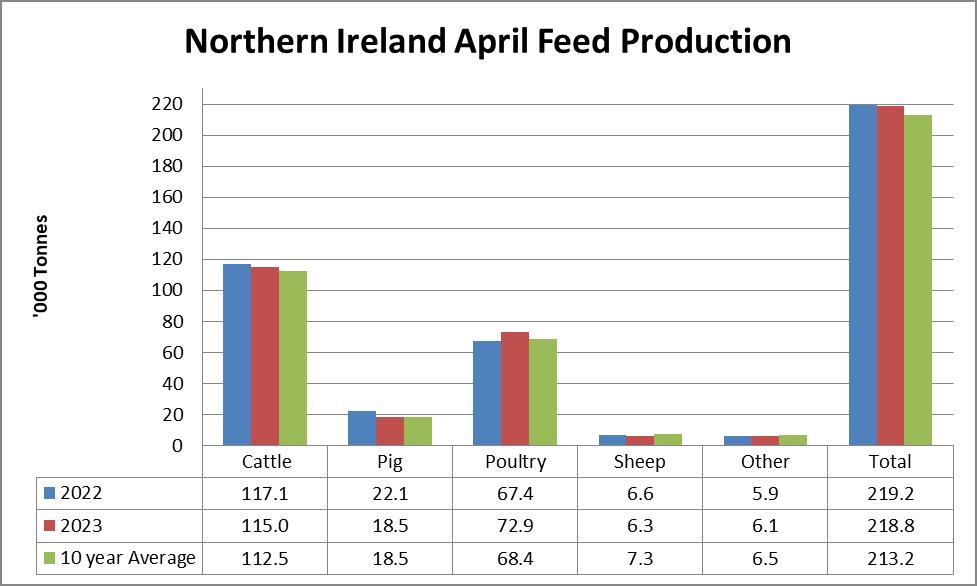
Total production of compounds, blends and concentrates during April 2023 in Northern Ireland dropped 400 tonnes or 0.2 per cent from the corresponding month a year previously to 218,800 tonnes. This was the second April in succession where production had fallen below its year earlier level and yet the output under review was still 5,600 tonnes or 2.6 per cent in excess of the decade long average for the month.
Total feed production during April 2023 was made up of: 52.6 per cent cattle and calf feed, 33.3 per cent poultry feed, 8.5 per cent pig feed, 2.9 per cent sheep feed and 2.8 per cent other feed.
A 2,100 tonnes or 1.8 per cent decrease in total cattle and calf feed output from a year earlier brought production down to 115,000 tonnes. However, the current output was 2,500 tonnes or 2.3 per cent greater than the 10 year average for April.
Despite the drop in production from the sector overall, other calf compounds were at their highest ever level for the month of 8,400 tonnes, an increase of 1,300 tonnes or 18.8 per cent from a year previous. Dairy coarse mixes or blends were also up significantly from a year earlier, rising by 2,600 tonnes or 12.8 per cent to 22,700 tonnes. In contrast, the sector’s largest element, dairy cow compounds dropped 1,100 tonnes or 2.1 per cent from its year previous level to
54,300 tonnes. Both beef categories also fell below their year earlier returns, beef coarse mixes or blends did so for the second April in succession, in this instance by 2,900 tonnes or 13.5 per cent to 18,300 tonnes, and beef cattle compounds did so by 1,900 tonnes or 14.7 per cent to 10,800 tonnes. Finally, all other cattle compounds, at 300 tonnes declined by 100 tonnes or 31.8 per cent.
At 72,900 tonnes, total poultry feed production was at its highest recorded level for April, surpassing 2022’s total by 5,500 tonnes or 8.2 per cent. Additionally, the total under review outstripped the decade long average for the month by 4,500 tonnes or 6.5 per cent.
Only layer and breeder feed output fell below that of a year earlier, it dropped 500 tonnes or 1.6 per cent below the record total for the month from a year previous to 28,500 tonnes. On the other hand, turkey and other poultry feed rose sharply from the record low output of a year earlier to 2,200 tonnes, an increase of 1,600 tonnes or 294.9 per cent. Broiler feed, at 39,700 tonnes surpassed its year previous output by 4,200 tonnes or 11.7 per cent. Lastly, chick rearing feed output rose from that of the corresponding month a year previously by 200 tonnes or 9.4 per cent to 2,500 tonnes.
Total pig feed production for April had fallen by 3,600 tonnes or 16.4 per cent from a year previous to 18,500 tonnes of output, its lowest level for the month since 2019. As a result of this drop, the production under review was directly in line with 10 year average for the month.
All pig feed subsectors fell below their respective year previous returns. At 3,200 tonnes of production, pig growing feed declined from its output a year earlier by the largest amount across the sector, doing so by 1,300 tonnes or 29.9 per cent. Additionally, pig finishing feed production decreased by 900 tonnes or 9.9 per cent from its second highest return for the April a year previous, to 7,800 tonnes of output. Production from the remaining categories all fell sharply from their 2022 levels. Pig breeding feed did so by 600 tonnes or 20.4 per cent to 2,400 tonnes; pig link and early grower feed by 500 tonnes or 15.2 per cent to 2,900 tonnes; and pig starter and creep feed did so by 300 tonnes or 11.4 per cent to 2,200 tonnes.
For the second April in a row, total sheep feed output had dropped below its year previous level, in this instance, output had declined by 400 tonnes or 5.4 per cent to 6,300 tonnes. Due to the much greater outputs posted in the first half of the preceding decade, the total under review was an even greater 1,000 tonnes or 13.4 per cent below the 10 year April average.
Breeding sheep compounds had also fallen for the second April in succession, dropping by 300 tonnes or 9.9 per cent to 2,700 tonnes. The output of growing and finishing compounds for sheep was also down on a year previous, declining by 200 tonnes or 7.4 per cent to 2,300 tonnes. On the other hand, coarse mixes or blends for sheep rose by 100 tonnes or 10.5 per cent to 1,300 tonnes of production.
Following a sharp fall in output a year earlier, total other feed production increased by 200 tonnes or 2.8 per cent to 6,100 tonnes. Despite this rise, production was 400 tonnes or 6.2 per cent down on the decade long average for the period.
PAge 8 July/August 2023 Feed Compounder Comment section is sponsored by Compound Feed Engineering Ltd www.cfegroup.com























Mycofix ® Deactivate mycotoxins Activate performance Powered by science to actively defend against multiple mycotoxins* With 3 combined strategies *Authorized by EU Regulation 1060/2013, 2017/913, 2017/930, 2018/1568 and 2021/363. If not us, who? If not now, WE MAKE IT POSSIBLE ADSORPTION BIOTRANSFORMATION BIOPROTECTION Follow us on: www.dsm.com/anh
View From Europe
By Colin Ley
Make the most of Brussels shutdown
If you’re waiting for the European Commission (EC) to sort something out, then it’s time to resign yourself to the reality of the imminent Brussels shutdown.
I’m being disrespectful, of course, given that there is always a skeleton staff in place to deal with any issues that arise, but the truth is that the EC in August is for emergencies only and the second half of July tends to resemble a very long Friday afternoon. If you’re going to disrespect, why bother being subtle about it.
My personal EC holiday experience came during a period when I was running a farm business online news site and needed something new to report each day. Normally, when I hit a quiet 24 hours on the news front, I would trawl various government sites, searching for a hint of a story. For most of the year, the EC would always be saying something, except in August. I wouldn’t have minded so much if the Commission newsroom hadn’t carefully sent me the names of their specially selected skeletons for the month, along with a link to follow their daily outpourings. I gave up after a week of reading that the said skeleton had ‘nothing to report’.
My sympathies, however, if your August frustration is actually about something important. I, after all, could always write about the potential development of three-legged ducks or two-headed sheep to get me through everyone else’s holiday month.
Unfinished business
Looking back, as Brussels starts to slow, there are clearly some unfinished items of business to be addressed once the autumn programme is launched.
Picking up on FEFAC’s 30th Congress report from Sweden, for example, I note that Copa-Cogeca Secretary-General, Pekka Pesonen is concerned that the EU Green Deal’s policy objectives risk reducing or pushing out the European livestock sector, a development he said which will undermine EU food security and the whole rural economy.
Dirk Jacobs, FoodDrinkEurope Director General, focused his congress attention on urging the ‘upcoming’ EC to allocate funds for a sustainable food investment plan under the next EU legislature’s budget, adding that such action was needed to enable the feed industry’s potential to prevent nutrient losses across the food chain.
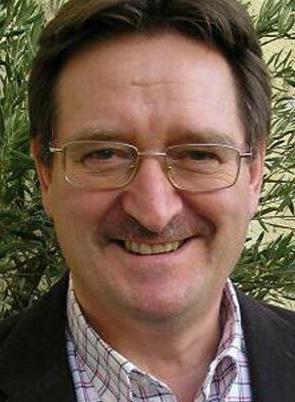
FEFAC’s immediate past President, Asbjørn Børsting, used his congress platform to call for an EU regulatory framework that would support the development and uptake of the sorts of innovation that help boost sustainability. This would, or should, involve new genomic techniques and the ‘legal possibility’ to harvest cover crops for bio-refining purposes.
Plenty there for the EC to focus on from September onwards, certainly, when the presidency of the Council of the EU is held by Spain. Starting on July 1 and running to the end of December, it’s a presidency with has to contend with both August and the Christmas/New Year period. At least this might concentrate Spanish efforts, whose already declared four presidency priorities are to redustrialise the EU; advance the green transition; promote social and economic justice; and strengthen European unity.
Refocusing on European businesses
Looking closer at the details of the Spanish plan, a major concern is that while it is perceived that the last 70 years of ‘international openness’ has been mostly beneficial for the EU, enabling strong levels of economic growth and social welfare, this same openness has ‘facilitated the offshoring of industries in strategic sectors’. This, according to Spanish analysis, has made the EU ‘excessively dependent on third countries in areas such as energy, health, digital technologies and food’.
To attempt a reset, the Spanish Presidency is committed to ‘fostering the development of strategic industries and technologies in Europe, the expansion and diversification of its trade relations, and the strengthening of its supply chains, giving special attention to Latin America’. This includes focusing closely on the EU-CELAC Summit, a heads of state and government event which is due to be held in Brussels later this month when European, Latin American and Caribbean leaders will seek to ‘renew and strengthen relations’.
As for advancing the green transition, the Spanish pledge is to give the programme its full backing, stating that successful transition will allow the EU to drastically reduce its dependence on energy and raw materials, lower electricity costs and generally make the EU27 companies more competitive. All of which sounds good.
And now ‘breathe’ or in Brussels-speak, take a month off. Sorry, disrespectful again.
Kick-start September
The commercial challenge in all this is to make sure your arguments are made prior to the end of July and that you’re ready to hit the ground running when September comes. In that context there are some excellent kick-start events to get you going in the early autumn.
My favourite post-holiday boost in recent years has been to attend SPACE, a genuine top-level exhibition and conference gathering centred on everything involving livestock production. This year’s happening will take place from September 12 to 14 within the Rennes Parc-Expo, in north-west France. The organisers claim to attract 1,200 exhibitors and over 100,000 professional visitors each year with no fewer than 12,000 international visitors drawn from 120 countries. Having been there several time, I don’t dispute the figures.
This is the 37th edition of SPACE, so the processes behind the event definitely work. In the Parc-Expo itself, there are countless conference and symposium sessions, a genetics hub with 750 animals, and easy access to all the latest innovative contenders.
Away from Rennes, delegates get the chance to visit selected local
PAge 10 July/August 2023 Feed Compounder Comment section is sponsored by Compound Feed Engineering Ltd www.cfegroup.com
• Reduce costs and prevent risks


• Optimize your entire product chain
• Guarantee higher-quality products
BESTMIX® Feed Formulation, Quality Control, Ration Calculation and ERP solution

Peace of mind:
No bearings, seals or service down time … Guaranteed for 5 YEARS for UK
Single V-Belt drive; High inertia, smooth and efficient No oil leaks into feed or on press floor

Designed, fabricated and built in Italy
Support:
Design, installation and project management services

UK based stock and engineers

2-3 day Die and roll refurbishment
Dies held in stock on request
Experience:
Sales technicians who understand the day-to-day requirements of a busy mill
>50 years manufacturing experience at La Meccanica Condex Ltd - established in 1980

Condex
not
buying a pellet
At
you’re
just
mill:
www.lameccanica.it …… Contact us to discuss your requirements WHITE CROSS, LANCASTER, LA1 4XQ Tel: 01524 61601 Email: info@condex.co.uk Web: www.condex.co.uk
www.bestmix.com
Scan to learn more:
in
BESTMIX® Software: The best solution
challenging times
farms to get a taste of all forms of livestock, with a definite nod towards the part compound animal feed and on-farm feed processing play in successful businesses.
It’s easy never to drag yourself away from the Parc-Expo, of course, but it’s worthwhile if you take the plunge. One year, I sat on a SPACE bus, returning from an impressive Brittany pig farm chatting to a young Kenyan farmer about how he was attempting to develop his business and how that chimed with what we’d just seen.
From a media perspective, SPACE was a good way to relaunch my autumn programme, getting some essential cash into the bank into the process. I also picked up some key contacts along the way, a few of which led to long-term working contracts. I would think the potential benefits for commercial visitors will be equally rewarding.
It’s only too easy to be downcast about the state of our industry at present, given the political and economic pressures we’re locked into. At SPACE (other events exist of course!) the feeling is generally upbeat and progressive. Everything is about what’s coming next. How to produce more. How to grow businesses. How to survive and prosper. Frankly, it’s a good way to drive forward into September.
AI and feed compounding
There’s an enormous amount of chatter about the role which Artificial Intelligence (AI) will play in our future, mainly focused on concerns over how ‘out of control’ AI units may impact our personal lives. In the midst of this, however, it’s more likely we’ll see AI impacting our lives first in a commercial sense, certainly in the short-to-medium term.
I was recently looking, for example, at plans for a major salmon farming development in the UK, the prospectus for which included a strong plug for the project being designed to maximise the potential of AI. A good headline for the general media, but when I asked for the sort of details that would interest industry readers, the information was kept ‘under wraps’ for reasons of commercial security.
In reality, even a development which is ready to be exposed to the planning regulators, will have a somewhat open file on AI potential. The sector is moving so fast at present that ‘just-in-time’ decisions will deliver a greater reward if you get it right and a more limiting return if you jump too soon. Choosing between competing new technologies is always difficult, although at some point you do have to pull the trigger.
Black Sea Initiative
Back in the here and now, and very much so, the extension of the Black Sea Initiative is rapidly approaching its renewal date of July 17. That has implications for us all.
According to a new summary produced by the UK’s Agricultural and Horticultural Development Board (AHDB), Russia has restated demands for their state agricultural bank to be reconnected to SWIFT, to ‘avert the collapse of the deal’. This follows news that the EU was considering a proposal for the Russian agricultural bank to set up a subsidiary to reconnect to SWIFT. This was dismissed by a Russian Foreign Ministry spokesperson, reported AHDB, saying it would take many months to set up a subsidiary and connect. A UN attempt to create an alternative payment
channel with JP Morgan has also been reportedly rejected, according to the Russian spokesperson.
Asking what all this means for the deal, AHDB added that Britain’s UN Ambassador said as recently as July 3 that she was ‘not confident’ the grain deal would be renewed.
Although we’ve been here before, this is clearly something that will demand maximum attention over the next few weeks.
Ukraine remains optimistic that the grain flow will continue, added AHDB, while also warning that as the renewal date gets closer, global grain prices are ‘likely to see some volatility’. Something of an understatement I suspect.
Food waste
Fresh into my inbox, is a statement from the European Former Foodstuff Processor’s Association (EFFPA), effectively welcoming the EU’s new food waste reduction targets. Food waste is another part of the feed-tofood chain that needs to be carefully managed. This is also an area where political thought, and therefore potential funding, is currently well focused and therefore worth an extra look.
The EC published its food waste reduction targets on July 5, with the declared aim of stimulating the sustainable use of key natural resources. This is against an estimated 59 million tonnes of food being wasted in the EU each year at a market value of €132 billion More than half of this waste (53%) is generated by households, followed by the processing and manufacturing sector (20%).
As a result, the EC’s targets concern food processing operations, the retail sector, and households. In order to make a significant impact, the EU wants to reduce food waste generation by 10%, in processing and manufacturing, and by 30% (per capita), jointly at retail and consumption (restaurants, food services and households).
EFFPA’s stance is that this is an opportunity for the food value chain to ‘engage with the former foodstuffs processing sector to benefit from the animal feed solution to prevent food waste’
The Association further stated that the former foodstuff processing sector can make a significant contribution towards the successful implementation of the EC’s targets through the processing of food losses into safe ingredients destined for use in animal feed. As such, EFFPA’s ambition is to strengthen cooperation with authorities, food business operators, as well as retailers, to ‘reduce avoidable food losses in the chain through animal feed’
Food waste – the future
Finally, and sticking with the food waste theme, a brief shout out to the team of students who won the Dutch-based Nature-based Future Challenge run by Wageningen University & Research (WUR).
The winning idea centred on converting agricultural food waste into a source of protein with the help of fungi, a pitch which earned the students €6,000 and the promise of professional support to further develop their idea into a real start-up.
It’s always been said there is money in muck. Clearly, there is money in food waste today and we certainly have more than enough to go round.
PAge 12 July/August 2023 Feed Compounder Comment section is sponsored by Compound Feed Engineering Ltd www.cfegroup.com

Feed Compounder July/August 2023 PAge 13 With products for every kind of mycotoxin, B.I.O.Tox® Mycotoxin Binders can protect your animals from clinical and subclinical intoxications and performance drops. B.I.O.Tox® Activ8 is specially formulated with activated substances and natural detoxifiers to boost health, performance, and liver function. It is scientifically proven to have a superior binding capacity of Fusarium toxins, especially Deoxynivalenol Contact us: caiger-smith@biochem.net . +44 7722 019727 biochem.net Revitalize Performance. Protect Your Animals. It’s Time to Detox! SODIUM BICARBONATE SODIUM CARBONATE CALCINED MAGNESITE PHOSPHATES A NEW BULK SUPPLY CHAIN FACILITY NEWPORT FEEDS +44 (0)20 8332 2519 +44 (0)20 8940 6691 sales@newport-industries.com Contact us:
Milk Matters
By Christine Pedersen Senior Dairy Business Consultant The Dairy Group christine.pedersen@thedairygroup.co.uk www.thedairygroup.co.uk
MANAGING BUSINESS VOLATILITY
It is hard to recall a period of such volatility in milk price, which is bound to be a challenge to manage in the coming months on top of the difficult weather conditions this spring and early summer. The milk price is largely out of dairy producer’s control and the weather certainly is, so the focus should be on things that can be controlled:
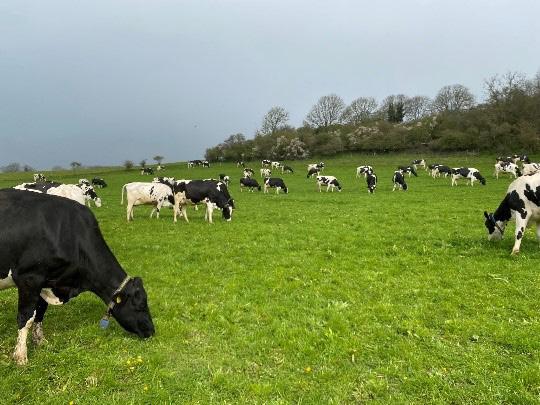
Milk income is related to the dairy market and weak supply from autumn 2021 led to the milk price increasing by 13.7ppl (+42%) comparing the year to March 2023 with the previous year. Following the June milk price cuts, the price reduction in the current year (to March 2024) is 18% to 39ppl average depending on future price developments. Even with the current milk price and lower feed costs, the margin over purchased feed is likely to fall by £350/cow in the year to March 2024, equivalent to £70,000 for a 200-cow herd.
cover of clover can fix 250 to 300 kg of Nitrogen a year so saving fertiliser costs, reducing greenhouse gas emissions and reducing the need for purchased protein, whilst supporting pollinators and increasing drought tolerance.
Furthermore, the recently announced Sustainable Farming Incentive (SFI) 2023 (England) includes an option to establish and maintain legumes on temporary grassland or improved permanent grassland for a payment of £102 per hectare per year.

Climate change promises both more drought and more rain. On affected land introducing other species of grass and broad-leafed “herbs” offers resilience. Many herbs are deep rooting and tolerate drought, whilst also mining minerals and offering some health benefits to animals, such as anthelmintic properties. Farms might benefit from introducing one or two additional species as opposed to full “herbal ley” mixtures.
In England there are three stewardship options that involve herbal leys: GS4 (conventional) and OP4 (organic) (both available via Countryside Stewardship) and SAM 3 (available via SF 2023). The recommended numbers of species under different options are as follows:
GS4 OP4 SFI SAM 3
Cost of production
Our own cost tracker estimates the cost of production in the year to March 2023 at 45ppl (including rent, finance and family labour), with the biggest increases in feed, fertiliser, labour and power. With most accounts ending 31 st March and yearends now completed, there is an opportunity for dairy producers to benchmark their technical performance and cost of production.
Cash is king and having sufficient cash keeps producers in control of their own businesses. Whilst feed, fuel and fertiliser costs are now reducing, there are more cost increases feeding through including finance costs resulting from the base rate increase to 5%, which means most businesses on variable rates are now paying around 7.5% interest. Another factor will be tax to pay in 2023, with many farms bringing forward much needed re-investment to make use of capital allowances, but now faced with less cash to pay the tax. Every business has its unique circumstances, and the start of the 2023/24 financial year is a key opportunity to look at the forward cash flow and understand cash needs and peak borrowing requirements taking into account likely tax liabilities from the year ending March 2023.
GRASS ESTABLISHMENT
For decades, perennial ryegrass (PRG) swards have suited most dairy farmers. There are reasons now to introduce other species beginning with legumes, especially clover. A sward with 30% ground
The aim for all three (against which inspections will be conducted), is to establish a sward with a diverse mixture of grasses, legumes and herbs. Mixtures should be farm focused, taking soils, climate, systems, skill and objectives into account. There is little point in sowing 15 species if 7 of them won’t thrive.
Whether including clover, different grasses or herbs, it is important to consider that compared to pure PRG, the seeds in mixtures vary greatly in shape and size, from less than 1 mm to over 5 mm. Drilling won’t suit many seeds. Broadcasting is preferred but
PAge 14 July/August 2023 Feed Compounder Comment section is sponsored by Compound Feed Engineering Ltd www.cfegroup.com
species
species 4 3 Not specified
species 4 3
specified
Grass
5 5 Not specified Legume
Herb
Not
seeds of varying shape and weight are flung un-evenly and light seeds are blown about on windy days. It is best to evenly drop seeds near the ground on a well-rolled seed bed. A pneumatic seeder fitted to a grass-harrow works well or a drill carried with the coulters just above the ground. Rolling (better double rolling) after seeding is essential to ensure soil contact for all seeds.
Spring re-seeds generally favour legume establishment, but drought-prone farms should establish in late Summer and before the 31 st of August to give smaller seeds time to establish.
If seed mixtures are undersown, the seed rate of the cereal crop should be reduced and the crop must be taken off by the end of June, typically as silage. Otherwise, the ley will be patchy and legume establishment poor due to a lack of light and competition for nutrients. The establishment of the ley, which should last for 5 years or more, must be the priority. Direct seeding without under-sowing should be considered.
Herbicides are of limited use when legumes and “herbs” are included. Weed control begins at establishment by creating a clean, level, firm seedbed. False seedbeds can be used but in dry conditions it may be better to sow immediately into a moist seedbed. Annual weeds can be mown out in the early summer or taken off with silage, but perennial weeds present a greater challenge. A summer fallow can be used to desiccate perennial weeds, followed by an
Autumn re-seed. The unproductive few months of fallow must be weighed against the long-term benefit of an improved ley.
Finally soil samples should be taken well ahead of time so that pH (6.5 to 7), P (index 2) and K (index 2) can be adjusted ahead of establishment. This is especially important for legumes.
DANISH DAIRYING
I am planning two short (2-3 day) tours to Denmark this autumn, the first focusing on organic dairying and the second on conventional systems including robots. Take-home messages from previous visits to high yielding, organic and conventional herds include:
• Produce and feed lots of excellent quality grazing and conserved forage (grass/clover leys (up to 4 cuts), wholecrop and maize silage, > 60% forage in the TMR) and carefully evaluate concentrate inputs,
• Do not compromise heifer growth rates – feed them to grow to calve at 22 – 24 months,
• Breed cows capable of high dry matter intakes (> 28 kg/head/ day) and high production and feed them!
• Health and nutrition go hand in hand, you need both to achieve high levels of performance.
Please feel free to contact me for further details of these trips.
Feed Compounder July/August 2023 PAge 15
Scientifically Speaking …
By Matthew Wedzerai
How does climate change impact mycotoxins?
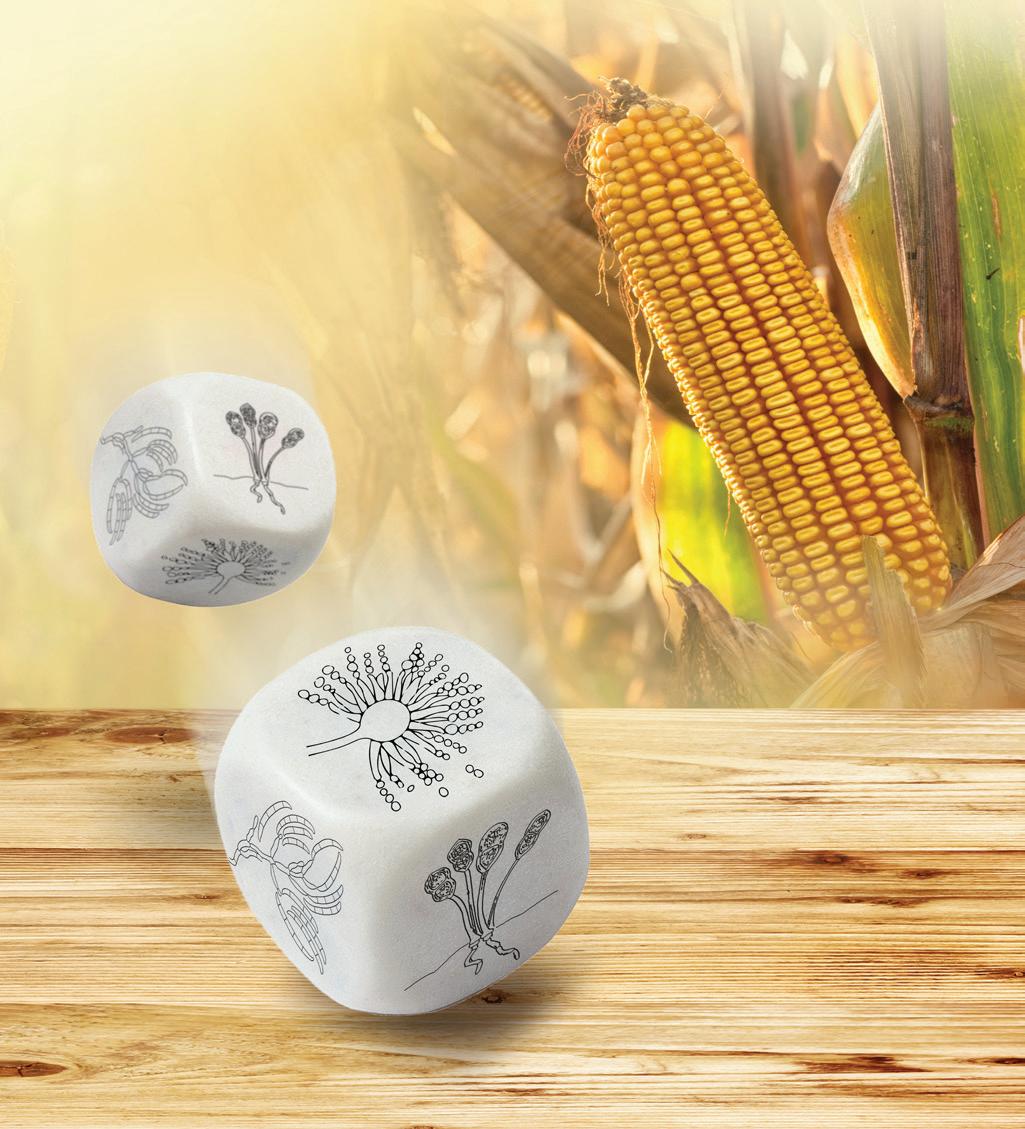
With climate change impacting everything on this planet, mycotoxins, one of the main challenges in feed production, are no exception. In this new study, researchers predict the impact of climate change on today’s major mycotoxins.
The occurring environmental changes are slowly shaping the balance between plant growth and related fungal diseases. Climate represents the most important agroecosystem factor influencing the life cycle stages of fungi and their ability to colonize crops, survive, and produce toxins. The ability of mycotoxigenic fungi to respond to climate change may induce a shift in their geographical distribution and in the pattern of mycotoxin occurrence.
The present study examines the available evidence on the impact of climate change factors on growth and mycotoxin production by the key mycotoxigenic fungi belonging to the genera Aspergillus, Penicillium, and Fusarium, which include several species producing mycotoxins of the greatest concern worldwide: aflatoxins, ochratoxins, and fumonisins.
Effect on fungal distribution
According to the researchers, increased temperatures will observe an overall increase in mycotoxigenic fungi suited to higher temperatures, such as aflatoxin-producing Aspergillus species, which represent an important hazard to human and animal health. Aspergillus spp. (Aflatoxin and Ochratoxin A producers) have been shown to occupy primarily tropical/subtropical regions growing at high temperatures and lowered water activity (aw). Comparing other mycotoxin-producing species,

studies show indicate that in hotter climatic scenarios A. niger may also gain more prevalence over A. carbonarius, as the former is better adapted to high temperatures and drier conditions than the latter. As reported in previous studies, changes in mycotoxigenic fungi due to climate change are already observed; examples of modified weather regimes impacting mycotoxins were demonstrated by the 2003, 2004, and 2012 summer seasons in Italy, where dry and hot weather (>35 ◦ C) contributed to an outbreak of A. flavus on crops, previously uncommon, by out-competing the more common Fusarium species and fumonisins contamination and causing an increase in Aflatoxin B1 (AFB1). Similarly, in France in 2015, an exceptionally hot and dry year, A. flavus was isolated from maize samples, with a high percentage of 69%.

Climate change on mycotoxin contamination
Aflatoxins


Aflatoxins are one of the most toxic mycotoxins known. The dominant aflatoxin produced (AFB1) is the most powerful naturally occurring carcinogen. Hence, it is of particular importance to understand how levels of this mycotoxin may shift with the climate change that agriculture will experience. Aflatoxins are produced in different crops by several species of Aspergillus, predominantly A. flavus and A. parasiticus, both characterized by the ability to persist in the most extreme climate warming conditions, as highlighted by their high optimum temperature.
Studies in vitro and on stored maize grain showed that AFB1 production is significantly stimulated under the three-way interacting climate change-related factors (temperature, CO2, and water activity (aw)), as demonstrated by the increase in the relative expression levels of structural and regulatory biosynthetic genes involved in aflatoxin production. Studies show that more recently, there has been a widespread incidence of aflatoxin contamination in countries not previously considered at risk resulting from persistent drought conditions and rising temperatures. A survey conducted by the European Food Safety Authority (EFSA) established the emerging issue of potential aflatoxin contamination in areas of Southern Europe in maize, wheat, and rice linked to the subtropical climate and the numerous hot and dry seasons that have occurred in the last years. In addition, a shift in traditional occurrence areas of aflatoxins is also expected.
PAge 16 July/August 2023 Feed Compounder
Engineering your feed solutions www.orffa.com - Follow us on EXCENTIAL SELENIUM
The new generation of
4000
organic selenium Sam Phelps Technical Commercial Manager +44 7761 758 284 phelps@orffa.com
Comment section is sponsored by Compound Feed Engineering Ltd www.cfegroup.com
“Excential Selenium 4000 is the first and only dust free organic selenium source in the market guaranteeing workers safety!”
All selenium is
in the most effectiveorganicform (=L-Selenomethionine)
Roseanna Barclay Technical Commercial Manager
+44 7947 171 823 barclay@orffa.com
Ochratoxin A

Ochratoxin A (OTA) is produced by Penicillium verrucosum and several Aspergillus species, including A. ochraceus, A. alliaceus, A. carbonarius , and A. niger . This mycotoxin has been found in a variety of crops such as barley, grapes, rye, wheat, and coffee. An essential condition for OTA production is the availability of water.
An a w > 0.95 is considered too humid and can favour other fungi, including yeast, which may limit OTA-producing fungi colonization; an aw < 0.80 is considered too dry and OTA-producing fungi are unable to produce the mycotoxin. In a study on maize grains, at 30 C, the production of OTA by A. ochraceus was significantly higher at 0.95 than at 0.99 a w. Alternatively, on barley grains, the optimal growth and toxin production were registered at 30 ◦ C and 0.99 a w
Fumonisins
Fusarium is a genus that includes plant-pathogenic fungi responsible for a variety of diseases on several different crops and with known potential in producing mycotoxins capable of adverse effects in humans and animals. Studies show Fusarium species can tolerate a wide range of temperatures and pH levels, require a relatively high aw for growing, are usually well established in a crop before harvesting, and may cause problems in grains following a late harvest after a rainy summer. Fumonisins are produced in cereals mainly by Fusarium verticillioides and Fusarium proliferatum . Fumonisins contamination is strictly associated with agroclimatic conditions and is prevalent in maize and maize sub-products compared with other grains and related derivatives. The researchers stated: “The growth of F. verticillioides occurs at a minimum temperature of 4 ◦ C and has a favourable temperature of 25 ◦ C, meaning climate change may easily jeopardise the growth of F. verticillioides.”
Conclusion
Overall, the evidence suggests climate change will negatively affect crops worldwide in terms of loss of suitable cultivation areas and an increase in mycotoxin contamination. Global warming will make growing crops in some areas impossible and, where growing crops will be possible, plants will be subjected to suboptimal climatic conditions, resulting in increased susceptibility to fungal contamination. Furthermore, warmer climates will favour thermotolerant species, leading to, for example, the prevalence of Aspergillus over Penicillium species.
The next step urgently needed is to use the models to give directions for adaptation to climate change to assure mycotoxin levels in grains stay below legal limits for raw materials and derived feed and food, and to safeguard feed and food safety. The researchers suggested that if mycotoxin forecasting models were linked to land use models such as the iCLUE model and crop phenology models, such scenarios could be investigated and used to give directions on the use of our land and cultivation of crops in such a way that safe feed and food can be produced under the estimated climate change effects.
IS NOT A BETTING GAME
MYCOTOXIN MANAGEMENT IT’S A MATTER OF EXPERTISE


Identify your risk and adopt the most efficient strategy

At Adisseo, we have developed a comprehensive approach to the management of mycotoxins. Our MycoMan range of services allows the mycotoxin risk to be identified and optimal strategies to be built thanks to the mycotoxin prediction tool, the harvest bulletin, quick or laboratory tests and, finally, our mobile app. Moreover, Adisseo has also developed a portfolio of products composed of Unike ® Plus, Toxy-Nil ® Plus and Toxy-Nil ® in order to propose the best-suited solution to a specific challenge.








Feed Compounder July/August 2023 PAge 17
www.adisseo.com
www.adisseo.com
Ten Ways … to get results without getting angry
By Robert Ashton
I’ve just taken delivery of my first electric car, and am enjoying its silence, performance and especially the way it recharges the battery when slowing down; I hardly ever need to use the brakes. I’ve also found it easy to find a public charging point, with my favourites being at Snape Maltings where I can charge my car while attending a concert.
But had my electricity provider done as they’d promised, and fitted a 3-phase meter to the new supply we’ve had installed at our new home 10 weeks ago, I’d have been able to charge it quickly and cheaply there. We had two dates booked for the installation, and both times, no engineer appeared. It would have been so easy to get angry and shout at people, but that would not have helped.
Finally, another clerical error meant the engineer had the right meter, the right day, but the wrong address, but after a few phone calls, he was able to fit the meter and now our electrician has installed our 22kW car charging point. This experience prompts me to share with you my 10 ways to get things done without getting angry!
1. Be realistic – Are you getting angry because you want an organisation to move faster than it usually does? Perhaps you did not place your order soon enough, and now are trying to push things along. Accept that if you’re chasing because you’ve left it late to place your order, it is actually your problem, not someone else’s. If this is the case, a little humility will take you a long way.

2. Beat the bot – It is pointless trying to describe anything but obvious requests to the A1 bot that these days always seems to be how utilities companies answer calls. They are programmed to recognise a few words, and can quickly divert your call to the wrong queue. My favourite way to beat the bot is to say; ‘I want to make a complaint.’ That gets you connected to a real person who is usually better trained than most in sorting our problems.
3. Speak slowly and clearly – I think and talk quickly, but as often or not, the person you end up talking to does not speak English as their first language. As with the bot, they will have a limited number of options that they can offer. If they say they cannot connect you to the team you want to speak with, it’s no good pushing, and remember to speak slowly and clearly.
4. Wait until 10am before calling – If you need to talk to someone senior, they won’t start work before nine in the morning, so ringing at eight just wastes everyone’s time. And as all the
angry people will ring just after nine, you’re friendly but firm approach a little later will be welcomed.
5. Tweet! – Twitter is a wonderful platform where all public facing corporations have a small team who respond quickly to frustrated customers. But don’t make your tweet a 280 character rant. Instead, make it factual and provide just enough information so that the person responding can check with their colleagues first, to see what’s gone wrong.
6. Agree deadlines - Always ask when you can expect the person handling your issue to come back to you, even if only with an update. Then, give them a further 24 hours before you chase them up. This gives them a little more time; it also gives you time to cool down!
7. Delegate - Sometimes, you’re just too close to an issue to deal with it calmly and without emotion. Delegating to a staff member, or if you’re older as I am, an adult child, can be effective. Often, when called by someone other than the customer, the assumption is made that you are somehow vulnerable, and that can help to move your job up the list.
8. Sympathise – Working in a call centre dealing with aggrieved customers is a thankless task. It could be an IT help desk, a breakdown recovery service, your doctor’s surgery, or as in my case, a utilities company. Showing some empathy and understanding will always help as if the call handler is on your side, they might just be able to shorten your wait.
9. Find a connection – They say there are no more than six degrees of separation between any two people on the planet. When you narrow that down to people in the same country, in management roles that are perhaps similar to your own, you’ll often find that you are just one or two degrees apart from a senior decision maker in the firm you’re trying to influence. Identify your target, then search your LinkedIn connections and see what that reveals. Then use your network to engage them in your quest.
10. Write a news release – Because I’m a writer, with a background in marketing and communications, when I failed to get the result I wanted using some of the techniques listed, I drafted a news release. This gave me the opportunity to objectively set out the context to my case, and the details of what had gone wrong. I then sent the draft to the press team at the electricity company that was failing to deliver my 3-phase meter, inviting them to provide a comment, and explaining that I was going to distribute it to local media in two days’ time. That gave the press team time to investigate my complaint, and the next day I had a phone call, followed up by an email, from someone in the chief executive’s office. This meant I was given a date for the installation that I knew would be kept.
One final tip is to always be positive and stress that your goal is to provide a positive review or testimonial, and that complaining and making a fuss is not in your nature. That too always helps.
PAge 18 July/August 2023 Feed Compounder Comment section is sponsored by Compound Feed Engineering Ltd www.cfegroup.com



ConverMax® Cargill Animal Nutrition Dalton Airfield Industrial Estate Thirsk, North Yorkshire, YO7 3HE 01845 578125 customerservices_dalton@cargill.com www.provimi.eu/uk-convermax ConverMax® is a blend of botanical extracts and mineral sources mixed into feed for grower-finisher pigs. The secret recipe to grow more with less. Reduce FCR by 0.1 01829 741119 admin@croston-engineering co uk Supporting manufacturers since 1976 with solutions in bulk handling, storage, and pneumatic and mechanical conveying, we have a wealth of experience for you to rely upon. croston-engineering.co.uk Design and Implementation New system solutions Modifications to systems Software improvements Minor ingredient additions Water dosing solutions Ongoing Support Critical Spares and Parts Emergency repairs DSEAR Reports Site surveys Fault finding Servicing and Maintainance Equipment Servicing Silo and pipeline cleaning Infestation works Calibration and certification Continuity and Earth testing
RUMINATIONS
By Rob Daykin of Daykin Partnership
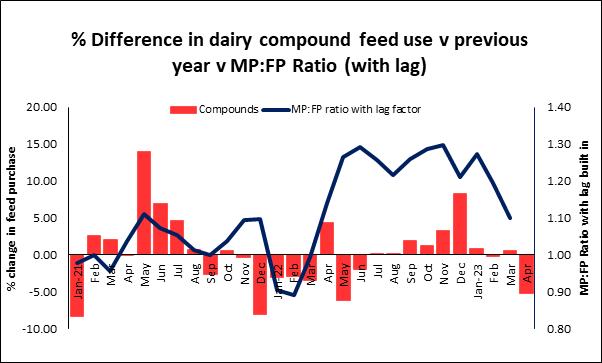
FEED DEMAND TO DROP AS MILK PRICE: FEED PRICE RATIO CRASHES
In the last issue some two months ago now I wrote of the worrying decline in milk prices and the fall in the Milk Price: Feed Price Ratio. At the time the weather was cold and wet, and we were worried about milk volumes being affected because the silage season had got off to a very shaky start.
So how have things changed since then?
Well as we know it stopped raining for weeks, and the land started to dry up very quickly indeed in May. By early to mid-June farmers up and down the country were screaming for rain. The grass had stopped growing, pastures were browning over and there were fears for some increasingly parched maize crops. Then – happily! – the rains came in abundance for many and a much-needed drink was given to many parts of the country.
But it was just what the market, or at least sellers, didn’t need! Hopes that the dry weather would also dry-up milk volumes, and thus help to turn prices, pretty much vanished. As it is, commodity prices did turn… but not in the direction that is needed. If one or two buyers were starting to get fidgety about milk supply (as opposed to being very jittery on demand) then those emotions were also put to bed. And as if this wasn’t enough, then came news from New Zealand that its May volumes had hit a record high, which followed April’s record. Cue another hit to sentiment.
Since then, there has been more data released about milk volumes in the UK, which shows volumes are dropping at the normal rate for the time of year and in line with the usual decline after the flush. Traders are only going to be concerned if they were dropping at a much faster rate. But they aren’t.
Two months ago, the perceived wisdom was that Q2 and Q3 commodity prices and thus milk prices would remain flat, but Q4 prices might lift. While that still might be the case, the far out Q4 prices aren’t going to make a significant difference to milk prices –certainly not enough to close the gap between current prices in the mid to low 30p range and the estimated cost of production which is over the 40p threshold still.
And this week we have seen more price cuts announced, although Arla has held its price, bar a slight currency decrease. Muller dropped another 1p to 37p. Two processors – Saputo and Barbers have increased their price, but the former was for political reasons relating to its farmers and the latter through an environmental bonus.
All-in-all the average non-aligned milk price is now 35.4p, which
is the lowest price since February 2022. Farmers supplying the supermarket pools are once again sitting pretty, with an average price of over 40p. Organic farmers, meanwhile, received a boost from Muller in that their price didn’t drop like the conventional price and held at 48p. OMSCo’s price is still 49p, but Arla’s is 10p down on that.
With feed prices dipping slightly, but not significantly because manufacturers are still working through stocks bought at much higher prices, the decline in the milk price means more pressure on the Milk Price: Feed Price Ratio, and this will lead to fewer compound and blend sales, as can be seen in the graph. It is, therefore, not looking good for forward sales for animal feed manufacturers.
We now look forward to seeing what the harvest brings in the UK and Ireland, the rest of Europe and elsewhere in the world to see if that brings any major reductions in cereal and other raw material prices to rebalance that Milk Price: Feed Price Ratio, and stimulate demand.
Personally, I’m not holding my breath!
WHO WE ARE
Daykin Partnership has over 30 years of experience in agriculture, expertise in estate management, product development and logistics. We work hard to provide up to the minute news and information as well as the latest and most innovative products from across the industry. Our extensive network covers every aspect of modern dairy farming from supply chains, market information and raw material sourcing to budgeting, staff training and ration formulation.
www.daykinpartnership.co.uk
PAge 20 July/August
2023 Feed Compounder



Feed Compounder July/August 2023 PAge 21 THE UK flavour manufacturer supporting British & Irish agriculture Unlock the possibilities To find out more about our unique Tastetite and other feed enhancement technologies visit our website at www.inroadsintl.com email info@inroadsintl.co.uk or call us on +44 (0)1939 236 555. 10461_Inroads_Feed Compounder Ad_Half Landscape_124x178.qxp_Layout 1 21/12/2021 14:33 Page 1 Tel: +44 (0)1159813700 Email: sales@dsl-systems.com Web: dsl-systems.com Member of the Valsoft group Tel: +44 (0)1260 277025 Email: sales@datastorsystems.com Web: datastorsystems.com • Software for life • Optimise processes • Reduce labour • User friendly • 24/7 support • Performance monitoring • Flexible and configurable • Stock control and traceability Advanced control, planning and information software for feed and grain plants Winner of the New Product Showcase IPPE 2023 Best of the Best in Animal Feed www.imperium4.com
Green Pages
Feed Trade Topics from the Island of Ireland
IRELAND’S TILLAGE SECTOR HAS LOST OUR UNDER NEW CAP MEASURES
Ireland’s agriculture minister, Charlie McConalogue TD, has acknowledged that Ireland’s tillage sector has lost out under the new Common Agricultural Policy (CAP) regime.
The admission was made in response to intense questioning from Irish Grain Growers Group (IGGG) president, Ollie Whyte, at a meeting in Co Meath recently.
According to the minister, the tillage sector has been negatively impacted by the fall-out, which has seen Ireland opting an 85% Pillar 1 payment convergence rate under the new CAP measures.
In mitigation, he said that two European Union (EU) member states had already reached a 100% convergence level, adding: “I am totally committed to the Irish tillage sector. I want to see it adequately supported. The scope to expand the industry on a sustainable basis is also immense. I want to see all of this potential realised.”
McConalogue pointed to the introduction of the protein payment scheme, the straw incorporation measure and the tillage incentive scheme as examples of the Irish government’s commitment to the crops’ sector.
The minister spoke at a recent meeting hosted by the Hoard family, who farm on the outskirts of Bellewstown in Co Meath. The event was attended by large numbers of IGGG members from the Dublin/ Louth/Meath region.
Reflecting back on the negotiations that took place in the run-up to the last CAP settlement, McConalogue confirmed that the pressure to cut the overall support budget for farming was immense. He added: “Ireland fought hard to have a budget agreed that was maintained at previous levels. But this, in itself, is a cut in real terms. However, this restriction relates to Pillar 1 payments only: there is scope for individual member states to invest national funds into Pillar 2 schemes.
“With this in mind the Irish government will be doubling its commitment to these measures over the next five years.”
McConalogue confirmed that the out working of the EU Nitrates’ directive is causing friction between Irish farmers within the different agricultural sectors. He said that Ireland’s retention of its current nitrates’ derogation should be regarded as a gesture made by the vast majority of EU member states, indicating that only three regions of Europe now ‘enjoy’ this status: Ireland, Denmark and parts of Belgium.
He continued: “The mid-term of the nitrates’ directive takes place at the end of this year. And Ireland will be pushing to secure maximum flexibility in this regard.”
But the minister’s words also came with a stark warming, which
is this: if Ireland cannot demonstrate a significant improvement in water quality, in tandem with a fall-off in fertiliser nitrogen usage, the possibility of getting the current nitrates’ derogation extended are very minimal.
McConalogue firmly believes that Ireland can maintain its current food output levels, while still meeting its climate change obligations. Driving this process will be a requirement to boost farm efficiency levels. And, according to McConallogue, this is already happening.
He said: “Ireland is starting off from a very strong place in this regard. The carbon footprint associated with the food we produce is already at an internationally low level. And we can build on this for the future.
“A combination of improved efficiency at farm level and the advent of new technologies will be at the heart of this process.”
THE INCREASE IN BREAK CROP AREA WILL HELP BOOST IRISH GRAIN YIELDS IN 2024
The increasing break crop area available to Irish cereal growers this autumn should act to boost grain yields in 2024.
This was one of the key messages delivered by Seedtech’s Tim O’Donovan at the company’s recent variety trials’ event, held in Co Waterford.
He added: “We have seen a significant increase in the areas of maize and winter oilseed rape over the last number of years. It is estimated that the break crop area available to cereal growers has increased by around 15,000ha, year-on-year.
“In turn, this is providing cereal growers with the opportunity to come in with a first wheat or a very productive winter barley option this autumn.”
According to O’Donovan, the increase in the spring bean, maize and winter oilseed rape area of recent years has brought the Irish break crop acreage close to what it was when sugar beet was a viable option.
He continued: “Seedtech is looking at the overall sustainability of tillage farms in Ireland. This principle can be distilled down to three factors: people, profit and the environment.
“In our case, we are producing varieties that are more sustainable. They will also deliver more profit while also keeping people in the industry. This latter point is crucially important.
“The Minister for Agriculture, Charlie McConalogue, has asked the tillage industry to come up with solutions.
“The new vision group, which the Irish Seed Trade feeds into, has been asked to take on this work.
PAge 22 July/August 2023 Feed Compounder
O’Donovan went on to highlight the role that plant breeding will play in this context, highlighting the challenge of barley yellow dwarf virus (BYDV) as a case in point.”
IRISH SEED TRADE WANTS BLACKGRASS ADDED TO REGISTERED LIST OF ‘NOXIOUS WEEDS’
The Irish Seed Trade Association (ISTA) has formally requested that blackgrass be added to Ireland’s register of noxious weeds.
The issue was first raised by ISTA courtesy of correspondence with Ireland’s farm minister, Charlie McConalogue, last autumn. By taking this approach, it is hoped that the issue of blackgrass resistance will be more widely profiled.
In addition, Department of Agriculture inspectors have the power to inspect land that is heavily infested with noxious weeds and enforce their destruction.
ISTA represents multipliers and assemblers of Irish certified seed. A spokesperson for the association commented: “We work with growers under contract to submit crops for certification by the seed certification division of The Department of Agriculture. Irish cereal seed adheres to a higher voluntary standard than current EU legislation requires and has a zero tolerance to blackgrass. This highlights the threat that blackgrass poses to the seed and of course wider tillage industry.”
According to ISTA, a total of 8 incidences of blackgrass occurred in crops submitted for certification in 2022. All of these crops were rejected outright, as per the ISTA voluntary standard. There were no incidences in 2021 and only two in 2020.
The ISTA representative continued: “The 2022 increase merited immediate action by all involved. These crops have been lost to the industry from grower right up the line and will require a commitment, investment and change of cropping and practice to get the weed under control on these lands.
“Blackgrass cannot currently be effectively controlled by plant protection products in a crop.”
Several incidences of blackgrass in commercial crops have been identified this year by agronomists.
Making blackgrass a noxious weed will serve to increase much needed awareness among tillage farmers and others. It will also give power to DAFM officials to enter on land to confirm presence of or order destruction of the plants or sections of affected crops should it be necessary.
As a further measure, ISTA members have committed to a higher voluntary standard (HVS) with regard to the assembling and certification
or importing of straights and mixes for cover crops, wild bird measures & arable margins.
This HVS is a further example of the Irish Seed Trade’s commitment to play its part in the control of grass weeds.
The vast majority of seeds (straights) for cover crops, wild bird measures and other arable margins are imported. Where possible, ISTA members will use Irish certified seed. ISTA members assembling or importing cover crop mixes or straights will now have each seed lot tested.

This is an internationally-recognised ‘Orange Certificate’ for presentation to department of agriculture officials, ahead of sale or certification in the Republic of Ireland.
The official search will include blackgrass, wild oats and sterile brome. Only ingredient lots with zero blackgrass test results assembled or imported by ISTA members will be used in mixtures for sale to Irish farmers.
The ISTA spokesperson concluded: “Farmers and amenity users of these mixes should be aware of the availability of this HVS seed.
“They should also check the label of any products they are considering purchasing, so that they have undergone testing for blackgrass, wild oats and sterile brome.”
CARBON STEERING GROUP LAUNCHED IN NORTHERN IRELAND
The Northern Ireland (NI) Carbon Steering Group is a pioneering alliance set up to represent farmers and the agri-food industry, and progress with the carbon element of the sustainability agenda.
The collaboration has been built on the recognition that an industry wide co-ordinated approach is the most effective way to ensure the industry is heard and that the best solutions are achieved for everyone in NI.
Agriculture has a key part to play in NI reaching net zero carbon emissions and the group has been working together, moulding an approach that will be farmer friendly and provide the basis for measuring and managing carbon emissions. Legal obligations and targets have been set and the group aims to deliver opportunities that will advance local agriculture sustainably.
Commenting, George Mullan, member of the Carbon Steering Group and Chair of NIFDA, said: “Under the NI Climate Change Act 2022, targets have been set which we are required to meet. To align with this, DAERA will publish its first Climate Action Plan in December 2023 requiring significant reduction in carbon emissions.
Feed Compounder July/August 2023 PAge 23 Alltech.com/ireland AlltechNaturally @Alltech Sarney | Summerhill Road | Dunboyne | Co. Meath
Choose the proven leader for all of your feed additive needs
“Therefore, we have come together to act on behalf of our farmers and agri-food industry to ensure we achieve consistency in the direction of travel.”
He added: “Working across farmers, processors, industry bodies, government departments and research organisations, we want to ensure that appropriate solutions are provided to measure carbon emissions and identify innovative ways to reduce emissions.
“As a group, we’ve been able to lead from the front to develop a market strategy and support farmers to intercept potential livestock reductions. Reducing carbon emissions is becoming a requirement for our customers, not only in the UK, but also in export markets. It has presented us with an opportunity to find a workable system that can deliver the information required and enable the NI agri-food sector to remain competitive.”
The NI Carbon Steering Group is working in partnership with the Department of Agriculture, Environment and Rural Affairs (DAERA) to create a programme which will help all farm businesses understand where they are on this carbon journey.
As part of this and to inform the work programme with DAERA, we intend to test the concept of whole farm data collection with 100 farms in the next few weeks.
Information required to test this concept will be collected following a NI Beef and Lamb Farm Quality Assurance Scheme (FQAS) inspection and during the same farm visit.
Ulster Farmers’ Union president David Brown is also chair of the new steering group.
He commented: “We need to ensure that we develop a programme with the farmer in mind at all times. It needs to be workable for them, ensuring an accurate and efficient process that causes minimal disruption to the farm business.
The delivery of information is a key element to ensure its suitable for all parties and supports appropriate carbon reduction strategies while protecting farmers’ data.”
Brown added: “Tackling climate change and reducing emissions is now a key part of doing business with retailers and banks that are taking carbon emissions and environmental factors into consideration. All parts of the food chain are required to act including retailers, processors and farmers. Farmers have already done great work to reduce emissions on farm, and this data collection exercise will enable them to build upon that.
“We’re all on this journey towards net zero and farmers are committed to reducing carbon emissions while feeding a growing population with quality food produced to the highest standards.”
The NI Carbon Steering Group includes representatives from the Livestock and Meat Commission, Ulster Farmers’ Union, Dairy Council for Northern Ireland, NI Meat Exporters Association, NI Food and Drink Association, NI Agricultural Producers’ Association, NI Grain Trade Association, NI Pork and Bacon Forum, NI Poultry Federation, and Moy Park.
In my opinion … Richard Halleron MCCONALOGUE COMMITS TO IRISH TILLAGE SECTOR
Ireland’s agriculture minister Charlie McConalogue has confirmed his commitment to Ireland’s tillage sector.
He made this totally clear courtesy of his presentation to farmers attending a recent public meeting in Co Meath.
For the record, he also admitted that Irish tillage farmers had lost out in the single payment conversion agreement reached as part of the current Common Agricultural Policy (CAP) agreement.
So, where do we go from here? It’s very simple really.
The minister has established the tillage vision grouping. The onus is now on the people making up this new body to come up with appropriate recommendations. Thereafter, the ball is back in the minister’s court: he will have to act promptly at that point.
It is envisaged that the vision group will come forward with provisional recommendations before the end of July. Let’s hope so, as this would then give Minister McConalogue an opportunity to include tillage-related measures in Budget 2024.
The minister had wanted to use this meeting to get feedback directly from farmers. He didn’t have long to wait.
It’s obvious that the current Tillage TAMS measure is not fit for purpose. At a very fundamental level, the pricing structures therein do not accurately reflect the cost of modern tillage machinery.
Time will tell if the minister will move on this issue. Another point raised from the floor related to the growing demand for high quality tillage land as sites for solar energy investments.
The point was made repeatedly that other, less valuable food production locations could be used for these initiatives.
Minister McConalogue also used his Bellewstown presentation to sketch out the possible future trajectory of Ireland’s nitrates’ derogation.
This is fast becoming a very serious issue indeed. Currently, only three regions of the European Union have been granted derogation status: Ireland, Denmark and parts of Belgium.
The mid-term review of the Nitrates’ Directive takes place later this year. It is now evident that if Ireland cannot show confirmed improvements in water quality, in tandem with a reduction in nitrate fertiliser usage, then all bets are off.
The implications of Ireland losing its nitrates’ derogation are immense, and they are all very negative.
Twenty years ago, the focus of the CAP was to facilitate the production of food in Europe. Now, the very clear emphasis is on environmental improvement and nature restoration.
Ireland will have very few friends in left Brussels if it is not actively demonstrating significant improvements, where both these issues are concerned.
PAge 24 July/August 2023 Feed Compounder
£4m Upgrade of Mole Valley Farmers’ Lifton Feed Mill
President of the National Farmers Union Minette Batters has opened Mole Valley Farmers’ newly upgraded Lifton Feed Mill following a £4m investment.
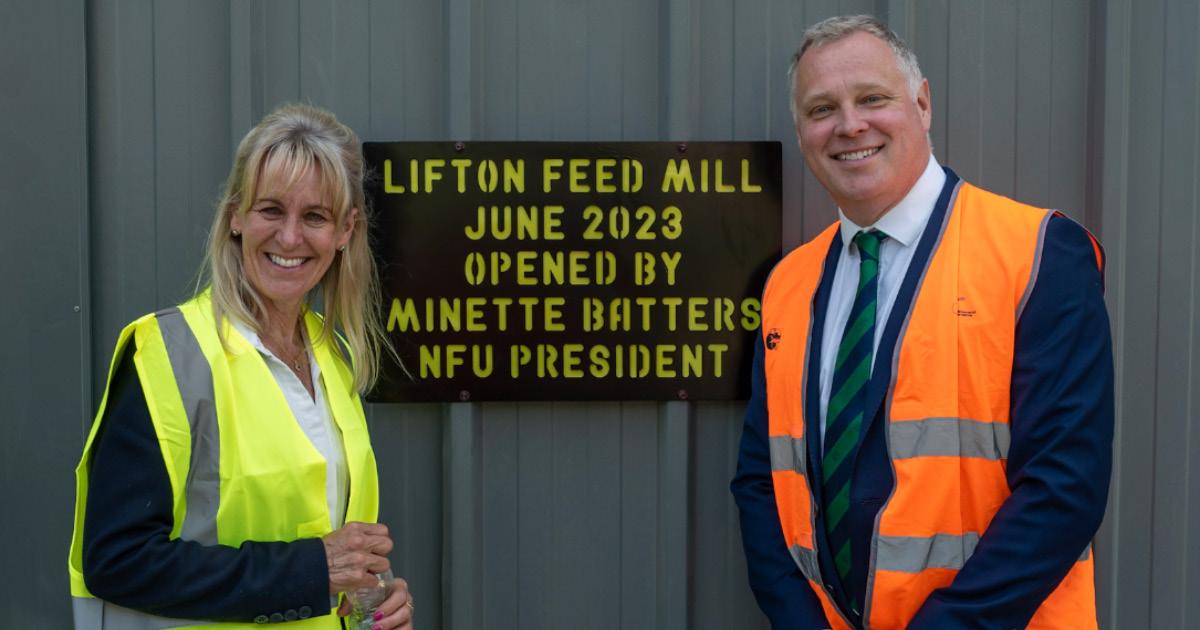
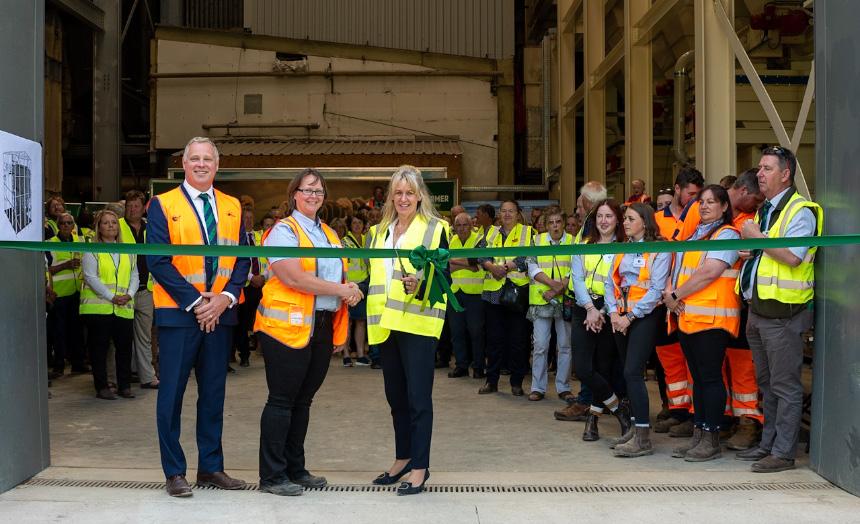
The investment boosts Mole Valley Farmers’ manufacturing capabilities by improving the mill’s raw material storage capacity and enabling feed production to increase by around 20,000 tonnes to a total of 135,000 tonnes a year.
“Everything we make gets reinvested back into the business and what we’re trying to do is support farmers in their endeavours to produce the highest quality milk and meat.
“This investment will secure the site for many years to come. It is the heart and jewel in our crown in terms of what it can do. The insecurity in global supply chains, made worse by the invasion of Ukraine, has meant getting raw materials and supply into our feed business, to make the highest quality feed we can, has at times been challenging.
“The investment will allow us to hold greater stocks of raw material. We’ve also focused on our environmental impact. What we are seeking to do is become the most efficient feed manufacturing business out there.
“The lower the cost of the production the better it will be for farmers to help support a margin on their farms. Something we strive to help with every day. This demonstrates our commitment to UK Agriculture.”
In addition to the £4m investment a further £250K has been invested in upgrading the process control system to the most modern currently available, delivering new levels of automation and efficiency within the manufacturing process.
Ms Batters praised the company for investing in the agricultural industry at a challenging and uncertain time.
She told more than 150 Farmer Shareholders, members and customers who attended the opening: “It is easy to not recognise what you have, when you have it. What you’re doing is one hundred percent the only way forward.
“It is great for me to see such huge levels of investment here in a farming cooporative. It really does give a strong sign of strength with productivity, sustainability and profitability the keys to success.
“If you don’t get those three things right you are not going to be able to deliver on the environment. To collaborate and use your collective power to buy together is the only model. Relish this moment because it really is the future.”
The project, on the Devon and Cornwall border, involved the construction of 12 new 70-tonne raw material bins and seven new 8-tonne mini bulk handling bins, resulting in a total on site storage capacity of between 900 to 1,000 tonnes.
The increased storage will ensure a resilient supply of animal feed with the upgrade also enhancing diet formulation accuracy, as well as improving efficiency and reducing manufacturing costs.
Mole Valley Farmers CEO, Jack Cordery, told members: “The purpose of today was to show you your mill. As Farmer Shareholders you own the business and we are hugely proud to be a farmers cooperative.
“It’s massively important at a time of such global uncertainty and such challenge and volatility within our markets that a strong cooperative movement and business like Mole Valley exists.
The farmer owned business, which trades with a cooperative ethos, made the investment as part of an ongoing commitment to UK agriculture and its manufacturing capability.
The construction at Lifton Feed Mill began in May 2022 and has taken around 12 months to complete. The upgrade also improves the environmental impact of the site, which is cleaner, with less noise, fewer lorry movements and reduced dust.
Director of Agri Operations Kevin Singleton, who oversaw the project, said it had involved 1,000 tonnes of concrete and more than 230 tonnes of steel.
He said: “This investment puts us on a really strong footing for continued feed production for many years to come. It enables us to maintain our position as a low-cost operator whilst at the same time ensuring we produce and provide farmers with the highest quality animal feed backed up by excellent levels of customer service.”
Feed Compounder July/August 2023 PAge 25
Copper in Ruminants
Best Practices to Master the Supplementation
By Dr. Rahma Balegi (Animine R&D) and Vet & Leandro Royo (Animine Product Manager)
Why Copper is essential for ruminants?
Copper (Cu) is an essential element to all living beings as it plays an important role in many biological processes. It is a co-factor of several important enzymes including lysyl oxidase, tyrosinase and cytochrome c oxidase. These important enzymes are required mainly for the synthesis of erythrocytes, myelin, keratin and collagen but also for effective immune and anti-oxidant responses. Nevertheless, Cu is the most common trace element deficiency in ruminants, characterised by a loss of hair pigmentation (particularly around the eyes), mucosal atrophy, depression of the immune function, bone fragility, cardiac failure and reduced reproduction and production performances.
Why copper metabolism is different in ruminants?
Unlike monogastric, ruminants have very poor homeostatic control of Cu. Indeed, cattle developed a special mechanism of storage of Cu excess in the liver by reducing its excretion in the bile which makes them very sensitive to Cu. Ensuring adequate Cu supplementation in ruminants is challenging for nutritionists because of the complexity of copper metabolism with a very small margin between deficiency and toxicity.
Copper deficiency occurs due to either a primary or a secondary deficiency. The primary deficiency is mainly associated with low Cu diets (<4 ppm) but this scenario is most unlikely to happen. However, secondary deficiency happens even at the right level of Cu supplementation. The three-way interaction between Cu, molybdenum and sulphur (Cu-Mo-S) in the rumen makes ruminants, particularly cattle, very susceptible to suffering from secondary copper deficiency. In fact, in the rumen, Mo and S interact together, forming complexes called thiomolybdates (TM) with high affinity to Cu making it less bioavailable for the animal. To guarantee Cu absorption, regardless
of the antagonist’s presence, there is a tendency to supplement Cu above nutritional requirements leading to chronic copper poisoning (CCP) in cattle and especially in dairy herds.
Chronic copper poisoning is mainly due to the slow accumulation of small quantities of Cu in the liver during a long period of time. Identifying CCP is not an easy task to do, as in the first stage, there are no changes in blood Cu and only evaluating liver concentration is relevant. An increase in blood Cu is only seen as a second stage when the liver is overloaded and it is released into the bloodstream. This causes acute toxicity with animals often dying within 24-48 hours. A growing number of lethal cases reported by veterinarians showed that such silent intoxication is spreading in dairy herds. A study was conducted in the UK to survey liver copper concentration within the UK dairy and beef herds using 510 abattoir cull cow samples. This study demonstrated that over 50 % of the liver samples analysed were above usual values of copper (Table 1). Moreover, 40 % of the female dairy cattle had liver copper concentrations above the AHVLA (Animal Health and Veterinary Laboratories Agency reference) range of 8000 mmol/kg DM. For all these reasons, there is a real need to set up strategies to monitor herd Cu status and amplify the awareness of farmers for CCP.
How to prevent copper toxicity in cattle?
Precision mineral feeding
Knowing the mineral composition of forages and the basal diet is fundamental to ensuring precision mineral supplementation and thus preventing CCP in ruminants. Indeed, minerals in the basal diet are often not investigated because they are not a priority when formulating the diet and also because of the high cost and long process of the mineral fraction analysis. Animine developed a portable analytical
PAge 26 July/August 2023 Feed Compounder
NUVetNA category Liver copper µmol/kg DM HF dairy cows Other Dairy Cows Beef Cow Bull Total Deficient 281-1404 30 6 42 5 83 Normal 1405-11237 294 18 30 7 349 High 11238-14046 34 2 3 1 40 Toxic 14047-44952 31 4 2 1 38 Total 389 30 77 14 510 Above AHVLA reference range >8000 149 (38.9%) 12 (40.0%) 13 (16.9%) 3 (21.4%) 177 (34.7)
Table 1: Numerical distribution of liver copper concentration by NuVetNa (School of Veterinary Medicine and Science, University of Nottingham) category of bulls, beef cows, Holstein-Friesian (HF) dairy and other dairy cows (Kendall et al., 2015)
tool for animal nutrition, able to evaluate mineral fractions in forages with a rapid and affordable method. This portable XRF analyzer (X-ray fluorescence spectrometry) allows users to obtain instantly high precision and immediate results to help nutritionists optimise mineral supplementation and thus make an adequate Cu supply.
Beware of higher risk of copper toxicity in high starch diets
Recent studies have highlighted that feeding high starch diets in dairy herds is likely to increase Cu reserves. Indeed, when cows are fed additional S and Mo in a grass silage-based versus a corn silagebased diet, there is a greater decrease in hepatic Cu concentration. It is suggested that this may have been due to the potential effect of rumen pH on S metabolism and TM formation. Indeed, TM formation is highly pH dependent in the rumen, with a greater proportion of Tetra TM formed at lower pH values which has a high affinity to Cu. Corn silage is higher in starch than other forages such as grass or alfalfa silage, and its inclusion is often associated with a decrease in rumen pH. Lower rumen pH means greater loss of Hydrogen Sulfide (H2S) by eructation and exhalation. The more H2S is formed the less S is available for TM formation (see Figure. 1). Reasons for these differences in Cu absorption and metabolism as a result of dietary starch concentration or reticular pH are unclear and require further investigation, but highlight the need to take these factors into account when calculating appropriate Cu supplementation levels for lactating dairy cows.

Mastering mineralisation in calves and heifers
When feeding young calves, we are actually feeding monogastric as their rumen are not completely developed yet which means that they are less exposed to the impact of the antagonists’ effects in the rumen. Indeed, they readily absorb Cu without any depletion factors and even if their feed intake at birth is low, they are efficient absorbers of this mineral. The CCP is particularly acute with pre-ruminant calves. In fact,
when calves consume more Cu than they need, the excess is stored in the liver and builds up over time. Previous studies demonstrated that eventual liver toxicosis can lead to the premature breakdown of red blood cells (hemolysis), anaemia, jaundice, and even death. In the absence of cases of clinical toxicity, heifers begin with very high initial hepatic Cu concentrations and may lead to altered liver function which is translated into reduced conception rate and milk yield.
The right source of copper
Choosing the appropriate Cu source to supplement in the feed is also of importance. Indeed, the physicochemical characteristics and dissolution kinetics are key to preventing the formation of the TM-Cu complexes in the rumen. Copper(I) oxide (CoRouge), recently authorised in the market, combines high bioavailability with low solubility at rumen pH. This innovative source of copper will help to restrict the need for higher copper dosages in ruminant diets and to preserve animal productivity, health and welfare.
Conclusion
Copper bioavailability for ruminants is mainly determined by sulphur, molybdenum and iron levels in the diet. Increasing the quantity of copper supplemented in bovine diets leads to copper chronic toxicity. Some good practices should be adopted to prevent this metabolic disorder. Thus, special attention should be paid to the basal diet as it is important to know the initial copper and its antagonists’ concentration. Moreover, feeding diets with high starch levels is more likely to induce copper toxicity in intensive dairy herds. Calves and heifers fed with high levels of copper have initial high liver copper concentration which will lead to reduced fertility and production performance later as dairy cows. Finally, it is important to use bioavailable copper sources to avoid insoluble complex formation in the rumen.
Feed Compounder July/August 2023 PAge 27
Figure 1: Suggested mechanism of the effect of the diet on copper metabolism adapted from the study of McCaughern et al. (2020)
New yeast cell wall product promises consistency
With Mark McFarland, Feed Additive Product Manager UK & Ireland, Lallemand Animal Nutrition
Lallemand Animal Nutrition has launched a new yeast cell wall product to the market, promising the best of both worlds: consistent quality and competitive pricing. We spoke to the company’s feed additive product manager for the UK & Ireland, Mark McFarland, to find out more.

What is the new product?
The new yeast cell wall (YCW) product is called Optiwall and it has been developed following an extensive research and development programme, alongside a strict supply selection process.
Its specification is ≥17% mannan-oligosaccharides (MOS) and typically 30% β-Glucans, and it is classed as a feed material under EU and UK regulations. It can be included in animal feed, premixes, and supplements.
It stands out from the other YCW products currently available on the market because whilst it is derived from secondary fermentation, it boasts the batch-to-batch consistency and benefits of a more expensive primary fermentation product.
Why has it been developed?
Our new product has been developed to answer the needs of specific segments of the animal nutrition market – such as the broiler industry – which are looking for cost-effective YCWs with guaranteed quality.
We know YCWs are widely used in animal nutrition as a source
of MOS and β-glucans due to their proven effects in supporting gut health, however, we are aware of problems with product supply, quality and efficacy.
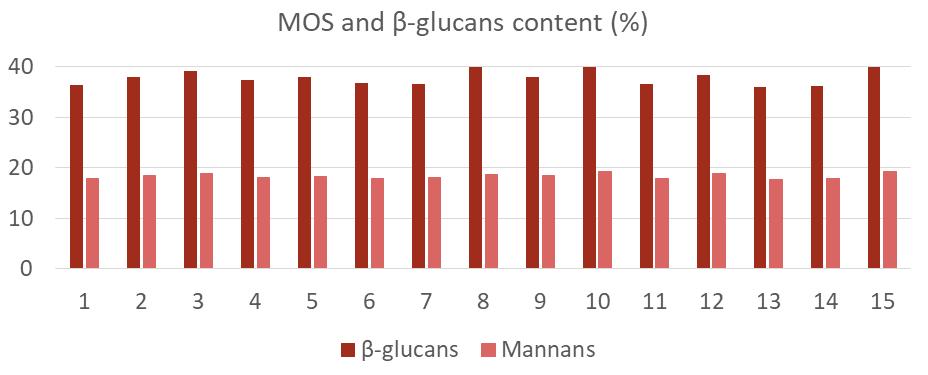
This led to us developing a methodology to assess, select and develop a YCW from secondary fermentation – with a view to offering a consistent and affordable product to answer market demands.
How has it been developed?
YCWs offer various benefits in animal nutrition including the ability to reduce the negative impacts of mycotoxins in feed, immune modulation and the ability to bind to certain unwanted bacteria and reduce the pathogen load in the gut.
However, these benefits are reliant on the strain, origin, and production process behind the YCW product – highlighting the importance of quality control.
In developing Optiwall, we went through a strict selection process to find one single plant capable of adopting Lallemand’s know-how in this area, as well as the ability to supply a large demand.
Once shortlisted plants were selected, a series of on-farm trials were conducted to ascertain which plant was producing the best YCW.
The trials looked at the impact of the YCWs on body weight, feed conversion ratio (FCR) and mortality at Lallemand’s experimental poultry farm in France.
The YCW, which is now being launched to the market, outperformed the others in all three areas.
Further analysis was conducted to compare 15 batches of the YCW from the chosen plant to ensure it was producing YCW of a consistent quality (Figure 1).
PAge 28 July/August 2023 Feed Compounder
Figure 1 - Percentage of MOS and β-glucans in 15 Optiwall batches
How does it differentiate from other YCW products on the market?
Two trials – one in India and one in Greece – were conducted in 2020 to assess how Optiwall would perform in broiler diets.
The Indian trial, which took place over 42 days, involved 440 birds split into four groups with 10 pens of 11 birds in each group.
Two of the four groups were given the YCW product at a rate of 1kg/tonne in the starter phase and 0.5kg/tonne in the grower and finisher phases.
All groups were assessed in two environments – one unchallenged and one challenged with avian pathogenic E. coli (APEC).
In challenged conditions, Optiwall helped increase the final body weight by 116g, and in non-challenged conditions, broilers receiving the YCW product were 33g heavier at 42 days.
A significant reduction in mortality was also recorded in the groups given Optiwall – the mortality rate was reduced by a factor of 2.5 in non-challenged conditions, and by a factor of 5.5 in challenged conditions (Figure 2).
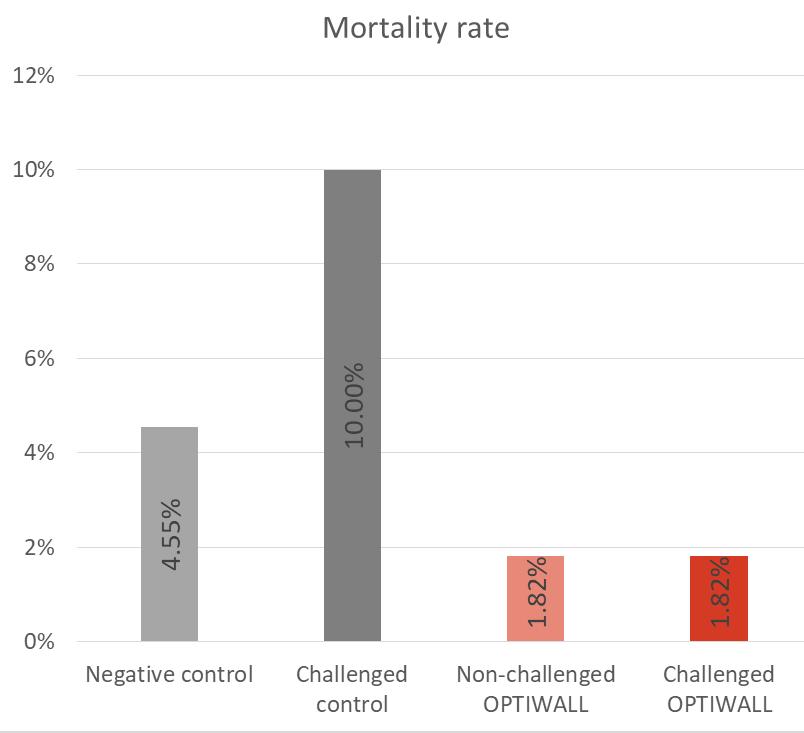
a rate of 1kg/tonne, and one was given a competitor’s YCW product at a rate of 1kg/tonne.
Results show the body weight of birds in the Optiwall group was 6% higher than the control group, and 4% higher than those given the competitor product at day 35 (Figure 3).
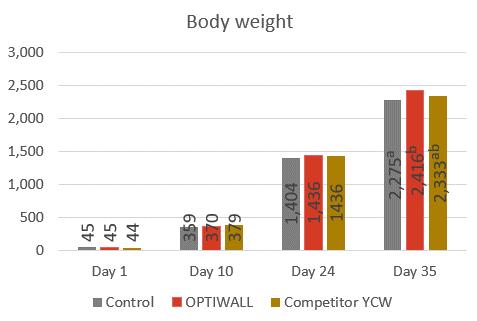
3 –Body weights (g/broiler) from the Greek trial
Overall FCR was reduced by 9% in the Optiwall group, compared to the control group, and it was 3% lower than the FCR of broilers supplemented with the competitor YCW.
The ROI when using Optiwall was 8:1 compared to the control group, which was two times higher than the ROI offered by the competitor product.
What benefits can it bring?
The results from both the Indian and Greek trials show the benefits Optiwall can bring to broiler diets.
With Optiwall, we are bridging the gap between premium products developed from primary fermentation and non-specific secondary fermentation products – most of which are highly variable in terms of composition, quality and efficacy.

It provides the best of both worlds – a highly consistent product, with guaranteed levels of MOS and β -Glucans, at an affordable price.
The trial also found an improvement in performance efficiency factor in birds given Optiwall – with improvements of 12% and 3% reported in the challenged and non-challenged groups respectively.
The return on investment (ROI) when using Optiwall in nonchallenged conditions was 5:1, increasing to 8:1 in challenged conditions.
Meanwhile, the Greek trial, which was conducted by the Aristotle University of Thessaloniki, took place over a 35-day period with 450 birds split into three groups comprising 10 pens of 15 birds per group.
One group received no YCW product, one was given Optiwall at
By offering a YCW with secondary fermentation origin, we also have the advantage of large volume availability.
All of this has been achieved due to the company’s extensive and long-standing expertise in yeast production with this year marking 100 years since we started producing yeast.
Feed Compounder July/August 2023 PAge 29
Figure 2 – Mortality figures from the Indian trial
Figure
Alternatives to Antibiotics in Pig Production: an Obligation, not a Choice?
By Ian Hands BVSc MRCVS, Techna Nutrition
Antibiotic resistance is a human global health concern: Antibiotic resistance occurs when bacteria evolve and develop mechanisms to withstand the effects of antibiotics, making them ineffective in treating infections. It is considered one of the most significant public health challenges worldwide. According to the World Health Organization (WHO), antibiotic resistance is responsible for an estimated 700,000 deaths annually worldwide. If left unchecked, it is projected to cause 10 million deaths annually by 2050.
But is population livestock farming really to blame, or are there also other factors?
No matter how this situation has arisen, urgent action is required globally if we are to avoid a human health catastrophe going forward.
Antibiotics have historically been widely used in pig farming to promote growth and prevent and treat diseases.
Traditionally, there have been four types of approach for using antibiotics in population livestock:
1. Therapeutic Use: Antibiotics are administered to individual animals to treat diagnosed bacterial infections. This targeted treatment helps to alleviate the symptoms, control the spread of infection, and promote animal welfare. It’s important to say that antibiotics still have a role to play in controlling disease and alleviating suffering for the animal. It is more the approach to how antibiotics are used, and what for, that is in question.
2. Prophylactic Use: Antibiotics are given to groups of animals as a preventive measure when there is a high risk of infection or disease outbreak. This approach aims to protect the entire population from potential bacterial infections. However, this is purely an insurance policy as it is not known whether the pigs will actually be challenged with a bacterial infection.
3. Metaphylactic Use: Metaphylaxis involves the treatment of a group of animals in which some individuals have already been diagnosed with a bacterial infection. The antibiotic is administered to the entire group to prevent the spread of infection and control the disease within the population.
4. Growth Promotion : Historically, antibiotics have been used as growth promoters in livestock, including population agriculture. Low doses of antibiotics are added to animal feed or water to promote growth and improve feed efficiency. This
practice is banned in several countries due to concerns about the development of antibiotic resistance.
The overuse and misuse of antibiotics have contributed to the emergence of antibiotic-resistant bacteria, which poses a serious threat to public health. There are many ways in which antibiotic resistance can be promoted, not just through pig production:
1. Misuse and Overuse of Antibiotics : Inappropriate use of antibiotics, such as unnecessary prescriptions, failure to complete the full course of treatment, or using antibiotics for viral infections, can contribute to the development of resistance.
2. Poor Infection Prevention and Control: Inadequate infection prevention and control measures in healthcare settings can facilitate the spread of resistant bacteria.
3. Global Travel and Trade: Global travel and trade facilitate the rapid spread of resistant bacteria between countries and regions.
4. Lack of New Antibiotic Development: The pipeline for new antibiotic development has significantly diminished in recent decades making it difficult to combat emerging resistant strains.
5. Agricultural Use of Antibiotics : The use of antibiotics as growth promoters or for disease prevention in animals can lead to the selection and dissemination of resistant strains that can be transmitted to humans through direct contact, environmental contamination, or food consumption.
6. Inadequate Diagnostic Testing: The overreliance on empirical treatment without appropriate diagnostic testing can lead to the inappropriate use of antibiotics.
7. Lack of Public Awareness and Education : Insufficient understanding among the public and healthcare providers about the consequences of antibiotic resistance, appropriate antibiotic use, and the importance of completing prescribed courses.
The decreased use of antibiotics in pigs in the UK has been a significant development in recent years. Concerns over antibiotic resistance and its impact on human health, as well as the welfare of animals, have prompted the implementation of stricter regulations and a shift towards more responsible antibiotic use in livestock farming. This can also be said for many regions of the world. However, whilst some countries may have a reduction in antibiotic policy, monitoring and having
PAge 30 July/August 2023 Feed Compounder
governance over that policy could be the blocker to the execution of it.
In the UK, the monitoring of antibiotic use in pigs is an essential part of ensuring responsible and sustainable farming practices. The monitoring process involves collecting data on the quantity and type of antibiotics used in pig production, which helps assess trends, identify areas for improvement, and evaluate the effectiveness of measures taken to reduce antibiotic usage. Monitoring is via several routes:
• Veterinary Prescriptions: serve as an important record of antibiotic use and provide valuable data on the quantity and purpose of antibiotic treatments.
• On-Farm Records: Pig farmers are required to maintain detailed records of all antibiotic use on their farms.

• Antibiotic Sales Data: The UK collects and analyses data on the sales of antibiotics for use in animals. The Veterinary Medicines Directorate (VMD) is responsible for monitoring and reporting antibiotic sales data.
• Quality Assurance Schemes: Include specific standards related to antibiotic use.
• National Surveillance Programs: The UK also participates in national surveillance programs to monitor antibiotic resistance in animals.
• Reporting and Analysis: The collected data on antibiotic use is analysed and reported at both industry and national levels.
So, within the pig industry, what can we actually do to reduce or minimise antibiotic usage and what alternatives exist? Whilst the UK industry has made tremendous steps in antibiotic reduction in livestock, there may be some solutions that are less known or less understood, yet nevertheless available to producers or stakeholders.
Some of the key alternatives to antibiotics in pig farming include:
Vaccination : Stimulate the immune system, allowing pigs to develop immunity against specific pathogens. Whilst vaccination can be very effective when correct protocols of storage and administration are followed, there are bacterial diseases or bacterial strains, and changing viral diseases, which are not covered by “off the shelf” vaccines.
Improved Hygiene and Biosecurity: Maintaining strict hygiene practices and implementing robust biosecurity measures are essential to prevent the introduction and spread of diseases. Regular cleaning and disinfection of pig housing, proper waste management, and controlled access to farms help minimize disease transmission.
Probiotics and Prebiotics : Probiotics are beneficial live microorganisms that, when administered to pigs, promote a healthy gut microbiota. They compete with harmful bacteria, enhance digestion, and support the immune system. Prebiotics are nondigestible food ingredients that stimulate the growth and activity of beneficial gut bacteria.
Management Strategies: Effective husbandry practices are crucial for disease prevention. This includes proper ventilation, temperature control, correct stocking density, and environmental enrichment.
Nutritional Interventions: Optimizing the nutritional composition of pig diets can contribute to better overall health and disease resistance. Well-balanced diets that meet the nutritional requirements of pigs enhance their immune system and promote robust growth. Appropriate feed formulations, including the right combination of vitamins, minerals, and additives, can help minimize the occurrence of diseases. After all, 70% of immunity is developed from the gut. At Techna Nutrition, nutritionists use data generated from their own nutritional trials farm, to implement feeding strategies to go hand in hand with the pigs’ requirements, taking into account the genetics, stage of production, type of housing and management practices. Fine tuning a diet can have considerable effects on gut stability, health, performance and commonly result in cost saving too.
Botanicals and aromatic substances: Certain plant extracts and essential oils have been found to possess microbiota regulating properties. They can be used as natural ingredients in pig feed to support gut health and digestion.
Techna Nutrition has a rich history of providing nutritional expertise, feed products and data services to the global swine industry. Many of the nutritional solutions are based on a combination of botanical ingredients, backed by performance data to validate claims. So, how do these products work?


The use of plant extracts and essential oils as part of an antibiotic reduction strategy in pigs has gained interest in recent years. These
A combination of plant extracts and aromatic compounds supporting improved growth performance and the immune system in piglets.
Mode of action
• Transfer of passive immunity via the colostrum
• Support to fight against infection
Results
• Better colostrum quality (more IgG and for a longer time)
• Heavier piglets at weaning
• 1st and 2nd age transition optimized for a higher weight at 70 days
Feed Compounder July/August 2023 PAge 31
O O
Watch the video
PIGLET ROBUSTNESS
more information Ian Hands, Swine Key Accounts TECHNA - ian_hands@gb.groupe-techna.com
IMPROVE
For
botanical compounds are not only being explored for their potential microbiota regulating properties but also for other health benefits and performance improvement. While more research is needed to fully understand their efficacy and mechanisms of action, here are some key points about their use:
Gut microbiota regulation: Many plant extracts and essential oils have shown the ability to modulate the gut microbiota, promoting a balanced microbial population and thereby helping manage the risks associated with a wide range of potentially pathogenic bacteria. For example, Techna Nutrition has developed Regal G+, a complementary feed specifically targeting Gram-positive bacteria, such as Streptococcus suis, that can be responsible for poor animal health status.
Mode of Action: The microbiota regulating effects of botanicals and essential oils can be attributed to their complex chemical composition. They often contain bioactive compounds such as phenols, terpenoids, alkaloids, and flavonoids, which can interfere with microbial cell structures and functions. These compounds may disrupt cell membranes, inhibit enzyme activities, or interfere with microbial cell replication.
Support a natural inflammatory response: Certain plant extracts and essential oils can support a natural inflammatory response. By supporting inflammation in the gut or other tissues, these compounds may indirectly support the immune system and contribute to better overall health in pigs.
Palatability and Feed Intake: Plant extracts and essential oils are often derived from aromatic plants, which can enhance the palatability of feed. This can lead to improved feed intake in pigs, promoting better growth and productivity. For sows, Techna Nutrition has developed such a product, Silena Lac, which promotes increased feed intake during lactation, with obvious benefits in milk production for her litter, weaning weights, and less body condition loss for the sow.


support the immune system of her piglets. It is well documented that the last pigs to be born can receive significantly less colostrum than the firstborn. This passive immunity is very important to protect the young piglet from infection, thus limiting the need for antibiotics and giving the piglet every chance to become a robust pig at weaning.
IMUN’UP is a Techna complementary feed comprising of botanicals and plant extracts. When fed to sows, trial data shows an increased quantity and longevity of the antibody IgG in the colostrum, supporting the passive immunity transfer to the piglet litter.
With the advent of hyper-prolific sows, there is obvious pressure on the sow to produce enough quality colostrum to pass on passive immunity to her entire litter. Immunoglobulin G (IgG) antibodies are an essential component of the immune system, providing protection against various pathogens. Colostrum is the first milk produced by the sow after giving birth and is rich in antibodies, including IgG, to

The escalating figures surrounding antibiotic resistance underscores the urgency of the situation. Collaborative efforts between the agricultural industry, policymakers, healthcare professionals, and consumers are imperative. By implementing responsible antibiotic use practices, exploring alternative strategies such as botanical products, and investing in research, we can safeguard animal welfare, protect public health, and preserve the efficacy of antibiotics for future generations.
For further information, please contact:
Dr Ian Hands: ian_hands@gb.groupe-techna.com
PAge 32 July/August 2023 Feed Compounder
New Poultry Vitamin Recommendations For More Productive and Sustainable Farming
By José-María Hernández - Global ANH Vitamin/Carotenoid/Premix Marketing Manager, dsm-firmenich
Addressing the poultry industry challenges of today and tomorrow
Understanding the overlap in poultry nutrition and poultry health is essential for meeting current and future industry challenges like hatchability, first week mortality, disease management without antibiotics, reducing feed costs, and eliminating food waste. There is a growing focus on sustainable farming where our industry has a critical role in shaping a better world, in line with the Sustainable Development Goals (SDGs) agreed by the United Nations.
Supporting poultry with appropriate vitamins can help make production more sustainable (SDG 12, 13), help get the world closer to zero hunger (SDG 2) and help achieve good health and well-being (SDG 3). Supplementing diets with the right levels of quality and sustainable vitamins will help poultry producers improve bird health, wellbeing, and performance, while also protecting the environment, succeeding in a dynamic and ever-changing global market, and enhancing both profits and environmental sustainability.
Vitamins play a decisive role in both human and poultry nutrition. As organic catalysts present in small quantities in the majority of foods, they are essential for the normal functioning of metabolic and physiological processes. Vitamin requirements in animals are dynamic: they vary according to new genotypes, levels of yield and production systems. Inclusion of the appropriate levels of vitamins in an animal’s diet not only allows complete realisation of its performance potential, but at the same time improves various aspects related to health and wellbeing, productivity and the ultimate quality of the food produced, be it meat or eggs. Healthier birds will produce more and healthier food.
OVN Optimum Vitamin Nutrition® is a dynamic concept which regularly reviews and updates vitamin supplementation in feed. OVN™ is about feeding animals high-quality vitamins, produced with the lowest environmental footprint, in the right amounts appropriate to their life stage and growing conditions, to optimize animal health and welfare, animal performance, food quality and food waste.
Reviewing and updating vitamin recommendations in animal nutrition
Vitamin recommendations from a number of international scientific associations (such as the National Research Council (NRC), and the Agricultural Research Council (ARC)) were developed with the
object of preventing nutritional deficiencies. Some of the studies their recommendations are based on are more than 20-30 years old. The poultry industry of today does not have much in common with the industry 30 years ago. Performance parameters such as bodyweight and feed conversion rate have improved up to 30% in the last 30 years (around 1-2 % per year).
It is logical to assume that nutrition programmes for commercial poultry production, including vitamin supplements, need to be adjusted in a manner consistent with improved management techniques and zootechnical performance.
This adjustment should be based ideally on the most recent scientific studies, while also considering practical experience from producers as well as nutritional recommendations from breeding companies.
Science, industry expertise and vitamin levels
Testing different levels of individual vitamins could be one way to define the optimal use of vitamins in feed. Recent DSM OVN™ webinars and poultry events have reviewed experimental data extracted from more than 50 papers on individual vitamins published over the last 10 years (further information available through the authors). Some examples of this research are shown in Figures 1-4.
Figure
different levels of vitamin A (on top of
control diet
8000 IU vit A/kg feed). Prediction equation: weight gain (1-42 d): -0.00000341vit. A2 + 0.10331vit.A + 2423.99964. R2: 0.68; p = 0.0001. Vitamin A level with maximum response: 15.148 IU. Maximum response: 3.206 g |
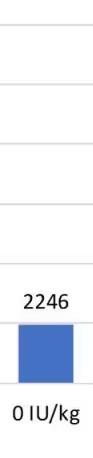
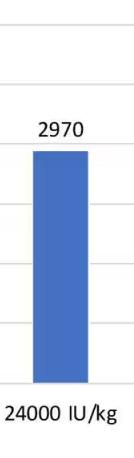
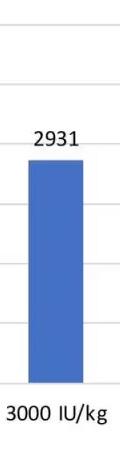
Source: Savaris et al., 2021
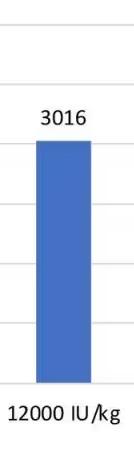
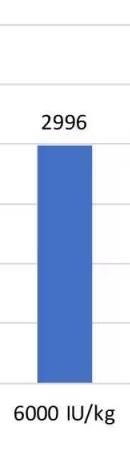
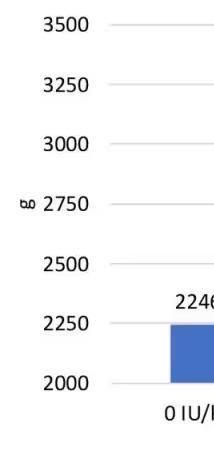
Feed Compounder July/August 2023 PAge 33
1. Weight gain in chicks from 1-42 days of age fed diets with
the
with
Figure 2. Effect of vitamin A supplementation on egg mass (grams) of 42–54-week-old laying hens under heat stress conditions. Values with different letters differ significantly (p < 0.05). Standard error: 45.25 | Source: Abd El-Hack et al., 2016
We should not forget that vitamins are well known for their complementary catalytic roles in important metabolic processes with multiple interactions among them. This means that we might not see the full effect of increasing levels of individual vitamins if levels of other vitamins are a limiting factor. We need to better understand and quantify the effect of good levels of all vitamins in the same diet as it is unlikely that there is an additive effect of all the benefits seen in individual vitamin trials.
The latest nutritional recommendations from Aviagen for parent stock (2021) and broilers (2022) were developed in this way. They found relevant performance improvements, mainly in bodyweight and mortality of progeny, from breeders fed a vitamin booster when compared to offspring from breeders fed their previous vitamin recommendations (Figures 5-7).
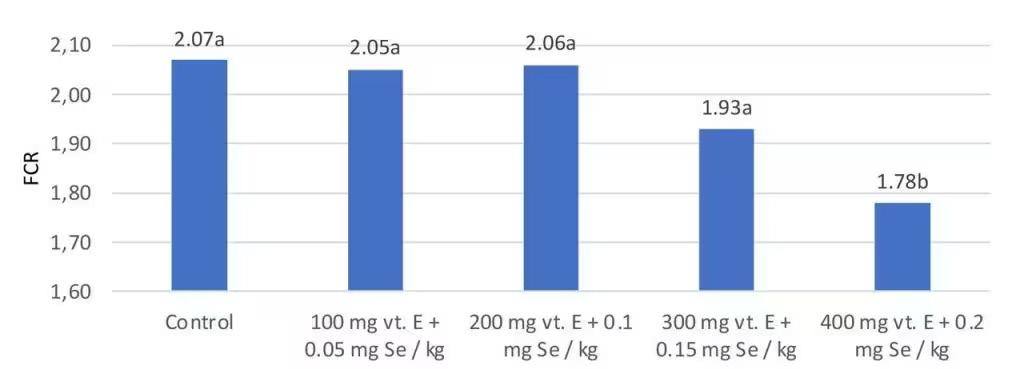
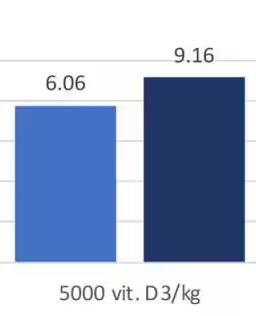
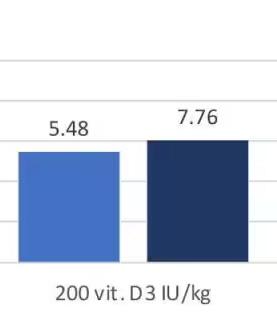
A more recent study ( Gracia et al., 2022 PSA Latin American Scientific Conference) compared vitamin levels commonly used in Spain to the 2022 OVN™ broiler guidelines. Under the experimental conditions tested, the authors concluded that the supplementation of Ross 308 broiler diets with OVN™ 2022 vitamin levels:
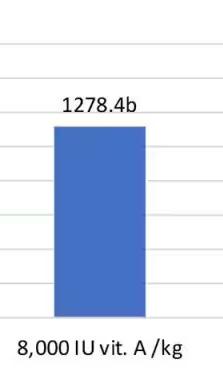
• significantly improved performance (body weight, daily gain and intake, mortality) during the starting phase (days 0 – 28) as well as a significantly reduced mortality over the whole fattening period (day 0 – 42, Table 1 - overleaf)
• significantly improved the antioxidant status of the animals by increasing blood vitamin E at days 28 and 42 and plasma GPx at day 42 of age
• significantly improved meat quality and oxidative stability of breast meat after 3-6 days of defrosting by means of reduced breast malondialdehyde (MDA)
Figure 3.
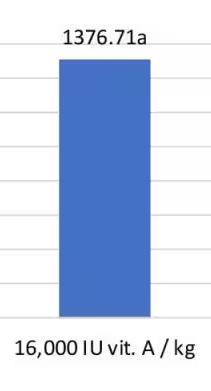
antibody titres in broilers (21 days of age) fed different levels of vitamin D3 with or without 25(OH)D3. Values with different letters are significantly different (p < 0.05) | Source: Vázquez et al., 2016

Additionally, the cost-benefit calculation indicates that the return on investment, based on the experimental results and market prices at that time, was 3:1.


More information on the new 2022 OVN Optimum Vitamin Nutrition® Guidelines for Poultry is available online (www.dsm.com/anh)
Figure
diets on feed conversion rate at 49 days of age under heat stress. Standard error: 0.04. Values with different letters differ significantly (p = 0.005) | Source: Ekunseitan et al., 2021
PAge 34 July/August 2023 Feed Compounder Vit.D3 (IU/kg) Average 25(OH) D3 (mg/ton) Average 200 5.77±1.0a 0 6.62±1.1y 5000 8.46±1.1b 69 7.61±1.0x
Newcastle disease virus
4. Effect of vitamin E and selenium levels in broiler
Why do we formulate vitamins? Adding value to feed
To meet the highest quality, nutritional, and legal requirements for animal feed production, premix producers and feed manufacturers need to handle additives safely and with great precision.
Vitamins are rarely added as pure substances to feed because they are often degraded due to instability towards oxygen, light or temperature. In some cases, they may not be suited to the rigors of the feed manufacturing processes, and in others, their handling properties may be poor.
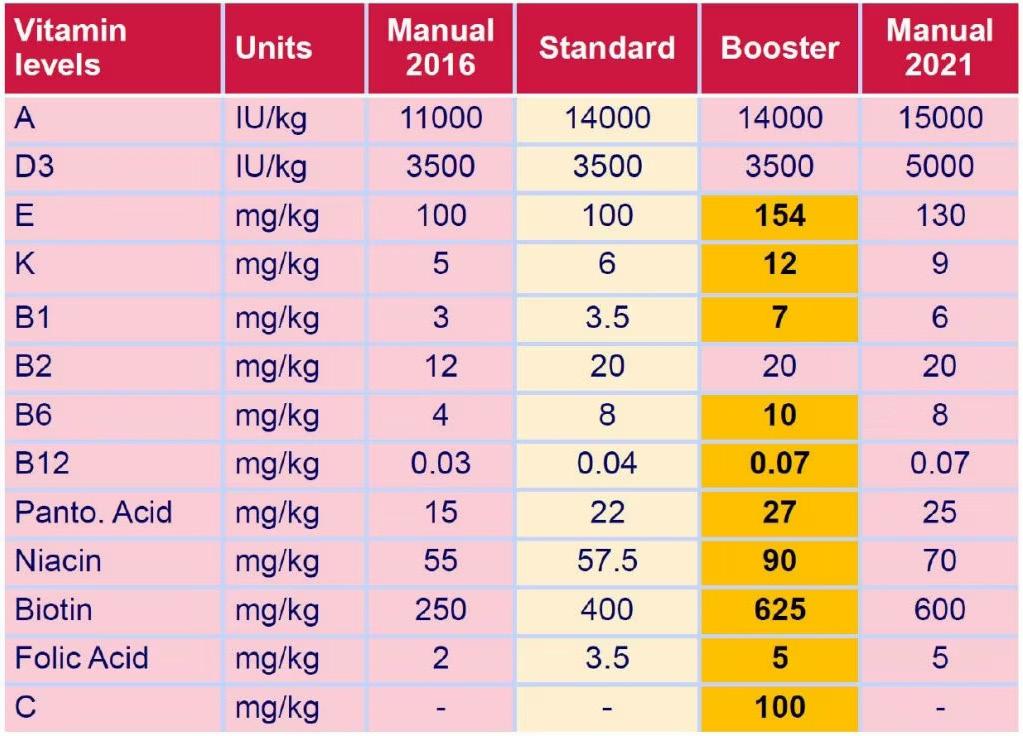
Pure crystals of vitamins may look very attractive but in most cases are impossible to use in poultry unless they are properly formulated as feed additives and added into premix, feed or drinking water before the bird get access to them. It is important to ensure the right amount of each nutrient is delivered on a daily basis.
For maximum efficacy, feed additives like vitamins should be formulated for:
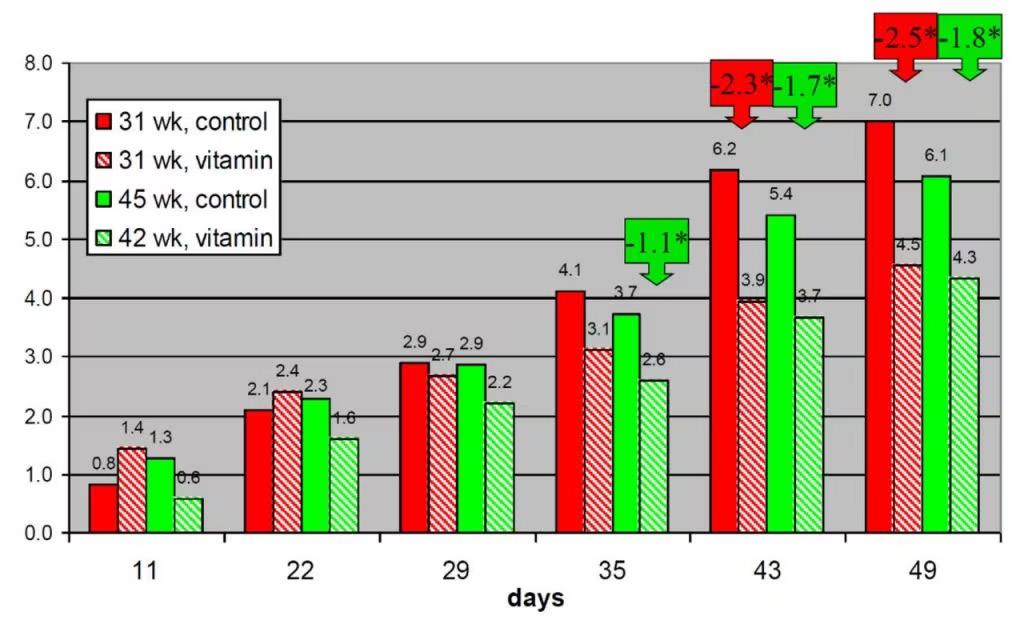
• low dust and best handling to ensure feed mill worker safety
• good flowability to allow a more efficient dosing operation and resulting in less product losses
• best homogeneity in premix and feed
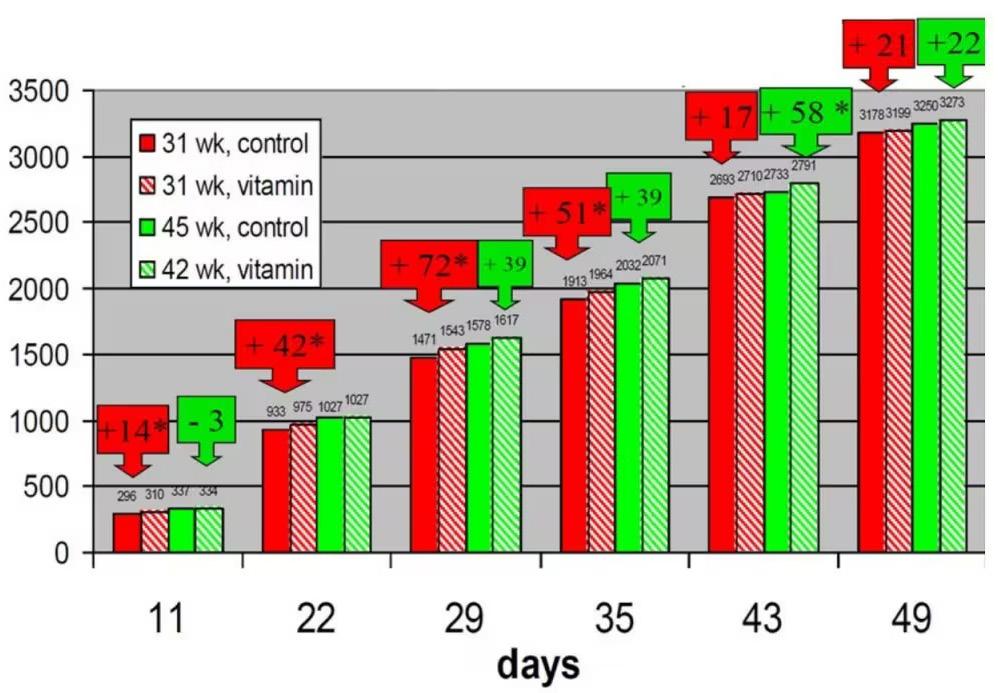
• superior stability in premix and feed to facilitate correct daily intake of nutrients by animals
• high bioavailability allowing efficient absorption and the best biological use by the animal
• manufactured with the lowest environmental footprint for more sustainable farming
Feed Compounder July/August 2023 PAge 35
Figure 5. Aviagen parent stock nutrient recommendation 2021
Figure 7. Influence of breeder vitamin booster on broiler mortality (as hatched) | Source: Aviagen parent stock nutrient recommendation, 2021
Figure 6. Influence of breeder vitamin booster on broiler liveweight (as hatched) | Source: Aviagen parent stock nutrient recommendations, 2021
Table 1. Optimum Vitamin Nutrition® for broiler performance, Spain 2022 | Source: Gracia et al., 2022 PSA Latin American Scientific Conference
SEM = Standard Error of the Mean; N = number of observations
T he final goal should be to achieve the best balance between handling, mixing, stability, and bioavailability factors depending on the specific application challenges.
Large overages (up to 100%) may be required to match the vitamin A nutritional requirements in poultry feed if unstable vitamin products are used, as demonstrated in the following trial. An independent trial was conducted under practical pelleted feed industry conditions for pelleted feed.
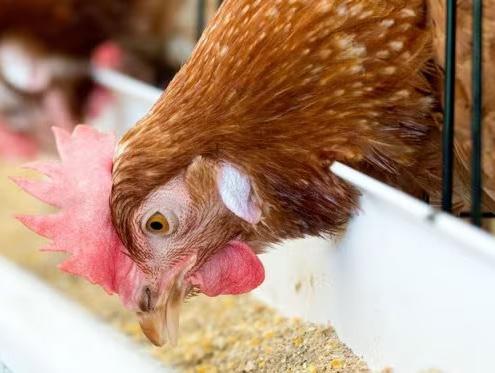
• Premixes produced with 3 different vitamin A products
• Target vitamin A in feed: 10000 IU vit A/kg feed
• Pelleting temperatures: 70°C, 80°C and 90°C
• Holding times: 30, 60 and 120 seconds
• Feed: Corn / wheat / soy produced by Kolding Technological Institute, Denmark
• Vitamin analyses carried out by LUFA Kiel lab, Germany (method REG(EC) 152/2009, IV, A)
Table 2. Vitamin A stability in pelleted feed, EU premixer 2020
Commitment to sustainability
Providing feed mills, integrators, and producers with the right levels of high-quality and sustainable micro-nutrients can help them improve bird health, wellbeing, and performance, while also protecting the environment, succeeding in a dynamic and ever-changing global market, and enhancing both profits and environmental sustainability.
ROVIMIX® A1000 proved to be much more stable than other vitamin A products.
DSM, as part of their sustainability commitment, has developed Environmental Vitamin Product Declarations (EPD) which transparently provide environmental footprint information to support purchasing decisions and to help better assess the product sustainability of feed mills and producers. A comparison of CO2 savings depending on the vitamin product form and type of animal production can be seen in Figures 8a and b. This tool allows producers to calculate their carbon footprint in premixes and adjust their footprint using tailor made solutions.
PAge 36 July/August 2023 Feed Compounder Period and Parameter T1- Vit Industry Levels T2- OVN 2022 SEM (n = 18) P-value 95% Confidence Interval diff. T2-T1 O-28 days of age Body weight, trial start 40.6 40.6 - - -Body weight, 28 d 969 1069 11.9 <0.0001 64.7 134.0 ADG. g/d 32.3 36.0 0.4 <0.0001 2.59 4.94 ADFI, g/d 55.7 61.1 0.87 0.0002 2.9 7.95 FCR, feed/gain 1.73 1.7 0.03 0.5125 -0.116 0.059 Mortality, % 1.9 0.4 0.48 0.0378 -2.9 -0.09 O-42 days of age Body weight, 42 d 2137 2167 22 0.3354 -33.4 94.6 ADG. g/d 47.6 49.0 0.49 0.0654 -0.09 2.78 ADFI, g/d 81.2 84.4 0.89 0.0174 0.61 5.76 FCR, feed/gain 1.71 1.73 0.015 0.3864 -0.025 0.063 Mortality, % 2.4 0.4 0.47 0.0077 -3.29 -0.56 EPEF 273 284 4.7 0.1206 -3.0 24.1
70°C 80°C 90°C Average Efficiency (% vs. target in feed) (% vs. target in feed) (% vs. target in feed) (% vs. target in feed) vs. Rx A1000 DSM A1000 88% 106% 101% 98% 100% Prod. A 49% 61% 52% 54% 55% Prod. B 65% 57% 54% 59% 60%
of CO2 saving assuming a carbon credit or tax of €50 per ton CO2
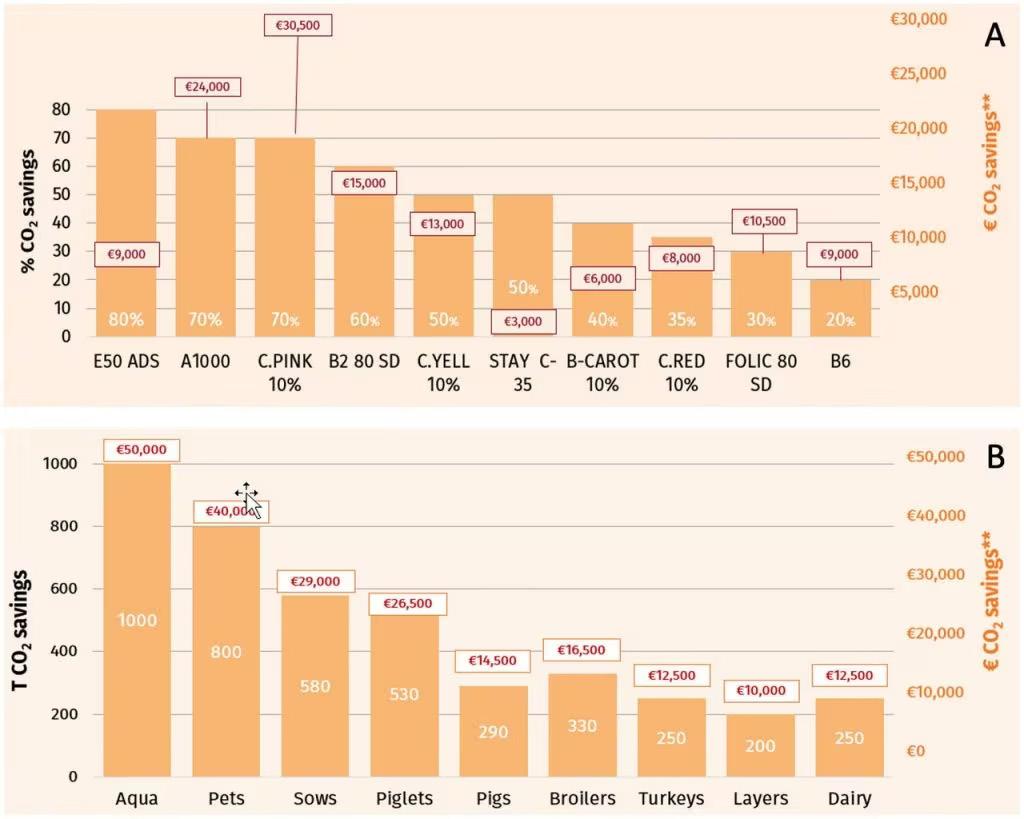
Conclusion
Production programmes for poultry, including vitamin supplementation, need to be adjusted in a manner consistent with the updated management techniques and genetics improvements which have supported the feed industry in achieving annual productivity improvements of +1-2%.
Testing different levels of individual vitamins as well as combinations of all vitamins compared to the current vitamin blends used by the industry seem to be a consistent strategy used to review and adjust optimal use of vitamins in feed.
Once vitamin levels are defined, maximum attention must be paid to the use of the correct vitamin product forms. This would avoid jeopardizing decisions taken by nutritionists to optimize animal health and meat/egg production costs with products which might not be stable enough or mix properly in premix or feed.
Supporting poultry with appropriate vitamins helps make farming more sustainable. OVN Optimum Vitamin Nutrition® is about feeding
animals high quality vitamins, produced with the lowest environmental footprint, in the right amounts, appropriate to the life stage and growing conditions of the bird, to optimize animal health and welfare, animal performance and food quality and food waste.
Article previously published on DSM Feed Talks
About the Author
José-María is a Spanish national holding a Degree in Veterinary Medicine and Masters in Exec-MBA and Marketing and Commercial Management.
Close to 35 years in the feed industry, he joined dsm-firmenich in 1989 and had different technical, commercial and marketing positions in EMEA and Global (Poultry) Business and Category (Vitamins, Carotenoids) management in Spain, Switzerland as well as GM in Argentina, Uruguay and Paraguay.

Feed Compounder July/August 2023 PAge 37
Figure 8. Potential CO2 emission savings coming from different vitamin product forms. A) CO2 savings and potential € value (carbon tax) per 10 T product form, and B) CO2 savings and potential € value (carbon tax) for a 100k T feed producer. Data from DSM Environmental Product Declarations. Examples of CO2 savings based on average vitamin levels used in 100k T feed (DSM Premix Carbon Calculator). **Value
Solutions for Sustainable Pig and Poultry Producers

 With Richard Remmer, Pig Technical Manager & Chloe Paine, Poultry Technical Manager, Trouw Nutrition GB
In the third of a series of articles by Trouw Nutrition GB exploring the sustainability challenges facing UK livestock production and the vital role of the supply trade in helping effect change, Pig Technical Manager, Richard Remmer and Poultry Technical Manager, Chloe Paine look at the specific issues affecting their sectors of the industry.
To feed in excess of 10 billion people, the world’s food producers and farmers need to increase food production by 60% while decreasing waste, producing food with 75% fewer emissions. The bottom line is we need to produce more from less.
Rather than being seen solely as the cause of the problem, we must remember that livestock is an integral and important part of the solution providing a circular economy.
Co-products from the food biofuel industries and former food products like bread, biscuits and crisps are often incorporated into monogastric diets rather than being destined for landfill, helping to achieve a circular economy.
At Trouw Nutrition our purpose is ‘Feeding The Future’. Sustainable agriculture is a key pillar in delivering this and protecting the future of farming. We believe we can directly contribute to reducing carbon emissions at farm business level, working with our customers to deliver solutions across the supply chain. We are committed to being proactive in delivering a holistic approach to sustainability on farm, linking environmental and economic sustainability through production efficiency and enhanced lifetime performance. Anything that improves environmental sustainability must also support economic sustainability.
At Trouw Nutrition we believe that sustainable, efficient, lower emission farming is the only way we can strive to reach the increasing worldwide demand for animal products and address the decreasing availability of resources such as land and water. Livestock production needs to increase its productivity and reduce its environmental impact.
Achieving net zero is not a simple solution but a multi-faceted and multi-year journey which must be embarked upon now as it cannot wait. The farming industry needs to take steps now to demonstrably reduce the emissions and environmental impact associated with meat and egg production.
Many factors contribute to a farm’s carbon footprint (see Figure
1a-c). Trouw Nutrition is already able to contribute to improvements in those areas which may account for around 70 - 80% of the carbon footprint of pig and poultry production operations respectively.
These include feeding programmes for young animals, gastrointestinal tract (GIT) development and GIT health, optimising feed formulations to achieve producers’ goals more efficiently and reducing emissions such as nitrogen and phosphorus as well as lowering carbon footprint.
We are already helping pig and poultry farmers to significantly impact these areas to deliver environmental sustainability, together with economic benefits, employing a proven strategy based on short, medium and longer term actions, each of which results in demonstrable improvements.
These figures clearly show that feed is the biggest contributor to the carbon footprint of monogastric production. Some short-term solutions to reduce emissions include feed formulation changes, such as reducing crude protein (CP) levels and including higher levels of synthetic amino acids together with sourcing lower carbon footprint raw materials. The safe reduction of CP levels in diets should be done in a balanced manner.
Undigested CP and uric acid, a key product from nitrogen (N) metabolism, are excreted into the environment and have a negative effect on ecosystems. Reduction of CP is a way to lower nitrogen emissions, leading to improved sustainability. Precise knowledge of all amino acid (AA) requirements and the bioavailability of the dietary AA supply are necessary to successfully reduce the protein content in the diet. While this knowledge is increasing, there are still some knowledge gaps around the optimal protein content and AA requirements for different diets and feeding stages. For example, information about recommendations for minimum contents of nonessential AA is limited. More research is needed to learn if we can reduce CP percentages even further without penalising growth performance.
PAge 38 July/August 2023 Feed Compounder
Mid-term solutions can focus on increasing the number of diets fed during the management cycle to more accurately match specific nutrient requirements at different stages resulting in lower emissions. Focussing on improving piglet birthweights and early life nutrition will help to develop a healthier GIT improving lifetime performance and efficiency. Another area that drives efficiency is the use of modelling tools to best match diet density and timing of the diet phases fed, specific to current farm or market situations.
Longer term solutions are focused on improved gilt rearing strategies to improve the longevity of the sow in the breeding herd and increasing longevity in layers with production up to 100 weeks while focussing on health and egg shell quality. There are many tools currently used to provide a footprint figure, developed by a variety of organisations. The choice of measurement tool will be determined by a range of factors, and all have their respective merits. Initially, it is less important which tool is used, than that a tool is used. Irrespective of which measurement tool is being used, ‘To measure is to know’, providing the starting point and benchmarks to allow actions to be implemented to instigate a downward trend in carbon footprints on farm, and allow progress to be tracked over time.
The environmental impact of the pig and poultry sector is mainly related to the production of feedstuffs and manure management. Feed is made up of many different ingredients, all of which have an environmental impact. Selecting which ingredient to use and taking account of the respective carbon footprint can help reduce the overall environmental impact of the diet. The primary objective of feed is to deliver the animal’s nutritional requirements as efficiently as possible, however, choosing how and where to source feed ingredients will affect the environmental impact of the feed.
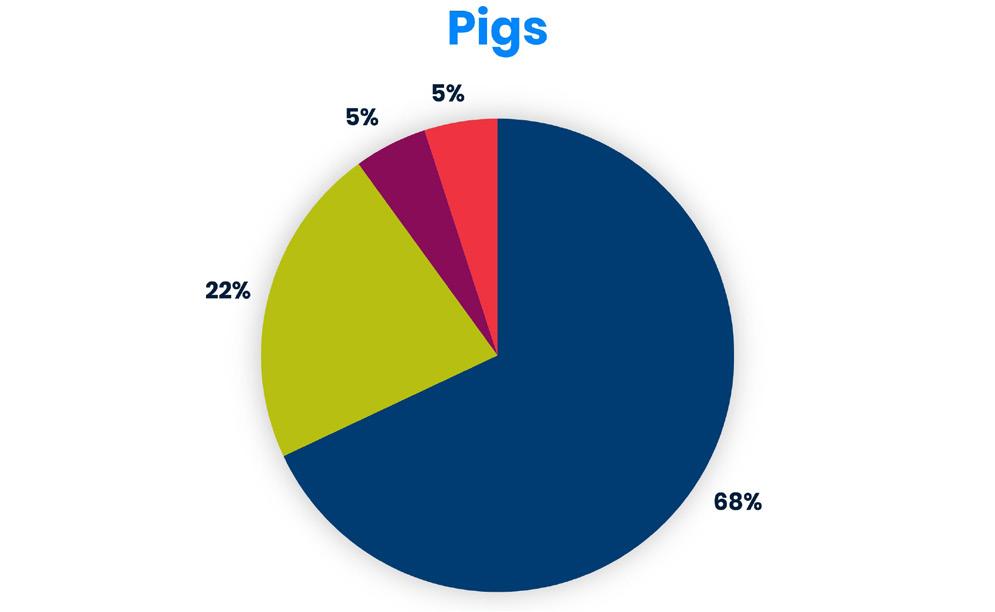
To help producers and nutritionists formulate lower carbon footprint diets, Trouw Nutrition has developed MyFeedPrint, an easy to use tool to assess the environmental impact of their feed ingredients and formulations. It employs Life Cycle Assessment (LCA) methodology and calculates various environmental metrics, including the carbon footprint measured in CO2 equivalent. The tool’s three modules (see Figure 2) provide data on environmental parameters, with a focus on the carbon impact, which is crucial when considering formulation changes
• Module 1 : Calculates ingredient environmental impact based on origin, transport mode, and distance to the feed mill. Users input ingredient details and transport information and export data for further use e.g. in feed formulation software.
• Module 2: Determines energy consumption in feed processing (per production line or facility average). Users input production line specifics and energy/gas consumption, and MyFeedPrint converts it into carbon impact data (kg CO2 equivalent per MT of feed).
• Module 3: Combines data from modules 1 and 2 to compute total environmental footprint of finished feed blends. Users select feed type, feed mill/production line, ingredients and inclusion rates. Reports generated include all relevant impact factors for further use e.g. client reporting.
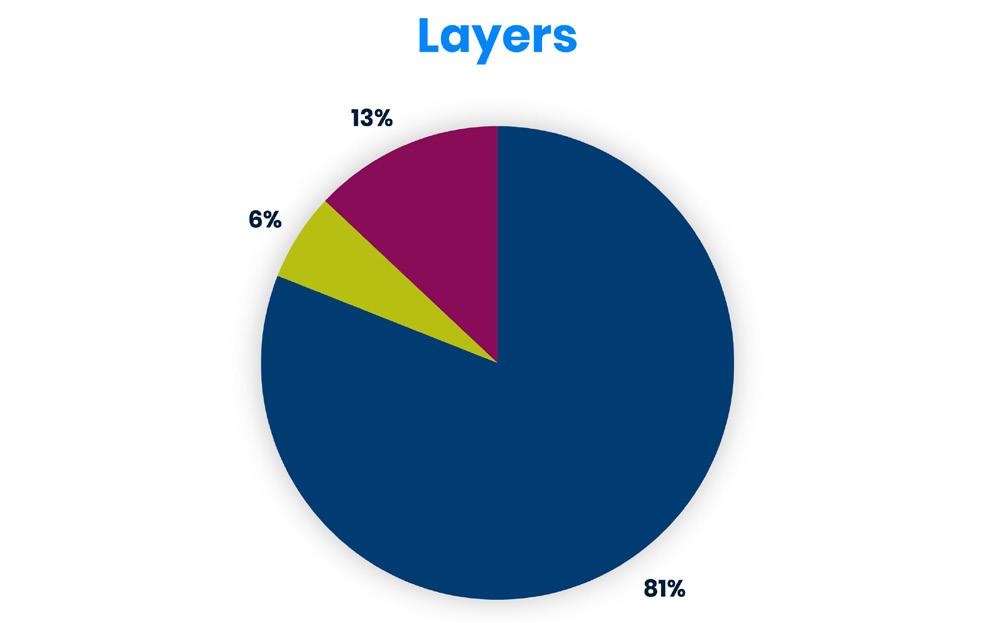
MyFeedPrint consolidates all relevant feed data, including nutritional and environmental impact information, in one place, enabling customers to make informed decisions. By using MyFeedPrint, feed
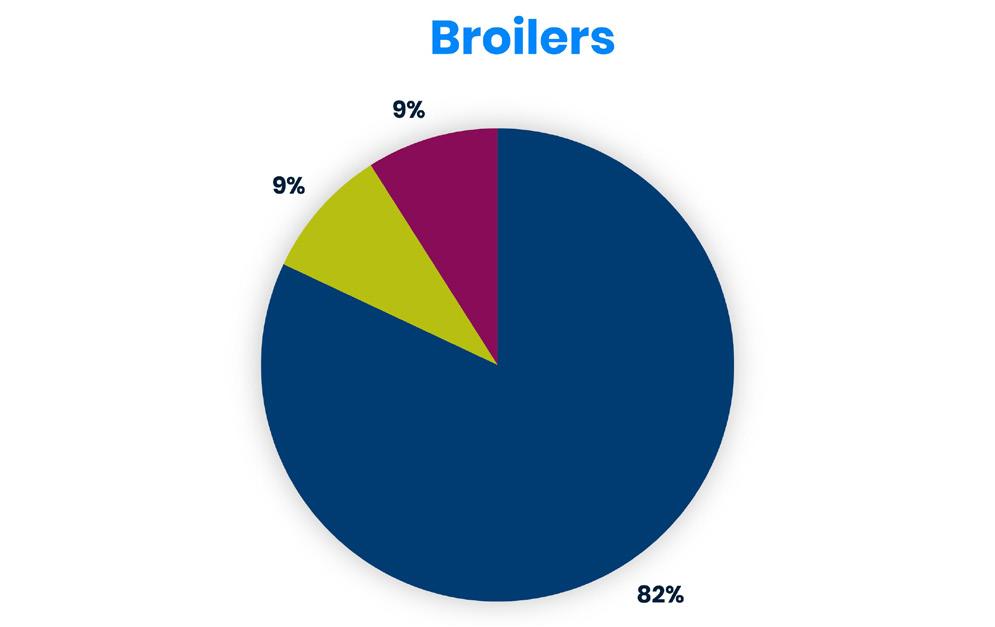
Feed Compounder July/August 2023 PAge 39
Figure 1a
Adapted from CIEL Net Zero & Livestock -How farmers can reduce emissions report April 2022
Figure 1c
% contribution to carbon footprint expressed as kg CO2 eq/kg deadweight or eggs
Figure 1b
Figure 2 MyFeedPrint uses 3 simple modules
producers can actively work towards producing more sustainable feed while considering feed costs, animal performance and health.
But it is important to remember that the lowest carbon footprint manufactured feed may not necessarily deliver the lowest overall farm carbon footprint. Emissions per kg dead weight or per kg egg are also important numbers to measure.
The Watson Swine model, Trouw Nutrition’s modelling tool, has recently been enhanced with a new link with SimaPro LCA software to allow a carbon footprint of pork to be produced.
The Watson model allows different scenarios to be compared to investigate the impact of different nutritional and management strategies. Some examples are shown in Tables 1 - 3. These demonstrate the effect of nutritional and management changes on the carbon footprint and how modelling can help explore what works best for each individual scenario.
production, would reduce emissions arising from both feed production and manure management.
Using Trouw Nutrition’s LifeStart and HealthyLife programs allows a focus on high productivity and improved efficiency. Early life nutrition and maximising growth and health status in the early stages of life are where farmers can capitalise on efficiency.
Our LifeStart program focuses on early life development and the impact of early life nutrition on animal productivity, reproductive potential and longevity. This focus sets animals up for superior lifetime performance.
Through scientific studies focused on mineral metabolism, functional proteins and nutritional requirements, Trouw Nutrition has identified the nutritional needs of chicks in the first days of life, according to the demands of their actual physiological state. Speciality diets focused on the first days result in better feeding efficiency. It also maximises the use of nutrients and generates greater production yield. This optimises feed conversion from the beginning of the chick’s life and consequent feed conversion in the entire production cycle.
Our HealthyLife programmes provide tools and services to improve gut health and aid longevity in pigs and poultry leading to improved efficiency and reducing carbon footprint. Our extensive studies into young piglet nutrition have enabled us to provide solutions to help in the replacement of therapeutic zinc oxide and reduce the use and reliance on antibiotics. This allows production efficiency to be maintained while reducing the impact on the environment by increasing overall lifetime performance.
Finally, by continuing to invest in precision nutrition approaches, we aim to meet animals’ requirements for production, health, and longevity, more precisely, delivering the right nutrients at the right amount at the right time. For example, strategies such as split feeding layers where the morning feed delivers the nutrition for energy, protein and phosphorus for egg-laying production and the afternoon feed meets the hen’s requirements for eggshell formation have been shown to have production and environmental benefits. Results from excreta composition proved that split feeding is a more sustainable feeding programme, reducing the levels of nitrogen, phosphorous and calcium excreted, through a combination of lower daily nutrient intake and better nutrient utilisation.
Matching nutrient levels closely to requirements, careful selection of raw materials and improving feed conversion are all areas that can impact carbon footprint through increased efficiency.
Increased productivity reduces environmental impact and improves economics. Improving feed efficiency, and reducing the amount of feed needed for a certain body weight gain or egg
At Trouw Nutrition we are committed to taking a lead on behalf of the industry, developing a clear sustainability approach for pig and poultry production. We will continue to develop our current tools and are committed to an innovative programme of R&D, creating new products and solutions in the fields of early life nutrition, healthy life nutrition, nutrient use efficiency and novel ingredients. By doing so we can help provide clarity for producers and the feed industry and help reduce the total footprint of the sector.
PAge 40 July/August 2023 Feed Compounder
Feed kg CO2 eg/kg farm gate weight % change compared to Brazilian soya Brazilian soya 3.290US Soya 2.274 -30.1 Low soya/ alternative proteins 2.353 -29.5 Feeds used kg CO2 eg/kg farm gate weight % change compared to single diet 1 feed 30 – 115kg 2.8712 feeds 30 – 60kg and 60kg to finish 2.838 -1.2 3 feeds 30 – 60kg, 60 – 90kg, 90kg + 2.771 -3.5 FCR kg CO2 eg/kg farm gate weight % change 2.52:1 2.7482.15:1 2.439 -11.2
Table 1: Effect on carbon footprint with 30 – 115kg diets using different protein sources
Table 2: Effect on carbon footprint with different numbers of diets fed from 30 – 115kg
Table 3: Effect on carbon footprint of improving FCR from wean to finish
Early Grass Silages Show Impact of Growing Season
Initial indications from the first 2023 grass silages analysed by Trouw Nutrition GB are that quality is slightly lower than average, largely a reflection of the growing season. However, Ruminant Technical Development Manager Dr Liz Homer believes they will still form the basis of effective rations provided close attention is paid to balancing diets to optimise rumen function.
Announcing the results of the first 500 samples analysed at the company’s Ashbourne laboratory, the largest forage testing facility in the UK, Dr Homer reports that crops are generally well fermented and have averaged 30.9% DM. She comments that the warmer winter meant that many swards never fully stopped growing, resulting in a higher proportion of more mature grass.
“This will have an impact on digestibility and energy levels. Overall ME is slightly lower than last year at 11.1 MJ/kgDM. While NDF is similar to 2022 initial silages at 44.5 %DM, lignin content is higher which will be contributing to lower energy content.”
As ever there is a range in energy contents but the average is tending towards the lower side. Nevertheless these forages still have potential to perform if balanced correctly in the rumen; and milk from forage can be optimised.
Dr Homer stresses that care will particularly need to be taken with high energy silages to ensure they can be balanced correctly. She says this is because they tend to be lower dry matter crops and will ferment more quickly, potentially with higher lactic acid content and higher acid load which will compromise rumen health.
Dr Homer adds that protein levels are also lower, which may be indicative of reduced nitrogen applications due to the wet spring. In addition, in some parts of the country she suggests farmers cut earlier when there was a spell of better weather. Crude protein is 14.3% compared to 15.2% last year, which has contributed to reduced fermentable protein supply.
“The lower fermentable protein levels combined with lower fermentable carbohydrates mean that the supply of digestible intestinal protein will be severely impacted.
“To overcome this, it will be important to supplement carefully with energy and protein sources. It will not just be a case of increasing the crude protein in the diet, but instead balancing the supply of energy and protein in the rumen to optimise the production of microbial protein, while supplying the appropriate levels of bypass protein.
Dr Homer stresses that these are the results of early cut crops, but they will give a good predictor of how the majority of crops will look and prospects for the winter. She comments that while farmers in the south of the country have managed to get an early first cut, farmers in the northwest in particular struggled to get fertiliser on which will lead to delayed cutting.
“By sampling clamps regularly during the season it will be possible to maintain a current picture of the forages being fed. Then work with your nutritionist to balance the diet for rumen function, energy and protein to optimise the contribution from forage, increase feed efficiency and reduce the environmental footprint of feeding cows.”
Feed Compounder July/August 2023 PAge 41
Units Min Average Max Dry Matter % 16.0 30.9 60.7 Protein % DM 6.8 14.3 25.4 D Value % 57.0 69.4 76.1 ME MJ/kg DM 9.1 11.1 12.2 NDF % DM 33.9 44.5 65.3 ADF % DM 19.6 27.6 42.8 Lignin g/kg DM 13.0 40.1 76.8 Sugars % DM 0.2 0.9 7.0 pH 3.5 4.0 5.7 Lactic Acid g/kg DM 2.0 79.1 158.3 VFA g/kg DM 0.5 44.4 128.3 Ammonia % 0.9 3.9 16.6 Rapidly Fermentable Protein g/kg DM 44.5 92.5 162.7 Total Fermentable Protein g/kg DM 50.1 104.1 196.3 Rapidly Fermentable carbohydrate g/kg DM 108.0 192.8 238.6 Total Fermentable carbohydrate g/kg DM 330.3 417.2 569.5 Acid Load 26.7 48.5 59.0 Fibre Index 133.1 178.2 269.9
Early 2023 grass silage analysis Source: TNGB
sustainability requires a holistic and individual approach
By Norman Downey, Commercial Director, Cargill Animal Nutrition UK
Small tweaks and attaching a sustainability sticker on feed products will not achieve the targets expected of our livestock industry. It requires a more comprehensive and integrated approach. Cargill’s sustainability-led innovations are geared to provide this more holistic requirement, with options that can be designed to suit individual situations.
These developments include a global platform of sustainability solutions for ruminants, an advanced AI tool that accurately images gut microbiome and can be used to improve dietary precision in broilers, and programmes to ensure a sustainable source of soya now used in Cargill UK’s pig and poultry feeds.
Its latest development, introduced in May 2023, is a global ruminant production sustainability platform, Reach4ReductionTM. This pulls together ruminant services and tools that can be selected on an individual basis to balance efficient production with reduced carbon emissions on dairy and beef units.
It has three pillars: managing on-farm productivity; optimising health and nutrition; and new innovations. Each includes sustainability tools, such as the modern formulation technology used in the Cargill Nutrition System, and the advanced dairy rationing programmes DairyMAX and Dairy Enteligen. It also draws on feed digestibility technology such as Diamond V XPCTM which is used in specialised rumen buffers. Its methane-reducing feed product SilvAir® is one of an expanding portfolio of innovative products that also supports sustainability goals.
More precision
More accurate and specific use of inputs supports sustainable production, and this is achieved with modern formulation technology such as the Cargill Nutrient System (CNS).
Designed by Cargill, CNS uses real time data on the nutritional analysis of ingredients, which allows for continuous improvements in production efficiency and on the environmental impact of diets. Feed compounders can use accurate and current information from CNS in more precise rationing programmes, like DairyMAX or BeefMAX. More accurate use of ingredients in these programmes, for example those with an improved amino acid profile which matches the animal requirement at specific life stages, will reduce waste and improve feed efficiency. More precise nutrition supports improved sustainability in livestock production.
Trials using different levels of crude protein in calf milk replacer showed that a 2% reduction in crude protein saw no detrimental effect on performance and growth providing an accurate balance of amino acids were included.
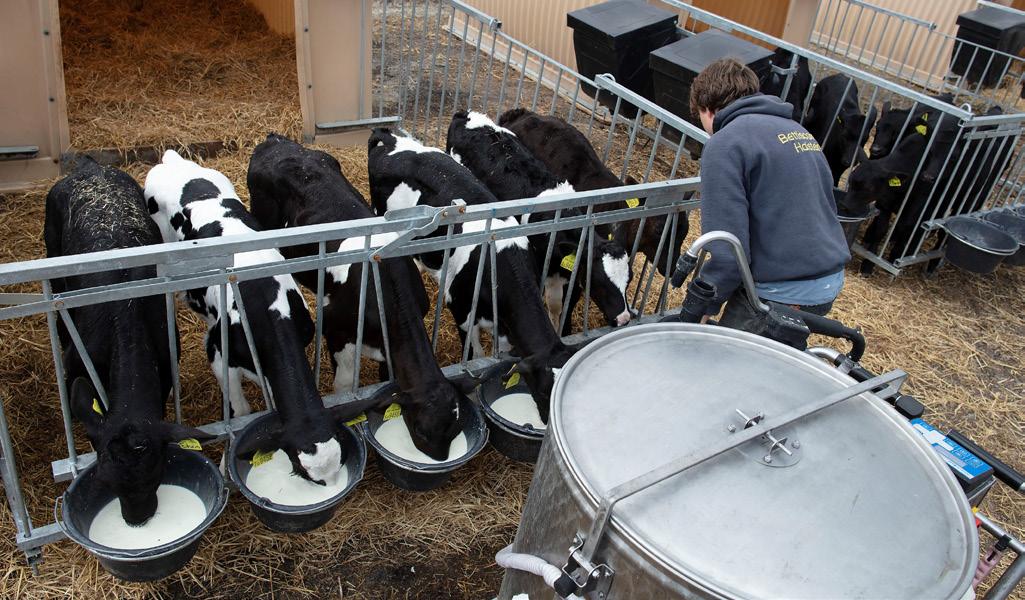
It’s important to use up-to-date knowledge to ensure maximum use is made of the correct ingredients and other ‘non-essential’ ingredients
are not wasted. This saves input costs, but it also helps to meet environmental goals, such as Defra’s water nutrient pollution targets.
As part of its environmental improvement plan, the target, set for December 31, 2038, is a 40% reduction of nitrogen, phosphorus and sediment from agriculture into the water environment from a 2018 base level. Interim targets of between 10% and 15% by January 31, 2028 have also been published.
Methane-reducer
Enteric methane produced by ruminants is the main contributor to greenhouse gases in the livestock sector. New innovations, such as SilvAir®, are proven to reduce methane production. It also brings other dietary benefits that support more sustainable production.
SilvAir® is a carefully manufactured feed-grade calcium nitrate comprising 76% nitrate and 22.5% calcium, with a dry matter of 84%. In trials, where it is included at a rate of 1.6% of the total dry matter in dairy diets, it has been shown to reduce methane emissions by up to 10%.
It also offers an alternative source of dietary protein and calcium, adding to its contribution to more sustainable production.
Diets that include SilvAir® must be reformulated to ensure correct amounts of crude protein are supplied and excess levels are avoided. It must also be used in compound feeds at the recommended inclusion rates, that are based on scientific research.
AI in poultry
Another example of a sustainability-led and integrated programme is Cargill’s poultry microbiome intelligence service Galleon®, as shown in Figure 1.
This service uses a representative number of faecal samples from a flock to determine the gut microbiome. Swabs are analysed and the results are identified against the company’s poultry microbiome database.
Cargill has collected a profile of gut microbiome from flocks across the globe for the past decade. This database now holds more than 25,000 samples and is still growing.
PAge 42 July/August 2023 Feed Compounder Supporting
It provides UK poultry producers with access to one of the world’s largest microbiome databases and, as more samples are added, this database’s accuracy increases.
The platform links automated laboratory analysis, that focuses on a list of microbial biomarkers shortlisted during the past few years, and a proprietary intelligence tool. This tool combines powerful statistical designs with advanced artificial intelligence models to extract the most important relationships that can be converted into insights for practical application.
The validation of this platform includes more than 100 events (datasets) between research trials and field exercises across a range of countries and farm conditions.
This is where the knowledge and skill really step in as the results on their own are meaningless. Cargill has a specialist team in poultry gut microbiome. It’s not something that can be done on farm, but once these details are known the technical team can work with producers to suggest interventions to help improve performance.
On-farm benefits
Detailed and accurate information about the farm’s unique gut microbiome profile can be applied to practical farm management and nutritional practices.
It provides a link to meeting the challenges between microbiome composition, bird and flock performance and interventions in commercial practice.
Information specific to a flock can be used to assess health status, resilience to disease, livability and overall performance. The information can also be used to help understand the effect of changes in diet or management.
It has been used to identify a specific pathogen that causes leg health issues. And, for feed companies, it has been used to demonstrate the effect of an additive on gut microbiota. Even if a particular additive does not result in a big gain in performance, the information can help determine the cost-effectiveness of the additive.
In other cases, microbiome results are used to fine-tune formulations to promote bacteria that will help improve feed use and conversion, and support production sustainability.

Galleon® received a top global accolade by winning a Gold in the Food and Agriculture Advancements category in the 2023 Edison Awards. It is already being used in flocks in the UK.

Sustainable at source
This spring saw Cargill Animal Nutrition UK move to using only sustainable soya sources in its Neopigg Max® piglet diets and the prestarter chick diet Neochicc.
This sustainable soya, Triple S® soya, is sourced from areas in Brazil, Argentina and Paraguay that are guaranteed deforestation-free since 2008. Importantly, the soya in Triple S® is also fully traceable to individual farms so the supply chain, including feed compounders and retailers, know exactly where it comes from.
Its production is part of farmer-focused sustainability programmes with each producer independently audited and supported with agronomy advice and continuous improvement goals. The farmers must meet
social, economic and environmental targets, set out under the Triple S® production guidelines.





For pig and poultry producers, Triple S® soya has the same nutritional value as the previously used soya, so no reformulation of diets is required. It meets the European Feed Manufacturers’ Federation (FEFAC) requirements for sustainably sourced soya. And it is also recognised by UK retailers as a step towards more sustainable sourcing of animal feed and increasing sustainability in the supply chain.
Cargill’s Provisoy®, a patented highly digestible processed soya used in monogastric diets, is also manufactured using soya that is certified by the Round Table on Responsible Soy (RTRS).
Multi-factorial
Improving sustainability is multifaceted and progress will rely on many changes. This is why Cargill has introduced species-specific programmes that put products and services with efficiency and welfare benefits designed to improve sustainability under one roof. It then allows the right combination to be used to suit each business. Improved sustainability takes an all-round approach and no one solution fits all.
One of the leading global food and farming companies, Cargill has taken a leading role in addressing sustainability. The company was ranked in the top 10 of the World’s most sustainable food manufacturers by Sustainability Magazine, June 2023.
Its driving ambition is to establish the most sustainable food supply chains worldwide by making connections through the supply chain in four key areas: climate change, which means reducing its own emissions and helping farmers adapt, improving land use, such as reducing deforestation; protecting water resources, particularly improving conservation; and by focusing on farmer livelihoods, particularly by advocating best practice. Environmental sustainability, with carbon emissions being a key factor, has added more complexity to livestock production. Achieving more sustainable milk, egg and meat production is multi-factorial. The industry must rely on tools to evaluate performance through the chain, and home in on the right areas to improve.
For more details
www.cargill.com/sustainability
www.cargill.com/galleon
Feed Compounder July/August 2023 PAge 43
Figure 1: Galleon® microbiome analysis tool
Spotlight on … FEED MILL PROCESS ENGINEERING
Condex (UK) Ltd
Knowledge and experience as part of the package, since 1980
Our supply and engineering package has been developed over many years to compliment the needs of our customers.
This starts with the basic service of identifying issues such as pellet quality, cooling efficiency and working with the customer to help improve process quality and productivity.
If replacement equipment or upgrades are needed, we offer high quality, robust, low maintenance equipment and our own UK based commissioning and service engineers.
With system design and installation, we can work with a customers preferred contractors. Alternatively offer a complete turnkey design and installation package, with a single point of contact for the customer.
Projects are managed in-house from concept through to commissioning. After sales service and support ensures our clients continue to receive the best service, even long after any project has been completed.
As a well-established supplier of equipment and services to the industry, we have a fundamental understanding of how to optimise equipment performance while still considering access and maintenance requirements in all areas of our design.
Working closely with our clients to expose any existing issues or bottle necks, optimising and modernising systems for expansion and increased throughput. At all times keeping ahead of legislation and industry requirements.
We offer this service to all clients as part of our equipment supply package, so whether you are just looking for equipment or looking for a company that can offer the complete package, in-house, we look forward to hearing from you.
Condex (UK) Ltd, White Cross, Lancaster, LA1 4XQ
Tel. 01524 61601 Email: info@condex.co.uk Web: www.pelletmills.com
Croston Engineering
Croston Engineering, formed in 1976, specialises in the design, building and servicing of bulk storage, mechanical/ pneumatic conveying, and weighing systems for the animal feed and many other associated industries throughout the U.K. These include pet food, grain, human food and drinks industries from intake of raw materials to out loading of finished products.
As an adjunct to new developments, the Company carries out improvements or extensions to existing production plants in compliance with the requirements of DSEAR/ATEX Explosion Regulations when applicable.
Croston Engineering is an Approved SafeContractor which is a recognised standard of competence throughout industry in complying with the requirements of safety legislation and procedures.

Tarvin Mill, Barrow Lane, Tarvin, Chester CH3 8JF
Tel: 01829 741119
Fax: 01829 741169
E-mail: admin@croston-engineering.co.uk
Web: www.croston-engineering.co.uk
Ottevanger Milling Engineers B.V.
Founded in 1909, Ottevanger Milling Engineers specializes in the design and manufacture of equipment and complete installations for the grain-processing and compound feed industry. This includes the design, manufacture and management of complete (turnkey) production facilities or individual lines for processes. Our engineers plan and create entire plants – across multiple continents and in diverse markets ranging from mixed feed, premixes, additives, aqua feed, pet food and soybean processing. Our project and site management teams can implement the most complex projects; while our craftsmen build a wide range of highperformance production machinery that’s built to last.
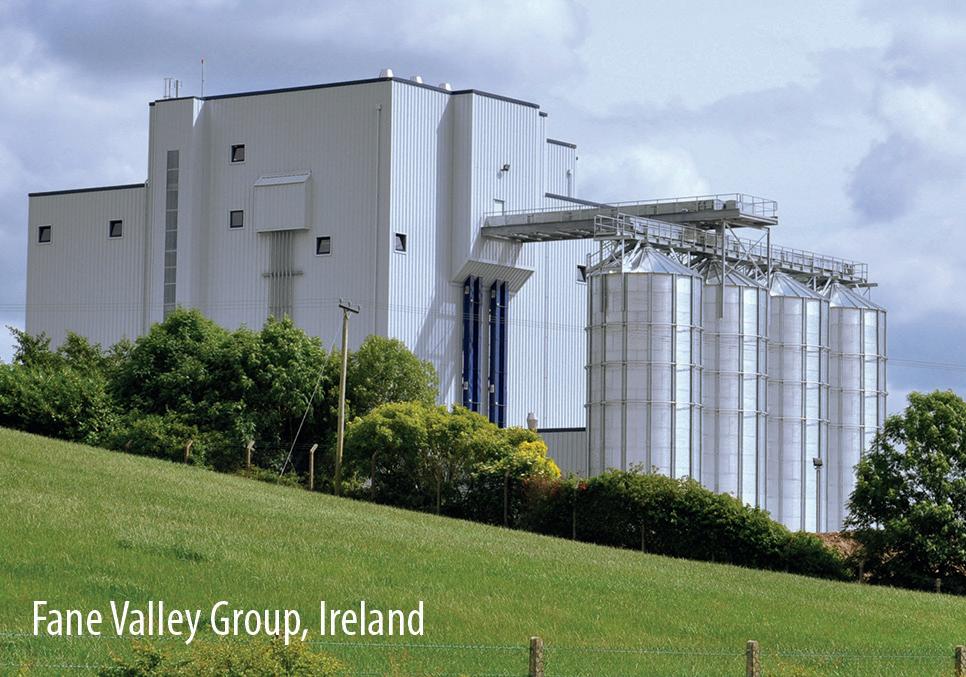
PAge 44 July/August 2023 Feed Compounder
Our product range includes mixers, hammer mills, pellet mills, conditioners, extruders, driers/coolers, crumblers, crushers, conveying equipment, weighing, liquid dosing systems, storage silos for grain and feed, spare parts, electric control and fully process automation and after sales service worldwide. We also offer our unique containerised mills which can be supplied in the range of 1 to 45 tonnes per hour. The equipment is installed in 20-foot containers which can be handled as separate modules.
We are part of the Triott Group, a family-run (privately held) production technology business that helps society produce a greater quality and quantity of animal feed and food – wherever in the world you are. Whatever your milling challenge, there’s a good chance we can solve it. So, whether you are striving for quick wins or a long- term strategic overhaul of your operation, we would love to hear from you. Web: www.ottevanger.com Email: info@ottevanger.com
van Mourik group
At van Mourik Process Optimisation is our way of thinking.
The van Mourik group focusses with a very experienced team on: consulting, design and realisations of feed milling projects.
Our long standing service and maintenance activities is the backbone of the company and forms the foundation of experiential knowledge which gives van Mourik its distinctive skill set that enables the optimizing of your processes and development of capital improvement plans.
Van Mourik started in 1990 as a mechanical installation company. By strategic take-overs and natural growth the company has become a unique specialized neutral integrator employing 150 FTE with its focus on feed milling and premix process. The clients value our neutral position in the engineering studies and process advice.
An example of the approach is a recent request of an independent client that needs to study an increase of its production by 25%. A dedicated team from van Mourik consisting of process specialists that have their own expertise in mechanical and electro technical control scanned the process of the client. Combined with the clients goal Van Mourik makes a future process plan with a neutral advice on the equipment. This time it resulted to a concept change from an additional grinding/mixing tower to an upgrade proposal for an existing production line.
Of course this approach can be the backbone of a bigger investment in a complete new production line to become future proof. The van Mourik group offers to help clients in the UK and Ireland with this approach to achieve efficiently and effectively their future goals. Web: www.vanmourik-group.com
UFAC-UK unveils new major mill upgrades
U FAC-UK has completed a major upgrade to its unique UK manufacturing facility, enhancing production efficiencies and helping to reduce its carbon footprint, through the use of intelligent control systems.
Headquartered in Newmarket, with production co-ordinated from the dedicated UK mill site in Woolfox, Rutland since 1979, the latest stage of UFAC-UK’s mill development programme has seen a significant investment in a new, bespoke manufacturing management software system and advanced liquid holding facilities, to further increase capacity.
Completing an 18-month programme of innovation and development across the facility, the latest updates will help meet the growing demand for UFAC-UK’s energy, protein and Omega 3 nutritional solutions, as well as providing increased capacity for bespoke formulations and new product development.
“The main focus of all our upgrades has been based around sustainability and efficiency, covering everything from the installation of the new storage tanks and IT system, right down to our new recycled polymer bags and reduced timber pallets on our packaging and
distribution channels,” explains Richard Jones, UFAC-UK commercial manager, who has been over-seeing the upgrades.
“The new IT system has had a significant improvement on the flexibility and efficiency of operation, regulating when machines are required to be in operation and therefore reducing overall operation time when lines are not required for specific runs,” he adds.
Robert Jones, UFAC-UK managing director, comments, “As a company we are constantly looking at opportunities to drive sustainability, productivity and efficiencies both within our own operation, but also on behalf of our partners and customers.”
Exporting 40% of everything produced at the Woolfox site into Europe and across global markets, UFAC-UK operates in over 25 countries worldwide.
“With the upgrades to our UK production facility, we are perfectly positioned to meet growing UK and international demand, but also further invest in the research and product development that has been the cornerstone of the business success,” continues Mr Jones.
“All of this is achieved while we are also improving efficiencies, sustainability and environmental credentials,” he concludes.
Feed Compounder July/August 2023 PAge 45
Products Influencing Feed Characteristics
ADISSEO
Adisseo Mycotoxin Management Nutritionists are good at creating the best possible diet, using only the best raw materials. However, what they can’t control is what happened before receiving the raw materials. What were the conditions out in the field or during storage? Mycotoxins can be present and have a huge impact on the health and development of animals. This is especially critical for breeding animals, which are affected more severely by mycotoxins in feed, compared to finishing animals.
Adisseo is a leading expert in controlling moulds and mycotoxins in animal feed and raw materials. Adisseo offers a complete range of EU-approved and hands-on solutions for a diversity of animal species and situations. These include UNIKE® PLUS, the best solution against broad-spectrum mycotoxin contamination in feed. It assures
to maintain good health and maximum performance, even of the most sensitive animals. Adisseo solutions have been tested extensively and have proven their reliability. Additionally, Adisseo supports its customers with mycotoxin analytical services, providing accurate information on field status which - in combination with the MYCOMAN® app - means that you can make the right choice of product and product dosage quickly and effectively, supporting customers in protecting their animals and achieving higher performance.
Furthermore, Adisseo has just published MYCOPEDIA, the technical reference book of mycotoxins. With contributions from over 30 experts and based on over 1,000 scientific publications, MYCOPEDIA offers unparalleled knowledge in an easy-to-navigate format. It’s the must-have guidebook for industry professionals seeking comprehensive and up-to-date information on mycotoxins in animal nutrition.

Contact: John Dunne or Sarah Davies
Email: info.nauk@adisseo.com

Web: www.adisseo.com
ADISSEO PRESENTS MYCOPEDIA, THE “ULTIMATE GUIDEBOOK OF MYCOTOXINS IN FEED”
Key findings from over 50 years of research have been concentrated in a single practical guidebook. Mycotoxins have long been recognised as a significant challenge in livestock production, jeopardising animal health, performance, and overall profitability. However, some in the industry continue to downplay the impact these compounds can have on their operations and/or rely on misconceptions or outdated information when developing their mitigation strategies.
With Mycopedia, Adisseo aims to empower industry professionals, who may not be experts in these toxins but require comprehensive knowledge, to effectively mitigate their adverse effects, with the latest in insights and opinions from academic and industry experts in the field.
The official launch of this Guidebook was held at ESPN in Rimini on June 20th, Italy.
The company has described Mycopedia as: “Unique in its kind, it is also easy for any reader interested in a specific topic to delve into it further with its section on data sources. As a tool, it is both handy and
timesaving for anyone interested in learning more about mycotoxins in animal nutrition.”
Mycopedia contains:
• More than 50 years of research summarized in a single book.
• Over 1,000 scientific publications referenced.
• More than 30 contributing experts.
• 388 pages to learn all about mycotoxins in feed and animal production.
Adisseo believe that Mycopedia will allow you to:
• Expand your knowledge of mycotoxins: their genesis and their origins (as summarized in mycotoxin ID cards), penetration pathways, critical accumulation sites and differences in appearance by geographic region and climate.
• Improve your understanding of mycotoxin’s impact on animal performance and health: a closer look at the specific effects of mycotoxins.
• Discover more about mycotoxin mitigation strategies: Implementation once contaminated feed has been ingested.
• Use our knowledge to stay ahead of future trends and fight climate change: which is expected to have a significant impact on plant biogeography and fungal populations, with effects on mycotoxin patterns.
This book is available from Adisseo representatives and online.
PAge 46 July/August 2023 Feed Compounder
ALLTECH
Leaders in our field. Proven results in yours. Ever-present in grain and forage ingredients, and a potential threat to the productivity of even the best-run livestock production operations, mycotoxin contamination should be on every feed and livestock producer’s radar.
Using a combination of modern management tools, the Alltech® Mycotoxin Management program provides a holistic solution to help producers take control of the mycotoxin challenge. The program is built around class-leading risk identification technology, data analysis and insights, and mycotoxin binder solutions designed to reduce the damaging effects of mycotoxins on animal health and production potential.
Identifying and quantifying the mycotoxin risk
Tools such as Alltech RAPIREAD® and Alltech 37+® provide feed and livestock producers with both lab and field-based mycotoxin detection. Once mycotoxin levels are detected, Alltech’s online analysis portal allows users to quantify what the physical and financial cost of that risk is depending on the species and animal groups that are being fed. These insights then inform the most effective decisions when it comes to implementing a mycotoxin mitigation plan and choosing an appropriate in-feed nutritional solution.
Mycosorb A+®: A broad-spectrum mycotoxin binding solution
Containing both yeast and algae, and developed through decades of research, Mycosorb A+® is designed to reduce mycotoxin absorption within the animal and proven to offset the risks to health and productivity that are associated with mycotoxin-induced damage. In addition to contributing to the control of mycotoxins, Mycosorb A+ also helps to support immune function and gut health within the animal, with proven efficacy at extrusion temperatures of up to 125°C and stability over a wide pH range.
Tel: +44 (0) 1780 764512
Web: knowmycotoxins.com | Alltech.com/uk
AZELIS
Azelis Organic Acids Range

The control of detrimental moulds and bacteria in the feed and agricultural industry is critical as they threaten not only livestock health, performance and productivity but can also lead to contamination in the food chain threatening human health.
The use of organic acids is well established and can play an important role in contributing to environmental hygiene by helping to protect feed and raw materials from microbial and fungal deterioration. Azelis now offers a range of organic acid formulations for the GB feed market on behalf of Swedish organic acid producer Perstorp, whose expertise in this area has led to their innovative and highly effective range of organic acid based products. Research and field trials have
shown their products to have a standout position across the areas of feed preservation, feed acidification and feed hygiene.
The Perstorp range offered by Azelis includes:
• ProPhorce™ SA Range dedicated to pathogen mitigation in feedstuffs, ingredients and finished feeds.
• ProPhorce™ PH & AC Ranges designed to improve animal welfare and performance.
• ProPhorce™ Water Solutions Range; using organic acids in water is an easy and well-established method to help preserve water quality and safeguard animal performance.
• ProSid™ MI 700 maximum grain protection.
• ProMyr™ TMR protecting nutritional value of TMR on farm.
Azelis Natural Minerals Range
Azelis offers a range of natural minerals for the UK and Irish feed sector on behalf of Imerys.
The range includes:
• SmectAgri®, a bentonite solution authorised for use as both pellet binder and mycotoxin(Aflatoxin) binder.
• Diamol®, a unique diatomaceous earth type known as moler, used as a natural carrier and anticaking agent. It helps feed and premix producers improve flowability and homogeneity of ingredient inputs and formulations. Diatomaceous earth is a natural mineral and its physical characteristics offer high effective free flow as an anticaking agent and high absorption as a carrier for liquids, oils and fats.
For further information please contact Leia Trotman at Azelis on: +44 (0)7792116659 or via email: leia.trotman@azelis.co.uk
BIOCHEM
B.I.O.Tox Activ8® – it’s time to detox
Successfully binding the mycotoxin DON is a challenge due to the special molecular properties of the mycotoxin. This is particularly difficult in high pH environments, such as that of the small intestine, where mycotoxin damage can result in cytotoxic effects on cells and result in reductions in growth performance or fertility issues.
B.I.O.Tox® Activ8 is the result of a careful selection of different raw materials, their further processing, extensive testing and the perfect ratio of the single ingredients. The well-balanced composition of mineral binding agents is able to bind all currently relevant mycotoxins, including DON.
Like all the other members of the B.I.O.Tox® family B.I.O.Tox® Activ8 starts to work immediately after uptake; important for DON as first serum levels are seen 20 minutes after ingestion. B.I.O.Tox® Activ8 contains additional phytogenic components to support metabolism and oxidative stress caused by mycotoxin damage. Altogether B.I.O.Tox® Activ8 is a valuable building block in a smart mycotoxin management, which is one essential point in stabilizing gut integrity and animal health.
Contact: Oliver Caiger-Smith Technical Sales Manager
Email: Caiger-Smith@biochem.net
Mobile: +447722 019727
Feed Compounder July/August 2023 PAge 47
DSM ANIMAL NUTRITION & HEALTH Mycofix®
The Mycofix® portfolio of feed additives represents the most state-of-the-art solution for protecting animal health by deactivating mycotoxins that contaminate farm animal feed. Its safety and efficacy are proven by 7 EU authorizations for substances that deactivate mycotoxins, this makes it completely unique in the market place.
Mycofix® Plus 5.E unites three strategies to combat mycotoxins using patented proprietary technology, making it the most scientifically advanced mycotoxin protection available:
• Adsorption – a blend of minerals selectively binds aflatoxins and other absorbable toxins
• Biotransformation - A unique combination of patented specific enzymes and biological components converts mycotoxins into non-toxic, environmentally-safe metabolites in the digestive tract of animals, before they are absorbed in the GIT, therefore preventing their deleterious effects on animal health and performance*
• Bioprotection - the Biomin® Bioprotection Mix in Mycofix® Plus 5.E supports proper liver and immune system function. It also prevents gut leakage, supporting the intestinal barrier function of the animal
*Mycofix ® Plus 5.E contains the only EU authorized feed additives proven to adsorb or to biotransform mycotoxins into nontoxic metabolites. (Regulation No 1016/2013, No 1060/2013, No 1115/2014, No 2017/913 and No 2017/930)
Furthermore, Mycofix® Plus 5.E protects against a weakened immune system and lower performance caused by endotoxins, even in the presence of adsorbable mycotoxins such as aflatoxins.
Mycofix® can be incorporated into feed or premix and is available in a range of formulations to best support customers’ needs.
For more information on Mycofix® in the UK and Ireland, place take contact to your feed supplier or your usual contact within DSM. Web: www.dsm.com/anh

KEMIN Know your Carbon footprint
A ccelerating greenhouse gas (GHG) emissions worldwide have created elevated concerns about the effects of climate change and the impact of GHGs on the planet. In 2015, the United Nations (UN) adopted 17 Sustainable Development Goals aimed at restoring and promoting social, economic and environmental sustainability. Goal 13 – “Take urgent action to combat climate change and its impacts.” – emphasizes that actions need to be integrated into national policies, strategies and planning. Identifying measures to reduce on-farm emissions contributes to this goal.
Kemin, Dow and Adesco jointly conducted a gate-to-gate life cycle assessment study to investigate the GHG emissions in CO2-eq of barley and wheat using three different methods of grain storage: aeration, drying and preservative addition. The results from this study demonstrate that drying and aerating grain create a bigger carbon footprint than treating grains with Myco CURB ES Liquid. Offering the industry an immediate, significant and practical means to reduce the carbon footprint of grain processing and feed production.
Web: www.kemin.com/sustainablepartnerships
ORFFA

Excential Toxin Plus
Mycotoxin contamination in feed is an increasing challenge in animal production since it negatively affects animal health and performance. Mycotoxins are the secondary metabolites of fungi and are often found as contaminants in feed. Therefore, the inclusion of a broad spectrum mycotoxin adsorbent in the feed to alleviate this harmful contamination is a recommended solution. One of the most common mode of actions of mycotoxin adsorbents, as already indicated by the name, is binding of mycotoxins which prevents the mycotoxins from being absorbed in the gastrointestinal tract of animals and exerting their negative effects. Commercial mycotoxin binders vary in their capacity to adsorb mycotoxins but Excential Toxin Plus has been shown to be one of the best binding mixtures in the market. However, some mycotoxins, such as the trichothecenes, remain difficult to bind. Therefore, it is important to include products that not only binds the mycotoxins, but also uses other strategies to protect the animal against the harmful effects of mycotoxins. Excential Toxin Plus improves mycotoxin defenses via a combined approach, by using five synergistically working ingredients. Besides the aluminosilicates
PAge 48 July/August 2023 Feed Compounder
and yeast aimed at adsorption of mycotoxins, Excential Toxin Plus also contains ingredients that are included to reduce the growth of fungi in stored feed and to support intestinal integrity and liver health. This unique combination of ingredients makes Excential Toxin Plus a broad spectrum toxin binder, that matches the mycotoxin binding capacities of premium commercial available products, and more!
Web: www.orffa.com
TECHNA NUTRITION
Vital Protect® Secure
Vital Protect ® is a multi-species (Pig, Poultry, Ruminants) approach designed to safeguard animal health and performance from mycotoxin contamination. Vital Protect ® Secure is a key product used in this approach, formulated with a careful selection of natural ingredients that have been extensively researched and tested to counteract mycotoxin contamination.
Due to an innovative blend of clay, yeast cell wall and botanicals, Vital Protect® Secure, is known for its ability to restore and maintain optimal animal performance when challenged with mycotoxin contamination.
Vital Protect® Secure promotes animal well-being/performance by neutralising mycotoxins (when tested with aflatoxin B1 a 93% adsorption capacity was demonstrated). The addition of plant extracts such as milk thistle and curcuma help support liver, kidney and immune health which are vital organs that are damaged by dietary mycotoxin exposure. Performance improvement can include reduced FCR, improved average daily liveweight gain and increased weights when challenged with multi-mycotoxin contamination, as seen in poultry trial results in the images below.
fed with Vital ProtectⓇ Secure demonstrated an increased number and mobility of protozoa in the rumen, indicating a better rumen capability.
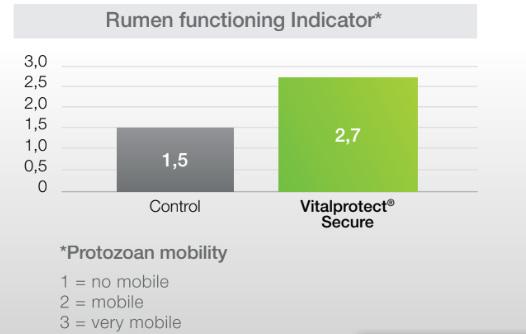
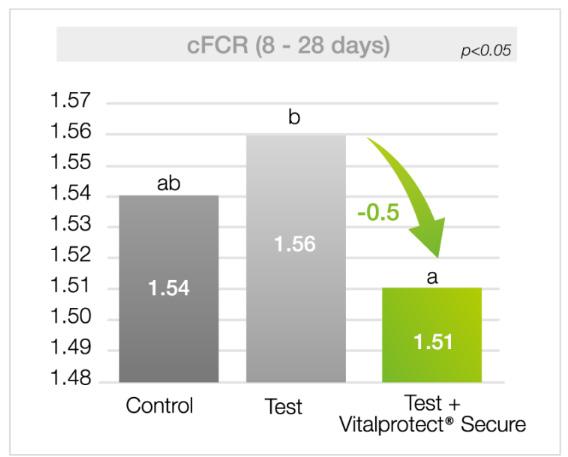
The specific blend of the product supports a healthy and efficient functioning of the digestive tract negatively impacted by mycotoxins. In a dairy trial, cows exposed to mycotoxin contaminated feed, when
Vital Protect® Secure is designed to be easily integrated into animal diets with tailored rates for each species and mycotoxin burden. Moreover, its natural composition ensures that it is available for use in conventional and organic systems.
Web: www.groupe-techna.com/en
TROUW NUTRITION

Our Selko feed safety and milling efficiency team can offer their specialist expertise to review and optimise each step of the production chain for safety, profitability, and sustainability.
Your dedicated feed additives engineer can advise on, and install, bespoke automated dosing equipment for all liquid applications.
All product users have access to our laboratories for shelf life testing, microbial and mycotoxin analysis, and moisture profiles.
Selko offer a range of product solutions depending on your needs:
Fylax® - An organic acid blend specifically developed to reduce microbial risk both in mill and raw material preservation with added benefit to reduce energy usage and increase moisture profiles during both mill and rolling processes.
Fysal® - An organic acid blend specifically developed to reduce Salmonella (re) contamination risk in vegetable and protein meals.
TOXO® - A broad-spectrum smectite clay mycotoxin binder that binds mycotoxins and mitigates animal performance impairment caused by exposure to mycotoxins.
Revalet® - A broad spectrum organic acid blend which supports the control of micro-organisms (yeasts, moulds and Enterobacteriaceae) in co-products. Resulting in shelf life extension while maintaining the nutritional value of the by-products. Helping to reduce food waste and repurpose back into feed and support sustainable choices. For more information contact our feed additives team:
Email: technical.gb@trouwnutrition.com
Web: www.trouwnutrition.co.uk
Tel: +44 1335 341100
Feed Compounder July/August 2023 PAge 49
DSM-FIRMENICH LAUNCHES ENVIRONMENTAL PRODUCT DECLARATION (EPD) PROJECT TO ADDRESS CREDIBLE SCOPE 3 REPORTING
dsm-firmenich’s Animal Nutrition and Health business unit has launched a new Environmental Product Declaration (EPD) initiative to provide credible Scope 3 reporting to help customers reach emissions commitments.
The EPDs, provide technical documents that communicate the full environmental footprint per kilogramme of dsm-firmenich products across 19 impact categories from raw material sourcing to manufacturing in line with the EU Product Environmental Footprint methodology.
By offering transparent and credible data, dsm-firmenich aims to support the industry’s need for greater transparency and sustainability in animal protein production, empowering customers to make informed choices that reduce their carbon footprint and contribute to a more sustainable industry.
To ensure the credibility and objectivity of the EPD data, all results undergo thirdparty assurance by DNV Assurance B.V., confirming compliance with international life cycle assessment standards (ISO 14021:2016) and enhancing the transparency and reliability of the information provided.
OCEAN HARVEST TECHNOLOGY GROUP PLC
Feed Trial Results Update
Ocean Harvest Technology Group plc was pleased to announce the results from four recently completed feed trials. The first three trials were carried out by universities in conjunction with potential customers whilst the swine trial was undertaken directly by a potential customer.
Highlights:
• A laying hen trial confirmed improvements in both egg production and feed efficiency when birds were fed an OceanFeedTM Poultry supplemented diet. These performance improvements materially increased income per hen.
• A catfish trial demonstrated that fish fed with OceanFeedTM Aqua in their diets had higher feed intake and weight gain, leading to a substantial increase in final weight.
• A trial with juvenile shrimp where OceanFeedTM Aqua improved both weight gain and feed efficiency, thus reducing production costs. OceanFeedTM Aqua also helped reduce mortality in a disease
challenge trial run in parallel.
• A commercial swine trial reported material improvements in feed efficiency in piglets with OceanFeedTM Swine included in their diet.
OceanFeedTM Swine successfully replaced a combination of seven conventional gut health additives.
Commenting on the trials Ocean Harvest Technology Group plc stated “These results add to our substantive dataset demonstrating the efficacy of OceanFeedTM in improving animal performance across a range of species, and highlights the important benefits of using OceanFeedTM ingredients in a number of applications. The substantial and growing breadth of data across multiple species is helpful in driving new customer adoption which remains an important aspect of OHT’s revenue growth.”
CARGILL’S POULTRY GUT INTELLIGENCE SOLUTION WINS PRESTIGIOUS INTERNATIONAL AWARD
The broiler microbiome intelligence solution Galleon™, developed by Cargill, received a top global accolade by winning a Gold in the Food and Agriculture Advancements category in this year’s Edison Awards.
The Edison Awards, named after the American inventor Thomas Alva Edison, recognise some of the most innovative products and business leaders in the world.
From thousands of nominations from around the globe, 153 were selected as finalists for awards, which were presented on April 19 to 21, 2023, in Florida, USA.
Galleon is designed to help improve poultry producers’ ability to navigate animal health challenges by providing more in-depth and precise details on the flock’s specific gut microbiome.
The non-invasive procedure involves taking cloacal swabs from a few birds on the broiler unit for analysis. Results are then compared with Cargill’s poultry microbiome database of more than 36,000 samples to make recommendations on steps to improve performance.
The analysis and interpretation combine powerful statistical designs with advanced artificial intelligence models to extract information regarding key bacterial relationships within the gut of the bird. These are interpreted for practical application by a team of highly-skilled Cargill specialists.
The information, which is specific to each flock, can be used to assess the microbiome health status, resilience to disease, livability, and overall performance. The data can also be used to help understand the effect on the microbiome of changes in diet or management.
“Gut microbiome is an important driver in determining the health and performance of the host; in this case the broiler, and it plays a crucial role in determining the birds’ performance,” says Cargill’s UK commercial poultry manager David McBride.
“The more detail we know about a flock’s gut microbiome, the better we can manage the birds, and the more precisely we can formulate diets to support improved performance or help overcome a limitation. Galleon is groundbreaking technology that enables us to do this better. It is already bringing practical and tangible benefits to UK flocks.”
SFT EDGAR PYE SCHOLARSHIP OPEN FOR APPLICATIONS
The SFT Edgar Pye Scholarship for 2023 is now open for applications. This year there is a £2,000 prize fund available.
The Edgar Pye Research Scholarship Trust (Registration Charity No. 1004754) was founded following the untimely death of R. Edgar Pye in July 1989, President of the Society of Feed Technologists, to perpetuate his memory by offering research scholarships relating to the animal feed industry.
If you would like further information and how to apply, please email the SFT secretary directly at secretary@sft.uk.com.
FORFARMERS CANCELS NEARLY 6 MILLION SHARES ON 27 JUNE 2023
ForFarmers announced the cancellation of 5,935,004 shares on 27 June 2023. ForFarmers has repurchased these shares for a total amount of €23,245,424 under the share-buyback programme to the amount of, at maximum €50 million, which was approved by the General Meeting of Shareholders in 2021. On 15 March 2022, ForFarmers announced that it considered it prudent to temporarily suspend the sharebuyback programme, which had started on 2 December 2021. Subsequently, ForFarmers reported in its Third quarter 2022 trading update on 1 November, not to restart the share-buyback programme.
The current share-buyback program for a maximum of 625,000 shares, for a maximum amount of €3,125,000, is still ongoing. This programme started on 18 April 2023 for the purpose of ForFarmers fulfilling its obligations under the (depositary receipts for) share-related incentive schemes and obligations from employee participation plans 2022. The buy-back programme will end no later than December 31, 2023, or when the programme has been completed.
All the conditions for cancellation of the shares have been met. The share capital has been adjusted in the articles of association of ForFarmers, the announcement regarding the intended withdrawal has been made and the declaration of no objection has been received from the Court.
After cancellation of the 5,935,004 shares, ForFarmers will have 89,283,817 issued ordinary shares, of which 89,082,499 outstanding as of today. The cancellation of the shares in question does not affect the voting ratio or the number of shares entitled to dividend.
PAge 50 July/August 2023 Feed Compounder
Wynnstay Group Plc Interim Results for the six months ended 30 April 2023
Wynnstay Group Plc has released its interim results for the six months ended 30 April 2023 with the group stating that it remains on track to deliver its underlying FY23 targets. The key points of the results are listed below.
KEY POINTS
Financial
• Good overall result in softer trading conditions; underlying performance in line with management expectations
• Revenue up 22% to £409.14m (2022: £335.66m)
� commodity price inflation accounted for estimated £48m of the rise
� full period contributions from Humphrey and Tamar acquisitions
• Adjusted operating profit* was £5.78m, (2022: £10.43m, including one-off fertiliser gains)
� H1 2022 results benefitted from the significant one-off fertiliser stock price gains. In this reporting period, the fertiliser blending activities at Glasson contended with a reversal of the abnormal spike in fertiliser raw material prices, which created one-off adverse stock realisations
• Underlying pre-tax profit* (including an estimated £1.5m of one-off adverse Glasson fertiliser stock realisations) of £5.25m (2022: £10.21m) / Reported pre-tax profit of £5.07m (2022: £9.56m, including one-off fertiliser gains)
• Basic earnings per share were 17.20p (2022: 36.99p)
• Net debt (pre IFRS 16) of £10.68m (30 April 2022: £7.62m); reflected acquisition funding and high working capital requirements, which typically peak around April and reduce in H2
• Net assets up 18% to £131.97m/£5.90 per share (30 April 2022: £111.68m/£5.50 per share)
• Increased interim dividend of 5.50p (2022: 5.40p) - following 19 years of unbroken annual dividend growth
Operational
� Breadth of Group activities remains a strength, helped to balance sector variations
� Agriculture Division - revenue of £333.57m (2022: £263.03m), operating profit contribution of £2.08m, including c.£1.5m oneoff adverse Glasson fertiliser stock realisations (2022: £6.06m, including positive Glasson fertiliser stock gains)
� Glasson contended with a sharp reversal of fertiliser raw material prices back to pre-exceptional and more sustainable levels
� feed volumes decreased by 1.3% and by 7% on a like-for-like
basis, in line with the sector. Cost inflation around labour, distribution and packaging costs
� arable activities benefited from record grain trading volumes and strong demand for winter and spring cereal seed inputs, while fertiliser sales were suppressed by high prices in line with national trends
� Specialist Agricultural Merchanting Division - revenue of £75.57m (2022: £72.63m), operating profit contribution of £3.44m (2022: £4.28m)
� like-for-like sales increased, reflecting inflation
� Acquisitions: integrating the strategically important Humphrey acquisition and smaller Tamar acquisition. In Q2, Group assumed the activities of S.G. Deakins, an agricultural inputs supplier and trader based in Powys
� Investment programmes across Group progressed well, including Carmarthen feed mill project
Outlook
� Overall outlook for H2 is encouraging, with strong arable sector performance. Board expects Group to achieve its underlying growth objectives for the financial year although pressures remain
Gareth Davies, Chief Executive of Wynnstay Group plc, commented: “The Group performed well against softer trading conditions compared to last year and underlying performance is in line with our expectations. The extraordinary one-off gains of last year, generated by escalating fertiliser prices, were absent. Instead, our fertiliser blending operation at Glasson contended with a sharp reversal in the price of fertiliser back to the pre-exceptional and more sustainable levels of late 2021, which created one-off adverse stock realisations.
“During the first half, we continued with the integration of the Humphrey acquisition and with investment programmes across the Group to improve efficiencies and increase capacity.
“The overall outlook for the Group’s performance in the second half is encouraging, with the arable sector looking strong. However, taking a cautious view, at this stage we do not expect to make up the full impact of the Glasson shortfall. Outside that one-off cost, we remain on track to achieve our targets for the year.”
*Adjusted operating profit and Underlying pre-tax profit are nonGAAP (generally accepted accounting principles) measures and are not intended as substitutes for GAAP measures and may not be calculated in the same way as those used by other companies. Refer to Note 6 for an explanation on how these measures have been calculated and the reasons for their use.
Feed Compounder July/August 2023 PAge 51
Wedding Bells at Feed Compounder

Feed Compounder Deputy Editor Ryan Mounsey was married to Sophie Lockie on 24th June at Elmore Court, Gloucestershire. Ryan and Sophie were accompanied in their celebrations by Ryan’s parents, Andrew and Fiona Mounsey, Editor and Sales Manager at Feed Compounder; Grandmother Jane Mounsey, co-founder of Feed Compounder; and uncle, Simon Mounsey, Editor of Feed Additives Handbook.

The sun shone throughout and a great time was had by all. The day was rounded up with a toast to the happy couple with Velfrey
Pedro Cordero Elected as New FEFAC President at the 68th General Assembly
FEFAC’s 68th General Assembly, held on 14 June 2023 in Ystad, Sweden, during FEFAC’s 30th FEFAC Congress, elected Mr Pedro Luis Cordero Castillo, as its new President, for the next term 2023 – 2026. Mr Cordero (ES), a graduate of the Complutense University of Madrid (Veterinary – Animal Production sp), served as Managing Director of NANTA (NUTRECO), Spain & Portugal. He is Vice-President of CESFAC, The Spanish Feed Industry Association.
Pedro Cordero: “I look forward to representing the interests of the European Compound Feed and Premix Manufacturers in these challenging times, trying to buffer the impacts of the geopolitical crisis caused by the Russian aggression in Ukraine and climate change, which affect the economic sustainability of the EU livestock and aquaculture value chain.
As FEFAC, we welcome and support the EU Commission’s efforts to increase the resilience of our Agri-food systems to better withstand external shocks. This requires a full functioning of the Single Market and
The couple managed a few days away in the UK’s smallest city, St Davids before Ryan was back writing up the latest monthly feed production figures for Great Britain and Northern Ireland.
a level playing field for our livestock sector facing growing competition from imports not meeting the same high EU standards on sustainability and animal welfare. We will proactively contribute to the announced EU protein plan seeking to increase the EU’s feed and food autonomy for protein production.
Our industry can offer effective solutions to support our customers with climate change mitigation effects, such as raising protein efficiency and reducing of emission intensity of animal products. Our collective investment and toolbox development adopting new technologies, including the use of “big database” tools, like our Global Feed LCA database, can help accelerate the uptake of more advanced feeding techniques at Farm levels, as demonstrated in our latest publication. As FEFAC President, I will do my utmost to promote circular, sustainable feed solutions, integrating them into our best-practice professional recommendations to assist our customers with the transition to more sustainable production systems, as laid down in our FEFAC Sustainability Charter 2030”.
The 68th General Assembly also elected a new FEFAC Board:
• Pedro Cordero, CESFAC, Spain - President
• Asbjørn Børsting, DAKOFO, Denmark, Vice-President
• Bernd Schmitz, DVT, Germany – Vice-President
• Nicolas Coudry-Mesny, France, Vice-President
• Zoltan Pulay, HGFA, Hungary – Vice President
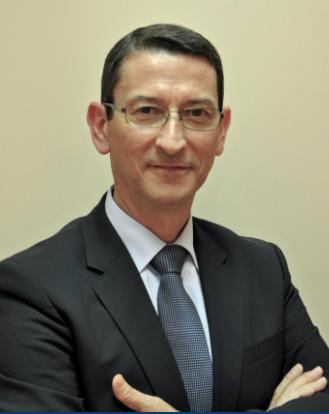
PAge 52 July/August 2023 Feed Compounder
Vineyard’s
award winning sparkling wine, which both Ryan and Sophie are involved in making.
• Dirk van Thielen, BFA, Belgium
• Elena Tsvetanova, BFMA, Bulgaria
• Iani Chiaia, ANFNC, Romania
• José Romão, Braz, IACA, Portugal
• Marcello Veronesi, ASSALZOO, Italy
• Marek Kumprecht, SKK, Czech Republic
• Ruud Tijssens, NEVEDI, The Netherlands
• Sara Bell, AIC, United Kingdom
• Wojciech Zarzycki, IZBA, Poland
Brinicombe Makes Changes at Board Level

Devon based animal nutrition manufacturing business the Denis Brinicombe Group has announced that it has made two appointments to the Board with existing senior managers making the step up.
Tom Butler who is the existing Group Technical Manager is moving into the role of Technical Director and current Head of Finance & HR
Brenda Pomery will assume the position of Finance Director with immediate effect.
Tom, a graduate from Seale-Hayne joined the Company in October 2006 as Operations Support, moving then into formulations and technical support before becoming Technical Manager in October 2011.

Brenda, an ACCA qualified accountant, joined the Company in June 2015 taking on the role of Head of Finance and shortly afterwards added HR to her daily tasks which she has held ever since.

Group MD Keith Greig commented, “We are delighted to welcome both Tom and Brenda to the board. Our business is quite different today to the one it was 20 years ago and they both bring valuable experience at a senior level. As we progress, develop and grow in different directions and diversify, the skill set of the board must grow and adapt in parallel”.
Rob Kiers Appointed as Member of the Executive Board of ForFarmers N.V.
ForFarmers’ shareholders resolved to appoint Mr Rob Kiers as Executive Board member as per 5 June 2023.
This resolution was taken during the Extraordinary General Meeting of Shareholders of ForFarmers N.V., which was held 5 th June. Rob Kiers will fulfil the position of Chief Operating Officer. The term of his appointment will start as of today and will end at the annual general meeting in 2027, when he is eligible for reappointment for another term of 4 years.
Eddy Ketels will step down as CEO of Orffa – Haiko Zuidhoff appointed as successor
Eddy Ketels will step down as CEO of Orffa at the end of 2023. He will be succeeded by Haiko Zuidhoff (pictured left) who will start in his new role as of 1 October 2023.
Eddy Ketels has been working for 35 years at Orffa. He became CEO in 2001. Under his leadership Orffa has developed from a local player, mainly focused on ingredients in Belgium and the Netherlands, into a global innovative value-adding company having presence in the main feed producing countries, offering a balanced portfolio of feed additives

Haiko Zuidhoff has worked in Asia for 25 years. He most recently served IMCD as President for the Asia region, overseeing IMCD’s vision, strategy and accelerated growth through both organic growth and M&A. Prior to IMCD he served in various senior leadership roles at Trouw Nutrition Nutreco and Corbion. His knowledge and expertise will contribute to Orffa’s strategy and vision to be a value-adding partner to the global animal production of today and tomorrow.
Haiko Zuidhoff will be based at Orffa’s headquarter in Breda, the Netherlands.
Feed Compounder July/August 2023 PAge 53
Product and Service Finder for the Animal Feed Industry Also available interactive and online at www.feedbuyersguide.com
Trouw Nutrition GB, Blenheim House, Blenheim Road, Ashbourne DE6 1HA
Tel: 01335 341100 Fax: 01335 341171
E-mail: customerservices.gb@nutreco.com
Web: www.trouwnutrition.co.uk
(See Acidifiers, Analytical Services, Animal Health Products, Antibacterials, Chelated Minerals, Enzymes, Feed Additives, Feed Supplements, Milk Replacers, Mould Inhibitors, Mycotoxin Binders, Salmonella Control, Silage Additives)
Promtek Ltd


Fisher Street, Brindley Ford, Stoke-on-Trent, Staffordshire ST8 7QJ
Tel: 01782 375600 Fax: 01782 375605
E-mail: info@promtek.com Web: www.promtek.com
(See Calibration and Weighing Services, Process Control Systems)

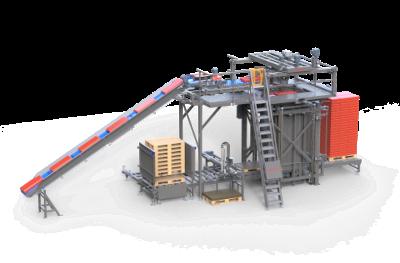



CLASSIFIED LISTINGS
ACIDIFIERS
Trouw Nutrition GB, Blenheim House, Blenheim Road, Ashbourne DE6 1HA
Tel: 01335 341100 Fax: 01335 341171
E-mail: customerservices.gb@nutreco.com
Web: www.trouwnutrition.co.uk
ALTERNATIVE PERFORMANCE ENHANCERS
Adisseo
Tel: +353 87 766 8848
E-mail: info.nauk@adisseo.com
Web: www.adisseo.com
ANIMAL HEALTH PRODUCTS
Kernfarm B.V.
De Corridor 14D
3621 ZB Breukelen, The Netherlands
Tel: +31 (0) 346 785 139
Email: info@kernfarm.com Web: www.kernfarm.com
Mervue Laboratories Ireland

Unit 9 Watergrasshill Business Park, Watergrasshill, Co. Cork, T56 HH98, Ireland
Tel: +353 21 21 4391080
E-mail: info@mervuelab.com
Web: www.mervuelab.com
Trouw Nutrition GB, Blenheim House, Blenheim Road, Ashbourne DE6 1HA
Tel: 01335 341100 Fax: 01335 341171
E-mail: customerservices.gb@nutreco.com
Web: www.trouwnutrition.co.uk
PAge 54 July/August 2023 Feed Compounder
ANALYTICAL SERVICES
DM Scientific Ltd, Main Site, Dalton, Thirsk, North Yorkshire YO7 3JA
Tel: 01845 577757
Email: dmacmillan@dmscientific.co.uk
Web: www.dmscientific.co.uk
Trouw Nutrition GB, Blenheim House, Blenheim Road, Ashbourne DE6 1HA
Tel: 01335 341100 Fax: 01335 341171
E-mail: customerservices.gb@nutreco.com
Web: www.trouwnutrition.co.uk
ANTIBACTERIALS
Adesco Nutricines, 23 Strandside South, Abbeyside, Dungarvan, Co. Waterford X35 W778, Ireland
Jack: +353 87 2208816 Seán: +353 85 1667512
Email: info@adesco.ie Web: www.adesco.ie
Trouw Nutrition GB, Blenheim House, Blenheim Road, Ashbourne DE6 1HA

Tel: 01335 341100 Fax: 01335 341171
E-mail: customerservices.gb@nutreco.com

Web: www.trouwnutrition.co.uk
ANTIOXIDANTS
Adisseo
Tel: +353 87 766 8848
E-mail: info.nauk@adisseo.com

Web: www.adisseo.com
AUTOMATED
BAGGING & PALLETIZING EQUIPMENT salesuk@fischbein.com Tel. +44 208 344 6600 www.fischbein.com
BAGGING EQUIPMENT
Concetti S.p.A
S.S. 75 Centrale Umbra, km 4, 190 Ospedalicchio
06083 Bastia Umbra, PG - Italy
Tel: +39 075 801561 Fax: +39 075 8000894
E-mail: sales@concetti.com Web: www.concetti.com
BULK STORAGE AND HANDLING
Croston Engineering Ltd, Tarvin Mill, Barrow Lane, Tarvin, Chester CH3 8JF
Tel: 01829 741119 Fax: 01829 741169
E-mail: admin@croston-engineering.co.uk
Web: www.croston-engineering.co.uk
CALIBRATION AND WEIGHING SERVICES
Promtek Ltd
Fisher Street, Brindley Ford, Stoke-on-Trent, Staffordshire ST8 7QJ
Tel: 01782 375600 Fax: 01782 375605
E-mail: info@promtek.com Web: www.promtek.com
CHELATED MINERALS
Trouw Nutrition GB, Blenheim House, Blenheim Road, Ashbourne DE6 1HA
Tel: 01335 341100 Fax: 01335 341171
E-mail: customerservices.gb@nutreco.com
Web: www.trouwnutrition.co.uk
COMMODITY CLAIMS MANAGEMENT
RMC Commodity Claims Management
3 Clement Road, Fulwood, Preston PR2 9LG
Tel: 07841 198733
E-mail: enquiries@rawmaterialclaims.co.uk
Web: www.rawmaterialclaims.co.uk
ENZYMES
AB Vista
3 Woodstock Court, Blenheim Road, Marlborough Business Park, Marlborough, Wiltshire, SN8 4AN. United Kingdom
Tel: +44(0)1672 517650 Fax: +44(0)1672 517660
E-mail: info@abvista.com Web: www.abvista.com

Adisseo
Tel: +353 87 766 8848
E-mail: info.nauk@adisseo.com
Web: www.adisseo.com
Danisco Animal Nutrition & Health, IFF
PO Box 218
2300 AE Leiden, THE NETHERLANDS
Tel: +31 6 1539 6689
Web: www.animalnutrition.iff.com

Trouw Nutrition GB, Blenheim House, Blenheim Road, Ashbourne DE6 1HA
Tel: 01335 341100 Fax: 01335 341171
E-mail: customerservices.gb@nutreco.com
Web: www.trouwnutrition.co.uk
FEED ADDITIVES
Borregaard UK Ltd

Clayton Road, Risley Employment Area, Warrington, Cheshire WA3 6QQ
Tel: 01925 285423 Fax: 01925 285433
E-mail: glenn.dearsley@borregaard.com Web: www.lignotechfeed.com
Cargill Animal Nutrition
Provimi Ltd., Dalton Airfield Industrial Estate, Thirsk, North Yorkshire, YO7 3HE
Tel: 01845 578125
www.cargill.com/feed

Inform Nutrition Ireland Ltd

Whitescross, Cork, T23 KD50, Ireland
Tel: +353 21 4394770
E-mail: info@informnutrition.com
Web: www.informnutrition.com
Kemin UK Ltd.
Kemin UK Ltd

Castlethorpe Court,Castlethorpe,BRIGG
North Lincolnshire DN20 9LG,England
www.kemin.com
tel:+44.1652.65.10.10 fax:+44.1652.65.54.13
34 Botanic Road, Southport, Merseyside PR9 7NG Tel: +44 (0)1704 537702
Orffa
Pancosma SA
Vierlinghstraat 51 4251 LC Werkendam
Minervum 7032 4817 LZ Breda
The Netherlands
The Netherlands
T +31 183 44 77 66 E info@orffa.com
Find your Orffa specialist at www.orffa.com
Voie des Traz 6, 1218 Le Grand-Saconnex, Geneva, Switzerland
Tel : +41 22 929 84 84 Fax : +41 9259 84 95
E-mail: info@pancosma.ch Web: www.pancosma.com

Trouw Nutrition GB, Blenheim House, Blenheim Road, Ashbourne DE6 1HA
Tel: 01335 341100 Fax: 01335 341171
E-mail: customerservices.gb@nutreco.com
Web: www.trouwnutrition.co.uk
FEED MILL DESIGN AND CONSTRUCTION
Croston Engineering Ltd, Tarvin Mill, Barrow Lane, Tarvin, Chester CH3 8JF
Tel: 01829 741119 Fax: 01829 741169
E-mail: admin@croston-engineering.co.uk
Web: www.croston-engineering.co.uk

Turner Process Equipment Ltd 5 De Grey Square, De Grey Road, Colchester, Essex CO4 5YQ
Tel: 01206 752017 Fax: 01206 854484
E-mail: sales@turnerprocessequipment.co.uk
Web: turnerprocessequipment.co.uk
Van Mourik Group
Boylestraat 34, 6718 XM Ede, The Netherlands
Tel: + 31 (0) 318 64 11 44
E-mail: info@vanmourik-group.com
Web: vanmourik-group.com
Feed Compounder July/August 2023 PAge 55
FEED MILL EQUIPMENT
The sole UK supplier for Feedtech and supplier of all new and used milling equipment
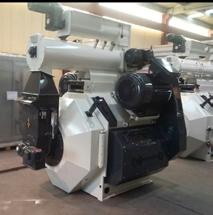

Go Green Pelleting Solutions Ltd, Unit 8A Brindley Road, St Helens WA9 4HY
Mick Swift – 07500887637 David Kelly- 07500335621 Office Number – 01744808600
www.gogreenpelletingsolutions.co.uk www.feedtech.com.tr
FEED PATHOGEN CONTROL
Adesco Nutricines, 23 Strandside South, Abbeyside, Dungarvan, Co. Waterford X35 W778, Ireland
Jack: +353 87 2208816 Seán: +353 85 1667512
Email: info@adesco.ie Web: www.adesco.ie
Anitox Ltd
7 Regent Park, Booth Drive, Park Farm, Wellingborough NN8 6GR
Tel: +44 1604 811228
Fax: +44 1604 811013
E-mail: anitoxEMEA@anitox.com Web: www.anitox.com
FLAVOURS & PALATANTS
Adisseo
Tel: +353 87 766 8848
E-mail: info.nauk@adisseo.com
Web: www.adisseo.com
Inroads International Ltd

Unit 4, Wem Engineering Centre Church Lane, Wem, Shropshire SY4 5HS
Tel: +44 (0)1939 236 555
Fax: +44 (0)1939 236 450
Email: info@inroadsintl.co.uk Web: inroadsintl.com
FEED INGREDIENTS
Azelis UK Ltd
Axis House, Tudor Road, Manor Park, Runcorn WA7 1BD
Tel: 01928 793090
Fax: 01928 716997
Email: nutrition@azelis.co.uk
www.azelis.com
Gemcom Ltd
68 Great Portland Street, London W1W 7NG
Tel: +44 (0)20 7580 8004 Fax: +44 (0)20 7580 8002
E-mail: info@gemcom.co.uk
Web: www.gemcom.co.uk
WestendAgri The Heath Business & Technical
Park, Runcorn, Cheshire, WA7 4QX
Tel: + 44 (0)1477 544400
Mobile: +44 (0)7961 977623
E-mail: sales@westendagri.com Web: www.westendagri.com
FEED SUPPLEMENTS
Inform Nutrition Ireland Ltd
Whitescross, Cork, T23 KD50, Ireland
Tel: +353 21 4394770
E-mail: info@informnutrition.com
Web: www.informnutrition.com
Premier Nutrition
The Levels, Rugeley, Staffordshire WS15 1RD
Tel: 01889 572500
Fax: 01889 577074
E-mail: info@premiernutrition.co.uk
Web: www.premiernutrition.co.uk
Trouw Nutrition GB, Blenheim House, Blenheim Road, Ashbourne DE6 1HA
Tel: 01335 341100 Fax: 01335 341171
E-mail: customerservices.gb@nutreco.com
Web: www.trouwnutrition.co.uk
MANUFCTURING OPTIMISATION SOFTWARE
Promtek Ltd
Fisher Street, Brindley Ford, Stoke-on-Trent, Staffordshire ST8 7QJ
Tel: 01782 375600 Fax: 01782 375605
E-mail: info@promtek.com Web: www.promtek.com
METHIONINE
Adisseo
Tel: +353 87 766 8848
E-mail: info.nauk@adisseo.com
Web: www.adisseo.com
MILK REPLACERS
Trouw Nutrition GB, Blenheim House, Blenheim Road, Ashbourne DE6 1HA

Tel: 01335 341100 Fax: 01335 341171
E-mail: customerservices.gb@nutreco.com
Web: www.trouwnutrition.co.uk
MINERALS/PHOSPHATES
WestendAgri The Heath Business & Technical Park, Runcorn, Cheshire, WA7 4QX
Tel: + 44 (0)1477 544400
Mobile: +44 (0)7961 977623
E-mail: sales@westendagri.com Web: www.westendagri.com
MOLASSES PRODUCTS
E D & F Man Liquid Products UK Ltd
Alexandra House, Regent Road, Bootle L20 1ES
Tel: 0151 944 5100 Fax: 0151 944 3919
E-mail: info.mlpuk@edfman.com
Web: www.edfmanliquidproductsuk.com
United Molasses GB Ltd
48 Gracechurch Street, London EC3V 0EJ
Tel: 0151 955 4850
Fax: 0151 955 4860
E-mail: molassesgb@umgroup.com


Web: www.unitedmolasses.com
PAge 56 July/August 2023
Feed Compounder
MOISTURE MEASUREMENT & CONTROL
Adesco Nutricines, 23 Strandside South, Abbeyside, Dungarvan, Co. Waterford X35 W778, Ireland
Jack: +353 87 2208816 Seán: +353 85 1667512
Email: info@adesco.ie Web: www.adesco.ie
MOULD INHIBITORS
Adesco Nutricines, 23 Strandside South, Abbeyside, Dungarvan, Co. Waterford X35 W778, Ireland
Jack: +353 87 2208816 Seán: +353 85 1667512
Email: info@adesco.ie Web: www.adesco.ie
Trouw Nutrition GB, Blenheim House, Blenheim Road, Ashbourne DE6 1HA
Tel: 01335 341100 Fax: 01335 341171
E-mail: customerservices.gb@nutreco.com
Web: www.trouwnutrition.co.uk
MYCOTOXIN BINDERS
AB Vista

Edificio Twin Golf A, C/Perú, 6, 2º Floor, Office 4 28290 Las Rozas, Madrid, Spain
Tel: +34 91 859 1787 Email: info@abvista.com
Web: www.abvista.com
Adisseo
Tel: +353 87 766 8848
E-mail: info.nauk@adisseo.com
Web: www.adisseo.com
Trouw Nutrition GB, Blenheim House, Blenheim Road, Ashbourne DE6 1HA
Tel: 01335 341100 Fax: 01335 341171
E-mail: customerservices.gb@nutreco.com
Web: www.trouwnutrition.co.uk
NUTRITION TOLL MANUFACTURE
B2B Nutrition, Fordton Industrial Estate, Crediton, Devon EX17 3BZ

(A division of the Denis Brinicombe Group)
Tel. 01363 775115
Tom Butler (Technical) 07803 736194
Email: tbutler@brinicombe.co.uk Web: www.b2bnutrition.co.uk
PACKAGING SOLUTIONS
Fischbein
Tel: +44 (0)20 8344 6600
E-mail: salesuk@fischbein.com Web: www.fischbein.com
PELLETING EQUIPMENT
Compound Feed Engineering Ltd
5 Haydock Lane, Haydock, St Helens, Merseyside, WA11 9UY
Tel: +44 (0) 1942 728188 Fax: +44 (0) 1942 408430
E-mail: info@cfegroup.com
Web: www.cfegroup.com
PROCESS CONTROL SYSTEMS
DSL Systems Ltd
Adbolton Hall, Adbolton Lane, West Bridgford, Nottingham NG2 5AS
Tel: 0115 981 3700 Fax: 0115 981 3702
E-mail: sales@dsl-systems.com
Web: www.dsl-systems.com
Promtek Ltd
Fisher Street, Brindley Ford, Stoke-on-Trent, Staffordshire ST8 7QJ
Tel: 01782 375600 Fax: 01782 375605
E-mail: info@promtek.com Web: www.promtek.com
SALMONELLA CONTROL
Adesco Nutricines, 23 Strandside South, Abbeyside, Dungarvan, Co. Waterford X35 W778, Ireland
Jack: +353 87 2208816 Seán: +353 85 1667512
Email: info@adesco.ie Web: www.adesco.ie
Trouw Nutrition GB, Blenheim House, Blenheim Road, Ashbourne DE6 1HA
Tel: 01335 341100 Fax: 01335 341171
E-mail: customerservices.gb@nutreco.com
Web: www.trouwnutrition.co.uk
SELENIUM
Adisseo
Tel: +353 87 766 8848
E-mail: info.nauk@adisseo.com
Web: www.adisseo.com
SIEVING & PRECLEANING
Turner Process Equipment Ltd 5 De Grey Square, De Grey Road, Colchester, Essex CO4 5YQ
Tel: 01206 752017 Fax: 01206 854484
E-mail: sales@turnerprocessequipment.co.uk
Web: turnerprocessequipment.co.uk
SILAGE ADDITIVES
Trouw Nutrition GB, Blenheim House, Blenheim Road, Ashbourne DE6 1HA
Tel: 01335 341100 Fax: 01335 341171
E-mail: customerservices.gb@nutreco.com
Web: www.trouwnutrition.co.uk
TRACE ELEMENTS
Chemox Pound Ltd
Unit 1, IO Centre, Swift Valley, Rugby, CV21 1TW
Tel: 01845 575065 Mobile: 07884 231880
E-mail: lawrence.green@chemoxpound.com Web: www.chemoxpound.com
Feed Compounder July/August 2023 PAge 57