DONORPROFILE
Realizing — and Supporting — Potential Through their personal experience, Connie and Alan Buerger choose to support minimally invasive surgery at Ryan Hospital
I
n October of 2010 Connie Buerger brought her beloved 11-year-old Portuguese water dog, Max, to Penn Vet’s Ryan Hospital to have a group of masses growing on his left shoulder evaluated. One of the reasons Connie brought Max to Ryan Hospital was because her daughter-in-law, and Penn Vet Overseer, Krista Buerger, had shared with her the excellent care her own Portuguese water dog, Kobe, had received just a year before. Connie and her husband, Alan, founded Coventry, the creator and leader of the secondary life insurance market. Their son, Reid, and daughter-in-law, Krista, both work in the family business. Connie and Alan live in the Philadelphia suburbs, dividing their time between their business, philanthropy and their growing family – Krista just gave birth to their second grandchild. Connie and Alan are both true animal lovers. When he was a young boy, Alan’s family raised and showed collies. While Connie did not grow up with dogs, she always wanted one, so as soon as it was possible, she and Alan took in three beautiful Portuguese water dogs: Max, Chance and Dash. That October visit at Ryan Hospital revealed that Max had myxofibrosarcoma, an aggressive soft-tissue cancer. After receiving this tough news, Connie placed her confidence – and Max’s life – into the expert hands of Ryan Hospital’s surgery and oncology teams. With David Holt, BVSc, professor of surgery, and Lili Duda, VMD, Dipl. ACVR, adjunct associate professor of radiation oncology, on his team, Max had the best chance at fighting and defeating his cancer. Max’s surgery to remove three cancerous masses from his shoulder was a success, but he still required a full course of radiation therapy. Between March and August of 2011 Max and Connie became daily visitors to Ryan Hospital’s Rosenthal Imaging and Treatment Center (RITC) where he received the ongoing treatments he needed. His friendly, playful disposition quickly made Max one of Ryan Hospital’s favorite patients, and to everyone’s great relief and delight on September 13, 2011 he received a clean bill of health – no small feat for an 11-year-old dog. During her many hours in the RITC waiting room, Connie had an opportunity to get to know Ryan
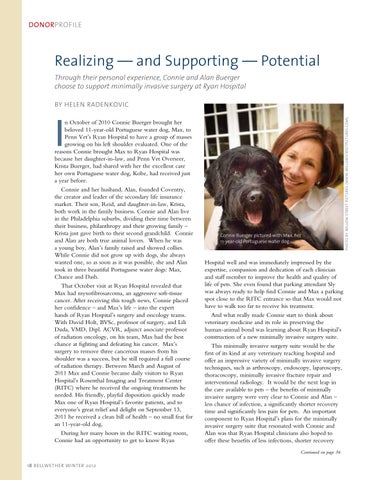
Connie Buerger pictured with Max, her 11-year-old Portuguese water dog.
Hospital well and was immediately impressed by the expertise, compassion and dedication of each clinician and staff member to improve the health and quality of life of pets. She even found that parking attendant Sly was always ready to help find Connie and Max a parking spot close to the RITC entrance so that Max would not have to walk too far to receive his treatment. And what really made Connie start to think about veterinary medicine and its role in preserving the human-animal bond was learning about Ryan Hospital’s construction of a new minimally invasive surgery suite. This minimally invasive surgery suite would be the first of its kind at any veterinary teaching hospital and offer an impressive variety of minimally invasive surgery techniques, such as arthroscopy, endoscopy, laparoscopy, thoracoscopy, minimally invasive fracture repair and interventional radiology. It would be the next leap in the care available to pets – the benefits of minimally invasive surgery were very clear to Connie and Alan – less chance of infection, a significantly shorter recovery time and significantly less pain for pets. An important component to Ryan Hospital’s plans for the minimally invasive surgery suite that resonated with Connie and Alan was that Ryan Hospital clinicians also hoped to offer these benefits of less infections, shorter recovery Continued on page 36
18 BELLWETHER WINTER 2012
PHOTO BY WILLOW STREET PICTURES (WWW.WILLOWSTREETPICTURES.COM)
BY HELEN RADENKOVIC