Growth Factors Confer Immortality to Sperm-Generating Stem Cells By Greg Lester
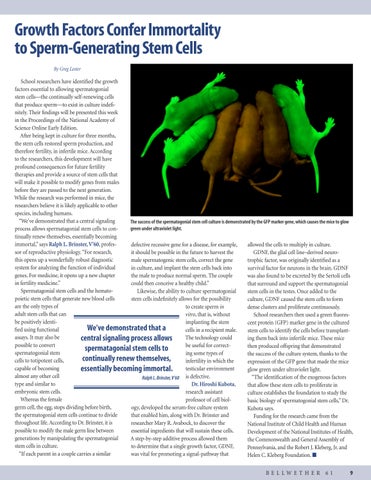
School researchers have identified the growth factors essential to allowing spermatogonial stem cells—the continually self-renewing cells that produce sperm—to exist in culture indefinitely. Their findings will be presented this week in the Proceedings of the National Academy of Science Online Early Edition. After being kept in culture for three months, the stem cells restored sperm production, and therefore fertility, in infertile mice. According to the researchers, this development will have profound consequences for future fertility therapies and provide a source of stem cells that will make it possible to modify genes from males before they are passed to the next generation. While the research was performed in mice, the researchers believe it is likely applicable to other species, including humans. “We’ve demonstrated that a central signaling The success of the spermatogonial stem cell culture is demonstrated by the GFP marker gene, which causes the mice to glow green under ultraviolet light. process allows spermatagonial stem cells to continually renew themselves, essentially becoming immortal,” says Ralph L. Brinster, V’60, profesallowed the cells to multiply in culture. defective recessive gene for a disease, for example, sor of reproductive physiology. “For research, it should be possible in the future to harvest the GDNF, the glial cell line–derived neurothis opens up a wonderfully robust diagnostic male spermatogenic stem cells, correct the gene trophic factor, was originally identified as a system for analyzing the function of individual in culture, and implant the stem cells back into survival factor for neurons in the brain. GDNF genes. For medicine, it opens up a new chapter the male to produce normal sperm. The couple was also found to be excreted by the Sertoli cells in fertility medicine.” could then conceive a healthy child.” that surround and support the spermatogonial Spermatagonial stem cells and the hematoLikewise, the ability to culture spermatogonial stem cells in the testes. Once added to the poietic stem cells that generate new blood cells stem cells indefinitely allows for the possibility culture, GDNF caused the stem cells to form are the only types of to create sperm in dense clusters and proliferate continuously. adult stem cells that can vitro, that is, without School researchers then used a green fluoresbe positively identiimplanting the stem cent protein (GFP) marker gene in the cultured We’ve demonstrated that a fied using functional cells in a recipient male. stem cells to identify the cells before transplantassays. It may also be The technology could ing them back into infertile mice. These mice central signaling process allows possible to convert be useful for correctthen produced offspring that demonstrated spermatagonial stem cells to spermatogonial stem ing some types of the success of the culture system, thanks to the continually renew themselves, cells to totipotent cells, infertility in which the expression of the GFP gene that made the mice capable of becoming testicular environment essentially becoming immortal. glow green under ultraviolet light. almost any other cell “The identification of the exogenous factors Ralph L. Brinster, V’60 is defective. type and similar to Dr. Hiroshi Kubota, that allow these stem cells to proliferate in embryonic stem cells. research assistant culture establishes the foundation to study the Whereas the female professor of cell biolbasic biology of spermatogonial stem cells,” Dr. germ cell, the egg, stops dividing before birth, ogy, developed the serum-free culture system Kubota says. the spermatogonial stem cells continue to divide that enabled him, along with Dr. Brinster and Funding for the research came from the throughout life. According to Dr. Brinster, it is researcher Mary R. Avabock, to discover the National Institute of Child Health and Human possible to modify the male germ line between essential ingredients that will sustain these cells. Development of the National Institutes of Health, generations by manipulating the spermatogonial A step-by-step additive process allowed them the Commonwealth and General Assembly of stem cells in culture. to determine that a single growth factor, GDNF, Pennsylvania, and the Robert J. Kleberg, Jr. and “If each parent in a couple carries a similar was vital for promoting a signal-pathway that Helen C. Kleberg Foundation. ■ BELLWETHER 61
9