Art courtesy of Kathy Corrigan.
Three of Hearts: Ramie Carries on Family Tradition
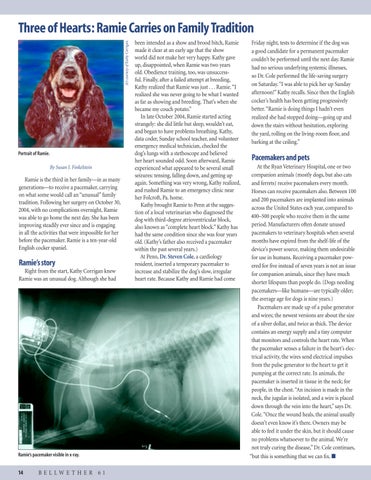
Portrait of Ramie.
By Susan I. Finkelstein
Ramie is the third in her family—in as many generations—to receive a pacemaker, carrying on what some would call an “unusual” family tradition. Following her surgery on October 30, 2004, with no complications overnight, Ramie was able to go home the next day. She has been improving steadily ever since and is engaging in all the activities that were impossible for her before the pacemaker. Ramie is a ten-year-old English cocker spaniel.
Ramie’s story Right from the start, Kathy Corrigan knew Ramie was an unusual dog. Although she had
Ramie’s pacemaker visible in x-ray.
14
BELLWETHER 61
been intended as a show and brood bitch, Ramie made it clear at an early age that the show world did not make her very happy. Kathy gave up, disappointed, when Ramie was two years old. Obedience training, too, was unsuccessful. Finally, after a failed attempt at breeding, Kathy realized that Ramie was just . . . Ramie. “I realized she was never going to be what I wanted as far as showing and breeding. That’s when she became my couch potato.” In late October 2004, Ramie started acting strangely: she did little but sleep, wouldn’t eat, and began to have problems breathing. Kathy, data coder, Sunday school teacher, and volunteer emergency medical technician, checked the dog’s lungs with a stethoscope and believed her heart sounded odd. Soon afterward, Ramie experienced what appeared to be several small seizures: tensing, falling down, and getting up again. Something was very wrong, Kathy realized, and rushed Ramie to an emergency clinic near her Folcroft, Pa. home. Kathy brought Ramie to Penn at the suggestion of a local veterinarian who diagnosed the dog with third-degree atrioventricular block, also known as “complete heart block.” Kathy has had the same condition since she was four years old. (Kathy’s father also received a pacemaker within the past several years.) At Penn, Dr. Steven Cole, a cardiology resident, inserted a temporary pacemaker to increase and stabilize the dog’s slow, irregular heart rate. Because Kathy and Ramie had come
Friday night, tests to determine if the dog was a good candidate for a permanent pacemaker couldn’t be performed until the next day. Ramie had no serious underlying systemic illnesses, so Dr. Cole performed the life-saving surgery on Saturday. “I was able to pick her up Sunday afternoon!” Kathy recalls. Since then the English cocker’s health has been getting progressively better. “Ramie is doing things I hadn’t even realized she had stopped doing—going up and down the stairs without hesitation, exploring the yard, rolling on the living-room floor, and barking at the ceiling.”
Pacemakers and pets At the Ryan Veterinary Hospital, one or two companion animals (mostly dogs, but also cats and ferrets) receive pacemakers every month. Horses can receive pacemakers also. Between 100 and 200 pacemakers are implanted into animals across the United States each year, compared to 400–500 people who receive them in the same period. Manufacturers often donate unused pacemakers to veterinary hospitals when several months have expired from the shelf-life of the device’s power source, making them undesirable for use in humans. Receiving a pacemaker powered for five instead of seven years is not an issue for companion animals, since they have much shorter lifespans than people do. (Dogs needing pacemakers—like humans—are typically older; the average age for dogs is nine years.) Pacemakers are made up of a pulse generator and wires; the newest versions are about the size of a silver dollar, and twice as thick. The device contains an energy supply and a tiny computer that monitors and controls the heart rate. When the pacemaker senses a failure in the heart’s electrical activity, the wires send electrical impulses from the pulse generator to the heart to get it pumping at the correct rate. In animals, the pacemaker is inserted in tissue in the neck; for people, in the chest. “An incision is made in the neck, the jugular is isolated, and a wire is placed down through the vein into the heart,” says Dr. Cole. “Once the wound heals, the animal usually doesn’t even know it’s there. Owners may be able to feel it under the skin, but it should cause no problems whatsoever to the animal. We’re not truly curing the disease,” Dr. Cole continues, “but this is something that we can fix. ■