
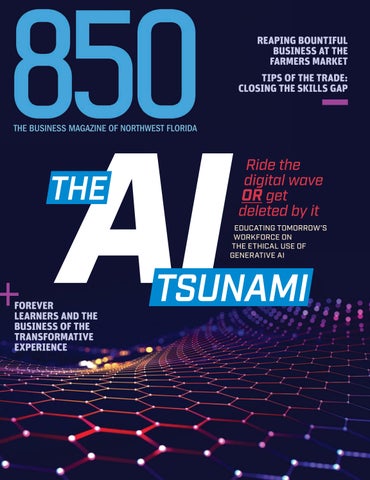

REAPING BOUNTIFUL BUSINESS AT THE FARMERS MARKET TIPS OF THE TRADE: CLOSING THE SKILLS GAP


FOREVER LEARNERS AND THE BUSINESS OF THE TRANSFORMATIVE EXPERIENCE
Ride the digital wave OR get deleted by it
EDUCATING TOMORROW’S WORKFORCE ON THE ET HICAL USE OF GENERATIVE AI






With the rise of generative AI tools, educators have been primarily focused on cheating, but it is growing increasingly clear that these tools are quickly being adopted in industries across the globe. Forward-thinking colleges and universities across Northwest Florida have pivoted in pedagogy but also in training offered to faculty. During this crucial time, early adopters on the college and university levels will place their graduating classes in first place as they enter into the rat race of today’s job market.
story by DAVID EKRUT, P h. D.
Teaching is a passion, but taking on entrepreneurship to train others is next level. It may not be obvious what cooking classes and martial arts have in common, but both tap into the market of forever learners— those high-performers in society who are not satisfied to spend all their time off work sitting in front of a screen.
story by DAVID EKRUT, P h. D.

are
15 ALTERNATIVE EDUCATION The current job market is highly competitive, so parents are searching for alternative education and extracurricular activities to provide advantageous skill sets to their children. From robotics and a STEM focus to farming and hands-on activities, students are grounded in principles based on grit, understanding, and project-based success.
20 TIPS OF THE TRADE
For many students leaving college, there is a chasm between being confident and being skilled, and humility on the job comes at a cost. Closing this gap will be necessary to tackle the problem of the skills shortages across industries. Durable skills are in high demand.
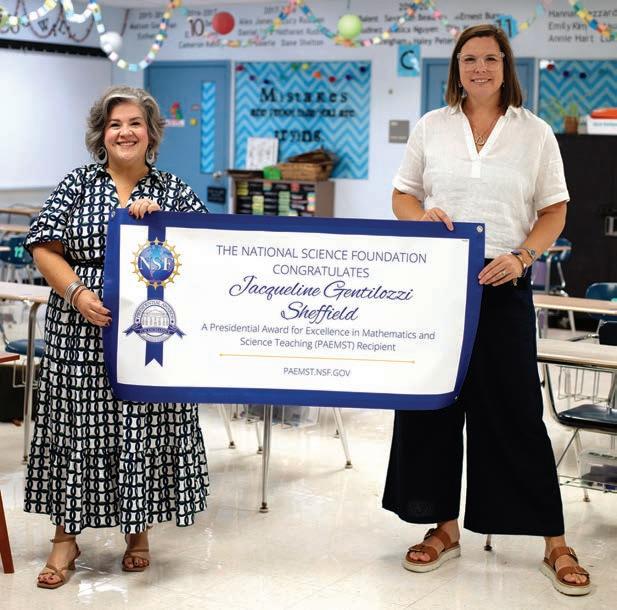
22 AWARDING EXCELLENCE The highest award and honor that any teacher in the United States can achieve has been awarded to Fort Walton Beach High School’s very own, Jacqueline Sheffield. With 28 years of experience teaching mathematics, Sheffield was recognized for her excellence in the classroom.
24 ACCELERATING SUCCESS Seacoast Collegiate High School gets to dream big with a new project opening in the 2025-2026 school year. The accelerator program aims to provide a smoother pathway to dual enrollment for juniors and seniors who will have opportunities to receive early credit for college and select from new certificate-awarding courses in technology and technical trade skills.
53 PANAMA CITY MAYOR Beyond his recent ascension into the political sphere, Allan Branch has deep roots in Panama City. The former software developer turned restaurateur


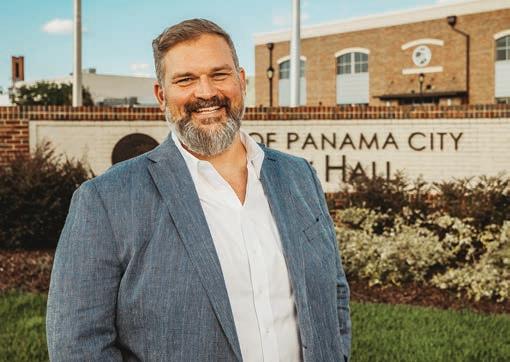
successfully ran a campaign promising to be a thought leader, offering conversations about ideas to improve infrastructure, reduce the millage rate, and offer an open discussion with constituents on the vision of Panama City.
58 DIRECT FLIGHTS TO NYC As a testament to the growth of the region, Northwest Florida Beaches International Airport now has a direct flight to and from New York City. Though
seats have been available on a weekly basis, Delta Air Lines is expanding flights to include daily trips to the Big Apple, starting on November 6, 2025.
Farmers markets and festivals are an incredible soft entry into several markets. In addition to produce, craftsmen can now peddle their wares alongside food trucks and boutique shops. Thanks to vendors such as Square, Shopify, and
PayPal, stores can be set up anywhere, allowing creators and innovators to open shop everywhere there is a demand.
26 PARTNERSHIP FUELS GROWTH
Cox Communications is not just a service provider but a long-term community partner, committed to tailoring technology solutions, reliable connectivity, and cybersecurity to help Gulf Coast businesses of all sizes grow, adapt, and thrive while reinvesting in the region’s future.
45 PROFESSIONAL PROFILES In this special section, we profile the business leaders and business owners who operate successful, dependable, and reputable companies throughout the 850 region. Learn about their specialities, experiences, and hopes for the future.
56 LOUNGING AT LATITUDE A 55-plus lifestyle community, Latitude Margaritaville Watersound invites retirees to live life to the fullest.


EDITORIAL
EDITOR David Ekrut, Ph.D.
PUBLISHER
MCKENZIE BURLEIGH
SENIOR EDITOR Rebecca Padgett Frett
SENIOR COPY EDITOR Melinda Lanigan
STAFF EDITOR Paige Aigret
CUSTOM CONTENT EDITOR Zandra Wolfgram
CONTRIBUTING WRITERS Hannah Burke, Mike Fender, Laurie Einstein Koszuta
CREATIVE
DESIGN DIRECTOR Jennifer Ekrut
CONTRIBUTING PHOTOGRAPHERS Anna Carolyn Photography, Black & Hue Photography, Boo Media, Dave Barfield, Jennifer Ekrut, Elizabeth Linn Photography, Mike Fender, M. Little Productions, Drew McIntosh/Life’s a Beach Photography, Jenny Ralph, Saige Roberts, Robert Young/FYImages
SALES, MARKETING & EVENTS
SALES MANAGER Lori Magee Yeaton
DIRECTOR OF NEW BUSINESS DEVELOPMENT, EASTERN DIVISION Daniel Parisi
SENIOR ACCOUNT EXECUTIVE Julie Dorr
ACCOUNT EXECUTIVES Darla Harrison, Daniel Walker, Erica Wilson
ACCOUNT MANAGER Renee Johnson
MARKETING ART DIRECTOR Saige Roberts
PRODUCTION
PRODUCTION DIRECTOR Selene Ceballo
PRODUCTION MANAGER Chris Edmund
DIGITAL MARKETING MANAGER Tyler Sansone
ADVERTISING DESIGN COORDINATOR Michael Kramer
PRODUCTION COORDINATOR Courtney Bryant, Ileana Caban
OPERATIONS
CIRCULATION/DISTRIBUTION SPECIALIST Melinda Lanigan
PUBLISHER EMERITUS Brian Rowland
GROUP PUBLISHER Terry Duffy
CHIEF OPERATING OFFICER Todd Schmidt
EDITORIAL DIRECTOR Daphne Nikolopoulos
HOUR MEDIA, LLC
CEO Stefan Wanczyk
PRESIDENT John Balardo

Our work lives can be very rewarding but also challenging, and it’s important to achieve a healthy work-life balance. There’s no better way to unplug, relax, and unwind than by experiencing an amazing Ultimate Hilton Sandestin Beach Resort Getaway. Enter to win the escape you’ve been longing for! Enter for your chance to win at 850BusinessMagazine.com/ ultimate-hilton-getaway.

ITEN WIRED Summit is the Southeast’s premier cybersecurity and technology conference, where participants connect, collaborate, and build community with industry leaders, entrepreneurs, and educators on innovation, technology, and entrepreneurship topics. The three-day event, taking place Oct. 29-31, 2025, highlights the area’s cybersecurity, information technology, and entrepreneurial communities. For more information and to register, visit 850BusinessMagazine.com/local-events.

Studer Community Institute’s annual leadership conference challenges business owners to “Embracing Collective Growth” at EntreCon 2025 on Nov. 12–13, 2025 in Pensacola. This year’s EntreCon features an inspiring lineup of speakers, lunch and learn sessions, and dynamic networking opportunities—all centered on the power of shared purpose in driving personal, professional, and community growth. Join a world-class experience celebrating a decade of growth with a lifetime of possibilities. To learn more, visit 850BusinessMagazine.com/ local-events.
Read the latest 850 Business Magazine “Bytes”—essential information about business openings, professional promotions, awards, honors, and more —at your convenience online.
For the latest news and information, sign up for our free e-newsletter. 850BusinessMagazine.com/ newsletter-mailing-list
Find 850 Business Magazine on LinkedIn as well as X, Instagram, and Facebook.
LinkedIn Palm Beach Media Group and 850 Business Magazine pages, and the 850 Business Magazine Group X @850BizMag
Instagram 850bizmag Facebook 850 - The Business Magazine of Northwest Florida


The word “scholar” originally came from Greek skholē, meaning “leisure, especially time spent on intellectual endeavors.”
Scholarly pursuits are a cornerstone of Western civilization and a driving force for technological change and innovations in the global economy. However, our modern universities have strayed far from the model given to us in antiquity.
The first European university was established in Bologna, Italy circa 1088. Founded by individuals seeking legal scholarship, students hired and paid their own teachers. The University of Bologna became recognized in Europe as a student-run guild that offered degrees authenticating their expertise in secular law.
By the thirteenth century, students entered university at 14 to 16 years of age, studying trivium (grammar, rhetoric, and logic), which would take two to three years. Graduates would be considered masters of language, reasoning, and writing and could leave the university and immediately be employable as scribes and clerks, earning a decent standard of living.
Others would go on to study quadrivium (arithmetic, geometry, music, and astronomy), ages 16-20, applying logic to the mathematical and natural sciences. After examinations or disputations, these students would be awarded a Bachelor of Arts where they could pursue careers as educators, court astrologers, timekeepers—not as easy back then—and the age-old favorite, architects.
Students could also receive tutelage in Aristotelian philosophy and go on to study law, medicine, or theology, earning a master’s degree, which would unlock higher prestige and earning potential.
Doctors of Law and Theology could gain status with courts and increase ecclesiastical rankings, but both types of scholars were considered lucrative and highly sought-after for their expertise.
This model spread across Europe, giving birth to the Renaissance, creating some of the greatest minds in human history. The reason for this was the interdisciplinary studies created by the earnest pursuit of clarity, understanding, and truth.
During the early days of university, the scope of all human knowledge could be studied and understood by individuals— called polymaths or as they are better known “Renaissance Men.” There are well-known figures in history, e.g. Leonardo da Vinci, Francis Bacon, and Paracelsus.
During the early days of true scholarship, knowledge, facts, and logical understanding were celebrated pursuits. Lecture halls were filled with students eager to understand the world around them.
I would postulate that we no longer foster an environment for polymaths in modern society.
Flash forward to today, and we churn out “scholars” in capitalistic fashion, selling more paper than Charmin with the hefty price tag of 10% to 20% of your salary for the next 20plus years.
Go to the average college campus and ask a random student, “Why are you here?”
If you can get anyone to stop staring at their phones or to remove their earbuds long enough to answer, they will say, “To get a degree in .”
Capitalism demands expertise. One of the most common questions adults pose to children is, “What are you going to be when you grow up?”
In other words, you must pick one box, so others can understand what value you have to society. This leaves little room for the requisite capacity for abstract thought necessary for true scholarship. Human thoughts are only worth as much as the capital they can generate.
And this is why humanity, as a whole, is getting dumber—or for the more rigorously minded, see the Reverse Flynn Effect. There is not enough space in this letter for possible causality for this; however, studies list education quality as a contributing factor, as well as increased screen time and decreased deep reading, and a cultural shift away from abstract problem-solving.
One might counter this argument by rightly pointing out that interdisciplinary synergy created by the early university model increased the global breadth of scientific knowledge beyond the capacity of any one person to know everything. Therefore, we must specialize.
Regardless, there has been little room in our society for scholarship for its own sake—the original catalyst for exponential technological growth in the Western world.
Humans must return to a state of scholarship—true dedication to abstraction, creativity, and critical thinking—else we will not survive in the global economy.
When our AI tools truly and completely replace the need for technical expertise
and cognitive labor, where does that leave the humans? What value will we have in a capitalistic society driven primarily by the optimization of dollars?
Our current model for education in the U.S. inspires dogmatic reaction rather than original thought. Without a major shift in our educational practices, pioneered by thought leaders in the classrooms, we will fail to inspire the next generation of polymaths necessary to usher in the next age of great innovators and thinkers. We require a cultural transformation dedicated to the revival of scholarship among our students, which can only be possible if we nourish our inquisitive minds with perspicacity, sagacity, tenacity, and a healthy amount of audacity.
It might also help if we paid our teachers enough to enable them to focus on the classroom rather than spread their attention across multiple jobs.
→ DO YOU HAVE A STORY OR KNOW SOMEONE WITH AN INTRIGUING BUSINESS MODEL? Please feel to reach out to me anytime at dekrut@850businessmagazine.com.








Your goals come first.
At Cadence, we appreciate the hard work and dedication you bring to your business every day. We’re here to give you every advantage, from expert guidance delivered by finan cial professionals who understa nd you, to tailored solutions and financing designed specific al ly for businesses like yours.

That’s what makes us your bank.
#yourcadence













I had the pleasure of hearing from Hod Lipson, professor of engineering and data science at Columbia University, one of the keynote speakers at the annual Florida Power and Light Symposium earlier this year. He said, “Those that see it, lead, and those that don’t get dragged along.” He was speaking about the benefits of utilizing generative artificial intelligence.
Being in the publishing industry, we have been keeping our eyes on the resources available while ensuring we maintain our journalistic integrity through authentic, original work. We also know the benefit of leading with strategic foresight to enhance our efforts in this arena. I can assure you that every word written in our products is not generated by artificial intelligence. We can use these types of tools to enhance our research and efficiency in many functions, but they will never replace the art of the written word.
Lipson shared the remarkable journey behind many generative artificial intelligence programs and how they can assist in the human experience, not replace it. Those same values remind me of the mission behind The Institute of Human & Machine Cognition, based in Pensacola, and one that I, too, believe in.
Lipson educated and inspired the group by sharing two examples of implementations I had coincidentally experienced firsthand. A self-driving car at any given time uses over 150 different scenarios to make a decision, compared to a human driver who uses only one. This increases the probability of a safe ride 150 times compared to human driving. When Lipson showcased the data and visual model behind this sophisticated technology, the entire room, including myself, was disarmed of the notion that AI was only something to be wary of.
The overarching truth is that as time goes on, more data is collected to reduce error and increase accuracy. The examples we saw showed us how much more effective certain generative artificial intelligence systems can be compared to
relying solely on humans. We simply can’t compete with that level of accuracy— even the most brilliant among us.
We are already witnessing this type of AI support in the medical sector. Pathology reports are now reviewed by generative artificial intelligence, not only increasing the accuracy of diagnoses and saving lives but also reducing the cost of these resources. I have personally seen this at my dermatologist’s office. Instead of sending a biopsy to a pathologist, they can digitally review the margins of inspection and provide immediate results to the patient, possibly avoiding excision altogether if the results come back clean.
Our region is taking an active approach to ensure our education systems incorporate this mindset and these resources into university and college curricula. You will be proud and inspired to read more details later in this issue showing how our students are being prepared to enter the job market fully equipped. The overarching theme echoes what I learned from Lipson: You either lead or get dragged along, and our region is taking the lead.
The data collected is the asset, and incorporating these programs into our business industries will enhance performance, not replace it.
Northwest Florida has much to be proud of when it comes to education. Not only are our institutions adapting and enhancing their programs, but they are also expanding access to our communities, continuing to be a driving force for growth.
The Seacoast Collegiate High School Expansion Project, in partnership with

Northwest Florida State College, is one of many initiatives in this regard. The expansion will offer dual enrollment opportunities, allowing high school students to graduate with both a diploma and an Associate of Arts degree. We are also seeing increased resources for workforce training to local agencies and businesses. For the fastest-growing county in the state, this educational infrastructure is becoming a major factor. With all digital enhancements and resources comes more responsibility and a reminder of digital ethics. The lines can be harder to see in cyberspace. I am inspired to see how our experience and impact can be propelled toward more efficient and productive outcomes. However, I encourage our leadership to ensure that education on ethics and integrity when using these systems is valued just as highly as the benefits of the systems themselves. We can enhance the human experience, but I urge that our discernment in how we use these tools be held in even higher regard.
Best,
McKenzie Burleigh mburleigh@palmbeachmedia.com






CAPITAL // LOCAL HONORS
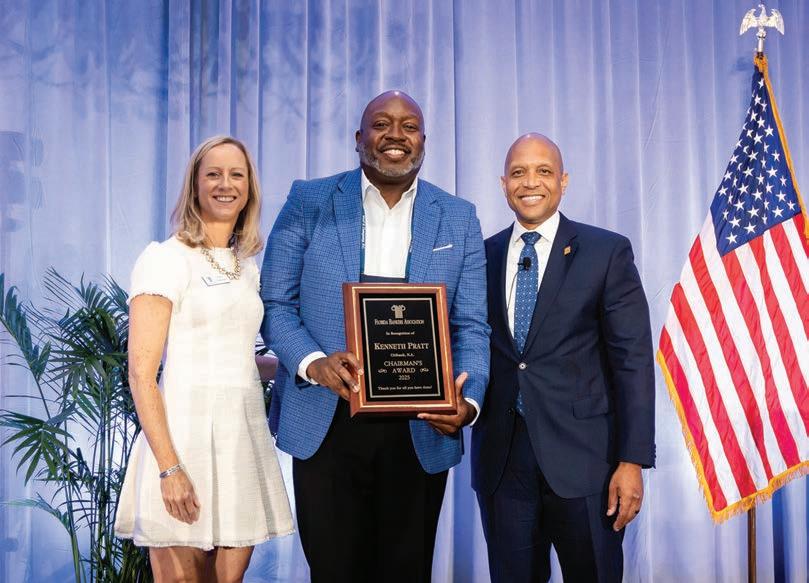
In keeping with tradition, the Florida Bankers Association (FBA) presented awards to a select group of deserving bankers during its 137th annual meeting. The distinguished awards recognize individuals for their dedication and contributions to the FBA and Florida’s banking industry. Kenneth Pratt, senior vice president and Southeast regional lobbyist, Citibank (Tallahassee), was presented with the Chairman’s Award. This award is given to recipients selected by the outgoing FBA chairman, in this case Derek Jones, region executive of Gulf Coast of Wells Fargo Bank, to honor members who have gone above and beyond to support the FBA. Pratt has worked tirelessly on the FBA’s behalf to return the Interest on Trust Accounts (IOTA) Program to a sustainable level, ensuring its success.
GrayRobinson is pleased to announce Dena H. Sokolow has joined the firm as shareholder in its Labor and Employment practice. Based in the Tallahassee office, Sokolow is a nationally recognized labor and employment litigator and advisor who

blends sharp legal insight with practical HR knowledge to help businesses navigate today’s complex workplace landscape. Sokolow’s practice is defined by her direct, solution-
oriented approach, combining strategic counsel with robust litigation experience. She represents employers across many industries— including health care, retail, construction, hospitality, and staffing—in federal and state employment disputes involving discrimination, harassment, retaliation, wrongful
termination, wage and hour violations, Family and Medical Leave Act (FMLA) claims, and employee misclassification. Nationally recognized for her work in wage and hour law, she regularly advises on U.S. Department of Labor audits, Fair Labor Standards Act (FLSA) collective actions, and internal classification reviews
involving independent contractor and exemption issues. In her advisory role, she helps clients proactively identify and address compliance risks, strengthening workplace policies, and minimizing legal exposure.
Out of hundreds of businesses throughout the state of Florida, Tallulah CBD, has been named No. 7 on the 2025 JMI 30 Awards list, recognizing the fastestgrowing businesses in Florida led by Jim Moran Institute alumni. Tallulah, the alternative wellness company redefining smoke shops, kava bars, and functional retail in the Southeast, has been named the No. 1 fastestgrowing business in Tallahassee and No.7 overall in the state of Florida. The JMI 30 honors the fastestgrowing, privately held companies.

Gov. Ron DeSantis has appointed Jason Vail, a shareholder with Allen Norton & Blue’s Tallahassee office, to the Judicial Nominating Commission (JNC) for the 2nd Judicial Circuit. Vail was appointed from a list of nominees recommended by the Florida Bar for a term
ending July 1, 2026.
The JNC is a panel that recommends lawyers for judgeships, selecting nominees to fill judicial vacancies within the Florida court system. The 2nd Judicial Circuit covers Franklin, Gadsden, Jefferson, Leon, Liberty, and Wakulla counties.
Vail represents public and private clients in employment law matters before Florida state and federal courts and in traditional labor matters, including collective bargaining, labor arbitration, and unfair labor practice cases before the Public Employees Relations Commission (PERC) and the National Labor Relations Board (NLRB). Vail is Board Certified by the Florida Bar as a specialist in labor and employment law. He earned his J.D. cum laude from the Florida State University College of Law and a B.S. in Legal Studies from the University of Central Florida summa cum laude. He frequently lectures and provides training to employers on employmentrelated matters. He also serves on the board of directors for Big Bend Habitat for Humanity and most recently as president.
Allen Norton & Blue, with offices in Miami, Orlando, Tallahassee, and Tampa, represents public and private sector employers and focuses its practice on employment litigation.
the state’s largest professional trade association with 238,000 members, has named Trey Goldman as its new senior vice president of public
policy. As the senior vice president of public policy, Goldman will lead the legislative and regulatory advocacyrelated efforts of the association. In addition to managing the public policy office, he is also responsible for all initiatives relating to the legislative agenda of Florida Realtors and the coordination of member involvement in all public policy-
related matters for the organization. Prior to taking on this new position, Goldman was Florida Realtors’ legislative counsel based in the Tallahassee public policy office. He represented Realtors® before the Florida Legislature, state regulatory agencies, the Governor’s office, and the Cabinet, with a focus on insurance
and community association-related issues. He is a member of the Florida Bar and serves on the executive council of the Bar’s largest section, the Real Property, Probate, and Trust Law Section. Goldman was raised in Daytona Beach, Florida, where both of his parents were Realtors. He graduated from the University of Florida College of
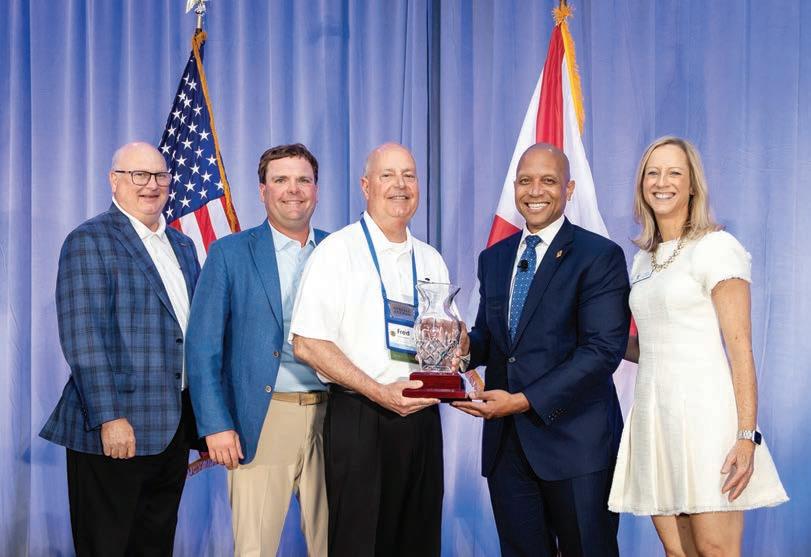
Florida Bankers Association (FBA) also presented awards to a select group of deserving bankers in the Emerald Coast (EC) during its 137th annual meeting. The distinguished awards recognize individuals for their dedication and contributions to the FBA and Florida’s banking industry. Fred Leopold, Coast Region chief lending officer, Community Bank (Miramar Beach), was named Banker of the Year. This award recognizes an individual who demonstrates the highest level of commitment to the banking industry and service to his or her community. Leopold has worked in banking for 42 years and serves as chair of the Florida Bankers Educational Foundation Board. He is actively involved with the FBA’s efforts to cultivate and mentor future banking leaders. He is highly respected by his peers, colleagues, and community partners.
Business with a degree in Real Estate and Urban Analysis. He also received his J.D. from the University of Florida College of Law.

David Bear has joined the Board of Directors of the Florida Institute for Human & Machine Cognition, adding to his impressive business and civic resume. Bear is the owner and CEO of The Lewis Bear Company, a beverage distributorship founded in 1876 in Pensacola. Bear and his company founded Bear Family Foundation in 2002, which has awarded millions of dollars in grants to more than 118 local nonprofit organizations serving Northwest Florida. In addition to his entrepreneurial success, Bear has built upon his family’s legacy of commitment to public service and community engagement. From August 2021 until June of 2025, he served on the Board of Triumph Gulf Coast, the nonprofit corporation funded by a legal settlement with BP following the 2010 Deepwater Horizon
oil spill. Its purpose is to seed projects that will transform the regional economy. Bear’s leadership extends beyond business into cultural and community development. He is the founder and trustee emeritus of Art, Culture, and Entertainment, Inc. and has held significant roles, such as the current chair of the Escambia County Tourist Development Council, chair of the Florida Beer Wholesaler
Association, and chair of FloridaWest. Additionally, he played a key role in founding the Foo Foo Festival, a fall event that celebrates the arts and culture as a driver of tourism in the community. Bear is past president of the boards for the Arts Council of Northwest Florida, Pensacola Museum of Art, Creative Learning Academy, and Pensacola MESS Hall. He earned
his bachelor’s degree in business administration from Belhaven College.
Dock Blocks of the Florida Panhandle, a leading provider of modular floating dock systems, announced today that every component of its docking systems is now 100% made in the USA—a major milestone that comes as demand surges across Florida’s coastal
and inland waterways. The announcement coincides with a local push: Dock Blocks is strengthening its onthe-ground support for Florida residents and contractors, offering fast delivery through terminal partners in towns across the state and a growing network of certified installation pros. Customers in Florida can now receive systems in just days—not weeks. Dock Blocks’ expansion into Florida is part of a larger
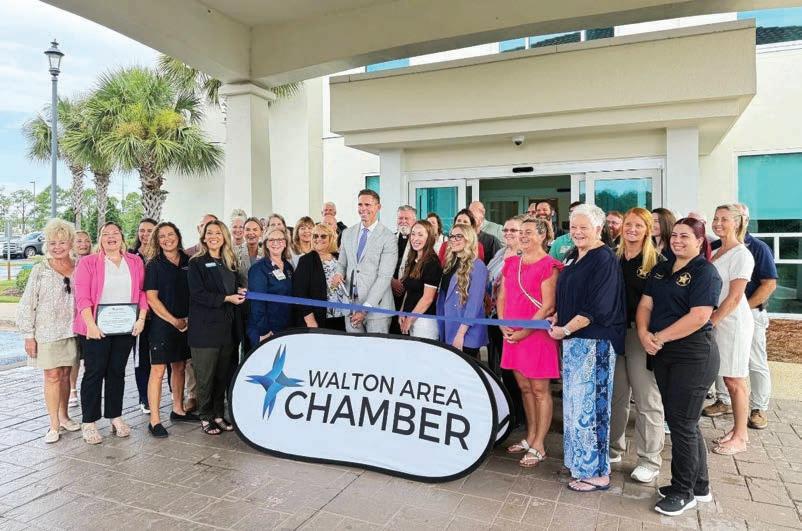
Ascension Sacred Heart Emerald Coast is expanding its maternity services at The Family Birth Place through a partnership with OB Hospitalist Group, OBHG. As the only NICU close to home for families living in Walton and Okaloosa counties, Sacred Heart Emerald Coast is renowned for its awardwinning maternity care. Sacred Heart Emerald Coast will also partner with OBHG to provide an OB ER, ensuring timely evaluation and intervention for emergencies like abdominal pain, bleeding, contractions, and high blood pressure. The goals of the program include reducing ER wait times for expecting mothers, increasing patient safety, and improving outcomes.
trend toward resilient, low-maintenance waterfront solutions, especially in hurricaneprone regions. Modular floating docks offer superior flexibility and durability compared to traditional fixed docks—and are easier to maintain, repair, or relocate after storms. The system has already been adopted by homeowners, marinas, municipalities, and military clients, including the U.S. Coast Guard and Marine Corps.




EG America has broken ground on a new-to-industry retail site at 23rd Street and Beck Avenue in Panama City. The Cumberland Farmsbranded store will offer innovative on-the-go food items, numerous fueling stations, a car wash, and more—strategically positioned in a robust business district with easy access for guests. The new site will be EG America’s eighth location in the Panama City area, further expanding its footprint in a growing market. It strengthens the company’s presence, boosts local brand recognition, and deepens guest connections. Shoppers will also enjoy the benefits of the popular SmartRewards loyalty program, featuring exclusive deals and rewards. With 1,500 retail locations and 18,000 team members across the U.S., EG America is one of the fastest-growing convenience store retailers in the country.
EMERALD COAST // NEW & NOTABLE


, together with Life Media Publications, announces a new cultural initiative, Art Escape, which showcases contemporary work by local artists in the airport’s concourse. The inaugural exhibit “Where am I Going?” opened July 1, with a plan for rotating works to cycle through the space over the next five months. Comprised of artists from across the region, this project brings together dynamic regional voices with the intent of enhancing the airport experience for those traveling to and from the Emerald Coast. Welcoming nearly 1.9 million passengers in 2024, ECP acts as a gateway to the cultural attractions of surrounding counties, which, beyond airport doors, include art galleries, world-class live music, documentary film festivals, stand-up comedy, and much more. “Where am I Going?” includes the work of artists Francisco Adaro, Christon Anderson, Mark Little, Chandler Williams, Mandy Yourick, and Jamie Zimchek in mediums that range from painting to photography and installation.
NAI TALCOR has acquired the Phillips Portfolio, a rare, 60plus asset collection of residential, commercial, and land holdings across Northwest Florida—
one of the fastestgrowing regions in the U.S. These assets include residential, commercial, and land in Okaloosa and other high-growth counties. These assets provide a debt-free advantage with opportunities for multigenerational holdings. Additionally,
most sites are shovelready or have active development orders.
NAI TALCOR was founded in 1990 as a real estate brokerage firm specializing exclusively in commercial properties in North Florida, South Georgia, and South Alabama. The brokerage company is staffed with the most experienced and competent professionals in the real estate business. We offer individual specialists in retail, office, agricultural, multifamily, industrial, and investment property sectors.








Alternative education helps all students excel
story by REBECCA PADGETT FRETT





↑ Kids immerse themselves in the science of light during the Pensacola MESS Hall’s special “Illuminate: Light” exhibit held this past November.
The rapid change of technological innovations has made the job market more competitive, creating an edge for students who pursue extracurriculars related to the field they will eventually follow. There seems to be little connection between a verdant Florida field of cattle, a workshop buzzing and beeping with robots, and the gently lapping waves of the Gulf; however, these are all examples of classrooms, classmates, and teachers spanning the nontraditional learning spectrum.
From homeschooling to immersive after-school activities and clubs, learning outside of the classroom has become crucial for students seeking an advantage in the current job market. In 2020, with the presence of the pandemic, the future of education was questioned, challenged, and immensely reshaped.
Parents, teachers, and students began to see the merits and pitfalls of classroom learning, as well as digital learning. Many parents sought education outside of the classroom entirely, opting for environments that connected kids to their interests and their communities.
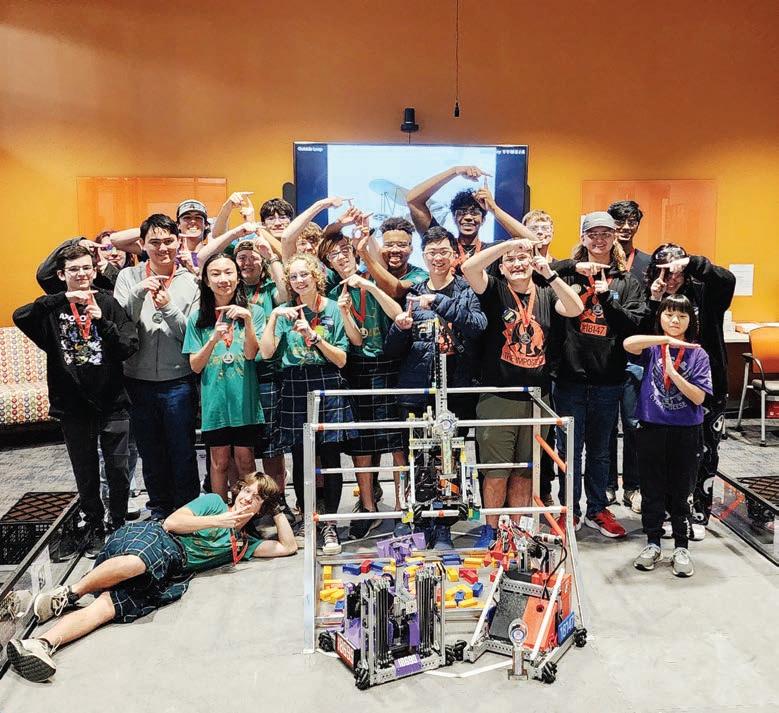
↑ Tallahassee FIRST Tech Challenge teams posing after their League Championship Tournamant in January. Teams are Purple Axolotls (Lincoln High School), Legacy (TallyRobotics), Imposters (TallyRobotics), and Cyber Geese (TallyRobotics). ↙ TallyRobotics FIRST LEGO League Challenge team, the Gorillabots, competing at the World Championship in Houston in April.
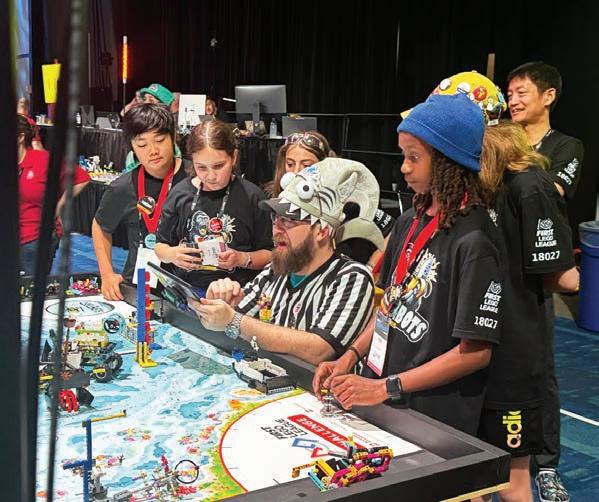
In 2013, Laura Leonard struggled to find a group for her son, who had taken an interest in robotics. When searching online, she came across a national organization, FIRST Robotics (For Inspiration and Recognition of Science and Technology), realizing her family could start their own FIRST Lego League in Tallahassee.
What began as a few other homeschool students meeting in the Leonard’s dining room quickly transcended to multiple teams competing in state FIRST Robotics competitions. For years, TallyRobotics partnered with TSC (Tallahassee State College), which provided a space for the children to meet and workshop their robotics projects.
This fall, TallyRobotics will move into its very own space in Midtown, complete with a large workshop full of tools and a practice area. In seeking a space to nurture their son’s love for
STEM, the Leonards have been able to reach and foster that same love of robotics for many other children.
“Students learn in a variety of ways,” Leonard says, “and not every student is going to learn and excel in a traditional school environment. Afterschool programs or community organizations give them the opportunity to do something they have an interest in that there may not be time for in school.”
For students in 4th through 12th grades, Tally Robotics presents opportunities to engage with STEM and programs to prepare them to compete in FIRST competitions. Whether traditionally schooled or homeschooled, these students are mentored in science, engineering, and technology skills while also promoting communication, confidence, critical thinking, teamwork, and leadership skills.
Where the teams work together to design, code, and build robots, they must also conduct research, write a report, and share their findings during the competition.
“As an educator and parent, I love that it’s the whole package deal including almost every school subject,” Leonard says. “At a young age, they start asking important questions that will lead them into adulthood, such as: Why do I want it to do that, how do I get it to do that, and how can I make it even better?”
The impact is evident in that all graduating seniors in recent years of the program have chosen to attend college to pursue careers in STEM fields.

With a Ph.D. in Neurobiology from Harvard, Dr. Megan Pratt certainly knows the importance of a classroom. She also knows that the majority of our lives will be spent outside of the classroom.
“I started Pensacola MESS Hall because I believe at every age, there’s a need for continual learning even in informal settings,” Pratt says. “There needs to be more public places where questions can be answered, interests can be followed, and ideas can be challenged.”
Pratt opened Pensacola MESS Hall in 2012 as a place where kids and adults can explore math, engineering, science, and stuff
(MESS). The exhibits are open seven days a week for the public to explore. Mess kits are also available to conduct experiments or for personal creations.

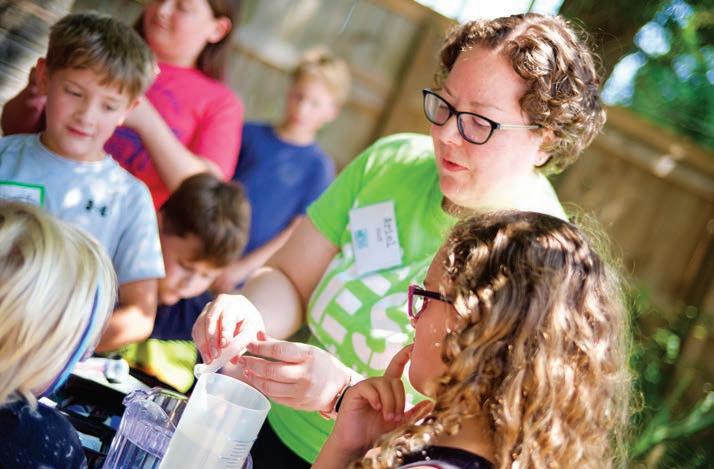
↑ MESS Hall educator Ariel Egan working with summer campers. ↓ Campers experiencing open exploration in the museum with an exhibit called the harmonograph. BELOW: During the “Illuminate: Light” exhibit, a field trip with Lafayette Parish from Louisiana allowing children to explore an activity station called zoetrope’s.
Throughout the year, the MESS Hall hosts field trips, welcomes homeschoolers, and offers special programming geared toward adults. During the summer and school breaks, science-themed day camps are offered.
As a result of funding from the National Academy of Sciences and other grants, MESS Hall is able to provide community outreach programs.
For the 2025 school year, students at 20 elementary schools will enjoy hands-on activities that highlight the life of the Gulf and the community’s impact on it. Through this School to Shore program, students explore the properties of water, consider how communities can respond to extreme precipitation events, and create an intervention for improving the environment at their school.
Whether it’s ecotourism, space adventures, or enjoying puzzles, the MESS Hall aims to inspire curiosity and spark experimentation.
“A lot of what is taught in a traditional classroom are the ABC’s and 123’s, which are important, but with that, we are often just retaining that knowledge to take a test and get the right answer,” Pratt says. “What’s more interesting and often most valuable, especially with science, is the creative process and exploration.”


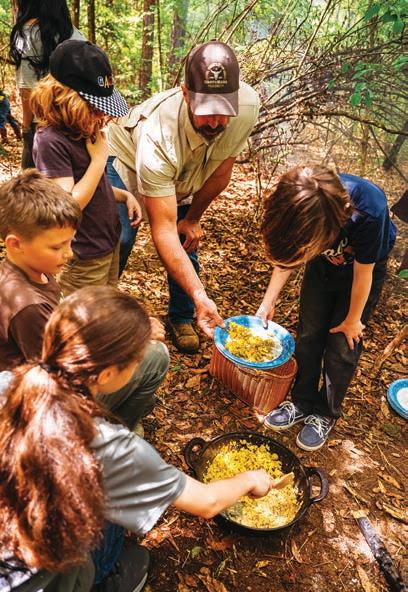
↑ During Friday Ranch Days, Wagyumama Schoolhouse hosted a “Cowboy Cookout” day, where students collected fresh eggs from the school’s chickens and cooked them over the fire, along with sausages donated by Big Creek Farms in Laurel Hill. →↘ Inside the barn-turned-one-room schoolhouse, students studied egg production and incubated chicks on their own.
Much like Leonard, Laine D’Souza Baker and her husband, Bryan, were seeking to enhance their son’s education with more hands-on learning.
Raised on a farm and working ranch, their son Kai thrived in that environment—building fences, working with cattle, changing tractor tires. He was not a child who learned well contained behind a desk.
The Bakers began the homeschooling journey to balance the necessary curriculum
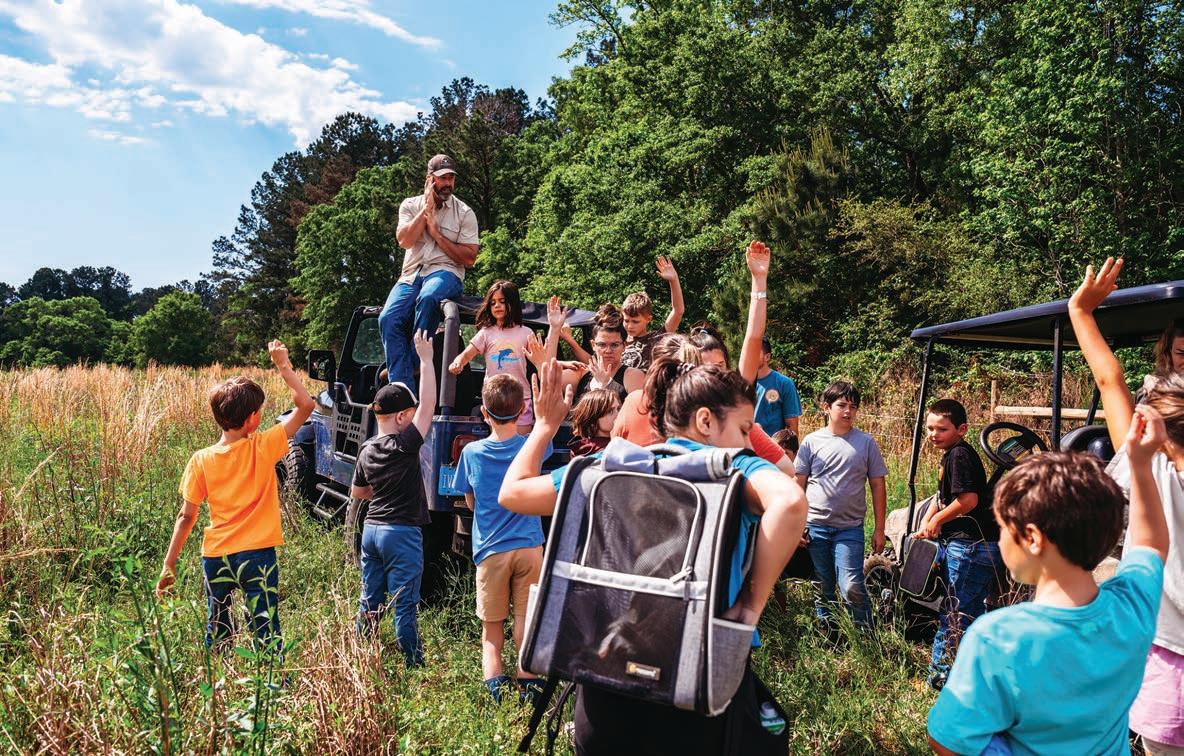

with plenty of time spent in the great outdoors. To build connections with other homeschooled students, the Bakers opened their property to what they called “Ranch Days,” where children could engage in handson activities to learn about life on a ranch.
“We wanted more for our son,” Baker says, “and apparently other people wanted that for their kids too, as over 50 people would show up sometimes, driving as far
as Pensacola to Laurel Hill because there’s nothing like this anywhere closer. And they loved it.”
The Ranch Days became so popular, the Bakers decided to expand, opening the Wagyumama Schoolhouses in Laurel Hill and Freeport.
The school follows the classical, Montessori education model focusing on foundational academics such as English language arts, reading, writing, math, history, and science but with hands-on exploration such as gardening, ranching, building, home economics, and more. Additionally, electives such as music, art, cooking, and Spanish can be added.
Families can select from a flexible, hybrid schedule of two, four, or five days a week or for teenagers, a dual enrollment program. For those
homeschooled or where traditional schooling allows, students can attend Ranch Days or enroll in electives only.
“The kids here are brilliant in so many ways,” Baker says. “Often, they just needed a change of environment or pace—to get away from busy work and worksheets and instead learn from nature, animals, community, and each other.” ▪

story by DAVID EKRUT, P h. D.
Ignorance creates confidence. Knowledge breeds humility. This is the short version of the Dunning-Kruger Effect (see side bar). This is to say, experience has a way of beating humility into us. There is a growing disparity in the durable skills demanded in industry versus the knowledge base from recent college graduates. Recent graduates with no prior work experience, aged 20-24, report unemployment as high as 6.6% versus 2.2% for experienced workers, aged 35-44. This period of career-searching can last up to 6 months with up to 5% taking longer than a year. However, companies on a global scale are reporting talent shortages. A survey conducted by Intelligent found that up to 38% of employers avoid hiring recent graduates in
favor of older employees. In fact, research from LinkedIn, Global Talent Trends shows a growing challenge in recruitment with 70% of U.S. employers struggling to fill positions.
Problem: College graduates need work; employers need employees. These ships seem to be passing one another in the night. Why?
These same employers that avoid hiring recent graduates reported that 20% of potential candidates brought their parent to the job interview and nearly half of employers have been forced to fire recent college graduates due to a lack of durable skills.
In the same study, over 50% of job candidates struggled with eye contact and asked for unreasonable compensation with nearly half
→ THE ORIGINAL STUDY by David Dunning and Justin Kruger conducted in 1999 was called “Unskilled and Unaware of It: How Difficulties in Recognizing One’s Own Incompetence Lead to Inflated Self-Assessments,” and was published in the Journal of Personality and Social Psychology. The key findings showed that people in the bottom quartile (beneath 25%) of performance in grammar, logic, and humor consistently overestimated their abilities across all three testing categories, displaying a complete lack of the metacognitive skill of accurate self-evaluation. Also dubbed, the “curse of knowledge,” on the other side of the Dunning-Kruger Effect, highly skilled people with great confidence will consistently downplay how difficult a task can be for others. This is also called projection bias, where the highly skilled assume others have the same knowledge or capability they possess. These same people may actually rate themselves lower than they will actually perform because they hold themselves to a higher standard and are more aware of what they don’t know.
dressing inappropriately for the interview. During virtual interviews, over a quarter refused to turn on a camera and more than 30% used inappropriate language.
According to a survey conducted by the Hult International Business School in 2025, 96% of HR leaders reported that colleges are not preparing students well enough for the workforce with 75% saying college educations are not providing students with any durable skills. Approximately 91% of these leaders say the cost to on-board new employees fresh out of college is higher—69% reporting at least double the expense.
Students agree with this assessment with 77% of recent graduates self-assessing that they learned more necessary skills after six months on the job than four years in college.
It appears that institutions of learning are churning out degrees without providing a meaningful education. Rather than focusing on durable skills which can transcend the college experience, some students are purchasing a piece of paper over the course of a four-year period without gathering training necessary for the workforce.
This practice is devaluing degrees from all colleges and universities, even those who emphasize quality in their pedagogy.
As seen in other stories in this issue, educational practices are shifting to address talent shortages from students. Colleges and universities in Northwest Florida are collaborating with industry leaders to share necessary durable skills expected from potential job candidates.
Here is a bullet list of what they are looking for in employees:
Critical Thinking and Problem Solving
■ Ability to analyze problems and think strategically
» How to build it: Case study competitions, logic-based games, consulting internships. Take up to calculus I, regardless of degree path.
Communication
■ Clear writing, presenting, and interpersonal skills
» How to build it: Join Toastmasters, volunteer, taking writing or storytelling courses, regardless of degree path
Digital and AI Literacy
■ Understand the ethical use of AI tools and how to utilize them
■ Comfortable with Google Workspace, Microsoft 365, ChatGPT
■ Bonus: Knowing how to automate tasks, manage data, or build no-code tools
Adaptability
■ Willingness to learn, experiment, and improve
» How to build it: Online learning portfolios, side projects, freelance gigs, pursue certifications in the career you are pursuing
■ Juggling deadlines, projects, and responsibilities
» How to build it: Internships, remote work, project-based courses ▪
→ AS EARLY AS 1944, the U.S. government began expanding benefits for college and vocational training with the Serviceman’s Readjustment Act (now known as the GI Bill), which began to normalize the idea of education for the general populace, rather than just the elites. In 1958, after the Soviet Union launched Sputnik, the U.S. passed the National Defense Education Act to fund education for the public at all levels with a heavy focus in STEM, which expanded in 1965 as part of President Lyndon B. Johnson’s Great Soviet reforms with Pell grants and student loans. By the 1980s, globalization shifted the scale of manufacturing and skilled labor jobs. This spurred an influx of degree-seekers. According to the U.S. Bureau of Labor Statistics and the National Center for Education Statistics, high school graduates enrolling in college rose from 49.3% to 59.6%. By 2010, 68.1% of students went straight into college, peaking in 2016 at 69.7% before declining. Public institutions earn over $500 billion per year on tuition. Private nonprofits nearly match that at $400 billion annually.
story by MIKE FENDER
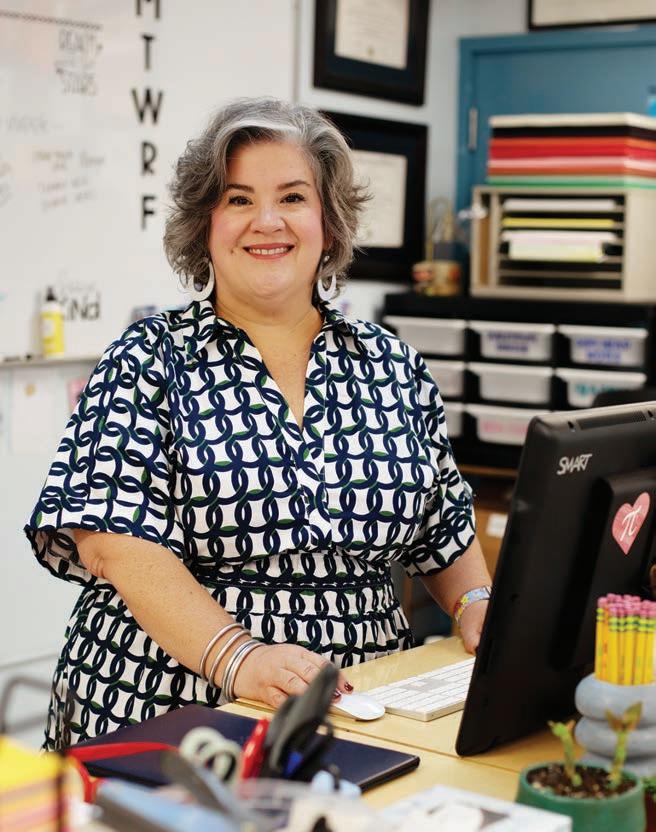
After 28 years in the classroom, it would be safe to say that teaching has helped put a roof over Jacqueline Sheffield’s head—not just metaphorically.
Earlier this year, the 51-year-old math teacher at Fort Walton Beach High School was named a recipient of the prestigious Presidential Award for Excellence in Mathematics and Science Teaching (PAEMST). The award, established in 1983, is the pinnacle of recognition that a K-12 teacher can receive from the U.S. Government. Before leaving
Math doesn’t just teach two plus two is four. Math is about critical thinking and problem-solving skills .”
—JACQUELINE SHEFFIELD, MATH TEACHER, FORT WALTON BEACH HIGH SCHOOL
office, President Biden announced 336 recipients. If the prestige and accolades weren’t enough, the award also comes with a check for $10,000.
What did Sheffield do with the money?
“I bought a new roof,” she says, laughing. “And I’m tickled pink about it.”
Mathematics and teaching have been constants in Sheffield’s life. This fall will be her twenty-ninth year in the classroom. Sheffield attended FWBHS (Fort Walton Beach High School) and went on to the University of Florida. After graduating, she returned to the Okaloosa County School District, where she started teaching math to middle school students. After four years there, she secured a position at FWBHS, where she has taught every level of math available at the school. Currently, she teaches Algebra 2 Honors and Advanced Placement Statistics, working with students she calls her “highflyers.”
Looking back, Sheffield always knew she wanted to be a teacher. As the youngest in her family with five older brothers, she remembers trips to the grocery when she was young. Sheffield says, “My brothers would go to the cereal aisle and look for the best toy in the cereal boxes while I would always go to the school supply aisle.”
She was always pretty good with math, winning math wars competitions in elementary school, but she credits having older brothers as being behind the push that made her even better.
“They made me a little scrappy, which is good for being a high school teacher,” Sheffield says, explaining that with five brothers and two sons of her own, she can easily handle the demands of her classroom.
Sheffield credits her brothers, Tim and Joe, both older, who would help her with homework, while bonding over David Letterman on “The Late Show.” Joe tutored her in Algebra I, where she went from struggling to becoming the “most improved” in her class. Their positive influence nurtured a love for education.
Learning from her brothers helped her understand different modalities of pedagogy and that sometimes students “need to see it in a different way.” Thanks to these experiences, Sheffield can help her own students in need of her versatile teaching methods in the classroom.
Over the 28 years as a teacher, Sheffield says she is always evolving, or in her words, “I reflect more. I analyze every test. I am kind of in that cycle of teaching, assessing, reflecting, and then going back and doing it again.”
Working with her “highflyers” also challenges Sheffield as a teacher. “I will tell you, when you are working with these really bright kids, you better be on your A game.”
She recalls when she first started teaching statistics, she had a student named Esther who ended up as the class valedictorian. She would have to spend extra hours doing a deep dive into what she was teaching just to be ready for class.
“I had to be prepared,” she says. “I always knew Esther was going to ask me the why.”
With new technological tools capable of answering most questions, getting students to appreciate the need to learn critical thinking has become challenging, but these are the skills that set students apart in industry. Students who can incorporate generative AI with other durable skills will have advantages regardless of the field they enter after graduation.
“Math doesn’t just teach two plus two is four. Math is about critical thinking and problem-solving skills,” Sheffield says and that students need, “… to be able to break down complex problems and come up with solutions. They have to be able to take a challenge, break it down into pieces, solve the parts, and put those parts back together for a solution.”
A crucial skill for students is the ability to assess the veracity of information found from a generative AI tool. Sheffield believes that sourcing the information is important, and she wants to be able to verify search results.
Administrators at her school are quick to compliment Sheffield and her work ethic. Her principal, Lindsey Smith, says the award is a testament to the high standards she sets in her classroom and the meaningful impact she has on her students’ lives.
“We are so proud of her and grateful for the dedication she brings to our school every day,” Smith says.
Okaloosa County Schools
Superintendent Marcus Chambers calls Sheffield “truly inspiring.” He says the award reflects her
photos by ROBERT YOUNG
unwavering dedication to academic excellence and her ability to inspire a love of learning in her students.
Besides the recognition from the award and the stipend, winners are typically invited to the White House to be recognized, which Sheffield is looking forward to.
“I love my job,” Sheffield says. “I love my students, I love where I work, and I love who I work with. I’m very lucky that this is my job that I get up and go to every day.”
Sheffield feels she has at least eight more years left in her as a classroom teacher before retiring.
With a new 20-year roof over her head, Sheffield has a constant reminder that her work has value, or in her words, “It’s a roof that math built.” ▪

story by PAIGE AIGRET
Raised during the age of the internet, millennials had a leg up on older generations in mastering all that the world wide web brought to the table. But generations Z and A are coming up during a new apex of technology where systems have evolved, and generative AI is now at everyone’s fingertips.
Comprehensive training will be essential for young learners to productively wield these new tools as they enter the workforce. School systems prioritizing new-tech initiatives will put students at a next-generation advantage.
“This year, we have to have a heavy focus on how to teach the students how to ethically use [generative] AI, how to use it as a thinking partner and a refinement tool,” says Tom Miller, executive director of The Seaside Schools, including Seacoast Collegiate High School.
Miller says Seacoast teachers will be pioneering instruction of generative AI systems at the South Walton charter school.
“Not everyone is all for this,” Miller says, “but it’s important that our kids learn how to use this so they can stay ahead of the game and not just use it as a glorified Google.”
Seacoast Collegiate High School seniors graduate with a diploma, an associate degree, and industry certifications. The school emphasizes an education based in workforce readiness and entrepreneurship.
“They’re going to be way more equipped than the traditional high school graduate when they leave us,” Miller says, explaining that the goal is “to expose our students and equip them for any path they choose.”
Seacoast is small but mighty. The ninth through twelfth grade charter school opened in 2013 with only nine classrooms and maintains a 10:1 educator to student ratio.
“We’re already out of space,” Miller says, “but when we have the Accelerator Building, that will be a big opportunity for us.”
Located directly off Highway 331, Seacoast shares a campus with Northwest Florida State College’s South Walton Center. Luckily, the campus left room for expansion.
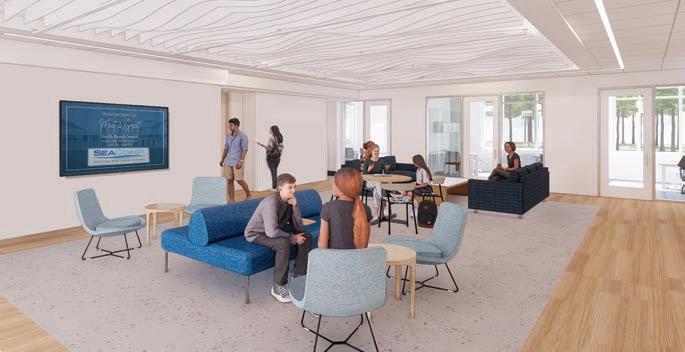
In October 2023, Seacoast announced that $9 million in state funding and a $1 million contribution from the Glavine family would support efforts to expand. A three-phase project, named The Dream Big Project, will bring about three new buildings upon its completion. Two of those are open and functioning as of the start of the 2025-26 school year. A third Accelerator Building will serve as a workforce incubation center where training, mentoring, and collaboration can take place among students, community, and business leaders. Prior
←→ As part of the three-phase project, named The Dream Big Project, Seacoast Collegiate High School’s expansion includes two buildings opening as of the start of the 2025-26 school year, and a third Accelerator Building (rendering, left) that will serve as a workforce incubation center where training, mentoring, and collaboration can take place among students and community and business leaders.
to additions, junior and senior students working on their collegiate courses had to commute to the Niceville NWFSC campus. The project’s new NWFSC Dual Enrollment Center will allow nearly 200 Seacoast junior and senior students to attend college courses on-site at the South Walton campus. The center will also be open to other area high school students and adult learners.
“In order for the Accelerator to work, we have to have all of the students on the actual campus,” Miller says. “The main purpose of the project was to eliminate the drive for South Walton high school students.”
The other new building will be designated for Seacoast freshmen and sophomores.
In the 2024-2025 school year, Seacoast educated around 300 students. That number will double with the new additions, opening capacity up to 600-700 students.
Opportunities will be further enhanced with the opening of the Accelerator Building. The building’s conference room alone will hold up to 200 seats. Miller says this will allow Seacoast to host more frequent keynote speakers and mentorship programs.
“The Accelerator Building will be a community building, which will be an ecosystem and a co-op for innovation and entrepreneurship,” Miller says. “It will have a workforce center; it will have a conference center; it will have a meetup space.”
Seacoast expects to break ground on the Accelerator Building by winter 2025. The project is approved for another $750,000 from the General Assembly state budget. In May 2025, The Seaside
In order for the Accelerator to work, we have to have all of the students on the actual campus. The main purpose of the project was to eliminate the drive for South Walton high school students.”
—TOM MILLER, EXECUTIVE DIRECTOR OF THE SEASIDE SCHOOLS, INCLUDING SEACOAST COLLEGIATE HIGH SCHOOL
Schools announced $9.5 million in funding awarded through the Triumph Gulf Coast grant to expand career and technical education programming. The funding will help bring the Dream Big Project to completion.
This year, education expansions include new certification-awarding courses in AI, IT fundamentals, cyber security, and QuickBooks.
“They’ll be able to take those to wherever they go, if they go straight into the workforce, or if they go to college, it really sets them apart,” says Seacoast principal Drew Ward, “because these are certifications that industries will look for in hiring somebody.”
AI training will go beyond simply introducing students to the use of generative AI, such as ChatGPT.
“It actually goes into the coding aspect,” Ward explains, “so they’ll build their own GPTs. They’ll data mine their own data and come up with their own, like a Chat GPT.”
The school has also recently expanded its electives and extracurricular
activities, including sports, arts, and theater. Seacoast students can also participate in teams and clubs at neighboring Walton County schools.
“We’ve brought in some significant experts in the field of STEM education, college and career advising, and AI,” Miller says. “We’re still recruiting cyber security, business leadership, and arts as well. We’ve already hired nine new staff this year, we hired four last year, and we’ll have another three or four next year.”
New staff members will assist in fostering mentorship and innovation initiatives with entrepreneurship programs, help to manage grant funding, and enhance STEM programs and AI training.
“Robotics clubs, engineering clubs, those will all be beefed up,” Ward says. “We do some of the underwater drones right now, and we have the Drones in Schools project, but we’re really going to beef those up this next year now that we have space and the experts in those fields that we’ve just hired.”
Dreaming big, Miller says, “There are no limits to our kids’ opportunities.” ▪

For David Deliman, Cox Communications is more than just a service provider; they’re a community partner.
Deliman, who oversees Cox’s Gulf Coast market (Escambia, Santa Rosa, Okaloosa and Walton counties), has witnessed his company make it possible for businesses to survive and thrive within the region for the past 21 years of his career.
“Whether it’s a small, mom-and-pop store, like a dry cleaner’s or a larger organization, hospital, military base, or financial institution, we want to provide the technology and support these entities need to grow and flourish,” David Deliman says. “We’re not simply here to make a profit. We want to foster a successful community and reinvest in it through service, jobs, infrastructure, and partnerships.”
That commitment and integrity toward the markets Cox serves is what Deliman believes characterizes them from other service providers. “We’re not just selling cookie-cutter packages,” he says. “We are
devoted to tailoring our solutions to each business to make sure we’re providing the correct level of services and support to help them prosper.”
Those solutions could be anything from Cox’s 24/7 IT support team to the implementation of self-service portals so clients may easily access their accounts and information without assistance. Also, Cox assists businesses in adapting to contemporary hybrid work models, offering scalable bandwidth, cloud solutions, and remote work support.
“Agility is key, and our tools and technology help enable that agility,” Deliman says.
Boasting a 99.9 percent network reliability, Cox fosters growth for the business community through steady, reliable connectivity that is simultaneously safe and secure.
“We are proud to have world-class, cloud-managed cybersecurity solutions,” Deliman says. “We’re devoted to helping businesses safeguard their customer’s data to maintain uptime, be it through


threat detection or data backup and disaster recovery solutions. It’s especially important to keep the latter in mind. As our area is prone to storms and hurricanes, we want to make sure you’re equipped with the tools and resources to keep your customers online.”
Deliman recalls recently when a new campus was constructed for a major area hospital, where technology is vital in maintaining medical records, patient monitoring, and telehealth remote health care. Cox was an integral part of the move, collaborating with the hospital’s IT team to support the new location as well as its other sites to ensure a seamless, successful transition.
Looking toward the future, Deliman says Cox will continue its time-honored tradition of creating a better quality of life within the counties they serve as well as continue adapting to the fast-paced digital landscape.
“We know we have to keep evolving our products and services to keep up with the demand of our consumers, especially as things like AI continue to advance and change the game for all types of businesses,” Deliman says. “We’re going to continue to provide a full suite of services to make life easier for our customers, and make sure we equip our team and clients with all the necessary means they need to stay online and competitive.”








2025-26 Concert Season All concerts are on Sunday in Tallahassee, FL.
September 21, 2025, 4 PM
Opus 76, string quartet
First Presbyterian Church, 110 N. Adams St.
October 12, 2025, 4 PM
Trio d’Anches, woodwind trio, Artist-in-Residence
St. Paul’s United Methodist Church, 1700 N. Meridian Rd.
November 9, 2025, 4 PM
Ilya Yakushev, piano
Christ Presbyterian Church, 2317 Bannerman Rd.
January 25, 2026, 2:30 PM
Tekalli Duo, violin & piano
St. Peter’s Anglican Cathedral, 4784 Thomasville Rd.
March 29, 2026, 4 PM
Paul Galbraith, guitar
St. Paul’s United Methodist Church, 1700 N. Meridian, Rd.



story by DAVID EKRUT, P h. D.
Generative AI appeared like a slow-moving tsunami, just a ripple on the horizon that concerned citizens watched with great interest.
GPT-1 (Generative Pre-trained Transformer 1) was released in 2018 and was largely limited in scope, accuracy, and comprehensibility. Those keeping an eye on those waters were not overly concerned until the next year when GPT-2 was released, demonstrating more comprehensible output. With each subsequent iteration, the generated text became less robotic, more human, until 2022; the average reader could not distinguish ChatGPT output from human writing.


those who have been watching at a safe distance were better prepared for what came next. The LLM (large language models) have continued to improve, changing the landscape of technological jobs forever.
And the metaphorical tsunami finally crashed into the masses with all the force of the ocean.
Those who did not see the wave coming were hit hard, but


As the initial shockwave created by generative AI ebbs, many colleges and universities started assessing how the shi in technology will necessitate a change to current pedagogy. The use of generative AI is quickly becoming a durable skill, and higher education will need to work hard to equip their graduating classes with the tools necessary to succeed as the demands of industry evolve.













BEGAN as a military term, officially defined by the U.S. Army in 1972, to indicate necessary non-technical skills that mostly included communication and decision-making capabilities transferrable across jobs and industries. The term was adopted by education and industry, evolving to include many social and life skills required for management, sales, and customer service. By the 2000s, globalization and technical expertise became far more important to daily careers. Companies and education rebranded soft skills as durable skills, covering all essential transferable skills, all of which are considered crucial to success in an everchanging world.
New roles are being created that did not exist when students entered college just a couple of years ago, and some jobs are vanishing altogether. Every industry involving computer science, communications, and technology is reevaluating the efficiency of the roles within their companies. To remain relevant, faculty and staff at universities must evaluate their course content and encourage faculty to utilize generative AI in their curriculum development.
Launched in January 2018, the Innovation Hub at FSU is a multidisciplinary innovation workspace with a $2.5 million investment by the Provost’s Office, led by Sally McRorie at the time. The center provides an environment to facilitate interdisciplinary collaboration and is open to all students, faculty, and staff.
Spanning approximately 14,000 square feet, there is a Digital Fablab equipped with 3D printers, laser and vinyl cutters, and electronics workstations, allowing space for faculty and students to train in robotics and drone technology. Additionally, the Rubini New Media Design Lab, which opened in May 2023, houses 14 high-end computer systems licenses with immersive media tools for UX design and coding.
The hub was launched at the same time generative AI tools were emerging, but the leadership team at FSU had been watching this space for even longer.
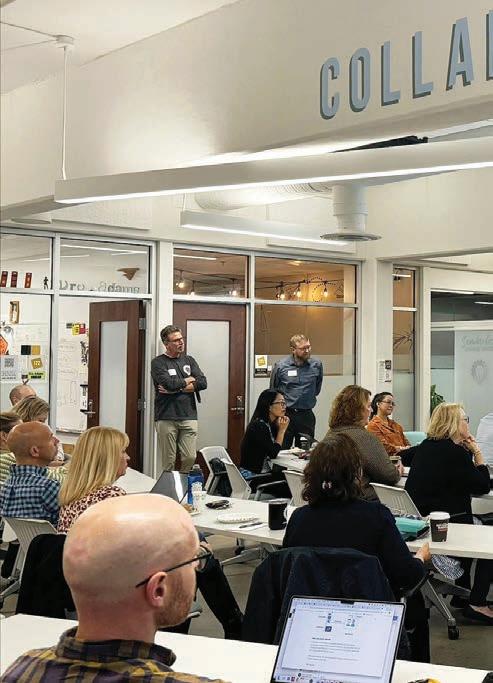
“I should stress that universities have been dealing with AI since the 1970s,” explains Dr. Paul Marty, associate vice provost for academic innovation from the School of Information. “It’s like the transition from the internet to the World Wide Web.”
After the web became available in the early ’90s, rather than adopting this new tool, academic institutions opted to use Gopher—an early IP tool utilizing hierarchical organizational menus of text-based content. Many of the arguments against the web at the time centered around a dilution of quality in information, viewing the ease of online publishing as a risk of losing scholarly integrity.
The same resistances exist on college and university campuses across the
THE INTERNET ORIGINATED in the late 1960s as ARPANET, a government project connecting research computers. By the 1980s, it had evolved into a global network using TCP/IP, supporting services like email and file transfers. However, it remained mostly text-based and was used mainly by researchers and academics.
In 1989, Tim Berners-Lee proposed the World Wide Web as a way to share information through linked documents using hypertext. By 1991, the web was publicly available, and in 1993, the release of the Mosaic browser made it easy to access and navigate. This graphical interface helped the web rapidly gain popularity, transforming the internet from a basic tool into a user-friendly platform for information, communication, and commerce.
Generative AI will be just as transformative as the web in how businesses and individuals communicate, learn, and work.

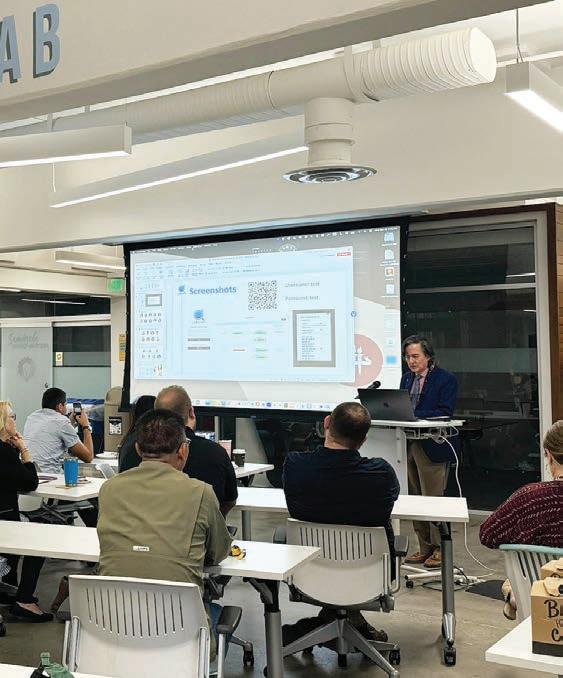

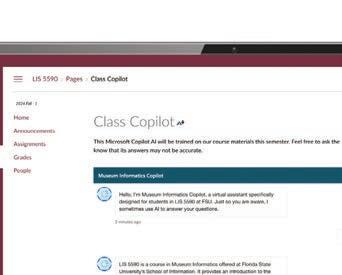

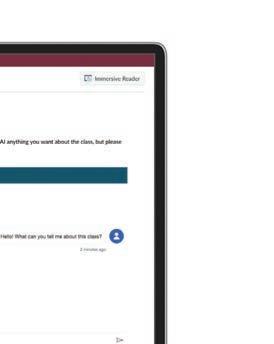

↑← FSU became an early adopter of generative AI, embracing the innovative technology. They created a custom GPT using Copilot for a student resource and began workshops in the
globe, many instituting tight controls and outright bans on the use of generative AI, naming ChatGPT, specifically. That is not the case at FSU.
“I had been watching this come down the pipeline for two years,” Marty says, discussing how he had been eager to try ChatGPT himself, “and I wasn’t alone in that. Lots of faculty all across this campus and other campuses knew this technology was coming.”
According to Ken Baldauf, founding director of the Innovation Hub, FSU became an early adopter of generative AI, embracing the innovative technology. “We decided that the best place to start is with faculty,” Baldauf says, adding that, “They need to know how to respond in a productive manner, so we started workshops here in the Innovation Hub.
“Within 15 minutes, all 60 seats were taken,” Baldauf recalls. “And then we had people complaining to the provost that we didn’t accommodate all the faculty.”
For their first introduction to ChatGPT, Marty explains, “I only have one rule. We weren’t going to talk about cheating.”
Instead, they took a proactive approach to training faculty on the ethical and proper use of the tools, not just to pass on to their students, but also to help teachers save time.
“We took all of our syllabus information, all of our assignments, all of our readings, etc.,” Marty says, “fed them into Copilot Studio and created a custom GPT using Copilot that could live right in a campus site. So that’s worked great.”
FSU is the first campus in the country to have embedded these agents into Canvas as a tool for students to answer basic questions about the design of the course.
“The way we teach has to keep evolving,” Marty says, explaining how they encourage faculty to show their students best practices in the use of generative AI as a free tutor and building their assignments with the assumption that the students are already using these tools.
Baldauf agrees, adding, “The value now becomes in asking questions.”
Generative AI tools are like having a personal research assistant always available, and the accuracy and quality will continue to improve. And the big question, according to Marty is, “So, a er everything is automated, what’s going to be le for humans?”
I had been watching this come down the pipeline for two years, and I wasn’t alone in that. Lots of faculty all across this campus and other campuses knew this technology was coming.”
—Dr.
Paul Marty, associate vice provost for academic innovation from the FSU School of Information
Marty and Baldauf agree that insight, critical thinking, and creativity are far greater assets in today’s job market, and the new, most sought-a er durable skill in industry will be emotional intelligence, being able to work with people, and the aspects of interdisciplinary collaboration, which is the entire reason the Innovation Lab exists.
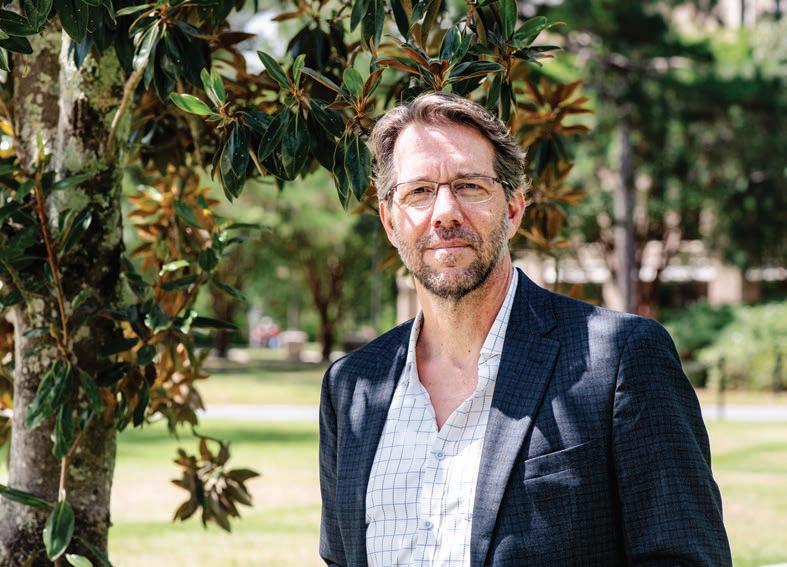
I was doing a ton of research on how generative AI was entering into the workforce, reading all of these articles and listening to the people who were actually making it happen in the real world, and I realized that we had been doing our students a disservice.”
—Dr. Kevin M. Scott, chair and professor of the Department of English in the College of Arts, Social Sciences, and Humanities at UWF
With over 13,000 students annually and greater than 70 undergraduate and graduate programs, UWF is the largest college in the Western Panhandle. As a whole, UWF is embracing the new changes in technology.
Dr. Kevin M. Scott, chair and professor of the Department of English in the College of Arts, Social Sciences, and Humanities, has been an early pioneer of incorporating AI into the curriculum at his institution, but some of his faculty were not on board right away.
“I was doing a ton of research on how generative AI was entering into the workforce, reading all of these articles and listening to the people who were actually making it happen in the real world, and I realized that we had been doing our students a disservice,” Scott says, recalling when ChatGPT first hit the market. His faculty “were pretty just dead set against it, and you know, I don’t blame them for that. Their experience had been pretty much entirely one kind of experience.”
Cheating.
Generative AI has increased the scope and volume of students willing to “life hack” for a quick
COGNITIVE DEBT is the accumulated mental burden caused by shortcuts, unclear processes, or poor knowledge management, especially in work environments requiring efficiency skills. According to a brief report in Springer Nature on the roles of cognitive abilities in managing moral short cuts, a study published in 2021, cheating is a cognitively demanding process that can damage executive functions, such as inhibitory control, working memory, and attention.
These practices can lead to self-deception and unearned confidence, which will cause people to overestimate the quality of their skills. This can be detrimental to students who build up unethical practices then enter into a job. Additionally, the debt created by unethical practices is cumulative, so these individuals will become underdeveloped and potentially lose critical thinking and problem-solving capabilities.
Research from MIT Media Lab and Carnegie Mellon University, in collaboration with Microsoft, has found that increased reliance on AI tools can impact the brain’s ability to engage cognitively expensive activities and inhibit the ability to evaluate the output produced by the AI tools, even results within their own submitted work.
fix to a high-stakes midterm papers worth a huge percentage of their final grades; however, cheating has been a pervasive disease in classrooms as far back as any teacher can remember.
The rapid adoption of generative AI among college students led to panic in those teachers caught unaware. Their fears birthed an industry dedicated to detecting AI-generated frauds and forgeries. Originality.AI, GPTZero, and Copyleaks all have subscription fees for their services with promises to detect the use of generative AI in documents. With an estimated revenue of $2.3 million for Originality.AI in 2025 and as much as $14 million and $16 million for Copyleaks and GPTZero, respectively, it is safe to conclude that cheating—at least in this instance—pays.
These tools have been created specifically to solve the problem of ethical misuse of generative AI. But there is a better way.
“Fortunately,” Scott says, “I have very serious, expansively minded faculty.”
Though ethical use is a very important topic, and conversations about plagiarism and morality should always be included in conversations around intellectual property, Scott and his faculty understand that, “AI is going to transform sections—big sections of the economy.”
Scott repurposed a committee to assess utilization of the new technology, posing one important question: “If students graduate from our program and don’t have a sense of how to make use of generative AI, both practically and ethically, have we served them well?”
The answer was to use a proactive approach to curriculum development. The sentiment, echoed from the FSU Innovation Hub, is to assume that students are already using these tools and that banning them will only hurt students.
“Unethical use of AI is foundationally destructive to the person who uses it,” Scott explains, invoking the notion of Cognitive Debt (see sidebar). “And if you are using AI to circumvent work, then you literally are firing your brain less.
“And that’s precisely why I think it’s important for us to find nonjudgemental ways to incorporate [generative AI] into classes such that students can be asked to be captain of the ship,” Scott elaborates on the importance of handing responsibility for critical thinking, research, and fact-checking over to his students. “Because if they build that in as a foundational skill, they will be focusing precisely on those skills which they’re going to be asked to use in the professional world.”
Though some career fields in mathematics and other sciences may be less impacted, Scott acknowledges that his department and his students will be directly a ected by the change in technology, which is why so many of his faculty have been so willing to embrace AI.
“They want what’s best for the students,” Scott says, explaining that academes can be resistant to change but that also, “They’re part of the world and recognize that AI is going to be seismic.”
GCSC is already well-established as an industry partner, connecting with business leaders along the coast to actively seek and fill skills gaps in industry. Local employers (see sidebar) are participating in lab-based training and cooperative education designed to prepare students for technical careers in related fields.
In addition to traditional studies, students can choose from 24 distinct AS degree pathways designed for direct career entry and can earn several specific AS post-secondary vocational certificates. Health



→ ENGINEERING TECH:
Introductory maintenance technicians with industry partners such as Naval Surface Warfare Center-Manufacturing lab, Maritech, Trane, Oceaneering, Berg Pipe, E.F. San Juan, Eastern Shipbuilding, Rockwell Automation, Haas Automation, Merrick Industries, Central Moloney, and local utility departments
→ COMPUTER SCIENCE: Cybersecurity/Networking/ Software and Database Developer-SAIC and other government contractors, Neeves Media web developer
→ UNMANNED VEHICLES : State and local law enforcement agencies, various government contractors, Customs and Border Patrol, Naval Surface Warfare Center, Military-sponsored Air Show Support, and public works departments
→ DIGITAL MEDIA : Kerrigan Marketing Associates, WJHG-TV, WMBB-TV

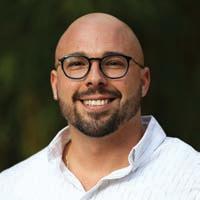
→ LED BY NICO ROSE, assistant provost and senior director of operations for Teaching and Technology, UF offers a three-day intensive training program for teaching faculty interested in curriculum development utilizing AI tools. The program teaches AI fundamentals, AI ethics, and AI applications in teaching and research.
UF also provides additional workshops and certificate offerings on getting started with AI, harnessing AI tools in the workplace, prompt engineering, AI image generators, and modules on Microsoft Copilot. They also offer similar versions for industry/external non-education organizations. The request form is: pwd.aa.ufl.edu/ai/ ai-contract
sciences provide pathways to nursing, diagnostic medical sonography, and related medical professions. In technology and engineering, students can specialize in cybersecurity, drone technologies, computer systems, etc. There are also industry-specific vocational tracks, such as accounting, business administration, criminal justice, and the culinary arts.
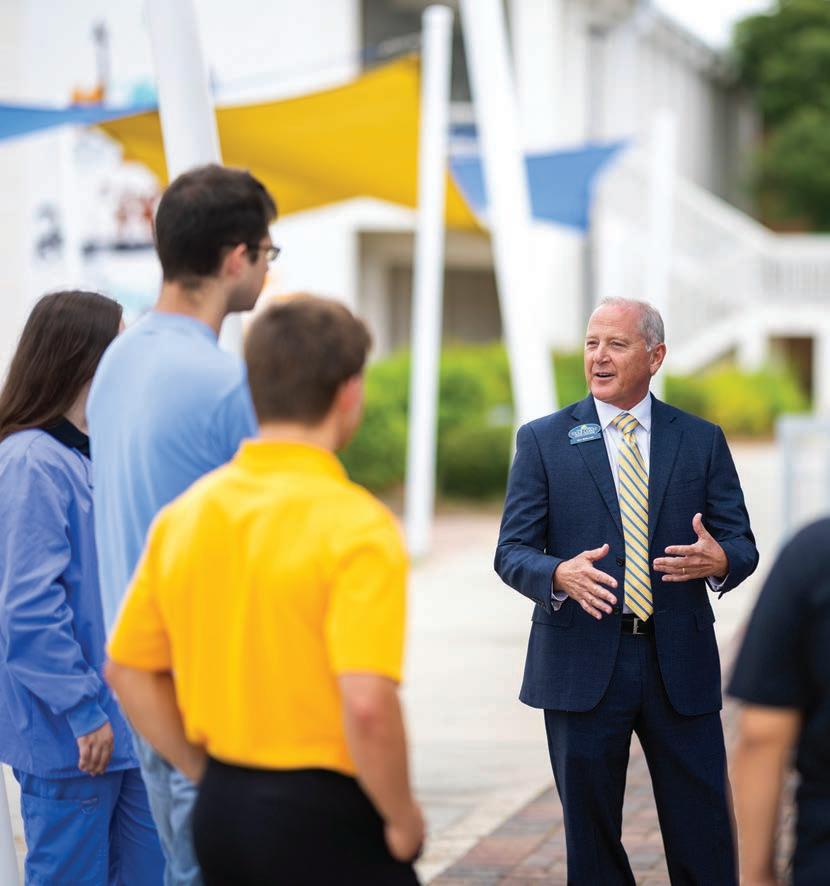
Being a student-focused institution, when Glen McDonald, president of GCSC, saw AI coming, he understood right away his college would need to adapt. Together with Dr. Holly Kuehner, vice president of academic affairs, they worked with faculty to devise a strategy to address the issue.
In the summer of 2025, they offered training to their faculty, provided by the University of Florida (UF), to give an introduction to AI, to which there was a good turnout from faculty.
Some educators have been resistant to learning the new technology with many of those more focused on the capacity for unethical use; however, many want to understand AI’s potential in the classroom.
“We’re trying to embrace AI because we know it’s in use, and we want our students to use it, both positively and appropriately,” says Dr. Jennifer Barber, the respiratory care coordinator at GCSC. Kuehner adds that they are working closely with faculty on implementation.
“We’re talking about it in the classroom,” Kuehner says, “helping students understand good ways to use it,” McDonald adds, “especially in English and writing.”
Similar to the messages from FSU and UWF, faculty at GCSC are making a transition in how they frame assignments to include ethical use of AI for their students.
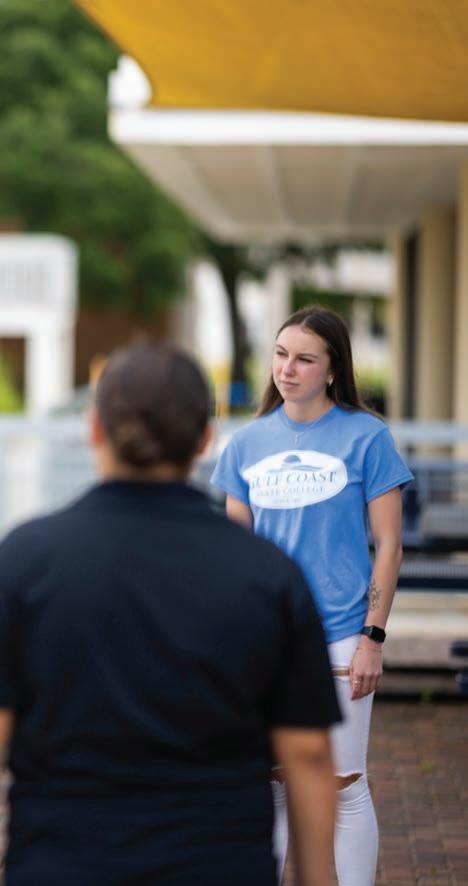
“If you want to use it for your classwork, use it as a study guide,” McDonald says, discussing how students can benefit from AI in assignments. “Learn what it is, and then write the whole thing in your own words.”
To help students learn proper use of the tools, GCSC contracted David Hatami, EdD to implement a module in AI ethics. Hatami is the founder and managing director of EduPolicy. AI, an educational consultancy specializing in AI policy, ethics, and implementation, who provides training opportunities to make the transition easier.
The overall strategy from GCSC to integrate AI tools into the current curriculum will keep their students engaged and learning the durable skills necessary to succeed in the workforce.
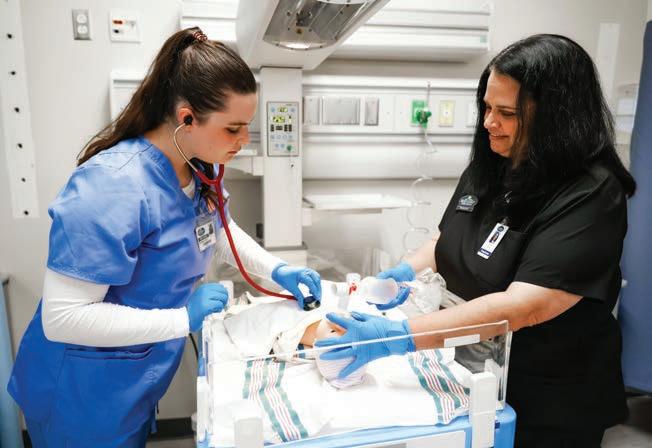
We’re trying to embrace AI because we know it’s in use, and we want our students to use it, both positively and appropriately.”
—Dr. Jennifer Barber, the respiratory care coordinator at GCSC
Specifically for McDonald, he wants graduating students to be immediately employable to GCSC’s industry partners, not just today but for the jobs of tomorrow.
While most colleges implementing AI into their curricula do so across all departments, few are offering an undergraduate degree for an AI-focused program. However, in the fall of 2024, TSC officially launched a two-year associate in science degree in Applied Artificial Intelligence, as part of a suite of workforce-focused programs.
“We are actively engaged in conversations with local industry leaders about the evolving role of AI in the workplace and the tools students need to stay competitive,” says Dr. Calandra Stringer, provost and vice president for Academic

Affairs. “As part of this effort, we partnered with the Greater Tallahassee Chamber of Commerce to host several community-wide events focused on AI awareness and workforce readiness.”
The goal is to connect business leaders, educators, and the community to strategize best practices for leveraging tools across industries. “The reality is that these tools are impacting all disciplines,” Stringer says. “We recognize our responsibility to help students become digitally responsible citizens,” which includes awareness among faculty and staff on ethical use.
“The college will be working with faculty this semester to design and implement an AI literacy framework to help students learn about generative AI and learn to use it ethically.”
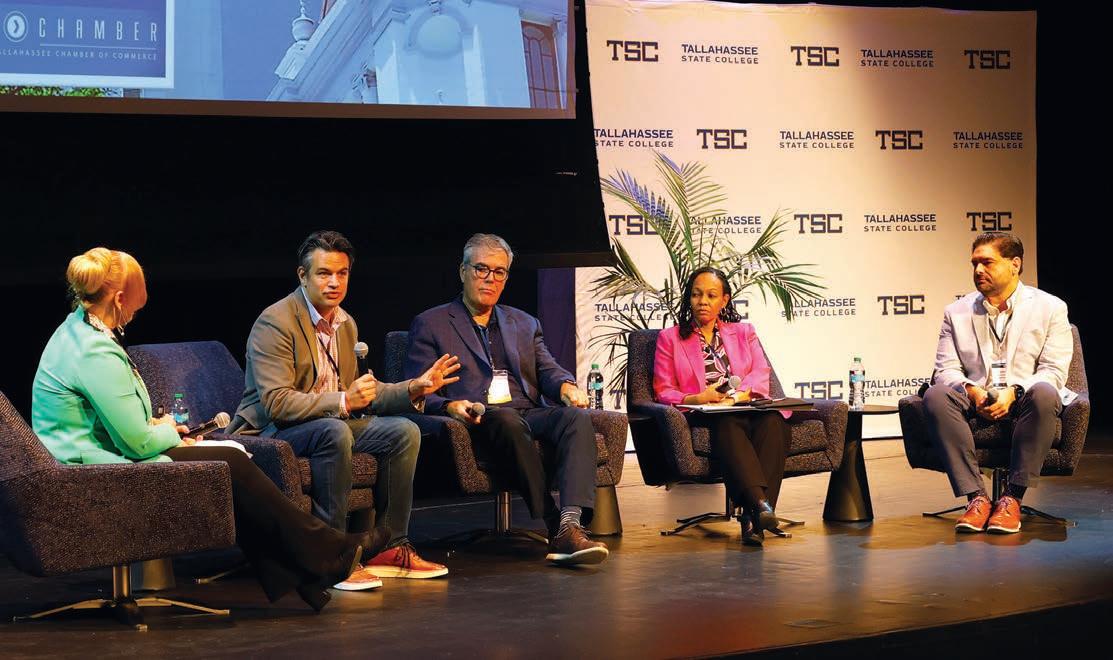
AI Innovations
event explored the transformative impact of artificial intelligence across industries and disciplines, with sessions covering topics such as marketing, cybersecurity, smart classrooms, health care, and even 3D-printed housing. Each discussion highlighted the growing influence of AI and inspired forward-looking conversations and ideas. → Dr. Angela Long, chief engagement officer at Tallahassee State College, was one of the keynote speakers.
TSC has also taken advantage of the training offered by UF, with several faculty members participating in the specialized training through their AI Learning program.
“Technology is both a tool and a skill,” Stringer explains, “and we know the importance of staying current. Our approach focuses on reinforcing the uniquely human skills, such as critical thinking, creativity, and thoughtful analysis, that remain essential regardless of how technology advances.” A similar methodology is echoed by
the other educators throughout Northwest Florida.
However, TSC takes this message a step further by creating a partnership with the Innovation Academy, Florida’s first AI-integrated middle school, where ethical training in AI and technology is embedded through the STEM-focused curriculum. The model uses AI as a teaching assistant, helping educators personalize lessons for individualized instruction.
The charter school serves grades six through eight and is located
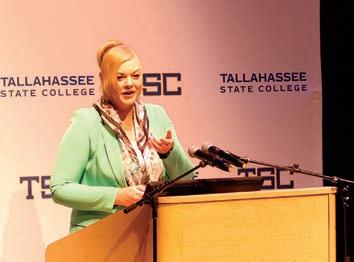
on the TSC campus inside the University Partners building. Together with their AS degree in AI and college credit certifications, TSC promises to become a leader in AI-driven education.
“These offerings,” Stringer says, “reflect our commitment to staying at the forefront of workforce innovation and preparing students for high-demand careers.” ▪
Technology is both a tool and a skill, and we know the importance of staying current. Our approach focuses on reinforcing the uniquely human skills, such as critical thinking, creativity, and thoughtful analysis, that remain essential regardless of how technology advances.”
—Dr.
Calandra Stringer, provost and vice president for Academic
Affairs,
Tallahassee State College
Diego Medone is the founder and CEO of Consulting IQ, a company offering AI-human hybrid consulting. Their digital ecosystem provides an all-inone platform to help small and medium-sized businesses grow. Here, Medone provides insights from a leading voice and user of AI tools. Though authorship of these responses belongs to Medone, he curated them for grammar using AI—an ethical use for this tool that leaders in industry are utilizing as a cost-effective time-saver.
1. THINKING IN TERMS OF NEW TALENT FRESH OUT OF COLLEGE/ TRADE SCHOOLS, WHAT SKILLS ARE MOST IMPORTANT TO YOUR CLIENTS?
At Consulting IQ, we work with thousands of businesses globally, and the answer is clear: Critical thinking, adaptability, and data fluency have become non-negotiable. Technical skills can be trained, but the ability to interpret information, solve complex problems, and make decisions in realtime is what truly sets talent apart. We live in a world where AI and humans must collaborate seamlessly—our clients are not just hiring for what you know, but for how quickly you can learn and apply in fastchanging environments.
2. AS AN INDUSTRY CONSULTANT, WHAT DO YOU SEE AS THE GREATEST GAP TO FILL BETWEEN CURRENT EMPLOYEES AND THE NEEDS OF YOUR CLIENTS? The most significant gap we see is what I call the “insight-action chasm.” Many professionals are drowning in data but starving for actionable insight. That’s precisely
the problem Consulting IQ solves—we help bridge this gap with AI-powered tools that empower teams to make smarter, faster decisions. But technology alone isn’t enough. Employees need business acumen, a cross-functional understanding, and the courage to take action. We need to turn information into transformation.
3. ARE THERE ANY SKILLS REGARDING GENERATIVE AI THAT YOU SEE AS CRUCIAL TO THE CURRENT JOB MARKET? Absolutely. Generative AI is not a futuristic concept anymore—it’s today’s toolbox. Skills such as prompt engineering, AI oversight, and ethical decision-making regarding AI use are becoming increasingly vital across various roles. At Consulting IQ, we train and guide businesses to utilize AI strategically—not just as automation but as a form of augmentation. Those who understand how to collaborate with AI will outperform those who compete against it.
4. WHAT ADVICE WOULD YOU GIVE HIGH SCHOOL GRADUATES
ON HOW TO BEST UTILIZE COLLEGE TO PURSUE A CAREER IN TECHNOLOGY? College should be more than lectures—it should be your launchpad for relevance. Learn to code, yes. But also learn to think like an entrepreneur, collaborate across disciplines, and lead projects that solve real-world problems. Get your hands dirty. Find internships, participate in open-source projects, and stay curious. The world doesn’t reward the best memorizer—it rewards the boldest learner.
5. WHAT DO YOU THINK COLLEGES/ UNIVERSITIES NEED TO DO TO ADAPT TO TODAY’S JOB MARKET? Universities need to stop preparing students for yesterday’s world. They must embed industry relevance, AI literacy, and entrepreneurial thinking across every curriculum. At Consulting IQ, we’re building bridges between academia and industry, so education doesn’t end in the classroom; it evolves in real time with the marketplace. Imagine students graduating not just with degrees but with strategic foresight and AI-ready problem-solving skills. That’s the future.
6. WHAT MESSAGE WOULD YOU HAVE FOR CLIENTS SKEPTICAL ABOUT THE USE OF AI IN THEIR INDUSTRIES?
I say this with clarity: AI is not coming for your job—it’s coming to transform how your job is done. Those who adopt it thoughtfully gain a competitive edge. Those who ignore it risk irrelevance. At Consulting IQ, we’ve seen clients improve profitability, agility, and decision-making by embracing AI in a personalized, strategic way. AI isn’t just for tech companies. It’s for every company that wants to survive and thrive in the new economy.
7. SAME QUESTION BUT FOR STUDENTS? To students, I say: You are the AI-native generation. Use that power wisely. Don’t just scroll—build. Don’t just consume— create. The ability to harness AI tools to learn more efficiently, work more effectively, and solve problems creatively will set you apart. At Consulting IQ, we’re building a world where talent and technology grow together. If you lean in now, you won’t just enter the workforce— you’ll shape it.
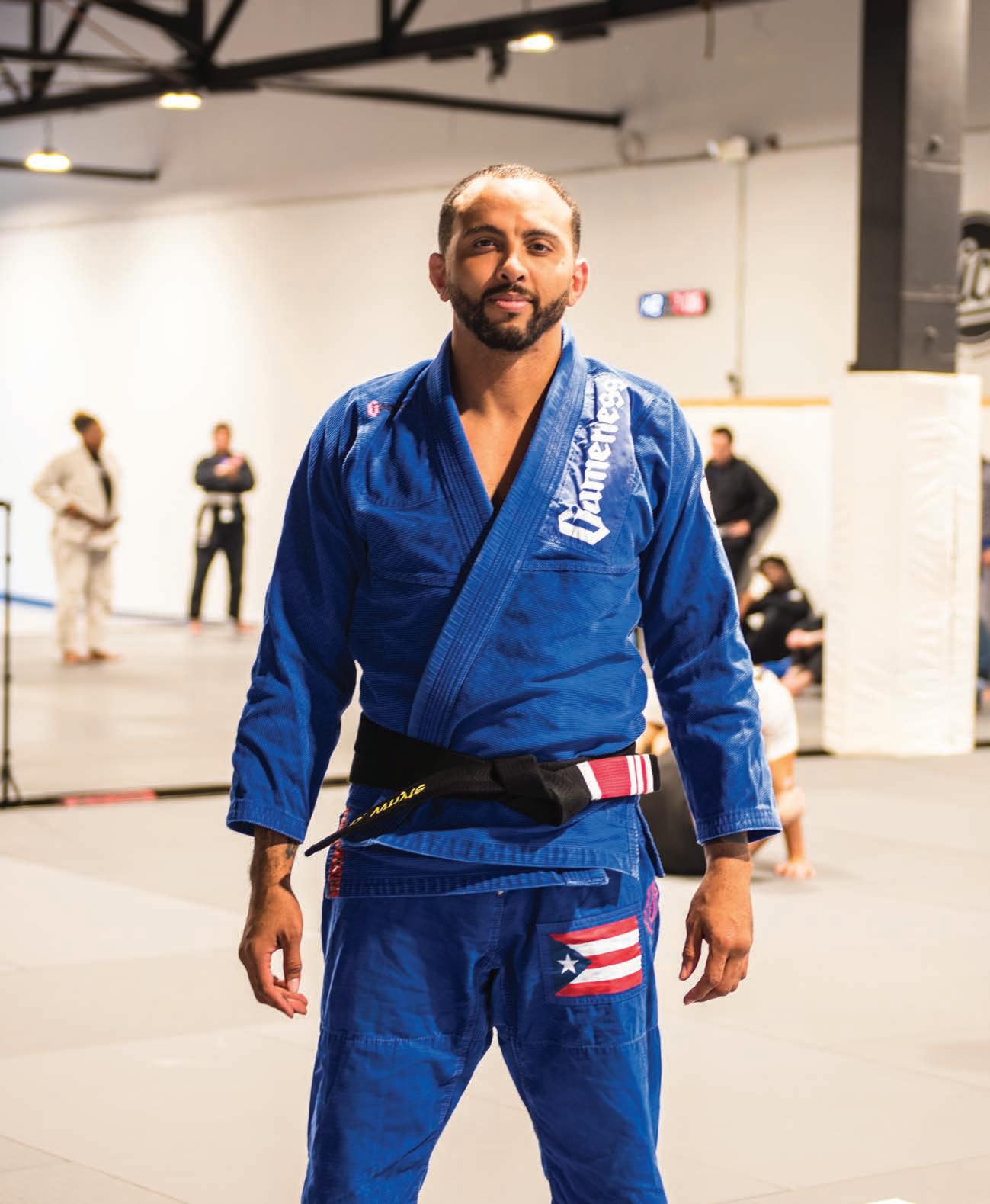
school with a focus on community over profit—eschewing contracts, delaying billing for new students, and even encouraging them to seek training elsewhere to broaden their skills.

story by DAVID EKRUT, P h. D.
t was Gandhi who said, “Live as if you were to die tomorrow; learn as if you were to live forever,” which is the philosophy of living a meaningful life of continuous learning. Today, people proudly brandish this quote on co ee mugs, T-shirts, and other memorabilia.
Business owners take the philosophy to heart, staking their livelihoods on finding communities of like-minded people who pursue learning as a lifestyle. The success or failure of a venture dependent upon selling adult-learning as a product depends on many variables.
Trends in entertainment and on social media are important factors in testing the viability of selling a hobby. Awareness and advertising also play a crucial role, but perhaps one of the leading factors is market fit.
For example, the dulcimer is an instrument from the medieval age that is not a typical conversation starter in modern times, so selling classes on learning to play one would be a di cult market.
Still, centering business strategies around adult learners, even in niche markets, can be lucrative. Many titans of industry exist on platforms designed to capitalize on upskilling adults in the workforce. Coursera, Udemy, and LinkedIn o er courses and certifications to users on their platforms, tapping into the market of forever learners; however, education goes beyond certifications in technical skills.
There is a growing demand from high performers seeking self-actualization. Maslow’s Hierarchy of Needs asserts that when basic needs are met, people with the time and freedom will seek fulfillment through transformation. A er finding meaning through mastery of a skill, the next level is to share this purpose with others.
“To teach is to learn twice,” is a quote attributed to Joseph Joubert, a leading French writer, known largely for his aphoristic style.
The entrepreneurially minded take this lesson and merge their passions with profits, opening a market to these forever learners.
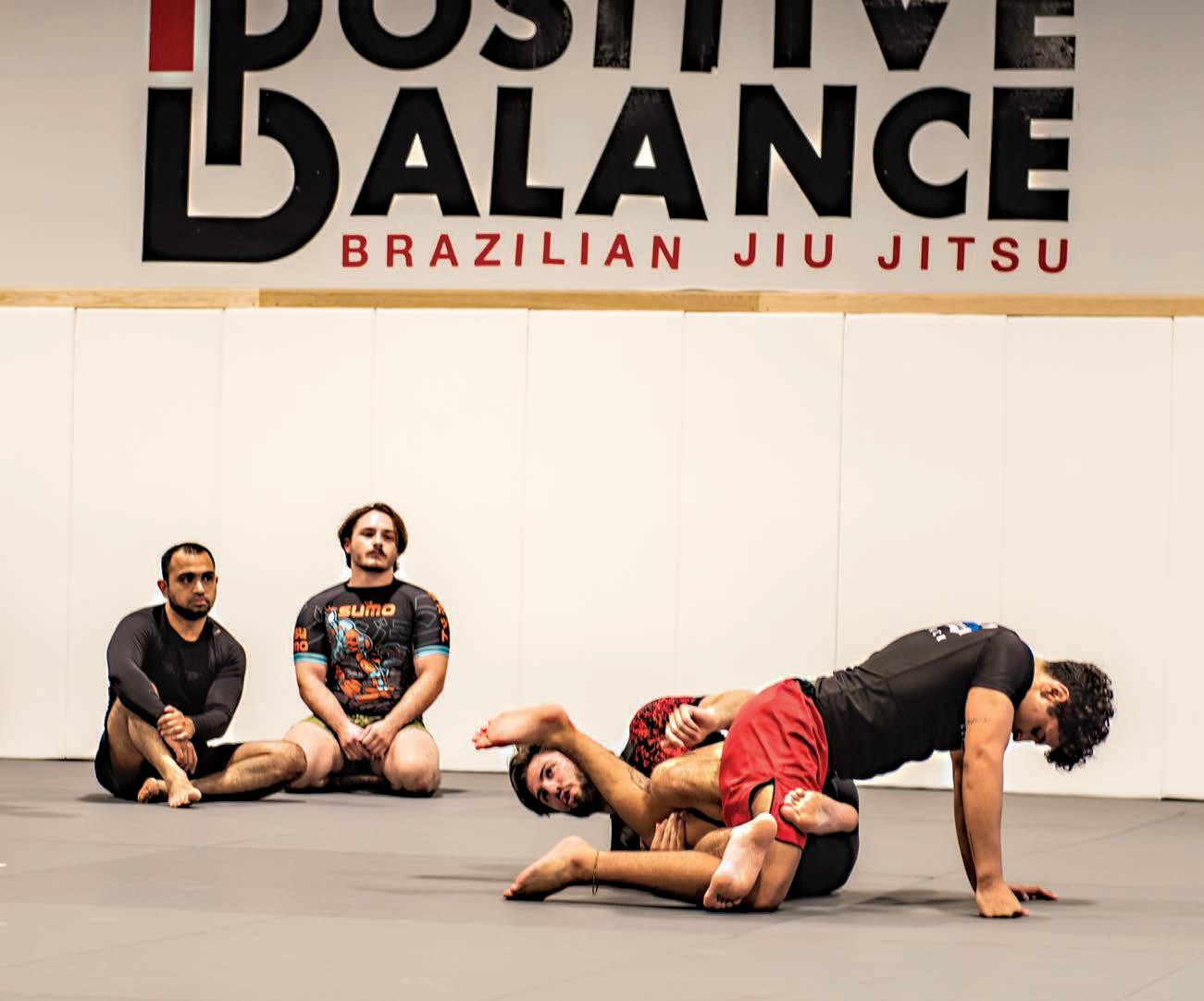
According to Gymdesk, the average martial arts school earns roughly $115,000 per year, but the most successful schools can earn much higher depending on location, success of the lead instructor in the ring, and population density. Elite MMA schools, pioneered by professional fighters, can earn significantly higher than those without endorsements or certifications of established arenas.
Gracie University, which offers licensing and instruction to other trainers, generates $3.5 million per year. The Gracie family is largely responsible for
pioneering BJJ (Brazilian Jiu Jitsu) in the U.S. with the founding of the UFC (Ultimate Fighting Championship).
For Dylan Whyte, owner of Positive Balance BJJ in Tallahassee, the focus of his school is to build a community rather than seek higher profits. Whyte does not force contracts on his members. There’s a standard sports waiver to try a class, but Whyte does not bill new students until they’ve been there for a few weeks.
Though Whyte admits that he has to keep the lights on, he makes a comfortable living without squeezing every possible dime out of his students. He
offers equipment but will happily show anyone how to find gear and uniform cheaper online. Whyte even encourages his students to branch out to train with other martial artists, such as Train Fight Win, to learn striking techniques not taught at Positive Balance BJJ.
“I want to make this a community. People think ‘jiu jitsu’ … they must be enemies,” Whyte says, but that’s not the case. “Not a lot of people enjoy this type of hobby, right? So, we should probably all be cool, and it benefits the whole.”
Training is not just about fighting and self-defense.

↑↘ Postive Balance BBJ is part of the International Brazilian JiuJitsu Federation, a for-profit company that hosts several of the biggest Brazilian jiu-jitsu tournaments in the world, including but not limited to World No-Gi Championship.
I want to make this a community. People think ‘jiu jitsu’ … they must be enemies. Not a lot of people enjoy this type of hobby, right? So, we should probably all be cool, and it benefits the whole.”
—Dylan Whyte,
“There’s a balance to it. [BJJ] helps people and improves their quality of life,” according to Whyte. “Whether it’s the jiu jitsu aspect or maybe their job might suck, you know? And they just want to be around good people.”
Meta-analysis of scientific studies shows a positive effect from training on reducing anxiety and depression, as well as increasing self-esteem and confidence, especially among women. Additionally, training in martial arts can improve balance, musculoskeletal health, cardiovascular fitness, and cognition, regardless of age or gender.
Positive Balance BJJ has recently expanded to a larger space to accommodate the growing school. When asked about how he built his success, Whyte says, “Honestly, it is mostly patience and listening,” adding that he gets to know every student, meeting their needs as individuals.
“I train a 5-year-old differently than I do a 40-year-old mom, who’s working on confidence, going through a divorce,” Whyte says, explaining that he tries to cater to each student’s needs: “Just care about them, and it works out.”
Despite the type of offerings, cooking, artistry, or martial arts, successful business owners always listen to the needs of their communities. Though the approach may look different in an MMA (mixed martial arts) gym than it does in a cooking class, owners willing to adapt to the needs of their customers are far more likely to succeed.

→ WHYTE, who also played soccer at a high level, signed on to play for Southern Polytechnic State University after high school. While living in Atlanta, Georgia, he began training in BJJ with Rubens Charles Maciel— known as Cobrinha, meaning “little snake,” who is regarded as one of the most accomplished BJJ athletes of all time. Cobrinha was the first to complete the Super Grand Slam, winning all major World BJJ championships in 2017.
Training with Cobrinha was a pivotal time in Whyte’s life, leading him to win bronze in the middleweight division as a blue belt at the World IBJJF No-Gi (International Brazilian Jiu-Jitsu Federation) Championship in 2013. This success altered Whyte’s trajectory. He left college and moved to Orlando to train with another great, Bruno Malfacine, who is a 10-time IBJJF Black Belt World Champion and inductee into the IBJJF Hall of Fame.

↑ Though Brentley Dumas initially took over the store reluctantly after her parents purchased it in 2006, she has grown passionate about building a space where people can discover and return to the joy of cooking.
Cooking classes will produce a revenue stream of approximately $98.9 billion this year, according to peekPRO, with the majority of those in attendance among young adults, aged 18-30. Demand has increased in recent years, likely influenced by COVID-19, when many people opted for home cooking rather than eating out. FinModelsLab claims a successful cooking school can generate an annual revenue of $200,000 to $1 million, with variations due to location, competition, and reputation.
Browns Kitchen is a retail cookware store that offers cooking essentials to aspiring chefs. The store originally supplied commercial equipment as well but now exclusively serves the home market. Brentley Dumas reluctantly took over the store after her parents purchased the space in 2006.
“At first,” says Dumas, “I wasn’t sure what I’d do with a kitchen store.”
An interior designer by training and strategist by nature, Dumas does not consider herself much of a chef. Though she cooks out of necessity, Dumas admits, “I would say my husband does most of the cooking.”
Dumas is passionate about the business side of her store and finds satisfaction “… creating a space for others to enjoy their passion for cooking. I love seeing the joy on people’s faces when they walk into the store for the first time or join their very first cooking class. Even better is watching those same faces return again and again.”
A self-described “workaholic,” Dumas explains, “I’m always looking for ways to improve both the store and the overall customer experience.” Even on vacation, she assesses and analyzes new trends in cooking to anticipate the demands.
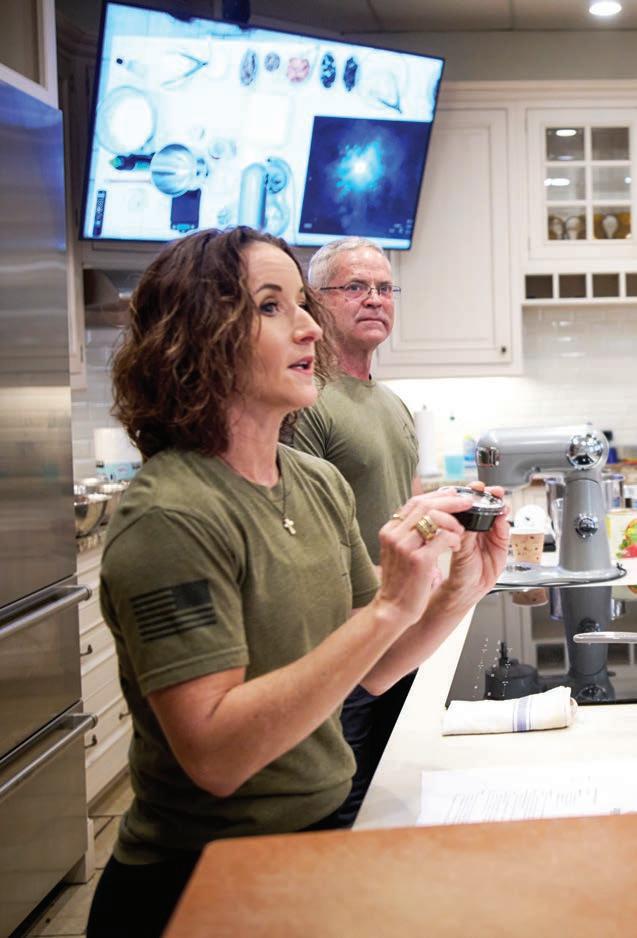
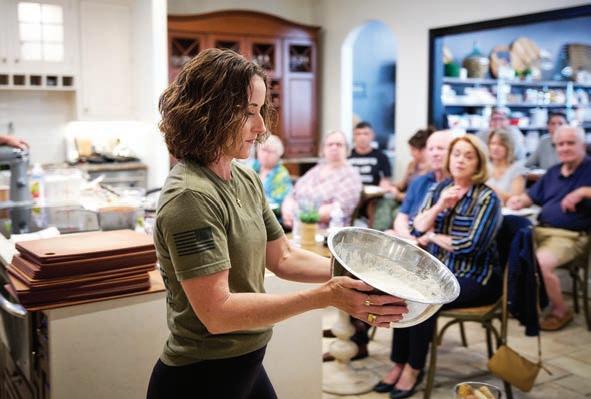




Dumas believes constant evaluation is necessary in today’s market. To compete with the big-box retailers, “We focus on quality, personalized service, and the connection with our customers,” Dumas says. “Plus, we offer classes to help customers make the most of what they buy.”
The hands-on classes are a great way to connect with the community and keep customers engaged with the store. More so, the high-quality instruction with premium tools attracts repeat students. Dumas dedicates a large kitchen for their classes, providing the best possible tools to learn new skills from a wide variety of chefs in the community.
Many of their classes are taught by successful chefs who own restaurants or offer catering services around Tallahassee. They have doubled their class offerings this year and hope to continue building their community.
“To me,” Dumas says with a smile, “the customer experience is everything.” ▪



Successful relationships between business professionals and their clients rely upon trust. But trust, as is often said, must be earned. We expect professionals in fields including health care, banking, insurance, real estate, and even travel to be competent and to extend toward us active goodwill. As evidence of their trustworthiness, we look for professionals who are courteous, experienced, reliable, and passionate about what they do. In this special advertising section of 850 Business Magazine, we present Northwest Florida professionals who are prepared to meet and exceed your expectations.
Kyle Paxton CPA/DIRECTOR
Afanatic of mathematics from an early age, Kyle Paxton decided in middle school he would pursue a career in accounting.
While attending college at the University of Florida, Paxton began interning for James Moore & Company, a full-service accounting firm that has fostered his tax and accounting experience and expertise for the past 12 years. Today, he is a trusted professional with a passion for growing businesses through curated advisory services and helping individuals file their tax returns and achieve their financial goals.
“I enjoy tax accounting in particular because I find the very messy tax law quite interesting and appealing,” Paxton says. “And I like helping people, so it’s a nice combination within an area of accounting where I feel like you’re an advocate for the client and have a lot of opportunity to help generate cash flow for people to be able to do what they enjoy.”
Paxton says that James Moore & Company provides a comprehensive array of accounting solutions, serving all shapes and sizes of businesses and
high-net-worth individuals through accounting and controllership services, auditing, business advisory, and assurance services, as well as supplying solutions for technology, human resources, and digital analytics.
“We like to think we’re fun accountants and like to add a little personal flair and deeper connection when building our relationships,” Paxton says. “In general, we try to be more on the strictly compliant side and take it to the next step by keying in on the strategy and the execution of that strategy. We want to be plugged into your operation and, if location allows, make regular trips to your business to understand the inner workings of it so we can become your holistic business advisor.”
Paxton, whose expertise lies win dealings between real estate and dealership industries, says that what distinguishes James Moore from other firms is its business model of creating teams around a client to establish multiple points of contact. “That way, if I’m off the grid, you have two or three
other people you know you can go to for a timely response.”
Mentorship is another role Paxton takes on, as he is passionate about spreading awareness of accounting as an early career path. He has worked in many departments of public accounting and encourages up-and-comers to explore different areas of specialization to find which one best suits them. As he oversees more than 500 tax returns a year, Paxton says accounting has been a worthwhile career that has allowed him to grow professionally and understand what makes a business successful across different industries.
“I enjoy learning about the art of business and saving people money. What I get most of my satisfaction from is developing the team around me. It’s rewarding to work with them and do our part in forming a pleasant community by working with clients to identify what they want to achieve and what we can do to help get them there.”
When Ashley Guy opened the doors to her first Tallulah store, she wasn’t just starting a business—she was creating a new category of wellness.
Today, Tallulah sets the standard for plant-based retail, legal psychedelics, and functional self-care across the Southeast.
Guy is the founder and CEO of Tallulah, a fast-growing alternative wellness company offering THC, kava, elixirs, mushrooms, float pods, and non-alcoholic social beverages. What began in 2019 as a single CBD store in Tallahassee has evolved into the region’s largest chain of elevated smoke shops and wellness spaces, with nine locations across Florida and Georgia— and a tenth opening in Crawfordville in fall 2025.
Focused on providing a cool atmosphere with fun products, Tallulah is for anybody who wants to try alternative wellness.
Whether it’s premium THC flowers, legal psychedelic drinks, love products, or a float pod session, Tallulah offers wellness that feels good and delivers results. Guy has also launched several dedicated kava bars, providing non-alcoholic, communitycentered spaces that align with the growing sober-curious movement and the demand for functional alternatives to alcohol.
Behind the scenes, Guy leads a strong, all-female executive team and fosters a workplace culture focused on autonomy, creativity, and growth. Her leadership style is hands-on, offering kava bars, float pods, a love shop, and fun products in a clean, bright space with great customer service.
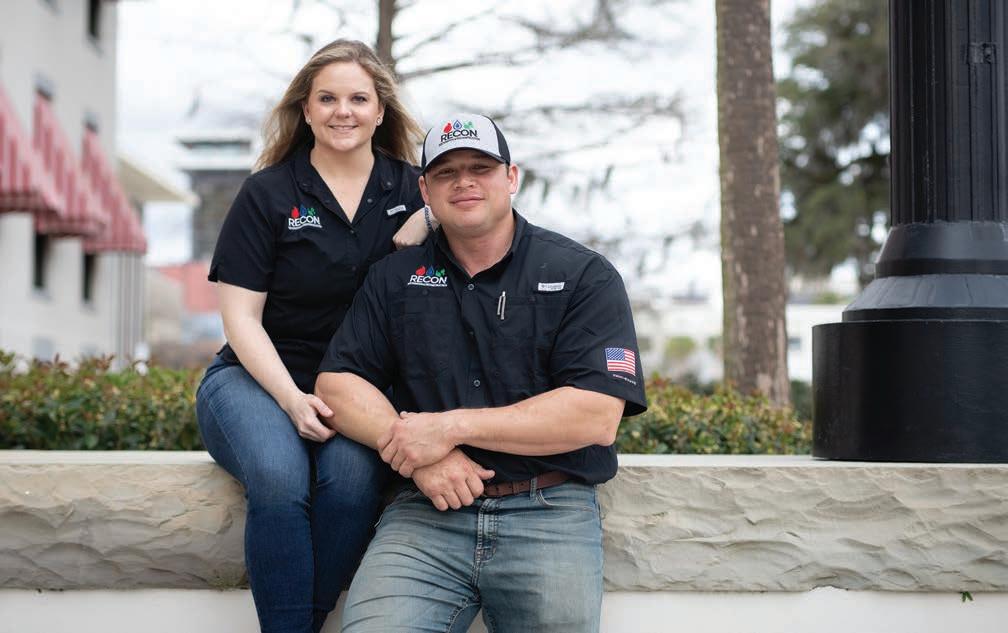
Steven and Ashley Wright have been involved in restoring properties for over 15 years.
All it took was being a part of the devastation experienced throughout the Panhandle from Hurricane Michael in 2018 to realize they wanted to help their neighbors as first responders. From there, they started their own business, RECON Restoration & Reconstruction, LLC. The business provides resources to property owners with property damage and property insurance claims.
RECON specializes in mold remediation, fire/smoke damage restoration, water mitigation, contents/packouts, eviction cleanings,
full-service cleanings, storm damage cleanup, reconstruction, and roofing. Their focus is residential, student housing, condominiums, and commercial spaces.
The husband-and-wife team both grew up in military families and have built their business around military values and expectations. They define their own success based upon the satisfaction of both their customers and their employees.
“We offer a customerfocused experience—seamless communication, competitive and fair pricing, highly skilled IICRC certified technicians who are available 24/7 providing quality work every time,”
Wright says. “Also, as a courtesy, we work with insurance companies to ensure all claims are handled appropriately and in a timely manner.”
Their intention is that RECON is always synonymous with trust and quality work. To date, their copious five-star reviews reflect that. They are preferred vendors for the top insurance companies in Florida and are highly skilled in dealing with insurance property claims.
Whether it’s the roof over your head or the contents inside that make a house your home, RECON Restoration & Reconstruction, LLC is there to help you restore normalcy— with improvements.
While Angela Balent, CPA, was only recently appointed Chief Operating Officer of Warren Averett, she has been embodying the Top 50 firm’s mission of providing “A+ service to A+ clients through A+ talent” for the past 33 years.
“To this day, I still love serving clients,” says Balent. As an auditor, she is devoted to providing professional assurance services to the extent she strives to become an extension of her client’s operations and someone they can call for any business need they may have.
“We want our clients to know we have their back,” Balent says. “Our firm’s direction isn’t focused on some type of shortterm financial return. We want the quality of our service to be the same, from our largest projects to the humblest of tasks, to ensure our client’s expectations are exceeded.”
Warren Averett provides conventional public accounting services, but Balent explains that they are equipped to provide multiple solutions for their clients, from HR and technology solutions to personal estate and trust services and outsourced client accounting and CFO services.
“I think what sets Warren Averett apart is our mission and our values,” Balent says. “It’s our investment in our talent to ensure that we have all the resources of a very large firm, but the way we deliver those services is personalized and still has that small-firm feel. We want every client to feel like they’ve been served well in helping their business thrive.”
For Balent, success in accounting relies on two core principles: building strong relationships with your team and clients and being nimble and adaptable.
“I’ve reinvented myself more than once throughout my career just by being willing to say yes to opportunities both small and large,” she says. “To feel like you have helped a client with a challenge or have been integral to their growth—or if you have helped a team member progress
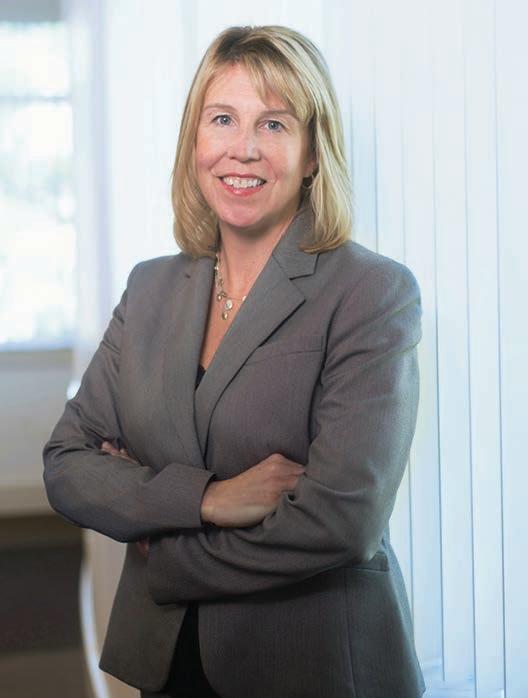
to reach that next milestone in their career—is incredibly fulfilling. That has motivated me to be a part of this firm for the past 33 years.”
Balent is also a passionate community servant. She often assists government clients and has served on the board of several nonprofit organizations including the Junior League of the Emerald Coast, One Okaloosa EDC, and Coast Aquatics Inc., among others. She derives additional satisfaction in helping elected officials make sense of financial information so they can make good, informed decisions for those who live and work in Okaloosa County.
Since accepting her role as COO this past July, she has been looking forward to being responsible for the people and processes that make Warren Averett thrive.
“At the end of the day, we cannot grow without our talented team members,” she says. “Even with advances in AI, we are in the people business. Investing in and fostering that next generation of owners and leaders is what I’m going to be focused on for the rest of my career, and I couldn’t be more excited about it.”
It’s no secret that Regina Jaquess enjoys a win. Jaquess experiences wins by helping patients pursue optimal health as the owner of Emerald Coast Compounding Pharmacy and as a 10-time World Ski Champion who has set 13 world records.
There has long been a duality to Jaquess’ life; she’s balanced her passions for medicine and sports since her college years as a scholarship athlete at the University of LouisianaMonroe studying pharmaceuticals.
In 2010, she made her way back to her hometown of Santa Rosa Beach

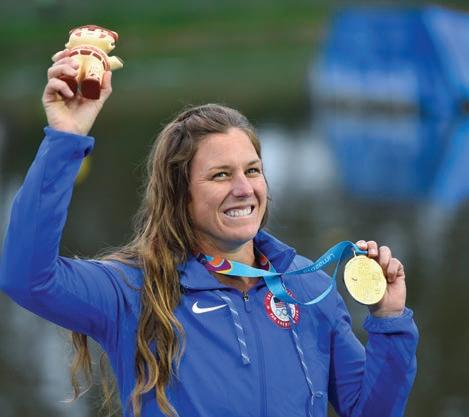
to open Emerald Coast Compounding Pharmacy all while traveling the world as part of the USA water ski team.
In 2023, ECCP was voted “Best Pharmacy” on the Emerald Coast in Emerald Coast Magazine “Best of” awards for the seventh time. This is an accomplishment Jaquess holds dear because she values her relationships with both the patients and the providers.
“Whether you’re coming in for vitamins to help with your energy levels, hormonal imbalance treatments, or medicine for your pet, we provide clear communication so everyone can achieve their health and wellness goals,” says Jaquess.
Goal setting extends beyond the patients to include those whom she mentors both in her pharmacy and on the water. Her appearance on the cover of her alma mater’s La Pharmacie en Louisiane, the College of Pharmacy Alumni Newsletter 2022, issue two, garnered interest.
In addition to her pharmaceutical endeavors, at the 2023 Pan American Games in Santiago, Chile, she captured gold medals in slalom, jump, and overall, defending her title from four years prior in Peru. She is the current world record holder in slalom, breaking
her own record in 2023 at the Malibu Open in Tuscaloosa, Alabama.
Jaquess has been inducted into the National Collegiate Hall of Fame and Georgia Water Ski Hall of Fame. In 2021, she was named the Most Outstanding Female Water Skier of the Past 25 Years by the International Water Ski Federation (IWWF) and was recently named Female Water Skier of the Year by the IWWF, which is the sixth time she has received this award.
While Jaquess is no stranger to winning awards, her proudest accomplishment yet is being nominated as Female Athlete for All Sports at the Pan American Games for 2023. Jaquess was one of five nominees, and the award encompasses all sports that participate in the games.
“Balancing and succeeding in both my roles is no easy feat, and it’s largely made doable by the foundational support I receive from staff, fellow athletes, and the community,” says Jaquess. “I’m blessed and lucky to be surrounded on all sides by those who support me, protect me, and have the same goals and mindset that I do.”
She has her sights set on another slalom World Record in 2025.

ARCHITECT:











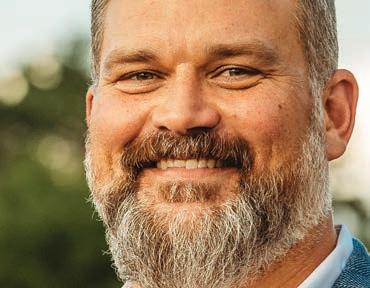














Before Allan Branch took office as Mayor of Panama City in May 2025, he was better known for opening brewpubs, restoring historic buildings, and revitalizing downtown storefronts. Now, he is bringing that entrepreneurial mindset to city government.

Branch’s roots run deep in Panama City, as his family has been doing business for nearly 80 years, operating places like Tally Ho Drive-In and Speedy Car Wash. After achieving success in software companies, Branch shifted into real estate and building restoration with his wife, Anna, launching History Class Brewing Company, El Weirdo tacopub, and The Sapp House.
During his mayoral campaign, Branch emphasized simplicity, accountability, and government accessibility. He speaks from experience, having found that working with City Hall as a builder was slow, inefficient, and frustrating.
“It felt like everything took 10 times longer than necessary,” Branch noted. “If I felt that way, people unfamiliar with the system must find it impossible. That’s not how a city should work.”
Even his sister, who opened a barbecue restaurant near City Hall, missed critical steps due to the city’s lack of how-to documentation.
“That’s the fault of the system,” he says, “not the citizen.”
It was these types of frustrations that led Branch to run for office.
“My job is to advocate for initiatives and help the city function by shaping direction, building consensus, and incorporating community feedback,” he says, explaining that the city operates under a “weak mayor” system, such that the mayor shares authority with a city manager. He has no executive authority over city operations.
Many cities operate under a “strong mayor” system, where the mayor’s role is similar to that of a corporate CEO.
Branch’s leadership style is intentionally collaborative.
“I engage on Facebook and Instagram, and share my email and cell number so I can hear the opinions of the community.”
Within weeks of taking office, Branch began making tangible changes. City Commission meetings are now tightly focused on agenda items only. Public comments are integrated into town hall meetings on the first Saturday of oddnumbered months.
Branch says, “When you give people time to speak and not a three-minute limit, they’ll tell you what’s working and what’s not.”
Branch instituted commission workshops on the first and third Mondays at 4 p.m. and launched a plan to create shared department inboxes to ensure no resident inquiry goes unanswered.
“We want feedback from citizens,” he says. “Most cities don’t encourage it. When residents become frustrated with city employees, they may not realize that those employees don’t have the authority to make changes. So, feedback needs to reach the policymakers who can.”
Emails now feature feedback links, and office doors have signs encouraging residents to ask for help. A system of response tracking ensures follow-through. He’s also focused on creating clear documentation, including checklists available both online and in every city office.
“People tell me, ‘Every time I talk to someone at City Hall, I get a different answer.’ To me, it’s because the system hasn’t equipped employees with better tools to communicate well.”
Branch wants service-level budgeting to show precisely how
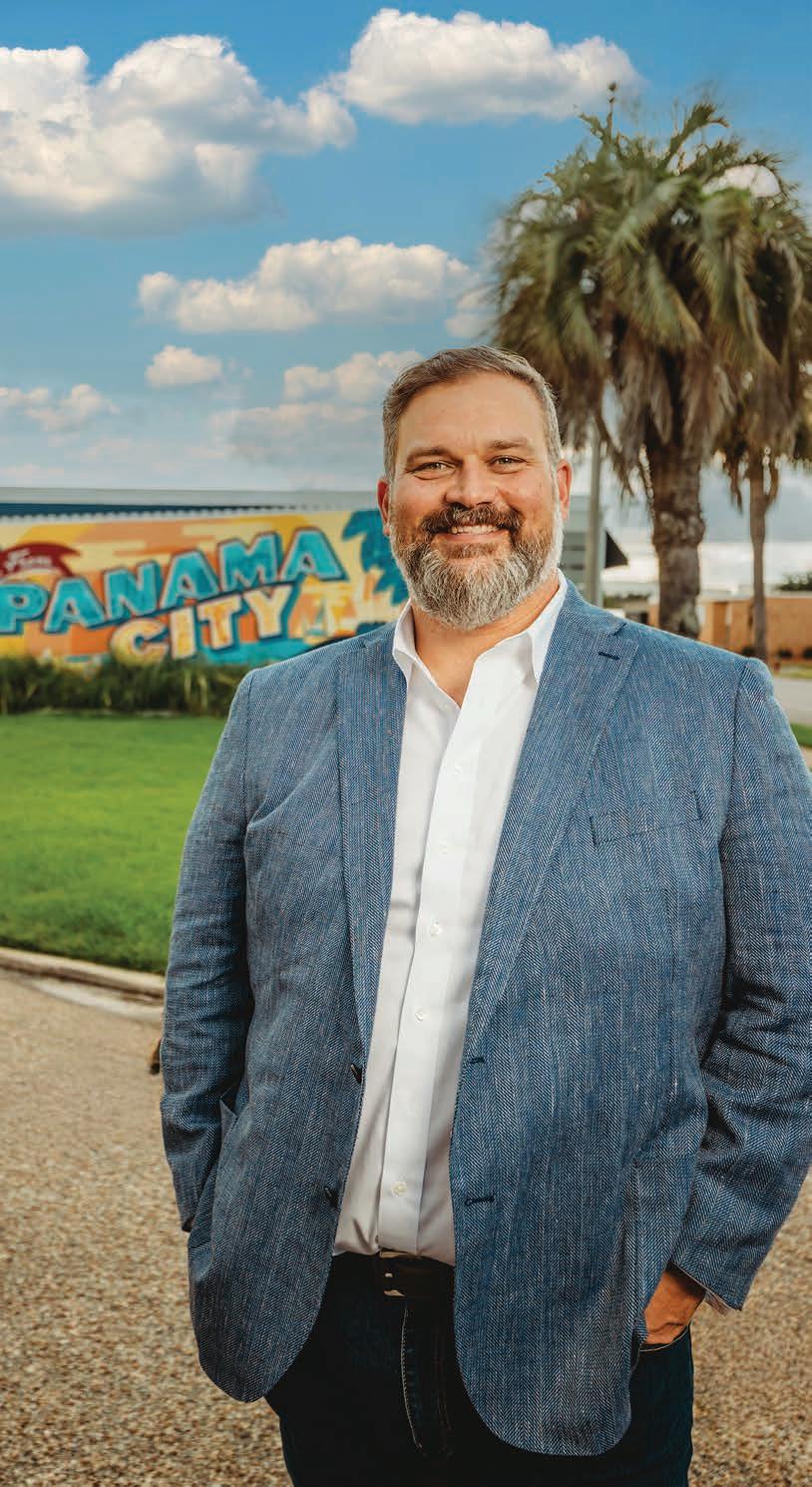
My job is to advocate for initiatives and help the city function by shaping direction, building consensus, and incorporating community feedback.”
ALLAN BRANCH , PANAMA CITY MAYOR
tax dollars are spent, and code reform that eliminates or adjusts one outdated ordinance for every new one passed.
Since Hurricane Michael, Branch has helped attract over $50 million in private investment to downtown Panama City. However, such success brings challenges, particularly since inflated property values pose affordability challenges for long-time residents.
“We want to revitalize, not gentrify,” he says. “The goal isn’t to push anyone out. It’s to make sure people who’ve been here forever still feel like this is their city, too.”
To that end, he is bringing in the Incremental Development Alliance, a national group that teaches citizens how to become small-scale developers. The aim is to educate locals on how to finance, design, and construct affordable housing, as well as revitalize vacant lots.
His administration is exploring mixed-use projects, combining workforce housing and retail, while continuing to share progress through social media and public events.
Branch is clear that his two-year term won’t be long enough to solve every issue, but he believes it can lay the foundation for long-term change.
And while he resists the title of politician, Branch fully embraces the fact that local government can be efficient and helpful. ▪

Explore 55-plus living that celebrates reinvention over retirement
What if the next chapter isn’t about slowing down, but living to the fullest? Latitude Margaritaville Watersound rede nes active adult community with a lifestyle built on fun, entertainment, and friendship.
Developed by Minto Communities, Margaritaville Holdings, and The St. Joe Company, Latitude Margaritaville Watersound is a truly happy place where every day feels like a vacation. Colorful homes, close-knit neighborhoods, and golf-cart friendly streets create a welcoming setting where new residents instantly feel right at home among neighbors.


Latitude Town Square invites togetherness with open architecture and seating areas. At its heart lies a bandshell concert stage, a jumbo screen, and a lively dance floor—popular gathering spots for residents during concerts, movie nights, and special events.
The Latitude Bar & Chill restaurant is the community hub, bringing neighbors together for refined casual dining while the lagoon-style Paradise Pool is a popular spot to bask in the sunshine or relax under a shady tiki-style cabana.
Other amenities include the state-of-the-art Fins Up! Fitness Center, tennis and pickleball courts, a Workin’ N’ Playin’ Center for business and recreational needs, The Last Mango Theater, Barkaritaville Dog Park and Pet Spa, plus a Hangar Workshop to engage in hands-on projects and hobbies. Walking trails are also found throughout the community.
In addition to the stunning Intracoastal Waterway setting, Latitude Margaritaville Watersound residents will have future access to an adjoining full-service public marina and commercial village being planned by partner St. Joe.




Latitude Margaritaville Watersound’s distinct home collections include one-story Conch Cottages, villas, single-family homes, and the exclusive two-story Vista Collection with prices starting in the $300s.
Each floorplan features open areas that maximize natural light and flow into outdoor living spaces. Spacious master suites offer large walk-in closets and luxurious master baths. Premium features are included throughout every home.
Right now, you can take advantage and save up to $15,000 with a limited-time incentive at Latitude Margaritaville Watersound. Additional special offers and financing are available.












story by HANNAH BURKE

Between tourism and a growing population of retirees and snowbirds with second homes in the region, many travelers are looking forward to ditching the layover on their way to the beach. A nonstop flight from Panama City to New York City will be a boon to the local economy, providing an influx of customers and clients for businesses and entrepreneurs.
Northwest Florida Beaches International Airport (ECP) Executive Director Parker McClellan is known among airline officials as “Mr. Sandman.” When meeting with various airlines to recruit new service to ECP, he takes to his meetings a small chest of alabaster sand straight off the gorgeous beaches for which the Florida Panhandle is renowned.

“At these meetings, this chest is passed around so airline representatives can literally play in the sand,” Parker McClellan says. “We realize the beach is a big part of what attracts visitors, but I like to let them know it comes with Southern hospitality and a beautiful region with a culture
that we’re finding to be in significant demand as a travel destination.”
Recently, this attracted the attention of Delta Air Lines, Inc., who, as of this past summer on June 14, introduced a new, nonstop flight between ECP and New York-LaGuardia Airport (LGA) in New York City.
For them to overfly their hub in Atlanta is a huge commitment from Delta and speaks to the desire of the Northeast and New York to come visit the beautiful beaches of our community.”
— PARKER MCCLELLAN , EXECUTIVE DIRECTOR , NORTHWEST FLORIDA BEACHES INTERNATIONAL AIRPORT (ECP)
McClellan says negotiations for a nonstop flight to New York have been in the making since 2011. Boasting over 30 years of experience in aviation management, he has been instrumental in expanding ECP’s appeal as what he calls “not just a destination, but an origination.”
2024 was a record-breaking year, as Parker spearheaded efforts to land new, nonstop routes to Austin, Texas and Boston. “When we closed the old airport in downtown Panama City, we would have around 312,000 to 325,000 passengers annually,” he says. “Last year, we recorded just under 1.9 million passengers—a 501% growth.”
With the addition of this new service, and factoring in global and economic considerations, McClellan anticipates at least a small growth, or at least the same success in 2025, saying, “At the end of the day, the addition of this flight and some of our other nonstops during the summer continue to show a really good performance.”
Flights to and from LGA on Delta’s CRJ-900 aircraft originated as a once-aweek, seasonal Saturday service for the 2025 summer season, a popular event that also supplies nonstop travel to other major cities such as Washington, D.C., Philadelphia, Chicago, and Denver. But, come November 6, departures to the city that never sleeps will be a daily offering.
“We were excited that, before the inaugural flight even took off this summer, Delta announced that there was a strong enough demand to commence a daily service in November,” McClellan says. “For them to overfly their hub in Atlanta is a huge
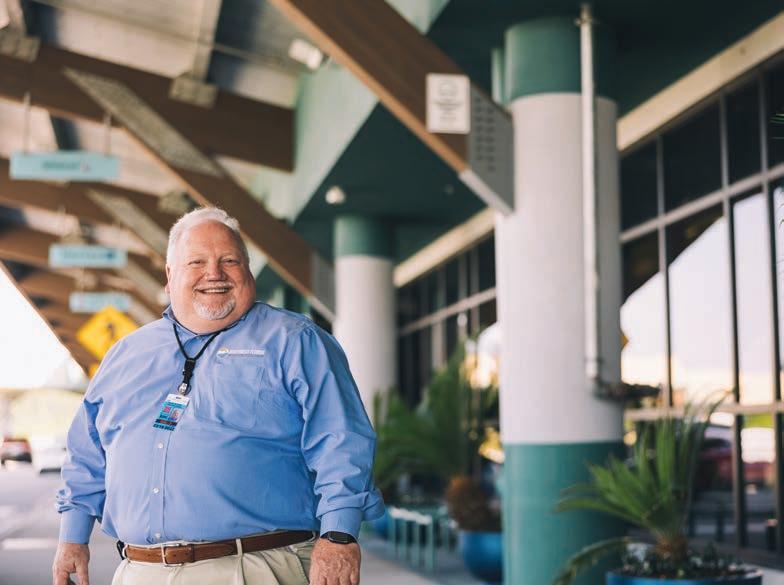
commitment from Delta and speaks to the desire of the Northeast and New York to come visit the beautiful beaches of our community.”
One of the most-awarded and successful airlines in the United States, Delta is devoted to making the flight as comfortable and accommodating as possible for its passengers. The yearround service will carry travelers on an Embraer 175 aircraft with multi-class amenities, something McClellan claims “keeps people happy.”
McClellan explained that ECP will continue to market the region. He is devoted to meeting with existing
airlines as well as new ones to secure destinations, saying that as the airport continues to grow, the expansion will affect the local economy. The ECP will continue to nurture business in and around the airport to benefit aviation and the community with the diversity of its employers.
“There is no stopping us now,” McClellan says. “We don’t sit back on our laurels and say, ‘Well we finally got New York, so I guess we’re done.’ No, we want people to come see us but want to continue to provide the opportunity for our residents to get out there and experience new places as well.” ▪

story by MIKE FENDER
While many people remember a cashcentered square with tables and tents offering mostly fruits, vegetables, and potted plants, innovations have transformed the farmers market into a laboratory for the entrepreneurially minded. There are many advantages to beginning a small business at the local market, such as low cost, reduced risk, and immediate customer feedback.
Historically, the farmers market provided a place for customers to bypass the supermarket and trade cash to farmers for fresh produce. Though items like lettuce, eggplant, and watermelons can still be found in stalls, there are also artisans, home cottages,
and crafts, providing a range of goods, from baked goods and homemade sauces to woodworking and other unique art.
Thanks to mobile payment vendors, such as Square, Shopify, and PayPal, etc., providing non-cash payment options, new business owners starting out can provide a means of using credit/debit to sell goods without the need for a retail space. For budding entrepreneurs looking to test the viability of their products, farmers markets and local festivals are the logical first step.
Bill Davenport, a retired U.S. Navy chief, has written three books providing tips and guidance for those wanting to be a vendor at a farmers market or even launch their own market. Davenport











runs Anchored Market Ventures out of Panama City, where his company organizes four full-time farmers markets and seven specialty markets that pop up once a year in the area, including three at Aaron Bessant Park in Panama City Beach.
Each year, Davenport works with almost 700 vendors at the markets he organizes. That number has been pretty stable the past couple years after spiking up to around 1,100 vendors in 2020 and 2021.
“Right around COVID,” Davenport says, “we saw a significant increase. Folks were avoiding brick-and-mortar businesses. More people were remotely working from home, so they were looking for other ways to supplement their income.”
Davenport says the low barrier to entry is one of the biggest attractions to starting a business at a farmers market, which can usually be set up for approximately $100 the first week, then around $40 a week afterward, which is significantly lower than renting a retail space with a fixed cost and overhead with a combined total into the thousands, depending on location.
“It’s a great way to fine-tune your products and your business before taking that next step to go brick and mortar,” Davenport says. “It’s also a great way to get instant feedback because you are on a very personal level with your customer base, getting face-to-face interaction week in and week out.” That feedback allows owners to fine-tune their businesses in real time rather than waiting for customers to leave comments on social media, he adds.
The biggest mistake Davenport has seen vendors make in starting their business at a farmers market is coming to the table with a hobbyist mindset, explaining, “Some start out thinking this is a hobby, with a ‘I’m good at it’ and ‘I like doing it’ mentality but still treating it as a hobby.” When vendors take this approach, he feels they set themselves up for failure.
Davenport says ultimately, “It is a business. You have to track your financials, your expenditures, your income,” and that mentality is key. Successful owners are meticulous with product tracking.
A strong believer in the farmers market concept, Davenport wants his
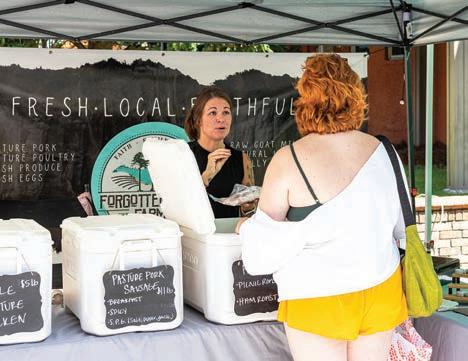
↑ Forgotten Coast Farms produces locally grown goods, offering pastureraised heritage pork, pasture-raised poultry, fresh eggs, all-natural lard soap, and handcrafted lotions.
markets to offer an outlet for locals to expand their hobbies and get their small businesses off the ground. “If folks are making it and it’s local,” Davenport says, “then at the end of the day, we are putting money back into the local economy.”
One of the annual markets that Davenport organizes is the Panama City Beach Fall Festival & Market, now in its third year. In 2024, the farmers market section of the festival featured 60 vendors, 8 food trucks, and 27 business booths.
According to Kylie Coffey, special events coordinator for the Panama City Beach Parks & Recreation Department, attendance for the event has been growing each year, and they expect up to 1,200 people this fall, depending on the weather.
For Coffey, the big attraction centers around anything and everything fall-related “because we just don’t get enough fall in Florida,” adding that the pumpkins are a big draw for her and many of the customers attending the market.
The annual market takes place in September and is free to the public. ▪











































































LEARNING A NEW SKILL OR TRADE can be daunting, but there’s a lot of money that goes into these pursuits. Despite 59.3% reporting difficulties being able to afford spending on their favorite hobby, data from a Self Financial survey shows the average American spends $98 per month to pursue it. Hobbyists find value above the cost, with 93.2% of survey respondents reporting no regret for putting money and effort into their hobbies, regardless of financial difficulties.
In short, people pursue their passions despite the hardship. From memberships to gyms and martial arts schools to learning to bake or create art, people are willing to budget for the privilege of learning hands-on skills.
There is an extra layer of grit required to take that hobby to the next level and become skilled enough to monetize on teaching others or creating products to market. We have reached out to several business owners who made that leap, moving beyond a hobbyist to sell their trades. In this closing bell, these entrepreneurs share the thoughts behind forming or maintaining their businesses. Though some were fueled by passion, others saw an unsupplied demand and filled the market by learning a skill and selling the product of that labor or by selling these skills to hobbyists.
— David Ekrut, Ph.D.











→ DYLAN WHYTE is the owner and lead trainer at Positive Balance BJJ, based in Tallahassee, a martial arts school focusing on grappling techniques. Instructors are active competitors and world-class practitioners. Whyte has grown his school from a few students in a garage to a few hundred members in his 3,500-square-foot space.
“I just started doing jiu jitsu as a hobby with my dad and brother to hang out with them before I went to college,” Whyte says, but now he has built a community he is proud to be part of.
→ MEGAN PRATT earned a BS in Chemistry from MIT, then went to Harvard University, where she completed an MS in Chemistry and received a Ph.D. in Neurobiology. Before founding MESS Hall—which stands for Math, Engineering, Science, and Stuff—Pratt led an impressive career in education and as a civil servant.
“I started Pensacola MESS Hall because I believe at every age, there’s a need for continual learning even in informal settings. There needs to be more public places where questions can be answered, interests can be followed, and ideas can be challenged.”
→ KRISTINA PATE founded Still Waters Boutique in Panama City to fill a niche market, offering women’s clothing for seasontranscending fashion.
“I used to work in health care and knew I needed to find a new passion. I saw a gap in the market in town. There were plenty of trendy boutiques, but not many that offered timeless, versatile pieces. I wanted to create a space that made shopping simple, uplifting, and accessible.”




→ J.T. TAYLOR owns and operates Soo Trucking Delicious, a chefdriven fast-food truck, based out of Panama City, known for smash burgers, shrimp and fish tacos, fries, and other casual comfort foods.
“It’s more of a hobby. I’ve been an entrepreneur, and I've been selfemployed most of my life. So, you know what the main trick is to start a business? Start it. Do something. A lot of people talk about it, but you know they never do anything.”
→ BRENTLEY DUMAS is the owner of Browns Kitchen in Tallahassee. The boutique kitchen store provides an outlet for the passionate home chef.
“I love the energy and connection that happens around food. I feel so fortunate that I get to create a space for others to explore their passion for cooking. I enjoy curating the products and collaborating with other local businesses and talented instructors, and our role at Browns is really to build the environment—whether that’s through a cooking class, a thoughtfully chosen knife, or a gift that inspires someone to cook.”
→ GABRIEL MONTUANI co-owns Resilient Jiu Jitsu with his spouse, Carly, out of Marianna. Now, an IBJJF-certified first-degree black belt with over a decade of teaching experience, his motivations to start his business were born out of a passion to help others.
“I was bullied in school in Brazil, and a friend who had trained in jiu jitsu kept other students from physically hurting me. So, I started training. Now 16 years later, I teach jiu jitsu because it’s an effective tool for people to improve their lives.”