


DRONES NOW BOMBARDING HIGH-RISE WINDOWS WITH WATER




LIVING SHORELINES PROTECT BUSINESSES AND COMMUNITIES

MOBILIZATION OF MODERN MEDICINE HEALS RURAL NWFL





DRONES NOW BOMBARDING HIGH-RISE WINDOWS WITH WATER
LIVING SHORELINES PROTECT BUSINESSES AND COMMUNITIES
MOBILIZATION OF MODERN MEDICINE HEALS RURAL NWFL



TALLAHASSEE BASED START-UP IS REVOLUTIONIZING BATTERY TECHNOLOGY WITH NEWLY INVENTED POLYMER





WANT TO GROW YOUR BUSINESS? GROW YOUR PEOPLE FIRST.
With more than 45 years of leadership and business management experience we help companies and their employees reach their full potential.


TOGETHER WE BUILD LEADERSHIP PIPELINES.
TOGETHER WE ALIGN EXECUTIVE TEAMS.





TOGETHER WE DEVELOP HIGH-PERFORMANCE CULTURES.
TOGETHER WE OPTIMIZE HUMAN CAPITAL.










TOGETHER WE HELP TO REDUCE THE COST OF CHAOS.


































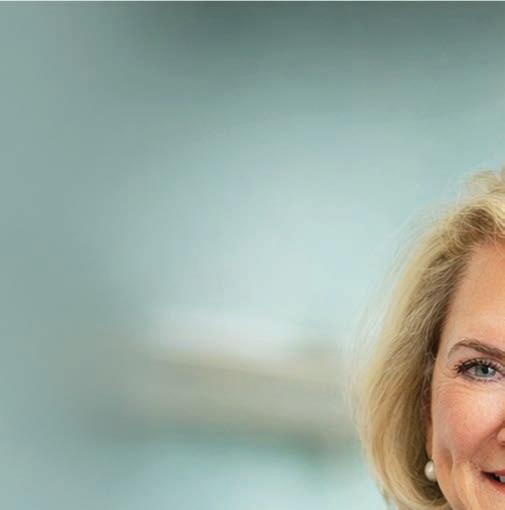










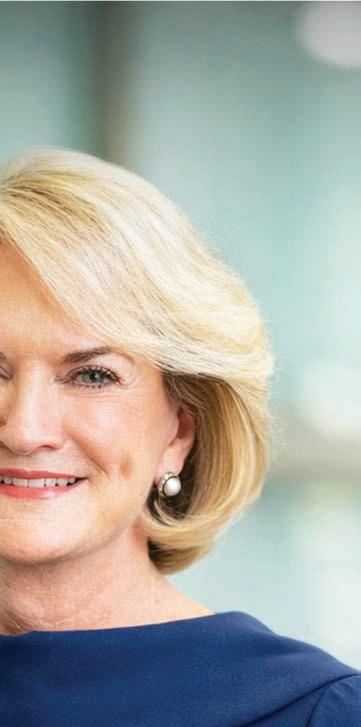


Leadership is more than instruction. Leadership is influence. And that influence begins with one—one person adding value. One person casting vision. One person making a lasting difference period. And that one becomes many.”
— CAROL CARLAN, FOUNDER/CEO








Northwest Florida is emerging as a quiet center for coastal resilience expertise, driven by rising climate risk, development pressure, and expanding public investment. From the Big Bend to the Panhandle, engineering, environmental, and infrastructure firms are responding to increased demand for flood modeling, stormwater planning, living shorelines, and post-storm analysis. Rather than a single megaproject, growth is coming through dozens of smaller, grant-funded initiatives supported by state and federal resilience programs. Living shorelines are gaining traction as costeffective, adaptive alternatives to traditional gray infrastructure, offering long-term risk reduction with lower maintenance burdens. Research from national institutions reinforces the economic case for mitigation, showing significant loss reductions tied to resilient construction and planning. Increasingly, resilience is being treated not as environmental policy but as economic infrastructure shaping the future viability of coastal communities.
STORY BY DAVID EKRUT, P h .D.
Florida’s rural health care system is seeing renewed momentum through a combination of state legislation, federal funding, and regional partnerships. Leaders cite the Florida State University–Tallahassee Memorial HealthCare partnership, the proposed Rural Renaissance Bill, and $209 million in Rural Health Transformation funding expected in 2026 as key drivers. These efforts target long-standing challenges in fiscally constrained counties, including provider shortages, financial instability, and limited access to care. Federally qualified health centers such as PanCare and Bond Community Health Center are expanding services through mobile clinics, telehealth, and sliding-scale payment models, reducing cost and transportation barriers. Technology firms like Ruvos are supporting modernization through data integration and digital health tools. While funding alone will not solve every challenge, collaboration and innovation are positioning rural communities for more sustainable health care access.
STORY BY PAIGE AIGRET
ON THE COVER: Dr. Claudiu Bucur in his lab at Piersica, a start-up located at Innovation Park in Tallahassee that has invented a new polymer to increase storage capacity in batteries. With their proof of concept now realized, they are in the planning phase of automated production. PHOTO BY ERICH MARTIN
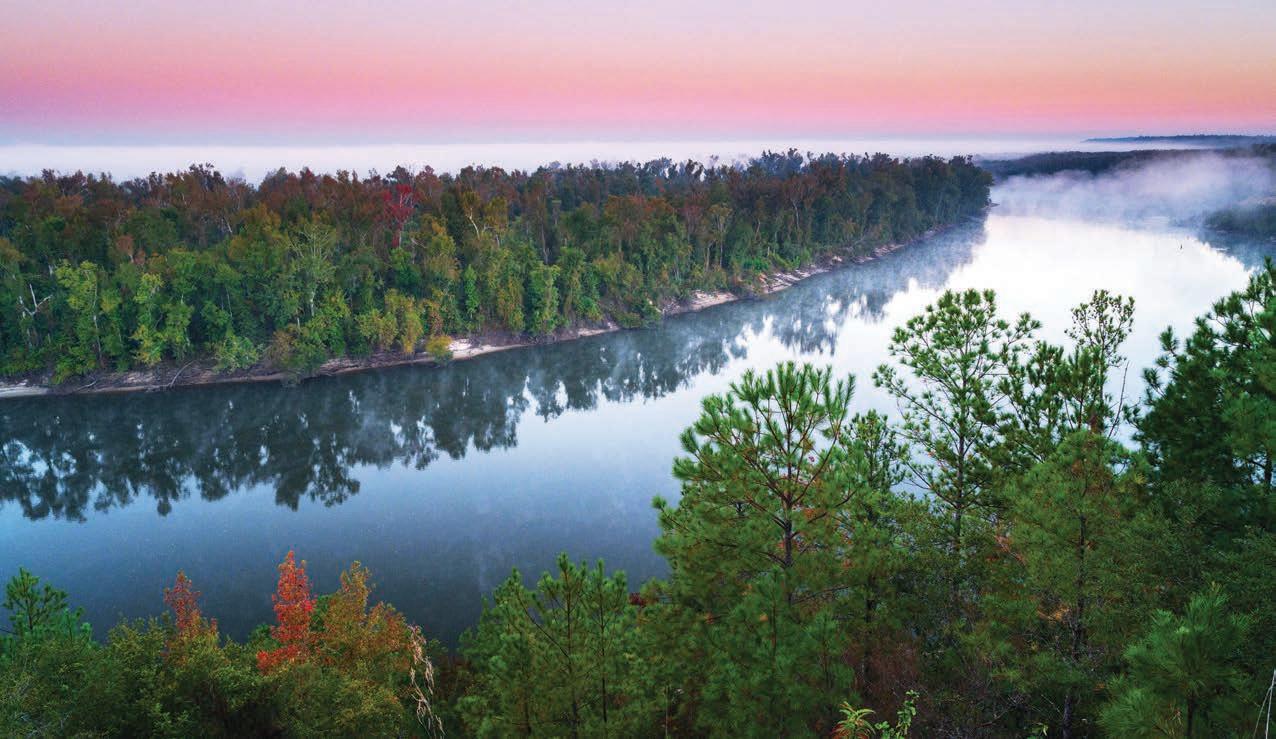
NATURE VERSUS BUSINESS As development accelerates across Florida’s Panhandle, conservation leaders argue growth and preservation
need not be opposing forces. The Nature Conservancy in Florida is working with communities and businesses to protect land and water while supporting economic vitality. With billions in annual tourism value tied to natural resources, thoughtful planning, habitat restoration, and water protection are positioned as essential strategies for sustaining both the region’s economy and its defining environmental character.
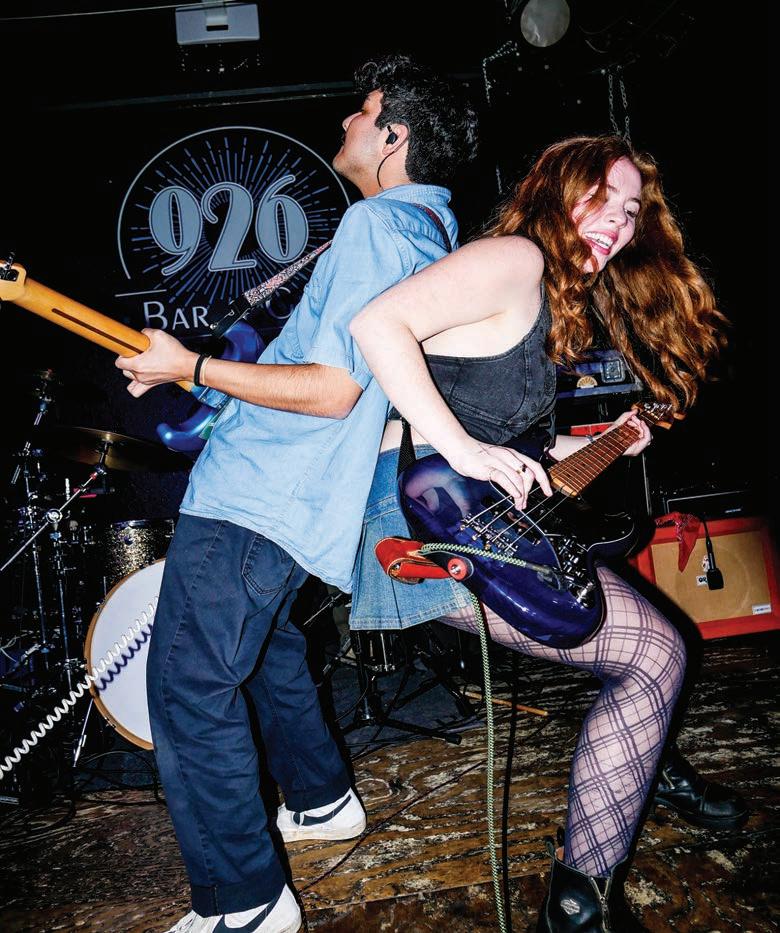
Tallahassee’s indie music scene thrives alongside nationally known artists, offering fertile ground for emerging musicians drawn to its collaborative energy and accessible venues. Local artists praise the city’s openness, discerning audiences, and low barriers to entry, while noting challenges in sustaining larger crowds and retaining talent. With students representing an untapped audience and house shows filling gaps left by limited venues, Tallahassee’s indie
scene reflects both strong creative momentum and clear opportunities for growth.
26 NO BENDING THE IRON TRIANGLE Time, cost, and quality: No project can have all three. This remains an unbreakable law in business, shaping every product and service decision. Organizations can optimize only two variables at once: Fast and cheap sacrifices quality, fast and high-quality costs more, and high-quality at low cost takes time. Using examples from retail, technology, and print media, the piece underscores a central lesson for leaders: Understand your brand, audience, and constraints, and invest accordingly to meet expectations without illusion.
28 INNOVATION THROUGH REGENERATION Pensacolabased Regenative Labs is helping shape the future of regenerative medicine by
emphasizing quality, data, and operational control over hype. Led by CEO Tyler Barrett, the FDA-registered biotech company produces humanderived birth tissue products using standardized, end-toend processes designed for reliability and scalability. By publishing clinical research and building one of the nation’s largest outcome repositories, Regenative Labs aims to bring structure, credibility, and long-term trust to a rapidly evolving field.
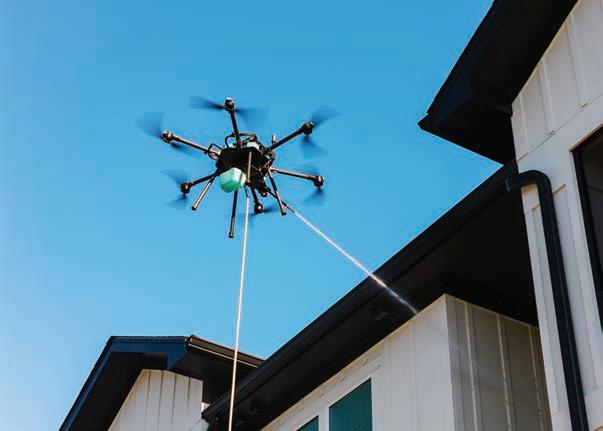
43 WINDOW WASHING GOES HIGH-TECH
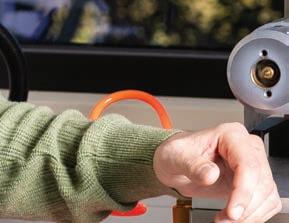
H2ODrone is bringing drone technology to high-rise exterior cleaning across Florida’s Emerald Coast, offering a safer alternative to traditional ladders, lifts, and rope-access crews. Founded in 2025 by former renewable-energy safety professional Ryan McKillip, the company uses tethered, pressure-washing drones to clean buildings, windows, and solar panels efficiently while reducing risk and cost. FAA compliance and safety remain central to the company’s operations and growth plans.
48 NURTURING WHAT’S NEXT TechFarms is driving organic economic development in Bay County by supporting entrepreneurs, scaling startups, and repurposing large commercial assets. Led by former Gulf Coast State College president Dr. John Holdnak and founder Steve Millaway, the Panama City Beach–based incubator provides space, collaboration, and capital to growing companies. Its Atlantis Center offers flexible facilities for expanding businesses and events, while TechFarms Capital (GAIN VC) invests in technology-driven ventures with long-term regional impact.
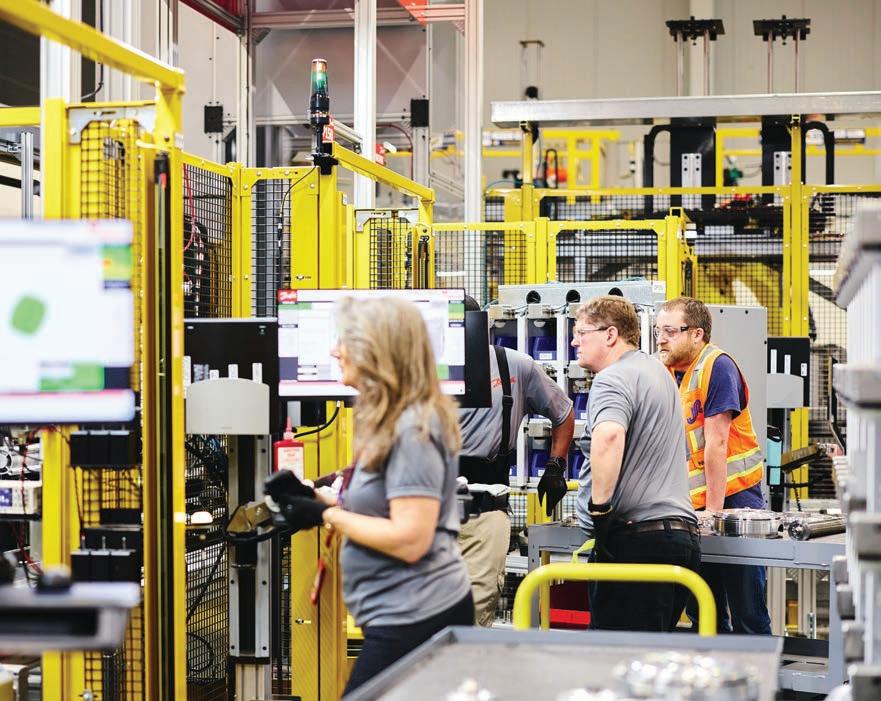
52 CONDITIONING THE AIR Danfoss is strengthening Tallahassee’s role in global green-tech manufacturing through continued expansion of its Turbocor facility and
52
Application Development Center in Innovation Park.
Recent investments, including a new testing chamber, support faster development of energyefficient HVAC and refrigeration systems as environmental standards tighten worldwide. By combining advanced engineering, manufacturing, and research partnerships, Danfoss is helping position the capital region as an emerging hub for sustainable cooling technologies with international reach.
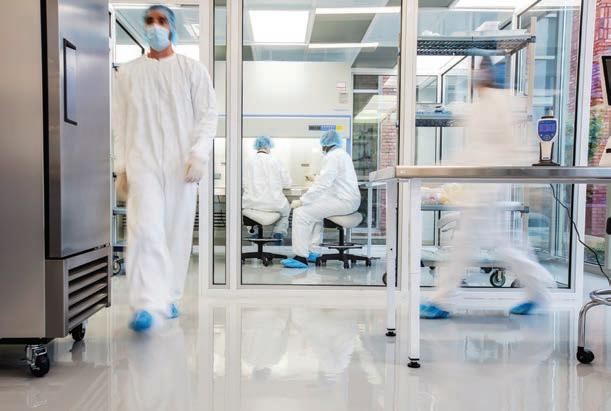
Tallahassee-based startup Piersica is advancing solidstate battery technology with its patented PIRION™ polymer, enabling lighter, safer batteries with more than double the energy density of current lithium-ion systems. Founded by battery-industry veteran Dr. Claudiu Bucur, the company is moving from hand-built cells toward automated manufacturing after successful military testing. Supported by grants, investors, and Florida State University’s IGNITE Tallahassee incubator, Piersica is positioning itself at the forefront of next-generation energy storage.
43
60
NO BULL AT FSU
Florida State University is repositioning Doak Campbell Stadium as a year-round entertainment and economic asset with the addition of national events beyond football.
In March 2026, the stadium will host a PBR Unleash the
Beast Major event paired with concerts by Jon Pardi and Miranda Lambert, following major infrastructure upgrades. These signature events reflect a broader strategy to attract tourism, diversify revenue, and strengthen Tallahassee’s regional economic impact.

EDITORIAL
EDITOR David Ekrut, Ph.D.






PUBLISHER
MCKENZIE BURLEIGH
SENIOR EDITOR Rebecca Padgett Frett
SENIOR COPY EDITOR Melinda Lanigan
STAFF EDITOR Olivia Sokolowski
CUSTOM CONTENT EDITOR Zandra Wolfgram
CONTRIBUTING WRITERS Paige Aigret, Steve Bornhoft, Hannah Burke, Mike Fender, Rebecca Padgett Frett, Laurie Einstein Koszuta, Jay Revell, Olivia Sokolowski
CREATIVE
DESIGN DIRECTOR Jennifer Ekrut
STAFF ART DIRECTOR Lindsey Masterson
CONTRIBUTING PHOTOGRAPHERS Addie J Photography, Boo Media, Dave Barfield, Mike Fender, Tim Jackson, Andrew Kornylak, Ryals Lee, Josie Liederman, Erich Martin, Riptide Media, Saige Roberts, Sw0mp.puppy, Ti Adoro Studios, The Workmans
SALES, MARKETING & EVENTS
SALES MANAGER Lori Magee Yeaton
DIRECTOR OF NEW BUSINESS DEVELOPMENT, EASTERN DIVISION Daniel Parisi
SENIOR ACCOUNT EXECUTIVE Julie Dorr
ACCOUNT EXECUTIVES Darla Harrison, Daniel Walker, Erica Wilson
ACCOUNT MANAGER Renee Johnson
MARKETING ART DIRECTOR Saige Roberts
PRODUCTION
PRODUCTION DIRECTOR Selene Ceballo
PRODUCTION MANAGER Chris Edmund
DIGITAL MARKETING MANAGER Tyler Sansone
ADVERTISING DESIGN COORDINATOR Michael Kramer
PRODUCTION COORDINATORS Courtney Bryant, Ileana Caban
OPERATIONS
ACCOUNTS RECEIVABLE SPECIALISTS Becky Briand, Ana Coronel, Avery Morales
DISTRIBUTION MANAGER Judy Heflin
LOGISTICS MANAGER Omar Morales
CIRCULATION MANAGER Marjorie Leiva
CIRCULATION ASSISTANTS Cathy Hart, Britney Stinson
CIRCULATION PROMOTIONS MANAGER David Supple
IT MANAGER Omar Greene
EMERITUS Brian Rowland GROUP PUBLISHER Terry Duffy
CHIEF OPERATING OFFICER Todd Schmidt
EDITORIAL DIRECTOR Daphne Nikolopoulos
HOUR MEDIA, LLC
CEO Stefan Wanczyk
PRESIDENT John Balardo
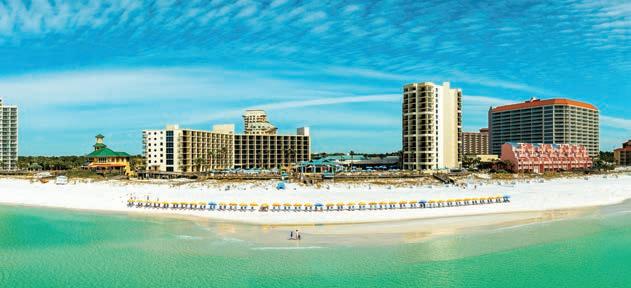
Our work lives can be very rewarding but also challenging, and it’s important to achieve a healthy work-life balance. There’s no better way to unplug, relax, and unwind than by experiencing an amazing Ultimate Hilton Sandestin Beach Resort Getaway. Enter to win the escape you’ve been longing for! Enter for your chance to win at 850BusinessMagazine.com/ ultimate-hilton-getaway.
Let’s get down to business. You’ll still be able to find the latest business news around the 850 region, including business openings, people on the move, and more by visiting 850BusinessMagazine.com. Sign up for our e-newsletter for online exclusives at 850BusinessMagazine.com/newsletter-mailing-list
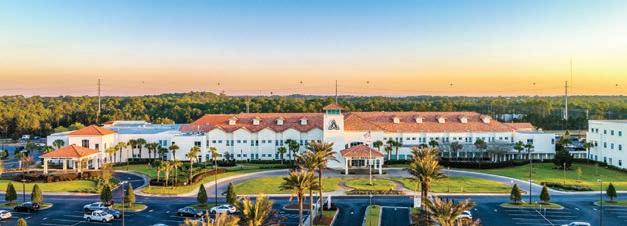
For the second consecutive year, Ascension Sacred Heart Emerald Coast has been named one of the Best Hospitals in Florida by Newsweek’s prestigious 2026 list of the best-in-state hospitals. Sacred Heart Emerald Coast is the only hospital in the tri-county area to be featured on the list. 850BusinessMagazine.com/ascension-sacred-heart-emeraldcoast-named-one-of-the-best-hospitals-in-florida
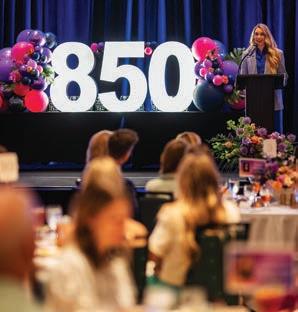
For the twelfth year, 850 Business Magazine celebrated contributions made by outstanding Northwest Florida Pinnacle Award recipients on March 6, 2026 at Hotel Effie, located within Sandestin Golf and Beach Resort in Miramar Beach. Visit the link below to read the event recap, enjoy access to event photos and videos, and discover more information about this year's recipients. 850BusinessMagazine.com/ pinnacle-awards
Read the latest 850 Business Magazine “Bytes”—essential information about business openings, professional promotions, awards, honors, and more —at your convenience online.
For the latest news and information, sign up for our free e-newsletter. 850BusinessMagazine.com/ newsletter-mailing-list
Find 850 Business Magazine on LinkedIn as well as X, Instagram, and Facebook.
LinkedIn Rowland Publishing and 850 Business Magazine pages, and the 850 Business Magazine Group X @850BizMag
Instagram 850bizmag Facebook 850 - The Business Magazine of Northwest Florida


Like many other greats, 850 moves into the Digiverse
After 17 years of production as a print magazine, our business journal will be predominately online. We will remain in print as special sections inside Tallahassee Magazine and Emerald Coast Magazine, as well as an annual release in winter.
As my final letter as editor of 850 Business Magazine in its current form, I would like to thank all who have contributed to sharing ideas and quotes to this title, trusting me to tell and edit your stories. As a spinner of tales, I have always sought to find the heart in each story and provide the technical and scientific expertise enjoyed by our readers.
Though I have only been in the editor’s role at this magazine for two years, it has been my greatest pleasure to serve Northwest Florida in this capacity.
Like many writers, I am high on the spectrum of hyperphantasia, meaning I see vivid imagery inside my mind. Often sparked by a single word or phrase, I can become fully immersed in a world that only exists in my imagination, which I am compelled to put into words. This characteristic has led me to a career in writing that I cherish.
In addition to articles and editing, my novels have reached thousands of readers worldwide. I have written in science and business journals, health care and medical communications, and educational materials. I am also a teacher of mathematics, storyteller, and cancer researcher.
Each outlet carries its own challenges and rewards.
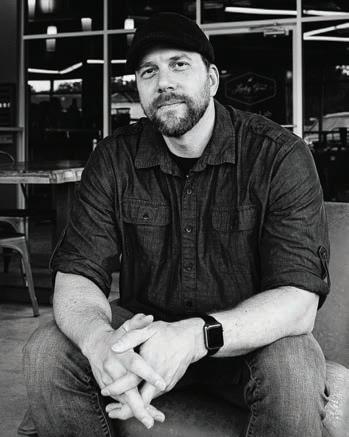
Whether fiction or nonfiction, business or lifestyle, education or pleasure, I believe that writing is the purest form of creativity. Great literary works can forge an instant connection between reader and writer through the shared experience of an idea or story crafted from a blank page. This is why I believe human-written stories will persist, despite the rise of artificially constructed articles and books pervading our society.
Without the human element, stories become a manufactured product with no heart. AI-produced passion is as dismal as the growth curve of print media over the last two decades. Anyone watching these trends might believe that print journalism is in its death throws, but as stated in my letter in Spring 2025, evidence suggests print is better than digital media for human cognition.
However, there are clear contractions in the market that have affected how we deliver stories to you.
This is not goodbye. We will continue to produce quality, technical articles, curated for our loyal readers, and our work will still be published online and folded into our other titles. Please continue to reach out to us with your stories and your passion projects, so we can continue to celebrate news and growth across the Panhandle and Big Bend.
Much love,
David Ekrut, Ph.D. dekrut@850businessmagazine.com
→ DO YOU HAVE A STORY OR KNOW SOMEONE WITH AN INTRIGUING BUSINESS MODEL? Please feel to reach out to me anytime at dekrut@850businessmagazine.com.




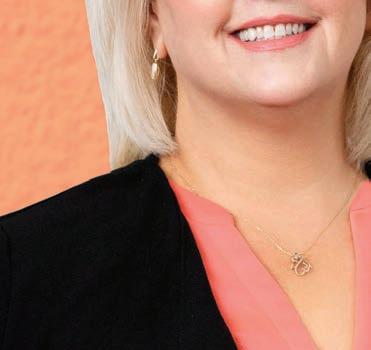







Online financial tools are super helpful…but a conversation with Kathie is even better.
Online financial tools are super helpful…but a conversation with Kathie is even better.
For more than 130 years, we have embraced technology to provide exceptional client service. Yet we always come back to the simplest tool of all: one-on-one interactions with our helpful bankers. Let us earn your business. ccbg.com
For more than 130 years, we have embraced technology to provide exceptional client service. Yet we always come back to the simplest tool of all: one-on-one interactions with our helpful bankers. Let us earn your business. ccbg.com

For more than 17 years, the award-winning 850 Magazine has been capturing the essence of Northwest Florida’s vibrant region to share with you, our readers.
Northwest Florida is home to one of the states brightest and most promising economies, influenced be emerging industries, global investments, eco-friendly enterprise, new real estate offerings and leading-edge research and development.
850 is dedicated to telling the dynamic story of the region’s exciting role in state, national, and international marketplace, and we are evolving the way in which we report and educate the communities that we serve.
We keep our finger on the pulse of Northwest Florida’s ever-growing opportunities, listening closely to our readers as we continue to fulfill our mission: to educate, inspire, and support the communities we serve. To strengthen that commitment, we are investing in our digital offerings, so the latest developments and business headlines are delivered directly to your inbox through our robust newsletter and website on a bi-weekly basis.
Our goals are to keep you informed from the earliest stages as our region’s business landscape evolves. At the same time, we are refining our print publication to focus on more thoughtful, in-depth reporting. By condensing our print schedule, we can produce a comprehensive annual issue dedicated to deeper investigations and long-form storytelling, with our first annual edition arriving this December.
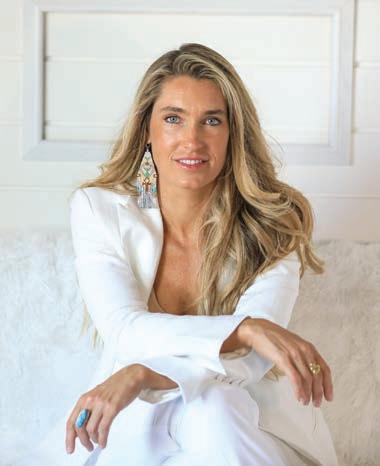
We will be supplementing our annual print edition by including economic updates in our two sister magazines—Tallahassee Magazine and Emerald Coast Magazine with a new special business section labeled 850. You will see this new section begin in May for Tallahassee Magazine and June for Emerald Coast Magazine. These sister publications are currently published bi-monthly.
We are thrilled to continue expanding our reporting and deepening our connection with readers under the leadership of our talented editor, Dr. David Ekrut. I’ve had the honor of knowing Ekrut for over a decade, and his deep knowledge of our region, economic development, innovation, and technology places our research and reporting in some of the most capable hands in Florida.
I am honored to continue to serve you, our readers, in an exciting new way. Visit 850businessmagazine.com/connect-with-us to sign up for a complimentary subscription to our newsletter to continue the journey with me.
McKenzie Burleigh mburleigh@palmbeachmedia.com
BY TIM JACKSON





EMERALD COAST //
DMG is seeing continued demand for luxury real estate in Florida’s top vacation and second-home markets, particularly along the scenic 30A corridor. After building a strong presence in Naples, the firm’s expansion into 30A reflects its commitment to serving clients wherever they live, vacation, or invest.
“Opening our DMG | 30A office is an exciting milestone,” says founder Dawn McKenna. “30A is one of the country’s most desirable coastal destinations, and our clients have increasingly sought our expertise here. This expansion allows us to deliver the same high level of service and market knowledge whether clients are buying a second home, investing, or relocating to the Emerald Coast.”
The 30A team brings more than 20 years of experience and over $200 million in sales, including record-setting transactions. Bonnie Hall, an award-winning agent and area resident since 1997, serves buyers and sellers from Fort Walton Beach to Rosemary Beach and Panama City Beach, representing first-time buyers, luxury clients, and investors.
She is joined by Maria McKenna, who specializes in 30A communities including Rosemary Beach, Alys Beach, Seaside, and WaterColor. Known for her strong market insight and client-focused approach, she has achieved record Gulf-front sales and began her career with DMG in Chicago.
Together, they also proudly serve military families stationed near Eglin Air Force Base and Hurlburt Field.
LOCAL HONORS
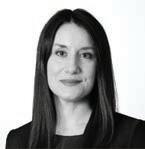
Holland & Knight announced that 50 attorneys were elected to the firm’s partnership effective Jan. 1, 2026. Among those promoted is Kathryn Isted of the Tallahassee office. Isted’s practice focuses on commercial, administrative, and appellate litigation, with experience handling complex matters in federal court, state court, and arbitration. She earned her J.D. from Florida State University College of Law and her B.S. from Florida State University.
Big Bend Hospice announced an expansion of hospice services into Jackson, Calhoun, and Gulf counties beginning in January 2026. The expansion marks the first phase of a long-term effort to increase access to compassionate, high-quality end-of-life care across North Florida, particularly in rural areas where services can be limited. For more than 40 years, Big Bend Hospice has supported patients and families through serious illness by providing comfort, dignity, and guidance. The organization will continue building partnerships to ensure residents in the expanded service area have access to needed care.
Stifel Financial Corp. (NYSE: SF) announced that the Huggins Wealth Management Group of Stifel, Nicolaus & Company has been named to Forbes’ 2026 Best-in-State Wealth Management Teams list for the third consecutive year. Based in Tallahassee, the team includes Stephen C. Huggins, C. Blair Huggins, J.D. Huggins, and Tom Stitely, and brings more than 55 years of combined industry experience. The annual list recognizes approximately 6,150 top-performing teams nationwide.
Amscot has opened a new Tallahassee location at 4212 W. Tennessee Street, expanding access to its financial services. The new branch reflects continued consumer demand for convenient, regulated small-dollar financial solutions. For more than 30 years, Amscot has focused on providing shortterm loans governed by strong consumer protections designed to prevent debt cycles. The Tallahassee opening follows recent expansions in Jacksonville, Port St. Lucie, and St. Augustine.
Richard D. Ogburn has been honored with the Florida Bar
BY
President’s Pro Bono Service Award. Ogburn has served low-income residents for more than 45 years and is a consistent presence at Legal Services of North Florida’s First Friday Legal Clinic. His career has included work with Jacksonville Area Legal Aid and continued dedication to improving access to justice throughout the Gulf Coast.
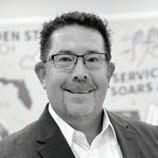
announced that Jose Delgado has joined its executive leadership team as chief member experience officer. Delgado brings more than 31 years of financial institution experience and will focus on integrating
services to enhance member experience. He holds degrees from Saint Louis University and Webster University and has served on boards, including the Tulsa Area United Way and American Heart Association.
, a family-owned Pensacola business founded in 1993, received the 2025 Pensacola Small Business of the Year award by the Greater Pensacola Chamber of Commerce. Owner Joe Barzacchini has supported local businesses and nonprofits for more than 30 years through printing and mailing services while remaining deeply engaged in community initiatives. Evergreen continues to operate locally while adapting to changes in the printing industry
EMERALD COAST // LOCAL HONORS
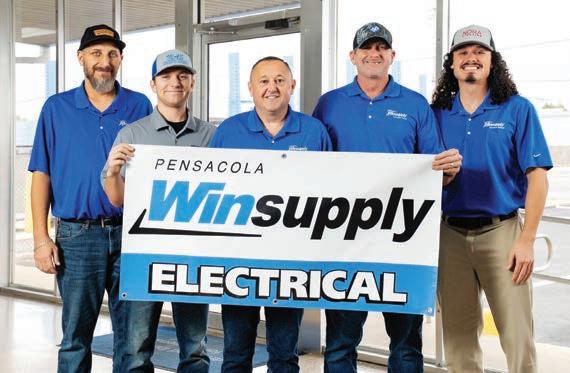
↑ The team at Pensacola Winsupply includes, from left to right, Donald Chase, Cody Gavin, President Trampas Miller (center), James Eliason, and Terrant Endresen. Not pictured are Karry Dixon and Jacob Kmetz. On far left, Donald Chase, passed away unexpectedly on January 5, 2026.
EMERALD COAST // NEW & NOTABLE
The Winsupply Family of Companies has expanded with the launch of Pensacola Winsupply, led by President Trampas Miller. Serving residential, commercial, and HVAC contractors, the new 11,800-square-foot facility on North Palafox Street opened September 21, 2025. A Pensacola native with decades of electrical industry experience, Miller was recruited by Fort Walton Beach Winsupply and embraced the opportunity for local ownership backed by national support. Pensacola Winsupply aims to stand out through customer-focused service and trust. Founded in 1956, Winsupply includes more than 670 local companies nationwide, generating $7.8 billion in annual sales and employing approximately 9,000 people.
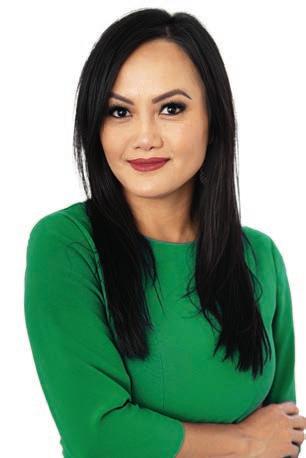
Florida Blue, the leading health insurer in the state, has named Hong Potomski as market president for Northwest Florida, a newly created position. This role will oversee regional business strategy and community engagement efforts spanning 19 Panhandle counties. Potomski brings more than 20 years of health care experience to the position, most recently serving as Northwest Florida market leader. A Pensacola native with strong local connections, she joined Florida Blue in 2021 and has been instrumental in developing and leading programs and partnerships to serve individuals, businesses, and communities across the area. Potomski holds a Bachelor of Science in Business Administration from the University of Central Florida and dual master’s degrees from the University of West Florida. In addition, Potomski is recognized as a Fellow of the American College of Healthcare Executives. She invests time and serves the community with various organizations, including Florida’s Great Northwest, Greater Pensacola Chamber, United Way of Emerald Coast, Florida State University College of Medicine, Greater Tallahassee Chamber, University of West Florida’s College of Health, and Pace Center for Girls. She has been recognized for her community contributions, including a Pinnacle award from 850 Magazine, a Healthcare Harmony award from the Escambia and Santa Rosa County Medical Society, and being named one of seven Rising Executives by Florida Trend. Potomski is also an alumna of and actively involved with both Leadership Pensacola and Leadership Florida.
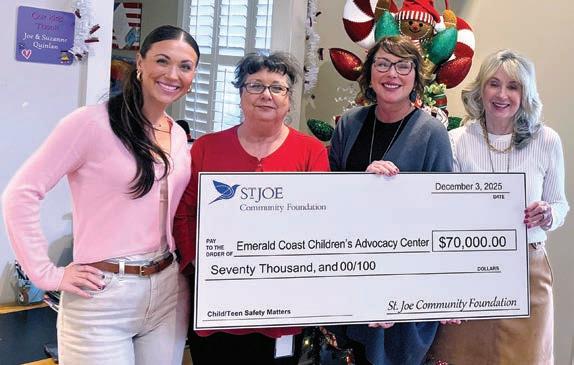
The Emerald Coast Children’s Advocacy Center (ECCAC) has received a $70,000 grant from the St. Joe Community Foundation to support services in Walton County. Of that amount, $40,000 will fund the Child Safety Matters school-based prevention program, while $30,000 will provide trauma-focused mental health counseling for child abuse victims through the Pierce Family Children’s Center in DeFuniak Springs. An additional $3,000 donation helped provide Christmas gifts for local children and families. The foundation, established in 1999, supports Northwest Florida nonprofits focused on education, environmental stewardship, health care, and the arts. In 2024, ECCAC delivered 9,201 child safety sessions and 739 hours of counseling in Walton County. Over 25 years, the organization has provided more than 200,000 free services and supported over 33,000 children affected by abuse, abandonment, and neglect.
NEW & NOTABLE
The Island Resort at Fort Walton Beach announced the opening of Cabana Cantina & Tequileria, a refreshed concept inspired by coastal Mexico. Open to the public and resort guests, the venue features Mexican-inspired cuisine and a tequileria offering more than 50 100% agave selections.
Gulf Winds Credit Union opened its 2026 Scholarship Program, offering five
renewable scholarships of up to $10,000. Since 2007, the program has provided nearly $300,000 in educational support to students pursuing higher education, trade school, and medical careers.
The Highland Group announced master-planning and development projects along Highway 331 in Freeport, totaling more than 70 acres. The projects include commercial
as vice president of wealth management. A Certified Financial Planner® Professional with more than 25 years of experience, Vinson will oversee wealth management services and program growth.
HAPPENINGS Out to Lunch
Emerald Coast will debut on WFSW 89.1 FM NPR on January 11. The program will air Sundays at 3 p.m. and Wednesdays at 6:30 p.m. and will be recorded at Farm & Fire in Santa Rosa Beach. Fletcher Isacks will serve as host.
Florida Institute for Human & Machine Cognition (IHMC) entered a strategic partnership
with Conduit Venture Labs to accelerate commercialization of IHMC research. The collaboration will support licensing and venture creation across defense and commercial markets.
Florida announced that Robert Weil has acquired the franchise license for Engel & Völkers 30A Beaches. A longtime 30A resident with more than $300 million in lifetime sales, Weil plans to expand the firm’s luxury real estate presence from its Seagrove Beach location.
development, a health care facility, and land designated for conservation, supporting balanced growth in one of the Panhandle’s fastestgrowing communities.
Gulf Winds Credit Union also announced Craig Vinson Sr.
EMERALD COAST // NEW & NOTABLE
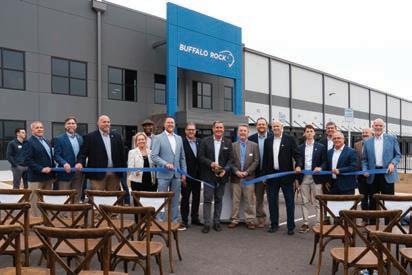
Buffalo Rock Company celebrated the opening of its new Santa Rosa Campus, a 352,800-square-foot facility located off I-10 in the Northwest Florida Industrial Park. The campus includes distribution and office space and will serve franchise sales centers across the Gulf Coast. The project will create 150-200 new jobs and relocate 200 positions. Construction began in September 2023 as part of the company’s long-term infrastructure strategy.



















INSPIRATION + PERSPIRATION + MANIFESTATION



The







Progress along the Panhandle can be seen with every downed stand of trees along the Northwest corridor. New suburb developments are sprouting faster than flowers in the spring, bringing new businesses, increased population, and changing demographics. One thing is certain: The character of this part of Florida is evolving.
For many, the major draw to the area is the abundant wildlife, beautiful beaches, and vast stretches of nature. Stepping into a park or forest here is like walking through a time before modernization. The magic of these spaces needs to be preserved, as an attraction but also as a legacy for future generations.
From a business aspect, the annual economic benefit can generate significant revenue for the state, rivaling theme parks for
tourism dollars. According to a study by Disney in 2022, their parks have a $40 billion impact across Florida, while fishing alone brings in $14 billion a year. Tax revenue from other outdoor recreation activities adds $10 billion, with another $5 billion for wildlife viewing. Altogether, public-owned parks and land have a value of over $60 billion across Florida, according to figures published by The Nature Conservancy.
Growth and preservation are often opponents on a field of battle that stretches from Pensacola to Tallahassee and
beyond. Greg Knecht thinks it is a battle where everyone can win.
Knecht is the executive director for The Nature Conservancy in Florida. The 59-year-old Tallahassee resident believes the Panhandle is still a blank slate that can manage development and keep its character. He claims, “We owe it to our current and future citizens to make sure we do it right.”
The Nature Conservancy is a nonprofit tasked with conserving land and water resources by working with communities and businesses globally. They have been active in Florida for 60 years and have worked to protect
1.2 million acres of vulnerable lands and waters in the state. They own and manage over 40,000 acres that include four nature preserves, which are open to the public.
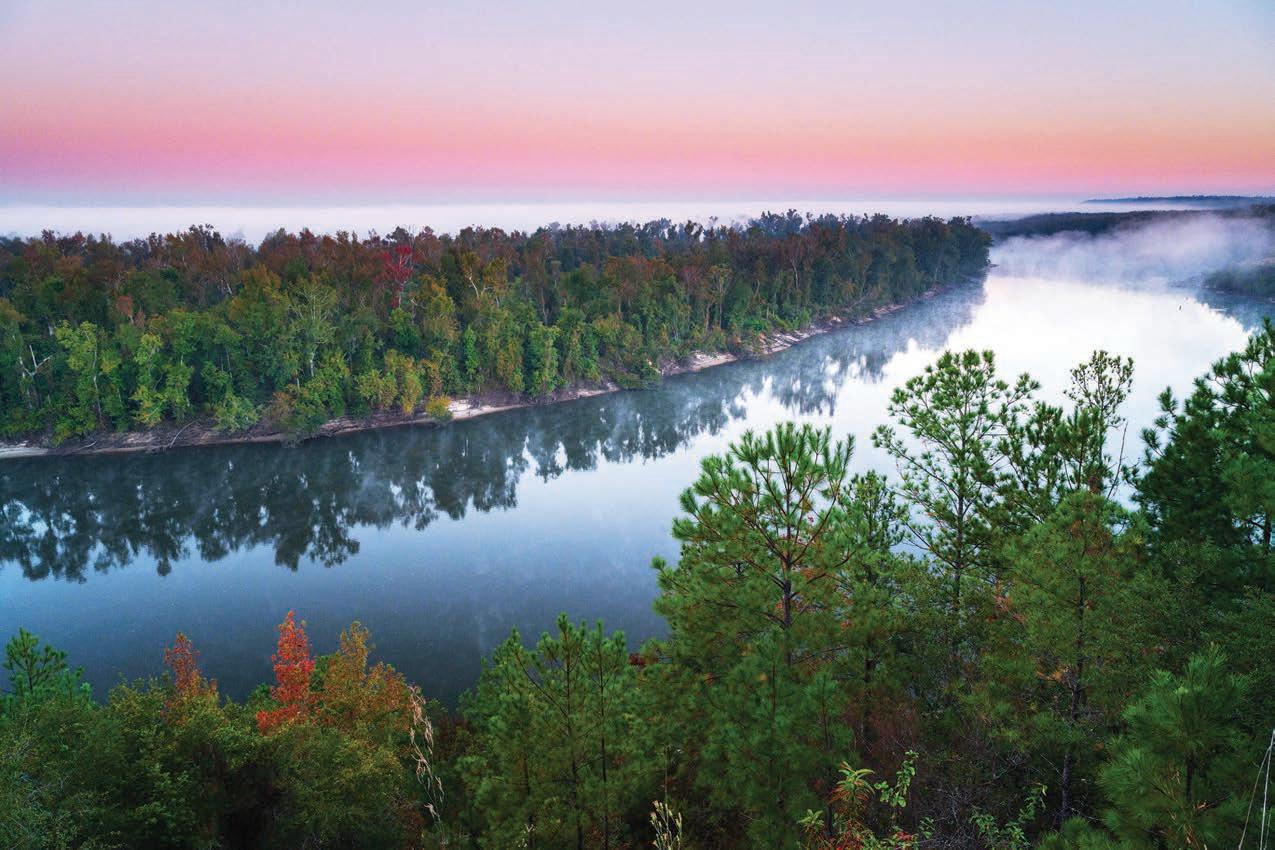
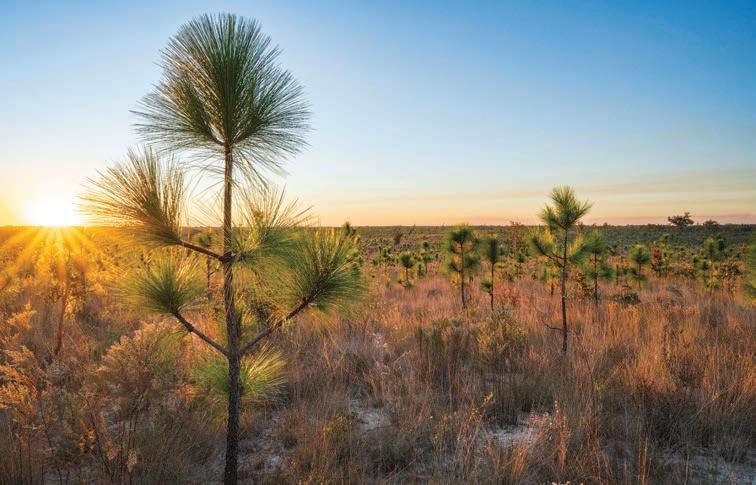
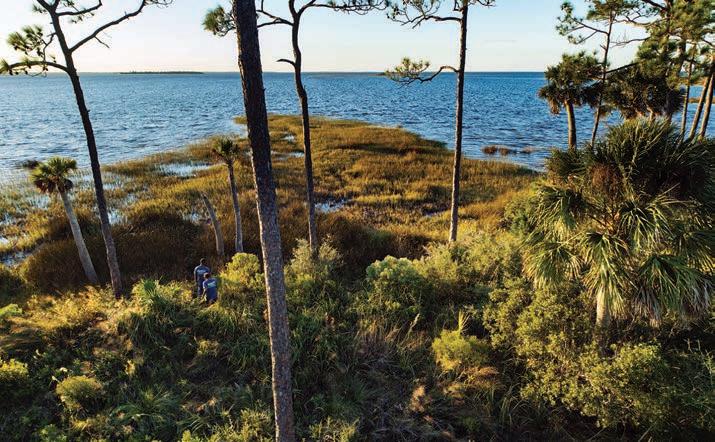
That includes the Apalachicola Bluffs and Ravines Preserve and covers almost 6,500 acres along the Apalachicola River. Located near Bristol, Florida, The Conservancy is working to protect longleaf pines in an environment featuring scenic bluffs and the reintroduction of the indigo snake. Knecht hints they hope to add another 2,500 acres close to that area in the near future.
Knecht has spent 13 years with The Nature Conservancy, three

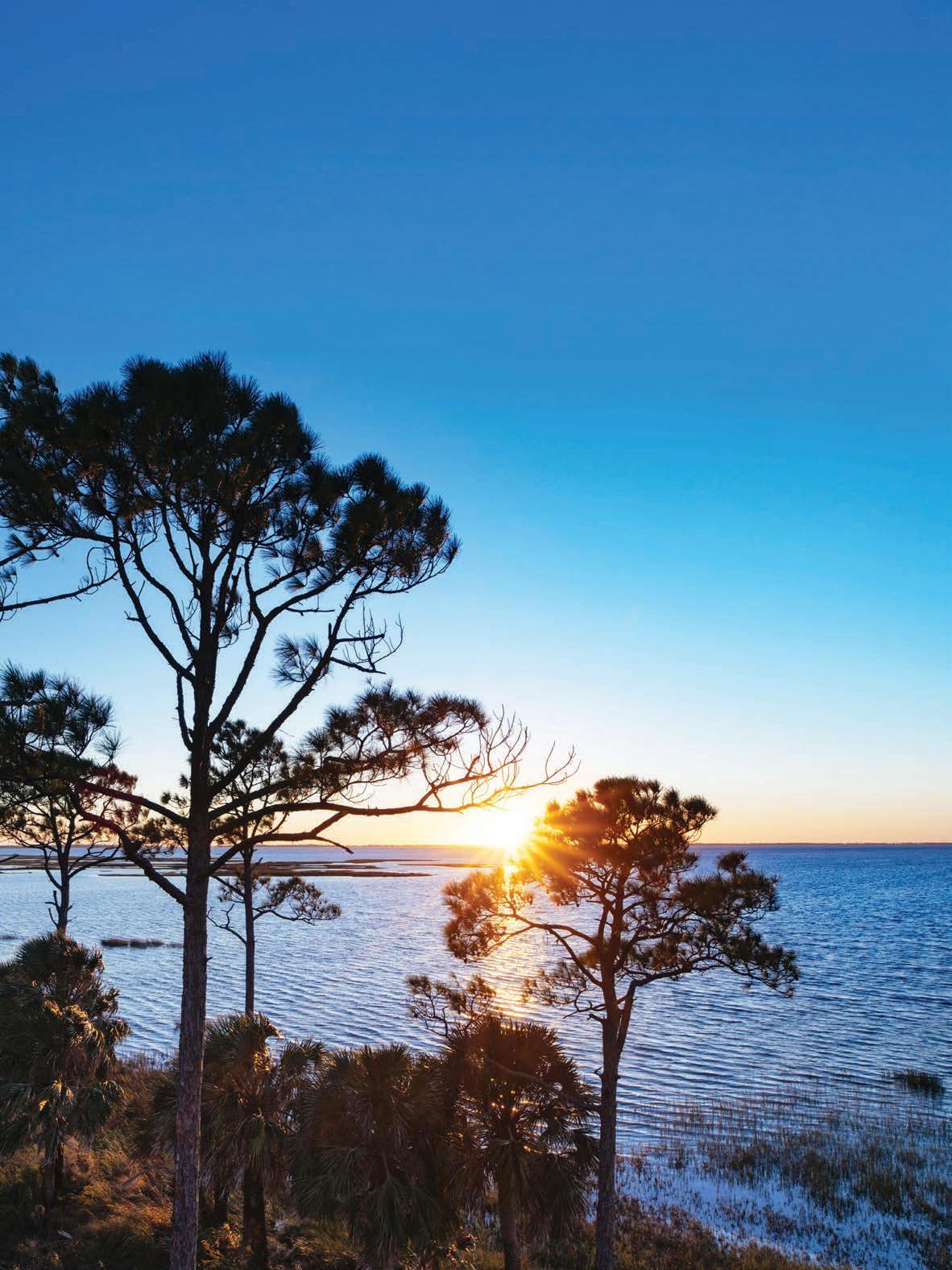
←↑ The Conservancy has helped protect 1.2 million acres across Florida and manages more than 40,000 acres, including four public nature preserves such as the 6,500-acre Apalachicola Bluffs and Ravines Preserve (pictured above, and left), where efforts focus on restoring longleaf pine habitat, reintroducing indigo snakes (bottom left), and expanding conservation by another 2,500 acres.
as their director. He says the preserve near Bristol is just one example of how important it is for the Panhandle to take a managed look at commercial and residential developments in the area. Knecht says, “We know it’s coming, right?”
While acknowledging some places along the coast have not approached development in a thoughtful way, he notes some have. “Seaside is not for everybody. Rosemary Beach isn’t for everybody, but they both have a character that doesn’t look like you picked up a portion of the I-4 corridor and dropped it on the Panhandle.”
With proper planning, Knecht claims the Panhandle can avoid problems that are plaguing Central Florida, where growth has exploded. “They just don’t have the water,” he says, which is forcing the area to look at more expensive ways of finding and providing water to support that growth. In those areas, the days of “cheap water” are limited.
“When your wetlands begin to dry up, and your surface waters are not getting the water they need in your estuaries, you have problems,” Knecht says. “And in the wet season, because you have grown in a way that wasn’t thought out, you now have water
with no place to go, and it goes to the Indian River lagoon. And you have manatee die-offs and things like that.”
While those problems have not been experienced along the Panhandle, Knecht says the community can learn from those mistakes. Knecht doesn’t think any of the problems in other parts of the state are intentional acts, but it is important for other areas to capitalize on the lessons learned.
In their 2025 Florida Impact Report, The Conservancy listed safeguarding and revitalizing water as one of two priorities in their goals leading up to 2030. Protecting and restoring land was the other.
T he Conservancy has been a partner in establishing three estuary programs along the Panhandle to improve the vitality of the waterways. An estuary is an enclosed body of water where salty seawater mixes with freshwater from rivers.
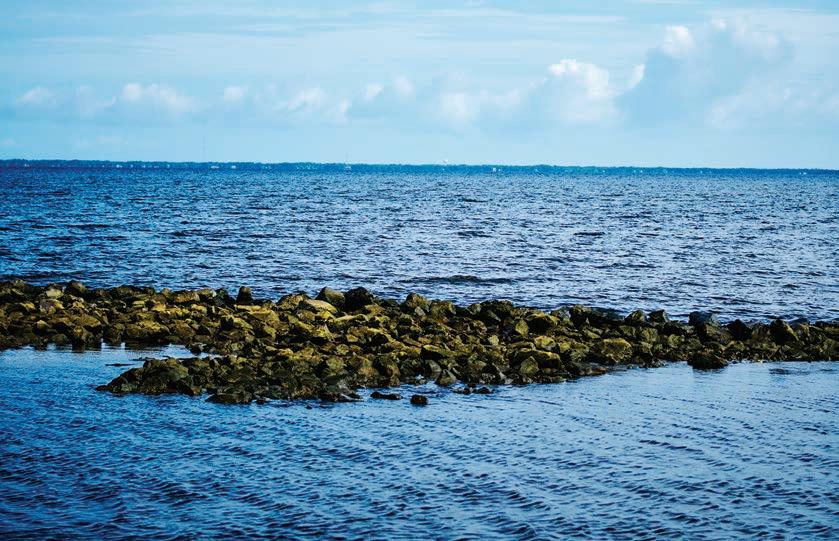
The three include the St. Andrew and St. Joseph bays, the Choctawhatchee Bay, and the Pensacola and Perdido Bays Estuary Programs. In Pensacola, they have been successful in bringing back an area that was once declared “dead for fishing” in 1971. According to Knecht, in Pensacola and Perdido Bays, The Conservancy partnered in a big oyster restoration project that produced 33 new oyster reefs.
Matt Posner, executive director for the Pensacola & Perdido Bays Estuary Program verified that The Nature Conservancy was instrumental in advocating for the program back in 2018. “The TNC and PPBEP have collaborated on numerous projects,” Posner says, “but perhaps the most transformational was collaborating on the development of the Pensacola Bay Oyster Restoration Initiative.”
The program has a goal to restore 1,500 acres of oyster habitat over 10 years. Posner credits the partnership with TNC, their national attention, and
expertise in helping propel the restoration efforts.
Knecht says The Conservancy donated $1 million to the projects as an example of “putting our money where our mouth is.”
The Conservancy works with a number of partners on various projects across the state. Knecht counts their work with The St. Joe Company as one of the best examples of a long-time working relationship. He says they have worked together most of the 60 years The Conservancy has existed.
“They have been a really good longterm partner,” Knecht says. “We’ve always respected one another and had great dialogue.”
Coming to work every day is easy for Knecht because he sees nothing but opportunity in Florida for innovative conservation work. He wants Florida to lead the country and feels in many ways it is currently doing just that. He says, “We have incredible water policy, and with the legislature and governor continuing to appropriate funds to the conservation space, we can continue to grow.”
Knecht feels the state has the ability to chart its own future for the next 30plus years as development continues,
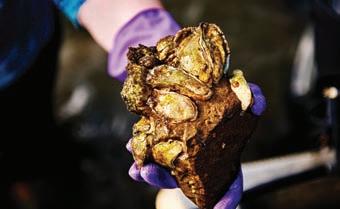
↑ Through a major partnership in Pensacola and Perdido bays, The Nature Conservancy helped launch the Pensacola Bay Oyster Restoration Initiative, supporting the creation of 33 new reefs and contributing $1 million toward a 10-year goal of restoring 1,500 acres of oyster habitat.
claiming, “The folks in the 850 can be leaders for the rest of the country.”
The director is a frequent visitor to the state parks in the Panhandle. He loves St. Marks National Wildlife Refuge, St. George Island, and Grayton Beach. “We are so fortunate here in North Florida to have the public lands available,” he says. “So many wonderful places.”
Despite the increased development, new demands for businesses, and a swelling population, Knecht is optimistic that the changes can benefit nature lovers, conservation, and economic impact without destroying the ecosystems that are attracting tourists and migrants in the first place.
Knecht says, “I truly believe we can have it all.” ▪



















story by OLIVIA SOKOLOWSKI
The Tallahassee music scene is characterized by giants.
C reed––as beloved in 2026 as ever––has put a globally recognized trademark on our gritty Southern character since 1994.
Rapper T-Pain’s stage name stands for Tallahassee Pain, a bittersweet homage to his childhood. Influential emo band Mayday Parade wrapped
their “Three Cheers for 20 Years” tour with a sold-out show in their hometown venue, The Moon, last year. Now, folk singer-songwriter Ethel Cain has broken out of the 323, spreading a sound influenced by Tallahassee’s haunting beauty to Coachella and beyond.
T he capital’s indie music scene is just as formidable as these giants
who have put Tallahassee on the musical map. Today, the artists who make this scene celebrate its unique character but also see clear opportunities for growth.
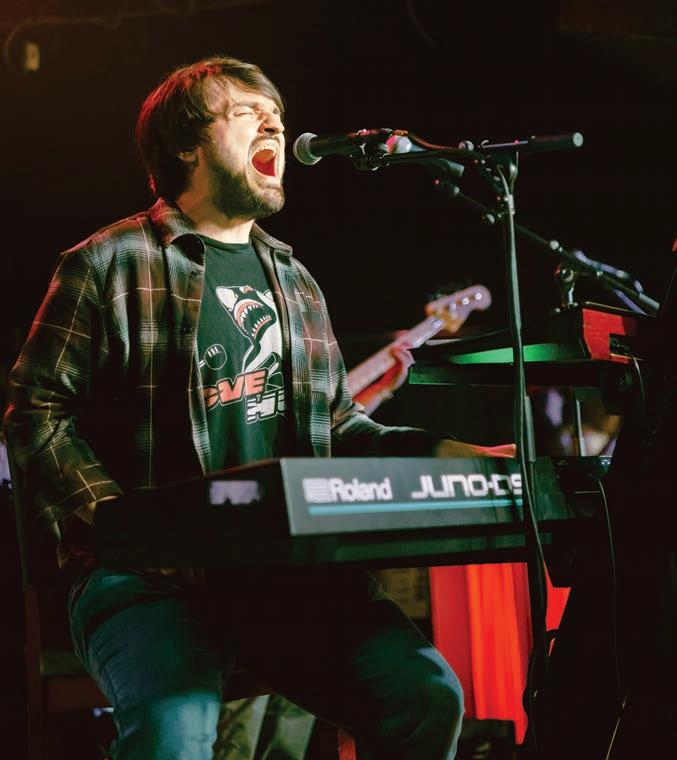
O ne of these artists is John Brashears. Brashears, a classically trained pianist, overcame a neurological injury to one of his hands and found new expressive potential in indie music. Brashears relocated from Atlanta known for a high-quality, competitive independent music scene––to Tallahassee in 2022, and was uniquely poised to appreciate how Tallahassee welcomes new acts when forming his own: the ambient-yetmelodic Sleep John B.
“In the Atlanta scene, it’s so challenging to find a platform,” Brashears says. But as for Tallahassee, “There’s some
other energy … It’s like still water. It’s so easy to tap into and find other musicians interested in creating.
“ I found that it was very, very fertile soil. I do think my music is so much better here than it was in Atlanta, and it feels like a rebirth.”
And a platform isn’t hard to find, either. “I’m not sure that everyone who’s only lived here is aware of how easy it is to get your first show or two in Tallahassee,” Brashears says.
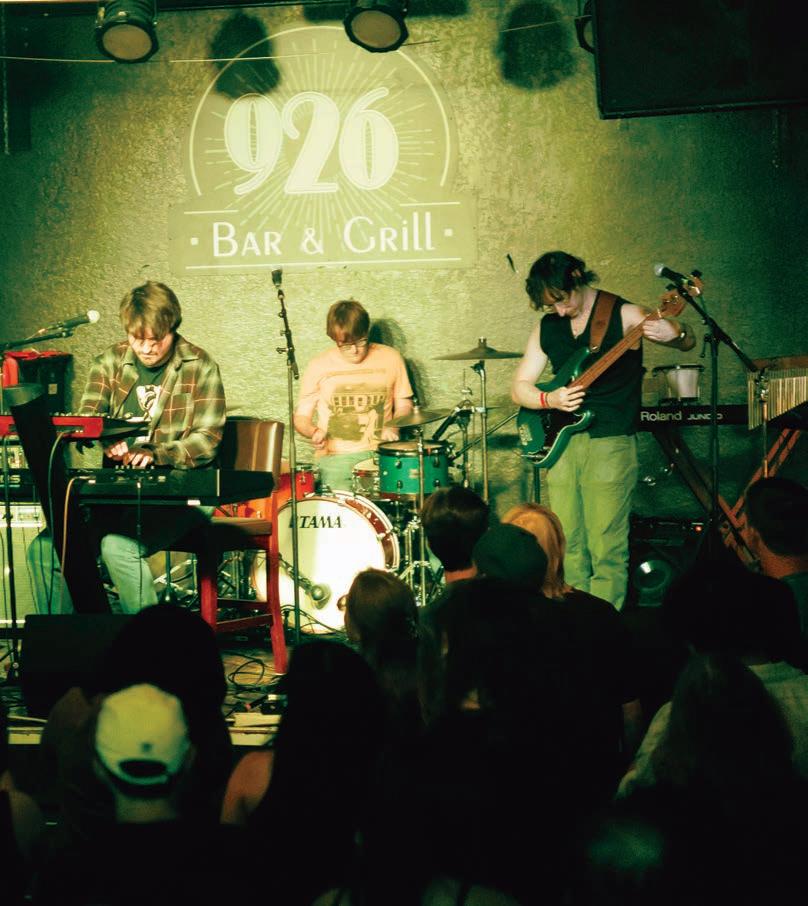
T here are relatively low barriers to entry at venues dedicated to serving the local music scene, like The Bark, 926 Bar & Grill, or Real Cool Time Records.
Because the market for newcomers is so rich, Tallahassee’s discerning listeners seek music outside of the norm. “The audience is pretty tapped in and interested in hearing
something good,” Brashears says. “They’ve heard the college bands that come out and do Led Zeppelin and AC/ DC covers and then move away to do other things, and I don’t think they’re impressed by that. They’re looking for people who are really taking a risk.”
But even when local artists take those risks, reap the artistic rewards, and secure venue time, there’s another ingredient for mainstream success not always present: major crowds.
L ocal bands often need to leave Tallahassee to find audiences larger than 30 or 40 at a show, drawing talent away from our city. But it’s a problem that just may be fixable.
I n a utopia, a new medium-tolarge-sized venue with sustainable means of welcoming local bands might lure locals on a Friday night.
PAUL CHAPMAN, CO-OWNER
Q: What’s the most rewarding part of operating a venue for local acts? Being able to proactively help nurture the scene. Local music is vital to any town, and being able to provide a home for bands at any level to progress to the next is awesome. Giving back to something that’s given life to so many of us is akin to the switching of roles from child to parent on Christmas morning.
Q: Do you see opportunities for growth in the Tallahassee music scene? Of course! The potential for Tallahassee’s growth seems inevitable. Tallahassee’s scene has always had an ebb and flow, but after the pandemic decimated the cyclical growth, to be frank, we had nowhere but up to look to. But there’s a germ of vitality here right now that, with a little luck and some calculated effort, could be cultivated into something as special as anytime I’ve seen since the ’90s.
Q: What sets Real Cool Time records apart from other record stores or venues in town? The focus. At the end of the day, we are a retail business built on transactions. However, we’ve tried to make the focus the communal nature of these artistic artifacts we love so much rather than the transactions themselves. People need art—it’s life-giving. Venues and record stores and bookstores are sanctuaries in times of joy, devastation, and every point between. We take that seriously because, ultimately, we aren’t really any different than those on the other side of the counter.
A WOEFULLY INCOMPLETE LIST OF INDIE ACTS
» Sleep John B.
» Weatherboys
» The Brown Goose
» Danitza
» Palace Rats
» St. Soleil
» Almost
» The Yeah Babys
» Pond Scum
» Gangs of Paris
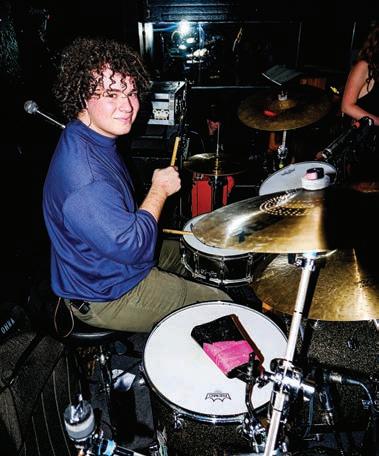
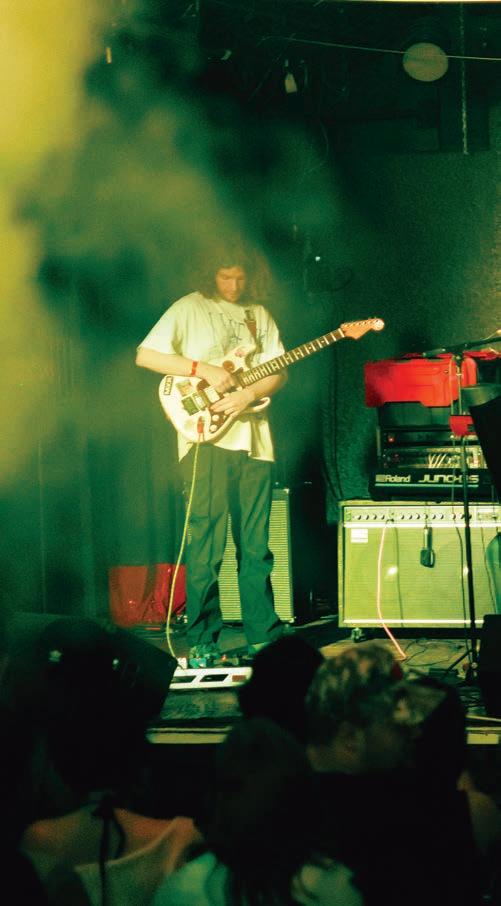
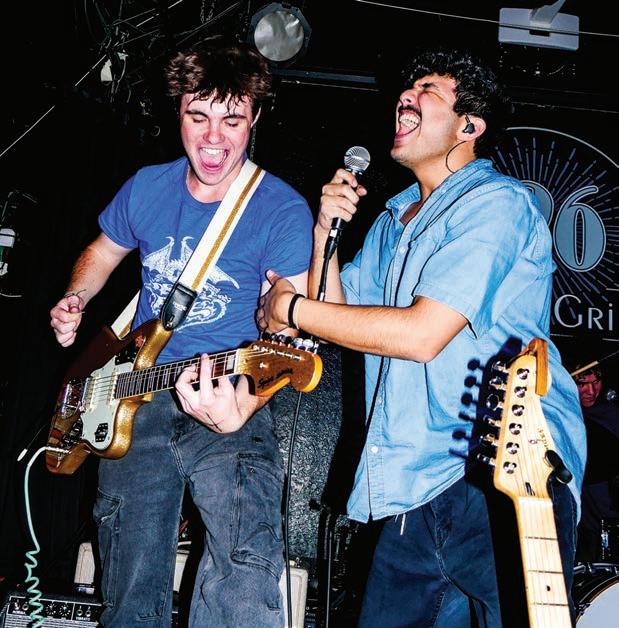
↙→ Local band Weatherboys plays at similar venues to Sleep John B. They find house shows hosted “with a backyard and friendly neighbors” can reach crowds up to 500 people, guaranteeing exposure but sometimes lacking quality engagement.
But perhaps the greatest untapped resource is already here: the vibrant, varied, ecstatic, ubiquitous, and elusive student bodies of Florida State University, Florida A&M University, and Tallahassee State College. Or, as Brashears calls it, the “slumbering giant.”
Local band Weatherboys are a part of this giant, but they’re wide awake. Their music, like Sleep John B’s, stands out from most newcomer bands; theirs is upbeat indie pop that’s equally suited to a local bar and a Friday night house party, but one of those options has proved more fruitful for the four-piece.
House shows are exactly what they sound like: Locals with “a big house with a backyard and friendly neighbors” host behemoth parties—sometimes boasting up to 500 primarily student guests—where young bands show their stuff. Despite the guaranteed exposure, the problem lies in quality engagement.
The house show is a bit of an oxymoron, according to Weatherboys. Drummer and vocalist Aiden Suarez calls them “the purest form of fun you can have as a band. … It’s a lot more intimate. While a venue will give you a more professional sound, a house show lets you connect with the people.” But the band notes that this connection doesn’t apply evenly: “Half of [the audience is] there for the music, and the other half are just there to party,” says guitarist and vocalist Jacob Da Costa.
In Weatherboys’ dream world, downtown accessibility
is paramount. The band agrees that the addition of one or two more venues walkable from CollegeTown, an analog to the lost stage at The Wilbury, would beckon the largely pedestrian student body.
Or, they wonder what might happen if the downtown bars students already frequent— which typically rely on DJ entertainment— added live music to their rotation. “Those clubs are great spots to play music, if they give bands a chance,” Da Costa adds.
A nd for those of us who want to take a step to support indie artists but don’t happen to own a bar, what can we do to support our local scene?
“Stream our music,” says Weatherboys bassist and vocalist Emma Claire. “Stay tuned.”
W hile the landscape is complex, this much is clear: The easiest thing we can do for our local music scene is to plug in our headphones and listen. ▪


We connect clients with the expertise they need, right when they need it—guiding them through complexity, minimizing risk and revealing opportunities others miss.





















story by DAVID EKRUT, P h. D.
Some principles are so fundamental, they are accepted as law. Every action has an equal and opposite reaction in nature. An object in motion will remain in motion until external forces change the object’s trajectory. Heat will di use from a higher concentration to a lower concentration.
Like thermodynamics, universal gravitational pull, and conservation of motion, the Iron Triangle has been tested by countless CEO’s, politicians, and organizations throughout history.
There are three main variables factoring into every product, project, or service: time/ e ciency, cost/budget, and quality/scope.
The equations are simple.
Fast + Cheap = Low Quality
Fast + High Quality = Expensive High Quality + Cheap = Slow
Producing a product fast and cheap results in a low-quality, cheap product. There are plenty of examples in profitable businesses employing this tactic of value pricing. With an annual revenue of just over $41 billion in 2025 (according to Stock Analysis), Dollar General stocks their shelves with quickly made, cheap products, which serves a low-income market. The tradeo is that few customers walk into a Dollar General expecting long-lasting electronics. Apple, on the other hand, is known for creating high-quality products very quickly, but its devices are famously more expensive
than similar goods, but the earnings report for Apple in 2025 was over $416 billion. A n example of highquality products that are cheap but slow are custom-built products. These can be anything from made-to-order apparel, customized furniture, or custom-built computers. The “handcrafted” or “artisanal” model will create quality products that are cheaper than designer products but take longer to finish.
Before choosing which model is important for a product, good, or service, business leaders need to consider branding and demographics. For example, print media is a broad category with products across the U.S. represented in the triangle. Creating a reputable magazine with a strong brand requires deep reporting with vetted, well-sourced articles on relevant topics, laid out with high-quality images by an expert eye willing to take the time necessary to cra a
→ The project management triangle shows the three options for any project, but the Iron Law restricts every project to only possessing two of efficiency, cost, and quality.
lasting brand. Since life moves at a rapid pace, the work must be produced quickly.
As stated above, this will cost more to produce, meaning that a high-quality branded magazine takes a team of experts to create. Remove members from the team, then either quality or time su ers. Reducing the quality of the content risks damaging the brand, but clients are also purchasing space for advertising, which must be released in a timely fashion. Therefore, to create a quality magazine that hits deadlines, a company needs a quality team to deliver its products.
Forbes and National Geographic are both examples of branded material of high quality. Typically, 8-15 people can work on the cover alone, and each company employs quality editors, journalists, photographers, and designers to create their products. In the case of political pieces, there is o en a legal review as well. Not including fact-checkers, the sales team, etc., one issue of Forbes will have over 50 people contributing to content, according to their masthead.
O n the other hand, lowquality brands can produce work with smaller teams quickly and at a bargain
price, but then quality will su er. These are seen in tabloids and direct-to-online content, sold by entertainment news. Facts are based on demographics rather than reality, meaning anyone with a typewriter can produce “stories.”
Each example has a place in business, but owners and operators need to hold realistic expectations for the products they produce. Slapping lipstick on a pig will not make Old Bessy a candidate for the World Dog Show, but she might do just fine at the local county show.
L ikewise, no magazine is winning an Ellie for General Excellence with a skeleton crew of designers and writers.
Lessons for all business leaders from studying the Iron Triangle: Know your brand; understand your audience; pay what is necessary to be on brand, on time; and deliver the quality that is expected. ▪

story by HANNAH BURKE
An emerging and quickly evolving field, regenerative medicine was just several years ago deemed by the Mayo Clinic as a practice caught between “hope and hype,” as the concept of utilizing stem cells to repair missing or impaired connective tissue within the body was largely unexplored.
But for Tyler Barrett, chief executive officer of Regenative Labs, it was a new frontier.
Leading the charge for this Pensacolabased, FDA-registered laboratory and biotech manufacturing company for the past three years, Barrett, who boasts an extensive background of leadership across software and health care sectors,
says he operates on the principle that “medicine doesn’t reward hype; it rewards results that are repeatable, scalable, and trustworthy.”
As such, Barrett knew he wanted Regenative Labs to control every aspect of its operation.
“We chose to build a company where we manage everything from donor
We work with everyone from orthopedic physicians and pain management to podiatrists and even functional medicine practitioners … if a physician can identify missing or damaged tissue, this provides new, healthy tissue to replace it.”
— TYLER BARRETT, CHIEF EXECUTIVE OFFICER OF REGENATIVE LABS
screening and tissue procurement to processing, quality, and distribution,”
Barrett says. “That’s because long-term impact comes from owning the entire system, not just a piece of it.”
Barrett acknowledges Pensacola isn’t exactly a biotech hub, but for him, the destination offers a good work-life balance and a strong spirit of community collaboration. He calls the Pensacola laboratory the operational heart of Regenative Labs, designed for “precision, consistency, and scalability.” Too, it allows the company to continue hiring and growing locally as they partner with local physicians, universities, and clinical specialists.
“I was inspired to create this because there was quite a bit of anecdotal information in the market saying there was a phenomenon occurring where people were getting better and outcomes were being observed,” he says. “But when I looked at the medical literature, there was very little written on the clinical use of these types of products. After conferring with my attorneys to make sure this approach was fully compliant, we set out to close the gap between what was known and what is possible.”
That gap is the driving force behind Regenative Lab’s mission of facilitating predictable patient outcomes by producing the highest-quality tissue
possible. They focus on the creation of human-derived birth tissue products, such as Wharton’s Jelly, which is harvested and developed through highly regulated, standardized processes.
It’s a divergence from conventional interventions focused on symptom management by offering non-surgical options designed to directly address underlying issues. “We work with everyone from orthopedic physicians and pain management to podiatrists and even functional medicine practitioners … if a physician can identify missing or damaged tissue, this provides new, healthy tissue to replace it,” Barrett says.
What differentiates Regenative Labs, Barrett says, is a dedication to rigorous reliability. “Success isn’t about innovation; it’s about execution,” he says. “We’ve invested heavily and repeatedly in quality frameworks and operational clarity, so physicians know exactly what they’re working with.”
As a result, Barrett has noticed within the medical market a shift in expectations, where more and more clinicians are looking for partners to support growth without risk.
“We’re bringing structure and reliability into regenerative medicine,” Barrett says. “We want everyone to experience its benefits, but we want to do that responsibly and sustainably.”
The biggest aspect of gaining credibility is through data, Barrett says, describing Regenative’s outcome
repository as one of the largest in the country with over 10,000 outcomes sets across myriad clinical use sites.
“We measure success by patterns,” he says. “And what we’re seeing is overwhelmingly positive averages across the board. Over the past several years, we’ve published 15 studies and plan to release additional research in collaboration with local doctors in 2026.”
These studies can be perused on the company’s website, regenativelabs.com, and offer some fascinating insights into the capabilities of regenerative medicine.
One of them, published last year, explores the case of an 85-year-old patient told she would require knee replacement surgery. But upon receiving a Wharton’s Jelly allograft, the patient, at a five-year follow-up, continued to demonstrate improved mobility and joint space, avoiding the strenuous procedure altogether.
For Barrett, his work is all about impacting people’s lives and helping define what a mature regenerative medicine industry could look like. Regenative Labs will continue to publish data, bolster their internal systems, and set standards that will allow the industry to support innovation and grow conscientiously.
“We see regenerative medicine following the same pattern as other transformative industries as it moves from early experimentation to trusted infrastructure,” Barrett says. “We’re building for permanence, and we’re proud to be doing that here in the 850.” ▪

story by DAVID EKRUT, P h. D. // illustrations by LINDSEY MASTERSON

orthwest Florida is emerging as an underrecognized hub for coastal resilience expertise, anchored by engineering, environmental science, flood modeling, and civil infrastructure firms that serve both public agencies and private developers. The region’s unique geography, from the Forgotten Coast and Big Bend to the Gulf Panhandle, makes it a frontline for sea-level rise, storm surge risk, stronger hurricanes, and intensifying development pressure. These forces drive demand for science-based planning, regulatory permitting, infrastructure design, and ecological restoration solutions.
In recent years, Florida’s Panhandle and the Big Bend Coast have been hammered by climate-related events. The term “Coastal Resilience” is becoming a steady stream of highvalued projects, such as flood studies, stormwater master planning, living shoreline construction, post-storm forensics, and permitting, all of which will affect business trends now and in the future.
Though there are lessons in here somewhere on the “Broken Window Fallacy” from Economics 101, the fact remains that climate solutions are driving large-budget projects along the coast and surrounding region. The growth signal isn’t one giant megaproject. It’s the accumulation of dozens of smaller public and private developments, funded through state resilience programs and federal hazard-mitigation pipelines, and by entrepreneurs seeking to minimize risk to businesses and homes near the Gulf.

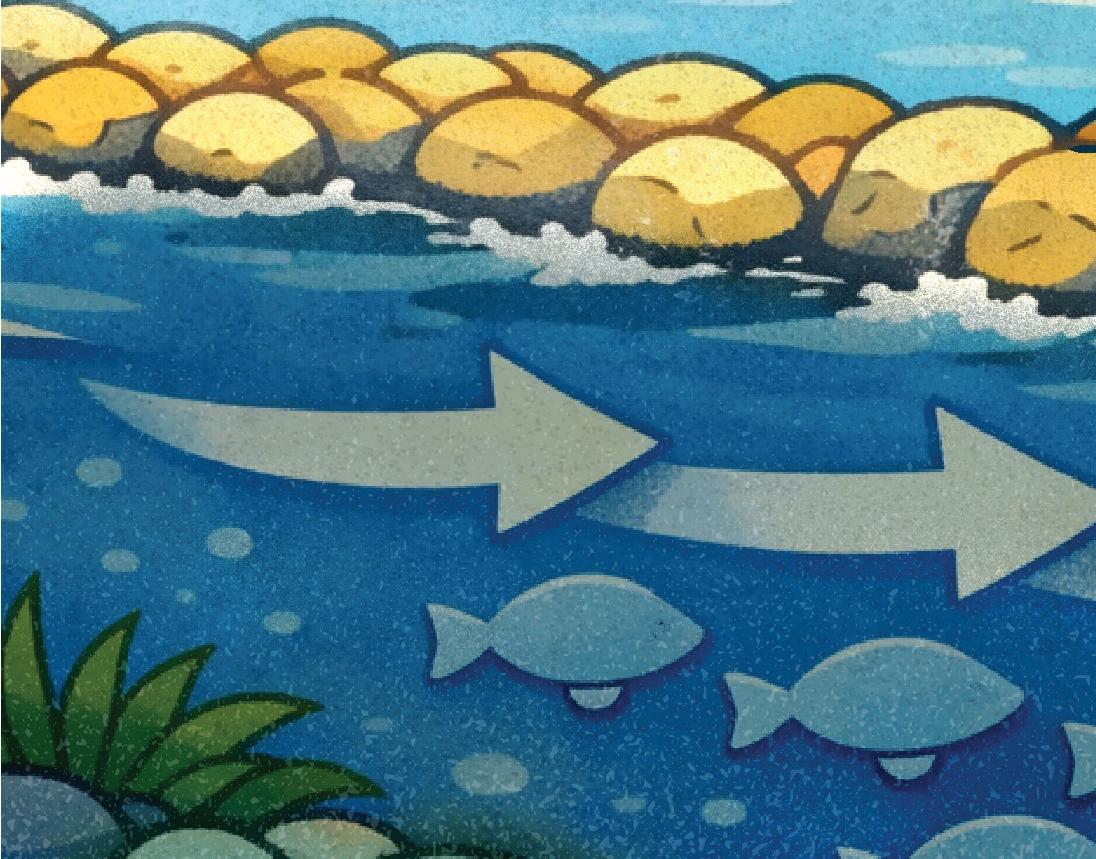




As climate-driven storms intensify along the Gulf Coast, coastal entrepreneurs, homeowners, and local governments are being forced to reassess how they manage long-term risk.
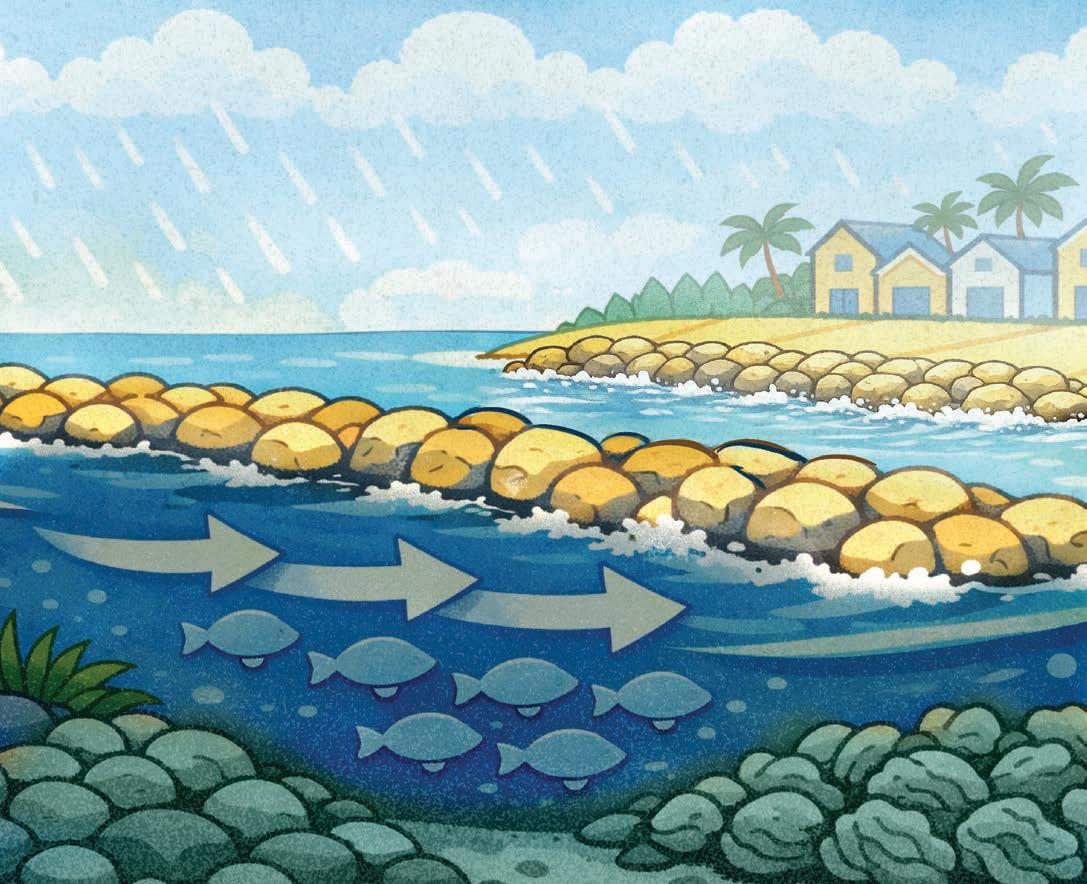
Traditional gray infrastructure, such as seawalls, bulkheads, and riprap, often carries high maintenance costs and can
fail abruptly during extreme events. Living shorelines are increasingly being viewed as an alternative form of climate resilience that also aligns with longterm economic realities.
“A common misconception I hear sometimes with living shorelines is it’s for storm events,” says Will Mather, who works on living shoreline projects across Florida’s Panhandle for engineering firm WSP. “Yes, it will help

with storm events, but it’s not stopping storm surge.” Instead, he explains, living shorelines reduce wave energy before surge arrives, limiting erosion and lowering damage to upland areas.
Unlike static barriers, living shorelines adapt to environmental changes, such as rising seas, and they foster an environment for habitation.
“The reefs are inert when we first put them out, but they get
colonized by oysters, barnacles, other organisms,” Mather explains, “and over time, that rock that was kind of loose is locked in place.” As sea level rises, those systems adjust naturally, growing vertically as oysters accumulate and marshes migrate inland.
That adaptability is central to their value under accelerating climate risk. “A living shoreline 50 years down the road … maybe it’s bigger now,” Mather says. “We don’t have to maintain it. The organisms maintain it.” From a cost perspective, reduced long-term maintenance is one of the strongest economic arguments for living shorelines, particularly for rural communities with limited tax bases.
“The first thing that we do is identify a grant funding source,” Mather says. Counties, regional planning councils, and small municipalities are often focused on day-to-day operations and do not have dedicated grant writers. Once funding is secured, projects move into design and construction.
That funding model also shapes local economic outcomes. For a living shoreline project in Franklin County, bid criteria were designed to prioritize nearby contractors.
“One of our primary goals was local economic development,” Mather says. Construction firms and subcontractors were drawn from within minutes of the project site, many with direct ties to the region’s struggling oyster fishery.
The climate benefits have already been tested. A er Hurricane Helene passed near one project site, Mather returned to inspect the shoreline.
“Behind the living shoreline, the damage was reduced,” he says, while adjacent properties without protection experienced severe erosion. “I was half-expecting to see carnage, he says, “and it just shrugged it o .”
As coastal risk continues to rise, living shorelines are increasingly being viewed not simply as environmental restoration but as climate-resilient infrastructure, reducing damage, lowering long-term costs, and channeling resilience funding back into the communities most exposed to risk.

Increased climate-driven weather events are forcing coastal entrepreneurs and homeowners to reevaluate their exposure to risk. Stronger hurricanes, heavier rainfall, and more frequent billion-dollar disasters are no longer abstract future threats; they are active economic variables shaping insurance markets, construction costs, and long-term business viability in coastal regions.
According to data from NOAA, the United States has experienced a sharp rise in weather and climate disasters causing more than $1 billion in damages, with both the frequency and cumulative cost of these events increasing over the past several decades. For coastal communities, that trend translates directly into higher insurance premiums, reduced coverage availability, and growing pressure on both homeowners and small businesses to demonstrate resilience, proactively.
That shi toward pre-event mitigation is central to research conducted by the Insurance Institute for Business & Home Safety (IBHS). In post-event analysis following Hurricane Ian, IBHS researchers documented dramatic di erences in structural performance tied to construction choices.
A common misconception I hear sometimes with living shorelines is it’s for storm events,” says Will Mather, who works on living shoreline projects across Florida’s Panhandle. “Yes, it will help with storm events, but it’s not stopping storm surge.” Instead, he explains, living shorelines reduce wave energy before surge arrives, limiting erosion and lowering damage to upland areas.
“Metal roofing, we observed failure rates of less than 5%,” says Sarah Dillingham of IBHS. By contrast, homes with asphalt shingle roofs experienced failure rates “just over 50%” under similar conditions.
The implication, Dillingham emphasizes, is not that structures can be made invulnerable but that risk can be meaningfully reduced. Those reductions matter not only to homeowners but to insurers modeling loss exposure and to businesses weighing the cost of disruption versus investment in mitigation.
“With inflation the way it’s been in the last several years,” Dillingham explains, “things just cost more to replace. So it’s just all more important that with the changing of the hazards, and the vulnerabilities that we know exist in our built environment, that we’re setting ourselves up so the next generation can have


stronger homes and businesses to perform.”
What distinguishes IBHS’s work is how those conclusions are reached. “We have more than 90 structures on-site,” Dillingham explains, referring to the organization’s aging farm, where residential buildings are exposed to real-world conditions over time. Roofing systems and attachments are tested a er 5, 10, and even 20 years of aging, allowing researchers to assess long-term performance rather than shortterm laboratory strength alone. That approach reflects a growing recognition that resilience must persist over decades to remain economically meaningful.
IBHS also evaluates the strength of residential building codes across 18 Atlantic and Gulf Coast states. “We rank states on a score of 0 to 100,” Dillingham says, describing a standardized system updated every three years. Stronger

codes consistently correlate with lower losses, a finding that reframes building standards as financial infrastructure rather than regulatory burden.
The economic stakes of those correlations are substantial. In the case of Hurricane Ian, IBHS estimates that improved mitigation measures could have reduced losses to single-family homes by as much as “$1 billion to $3 billion.” For insurers, that scale of loss avoidance influences pricing and solvency. For coastal entrepreneurs, it a ects downtime, rebuilding costs, and long-term insurability.
As climate risk accelerates, the lesson. emerging from both national data and IBHS research is clear: Resilience is no longer optional. It is a business decision that increasingly determines whether coastal communities can remain economically viable in the decades ahead. ▪



Resilience spending is increasingly treated like an “investment,” not a cost. A major reason resilience work keeps getting funded is due to the cost-benefit assessment. The National Institute of Building Sciences’ mitigation research, supported by federal agencies, is widely cited for showing that federal mitigation grants can return about $6 in benefits for every $1 invested when factoring in reduced losses.
A separate 2024 economic study promoted by the U.S. Chamber of Commerce and partners argues that every $1 spent on resilience and preparedness saves $13 in damages, cleanup, and broader economic impacts in the modeled disasters. For North Florida officials trying to justify stormwater upgrades or shoreline work, those figures matter because they help unlock grants and match dollars.
■ $8.3 million initially awarded for living shoreline and marsh restoration
■ 20 acres of estuarine reef restoration
■ Approximately 30 acres of intertidal marsh restoration
■ Protects up to 12 miles of shoreline along U.S. Highway 98
■ Project administered through the Apalachee Regional Planning Council
Pensacola Bay Living Shoreline — Phase 1 (Escambia County/ NAS Pensacola)
■ $1.56 million approved for planning and implementation
■ Approximately 24,800 linear feet of oyster reef and rock breakwater
■ Approximately 205 acres of emergent marsh and submerged aquatic vegetation habitat
■ Includes dedicated funding for advance planning and permitting
St. Joseph Peninsula Beach Nourishment & Coastal Structures (Gulf County)
■ Approximately 830,000 cubic yards of sand placed along roughly 1.1 miles of shoreline
■ Eight submerged breakwaters constructed offshore
■ Project responds to erosion exceeding 1.3 million cubic yards recorded between 2019 and 2023

Public investment in coastal resilience across the Florida Panhandle is increasingly focused on projects that reduce long-term risk while protecting infrastructure, ecosystems, and local economies.
■ Modeling indicates up to a 40% reduction in background erosion
■ Modeling also indicates up to a 50% increase in sand retention compared to nourishment alone
■ Construction scheduled for March 2026
St. Andrew & St. Joseph Bays Estuary Program (Regional)
■ $200,000 state grant to develop a living shoreline planning tool in partnership with Florida State University Panama City
■ Thirty monitoring sites across St. Andrew, Choctawhatchee, and Pensacola bays
■ $750,000 in additional funding supporting a three-year regional water-quality initiative
Resilient Florida Planning Grants (Panhandle Communities)
■ Bay County countywide vulnerability assessment: $150,000
■ City of Lynn Haven vulnerability assessment: $160,000
■ City of Panama City resilience planning: $274,000
■ Planning grants serve as the pipeline for future construction and mitigation funding

WHAT THE NUMBERS SHOW
→ National Climate Risk
■ The U.S. has experienced a steady increase in billion-dollar weather and climate disasters, with both frequency and total cost rising over recent decades (National Oceanic and Atmospheric Administration).
■ Coastal states account for a disproportionate share of insured losses due to hurricanes, flooding, and wind-related damage.
→ IBHS Research Findings
■ < 5% observed failure rate for metal roofing systems after Hurricane Ian
■ > 50% observed failure rate for asphalt shingle roofs under similar conditions
■ 90-plus residential structures monitored at IBHS’s aging farm
■ Roofing systems tested after 5, 10, and 20 years of real-world exposure
■ 18 Atlantic and Gulf Coast states evaluated in IBHS’s residential building code scorecard
■ 0–100 scoring system, updated every 3 years
Together, these projects represent tens of millions of dollars in public investment aimed at reducing infrastructure risk, stabilizing insurance exposure, protecting transportation corridors and coastal assets, and directing grant funding into local construction, engineering, and environmental services. For coastal communities, resilience is increasingly functioning as economic infrastructure, not just environmental protection.
■ $1 billion–$3 billion estimated loss-reduction potential for single-family homes in Hurricane Ian through improved mitigation
era of medical
story by PAIGE AIGRET
Dr. Rosa Bernier has been working in health care for 14 years. In the last two, she says, real waves of rural health care advocacy are finally rippling across state as well as federal entities, stakeholders, and partners.
“This is the first time you can see that they want to bring attention to rural communities,” says Bernier, chief medical officer of PanCare of Florida. “They are understanding that the need is there. And that accessibility needs to go where it’s necessary.”
↑→
and
out-of-pocket
for
10
of

Eddie Gonzalez is a partner at the Tallahassee-based data convergence company Ruvos and chair of the Greater Tallahassee Chamber of Commerce. As a key player involved in health care data communications with roots in the local community, Gonzalez sees three major factors at play for rural health care advocacy in Northwest Florida: The Florida State University (FSU) partnership with Tallahassee Memorial HealthCare (TMH); the Rural Renaissance Bill (SB 250) that is currently pushing through legislature; and new grant funding from the Rural Health Transformation (RHT) program.
Gonzalez says the FSU-TMH partnership, announced in September, will “have a ripple effect across the region when it comes to development and jobs,” and that it will “revolutionize health care for rural communities” from Jacksonville through to neighboring regions in Georgia and Alabama. The partnership plans to expand access locally to specialist care.
Dr. Temple Robinson, CEO of Bond Community Health Center, says the greatest challenges in rural health access today come in the form of financial instability and lack of awareness for available services.
“The economic pressure of providing sustainable, quality health care to uninsured or underinsured patients who reside in counties that are financially constrained is the biggest challenge,” Robinson says. “The other challenge is to ensure that the targeted population is educated on the services that are or will be available and the importance of preventive care and continuous chronic disease care.”
The Rural Renaissance bill, introduced by Senator Cory Simon (R, FL), will help alleviate some financial burdens, requiring the state to give preference to rural areas for technical assistance funding. It will also revise the conditions to be considered a fiscally constrained county.
Currently, the Florida Department of Revenue defines 10 Northwest
Gonzalez says the FSU-TMH partnership, announced in September, will “have a ripple effect across the region when it comes to development and jobs,” and that it will “revolutionize health care for rural communities” from Jacksonville through to neighboring regions in Georgia and Alabama. The partnership plans to expand access locally to specialist care.
Florida counties as fiscally constrained: Holmes, Washington, Jackson, Calhoun, Gulf, Gadsden, Liberty, Franklin, Wakulla, and Jefferson. That number could potentially expand under the Rural Renaissance Bill, which aims to enhance rural infrastructure for schools and hospitals and expand opportunities for education, commerce, and health care, according to Senator Simon.
The bill’s $218 million in funding has goals to create an Office of Rural Prosperity to administer Renaissance Grants and provide block grants to grow populations. Some grant funding from the bill will cover start-up costs for new health care practices, including facility construction, leasing expenses, medical equipment, and furnishings, in an effort to encourage an influx of medical providers to rural areas.
As part of the new RHT program, Gov. Ron DeSantis announced in December that Florida will receive $209 million in rural health care funding in 2026. The funding will focus on expanding the rural health care workforce, training initiatives, and accessibility.
“This is amazing for rural communities; this is their year,” Gonzalez says. “The federal government is basically saying, ‘We’re getting the funding to the boots on the ground, the actual people that are doing the work.’”
“The rural community is an investment,” says Bernier. “Rural clinics might not always be full of patients … But every person that you see there
has a real need, so you solve a huge problem as a community.”
Bernier says true advocacy is action. The RHT program is a step in the proactive direction.
“It’s necessary to bring the service to them,” she says. “No matter how they use it, to improve facilities or hospitals, bring in specialists, more access to telehealth, to bring primary care doctors to those areas. Right now, we have a huge deficit of primary care providers.”
However, the National Rural Health Association (NHRA) says that “RHT funds may not fully offset the anticipated reductions in Medicaid funding and exchange revenue related to other One Big Beautiful Bill provisions, partly because states may choose to use the funds for purposes other than providing payment support to rural providers.” The NHRA recommends that providers approach anticipated RHT program funding as “just one part of a long-term plan for financial sustainability.”
Dr. Bernier says effects from recent cuts in Medicaid funding are not initially being felt at the provider level but that she expects to see loss of benefits widespread across patients in rural areas and beyond.
“They may not have insurance coverage, but we are here to serve,” Bernier says. “They can really have uninterrupted access to health care because we exist.”
“I know there have been a lot of changes to the marketplace and Medicaid,” says Lindsey Cross, PanCare’s mobile programs director. “I think that people are moving to self-pay out of necessity. I think that
The economic pressure of providing sustainable, quality health care to uninsured or underinsured patients who reside in counties that are financially constrained is the biggest challenge. The other challenge is to ensure that the targeted population is educated on the services that are or will be available and the importance of preventive care and continuous chronic disease care.” —Dr. Temple Robinson, CEO of Bond Community Health Center
if it continues the way it is, we’ll probably see a lot more of that.”
PanCare, a federally qualified health center, has facilities and mobile units in 10 Northwest Florida counties—Walton, Bay, Holmes, Washington, Jackson, Calhoun, Gulf, Gadsden, Liberty, and Franklin— eight of which are currently defined as fiscally constrained.
While Walton County doesn’t qualify, due to the a uence of the beach communities along Highway 30A, Cross says that inland rural communities like DeFuniak and Freeport are where she sees some of the highest demand for the clinic’s free mobile services.
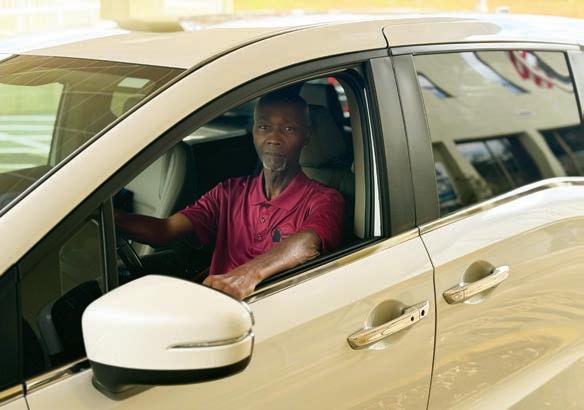
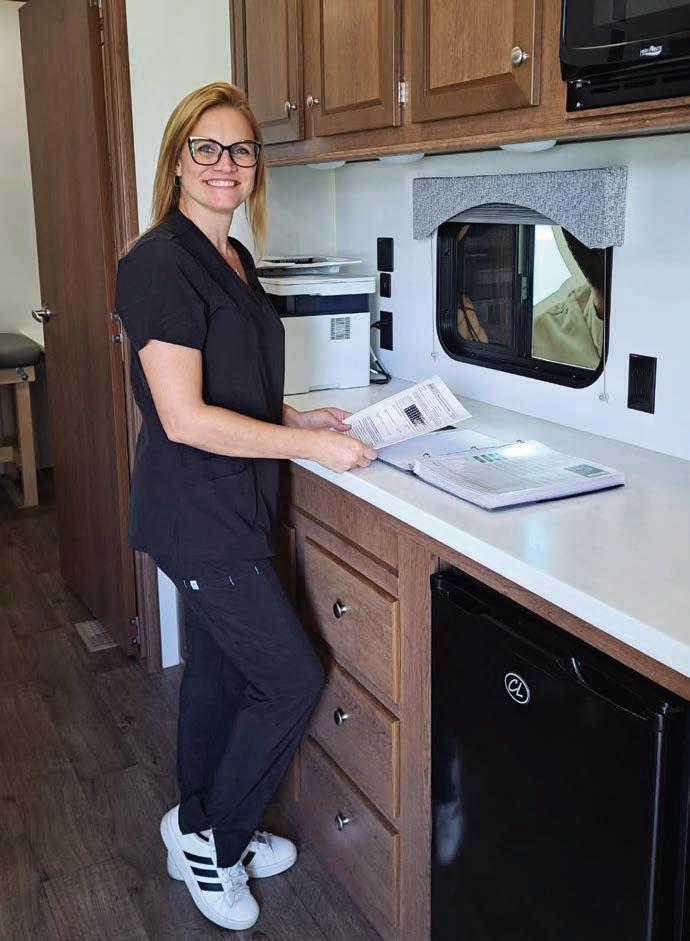
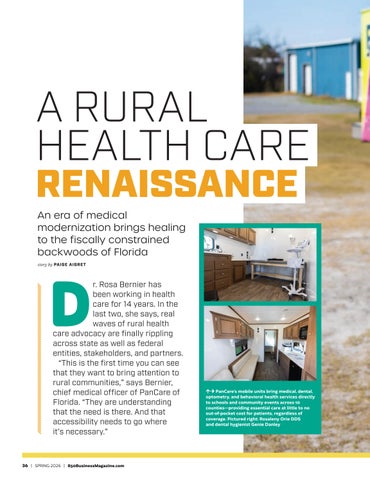
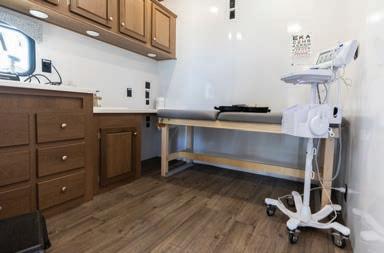
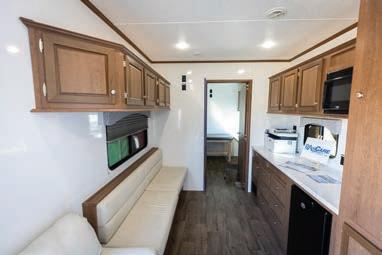
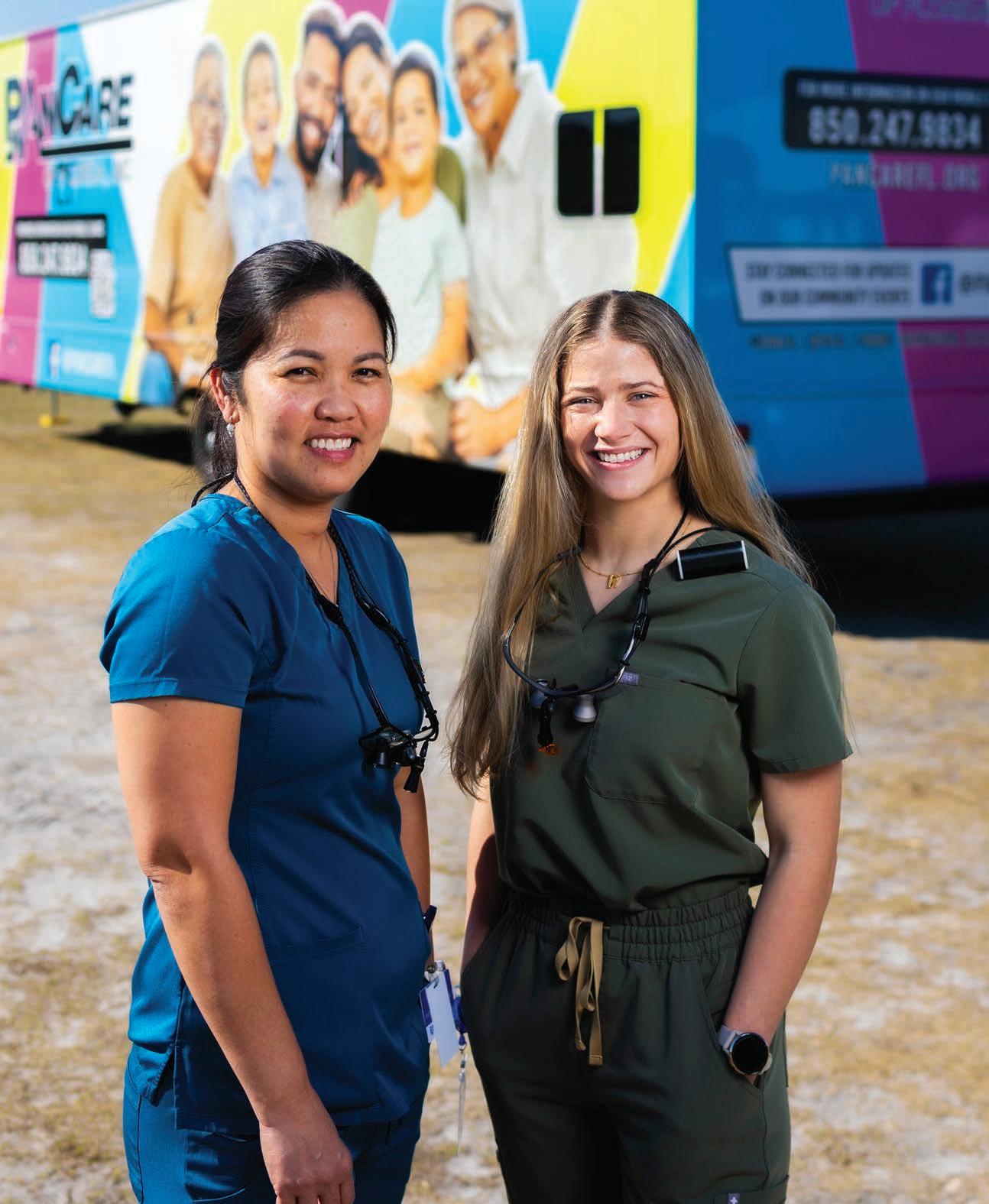
PanCare’s sweeping mobile program encompasses medical, optometry, dental, and behavioral health. The mobile units tour the 10 serviced counties, stopping at schools and health fairs to offer basic medical services on-site. Nearly all of the services provided through PanCare’s mobile units are offered at no out-of-pocket cost to the patient, regardless of coverage.
“There’s no copay charged, and we don’t charge for a visit regardless of the insurance status,” says Cross.
Dental care, to include exams, cleanings, sealants, and even basic extractions, can be serviced on the bus. Optometry offers eye exams and other basic services. And medical provides primary care visits, immunizations, sports physicals, blood pressure checks, behavioral
health services, and a variety of other services.
Bond CHC helps fill a gap in the fiscally constrained Wakulla County, as well as in Gadsden and Leon counties, also offering mobile unit services for medical and dental as well as door-to-clinic transportation services for patients. Bond plans to add mammography services to its mobile unit, too.
At PanCare’s brick-and-mortar clinics, costs are calculated using a sliding fee scale, which is based on income and household size. Clinics operate as all-in-one facilities that offer medical, dental, optometry, and pharmacy all on-site.
Telehealth services have drastically expanded access to behavioral health services and other general care areas. PanCare offers
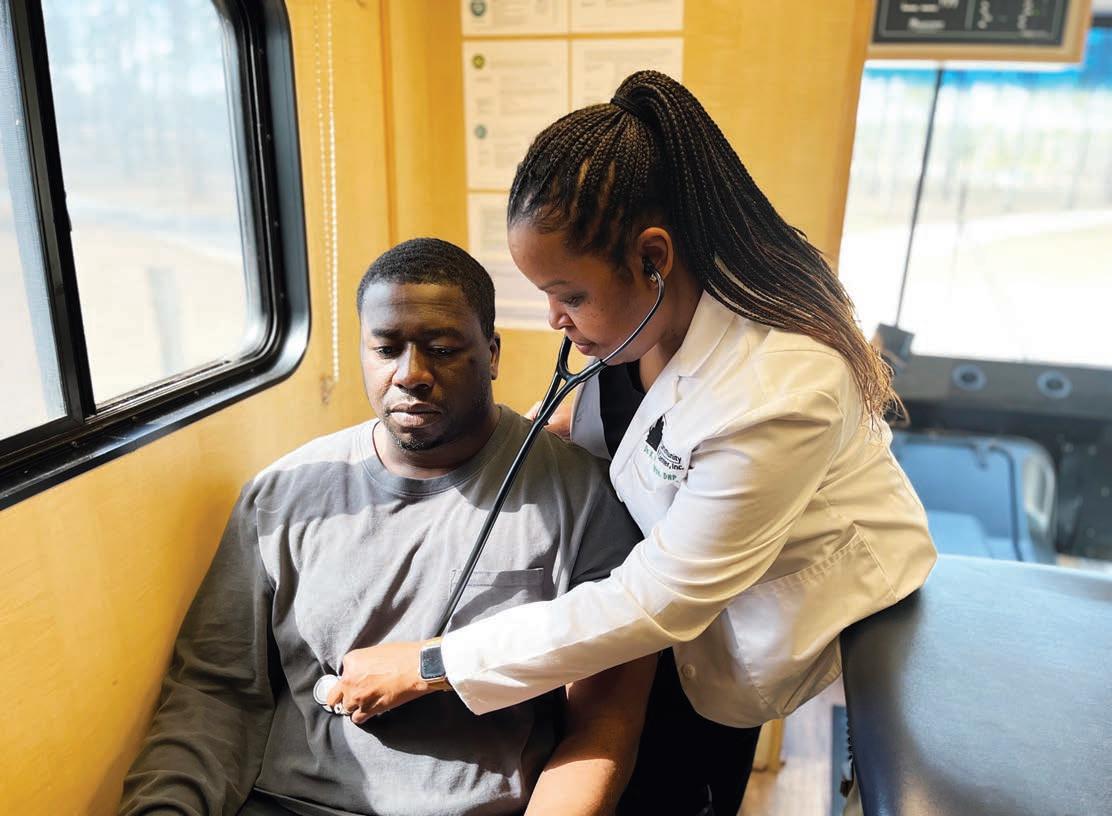
← PanCare staff member in a mobile unit at their Chipley Location. PanCare has facilities and mobile units in 10 Northwest Florida counties—Walton, Bay, Holmes, Washington, Jackson, Calhoun, Gulf, Gadsden, Liberty, and Franklin—eight of which are currently defined as fiscally constrained.
counseling, psychiatric, prescription refills, and lab result reviews via telehealth. Its telehealth programs work in coordination with the mobile units and some schools to provide services to students.
Bond supports telehealth accessibility with its “portable hot spot library,” which gives patients internet access for appointments and offers remote blood pressure monitoring.
PanCare was awarded a rural grant for improvement on telehealth services, which was used to purchase advanced telehealth equipment. Working with a health tech or a nurse on-site at a partnering school, a provider can virtually listen to your heart and lungs through stethoscope feedback and look in on a patient’s throat, ears, or eyes to evaluate remotely. This allows providers to detect pneumonia, heart murmurs, ear infections and ruptures, and more, all done remotely.
Mobile units, all-in-one facilities, and telehealth services are resolving barriers like transportation, minimizing trips that, in rural communities, can often amount to 30-60 miles from home to clinic to dentist to pharmacy and back. And free services and a sliding fee scale makes health care financially approachable for an increasing number of self-pay patients.
“Some of these communities only have us,” Bernier says. “Unless we are there, they will not have access to the whole package of things. So, we really meet a requirement for them.”
Ruvos plans to stand ready and waiting to help facilitate technological transitions and advancements as RHT program funding rolls out to communities.
The rural community is an investment. Rural clinics might not always be full of patients … But every person that you see there has a real need, so you solve a huge problem as a community. It’s necessary to bring the service to them. No matter how they use it, to improve facilities or hospitals, bring in specialists, more access to telehealth, to bring primary care doctors to those areas. Right now, we have a huge deficit of primary care providers.”
—Dr. Rosa Bernier, chief medical officer of PanCare of Florida
“We are confident that there will be opportunities for Ruvos to help,” Gonzalez says. “We see ourselves sometimes as being the bridge between a hospital, a nonprofit or private hospital, and public health— not only a bridge technologically, because literally we move data, but also strategically.”
Moving data, Gonzalez says, is Ruvos’ bread and butter regionally, nationally, and beyond. The company has been a leader in disease and lab result reporting for 22 years. Working with federal entities like the Centers for Disease Control (CDC) and public health agencies like the Association of Public Health Labs and the World Health Organization (WHO), Ruvos has contributed to data solutions and the transference of major world health events like the COVID-19 pandemic.
In the last few years, Ruvos has returned a focus to its local roots, centering e orts in rural areas to contribute to the renaissance era that is arriving with new funding. Partners at Ruvos have recently created a new app, WellConnector, which they plan to roll out locally before its national launch. Gonzalez describes WellConnector as a health care wallet, housing patient records, files, insurance information, and more.
“WellConnector allows you to store all of the information on your phone in a secure fashion,” Gonzalez says. “When you go to the doctors’ office, you give them a QR code and it pulls in all of your information.”
WellConnector will help communicate records, results, pre-
scriptions, and general patient information across primary care physicians, specialists, and new providers. Any internal updates to questionnaires or forms will notify the patient to provide the updated response without having to refill or refile previous information.
Bernier calls this a dynamic health record something she’s been hopeful to see the industry achieve.
“That kind of universal dynamic health record, that the patient can take from one place to another, will facilitate our work a lot,” Bernier says. “It is a real access to health and wellness and an improvement to the health care system.”
With funding on its way and new systems at play, are we prepared to follow the path to a rural health care renaissance? Gonzalez thinks so.
“The roads are there,” he says. “But there are some potholes. We
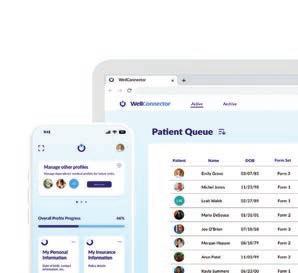
need to patch up those potholes. There is modernization that is needed. But there is a highway system. We do not have to invent anything from scratch. Funding like the RHT program and others will hopefully provide that needed modernization funding.”
Robinson says solutions will require open minds and shared interests.
“This will take a multi-system approach from local, state, and federal governmental leaders,” she says. “It will take nontraditional partnerships of government, private organizations, businesses, and nonprofit organizations. It may require changes in workflows and adaptation of new technology.”
At the heart of it all, collaboration and community will be the final pieces of the puzzle—two things in which rural Florida is consistently adept. ▪

← Partners at Ruvos have recently created a new app, WellConnector, that securely shares records and updates across providers, instantly notifying patients of any form changes—no refiling required.

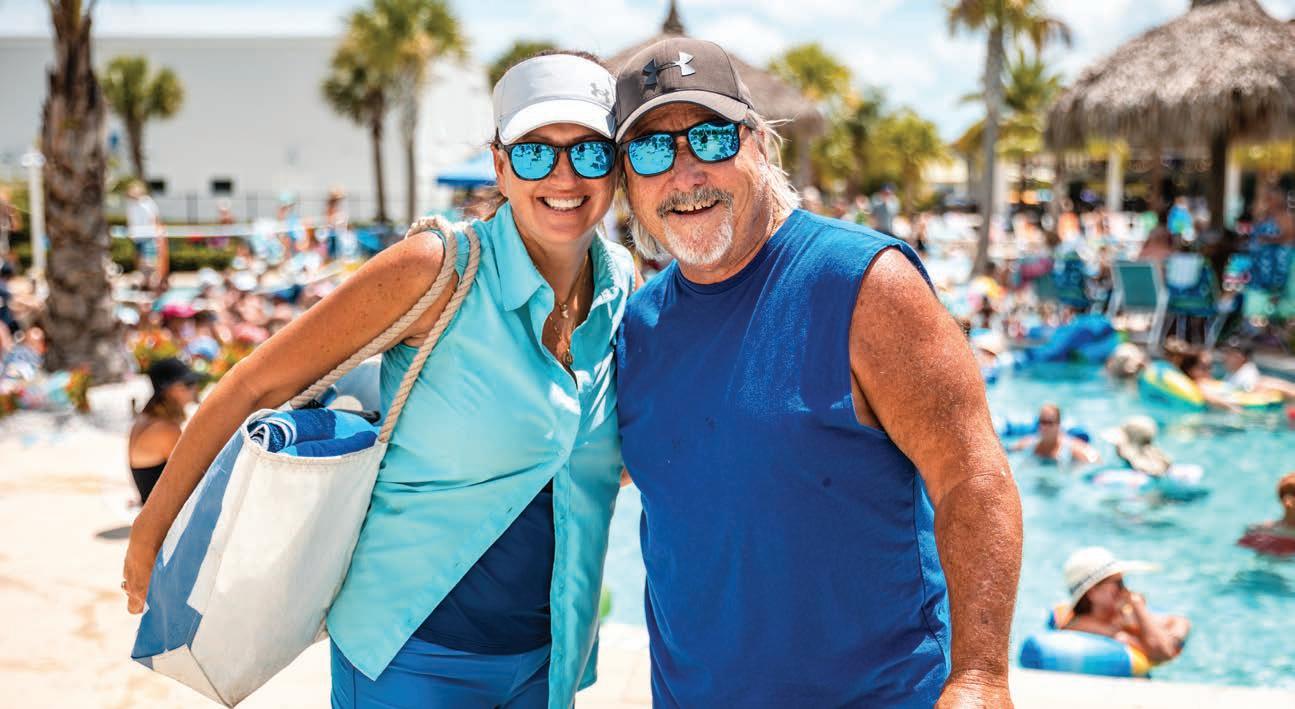












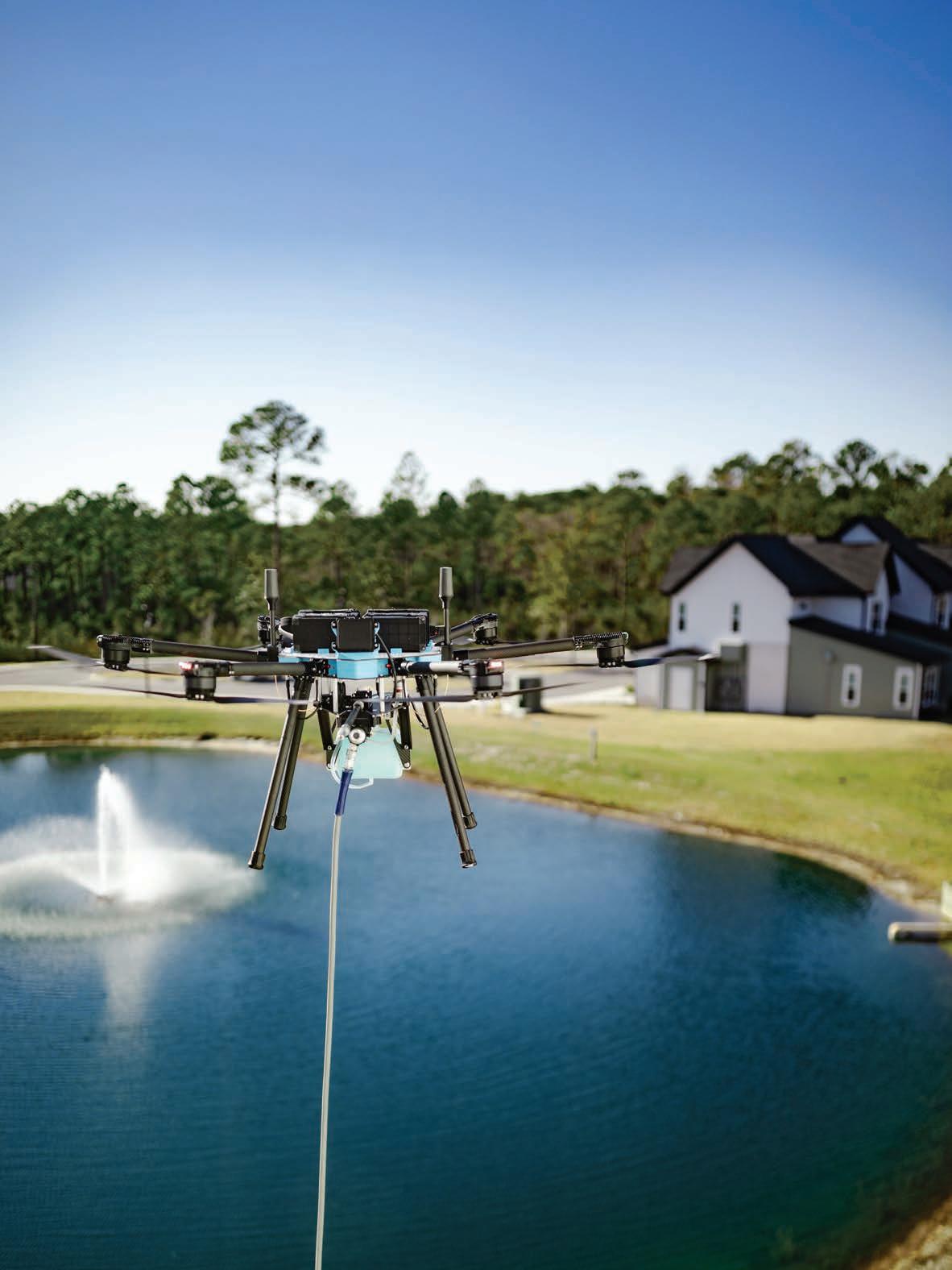


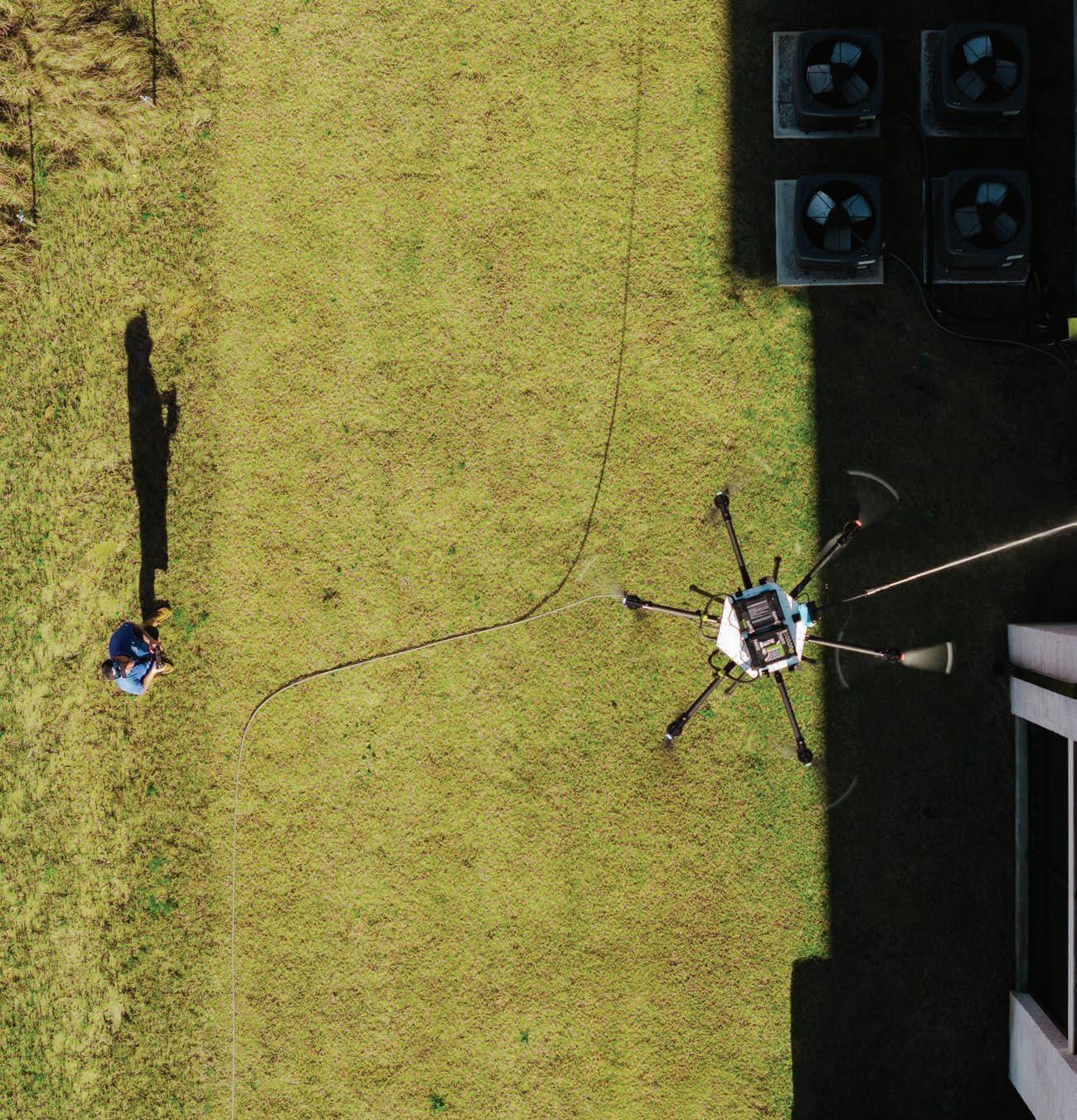
Drones are changing that model, revolutionizing high-risk building cleaning and maintenance by offering a safer alternative There is significant demand for this service, especially across Florida’s Panhandle because we can reach challenging areas without putting people at risk.”
— RYAN MCKILLIP, FOUNDER, H20DRONE
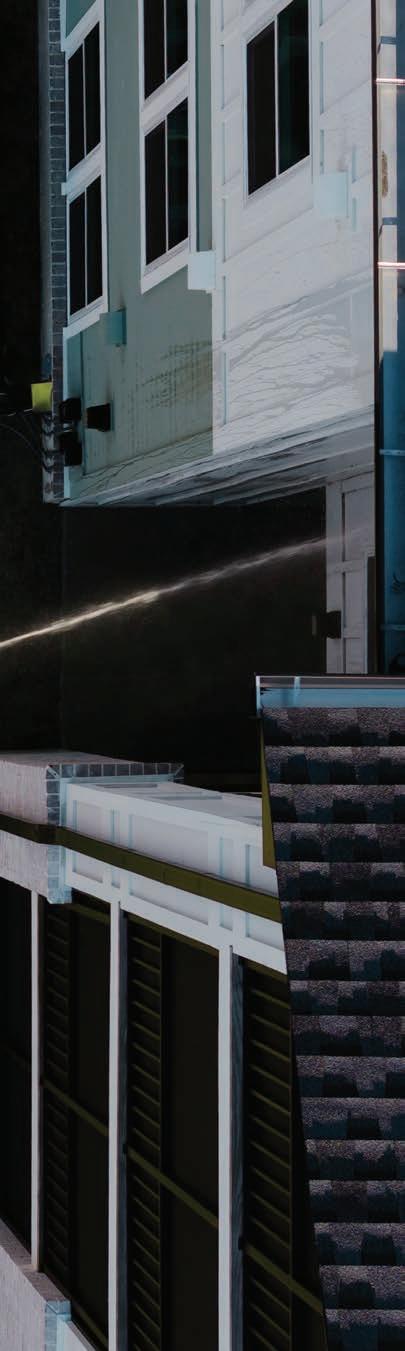
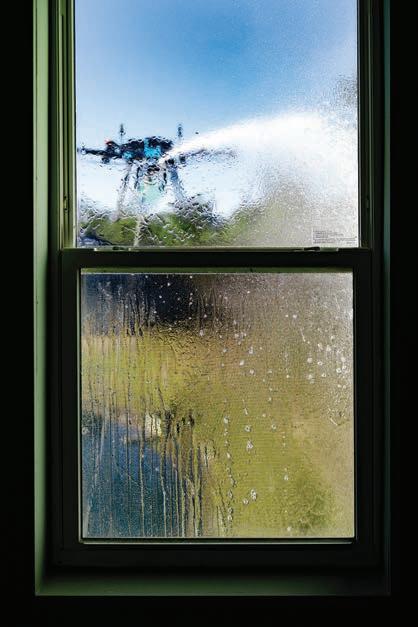
←↘ McKillip launched H2ODrone in July 2025, bringing a safer, more efficient solution to cleaning highrise buildings in a region where traditional ladders and lifts are costly and impractical.
When Ryan McKillip, a former renewable-energy safety professional, first saw drones that were inspecting massive wind turbine blades, he was immediately intrigued. Traditionally, to perform this work, rope-access crews rappel hundreds of feet from the top of a turbine. After viewing this, McKillip quickly recognized how drones changed things. Inspections that once took days could now be completed in hours, allowing multiple turbines to be evaluated in a single day, which was far safer and more efficient.
This realization inspired McKillip to consider whether drones could also handle other hazardous, hard-to-reach tasks, such as pressurewashing the exteriors of tall structures. McKillip dove in and began researching the technology and discovered Lucid Bots, a Charlotte, North Carolina-based company specializing in drones for pressure and soft washing. Within months, he left his job, purchased a Lucid Bots drone, and moved to Florida’s Emerald Coast to be closer to family. The area, with its many high-rise buildings and exposure to salty air and algae, provided an ideal location to launch his start-up, H2ODrone, in July 2025.
McKillip notes that luxury apartments and condominiums are often built on sloped terrain or near ponds, making lifts impractical and ladders unsafe. Despite these challenges, exterior cleaning has long relied on ladders, lifts, and harness systems, which are costly, timeconsuming, and hazardous.
“Drones are changing that model, revolutionizing high-risk building cleaning and maintenance by offering a safer alternative,” says McKillip, who runs the company with his brother Chris. “There is significant demand for this service, especially across Florida’s Panhandle because we can reach challenging areas without putting people at risk.”
McKillip’s drone features a 5-foot wingspan from blade tip to blade tip. An attachment beneath the aircraft carries a payload of chemicals to remove organic growth, salt, and grime and is capable of rinsing the surfaces afterward with clean water. Powerful motors allow the drone to withstand pressures up to 3,500 PSI and spray up to 8 gallons per minute while maintaining stability. It can also operate at lower pressures for soft washing, such as window cleaning. Pricing for drone use is determined by total square footage and the complexity of each project. When the job is complete, the drone can
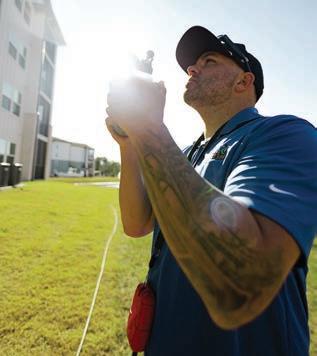
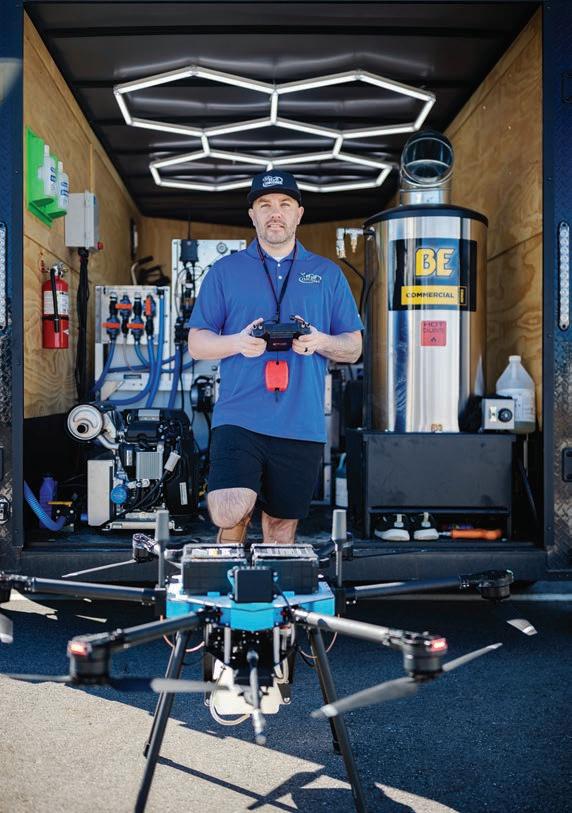
↑ H2ODrone’s 5-foot-wingspan aircraft delivers up to 3,500 PSI and 8 gallons per minute, carrying cleaning agents and rinse water to safely and efficiently wash high-rise exteriors before folding compactly for transport.


higher. For high-rise buildings like ours, the lifts alone make the job more expensive because the daily rental rate is so high. We didn’t have to worry about that with the drones because they made the job faster.
One great byproduct of having drones do the job was that our residents loved watching and were really engaged.”
“Safety is at the core of everything we do,” McKillip says, “for us and for our clients.”
This focus on safety extends beyond equipment. As an FAA Part 107-licensed drone pilot, McKillip coordinates with airspace authorities, including Eglin Air Force Base. Before each job, he files flight requests and notifies officials before and after daily operations to ensure compliance with restricted airspace requirements.
fold compactly for transport in a specially equipped truck.
“We also use the drone for maintenance cleaning of rooftop solar panels,”
McKillip says, “Solar panels collect the same buildup as siding and roofs. If they’re dirty, they’re not producing the power people paid for.”
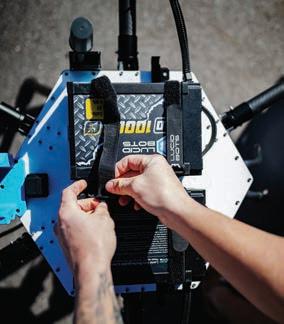
American House Bluewater Bay, a five-story senior independent-living apartment complex in Niceville, Florida, had its exterior cleaned and was pleased with the results.
“We’ve received quotes for traditional pressure washing,” says Yoly Ostertag, the facility’s executive director. “And the cost for those was much
“Many people fly drones without fully understanding the airspace,” he says. “With the amount of flight training that occurs around places like Eglin every day, authorities want to know exactly where unmanned aircraft are operating.”
Unlike many drones, McKillip’s aircraft is tethered to a ground-based system by a hose that supplies water and limits its range. “It physically can’t just take off and go somewhere else,” he explains. “That tether offers another layer of safety.
“The goal is to grow the company and eventually expand into cleaning structures such as water towers and coastal infrastructure,” notes McKillip, “but we want to do it the right way by starting small, staying safe, and remaining professional.”
McKillip’s original concept, still in development, is ambitious. He aims to become the first company in the United States to wash large commercial wind turbines using drones, a service that has yet to be successfully implemented at scale.
For now, McKillip is focused on demonstrating that drones can handle even the most dangerous maintenance jobs, eliminating the need to put people at risk. ▪














































story by STEVE BORNHOFT
At meetings of the American Association of Community Colleges, school presidents nearing retirement are feted, their achievements summarized.
Typically, recalls Dr. John Holdnak, presidents are saluted in terms of buildings built, degree programs added, or scholarship dollars raised.
But for Holdnak, who served as the president of Gulf Coast State College in Panama City for eight years, those statistics, while important measures
of a college’s vitality, didn’t speak to community service.
“One of the things I enjoyed most about my responsibilities at the college was getting involved in economic development,” Holdnak says. Indeed, “supporting economic development” is part of GCSC’s mission statement and the job description for its president.
“I wanted to leave the college with the community better off than when I started,” Holdnak says. “If the
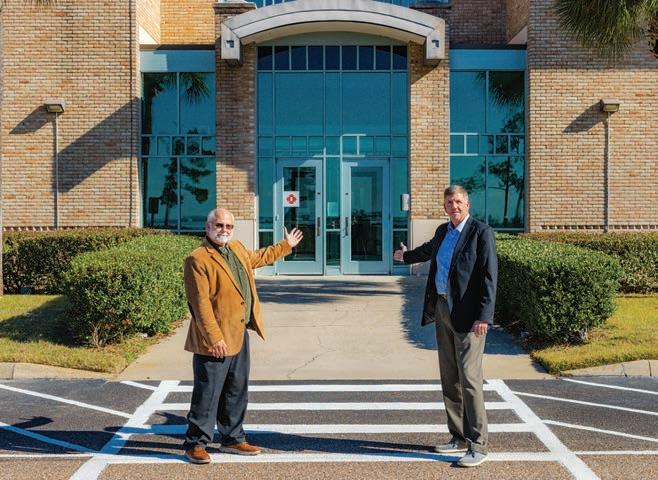
number of good-paying jobs available locally had grown during my tenure, I could feel that I had been a decent president. The bigger that number was, the better I felt.”
The college is in a position to facilitate job growth and increase the community’s attractiveness to businesses by tailoring curriculum to employers’ needs.
Holdnak, having successfully worked with Bay County Economic Development Alliance president Becca Hardin and others to attract big payrolls, left GCSC feeling good and ready for more—economic development, that is.
“Involvement in economic development gave meaning to my career at the college (34 years in total), and it’s giving meaning to the latest chapter in my work life,” Holdnak says.
Today, he is the vice president of operations and innovation at TechFarms, a technology business incubator founded in Panama City Beach by serial entrepreneur Steve Millaway, whom Holdnak got to know when Millaway was a GCSC trustee.
Holdnak devotes much of his time and energy to The Atlantis Center, the former Sallie Mae Servicing Corp. building located in Lynn Haven and acquired by Millaway in 2024. At 133,000 square feet, it is a leviathan of a structure that houses
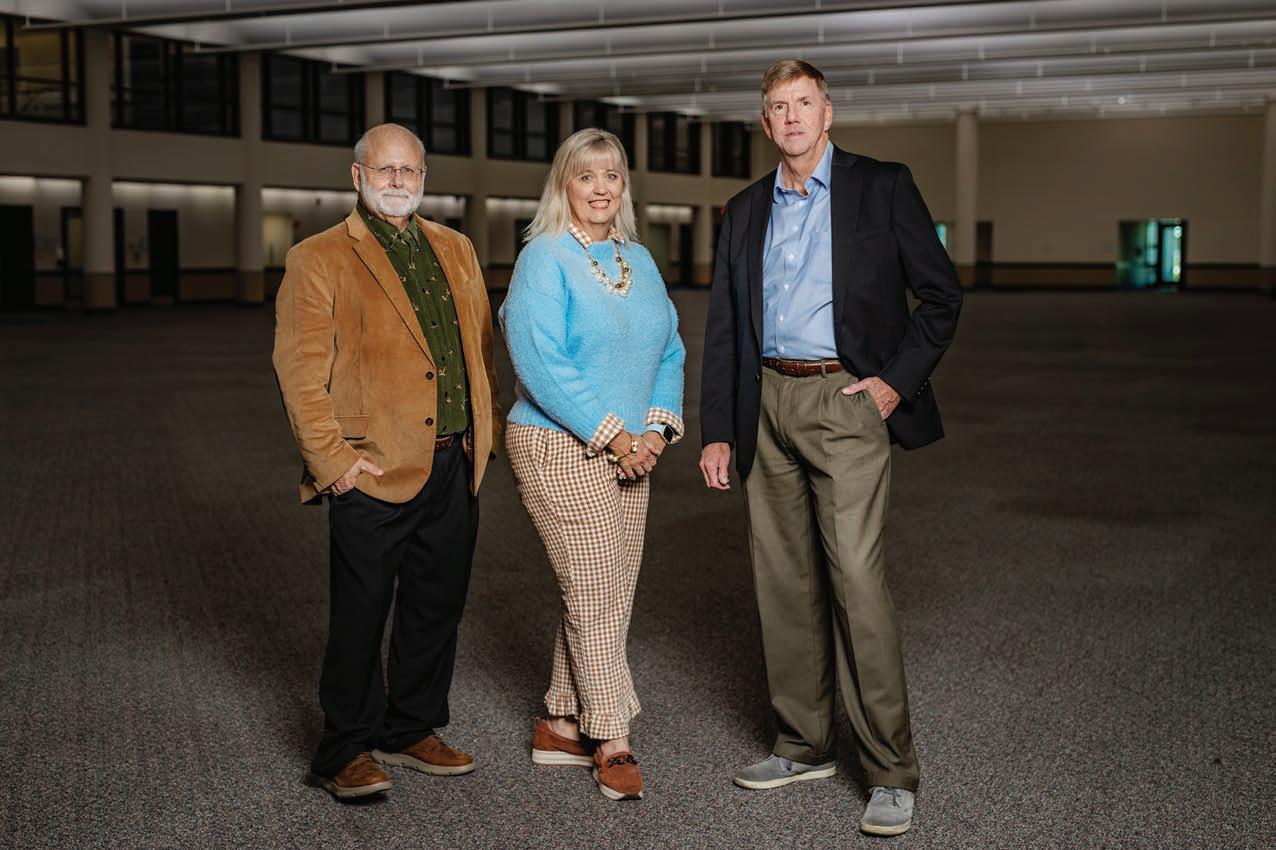
more than 80 offices. It is capable of hosting large-scale events and accommodating businesses, including light-manufacturing operations.
Holdnak and Millaway believe that Atlantis is an asset that can figure in community betterment and, yes, economic development efforts. They are actively recruiting tenants and booking events pursuant to a “hybrid business model.”
Atlantis stands to fill a void that has existed since 2018 when Hurricane Michael destroyed the Marina Civic Center owned by the City of Panama City. It offers variably sized spaces suited to events both big and small and has 1,100 on-site parking spots.
Data centers and additive manufacturers have expressed interest
in Atlantis, and companies outgrowing their TechFarms incubator space are likely to land there.
Millaway started the incubator 10 years ago after talking with entrepreneurial types in Bay County and finding that other than Starbucks, they had no place to meet, share ideas, and compare notes.
“Over the years, we’ve learned that more than office space, more than equipment, more even than capital,
Over the years, we’ve learned that more than office space, more than equipment, more even than capital, collaboration is what people come to the incubator for. Tech, driven by AI, is moving so fast that no one person can keep up with everything. That makes collaboration all the more important.”
— STEVE MILLAWAY, FOUNDER AND CEO
collaboration is what people come to the incubator for,” Millaway says. “Tech, driven by AI, is moving so fast that no one person can keep up with everything. That makes collaboration all the more important.”
At TechFarms, diverse incubator tenants are generating success stories.
ATOR Labs, the developer of breathing simulators used to test respiratory protective devices like those relied upon by firefighters, has expanded its product line and is outgrowing its incubator space, making it a candidate to move to Atlantis.
Better Greens sells highly nutritious microgreens by subscription and is working to automate its cultivation and harvest.
Chaos Audio exemplifies a truism: The world of entrepreneurship is perpetually fluid, chaotic even. CEO Landon McCoy burst upon the music scene when he introduced the Stratus guitar pedal, a plugin platform that enables musicians to build and store a catalog of effects on a single accessory and perform hands-free.
In 2025, Chaos birthed Stratus’s big brother, Nimbus, a combined smart amp, audio interface, looper, and effects processor that McCoy likes to call a “music studio in a box.”
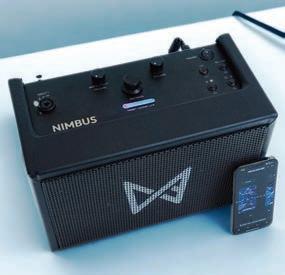
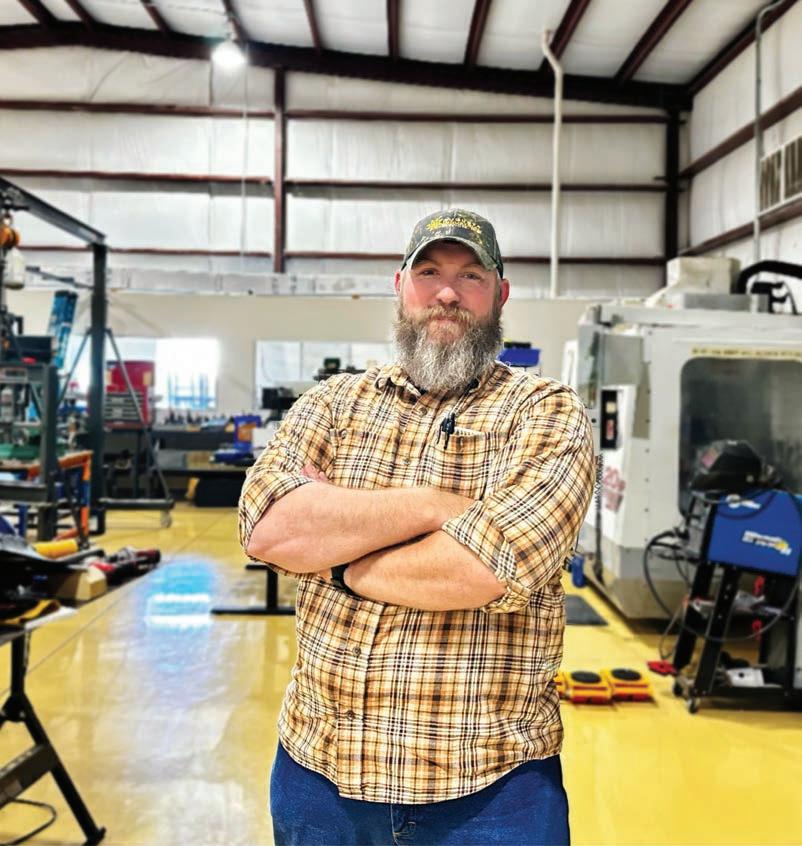
The highly portable Nimbus, which figured in a successful Kickstarter campaign launched in October, replaces much of the cumbersome gear that musicians are used to carrying around.
ArroTech’s metal-detecting drone, the GEON E61, was purposebuilt with a humanitarian goal in mind: precisely and swiftly locate landmines and unexploded ordnance while avoiding the need to place people in harm’s way.
In recent months, the company has carried out demonstration
flights for members of the demining community in Ukraine.
Various interests from around the world have contacted ArroTech and suggested uses for the drone, ranging from mapping underground conduit at decommissioned military installations to locating underwater hurricane debris.
The GEON E61 system has been upgraded to provide for realtime data processing and display. Operators can now see mission results as they are obtained on a computer tablet.
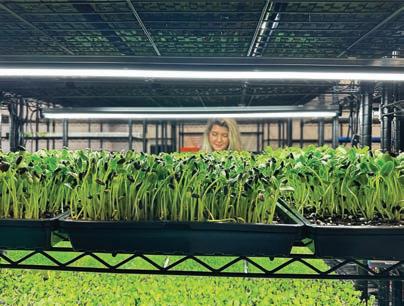
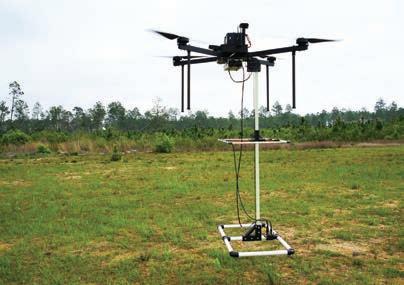



← Better Greens co-owner Courtney Harshbarger (top) inspects flavorful and highly nutritious micro-greens at TechFarms. The business is working on plans to automate the cultivation and harvesting of its product. The GEON E61 drone (bottom) and metal-detecting system has been designed specifically for the purpose of precisely and safely locating landmines and unexploded ordnance.
In addition, ArroTech owner and chief technical officer Tobias Leininger has been working to equip the drone with obstacle-avoidance capabilities. The work is tricky in that sensors that detect objects in the drone’s flight path must be installed and operate such that they don’t interfere with the GEON E61’s metal-detecting function.
Scaling a good idea typically requires funding beyond that which friends and family can provide. That reality led Millaway to found a venture-capital firm, TechFarms Capital, now GAIN VC. With $10 million in assets under management, GAIN VC is invested in
20 companies and has undertaken a second capital raise. Fund 2, with a goal of $25 million, is focused primarily on companies that produce AI-enhanced hardware. Such devices include sensors that can make decisions based on algorithms and collect vast amounts of saleable data.
“I’m confident that in another 10 years, TechFarms and GAIN VC will have had an appreciable regional impact on job creation and business development,” Millaway says. “We’re focused on stimulating organic growth. Businesses rooted here are the most likely to stay and eventually spin off more new companies.” ▪






















Palm Beach Media Group delivers the finest reader experience across a family of Lifestyle, Design and Special Interest titles for the Florida market. Find us on your local newsstand or by visiting our website to see how we cover Florida from a reader’s point of view.

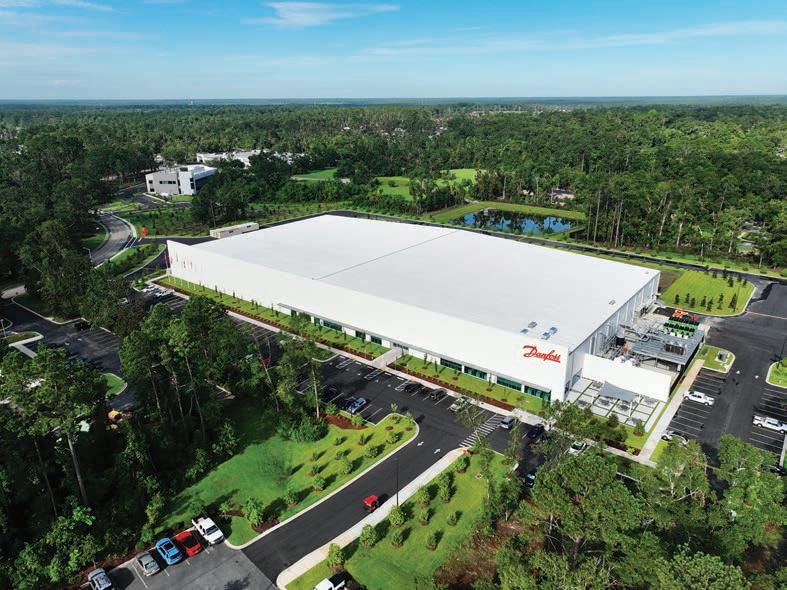
story by JAY REVELL
In the heart of Florida’s capital region, a quiet manufacturing transformation continues to take shape. The Danish company, Danfoss, and its growing campus in Tallahassee, is driven by energy efficiency, advanced engineering, and rising global demand for sustainable technologies. Through both its Turbocor manufacturing operation and its expanding Application Development Center in the Capital City, the company is a central player in this green-tech shift, helping position the region as an emerging hub for green technology innovation with international reach.
On December 9, 2025, Danfoss opened an additional testing chamber at its Tallahassee Application Development Center, or ADC. The new chamber is designed to test food retail and commercial refrigeration equipment using A3, A2L, or non-flammable refrigerants, which are increasingly required as energy efficiency standards and refrigerant regulations tighten worldwide. The expansion allows manufacturers to validate new designs more quickly at a time when speed to market has become critical.
The ADC is located in Innovation Park, near the National High Magnetic
← Located in Innovation Park, the ADC provides a live testing environment where manufacturers across the Americas can develop, evaluate, and refine advanced air-conditioning and cooling solutions.
Field Laboratory and Florida State University’s research campus, placing it within one of the region’s most concentrated clusters of scientific research and advanced manufacturing. The facility was established to help customers and partners test new airconditioning and cooling solutions and improve system performance in a live environment. While it primarily supports manufacturers throughout North and South America, it also provides global support for companies navigating complex regulatory and performance demands.
“Danfoss continues to invest in Tallahassee because it offers a unique environment for our technology,” says Frank Ford of Danfoss. “The Innovation Park campus develops strong engineering talent, a highly skilled manufacturing workforce, and close collaboration with neighbors such as the National High Magnetic Field Laboratory. These strengths allow us to scale production of our highly efficient oil-free magnetic bearing compressor technology from Tallahassee to support the rapidly growing global demand for highperformance cooling.”
Originally opened in 2017, the 23,700-square-foot ADC houses three fully automated psychrometric test systems capable of evaluating a wide range of equipment sizes and configurations. Testing capacities range from small residential systems to large commercial and industrial units, including air-cooled chillers up to 150 tons. The facility supports testing for residential air-conditioners, heat pumps, precision cooling for data centers, light and commercial rooftop systems, and chillers.
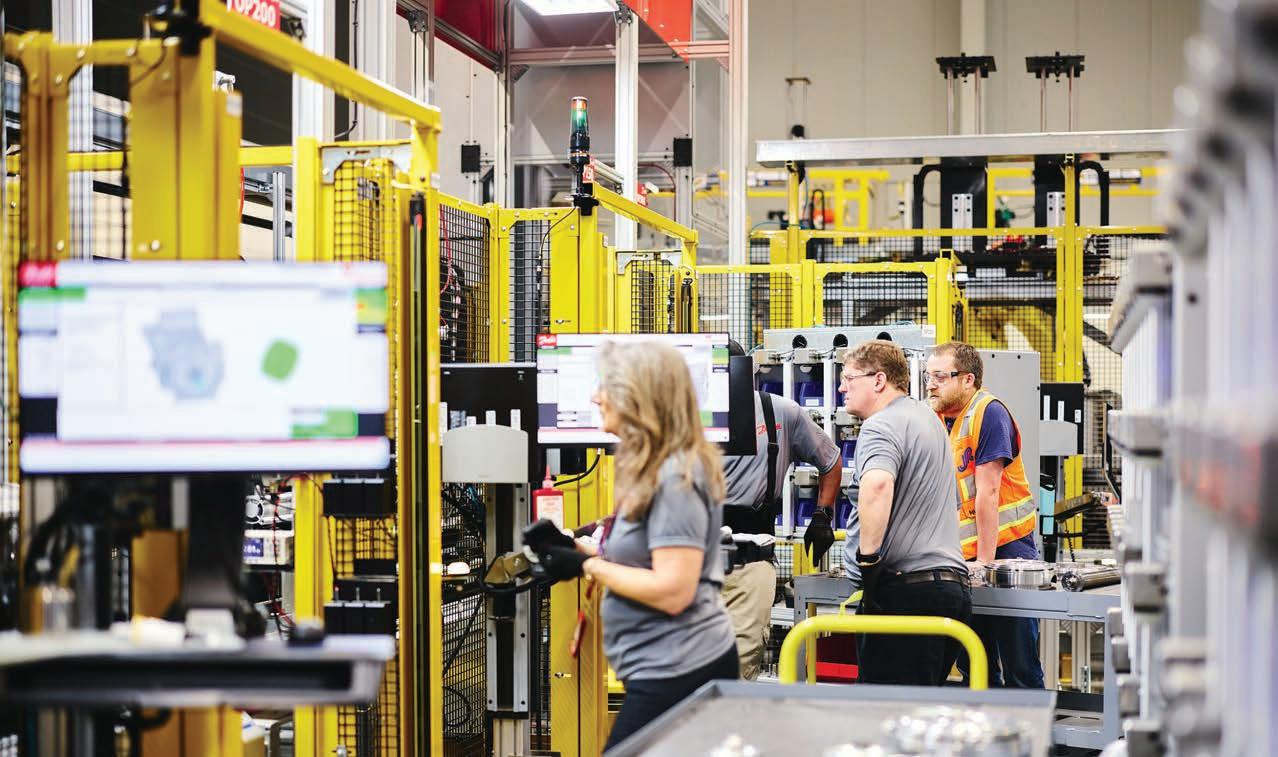
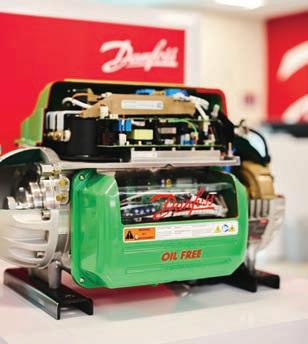
As regulatory requirements have evolved, the Tallahassee ADC has expanded its capabilities. Its test facilities meet all widely recognized industry standards, while also accommodating special testing requests. Temperature testing ranges have been extended beyond standard requirements, and the center can safely test systems using
mildly flammable refrigerants, a growing necessity as manufacturers transition to potential alternatives with a lower environmental impact.
The ADC’s importance is amplified by its location next door to the Danfoss Turbocor facility, which produces oil-free compressor technology used in highefficiency cooling systems worldwide. Danfoss Turbocor was the first company to commercialize oil-free magnetic bearing compressor technology for HVAC applications, and its Tallahassee operation has grown steadily since opening.
In 2024, Danfoss announced a major expansion of the Turbocor facility in Innovation Park, reinforcing the company’s long-term commitment to the
region. The 155,000-square-foot expansion increased manufacturing capacity and added new jobs, supporting rising global demand for energy-efficient chillers used in commercial buildings, data centers, and industrial applications. The close proximity between Turbocor manufacturing and the ADC enables a high level of collaboration on oil-free and next-generation cooling solutions, strengthening Tallahassee’s role in global product development.
“The driving force is the rapid global growth in cooling demand, particularly from data centers, and the need to meet that demand efficiently and sustainably,” Ford says. “By expanding manufacturing and operations in Tallahassee,
Danfoss can scale production of proven technologies like our Turbocor oil-free compressors that help customers worldwide grow responsibly while reducing energy use and emissions.”
Local business leaders say the continued growth of Danfoss reflects the type of industrial innovation shaping the region’s future.
“Danfoss is operating squarely at the intersection of technology and manufacturing innovation in our region,” says Michael Dalby, president and CEO of the Greater Tallahassee Chamber of Commerce. “Their use of and engagement with the research happening through Florida State University and Innovation Park are the model for how we see Tallahassee’s economy growing in the decades to come.”
The company’s long-term presence has also created ripple effects across the local economy.
“As Danfoss has grown, other companies like ours have grown with them,” says Clayton Wells, director of construction for Sperry Construction, which has helped build out the Danfoss campus over the past two decades and oversaw construction of the newest manufacturing facility. “We’ve helped them build out their campus project by project, and every time they call us, we know more innovation and more jobs are coming to our city.”
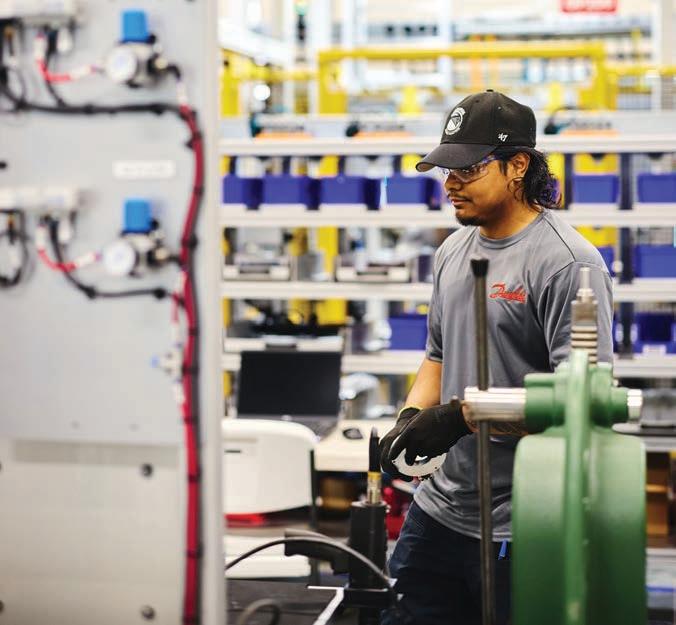
That broader impact extends beyond the Danfoss campus itself.
“Danfoss is a powerful job creator in our community,” says Eddie Gonzalez Loumiet, chair of the Greater Tallahassee Chamber of Commerce.
“Their continued investments in green-tech manufacturing are creating jobs on their campus and around it. From construction to research and visiting partners, the impact goes far beyond just their team members. Our aim is to help them at every turn and tell that story, so other
similar companies can build from their success model.”
Together, the ADC expansion and the growth of Danfoss Turbocor reflect broader changes underway in the HVAC and refrigeration industries. As equipment tested and manufactured in Innovation Park is deployed in grocery stores, warehouses, office buildings, and data centers across the Americas and beyond, Tallahassee is increasingly demonstrating how local innovation, global exports, and sustainability-focused manufacturing can grow together. ▪
Danfoss is a powerful job creator in our community. Their continued investments in green-tech manufacturing are creating jobs on their campus and around it. From construction to research and visiting partners, the impact goes far beyond just their team members.”
— EDDIE GONZALEZ LOUMIET, CHAIR OF THE GREATER TALLAHASSEE CHAMBER OF COMMERCE





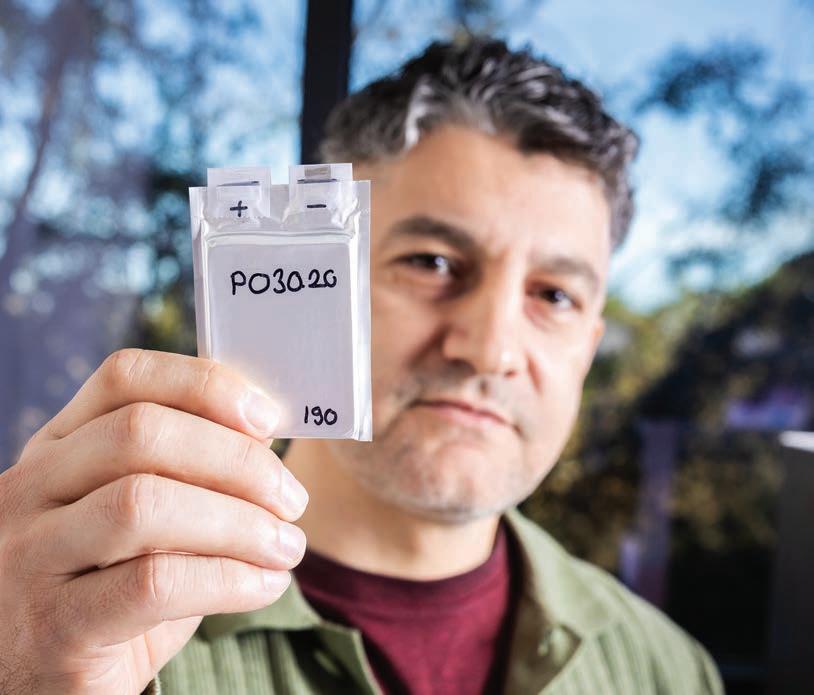
Tallahassee-based
start-up,
Piersica, has created a buzz in the battery industry
story by REBECCA PADGETT FRETT
In a not-so-far-off future, commercial flights will possess the ability to operate electrically, and the use of robots will become more commonplace. Piersica, a Tallahassee-based company specializing in high-powered batteries, has developed cutting-edge technology and materials that have the capabilities to revolutionize battery use. I n 2020, after 15 years of working in the battery industry, Dr. Claudiu Bucur, CEO and founder of Piersica, set out on his own to delve into creating a solid-state battery unlike any on the market.
“I want to change the landscape and future of the battery,” Bucur says. “I’ve seen what OEM’s (Original Equipment Manufacturers) are doing, their milestones and roadmaps, and have realized the development pace is often inefficient at large companies. They often rely on start-ups to help provide them the technology.”
Piersica technology enables batteries with an energy density of over 600 watt-hours per kilogram (Wh/kg), which is more than double that of current commercial lithium-ion batteries (around 280 Wh/kg). The result is batteries that charge faster, contain
is working with fiber mat anode sheets, a thin, flat, electrically conductive material that serves as the anode (oxidation electrode) in an electrochemical system. It is the surface at which oxidation occurs, meaning electrons are released into the external circuit.
higher voltage, have a lengthened life cycle, improved safety, and competitive pricing.
Bucur patented PIRION™ Polymer Technology, which is the key element that sets their batteries apart.
Bucur found that PIRION’s disordered molecular structure enhances
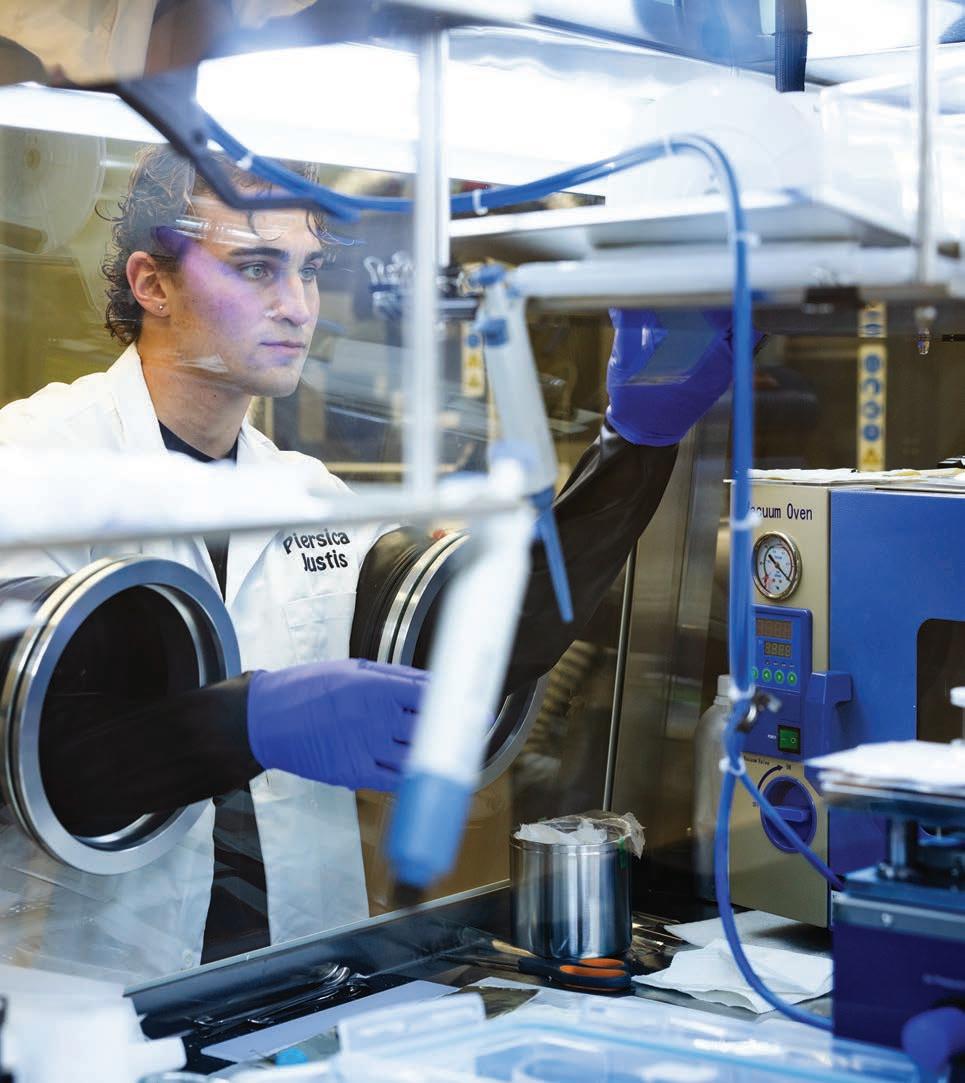
lithium salt solubility and ion mobility, creating unmatched conductivity. The polymer’s unique design enables it to be used as a solid polymer electrolyte and an electrode binder.
Alongside superior conductivity, this distinct chemistry produces stable voltage, thermal resilience, and mechanical durability. Currently, lithium-ion batteries are heavy and low-capacity. PIRION™ Polymer Technology enables lightweight, highcapacity solid-state batteries.
“We created a new polymer with very favorable properties that was
designed from scratch,” Bucur says.
“The existing polymers are not productive in the battery space and are designed for other purposes that aren’t battery specific. Our polymer contains many properties at the same time. It’s like a cross athlete that can run, lift weights, do everything.”
While lithium-ion batteries have existed for over 30 years, commercialized use hasn’t been as successful as it could be because the batteries were extremely heavy. By starting from the materials step rather than engineering, Piersica produced
» Electric vehicles
» Electric bikes
» Electric planes
» Consumer electronics
» Power tools
» Robotics
» Consumer electronics
» Medical wearables
» Drones
» Energy storage
» Aerospace and defense
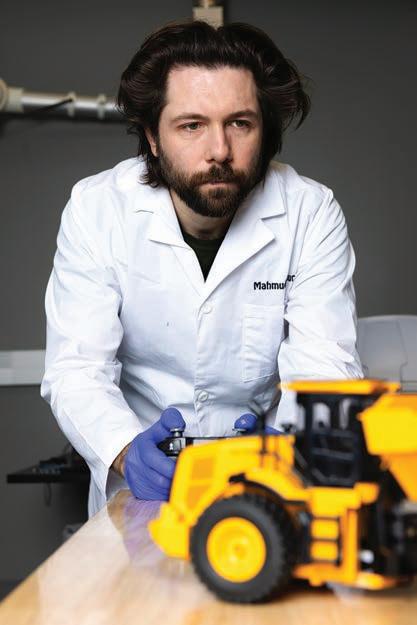
photography by ERICH MARTIN
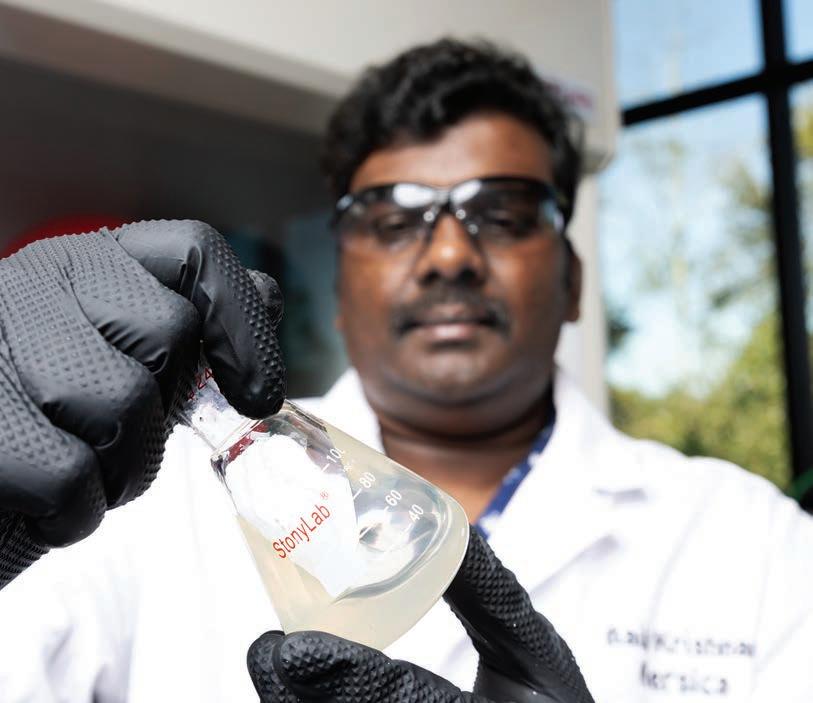
a lightweight, conductive battery that doubles the energy density.
“You don’t want solid-state batteries just because they have the name ‘solid’ in it—you want the performance of a solidstate battery,” Bucur says. “People expect something better than what they have now, and that’s what we can give them.”
In December of 2025, Piersica achieved a major milestone, demonstrating its cell externally to the military with a successful test. This is a positive and promising step in their next direction—manufacturing.
Currently, Piersica’s batteries are made by hand. Over the next two years, they will be converting from manual to semi-automation to a fully integrated automated process.
“At the end of the automation process, we will be able to submit industrystandard testing cells to OEM’s to play with them and create their own packs. Once we have a pilot in place, we become contenders for getting customers.”
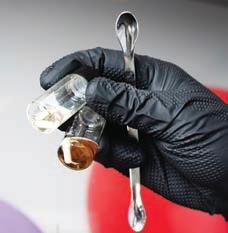
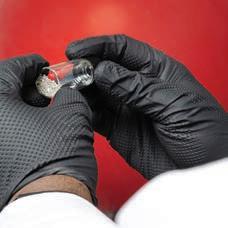
← Dr. Baiju Krishnan uses polymer solutions to create PIRION polymer beads that are used to produce the batteries. The materials are stacked and layered to create the high-energy density battery.
their first and largest clients here. As soon as they opened, we moved in and have been expanding our footprint ever since.”
Bucur notes that this is the stage where most start-ups fail, making its mission all the more critical. Fortunately, they have reached this phase more quickly than their competition and have high hopes for this upcoming phase.
Bucur credits his team, Florida State University’s IGNITE Tallahassee, and grants/funding for Piersica’s success. Their funding is split between investors and grants from the government and private companies. Notably, they’ve won awards from the U.S. Army, the Shell Game Changer program, and a Phase 2 National Science Foundation (NSF) grant for $1 million.
Piersica is housed inside of IGNITE Tallahassee, a business incubator in Innovation Park, run by Florida State University’s Division of Research. At its start, it occupied one lab; to date, they have five labs.
“Working closely with IGNITE has been instrumental for us,” Bucur says. “We are
David Jacobs, CFO of Piersica adds, “We love being in Florida, especially Tallahassee. The relationship with Florida State University has been particularly great for us because they have an ecosystem built up around companies like us. Additionally, our local vendors and partners have an opportunity to bring significant focus to this industry.”
Both note that a start-up like Piersica, in the past, was most likely to exist in the likes of Silicon Valley, but that a lot of cuttingedge companies are seeking the opportunities Florida presents.
The battery market is projected to reach about $300 billion by 2030. Undoubtedly, Piersica, will continue to be a significant contributor to that statistic.
“What we do and the markets we can fulfill are billion- and trilliondollar markets,” Bucur claims. “It’s very exciting to be a part of and think about.”
Jacobs adds, “We are on the cutting edge, with the ability to successfully enable technology that is not yet available and has the capacity to change lives.” ▪
SUSTAINING SIGNATURE SPONSOR
SPONSOR
SPONSOR GOLD SPONSORS
SPONSORS

SPONSORS WITH SPECIAL DESIGNATION SUPPORTING SPONSORS BRONZE SPONSORS

SPONSORS WITH SPECIAL DESIGNATION

story by JAY REVELL
For decades, Doak S. Campbell Stadium has stood as one of Tallahassee’s most iconic landmarks, a cathedral of college football and the heartbeat of Seminole Saturdays. In 2026, that familiar roar will be joined by something entirely new: the thunder of bucking bulls, the energy of chart-topping country music, and the buzz of a stadium increasingly positioned as a year-round economic engine.
On March 13 and 14, Florida State University will host PBR (Professional Bull Riders) at Florida State, a PBR Unleash the Beast Major event, at Doak Campbell Stadium. Each night of elite bull riding will be followed by full-scale concerts from country music stars Jon Pardi on Friday and Miranda Lambert on Saturday, transforming the football field into a dual-purpose arena that blends world-class sport and entertainment.
The event represents more than a marquee weekend. It is the product of FSU’s strategic, multi-hundred-million-dollar investment in Doak Campbell Stadium, an effort aimed not only at improving the fan experience during football season but also at creating a flexible venue capable of attracting national events well beyond Saturdays in the fall.
Those upgrades include enhanced infrastructure, modernized seating configurations, expanded premium areas, upgraded concessions and restrooms, and advanced audiovisual capabilities. Together, they allow the stadium to adapt quickly to a wide range of uses, from concerts and specialty sporting events to large-scale productions that once bypassed mid-size markets like Tallahassee.
“We’re thrilled to welcome Jon Pardi and Miranda Lambert to Tallahassee as part of this landmark event for our campus and community,” says Michael Alford, vice president and director of athletics at Florida State. “Their performances, combined with the world-class athleticism of PBR, will make this an unforgettable weekend at Doak.”





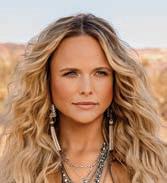
←↙ The inaugural PBR (Professional Bull Riders) Last Cowboy Standing event took place at Colorado State University’s Canvas Stadium in Fort Collins on July 21-22, 2025. The twonight event featured top bull riders, including winner Leonardo Castro, alongside concerts by Cross Canadian Ragweed and Jon Pardi, attracting over 24,000 fans. This year, Florida State University will host PBR at Florida State, at Doak Campbell Stadium on March 13 and 14 in hopes of similar success.
From the PBR perspective, the event underscores a broader shift in how professional sports organizations and universities collaborate.
“This groundbreaking bull riding event is the result of a true partnership with Florida State University, bringing the world’s best cowboy and animal athletes to one of college football’s most iconic stadiums,” says Sean Gleason, CEO of PBR. “We’ve proven a new model for transforming football stadiums into premier bull riding stages. Fans get an unforgettable experience, and universities unlock opportunities to generate revenue for their athletics programs by hosting major events beyond football.”
As the thirteenth stop in the 18-event 2026 PBR Unleash The Beast regular season, PBR Florida State is among the tour’s most competitive events, offering elevated points toward the PBR World Championship and a
We’re thrilled to welcome Jon Pardi and Miranda Lambert to Tallahassee as part of this landmark event for our campus and community. Their performances, combined with the worldclass athleticism of PBR, will make this an unforgettable weekend at Doak.”
— MICHAEL ALFORD, VICE PRESIDENT AND DIRECTOR OF ATHLETICS AT FLORIDA STATE
$200,000 prize purse. The world’s top riders and rankest bulls will compete on more than 2,500 tons of specially delivered dirt, temporarily reshaping Doak Campbell Stadium before the field is restored.
The impact of the weekend will be felt well beyond the stadium gates.
Located within walking distance of Gaines Street and the CollegeTown District, Doak Campbell Stadium anchors one of Tallahassee’s most active commercial corridors. Multinight, destination-style events like PBR Florida State are particularly valuable to local businesses, drawing visitors who arrive early, stay late, and spend throughout the surrounding area.
“From a macro view, I’ve long said Doak is the city’s most underutilized asset for economic growth,” says Matt Thompson, partner in For the Table Hospitality, which owns Madison Social and Township in CollegeTown. “The regional pull we can have with events like this will bring visitors to town while also stimulating the calendar for locals.
“Tallahassee can be a tough market to own and operate a food and beverage concept,” Thompson says, explaining why the timing of spring events is especially meaningful for hospitality operators. “On our side of town, you’re trying to make 52 weeks’ worth of revenue in about 35 to 40 weeks of foot traffic. Anytime we can make a spring month bigger because of events like this, it helps stem the tide for the summer months.” He adds, “I applaud everyone who stuck their neck out to make this happen for the city. I think it will pay dividends for years to come.”
The inclusion of nationally recognized artists further broadens the audience. Pairing elite bull riding

with concerts from Pardi and Lambert encourages visitors from across Florida and the Southeast to treat the weekend as a destination experience, dining out, staying overnight, and exploring Tallahassee beyond the stadium.
PBR Florida State is part of a broader strategy by FSU to diversify the use of Doak Campbell Stadium and attract high-profile attractions throughout the year. That strategy includes hosting the Savannah Bananas, whose popular Banana Ball tour will open its 2026 season in Tallahassee from February 26 through 28, culminating with a game at Doak Campbell Stadium on February 28.
“This is significant,” Alford says, “because it will be the first non-football event in the refurbished Doak Campbell Stadium, putting one of America’s top entertainment brands into one of the nation’s most famous venues.”
The transformation of Doak Campbell Stadium has also been supported by public investment. The City of Tallahassee and Leon County jointly committed $27 million to the project through the Blueprint Intergovernmental Agency, framing the contribution as an economic
development initiative aimed at diversifying tourism and expanding the stadium’s use beyond football.
“I am very excited to see FSU being able to offer new and diverse uses for Doak Campbell Stadium,” says Brian Welch, chair of the Blueprint Intergovernmental Agency board.
“While some were skeptical, myself included, these types of shows will undoubtedly generate millions of dollars in local tourism revenue. I’ve never been happier to be proven wrong.”
Together, events like the Savannah Bananas and PBR Florida State signal a shift in how Tallahassee is positioned on the national stage, not just as a college football town but as a destination capable of hosting largescale entertainment experiences.
As Doak Campbell Stadium continues to evolve, its impact will be measured not only in ticket sales but in helping create a more vibrant, connected, and attractive Tallahassee. Leaders from FSU, local government, and the business community are all hoping for a thriving future powered by events that bring people together long after the final whistle of football season blows. ▪



















Methodology: Analysis by David Ekrut, Ph.D. Data were extracted from the Bureau of Labor Statistics publicly available tables. Suppressor data for small populations were categorically rejected due to insufficient data. Industries included were among the top gains and losses in the public sector (list not exhaustive). While data from 2019 were annual averages, 2025 values were derived from Q2 listings, the most recent data provided, due to government shutdowns and lack of reporting in Q3 and Q4. *Though some unverifiable data from year-end 2025 may differ, reporting on BLS showed no significant job losses in Walton County in the private sector.