But for Borgman, it was a natural continuation of her longtime interest in agriculture, first sparked by her childhood in smalltown Oregon. While her culinary school classmates dreamed of opening restaurants, Borgman was growing fascinated with whole-animal butchery. She developed a deep reverence for what farmers, ranchers and nature could provide, one that only intensified in graduate school. “I got really interested in the intersection of wild food and the industrial food system,” she says.
When Anna B orgman , now a B ozeman -based butcher and
When Borgman moved to Montana three years ago, Big Sky Country and its abundance of edible resources ignited new passions. She took up foraging and taught herself how to hunt. “When I went out hunting for the first time, it was like ‘Oh man, I talk about butchery a lot but I’ve never actually killed anything before. Can I do this?’”
the founder of the food-focused workshop program Forage Fed , first set tled on a culinar y c areer path , her parent s were quick to express their concerns . “ What are you going to do in culinar y school? ” they said .
“ Yo u can’t even
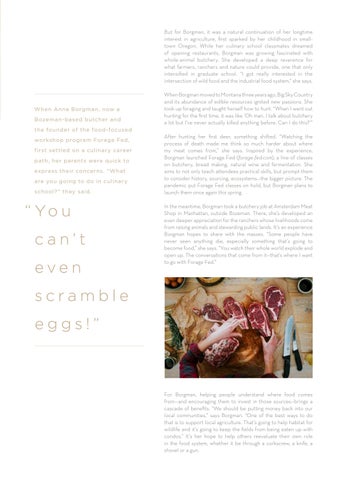
After hunting her first deer, something shifted. “Watching the process of death made me think so much harder about where my meat comes from,” she says. Inspired by the experience, Borgman launched Forage Fed (forage-fed.com), a line of classes on butchery, bread making, natural wine and fermentation. She aims to not only teach attendees practical skills, but prompt them to consider history, sourcing, ecosystems—the bigger picture. The pandemic put Forage Fed classes on hold, but Borgman plans to launch them once again this spring. In the meantime, Borgman took a butchery job at Amsterdam Meat Shop in Manhattan, outside Bozeman. There, she’s developed an even deeper appreciation for the ranchers whose livelihoods come from raising animals and stewarding public lands. It’s an experience Borgman hopes to share with the masses. “Some people have never seen anything die, especially something that’s going to become food,” she says. “You watch their whole world explode and open up. The conversations that come from it—that’s where I want to go with Forage Fed.”
scramble eggs!”
For Borgman, helping people understand where food comes from—and encouraging them to invest in those sources—brings a cascade of benefits. “We should be putting money back into our local communities,” says Borgman. “One of the best ways to do that is to support local agriculture. That’s going to help habitat for wildlife and it’s going to keep the fields from being eaten up with condos.” It’s her hope to help others reevaluate their own role in the food system, whether it be through a corkscrew, a knife, a shovel or a gun.