THE DESIGN ISSUE
KEVIN BEASLEY, UNTITLED (DIFFUSOR II), 2016. COURTESY OF THE ARTIST AND CASEY KAPLAN, NEW YORK.
DOLCE&GABBANA
DESIGN September 30, 2019 | Dallas | Live & Online
View | Track | Bid HA.com/5420 Now Accepting Consignments Prints & Multiples October 22 | Dallas | HA.com/5419 Deadline: August 20 Modern & Contemporary November 19 | Beverly Hills | HA.com/5439 Deadline: September 17 Visit HA.com/Auctions for a Complete Calendar
Harry Bertoia (American, 1915-1978) Untitled (Gong): $30,000-$50,000 Alexandre Noll (French, 1890-1970) An Important Sculpture: $80,000-$120,000 Claude Lalanne (French, 1925-2019) Bench from Colonial Williamsburg: $120,000-$180,000
DALLAS | NEW YORK | BEVERLY HILLS | SAN FRANCISCO | CHICAGO | PALM BEACH LONDON | PARIS | GENEVA | AMSTERDAM | HONG KONG
Always Accepting Quality Consignments in 40+ Categories 1 Million+ Online Bidder-Members Paul R. Minshull #16591. Paul R. Minshull #LSM0605473; Heritage Auctions #LSM0602703 & #LSM0624318. BP 12-25%; see HA.com. Licensed by the City of New York #1364738/9-DCA. 53449
Inquiries: 214.409.1444 | Art@HA.com 1518 Slocum Street, Dallas TX 75207
10210 Strait Lane / $19,500,000
The one and onlys.
The only home in Dallas by Philip Johnson. The only home in Dallas by Edward Larrabee Barnes. The only agent representing both.
4608 Meadowood Road / $15,000,000
FAISAL HALUM 214.240.2575 fhalum@briggsfreeman.com faisalhalum.com © MMXIX Sotheby’s International Realty Affiliates LLC. All Rights Reserved. Sotheby’s International Realty Affiliates LLC fully supports the principles of the Fair Housing Act and the Equal Opportunity Act. Each Office Is Independently Owned And Operated. Sotheby’s International Realty and the Sotheby’s International Realty logo are registered (or unregistered) service marks licensed to Sotheby’s International Realty Affiliates LLC.
If empowerment came in a sofa, this would be it.
Be King or Queen on the New York Suite sofa: in velvet, of course .
Dallas 1617 Hi Line Dr. Ste. 100 214.748.9838 Austin 115 W. 8th St. 512.480.0436 scottcooner.com
EDITOR’S NOTE
Portrait Tim Boole, Styling Jeanna Doyle, Stanley Korshak
August / Septembr 2019
TERRI PROVENCAL Publisher / Editor in Chief terri@patronmagazine.com Instagram terri_provencal and patronmag
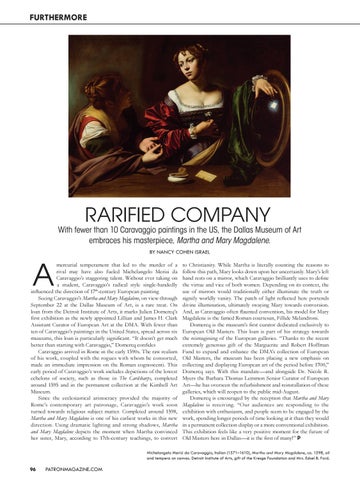
We would love to slip into this issue’s cover like the Pevensie children in The Lion, the Witch, and the Wardrobe. Jennifer Steinkamp’s signature computer 3-D animation blooms in this immersive video installation. To mesmerizing effect, the fluidly shifting imagery reveals an imagined cycle of seasons perfectly blended within the light-filled home designed by Bodron/Fruit. The unsullied interior design is equaled by the art collection curated by art advisor Michael Thomas. By chance, Steinkamp will have a show at Talley Dunn Gallery, August 24–September 12. In California we take in the verdant Napa Valley property owned by Cindy and Howard Rachofsky. Known as Green Acres, the land flourishes with grapevines, fruit, vegetables, a reinvented hay barn, and the formidable sculpture collection one would expect from the celebrated TWO x TWO for AIDS and Art founders. TWO x TWO cohosts Lisa and John Runyon joined the Rachofskys during the summer, to enjoy the bounty and connect on the upcoming 21st installment in October. Elsewhere in Patron: With its extensive photography holdings, the Amon Carter Museum of American Art reopens its redesigned galleries this fall with Gordon Parks: The New Tide, Early Work 1940–1950. This “barrier-breaking,” photographic exhibition traces the start of Parks’ extensive multidisciplinary career; he is perhaps best known as the director of Shaft. We remain in Fort Worth with fine-art photographer Carolyn Brown, who takes us to the now-shuttered, fantastically graffitied, former meatpacking plant, Swift & Co. In The Painted Tombs of Swift, Carolyn trains her lens on the street art within and fall fashions gathered by Elaine Raffel. While in Fort Worth, we visit with two dissimilar artists whose practices add to the distinct art culture of the area. Here, I caught up with John Holt Smith, whose precise Oculus and Sequence paintings are found in the Rosewood Mansion on Turtle Creek, The Joule, Toyota Motor North America, Terminal D at Dallas Fort Worth International Airport, and at William Campbell Contemporary Art. Next, in Bogie’s Hat Was In My Driveway, Brandon Kennedy probes the category-defying vocabulary and “disarming nonchalance” of Ed Blackburn, who populates his recent paintings with politicians. In our design pages, Peggy Levinson brings news of trends in wallpaper and lighting, Avrea Wagner’s bespoke fire screens, and Mary Alice Palmer’s design prowess as the principal and director of global hospitality at HKS. In The Greatest Showman, Elaine Raffel checks out The Conservatory, Brian Bolke’s new lifestyle concept, designed by Droese Raney Architecture in New York’s Hudson Yards. We also unearth form and function in wide-ranging ceramics in Hands-On Experience. And rooted in both art and design, Finishing Touch takes readers to the rooftop of Park House, where Sarah Crowner’s water feature caps the private club’s collection. The Dallas Museum of Art makes the Old Masters new again with two stimulating moves. The second floor European Galleries will reopen on August 17 with a fresh interpretation of the European collection, brimming with Impressionist and Modern works, restored collection works, and a new presentation of Old Masters paintings and sculpture. The first move took place in April when Dr. Agustín Arteaga enticed Julien Domercq from the National Gallery of London to be the Lillian and James H. Clark Assistant Curator of European Art, under the direction of Dr. Nicole R. Myers. Domercq’s first exhibition wraps up our coverage in Furthermore. On view through September 22, Caravaggio: Martha and Mary Magdalene highlights the restless renegade’s masterpiece, on loan from the Detroit Institute of Arts. With fewer than 10 Caravaggio paintings in the US, it’s a rare treat to have two in North Texas at the same time—The Cardsharps, a personal favorite, is within the Kimbell Art Museum’s permanent collection. Our next issue marks Patron Magazine’s 8th anniversary. We hope to see you when the art season is back in full swing. – Terri Provencal
8
PATRONMAGAZINE.COM
Highland Park Village | www.akris.com
CONTENTS 1
FEATURES 60 CHANGE OF SCENERY Bodron/Fruit works in concert with art advisor Michael Thomas to define a collecting couple’s home. By Peggy Levinson 70 GREEN ACRES For Cindy and Howard Rachofsky, their summer home in Napa is the place to be. By Terri Provencal 78 THE GRAND CHARACTER OF GORDON PARKS The Amon Carter reopens this fall with a stunning survey of the late artist’s photographs. By Patricia Mora 82 THE PAINTED TOMBS OF SWIFT Fine-art photographer Carolyn Brown returns to the abandoned Swift & Co. plant in the Fort Worth Stockyards for Patron. Photography by Carolyn Brown, creative direction by Terri Provencal and Elaine Raffel.
70
78
60
On the cover: On the living room wall: Jennifer Steinkamp, Orbit #11, 2011, computer video installation or single channel; table sculpture: Erick Swenson, Scuttle, 2012, acrylic on resin; Eero Saarinen, Saarinen Pedestal Collection coffee table, Knoll, Dallas; Sofa: Edward Wormley for Dunbar, Adelina, Dunbar; Theo Ruth for Artifort, club chairs, vintage 1950s, Netherlands Galerie Andre Hayat, Paris; Erba Italia, SASSI ottoman, Haute Living, Chicago; Antoine Proulx, CT-1 coffee table; Suzanne Sharp, Stupa silver, wool and silk, The Rug Co., Dallas.
82 10
PATRONMAGAZINE.COM
STORES AKRIS ALEXANDER MCQUEEN ALICE + OLIVIA BALENCIAGA BANDIER BERETTA GALLERY BLUEMERCURY BRUNELLO CUCINELLI CAROLINA HERRERA CARTIER CELINE CHANEL CHRISTIAN LOUBOUTIN CHRISTOFLE DIOR ERMENEGILDO ZEGNA ESCADA ETRO FENDI FORTY FIVE TEN FRAME FRÉDÉRIC FEKKAI HADLEIGH’S HARRY WINSTON HERMÈS JAMES PERSE JIMMY CHOO KIEHL’S SINCE 1851 LE LABO LELA ROSE LORO PIANA MADISON MARKET MIRON CROSBY PEEPER’S RAG & BONE RALPH LAUREN ROLLER RABBIT ST. JOHN ST. MICHAEL’S WOMAN’S EXCHANGE THEORY TOM FORD TORY BURCH TRINA TURK VALENTINO VERONICA BEARD VINCE
RESTAURANTS BIRD BAKERY BISTRO 31 CAFÉ PACIFIC FACHINI THE HONOR BAR LOUNGE 31 MI COCINA PERFECT UNION PIZZA CO. ROYAL BLUE GROCERY
PARTIAL LISTING
LANDMARK OPEN-AIR C AR OL I N A HE R R E R A | 21 4 .21 9.606 0
WILLIAM NOBLE
CENTER WITH MORE THAN 50 WORLD CLASS BOUTIQUES AND A DOZEN RESTAURANTS COMPLIMENTARY CAR SERVICE, PERSONAL SHOPPING AND VALET TAXFREE SHOPPING REFUND CENTER
47 HIGHLAND PARK VILLAGE HPVILLAGE.COM
CONTENTS 2
DEPARTMENTS 8 Editor’s Note 14 Contributors 24 Noted Top arts and culture chatter. By Anthony Falcon Contemporaries 40 ALL THE LIGHT WE CAN SEE John Holt Smith mines the visible spectrum to create precisely rendered abstract expressions of color. By Terri Provencal 42 NEW WORLD ORDER At the center of design and fine art lies the work of Peter Saville. By Chris Byrne Studio 44 BOGIE’S HAT WAS IN MY DRIVEWAY The disarming nonchalance of Ed Blackburn. By Brandon Kennedy
40
Space 48 JUST ADD COLOR Avrea Wagner’s bespoke collection brings contrast. By Peggy Levinson 50 DESIGNING WOMAN Mary Alice Palmer flexes her multidisciplinary prowess at HKS. By Peggy Levinson 52 NOT YOUR AVERAGE WALLFLOWER Today’s wallcoverings step out of the background. By Peggy Levinson 53 ON THE BRIGHT SIDE Dallas showrooms offer state-of-the-art lighting. By Peggy Levinson 54 THE GREATEST SHOWMAN Brian Bolke’s The Conservatory offers all the convenience of e-commerce without the returns. By Elaine Raffel
44
56
56 HANDS-ON EXPERIENCE Eight contemporary artists explore the unbounded potential of ceramics. By Terri Provencal 58 FINISHING TOUCH Park House taps Brooklyn-based artist Sarah Crowner to install an outdoor water feature, completing the private club’s robust art program. By Terri Provencal There 90 CAMERAS COVERING CULTURAL EVENTS Furthermore 96 RARIFIED COMPANY The Dallas Museum of Art embraces Caravaggio's masterpiece, Martha and Mary Magdalene. By Nancy Cohen Israel
48 12
PATRONMAGAZINE.COM
H OT.
1515 Slocum Street, D a l l a s 214 265 7272
Publication: Patron Ad August/September 2017
John Sutton Photography
CONTRIBUTORS
CAROLYN BROWN began photographing ancient architecture while living in Cairo, Egypt, and through travels across Mexico. She specializes in preservation and finearts projects such as Swift & Co., deserted since 1971, where the building shells became palettes for graffiti artists, seen in The Painted Tombs of Swift. She is completing her third book with Texas A&M University Press, on the Fort Worth Stockyards, and has produced books about her adopted hometown, Dallas. She exhibits with Craighead Green Gallery.
NANCY COHEN ISRAEL is a Dallas-based art historian, writer, and educator who leads art tours and lectures. With her background in 17th-century painting, she counts Caravaggio’s paintings among her favorites. Nancy was thrilled to know that his early work, Martha and Mary Magdalene (c. 1598), will be on view at the Dallas Museum of Art through September 22, and she was equally delighted to write about it for Patron in her Furthermore column, Rarified Company.
MEGAN GELLNER is a photographer with a background in illustration and graphic design. She has a BFA in studio art from the University of North Texas, where she works as a photographer and videographer. Environmental and traditional portraiture is her passion, and she loves having the opportunity to photograph so many diverse personalities for Patron, including the artists featured in Studio. For this issue, she visited two Fort Worth artists: Ed Blackburn and John Holt Smith and captured Sarah Crowner’s work at Park House.
BRANDON KENNEDY is the director of exhibitor relations for the Dallas Art Fair, working with international galleries and assisting with programming for the April event. Brandon curated The Anatomy of Disquiet at the Karpidas Collection, exploring the nature of Jungian thought and the collective unconscious through almost 80 artworks culled from the private collection. He is an occasional artist, avid book collector, and peripatetic curator who writes about area artists, including Ed Blackburn in this issue’s Studio column.
Lindsay Roche
CHRIS BYRNE is the author of the graphic novel The Magician (Marquand Books, 2013) as well as The Original Print (Guild Publishing, 2002). He is co-chair of Art21’s Contemporary Council and serves on the board of directors of Institute 193, Museum of Contemporary Art Detroit, and the American Folk Art Museum’s Council for the Study of Art Brut and the Self-Taught. He is the co-founder of the Dallas Art Fair and was formerly chairman of the American Visionary Art Museum.
LAUREN CHRISTENSEN has more than two decades of experience in advertising and marketing. She consults with clients in art, real estate, fashion, and publishing through L. Christensen Marketing & Design. She serves on the boards of the Christensen Family Foundation and Helping Our Heroes. Her clean, contemporary aesthetic and generous spirit make Christensen the perfect choice to art direct Patron.
14
PATRONMAGAZINE.COM
PEGGY LEVINSON draws on her expertise as a former showroom owner to share news of the latest trends in design with Patron. In Space she highlights bold looks in wallpaper, three lighting lines, and visits with HKS designer Mary Alice Palmer as well as design team Ashley Avrea Cathey and Mary Beth Wagner who recently unveiled a new product line. Change of Scenery takes Peggy inside a polished private home designed by Mil Bodron and Svend Fruit, with art advisory by Michael Thomas.
JOHN SMITH gets to flex his degree in architecture as an ongoing Patron homedesign contributor and Dallas-based photographer. He brings out the artistic side of architecture in his pictures and is renowned in the region for his work with architects, designers, and artists when tapped to showcase their vision and projects through photographs. In Change of Scenery, John captured the dramatic light changes throughout the day on an impeccably designed private home and art collection.
CHRIS LUTTRELL is a painter and sculptor who splits his time between the Hudson Valley and New York City. His formative years were spent in New York’s East Village after migrating from Oklahoma City, and he is a part of New York’s downtown art-and-nightlife community, capturing its unique history, either by lens or by line. After earning a BA in music, he spent a large part of the 2000s documenting downtown musicians while traveling the world as a musician and tour photographer.
PATRICIA MORA provides work for Fortune 500 companies and writes extensively about arts and culture in diverse venues and a variety of media, including the Dallas Morning News; she also has had the privilege of being published by the International Association of Art Critics. In this issue of Patron, she investigates the photographic work of the late multidisciplinary legend in The Grand Character of Gordon Parks, set to open at the Amon Carter Museum of American Art’s newly restored galleries this fall.
MEG SMITH is Napa Valley-raised and trained in art history and film photography. Meg honed a vision that forgoes the predictable and slick in her photography; instead, she embraces unrehearsed interactions, the moments between moments and the color between color, whether an intimate embrace under a darkening sky or the rich hues of a ripe tomato. In this issue, Meg visited Cindy and Howard Rachofsky at their Napa Valley home, training her lens on the lush grounds and sculpture in Green Acres.
ELAINE RAFFEL blames her obsession with designer fashion, opulent jewels, and design on her years as creative head for the crème de la crème of retail: Neiman Marcus, Bergdorf Goodman, and Stanley Korshak. The Painted Tombs of Swift finds Elaine in Fort Worth and partnered with fine-art photographer Carolyn Brown to present an eclectic mix of fall fashion. With her eye for style, Elaine also visits with Brian Bolke, founder of The Conservatory in New York City’s Hudson Yards, in The Greatest Showman.
OPENING EARLY 2020
LUXURY RESIDENCES | DALLAS ARTS DISTRICT
SIMPLY THE BEST HALL Arts Residences offers the perfect blend of art and living with an exclusive collection of up to 50 luxury homes in the heart of the Dallas Arts District.
HALLARTSRESIDENCES.COM
UNDER CONSTRUCTION FROM $2 MILLION
For a personal introduction to HALL Arts Residences, contact Lea Anne Laughlin at 214.269.9535 or llaughlin@hallgroup.com.
The designs, features and amenities depicted are subject to change and no assurance is made that the project will be of the same nature as depicted or that the project or the condominium units will be constructed. This is not an offer to sell, or solicitation of offers to buy condominium units in states where such offer of solicitation cannot be made.
PUBLISHER | EDITOR-IN-CHIEF Terri Provencal terri@patronmagazine.com ART DIRECTION Lauren Christensen DIGITAL MANAGER/PUBLISHING COORDINATOR Anthony Falcon COPY EDITOR Sophia Dembling PRODUCTION Michele Rodriguez CONTRIBUTING WRITERS Chris Byrne Nancy Cohen Israel Brandon Kennedy Peggy Levinson Patricia Mora Elaine Raffel CONTRIBUTING PHOTOGRAPHERS Bret Redman John Cain Tamytha Cameron John Smith Meg Smith George Fiala Kevin Todora Megan Gellner Erik Tomasson Brad Linton Deen van Meer Chris Luttrell Evan Zimmerman T. Martin Jeff McClain STYLISTS/HAIR & MAKEUP Alexandra Haerle Elaine Raffel LB Rosser Ashli Vondara ADVERTISING info@patronmagazine.com or by calling (214)642-1124
think smink
PATRONMAGAZINE.COM View Patron online @ patronmagazine.com REACH US info@patronmagazine.com SUBSCRIPTIONS patronmagazine.com One year $36/6 issues, two years $48/12 issues For international subscriptions add $12 for postage SOCIAL @patronmag
1019 Dragon Street | Design District
16
PATRONMAGAZINE.COM
| sminkinc.com
is published 6X per year by Patron, P.O. Box 12121, Dallas, Texas 75225. Copyright 2018, Patron. All rights reserved. Reproduction in whole or in part without express written permission of the Publisher is strictly prohibited. Opinions expressed in editorial copy are those of experts consulted and do not necessarily reflect the opinions of the editors, publisher or the policy of Patron. Unsolicited manuscripts and photographs should be sent to the address above and accompanied by a self-addressed stamped envelope for return. Publisher will take reasonable precaution with such materials but assumes no responsibility for their safety. Please allow up to two months for return of such materials.
ALEXANDER SEATING SYSTEM RODOLFO DORDONI DESIGN
WWW.MINOTTI.COM
SMINK 1019 Dragon Street, Dallas, Texas 75207 www.sminkinc.com
214.695.9595 sharonquist@dpmre.com “Real estate is not just my job, it’s my passion. I never tire of seeing beautiful homes and there’s a real thrill in finding someone the perfect home for them.” “Simply the best” and “The ultimate problem solver” are client accolades Sharon cherishes. Not only has she accomplished landmark sales from the Swiss Avenue Historic District to Lakeside Drive in Highland Park, she also holds the record for the highest price-per-square-foot condo sale ever attained in Dallas MLS. Living in Uptown at The Residences at the Ritz-Carlton fueled her passion for the Dallas urban living scene. If you’re looking to make a move and need an agent with over 30 years’ experience who knows everything this city has to offer, look no further.
Residences at the Ritz-Carlton, Uptown
Residences at The Stoneleigh, Uptown
1 to 4 Bedrooms · 1,375 to 5,666 Sq. Ft./Plan
2 to 3 Bedrooms · 2,484 to 4,676 Sq. Ft./Plan
Represented Units from $875,000 to $7,500,000
Represented Units from $1,250,000 to $4,395,000
Join us at NorthPark Center Through September 25 NorthPark Center joins a global network of 40+ Portal sites and communities and will serve as a local venue for global conversations and interactions. Portals are interconnected, immersive spaces that allow you to speak with new and unique communities around the world. For more information and calendar of events, visit northparkcenter.com
Includes sites in: Brooklyn, NY, USA San Juan, PR, USA Erbil, Iraq Mexico City, Mexico Lesbos, Greece Kigali, Rwanda Nairobi, Kenya Herat, Afghanistan Toyko, Japan ..and more.
Elevated Style. Boundless Creativity. Discover a contemporary luxury hotel experience – sincerely inviting, generous in spirit and warmly authentic. With 183 rooms, 19 suites and unmatched amenities, our luxury is without pretense, our offerings fresh and imaginative and our care attentive every day of the week. H A L L A R T S H OT E L .CO M P R E M I E R I N G FA L L 2 0 1 9
1 7 1 7 L E O N A R D S T R E E T, DA L L A S , T X 7 5 2 0 1 | 2 1 4 . 9 5 3 .1 7 1 7 | S A L E S @ H A L L A R T S H O T E L .C O M
DISAPPEARING— BAS JAN ADER
CHRIS BURDEN
JACK GOLDSTEIN
CALIFORNIA C. 1970 THROUGH AUGUST 11, 2019 Disappearing—California, c. 1970: Bas Jan Ader, Chris Burden, Jack Goldstein is curated by Philipp Kaiser and organized by the Modern Art Museum of Fort Worth. Support for the exhibition is generously provided by the Kleinheinz Family Endowment for the Arts and Education. Pictured: Jack Goldstein, The Jump, 1978 (film still, detail). 16 mm film, color, silent projection, and two black light tubes; 26 seconds. Courtesy The Estate of Jack Goldstein. © The Estate of Jack Goldstein
DAVID PARK : A RETROSPECTIVE THROUGH SEPTEMBER 22, 2019
David Park: A Retrospective is organized by the San Francisco Museum of Modern Art. The exhibition is curated by Janet Bishop, Thomas Weisel Family Curator of Painting and Sculpture at SFMOMA. Support for the presentation of David Park: A Retrospective in Fort Worth is generously provided by the Kleinheinz Family Endowment for the Arts and Education. Pictured: David Park, Two Bathers, 1958. Oil on canvas. 58 x 50 inches. SFMOMA, Purchase through gifts of Mrs. Wellington S. Henderson, Helen Crocker Russell, and the Crocker Family, by exchange, and the Mary Heath Keesling Fund
Modern Art Museum of Fort Worth 3200 Darnell Street Fort Worth, Texas 76107 817.738.9215
Follow the Modern
4800 Park Lane Tucked behind impressive wrought iron gates, 4800 Park Lane presents timeless architecture and an idyllic, park-like sanctuary in the city. Affectionately known as “Park House,� this elegant landmark estate rests on over 4 acres between the confluence of Bachman Creek and Browning Branch. This distinctive retreat includes exquisite landscaping design beneath a canopy of majestic trees, breathtaking views, and a uniquely private, serene setting. 5 Beds | 5.2 Baths | 10,210 SQFT | Carriage House Offered for $9,950,000
Gretchen & Elly Group Gretchen Brasch gretchen.brasch@compass.com 214.460.9488
Elly Holder elly.holder@compass.com 214.207.6708
gretchenandelly.com
NOTED 06
17
01 AFRICAN AMERICAN MUSEUM The Carroll Harris Simms: National Black Art Competition and Exhibition continues through Aug. The Kinsey African American Art & History Collection celebrates the achievements and contributions of black Americans from 1595 to today, Sep. 21–Mar. 1, 2020. aamdallas.org 02 AMON CARTER MUSEUM OF AMERICAN ART The newly renovated Amon Carter will open five new exhibitions on Sep. 14. Seeing in Detail: Scott and Stuart Gentling’s Birds of Texas will display 23 watercolors from the museum’s permanent collection, through Dec. 1. Set in Motion: Camille Utterback and Art That Moves pairs an interactive installation by new-media artist Camille Utterback with a century of art depicting motion, through Dec. 8. Gordon Parks: The New Tide, Early Work 1940–1950 explores the early years of Parks’ career capturing the essence of the civil rights movement while helping break barriers for African Americans, through Dec. 29. Puente Nuevo by Justin Favela is an immersive installation created exclusively for the Amon Carter, through Jun. 30, 2020. James Surls’ sculpture Seven and Seven Flower is a complex portrait of family, land, and self, on exhibit through Jul. 31, 2020. Image: Justin Favela, Popocatepetl e Iztaccihuatl vistos desde Atlixco, after Jose Maria Velasco, 2016, paper and glue, © Justin Favela, Photograph by Mikayla Whitmore. cartermuseum.org 03 CROW MUSEUM OF ASIAN ART Immortal Landscapes: Jade from the Collection runs through Jun. 23, 2020, and The Art of Lacquer continues through May 3, 2020. Hands and Earth: Contemporary Japanese Ceramics, on display through Jan. 5, 2020, explores avant-garde pottery styles, showcasing a range of shapes, glazes, and surface treatments that blend ingenuity and modernity with deep respect for tradition. Future Retrospective: Master Shen-Long serves as a midcareer retrospective of Master Shen-Long, innovative ink artist and master of classical Chinese literati arts, through Aug. 23, 2020. crowcollection.org 04 DALLAS CONTEMPORARY Francesco Clemente: Watchtowers, Keys, Threads, Gates; Self Service: TwentyFive Years of Fashion, People and Ideas Reconsidered; Mario Sorrenti: Kate; and Yelena Yemchuk: Mabel, Betty & Bette remain on view through 24
THE LATEST CULTURAL NEWS COVERING ALL ASPECTS OF THE ARTS IN NORTH TEXAS: NEW EXHIBITS, NEW PERFORMANCES, GALLERY OPENINGS, AND MORE.
PATRONMAGAZINE.COM
14
Aug. 25. From Sep. 15–Dec. 22, My Life as a Man will focus on John Currin’s provocative depictions of a range of masculine identities over the course of his career. Running concurrently, an exhibition of works by Alicja Kwade, who employs ordinary materials such as glass, steel, and concrete to explore the conventions developed by humanity in order to explain natural phenomena; and artist Jessica Vaughn’s first museum exhibit, a site-specific installation that considers her ongoing investigations into how architectural structures reinforce segregation. dallascontemporary.org 05 DALLAS HOLOCAUST AND HUMAN RIGHTS MUSEUM The new Dallas Holocaust and Human Rights Museum will open to the public on Sep. 18 with Stories of Survival: Object. Image. Memory, an exhibition that showcases more than 60 personal items—from a child’s doll to a wedding announcement—brought to America by survivors of the Holocaust and genocide around the world, including Armenia, Bosnia, Cambodia, Iraq, Rwanda, South Sudan, and Syria. On view through the end of the year. dhhrm.org 06 DALLAS MUSEUM OF ART Asian Textiles: Art and Trade Along the Silk Road concludes Aug. 18. America Will Be! Surveying the Contemporary Landscape, continuing through Sep. 15, draws on the DMA’s permanent collection and presents the ways in which contemporary artists engage with landscapes. Dior: From Paris to the World surveys more than 70 years of the House of Dior’s legacy, featuring a dynamic selection of over 100 haute couture dresses as well as accessories, photographs, original sketches, runway videos, and other archival material, through Sep. 1. On loan from the Detroit Institute of Arts, Caravaggio: Martha and Mary Magdalene, by one of the most influential painters in European history, is on view through Sep. 22. Sheila Hicks: Secret Structures, Looming Presence showcases the way she is inspired by the techniques of indigenous textile artists by pairing her loom-woven, wrapped-, twisted-, and knotted-fiber works with items from the museum’s collection of ancient Andean art, through Jan. 12, 2020. Image: Thomas Struth, Dallas Parking Lot, Dallas, 2001, c-print mounted on Plexiglas, Dallas Museum of Art. Gift of the artist and Marian Goodman Gallery, 2002.51, © Thomas Struth, 2019. dma.org
H E L L E S S Y
H O U S T O N
D A L L A S
A T L A N T A
T O O T S I E S . C O M
NOTED: VISUAL ARTS
15
16
07 FORT WORTH MUSEUM OF SCIENCE AND HISTORY Launchpad: Apollo 11 Promises Kept, on display through the end of the year, commemorates the 50th anniversary of the Apollo 11 moon landing and introduces Drome 2020, an exciting 4-D theatrical experience. This new 10,000-square-foot exhibit in the Gary Havener gallery was developed and created by the museum’s team of scientists, curators, designers, and educators to tell the story of space exploration. fwmuseum.org 08 GEOMETRIC MADI MUSEUM Works by finalists in Biennial: Origins in Geometry, a juried competition to recognize excellence in emerging visual artists inspired by geometric abstraction, are on display through Oct. 20. geometricmadimuseum.org 09 GEORGE W. BUSH PRESIDENTIAL CENTER Through Oct. 6, the Bush Center presents Presidential Retreats: Away from the White House. Four featured retreats—Camp David in Frederick County, Maryland; Prairie Chapel Ranch in Crawford, Texas; LBJ Ranch in Stonewall, Texas; and Walker’s Point in Kennebunkport, Maine—are featured, illustrating how US presidents have used these places for work and rejuvenation. bushcenter.org 10 KIMBELL ART MUSEUM Through 52 paintings, Monet: The Late Years traces Monet’s artistic evolution from 1913, when he embarked on the reinvented painting style that led to his increasingly bold and abstract works, to his death in 1926. Continuing through Sep. 15, majestic panoramas are on display alongside late easel paintings, demonstrating Monet’s continued vitality and variety as a painter. kimbellart.org 11 LATINO ARTS PROJECT In Mexican Modern Sculpture: A Study of the Artists, Escuela Mexicana de Escultura, or Mexican School of Sculpture, is explored through the works of nine featured artists, who are clearly positioned within the historical context of the Post-Revolution era in Mexico after 1920. The exhibition emphasizes the revaluation and the exaltation of being Mexican, the nationalistic spirit of that time, and the ideals of the Revolution that both influenced and were influenced by the art. On view through Sep. 22. latinoartsproject.org 12 LATINO CULTURAL CENTER On Aug. 3, the Vejigante Mask Workshop by Puerto Rican artisan Kenneth Melendez will consist of a short history of the Vejigante
26
PATRONMAGAZINE.COM
followed by a mask-building class. On Aug. 21, Cine de Oro: Por Si No Te Vuelvo a Ver presents the story of five elderly men in a retirement home who form a musical group and then, when a friend of theirs dies, decide to take the ashes to Tijuana. On Sep. 18, Cine de Oro: Tu Camino y el Mío, explores unrequited love, as a young mechanic fights for the love of the woman of his dreams. lcc.dallasculture.org 13 THE MAC Assembly: 22nd Annual Members Show, continues through Sep. 1. This annual member exhibition is one of the cornerstones of the spirit and mission of The MAC, celebrating both emerging and established artists in the Dallas area while fostering an inclusive worldview and shaping attitudes towards contemporary art. the-mac.org 14 MEADOWS MUSEUM Goya’s Visions in Ink: The Centerpiece of the Meadows Drawings Collection highlights the Meadows’ recent acquisition of Goya’s ink drawing Visions, from his “Witches and Old Women Album,” on view through Nov. 3. El Greco, Goya, and a Taste for Spain: Highlights from The Bowes Museum will feature paintings from the early 16th to the late 18th centuries by such artists as Juan de Borgoña, El Greco, and Francisco de Goya. Just under a dozen paintings on panels and canvas of saints and sinners, secular and sacred likenesses are meant to inspire devotion, admiration, and discomfort. On view from Sep. 15–Jan. 12, 2020. Image: Francisco José de Goya y Lucientes (Spanish, 1746–1828), Interior of a Prison, 1793–94, oil on tinplate. The Bowes Museum, Barnard Castle, County Durham, UK, B.M. 29. meadowsmuseumdallas.org 15 MODERN ART MUSEUM OF FORT WORTH Disappearing—California, c. 1970: Bas Jan Ader, Chris Burden, Jack Goldstein continues through Aug. 11. In 1971, Chris Burden disappeared for three days without a trace. That work, titled Disappearing, gives its name to this exhibition, which examines the theme of disappearance in the works of Burden and two of his contemporaries in 1970s Southern California. David Park: A Retrospective is the first major museum exhibition in more than 30 years of the expressive work of David Park, the founder of Bay Area Figurative Art, through Sep. 8. Image: Chris Burden, Three Ghost Ships, 1991, installation view, Places with a Past: New Site-Specific Art in Charleston, Spoleto Festival, Charleston, South Carolina, May 23–August 14, 1991. Three Micro 16 sailboats, one equipped with navigational satellite system, robotic sail and rudder controls, concept drawing. Each boat: 276 × 192 × 72 in. Nicolas Berggruen Charitable Foundation © 2018 Chris Burden / licensed by The
September 14 —December 29, 2019 02
Chris Burden Estate and Artists Rights Society (ARS), New York. themodern.org 16 MUSEUM OF BIBLICAL ART View the Holy Land in a fresh way through contemporary Israeli artist Avner Sher’s Chaotic Harmony: Jerusalem Journeys. Sher’s exhibition is rooted in his architectural practice and interest in the history of Israel. Elaborate and physically demanding, his technique involves scratching, slicing, engraving, and burning large sheets of cork. On view through Sep. Image: Anver Sher, Jerusalem Map #4, 2017, scratching, etching, engraving, and gold leaf on cork 61 x 61 in. biblicalarts.org 17 NASHER SCULPTURE CENTER Sheila Hicks has been working almost exclusively with textiles throughout her decades-long career. For Sheila Hicks: Seize, Weave Space, Hicks created site-specific installations in the Garden and Lower Level Galleries, on view through Aug. 18. Elmgreen & Dragset: Sculptures, Sept. 14–Jan. 5, 2020, marks the Scandinavian duo’s first major museum presentation in the US. In their sculptures, installations, and performances, the artists reinterpret familiar designs and spatial structures that surround us in our everyday lives with criticality and subversive wit. Image: Elmgreen & Dragset, Pregnant White Maid, 2017, aluminum, stainless steel, lacquer, clothing, shoes, 66.25 x 17.75 x 26 in. Studio Elmgreen & Dragset 6. Photograph courtesy of Galerie Perrotin. nashersculpturecenter.org 18 PEROT MUSEUM The Art of the Brick, continuing through Aug. 18, features LEGO® bricks of every size in stunning works of art and structural marvels such as the Mona Lisa, the statue of David, and a T. rex. The Perot mounts Discovery Camps, Sleepovers, Social Science, A Day in the Life, and Art Lab events throughout the month. perotmuseum.org 19 TYLER MUSEUM OF ART Texas Birds: Works by Frank X. Tolbert 2 concludes Aug. 6. Through Aug. 25, Floating Life: Mississippi River Drawings by Liz Ward spotlights pieces from two recent bodies of work. Works from Ghosts of the Old Mississippi are based on geological maps of the river’s ancient courses and inspired by the artist’s childhood memories from South Louisiana, while Veritas Caput focuses on the search for the source of the river by various explorers. Little Black Dress Goes Tropical, returns Sep. 26 with an island theme. tylermuseum.org
From his fashion photographs to his thoughtful depictions of American life, Gordon Parks used the camera as his tool for proclaiming the value of an American community built on freedom and equality.
Free Admission cartermuseum.org @theamoncarter
Gordon Parks: The New Tide, Early Work 1940–1950 is organized by the National Gallery of Art, Washington, in collaboration with The Gordon Parks Foundation. Bank of America is proud to be the national sponsor of the exhibition. Generous support is also provided by the Kleinheinz Family Foundation for the Arts and Education and the Ann L. & Carol Green Rhodes Charitable Trust, Bank of America, N.A., Trustee. Gordon Parks (1912–2006), Washington, D.C. Government charwoman, July 1942, gelatin silver print, Prints and Photographs Division, Library of Congress, Washington, D.C., Farm Security Administration/ Office of War Information Photograph
AUGUST/SEPTEMBER 2019
27
NOTED: PERFORMING ARTS
02
09 01 AMPHIBIAN Gutenberg! The Musical! is a two-man spoof featuring a pair of aspiring playwrights in a splashy musical about printing-press inventor Johannes Gutenberg, through Aug. 18. As part of the National Theater Live series, Small Island traces the tangled history of Jamaica and the UK through three intricately connected stories where hope and humanity meet stubborn reality, Aug. 21–24. The Lehman Trilog y follows the firm’s glorious rise and spectacular fall, Sep. 11–14. amphibianstage.com 02 AT&T PERFORMING ARTS CENTER Spend An Evening with Lyle Lovett and His Large Band Aug. 18. Roald Dahl’s Charlie & The Chocolate Factory is a world of “pure imagination,” and part of AT&T’s Broadway Series, Aug. 22–25. Robin Thicke performs with Tony! Toni! Toné! on Aug. 24, and Paul Anka Sings Sinatra: His Songs, My Songs, My Way Sep. 17. Kenny G takes the stage on Sep. 18. CitySquare’s annual fundraising event, A Night to Remember, will feature comedy legends Steve Martin and Martin Short in their show Now You See Them, Soon You Won’t. The iconic twosome will present new material in musical sketches and conversations about their careers, memorable encounters, and their legendary lives in show business, Sep. 21. Image: Rueby Wood as Charlie Bucket. Roald Dahl’s Charlie and the Chocolate Factory, photograph by Joan Marcus. attpac.org 03 BASS PERFORMANCE HALL Fiddler on the Roof, with stunning movement and dance from Israeli choreographer Hofesh Shechter, will close out the 2018–2019 season Aug. 20–25. The 2019–2020 season opens with Cameron Mackintosh’s new production of Andrew Lloyd Webber’s Phantom of the Opera, Sep. 24–Oct. 5. Image: Eva Tavares as Christine Daaé, photograph by Matthew Murphy. basshall.com 04 CASA MAÑANA A musical reimagining of Stephen King’s gripping tale, Carrie the Musical presents the unforgettable outcast who’s bullied by the popular crowd, Aug. 2–4. Set during the golden days of rock ‘n’ roll, Buddy Holly will feature hits such as Pegg y Sue, That’ll be the Day and Rave On, Sep. 7–15. casamanana.org 05 CHAMBER MUSIC INTERNATIONAL CMI returns Sep. 27 with Sonata for Two Violins, Opus 15 by Miklós Rózsa; Bagatelles for Two Violins, Cello, and Harmonium by Antonín Leopold Dvořák; Night Thought, pipa solo Wu Man; White Snow in Spring; and Ghost Opera by Tan Dun. chambermusicinternational.org
28
PATRONMAGAZINE.COM
06 DALLAS BLACK DANCE THEATRE With an ever-expanding national and global audience, Dallas Black Dance Theatre employs a diverse, multiethnic troupe of dancers performing for audiences of all ages and backgrounds. dbdt.com 07 DALLAS CHILDREN’S THEATER DCT opens its 2019–2020 season with Disney’s Beauty and the Beast. Beloved songs mixed with a touch of compassion and kindness highlight the power of true love in this large-scale family musical based on the classic tale, Sep. 22–Oct. 27. dct.org 08 THE DALLAS OPERA TDO opens its 2019–2020 season with Mozart’s masterpiece The Magic Flute, Oct. 18, 20, 23, 26 and Nov. 1, 3. dallasopera.org 09 DALLAS SUMMER MUSICALS A fresh new production of Fiddler on the Roof, with dance by acclaimed Israeli choreographer Hofesh Shechter, runs Aug. 7–18. Centering on Tevye, the father of five daughters, the story follows his struggle to maintain Jewish traditions and culture as the outside world creeps in. Image: Cast of Fiddler on the Roof, photograph by Joan Marcus. dallassummermusicals.org 10 DALLAS SYMPHONY ORCHESTRA The DSO will celebrate its anniversary with world percussion group D’Drum Aug. 20. The Empire Strikes Back Movie in Concert is Aug. 30–Sep. 1, and Motown makes its way to the Meyerson in Dancing in the Street: The Music of Motown Sep. 6–8. Fabio Luisi opens the new season on Sep. 12–15 with a program that includes Strauss’ massive An Alpine Symphony, with more than 100 musicians and meteorological sound effects; Cliburn medalist Beatrice Rana with the Emperor Concerto; and Augusta Read Thomas’ Aureole in its Dallas premiere. On Sep. 21, The Magic Flute at the Symphony will feature music from Harry Potter to The Hall of the Mountain King. The Dallas Symphony Chorus concert will feature local choruses, the Lay Family Concert Organ, and will include the world premiere of a new choral work by Ryan Murphy, Sep. 22. Joshua Bell and his violin will take center stage Sep. 26 and 29, and at the 2019 Gala Concert & After-Party Sep. 28. mydso.com 11 DALLAS THEATER CENTER Public Works Dallas stages Shakespeare’s As You Like It, an immersive dreamlike tale of faithful friends, feuding families, and lovers in disguise, with an original folk-pop score by Shaina Taub, Aug. 16–18. In the Heights tells the universal story of a vibrant community in New York’s Washington Heights neighborhood as it wrestles with change. Sep. 21–Oct. 20. dallastheatercenter.org
E R I N H O M E . C O M | E R I N @ E R I N H O M E . C O M
E R I N
M A T H E W S
| 2 1 4 . 5 2 0 . 8 3 0 0
THE RESIDENT EXPERT
AUGUST/SEPTEMBER 2019
E R I N H O M E . C O M
15 MAJESTIC THEATRE Comedian Daniel Sloss opens at the Majestic Theatre on Aug. 2. Coach Dianna Williams and her team of Dancing Dolls Bring It! Live on Aug. 3. Paramount’s Laser Spectacular, feat. The Music of Pink Floyd returns to Dallas Aug. 9. José María Napoleón and his Tour 50 años brings the hits Aug. 17. AEG presents Bryan Ferry on Aug. 21, and comedian Marc Maron Aug. 22. An Evening with Kristina Kuzmic: The Hope and Humor Tour serves up encouragement and hope with humor on Aug. 23. Desus & Mero Live! brings the Bronx’s own Bodega Boys to town on Aug. 24. Bob James, David Sanborn & Marcus Miller: Double Vision Revisited with guests Billy Kilson and Larry Braggs take the stage Aug. 25. Katya’s Help Me, I’m Dying tour talks about what it means to be a woman from the perspective of a person who dresses up like one, Sep. 3. Mijares performs Sinfónico on Sep. 5. Home Free’s Dive Bar Saints World Tour brings
|
14 LYRIC STAGE Evita, by Andrew Lloyd Webber and Tim Rice, opens the season Sep. 20–22. The Tony-winning musical follows the journey of Argentina’s Eva Duarte from poor, illegitimate child to ambitious actress to—as wife of military leaderturned-president Juan Peron—the most powerful woman in Latin America. lyricstage.org
E R I N @ E R I N H O M E . C O M
13 KITCHEN DOG THEATER Based on interviews conducted in Dallas, via Skype, and at the border, Crossing the Line is a documentary-style performance created and produced by Cry Havoc Theater and Kitchen Dog Theater focusing on the immigration debate and the situation at the border. Through Aug. 4. kitchendogtheater.org
AGENT
|
12 EISEMANN CENTER On Aug. 16, the Eisemann Center presents Anomaly: The Magic of Robby Bennett and Other Curiosities. Next, Kraig Parker: Elvis Thru the Ages with Victor Trevino Jr., Aug. 17. Indian Idol Fame stops in Aug. 18. Rhythm & Rich-Tones perform Totally Off Beat Aug. 24. The Nawab Story: Power of One, featuring Saif Ali Khan & Javed Jafferi, takes the stage Aug. 25. The Spectacular Follies celebrates its 11th year with A New Attitude! Sep. 12–15. Nonprofit Grace for Impact’s A Night for Sight on Sep. 28 includes exotic flavors and music that demonstrate the life-changing power of restoring sight. On Sep. 29, Not Without My Hijab takes an inside look at the struggle faced by young people as they practice their faith. eisemanncenter.com
M A T H E W S
2 1 4 . 5 2 0 . 8 3 0 0
03
E R I N
29
TTS1900-190701-TITAS1920-Ronald K. Brown-BodyTraffic_Patron Magazine_4x11_.pdf
1
7/1/19
4:16 PM
NOTED: PERFORMING ARTS
S U B S C R I B E T O D AY !
19 the Nashville sound to Dallas on Sep. 27. KXT 91.7 present Indie icons Calexico and Iron & Wine on Sep. 29. majestictheatredallas.com
“SOULFUL”
16 TACA The 2019 TACA Lexus Party on the Green takes place on Oct. 4. taca-arts.org
C
M
RONALD K. BROWN/ EVIDENCE
Y
CM
MY
SEPTEMBER 20 2019 WINSPEAR OPERA HOUSE
CY
CMY
K
“SOPHISTICATED WITT”
OCTOBER 25.26 2019 M O O DY P E R F O R M A N C E H A L L PHOTO CREDITS: Header photo MOMIX, - photo by Todd Burnsed; 1. Photo by Ayodele Casel; 2. A Million Voices, Photo by Rob Latour
OFFICIAL AIRLINE
SERIES SPONSORS
CALL
214.88 0.0202
OR VISIT
30
PATRONMAGAZINE.COM
18 THEATRE THREE Theatre Three opens its 2019–2020 season Oct. 3–27 with a fresh take on Dracula, told through the eyes of his mistress, Mina. theatre3dallas.com 19 TITAS/DANCE UNBOUND On Sep. 20, the highly anticipated return of Ronald K. Brown/Evidence will feature a mixed repertoire, including his extraordinary, soulful work, Grace. Image: Ron Brown Evidence company, photograph by Ayodele Casel. titas.org 20 TURTLE CREEK CHORALE Marking a return to the Meyerson Symphony Center on Sep. 29, TCC will kick off its extended season by honoring the women in the singers’ lives with To All the Women We’ve Loved Before. TCC will be joined by three beloved leading ladies—Denise Lee, Patty Breckenridge, and Jodi Crawford-Wright—and will welcome the Women’s Chorus of Dallas to the stage. turtlecreekchorale.com
B O DY T R A F F I C
OFFICIAL HOTEL
17 TEXAS BALLET THEATER The Sleeping Beauty is doomed by fate and awakened by love. Princess Aurora dances her way through curses and dreams to find her prince charming Sep. 6–8 at the Winspear Opera House and Oct. 18–20 at Bass Performance Hall. texasballettheater.org
AT TPAC .ORG/ TITA S
21 UNDERMAIN THEATRE In Red Chariot, a world-premiere science-fiction thriller by playwright Gordon Dahlquist, a mysterious Tarot deck created by the Internet has the power to affect past, present and future, triggering the downfall of civilization. Runs Sep. 18–Oct. 13. undermain.org 22 WATERTOWER THEATRE Ignite! is a one-night-only performance on Aug. 23 from Grammy- and Emmy-nominee Steve Dorff, with special appearances by some of DFW’s favorite musical talents and featuring songs made famous by Barbra Streisand, The Carpenters, Whitney Houston, Dolly Parton, and George Strait. watertowertheatre.org
NOTED: GALLERIES 31
37
29
01 12.26 Cofounded by sisters Hannah Fagadau and Hilary Fagadau, 12.26 is a contemporary art gallery that focuses on introducing emerging, internationally recognized, and established artists to the burgeoning Dallas arts market and community. For its inaugural exhibition, 12.26 presents, Waters a two-person show of new paintings by Alex Olson and sculptures by Nancy Shaver. Sep. 28–Nov. 16. Image: Alex Olson, Address, 2018, oil and modeling paste on canvas, 24 x 18 in., courtesy of the artist; Shane Campbell Gallery, Chicago; Altman Siegel, San Francisco; Park View/ Paul Soto, Los Angeles, photograph by Jeff McLane. gallery1226.com 02 214 PROJECTS How it looks to be you in Eg yptian Cotton curated by Adrianna Cole, a group exhibition on view through Aug., explores concepts of personae and identity through distorted renderings of the human figure. Painting, sculpture, and mixed-media works by various artists, including Miriam Cahn, Oshay Green, and Calvin Marcus, are presented in the galleries among domestic objects that activate the space as an installation. Rounding out the exhibition is a video installation by Shelby David Meier. 214projects.com 03 500X GALLERY Marking its 40th year, 500X presents the 2018-2019 Members Show on Aug. 18, which showcases works by senior and new members side by side, through Sep. 7. 500x.org 04 ALAN BARNES FINE ART ABFA’s Summer Exhibition, featuring a selection of 19th and 20th century modern and traditional paintings, will be on view through Aug. 15. Next, Exhibition Atelier displays work by Carle Shi from Oct. 3–28. alanbarnesfineart.com 05 AND NOW Sophie Giraux’s work fills the gallery through Aug. 31. The French artist explores the relationship between time and structure. andnow.biz 06 ARTSPACE111 For the 2019 FWADA Fall Gallery Night on Sep. 7, AS111 will showcase New Works, a collection of recent paintings by Nancy Lamb. The exhibition will continue through Oct. 12. artspace111.com
26 07 BARRY WHISTLER GALLERY No Big Deal/The Large Canvases is a selection of the late artist Michael Miller’s work, showcasing canvases that combine his punchy graphics and text as well as works on paper. Sep. 14–Oct. 12. barrywhistlergallery.com 08 BEATRICE M. HAGGERTY GALLERY CAMEO features prominent ceramics instructors from colleges, universities, and art schools across Texas as well as their promising students. For this exhibit, on view Aug. 26–Sep. 27, the University of Dallas teamed up with Houston-based nonprofit Ceramic Arts Museum and Education Organization, whose mission promotes the appreciation of clay. udallas.edu/gallery 09 BIVINS GALLERY International States of Mind, a group show of newly represented artists, including David Datuna, David Drebin, Cristóbal, Russell Young, and Layer Cake, is on view through Sep. 28. bivinsgallery.com 10 BLUE PRINT GALLERY Blue Print displays established, midcareer, and emerging Texas artists and features contemporary paintings, works on paper, fineart photography, and sculpture. blueprint-gallery.com 11 CADD Contemporary Art Dealers of Dallas is a nonprofit organization promoting contemporary art in Dallas. Save the date for the CADD Third Thursday Happy Hour on Sep. 19 at a member gallery. caddallas.org 12 CARNEAL SIMMONS CONTEMPORARY ART Tethered Reflections pairs artists Ender Martos and Jen Pack for an exhibit on view through Aug. 24. carnealsimmons.com 13 CHRISTOPHER MARTIN GALLERY The Dragon Street gallery presents the reverse-glass paintings and the limited-edition works of Aspen-based American artist Christopher H. Martin alongside the work of midcareer sculptors Jim Keller, Brandon Reese, Michael Sirvet, and Gregory Price. Christopher Martin galleries are located in Dallas, Aspen, and New York. christophermartingallery.com 14 CONDUIT GALLERY For Conduit’s Persistence, Vision and Passion=Longevity, continuing AUGUST/SEPTEMBER 2019
31
NOTED: GALLERIES
47
50
Susan Gott “Wild Woman”
through Aug. 31, Robert Barsamian curated a group show of artists based in New York. On Sep. 7, Darren Jones: Supernatural Architecture and Ludwig Schwarz: No Title (Subject to Change) open. Accompanying these exhibitions, Jeff Gibbons’ Blurp fills the Project Room. All three exhibitions will be on view through Oct. 12. conduitgallery.com 15 CRAIGHEAD GREEN GALLERY New Texas Talent XXVI, featuring works by emerging Texas artists, opens Aug. 3. Caleb Bell, curator of the Tyler Museum of Art, serves as juror in the 26th installment of this showcase. On view through Sep. 30. Works by Jeanie Gooden, Marty Ray, and Raymond Saa will be on display Sep. 7–Oct. 4. craigheadgreen.com 16 CRIS WORLEY FINE ARTS On view through Aug. 17, Summer Highlights features a group exhibition of gallery artists. Tied to this World showcases new works in crepe myrtle and bronze by Dallas native Sherry Owens Sep. 7–Oct. 12. crisworley.com 17 CYDONIA For In Memory, which frames gentrification as a currentday colonization of communities of color, Cydonia and Oak Cliff’s Mercado369 have co-organized works by Warsaw-based multimedia artist Alicja Bielawska and artists who specialize in Mata Ortiz pottery to create a dialogue of craft and memory. The exhibition spans multiple locations, including the Safe Room and Mercado369. Through Aug. 25. Image: Alicja Bielawska, Patterns, 2013, pencil, collage on paper, 27.5 x 39.2 in., courtesy of the artist and Cydonia. cydoniagallery.com 18 DADA The Dallas Art Dealers Association is an affiliation of established independent gallery owners and not-for-profit art organizations. DADA’s Fall Gallery Walk will take place Sep. 7. dallasartdealers.org
Kittrell/Riffkind Art Glass Gallery 4500 Sigma Rd. Dallas, Texas 972.239.7957 n www.kittrellriffkind.com
32
PATRONMAGAZINE.COM
19 DAVID DIKE FINE ART David Dike Fine Art specializes in late 19th and 20th century American and European paintings, with an emphasis on the Texas regionalists and Texas landscape painters, and organizes art auctions. daviddike.com
NICNOBLIQUE "N o Dead Ends , Jus t N e w D i r e cti o n s "
56X32X33
SW GALLERY 4500 Sigma Rd. Dallas n 972.960.8935
W W W. S W G A L L E R Y. C O M Fine Art n Sculpture n Custom Framing n Glass
NOTED: GALLERIES
HUNT SLONEM
17 20 ERIN CLULEY GALLERY The Annual Summer Group Exhibition, continuing through Aug. 24, is culled from the gallery’s program and includes works by Chul-Hyun Ahn, Kalee Appleton, Taylor Barnes, Gary Goldberg, R iley Holloway, Rachel Livedalen, Catherine MacMahon, Anna Membrino, Francisco Moreno, Will Murchison, Nic Nicosia, Stephen Ormandy, Marjorie Schwarz, René Treviño, Antonio Turok, and others. Next, Hidenori Ishii: On the Fence will fill the gallery Sep. 7–Oct. 4. Image: Hidenori Ishii, MIR ЯOR ( Yellow Fluorite), 2019, 48 in. dia, courtesy of the artist and Erin Cluley Gallery. erincluley.com 21 EX OVO Ex Ovo is a new multidisciplinary project space that hosts exhibitions, performances, and experimental projects. The Big Summer T-Shirt Show continues through Aug. 17. Next, the gallery will present Altweibersommer, which translates to “old women’s summer,” from Sep. 6–Oct. 4. Image: Installation view of The Big Summer T-Shirt Show at Ex Ovo. exovoprojects.com 22 FERRARI GALLERY Atmospheres, Aug. 8–Oct. 5, features abstract contemporary landscapes inspired by the colors found in nature, connecting the viewer to nature with a representation of a place in time. Atmospheres reflects one of Debra Ferrari’s most popular series of oil and acrylic paintings on wood and canvas. ferrarigallery.net
Saturday, September 7th, 2019 Opening Reception, 5-8PM Artist Talk, 6:45PM Artist in attendance Exhibition on display through October 5th, 2019
1130 Dragon St. Dallas, TX 75207 214.761.2000 LauraRathe.com
34
PATRONMAGAZINE.COM
23 FORT WORKS ARTS Chaos and Cosmos, featuring works by portrait photographer Kate Simon, continues through Aug. 31. Simon’s highly personal photographs serve as a peephole into the worlds of many of our heroes and icons. fortworksart.com 24 FWADA Fort Worth Art Dealers Association (FWADA) organizes, funds, and hosts exhibitions of noteworthy art. The 2019 FWADA Fall Gallery Night will take place on Sep. 7. fwada.com 25 GALERIE FRANK ELBAZ The Dallas gallery will reopen for fall with a Mungo Thomson solo show in October. galeriefrankelbaz.com 26 GALLERI URBANE Private Collection includes gallery artist Stephen D’Onofrio
41 as well as four visiting artists: B. Chehayeb, Paho Mann, Lori Larusso, and Rachel Grobstein. The exhibition runs through Aug. 24. Anna Kunz will transform galleries one and two, Sep. 7–Oct. 5. Image: Stephen D’Onofrio, Studio Pile, 2019, acrylic on canvas, 64 x 56 in. galleriurbane.com 27 GINGER FOX GALLERY Ginger Fox Gallery features paintings by Ginger Fox and select emerging and midcareer artists. Currently, the gallery collection focuses on Abstract Scrapes by Ginger Fox. gingerfox.myshopify.com 28 THE GOSS-MICHAEL FOUNDATION Marc Quinn: History & Chaos, on view through Aug. 16, represents an evolution of the artist’s History paintings, capturing how the news cycle populates our minds. In the Chaos works, Quinn uses thick impasto and gestural strokes to aggressively cover hyperrealist images of “contemporary history,” rendered in oil paint from news photographs. g-mf.org 29 HOLLY JOHNSON GALLERY Through Aug. 17, Velvet Room presents Antonio Murado’s three large-scale works influenced by the techniques and visual elements from 17th century Spanish Baroque painting. Summertime Blues: Collages, Drawings, Paintings, Photography, Sculpture, and Prints continues through Sep. 7. Kim Cadmus Owens is inspired by nostalgic imagery reflecting decades of redevelopment in Forced Perspective.. Owens untethers this imagery of structures, signs, and words from the past and creates new meaning that speaks to the future. Sep. 7–Nov. 16. Image: Kim Cadmus Owens, Les Poupees, 2017-2019, oil and acrylic on wood panel, 24 x 24 in. hollyjohnsongallery.com
Meet the artist & view his newest work.
DALLAS September 14th CHICAGO September 6th & 7th Contact us for additional details.
30 KIRK HOPPER FINE ART Redux Summer Selections, featuring work from artists Jorge Alegría, Matthew Bourbon, Angela Faz, Lily Hanson, Gina Garza, Bryan Florentin, Eduardo Portillo, and Keri Oldham, continues through Aug. 31. Dallas artist Martin Delabano makes his return with all new work for his third solo exhibition with KHFA, Sep. 7–Oct. 5. kirkhopperfineart.com 31 KITTRELL/RIFFKIND ART GLASS 25th Goblet Invitational, featuring drinking vessels ranging from functional to fantasy from more than 70 artists nationwide, will end Aug. 4. Wild Woman, a solo show
SAMUEL LYNNE GALLERIES DALLAS
|
CHICAGO
WWW.SAMUELLYNNE.COM | 214.965.9027
AUGUST/SEPTEMBER 2019
35
GINGERFOXGALLERY
NOTED: GALLERIES
50
00
featuring the sculptural works of Florida artist Susan Gott, will be on view Aug. 17–Sep. 22. Image: Susan Gott, Garden Sentinel, courtesy of Kittrell/Riffkind. kittrellriffkind.com 32 LAURA RATHE FINE ART Laura Rathe opens the fall art season with Hunt Slonem: Wonderland from Sep. 7–Oct. 5. Wonderland will feature Slonem’s renowned paintings of rabbits, butterflies, and birds. The gallery will also introduce his newest Bayou series and rabbit sculptures. Image: Hunt Slonem, Untitled, oil on canvas, 72 x 84 in. laurarathe.com 33 MARTIN LAWRENCE GALLERIES MLG specializes in original paintings, sculpture, and limited-edition graphics and is distinguished by works of art by Philippe Bertho, Erté, Marc Chagall, Robert Deyber, Frederick Hart, Keith Haring, Liudmila Kondakova, René Lalonde, Takashi Murakami, Pablo Picasso, Andy Warhol, and many others. martinlawrence.com 34 MARY TOMÁS GALLERY Creative Arts Center of Dallas 2019 Annual Juried Membership Exhibition opens Aug. 3, featuring the work of emerging- and seasoned-artist members. Concurrently, Radar V displays two artists: Blake Boettcher: A State of Mind highlights the artist’s conceptual collage creations, and Megan Ping: Don’t Tap studies the wrestler culture taken out of context through paintings. Through Aug. 24. Trayectorias reflects on the parallels and differences of Mexican American artists Juan Cruz and Fred Villanueva. Sep. 7–Oct. 5. marytomasgallery.com
CONTEMPORARY ART 1531 Dragon St. | 214-801-3211 | gingerfoxgallery.com 36
PATRONMAGAZINE.COM
35 MERCADO369 Latin American artists from Mexico to Argentina and points between are well represented in this Oak Cliff jewel. Nine galleries offer sculpture, jewelry, textiles, and home décor. Mercado369 is partnering with Cydonia gallery for In Memory, a series of events and exhibitions that questions the relationships between art and community, gallery and artist, and those cultural products informed by gentrification. mercado369.com 36 PHOTOGRAPHS DO NOT BEND Hot Dog, a summer group exhibition featuring photographs
20
01
of “man’s best friend” continues through Aug. 24. Jeffrey Silverthorne: Looking features recent work by the artist Sep. 7–Nov. 2. pdnbgallery.com 37 THE PUBLIC TRUST The gallery will exhibit a classic selection of photographs from legendary photographer Mick Rock, which will feature iconic images from the ’70s and ’80s of David Bowie, Lou Reed, Debbie Harry, Iggy Pop, Andy Warhol, Mick Jagger, and Joan Jett, among many others, and a popup at Taschen in The Joule. Sep. 4–Oct. 19. Image: Mick Rock, Pink Debbie Harry, 1978, archival pigment print, ed. of 35, 30 x 24 in. trustthepublic.com 38 THE READING ROOM Eddie Leon Returns, narrative work by Ray Madison (aka Fort Worth artists Linda and Ed Blackburn) will be on view Sep. 14–Dec. 7. The exhibition will include paintings, drawings, and video, and is guest curated by Caleb Bell. thereadingroom-dallas.blogspot.com 39 RO2 ART Ro2 Art represents a diverse group of emerging, midcareer, and established contemporary artists, many with ties to the North Texas region. The gallery regularly collaborates with organizations such as The MAC and The Cedars Union, and maintains an exhibition program within the Magnolia Theatre and a Downtown pop-up gallery. Ro2art.com 40 ROUGHTON GALLERIES Featuring fine 19th- and early 20th-century American and European paintings, the gallery is distinguished for its scholarship and research. roughtongalleries.com 41 SAMUEL LYNNE GALLERIES An exhibition opening Sep. 14 features photographs from Tyler Shields’ latest fairy tale-themed series, in which he captured magical moments on legendary Hasselblad film. Letting his characters run wild, Shields set out to bring subjects of fabled imaginations to reality. The exhibition will run through Nov. 2. Image: Tyler Shields, Lion Tamer, 2018, stainless steel, 32 x 23 x 17 in. samuellynne.com 42 SEAN HORTON (PRESENTS) On Sep. 14, Sean Horton (Presents), occupying a Mission AUGUST/SEPTEMBER 2019
37
NOTED: GALLERIES
32
01
Revival storefront in Oak Cliff, will open an exhibition of works by Lucia Hierro titled Objetos Específicos. The solo show remains on view through Oct. 19. seanhortonpresents.com 43 SITE131 Structured introduces Danish artist Anne Damgaard’s first presentation in the US. Damgaard’s fashions show as objets d’art. Hungarian artist Zsofia Schweger’s meditative paintings of interiors reflect home, belonging, and the emigrant experience. Digitally contrived, photographs of reinvented well-known paintings by American artist Richard Tuschman show quiet figures that capture themes of solitude and longing. Cristina Velásquez creates multiples of folded-image collages recognizing the impact of quiet repetition. Structured shows Sep. 14–Dec. 14. site131.com 44 SMINK SMINK, a design showroom and fine art gallery open to the public, represents artists such as Diane McGregor, Gary Faye, Dara Mark, Robert Szot, and Zachariah Rieke. Paper 4 Paper, the fourth annual paperwork show, features Signe Stuart, Thel, Gary Faye, and Dara Mark, Aug. 3–Oct. 9. sminkinc.com 45 SOUTHWEST GALLERY For more than 50 years, Southwest Gallery has boasted Dallas largest collection of fine 19th- to 21st-century paintings and sculptures. On Aug. 17 and 18, the gallery will host its Annual Summer Art Festival, an interactive experience where patrons can watch gallery artists create while listening to the soul sounds of GoGa. swgallery.com 46 TALLEY DUNN GALLERY Matthew Sontheimer: Traveling Without Moving, Natasha Bowdoin: Seedling, and Helen Altman: Oasis continue through Aug. 10. A solo exhibition by Sam Reveles, Poulaphouca: New Paintings and Work on Paper, will open Aug. 24 and will run congruently with a solo exhibition of work by Jennifer Steinkamp. Both exhibitions close Oct. 12. talleydunn.com 47 VALLEY HOUSE GALLERY Bird Show, a summer celebration of skyward friends, features artists inspired by the avian world, including work in varied mediums by artists Kathy Boortz, David A. Dreyer, David Everett, Barnaby Fitzgerald, David H. Gibson, Miles Cleveland Goodwin, Mark Messersmith, Brian Molanphy, Gail Norfleet, Valton Tyler, Mary Vernon, Anne C. Weary, and Valley House founder Donald S. 38
PATRONMAGAZINE.COM
21 Vogel, whose name means bird in German. Aug. 10–Sep. 7. An exhibition of works by Mary Vernon, who recently retired after teaching studio art and art history for 50 years, includes her recent paintings on Yupo paper, Sep. 21–Oct. 26. Image: David A. Dreyer, Still Waters at Night, 2018, oil, charcoal, and graphite on canvas, 22 x 24 in. valleyhouse.com 48 WAAS GALLERY WAAS celebrates eight years in contemporary art and transforms into an all-women roster working with multidisciplinary artists. Molly Margaret Syndor, a graduate of the Maryland Institute College of Art, is leading a zine workshop exploring identity, feminism, and womanhood on Sep. 14 to mark this anniversary. waasgallery.com 49 WEBB GALLERY Webb Gallery will open fall with Stink Eye, an exhibition featuring artists Martha Rich, Esther Pearl Watson, and Heather Sundquist Hall. Stink Eye will be on view Sep. 22–Nov. 24. webbartgallery.com 50 WILLIAM CAMPBELL CONTEMPORARY ART Signs of Wear, Randall Reid’s exhibition opening Sep. 7 and running through Oct. 5, will feature fragments of collected material of historical reference, such as signage, wood, and steel. Here the artist opens and transforms dormant memories from chapters previously closed into new life with new meaning. By recontextualizing the past, Randall creates new iterations that abound in the present. Image: Joachim Kersten, I Don't See Any Red, 2008-9, mixed media on canvas, 60 x 81 in. williamcampbellcontemporaryart.com AUCTIONS AND EVENTS 01 DALLAS AUCTION GALLERY Dallas Auction Gallery’s Fall 2019 Fine & Decorative Art Auction will take place on Sep. 11. The auction also boasts a large collection of Rambo knives by Jimmy Lile. dallasauctiongallery.com 02 HERITAGE AUCTIONS Auctions scheduled for HA include the Fine & Decorative Art Auction Aug. 8, the Summer Sports Platinum Collectables Auction Aug. 17–18, Vintage Sports Photography Catalog Auction Aug. 23, Rock H. Currier Collection of Fine Minerals Signature Auction Aug. 26, US Currency Signature Auction, and the World Currency Signature Auction are on Sep. 4–9, and the Design Auction is on Sep. 30. ha.com
OF NOTE
interior design + art
Image: The Other Art Fair, photograph by Lydia Lee.
THE OTHER ART FAIR
Presented by the global enterprise Saatchi Art, The Other Art Fair gives North Texans the opportunity to meet a curated selection of over 120 independent artists and browse thousands of pieces for every budget under one roof. This year’s selection committee included Ree Willaford, the founder of Galleri Urbane; Jennifer Klos of Collector House; Michael Wyatt the founder of Full City Rooster Coffee; Hannah Fagadau, cofounder of 12.26; and artist Frankie Garcia. First-time art buyers, seasoned collectors, or anyone in between can take in The Other Art Fair Dallas’ unique, immersive experience alongside some of the art scene’s familiar names, like Dallas-area based artists Abi Salami, Alexandra Hulsey, Amy McKenzie, Brian Chaffin, Deepa Koshaley, Desireé Vaniecia, Diane McKenna, Glen Gauthier, Jammie Holmes, Jo Mattison, Johnny Cochran, Julia Ross, Kat Warwick, Kelly Brynteson, Kimberly Christopher, Lee Albert Hill, Margaret McNiel, Margaret Schumacher Rehwinkel, Melanie Clemmons, Mouty Shackelford, Orbedonna, Rapheal Crump, Roma Osowo, Ryan Oswald, Suzan Cook, Tamara White and Tyler Butcher. The fair’s private-view opening will take place on Sep. 19 at Dallas Market Hall. Fair days are September 19–22, 2019. dallas.theotherartfair.com
Photography by Danny Piassick Lea Fisher, “Infinite Diamonds”, Samuel Lynne Galleries
MARY ANNE SMILEY, RID, ASID maryannesmiley.com 214.522.0705
AUGUST/SEPTEMBER 2019
39
John Holt Smith, Limerock Sequence #23, 2012, acrylic enamel on aluminum, 16 x 60 in. Courtesy of William Campbell Contemporary Art.
ALL THE LIGHT WE CAN SEE John Holt Smith mines the visible spectrum to create precisely rendered abstract expressions of color. BY TERRI PROVENCAL PHOTOGRAPHY BY MEGAN GELLNER
John Holt Smith in his Fort Worth studio
40
PATRONMAGAZINE.COM
CONTEMPORARIES
A
rt sparks enduring relationships. Consider Bill Campbell, cofounder of William Campbell Contemporary Art in Fort Worth, who was struck by a painting he saw while visiting the home of his friend, the late Dr. William F. Runyon, in 2004. After inquiring about the work, he learned that the artist, John Holt Smith, was the art collector’s stepson. Following that conversation, Campbell pursued Smith to add to the gallery’s venerated roster. In September of the following year, Campbell mounted Smith’s solo show Sequence: The Light We Remember To See, For Bill in memory of the artist’s stepfather, lost to leukemia. Essential to all humans, light pivots through morning sunrise and evening sunset, then on to moonlight, when the glowing orb takes over and adds mystery to the chromatic spectrum. Light continues to plays a fundamental role in Smith’s practice; through the use of imaging spectrometry, he bridles light signatures to create work that reverberates between the individual bands of color derived from his source material: the human eye, stem cells, wildflowers, landscapes, and more. Beginning with a photograph, he takes a slice of the image and digitally stretches it to create a linear matrix of colors derived from the whole. The reduced reference image is used to make an identically color-accurate painting by applying hundreds of layers of airbrushed acrylic enamel on to aluminum. “It’s amazing that anyone can be that patient. Each band of color is painted about eight or nine times,” Campbell says. And some of the “strictly ordered lines” might be only the breadth of a single hair. “There’s a simplicity with the lines and the color, and even though it’s minimal, there’s a softness to it, with a blurring effect,” enthuses Pam Campbell, Bill’s wife and partner. Smith’s ongoing Oculus—derived from rotating the color sequence to create a concentric circle, like eddying water—and his Sequence paintings, which refined his explorations with spectral color, are, like much of Smith’s work, science-based and trace back to a high school physics class. His technique is similar to that of Old Masters, wherein the translucent glaze is applied multiple times—a skill he gleaned from a yearlong painting residency in Florence, Italy. “Rarely will paint straight from the tube result in the dynamic, vibrant color we may be seeking. Neither will it interact with adjacent colors as you might want or predict. That is where a deeper knowledge of how
Oculus and Sequence paintings installed in the artist’s family home.
great painters painted really comes in handy,” says Smith. “In more ways than I can express, the residency just solidified my desire to try as hard as I could to be an artist,” he continues. “That whatever the obstacles that pursuit would present, it was worth it.” Following his time in Florence, the artist moved to New York City for seven years. “I learned so much in New York, but the most important by-product of that time was resilience,” he says. “You are confronted and tested in so many ways as a young artist in New York, and you either quit or you come out more intent, focused, and open to criticism and failure—if only because they may be the only indicators of the pathways to success.” Thankfully for his collectors and dealers—including his stepbrother, the art advisor John Runyon, who has placed numerous works—Smith persisted. Through a disciplined practice and great representation, John Holt Smith’s career is evident throughout North Texas. “He’s always been inquisitive, creative, very punctual, very organized, caring—an art dealer’s dream,” Bill Campbell says. The artist’s signature works are now among many prominent corporate collections: Dallas/ Fort Worth International Airport Terminal D, Toyota collection, Rosewood Mansion on Turtle Creek, The Joule hotel, and Neiman Marcus stores. And the commissions keep coming, with no end in sight: “The personal images of families or eyes used to create both Sequence and Oculus images has increased the desire for commissioning works,” Smith says. And family is most important to the artist, which is why he returned to his Fort Worth roots years ago. He’s raising two teenage boys—the son we met looks uncannily like him—with his wife, Sarah, whom he refers to as “above his station.” Now Smith is excited about reintroducing oil paint into his work. “The lush quality of the paint and the opportunities for new surface and blending effects…there is a lot of energy and tension there that amplifies as you move closer to the work.” And with every enduring relationship, there is always something to be remembered—like the advice of Smith’s mentor, Harry Reese at the University of California, Santa Barbara. “I think he would focus on the thing that any good artist and art teacher would know better than anyone, and that is that you can have all ideas and talent in the world, but if you cannot persevere, it won’t amount to anything.” P
Two Oculus paintings bring vibrancy to the light-filled rooms.
AUGUST/SEPTEMBER 2019
41
CONTEMPORARIES
NEW WORLD ORDER At the center of design and fine art lies the work of Peter Saville.
O
BY CHRIS BYRNE
n July 24, New Order opened at the Sprüth Magers gallery in London. The exhibition, curated by Michael Bracewell, is on view through September 14 and includes work by Angus Fairhurst, Richard Hamilton, Damien Hirst, Gary Hume, Karen Knorr, Sarah Lucas, Olivier Richon, Sam Taylor-Johnson, Gillian Wearing, and Peter Saville. The show deals with “British art, culture, and society between 1976 and 1995,” but was organized around the art-historical recognition of Peter Saville’s best-known graphic productions for Factory Records from the early 1980s. This period arguably created a rupture between the previously designated boundaries of fine art from design. The exhibition features Saville’s design for New Order’s hit dance record, Blue Monday. I recently had the opportunity to meet the hugely influential Peter Saville (I was fortunate enough to be seated next to him at dinner for Thomas Solomon’s recent exhibition at Marlborough), and he was kind enough to agree to be interviewed. His direct and unpretentious responses are thoroughly consistent with his groundbreaking aesthetic. Chris Byrne (CB): Congratulations on your current exhibition at Sprüth Magers. How did it come about? Peter Saville (PS): It arose as an outcome of conversations over time between myself, the writer and curator Michael Bracewell, and the gallery Sprüth Magers. CB: How did you begin Factory Records after art school? PS: I made the first Factory poster in my final term at art school in 1978—which in time led to the cofounding of what would be Factory Records. CB: You’ve mentioned the idea of “applied” versus “non-applied” arts… PS: I was motivated by the potential of making art in the context of mass production. CB: At dinner we had the chance to discuss your earlier working relationships. Can you describe your interactions with the band members in Joy Division and
then New Order? PS: It was initially a collective experience, but one which became increasingly autonomous as Joy Division’s momentum overtook their available time. Ultimately my work with and for them often became entirely autonomous following the death of their lead singer, Ian Curtis, and the remaining members’ consequent evolution into being New Order. CB: What was your reaction to Matthew Higgs’ recent exhibition, True Faith, at the Manchester Art Gallery? Were you involved in the organization of the show? PS: I was delighted by the True Faith exhibition in Manchester—and I was very happy to advise and support in the making of the show whenever asked. CB: How do you feel that your work has influenced painters and sculptors? PS: Perhaps it is not for me to say how my work has influenced others, that is something only they can articulate. But it is true to say I am regularly thanked for my contribution by artists from across the disciplines, and for this I am grateful. It is wonderful to know that the work I have made holds resonance for so many. CB: What is your current studio situation like? How do you decide to choose a particular commission? PS: I work independently and do not run a large studio; this freedom enables me to accept commissions which I feel have some degree of authenticity. CB: Do you have additional upcoming projects that will feature your work within a fine-art context? PS: Yes, though difficult to announce, as work is in progress. But the ongoing evaluation of my archive in the context of fine art is currently of considerable interest. CB: What do you find currently interesting in the design world? PS: I’m interested in any practice that has discernible values. I’m interested in what matters. P
From left: Peter Saville, The Factory, poster, 1978, design by Peter Saville, courtesy of Peter Saville Studio. Peter Saville, Blue Monday, 1983, © Peter Saville, courtesy of Peter Saville Studio.
42
PATRONMAGAZINE.COM
Ed Blackburn with his paintings, from left: Trump and Cruz, 2016, acrylic on canvas, 64 x 72 in.; Jared, Donald and The Pope, 2018, acrylic on canvas, 66 x 82 in.
“Bogie’s Hat Was in My Driveway” The Disarming Nonchalance of Ed Blackburn BY BRANDON KENNEDY PHOTOGRAPHY BY MEGAN GELLNER
T
Ed Blackburn, The Woman Started (diptych detail), 2010, mixed media, 30 x 49 in.
44
PATRONMAGAZINE.COM
he bell momentarily cut through the steady buzz of the cicada’s drone. With mild anticipation, the visitor pictured the slow, sweeping gesture of the chemist’s gait across the carpet and, finally, a barely raised arm as he reaches for the knob. A screen door separated their initial shared glance, smile, and eventual handshake. It had been more than a few years. The visitor came down to talk about the two new acquisitions he’d spotted recently at the local morgue. That, and the visitor wanted to see what the chemist was currently cooking over here in the new lab. As I enter into the Blackburns’ living area, Ed’s wife, Linda, apologizes for the silent, mounting army of loosely wrapped canvases awaiting today’s pickup. Through their plastic coverings, several canvases reveal bold swathes of color and texture mapping out simple scenes from her Law of the Saddle (II) series exploring the Western film genre. These just so happen to be headed to Kansas for an exhibition guest curated by the couple’s daughter, Rachael Blackburn Cozad, an art advisor/consultant based in Kansas City. After we run through our hellos and catching up, I follow Ed through the kitchen, down two steps outside to the driveway, and then over to the adjacent garage that serves as his painting studio and art-storage facility. Ed gently sends the aluminum overhead door rolling, and we duck under and enter. There’s an incised graffito on the cement floor proclaiming “RAT’S GUTS” just
STUDIO
beyond the threshold. Is this a warning to unforeseen rodents? A teen’s feverish ramble? I inquire about the inscription while Ed— at Linda’s request—is trying to locate a black cat that I spy lying sprawled across a table. The cat rouses, revealing a drawing of a smiling Obama patting the back of an unknown gentleman amidst a crowd. By the time Ed adjusts the door back down to keep the rising spring temps at bay, the cat has beaten a path back to the kitchen. Just months earlier, I had the unexpected delight, in the Modern Art Museum of Fort Worth, of finding two new companions hanging next to Ed’s large acrylic Hoppy Serves a Writ (1982), a somewhat loose, grisaille snapshot of an altercation thrown atop a poker table, with a pool of high stakes beneath, faceless onlookers behind, and belted bullets on the assumed accuser. The museum made this acquisition through a gift from their Director’s Council in 1992. Now, next to that, slightly larger in format with expanded, contrasting palettes and more complex compositions, hang Painting No. 4 (The Lady Eve) and Painting No. 3 (High School Confidential), both 1986, purchased with the museum’s general funds directly from the artist’s studio (Blackburn, oddly, has no local gallery representation). These three genre film paintings effortlessly capture the moments that we file away as iconic clips, nostalgic plot recall, or an awkward reminder of how body language renders everything else empty and flat. A battle between law and order drifts messily over state lines; a seasoned con artist in a new disguise embraces her mark again after initially being found out; curious hip newbie sniffs out a marijuana epidemic at high school while scheming all the while. Tussle, embrace, courtship—not necessarily in that order. In the garage studio, several new canvases are pinned to the
wall with thumbtacks and offer jazzy representations of recent “newsworthy” political events bolstered by an array of free-floating multihued shapes around the perimeter and a few lines of unrelated text, giving the read a spin away from the drudgery of diplomacy. Blackburn offers that “the shapes flirt with design and interrupt the moment of painting. Why can’t I put that there? It has as much integrity as anything else.” I wouldn’t disagree in the least, even given the political figures and the bizarre dance among the disparate elements. This is perhaps the point: Let Kellyanne, the Pope, “Lyin’ Ted,” “Crooked Hillary,” and the Donald all boogaloo together in these new scenes with borrowed lines. As a painting depicting a brushy, violet abstraction of Mrs. Clinton remarks in the margins: “Tell Louise to Call Back. Talk to Someone Else.” Shapes lighten up the mood further as the offbeat text both opens and shut doors. “The emptiness of the genres states it’s over, but also manages to free everything up as well,” Blackburn says. These “political” paintings start elsewhere, as Photoshop collages, group email missives, and prints derived from the former. Back in their home office, Ed fires up a large, newish Mac desktop, which quickly reveals a staggering grid of folders and image files littering the imageless background. Once he opens his Photos app, the abyss widens, and the hundreds of images threaten to consume us both. Originally, as a method of working, Blackburn was opening up multiple image windows at once, then layering them over his desktop file jumble and taking screenshots as documentation before filing them under the catchall “desktop waiting.” He scrolls through the lot of them with me, commenting about how quickly they added up.
Ed Blackburn, The Only Sound, 2002, acrylic on canvas, 47 x 58 in.
AUGUST/SEPTEMBER 2019
45
STUDIO
From left: Ed Blackburn, Hoppy Serves a Writ, 1982, acrylic on canvas, gift of the Director’s Council, acquired in 1992; Ed Blackburn, Painting No. 4 (The Lady Eve), 1986, oil on canvas, museum purchase, acquired in 2019; Ed Blackburn, Painting No. 3 (High School Confidential), 1986, oil on canvas, museum purchase, acquired in 2019. Photograph by Kevin Todora, courtesy of the Modern Art Museum of Fort Worth.
Eventually, this method led to “NOT EXACTLY A SITE” email missives that juxtapose image and text, culture and politics, appropriation and creation. I recently was added to the mailing list of the few dozen cc’ed recipients and have been enjoying their tumble into my inbox; they add unexpected levity and colorful collages to the usual daily feed of non-news and consumerist ploys. “There are an amazing array of choices here,” Ed confesses, and he lays out his nightly ritual of producing imagery for both projects throughout a given week and the time involved. Meanwhile, I realize that we are again in a room (much like his garage studio) where we are
surrounded by paintings and drawings produced over many fruitful decades. In addition to his prodigious artistic output (while he also continues collaborating on projects with Linda), Blackburn has recently retired from teaching, after 24 years at the University of North Texas. I was lucky enough to be one of his earliest students, taking a summer studio course in which we talked about films and language and our attempts to recall both. “I can think back and remember words more than images” he’d said to me earlier, in the garage, recalling a scene from a Cary Grant film in which the iconic actor plays an adman gifted a new jingle by his breakfast-serving maid. Ed dropped it back into our conversation verbatim and painted the scene accordingly. While letting my eyes fall over the plastic-sleeved paintings from decades past in the studio—the Eddie Leon series; diptychs with bold text components; an actor portraying Colin Powell at the UN—I spy a dusty, cobalt-blue, short-brimmed fedora with the diameter of a kiddie pool resting comfortably on a high shelf at the back of the room. Ed tells me it was made out of tarpaper, and while originally black, it eventually found a new blue-screen hue. Later, he shows me the documentary photo of the oversized hat, a movie star’s signature prop, in situ in the driveway, with accompanying text: “This is Bogart’s hat they said. You got papers? Com’ on it’s too big I said. It’s a metaphor. There’s gonna be hell to pay if that’s his hat they said.”
Linda Blackburn, Craig, 1964, bronze, 21 in.; The Lonesome Utrillo poster from a video screening at the Modern Art Museum of Fort Worth.
46
PATRONMAGAZINE.COM
Personally, I’d like to move it back to the driveway and see what the hell would happen. Either Ed or the black cat would most likely be waiting for “them” inside the garage anyhow. P
TWO x TWO
proudly announces
2019 Honoree
ALEX KATZ
As part of TWO x TWO for AIDS and Art 2019, Alex Katz will receive the amfAR Award of Excellence for Artistic Contributions to the Fight Against AIDS in recognition of his generous support of amfAR’s programs. Past TWO x TWO for AIDS and Art honorees include renowned artists Dana Schutz, Jonas Wood, Laura Owens, Ellsworth Kelly, Wade Guyton, Luc Tuymans, Richard Phillips, Mark Grotjahn, Christopher Wool, Peter Doig, Jim Hodges, Elizabeth Peyton, Tom Friedman, Cecily Brown, Julian Schnabel, April Gornik, Ed Ruscha, Joel Shapiro, and Robert Rauschenberg. Photo credit: Vivien Katz
The TWO x TWO auction catalogue is coming soon to twoxtwo.org.
SPACE
JUST ADD COLOR
Avrea Wagner’s bespoke collection brings contrast. BY PEGGY LEVINSON
Designers Ashley Avrea Cathey and Mary Beth Wagner
Avrea Wagner's Embellished Band Fire Screen
48
PATRONMAGAZINE.COM
A
shley Avrea Cathey and Mary Beth Wagner, principals of Avrea Wagner design firm, always fill their designed spaces with exactly the right pieces, from custom-upholstered sofas and chairs to a client’s favorite chest in the appropriate size and finish. From their eponymous collection, Avrea Wagner fire screens move away from the trend of screens featuring decorative ironwork with birds and scrolls into the simplest glass screen with minimal detail and a pop of color, making the fireplace center stage. And if they can’t find it, they build it. Which is exactly what happened when they were looking for the right coffee table for a client. Using a French side table from the 1940s as inspiration, they designed a fresh and colorful take on a classic Regency metal table. Their collection tables are brass and glass like the originals, but with supports and side rails clad in highquality leather. The result is a fun and innovative way to introduce color to a neutral palette, or bring another color into an existing scheme. “Today’s design ethos is still in a neutral monochromatic style; the option to customize our tables in a bright-colored leather will always make any room more interesting,” says Wagner. Contrasting stitching brings in another color and texture, and if the client decides they don’t want to ever see coral again, the leather is easily switched out. P
Th a n k you to ou r gen erous sponsor s
TACA Lexus Party on the Green Chairman
Kim and Nevin Bannister
Join the party on Friday, October 4, 2019 6:30 pm Elaine D. and Charles A. Sammons Park at the AT&T Performing Arts Center Tickets: $350 For information or to purchase tickets to Party on the Green, please call 214.520.3926 or visit our website at taca-arts.org/partyonthegreen.
SPACE Esperanza, an Auberge Resort & Spa in Cabo San Lucas, photograph courtesy of Esperanza, Auberge Resorts.
W Hotel Bellevue, photograph by Garrett Rowland.
Mary Alice Palmer is the Principal of Hospitality Interiors at HKS, photograph by Daryl Shields/HKS.
DESIGNING WOMAN Mary Alice Palmer flexes her multidisciplinary prowess at HKS. BY PEGGY LEVINSON
A
dvertising, residential interior design, movie-set design, an eponymous handbag collection, and hospitality define the career of Dallas-based Mary Alice Palmer, Principal and Director of Hospitality Interiors at HKS. We talked with Mary Alice to delve into the creative mindset that takes her everywhere on the design spectrum. Peggy Levinson (PL): You have so many creative outlets, how do they influence and relate to each other? Mary Alice Palmer (MAP): In college, a major in advertising led me to the question of how to frame something to make it more desirable— how to describe and visualize a product in the best possible way. PL: You interned for the legendary designer John Saladino in New York. How was that? MAP: While I was in design school at Parsons, I got an internship and then worked with Saladino for several years. I’m forever indebted to him for what I learned there—how the elements of color and texture come together to create a collage of proportion and scale. PL: How in the world did you move from Saladino in New York to James Cameron in Los Angeles? MAP: I’ve always been interested in journalism, in describing what I see visually, and started working on a little indie film in New York. That led me to Los Angeles, where I got to work with Cameron on set design for The Abyss. He is brilliant—focused and driven. His revolutionary special effects taught me that anything could be accomplished; you can’t be limited in your thinking in order to find a way. In fact, that is a mantra of mine that I share on projects: limitless thinking. 50
PATRONMAGAZINE.COM
PL: How did a global handbag company come into being, and why did you move on from that venture? MAP: While working on The Abyss, I admired a handbag that a worker onsite had and discovered it was made by inmates at the Wyoming State Penitentiary. I started sending designs to them to make, and wherever I went, someone wanted to buy my bag right off my arm. Before long I was selling to Barneys, Neiman Marcus, and Stanley Korshak. I realized that to keep up with demand I would need a huge infusion of cash, and it would take all my time. About this time, I came back to Texas and HKS offered me a position to head up their hospitality interior design department. PL: What would be your dream project? MAP: I’m lucky in that I work in beautiful locales all over the world. My dream project is to always create a unique environment that mirrors and enhances the natural beauty of the place. I examine the history and culture of the site to design a space that is evocative, respectful, and magic. PL: What inspired you as a child? What kind of kid were you? MAP: Ha! I suppose I was rather stubborn and adventurous. I grew up in Fort Worth and Los Angeles, and for a time traveled around Europe in a Volkswagen bus. I loved to read and write. Even today, I create a poetic design narrative to create a verbal picture of the project I’m working on. PL: Could you share one with us? MAP: Here’s just the intro to the W Bellevue. “The W Hotel Bellevue rose from the shores of Lake Washington with a design deeply rooted in memories of summers at the lake, local lore, historical reference, varied and legendary musical influences, and a fashion culture all their own, all housed in a virtual lake house.…” P
NOT YOUR AVERAGE
WALLFLOWER Today’s wallpaper steps out of the background. BY PEGGY LEVINSON Wallpapers and coverings are bold and attention-grabbing again. Choose from titans striding over conquered cities; dizzying, mindblowing graphic designs; and peonies that burst off the wall in 3-D imagery, bringing to mind their fragrant beauty. What we’re not seeing in wallcoverings are sea coral patterns in soft pastels and tiny clover that only serve as backgrounds to
art and plates on the wall. Designers are also moving away from papers with faux wood, stone, marble, and gemstone patterns. New printing techniques using vibrant metallics, ground mica, and textured backgrounds creating realistic murals, scenes, and myriad colorful patterns are the order these days. Enjoy some of our favorites. P
Pierre Frey Rise wallcovering available to the trade at Culp Associates, Dallas Design Center.
Below: Installed commissioned wallcovering by Bettinger Studio at David Sutherland, Dallas Design Center, courtesy of Rolnick + Gordon Design.
Area Environments Downtown Train DMB-1 available to the trade at Allan Knight and Associates, International on Turtle Creek.
Image captions.
Élitis RM 894 22 Pop Kalangut available to the trade at George Cameron Nash, Dallas Design Center.
52
PATRONMAGAZINE.COM
SPACE
on the
BRIGHT SIDE
Dallas showrooms offer state-of-the-art lighting. BY PEGGY LEVINSON
W
e are seeing the light in exciting new ways with the advent of LED bulbs, microfiber optics, and lower-voltage bulbs. Here are just a few designs that have captured our attention: Wired Custom Lighting, now open in the Dallas Design Center, began in Los Angeles as a source for huge chandeliers, with limitless custom capabilities, used in hotel lobbies and casinos. Since moving into the high-end residential market, Wired still offers custom designs, and represents prestigious artists. Their West Coast factory creates modern designs using old-world techniques combined with edgy innovations. Dallas showroom manager Kelsey Ann Haley says, “The Pearl wall sconce reads both organic and sophisticated, with its satin brass plate wrapped around a linear plate of white alabaster. Stunning.” The new Plant Chandelier by Moooi is deceptively simple. At first glance, the six-arm fixture appears to be a traditional chandelier with a center chain and shaded lamps. Look a little closer and the arms appear to reach toward the ceiling in a highly stylized version of intertwining branches and stems that grow and spread in definite directions. Look even closer and recognize the shape of a dataflow diagram on a computer. The design team of Kranen/Gille for Moooi, Inc. has created a copy of natural branches, unrestricted by cables or wires, coaxed into a recognizable technical shape—technology following nature. Lightly frosted glass domes allow the lamps to glow with a natural light. The Vesuvio Sconce by Stefan Gulassa for Holly Hunt takes its inspiration from an erupting volcano; Gulassa uses bronze to emulate lava’s natural flow. At once molten and solid, rough and refined, the Vesuvio Sconce LED light source illuminates the unit’s smooth bronze interior. The reflective glowing shape makes a circle in homage to the traditional moon bridge in Chinese and Japanese design. P
Vesuvio Sconce by Stefan Gulassa for Holly Hunt available to the trade at Holly Hunt, Dallas Design Center.
Wired Custom Lighting Pearl WS available to the trade at Wired, Dallas Design Center.
Moooi Plant Chandelier and Liberty Table available at Scott + Cooner, Decorative Center Dallas.
Private Sale: W. A. Slaughter (1923-2003) This commissioned 1995 24 x 36 in. oil painting features Slaughter’s signature Hill Country bluebonnet scenery complete with a barn, windmill, and tree.
For inquires: Jerry Luterman JerryLuterman@gmail.com | 818.297.7172 | Dallas, TX
AUGUST/SEPTEMBER 2019
53
SPACE
The 25-foot structure, akin to a greenhouse, was crafted by Larry Whiteley for The Conservatory.
THE GREATEST SHOWMAN
Dallas-based Droese Raney Architecture designed The Conservatory.
Brian Bolke’s The Conservatory offers all the convenience of e-commerce without the returns. BY ELAINE RAFFEL
B
rian Bolke isn’t one to rest on his laurels. Even though the veteran entrepreneur admits, “I got to say everything I wanted to say” during his 17-year tenure developing Forty Five Ten, he’s never been content with the status quo. Case in point: His latest venture, The Conservatory, located on the first floor of New York City’s buzzed-about Hudson Yards, does nothing short of shaking up traditional retail. Combining the hands-on appeal of brick-and-mortar with the ease of e-commerce, the 6,900-square-foot concept store features a thoughtfully edited mix of fashion, jewelry, art, food, flowers, gifts, and an apothecary. Bolke’s aha moment came shortly after he left the luxury department store he founded in 2000. “I started shopping online only to end up returning everything. There was always something I didn’t like. I kept thinking, ‘if I’d seen that in real life, I never would have bought it.’ ” The missing link crystalized: “What if you could present brands only available online in a place where people could touch it and try it?” A business model was born. Although transactions at The Conservatory are done on a website, the store is committed to providing a multisensory, gallery-like experience. Bolke cites a Stella McCartney black blazer, which he says could never be fully appreciated online, among his favorite items. “You have to put it on someone and show them the working buttonholes 54
PATRONMAGAZINE.COM
and contrasting lining, tell the backstory about where it was made and the research that went into the fabric—and all of a sudden, it’s the most compelling thing in the store.” The style arbiter also wants to take price out of the equation of “considered luxury”—a term he trademarked for The Conservatory. “The hand soap you use every day because you love the smell may be more luxurious than a sable coat that just hangs in the closet.” And while the move to New York has not been without its surprises—for one, a more transient clientele than he anticipated— Bolke finds it exciting not knowing every customer who walks in the door. “It’s much more interesting to be about stories and brands and people I find fascinating.” Among the brands are exclusive collections and collaborations from familiar designers ( Jil Sander, Marc Jacobs, Narciso Rodriguez) mixed with lesser-known names (ROYL loungewear, Salle Privée menswear, Ron Dorff luxe basics). Once signed on at Hudson Yards, Bolke turned to trusted Dallas associates to help fulfill his vision. Among the parameters for Droese Raney Architecture was designing a space that felt removed from the center’s frenetic vibe. The solution: Set the store back from the mall and optimize the generous 16-foot ceilings. “We had the luxury of playing with heights. It’s amazing how the right lighting, the right colors, and the right textures can convey warmth—such
HOME SLEEK HOME
Brian Bolke, founder of The Conservatory.
an amazing thing to achieve in a place that’s inherently so cold,” Bolke says. “It’s the subtle things, the nuances you don’t catch, that make working with a really talented architect so important.” For Dallas ironworks artist Larry Whiteley, the goal was to bring the outdoors in. “Brian wanted the feel of a conservatory greenhouse; something inviting that would pull people into the space,” Whiteley says. The most challenging part? Transporting the 25-foot-square structure, constructed in Texas, to New York. “It all had to be done in pieces that would fit inside a freight elevator.” Now Whiteley’s structure is home to Lewis Miller’s UrbanStems, florist-turned-Instagram sensation, known for his incredible outdoor floral installations. “People love to see Lewis’ work in a different context,” says Bolke. “Plus, they can take a little bit of nature home with them.” Filled with natural light and greenery, the Teak Tearoom offers what Bolke describes as “easy, super-lovely organic food.” The store also offers visitors a tranquil private room to simply recharge: La Sieste Bastide—the vision of Frèdèric Fekkai and his wife Shirin von Wulffen—showcases the couple’s Provenceinspired scents and the work of multidisciplinary French artist Alexandre Benjamin Navet. Rotat ing ga l ler y shows add to t he fash ion-meets-art component. For its opening, the store featured the work of New York celebrity photographer Ron Galella, who is often credited with starting America’s paparazzi culture. Next up is self-taught pop culture artist Ashley Longshore, with a show centered on her YES paintings (one hangs in Bolke’s Highland Park Village office). “Our theme for fall is about optimism and the power of positive thinking,” Bolke says. “I’m thrilled that customers have a big reaction to the store, whether they buy something or not. That’s super meaningful to me.” P
4026 OAK LAWN AVE. DALLAS, TX 75219 (214) 252-0404 INFO@CASADILINO.COM Monday–Saturday 10:00 am–6:00 pm Featured linens
AUGUST/SEPTEMBER 2019
55
HANDS-ON EXPERIENCE Eight contemporary artists explore the unbounded potential of ceramics. BY TERRI PROVENCAL Anthony Sonnenberg Included this fall in exhibitions at the Fuller Craft Museum in Brockton, Massachusetts, and at Conduit Gallery in December, Anthony Sonnenberg mines the “cyclical nature of growth and decay” through his multidisciplinary practice. Investigating “our present moment and histories,” Sonnenberg’s hand-built, thickly glazed, and dripping ceramic sculptures borrow from baroque and rococo sensibilities. Modern tchotchkes (found thrifting) sprinkled beneath unicolor glazes invite closer inspection. conduitgallery.com
L’Objet, Lukas Soup Monster, earthenware and 24K gold-plated stainless steel. At Forty Five Ten Dallas, Aspen, and New York stores.
L’Objet Haas Brothers “We love to offer artist pieces in the design realm,” president and chief creative officer Kristen Cole says of the diverse array of products at Forty Five Ten. Among these are works by the hip, hip Haas brothers: Simon, who studied blacksmithing; and Nikolai, master carving, at Rhode Island School of Design. The L’Objet collection is made of Limoges porcelain with 24K gold accents, or of earthenware and brass. Designed in Los Angeles and produced in Portugal, the collection, Cole says, “offers a great price to get in on the wonderful world of Haas creatures. The creature soup terrine is a favorite—how delightful to have this on your table.” fortyfiveten.com
Anthony Sonnenberg, Campagna Vase (Drama Kween), 2018, porcelain over stoneware, found ceramic tchotchkes, glaze and overglaze, each 17 x 24 x 10.5 in. Courtesy of the artist, exclusively at Conduit Gallery.
56
PATRONMAGAZINE.COM
Melinda Laszczynski Named by Artspace as one of the “most affordable (and covetable) artists to discover at PULSE in Miami” in December last year, Houston-based Melinda Laszczynski is a self-described “compulsive collector of things that have potential.” Primarily a painter, her work in clay is relatively new, and she thinks of her gloriously imperfect layered, dripping, highly glazed, and textured creations as cakes rising and falling. galleriurbane.com Melinda Laszczynski, Out of Sky, stoneware and glaze, 11 x 16 x 13 in. Courtesy of the artist, exclusively at Galleri Urbane.
SPACE
Ceramica Suro, Katherine Bernhardt Teapot Pink, limited edition. Exclusively at Forty Five Ten Dallas.
Katherine Bernhardt Katherine Bernhardt’s brightly hued, humorously recognizable abstract and figurative paintings are found in many local collections and museums, including the yet-to-open HALL Arts Hotel. “This collection is based on the commission Katherine did for our café, No Aloha, at Forty Five Ten,” Kristen Cole says, referring to Bernhardt’s painted mural and limited-edition tableware. “The playful platters, espresso cups, pitchers, and other pieces feature the artist’s signature birds, cigarettes, and fruits, and were produced by our favorite— Cerámica Suro in Guadalajara, Mexico.” fortyfiveten.com
Andile Dyalvane Showcasing the underrepresented contemporary artists and artisans from the continent with the world’s longest river and largest desert, kanju interiors promotes the ethical exchange of goods from Africa. Among the modern jewels culled from this diverse region are the ceramic works of Andile Dyalvane, cofounder of Imiso Ceramics in Cape Town. Born in Ngobozana, a village in the Eastern Cape province of South Africa, Dyalvane taps his Xhosa roots and life’s four elements—earth, fire, water, and air—to create museum-collected functional works that draw inspiration from urban culture, African traditions like scarification, and the countryside. kanjuinteriors.com
Sam Mack Sam Mack's exhibition Pass, at Galleri Urbane, was mounted immediately following their MFA thesis exhibition at The University of Arkansas. In Pass, assembled sculpture and installation emphasized the content of the material and the ways in which the material was handled and contextualized, resulting in a neutralized space. Comprised of ceramic, glaze, and found objects, Mack writes, “The work visually expands upon conversations about institutional critique and its contradictions, specifically, who may dictate the boundaries between institutions and bodies and who may enact force or receive it.” Highly affordable, Mack’s work deserves a second look. galleriurbane.com Sam Mack, Untitled (what a joyful snap it would be, with straps), (detail), 2019, wood, truck bed liner, spackle, ratchet straps, ceramic, glaze, gravity, 48 x 36 x 11 in. Courtesy of the artist, exclusively at Galleri Urbane.
Reinaldo Sanguino Born in Caracas and educated at the School of Visual Arts Cristobal Rojas, Reinaldo Sanguino now lives and works in New York City. “His abstract, painterly approach to ceramics is really stunning. I’ve stocked it for years and adore his tabletop vases, centerpiece bowls, and side tables,” says Kristen Cole, Forty Five Ten’s president and chief creative officer. Sanguino’s work is included in the permanent collections of the Museum of Fine Arts, Houston; the Mint Museum in Charlotte, North Carolina; and the Minneapolis Institute of Arts. fortyfiveten.com
Andile Dyalvane, Ingoma, Africasso Collection, stoneware clay, 23 x 8 x 8 in. Courtesy of the artist, exclusively at kanju interiors.
Reinaldo Sanguino, ceramic square side table. Exclusively at Forty Five Ten Dallas.
AUGUST/SEPTEMBER 2019
57
FINISHING TOUCH Park House taps Brooklyn-based artist Sarah Crowner to install an outdoor water feature, completing the private club’s robust art program. BY TERRI PROVENCAL PHOTOGRAPHY BY MEGAN GELLNER
T
erri Provencal (TP): When Park House’s art advisor, John Runyon, visited your Brooklyn studio, you had just completed a ceramic water feature concept for a foundation in Mexico. Did this work inform the Park House commission? How are they similar or different? Sarah Crowner (SC): My commission in Veracruz, Mexico, is affiliated with a local artist residency there, called Fundación Casa Proal. My intention was to design a “painting you can swim in,” or the ultimate exercise in making a truly “immersive” artwork. The water feature is a fully functioning outdoor pool, comprised of handmade tiles, which the artist residents are able to swim in. With Park House, the ceramic fountain offers a similar opportunity for viewer engagement. While you cannot swim in it, you can sit on the edges, look inside, and chat there with a drink. In both artworks, the painterly composition in the basin of the fountain is distorted by the moving water, which I think is an interesting way to experience a painting. TP: You mine the foundations of modernist design, the decorative arts, and even theater in your artwork, and are a frequent collaborator, even with Jessica Lang and the American Ballet Theatre, on costumes and scenery. For this tile
58
PATRONMAGAZINE.COM
installation and others, you worked closely with José Noé Suro of Cerámica Suro. Will you take us through that process? I understand John Runyon also met you at José’s factory in Guadalajara. SC: My installations are often architectural in scale and scope, so collaborative relationships are a vital aspect of the overall process. Working with the American Ballet Theatre last fall was fascinating for me personally, and a true learning experience in a professional sense. In many ways, ballet is the ultimate collaboration, with music, dance, lighting, and scenography to contend with. José Noé and I have worked together for over six years now. The tiles in my artworks are fabricated by his factory in Guadalajara, handmade by families of local artisans who have been creating ceramic work for generations. José and I trust each other, and after all these years he understands the kind of look I am going for intuitively. TP: I understand you worked with Cerámica Suro on the Guggenheim NY sitespecific project. Is there any connectivity to the Park House project stylistically and/or conceptually? SC: The Park House project includes some of the same arrow forms
SPACE I used in the Guggenheim, but the colors and intentions are very different. The fountain for Park House marks the first time I have used multicolored tiles to create a dynamic composition, reminiscent of my sewn-canvas paintings. TP: You have a passion for Mexico and just had your first solo exhibition, via Highpoint Editions, in Nordenhake, Mexico City, at Galerie Nordenhake. Small jacaranda trees were placed within the gallery during this exhibition. How important are natural elements in your work, and particularly in Texas, for your Park House water feature? SC: With the exhibition in Mexico, called Post Jacaranda, I filled the gallery with baby jacaranda trees. The idea came during a visit to the gallery last year, when I noticed that every room had multiple windows and skylights and felt to me like a greenhouse. Many public spaces in Mexico have plants and trees integrated into the architecture, and I was inspired by this. I liked the idea of hanging paintings on the wall and having them be obscured by the plants, so they are directly affected by and contingent on their environment. I feel that we do not experience art in a bubble, we always have to reckon with a setting or context, and I continually search for ways to expose this in my work. When I was offered a permanent outdoor installation at Park House, it felt like a perfect opportunity to explore these ideas and integrate my love of painting, public art, and the natural world. TP: Like your exquisite stitched canvases, the seams between the tiles create a connectivity, and these tile abstractions provide a surface that people can walk on /swim in /or interact with in some way. This work for Park House is functional, as guests may sit on the framed edge of the pool and enjoy a cocktail while listening to the restrained and soothing sound of the fountain. In these nontraditional art environments, you are combining
art and architecture in such fresh way. When creating your concepts, do you think about this human interplay? SC: Yes! Creating accessible, immersive, and participatory environments within which my work can be not only observed but actively explored—experienced bodily by the viewer—is a vital part of my practice. TP: Similar forms appear frequently within your work, though they may be reversed or flipped. You have an identifiable color and geometry sensibility. Will you tell us about your vocabulary? And colors also reappear, yes? SC: The reversing or flipping of certain forms or motifs in my painting began as an intention—I was thinking about the meaning of the word “pattern”: a pattern in nature, a pattern in painting, and the literal definition, as in a dressmaker’s pattern. A pattern is something that is made to be repeated. I liked inserting this concept into the process of making a painting. TP: I am told you have many fans in DFW. Some of our prominent collectors who own your work are members of Park House: Charlotte Jones, Jennifer and John Eagle, Howard and Cindy Rachofsky, Park House architect David Droese. Do you have plans to visit Park House? SC: Yes! As soon as I can! TP: In April, the American Academy in Rome selected you as one of the recipients for this year’s prestigious Rome Prizes. What do you plan to work on during the eleven-month residency at the campus? SC: I hope to expand my knowledge of tiles—specifically tile making, setting, and the mosaic. In Rome there is a rich tradition of integrating painting into architecture through frescos, colorful mosaics, or stonework. This will be my primary focus of research and study during my fellowship in 2020. P
This page and opposite: Sarah Crowner, Fountain (leaf motif, green and black), 2019, glazed terracotta tiles, grout, 252 x 117 x 18 in. Courtesy of the artist and Casey Kaplan.
AUGUST/SEPTEMBER 2019
59
Scenery CHANGE OF
Bodron/Fruit works in concert with art advisor Michael Thomas to define a collecting couple’s home. BY PEGGY LEVINSON PHOTOGRAPHY BY JOHN SMITH
60
PATRONMAGAZINE.COM
W
hen Svend Fruit of the architectural and design firm Bodron/Fruit was chosen to design and build a modern home for his clients, he knew he wanted to do something a little different. The lot is on a street in Old Preston Hollow that is home to some of Dallas’ modern architectural masterpieces, which stand in stark contrast to the more traditional homes of the neighborhood. Two of the modern white homes on the block are built around a center courtyard. Fruit decided to take a different approach. On the 100 x 122-foot lot, which is replete with a generous tree, the home seems larger because of the direct sight line from front to back. Behind a street-side esplanade of magnolia trees, exterior wood and textured exposed stone bricks seem to blend with the site, and the substantial back lawn seems to go on forever, creating a sense of volume and airiness. The interior space continues that voluminous feeling with a high-ceilinged living room and lower ceilings in the adjoining rooms. Huge walls of glass to smaller rectangular windows in private areas fill the home with light. Fruit refers to it as “borrowed light.” And, he says, “I worked extensively on hospitality projects in the South Pacific. I was particularly influenced by the private bathroom courtyards in Bali that let the outside in but still maintained total privacy.”
Like the majority of Bodron/Fruit projects, the house is designed to accommodate a significant art collection, and the designers worked in tandem with art advisor Michael Thomas. Says Fruit, “We’ve worked with Thomas before, and in this project, more than others, the art really is the reflection of the homeowners.” Thomas is more than an art advisor—he is an art philosopher and subscribes to the notion that the artist’s vocabulary will inform the collection. He chooses clients carefully for an abiding synergy; his relationship with his clients is for a lifetime and occasionally lasts through the next generation. And he believes that an important collection should only be passed between two generations before being donated to an institution so others may enjoy it. His knowledge of modern and contemporary art is encyclopedic, and he shares that with his clients. “I think a life changes through collecting art, a person grows along with his or her collections,” he says. This philosophy is evident in how art is chosen for each client’s home. And, he says, “Many times the collector develops a relationship with the artist that grows into a true friendship through time.” Thomas also enjoys the dialogue art creates throughout a home. “The artworks are constantly talking to each other,” he says, and that determines how artworks within the collection relate to and enhance other pieces in the collection. In this home, the concept of time permeates the
This page: Giandomenico Belotti for Alias, Green sun lounger in grey; Michele De Lucchi for Alias, dehors armchairs, Scott + Cooner, Dallas; Paola Lenti, Float poufs and bench, Scott + Cooner; Alias, Segesta coffee table, Scott + Cooner; Richard Schultz, Petal end tables, Summit Furniture, Los Angeles; James Irvine, open-system side table, Scott + Cooner, Dallas. Opposite: On the living room wall: Jennifer Steinkamp, Orbit #11, 2011, computer video installation or single channel; table sculpture: Erick Swenson, Scuttle, 2012, acrylic on resin; Eero Saarinen, Saarinen Pedestal Collection coffee table, Knoll, Dallas; Sofa: Edward Wormley for Dunbar, Adelina, Dunbar; Theo Ruth for Artifort, club chairs, vintage 1950s, Netherlands Galerie André Hayat, Paris; Erba Italia, SASSI ottoman, Haute Living, Chicago; Antoine Proulx, CT-1 coffee table; Rug: Suzanne Sharp, Stupa Silver, wool and silk, The Rug Co., Dallas.
AUGUST/SEPTEMBER 2019
61
The Preston Hollow home was designed by Bodron/Fruit.
62
PATRONMAGAZINE.COM
AUGUST/SEPTEMBER 2019
63
Suspended sculpture, Tomรกs Saraceno, Q2343-BX442/M, 2016, metal, polyester rope, fishing line, steel thread; Milo Baughman, vintage 1970s chairs, Christopher Anthony Ltd., Palm Springs; De Sede, Heritage daybed, Scott + Cooner, Dallas; Erba Italia, SASSI ottoman, Haute Living, Chicago; Antoine Proulx, CT-1 coffee table; Eero Saarinen, Saarinen Pedestal Collection coffee table, Knoll, 64 the staircase, PATRONMAGAZINE.COM Dallas; beneath Aaron Curry, Dead E, 2012, ink, silkscreen, and spray paint on wood, silkscreen on cardboard.
collection, and all the artworks, with the exception of one, are by living artists. If Thomas is most discerning about art, Mil Bodron is his design counterpart. When Bodron and partner Fruit design a home, they don’t necessarily know what artworks will be there—they don’t need to know. They do know, however, where the art walls will be. Mil begins his spatial design early in the architectural-design process. Once walls are in place and sight lines are developed, he decides the contour of the design—exactly where furniture will be, what form, what size, and the details. “It’s not about good or bad, it’s about correct or incorrect,” he says of his vision. He then goes on a hunt to find the precise pieces that fit his design. The plan is not married to a specific period of furniture, and the lines may vary, but is based on correct placement and use—how the room will be used, how conversation areas are configured, and where the walkways are. In this house, the seating area in the formal living room floats, and rounded silhouettes fit handsomely in the rectangular room. Against the exposed stairway, a daybed and open armchairs offer unobstructed views from any direction. Bodron’s choice of furniture is also mathematical, and selected pieces harmonize seamlessly with the extraordinary art in the room. The living room is dominated by the floor-to-ceiling video
Aaron Curry, Dead E, 2012, ink, silkscreen, and spray paint on wood, silkscreen on cardboard.
Elliott Hundley, the sound of its own ringing, 2014, wood, foam, paper, gesso on linen, pins, string.
Erick Swenson, Kleine Schwarmerei, 2014, acrylic on resin, silicone, MDF; on back wall: Iran do Espírito Santo, Bulb 4, 2014, stainless steel and aluminum.
AUGUST/SEPTEMBER 2019
65
Giuseppe Penone, Spine d'acacia - Contatto 01 marzo, 2008, acacia thorns on silk on canvas; Katja Strunz, Falling and Folding, 2010, wood, paint.
Edmund de Waal, five winter songs V, 2016, six porcelain vessels and two alabaster blocks in an aluminum and Plexiglas vitrine.
Marsotto Edizioni, Toni, James Irvine, white Carrara marble dining table with matte polish finish with Edward Wormley for Dunbar vintage 1940s dining chairs, Sputnik Modern, Dallas; Mary Weatherford, blue and black night, 2014, Flashe and neon on linen; Kwon Young-Woo, Untitled, c. 1980s, Korean paper.
66
PATRONMAGAZINE.COM
Markus Amm, Untitled, 2019, oil on gesso board.
Erin Shirreff, A.P. (No. 12), 2014, archival pigment print; Sirtaki, Isabelle Sicart and Emmanuel Levet-Stenne edition of 24 console table, Galerie Carole Decombe, Paris. On console: Iran do EspĂrito Santo, Water Glass 2, 2008, solid pure crystal.
Bodron/Fruit, custom bed, Daubitz & Sons Upholstery; Muse bedding; Elizabeth Garouste and Mattia Bonetti c. 1985 table lamps, gilt steel, polyester, Wright, Chicago; Tod Von Mertens, portfolio nightstands, steel-wrapped oak, Tod Von Mertens LLC, Hancock, New Hamphire; Ryan AUGUST/SEPTEMBER 2019 67 Gordon Jackson, Thomas Bench, oil-rubbed bronze, Studio Jackson, Inc., Los Angeles.
On the wall, Vik Muniz, Floor Scrapers, after Gustave Caillebotte (Pictures of Magazines 2), 2011, digital C-Print; Vioski, Chicago sofa and chaise, Vioski, Inc., California; B&B Italia, Dandy chairs; Linteloo, Log Table coffee table, M2L, New York; (on the table) Tam Van Tran, Ghosts I, 2012, high-fire glaze, and glass on ceramic. Porada, Londra side tables, Scott + Cooner, Dallas; Sam Turner rug, The Rug Company Dallas.
installation Orbit #11, of trees and leaves swirling and slowly changing colors with the seasons. It is at once mesmerizing and contemplative, hypnotizing and inspiring, and impossible to look away from. Its artist, Jennifer Steinkamp, professor of design and media arts at UCLA, composes site-specific installations that create the illusion of receding space. For this project, she designed a custom lens that unerringly fits the wall and projects from an upstairs bedroom. Because the projection comes from above, a person can walk in front of the image and feel part of the power and magnitude of nature as the video changes from blossoms to fallen leaves. On an adjacent wall hangs the sound of its own ringing by Elliott Hundley. In his work, Hundley incorporates a diverse spectrum of materials, from photographs to flea market finds to newspaper clippings, drawing inspiration from his Southern heritage and references to Greek tragedy. A standing sculpture, Dead E by Aaron Curry, is beneath the stairs. Curry was trained as a painter, and his sculptures blur the boundaries between abstract and figurative. His use of flat, imaginatively cut pieces of plywood, cardboard, and aluminum reflect the influences of Cubism, abstract expressionism, graffiti, and cartoons.
68
PATRONMAGAZINE.COM
Suspended from the ceiling above the staircase is a sculpture by the Argentine artist Tomás Saraceno, whose study of arachnology reflects the complexity of connectivity and the potential for airborne dwelling. Echoing a spider’s web, Q2343BX442/M is designed to appear as a unique, geometric galaxy floating in space. In the adjacent den hangs a photograph by Vic Muniz, the contemporary Brazilian artist known best for sourcing a wide variety of eclectic and found materials to recreate iconic historical artworks and scenes from popular culture. Here we see his reinterpretation of The Floor Scrapers by Gustave Caillabotte. The dining room is also a walk-through gallery space; this purposeful use of square footage is found in many Bodron/ Fruit projects. And, because it is a walk-through, the table is not centered in the room, so there is no ceiling fixture or rug, and Bodron had to be very discriminating about shape, size, and material for the dining table and chairs. For example, the split-back Dunbar chairs provide enough textile for pleasing acoustics, but the split backs keep the chairs from looking like a “fence around the table,” Bodron says. An abstract by Mary Weatherford provides contrast, with spontaneously applied paint on heavy linen and carefully placed neon tubing. Spina d’acacia
by the Italian artist Giuseppe Penone is also displayed in the dining room. Penone’s sculptures, installations, and drawings are distinguished by his use of natural materials such as clay, stone, metal, and wood; in this case, acacia thorns are applied to silk on canvas. In the master bedroom, a small immersive abstract by Markus Amm hangs near the bed. The German artist, influenced by the Bauhaus style, creates a sculptured presence on the wall with luminous layered paint that is like looking into deep pools of water. Otherwise, the master bedroom is spartan and minimalist, and, at first glance, quite simple. The design thought process, however, was far from it. The ’80s table lamps, bought at auction in Chicago, provide shape and a touch of formality to the bedroom—they are the “earrings of the room,” says Bodron. Since there is no other seating in the room, a bench provides a place to sit or spot for the duvet cover as well as softness, with its curved bronze base. The nightstands break up the materials in the room, and the custom bedding, woven with three different colored threads, gives the room elegant appeal. Upstairs, in the cozy family study, hangs a colorful abstract by American painter Tomory Dodge, who melds American history, landscape painting, post-Internet aesthetics, and urban life with confident brushstrokes. The entry creates a strong minimalist statement. A blackand-white photograph by Canadian artist Erin Shirreff blurs the lines between two- and three-dimensional space in a question of wholeness and incompleteness. Bodron found the edition console in Los Angeles; the flattened black cast-aluminum oval top was perfect for the short wall, and a solid white sandstone column base completes the sculptural aspect of the room, as does the solid crystal Water Glass 2 by Iran do Espírito Santo. The three pieces were not necessarily selected to coalesce, but they nevertheless create an ethereal balance in the room. They are pieces chosen because they were exactly right for the space— just like everything else in the aesthetically precise design of this house. P
Tomory Dodge, the day's long shadow, 2012, oil on canvas; Molteni & C, Hi-Bridge chaise, Smink Inc., Dallas; Joe D’Urso, Square table, Carrara marble and polished chrome, Knoll; Ward Bennett, Landmark chairs, Geiger; Nicos Zographos, low table, polished stainless steel; polished plate glass, Zographos; Limited Edition, dine opal grey cowhide rug, Scott + Cooner.
AUGUST/SEPTEMBER 2019
69
Liz Larner, 2 as 3 and Some Too For Howard Rachofsky, 1999, stainless steel, fiberglass, and paint, 121 x 112 x 120 in. The Rachofsky Collection. Installation view at Green Acres, Napa.
Green Acres For Cindy and Howard Rachofsky, their summer home in Napa is the place to be. BY TERRI PROVENCAL PHOTOGRAPHY BY MEG SMITH
70
PATRONMAGAZINE.COM
Lisa Runyon, co-chair of TWO x TWO for AIDS and Art, and Cindy Rachofsky pick carrots on the property.
“W
e don’t eat anything we don’t grow here,” Cindy Rachofsky shares by phone. She’s in Napa Valley with her husband, Howard, at their summer home, which they share with two dogs, Sophie and Dumpling, the newest family member—a petite Shichon—named by Howard, Cindy says. And on their verdant property, nothing is neglected or untilled. Every spare patch of the nine-and-a-half-acre lot is used to grow, whether it’s cabernet grapevines, flowers, 34 species of tomatoes, 15 types of peppers, six types of carrots and cucumbers, plus beets, husk cherries, peaches, and a myriad of other fruits and vegetables. Even an apiary painted by a local artist is replete with honeybees. The property is also roomy enough for visits from friends, family, art dealers, curators, museum directors, and their rotating sculpture collection, which effortlessly blends with the groomed acreage designed by landscape architect Steve Arns. “The grounds are full of art that we love living with,” say the renowned collectors and founders of TWO x TWO for AIDS and Art, which benefits amfAR, The Foundation for AIDS Research, and the Dallas Museum of Art, to which the couple has bequeathed their collection. After stretches of heavy art travel—London; Art Basel, Hong Kong and Switzerland; and Venice Biennale, at which they arrived via a friend’s boat boarded in Montenegro with a stop in Croatia— the Rachofskys unwind at this resplendent property known fondly as Green Acres. “We love to have friends come and stay with us and to entertain our local friends for dinner,” says Cindy. San Francisco architect
Cindy Rachofsky
AUGUST/SEPTEMBER 2019
71
Ugo Rondinone, the loving, 2013, bluestone, granite, and steel, figure: 85.5 x 22 x 30 in., pedestal: 4 x 32 x 32 in. The Rachofsky Collection. Installation view at Green Acres, Napa.
Otani Workshop, Child with Stripes, c. 2015, ceramic, wood, canvas, and steel, 136 x 75.5 x 78 in. The Rachofsky Collection. Installation view at Green Acres, Napa.
72
PATRONMAGAZINE.COM
Kiki Smith, Cave Bear Teeth, 2000, cast bronze with patina, approximately 132 x 132 in. The Rachofsky Collection. Installation view at Green Acres, Napa.
William Duff took care of that by repurposing a century-old hay barn that was on the land into a “modern take on a barn,” the Rachofskys say. “We wanted to turn the barn into an entertaining space. We needed a catering kitchen, a proper bar, a powder bath, and a full gym.” Duff, t he fou nder and pr i ncipa l of W DA , restored, reinvented, and relocated the hay barn nearer to the home and pool and installed a concrete plinth beneath its structure so it would roost like a sculpture itself, surrounded by Napa vineyards. Sun-streamed light through the barn’s exterior timeworn slats and gaps engages with the interiors. With the barn doors fully opened, mirrored pavilions on either side of the dining table reflect guests comingled with the nature outdoors, appearing in perpetuity. At night, the lighted barn glows. “We didn’t want to change anything about the exterior of the barn, only the inside, so it would be a surprise when you walked in,” the Rachofskys say. A found gazebo was also transformed into a Moroccan-style gathering place for cocktails. Designed by Rob
Dailey, all the gazebo’s accoutrements were discovered on trips to Morocco. “We fell in love with Morocco,” Cindy recalls of their first trip there. The barn, gazebo, and a host of other surprises share rich company with not only guests, but prized sculpture. By Otani Workshop, Child with Stripes is the work of one Japanese artist, Shigeru Otani, rather than a collective, as the name implies. Born in Shiga Prefecture and mentored by Takashi Murakami, Otani’s imaginative beings effuse personality and explore the relationship between ceramics and sculpture while blurring the boundaries of craft and fine art. An imposing bluestone, granite, and steel figure by the Swiss-born, New York–based artist Ugo Rondinone, titled the loving, stands guard on the opposite side of the pool. Kiki Smith’s cast bronze Cave Bear Teeth shows her shift to the animal kingdom in the mid-’90s while maintaining her emphasis on the human condition. Of a similar palette, the painterly glazed celadon-bluish layers of Badal 40422-01 by South Korean artist Lee AUGUST/SEPTEMBER 2019
73
Richard Long, Rochechouart Circle, 1990, caolin stone, 236.25 in. diameter. The Rachofsky Collection. Installation view at Green Acres, Napa.
Beehive painted by a local artist.
74
PATRONMAGAZINE.COM
Gazebo found on property redesigned with a Moroccan theme.
Lee Hun Chung, Bada140422-01, 2014, glazed ceramic in traditional grayish-blue-powdered celadon, gold leaf, and copper, installation dimensions variable. The Rachofsky Collection. Installation view at Green Acres, Napa.
AUGUST/SEPTEMBER 2019
75
Lisa and John Runyon, Cindy and Howard Rachofsky, Alex and Matthew Looney.
Hun Chung exemplify the contoured ceramic art furniture for which he is known. Liz Larner’s 2 as 3 and Some Too For Howard Rachofsky is here for the season. “We loved the floating cubes and how they related to the formal geometry of the Richard Meier house,” Howard says. “We brought it out to Napa because we rotate the outdoor works in Dallas.” A California native based in Los Angeles, Larner, one of the 10 sculptors from across the globe commissioned for the Nasher XChange 10-site exhibition celebrating the Nasher Sculpture Center’s decade in art, stretches the limits of threedimensional object making, and on this estate, her sculpture appears ready to bend with the breeze. Presently, a stone-based work by Richard Long, Rochechouart Circle, is installed, along with Mark Handforth’s paintedaluminum sculpture Pink Panther, which casts an unexpected shadowed star on the lawn during the course of the day. Now based in Miami, Handforth is a Hong Kong-born, Londonraised sculptor recognized for his frequently photographed red star, Texas Tom, from The Rachofsky Collection, currently on view in the Eagle Family Plaza at the Dallas Museum of Art. All of these works and much more held at The Rachofsky House and The Warehouse in Dallas have made the Rachofskys a household name across the globe, as have their grand gestures of philanthropy, most notably through TWO x TWO; the First Look preview, gala, and art auction takes place at their Dallas home. Now sharing “the mantle of leadership” with cohosts and houseguests Lisa and John Runyon of Runyon Arts, Cindy offers, “When the Runyons were here we had lots of quiet time
76
PATRONMAGAZINE.COM
Mark Handforth, Pink Panther, 2016, aluminum and painted Unikat, 120.125 x 69.25 x 47.625 in. The Rachofsky Collection. Installation view at Green Acres, Napa.
Howard Rachofsky and Dumpling.
to discuss TWO x TWO: The art donations, the table and ticket sales, the auction, the tent decor. Since this is their first year, we are literally going through every single detail with them.” The Runyons, too, are recognized as influencers in the art community. As an art advisor, John has worked extensively with Howard on the art auction over the past several years. “We are fortunate to be included!” the couple says. “In Napa, the Rachofskys have been gracious hosts for many years. We are really quite compatible in all categories of art, exercise, and food. Of course the meals are incredible, a true farm-to-table that equals any I have ever experienced.” And, John says, “The life the Rachofskys lead in Napa is far different from their Dallas existence, filled with obligations, philanthropy, and travel. Green Acres is where they recharge their batteries from the crazy schedule they keep the rest of the year. However, don’t think for a second they are not active while in Napa. Cindy and Howard are up at crack of dawn collecting the day’s bounty, followed by a vigorous workout. Howard works out twice a day—not kidding.” When the final blush of summer unfolds at the end of August, the Rachofskys return to Dallas and hit the ground running. The Runyons also return, though last we checked they were cruising the Aeolian Islands with their two children and friends. “We witnessed the eruptions of Stromboli Island last night; pretty amazing,” says John. But now there is much work to do. The impressive $84 million in funds raised at TWO x TWO over the past 20 years did not come easily. The 21st installment, which will honor artist Alex Katz, is around the corner in October, and it’s time to get busy. P
Interior of the barn designed by architect William Duff.
AUGUST/SEPTEMBER 2019
77
The Grand Character of
GORDON PARKS The Amon Carter reopens this fall with a stunning survey of the late artist’s photographs. BY PATRICIA MORA
Clockwise from left: Gordon Parks (1912–2006), Self-Portrait, 1941, gelatin silver print, 20 x 16 in. Private Collection. Right: Gordon Parks (1912–2006), Paris Fashions, 1949, gelatin silver print, 11.625 x 7.75 in. National Gallery of Art, Washington, Corcoran Collection (The Gordon Parks Collection), 2016.117.149. Bottom left: Gordon Parks (1912–2006), Captain Scott, Ethel Waters, Alain Locke, and Eleanor Roosevelt, South Side Community Art Center Dedication, May 7, 1941, gelatin silver print, 8 x 10 in. Courtesy of the Moorland-Spingarn Research Center, Manuscript Division, Howard University, Washington, DC. All images courtesy of and copyright The Gordon Parks Foundation.
78
PATRONMAGAZINE.COM
G
ordon Parks (1912–2006) claimed he directed the iconic film Shaft because he wanted “to give black youth a hero they hadn’t had before.” While that is no doubt true, it’s equally clear that Parks’ own life offers plenty of fuel for both inspiration and adulation. Basking in online footage of him accomplishes the impossible by making the past luminously present yet again. The documentaries are heady visual cocktails, and they’re intoxicating because, like Parks’ photography, they provide a trajectory that vacillates between the chic and the thoroughly unnerving. His images of acute poverty seem at odds with portraits of haute Parisian models and his immaculately trimmed mustache and elegant demeanor, but one inevitably succumbs to the world he postulates, comprised of equal parts visual splendor and tragedy, all bathed in his own sense of personal integrity. He was a novelist, composer, poet, director, and, of course, broadly lauded photographer. Thus, when the Amon Carter Museum of American Art reopens its doors in September after extensive renovation, there’s definitely cause for abundant celebration. On view September 14–December 29, Gordon Parks: The New Tide, Early Work 1940–1950 will present a stunning survey of the late artist’s photographs. Parks once turned down a project that would have paid him
Top: Gordon Parks (1912–2006), Tenement Dwellers, Chicago, Illinois, 1950, gelatin silver print, 10.75 x 14 in. The Gordon Parks Foundation. Bottom: Gordon Parks (1912–2006), Anacostia, D.C. Frederick Douglass housing project.: Mother watching her children as she prepares the evening meal, June 1942, gelatin silver print, 10 x 8 in. Photography Collection, Miriam and Ira D. Wallach Division of Art, Prints and Photographs, The New York Public Library, Astor, Lenox and Tilden Foundations. All images courtesy of and copyright The Gordon Parks Foundation.
AUGUST/SEPTEMBER 2019
79
Top: Gordon Parks (1912–2006), Untitled, Puerto Rico (Inauguration of Luis Muñoz-Marín), January 1949, gelatin silver print, 10.313 x 10.688 in. Philadelphia Museum of Art: Purchased with funds contributed in memory of Magda Krauss, 2001. Bottom left: Gordon Parks (1912–2006), Washington (southwest section), D.C. Negro woman in her bedroom, November 1942, gelatin silver print, 14 x 11 in. Photographs and Prints Division, Schomburg Center for Research in Black Culture, The New York Public Library, Astor, Lenox and Tilden Foundations. Right: Gordon Parks (1912–2006), Marva Trotter Louis, Chicago, Illinois, 1941, gelatin silver print, 9.5 x 7.875 in. The Gordon Parks Foundation. All images courtesy of and copyright The Gordon Parks Foundation.
80
PATRONMAGAZINE.COM
half a million dollars because he didn’t fully believe in it; this was decades past, so an equivalent sum is difficult to calibrate in today’s currency. Thus, not only was he exquisitely groomed and marvelously articulate, Parks remains as compellingly attractive as anyone you could ever wish to hear speak about life, politics, and pain. He was a confidant of cleaning women, occupants of favelas, and a host of politicians and celebrities, including Malcolm X, Ingrid Bergman, and Gloria Vanderbilt. The latter spoke of him in whispered East Coast tones redolent of Newport, Rhode Island, with a wistful, even sinuously sexy, adulation. They became “each other’s muse,” which seems improbable given Parks’ humble African American origins in rural Kansas—until you hear him speak. He read voraciously, including works by poet Pablo Neruda, and he loved the music of Erik Satie. Thus, surprisingly, Parks and Vanderbilt had plenty to converse about, and their communiques generally took the form of poems penned with sonorous and sensuous tonality. John Rohrbach, senior curator of photography at the Amon Carter, said, “Parks’ personality allowed him access to everyone, no matter what their social status might be—and this is what allowed him to go from obscurity to assignments for Life magazine in only ten years. This is unheard of for anyone.” Intriguing though all of this might be, it almost never occurred. When Parks was born, he was promptly pronounced dead before a resourceful physician thought to have him plunged into water chilled by a frozen block from an old icebox. Parks joked, “I began wailing right then, and I never stopped.” It should be added that he had plenty to urge him into a “fever”—a term used by his daughter to describe the intense mood that circulated around his work and never left him. He was the youngest of fifteen children, and his mother died when he was fourteen years old. He subsequently left Kansas for Minnesota, where he was sometimes homeless on subzero roads—and yet this was the area where he managed to launch the career in fashion photography that eventually took him to Europe. “Paris became my beautiful mistress,” he said. This is especially shocking given the fact that Parks was an utter neophyte without training or equipment, except a camera bought for $7.50 in a pawn shop. Yet he quickly landed a plum assignment: a photo shoot at the most expensive store in Minneapolis. He
shot an extensive series of languorous images, all of which were marvelous—but double exposed. Except one. He had it elaborately framed and put on an easel. The store was sufficiently intrigued to give him additional assignments that eventually led to an extensive career in the industry, working for an array of magazines, including Vogue, Glamour, and Life. Rohrbach noted that his intuition for lighting sustained him throughout his career. “His ability to light scenes, to use odd angles and bring the viewer into the image was remarkable.” While his career began with portraits of the elegant and wellheeled, a thoroughly different kind of work began to emerge when he was awarded a Rosenwald Fellowship and began working for the Farm Security Administration in Washington, DC. It was during this period that he met a very different kind of muse from the rather ethereal Ms. Vanderbilt—and their relationship was also quite different. Ella Watson was a cleaning woman Parks befriended and empathized with long before he began photographing her. Images of Watson and her friends and relations are numerous, and each is profoundly moving, including the oft-cited Washington D.C. Government charwoman. It depicts a thin, bespectacled woman wearing a print dress and flanked by a mop and broom. Watson is addressing the camera while standing in front of an American flag, and the image could hardly be more searing. Parks said he had chosen to use his camera as a “weapon,” and his images of Watson prove he wielded it with both precision and haunting depth. Rohrbach emphasized that the museum felt the show was important “because the early years of Parks’ career carries within it the weight of the work he would do later during the Civil Rights era.” This led to a question regarding the role of museums. “What are we to make of the fact that the injustices Parks highlighted remain with us?” He didn’t hesitate. “The work gives us an experience of human connections. We see those people and we relate to them. We understand them much better than we otherwise would.” Parks’ images of pain and denial, then, enlarge and enrich our own lives and understanding. Also, if grandness of character is measured by the range of company one keeps, Parks is grand, indeed. Thus, we’re in excellent company, and what a truly marvelous gift the Amon Carter is bestowing upon us. P
Gordon Parks (1912–2006) Washington, D.C. Government charwoman, July 1942, gelatin silver print mounted to board with typewritten caption, 9.313 x 7.188 in. Prints and Photographs Division, Library of Congress, Washington, D.C., Farm Security Administration/Office of War Information Photograph. Gordon Parks (1912–2006) Washington (southwest section), D.C. Two Negro boys shooting marbles in front of their home, November 1942, gelatin silver print, 3.625 . 4.625 in. The Museum of Fine Arts, Houston, Museum purchase funded by the Mundy Companies. All images courtesy of and copyright The Gordon Parks Foundation.
AUGUST/SEPTEMBER 2019
81
This page: Adam Lippes printed-satin opera coat and printed duchess-satin fitted dress, Forty Five Ten; Oscar de la Renta tassel earrings, Tootsies, Plaza at Preston Center. Opposite: Valery Kovalska accordion jacket, Elements; Erdem crystal frame earrings, Forty Five Ten; Tom Ford zip-pocket jean, Tom Ford, Highland Park Village; Benincasa Milano 90 shoe, benincasamilano.com. Hair and makeup LB Rosser, Kim Dawson Agency; Assistant stylist, Ashli Vondara, Seaminx; Photographer’s assistant, Alexandra Haerle; Model Adrian Hilliard, Kim Dawson Agency.
82
PATRONMAGAZINE.COM
THE PAINTED TOMBS OF
SWIFT
FINE-ART PHOTOGRAPHER CAROLYN BROWN RETURNS TO THE ABANDONED SWIFT & CO. IN THE FORT WORTH STOCKYARDS FOR PATRON.
PHOTOGRAPHY BY CAROLYN BROWN CREATIVE DIRECTION BY TERRI PROVENCAL AND ELAINE RAFFEL STYLING BY ELAINE RAFFEL
AUGUST/SEPTEMBER 2019
83
This page: Akris printed-cashmere swing coat, silk-and-cashmere-blend sweater, pencil skirt, Akris, Highland Park Village. Opposite: Jeremy Scott asymmetrical skirt, New York Post scarf, and Daily News beanie, The Conservatory, theconservatorynyc.com, Hudson Yards, New York.
84
PATRONMAGAZINE.COM
AUGUST/SEPTEMBER 2019
85
Rachel Comey Converge dress, Elizabeth W, Shops of Highland Park.
No. 21 animal print tie-back dress, Nordstrom, NorthPark Center; Erdem Crystal Frame earring, Forty Five Ten; Benincasa Milano Dolomiti bootie, benincasamilano.com.
86
PATRONMAGAZINE.COM
Carolina Herrera off-the-shoulder tulle midi dress, Carolina Herrera, Highland Park Village; Oscar de la Renta gold Dreamcatcher earrings, Tootsies, Plaza at Preston Center.
AUGUST/SEPTEMBER 2019
87
This page: Geoffrey Henning silk gown at Rich Hippie, Inwood Village; Nickho Rey Evie slim hoop earrings, 14K rose gold, at Tootsies, Plaza at Preston Center; Benincasa Milano 90 pump at benincasamilano.com. Opposite: Karolina Zmarlak Shadow capelet coat, and Etro scarf, both Tootsies, Plaza at Preston Center; Benincasa Milano 90 shoe, benincasamilano.com.
88
PATRONMAGAZINE.COM
AUGUST/SEPTEMBER 2019
89
THERE ART BALL 2019: FORM + FUNCTION AT DALLAS MUSEUM OF ART PHOTOGRAPHY BY GEORGE FIALA AND TAMYTHA CAMERON
Michelle Rawlings, Mayor Mike Rawlings, Micki Rawlings
Kara Goss and Jake Walton
Zoe Bonnette, Hollee Hirzel
90
PATRONMAGAZINE.COM
Brooke Hortenstine, Mia Brous
Becca Cason Thrash, Eugene McDermott, Dr. AgustÃn Arteaga and Ceron
Robbie Gordy
Hallie Lamont, Amanda Shufeldt, Lindsey Collins
Meredith Land, Blake Davenport
Dirk and Jessica Nowitzki
2019 NASHER PRIZE AWARD GALA HONORING ISA GENZKEN AT NASHER SCULPTURE CENTER PHOTOGRAPHY BY BRET REDMAN
Nancy Nasher
Mattrice Ellis-Kirk, Deedie Rose
Jessica Nowitzki, Nancy Rogers, Nasiba Hartland Mackie, Sharon Young, Federica Fanari
Tia Pulitzer, Nathan Mabry, Brandon Kennedy
Temple Shipley, Harlan Levey
John Dayton, Howard Hallam, Fanchon Hallam
Sita Valrun, Piero Golia, Cindy Schwartz, Armond Schwartz
AUGUST/SEPTEMBER 2019
91
THERE DIOR: FROM PARIS TO THE WORLD VIP RECEPTION AND DINNER AT THE DALLAS MUSEUM OF ART PHOTOGRAPHY BY TAMYTHA CAMERON SMITH AND JOHN CAIN PHOTOGRAPHY
Florence Müller, Shohei Shigematsu, Goran Vejvoda
Taylor Olson, Florence Müller, Nancy Rogers
Will Rose, Catherine Rose
92
PATRONMAGAZINE.COM
Bela Cooley and Nasiba Hartland-Mackie
Stephen Jones, Hamish Bowles
Brian Bolke, Cindy Rachofsky, Howard Rachofsky
Gene Jones, Kate Bosworth
Geoffroy van Raemdonck, Maria Grazia Chiuri, Dr. Agustín Arteaga
Randall Goss, Kara Goss
MOOOI PLANT CHANDELIER UNVEIL WITH KATY TRAIL VODKA AT SCOTT + COONER PHOTOGRAPHY BY THOMAS GARZA
Lionel Morrison, Mary Alice Palmer
Jeffrey Opdyke
Kyla Cakarnis, Renee Cakarnis
DJ Jennifer Miller, Lloyd Scott, Gina Cotroneo
Kelly Nyfeler, Josy Cooner-Collins, Julie Beichler
Claudia Biedenharn, Joe Biedenharn
Johannes Gille, Jos Kranen
David Smith, Kelly Landen
Mil Bodron, Tina Syring
AUGUST/SEPTEMBER 2019
93
THERE PATRON MAGAZINE’S 3RD ANNUAL CURATED WITH ASTON MARTIN DALLAS AT DALLAS DECORATIVE CENTER PHOTOGRAPHY BY BRAD LINTON
Erin Cluley
Jason Willaford, Josy Cooner-Collins
Jennifer Klos
Aston Martin Dallas
94
PATRONMAGAZINE.COM
Brant McFarlain
Lee Lormand
Peggy Levinson, Danette Dufilho
Ginger Fox
Ricardo Paniagua
2019 DADA SCHOLARSHIP AWARDS AND EXHIBITION AT ONE ARTS PLAZA
MEXICAN MODERN SCULPTURE: A STUDY OF THE ARTISTS RECEPTION AT LATINO ARTS PROJECT
PHOTOGRAPHY BY BRAD LINTON
PHOTOGRAPHY BY THOMAS GARZA
Kenneth Craighead, Ari Medina, Steve Green
Jorge Baldor
Jeson Aviles
Erin Cluley, Carlos Gonzalez-Jaime
Isabella Bruner, Nancy Coen Isreal
MarÃa Estela Duarte
Edith Baker, Cathy Drennan
Jennifer Karol, Will and Catherine Rose
AUGUST/SEPTEMBER 2019
95
FURTHERMORE
RARIFIED COMPANY
With fewer than 10 Caravaggio paintings in the US, the Dallas Museum of Art embraces his masterpiece, Martha and Mary Magdalene. BY NANCY COHEN ISRAEL
A
mercurial temperament that led to the murder of a rival may have also fueled Michelangelo Merisi da Caravaggio’s staggering talent. Without ever taking on a student, Caravaggio’s radical style single-handedly influenced the direction of 17th-century European painting Seeing Caravaggio’s Martha and Mary Magdalene, on view through September 22 at the Dallas Museum of Art, is a rare treat. On loan from the Detroit Institute of Arts, it marks Julien Domercq’s first exhibition as the newly appointed Lillian and James H. Clark Assistant Curator of European Art at the DMA. With fewer than ten of Caravaggio’s paintings in the United States, spread across six museums, this loan is particularly significant. “It doesn’t get much better than starting with Caravaggio,” Domercq confides Caravaggio arrived in Rome in the early 1590s. The raw realism of his work, coupled with the rogues with whom he consorted, made an immediate impression on the Roman cognoscenti. This early period of Caravaggio’s work includes depictions of the lowest echelons of society, such as those in The Cardsharps, completed around 1595 and in the permanent collection at the Kimbell Art Museum. Since the ecclesiastical aristocracy provided the majority of Rome’s contemporary art patronage, Caravaggio’s work soon turned towards religious subject matter. Completed around 1598, Martha and Mary Magdalene is one of his earliest works in this new direction. Using dramatic lighting and strong shadows, Martha and Mary Magdalene depicts the moment when Martha convinced her sister, Mary, according to 17th-century teachings, to convert
to Christianity. While Martha is literally counting the reasons to follow this path, Mary looks down upon her uncertainly. Mary’s left hand rests on a mirror, which Caravaggio brilliantly uses to define the virtue and vice of both women. Depending on its context, the use of mirrors would traditionally either illuminate the truth or signify worldly vanity. The patch of light reflected here portends divine illumination, ultimately swaying Mary towards conversion. And, as Caravaggio often flaunted convention, his model for Mary Magdalene is the famed Roman courtesan, Fillide Melandroni. Domercq is the museum’s first curator dedicated exclusively to European Old Masters. This loan is part of his strategy towards the reimagining of the European galleries. “Thanks to the recent extremely generous gift of the Marguerite and Robert Hoffman Fund to expand and enhance the DMA’s collection of European Old Masters, the museum has been placing a new emphasis on collecting and displaying European art of the period before 1700,” Domercq says. With this mandate—and alongside Dr. Nicole R. Myers the Barbara Thomas Lemmon Senior Curator of European Art—he has overseen the refurbishment and reinstallation of these galleries, which will reopen to the public mid-August. Domercq is encouraged by the reception that Martha and Mary Magdalene is receiving. “Our audiences are responding to the exhibition with enthusiasm, and people seem to be engaged by the work, spending longer periods of time looking at it than they would in a permanent collection display or a more conventional exhibition. This exhibition feels like a very positive moment for the future of Old Masters here in Dallas—it is the first of many!” P
Michelangelo Merisi da Caravaggio, Italian (1571–1610), Martha and Mary Magdalene, ca. 1598, oil and tempera on canvas. Detroit Institute of Arts, gift of the Kresge Foundation and Mrs. Edsel B. Ford.
96
PATRONMAGAZINE.COM
4012 MIRAMAR AVENUE
Highland Park | $4,500,000 Jane Hopkins | 214-906-6000 4012miramar.ebby.com
6243 FOREST LANE
4242 WESTWAY AVENUE
Highland Park | $3,695,000 Wendy McCormick | 972-922-0910 4242westway.ebby.com
5706 WATSON CIRCLE
Dallas | $2,490,000 Gretchen Williams | 972-342-8246 6243forest.ebby.com
Preston Hollow | $2,290,000 Penny Rivenbark Patton | 214-632-0805 5706watson.ebby.com
6412 AZALEA LANE
488 PLEASANTVIEW ROAD
Dallas | $1,475,000 Alice Simonton | 469-569-3724 6412azalea.ebby.com
Lake Cypress Springs | $1,399,000 Dee Evans | 972-772-1366 488pleasantview.ebby.com
ebby.com ©2019. Equal Housing Opportunity.