INSULATION | AIRTIGHTNESS | BUILDING SCIENCE | VENTILATION | GREEN MATERIALS
S U S TA I N A B L E B U I L D I N G
HOME SCHOOL Leitrim school house retrofitted
decentralised power future Deep retrofit grants One-stop-shop differences emerge
Embodied carbon
Green credentials of 11 wall types ranked
Passive power
The passive house that became a power station
Issue 41 €6.95 IRISH EDITION
A GRID OF THEIR OWN Wicklow housing scheme points to
to passive micro home
ADVERTORIAL
OKNOPLAST
What makes a window frame – a little bit about the chambers in PVC window construction While selecting windows for their project, most clients focus on the factors that first catch our attention: the window profile, glass and hardware. Decisions are made: PVC or aluminium? Smooth colour or wood effect? The more advanced buyers may even consider various technical parameters, but few would know what role is played by the chambers of a window. One of the main aspects determining the thermal properties of windows is the number of chambers – is it always ‘the more the better’? What is the function of the chambers, and how many should a window have to ensure sufficient insulation? CHAMBERS WITHIN THE PROFILE
A cross-section of a PVC window profile will show a multi-layer build-up, with internal partitions, or walls. Within these walls are the chambers of the window frame, with the largest one being the socalled reinforcement chamber which houses a folded steel reinforcement to provide structural strength to the window. The remaining chambers play the role of air-filled thermal insulators, while their walls create additional connections inside the profile for further reinforcement. The energy efficiency of a PVC window is directly linked to the thickness (depth) of its profile as well as the number of chambers within it. For the passive house standard, which can be used as a benchmark, we would expect to see a profile of over 75mm with 5 or more chambers. Generally – at least from the performance point of view – the more, the thicker, the better. CHAMBERS WITHIN THE GLAZING
The hermetically sealed space between glass panes is also a chamber. Single-glazed windows were discontinued many years ago in favour of those with at least two panes of glass, which are able to provide this chamber within the glazing for much-improved thermal
performance. As with the frame profiles, more chambers create more insulation – in essence, more barriers for heat to pass through – slowing the process of heat loss. All highly energy-efficient windows nowadays would have at least 3 panes of glass, creating 2 insulating chambers. Most professional manufacturers inject the chambers with a noble gas – Argon, Krypton or Xenon – which offer better insulating parameters than standard air. When selecting the glazing package, it is important to clarify not only how many chambers are in the glazing unit and how they are filled, but also look at the glass spacer frame that creates space between the glass panes and seals the noble gas inside. Best practice dictates that the spacer frame is bent in the corners rather than cut, to reduce the gas leakage over the lifetime of the window. Those spacer frames can be made from steel or aluminium. However, for best energy efficiency it is advised to use the socalled warm spacers, made from composite materials. Remarkably, this small detail can reduce thermal conductivity of a glazing unit five-fold and improve the performance of the window by even 8%. BEST IN CLASS
The best example of a multi-chamber energy-efficient window is the market-leading Winergetic product line from Oknoplast. The strength and durability, as well as the excellent thermal properties of Winergetic windows have been achieved by implementing a 7-chamber profile of Grade A uPVC with wall thickness of 3mm. The available glazing options include a triple-glazed unit with Ug=0.5 W/m²K and even a quadruple-glazed unit providing a staggering Ug of 0.3 W/m²K. The best overall U-value of a Winergetic window reaches as low as Uw=0.59 W/m²K, which is among the very best for any window around the world.
Winergetic Premium
Let’s remember, though, that it is the combination of all the aspects of functionality, style and thermal performance which helps create the perfect window for any project.
ph+ | oknoplast advertorial | 3
EDITOR’S LETTER
PASSIVE HOUSE+
Publishers Temple Media Ltd PO Box 9688, Blackrock, Co. Dublin, Ireland t +353 (0)1 210 7513 | t +353 (0)1 210 7512 e info@passivehouseplus.ie www.passivehouseplus.ie
Editor
Jeff Colley jeff@passivehouseplus.ie
Deputy Editor
Lenny Antonelli lenny@passivehouseplus.ie
Reporter
John Hearne john@passivehouseplus.ie
Reporter
Kate de Selincourt kate@passivehouseplus.ie
Reporter
John Cradden cradden@passivehouseplus.ie
Reader Response / IT
Dudley Colley dudley@passivehouseplus.ie
Accounts
Oisin Hart oisin@passivehouseplus.ie
Art Director
Lauren Colley lauren@passivehouseplus.ie
Design
Aoife O’Hara aoife@evekudesign.com | evekudesign.com
Contributors
David Browne RKD Toby Cambray Greengauge Building Energy Consultants Anthea Lacchia journalist Susan McGarry Ecocem Ireland Martin Murray architect Marc Ó Riain doctor of architecture Mel Reynolds architect Peter Rickaby energy & sustainability consultant David W Smith journalist Johanna Varghese Irish Green Building Council
editor’s letter ISSUE 41
I
f you find yourself in a hole, stop digging. Or so the expression goes. But some of us simply can’t help ourselves. In preparing this issue of Passive House Plus, I have been tunnelling ceaselessly through an embodied carbon rabbit hole. As disorienting as the experience has been, it’s been fascinating. Much of what I’ve learned is manifest in these pages, in the embodied carbon calculations included in all four case studies, and in the special feature comparing the embodied carbon of no fewer than eleven wall types. The more I’ve learned, the more I’ve come to the conclusion that as an industry, we must grapple properly with embodied carbon as a matter of the utmost urgency. To stretch the rabbit hole analogy to breaking point, we have to stop playing Whac-A-Mole with environmental problems. If we merely attempt to doltishly hammer the proverbial mole of, say, CO2 emissions from heating back into its hole, it may simply pop its head out of an embodied carbon or cost-of-living hole. We must instead seek the solutions that tackle a multiplicity of converging factors. In this task, building life cycle assessment tools – in the hands of specifiers who use these tools to immerse themselves in learning about how to minimise whole life carbon – are essential. One of the main benefits of building life cycle assessment is that it enables us to start thinking about environmental impacts in a more rounded way. It’s true that thinking in whole life carbon terms doesn’t capture every aspect – for instance aspects such as occupant health and biodiversity aren’t explicitly part of an embodied carbon calculation. But it’s remarkable how many environmental impacts can be addressed by this approach. Can is perhaps the key word here, as the scope of building life cycle assessments can vary wildly. Given the industry is still familiarising itself with the rules over LCA in particular areas, the conditions are ripe for cherry picking. The emerging cliché is the architect presenting
calculations on a mass timber building, focusing only on the upfront emissions released in manufacturing the structure, weighed against the carbon sucked out of the atmosphere by trees, and stored in the building’s structure. The logical conclusion to this way of thinking is to fell our way to victory, and cut down as many trees as possible. Sustainably managed forests have an essential role to play in meeting our climate targets, including the supply of low impact building materials, but we must avoid magical thinking. There’s a series of questions we should ask ourselves. Do we need to build new? If so, is the building the right size, and in the right location? Even on the same site, a 100 m2 concrete building would likely be more sustainable than a 200 m2 timber frame building, because the impacts of a building extend far beyond the building structure, and into other materials – and also operational energy use. So it’s important not to obsess over one element of a building, but think about the whole building context – and the building in context in terms of car dependency, infrastructure, etc. By engaging with whole life carbon calculation we can weigh up the impacts of design decisions from pre planning through to detailed design, taking account not just of the emissions released by the point of the building’s completion – but having a good stab at predicting the amount of emissions that may be released during the building’s life, and once it is eventually taken down. Sometimes, as some of the examples shown in this issue reveal, this process can reveal enormous discrepancies in emissions for seemingly similar products. It’s incumbent on anyone procuring or designing a building to learn about these impacts, and use our emerging understanding of these issues to avoid making decisions which may cause needless and irrevocable damage. Regards, The editor
GPS Colour Graphics www.gpscolour.co.uk | +44 (0) 28 9070 2020
Cover
Leitrim schoolhouse deep retrofit Photo by Stefan Hoare / Sheelin Photography
Publisher’s circulation statement: 7,000 copies of Passive House Plus (Irish edition) are printed and distributed to the leading figures involved in sustainable building in Ireland including architects; consulting; m&e and building services engineers; developers; builders; energy auditors; renewable energy companies; environmental consultants; county, city and town councillors; key local authority personnel; and to newsagents nationwide via Easons. Disclaimer: The opinions expressed in Passive House Plus are those of the authors and do not necessarily reflect the views of the publishers.
4 | passivehouseplus.ie | issue 41
About Passive House Plus is an official partner magazine of the International Passive House Association. Passive House Plus (Irish edition) is an official magazine of the Passive House Association of Ireland.
PASSIVE HOUSE+
OFF SITE CONSTRUCTION
FAST CONSTRUCTION TIME
EDITOR’S LETTER
HIGH ENERGY RATINGS
IRISH TIMBER FRAME MANUFACTURER'S ASSOCIATION
ph+ | editor’s letter | 5
CONTENTS
PASSIVE HOUSE+
CONTENTS
12
10
16
COLUMN
30
30
16
26
INTERNATIONAL This issue features a house in Brooklyn renovated to the Enerphit standard, with recycled wood used throughout.
42
NEWS Huge demand for new retrofit grants, first buyers move into 219-home passive Belfast scheme, and the IPCC calls for more efficient use of floor space in its latest report.
COMMENT In his latest column, Dr Marc Ó Riain wonders if the current world energy crisis will prompt a major shift in Europe from foreign oil and gas towards energy efficiency and renewables; and Dr Peter Rickaby asks what the UK government’s plan is to deliver the wholehouse, quality-assured retrofits needed to get to net zero by 2050.
6 | passivehouseplus.ie | issue 41
A grid of their own
Irish housing scheme points to a future of decentralised power A new development in County Wicklow demonstrates how typical housing estates might be turned into electricity microgrids through solar power and battery storage, with residents buying and selling renewable energy from each other, helping to insulate them from price spikes and outages.
Housing: turning problems into solutions for Ukrainian refugees Our abundance of holiday homes and other vacant dwellings could be used to house Ukrainian refugees, writes Mel Reynolds.
12
CASE STUDIES
52
Home school
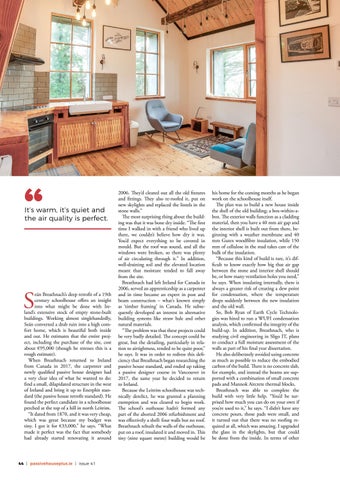
Old Leitrim primary school transformed into a timber-based, Enerphit home Rural Ireland has a crisis of dereliction, with numerous government policies aimed at breathing new life into thousands of old, vacant buildings. The careful transformationof one 19th century schoolhouse into a small, beautiful home shows a way forward for the sensitive, climate-conscious renovation of many of these properties.
Mass timber masterwork
Ultra airtight CLT passive house This home on the edge of the Cotswolds, built with cross-laminated timber, now holds the distinction of being the UK’s most airtight home, with the client even doing a significant chunk of the airtightness taping himself. What’s more, it demonstrates how passive homes that generate their own renewable power may escape the worst of the energy price crisis.
PASSIVE HOUSE+
CONTENTS
COVER STORY
42
62
72
52
62
Passive Power
The passive house that became a power station A passive house, by its nature, requires a much smaller amount of energy than a typical home, and when its heating demand is met by electricity, and you cover it in solar PV panels, you can start to see the potential for a whole new generation of passive homes that are semiindependent of the electricity grid. This is the case for Carrstone House in Bedfordshire, which generates so much solar energy it had to be registered as a power station.
INSIGHT Up to 11
Embodied carbon of 11 concrete and timber frame wall specs number crunched Last year Passive House Plus published an indepth assessment comparing the build specs including five wall types to a typical Irish house. To enable the industry to fairly compare a broader range of build options, we now expand that analysis with the addition of four timber frame wall types and two insulated concrete formwork systems.
75
76
82
Embodied carbon explained
All this talk of embodied carbon and building life cycle assessment (LCA) can be very daunting, but what does it mean? This is our stab at shedding some light, and explaining the jargon.
MARKETPLACE Keep up with the latest developments from some of the leading companies in sustainable building, including new product innovations, project updates and more.
When will energy efficiency have its day?
In spite of the ongoing global energy crisis, Toby Cambray wonders why energy efficiency seems likely, once again, to be the bridesmaid rather than the bride.
ph+ || contents contents || 77 ph+
CONTENTS
PASSIVE HOUSE+
8 | passivehouseplus.ie | issue 41
PASSIVE HOUSE+
CONTENTS
BOOK YOUR CPD NOW
It’s easy to be smart • Timeless, elegant design • Integrated WiFi connection • Touch screen with swipe function
ph+ || contents contents || 99 ph+
MEL REYNOLDS
COLUMN
Housing: turning problems into solutions for Ukrainian refugees Our abundance of holiday homes and other vacant dwellings could be used to house Ukrainian refugees, writes Mel Reynolds.
I
t is hard to focus on anything other than the conflict in eastern Europe. The EU and other regions face a very difficult time, not least the humanitarian crisis unfolding before our eyes. The immediate challenge for us on Europe’s western fringe to manage is the massive demand pressures that will be put on our already struggling housing system as we welcome displaced Ukrainian people to our country. In addition to the influx of families who had already fled the war, at the time of writing the government was scrambling to find accommodation in anticipation of a further surge of 10,000 people that were expected to arrive before the end of March. Tánaiste Leo Varadkar told the Dáil on 21 March that the number of Ukrainian refugees in Ireland could double to 40,000 by the end of April. Other Ministers suggested that numbers could eventually reach 200,000, although senior officials consider a total of under 100,000 a more realistic estimate. This suggests that this year we will need another 40,000 homes in addition to our current housing need.
According to the CSO there are 62,148 vacant holiday homes nationwide. Current circumstances suggest that new build housing, either public or private, is nowhere near levels required. The Central Statistics Office (CSO) confirms that 20,433 new homes and apartments, including once-off single homes, were completed in 2021. This is a significant increase from the 2017 level of 14,338 per annum, but still well short of the official Housing Agency’s estimate of a demand of 32,000 per annum. Although the overall output has increased, the number of homes for sale to households has remained stubbornly low at 7,500 new homes per year (see my column in issue 40 of Passive House Plus). New build social housing by local authorities
10 | passivehouseplus.ie | issue 41
and approved housing bodies remains low at an average of 1,334 new homes per year nationwide. Despite owning vast land-banks, the bulk of social housing ‘solutions’ are either purchased from the private sector, rented or leased. Current circumstances suggest that we do not have five years to ramp up building new homes, and there are also well-publicised capacity constraints in the sector that limit output. We must be realistic about the scale of this challenge and look elsewhere for practical solutions. So, what can we do? There are three areas we could consider as a suite of solutions. First, according to the Central Statistics Office (CSO) Census 2016 there were 62,148 vacant holiday homes nationwide . Even if just one-third of these were volunteered under an emergency scheme, this accommodation could take half the total of Ukrainian refugees expected to be in Ireland by the end of April. Holiday homes are habitable and available immediately. The remaining issue is logistics, organising localised transport services for new arrivals who do not have access to a car. Better local public transport is a strategic goal which can be brought forward as an immediate response by local authorities. Secondly, vacancy is an issue that became very topical back in 2016 after the last census. Out of a total of 2,022,898 dwellings nationwide, the vacancy rate measured by the CSO in 2016 was 183,312 (9.1 per cent) excluding holiday homes. When compared to 2011 this figure had fallen by 46,734 dwellings. Assuming this vacancy rate reduction continues at a similar pace from 2016-2022, the number of vacant dwellings expected in census 2022 could be in the region of 137,000, a 6.5 per cent vacancy rate. This would suggest that there are 40,000 existing habitable dwellings over and above a normal level of vacancy, which could be brought back into stock in the short term if the correct measures were employed. This figure will be confirmed shortly as census 2022 commenced in April. By the summer we could have very detailed granular information on what is vacant, and where etc. Again, these dwellings are existing, habitable and in many cases could be used immediately with little or no work required
other than re-connecting to the grid. The third potential solution is the use of emergency powers. The precedent for emergency powers during wartime is already in Irish law. The Emergency Powers Act 1939 was a broad ranging act in which section 2.2 allowed the government to take possession of land or property if required as an emergency measure during the war. A version of this could be reintroduced as a ‘push’ measure to accelerate the use of short term let accommodation or vacant new-build apartments. In February, an Oireachtas housing committee heard that there were just three vacant housing officers nationwide and no dedicated fulltime staff at all in the Department of Housing dealing with vacancy. Local authorities and the department need to re-deploy and allocate existing staff into dedicated teams to audit, identify and act on suitable vacant homes, as a matter of urgency. One of the blind spots of previous housing plans was an inability to tackle our massive and very visible vacant housing problem. Now seems to be the time to tackle this issue head on and to provide suitable accommodation to our Ukrainian friends. n
A fully referenced version of this article is online at www.passivehouseplus.ie Mel Reynolds is a registered architect with more than 25 years of experience in project management, conservation, urban design and developer-led housing. He is also a certified passive house designer.
POWERED BY A NEW PARTNERSHIP FOR HEAT RECOVERY VENTILATION IN IRELAND
Combing Aereco's expertise in indoor air quality and its industry leading reputation for outcomes in the sector with class leading technology from Wolf. Aereco will be supplying Wolf's domestic range of Heat Recovery Ventilation Units and a select range of commercial products. For more information on the products and service please visit: www.aereco.ie
INTERNATIONAL PASSI VE & ECO BUIL D S F R O M A R O U N D TH E WO R LD
IN BRIEF Building: 226 m2 row house Location: Brooklyn, New York Building method: Timber construction with cellulose insulation Standard: Enerphit certified
12
NEW YORK
Photos: Emily Dryden
I N T E R N AT I O N A L
CLIFTON PLACE, NEW YORK
A
lan Solomon, whose company Sawkill Lumber specialises in providing reclaimed timber for construction projects,
be torn out anyway. Alan and the team completely rebuilt the walls, which are
first heard about the passive house standard when supplying
now comprised of timber studs insulated with cellulose. The
salvaged wood to early passive house retrofit projects in the
front façade was clad in Douglas fir that was salvaged from
New York area.
Worcester Sauce tanks, then charred to increase its weather
“Passive house was starting to get a foothold, and I was intrigued without how it could radically cut energy use,” he says.
resistance, giving it a unique take on a traditional row house facade.
So, when Alan and his wife Rebecca bought a row house
The rear façade is more modern, however, and finished with
in the Bedford-Stuyvesant district of Brooklyn that needed
tropical hardwoods salvaged when the boardwalks at Coney
complete renovation, combining passive house design with an
Island and Rockaway were damaged during Hurricane Sandy
emphasis on reclaimed wood seemed the natural approach
in 2012. The window frames were even made from redwood
to take. “It was a good chance to learn about living with these
salvaged from wine tanks.
materials,” Alan says.
Sawkill Lumber also provided reclaimed lumber for the
The house was in poor condition. “The house had been
flooring, internal doors and other finishes. The house is now
patched up in recent decades, but it just needed to be gutted.
heated by two mini split heat pumps, with fresh pre-warmed
There was very little that could be preserved, the walls had to
air delivered by the heat recovery ventilation system. The
be ripped out.”
finished home was certified to the passive house retrofit
Alan brought in architect Paul Castrucci, and passive house
standard, Enerphit, in 2017.
consultant David White, who advised that it would be a good
“For the most part living in the house is really wonderful,” Alan
candidate for passive house, given that it has good exposure to
says,” the space, the air, the sound — the consistent temperature
the south via the rear façade, and that the walls were going to
throughout the house.”
ph+ | new york international | 13
NEW YORK
I N T E R N AT I O N A L
WANT TO KNOW MORE? The digital version of this magazine includes access to exclusive galleries of architectural drawings. The digital magazine is available to subscribers on www.passive.ie
14 | passivehouseplus.ie | issue 41
Unmatched weather tightness and protection for modern methods of construction With EXOPERM™ MONO SA 250, Partel brings an advanced self-adhesive breathable membrane, based on proven Monolithic Technology, designed for external and internal applications within the low-energy building sector. A completely adherent, vapour permeable, and extremely durable membrane for increased protection of assembly during the construction process and long after.
EXOPERM™ MONO SA 250 • Integrated Self-Adhesive Technology • Facilitates continuous air and windtight connections that withstand damp conditions • Maintains the building fabric integrity, maximising energy efficiency • Enables a faster, easier, and safe application for both on-site and factory installation methods
For more detailed guidance for your specific project, get in touch with our Technical Consulting Team, or visit our website to learn more.
PARTEL.IE | TECHNICAL@PARTEL.COM | 0818 333355
NEWS
PASSIVE HOUSE+
NEWS ‘Sufficiency’ key alongside energy efficiency & renewables, says IPCC Latest climate report calls for more efficient use of floor space in buildings ‘Sufficiency’ policies that reduce the need for new building space, and more efficient use of floor area in buildings, will both have a critical role to play in reducing the carbon footprint of the built environment, the latest report from the Intergovernmental Panel on Climate Change (IPCC) has said. As well as stressing the importance of energy efficiency and renewables, the report says that sufficiency — defined as avoiding demand for energy, materials, land and water while delivering human wellbeing — can play a key role in reducing emissions. It gives dense and compact design, multi-functional spaces, shared spaces, and repurposing of existing buildings, as examples of sufficiency-based policies, and says that, “up to 17% of the mitigation potential in the buildings sector could be captured by 2050 through sufficiency”. The report also says that total direct and indirect emissions from residential buildings increased by 50 per cent between 1990 and 2019, and that this was “mainly driven by the increase in floor area per capita”, as dwelling size has increased while the number of occupants per household has decreased. It says that more efficient use of both floor space and energy will be important to reducing emissions. The document, ‘Climate Change 2022: Mitigation of Climate Change’ was published on 4 April. It is the third and final report published as part of the IPCC’s sixth assessment report. It says that global emissions from buildings could be reduced by 61 per cent by 2050, with the largest share of mitigation potential coming from low carbon new buildings in developing countries, plus the renovation of existing buildings in developed countries. “We see examples of zero energy or zero-carbon buildings in almost all climates,” said IPCC Working Group III co-chair Jim Skea. “Action in this decade is critical to capture the mitigation potential of buildings.” However, the report warns that “low ambitious” policies have the potential to lock-in carbon emissions from the built environment for decades. It also says that “low
16 | passivehouseplus.ie | issue 41
renovation rates and low ambition of retrofitted buildings have hindered the decrease of emissions”. But it says that that well designed and implemented new build and retrofit policies have the potential to contribute to the UN’s sustainable development goals while adapting buildings to future climate. “For the built environment, the report revealed some promising information about our sector’s potential to accelerate climate action,” said Cristina Gamboa, chief executive of the World Green Building Council. “Most encouraging is the verdict that net zero buildings can be delivered at scale by 2050, but only if policy packages are effectively implemented and barriers to decarbonisation removed. And these packages must combine a purposeful trifecta of sufficiency, efficiency, and renewable energy measures.” “What we need is the perfect union of political ambition and financial incentives to make this happen at scale. “These mitigation interventions also have significant potential to address wider socio-economic issues, and help achieve
the UN Sustainable Development Goals (SDGs) in all regions, while future-proofing buildings for changing climates. “The challenge of embodied carbon has long been a contention point for our industry,” Gamboa said. “However, this report finds that embodied emissions can be addressed by limiting a new building's required floor space, and reducing the quantity and intensity of material emissions through rigorous efficiency measures. “We know that the solutions already exist to help us achieve net zero buildings, but we need radical, systemic transformation in the way we design, build, operate, deconstruct and value our buildings and infrastructure.” The report also says that the expanded use of wood products from sustainably managed forests has the potential to mitigate emissions if these products are long-lived, recycled or substitute for higher carbon materials, but it stresses that land and forest-based mitigation measures, “cannot compensate for delayed emissions reductions in other sectors.” The full report is available at www.ipcc.ch. •
Global surface temperature (°C) anomaly relative to 1850- 1900 High warming scenario: SSP3- 7, Low warming scenario from SSP1-2.6 Source: IPCC AR6 WG1
PASSIVE HOUSE+
NEWS
Huge demand for new deep retrofit grants Some one-stop-shops will not take on projects with new build extensions
O
ne-stop-shops have reported strong consumer demand in the first few weeks of Ireland’s new national retrofitting scheme. Under the scheme, which is administered by SEAI, applicants can claim up to 50 per cent grant aid on the cost of a deep energy upgrade if they go through an approved one-stop-shop. “We have had over 1,000 enquiries so far since SEAI published the one-stop-shops on their website two weeks ago,” Rory Clarke, general manager of House2Home Retrofit, one of five bodies approved at the time of writing, told Passive house Plus. “There has been massive interest in the scheme,” said Caroline Ashe Brady of Kore Retrofit, another of the one-stop-shops. “There have been a large number of leads, which we are working through.” Electric Ireland Superhomes also said they had been inundated with enquiries. Homes upgraded under the scheme must achieve at least a B2 energy rating and a 100 kWh reduction in energy use, per square metre of floor area per year. One-stop-shops provide a start-to-finish project management service which includes surveying the home, designing the upgrade, engaging contractors, managing grants, helping with access to finance, and quality assurance. One-stop-shops were also positive about the role played by SEAI on the scheme to date. A representative from one one-stopshop told us: “I have to say it is a totally different approach from SEAI, certainly more open to listening to commenters. The key difference is that they genuinely seem to want to make changes to the scheme where you can properly explain why a change would be better for the homeowner.” Different one-stop-shops operating under the programme are likely to offer different scopes to their services, Passive House Plus has learned. One rep told us that his company was not taking on projects with extensions or renovation works outside the scope of the retrofit grants, for example. He said: “We have done a number of pilots over the last few years where we tried really hard to make this work, but on almost all occasions it proved very difficult,” he said, citing quality assurance and risk management as challenging on such jobs. Other one-stop-shops, however, said they would take on such jobs. Most also said they are happy to take on upgrades that go be-
yond the scheme’s B2 energy benchmark, to higher targets such as the Passive House Institute’s Enerphit standard. “Eighty-five per cent of our homes were A-rated last year,” said a spokesperson for Electric Ireland Superhomes. “We’ll work with the homeowner on whatever their requirement is. We have a minimum standard, no maximum standard.” There remains some concern that airtightness testing and mechanical ventilation are not mandatory under the scheme, though a €1,000 grant is available towards airtightness measures, and €1,500 for mechanical ventilation. However, most of the one-stop-shops that Passive House Plus spoke to indicated that they would take care to avoid measures which may cause risk of interstitial condensation, such as internal wall insulation in certain scenarios. “Given the cost of the works I think it would be too much for the early adaptors to force [mechanical ventilation] on them,” one told us. “Obviously, it would be better and certainly can be recommended, but we need to be careful as the cost to the homeowner is already considerable.” Electric Ireland Superhomes, however, told Passive House Plus that advanced ventilation – typically demand controlled mechanical extract ventilation – would be a requirement on their jobs, as would airtightness testing and the installation of a heat pump. The deep retrofit grants, which must go through a one-stop-shop, include funding of up to €2,000 for project management. A government source told Passive House Plus that this payment was designed to help the one-stop-shops to invest in their own capacity, marketing, sales, and digital systems — essentially to help develop the retrofit economy. However, while the grants acknowledge the importance of good project management — seen as critical to avoiding retrofit failures — there is no requirement for specific roles such as a retrofit co-ordinator, which is a feature of the PAS 2035 retrofit standard recently developed in the UK. €8 billion funding Efforts to expand and upskill the workforce are now seen as critical to the success of the retrofit programme, particularly as the country embarks on a major housebuilding
drive simultaneously. There are expected to be 4,500 training places across five Irish retrofit centres of excellence by the end of the year, and it is hoped that the guarantee of multi-year retrofit funding, long desired by contractors in the sector, will now give companies the certainty they need to expand. “One of the biggest barriers to uptake and market growth has been the absence of a multi-annual grant system for multi-measures,” said Rory Clarke of House2Home Retrofit. “The one-stop-shop programme has addressed that, and we can now invest in growth with confidence and certainty.” Launching its retrofit programme earlier this year, the Irish government said that its new schemes reflect a “step-change” in the pace and scale of retrofit delivery, towards achieving the national target of 500,000 home energy upgrades, to B2 building energy rating (BER) standard, by 2030. It has committed to spending €8 billion on retrofit up to 2030, with €5 billion of this ringfenced from future carbon tax revenues. Speaking to Passive House Plus, Adrian Joyce, campaign director of Renovate Europe, said that Ireland’s new retrofit programme “sits at the top of class” among similar programmes across Europe. He said this was for three reasons: the long-term ambition, with funding pledged until 2030; the fact that projects must reach at least a B rating and save 100 kWh/m2/yr; and that €8 billion is allocated to the scheme, which represents more per capita compared to other European countries. “We in the Renovate Europe campaign will be keeping a close eye on the roll out of the scheme and will promote it as a best practice example, asking other member states to prepare and implement similar schemes,” he said. •
There remains some concern that airtightness testing and mechanical ventilation are not mandatory under the scheme.
ph+ | news | 17
NEWS
PASSIVE HOUSE+
Build warmth with Grant Our complete integrated heating packages provide everything needed to build a highly efficient, warm and comfortable home. Tailored to suit the homeowners’ requirements, each Grant heating package is correctly sized and specified, free of charge, to achieve compliance, maximise efficiencies and provide long-term savings. Packages feature the Grant Aerona3 air to water, air source heat pump, Grant hot water cylinders, Grant Afinia aluminium radiators and the Grant Uflex underfloor heating system. Smart controls are also available.
Trust Grant on the journey to warmth and comfort by sending house plans to
heatpump@grantengineering.ie 18 | passivehouseplus.ie | issue 41
PASSIVE HOUSE+
NEWS
#BuildingLife: “Make life cycle assessment part of the planning process,” says Ecocem Ireland’s Susan McGarry. becoming managing director of Ecocem Ireland in 2021, I worked as Ecocem’s European sustainability manager for four years. Most of my career has been in sustainable building materials. When I was asked to become a #BuildingLife ambassador, I immediately accepted as the campaign is fully aligned with both Ecocem’s business focus and my values. What are you hoping to achieve with the #BuildingLife campaign?
I
n our #BuildingLife ambassador spotlight series, Passive House Plus is profiling leaders who have endorsed the Irish Green Building Council’s call to address the environmental impacts of buildings across their lifecycle. In our fifth interview, Susan McGarry, managing director at Ecocem Ireland, tells us about why she is supporting the campaign. Why did you choose to become a #BuildingLife ambassador? Susan McGarry: Ecocem is a founding member of the Irish Green Building Council (IGBC) and has been highly involved with the organisation for all its existence. Ten years ago, it was a real struggle to talk about the importance of low carbon building materials. The IGBC was one of the first organisations to highlight that this issue needed to be addressed. You cannot act on something that has never been measured so I was excited to read the initial assessment of the carbon emissions associated with the construction and operation of the Irish built environment, produced by UCD’s Building in a Climate Emergency Research Group for the IGBC*. The document provides baseline data on embodied carbon which had never been collected before. It highlights that cement is a big part of Ireland’s national greenhouse gas emissions, accounting for 4 per cent of our emissions. At a personal level, I have always been highly interested in sustainability. Prior to
SMcG: Progress has been made over the last few years. For instance, the Climate Action Plan (2021) includes for the firsttime actions to address whole life carbon. It also highlights the need to reduce the CO₂ emissions associated with the cement production process, not only by facilitating the use of alternative fuels but also by maximising clinker replacement. It's a first step but we need to be more ambitious. The UCD report shows that embodied carbon accounts for 11 per cent of Ireland’s emissions. I strongly believe we have the technology and the capability to target these emissions, but this requires a shift in the entire landscape. We need a clear action plan, and this must evolve gradually to incorporate stronger language. A simple step could be to introduce life cycle assessment (LCA) for all projects as part of the planning process, or at the very least, for publicly funded projects. The #BuildingLife campaign provides a great opportunity to work with very knowledgeable people to decarbonise our built environment, and to engage with everyone in the industry, to raise awareness about what is possible and what needs to be done.
annual turnover in innovation and disruptive technologies. 14 per cent of our staff work in R&D and we recently opened an innovation centre in Paris to accelerate the development of new technology and products that will help our industry decarbonise more quickly. The centre enables our innovation team to focus on testing, evaluating, and improving our low carbon solutions. It also allows them to run industrial-sized trials in collaboration with trusted industry partners and universities. The alternatives exist but we are now working on scaling them up. *The ‘Whole Life Carbon in Construction and the Built Environment in Ireland’ report is available at www.igbc.ie. #BuildingLife is a project led in Ireland by the Irish Green Building Council. The initiative aims to achieve the mix of private sector action and public policy necessary to tackle the whole-life impact of buildings. Learn more at www.igbc.ie. •
Can you explain a few ways in which Ecocem is working towards a sustainable built environment? SMcG: At Ecocem, we believe that immediate action is needed to decarbonise the cement industry. We don’t have time to wait for green hydrogen, carbon storage technologies or other long-term solutions. That’s why we invest two per cent of our
ph+ | news | 19
S&P single room heat recovery Respiro Series NEWS
PASSIVE HOUSE+
The S&P Respiro Series is a decentralised ventilation unit, with heat recovery, designed for use in single rooms in domestic or commercial applications. The elegant front cover design allows its adaptation to any environment which means that it is suitable for all manner and scale of project. Measuring just 160mm or 100mm in diameter, diamete it features a brushless motor with low consumption electronic control. The ventilation system is delivered via a reversing motor and a ceramic heat exchanger with a performance up to 93%, and protected by a G3 filter at both ends. Designed for continuous operation, the unit adjusts the airflow proportionally in relation to the humidity level (model RD), ensuring excellent indoor air quality. 20 | passivehouseplus.ie | issue 41
PASSIVE HOUSE+
First buyers move in at 219-home passive Belfast scheme P roperty developer Fraser Millar has completed the handover of the first home at the £70m Lancaster Park development in Belfast, which is set to become the largest residential project in the UK and Ireland certified to a Passive House Institute standard. When complete, the Lancaster Park development will comprise 219 houses across 26 acres on the southern edge of Belfast. The first 21 homes in phase one sold out in one hour and are being completed weekly from 1 April. They consist of three and four-bedroom, semi-detached and detached family homes. Phase two is now under construction. Lancaster Park is the first developer-led passive house scheme in Northern Ireland for the house buying public. The homes are all built to the Passive House Institute’s Low Energy Building (LEB) standard. A marginally less onerous alternative to classic passive house, the LEB standard allows for maximum space heating demand of 30 kWh/m2/yr and airtightness of one air change per hour. Fraser Millar is now exploring the possibility of developing future projects to the full passive house standard. The homes are built with a timber frame, insulated with Rockwool, and with a brick outer leaf. All of the dwellings feature Nilan Compact P combined heat pump and heat recovery ventilation systems. All the homes are also being designed to achieve an
EPC A rating. “Lancaster Park has been very well received to-date and to see our first purchaser move in is a brilliant feeling,” said developer David Millar. "Fraser Millar has embraced absolute best-practice and the gold standard in home building in this exciting new development. The homes required a completely different style and method of build, to the exacting passive house standards, very different than we have been used to for the past 50 years. It took longer and was more expensive, however, the additional costs were not passed onto the buyer. It has been a complete education and has allowed us to adopt best practice for the entire company moving forward.” The second phase of the development is expected to launch shortly and will also feature solar PV panels as standard. John Carrigan, a senior executive at Fraser Millar, was named an ‘Everyday Climate Hero’ at COP26 for his work in pioneering the scheme. Carrigan said that when he noticed his own energy bills rising, he researched what the best way was to control fuel costs, and found that it was through providing low energy homes, of which he described passive house as the “gold standard”. “I took the idea to the company owners who were immediately convinced and agreed to adopt passive house standards,” he says. •
Below: Charles Millar (first from left), John Carrigan (third from left) and David Millar (fourth from left) — all of Fraser Millar — are pictured with May Lee (second from left), purchaser of the first Lancaster Park property.
NEWS
Most users are satisfied with their heat pump, survey finds
A
new survey has revealed that 88 per cent of European users are satisfied with the switch to heat pumps. The study was commissioned by Coolproducts, a coalition of NGOs, “working to ensure that eco design and energy labelling truly work for Europeans and the environment”. Regardless of weather conditions, house type and motivations, the large majority of respondents in this study (88 per cent) reported being satisfied with their switch to heat pumps. In total, 81 per cent said that the average level of comfort at home had improved by replacing fossil fuel heaters with heat pumps. In five countries, all respondents answered that they were either very happy or somewhat happy with their new heating system. While many respondents were environmentally motivated in their switch to heat pumps (especially in Germany, Ireland, the Netherlands, and the UK), many users also made the switch with the aim of reducing energy bills, and to reduce the hassle of traditional heating. Switching to heat pumps resulted in relatively similar heating bills in most regions. 64 per cent of respondents said that the switch to heat pumps has been economical, and even in cases of slightly higher running costs, the impact of price on comfort and satisfaction was minimal, the survey found. Coolproducts said that the biggest barrier to the uptake of heat pumps was the upfront cost, and lack of government incentives and information. “Major leaps in policies are needed urgently to keep Europe on track with its environmental and geopolitical strategies, starting with the humble but powerful heat pumps. It’s time to turn up the heat to policymakers and demand a green energy transition for all,” the group said. As part of the research, 670 heat pump users were surveyed, and 40 were interviewed, across 22 European countries. The full report is available at tinyurl.com/56nusczf. •
ph+ | news | 21
INGEBW C S U P DPA ATSES I V EP A HSOSUI V S E +H O U S E +
Getting home retrofit ready As part of the group’s latest update, Johanna Varghese of the Irish Green Building Council looks at how one-stop-shops can make retrofit easier and more affordable for homeowners, and details the group’s new online renovation hub.
T
he Irish Green Building Council (IGBC) and NUI Galway are creating a prototype information platform called Renovation Hub for the homeowner interested in retrofit. As the IGBC is a charity, it will be a public resource to get the homeowner ‘renovation ready’ and connect them to an impartial renovation advisor. Those who face prospective retrofit customers say that they spend an inordinate amount of time dealing with people, only to see them baulk at the end, due to the high upfront cost. One dedicated place on home retrofit could arm the customer with appropriate information and nudge them to connect with a renovation advisor. They would get a roadmap, showing a clear sequence of works and an estimate of costs. It means the next time a manin-a-van tells them they need to install ventilation in the roof, they can refer to their road map to check if it’s what they should do. Under the Climate Action Plan, 500,000 homes must be retrofitted to a B2 BER by 2030. More specifically, 75,000 homes per year must be retrofitted to a B2 BER from 2026 to 2030. This represents a significant jump from current levels of deep retrofit (only 4,000 home retrofits reached that standard in 2020). Certainty in the shape of multi-annual framework grants, was what the building industry called for. At a workshop organized by the Department of Environment, Climate and Communications on Ireland’s retrofit strategy in 2020, stakeholders said that if they and their customers were certain about the grant schemes, they would be confident to scale up their services and bring in new labour. February saw the launch of the new National Home Energy Upgrade Scheme and the reform of SEAI residential retrofit schemes in a multi-annual framework. The reform includes bigger retrofit grants for homeowners, with advantages for opting for a one-stop-shop service, including up to 50 per cent discount on the works. It remains to be seen whether the new scheme is enough to drive the latent sup-
22 | passivehouseplus.ie | issue 41
ply of those who were thinking of moving into the retrofit business, but never felt it was a viable option. However, the one-stop-shop approach addresses some of the challenges faced by the homeowner, including the hassle, complexity and affordability of energy renovation. One-stop shops are not all the same SEAI states that “one-stop-shops are registered private operators that manage the entire retrofit process, from the initial assessment to the final BER”. Many types of one-stop-shops exist in Ireland. They may be managed by contractors, material suppliers, engineers, or partnerships, between financial institutions and energy companies or energy companies and engineers. There were 17 registered with SEAI before the launch of the new scheme. If a homeowner is interested to engage a one-stop-shop, it’s up to them to find the right match. For example, someone who owns a traditional building, will need both professional advice and a onestop-shop that understands the nature of working with these buildings. It is also up to the homeowner to check for professional indemnity in the contract so that if something goes awry during the works, they have some recourse.
tion on aggregated projects. The IGBC’s Renovation Hub will launch imminently. Plans include connecting homeowners to a renovation advisor for a retrofit assessment with a road map. If you are a qualified retrofit advisor or completed a course on retrofitting, we’d like to hear from you. Alternatively if you’d like to support the development of the Renovation Hub, please contact Johanna@igbc.ie. Johanna Varghese is a project manager for two EU H2020 projects: Turnkey Retrofit and Smarter Finance for Families at the IGBC. Turnkey Retrofit has a platform called Solutions4Renovations as a launching pad for platforms in France, Spain and Ireland which are works in progress. •
Renovation Hub and feedback The ‘Renovation Hub’ being built by the IGBC and NUI Galway was recently tested and here’s some of the feedback: •
• • •
When a homeowner first considers an energy upgrade, they need independent and trustworthy information. This information should be tailored to different levels, unfolding from the basic to more in-depth levels. Budget is the major roadblock. Information on finance and grants must be available in one place. The system must be better connected. For example, through the road map, renovation advisors or one-stop-shops could have informa-
Certainty in the shape of multi-annual framework grants, was what the building industry called for.
PASSIVE HOUSE+
Natural Fibre Insulation
NEWS
The warmest, safest natural fibre insulation made in Ireland
As Ecocel cellulose is pumped in it achieves a level of air-tightness not possible with any other sheet or roll out material. Ecocel will last the life span of the building and make it safer in the event of a fire. Ecocel, due to its natural fibres creates a healthy indoor air quality and is carbon negative when installed.
MADE FROM RECYCLED NEWSPAPER
U-Values: 300mm in attic = 0.11 W/m2K //// 225mm in Timber Frame Wall = 0.14 W/m2K
www.ecocel.ie 021 432 4567 087 248 4487 ph+ | news | 23
NH P EW A IS U P D PA ATSES I V EP A H SOSUI S V E +H O U S E +
Passive house 2020 to 2030: keep calm and carry on? Looking ahead to the next decade, architect Martin Murray wonders if the rigours of the passive house standard can help to transform our construction industry, as part of the latest update from the Passive House Association of Ireland.
T
he nearly zero energy building (NZEB standard is an asset rating, calibrated to be ‘cost optimal’. The performance criteria and energy/carbon context from which it emerged have changed enormously in recent years and so a transition to a design-based energy standard with improved predictive accuracy is required. Passive house is an obvious candidate. 2010 to 2020 The past decade has witnessed an increased awareness of passive house design, in both Ireland and Britain, with the Passive House Planning Package (PHPP) emerging as a leading independent methodology for achieving reliable low energy buildings within our oceanic temperate climate. This is notable as having been achieved across a decade when NZEB criteria have remained steadfastly blinkered toward operational efficiencies only, within a strict ‘cost optimal’ set of criteria, resulting in significant performance gaps and variable indoor air quality. By contrast, buildings designed to the passive house standard exhibit a clear pattern of consistency between predictive and actual energy-use, as well as good indoor air quality, improved productivity in commercial buildings, and better health outcomes across residential stock. Despite the relative simplicity of the pas-
24 | passivehouseplus.ie | issue 41
sive house paradigm itself (minimise loss, maximise gain and provide good, controlled ventilation), passive house has remained peripheral to practice, due to regulatory compliance with Part L being reserved for the NZEB standard alone. A review of NZEB is mandatory within the next three years and there is an emerging need to address its known shortcomings and agree industry methodologies for their rectification. The decade 2020 to 2030 is too important to ‘keep calm and carry on’. 2020 to 2030 EU greenhouse gas (GHG) emissions need to reduce by 55 per cent over the next eight years and while NZEB buildings place great reliance on the expectation of a carbon neutral power grid, the EU has also identified the need to implement a renovation wave. Here in Ireland, centres of excellence have begun to offer NZEB training courses for operatives across the construction industry. This is to be welcomed, however if the industry is to prove attractive as a place of employment, then expectations need to parallel other industries with good working conditions and predictable career pathways. The rigour and discipline of passive house can provide a real context for the restructuring of the construction industry to a deeply knowledge-based activity.
One possible impediment to such a transformation is our understanding of what constitutes ‘education’. The valuing of academic ability above manual dexterity has always been a key determinant in this, with the result that for many years trade and craftbased training suffered from significant underinvestment, while third level colleges have expanded exponentially. Ireland has approximately 60,000 entering the work force annually, 40,000 of whom choose a career pathway which brings them through one of the 1,300 third level courses available, while only 62 apprentice routes attract 3,000 participants. One manifestation of this is that each year 115 plastering apprentices are required by the construction industry, with only 15 applications being received. Against these relative imbalances, 5,000 extra construction workers per annum are required over the next eight years if the EU renovation wave is to materialise. Additionally, only 10 per cent of the construction workforce is female, a figure which must increase if we are to meet our apprenticeship quorums. However, overcoming historic patterns is not easy, and patterns have a tendency to repeat themselves. Eoin Ó Broin TD, in his recent book Defects, records how when the Building Control Bill was being proposed to Cabinet in 1983, the accompanying
departmental memo stated that the main argument against introducing a building regulatory system, “related to the extra costs likely to arise from operating it”. The memo went on to explain how the Department of the Environment had decided not to proceed with the implementation of the 1976 Building Control Regulations until they had secured “the general acceptance of the building industry”, citing regulations related to staffing embargoes and the construction industry operating in a time of recession. Thirty years later, in 2013, amidst another recession, at a meeting with the Construction Industry Federation (CIF), the Passive House Association of Ireland, arguing for the potential benefits of passive house methodologies in reforming the industry, was informed that no improved regulatory standards would be considered or tolerated by the CIF unless sanctioned by the government. With such Orwellian interdependency, to whom do we turn to demand improved standards? Who reconsiders the metrics of NZEB? NZEB reconsidered A building’s value lies not in its sale or construction price, but rather across its entire operational life. A good building promotes wellbeing and protects health; this is a wealth in itself. The quality of what is built now
P A S S I V EP A H SOSUI S V E +H O U PS HEA+I U PNDEAW TE S
is not just critical to avoiding costly renovations into the future but also ensuring that resources used now, deliver long term optimal performance. An NZEB reconsidered must reflect that building stock is part of a nation’s infrastructure and is reflective of that country’s social and cultural wealth. Land and buildings are ultimately community assets. Such a viewpoint however carries with it responsibilities, not least being that we need to tax land in such a way as to extract from it any community value from which it benefits. Such taxes would allow us build better buildings. NZEB is strongly framed by cost optimality. Cost optimality however is not definitive, and it can be extended to reflect longer term (60 years plus) social and cultural values if structured to do so. In times of low energy inflation and low interest rates, cost optimality solutions default toward mechanical solutions. In times of high energy costs with rising finance costs, ‘fabric solutions’ are found to be optimal. As the international unpredictability of fossil fuel transition becomes a
reality, an NZEB reconsidered, needs to reflect improved fabric performance and airtightness, and 24-hour occupancy with improved indoor air quality to the EN 16798-1 (2019) standard. Furthermore, an NZEB reconsidered must address overheating, and restrict the use of high embodied carbon solutions to the creation of low energy buildings. These are all aspects of passive house which are already well developed through the Passive House Planning Package (PHPP) and its PHribbon add-on. The physics of passive house respects the rule that heated air is best kept indoors and that ventilation is best managed and controlled. The industry has resisted this reality for years because airtightness is such an accurate reflection of construction quality. Covid showed up with forensic clarity the dismal quality of our buildings and their internal environments and although many of the shortcomings might be claimed as being historic, the thinking and material perspective which created them still pertains. We
need a transformative leadership toward better standards. PH leadership Our climate change dilemma needs focused leadership. The energy and optimism experienced by the author during a recent visit to two schools of architecture is wholly deserving of a construction industry which respects these aspirations. This requires more than statements of ambition at both an institutional and government level. Much of this ambition reflects not just ‘magical thinking’ but a lack of engagement with what would really constitute a resilient construction work force. Passive house is in fact the conversation we need to have, and the past decade of passive house has seen a wonderful expansion of a shared language within which to have it. Passive house is more than just a predictive energy standard. it constitutes a construction discipline capable of remaking the industry. We must carry on, but let’s not, in Beckett’s famous words “fail better”; the industry deserves more than that. •
AIB to offer cheaper finance for green developments
AIB will offer discounted loans to residential developers who build to the Irish Green Building Council’s (IGBC) Home Performance Index, the bank has announced. The Home Performance Index (HPI) is a holistic green building standard that takes account not only of the energy efficiency of the home but also air quality, water efficiency and the sustainability of the location in the context of factors such as transport links and community facilities. While aligned to Irish regulations, HPI is also internationally recognised in line with the
Global Rating ESG Benchmark for Real Assets (GRESB). AIB’s real estate finance team will encourage the adoption of this index for new development schemes it reviews, offering all applications a lower priced option if they comply with HPI standards. AIB has committed to being carbon neutral in its own operations by 2030 and says that 70 per cent of its new lending will be green or “transitional” by that date. Cathy Bryce, managing director of AIB Capital Markets, said: “We in AIB have both a responsibility and an ambition to be a sustainability leader. This new loan
option is about encouraging our development customers to think green in all aspects of their projects. As a society, we face an enormous challenge to adapt to climate change and we will lead the way in working with our customers to set higher standards for sustainable development. “We are proud members of IGBC and have worked closely with them to get this offering right and, whilst we acknowledge there is more to do to address the sustainability challenge, we look forward to continuing that journey through our work with IGBC.’’ Pat Barry, CEO of the IGBC, added: “With this financial product AIB has created a really powerful tool by aligning discounted finance with greener standards. This will move our new housing construction far faster towards sustainability. It will ensure that wider criteria such as embodied carbon, better land use and improved biodiversity are integrated into new housing.” • (above) An HPI-certified development of 80 homes by SISK in Dunleer, Co Louth. AIB will offer discounted finance to the developers of HPI-certified schemes in future.
ph+ | news | 25
DR MARC Ó RIAIN
COLUMN
The world energy crisis 2022 The energy crises of the 1970s did not prompt a major shift in Europe from foreign oil and gas towards energy efficiency and renewables. Will we learn this time around, wonders
Dr Marc O Riain
I
n many of my articles I have touched on geopolitical events that have impacted the supply, and therefore the cost, of energy. This has had a direct and consequential effect on the cost of petrol in our cars, and the heating of our homes. Up to 1 April 2022, UK energy costs have already increased by 54 per cent and in Ireland suppliers like Bord Gáis have increased gas prices by 39 per cent, forcing both governments in both countries to give householders a once off energy rebate, which will do nothing to abate demand or reduce energy costs. As I write this article, Russia has invaded Ukraine and Brent crude has just passed $105 a barrel and maintained that level for six weeks. Undoubtedly the ratcheting up of EU sanctions on Russia, the halting of the Nord 2 gas pipeline, and the fact that Nord 1 actually runs through Ukraine from Russia, are likely to result in home energy costs increasing further, throwing more of us into fuel poverty. The number of households in England experiencing “fuel stress” was expected to double to around five million this spring, according to the Resolution Foundation. These are people that will routinely have to decide between food and heating. Soaring inflation and carbon taxes have further increased pressure on household income. You would think that since the first energy crisis of 1974, we would have weaned ourselves off the teat of foreign oil and gas, that we would have transformed our building standards and addressed energy conservation in our existing buildings. Much has been done in terms of the development of renewables and new building standards in response to the Kyoto, and more recently Paris, climate agreements. However, Russia accounts for 57 to 60 per cent of all EU gas, oil and coal imports (REPowerEU 2022) , and accounted for 47 per cent of UK gas imports in 2021. In fact the UK imported 33.7 million megawatt-hours’ worth of liquefied natural gas (LNG) from Russia in 2021, up from 15.6 million in 2018. Russia is trying to force EU countries to pay for gas imports in roubles in order to prop up the value of the currency, and is threatening to turn off the tap. While the EU has been debating the creation
26 | passivehouseplus.ie | issue 41
of a voluntary strategic reserve for natural gas, prices hit record highs in December with gas costing €183 per MWh, an increase of 985 per cent year-on-year, and by 5 April EU gas stocks had fallen to 17 per cent. Wholesale natural gas prices in the EU are at $42.39 per MMBtu, up from $6.127 one year ago, a 690 per cent increase. The EU has struck a deal with the US for about 10 per cent of its gas requirement for the coming winter, but it still faces a major challenge in replenishing its stocks. European Commission president Ursula von der Leyen has stated that the EU wants to diversify away from its reliance on Russian imports and in general pivot towards renewables. But we have not radically shifted, at speed,
must be slashed by 95 per cent worldwide, while consumption of oil and gas has to be reduced by 60 per cent and 45 per cent, respectively, by 2050. We must use this crisis to move our countries towards a faster rollout of renewable infrastructure, offshore wind, micro-solar, solar fields, micro-grids, feed-in tariffs and green hydrogen. We must make grants for elemental and deep retrofit packages simpler and easier to access with low-to-zero cost finance for energy conservation measures. While we think about our own future, energy security, environment and population my heart goes out to the brave people of Ukraine. Solidarnist! n
We have not radically shifted, at speed, toward renewable energy. toward renewable energy, nor have we translated our building stock to low energy demand since the energy crises in 1973 and 1979. Rising environmental concerns have shifted our building energy standards for new buildings since 2010, but this does not address the elephant in the room: we only replace one per cent of our housing stock per year. Since 1974, the UK has aggressively followed an energy independence strategy shifting its energy mix to oil, gas and nuclear, with new reserves in the North Sea and nuclear reactors along the Irish Sea. Indeed, Boris Johnson has just rejected a doubling of onshore wind in favour of seven new nuclear reactors. The percentage of renewable energy generation in the UK in 2021 was 36 per cent whilst fossil fuels represented 45 per cent of total energy demand. Ireland by contrast is more dependent on imported fossil fuels with renewable generation at only 13.5 per cent in 2020 (Source: SEAI). The UN’s Intergovernmental Panel on Climate Change (IPCC) has just published Climate Change 2022: Mitigation of Climate Change, and it has warned that the use of coal
A fully referenced version of this article is online at www.passivehouseplus.ie Dr Marc Ó Riain is a lecturer in the Department of Architecture at Munster Technological University (MTU). He has a PhD in zero energy retrofit and has delivered both residential and commercial NZEB retrofits In Ireland. He is a director of RUA Architects and has a passion for the environment both built and natural.
SHOWROOMS: CORK, DUBLIN, GALWAY & BELFAST UNPARALLELED CHOICE OF PASSIVE CERTIFIED PRODUCTS – OUTWARD OPENING, INWARD OPENING, UPVC, ALUMINIUM, ALUCLAD
GROUND BREAKING U-VALUES FROM AS LOW AS 0.47W/M2K
T. 064 7751151 E. info@munsterjoinery.ie
www.munsterjoinery.ie WINDOWS & DOORS
DR PETER RICKABY
COLUMN
Punk retrofit: fighting the lack of vision on energy upgrades In the aftermath of COP26, Dr Peter Rickaby asks what is the government’s plan to deliver the deep, whole-house, quality-assured retrofits needed to get us to net zero by 2050?
I
n the disappointing aftermath of COP26, I was part of a WhatsApp group called ‘Punk Retrofit’. Members were professionals disgruntled that despite the UK’s commitments, insufficient progress is being made with domestic retrofit, on which achieving our ‘net zero carbon’ target depends. They were also disappointed by an apparent loss of commitment to the quality assurance process developed after the Each Home Counts review. At the beginning of the last decade domestic retrofit was placed in the hands of an installation industry that was untrained, with little understanding of building physics, moisture risks or retrofit risk management, and which was fragmented into ‘silos’ around individual measures. Retrofit professionals, with more knowledge (learned from Retrofit for the Future, CoRE, RE:NEW, the STBA and elsewhere) had been excluded
public and industry. The implementation board was clear that the hub must be authoritative, independent and publicly funded. The hub is needed without delay – it is the only recommendation of Each Homes Counts that has not been implemented. Another view of the Each Home Counts implementation board was that the recommended retrofit quality mark should be public-facing (part of the process of restoring confidence) and that it should have the ‘teeth’ to curb poor practice. The role was given to TrustMark, which has no public profile, and which is funded via the certification bodies to which retrofit installers belong. How can a gamekeeper be funded by the poachers? The funding arrangements for TrustMark create a conflict of interest that does not help with its mission of protecting homes and occupants’ health.
We will not achieve net zero carbon without inspiring leadership, a clear strategy and courageous policy.
from The Green Deal and ECO. It is not surprising that much retrofit went horribly wrong, damaging public and government confidence in the industry. Potential funding bodies were not impressed. The Each Home Counts review was established in 2014 to protect people’s homes and health against poor retrofit and to restore confidence in the industry. The report was published in December 2016, and government recently reaffirmed its commitment to implementing the recommendations in full, but it appears to have lost its way. We know how to do safe, healthy retrofit. Knowledge has been embedded in the BSI Retrofit Standards Framework, including Publicly Available Specification (PAS) 2035, that was developed in response to one of the Each Home Counts recommendations. But that knowledge is not being adequately disseminated. A key recommendation of Each Home Counts was the establishment of an information and advice hub to inform the
28 | passivehouseplus.ie | issue 41
Another recommendation of Each Home Counts was to move away from measures-based incremental retrofit towards more robust whole-dwelling retrofit, a change that removes many risks to people’s homes and occupants’ health. During the development of PAS 2035 it was acknowledged that many owner-occupiers and landlords cannot afford to improve their homes all at once, to the extent needed. In response, PAS 2035 requires a retrofit process in substantial stages, using the ‘fabric first’ approach, and based on a whole-dwelling assessment, an improvement option evaluation and a medium-term improvement plan. ‘Substantial stages’ means, first, improvement of the whole building fabric (plus ventilation), then decarbonisation of building services (heating and hot water); and then the use of renewable energy systems to top up to zero carbon if necessary. Yet government continues to promote measures-based retrofit funding programmes involving
pre-determined measures, and although packages of measures are encouraged, the funding caps are inadequate and the timescales are often unachievable. A programme with a funding cap of £15,000 should support, as first priority, building fabric retrofit (and ventilation), and leave decarbonisation to the next stage. Mixed messages about ‘step by step’ retrofit are confusing and unhelpful. Participants in the Punk Retrofit discussion complained that installers, not retrofit professionals, have the ear of BEIS when it comes to standards and quality assurance in domestic retrofit. This is despite the evidence from Each Home Counts that installers are part of the problem, not part of the solution. The BSI Retrofit Standards Task Group now plans to change the focus of PAS 2035 from professionals and installers to professionals and contractors. In this context it is time for the government to listen to experienced individuals and organisations who know what they are doing, rather than to inexpert and differently motivated trade groups and certification bodies who make the most noise. All low carbon heat options (heat pumps, heat networks, hydrogen, renewables) require demand reduction. They are also surrounded by uncertainty that will not be resolved for years, so today the only ‘no regrets’ strategy is demand reduction through retrofit. However, the UK government appears to be ducking the challenge. We will not achieve net zero carbon by 2050 without inspiring leadership, a clear strategy and courageous policy. Unfortunately, too little, too late, with no sense of urgency and a reluctance to communicate inconvenient truths, seems a good characterisation of current policy. n
Dr Peter Rickaby is a retrofit consultant with Savills social housing team, and chairs the BSI Retrofit Standards Task Group. The views expressed in this article are his own, and not necessarily those of Savills or of BSI.
THE NEW THE NEW THE NEW THE NEW ISOVER THE NEW ISOVER ISOVER ISOVER SOLUTIONS ISOVER SOLUTIONS SOLUTIONS SOLUTIONS GUIDE SOLUTIONS GUIDE GUIDE GUIDE N O W !! N O GUIDE W N O W N ! O W ! N O W ! N Get the latest insulation, Get the latest insulation, Get the latest insulation, Get the latest insulation, airtightness & dry lining solutions, Get the latest insulation, airtightness & dry lining solutions, Get the latest insulation, airtightness & dry lining solutions, Get the latest insulation, airtightness & dry lining solutions, as well as sustainability guidance, Get the latest insulation, airtightness & dry lining solutions, as well as sustainability guidance, Get the latest insulation, airtightness & dry lining solutions, as well as sustainability guidance, Get the latest insulation, airtightness & dry lining solutions, as well as sustainability guidance, Get the latest insulation, regulatory advice and case airtightness & dry lining solutions, Get the latest insulation, as well as sustainability guidance, regulatory advice and case airtightness & dry lining solutions, as well as sustainability guidance, Get the latest insulation, regulatory advice and case airtightness & dry lining solutions, as well as sustainability guidance, regulatory advice and case airtightness & dry lining solutions, studies, from ISOVER. as well as sustainability guidance, airtightness & dry lining solutions, regulatory advice and case studies, from ISOVER. as well as sustainability guidance, regulatory advice and case airtightness & dry lining solutions, studies, from ISOVER. as well as sustainability guidance, regulatory advice and case studies, from ISOVER. as well as sustainability guidance, regulatory advice and case as well as sustainability guidance, studies, from ISOVER. regulatory advice and case studies, from ISOVER. as well as sustainability guidance, regulatory advice and case studies, from ISOVER. regulatory advice and case studies, from ISOVER. regulatory advice and case studies, from ISOVER. regulatory advice and case studies, from ISOVER. studies, from ISOVER. studies, from ISOVER. studies, from ISOVER.
A V A IIL A A B V A L E L A A V B A L E I L A A B V L A E I L A A B V A L E I L A A B V L E A AVAIIL A B L L E A B L A E V A I L A A V B A L I E L A A V B A L I E L A A B V L A E I L A A V B A L I E L AVAIL A L AB B LE E
O !! W N W NO OW!
GET YOUR FREE COPY HERE GET YOUR FREE COPY HERE GET YOUR FREE COPY HERE GET YOUR FREE COPY HERE GET YOUR FREE COPY https:/www.isover.ie/solutions-guide GET YOUR FREE COPY HERE HERE https:/www.isover.ie/solutions-guide https:/www.isover.ie/solutions-guide GET YOUR FREE COPY HERE https:/www.isover.ie/solutions-guide GET YOUR FREE COPY HERE https:/www.isover.ie/solutions-guide GET YOUR FREE COPY HERE https:/www.isover.ie/solutions-guide GET YOUR FREE COPY HERE https:/www.isover.ie/solutions-guide GET YOUR FREE COPY https:/www.isover.ie/solutions-guide GET YOUR FREE COPY HERE HERE https:/www.isover.ie/solutions-guide https:/www.isover.ie/solutions-guide https:/www.isover.ie/solutions-guide https:/www.isover.ie/solutions-guide https:/www.isover.ie/solutions-guide
TINAKILLY
CASE STUDY
A GRID OF THEIR OWN IRISH HOUSING SCHEME POINTS TO A FUTURE OF DECENTRALISED POWER A new development in County Wicklow demonstrates how typical housing estates might be turned into electricity microgrids through solar power and battery storage, with residents buying and selling renewable energy from each other, helping to insulate them from price spikes and outages.
00 25.7
E HOUS Z1 TYPE
23.6
00 25.5
23.6 59 23.3
25.5
00
0 23.90
E HOUS Z1 TYP E
E HOUS P1 TYPE
86
00
E HOUS Z1a TY PE
23.9
E HOUS 1a PN1a TYPEE TYP
86
E HOUS Z1 TY PE
00 25.7
E HOUS Z1b TYPE
00 26.0
By Anthea Lacchia
00 25.0
E HOUS P 1 TYP E
E HOUS P1 TYPE
5 23.05
5
55 23.0
25.420
25.420
25.212
25.212
25.226
27 22.7
0 24.20
25.613
25.226
7 22.72
25.613
81 20 .4
26.000
.1 85
26.000
00 23.1
85
49
.1 0 20
17.
SE HOU E 01 TYP
20.
10
R2c
70
R1d
23.700
23.750
23.442
23.700
22.600
2 0.0
SE HOU E M1 TYP
0 1 9.9
21. SE HOU N1 TYPE
0 2 1.0
SE HOU E N1 TYP
20.
SE HOU E M1 TYP
.4 0
19.
SE HOU E M 1 TYP
18
R2d
.5 0 18
SE HOU N1a E TYP
R2 d
.50
R2 c
Y1
R2c
R2d R2 d R2c 0 .80
21.665
30
0 1 9.3
0 18.7
R2a
000 18.
00 19.7
0 1 8.7
Y1 a
00 19.7
21.228
Y1 Y1 Y1
18
18.
19.3
19.300
5 .32
00
19.300
20
00 0 .69 20
.32
5
d
18
75 18.5
c
20
U1
a
75
d
T1
0 1 7.90
Y1
T1c
Y1
17 .8
00
0 1 7.85
18.5
Y1 a
Y 1c Y 1c
18
20
20.200
17.9
U1
3 . 54 20
20.200
300
0 19.30
20.600
d
0 20.60
0 .30
21.228
U1
21.665
0 .40
17
21.665
21.024
17
0 .80
R2 c
000
21.665
5 .37
R2a R2c R2c
40
T1 c
21.887
19
18.
21.530
21.442
20 SE HOU E N1 TYP
21.530
21.442
20.
SE HOU E M 1 TYP
SE HOU E M1 TYP
21.100
21.024
20
T1c
21.887
00 19.
21.100
21
R2 c R2c
R2a U1 d
22.600 22.302
SE HOU P1b TYPE
SE HOU N1 TYPE
22.302
SE HOU N1a TYPE
0 21.8 SE HOU E M 1 TYP
SE HOU N1a E TYP
20.775
5 1 9.8
21
SE HOU E N1 TYP
0 19.9
22.191
U1 d
22.191
T1c
22.057
T1 c
22.057
U1 d
20.775
20.300
85 21.453
d
20.300
5 20.02
21.453
19.
21.60
SE HOU M 1 TYPE
21.600
U1
22.156
17
21.676
SE HOU E N1a TYP .50
50
SE HOU E M1 TYP
SE HOU M1 E TYP
T1c
22.156
17.
21.676
SE HOU E N1 TYP
21.84
60 17.
5 20.02
U1a
T1 c
22.310
SE HOU M1 E TYP
60
R1a
21.840
17.
Q1c
22.310
SE HOU M1 E TYP
c
22.470
.70
Q1
22.470
17
R1d
22.200
SE HOU E N1 TYP
R1 d
22.631
17
22.200
SE HOU E N1a TYP .70
R1d
c
22.631
R2 d
0
ESB SUB-UNIT
Q1c
SE HOU E M1 TYP
20
.0 0
Q1c
R2d
23.750
23.420
23.420
22.800
22.428
SE HOU 01a E TYP
R2c
SE HOU E N1a TYP
70
22.428
17.
R1d
22.190
R2d
SE HOU E N1 TYP
22.190
80 17.
22.798
SE HOU E M 1 TYP
80
X1
23.006
19 .8
17.
22.798
SE HOU E M1 TYP
X1
49
90 17.
23.006
19 .8
00
52
SE HOU E O1 TYP
90
23.1
17.
20.5
SE HOU E O1 TYP
20 .1
00 24.2
20
50
52 20.5
X1a
25.900 HOUSE TY PE X 1
23.0
SE HOU E O1 TYP .00 18
.00
Q1c
c Q1
25.900
50
61 2 0.8
18
Q1c
R1d Q1
HOUSE TYPE X1a
23.0
1 2 0.86
SE HOU E 01 TYP
X1
24.7
00
20 .4
00
81
76
23.4
21 .1
00 24.7
2 0.78
SE HOU Z1 TYPE
1 76
00 23.4
21.
SE HOU E Z1a TYP
20.7
85
00 23.6
00 25.0
59 23.3
00 23.6
19 21.4
18
SE HOU P1b E TYP .30
E SB SUB-UNIT
3a
HOUSE N2a TYPEN1a TYPE
22.800
22.751
22.751
20
53
Y1 Y1
17 .800
17.5
d
c
c
Y1 d
17
.5 50
3 1 7.55
21.251
21.251
Y1 d
17 .550
21.421
21.421 21.427
Y 1c
21.427
Y 1c
20.746
20.746
Y1 19.200
Y1
19.200
18.825
Y1
5 18.82
d
d
c
Y1 c
18.250 18.250 17.300
Y1 a
17.300
16.800 16.800
15.800
15.800
15.275
15.275
30 | passivehouseplus.ie | issue 41
8 .94
0 . 69
3 .54
5 .56
23.442
c
c
d
d
CASE STUDY
TINAKILLY
IN BRIEF Building: Scheme of 365 A-rated dwellings (phase one) Method: Timber frame with block/brick outer leaf Location: County Wicklow Standard: NZEB
ph+ | tinakilly case study | 31
TINAKILLY
CASE STUDY
O
n Ireland’s east coast, just north of Wicklow town and a few hundred metres from the sea, a new residential development by Ardale Property Group in partnership with D-RES Properties is taking shape. Nestled between the Wicklow mountains and the Irish Sea, within easy commuting distance to Dublin, these homes-to-be are within easy reach of many amenities. The 365 units of Tinakilly Park, comprising 3, 4 and 5-bed family homes and duplexes, get their name from the estate of Tinakilly Country House, a Victorian home constructed in the mid 1800s, on which they are located. The first phase of the development, which includes 125 properties, launched on 24 February, with the first 27 homes to be completed in June. But a total of 700 homes is expected, pending planning permission for future phases. The scheme is aimed at first-time buyers and families.
We wanted to create a kind of mini power station in the house.
32 | passivehouseplus.ie | issue 41
Building a community Robbie McGrath, head of sustainability with D-RES, has been involved with the project for the last seven months. With a background in engineering, he worked in Finland for 13 years as a sustainability consultant on projects ranging from offices, to airports, hospitals and universities. He says that one of the aspects that drew him to D-RES was the company’s focus on community-building, rather than simply house-building. This focus shines through the project, from the layout of the site, to its amenities, and, crucially, to how energy is generated in the homes. “The aim is to have more functional spaces for people, not just a
few benches, but connectivity to green spaces and biophilic design, which was championed by our creative director, Aideen Leahy. Having that connection to nature for people has been really important, especially in Tinakilly because we have a lot of green space,” he says. At Tinakilly, the community will be able to generate its own energy, reducing demand on the national grid. All homes are A2 energy rated, and have mechanical ventilation with heat recovery, and fully electrical heating via heat pumps. “The heat pumps have been specially selected to communicate with the smart energy management system to maximise energy efficiency,” McGrath says. Residents have the option to upgrade to an A1 building energy rating (BER) by installing six 400W solar PV panels on the roof and generating electricity that can be stored in smart batteries. “We wanted to try and create a kind of mini power station in the house,” McGrath says. On cloudy days, the batteries can charge from the grid at off-peak times. At peak times, battery electricity can be used to reduce the demand load on the national grid. Renewable energy supplier Pinergy is acting as energy partner on the project, helping D-RES to provide the energy upgrade package. Philip Connor, head of energy services with Pinergy, has an eclectic background in law, aircraft engineering, boat building, and professional yacht racing. Since 2015, he has been working in the renewable energy space, and is now leading Pinergy’s energy efficiency and renewable energy solutions. The energy system for the homes works
CASE STUDY
in a “fully optimised fashion”, he says. The homeowners can generate electricity, they can store it, and a cloud-based software system manages the energy for each home. Energy tariffs are cheaper at certain times, and the system takes tariffs into account in making decisions to ensure the homeowner is using the cheapest energy available. The system looks at the amount of energy that is being used and when it’s being used during the day. It then looks at the cost of energy over that period, and at weather forecasts over three to four days, to understand what the solar opportunity is like, explains Connor. It then decides around how much energy to store and when to store it. A home dashboard app shows residents how power is flowing in the household and how much energy is being generated and stored. Although the system’s decisions can be overridden by users, the automated system helps make “sustainability easy for homeowners,” says Connor. It’s up to the homeowners to decide if they want the panels. “In the initial rollout, we’re waiting for the owners to order the systems, and, if they engage earlier in the process, we can install them as part of the construction phase,” says Connor, adding that retrofitting is going to be “very straightforward”, since the space for cables is built into the homes. “The home is basically battery and solar ready,” he says. Connor says that the system has the potential to provide big savings, with optimisation modelling suggesting a reduction in energy costs anywhere from 40 to 60 per cent com-
Having that connection to nature has been really important.
pared to the same homes without this optimisation. This feat is achieved by a system which will run in the background and decide for the occupants when it’s appropriate to use energy generated on site or draw from the grid. Another big advantage of the system is that, in the event of power outages, people can use their own energy, says McGrath. Micro-grid Unused excess electricity can be exported to the national grid or shared with neighbours in a peer-to-peer network, explains McGrath. In the past “you might have knocked on a neighbour’s door to get a cup of sugar, now you’re getting a few kilowatts of energy,” he says. Through this system, residents can set a price and trade with each other. In future, they may also be able to sell energy back to the grid at times when it might be struggling. This payment is enabled by the Irish government’s ‘clean export guarantee’ tariff as part of its microgeneration support scheme, announced at the end of last year, but it is up to the market to decide on a price
TINAKILLY
for the tariff. (In March, Pinergy became the first supplier on the Irish market to announce a clean export guarantee tariff, which will be available later in the year.) “We tried to make it as joined up as possible,” says McGrath. “So, it’s not just individual houses. It’s the whole 300-house community which will be linked together in a two-megawatt micro grid,” he says. Electric vehicle (EV) charging points are another option available to residents, McGrath notes, adding that the battery in EVs may be used effectively as secondary batteries for the houses. According to Connor, at present this will be limited to using the EV batteries to soak up grid or micro-generated energy at the most opportune times, as the functionality of powering houses from EVs will require the development of new standards and will require engagement from the EV manufacturers. McGrath says that by giving residents more control over their energy use, D-RES hopes to empower them to become energy citizens, who play an active role in the transition to a low carbon future.
WANT TO KNOW MORE? The digital version of this magazine includes access to exclusive galleries of architectural drawings. The digital magazine is available to subscribers on passivehouseplus.ie & passivehouseplus.co.uk
ph+ | tinakilly case study | 33
TINAKILLY
CASE STUDY
Reset to circular
Xtratherm is commited through our investment in R&D to be a leader for sustainability & circularity in our industry. We are on a path of continual improvement in the sustainability of our products, working with our partners in design and construction to meet the most stringent targets for the construction sector such as the RIAI 2030 Climate Challenge.
Our best performing insulation to date is not only bio-enhanced, but is also designed to integrate with the most energy efficient building methods. Meets RIAI 2030 Climate Challenge
Over 50% reduction in packaging materials* Halogen free formulation
Reduction of onsite waste
Improved thermal performance of 0.020 W/mK Bio-degradable packaging materials
Visit xtratherm.ie to view the full ECO360 range
in recycling technology 34 | *Investment passivehouseplus.ie | issue 41will see Xtratherm reprocessing waste raw materials, resulting in up to 30% of recycled raw material input into new products, by 2026.
CASE STUDY
TINAKILLY
Excess electricity can be shared with neighbours in a peerto-peer network.
Positive living When asked what about Tinakilly Park excites him most, McGrath says it’s “the holistic approach that has been taken to sustainability. It’s not just an add on. D-RES are really interested in putting sustainability at the forefront of everything we do [...], from site selection, to design, construction, down to our waste management.” The company is also interested in how sustainability and ESG (environmental, social and governance) principles can filter down to the process of house building, he says, explaining that ESG principles affect the entire business. McGrath adds: “It’s how we run our business, how we look after the environment, but also how we look at the social side. We pay people on time, we look after our staff, we encourage companies who have apprenticeships, we select local businesses and local materials, and we try to tie in with local sports clubs, to show that we understand the impact we have and the impact we can have for the good.” As well as hiring McGrath as head of sustainability, D-RES has established a company-wide ESG team to drive ESG actions throughout the organisation. D-RES is also listed on GRESB, an international benchmark for sustainability in property and real estate, with chief executive Patrick Durkan driving the company’s overall sustainability goals. “We now have a sustainable purchasing policy,” says McGrath, adding that, going forward, they will be asking service providers to have environmental product declarations for materials. Towards passive house The houses at Tinakilly Park, which are timber framed, have an airtightness of about 1 m3/hr/m2 and were built using passive house, fabric-first principles — an element of the project driven by D-RES housing director, Kevin Durkan. However, the price point of the houses meant it wasn’t feasible to adhere to all passive house principles. Triple glazing, for instance, would add a lot of costs, so the windows are double glazed, he says. “If the market changes as the phases go on,
and people say they really would like passive houses, it’s easy for us to just upgrade the house and get it to that level”, he says. Within the homes, the batteries are upstairs in the areas traditionally reserved for a hot press, and the heat pump cylinders are downstairs in utility rooms. The PV panels are made of monocrystalline silicon and are self-cleaning, says Connor. The batteries, which are lithium ion, contain built-in inverters which convert direct current electricity from the panels on the roof into alternating current which can be used in the home. They have a 10-year warranty equivalent to 10,000 cycles, he says. In future, says McGrath, it may be possible to increase the number of solar panels on the roofs from six to eight or ten.
Caring for ecosystems Given climate-change related extreme weather events, rainwater management was a challenge for the site, which currently has attenuation tanks that may be used in rainwater harvesting, says McGrath. Other ideas include allowing playgrounds to turn into wet playgrounds on very rainy days, he says. The houses’ avian names, from kingfisher, to redwing, to guillemot, conjure up images of local wildlife. Right beside the development lies Broad Lough, the largest estuarine habitat in Co. Wicklow and an important area for migratory and resident birds. Working with an ecologist on site, wildflower meadows and about 1,400 trees are being included, he says. “Obviously the site had to be cleared to an extent, so we are try-
ph+ | tinakilly case study | 35
TINAKILLY
CASE STUDY
Supporting Sustainable New Homes
36 | passivehouseplus.ie | issue 41
Visit pinergy.ie or call 0818 363 749
CASE STUDY
TINAKILLY
ing to increase the ecological value of the site after we’ve worked on it,” he says, adding that D-RES are trying to reuse felled trees in the playground areas. Other options include installing bee boxes, and including better linkages between ponds and meadows to facilitate movement of reptiles and amphibians. These natural features could tie in with educational events for local schools, where children could come in and see things like frogspawn, he says. Other green infrastructure will include off-road cycleways allowing people to easily travel to and from Wicklow town. McGrath hopes that centralised bike storage facilities with green roofs or solar panels could be added as well. He also wishes to include more facilities for teenagers, such as skatefriendly solar furniture.
1
2
3
4
5
6
1 & 2 Ground floor build-up features a 150 mm reinforced concrete floor slab with a minimum of 50% GGBS, with 150 mm Xtratherm PIR floor insulation underneath and 25 mm upstand perimeter insulation to the edges; 3 the prefabricated attic roof trusses on site; 4 vapour control/airtight membranes to walls and ceiling; 5 & 6 progress continues on the site, which is located close to close to Broad Lough, Wicklow Town and the Irish Sea.
ph+ | tinakilly case study | 37
TINAKILLY
CASE STUDY
38 | passivehouseplus.ie | issue 41
CASE STUDY
TINAKILLY
SELECTED PROJECT DETAILS
EMBODIED CARBON A reference house – a three-bed semi-d with a gross internal floor area of 108 m2 – at Tinakilly Park was assessed by Robbie McGrath using One Click LCA. The scope was as per the requirements of Level(s), including essentially everything in Level(s) scope, with the exception of external works. The PV array and associated equipment – which can represent a large amount of embodied carbon as the two UK case studies in this issue reveal – were also excluded, as PV is an optional extra for purchasers. For some building products, the calculations relied upon default data from One Click LCA, or from generic/industry association Environmental Product Declarations (EPDs) and Product Environmental Passports (PEPs) – in some cases from similar products. As Level(s) specifies a 50-year life cycle rather than the 60 years specified by the RICS methodology used in the UK, the project’s embodied carbon emissions were reduced by assuming fewer prod-
uct replacements across the building’s lifespan. For instance, this led to two replacements of heat pumps, given the 17year lifespan referenced in the PEP used for the calculations. The external render was assumed to need one replacement, while the Munster Joinery windows were assumed to need no replacement, given the company’s EPD contains a life expectancy of 50 years. The house scored a cradle-to-grave total of 439 kg CO2e/m2 – comfortably beating the RIAI 2030 Climate Challenge target of 625 kg CO2e/m2. Some of the key factors which may have contributed to this low score, the omission of the PV system notwithstanding, include the timber frame build system, the 50-year window EPD, the presence of the relatively low global warming potential (GWP) refrigerant R32 in the heat pump, and the specification of 50 per cent Ecocem GGBS in the concrete.
Landowner: Ardale Property Group Developer: D-RES Architect: BBA Architects M&E design: PMEP Consulting Civil & structural engineering: CS Consulting Group Project management: D-RES Plumbing contractor: Gaffney Mechanical Electrical contractor: Armour Electrical Build system supplier: FastHouse Attic insulation: Baker & Co Windows & doors: Munster Joinery Fire proofing contractor: Fireseal Heat pumps: Daikin, via Gaffney Mechanical Floor insulation: Xtratherm Roof tiles: Neal Brennan Roofing Ground works: Cowman’s Civil Engineering Brick facades: Likestone Concrete blocks: Dan Morrisey & Co Concrete (50% GGBS): Dan Morrisey & Co Landscaping: SMB Landscapes Solar PV & battery: SolarElectric Lighting: Eurosales
ph+ | tinakilly case study | 39
TINAKILLY
CASE STUDY
Building remarkable Making life remarkable We design and build homes with high levels of comfort and healthier living environments. Establishing sustainable communities is always at the forefront of our thinking.
www.dres.ie
40 | passivehouseplus.ie | issue 41
Our expert team drives an active programme of collaboration and innovation. We are building a network of the most forward-thinking partners and suppliers, to improve how we live through research, design and implementation. D/RES incorporates international best practice in Environmental Social Governance (ESG) and was awarded GRESB accreditation in 2021.
CASE STUDY
TINAKILLY
IN DETAIL Buildings: Three (112 m2), four (146 m2), and five (207 m2) bed detached and semi-detached timber frame dwellings with exterior block & render. Location: Tinakilly Park, Rathnew, Co. Wicklow Completion date: Phase 1 completed June 2022 Embodied carbon: 439 kg CO2e/m2, for building life cycle stages A1 through C4 (assessment using One Click LCA). Primary energy demand: 37.85 kWh/m2/yr (sample 3-bed dwelling) Energy performance coefficient (EPC): 0.271 (sample 3-bed dwelling) Carbon performance coefficient (CPC): 0.257 (sample 3-bed dwelling) BER: A2 (or A1 with solar upgrade) (indicative BERs only) Airtightness (at 50 Pascals): 1.46m3/m2/h (sample 3-bed dwelling) Thermal bridging: Through using a fabric-first approach particular care was given to design out heat loss through thermal bridges in the external envelope, e.g., the use of blocks with low thermal conductivity at the external wall-to-floor slab detail. All junctions were designed as per the FastHouse thermally modelled suite of junction details. Many of
these are superior to those in the Acceptable Construction Details (ACDs, TGD L), and they are accredited and certified by an NSAI Approved Thermal Modeller. Thermal bridging factor 0.08 W/m2k. Ground floor: 150 mm reinforced concrete floor slab, on 150 mm Xtratherm PIR floor insulation, 25 mm upstand perimeter insulation to the edges with min R-value of 1.0 m2K/W. Blockwork wall on monarflex RMB350 DPM/radon barrier. Floor U-value: 0.12 W/m2K Walls: Facing brick or rendered blockwork externally, on 50 mm ventilated air cavity, on external breather membrane, on 9 mm OSB, on 89 mm timber frame wall panel with Rockwool insulation packed between, on 40 mm PIR insulation, on vapour control/airtight membrane, on 36 mm x 46 mm battens with service void, on 15 mm Type F Fireline board. U-value 0.18W/m2K Roof: Slate tiles on treated timber battens on Siga Majcoat breathable membrane. Attic floor construction comprised of prefabricated attic roof trusses with 400 mm Isover Metal mineral wool laid between and over. Vapour control layer, services cavity and Type F plasterboard beneath. U-value 0.11 W/m2K Windows: Munster Joinery uPVC double glazed, argon-filled, U-value 1.3W/m2K
Heating system: Daikin Altherma 3 range of heat pumps specified throughout. Seasonal coefficient of performance (SCOP) estimated to be 3.8 at the flow temperature of 45 C. These provide heating via radiators and hot water via the integral thermal store. Back up immersion to supply hot water. Motorised valves on the hydronic heating system which separate the ground floor and other floors into two zones. Each zone has a local thermostat, and can be programmed on a separate time schedule via user interface. Ventilation: Vent-Axia Sentinel Kinetic FH heat recovery ventilation system installed in the attic of each home. Integrated humidity sensors. Heat recovery efficiency of 90 per cent. Water: Low flow water fixtures. Basin taps with flow rate of 5 litres per minute. WC dual flush 6/4 litre with effective flush volume of 4.67 litres per flush. Shower flow rate 8 litres per minute. Electricity: Solar PV 6 panels (400kW peak) with output of 2.4 kW. Sonnen 7.5kW battery and smart energy management system. Green materials: FastHouse timber frame structure, all timber is certified sustainably sourced and chain of custody; concrete used in the foundations and ground floor slab have a minimum of 50% GGBS; all lighting is LED.
ph+ | tinakilly case study | 41
LEITRIM SCHOOLHOUSE
CASE STUDY
IN BRIEF Building: 52 m2 detached schoolhouse from 1870 Method: Retrofit with internal timber frame Location: County Leitrim Standard: Enerphit (uncertified) Energy bills: €20 per month for space heating (estimate). See ‘In detail’ for more.
€20 per month
42 | passivehouseplus.ie | issue 41
CASE STUDY
LEITRIM SCHOOLHOUSE
HOME SCHOOL OLD LEITRIM PRIMARY SCHOOL TRANSFORMED INTO A TIMBER-BASED, ENERPHIT HOME
Rural Ireland has a crisis of dereliction, with numerous government policies aimed at breathing new life into thousands of old, vacant buildings. The careful transformation of one 19th century schoolhouse into a small, beautiful home PRODUCED BY AN AUTODESK STUDENT VERSION shows a way forward for the sensitive, climate-conscious renovation of many of these properties.
PRODUCED BY AN AUTODESK STUDENT VERSION
By John Hearne
ph+ | leitrim schoolhouse case study | 43
LEITRIM SCHOOLHOUSE
CASE STUDY
It’s warm, it’s quiet and the air quality is perfect.
S
eán Breathnach’s deep retrofit of a 19th century schoolhouse offers an insight into what might be done with Ireland’s extensive stock of empty stone-built buildings. Working almost singlehandedly, Seán converted a drab ruin into a high comfort home, which is beautiful both inside and out. He estimates that the entire project, including the purchase of the site, cost about €95,000 (though he stresses this is a rough estimate). When Breathnach returned to Ireland from Canada in 2017, the carpenter and newly qualified passive house designer had a very clear idea of what he wanted to do: find a small, dilapidated structure in the west of Ireland and bring it up to Enerphit standard (the passive house retrofit standard). He found the perfect candidate in a schoolhouse perched at the top of a hill in north Leitrim. “It dated from 1870, and it was very cheap, which was great because my budget was tiny. I got it for €33,000,” he says. “What made it perfect was the fact that somebody had already started renovating it around
44 | passivehouseplus.ie | issue 41
2006. They’d cleared out all the old fixtures and fittings. They also re-roofed it, put on new skylights and replaced the lintels in the stone walls.” The most surprising thing about the building was that it was bone dry inside. “The first time I walked in with a friend who lived up there, we couldn’t believe how dry it was. You’d expect everything to be covered in mould. But the roof was sound, and all the windows were broken, so there was plenty of air circulating through it.” In addition, well-draining soil and the elevated location meant that moisture tended to fall away from the site. Breathnach had left Ireland for Canada in 2006, served an apprenticeship as a carpenter and in time became an expert in post and beam construction – what’s known simply as ‘timber framing’ in Canada. He subsequently developed an interest in alternative building systems like straw bale and other natural materials. “The problem was that these projects could be very badly detailed. The concept could be great, but the detailing, particularly in relation to airtightness, tended to be quite poor,” he says. It was in order to redress this deficiency that Breathnach began researching the passive house standard, and ended up taking a passive designer course in Vancouver in 2017, the same year he decided to return to Ireland. Because the Leitrim schoolhouse was technically derelict, he was granted a planning exemption and was cleared to begin work. The school’s outhouse hadn’t formed any part of the aborted 2006 refurbishment and was effectively a shell: four walls but no roof. Breathnach rebuilt the walls of the outhouse, put on a roof, insulated it and moved in. This tiny (nine square metre) building would be
his home for the coming months as he began work on the schoolhouse itself. The plan was to build a new house inside the shell of the old building; a box-within-abox. The exterior walls function as a cladding material, then you have a 40 mm air gap and the interior shell is built out from there, beginning with a weather membrane and 40 mm Gutex woodfibre insulation, while 150 mm of cellulose in the stud takes care of the bulk of the insulation. “Because this kind of build is rare, it’s difficult to know exactly how big that air gap between the stone and interior shell should be, or how many ventilation holes you need,” he says. When insulating internally, there is always a greater risk of creating a dew point for condensation, where the temperature drops suddenly between the new insulation and the old wall. So, Bob Ryan of Earth Cycle Technologies was hired to run a WUFI condensation analysis, which confirmed the integrity of the build-up. In addition, Breathnach, who is studying civil engineering in Sligo IT, plans to conduct a full moisture assessment of the walls as part of his final year dissertation. He also deliberately avoided using concrete as much as possible to reduce the embodied carbon of the build. There is no concrete slab, for example, and instead the beams are supported with a combination of small concrete pads and Mannok Aircrete thermal blocks. Breathnach was able to complete the build with very little help. “You’d be surprised how much you can do on your own if you’re used to it,” he says. “I didn’t have any concrete pours, those pads were small, and it turned out that there was no roofing required at all, which was amazing. I upgraded the glass in the skylights, but that could be done from the inside. In terms of other
CASE STUDY
contractors, I had a guy do the driveway, I had an electrician do his stuff, and I had help with insulation pumping and the heat pump installation.” Breathnach especially praises Roman Szypura of Clíoma House, who installed the cellulose insulation, for his workmanship, and the guidance he provided on airtightness. While the house is not Enerphit-certified, it does meet the requirements of the standard in PHPP, the passive house software. You can use one of two methods to qualify for Enerphit: either by meeting energy performance targets for the individual elements of the building (the component method), or by meeting overall space heating targets for the building. Breathnach chose to go the component route. While in a retrofit this only requires internally insulated walls to achieve a U-value of 0.35, he chose to aim for the higher target of 0.15. This move alone cut the modelled heat demand of the building by almost half, from 48 to 26 Wh/m2/yr. The downside was that the additional insulation thickness reduced available space in what is already a small house. Breathnach also makes a point about form factor in small buildings. Form factor refers to the shape of the building. It’s the ratio of the external surface area to the usable internal floor area, or treated floor area. It can also be measured by the ratio of the external surface area to the internal volume (SA/V). Heat loss form factor, to give it its full title, is essentially a measure of how dispersed the design is. In essence, a simple, quadrilateral design is easier to heat than one which is more spread-out. However, form factor can
Photos: Stefan Hoare / Sheelin Photography
He deliberately avoided using concrete as much as possible.
penalise small housing units, no matter how otherwise compact. This is from The Passivhaus Designer’s Manual edited by Christina J Hopfe and Robert S McLeod: “...buildings can have identical U-values, air change rates, window areas and orientations yet feature very different heating and cooling demands simply because of their SA/V ratio. Very small buildings (such as detached bungalows) have an inherent high surface area to volume ratio compared to larger buildings.” Breathnach says this can make it harder for small buildings to achieve passive house certification. It can also make it harder to achieve airtightness targets, because air changes per hour — the way in which airtightness is evaluated under the passive house standard — is a measure of the proportion of the interior volume of the building passes that through the surface area in one hour. It’s not hard to see why a smaller volume could yield more air changes. Airtightness in the walls comes via an Intello membrane, while 18 mm Smartply tongue and groove board provides airtightness in the floor. Breathnach says his de-
LEITRIM SCHOOLHOUSE
tailing philosophy was based on simplicity. “I tried to keep everything as basic as possible,” he says. “This meant minimising timber build-up at junctions and ensuring insulation in any gaps. A lot of traditional stick-framing techniques overbuild corners and openings resulting in excessive thermal bridging.” He also tried to keep things as natural as possible. The stick-framing in the walls was rough sawn spruce from a local sawmill, the exposed interior frame and trim is Douglas fir, from the same sawmill, while the ceiling is white deal, and the floor is Scots pine. Though he could have fitted a loft, he opted for a single storey with a cathedral roof to give the place a feeling of size and space. Sourcing the heat pump proved one of the biggest challenges. “I had awful trouble getting anyone to even talk to me about heat pumps. I think it’s because I’m based in Leitrim, plus the fact that it was a small project,” he says. He points out that the low number of suppliers is likely to impact the government’s plans to renovate half a million homes in the next eight years. Breathnach subsequently worked with
WANT TO KNOW MORE? The digital version of this magazine includes access to exclusive galleries of architectural drawings. The digital magazine is available to subscribers on passivehouseplus.ie & passivehouseplus.co.uk
ph+ | leitrim schoolhouse case study | 45
LEITRIM SCHOOLHOUSE
CASE STUDY
1
2
3
4 1 The 19th century schoolhouse was gutted prior to construction; 2 & 3 Douglas fir for the interior frame was sourced from a local sawmill, while studwork on the inside of the walls and roof was insulated with cellulose and then covered with an Intello vapour control and airtightness membrane; 4 measuring tape showing the depth of the cellulose-insulated stud, with Intello membrane applied to the room-face.
46 | passivehouseplus.ie | issue 41
(above) Homeowner and carpenter Seán Breathnach Greentherm in Dublin, installing a Hitachi 7.5 kW heat pump, which works with a radiant tubing system, installed in the walls rather than the floor. According to Enda Ruxton of Greentherm, the heat pump’s large size for such a small, highly insulated house was about ensuring hot water supply at all times. “People are forgetting that if you empty a 300-litre tank and fill it with cold mains water, it’s going to take you almost 15 kWh to bring to 60C.” Ruxton adds that inverter-driven heat pumps will tend to modulate down to about half of their output. “A 7 kW would modulate down to about 3.5 kW, which is just bigger than an electric immersion. And people forget about hot water recovery. If you have a few people taking showers it could take a couple of hours to heat back up. It’s the battle between energy efficiency and practicality.” With everything specified, the construction phase proceeded remarkably smoothly. “I got lucky,” says Breathnach, “really lucky, first of all with the state of the building when I bought it, and also I didn’t hit any major snags that I couldn’t figure out. I’ve worked on so many buildings and something always goes sideways, and you go, ‘Oh right here’s another five grand down the hole because I didn’t see this coming’. That didn’t happen here, and it was down to pure luck.” The timing of the build was also fortunate. Everything was done before the current phase of building materials inflation kicked in. Breathnach moved in in October 2019, when the house was just about liveable, and continued to work on it through the summer of 2020.
“It’s been brilliant,” he says, “compared to a lot of rental houses in Ireland which are hard to heat and can have mould issues. The temperature is perfect. It’s warm, it’s quiet and the air quality is perfect.” Including the purchase of the site, Breathnach estimates his project cost about €95,000. He can’t quite put a value on his own labour, but estimates it at something around €50,000. As such, this is probably one of the most cost-effective projects that Passive House Plus has ever featured. Between December 2020 and December 2021, his total electricity bill came to €1,099. “A lot of people when they look at renovation, they think in terms of payback times. Maybe that makes sense with a rental property, but if it’s your own home, you’ve got to think about it as investing in your own comfort and well-being. That’s something that you can’t put a number on,” he says. It’s interesting to note too that because the schoolhouse was originally a public building, the quality of the stonework is superior to what you usually find in dwelling houses of the same period – an important consider-
You’ve got to think about it as investing in your own comfort and well-being.
CASE STUDY
ation for someone looking for a renovation project. Breathnach points out too that very many of our run-down town centres feature period stone buildings. In the context of Ireland’s various town centre regeneration plans, not to mention the housing crisis, his ‘box-within-a-box’ approach could offer an excellent template for refurbishing stonebuilt buildings. “Builders often shy away from stone because it’s awkward,” he says. “But approaching the project in this way makes it far more doable, and offers a way of renovation which meets NZEB standards.”
He opted for a cathedral roof to give the place a feeling of space.
LEITRIM SCHOOLHOUSE
SELECTED PROJECT DETAILS
Client & builder: Seán Breathnach Passive house consultant: Earth Cycle Technologies WUFI analysis: Earth Cycle Technologies Heating & plumbing contractor: Ribbit Engineering Electrical contractor: Shay Boylan Timber (framing): Brooks Group Cellulose insulation: Clíoma House Wood fibre insulation: Gutex, via Ecological Building Systems Airtightness products: Ecological Building Systems Windows and doors: Munster Joinery Roof windows: Velux Entrance doors: Munster Joinery Timber (fit-out and trim): McHale’s Sawmill Flooring: McHale’s Sawmill Heat pump: Greentherm MVHR: Paul Scotland
ph+ | leitrim schoolhouse case study | 47
LEITRIM SCHOOLHOUSE
CASE STUDY
48 | passivehouseplus.ie | issue 41
CASE STUDY
LEITRIM SCHOOLHOUSE
EMBODIED CARBON
Windows and external doors
Substructure
External walls
Wall finished Frame, internal walls & partitions
Building services
Roof
Ceiling finishes
Furniture, fixtures & equipment (fixed)
Temporary enabling works Floor finishes
(above) Embodied carbon by building element 500
400
300
kgCO2e/m2 Gross Internal Floor Area
200
100
0
Composite Concrete
-100
Copper Inert Mineral wool Oil-based Steel
-200
Timber Timber-based Store Co2: Timber Store Co2: Timber-based Transport to site
-300
Construction Use (maintenance/ replacement Demolition & Disposal
-400
Module A
Stored CO2 Module B Module C
Lifecycle stage
(above) Embodied CO2e: As built
The embodied carbon of the house was assessed by John Butler Sustainable Building Consultancy using PHribbon. The scope was in accordance with the requirements of the RIAI 2030 Climate Challenge embodied carbon reporting (See our explainer on what we include in embodied carbon calculation on page 75). In this case, the calculation included virtually all works done since Breathnach acquired the property, which therefore excluded works done before Breathnach’s time, such as a new roof membrane and slates, roof window frames, and with an empty shell inside. The total came in at 26.8 tonnes – or 415 kg CO2e/m2 gross internal area, comfortably inside the RIAI 2030 Climate Challenge target of 625. While the total may seem high given that this project is a retrofit, there is one mitigating factor in particular: the house’s very small size and high surface area to volume ratio means that each square metre of floor area carries a higher proportion of the total. If floor area is ignored, the result looks very different: the score of 26.8 tonnes is the second lowest of the four retrofit projects assessed in Passive House Plus case studies to date. Notably, the only retrofit to post a lower score, an Enerphit to a far larger house by Ruth Butler Architects in New Forest, did not include interior finishes or fitted furniture – which in Breathnach’s house make up 11.9 per cent of the total – and did not involve installing a new heating system. As if to emphasize that point, by far the single greatest contribution to the embodied carbon score of the building is the building services, which represent 48.8 per cent of the total emissions. The vast bulk of this total comes from the heat pump, which is taken to represent over 8.7 tonnes, roughly a third of the total. (It’s important however to emphasize that even when heat pumps come with a significant embodied carbon impact, this tends to be paid back many times over in terms of emissions reductions from operational energy use.) The heat pump data was derived from a Product Environmental Passport (PEP) by the French industry association Uniclima, a generic certificate applicable to specific air-to-water heat pump models from a number of leading heat pump brands. A health warning here: strictly speaking these values don’t apply in this case, as the manufacturer and model in question wasn’t referenced in the PEP, but the data in the PEP seemed a close analogue for the installed heat pump. As per the PEP, the heat pump was projected to have a 17-year lifespan, meaning two replacement heat pumps were included to cover the projected 50-year lifespan of the building, with both replacement units assumed to have very low global warming potential (GWP) refrigerants, given the expected impact of the EU F-Gas Regulation and Montreal Protocol. The refrigerants in the PEP were substituted for the refrigerant used in the heat pump – R410A, which has a relatively high GWP of 2088. Breathnach’s heat pump includes 2.4 kg of R410A – as the much lower GWP R32 wasn’t yet available on the market – representing over 5 tonnes of CO2e. As per TM65.1 the refrigerant leakage in the first heat pump adds up to a total of 1.75t of emissions. The house’s Munster Joinery Passiv Aluclad windows – which have an Environmental Product Declaration (EPD) showing a 50-year lifespan – added 2.97 tonnes, while the frames of the roof windows – which were installed prior to Breathnach acquiring the property – were not calculated. The triple glazed units Breathnach fitted into the existing roof window frames added a quarter of a tonne. In line with the RICS Whole Life Carbon guidance, emissions associated with the construction process itself were estimated based on the value of the project. Sean Breathnach, who did most of the construction himself, estimated that the total build cost would have been circa €140,000 if he had paid contractors to do the work instead, rather than the actual build cost of €62,000. The difference added almost a tonne of embodied CO2e. In line with LETI’s embodied carbon guidance, the construction process totals were divided out among the building elements according to their A1-A3 embodied carbon scores. As per the RIBA & RIAI 2030 Climate Challenge targets, external works were calculated but not included in the main totals. If included, they would have added an estimated 3.3 tonnes of embodied CO2e.
ph+ | leitrim schoolhouse case study | 49
LEITRIM SCHOOLHOUSE
CASE STUDY
50 | passivehouseplus.ie | issue 41
CASE STUDY
LEITRIM SCHOOLHOUSE
IN DETAIL Building type: 52 m2 detached schoolhouse from 1870. Enerphit refurbishment to near-derelict building without extension. Location: Rural site, Co Leitrim Completion date: September 2020 Budget: €95,000 including cost of land and property and all materials. Majority of labour not included except for electrical, groundworks, insulation and installation of heating system (though homeowner helped with these too to keep costs down). Homeowner’s labour estimated at an extra €50,000. Passive house certification: Meets Enerphit criteria via component certification but uncertified. BER (after): TBC Space heating demand: 26 kWh/m2/yr Heat load (PHPP): 10 W/m2 Primary energy demand (PHPP): 106 kWh/m2/yr Primary energy renewable demand (PHPP): 61 kWh/m2/yr Heat loss form factor (PHPP): 2.24 (surface area to volume) Overheating (PHPP): 8%. Number of occupants: 1 Energy bills (after): €1,099 spent on electricity (Dec 20 – Dec 21) including all charges. Using
final energy demand figures in PHPP, Bonkers. ie suggests a cheapest available annual space heating & cooling bill for this property of €236 for this property (17.32 cent per kWh plus 13.5% VAT). Exclusive of annual standing charge of €184 and PSO levy of €52. Airtightness (after): 0.7 ACH Ground floor Before: Uninsulated dirt floor. After: Suspended timber floor insulated with 425 mm cellulose insulation. U-value: 0.09 W/m2K Walls Before: Solid stone wall. After: Stone wall externally, followed inside by air gap, weather membrane, 40 mm Gutex woodfibre insulation, 150 mm cellulose in stud cavity, Intello airtight membrane and vapour control layer, 100 mm Rockwool, 12 mm plasterboard. U-value: 0.13 W/m2K Roof Before: Roof slates on strapping with weatherproof membrane over rafters. After: Slates on wooden strapping over weatherproof membrane (all retained). Existing rafters as air space. Breathable membrane, 300 mm cellulose insulation in stud framed cavity, Intello air barrier, 100 mm Rockwool insulation in stud framed cavity, 19 mm wooden ceiling. U-value: 0.10 W/m2K
Windows & doors Before: Single glazed, timber windows and doors. Overall approximate U-value: 3.50 W/m2K After: New triple glazed windows: Munster Joinery triple glazed PassiV Future Proof timber aluclad windows and doors. Overall U-value of 0.80 W/m2K Roof windows: Velux triple glazed roof windows with thermally broken timber frames. Overall U-value: 1.0 W/m2K Heating sytem Before: Open fireplace. After: Hitachi Yutaki-M 7.5kW monobloc air source heat pump, heating via wall and floor mounted radiant heating pipes. 200L split tank for domestic hot water. Ventilation Before: No ventilation system. Reliant on infiltration, chimney and opening of windows for air changes. After: BluMartin FreeAir decentralised heat recovery ventilation system with extract duct from bathroom. Passive House Institute certified to have heat recovery rate of 86%. Water: Low flow fixtures throughout. Green materials & measures: Retention of original walls and existing roof; avoidance of concrete where possible; cellulose and wood fibre insulation; timber construction and finishes.
ph+ | leitrim schoolhouse case study | 51
LARCH CORNER
CASE STUDY
MASS TIMBER MASTERWORK ULTRA AIRTIGHT CLT PASSIVE HOUSE This home on the edge of the Cotswolds, built with cross-laminated timber, now holds the distinction of being the UK’s most airtight home, with the client even doing a significant chunk of the airtightness taping himself. What’s more, it demonstrates how passive homes that generate their own renewable power may escape the worst of the energy price crisis. By John Cradden
IN BRIEF Building: 162 m2 detached house Method: Cross-laminated timber Location: Upper Quinton, Warwickshire Standard: Passive House Classic Energy bills: £240 profit/year on energy bills prior to recent price spikes. Predicted net cost of £230/year post price spikes.
£19
per month (2022) vs £20 per month profit (2021) 52 | passivehouseplus.ie | issue 41
CASE STUDY
T
The builders have ‘accidentally’ created the UK’s most airtight house.
Photos: Mark Siddall and Regen Media
his modest, single-storey three-bed home in the northernmost tip of the Cotswolds has been singled out for the kind of praise and awards that will warm the hearts of both passive house advocates and fans of precision-built timber — not least because its builders have ‘accidentally’ created the UK’s most airtight house. Larch Corner’s record-breaking airtightness result of 0.048 air changes per hour (at 50 Pascals pressure) is some 12 times higher than that required by the passive house standard, and 244 times more than that required by UK building regulations. The project also represented an early attempt to calculate the embodied carbon of a building in the UK, before standard tools for doing so were widely available. The site in Warwickshire had planning permission for a passive house before its owner, Mick Woolley, bought it at an auction in 2018. Woolley, a software engineer, was attracted to the scientific approach of the passive house standard. But even to his untrained eye, the original design needed work, so he commissioned architect Mark Siddall, one of the UK’s leading authorities on passive house design, to come on board. Siddall identified a number of issues straight away. “The design was based on socalled passive house principles, but it was heavily flawed,” he says. “There was way too much glazing, too much shading in other locations, and the form factor was worse than it is now.” Planning permission limited the height of the house to one storey, but the
LARCH CORNER
form factor [the ratio of the surface area of the building to the floor area] was measured at over 3.9 and was unnecessarily complex. “There were lots of jagged edges and things that together just would’ve really undermined the ambition, and would’ve led to additional costs.” Siddall wasn’t a big fan of the floor plan either, particularly in terms of the relationship between public and private areas. Part of Woolley’s brief was also for a space that was fully accessible for his sister-in-law’s wheelchair, for when she comes to visit. However, Siddall was happy to work within the limits of the existing permission rather than go back to the drawing board. “I don’t get wrapped up in being creative for the sake of it,” he said. “It’s a case of understanding the constraints and working within them. We didn’t want to put in a new planning application. We had to work with the one that was granted already, so we could tidy it up, but not in ways that were going to be a concern from the planning perspective.” The excessive glazing of the original design added to the costs because, after all, windows cost more than walls, but also because it created overheating risks that the design tried to compensate for with shading. Furthermore, it also created a bit of a goldfish bowl effect because of the corner site’s exposure to a moderately busy road and footpath. Using the AECB’s daylighting tool, Siddall was able to cut down on the glazing to still provide good levels of daylight but without the need for shading devices. The front
ph+ | larch corner case study | 53
LARCH CORNER
CASE STUDY
The finished building is held together by 21,000 screws.
façade was retained because it worked well in articulating the sweeping corner plot, but the northern and western façades were manipulated a little and refined. “Reappraising glazing areas, removing eight corners and reducing the form factor were all part of a value engineering strategy which avoided complexity, improved buildability and reduced costs, without compromising the home that Mick wanted,” Siddall says. “It’s the strive for optimal value, achieving more with less, that underpins every project I work on.” Further evidence that whoever created the original blueprint didn’t fully understand passive house design was the lack of provision in the space for an MVHR [mechanical ventilation with heat recovery] system, which Siddall also addressed with his revised plan. While Siddall and Woolley struck up a good working relationship, one aspect they differed on was the exact type of timber construction to be specified. Woolley was keen to use cross-laminated timber (CLT), a mass timber method more commonly used for multi-storey buildings, mainly because he
WANT TO KNOW MORE? The digital version of this magazine includes access to exclusive galleries of architectural drawings. The digital magazine is available to subscribers on passivehouseplus.ie & passivehouseplus.co.uk 54 | passivehouseplus.ie | issue 41
really liked the range of options from CLT manufacturer Novatop that provide a good quality timber finish on the inside, including the roof. “I ended up deciding that the ceiling should be timber as well,” he says. Siddall felt that using engineered timber I-beams would have been more cost-effective and would have reduced the overall carbon footprint of the project (CLT is a wood panel product which is made by gluing together layers of solid-sawn lumber. As such it is heavier, more resource hungry and more carbon intensive when compared to a structure built using engineered timber I-beams). Woolley insisted on CLT, but admitted that Siddall’s focus on resource efficiency and embodied carbon has finally rubbed off him. “I’ll have to hold me hand up now and say, having built it, if I did it again… that you could build a stud version of the house and still finish it internally with timber,” he says. “At the time it wasn’t something that occurred to me, particularly. I was thinking, well, I like this. But I must admit I’m probably more thoughtful now about what the embodied carbon might be of various products, which has made me think a lot about possible other options if I did something like this again.” It was at this point that Swiss-trained carpenter Andy Mackay of Mac Eye Projects got involved because of his experience building with CLT. He installed the superstructure and later became the main contractor, and by all accounts was instrumental in delivering the project’s high-quality finishing and superb airtightness result. Mackay had recently qualified as a certified
passive house tradesperson and brought a lot of enthusiasm to the project, says Siddall. “The detail that he goes to, the accuracy, the precision, the quality of workmanship is just really, really up there,” he said. “For instance, where we’ve got electrical cables routed into the CLT, he’s cut into the CLT, he’s then matched a piece of wood over the top in such a way that the grain matches in with other bits of the CLT around it. So, you don’t even know it’s there. Just excellent.” The finished building fabric is comprised of 35 CLT panels held together by 21,000 screws, which means it can be more easily disassembled and reused at the end of its life. Mackay also added his own small contribution to reducing the embodied carbon of the
CASE STUDY
LARCH CORNER
project by making bespoke furniture from CLT off-cuts, including the dining room table, integrated window seats, an oversized sliding door, and hidden guest bed. He also built the single interconnected engineered oak floor throughout the entire house, and describes working on the project as “one of the highlights of my career thus far”. The build itself progressed very smoothly with few issues, and Woolley and Mackay ended up becoming a bit of a tag team, with Woolley on site pretty much full-time, rolling up his sleeves and getting stuck in. One of the big jobs he contributed to was the airtightness taping. “He showed me what to do, and then I just got on with it,” Woolley says. In fact, the two worked together so well that later on Mackay got him involved in a couple of other local builds as an assistant. “I did some of the airtightness taping on that one and it got 0.1, so again, I just don’t think it’s hard to do if you just do it properly,” said Woolley. Getting involved also allowed him to appreciate how building a passive house is all about the attention to detail. “With the right amount of insulation, the right design, and then the execution to build, it’s just all about care. It’s not about doing anything completely bizarre and impossibly difficult. It’s just about taking care of things.” Siddall says the amazing result of the airtightness test, conducted by Paul Jennings, was a “nice surprise” and something the team could be really proud of — but it also confirmed that if you “design it properly, make sure it’s buildable, you can get a crazy result without trying — just by accident”. He continues: “When we had the initial blower door test we were at 0.09, so we knew were in a good position. It was a case of, ‘well, we don’t need to get better than that — if we can maintain it, that would be amazing’. We were never pursuing something so ridiculous that the leakage fits on a one penny coin. “I think that different things might have helped to support or improve the performance, such as the consistency in the workmanship. Then when we added on blown [wood fibre] insulation and the wind barrier on the outside. It seems all that just helped ratchet it down a little bit further.” Larch Corner is also notable for Siddall’s efforts at calculating its embodied carbon, at a time when there were no standardised tools available for doing so (see ‘Embodied car-
Design it properly, make sure it’s buildable.
ph+ | larch corner case study | 55
LARCH CORNER
CASE STUDY
1
2
3
4
5
6
7
8
9
10
11
12
1 The Novatop cross-laminated timber system arriving on site; 2 & 3 the first CLT panels being fitted into place; 4 Green Building Store Ultra timber triple glazed windows and Pavatex DSB2 airtight roof sheathing membrane, 5 installation of the Steico Zell blown wood fibre insulation, with 80 mm Pavatherm Combi wood fibre insulation fitted externally to the wall; 6 & 7 this is followed externally by a Pavatex ADB wind barrier and finished with 22 mm larch cladding; 8 formation of a hipped, shallow pitch, ventilated roof void in preparation for the installation of ply boarding, and above that, the roofing membrane and green roof, 9 & 10 airtightness taping was one of the important jobs on the build that owner Mick Woolley contributed to; 11 electrical services do not penetrate through the CLT, which acts as the air barrier, and in some cases electrical conduits were used, as seen here; 12 large radiators, served by an air source heat pump, are the primary mechanical means of space heating.
56 | passivehouseplus.ie | issue 41
bon’). This was one facet of the project that helped it to win the small projects category at the 2021 UK Passivhaus Awards, not to mention commendations and shortlistings for several other awards. Woolley was initially hoping to achieve passive house plus certification but because of the poor ratio between the (already large) PV array and the large projected building footprint, it did not satisfy the criteria of the ‘plus’ standard. But he’s happy that the team achieved the best possible result within the constraints they had to work with, and qualified for passive house ‘classic’ certification. In terms of its visual and visceral impact, Larch Corner is certainly a “timber triumph”, to borrow the Passivhaus Trust’s description of it. Clad in Siberian larch cladding and insulated with wood fibre, it all works really well in articulating the sweeping corner site. It’s also no surprise to learn that, after three years of living here, Woolley is delighted with it. “I love the fact that it’s very, very relaxing to be in,” he said. “And I think it’s partly because of the MVHR and the fact that it gives you this really comfortable even temperature. But I also think that the timber is a factor. I’ve certainly had people come over to the house and say to me, after a few hours, you know, ‘this is so relaxing’. They quite often say they can smell the timber, which I’m surprised about after three years.” One of the more interesting visual details is the roof ’s rainwater drainage, which is notable for not featuring any kind of conventional gutters or downpipes. “It was about trying to do something interesting with the rainwater,” says Siddall. “There’s a sedum roof, which will attenuate a lot of the water coming off the roof, and during heavy rain we didn’t have the same rainwater cascade that you might get in a lot of instances. Obviously rainwater does come off the roof, so it was then a case of do we put little down pipes on there or do we want to kind of try and keep the facade a bit cleaner. So, we thought these kind of gargoyles, as I think of them, we’d just give them a go.” As projects go, there’s much to talk about with Larch Corner, whether it’s the record airtightness, the superb timber construction and detailing inside, the unusual form factor (for a passive house) or the embodied carbon calculation. The house also demonstrates
The air leakage fits on a one penny coin.
LARCH CORNER
CASE STUDY
Monthly Import/ Export
SELECTED PROJECT DETAILS
how passive dwellings that generate renewable power and heat on site may be better insulated from the worst of the current energy price crisis. Mick currently makes almost £200 per year profit on his energy bills when you factor in his solar export and renewable heat incentive payments. And while the price he pays for electricity, and his standing charge, were set to double at the time of writing, even this should only bring his annual bill to about £230. For his part, Woolley gets plenty of com-
Client: Mick Woolley Architect: LEAP (Mark Siddall) M&E engineer: Alan Clarke Main contractor: Mac Eye Projects Blower door test: Paul Jennings Cross-laminated timber: Novatop System Timber engineered I-beams: Steico Wall insulation: Pavatex, via Soprema Additional wall insulation: Steico Roof insulation: Steico Additional roof insulation: Pavatex, via Soprema Airtightness products: pro clima, via Green Building Store & Pavatex Roof lights: Passivhaus Store Entrance doors: Green Building Store Heat pump: Mitsubishi MVHR: Green Building Store
ments from passers-by, and regularly takes the opportunity to educate them. “I’ll be out there trying to do a bit of gardening and quite regularly people stop and have a chat, because one of the footpaths paths goes sort of along the lane here, past the house. And so, you get a lot of walkers for instance, coming past and they tend to stop and ask you questions about the house. So, I sort of immediately launch into why everyone needs to have a passive house.”
Monthly Import/ Export
Imported Elec.
PV Eported
1500
1000
kWh
500
0
-500
-1000
-1500
9
p-1
Se
9
t-1
Oc
9
v-1
No
9
c-1
De
0
n-2
Ja
0
b-2
Fe
0
r-2
Ma
0
r-2
Ap
0
y-2
Ma
0
n-2
Ju
0
l-2
Ju
-20
g Au
(above) Electricity imported and exported at Larch Corner over a 12 month period
ph+ | larch corner case study | 57
LARCH CORNER
CASE STUDY
NORDAN WINDOWS & DOORS Sustainable Design, Energy Efficient, and Virtually Zero Maintenance
With secured by design accreditation and weather performance far exceeding the standard, it’s clear that no one can like NorDan can. Visit our showrooms in Cork, Dublin or Galway to experience the NorDan difference first hand 38 North Point Business Park, New Mallow Rd, Cork City Bluebell Industrial estate, Bluebell, Dublin 56b Briarhill Business Park, Briarhill, Galway
58 | passivehouseplus.ie | issue 41
www.nordan.ie
CASE STUDY
LARCH CORNER
EMBODIED CARBON AT LARCH CORNER
Substructure
Frame, internal walls and partitions
External walls
PV
Building services Windows and external doors
Roof
(above) Embodied carbon by building element 500
400
300
kgCO2e/m2 Gross Internal Floor Area
200
PV AND HEAT PUMP IMPROVEMENTS
100
0 Composite Concrete Copper
-100
Inert Mineral wool Oil-based PV Steel
-200
Timber Timber-based Store Co2: Timber Store Co2: Timber-based
-300
Transport to site Construction Use (maintenance/ replacement Demolition & Disposal
-400
Life cycle assessment (LCA) calculations by Tim Martel using PHribbon showed a cradle-to-grave embodied carbon figure of 473.2 kg CO2e/m2, comfortably beating the RIBA 2030 Climate Challenge target for dwellings of 625 kg CO2e/m2. (Check out the embodied carbon calculation explainer on page 75 for a simple explanation of the embodied carbon calculations published in Passive House Plus.) The analysis includes full build ups for the external and internal walls, roof and foundations, along with windows, doors, roof lights, heating system, ventilation system and large PV array. In this case timber flooring, kitchen units, electric wiring, and bathroom fit-out were omitted. Wherever possible, emissions data was derived from valid Environmental Product Declarations (EPDs) for products used on the build, or from generic industry association EPDs or Product Environmental Passports (PEPs) applicable to the products in question. Where this was not possible, values from EPDs or PEPs for comparable products were used, or from default data such as the Inventory of Carbon and Energy (ICE). Given the substantial use of timber at Larch Corner, the total amount of 300 kg CO2e/m2 stored CO2e is almost equivalent to the 323 kg CO2e/m2 of upfront emissions – though Siddall is careful to warn against “magical thinking” that the decision to opt for mass timber and timber-based insulants led to a net reduction in carbon being released into the atmosphere. These stored emissions are regarded as being released back into the atmosphere in the end-of-life phase of the LCA, and applying this assumption to the sheer amount of timber and timber-based materials in the building is the main reason why the module C total is so large. If the building lasts longer – and data on UK housing stock replacement rates indicates a 200year lifespan could be expected, then these emissions would be significantly delayed – although a longer lifespan would mean more replacement and repair emissions during the building’s use phase, module B.
Module A Stored CO2 Module B Module C
Lifecycle stage
(above) Embodied CO2e: As built
The specified Mitsubishi Ecodan QUHZ air-to-water heat pump uses CO2 as a refrigerant. Up until this point, PHribbon calculations in Passive House Plus have tended to rely on an industry association Product Environmental Passport for an air-to-water heat pump, based on averaged emissions of two conventional refrigerants, R410A and R407C, which respectively have a global warming potential (GWP) of 2,088 and 1,774. Each kilogram of these refrigerants is equivalent to 2,088 and 1,774 kg of CO2e, respectively. CO2 by comparison, has a GWP of 1. In one fell swoop, this specification has effectively solved the refrigerant leakage issue. Refrigerant leakage from the heat pump (and assumed replacements over the 60-year design life specified for LCAs in the UK) add up to a rounding error: just 0.4 kg of CO2e. Meanwhile, some recent EPDs on solar PV arrays are showing dramatic reductions in embodied carbon, likely due to a combination of lighter materials, lower emissions manufacturing processes, and dramatic improvement in the efficiency of PV arrays over the last decade or so – an important consideration as EPDs for PV arrays are expressed in CO2 emissions per kilowatt peak. One interesting footnote is that Mark Siddall built his own embodied carbon calculator for Larch Corner in 2018, with Siddall spending a significant amount of time hunting down EPDs for products not included in the ICE (Inventory of Carbon & Energy) database. Siddall’s calculations were tested against a beta version of PHribbon. “It was a painful but valuable learning experience, but now that the PHribbon plugin for PHPP exists for calculating the embodied carbon of passive house buildings, I can firmly say that I will always use it in preference to any other tool,” says Siddall. “This is because it saves so much time and because it integrates so smoothly into the normal workflow.”
ph+ | larch corner case study | 59
LARCH CORNER
CASE STUDY
Passive House Institute Certified Mechanical Ventilation with Heat Recovery Systems With Self Balancing technology for better energy efficiencies. Brink. Quiet, efficient and technologically advanced complete MVHR Systems.
Say goodbye to: • Mould, mildew and condensation • Stale, foul, unpleasant, humid air • Musty and unpleasant odours • High humidity levels
Say hello to: • Warm, freshly filtered air • Reduced asthma, hay fever and allergy triggers • Lower energy bills and emissions • Guaranteed, Dutch quality
Brink systems are also fully compatible with Ubbink’s Air Excellent air distribution systems. Air Excellent’s clever, push-together connection system combines unsurpassed ease of installation, with incredible levels of airtightness.
We only offer designs and systems that are fully NZEB and TGD Part F compliant. Learn more at www.BrinkHRV.com/newbuild Brink and Ubbink are distributed throughout Ireland by Kernohan Distribution. Web: www.iakonline.com or www.brinkhrv.com | Email: info@BrinkHRV.com or info@iakonline.com
Coming soon. Underfloor heating packages. Intuitive underfloor heating packages with high performance Valsir multilayer PEX pipe and smart self calibrating controls from Danfoss. Combine your MVHR system with an underfloor heating package for even greater savings. Visit www.BrinkHRV.com/underfloorheating to find out more.
ALUCLAD
HIGH-PERFORMANCE HOMES REQUIRE HIGH-PERFORMANCE GLAZING, WHICH IS WHY WE PARTNER WITH ZYLE FENSTER TO BRING YOU HIGH SPECIFICATION WINDOW AND DOOR SOLUTIONS.
CONTACT US FOR A QUOTE: hello@buildingkudos.com
www.buildingkudos.com
SCHUCO
KUDOS DISTRIBUTE ZYLE FENSTER WINDOW & DOOR SOLUTIONS FOR LOW ENERGY & PASSIVE HOUSES.
REYNAERS
☗
specialists in creating low energy homes 60 | passivehouseplus.ie | issue 41
CASE STUDY
LARCH CORNER
IN DETAIL Building type: 162 m2 detached cross-laminated timber dwelling. Site & location: Upper Quinton, Warwickshire Completion date: April 2019 Budget: £448,000 (excluding cost of plot) / £2,685 per m2 Passive house certification: Passive House Classic certified Space heating demand (PHPP): 14 kWh/m2/yr Heat load (PHPP): 8 W/m² Primary energy demand non-renewable (PHPP): 66 kWh/m2/yr Primary energy demand renewable (PHPP): 26 kWh/m2/yr Renewable energy generation: 38 kWh/m2/yr Heat loss form factor (PHPP): 3.9 Overheating (PHPP): 5 per cent assuming night vent at 0.1 ACH. Measured: 5.5 per cent. Number of occupants (PHPP): 3.0 for passive house assessment (actually one). Airtightness (at 50 Pascals): 0.041 m3/hr/m2 at 50 Pa / n50 of 0.048. Measured energy consumption: 4,723 kWh (avg. over 3 years). Thermal bridging: Default building regulations assumptions (Y-value 0.15 W/m2K) would mean 60 per cent of all heat loss goes through thermal bridges. Vigilant design and attention to building physics reduced this by 90 per cent (Y-value 0.015 W/m2K). Insulated raft foundation. Reducing the timber fraction by using engineered I-beams. Energy bills: Mick’s average annual all-electric energy bill has averaged approximately £450 per year, at a rate of 14p per kWh, including VAT but not standing charges. During 2021, his heat pump consumed 1,133 kWh/yr for space heating, which would have cost £159 at this rate, or
approximately £13 per month. Mick receives a solar export payment of about £320 per year, and a renewable heat incentive payment of approx £470 per year. His annual standing charge has averaged about £100 per year at 28p per day. Taking all of these figures into account makes for a net profit on annual energy bills of about £240. However, at the time of writing, Mick’s standing charge and unit fee for electricity were both set to increase to 48p per day and 27p per kWh respectively, which would bring his annual bill to approximately £230 per year, all things considered. Ground floor: 22 mm timber floorboards, followed underneath by 213 mm reinforced concrete, 260 mm Jackon Jacodur Plus XPS insulation, sand blinding. U-value: 0.07 W/m2K Walls: 22 mm larch cladding, followed inside by ventilated cavity, Pavatex ADB wind barrier, 80 mm Pavatherm Combi wood fibre insulation, 360 mm JJI-Joist with Steico Zell wood fibre insulation, 84 mm Novotop CLT (taped and sealed for airtightness). U-value: 0.09 W/m2K Roof: Green roof, followed underneath by ventilated air gap, Pavatex ADP underlay, Pavatherm wood fibre insulation, Pavatex DSB2 air barrier, Novatop hollow CLT panel filled with Steico Flex wood fibre insulation between the ribs, 70 mm service void/air gap, 14 mm Novatop acoustic panel. U-value: 0.12 W/m2K Windows & external doors: Green Building Store Ultra timber triple glazed windows. Passive House Institute certified. Overall U-value of 0.74 W/m2K Roof window: Lightway Crystal 300 HP Blue Performance. Overall U-value: 0.6 W/m2K Heating system: Mitsubishi QUHZ air source heat pump, heat distributed via oversized radiators at low flow temperature.
Ventilation: Paul Novus 300 mechanical ventilation with heat recovery (MVHR) system. Passive House Institute certified heat recovery efficiency of 93 per cent. Wellness: BS 8206-2 was used to assess daylight provision and avoid oversizing windows. This means rooms are well lit, minimise the use of artificial lighting, reduce overheating risks and minimise Seasonal Affective Disorder (SAD). Noise from MVHR is unregulated. To avoid sleep disturbance and preserve IAQ, habitable rooms are designed to achieve <25 dB(A). Water: AECB Water Efficiency standard adopted. This has been achieved through the use of low flow fittings, a compact services plan, microbore plumbing (which minimises the volume of dead legs to < 1.0 litre) and a super-insulated storage cylinder. Electricity: 9.3 kWp photovoltaic array. Excess energy is used for electric car charging or grid export. The EPC states household emissions are -2.2 tCO+e/yr. The site used 39 per cent of the electrical energy generated by the photovoltaic array and exported the remaining 61 per cent. Energy breakdown for a typical year: PV generated: 8,530 kWh/yr PV used: 1,600 kWh/yr PV exported: 7,200 kWh/yr Electricity imported: 3,123 kWh/yr Total household elec: 4,723 kWh/yr Electricity use of heat pump: 1,343 kWh/yr Space heating: 1,133 kWh/yr Hot water: 210 kWh/yr Other (Household elec.): 3,380 kWh/yr
Note: ‘Other’ includes the charging of an electric car which is estimated to use about 1,600 kWh per year.
ph+ | larch corner case study | 61
CARRSTONE
CASE STUDY
PASSIVE POWER THE PASSIVE HOUSE THAT BECAME A POWER STATION A passive house, by its nature, requires a much smaller amount of energy than a typical home, and when its heating demand is met by electricity, and you cover it in solar PV panels, you can start to see the potential for a whole new generation of passive homes that are semi-independent of the electricity grid. This is the case for Carrstone House in Bedfordshire, which generates so much solar energy it had to be registered as a power station. By David W Smith
IN BRIEF Building: 230 m2 detached house Method: Timber frame Location: Bedfordshire, England Standard: Passive house plus Energy bills: £46 per month for all energy including running an electric car (estimate, including April 2022 price hike.) Compared to £8 per day profit from March 2021-2022.
£46
per month (2022) vs £8 per month profit (2021)
62 | passivehouseplus.ie | issue 41
CASE STUDY
Carrstone House has so many PV panels that it had to be registered as a power station.
A
s energy prices soar to all-time highs, the thought of living in a house that generates much of its own power sounds appealing. This is the case for Carrstone House, in Bedfordshire, which has 91 solar PV (photovoltaic) panels providing 24 kW peak of electricity, enough to meet the equivalent of all the house’s power and heating needs, with excess to run a powerful electric Tesla Model X car and export surplus electricity back to the grid. Carrstone House has so many PV panels that it has had to be registered as a power station. The owners, Paul and Belinda Wilson,
moved into the house in 2017 after an eightmonth build. Their new home was constructed in the one-acre garden of their old house and achieved the passive house ‘plus’ standard, only just falling short of the passive house ‘premium’ benchmark. These additional certification categories reward passive houses that produce renewable energy. The couple decided to build their own home after their three children had grown up. They sold their old house and half the garden, and the new owners moved in just weeks after Paul and Belinda had left. Paul and Belinda are very satisfied with the comfort and heat-efficiency of their passive house. “To date we have been paid more than we pay out by a few hundred pounds... in the winter it has cost us more to use electricity than we create, but in the summer we have made a significant surplus,” says Paul. “We have a 4 kW air source heat pump, which provides the heat. As part of the project, we bought a Tesla Model X including free supercharging… we’ve done 65,000 miles in five years and, with negative costs for electricity at home and free Tesla charging on the road, it hasn’t cost us a penny for fuel.” The average annual amount of electricity generated by the panels, he says, is 19,500 kilowatts, or 1,625 kilowatts per month. But in practice it ranges widely between 200 and 3,575 kilowatts monthly. The couple’s feedin-tariff pays them about £1,500 per year. Their electricity bills were averaging about £1,320 per year, but the rate they pay for electricity is now set to increase to 29p per
CARRSTONE
unit, which will push their annual bill up to over £2,000, meaning for the first time they will pay more for buying electricity than they earn for generating it. It is a sign of just how much energy prices have risen that a house with such a large solar array will now have an annual bill of about £800 (See ‘In detail’ for more on these figures). The surface of the roof uses an integrated PV system, with PV panels supported on an aluminium railing system. Glass was used for the perimeters to limit the amount of PV electricity provided to 24 kW peak, because the network operator said the grid could not take any more. Because the home has so many PV panels, the couple had to obtain a licence to be classified as a power station. Restricting the peak to 24 kW left the house slightly short of the passive house premium standard, but they cannot imagine living in a more comfortable home. “The main lesson we’ve learned is we wouldn’t want to go back to living in an ordinary house. Our ambient temperature is 21 degrees and, generally, any house we visit feels cold and draughty. We’ve got used to an absolutely constant temperature,” says Paul. “We have the heating on for about 20 per cent of the time through the winter. Heating is provided by underfloor heating installed in the slab. The foundation contractor offered it for an extra £1,200 so it was too good to miss. The other thing is we often make the mistake of going out inappropriately dressed, especially in spring. Belinda has headed off a few times in her flip-flops when it’s been
ph+ | carrstone case study | 63
CARRSTONE
CASE STUDY
cold outside.” The couple are horrified by the quality of construction of some of the new builds springing up locally. “You think it’s going to be phenomenal to heat these new homes with so little insulation and poor detailing. It’s like our home is hermetically sealed with a constant source of fresh air being pumped into us inside the pod. You have to live in it to believe it.” Belinda and Paul bought their old house 15 years ago and in 2014 began to think about building a house in the garden, then selling the first home. An initial design was rejected by local planners based on a rule that new builds had to be either in the style of “country houses” or have something special about them. The couple immediately thought of building an environmentally efficient home. When Belinda chanced upon a YouTube video with Alan Budden of Eco Design Consultants demonstrating the care required to ensure airtightness when building a passive house, the pair were curious. The high standards of passive house appealed to Paul, who was sceptical about what he called “cosmetic” add-ons to houses. He had worked in the construction industry as a quantity surveyor and ended up running UK operations for a major contractor. “I’d seen work on buildings with tiny windmills, wood pellet boilers and ground source pumps, but I wanted us to go much further and get the house to pay for itself,” he says. Paul was also reluctant to build a prefabricated “kit house”. The manufacturers, he said, could not confirm whether they would reach passive house standards until the design was complete, nor would they commit on price.
64 | passivehouseplus.ie | issue 41
CASE STUDY
The couple spoke to their existing architect about designing a passive house and he advised them to find a specialist architect. They approached Alan Budden, from Eco Design Consultants, in Milton Keynes. The couple already had some clear ideas about what they wanted design-wise. The old house had far too much circulation space and they wanted to minimise it in their new home. One feature they opted to keep was a downstairs bedroom. Meanwhile, they asked for the kitchen-diner to have the best views during the day as opposed to the lounge, which was where they would put their feet up in the evening. “When planning was [initially] refused the house design was quite tall and didn’t fit into the environment, blocking views from the old house due to the bulk and scale,” says architect Alan Budden. “We designed Carrstone House to look a little like an outbuilding down the side of the garden with a lower pitched roof, hunching down into the environment. We also dropped it into the ground to enhance the views from the former property. At the same time, Paul and Belinda liked the old house’s extension which had a vaulted ceiling. So, those two things came together to create the overall effect.” Paul and Belinda helped to check that the new roof designs allowed good views. They conducted experiments with poles and ropes in the garden to test how obtrusive the new roof would be. They looked across from the patio and kitchen window in their old house, and were happy with the lines of sight. “We’ve enjoyed those views for years and it is no different now to what we could see before,” he says.
Photos: Alistair Nicholls
Their new home was constructed in the oneacre garden of their old house.
There was some concern when they put in for planning for the second time that the application would be refused on the grounds of “garden grabbing”, rumoured to be a significant local problem. But the council planning team said it was not yet an official policy. “They’d debated it many times, but when the planning officer checked, it turned out there was currently no rule,” says Paul. “Alan prepared an extensive document with pictures showing the advantages of the build and the planner said they’d given permission for buildings ‘nothing like as interesting, beneficial, or sustainable’, as ours.” The builder, Nick Hull, and sub-contractors, began on site in May 2016 and had completed the work by January 2017 when the couple moved in. In the meantime, the couple had sold their old house and the new owners arrived in February 2017. Gloucester-based MBC Timber Frame not only put up the frame, but also did all of the foundation work. “In three weeks, they had completed nearly all the work. They went away and we had the windows delivered and installed and then they came back a week later
CARRSTONE
and did the air test. At that point we had a watertight, airtight building to passive house standards,” he says. Paul’s extensive experience in construction helped to make it a smooth process. He opted to be the project manager and took on the role of principal designer, giving him responsibility for ensuring that health and safety were managed properly. He took a one-day construction, design and management course to make sure he understood the role fully. He also enforced some basic rules – every person on site had to wear a hard hat, high visibility jacket and protective boots, and everyone entering the site was inducted. Belinda also did a four-day first aid at work qualification along with the builder. There was a first aid presence on site at all times. The finished house has large open-plan living spaces downstairs. This necessitated extra insulation in the building envelope as it made the form factor of the house worse, increasing the surface area from which heat can be lost. The single-storey living area has a sloping roof that provides one to 1.5 storey height rooms. The interior hall has views through to the living space and garden beyond. “Belinda was keen on the idea of ‘borrowed landscapes’ so the garden in the background feels part of the living space,” says Paul. Carrstone House has Internorm triple glazed timber aluminium windows and sliding doors. The sliding doors were chosen instead of bifold ones because of their superior airtightness. “There are two large glazed units in the sliding doors, which each weigh about a quarter of a tonne. But they slide across when pushed by one finger. So, the quality is
ph+ | carrstone case study | 65
CARRSTONE
CASE STUDY
WANT TO KNOW MORE? The digital version of this magazine includes access to exclusive galleries of architectural drawings. The digital magazine is available to subscribers on passivehouseplus.ie & passivehouseplus.co.uk
1
2
3
4
5
6
7
8
9
10
11
12
1 The insulated foundation system features 300 mm of Kore EPS; 2 installation of underfloor heating pipework, DPM and reinforced steel mesh, to be followed by concrete slab; 3, 4 & 5 erection of the MBC timber frame system underway, which is insulated with Warmcel, and the SmartPly ProPassiv panels fitted to the inside delivering outstanding levels of airtightness; 6 & 7 breather membrane and Aquapanel render board fitted to the external side; 8 a section of the 91 panel roof-integrated PV system, with PV panels supported on an aluminium railing system, and glass to perimeter; 9 & 10 airtightness taping to ProPassiv panels and ductwork for MVHR system; 11 & 12 the roof light seen here was formed on site with a triple-glazed panel in the PV curtain-walling system, while exposed MVHR ducting is also visible here.
66 | passivehouseplus.ie | issue 41
CASE STUDY
As the ducting was so neatly done, it was left exposed.
superb,” Paul says. The MVHR (mechanical ventilation with heat recovery) unit is on the ground floor in the utility room. As the ducting was so neatly done, it was left exposed to improve route efficiency and to show a key part of the passive house philosophy. Air is distributed to the bedrooms, living room and study via ducts in the first floor, and exposed ducts in the study and pantry. The air is then transferred under doors and through the hall to the kitchen and bathrooms. When the district network operator limited the licence for electricity to 24 kW peak, other options were considered in order to reach the passive house premium standard.
The couple could have bought shares in a renewable energy scheme, for example. They rejected this solution in the end, but may explore it again in the future. Direct electric heating was also assessed, but using an air source heat pump provided much greater efficiency and could also heat the domestic hot water supply. The air source heat pump and hot water cylinder supply the underfloor heating downstairs, as well as towel rails in the bathroom. Belinda and Paul thought about using battery power, but this was difficult to do at the time as their three-phase installation would have required three different battery systems. However, Paul says the recent spike in energy price means he is now thinking again about getting a battery, and Tesla now supply a three-phase version. The couple’s experience has been so positive that they have been happy to advise people thinking of going down the same route. “We’ve sat down with quite a few people to discuss their plans and talk about how they can achieve what they need,” says Paul. For Belinda, there is even the enticement of building another passive house. “It’s tempting to buy a plot in Norfolk, and have another go,” she says.
CARRSTONE
SELECTED PROJECT DETAILS
Architect & passive house design: Eco Design Consultants Main contractor: Nick Hull Builders Timber frame: MBC Timber Frame Structural engineering: South Stoke Structures Passive house certification: Etude Building services design: Williams Energy Design Building control: JHAI Airtightness test: Melin Consultants SAP assessment: Eco Energy Environmental Power connection: UK Power Networks Thermal breaks: Compacfoam, via Green Building Store Windows & external doors: Internorm, via Footprint Homes MVHR: Touchwood Building M&E contractor: Teckos Tesla connection: Mark Cawood Lighting: National Lighting
ph+ | carrstone case study | 67
CARRSTONE
CASE STUDY
INSULATED FOUNDATION
Stop Building in the Past | Embrace the Future
Ireland’s Only
NSAI Certified Insulated Foundation
KORE Insulated Foundation System CERT No. 20/0424
Over 3x more heat retention & 15% less energy use when combined with an underfloor heating system*
*When compared to a traditional screed layer in a typical foundation
Reduce material and labour costs while maximising efficiencies on-site
Designed to exceed nZEB & Part L 2019
Fully engineered for each property
Sustainable, recyclable and EPD-verified
HIGH PERFORMANCE
EPS
68 | passivehouseplus.ie | issue 41
Learn more | www.kore-system.com
CASE STUDY
CARRSTONE
EMBODIED CARBON
Substructure
External walls
Ceiling finishes Windows and external doors
PV roof
Floor finishes
Wall, floor & ceiling finishes
(above) Embodied carbon by building element Building services, FF&E (fixed) & refrigerant leakage
400
Wall, floor & ceiling finishes Internal walls, partitions & upper floor
300
Windows for External Doors External Walls
kgCO2e/m2 Gross Internal Floor Area
The building’s embodied carbon emissions were calculated by Tim Martel using PHribbon. (If you’re new to embodied carbon, see the explainer on p75 to make sense of what you’re about to read). The scope focuses on the house only – without the separate garage building – and included the substructure, superstructure, finishes, FF&E and building services, albeit with some items omitted. Facilitating works were not included, nor were external works. While the MVHR unit and heat pump were included – based on industry association PEPs in both cases – the associated services such as ducts, pipes and heat emitters were not, and nor were any of the electrics, with the exception of the PV array. The EV charger, solar inverter and battery, stairs, carpets and paints weren’t included. Tiles were included, along with all bathroom fittings – but the kitchen sink was not. The biggest ticket item by far is the home’s 93-panel building integrated photovoltaic (BIPV) array, which stands at 150.3 m2 of modules, with 36 m2 of single glazed curtainwalling to the perimeters to make up the remainder of the roof. In the absence of verified embodied carbon values for the PV panels, default data for monocrystalline panels from the ICE database was used. If we stop short of the PV + perimeter glass roof, the building total stands at a cradle to grave figure of 316 kg CO2e/m2 – a highly creditable score bearing in mind the RIBA 2030 Climate Challenge target for dwellings is 625 kc CO2e/m2 GIA. But with the PV roof included a different picture emerges. Based on a default value from the ICE Database of 242 kg CO2e per m2 of module area, the total rockets to 809 kg CO2e/m2, though the reality could in fact be worse still. Passive House Plus found a valid EPD for a different brand of monocrystalline PV module available on the UK market with independently verified embodied carbon results worse than the ICE default data, including a cradle to factory gate (A1-A3) total of 276 kg CO2e per m2. This module would bring the building’s total up to 859 kg CO2e/m2. But if PV modules like Sunpower’s Maxeon 3 was used instead, the total would drop to 490 kg CO2e/m2. The Maxeon 3’s impressively low embodied carbon score appears to be due to a number of factors, including their use of thin wafers from Nowegian supplier NorSun, who have taken efforts to reduce their own carbon footprint. What’s more the Maxeon 3 boasts a market-leading output of 226 Wp per m2, as compared to a still respectable 205 Wp score by the brand with the higher embodied carbon EPD score. It was assumed the array would last for
PV roof
200
100
0
-100
-200 Module A
Stored CO2
Module B
Module C
(above) Embodied CO2e: As built 25 years, meaning the calculations allow for two full replacements of the array within the 60-year design life specified for building LCAs in the UK. But this exercise has shown that the impact of PV module choice can be stark. For an array of this size, the embodied carbon of the modules alone could vary from 35 tonnes for an array with higher output, to over 125 tonnes for an array with a lower output, which would be over 61 per cent of the whole building total. A health warning must be applied here: as no EPD or PEP was available for the modules used in Carrstone House, it’s not possible to determine whether the default values used reflect the actual system installed. One factor which helped reduce the building’s embodied carbon score was the decision to opt for a heat pump which uses CO2 as its refrigerant, a Mitsubishi Ecodan QUHZ. The global warming of R410A – a refrigerant which dominated the market when Carrstone House was under construction – is 2088, meaning each kilo in the machine
represents 2.088 tonnes of CO2e. According to CIBSE TM65, a document which defines how to calculate the embodied carbon of building services, a leakage rate of 2 per cent is assumed per annum, and a further 1 per cent leakage at the building’s end of life. While Mitsubishi has completed TM65 calculations of its outdoor units, the absence of calculations for the indoor unit led to data for air source heat pumps from French industry association Uniclima being used, albeit with the refrigerant substituted out for CO2 – meaning a kilo of refrigerant only contains a kilo of CO2e. The total is also reduced by the build system – Larsen Truss timber frame filled with cellulose insulation, and with an Aquapanel render board externally. In spite of the use of 28/35 reinforced concrete made with CEM I, the insulated foundation system likely helped reduce the embodied carbon too, by reducing concrete use compared to conventional foundations.
ph+ | carrstone case study | 69
CARRSTONE
CASE STUDY
220124 V1 Trade Advert - Passive House .pdf
1
01/03/2022
Future Proofing Home Heating & Protecting the Environment
For over 40 years, Firebird has been delivering world class products and training, while setting new standards in quality, innovation and sustainability. We guarantee a stress free installation process and a backup service you can really trust.
ARCHITECTURAL PRECAST CONCRETE SPECIALISTS DUBLIN
|
LEICESTER
|
LONDON
|
NTH. LINCOLNSHIRE
Environment
Innovation
Technology
We have the complete Heating Solution for your new build or retrofit
C
M
Y
CM
MY
CY
CMY
COMMERCIAL | RESIDENTIAL | EDUCATION | AND MORE
20%
LESS CARBON INTENSIVE THAN THE CURRENT STANDARD
Envirogreen Boilers Europe's Most Efficient Boiler & HVO Ready
Pre-Plumbed Cylinders Fully Pre Plumbed & Pre Wired
Solar Thermal Systems High Performance Solar Panels
Envirofloor Heating Even Heating Throughout
MHVR Mechanical Heat Ventilation Recovery
Nearly Zero Energy Building Compliant
NET ZERO CARBON EMISSIONS BY 2030
Visit www.techrete.com/low-carbon-concrete to find out more
Proudly the 1st architectural precast concrete manufacturer to publish an Environmental Product Declaration. WWW.TECHRETE.COM
70 | passivehouseplus.ie | issue 41
K
Enviroair Heat Pumps
SCAN ME
10:55
CASE STUDY
CARRSTONE
IN DETAIL Building type: 230 m2 detached two-storey timber frame house. Location: Bedfordshire Completion date: July 2017 Budget: £528,000 including fees. Passive house certification: Passive house plus certified Space heating demand (PHPP): 16 kWh/m2/yr Heat load (PHPP): 10 W/m² Primary energy demand (PHPP): 83 kWh/m²/yr Heat loss form factor (PHPP): 3.09 Overheating (PHPP): 4 per cent Airtightness (at 50 Pascals): 0.27 ACH Energy performance certificate (EPC): A 136 Energy use & generation: Paul and Belinda’s energy consumption of grid electricity has averaged approximately 7,500 kWh per year. However, their 24 kW peak solar PV array has generated, on average, 19,500 kWh per year, about 2.5 times what they import. Energy bills: Paul and Belinda's average annual energy bill has increased from approximately £1,125 in 2017 to an anticipated £2,156 for the next calendar year (inc VAT and standing charges), as their electricity rate has increased from 15p per kWh in 2017 to 27p in 2022. Their standing charge has also increased from 19p per day to 36p per day (or from £69 to £131 per year).
The couple recieves an annual fee for generating electricity of approximately £1,600 per year, comprised of both a feed-in-tariff and an export allowance. This means that, with the recent hike in energy prices, the couple will soon make a net loss on their annual energy bills of approximately £556 per year, or £46 per month, after five years of making a net positive on their bills. They will continue to make a significant surplus in summer due to high power generation, but will incur the total cost of their power during winter months. Thermal bridging: Use of the MBC timber frame with Larson truss to reduce thermal bridging in wall and at foundation, additional Compacfoam used at door thresholds. Additional insulation around window frames to reduce thermal bridging. SVP vent pipes eliminated by venting manhole. Ground floor: Hardcore and sand blinding, followed above by DPM, 300 mm EPS100 (λ=0.036), separating layer, 100 mm reinforced concrete slab with underfloor heating pipes (thicken to 200 mm x 600 mm wide at perimeter, and load bearing walls). Power-floated finish. U-value: 0.117 W/m2K Walls: K-Rend external render on Aquapanel render board, followed inside by 50 mm ventilated void with battens, 12.5 mm Medite Vent panel board, 300 mm Larsen Truss timber frame by MBC with plywood gussets and Warmcel insulation between, 12.5 mm SmartPly Propassiv
board internally taped with Siga tapes to form airtightness layer, 38 mm service void formed with battens, 12.5 mm plasterboard plus skim. (One external elevation render board replaced with 150 mm stone blocks). U-value: 0.12 W/m2K Roof: 80 mm PV curtain walling system externally, with aluminium rails supporting PV panels, and glass to perimeter, followed underneath by 35 x 50 battens and counter battens, Amacol Areo Plus breather membrane, 400 mm MBC Larsen Truss roof panel, with plywood gussets and filled with Warmcel insulation, Siga airtightness membrane, 38 mm service void formed with battens, 12.5 mm plasterboard plus skim. U-value: 0.11 W/m2K Windows & external doors: Internorm HF 310 from Footprint Homes. Sealed with Siga tapes. Roof windows: Formed on site with triple glazed panel in PV curtain walling system and insulated kerb. Heating system: Mitsubishi Ecodan PUHZ-W50VHA-5KW, with integral hot water tank – 170 litres ErP class C. Feeding underfloor heating on ground floor, and heated towel rails in bathrooms on first and ground floors. Ventilation: Paul Novus 300 with summer bypass. Water: Restricted waterflow showerheads. Water from roof to water butts, then overflow into pond and then second soakaway pond in garden.
ph+ | carrstone case study | 71
ITFMA EMBODIED CARBON REPORT
INSIGHT
Up to 11 Embodied carbon of 11 concrete and timber frame wall specs number crunched Last year Passive House Plus published an in-depth assessment comparing the build specs including five wall types to a typical Irish house. To enable the industry to fairly compare a broader range of build options, we now expand that analysis with the addition of four timber frame wall types and two insulated concrete formwork systems. By Jeff Colley
I
ssue 38 of Passive House Plus included an article, Six of one, which took a typical Irish house type and analysed the embodied carbon required to build it – assessing a number of variables for wall types and foundations. The house design in question – a 76 m2 end-of-terrace unit provided by Cork City Council – was assessed using the PHribbon embodied carbon calculation tool, in a collaboration between the Passive House Association of Ireland (PHAI), which funded the work, and the Association for Environment Conscious Building (AECB). The analysis included cradle-to-grave calculations for wall types including cavity walls (with rendered block or brick externally), externally insulated blockwork (with either render or brick slip) and an I-beam timber frame wall with cellulose insulation and a render board. While these calculations were an important start – an opportunity to compare apples with apples by assessing the same house against different build approaches – it took in a comparatively small number of variants. The PHAI and AECB therefore agreed to make the calculations available to any third parties who wish to assess other variants against the house type, provided they agree to share the results for further dissemination. The Irish Timber Frame Manufacturers Association (ITFMA) has taken the opportunity to assess four additional timber frame wall variants against the house type – essentially including timber frame with a fire-rated plaster board and either mineral wool or PIR insulation, and in both cases either rendered block or a recycled glass render board and render system. The ITFMA commissioned sustainable building consultant John Butler to produce a report on the different wall type variants – along with an insulating concrete formwork (ICF) system – and provided draft results to Passive House Plus for this article. The wall build-ups were calculated to a U-value of 0.18, the backstop for walls under Ireland’s 2019 Technical Guidance Document for Part L of the building regulations, and the five build-ups from the earlier PHAI/ AECB analysis were adapted to meet the same U-value, to enable fairer comparison. For this article, Passive House Plus commissioned fur-
72 | passivehouseplus.ie | issue 41
ther analysis to evolve the ICF analysis into two scenarios – including high and low embodied carbon variants. At the risk of death by tables, the 11 variants are included here, to show the build-ups in each case. While the full ITFMA report will assess wall build-ups to achieve U-values of 0.18 and 0.15, for this article only values of 0.18 were used. Eleven variants may also be a lot to take onboard in one article – let alone 22. As the embodied carbon explainer on p75 reveals, building life cycle assessments typically include three modules – A (cradle to practical completion), B (use phase, typically excluding operational energy and water use) and C (end of life). In this case, two sections of modules have been omitted. Modules A5 and C1 – which respectively deal with emissions released via construction (e.g. onsite activity) and dem-
olition (at end of life), are typically calculated based on the project cost, based on default figures. In the absence of specific costs for the various wall build-ups, these aspects were omitted. Consideration was given to excluding emissions from transporting the materials from factory gate to site (A4) from the calculations for this article, in part due to the difficulty in accurately calculating transport distances for concrete products, in the absence of environmental product declarations (EPDs) for many specific products. (For instance, in the case of a concrete block this would involve speculating on where the cement, sand and aggregate were sourced, calculating distance, freight type – and how heavily laden the vehicle is, including return trips – to and from the blockwork manufacturer, and calculating the ratio of each material used). In the end, transport
ITFMA EMBODIED CARBON REPORT
INSIGHT
Embodied C02e of 11 wall variants Wall type 1 Cavity wall, PIR, rendered block Plaster Blockwork PIR Residual cavity Blockwork Sand / cement render
mm 13 100 110 10 100 19
Total
352
Wall type 4 Externally insulated single leaf block with brick slips mm Plaster 13 Blockwork 215 Sand / cement scratch coat 10 EPS 160 Adhesive 10 Brick slip 20
Total Wall type 7 Timber frame, mineral wool/ PIR, renderboard Fire-rated plasterboard Cavity (with battens) VCL PIR Mineral wool between timber studs OSB 3 Weather tight vapour permeable membrane Cavity (with battens) Renderboard and render system Total Wall type 10 Insulated concrete formwork base case Fire-rated plasterboard EPS Concrete (1% rebar, 28/35 RC, CEM I) Polypropylene webs EPS Render system
Total
428
mm 15 35 30 140 9 50 16 295
mm 15 75 150 75 10
325
default data from the RICS whole life carbon methodology was used, which suggests default distances for locally, nationally, and mainland Europe manufactured products of 50, 300 and 1,500 km by road, and points to UK government data for emissions from a range of road freight scenarios. Where a material was Irish-made – as most materials in the analysis are – it was assumed to travel 300 km nationally by articulated truck, and 50 km locally by rigid truck. With the exception of the OSB and cellulose insulation, the timber and timber-based products were assumed to be from mainland Europe, along with the mineral wool insulation, render board system, EWI silicone render and the adhesive for the EWI brick slip system. Based on 2021 UK averages, the local journeys appear to be circa 50 per cent laden trucks, due to consideration of return journeys, which
Wall type 2 Cavity wall, PIR, brick outer Plaster Blockwork PIR Residual cavity Brick
mm 13 100 100 40 103
Total
355
Wall type 5 I-beam timber frame, cellulose, renderboard Fire-rated plasterboard Battens @ 600C Airtight OSB Cellulose in I-beams WF sheathing Battens, counterbattens Renderboard & render system
Total Wall type 8 Timber frame, PIR, rendered block Fire-rated plasterboard Cavity (with battens) Foil-faced VCL Cavity between timber studs PIR between timber studs OSB 3 Weather tight vapour permeable membrane Cavity Blockwork (medium dense concrete) Sand / cement render Total Wall type 11 Insulated concrete formwork improved case Fire-rated plasterboard EPS Concrete (0.4% rebar, 20/25 RC, CEM III with 70% GGBS) Polypropylene webs EPS Render system
Total
mm 15 25 12 190 22 50 16
303
mm 15 35
Wall type 3 Externally insulated single leaf block, rendered Plaster Blockwork Sand / cement scratch coat EPS Silicone render
mm 13 215 10 160 6
Total
404
Wall type 6 Timber frame, mineral wool/ PIR, rendered block Fire-rated plasterboard Cavity (with battens) VCL PIR Cavity between timber studs Mineral wool between timber studs OSB 3 Weather tight vapour permeable membrane Cavity Blockwork (medium dense concrete) Sand / cement render Total Wall type 9 Timber frame, PIR, renderboard
50 100 19
Fire-rated plasterboard Cavity (with battens) VCL PIR across timber studs Cavity between timber studs PIR between timber studs OSB 3 Weather tight vapour permeable membrane Cavity (with battens) Renderboard and render system
368
Total
50 90 9
mm 15 35 15 30 110 9 50 100 19 383
mm 15 35 25 50 90 9 50 16 290
mm 15 75 150 75 10
325
are presumably largely empty for local trips. This means that the 50 km local trips are effectively assumed to be from depots circa 25 km from the site. The 300 km national and 1,500 km European journeys assume roughly 75 per cent laden artics, reflecting a reduced likelihood of empty return journeys. The timber frame variants tended to include more materials from continental Europe, but this doesn’t come with a significant embodied carbon penalty via transport, due to the lighter material weight compared to concrete products. By way of example, option 5, the I-beam timber frame system with cellulose, generally assumes timber and timber-based products from Sweden, with the exception of Irish-made cellulose and OSB. Much of the imported structural timber used in Ireland comes direct from the south of Sweden by relatively low carbon sea freight, but as the article supposes
1,500 km truck journeys were instead made, with an extra 50 km locally to deliver to site, it would have added 326 kg CO2e, compared to 86 kg based on 300 km national and 50 km local transport. Given the lack of EPDs for Irish concrete blocks, figures for a medium density block from the British Precast Association were used, albeit with national transport assumptions. Also, the concrete mix calculations for the ICF system were done prior to the Cement Manufacturers of Ireland obtaining an EPD for CEM I, and were therefore instead based on an averaged portland cement EPD by the UK’s Mineral Products Association. This meant the cement had a value of 846 kg CO2e/tonne, compared to CMI’s values of 723 kg CO2e/ tonne for CEM I, or 698 kg for CEM II. If the calculations were redone, it’s likely the ICF worst case would have reduced by over one
ph+ | up to 11 insight | 73
A5 Constuct
B1, B2, B3
5: Timber frame (I-beam, cellulose & renderboard)
3.5
-5.4
0.5 Omitted
0.0
7: Timber frame (mineral wool + PIR, renderboard)
4.2
-4.0
0.6 Omitted
0.0
9: Timber frame (PIR, renderboard)
4.4
-4.0
0.6 Omitted
0.0
6: Timber frame (PIR, renderboard)
4.2
-3.3
1.1 Omitted
-0.5
8: Timber frame (PIR, block outer)
4.6
-3.3
1.1 Omitted
-0.5
3: Block on flat (rendered EWI)
6.2
0.0
1.6 Omitted
-1.0
1: Cavity wall (rendered)
6.6
0.0
1.5 Omitted
2: Cavity wall (brick clad)
8.0
0.0
11: ICF (20/25 RC, 70% GGBS, 0.4% rebar)
6.2
0.0
7.9
0.0
1.7 Omitted
11.4
0.0
1.9 Omitted
(above) Results, tonnes of C02e
74 | passivehouseplus.ie | issue 41
C3/C4 (Incinerated)
C3/C4 (Landfill)
0.1
0.0
5.4
0.1
0.1 Omitted
0.1
0.0
4.0
0.0
5.0
0.0 Omitted
0.0
0.0
4.1
0.0
5.2
1.0 Omitted
0.3
0.2
3.3
0.0
6.4
0.9 Omitted
0.3
0.2
3.3
0.0
6.6
0.4 Omitted
0.4
0.5
0.0
0.1
8.2
-0.9
0.9 Omitted
0.4
0.5
0.0
0.1
8.9
1.3 Omitted
-0.5
0.0 Omitted
0.4
0.4
0.0
0.0
9.8
1.8 Omitted
-0.2
0.0 Omitted
0.5
0.5
0.9
0.1
9.9
-1.0
0.4 Omitted
0.5
0.5
0.0
0.1
10.0
-0.4
0.0 Omitted
0.5
0.6
0.9
0.1
15.0
0.0 Omitted
Total A-C
C3/C4 (Recycled)
10: ICF (28/35 RC, CEM I, 1% rebar)
C2 Transport
4: Block on flat (brick slip EWI)
the ICF or timber frame variants. The fairest comparison therefore is arguably between the rendered versions of all wall types, including systems with rendered block-clad outer leafs, rendered EWI, and renderboard systems. Secondly, the ICF variants – and to a lesser extent the other concrete-based variants – are to a fairly large extent affected by the assumptions around transport distance: 1.48 and 1.56 tonnes of CO2e are estimated for transporting concrete to site in the low embodied carbon and high embodied carbon ICF variants respectively, assuming 300 km by artic and 50 km by rigid trucks. While these distances may look less far-fetched given that the figures are based on round trips, over a tonne of CO2e is associated with the artic journeys specifically. An ICF project near a cement manufacturer’s factory gate would stand to achieve significant reductions. It’s also important not to take these results out of context, notwithstanding the fact that this article is focused on embodied carbon alone, and ignoring other considerations. External walls can represent a significant proportion of a building’s total embodied carbon, but there are other building elements which may have similar or greater impacts in some cases. The extraordinarily high results for an admittedly unusually large solar PV roof in the case study on p69 are a case in point. Passive House Plus intends to add other build specs to this comparison in future issues, and invites other parties to put forward their build specs for publication. But while analysis like this may serve as useful guidance to inform design specifications, it’s imperative that building designers start either commissioning building LCA consultants or using building LCA tools for themselves – and at the earliest possible stages in the design, in order to inform the specification – and focus the minds of suppliers to find ways to reduce the embodied carbon of their solutions. • C1 Demolition
Wall Types
A4 Transport to Site
A1-A3 Sequestered
external cladding, such as charred timber cladding – which can offer the dual benefit of low upfront emissions and 100-year plus lifespans. The second and third best results go to two timber frame walls with render board finishes, wall type 7 and 9, with the mineral wool/PIR insulated version (5.0 tonnes) scoring better than the PIR-only variant (5.2 tonnes). Wall type 6 – timber frame with mineral wool/PIR and blocker outer – comes in at 6.4 tonnes, while wall type 8, 8 – a PIR insulated timber frame wall with rendered block cladding – comes in at 6.6 tonnes. One point to note here: the timber frame variants 7-9 benefit significantly from the very low emissivity levels assumed for the foil-faced PIR insulation and foil-faced VCLs and membranes, where these materials were facing unventilated cavities, in line with ISO 6946:2017. This meant significantly reduced insulation thicknesses are required to achieve the 0.18 U-value backstop. The cavity wall variants also benefited from this emissivity – with the foil facing on the PIR facing into unventilated cavities. Sixth place and the best result for a concrete-based system goes to wall type 3, the block on flat with EPS external insulation and silicone render, which at 8.2 tonnes adds over a tonne compared to the worst performing timber frame variant – and double the score of wall type 5. Rendered cavity wall (wall type 1) comes in seventh at 8.9 tonnes, with brick-clad cavity wall (wall type 2) at 9.8 tonnes – reflecting the high embodied carbon of brick manufacturing. The low embodied carbon variant of ICF (wall type 11) comes in ninth at 9.9 tonnes, followed by the brickslip-clad externally insulated block variant (wall type 4) at 10 tonnes. The clear outlier from these 11 wall types is the higher embodied carbon variant of (wall type 10) bringing up the rear at 15 tonnes. There are a couple of important observations here. The first is that the brick or brickslip clad variants fare significantly worse than their rendered equivalents. Note that brick or brick slip options were not considered for
A1-A3 Manufacture
tonne of CO2e. A 50-year building design life was assumed, as per the EU Level(s) sustainable building framework. The render board and render system used for three of the timber frame variants was assumed to last for the lifespan of the building – though as the EPD for the system makes clear, this assumption is dependent on the quality of installation, taking account of rainproof connections to other buildings or building parts. Similarly, the silicon render system used on the two ICF variants and on the rendered EWI system were also considered to last for the life of the building, although the EPD in this case listed a design life for the outer layers of the system of 25 to 50 years, depending on location, construction and material quality, while also recommending repainting after 15 to 20 years. Repainting and retouching of render systems was omitted in all scenarios, including the sand/cement render, which was assumed to have a 30-year lifespan. Interior painting and repainting were omitted in all cases. Had a 60-year lifespan been assumed instead, as per the UK RICS methodology, the results may have differed in some cases – depending on what assumptions are made about component lifespan. The five timber frame variants posted the lowest embodied carbon scores, both in terms of the module A (cradle to practical completion) results, and the A-C (cradle-to-grave) results. Wall type 5 – the I-beam timber frame wall with cellulose insulation and a render board – is the clear winner at 4.1 tonnes from A-C. This wall type is also the only variant where more CO2 is sequestered in the walls at the point of practical completion than was released in the manufacture and transport of the wall materials to site. It’s important to note that this sequestered CO2 is assumed to be released at the end of the 50-year design life in the life cycle assessment (LCA), but if the walls were to last in excess of 100 years, this CO2 would remain sequestered for that time. Planners permitting, greater reductions still could potentially be achieved by use of lower embodied carbon
INSIGHT
B4, B5
ITFMA EMBODIED CARBON REPORT
4.1
PASSIVE HOUSE+
EMBODIED CARBON
Embodied carbon explained All this talk of embodied carbon and building life cycle assessment (LCA) can be very daunting, but what does it mean? This is our stab at shedding some light, and explaining the jargon.
S
hifting the focus from the emissions caused by energy used to heat, cool and power buildings, embodied carbon focuses instead on emissions generated in the construction of the building itself, from extraction of raw materials right through to the building’s eventual end of life. Embodied carbon scores are expressed in terms of CO₂ equivalent, or CO₂e. This is a combined total of CO2 and other greenhouse gases converted into the equivalent amount of CO₂ . The emissions totals are broken down into separate modules – A, B, C and D, which represent different stages of the building’s life. If buildings were living organisms, module A could be thought of as emissions released in gestation. Module B would be emissions released during the creature’s life, and module C would be emissions released when it dies. Module D makes this metaphor a little nightmarish, representing the potential benefits that may be salvaged by the proverbial gravedigging that is future recovery. For the sake of transparency – and just to make a complicated process even more complicated – it is worth pointing out that module A includes two markedly different parts, and where possible we have tried to reflect this in the graphs we publish. Module A (upfront emissions) includes emissions released up to the point of practical completion – including the manufacture of construction materials, transporting materials to site, and the construction process itself. Materials are covered by A1-A3, A4 covers transport to site, and A5 covers the construction process itself. Module A (stored emissions) includes the CO₂e sucked out of the atmosphere by building materials from biogenic sources – such as trees or other plants – and stored for the duration of their use in the building. They’re reported as a minus figure. Stored emissions should be reported separately in this way to discourage accountancy sleight of hand. There is new thinking that biogenic storage should be assessed dynamically, for instance to include sequestration from regrowth in a forest after timber is harvested. But for the sake of simplicity, we’ve chosen not to go there yet. Module B (use-phase emissions) looks ahead at the emissions predicted to be released during the building’s use period. B1 to B5 covers CO₂e that may be released in the maintenance, repair and replacement of
building components across the reference design life of the building, while B6 and B7 include emissions from estimated energy and water use respectively. The Royal Institute of British Architects (RIBA) and the London Energy Transformation Initiative (LETI) in the UK, and the Royal Institute of the Architects of Ireland (RIAI), all exclude B6-B7 from their embodied carbon targets. (All three organisations have standalone operational energy targets, while RIBA and the RIAI also have water use targets.) The length of the projected building lifespan can have a significant impact here. RICS (Royal Institution of Chartered Surveyors) specifies a 60-year lifespan – although there are plans to start adjusting totals based on building type – while the EU Level(s) framework sets the design life at 50 years, which may mean inclusion of fewer replacements of components. RIBA and LETI use the RICS 60-year figure, while the RIAI in Ireland use the EU 50-year figure. Module C (end of life) estimates the amount of emissions released from the building when it is eventually taken down, taking account of demolition, transport, waste processing and disposal. At this point, the CO2e stored in building components is effectively regarded as being released into the atmosphere. In reality, it’s plausible that most of these emissions may not be released for a very long time, if at all, as the fabric of buildings can last for hundreds of years. (Though as high-profile building failures have shown, far shorter lifespans can occur due to defective materials, design or workmanship). Module D (recycling potential) covers the net environmental benefits or loads that may result from reuse, recycling and energy recovery – including the potential reuse or recycling of building components, while potential energy exported into the grid during the building’s life is also crowbarred in here. Module D emissions aren’t included in the RIBA, RIAI or LETI targets, so we’re ignoring them too. It’s also critical to consider what is included within the scope of a building life cycle assessment, aside from taking account of whether modules A, B, C and D are included.
Building elements But where does a building begin and end, and what stuff should you count? Broadly speaking, the elements which can be included in an LCA are similar between the documents which frame the UK and EU approaches, respectively Table 3 in the RICS document, ‘Whole life carbon assessment for the built environment’, and Table 11 in Level(s) User manual 2 (Publication version 1.1). Readers would be advised to compare both documents, both of which include the whole building and external works, albeit with some elements described differently. One major difference: RICS includes demolition and facilitation works – including specialist groundworks, which can contribute quite considerably to embodied carbon in some cases, such as excavating and transporting muck. As it stands Level(s) does not include these elements, but member states are free to include elements outside of the scope of Level(s) – and report on them separately, or to include totals with and without these elements. The RIAI targets follow the full Level(s) scope, but the RIBA and LETI targets exclude demolition and external works from the RICS scope. The RIAI, RIBA and LETI all state that analysis should include a minimum of 95 per cent of cost, including substructure, superstructure, finishes, fixed FF&E, building services and associated refrigerant leakage. Meanwhile LETI exclude the embodied carbon of renewable electricity generation, with the exception of building integrated systems. RIBA and the RIAI’s 2030 Climate Challenge targets set embodied carbon targets for buildings, including a target by 2030 of 750 kg CO₂e/m2 (gross internal area) for offices, 540 for schools and 625 for domestic buildings. The RIAI sets a higher target of 450 for dwellings above 133m2 or for low density homes of up to two storeys. RIBA and the RIAI require building LCAs to include A1-A5, B1-B5 and C1-C4, and do not include module D. LETI also includes a module A target, to focus attention on the upfront emissions. In general, the embodied carbon calculations published in Passive House Plus endeavour to align with the requirements set out by RIBA or the RIAI, depending on whether the project is UK or Ireland-based, though typically external works are omitted. Where some (typically minor) elements have been omitted, we try to ensure this is stated in the description. •
ph+ | embodied carbon | 75
MARKETPLACE
PASSIVE HOUSE+
Marketplace News EPDs key to reducing Techrete aims for net zero carbon by 2030 embodied carbon – L Munster Joinery
L
eading Irish window manufacturer Munster Joinery has emphasised the importance of environmental product declarations (EPDs) for reducing embodied carbon in buildings. The company sees reducing embodied carbon as the next major step for the industry after tackling operational energy. “We have known for some time that buildings and construction are responsible for a huge chunk of carbon emissions, around 39 per cent of the world’s annual CO2 emissions,” said Marlene O’Mahony, quality manager at Munster Joinery. “We have become very good at limiting the amount of energy required to heat, light and cool buildings. But the industry is only now getting to grips with another large chunk of these emissions, the embodied carbon generated during the manufacturing and extraction processes of building products.” She said the transparent information provided by EPDs is now critical to cutting the embodied carbon of construction materials. “The availability of an EPD has a twofold impact. For the construction industry professional it offers a transparent source allowing the comparison of different products under a common set of environmental performance indicators. For the manufacturer it makes the environmental impact of products easily visible, enabling them to identify ways of reducing this impact. “For this reason, Munster Joinery have developed EPDs across a wide range of our products and we currently have five EPDs published and readily available on the Irish Green Building Council website. This makes accurate, unbiased, independently-verified sustainability data available to potential customers and specifiers, all of whom are becoming increasingly aware of the need for sustainable products. It has also allowed Munster Joinery to measure performance and set goals in regard to sustainability and carbon reduction. As we aim to design low carbon products to decarbonise building and infrastructure projects, EPDs are set to become a powerful resource.” All of Munster Joinery’s product ranges meet NZEB requirements as a minimum and eight product lines are certified by the Passive House Institute in Germany. “Our operations are tailored to minimise the use of energy and water, use materials that are environmentally friendly, use recycled materials wherever possible, minimise waste and continually reduce emissions,” O’Mahony said. “Much of our energy needs are met by two wind turbines with an electrical output of 4.2 megawatts. A biomass combined heat and power (CHP) plant with a capability of 12 MW thermal and 3 MW electrical also contributes significant amounts of green energy to the plant.” • (above) Munster Joinery has invested in a range of measures to minimise the company’s environmental impact, including wind turbines with an output of 4.2 MW.
76 | passivehouseplus.ie | issue 41
eading precast concrete facade manufacturer Techrete has pledged to achieve net zero carbon emissions by 2030. With the concrete industry responsible for circa seven per cent of global greenhouse gas emissions, the Irish company is implementing plans to quantify and reduce the environmental impacts of its products. Techrete obtained an environmental product declaration (EPD) last year for its precast concrete cladding, showing a 20 per cent reduction in embodied carbon compared to industry standards. The company has implemented a number of sustainability initiatives which contribute to this reduction. A 250 kW PV array was installed at the company’s UK production plant in 2015, and it had a gigawatt hour (1,000,000 kWh) of electricity by 2020. A 45 kW ground source heat pump at the Dublin site was joined by a 320 kW PV array in 2021. A range of other sustainability initiatives adopted by the company include energy efficiency measures, rainwater harvesting, increasing biodiversity around the company’s sites, and the use of one hundred per cent recycled steel in their precast products, while also imposing stringent limits on cement use. Pledging to reduce emissions by 50 per cent by 2025 and to net zero by 2030, Techrete’s plans involve using a combination of measures, including increasing the proportion of low carbon binders in concrete, reducing the volume of concrete used per square metre of façade, and developing novel low carbon concrete, before offsetting emissions that can’t be avoided, through gold standard offsets. In 2022, the company is buying 233 biomass stoves for families in developing countries. According to Techrete’s technical director Derek Russell, the company’s products offer certain advantages which lock in carbon savings well into the next century. “Our cladding has a design life of at least 120 years, and the concrete has the ability to absorb and store CO2 via carbonation over time.” Russell adds that when the building is eventually taken down, the panels could be crushed and used as aggregates or hardcore. “The CO2 is still locked in; you reuse the concrete, and the new concrete absorbs more.” Russell added that Techrete is increasingly getting involved in helping clients to detail an airtight, highly insulated, thermally broken façade, with the cladding having properties which can help achieve high levels of thermal performance – such as the inherent airtightness of the panels, and the development of pre-insulated panels. Mineral wool is applied in the factory under tightly controlled and audited conditions. “We can prefit insulation into areas that maybe can’t be reached easily onsite, such as behind a core wall or a column,” said Russell. •
(below) Techrete’s Dublin factory, with the large PV array on its roof visible.
PASSIVE HOUSE+
MARKETPLACE
Retrokit tailors software platform for one-stop-shops
R
etrokit, the Irish clean tech start-up whose software platform helps housing professionals to make evidence-based decisions for energy upgrade projects, has tailored its software for one-stop-shops managing retrofits under the national home energy upgrade programme. “Retrokit is a cloud-based platform, and its core mission is to support the upskilling of energy renovation in housing,” said company founder and CEO Xavier Dubuisson. Retrokit creates a customised database with the baseline energy performance of dwellings – including energy use and expenditure, carbon savings and BER rating. This information can be viewed for multiple homes in a grouped project or zoomed in on for individual homes. The software then models and compares a wide range of energy renovation scenarios, helping to decide on the best route to meeting the objectives of the client, whether these are
can clearly see where and how energy bills and the home’s carbon footprint can be reduced.” When it launched in 2020, Retrokit’s focus — and still one of its core markets — was social housing, as the software can enable housing managers to make critical retrofit decisions about large numbers of dwellings. “It can also calculate the capital cost of implementing those measures,” Dubuisson said. “It can generate quantities and apply a unit cost to those properties. In this way, we help housing stock managers to optimise their operations and answer questions such as, “how do I upgrade my building stock?”, and “how much is it going to cost me?”. It can model a large number of different options quickly, and help housing managers to make strategic decisions.” “We’ve also combined the BER database with CSO data, to support the creation of masterplans for sustainable energy communities. We can select any area around Ireland and use Retrokit to create a model of the housing stock there, and create a masterplan for upgrading the housing stock. This makes it the perfect tool for project managers working under SEAI’s Sustainable Energy Communities programme.”
based on budget, CO2 emissions, the health of the homes or fuel poverty targets. “Our API can interrogate the national database and retrieve BER data for a particular dwelling, to get a baseline representation of its performance,” said Dubuisson. “It can then bring all of that into a home energy upgrade plan, which will tie in with the home energy assessment that will be carried out by the onestop shop. We already working with a number of one-stop-shops.” Retrokit features a database of 56 different energy conservation measures that can be applied across the dwellings being analysed. It can model the resulting energy performance when different combinations of measures are applied, and judge them against key performance indicators such as energy consumption, carbon emissions and BER. “We have worked with Xavier and his team in Retrokit over the past year to develop bespoke energy upgrade proposals for our customers based on actual BER data,” said John McMahon of leading retrofit contractor Energlaze. “Retrokit have created a system that allows us to present customers with a fully costed and bespoke pathway to improve the comfort level and energy efficiency of a home. This is a real bonus for us as it delivers a plan based on hard facts that allows customers to understand the benefits of each potential step in the upgrade process. In addition, customers
For more see www.retrokit.eu. • (above left) Retrokit founder and CEO Xavier Dubuisson
Smet publishes over 40 EPDs
S
met Building Products has published over 40 environmental product declarations for its product range through the EPD Ireland programme. The Newry-based company has published EPDs for its extensive line-up of German-made screeds, renders, plasters, primers, sealers and tiling. To access these third-party verified EPDs, open the platform www.igbc.ie/epd and search for ‘Smet’. The company’s products are also now listed on the Alliance for Sustainable Building Products’ members EPD directory, which is available at asbp.org.uk/epd-product-database-asbp-members. Environmental Product Declarations (EPDs) are a standardised way of providing data about the environmental impacts of a product through its life cycle. They contain information on the energy and resource use of a product as well as the extent to which it contributes to the greenhouse effect, acidification, eutrophication, destruction of the ozone layer and smog formation. In Europe, EPDs must conform to the
European standard, EN 15804, which ensures that EPDs for construction products use a common methodology, report a common set of environmental indicators, and have a common reporting format. This means that EPDs can be integrated into building level assessment and used by specifiers to compare the environmental performance of construction products. “We are seeing real growth in interest in EPDs within the industry and for some projects it’s even been a prerequisite for specification and use,” said Joris Smet of Smet Building Products. “A product with an EPD is not automatically a product with low environmental impact – the EPD provides the environmental information about the product which allows you to compare it to other products at the building level. “However, in obtaining an EPD, the manufacturer can see the sources of impacts through the life cycle, which allows them to consider how they might reduce these impacts. So EPDs have a major role to play in en-
abling better product choices and delivering lower carbon buildings with less environmental impact.” The IGBC developed the EPD Ireland programme, which allows Irish manufacturers and suppliers to create an environmental product declaration using product category rules for Ireland and have it verified and published on the platform. EPD Ireland also allow manufacturers to upload EPDs from other programme operators on its website. • (above) Smet has EPDs available for a diverse range of building materials including screeds, renders, plasters, primers, and tiling.
ph+ | marketplace | 77
MARKETPLACE
PASSIVE HOUSE+
Care needed around older buildings in retrofit drive — Ecological
A
core element of the government’s Climate Action Plan is the national retrofit programme, which sets the ambitious target of retrofitting 500,000 homes to a B2 BER standard by 2030. In a market where the labour force is already working at capacity, this plan presents many opportunities and challenges. One of the major challenges is a shortage of skilled labour, with an estimated workforce of 20,000 to 30,000 needing to be trained or upskilled. It is positive that education and training boards already have training centres up and running, while the Department of Education and Skills is working on how these can evolve to coincide with market uptake. Building materials suppliers are also stepping up to the mark with retrofit training courses specifically focused at attaining this target. Niall Crosson, group technical manager with Ecological Building Systems, states: “With more than one-sixth of our dwellings in Ireland being traditionally built, featuring solid walls, it is becoming more widely accepted that these buildings require a more nuanced approach to retrofit. They perform differently to modern forms of construction which generally feature a cavity wall. Older buildings have different hygroscopic and thermal behaviours too, and a failure to consider this can ultimately damage the building fabric. Therefore, it is essential to employ a ‘whole building approach’ using
78 | passivehouseplus.ie | issue 41
appropriate breathable solutions which are compatible with the existing fabric, in order to avoid having to retrofit our retrofits in the years to come.” The embodied energy that the existing elements of these buildings contain must also be recognised. A large part of the whole life carbon footprint of buildings is not solely associated with their operation, but is embodied in the materials used. This reinforces the principle that the greenest building is the one that already exists. Refurbishing existing structures leads to significantly lower carbon emissions compared to demolition, while protecting their heritage value. To retain our traditional buildings, great care should be taken to ensure a thermal upgrade does not lead to unforeseen moisture-related issues. Thankfully building standards are evolving to account for the impact of moisture in our warming climate, such as the soon to be published revised guidance document, Energy Efficiency of Traditional Buildings. The recently revised BS 5250:2021 – Management of moisture in buildings: Code of practice is also timely. This comes at a time when buildings are under increasing stress from moisture for two complementary reasons. First, the effects of climate change will impact directly on buildings because of increased penetration of driving rain; more frequent, deeper and longer lasting flooding; and increased atmospheric humidity, which
slows drying rates. Second, energy conservation measures to combat climate change include increased airtightness levels, which if not attained in conjunction with a ventilation strategy, increases internal humidity. Also, increased levels of thermal insulation can make the outer layers of the fabric colder. This can lead to moisture issues in traditional buildings which have been in equilibrium with the local climate for many years. Meeting the demanding challenge to attain a BER target of B2 may appear daunting, but it can be achieved through smart design by viewing the building as a system and using the appropriate materials. Crosson points out that innovative solutions are now more widely available such as Diasen cork lime thermal plasters, Gutex wood fibre insulation and Calsitherm calcium silicate boards. “These have been used on many traditional buildings throughout Ireland that have attained a B2 rating and beyond, many of which featured in the pages of Passive House Plus. These solutions not only reduce heat loss but will also allow the fabric of a traditional building to breathe in the decades to come.” • (above) Gutex wood fibre is a breathable insulation material that can help to protect the fabric of traditional buildings.
PASSIVE HOUSE+
MARKETPLACE
Grant and IGBC team up for low carbon heating G
rant has announced a new partnership with the Irish Green Building Council (IGBC), which will see the leading home heating solutions company supporting the IGBC in accelerating the decarbonisation of residential heating. Pat Barry, CEO at the Irish Green Building Council, said: “Decarbonising our homes is critical to reach carbon neutrality. As it currently stands, the residential sector accounts for about one-quarter of the energy used in Ireland. Grant is the first heating company to join our organisation as a partner member and we are looking forward to working with them to support the decarbonisation of our built environment.” Speaking about the partnership Stephen Grant, founder of Grant, added: “We are delighted to join the Irish Green Building Council, bringing over four decades of knowledge, innovation and expertise in the heating industry. We are committed to the decarbonisation of residential heating and will continue to focus on helping homeowners throughout Ireland reduce their carbon footprint and future-proof their homes.” The government’s Climate Action Plan requires Ireland to install 600,000 heat
pumps by 2030. To make the shift to heat pump technology, Grant is ramping up education of installers, architects, engineers and local authorities, offering free CPDs. Niall Fay, director at Grant, commented: “We look forward to working together with the Irish Green Building Council and fellow members, to educate homeowners but also installers, architects, engineers and local authorities alike, on how making the shift to renewable heat pump technology can deliver a fully decarbonised, resource efficient home heating system, whilst also allowing long term cost saving and increased comfort.” Grant has expanded its product portfolio to include a wide range of renewable heating technologies including heat pumps, solar thermal panels, underfloor heating, hot water cylinders, aluminium radiators, and condensing wood pellet boilers. The company said that its introduction of its Grant Vortex condensing oil boiler “was the catalyst for a sustained increase in boiler efficiencies throughout the industry and a reduction in running costs for homeowners”. Over the past six years the Grant R&D team has worked with third level institutions, industry partners and renewable
fuel producers, focusing on more sustainable and carbon saving fuels and innovating its oil boilers to be biofuel compatible. Grant has recently launched a new Knowledge Hub section on its website. Dedicated to giving homeowners easy access to information and advice to help them make informed decisions when selecting heating technologies, the Knowledge Hub emphasises the importance of making sustainable home heating choices. For further information visit grantengineering.ie. •
(above) Grant founder, Stephen Grant (left) and director, Niall Fay (right) welcomed the company’s new partnership with the Irish Green Building Council.
Prodomo expands its range of Triotherm thermal brackets P
(above) Prodomo Ireland launched Triotherm MultiPro Board at this year’s SEAI Energy Show.
rodomo Ireland introduced a new product to its Triotherm range of thermal brackets at this year’s SEAI Energy Show, which was held in the RDS at the end of March. The Triotherm MultiPro Board has exactly the same performance values as the Triotherm+ and Triotherm Base profiles (e.g., 150kg/m³ density), but allows for individual cuts, which can be a big advantage in retrofit projects. Triotherm MultiPro Board comes in dimensions of 1.2 x 1.2 metres, and thicknesses between 30 mm and 120 mm. At the Energy Show, Philip Nickol of Prodomo Ireland and technical advisor Lutz Callsen of Meesenburg KG, manufacturers of the Triotherm range, demonstrated the importance of having windows installed beyond the external layer of blockwork, right in the insulation layer, to retain the good overall insulation performance of modern triple glazed windows. “Using steel brackets to shift the windows
beyond the block creates a thermal bridge and worsens the installed U-value, and installing the windows flush with the external leaf of block makes the U-value even worse again,” said Nickol. “But using Triotherm thermal brackets to support the windows offers the best thermal performance of all.” “Triotherm acts like a thermal circuit breaker and separates the blockwork from the window frame. The windows can be fixed right into the Triotherm thermal brackets, by using concrete screws. This installation method is approved even for window installations, covering burglar resistance class RC2.” A study by the Passive House Institute compared the installed U-values achieved for windows using different installation methods, and confirmed Triotherm as offering the best thermal performance of the three methods compared. The study can be downloaded at https://www.prodomo.ie/thermal-brackets/ •
ph+ | marketplace | 79
MARKETPLACE
PASSIVE HOUSE+
Kilsaran Partel launches new Acraline Roll adhesive launches lower carbon cement P with CarbonCure
K
ilsaran has announced the signing of a new partnership agreement with CarbonCure Technologies to bring a lower carbon concrete to its clients. The project represents a €1 million investment by Kilsaran and will create an additional eight jobs in the areas of project support and R&D. A statement from Kilsaran said that deal would allow the company to deliver a lower carbon solution to its clients in the construction sector. CarbonCure Ready Mix is a technology that introduces captured carbon dioxide (CO₂), into fresh concrete while it’s being mixed. Once injected, the CO₂ chemically converts into a mineral, which permanently embeds within the mix and improves the concrete’s compressive strength. According to Kilsaran, this allows for reductions in the use of carbon-intensive cement, resulting in the same reliable concrete product but with a smaller carbon footprint. Kilsaran will begin a phased rollout of CarbonCure with a trial period of production at two Kilsaran ready-mixed concrete plants in Dublin. A limited number of Kilsaran customers will participate in this trial in 2022. Commenting on the announcement, Keith Goodwin, group technical manager with Kilsaran, said: “The introduction of CarbonCure will enable Kilsaran to offer their customers concrete that is not only better for the environment with a reduced carbon footprint but with increased long-term durability. Kilsaran has long been a leader in environmental best practice, having been the first concrete producer in Ireland to introduce GGBS, a by-product from steel production as a partial cement replacement over 20 years ago.” Based on evidence from existing projects in the US, Kilsaran said that the CarbonCure solution typically reduces the greenhouse gas emissions impact of concrete by four to six per cent, and in certain cases, as high as 10 per cent. Goodwin advises that the use of CarbonCure can effectively reduce the CO₂ associated with a typical delivery of concrete by up 120 kg. “In an industry which accounts for a significant percentage of global emissions, such innovation is essential if we are to achieve our global carbon reduction targets,” he said. For more information about CarbonCure from Kilsaran see www.kilsaran.ie. • (above) Kilsaran is conducting a trial of lower carbon concrete with CarbonCure technology.
80 | passivehouseplus.ie | issue 41
artel has upgraded the performance and functionality of its Acraline Roll adhesive with new technical features. The company said that Acraline offers a “unique sealing solution for membranes” in the construction of passive house and low energy buildings. Partel described Acraline Roll as an innovative response to increased demands for adhesive solutions, and as an alternative to conventional air sealing technologies such as liquid adhesive. “It is a unique compound, because it combines the advantages of liquid adhesives and adhesive tapes, resulting in a smart bonding approach with outstanding immediate adhesion properties,” said Hugh Whiriskey, technical director of Partel, who was involved in the R&D process. The roll adhesive — for sealing of internal and external membranes — forms a complete, tested system in accordance with Part L and DIN 4108-11. Partel said that Acraline Roll is set apart by its functionality: “It’s quick and easy to apply directly from the roll, with the simple handling of a pressure-sensitive adhesive, ensuring permanent elastic airtight connections, without any drying time needed.” Ideal for a very wide range of substrates, the roll sealing tape adheres to surfaces with residual moisture and can be processed even at temperatures as low as -20 C. Both during processing and after application, Acraline Roll offers maximum adhesion accuracy thanks to its high-performance translucent acrylic adhesive, engineered to achieve optimum peel, tack and long-term strength. Partel said that the product is a 100 per cent solvent-free adhesive, with outstanding water and temperature resistance. That makes it a reliable solution for durable airtight connections. The Acraline Roll adhesive was introduced to Ireland in March and is now available in the UK, US, and mainland Europe. For further information, see www.partel.ie. • (below) The new Acraline Roll adhesive, from Partel.
PASSIVE HOUSE+
MARKETPLACE
Cellulose insulation improves airtightness, new research finds
T
he installation of cellulose fibre insulation in attics can improve the airtightness of dwellings, new research from the University of Ulster has found. Last year, Cork-based insulation manufacturer Ecocel engaged the University of Ulster to conduct an independent evaluation of whether applying its blown cellulose insulation and hatch sealing service to attics could improve dwelling airtightness. The research was conducted by Dr Shane Colclough and funded by the Enterprise Ireland innovation voucher scheme. As part of the research, Ulster University conducted before and after blower door tests to determine the unintended air filtration rate of three dwellings. In each of the dwellings, Ecocel installed 300 mm of its cellulose insulation to achieve a U-value of 0.11. A proprietary polythene or timber hatch surround was fixed to the hatch frame to hold the insulation in place around the hatch perimeter. The perimeter of the hatch was sealed with a draught excluder to minimise water vapour ingress. The blower door tests confirmed that the attic treatment improved the airtightness of all three dwellings. The airtightness of dwellings in Deansgrange and Killiney improved by nine and eight per cent respectively, while a third dwelling in Wicklow improved by four per cent. The mean change was seven per cent – a significant finding given that only the attic was improved. “We’ve long thought that cellulose alone can improve the airtightness of dwellings, and now we have the research to prove it,” said John Egan of Ecocel. “The material is naturally dense, and the nature of the installation process means that it’s blown into every nook and cranny, and around pipes and wiring, helping to seal up these spaces.” The report noted that the test conditions were not ideal on the day that the Wicklow test was conducted, with wind gusts recorded, which may have impacted on the test. This dwelling also has a lower ceiling surface area to building volume ratio, which may have contributed to lowering the relative improvement. “This brings up another point which is the importance of going back and repeating airtightness tests one, five and 10 years later, to really inform ourselves,” said Colclough. “This Wicklow house would be a good candidate for retesting. At the moment we only predict energy performance, using BERs, rather than gathering empirical evidence about how buildings really perform.” •
The most advanced thermal bracket system for doors & windows
066 4014045
prodomo.ie
(below) Attic installation of Ecocel cellulose insulation.
ph+ | marketplace | 81
D R TO B Y C A M B R AY
COLUMN
When will energy efficiency have its day? In spite of the ongoing global energy crisis, Toby Cambray wonders why energy efficiency seems likely, once again, to be the bridesmaid rather than the bride. ‘May you live in interesting times’ is apparently a western, faux-Chinese expression but to my mind that only makes it more apposite, in an ironic sort of way; for the times they are certainly interesting. Events over the last few months have thrown the energy trilemma — climate change, energy security, and fuel poverty — into a relief sharper than ever. This hattrick of inter-related issues has of course been growing in severity for a long time, but the invasion of Ukraine seems to have upped the ante very rapidly.
the surface of the myriad, interconnected issues influencing our energy supply, none the less we must ask ourselves what should we do about it? How can we meaningfully address the energy trilemma? The right wing in the UK would have us frack our way out of the problem, which certainly wouldn’t mitigate climate change, and may or may not reduce prices. I would be surprised if the price of petrol and diesel reduces to pre-invasion levels in the future, after the public have adapted to the increased price, and the
Or is it that a nice big infrastructure project is just a lot simpler both to sell and to deliver than 25 million retrofits, and actually taking on Big Housing over new build standards? n
Why has energy efficiency consistently failed to capture the public and political imagination?
What the situation has really reminded us of is the importance of energy security and the financial costs. I was surprised to learn that onethird of the UK’s diesel comes – or rather came – from Russia. We’ve also seen UK petrol and diesel prices shoot up 40 or 50 per cent since the invasion; this comes on top of the increase in retail electricity and gas thanks to the raising of the tariff caps coming into effect on the 1 April (but announced back in February and presumably planned even further back). The bulk of this increase is due to increased wholesale costs. While this has been linked to a lag in supply increase as economies recover from the pandemic, this seems to be a simplistic analysis. The conflict has also reinvigorated tensions over Nord Stream 2, the gas pipeline from Russia to Germany, and thence to the rest of western Europe. One of the motivations for the line was Germany’s decision to close down its nuclear power stations in the aftermath of Fukushima. Despite what you might infer from the lack of coverage, thousands of activists continue to undertake actions under the banners of Extinction Rebellion, Insulate Britain and others, to draw attention to the climate emergency. This short pen portrait doesn’t even scratch
82 | passivehouseplus.ie | issue 41
same applies to gas. Why would producers sell the resource they know full well to be finite at less than we have shown we will pay? Boris Johnson has announced plans for up to eight new “home-grown” nuclear power stations, which might be relatively low carbon but come with a host of other issues, least of all that it will take 30 years to bring them online. And the “homegrown” slogan is laughable even by his standards – we have no uranium for one thing, and for another Hinkley C that is funded by China and being built by France. There is of course another way, and given the publication you’ve probably been wondering when I’ll get around to the punchline – simply using a lot less energy can of course address all of these matters in one fell swoop, with a raft of co-benefits to boot. What I can’t understand is why energy efficiency is always the bridesmaid and never the bride. It’s not the only thing we need to do of course, but why is it that this issue has consistently failed to capture the public and political imagination? Is it obscure but powerful vested interests opposing any ideas about less consumption of anything? Or a banal vanity that means we crave the shiny new high-tech silver bullet?
Toby Cambray is a founding director at Greengauge and leads the building physics team. He is an engineer intrigued by how buildings work and how they fail, and uses a variety of methods to understand these processes.
European market leader in heat pump technology
Daikin Altherma 3
Welcome renewable heat into your home
R-32 Both low and high temperature options available meeting all heating demand requirements
Complete range of highly efficient R-32 heat pumps from 4 -16kW
Market leading heating and DHW efficiencies, providing COPs up to 5.1 and 3.3 respectively
Smart Control as standard allowing control of your system from your phone or smart speaker
Assorted range of outdoor and indoors units to integrate flawlessly into any new or existing home
Established service partner network all around Ireland trained by Daikin
For more information visit www.daikin.ie or email heating@daikin.ie for dedicated design support