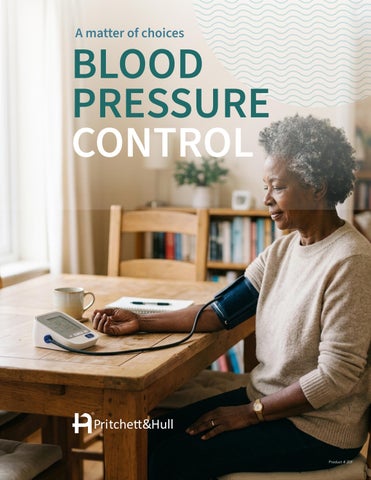
A matter of choices
BLOOD PRESSURE CONTROL
Product # 20F
Order this book from : PRITCHETT & HULL ASSOCIATES, INC. 3440 OAKCLIFF RD NE STE 126 ATLANTA GA 30340-3006 or call toll free: 800-241-4925 Email us at: phsales@p-h.com Copyright© 2027 by Pritchett & Hull Associates, Inc. All rights reserved. No part of this book may be photocopied, reprinted or otherwise reproduced without written permission from Pritchett & Hull Associates, Inc. Published and distributed by: Pritchett & Hull Associates, Inc. Printed in the U.S.A. This book is written to help you find out more about hypertension. It should not be used to replace any of your doctor’s advice or treatment. Throughout this book, where Pritchett & Hull Associates, Inc. was aware of names of products for which a trademark has been claimed, such names have been printed in initial capital letters (e.g., Minute Rice).
Icons used in this book: Special notes and information Caution and warning Fill in with your specific information
Table of contents A matter of choices............................................................................2 What is blood pressure..................................................................3–5 When blood pressure is high...................................................4 Risk factors...............................................................................5 Treatment.....................................................................................6–31 Take medicine.................................................................... 6-11 Eat a heart-healthy diet.................................................... 12-22 Limit or avoid alcohol.............................................................23 Do exercise....................................................................... 24-26 Lose weight............................................................................27 Avoid tobacco smoke....................................................... 28-29 Reduce stress................................................................... 30-31 Taking your own blood pressure............................................... 32-36 How to take your blood pressure.................................... 34-35 You can do it....................................................................................37 Resources.........................................................................................38 Blood pressure chart........................................................................39 Blood pressure treatment plan........................................................40
A matter of choices In the early stages, high blood pressure causes few problems. Since there are few symptoms, most people aren’t even aware that they have it. (That’s why it’s called “The Silent Killer.”) But over time, uncontrolled high blood pressure begins to damage the kidneys, heart, blood vessels, brain and eyes. You can reduce your risk of heart disease and stroke! Make wise choices about medicines, food, body weight, exercise, smoking, alcohol and stress. Play an active role in controlling your blood pressure. Talk with your health care team if you think any part of your treatment is not working. The choices you make determine how well you control high blood pressure and your health.
2
What is blood pressure? Blood pressure (BP) is the force that pumped blood puts on the artery walls.
Systolic pressure Peak pressure in the arteries when the heart pumps blood out to the body.
artery stretched peak pressure (systolic) peak pressure (systolic)
Between heartbeats, the arteries are more relaxed.
Diastolic pressure Pressure left in the arteries after the heart has pumped and is at rest between beats.
artery relaxed diastolic pressure diastolic pressure
3
When blood pressure is high Blood pressure (BP) is recorded with a set of two numbers such as 110/67. The top number (110) is the systolic pressure, and the bottom number (67) is the diastolic pressure. High blood pressure is when two or more BP checks at rest show:
Example: Systolic
• Top number (systolic) BP
110
greater than or equal to 130
Diastolic
and/or
67
• Bottom number (diastolic)
(The 2025 guidelines published by the AHA and the ACC defined normal BP in adults as less than 120/80.)
BP greater than 80
Systolic
Diastolic
Elevated BP
120–129
and
less than 80
Stage 1 Hypertension
130–139
or
80–89
Stage 2 Hypertension
140 and over
or
90 and over
As time goes on, your health care team may adjust your target goal based on how you respond to medication and lifestyle changes.
4
taken
CAUTION Call your health care team right away for any BP reading of 180 or more systolic or 120 or more diastolic.
Risk factors There are many things that increase the risk of having high blood pressure (HBP). These are called “risk factors”. Although some of these things can’t be changed, like your age or family history, others can. From the list below, check all the risk factors that apply to you:
I smoke or am exposed to a lot of second hand smoke. (see pages 28-29)
I am overweight. (see page 27)
I take birth control pills. (Taking these increases a woman’s risk of high blood pressure.)
I could manage my diabetes better.
I have too much sodium in my diet and may not eat as healthy as I could. (see pages 12-22)
I am very stressed. (see pages 30-31)
I don’t get much exercise. (see pages 24-26)
M y cholesterol level is over 200.
I drink more than 2 alcoholic drinks a day. (See page 23 for details on how much alcohol is OK.)
Use the risk factors you checked to help fill in your HBP treatment plan on page 40.
5
TREATMENT–TAKE MEDICINE
Treatment You and your doctor will be partners in controlling your blood pressure. Don’t be afraid to ask questions and be honest with your health care team about what you are doing to improve your BP. This will help determine if and when changes need to be made. Lowering your blood pressure will likely include: • taking medicine • eating a heart-healthy diet, low in sodium, added sugar, unhealthy
fat and with the right number of calories • exercising and losing weight (if needed) • avoiding tobacco smoke • limiting or avoiding alcohol • reducing stress
Medicine Although medicine is often needed to get high blood pressure (HBP) under control, you can expect help from the lifestyle changes you make. Many people can take less HBP medicine when they reach a normal weight, exercise regularly, give up smoking, avoid or limit alcohol and reduce stress in their life. You will be able to see the benefit of making these changes as you check your BP at home (or your doctor’s office).
6
TREATMENT–TAKE MEDICINE
Many HBP drugs relax your blood vessels. Since blood vessels also relax with tub/hot tub bathing and saunas, follow these safety rules: • keep temperature from getting too hot • limit time to 10-15 minutes • don’t drink alcohol at the same time • avoid sudden hot and cold temperature changes • have someone go with you
Keep your BP chart (see page 39) up to date. Write down any major life events as well. As changes occur in your life (moves, marriage, divorce, children, job changes, weight gain, etc.), the added stress may cause a need for an increase in your medicine for a time. When this happens, your health care team may adjust your medicine to keep your blood pressure within the desired range. They may also adjust your medicines based on other conditions you have or your risk for heart attack or stroke.
CAUTION Never change the dose or stop taking your medicine unless your doctor tells you to. And never, EVER take anyone else’s medicine or let anyone take yours!
7
TREATMENT–TAKE MEDICINE
Always take your high blood pressure (HBP) medicine just as prescribed. If there are side effects, be sure to let your health care team know right away. Sometimes side effects go away with time, but anytime you feel dizzy or weak, check your BP and tell your health care team. It may take several weeks to know if a particular drug or drug combination is working. Many people have to try several drugs before finding the right one. You may need one or more of these drugs to control your HBP:
Type of medicine • Diuretics (water pills) • ACE inhibitors • Angiotensin II
receptor blockers (ARBs)
• Beta-blockers
What it does • help your body get rid of excess
salt and water • block the making of a body chemical that
causes arteries to tighten • keep your arteries from being too tight
• slow down your heart rate; help keep your
heart from beating too hard
• Calcium antagonists
• keep your artery muscles from squeezing
• Vasodilators
• relax your artery muscles so they stay open
• Sympathetic nerve
• keep your arteries from being too tight
• Endothelin receptor
• relax blood vessels
• Combined alpha and
• help prevent your arteries from being too tight; help
(also called calcium channel blockers)
too tight
inhibitors
antagonists (ERA) beta blockers
8
keep your heart from beating too fast or too hard
TREATMENT–TAKE MEDICINE
Possible side effects • change in potassium levels, dehydration, high blood sugar, abdominal
cramping, constipation • dizziness, change in potassium levels, coughing, swelling, skin rash
• diarrhea, headache, dizziness, nasal congestion • dizziness, fatigue, changes in sexual desire or function, high blood sugar,
insomnia, depression • dizziness, headache, constipation, stomach pain, drowsiness, nausea,
hot flashes, sore throat, swelling • dizziness, headache, swelling • dizziness, constipation, dry mouth • birth defects, swelling, anemia and liver damage
• high blood sugar
9
TREATMENT–TAKE MEDICINE
Your medicine chart Use this chart to keep track of your medicine(s):
Medicine
When to take
How much to take
What it does
© Pritchett & Hull Associates, Inc., Atlanta, GA Patients and their families may copy this page.
10
TREATMENT–TAKE MEDICINE
Over-the-counter (OTC) drugs People with high blood pressure should not use over-the-counter drugs unless directed by a doctor. Some non-prescription drugs can raise blood pressure by causing blood vessels to become more narrow. These types of over-the-counter drugs may cause problems: • decongestants • cough medicines • supplements or natural medicines
CAUTION Some non-prescription drugs (such as many antacids) are high in sodium. This can raise your BP. Before choosing an over-the-counter medicine, talk with your pharmacist about the sodium content, unless your care team has told you it is OK.
11
TREATMENT–EAT A HEART-HEALTHY DIET
Diet The DASH (Dietary Approaches to Stop Hypertension) food plan* has been shown to help lower HBP. It is a flexible and balanced eating plan that is heart healthy and can be followed for life. The plan includes: • Eating vegetables, fruits, and whole grains. • Including fat-free or low-fat dairy products,
fish, poultry, beans, nuts, and healthy fat oils such as olive. • Limiting unhealthy foods, such as fatty
meats, full-fat dairy products, and tropical oils such as coconut, palm kernel, and palm oils. Avoiding transfats. • Limiting sugar-sweetened beverages and sweets. • Limiting sodium to no more than 2300 mgs per day.
Limiting to 1500 mgs will lower BP more. • Choose foods rich in potassium, calcium, magnesium, fiber, and protein.
Using the DASH food plan • Choose what to eat from eight food groups listed in the left-hand
column of the DASH chart on page 13.
• The Daily Servings column tells you how many servings you can have
from each food group.
• The Serving Size column shows you how much food is in one serving. • Some people taking a diuretic (water pill) are given a potassium
supplement in addition to being told to eat potassium-rich foods. * From the National Heart Lung and Blood Institute at NIH - nhlbi.nih.gov/health-topics/dash-eating-plan
12
TREATMENT–EAT A HEART-HEALTHY DIET
The DASH food plan The daily servings on this page are for a food plan of 2,000 calories per day. It limits sodium to 2,300 mg/day, which can help you control your BP. The number of daily servings that would meet your needs from each food group is based on your age, calorie needs for men vs. women and on how active you are. Adjust the daily servings to meet your body’s needs. Food Group Grains & grain products
Daily Servings
Serving Size
Sample Foods
Notes
6–8
1 slice bread 1 oz dry cereal ½ cup cooked rice, pasta
whole wheat bread, English muffin, pita bread, bagel, cereals, grits, oatmeal, crackers, unsalted pretzels and popcorn
major source of energy & fiber
Vegetables
4–5
1 cup raw, leafy vegetable ½ cup cooked vegetable 6 oz vegetable juice
tomatoes, potatoes, carrots, peas, squash, broccoli, turnip greens, collards, kale, spinach, artichokes, beans, sweet potatoes
rich sources of potassium, magnesium & fiber
Fruits
4–5
6 oz fruit juice 1 medium fruit ¼ cup dried fruit ½ cup fresh, frozen or canned fruit
apricots, bananas, dates, grapes, oranges, orange juice, prunes, raisins, grapefruit, grapefruit juice, mangoes, melons, peaches, pineapples, tangerines and strawberries
important sources of potassium, magnesium and fiber
Low-fat or nonfat dairy foods
2–3
8 oz milk 1 cup yogurt 1½ oz cheese
skim or 1% milk, skim or low-fat buttermilk, nonfat or lowfat yogurt, lowfat and nonfat cheese
major sources of calcium and protein
Meats, poultry & fish
6 or less
3 oz cooked meats, poultry or fish
select only lean meats; trim away visible fats; broil, roast or boil instead of frying; remove skin from poultry
rich sources of protein & magnesium
Nuts, seeds & dry beans
3–5 a week
1½ oz or 1/3 cup nuts ½ oz or 2 Tbsp seeds 1/2 cup cooked dry beans
almonds, filberts, mixed nuts, peanuts, walnuts, sunflower seeds, kidney beans, lentils
rich sources of energy, magnesium, potassium, protein, fiber
Fats & oils
2–3
1 tsp soft margarine 2 Tbsp lowfat mayonnaise 2 Tbsp light salad dressing 1 tsp vegetable oil
soft margarine, lowfat mayonnaise, light salad dressing, vegetable oil (such as olive, corn, canola, or safflower)
DASH has 27% of calories as fat, including fat in or added to foods
Sweets
5 or less a week
1 Tbsp sugar 1 Tbsp jelly/jam 8 oz lemonade
maple syrup, sugar, jelly, jam, fruit-flavored gelatin, jelly beans, hard candy, fruit punch, sorbet, ices
Sweets should be low in fat
13
TREATMENT–EAT A HEART-HEALTHY DIET
Sodium Studies show you can get even lower BP readings if you limit your sodium intake to 1,500 mg of sodium/day. If you are having trouble reaching your BP goal with a DASH eating plan (2,300 mg of sodium), your health care team may ask you to aim for 1,500 mg of sodium/day. This will mean looking at the sodium content on food labels more carefully.
One level teaspoon of salt has about 2,300 mg of sodium.
NOTE: The 2 most common sources of sodium are restaurant and processed foods.
14
TREATMENT–EAT A HEART-HEALTHY DIET
How to buy and fix lower sodium foods • Season foods with fresh or dried herbs,
vegetables, fruits or no-salt seasonings. Avoid soy, teriyaki, Worcestershire and other high-sodium seasonings.
• Do not cook with salt or add
salt to foods.
• Make your own breads, sauces, salad
dressings, vegetable dishes and desserts when you can.
• Eat fresh or unsalted canned or frozen
vegetables. These have less sodium than most processed foods.
Example: Instead of:
Use:
1 cup of canned green beans: 320 mg of sodium
1 cup of cooked, fresh green beans 5 mg of sodium
1 cup of cooked canned peas: 400 mg of sodium
1 cup of fresh, cooked peas: 2 mg of sodium
½ cup of Minute Long Grain and Wild Rice: 570 mg of sodium
½ cup of cooked rice: 1 mg of sodium
Sodium contents of foods from USDA Handbook #456.
• Use low-sodium tuna or salmon when possible. If you only
have oil-packed, break it up and soak it for 3 minutes in cold water. Rinse, drain and squeeze out the water.
15
TREATMENT–EAT A HEART-HEALTHY DIET
Reading about sodium on food labels Food labels will tell you how much sodium is in one serving of the food you are buying. The label will also tell you: • how large a serving size is. (This
should be the same as in the DASH plan. When it is different, stick to the DASH serving size.)
• the % Daily Value. This number gives
you the % of an entire day’s sodium that is in 1 serving of this food.
16
TREATMENT–EAT A HEART-HEALTHY DIET
Fats The type and amount of fat you eat is important if you are concerned about heart health and HBP. The fats most harmful to your body are saturated fat and trans fat. Both can raise your risk for heart attack and stroke. When there is too much cholesterol in the blood, fatty plaque builds up on the artery walls, and the arteries become narrow. If blood can’t pass through a clogged artery to the heart, a heart attack or stroke can occur. You can help prevent this artery buildup by eating less unhealthy fat and only small amounts of healthy fat (olive oil, avocado). The food choices in the DASH plan will help you choose the right foods. Many times a drug is needed to reduce your risk of heart attack and stroke.
17
TREATMENT–EAT A HEART-HEALTHY DIET
How to buy and fix foods on the DASH eating plan • Bake, broil, steam, roast, poach or boil foods. Serve without fatty
sauces. Don’t fry. A vegetable oil spray, used lightly and sprayed onto the food or on the pan, will keep foods from sticking to the pan.
• Cook more fish and poultry (light meat). Limit lean red meats
to less than 3 times a week. Trim off all excess fat before cooking. It’s OK to cook poultry with the skin on, but don’t eat the skin. It contains a lot of fat.
• Buy meats that have less visible fat and marbling (streaks of fat
in the meat). Avoid processed and cured meats.
• Drain all meats on a paper towel after cooking. The towel will
soak up extra grease or fat.
• Season foods with herbs and low sodium bouillon. Do not cook with
saturated fat like butter, lard, ham hocks, fatback, bacon or sausages.
• Cook with small amounts of vegetable oils. Use 1 Tbsp or less per
dish. Make salad dressings with small amounts of monounsaturated or polyunsaturated oil such as canola or olive oil.
18
TREATMENT–EAT A HEART-HEALTHY DIET
Reading about fats on food labels Food labels will tell you how many grams of fat, saturated fat and total fat are in 1 serving. The DASH diet recommends that 30% of your daily calories come from fat, with very little of that from saturated fat.
Nutrition Facts Serving Size 1 cup (228g) of Macaroni & Cheese Servings Per Container 2
Amount Per Serving Calories 250 Calories from Fat 110 % Daily Value* Total Fat 12g 19% Saturated Fat 5g 25% Trans Fat 1.5g Cholesterol 25mg 9% Sodium 650mg 28% Total Carbohydrate 30g 10% Dietary Fiber 0g 8% Sugars 5g Protein 5g Vitamin A Calcium
3% • Vitamin C 15% • Iron
2% 5%
• Percent Daily Values are based on a 2,000 calorie diet. Your daily values may be higher or lower depending on your calorie needs: Calories 2,000 2,500 Total Fat Less than 65g 80g Sat Fat Less than 20g 25g Cholesterol Less than 300mg 300mg Sodium Less than 2,400mg 2,400mg Total Carbohydrate 300g 375g Dietary Fiber 25g 30g Calories per gram: Fat 9 • Carbohydrates 4
•
Protein 4
19
TREATMENT–EAT A HEART-HEALTHY DIET
Potassium The DASH eating plan is designed to be rich in potassium. Shoot for a target of 4,700 mg potassium daily. Eating a diet high in potassium can work alongside your effort to reduce sodium intake to control your blood pressure.
High potassium foods • dried fruit
raisins, prunes, apricots, dates
• fresh fruit
ananas, strawberries, watermelon, b cantaloupe, oranges, grapefruit, kiwi, nectarines
• fresh vegetables
avocados, potatoes, broccoli, greens, spinach, peas, tomatoes, mushrooms
• dried vegetables
beans, peas
• fresh meats
turkey, fish, beef
• fresh juices
orange, grapefruit
• canned juices
grapefruit, prune, apricot
Most diuretics (water pills) cause you to lose potassium in the extra urine that leaves your body. Ask your doctor about potassium if he or she prescribes a diuretic. Do not take a potassium supplement unless one is prescribed.
CAUTION: Some people with abnormal kidney function and those taking a potassium-sparing diuretic don’t need a potassium supplement and are advised NOT to eat large amounts of foods high in potassium. Check with your doctor if you think this may apply to you. 20
TREATMENT–EAT A HEART-HEALTHY DIET
Eating out Eating out doesn’t have to be a problem when you need to eat fewer calories, less saturated fat or sodium. Here are some tips to help you: • Order salad dressings on the side, and put only 1 tablespoon (Tbsp) on
your salad.
• Order fish, poultry or lean meats (light meat); ask that it be broiled,
baked, roasted or poached (without sauces or fat). When you eat red meat, eat smaller portions.
• Order baked potatoes plain. If you use butter or margarine, only use
one pat or less at a meal. Sweet potatoes are a healthier option.
• Order vegetables without sauces or breading. • Have a healthy snack such as a large piece of fruit or a glass of skim milk
before you eat out. This will make you less hungry.
• Choose restaurants that offer healthy options, fresh vegetable side
dishes and substitutes.
21
TREATMENT–EAT A HEART-HEALTHY DIET
Snacks The best snacks for weight and blood pressure control are foods or drinks such as these: • fresh fruit such as a bowl of berries or an apple • raw vegetables and hummus • dips made from hummus or guacamole • popcorn without butter, oil or salt (limit portion size to 3 cups or less) • One Tbsp of peanut or almond butter on a rice cake (sodium content
varies from 35–300 mg per serving)—limit to 140 mg or less each day • low-fat and low-sugar yogurt with granola • unsalted nuts, seeds and dried fruit mix (¼ cup)
22
TREATMENT–LIMIT ALCOHOL
Alcohol Alcohol can raise your blood pressure and cause problems when you have HBP. If you drink alcohol and have HBP you may need to reduce the amount of alcohol that you drink. The risk is the same with beer, wine or liquor and increases with the amount you consume. The best choice if you have HBP is to not drink alcohol at all. If you do drink, women should limit their alcohol to no more than one serving a day. Men should have no more than two servings a day. One serving of alcohol is: • 1½ oz of 80 proof spirits
or 1 oz of 100 proof spirits, or • 5 oz of wine,
or • 12 oz of beer
CAUTION: If you are trying to lose weight, keep in mind that alcoholic drinks add calories that would be better spent on more nutritious options. Alcohol interferes with some BP medicines and can make side effects more intense.
23
TREATMENT–DO EXERCISE
Do exercise Being physically active is important for a strong heart, controlling HBP, managing weight and stress, as well as overall good health. The best activities for your blood pressure are aerobic ones such as brisk walking, jogging and cycling. To help control your blood pressure, it is best to do at least 150 minutes of moderate-intensity aerobic activity per week. Brisk walking or an activity you enjoy five days a week for 30 minutes would meet this. Also include flexibility and stretching exercises as well as two muscle strengthening sessions. According to the American Heart Association, even mild physical activities in 10 minute increments can help you control HBP. These may include: • walking for pleasure • gardening • housework
The most important thing is that you make some type of physical activity a regular part of your life. Plan your physical activity and find an exercise partner to ensure success and make it FUN!
24
TREATMENT–DO EXERCISE
NOTE: Once you have talked with your health care team and have an exercise plan, here are some tips: • T o avoid injury, warm up before you exercise. Then cool down and stretch after you exercise. • Start off slowly. If you aren’t already physically active, you can begin with small amounts of walking, gardening or yard work, for example. • Exercise regularly. It is better to do small or moderate amounts of exercise most days of the week than to go all out only once a week. • Do something you enjoy. It’s harder to keep doing an exercise if you don’t like it. This is why walking is a great choice. It’s easy and can be done indoors or outside. Good shoes and comfortable clothes are the only expense for walking. • Don’t say “there’s not enough time.” It can be hard to squeeze exercise into a busy schedule. But even 10 minutes a day may make a difference in your health. Make exercise a priority and consider it like taking a medicine. • Choose an exercise partner. If you need an extra push, a friend, dog or video exercise program can help you plan and stick to an exercise routine.
25
TREATMENT–DO EXERCISE
CAUTION: Before you begin exercising, talk to your care team.
Muscle strengthening Get approval from your health care team and make sure your blood pressure is controlled before you start. Tips: • Learn and use proper form when lifting to reduce the risk of injury • Don’t hold your breath. • Start with a low amount of weight and gradually increase over time. • Lift lighter weights more times. You can challenge your muscles with
lighter weights by increasing the number of repetitions you lift. • Alternate between upper and lower body exercises
to let your muscles rest during exercise
NOTE: Have an instructor or physical trainer teach you the best weight training routine and how to stay safe while gaining benefit for your health.
26
TREATMENT–DO EXERCISE
My target body weight is
Weight If you are overweight, your health care team will most likely tell you to lose weight. By losing weight, you will decrease the amount of work your heart has to do and make it easier to control your blood pressure. Losing even a few pounds may make a difference! If you are overweight, losing as little as five to 10 pounds may help lower your blood pressure and can be the difference of needing another medicine to control your blood pressure One of the keys to losing weight is reducing calories and portion sizes. On a heart-healthy diet (like the DASH food plan—see page 13), you lose weight slowly without risking your health by reducing the number of servings you have each day. Avoid diets that claim a “quick fix” of fast weight loss in a short time. In the long run, these diets make weight loss harder. And very low calorie diets can be dangerous for some people taking blood pressure medicine. The best weight loss plans also include regular exercise and having a lifestyle in which you are more physically active all the time. Talk to your health care team about a safe exercise routine.
27
TREATMENT–AVOID TOBACCO SMOKE
Tobacco If you have high blood pressure and are also a smoker, your risks for heart disease, lung disease and stroke are much higher. Each cigarette you smoke raises your blood pressure for a number of minutes. Smoking is even more dangerous for women who use oral contraceptives (birth control pills). Tobacco in any form is bad for you. This includes chewing, vaping and e-cigarettes.
NOTE: Your own hospital is a good place to call about a stop-smoking clinic. There are also medicines and nicotine patches to help you avoid withdrawal. Ask your health care team to help you choose a way to quit smoking.
28
TREATMENT–AVOID TOBACCO SMOKE
The American Cancer Society reports that after you quit smoking for: • 20 minutes, your heart rate drops • 24 hours to a few days, nicotine and carbon monoxide levels in your
blood drop to normal • 1 to 9 months, your coughing and shortness of breath decrease • 1 to 2 years, your risk or heart attack drops sharply • 5 years, your risk of cancers of the mouth, throat and voice box
is cut in half • 10 years, your lung cancer death rate is about half that of a smoker.
Your risk of cancers of the mouth, throat, esophagus, bladder, kidney and pancreas decrease • 15 years, your risk of coronary heart disease is back to that
of a non-smoker
29
TREATMENT–REDUCE STRESS
Stress management One way to relax (plan for 20 minutes): 1. Sit or lie quietly in a comfortable position away from interruptions (TV, pets, children, phone, etc.). 2. Close your eyes. 3. Begin to relax each muscle of your body, working up from your feet to your face. Don’t rush. When you feel no tightness, stay quiet and still. 4. Breathe easily through your nose. Become aware of your breathing. Each time you exhale, repeat the word “one.”* 5. When you feel that it is time to come out of this relaxed state, open your eyes slowly. Sit quietly for a minute before getting up.
* This method comes from The Relaxation Response, by Herbert Benson, M.D., with Miriam Z. Klipper, © 2000; available through major booksellers.
30
TREATMENT–REDUCE STRESS
Another way to relax (plan for 20 minutes): 1. Sit or lie quietly in a comfortable place where you can’t be disturbed. In many homes, this is a hard place to find, but do your best. 2. Close your eyes. Take a few slow, deep breaths. As you breathe out, let your body go loose. Breathe slowly and easily. 3. Think of a time or place that was a lot of fun for you. Think about everything that made it fun. Remember the sounds, smells, feelings or people that may have been there. 4. Continue to relax and think of this fun time. If you really lose yourself in this memory, your body will begin to relax. 5. As your private time comes to an end, open your eyes slowly. Lie or sit quietly for a few minutes before getting up. Plan another quiet time for tomorrow.
31
Taking your own blood pressure The American Heart Association strongly encourages home BP monitoring. Ask your pharmacist to suggest a good device (or visit ValidateBP to find a device you can trust) and bring it to your next health care visit to compare readings. Upper arm BP devices are usually best (rather than wrist devices). You should also know that BP: • may be different in each arm,
so after your doctor checks, find out which arm you should use in future readings • is often lower when you
have been asleep • goes up as you wake up
and become more active • can rise in a few seconds due
to sudden stress or pain • can sometimes be higher
in the doctor’s office than at home
When you take your own BP, take it at about the same time each day and in the same place. If you’ve been active, empty your bladder and then rest for at least 5 minutes before you take it. Avoid caffeine, alcohol and nicotine in the 30 minutes prior to taking your BP.
32
Digital blood pressure monitor The most popular type of blood pressure device today is a digital monitor. These are not too costly, and it is easy to read your BP on the small screen.
NOTE: • Compare readings with your digital BP device to those at your doctor’s office to make sure they are accurate. • All digital BP devices come with instructions. Read them carefully before taking your blood pressure. • Store your BP device at room temperature. Extreme heat or cold can cause it to give false readings. • The height at which you hold your arm can affect the BP reading. Keep the arm with the blood pressure cuff at about heart level. Do this by propping that arm on a table, sofa edge or other flat surface. • Make sure the blood pressure cuff you are using is the appropriate size. Ask the pharmacist to help you select the best cuff.
33
How to take your blood pressure Read through these steps before starting. 1. Sit at a table where you can place your arm and equipment comfortably. Make sure your bladder is empty and avoid caffeine, alcohol, exercise or nicotine for 30 minutes before taking your BP. 2. Wrap the blood pressure cuff around your bare arm (not over your clothes) an inch above the elbow. The cuff should fit snugly, but with enough room so that one finger can be slipped under the cuff. Wrap the cuff evenly. 3. Rest your elbow and lower arm on a flat surface so that the upper arm is level with the heart. Stay still and quiet.
cuff snug, but room for a finger under cuff
1 inch above elbow
upper arm level with heart
34
4. Turn the power on. A. I f your device measures BP automatically, press ‘start’ button for the reading and remain still until the device displays the final reading. B. If your device has a rubber bulb, inflate the cuff until it is tight around your arm. After you stop inflating, the machine will display your systolic and diastolic pressure on the screen. Turn or press the exhaust button to release all of the air from the cuff. 5. Turn power off.
read blood pressure numbers here
rubber bulb
35
NOTE: • T aking your blood pressure over clothes or rolling up your shirt or jacket over the cuff can cause false or high readings. • M any machines offer only one cuff size. But cuffs must be large enough to get a true reading. Measure the distance around the middle of your upper arm. If it is more than about 13 inches, you will need a large rather than a standard size cuff. • H ave your blood pressure device checked to be sure it is accurate. Do this when you buy it and at least once a year after that. You can check it at your doctor’s office or at a nearby fire station that has a mercury device. • Y our equipment should be stored with care. If you are not likely to use it for a few months, remove the batteries. Before you use it again, check rubber tubing for cracks or leaks. Make sure the tubing is not twisted. Store it away from heat and dust. • I f you have had breast cancer surgery, always have your blood pressure checked on the side that was not affected.
CAUTION: Call your doctor right away for any BP 160 or greater systolic or 100 or greater diastolic. Report if you have any of these symptoms: severe headache, shortness of breath, nosebleeds or severe anxiety.
36
You can do it As you bring your BP down, stay in touch with your health care team. They need to know your progress and change treatment when needed. Don’t wait until kidney disease, heart attack, stroke, or vision problems prove to you that HBP is serious. Remember the choices you need to make to control your BP: • Take your medicines as prescribed. • Achieve and stay at a healthy weight. • Follow a DASH eating plan and keep sodium to 1,500 - 2,300 mg/day. • Exercise most days of the week and increase physical activity all day • Don’t use tobacco and avoid secondhand smoke exposure. • Limit alcohol. • Reduce and learn to manage your stress.
37
Resources • The DASH Diet Weight Loss Solution by Marla Heller • The DASH Diet for Hypertension by Thomas J. Moore and Mark Jenkins
https://www.nhlbi.nih.gov/health-topics/dash-eating-plan
• American Heart Association Low-Salt Cookbook, 4th Edition:
A Complete Guide to Reducing Sodium and Fat in Your Diet by American Heart Association
• Your Guide to Lowering Your Blood Pressure with DASH
by National Heart, Lung and Blood Institute "Google" the title to download this guide.
• My doctor:
(name) (phone number)
38
Blood pressure chart
My target blood pressure is ______________.
Use this page to keep track of your progress.
Date
Time
Systolic Pressure (top number)
Diastolic Pressure (bottom number)
Comments
© Pritchett & Hull Associates, Inc., Atlanta, GA Patients and their families may copy this page.
39
Blood pressure treatment plan
My blood pressure is .
Check off your blood pressure stage below:
Systolic Diastolic (top number) (bottom number)
E levated BP...................... 120–129.......... and...........less than 80
S tage 1 Hypertension..... 130–139.......... or..............80–89
S tage 2 Hypertension..... 140 or more.... or..............90 or more
Using your risk factors on page 5, ask your doctor to check off the actions he recommends for you from the following list:
40
B egin taking medicine and monitoring BP at home.
L ose ________________ lbs.
S tart the DASH food plan (found on page 13).
CAUTION: Call your health care team right away for any BP reading of 180 or more systolic or 120 or more diastolic.
C ut back on sodium in my food to 1,500-2,300 mg a day.
L ower my cholesterol by eating healthy and taking medicines as ordered.
B e more active. Try to walk 5 days a week.
L imit or avoid alcohol.
S top smoking and limit secondhand smoke exposure.
R educe my stress and learn to relax. (see pages 30 & 31 for suggestions)
Suggested questions It is important to talk with your care team about your HBP. Here are a few questions to get you started: • What is my target BP goal? • Will I always have to take HBP medicine?
• What is a good weight for me? • Which of the DASH calorie diets would work best for me?
1,200 calories
2,000 calories,
1,800 calories
2,400 calories
• What type of exercise should I do and how often?
• Should I limit coffee and high-energy drinks?
• What can I do if I just can’t afford my medicine?
AUTHORS: W. Dallas Hall, MD Professor of Medicine and Director of The Division of Hypertension (Retired) Emory University School of Medicine and Grady Memorial Hospital, Atlanta, GA Julia Ann Purcell, RN, MN, FAAN Clinical Nurse Specialist, Cardiology, 1968–1996 Emory University Hospital, Atlanta, GA Yvonne Payne, RD, LD Thanks to reviewers of previous editions of this book.
3440 Oakcliff Road, NE, Suite 126 Atlanta, GA 30340-3006 1-800-241-4925 www.p-h.com
We believe that you have the right to know as much as you can about your health. Our goal is to give you enough facts to get the main points clearly in mind. We do this with medical accuracy, warmth and humor. The result for you: less tension, more healing and a good idea of what to ask your doctor, nurse or others.
Please let us know how this booklet is helping you (or your patients). Share your comments at p-h.com/20