PALLIUM THE MAGAZINE OF CANTERBURY SCHOOL The Third Centennial Issue: 1965-1990 VOL. 33, NO. 1
Canterbury Core A Society of Alumni Initiative
We are all Saints and we are more than 5,000 strong. We are part of a powerful and lifelong community of alumni. Whether you are across town or across the globe, Canterbury Core offers you a variety of ways to connect with your Society of Alumni. Just as important, it provides you with real opportunities to personally benefit from your alumni network. And whether you have a great deal of time or not very much, there are options that fit your lifestyle, schedule, needs, and interests.
Explore our volunteer opportunities and find your inspiration to become a member of Canterbury Core. For more information contact: Jennifer Loprinzo Director of Alumni and Parent Relations 800.526.1710 | jloprinzo@cbury.org
ADMISSIONS
REUNION
Reconnect with your classmates and become involved in planning your most memorable celebration yet! Provide a strong link between prospective students and the School simply by sharing your knowledge and experiences.
REGIONAL NETWORK
ATHLETIC & AFFINITY GROUPS
MENTORING
Whether you are a well-established professional or just begining your career, you can help fellow Saints in their employment pursuits.
From the hill and beyond, the network of Canterbury alumni reaches around the world.
Go beyond the traditional classroom and interact with those with shared interests or similar Canterbury memories and experiences.
PALLIUM Vol. 33, No. 1
2016
2
Canterbury’s Trustees: 1965-1990
8
Headmasters Sheehan, Reydel, Clarke: 1965-1990
20
By Lou Mandler In Canterbury’s third quarter century, the School saw four Board presidents and three headmasters. They guided the School through economic good times and bad and led efforts to improve programs for students and faculty. By Marc Vanasse ’73 During Canterbury’s third quarter century, three headmasters shaped the direction of the School through tumultuous times. The era brought coeducation, new buildings, and new academic programs to the campus.
The Story of the Canterbury Chalice
Compiled from detailed notes by Thomas B. Haire ’30 To cap the Fiftieth Anniversary Celebration, Thomas Haire ’30, trustee and chairman of the Anniversary Commitee, made detailed arrangements to have a chalice used by Pope Paul VI at a private Mass delivered to Cardinal Spellman’s residence on the same day as the final anniversary event. The arrangements didn’t exactly go according to Haire’s plan.
22
The Faculty: 1965-1990
30
Canterbury’s Campus: 1965-1990
By Wright Danenbarger The author chronicles the contributions of long-tenured “good teachers” who served their students and Canterbury with exquisite precision, demanding rigor, and an indomitable passion. By Bryan Kiefer In Canterbury’s second quarter century, a spate of new construction provided much needed facilities for a growing student body. During the next 25 years, the School continued to build major projects including Nelson Hume Hall, Carmody House, a covered rink, and a field house.
38
The Student Body: 1965-1990
By Lou Mandler In the third quarter century, children of alumni, faculty children, females, and day students comprised a substantial portion of the student body.
42
Student Life at Canterbury: 1965-1990
54
Women at Canterbury
58
68
By Kathy Bolster Milestone anniversaries bookended this period in Canterbury’s history. During the 25 years, the School witnessed perhaps the most significant changes in its history. By Lou Mandler From the beginning, women played essential, if at times invisible, roles in making Canterbury function. Who were these women and what were their contributions?
Athletics at Canterbury: 1965-1990
By Lou Mandler An expanding enrollment and a foray into coeducation called for additional sports offerings, female coaches, new athletic facilities, and produced several team juggernauts.
The Next Issue
The next and final PALLIUM history issue will begin with Cantebrury’s 75th anniversary, which took place on October 6, 1990, and end with the School’s year-long centennial celebration.
Editors: Marc Vanasse ’73, Lou Mandler Photographer, Designer: Marc Vanasse ’73 Cover photo: Front, l-r: Gail Erwin, Sarah Huntington ’75, Jim Cornwell ’75. Back, l-r: Mike Goldthwaite, Kevin Hannon ’75. The photo, taken in the fall of 1971, the first year of coeducation, originally appeared in the 1972 Cantuarian. Corrections: In PALLIUM Vol, 32, No. 1, Photo of the 1928-1929 golf team. Bayard Sweeney was incorrectly identified as Charles Sweeny. Bayard Sweeney Jr. '30 was one of three Sweeney brothers: Bayard, John '32, and George '35. The next generation of Sweeney Cantuarians were Bayard, III '56, Shepard ’57, Kevin '61, and Michael '71. In PALLIUM Vol, 32, No. 2, Kevin Reilly ’68 should have been included as a child of former faculty member and trustee Gene Reilly and his wife Isabelle, also a former trustee.
How to Reach Us
The Pallium encourages its readers to communicate with the School. Mail: Pallium Editor, Canterbury School, 101 Aspetuck Avenue, New Milford, CT 06776 E-Mail: pallium@cbury.org Fax: (available 24 hours a day): 860-350-4425 Call: 860-210-3800 (Switchboard) 1-800-526-1710 www.cbury.org Canterbury School, founded in 1915 by Roman Catholic laymen, is a coeducational, boarding and day school of approximately 320 students, grades 9-12, PG. The Roman Catholic commitment of the School remains central. Canterbury School is a non-profit institution that seeks and admits students of any race, color, national and ethnic origin, and does not discriminate in the administration of its programs and policies.
1
By Lou Mandler
Canterbury’s Trustees 1965-1990 In Canterbury’s third quarter century, the School saw four Board presidents and three headmasters. They guided the School through economic good times and bad and led efforts to improve programs for students and faculty.
I
n 1965, as Canterbury’s third quarter century began, both Henry O. Havemeyer and Francis Carmody died. These two leaders had served as Board presidents for the School’s first 44 years, with Carmody continuing as a trustee until his death. That year, Walter Sheehan was in his 17th year as Head, and had worked closely with Francis Carmody from the beginning of his tenure. Descendants of the founding trustees and early benefactors continued to support the School. Donal McDonnell ’39, Board president in 1965, was the son of Hubert McDonnell, Hume friend and influential trustee during the ’30s and ’40s. James Farrell Jr. ’19 was a trustee for 28 years, from 1950 until 1978, and contributed to the construction of Hume Hall, where the physics lab bears his name, to the acquisition of computers and the construction of new tennis courts and a covered rink. Fortune Peter Ryan ’29, who served for 27 years, beginning in 1948, was a significant benefactor in Canterbury’s second and third quarters. When he retired in 1975,
2
the trustees “voted enthusiastically” to have president Kiernan write to thank Fortune Peter “for his long and able service to the school as a Trustee, and for his help in benefactions without which the past and present progress of Canterbury would not have been possible.” A Carmody was on Canterbury’s Board for 65 consecutive years. Guerin Carmody ’28 and his son Christopher (Kit) ’57 together served a combined 20 years, from 1966 to 1986. Guerin contributed valuable legal advice to the Board both during his brother Francis’s term as president and after Francis’s death. Kit died on August 2, 2016. Gerard Smith ’64 followed his father Gerard Smith ’31 and uncle Gregory Smith ’30 as a trustee and served a total of 30 years. Patriarch John Thomas Smith was the spiritual and financial force behind the construction of the Chapel of Our Lady. Trustee Emeritus Stephen Hume ’43, son of founding headmaster Nelson Hume, served as both secretary and vice president of the Board in the 1980s and provided legal counsel during the acquisition of Hickory Hearth, the Cramer property, and numerous
James Farrell Jr. ’19, a trustee from 1950-1978 and a major contributor to Canterbury School.
A Carmody was on Canterbury’s Board for 65 consecutive years. Guerin Carmody ’28 and his son Christopher (Kit) ’57 together served a combined 20 years, from 1966 to 1986. additional transactions. He was a trustee from 1981-1991 and 19931995. He received the Canterbury Medal in 1997. A member of the Burke family served on Canterbury’s Board for 56 years. John “Jack” Burke Jr. ’41 became a trustee in 1957, a year after his father John Burke Sr. completed his 28 years on the Board. Jack Burke continued as a trustee until 1985; his brother Thomas Burke ’41 also served for four years during this period. Denis Coleman ’63 began his tenure as a trustee in 1979, served actively on the Board until 2002, and is currently a Trustee Emeritus. Coleman and John Duffy ’59 (sixth Board president) were significant leaders and financial supporters of the School during this period. As
In January 1974, two and a half years after Canterbury became coeducational, the Board minutes reported that the members were “desirous of adding two women to the Board of Trustees.” That year, Gwen Briggs, wife of Walter O. Briggs III ‘53, became the second female trustee. 1966-1967 Board of Trustees Donal McDonnell ’39, president John S. Burke Jr, ’41 vice president Frank B. Cavanagh Robert F. Corroon ’40 James A. Farrell Jr. ’19 Thomas B. Haire ’30
Guerin B. Carmody ’28, secretary Walter F. Sheehan, treasurer
John L. Hamilton ’31 May D. Hume H. Wisner Miller Jr. ’30 Thomas E. Murray II ’44
Edward H. O’Hara ’34 F. Peter Ryan ’29 Gerard C. Smith ’31 Richard Joyce Smith
Fortune Peter Ryan ’29 served 29 years on the Board of Trustees and was a significant benefactor.
From a page of the 1967 Cantuarian.
mentioned elsewhere in this issue, Tom Haire ’30 played a crucial role in the 50th anniversary celebrations. Although not an alumnus, trustee Frank Cavanagh married a descendant of James Farrell and was a parent (Frank Cavanagh Jr. ’64, Lisa ’75, and Marcia ’78) during this time. He, too, as mentioned in this and the second Centennial issue, was an influential voice. In January 1974, two and a half years after Canterbury became coeducational, the Board minutes reported that the members were “desirous of adding two women to the Board of Trustees.” That year, Gwen Briggs, wife of Walter O. Briggs III ’53, became the second female trustee. Until that time, May Hume, widow of Nelson Hume, was the only woman on the Board. Rosemary Sinnott, wife of Peter Sinnott ’59 and mother of Peter ’85, joined the Board in 1979. Mary Elizabeth Tucker, daughter of Carlton Hayes, trustee from 1939 to 1949, and mother of four Canterbury graduates, joined the Board in the same year. In the years between 1965 and 1990, Canterbury saw four Board presidents, Donal McDonnell ’39, Peter Kiernan ’40, Vincent Largay ’49, and John Duffy ’59; and three headmasters, Walter Sheehan, John “Jack” Reydel, and Roderick Clarke ’46. When Walter Sheehan retired in 1973, he continued his association with the School as Director of the Fund Drive. At the January 1974 Board meeting, Sheehan was elected secretary of the Board. In this position, he attended Board meetings and occasionally offered advice to Board president Peter Kiernan. For example, in August of 1974 he wrote to Kiernan suggesting hiring an alumnus to take
Rosemary Sinnott, an early female trustee. She served from 1979-1987.
Mary Elizabeth Tucker, an early female trustee. She served from 1979-1986.
3
Peter D. Kiernan ’40 was Board president from 1974-1978.
over the Alumni Office. In April of 1975, he again wrote with suggestions on how to encourage more active participation from the Board. Sheehan retired from his fundraising position in 1977. The issue of coeducation was certainly one of the most profound changes the Board dealt with during this time. In the late ’60s, faculty member Bill D’Alton, father of five daughters, wrote to the Board to suggest they make some provision for tuition at other schools for faculty daughters, because faculty sons received a free education at Canterbury. The Board acceded to this request and to help fund this cause, when Theodore Ryan ’23 sold his herd of Angus cattle in 1969, part of the proceeds went to tuition for faculty daughters. In September of 1968, the Board formed a planning committee headed by Bob FitzGerald ’43. Consisting of Donal McDonnell, Walter Sheehan, David Hume ’45, Toby Smith ’56, and John Duffy ’59, the committee’s discussion topics included day students, co-education, and a summer program. At a December 4
1968 meeting, the committee met with members of the School’s administration and afterwards came out in favor of coeducation. In a letter to Walter Sheehan regarding the recommendation, FitzGerald wrote, “With conditions of education changing so dramatically on all levels, I really don’t think we can afford to hesitate in adapting. The old idea of a preparatory school education as you and I know it, has probably seen its finest day. However, perhaps the preparatory school education of the future, with modifications which may seem drastic in 1968, but old hat by 1978, will provide an even finer educational experience.” The January 1969 Board meeting was devoted to discussing coeducation. One expressed view, “If girls are not added, Canterbury will be far behind in 10 years,” carried the day. Opinions varied on the topic, however. In a letter dated May 18, 1970, George V. Comfort reported to Walter Sheehan regarding his “most constructive meeting” with Canterbury students to gauge their opinions on a number of topics
of concern to them. Regarding the boys’ thoughts on girls attending Canterbury, Comfort wrote“Every boy I spoke to seemed to be very much in favor of having girls attend Canterbury School, possibly starting with just day girls and ending up with boarding students also. This idea is quite a switch from when my boys were there, but I think both for financial reasons and others we might have to bring girls into Canterbury School.” Taking the opposite side, when the question of boarding girls came up a year later, John H. Breck Jr. wrote to Peter Kiernan: “Wally [Sheehan] advises me that the question of boarding girls is a foregone conclusion in the affirmative. I’d like to go on record as opposed to the idea. In my opinion, the consideration of coeducation at Canterbury, or any private school, is due more to fear than philosophy; more to expediency than conviction.” With the majority of trustees and School administrators in favor of coeducation, in October of 1970, the Board voted to change the Articles of Association to include young women, and nine day girls attended Canterbury in the fall of 1971. The following fall, they were joined by 24 boarding girls, mostly students gained by the closing of the Convent of the Sacred Heart in Noroton and Notre Dame of Ridgefield. In a May 14, 1970, letter, trustee Kevin Wait seemed to be also concerned about the School retaining its Catholic identity. He wrote, “There is a prime need for the continuation of Canterbury as the outstanding Catholic prep school.” Sheehan’s response addressed change in general, but emphasized maintaining
The issue of coeducation was certainly one of the most profound changes the Board dealt with during this time.
Canterbury’s essential identity: “In short, I am very proud of what we have been as a school and I hope to see us continue, realizing that changes are necessary in some instances but holding to standards and to the founding ideals.” The Board continued to confront financial challenges. The building boom of the ’60s which included Havemeyer and Carmody dormitories, Hume Hall, and the Alumni Memorial Gymnasium were a boon to admission, to the athletic and academic programs, and an outward sign of Canterbury’s wellbeing and future prosperity. The School’s enrollment increased from 137 in 1957 to 194 in 1960, but in 1970, the School opened with 270 students, the increased number certainly influenced by the improved and expanded facilities. However, the early ’70s were years of poor performance by the stock market, and the recession of that time negatively affected the fundraising efforts of former Head Walter Sheehan in the years after he retired as Head and became Director of the Fund Drive. In October of 1973, Sheehan reported on the slow progress to the Board but philosophically said, “We continue to saw wood and pray.”
Vin Largay ’49 served as Board president from 1978-1983. He received the Canterbury Medal in 2004.
The building boom of the ’60s which included Havemeyer and Carmody dormitories, Hume Hall, and the Alumni Memorial Gymnasium were a boon to admission, to the athletic and academic programs, and an outward sign of Canterbury’s well being and future prosperity… However, the early 1970s… Sheehan suggested dropping the fund goal from three million to two and extending the drive to 1979 instead of ending in 1977. The state of the economy prevented further construction recommended by president Peter Kiernan in August of 1973. As a result, the School put on hold expanding the gym to meet the needs of girls, razing the old chapel and building a small administration and reception building just to the north and east of the old chapel, and constructing a dining hall east of South House (now Carter). The Board frequently discussed how to further cut costs, from selling school-owned off-campus faculty houses to “lopping off a few faculty” to instituting a student work program to save money. Faculty salaries were frozen in the 1971-72 school year. These were discussions borne out of real financial stress. When third headmaster Jack Reydel campaigned for funds for a covered hockey rink, he told one prospective benefactor that the School was still paying off $440,000 in mortgage on the buildings constructed during the ’60s. As a result, the trustees prudently dictated that no new building could
be constructed until 60% of the funds were in hand. In the late ’70s, the School was again in the black and healthy enough to construct Steele Hall and the field house and buy Hickory Hearth and the Cramer property in the 1980s. Trustees worked with headmaster Rod Clarke to establish the Nelson Hume dinners for members of the Hume Society in the mid-’80s. The dinners were initially held in New York City and featured such speakers as Sargent Shriver ’34, founding director of the Peace Corps; Joseph Califano, former Secretary of Health, Education, and Welfare, trustee and parent (Claudia ’88); and Rudy Guiliani, future New York mayor. These have evolved into the Medal Dinners of today. In March of 1985, the trustees presented headmaster Rod Clarke with an original cartoon by a Wall Street Journal artist in appreciation of the capital campaign passing the four million mark. However, in October 1987, the School’s endowment lost $400,000, one-third of its value, on Black Monday, and Canterbury was struggling once again with reducing the School’s debt. The next centennial issue will describe the School’s financial recovery and the greatly increased endowment after 1990. Other schools were also facing financial troubles during the same period, and Canterbury gained
John Duffy ’59 was Board president from 1983-1992. He holds the sign Duffy House, the dorm named in his honor. He received the Canterbury Medal in 1994.
5
6
Trustee Emeritus Denis Coleman ’63, a significant benefactor in Canterbury’s third quarter century. He received the Canterbury Medal in 1995.
Peter Carney ’49, father of former trustee Ed ’79, served on the Board from 1978-1985. He received the Canterbury Medal in 2004.
Charley Clarke ’47, father of current trustee Jay ’84, served on the Board from 1984-1991. He received the Canterbury Medal in 2006.
students not only from the closing of Sacred Heart and Notre Dame but also of Cranwell School in 1975. Changing demographics and a weak economy negatively affected enrollment at all boarding schools during the ’70s. In the fall of 1971, enrollment was down 13 students from the target of 205 boarders, and headmaster Walter Sheehan mentioned that there were fewer applicants and that many students chose to stay at home rather than go away to school. These factors certainly influenced the Board’s decision to institute coeducation and to enroll more day students. In 1986, they approved an increase in the size of the Fifth and Sixth Forms in another effort to maintain enrollment numbers. In 1970, perhaps for the first time in the School’s history, trustees met directly with student groups to exchange perspectives. The five student groups consisted of the student council and a few others. Each group contained five students and three or four trustees. According to a Tabard article (6/13/70) on the meetings,
an “urgent topic was the School’s lack of consideration for art and music.” Students felt “more students should be encouraged to pursue the arts and music…” The Tabard writer also wryly observed that “…students were somewhat surprised to find a very interested and receptive body of men rather than an oligarchy of nasty old graybeards.” By the same token, he reported, many of the trustees were pleased by a real concern and positive attitude rather than apathy on the part of the students. The Board also took up matters of the School’s program and faculty. In 1986, the Education Committee, after a discussion with School administrators, brought to the Board a recommendation to upgrade the School’s grading system to bring it more in line with that of other schools and to facilitate a more positive college admission process. The grading change took place shortly thereafter. The Education Committee also discussed student preparation for SAT exams with school administrators. This resulted in instituting a Kaplan course in
the 1987-88 school year. Later, the committee recommended the School add a 20-hour in-house prep program for all Fifth Formers. Faculty concerns were a topic of Board meetings from time to time. As early as 1967, trustees
In the late ’70s, the School was again in the black and healthy enough to construct Steele Hall and the field house and buy Hickory Hearth and the Cramer property in the 1980s. Trustees worked with Headmaster Rod Clarke to establish the Nelson Hume dinners for members of the Hume Society in the mid-’80s.
In 1986, the Education Committee, after a discussion with School administrators, brought to the Board a recommendation to upgrade the School’s grading system to bring it more in line with that of other schools and to facilitate a more positive college admission process. discussed sabbaticals for the faculty, but the idea did not progress because of a lack of funds. This idea has since been included in long term plans but funding has never been available. However, the budget has included funds for faculty development, and fourth headmaster Rod Clarke was especially supportive of faculty earning advanced degrees. In May of 1985, the first informal meeting between faculty and trustees, a cookout for Board members and faculty, occurred. Gatherings like this have continued to the present. In September of 1985, the Board retained the services of a management consultant, Ocie Adams, to evaluate the administrative structure of the School. After several months of interviewing a diverse segment of faculty and administrators, Ocie recommended reinstituting the position of assistant headmaster and the creation of a Personnel Committee on the Board. Trustee Hope Carter chaired that committee. In December of 1985, after noting that most faculty were over 50 or under 30, the committee’s primary discussion was on retirement for faculty who were approaching 65. Extended medical coverage, housing, and review of pension options were all topics of concern. In 1988, when several senior faculty members
Former trustee Bob O’Connor ’76 presents retired faculty member Jules Viau the Canterbury Medal in 1997. Bob was a trustee from 1985-1999.
In May of 1985, the first informal meeting between faculty and trustees, a cookout for Board members and faculty, occurred. Gatherings like this have continued to the present. retired, the Board resolved to create a faculty emeritus title to be granted at graduation of the year of retirement. They also stipulated that any future emeritus status be decided with the Board’s approval. The Board recommended that Faculty Emeriti be welcome at all meals on campus and receive financial consultant services and medical coverage to age 70. There is no record of this occurring. By the end of the 1980s, with the retirement of fourth Head Roderick Clarke, the Board was faced with the task of choosing Canterbury’s fifth headmaster. Board chair John Duffy and members Hope Carter, Isabelle Reilly, Bob Geigengack ’56, David Como ’63, John O’Neill ’57, Frank Leana and faculty member Jim Shea formed the committee charged with the search. At the same time, a Faculty Advisory Committee, chaired by Jim Shea, was formed on campus. It included Walter Burke, Steve Falcone, Holly Hanes, Lou Mandler, Beth O’Donnell, Guy Simonelli, Marc Vanasse ’73, and Jules Viau. The charge of the committee was “To assist in the process of identifying and appointing the next Head of Canterbury School.” The committee solicited feedback from faculty and students, and Jim Shea reported to the Board. The Board selected four finalists who met with trustees and the School’s faculty. After receiving input from all involved, the Board appointed Thomas J. Sheehy III as Canterbury’s fifth headmaster. He assumed the position July 1, 1990. The School celebrated its 75th anniversary in October 1990, and the next 25 years brought a stable enrollment, a growing endowment, and a dramatically enhanced physical plant. 7
By Marc Vanasse ’73
Headmasters Sheehan, Reydel, Clarke 1965-1990 During Canterbury’s third quarter century, three headmasters shaped the direction of the School through tumultuous times. The era brought coeducation, new buildings, and new academic programs to the campus.
Headmasters Walter Sheehan, Jack Reydel, and Rod Clarke ’46.
8
The Sheehan Years (1965-1973) Canterbury’s third quarter century began with a three-part celebration of the School’s 50th Anniversary: an October Homecoming, a March symposium, and a May banquet in New York City. Planning had begun some seven years earlier. In addition to marking a significant milestone for the School, the golden anniversary served as the catalyst for a commemorative fund drive to strengthen the physical plant and provide an endowment for faculty salaries and student scholarships. Indeed, these events would allow Canterbury to bathe in the warm golden light of everyone who had advanced Canterbury from the untested idea of Henry O. Havemeyer to a full-fledged and successful Catholic boarding school run by laymen. Headmaster Walter Sheehan, the Board of Trustees, and others worked tirelessly to ensure that the anniversary spotlighted Canterbury’s tremendous growth and celebrated the School’s strong foundation for a flourishing future. A front-page story in the October 15, 1965 Tabard promoted the opening event, Homecoming and Parents’ Day, stating: “Canterbury is looking forward to hosting the greatest turnout in the School’s history of alumni, parents and friends for the first event of the Fiftieth Anniversary Year.” The festivities began with Mass celebrated by Fr. Clement Greenan, O.P., school chaplain. Following the ceremony, guests gathered in Alumni Memorial Gymnasium to hear an address by William Sanders, Connecticut’s Commissioner of Education and the father of Bill Sanders ’58. More than two hundred guests returned for the day’s events, which included a noon buffet served under a large tent on the upper athletic fields. The March 28-30, 1966, symposium titled “The Role of the Christian Humanist in an Age of Technology,” included an impressive list of speakers: Donald H. McGannon, Presidnt of Westinghouse; Most Rev. Mark G. McGrath, C.S.C, Bishop of Santiago de Veragues, Panama; and Rev.
“While this year marks the end of our first fifty years, it marks the beginning of what we hope will be an even greater future.” –Thomas Haire ’30, chairman of the Fiftieth Anniversary Committee
named for Francis Carmody. The Carmody graduation prizes recognized achievement in the arts and other creative pursuits at Canterbury. That year, the headmaster awarded two first prizes: one in poetry and one At Canterbury’s 50th Anniversary dinner at the Waldorf-Astoria Hotel in New York for the short story, both given to David Carvin ’66. in May 1966, Headmaster Walter Sheehan receives the Canterbury chalice from Cardinal Spellman. Thus, Walter Sheehan’s vision for a modern school facility was complete. He had realized his plans Roberto Tucci, S.J., of Civilita Cattolica, Rome. It was chaired by Dr. with the assistance of his Board Dumont F. Kenny, President of Queensborough Community College and of Trustees and major donors. As keynoted by the Most Reverend John J. Wright, D.D., Bishop of Pittsburgh. satisfied as Sheehan may have been The culmination of the Fiftieth Anniversary year occurred on May 2, with the many physical additions 1966, when 800 members of the Canterbury family gathered in the Grand to the campus, other changes to Ballroom of the Waldorf-Astoria Hotel in New York City for an elegant Canterbury loomed large, ones that dinner. The Tabard wrote of the event, “The Fiftieth Anniversary year was would send shockwaves through the flowering of the Canterbury Idea and this idea reached fruition that the School’s community and would evening.” Trustee and graduate parent Thomas Haire ’30 (Brett ’67, John challenge the all-male culture upon ’70, Paul ’73,) served as chairman of the Fiftieth Anniversary Celebration which the traditional preparatory Committee. Additional members of the committee included Peter Cashman school had been built. ’55, Canterbury’s Director of Development; trustee Frank Cavanagh; Donal In a letter dated March 1, 1967, McDonnell, president of the Board of Trustees; Walter Sheehan; Gregory to a former Deerfield colleague, B. Smith, trustee and son of early school benefactor John Thomas Smith; Russ A. Miller, a history teacher and and Richard Joyce Smith, parent (Peter ’52, Tim ’54, Toby ’56, Andrew ’59, administrator, Sheehan argued that and Will ’63). Haire, in his report on the year’s celebration, stated: “We a revolution in American education have given this year of celebration the slogan “Fifty Years of Preparation had taken place in the early 1950s for Tomorrow.” He continued, “While we are glad to have survived and at the college level and had come to have been able to build as well as we have in the past fifty years, down to the secondary and primary we have done so primarily to prepare ourselves for whatever tomorrow schools by the late 1960s. He stated holds. While this year marks the end of our first fifty years, it marks the that forces such as Sputnik, the beginning of what we hope will be an even greater future.” computer, and new procedures in On February 18, 1966, Walter Sheehan announced to the student science, “conduced to a re-thinking body that the Board of Trustees had approved plans for Nelson Hume of our whole educational process, Hall, a combination of classrooms and an auditorium. The new building one that goes on today and will would allow the School to continue to grow student enrollment and continue for an unforeseeable expand facilities. time.” He concluded: “All of them Construction of Carmody Hall, the fifth and last structure of the building led, finally, … to a challenging program of the early ’60s, began in the fall of 1967, was scheduled for of concepts and authority, to a completion by the start of the 1968-69 school year, and was blessed by demand for independence, in Fr. Clement Greenan, O.P., on October 5. A residence for 50 students and study, in use of time, in haircuts, three faculty members, the building was named for past Board President and in mores, and to a search for Francis T. Carmody ’25. At the dedication, Edward T. Carmody ’22, the works or movements upon which brother of Francis, addressed the assembled guests. to expend their idealism. It is a At graduation in 1966, Mr. Sheehan inaugurated the Carmody awards, vastly different world for them and
9
for us as parents and educators. I am sure we all have to change our thinking to meet it.” These three words, “change our thinking” proved to be more challenging to Sheehan than perhaps he ever imagined and would force him, his administration, and his faculty to adapt the School’s programs to an increasingly activist student body. By the spring of 1968, the “revolution” to which Sheehan had referred had not reached the school on the hill. As Sheehan explained in a report to alumni and parents, “By their nature boarding schools are more controlled environments than universities, and for this reason our campus is not plagued by incidents which reflect a mood of rebellion against authority or, all too often, just plain bad manners or a lack of patriotism. It seems to me, however, that one of our tasks today is to find free time for our students to use constructively. We have to help them to a knowledge of selflessness, to an understanding of what responsibility entails, and to the realization that discipline and respect for authority are vital to community, state and national life. They must be convinced of the dangerous potential of marijuana and other narcotics, and they must have the independence of mind and heart to say ‘No!’ when opportunities are presented, as they will be sooner or later, judging from conditions all over this country.” To address the use of illegal drugs on campus, Sheehan appointed faculty member John Martiska the School’s unofficial “drug czar.” He was tasked with educating the faculty, particularly the “old guard,” on such matters as what marijuana smelled like and how to respond to students under the influence of a variety of illicit substances. Pandora’s box could no longer contain the mighty currents of social change, and thus the lid was blown off. Canterbury, like all schools of its kind, continues to deal with such matters and realizes that there is no permanent solution. Pro-active programs to curb student drug and alcohol use are ongoing. Certainly, today’s student body is 10
Pandora’s box could no longer contain the mighty currents of social change, and thus the lid was blown off for decades to come. Canterbury, like all schools of its kind, continues to deal with such matters and realizes that there is no permanent solution. Pro-active programs to curb student drug and alcohol use are ongoing. more socially conservative and less likely to challenge the School’s policies. In his correspondence from the late 1960s, Walter occasionally bemoaned that the boarding school, as he had always known it, was succumbing to what he considered to be an assault on the nation’s traditional values. In April of 1969 he wrote to Arthur S. “Arch” Williams Jr., a Deerfield friend, “Boys are a very different breed of cat from what they were up until three years ago, and they are just not content with doing things the way their predecessors have done them. Actually, I have found that they make us examine a number of our traditions and our ways of doing things, which, when you come right down to it, do not have too much sense.” Writing to his son Peter, a teacher at St. Paul’s School, in 1970, Walter confides: “Several of my friends are retiring from their headmasterships to go into a different kind of work, and while they feel that young people today are very idealistic, they also feel that they are very selfish and want instant gratification, regardless of
obligation or regardless of anybody else with whom they might be connected, and certainly any adult… So, all in all, it is a very interesting time, and the only scary thing to me is the drug culture, which has got so strong in the cities and which will inevitably spread to all the private schools in a far greater degree, I believe, than we have known to date.” The anti-establishment movement of the late ’60s and early ’70s affected the longstanding traditions of private schools. At Canterbury, yearbook staffs began to abandon the information-filled traditional annual in favor of a freestyle approach. For a number of years, students ceased to organize their senior prom. In 1971, Sheehan approved a casual dress code; off came the coats and ties and on went the jeans and open-collar shirts. Six years later, during the Reydel years, the formal dress code was reinstituted. In the fall of 1968, Canterbury’s Board of Trustees took up the matter of coeducation vs. coordinate education (i.e. separate campuses for boys and girls). To test the waters, the School sent up a trial balloon when they invited eight girls from the Convent of the Sacred Heart School in Noroton to spend a week on campus in October of that year. Canterbury invited Noroton to visit again the following year. Simultaneously, the Board asked Bob FitzGerald ’43 to lead the Canterbury Planning Committee to investigate a variety of school issues, including the feasibility and practicality of coeducation at Canterbury. Following a December 1968 meeting of the committee, FitzGerald stated in a letter to Sheehan: “The consensus of the Committee at this stage appears to be almost unanimously in favor of some form of coeducation.” Although not all Board members were in favor of going coeducational, at the Board meeting of May 13, 1970, the trustees voted to approve the admission of female day students in September of 1971. Sheehan’s correspondence on
matters of admitting girls reveals he was lukewarm about, yet resigned to, Canterbury becoming a coeducational school. He expressed in a letter to May Hume, widow of Nelson Hume, “I cannot say that, philosophically, I am for having girls at Canterbury, but David [Hume ’45] and so many of the young alumni are convinced that it is the way of the future that I do not think we should be adamant in regard to the possibility.” On admitting day girls, he became more supportive. “By taking day girls, we are not hurting ourselves financially, which we could not afford to do anyway, and we can see how this goes as an indication of what the future might be like.” As the Board discussed admitting boarding girls for the 1972-73 school year, trustee Peter Ryan ’29 suggested that the Sheehans do due diligence by visiting Berkshire and Taft Schools, both of which had taken in boarding girls in September of 1971. Their visits took place on November 9, and three days later Walter Sheehan released a summary of their findings titled “Headmaster’s Report on an Examination of the Arrangements for Boarding School Girls at the Berkshire and Taft Schools.” In the first half of the report, Sheehan describes how each school managed such areas as rooming, infirmary, meals, athletics, social life, scholastic life, and a section called problems. Administrators at each school provided the Sheehans suggestions should Canterbury’s trustees vote to go ahead with accepting boarding girls at their December 1971 meeting. Some of their recommendations included appointing a woman, not a separate dean, to be in charge of the girls; not to merge with a girls’ school, and to have “small brochures set and ready to be printed, so as not to lose valuable time after the announcement is made, should the decision be for 24 boarding girls.” At their meeting on December 16, 1971, the Board of Trustees decided to admit boarding girls. The decision came after two years of discussions by a committee of alumni, faculty, and parents. In addition, Peter D. Kiernan ’41, president of the Board, surveyed the current parents and three alumni classes of various eras to gauge their reaction to the possibility of boarding girls. The results of the survey were mixed, from strong enthusiasm for the idea to a desire to see Canterbury remain as it had been. After considering all opinions and suggestions, the Board decided to proceed in the firm belief that adding boarding girls was a natural and desirable development. Sheehan concluded that admitting boarding girls was feasible, because it would have only a minor impact on the operating budget. In addition, he was certain the School would not have to create duplicate facilities for the girls, and it could hire women teachers to coach, teach dance classes, and oversee other athletic activities. In 1972, the closing of the Convent of the Sacred Heart of Noroton, CT, a boarding and day girls’ school, and Notre Dame of Ridgefield, CT, proved a boon to Canterbury’s chances of launching a successful boarding girls program. The Board’s plan called for admitting a maximum of 24 boarding girls as a first step. The plan also stated that the girls would live in faculty houses, including the headmaster’s. This never came to pass as the girls were housed in Havemeyer Hall. Mrs. Sheehan was to be in
Although not all Board members were in favor of going coeducational, at the Board meeting of May 13, 1970, the trustees voted to approve the admission of female day students in September of 1971.
In the fall of 1972, Walter Sheehan coached the girls’ soccer team. He is pictured here with Casey Kiernan ’74 and Laura Burke ’74.
charge of the girls, with assistance from Gilda Martin and Kim Smith of the faculty. John Martiska and Gerry Vanasse supervised the girls in the dorm, with help from Kim, who was given two dorm rooms closed off by a folding door at the end of the hall. She shared the hall bathroom with the girls. In January of 1973, she married John Niles ’68, a former Canterbury English teacher and currently on the executive committee of the Society of Alumni. Although Sheehan coached boys’ basketball and soccer while the School was all-boys, he ventured into the world of coaching girls’ soccer during his final year as headmaster. Kristin Kathe Hughes ’73, who was a member of the team, says of her coach, “Mr. Sheehan expected a lot from us, but he was very kind and very proud of us. He was trying to find a balance for us. We were not used to the long practices. While I was at Noroton, we practiced half the time each day.”
11
Sheehan’s interactions with students and faculty were inimitable. He could use his pet words and phrases to either humorous or devastating effect. I recall as a student that at many school meetings he would admonish us to “Please keep off the grass, boys.” Was he warning us to stay off the newly planted seeds or was he warning us about other things? He would usually punctuate his admonitions with a few taps of the back of one hand into the palm of the other. Many teachers who served under Walter have told me he had a very formal relationship with his faculty. They always called him Mr. Sheehan, never Walter or Twit, a nickname he acquired as a boy and which was reserved for his close Holyoke friends. JP Mandler, who served under Sheehan for three years, recalls a few stories that illustrate Walter’s style. In a talk to the student body at a school meeting, he said, “The other night, I called Havemeyer Hall, and a boy answered, ‘Havemeyer Zoo.’ Well, I have nothing against zoos. San Diego has a wonderful zoo, and Benton (Smallpage), isn’t the New Orleans Zoo great? Boys, ‘Havemeyer Hall, not Havemeyer Zoo.’” “After he dismissed a student, he would announce at school meeting, ‘Boys, as you may have heard, Joe (or whatever the name) stubbed his toe on a can of beer this weekend, leaving us no option but to send him home.’” JP continues, “It was a Sunday before the noon meal. Mr. Sheehan approached Jack Graney and swung his arm in the arc of a golf swing, and asked, ‘Jack, how’s your driving these days?’ To which Jack, expecting to be invited to join him at Waramaug Country Club later that afternoon, said, ‘Great!’ And then Walter fished the keys to the school wagon out of his pocket, ‘Good. Then you can pick up Joe Shmoe in Brewster. He’ll be on the 2:10.’” Such stories were par for the course with Walter. Because of the Sheehans’ many years of commitment to Catholic causes, Cardinal Spellman invested them as knight and dame into the Order of the Holy Sepulchre on September 9, 1967, at Saint Patrick’s Cathedral. The organization is a Roman Catholic order of knighthood under the protection of the Holy See. The pope is sovereign of the order. It traces its roots to circa 1099 under the Frankish Duke Godfrey of Bouillon, Advocatus Sancti Sepulchri, “Defender of the Holy Sepulchre,” one of the leaders of the First Crusade and first ruler of the Kingdom of Jerusalem. It is the only medieval order of chivalry, together with the Sovereign Military Order of Malta, that is recognized and protected by the Holy See. Proud of his and Lynn’s investiture, he wrote to his friend Edward C. Connelly Jr., “Our cup of happiness was fuller when we were invested.” In their years at Canterbury, Walter and Lynn Sheehan maintained many loyal friendships, ranging from Walter’s connections at Deerfield, Williams, and friends in Holyoke to new friends in New Milford. Their social circle expanded when they joined Lake Waramaug Country Club. Excellent golfers, they both played golf often and sometimes competitively. They counted the actor Frederick March and his wife Florence and the renowned etcher Philip Kappel, all of whom lived locally, as friendly acquaintances. Kappel wrote to Sheehan about Sheehan’s impending hip surgery, saying, “When you were here with Lynn a few months ago you said you were going to Boston for surgery. I forgot when you said you made arrangements for going but I hope someone will let me know so that I may keep in touch with you. Uppermost in mind is that in the end you will be able to have freedom from pain.” Both Sheehans played active roles in New Milford’s civic affairs. Walter was a trustee of New Milford Hospital and an incorporator of the New Milford Savings Bank. Lynn served terms as president of the New Milford Hospital Auxiliary and secretary of the New Milford Garden Club, a member of the Board of Governors of Lake Waramaug Country Club, and a member of the St. Francis Xavier School Guild. Sheehan had several surgeries during his headmastership, but none as significant as his hip operation. He planned to have the replacement 12
Walter and Lynn Sheehan.
surgery in late May or early July of 1971 so that he could be recovered by the start of school. In a letter to Julianne Linehan of Ireland, dated January 5, 1971, he states: “I am going to have the hip operated on this spring, perhaps in late May, for it has deteriorated through the years and the X-rays show that I do need to have the job done.” The surgery took place on May 18 at Boston’s New England Baptist Hospital. Given the scheduling of the surgery, he would not be able to officiate at graduation. To assure a smooth temporary transition of leadership, the Board of Trustees, at its May 1 meeting, appointed Jim Breene assistant headmaster to run the School in Sheehan’s stead and to continue serving in that capacity the following year. In a letter dated September 3, 1971, Sheehan writes to the Honorable Marc L. Filley, “I can report that the hip surgery last May was successful, and that I am coming along very well. I expect to be off crutches within a few weeks, and the doctor has assured me that I shall be able to play golf next spring.” During the 1972-1973 school year, Walter announced his retirement effective June 30, 1973. He stated: “Leaving will be a wrench for us after twenty-five years, which have been busy and exciting and, I believe, productive
ones for Canterbury. I am sure the new Headmaster, whoever, he may be, will carry on the aims and ideals of the School in full measure.” He and Lynn moved to a home on New Milford’s Marwick Manor, a short distance from their Canterbury residence. From there Walter would, for the next four years, serve as the School’s Fund Drive Director. The Sheehan’s oldest child, Peter, a Deerfield Academy and Williams College grad, taught English at two independent schools before serving as a vice president at New Milford Savings Bank. He predeceased his brother Kevin in 2007. Kevin Sheehan ’62, the Sheehans’ middle child, worked at Cummins Engine for 20 years before he joined CID Venture Capital as a partner. He served the School as a trustee from 2003-2012 and Board secretary from 2004-2012. Kevin was the commencement speaker in 2006. Upon his retirement from the Board, he was named a Trustee Emeritus. A generous Canterbury benefactor (Sheehan Baseball
Late in his tenure, Walter Sheehan, with his signature notepad in hand, presides over a school meeting in Maguire Auditorium.
Walter Sheehan and his successor Jack Reydel in front of the Headmaster’s residence in 1973.
Field, Walter and Lillian Sheehan Endowment for Faculty), he died on April 16, 2014. His son Tim is a 1994 Canterbury graduate. The youngest Sheehan, Monica Sheehan Bennett ’73, remains an active member of the Canterbury family, attending many of the School’s major events. After working at Viacom for seven years, she worked in banking, including a stint as a vice president at Mitsubishi Bank. For the past ten years, she has been a medical billing collection specialist at Tufts Medical Center. In Sheehan’s 25-year career as Canterbury’s second headmaster, he oversaw a major expansion of the campus and left other indelible imprints on the school he loved. After a battle with Alzheimer’s, Walter Sheehan died on October 23, 1993. Lynn predeceased him in 1991. In a tribute printed in the fall 1993 PALLIUM, Jules Viau, a then faculty member and fellow Holyoker, wrote, “No longer will we hear Mr. Sheehan’s hearty ‘How goes the battle!’, his conclusive ‘Carry on!, or his
favorite valediction, ‘Peace!’ He strove mightily indeed for the faith handed down to the saints, just as he devoted himself to his ‘boys’ and ‘girls’, and for the ’saints’ of Canterbury School.” The Reydel Years (1973-1978) At the Board of Trustees meeting on October 11, 1972, Board president Peter D. Kiernan ’41 read a letter to the members in which Walter Sheehan had asked that his resignation as headmaster be accepted effective June 30, 1973. According to the minutes of the meeting, “After twenty-five years at the School, he [Sheehan] felt it was time for a new man to take over while he would like to continue his activities towards raising funds for the School.” On motion duly made and seconded, the members accepted Sheehan’s resignation. The Board then formed a search committee headed by Kiernan. The group included trustees John S. Burke, Jr., William W. Higgins, Donal McDonnell, and Walter Sheehan. After a search that lasted
13
The Reydel family. Bradley, Amy, JJ, and Jack.
four months and screened 25 candidates, Sheehan announced to the students and faculty on February 1, 1973, that John J. “Jack” Reydel would be his replacement as the third headmaster of Canterbury School. Upon Jack’s appointment, Sister Carmody of the Stuart Country Day School of the Sacred Heart in Princeton, a sister of Fran, Eddie, and Guerin, stated, “Jack is just a fine Catholic gentleman.” Immediately prior to assuming his duties as headmaster at Canterbury, Reydel had spent 17 years at The Lawrenceville School, where he had served as housemaster, head varsity football and baseball coach, and chairman of the History Department. Before that, he had taught at The Hill School. After service in the U.S. Marine Corps in Korea, Jack received his Masters degree in Education from Harvard. He was a recipient of a Coe Fellowship in American History at Stanford University and an Asian Fellowship at the East-West Institute of the University of Hawaii. Born in Westfield, NJ, Reydel graduated from Princeton University in 1951. In the summer of 1973, Jack and his wife Bradley and their two children, JJ and Amy, moved into the headmaster’s residence. Reydel inherited a School in the midst of great social and cultural change and in need of major upgrades to its physical plant. To address the student body, many of whom embraced a non-traditional approach to life, Reydel moved to bring back social order. In 1977, he brought back the School’s traditional dress code, which had been relaxed during Sheehan’s final years as headmaster, and added Saturday classes to stem Friday night student shenanigans. In August of 1973, Jack and the Board began to lay the groundwork for a new capital fund drive of $3,000,000 to remedy the deterioration of North, Middle, and South Houses, expand gymnasium facilities to support the needs of girls, and construct a new hockey rink. They also voted to support the concept of allocating approximately $1,000,000 for endowment purposes to provide a base for supporting both debt service on existing structures and to provide additional needed funds for support of faculty salaries and scholarship aid. To benefit teachers, Reydel expanded the faculty’s retirement fund from a small private 14
endowment to TIAA-CREF, which continues to manage the School’s retirement plan. (Now called TIAA.) The fund drive also called for the construction of a centralized administration and reception building, and a new one-story dining hall and food service building. Owing to an ailing economy at the time, the fund drive progressed slowly in 1974 and 1975. Of the drive’s wish list, only a new rink, opened in 1976, and the rehabilitation of North House, completed in the fall of 1978, were realized. Jack worked tirelessly to bring a new hockey rink to campus. In a letter to the trustees, dated March 1, 1974, he described the present state of the rink located on the north side of the gymnasium. “It is simply no longer usable. The pipes have eroded. The boards are splintered. The compressors have broken down and the Zamboni has not worked all year. We played no home games at Canterbury this year and had no varsity practices here. Our home games were played on The Gunnery rink where we had to buy ice time (at $30.00 an hour) even to practice. In fact, there is no Canterbury rink.” In the letter, he cites the effects of no rink on the athletic program, school morale, and admissions. “We have seen a number of potentially outstanding prospects for Canterbury next year. A number of them play hockey. They will not come to us and many others don’t even bother to apply… I feel it is of the highest priority that we direct our attention to raising money for the rink as a project to begin as soon as possible.” In a letter to Gerard C. Smith ’31, dated April 22, 1975, Reydel explains to Smith, “We have really been hurt this year in admissions because we lack a rink.” Athletic Director and Varsity Hockey coach Charlie Huntington also forcefully argued the case for a new rink, which would be a plain but adequate indoor hockey facility. His contribution consisted of preparing a detailed estimate/ report by which the School could feasibly build a covered
Reydel inherited a School in the midst of great social and cultural change and in need of major upgrades to its physical plant. To address the student body, many of whom embraced a non-traditional approach to life, Reydel moved to bring back social order.
Walter Sheehan serves as emcee of a fundraising dinner in North House Dining Room in the 1960s. At the dias, l-r: Frank Cavanagh, May Hume, unidentified, Francis T. Carmody, unidentified, Lynn Sheehan, Walter, unidentified, Donal
PORTRAITS BY PIELLI
rink for approximately $249,733, considerably lower than original estimates of between $300,000$500,000. His report echoes Reydel’s rationale for the new building. “…it is worth noting that a new rink at Canterbury would result in benefits far beyond a winning varsity hockey team— practice for lower teams, higher student body morale and pride in the school, easier enrollment of both boarding and day students, and an improved image in the local community.” After years of fundraising, pledges and gifts totaling more than $250,000 had accumulated for the new rink, and Reydel and Huntington’s dream had been realized. The rink opened on November 13, 1976, with the first varsity hockey game held on December 1. The School now had a rink of which it could be proud. During the Reydel years, sports enjoyed a resurgence. He firmly believed that admitting talented athletes would enhance the School’s reputation and result not only in winning teams but also a larger student body. His strategy had its intended results. Wrestling and cross-country, in particular, boasted strong winning seasons. In the winter of 1973, Canterbury
Jack Reydel addresses guests at a fundraising event. Lynn Sheehan in the background.
hosted its first wrestling invitational. Boys’ and girls’ varsity soccer teams finished on a high note. Varsity Basketball, led by captain Bob O’Connor ’76, finished their season with a record of 17-3. In the spring of 1974, four new tennis courts, a gift of James A. Farrell Jr., expanded the School’s athletic facilities. In 1975, the relatively new Boys’ Varsity Lacrosse team, led by Larry Turkheimer and captain John Sargeant, won its first league title
with a record of 11-1. On August 9, 1978, Jack Reydel wrote to Board President Vin Largay ’49, “After five full years at Canterbury, Bradley and I have decided to leave New Milford. These years have been exhausting but also very rewarding, in so many ways. The desire to return to the classroom has never been far removed from my mind.” In her book Canterbury School: the First Ninety Years, Kathy Bolster
15
MA and Vero Beach, FL. Jack’s son JJ has taught at Tabor Academy for many years, and daughter Amy lives with her husband Tom and their two children in Buffalo, NY. She recently reminisced about her halcyon days at the School. “My best years were at Canterbury. I have lots and lots of fun memories. I had a great childhood!”
Headmaster Rod Clarke with faculty children, l-r: Mark Simonelli ’99, Matt Kiefer ’99, Christian Mandler ’99, and Jesse Kiefer ’99.
summarizes Reydel’s contributions. “In his short tenure, he presided over the increase in the female population at Canterbury, the institution of Saturday classes, a return to a formal dress code, and great achievements in interscholastic athletics. He greatly expanded the community service program, with students regularly visiting the local nursing home, day-care center, and Southbury Training School. Canterbury’s finances were in the black, with enough funds to renovate North House and construct a new hockey rink.” After his resignation as Canterbury’s third head, Jack became Chairman of the History Department at Germantown Academy in 1979. He received several grants to study in Korea, and remained involved in sports, especially hockey and baseball. He has been inducted into St. George’s and Lawrenceville’s Athletic Halls of Fame. Bradley Reydel passed away in 2005. Jack remarried Jill Gerald, and they divide their time between Marion, 16
The Clarke Years (1978-1990) Born on April 14, 1928, in Utica, NY, to Brian Warner and Mary Baker Clarke, Roderick Clarke ’46 arrived at Canterbury as a Third Former in the fall of 1942 and, by his keen intellect and friendly personality, quickly became a class leader. His page in the 1946 yearbook states: “President of the Sixth Form during the Winter Term, Rod Clarke is probably the most respected member of the Senior Class.” During his four years at the School, he absorbed its traditions and culture, which would serve him well when he returned to teach history in 1954, after having received a BA in History from Amherst College in 1950 and teaching for two years at the Solebury School in New Hope, PA. In 1957, Walter Sheehan appointed Rod Director of Studies and, soon after, College Counselor. His “jolly” personality endeared him to many alumni, parents, faculty, and students, and his love of European history and its complex family lines made him a natural genealogist concerning the interconnectivity of Canterbury’s legacy families. Simply stated, he came to know more about Canterbury’s alumni body than anyone else associated with the School. Rod’s ascendency to headmaster was unorthodox. Shortly after the Reydels left campus in the summer of 1978, rumors swirled as to who would succeed Jack. The name most often mentioned was Rod Clarke, but no one could confirm the rumor. While I was visiting Rod at his Elkington Farm Road home one evening in early August, he asked me if I would consider taking over the duties of Director of Studies, a role he had filled for
decades. Although an unlikely and inexperienced candidate for the job, I agreed. It was clear to me then that Rod was going to be Canterbury’s next headmaster. My hunch became concrete when on August 21 Board President Vin Largay stated in a letter to the Canterbury constituencies: “At our meeting of August 9th, the Board of Trustees unanimously appointed Roderick Clarke, a distinguished Canterbury alumnus, dedicated teacher, and presently Director of Studies, as acting Headmaster at Canterbury for the 1978-79 school year. The Board appointed a Search Committee to search for and secure a worthy successor as headmaster to Mr. Reydel. The five trustees (Vincent B. Largay ’49, Daniel J. Altobello ’59, John S. Burke Jr. ’41, Philip A. Faix Jr. ’54, and Peter D. Kiernan ’40) serving on the Committee will be assisted in this search by Frank R. Miller of Carl Andrews Associates, a distinguished educational consultant.” Three months after he sent his August letter, Vin Largay came to campus to announce to the student body and faculty the
Anyone who knew Rod, knew that he was a Renaissance Man. There was practically no subject on which he could not contribute a carefully considered opinion, and Rod had plenty of opinions. In particular, Rod loved music and art, and these passions translated into his commitment to expand academic offerings in and facilities for the Fine Arts Department.
result of the committee’s work. He explained that after an exhaustive search for Canterbury’s fourth headmaster, “all roads led back to Rod Clarke.” I recall that Rod’s permanent appointment as headmaster was received exceedingly well by the Canterbury family and sent a signal to all connected to the institution that Rod would bring positive change to the School, particularly in the academic arena. According to Kathy Bolster’s history of Canterbury (1915-1990), Rod instituted the practice of formal faculty evaluations and encouraged teachers to earn their Masters degrees. With the help of his department chairs, he was not afraid to “counsel out” less skilled teachers. He strengthened the Theology Department by hiring two additional teachers, Margaret Mitchell and Brendan McCormick. Anyone who knew Rod knew that he was a Renaissance Man. There was practically no subject on which he could not contribute a carefully considered opinion, and Rod had plenty of opinions. In particular, Rod loved music and art, and these passions translated into his commitment to expand academic offerings in and facilities for the Fine Arts Department. He hired the first full time faculty member, Paula Padula, to teach vocal music. In 1979, Chorale became a course for credit. When the School opened Steele Hall in 1984, it contained not only consolidated administrative offices but also a new library and dining room. Two years later, the former Old Schoolhouse library was converted into the School’s first music classroom and practice space, and the North House dining room was transformed into The Edward J. Duffy Family Art Center, complete with light-filled classrooms and an exhibition space. As a result of these new facilities, enrollment in music and art classes grew tremendously. In 1975, faculty member Jack Graney organized a concert series for the school community and the Town of New Milford. After Jack left Canterbury to teach at Deerfield, the series morphed into Music at Canterbury, which premiered on November 3, 1978. Led by Rod and a committee of townspeople, the organization’s premiere season featured the Concord String Quartet performing in the School’s Chapel of Our Lady. The concert featured pieces by Josef Haydn, Ben Johnson, and Antonin Dvorak. Rod exercised his influence on Canterbury’s music program by adding instrumental courses to the curriculum several years after vocal courses were first added. Dave Overthrow, a well-known and respected bassist, began teaching private guitar lessons in 1984. In 1996, he became a faculty member, and since that time, has directed Canterbury’s instrumental program. In May of 1982, under Rod’s leadership, the School hosted a symposium entitled “Challenges to Leadership: Seeds Which Produce Responsible Decision Making.” Its purpose was to raise awareness among graduates and friends of a new capital campaign to seek funds for the construction of Steele Hall. To chair the event, he tapped Gerard C. Smith ’31, the chief U.S. delegate to the Strategic Arms Limitation Talks (SALT) in 1969 and the first U.S. Chairman of the Trilateral Commission, and Sargent Shriver ’34, the first Peace Corps Director, U.S. Ambassador to France from 1968-1970, and a vice presidential candidate in 1972. The event featured some of the most known figures in education and politics of the time. Forty-sixth president of Georgetown University, Timothy S. Healy, S.J., spoke on “The Religious Basis for Leadership.” Dr. Robert Goheen, President Emeritus of Princeton University, spoke on “The Importance of a Liberal Education.” William R. Hearst III ’67 introduced headmaster Clarke, who spoke on the role of secondary education in developing leadership. The daylong event, attended by students, alumni, and additional guests, concluded with a speech on “Choices in Foreign Policy” presented by Connecticut Senator Christopher Dodd. In 1983, Rod and Director of Development Peter O’Donnell ’70 commissioned graphic designer and parent Warren Smith (Nicole ’86,
Justin ’90) to update all of the School’s printed materials. A highlight of the redesign/rebrand project was the creation of a new logo for the School. The school seal, which had been used since the early days of the school, had, according to The Tabard dated March 2, 1984, “been difficult to duplicate; therefore, the school needed a more simple symbol which could appropriately be used as the school’s identifying mark on uniforms and other assorted articles.” If the logo was a highlight of the School’s rebranding efforts, the centerpiece of these efforts was the launch in 1984 of the PALLIUM, The Magazine of Canterbury School. Designed by Warren Smith and with editorial input from Peter O’Donnell, Rod Clarke, and the magazine’s first editor Steve Reynolds ’78, the glossy quarterly promoted the School through stories about successful alums, influential teachers, school events, and class notes. The PALLIUM also included “The Canterbury Observer,” a column where alums could sound off on topics of interest to them. The magazine is the School’s longest continuously published alumni communications vehicle. Since 1986, I have served as its editor and principle photographer. I took over design duties from Warren Smith with the fall 1993 issue. Two major building projects took place during Rod’s administration: Robert Markey Steele ’72 Hall (1984) and the field house (1985). The field house provided the athletic department with much needed all-purpose courts to accommodate a growing student body and burgeoning athletic program. The purpose of Steele Hall was to consolidate administrative offices that were scattered in multiple school buildings. Steele Hall would also contain a new library and dining room. Readers may learn more about these two structures in the article about campus buildings. One of the highlights of Rod’s professional life occurred on May
17
School Logo Explained
Rod Clarke receives his honorary degree from Georgetown University in May 1984. The event was one of the highlights of his personal and professional lives.
27, 1984. On that day, Georgetown University conferred upon him a Doctor of Humane Letters, honoris causa. The citation read, in part, “Today, Georgetown University proudly honors Roderick Clarke and through this gesture pays tribute to a most fundamental of Jesuit traditions, the union of learning and teaching. In Roderick Clarke, the University honors an outstanding teacher, counselor, and life-long learner.” The citation later states: “[Rod] has been described by many who know him as gracious, of great warmth, insightful, and an effective administrator and leader, one who delights in the growth of his students.” The story of this momentous event in Rod’s life was included in the first issue of the PALLIUM, which featured a photo of Rod and Georgetown President Timothy S. Healy, S.J. on its cover. Close friend Bob O’Connor ’76, himself a Georgetown grad, reflected about the occasion in his eulogy of Rod in September of 2006. “A few of us accompanied Rod for the weekend’s festivities. Rod’s permanent smile… was even more pronounced that weekend. We were all so proud of him. I think he 18
was even proud of himself.” A childhood victim of polio, Rod touched many with his personality and a sense of identity that forgot, and made others forget, any notion of his handicap. He wore customfitted braces and shoes and walked using brown wooden crutches. Staircases and rough terrain posed no problem to his getting around, and his cars were retrofitted with special hand controls for accelerating and braking. He frequently travelled domestically, and he crossed the Pond for several trips to Europe. He once told me, “There isn’t anything I can’t do, it just takes me a bit longer.” Whereas FDR hid his polio from the world, Rod had no choice but to make it a very public part of his life. He took a spill every so often, but he always got up, dusted himself off, and got on with business. Rod never complained about his condition, thereby serving as a great role model. Although physically handicapped, his spirit was not. He was ever the optimist. As a result of years on crutches, Rod had developed very strong arms. To the amazement of legions of Canterbury students who sat at his table in the dining room, Rod
The top of the logo contains a dove, which symbolizes the Holy Spirit. Separating the dove from the other figures is the pallium, the y-shaped element that represents the vestment given to the Archbishop of Canterbury by the pope before England’s break from the Catholic church. Today, every bishop, including the pope (Bishop of Rome), wears a pallium over his outer vestments. On the left is a lamb holding a pectoral cross, symbolizing our Lord the Savior and peace. On the right side is the figure of a lamb holding a crosier, symbolizing leadership and the Lord as our Shepherd. could single-handedly lift a stack of eight plates. In the years following his headmastership, Rod underwent surgery to repair wear and tear to one shoulder that developed from decades of hoisting himself up from a seated position. Months of physical therapy to strengthen the shoulder proved unsuccessful. Although he remained in a wheelchair for the rest of his life, he continued to attend school functions, visit friends and family, and dine at his favorite restaurants. Eventually, he lost the stamina to drive his own car and relied on friends to do the driving. In his personal life, Rod was the glue that held together myriad groups of Canterbury teachers and alumni. He was a gracious and generous host who opened the headmaster’s residence to the School’s newest faculty as well as to those who had served Canterbury for decades. When he threw a dinner party, he insisted that guests sit at table, family style. And for Rod, family was important. He made sure his faculty friends got to know his family members: siblings, in-laws, nieces, and nephews. In 1989, after a nearly 50-
year association with Canterbury with 12 as its headmaster, Rod announced his retirement effective June 30, 1990. After he retired to his Elkington Farm Road home, which he had built in the mid1960s, the get-togethers didn’t end. He continued to host dinners and impromptu gatherings. As long as the outside lights remained on, so was the invitation to join whoever was inside, perhaps Rod alone or with a group of faculty just looking to get off campus for a couple of hours on a free night. Alums, whether on campus for a reunion weekend or a Board of Trustees meeting, made the pilgrimage to 3 Elkington Farm Road to see how Rod was doing and to share family news with him. Although Rod was a great talker, he was also a great listener, and he could share in one’s joy or sadness with equal ease. Rod’s retirement days were full. When not entertaining his friends, he served his alma mater, Amherst, as an alumni agent, In addition, as a member of the St. Francis Xavier parish in New Milford, he taught RCIA (The Rite of Christian Initiation of Adults), a process developed by the Catholic Church for prospective converts to Catholicism who are above the age of infant baptism. In mid-June of 2006, Rod left New Milford for Barneveld, NY, where he traditionally spent the summer with his family. That summer Rod fell ill. Shortly after, on September 26, he died at St. Elizabeth’s Hospital in Utica, NY. A memorial Mass was held on September 30 at Historic Old St. John’s Church in Utica, NY. Two
A childhood victim of polio, Rod touched many with his personality and a sense of identity that forgot, and made others forget, any notion of his handicap.
months later, Canterbury held a memorial Mass for Rod in the Chapel of Our Lady. The arrival of Tom Sheehy as Canterbury’s fifth headmaster in the summer of 1990 would begin a new era in the School’s history, one marked by successful fundraising, new construction and renovations, a more challenging curriculum, new athletic offerings, and more generous faculty compensation and benefits. Details of Tom’s Canterbury legacy will be covered in the next and final history issue.
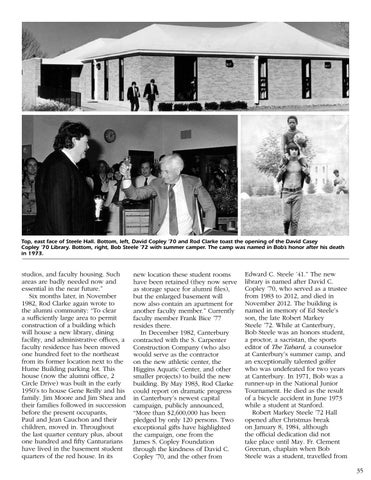
Michael Conniff ’72 speaks at the dedication of Robert Markey Steele ’72 Hall, in the spring of 1984. In the background are Mike Steele ’75, Bob’s brother, headmaster Rod Clarke, and Board president John Duffy ’59.
Rod Clarke and his successor Tom Sheehy in the study of the headmaster’s residence in 1990.
19
Compiled from notes by Thomas Haire ’30
The Story of the Canterbury Chalice To cap the Fiftieth Anniversary Celebration, Thomas Haire ’30, trustee and chairman of the Anniversary Commitee, made detailed arrangements to have a chalice used by Pope Paul VI at a private Mass delivered to Cardinal Spellman’s residence on the same day as the final anniversary event. The arrangements didn’t exactly go according to Haire’s plan.
A
small group of people knew of the highlight planned for the Fiftieth Anniversary dinner. Thomas Haire ’30 and Thomas Deegan, father of Nick ’68, directed the effort to ask New York’s Cardinal Spellman if he would ask Pope Paul VI to use a chalice provided by the School at a private Mass on May 2, return it the same day to be presented at the dinner, and give a special blessing to Canterbury. The meeting with Cardinal Spellman was scheduled for February 15. As it turned out, Deegan did the asking because he was to see the Cardinal at a CYO (Catholic Youth Organization) dinner on the prior evening. The Cardinal liked the idea and asked that the chalice be in his hands by the end of the week, February 18. Deegan assured him he and Haire could make this happen. However, unforeseen obstacles hampered Haire’s and Deegan’s best efforts to meet the Cardinal’s deadline. The chalice was being fabricated by a Mr. Ziegler in Tulsa, OK. Ziegler wasn’t sure that he could meet the Cardinal’s deadline, because he wanted the chalice 20
to be absolutely perfect in every regard given its destination. However, on February 17 at about 3:00 p.m., Ziegler called Haire and told him that he had personally placed the chalice in the hands of a stewardess by the name of Sandra on American Airlines Flight No. 382 out of Tulsa to arrive at LaGuardia Field at 7:50 p.m. that night. A few hours later, Ziegler called Haire again to inform him that the box containing the chalice had been taken off the plane at the last minute because the captain thought it looked suspicious (i.e. bomb) with all of its well-intentioned “Fragile,” “Caution,” “Handle with Care,” and “This Side Up” stickers on it. Unfortunately, Flight 382 was the last flight out of Tulsa to New York that day. To expedite the chalice’s arrival on time, Haire called upon his old friend, C.R. Smith, Chairman of the Board of American Airlines. Despite admonishing Haire that the parties concerned had inadvertently broken Federal regulations, Smith realized the urgency of the matter and offered a solution. To that end, he authorized a special ferry
The Canterbury papal chalice inscribed “ITE IN PACEM, Paulus VI.”
At 6:00 p.m., 90 minutes before the start of the dinner, there was still no definitive word about the chalice’s whereabouts. flight to carry the box containing the chalice to LaGuardia Field. Unfortunately, the plane was forced to land at Kennedy Airport because it had developed minor engine problems en route and LaGuardia was ill-equipped to handle the repairs. Furthermore, no one at Kennedy knew about the arrival of the chalice, further adding to the delay of getting the chalice into Haire’s hands. In the meantime, the staff at the Passenger Service Department at LaGuardia knew of the arrival of the airplane at Kennedy but couldn’t find out anything from the Passenger Agent there. As soon as the box was delivered, the agent called his counterpart at LaGuardia to inform him. When Haire heard the news, he immediately went to Kennedy where the box containing the chalice was handed to him. It was now about midnight on February 17. The following morning, Haire brought the chalice to Benziger
The Dais. L-r: Pedro Torres ’66 (Head Proctor), Fr. John Donovan, M.M., John L. Hamilton ’31 (Pres. of Alumni Assoc.), Fr. Regis Ryan, O.P. (former Canterbury chaplain), Frank Cavanagh (Chairman of Fiftieth Anniversary Dinner Committee), Msgr. Raymond Rigney (Superindent of Schools, Archdiocese of New York), Lillian Sheehan, Frank Boyden (Headmaster, Deerfield Academy), Walter Sheehan (Headmaster), His Eminence, Francis Cardinal Spellman, Donal McDonnell ’39, President of the Board of Trustees), Fr. John Comber, M.M., Fr. Gerard Campbell, S.J. (President of Georgetown University), Thomas Haire ’30 (Chairman of the Fiftieth Anniversary Celebration Committee), May Hume, James Farrell, Jr. ’19 (trustee and charter member of Canterbury), Fr. Thomas Quinn (Canterbury’s first resident chaplain), Arthur O’Gorman ’18 (member of Canterbury’s first graduating class), Fr. Clement Greenan, O.P. (Canterbury chaplain), Fr. Vincent Donovan, O.P., Joseph Keller (President of the Canterbury Parents Association).
Brothers for polishing, as the chalice had so many finger marks on it that it just could not be brought to the Cardinal’s residence without a good cleaning. It was then delivered to the Cardinal’s residence, along with an additional copy of the special requests the School was making of His Eminence and of His Holiness. Months passed and Haire had not received any word about when Canterbury might receive the chalice from the Vatican. He became quite concerned and came to believe that the chalice would not be delivered in time for its presentation at the Fiftieth Anniversary Dinner. When May 2, the day of the dinner, arrived, Haire made one more call to Monsignor Patrick V. Ahern of the Cardinal’s staff to determine if there were any word. There was
none. Later that morning, Ahern called Haire to tell him that he had received a cablegram, which contained a special blessing to Canterbury School on the occasion of its Fiftieth Anniversary from His Holiness Pope Paul VI, which the Cardinal would read that night. Later that afternoon, Haire learned from Ahern that the Cardinal’s office had received a radio message from a TWA plane flying across the Atlantic that there was a box on the plane addressed to His Eminence. At 6:00 p.m., 90 minutes before the start of the dinner, there was still no definitive word about the chalice’s whereabouts. When Haire arrived at the Cardinal’s residence at 6:45 to escort the Cardinal to the dinner, Spellman was not quite ready. While waiting, Haire heard the doorbell ring and the
Thomas B. Haire ’30, trustee and chairman of the Fiftieth Anniversary Celebration Committee. He is the father of Brett ’67, Jack ’70, and Paul ’73.
housekeeper answer it. She called upstairs to Ahern that a box had arrived for His Eminence. Ahern came down, received the box from the TWA messenger, handed it to Haire, and said, “Here is the Canterbury chalice.” When he arrived at the Waldorf, Haire sought out Sheehan and informed him that the chalice had arrived. “The timing of the arrival of the chalice and the fact that His Holiness had said a private Mass using the chalice that very morning in Rome, stunned not only the headmaster and me, but I imagine everyone in the room,” wrote Haire in his detailed account of the chalice’s history. He concluded it saying, “To all the rest of the assemblage it came as an aweinspiring surprise and a thrilling climax to the dinner and to the entire year of celebration.” 21
By Wright Danenbarger
The Faculty 1965-1990 The author chronicles the contributions of longtenured “good teachers” who served their students and Canterbury with exquisite precision, demanding rigor, and an indomitable passion.
B
efore I began the process of writing this series of articles for the PALLIUM on the faculty of the first 100 years of Canterbury School’s history, Lou Mandler, who has been scouring the archives to feed me material and direct me to sources of inspiration, sent me this amusing passage from the teacher-narrator of the novel Fifth Business, by famed Canadian writer Robertson Davies: “Schoolmastering kept me busy by day and part of each night. I was an assistant housemaster, with a fine big room under the eaves of the main building, and a wretched kennel of a bedroom, and rights in a bathroom used by two or three other resident masters. I taught all day, but my wooden leg mercifully spared me from the nuisance of having to supervise sports after school. There were exercises to mark every night, but I soon gained a professional attitude towards these woeful explorations of the caves of ignorance and did not let them depress me. I liked the company of most of my colleagues, who were about equally divided 22
among good men who were good teachers, awful men who were awful teachers, and the grotesques and misfits who drift into teaching and are so often the most educative influences a boy meets in school. If a boy can’t have a good teacher, give him a psychological cripple or an exotic failure to cope with; don’t just give him a bad, dull teacher. This is where the private schools score over state-run schools; they can accommodate a few cultured madmen on the staff without having to offer explanations.” I really love the sensibility of this quote, especially as it favors the “exotic failure” over the dull teacher. I have looked actively for a way to fit it in to my two previous articles on the first two quarter centuries of faculty, but I have been stymied largely by the simple fact that the types of faculty members that rise to the level of being worthy of mention in these pieces are the “good men who are good teachers.” Needless to say, Canterbury has sustained itself and thrived on the work of this category of teacher. The third quarter of the
Canterbury’s most memorable faculty from this era were much more than good teachers; they stand out as good men and women. They succeeded here and made Canterbury a better school still in no small measure by being hardworking, dedicated and upright, and role models for young people.
School’s faculty history is, in fact, no different in this regard, and that is exactly what the quote puts into relief for me when I look at these men and women whose tenures mostly fell between 1965 and 1990. If you are reading this article and you had the privilege of being taught by or working with Jules Viau, Jim Shea, Gilda Martin, Jim Breene, John Coffin, Gerry Vanasse, Jack Graney, John Martiska, Walter Burke, Paul Cauchon, or the others I will mention here, you know exactly what I mean. Canterbury’s most memorable faculty from this era were much more than good teachers; they stand out as good men and women. They succeeded here and made Canterbury a better school still in no small measure by being hardworking, dedicated and upright, and role models for young people. That I knew and worked with some of these figures only confirms what everyone I’ve read and spoken to says about them. Canterbury certainly has seen its share of cultured madmen on the faculty, but it most certainly did not persist through the turbulent era of
Faculty who served under Walter Sheehan, circa 1992. Front row, l-r: Gerry Vanasse, Gilda Martin, Jules Viau. Back row, l-r: Charlie Huntington, John Martiska, Jim Breene, Jim Shea, Jean Hebert, JP Mandler. Photo was taken in the headmaster’s residence.
its third quarter century by going exotic. Who better than to exemplify the good men that Davies writes of than history teacher Jim Shea and French teacher Jules Viau? Viau may have preceded Shea at Canterbury by one year, the former hired in 1954 and the latter in 1955, but it would be hard to privilege one over the other, and so I start with them together. When paired this way, moreover, the similarities start to abound. Both men hail from Holyoke, MA, and, yes, there may be something in the water there, but then let’s agree that Holyoke son Walter Sheehan drank it first and thus knew well the pedigree of the men he was hiring. Jim Shea came by way of Portsmouth Priory (now Portsmouth Abbey) and the Navy, where he served as a journalist during the Korean War. Viau came right out of a Master’s program at UMass in French Literature, and both men knew of Canterbury School because headmaster Sheehan had been a legend around Holyoke for his basketball and baseball heroics there and at Williams College, from which Shea also graduated in 1950. Really, what ties these two men
together beyond their 40-plus year concurrent tenures is the way their former students talk about them. Jules Viau and Jim Shea are beloved by many Canterbury alumni. The reminiscences and testimonials depict two men who engendered a deep respect from their charges. They made their students want to learn by being passionate about the subject matter and the pupils themselves in equal measures. As for Shea, the words of the Class of 1964 published in the PALLIUM at the time of his death (January 6, 2015) speak, I have little doubt, for all of the classes before and after: The Class of 1964 loved Jim Shea. We respected the teacher, the daily presence, and he deserved our respect. But we loved him because he was, simply and positively, a good man. He led the life of a good man. A good husband. A good father. Disciplined, dedicated, accomplished at a difficult task. A humble man. A man of Socratic self-control and wisdom. And, although humble, a man of unbounded ambition: to teach growing boys by practice and
example how in turn they could become good men. To give them a foundation in knowledge that would position them to understand themselves and the world around them. As I read this paean, it immediately reminded me of the interview I had conducted for the PALLIUM article I wrote on Viau in 2013. It is easy to notice the same affection in the words of alumni Jack Heffernen ’58 and Lou Buck ’66 as they describe what Jules Viau meant to them. The Office of Advancement tells me he is one of the most requested teachers at reunions. That he sits so firmly in the hearts of former students so many years later is of little surprise because he seems to keep them in his heart just as squarely. Jack and Lou both made a point of recounting Jules’s continuing concern for their well being. “I had a notable tragedy in my life back in 1989 when my son died,” Jack recounted. “I had not spoken to Jules in a while, and out of the blue, a two-to-three-page handwritten letter arrives from him. It was moving…really, he’s just a great guy.” Lou’s comments to me were born out of good times, though they carry much of the same emotion. “My wife Nora is a Canterbury alumna. Though she never had Jules as a teacher, she was almost as fond of Jules as I. Nora and I were engaged in April 1982. After breaking the news to her family, Nora and I drove from her home in Brookfield to New Milford. There we sought out Jules on the tennis courts to share with him our good news. In return, he gladdened us with his well-wishes expressed with a beaming smile.” As teachers, both Shea and Viau excelled at making students want to learn. Jim Shea did not just go over the history text year after year, he was a true history buff, as Marc Vanasse ’73 relates in a 1995 interview with Shea for the PALLIUM: But what does Jim believe makes him a teacher many of his current and former students say is one of the best they ever had? He 23
Shea and Viau hail from Holyoke, MA, and, yes, there may be something in the water there, but then let’s agree that Holyoke son Walter Sheehan drank it first and thus knew well the pedigree of the men he was hiring. puts aside his characteristic modesty and says, in own words,” I think I know my stuff, and I prepare assiduously. I do not ever enter a classroom without having prepared, even though I have taught the material before. I always review my notes and reading for the day.” He also keeps current with the latest historical and political works. On the day I visited his class, Jim related to his students an anecdote he had recently read in a new volume about Lyndon Johnson. An admitted newspaper junkie, Jim always tries to relate past history to current events. Although Viau was certainly skilled and knowledgeable in his discipline, much of what seems to set him apart was his way of making students want to follow him along in class. Again, Lou Buck: “Jules is a wonderful individual. He is very warm, modest to a fault, easily approachable and most likeable. He was also a great teacher. He was always very genuinely interested in getting to know Canterbury’s students, particularly his own. In this regard, he had an uncanny ability to size up an individual rather quickly. Based on his assessment of their character, ability and work ethic, Jules would establish the level of achievement he expected from each of his students. Then, either through good natured chiding or words of encouragement, Jules would nudge and prod his charges through the study of French.” What then of Davies’ “cultured madmen”? Did Canterbury students miss out on this the most entertaining and memorable type of teacher? Happily, no. Canterbury had John “The Rock” Martiska. Martiska arrived at Canterbury to start the 1954 school year and worked at the School for 45 years until his death in December of 1999 just after the end of the fall semester. This was only my first semester at Canterbury, so I did not know how to receive the news of his death, but the reaction of the returning faculty and students made it clear to me that Martiska was firmly embedded in Saints culture and sentiment. Like so many I have written about in these pieces for the PALLIUM, John Martiska devoted his adult life to Canterbury, arriving as a 26-year-old bachelor, marrying Virginia three years later, raising four children with her on campus, and working here until his last breath. From what his colleagues say of him, one gets the impression that he would not have wanted it any other way. He was wholly devoted to Canterbury. Martiska taught English for 17 years and theology for 15. He occasionally taught Russian, and he even taught chemistry for a year. He ran the school store and was business manager. At the time of this death, he was the director of school services, which meant that he oversaw the mail, drivers’ education, sitdown dinner, and school security. In short, John Martsika did everything a school needs. What people recall fondly about him, though, were his idiosyncrasies. He loved outlandish getups and sought opportunities to wear them. No one who knew him can forget the checkered blazer-Budweiser pants-top hat combination he favored for sit-down dinner. He borrowed Michael Jackson’s one-glove look as he rang the bell to start sit-down, often commenting comically on his expertise at this duty: “It’s all in the wrist.” He wore a bow tie made of pheasant feathers, and he loved Nehru jackets, which he would combine, as was the period style, with longhaired wigs and Lennonesque medallions on chains. These outfits did not seem congruent with Martiska’s gruff exterior in his interactions with the 24
students, and perhaps that was the point. By all accounts, Martiska loved being around the students. It is what gave him energy and, ultimately, it was how he defined himself. Alum John Maloney ’00 summed it up well as he described his first school meeting and first sit-down dinner when he eulogized Martiska at Canterbury’s memorial Mass on January 9, 2000. “The proceedings started with the kind of announcements one would expect: Mrs. Mandler spoke about classes and Mrs. Jenkins spoke about dress code—with a smile on her face. Then Martiska walked down the aisle. He turned to the student body and gave us a kind of stare that only Martiska could. After a brief silence, he said, ‘Mail! I work with the U.S. mail here at Canterbury.’ To my astonishment, he then proceeded to tell us how if we looked at, touched, opened, or read any mail besides our own, we had committed a Class A felony, punishable by up to 20 years in prison. My jaw dropped and I said to myself, I did not sign up for this!” A few days later, I opened the doors of the dining room at promptly 6:16 p.m., Mr. Martiska’s appointed time for the start of sitdown dinner. As my eyes wandered around the room, they locked on an elderly man wearing a top hat, a checkered blazer, some crazy shirt, penny loafers, and a pair of Budweiser pants. He was carrying a dainty bell. I asked myself, Could this be the same man?” Although Maloney did not have an answer then as a Third Former, those who knew him could have answered resoundingly, “YES! This is exactly the same man. This is exactly John Martiska.” He, by all accounts, was the antithesis of the dull teacher that Robertson Davies inveighs against. Jim Breene was perhaps best known as an administrator, but he was a fine educator, too, arriving in 1955 to teach Latin. JP Mandler recalls that Breene was a conspicuous figure on campus, perhaps second only to Martiska in Canterbury’s sartorial memory.
“He was remarkably well rounded, well educated, and intelligent. Jim was in those days in charge of both admissions and development, and he was often walking about the campus in his three-piece suit. One year, he volunteered to coach the hurdlers. He appeared on the track in that suit. He always looked impeccable. Jim had a marvelous sense of humor, much of which was language humor, puns especially. He was always eager for conversation, and with Jim, you had to be fully engaged in the conversation. Talking to him was kind of like sparring, and he always landed more punches than you could. Sharp dresser, sharp wit, sharp mind. And he engaged students as much as he did faculty.” He held the title of assistant head from 1971-1973, when he left to head Sacred Heart in Bryn Mawr, PA. Later, he also served as Head of St. Gregory School, a Catholic boys’ K-8 school in Loudonville, NY. After retiring from that position, he and his wife Kathleen retired to Warren, CT, and Jim joined the staff of The Gunnery as a part time teacher of Latin. The Latin prize at Canterbury’s graduation is named for Jim, given by the Class of 1963. It seems clear that he kept Canterbury close to his heart, as, after his retirement, he would come to Canterbury mid-afternoon and lose himself in a corner of the library, reading The Federalist Papers or proofing a PALLIUM. Jim died on August 16, 2002. Bob Wray arrived at Canterbury in 1958 after having graduated from the University of Notre Dame in 1952 and serving in the Navy for five years. He taught history and coached football and basketball. In 1965, the Board of Trustees appointed him Walter Sheehan’s assistant headmaster, a post he held until he left the School in 1970. He was also the School’s Director of Athletics and Chairman of the Disciplinary Committee. He later served as headmaster of Villa Duschene, Convent of the Sacred Heart in St. Louis, MO, and Stoneleigh Burnham in Greenfield,
Paul Cauchon, the father of computers at Canterbury, taught sciences at the School from 1962-1992.
MA. He died on August 30, 2008. Certainly, Jules Viau and Jim Shea fall into Robertson Davies’s first category of boarding school teacher. There were many that preceded them that would fit that description, too, but they seem to have embodied it. Alumni and fellow faculty cannot help but frame them this way. Following this lead, it is no stretch to say that Gerry Vanasse, who started in 1960, belongs in the good man/ good teacher column. He arrived at Canterbury School with his wife, Teri, and three children in tow. (Two more children were born later.) He was the new French teacher, raised in a French-speaking household, but he also grew up with training in music as a piano and organ player. He retired in 1990 but remained school organist until 1994, a duty he performed for 34 years. More significantly still, to me, is that Vanasse, along with Bill D’Alton ’42, directed the first musical at Canterbury: Guys and Dolls, in 1974. In the spirit of pioneering, Gerry and John Martiska supervised the first girls dorm on campus, Havemeyer House, which went female in 1972. He and Jean Hebert revived Schola. The more you learn about Gerry
Vanasse, the more you realize he saw Canterbury as an already stretched canvas on which to paint. He was also the first faculty member to take students to Europe on vacation. He organized five trips during his tenure, the first in 1962. Despite all this, many alums associate him with the golf team, which he coached for many years. Talk about a triple threat! Among so many lasting legacies, we also have one of his sons, Marc, teaching and working here in his 40th year. Gerry died on August 7, 2000. Jack Graney came to Canterbury in 1960 and by 1970, he was Chair of the Math Department. He was a graduate of Holy Cross, and, according to colleague JP Mandler, Graney was a warm and well-liked teacher by faculty and students alike. “He had a sunny personality. In the days of the faculty room in the Old Schoolhouse, the Math and English Departments had adjoining offices off the faculty room. So Jack was often in the faculty room when he wasn’t teaching. He had a great personality, as I said, sunny, always upbeat, and he had an infectious laugh. He was a math teacher’s department head, always thinking.” Acccording to Marc Vanasse, who had Jack for Algebra I, “Jack was 25
Walter Burke, faculty member from 1964-1995.
a great teacher, very patient with students. I remember that he was as passionate about explaining the FOIL method of solving an equation as he was discussing current events. He often digressed from the lesson at hand to debate issues of the day with us. It was great fun.” Jack’s wife Marian was the medical librarian at New Milford Hospital. They had five children, John ’74, Michael ’75, Mary Ellen ’78, Peter, and Paul. At various times, Jack coached basketball, golf, and squash. As well as being Math Department Chair, Jack was musical and a sort of Renaissance man. He, Jean Hebert, Gerry Vanasse, and Paul Cauchon performed as a barbershop quartet at various School events. Graney organized a concert series for Canterbury in 1975. Four concerts including a string quartet, a brass quintet, and a guitarist were planned. Begun as concerts for the Canterbury community, the series evolved into the Music at Canterbury concerts, open to the New Milford 26
community and they continued into the mid-1980s. When Jack Graney left Canterbury, art teacher Sylvia Lahvis became the liaison between Canterbury and the local music sponsors. Rod Clarke subsequently became the liaison. In 1978, Jack left Canterbury for Deerfield Academy, where he spent the rest of his teaching career. He and Marian live in North Carolina. Paul Cauchon, another Canterbury pioneer, was hired in 1962 and spent 30 years as a member of the Science Department. He arrived after a seven-year stint at Columbia Academy in Tennessee, and he came with his wife, Jean, and their two sons, Paul ’71 and Stephen ’74. (Two more children were born later.) He was, by all accounts, a masterful teacher of both chemistry and physics, and he cited as his proudest achievement being named the Outstanding High School Chemistry Teacher of the Year (1987) by the American Chemical Society. Like the pioneering Vanasse, Cauchon gave birth to new programs, too. He started Canterbury’s first computer programing classes, and will likely always be best remembered for being the father of the School’s program. In fact, Cauchon first came across my radar screen when I interviewed alum Steve Knoblock ’79 for this magazine. Knoblock works as a test pilot for Lockheed Martin, a job that involved mastering the high-tech computer systems that run the planes they make. In my interview, Knoblock singled Cauchon as the one who started him on his career path. “Paul Cauchon was the one responsible for really getting me into computers and programming at a time when the PC was just emerging. He really challenged me and gave me the tools I needed to excel in pursuing my aeronautical engineering degree at the Air Force Academy because I had the computer skills needed to do well. Paul was a Marine Reserve Colonel, and his example let me know it was cool to be in the military and be a computer geek.” I love this last line as it demonstrates how good teachers are models for the young of how the stereotypical boxes they might try to fit people into—“computer geek,” “warrior”—are artificial separations. Cauchon, moreover, was also the musical director for two plays, he was an advisor to the The Tabard, and with military precision resurrected Canterbury’s work program. Neither Vanasse, Graney nor Cauchon arrived at Canterbury and said, “I am a language/math/science teacher; I will teach my discipline.” Rather, they clearly came here and thought to themselves, I have a campus full of hungry learners and I want to share with them everything I love.” They pulled off the artful trick of making their jobs fun while working hard to ensure that the students were enriched and ready for the wider world. Paul Cauchon died on October 14, 2010. Walter Burke, by all accounts, was another of Canterbury’s consummate school men. He arrived on campus in 1964 after beginning his teaching career at Hawai’i Preparatory Academy in 1959 and proceeded to teach and serve in the administration at Canterbury for 31 years, until his retirement in 1995. He and his wife Betty, who worked as a Canterbury nurse for many years and was Rod Clarke’s official hostess during his tenure, raised a family of four children at the School, all of whom attended and graduated as Saints. This, it strikes me, is an allin Canterbury family. Moreover, Burke, like so many faculty mentioned above, was versatile and multi-talented. He served as the head of the Discipline Committee, a job which prepared him to later become the Dean of Students. From there, he was elevated in 1978 to assistant headmaster, at the same time becoming Chair of the Math Department. Marc Vannase, writing in a 1995 PALLIUM piece on Canterbury’s best teachers, captured Burke’s other triple-threat feats: “His talent as coach and the accomplishment of his runners are legendary. In the late 1970s, his cross-country teams ran undefeated for four consecutive seasons. He also coached J.V. Football, squash, and track, and lived in Carmody and Havemeyer Houses for many years.”
Physics and math teacher John Coffin, who taught at Canterbury from 19631995, guides his students through the solution of a problem.
Of course, one does not ascend to become Department Chair without knowing how to teach. Walter Burke’s artful trick was, as Vanasse put it in that same article, that he “blend[ed] military-style organization with a talent for stand-up comedy.” For my part, as Dean of Faculty today, I can identify many key traits of excellent teachers, but I must admit I do have great admiration for a teacher who can deliver the lesson effectively and be funny at the same time. There’s no question humor can help a lesson, but the art of actually being funny for an adolescent audience is another matter altogether. Walter Burke mastered that happy admixture of talents to such an extent that it prompted Walter Sheehan to tap him on the shoulder one day and say nothing more to him than “You’re a good school man, Coach.” Betty Burke died on September 29, 1997. Walter has remarried, and he and his wife Liz divide their time between St. Petersburg, FL, and Mashpee, MA. The tenure of Walter Burke is almost perfectly concurrent with that of physics and fellow math teacher John Coffin. Coffin started one year before Burke, in 1963, but retired with Burke in 1995. Much like Burke, John Coffin was an excellent teacher who used his sense of humor, albeit a different brand from Burke’s, in the classroom and in his work generally. JP Mandler recalls John’s wit fondly. “John taught physics and math very well and with a marvelous dry sense of humor. The sense of humor displayed in other areas as well. Coaching, he might say to the players, ‘Pair off in groups of three.’ It would take them awhile to get the joke. Once, he came into the faculty room after some minor surgery on his eye. Half his face was bandaged. His comment: ‘Do you think anyone will notice?’” Coffin was also known as a gentleman, the type who took care of the tasks that needed to be done without being asked to do so and with no desire to be recognized. He maintained his gentlemanly composure as the Saints longtime successful Varsity Soccer coach, as well. According to JP Mandler, who worked as his assistant coach, Coffin never lost his cool, even when the going got rough. The worst JP remembers occurred when Coffin kicked the grass during a tough sequence in a game, and this was memorable because the players were astonished to see even that much frustrated emotion from him. Most who worked with Coffin would also quickly recall his wife, Mary Lou, who worked as Canterbury’s first female Director of Studies after a career in the New Milford school system. Together, they formed and still hold a significant place in the history of Canterbury’s faculty. The School acknowledged as much by awarding Coffin the Canterbury Medal in 2006. Mary Lou died on October 14, 2003, and John has remarried and lives in
Tuscon, AZ. Canterbury certainly employed its share of good men, but Davies’ category omits a crucial class of teacher that changing times made necessary: good women. The third quarter of Canterbury’s history saw the hiring of its first full-time female faculty member, Gilda Martin. Martin was hired in 1966 and served for 40 years until her retirement. In fact, she was going to retire from teaching at the time Walter Sheehan offered her a job. She had just gotten married after a language teaching stint at New Milford High School that had begun in 1952. I’ve read the exchange she had with Sheehan about the job from a few different sources, but from Gilda’s own retelling, Sheehan said, “Gilda, we need a language teacher. Jean Hebert recommends you. He sees no reason why we can’t have a woman. Will you take the job?” He then asked her if she would have any trouble working with boys, and Gilda, without hesitation, replied, “No. No trouble at all.” And thus, somewhat anticlimatically, Canterbury ushered in another new era. The School did not hire another full-time female faculty member until 1972, a year after it had admitted its first female students. I have a hard time imaging what those six years were like as the lone woman on the faculty, but I do know that Gilda was strong and self-assured in a way that never hindered or abashed her. In the beginning of her time, confused students would address her as “Sir.” Headmaster Sheehan had to address the faculty as “Gentlemen and Gilda.” Gilda not only persevered but she thrived. Female and male students alike cite her as one the best teachers from their time at Canterbury. She also pioneered the role for the female teachers that followed. Gilda died on December 31, 2008. The second full-time female hire alluded to above was Kim Smith Niles. She worked only for one year, 1972-73, but she was the first single woman to live in a dorm and do dorm duty when Havemeyer was switched to a girls’ 27
Jack Graney came to Canterbury in 1960 and by 1970, he was Chair of the Math Department. He was a graduate of Holy Cross, and, according to colleague JP Mandler, Graney was a warm and well-liked teacher by faculty and students alike. Jack Graney taught math at Canterbury from 1960-1978.
residence. She lived in two dorm rooms across from each other, and she moved between them by going out into the hall where an accordion door separated her end of the hall from that of the students. She used the same bathroom as the girls used. In the next year, the School hired Betsy Conley Fitzgerald, who worked three years as an English teacher, and Sylvia Lahvis, who taught art history for eight years. Certainly these women were pioneers as well, and when you view their contributions together with the other faculty of this quarter of Canterbury’s history, the picture that emerges is one that is quite apt for the larger social history of the country at the time. In 1965, the United States itself began a period of sweeping social changes. The Civil Rights and Feminist movements had begun to take hold. Cold War geopolitical re-alignments and Vietnam protests challenged the social order. Men were walking on the surface of the moon. Canterbury had to change, too, and it seems as if its faculty either knew this instinctively or perhaps were at once both a product and a driver of the perpetual newness on campus. Faculty members Jack Gaudreau and Peter Bordonaro served in Vietnam. Jack enlisted in the U.S Army in the fall of 1966 and two years later served in Special Forces. He arrived at Canterbury in 1970 as an English teacher and coach. He left in 1976 but returned to serve a second tour of duty from 1978-1985. Peter Bordonaro arrived at Canterbury in 1967 to teach history but was drafted a year later. After completing his basic training in Fort Jackson, SC, he was transferred to Fort Hood, TX, where he was a mail censor for army prisoners. Then, from 1969 until his discharge in May 1970 he worked as a clerk for the Military Assistance Command in Saigon. Peter returned to Canterbury in 1970 and left in 1976. He received the yearbook dedication in 1974. He lives in New York City with his wife Katy. They have two children. Before concluding this story, I should note that a few important figures get their due elsewhere in these commemorative issues. Charlie Huntington, Don Robert, and Jack Karpoe are included in the athletic article in this edition. Several faculty members who were hired during this era went on to serve the majority of their tenure after 1990. JP Mandler was hired by Walter Sheehan in 1970; he begins his 46th year of teaching in the fall of 2016, the longest teaching tenure in Canterbury’s history. Marc Vanasse and Lou Mandler were hired by Rod Clarke in 1977, Lou for just one year, but she returned in 1981 and retired in 2016 after 35 years. Bev Lee also retired in 2016 after a 35-year teaching and coaching career. 28
Others hired during these years by Rod Clarke include Sandy Behan (1982), Kathy Bolster (1983), Guy Simonelli (1981), and Kim Tester (1983). These teachers will be given more attention in the next issue of the PALLIUM. On a historical note, Kevin Sweeney ’61 was the first son of a Canterbury alumnus to be hired as a faculty member. He was one of the second generation of Sweeneys. First generation was Bayard K. “Bud” ’30, John ’32, and George ’35. The second generation besides Kevin were B.K. “Barry” ’56, Shepard ’57, and Michael ’71. Kevin taught at Canterbury from 1968 to 1970 and was the first faculty member to be married in the Chapel of Our Lady. As the 1980s closed, William L. “Bill” Burke III arrived at Canterbury with his wife Patty and their four young sons in 1987 to serve as Rod Clarke’s assistant headmaster and teach English. After three years in that role, he became headmaster of St. Sebastian’s School in Needham, MA. He continues to serve in that position. The faculty members of this era—the good, the cultured, the exotic, and the “perfectly mad”— were among the very best to be found in any independent school. They served long tenures, pioneered great school programs, and left indelible marks on the institution they served with passion and commitment.
Canterbury Chaplains 1965-1990
Fr. Clement Greenan, O.P. 1965-1976 He is mentioned elsewhere in this issue.
Fr. Kennan Morris, O.F.M. 1976-1977
Fr. Herbert Cleary, S.J. 1977-1980
Fr. Edward Howard, S.J. 1980-1981
Fr. Richard Curci 1981-1986
Fr. Roch Ciandella, O.F.M. 1986-1992
29
By Bryan Kiefer
Canterbury’s Campus 1965-1990
In Canterbury’s second quarter century, a spate of new construction provided much needed facilities for a growing student body. During the next 25 years, the School continued to build major projects including Nelson Hume Hall, Carmody House, a covered rink, Steele Hall, and a field house.
I
n anticipation of the fiftieth anniversary of Canterbury’s founding, in 1962 the trustees set in motion Canterbury’s first organized capital campaign with a goal of raising $1.8 million. With fundraising off to a brisk start, by graduation day in 1965, the headmaster’s residence, Havemeyer Hall, and Alumni Memorial Gymnasium had been built, dedicated, and in full use. These additions to the campus joined Walter Sheehan’s previous campus enhancements: the infirmary, the extension to the Chapel of Our Lady, the new wing of the dining room, the addition of the south wing of the Schoolhouse, and new playing fields. The culmination of the fiftieth anniversary celebration occurred on May 2, 1966, as 800 members of the Canterbury community gathered at the Waldorf Astoria in NYC for a gala dinner. Within a month, the Waterbury Construction Company broke ground on Nelson Hume Memorial Hall, Walter Sheehan’s long-anticipated classroom building and auditorium, named in honor of Canterbury’s founding headmaster. Closer in style to the brick-faced, flat-roofed Alumni Memorial Gymnasium across the street than to the elegant Chapel of Our Lady to its south, the solidly constructed building reflected Mr. Sheehan’s twin priorities of durability and economy. The estimated cost of the building in April of 1965 was
30
Maguire Auditorium, a 400-seat facility, was first used in the spring of 1967 for the Mimers’ production of “A Man for All Seasons.”
$500,000. The building contained classrooms, science laboratories, and Canterbury’s first art classroom, Room 207. In a June 1967 letter, Walter Sheehan stated that the physics classroom would be called the Farrell Physics Laboratory to honor James A. Farrell ’19, a benefactor of the School and son of founder James Farrell. A plaque outside the physics classroom, #102, commemorates Farrell. Plaques in the science area of the Hume Hall also commemorate the
support of trustee and parent John Breck (John III ’67) and Alfred and Agnes Teeter, (David ’70). Perhaps the most gratifying element in the new building was the 400-seat auditorium, perfect for dramatics, school meetings, and general gatherings. The auditorium was dedicated to William George Maguire, fatherin-law of Gerard C. Smith ’31, who raised the funds for its construction. A trustee from 19481971, father of three Canterbury
Maguire was a visionary natural gas pipeline pioneer. Beginning in the 1930’s, he spearheaded acquisition of natural gas reserves in Texas and Oklahoma and the construction of pipelines to bring this fuel to the industrial Midwest. graduates (JT ‘60, Gerard ‘64, and Hugh ‘72), and the son of the chapel’s donor John Thomas Smith, Gerard Coad Smith (1914-1994) was a distinguished diplomat and statesman, the chief U.S. delegate to the Strategic Arms Limitation Talks in 1969, the first U.S. chairman of the Trilateral Commission, and one of Canterbury’s most distinguished graduates. Gerard Smith was awarded the Canterbury Medal in 1995 and the Presidential Medal of Freedom by President Jimmy Carter in 1981. A plaque at the entrance to the auditorium recognizes William George Maguire with the legend “Strength, Persistence, Courage.” Maguire was a visionary natural gas pipeline pioneer. Beginning in the 1930’s, he spearheaded acquisition of natural gas reserves in Texas and Oklahoma and the construction of pipelines to bring this fuel to the industrial Midwest. He helped form the Panhandle Eastern Pipeline Company, which he headed from 1943 until his death in 1965. At the time of his death, Panhandle and its subsidiaries owned or controlled natural gas resources totaling 14 trillion cubic feet and operated 11,000 miles of pipelines. The Tabards of the 1966-67 academic year provided regular updates as construction proceeded ahead of schedule, and by the eve of the 1967 graduation, Maguire Auditorium was ready for “The Beginning of an Era” as trumpeted on the front page of the July 3, 1967 Tabard. The Tabard reported a night of firsts regarding the production of A Man for All Seasons: “the first time a play had been produced the night before graduation, the first time Canterbury had used girls to play the women’s parts, and the first time that Canterbury actors have worked on a fully equipped, fully lighted, professional stage.” Nelson Hume Hall was officially dedicated the following fall during Homecoming ceremonies with Fr. Thomas Quinn, Canterbury’s first resident chaplain, officiating. In the same month that the Board approved the building of Nelson Hume Hall, it approved a long-range planting program for the School’s grounds, voting in favor of a $700 annual budget to support the program. At their spring 1967 Board meeting, while the finishing touches were being put on Hume Hall, the trustees approved the construction of a new dormitory, the final facilities item on the capital campaign agenda. Within a month of the Hume Hall dedication, work commenced on Francis T. Carmody ’25 House. In design identical to Havemeyer House, Carmody House had a ground floor that housed ten additional boys, for a total capacity of 50. By March of 1968, the Canterbury Alumnus magazine reported that “Despite severe cold, high winds, and a heavy blanket of snow, work is progressing on the dormitory named to honor Francis T. Carmody. Mr. Shea, head of the History Department, and Mr. Burke, a member of the Mathematics Department, will supervise 40 boys, each of whom will reside in single rooms. Comfortable quarters, similar to those in Havemeyer, will house their families. Ten more boys will live on the ground level, facing away from the campus, and Mr. Malcolm will oversee their activities.” One of three brothers to attend Canterbury (with Edward ’22 and Guerin ’28), Francis served as a Canterbury trustee from 1946-1965 and was Board president from 1946 to 1959. A senior partner at the law firm Whitman, Ransom & Coulson, he was a Yale graduate, president of the
Child Welfare League of America, and president and trustee of the Shakespeare Oxford Society. When Francis Carmody was enrolled at Yale, he shared living quarters with his Canterbury classmate James Cox Brady ’25, Peter Folger (father of Peter Folger ’63), and Paul Mellon, an heir to one of America’s greatest fortunes. When he was president of Canterbury’s Board, Carmody approached Mr. Mellon to help establish a retirement fund for faculty. Mr. Mellon was happy to do so, provided the source remained anonymous. A graduate of Choate, Mr. Mellon did not want the appearance of a conflict of interest. Later, when it was time to solicit funds for the new dormitory, Canterbury approached Mr. Mellon again. In an astounding act of generosity and as a testament to his old friend, who had died in 1965, Paul Mellon made the largest single donation to Canterbury received up to that time. The projected cost of Carmody in June of 1966 was $375,000; the final cost was $400,000. Francis T. Carmody Hall was dedicated on October 5, 1968. Fran’s older brother Edward ’22 gave an eloquent address that recalled his early days at Canterbury while pointing the way to a better world. In dedicating the new dorm, he stated: “I know you rejoice in this beautiful new dormitory which is named in honor of Fran Carmody who labored so long in the Canterbury vineyard. I ask you to think often in gratitude to those old friends who wanted to do something for his memory and, with many friends of the school, did it.” The 1968 dedication of Francis T. Carmody House successfully completed all the objectives of the 1962 capital campaign. It also marked the end of major facilities improvements under Walter Sheehan. He retired at the end of the 1972-73 school year and assumed the role of Canterbury’s Fund Drive Director until his full retirement in 1977. 31
The School’s 1972 purchase of the Marwick Manor house to which the Sheehans retired was a late venture in investing in local real estate for the purpose of supplying faculty housing. In the late 1950s, the School bought a house on Treadwell Avenue and a house on Summit Street, only to sell them for needed funds later. Jim and Mary Lou Briggs had built a house on Marwick Manor while Jim was a faculty member. The School bought that house in 1967, and later sold it to John and Virginia Martiska. Canterbury also owned another Marwick Manor house where Jack and Kathy Gaudreau lived in the early 1970s; it was sold shortly thereafter. In 1965, John and Mary Lou Coffin received permission to build a house on School land on Elkington Farm Road. After they retired to Arizona, Marc Vanasse purchased the house and still lives there. Shortly after the Coffins built their house, Rod Clarke built his own house on an adjoining lot. He returned to that house, now called Clarke House in Rod’s memory, in his retirement. It is currently used to house faculty. Canterbury’s next capital campaign was launched at a festive dinner at the School on October 28, 1973. At the kickoff event, Board president Peter D. Kiernan ’40 and former headmaster Walter Sheehan described the planning which had gone into the campaign goal of $3 million. New headmaster John J. Reydel announced and explained the endowment and facilities objectives, which are summarized below. Endowment $1,000,000 Covered Ice Hockey Rink $475,000 Girls Athletic Addition and Improvements $280,000 Refurbish South House $225,000 Refurbish North and Middle Houses $500,000 Central Administration House $165,000 Dining Hall $355,000 Total $3,000,000
Headmaster Walter Sheehan presides at the dedication of Carmody Hall.
32
A campaign report published on January 8, 1974, expanded on the plant needs. The three original dormitories required major renovations, including the installation of new heating systems, weatherproof windows, and new plumbing fixtures. With the advent of coeducation in 1971, some facility adaptations seemed necessary. A major addition to the gymnasium was planned for a girls’ locker room, together with rehabilitation of the old gym, and conversion of the Brodie Room into a student center/snack bar. Finally, with hockey now the most popular winter sport and the existing rink so run down that many games and practices were cancelled, a new covered hockey rink was planned. The campaign brochure included several architectural renderings, revealing plans that, regrettably, never came to fruition. A new hockey rink was a particularly pressing need. As Jean Hebert reminisced, “I’ve seen four rinks come and go,” but even the latest improvement—the outdoor rink north of the gym— did not provide reliable ice. By the 1970s, that rink was in such poor condition that practices were sporadic, depending on ice availability. Three times per week, coaches held practices at The Gunnery, when ice was available. Economic uncertainty and a weak stock market slowed progress in fundraising. The next campaign report, issued in December 1974, included an appeal from headmaster Reydel. “After a slow summer, we have received three gifts totaling $70,000 earmarked for a new hockey rink. Canterbury is near the bottom in New England in offering outside athletic activities in the winter. I believe we can have a rink in 1975, but only if we have a great effort by our alumni and friends. Time is running out. We are gathering steam and all of us at the school are hoping we can break ground this spring. Anything that you can give will be greatly appreciated by all of us at the school.” Athletic Director Charlie
Huntington joined forces with headmaster Reydel to draft a proposal for an indoor rink. Reydel devoted much of his time raising funds for the new rink, and finally with the help of such benefactors as Fortune Peter Ryan and James Farrell ’19, construction of the rink was approved. The new rink opened on November 13, 1976, and the first varsity hockey game was held on December 1. The new rink must have brought luck to the hockey team, as they finished with a 22-3 record in the 1976-77 season. From the beginning, Canterbury made the ice arena available to the New Milford community. Groups such as New Milford Youth Hockey used the rink, and the Town of New Milford also used it for townsponsored figure- and free-skating times. This spirit of generosity continues to the present day, with many groups making use of the ice throughout the winter season. Unplanned in the capital campaign, but eagerly and gratefully accepted, was the gift of four new tennis courts from trustee James A. Farrell Jr., a member of Canterbury’s second graduating class and the president of Farrell Steamship Lines. Donated in memory his father, one of Canterbury’s most farsighted and generous early leaders, the courts were dedicated on April 28, 1974. Located to the east of the new athletic center, they have not been used since Mark Pigott ’72 donated new tennis courts north of the infirmary in 2009. Wear and tear over the years had taken a toll on the three lower campus dormitories. The building most in need of attention was North House, and work commenced on that project in the summer of 1977, under headmaster Reydel. Architect Thomas Hume ’46, son of Raphael, nephew of Nelson, and father of Tony ’71 and Emmett ’72, supervised the replacement of the two ancient boilers, the insulation of the building, the renovation of all the bathrooms, and the replacement of the roof, complete with new drains and gutters. The work on North House
After decades of outdoor hockey rinks, Canterbury built its first indoor facility, which opened on November 13, 1976.
continued the next summer, when workers gutted two dormitory floors, completely replaced all the windows, ceilings and walls, refurbished the stairways, and expanded the wiring throughout the dorm. Finally, the dorm rooms, corridors, and common room received wall-to-wall carpeting. By the end of the summer of 1978 the dorm was ready for occupancy, and a new headmaster, Rod Clarke, was in charge of Canterbury. North House is now called Duffy House, after John Duffy ’59, (trustee from 1981-1992, 1998-2006, Board president from 1983-1992, and Trustee Emeritus). In the following summer, South House received similar treatment as North House. Known as Carter House since 1998, named after Board president Hope Carter (trustee from 1985-2002, president from 1991 to 1998, and Trustee Emeritus), the dorm’s hallways and common room were carpeted and the walls painted. Four washers and dryers were installed in the basement, the terrace was resurfaced, and the steps repositioned. The common room was restored to its original size and furnished by B. Altman with new couches, chairs, and tables. To celebrate May Hume’s 32 years of service on the Canterbury Board of Trustees, she was honored at the Alumni Dinner on April 9, 1980, for her “long and loving service in nurturing the Canterbury Ideal.” After Mass on October 1980’s Alumni Day, a portrait of Mrs. Hume was hung in the South House common room and the common room was named and dedicated in her honor. In the words of Rod Clarke in the April 1980 issue of Canterbury Today, “South House is once again a very attractive place in which to live.” Finally, Sheehan House, the former Middle House, was renovated three years after it was renamed in honor of Walter Sheehan during the 1978-79 school year. Contractors installed new doors and locks, leveled and laid new tiles on the patio, installed new insulated windows and new exterior doors, installed new bathroom partitions, replaced electrical wiring and fixtures, and patched and painted exterior walls. To restore some of the common room’s original beauty, the woodwork was removed, restored, and replaced; the original lighting fixtures were cleaned; new track lighting was installed; and a faculty apartment was added on the north end of the second floor. As Rod Clarke reported in the September 1981 issue of Canterbury Today, Sheehan House “now joins South and North Houses as showplaces on campus.” 33
Faculty house being moved to make space for Steele Hall.
Six months later, in November 1982, Rod Clarke again wrote to the alumni community:“To clear a sufficiently large area to permit construction of a building which will house a new library, dining facility, and administrative offices, a faculty residence has been moved one hundred feet to the northeast from its former location next to the Hume Building parking lot.
An early photo of the construction of Steele Hall.
In 1981, Canterbury engaged Daniel Tully Associates of Melrose, MA, to develop a plan for the School’s physical growth. At the same time, trustees began planning for a new capital campaign. Among the key plant priorities that emerged from this process were the need for an enlarged library with up-to-date information technology, a new dining room and food service facility, and centralized administrative offices. On December 11, 1981, Rod Clarke unveiled Tully’s plans for a new building that would address these needs. Located on the vacant land north of Hume Hall, the new building would be the most architecturally unique building on campus. Tully called it a “hyperbolic-parabolical structure,” and it has been compared to a series of saddles, or to a “big-top tent.” With its wide span under the open raised roof, it was similar in 34
design to several athletic stadiums that Tully designed during this era. Meant to bring the center of campus to the top of the hill, this building houses the library, dining room, administrative offices, and an 88-seat lecture room. Constructed during the cusp of the energy crisis of the 1970s, it included several energy saving features such as stairways that did not need to be heated or air conditioned, limited window expanses, and a special water saving feature (which in the end was not practical). The building was expanded and renovated in 2010; more on this in the next issue of the PALLIUM. In a March 1982 letter to alumni, Rod Clarke explained that “the trustees have concluded that a new library facility should have top priority. The present library occupies more than half the upper floor of the Schoolhouse. More space and a better floor plan are
deemed necessary for the needs of the School now and over the next few decades.” In this same letter he went on to say “the trustees have agreed that a new dining room and centralized administrative offices should have the next priority.” In this era, the administrative offices of the School were located in North House and at both ends of Sheehan House, with the effect that “the headmaster spends most of the day far removed from the truly important work of the school, the education of students. By bringing the offices together, the school will be able to take advantage of the best technical equipment. By locating them with the dining room and the library near the center of school activity, all facets of the school community will benefit. The space left free in the Schoolhouse, North House, and Sheehan House will provide for expanded facilities for classrooms, art, and music
Top, east face of Steele Hall. Bottom, left, David Copley ’70 and Rod Clarke toast the opening of the David Casey Copley ’70 Library. Bottom, right, Bob Steele ’72 with summer camper. The camp was named in Bob’s honor after his death in 1973.
studios, and faculty housing. Such areas are badly needed now and essential in the near future.” Six months later, in November 1982, Rod Clarke again wrote to the alumni community: “To clear a sufficiently large area to permit construction of a building which will house a new library, dining facility, and administrative offices, a faculty residence has been moved one hundred feet to the northeast from its former location next to the Hume Building parking lot. This house (now the alumni office, 2 Circle Drive) was built in the early 1950’s to house Gene Reilly and his family. Jim Moore and Jim Shea and their families followed in succession before the present occupants, Paul and Jean Cauchon and their children, moved in. Throughout the last quarter century plus, about one hundred and fifty Canturarians have lived in the basement student quarters of the red house. In its
new location these student rooms have been retained (they now serve as storage space for alumni files), but the enlarged basement will now also contain an apartment for another faculty member.” Currently faculty member Frank Bice ’77 resides there. In December 1982, Canterbury contracted with the S. Carpenter Construction Company (who also would serve as the contractor on the new athletic center, the Higgins Aquatic Center, and other smaller projects) to build the new building. By May 1983, Rod Clarke could report on dramatic progress in Canterbury’s newest capital campaign, publicly announced, “More than $2,600,000 has been pledged by only 120 persons. Two exceptional gifts have highlighted the campaign, one from the James S. Copley Foundation through the kindness of David C. Copley ’70, and the other from
Edward C. Steele ’41.” The new library is named after David C. Copley ’70, who served as a trustee from 1983 to 2012, and died in November 2012. The building is named in memory of Ed Steele’s son, the late Robert Markey Steele ’72. While at Canterbury, Bob Steele was an honors student, a proctor, a sacristan, the sports editor of The Tabard, a counselor at Canterbury’s summer camp, and an exceptionally talented golfer who was undefeated for two years at Canterbury. In 1971, Bob was a runner-up in the National Junior Tournament. He died as the result of a bicycle accident in June 1973 while a student at Stanford. Robert Markey Steele ’72 Hall opened after Christmas break on January 8, 1984, although the official dedication did not take place until May. Fr. Clement Greenan, chaplain when Bob Steele was a student, travelled from 35
Ireland to bless the new building. With the opening of Steele Hall, Rod Clarke said it felt like the School had really gained two buildings. The greatly expanding dining room seated 325 people compared to 250 in the old dining room in North House. The Copley Library was double the size of the old library in the Schoolhouse, and Mr. Clarke enlarged the book collection in scope and variety and increased audiovisual and other technology, all designed to make the library the hub of the School. The air-conditioning in the building, particularly in the dining room, helped summer programs flourish. Meanwhile, the former library rooms in the Schoolhouse were converted into classrooms, including a new music room complete with sound-proof practice rooms. In North and Sheehan Houses, the vacated offices were converted to faculty apartments. And in 1985 into early 1986, thanks to a generous gift from Board president John Duffy ’59, the old North House dining room was converted to the Edward J. Duffy Family Art Center. Art teachers Sylvia Hierro and Kim Tester worked with architects from Butler Rogers Baskett to design an art center with a ceramics room, art gallery, painting/drawing area, office, and teaching/lecture space. The 3,500 square-foot Duffy Art Center transformed art education at Canterbury. Dust had barely settled on the groundbreaking of Steele Hall when ground was broken once again, this time for a new field house, which was to contain three basketball courts, one of which could be converted to a volleyball court. Slow progress with construction prevented the building’s use during the winter of 1984-85, but in the 1985-86 school year, the building allowed for a much more efficient schedule of games and practices during the winter season, made possible indoor practices in the early spring, and permitted rentals to outside groups during March and summer recesses. 36
After a new dining room opened in Steele Hall in 1984, the North House dining room, which had been used since 1927, was transformed into the Edward J. Duffy Family Art Center. Classes were held during the construction.
Headmaster Rod Clarke and art teachers Sylvia Hierro and Kim Tester at the dedication of the Edward J. Duffy Family Art Center.
With a still expanding enrollment of girls, Canterbury purchased the 8.5 acres and two buildings of Hickory Hearth in July 1985. The house was converted into a dormitory for girls, with two faculty apartments, one on the main floor and one in the basement. The elegant but dilapidated carriage house served as a storage facility until its condition made it advisable to demolish it in 2006. The original Hickory Hearth house, once occupied by the headmistress of Ingleside School for Girls, burned down in 1937. The Taylor family rebuilt the house in 1945, and Mrs. Jennifer Taylor lived there until her death in the spring of 1985. Through the good offices of local trust and estates attorney Steve Hume ’43, head partner of Cramer & Anderson, a longtime trustee, and son of Nelson, Canterbury acquired the property from the estate. Finally, in this same busy 198586 school year, the women’s locker room was moved from the north
end of the original locker room in the basement of the Old Gym to a former weight room and faculty locker room in Alumni Gymnasium. Canterbury girls now had better showers, new lockers, and a more convenient location. The 1986-87 year saw continued plant improvements. New roofs were installed on Hume Hall, Alumni Gymnasium, and the headmaster’s house. In the chapel, the sanctuary hangings from the early 1930’s were replaced by exact copies, and the statue of Mary, the altar crucifix, and the magnificat lunette over the sacristy entrance were repaired, cleaned, and repainted. These restorations were the gift of Trustee Emeritus Denis Coleman ’63. The Brodie Room was restored and refurbished as a conference/ reception room, and the furniture in North and South Houses was replaced. The original squash courts in the Old Gym were renovated through a generous gift from trustee D.V. Reed ’58 (father of Taylor ’88). Finally, the old farmhouse, vacant
Canterbury purchased the Hickory Hearth property in 1985. Today, it houses ten students and three faculty members.
and in disrepair for years, was completely renovated in preparation for the arrival of the new business manager, Bryan Kiefer, and his young family in summer 1987. After years of acquiring land, Canterbury sold its first piece of land in 1962 to the Town of New Milford for a site for a water tank. In 1966, a neighbor on Route 202 asked to buy two acres off Route 202 which included the pond and some woods. The School rejected this offer, saying Canterbury wanted to keep the land as a buffer. However, on September 30, 1986, the School sold 2.58 acres off 202 to the New Milford
The girls’ basketball and volleyball teams pose in the field house, completed in 1985. The new facility allowed for a more efficient schedule of games and practices during the winter season.
Police Department for its new headquarters. In 1983, trustee Stephen Hume facilitated a gift of land to the School. In an October letter to Steve, Rod Clarke thanked him for the fact that he “smoothed the way and assured the addition of this elegant piece of real estate.” These acres are located on the northwest corner of the campus and prevent heavy residential development there. Rod Clarke announced in the summer of 1988 that the capital campaign, begun in 1981, had surpassed its $7.5 million goal by raising $7,688,818. In his last two years as headmaster, he completed several plant projects. Thanks to the generosity of Brett ’67, Jack ’70, and Paul ’73 Haire (sons of Tom ’30), the chapel doors were replaced with specially carved, heavy oak doors. To maintain and enhance the quality of turf, a sprinkler system was installed on the soccer, football, and baseball fields. Finally, the infirmary was renovated in the summer of 1988, to become, on its southern half, Ingleside House. This fresh space provided housing for six students, a comfortable common room, and two compact faculty apartments on the main floor. The northern half of the infirmary became the health center with its entrance on the west side of the building. Finally, the William Ade family (Dylan ’90) provided Canterbury with two superbly equipped weight rooms. The end of Canterbury’s third quarter century coincided with the retirement of headmaster Rod Clarke. During his tenure, the first dedicated facility for instrumental and vocal music was created, and the studio art program benefitted from a greatly expanded space. With the construction of Steele Hall containing a library, dining room, mailroom, and administrative offices, daily student and faculty life was centered at the top of the hill. With the arrival of Canterbury’s fifth headmaster Tom Sheehy in the summer of 1990, Canterbury would soon begin another 25 years of plant improvements. 37
I By Lou Mandler
The Student Body 1965-1990 In the third quarter century, children of alumni, faculty children, females, and day students comprised a substantial portion of the student body.
n the fall of 1965, Canterbury opened with 224 students. Twentyfive years later, the striking characteristic of the opening enrollment of 301 was not the number but the fact that 117 of these students were female and 103 were day students. The female students and the day students together equaled the total number of students, all male, in 1965. As had been true in past decades, many student spots were filled with descendants of alumni. The rosters again carried names mentioned in earlier issues: Salembier, Ryan, Steers, Smith (both of the John Thomas and Richard Joyce families), Duffy, Corroon, Briggs, Burke, and Hume.
Children of alumni in 1979. Front row, l-r: Bill D’Alton (Bill ’42), Gerry Flood ’81 (Gerry ’50), Mary Carroll McFadden (Francis ’56), Frank Weis ’81 (Frank ’58), Amy Kiernan ’81 (Peter ’40), John Harding ’81 (John ’49), Hugh Flood ’83 (Gerry ’50), Andrew Armstrong ’80 (Reed ’55). Back row, lr-: Jim Denny ’81 (Jim ’50), Tim Flynn ’80 (Dick ’48), Aidan Mullett ’80 (Aidan ’44), Peter Leonard ’81 (Peter ’51), Mike McCabe ’81 (Ed ’52), Andy Flood ’82 (Gerry ’50). Absent from photo: Bill Grace (William ’54), Martin Harding (John ’49), Gregory Armstrong ’81 (Reed ’55), Fernando Arguelles ’80 (Fernando ’56), Tim Corridon ’80 (Jim ’54), Regina D’Alton ’80 (Bill ’42), Claire D’Alton ’82 (Bill ’42).
38
Children of alumni in 1983. Front row, l-r: Seth Nesbitt ’86 (Mike ’54), Jim Kerrigan ’85 (Richard ’45). Second row, l-r: Shawn Harris Tribe ’84 (Dick ’56), Sarah Smith (Gerry ’51), Bill Dillon ’84 (Dick ’51), Lisa Berry Burke ’83 (Bernard ’48), Jay Clarke ’84 (Charley ’47). Third row, l-r: Pat Clarke ’82 (Cartan ’46), Shane Heekin (Brian ’61), Michael Gutteridge ’86 (Dave ’58), Leo Tracey ’84 (Bill ’49), Tim Barney ’85 (John ’60), Jay Picotte (John ’60). Absent from photo: Hugh Flood ’83 (Gerry ’50), Charlie Heekin ’84 (Brian ’61), Ann Largay Jennings ’83 (Vin ’49), Chris McCabe (Jay ’57).
Rod Clarke ’46 with Arthur Halleran ’65, who established the Halleran Endowment for the Dramatic Arts in memory of Thomas A. Halleran, Arthur J. Halleran ’27, and Leo B. Halleran ’34.
A student during this time who was a third generation Canterbury alumnus was Trevor Hamilton ’89, whose father Colin ’62 and grandfather John ’31 were graduates. Other third generation students who enrolled after 1990 will be mentioned in the next issue. Some alumni sent four or more children to Canterbury during this era. The children of Board president Peter Kiernan ’40 hold the record for the most graduates from one family: Peter ’71, John ’72, Casey ’74, Gregory ’75, Michael ’77, Stephen ’78, and Amy ’81. The Flood family was remarkable in several ways. Grandfather Gerald was a trustee in the 1960s, and father Gerald Jr. ’50 sent five children to Canterbury: Gerald III ’81, Andrew ’82, Hugh ’83, Emuella ’87, and Christopher ’91. For three consecutive years, a Flood was named Steele Scholar Athlete: Gerry in 1981, Andrew in 1982, and Hugh in 1983. One of the first female trustees, Mary Elizabeth Tucker, was the daughter of trustee Carlton Hayes. Four of her children are Canterbury graduates: Paul ’68, Carlton ’73, Elizabeth ’76, and Peter ’78, who is currently president of the Society of Alumni. The O’Connor girls from Brookfield hold the record for the most female graduates from one family: Debbie ’78, Denise ’79, long term Canterbury employee Sheila ’76, former trustee Cecile ’74, and Sharon ’83. The number of Coleman siblings nearly equals the “most siblings” record of the Kiernan family: Steve ’71, Greg ’72, Ed ’74, Patrick ’77, Mary ’90, and Chris ’92. Greg’s son Ben is a member of the Class of 2005. Another family with four or more sibling graduates is the Gilbanes: John ’74, Richard ’69, Bob ’67, Tom ’65, and Bill ’65. Faculty children contributed to the day student numbers, and some faculty families enrolled four or more students. There were five Vanasses: 39
Marc ’73, Nicole ’75, Paul ’75, Gerry ’78, and Guy ’84; five Sheas: Jimmy ’78, Mary Kate ’77, Megan ’79, Toby ’81, and Tim ’86; four Martiskas: Joanna ’77, Tom ’76, Greg ’81, and Laura ’79; four D’Altons: Terry ’73, Stephanie ’76, Regina ’80, and Claire ’82; four Burkes: Sean ’78, Kevin ’79, Kathleen ’82, and Maureen ’83; and four Cauchons: Paul ’71, Stephen ’74, Christine ’87, and Alexander ’88. Members of fourth headmaster Rod Clarke’s extended family were part of several classes, following nephew Rudy von Bernuth ’62. Will Cardamone ’81 and Jim Kernan ’72, son of Jim Kernan ’32, were also nephews. Warnick Kernan ’76 and Leslie Kernan ’70 were additional members of the extended Clarke family as was Patrick Clarke ’82, son of Rod’s cousin Cartan Clarke ’46. Other members of the student body during these years were the grandsons of Joe Maloney, one of the first Canterbury faculty members: Chris ’85, Tim ’82, and Mark ’80 Kallenbach. Twenty-nine alumni from this era went on to serve Canterbury as trustees. Dorothy Alpert ’78 has been a trustee since 2003 and currently chairs the Finance Committee. David Copley ’70 was a Board member for 29 years until his death in 2012. The Copley Library bears his name in recognition of the gift by the James S. Copley Foundation to make the library possible. Jay Clarke ’84 followed in the footsteps of her father Charley ’47 who was a trustee
from 1984-1991. Jay currently chairs the Education Committee. Bob O’Connor ’76 returned to Canterbury as a faculty member, became Business Manager under headmaster Rod Clarke and then served as a trustee for 14 years. Mike Carretta ’71 is currently secretary of the Board. Bob Steers ’71 became a trustee in 2002 and president in 2007, a position he still holds. Several alumni from this era contributed to the program and facilities. Arthur Halleran ’65 established the Halleran Endowment for the Dramatic Arts in memory of Thomas A. Halleran, Arthur J. Halleran ’27, and Leo B. Halleran ’34. Three Haire brothers, Brett ’67, John ’70, and Paul ’73, made possible the rebuilding of the chapel doors in memory of their father Thomas ’30. Mark Pigott ’72 was the key financial and organizing force behind the funding of the new South House. The plaque on the South House terrace memorializes C.T. Fisher ’72, who died in the Pan Am Flight 103 tragedy, and lists all members of the Class of ’72 as donors. The Vietnam War profoundly affected America in the ’60s and ’70s. Three Canterbury alumni lost their lives in this war: Paul McGrath ’62, Charles Bergevin ’62, and Charles David Burke ’65. Serving the country in a different way, several alumni joined the Peace Corps following in the footsteps of earlier alumni such as Luis Midence ’57 and Rudy
Student Graduates: 1966-1990
von Bernuth ‘62. These included Jim Stearns ’66 (Africa) and Rich Hopkins ’78 (Paraguay). Michael (“Nick”) Deegan ’68, and Frank Guinta ’89 have been involved in service in elected office. Nick served a term in the Wyoming House of Representatives and is now a judge for the Sixth District Court. Frank was Mayor of Manchester, NH, and is currently a Congressman (first district) from New Hampshire. Canterbury alumni are, of course, involved in many professions and have made notable contributions to their chosen fields of work. Mal Cleary ’75 has acted in many television commercials. Victoria Bundonis Rovin ’81 regularly performs nationally in theater and has appeared in episodes of Nurse Jackie. Lydia Tenaglia Collins ’84 and Dave Turecamo ’66 are involved in television and news production. Greg Coleman ’72 is currently CEO of BuzzFeed. Bruce Carbonari ’73 is Chairman and CEO of Fortune Brands. This is just a very small sample. It would be impossible to list all the alumni who are making valuable contributions to the nation and the world. We hope that our graduates will report their professional updates to the Office of Advancement. Canterbury would not have survived to observe its centennial were it not for the many alumni who have supported the School with their work, wealth, and wisdom. As the 1980s concluded, alumni continued to build upon the foundation of Canterbury’s original mission.
The data for this chart and the chart in each of the two previous issues have been determined by counting the names in each class list in the 2009 Alumni Directory.
40
Donating to the Archives
T
he occasion of Canterbury’s Centennial has put a spotlight on our archives. The photo at right of Nelson Hume at a 1940s football game was donated by Richard Keogh ’49. Past publications such as The Quill, The Tabard, Cantuarians, and PALLIUMS have been rich sources of photographs and historical information. We have used this information and other photographs, correspondence, and artifacts in creating the Centennial website, exhibits, presentations, and the articles in this issue of the PALLIUM. We have benefitted greatly in the past from donations of scrapbooks, photos, athletic uniforms, and other memorabilia from alumni. For example, last fall Grace Sartor, daughter of Captain Thomas J. Sartor ’19 and sister of Thomas J. Sartor Jr. ’50, sent the photos of the Bungalow and Main House used in “The Founding” article in the previous issue. Baseball uniforms worn by John Dowling ’30 and exhibited during the Athletics Hall of Fame dinner were donated by his wife Claire Dowling and his daughter Nancy Petty. We are interested in adding to the material we have on Canterbury’s history. We would welcome receiving personal papers such as correspondence, diaries, scrapbooks, photographs, or videotapes that shed light on the life of students at Canterbury.
Nelson Hume supporting Richard Clarke ’48, unidentified, and J. Barry Stanford ’48.
Even if you did not keep artifacts from your days at Canterbury, you may have memories to share. We would be pleased to receive written or recorded reminiscences. These reminiscences could be just a short recollection or anecdote about a classmate, teacher, event, or a general reflection. At the moment we do not have an archivist; librarian Ellen O’Meara and Kathy Bolster are minding the space and its holdings in the meantime. If you have any material from your Canterbury years, or if you have questions about what might be appropriate for adding to our archives, please contact Ellen or Kathy.
We are interested in adding to the material we have on Canterbury’s history. We would welcome receiving personal papers such as correspondence, diaries, scrapbooks, photographs, or videotapes that shed light on the life of students at Canterbury.
41
By Kathy Bolster
Student Life at Canterbury 1965-1990
Milestone anniversaries bookended this period in Canterbury’s history. During these 25 years, the School witnessed perhaps the most significant changes in its history.
I
n the April 26, 1966, special edition of The Tabard devoted to the Fiftieth Anniversary three-day symposium, the reporter quotes keynote speaker Bishop Wright of Pittsburgh, “As I lie in my bed at night, I am awed by the power of the I.B.M. computer but I am comforted by the thought that a mere baby can crawl behind the machine and pull out the plug.” The United States seemed in need of comfort as changes and unrest accelerated throughout the world. Tensions between Protestants and Catholics in Northern Ireland grew, as the Ulster Volunteer Force declared war on the Irish Republican Army. The Congress of Racial Equality endorsed the “Black Power” slogan, credited to Stokely Carmichael, in May 1966. Civil Rights marchers in Mississippi were dispersed by tear gas in June, and race riots followed in Chicago, Lansing, and Waukegan. Betty Friedan, along with 27 other women and men, founded the National Organization for Women and served as its first president. A protest occurred at the 1968 Miss America Pageant, and a sit-in was staged against the all-male editorial board of Ladies Home Journal. Chinese leader Mao Zedong urged young Chinese to revolt against traditional culture and leaders, beginning a cultural revolution that is believed to have left more than a million dead. Anti-Vietnam
42
Members of the cast of “A Man for All Seasons,” the first play performed in Maguire Auditorium. Seated, Paul Tucker ’68. Standing, l-r: Chris Doyle ’67, Christine Coffin, William Hearst ’67, Shelley Lang, Ed Wallace ’67.
War demonstrations took place in the U.S. and throughout the world. Canterbury’s student body held a mock presidential election in 1968 with Nixon garnering 43% of the vote, Humphrey 31%, and Wallace 9%. Throughout the 1960s and into the 1970s, The Tabard regularly featured reports of the Vietnam War and contained editorials expressing the pros and cons of the United States’ involvement. Generally, as the war progressed, the feeling of protest grew stronger within the student body and coverage increased in the paper, coinciding with anti-war demonstrations across the nation. The second centennial issue of the PALLIUM mentioned William F. Buckley’s campus visit and Rick Salembier ’69’s interview with Governor Nelson A. Rockefeller in 1966. Parents Mr. and Mrs. William Hearst (William ’67, Austin ’71) continued to arrange for notable people to speak with Canterbury students. Pulitzer Prize winner, editor, and journalist Frank Conniff, father of Michael ’72, lectured the Fifth and Sixth Forms on Vietnam and the communist threat from Russia and China. The following fall, author Jimmy Breslin spoke at the annual pre-Thanksgiving Banquet and Sports Awards Presentation. In March of 1967, Bohden Tomaravitch, Polish delegate to the United Nations and Shue Uyu-chi, Ambassador to the UN from the Nationalist Chinese island of Formosa, spoke at Canterbury. The October 17, 1969, issue of The Tabard contained an interview with Bernadette Devlin, Irish political activist. Bernadette was in the United States raising money for Irish Catholics displaced from their homes after the Battle of the Bogside in Derry, Northern Ireland. In September 1966, the Student Council submitted a request to the headmaster to allow Fifth and Sixth Formers to have radios in their rooms. That year a General Electric computer terminal directly coupled to a mainframe located in Valley Forge, PA, arrived on campus. “By telephone to Bridgeport, CT, one could connect to the main frame computer for an hourly rate of $30, not including the monthly fee for the terminal itself.” After renting a computer at the cost of $3,000 per year, the School made the jump to enter the technological age by purchasing a new computer system, the digital PDP8, for the cost of approximately $11,000. This was the first introduction to computing at Canterbury, and the beginning of science teacher Paul Cauchon guiding Canterbury into the computer age. Other Sixth Form privileges added in 1966 included an optional breakfast on Monday mornings and a later Mass on Sunday at 11:00 a.m. Fifth Formers also attended this Mass while Third & Fourth Formers attended at 8:30 a.m. The 5:30 p.m. Sunday benediction service continued.
While on a tour of Europe in the summer of 1968, six Canterbury boys met Ireland’s President Éamon de Valera. L-r: Gerry Vanasse (chaperone), Manuel Garcia Valles ’66, John Ryan ’66, Fr. Clement Greenan, O.P. (chaplain), Roger Rath ’67, Carl Breer ’69, Gordon Lawson ’68, Kevin Coneys ’67.
Canterbury offered many educational and entertainment programs during the late ’60s. Several students traveled with Mr. Cauchon to MIT for a seminar on laser technology. A memorable student trip took place in 1968 when faculty member Gerry Vanasse took six students to Europe. The trip included meeting Ireland’s President de Valera and posing for a photo outside the president’s home. Canterbury students traveled to New Milford High School in December 1969 to hear blues legend BB King. Baritone Gilbert Price performed musical selections for the Canterbury community, and through the auspices of Paul Hanly ’69 and his grandfather, Mr. Kenny, Canterbury hosted a performance of The Four Seasons. This performance and the Gilbert Price concert raised money for the African Project, led by Fr. Michael Duffy ’51, a Maryknoll priest then stationed in Tanzania. Fr. Duffy was one of five brothers who were Canterbury graduates. Brother John ’59 became Board president and benefactor. Duffy Art Gallery is named for the Duffy family, and Duffy House is named for John. Fr. Duffy had requested funds for the purchase of a tractor. The proceeds from the two fund-raising events netted close to $2,100, meeting Fr. Duffy’s need. During the mid-1960s, history teacher Jim Shea started a lecture series on world affairs, and clubs remained active on campus. The Art and Architecture Club, in its second year under Mary Lou Briggs, wife of Jim Briggs ’56, helped design sets for the stage productions. The Choral Club recorded two records and a recital broadcast by Danbury radio station WLAD. The Chess Club attracted many members, and the Bridge Club, which had faded under the popularity of chess, made a comeback. Mike Meserole ’68, as the newly appointed head of the Press Club, continued the work of reporting sports scores to local newspapers. The Debate Club discussed topics of the generation gap and the draft. Arguing for the 43
pro side of the question, “Resolved: Don’t trust anyone over 30,” a Canterbury debater (uncredited) stated, “People over thirty are prone to disabling mental rigidity, they can’t adapt to new situations, a special handicap in a world where the only permanent thing is change.” Dances with area girls’ schools continued. Schools involved in Canterbury dances included Ethel Walker, School of the Holy Child, and Dobbs Ferry. The Tabard reported, “Girls arrived in time for the Suffield football game, and the Salisbury soccer game. The boys on the Varsity teams met their dates at the game tea in the Brodie room, where, following the tea, the dance was held. At about 7:00 the couples had dinner in North House, after which the girls departed.” The construction of Nelson Hume Hall ushered in a new era for drama. The graduation-night performance of A Man for All Seasons in May 1967, directed by William D’Alton, assisted by John McDonald, was the first play performed in the new Maguire Auditorium of Nelson Hume Hall. “Man” will surely hold a place with the 1921 production of A Midsummer Night’s Dream which featured Nelson Hume in the role of Bottom and the voice of Irish tenor John McCormack. “A Man” was also the first Canterbury production in which girls filled the women’s roles. Female students from New Milford High School had been invited to audition for these parts. The three girls selected from New Milford High School included Chris Coffin, daughter of Mary Lou and John Coffin. The cast of A Man for All Seasons included Fifth Former Paul Tucker who portrayed The Common Man. William Hearst ’67 played the part of Sir Thomas More, while Patrick Tokarz ’67, Christopher Doyle ’67, and others rounded out the cast. The following fall, Paul Tucker returned to the stage in the Christmastime production of The Man Who Came to Dinner. Later in the winter, Kent School invited both Paul Tucker and Mike Burgess ‘68 44
to participate in their First Annual Drama Festival. Both boys won citations for their performances. The spring of 1969 brought two Canterbury alumni back to speak to the student body. Bob Giegengack ’56, then assistant professor of geology at the University of Pennsylvania, returned to speak on the study of geology. Sargent Shriver ’34 addressed students about his newly appointed position as U.S. Ambassador to France, a post he held from 1968-1970. Following the general mood in the country, the School made several changes to both the curriculum and the privilege system for the 19691970 academic year. More electives were offered, including half-year courses in theology, such as “Introduction to Philosophy,” “Existentialism,” and “Love, Sex, and Morals.” The Student Council elected to open their meetings to all students. Mr. Sheehan loosened restrictions on downtown visits, and, in one of the most welcome changes, breakfast became cafeteria-style rather than a sit-down meal. Instead of waiting in the common room for everyone to arrive before sitting down to breakfast, students were free to come and go during the allotted breakfast time. Other minor changes took place on campus as well. Director of Studies Rod Clarke made several scheduling modifications. In place of a mandatory Saturday-morning study hall, students had the option of participating in various activities. Janet Huntington, wife of Charlie, offered a typing class, Gerry Vanasse offered music appreciation, and members of the History Department offered a current events class. Additional changes included altering the daily schedule to give the students a greater block of free time in the afternoon. Breakfast began ten minutes earlier, and lunch was shortened to allow for an extended mid-morning break. The dining hall and kitchen had been experiencing growing pains due to the increased enrollment throughout the 1960s. A student-led walkout during the 1968-1969 school year called attention to the need for modernization in the kitchen. The School soon added a new dishwasher, steam tables, and new refrigeration facilities. Displeasure with the meal offerings continued, however, so a food committee consisting of several students and faculty members was formed to address these concerns.
The “Man for All Seasons” program.
Although acceptable by institutional food standards, the quality of the food in no way matched the meals of the early days, when Dr. Hume had insisted on top quality in the dining hall. The dining service agreed to replace cornflakes with a more palatable breakfast cereal and to offer French fries or hash browns as a supplement to meals of “dubious edibility,” such as corned beef and cabbage. An International Week created more variety in the food offerings for the students. The dining hall offered theme dinners such as “Soul Food Night” or “Italian Night” twice a month. In an unusual move, Mr. Sheehan appointed two head proctors in 1969-1970: Rory Nugent and Steve Van Schoyck. Nugent and Van Schoyck alternated their responsibilities, with Nugent acting as head proctor for the first half of the year, and Van Schoyck the latter. In another unusual move, six boys in the class of 1970: Bruce Angiolillo, Edward Calhoun Jr., Roger Kavanagh III, Peter O’Donnell, Rory Nugent, and Steve Van Schoyck received Hume Awards at graduation. The biggest change to come
A student-led walkout during the 1968–1969 school year called attention to the need for modernization in the kitchen. The School soon added a new dishwasher, steam tables, and new refrigeration facilities. to Canterbury in the 1970s was coeducation. As Lou Mandler wrote in a 1991 PALLIUM, “America was experiencing the first strong wave of modern feminism… [t]he coeducation movement of the early ’70s had a financial impetus, but it probably would not have occurred without the spadework done by Freidan and her cohorts.” On Friday, October 30, 1970, Mr. Sheehan announced at lunch that Canterbury would become a coed school. Thus, in the fall of 1971, Canterbury admitted nine girls as day students. The first
The first residents of Hickory Hearth. L-r: Sarah Coughlin Vorbach ’86, Heather Garrigan Hentz ’87, Susan Burke-O’Neal ’87, Shelly Hettwer Arrix ’87, Ann Carter Rizzo ’87, Mary Collins Morales ’87, Charlotte Worsley Pendergast (dorm head), Loreto Barreiros Juste ’87, Landis Becker Young ’87.
nine girls to attend Canterbury were Terry D’Alton ’73, Gail Erwin, Valerie Gumpper ’74, Sarah Huntington ’75, Sarah Krieger, Lizette Michelman ’74, Judy Sullivan ’74, Anne Wagenbrenner ’73, and Vicky Weill ’74. Surprisingly little appears in The Tabards during the 1971–1972 school year regarding this major change. However, one anonymous wag wrote to the paper, “Although this year’s Sixth Form is the last to suffer unwanted celibacy, we acknowledge the change as an important one for the future of the school.” Once Canterbury decided to go coeducational, there was no going back. The February 12, 1972 Tabard’s headline was “Canterbury Announces Co-Educational Move: will board girls in ’73.” [1972-1973 school year.] The boarding girls would live in Havemeyer Hall. In a few years the number of girls increased, and they outgrew Havemeyer’s 40 rooms. They soon moved next door to Carmody Hall, which contained ten additional rooms than Havemeyer. By the end of the 1970s, boarding girls occupied two dorms: North House for Third and Fourth Formers and South House for Fifth and Sixth Formers. With a still-expanding enrollment of girls, Canterbury purchased the Hickory Hearth property and building in July 1985, pressing it into service as an “outside house” for girls. Today, Hickory Hearth is occupied by returning Fourth Form boys, and the new South House, built in 2006, houses upper form girls. Female students also continue to live in Duffy (North) and Carter (South) House. When reflecting on her experience as one of the first female students, Valerie Gumpper pointed out some of the difficulties the administration faced with this development. “We fit easily into the academic program; that [was] no problem. Aside from that, what [were] they to do with us? There [was] no sports program for girls… [a]s day students, we [were] sometimes unable to join in evening activities.” 45
“Androcles and the Lion,” the first school production to include Canterbury girls, featured Victoria Weill Boucher ’74. Here she plays opposite Jeff Lee ’72. In the background are Tom Toomer ’72 and Ed Jones ’73.
Lou Mandler’s article in the 1991 PALLIUM discussed further changes made to the School during the transition phase, “When girls became boarders in 1972, washers and dryers were installed in their dorm, Havemeyer, whereas boys had to wait until 1981 before they could do their own laundry on campus. Girls’ soccer, basketball, and lacrosse were added to the athletic program. Little in the curriculum changed in those first years of coeduation, although when Betsy Conley Fitzgerald was hired in 1973, she taught a course in women’s literature.” Sarah Huntington commented, “Looking back I think the male students adapted to us more easily than did the faculty. Our presence upset the chemistry of the school; we kept having to be accommodated.” And Terry D’Alton wrote in the “First Impressions” column of The Tabard, “In some classes we [felt] that we [were] cramping some of the more colorful academic dramatics, and vernacular.” The administration and faculty had to grapple with defining new rules for dress code, dormitory visitation, and appropriate language. Mrs. Sheehan contributed her own thoughts about what the girls would wear. The first nine girls were expected to wear skirts to classes. Speaking at the Women of Canterbury Centennial Dinner in April 2016, Vicky Weill said, “In the winter, Mr. Breene, Assistant Headmaster, told us, ‘Go bold, not cold.’” The girls interpreted this as an invitation to rebel against the skirts only dress code. En masse they began to wear pants and won the School’s permission to do so after the fact. The School prepared a small lounge area in the Old Schoolhouse to serve as the girls’ common room, painted a salmon color. Years later, the girls said they came to associate the color with their confinement and sense of not really fitting in with the life of the School. In speaking of those first years of coeducation at Canterbury, Valerie Gumpper said, “That little orange room embodied how we all began to feel—set aside— expected to go to our room when not in class. That room made our blood boil. However, we became an integral part of the school. Things loosened up.” On November 23, 1971, the School’s drama department produced Androcles and the Lion, notable for its debut of Canterbury actress Victoria Weill with Lisette Michelman in a supporting role. Female students very quickly became leaders in student life and activities as noted in the 46
Women of Canterbury article in this issue. Another important change during this time was the announcement in the fall of 1972 that headmaster Walter Sheehan planned to retire after 25 years of service. Mike Flynn ’73, editor of The Tabard, reported, “Before Thanksgiving vacation, Mr. Sheehan called me to his study. He said, ‘The way it is done in other schools is that when the headmaster resigns, the editorial in the paper praises the man. No matter how much of an ogre the guy is, you have to praise him.’” This comment was typical of Sheehan’s tongue-in-cheek brand of humor. The new headmaster, Canterbury’s third, would be John “Jack” Reydel, History Department Chair at Lawrenceville School. Walter Sheehan announced Jack’s appointment to the student body in the early spring of 1973. One of the biggest changes that Mr. Reydel brought to Canterbury School was the institution of Saturday classes. The new sixday class schedule began with the 1974–1975 school year. Students had a full schedule on Monday, Tuesday, Thursday, and Friday; five classes on Wednesdays; and four classes on Saturdays. Despite initial grumblings expressed through The Tabard, by the end of the year, students had accepted, if not embraced, the concept of Saturday classes. In his final editorial in The Tabard, Sixth Former Gregory Kiernan ’75 endorsed Saturday classes based on improved academic involvement, quicker intervention for those needing help, increased opportunities for extracurriculars, and the greater participation of day students in activities. The drawbacks, then, as now, are that some sporting events, weekends for students, and special programs, such as the SATs, interfere with Saturday classes. Long lines at gas pumps and worry about decreasing supplies of oil marked the mid-1970s. Concern about the energy crisis led to a number of steps toward conservation at Canterbury.
Jean Hebert serves as bake sale auctioneer after sit-down dinner in the early 1970s. Funds raised supported Mission Society causes.
The dormitory heads lowered thermostats during the academic day, and the headmaster limited school trips. For the 1973–1974 school year, Mr. Reydel announced a revised school calendar. He extended the February winter
Speaking at the Women of Canterbury Centennial Dinner in April 2016, Vicky Weill said, “In the winter, Mr. Breene, Assistant Headmaster, told us, ‘Go bold, not cold.’” The girls interpreted this as an invitation to rebel against the skirts only dress code. En masse they began to wear pants and won the School’s permission to do so after the fact.
break, and the March break began a week earlier. School that year ended on June 8 instead of June 3, although graduation still took place on Wednesday, May 29. A wide variety of courses and clubs sprang into being during the ’70s. In one of his first letters home to parents, Jack Reydel announced new programs in wilderness, driver education, and a co-educational choral group. A jug band, featuring JP Mandler on guitar and banjo, was popular, as was a Sound Effects Club, sponsored by Bill D’Alton. The club’s purpose was to create radio commercials. Through the generosity of retired CBS sound engineer Hamilton O’Hara, Canterbury students also produced several radio broadcasts. On Halloween night, 1974, WINE, a Danbury radio station, broadcast the students’ production of Sorry, Wrong Number, featuring Nicole Vanasse Burke ’75 and Stephanie D’Alton Barrett ’76. In the spring of 1965, the Mission Society was founded with the primary goal of promoting the spirit of Christian living by urging Canterbury students to give of their time and money to the less
fortunate. As a fundraiser, the Mission Society sponsored several auctions in the early ’70s. Students bid for baked goods and other food items after dinner in the dining room. At one auction, Mrs. Weldon Knox’s Vintage Vanilla Cake raised the most money for a single item, with the winner paying $26. A lasagna dinner in the home of Mr. and Mrs. Robert sold to six Fifth Formers for $100. Faculty children also contributed. Mary Kate Shea ’77 baked oatmeal cookies, and the Martiska children offered Rice Krispy squares. Academic departments offered new courses covering subjects such as “Sports Literature,” “Science Fiction,” “America Revolts,” and “The Virtuous Person.” They were later joined, or replaced by, “Ecology” (which included a fiveday camping trip), “The Study of Fantasy,” and, in the Theology Department, “Psychic Phenomena.” In 1975, John Martiska taught a half-year theology course, “Examination of Moral Conduct.” Along more traditional academic lines, Jack Reydel established an AP American History course. He hoped that it would stretch the students and lead to excellent Advanced Placement scores. The day student population continued to grow during this time. The 1974–1975 school year brought the largest enrollment in the School’s history. On opening day, the enrollment totaled 283 students: 205 boarding students and 78 day students. Mary Kate Shea, co-editorin-chief (with Michael Kiernan ’77) of The Tabard noted, “About ten years ago there were fewer than ten day students at Canterbury School. Now they comprise approximately one third of the school’s total population, exerting a major influence in school affairs.” Steve Reynolds ’78 wrote an article in the November 20, 1976, issue of The Tabard, titled “Day Students Find a Home,” describing the newest attempt to provide day students with a place to unwind: a common room located off the lobby of Hume in what is now Frank Bice’s office. 47
John Gilbane ’74, left, and Michael Buck ’74, right, Canterbury Summer Camp counselors, with campers. In the summer of 1974, the camp was named in honor of Robert Steele ’72, who was a counselor at the first camp and who died in June of 1973.
At the time, students voiced dissatisfaction with a lack of diversity on campus. A letter to the editor in The Tabard dated April 29, 1977, stated that there were no black females on campus and recommended a stronger affiliation with A Better Chance (commonly referred to as ABC), a New York-based program dedicated to “recruiting, identifying and developing leaders among young people of color.” The 1970s were a time for experimenting with rules and regulations. The dress code went from jackets and ties to a less rigid code in 1971 and then back again in 1977. Reydel attempted to counteract student skepticism of tradition by encouraging more student involvement. He tried a brief program of using Sixth Formers to proctor daytime study hall. In addition, the Mission Society acted as a security force to watch over the pinball machines installed in the school store. The School’s work program was once again resuscitated, under the supervision of Mr. Paul Cauchon. Work crews toiled every day performing such jobs as kitchen and dining hall cleanup, library duty, or vacuuming and cleaning the common rooms, dorms, and classrooms. Student members of the Welcome Committee helped in admissions, concert ushering, and receptions at athletic teas. Community service became a strong component of the School. Michael Conniff ’72 and John Kiernan ’72 founded Canterbury’s summer camp for children, attended by approximately 40 underprivileged children from the surrounding community. The camp ran for two weeks in the summer, and the New Milford Visiting Nurses Association and the Community Action Committee of Danbury made camper referrals. Funds raised from spring musical ticket sales and sponsors of ads in the program offset the cost of running the summer camp, which was directed at this time by John 48
Martiska, the School’s business manager. A year after the death of Robert Markey Steele ’72 on June 7, 1973, Canterbury’s summer camp was named in his memory, because he had served as a counselor at the first camp. A first, which turned into a spring tradition, occurred at Canterbury on May 10, 1974, the staging of the School’s first musical production, Guys and Dolls. Under the direction of Bill D’Alton and musical direction of Gerry Vanasse, the show starred Rob Rigney ’74 as Sky Masterson, Martha Ayre ’74 as Sarah Brown, Carleton Casey as Nathan Detroit, and Nicole Vanasse Burke ’75 as Miss Adelaide. The drama group staged several smaller shows in addition to the major fall and spring drama productions. Brian Meehan ’78 directed a Christmastime student production of Our Town. Brian acted as well as directed while at Canterbury, playing the role of the shy salesman in the production of Ah, Wilderness. Michael Kiernan ’77 played the father, and Mac Briggs ’77 as Arthur and Steve Kiernan ’78 as Richard were the two sons. Denise O’Connor ’79 as a dizzy Irish maid and Michael Burke ’78 as the tough bartender rounded out the cast. To relieve the tedium of the winter season, a combination talent show and Mardi Gras was held on March 4, 1976. Gilda Martin initiated the Mardi Gras, and her French III class provided the decorations. Mr. and Mrs. Reydel attended as a sailor of the high seas and a coed. Best faculty outfit, however, went to John Coffin for his authentic Asian costume. The talent show, which featured Michael Burke ’78 and his marionette, “Mean Harry,” was a great success. At the beginning of Jack Reydel’s tenure, Jamer Breene ’74 and Casey Kiernan ’74, the first female Tabard editor, were co-editors of the student paper. During this time, paper placed a heavier emphasis on sports reporting. Each issue usually contained at least one full page of sport photos and one or two
From 1971-1977 school rules permitted students to wear casual clothes to classes.
pages of sports articles. On March 7, 1974, The Tabard published an all-sports extra. Shortly thereafter, The Tabard staff announced a renewed commitment to serious reporting and articles of substance. The staff felt that too much of the paper was being taken up with humorous pieces. A day student newspaper, The Spectrum, edited by Doug Myers ’75, appeared at the time, and the rivalry between the two papers was expressed in The Tabard by a cartoon mocking The Spectrum. As the decade of the ‘70s wound down, John Hemingway ’79, part of The Tabard’s editorial board, wrote, “As we near the end of the ’70s, we are no longer faced with the anxieties that nearly tore this country apart. Vietnam and Watergate are behind us and rapidly fading into the history books…[but] sometimes it is easier, in times of strife, to recognize the man standing next to you as your brother… It might have been easier for the Hippies to love one another. Their country was in turmoil… The Hippies … passed out of our thoughts with the memories of Kent State and the moon shots… We do not see that the man standing next to us is our brother.” During the summer of 1978, Jack Reydel announced his resignation, effective August 9. During his tenure, the School population
had reached an all-time high of 323 in 1976, and he had initiated important scheduling and academic changes as well as encouraging a more vital athletic program. Changing demographics, which included a declining secondary school population during the 1980s, would present an enrollment challenge for Rod Clarke, the next headmaster. On Rod Clarke ’46 being appointed acting headmaster, The Tabard of September 1978 reported that he “expressed Canterbury’s
In 1966, a General Electric computer terminal was located in the business office of Middle (Sheehan) House.
One of the biggest changes that Mr. Reydel brought to Canterbury School was the institution of Saturday classes. The new six-day class schedule began with the 1974–1975 school year. Students had a full schedule on Monday, Tuesday, Thursday, and Friday; five classes on Wednesdays; and four classes on Saturdays.
commitment to the academic and spiritual growth of the students by instituting new programs and rules to provide the structure and atmosphere necessary to learn and grow both scholastically and spiritually.” During Rod’s tenure, Canterbury strengthened its commitment to providing student access to computers. Thanks to the foresight and expertise of Paul Cauchon, who had, since the 1960s, overseen putting computer processing power in the hands of students, the School added computer courses to its curriculum. When Steele Hall opened in 1984, a computer lab was included. In the same year, Cauchon received a grant to conduct computer workshops for the entire faculty during Winter Weekend and March Break. Faculty members learned the intricacies of word processing using the “Papermate” program on Commodore PETs.533. Mr. Clarke restored and expanded the various cultural events provided for the students. Two evening programs, a coffeehouse and a music series, 49
further enlivened the campus. George Gritzback, blues guitarist, played for the first coffee house of 1978, followed in November by the season premiere of Music at Canterbury with the Concord String Quartet. In the fall of 1979, Quentin Keynes, grandson of Charles Darwin, spoke to the students. Rod Clarke also promoted art exhibits around campus, including the display of students’ artwork in the library and in the corridors of Hume Hall. One such exhibit was a mural depicting numbers, created by students Brian Belvin ’85, Tony Cassatt ’84 (distant relation to the artist Mary Cassatt), Melissa Greene ’83, and Craig Speight ’83, outside Walter Burke’s mathematics classroom. In 1986, John Duffy ’59 provided a generous gift to expand the facilities of the Fine Arts Department. The former North House dining hall became a ceramics room, painting/drawing area, an office, and a gallery. The 3,500-square-foot space is called the Edward J. Duffy Family Art Center. Participation in student government, the school newspaper, and the literary magazine dwindled during the ’70s. During the next ten years, both the literary magazine and the student government winked in and out of existence. The Carillon was reborn in the early ’80s, with the addition of photographs, art work, and interviews, although it almost immediately disappeared from the scene again. When it returned in 1984, the staff had shrunk from 12 students to six. Although two issues had been planned for the 1984-1985 school year, the staff published only one. Despite these challenges, The Carillon persevered, and in 1987, under the leadership of Duchess Harris ’87, the National Council of Teachers of English cited it as an outstanding art and literary magazine. In the spring of 1982, a preliminary governing committee had organized some social events and had explored the possibility of expanding the role of the committee into a governing body. The last time a student governing 50
1976 Sacristans. Front row, l-r: Rob Malhame, Bob O’Connor, Jeff Mulhull, Middle row, l-r: John Glynn, Ed Perley, Jonathan Reiss, Tom Martiska, Fr. Clement Greenan, O.P., Erin Kathe Donatelli, Patty Hughes Barnes. Back, Xie Martin.
body had been in existence was in 1979 as the Student-Faculty Senate. By the mid-’80s, the student government had reestablished itself and won longer snack bar hours and more weekend activities. Mary Collins was the first female president of student government in 1986, followed by Annmarie Venice in 1989. Under the leadership of Joseph Viau ’79 and Megan Shea ’79, The Tabard presented a new, “meatier” look in 1979. Staff size increased, as well as the number of issues. Under the editorship of Jen Lee ’84, The Tabard won a first place award in the American Scholastic Press Association competition. After a brief hiatus, The Tabard brought back “Athlete of the Issue,” and continued with its popular “Inquiring Photographer.” For a while, The Tabard settled into a five-issues-per-year publication schedule and won several first place ratings from the Press Association. Canterbury was still experiencing growing pains as it grappled with fully integrating the female population into the life of the School. At this time, the School had approximately 50 boarding girls
enrolled, with a goal of enrolling up to 80. An ongoing concern of the girls was the lack of parity in girls’ athletics. A letter to the editor that appeared in The Tabard on November 20, 1981, aired several complaints such as the single practice time given to varsity and junior varsity girls’ sports, the small size of their locker room, and difficult access to the training and weight rooms. Out of various small groups of girls voicing their concerns, the Girls’ League, under the auspices of Gilda Martin, was born. Through the League, Sarah Lyons ’82, president, and Sharon O’Connor ’82, Sixth Form representative, instigated some changes such as the installation of a salad bar in the dining hall. The girls organized dances, skating parties, and additional events. Concerns about parity between male and female students prompted some faculty to form a Coeducation Committee, chaired by Lou Mandler, in 1984. That committee organized several events intended to raise awareness of issues pertinent to creating an equitable coeducational community. The committee put on a Career Day in 1985 at which alumni, parents, and
Late in 1989, Director of Studies Mary Lou Coffin spearheaded the formation of the Canterbury Honor Society. The aim of the Society was to recognize academic achievement in the student body. local residents shared information about their respective careers. A second Career Day, modeled after the first, was held in 1989. Several years later, in 1991, Sandy Behan formed Women of Canterbury to address issues germane to female students. Coeducation received wholehearted support from headmaster Clarke who said, “Coeducation has been an incredible change for the better.” A 1985 PALLIUM article reported that then Director of Development Peter O’Donnell ’70, agreed. O’Donnell added, “Boys have learned to cheer girls, compete with girls, and accept them as true friends.” The drama program during this period experienced some near show-stopping incidents. The 1979 spring production of Babes in Arms almost didn’t run when two members of the cast were expelled a few weeks before opening night. The following season, You Can’t Take It With
You was canceled due to illness among the cast and crew. The first drama event of the 1979-1980 school year was a small production on Thursday, January 31, called “Drama Potpourri,” selections from plays and dramatic readings. After eight consecutive years of musicals with large casts, You’re a Good Man Charlie Brown, with a cast of six principals and no chorus was the choice for the spring 1982 musical. The production of Godspell the following year again demanded a large cast. In a departure from staging comedies, director Marc Vanasse ’73 staged a noir thriller, Night Watch, for the 1985 fall show. Mr. Vanasse would soon pass the torch to Kevin Dearinger, but not before Marc directed his last show, Joseph and the Amazing Technicolor Dreamcoat, in the spring of 1986. This production featured Sixth Former Rachel Muszala ’88 as Joseph. Music teacher Grant Cochran played a vital role in choreography and
The first members of the Canterbury Honor Society. Seated, Brian O’Rourke. Standing, l-r: Sonya Halls, Jaime Martinez del Rio, Liz Rubin Joubert, Marlene Schneider McGrade, Jacques Joubert, Madeleine Del Vicario, and Dan Bertram, all of the Class of 1990.
coaching the vocalists. Kevin Dearinger produced his first Canterbury play, Spoon River Anthology, the following fall. Kevin maintained school tradition by producing a musical each spring, but he challenged students with different genres of theater in the fall. He brought back comedy with Brighton Beach Memoirs, but experimented with serious drama, such as Vanities, as well as a onewoman show featuring Nicole Sidney ’88 as Emily Dickinson. The Tabard devoted some space in its articles to wondering whether the Class of 1981 would be allowed to have a prom after problems following previous proms. In late winter, Mr. Clarke announced that the prom would be given a second chance. The Tabard reported, “Even Mr. Burke thinks that the prom is a great idea.” The students canceled prom plans once again in 1983, however, after the School withdrew its sponsorship for a party to be held in New York City. The May 9, 1985, issue of The Tabard ran this short piece: “This year’s senior class would like to extend its humble thanks to the English Department for creating one more obstacle which needs to be overcome on our road to graduation.” This obstacle was the Sixth Form paper, which Sixth Formers must still write today. Another cause for uproar among the students was changing the frequency of school meeting from once per week to four per week at 7:40 a.m. While four school meetings per week continued to be a permanent part of the daily schedule, they were soon moved to mid-morning, a more convenient time for faculty and students. Addressing a new generation of hazards to students’ health and well-being, Canterbury continued its health education program. Joseph Sullivan, a drug and alcohol counselor, appeared at a morning meeting to advise students about the dangers of substance abuse. Fr. Bruce Ritter, Director of Covenant House, spoke to the student body on at least two occasions about the Covenant House program and 51
Several other “firsts” were inaugurated around this time. Kevin Dearinger of the English Department initiated a public speaking program. Students presented either a reading or an original speech in their respective English classes. Winners of the annual speech competition in 1989. L-r: Keith Choate ’92, Ross Moscatelli ’91, Kym Feltovic ’91, John Gaffney ’90, and Kevin Dearinger, an English teacher who initiated the program.
what life was like for a runaway on the streets of New York City. Phoenix House, a drug treatment and rehabilitation service run by ex-users, also presented several programs on campus. In the fall of 1984, Phoenix House presented an “Issues Day” for students. Amid protest from the students, the popular “Game of Assassins” was banned on campus. Additionally, the School restricted smoking to designated areas on campus, available only to Sixth Formers. This was the beginning of the end of smoking on campus. For decades, students had been allowed to smoke in certain areas if a parent gave written permission. Specific smoking areas over the years included the Sheehan Terrace, the walled-in area on the south end of Sheehan, the basement of South, and for a time, students could smoke in Carmody common room if they stayed on the rubber mat. Within a few years, student smoking was entirely outlawed on campus, and, shortly after that, smoking by faculty and staff was banned in buildings. At a Sixth Form retreat in the mid- to late-’80s, assistant headmaster Bill Burke discussed the values that were important to create a better Canterbury. The Sixth Form picked respect as the value having the greatest impact on the campus community. Bill emphasized that the most important part of having values was “being able to publicly affirm and practice them.” Under Bill’s direction, Canterbury designed leadership workshops, held during the first weeks of school, and invited student leaders, sacristans, proctors, team captains, student representatives, and publication editors, to participate. The leadership workshops involved approximately 40 Sixth Formers. On Tuesday, February 11, 1986, the first Canterbury ring ceremony occurred in the chapel. Headmaster Clarke spoke of the significance and value of obtaining a Canterbury ring. The entire Fifth and Sixth Form assembled in the chapel after a sit-down dinner for the special ceremony. Sixty-three students from the Classes of 1986 and 1987 purchased rings and participated in the ceremony. Several other “firsts” were inaugurated around this time. Kevin Dearinger of the English Department initiated a public speaking program. Students presented either a reading or an original speech in their respective English classes. The best speakers in each class presented their speeches to the entire student body at one of the morning 52
meetings. Faculty members judged the competition. The English Department awarded prizes for the best speaker in each of the three first Forms and for the overall best public speaker. Today, the speech competition is named for founding headmaster Nelson Hume, who conducted speech classes in the 1930s. Late in 1989, Director of Studies Mary Lou Coffin spearheaded the formation of the Canterbury Honor Society. The aim of the Society was to recognize academic achievement in the student body. To become a member, students had to achieve grades within a particular GPA range, to demonstrate involvement in extracurriculars, and to model good citizenship. The Honor Society limited its inaugural membership to no more than 20 percent of the Sixth Form, or, in 1989, a maximum of 12 students. However, the criteria changed over the years, and today there is no maximum percentage requirement. Other programs that debuted during this time included College Night, instituted by college counselor Holly Hanes in 1987. Representatives from more than 70 colleges arrived on campus to speak with students. The event was so successful that the following
The Sixth Form retreat of 1988 at the Montfort Retreat Center in Litchfield, CT. The two-night weekend retreat was a popular event for many years. Today, students may elect to participate in the School’s annual Emmaus Retreat, also a weekend event organized by the Theology Department and part of Canterbury’s retreat program for all students.
year, 105 schools attended. College Night and College Day during the spring Parents’ Weekend continue today. The Big Brother/Big Sister program, created by the Coeducation Committee, also began in 1987. Once assigned, a Big Brother or Big Sister guided new students through the registration process and assisted in unpacking and setting up dorm rooms. Students played getting-to-knowyou games, and the program culminated with a cookout on the Sheehan Terrace at the end of orientation week. In 1989, The Tabard reported on what was to become another tradition at the School. “On Thursday, January 26, 1989, after a sit-down dinner, the Canterbury community convened in the Duffy Art Gallery for dessert.” Thus began the Canterbury custom of opening each new gallery show with a festive dessert. Today, the gallery hosts six shows per year:
three exhibits by professional artists and three by students. One of the shows is a juried exhibition of student work in February. In 1988, the Entertainment Committee, led by chairman Bill Paxton ’89, enlivened the week preceding the fall Parents’ Weekend with the School’s first Spirit Week festivities which featured such events as “Nerd Day” and “Gender Opposite Day.” The committee planned to end the week with a bonfire and pep rally, which, unfortunately, had to be canceled due to bad weather. Spirit Week has persisted, however, and is still celebrated today. “Gender Opposite Day” is no longer included, but “Hat Day,” “Twin Day,” and “Form Pride Day” have taken its place. The week ends with an afternoon pep rally in Pigott Arena. In 1989, Spirit Week culminated with Canterbury winning the coveted Sheehan Cup. At the end of the football game, Thomas Lord, headmaster of Berkshire, presented
the Cup to a beaming Rod Clarke. On the cusp of the School’s seventy-fifth anniversary, Rod Clarke announced his retirement, and William Burke announced his move to become headmaster at St. Sebastian’s School in Needham, MA. Thomas J. Sheehy III, the Head of The Old Westbury School of the Holy Child in Old Westbury, NY, was named Canterbury’s fifth headmaster. Although the School had weathered the politically turbulent ’60s and ’70s, along with the accompanying social upheaval, the ’80s had also proven challenging with its economic uncertainty and dwindling secondary school population. Working together, trustees, Heads, faculty, and students had successfully kept the School moving forward. The new headmaster, Tom Sheehy, would face some tough economic challenges in the next few years, but Canterbury School’s mission remained intact and its spirit unbroken. 53
By Lou Mandler
Women at Canterbury From the beginning, women played essential, if at times invisible, roles in making Canterbury function. Who were these women and what were their contributions?
T
he April 2016 Women of Canterbury Dinner featured a history of the role women have played in Canterbury’s first 100 years. The history, read by Women of Canterbury student presidents, Ashley Berry, Mary LaVigne, and Alana Murphy follows. From the beginning, women played essential, if at times, invisible, roles in making Canterbury function. You might have thought the photo on the cover of the first centennial PALLIUM consisted only of males. But in the very back row, second from the right you will find Marie Hume, founding headmaster Nelson Hume’s sister, who ran the kitchen, served as the infirmarian, and as housemother in Middle House. When that building burned in 1936, headmaster Hume reported in a letter that, “When Marie came out of her room to go downstairs, she found a lot of smoke floating around and she shut the door, got out on the window sill and sat there until the firemen came with a ladder and lifted her down.” Marie Hume retired in 1942 after serving the School for 28 years. Several women filled clerical positions in the early years, but a notable person among them, albeit one who worked in the background, was Madeline Powers, who was hired as Dr. Hume’s secretary by Dr. Hume in 1924. She served each successive headmaster until she retired in 1972. According to faculty member JP Mandler, she was viewed by the faculty as more
54
fearsome than the headmaster, as one who must be obeyed. Her organizational prowess is preserved in her perfect script on files in the School’s archives. In 1923, the female population on campus doubled when Marie Hume was joined by May Hume, first headmaster Nelson Hume’s bride. According to students at the time, May Hume brought a balance to the schoolmasterly ferocity of her husband. During World War II, she took over the management of the dormitories, directed the kitchen staff, and worked with the housekeeping crew. After Dr. Hume’s death in 1948, Mrs. Hume continued to participate in Canterbury life, serving as a trustee for 32 years until she was 93. She passed away in 1988 at the age of 101. May Hume’s portrait is above the fireplace in Carter House. Lynn Sheehan came to Canterbury in 1948 as the wife of second headmaster Walter Sheehan. Walter met Lynn when he was a teacher at Deerfield Academy and she was the headmaster’s secretary. As May Hume had done, Lynn Sheehan welcomed Canterbury boys, faculty, and visitors into the headmaster’s home, and she oversaw campus aesthetics as well as pitching in when the business office was shorthanded or when Walter needed her to accompany him on fundraising trips. She, like Walter, was an accomplished golfer. Lynn Sheehan earned her Master of Library Science degree in 1972 and served as Canterbury’s librarian
May Hume, wife of Nelson, served as a Canterbury trustee for 32 years until she was 93. She is pictured here at the dedication of the May Hume Common Room of South House in October 1980 with artist Thomas Orlando, who painted her portrait.
after her husband retired. When Bradley Reydel arrived on campus in 1973, she must have been intimidated to follow in the footsteps of May Hume and Lynn Sheehan. Nevertheless, she dutifully assumed the role of hostess while also caring for the two young Reydel children. When Rod Clarke became Head in 1978, he enlisted the help of Betty Burke, wife of faculty member Walter Burke, as School hostess. Betty was also a School nurse, and her friendly, cheerful
According to students at the time, May Hume brought a balance to the schoolmasterly ferocity of her husband. During World War II, she took over the management of the dormitories, directed the kitchen staff, and worked with the housekeeping crew.
Madeline Powers served as headmasters’ secretary from 1924-1972.
nature made her a gracious, engaging hostess. In 1990, Betsy Sheehy arrived on campus with fifth headmaster Tom Sheehy and their four children. In Betsy’s 26 years here, she has been immediately and directly involved in all that Canterbury does. She is the first headmaster’s wife to be an official employee of the School, having worked in the Office of Admission since 1991. She is a regular at lunch and at school events. In addition, she has been intricately involved in shaping the image projected by the School’s buildings, grounds, and interiors. And, most important, Tom Sheehy often describes her as his “greatest supporter and greatest critic.”
The role of faculty wife is another support role that Canterbury women have filled. In the beginning years, married “masters,” as they were called, did not live on campus. They lived in apartments or houses downtown, but faculty wives were still called on to perform some duties. They sat with their husbands at served dinners. They were expected to pour tea at receptions for the parents and Canterbury boys. The Tabard, when reporting on teas would include such notes as this one from 1940: “Mrs. Hume and Mrs. Lindman poured.” In a 1960 article on faculty wives, The Tabard reported that the wives “take an industrious part in school activities.
Mrs. Sheehan and Mrs. Martiska are heading the altar society. All the faculty wives are doing an outstanding job serving the teas.” This expectation of faculty wives continued into the 1970’s. Virginia Martiska also served in the business office and as a switchboard operator for many years. Faculty wives were expected to perform other social duties. A Tabard article from 1947 describes a meeting of headmasters at Canterbury. It includes this statement: “At dinner time, the headmasters were placed in pairs at masters’ tables and entertained by masters’ wives.” In 1964, a visiting accreditation team included in their written comments, praise for the “friendliness of wives.” Frances Hebert, who came to Canterbury as Jean Hebert’s wife in 1952, helped out in the school store and so became one of the few females featured in early yearbooks. This culture began to change in the 1970s as women began to enter the workforce. However, in 1973 when Lou Mandler accepted a teaching position at New Milford High School, a faculty wife said to her in shocked tones, “But who will take care of the baby?!” As a working faculty wife and mother of young children, Lou was an anomaly at the time. Today, the reverse is true. One of the first females to appear in a Canterbury yearbook as a teacher was Eleanor von Trapp Campbell in 1954. One of the children of the family on which The Sound of Music is based, Mrs. Campbell taught a German class and directed the chorale. In 1966, while the School was still all boys, Gilda Martin was hired as the first full-time female faculty member. Gilda taught Spanish and French, and after girls were admitted, she formed the Girls’ League as part of the effort to give girls a voice. Gilda retired in 2006. When the School became co-ed in the fall of 1971, no additional female faculty members were hired. However, the following year, Kim Smith Niles was the first woman to live in and supervise girls in the 55
Lynn Sheehan.
Bradley Reydel.
dorm. She lived in two rooms at the end of the first floor of Havemeyer with an accordion door fitted across the hall so she could move from one room to another in privacy. She shared the hall bathroom with the girls. The next year, in 1973, Betsy Conley Fitzgerald was hired to teach English and coach three seasons. Sylvia Lahvis, who lived off campus, was hired the same year to teach art history. Gradually, the ratio of female teachers and coaches has increased. In 1998, Sandy Behan was the first female faculty member to receive a yearbook dedication. Today 43 percent of the teaching faculty are women. The first female administrator was Mary Lou Coffin, wife of faculty member John Coffin and a former New Milford public school teacher, who was appointed Director of Studies by headmaster Rod Clarke in 1985. Pat Shea, wife of faculty member Jim Shea, spent many years in the dorm with Jim and their family. In 1987, she became Director of Development and served in that position for two years. Today, when the administrative team meets, four of the 12 are women. And, of course, in July of 2016, Canterbury welcomed its first female Head of School, Rachel Stone. And finally, the core population of a School is its students. Canterbury began as a school for boys in 1915 and remained so until the fall of 1971. The decision to go co-ed was a few years in the 56
Betty Burke.
making. The discussion began in 1968, and not all trustees were in favor of it. One trustee wrote to headmaster Sheehan in 1970, “I love girls and think they are just great, but they have absolutely no place at Canterbury regardless of what St. Paul’s does or Choate.” Headmaster Sheehan countered by standing with the young alumni who were thought to be the way of the future. And so in the fall of 1971, nine girls became day students at Canterbury. In December 1971, the Board decided to go a step further and admit young women as boarding students, effective with the fall 1972 term. The School published a brochure to encourage boarding girls to apply the next year. The brochure said in part: “Canterbury School is rich in tradition and proud of its accomplishments in more than a half-century of educating young men… But Canterbury is not tradition-bound.” The 1972 brochure says, “Instruction in sewing and in the dance will be offered.” Modern Dance was indeed offered, but sewing never was. Sports available to girls in the first years were soccer in the fall, coached by headmaster Walter Sheehan, basketball in the winter, and lacrosse in the spring. Dr. Bev Lee was an early coach of cross country and went on to coach squash and tennis. In the classroom, girls were certainly outnumbered by boys. Would this have had anything to do with the remark made by a male
Betsy Sheehy.
faculty member at the time, “Girls are smart enough, but I find boys to be more creative,” he said. As the decades passed, girls made their marks in and contributed to all areas of the School—athletics, academics, and student life. The 1989 girls’ soccer team became New England Small School Champions with an 11-5 record and a shoot-out win against Governor Dummer in the Championship game. They were inducted into the first class of Canterbury’s Athletics Hall of Fame in October 2015. Individual female athletes also earned accolades for their skill and success. Marcia Simpson ’85 was inducted posthumously into the first class of Canterbury’s Hall of Fame for earning 12 varsity letters, breaking track and field records, and serving as captain of three varsity sports. Lilly Bertz, Class of 2003, was also a member of the first Canterbury Athletics Hall of Fame Class for becoming a three-time New England pole vault champion, breaking the 200-meter School record, and a four-year member of Dartmouth’s Track and Field team. Clare Fitzpatrick ’09 became the first basketball player, male or female, to score 1,000 points. Clare reached this pinnacle in her Fifth Form year. After playing at Cornell, Clare worked as an assistant coach at Yale; she is now assistant basketball coach at the Air Force Academy. Today, female athletes can choose from more than a single
Pat Shea.
Gilda Martin.
Frances Hebert.
Virginia Martiska.
Mary Koenig.
Kim Smith Niles. 1984 “Tabard” staff. Front, l-r:, Wayne Pestone ’84, Susan Yomazzo Hemes ’84, Jen Lee Chandler ’84, Maureen Flynn Delaney ’84 Jay Clarke ’84. Back, l-r: Joe Csizmadia Peck ’84, Ashwani Dhar ’84, Chris Kallenbach ’85.
Betsy Conley Fitzgerald.
Sylvia Lahvis.
Bev Lee with Amy Lee ’82 and Sarah Lyons ’82.
Lou Mandler.
Mary Lou Coffin.
Sandy Behan.
Three of the original nine day girls attended the 2016 Women of Canterbury Dinner. L-r: Vicky Weill Boucher ’74, Judy Sullivan ’74, and Valerie Gumpper ’74.
sport per season. As well as participating in all female teams, girls have been on the wrestling, football, and water polo teams. Female students very quickly became leaders in student life and activities. Current trustee Dorothy Alpert ’78 was an early female Cantuarian editor. Former faculty member Jen Chandler and current trustee Jay Clarke, Class of 1984, edited The Tabard. Mary Collins was the first female president of student government in 1986, followed by Annmarie Venice in 1989. At the 75th anniversary celebration in 1990, Patricia Sordoni ’89 was chosen to read a letter from President George H.W. Bush to the assembled crowd. Patricia, chosen as the 2016 Woman of the Year by the Women of Canterbury, was also captain of three varsity sports and a dorm proctor. Female students served as sacristans from the earliest years of coeducation. Girls were a big plus for the drama program. No longer did the School have to look for plays with all-male characters or import girls from neighboring schools. The first musical in 1974 starred Martha Ayre Ladner ’74 and Nicole Vanasse Burke ’75 in Guys and Dolls. In 1988, Nicole Sidney presented a one woman show, Because They Liked me Still, written by director Kevin Dearinger and based on the works of Emily Dickinson. In 1990, Sandra Behan founded the Women of Canterbury organization, and it has flourished under her guidance and leadership. It has provided a safe and nurturing place for girls to discuss issues and hone their leadership skills. Today, girls and female faculty and administrators are a vital part of the life of the School and participants in determining the direction of the School. This will be especially true under sixth Head Rachel Stone. 57
By Lou Mandler
Athletics at Canterbury 1965-1990
An expanding enrollment and a foray into coeducation called for additional sports offerings, female coaches, new athletic facilities, and produced several team juggernauts.
T
he years 1965 to 1990 at Canterbury saw significant changes in the athletic program including larger enrollment, additional facilities, and the introduction of additional sport offerings. The inclusion of girls to the student population required adding teams and coaches which in turn put demands on facilities. Practice and game space were limited, and locker room areas were inadequate. The condition of the outdoor hockey rink and the squash courts during this period negatively affected the recruitment success of these teams. The profile of Canterbury’s hockey team immediately ascended with the advent of the new hockey rink in 1976, but the condition of the squash courts was not addressed until the construction of the athletic center in 1999. As enrollment fluctuated from 222 (1965) to 299 (1975), 323 (1976), 290 (1983) and 301 (1990), Canterbury often found it difficult to compete against schools with more students. In the February 1986 Tabard, Jarl Johnson ’86 commented on the challenge Canterbury’s teams faced competing against Division I schools such as Choate, Kent, Westminster, Avon, and T-P, schools which had
58
The 1970-1971 Varsity Wrestling team. Front row, l-r: Joe Spagnola, Michael Antworth ’73, Andrew Binstock ’73, George Malhame ’74, John Gilbane ’74, Reggie Dean ’72, Mike Buck ’74, Wayne Rigney ’72, Tom Adams ’74, Brian Neff ’73. Second row, l-r: Ed Coleman ’74, Dana Huntington ’72, Tony Hume ’71, Nick Love ’71, Larry McCann ’71, Bob Spagnola ’73, Mike Donovan ’74, coach Don Robert. Back row, l-r: Phil McElroy ’71 (mgr.), Jacques L’Heureux ’72, Gary Ricozzi ’71, Paul Haire ’73, Brogan Duffy ’71, Steve Coleman ’71.
many more students and Avon and T-P being all-boys schools. He commented that despite the disadvantage of size, “With only 300+ students, Canterbury definitely has shown people where they are on the map.” At the same time, during these years, males were spread over more teams as several additional boys’ sports were added to the traditional offerings of football and soccer
in the fall, basketball, hockey, and swimming in the winter, and baseball and tennis in the spring. Squash and golf had existed in prior years, but did not have many participants. Cross Country was added to the fall options, wrestling to winter, and lacrosse and track to spring. When the School became coeducational in 1971, girls participated in soccer in the fall,
The 1971 Varsity Lacrosse team. First row, l-r: Richard Cutting ’71, Brogan Duffy ’71, Peter Hume ’71, Mike Whelan ’71, Matt Dwyer ’71, John McNally ’71, Larry McCann ’71, Paul Vaczy ’71. Back row, l-r: Ward Bitter, Richard Corroon ’72, Tom Brennan ’72, Dana Huntington ’72, Bob Werber ’72, Mike Conniff ’72, John Gilbane ’74, Mark Skakel ’72, Ward Wallau ’73, coach Charlie Huntington.
basketball in the winter, and lacrosse in the spring. Canterbury also offered modern dance as a noncompetitive option and eventually added field hockey and cross country in the fall; volleyball, swimming, and squash in the winter; and softball and tennis in the spring. Girls would not have the option of ice hockey until the 1990s. In 1965, Walter Sheehan had only seven years remaining in his headmastership. Always very interested and involved in the athletic component of a Canterbury education, he had pitched in over the years to help coach soccer and baseball, and in 1971, the “Headmaster’s Hoopsters” were the fourths basketball team. When the School became coed, Sheehan coached the girls’ soccer team that year. Athletics in the ’70s and ’80s revealed the degree to which girls were integrated into the School. Betsy Conley Fitzgerald was hired in the fall of 1972 as the first female three-season coach. In the fall of 1980, nine years after the first girls
were admitted, Bev Lee was hired as Coordinator of Girls’ Athletics. She also coached girls in cross country, squash, and varsity tennis. Throughout the 1980s, only Bev Lee remained for more than two or three years as a coach of girls’ teams. Not until Beth Hamner arrived in 1980 and Pat Conley Dunn in 1981 did Canterbury benefit from other long-term female coaches. Gail LeBlanc in 1983 was the first female Girls’ Varsity Basketball coach. Conversely, Pat Dunn was the first woman to coach a boys’ team: Varsity Squash in 1983. In the ’80s girls began to be more vocal about supporting girls’ sports and about the inequities they observed between the boys’ programs and the girls’ programs. At the time, a female and a male student coauthored The Tabard sports column “From the Sidelines.” Columnist Jenny Michels ’83 wrote in the October 30, 1982 issue, “This year marks the beginning of a truly strong competitive and respectable girls’ athletic program at Canterbury… As many people have noticed, the girls’ team records (in the past) leave something to be desired with more losses tallied than victories.” A month later, Jenny commented that girls’ uniforms are not cleaned for games as boys were. The following year, current trustee Jay Clarke ’84, the female columnist for “From the Sidelines,” noted that girls’ uniforms were now being washed and that the fall ’83 season was one of the best so far for girls’ athletics. In a February column, she noted another improvement: girls’ uniforms had changed from 100% polyester to 50/50. However, she also mentioned an incident in which the girls’ basketball team was given the boys’ attractive cross country warm-up jackets to wear before and after their first game, but when the jackets were sent to be washed, the girls never saw the jackets again. Jay also wondered in print why the trainer never accompanied girls’ teams, only the boys’, to away games. In February of 1986, 15 years after coeducation, Kathleen Nagle ’86 praised the new locker room for girls in the basement of the gymnasium. As noted elsewhere in this issue, plans had been drawn up in the early 59
’70s to expand the gym to add facilities for girls but financing never materialized. In October of 1986, Tabard columnist Susan Burke-O’Neal ’87 voiced a plea for a girls’ ice hockey team. She cited arguments of the administration opposing it included scarce ice time and no girls with talent or experience. Susan also noted that the boys had two lacrosse fields and two baseball fields while girls’ varsity and j.v. lacrosse and softball teams shared the Sheehan field. Despite the growing pains occasioned by the addition of girls, some girls’ teams, beginning in the first years of coeducation, were very successful. The 1975 soccer team won the Western New England Championship with a 10-1 record, and the 1989 Girls’ Varsity Soccer team won the New England Small School Championship with an 11-5 record. As Megan McDonald Collins ’90 wrote, “Bringing home this championship solidified the strength and importance of girls’ sports at Canterbury School.” This team was inducted into the 2015 Class of the Canterbury’s Athletics Hall of Fame. In 1984, volleyball was the only undefeated team on campus, and in 1989 the team ended a 27-game winning streak. Some individual female athletes gained renown as noted later in this article: Stephanie D’Alton ’76, Lydia Tenaglia ’84, Cynthia Shea ’89, Sandy Foster ’82, Sarah Lyons ’82, and Jen Lee ’84. When Jack Reydel arrived at Canterbury as the third headmaster in 1973, he intended to build enrollment and the School’s image partially through reinvigorating the athletic program. In a November 1973 letter to alumni, he proudly reported that the football team beat undefeated Cranwell on Parents’ Day, then undefeated Westminster, and then beat Berkshire. He also wrote that the girls’ soccer record was 7-1. Two years later, in October of 1975, he wrote to the football coach at West Point, “… our athletic program has taken off. We have had the best football record in over a decade, the best basketball (boys) team in our history, the best
The 1980-1981 Varsity Swim team. Front row, l-r: Coach Beth Hamner, Sandy Foster Swindler ’82, Sheila Scott, Nicolette Chiaia Possemato ’83, Lee Ostrowski Duvall ’84, Mary O’Connor Cole ’81. Back row, l-r: Missy Michels O’Brien ’81, Mary Foster ’83, Carol O’Driscoll, Susan Tenaglia Porretta ’83, Cindy Brainard Armellini ’83, Holly Morrow ’82.
60
cross country team in our history and an outstanding girls’ soccer team.” Almost from the beginning of his tenure, Reydel worked tirelessly to obtain funding for a covered hockey rink. As early as March of 1971, an article in The Tabard stated that the School’s Zamboni was “one of the oldest in existence” and that the “future of hockey is an uncertain one with the imminent death of the old rink.” Reydel outlined in detail the need for a new rink to the trustees and wrote many letters to prospective donors contrasting the success of other Canterbury teams with the challenge the inadequate rink posed to the success of hockey. “I cannot tell you how much the rink would mean to the school morale as well as our overall stature in the prep school world,” he wrote to trustee and benefactor James Farrell in October 1974. More than a year and many letters later, Reydel announced that the bulldozers had begun clearing the area for the new rink which was ready for the 1976 season. Reydel’s belief that a new rink would revitalize the hockey program was well founded. In July of 1977, Reydel wrote to graduate parent Vin Draddy, “In December ’77 Canterbury has been invited to the most prestigious hockey tournament among the prep schools which is held each December at Lawrenceville, New
Under coach Charlie Huntington, hockey became one of the School’s most consistently successful teams, winning several New England Championships and sending a number of Canterbury hockey players to play in college and beyond.
The 1975 Girls’ Varsity Soccer team. Front row, Anne Murray D’Aprix ’77, Ann Gurley Alger ’77. Middle row, l-r: Coach Betsy Conley FitzGerald, Diane Bourdeau Barton ’77, Lisa Cortina ’78, Debbie O’Connor Cully ’78, Stephanie D’Alton Barrett ’76, Patty Hughes Barnes ’76, Sheila O’Connor Kuhn ’76, Nora Hegarty Buck ’77, Mary Kate Shea ’77, Dorothy Alpert ’78. Back row, l-r: Nancy Mygatt ’78, Mary Heacox Ryan ’76, Bailey Breene Gendron ’77, Carol Shaw ’76, Libby Tucker ’76, Kellen Burke ’76, Sarah McGaughan Kunetz 76’, Marcia Cavanagh Fick ’78, Sue Cooper Hodge ’77.
The undefeated Varsity Football team of 1980. First row, l-r: Mark Shaughnessy ’81, John Ivimey ’81, Phil Rizzi ’81, Peter Leonard ’81, Tom Cahill ’81, Mike Mundorf ’81, Scott Chamness ’81, Steve Tormey ’81, Joel Steensen ’81, Gerry Flood ’81, BJ Landers ’81, Jim Powers ’81, Mike McCabe ’81, Jim Taggart ’81, Rick Festa ’81, Tony Walters ’81, Tim Crandall ’81. Middle row, l-r: Marty McQuillan ’81, Chuck Frydenborg ’82, Curt Cannata ’82, Donny Robert, Matt Hewitt ’82, Dave Depietri ’82, Matt Tormey ’82, Ron Morgan ’83, Mike Barton ’82, Scott Ivimey ’82, Ken Rigney ’82, Tom Esposito ’80, Ed Dunn ’81, coach Tim Dunn, John Harding ’81 (mgr.). Back row, l-r: Coach Jack Karpoe, coach Don Robert, Darryl Roberts ’83, Craig Speight ’83, Brett Nichols, Joe Staley ’83, Joe MacFarlane ’83, Jeff Morgan ’82, John Nagle ’83, Jeff Jayson ’82, Mark Conklin ’82.
Jersey.” Under coach Charlie Huntington, hockey became one of the School’s most consistently successful teams, winning several New England championships and sending a number of Canterbury hockey players to play in college and beyond. For example, members of the team of ’88, Scott Matusovich (Yale), Joe Flanagan (UNH), Dave Moody (Union), Tim Fingerhut
(UVM), and Mike Dunham ’91 (U of Maine) all went on to play in professional hockey leagues. Mike Dunham played goalie on the U.S. Olympic teams in 1994 and 2002, helping the team win a silver medal in 2002. Several athletic traditions and events began during these years. In 1974, a wrestling tournament, later named in honor of Gordon
Lawson ’68, began the annual wrestling tournament hosted by Canterbury today. Walter Burke established the Canterbury Invitational Cross Country meet in 1973, and it continues today. Both events bring scores of independent schools to campus each year. The Sheehan Cup, a competition between Berkshire and Canterbury on an October Saturday, was 61
After Cross Country was established in 1970 under coach Walter Burke, it almost immediately became one of the most successful fall sports. Charley Torpey ’72, one of Canterbury’s first top runners, was followed by such stand-outs as Chris Adams ’77, Gerry Vanasse ’78, David Keating ’78, Andrew Flood ’82, Jay Powers ’87, and Adrian Dognin ’90. By 1976, the team had gone undefeated for three years and at a 40-0 record, won its second straight New England championship.
initiated in 1981 by Jim Moore, former Canterbury assistant headmaster and Head of Berkshire School in 1981. Canterbury won the cup for the first time in 1989 although the two schools tied in 1985. The November football game with T-P was a much anticipated rivalry during the ’70s and ’80s. The Tabard gave generous ink to the 1982 Canterbury/T-P game reporting on the bonfire and pep rally the day before and the 21-0 victory of Canterbury over T-P. Fall Sports Football continued to be the most popular fall sport during Canterbury’s third quarter. In November of 1965, with Don 62
Saluta as the coach, The Tabard called Jim Stearns ’66 “one of the finer players in recent Canterbury history.” Stearns received “Best Performance” at the end-of-year Athletic Awards. While the team had winning seasons periodically, it wasn’t until 1980 under coach Jack Karpoe that the team had an undefeated season, for the first time in 21 years. This team has been named to the 2016 class of Canterbury’s Athletic Hall of Fame. In the early 1980s brothers Pete ’84 and Tim ’84 Lappin were crucial to the team’s success. For instance, in the 1983 game against T-P, Pete totaled five touchdowns, and ran 52 yards for a touchdown in both the T-P and the Westminster games. That fall Pete received the John Confort ’70 Trophy, and Tim, with Rick Crews ’84, was awarded the trophy for Outstanding Performance. The Lappins were also hockey stand-outs as noted elsewhere in this article. The fall 1984 team contained star kicker George Murphy ’85 who went on to the University of Iowa where he was a four-year letterman. He went to the Rose Bowl and three other Bowls as field goal kicker. John Coffin coached the Varsity Soccer team for 20 years, until 1987, when Bill Dunham took over the team. During John’s tenure as coach, he accumulated many
winning seasons. In November, 1976 The Tabard reported that boys’ soccer, for the second season in a row, was one of the strongest teams in history. Mike Mauger ’78 was the team’s highest scorer that year. Other seasons with winning records included 1970, 1971, 1980, 1983, and 1986. In the fall of 1986, The Tabard reported with satisfaction that the team beat Avon for the first time since 1980. Notable soccer players during this period included Victor Hugo ’82 who, in 1981, scored as many goals as the rest of the team combined and goalie Ian Thompson ’84 who was elected to the WNEPSSA All-Select Team. As noted previously, girls’ soccer was the initial fall sport for girls. In 1975, only four years after the advent of coeducation, the girls’ team won the Western New England Championship with a 10-1 record. Team member Stephanie D’Alton was high scorer with 16 goals for the season. In 1976, the team was 10-5-1 with sisters Denise ’79 and Debbie ’78 O’Connor combining for 45 goals. 1977 was another notable season with a 103-1 record. Adding field hockey and cross country as options for girls did not lessen the draw of soccer. In 1980, 50 girls came out for soccer under head coach Pat Conley Dunn. Those numbers did
The 1983-1984 Varsity Volleyball team. Front row, l-r: Maria Gonzalez ’85, Maria Gulino Elting ’84, Laura Howatt Colangelo ’85, Mary Hegarty Nowlan ’85, Lisa Schrepferman Kaplan ’84, Jen Scholze Bleakley ’86. Back row, l-r: Kim Rosario Vasquez ’84, Patricia Jackson Zeman ’85, Lydia Tenaglia-Collins ’84, Debbie Smith Arthur ’84, Ann Adilietti ’84, coach Beth Hamner.
The 1978 Varsity Cross Country team. First row, l-r: Tom Ewing ’78, Bill Driscoll ’78, Chris Omeltchenko ’78, Dave Keating ’78, Gerry Vanasse ’78, Joe Keneally ’78, Mark Ketterer ’78, Sean Burke ’78, Greg Reynolds ’78. Second row, l-r: Mike Schneider ’82, Tom McCormack ’79, Noah Hume ’79, Kevin Burke ’79, Brendan Skislock ’79, Garret Lahvis ’79, Scott Burgess ’81, Peter Maher ’81, Joe Viau ’79, Dave Langley ’79. Third row, l-r: Coach Walter Burke, Phil Brailsford ’79, Afshin Mansooieh ’79. Fourth row, l-r: Joe Chaffee ’79, John Cornwell ’79.
not result in a winning season for several years. In 1982 a Tabard headline sympathized, “Girls Soccer Tries Hard.” However, the next year the team did enjoy a winning season, helped by the efforts of goalie Lydia Tenaglia ’84 who had shut-outs in four games. Two years later, The Tabard covered the 8-5-1 record with the headline, “Dunn’s Torture Pays Off.” The following year, in 1986, under Linda Miller’s coaching, the team won the Ted Alex Award for best sportsmanship, an award decided by referees. Girls’ soccer ended the decade of the ’80s by placing second in the small school league in 1988. Annmarie Venice ’89 was voted best goalie in the league. Girls’ soccer won the league championship
in 1989 under coach Michael Hennessey as mentioned earlier. After being inaugurated as a fall sport for girls, field hockey struggled for several years to establish a respectable record. Things were so tough that in a 1982 Tabard article on field hockey, the writer commented that the 2-0 loss to Westminster wasn’t so bad because it was better than the 9-0 loss the year before. The next year, the paper reported on “a new trend -- winning games,” but several years later, in 1987, The Tabard wrote that field hockey had never had a winning season. This changed that year with Steve Falcone coaching the team to a 7-4 record. The following year, with new coach Cindy Martin Taylor,
goalie Cynthia Shea ’89 had four shut-outs and was elected to the All-Star Team. After Cross Country was established in 1970 under coach Walter Burke, it almost immediately became one of the most successful fall sports. Charley Torpey ’72, one of Canterbury’s first top runners, was followed by such stand-outs as Chris Adams ’77, Gerry Vanasse ’78, David Keating ’78, Andrew Flood ’82, Jay Powers ’87, and Adrian Dognin ’90. By 1976, the team had gone undefeated for three years and with a 40-0 record, won its second straight New England championship. Not until 1979 did the team lose its first dual meet in five years. The loss to Choate ended a run of 65 consecutive 63
The 1987-1988 Boys’ Varsity Hockey team. First row, l-r: Matt Heissan ’89, Dave Moody ’88, Joe Flanagan ’88, Mike Dunham ’90, Scott Matusovich ’88, Bill Foster ’88, Dave Wakabayashi ’89. Middle row, l-r: Coach Steve Falcone, Eric Tietje ’89, Tim Fingerhut ’90, Kevin Delaney ’88, Brian Geraghty ’88, Sean Patrick ’88, Peter Migneault ’88, Jeff Pellegrini ’88, Bud Brown ’88, coach Charlie Huntington. Back row, l-r: Bill Paxton ’89, Eric Blatz ’89, Derek Amoroso, Bill Whalen 89’, Jeff Winter ’91, John Sweeney ’90, Larry Seward ’90, Warren Prunella ’90.
victories. In 1981, it was the only fall team with a winning record. In 1989, it won the Canterbury Invitational for the first time as a Class C team. It won all 14 meets that year and won the New England Class C title. Dognin won first place at the New England’s and set a new course record. Cross country for girls began in 1977, coached by chaplain Fr. Cleary. Although the team as a whole did not do well, Mary Garafalo ’79 finished first in three races. Winter Sports After beginning as a club team in 1967, wrestling was introduced as a varsity sport in 1968 under coach Ted Hines from Danbury State College. Gordon Lawson ’68 was instrumental in the launching and success of “Gordy’s Grapplers,” the first team. He went on to earn an undefeated career record of 16-01. For his efforts, he was inducted posthumously into the first class of Canterbury’s Athletics Hall of Fame in 2015. Coach Don Robert oversaw many successful seasons and individual wrestlers. Wrestling rivaled hockey as the most successful winter sport in the ’70s and ’80s. In 1969, Peter O’Donnell 64
’70 was an undefeated heavyweight. The March 3, 1970, Tabard issued an “Extra” with the headline, “Varsity Wrestling best in History. Team places Third in State.” The team had a 10-0 record, and 11 of 12 Canterbury wrestlers went to the Connecticut Interscholastic Wrestling Association tournament. At the National Prep School Tournament, Chappy LeBlond ’70 became National Prep School champion. Undefeated Nick Love was #1 in the State, and Peter O’Donnell ’70 was a State Champion. Again, in 1971, wrestling’s record was 20-0, and they were New England Champions. Don Robert received much praise in The Tabards. He “instills in his wrestlers a winning drive” according to one writer, and another stated the team’s success was due to coach Robert “who took a team more than one-half of which had never wrestled varsity and trained and coached them to victory after victory.” By 1972, wrestling’s winning streak was 25, and the team had been undefeated for three years, defeating such schools as Taft, K-O, and Salisbury. In 1972, Bob Spagnola ’73 (also mentioned in the lacrosse section) took first place in the CIWA, and Paul Haire ’73 placed first in the New England Interscholastic Tournament. In the early ’80s, after a few unsuccessful years, Ken Rigney ’82 and Chris Caramanico ’84 ranked in CT standings, and the 1982 team ranked first in the state with a 14-0 record. As the decade of the ’80s ended, Dan Bertram ’90 and Matt Orsi ’91 earned awards as Canterbury wrestlers. Both Dan and Matt took first places in the Canterbury Invitational Tournament, and Dan was undefeated for the season and a champion in the Western New England Tournament. Hockey was in a precarious state in 1965 because of the deleterious condition of the outdoor hockey rink north of the gym. In 1968, a victory against Hopkins broke the longest winless streak (18 losses) in Canterbury history. With the construction of a new covered rink in 1976, the hockey program took off under the skilled coaching of Charlie Huntington. In 1977 The Tabard reported that hockey had “recovered the luster it once had” and ended the season with a 22-3 record. The team tied Gunnery for the Connatonic League Championship with Kevin Behan ’78 scoring 75 points on goals with assists. Hockey continued to be one of the
Charlie Huntington, Athletic Director from 1971-1981 and 1986-1988. He developed Canterbury’s first girls’ hockey program and was head coach from 1993-1999.
Bev Lee was hired as Coordinator of Girls’ Athletics. She also coached girls in cross country, squash, and varsity tennis.
most successful of all Canterbury teams throughout the remainder of the ’70s and into the ’80s. Throughout this time, Michael Onorato, rink manager and Zamboni operator extraordinaire, was a stalwart supporter of all things Canterbury hockey. A plaque outside the hockey rink commemorates Mike’s exceptional service and generous life (1956-2007). In Canterbury’s history, basketball traditionally played second fiddle to hockey during the winter season. During this quarter of the School’s history, basketball continued to struggle to build winning records. However, under coach Jack Gaudreau in 1975 and 1976, the basketball team became Western New England champions and in 1976, with a 17-3 record, they tied for League Championship with Avon but lost to Avon in the semi-final round of the New Englands. Paul Daley ’76 of that team was an All-New England player. In 1982, Matt Tormey ’82 led the Tri-State League by scoring more than 22 points per game average. A period of lackluster seasons followed until 1989 when “Fifth Form sensation Robert Williams ’90” earned MVP at the Christmas tournament. Rob went on to play basketball at Williams College. Girls’ basketball, coached by Tim Bilodeau, achieved a 10-5 record in 1977 with Mary Kate Shea ’77 as the high scorer (171 points) followed by Dorothy Alpert ’78 (153 points). This was followed in 1978 with a winning season of 8-5. The “best season ever” occurred in 1988 with a 9-3 record with coach Jim Pettyjohn and captains Annemarie Venice ’89 and Sandra Eber ’88. Swimming had an illustrious history at Canterbury, but its light did not shine as brightly during these years. In 1966, although the team had a 3-3 record, they won the CISSA championship at Yale for the second consecutive year. This team was inducted into the 2015 Class of the Canterbury’s Athletics Hall of Fame. Ed Wallace ’67 set two school records during this meet. Swimming’s record the following year was even better (6-1). “The finest team in history” won their third consecutive CISSA. The final Tabard issue of the year touted Ed Wallace, who held records in six swimming events, some of which remained for 40 years, as “probably the most outstanding singular athlete in the School.” By 1972, The Tabard commented, “As recently as November, it was unclear whether or not
Varsity Cross Country coach Walter Burke with captains Kevin Burke ’79 and Tom McCormack ’79. Walter led his teams to 65 consecutive wins and two straight New England championships.
there would be a Canterbury swim team.” The next year, The Tabard noted the team’s “first win in three years.” In 1984, the team rebounded to earn the Division II title, followed by several lackluster years. Finally, in 1987, the team had a winning season with Grant Cochran as coach. Throughout most of this time, the girls’ swimming team, under coaches Liz Trister and Charlotte Worsley Pendergast, was performing better than the boys’ team; In 1989 the girls and boys teams combined into one. Before the teams combined, the girls’ teams had several consecutive winning records in the ’80s. In 1981, Sandy Foster ’82 was the only girl in CT named to the 1979 All-American prep school swim team. She was undefeated in the backstroke for four years and went on to swim at Yale. In 1965, Bill D’Alton was coaching the squash team, but in 1966, squash was discontinued and the courts were used for storage until 1969 when Bill brought the team back. Hampered by the number and poor condition of the courts as well as the fact that the two courts were two feet short of 65
66
Don Robert, a football, wrestling, baseball, and lacrosse coach.
Longtime varsity tennis coach Jules Viau with captain Mike Mannix ’68.
regulation, the team struggled to have winning seasons. Girls’ squash faced the same challenges, although in 1987 they achieved a record of 7-4 under the coaching of Bev Lee. Bev’s daughter Jen ’84 went on to play squash at Cornell. Volleyball was one of the most successful winter teams on campus during some of these years. After beginning in the winter of 1975, the sport gained traction slowly, but by 1982, it began a streak of mostly winning seasons. In February of 1984, The Tabard reported that volleyball was the only undefeated team on campus. Beth Hamner Menzie continued to coach a successful team, and in 1989, it had a 27-game winning streak. Spring Sports Note: Much of the information in this article has been gleaned from yearbooks and Tabards. Because of publication deadlines, coverage of spring sports was often skimpy in both publications, so we apologize if the information on spring sports is not as complete as that for other seasons. Traditionally, baseball was the major spring sport, and by 1965, Jim Shea was in the middle of his long baseball coaching career. In 1970, the team finished second in the League, and according to The Tabard, “Tom Moore ’71 will be remembered as one of the
best players in history.” With the advent of lacrosse, the number of baseball players declined and in 1972, there were only two baseball teams, down from four in 1970. Nevertheless, that year the team’s record was 5-1, and they finished second in the League behind Berkshire. The 1977 team ended the season with a 7-4 record. The early 1980s teams, coached by Tim Dunn, benefited from the talent of Tim Lappin who, in 1984, “should be among the league leaders in hitting.” Baseball had another winning record in 1986 and finished the decade with a 6-6 record. It is difficult to find information on girls’ softball, but The Tabard did mention the team had a winning season in 1989. The student newspaper also profiled Debbie Smith ’84 as one of softball’s stars under coach Gail LeBlanc. Lacrosse was added as a club team in 1970 and as a varsity team a year later. The Tabard reported that it was “fast becoming one of the most popular spring sports at Canterbury.” Coached by Charlie Huntington, trustee Matt Dwyer ’71 was the season’s high scorer and captain with Mike Whelan ’71. Several early lacrosse players are honored in Canterbury’s Athletics Hall of Fame. Matt Dwyer went
on to play at Dartmouth and became “Greater Boston’s Pied Piper of Lacrosse” according to the Boston Globe. He co-founded the Massachusetts Bay Youth Lacrosse League and founded the Boston Cannons. He was inducted into the 2015 Class of the Athletics Hall of Fame. The 1973 captain Bob Spagnola ’73 has been named as a member of the Class of 2016 Canterbury Athletics Hall of Fame. Bob was also co-captain of varsity wrestling and a member of the varsity football team. Bob went on to play lacrosse at Lehigh and later became an amateur boxer and prominent fight manager. The 1974 team contained “wild man” John Gilbane ’74, the leading scorer who set a school record of seven goals in the game against Cheshire. John was captain of the football team and also on the varsity wrestling team. He went on to play lacrosse at Ohio Wesleyan. He is a member of the Class of 2016 Canterbury Athletics Hall of Fame. Another noted lacrosse player from the ’70s was Larry Turkheimer ’75. Before coming to Canterbury for his Sixth Form year, Larry was awarded All-American Honorable Mention from his high school in Wantagh, Long Island. At Canterbury, he doubled as an assistant coach of the Girls Varsity team and was a leading scorer on the Boys’ Varsity team. Larry went on to play lacrosse at UNC. He serves on the board of Israel Lacrosse and coaches youth lacrosse in California. Lacrosse continued to attract players and achieve winning records. In 1977, the boys’ record was 6-3. In early May of 1986, under coaches Tim Pendergast and Charlie Huntington, with an 8-3 record, the team was tied for the division title. Pat Finn, who played at UVA, took over the team in 1989, the beginning of a long career guiding the team. That year the team achieved a 7-2 record, and team member Rob Falk ’89 was named All-American. Track continued to benefit from talented individuals and coaches during this era. One of the iconic
Coach Gerry Vanasse with phenom golfer Bob Steele ’72.
Varsity Football coach Jack Karpoe with player.
Pat Conley Dunn was the first female to coach a male team at Canterbury.
images of this time is of Jim Breene, hurdler coach, demonstrating proper form while wearing his signature three-piece suit. Coach Walter Burke put the same energy into coaching track as he did with his successful cross country teams. Notable individual athletes during this time included cross country team members Charley Torpey ’72, Chris Adams ’77, Gerry Vanasse ’78, and Mark Sikand ’77. The team was undefeated in 1977 and 1984. Chris Adams and Gerry Vanasse are both Canterbury Athletics Hall of Famers: Gerry in the Class of 2015 and Chris in the Class of 2016. Sarah Lyons ’82, referred to as “track’s golden girl,” was the standout for girls’ track. In November 1981, The Tabard reported that she had placed first in every dual meet so far and placed second in the Loomis Invitational. By 1984, girls’ track was struggling to survive with only 6-8 girls competing. A varsity sport since 1964, golf sustained its original success for several years under the leadership of coach Gerry Vanasse. In 1966, its record was 8-1, and the following year, “superstar” Bobby Stuart ’67 went on to become Eastern Interscholastic Champion. In 1969, Third Former Bob Steele ’72 joined the team and became the “most feared player in the prep school league.” The team was also
bolstered by the contributions of Charlie Steers ’69, Chris Ryan ’69, and Mike McBride ’71. The team’s three-year record in 1972 was 285. In 1986, Peter Powers ’87 made school history by being the only golfer to make a hole in one during a Canterbury match. Perhaps the coach with the most years of experience in one sport during this time was tennis coach Jules Viau. In 1967, Roger Kavanagh ’68 completed the season with a 10-0 record. Canterbury’s third quarter was remarkable for the considerable number of long-term, dedicated coaches during this period. Some, Charlie Huntington, Jack Karpoe, Walter Burke, and Don Robert, achieved legendary status in their prime sports of hockey, football, cross country, and wrestling, but all coached other sports as well and all taught. Walter Burke chaired the Math Department for many years and mentored many Calculus students to a 5 AP score. Other long-term coaches, Jim Shea, Jules Viau, and John Coffin, were also identified primarily with one sport (baseball, tennis, soccer) and were renowned as classroom teachers and revered as “School Men.” Jim Shea chaired the History Department for many years, Jules Viau taught French and Latin memorably, and John Coffin’s
idiosyncratic dry wit (“You Guess ’er, Chester”) enlivened many a physics lesson. These 25 years also marked the first years of female coaches. Bev Lee was a trailblazer coach at Canterbury. Although she coached three seasons, squash was her stand-out sport (she is also a crack tennis player and golfer), and under her guidance, her two daughters, Amy and Jen, became college squash athletes. Jen went on to coach Boys’ Varsity Squash at Canterbury. Beth Hamner Menzie and Pat Conley Dunn coached for 14 and six years respectively and made a significant impact on the female athletic program. Headmasters Walter Sheehan and Jack Reydel were both former athletes and took an avid interest in the sports program. Rod Clarke’s personal interests were more in academics, art, and music, but he supported athletics and believed in their value. The construction of the hockey rink during Reydel’s tenure and of the field house under Clarke’s years enhanced the athletic program by attracting prospeective students and providing student athletes with enhanced facilities. In the fourth quarter century, Canterbury’s facilties would continue to expand and improve to support the School’s strong commitment to its athletic program. 67
The next and final PALLIUM history issue will begin with Canterbury’s 75th anniversary, which took place on October 6, 1990, and end with the School’s year-long centennial celebration.
Dan McKeon ’24, David Reeves ’44, and John Hughes ’20 at the Schools 75th anniversary celebration.
68
Fr. Clement T. Greenan, O.P. Fr. Greenan served as Chaplain, taught theology, and lived in Sheehan House, where he was always available to the students as a sympathetic listener. Fr. Greenan returned to his native Ireland at the conclusion of his tenure. The Classes of ’67 and ’75 dedicated the Cantuarian to Father Greenan and the Class of ’74 dedicated a plaque to honor him in the Chapel of Our Lady at their 40th Reunion. This June, a special tribute was held on campus during Reunion weekend where alumni shared remembrances and signed a specially engraved Bible given in his memory.
Honor His Legacy Canterbury’s founding Headmaster, Dr. Nelson Hume, chose as the School’s motto Supercertari Semel Traditae Sanctus Fidei. (To contend earnestly for the faith once delivered to the saints.) Fr. Clement T. Greenan, O.P., epitomized this motto as Canterbury chaplain from the fall of 1965 to the summer of 1976. Since his death in February 2016, the outpouring of
affection for him has been powerful and has captured his joyous spirit and abiding faith. To honor his legacy at Canterbury, The Fr. Clement T. Greenan, O.P. Endowment Fund to Support the Chaplaincy has been established. This endowed fund will support the purchase and maintenance of all vestments, liturgical, and ecclesiastical needs, as well as provide for a
special fund to use at the chaplain’s discretion. To learn more about the Fr. Clement T. Greenan Endowment Fund to Support the Chaplaincy and to make a contribution to permanently memorialize his legacy, please contact the Office of Advancement at 800-526-1710 or visit www.cbury.org/greenan.
Canterbury Where Saints Stay Connected! Social Media Alumni social media pages are a great way to stay connected with fellow
alums and remain in “the know” of anything and everything Canterbury.
From alumni news, to events, to feature stories and photos – you’ll find it all on these pages. We look forward to seeing you there!
Facebook: Twitter: Instagram: LinkedIn:
https://www.facebook.com/cburyalumni https://twitter.com/CburyAlums https://instagram.com/cburyalums https://www.linkedin.com/groups/1122047 1
Non-Profit Org. U.S. Postage PAID Canterbury 101 Aspetuck Avenue New Milford, Connecticut 06776-2825
PARENTS OF GRADUATES: If this publication is addressed to your son or daughter and he or she no longer maintains a permanent address at your home, please notify the alumni office of his or her new mailing address (800-526-1710 or trice@cbury.org). Thank you. www.cbury.org
On May 14, members of the Board of Trustees gathered in front of a new sign designating the Head’s House “O’Connor House,” in honor of Trustee Emeritus Bill O’Connor ’57, center, who served as a trustee from 1996-2014 and Board President from 1996-2007. Bill has also been a generous Canterbury benefactor. l-r: Jim Briggs ’56, Bob Steers ’71, Board President, Bill, Tom Sheehy, and John O’Neill ’57, Board Vice President.
2
School
Non-Profit Org. U.S. Postage PAID 101 Aspetuck Avenue New Milford, Connecticut 06776-2825
PARENTS OF GRADUATES: If this publication is addressed to your son or daughter and he or she no longer maintains a permanent address at your home, please notify the alumni office of his or her new mailing address (800-526-1710 or trice@cbury.org). Thank you.
COURTESY GAIL ERWIN
www.cbury.org
Gail Erwin, one of Canterbury's first nine day girls, sent us this photo of her wearing the same vest she wore in the picture on the left, taken in 1971 and which appeared in the 1972 “Cantuarian.� After graduating from Skidmore College with a degree in economics, Gail worked on Wall Street during the 1980s before moving to Southern California, where today she works in the aviation industry.
Canterbury School