S
taircases are as much a feature of the home as they are a functionality. Whether considering the appropriate look for a banister or railing, or redesigning the location and structure entirely, modifying your stairs can, quite literally, elevate your home. “Staircases can be a dominating feature, so they need to be well considered visually,” says Jake James, a blacksmith based in Metchosin, who specializes in producing sculpturally influenced projects. “They are a part of a home that will be used continually, so there are tactile as well as esthetic considerations, too.” A well-thought-out stair can elevate the overall appeal of your home and create a unique focal point. But how does one decide on the type — quarter-turned, winder, cantilevered, curved, circular, ladder, straight, crossover, bifurcated; the list goes on — and the style to suit your space? Spruce talked to a few experts to help guide your process. Here are a few things to consider when you’re ready to take the next step.
THE OVERALL GOAL Ideally, a staircase should marry form and function. When designing a staircase, Wendy Taylor, design and development co-ordinator at Green Island Builders, says it’s important to consider the overall goal of the space. For example, are you trying to open up the feel of the home or create a separation between levels and areas? Taylor speaks in favour of open designs — especially for small or irregular spaces — to open the room and create an illusion of space. L-shaped open stairs and transparent materials are classic choices for this. “Open-trade design can add a lightness to a staircase and an openness to a floor plan,” says Taylor, even if the layout is limited. “Glass, if used correctly, can make the staircase feel very open as well.” To ensure the staircase is a focal point and not a distraction, it’s crucial to take into account the actual style of the home — not just the one you wish you had. “When I am designing, I am always responding to external stimuli,” says James. “The style of the home and tastes of the client are usually the biggest factors, and my job is to take these and then create a beautiful and functional railing that will meet — and hopefully exceed — the needs.” When in doubt, choose staircase features that are modern and elegant, and avoid moves that turn the home into a patchwork of styles. “Curved handrails with minimal pickets are beautiful and can suit almost any home,” says Taylor.
PLATINUM CREATIVE
THE HOME’S EXISTING STYLE
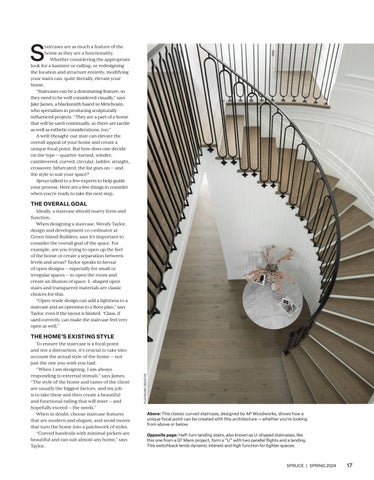
Above: This classic curved staircase, designed by AP Woodworks, shows how a unique focal point can be created with this architecture — whether you’re looking from above or below. Opposite page: Half-turn landing stairs, also known as U-shaped staircases, like this one from a GT Mann project, form a “U” with two parallel flights and a landing. This switchback lends dynamic interest and high function for tighter spaces.
SPRUCE | SPRING 2024
17