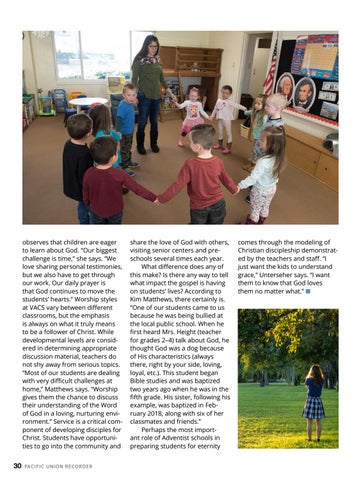
observes that children are eager to learn about God. “Our biggest challenge is time,” she says. “We love sharing personal testimonies, but we also have to get through our work. Our daily prayer is that God continues to move the students’ hearts.” Worship styles at VACS vary between different classrooms, but the emphasis is always on what it truly means to be a follower of Christ. While developmental levels are considered in determining appropriate discussion material, teachers do not shy away from serious topics. “Most of our students are dealing with very difficult challenges at home,” Matthews says. “Worship gives them the chance to discuss their understanding of the Word of God in a loving, nurturing environment.” Service is a critical component of developing disciples for Christ. Students have opportunities to go into the community and
30
PA C I F I C U N I O N R E CO R D E R
share the love of God with others, visiting senior centers and preschools several times each year. What difference does any of this make? Is there any way to tell what impact the gospel is having on students’ lives? According to Kim Matthews, there certainly is. “One of our students came to us because he was being bullied at the local public school. When he first heard Mrs. Height (teacher for grades 2–4) talk about God, he thought God was a dog because of His characteristics (always there, right by your side, loving, loyal, etc.). This student began Bible studies and was baptized two years ago when he was in the fifth grade. His sister, following his example, was baptized in February 2018, along with six of her classmates and friends.” Perhaps the most important role of Adventist schools in preparing students for eternity
comes through the modeling of Christian discipleship demonstrated by the teachers and staff. “I just want the kids to understand grace,” Unterseher says. “I want them to know that God loves them no matter what.” n