world. “Giving an exam in which students merely repeat what was taught isn’t as good as asking, ‘What questions were raised in your mind?’” von Pohle explains. “Remember that Jesus asked a lot of questions! So we need to provoke good questions and help students discover answers in a safe environment. Our teaching methods have moved towards project-based learning in which various disciplines can be taught together, including the spiritual component. We see the teacher as facilitator of this process.” Spirituality for Life The development of spirituality is a wider question for the whole Adventist community, she observes. “This is a context for life, one that includes all skills. We emphasize a spirituality for life, whatever the job or profession. It doesn’t matter what you end up doing as a career, you want to be able to carry your spirituality with you and live it wherever you are. We want to make sure this focal point is relevant and effective as you go out from the school system into the wider world.” Illustrating this point, she references the “Stand for Jesus” program, which involves sport teams in community service experiences. “It may be a basketball tournament” she says, “but the way we play it is important. It impacts how we develop who we are as people.” In this context, she offers teachers a simple objective: “At our schools we want children to meet Jesus in an atmosphere of excellence. Our response to our Lord is everything we have to give”
12
PA C I F I C U N I O N R E CO R D E R
The Challenges So what of the challenges ahead? One major challenge, says von Pohle, is the expansion of the school program for children younger than kindergarten age. In order to help disadvantaged children, the state of California has worked for universal pre-school and for what is now termed transitional kindergarten. “This is where society is headed,” she notes, “and we need to offer the same programs as introductions to our school system. Otherwise we’ll lose them. We can’t pretend it doesn’t affect what we’re doing.” Heading up what is the largest North American Division school system in terms of student numbers, von Pohle doesn’t underestimate the challenge. “One third of all senior academies in the Division are in the Pacific Union,” she says. “Our K through12 system is now moving towards birth through 12. Thirty percent of our students are non-Adventist, which makes our school system one of the biggest mission fields—some 12,000 children in 150 schools in seven states. It’s a real responsibility!” Back to the Crosswalk But back to the crosswalk image. Yes, it’s a great way to illustrate the developmental objective of true education—the training given in dealing with the significant challenges of life, challenges that could be very dangerous without the right education.
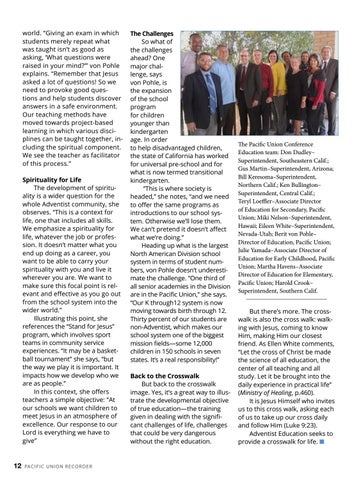
The Pacific Union Conference Education team: Don Dudley– Superintendent, Southeastern Calif.; Gus Martin–Superintendent, Arizona; Bill Keresoma–Superintendent, Northern Calif.; Ken Bullington– Superintendent, Central Calif.; Teryl Loeffler–Associate Director of Education for Secondary, Pacific Union; Miki Nelson–Superintendent, Hawaii; Eileen White–Superintendent, Nevada-Utah; Berit von Pohle– Director of Education, Pacific Union; Julie Yamada–Associate Director of Education for Early Childhood, Pacific Union; Martha Havens–Associate Director of Education for Elementary, Pacific Union; Harold Crook– Superintendent, Southern Calif. But there’s more. The crosswalk is also the cross walk: walking with Jesus, coming to know Him, making Him our closest friend. As Ellen White comments, “Let the cross of Christ be made the science of all education, the center of all teaching and all study. Let it be brought into the daily experience in practical life” (Ministry of Healing, p.460). It is Jesus Himself who invites us to this cross walk, asking each of us to take up our cross daily and follow Him (Luke 9:23). Adventist Education seeks to provide a crosswalk for life. n