SPRING 2022
SUMMER 2023
SPRING 2022

A PUBLICATION OF THE OKLAHOMA VISUAL ARTS COALITION
ALWAYS FREE ADMISSION
Plus a local gallery shop filled with hand-made goods from Oklahoma artists!
June 2 – July 23, 2023

Surface Design Association Member Exhibition: Safekeeping



Juried by Anita Fields

August 4 – September 24, 2023
Linda Lopez & Mathew McConnell: Live from the Moon
July 1 − October 1, 2023
CALL FOR ENTRIES
The State of Craft 2023
108 Members Exhibition, become a member today!
Thursday, August 31, 2023
5:30 − 7:30 pm
THRIVE: Connecting Art + Design

An evening of art mingling.
HOURS:
Wednesday - Sunday 12:00 - 5:00 pm
First Fridays 6:00 - 9:00 pm
Thank you to our sponsors:
108 East Reconciliation Way, Tulsa OK 74103 | 918.895.6302 | 108contemporary.org
LETTER FROM THE EDITOR
JOHN SELVIDGE
IN THE STUDIO // Exploring Collective Wisdom with Billy Hensley
KRISTIN GENTRY
REVIEW Vital Restorations // New Art from the Capitol Collection
KRISTEN GRACE
FEATURE Errant Spirits // ArtNow: The Soul is a Wanderer at Oklahoma Contemporary
BENJAMIN MURPHY
PREVIEW Iconic Alchemy // Taylor Young’s Ornata Sacramentum at the Tulsa Artists’ Coalition

ARIANA JAKUB BRANDES
REGIONAL Abstraction Unbound // Virginia Jaramillo: Principle of Equivalence at the Kemper


OLIVIA DAILEY
INTERMEDIA Video Art and Music // Princess’s One-Minute Social Reign
OVAC NEWS // NEW AND RENEWING MEMBERS
ON THE COVER // Exhibition view of ArtNow: The Soul Is a Wanderer including Joseph Rushmore’s No Known Place , Elspeth Schulze’s The Sparing Ones, and Moira RedCorn’s Ma^zha^ tseka Ma^thi^ (Moving to a New Country) | Lexi Hoebing, page 14; MIDDLE // Billy Hensley and Lokosh (Joshua D. Hinson, Chickasaw), Abikoppolo, 2022, acrylic paint, 24”x36”, page 6; BOTTOM // Taylor Young, Tulipa , 2021, watercolor, charcoal, and acrylic, 10”x 10”, page 18
Support from:
Oklahoma Visual Arts Coalition PHONE: 405.879.2400 1720 N Shartel Ave, Ste B, Oklahoma City, OK 73103. Web // ovac-ok.org Executive Director // Rebecca Kinslow, rebecca@ovac-ok.org
Editor // John Selvidge, johnmselvidge@outlook.com
Art Director // Anne Richardson, speccreative@gmail.com
Art Focus is a quarterly publication of the Oklahoma Visual Arts Coalition dedicated to stimulating insight into and providing current information about the visual arts in Oklahoma. Mission: Growing and developing Oklahoma’s visual arts through education, promotion, connection, and funding. OVAC welcomes article submissions related to artists and art in Oklahoma. Call or email the editor for guidelines. OVAC welcomes comments. Letters addressed to Art Focus are considered for publication unless otherwise specified. Mail or email comments to the editor at the address above. Letters may be edited for clarity or space reasons. Anonymous letters won’t be published. Please include a phone number.


2022-2023 BOARD OF DIRECTORS // Douglas Sorocco, President, OKC; Jon Fisher, Vice President, OKC; Diane Salamon, Treasurer, Tulsa; Matthew Anderson, Secretary, Tahlequah; Jacquelyn Knapp, Parliamentarian, Chickasha; John Marshall, Past President, OKC; Marjorie Atwood, Tulsa; Barbara Gabel, OKC; Farooq Karim, OKC; Kathryn Kenney, Tulsa; Heather Lunsford, OKC; Kirsten Olds, Tulsa; Russ Teubner, Stillwater; Chris Winland, OKC
The Oklahoma Visual Arts Coalition is solely responsible for the contents of Art Focus . However, the views expressed in articles do not necessarily reflect the opinions of the Board or OVAC staff. Member Agency of Allied Arts and member of the Americans for the Arts. © 2023, Oklahoma Visual Arts Coalition. All rights reserved. View the online archive at ArtFocusOklahoma.org.
3
CONTENTS / / Volume 38 No. 3 // Summer 2023
4 6 18 22 10 14 26 29
LETTER FROM THE EDITOR
Summer is just too much. As I write this, not long before the 4th of July holiday weekend, tomorrow’s high temperature is projected to be 104 degrees. Tempers are running high, and a lot of us have not been exactly at our best: denial runs rampant, even after audiotape surfaced of an ex-president serving up classified war documents like canapés to party guests, and the soulless howl of laughter from online cynics, rejoicing at several people killed by an imploded submarine, has only recently died down.
And that was just this past week. There will surely be more inspiring moments to come. Luckily, summer is a lot of everything: so much light, long days, and for many of us, it’s festival season, a time of parties, excitement, excess, plenitude. That’s true of our art season as well. With so many Oklahoma artists working today, emphasizing group shows made sense for this issue of Art Focus Oklahoma Contemporary’s ArtNow (p. 14), the touring show Collective Wisdom at Red Earth (p. 6), even the state Capitol’s expanded art displays (p. 10) mark the season’s high tide in bringing so many undersung legacies into the light. From a different angle, the symbol-rich, spiritual density of Taylor Young’s mythic, sensual figures at the Tulsa Artists’ Coalition (p. 18) celebrates summer’s apogee, as does the exuberance of Virginia Jaramillo’s abstract experimentalism (p. 22) in its expressive joy.
In that spirit, I’m excited to unveil a new section of Art Focus, one that picks up from Liz Blood’s stellar “Ekphrasis” feature that ran for almost nine (!) years, that explores other interdisciplinary hot zones. Since art and poetry vibe so interestingly together, why not expand this wider sense of poesis to realms of art-making that straddle visual art and other media? With a nod to one of my heroes, Dick Higgins, I hope that “Intermedia” offers a welcome engagement with hybrid forms that overrun their generic boundaries.
Also, please reach out to me about the upcoming art happenings you’re excited about near where you live. We want to support artmakers, art spaces, and art enthusiasts all over the state, and we’ll need your help to do that, so I hope you’ll join the party.
—John Selvidge

4
JOHN SELVIDGE is an award-winning screenwriter who works for a humanitarian nonprofit organization in Oklahoma City while maintaining freelance and creative projects on the side. He was selected for OVAC’s Oklahoma Art Writing and Curatorial Fellowship in 2018.
LETTER FROM THE EDITOR
ROBIN CHASE

5 feature On view through Jan. 15, 2024 okcontemp.org | 11 NW 11th St., Oklahoma City The Soul Is a Wanderer 2023 Detail of Moira Redcorn’s Ma^zha^ tseka Ma^thi^ (Moving to a New Country), 2022.
Ann Sherman.
Photo:

6
IN THE STUDIO // EXPLORING COLLECTIVE WISDOM WITH BILLY HENSLEY
by Kristin Gentry (Choctaw Nation)
Highly textured mixed media works hang on the walls of any exhibition that includes the work of Billy Hensley. Both a citizen of the Chickasaw Nation and a Choctaw Nation descendant, Hensley begins his pieces by layering various types of media before often adding imagery relevant to both his ancestral and contemporary-traditional southeastern tribal cultures. The southeastern tribes, also known as the Five Tribes—those forcibly removed from the southeastern part of the U.S. to what was then “Indian Territory” beginning in the 1830s, today the Cherokee, Choctaw, Chickasaw, Seminole, and Muscogee Creek Nations of Oklahoma—share deep symbology, cosmologies, oral histories and lifeways important to the artist. To complement the influence of tribal weaving that can be seen in the linework of his paintings, Hensley has begun adding beadwork atop the mixed media textures of his most current pieces.
In addition to his own art, Hensley has curated the traveling group exhibition entitled Collective Wisdom , which showcases more than 20 First American artists and will be visible at the Red Earth Art Center in Oklahoma City from July 5 through September 1. Each piece in the exhibition is a unique collaboration between two or more artists. By incorporating their own media and interweaving their various cultures, experiences, and relationships, these artists have developed a representative show that reveals unique facets of the contemporary First American art world.
What prompted the use of beadwork on your art?
I think I’ve always admired beadwork I’ve seen, and I’ve enjoyed watching people make it. I thought it would be
a good addition to my work, and it replicates the same textures I paint with my lines. I am inspired by Marcus Amerman’s (Choctaw Nation) style of beadwork, so I made sure he was included in Collective Wisdom
Why do you often focus on the garfish and the crayfish for the subjects of your works?
The crayfish I don’t use as much as the garfish, but it’s part of our [Chickasaw] creation story of building the earth up from the ocean floor. The garfish is more aligned with Chickasaw utilitarian traditions, like using the scales for arrow tips. The garfish jaw bones and teeth were used for traditional tattooing and have been revitalized for that use again today. One of our original Chickasaw dances is called the “hard fish dance” in honor of the crayfish.
Who are the mentors who have been significant to your career as an artist?
Growing up, my mom and grandma were artists, and my grandma was an oil painter. We always drew together. When I went to high school, I met Paul Walsh as my art teacher. He inspired me to become a professional artist and still supports me today. I have my career because of him. I also spend a lot of time learning from my community mentors: painter Brenda Kingery (Chickasaw Nation) and weaver Margaret Roach Wheeler (Chickasaw/Choctaw).
How have you and the artists included in Collective Wisdom created this unique collaboration between artists?
I always thought it would be cool to mix other artists’ work and have maybe ten artists collaborate on one piece. Many times, my friends in our artist community would come over to my home for us to have a meal and create work
7
CONTINUED
IN THE STUDIO
OPPOSITE // Billy Hensley, Brenda Kingery, and Margaret Roach Wheeler. Tochina, 2022, mixed media, 3’x5’ | Courtesy of the Chickasaw Nation
collaboratively, but I wanted to push the idea to become a little more formal to give us all the chance to create even stronger works.
Although the exhibition pieces involve only two to four artists per work, Hensley’s idea has been successfully executed within Collective Wisdom. Many pieces began with only one artist painting the background or foregrounds onto canvas and then passing the work to a second artist to complete. When viewing the exhibition, the concept may not seem complex, but interesting challenges arose for the artists during creation. In an artist talk at The ARTesian Art Gallery in Sulphur, Dustin Mater (Chickasaw Nation) and other panelists discussed how the process caused some emotional reactions and even fear about painting, printing, or beading on top of another person’s art, an experience that many of the artists included in the show shared. The artists had to learn how to mix their styles with those of other artists while still trying to make sure each person’s work remained present in some form. Another challenge they noted was creating works in media different from those each artist normally worked in. A positive and surprising result came about when printmaker Marwin Begaye (Navajo Nation) noted that he wouldn’t have seen some of the details in Margaret Roach Wheeler’s work if he hadn’t had the opportunity to collaborate directly with her hand-woven textiles for their piece Cultural Algorithms
A selection of works from Collective Wisdom will be traveling from Red Earth Gallery in Oklahoma City to Santa Fe, New Mexico, for the next iteration for the Sovereign Santa Fe Expo, inside the historic La Fonda Hotel, which coincides with the Santa Fe Indian Market. Collective Wisdom’s path will then include stops at the University of North Texas, the Museum of the Southeastern Indian in North Carolina, and then later end back in Oklahoma with a showing at the Jacobson House in Norman in the spring of 2024.

I am also happy to announce here that Hensley is slated as the 2023 Mahota Textiles featured artist for his blanket, based on his painting Ascension. Additionally, Hensley will be exhibiting work later this summer at the Rainmaker Gallery in Bristol, UK.

8 IN THE STUDIO
ABOVE // Works from Collective Wisdom as exhibited in 2022 at the Chokma’si Gallery in Ada; RIGHT // Billy Hensley in his studio | Kristin Gentry
Collective Wisdom can be seen from July 5 through September 1 at the Red Earth Art Center in Oklahoma City. It will also be visible at the Jacobson House in Norman in the spring of 2024, dates TBA. You can learn more about Hensley’s work at billyhensley.com

KRISTIN GENTRY is a citizen of the Choctaw Nation of Oklahoma. They are an award-winning multidisciplinary visual artist, arts writer, curator, educator and the Director of Community Engagement and Outreach for Native Realities, LLC. They were born in Tulsa, Oklahoma, and live with their daughter, Jewell Shooting Star, in Oklahoma City. You can view their artwork at kreativenative.com
 ABOVE // Marcus Amerman and Billy Hensley, Oklahoma Flyover , 2022, watercolor and beadwork, 18”x24”; RIGHT // Billy Hensley, Ascension , 2023, blanket woven with Mahota Textiles, 30”60”, modeled by the artist’s daughter Holly Hensley | Courtesy of Mahota Textiles.
 Interior of the Oklahoma State Capitol | Kristen Grace
VITAL RESTORATIONS // NEW WORKS FROM THE CAPITOL ART COLLECTION
by Kristen Grace Unknown
to many Oklahomans, the historic Capitol building has become the largest free art museum in the state, its marble halls open to the public most days of the year. Ten years ago, it was a different story. Mold, leaks, and even falling marble caused Preservation Oklahoma to put the Capitol on a list of the state’s most endangered places in 2013. Just one year later, the Oklahoma State Capitol Restoration Project began, funded by more than $245 million in bonds approved by the legislature. Oklahoma law requires certain capital improvement projects undertaken by the state to dedicate 1.5 percent of their budgets to on-site public art, a stipulation that provided an opportunity for the Capitol to enhance its art collection with new commissions. The Oklahoma Art Commission assessed the art displayed at the Capitol and decided to seek commissions to address aspects of Oklahoma’s history that had been previously left out.
While giving a recent tour of the newly remodeled Capitol and introducing the new art, Jarica Walsh, Director of the Art in Public Places Program for the Oklahoma Arts Council, reflected on the OAC’s motivation. “This is the people’s house,” she said. “We want all of Oklahoma’s people to be reflected here.”
To date, the Oklahoma Arts Council has brought in 21 new works to the Capitol building. Artwork throughout the ground floor now focuses on Oklahoma’s pre-statehood and Native American history. This new Indigenous emphasis begins in the Capitol’s entrance where visitors are greeted by a video incorporating Native languages produced by Buffalo Nickel Creative with the help of Sterlin Harjo (Seminole, Muscogee), co-creator of the made-in-Oklahoma hit series “Reservation Dogs.” But the focus on Native American artwork does not stop there.
Outside the Supreme Court chamber on the second floor, guests will find the new Hall of Heroes, which pays tribute to the state’s military history and includes a new work by Choctaw artist Dylan Cavin titled Anumpa Luma Anumpuli Choctaw for “code talkers.” The painting takes inspiration from a rare photo of the Choctaw code talkers who served in WWI. Cavin’s painting captures the sharp clarity of the men’s dark green uniforms and dignified facial expressions, while in the background, the air is full of debris, reminiscent of the cloud of confusion the men were able to maintain around the enemy. The Choctaw code talkers, like the later Navajo code talkers of WWII, used their native language in the service of the U.S. military to stay one step ahead of the enemy. Native Americans serving in the first world war were not considered U.S. citizens at the time of their service. Citizenship would not be granted to them until 1924.
Installed in February of this year, Making Her Mark by Sara Scribner is a mural of four Oklahoma women: astronaut Shannon Lucid; Opaline Deveraux Wadkins, a nurse, activist for desegregation and the first Black woman to earn a master’s degree from the University of Oklahoma; Chief Wilma Mankiller, the first woman to serve as chief of a major Native American tribe; and Maxine Horner, one of the first Black women elected to the Oklahoma Senate. This mural is located, fittingly, overlooking the Hall of Governors, a collection of the bronzed busts of every governor in Oklahoma’s history. The placement of the mural, as well as the women standing together in shades of regal blue, feels purposeful. Looking down from an imposing height, the women in the painting might be understood as gathering inspiration from some of the best of Oklahoma’s past leadership and standing on the threshold of a hopeful future.
11 REVIEW
CONTINUED
A portrait of Chief Wilma Mankiller by artist Starr Hardridge (Muscogee) has been added on the fifth floor in the Hall of Heroes. In his portraiture, Hardridge is influenced by classical art, but in his work on Mankiller he uses an assemblage of pointillism and a southeastern woodland beadwork aesthetic. His bold use of color and geometry works to highlight and even give glamour to the Cherokee Chief. Hardridge’s portrait also showcases the Cherokee seven-pointed star as well as the Cherokee syllabary above Mankiller’s head.
Not surprisingly, the Capitol honors such pride-of-Oklahoma stalwarts as Woody Guthrie, Will Rogers, and Wiley Post, but also Chickasaw storyteller Te Ata and civil rights leader Clara Luper, who is represented with a newly fashioned bust by Oklahoma artist LaQuincey Reed. A new mural depicting the Katz Drug Store sit-in of 1958 is coming soon, as is a mural celebrating Tulsa’s Black Wall Street, whose legacy lives on despite the tragic destruction of the district in the 1921 Tulsa Race Massacre. Through art, these stories will be displayed on the walls of our state Capitol for our students and citizens.
Walking through the marble halls of the Oklahoma State Capitol, one can see that this place has become a visible record of our state’s past, both glorious and sorrowful. Its thoughtful artworks have in many cases has become vessels for history lessons that were hidden from many of us in school.

“Hopefully in the next five years, we’ll be ready to get every student across the state to the Capitol to see the renovated building in their lifetime,” says Oklahoma Arts Council Executive Director Amber Sharples. “We want to leverage the artwork as an educational tool, which it’s always been.”
This place is more than just a house of state, more than a museum. It’s the people’s house.
The Oklahoma State Capitol is open 8 a.m. to 5 p.m. weekdays and 8 a.m. to 4 p.m. weekends. For guided tours and more information, please see arts.ok.gov/tours
KRISTEN GRACE is a journalist for 405 Magazine and 405 Business Magazine, a freelance copyeditor for Callisto Media, and a graduate of Oklahoma City University’s Red Earth MFA program. She has authored a picture book for children, The Stepmother Who Believed in Feathers, as well as Wings, a collection of feminist fairy tales, both available from Literati Press. She has recently published poems in Focus Magazine, Mid/South, Freezeray, Behind the Rain Anthology and other literary journals.
12 REVIEW
Dylan Cavin, Anumpa Luma Anumpuli, 2022, acrylic on linen, 36”x 48” | All images of artwork by the Oklahoma Legislative Service Bureau, courtesy of the Oklahoma Arts Council


 TOP LEFT // Sara Scribner’s Making Her Mark (2023, oil on linen, 9’x 22’) being installed in February, 2023; TOP RIGHT // LaQuincey Reed, Clara Luper, 2022, bronze, 21”x17”x10”; RIGHT // Starr Hardridge, Chief Wilma Mankiller, 2022, acrylic paint and venetian plaster on linen, 36”x 30”; ABOVE // Jessica Moore Harjo, PhD (Otoe-Missouria/Osage Nation/Pawnee/Sac & Fox), Detail of People of the Great Sky, Constellations of the Land, 2023, laser-cut brass on ceiling, 63’x12’
ERRANT S PIRITS // ARTNOW: THE SOUL IS A WANDERER AT OKLAHOMA CONTEMPORARY
by Benjamin Murphy
Oklahoma is a complex place, rich with stories that represent a wild variety of experiences. With Oklahoma Contemporary’s most recent iteration of its biennial exhibition ArtNow, thirteen artists who work in the state plunge into their investigations of the past, today’s complicated truths, and what we might read as possibly liberated futures. Presented by Tulsa-based guest curator Lindsay Aveilhé, the exhibition takes its title The Soul is a Wanderer from former United States Poet Laureate Joy Harjo (b. 1951, Tulsa; Muscogee Nation). As her poem from 2000 “A Map to the Next World” tells us “The soul is a wanderer with many hands and feet.” It also counsels us that “Crucial to finding the way is this: There is no beginning or end./ You must make your own map.”
Among the thirteen artists who endeavor to find their way through our shifting cultural landscape, I chose to take a close look at three who have created an exciting range of artworks utilizing language, video, earth, sculpture, performance, sound, and extended painting techniques.
Nathan Young: Plains Indian Sign Language II
“Heavy” and “surreal” is how Nathan Young (b. 1975, Tahlequah; Delaware Tribe of Lenape Indians) describes his video installation Plains Indian Sign Language II. Don’t be fooled by the innocuous-sounding title, the story it tells is as heavy as it gets. Calling the mythologized story of the Mayflower and the first Thanksgiving “lies in history books,” Young’s telling asserts a darkness in these religious pilgrims. When the settlers arrive, Native Americans provide lifesaving assistance during the colonists’ first winter only to be later rewarded with death. Told using only hand gestures, silence becomes a salient character in this tale of undeserved aggression, one whose quiet delivery chillingly subverts the naïve version of America’s colonial origin story to make it emblematic of the attempt to silence Native Americans. Young’s visually plain and silent video packs a punch.
On a documentary field trip, Young encountered a tribal elder who told this version of the Mayflower story—a jarring and compelling response to negative collective memory. Within the frame of an old-school video art aesthetic, the video features Young’s cousin Warren Realrider (Pawnee/Crow) recounting the story through the “picture writing” of Plains Indian Sign Language—itself the basis for American Sign Language—whose short phrases are subtitled. Young’s approach can be traced back to his sound and music studies at Bard College, where he began to understand that silence is a part of sound and the world lacks true silence. The work pulls its audience into an insurgent reaction to America’s original myth to experience an ambivalence born of tension between authenticity and invention.
Ashanti Chaplin: Earth Elegy
Inspired by Walter De Maria’s Earth Room, Ashanti Chaplin (b. 1981, Tulsa) uses sculpture, video, sound, and performance to connect with memory and place in a reflection on the 13 historically Black towns in Oklahoma: Boley, Brooksville, Clearview, Grayson, Langston, Lima, Red Bird, Rentiesville, Summit, Taft, Tatums, Tullahassee, and Vernon. Acting as a landscape, but not in a traditional sense, the work’s video projection depicts earth and soil up close, presenting us with an abstracted landscape. Accompanying the video is an obelisk standing 13 feet high. This reverential monument is constructed from ground clay collected from each of the 13 towns and mixed with polymer. Its exterior resembles adobe building materials but with an ombré effect achieved by the different colors of clay, whose mixed colors move from dark to light in hues ranging from deep red and purple to pale ochre. Shifting musical compositions, inspired by the landscapes associated with each town, play in the exhibition space. On ArtNow’s opening night, Chaplin gave a ritualized performance to invoke a spiritual connection with the earth.
14
CONTINUED FEATURE

15
Ashanti Chaplin, Earth Elegy, 2023. Obelisk sculpture: Fired clay soil on wood armature, 13-minute (looped) video, and score composed by Gabriel Royal with Ashanti Chaplin | Lexi Hoebing
Chaplin’s material and process are equally important to the experience as the piece’s visual and auditory components. Learning about Greenwood as a young person inspired a pride of place in Chaplin, and she felt a sense of wonder that compelled her to visit each one of these fabled all-Black towns. The process of collecting clay from each location began in August of 2022 with visits to Taft and Tallahassee. Soon, driving as far as Lima, Chaplin was awestruck by the beauty of the landscape connecting these towns. Accompanied by cellist and composer Gabriel Royal, her act of driving inspired the compositions that fill the gallery with sound. In Boley and Grayson, Mayors Dr. Francis Shelton and Leon Anderson greeted Chaplin with shovels. Looking for clay they explored creeks, ponds, and cemeteries so that history could become literally embedded in Chaplin’s materials for the project and bind the places from which it was excavated to its viewers’ consciousness. Earth Elegy ultimately offers a mediation on earth, placemaking, and the opportunities land provides to build new futures.
Molly Kaderka: Ferrous Form/Unform


Through a reimagined approach to landscape painting, Molly Kaderka (b. 1989, Austin, TX) can be thought to respond to the circular journey central to Harjo’s text. By removing the linear or horizontal paradigm associated with traditional landscape imagery, with Ferrous Form/ Unform Kaderka constructs a spherical model that positions an earthly rock formation around a celestial center. The viewer encounters two immersive, large-scale paintings, presented as a diptych, each with a diameter of 15 feet. While modifying the notion of landscape, Kaderka also confronts our traditional understanding of painting by utilizing paper marbling, painting, and drawing and laminating her materials to the wall. The texture of the marbled paper is used to depict circular rock formations whose brick-red coloring, thanks to the marbling process, references Oklahoma’s iron-rich, ferrous soil. The scale of these swirling landscapes and seemingly infinite vistas tend to evoke an overwhelming sense of wonderment and contemplation in their viewers.

16 FEATURE
Video stills from Nathan Young’s Plains Indian Sign Language II, 2023. Courtesy of the artist.
Kaderka examines the theme of transformation through contrast. While Ferrous Form remains a stable image that perhaps symbolizes our present state of being, its counterpart Ferrous Unform enacts a more visually kinetic circular landscape fractured in a centrifugal array of earthly fragments that seem to be flung away from the work’s dislocated center. Viewed together, they speak to our tenuous control over our surroundings, since nature is in a constant state of change, by exploring the relationship of ground to sky, circular composition, and states of coherence and coming apart. Kaderka has created a visual narrative that echoes Harjo’s statement that “there is no beginning or end.”


Just as we are made from stars, there is no ending, only an infinite unfolding of transformation. With ArtNow, Oklahoma
Contemporary and curator Aveilhé put forward a diverse range of artists who testify to this poetic truth, showing us along the way a glimpse of Oklahoma’s soul so that we might consider our past, present, and future together.
ArtNow: The Soul is a Wanderer can be seen from June 22 through January 15, 2024, at Oklahoma Contemporary in Oklahoma City.
BENJAMIN MURPHY is a Canadian-born artist who sees the language of art as an expanding one and utilizes the mediums of painting, drawing, printmaking, and digital fabrication. His work examines our evolving understanding of the physical world, technology, and the anthropogenic impacts of climate change. Murphy is the Assistant Professor of Studio Art at OSU and holds an MFA in Painting from the University of Oklahoma. You can learn more about his work at benjaminmurphy.art .

17 FEATURE
TOP // Molly Kaderka, Ferrous Form/Unform, 2023, hand-marbled paper and mixed media | Lexi Hoebing; ABOVE // Ashanti Chaplain, Earth Elegy, clay samples | Courtesy of the artist; RIGHT // Molly Kaderka, Ferrous Unform | Studio image courtesy of the artist;
ICONIC ALCHEMY // TAYLOR YOUNG’S ORNATA SACRAMENTUM AT TULSA ARTISTS’ COALITION
by Ariana Jakub Brandes
In the corner of my grandfather’s house, his icons watched over us. Housed in golden frames, they stacked to the ceiling, moving a bit in the flickering of the candlelight. Saints, I presume, though we were never introduced. They served as symbols of the spirit that allowed him to escape a gulag, surviving for days on an appetite of faith. Those golden saints have made their way to my house, though diluted with works I’ve collected and ephemera of my lived experience.
It is from this memory that I begin my conversation with OKC-based artist Taylor Young, who describes his works as iconographic images in a divine light. “These works are an amalgamation of my experiences, stories I am told, stories I tell myself and the natural world.” But these bright, white, unframed images look far from the traditional golden men peppered throughout my walls.
Adustus lures me in with a large golden circle painted at the top, in front of which falls a man headfirst. He gracefully braces for a meeting with what may be below. The downward movement is rendered so gracefully that the visual works any direction you rotate the work. Several feathers on either side of the man’s feet create white silhouettes in front of the gold circle. A translation of the title from Latin suggests the sun has dislodged the man from the sky and suddenly we are in the theater of Greek mythology.
As in Breugel’s Landscape with the Fall of Icarus, we are the only witness to this man’s descent, his misfortune becoming a moment of beauty. Just as Breugel organizes the viewer’s path through his painting, through his placement of figures, Young is skilled at leading the eye around his works using design elements. With a penchant
for balanced compositions, unified color palettes, and harmonic placement of objects, his training in printmaking is on full display. Golden vertical lines from the sun curtain around our falling subject, connecting the young man to the source of his glowing demise.
Ovid’s Metamorphoses, the long, narrative poem in Latin within which the story of Icarus is written, has remained a stalwart source of artistic inspiration—from the Middle Ages, through the Renaissance and even memorably rendered in collage by Matisse. Such illustrations emphasize the longevity and lure of this story throughout time, making it a natural subject for an artist interested in iconography and folklore. Young’s work carries on this artistic tradition using a distinctively modern style.
His mixed-media paintings, all painted on white watercolor paper, contain base layers of watercolor and gouache. Details are added with charcoals and chalk pastels as well as colored pencil. Gold acrylic paint appears in almost all of his paintings, a representation of the divine light of the spiritual world common to much iconography. His spare, modern symboling of flora and fauna recalls English illustrator Aubrey Beardsley: confident, sensual, enticing and attractive.
A smaller painting only slightly larger than an actual heart, Sacrum, feels ripe with the spirit of Young’s recent trips to Mexico. Placed atop a purple rose, the four chambers of the heart are distinguished in muted primary colors. In the center is a black pupil floating inside an eye shape radiating golden lines, a motif appearing in several other works. The images in Young’s paintings are created intuitively from stored visuals of his travels and all that “stuff around us” that can end up as subconscious sources
18 PREVIEW 18
CONTINUED

19
Taylor Young, Nox Fae Floribus, 2023, watercolor, charcoal, pastel, colored pencil, gouache, and acrylic, 16”x12” | All images courtesy of the artist
of inspiration. “I am able to look back at a time and place and see what I was truly working through in my own life and the world around me,” says Young when reflecting on his work.
Tribus Alis Serpentibus Aurora’s circular composition is like looking through a telescope to discover a hidden figure in the sky, or a portal into the mind of the artist. Echoes of halos and heavenly imagery are organized around a bare-chested, triplewinged man. Striking a couture pose, the hairless, faceless figure stands within the coiled bodies of two red cobras—perhaps they are one animal. The juxtaposition of a winged man with snakes, common Christian symbols of heaven and evil, is unusual and fierce, challenging their traditional Christian meanings. This angel is rendered even more strange by a single eye that appears vertically across the man’s entire face, resembling an Egyptian scarab: a symbol of rebirth, immortality and protection. Gold, associated with traditional icons and seen in most of Young’s work, is largely absent from this scene.
Like Nox Fae Floribus, Young’s more recent works, many of which will be visible in his upcoming show Ornata Sacramentum at the Tulsa Artists’ Coalition Gallery, feel more experimental and complex. The hanging configurations of his artworks in his home have generated new, larger narratives based in “nature, self-created folklore, and my own personal experiences.” The white negative space feels less sharp in these more populated compositions.
The difficulty of titling artworks is tempered through Young’s use of Latin. Used for scientific classifications and a blueprint for many other languages, his Latin titles imbue works with a scholarly sophistication. Young enjoys listening to what others see in his work, reducing any restrictions a title might have

PREVIEW 20
LEFT // Taylor Young, Adustus, 2019, watercolor, charcoal, and acrylic, 48”x24”
in crafting a viewer’s own interpretation. Similarly, the absence of frames—works are only suspended in bolted glass—allows the viewer to consider these artworks as part of something larger, perhaps connecting to one another across the walls.
Looking back around the room where I wrote this piece, there’s a painting of Don Quixote’s horse staring at one of my grandfather’s saints on the opposite wall. He’s gesturing a blessing to the equine, a correspondence I’ve never made until now.
Ornata Sacramentum will be shown at the Tulsa Artists’ Coalition Gallery from July 7 through July 29. You can also see Taylor Young’s work on Instagram at @tcryoungart.


ARIANA JAKUB BRANDES is an artist, educator, and writer who lives in Tulsa. She teaches art at Cascia Hall.
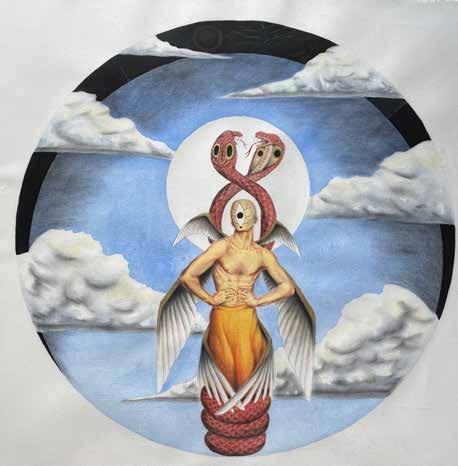 TOP RIGHT // Taylor Young, Sacrum, 2022, watercolor, gouache, charcoal, and acrylic, 10”x8”; BOTTOM RIGHT // Taylor Young, Tribus Alis Serpentibus Aurora, 2022, watercolor, charcoal, acrylic, gouache, pastel, and colored pencil, 24”x24” ; BELOW // Taylor Young, Calvaria III, 2023, watercolor and charcoal, 10”x10”

22
ABSTRACTION UNBOUND // VIRGINIA JARAMILLO: PRINCIPLE OF EQUIVALENCE AT THE KEMPER
by Olivia Dailey
The groundbreaking career retrospective, Virginia Jaramillo: Principle of Equivalence, shows at the Kemper Museum of Contemporary Art in Kansas City, Missouri, from June 2 through August 27. Virginia Jaramillo is an abstract Mexican American painter whose career began over sixty years ago. The exhibition contains seventy-three paintings and handmade paper works, two of which are in Kemper’s permanent collection: Principle of Equivalence (1975) and Anonymous Site #1-603 (1990). Her work explores themes of physics, science fiction, the cosmos, and place.
Born in Texas, growing up in Los Angeles, then living in Paris for a year before settling in New York, Virginia Jaramillo has always been a part of the art community, consistently making thoughtful work. However, she did not receive her deserved recognition until only a few years ago. Her first solo museum exhibition was in 2020 in honor of the 50th anniversary of The DeLuxe Show in Houston, considered one of the first racially integrated art exhibitions in the United States. Jaramillo was the only female and only Latina to participate in the show. She exhibited Green Dawn (1970), which is included in Principle of Equivalence. A large-scale, vivid green canvas, Green Dawn is a part of her significant Curvilinear Paintings series. A thin yellow line, resembling thread, drapes over the upper right corner of the painting. Like a bright dandelion in a sea of lush grass, Green Dawn uses boldly contrasting colors and draws upon the Japanese aesthetic concept of ma, the harmony between lines and space.
With Jaramillo’s first comprehensive career retrospective, there is a Jaramillo-ssance underway. Not unlike Taylor Swift in her “Eras” phase, Jaramillo travels through time, in a sense, by revisiting her full body of work. “I’m amazed
that the works at this point in time exist within their own reality and are a testament to the time of their creation,” she says.
The Kemper’s Director of Curatorial Affairs, Erin Dziedzic, saw a New York show featuring Jaramillo’s new paintings in 2018 and was immediately taken with her artistry. “The level of depth and the attention to color and the way that space relates to it just became something else.” Even as Dziedzic noticed Jaramillo’s work resurface in the art world, a mystery still surrounded the artist. “[There were] gorgeous examples of her works in the shows and two sentences about her in the books…she’s so well represented in these shows, with really big paintings, but there’s nothing written about her.” Her curiosity and research revealed that Jaramillo had a longtime relationship with Kansas City that began in 1975 when the Douglas Drake Gallery first represented her. Dziedzic’s research led to a friendship with Jaramillo and, ultimately, to Principle of Equivalence.
The show also includes recent Jaramillo works like Site No.3: 51.1789° N, 1.8262° W (2018), whose name comes from Stonehenge’s geographical coordinates. The true purpose of Stonehenge is unknown—it could be astrological, spiritual, or even extraterrestrial—and all these theories are very on-brand for Jaramillo’s interests. Site No.3’s black and white color palette harkens back to Jaramillo’s first painting series, The Black Paintings, which focus on the Earth’s more fractured landscapes and muted color tones. In fact, there’s even a painting from The Black Paintings series titled Stonehenge (1964). Since Jaramillo visited Charles and Ray Eames’ studio for lectures in design when she attended the distinguished Manual Arts
23 REGIONAL PREVIEW
CONTINUED
OPPOSITE // Virginia Jaramillo, Green Dawn, 1970, from the Curvilinear series, acrylic on canvas, 83⅞” x 72⅛”. The Joyner/Giuffrida Collection. Image courtesy of the artist and Hales Gallery and Pace Gallery | Phoebe d’Heurle
High School—whose alumni also include Jackson Pollock and Philip Guston—Site’s overlapping white lines on a black surface, resembling an overhead view of a blacktop basketball court, might be considered a nod to Eames’ art film, Blacktop, which features 11 minutes of soap and water swirling around a black-topped schoolyard that Jaramillo says made an impact on her.
Art is not always accessible. Often, museums like the Kemper are free, and the internet has done a lot to make art of all kinds more accessible, but abstract art still faces a bit of a hang-up. We likely all know about the prank where someone plants amateur art in a modern museum as a gag, or have heard someone say incredulously (and mistakenly), “I can make that!” when looking at an abstract
work. When abstract art is not collectively appreciated, that reaction is understandable. We do not know how to digest “weird” art that doesn’t seem to mimic reality, but the best abstract art is not derivative. Unlike art produced by AI, a human created it with skill, purpose, and attention.
To glance at abstract art and immediately dismiss the process that produced it misses the point entirely. You have to engage with it since it relies on a dialogue between the individual and the work. Fortunately, there are no wrong answers! The disarming beauty of it is that, whatever you experience, it is valid. We live in a visually rich world and see more images each day (advertisements, more specifically) than ever before, but just because we may have a greater volume to our visual literacy does not mean that we see

24 REGIONAL PREVIEW
Virginia Jaramillo, Quantum Entanglement, 2019-2020, acrylic on canvas, 72”x144.” Image courtesy of the artist and Hales Gallery and Pace Gallery. | JSP Art Photography
better or can view our visuals through a critical lens. After all, ads tell you how to feel, while art asks you how you might.
Jaramillo maintains that she and her late husband, abstract painter Daniel LaRue Johnson, decided early on to always maintain their freedom as artists. That vow must not have always been easy, but they stuck with it. Jaramillo has excellent advice for anyone wanting to make it as an artist (or follow any dream, really): “Be true to yourself. You must be the hero of your own story and be willing to pay the price.” It has certainly paid off for Jaramillo.
Virginia Jaramillo: Principle of Equivalence can be seen from June 2 through August 27 at the Kemper Museum of Contemporary Art in Kansas City, Missouri.
OLIVIA DAILEY has a BA in Journalism from the University of Oklahoma. She works as a media production coordinator in Norman and is a frequent contributor to Art Focus

25 REGIONAL REVIEW
Virginia Jaramillo, Site No.3: 51.1789° N, 1.8262° W, 2018, acrylic on canvas, 72”x72”. Image courtesy of the artist and Hales Gallery and Pace Gallery | JSP Art Photography
INTERMEDIA - VIDEO ART AND MUSIC // PRINCESS’S ONE-MINUTE SOCIAL REIGN
This past May, interdisciplinary performing arts duo Princess stopped by Oklahoma City’s 21c Museum Hotel to perform their conceptual video opera @1minworld (One Minute World) during their cross-country tour of 21c locations and other experimentally-friendly art spaces. Once they were home, I caught up with Alexis Gideon and Michael O’Neill, creative partners in Princess since 2009, for a Q&A session to unpack some of their thoughts about the project.
It could be easy to think of Princess as simply a band that performs songs with a cool live show. But how central are the visual and video elements to your work?

The visual element is paramount to the work. We want to create narrative immersive experiences for the audience. The visual element allows for meaning to operate on different
levels, whether the visuals and audio contrast or are in accord, and deepen the impact of the work.
Tell me more about the one-minute animated films for @1minworld?
We used the process of stop animation—relying heavily on loops—to create a surreal repetitive universe. The use of Lichtenstein-esque Ben-Day dots reference both the pixels of the digital realm as well as the fakeness and mass-produced nature of social media experience.
What inspired the @1minworld project? How did it come about and how did it evolve into its finished form?
Our last piece Out There is a sci-fi feminist rock opera that clocks in at an hour. While promoting the piece, we were
26 INTERMEDIA
lamenting over how people’s attention spans had gotten so short. We jokingly came up with the idea of releasing video songs specifically for Instagram, as that’s where most people were digesting content. But then we quickly thought doing that would actually be really cool and that the one-minute time limit could inform the work in a very pointed way. As we started developing the one-minute video songs, we realized that social media and phone usage had to be the content as well as form.
One thing I found refreshing about the show is that you’re not critical of social media from on high, but you implicate yourselves. You don’t pretend like you’re exempt from the collective hallucination, or problem, or whatever it is. Did that happen naturally, or was it a conscious choice?


It definitely was a conscious choice. We strive to create work that is critical without ever being pedantic. We like to get into big issues, but always through a self-reflective and humorous lens. In order to keep the work personal and resonant for us, we have to look at how we are accountable and what behaviors we’d like to change in ourselves.
Why is keeping Princess within an explicitly queer frame of reference important to the band’s work?

To us, queerness represents much more than sexuality. We want to push the boundaries of “normal” with our use of genre and medium in order to exemplify our ethos of fluidity. Once society embraces the full gradient of identity, the richer, healthier, and more beautiful the world will be.
What’s a question you’d like to get asked about your work but never is?
We haven’t had much opportunity to talk about the piece we’re planning to do next. Loosely called Bubbles, it will be another futuristic dystopian video opera in which people are all living in individual bubbles, interpersonal human connection has completely ceased, and information is fed through a personalized algorithmic lens. (Wait, is this the future or is this now?!) We know the Flaming Lips are big fans of bubbles…perhaps a collaboration’s on the horizon?
Wayne Coyne, are you out there?? Give us a ring…
You can learn more about Princess at bandofprincess.com and experience selections from @1minworld on Instagram at @1minworld.
27 INTERMEDIA
OPPOSITE // Princess performing @1minworld live at the Warhol Museum in Pittsburgh | Sean Carrol; TOP LEFT // Video still from @1minworld (WAKING); ABOVE // Princess’s Michael O’Neill and Alexis Gideon | Sammy Tunis; TOP RIGHT // Video still from @1minworld (WASTING)
The annual 12×12 Art Fundraiser fuses 175 of Oklahoma’s finest artists with local food and live entertainment to create a memorable one-night-only art event.
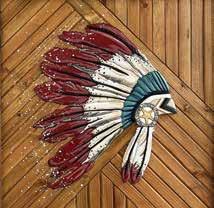

September 29th, 2023

7:00–10:00 PM
Lively Beerworks

OVAC NEWS
July holds a significant milestone for OVAC as we celebrate our 35th anniversary as a nonprofit committed to serving the visual arts community. This occasion calls for collective celebration, as we reflect on the remarkable journey we have had together. Since founding in 1988, OVAC has been driven by a powerful mission: to grow and develop Oklahoma’s visual arts community. Born out of the visionary minds of artists themselves, OVAC has consistently made a profound impact on the artistic landscape of our state. Our unwavering dedication has enabled us to extend support to artists and communities across all 77 of Oklahoma’s counties.
Over the years, we have invested over $2.5 million in artists’ grants, awards, commissions, and honoraria, helping artists pursue their creative endeavors and contribute to the cultural fabric of our communities. Additionally, we have organized more than 60 innovative exhibitions that have showcased the extraordinary talent and diversity within our visual arts community. We also take pride in having equipped over 1,000 artists with invaluable tools, knowledge, and skills essential for their sustained success.
Looking ahead, OVAC is focused on a promising future. We are currently engaged in strategic planning aimed at expanding our services of promotion, education, connection, and funding with the goal of better supporting artists and amplifying the benefits they bring to our communities, both culturally and economically.
As OVAC prepares for expansion, we are thrilled to announce Fernando Calvillo’s promotion to the role of Community Relations Director. In this new leadership position, he will apply his many talents to increasing OVAC’s visibility, enhancing brand awareness, and driving development efforts. Additionally, we are delighted to welcome Karis Chambers to our team as the Membership and Marketing Manager. With their expertise, they will manage various aspects of our community relations, including the website, social media, communications, and member relations.
To celebrate our successes and learn more about how we plan to bring even greater value to our members in the coming year and beyond, join us for our annual members’ meeting at Ponyboy in OKC on Saturday, July 29, from 2 p.m .to 4 p.m. Among other exciting developments, we will share our new membership platform, set to launch in late 2023 as an online community hub that will offer opportunities for networking, building relationships, and accessing a wide variety of resources.
Additionally, we are thrilled to announce the reintroduction of our Oklahoma Curatorial Fellowship. Redesigned since its most recent iteration in 2018-29 as the Oklahoma Art Writing and Curatorial Fellowship, this program will offer the next generation of curators a unique opportunity to cultivate their skills and advance their careers under the mentorship of esteemed local, regional, and national curators. We believe this initiative not only provides valuable learning
Mazen Abufadil
Susan Agee
Craig Alleman
Kayla Andrus
Kathleen Arrieta
Alyson Atchison
Sarah Atlee
Margaret Aycock
Natalie Baca
Paul Bagley
Randall Barnes
Barbara Benton
Eric Bloemers
Christine Bonilla
Danette Boswell
Autumn Brown
Deborah Burian
Michelle Canning
Stan Carroll
Claudia Carroll-Phelps
MaryAnn Ceballos
Amanda Cole
Patrick Collins
Dale Coons
Cinda Covell
Gayle Curry
Ann Boos Davis
Rachel Dazey
Christian Dixon
Anke Dodson
Michael Downes
Callan Dullea
Tony Dyke
Sage Edsall
Michael Eggar
Ben Ezzell
Kris Fairchild
Daniel Farnum
Lauren Florence
Ellen Frank
Janet Funk
Barbara Garcia
Andrea Gardner
Irmgard Geul
Alexa Goetzinger
John Gooden
Susan Green
Susan Hamilton
Patricia Harper
Susan Hayes
Shelly Henry
Larry Hill
Katie Hoffmeier
Kaylee Huerta
Cecelia Hussein
Jane Iverson-Ross
Patrick Jalbert
Amy Jenkins
Micheal Jones
Karis Jones
Kelsey Karper
Jean Keil
Joel Kelley
Larry Landers
Erin Latham
Darci Lenker
Cing Lian
Trace Logan
Lana Lopez
Naima Lowe
Rebecca Lucht
Wesley Luster
Leslie Martin
Casey McCall
Jessica McGhee
Richard McKown
Paul Medina
Sara Michael
Paige Nguyen
David Palmer
experiences for our fellows, but also enriches the larger community through engaging artistic programs and exhibitions. Stay connected with us as we unveil further details about this program throughout 2023-24.
Rebecca Kinslow, Executive Director
Mark your calendars for September 29, 2023, as we host the 2023 12x12 Art Fundraiser at Lively Beerworks in OKC from 7:00 p.m. to 10:00 p.m. Join us for an evening of live entertainment, local food and drink, and the opportunity to shop and bid on unique pieces created by talented local artists. All proceeds from ticket sales and donations will go toward fulfilling OVAC’s mission.
In the weeks and months to come, we have many exciting announcements in store. Keep an eye on Facebook, Twitter, and Instagram for updates on upcoming Thrive artist awards, grant deadlines for artists, educational opportunities, and more!
Thank you for being a champion of OVAC. Your support and dedication are the driving forces behind our success, and we are truly grateful to have you as part of our vibrant community.
Best wishes,
Rebecca Kinslow Executive Director
Molly Murphy-Adams

Caroline Patton
David Phelps
Patty S. Porter
Betty Refour
Elizabeth Richards
G. Patrick Riley
Cheryl Roach
Jim Rode
Liz Roth
Rita Rowe
Amy Sanders
Todd Scaramucci
Barbara S. Scott
Carl and Beth Shortt
Mark Sisson
Denae Smith
Cheryl Smith
Ann Solinski
Agnes Stadler
Jezz Strutt
Cindy Swanson
Lisa Taylor
Jim Terrell
VC Torneden
Matt Travis
Carla Treadway
Cindy Van Kley
Jason Wallace
Jim Weaver
Kathryn Webster
Kathy White
Jason White
Dean Wilhite
Jessica Willis
Megan Wimberley
Adam Winegarten
Emma Winters-Difani
John Wolfe
Jenny Woodruff
Adrienne Wright
Janice Yeary
Candie Yount
NEW AND RENEWIN G MEMBERS MARCH THROUGH MAY 2023 29
MEMBERS
OVAC NEWS


PASEO ARTS & CREATIVITY CENTER Two Art Galleries | Gift Shop | Photography Studio 10 Artists’ Studios | Art Workshops 3024 Paseo, Oklahoma City, OK 73103 thepaaok.org 405.525.2688 Tues-Fri 11am-5pm Sat Noon-5pm
BECOME AN OKLAHOMA INSIDER.


Get events info and behind-the-scenes stories about Oklahoma’s food, travel, events, and culture sent to your inbox.




up for Oklahoma Today’s newsletters at Newsletter.OklahomaToday.com.
Sign


Non Profit Org. US POSTAGE P A I D Oklahoma City, OK Permit No. 113 1720 N Shartel Ave, Suite B Oklahoma City, OK 73103 Visit ovac-ok.org to learn more. UPCOMING EVENTS // Quality of LIGHT 6/26-8/4 24 Works on Paper , Thomas K. McKeon Center for Creativity in Tulsa 7/15 Oklahoma Curatorial Fellowship Application Deadline 7/22 2022 Thrive Awardee Presentations 7/29 OVAC Members’ Meeting & Mixer, Ponyboy, OKC 8/13-9/14 24 Works on Paper , Gardiner Gallery of Art in Stillwater 8/18-9/15 12x12 Preview Exhibition at Art Hall, OKC 9/29 12x12 Art Fundraiser at Lively Beerworks, OKC
