ART PRODUCTION | Megan Sierra, Griffin House, Luke Breum
SALES & CLIENT MANAGEMENT | Ellie Boeschenstein, Ersin Ozer, Patrick Mahoney, Nic Thoman
ACCOUNTING | Sara Sipe, Kaitlyn Malcom
CHIEF OPERATING OFFICER | Josh Timon
CHIEF MARKETING OFFICER | Megan Paulson
VP DESIGN & PRODUCTION | Hiller Higman
DISTRIBUTION | Ennion Williams
CONTRIBUTING WRITERS | Claire Cella, Lily Crane, Parker Day, Gabrielle Gasser, Fischer Genau, Elisabeth Kwak Hefferan, Sarah May, Carol Polich, Paige Southwood, Katie Thomas, Leath Tonino, Charlie Watt
CONTRIBUTING PHOTOGRAPHERS/ARTISTS |
Sam Bartling, Jay Erhard, Jacob W. Frank, Fischer Genau, Michael Hansen, Frank J. Haynes, Elisabeth Kwak Hefferan, Neal Herbert, William H. Jackson, James Jenks, Carol Polich, Walter Reed, Bri Rudinsky, Rachel Schlueter, Katie Thomas, Rosalie Wetzel
Visit outlaw.partners to meet the entire Outlaw team. ON THE COVER
Explore Yellowstone magazine is distributed to subscribers in all 50 states, including contracted placement in resorts and hotels across the West. Core distribution in the Northern Rockies includes Big Sky and Bozeman, Montana, as well as Jackson, Wyoming, the gateway communities around, as well as inside Yellowstone National Park.
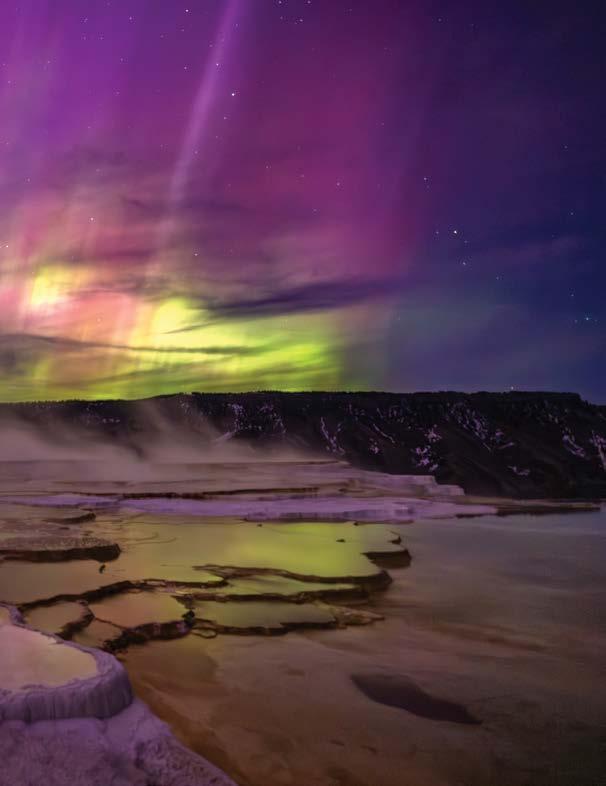
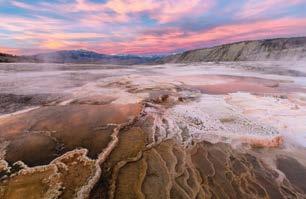
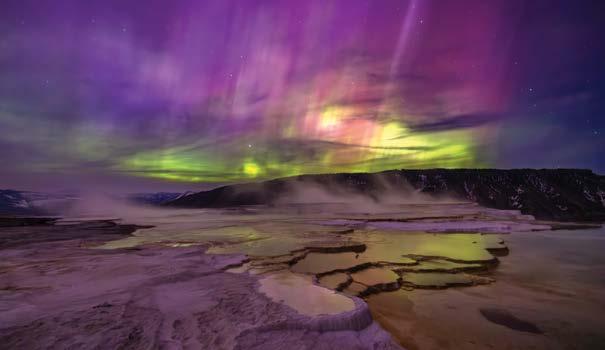
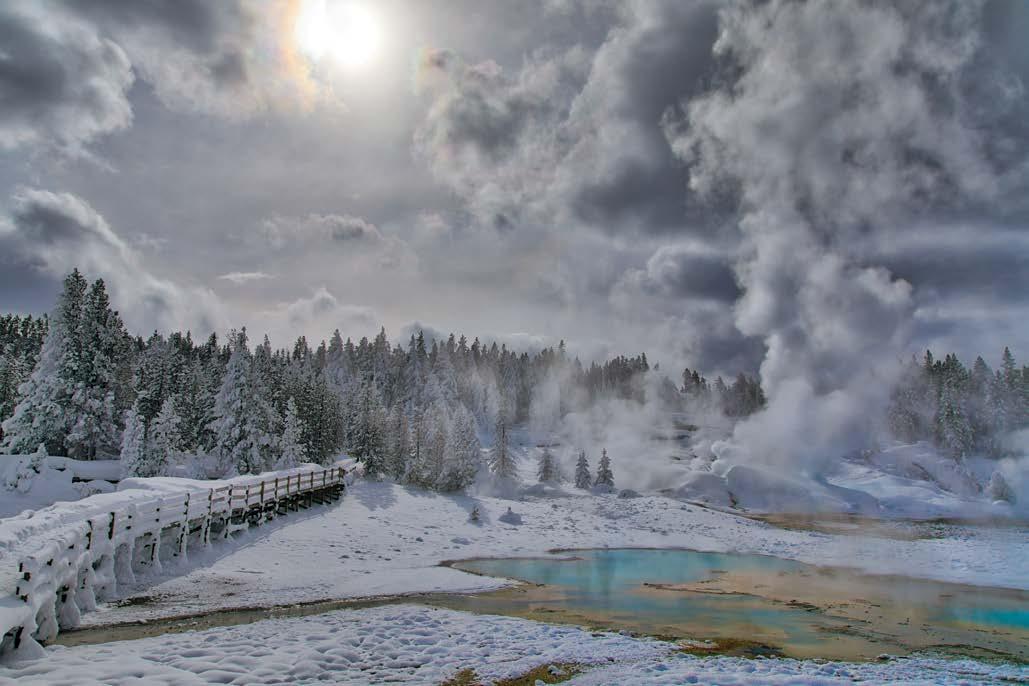
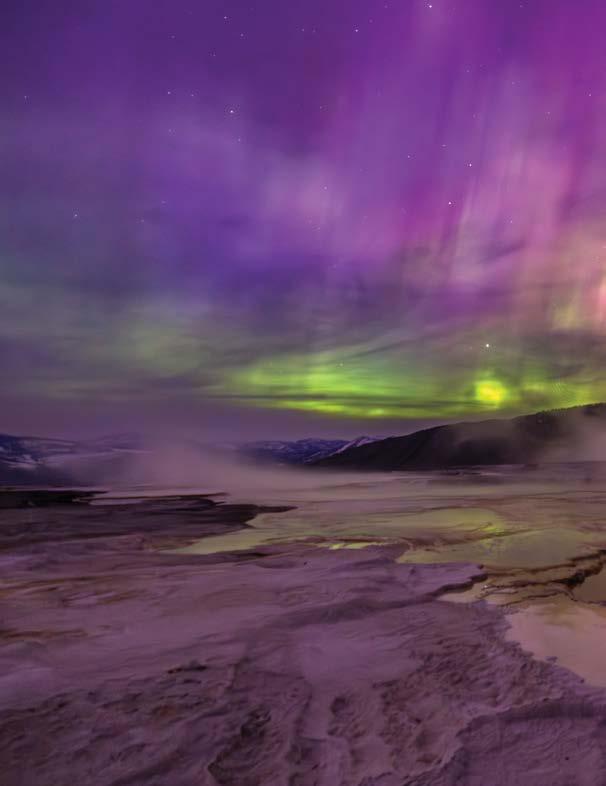
The northern light glistens against Mammoth Hot Springs in Yellowstone National Park on April 23, 2023. Photo by Jacob W. Frank
Photo Courtesy of
Best of Yellowstone Country: What to Do, Eat, & Explore
What’s the Rush? What’s Your Hurry?
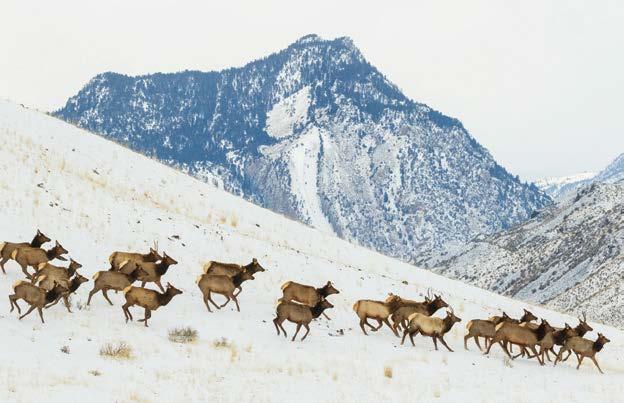
Keeping Yellowstone’s Wildlife on the Move
The “How” of Conservation
Inside Yellowstone: A Lodge-to-Lodge Journey Through the Park
Flying With Motus
Yellowstone’s Night-Shift Engineers: How Beavers Quietly Preserve the Park
Yellowstone’s Personal Photographer Keeping Seeds, Keeping Stories
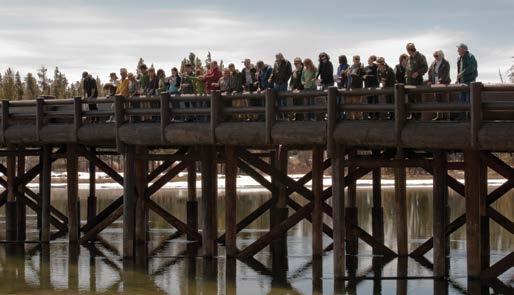
Fishing Bridge: A Lesson in Yellowstone’s Evolution
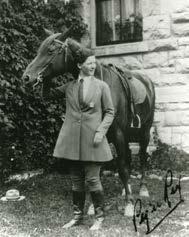
Breaking Barriers in Yellowstone: How Marguerite Lindsley Changed National Parks Forever Among the Savages
Held Up on the Grand Loop: Stagecoach Robberies in Yellowstone’s Early Tourist Era
Surviving Yellowstone: “I Will Not Perish in this Wilderness”
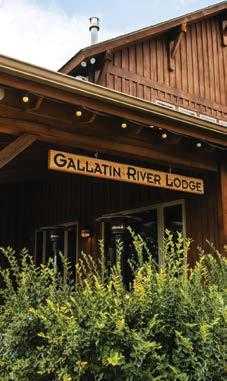
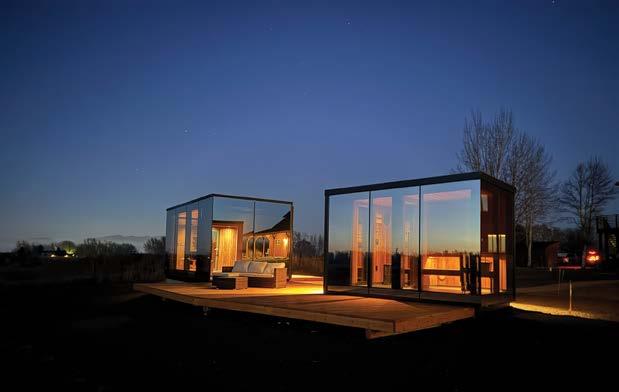
It Starts at the Dirt Road: Finding Comfort at Gallatin River Lodge THE WAY IN
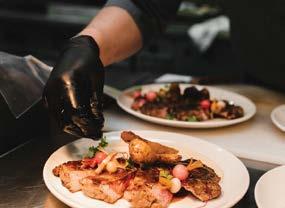
Eating Your Way to Yellowstone
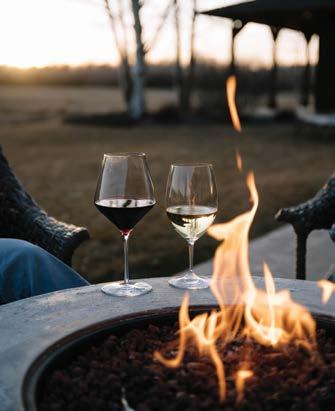
Umvelt and Nissa Bring a Full-Circle Wellness Ritual to Downtown Bozeman
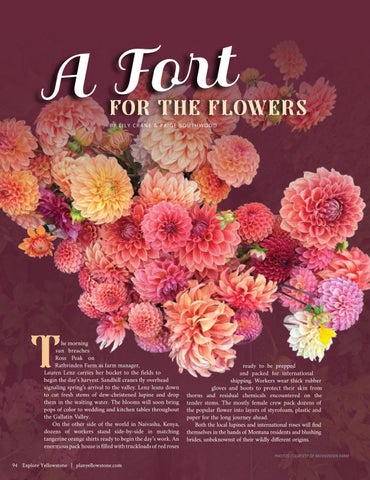
A Fort for the Flowers
A Taste of Paris Finds a Home on Main Street Bozeman
THE STORIES ARE STILL UNFOLDING
Long before Yellowstone National Park was established in 1872, stories were already unfolding across this landscape—from early explorations, to the lives of the animals that shaped it. Since then, the park’s history has continued to grow, and the structures that still stand today carry their own stories, reflecting the changes we’ve made and what we’ve learned over the more than 150 years of the park’s history. Together, these stories remind us that Yellowstone’s history is not a single moment in time, but a living narrative still unfolding.
This issue of Explore Yellowstone looks at where we’ve come from and where we’re going. Inside, you’ll find stories of Yellowstone beavers and their remarkable feats of engineering; seeds that carry the ecological history of a region and the people behind preserving them; a man surviving alone in the Yellowstone landscape before the park’s founding; birds and their migratory journeys that remind us how deeply everything is interconnected; two women on a modern-day, food-focused road trip through and around the park, creating new memories and stories along the way; and much more.
Just beyond the park’s boundaries, the gateway towns at each entrance
to Yellowstone—like Gardiner, West Yellowstone, Cooke City—are much larger today than they were in the park’s early days. Once simply the places where many Yellowstone stories began, these communities have grown into destinations with stories of their own. Cozy lodges, unique farms, warm bakeries, steamy bathhouses, and nonprofits working to protect the animals and landscapes of the Greater Yellowstone Ecosystem all contribute to the experiences found there.
Yellowstone’s story is still unfolding, and each visit adds another page. However you explore Yellowstone this season, we hope these stories travel with you and inspire the next chapter of your own.
See you out there.
- TAYLOR OWENS MANAGING EDITOR
What’s the Rush? What’s Your Hurry? An Ode to Slowing Down
Keeping Yellowstone’s Wildlife on the Move
The “How” of Conservation: Inside PERC’s Approach Inside Yellowstone: A
Yellowstone Country Best of
THINGS TO DO, EAT & EXPLORE
big sky, mt
COFFEE & BAKERIES
• Cowboy Coffee Co.
• Caliber Coffee
• Hungry Moose
• Blue Moon Bakery
• Wildflower Market
DINING & DRINKS
• Omakase MT
• Tres Toros Tacos & Tequila
• Blue Buddha Sushi Lounge
• Blindside Burger
• Café 191 / Casino 191
• The Waypoint
• Ousel & Spur
• Pinky G’s Pizzeria
• Block 3 Kitchen & Bar
• Tips Up
• Buck’s Roadhouse
• Yeti Dogs
• Big Sky Scoops & Big Sky Noodles
& RESORT DINING
• 320 Guest Ranch
• McGill’s Restaurant & Saloon
• Lone Mountain Ranch
• Horn & Cantle
• Montage Big Sky
• Cortina
• Beartooth Pub
• Alpenglow
• One&Only Moonlight Basin
• Akira Back
• Wildwood
• The Landing
• Dear Josephine
• Rainbow Ranch
• Wild Caddis
• Terrain Taco
• Gravity Haus Big Sky
• Belle Cose
• Bluebird
• Christy Sports
• New West Knifeworks
• Great Rocky Mountain Toy Company
• Faherty
• Trove West
• Montana Supply
• Rhinestone Cowgirl
• East Slope
• The Cave
• Hyde (Fur Shop)
ACTIVITIES
• Yellowstone Safari Co. Tours
• Horseback Riding
• 320 Guest Ranch
• Jake’s Horses
• Canyon Adventures
• Rafting
• Montana Whitewater
• Hiking
• Big Sky Community Organization (BSCO) Trails
• Fly Fishing
• 320 Guest Ranch
• East Slope
• Gallatin River Guides
• Mountain Biking, Ziplining, Golf
• Big Sky Resort
• Side by Sides
• Canyon Adventures
• Wednesday Big Sky Famers Market
• Thursday Music in the Mountains
• Tuesday Rodeo at Lone Mountain Ranch
• Treeline Coffee
• Wild Crumb
• Studio Coffee
• Rowan Coffee Roasters
• Roly Poly Coffee Co.
• Vienne Café
• Gallatin River Lodge
• Bodhi Farms
• Shan
• La Brasserie
• AC Benchmark
• Sidewinders
• Wild Rye Distillery
• Tanglewood Grill & Tap
• Ponderosa Social Club
• Sky Shed
• Fielding’s
• The Farmer’s Daughters Café
• J.W. Heist
• Stockman’s Bar
• Devil’s Toboggan
• It Will Always Be That Way
• Heyday
• Biome Slowcraft
• Lucchese
• Montana Expressions
• Montana Territory Hat Co.
• Crossbow Hats
• Stio
• Museum of the Rockies
• Bodhi Farms (yoga, wellness, events)
• AC Benchmark (golf & recreation)
• The Gem Coffee Shop
• Coffee Crossing
• Tru North Café • Fireflies Pottery, Coffee & Ice Cream • Out of the Blue Antiques
• Jackson Hole Aerial Tram (scenic mountain views)
• National Elk Refuge (wildlife viewing & sleigh rides)
• National Museum of Wildlife Art
• Whitewater Rafting
• Horseback Riding
• Hiking
What’s the
What’s the
Rush?
Rush?
What’s Your Hurry? What’s Your Hurry? AN ODE TO
SLOWING DOWN
BY ELISABETH KWAK-HEFFERAN
A GO-GO-GO TRAVELER DISCOVERS THAT AT YELLOWSTONE, LESS REALLY IS MORE.
don’t often find myself craving espresso and ice cream at the same time. Coffee is for the morning; ice cream is best after dinner. But for years, I’ve made an exception at Yellowstone. Yellowstone Perk, a gift and snack shop in the gateway town of Gardiner, serves up a mean affogato—and if there was ever a time for caffeine poured over refined sugar, it was midafternoon on another jampacked visit to the park.
Back in those days, I tackled the country’s first national park like an all-you-can-eat buffet. Never mind that, at 3,472 square miles, Yellowstone is larger than entire states. I wanted to see everything: geysers, bears, bison, lakes, travertine terraces. And I wanted to see them all today. I’d get up with the sun to scope for wildlife, then drive from destination to destination, tagging hydrothermal basins
and waterfalls like I was punching a bingo card. By 3 p.m., I’d be utterly exhausted, yet somehow unfulfilled. Cue the affogato, and another round of touring until I crashed, or sunset, whichever came first.
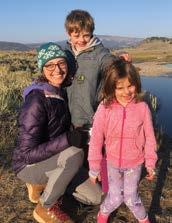
Reader, there’s a better way. A way to see less, but profoundly more at the same time. And I wouldn’t have figured it out if not for my two most uncompromising teachers: my kids.
Parents everywhere know that little kids will not tolerate marathon sightseeing. Trying to visit Yellowstone Lake, Old Faithful, Canyon, and Mammoth all in one day is a recipe for meltdowns the likes of which will scare away all wildlife in a three-mile radius. Admittedly, I was slow to accept this new reality. But I finally conceded that my breakneck visits simply wouldn’t do once first Sam, then Eve, joined the touring party.
Here’s what I didn’t expect, though: Being forced to slow the pace has given rise to some of my very best moments in any national park. Children excel at just being in a place—enjoying the here and now without worrying they’re missing something else down the road. We’d all be wise to take notes.
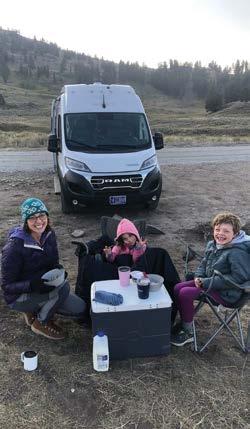
After a few rather stressful attempts to take our family to the park the old way, we decided to try a different approach: just one Yellowstone destination. On our next trip, we camped outside the park and ventured in to explore Norris Geyser Basin, and only Norris. I’d been there several times, and usually rushed through its boardwalks, hot and a little disappointed in its lack of predictable geysers.
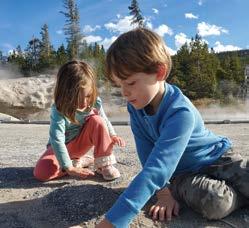
Things were different this time. With nothing else on the agenda, we strolled through the basin’s two miles of trail slowly, stopping to appreciate every fumarole and minor bubbler. When the sun got to us, we found a bench and chugged water. We studied the different colors of the microorganisms surrounding each feature. At one point, the kids plopped down on the trail and started building hills out of gravel; my husband and I just hung out, watching shapes form in the steam over a hot spring. I felt like I was seeing Norris for the first time.
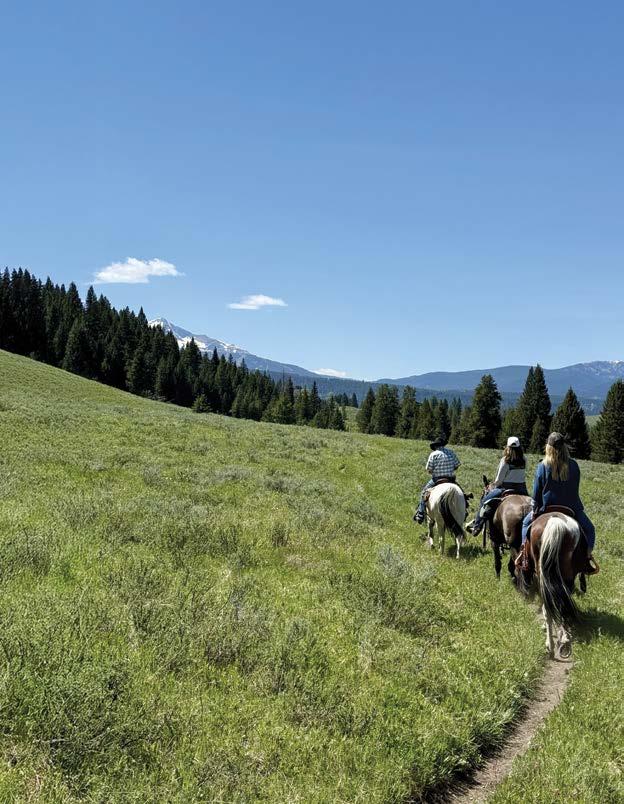
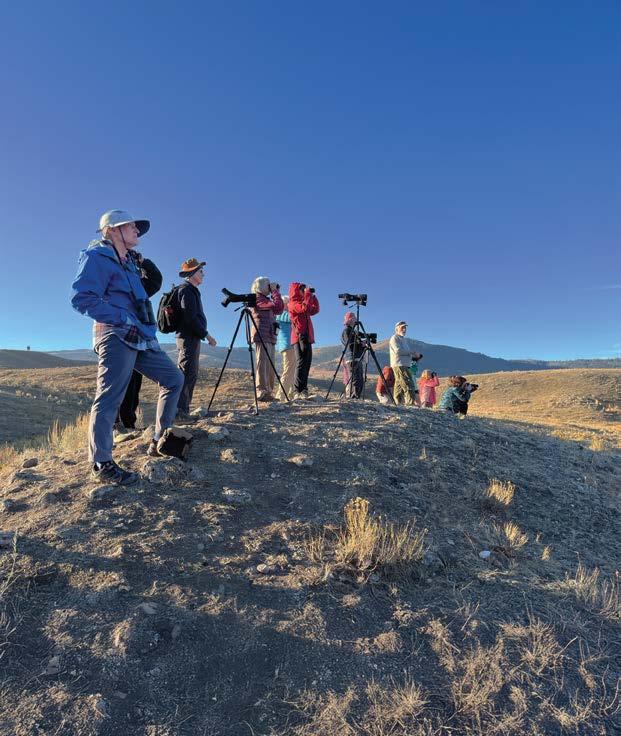
On another visit a couple of years later, we headed for the Lamar Valley before sunrise, hoping to spot a wolf or a bear in the wildlife golden hour. When we saw a small group with spotting scopes at a pullout near Slough Creek Campground, we joined them—but heard we’d just missed the wolves. The old me would have hopped back in the car and driven somewhere else. But we decided to stay awhile.
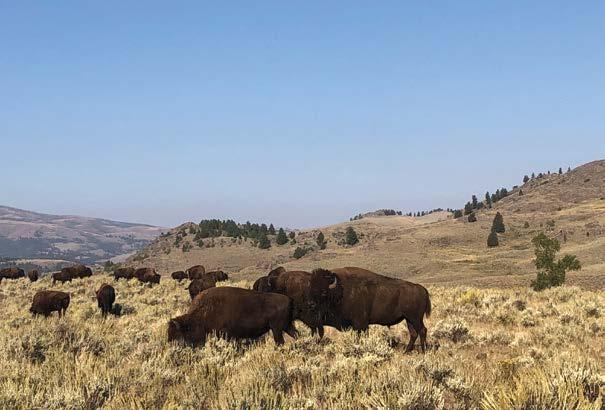
Sam and Eve set themselves up with camp chairs and blankets, hot cocoas in hand. A few bison grazed in the distance as the valley lit up with the rising sun. This wasn’t bad at all. We explored the sagebrush and the creek as the air warmed up. Then, suddenly—“Wolf!” Three members of the neighborhood pack had returned. We watched them in awe, passing binoculars back and forth.
A half-hour later, we noticed more bison were wandering toward us from the south. Amusement (“Oh cool, more bison!”) gradually turned to alarm (“Aren’t they going to stop?”). We finally pushed the kids into the van as a hundred bison surrounded us, moseying their way from grass clump to clump. We couldn’t have gone anywhere even if we’d wanted to. But with the enormous animals grunting and stomping within six inches of our windows, who’d leave? Eventually, they moved on. We checked the clock: We’d been at the pullout for almost five hours. And the wolves, the bison, the creek, the sunrise? Old me would have missed them all in a mad attempt to see “more.”
We live in Montana, so we have the privilege of visiting Yellowstone often. If you’re on a once-in-a-lifetime trip here, I can relate to the urge to tour ‘til you drop. But from one recovered whirlwind sightseer to another: You won’t regret slowing things down a bit. When I’m not in any rush, I’ve found that the landscape reveals so many new layers—I notice more, and appreciate it more, too. Plan to spend more time in fewer places, and you’ll be able to really soak in the magic of this park.
Go ahead and order the affogato, though. I still do.
Elisabeth Kwak-Hefferan is a Montana-based freelance writer who covers climate, public lands, environment, and travel--especially where those things intersect. On her last trip to the Tetons, her family slowed things down so much that the kids ended up with leeches. This was perhaps too slow.
PHOTOS BY ELISABETH KWAK-HEFFERAN
Keeping Yellowstone’s Wildlife on the Move
BY GABRIELLE GASSER
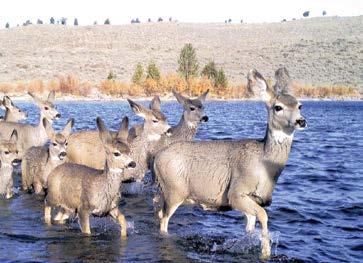
n a sunny spring day, a mule deer leads her fawn along a well-remembered migration path to a summer foraging ground. As they pick their way through tall grass, a barbed-wire fence looms on the horizon. The mother leaps gracefully, clearing the gleaming barbs with room to spare. Her fawn, however, is still too small to make this daunting leap. It tries to crawl underneath the fence and becomes ensnared in the sharp metal.
Scenes like this are all too commonplace in the Greater Yellowstone Ecosystem (GYE)—the 22-millionacre area encompassing Yellowstone National Park (YNP) and surrounding public and private lands in Montana, Wyoming and Idaho.
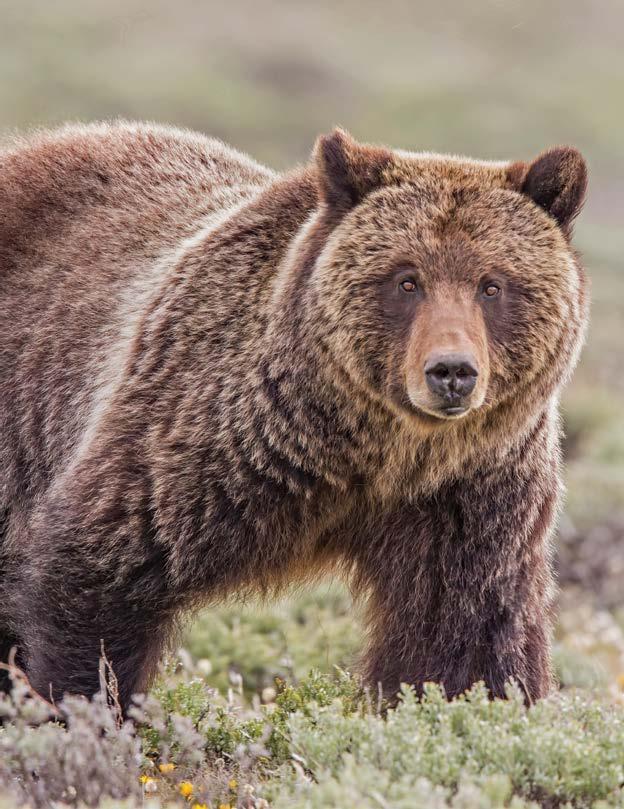
Like the mule deer above, all wildlife big and small need to move to survive. Elk, mule deer and grizzly bears, to name a few species, don’t recognize the borders of Yellowstone National Park or the difference between public and private lands; they go where there is water, food, shelter or mates.
“The wild lands in the Greater Yellowstone Ecosystem have some of the most intact big game migrations of anywhere in North America,” Greg Nickerson, writer and filmmaker with the Wyoming Migration Initiative, said. “At the same time, wildlife does face barriers like fences, roads and development of all kinds that encroach on their habitat and diminish their ability to migrate freely.”
The Wyoming Migration Initiative at the University of Wyoming is one of a handful of research groups that are tracking migrations to understand where animals are moving. This research is helping to prioritize conservation actions and unlock new avenues of funding that can make a real difference for elk and other wildlife.
Similar to WMI, the Bozeman-based nonprofit Center for Large Landscape Conservation (CLLC) is working to ensure that GYE migrations continue.
“Finding ways to mitigate the impacts of major roads is essential to maintain habitat connectivity for GYE’s wildlife and to improve safety for residents, commuters, and tourists,” said Liz Fairbank, road ecologist with CLLC.
Busy roads in the GYE represent one of the biggest barrierstowildlifemovement,somethingCLLCisworkingto change using a combination of science and policy through partnerships and engagement with local communities.
In the fastest growing county in the GYE, Gallatin County, Montana, CLLC completed a US-191/MT-64 Wildlife & Transportation Assessment in partnership
with Montana State University’s Western Transportation Institute (WTI), which identified priority sites that are potential barriers to wildlife movement and pose elevated risks to human and wildlife safety. In neighboring Park County, CLLC completed a similar assessment with WTI on US-89 as a member of Yellowstone Safe Passages, a coalition working to create safe passage for people and wildlife in the Paradise Valley.
collisions with elk.
In 2021, Congress dedicated $350 million over five years to the federal Wildlife Crossings Pilot Program (WCPP), which awards grants to states, municipalities, and tribes to reduce wildlife mortality in locations where crossings are most needed. Recently, three pieces of bipartisan legislation were introduced in the House and the Senate, with sponsorship for two of them coming from Representative Ryan Zinke (MT) and Senator Tim Sheehy (MT), to make the highly successful WCPP a permanent part of federal law and extend its authorization for funding through fiscal year 2031. CLLC expects to apply for funds from the WCPP to support construction of a proposed overpass on US-191.
Properly sited and designed wildlife crossing structures, like underpasses, overpasses, enlarged bridges, and culverts—implemented together with fencing—commonly reduce wildlife-vehicle collisions by over 80% while maintaining habitat connectivity.
“Historically, Montana’s iconic species moved freely to and from Yellowstone National Park and adjacent habitat in the 1.8-million-acre Gallatin National Forest,” Fairbank said. “Today, without proactive measures, higher traffic volumes, associated road noise, and other road impacts threaten habitat integrity while, simultaneously, residents, commuters, and tourists face greater collision risk.”
As highway traffic increases across the region there is a growing number of wildlife-vehicle collisions. A 2020 Montana Department of Transportation (MDT) Corridor Study of US-191 found that 24% of crashes through Gallatin Canyon, from Four Corners to Big Sky, are due to wildlife, while a similar 2014 study of US-89 from Livingston to Gardiner found that 50% of crashes are due to wildlife. These figures contrast sharply with a statewide average of 10%, which is already double the U.S. average of 5%. Above: Mule deer
To help reduce this risk, CLLC is working to ensure that wildlife is considered in planning activities along US-191, such as in planning for the replacement of the Spanish Creek Bridge and, replacing outdated structures at Teepee Creek. Together with MDT, CLLC is examining any possible federal funding opportunities for a series of crossings, including Southwest Montana’s first wildlife overpass at the mouth of the Gallatin Canyon between Gallatin Gateway and Big Sky, Montana—a hotspot for
“Keeping migration corridors intact is the best chance we have at keeping elk and other big game abundant and widespread across Greater Yellowstone both now and for future generations,” Nickerson said. “They need these corridors to optimize their use of the landscape and stay flexible as they face other challenges like disease, habitat loss, drought, and severe winters.”
Millions of people travel to Yellowstone National Park each year for the chance to see iconic wildlife in their natural habitat. To do so, they drive on US-191, US-89, and other gateways to Yellowstone running the risk of hitting one of the elk, mule deer or even grizzly bears that they are so looking forward to seeing. Historic movement paths must be conserved for wildlife to survive and thrive now, and in the future.
Gabrielle Gasser is the Communications and Development Coordinator for the Bozemanbased nonprofit Center for Large Landscape Conservation. She grew up in Big Sky, Montana, and enjoys skiing, climbing, and hiking in the stunning mountains of southwest Montana.
EXPERIENCEYELLOWSTONE
WITH THE PARK’S NONPROFIT PARTNER
Discover more about Yellowstone’s awe-inspiring wonders on an educational program guaranteed to create memories that last a lifetime. No matter your interest— wildlife, hiking, thermal features, photography we‘ll help you see the park in a whole new way!
The “How” of Conservation
INSIDE PERC’S APPROACH
By Claire Cella
I found out quite quickly that it only takes one brief conversation about the Property and Environment Research Center to understand that … and please, pardon the pun, but … there are perks to partnering with PERC.
Take Cam Sholly, superintendent of Yellowstone National Park, for instance. Before I asked any questions, Sholly had already launched into praise. “They’re just a really good group,” he said. “They convene the right people, the right perspectives. They’ve got the expertise to do the analysis to develop a position, to mobilize quickly. Their team is one of the best that I’ve ever seen.”
PERC is a nonprofit conservation organization based in Bozeman, Montana, helmed by Brian Yablonski as chief executive officer and a team of 25 experts in conservation, research, communications, policy, and law. What distinguishes PERC from other conservation nonprofits in the Rocky Mountain West, and arguably the country, is their focus on the how of their work, Yablonski said.
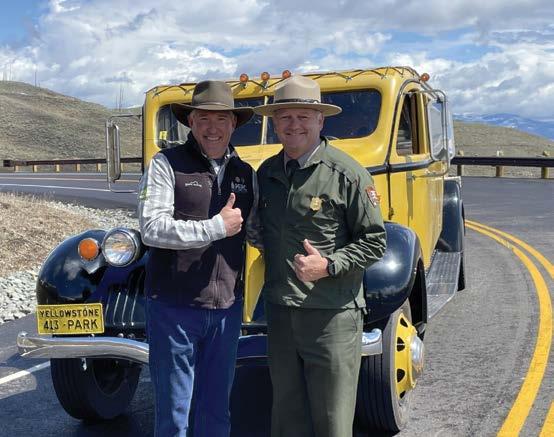
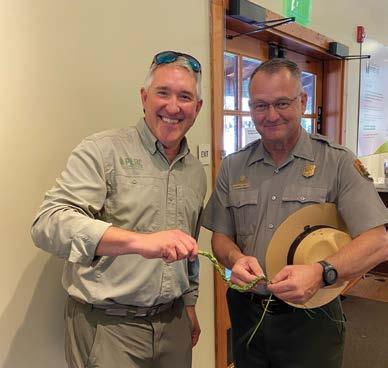
PERC CEO Brian Yablonski (left) with Yellowstone National Park Superintendent Cam Sholly (right) at the park’s 150th anniversary ceremony in the spring of 2022.
PHOTO COURTESY OF PERC
“A lot of conservation groups are where groups—there’s a geographic location they’re working within—or what groups— there’s a species or an issue they’re working for—or who groups—their membership is a certain group, like hunters and anglers,” Yablonski said.
“At PERC, we believe how you do conservation matters significantly, and our how approach is based on using incentives, property rights, and market tools that make economic sense to, in turn, make conservation more durable and innovative.” - BRIAN YABLONSKI
PERC was founded in the 1980s by a group of conservation-minded economists who wondered if capitalism could produce things like bread and cars, couldn’t it also produce conservation? The driving force behind PERC’s mission, Yablonski said, was trying to figure out how to use capitalism and markets as tools for good. The founders went on to create an entirely new framework for conservation called free market environmentalism—where creative approaches are taken to ensure that environmental quality and the bottom line are not antithetical to one another, that exchanges can be cooperative, mutually beneficial, and produce sustainable environmental outcomes.
In current practice, this involves what Yablonski called PERC’s three legs of a stool—a research center, a law and policy center, and a Conservation Innovation
Lab. PERC employs a team of in-house researchers, natural resource economists, and law professors—in addition to contract researchers and fellows from across the country—who tackle questions ranging from how to reform and enhance the Endangered Species Act to encourage species recovery to how virtual fencing can be used to help reduce wildlife conflicts on working ranches. Their research serves as the foundation for policy reform and legal defense, where they center voluntary conservation practices and economic incentives for conservation, and funnels into the Conservation Innovation Lab, where research ideas are applied in the field at ranches, national parks, and in local communities.
Yablonski said PERC’s aim is to make conservation an asset, and not a liability. An example of this is found in the interface between migratory wildlife and private lands. When wildlife move from their
higher summer ranges onto ranch lands in the winter, they can do damage: eating hay, bringing diseases such as brucellosis, leading predators to domestic herds, or damaging fences.
This is where PERC stepped in, working to find and create incentives for ranchers to continue providing this critical habitat for wild animals. In Wyoming and Montana, this looks like the East Yellowstone and Paradise Valley Brucellosis Compensation Funds, respectively, which compensate cattle ranchers in these regions who provide winter habitat for elk—but as a result, risk their herds contracting brucellosis. Over the course of a few years, PERC’s researchers listened to the ranching community’s challenges, convened working groups with other conservation groups, state wildlife agencies, and ranchers to discuss obstacles and opportunities, and provided recommendations for potential solutions. These funds are the result—a privatelyfinanced tool that covers 75 percent of a rancher’s quarantine-related costs following a positive brucellosis test and makes it possible for them to protect both the region’s wildlife and their domestic herds.
PERC CEO Brian Yablonski (left) with Yellowstone National Park Superintendent Cam Sholly (right) at the park’s 150th anniversary ceremony in the spring of 2022.
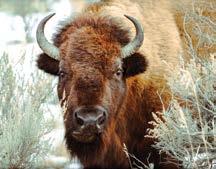
Below Left: A bison in Yellowstone National Park.
PHOTOS COURTESY OF PERC
This is where Sholly said PERC shines—in their creation of good, strong relationships with and between divergent stakeholders, such as landowners, communities, universities, other nonprofits, and congressional delegations.
“I think that’s really novel,” Sholly said. “There are other nonprofits out there doing great work, but I really do think [PERC] has been at the tip of the spear in a lot of ways, in engaging with people that may have otherwise not necessarily been super interested in conservation. His team brings them to the table to figure out, ‘How can we work together?’”
“And those are all real-life problems,” Sholly added, “and things that have to be creatively thought through for us to be able to piece together the components of this ecosystem that make it what it is. They care, like we all do, about the strength of the GYE as an ecosystem, and the interface that has to occur between.”
And while PERC is national in scope— spanning research on orca fertility in the Salish Sea to surveys of old-growth forests in Maine—having the Greater Yellowstone Ecosystem in their backyard has meant it has
become ground zero for a lot of their work, Yablonski said.
And over the years, Yellowstone National Park has become one of PERC’s prominent local partners. Since 2018, they’ve worked together to address five substantive issues in the park: thinking creatively about streams of revenue, especially those tied to visitation; tackling the park’s deferred maintenance backlog; improving employee housing; navigating transboundary wildlife issues; and managing the aftermath of the 2022 floods.
One of the first issues to become apparent to Sholly upon assuming his role was the horrible conditions of the park’s employee housing—a mix of mostly trailers built between 1960 and 1983 that hadn’t been renovated in decades.
Yablonski said PERC helped Sholly and other park employees brainstorm solutions, such as replacing outdated trailers with high-quality modular homes, and advocating for the need in Washington D.C. Their work was further aided in 2024 by a $40 million gift that allowed the park to build 70 new modular units. Today, in early 2026, Sholly said the park has replaced or flipped half of its housing inventory.
“Sholly elevated employee housing as a priority for the park—moving it from not just a backburner maintenance issue, but to a core conservation priority,” Yablonski said. “The way we think about employee housing is that conservation starts by first taking care of the people who do the work of conservation. Sholly was smart enough to recognize that if you want good conservation, you’ve got to get the best conservationists. And that means putting them in habitable facilities.”
Another area where PERC and YNP worked closely together was in exploring increased visitor fees as a potential means to bolster the park’s revenue stream. Earlier this year, some of that research was put into effect when a new $100 surcharge on foreign visitors was applied in Yellowstone and 10 other of the most visited national parks. The revenue generated from the fees will go right back to the parks to help with deferred maintenance on crucial systems that keep the park running, such as infrastructure and wastewater systems.
In June 2025, PERC and its economists released a report that analyzed how much consumer behavior would change in response to a change in the price of visiting Yellowstone—something called price elasticity of demand. What they found was that the demand to visit Yellowstone is highly
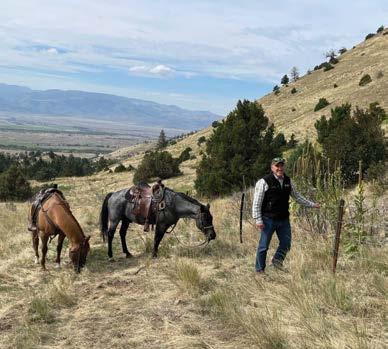
Brian Yablonski checks in on wildlife-friendly fencing PERC funded on the Petrich Ranch in Paradise Valley to help facilitate elk migration while reducing conflict with cattle.
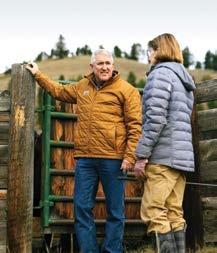
Right: PERC CEO Brian Yablonski (left) visiting with ranching partner Druska Kinkie of Emigrant Peak Ranch. PERC has worked with Kinkie on a payment for presence program for elk on her property
PHOTOS COURTESY OF PERC
inelastic, suggesting that Yellowstone could modestly increase fees without significantly impacting visitation. In the study, they even used a hypothetical example of the $100 surcharge for international visitors, citing that it would raise $55.2 million while seeing only a 1.3 percent drop in visits. For a park with a $1.5 billion maintenance backlog, this idea seemed to offer a sensible and practical way for the park to fund its needs without significantly impacting visitation.
These two examples in Yellowstone are emblematic of the types of projects PERC seeks out and stewards—research with outcomes, not just outputs, and where they think their research will lead to real-world conservation, Yablonski said.
“I think it was a great decision, and we’re looking forward to implementing it. Every American pays something in taxes to the greatest national park system in the world, and international visitors don’t. This same model exists in many places around the world—and PERC has been right there, advocating for that.”
As he looks ahead, Yablonski says he sees both challenges and opportunities for PERC and the GYE—often in the same issue. He thinks it will be crucial to find solutions that prevent fragmentation and development on private lands while also meeting landowners where they are and helping to support their viability. With public lands, he believes we’ll have to get our arms around the issue of loving our lands to death and figure out a way to conserve them while also enjoying them.
- CAM SHOLLY
He believes the market can help be a part of the solution in both cases. “People are moving here for the things we want to conserve,” he said. “They aren’t here to extract oil and gas or jumpstart the timber industry, they’re here for our open space, our unique wildlife, our vast public lands.” In that, he sees an opportunity—people may be willing to pay for the resources to keep land intact, vistas open, and trails managed.
Ultimately, he said, conservation is a verb. “You have to do it. It just doesn’t happen on its own. It needs help.”
And PERC will remain one of conservation’s staunchest advocates, in the GYE and further afield, dedicated to helping bring people together to answer the next question when moving forward: how?
Claire Cella is a freelance writer living in Lander, Wyoming. She’s written about issues across the West for various publications since 2017. Her day job is as a graphic designer for a conservation advocacy nonprofit. She’s a lover of poetry, trails on public lands, and most recently, birds.
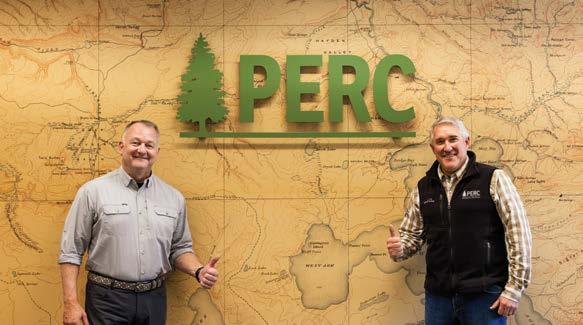
Yellowstone National Park Superintendent Cam Sholly (left) with PERC CEO Brian Yablonski (right) at PERC headquarters, observing a wall map of Yellowstone National Park.
Below Right: Yellowstone National Park
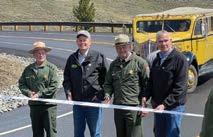
Superintendent Cam Sholly with NPS staff and others at the park’s 150th anniversary ceremony in the spring of 2022 where they reopened the park’s southern loop after historic flooding caused its closure.
PHOTOS COURTESY OF PERC
Inside Yellowstone
BY TAYLOR OWENS
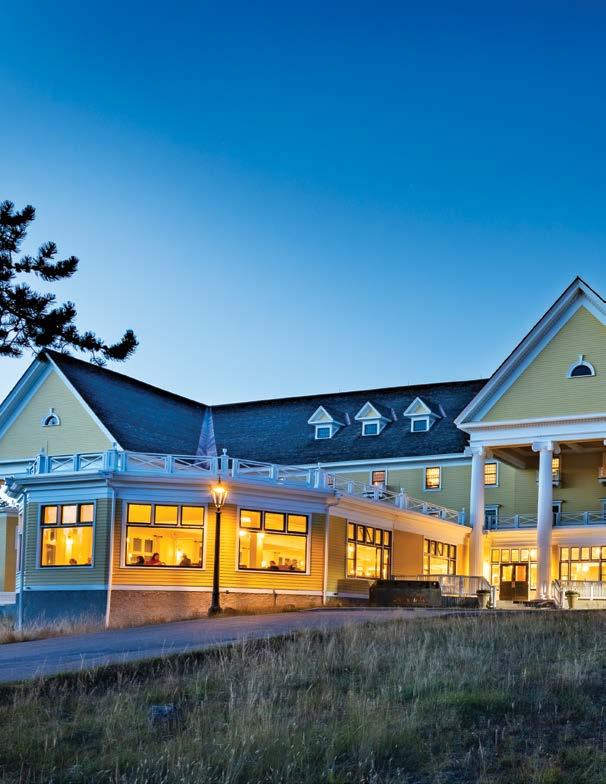
Lake Yellowstone Hotel.
PHOTO COURTESY OF XANTERRA TRAVEL COLLECTION
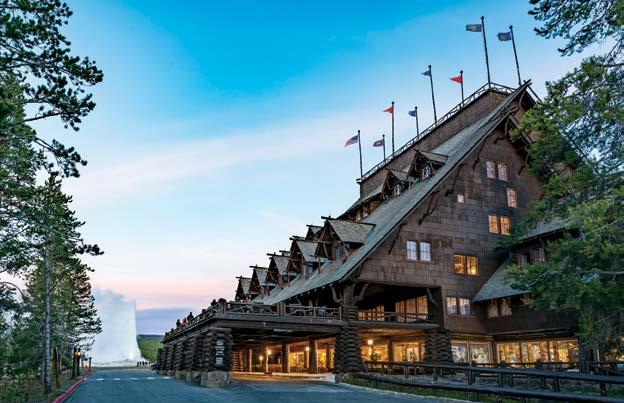
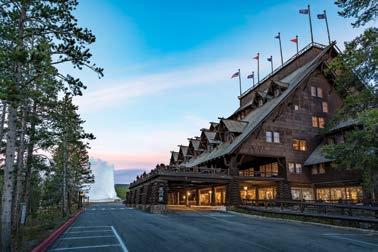
Opposite Left: Exterior of the Old Faithful Inn. PHOTO COURTESY OF XANTERRA TRAVEL COLLECTION
Opposite Middle: Mammoth Hot Springs Hotel’s Map Room. PHOTO COURTESY OF XANTERRA TRAVEL COLLECTION
Opposite Right: Roosevelt Lodge, visitors sitting in rocking chairs on porch
PHOTO COURTESY OF YNP / JODY LYLE
Mammoth Hot Springs Hotel
Old Faithful Inn
here are countless ways to explore Yellowstone National Park. Some visitors rush through in a single day, stopping at famous viewpoints before heading back out the gates. But one of the most immersive ways to experience the world’s first national park is by traveling slowly and moving from village to village and staying inside the park itself.
Many of those historic lodges and visitor villages are operated by Xanterra Travel Collection, which manages several of the park’s most iconic properties.
For Todd Walton, director of marketing and sales at Yellowstone National Park Lodges, the ideal Yellowstone road trip is about more than checking off landmarks. It’s about stepping beyond the roadside crowds.
“Once you get a couple hundred yards off a trail, you’re not going to see a lot of people.”
- TODD WALTON
Starting from the North Entrance near Gardiner, Montana, Walton suggests a route that loops through Yellowstone’s northern wildlife valleys, historic lodges, and famous geyser basins—giving travelers a chance to experience both the upper and lower loops of the park.
Just inside the north entrance lies Mammoth Hot Springs, where steaming terraces of white limestone cascade down the hillside. “It is one of the most unique geothermal features in the park,” Walton says. “It’s just a beautiful, beautiful spot.”
The nearby Mammoth Hot Springs Hotel makes an ideal
first stop. Renovated in 2019, the property is reminiscent of the park’s historic character with one of its most interesting features being the Map Room.
“The map room has got a beautiful wooden historic map of the United States made with wood from different areas,” Walton says. The handcrafted map even contains a small challenge for observant visitors. “There are a couple of mistakes on the map… I know there are two, but I’ve heard there are three.”
Outside the hotel, Mammoth’s boardwalk trails wind through steaming terraces and scenic overlooks that provide views of both the geothermal formations and the historic Fort Yellowstone district.
“It’s a great opportunity to see a lot of wildlife,” Walton says. Travelers can also begin their wildlife adventures nearby in Lamar Valley, one of the park’s most famous wildlife habitats.
From Mammoth, the road continues east toward Roosevelt Lodge, a collection of rustic cabins that reflect Yellowstone’s frontier-era roots. The lodge is named for President Theodore Roosevelt, who once camped nearby during his visits to the park.
Today, the property offers a quieter and more relaxed atmosphere than some of Yellowstone’s busier villages. Guests can spend the evening enjoying dinner, visiting the whiskey bar, or relaxing on the lodge’s wide wooden porch overlooking the surrounding landscape.
“I’ve heard it said that it’s the best porch in the park,” Walton says.
For visitors seeking a unique Western-style adventure, Roosevelt Lodge also hosts the Roosevelt Cookout, where guests can travel by stagecoach into the backcountry for a traditional cowboy-style dinner.
Continuing south from Roosevelt, the road climbs toward Dunraven Pass, one of Yellowstone’s highest scenic drives. From here, travelers can access trails leading to Mount Washburn, which offers sweeping panoramic views across the park.
Descending from the pass brings visitors to Canyon Village, where the park’s visitor center offers exhibits about Yellowstone’s geology, wildlife, and history.
The drive between Canyon and the lake passes through Hayden Valley, another prime wildlife habitat where bison herds often roam the open grasslands.
“You can see incredible things from the car driving through Hayden Valley or driving out towards Lamar Valley,” Walton says.
Still, he encourages visitors to explore beyond the roadside.
From the lake, the road curves west toward West Thumb Geyser Basin, where geothermal pools bubble along the shoreline.
The journey eventually reaches Yellowstone’s most famous geothermal attraction: Old Faithful.
Nearby stands the towering log structure of the Old Faithful Inn, another landmark designed by Robert Reamer. Guests staying here are just steps away from one of the most iconic geysers in the world.
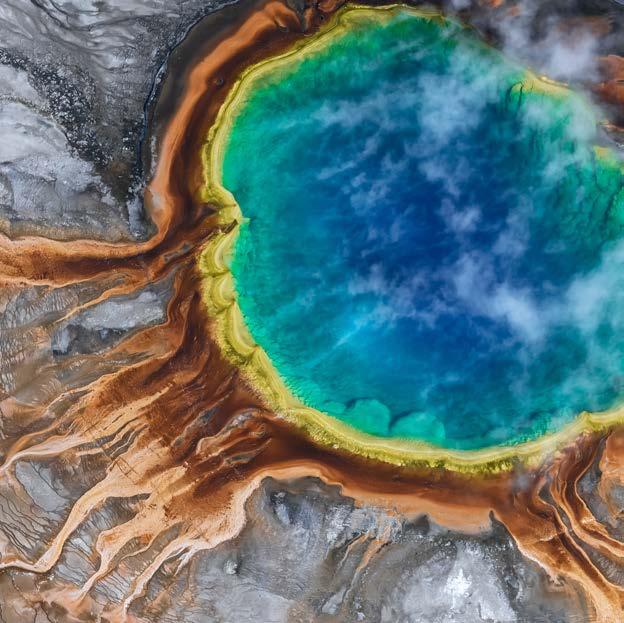
Not far away, the brilliant colors of Grand Prismatic Spring draw photographers and visitors from around the globe.
While many visitors choose lodging outside the park in communities such as West Yellowstone, Montana, or Cody, Wyoming, but staying inside the park’s boundaries changes the pace of the experience.
“Staying in the park really allows you that extra time to enjoy being there,” Walton says. “You don’t have to rush to get into the park and hurry up to get somewhere. You’re already there.”
“Only four or five percent of people get within a couple hundred yards of their car. If you’re going to do a road trip, getting out of the car is the way to do it.”
- TODD WALTON
Continuing south brings travelers to the shoreline of Yellowstone Lake. Overlooking the water is the elegant Lake Yellowstone Hotel, one of the park’s most recognizable historic buildings. Redesigned and expanded upon in 1903 by park architect Robert Reamer, the hotel has welcomed visitors for more than a century.
Large windows in the sunroom frame views of the lake, making it a peaceful place to relax after a day of exploring nearby trails or taking a scenic boat cruise from nearby Bridge Bay Marina.
“The sunroom is an amazing place to just have a cocktail,” Walton says.
Guests staying within the park can avoid the morning traffic at park entrances and have easier access to tours, hikes, and ranger programs.
For many visitors, Yellowstone’s most memorable moments are often the simplest, like watching wildlife move across a valley, listening to geysers hiss in the distance, or sitting quietly on a lodge porch as evening settles over the landscape.
And in a world that rarely slows down, the park still offers something increasingly rare.
“Chances are your cell phone’s not going to work a lot of the places, and that’s pretty awesome,” Walton says.
That quiet, he believes, is part of what makes Yellowstone unforgettable.
“Our goal is to provide legendary hospitality,” Walton says. “Yellowstone is the world’s first national park… and there are so many stories.”
Taylor Owens is a writer who spends her days running in the sun, playing in the snow, or on the hunt for the best breakfast across the West. She is based in Bozeman and is the content marketing director at Outlaw Partners.
Left: Exterior of the Old Faithful Inn. Top right: Roosevelt cookout in Yellowstone National Park. Bottom right: Lake Yellowstone scenic cruise.
PHOTOS COURTESY OF XANTERRA TRAVEL COLLECTION
THE WILD AT WORK
Duck & Waterfowl Mania
Flying With Motus
Keeping Seeds, Keeping Stories 35 43 46 50 56
Yellowstone’s Night-Shift Engineers: How Beavers Quietly Preserve the Park
Yellowstone’s Personal Photographer
Photo
Mania Duck & Waterfowl
Words & Photos By Carol Polich
et’s face it: waterfowl come as a complete package of “E” words—exquisite and electrifying in their colorful suit of feathers. With their territorial behaviors during the spring mating season, they become exciting to photograph. Be on the lookout for the males’ bobbing heads when anticipating an explosive charge, running across the water in a chase, and then taking flight. If a female doesn’t like her suitor, she will also defend her space. It’s all about territorial displays and disputes with lots of energy starting in April and continuing into late May and June.
The Ruddy Duck: Small, Fierce, & Formidable
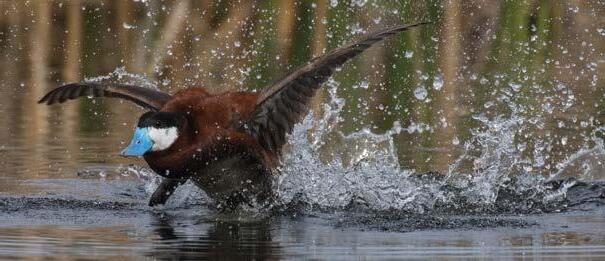
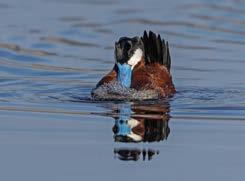
The small Ruddy duck, in breeding season, becomes a sinister little titan on the marshy pond. For this robust looking duck (smaller than a Mallard), the Ruddy is aggressive to the hilt within his territory and protective with his female. Wrapped in chestnut-colored feathers, his blue bill brings attention to his breeding presence. A black crown tops his head, its feathers lifting into two hornlike points during courtship display. His extreme alertness is followed by behavioral cues that signal the beginning of a courtship ritual. An inflatable neck air sac forces air into the breast feathers. When the bill rapidly taps the chest feathers, a foamy bubble display occurs in the water while his stiff tail feathers move upward. A low, belch-like croak sounds, alerting the hidden female of his approach. She awaits her suitor in the marsh reeds. With outstretched wings, the Ruddy explodes into action. He thrusts his body forward with great intensity, advancing on webbed feet that race in a flurry across the water.
When no immediate response follows, the male repeats his courtship displays as he moves through the pond reeds. These repeated displays often lead to territorial disputes with other males as females appear in the area. The female Ruddy Duck, though more muted in color, is no less aggressive and is highly selective in choosing a mate.
Rival Species on the Marsh Stage
Fiercely competitive and not to be outdone with territorial conquests are the Cinnamon Teal, Northern Shoveler, and the American Coot. The Teal and Cinnamon have exquisite colors when they are in full display racing after mute colored females.
Cinnamon Teal: Color, Conflict, & Chase
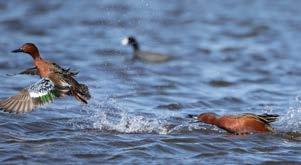
Explosive energy continues as a Cinnamon Teal charges another male that dares to approach a sequestered female. Cinnamon-colored bodies, accented with green and blue feathers, burst through the splashing water as the disputing males give chase. Bills snap and ruby-red eyes flash as the birds plunge at one another.
Northern Shoveler: A Dabbling Defender
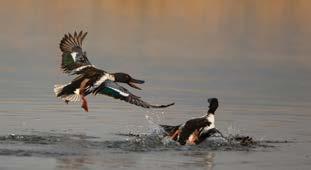
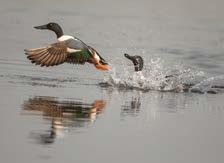
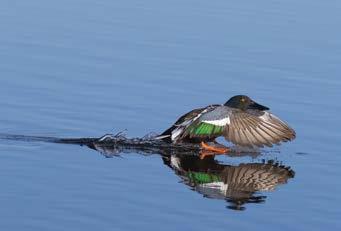
The Northern Shoveler is a handsome dabbling duck with a large, spatulate bill designed for skimming the water’s surface rather than diving for food. Electrifying, orange-colored feet propel him across the water during display. His 30-inch wingspan unfolds, exposing exquisite colors of white, rust, green, and a powdery blue shoulder patch. The yellow eye is a brilliant disk set within an emeraldgreen head. In full color and charged with excess energy, he willingly defends his territory.
The American Coot: Odd Appearance, Explosive Behavior
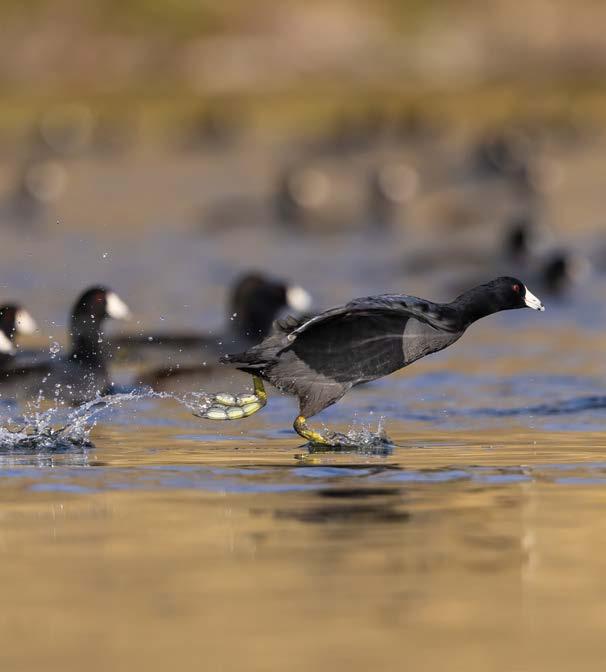
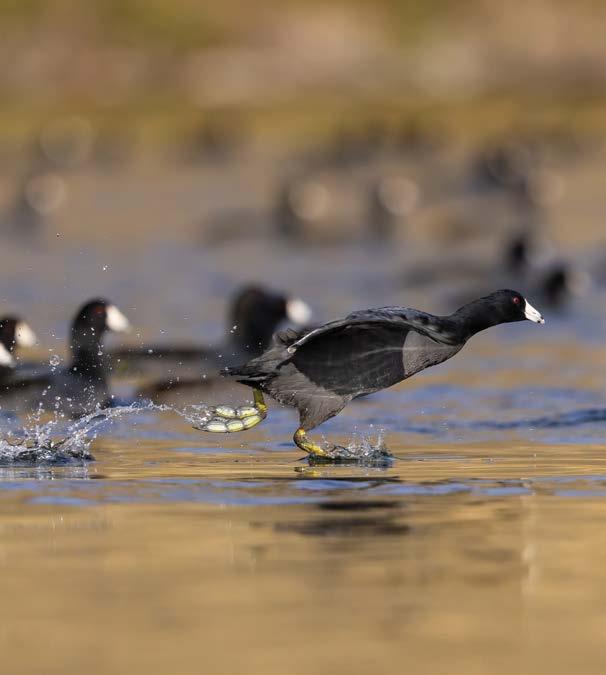
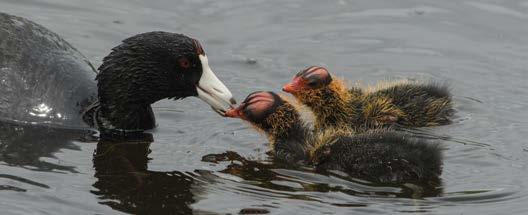
The American Coot has an unusual, dark, chicken-like body. A pointed, ivory-colored bill and prominent red eye distinguish it above the waterline. Although the coot shares waterways with ducks, it is not a member of the duck family and lacks webbed feet. Less colorful than the fowl described earlier, it is equally explosive when running across the water on its strange-looking, yellowish-green lobed feet. When
coots gather, excited squabbling often leads to bursts of running and brief fight displays, during which they appear to stand in the water and kick at one another. Coots, grebes, and loons all share these lobed feet, which allow them to propel across the water to take flight. If one of these birds is found floundering on land, placing it in water can help it regain movement.
Grebes & the Art of Courtship
Graceful and elegant courtship displays are characteristic of the Grebe family. Western Grebes perform a variety of romantic ceremonies, beginning with the Weed ritual. The pair dives for aquatic plants and resurfaces together, chest to chest, shaking the weeds before tossing them aside in a synchronized nest-building display.
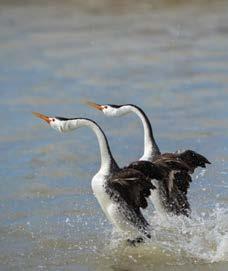
The mating dance performed by Clark’s and Western Grebes is both spectacular and comical. As a precursor to their “Rushing” performance, the birds face one another, screech, and dip their bills. The ballet continues with arcing necks that rise and fall. Suddenly, the pair rise upright out of the water and rapidly paddle their webbed feet across the surface in perfect unison, creating a dramatic water dance. Splashing water adds an energized, animated dimension to the performance.
From Incubation to Independence
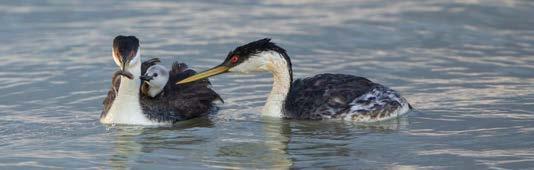
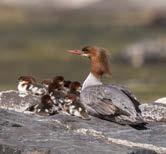
After approximately 24–28 days of incubation, robust chicks emerge and swim behind—or even atop—the adults. Grebe parents delicately feed fish to their young, while coots tend to their oddly shaped chicks. A flock of Merganser chicks follows its mother as she navigates a river current winding between boulders. When it is time to rest, she waddles onto a rock, and the chicks gather close beside her.
Each spring, the waterfowl ecosystem renews itself as chicks mature and gradually emulate the behaviors of their parents.
When Calm Turns to Chaos on the Pond
If the pond appears quiet and serene upon arrival, patience is short-lived. Within minutes, flocks of Shovelers and Teals sweep in, feet extended, skimming the water’s surface. Once this happens, waterfowl mania erupts. For the photographer, it becomes both a challenge and an opportunity— demanding quick reflexes, sharpened skills, and a deeper understanding of waterfowl behavior.
Bozeman based photographer, Carol Polich, has traveled and photographed throughout the world and Western USA for the past 35 years. As a photographer and author, with three previous books to her credit, her many featured nature and travel photos and articles have appeared in a variety of overseas and American magazines, calendars, and books. An accomplished lecturer and photo instructor, she recognizes the value of the story behind the landscape scene or wildlife action.
Polich’s website (www.wildnaturetrails.com) is innovative, informative and impactful showcasing her photographic diversity.
Flying WITH MOTUS
By Leath Tonino
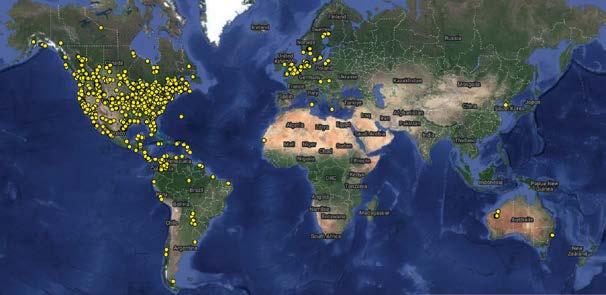
icture an old-school TV antenna, not rabbit ears protruding from the television in the den, but a silvery, fingery, towery gizmo standing proud of the house’s ridge cap. Multiply that picture by 2,377 and scatter these antennas all around the planet, from Chile to Canada to Australia to Jamaica to Norway to Mexico. Be sure to install some in the Greater Yellowstone Ecosystem, at Red Rock Lakes National Wildlife Refuge in Montana and Gray’s Lake National Wildlife Refuge in Idaho. For good measure, erect a couple on the outskirts of Pinedale, Wyoming, too.
Now kick off your boots, crack a beer, and wait.
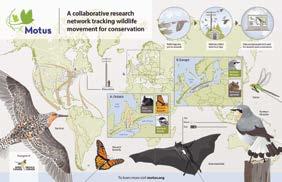
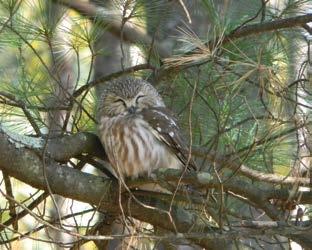
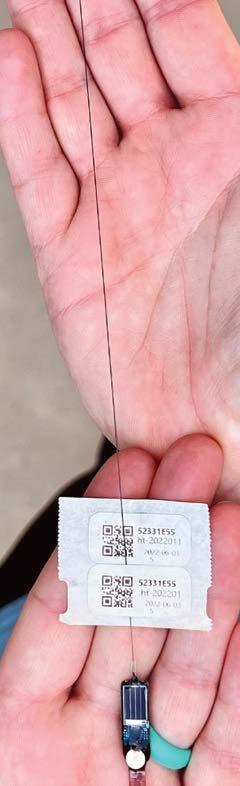
This is Motus, the name for both a sprawling network of automated radio telemetry stations and a global research community studying the movement and behavior — particularly the spatio-temporal migratory patterns — of hundreds of different bird species (also bats and chunky insects). Though the tech is advanced and the outpouring of data is overwhelming, the methodology is simple and easy to grasp. Biologists trap a critter, affix to its back a tiny tag that emits a unique identifying signal, then release it to the skies. Henceforth, when that individual — say, a Northern Saw-whet Owl labeled #60283 — flies within 15 or 20 kilometers of a Motus station, its presence will get registered in real time. To date, 61,928 animals have been tagged.
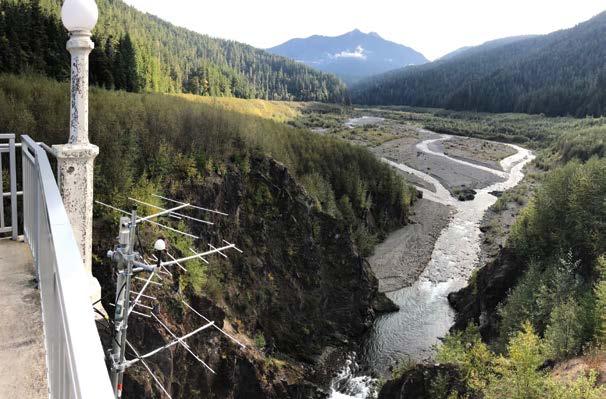
Top: A Motus tower installed on the spillway of the former Glines Canyon Dam in Olympic National Park. The solar-powered array of radio antennae will detect the signals send by tiny transmitters known as “nanotags” that have been attached to small flying animals. This tower was installed to study bat movement behavior. | PHOTO BY MICHAEL HANSEN, USGS
Above: Motus Infograph | GRAPHIC BY MOTUS/BIRDS CANADA
Did you know that a Sandhill Crane just moments ago passed overhead, cruising among the clouds? And that it was hot on the heels, er, metatarsals of a White Pelican? And that last night, under cover of darkness, a slew of warblers, thrushes, and vireos flapped through the neighborhood? Motus renders the invisible busyness, the hidden-in-plain-sight flow of the world, suddenly and shockingly perceivable — at least on a laptop screen. It’s magic of a sort.
Thanks to a friendly field ecologist’s recommendation (This is very cool stuff, definitely worth checking out), I’ve become nerdily obsessed with the Motus website’s cornucopia of maps and flightpaths, stories and surprises. Specifically, I’ve become obsessed with tracking the continent-spanning journeys of, well, #60283 is a perfect example. This diminutive owl—Northern Saw-whets weigh between 2 and 5 ounces—was first detected at Red Rocks Lake NWR on October 29, 2024. Presumably, it wintered in the region, hunting rodents in the conifer forests of the Centennial Mountains, before winging north for the summer on March 27, 2025. Then… radio silence. Six months later, on October 2, 2025, #60283 finally reemerged west of Dawson Creek, British Columbia, a whopping 1,000-plus kilometers from its previous confirmed waypoint.
Here’s another example—#65463, a drab, sparrow-sized grassland species called a Sprague’s Pipit. It showed up at Red Rocks Lake NWR on August 19, 2025 and at Lacreek NWR in South Dakota on October 28, 2025. What happened in the interim? Maybe it spent early fall in Yellowstone National Park, where there currently are no Motus stations? This much is certain: Lacreek was at best a brief rest stop. Eleven hours and 900 kilometers after pinging that antenna, #65463 arrived at Sandy Sanders Wildlife Management Area on the OklahomaTexas border.
That these avian narratives are simultaneously down-to-the-second detailed and vague in the extreme is part of their allure. Hemingway believed omission was the key to spinning a compelling yarn, as it invites readers to fill in the gaps and engage. Indeed, as with an engrossing novel or movie, Motus leaves a lot to the imagination, and hunching over my laptop, clicking and squinting and clicking, I inevitably wonder: Is #60283 faring okay? Is that tough little owl planning to return to Red Rock Lakes again soon? Is it going to bump into #65463, the pipit? Is it going to appear in a new unexpected spot? This is high-level drama, a geographical adventure featuring an all-star cast of characters, a mystery that keeps me tuning in.
Top Left: Northern Saw-whet Owl at Rachel Carson National Wildlife Refuge
PHOTO BY BRI RUDINSKY/USFWS
Right: Motus Tag
PHOTO BY ROSALIE WETZEL/USFWS
But entertainment is merely one of the benefits of snagging rides on Motus birds, vicariously traveling to and from (and to and from, and to and from) the Greater Yellowstone Ecosystem. Better yet is the realization — a realization that feels increasingly important in an era of fragmented habitats and busted biomes — that nearby places are made of distant places, that the local and the far-flung are ultimately of a piece, that as the scientists and poets and mystics have insisted for ages, nature is a tapestry, a lattice, a gossamer tissue, a sensitive web, a trembling whole. John Muir once wrote, “When we try to pick out anything by itself, we find it hitched to everything else in the Universe.” Or to borrow an image from the Buddhist philosophy of interconnection and interdependence: Envision a vast net with a jewel situated at each node, the polished surface of which reflects every other
jewel. Got that in your mind’s eye? Excellent. Now substitute old-school TV antennas for jewels, kick off your boots, crack a beer….
Yesterday, during a Motus binge, it hit me with the force of epiphany: Homo sapiens flying from Paris to Bozeman and Tokyo to Jackson Hole, driving rental cars to Old Faithful and Mammoth Hot Springs, vacationing for a while and then moseying on — we too are a species in perpetual motion, drawn to Yellowstone National Park by the richness of the land, the awesomeness of the earth. Granted, us featherless humans don’t carry Motus tags. We do, however, carry smartphones equipped with GPS.
Perhaps somebody could develop an app to help visitors visualize their place within the place within the place within the place?
That’s a map, a story, I’d love to see.
Leath Tonino is a freelance writer and the author of two essay collections about the outdoors, most recently The West Will Swallow You
Top: Map of Motus towers as of 2023
PHOTO BY MOTUS
DATABASE/BIRDS CANADA
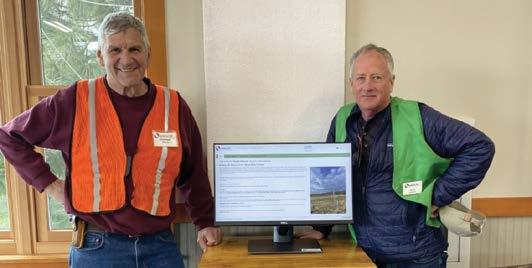
Ankeny National Wildlife Refuge volunteers Pat Allaire (left) and Rich Schramm stand next to the Motus kiosk in the Ankeny Hill Nature Center
PHOTO BY SAM BARTLING/U.S. FISH AND WILDLIFE SERVICE
Night-Shift Engineers: Yellowstone’s
HOW BEAVERS QUIETLY PRESERVE THE PARK.
BY SARAH MAY
s the sun sets in Yellowstone, the visitor shops and museums close up for the night, and the adventure weary tourist returns to their sleeping quarters. It is only after the sunlight fades that the unsung hero of Yellowstone begins to work. The conservation engineering team is busy building pathways to float chopped logs and branches down the river toward
their holding place. They keep busy checking on existing infrastructure, making needed repairs as they work well into the night. They work in collaboration with each other to build the natural infrastructure, helping restore the environment for the betterment of all who inhabit the park. The engineering team is one composed of a few hardworking beavers.
WHILE THE BISON AND WOLVES ARE REGULARLY VOTED THE MOST POPULAR ANIMALS IN THE PARK, IT IS THE OFTEN-OVERLOOKED BEAVER WHO IS THE SUPERPOWER OF YELLOWSTONE. BEING A KEYSTONE SPECIES,
BEAVERS ARE AN ANIMAL WHOSE NATURAL BEHAVIORS SIGNIFICANTLY IMPROVE ECOSYSTEM HEALTH AND PROMOTE BIODIVERSITY. LONG BEFORE PRESIDENT ROOSEVELT DECLARED YELLOWSTONE A NATIONAL PARK, THE BEAVERS WERE WORKING HARD AT CREATING THE LUSH DIVERSITY AMONG THE LANDSCAPE VISITORS ENJOY TODAY.
According to fossil records, a variety of beaver species roamed the Earth for nearly 10 million years. However, that once diverse group is now down to just one species. In the 1700s and 1800s, the fur trade became an important industry in the American colonies. Beaver fur, prized for its density, was especially valuable for hat making in Europe. While the hunt for beavers enticed trappers like John Colter to head west and the sale of fur stimulated the economy, unbeknownst to humans, the environment was quietly deteriorating.
By the mid-1800s, beavers were nearly extinct across much of the United States and Canada as the environment began to reflect the impact the loss of beavers had. Streams that once meandered through wetlands became fast, eroding channels of water, while other water sources ran dry. At first, people didn’t connect the environmental damage to the loss of beavers, but some were starting to take note.
As Europeans began favoring silk hats over fur, fashion trends shifted, the fur trade collapsed, and trapping laws were established, the beaver narrowly avoided complete extinction. In the early 1900s, early conservationists began to realize the effects the beaver had on the environment. Where the beavers disappeared, so did the water.
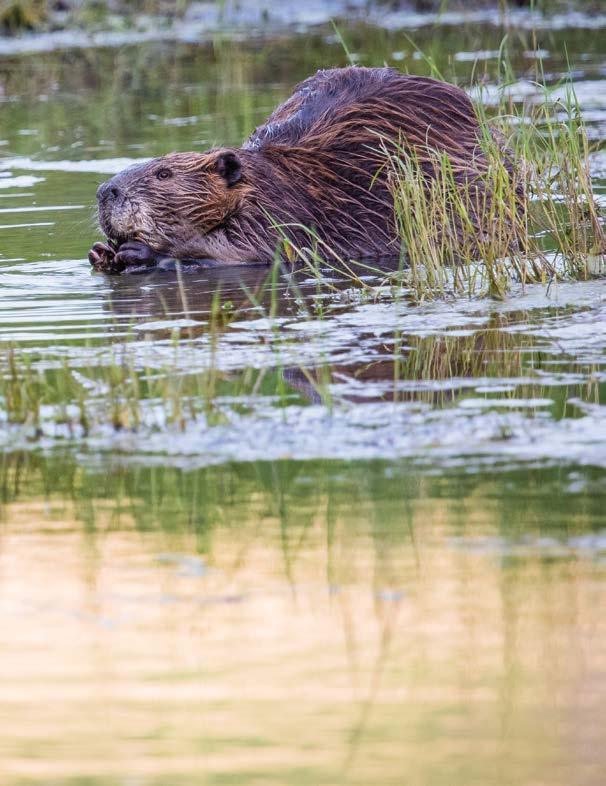
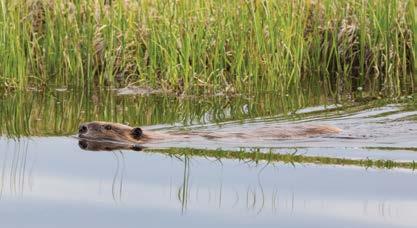
Left: Beaver, Lamar River
Right: Beaver near Swan Lake
PHOTOS COURTESY OF NPS/ NEAL HERBERT
AS PARK VISITORS, WE SEE A PILE OF STICKS, LOGS, AND VARIOUS ENVIRONMENTAL MATTER PILED UP IN A WATERWAY AND DO NOT THINK MUCH OF IT, AS BEAVER DAMS MAY SEEM VISUALLY UNDERWHELMING COMPARED TO THE OTHER WONDERS OF YELLOWSTONE. HOWEVER, THE UNASSUMING PILE OF STICKS IS CRITICAL TO REHABILITATING AND MAINTAINING THE GREATER ECOSYSTEM.
Beaver dams turn long-flowing streams into a series of small steps and pools, creating resting and feeding zones for various animal life, both land and water alike. Unlike man-made dams, beavers create a dam that is still permeable to water and fish. By slowing the flow of water, the dam eases the effects of erosion on nearby land. As water slows, sediments and pollutants settle out, and microbes in wetland soils break down excess nutrients, cleaning the polluted water before it flows downstream for both animals and humans to consume. A single beaver pond can hold thousands of gallons of water, released gradually over time, helping stabilize the flow of snowmelt and allowing our rivers and streams to
remain full all summer long.
With the threat of wildfires every summer, areas with dams have a natural fire break. The wet meadows and saturated soils around beaver ponds can help reduce the impact of the burn and help stop the spread of a wildfire. It has also been observed that after wildfires, beaver-influenced valleys often recover faster from the burn damage.
In Yellowstone’s high plateaus and winding river systems—like the Lamar, Yellowstone, and Madison—beavers built dams that slowed snowmelt, spread water across floodplains, and created lush wetlands. These wetlands have supported populations of willow and aspen trees, as well as waterfowl, fish, and large mammals, for centuries.
Beavers often live in colonies of five to six beavers. Their babies, or kits, are born in late spring and are ready to begin swim lessons around four days old. Shortly thereafter, a gland producing a waterproof fluid is developed for their fur. Now equipped for a life on the river, young beavers begin to learn the family trade of engineering. While out working, if a beaver senses danger, it will slap its large tail on the water to warn the others to be on the lookout for any incoming threat. Young beavers will stay with their parents for about two years before setting off to construct their own dam and establish their own beaver colony.
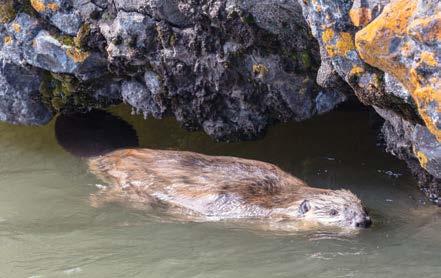
Beaver in Soda Butte Creek PHOTO COURTESY OF NPS / JACOB W. FRANK
THE FIRST SURVEY OF BEAVERS INSIDE THE PARK WAS COMPLETED IN 1921, WHERE 25 COLONIES WERE OBSERVED. SEEING A NEED FOR AN INCREASED BEAVER POPULATION, 129 BEAVERS WERE RELEASED JUST NORTH OF THE PARK BETWEEN 1986 AND 1999. BY 2024, THE POPULATION GREW TO 121 COLONIES.
If you’re hoping to spot these wildlife engineers, you’ll need to be patient. Beavers are most active at dawn and dusk, and they prefer quieter waterways away from heavy traffic. While sightings are never guaranteed, areas such as Beaver Ponds Loop Trail, a five-mile roundtrip trail starting near the Mammoth Hot Springs Hotel, or Willow Park, located between Mammoth and Norris, provide prime habitat for the
beavers. Other areas in the park that are hospitable to beavers are Lamar Valley, calmer stretches of the Yellowstone River, and side channels and feeder creeks off the Madison River.
Beavers are not just part of Yellowstone’s past; they are actively preserving its future. Their presence reflects a larger shift in how we understand conservation: protecting not just animals, but the natural processes
that sustain entire landscapes. The beaver’s legacy is not loud or dramatic, but it is lasting. In a park celebrated for its geysers and breathtaking landscape, the beaver reminds us that some of the most powerful forces in nature work patiently, out of sight, shaping the land one branch at a time.
Sarah is a freelance writer calling Bozeman, Montana home, where the mountains and open skies fuel her creativity. Her stories are deeply rooted in the landscape of the West, drawing on the natural world to explore themes of place, wonder, and belonging. Visit sarahemay. com to learn more.
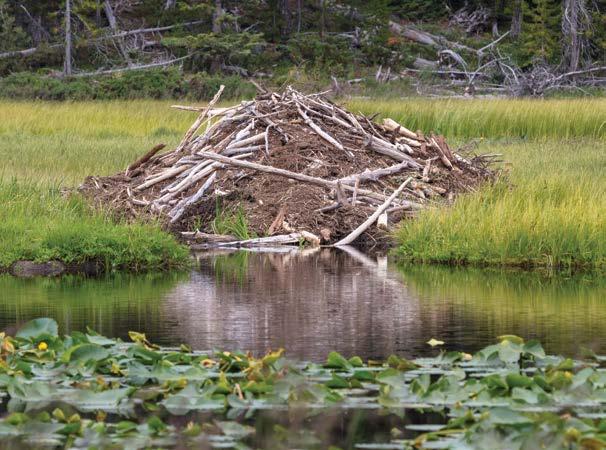
Beaver lodge near Shoshone Lake PHOTO COURTESY OF NPS / JACOB W. FRANK
[SNOWY BISON WALKING TO CAMERA]
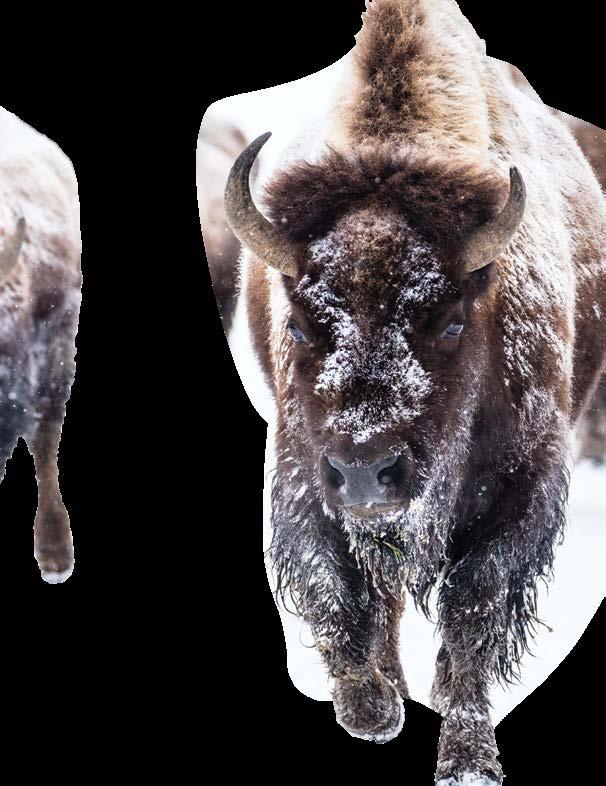
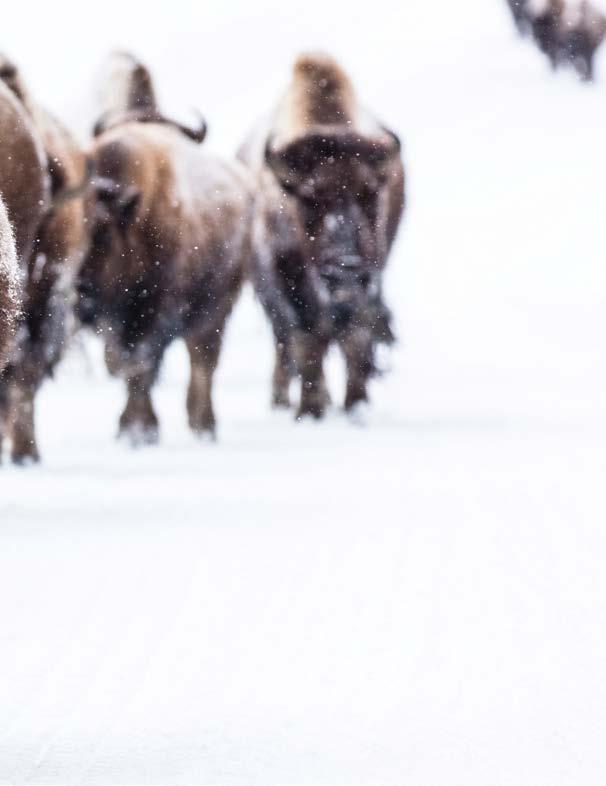
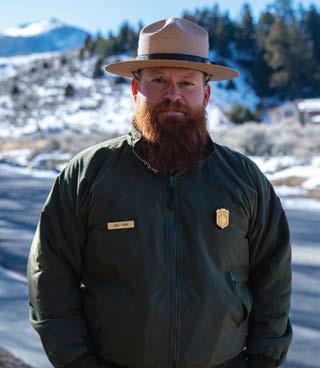
A group of bison walk the snowy road near Frying Pan Spring. Part of Frank’s job is going out in the field with biologists to photograph them as they dart and collar bison and other animals.
PHOTO BY JACOB W. FRANK
PersonalPhotographer
BY FISCHER GENAU
YELLOWSTONE’S
or Jacob W. Frank, the digital communica Yellowstone National Park, working fo of like working at NASA in the 60s. “When you went [there] and you asked the guy mopping the floor, ‘What’s your mission?’ he’d putting a man on the moon,’” Frank said. “Everybody felt like p larger thing, regardless of what your job was. And I think that same with employees in the Park Service.” Frank has his own mission, and it all started just a few years after he was born.
Above: [JAKE PORTRAIT]
Ranger Jake outside of Yellowstone’s headquarters at Mammoth Hot Springs.
PHOTO BY FISCHER GENAU
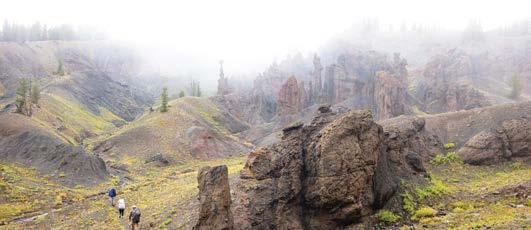
Below: [THE HOODOOS AND BACKPACKERS]
A heavy fog suddenly lifts as Frank and his friends backpack through the Hoodoo Basin near the northeastern boundary of Yellowstone National Park.
PHOTO BY JACOB W. FRANK
The first time Frank visited Yellowstone he was a youngster. Born in Billings as a fourth-generation Montanan, Frank and his family moved to Fort Lauderdale, Florida when he was three, but they returned to Montana almost every summer to camp and boat at Canyon Ferry or take Highway 212 through the Beartooth Mountains into Yellowstone. The first trip to the Park he can remember was when he was eight. Frank and his family, along with a few family friends, stayed in the cabins at Old Faithful for five days, taking hikes and watching water bubble up from the smoking ground. While he was there, his friend’s mom told him that national parks like Yellowstone were so pristine that people could drink right out of the rivers. So, Frank tried it, and a few gulps from the Yellowstone River gave him severe stomach issues for the rest of the trip. “I love telling that story,” Frank said. “Some of the people that come here, they don’t really have any idea what’s safe and not safe.”
thought about working for the Park. “I’d been to Yellowstone so many times, but I didn’t realize that people, like, worked here,” Frank said. “I know that sounds stupid, but I didn’t know what the National Park Service was. We never went to ranger programs. We would just come here and picnic and look at animals and stuff.”
After that summer, Frank visited Yellowstone more times than he can count on subsequent family vacations and road trips through high school and college. But he never once
During his senior year at the University of Florida, Frank needed an internship for his degree, and he got a job working “Interp” (which basically means educating and guiding visitors) at Grand Teton National Park for the summer. It was there he would get his first taste of the National Park Service. And it was the beginning of something else too.
Part of Frank’s job was taking visitors on hikes in the park, and, often, people would ask him about a particular bird or tree they were looking at. At first, Frank couldn’t answer their questions— “I literally didn’t know what anything was.” But his mom had given him her old camera (a Canon Rebel that Frank bought her using his employee discount at Best Buy) and told him to take photos with it in the Tetons over the summer. When a visitor asked Jake about a particular wildflower or songbird, he’d take its picture, show it to his supervisor, and then email the person their answer. “I basically got into photography because it was a tool to try to understand what I was seeing,” Frank said.
He calls his first summer in the Tetons a “life-changing experience,” and he wanted to keep working in Parks. Over the next few years, he worked in a lot of them. First, it was a summer in Glacier, followed by a winter volunteering in Carlsbad Caverns. Then, Frank worked three seasons in Alaska at Denali National Park, where he met his future wife Corrie and got his first proper media job. “I was like, oh man, I didn’t know this was a thing, this is even cooler than what I thought before!” Frank said.
He’d caught the bug. After Denali, Frank got a job as social media manager and videographer with Navajo youth in Arizona through AmeriCorps, while his then-girlfriend Corrie stayed in Alaska mushing dogs. The next summer, she joined him in Rocky Mountain National Park, and the following winter Frank finally made his way back to Yellowstone. His job had him working out of a FEMA trailer while the Albright Visitor Center was being renovated, and that’s when he met Neal Herbert, another photographer
and videographer for Yellowstone who became a mentor to him and whom he would shadow whenever Herbert needed a second shooter.
This job was also seasonal, but Frank was biding his time and trying to string together enough seasonal stints to qualify for the more competitive permanent jobs in the Park Service. After that winter, he got his break. Frank was hired by Glacier National Park to work in digital communications, and this position was permanent. He worked there for 18 months, until a spot as videographer and photographer in Yellowstone opened and he returned to the national park he’d grown up visiting as a kid. This time, he was there to stay.
“I basically got into photography because it was a tool to try to understand what I was seeing.”
- JACOB FRANK
Sunset over travertine pools near Canary Springs (wide)
PHOTO COURTESY OF NPS / JACOB W. FRANK
Above:
[FLOOD 1: RIVER FROM DISTANCE
JAMMED WITH LOGS]
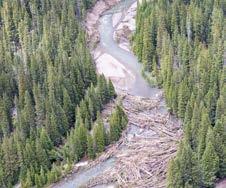
Logjams deposited by Yellowstone’s historic flood in 2022.
Below:
[FLOOD 2: ROAD WITH CHUNK GOUGED OUT, CHOCOLATE MILK WATER]
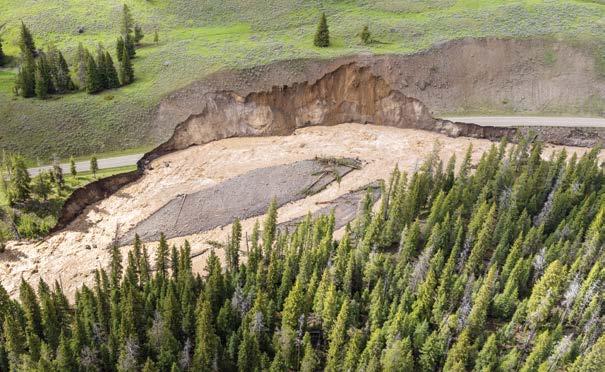
Destruction near Yellowstone’s northeast entrance during the 100-year flood of 2022, photographed from a helicopter by Frank after the park was evacuated.
PHOTOS BY JACOB W. FRANK
uring Frank’s third official year as the digital communications specialist for Yellowstone, the Park flooded. An atmospheric river combined with fast-melting mountain snows to cause what scientists called a thousand-year event, tearing homes from their moorings, gouging chunks out of highways, and carrying thousand-pound boulders for miles. On June 14, 2022, the Park Service evacuated 10,000 visitors from Yellowstone as the waters raged on, and Frank said that once everyone was safe, they realized, “We need to get out there.”
A helicopter carrying Frank, his camera, and several others launched from Mammoth Hot Springs to check the status of two cabins near the river that were in danger of being swept away, and once the bird was in the air, Frank could see the true scale of the flood’s devastation.
“I grew up in Florida and I’ve been in a bunch of hurricanes…but to see a river and trees just crashing down, and the sound of these boulders that are bigger than cars, and you can hear them and feel the ground shaking as the boulders are tumbling down—it’s pretty humbling to see all that stuff,” Frank said. He remembers flying by Osprey Falls in the helicopter, but the water was no longer falling— it was shooting from the mouth of the river out into space. “Everything up here was going gnarly,” Frank said.
Of everything he’s done working in Yellowstone, Frank thinks that his coverage of the flood will be the thing that lasts. But he’s also taken tens of thousands of photos and videos all over the Park. Chances are pretty good that anyone browsing photos on the Park’s website, or who sees a picture of Yellowstone pop up in a news article, are looking at one of
Frank’s images. He’s been to all four corners of Yellowstone, either for work or on backpacking excursions with his wife or friends, and his camera is never far from his reach. Through his job, Frank regularly follows biologists into the field to photograph the collaring of mountain lions, wolves, grizzlies, and other megafauna, and one of the first things he saw in the Park after being hired there full time was a bison collaring. After a bison gets darted, its head must be kept uphill so it burps out the gas in its multiple stomachs instead of getting bloated, and Jake was filming down near its head when the bison let out a big belch right into his face. “It smelled like fresh cut grass,” Frank said. “I was thinking it was going to smell bad, and I was like, ‘Oh wow, that smells really good!’”
“One of my favorite parts of my job is to shine a spotlight on all the people and work and everything that takes place,”
- JACOB FRANK
Somewhat surprisingly, most of the wildlife photos Frank captures are happy accidents. Often, he’s on his way to some other assignment, like taking videos of new employee housing, when a wolf darts across the road and leaves him only a few seconds to whip out his camera and point it out the window for a photo. “I call it Yellowstone magic,” Frank said. “When you’re least expecting it, something crazy and amazing happens to you…and you just have to make sure that you’re ready.”
Most of Frank’s work in the Park focuses not on the wildlife or the landscape, but on everything that goes on behind the scenes to make it tick. Frank works closely with Cam Sholly, Yellowstone’s superintendent, to determine which stories to tell, and often that means covering little-known corners of the Park that don’t often see the spotlight. “One of my favorite parts of my job is to shine a spotlight on all the people and work and everything that takes place,” Frank said. He talks about the 175-plus toilets that must be cleaned and maintained in the Park, Yellowstone’s sizable wastewater treatment plant, and everything else required to support the 30,000ish people that spend the night in Yellowstone each night during the summer. Frank remembers telling his friend Dave Whaley that he couldn’t believe how much infrastructure there was in the Park. “Yup,” Whaley replied.
“There’s a whole lot of stuff that goes into just making sure that somebody can come and take a picture of a bear.”
To Frank, the goal of everyone in Yellowstone is to allow that interaction to happen, in a way that’s safe for both the bear and the person taking its photo. “It’d be really easy to protect Yellowstone if you just said, ‘Hey, no one’s allowed to come in here,’ and then it just kind of takes care of itself,” Frank said. “But I think our job is that dual mandate of the Park Service: to preserve it, but then also allow people to enjoy it at the same time.”
That’s the mission. “This is a relay race, and we have the baton right now,” Frank said. “But when you came
here, someone passed it off to you, and then you’re going to pass it off to somebody else, and this has been going on for 154 years. Our goal is, ultimately, to work for the American people and to protect this thing that belongs to everybody, so that when they come and visit, they have a memorable experience. Hopefully we can just keep that going in perpetuity.”
As someone who came there for the first time as a three-year-old, Frank knows that better than anyone.
Fischer Genau is a writer and filmmaker living in Bozeman. He enjoys active stretching, reading books outside, rain, Kettle Corn-flavored Popcorners, and time with the people he loves. He works for Explore Big Sky as the Digital Media Lead.
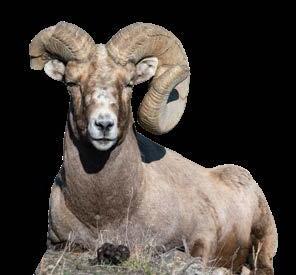
Above: [BIGHORN SHEEP WITH ONLY ONE HORN]
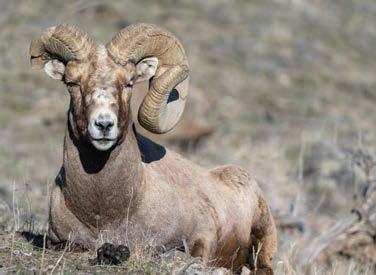
The most unique ram Frank’s ever seen, photographed off the side of one of Yellowstone’s main roads.
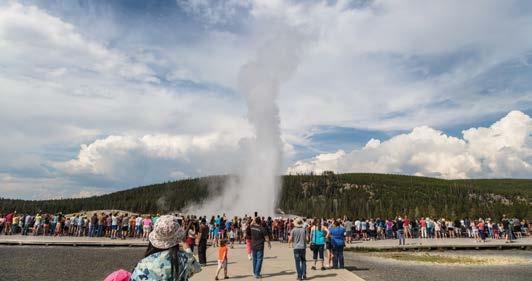
Below: [OLD FAITHFUL ERUPTION, BUSY DAY]
Old Faithful erupts on a busy summer day. As Yellowstone’s digital communications specialist, Frank also points his camera at visitors and staff members, not just the natural attractions.
PHOTOS BY JACOB W. FRANK
keeping stories keeping seeds,
BY CHARLIE WATT
“It’s nice to meet a young person who’s interested in tomatoes,”
John Austin, longtime seed keeper and steward of a vast diversity of vegetable varieties, said.
Charlie Watt, founder of Homecoming Seeds of Northfield, Vermont, met Austin after giving a presentation about his tomato research to the Gallatin Gardener’s Club back in 2019. These words sparked a deep friendship between the two that would go on to cement Austin’s legacy of seed keeping in the manifestation of Homecoming Seeds, a bio-regionally adapted, farm-based seed company that launched their inaugural catalog in January 2026.
In the Gallatin Valley, at the northern edge of the Greater Yellowstone Ecosystem, gardening has always been an act of adaptation.
Inspired by Austin’s humble and quiet work of keeping a diverse collection of open-pollinated seeds, Homecoming Seeds is built upon the lifework of Austin, who spent 45+ years keeping an astounding diversity of seeds in his basement in the foothills of the Bridger Mountains.
Everything starts with a seed, or so the saying goes, and, in this case, it was literally tomato seeds that connected these two passionate gardeners. After their initial meeting where Watt shared his findings on organic soil fertility in high tunnel tomato systems, part of his doctoral work at Montana State University, another garden club member walked up to Watt and said, “That’s John Austin. He has the best gardens in the valley, and his tomatoes are legendary. We should see if he’ll invite us over for a tour.”
In the years following their first encounter, Watt would visit Austin weekly. During the growing season, Watt would help in the garden and provide some muscle to Austin’s ever-ambitious gardening rituals, even as he approached and rounded 80 years of age.
In the winter, they would spend hours talking about seeds, their stories, and the personality of the different varieties that were kept and collected. Austin quickly became more than just a seed mentor to Watt. As Austin likes to say, they “could talk endlessly about life, the universe, and everything.”
Austin had three focus areas to his seed work. He saved seeds for bioregional adaptation. He curated the Tinsley House gardens at the Museum of the Rockies where he saved seeds that were historically accurate to the turn of the twentieth century. He also stewarded varieties of corn, beans, squash, and sunflowers that are native to the tribes in the Northern Great Plains. He did his best to recreate Buffalo Bird Woman’s gardens.
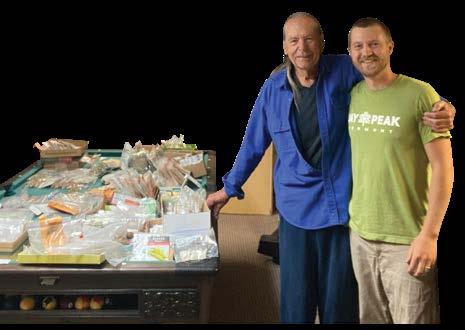
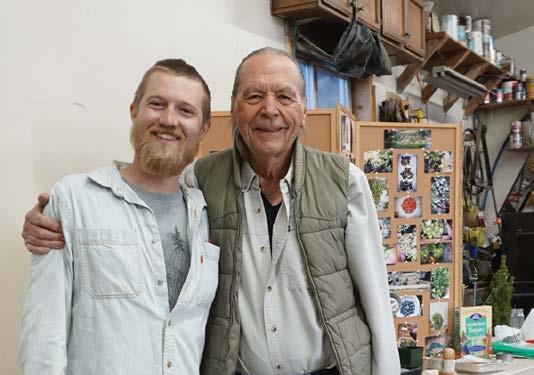
Opposite: John and Charlie in John’s home sorting seeds and sharing stories.
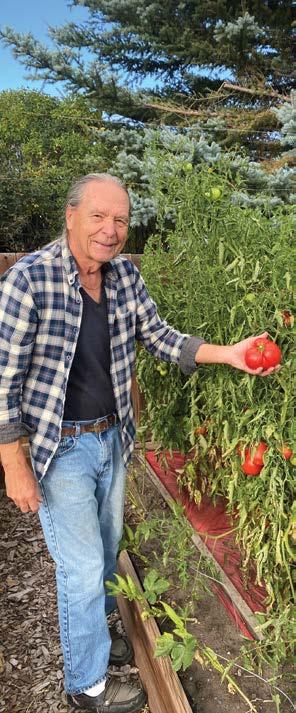
Right: John in his garden.
PHOTOS COURTESY OF CHARLIE WATT
It’s easy to overlook the importance of seeds when we consider our food system, as the plants and animals we harvest and eat are often what comes to mind first. However, seeds are the foundation of our food system. And as with all biological systems, diversity in our seed system conveys resilience.
But seeds are not just important as a basis of the nutritional and caloric needs of humans—seeds carry culture and stories that are vital to our sense of belonging and community wellbeing. The lives of people and plants are intimately intertwined, codependent. We remember who we are, individually and collectively, through our relationship with plants and seeds. These relationships feed us physically and spiritually. Who would we be without the foods, flavors, dishes that bring us “home”? And who would we be without the acknowledgement and celebration of those who came before us, carrying seeds and songs, reflecting the struggles and joys of the human experience so that we can feed ourselves today?
The memory of our ancestors is carried by the seeds we sow today. Seeds bring us home.
It will not come as a surprise that our current food system is unsustainable. Seed industry consolidation and biodiversity loss has made our system fragile and vulnerable to disruption. We can remember how COVID-19 led to seed shortages and food chain disruptions that increased food insecurity. We are called to work towards a decentralized local and regional seed system that emphasizes adapted seeds and centers the role seeds play in culture and community vitality.
The loss of seed diversity threatens the lineage of Native American culture who continue to be examples of sustainable inhabitance in our landscapes. Diversity loss also threatens our memory of the foodways of early settlers in the Gallatin Valley. While these stories include themes of violence and erasure through colonization, they need to be remembered so we know from where we come and how seeds and plants have always been loyal in their commitment to feeding us.
Austin recognized the importance of these seeds to the cultural integrity of the Gallatin Valley. His commitment to the curation of Tinsley House gardens down to the specific varieties that were grown from 1890 to 1910 has filled important gaps in the heritage of early white inhabitants of this valley, who relied on gardening for sustenance. And perhaps more importantly, Austin’s dedication to recovering Native varieties of corn, beans, squash, and sunflowers to the tribes of the Northern Great Plains, has been an important link in supporting Native communities today to take back their own path to food sovereignty. His collection of corn, beans, squash, and sunflowers were rematriated through the Montana Indigenous Food Sovereignty Initiative in 2021 where they now connect with their original stewards to whom the seeds belong.
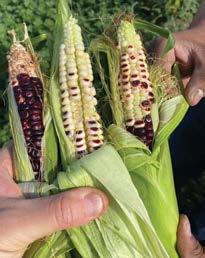
Corn grown for the inaugural ancestral seed bank led by the Montana Indigenous Food System Initiative.
PHOTO COURTESY OF CHARLIE WATT
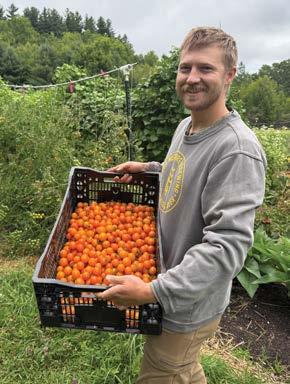
Charlie on his farm in Vermont harvesting tomatoes to be processed for seed.
PHOTO COURTESY OF CHARLIE WATT
The third collection that Austin curated are bioregionally adapted seeds — seeds selected to thrive in a specific landscape. In the Gallatin Valley, on the northern edge of the Greater Yellowstone Ecosystem, cold nights, high elevation, and unpredictable spring and fall frosts make this work especially important. Vegetables such as tomatoes, squash, and melons, which evolved closer to the equator, are constrained by short frost-free windows and limited heat accumulation. Many of these warm-season crops require long days to maturity and sustained warmth, making careful variety selection essential for success in this region.
This is where Homecomings Seeds has picked up where Austin left off. Watt is now using Austin’s collection of bioregionally adapted seeds as the foundation of his new seed company. This is part of what makes Homecoming Seeds so special. Austin has spent over 45 years selecting for cold hardiness, early maturity, and resilience to the challenging growing conditions found in Montana’s Gallatin Valley. He was legendary for how productive his gardens were so early in the year. While growing in central Vermont has many similarities to the growing in the northern Rockies, it also has many differences, namely: soil types, precipitation patterns, and humidity levels. Watt expects some varieties to translate well to Vermont while others may not. Watt is also working with other long time seed keepers in Vermont and New
England to build a catalog that is expressive of cold, northern latitudes in the United States.
Another distinction of Homecoming Seeds is their transparency. When you buy seeds from large companies, it’s hard or impossible to know where the seeds were grown. Homecoming Seeds is a farm-based seed company – meaning most seeds in their catalog are grown on their home farm. If not grown by them, they’re grown by farmers in the same bioregion who are also committed to strengthening local seed systems and adapting plants to northern climates. And they tell you right on the website where the seeds come from.
When you encounter the Bozeman Watermelon, Candy Mountain Sweet Corn, or varieties of Austin’s famous tomatoes in the Homecoming Seeds catalog, know that these — like most of their offerings — were tested and selected to grow well and taste good in places like the Gallatin Valley.
This region shaped these seeds — and those seeds now carry this place elsewhere.
Charlie lives with his wife Madi, daughter Fia, and two dogs in Northfield, Vermont, where he works toward building a more resilient food system that will flower in a time beyond his own. He hopes to make his ancestors proud.
John and Charlie at Cashman’s Nursery in Bozeman for John’s annual spring garden lecture.
PHOTO COURTESY OF CHARLIE WATT
THE LIVING ARCHIVE
Fishing Bridge: A Lesson in Yellowstone’s Evolution
Surviving Yellowstone: “I Will Not Perish in this Wilderness” 61 67 70 76 78
Breaking Barriers in Yellowstone: How Marguerite Lindsley Changed National Parks Forever
Among the Savages
Held Up on the Grand Loop: Stagecoach Robberies in Yellowstone’s Early Tourist Era
Photo Courtesy
Fishing Bridge
A Lesson in Yellowstone’s Evolution
BY TAYLOR OWENS
n Yellowstone’s southeastern side, near where the Yellowstone River flows out of Yellowstone Lake, stands a structure known as Fishing Bridge—a place where fishing is no longer allowed. Today, visitors lean against the wooden railing, feeling the steady wind off the lake and watching fish move through the water below, rather than catching them. But it wasn’t always this way. There was a
time when anglers lined the bridge shoulder to shoulder, casting their lines into the river and pulling trout from the current throughout the day. The fishing poles are gone, but the bridge remains. And in many ways, Fishing Bridge tells the story of Yellowstone itself—how the world’s first national park evolved from a place visitors were encouraged to use to one carefully managed for protection.
People fishing at Fishing Bridge.
PHOTO BY FRANK J. HAYNES
When Yellowstone National Park was established in 1872, it became the first national park in the world. But the people responsible for managing it had little precedent to follow. As Alicia Murphy, Yellowstone National Park historian, explained,
to shape the park’s wildlife rather than allow natural systems to operate on their own.
We didn’t know how to manage a national park—we didn’t have national parks. We were kind of learning as we go.
In those early decades, the park was often managed in ways that today might seem surprising. “Early on we were a lot more consumptive with the park,” Murphy said. “We were a lot more interested in managing it in a very kind of domestic way.”
Yellowstone sometimes resembled a carefully tended landscape rather than a protected wilderness. Wildlife were fed, predators were removed to protect other species, and hay fields were even maintained in parts of the park.
Fish management reflected the same philosophy. “We had a fish hatchery where we raised millions of fish and released them into the park,” Murphy explained, part of an effort
One place where that approach played out clearly was at the outlet of Yellowstone Lake, where the river flows beneath Fishing Bridge. The location is a spawning run for native Yellowstone cutthroat trout, drawing large numbers of fish each year and making it an irresistible place for anglers.
Fishing
Bridge was originally built for transportation, not fishing. In the early days of tourism in Yellowstone National Park, most visitors traveled the park along the Grand Loop Road, a route designed to take stagecoach passengers past the park’s major sights.
As travel to the region expanded, communities outside the park sought connections to that route. When the town of Cody, Wyoming was established east of the park, local leaders wanted access for visitors entering Yellowstone from that direction. The road from the East Entrance eventually reached the outlet of Yellowstone Lake, but one final piece was needed. “That road from the East Entrance to the outlet of Yellowstone Lake…
was really completed with what we now call Fishing Bridge,” Murphy said, connecting Cody to the park’s main road system.
The bridge quickly became more than just a transportation link. It also crossed one of the most productive fishing spots in the park, where spawning Yellowstone cutthroat trout gathered in large numbers. “Fishing was extremely popular,” Murphy explained. “We have many photos of hundreds of people lining the bridge fishing.” The sight of so many trout in the clear water below drew many anglers.
For some families, fishing at the bridge became an all-day affair. “People didn’t have real limits,” Murphy said. “I’ve talked to people who recall their childhood—the kids would fish all day and the moms would be back at camp canning the fish.” Just downstream, a campground near the bridge provided a place for visitors to stay while they fished and processed their catch. Visitors pulled dozens of trout from the river, often preserving them to take home and feed their families long after their Yellowstone trip had ended.
Over time, the popularity of fishing at the bridge began to reveal a problem. Large numbers of trout gather beneath the bridge during spawning season, making the fish especially vulnerable.
Fishing Bridge, Yellowstone, 1956. PHOTO BY WALTER REED
“We quickly realized that was actually having an impact on the greater population of Yellowstone cutthroat trout,” Murphy explained. The trout are not only an iconic native species in Yellowstone National Park, they are also an important food source. “It’s an important one for grizzly bears,” Murphy said, noting that the spawning streams around the lake are prime bear habitat.
At the same time, Yellowstone itself was changing. In the decades after World War II, visitation to the park grew dramatically. “When the park was established, we would have less than a million visitors a year,” Murphy said. As more people arrived, the cumulative impact on the park’s resources became harder to ignore.
Scientific understanding was also evolving. Fields like fisheries science and wildlife biology were beginning to shape how parks were managed.
This led park managers to rethink earlier practices. Instead of trying to control every aspect of Yellowstone’s wildlife, the philosophy gradually shifted toward protecting natural processes.
That shift eventually reached Fishing Bridge. By the 1970s, fishing from the bridge was prohibited in order to protect spawning cutthroat trout. Visitors can still walk across Fishing Bridge today, leaning over the railing to watch fish move through the clear current below—but the fishing lines are gone.
“You are still encouraged to walk across Fishing Bridge, and you can stop and view the fish that are down there,” Murphy said. While watching the trout remains a popular activity, the scene looks very different than it once did. “You don’t generally see hundreds of people outlining the bridge anymore like they did when fishing was allowed.”
The bridge itself still serves as an important crossing in Yellowstone National Park.
As science itself evolved, so did concepts like an ecosystem and a landscape, and how species are interconnected, Murphy said.
Located near the outlet of Yellowstone Lake, it remains
a gateway for visitors entering from the east.
Fishing Bridge tells a larger story about Yellowstone’s evolution. In the park’s early years, managers had little precedent or scientific understanding to guide them. Over time, new research reshaped that approach, shifting the focus from using Yellowstone’s resources to protecting the ecosystems that sustain them.
“You know, Yellowstone is an evolution,” Murphy explained. “We are evolving our understanding of how to maintain this landscape and this ecosystem.”
Standing on the bridge today, visitors witness that change firsthand. “They are standing on a physical representation of the park’s evolution,” Murphy said—an enduring reminder of Yellowstone’s ongoing effort to balance access with stewardship.
Taylor Owens is a writer who spends her days running in the sun, playing in the snow, or on the hunt for the best breakfast across the West. She is based in Bozeman and is the content marketing director at Outlaw Partners.
Visitors on Fishing Bridge. Seasonal interp rangers in training at Fishing Bridge.
PHOTO BY JAY ELHARD
“If you don’t do it this year, you will be one year older when you do.”
- Warren Miller
Photo by Holly Pippel
BREAKING IN YELLOWSTONE: BARRIERS
How Marguerite Lindsley Changed National Parks Forever
BY SARAH MAY
With the wind kissing her cheeks and brown hair blowing freely, Marguerite Lindsley was headed west on a 2,600-mile, seventeen-day trek atop her Harley Davidson motorcycle. Upon completion of her master’s degree in bacteriology at the University of Pennsylvania and an eight-month stint in clinical research in Philadelphia, Lindsley felt what many others have experienced: the tug of a life in Yellowstone country pulling at her heart. A young, single woman longing to return to her roots and do the work she felt called to do. The year was 1924, and Marguerite Lindsley was about to become a national park trailblazer.
Top: Permanent Ranger Marguerite “Peg” Lindsley and Rex the horse, at Yellowstone National Park, c. 1928-1931.
PHOTO COURTESY OF NPS HISTORY COLLECTION
Middle: Marguerite Lindsley, August 18, 1927. Lindsley wears her permanent ranger uniform riding boots, breeches, badge, and approved alternative coat.
PHOTO COURTESY OF THE ARNOLD FAMILY
Bottom: A woman, Jane Marguerite “Peg” Lindsley (later Arnold), is riding astride wearing a riding jacket, boots, pinned neck cloth or scarf, and a cloche hat. They are at Fort Yellowstone (Mammoth Hot Springs) in Yellowstone National Park.
PHOTO COURTESY OF YELLOWSTONE NATIONAL PARK HERITAGE AND RESEARCH CENTER
Born October 2, 1901, in Mammoth Hot Springs, where her father, Chester Lindsley, worked. At the time, the park was still under military control. Her father played a pivotal role in establishing Yellowstone as a national park. First working for the army and later serving as acting Superintendent of Yellowstone with the Department of the Interior.
Lindsley spent her early years being homeschooled amid the backdrop of bison, geysers, and Yellowstone’s beauty—sparking a passion for nature, science, and the intersection between the two. Often found out in the wild drawing pictures of plants and animals in her trusty notebook, she would go on to pursue her love of science and nature at Montana State College in Bozeman before earning her master’s degree at the University Pennsylvania.
Like many who call the national parks home, Lindsley began her Yellowstone career in 1921 as a seasonal ranger, leading tours, working in the museum, and educating park visitors. Seasonal ranger work formed the backbone of the early National Park Service,
requiring long hours, adaptability, and a deep knowledge of the landscape. In these roles, Lindsley balanced scientific understanding with a deep knowledge of the park, helping visitors make sense of Yellowstone’s geysers, wildlife, and geological features.
Being a young working woman in the 1920s came with its own set of challenges. Many high-ranking officials in the Department of the Interior believed women were unfit to serve as park rangers, leaving the agency unprepared to support female employees in the field.
Upon her hiring, Lindsley discovered a lack of ranger uniforms for women. Seeing a need, Lindsley designed her own version of the uniform, similar to that of her male counterparts. Using the iconic dark pine green rangers still wear, she fashioned a woman’s uniform fit for the job. Her female-fitting uniform would gain popularity as other female rangers used her patterns to create their own, adjusting the fit to their bodies and the work they were assigned.
“......a tall, clear eyed, boyish-bobbed, slender young woman, trim in her well-fitting, olive-green uniform with its shining silver badge denoting that she is a member of the Department of Interior, National Park service, immaculate in her high-necked white blouse and black tie, ranger-like in her highly polished leather boots, it is no wonder that at first she was indistinguishable from the other 34 rangers.”
Though the number of women serving as park rangers was small, their presence marked a quiet but meaningful shift in the culture of the parks, laying the groundwork for broader opportunities for women in the years to come.
The Christian Science Monitor would report on Lindsley’s seamstress skills and would describe her as:
After a few summers of leading tours, out fishing the men, giving lectures to curious visitors, and sharing her wealth of knowledge with those eager to explore America’s first national park, she was appointed as the first full-time female park ranger in 1925, adding an embroidered acorn to her custom-made ranger uniform to designate her full-time status with the park. Her duties would expand to more leadership roles and working to enhance the visitor experience inside the park.
Before yellow snow coaches and buses shuttled visitors around the park, tours were done on horseback. On one three-week tour, she was leading a group on foot around Artist Paint Pot, where her leg suddenly broke through the dried crust into scorching hot mud. She would sustain third-degree burns and earn the nickname “Paint Pot Peg.” Not one to abandon her duties, she took it as a time to educate her group on the hazards of the park and wound care as they continued on their trip.
With winter serving as a quieter time in the park, Lindsley took that time to explore. Never one to shy away from a challenge in the great unknown, Lindsley embarked on a winter expedition with three others—a 143-mile circumnavigation of Yellowstone on skis.
In her journal, Lindsley described her life
in Yellowstone as: “The deeper in its unspoiled wilderness we can be, the happier we are. Busy summers flew by on swift wings and no winter was half long enough.”
In 1928, Marguerite married fellow park ranger Ben Arnold and retired from her full-time ranger position, continuing instead as a summer ranger so that she and Arnold could work at the same posting. In 1932, they welcomed a son, William, and remained living at Tower Falls before later moving to the Northeast Entrance of the park. There, the family cared for orphaned animals and remained an integral part of Yellowstone life.
Marguerite “Peg” Arnold would pass away on May 18, 1952, at the young age of fifty after suffering complications from injuries sustained in a car accident. Her ashes were spread where they belonged, among the Yellowstone landscape. A small plaque can be seen today at the Mammoth Chapel honoring the life and legacy of Marguerite “Peg” Arnold. Her story and those of other women involved in Yellowstone can be seen at the “Women in Yellowstone” exhibit, featured at the Yellowstone Heritage and Research Center in Gardiner, which highlights the critical roles women played in the park’s history, including early rangers, homesteaders, and artists.
Opposite Top: Marguerite Lindsley (right) with unidentified woman. Both wear similar shirts and hats, suggestive of a “uniform” of sorts, probably for the Howard Eaton Company, c. 1918-1920. | PHOTO COURTESY OF YELLOWSTONE NATIONAL PARK (YELL 93075)
Opposite Middle: Ranger Marguerite Lindsley (right) in the prescribed uniform of a temporary ranger, including breeches, shirt, tie, and Stetson hat, c. 1921-1923. | PHOTO COURTESY OF YELLOWSTONE NATIONAL PARK (YELL 93081)
Opposite Bottom: Marguerite Lindsley wearing riding clothes including a white shirt with jabot and a fashionable hat, probably the uniform of the Howard Eastman Company, June 1918. | PHOTO COURTESY OF YELLOWSTONE NATIONAL PARK (YELL 93100)
Above: Yellowstone National Park staff photo, with Marguerite Lindsley in the second row from the front, c. 1921 | PHOTO COURTESY OF NPS
Sarah is a freelance writer calling Bozeman, Montana home, where the mountains and open skies fuel her creativity. Her stories are deeply rooted in the landscape of the West, drawing on the natural world to explore themes of place, wonder, and belonging. Visit sarahemay.com to learn more.
AMONG THE SAVAGES
By Fischer Genau
N 1932, AMERICA WAS IN THE GRIPS OF THE GREAT DEPRESSION. THE UNEMPLOYMENT RATE PASSED 23%, BANKS WERE FAILING, SHANTYTOWNS WERE POPPING UP ALL OVER THE U.S., AND BREADLINES FOR THE HUNGRY KEPT GROWING LONGER AND LONGER. BUT IN YELLOWSTONE NATIONAL PARK THAT SUMMER, THINGS FELT DIFFERENT FOR A SMALL GROUP OF SEASONAL WORKERS.
“You know Bernice, that ’32 has been a perfect year,” wrote Midge Ryan to her friend Bernice Koch in her Yellowstone yearbook. “I’ve enjoyed knowing you so much this summer…The Fairy band is breaking up but we’ve got to be all here next year, don’t we?”
Bernice was a 21-year-old from a small town in southern Illinois, and she’d moved out to Yellowstone for the summer to work as a waitress. When she arrived, she met a colorful array of other young adults hailing from all over the country and thrown together that summer in one of America’s greatest wild places. They called themselves savages.
PARK TRADITIONS
LINGO
“Savages” was the name seasonal workers in Yellowstone gave to themselves, and it persists to this day. But that wasn’t the only slang term used there in Bernice’s time. In fact, the workers had a name for every job in the park. Porters, who handled luggage for guests who were arriving by train or by stagecoach, were called “pack rats,” while laundry workers were dubbed “bubble kings” and “bubble queens.” Dishwashers were “pearl divers,” bus drivers were “gear-jammers,” waitresses were called “heavers,” and lodge maids, who mostly cleaned room in park hotels and lodging, got the moniker “pillow punchers.” Savages even had a special word for when two of them got a little frisky: “rotten-logging.”
Seasonal workers in Yellowstone during the 30s and 40s had their own set of unique traditions and celebrations, none more famous than “Savage Days.” During this event, park employees congregated at Old Faithful Lodge and hosted a parade, promenading down the street on floats of their own design, like this Pearl Diver’s float sporting a man in a bathtub and some kind of masked creature. This tradition lasted all the way up until the 1950s, when Park officials retired it because they thought it was getting too rowdy for the tourists (Savage Days was an employee-only celebration). Savages also hosted fashion shows and talent shows, and they went all out—the men in particular seemed to really like wearing dresses.
EMPLOYEE CONTEXT
WILDLIFE (MIS)MANAGEMENT
Policies around interacting with the wildlife used to be much more lax—it was generally acceptable for park employees to feed animals scraps from the kitchen, or, apparently, pretend to have a tickle fight with a dead black bear. During the 30s, Yellowstone even hosted bear-feeding shows at the local garbage dumps for tourists to watch. But this laissez-faire approach had some serious consequences. From 1931 through the 1960s, park staff logged an average of 48 bear-inflicted human injuries each year (for reference, today that number’s down to about one).
Seasonal workers in Yellowstone in the 1930s, similar to today, had a variety of hometowns and backgrounds. Other people in Bernice’s yearbook included Leda, the big girl from Nebraska, and a Mr. Lenaux from Seattle. Many who traveled to Yellowstone came seeking relief from the Great Depression, and they found it there. However, many of them were met with hardship upon returning home. Millions of American men went straight from the Great Depression into World War II, and many of them never returned from across the ocean. Still, the faces smiling out from the pages of Bernice’s scrapbook show them in the prime of their youth, scaling rock faces, beholding geysers, and making the most of a difficult chapter in American history.
Fischer Genau is a writer and filmmaker living in Bozeman. He enjoys active stretching, reading books outside, rain, Kettle Corn-flavored Popcorners, and time with the people he loves. He works for Explore Big Sky as the Digital Media Lead.
Held Up on the Grand Loop
Stagecoach Robberies in Yellowstone’s Early Tourist Era
By Taylor Owens
Long before paved roads and pullouts, Yellowstone visitors toured the park in stage lines — dusty, rattling caravans moving through wilderness with no quick way to call for help. Between 1887 and 1915, a string of holdups punctured that adventure with a darker edge: the stagecoach robbery.
Imagine: it’s the summer of 1908, and you’re five days into a stagecoach tour of Yellowstone National Park. You’re riding in an observation wagon, watching the landscape pass like a moving panorama, with thermal pools flashing between trees and pockets of water where ruddy ducks swim. Your wagon is the third in a line of fifteen, heading south along the Grand Loop.
Aside from the other passengers around you, you are effectively alone.
There are no cellphones. No reliable telephone service. The nearest park station is hours away. Automobiles haven’t arrived yet. The road beneath you isn’t smooth pavement — it’s dirt, carved by ruts and holes that shake wheels loose and throw dust into the air. Early Yellowstone travel wasn’t just scenic. It was vulnerable. And while modern visitors might joke about bears, in this era there was more than one thing worth worrying about.
Between 1887, 1897, 1908, 1914, and 1915, tourists and stagecoach drivers in Yellowstone faced the iconic Western crime: the stagecoach holdup. These weren’t constant occurrences, but when they happened, they hit the park hard because they disrupted the very thing Yellowstone was beginning to sell: a grand wilderness made accessible, safe enough to tour on schedule.
The most audacious of these crimes occurred on August 24, 1908. Near Kepler Cascades, a lone masked bandit stopped seventeen stagecoaches carrying roughly 170 passengers. Moving deliberately from wagon to wagon, the robber collected cash, jewelry, and personal valuables while tourists waited in stunned silence.
Despite eyewitness descriptions and an extensive search, the robber disappeared into the surrounding wilderness. The case was never solved, and served as a reminder that Yellowstone’s vastness could still swallow a man whole.
Six years later came the park’s most documented robbery.
On July 29, 1914, near Shoshone Point due east of Old Faithful, gunmen stopped twenty-five stagecoaches carrying more than 165 passengers and made off with nearly $1,000 in cash and jewelry. Unlike earlier incidents, this holdup unfolded in full view of a massive tour convoy, magnifying its impact and urgency.
In the middle of the chaos, one tourist did something extraordinary. W. I. Allinder managed to secretly photograph one of the robbers during the holdup. In a moment when most people were keeping their hands visible and their eyes down, Allinder captured evidence. The image, part souvenir, part proof, would become one of the most unusual artifacts in Yellowstone’s outlaw history.
The robbery didn’t end with the holdup itself. Archival correspondence and law enforcement records detail what happened next: immediate panic, swift communication between park hubs, and a manhunt shaped by the logistical reality of the park. During the robbery, one stagecoach managed to turn around unnoticed and race back west toward Old Faithful to call for help. In an era with limited infrastructure, that retreat mattered. It was, effectively, Yellowstone’s emergency response system in motion.
Investigators circulated an official description of the robber:
“About 5’8”, weighing about 145 lbs. Blue eyes, short hair, probably dark, with large sunburnt hands. He carried a Winchester rifle and used a black handkerchief as a mask. Dressed in tan corduroy trousers tucked into black, high laced boots, with thick grey socks visible. He wore a felt hat with a hole in it, and an old, faded coat. He spoke good English and was fairly polite.”
Then came the flood.
After the description went public, Yellowstone officials were inundated with tips and many were based on little more than intuition. Letters poured in naming “suspicious” men who wore thick socks. Or men with dark hair. Or newcomers with rumors attached. Some suggestions carried the confidence of certainty without the substance of proof. In the scramble to restore order and reassure the public, officials even arrested innocent men on hearsay alone.
Ultimately, the evidence held. The 1914 holdup led to the arrest and conviction of Edward B. Trafton, making it Yellowstone’s most traceable robbery case: a crime with a photograph, a paper trail, and a captured man at the end of it.
Yet not every Yellowstone stagecoach robbery left behind such clarity. Some survived only in memory — told years later, shaped by repetition, and polished into legend.
One such story emerged decades after the stagecoach era had ended, preserved not in court records but in a file folder at the Pioneer Museum in Bozeman. In the 1950s, Jefferson Jones, longtime publisher of The Bozeman Daily Chronicle, quoted an interview with Lester Piersdorff, a Bozeman pioneer who claimed to have witnessed — and taken part in — a dramatic Yellowstone holdup in the 1880s.
According to Piersdorff, nine mounted road agents dressed in army uniforms stopped an army paymaster escort near Eagle’s Nest on the Gardner River. Only when the command “Hands up” was issued did the party realize the men were not a cavalry patrol. The robbers disarmed the soldiers, threw their weapons into the river, calmly transferred sacks of gold into regulation saddlebags — and then, Piersdorff said, saluted the officer before riding away toward Gardiner with $40,000 in gold.
It is a remarkable story. It is also almost certainly untrue.
Yellowstone historian Aubrey Haines later traced the account and concluded, “It is a beautiful little story, but there is no truth in it.” What survived, Haines suggested, was not a reliable eyewitness account but a legend — shaped by time, memory, and the desire to be close to a dramatic past.
That tension between record and recollection runs through Yellowstone’s stagecoach era. Some robberies, like the 1914 Shoshone Point holdup, are anchored by photographs, arrest records, and trial testimony. Others exist only as stories, resistant to verification but impossible to ignore. Together, they reveal a park still negotiating its identity: not yet fully governed, not entirely lawless, and never as controlled as its promoters hoped.
In total, park records confirm five stagecoach robberies during Yellowstone’s stagecoach era. Though rare, each carried outsized consequences. Newspapers seized on the stories. Tour companies worried about safety and reputation. Park officials faced mounting pressure to prove that Yellowstone was still orderly and not a frontier free-for-all.
That tension mattered. Yellowstone was in the midst of redefining itself, shifting from raw exploration to managed tourism. The robberies exposed the fragility of early infrastructure and the limits of authority in a landscape that still favored distance, silence, and concealment.
Stagecoaches themselves remain a defining piece of Yellowstone history. For years, they were the only way most visitors could see the park. Public use ended in 1916 when automobiles were allowed into Yellowstone, effectively closing the window that had made mass holdups possible. Faster communication, motorized patrols, and improved roads changed the balance.
Stagecoaches never fully disappeared. Today, they still operate in the park through tours departing from Roosevelt Lodge, connecting modern visitors to the era when the Grand Loop ran on hoofbeats and wheel spokes.
And that’s why the robbery stories endure. They aren’t just tales of crime. They’re snapshots of what early Yellowstone travel truly felt like: remote, thrilling, and not entirely under anyone’s control.
Taylor Owens is a writer who spends her days running in the sun, playing in the snow, or on the hunt for the best breakfast across the West. She is based in Bozeman and is the content marketing director at Outlaw Partners.
DATE: July 29, 1914
LOCATION:
Near Shoshone Point, east of Old Faithful COACHES STOPPED: 25
PASSENGERS: 165+
LOOT: Nearly $1,000 in cash & jewels
KEY DETAIL:
Tourist W. I. Allinder secretly photographs a robber
OUTCOME:
Edward B. Trafton arrested & convicted
DATE: August 24, 1908
LOCATION:
Near Kepler Cascades, south of Old Faithful COACHES STOPPED: 17
PASSENGERS: ~170
LOOT:
Cash, jewelry, and personal valuables (exact amount unknown)
KEY DETAIL:
A single masked robber methodically moves coach to coach
OUTCOME: Robber escapes; case remains unsolved
Above Left: View of man (Ed Trafton) rummaging through items from a stagecoach robbery.
SurvivingYellowstone
“I will not perish in this wilderness”
By Fischer Genau
Truman C. Everts, at the age of 53, was a man of little consequence. He was a desk jockey working as the surveyor for the Montana territory, and he was a widower, with a dead wife in the ground somewhere back in Massachusetts. Truman had few notable qualities aside from a long bushy beard and a real fondness for stories of the wild. It was this second quality that would eventually lead him on the adventure that came to define his life, for in his 54th year, our man Truman forever etched his name into the annals of the history of Yellowstone National Park.
Here is his story.
Photo of Everts published in The Discovery of Yellowstone Park (1870).
t all started in the spring of 1870, when Truman got wind of an expedition into the interior of a virgin Yellowstone. At that point, only natives, trappers, and one party of three men had traversed the region, and the stories that made their way back to Helena told of fountains of boiling water, mountains of glass, and canyons a thousand feet deep. These “most marvelous accounts” had captured Truman’s imagination, and when his acquaintance Nathaniel P. Langford, who worked as the U.S. collector of internal revenue for Montana, told him that he was helping organize the biggest mission yet into Yellowstone’s interior, naturally Truman was quite taken with the idea.
Our man Truman was in between jobs at the time, having been relieved of his post by President Ulysses S. Grant after John Wilkes Booth put a bullet through Lincoln’s head, and he was in desperate need of something to do. I like to imagine him sitting in his study, taking a long draw from a cigar and tuttutting as he exhales and says: “Ahhh adventure, fair maiden of my youth, it’s been too long since we’ve danced you and I. Now, I’ll admit I am getting a little long in the tooth…but I think this might be exactly what the doctor ordered. A bit of fresh air, new sights, perhaps an invigorating run in with a native or a brown bear. Yes, yes, I think a trip to the interior is just what I need.”
So Truman told his pal Langford that he wanted to join. Now Truman had grown up comfortably in New England and spent most of his life as a desk jockey and bureaucrat, and he had almost no outdoor experience or survival skills. In fact, he was nearsighted, and he wore glasses almost every day of his life (without them, he had trouble making out shapes in the distance, which I assume made wilderness navigation difficult.) And yet, the expedition took him on. What kind of screening process the group had, I’m really not sure—perhaps a few manly push-ups and a friendly game of darts— but regardless, Truman was bound for Yellowstone.
That summer, as the departure date of August 16 neared, Truman tidied up his personal affairs, gave his only child and young daughter Bessie a peck on the head (I assume), secured some form of childcare, and rendezvoused with his company. The entire expedition set out from Fort Ellis on August 22, 19 men on horseback, and their party included a judge, a future Montana governor, an army sergeant, and two African American cooks, Nute and Johnny. 18 days later, Truman got lost.
While picking his way through a wash of fallen pine trees, our man Truman got separated from his companions, and when he finally made it to the other side, he took off in the wrong direction. While separated, Truman kept his cool, later writing that he “had no doubt of being with the party at breakfast the next morning.” But he didn’t find them the next morning, and his second day alone, Truman’s horse bolted after he dismounted to choose his path. That night, without the company of his horse nor blankets or matches to start a fire, Truman’s naturally sunny disposition started to fray.
Bottom Left: PHOTO CREDIT PROJECT GUTENBERG
Bottom Right: [LOWER FALL OF THE YELLOWSTONE] A sketch of the lower falls on the Yellowstone River.
Drawn by Private Charles Moore, a member of Truman’s original party, this is one of the earliest images of the landmark.
PHOTO COURTESY OF YELLOWSTONE NATIONAL PARK.
Above: Truman Everts loses his horse, starting his perilous survival story. PHOTO CREDIT PROJECT GUTENBERG
Truman admitted to being “naturally timid in the night,” (or, as I like to say, afraid of the dark), and he wrote that during that second night “the forest seemed alive with the screeching of night birds, the angry barking of coyotes, and the prolonged, dismal howl of the gray wolf.” These sounds were “full of terror” for Truman and “drove slumber from my eyelids.”
The next morning, Truman’s great adventure had really broken down. He woke up tired, hungry, and alone, and these feelings would become close companions over the next several weeks. Truman didn’t find his party that day, nor the next, nor the next, even though they were looking for him the whole time. Instead, Truman went from one misadventure to another, and the daily task of survival became more and
more grim with each lonely night.
On the third day, Truman encountered a mountain lion. He was resting beneath a tree when he heard the cat’s shrill scream, and the danger he was in struck him immediately. He yelled back and swung himself up into the tree he’d been resting by, scrambling up high into the tree’s uppermost branches. From his perch, he endured a tense standoff with the mountain lion, screaming at it and hurling branches down, but to no avail. Eventually he gave up and sat mute, until the animal “ran screaming into the forest.”
When he returned to the base of his tree, a storm hit, and Truman spent two days shivering beneath dug up earth and tree limbs. His only food in that period was a small songbird that wandered within reach of his hungry hands and that he ate raw after plucking its feathers. A few days after that, Truman burned himself badly on a hot spring that scalded his thigh, and from that point on he had to sleep sitting up, one night falling face first into his fire and burning his hand.
And yet, through each trial, our man Truman carried on. On his third day of
no food, he found he could eat the thistle roots that grew plentifully around Yellowstone Lake (“Eureka! I had found food”). Faced with hypothermia, he sought out hot springs and slept on the ground near them for warmth. During his stay at the springs, Truman found a “small, round, boiling spring” that he cooked his roots in and called his “dinner-pot.” And, after getting burned by a jet of hot air and in desperate need of another way to keep warm, Truman had his Prometheus moment. A gleam of reflected sunshine off the lake inspired Truman to try using his opera-glasses, which had remained with him, to “get fire from Heaven.” He directed the sun’s rays at a piece of dry wood in his hand, and within seconds a tongue of smoke curled skywards. Truman was elated, and he said to himself, “I will not despair.” This was one of the refrains that kept him going in the weeks to come. Wilderness skills be damned, our man Truman was determined to make it.
In “Thirty-Seven Days of Peril,” Truman’s first-person account of his survival, he reflected on what he thought kept him alive throughout those five weeks:
I recollect at this time discussing the question, whether there was not implanted by Providence in every man a principle of self-preservation equal to any emergency which did not destroy his reason. I decided this question affirmatively a thousand times afterwards in my wanderings, and I record this experience here, that any person who reads it, should he ever find himself in like circumstances, may not despair. There is life in the thought. It will revive hope, allay hunger, renew energy, encourage perseverance, and, as I have proved in my own case, bring a man out of difficulty, when nothing else can avail.
Left: Everts thistle (Cirsium scariosum), Mammoth Hot Springs PHOTO CREDIT NPS / NEAL HERBERT
I think Truman is generous to identify in “every man” (though he notably does not extend this quality to women) the selfpreservation that carried him through his dark night of the soul. As I read his account, there were numerous places where I imagined I might rather just plop down, give up, and die rather than go on surviving with no guarantee of rescue and prolong my suffering. Truman did, occasionally, give in to self-pity and momentary despair. But he kept going, kept starving, kept freezing, kept falling down and dusting himself off, and kept tripping his way into the next exquisitely painful experience. It wasn’t all agony, however.
When Truman first arrived at Yellowstone Lake, he called it “one of the grandest landscapes” he’d ever beheld. The lake sparkled blue, the mountains shot up from beyond the water’s edge, and steam from a thousand hot springs hung over the
scene with a single geyser pouring up into the sky in the distance. The animals there were surprised at the appearance of this strange, bipedal creature, but they didn’t run. Instead, Truman watched otters dance through the water and swans glide across its surface. He locked eyes with deer, elk and mountain sheep, and he listened to the birds singing to each other. Truman also remarked that he wished some of his friends could see what he was seeing, which he thought was probably being beheld by mortal eyes for the first time, even though the Shoshone, Blackfeet, and other tribes had traveled that land for generations.
The Yellowstone that Truman peered out on was different, despite the valiant attempts to protect it, than the Yellowstone we visit today. Those animals didn’t know constant human company. They’d never seen roads or trail signs. It was
their land back then, and Truman was only a visitor, lonely and vulnerable and (almost) at the complete mercy of Mother Nature.
Top: [CAMP PHOTO ON YELLOWSTONE LAKE]
The Hayden expedition, the first federally funded survey of the Yellowstone region, camped out on the north shore of Yellowstone Lake in 1871, a year after Truman’s fateful journey.
PHOTO BY WILLIAM H. JACKSON/YELLOWSTONE NATIONAL PARK
Above: PHOTO CREDIT PROJECT GUTENBERG
Several days after his discovery of fire, Truman was back on the banks of Yellowstone Lake, rooting through an old campsite left by his party. All he found was a forgotten fork and a discarded yeast-powder can, and, dejected, Truman used the afternoon sun to make fire and carried it back to a camping spot in the trees on a burning stick. There, he got a proper blaze going and took shelter from a vicious wind beneath a canopy of pine branches.
When he woke up, his shelter was on fire. By the time he escaped the flames, his left hand was crisped and most of his hair had burnt off, and he stood by the edge of the lake and watched as the wildfire he’d started ripped through the forest.
An immense sheet of flame, following to their tops the lofty trees of an almost impenetrable pine forest, leaping madly from top to top, and sending thousands of forked tongues a hundred feet or more athwart the midnight darkness…fills the beholder with mingled feelings of awe and astonishment. I never before saw anything so terribly beautiful…The roaring, cracking, crashing, and snapping of falling limbs and burning foliage was deafening. On, on, on traveled the destructive element, until it seemed as if the whole forest was enveloped in flame.
Spurred on by the wind, the fire was relentless, swallowing up trees, shrubs, and all the creatures of the forest that couldn’t outrun the flames and leaving a trail of black devastation in its wake. Afterwards, Truman wrote that “Among the disasters of this fire, there was none I felt more seriously than the loss of my buckle-tongue knife, my pin fish-hook, and tape fish-line,” which were items he had fashioned out of his meager supplies.
Not long after the fire, our man Truman began to hallucinate. He was about to attempt a climb over the
Madison Range and into the neighboring valley when he was visited by an old friend of his that had always given good advice. The friend told him he should turn back immediately, and he was right. By that point, Truman had been alone for four weeks, was covered in swelling burns, and his body was starting to break down. The thistle roots that had sustained him all that time had locked up his digestive tract, and “their fibres were packed in it a matted, compact mass.” A climb into the mountains to try to reach Virginia City just 70 miles away would have killed him.
Truman’s old friend told him as much, and he beseeched Truman to put his trust in heaven— “Help yourself and God will help you.”
So Truman kept trying. He headed back to the Yellowstone River, hoping to follow it north towards a settlement. He repeated to himself “I will not perish in this wilderness.” He dreamt of sumptuous, fivecourse meals at New York restaurants, and he looked to his new traveling companion for reassurance when his spirits sagged. He endured a night without fire when the sun refused to shine, and he began to crawl when his legs refused to carry him. Then his counsellor disappeared, so Truman began having conversations with his arms, legs, and stomach. “The legs implored me for rest, and the arms complained that I gave them too much to do,” Truman later wrote, and he would argue
Above: PHOTO CREDIT PROJECT GUTENBERG:
Below: [MAP OF YELLOWSTONE LAKE CREATED BY PARTY] A map of Yellowstone Lake sketched by explorer and businessman Nathaniel P. Langford, who helped organize Truman’s expedition in 1870.
with them all day long. “They appeared to be perfectly helpless of themselves; would do nothing for me or for each other.”
Truman spent one night in a bear’s den and set another forest fire, though this one was smaller than the first. Then a winter storm broke—by this time it was already into September—and Truman spent two nights crawling around to gather firewood in the snow. “I cannot perish in this wilderness.”
On his 37th day in Yellowstone, our man Truman was only three days travel from Boteler’s Ranch, which lay between present-day Emigrant and Gardiner. But he knew he wouldn’t make it. “I stumbled blindly on, stopping within the shadow of every rock and clump to renew energy for a final conflict for life,” Truman wrote. “I felt that I had done all that man could do.”
All he could do, it turned out, would just be enough. Truman’s deliverance came in the form of two men on horseback, John Baronett and George A. Prichette, who had heard of a $600 reward for his recovery. At first, they thought the shape crawling along the ground was a wounded bear, but it was too emaciated for that. When he was discovered, our man Truman weighed a mere 50 pounds, his clothing was in shreds, and his shoeless feet were frost bitten and literally worn down to the bone.
“Are you Mr. Everts?” they asked.
“Yes. All that is left of him,” Truman replied. After nursing Truman back to life for two days, Baronett and Prichette took
him twenty miles to the cabin of a miner to tend to his infirmaries. The thistle roots had ground Truman’s stomach to an almost complete halt, and he thought that he had been saved “only to die among friends.”
But, as Providence would have it, an old trapper passed by the cabin, and he had Truman drink a pint of hot bear grease to clear out his system.
In the end, Truman C. Everts did not perish in that wilderness. Instead, our man lived another 31 years and moved back to the east coast where he married a 14-year-old at the age of 64. His story of survival made it back to the east coast too, where it helped Yellowstone eventually become the country’s first national park. Everts refused to pay the reward for his own recovery to his saviors Baronett and Pritchett, saying that he could have made it out of the wilderness on his own. He also petitioned that a peak he had climbed in the early days of the expedition be named after him, but his request was denied (that peak is now called Mount Sheridan), although the thistle that kept him alive is now called “Evert’s Thistle.” The U.S. government offered Truman the role of the first superintendent of Yellowstone, but he politely declined—it wasn’t a paid position. He died at home of pneumonia at the age of 85 while being cared for by a wife who was 50 years his junior—which I can only imagine was the dream for almost every man in the 1890s—and his tale of glorious misadventure is now legend.
Read Truman’s original “Thirty-Seven Days of Peril” in Scribner’s Monthly from 1871. Fischer Genau is a writer and filmmaker living in Bozeman. He enjoys active stretching, reading books outside, rain, Kettle Corn-flavored Popcorners, and time with the people he loves. He works for Explore Big Sky as the Digital Media Lead.
Above: Truman C Everts’ account of his time in Yellowstone published in Scribner’s Monthly in November of 1871.
Below: Hikers on Mount Everts near Mammoth Hot Springs, Yellowstone National Park.
PHOTO BY JACOB W. FRANK/NPS
Eating Your Way Eating Your Way
to Yellowstone
BY KATIE THOMAS
ne of the best things about living in the Gallatin Valley is how easy it is to visit Yellowstone Park. You can drive there and back in one day, if you want. This proximity is a benefit that many locals take advantage of year-round for the Park’s extraordinary fishing, hiking, cross-country skiing, camping, animal-watching, and geyser-admiring. As long as the roads aren’t closed due to inclement weather, this 2.2-million-acre slice of paradise is accessible right outside our door.
However, once you’re inside Yellowstone Park, the food possibilities come to a screeching halt. Sure, there are a few restaurants and little stores where you can buy the limited selection of things one might find in a mini mart. Depending on the time of year, many of these are closed for the season
or booked solid with hours-long lines of tourists waiting for a table. One July, I waited two hours for a charcuterie plate that consisted of bland cheeses, stale crackers, and a sad handful of grapes. By the time I got out of there, the mart around the corner from my cabin had closed for the night.
Eggs Florentine at Pinky’s in Livingston, MT.
PHOTO BY JAMES JENKS
Having learned my lesson about depending on dining options within Yellowstone, I decided to take my tastebuds on the road. I knew of a few good places to grab a bite outside the Park, but I wanted to investigate further. So, with my spirited friend Sarah, I went on a quest to combine two of my favorite things: eating and journeying to Yellowstone.
One cool October morning, Sarah and I hit I-90 East out of Bozeman. Our first stop was breakfast at Pinky’s Café in Livingston. An incredible little hole-in-the-wall, Pinky’s
remains my favorite breakfast place in the state. Something about the retro atmosphere and the perfection of their eggs keeps me driving over Bozeman Pass just for the Bird Float Breakfast. With choices like Belgian waffles (Sarah’s pick of the day) and the Eggs Florentine (mine), breakfast at Pinky’s is always a treat. We decided to kill some time until lunch, because we had our hearts set on the next destination. Livingston is a great place to walk around under the stunning views of the Absaroka Mountains, so we meandered down to Sacajawea Park, where we took turns belting out showtunes in the little bandshell. After “You Can’t Get a Man with a Gun,” it was justifiably lunch time. We had a tough decision: Engine Room Pizza (tremendous homemade crusts), Neptune’s Eatery (an ocean-themed sushi restaurant), or Mark’s In & Out (a 50s-style walk-up burger stand).
Because I’m a certified aquaphile and love an establishment covered in mermaids, we chose Neptune’s. Colorful seahorses and jellyfish greeted us from all
angles as we settled into our blue-andwhite booth. I ordered the gorgeous and refreshing Sushi Salad, and Sarah ordered the Smash Burger, which provided enough French fries for two and Sarah reported as “scrumptious.” Neptune’s menu is extensive, and those who may not be sushi fans can find a wide variety of choices, including nachos, cheese fries, and salads.
After lamenting that we couldn’t stay in town for dinner at Campione, Sarah and I drove into Paradise Valley. We waved to Pine Creek Café, promising that we’d eat there next time. Once we arrived in Emigrant, we considered the cluster of choices: Sage Lodge, the Old Saloon, Follow Yer’ Nose BBQ, or Chico Hot Springs. At length we sidled up to the old-timey bar at the Old Saloon, where we enjoyed a pint under the watchful eye of a mounted jackalope.
Then it was on to Gardiner, the last stop before entering Yellowstone. We’d heard great things about the Wonderland Café, so we had to give it a whirl. Here we sampled the unmatched Curried Pumpkin Hummus and savory Honey Mustard-Glazed Salmon, officially stuffing ourselves before bidding farewell to our gastronomic tour for the night. We entered the Park’s north gate and checked into the Mammoth Hotel, where we giggled like children at haunted creaking sounds before conking out.
Early the next morning, Sarah and I grabbed coffee in the Map Room of the hotel before taking a quick spin around the Terraces. Then we drove to Old Faithful, where the wandering bison were
Top: Belgian waffle at Pinky’s in Livingston, MT.
PHOTO BY JAMES JENKS Bottom Left: Exterior of Wonderland Cafe in Gardiner, MT.
PHOTO BY STACEY JOY Bottom right: The curried pumpkin hummus at Wonderland Cafe.
PHOTO BY CHEF RACHEL SCHLUETER
close enough to high-five and where, sure enough, breakfast selections consisted of overpriced yogurts and microwaved egg patties. So,we hightailed it out the Park’s west gate and into the singular town of West Yellowstone. We’d been instructed to visit the Running Bear Pancake House.
As soon as we pulled up and spied the restaurant’s vintage sign, I knew we were in the right place. This is a proper Montana café, clearly beloved by locals. Sarah and I ordered enormous breakfasts, perhaps encouraged by the table of snowmobilers chowing down at the table next to us. The pancakes – huge, sweet, and fluffy – did
not disappoint. Nor did the crispy hashbrowns, or dark coffee, or anything at all. Although a decidedly different ambiance, Running Bear is a close second to Pinky’s.
Once again, we had extra time before our next meal. We combed the streets, poking our heads into Old Town Café, the Buffalo Bar, and Yellowstone Provisions. We were heartened by strong evidence that anyone stranded here wouldn’t go hungry. At exactly 11:59 a.m., we declared lunch and entered Wild West Pizzeria and Saloon. It was everything we’d hoped for, complete with a pool table and friendly bartender. Sarah ordered the Calamity Jane pizza (vegetables and ricotta cheese with white sauce), while I had no choice but to order the Annie Oakley (tomatoes, basil, and mozzarella on marinara).
It was finally time for the long and scenic journey home. But our loop was not yet complete; we had to stop at the Corral, a classic Montana bar-steakhouse-motel of
the variety that I fear will someday be extinct. Sarah ordered the most outrageous Bloody Mary I’d ever seen, while I gazed in awe at the taxidermy.
Passing Big Sky, we waved at Olive B’s as Highway 191 snaked us along the glorious Gallatin River. We rolled into Gallatin Gateway for our last gasp at Stacey’s, where we took to the barstools, deciding that we could manage the fried pickles with Rocker sauce. Licking our fingers, we agreed that this had been a tough job, but someone had to do it.
People don’t go to Yellowstone Park for the food. But since everyone has to eat eventually, why not enjoy what the surrounding areas have to offer, instead of depending on fast food or a cooler of soggy PB & Js? With a bounty of delicious and unusual roadside options, today’s journey to Yellowstone Park can be a culinary adventure.
Katie Thomas grew up outside Yellowstone Park in Bozeman, Montana. She is the dining contributor for Bozeman Magazine and writes for many local publications about food, people, local history, and the outdoors. Her fiction has been published in the mystery anthology Deadly Yellowstone: An Original Collection of Tantalizing Western Mystery Tales
Top: Wild West Pizzeria in West Yellowstone, MT.
PHOTO COURTESY OF AARON HECHT
Middle: The exterior of the Old Saloon in Pray, MT.
PHOTO BY KATIE THOMAS
Bottom: The Annie Oakley Pizza at Wild West Pizzeria.
PHOTO COURTESY OF AARON HECHT
Umvelt & Nissa
BRING A FULL-CIRCLE WELLNESS RITUAL TO DOWNTOWN BOZEMAN
By Parker Day
s a mental health therapist, I always have an eye out for wellness opportunities within the community. When I heard about the launch of Umvelt, a new bathhouse in Downtown Bozeman, my therapist senses started tingling. The health benefits of hot and cold intervention are well-known and highly studied, so I was interested to see what this place had to offer.
Umvelt is inspired by the tradition of Banya, a Slavic steam-bathing ritual where bathers cycle between intense heat, cold immersion, and rest to promote physical cleansing, nervoussystem regulation, and communal connection. Their bathhouse sports a high-humidity sauna, a Finnish dry sauna, a eucalyptus-infused steam bath, a cold plunge, a warm spa, and is even directly attached
to a restaurant, Nissa, that offers to restore you after bathing.
“Umwelt is a German word that we don’t have in English that roughly translates to ‘the sensory environment,’” Paul Byrne told me, the founder and owner of Umvelt.
“It’s this idea that every organism is having a different experience of the environment based on its unique set of senses.”
And every inch of the space seems designed to put the senses at ease. Smokeless incense wafts gently through the air, relaxing music chosen for the particular time of day reverberates through the room, and the whole bathhouse is an enforced technology-free zone. From top to bottom, Umvelt was designed with intention, and that intentionality extends beyond just the physical space.
One of the two sauna options at Umvelt. Left: The cold plunge at Umvelt. PHOTOS COURTESY OF UMVELT
Byrne said that Umvelt is trying to really lead with their “Sweatiquette,” a term he credits to Joe Dispenza from Bend Beyond Yoga. Its first line is “Consciousness is awareness, and awareness is paying attention,” and Byrne hopes that Umvelt’s patrons will embody those principles. “It’s a body neutral space, so it’s a space where we’re not going to comment on body types, tattoos, swim suits, anything like that,” Byrne said. “Even if it’s meant in a complimentary way. We’re thinking about our conversations in a small space being overheard, not talking about things that might make other people uncomfortable.”
As a therapist, this is music to my ears. In a world where we are conditioned to notice things about our own bodies and other people’s bodies, it was so refreshing to enter a space encouraging us to rewire our brains and redirect our attention to the sensory experience that Umvelt delivers.
through. “One of the reasons people tend to get headaches or feel faint in saunas is because they aren’t properly ventilated,” Byrne says. “Moving air through keeps [it] fresh and prevents oxygen deprivation.”
One of my early decisions was not to lean too hard into the science. I’m sure I could say you need sauna to survive or whatever. I just know it feels really good, so our motto is ‘feel what’s real.
- PAUL BYRNE
Byrne also said that he wanted to lean away from fear-based marketing: “So much of the longevity movement is half optimistic and half makes you feel bad all the time.”
So a body-neutral space that encourages listening to the natural responses of your body? A space that rejects the kind of marketing that tells you there’s only one way to do things and doesn’t acknowledge the hundreds of differences every gender, race, and being can have? Sounds pretty good to me. But what’s the space actually like?
Inside the bathhouse, there are two saunas—one set to 195 degrees at around 30% humidity and the other set to 175 degrees and left dry. Byrne describes a traditional contrast therapy circuit as five to 15 minutes in one of the thermal rooms, then a mandatory rinse in the showers before cold plunging for anywhere between one and five minutes. Then guests can use the rewarming pool to slowly warm the body back up (he says this naturally tends to be the time to socialize), and repeat for however many times it feels good for their body.
Byrne said that he prioritizes ventilating the saunas to consistently pull fresh air
Attached to the bathhouse is the restaurant Nissa, owned and run by Bader Labidi and Thibault Vigier-Hervé (who goes by Teebo), two kind-hearted chefs that grew up in Nice, France. Labidi says “Our hope is for people to not feel rushed,” challenging the traditional American style of getting as many customers in and out of a restaurant to create as much revenue as possible. “We want people to really take in what they are eating and experience the food.”
Labidi, who’s also the owner of Food for Thought Catering, describes Nissa as “intuition-based cooking,” and their menu is constantly changing. And by constantly, I mean every two weeks. Labidi explains that his philosophy draws from the food traditions of his upbringing, where chefs let seasonal ingredients and the freshest market offerings guide their menus each day.
Like the bathhouse, Nissa is also incredibly intentional. The restaurant encourages a slow-paced experience, body neutral space, and prioritizes the quality of the food going into its customers’ bodies. The chefs even clear each menu with a dietician who lets them know if adjustments should be made to make the food healthier for guests. The restaurant shines with intention, honesty, and truly delicious food.
When I visited Umvelt, I did two contrast circuits in the wet sauna, bracing myself
each time I stepped into the cold plunge and fighting to stay in for more than a few seconds. After my circuits, I spent a few minutes breathing eucalyptus in the steam room, then went upstairs for a mocktail at Nissa, a bowl of the best stew I’ve ever had in my life, and some lively conversation with Teebo. I left feeling refreshed and rejuvenated from a very different kind of wellness experience than what I’m used to.
To say I was impressed as a mental health therapist by Umvelt and Nissa is an understatement. The emphasis these two spaces put on slowing down and simply listening to your body felt incredibly rare and unique. Umvelt is a great place to establish an intuitive and somatic routine, and it wasn’t long before I came back for more. In fact, I took a few friends there for dinner later that night, and I think they liked it as much as I did.
Parker Day is a mental health therapist in the Bozeman community always searching for the best wellness spots out West. She spends her free time singing in a local band, hiking, and going on as many adventures as possible with her shelter pup, Dobby.
Above Top: Two guests chatting in the changing room
Above Bottom: Bathhouse goers seated inside one of the saunas at Umvelt.
PHOTOS COURTESY OF UMVELT
at Umvelt..
for the flowers A Fort
BY LILY CRANE & PAIGE SOUTHWOOD
begin the day’s harvest. Sandhill cranes fly overhead signaling spring’s arrival to the valley. Lenz leans down to cut fresh stems of dew-christened lupine and drop them in the waiting water. The blooms will soon bring pops of color to wedding and kitchen tables throughout the Gallatin Valley.
On the other side of the world in Naivasha, Kenya, dozens of workers stand side-by-side in matching tangerine orange shirts ready to begin the day’s work. An enormous pack house is filled with truckloads of red roses
shipping. Workers wear thick rubber gloves and boots to protect their skin from thorns and residual chemicals encountered on the tender stems. The mostly female crew pack dozens of the popular flower into layers of styrofoam, plastic and paper for the long journey ahead.
Both the local lupines and international roses will find themselves in the hands of Montana residents and blushing brides, unbeknownst of their wildly different origins.
athvinden Farm, nestled in the Bridger Mountain foothills in Belgrade, Montana, was built with a unique purpose: to improve the health of the land, the lives of its farmers and the local community through agriculture. Its creator, Fiona Buckley, is a first-generation American, born to Irish parents who immigrated to the United States for greater economic opportunities. In 2011, she bought the 50-acre property northwest of Bozeman later named for her grandparents’ farm in Ireland meaning “fort of the faeries.”
Buckley joined the Montana Organic Growers Association and began studying regenerative farming. Growing regeneratively for Buckley means using natural and organic fertilizers and pestmanagement solutions, notill farming, crop rotation and cover cropping. These practices helped Buckley build a farm that nurtures biodiversity, captures more carbon, retains more water, and eliminates harmful run-off. By choosing to focus on flowers, Buckley was ahead of her time. Demand for local flowers in the valley has been increasing. To meet this demand, existing farmers are adding flowers to their crop list, and new farmers are entering the market with their backyard flower yields. However, domestically sourced flowers only represent a tiny portion of national flower sales. Over 90% of all flowers sold in America are imported from places like Ecuador, Columbia and Kenya. While many international flower growers benefit from the ideal growing conditions that exist on high altitude farms close to the equator, they face unique obstacles
in growing and transporting those blooms. This often includes heavy herbicide and pesticide use at rates far higher than food, and occasionally with chemicals banned in the U.S. This can have significant health implications across the supply chain, from workers in the field, to florists making arrangements to consumers enjoying holiday bouquets.
However, it’s important to note some international growers buck the trend towards cutting corners to save cost and instead support fair trade practices including implementing safe working conditions and environmental protections while offering sustainable livelihoods for their workers. Unfortunately, this is not the majority of growers, and consumers are rarely given the information about farms and working conditions to make an educated purchase.
The sweet smelling roses passing through the Kenyan workers’ fingers in Naivasha will experience a modern logistical feat delicately balanced on a supply chain of workers, farmers, wholesalers, airlines, cargo ships, traders, florists and supermarkets. This journey has an environmental impact very few consumers appreciate.
On Valentine’s Day alone, over 30 million gallons of airplane fuel are used to import flowers, where they will continue the journey on refrigerated trucks to their final destination.
espite the environmental impact and reported poor working conditions for flower farmers around the world, the consumption habits of the market demand the low prices offered by the imports. Unfortunately, local farmers cannot compete with the cheap labor—some Kenyan farmers earn less than two dollars a day—monocropping, year-round growing season, and unregulated chemicals used internationally to cut costs.
According to the Washington Post, almost 60% of U.S. flower farms have gone out of business since 1992 due to competition with the imported flower market.
Small farms growing flowers in the U.S is not new–but more of a renaissance. Local farms like Rathvinden cannot compete on cost, but they can provide a product grounded on principles of organic farming and healthy labor practices.
“I’m not sure people realize the breadth of what they’re supporting when they choose to buy local flowers,” said Buckley.
Small farms survive on the thinnest profit margins, but their existence helps preserve farmland and green spaces across the country.
“Part of the reason I built a farm here is to make sure that no one turns it into a housing development,” Buckley added, gesturing to the breathtaking 360-degree mountain views, the chirping birds and the sounds of the creek running through the grasslands encircling the farm.
Rathvinden is currently operated by a small but highly qualified team of women whose professional credentials include photojournalism, public relations, mycology, grant writing, web design, and a medical doctorate, to say nothing of decades of farming experience.
“Every member of my team is making a financial sacrifice to farm because they believe in what we do—in the health of nurturing life from seed and because they want to share that with their community,” Buckley explains.
he added cost for local flowers covers the care and attention paid to the health of the entire ecosystem in which the flowers grow, the time to manage weeds and pests without chemicals, the living wage for staff members to do what they love, the flowers in your bouquet to be picked at exactly the right growth stage and the delicate and heirloom floral varieties unique to this location. The product that lands on a tablescape in June will look and feel like it just left the vibrant field, because it did.
The list of factors working against the profitability of small, local farms in Montana is long, not least of which is the limited growing season. While the growing season in Southwestern Montana is a little over three months, the team at Rathvinden can extend that through planting in hoop houses, using reusable row covers and starting seeds in a heated greenhouse. In a typical year, Rathvinden’s first flowers arrive in early April and their last stems are cut at the end of October.
While fresh flowers are difficult to grow in the winter without significant energy use, Rathvinden sells dried flowers in the off season. The local market for
dried wreaths, bouquets, garlands and more is gaining attention with winter brides even requesting the unique offerings for their bouquets and table settings.
“Some folks prefer a dried bouquet to a live one for their wedding because they can keep it forever,” said Lenz. Rathvinden’s team sold more dried flowers this year than in all previous years combined.
Though the international flower market will continue to have cost advantages, the values many of these farms uphold are antithetical to some conscious consumers’ ideals. Opting to support a small flower farm is an investment in the local community and economy, as well as the health, sustainability and future of the land.
Flowers continue to drive a thriving market because they’ve been shown to inspire joy and hope, beauty and peace. Flowers are symbols of life and evidence of resilience and adaptability. Purchasing a Rathvinden flower subscription or working with florists who prioritize sourcing local flowers ensures the product that ends at the altar or in the hands of a loved one embodies all the health and values it represents.
Paige Southwood is a Bozeman-based farmer and journalist who photographs and writes about women in the Mountain West. Her work has spanned several continents but she’s proud to call Montana home.
A TASTE OF PARIS FINDS A HOME ON MAIN STREET BOZEMAN
By Taylor Owens
n the early morning hours in Bozeman, trays of buttery croissants and delicate pastries make their way from a bustling bakery kitchen eight miles west in Four Corners, to an iconic building downtown. Inside the lobby of the historic hotel The Baxter, the display cases at Café Aurore fill with the kind of pastries more commonly associated with the streets of Paris, France, than the mountains of southwest Montana.
For founder Aurore Adam, the new downtown café is both a milestone and a fullcircle moment. What began as an unexpected pandemic detour has grown into one of Bozeman’s most beloved bakeries, now with a new Main Street destination.
Adam never originally planned to start a bakery in Montana. In fact, before moving to the United States, baking wasn’t even on her radar.
“I came directly from Paris,” she said. “I came here to visit my sister in 2020, and the border shut down because of COVID, and I got stuck here.”
Instead of being confined to a small Paris apartment during strict lockdowns in France, Adam suddenly found herself in Montana’s wide-open landscapes, learning to downhill and cross-country ski, and enjoying biking and hiking. But amid all that outdoor adventure, she noticed something missing.
PHOTOS BY FISCHER GENAU
“In France, when you go out for the day, you just buy from the bakery in the morning—you take pastries, sandwiches, bread—and you have it for the day,” Adam explained. “Here I was craving to-go pastries or a sandwich before going out.”
In Paris, bakeries are simply part of everyday life. “You don’t think about it,” she said. “It’s your routine. And you don’t see how important it is in your life before you don’t have it anymore.”
That realization planted the seed for what would eventually become Aurore French Bakery & Café.
“My inspiration was that there is a market,” she said. “I think people will love it. I want that for myself if I move here. I want to go to a bakery.”
“During COVID everybody was trying to make their own bread, their own croissants,” she said. Like many people during the pandemic, Adam initially started experimenting with baking at home. “I had never baked before,” she laughed.
Adam eventually returned to France
to train professionally, attending baking school and completing internships in multiple bakeries across the country.
“The most important thing was training in different bakeries—real world experience, touching the dough, making stuff,” she said. “This is how you learn.”
She worked in seven different bakeries throughout Paris and the French Alps, absorbing techniques and styles from each.
“I wanted to have a lot of experiences in different bakeries,” Adam explained. “Because then I could pick what I like from this one, what I like about this one.”
The training also reinforced just how central bakeries are to daily life in France.
“In France, bakeries are considered essential,” she said. “During COVID only essential workers could go to work—medical staff, firefighters, and people who work in bakeries.”
After coming back to Montana, Adam began selling pastries at farmers’ markets and pop-up events before opening her first brick-and-mortar location in Four Corners in May of 2023.
“I remember the first month I did not really sleep. I did not really eat,” she said. “We were doing everything.”
She and her small team worked nearly around the clock.
“I was leaving at night at like 9 p.m., then coming back at midnight,” Adam recalled. “It was very intense.”
Still, the moment customers began walking through the doors made it all worthwhile.
“The first day, when we saw people coming, we were like—people are here at the opening,” she says. “Every time somebody crossed the door we were like, ‘There is a client!’ We couldn’t believe it.”
Adam credits much of the bakery’s early success to the support of the local food community in Bozeman. Local cafés and businesses offered advice and encouragement while she was getting started, and farmers’ markets quickly proved the concept worked.
“Every time we opened at the farmers’ market, we had a line of people waiting,” she said. “Most of the time we sold out.”
Another turning point came when she hired her first bread baker—finally allowing her to step back from the overnight shifts.
“That was the moment I could breathe,” Adam said. “Before that, I was the owner, grocery shopper, manager, hiring, everything— and bread baker waking up at three.”
From the beginning, Adam dreamed of eventually opening a downtown location. But she waited until the timing was right and there was the right space. That opportunity came unexpectedly during the bakery’s Bastille Day celebration in July.
“The owner of The Baxter came to the bakery and said, ‘Would you like to be in The Baxter?’” Adam recalled.
Her answer was immediate: “I was like—hold on, what? I don’t need to think twice about that.”
For Adam, the building represents one of Bozeman’s most recognizable landmarks.
“This building is so beautiful. It’s full of history,” she said. “Every time you see something about Bozeman, you see The Baxter.”
Now operating inside the historic building, Café Aurore serves pastries, bread, and coffee daily, with baked goods delivered fresh each morning from the Four Corners kitchen. The space itself is intentionally small.
“I think it’s one of the smallest businesses physically on Main Street,” Adam said. “But we don’t need more than that.”
For Adam, the goal has always been simple: bring a small piece of French daily life to Montana.
“I wanted to share the culture,” she said. “There is not a lot of diversity yet here, and I think it’s good to share that when you can.”
And judging by the steady flow of customers at both locations, Bozeman seems to agree.
What started as a pandemic accident has become a thriving local bakery, and now a Main Street café where locals and visitors alike can grab a croissant before heading out to explore Montana’s mountains. Just as they would in France.
Taylor Owens is a writer who spends her days running in the sun, playing in the snow, or on the hunt for the best breakfast across the West. She is based in Bozeman and is the content marketing director at Outlaw Partners.
at the It StartsDirt Road
FINDING COMFORT AT
GALLATIN RIVER LODGE
BY TAYLOR OWENS
ucked between open pasture and the winding Gallatin River, just minutes from Bozeman and within reach of Yellowstone National Park, Gallatin River Lodge offers something increasingly rare: a stay defined not by spectacle, but by feeling.
As Kathryn Bartlett, general manager of Gallatin River Lodge, put it simply, “It’s about the hospitality, it’s about what people feel when they arrive.”
From the moment guests turn onto the lodge’s dirt road, things begin to slow
down, and the experience begins before you ever step inside.
“Part of our messaging for this year is about belonging,” Bartlett said. “We want people to feel like they belong here.”
But first comes the turn off of Jackrabbit Lane.
“That is a key little trick we use to get people to literally slow down and take a breath and just be ready for the experience,” Bartlett said.
Exterior shot of Gallatin River Lodge.
PHOTO COURTESY OF GALLATIN RIVER LODGE
“WHEN YOU’RE DRIVING ON A DIRT ROAD, YOU FEEL LIKE YOU’RE A LITTLE FURTHER FROM YOUR PROBLEMS.”
- KATHRYN BARTLETT
The shift is immediate. Shoulders drop. The sky stretches wide. The calmness of the landscape takes over.
After check-in, the feeling continues.
Bartlett describes her perfect arrival: settling into “one of our comfy main lodge suites,” sinking into “super soft bamboo, cotton linens, great big fluffy pillows,” and realizing you’re about to have a truly restful night.
“For us, luxury is never overdone,” she said. “We want it to be thoughtful and intentional.”
Guests often begin with a slow walk around the property. The lodge’s 20 acres offer enough room to stretch your legs, circle the pond, or watch multitudes of deer move quietly through the pasture. In winter, snowshoes or cross-country skis invite exploration across frosted ground and groomed trails.
For those seeking restoration before dinner, the lodge provides space to unwind. Guests can enjoy a quick workout in the fitness room followed by a restorative sauna—a small but meaningful way to move, breathe, and reset before the evening unfolds.
The lodge positions itself as what Bartlett calls “a great home base for you to explore this part of Montana.” Perfectly remote, yet perfectly convenient.
As evening settles, the restaurant becomes the heart of the experience at the lodge.
For Executive Chef Tray Mathis, what guests should feel is clear: “A belonging here, like they feel like it’s home and it’s very hospitable for all that come through.”
“They get to come inside, enjoy a beautiful meal, beautiful wines,” Mathis said. “When guests come here, they feel like they’re outside the city. But, they’re not so far away.”
The food itself begins long before service.
“I really start developing the menu early knowing what we have coming in in a couple months,” Mathis explained, describing his relationships with Montana ranchers and purveyors. Much of the beef is Montanaraised and butchered locally. Trout is wild-caught from Flathead Lake. Honey and heirloom produce arrive from trusted regional partners who prioritize clean, responsible practices.
From there, it becomes craft.
“For me personally, it’s about a lot of really good cooking techniques, seasoning, understanding the profile of what meat or protein or vegetable you’re using and making that shine with proper cooking techniques,” Sous Chef Wyatt Moore said.
“We put love into it,” Moore added. “We love our craft, so we love what we do.”
Above right: Inside view of the ÖÖD Signature House Sauna.
Above left: Behind the bar at Gallatin River Lodge’s restaurant.
Below: Inside view of a guest suite at the lodge.
PHOTOS COURTESY OF
GALLATIN RIVER LODGE
Menus change seasonally, and wine dinners offer creative transitions between them. Moore’s delicata squash ravioli, introduced this season, reflects that thoughtful approach. “A dish like that proves you don’t necessarily need a main meat in a dish for it to be successful. If everything is there and properly put together, then it could also be mind blowing in a sense.”
The goal is never flash. It’s flavor, care, and connection.
Shareables like Southern cheese dip, bison tartare, and shrimp dip with Old Bay-seasoned house chips are the perfect start to a dinner at the lodge, as well as an array of wine options and cocktails like multiple types of margaritas, martinis, and mocktails. Duck purloo, spatchcock poulet, a classic smash burger, and the chef pot are some of the many entrée options for guests to choose from, providing warm and comforting options to diners during chilly Montana evenings.
The lodge becomes a launch point— for fishing, rafting, hiking, skiing, trips to Yellowstone—and a place to return to at day’s end.
Perhaps what defines Gallatin River Lodge most is not a single perfect day, but the way it threads itself into the seasons of people’s lives.
“We have guests that got married here 20 years ago, they come back every year for their anniversary,” Bartlett said. “We have guests that visit us every year for Christmas, and others that come every year for Mother’s Day brunch.”
“We’re part of their lives throughout their whole lives at different seasons.”
That continuity is intentional.
“WE ARE IN THE BUSINESS OF SELLING MEMORIES. I HOPE MORE THAN ANYTHING, THEY JUST TAKE HOME A MEMORY FROM THEIR TIME HERE.”
- KATHRYN BARTLETT
You don’t have to stay at the lodge to dine either. Anyone can come and enjoy a nice meal, or visit for happy hour drinks and menu items like Piggy Pepper poutine, trout dip, and beer cheese fondue.
After dinner, the night slows again.
Perhaps it’s Wine Wednesday—$25 off any bottle—a chance to linger longer over a pairing suggested by the sommelier. Perhaps it’s stepping outside for stargazing through the lodge’s telescope, or settling near the fire with a warm drink. In colder months, the upstairs library offers a quiet retreat for reading and playing cards.
Bartlett described it best: “Taking advantage of the moment to be able to just put everything aside and enjoy where you are in that moment.”
Morning brings its own ritual.
Coffee on the patio. Deer crossing the lawn. Light spilling over the pasture and pond.
Because long after checkout, after the dirt road reconnects to pavement and the mountains fade in the rearview mirror, what remains is the feeling.
Of slowing down.
Of being welcomed.
Of belonging.
And as Bartlett said plainly, “If they don’t take a good memory with them, we haven’t done our job.”
Bottom
PHOTOS
Taylor Owens is a writer who spends her days running in the sun, playing in the snow, or on the hunt for the best breakfast across the West. She is based in Bozeman and is the content marketing director at Outlaw Partners.
Top right: The Gallatin River Lodge sign over the lodge’s entrance.
right: The ÖÖD Signature House Sauna is available for guest use at the lodge.
COURTESY OF GALLATIN RIVER LODGE
After a day exploring Yellowstone, come back to warmth, good food, and a place that already feels like yours.
Moments worth staying for.
STAY I DINE & DRINK I ADVENTURE I SAUNA I FISH I RELAX