
Avery The Palette ThePalette.com Humboldt County’s Arts Magazine see inside for features on Realms of Art, Science & Environmentalism Poetry • Black Humboldt • The Art of the Tattoo The Art of Selling • Why Study Art? artist of the year
Carl
With a selection of over 12,000 high-quality products, Ace has what you’re looking for regardless of the project. You’ll find everything from tools to electrical and plumbing supplies to lawn and garden gear, all manufactured to the highest standards, all guaranteed to meet or exceed the quality of the national brands. Load

707-442-5734
707-798-6041
up on quality (but you might need a bigger cart) Shafer’s Ace Hardware Harris 2520 Harris Street Eureka, CA 95501
Open Mon-Sat 8-6, Sun 9-5 Shafer’s Ace Hardware Henderson 2760 E Street Eureka, CA 95501
Open Mon-Sat 8-6:30, Sun 9-6 Willow Creek Ace Hardware 39168 Highway 299 Willow Creek, CA 95573 530-629-2425
Fortuna Ace Hardware & Garden 140 South Fortuna Boulevard Fortuna,
95540
Open Mon-Sat 8-6, Sun 9-5
CA
707-725-8647
you’re painting inside or outside. Hardware 95501 442-5734 Sun 9-6 Willow Creek Ace Hardware 39168 Highway 299 Willow Creek, CA 95573 (530) 629-2425
Hours: Mon-Sat 8-6, Sun 9-5 Fortuna Ace 140 South Fortuna, (707) Store Mon-Sat www.acehardware.com
Open Mon-Sat 8-6:30, Sun 9-5:30
Store
On the Cover: Painter Carl Avery painting his “Elements of the Lost Coast” mural which greets visitors as they enter Eureka from the south. Photo courtesy of the Ink People Center for the Arts.
The Palette
humboldt’s ART magazine contents
STAFF
Executive Director-Curator
Jemima Harr
Museum Manager
Alexandria Sullivan
Education Programs Coordinator
Genevieve Kjesbu
Retail Consultant/Museum Store
Dennis Winstead
Museum Assistant
Meghan McLeod
Christi Carter, Kay Harden, Nicole Jean Hill, David Holper, Charles MacQuarrie, William McClendon, Jose Quezada, Lucy Quinby, Courtney Ramos
EMERITUS MEMBERS
Julia Bednar, Sheila Marks, Betty Osborne, Robert Yarber
FOUNDING MEMBERS
Sally Arnot, Dr. Homer Balabanis, Floyd Bettiga, Muriel Dinsmore
ADVISORY BOARD
Karen Angel, Sally Biggin, Lora Canzoneri, John Dalby, Larry Eitzen, Nancy Flemming, Gregg Gardiner, JoAnn Hanson, Beverly Harper, Sanderson Morgan, Cathy Ray Pierson, John Pound, Jean Santi, Don Smullin, Janna Snell, Lane Strope, Karen Sullivan
The Humboldt Arts Council appreciates the generous support of all the local businesses that have chosen to advertise in the 2023-24 Palette magazine in support of the arts in our community.
The Morris Graves Museum of Art, located at 636 F Street, Eureka is open to the public noon-5p.m., Wednesday through Sunday. Admission is $5 for adults; $2 for seniors (age 65 and over) and students with ID; children 17 and under free; Museum members are free, Military Veterans are free. EBT Card Holders and their families are free through the Museums for All program. Admission is always free for everyone on the first Saturday of every month, including First Saturday Night Arts Alive!, 6-9 p.m.
The Palette | 3 Humboldt Arts Council ......................................................... 4-6 Nancy Tobin Exhibition / In Memoriam ................................... 7 MGMA 2024 Exhibition Schedule ...................................... 8-11 Eureka Cultural Arts District 12 Martin Wong joins the HAC Permanent Collection 13 Humboldt County Museums ................................................... 14 Eureka ................................................................................ 15-21 Realms of Science, Art & Environmentalism ......................... 22 Ghost Net Landscape ...................................................... 23-25 The Art of Biology ............................................................ 26-27 Shifting Shorelines 28-30 Picture This (a poem) 30 The Art of Selling ..................................................................... 31 On My Mother Being Immortal (a poem) ............................. 32 Carl Avery: Artist of the Year........................................... 33-35 Augustus Clark: Inside His Colorful World ..................... 36-38 Black Humboldt: Enriching the BIPOC Community ...... 39-40 The Art of the Tattoo ...................................................... 41-42 Arcata 43-45 Gallery Spotlights 46 & 56 Why Study Art? Cal Poly Art & Film Program................. 47-48 Hwy 299 & Hwy 96 - Blue Lake, Willow Creek, Hoopa ......... 49 Northern Humboldt County: McKinleyville, Westhaven, Trinidad ............................ 50-51 Central Humboldt County: Ferndale, Fortuna, Rio Dell, Scotia .............................. 52-53 Southern Humboldt 54-55 Artist Profiles .................................................................... 57-62 Printed by Western-Web, Eureka, CA 2023-24 • Volume 37 • Number 8 707-443-1234 ext 300 info@101things.com Publisher Carlton Nielsen Editor Courtney Ramos Creative Director Barb Switzer Production Associate Maximiliano Gambin ThePalette.com The Humboldt Arts Council staff wishes to thank the board of directors, docents and all volunteers who make our programs possible. We couldn’t do it without you!
Lowry President/CEO
Becker Vice President
Irvine Secretary
Quinby Treasurer BOARD OF DIRECTORS
James
Gale
Peggy
Lucy
welcome to the 2024 Palette
For twenty seven years the Palette Magazine has been the leading guide to art and cultural resources in Humboldt County. With more artists per capita than any other county in the state, Humboldt County boasts an abundance of museums, galleries, dance companies, writers and poets, film makers, theatre groups, musicians, culture bearers and cultural events


and artistic offerings. Residents and visitors alike can enjoy the many opportunities to take part in the arts, and this edition of the Palette Magazine highlights them all! Save this guide as your arts and culture reference for the whole year and support the wonderful sponsors and artists contained within. For additional copies contact 101 Things at 707-443-1234. Enjoy all that the arts have to offer!
Morris Graves Monthly Events
Free First Saturdays and Arts Alive! First Saturdays 6 to 9pm
Join us at the Morris Graves Museum of Art on the first Saturday of every month for live musical performances sponsored by Redwood Capital Bank and exhibition openings. Admission is free for everyone from Noon-5pm and for Arts Alive! 6 to 9pm.
Family Arts Day, Second Saturdays at 2pm
FREE for kids and members and included with Museum admission
Second Saturday Family Arts Day offers handson arts projects activities for youth and families inspired by current exhibitions.
Afternoon of Wine & Jazz, Third Sundays from 3-5pm
FREE for kids and members and included with Museum admission. Afternoon of Jazz features a performance by a different local jazz group each month. Sit back and enjoy listening to great jazz. Check the HAC website www.humboldtarts.org for updates on Special Events at the Morris Graves. We always have more to see!
Humboldt Artist Gallery
Want to support local artists? Need a unique gift or unforgettable souvenir? Make sure to stop by the Humboldt Artist Gallery, open 12pm to 5pm
Wednesday through Sunday!
Afternoon of Wine and Jazz (top)
All other phots from Family Arts Day
Located inside the Morris Graves Museum of Art, the Humboldt Artist Gallery features artwork for sale by local artists offering everything from prints and paintings to sculpture, jewelry, gorgeous greeting cards, scarves and ceramics. There’s something there for every budget and every style!
Stop by and see what treasures we have in store! To learn more about the artists currently on view in the Humboldt Artist Gallery, check out: www.humboldtarts.org/humboldt-artist-gallery
4 | The Palette
humboldt arts council
As the county with the most artists per capita in the state, visitors and residents of Humboldt County are urged to get involved in the arts. The wide array of events, art education programs and community exhibitions at the Morris Graves Museum of Art offers something for everyone, from children and families to artists and visitors to the area.
Each month the Morris Graves Museum of Art offers art education programs to the community. From artist lectures to hands-on family programs, you will find something to explore and excite your artistic senses. Youth and families can join in and explore the artworks and artists featured in the museum while making art projects of their own. Enjoy live music? Join us each month at First Saturday Night Arts Alive or Wine & Jazz as local musicians showcase their talents in free and low cost performances and concerts. Interested in finding out more about current exhibitions at the Museum? Every first Sunday, learn from professional visiting and local artists as they lead guided gallery tours during Art Talk Sundays. Whichever programs you attend, you are sure to walk away with inspiration and a better understanding of our local arts and music.
Throughout the year the Morris Graves Museum of Art showcases community artists in juried exhibitions as well as exhibitions from across the country. A local favorite in the fall is the Junque Arte Competition and Exhibition. Designed to heighten awareness of renewable resources in the artmaking process, each artwork in this juried community exhibition is made from 100 percent recycled materials.
On the main level of the MGMA, the Humboldt Artist Gallery features artwork for sale by local
The Humboldt Arts Council in the Morris Graves Museum of Art is part of a National program for inclusion in museums, Museums for All, a signature access program of the Association of Children’s Museums (ACM) and the Institute of Museum and Library Services (IMLS) to encourage families of all backgrounds to visit museums regularly and build lifelong museum habits. The program enables low-income families to visit the Morris Graves Museum of Art for free with the pre-

Art Talk Sundays
artists offering everything from prints and paintings to sculpture, jewelry, and gorgeous greeting cards. The Humboldt Artist Gallery is the perfect place to stop for an unforgettable souvenir or unique gift.
Whether you are a local artist, art-lover or just passing through town, the Morris Graves Museum of Art is your connection to the arts on the North Coast through events, art education programs and exhibitions. Be sure to get involved this year with the local arts!


Open Wednesday-Sunday Noon to 5 p.m.
sentation of an Electronic Benefits Transfer (EBT) card. Museums for All is part of the Humboldt Arts Council’s broad commitment to seek, include, and welcome all. The Museums for All initiative represents a long stride toward the goal of reaching more children and parents, especially those living in poverty, with the valuable learning resources of museums. The Museums for All initiative will allow the Humboldt Arts Council to further expand their reach and impact.
Morris
Fun, affordable connect
636 F Street, Eureka CA 95501
The Palette | 5
Free Art Education Second Cultural After Unique
humboldt arts council join today!


Humboldt Arts Council is the county’s largest arts organization, founded in 1966 and dedicated to the promotion of arts and culture in our region. The Morris Graves Museum of Art, a program of the Council, is located in the former Carnegie Library in Eureka, built in 1904 and completely renovated in 2000 with over 1 million dollars in donations from the local community. The Morris Graves Museum of Art houses seven galleries including the Melvin Schuler Sculpture Garden, a Museum Gift Shop, Youth Gallery and Classroom facilities, Arts Resource Center and Performance Rotunda.
MEMBERS of the HUMBOLDT ARTS COUNCIL:
• KEEP INFORMED of exhibits and events at the MGMA. Learn about special museum competitions & exhibitions, and outstanding exhibitions from local and out-of-the area artists with admission free to members.
• GET INSPIRED at monthly programs of film and discussion, jazz, dance programs, classical, cultural and popular music events, and the family arts program including activities and perfomances for children and much more!
• KEEP ART IN THE SCHOOLS - our Art Banks and Docents in the Schools Programs serve thousands of school children annually with artwork on loan and more than 2 dozen art-themed presentations available to schools. We need your help to fulfill our dedication to providing leadership in support of the rich heritage of North Coast Arts and to bringing this legacy fully into community life.
BASIC MEMBERSHIP levels entitle you to a quarterly newsletter of exhibitions and events, invitations to museum activities and free admission to the museum, plus a 10% discount on MGMA merchandise.
JOIN THE FRIENDS OF THE ARTS, CIRCLE OF 100 OR ABOVE!
One of the fantastic benefits of Humboldt Arts Council in the MGMA membership at the Circle of 100 level or above is the North American Reciprocal Membership Program (NARM). When you join as a Circle of 100 level or higher, you will receive a specially marked membership card that grants you FREE admission at all times during museum hours to more than 800 museums in the U.S., and a 10% discount in Museum Gift Shops in more than 800 museums*
ALL MEMBERS RECEIVE:
•Free Admission to the Morris Graves Museum of Art
•Personalized Membership Card
•The Quarterly newsletter that includes information about Events & Exhibitions
•10% Discount on MGMA Merchandise
*Some of the California museums you will receive privileges to include: Asian Art Museum, San Francisco
• California Historical Society Museum, San Francisco • California State Railroad Museum, Sacramento
• Center for Contemporary Art, Sacramento • de Young Museum, San Francisco • di Rosa, Napa Valley • Legion of Honor, San Francisco • Museum of Contemporary Art (MOCA), Los Angeles • Oakland Museum of California, Oakland • San Jose Museum of Art, San Jose • UC Berkeley Art Museum, Berkeley Yerba Buena Center for the Arts, San Francisco. For the full list, visit NarmAssociation.org.
*All member institutions may implement NARM policies as they choose.
Please note: you will not receive membership mailings from the participating NARM museums
6 | The Palette
Photo by Amy Kumler

Nancy Tobin “CRy Baby”
January 30 - March 1
College of the Redwoods in the Floyd Bettiga Gallery Creative Arts Complex Building 100, Eureka Main Campus
A comedic installation connecting spaces, the past and future self.
Gallery Hours: Tue-Thu, 12 pm - 3 pm (707) 476-4155
in memoriam photographic services

Film Photography Services in Old Town, Eureka
Lufkin Photo has a darkroom! They can process black and white film to make prints from 35mm, 120 roll film, or sheet film.
The darkroom is also available for full- or half-day rental. Lufkin provides the chemistry and equipment, you need only bring your own printing paper.
Call ahead to schedule a rental, arrange a visit or get prices. 707-442-4275
Farmer’s Film Supply in Ferndale
Ryan Farmer (714-369-5761) and Sammantha Melton (707-601-6870) sell
120 and 35mm film from a fridge located in Mind’s Eye Coffee in Ferndale. They offer film development of black and white and color film and high-resolution scans of negatives. farmersfilmsupply

Harvey Danney Harper (Dan) was born in Eureka on August 22, 1946, and passed away on July 18, 2023. He is survived by his wife and best friend of 43 years, Beverly H. Harper; son Trevor Harper and his wife Wendy of Freshwater; daughters Courtney Harper and her partner, Matt Garrett of Freshwater, and Elizabeth Henderson and her husband, Spencer of West Linn, Oregon; sister Elizabeth Anne Lawson and her daughter Starbright of Eureka; stepbrother Clarence ‘Butch’ Parton of Eureka; sister-in-law Donna Harper of Courtland, California; nephew Eric Harper and his wife Maiko, and their daughters Sophie and Lauren of Dallas, Texas. He is also survived by his grandchildren Morgan, Marshall, and Rose Marie Harper of Freshwater.


He was preceded in death by his mother, Mildred Johnson Harper; brothers Geddes E. Harper and Michael G. Harper; stepmother Elizabeth A. Harper; and father, Harvey G. Harper.
Dan grew up in Humboldt County, attending Marshall Elementary and Eureka High School. He attended Humboldt State University in Arcata. Dan left his studies at Humboldt State to pursue his dream of becoming a race car driver. He worked during the day at the family Ford Dealership in downtown Eureka and spent the evenings working on his race cars. His racing experience included the Continental Formula 5000 Series and later the Northern Auto Racing Club (NARC) Sprint Car Series. Dan raced on a shoestring budget and depended on his friends’ help, for which he is forever grateful.
After learning he was not getting particularly rich or famous racing cars, he spent more of his working career helping the family automobile business grow and moving the operation to its current location on the highway. He is a past member of the Eureka Rotary Club (1974 to 1984) and a former President of the Eureka Chamber of Commerce. He is a member of the Arcata Chamber of Commerce and the Ingomar Club.
Dan enjoyed being with his family and spending time at Hawkins Bar, Mad River, and Big Lagoon.
In Dan’s earlier years, he was an avid duck, deer, and bear hunter; however, after shooting a bear on Friday Ridge in Trinity County, a spiritual feeling came over him, and he quit hunting. He did continue to fish all over the United States, Mexico, and New Zealand. His greatest thrill in fishing was letting them go!
Dan was a longtime Humboldt Arts Council Advisory Board Member and supporter of the Arts in our commnity.
The Palette | 7
exhibition
Skiing tab girl from the guerrilla installation in San Francisco
Lufkin Photo darkroom
MGMA 2024 Exhibitions
Drops and Tints: Metal Pincushion
Sondra
Schwetman & Patrick Williams
January 17 through March 3
Schwetman functions as the political action committee of Metal Pin Cushion being that as a woman she has to function in the ‘lightly’ mad world of the patriarchy that we all find ourselves living under. Direct shifts between two series: clothing-based work and allegorical figures, constructs wary protests and the jaded observations of a southeast Texan refugee. Working in fibers, fiberglass, bronze and steel the pieces are created to start a dialog about the human condition, particularly women’s issues from reproductive rights to creativity. Works such as “S.O.S” and “Witness” use black and white to denote the rearisen classic American issue of class dominance through non abstract racism. The allegorical figures are created using body casts, the tasteful figures are life scale and tend to be installed works rather than discrete objects.
Williams’ work consumes found mass gathered between time spent in nature and the man made. Organization of silk and driftwood pulls new organic forms out and into home and gallery space. The works reference wings, sails, insects and some said movement many taking advantage of the corner as site. The colorful wood and fiber constructions are conceived with vague fun and a tidy menace as visual options. They are often named after passages in books such as example work “Tuxedo from a dead man’s closet”. Williams’ work ranges in scale from the very intimate to fairly large. The corner dependent pieces tend to be larger.

Together the works create an array of features and visually tensioned object and situations. The title “Drops and Tints” refers to the unused ends of materials as well as life sometimes viewed through a rose-colored glass. Other times the glass is not so rosy or just plain half full.
We splash carnage and roughed up social flags in as much of a space as possible.
Noelle Cox: Underneath the Surface
January 20 through February 25
Through the motions of life, on the surface, shiny and clean, but just beneath, there is a storm, she rumbles and swirls.
This is a showing of 20 years of expression and digestion.
Born in 1979, she lived a moderate childhood with two loving parents, and one younger sister. Youth for Noelle was steeped in the SoCal culture of entertainment, brimming with tanning beds, diet, pills, hair, bleach, and boob jobs. Luckily, she took her chance to escape here in Humboldt, where the “grass is greener,” but still, she was not left unscathed. This culture, or the lack thereof, had a huge impact on how she learned to see herself and the world. Noelle believes that it is important for a people to feed a healthy culture and knows that and essential part of that ingredient is honesty. Dealing with the emotional impact of an artificial culture, the unrealistic expectations and self-judgment will never be fully wiped clean. Instead, she says, “I’ve learned to manage ‘the storms’ with a paint brush.” Raw and intense, come witness the 20year journey of a woman, mother, and lover, The artist named Noelle.

Youth Arts Festival—Celebrating Humboldt County Youth in Visual and Performing Arts
March 2 through March 24
The Morris Graves Museum of Art in partnership with the Humboldt County Office of Education proudly presents the Youth Arts Festival; a celebration of student creativity in visual, media, and performing arts. This exhibition features various styles of visual artworks in both traditional and communication media created by Humboldt County pre K-12 students in their public and charter classrooms during the school year. The exhibition highlights the promise of equity and access in quality arts education for all students preK-12, in every school, every day, made real by Humboldt County’s Arts Education Plan. The festival itself is the living portfolio, where all who attend may see for themselves the inspiration and creativity inherent in all of Humboldt County’s Youth. We welcome students, parents, teachers, artists, and community members to see, hear, and feel what has been taught and experienced in so many classrooms across Humboldt. Become the beneficiary as you stand in wonder at what our children are capable of; the enormity of their creative dreams becomes immediate and evident, viewed in the context of a historical museum. Join us in this annual culminating event that celebrates the creative power of all students of Humboldt County.


8 | The Palette
e x h i b i t i o n
Patrick Williams
Sondra Schwetman
Noelle Cox Youth Arts Festival
Ann Savageau
MGMA 2024 Exhibitions
Guardians: Spirits of Protection
March 16 through April 27
Ann Savageau is a mixed-media artist and teacher whose career spans over 45 years. Her work focuses on the intersection of the natural and manmade worlds. It is in this space that she finds the most interesting issues, processes, and statements. She focuses on the natural materials and manmade detritus that are routinely discarded as worthless, combining, and transforming them into new entities that bear the marks of their origins, history and alteration. The underlying theme in Savageau’s work is the inherent worthiness of all matter and rejection of a hierarchy of values, and the urgent need to take the necessary steps to preserve our ecosystem.
Ann began creating the guardian spirits of protection series in 2018 after the death of her sole surviving child, as a way of coping with the profound loss of her three children. The project took two and a half years to complete; as Ann worked, she expanded the content to include protection from climate change, species extinction, the COVID pandemic, social injustice, and war. The seventeen life-size figures of animals and humans are composite beings fashioned from castoff materials, including driftwood, and found objects. The Guardians messages of loss, grief and healing are intended to inspire the viewer and it is Ann’s hope the element of community involvement will enrich and deepen the Guardians installation at the Morris Graves Museum of Art.

Shawn Gould:
The Art of Getting Lost
March 30 through May 19
The Art of Getting Lost is the result of Shawn Gould’s multiple trips to the Punta Gorda Lighthouse on the remote stretch of coastal wilderness called the Lost Coast. This new body of work is due in large part to Gould receiving a Victor Thomas Jacoby Award from the Humboldt Area Foundation in 2021. It was the spark that he needed to return to a subject he began to explore decades ago. The Lost Coast Trail and Punta Gorda Lighthouse caught his interest on his first camping trip in 2002 and he has returned a number of times since. Over the years he had created a few paintings based on these trips, but inevitably got pulled away by other projects and commitments. Despite this, he always hoped to go back and continue what he had started. Who travels to an abandoned lighthouse in search of enlightenment you might ask? An artist who had to get lost to find new inspiration.
Joan Gold: About Color
May 4 through June 23

Color has been Joan Gold’s focus from the beginning and collaging paint and paper bring her vision to life. Painting on paper, printing her own designs; juxtaposing colors, adjusting hues, lighter or darker, saturated, or muted, complex, or simple — these are

the decisions that occupy her process. In response, the world of care and responsibility and the news of the day fall away. Images of the Holocaust that Gold saw as a child have haunted has life, along with the many horrors past and present that we know of, so she goes to her studio to make something about this beautiful world and her good life. The joy she finds in painting, using patterns, textures and stripes, and the pleasure of working with color brings her balance, serenity, and peace.
Peter Holbrook: Small Works
May 25 through July 7
Peter Holbrook’s (1940-2016) landscapes and riverscapes capture mountains, valleys, and bodies of water with intricate detail as seen through his lens. Known for his contemporary landscape paintings of the Southwest as well as California, this selection of small paintings illustrates his strong relationship with the natural world. In an artist statement Peter wrote: “I’m interested in the question of what exactly it is that makes certain places endlessly fascinating to look at. There are no formulas, but scale (large against small) and clarity are often factors. The quality of the secondary (bounced) light that occurs where there are immense polished vertical surfaces to catch it makes some places extraordinary. Rhythmic repetition of shapes gives power and integrity to a composition, so I look for that and often find it in the shadow patterns of erosion (earth and water). I also look for the effects of vast distance on strong color (fire and air). Mostly I just try and be open and receptive to many visual possibilities, and I am often surprised by what shows up. I want the process of painting to surprise and challenge me.”

The Palette | 9
Ann Savageau
Joan Gold
Peter Holbrook
e x h i b i t i o n
Shawn Gould
MGMA 2024 Exhibitions
Carly Slade: Rat Race
June 29 through August 18
Carly Slade grew up in “Big sky” Alberta, Canada. Her work is influenced by her blue-collar roots and plagued by a concern for the precarious nature of the working class. Using a mix of materials (most often including clay, embroidery, and building supplies), Slade creates dioramas of real places in an unreal perspective. She received her MFA from San Jose State University and her BFA from the Alberta University of the Arts. Slade is currently an Assistant Professor and Area Head at California State Polytechnic University, Humboldt.
Rat Race is an interactive exhibition where viewers are encouraged to pick up a remote controller and drive one of three RC Ceramic pick-up trucks around an 18’ slot-car style racetrack. However, just like in the real world, this Rat Race has no finish line and some trucks are at a disadvantage. The trucks carry in their bed bits of ceramic scrap metal and American monuments that they have collected in hopes of building a better life for themselves and their families.
Aldaron Laird
Wigi: A Photographic Exploration
July 13 through September 1
As an environmental planner and photographer, Aldaron Laird has been very fortunate to be able to explore and study Humboldt Bay (Wigi), his home, and the ancestral home to the Wiyot people. While creating a historical atlas of Humboldt Bay, Laird learned of the profound changes to Wigi that have occurred over the last 170-plus years. After documenting these historical changes to Wigi, he was given an opportunity to map Wigi’s present day shoreline and assess its


vulnerability to sea level rise. He spent two years field verifying the shoreline mapping as he traversed the 102-mile shoreline perimeter by kayak or on foot. He continues to explore areas of Wigi seldom seen or visited by the public and has been fortunate to experience magical moments of light, atmospheric phenomena, beautiful landscape compositions, and birds everywhere! This exhibition shares his photographs from his recently published book and through these images he hopes people will come to appreciate the beauty that is Wigi.
Guy Joy
Joy: Celebrating Human Connection
July 6 through August 25
By the process of an individual viewer’s personal responses to his images, Guy Joy’s acrylic paintings invite you to perceive and enjoy the richness of differences and similarities among us, focusing your awareness on the rewarding aspects of our interconnections and interdependencies, to perhaps rediscover what we genuinely value about ourselves and each other.

Fungus and Fire: A Glass Mushroom Experience by John Gibbons
September 4 through October 27
Fungus and Fire is a collection of larger-than-life hand-blown glass mushrooms. Fire plays a key role in glass making and is often seen as a destructive force, but it can also be a powerful tool for creation. In Gibbons’ hands, fire is used to transform molten glass into beautiful and unique fungal specimens. The combination of glass and fire is symbolic in the duality of nature. Fire is both destructive and creative, while glass is a fragile and delicate material, both incredibly strong. Gibbons’ mushroom sculptures capture this duality perfectly. The sculptures are both beautiful and fragile, just like the mushrooms that inspired them.
Lida Penkova:
Living in Different Worlds and Painting Them
September 7 through October 27
Lida Penkova has lived and travelled in different countries for most of her life, immersing herself in various cultures, their customs, celebrations, and ceremonies. When she started painting, these cultural themes became the focal point of her work, especially themes related to Mexico where she lived and worked for many years. It was during the pandemic that she began to paint a series of work about her granddaughter’s visits to California, which culminated in a book of those adventures. Some of these paintings will be featured in this exhibition along with work from her new adventures after relocating to Colorado.


10 | The Palette
e x h i b i t i o n
Carly Slade
Aldaron Laird
Lida Penkova
Guy Joy
John Gibbons
MGMA 2024 Exhibitions

Junque Arte Competition & Exhibition
Sponsored by Recology Humboldt Fall 2024
Designed to celebrate artistic creativity on the North Coast, and heighten the awareness of renewable resources in the art making process, each artwork in this juried exhibition is made from 100% recycled materials… reclaimed, reused, recovered, secondhand, salvaged, anything un-new!
Eliseo Casiano: How to Draw Fire
November 2 through December 15
Eliseo Casiano is a painter focused on portraiture and personal narrative. He is interested in color, light and pattern to create a spectrum of potentialities that reflect a cultural aesthetic centered in his lived experience. Casiano reconfigures family photographs and oral histories into heavily saturated and adorned paintings with free associations and indefinite resolution.
In his upcoming exhibition titled “How to Draw Fire” at the Morris Graves Museum of Art, Casiano has redirected his painting practice from personal symbolism to drawing inspiration from the vibrant landscapes and inhabitants of Humboldt County. His latest paintings capture the interplay of light and

darkness over the land during twilight, dawn, and dusk. Alongside these scenic compositions, Casiano is creating a series of portraits that showcase the intriguing individuals he has encountered in the region.
Eliseo earned his Bachelor in Fine Arts degree in painting from East Central University in Ada, Oklahoma, and his Master in Fine Arts degree from Louisiana State University in Baton Rouge, LA. His paintings have been shown widely across the United States, including at the Ogden Museum of Southern Art, Historic Arkansas Museum, Texas A&M-Corpus Christi, and the Vermont Studio Center. He is an Assistant Professor in Art + Film at Cal Poly Humboldt in Arcata, CA.
Ronald Walker: Musings from the Suburbs
November 2 through December 15
Ronald Walker works in a style he calls “Suburban Primitive” which combines his interest in the origins and functions of art along with life in the suburbs. For Walker, the draw of art lies not in the depiction of physical reality but rather the representation of my emotional, psychological and intellectual reactions to the environment in which he lives. He sees painting as visual thinking--a way of making sense, finding connections and organizing the seemingly incongruent thoughts that bounce around within his head. Ultimately, he holds the belief that all things, within our existence, are somehow tied together and his task, as an artist, is to find and explore these ties. Ron is a retired art educator with a MA in painting from the University of Central Missouri as well as a MFA degree from the University of Kansas.




The Palette | 11
Eliseo Casiano
FIRST SATURDAY NIGHT 6-9 PM ArtsAlive! 108 F Street Eureka (707) 441-4150 VisitEureka.com Experience Historic Old Town & Downtown Presented By EUREKA MAIN STREET
Ronald Walker
Celebrating the breadth and diversity of California’s extensive cultural assets
Eureka Eclectic Vibrant Artful
Surrounded by the redwood curtain, the Eureka Cultural Arts District features a wide variety of expressions – everyone can find something to love (and can say “Eureka!” when they find it), from murals to movies, theater to traditional crafts, galleries to historical museums, fine dining to great bagels. Skirting Humboldt Bay, the mild climate encourages walking and biking tours of public art, fine chocolate makers, local breweries, galleries, museums, artist studios, cafés, and organic ice cream.
Every month, hundreds converge on Old Town and Downtown for Eureka’s art walk, First Saturday Night Arts Alive! Visitors can patronize more than 75 open cultural sites and businesses displaying artworks or hosting performances. Musicians, jugglers, clowns, crafts vendors, politicians, and community activists line the streets to reach out to passersby. At certain times of the year, crowds of people gather to celebrate the Redwood Coast Music Festival, Taste of Main Street, Summer Concerts, Tuba Christmas, Woofstock, the Perilous Plunge, and more.
EUREKA ART & FRAME CO.
Judged


Something for everyone to discover, surrounded by the Redwood Curtain.

District Region: North Coast
Whether a scenic drives or a hiking trail, there are plenty of choices in Redwood National and State Parks in the north county, or along the Avenue of the Giants and Humboldt Redwoods State Park in south county. These two jewels adorn a crown studded with many other parks, forests, preserves and beaches, making Humboldt County a paradise for nature lovers and outdoor recreation. Within this splendid natural setting, visitors also discover a rich history and vibrant culture. Picturesque farming towns and fishing villages have changed little over the years, yet provide amazing culinary, wine and craft beer experiences as well as a treasure trove of local arts and entertainment.

12 | The Palette
eureka cultural arts district
Best in
for Retail
&
Custom Framing Art Restoration
Quality at Everyday Low Prices
❖ EurekaArtandFrame.com
F St in Eureka, one block north of Wabash
America
Aesthetics
Design
Impeccable
444-2888
1636
www.CACulturalDistricts.org
humboldt arts council
Martin Wong permanent collection highlight M
In 2010 the Humboldt Arts Council was gifted a monumental work of art by Martin Wong, through the Martin Wong Foundation, which was created by his friends and family after his death. IMU RU2 or referred to as the “Halloween Banner”, was created in 1974 for a Humboldt State University Halloween Party. The large unstretched canvas features two skeletons with libations, surrounded by a frame of skulls and images of dice and an eight ball. This work measures over 14 feet tall and is the largest work of art in the HAC Permanent Collection.
Martin Wong’s work has been described as a meticulous blend of social realism and visionary art. Wong’s paintings often explored multiple ethnic and racial identities, exhibited cross-cultural elements, demonstrated multilingualism, and celebrated his queer sexuality.

through the outdoor exhibitions of the San Francisco Arts Festival and in his creation of stage sets and props for the San Francisco alternative theater troupe The Angels of Light.
In 1978, Wong moved to New York City, where he became connected with the cultural developments of the Lower East Side. Wong’s unique representational imagery embraced the urban environment, the history and stereotypes of Chinatown, and homosexual content. Wong used text created with signing hands in much of his work, likening it to the esoteric inscriptions in ancient Chinese painting. He received several awards, including the 1993 New York City Council’s All Star Salute to Chinese American Cultural Pioneers. In New York, Wong was also known as a wide-ranging collector – especially of the work of the pioneers of graffiti art.

Martin Wong first exhibited work in his hometown of San Francisco in 1959. Wong’s early works reflect the psychedelic era and his interest in the diverse cultures of Asia. Beginning in 1964, Wong spent fifteen years in Eureka, CA. During this time he attended Humboldt State University, graduating with a bachelor’s degree in Ceramics in 1968. Through for another 10 years, Wong traveled between Eureka and San Francisco practicing his artistic craft. His paintings, ceramics, and calligraphy from this period include eclectic imagery drawn from Eastern mythologies, local scenes, and toys. He maintained an artistic presence in San Francisco
Wong returned to San Francisco for much of the final five years of his life. He painted up to the day of his death from complications related to AIDS.
Wong’s work has been included in innumerable group exhibitions in museums in the United States, Mexico, Spain and Germany – as well as solo exhibitions at the New Museum of Contemporary Art, San Francisco Art Institute, Exit Art, and PPOW gallery in New York. The Martin Wong Catalogue Raisonné is a recent collaboration with Stanford Libraries, the Asian American Art Initiative (AAAI) and the Martin Wong Foundation and is a free online resource featuring the paintings, drawings, poetry, and ceramics of artist Martin Wong.
The Palette | 13
G M A
Martin Wong in 1980. Photo by Tom Warren
IMU RU2 awaits installation at the Morris Graves
Humboldt County Museums
All area codes are (707) unless noted. Information and venues are subject to change.

INDIGENOUS HERITAGE & CULTURE
Local Northwestern California Karuk, Hupa, Tolowa, Wiyot, and Yurok Tribes remain in their traditional homelands. Celebrate and honor local tribe’s stories, ceremonies, history, art, and culture throughout Humboldt County.
American Indian Art & Gift Shop
241 F St., Eureka, 95501, 445-8451, NCIDC.org
Art and gifts by national Native American artists.
Clarke Historical Museum
See above in Humboldt County Museums
End of the Trail Museum at Trees of Mystery
15500 Hwy 101 N., Klamath 95548
800-638-3389, TreesOfMystery.net
Largest privately owned collection of Native American art and artifacts, as well as rare Edward Curtis orotone photographs.
Hoopa Tribal Museum
Hwy 96 at Hoopa Shopping Center, Hoopa 95546, 530-625-4110, on Facebook
Demonstrates the culture and history of the native people of the area, including Hupa, Yurok and Karuk. Native artifacts, as well as a village and fort (by advance appointment). Ceremonial celebrations throughout the summer.
Potawot Health Village
1600 Weott Way, Arcata 95521, 825-5000
UIHS.org/locations/potawot-health-village-arcata
Owned and operated by the United Indian Health Services, this healing center includes healthcare services for Native Americans, a permanent collection of paintings, sculpture and basketry made by contemporary and traditional American Indian artists, two-miles of walking trails and a wellness garden on its 40-acre site.
Sumeg Village Heritage Attraction
Sue Meg State Park State Park
4150 Sue Meg State Park Dr., Trinidad 95570 677-3570, www.parks.ca.gov/?page_id=417
Features recreated Yurok village with plank homes set in the ground.
Blue Ox Millworks & Historic Park
1 X St., Eureka 95501, 444-3437 • BlueOxMill.com
Self-guided tour of Victorian-era woodworking shop, skid camp and farm; workshops in woodworking, blacksmithing and ceramics.
Clarke Historical Museum
3rd & E Sts., Eureka 95501, 443-1947 • ClarkeMuseum.org
Permanent and rotating exhibits of Humboldt County History, period rooms and American Indian basketry and regalia.
Discovery Museum
612 G St., #102, Eureka 95501, 443-9694 • Discovery-Museum.org
Hands-on children’s museum with art, science, ocean and health exhibits. Please call for events available for children’s parties.
Ferndale Museum
Shaw & 3rd Sts., Ferndale 95536, 786-4466 • Ferndale-Museum.org
Displays Victorian life with typical living settings, dairy and agricultural equipment, blacksmith area, antique machine shop items, local photos and an operating seismograph.
Fort Humboldt State Historic Park & Logging Trail
3431 Fort Ave., Eureka 95503, 445-6547
www.parks.ca.gov/?page_id=665
Attractions include original buildings, logging museum, Dolbeer Steam Donkey, locomotives and self-guided trails chronicling the history of Fort Humboldt.
Fortuna Depot Museum
621 11th St., Fortuna 95540, 725-7645 • FriendlyFortuna.com
Located in the Northwestern Pacific Railroad depot built in 1889, the museum features local history and railroad memorabilia.
Humboldt Bay Maritime Museum Across the bridge from Eureka in Samoa• 908 Vance Ave., Samoa, next to the Samoa Cookhouse, 444-9440 • HumboldtBayMaritimeMuseum.com
Nautical items, ship models, ship building tools, artifacts related to shipwrecks and lighthouses including fresnel lens, and bay ferries information.
Cal Poly Natural History Museum
1242 G St., Arcata 95521, 826-4479 • Humboldt.edu/natmus
Museum is open to the public Tues.-Sat., 10-5. Interactive exhibits, fossils and displays on local animals, insects, marine life and birds.
Morris Graves Museum of Art
636 F St., Eureka 95501, 442-0278 • HumboldtArts.org
Former Carnegie Library is home to the Humboldt Arts Council, six galleries and a sculpture garden. Also offered are Monthly Programs including First Saturday Night Arts Alive!, Family Arts Days and Community Jazz Jams.
Samoa Cookhouse Logging Museum • Across the Samoa Bridge off Cookhouse Rd., Samoa, 442-1659 SamoaCookhouse.net
Logging equipment, photographs and memorabilia from the heyday of logging in Humboldt County in the very early 1900s. THE MUSEUM IS OPEN DURING THE COOKHOUSE’S RENOVATION.
Trinidad Museum • 400 Janis Ct. at Sue Meg State Park Dr., Trinidad 95570, 677-3883
• TrinidadMuseum.org
Photos of the area’s whaling and logging history, native plant garden, marine shells and Yurok artifacts.
Willow Creek-China Flat Museum
• PO Box 102, Willow Creek 95573 • 530-629-2653 • BigfootCountry.net
Features logging, mining and farming history of the region, Native American information, a blacksmith shop, and a Bigfoot display area.
14 | The Palette
m u s e u m s
Displays at the Morris Graves
Photo by Maximiliano Gambin

Nestled in the heart of California’s beautiful North Coast, Eureka is home to a lively colony of artists working in almost every medium imaginable. Humboldt County has more


lani’s book The 100 Best Small Art Towns in America, Eureka is an exciting place for art lovers. Just strolling down the street, visitors and residents will find themselves surrounded by an abundance of art. Countless murals adorn the exterior walls of businesses, and an array of abstract sculptures grace the Old Town and Downtown areas. The numerous beautifully restored Victorian-style buildings with their ornate decorations and historic architecture add to the beauty. There are also many galleries displaying pieces from local painters, sculptors, potters, weavers, jewelers and photographers.
For those who love to not only see art, but to meet artists and view and discuss art with other people who share the same passion, Eureka offers “First Saturday Night Arts Alive!” in Downtown and Old Town. This is an


1450 BROADWAY ST, EUREKA 707-442-6325 2165 CENTRAL AVE, MCKINLEYVILLE 707-839-3636 www.eurekanaturalfoods.com @eurekanaturalfoods Make a stop into our store and grab some organic fruit, a healthy drink, and a hot-ready homemade meal from our kitchen, only at Eureka Natural Foods! Helping You To Live Well And Be Healthy...Naturally! e u r e k a localartlocalartlocalart The Palette | 15
“Microcosm” by Aerosol Kingdom (Justin Suarez). Added as one of the 101 Corrridor projects from the 2023 Eureka Street Art Festival. Photo by Courtney Ramos.
Arts Organizations
All area codes are (707) unless noted. Information and venues are subject to change.
American Indian Art & Gift Shop
241 F St., Eureka, 95501 • 445-8451 • NCIDC.org
Art and gift items by national NativeAmerican artists. All net proceeds return to the nonprofit operations of the shop and NCIDC.
Blue Ox Millworks & Historic Park
1 X St., Eureka 95501 • 444-3437 or 800-248-4259 • BlueOxMill.com
Self-guided tour of Victorian era woodworking shop, skid camp and farm; workshops in woodworking, blacksmithing and ceramics.
Brenda Tuxford Gallery
525 7th St., Eureka 95501 • 442-8413 • InkPeople.org
New exhibits monthly.
Chamber Players of the Redwoods ChamberPlayersRedwoods.org
Since 2007, the 501(c)(3) nonprofit has presented public concerts celebrating the vast diversity of Classical Music. Local and out-of-area musicians perform three concerts a year at different acoustic halls in Humboldt County. The concerts are free, and donations welcome.
College of the Redwoods
7351 Tompkins Hill Rd., Eureka 95501
Art & Humanities Dept. • 476-4559 • Redwoods.edu
The Dance Scene Studio, The Sundance Ballet Company
1011 H St., Eureka, 95501 • 502-2188 • DanceEureka.com
The Dance Scene Studio offers classes in Ballet, Pointe, Jazz, Creative Dance, Hip Hop, Musical Theater, Belly Dance, Tiny Taps, and Pilates for ages 3–Adult.

Eureka Art & Culture Commission
531 G St., Eureka 95501 • 442-8413
search at www.ci.eureka.ca.gov. Advises Eureka City Council on art programs and projects.
Eureka Chamber Music Series At Calvary
Lutheran Church
PO Box 3509, Eureka 95503 • 273-6975 • EurekaChamberMusic.org
Sponsors international artists, piano trios, string quartets, pianists and the San Francisco Opera Center Singers.
Eureka Main Street
108 F St., Ste. 105 • Eureka 95501 • 441-4187 • EurekaMainStreet.org
Working toward an economically and culturally vital Main Street.
Eureka Symphony
PO Box 776, Bayside 95524 • 798-6139, Box Office 845-3655
EurekaSymphony.org
Produces five concert sets each season, two concerts for school children from throughout Humboldt County, plus special events.
Humboldt Arts Council & the Morris Graves Museum of Art
636 F St., Eureka 95501 • 442-0278 • HumboldtArts.org
Provides leadership, programs and services to enhance the presence of art in Humboldt County.
Humboldt Botanical Gardens Foundation
7707 Tompkins Hill Rd., Eureka 95503. Located just north of College of the Redwoods Main Campus • 442-5139 • HBGF.org
Providing educational opportunities for the community as it works to create the Humboldt Botanical Gardens.
Humboldt Handweavers & Spinners Guild
PO Box 370, Arcata 95518 • 599-2729 • HHSGuild.org
Promotes textile arts through classes and exhibitions. Monthly meetings in Eureka. Ink People Center for the Arts
527-3rd St., Eureka 95501 • 442-8413 • InkPeople.org
Coordinates over 100 programs, exhibitions, ongoing classes & events.
MARZ (Media, Arts Resource Zone)
627 3rd St St., Eureka 95501 • 442-8413 • InkPeople.org
Youth using analog & digital arts for community change.
North Coast Dance
426 F St., Eureka 95501 • 442-7779 • NorthCoastDance.org
Three major productions a year. Offers Ballet Kinder through Adult, Pointe, Men’s, Pas De Deux, Ballroom, Hula and several other disciplines.

Soul Realignment is an energy-based, intuitive, spiritual and personal growth practice. As a Soul Realignment Practitioner and Akashic Record Reader I can help you discover your Soul gifts, as well as, help you clear issues that may be energetically blocking you from becoming who you are at the Soul level.
16 | The Palette
e u r e k
a
www.northcoastdance.org (70
Eureka
Where Dance Lives!
7) 442- 7779
Adults & Teen s C hildren 3+
Advanced Intermediate & Beginner Ballet, Pointe, Hip Hop, Jazz, Tap, Belly Dance & Contemporary
Adults & Teen s
C hildren 3+
Hayes | 707.499.9207 | jolene@divinesoulwisdom.
Advanced Intermediate & Beginner Ballet, Pointe, Hip Hop, Jazz, Tap, Belly Dance & Contemporary Jolene
DivineSoulWisdom.com
Wisdom of the Soul Soul Realignment Practitioner
Wisdom of the Soul Soul Realignment Practitioner
Eureka Arts Organizations
All area codes are (707) unless noted. Information and venues are subject to change.
North Coast Repertory Theatre
300 5th St., Eureka 955018 • 442-NCRT (6278) • NCRT.net
Professional quality live theatre presenting classic and contemporary works throughout the year.
Redwood Art Association
603 F St., Eureka 95501 • 268-0755 • RedwoodArt.us
A community of artists who value art as an indispensable part of life in Humboldt County. Membership is open to all artists.
Redwood Camera Club
1812 N St., Eureka, 95501 • 443-8796 •RedwoodCameraClub.com
Open to professionals, amateurs and beginning photographers using a wide range of techniques; black and white, color film, as well as digital media. Providing education and a forum for showing photographs.
Redwood Coast Children’s Chorus
499-3920 • RedwoodCoastChildrensChorus.net
Celebrating nearly 40 years. RCCC is adding The World Children’s Concert Chorus (Children Survivors of Natural Catastrophes), a concept proposed by Kathé Lyth, Founder/Director. An adult chorus offers several workshops a year. Under sponsorship of The Ink People.
North Coast Dance (NCD), is a tax-exempt non-profit organization with a dance studio housing three separate dance spaces in our 426 F Street location. The Arkley Center for the Performing Arts (ACPA) is also managed by North Coast Dance and is the presenting venue for all NCD’s mainstage productions, as well as various other community groups including the Eureka Symphony.
Redwood Coast Music Festival
523 5th St., Eureka 95501 • 445-3378 • RCMFest.org
Nonprofit organization dedicated to raising funds to support area programs that benefit seniors and youth music education. Produces Redwood Coast Jazz Festival in April.
Redwood Empire Quilters Guild
PO Box 5071, Eureka 95502 •445-5844 • REQG.com
Nonprofit organization promoting quilting. Meetings the first Thursday of the month, Sept. - June, at Faith Center on Bay St., Eureka.
Representational Art League
PO Box 6175, Eureka 95502
Producing artists working in various representational styles meet monthly to critique, discuss and support. Paint-outs, retreats and in-studio painting sessions. Find them on Facebook.
Viols, Recorders, Krumhorns and All 2135 F St., Eureka 95501 • 476-0421
ViolsRecordersKrumhorns.org
Early music performance group that performs in costume at events such as Arts Alive! Features 14th through 17th century music.
North Coast Dance

North Coast Dance offers Pre-Ballet, Beginning through Intermediate & Advanced levels of Ballet, Pre-Pointe & Pointe, Jazz, and Contemporary dance. Mounting three to four productions per year, North Coast Dance performs both classic and original works, with casts numbering from 60 to over 200, attracting artists from all over Humboldt, central California, and San Francisco.
In the 2023-2024 season, NCD will produce the Zombie Ballet, The Nutcracker, a Spring Gala, and Alice in Wonderland. The Zombie Ballet is a series of vignettes choreographed by both student and staff choreographers. This year Clover Ladd, Phoenix Jones, Bizou Massias, and Hazel Neukom have set their choreography for the first time with NCD on the mainstage!
NCD’s Nutcracker opens on Friday, December 8th at 7:00pm at the ACPA and runs through Sunday, December 17th’s 2pm matinee. This Nutcracker will feature 2 NCD Company members as the Sugar Plum Fairy, Harmony Sorter, and her Cavalier, Daniel Tran.
Another exciting fall development at North Coast
Dance is our Outreach Ensemble. The Outreach Ensemble is a multi-level ensemble of dancers dedicated to representing NCD with poise and professionalism as they share the joy of dance in our community through high quality performance.
A symbiosis between arts and education has been illustrated over and over again. When youth learn to dance, they learn important skills, like how to pick up new ideas quickly, to pay attention to small details, and to focus on the task at hand. Research demonstrates that children respond to creative dance with an intensity, concentration, ‘ownership,’ and enthusiasm they did not usually see in children’s educational activities. Children who participate in arts education engage with the work around them, are more prepared to interact with it, learn from it, and contribute to it. Dance, theatre, and music are vehicles that stimulate this engagement. Study after study shows that students who participate in arts education have better social, academic, and life outcomes. NCD is actively involved in creating performance and training opportunities to support youth educational development.
North Coast Dance is so thankful for generous community funders, like Cherie and Rob Arkley who continue to donate to our scholarship programs and production costs. It is through a supportive community that NCD is able to fulfill the mission of bringing high quality dance training to the north coast.
The Palette | 17
e
e k
Dance enhances all aspects of development.
u r
a
707 Bar
1st & C Sts. • 443-8887
A Taste of Bim
613 3rd St. • 798-6300
ATasteOfBim.org
Adorni Center
1011 Waterfront St. • 441-4248
American Indian Art & Gift Shop
241 F St. • 445-8451
AmericanIndianOnline.com
Amigas Burritos
317 5th St. • 443-3373
Annex 39
610 F St. • 443-9113
Arkley Center for the Performing Arts
412 G St. • 442-1956
ArkleyCenter.com
Art Center Frame Shop
616 2nd St. • 443-7017
Arts & Drafts
422 1st St. • 798-6329.
Bayfront Restaurant
F Street Plaza • 443-7489
Arts Alive Venues
All area codes are (707) unless noted. Information and venues are subject to change.
Bella Baskets
444-2823 • Bella-Baskets.com
Belle Starr
405 2nd St. • 441-1296
belle-starr.com
Blossom’s Florist 798-6002
Blue Ox Boutique
515 2nd St. • 798-6104
Booklegger
402 2nd St. • 445-1344
Brenda Tuxford Gallery
627 3rd St. • 442-8413
InkPeople.org
Buttons
621 3rd St. • 407-3527
Buzzard’s Nest Antiques & Uniques
420 2nd St. • 601-5481
C Street Hall Gallery
208 C St. • 498-0059
Café Nooner
2910 E St • 407-3664
CafeNooner.com

Calla Hana Boutique
3300 Broadway •267-2161
Canvas + Clay
272 C St. • 443-2428
canvasandclaystudio.org
Chapala Cafe
201 2nd St. • 443-9514
Cheri Blackerby Gallery & The Studio
272 C St. • 443-1428
Ciara’s Irish Shop
334 2nd St. • 443-0102
Clarke Historical Museum
240 E St. • 443-1947
ClarkeMuseum.org
Cottage Annex
618 F St.
Dalianes Travel
510 Russ St. • 443-2778
Dalianes.com
Dick Taylor Chocolates
4 W. 4th St. • 798-6010
DickTaylorChocolate.com
Ellis Art & Engineering
Sidewalk Gallery
401 5th St. • 445-9050
Ar tAndEngineeringSupplies.com
Epitome Gallery
420 2nd St. • 798-1541
TheEpitomeGallery.com
Eureka Books
426 2nd St. • 444-9593
EurekaBookSellers.com
Eureka Fabrics
412 2nd St. • 442-2646
Eureka Inn
518 7th St. • 273-6584
EurekaInn.com
Eureka Theater
612 F St. • 442-2970
TheEurekaTheater.org
Eureka Visitor’s Center
108 F St. • 441-4150
VisitEureka.com
F Street Foto Gallery at Five Eleven
511 2nd St. • 268-3852
fiveeleveneureka.com


EUREKA FLOOR CARPET ONE


18 | The Palette
e u r e k a
Featuring Bigelow® & Lees® Carpets Waterproof Luxury Vinyl & Hardwood Floor Tile Showroom • Professional Installation The ONE STORE for Your Perfect Floor THE LARGEST FLOORING CENTER NORTH OF SANTA ROSA 2385 Myrtle Avenue • Eureka • 443-9321
Forever Young
Beauty Salon
308 2nd St. • 268-8039
G ood Relations
223 2nd St. • 441-9570
GoodRelations.com
HealthSPORT by the Bay
300 Martin Luther King Jr. Parkway • 268-8220
HealthSPORT.com
Here & There
339 2nd St. • 441-9312
Himalayan Rug Trader
529 2nd St. • 268-8268
HimalayanRugTraders.net
Homie
531 2nd St. • 269-0143
House of Humboldt
212 G St. #103 • 499-5559
Humboldt Arts Council at Morris Graves
Museum of Art
636 F St. • 442-0278
HumboldtArts.org
Humboldt Bay Coffee Co.
520 2nd St
444-3969
www.HumboldtCoffee.com
Humboldt Bay Provisions
205 G St.
672-3850
HumboldtBayProvisions.com
Humboldt Carpet Showroom
at The Gallery
212 F St. • 442-0291
Humboldtcarpetshowroom.com
Kenny’s Chocolates
425 Snug Alley • 445-8015
KennysChocolates.com
Humboldt Cider Co.
Tap Room
517 F St. • 497-6320
HumboldtCiderCompan y.com
Humboldt Herbals
300 2nd St. • 442-3541
HumboldtHerbals.com
Humboldt Honey Wine
723 3rd St.
599-7973
Humboldt Marketplace
317 E St. • 444-2823
HumboldtMarketplace.com
Humboldt Republic
535 4th St. • 497-6270
HumboldtRepublic.com
Arts
Humboldt Skate Lab
617 3rd St. • 683-6683
humboldt-skate-lab.business.site
Ink People Center for the Arts
525 7th St. • 442-8413
InkPe ople.org
Inn at 2nd & C
124 C St. • 444-3344
TheInnAt2ndAndC.com
Just My Type
235 F St. • 502-2446
JustMyTypeLetterPress.com
Land of Lovely
127 F St. • 273-5234
LandOfLovely.com
Livella Studios
120 2nd St. • 268-8781
Living The Dream Ice Cream
1 F St. by Bayfront Restaurant
407-3508 • LTDIceCream.com
Los Bagels / Truchas Gallery
403 2nd St. • 442-8525
LosBagels.com
Lotus Studio
630 2nd St. • 362-6833
Lotstu.com
Mantova’s Two Street Music
136 2nd St. • 445-3155
MTSMusic.com
Many Hands Gallery
438 2nd St. • 445-0455
ManyHandsGallery.net
Megara’s Salon
521 6th St. • 382-2851
Mendenhall Studios
215 C St.
MikkiMoves’ Living Room Gallery
805 7th St. • 515-6683
MikkiMoves.com
North Coast Co-op
25 4th St. • 443-6027
NorthCoast.coop
North Coast Dance
426 F St. • 442-7779
NorthCoastDance.org
North of 4th
207 3rd St. • 798-6303
Old Town Antique Lighting
2nd & F St. • 267-5439
OldTownAntiqueLighting.com
Old Town Art Gallery
417 2nd St. • 445-2315
EurekaOldTownArtGallery.com
Old Town Coffee & Chocolates
211 F St. • 445-8600
OldTownCoffeeEureka.com
Old Town Art Gallery
417 2nd St., Ste 102 • 445-2315
OldTownArtGallery.com
Om Sweet Om Hot Yoga & Dance
516 5th St. • 683-6231
BikramYogaHumboldt.com
Otto + Olive
330 2nd St. • 798-6326
otto-and-olive.com
Paul’s Live From New York Pizza
604 F St. • 442-5800
PaulsLFNYPizza.com
Piante Gallery
620 2nd St. • 441-1322


The Palette | 19 turn page for more Eureka Arts Alive Venues
Since 1970 From Peggy & George Schmidbauer
Alive Venues Supporting the Arts
•
•
•

Accessories
Antiques
Art Galleries & Museums
Automotive Bakeries
Bay Cruises
Beauty Salons / Spas Books
Candy Shops
Carriage Rides
Clothing
Coffee Houses
Delis
Festivals / Events
Gift Shops
Grocery Stores
Health Aids
Ice Cream Jewelers
Live Theater
Lodging Music
Restaurants
Second Hand Shops Shoes
Wonderful Architecture


Arts Alive Venues
Primate Tatu
505 H St. • 443-3809
PrimateTatu.net
Ramone’s Bakery
209 E St. • 442-1336
RamonesBakery.com
Redwood Art Association
603 F St. • 268-0755 • RedwoodArt.us
Redwood Discovery Museum
612 G St. #102 • 443-9694
Discovery-Museum.org
Redwood Music Mart
511 F St. • 268-3829
RedwoodMusicMart.com
Sailor’s Grave Tattoo
2nd & C St. • 443-0666
SailorsGraveTattoo.com
Summit Funding
626 H St. • 407-4018
SummitFunding.net/branch/eureka
Surfside Burger Shack
445 5th St. • 268-1295
Synapsis
1675 Union Street • 616-3104
Talisman
214 F St. • 443-1509
Talisman-Beads.com
The Bodega
426 3rd St.- 502-0108
Nothing-Obvious.com
The Little Shop of Hers
416 2nd St. • 441-9078
The Madrone BrickFire Pizza & Tap House
One of the last preserved downtowns in California Eureka Main Street • 108 F Street Eureka, CA 95501 (707) 441-4150 • info@VisitEureka.com
Savage Henry Comedy Club
415 5th St.
SavageHenryComedy.com
Seamoor’s
212 F St. • 444-2667
Shipwreck
430 3rd St. • 476-0991
Smug’s Pizza
626 2nd St. • 268-8082
SmugsPizza.com
Soulshine Arts

411 5th St. • 502-8194
Soulshine-Arts.com
Spa at Personal Choice
130 G St. • 445-2041
TheSpaAtPersonalChoice.com
Stonesthrow Boutique
423 F St. • 269-7070
StonesthrowBoutique.com
Studio 424
424 3rd St. • 497-6438


421 3rd St. • 273-5129
themadronephouse.com
The Siren’s Song Tavern
325 2nd St. • 599-8986
SirensSongTavern.com
The Speakeasy Bar
411 Opera Alley • 444-2244
The Works
434 2nd St• 442-8121
TheWorksEureka.com
Timber Boutique
514 2nd St. • 601-8521
ShopTimberBoutque.com
Vanity
109 F St. • 616-1122
Vista Del Mar
91 Commercial St. • 443-3770
vista-del-mar.business.site
Whiplash Curve
423 1st St. • 407-3520
WhiplashCurveJewelers.com


20 | The Palette
Fiesta
Supports the ARTS! j Delicious MExican Food! • Full Bar • Reservations • • Catering • 823 Broadway • Eureka • 707-269-2618 j Menu
j
Cafe
It’sallrighthere! Experience Historic Old Town and Downtown EUREKA!
A TO I STREETS • WATERFRONT TO EIGHTH
www.VisitEureka.com e Center of Commerce and Culture Since 1850
Romano Gabriel Sculpture Garden

Atrue Eureka treasure, the incredible wooden sculpture garden of Romano Gabriel is preserved at 315 Second Street in Old Town Eureka, CA. It originally sat in Gabriel’s home front yard on Pine Street, where it grew to nearly obscure the front of the house. In the 1980s, the sculptures were moved to Old Town for restoration and preservation.


Are you still on track for retirement?
Are you still on track for retirement?
“It took Romano Gabriel, a carpenter and gardener, nearly three decades to make the hundreds of of brilliant and arresting objects with which he filled the front yard of his Pine Street home in Eureka. Gabriel fashioned his brightly painted trees and flowers out of vegetable crates, adding droll faces and figures to create a fantasy that dazzles and delights like the finale of an old-fashioned Fourth of July fireworks display--pinwheels fixed but appearing to spin in a triumphant breathtaking burst. Unlike much other naive art, the Wooden Garden was not made from found objects, or arranged in patterns; nor was it a structure intended for real or imagined use. It was, rather, a seeming jumble of objects; taller in back, smaller in front; set up in the approximately thirty by sixty foot yard, behind the picket fence, and intended to be seen by passersby. According to a longtime friend (of the artist), some of the figures were commentaries on contemporary people or events, political or religious, or even caricatures.”
— Patricia Elsen, ARTnews
This unique contribution to the world of folk art continues to delight visitors and residents alike, who pass by its open doors daily. The world-renowned Sculpture Garden is owned and operated by the Humboldt Arts Council, who have been the caretakers of the sculpture garden since 2012
Investors have survived market swings and corrections before. But a twinge of uncertainty may have you wondering if you should get another opinion to help con�rm your wealth is in the right place. That’s why we’ve made it as easy as we can to have a complimentary, face-to-face meeting with an advisor.
Investors have survived market swings and corrections before. But a twinge of uncertainty may have you wondering if you should get another opinion to help con�rm your wealth is in the right place. That’s why we’ve made it as easy as we can to have a complimentary, face-to-face meeting with an advisor. Haider Ajina Managing Director - Investments
Haider Ajina Managing Director - Investments 318 5th Street Eureka, CA 95501
Direct: (707) 442-2422
Direct: (707) 442-2422
haider.ajina@wellsfargoadvisors.com
home.wellsfargoadvisors.com/haider.ajina
•
The Palette | 21 Wells Fargo Advisors is a trade name used by Wells Fargo Clearing Services, LLC, Member SIPC, a registered broker-dealer and non-bank affiliate of Wells Fargo & Company.
Wells Fargo Clearing Services, LLC. CAR-0622-03974
©2022
NOT FDIC Insured
NO Bank Guarantee • MAY Lose Value Investment and Insurance Products: Wells Fargo Advisors is a trade name used by Wells Fargo Clearing Services, LLC, Member SIPC, a registered broker-dealer and non-bank affiliate of Wells Fargo & Company.
Wells Fargo Clearing Services, LLC.
•
©2022
CAR-0622-03974
318 5th Street Eureka, CA 95501
• NOT FDIC Insured • NO Bank Guarantee • MAY Lose Value Investment and Insurance Products:
haider.ajina@wellsfargoadvisors.com home.wellsfargoadvisors.com/haider.ajina
Sculpture Garden Located at 315 Second Street Old Town Eureka
Romano Gabriel

Realms of Art, Science & Environmentalism
by Courtney Ramos
Both art and science rely on observation and synthesis. Artists observe the world around them and use their imaginations to create new perspectives. Scientists also observe the world, but they use their knowledge of the natural world to develop new theories and technologies.
Environmentalism is the study and protection of the natural world. It is a field that is both scientific and artistic. Environmental scientists study the complex systems of the Earth and how they are affected by human activity. Environmental artists use their creativity to raise awareness of environmental issues and inspire people to take action.
When art, science, and environmentalism converge, they can create something truly remarkable.
Emily Jung Miller’s ghost net installations combine art, science, and environmentalism to raise awareness of the problem of ocean plastic pollution. Ghost nets are one of the most abundant and dangerous sources of ocean plastic debris. Michael Zontos’s paintings of fish species combine science and art to celebrate the beauty and importance of these fish. Aldaron Laird’s photographs of sea level rise combine science and art to show the devastating effects of climate change, exposing how fast it’s all actually happening. Jerry Martien’s poetry about environmentalism evokes a deep emotional response in readers.
The series Realms of Art, Science, and Environmentalism commemorates the convergence of these three disciplines. It is a reminder that art, science, and environmentalism can work together to create a better future for our planet.
This series in the 2024 Palette explores the convergence of these three disciplines through the work of local artists, scientists, and environmentalists who use their creativity and knowledge to make a difference in the community and the world. Here are their autobiographical narratives.
The Ghost Net Landscape Exhibition at Cal Poly Humboldt.
Photo courtesy of Shelby Silver.
Ghost Net Landscape
Interactive Community Installations Transform Reclaimed Fishing Gear Into Art
EMILY JUNG MILLER
We live on an ocean planet. 97% of Earth’s water is found in our oceans, vast expanses stretching across nearly three-quarters of the world. Our deep, shared connection to the ocean is only sometimes obvious in daily life, even though 80% of humans live within a day’s drive of the coast. But half the oxygen breathed by all living beings is generated from the sea. One-third of humanity relies on fish to sustain themselves.
The health and vitality of our planet’s oceans are absolutely essential to our own personal ability to thrive.
The Ghost Net Landscape interactive installation is a call to action that begins with what we have: a massive supply of reclaimed fishing gear, from “ghost net” lost at sea to responsibly retired material from commercial fisheries. Ghost net (lost or abandoned fishing gear) is one of the most abundant and dangerous sources of plastic marine debris in our oceans. This is the exhibit’s jumping-off point for imagining radical hope, creating positive transformation, and engaging collaborative creativity.
Ghost Net Landscape is a traveling art installation and performance inviting communities to collaborate in transforming reclaimed fishing gear into artwork. I work in the exhibit space as an artist-in-residence, stitching rope baskets on my sewing machine and inviting everyone to participate in transforming this material into art. Each exhibit is uniquely shaped into a space for healing and regeneration through abundance, collaboration, creativity, and play.
Each exhibit begins with a massive, multi-ton pile of reclaimed fishing gear, a small fraction of what washes ashore daily. Re-contextualized in an open creative space, this abundance of material is an opportunity to explore freedom and expansive play.
Ghost Net Landscape involves the community in equal partnership. Collaboration allows many voices to join together and create something new that could not be completed alone. Ghost Net Landscape explores the essential value of cooperation between participants and finding new perspectives by collaborating with the material itself.

The Palette | 23
f e a t u r e
From the Ghost Net Landscape Exhibition at Cal Poly Humboldt

Centering joy in this work is vital for sustaining ourselves. Ghost Net Landscape exists as a non-judgmental, zero-stakes sanctuary to move forward into new solutions by actively creating, exploring, sharing, and playing with new ideas. Each exhibit begins unfinished and evolves throughout the show. I make my own art during each exhibition to establish a welcoming space for collaborative creativity. I lead visitors in exploring their own ideas and taking ownership of the space. Over eight years of collecting rope and net in the


Pacific Northwest, Kauai, and Maine, I can still identify the source of most pieces in my collection. I remember their stories, as each one was a gift given to me – by fisheries, beach cleanup crews, or directly from the sea.
I’ve worked with natural and reclaimed materials for over 20 years, and all my artwork is rooted in my love of the sea. In 2015, I began stitching coiled baskets on my grandmother’s sewing machine, using fishing rope washed up on the coastline near my grandparents’ home in Downeast Maine. Washed-up bits of fishing gear were one of my beachcombing treasures. My relationship with this material began with joy. Every frayed and knotted piece of rope was another thread connecting us to the sea, a visual reminder of resilience, rebuilding, and transformation.
In 2018, visiting my former home on Kauai, I pulled rope from a massive environment created from two tons of ghost net, hauled off the beaches by Surfrider Kauai in just two months. Powerful ocean currents bring ghost nets to the Hawaiian Islands from thousands of miles across the Pacific Ocean. This experience directly inspired the Ghost Net Landscape installation. I envisioned bringing the massive pile of ghost nets into public creative spaces to reframe its powerful physical presence beyond a problem into the realm of possibility.

24 | The Palette f e a t u r e
Dave from Seaside Weavers cleans rope to make baskets & doormats Wall hanging from the exhibition at Cal Poly Humboldt
Ukidama Basket from reclaimed crab pot rope
Ocean Goddess constructing art for Ghost Net Landscape


In 2019, I began coordinating the first installations of Ghost Net Landscape near my current home in Portland, Oregon. During my search for local sources of material, I learned so much from responsible fisheries who want to make sure their end-of-life gear never becomes ghost net, and who hope it can find a better future than the landfill. Each exhibit of Ghost Net Landscape now includes a mix of ghost net alongside responsibly retired gear from commercial fisheries. Since 2019, five major exhibitions of Ghost Net Landscape have included 4,000 pounds of reclaimed fishing gear and over 500 artistic collaborators.
Most recently, Cal Poly Humboldt’s Reese Bullen Gallery hosted Ghost Net Landscape as the opening exhibition for Fall 2023, curated by local artist and Gallery Director Brittany Britton. About 200 students and community members engaged with the materials from beginning to end, collecting local materials from Humboldt area waterways, installing the exhibition artwork, and creating dozens of new artworks to display as part of the show. It was an inspiration to collaborate and learn from the Humboldt community. I was fortunate to connect with Yurok tribal members on a traditional canoe tour of the Klamath River, where some of our
local materials were collected. An immersive video of the river tour was projected on the gallery wall as part of the exhibit, with subtitled audio sharing tribal history and traditions by Canoe Captain Julian Markussen Jr.
At the end of each exhibit of Ghost Net Landscape, I feel so much gratitude for the enthusiasm, creativity, and generosity shared by each collaborator. That shared joy is a sustaining force in my work with reclaimed fishing gear. Each partnership teaches me more about how our communities can collaborate with this material – a material I truly love to work with. In a landscape that can sometimes seem unbearably heavy, this central spark of joy carries me forward, creating space to hold all the complexities of gratitude alongside grief and hope alongside loss.
Learn more about Ghost Net Landscape at GhostNetArt.com
All photos except for Dave at Seaside (pg. 24) provided courtesy of Shelby Silver.


707-834-3830


The Palette | 25
& BASKETS
reclaimed crab pot rope
DOORMATS
woven from
SeasideWeavers.com
@seasideweavers
r e
The Ghost Net Landscape Exhibition and Artists at Cal Poly Humboldt
f e a t u
ICC No. MC-67234 • ICC No. MC-98286 • PUC No. T-79023 A State Approved Moving Company • Office • Residence • Industrial • Record Storage Packing • Local • Long Distance • International • HumboldtMoving.com Humboldt Moving and Storage Co., Inc. Local, national or around the world. We ensure a professional move. 1433 Broadway • Eureka • 443-7369 1528 Northcrest Drive • Crescent City • 465-4914 Free Estimate 707-443-7369 / TOLL FREE 1-800-398-9484
The Art of Biology Reality Illustrated
MICHAEL ZONTOS
My name is Michael Zontos, and I am an artist and a full-time fisheries biologist. I grew up in Santa Cruz, CA, and now live in Eureka with my wife Kathleen and son Otto. My interest in nature and art has been intertwined with one another for as long as I can remember. Most of my free time growing up was spent fishing for steelhead in the San Lorenzo River or camping in the High Sierras with my family. Drawing is something I picked up early on when I was a kid, and I kept doing it over the years because I really enjoyed it.
After high school, I knew I wanted a job working outside, but I wasn’t sure what that would look like. It was my passion for all things fish that ultimately led me to pursue a degree in Fisheries Biology at Humboldt State University (now CalPoly). While at HSU, I took a deep dive into the scientific world of fisheries and learned everything from fish identification, behavior, fisheries management, and beyond. There was one class in particular that really piqued my interest, and that was Ichthyology. Ichthyology is the study of fish and includes an in-depth look at hundreds of fish species. We were required to identify species of fish by observing a preserved specimen. The key to differentiating a species is recognizing the subtleties in the number of fin rays, scales, location of fins, and markings, just to name a few.
One technique that I developed to help me learn each species was to draw every single one on a flash card. Studying for Ichthyology had become more of a joy than a chore. Taking the time to draw all the unique characteristics of each fish really helped me appreciate each individual species. Scientific illustration was the bridge between the world of art and the world of science as I knew it. In most literature for scientific illustrations of fish, the standard is to depict the left side of the fish with all the fins extended to best display all identifiable characteristics. This is the method I emulated best to display the distinct and unique beauty of each species. Before this moment, fisheries biology was my primary focus, and art was simply a diversion. Pursuing art as something bigger had never occurred to me, at least not until I moved to the Mendocino coast after college.
The Mendocino coast was a place that was completely new to me, and moving there was one of the best decisions I have ever made. My job involved hiking and kayaking miles of river and observing salmonids in their natural habitat. Those surveys took me to some incredible locations in the rivers and coastal mountains that most people don’t get to see. When I clocked out, I continued the exploration of the rugged coast by diving for abalone, spearfishing, surfing, and fishing. The dif-

26 | The Palette
f e a t u r e
“Mendocino Coast - Coastal Colors”


From top left (clockwise): Many samples of finished drawings and paintings. Michael with steelhead fry at work.
A colored pencil rendering of a salmon.
“Life Cycle,” one of Zontos’ earliest pieces.


ferent fish species I once studied in textbooks, I was able to see in their natural habitat doing things I loved. My days living on the Mendocino coast were spent either in the rivers chasing fish or immersed in the ocean environment and its beauty. My world expanded far beyond what I thought possible in this little rural coastal town, and I was so inspired. That’s when I picked up drawing again. Most of my artwork is inspired by fish that I have touched and seen with my own eyes, whether during fish surveys for work or caught on fishing lines. Really, I am attempting to create a lasting image of that special fish while preserving a special memory of my own. My focus early on was creating scientific drawings of fish. Over time, as I encountered more and more fish in their natural habitats, my inspiration evolved to capture the essence of these fish in the natural world. For example,
one of my early pieces, the “Life Cycle,” is a pencil illustration that depicts all the life stages of a steelhead, from egg to skeleton, in a cyclical design. This piece was inspired by working on a fish trap in Little River in Humboldt County, where I witnessed firsthand all life stages of steelhead. This unique experience of handling all sizes of steelhead and my knowledge of the species was poured into a piece of artwork that not only represents their incredible life history but also a special moment in time for me. In my opinion, it’s artwork like this that can be used to provide some insight into the science world or at least provoke some deeper thought about a particular subject matter, in this case, fish.
I hope that my artwork will continue to evolve, and my goal is to continue to use my experiences with fish and nature as my inspiration. Art has created some incredible opportunities for me in both the science and fishing worlds. I have met some wonderful people along the way, and I so appreciate all of you who have supported my work since day one. I look forward to creating new artwork and seeing where this journey takes me.
All photos pgs 26 & 27 are courtesy of Michael Zontos
The Palette | 27
f e a t u r e
Shifting Shorelines
Sea-Level Rise Impacts the Wigi
ALDARON LAIRD
Growing up, I was an avid mountaineer, hiker, and photographer. My emphasis at HSU was biology and the ecology of the Redwood biome. In the span of my career, I have expended effort to repair the damage done to our watersheds, rivers and streams, and inter-tidal wetlands.
Initially, I planted thousands of trees, then I endeavored to enhance salmon and steelhead habitats to help them migrate upstream. Later, I shifted my efforts to focus upon land use and environmental planning and I became a planner for restoration/ enhancement projects.

ways have changed over the last 170 years to support the application of the Public Trust Doctrine to protect or restore California’s waters.

I recently received a lifetime achievement award from California’s Salmonid Restoration Federation for that work. One of my areas of expertise is conducting historical research regarding how our water-
I migrated to Humboldt nearly 50 years ago; I consider Wiyot’s ancestral lands and waters my home now. I created a Historical Atlas of the Eel River (Wiyat) Delta and Humboldt Bay (Wigi) that also included the lower Mad River (Baduwa’t), documenting shoreline changes to these Wiyot waters since the American invasion of 1850. Beginning in 1890, land developers diked off nearly 10,000 acres (approximately 40% of Wigi’s tidal footprint). The nineteenth century settlers created a historical legacy that, with the inevitability of sea level rise, will result in Wigi’s recovery of former inter-tidal wetlands such as salt marsh, to the Wiyot’s ancestral waters.
28 | The Palette
Dike breaching in the Humboldt Bay National Wildlife Refuge’s White Slough Unit on South Bay
f e a t u r e
Mad River Slough (Tvughughu’r) in the National Natural Area Landmark at the Humboldt Bay National Wildlife Refuge’s Ma Le’l Unit.
In 2010, I embarked upon the undertaking to map Wigi’s current shoreline and assess its vulnerability to sea level rise. I traversed by kayak and on foot, Wigi’s 102-mile perimeter documenting and photographing nearly 1,000 shoreline units. Roughly 75% of Wigi’s shoreline is an artificial structure such as a dike, railroad, or fill; just 25% of the shoreline remains in its natural state.
Creating a shoreline elevation profile revealed that, with just 2 feet of sea level rise, as much as 57% of the diked shoreline will be overtopped and likely breached by King Tides.
Current sea level rise projections indicate such a breach event could happen in the next 30 to 40 years. Since mapping Wigi’s shoreline I have completed almost a dozen vulnerability assessments and given a couple hundred presentations relying on my photography to show how vulnerable our area is and what is at risk from sea level rise.
Besides eroding bluffs or overtopping shoreline structures, sea level rise will also manifest as emerging groundwater to flood low-lying areas. This would likely occur on the thousands of acres of diked former tidelands even if shoreline dike structures are raised in elevation or fortified with rock, flooding critical utility and transportation infrastructure.
The rise in sea level will affect freshwater wetlands and thousands of acres of diked agricultural parcels that are also seasonal freshwater wetlands and grazing habitat for migrating geese.
As an outgrowth of my shoreline mapping and preparing sea level rise vulnerability assessments, I have assembled a collection of photographs from my explorations of Wigi’s unique areas. Wigi is a water and landscape that not many people really know very well. Through my photographs I aspire to share the beauty and diversity that I have experienced traversing and floating upon Wigi. To that end, I have produced a book: Wigi: A Photographic Exploration, that the University Press will be publishing in the next few months.
A photographic exploration can involve visiting many areas or entail visiting just a single area/composition multiple times. Wigi is tidal water which is in constant motion. Its tides flood and ebb twice daily, light changes with the time of day and atmospheric conditions, and seasons can bring their own visual elements to a scene.
continued on next page


The Palette | 29
Nuclear fuel rods are being stored just 115 feet back from this highly erodible bluff in King Salmon
Emerging groundwater flooding California Fish and Wildlife Reserve on Fay Slough
Tidelands along Mad River Slough
Diked former tidelands along Mad River Slough that provide valuable grazing land for Aleutian Geese
f e a t u r e
ALDARON LAIRD


picture this beneath the harbor a living body of water
around it marsh dune and mudflat
beneath its name older names a life around us unacknowledged on a willow branch —night heron
under the pine —manzanita berry
over the tideland —mist in morning sun
To illustrate the beauty of this concept, I created a time series of the Devoy Eucalyptus Grove on the eastern shore of northern Wigi between Arcata (Goudi’ni) and Eureka (Jaroujiji). Below are a couple of photographs from that series documenting an iconic and historic landscape that is now gone, as these trees had to be cut down to make way for the Bay Trail.
To facilitate the use of local sea level rise vulnerability and adaptation studies presentations, as well as foster ongoing research and dis-
cussions, I co-founded the HSU now Cal Poly Sea Level Rise Institute, where local reports are stored and available through the university’s Digital Library, and local stakeholders collaborate. I continue to reach out to the public with presentations through CPH’s OLLI program’s Sea Level Rise Class/Special Interest Group.
Aldaron Laird will be sharing his work in the exhibition Wigi: a Photographic Exploration at the Morris Graves Museum of Art
from July 13–September 1

a rising sea coming our way a picture of home coming home
Jerry Martien
30 | The Palette
Background photo by Aldaron Laird
Devoy Eucalyptus Grove. Due to safety concerns for the Humboldt Bay Trail, the trees were cut down in 2023.
f e a t u r e
All photos on pages 28, 29 & 30 are by Aldaron Laird
The Art of Selling
Insights from Julie Frith
For many artists, the joy of creating art is paramount, but the realities of selling and promoting their work can be daunting. Transitioning from a passion project to a viable business requires a blend of creativity, entrepreneurial spirit, and strategic marketing. Julie Frith, a successful self-employed artist, shares her insights and experiences to help aspiring artists navigate the business of art.
Julie’s artistic journey began with an entrepreneurial spirit and a knack for creating unique pieces from discarded materials. Her mobiles and stabiles, inspired by Alexander Calder’s work, quickly gained popularity, leading to commissions from galleries worldwide. As the mobile art scene became more competitive, Frith’s focus on originality and her unique artistic voice set her work apart.
1. Advice for Aspiring Artists: Perservere and Self-Promote. Continue to create, explore new ideas, and never give up on your artistic dreams. Recognize the importance of self-promotion, fearlessly showcase your work through various channels.
2. Visual Storytellling: Capture Attention and Establish Credibility. Make sure that images of your artwork are the best possible quality and color. Take time to learn how to photograph your own work or find someone you can trust and afford to do it for you. The appearance of your product or service is of key importance.
3. Optimize Online Presence: Make Yourself Discoverable. In today’s digital age, a strong online presence and conistent identity are crucial for reaching potential buyers. Find the best marketplace(s) for your specific art; Etsy is great for crafts, but not a vigorous market for large-scale sculpture or canvasses.
4. Leverage Technology: Expand Opportunities Explore online marketplaces to list your work for a global audience. Create a professional website, a captivating bio that tells your artistic story, and engage social media profiles to promote your work.
5. Network and Build Connections: The Power of Community. Attend art fairs, festivals, and industry events to connect with potential buyers and fellow artists. Engage with the art community online through social media groups and forums.
6. Price Your Artwork for Profit: Strike the Right Balance. Carefully consider your prices to ensure you are compensated fairly for your time, materials, and expertise. Research the market value for similar artwork, consider the time and effort invested in each piece, and factor in your production costs. Don’t estimate the time or the cost of materials; do the math and make certain that what you charge supports your efforts.
7. Diversify Sales Channels: Maximize Your Reach. Don’t limit yourself to a single sales channel. Explore various avenues to reach a wider audience. Consider selling through galleries, art fairs, and online marketplaces. Utilize social media platforms like Instagram and Facebook to sell directly to your followers.
Julie Frith’s work can be purchased at FrithMobiles.com, Instagram.com/frith.julie and Instagram.com/frithpots


The Palette | 31
Artist Julie Frith
An installation in a home
b u s i n e s s
An installation in Kyoto
Eureka’s Poet Laureate
On my mother being immortal. She isn’t. She died in 1992, but what a wonderful idea.
There to tell me how disappointed or proud she could have been. I may have acted in a safer manner. I may have never left home, or just never left.
My mother was a butterfly. Was a monarch butterfly, she covered such a large amount of ground in a very short life span.
My mother’s life span was thirty years. There are many things that do not have a life span of thirty years. To these things my mother lived a very long time.
Wil Gibson


I have trouble forgiving myself for wasting the life she gave me on all this smoke and fear, will never forgive myself for not caring for other people sooner. If we live on in the good deeds and actions of our
children, I have killed my mother time and again. I have not been a memorable child to my parents.
I have not been a good sun.
It is not that I wanted all this dark tarnish, this dirty silver, this jagged green. It is only that
this is the most comfortable place I could find safety and rest. In this duct tape and chicken wire county, this place that can grow anything. Even me.
My Mother Would have loved it here.
This place of immortal trees, this place of everlasting green, this place of immortal, everlasting mothers.
32 | The Palette
p o e t r y
ARTIST OF THE YEAR
Carl
Avery
by Courtney Ramos
Queue drumroll …Meet Artist of the Year Carl Avery! Carl Avery is a man of many talents. A Yurok tribe member, a father, a husband, and an artist of extraordinary versatility and skill, he is a master of airbrush, pinstriping, custom painting, illustration, murals, graphic design, and high-quality commission work.
Growing up Yurok on the Hoopa reservation, Avery was surrounded by the natural world and the rich cultural heritage. These influences are evident in his work, which is often infused with organic motifs and traditional designs. However, Avery is also a restless and innovative artist, and his work is constantly evolving. In recent years, he has begun experimenting with a more graffiti-inspired style, using bold colors and geometric shapes to create striking and unexpected juxtapositions.
He is also a highly sought-after custom painter. When a client has an idea that needs to be just right,
Avery is the man for the job. Whether painting a motorcycle, a logo, or a mural, Avery’s work is always characterized by meticulous craftsmanship and attention to detail.
One of Avery’s most notable works is the mural “Elements of the Lost Coast,” which graces the Herrick Avenue overpass when entering and exiting Eureka. The mural was commissioned by the city of Eureka for the Street Art Festival and is a celebration of the diverse flora and fauna of the Lost Coast, a rugged and scenic stretch of coastline in Northern California. The mural was a popular choice with the community, receiving the most votes in a city poll and being recommended by Eureka’s Art and Culture Commission.
Carl Avery is a gifted artist with a unique vision. His work bridges tradition and innovation and constantly pushes the boundaries of what is possible. He is a true master of his craft.

THE INTERVIEW
Tell us about yourself and the kind of art that you do (Urban Art, New Contemporary Art, Graffiti Style, etc.).
I am a Native American artist who grew up in Hoopa, CA. I am a Yurok tribal member and am influenced by our traditional values and ceremonies. I lean into art without modern technologies, no buildings, nothing artificial. I like to think of the pieces more as just a setting before electricity and plastic. My pieces mostly involve natural resources, wood, basketry, rock
and animals, and sustainability. I don’t know what my art qualifies as style. However, this is one small part of my art world. I also do character design, paint motorcycles and cars, paint murals, design logos, build sculptures, you name it, and I dabble a little. Spray can or paintbrush?
I mostly spray paint as I transitioned from smallscale airbrushing motorcycles and cars to rather large murals with spray cans. I still use paintbrushes in my fine art and gallery paintings.
The Palette | 33
f e a t u r e
Carl’s mural “Elements of the Lost Coast” at the South entrace to Eureka on Highway 101.

Have you always wanted to be an artist?
I don’t know at what age I even decided. It was always a goal to do something in the art world, and was an obsession more than a choice.
Tell us about how growing up on the reservation has influenced you artistically.
I grew up with influence all around me. The mountains and rivers were extremely influential as they were the way of life. I grew up hunting, hiking, fishing, and just being outside all the time. The traditional dances were also very much a part of growing up and gave me something you can’t experience anywhere else in the world. Art gives me a way to express feelings and show emotions after the dances are over; it’s a piece I can relive over and over.
How does your experience of living and working in Humboldt County inform your art?
In the years growing up, I spent a lot of time traveling for sports and seeing Humboldt County and its entirety. I was influenced then by road trips up and down the coast, and my parents followed me to almost every game. This was a great way to see all of the landscapes; now, it feels like second nature to include these things in my art. The beach, the redwoods, the plants, and the flowers connect me to this area in my art. I have mostly worked with local schools that are trying to tie in the native tribes, and this, to me, gives them a voice. Something to be proud of.
What are some of the unique challenges and opportunities of being an artist in a rural community?
The biggest challenge is trying to be a little different and think outside the box. I am creating art that I myself have never seen before, something to get people on the hook or be interested in. In a small community, the recognition can also feel small, which can also be a little discouraging as I want the world to see my art. Social media has helped me in this regard, though.
How do you see your work contributing to the cultural landscape of Humboldt County?
I want to influence other small-town kids to know that these things are possible. To be a native boosts not only other natives but anyone with a voice that needs to


be expressed. I think it can be important to be recognized as a Native American artist. It can inspire others to pursue and feel accomplished as well and show we are still here.
How do you think Street Art influences a community? Do you see it as a modern movement?
I do see it as a modern movement, every city you go to now has at least a couple of them. They have value, most blank walls don’t get a second look. Murals spark things unforeseen in people, even if a mural is controversial it is still influential.
How has your art practice evolved over the years?
I have evolved many times in the 20+ years of my career, I started in the automotive art world, painting cars and motorcycles. These were mostly commissioned pieces with less creative freedom and more individual influence. This was great for me as I learned how to paint or draw almost anything. I then transitioned into digital art learning programs, like Adobe Photoshop and Illustrator, for designing logos. This has led me down the path I am on now with fine art and mural work, as I use digital art for layouts and mock-ups.
34 | The Palette f e a t u r e
Samples of Carl’s custom auto painting and pinstriping.
Crab on the Northbound side of the overpass, in progress.
Photo courtesy of Eureka Street Art Festival

What are some of the challenges and rewards of being an artist in Humboldt County?
Challenges can be getting outside the area with your art, you have to make art that speaks to the rest of the world. The reward is that the people who know your work often stick with you through the years and continue to support.
What are your thoughts on the current state of the art world?
For me it is a whirlwind right now, I love the production of all the new murals and giving individuals a place to be seen. However, most of the new modern art is lost on me…..
What are your hopes and dreams for the future of your art practice?
I hope to continue to make a living doing it, I want to get to a point where I have enough time to create and enjoy creating. I feel a little pressure of everyday life mixed within my art at the moment, but I’m figuring it out slowly after all these years.
What advice would you give to other artists who are striving to achieve their goals?
Don’t give up and if you really want to achieve your goals you will do everything it takes to achieve your goals. It’s a long process though so take it slow, and make every opportunity count.
Tell me about your inspiration for The Street Art Festival mural?
For me, this mural was a little piece of Humboldt, driving north on the 101 and seeing all of my favorite things. The crab, the beach, the redwoods, it’s all stuff I think about when I think of Humboldt or Eureka. When growing up, I was in Eureka every weekend for sports, so these are the things we went to see after games or before games. My parents were very hands-on and took every opportunity to show us kids all of Humboldt. It must take a lot of energy for these big artworks and murals...
I like the physical part of doing murals, climbing ladders, balancing paint cans, running lifts, rolling, and spraying paint. It is very physical on that end; the other side is mental, creating the draft, figuring out the paint colors, how much paint, and coordinating lifts and schedules. This is the part I like the least and requires the most of my energy, usually a week of mental prep in

these steps and the stress that comes with it. Did I order enough paint? Will I have enough time to finish? What are the logistics? All of these things require energy. Whatisyourcreativeprocesslike?Doanyritualsor routineshelpyougetintotheflow?
I will often do my research, figure out what I want my mural to say and then get specific to an area. Find out what a town is about or a specific business is about. I spend so much time researching because I want the mural to represent the area. Then I get measurements of the space to be muraled and start designing on my tablet or computer. Once the design is finished and I have approval, I use the doodle grid method to trace the image on the wall and get started. This is the gist of it, every project is different.
Whatchallengesdoyoufaceasanartist,andhowdo youovercomethem?
Artist block can be a big challenge, just wrestling with ideas and ensuring a mural says what I want it to interpret. Usually, time is the answer, I will eventually figure it out, try not to stress, and occasionally walk away for a bit.
Whatartistsinspireyou?
Tony Sylvia was my uncle and the biggest influence in Native American Art. Other artists that I love are graffiti-based, Pose, Does, Sofles, and Shepard Fairey are a few of today’s favorites.
Doyouhaveanynewprojectsorexhibitionscoming uporrecentlycompleted?
The mural in Hoopa, CA at the Tishtang Campground is a retaining wall approximately 165’ long and will represent the area and some important things in it. There’s also a mural at the Clock Tower Park in Red Bluff, CA, including some of the Sacramento Valley’s tribes.
Website, Carlaverystudios.com

@carlaverystudios to follow along all current projects
Photos courtesy of Carl Avery unless indicated
The Palette | 35
f e a t u r e
Left: “Wayken-Pana ELPOM” north face of the Cascade Theater in Redding. Right: Freemason’s Lodge in Red Bluff.
Augustus Clark Inside His Colorful World LEILA IPAKCHIAN


Standing outside of the C Street building in Old Town Eureka, one would imagine almost anything but an artist’s playground inside. Is it an office space? Retail stores? Apartments? But as you walk up the old, wooden creaking stairs, you immediately get the sense that this is not just an ordinary office building. In fact, you’re immediately consumed by the various art that adorns the walls, doorways, and door jams - vivid, eye-catching, colorful creations let you know that you have indeed stepped into an artist’s home at the C Street Studios.
Not just one artist, but this is home to several artists who create many of the beautiful, vibrant, and essential works of art that help lift northern Humboldt County out of the fog. Hang a right off the stairs and then a quick left down the hall, and you’re hit with the smell of acrylic, spray paint, glue, and wood wafting from a particularly colorful doorway. Welcome to the art studio of Augustus Clark.
Augustus, or Gus as friends and fans call him, has been creating art in this space since 2002. After graduating from UC Santa Cruz in 1995 with a Bachelor’s Degree in Studio Art, Gus returned to Humboldt County to practice what he had been learning his whole life. Twenty-one years later, he continues to be inspired by all sorts of things – nature, animals, interesting people - and we here in Humboldt are very fortunate to have him call the North Coast home.
36 | The Palette
f e a t u r e
NE PLUS ULTRA
Augustus shares a custom painted guitar
What is your earliest memory of creating art?
At around 3 or 4 years old, I placed my hand on a piece of paper and traced the shape around it. I drew a little beak on the thumb and made, you know, a little chicken. Kindergarten was also a big year for me for drawing; my teacher told the class they would be helping me in the creation of a giant mural. They would be helping you? So you became an art director of sorts in Kindergarten?

Yeah, I was the one who designed it. She said Gus would do a giant piece of art, and everybody would help. That’s amazing, and at such a young age, you seemed to have already a strong sense of creating art. What do you believe inspired you to start so young?
My grandmother was a good artist. Most of my family were all really good artists. They didn’t get into it as far as I have. My aunt was an art teacher. She was talented in visual arts. My grandmother wanted to attend art school in San Francisco, but her father didn’t really want her to go, being so far from home (Eureka) in the 1920s.
So you grew up in a family of artists. Are there any teachers/mentors that encouraged and influenced you?
Art class was my favorite class. I studied at Fortuna High, and my art teacher was Mr. Enos, Jim Enos, and he was really, really fantastic, like grounding and technique-building kind of teacher with eye-work and perspective work – he’s perfect for that. So, I had visual training in high school. Then I went to UC Santa Cruz for four years from ’91 – ’95, where I got my higher education and bachelor’s degree in studio art. There, I met Eduardo Carrillo, my painting professor, and he became my mentor. He died in 1997, and I think about him all the time. I still keep his picture in my studio.
After graduating from UC Santa Cruz, did you jump right into creating art for a living?
I came back in 1995 and started painting in my mom’s garage on H Street for a while; then, I had to work around some things when she left that house to go live with my grandparents. I returned to Santa Cruz and was a bus driver for a few months, which was my big day job for a while. Then I came back here, and that’s when I moved into my art studio in the C Street Studios in 2002. I had other little part-time jobs in the meantime. I actually worked for All Under Heaven (Arcata Plaza)

for ten years as a day job off and on. I was there for quite a while, then I returned to the studio and started painting again. Your work fits with the eco-conscious vibe of this area. Was that a conscious choice or just a result of being born and raised here? You mentioned you do a lot of up-cycling and re-use, can you share some of the most unique materials you use in your art?
Well, I just keep my eyes and ears open! I tell a lot of my friends that I am looking, and it all comes my way! Recology is good for upcycling. Craigslist is also good for free supplies and recycled materials. It works for me sometimes. I have a very funny story about Craigslist, but it's not fit for print.
I kinda use the entire spectrum of materiality — latex, house paint, acrylic, oil-based, and spray paint. Spray-on expansion foam is my newest. I was using it and realized it makes these crazy-looking bubonic shapes. They’re like Lovecraftian. But I use anything, anything. Right now, I have a bunch of wooden blocks that I got from Ron at Marimba One that I’ve been using.
With your recent work, you started mixing spray paint with acrylic. Tell us a bit about that.
I’m practicing with spray paint and with acrylic brush paint at the same time. Yeah, so it’s water-based spray paint. I mostly use MTN – I get it from Epitome Galley or Ellis. These new paints have almost no smell, so it’s cool. The old Rustoleum stuff, you had to leave the room. You needed a respirator, but with the water-based spray paints, you can spray for a while without getting into trouble. You could spray wet on wet; they mix and go back and forth easily. Even if it’s wet, you can play right through it. If it dries, you can paint over it, wet on dry.
Layers and layers.
And I think about layers all the time in everything with painting. It’s like part of that whole music theory - layers, building, passes, and stuff. More than even my subject matter anymore is how paints interact with each other. It’s been a lot like that these past couple of years. Anyhow, it sprays out a nice pattern. So that’s a very fun thing to do. I’ve always done a lot of brushwork, but I like the idea of fades and transitions. I’m working on seamless transitioning. I’m kind of a student of that right now. Yeah.
continued on next page
The Palette | 37
f e a t u r e
Molly Hatchet Dragonfly Sunrise Surprise!

Any advice, guidance, or words of wisdom for up-and-coming artists?
As far as making money, I can’t give great advice on that yet. One time, I was in Boston, where Pete Max had a show. It was about 2 in the afternoon, and I had a minute and a half to talk to him. I’m just there, a kid with a book in hand waiting for him. He said to me, “Draw a lot. Paint a lot. And get involved a lot. Show as many people as much art as you can.”
I’m happier doing this alone, but I understand the importance of getting out there and meeting people. I’m kind of a shut-in. [laughs]. Follow what you love. Follow your bliss. Everyone has said it already, but I feel


Mural at The Heart of The Emerald Dispensary (103 5th St., Eureka)
that it is true. If a person lies to themselves, they might not be so happy. I don’t know. I’m right for myself. What’s that song? I’m right for my side, and you’re right for yours, or something like that.
I don’t think the world will be in good shape until we learn the value of win-win.
Check out Gus’s work:
C Street Studios during Arts! Alive
Heart of the Emerald - Outer Ruminations mural on B and 5th Streets
Utiity boxes in Eureka – 5th and E Streets, E and Henderson streets, Harrison and Harris augustusclark.com • augustusclark.artstation.com
YouTube – @augustusclark4129
Clark@Humboldt1.com
@augustus_clark_studio_painting
707-498-2612
See Augustus' Artist Profile on page 55
38 | The Palette
11th & H St. Arcata CA 95521 Thurs-Sat. 11-6 @vintage_avenger
Sponsor of the Morris Graves Museum of Art Junque Arte Exhibit Recology sees a world without waste. RECOLOGY HUMBOLDT COUNTY 555 VANCE AVE, SAMOA, CA 95564
• recology.com f e a t u r e
707-442-5711


Empowering Humboldt’s BIPOC Community
Black Humboldt began in April 2018 by visionary Dionna Ndlovu (née Fletcher) and co-founded by Mo Harper-Desir as a response to Humboldt County’s social climate and injustices, and the lack of safe black spaces. Dionna wanted to provide a platform for all black and brown bodies who shared similar needs and interests while existing in Humboldt. Black Humboldt seeks to promote existing black businesses, professionals, and organizations, support Black navigation, and to help unify people of color (POC).
Black Humboldt’s events and programming have

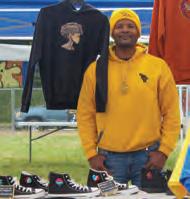
always and will always house arts as a tool to transform and express culture. The arts have a long history within Black and afro culture for being a vehicle for social change,expression and healing.
Live music, singing, poetry, dance and so much more, is written in our DNA and is something shared across all the many races, ethnicities and languages of Blackness, it is crucial to our foundation as an organization. Through the performing arts Black Humboldt is creating safe spaces for artists to bare themselves but also giving platform to cultural awareness, preservation and representation.
MISSION: To enlighten, empower, and entertain our Black community in Humboldt County through events made FOR US and BY US.
VISION: Focus on positive stories from the Black community in Humboldt County, invest in Black businesses, and support Black arts and culture. Build community awareness of issues affecting Humboldt County residents. Create visible spaces within the community for the acceptance of Black presence and fostering relations with BIPOC and non-BIPOC communities.
VALUES: Safety, Culture, Community, Empowerment and Education
GOALS: Cultivate safe, supportive, and inclusive spaces. Create, maintain, and sustain economic empowerment. Educate, empower and liberate the Black community. Promote resources for racial equity, inclusion, and allyship.


“Our decision to use “Black” instead of “African American” is to ensure the geographical and cultural inclusivity of everyone within the African diaspora. “Black” is both a socially and racial constructed identity, but also a culture. Black people come in many different races, ethnicities and cultural backgrounds. There is no one way to be Black and there are many variations of the Black experience.

| 39
The Palette
= Photo courtesy of Black Humboldt
f e a t u r e
Juneteenth 2023 vendors from left to right: Attribute and A1 Embroidery, Kassandra Rice of Nail Tripp, Leon, Soul Bunni, Malaki Aurthor and Tajiza Kenney -
Paige of Hanzy With the Crafts sells custom t-shirst at Juneteenth
Photo courtesy of Mary Ann Clark
Black Humboldt Arts Programming


Arts for Black and Brown Bodies is a month-long series that explores black and brown bodies within art forms that society doesn’t normally attribute to black/Afro culture or community.
The series occurs for an entire month, both in October and March every year, and includes six to 12 art workshops, exclusive for attendance for BIPOC community members, as well as art exhibitions and performance showcases. The goals of the series is to provide representation within an area that is normally lacking, create safe spaces and expose the community to local BIPOC artists in a safe manner.
Look for Black Humboldt, 2024 exhibitions and showcases during the month of February in honor of Black Liberation Month, in March to celebrate Arts for Black and Brown Bodies, and in June to celebrate Juneteenth


Photos from top left and working clockwise: 2022 Juneteenth Black Arts Showcase (Mary Ann Clark). Group of local dancers from “Get me Bodied,” October 2018 (K.M Ross Photography). Local artist Ra HTP performing at The Eureka Night Market - . Drag performer “Garlic Bread” performs at Juneteenth 2023 - . LionIssachar and Ju drum hosting a radio takeover at Humboldt Hot Air for “Black Liberation Month” (BLM) - . Parks family enjoying a Kids Kraft session led by Lydia Morris forAll Love Aundrea leading a singing workshop as part of “Arts for Black and Brown Bodies” March 2020 - . All Love Aundrea leading a singing workshop as part of “Arts for Black and Brown Bodies” March 2020
40 | The Palette
f e a t u r e
The Art of the Tattoo
With Henry Kruger from Sailor’s Grave Tattoo
CARLTON NIELSEN

Practiced in cultures worldwide for various purposes, from adornment to status to religion, tattooing is one of the oldest art forms known to humankind. Tattoos are no longer taboo; we can fully appreciate the rich and fascinating history dating back over 5,000 years.
Sailor’s Grave is a unique place where people can learn about the history and culture of tattooing and get a high-quality tattoo from a master artist.
I had a chance to talk with Henry Kruger of Sailor’s Grave Tattoo about the art form, his thought process and practice, the technology of tattooing, and its progression from an ancient art form to the industry it is today. For starters, the collection of industry-related memorabilia, tattoo art, tattooing gear, and images of the art form’s history is unique to our part of the State. The nearest similar quantity and quality collection is at Triangle Tattoo in Ft. Bragg (well worth the drive to visit with Madame Chinchilla and Mr. G). Even more impressive is Henry’s knowledge of the origins of tattoos from the outgrowth of the styles and applications popularized in Japan after WWII.
The people and places that Henry encountered early in his career make his story fascinating, even before considering his tattooing skills, collection, mentorship

philosophy, and other unique qualities. Over time in his career, he added Sailor Jerry, Danny Danzl, Percy Waters, Greg Irons, Pete Stevens, Filip Leu, Joe Kennedy, and Ed Hardy to his list of contemporaries and influences. He started art school at the Seattle Art Institute, with his most prominent instructor being William Cummings, who makes an interesting read in and of himself if you have a little time. William is famous and influential in his own right and helped Henry to begin to see himself as a commissioned artist who works in tattooing. Many new tattoo artists come into the field with a mono-ocular view that they must express themselves through their work on inking people. In contrast, Henry sees his work as a collection of what people want to express with their ink and works with folks to talk about their ideas and execute the practical application of what they are trying to convey. All of this very much came out of his time in art school.
Through his many years of experience, Henry knows what will last on human skin as a canvas and hold up well over time. “Henry time” is to share a bond with his customers through providing what is essentially good customer service in delivering quality work and expression.
He has known many tattoo artists over the years,
The Palette | 41
A historical collection of tattoo machines displayed at Sailor’s Grave A detail shot of one of Henry’s tattoos
f e a t u r e
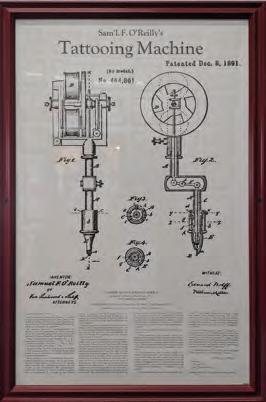


and this concept is unique to very few. There is a certain selflessness to how he expresses himself and his passion for what he does. He sees himself as a caretaker of knowledge and skills that he has an obligation to pass along and share with the next generation.
Kruger is also a strong advocate for apprenticeship. He believes passing on the skills and knowledge of tattooing to the next generation is vital. He is currently training five tattoo artists at his shop; like any master of their craft, Henry and his team understand and respect their predecessors. This is evident in the care and organization of their shop, displays, work areas, supplies, and hardware. He states that as materials technology advances, that print and apply permanently. Henry likes tattoos that look like tattoos, and with experience, he


understands what will hold up over time. Watercolor emulation and more recent trends won’t look as hot as skin ages. An appreciation of skin and ink as a media and medium cannot easily be understood from a book. Elasticity, skin tone, existing tattoo art, and location pain tolerance all go into a successful tattoo session equation.
The shop contains a collection of tattoo equipment rivaled by a few in Southern Oregon and Norcal. He has application equipment dating back to the First World War era and some from the early days of tattooing in Japan. The display cases are full of not only gear but also memorabilia and history dating back to the early days of tattooing. Just about every square foot of wall space is devoted to examples of tattoo art and photos of the many early influencers of the craft. If I had to guess the number of images, it is well over 5,000 and rivals anything you would see in Seattle, Portland, or San Francisco. Like Henry’s knowledge, his art collection dates back to the early 20th century and showcases the evolution of tattoo styles and subject matter over the past 100+ years. Whether you’re looking for inspiration or want to immerse yourself in creativity, I highly recommend adding this shop to your itinerary for an art walk through Eureka’s Old Town. Kruger’s passion for tattooing as an ancient art form is evident in everything he does. He is a true artist and a craftsman; his tattoos are works of art.


All tattoo photos show original work and are courtesy of artist Henry Kruger

42 | The Palette
open for arts alive!
welcome•
OLD TOWN’S PREMIERE TATTOO STUDIO 138 2nd st. eureka, ca • 707-443-0666 “Dedicated to the Art and History of Tattooing” sailors-grave-tattoo @sailors_grave_tattoo_humboldt
TUES-SAT 11 AM-7 PM
•walk-ins
•appointments Preferred• stop by & check out our tattoo related Art, antiques & history
f e a t u r e
Shop poster
Arcata offers everything you’d expect from a college town, and then some. Arcata has room to love coffee, music, celebrations, intellect, the outdoors, and any possible chance to watch or participate in art.
As you might expect, Arcata has a lively art scene. Art is one of the more popular majors at Cal Poly Humboldt, and the faculty is first rate. Be sure to check out the Reese Bullen Gallery on the Cal Poly campus, which houses the university’s permanent art collection and sponsors exhibitions by professional artists as well the annual Juried Student Exhibition. While on campus you will also want to visit the Native Arts Gallery, which highlights contemporary and traditional Native American Arts.

Cal Poly also offers multiple venues for the performing arts, including student performances and film festivals presented by the Department of Theatre, Film and Dance, and recitals by the Music Department. CenterArts hosts world-class entertainment; acts they’ve presented over the past few years have included George Clinton & Funkadelic, Ziggy Marley, Lyle Lovett, Suzanne Vega, David Lindley, Jake Shimabukuro, B.B. King, James Brown, Willie Nelson, Jay Leno and the
Arcata’s art scene extends well beyond the Cal Poly campus, however, and has given rise to cooperative galleries and studios as well as numerous public events and celebrations, all stamped with the city’s inimitable style. The performing arts, too, have a thriving presence off-campus, with well-established theater and dance troupes. The city also offers a lively night life, replete with good music and good food.


The Palette | 43 localartlocalartlocalart
Julliard String Quartet. See page 45 for a listing of 2024 performances.
23local artists open daily onthe plaza
ElaineShore
Delicious MExican Food! • Full Bar • Reservations • • Catering • 850 Crescent Way • Sunny Brae • 707-630-5196 Menu a r c a t a
Kinetic Sculpture Race. Photo by Maximiliano Gambin
AnnaOneglia
AmyEllisTaylor
Arcata Arts Organizations
All area codes are 707 unless noted. Information and venues are subject to change. Locations are Arcata 95521 unless otherwise indicated.
No Limits Dance Academy
1093 10th Street 95521• 825-0922
NoLimitsDanceAcademy.com
Emphasizing technical perfection and fun in a positive environment. Tap, Ballet and Jazz/Hip Hop.
All Seasons Orchestra
D Street Neighborhood Center 14th & D Sts. 443-2626
Saturdays 10am to noon
A community orchestra open to all ages and orchestral instruments. The group plays a mixture of popular and classical pieces. Sponsored by the City of Arcata and a Parks and Recreation Program.
Arcata Artisans
PO Box 4327 Arcata CA 95518 825-9133 • ArcataArtisans.com
Cooperative gallery of over 30 local artists, featuring fine art, fine crafts and gifts.
Arcata Arts Institute
Arcata High School • 1720 M St. 825-2400 • ArtsInstitute.net Program open for all Humboldt County students grades 10-12 who are dedicated to the arts.
Arcata Interfaith Gospel Choir
PO Box 171, Arcata 95518 822-4444 • AIGChoir.com
A 60+ member choir of community singers, inspired by black Gospel Music, that has performed for 27 years throughout Humboldt County and beyond.

Arcata Main Street
761 8th St., Ste. C • 822-4500 • ArcataMainStreet.com
In service to the community since 1987 to restore, maintain and build a clean, safe and diverse downtown; hosts Arts! Arcata on the second Friday of each month.
Arcata Playhouse
1251 9th St.
822-1575 • ArcataPlayHouse.org
Presents exciting, high quality music and theater in an intimate setting for young and old alike.
CenterArts
Cal Poly Humboldt • 1 Harpst St.
Tickets: 826-3928
Humboldt.edu/centerarts
CenterArts offers a wide range of music, dance, theater and performance art, educational opportunities for children and a commitment to supporting culturally diverse creative work.
Fire Arts Center
520 S. G St. • 826-1445
FireArtsArcata.com
Fire Arts Gallery open daily. Offers studio membership and classes in ceramics and fused glass, including wheelthrowing, handbuilding, tile making, sculpting, and children’s ceramic classes.
Humboldt Area Foundation
363 Indianola Rd.
Bayside 95524 • 442-2993
HAFoundation.org
HAF grants more than $100,000 annually to support the arts in our region.


First Saturday in October

Humboldt Folk Dancers
Friday events, visit website: HumboldtFolkDancers.org
Weekly international folk dancing instruction and request dancing at St. Alban’s Episcopal Church, and monthly dance parties with live music, first Fridays at Redwood Raks World Dance Studio.
Humboldt Folklife Society
HumboldtFolklife.com
Promotes traditional music and dance; bimonthly newsletter. See website for performances.
Humboldt Light Opera Co.
92 Sunny Brae Center
630-5013 • HLOC.org
More than 100 major productions staged since 1973. Company program, HLO/KidCo, for youth musical theater presentation.
Humboldt Music Academy
Cal Poly Humboldt
1 Harpst St. 826-3411 • Humboldt.edu/hma
Music instruction and performance ensembles for students 2 to 18.
Cal Poly Humboldt
1 Harpst St. • Humboldt.edu
Art Dept., 826-3624
Theatre, Film, Dance, 826-3566
Music Dept., 826-3531
CenterArts Tickets, 826-3928
•Goudi’ni Native American Arts Gallery • 826-3629
Rotating exhibits feature works by contemporary and traditional Native American artists, located on Cal Poly campus in Behavioral & Social Sciences Building.
•Cal Poly Sculpture Garden 9th St., between H & I Sts., behindHumboldt Glassblowers
Rotating sculpture exhibits.
•Reese Bullen Gallery 826-5814

The heart of the University’s Museum and Gallery Practices Certificate Program, located within the Cal Poly Art Building, presents exhibitions of works by local, regional and visiting professional artists and an annual exhibition of student art by HSU Art Department graduates.
•Student Access Gallery 826-4149
Student-run exhibits in Foyer Gallery, Karshner Lounge, Student Business Service Building, 1st floor.
KHSU & KHSUBBC
Diverse Public Radio -FM
90.5 Arcata - Eureka
91.9 Crescent City - Brookings 88.7 Ferndale - Fortuna
89.9 Garberville
99.9 Willow Creek
103.3 No Hum Co.
90.2 Eel River Valley
Cal Poly Humboldt
1 Harpst St. • KHSU.org Office, 826-4807
Studio, 826-4805, 800-640-5911
Mix of national news, local public affairs and music programming.
KidCo Musical Theater
92 Sunny Brae Center 630-5013
• HLOC.org/KidCo
Humboldt Light Opera Company’s youth program offers classes ages 3-18, and bi-annual youth productions. Students learn vocal, acting, movement and ensemble skills.
Meridian Fine Art by appointment, 826-7184
MeridianFineArt.net
Photography services specializing in the documentation of art and history for reproduction including e-media, competitions, portfolios, printon-demand, and fine art printing. Services include digital printing up to 64 inches on diverse range of media.
No Limits Dance Academy 1093 10th St. • 825-0922
NoLimitsDanceAcademy.com
Emphasizing technical perfection and fun in a positive environment. Tap, Ballet, Jazz/Hip Hop and DanceFit, an adult exercise class.
Redwood Raks
World Dance Studio
824 L St., Old Creamery Building 616-6876
• RedwoodRaks.com
Classes, performance / event space.
Ya Habibi Dance Company
826 L St., Old Creamery Building, Arcata 95518 • 616-6876
RedwoodRaks.com
Middle Eastern Dance group directed by Shoshanna.
44 | The Palette a r c a t a
Benefit for Northcoast Children’s Services
the Arcata
A
On
Plaza

Upcoming
CenterArts
Performances

For Tickets, call 707-826-3928
Per formance Locations:
ACPA = Arkley Center for the Performing Arts
JVD = John Van Duzer
Theatre, Cal Poly Humboldt
FRC = Fulkerson Recital
Hall, Cal Poly Humboldt
Peking Acrobats
7 pm January 23 2024
Gov’t Mule • 8 pm February 13 2023
• JVD
Masters of Hawaiian Music: George
Kahumoku Jr, Daniel Ho & Tia Carrere
7 pm February 25 2024
• FRC
Tommy Emmanuel, CGP
7 pm March 5 2024
• ACPA
The Wood Brothers
7 pm March 6 2024
• ACPA
Altan
8 pm March 9 2024
• ACPA
World-Famous Glenn Miller Orchestra
7 pm March 12 2024
• ACPA
Immanuel Wilkins
7 pm April 7 2024
• FRC
Arts! Arcata
T he second Friday of each month businesses stay open late for Arts! Arcata , featuring local artists working in nearly every conceivable media. This list is subject to change from month to month. For an updated listing, call 822-4500 or visit: ArcataChamber.com
All area codes are (707) unless noted. Information and venues are subject to change.
Arts! Arcata Venues

Angelica Atelier
1101 H St. • 834-1296
AngelicaAtelier.com
Arcata Artisans
883 H St. • 825-9133
ArcataArtisans.com
Arcata Exchange
813 H St. • 822-0312
ArcataExchange.net
Arcata Main Street
761 8th St. • 822-4500
ArcataMainStreet.com
Bubbles
1031 H St. • 800-398-7627
Bubbles-Arcata.com
Café Brio
791 G St. • 822-5922
CafeBrioArcata.com
Fatböl Clothing
1618 G St. • 844-432-8265
Fire Arts Center
520 S. G St., #A • 826-1445
FireArtsArcata.com
Foodwise Kitchen
971 8th St. • 633-8328
FoodwiseKitchen.com
Global Village Gallery
973 H St. • 826-2323
GlobalVillageGallery.com
Jacoby’s Storehouse
Corner of 8th & H Sts.• 825-0108
•Plaza Grill (3rd floor)
826-0860 • PlazaGrillArcata.com
•Plaza View Room (3rd floor)
•Jay Brown (3rd Floor Ste. 5)
The Jam
915 H St. • 822-4766
TheJamArcata.com
Libation Wine Bar
761 8th St. • 825-7596
Moonrise Herbs
826 G St. • 822-5296
MoonriseHerbs.com
Moore’s Sleepworld
876 G St. • 822-9997
MooresSleepworld.net
Northtown Books
957 H St. • 822-2834
NorthtownBooks.com
Om Shala Yoga
101 H St. • 825-9642
OmShalaYoga.com
Pacific Outfitters
1600 5th St. • 822-0321
PacificOutfitters.com
Plaza
808 G St. • 822-2250
PlazaArcata.com
Redwood Yogurt
1573 G St. • 826-7677
Rocking Horse, The 791 8th St. • 822-3509
therockinghorsearcata.square.site
Sanctuary, The 1301 J St. • 822-0898
SanctuaryArcata.org
Savory
1504 G St. • 630-5083
SavoryGrillCafe.weebly.com
Stokes, Hamer, Kirk & Eads, LLP
381 Bayside Rd., Ste. A • 822-1771
SHKKLaw.com
Umpqua Bank
Upstairs Gallery
1063 G St.
Wildberries Marketplace
747 13th St. • 822-0095
Wildberries.com
Zen
1091 H St. • 630-5007
The Palette | 45
r c a t a
a
Gallery Spotlight: Arcata Artisans


Arcata Artisans is a cooperative gallery for Humboldt County art and fine craft. Since its opening in 2003, it has made a unique home for nearly 100 artists, many of whom have gone on to become leaders in our arts community. Run on a cooperative model, the member artists are the owners, sharing the tasks of running the business. And since they are also the gallery staff, there is always an artist on site to provide insight into the current work on offer.
These days the gallery includes six who have been there from the very beginning. Founding member Joyce Jontè remembers “Twenty years ago I joined a group of 40 local artists who met every Monday evening at Steven Vander Meer’s studio, making plans for a cooperative art gallery. We came up with diverse and creative approaches and had spirited discussions. One thing we all agreed upon was that we needed to be on the Plaza… It took two years of meetings and work parties until we finally opened in June of 2003, in a brand-new building at the corner of 9th and H Streets.”
Still in the same location, Arcata Artisans is now one of the oldest continuing businesses on the Plaza. It

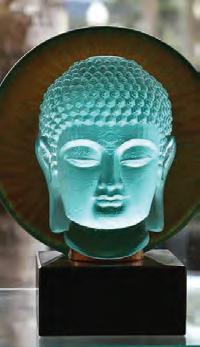
presents a wide variety of art to enjoy or to gift, including affordable, frame-worthy greeting cards to one of a kind sumptuous sculptures and paintings.
The current membership of 22 represents a wide range of styles and media. Visitors to the gallery will find oil, acrylic and watercolor painting, printmaking, collage and mixed media assemblage, sculpture in wood, metal, ceramic, cement and glass, photography, stained, cast and fused glass, functional ceramics, jewelry, handweaving and felting.
Each month, two artist members bring in a large display of recent work for the Featured Artist Area; they then welcome visitors to experience their creations in person during Arts Arcata! on the second Friday evening of each month. Then each year during December the Featured Artist Area switches to a group show where each member presents only one or two pieces to showcase the entire group at once.
Arcata Artisans Gallery is open everyday, 10am to 6pm, except Sundays: noon to 4pm. Winter hours are 11am to 4pm daily from January through March.


46 | The Palette a r c a t a
883 H Street on the Arcata Plaza • ArcataArtisans.com • 825.9133
j Fiesta Grill Supports the ARTS! j Delicious MExican Food! • Full Bar • Reservations • • Catering • 3525 Janes Rd • Arcata • 707-822-4600 j Menu j
From left to right: Painting by Anna Oneglia. Gallery Exterior. Gallery Interior. George Bucquet Cast Glass Head.
Why Study Art?
Choosing A Medium at Cal Poly Humboldt NICOLE JEAN HILL
As many of my colleagues, current students, and Art + Film alumni would likely agree, many of us pursue careers in the arts because, at a certain point in our lives, we couldn’t imagine doing anything else. Once an art-curious individual has connected with a particular teacher, artist, or media area, the relationship the visual arts have to our everyday lives becomes inescapable and the driving force behind our intellectual curiosity.
As a professor of art and the chair of the Department of Art + Film at Cal Poly Humboldt, I often reflect on my experience as a student and my entry into the art world. I am, along with many of my colleagues, a first-generation college student who didn’t have much exposure to art until I was a college student. I had some photography experience working on the high school newspaper and started as a photojournalism major. But during my first semester in college, I took a general education art history class, which opened up a whole new world for me. From that moment forward, I was hooked on how complex and thought-provoking the art world can be and how interconnected it is to the social, political, and physical environment. I pursued both a bachelor’s degree and a master’s degree in photography through studio art programs. I’ve been a practicing artist and educator ever since.

In hindsight, I may have approached my studio art degrees differently if I had known more about printmaking, sculpture, digital media, or the many other visual art-related disciplines that I wasn’t aware of before college. That is why I am very excited by how our programs at Cal Poly Humboldt are structured to provide students with exposure to many fields within the discipline early on. We offer the Creative Coast, a first-year place-based learning community for Art and Film majors. This entry point for freshmen allows them to experience the many on and off-campus resources available to them, including our facilities, art mediums, galleries, community partners, majors, minors, and certificate options. It also allows students to meet professors from various disciplines to make those connections early with the hope that students will make the most of their four years on campus.
Cal Poly Humboldt offers several pathways in Art + Film: Filmmaking, Studio Art (Ceramics, Photography, Jewelry & Small Metals, Printmaking, Sculpture, Digital Media, Painting, Drawing & Illustration), Art History & Museum Studies, and Art Education. In all these areas, my colleagues and I always ask: What are the essential skills we want students to have when they graduate, and how can we provide them with several possible pathways after graduation? To address this, we’ve back-engineered our programs to


The Palette | 47
f
Jewelry & Small Metals students displaying their wearable metal work. Photo by Winchi De Jesus
e a t u r e
Ceramics students create custom-made mugs as part of Cal Poly Humboldt University Advancement commission
Sculpture student removing shell from a bronze sculpture, part of the foundry process to prepare it for finishing.

get students thinking about careers and get them involved in campus experiences that help build up their resumes. I was only asked to think about those things once I finished school, and felt very lost during that transition phase after my undergraduate education. Unlike my student experience, the Cal Poly Humboldt faculty has been very thoughtful in building resume-building activities directly into the curriculum in the form of exhibition opportunities, internships, experience coordinating the Humboldt International Film Festival, and art education service-learning in the community. Professor Berit Potter, who leads the Museum and Gallery Practices program stated in a recent interview in the Humboldt Journal of Social Relations (Volume 45, May 2023):
My aim for the certificate is to provide students with more vocational guidance. I take them on field trips so they can see what’s happening behind the scenes in museums and other community-serving institutions, and hopefully that helps them determine what internship might be best for them. We have class discussions about specific jobs and guest speakers visit. We also do projects in the museum and gallery practices class where each one is geared toward a different aspect of museum work. Students have the opportunity to think about, just at a very basic level: Is this fun for me? Does filling out a condition report—that sort of detail-oriented work— look exciting and is it something that I can really get into? Or am I more interested in talking to people about the artwork? In that case, maybe they’re more interested in education than registration.
This vocational guidance provided throughout the curriculum was a benefit to Angie Allen, a 2016 Art graduate who currently works as a professional art handler. In reflection on her experience studying in the areas of Studio Art, Art History, and Museum Studies, Allen states:
Art History, Studio Art, and the Museum and Gallery Practice Certificate introduced me to the field of art handling and the art industry at large. Studio Art prepared me by learning how specific materials behave, understanding creative processes, and growing a passion for my personal practice. It is critical when handling delicate and valuable art to know for example, how long it takes oil paint to dry (sometimes years). Studying Art History laid the context for the art that I handle daily. It is exciting to handle works of art that I learned about
in an art history lecture. The Museum and Gallery Practice Certificate is what actually introduced me to the field of art handling. I knew that I did not want to be a curator, but I did know that I wanted to work with my hands, and art handling is just that.
Some students decide they want to focus on a very specific media area as the emphasis for their degree, but students who want to focus on the education aspect of art need to be very versatile in their artmaking practice. Professor Jim Woglom, head of the Art Education program, explained in the Humboldt Journal of Social Relations (Volume 45, May 2023) :
So, whereas studio majors would focus on probably a couple of different media that they were super interested in before diving into specifics, or art history, students would focus on how to make art and then a bunch of looking at art history, in art education, we cover all of the media that could potentially be taught in K-12 schools and colleges in California. We then look at art history as a kind of breadth thing—ensuring that students have a widely informed knowledge of what the arts are so they can take that to as many students as possible over their teaching careers.
While less access to the art and film industries a university in a larger city can provide of larger cities might put our program at a disadvantage, our relative remoteness is actually one of our strengths. For the filmmakers, Humboldt County is home to prime location filming: beaches, redwood forests, Victorian villages, rural farmland, and coastal port towns. For artists, the remoteness of campus can be, as Renee Calway (ART, 2015) describes, “an oasis for creative thoughts.”
I know very well how intimidating it can be to decide on a major in the visual arts, and I see many students ask- how can I do this if I’ve never taken any formal art or film classes before? That is true of most of our students, and there is no connection between the level of experience at the start of the program and the success and depth of experience possible within the programs. Most of us end up in these creative fields because something got us hooked and we feel almost supernaturally compelled to create, tell stories, teach, research, and curate. And I can confidently say that the Cal Poly Department of Art + Film has the faculty and resources to help those that get hooked all along the way.
48 | The Palette
f e a t u r e
Demonstration of the green screen during Professor Sarah Lasley’s FILM 478 Visual Effects class
localartlocalartlocalart

The tiny town of Dadiqhoughuk (Blue Lake) rests near the banks of the Mad River off Hwy 299. It is home to a surprising number of artists, musicians, writers and actors. At the center of its art community is Dell’Arte International, a world-famous school of physical theatre. Their professional training program attracts students from all over the globe, offering the only accredited MFA of its kind in the world. Celebrating over 40 years in Blue Lake, Dell’Arte presents performances at various venues throughout the year, highlighted by the Baduwa’t Summer Series, celebrating arts, community and connectivity. Baduwa’t is the name for Mad River, so the festival was renamed
in 2021 to revitalize the use of Soulatluk, the Wiyot Language. Dell’Arte is a destination unlike any other on the American theatre map.
Also along Hwy 299 sits Willow Creek, a delightful rural community with a distinct and ever-growing art scene. Its Studio 299 Center for the Arts, a nonprofit community organization devoted to the promotion and development of the arts in the area, offers artists a place to gather and a way to share their work with the community at a variety of local events. The organization provides support for the entire art community on the Hwy 299 corridor of Humboldt and Trinity Counties. Another important art resource is Willow Creek’s Dream Quest, which offers a wide range of programs and activities for local children and teens, including fine arts, electronic media, performing arts and also hosts a retail thrift store.
Any excursion inland devoted to arts and culture needs to include the art created by the Native American tribes of the region. The Hoopa Tribal Museum, located on Hwy 96 in the Hoopa Valley Indian Reservation, is dedicated to preserving and sharing the rich cultural history and artistic practices of Northern California Native Americans. The museum displays one of the finest collections of Hupa, Yurok and Karuk artifacts in Northern California. Their collection includes a fine display of local Indian basketry, ceremonial regalia, dugout canoes, tools and implements. The Hoopa Tribal Museum is a “Living Museum.” Most of the artifacts on display are on loan to the museum by members of the local native community, and are removed annually to be used in the traditional tribal ceremonies.
Arts Organizations & Venues
Dell’Arte International School of Physical Theatre
PO Box 816, Blue Lake 95525 • 668-5663 • DellArte.com
The North American center for theatre training and performance of original theatre. Offers performances year-round.
Dream Quest Teen & Youth Center
100 Country Club Dr. • Willow Creek 95573• 530-629-3564
www.DreamQuestWillowCreek.org
A community-supported grass roots organization offering a wide variety of programs that teach youth how to pursue their passions and follow their dreams. Provides a safe, drug-free environment with access to vocational and artistic resources.
Hoopa Tribal Museum
PO Box 1348, Hoopa 95546 • Hwy 96 Shopping Center
530-625-4110
• see on Facebook
A nonprofit entity of the Hoopa Valley Tribe created to preserve, and to share, the rich culture and history of the native people of Northern California.
Studio 299 Center for the Arts
PO Box 32, 75 The Terrace Rd. Willow Creek 95573
Studio299Arts.com
• 530-629-3488
Studio 299 is devoted to the promotion and development of the arts in the Klamath and Trinity communities of Northern California.
TRINITY COUNTY
First Saturday Art Walk, 5-8pm Weaverville art galleries and businesses, plus live music. Produced by Trinity Arts Council, TrinityCountyArts.org
Highland Art Center
PO Box 1270, 691 Main St., Weaverville 96093 530-623-5111 • HighlandArtCenter.org
In cooperation with the Snyder Highland Foundation, HAC presents a new show of local and regional art each month throughout the year in their galleries.
Trinity Arts Council
PO Box 1887, Weaverville 96093 • 530-623-2760 • TrinityCountyArts.org
A nonprofit corporation with the mission to advance Trinity County through the arts and creativity.
Trinity Players/Trinity Alps Performing Arts Center
PO Box 453, Weaverville 96093 • 530-623-8695 • tapacOnline.org
Theatre company and community performing venue.
EarthDance Studios & Gallery
140 S. Miner St., Weaverville 96093 • 530-778-3135 • EarthDanceArt.com
Guest artist shows, gift shop, classes, workshops, gatherings, custom matting and frame shop.
The Palette | 49
h w y 2 9 9 &
The Dream Quest Store in Willow Creek offers all types of local art.
96
mckinleyville westhaven trinidad

McKINLEYVILLE is a popular, growing community set along the rugged Pacific Coast. It is graced by the Mad and Little Rivers, the beautiful Azalea State Reserve, and the Hammond Coastal Trail, which presents stunning panoramic views of the coastline. Nearby Clam Beach is known for beachcombing, fishing and horseback riding. The natural beauty of this area makes it a favorite place for artists and art lovers to live, work and play.
North of McKinleyville is the tiny community of WESTHAVEN, featuring the Westhaven Center for the Arts. The center features new exhibits and artists’ receptions each month, concerts and drama events, workshops and classes, many children’s activities, poetry readings, puppet shows, holiday events and other art exhibits.

Just past Westhaven is the seaside town of TRINIDAD, one of the most picturesque communities on the California Coast. Trinidad, with its small but dramatic bay and coastline, is known for its traditional fishing fleet, quaint oceanside cottages and lovely Bed and Breakfast inns. Enjoy fresh local seafood at one of Trindad’s fine restaurants, and venture into one of several galleries highlighting works that star the natural beauty of the area. Trinidad has inspired the work of many well-known local and visiting artists, and plays host to a noted artists’ colony.


50 | The Palette
n o r t h e r n
Trinidad Art Gallery, a cooperative, offers a wide variety of art.
Northern Humboldt Arts Organizations
All area codes are (707) unless noted. Information and venues are subject to change.
M c KINLEYVILLE
Trinity Ballet Academy
1981 Central Ave., McKinleyville 95519 839-1816
TrinityBalletMck.com
A full ballet curriculum for ages 3 to adult.
TRINIDAD & WESTHAVEN
Trinidad Art Gallery
490 Trinity St., PO Box 395, Trinidad 95570 677-3770
TrinidadArtGallery.com
A fine art and craft cooperative featuring original art from more than 20 local artists.
Trinidad Museum Society 400 Janis Ct., Trinidad 95570 677-3883
TrinidadMuseum.org
Photos of the area’s whaling and logging history, native plant garden, marine shells and Yurok artifacts, sets up special school or organization group tours.
Trinidad Arts Nights Venues
Beachcomber Cafe
363 Trinity St. • 677-0106
Forbes and Associates
343 Main St. • 677-1600
Headies Pizza and Pour
359 Main St. • 677-3077
The Lighthouse
355 Main St. • 677-0077
TrinidadLighthouseGrill.com
Moonstone Crossing Tasting Room
529 Trinity St. • 845-5492
MoonstoneCrossing.com
Ned Simmons Gallery at the Trinidad Coastal Land Trust
380 Janis Ct. • 677-2501
Saunder’s Plaza • Main St. at Scenic Dr.
Seascape Restaurant and Pier
1 Bay St. on the Pier • 677-3762
Trinidad Art Gallery
490 Trinity St. • 677-3770
TrinidadArtGallery.com
Trinidad Eatery
607 Parker St. • 677-3777
TrinidadEatery.com
Trinidad Elementary School
300 Trinity St. • 677-3631
Trinidad Museum
400 Janis Ct. at Patricks Point Dr. • 677-3883
TrinidadMuseum.org
Trinidad Trading Company
460 Main St. • 677-0711
TrinidadTrading.com
Wind N Sea
410 Main St. • 677-3223
Westhaven Center for the Arts
501 S. Westhaven Dr., Trinidad 95570
677-9493
WesthavenCenter.org
Art exhibits, workshops and classes in a variety of media, healing arts and spoken word, community concerts.
n o r t h e r n
Trinidad Art Nights are held the first Friday of each month from May through October, 6 to 9pm, and made possible by Community Arts Trinidad, a nonprofit DreamMaker Project of the Ink People. Join the town in a night of exploration and celebration of the diversity and talent of local artists. Many businesses and organizations participate as well as artists, dancers and musicians, and after hours extravaganzas.
TrinidadArtNights.com


490 Trinity st
Trinidad, CA
Open 10-5 Daily (apr-dec)
Open 11-4 (jan/feb/mar)
707.677.3770
trindadartgallery.com
Paintings by Mara Friedman
The Palette | 51
Ceramics by Loryn White
Botanical Prints by Patty Demant
fortuna ferndale scotia rio dell
The towns and villages of the Eel River Valley are home to outstanding theater and music, antique and collectibles shops, arts cooperatives, charming accommodations and first class restaurants that rival those of much larger cities. The area also plays host to an abundance of local festivals.
Ferndale has been named one of America’s prettiest towns by Forbes magazine. AP reporter Jennifer Marin called it “A genuine Victorian hamlet,” and Los Angeles Times former travel editor Jerry Hulse dubbed Ferndale “the best preserved Victorian village in California.” The entire Main Street has been designated a National Register Historic District. The village is home to a number


of notable artists and galleries and the ever-popular Ferndale Repertory Theatre, as well as the Humboldt County Fairgrounds, site of the County Fair every August and a venue that has hosted some of the biggest acts in the world.
Fortuna’s warm weather and friendly atmosphere make it a particularly good setting for a number of well-attended annual events including a rollickingly good time AutoXpo, one of the oldest (and best) rodeos in California, and the town’s signature Apple Harvest Festival. In addition, on the first Friday of every month, artists, businesses and art lovers get together for a monthly celebration of art and music.
Loleta is also home to Humboldt Bay National Wildlife Refuge and Table Bluff County Park, favorite destinations for photographers and plein air painters. Rio Dell hosts Wildwood Days, representing its heritage with logging events, a parade and festivities. In Scotia, you can tour the historic logging museum and the Fisheries Exhibit, featuring Humboldt County’s largest indoor aquarium.


52 | The Palette
Lucas Thornton’s “A Place By the River” Mural on Fortuna Boulevard on the side of the Ray’s Grocery store. Photo by Barb Switzer
c e n t r a l
Central Arts Organizations
All area codes are (707) unless noted. Information and venues are subject to change.
FERNDALE
Ferndale Arts
PO Box 723, Ferndale 95536
535 Main St. at Shaw Ave. 298-1699
FerndaleArtGallery.com
A cooperative art gallery featuring original work of local artists; includes paintings, photography, quilting, needlecraft, woodwork, ceramics, jewelry, greeting cards and stained, fused and blown glass.
Ferndale Community Choir
PO Box 67, Ferndale 95536
FerndaleChoir.com
The Ferndale Community Choir has been a part of Ferndale for over 45 years. The choir presents a concert of an eclectic selection of sacred music during the Christmas season and again in the Spring.
Ferndale Repertory Theatre
PO Box 892, 447 Main St. Ferndale 95536 • 786-5483
FerndaleRep.org
The Ferndale Repertory Theatre is the oldest and largest of the North Coast’s resident community theatres. Since 1972, they have produced more than 270 productions including comedies, classics, mysteries, musicals, dramas and more.
FORTUNA
Fortuna Concert Series
Fortuna Monday Club, Main St. at 6th St., Fortuna 95540 • 845-5652
FortunaConcertSeries.com
The Fortuna Concert Series is a private, nonprofit corporation formed in 1990 for the purpose of bringing quality music to Fortuna and the Eel River Valley.
SCOTIA
Scotia Band
PO Box 3, Scotia 95565 599-4872 • ScotiaBand2.org
Humboldt County’s community band. Performs at local festivals year round. Scotia band is a notfor-profit organization.


The Palette | 53 c e n t r a l
Above and below: Murals in Rio Dell, which also features public sculptures along Wildwood Boulevard, it’s main thoroughfare
Fortuna’s Welcome sign features an ever-changing sculptural icon (right).
Scotia’s Fisheries Exhibit is a hybrid of art, nature and biology.


The arts along Southern Humboldt’s famous Avenue of the Giants (Old Hwy 101) are thriving. The majestic towering redwoods and gently flowing Eel River make for a natural wonderland, perfect for creative inspiration. The small rural communities in the heart of the redwoods, once booming mill towns, are now havens for artists, musicians and craftsmen.

Benbow, Garberville and Redway, located just outside the southern entrance to the Avenue of the Giants, are home every year to major musical and theatrical events.
The Mateel Community Center in Redway operates as both an event venue and in-house arts presenter. Famous for such festivals as Reggae on the River, the Summer Arts & Music Festival and the Northern Nights Festiva, the Mateel Community Center also offers an annual calendar of events which covers a wide range of artistic styles and media, and a wide variety of programs, from youth athletics and children’s theater to cooking classes and clown workshops. Many of these programs are offered at no cost or at minimal cost to
students and schools. The area is home to retail shops, restaurants, roadside vendors and rural galleries all along the Avenue of the Giants. At many of the roadside stops along this route you will find whimsical carvings hewn from some of the glorious redwood trees that help give this region its name. However, it is a mistake to think that the artistic offerings of Southern Humboldt are limited to redwood bears and tree houses, woven hemp products and tiedyed clothing. There are also artist studios and galleries where visitors can find fine paintings, blown glass, hand-wrought jewelry, pottery, sculpture, and many other one-of-a-kind pieces.
Miranda, near the southern entrance to the Avenue of the Giants, is one of the towns where you can find places to admire and purchase these treasures. The peaceful village of Myers Flat, nestled in the redwood forest, serves as a centerpiece of the Avenue of the Giants. The whole Avenue journey, through Weott and Redcrest north to Pepperwood, is a visual treat for the traveler, both in the form of natural beauty and in the work of gifted artists.
54 | The Palette localartlocalartlocalart
s o u t h e r n
David Hinds performs with Steel Pulse at the Mateel Community Center.
Summer Arts & Music Festival at Benbow
Artist Laci Dane demonstrates how to use her Redwood Moth Mural.
Photo by Courtney Ramos
Arts from Redway to the Lost Coast

Southern Humboldt is home to a large community of artists, and it has quite a few venues for performing arts, especially considering the relatively small population in this rural part of the county. The Mateel Community Center (MCC or Mateel) is a performing arts center in Redway whose name was inspired by local poet Deerhawk. His poem, crafted in the late 70s, combined the names of the Mattole and Eel Rivers, creating a new place name of “Mateel” for this area.
In addition to being a concert venue, the MCC has produced two important Fine Arts events for decades. The Summer Arts Festival , which will be on June 8 and 9, 2024, is a local craft and music festival featuring dancers, musicians, potters, painters, and creatives of all kinds. The event, which was created almost 50 years ago, is a celebration of the community of artists who call Southern Humboldt home.
Every December, the MCC also holds a Winter Arts Fair , a wonderful opportunity to connect with artists and craftspeople offering handmade goods and gifts for the holidays.
The Redwood Playhouse in Garberville is a smaller venue that hosts performing artists with various theater and dance groups and film nights. Recycled Youth , a theater group with original plays created by teens, and Feet First Dancers are both longtime performing arts organizations in SoHum that currently call the Redwood Playhouse home.
Although there are several small galleries along the Avenue of the Giants, for the moment, Garberville lacks a dedicated art gallery. However, Garden of Beadin’ and Redwood Raindrop Harmonics are two centrally located storefronts in Garberville that feature local artists’ work in their shops.
Indigenous names for those who call these watersheds home is Kinest’e or Wailaki. These original inhabitants of the Mattole and Eel River watersheds, are still here. Their traditions include artful and sustain -
able ways of caring for the land. The nonprofit organization Native Health in Native Hands (NHNH) offers a variety of ancient skills classes in Southern Humboldt, including bead-making and hands-on carving workshops for building redwood canoes. They demonstrate that land stewardship is integral to creating art from natural materials and showing respect for the environment. Keeping the Wailaki traditions, language, and culture alive and thriving is the mission of Perry Lincoln, artist, and founder of Native Health in Native Hands. NHNH generously shares a deep knowledge of this place with the wider community by creating a series of Cultural Arts workshops in Southern Humboldt.
A more recent addition to the community Arts scene in Southern Humboldt is the SoHum Mural Project. This organization started in 2018 as a group of creative women spearheading projects to beautify and uplift the town of Garberville. Their first projects raised funds and coordinated a group of local artists to brighten the main street by painting the large trash receptacles along the sidewalks.
Keeping with that theme, in April 2023, Southern Humboldt artist Laci Dane was commissioned by the Mural Project to create a Redwood Moth mural adjacent to the Garberville Town Square. This interactive mural allows visitors to stand before the wall and appear to ‘wear’ the enormous and colorful wings. Laci has painted murals throughout the area, including for the Eureka Street Art Festival, and often does live painting at local events like the Northern Nights Festival. You can find her paintings on Instagram @lacidane.art
Holly Sweet is another artist who has been working with the SoHum Mural Project to bring more public art to Southern Humboldt. Holly is fiber artist, author, and illustrator who is currently creating a proliferation of pottery. Her hand-painted pieces are delightful, depicting a variety of whimsical woodland creatures in the vibrant natural environment they inhabit outside her mountain home. Her creations are at Dancingbirdpottery.com and @hollybootssweet on Instagram
The SoHum Mural Project recently received a grant for a new mural from the California Arts Council and will be partnering with Native Health in Native Hands to create a mural that is a collaboration, combining perspectives of both non-Native and local Native artists. Creating public art that reflects and makes our vibrant Arts Community visible is an ongoing effort in Southern Humboldt. We encourage art enthusiasts to join us for an event or just stop by and take in natural and human-made beauty!
Find more @thesohummuralproject on & Additional resources: nativehealthinnativehands.org mateel.org & redwoodplayhouse.org

The Palette | 55
s o u t h e r n
SoHum Mural Project artists beautifying Garberville’s Redwood Drive.
Photo by Courtney Ramos
Gallery Spotlight: Shelter Cove & Arts at Heart Collective


The Shelter Cove Gallery at the Inn of the Lost Coast function room display:s artwork from Lost Coast Artists and donate a percentage of sales to Shelter Cove Arts and Recreation nonprofit (SCARF). The galley is open daily 11 am -4 pm . SCARF and BLM sponsor an artist-in-residence program twice a year. The SCARF annual quilt show is a festive event for locals and visitors on Labor Day weekend. Learn more about the AIR program and projects at SCARF on their website, www.sheltercoveartsrecreation.com.
Artist pop-ups are ongoing in the cove: on Fridays at Gyppo Ale Mill Arts At Heart features an artist monthly: on the first Friday during their Meet the Maker pop-up and donates 10% of all sales to local school art classes. The Farmers Market in the Marina features local artists on Tuesdays May-October.
The Shelter Cove General Store and Giftshop showcases jewelry, photographs, the printed word and features a long list of local artists.
Lost Coast Giftshop opened in 2023 and features a selection of local artists.
Cafe Dulce , located in Whitethorn, offers a rare assortment of custom furniture, cuttingboards plus slabs of wood to create your own special custom designed piece.


The rugged natural landscape of this small community inspires the artist within to be brave and step forward... art is everywhere you look. Paintings from local artists grace the walls of local restaurants and coffee shops.
Glass and Fabric Artist JENNY BUTLER has called the Cove home for 20 years. You’ll find her original stained glass hangings and fused glass art as well as hand painted clothing for sale at Arts at Heart. She offers a popular workshop, painting on T-shirts with bleach and acrylics and will be teaching an upcoming Mosaic Garden Stone Workshop.
CINDY GREEN , pastel and multimedia artist. Newly fired glass sushi plates inside the open kiln cool and fused glass art with wood display blocks rest on her workbench. When asked how she classifies her art, Cindy says “I’m like a hummingbird, in that I jump from one thing to the next. I like to have a variety of projects to keep my mind going. I see possibilities in everything ... trash, stuff on the beach, even m my neighbor’s leftover pile of lumber.” She also offers workshops: Lino Printing, silk hoop painting, Kids Crafts and coming soon, Steam-Punk Robot making.
Redwood craft and custom abalone jewelry creations are the latest endeavours of multimedia artist RON SALVUCCI . Ron has a vast background in working with many materials, mason, carpentry and welding are just a few. He has called the cove home for 15 years and you’ll see his redwood benches along the nature trails and carvings decorate many homes inside and outside even the “Welcome to Shelter Cove sign” along the cove road is one of his creations. He has several unique redwood hangings, tables and abalone jewelry for sale at Arts At Heart. He is also available for custom redwood requests.
56 | The Palette s o u t h e r n
From left to right: Sculpture by LaVonne Sallee. Gallery signage. Nautilus stained glass by Jenny Butler. Photos by Courtney Ramos
ARTS AT HEART • 533 Machi Rd, Whitethorn CA • 805-637-1933 ArtsAtHeart.com
Humboldt Artists’ Profiles
Meet some Humboldt County artists, see photographs of their work, and view their contact information.
Humboldt Arts Council maintains an Arts Online Directory of members’ work on the website
HumboldtArts.org.
On page 62, meet local artists who specialize in pet and animal portraits.
Madison Acres
Photography @madisonacres madisonacres@gmail.com
1215 Chester Avenue • Arcata 707-601-8115
I enjoy helping individuals and businesses create a distinct visual style for their brand through my photography. With a strong visual identity, we can leave a lasting impression on viewers, and properly communicate values/ passions. I am well-versed in different social media platforms and graphic-based software. Please reach out with any questions!
Christina Anastasia
Jewelry & Visionary Paintings
www.ChristinaAnastasia.com
Sparkle@ChristinaAnastasia.com
100 H St Ste 202D • Eureka 707-616-9559


Whether you are running errands or walking the red carpet Christina Swingdler will adorn you in sparkles that inspire your inner Goddess and delight your senses. Christina’s jewels for your body and home makes the world a kinder place one smile at a time. Prepare for massive joy!
Leslie Allen
Watercolor Painting & Fabric
www.spoonflower.com
LeslieAllenArtandHorses@gmail.
4051 Mitchell Rd. • Eureka 707-601-1160
I make watercolor paintings of my garden, local landscapes, or your pet, then I develop a repeat design to be printed on fabric at Spoonflower.com. My goal is to make practical, functional, affordable everyday objects with my artwork, such as tote bags, tablecloths, velvet pillows, and more. Art for everyday life!

Mary Bancud-Bettis
Low Fire Clay & Glazes
www.LotusStudioPottery.com
mud@lotusstudiopottery.com 630 2nd St., Eureka 95501 707-616-6504
Motivated by the calming effects of using the Throw Wheel and hand building, I wanted to share my small quiet studio to those who seek this experience with pottery. Check out website or email for more information.
Cate Be
Mutlidimensional Artist
@Cbeceramics
CBeCeramics@gmail.com linktr.ee/cbeceramics


Primarily porcelain and stoneware. Work I create is a reflection of self: an amalgamation of all I’ve opened my heart to. This ranges from natural resource aspects e.g. botany, wildlife and mycology, to sexual awareness, identity, social and racial injustice, self-care, self-love, cannabis-culture, and more. For custom and pet portrait opportunities, contact me.
Blondies
An Artist’s Café BlondiesFoodandDrink.com
420 E California Avenue • Arcata 707-822-3453
Tues-Sunday 10am-10pm

Our stage hosts a variety of fun and engaging shows. Figure Drawing 6-8:30pm Wednesdays. Legendary Open Mic on Thursdays. Live Music with local and touring bands on Friday and Saturdays, and the Open Jazz Jam on Sundays.
Augustus Clark
Acrylic Paint & Canvas
AugustusClark.com/ @Clark.Augustus
AugustusClark You Tube Channel
AugustusClark.ArtStation.com 707-498-2612
I am Augustus Clark, a humble vessel of acrylic paints, enraptured by the divine palette of existence. In every stroke, I dance with the myriad colors of creation, whispering love sonnets to the canvas. I am an artist of boundless styles and subjects, weaving the tapestry of life. My murals are hymns of beauty, painting the world’s heart in vibrant hues.

The Palette | 57
John Fossier
Stoneware & Porcelain
www.ThomasFossier.com
tfossier@suddenlink.com
Humboldt Artists’ Profiles

My work celebrates form and the beauty of ceramic surfaces. I work with wood and soda kilns to bring some of the random complexity of Nature into every piece. I seek to make robust and unpretentious pottery that may enhance the aesthetic experience of home, and bring a sense of occasion to the ordinary routines of living.
Cosmo Free
Photos & Videos
Shawn Gould
Acrylic Painting
www.ShawnGould.com
Shawn@ShawnGould.com
3960 D. St. • Eureka 95503 707-476-8197
I create photorealistic paintings inspired by the beauty of nature and the wild creatures that live all around us.

CosmoFreePhoto@gmail.com @cosmofree
I am a visual artist born and raised in Humboldt County, with an eye for detail and a passion for creativity. Reach out to me for any videography and photography needs.

Julie Frith
Mobiles, Ceramics, Jewelry, Music
www.FrithMobiles.com
FrithMobiles@gmail.com
707-443-5366
I am a mobile maker, ceramist, jeweler and musician. I love to make custom mobiles for homes and businesses. I have my mobiles all over the world, and can make one for you. Tell me the colors or materials and I can mock it up for you to approve. Like I say…Just Ask, I’ll see if I can do it!
John Gibbons
Blown Glass
www.GibbonsGlass.com
GibbonsGlass@gmail.com

Kay Harden
Ink Drawing
www.KayHarden.com
Ferndale, CA 707-599-8252

I am primarily a landscape artist. I love the trees of Humboldt and try to incorporate them into my work as focal points. I work with India and acrylic ink on paper and canvas. I’ve shown locally for over 30 years, most recently (10/22) at the Morris Graves Museum in Eureka.
Joyce Jonte
Watercolor
JoyceJonte.com
JoyceJonte@gmail.com PO Box 4374 • Arcata • 707-498-6224
I paint florals, figures and landscapes, working from life and from my own photos, inspired by the exquisite beauty that surrounds us. I am available for commission and have an open studio by appointment. Contact me for information about zoom and in-person life drawing sessions.

804 Broadway Suite A-1, Eureka • 619-964-5277
In my glass artwork I recreate the movement, colors, and creatures of the ocean. I transform the cold, craggily northern coasts and tropical warm waters of the oceans into earthy tide pool green and glowing aqua sculptures. I create detailed glass vessels with starfish clinging to the sides, turtles riding on optical waves, and starfish clustered together in the shape of a crown. Studio visits are welcomed, custom lighting and sculptures available.

Georgia Long
Oil, Cold Wax, Ink
www.GLongStudio.com
georgialong262@gmail.com
3206 W St. • Eureka 707-362-7883

My art tracks two paths — oil and sumi-e [ink] in the abstract. Design, composition, texture, and energy are important elements. Palette knives are used primarily with oils and cold wax, using an impasto technique. Ink abstracts use traditional tools and are wet mounted. I am self-taught, painting professionally since 1990. Art civilizes and fear eats the soul. Studio visits by appointment.
58 | The
Palette
John Fossier
Stoneware & Porcelain
www.ThomasFossier.com
tfossier@suddenlink.com
Humboldt Artists’ Profiles
My work celebrates form and the beauty of ceramic surfaces. I work with wood and soda kilns to bring some of the random complexity of Nature into every piece. I seek to make robust and unpretentious pottery that may enhance the aesthetic experience of home, and bring a sense of occasion to the ordinary routines of living.
Cosmo Free
Photos & Videos
Shawn Gould
Acrylic Painting
www.ShawnGould.com
Shawn@ShawnGould.com
3960 D. St. • Eureka 95503 707-476-8197
I create photorealistic paintings inspired by the beauty of nature and the wild creatures that live all around us.
CosmoFreePhoto@gmail.com @cosmofree
I am a visual artist born and raised in Humboldt County, with an eye for detail and a passion for creativity. Reach out to me for any videography and photography needs.
Julie Frith
Mobiles, Ceramics, Jewelry, Music
www.FrithMobiles.com
FrithMobiles@gmail.com
707-443-5366
I am a mobile maker, ceramist, jeweler and musician. I love to make custom mobiles for homes and businesses. I have my mobiles all over the world, and can make one for you. Tell me the colors or materials and I can mock it up for you to approve. Like I say…Just Ask, I’ll see if I can do it!
John Gibbons
Blown Glass
www.GibbonsGlass.com
GibbonsGlass@gmail.com
Kay Harden
Ink Drawing
www.KayHarden.com
Ferndale, CA 707-599-8252
I am primarily a landscape artist. I love the trees of Humboldt and try to incorporate them into my work as focal points. I work with India and acrylic ink on paper and canvas. I’ve shown locally for over 30 years, most recently (10/22) at the Morris Graves Museum in Eureka.
Joyce Jonte
Watercolor
JoyceJonte.com
JoyceJonte@gmail.com PO Box 4374 • Arcata • 707-498-6224
I paint florals, figures and landscapes, working from life and from my own photos, inspired by the exquisite beauty that surrounds us. I am available for commission and have an open studio by appointment. Contact me for information about zoom and in-person life drawing sessions.
804 Broadway Suite A-1, Eureka • 619-964-5277
In my glass artwork I recreate the movement, colors, and creatures of the ocean. I transform the cold, craggily northern coasts and tropical warm waters of the oceans into earthy tide pool green and glowing aqua sculptures. I create detailed glass vessels with starfish clinging to the sides, turtles riding on optical waves, and starfish clustered together in the shape of a crown. Studio visits are welcomed, custom lighting and sculptures available.
Georgia Long
Oil, Cold Wax, Ink
www.GLongStudio.com
georgialong262@gmail.com
3206 W St. • Eureka 707-362-7883
My art tracks two paths — oil and sumi-e [ink] in the abstract. Design, composition, texture, and energy are important elements. Palette knives are used primarily with oils and cold wax, using an impasto technique. Ink abstracts use traditional tools and are wet mounted. I am self-taught, painting professionally since 1990. Art civilizes and fear eats the soul. Studio visits by appointment.
58 | The
Palette
Natascha Pearson
Acrylics
www.LittleLostForest.com
LittleLostForestArt@gmail.com
@LittleLostForestArt 707-218-1880
Humboldt Artists’ Profiles

Natascha is a magical realism acrylic painter. She is the Founder of the Art Collective, Little Lost Forest. She draws inspiration from the female form, paganism, pachamama and fantasy. She often collaborates with her husband Jeremy. Natascha began painting at music events in San Diego. You can find her art and workshops on her website.
Cathy Ray Pierson
Pottery, Functional Stoneware
www.piersonpottery.com
CathyRay@pierson1.com
455 Freshwater Rd., Eureka 707-443-1665
My use of a masking technique makes my work distinctive and a piece of Humboldt County. I choose a wide variety of ferns and other leaves in this process. My Spirit Horses are made as one-of-a-kind pieces either pit fired or Raku. I am behind Freshwater Stables. Enter the stables and follow the signs to my pottery.
Blake Reagan
Murals, Paintings & Sculptures
www.BlakeReagan.weebly.com
BlakeReagan11@gmail.com
2550 Table Bluff Road, Loleta 707-267-8679

Patricia Sennott
Monotype printmaking, Cyanotype and Watercolor
www.arcataartisans.com
psennott@gmail.com
@patriciasennott PO Box 237 Blue Lake CA 95525
My experiments continue with portraying insects, flowers, birds and natural phenomena. Arcata Artisans Gallery on the Plaza displays my work year round. Arcata studio open by appointment. Commissions welcome.
Jeff Stanley
Acrylic & Open Acrylic on Canvas
www.PaintingsByJeffStanley.com
paintingsbyjeffstanley@ hotmail.com 707-497-8003


I find that snacking and napping play an important part in both the creative process and a happy life. Visit my website to see more of my paintings, to find out where I am currently showing my paintings, and where I am currently teaching painting classes. Greeting cards, prints, and stickers of my paintings are available throughout Humboldt County.
From electric art deco, to undulating sunsets of colorful clouds, many of my creations display bright gradient waves of brilliant floral vibrations. Though I work out of my studio in Eureka CA, most of my work bodies are painted on site in public spaces with a focus on beautifying our drab urban environments.
Stock Schlueter
Oil Painting
www.StockSchlueter.com
StockSchlueter@gmail.com
Studio 208 C St Eureka
Gallery 330 2nd St Eureka 707-498-0059


Stock is a native of Humboldt County and has painted plein air for decades. His artistic journey has taken him across the continent painting the Southwest and into Mexico. In 2019 he spent a month painting on location in Bhutan. He states “ If I can paint something beautiful to remind us where we live, it might just do some good.

Patricia Sundgren Smith
Fine Art Printmaking, Collage, Drawing, Pastel, Photography
TrinidadArtGallery.com
psundgren3@gmail.com
2971 Wales Lane • Eureka, CA 95503 • 707-476-0408
I use a wide range of techniques in works both abstract and figurative. Redwoods, ravens, raptors, shorebirds, whales, owls and koi are some of my subjects. See my work at Trinidad Art Gallery in Trinidad, Highlight Gallery in Mendocino and Humboldt Artist Gallery at the Morris Graves Museum of Art in Eureka.
60 | The Palette
Autumn Equinox Offerings
Cetacean Migration
Sara Starr
High-fire tiles, Watercolors sarastarrart@gmail.com
4 Lorenz Lane, Bayside 95524 707-407-7865
Humboldt Artists’ Profiles

Subjects often come from nature. Love of color is reflected in vibrancy achieved with watercolor pigments and tile glazes. My work can be seen locally at Morris Graves, Fine Arts Center, and Art Center Space, Mendocino’s Highlight Gallery. I create the watercolor artwork and tile awards annually for the August Humboldt Bay Marathon since 2015.

Steven Taylor
Oils
www.StevenTaylorArt.com
sjtaylorart@gmail.com
1734 McFarlan St • Eureka 707-845-8276
The beginning of my artistic endeavor is now ancient although I did take a bit of time off to be a productive member of society and help raise three sons. I am now an artist who works in oils, delights in the plein air discipline and is infatuated with the beautiful world we live in which lends itself to painting landscapes.

Loren Wheeler
Some kind of media

@twenty1bingerz @blacktrailart LostCoastLivin@iCloud.com
I am a local indigenous artist. I work with all types of media. Lately I’ve been painting and incorporating traditional Yurok design with the thought of preserving our cultural way of life through my expression in my art. I also paint landscapes and abstract landscapes of the beautiful Humboldt area. I do commission work and am located in Old Town Eureka.

Libby Yee
Chinese Brush Painting
www.LibbyYee.com
l-yee@sbcglobal.net
3011 Cedar Lane, Eureka • 707-845-7324
Painting is an inside/outside process—each painting, a record of my senses in a moment, a dance of brush on paper. Using animal-hair brushes, hand-ground ink, watercolor, and Xuan paper, I connect to an ancient tradition, hoping to say something new. I am fascinated by the transitory nature of bloom, it’s joy and spirit.





E st. Eureka, Circa 1910 PHOTO COURTESY OF THE CAL POLY HUMBOLDT LIBRARY — PALMQUIST COLLECTION PIERSON
CENTER
Empire Theater,
BUILDING
Pet Portrait Artists
Margaret Branch Margaret603@gmail.com


Erica Brooks
www.FineArtByErica.com
• fineartbyerica@gmail.com


Rachel Chase @rachels._.magic


Gisele Cox ggstudiocreations.com
• gigi@ggstudiocreations.com
• 541-315-8465


Julia Finkestein @paintoneverythin
• Owner of @theepitomegallery jafunk21@gmail.com


Amanda Morettini AmandaPaintsAndPots.com
• @amanda_paints 707-497-8572


Kylie Mossbacher @laughinglilith
• laughing.lilith@gmail.com


•Pet portraits on wood panels •Face Stickers
•Cartoon Pokemon card portraits
Cindy Siemens casiemens1@gmail.com


Portraits & Pet-Inspired Images from Formal to Whimsical
62 | The Palette
Unframed drawings from photos using graphite and colored pencil





A symbol of commitment and a bond that lasts forever.
You signed an oath that never expires; this art will never expire as well. Our deep gratitude to our military.


Your personal mission statement – a xed destination you can depend on in your life.


825 West 14th St. | Eureka, CA 95501 | 707-443-0934 BTArchitectural.com IMMORTALIZE the events of your life.
STRENGTH
NORTH STAR THE REDWOODS Longevity. DAHLIA
