The Proud Legacy of
8
African-American Opera Singers Marian Anderson (February 27, 1897- April 8, 1993) was born in Philadelphia on Webster Street. She grew up on Colorado and Fitzwater Streets and attended South Philadelphia High School for Girls. She also attended the Union Baptist Church at 12th and Fitzwater Streets. Her father was a salesman at the Reading Terminal Market and her mother worked as a laundress. After Marian’s father passed away, her mother raised her and her two sisters on her own. Marian’s unique abilities were noted at an early age and she began her formal music studies at 15. She studied with Giuseppe Boghetti and Frank LaForge. In the winter of 1925, Marian entered the talent auditions for the Lewisohn Stadium Concerts of the City College of New York. These concerts were an integral part of New York City’s cultural life. She won first place over 360 other contestants with her rendition of “O mio Fernando” from Gaetano Donizetti’s La Favorita. On August 26, 1925, she sang with the New York Philharmonic. Marian brought the house down with her breath-taking trill at the end of the same aria.
Marian Anderson as Ulrica in Verdi’s A Masked Ball. Courtesy, Metropolitan Opera Archives.
Racism prevented Marian from advancing her career in America. As a result, she went to Europe where the walls of segregation were not as difficult to surmount. She made her London debut in 1930 and won accolades from the preeminent conductor Arturo Toscanini who said that a voice like yours “is heard once in a hundred years.” In 1935 Marian was back in the United States and made her Carnegie Hall debut at Town Hall. In 1939, Marian was scheduled to sing at Constitution Hall in Washington, D.C. The hall was owned by the Daughters of the American Revolution and they did not permit African Americans to perform there. First Lady Mrs. Eleanor Roosevelt resigned her membership with the organization as a result of this insult. Another concert was organized for Marian on Easter Sunday, April 9, 1939 on the steps of the Lincoln Memorial before a throng of 75,000. Marian sang a program of six selections including “America” and “O mio Fernando.” A mural of the event is on the walls of the Department of the Interior in Washington. At its dedication, Secretary Harold L. Ickes said, “Her voice and personality have come to be a symbol – a symbol of the willing acceptance of the immortal truth that ‘all men are created free and equal’.” Later that spring, President and Mrs. Roosevelt invited Marian to come to the While House and sing for King George VI and his wife, the parents of the current Queen Elizabeth II of England. Afterward, Marian and Mrs. Roosevelt became good friends. Sixteen years later, in 1955, a major wall of segregation fell in the operatic world. At the age of 58 Marian became the first African-American to sing at the Metropolitan Opera in New York. She sang the role of Ulrica in Verdi’s A Masked Ball. In 1958 she was officially designated a delegate to the United Nations as a “goodwill ambassador” of the United States. In 1972 she was awarded the United Nations’ Peace Prize. In her musical way, Marian embodied the words, “We Shall Overcome!” As a gift to all of us, she did.
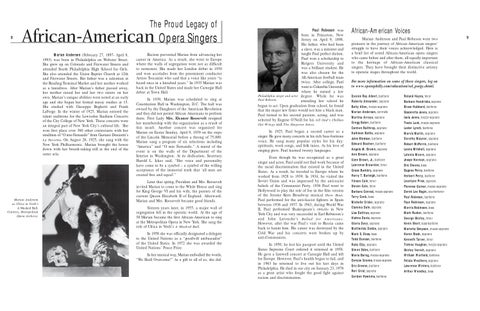
Paul Robeson was born in Princeton, New Jersey on April 9, 1898. His father, who had been a slave, was a minister and taught Paul perfect diction. Paul won a scholarship to Rutgers University and was a brilliant student. He was also chosen for the All-American football team twice. After college, Paul went to Columbia University where he earned a law Philadelphia singer and actor degree. While he was Paul Robeson. attending law school he began to act. Upon graduation from school, he found that the major law firms would not hire a black man. Paul turned to his second passion, acting, and was selected by Eugene O’Neill for his All God’s Chillun Got Wings and The Emperor Jones. In 1925, Paul began a second career as a singer. He gave many concerts in his rich bass-baritone voice. He sang many popular styles for his day: spirituals, work songs, and folk tunes. As his love of singing grew, Paul learned twenty languages. Even though he was recognized as a great singer and actor, Paul could not find work because of the racial discrimination that existed in the United States. As a result, he traveled to Europe where he worked from 1928 to 1939. In 1934, he visited the Soviet Union and was impressed by the anti-racist beliefs of the Communist Party. 1936 Paul went to Hollywood to play the role of Joe in the film version of the Jerome Kern Broadway musical Show Boat. Paul performed for the anti-fascist fighters in Spain between 1936 and 1937. In 1943, during World War II, Paul performed Shakespeare’s Othello in New York City and was very successful in Earl Robinson’s and John Latouche’s Ballad for Americans. However, after the war Paul’s visit to Russia came back to haunt him. His career was destroyed by the Cold War and his concerts were broken up by anti-Communists. In 1950, he lost his passport until the United States Supreme Court ordered it returned in 1958. He gave a farewell concert at Carnegie Hall and left for Europe. However, Paul’s health began to fail, and in 1963 he returned to live out his last days in Philadelphia. He died in our city on January 23, 1976 as a great artist who fought the good fight against racism and discrimination.
African-American Voices Marian Anderson and Paul Robeson were two pioneers in the journey of African-American singers’ struggle to have their voices acknowledged. Here is a brief list of noted African-American opera singers who came before and after them, all equally important to the heritage of African-American classical singers. They have brought their distinctive artistry to operatic stages throughout the world. For more information on some of these singers, log on to www.operaphilly.com/education/sol_porgy.shtml. Donnie Ray Albert, baritone Roberta Alexander, soprano Betty Allen, mezzo-soprano Marian Anderson, contralto Martina Arroyo, soprano Gregg Baker, baritone Carmen Balthrop, soprano Kathleen Battle, soprano Jules Bledsoe, baritone Edward Boatner, baritone Angela M. Brown, soprano Ann Brown, soprano Uzee Brown, Jr., baritone Lawrence Brownlee, tenor Grace Bumbry, soprano Harry T. Burleigh, baritone Vinson Cole, tenor Steven Cole, tenor Barbara Conrad, mezzo-soprano Terry Cook, bass Michelle Crider, soprano Clamma Dale, soprano Lisa Daltirus, soprano Kishna Davis, soprano Gloria Davy, soprano Mattiwilda Dobbs, soprano Mark S. Doss, bass Todd Duncan, baritone Ruby Elzy, soprano Simon Estes, baritone Maria Ewing, mezzo-soprano Denyce Graves, mezzo-soprano Eric Greene, baritone Reri Grist, soprano Gordon Hawkins, baritone
Roland Hayes, tenor Barbara Hendricks, soprano Bruce Hubbard, baritone Sissieretta Jones, soprano Isola Jones, mezzo-soprano Tracie Luck, mezzo-soprano Lester Lynch, baritone Marvis Martin, soprano Dorothy Maynor, soprano Robert McFerrin, baritone Leona Mitchell, soprano Latonia Moore, soprano Jessye Norman, soprano Eric Owens, bass Eugene Perry, baritone Herbert Perry, baritone Leontyne Price, soprano Florence Quivar, mezzo-soprano Derek Lee Ragin, countertenor Paul Robeson, baritone Faye Robinson, soprano Morris Robinson, bass Mark Rucker, baritone George Shirley, tenor Kevin Short, bass-baritone Marietta Simpson, mezzo-soprano Karen Slack, soprano Kenneth Tarver, tenor Tichina Vaughan, mezzo-soprano Shirley Verrett, soprano William Warfield, baritone Felicia Weathers, soprano Lawrence Winters, baritone Arthur Woodley, bass
9