BRITISH
CINEMATOGRAPHER
www.britishcinematographer.co.uk Issue 10 - Focus On: Virtual Production August 2026
VIRTUAL PRODUCTION
VOLUME 3
BUILDING WORLDS POP-UP VOLUMES INTEGRATED LIGHTING THE NEXT PHASE OF VP TOOLS ARE TRANSFORMING HOW DIGITAL WORLDS ARE CREATED
MANY PRODUCTIONS ARE NOW CUSTOM-BUILDING A TEMPORARY VOLUME TO MATCH THE FILM SET
INTEGRATING IMAGE-BASED LIGHTING WITH BACKGROUND ENVIRONMENTS UNLOCKS ANOTHER LEVEL OF REALISM
LENSES FOR VP SPECIAL EFFECTS GAUSSIAN SPLATTING WOMEN IN VP
BRITISH
CINEMATOGRAPHER
CUTTING-EDGE CRAFT
A
U N I T I N G C I N E M AT O G R A P H E R S A R O U N D T H E W O R L D
s virtual production enters a new chapter so does our series of Focus On guides as we continue to delve deep into the topic and discover the ever-increasing opportunities it presents the creative community. As you will read in this publication, following years of fast technological development, virtual production discussion is moving beyond tech specs and tools as focus increases on LED volumes, real-time rendering and incamera visual effects’ role in supporting the craft, strengthening collaborations and expanding cinematic possibilities. Comment from filmmakers and virtual production specialists highlights how the medium has matured and virtual production has become a practical and flexible solution for all sizes and types of project rather than being reserved for blockbuster projects alone. Innovation drives change and advances the creative and technical options filmmakers can enjoy, from image-based lighting helping seamlessly blend physical and digital worlds convincingly through to Gaussian splatting making it possible to create increasingly photoreal virtual environments. But while technology plays an important role in moving virtual production forward, careful planning and communication are also essential as decisions made before the shoot begins set the stage for success. As cinematographer Orren Soffer highlights, “Virtual production is a precision instrument. For it to really reach its full potential, it requires a lot of very careful planning and deployment under very specific circumstances for very specific kinds of scenes and lighting scenarios.” People remain as crucial as ever with training initiatives, mentoring programmes and industry networks continuing to create the next generation of specialists in this field. By developing the skills required to support VP’s continued expansion this ambitious and inventive community at its core will have an even deeper understanding of the ways in which the tools open up new storytelling horizons.
Publisher | STUART WALTERS stuart.walters@ob-mc.co.uk Publisher | SAM SKILLER sam@ob-mc.co.uk Editor-in-Chief | ZOE MUTTER zoe@britishcinematographer.co.uk Design | MARK LAMSDALE mark.lamsdale@ob-mc.co.uk Design | MATT HOOD matt.hood@ob-mc.co.uk Sales | KRISHAN PARMAR krishan@britishcinematographer.co.uk Sales | RUPINDER RANDHAWA rupinder@britishcinematographer.co.uk Assistant Editor | ROBERT SHEPHERD robert@britishcinematographer.co.uk Digital journalist & social media coordinator | GEORGE WHITE george@britishcinematographer.co.uk Website | PAUL LACEY | paul@paullacey.digital Contributors: Michael Burns, Neil Oseman, Christopher Jorna, Trevor Hogg, Zoltan Batho G, George White, Robert Shepherd Cover: Sarah Thomas Moffat shooting The Lonely Hunter (Credit: Jimmy Lee Photography)
British Cinematographer is part of LAWS Publishing Ltd. Premier House, 13 St Paul’s Square, Birmingham B3 1RB
We make every effort to ensure the accuracy of all of our articles, but we cannot accept liability for loss or damage arising from the information supplied. The publishers wish to emphasise that the opinions expressed are not representative of Laws Publishing Ltd but the responsibility of the individual contributors.
Until next time, Zoe Mutter, Editor-in-Chief, British Cinematographer
CONTENTS
04
08
10
16
22
As virtual production enters its next phase, filmmakers are focusing on craft, collaboration and storytelling.
LED volumes create a wonderful illusion when properly photographed – and key to that is the DP’s choice of lens.
WiVP is a rapidly growing, female-focused global community of over 2,000 members.
Within the restrictive confines of the LED volume, special effects supervisors have to be creative in providing practical effects.
Gaussian splats are a way of capturing high-detail location scans and getting the most out of real-time rendering in the volume.
THE STORY CONTINUES
Also inside...
LENSES FOR VP
WOMEN IN VIRTUAL PRODUCTION
p09 The role of a virtual production operator
.
p14 AI and VP
SPECIAL EFFECTS
.
p24 Image-based lighting
GAUSSIAN SPLATTING
.
p28-34 Production profiles
Focus On: Virtual Production - Volume 03 | 03
INTRODUCTION WORDS: MICHAEL BURNS
THE STORY CONTINUES As virtual production enters its next phase and the technology continues to evolve, filmmakers are focusing on craft, collaboration and storytelling.
V
irtual production has endured the hype and moved on. It has evolved into solid methodology with a sizable body of practitioners who know what VP does well, where it needs careful handling, and how to ensure the best results before the action starts. “The cowboys are gone, the science experiments are gone,” says David Gray, founder of The VP Co and an independent specialist formerly at Lux Machina. “It’s a known method. “A large part of what we were doing [five years ago] was educating people on what VP is,” he continues. “Now, a DP knows that if they have a driving shoot, they should get a quote from an LED stage. It’s a real-world workflow that has been proven to work.” Cinematographer Natasha Braier ASC ADF, whose recent credits include I Love Boosters, reports a shift “away from the destination LED volume business model” used by many productions. “Instead, we’re seeing more pop-up LED shoots with custom-built setups that fit each production’s needs and schedules.”
A scene from Sweetpea series one shot on an LED volume (Credit: Courtesy of MARS Volume)
“The understanding of what virtual production is has expanded over the past couple of years,” says Ben Bentley of Nightsky Studios. “What seemed like something only the big boys could use has now opened up to another whole industry.” “We’re now able to explain it as a tool and brush away the hype, having just honest conversations about where it can be useful,” says cinematographer Ben Saffer, who runs SupervisionVP. “We’ve got enough information now to do a proper cost comparison; showing producers ‘this is your budget without VP’, ‘this is your budget with VP’. It’s a known quantity now.”
MAKING LIGHT WORK
“Virtual production is a precision instrument,” says cinematographer Oren Soffer. “For it to really reach its full potential, it requires a lot of very careful planning and deployment under very specific circumstances for very specific kinds of scenes and lighting scenarios.” Soffer shot The Creator with Gareth Edwards using ILM’s StageCraft system, but most people are surprised when he tells them virtual production was used at all. That invisibility, he argues, is exactly the point. Jamie Sims, virtual production project manager at MARS Volume, reports that scripted drama such as Sweetpea (pictured) now represents a significant and growing share of the studio’s bookings (Credit: Courtesy of MARS Volume)
This year MARS Academy launched a job-shadowing programme, placing production professionals on real shoots at MARS Volume (Credit: Courtesy of MARS Volume)
04 | Focus On: Virtual Production - Volume 03
Believe Me’s driving scenes recreated the sodium-lit streets of early 2000s London on a VP stage (Credit: ITV Studios) Bryan Gavigan’s experience on Believe Me, an ITV mini-series about survivors of serial predator John Worboys, illustrates the forensic precision VP can enable (Credit: ITV Studios)
VP is not a catch-all solution, Soffer adds: “It’s certain to fall apart quite quickly without the proper time, prep or application for the right purposes.” Soffer has always been a believer in VP’s power as a lighting tool. “The entire concept of ‘the Volume’ was attractive [because it could] create interactive, high-quality volumetric lighting in a contained space. Another major advantage of course is the integration of elements from the virtual environment into various practical set elements reflective glass or metallic surfaces for example, which add texture and integration and help create the illusion of a cohesive, unified environment that blurs the line between the virtual wall and the tactility of practical set elements.” Image-based lighting (IBL) adds to the realism. Working with gaffer Bobby Wotherspoon, Braier deployed it on I Love Boosters through a combination of Fuse Technical Group’s IRIS system and Creamsource Vortex fixtures. “The surprise was the IRIS system and how the video image could be sampled and fed into the fixture to achieve the same quality of light as the virtual set,” says Braier. “Matching the lighting in the physical world to the lighting in the virtual world is what perfects the illusion.” “[VP] is most effective when used for interior driving work,” says cinematographer Bryan Gavigan. “It solves a massive industry issue regarding working safely on the road; you can be extremely precise from a visual point of view. And when you compare it to green or blue screen, where the DP has to hand over a huge part of the image to a VFX artist, usually in blind faith, VP is a really appealing option.” Gavigan’s experience on Believe Me, an ITV mini-series about survivors of serial predator John Worboys, illustrates the forensic precision VP can enable: the show’s driving scenes recreated the sodium-lit streets of early 2000s London on a VP stage – an environment impossible to replicate on a low loader in 2026 given the universal rollout of LED street lighting. “VP in LED workflows still works best where you need real-time lighting and real-time reflections,” agrees Kinga Kliss, virtual production supervisor. And Kliss points out VP isn’t only restricted to car driving simulations – aerial and underwater scenes are using the same workflow.
Wider access, however, brings its own risks. “Productions now think of VP as so much of a commodity that it’s almost gone too far the other way,” says Saffer. “They’ll just ring up an LED company and say: we want a 12m x 4m wall and a playback system, can you bring that on this day? And there’s nobody actually talking to the creatives, nobody interfacing with the director and the DP asking what’s actually going to work for them.” The result, he says, is productions arriving on stage with specs copied from a previous job, configurations suited to someone else’s shoot, The environment in Believe Me would have been and no one in the room who impossible to replicate on a low loader in 2026 knows the difference. given the universal rollout of LED street lighting so the production turned to VP (Credit: ITV Studios) Gavigan is blunt: “There is a misconception, sometimes even flogged by the VP companies themselves, that the volume will do GROWTH PROJECTION all, or the majority of, the lighting itself. This “Film and high-end TV is definitely where I’m isn’t the case.” His rule of thumb is that the seeing the most sustained adoption of virtual volume wall does roughly 25 per cent of the production,” says Gray. “Productions and crew lighting work; the remaining 75 per cent comes are more aware of when it works really well - it’s from full-spectrum film lighting, bedding faces now just a trusted and established alternative and foreground elements into the environment. workflow that’s available to filmmakers,” The consistent prescription is Jamie Sims, virtual production project preparation that begins early. “The best thing manager at MARS Volume, reports that to help mitigate wasted time on the day is scripted drama now represents a significant prep, prep and more prep,” says Gavigan. and growing share of the studio’s bookings. Saffer goes further: “I think it always saves Recent credits include Gangs of London, Black productions money in the end, because you Doves, Sweetpea and Mobland S2. “HETV has don’t end up with tech you don’t need, no continued to grow as a proportion of our over-speccing.” Braier agrees: “The ability to bookings, and scripted drama is a significant make decisions for an ICVFX environment part of what comes through MARS Volume takes a lot of the guesswork out of making a now,” Sims says. “We are fast becoming the film. When you leave set, you’re done.” go-to virtual production studio for companies She distils the philosophy to just like Amazon, Sky, Netflix and the BBC.” four words: “Fix it in pre.” >> MARS Volume, Jodi Nelson-Tabor, director of MARS Academy, says that while an understanding of VP workflows and key technologies is critical, “nothing compares to having hands-on experience within a live and commercially working LED volume (Credit: Courtesy of MARS Volume)
Focus On: Virtual Production - Volume 03 | 05
INTRODUCTION WORDS: MICHAEL BURNS
Virtual production techniques were utilised for selected scenes in I Love Boosters (Credit: Ryan Bradford)
Working with gaffer Bobby Wotherspoon, Natasha Braier ASC ADF deployed image-based lighting on I Love Boosters through a combination of Fuse Technical Group’s IRIS system and Creamsource Vortex fixtures (Credit: Ryan Bradford)
CREWING UP
But the human infrastructure around virtual production remains underdeveloped. Sarah Thomas Moffat, a cinematographer who has spent five years presenting VP to productions Natasha Braier ASC ADF, whose and vendors across the UK and the US, recent credits include I Love Boosters identifies a specific gap: all of the focus on (pictured), reports a shift “away from technology was overshadowing the story. the destination LED volume business Her response has been to develop an online model” used by many productions course aimed not at Unreal Engine beginners (Credit: Courtesy of Universal Pictures) but at experienced professionals – directors, DPs and designers who understand their craft but find the technical environment of a CRAFTING THE LOOK VP stage overwhelming. “I decided to open the door and show them how to be a part of When interviewing for this article, mention of it,” she says. “How to apply their existing skill a ‘VP look’ produced more varied responses sets with confidence.” than almost any other. Saffer’s Practitioners broadly diagnosis is similar agree a recognisable but more specific: “It’s visual signature exists. not a skills gap; it’s a For Gavigan, the confidence gap,” he tell is primarily optical. says. SupervisionVP “The obvious look is large has been developing sensors and wide apertures, role-specific training the easiest way to make the sessions for gaffers, volume look real is to see camera operators as little of it as possible. I’ve and focus pullers who been guilty of this too, but will encounter VP on I feel like I’ve done my most set without having interesting work in the sought it out. “[We’re] volume when being bolder just doing something with the stop and depth of so that when people field.” A related issue is the walk into the studio, quality of the light itself. there are no “The volume is a big unknowns, they’re soft source, so the absence coming in feeling of hard light is often a big confident.” giveaway.” He connects Access is key. both observations to a At MARS Volume, broader trend he finds Jodi Nelson-Tabor, creatively limiting: “The director of MARS general shift towards soft Academy, says lighting and shallow depth that while an of field is something I’m understanding of feeling uninspired by at VP workflows and the moment. I hope the key technologies is technology keeps critical, “nothing advancing in a way that BEN BENTLEY, NIGHTSKY STUDIOS compares to having allows people to start hands-on experience pushing the pendulum back within a live and in the other direction.” commercially working LED volume. That’s Ben Saffer identifies a more specific what MARS Academy has prioritised.” This culprit. “The classic one for DPs and gaffers is year the Academy launched a job-shadowing light spilling onto the wall, lifting the black levels programme, placing production professionals so you can’t match the foreground and on real shoots at MARS Volume. background,” he says. “That’s 90% of people
“THE UNDERSTANDING OF WHAT VIRTUAL PRODUCTION IS HAS EXPANDED OVER THE PAST COUPLE OF YEARS. WHAT SEEMED LIKE SOMETHING ONLY THE BIG BOYS COULD USE HAS NOW OPENED UP TO ANOTHER WHOLE INDUSTRY.”
06 | Focus On: Virtual Production - Volume 03
going: oh, that’s the VP problem. But it’s somebody not planning early enough – the size of the wall, the pixel pitch, the layout of the set, the way it’s going to be lit.” The implication is clear: most of what gets labelled a VP look is not a technology problem but a planning problem. Oren Soffer approaches the question from the perspective of what LED panels can and cannot physically deliver. “VP has always excelled when deployed to create contained interior spaces, or exterior spaces at times of day with soft, indirect lighting, overcast weather, under the shade of trees or canyons, or at dusk and twilight. Basically, anything other than hard, direct sunlight in wide open spaces.” Braier echoes this: “It is still tricky to get sunny outdoor shots to look natural in an LED volume, the screens just can’t offer enough light to fill the scene like the real sun does.” “I think ‘the VP look’ is a catch-all phrase that people started adopting who are not necessarily a fan of the workflow,” says Kliss. She concedes that bad examples exist and do real damage but makes a more substantive point about context: “When you look at it through a camera – with a specific focal length, a specific film back, props and actors – VP looks bloody incredible. If we do our jobs well, you’re not going to be able to say whether it’s been built out or not.” Sims has a similar position: “When the technology disappears into the background and the craft of filmmaking and the DP is allowed to shine through, that’s when VP is really working.” That ideal is ultimately what defines the current state of virtual production. “We have three different worlds coming together, three different languages, in a container that is heavily technical,” says Sarah Thomas Moffat. “What we can’t forget is that the most important thing out of all of this is the story itself.” The cowboys are gone. The craftspeople are in place. It’s time to roll the cameras. n
Yo u r n ext f u l l -s er v i ce v i r t ua l p rod uc t i on hu b , d r i v i n g A I h y b r i d i n n ova t i on & l i mi t l e ss c rea ti v i t y. ATM Virtual in Warsaw stands as a premier hub for Virtual Production across Central and Eastern Europe. We proudly deliver cutting-edge solutions for global giants like Disney, Netflix, Canal+, Amazon, HBO, as well as premium automotive and beauty commercials. Our facility offers a complete under-one-roof ecosystem: 6 sound stages (800 to 1,500 sq m), a specialized driving platform, top-tier camera and lighting rentals, and full-service production support—giving projects seamless access to Poland’s 30% cash rebate. Driven by our in-house Unreal Engine & AI department, we design and build bespoke virtual environments tailored to any creative vision. As regional industry pioneers, our team brings unmatched expertise in engineering
and managing LED volumes of every scale. Through our specialized On Set services, we can deploy this advanced technology and our expert crew directly to your location. From In-Camera VFX to AI Hybrid production, we provide accessible, custom-fit workflows. Reach out today to elevate your next project.
Contact us and book your next shoot in our studio at radka@atmvirtual.pl | WhatsApp +48 796 154 624
Focus On: Virtual Production - Volume 03 | 07
LENSES FOR VIRTUAL PRODUCTION WORDS: NEIL OSEMAN
Sarah Thomas Moffat: “I knew that using 8K raw on the RED V-Raptor, and the beauty of T1.4 on our Cookes – I could just lean on that.” (Credit: Jimmy Lee)
THROUGH THE LOOKING GLASS LED volumes create a wonderful illusion, but that illusion is only convincing when properly photographed – and key to that is the DP’s choice of lens.
When shooting VP projects Sarah Thomas Moffat recommends working with lenses that give you a faster stop (Credit: Jimmy Lee)
“W
ith virtual production, I would definitely recommend working with lenses that give you a faster stop,” says DP Sarah Thomas Moffat MBKS. “It gives you a beautiful fall-off that helps you disguise any digital feel that you have. And a coating that doesn’t so much get in the way of what colours might be coming from the scene that’s on the wall.” Moffat chose Cooke S8/i glass for the virtual production dance film The Lonely Hunter, adding a Hollywood Black Magic filter. “I knew that using 8K raw on the RED V-Raptor, and the beauty of T1.4 on our Cookes – I could just lean on that.” “One way to approach photographing a volume is from the same perspective as photographing a bad set,” offers DP Bryan Gavigan. “Any flaws in an imperfect set are going to be enhanced by lenses that resolve in great detail and clarity.” This logic leads him to suggest vintage lenses for VP – but with a caveat. “Real vintage lenses do sometimes come with drawbacks
Natasha Braier ASC ADF at Fuse in Los Angeles lining up a shot for I Love Boosters with director Boots Riley and remote head operator Matthew Pierce (in the background stunt coordinator Chelsea Bruland (Credit: James Gallagher)
like lack of metadata etc., so one may choose modern glass that is tweaked to exhibit vintage qualities. You may end up with a ‘best of both worlds’ situation there.” This was the balance Natasha Braier ASC ADF had to strike when she shot crime comedy I Love Boosters. She had Panavision’s Dan Sasaki create “Frankenstein” anamorphic lenses – based on the company’s B-series – which had the vintage feel and “porcelain faces” of Cooke Xtal Xpresses but could focus closer and retain sharpness at a faster stop. The latter was needed for the film’s nighttime car chase, originally planned to be shot for real, but ultimately accomplished with 1:12 scale miniatures for wides and VP background plates. “The lenses are a little bit too vintage for the taste of the VFX people,” Braier notes, “but the good thing is, I love doing everything in camera, and so with the virtual production, 99% is what we did on the day, so they don’t have to actually do any VFX. In that case, it actually really benefits you to have a soft lens, because it really helps the volume.” Director-DP Brett Danton agrees that vintage lenses work well in volumes. “I find some of the newer lenses are just too sharp, and they just don’t look as good. So I’ve tended to pull in Canon K35s. They’re just amazing in the volume, absolutely beautiful.” When it comes to focal length, Danton reflects that options have increased as LED walls have improved. “The first volumes I used were 2.2mm pixel pitch,” he says. “You had no chance of using a wide-angle lens, because of the background being sharp and the moiré pattern coming in. My favourite lens has been a standard, so I’ve been running a 35mm [on fullframe sensors] most of the time in a volume, and I think most people I speak to tend to run that or longer.” He has found 50mm to be another sweet spot, and also highlights the advantages of zoom lenses in VP work. “The reason why a zoom is quite good is the change of lenses in the volume does take a little bit of time, because you have to recalibrate every time you put it on.” “You can of course shoot in an LED volume using any camera or lens combination,” Gavigan concludes, “and ultimately there are many other factors that influence this choice. I would hate to see VP suites prescribing lenses… for it is when these restrictions are pushed and ignored that you start to create something interesting.” n
Moffat chose Cooke S8/i glass for the virtual production dance film The Lonely Hunter, adding a Hollywood Black Magic filter (Credit: Jimmy Lee)
08 | Focus On: Virtual Production - Volume 03
www.britishcinematographer.co.uk
THE ROLE OF A VIRTUAL PRODUCTION OPERATOR WORDS: CHRISTOPHER JORNA
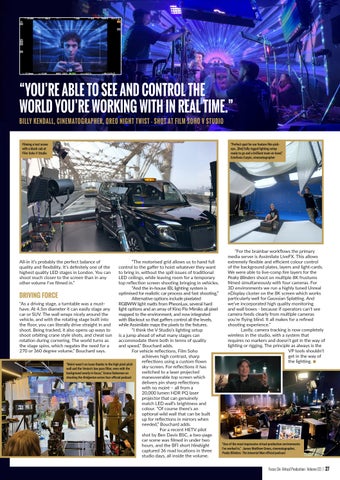
Christopher Jorna (pictured), VP operator, on the Peaky Blinders promo. He worked with VP supervisor Chris Bouchard and DP James Green at Film Soho (Credit: Courtesy of Christopher Jorna)
WHERE CREATIVE MEETS CONTROL Comparing the role of a virtual production operator to “holding the remote” for the LED wall, Christopher Jorna explains the communication, troubleshooting and technical control required to shape LED environments on set.
T
he simplest way I can explain what a VP operator does is to imagine you’re watching TV with your family and the operator is the one holding the remote. But instead of a small remote that switches channels and volume, they work from a computer, swapping between timelines they’ve prepared with content that’s been transformed, colour adjusted, and with a whole range of adjustments they can make on top. During prep days the operator sets up the timelines and runs quality control. On shoot days, they make adjustments in real time, log changes, blend the LED wall with the real floor through regional colour corrections, and monitor performance.
WORKING WITH THE VP SUPERVISOR
The person you work closest with on set is the VP supervisor. They’re there from start to finish and sit between the creative team and the technical crew. The director or DP will have a creative request, and the VP supervisor breaks that down into operator tasks. Sometimes a DP will come directly to the operator and ask for a change. That’s fine but always loop in the VP supervisor. For them to do their job in the best way, they need to always be up to date on what’s happening. When the DP later asks, “Why does the image look different?”, the supervisor needs the answer. At times the director and DP will be at the brainbar discussing ideas. Don’t insert yourself into that conversation. What I do is quietly prepare an option in the background, and if the VP supervisor agrees, we show it.
THE A/B TECHNIQUE
When the DP asks for a change, I avoid making small incremental adjustments and instead push the look further to present a clear beforeand-after comparison. I call out values live in percentages. They’ll usually say, “That’s too strong, let’s split the difference,” and we narrow it down until we land on the look they want. That verbal communication is key. Always call out what you’re changing. Once approved, I log it and make no more changes unless something is flagged. It’s a different discipline to working alone. On set, every change can affect system stability or performance, so you stick to the approved look rather than quietly adjusting.
KEEPING EVERYONE ON THE SAME PAGE When I’ve operated on Believe Me (2026) with Fivefold for ITV, we used a Miro board with screenshots and notes to track every change. When the client wanted to revisit a setup from the pre-light, we could pull it up immediately which saved valuable time on set. One useful trick from that set: on car shoots, the LED ceiling edge can show up in reflections, and finding which edge it is can be slow. We placed different coloured rectangles on each edge that could be toggled on and off and identify it straight away.
IMAGE-BASED LIGHTING
The operator also works with the gaffer on image-based lighting. Some IBL lights are pixel mapped in the media server and run over DMX. I’d recommend exposing most controls to the gaffer, so the operator only selects what content is displayed. Other lights go via HDMI and tend to be fully controlled through the media server, which makes handing over to the gaffer harder and keeps the operator more involved.
TIP FOR ASPIRING OPERATORS
Understand where the data starts and the journey it takes to reach the screen. If you understand this you can pick up any software quickly. I operate disguise, Assimilate and Pixera, and that knowledge is what carries across. Every set throws new problems at you, so you’re constantly finding creative solutions on the spot, communicating how long they’ll take, and optimising your workflows. n Christopher Jorna was VP operator for Believe Me (ITV), shot at Fivefold Studios, Dragon Studios, Wales, using plates from Driving Plates (Credit: Courtesy of Christopher Jorna)
Christopher Jorna, VP operator on 7Dogs, at the ARRI VP Stage, Alhisn Bigtime Studios, Riyadh (Credit: Courtesy of Christopher Jorna)
09
WOMEN IN VIRTUAL PRODUCTION
WOMEN IN VIRTUAL PRODUCTION
Over the last two years, WiVP has scaled into an active network spanning 28 countries. Pictured: The UK event at Epic Games, London
Women in Virtual Production (WiVP) is a rapidly growing, female-focused global community of over 2,000 members. It serves as a vital hub for professionals working across the real-time ecosystem, as well as those curious to learn.
F
ounded by industry peers Christina “This year, we are focused on reframing Nowak and Catherine Crawley, the what leadership looks like in real-time initiative sparked from a shared technologies,” says Nowak. “Beyond realisation of just how maleexpanding our geographic chapters, we are dominated this fledgling sector was. intentionally aligning with sister organisations Nowak’s journey in VP began with Ncam across gaming, animation, advertising and in 2018, later moving full-time into the space immersive events. Our goal is to ensure with 80six in 2021 and Anna Valley in 2022. women aren’t just participating in the future While serving on the board of SMPTE, Nowak of entertainment, we are actively designing it.” spearheaded the creation of The Biggest Virtual Production Show Across the Atlantic, the Los Angeles across London (Garden Studios) and chapter of Women in Virtual Production is LA (XR Studios). She collaborated demonstrating how community-led leadership with Crawley, who managed the can ensure the future of filmmaking is both high-profile sponsors and multiinnovative and inclusive (Credit: Eric Ulbrich) channel live broadcasts. Crawley subsequently transitioned into marketing, business development, and data strategy for US-based VP consultancy Lux Machina. “We both looked around and realised how urgently this industry needed a dedicated space for women,” Crawley reflects. “Our response was to create a community encompassing all aspects of VP from marketing and sales to producers, technical directors and engine artists. Women in Virtual Production’s LA WiVP was born to bridge that gap.” event: The VP Shift Over the last two years, WiVP has scaled at Synapse Digital into an active network spanning 28 countries, (Credit: Eric Ulbrich) driven by a dynamic website, LinkedIn hub and lively WhatsApp subgroups. The community actively shares job opportunities, training and crew calls while hosting podcasts and providing expert panels for major international events like IBC Show, Cannes Next, Venice Film Festival and the Media Production & Technology Show (MPTS). Looking ahead, the UK-founded global network is ready for its next evolution. 10 | Focus On: Virtual Production - Volume 03
DRIVING INNOVATION – THE LOS ANGELES CHAPTER
Across the Atlantic, the Los Angeles chapter of Women in Virtual Production is demonstrating how community-led leadership can ensure the future of filmmaking is both innovative and inclusive. Led by Ames O’Connor, LB Bunch, and Carin Mazaira, the LA chapter focuses on creating meaningful spaces for education, collaboration, and peer-to-peer connection across Southern California’s rapidly evolving production landscape. This year, the chapter made waves with The VP Shift: Women Powering the Future of Filmmaking. Hosted at Synapse, this inaugural event brought together creatives, technologists and industry leaders for an immersive afternoon of hands-on learning. Featuring a live virtual production workshop and a panel of accomplished women working across film and technology, the event offered attendees practical insights into ICVFX and real-time tools, while spotlighting the female talent driving that change. Beyond technical training on the LED volume, the LA chapter places a heavy emphasis on building authentic human connections. A recent community hike allowed members to connect informally outside the high-pressure studio environment, reinforcing the value of peer support in a fast-paced, fragmented industry. The momentum is only growing. This summer, the chapter will host a networking mixer in partnership with Vicon during SIGGRAPH, uniting artists, engineers and innovators at one of the industry’s most influential global gatherings. Looking further ahead, upcoming collaborations with groundbreaking powerhouses like Sphere and Epic Games will offer members direct, unprecedented access to the absolute cutting edge of immersive storytelling and real-time production tools. By lowering the barrier to entry and fostering high-level technical dialogue, the LA chapter is successfully building a sustainable, diverse pipeline for the next generation of Hollywood professionals. n
www.britishcinematographer.co.uk
SPECIALIST PROVIDERS OF HIGH-END LED VOLUME, VIRTUAL PRODUCTION AND REAL TIME SOLUTIONS EQUIPMENT I DESIGN I ENGINEERING I SUPPORT videoscreenservices.com
SPONSORED CONTENT APUTURE
For cinematographer Stuart Graham, modern LED fixtures provide the output, colour accuracy and consistency needed to blend practical lighting with the virtual environment (Credit: Courtesy of ARRI Stage)
From commercials and automotive campaigns to narrative filmmaking, four cinematographers explain how practical lighting has become the key to creating believable virtual worlds.
V
irtual production has come a long way in a remarkably short time. Once reserved for blockbuster filmmaking, LED volumes and real-time rendering are now finding their place across commercials, fashion, automotive and narrative productions. As the technology matures, the conversation is shifting away from the LED wall itself. The question is no longer whether virtual production works, but how cinematographers use it to create believable images.
BEYOND THE LED WALL Across the productions featured here, Aputure’s lighting ecosystem has evolved alongside virtual production itself. Whether extending the light generated by an LED volume, delivering the colour accuracy demanded by commercial productions or integrating with real-time imagebased lighting workflows, Aputure fixtures have become an active part of the creative process rather than simply illuminating a scene. The experiences of cinematographers Stuart Graham, J.P. Garcia, Uffe Mulvad and Matt Brown demonstrate just how diverse those applications have become. From Bupa’s global commercial campaign and Chaos God, directed by Elliot Gonzo, to a Porsche production at Norway’s LED HUB and RheuMuseum at CUBE Studio, each project approached virtual production differently. Yet they all reached the same conclusion: lighting has become the bridge between the physical and virtual worlds.
CREATING BELIEVABLE WORLDS For cinematographer Stuart Graham, that challenge sits at the heart of every virtual production. Having worked extensively across commercial, fashion and automotive productions, Graham has watched virtual production evolve from an emerging technology into a mature creative workflow.
12 | Focus On: Virtual Production - Volume 03
VIRTUAL PRODUCTION COMES OF AGE A recent Bupa campaign recreated forests, mountains and deserts inside Garden Studios, allowing multiple international locations to be captured within a single studio (Credit: Stuart Graham)
A recent Bupa campaign recreated forests, mountains and deserts inside Garden Studios, allowing multiple international locations to be captured within a single studio. While the logistical and sustainability benefits were significant, Graham believes the real challenge begins once the LED volume is switched on. “Everything needs to live in the same colour space. Once that’s aligned, you can start shaping the image creatively,” he says. For Graham, the LED volume establishes the environment, but practical lighting determines whether audiences believe it. Unlike shooting outdoors, a volume cannot replicate the natural ambience of the sky or the subtle atmosphere surrounding a location. “You already have a challenge because you’re not outside. You don’t have that enormous sky. You don’t have that haze or environment around.” Rather than competing with the LED volume, practical lighting has to feel like a natural continuation of it. For Graham, Aputure’s latest generation of LED fixtures provides the output, colour accuracy and consistency needed to blend the physical and virtual worlds, allowing cinematographers to spend more time shaping the image and less time correcting it in post. One of virtual production’s biggest creative hurdles remains daylight. “Volumes are exceptional tools when you’re creating atmosphere and mood. But often within a commercial, it’s a brighter, happier place,” he says. “The daylight side of things is a very difficult space to emulate within a volume.” That challenge becomes even greater in fashion and automotive work, where colour accuracy is fundamental. On a recent fashion production at ARRI Stage London, Graham used Aputure’s STORM XT52 to create a broad, controllable source capable of lighting talent across a large performance area while maintaining accurate rendering of fabrics and wardrobe.
www.britishcinematographer.co.uk
“The bigger the source, the further you can throw it and still maintain intensity,” he adds. Output alone, however, is never enough. “There are some clients where colour rendition is super important, and it is often fashion and it is often cars.” Whether photographing skin tones, textiles or highly reflective paintwork, the objective remains the same: lighting should feel like a natural extension of the world displayed on the LED volume.
EXTENDING THE VIRTUAL WORLD The same philosophy is increasingly shaping narrative filmmaking. On Chaos God, directed by Elliot Gonzo, cinematographer J.P. Garcia used practical lighting not to illuminate the virtual environment, but to become part of it. “The goal was always for the lighting, the volume and the physical set to feel like one single environment,” he explains. Working with Aputure LS 1200d Pro, LS 600c Pro, Nova panels and MC Pro fixtures, Garcia carefully matched the practical lighting to the atmosphere created by the LED volume, allowing the physical set and digital environment to blend into a single visual language. “I was not interested in over-lighting the set. The idea was to protect the darkness and let the character disappear into it at times. The close-ups were especially important. We wanted them to feel intimate, almost fragile, with the character emerging from the darkness rather than being lit in a conventional way.”
WHEN REFLECTIONS BECOME THE STORY While Chaos God demonstrates how virtual production can support narrative storytelling, automotive productions present a very different challenge. Rather than lighting actors or sets, cinematographers are often lighting reflections. That was the focus of a recent Porsche campaign photographed by cinematographer Uffe Mulvad at Norway’s LED HUB, a virtual production facility that combines commercial production with education, research and technical development. “Instead of hiding the studio, we wanted to embrace it. The contrast between the clean studio space and the wild nature became an important part of the visual expression.” Because a car is essentially a large reflective object, the challenge was not simply to illuminate the vehicle, but to control the reflections that defined its shape and connected it to the virtual environment.
ONE ENVIRONMENT Working with Aputure LS 1200d Pro, LS 600c Pro, Nova panels, flexible F-Series mats and MC Pro fixtures to shoot Chaos God at CUBE Studio, DP J.P. Garcia matched the practical lighting to the atmosphere created by the volume (Credit: Terry Joshi)
“Since a car is essentially a large reflective object, our focus was not so much on lighting the car, but on controlling the reflections.” The LED volume provided both the environment and the primary source of illumination, while a ceiling array of 12 Aputure Nova P600c fixtures, positioned behind a large diffusion sail, refined reflections across the bodywork. Additional LS 600c Pro fixtures and Infinibars provided further shaping where required. What made the workflow particularly compelling was the integration between the practical lighting and the virtual environment. Using Assimilate Live FX, the Nova fixtures sampled colour information directly from the LED wall via DMX, allowing the lighting to respond dynamically as the virtual landscape changed. “The Nova fixtures were controlled through DMX and integrated with Assimilate Live FX, allowing them to sample colours directly from the content on the LED wall.” Rather than manually matching colour temperature, the practical lighting evolved alongside the virtual environment, creating reflections and highlights that felt completely natural. “The reflections moved naturally across the soft curves of the Porsche and created a connection between the vehicle and the landscape,” he says. For Mulvad, the production demonstrated how virtual production can simplify complex automotive shoots while giving cinematographers an unprecedented level of creative control.
Virtual production is equally valuable when extending physical sets rather than replacing them. On RheuMuseum at CUBE Studio, cinematographer Matt Brown combined a practical museum set with a virtual extension displayed on the LED volume, creating the illusion of one continuous environment. “The challenge was ensuring both spaces felt like a single, seamless environment. A museum that existed simultaneously in both the physical and virtual worlds.” Working with Aputure Nova and Light Storm fixtures, Brown balanced the practical and virtual environments while maintaining consistent colour and exposure throughout the set. “The reason I continue to use Aputure is simple: they’re reliable, consistent and incredibly intuitive within a virtual production environment.” For Brown, colour consistency and intuitive control allowed the physical and digital worlds to blend seamlessly into a single cinematic space.
LOOKING AHEAD Although each production explored virtual production in a different way, they all arrived at the same conclusion. The LED volume is no longer the defining feature of virtual production. Instead, success depends on how convincingly cinematographers integrate practical lighting with the digital environment. Whether recreating international locations for a commercial, building the dreamlike world of Chaos God, controlling reflections around a Porsche or seamlessly extending a museum set, lighting remains the creative thread that connects the physical and virtual worlds. As Stuart Graham puts it: “One of the things that gets me out of bed and turns me up on set is that it’s a challenge. It’s always a challenge, and I enjoy a challenge.” n
On RheuMuseum at CUBE Studio, cinematographer Matt Brown combined a practical museum set with a virtual extension displayed on the LED volume, creating the illusion of one continuous environment (Credit: Michael Fyfe)
When DP Uffe Mulvad shot a Porsche campaign at Norway’s LED HUB, the volume provided the environment and primary light source, while a ceiling array of 12 Aputure Nova P600c fixtures, refined reflections across the vehicle (Credit: Courtesy of LED Hub)
Focus On: Virtual Production - Volume 03 | 13
THE NEXT PHASE OF VP TOOLS Ben Saffer (left) and Supervision lead technical artist Rhy Murphy on set at Production Park in Wakefield on a VP shoot (Credit: Courtesy of Ben Saffer)
WORDS: MICHAEL BURNS
BUILDING WORLDS: ALL CHANGE FOR VP ENVIRONMENTS
From Gaussian splats and generative AI to advances in real-time rendering and photogrammetry, the next phase of virtual production tools are transforming how digital worlds are created.
V
P world-building used to mean one thing: 3D assets built in game engines, painstakingly modelled and lit by specialist teams. That pipeline has not disappeared, but it is no longer the only option. Ben Bentley of Nightsky Studios says productions using the company’s customisable LED volume – which can be configured at the Coatbridge studio or at a location of choice – have found that plate libraries, pre-shot environments available to license rather than build, provide access to VP workflows without the cost of creating custom 3D environments. “It makes it more cost effective for them,” he adds. A before and after of Ben Saffer enjoying the sunshine in the studio at Film Soho (AI background replacement and relighting) (Credit: Courtesy of Ben Saffer)
14 | Focus On: Virtual Production - Volume 03
At the 3D end of the pipeline, Connor Ling, virtual production supervisor at Framestore, describes a fundamental shift in what real-time engines can handle. “We’re no longer fighting polygon budgets or baking lighting the way we used to – we can build incredibly dense, dynamically lit environments and actually maintain performance.” Procedural workflows are also accelerating environment creation and variation, according to Ling, while advancements in Unreal Engine, including Nanite, Lumen and Megalights, have underpinned more flexible and scalable world building. Gaussian splats, which can reconstruct 3D real-world environments from photographic captures, are generating particular interest. “Feature and episodic uses of Gaussian splats and NeRFs are happening, but still sparse,” Ling says. “It is an ever-evolving workflow that is showing real promise, but it is not quite at the point of widely adopted commercial use.” Framestore’s capture lab is well-placed to develop splat pipelines, he notes, because the capture process builds on existing photogrammetry skills and infrastructure. The appeal is photorealism at speed. David Gray worked on an R&D project exploring splats as a way of preserving expensive stop-motion and other sets before they were dismantled. “If we need to do some pickups, we can go to a VP stage and work in the fully 3D-realised environment,” he says. “That’s a very strong use case.” Ben Saffer of SupervisionVP is putting Gaussian splats to practical use, experimenting with SpAItial’s Echo2 technology, which can generate them from a single still in around five minutes. “It’s perfect for when the DP
turns around and says, ‘I just want a little bit of movement on that,’” he says. Gray says the key limitation remains relighting: “If you capture it sunny, it’s sunny. If you capture it at nighttime, it’s nighttime.” Kinga Kliss, virtual production supervisor, believes that will change: “I’m definitely looking forward to working with Gaussian splats that are relightable the same way any 3D environment is.” Ling notes that relightable and 4D Gaussian splats are under active development but remain some way from real-time production use.
AI IN THE VIRTUAL WORLD
Studios are approaching AI cautiously. Joanna Alpe, CCO of MARS Volume, says adoption is guided by a commitment to supporting human creativity. “The non-negotiable for us is ensuring that any new tool or approach always adheres to our core value of empowering and protecting the human-made craft of filmmaking.” MARS Academy’s forthcoming VP + AI course will explore that relationship further. Ling distinguishes between LLMbased tools used for coding and pipeline development and image-generation systems used for visual content creation. While AI can accelerate workflows, production-quality control and consistency remain significant challenges. “When an artist or supervisor needs pixel-perfect directability and precise iteration control, relying solely on visual generative AI can be a costly, frustrating and time-consuming process,” he says. “We’re seeing people experimenting with AI-generated back plates or using real 2D footage with AI-generated VFX passes like depth maps to add dimensionality and parallax, or converting footage from SDR to HDR” says Natasha Braier ASC ADF. Saffer agrees: “AI as a tool, rather than trying to create final pixel, is really working”. That shift in perception extends beyond the studio. Rob Chandler, virtual production supervisor and founder, Starting Pixel, argues that AI’s own overpromising has paradoxically made VP easier to adopt. “The conversation around GenAI has become so extreme – that we’re all going to be unemployed, working on farms or being window cleaners – that it has pushed the ‘Overton window’ for virtual production,” he says. “Suddenly, the big LED wall feels normal. It’s simple. It’s fine. We realise we can still film, we can still use real glass. [The threat of] AI has made VP look like the safe, human choice.” n www.britishcinematographer.co.uk
SPONSORED CONTENT MARS VOLUME BROMPTON TECHNOLOGY
One of the key sequences took place on a rooftop, where maintaining continuity across changing daylight conditions would have proved difficult on location (Credit: Courtesy of MARS Volume)
COMPLETE CREATIVE CONTROL
R
V O L U M E
Find out how MARS Volume and Brompton enabled two of Sweetpea’s most challenging scenes.
F
or cinematographers, the value of an LED volume is increasingly extending beyond background replacement. As the technology matures, virtual production is becoming another creative tool for shaping light, controlling environments and giving directors of photography greater confidence from prep through to final capture. On Sweetpea season one, produced by SeeSaw Films, the production utilised MARS Volume and Brompton Technology to solve two very different cinematography challenges through a single virtual production workflow. Rather than relying on the LED volume simply as a digital backdrop, the production embraced it as an extension of the lighting package and an environment that could support complex in-camera work while maintaining complete creative control. One of the key sequences took place on a rooftop, where maintaining continuity across changing daylight conditions would have proved difficult on location. Instead, the LED volume displayed a photoreal sky plate, captured by Driving Plates, that served as an active lighting source, delivering soft ambient illumination, natural reflections and consistent lighting across the set. This approach allowed the cinematography team led by DOP Nick Morris to maintain a consistent time of day throughout the shoot, eliminating the variables of changing weather and daylight while giving the production greater flexibility to work through coverage without compromising continuity. “One of the biggest shifts we’re seeing is cinematographers treating the LED volume as
part of the lighting package rather than simply a background,” says Rowan Pitts, co-founder of MARS Volume. “On Sweetpea, the rooftop sequence demonstrated how virtual production can deliver consistent ambient light, natural reflections and complete control over the environment. That gives the DP more freedom to focus on the image rather than chasing the weather.”
PREP MAKES PERFECT
The production also turned to virtual production to capture multiple driving sequences inside a full-size British bus. Vehicle interiors often present significant logistical and creative challenges, from towing vehicles and road closures to fluctuating lighting conditions outside the windows. Bringing the bus onto the MARS Volume stage allowed the production to capture the sequences entirely in-camera within a controlled environment, while retaining realistic movement, lighting and interactive reflections. Preparation proved just as important as the shoot itself. Using the MARS Pre-visualiser, the virtual production team worked with the filmmakers to validate the complete setup before arriving on stage. Camera positions, lens choices, vehicle placement and the feasibility of each shot could all be tested virtually, allowing creative and technical decisions to be made during prep rather than under production time pressures. Once on stage, MARS’ virtual production specialists worked alongside the crew to ensure the driving sequences translated smoothly from previsualisation into principal photography, helping the production execute multiple in-camera driving scenes efficiently while preserving the intended visual language. Across both environments, Brompton Technology’s LED processing played a critical role in ensuring the imagery displayed on the volume reproduced accurately for camera. Stable imagery, smooth gradients and dependable colour reproduction allowed the cinematography team to The LED volume displayed a photoreal sky plate, delivering work with confidence that the content soft ambient illumination, natural reflections and consistent displayed on the wall would translate lighting across the set (Credit: Courtesy of MARS Volume) faithfully into the recorded image.
“For cinematographers, consistency is everything,” says Patrick Goodden, UK technical sales manager for Brompton Technology. “Whether the LED wall is providing the background, the key source of ambient light or interactive reflections, it has to perform predictably. Dynamic Calibration ensures accurate colour reproduction, while PureTone and Extended Bit Depth produce smooth gradients and linear colours, even at the lowest brightnesses. Coupled with our patented ShutterSync technology, that allows the LED’s refresh to be tuned to the camera’s shutter, DPs can make decisions without the technology limiting their creativity.” The combination of previsualisation, specialist virtual production expertise and dependable LED processing demonstrates how virtual production is evolving into a practical cinematography workflow rather than simply a visual effects technique. For DPs, the advantages are increasingly tangible. The ability to validate complex setups before production, control time of day regardless of weather, generate natural interactive lighting and capture convincing environments in-camera all contribute to a more efficient production without sacrificing creative intent. Sweetpea illustrates this evolution. The rooftop sequence showed how an LED volume can become an extension of the lighting department, while the bus interiors demonstrated how virtual production can simplify technically demanding driving scenes without compromising realism. As more productions adopt these workflows, LED volumes are becoming another instrument in the cinematographer’s toolkit. Offering greater control over light, movement and environment, while enabling filmmakers to spend more time refining the image and less time working around the limitations of location and weather. n Sweetpea also turned to virtual production to capture multiple driving sequences inside a full-size British bus (Credit: Courtesy of MARS Volume)
Focus On: Virtual Production - Volume 03 | 15
VP AND SPECIAL EFFECTS WORDS: TREVOR HOGG
ESTABLISHING THE CORRECT ATMOSPHERE
Oscar-winning special effects supervisor J.D. Schwalm highlights the importance of the collaboration with the cinematographer (Pictured: BTS from Devotion) (Credit: Innovation Workshop Special Effects)
Given the high sensitivity of the technology situated within the restrictive confines of the LED volume stage, special effects supervisors have to be particularly mindful and creative in providing the desired practical effects.
M
ost of the time special effects contributes mechanical effects for LED volume stages, which was problematic at times on Masters of the Air. “We had a hydraulic hose burst that covered the monitors at one point and visual effects had a meltdown!” recalls Terry Glass (Angel Has Fallen, 13 Hours), who assisted fellow special effects supervisor Neil Corbould on the Apple TV World War II miniseries. “We would try to design explosions. I got an air cannon and filled the funnel up with CO2. I had some debris in it but also flashbulbs
to backlight the CO2 as it came out so it looked like a big flame coming into the cockpit.” Wind was a key natural element that had to be incorporated into the aviation shots. “We had to come up with new systems for that,” recalls Glass. “You’ve got this cockpit environment and the windscreen gets shot out so you suddenly need this wind. You can’t have a great big wind machine up. They can’t just take it out like they used to with a bluescreen. What we were doing was running three quarter hoses from a mobile diesel-powered air compressor parked outside the stage with Silvana air jet nozzles on the ends of those and fitted them into the dashboard of the cockpit.”
THE IMPORTANCE OF PLANNING
Preplanning is essential. “You can do so much more if you know upfront what they want rather than them telling you when you get on the volume,” notes Glass. “The first person
Wind was a key natural element that had to be incorporated into the aviation shots of Masters of the Air (Credit: Courtesy of Apple)
J.D. Schwalm used atmospheric smoke on First Man (Credit: Innovation Workshop Special Effects)
that you want to get onboard is the DP. DPs are a lot more knowledgeable now about some of the mechanical stuff that we do.” Comfort levels are important as well. “I’ve worked in the volume at Trilith Studios in Atlanta,” remarks J.D. Schwalm, the Oscar-winning special effects supervisor on First Man. “We’ve done atmospheric smoke, falling snow and wind in there. The way it typically goes down is we work hand-in-hand with the people who own the technology, explain to them exactly what we’re going to be doing and make sure it’s okay.” Smoke lingers but is manageable. “The smoke is water-based and is actually used in museums to do HVAC system checks,” explains Schwalm. “It doesn’t leave a residue behind.” For the rain in the live-action version of Moana, a big containment tank was constructed. “We put the canoe in the tank and had wind on it,” states Schwalm. “We were creating storm sequences. They had the LED volume behind it and we rigged rain from the ceiling to fall into the tank. It looked really good because not only did you get the rain, the interaction with the actress, water and boat but also had the refraction of the light from the monitors and what was being displayed in the rain. When they brought the sun down low into the horizon, that ball of orange light would refract into the rain. I’m sure they could do that in post as well but it made it look good right then and there.”
SIMULATING SNOW EFFECTS
“When we did the snow job, it was for a commercial for the Olympics,” says Schwalm. “We were simulating a snow skier ripping down the slalom course. There were a couple of highspeed camera shots that they did where the guy is in midturn. We were blowing snow off of his skis and in his face. We probably kept all of the snow 20 to 30 feet away from the monitors, so it was contained. But again, we made a little containment zone on the ground where all the snow would land and accumulate.” There is a tight collaboration with cinematographers. “When it comes to working on LED volume stages, the relationship does change a little bit,” observes Schwalm. “Instead of just talking about how thick or thin the atmosphere is on the set, you’re geeking out on whether the mechanical effects going to be putting any feedback into what the monitors are doing. It’s an opportunity to have a closer relationship with the cinematographer and the mechanical effects guy, like myself, so I’ve enjoyed it.” n
Terry Glass (Masters of the Air): “You can do so much more if you know upfront what they want rather than them telling you when you get on the volume” (Credit: Courtesy of Apple)
16 | Focus On: Virtual Production - Volume 03
www.britishcinematographer.co.uk
SPONSORED CONTENT QUITE BRILLIANT
A LEAP IN PICTURE QUALITY
The starting point was to offer the first major UK stage using Samsung’s latest Micro LED technology (Credit: Quite Brilliant)
When Quite Brilliant began designing the Twickenham LED stage, the ambition was to build an LED volume that finally solved the picture‑quality problem (Credit: Quite Brilliant)
Delivering deeper blacks, higher contrast and greater creative flexibility, Quite Brilliant’s new Micro LED stage at Twickenham Film Studios raises the bar for image quality and efficiency for productions of every scale.
T
he rise of virtual production has brought with it extraordinary creative potential yet one constrained by the limitations of the very screens designed to unlock it. For years, cinematographers have battled the same problem - LED volumes that promise realism but deliver compromise. Grey‑milky blacks. Washed‑out contrast. Surfaces that simply cannot hold up once you start lighting a scene properly. It’s against this backdrop that Quite Brilliant’s arrival at Twickenham Film Studios last summer was a welcome course correction. Our team’s experience stretches back to the UK’s first commercial VP demo in 2020 and have now done over 350 VP projects. Regardless of the facility, the manufacturer or the generations of LED technology we kept running into the same issue: existing LED panels simply cannot produce true blacks. Quite Brilliant incorporated a six‑metre turntable into the floor of the stage—ideal for car work (Credit: Quite Brilliant)
AT THE CUTTING EDGE No matter the pixel pitch, no matter the calibration, once production lighting hits the wall, the image lifts. Blacks become charcoal and contrast collapses. The problem is that existing screens use SMD (surface‑mounted device) which is an outmoded technology. So when we began designing the Twickenham volume, our ambition was to build an LED volume that finally solved the picture‑quality problem. Technology-wise, our starting point was to offer the first major UK stage using Samsung’s latest Micro LED technology. These advanced panels are capable of delivering genuine black levels and a contrast ratio of 35,000:1, more than five times higher than any other LED volumes. It was a significant investment, but we believed the industry was champing at the bit for a screen that could finally hold up to the demands of high‑end cinematography. With Micro LED, the blacks stay black. The highlights stay crisp. The image doesn’t wash out under production lighting. If you place an SMD panel alongside the Samsung wall the comparison is ‘night and day’ or ‘black and grey’. This ability to maintain depth, contrast, and colour integrity has become Quite Brilliant’s defining advantage.
GAME-CHANGING CREATIVITY But picture quality isn’t enough. Our team also wanted to make VP more accessible and more production‑friendly. We designed the stage with both a curved and flat LED section, each offering different creative advantages, and built
a 100sqm retractable LED ceiling capable of hitting 10,000 nits, enough to light convincing daytime scenes without additional rigging. We added multiple ‘wild walls’, including 1.8‑pixel‑pitch panels suitable for shooting directly against, and sunk the main LED wall below floor level so productions no longer need to budget for staging to hide the gap. One of the most practical innovations is the dual‑studio layout. With two adjoining stages, both offering LED options, productions can shoot continuously with no downtime for strikes or resets. For fast‑turnaround work like commercials and multi‑vignette shoots that’s a game-changer. We’ve also incorporated a six‑metre turntable into the floor—ideal for car work. And with four tiered packages productions only pay for the screen size they actually use. For second units and smaller budgets, we’ve a bespoke pop‑up screen. The philosophy is simple: VP should scale to the production, not the other way around. The response from cinematographers, directors and photographers, who have used the screen has been emphatic. In less than a year, they have done close to 50 productions, spanning features, advertising, social content, music videos, plus dozens of stills shoots, have shot with our Micro LED advantage. At Quite Brilliant, we’ve built the LED volume we always wished we had. And in doing so, we’ve raised the bar for what virtual production can look like when the screen finally stops getting in the way. n Focus On: Virtual Production - Volume 03 | 17
POP-UP VOLUMES WORDS: NEIL OSEMAN
POPPING UP ALL OVER THE PLACE When we think of LED volumes, we may picture large permanent facilities, but for many productions, custom-building a temporary volume is more appropriate.
“T
he really big-budget features and high-end TV tend to be mostly pop-ups,” says VP supervisor Chris Bouchard, “because you tend to want to build an LED wall to match your film set. Then for the middle-budget stuff, the permanent stages tend to be doing more of the car process, bus process, train process, a bit of plane process, and a lot of commercials.” For Ballad of a Small Player, Bouchard was involved in transforming an existing LED wall in a Macau casino theatre into a pop-up volume. “It had an enormous 47x12m LED wall on the theatre stage, not designed for virtual production,” he explains, “but with some pretty careful previs, myself and Lexhag VFX created a pipeline, built a custom server, integrated it with their LED processing, and did colour calibrations and projection mapping for that screen. And so we essentially created a pop-up in a few days out of an existing screen.” The volume was used for coverage that could not be captured in the crew’s limited time on the real casino floor. That time was dedicated to shooting wide masters, then the closer angles were picked up against the LED wall.
For Ballad of a Small Player, Chris Bouchard was involved in transforming an existing LED wall in a Macau casino theatre into a pop-up volume (Credit: Courtesy of Chris Bouchard)
Director-DP Brett Danton thinks “a pop-up volume can be very useful for getting the latest technology” (Credit: Courtesy of Brett Danton)
18 | Focus On: Virtual Production - Volume 03
Chris Bouchard (right) demonstrates a virtual environment with Jodi Nelson-Tabor (centre) at ARRI Stage London (Credit: Neil Oseman)
RETHINKING THE SCALE OF VIRTUAL PRODUCTION
When DP Sarah Thomas Moffat gets involved in a virtual production, she immediately has questions: “What is the shot? What do we need the screen for? Because sometimes you don’t always need the screen. How much of a screen do we need?” She observes that the popular perception of VP, even within the industry, is of the very big productions, the superhero movies, The Mandalorian and so on. “Producers will turn a blind eye when they hear the words ‘virtual production’, because they just immediately think of all those big fantastical movies… and how much money it costs. Some of the interesting projects that I’ve done using virtual production have been much more scaled-down, with really excellent results.” A good example is The Lonely Hunter, a dance piece inaugurating Eastbrook Studios in Dagenham. Dancer and choreographer Emma Farnell-Watson performed a Celtic mythology-inspired routine about growth and transformation against two 2D backdrops: one a moonlit enchanted forest, the other a pattern of abstract red-orange swirls. VSS provided a pop-up 10x5m Roe BP2 LED wall. “We had two or three wall-techs with us that built the wall; we had a virtual production supervisor [Chris Johnston] programming the wall with me,” Moffat explains. “The Lonely Hunter was the first time that I’ve used an LED wall as an installation, not as a volume. We’re not creating something that needs to match what a cinematic world reference is. We’re actually experimenting more in the abstract, and now it starts to feel like a theatre performance, and we accept that intellectually, and we have more freedom with that.”
ADVANTAGES AND LIMITATIONS
“I think a pop-up volume can be very useful for getting the latest technology,” says director-DP Brett Danton. He cites a music video he made for Bastille in 2022, where building a custom LED wall allowed the team to use panels of an unusually small pixel pitch for that time. “Or a pop-up could be very useful if you only want to build it to a specific shape, if you only want it in the background, or it might be a window or something like that, that can be very specific to a pop-up. Where the popup is not as good is if you need the more specialised items, like you want to have a ceiling in there.” But Danton cautions that “the cost of doing a pop-up can be quite large, depending on the size and the crew. It wasn’t massive,” he says of the Bastille 12m wall, “but it still took three days of rigging.” n www.britishcinematographer.co.uk
EXAMINING THE AVENUE RESEARCH REPORT FINDINGS WORDS: ZOLTAN BATHO G
THE SURVIVAL KIT FOR DIGITAL CREATIVES Zoltan Batho G, producer and educator at Cradle Buas, discusses the skills needed in 2026. From Unreal Engine literacy to invoicing and production awareness, the AVENUE research report argues that creative careers increasingly depend on hybrid skills rather than narrow specialisation.
W
hen the audience at FMX pipeline awareness, and an understanding of 2026 took live polls during how money moves through a production. the Survival Kit for Digital One of the research interviewees, Aidan Creatives panel discussion, McAteer, quoted in the storytelling section, puts the results said something it plainly: “Invoicing, that kind of stuff, I think is more interesting than the usual AI-anxiety really missing.” Graduates leave education with story. Asked which skill they felt least prepared a polished reel and very little of the operational for, 52% of the room knowledge that gets the next picked business literacy job booked and paid. For virtual production specifically, the report and self-management. describes an “M-shaped” profile, a different AI fluency came second shape from the classic T of one deep specialism THE RISE OF THE at 24%. Technical plus shallow breadth (Credit: Grégory Brandel) “M-SHAPED” CREATIVE craft, the thing schools spend years teaching, For virtual production scored 7%. Pipeline specifically, our report and production literacy describes an “M-shaped” bottomed out at 2%. profile, a different shape The AVENUE from the classic T of one Year 1 Research Report, deep specialism plus shallow published shortly breadth. The “M” is a person before FMX 2026 who has gone deep multiple by our EU- funded times in sequence. Another Erasmus+ consortium participant in the research, of five creative-industry Igor Riabchuk, illustrates it ecosystems (Virtual through his own trajectory: Production/VFX, 3D artist, then VFX artist, Games, Animation, then cinematographer, then Visual Storytelling and director and VP generalist, XR), reaches the same now AI producer. And David conclusion through a Gray, one of the best-known different door. Across interviews with industry Swiss Army knives in the VP industry, puts it professionals from all five sectors, the report more concisely: “Try to learn something about identifies “hybrid skill profiles” as the shared everything and everything about something.” requirement: technical expertise combined This matters for cinematography because with communication, adaptability, business the LED volume sits at the seam between awareness, and what we call professional disciplines that speak different languages. A DP skills, including time-pressure literacy, working with a virtual art department needs
Across interviews with industry professionals from all five sectors, the AVENUE research report identifies “hybrid skill profiles” as the shared requirement (Credit: Grégory Brandel)
enough Unreal vocabulary to ask the right questions. A real-time artist needs to understand colour science and lensing well enough to deliver content the DP can light against. The second FMX poll asked about fears for the next 12 months. Portfolio strength came in at 33%, landing paid work at 25%, breaking into networks at 20%. “AI replacing my skills” sat at 13%. The fears cluster around employability and obsolescence ranks lower. The AVENUE report’s findings suggest the instinct is roughly right. AI is being adopted across all five sectors, mostly upstream: concept, pre-visualisation, mood boards, initial asset generation. Studios report efficiency gains and immediately flag the same problem afterwards: outputs need validation, refinement and critique.
JUDGEMENT BECOMES THE CORE SKILL
Judgement is the skill that gets amplified and generation is the part the tools handle. Three moves seem defensible on this evidence. -Treat business literacy as a craft skill. Rate cards, contracts, scoping, invoicing, IP, and tax treatment for freelancers belong in the same toolkit as colour pipelines. -One deep specialism is fragile in a sector that releases a new Unreal version every six months. Two or three serial specialisms make a person legible to producers across film, games and VFX departments at the same time. -Separate portfolio work from learning work. AVENUE explicitly recommends curricula that protect experimental, low-stakes learning from assessed portfolio output. The same logic applies to working professionals: keep one project where the goal is exploration rather than delivery. What survival looks like in 2026: being the person a confused production calls when departments cannot talk to each other. That person reads a call sheet, understands a budget, prompts an LLM critically, and can still light a scene. Download the AVENUE research report at www.avenuecove.eu/wp- content/uploads/ 2026/04/AVENUE_Report_Digital.pdf For more information on AVENUE Cove, visit www.avenuecove.eu/ Special thanks to Silke Hassreiter and TreshiMarie Perera, the key researchers behind the AVENUE Year 1 Report, and to all AVENUE partners, vocational training providers and ecosystem drivers across the five sectors. n Focus On: Virtual Production - Volume 03 | 19
SPONSORED CONTENT
The production’s real-life van on the LED volume stage, matched to the miniature used for the chase sequence. The image on the wall was rotated to create the illusion of the van driving up the escalator (Credit: Courtesy of Fuse Technical Group)
FUSE TECHNICAL GROUP CREAMSOURCE WORDS: ROBERT SHEPHERD
SMALL MODELS, BIG CHASE Discover how Fuse Technical Group and Creamsource helped build I Love Boosters’ chase scene.
F
use Technical Group’s work on I Love Boosters shows that virtual production isn’t about replacing traditional filmmaking. It’s about discovering what’s possible when old and new techniques work together. Fuse’s proprietary render engine, IRIS, speaks the language of cinematographers and cameras, translating imagery for LED volumes. Creamsource’s Vortex fixture unified the lighting of the virtual and physical worlds. Director Boots Riley commissioned Chris Warren’s Blind Beagle VFX to create a car chase through San Francisco using miniature models. DP Natasha Braier ASC ADF suggested using an LED volume to film the performance inside the vehicles. “I’d worked with Natasha before. She called with the idea, and we got right into (Left to right) Camera operator Matthew Pearce, Director Boots Riley and DP Natasha Braier discuss footage of the chase sequence (Credit: Courtesy of Fuse Technical Group)
20 | Focus On: Virtual Production - Volume 03
planning. Blind Beagle created the Creamsource’s Vortex fixture miniature plates, helped bring the and we used lighting of the IRIS to preserve virtual and physical and amplify the worlds together integrity of the (Credit: Courtesy of Creamsource) miniature imagery throughout the LED workflow,” explains Joseph White, virtual production producer at Fuse Technical Group. “We had a real-life van to match the miniature van,” White continues. “We had Nikon Z9 imagery from all around the inside of the miniature models, and that’s how we shot it. At one point, Boots announced that he felt like we shrank ourselves and were working inside the miniatures.”
WHEN THE BUDGET WRITES THE STYLE The chase sequence was shaped by the realities of production. The filmmakers had initially considered shooting on location in San Francisco. The cost implications led them towards a different approach. The decision to use miniatures became more than a practical solution. It helped define the visual identity of the film. “It really is a part of the fabric of how this film looks and feels,” Braier explains. “It’s like the happy accident that makes the style, like the cartoon comic-book style of everything popping, really great.” The production used practical effects on the LED volume. “When the van bursts through the drywall of the mall, there is literally a woman on top of the van, showering drywall onto the windscreen while the actors are inside driving. It’s just old-fashioned techniques mixed with this in-camera VFX thing,” Braier continues. The collaboration was built on an existing relationship. “Natasha and I had done a film in the past called She Said,” says White. “She knew she could trust me. When we did, She Said, Natasha said, ‘Listen, we can’t have anybody get taken out of this film because of shoddy virtual production. Whatever you do has to be perfect.’ We did it, and it was perfect.” www.britishcinematographer.co.uk
Camera rig films the van chase against miniature-based virtual San Francisco streets (Credit: Courtesy of Fuse Technical Group)
MERGING WORLDS As virtual production and image-based lighting continue to mature and become tools embraced by more film and television productions, Creamsource’s Vortex fixture played its own part in the Boosters chase sequence, helping crews merge the LED volume’s virtual environments with the real world on set. According to Jim Amorosino, technical director at Creamsource, it is the fixture’s particular combination of capabilities that makes this possible: “The colour control, light distribution options and pixelation offered by the Vortex has empowered crews to take realistic lighting from the virtual environments projected onto LED walls and immerse the reallife actors and set elements in real-time lighting driven by the virtual world.” Amorosino points to the Boosters chase sequence itself as a case study in how that lighting integration should work. “The San Francisco chase scene from I Love Boosters, is a great example of combining several technologies and techniques in a way that feels both creative and intentional, while striking the right balance of being grounded in real world physics,” he says. Lighting, he notes, is only one part of what makes the sequence feel immersive, but it is a critical one: “While lighting is just one of many elements that help create this level of immersion, it would stick out like a sore thumb if the lighting wasn’t integrated into the environment. When you build a rig to shoot car process on a real city street, you get these naturally fantastic lighting elements such as reflections, storefront lights, the stop lights, and taillights.” For Amorosino, the Vortex is designed specifically to recreate that kind of naturalistic detail on stage. “The Vortex’s pixelation and directional light can bridge this gap,” he explains. “Complementing the ambient and reflective light that comes from the LED wall, crews can map specific elements of the virtual world to the Vortexes. Using the chase scene from Boosters as an example, you’re getting intentional and purposeful effect lighting that is driven by the scene. It is repeatable, consistent and most importantly intentional.” That intentionality, Amorosino says, is rooted in tools crews already understand. “When used in a virtual production and image-based lighting scenario, Creamsource is leveraging existing and familiar protocols such as DMX over sACN,” he says. “We’re not reinventing the wheel but instead helping productions spin the wheel whichever way they need at that time and place.”
Amorosino frames that philosophy as central to how Creamsource develops its tools more broadly. “At Creamsource, we believe in creating tools which empower artists and reduce friction in production,” he says. “By working closely with the crews over the years, we’ve been able to further dial in how the Vortex works with these workflows. All this while leveraging existing tech in the lights
“As more productions move between the UK, Europe and abroad, they expect the same level of creative and technical support wherever they shoot. With teams based in London and Mechelen, Belgium, Fuse is built to provide that consistency. IRIS was developed around the way cinematographers already work—light, exposure and color—not around software or technical workflows. Our role is to manage the complexity behind the scenes, so the DP never has to think about the technology. When the LED volume behaves as an extension of the camera and the filmmakers are focused on the shot— not the technology—that’s when we know we’ve done our job.” Fred Waldman Fuse Technical Group
Image courtesy of Blind Beagle VFX
and unlocking more capabilities through features such as colour space control, genlock capabilities and control modes, which work for both the lighting and virtual production crews. And the reward of this hard work is seeing the ways productions like Boosters leverage these features alongside other tech and production elements.” A big part of the film’s visual identity comes from Panavision and Dan Sasaki, who created lenses especially designed with Natasha to create a specific look for I Love Boosters. Though not intended, this was another happy accident that helped smooth the connection of the physical world into the digital world. The technical advantage of the IRIS render engine is that it makes the virtual backgrounds look even better on camera. IRIS is the result of a decade of development as a playback and compositing tool for in-camera visual effects. Designed to preserve and amplify the integrity of imagery on camera, IRIS translates the behavior and character of cinema cameras to imagery displayed on LED volumes, enabling cinematographers, gaffers, VFX supervisors and virtual production teams to work in a common creative language while shaping images on set. Developed by Jared LeClaire and a team of technical artists and engineers, IRIS continues to evolve alongside the industry’s understanding of virtual production and LED workflows. n
Director Boots Riley and crew on the LED volume, fine-tuning the sequence with practical smoke and virtual lighting (Credit: Courtesy of Fuse Technical Group)
Focus On: Virtual Production - Volume 03 | 21
GAUSSIAN SPLATTING WORDS: NEIL OSEMAN
BACKGROUND DETAILS Gaussian splats are gaining popularity as a way of capturing high-detail location scans and getting the most out of real-time rendering in an LED volume.
G
aussian splatting is a method of scanning an environment to create a virtual 3D model. Whereas conventional photogrammetry techniques produce a wireframe mesh, Gaussian splatting generates a cloud of blurred shards, each with colour and direction. These shards blend together to produce a photorealistic 3D image that can include traditionally tricky elements like reflections. Some of the uses Gaussian splats have been put to in film and TV include virtual location reccies for Jurassic World: Rebirth, a holographic message from Kal-El’s Kryptonian parents in Superman (2025), and a Bullet Time commercial for The Good Food Guide in Australia.
Brett Danton – conducting research with advertising company WPP – tasked a Unitree G1 robot to splat a large area of woodland (Credit: Courtesy of Brett Danton/WPP)
Changing light conditions, moving people and vehicles, and even wind in the trees can all affect the final result. We carried out multiple scans of each environment to ensure a strong result, and often combined the best parts of several scans together to create the final location.”
TRIAL AND ERROR
A NEW TOOL FOR VIRTUAL PRODUCTION
But for virtual production, splats have particular potential: since they are less processor-intensive, they can produce a much more detailed image within the real-time rendering constraints of an LED volume. “For me as a DP, Gaussian splatting is the solution I’ve been waiting for in virtual production,” says Lucas Tucknott, creative director at Virtualº. “Unreal Engine is, of course, capable of producing incredible photo-real visuals, but achieving that consistently across a large LED volume running on four or more servers is a major technical challenge, and it can sometimes limit how far you can push the realism. With Gaussian splats, however, the assets For VP, splats have are extremely lightweight particular potential: and, by the nature of since they are less the capture process, processor-intensive, inherently photo-real.” they can produce a much more detailed Using an XGRIDS image within the scanner – a handheld realtime rendering device with multiple constraints of an cameras and a LiDAR LED volume (Credit: sensor – Tucknott splatted Chris Bouchard) parts of Cannes for a pre-festival VP event at Film Soho. “The Croisette in particular was a challenging location…
Elsewhere in France, Brett Danton – conducting research with advertising company WPP – tasked a Unitree G1 robot to splat a large area of woodland. The director-DP is somewhat cautious about the technique. “I don’t personally feel [Gaussian splats] are quite what everybody is saying they are,” he opines. “It can be a little bit of trial and error, getting a good one out.” But he adds, “The low memory usage and everything is fantastic. I think it’s another great tool to have.” Danton notes that splatting bakes in the lighting, which has consequences down the line for LED volume work. “If the lighting on the splat isn’t amazing, then are you going to light your foreground to look amazing?” Tucknott generally captures splats in overcast lighting, as he would for mesh-based scans, and claims the latest relighting tools allow “a convincing day-to-night transition faster than ever before. That said,” he continues, “there are situations where preserving the original lighting is exactly what you want. For example, on a drama production where you’re scanning a set, you may want to retain all the work the DP has done to shape the scene. That’s where Gaussian splats become incredibly powerful for pick-ups, as they help preserve the visual intent of the creatives.” VP supervisor Chris Bouchard, who helped establish the splatting workflow at Film Soho, says the technique can slash the scanning and prep time for a virtual background from weeks to days, presenting new opportunities. “You’ve got a really tricky location, and you can’t get your talent to that location, but you can get them there for an hour and shoot the wide and the establishing action, and then jump into the volume the next day, or in a couple of days, and shoot the close-ups of the same scene. It feels like that’s where it’s going. It enables that, which you haven’t really been able to do before.” n
VP supervisor Chris Bouchard, who helped establish the splatting workflow at Film Soho, says Gaussian splatting can slash the scanning and prep time for a virtual background from weeks to days (Credit: Chris Bouchard)
Using an XGRIDS scanner – a handheld device with multiple cameras and a LiDAR sensor – Lucas Tucknott splatted parts of Cannes for a pre-festival VP event at Film Soho (Credit: Chris Bouchard)
22 | Focus On: Virtual Production - Volume 03
www.britishcinematographer.co.uk
Focus On: Virtual Production - Volume 03 | 23
IMAGE-BASED LIGHTING WORDS: NEIL OSEMAN
INTEGRATED APPROACH
The abundance of lighting fixtures with both high colour fidelity and multiple addressable pixels makes image-based lighting a formidable tool for DPs today. Integrating that lighting with background environments unlocks another level of realism for virtual production.
“I
mage-based lighting [IBL] is the WORKFLOW INTEGRATION most important change in virtual production in the last year,” Kang explains the workflow of integrated says Natasha Braier ASC ADF. IBL: “You need to be able to have the virtual “I think the ability to get the same production team send a video feed that quality of light from a fixture that matches the matches what’s on the screen to the lighting image on the volume, but with the accurate team, and the lighting team does the work to colour, it’s just making the work so much more use that as the control source.” He emphasises efficient and better.” the importance of Braier recalls a 2022 colour management, Chris Bouchard demonstrates a virtual VP shoot for She Said, pointing out that it’s environment at ARRI Stage London where she had to sacrifice been well-known to (Credit: Neil Oseman) colour quality to get all the the printing industry interactive lighting from for decades, but the LED wall itself. On her it’s relatively new recent film I Love Boosters, to filmmaking and she had a much better especially to lighting experience. Night scenes departments. “That’s in a moving van were shot something that the on a 180º volume, and Star Wars team had Vortexes driven by the same to learn, but they plates were shone through learned, and it worked Magic Cloth and diffusion well for them.” into the side windows. “The Mandalorian and Grogu feature film heavily used image-based lighting, and they used multiple methods,” says Tim S. Kang, a cinematographer and colour and imaging engineer who developed the BLAIRCG engine for Aputure. “They had fuller-spectrum video tiles as well as traditional fixtures that were calibrated with video colour spaces, and they’re all running off of Assimilate Live FX. That was going on in conjunction with their traditional lighting programming setup with a grandMA3 lighting console, so it was a true hybrid of all the technologies of modern production.” 24 | Focus On: Virtual Production - Volume 03
Tim Kang on IBL: “You need to be able to have the virtual production team send a video feed that matches what’s on the screen to the lighting team, and the lighting team does the work to use that as the control source.” (Credit: Tim S. Kang)
Crucial to integrating IBL with an LED volume is the media server which plays back the video material. The Mandalorian’s server, Assimilate, is based on Scratch. “Scratch was colour-compositing and colour-grading dailies software,” notes Kang. “They already knew colour management from day one, so it was a no-brainer for them to apply the same tools on a fixture basis, so you can colour-manage fixtures.”
ADVANCED CONTROL
VP supervisor Chris Bouchard describes how Assimilate works: “You can select which parts of the image in the plate are going to be on which pixels or which fixture. You can then colour-grade each fixture using all the colourgrading tools. And you can stretch the box that you’re sampling so that you’re sampling only the streetlights in the driving plate, or you’re sampling larger areas where you can smooth how the pixels are sampled. You can also do this with Unreal, you can do this with disguise, you can do this with Pixera, but perhaps there isn’t quite such a refined set of controls.” It is interesting to note that there are other ways of using this technology, without an LED volume. “I recently ran a bluescreen shoot, but as a pixel-mapping VP supervisor,” says Bouchard. “It was a vehicle driving through a few different lighting conditions. An array of DMX fixtures surrounding the vehicle was pixel-mapped to the plate footage, allowing thousands of pixels of dynamic lighting, with full control of colour and how the fixtures were mapped to the 360º plates. The benefit is you have the lighting environment in camera dynamically matching the plates and locations that will be comped in post.” As a bonus, the filmmakers could see a live-comp of the plates and foreground as they were shooting. n
IBL used in a virtual production research project for USC ETC. “Many of the foundational concepts to use lights as ‘accurate playout’ of video came from these tests with the founder: father of IBL, researcher Paul Debevec PhD,” says Tim Kang (Credit: Paul Debevec, director of research, Netflix)
SPONSORED CONTENT FILM SOHO WORDS: ADRIAN PENNINGTON
Film Soho’s volume is now optimised for car-process filming (Turntable, reflections, pixel mapped lighting and easy drive-in) (Credit: Courtesy of Film Soho)
VP FOR CINEMATOGRAPHERS How Film Soho’s V Studio has been designed around the way cinematographers actually work.
F
or years, virtual production stages have been largely designed around the technology. Having worked on many of them – and experienced their limitations – the team at Film Soho’s V Studio in central London set out to create a volume designed around the needs of cinematographers and filmmakers. “We wanted to create a facility that took the concept of being ‘production friendly’ to the next level and genuinely made life easier for productions,” says Kate Phibbs, head of studio at the V Studio. “We tried to consider it all - speed, lighting, and, above all, creative flexibility. Twelve months into this journey, we are incredibly proud because we have done just that - and we have a long list of DPs who have shot here who can testify.”
A SPECIALIST FACILITY Since launching at Cannes last year, the V Studio has hosted an incredibly diverse range of productions, from commercials and high-end television to feature films, and immersive Netflix companion content for titles including Bridgerton S4 and Peaky Blinders: The Immortal Man. While equally suited to film, HETV and advertising, the studio has increasingly established itself as a specialist facility for vehicle process work - an area where the studio’s design philosophy really comes into its own. “What really sets us apart is how our volume’s design allows our world-class vehicle shoot and car process service. Every aspect has been fine tuned to provide the smoothest shoot experience,” says Phibbs. “Of course, while boasting the best and latest technology is important, what is really essential is having the right team to bring filmmakers’ dreams to life.” The V Studio VP supervisor in residence, Chris Bouchard, explains the design approach and integrated workflows: “We’ve been listening 26 | Focus On: Virtual Production - Volume 03
“We could utilise the articulated ceiling and side panels to light or fill in exact harmony to the environments we had created,” Nigel Stone BSC (A Paige Odyssey, Scrapbook Pictures)
“A SHOOT CREW AND ESPECIALLY A DIRECTOR SHOULD NEVER HAVE TO KEEP ACTORS WAITING FOR THE ‘BACKGROUND DEPARTMENT’” CHRIS BOUCHARD, VP SUPERVISOR IN RESIDENCE, FILM SOHO V STUDIO
carefully to what the industry wants in terms of making volumes efficient to work in, while delivering extremely high quality VP. A shoot crew and especially a director should never have to keep actors waiting for the ‘background department’, especially when the biggest benefits of shooting VP is getting performances in the studio. “So we’ve designed every aspect of the tech stack driving the volume, and the team’s workflows, to avoid interruption
WHO’S SHOOTING AT THE V STUDIO AT FILM SOHO The past twelve months have seen cinematographers use the V Studio across a broad range of productions, from vehicle process work and feature film pick-ups to hybrid virtual production, miniatures, commercials and immersive cinematic podcast shoots. Ben Davis BSC recently shot vehicle process work for director Matthew Vaughn’s HETV pilot, while Nigel Stone BSC used the volume alongside miniatures for A Paige Odyssey with Scrapbook Pictures. James Matthew Green photographed the official Peaky Blinders: The Immortal Man Netflix video podcast with Cillian Murphy, Rebecca Ferguson and Steven Knight inside an immersive recreation of the film’s world, while Emma Dalesman used animated 8K environments to stage the official Bridgerton season four podcast for Netflix. Billy Kendall combined hybrid AI-generated backgrounds with image-based lighting for the Oreo Night Twist commercial, while Estefania Carpio employed the volume as a custom blue-screen environment to recreate snowy exterior lighting for feature film pick-ups. Ian Murray explored integrated imagebased lighting on the short film Seeds of Fire, while Alistair Little used the studio’s pixel-mapped lighting system and live compositing workflows on a recent Rattling Stick production.
so you can keep rolling with talent, without hitches, and the tech all quietly hums along, controlled by the supervisor and experienced operators. Adjustments to blend and integrate the background take seconds now where they might have taken minutes in the earlier days of VP.” Bouchard says, “V Studio’s Absen 1.5mm pitch LED wall features incredible resolution density - and great colour reproduction. For a supervisor it’s got enough control and flexibility, and the calibration process allows us to get an accurate result and blend in colour around the curve. www.britishcinematographer.co.uk
“YOU’RE ABLE TO SEE AND CONTROL THE WORLD YOU’RE WORKING WITH IN REAL TIME.” BILLY KENDALL, CINEMATOGRAPHER, OREO NIGHT TWIST - SHOT AT FILM SOHO V STUDIO Filming a test scene with a black cab at Film Soho V Studio
“Perfect spot for our feature film pickups…[the] fully rigged lighting setup ready to go and a brilliant team on hand,” Estefania Carpio, cinematographer
“For the brainbar workflows the primary media server is Assimilate LiveFX. This allows extremely flexible and efficient colour control of the background plates, layers and light-cards. We were able to live-comp fire layers for the Peaky Blinders shoot on multiple 8K frustums filmed simultaneously with four cameras. For 3D environments we run a highly tuned Unreal nDisplay cluster on the 8K screen which works particularly well for Gaussian Splatting. And we’ve incorporated high quality monitoring and wall boxes - because if operators can’t see camera feeds clearly from multiple cameras you’re flying blind. It all makes for a refined shooting experience.” Lastly, camera tracking is now completely wireless in the studio, with a system that requires no markers and doesn’t get in the way of lighting or rigging. The principle as always is the VP tools shouldn’t get in the way of the lighting. n
“The motorised grid allows us to hand full control to the gaffer to hoist whatever they want to bring in, without the spill issues of traditional LED ceilings, while leaving room for a temporary top reflection screen shooting bringing in vehicles. “And the in-house IBL lighting system is optimised for realistic car process and fast shooting.” DRIVING FORCE Alternative options include pixelated “As a driving stage, a turntable was a mustRGBWW light matts from PheonLux, several hard have. At 4.5m diameter it can easily stage any light options and an array of Kino Flo Mimiks all pixel car or SUV. The wall wraps nicely around the mapped to the environment, and now integrated vehicle, and with the rotating stage built into with Blackout so that gaffers control all the levels, the floor, you can literally drive straight in and while Assimilate maps the pixels to the fixtures. shoot. Being tracked, it also opens up ways to “I think the V Studio’s lighting setup shoot orbiting crane style shots, and cheat sun is a jump ahead of what many stages can rotation during cornering. The world turns as accommodate there both in terms of quality the stage spins, which negates the need for a and speed,” Bouchard adds. 270 or 360 degree volume,” Bouchard says. For vehicle reflections, Film Soho achieves high contrast, sharp reflections using a custom flown “Moiré wasn’t an issue thanks to the high pixel pitch sky-screen. For reflections it has wall and the Venice’s low pass filter, even with the switched to a laser projected background nearly in focus,” Emma Dalesman on shooting the Bridgerton series four official podcast maneuverable top screen which delivers pin sharp reflections with no moiré – all from a 20,000 lumen HDR PQ laser projector that can genuinely match LED wall’s brightness and colour. “Of course there’s an optional wild wall that can be built up for reflections in mirrors when needed,” Bouchard adds. For a recent HETV pilot shot by Ben Davis BSC, a two-page car scene was filmed in under two “One of the most impressive virtual production environments hours, and the BFI short Hindsight I’ve worked in,” James Matthew Green, cinematographer, captured 36 road locations in three Peaky Blinders: The Immortal Man official podcast studio days, all inside the volume. All-in it’s probably the perfect balance of quality and flexibility. It’s definitely one of the highest quality LED stages in London. You can shoot much closer to the screen than in any other volume I’ve filmed in.”
Focus On: Virtual Production - Volume 03 | 27
PRODUCTION PROFILE: THE LONELY HUNTER WORDS: SARAH THOMAS MOFFAT
Film Barking and Dagenham hosted the Production Simulation in partnership with New City College and Eastbrook Studios (Credit: Jimmy Lee)
VP DONE DIFFERENTLY
A ROYAL SUCCESS Cinematographer Sarah Thomas Moffat reveals how she helped to craft an immersive art piece worthy of royalty – using a strippedback virtual production approach to do so.
T
his project came to me through Rachel Clark BSC in the illuminatrix DPs collective, of which I am a member. I initially said yes before it was announced that it would involve a royal visit to officiate the opening of Eastbrook Studios. When it was confirmed that King Charles III would be in attendance, there was definitely additional excitement amidst the production! Film Barking and Dagenham hosted the Production Simulation in partnership with New City College and Eastbrook Studios, creating a live studio environment where adult learners could observe a professional production workflow in action. Participants were able to observe director Patrick Dickinson, choreographer/dancer Emma Farnell-Watson, myself, and the crew working in real time. The dance film is called The Lonely Hunter, and for fun, when King Charles III came, we listed it on the slate as The Royal Visit with King Charles III.
Moffat chose the RED V-Raptor paired with Cooke S8/i lenses from One Stop Films, as she wanted to bring a specific texture that would balance the graphic nature of the LED imagery and give the story a more organic, film-like quality (Credit: Jimmy Lee)
The project involved a royal visit to officiate the opening of Eastbrook Studios as King Charles III was in attendance (Credit: Jimmy Lee)
28 | Focus On: Virtual Production - Volume 03
Having worked in virtual production for many years, I approached this as an inward-out story, using a single LED wall with abstract 2D imagery rather than real-time 3D environments. Emma and Patrick crafted an interpretive tale, which we framed with segments of VP technology. We worked with a 10m x 5m ROE BP2 LED wall supplied by VSS, driven via disguise GX3 media servers, with VPS Chris Johnston operating disguise, moving between a 2D still image of a blue-toned forest and a second scene of swirling red-toned 2D animation. The approach was intentionally minimal and atmospheric — shifting colour, texture and light — using the wall less as a background and more as an emotional extension of the performance, working from the inside out. That fundamentally changed the relationship between performer and screen. In traditional VP workflows, Unreal Engine is used to render and drive full 3D environments on the LED wall, with on-set operation handled within this pipeline. Here, it became part of the choreography and visual language of the piece, interacting with the dancer on an emotional level rather than functioning as a simulated location.
PRACTICAL LIGHTING
Lighting was supplied by MBS Equipment Co, with Toby Dare overseeing the package. We built a grid in front of and above the LED wall to rig the lighting, crewed by the Screen Lighting Technician Apprentices. Le Mark Studio Tack was used on the floor to add a subtle reflection into the image. One key element in the forest-inspired scene was my decision to use break-up gobos through the overhead Vipers, creating fragmented shadow patterns that echoed the darker tones of the LED imagery. The result was that when Emma moved across the floor, the shadows and soft light fell across her body, creating the illusion that she was within a darkened forest. I chose the RED V-Raptor paired with Cooke S8/i lenses from One Stop Films, as I wanted to bring a specific texture that would balance the graphic nature of the LED imagery and give the story a more organic, film-like quality. My 1st AC Louise Harris and 2nd AC Frankie Cilia were excellent throughout, particularly in the challenge of pulling focus on a live dance performance. This project demonstrated yet again that story and emotion remain at the centre of filmmaking. Regardless of how advanced the technology becomes, it is simply a tool. As VP environments are more accessible and creatively flexible, everyone can now use them with greater confidence. n www.britishcinematographer.co.uk
PRODUCTION PROFILE: GOODBYE JUNE WORDS: GEORGE WHITE
DRIVING SUCCESS
Kate Winslet’s directorial debut, Goodbye June, used virtual production to help overcome budgetary restraints – with DP Alwin H. Küchler BSC using practical lighting to help enhance VP scenes.
W
hen discussing virtual production, many people’s minds might jump to bigbudget science fiction productions with huge volumes bringing new worlds to life. However, Kate Winslet’s directorial debut, Goodbye June, is quite the opposite. Following a dysfunctional family as they come to terms with devastating news, the Netflix original is a touching intimate drama built on a small budget. Yet virtual production still proved useful for one key reason, as cinematographer Alwin H. Küchler BSC explains. “On Goodbye June, we were interested in virtual production because it had scheduling benefits,” he says. “We had many different actors in the film, some of them child actors, so it meant we could work around them much easier. If we had nighttime scenes, we didn’t have to wait for nighttime – we could just set the volume up and shoot those scenes in daytime, which is much easier for child actors who can only work certain hours.”
STEERING THE VISUALS
As expected, VP was deployed for driving scenes – but there were some caveats. “For car scenes,
I personally feel you have to supplement it with your own lighting to take away from the ‘cleanliness’ of the visuals,” Küchler muses. “We used ARRI SkyPanels and I also wanted to set up some ETC Source Four lights with lenses, which would peek in from the opposite side of the car to give the occasional flare, to liven up the visuals – as if you only rely on the interactive lighting of these screens, for me that feels too clean, it doesn’t feel real.” Küchler used a range of “old-school techniques” too, such as moving redheads over the actors to get a moving light effect, replicating street lighting to add dynamism to the shots.
GARDEN RESCUE
Goodbye June shot all set and car driving scenes at Garden Studios in North West London, using the ARRI Alexa 265 with Sony Alpha lenses, with Küchler praising the “very helpful, very nice” team at the independent studio for their support with the virtual production setup. “They showed it to me upfront,”
On Goodbye June, virtual production was deployed for driving scenes – but there were some caveats (Credit: Kimberley French/Netflix)
he explains. “They let me do a little test to get to know the system better. They have a good knowledge in terms of different screens and different resolutions. For example, they explained how overhead screens won’t have as good a resolution as the screens which will be directly in shot. So they explained how to use these elements to their full strength.” This guidance and support proved valuable for overcoming budgetary limitations, which meant that Goodbye June had to use stock plates rather than shooting their own footage for the volume. “We had to take plates from an image bank,” Küchler explains, “and sometimes these plates are delivered to you in a format where the grading ability is quite minimal. So that forces you to rely more on your lighting decisions. Thankfully, Garden Studios had a lot of different techniques to help inform those decisions on the day – such as making certain screens or areas darker or brighter, warmer or cooler.” Lighting wasn’t the only concern for Küchler, though, with perspective also a major consideration in helping to make scenes feel as real and authentic as possible. “With car shots, you have to be really careful about the perspective,” he explains, “because with plates there tends to be 360 degrees of cultural environment. So if you’ve got a three-quarter shot of a car, the eye can sense if the angle of the background isn’t correct. If the curve goes by at a weird angle, it looks like the car is sliding sideways rather than driving along the street. So you have to be quite precise about the lineup of the car in its environment.” n
Following a dysfunctional family as they come to terms with devastating news, Goodbye June is a touching intimate drama built on a small budget (Credit: Kimberley French/Netflix) DP Alwin H. Küchler BSC (left) lensed Kate Winslet’s directorial debut Goodbye June (Credit: Kimberley French/Netflix)
Focus On: Virtual Production - Volume 03 | 29
PRODUCTION PROFILE: BELIEVE ME WORDS: BRYAN GAVIGAN
CREATING A BELIEVABLE WORLD
Rather than developing a separate visual language for the volume, Gavigan maintained the same photographic philosophy that shaped the rest of the series (Credit: Courtesy of Fivefold Studios)
When shooting Believe Me, cinematographer Bryan Gavigan used the volume as a cinematographic tool only where it served the story and allowed a more considered approach to performance.
B
ased on the shocking true story of the victims of serial rapist John Worboys, powerful and harrowing crime drama Believe Me centres on the sexual assaults committed inside a London black cab. As the scenes presented practical and creative challenges, cinematographer Bryan Gavigan searched for a solution that created a safe, controlled environment in which both the cast and director Julia Ford could work. “The lack of intimacy in the creative process and physical distance between cast and director when working on a low loader was too big of a barrier,” he says. “These scenes needed more care and attention than what can be provided over an open radio.
As the scenes taking place in the vehicle presented practical and creative challenges, cinematographer Bryan Gavigan searched for a solution that would create a safe and controlled environment in which both the cast and director Julia Ford could work (Credit: ITV Studios)
30 | Focus On: Virtual Production - Volume 03
“Shooting it on a VP stage, Julia could be right there with the actors guiding the performances, our intimacy coordinator could also be present in a way not possible on a low loader. I felt the extra lighting and camera movement control would open up options to even better serve the story.”
STUDIO SUPREME
Working with Fivefold Studios in Cardiff, the production adopted a workflow that balanced extensive preparation with the realities of a Band 2 television drama. Gavigan credits the studio’s willingness to test ideas throughout pre-production as a significant factor in the shoot’s success. “Our main job is to make sure the background does not take the audience out of the moment and performance,” says David Levy, MD and CTO, Fivefold Studios. “This
includes making sure the brightness, contrast, colour, perspective and scaling are correct.” Rather than developing a separate visual language for the volume, Gavigan maintained the same photographic philosophy that shaped the rest of the series. “We approached the VP scenes with the same mentality as the rest of the show: character-focused and from an intimate point of view with nongratuitous lighting that was story serving and emotionally charged,” he says. That approach naturally suited the volume and technology being used which included Brompton LED processing. Shooting close to the actors with relatively shallow depth of field allowed backgrounds to soften, reducing the visibility of the ROE Black Pearl BP2V2 LED panel structure and plate stitching while maintaining the audience connection to the characters. Realism was achieved through lighting and, together with gaffer Llyr Evans, Gavigan played Driving Plates’ driving plates through fixtures which were primarily arrays of Creamsource Vortex8s positioned above the LED wall on all sides. “This meant they outputted the same colours present in the plates as well as reflecting changes in intensity as the car moved from the bright Soho streets to quieter darker residential areas,” Gavigan says. They also physically moved lights on dollies and helicopter rigs made of scaffolding, spinning lights above the car and bouncing lights into mirrors. “Many things you try to mitigate on a low loader like reflections from other cars or interior mirrors or invasive car headlights are all things we actively created on stage to help produce a sense of chaos and realism,” he adds. “The key benefit was we www.britishcinematographer.co.uk
Working with Fivefold Studios in Cardiff, the production adopted a workflow that balanced extensive preparation with the realities of a Band 2 television drama (Credit: Courtesy of Fivefold Studios)
Careful previs and repeated testing ensured the LED environment was designed around the intended compositions (Credit: ITV Studios)
could control everything, so a lens flare from a tailing vehicle shifts from being an annoyance to a powerful storytelling tool.” Vintage Canon K35 lenses were chosen before virtual production was added into the mix as “a lot of the series is based around memory and the lenses’ unique characteristics, whether that be general softness and low contrast or veiling flares, contributed towards creating a level of subjectivity” which episode one’s opening sequence. Beginning Gavigan felt was integral in allowing audiences inside a London bus, the shot follows protagonist to connect with the performances. Sarah’s gaze out towards the London Eye before For the cinematographer, however, virtual returning to her and her child. production demands that lensing decisions “I started testing what pulling focus to are made early. “Wider lenses naturally mean the volume would look like as it would be a the background is more in focus, which can dream to open the show following her POV be a good or bad thing in the volume. So I out the window and then back into the bus, don’t think it is a matter of choosing the right cementing her POV and setting the location up lens and all your shots will work but knowing in one intimate handheld move,” he says. what lenses you want to use for certain shots “Inspired by a BSC Masterclass I in advance and designing your LED wall attended with Christopher Ross BSC and around that which sets you up for success,” he Ben Fordesman BSC in which we tested the advises. “The wider you lens, the larger and limitations of the LED wall at the NFTS studio, further away you need the volume to be.” I was confident this would be possible despite Careful previs and repeated testing the fact it is the number one rule when working ensured the LED environment was designed in a volume: don’t let it come into focus!” around the intended compositions rather than Through rigorous testing at Fivefold and needing to compromise on the day. “If you are carefully controlling window contamination, inside a container like a car, you can hide the flare, plate photography and viewing angles, top and sides of the LED wall in the door frames Gavigan successfully executed the focus pull and roof but you can’t get away from the without introducing moiré. “For this to work we fact that if the LED wall is too close it will give you grief in the form of either Driving Plates were a core part moiré or place you in the uncanny of the production, flexible and valley as perspectives start to look off.”
POWERFUL STORYTELLING TOOL
Captured on the ARRI Alexa Mini LF, the production benefited from the flexibility offered by the larger sensor. Shallow depth of field helped separate performers from the background when required. “In terms of camera movement, we tried to operate as if we were in a real vehicle as much as possible because we wanted to place the audience inside the vehicle and didn’t see much benefit from a story point of view in placing them far away looking in on a longer lens. A sense of claustrophobia sets in when you don’t let the camera out for a breath,” he adds. One of the production’s most ambitious uses of the volume is in
needed the sun in a certain spot on the plate so it would line up with where we needed our backlight to be,” Gavigan adds. “Ian Sharples at Driving Plates kindly ensured they shot the plate at exactly the right time of day to make that happen.” Driving Plates were “a core part of the production and incredibly flexible” with Gavigan’s “complicated plate requests”, supplying bespoke journeys accurately reflecting the routes central to the narrative. The Driving Plates team shot for three days in London and three in Wales, planning for story beats for very specific scenes and locations such as the Royal Courts of Justice. “We had some pretty unconventional requests like stop at a traffic light and when it turns green don’t go for 10 seconds, to sync up with our action in the taxi. Ian and the team took it all in their stride,” Gavigan says. “We also took the footage to Gelert, a fantastic post facility in Cardiff where we reviewed the plates and made colour adjustments to transform the cool LED lit streets of 2025 into seemingly sodium lit streets of the late ‘90s and early 2000s.” Gavigan sees virtual production continuing to be a useful tool for TV dramas and particularly for complicated driving work: “It is safer and gives the creative team a level of control I found hugely beneficial. Certain stories and scenes make more sense to be on location but I see virtual production as another storytelling tool rather than an entirely new way of doing everything.” n
supplied bespoke journeys that accurately reflected the routes central to the narrative (Credit: Courtesy of Fivefold Studios)
Focus On: Virtual Production - Volume 03 | 31
PRODUCTION PROFILE: FALLOUT WORDS: BRUCE MCCLEERY ASC
BUILDING THE WASTELAND
The advantage of working in Unreal Engine and with digital cameras is understanding where the transitions are going to be between the practical set and the volume, says McCleery (Credit: Lorenzo Sisti/Prime)
While Fallout was captured on celluloid, virtual production DP Bruce McCleery ASC utilised digital techniques to ensure a smooth shoot, as he explains.
I
n the volume, there’s a different workflow cameras, both very adaptable in terms of the in terms of prep. On Fallout season sensor and being able to emulate the film look. two, I got involved as volume DP very, The advantage of working in Unreal very early on in the visual approach to Engine and with digital cameras is understanding various sets, working with our amazing where the transitions are going to be between production designer, Howard Cummings, and the practical set and the volume. It takes a our virtual art department and our content couple of days to get the results back from a film creators from Magnopus. test, so in the interim, you use the digital camera We would start with concept art and then transition into shaping the proposed virtual content so that we would know how the practical environments would integrate with the virtual sets. It was complex, but credit to the production, because they were very supportive in making sure that we got involved with sets a couple of months before we’d go to camera. Every week, we would work on virtual sets or have meetings scheduled where we would touch on sets’ states of preparedness, and “In the volume, there’s a then as we got closer to the shoot, different workflow in terms of we were bringing content into the prep,” says McCleery (right) (Credit: Lorenzo Sisti/Prime) volume and putting it up on the wall, pointing a digital camera at it, making sure it agreed with the digital camera and our film emulation LUT, and then proceeding to start lighting based on what we had established already in Unreal Engine.
to craft ways to help adapt the content or the look of the practical set by using set dressing, background extras or shadows, blending the light that’s hitting actual subjects on the set with the virtual light. So you’re creating a rhythm. Then we’d use other tools to put extra elements like moving puffs of smoke into the content that I would then replicate on the practical set.
WHERE SCIENCE MEETS ART
The digital camera became a kind of light meter to understand how the sets blend with the content on the wall, how the lighting blends, and how the volume itself looks in terms of density, brightness, shadows and contrast – but also in terms of colour. The colour science is really specific and particular. Thankfully, we had a great colour scientist, Vlad Simion, on board, and we worked in the beginning of the season with Vlad and Joseph Slomka at FotoKem to work out a formula where film would look at its best. On pretty much every set we had, we got two days of film testing. We would do a film test on one day, get the results back, and then we would adapt, constantly refining the LUT on set with our DIT, Michael Romano, to make it more closely emulate the response of film. Those tests really helped us to perfect our formula. Then, once we got to set properly, we had the freedom to operate within that template. For the final shoot, we primarily used the Arricam LT and ST, paired with class-X anamorphics from Hawk, which are great lenses. Those lenses and the depth of film were a really effective combination. I think this show has a really, really tremendous look that works well in the volume – it ended up so rich and pleasing. n
CREATING A RHYTHM
In advance of a film camera, we used a RED V-Raptor with a carefully constructed film emulation LUT. I actually used the Sony Venice 2 on the first season, then switched to the Raptor this time out, but they’re both fantastic 32 | Focus On: Virtual Production - Volume 03
For the final shoot, the team primarily used the Arricam LT and ST, paired with class-X anamorphics from Hawk (Credit: Lorenzo Sisti/Prime)
www.britishcinematographer.co.uk
PRODUCTION PROFILE: TOYOTA COMMERCIAL WORDS: ROBERT SHEPHERD
Virtual production allowed the camera to stay close to the actors (Credit: Courtesy of Antonio Paladino)
DRIVEN BY PERFORMANCE Cinematographer Antonio Paladino offers insight into the creative and technical thinking behind a Toyota car commercial that embraced virtual production to bring greater control and flexibility to a complex shoot centred on performance inside a vehicle.
T
he project began with a call from the late director James Rouse, who was developing a large-scale campaign. “Listen, I’m pitching on this big American car commercial,” Paladino recalls him saying. “It’s complicated. It’s a big car with three rows, six people in the car and it’s heavy dialogue comedy.” The car in question was the first-ever Toyota Grand Highlander. From the outset, the production required a solution that could balance performance, camera movement and consistency across interior car scenes.
Early discussions explored a traditional approach using a moving vehicle on a low loader. However, Paladino quickly highlighted the inherent limitations of shooting on the road, particularly when it comes to maintaining control over performance and lighting continuity. Instead, he proposed a studiobased alternative using virtual production. “I said, listen, I know how you work and I don’t see you in the back of a truck with a generator behind your neck,” he explains. “The solution for you is virtual production.” Drawing on previous experience in the field, Paladino outlined how LED environments could replicate real-world driving conditions while allowing the director to stay close to the actors and shape performances in real time. The idea proved to be a turning point in the development of the project. “If you can do this in a studio, it’s less headache for all of us,” Paladino recalls the agency saying, recognising the potential for a more controlled and efficient workflow. The production ultimately moved forward using a virtual production stage in Los Angeles.
What would traditionally have demanded a low loader and a generator unfolded on a studio stage (Credit: Courtesy of Antonio Paladino)
Paladino describes virtual production as offering two main approaches depending on scale and budget. “You can go big with a large screen in the background,” he says, “or, especially for interior car work, you can use two or three smaller screens.” In this case, the team combined both methods, using a larger LED surface to create windscreen reflections and additional elements to build a convincing driving environment around the vehicle interior. The result, Paladino says, was a setup that allowed actors and directors to work in a more natural and immediate way. “The director can be in the room with the actors, directing them directly, without having to rely on distance communication,” he adds, contrasting it with more traditional location-based setups.
CAR CAMERA
On the technical side, Paladino worked with an ARRI Alexa Mini LF camera paired with rehoused vintage Nikon lenses from the 1970s and 1980s. Originally designed for portrait photography, he values their ability to render human faces with subtlety and character. “They are absolutely beautiful lenses,” he says. “They were designed for portrait photography in Japan and they bring a really special quality to performance.” He sees the combination of modern digital capture and classic optics as central to the aesthetic of the project, particularly in a format where actors are framed closely inside a car environment. The approach supports the emphasis on dialogue and character interaction, enhancing the emotional clarity of each scene. For Paladino, virtual production represents a broader evolution in filmmaking rather than a purely technical innovation. It enables greater consistency, more responsive direction and a streamlined production process, particularly in scenarios that would traditionally be constrained by logistics. In reflecting on the experience, he emphasised how the technology supports storytelling by keeping the focus on performance. By removing many of the environmental variables associated with location shooting, the team was able to concentrate on the interaction between actors, camera and narrative — the core elements of the commercial’s design. n Focus On: Virtual Production - Volume 03 | 33
PRODUCTION PROFILE: GOOD LUCK, HAVE FUN, DON’T DIE WORDS: ROBERT SHEPHERD
LIGHTING THE INVISIBLE
Inside Good Luck, Have Fun, Don’t Die, James Whitaker ASC reveals how LED volumes, VFX prep and precision lighting merged to build a reactive cinematic world.
B
efore stepping onto set, James Whitaker ASC and the team spent months building the visual foundation in collaboration with VFX. The goal was to define not just how the world looked, but how it behaved as a light source. “We worked with VFX for months to develop the content for the LED wall,” he explains. “A key starting point was directed by Gore Verbinski’s concept of a quantum coding environment, with a giant triangle at its centre—this became both a visual anchor and our primary light source.” To bridge imagination and production, the
team used Blender as a previs tool, stress-testing lighting ideas before the LED stage was built. “Because we didn’t yet know how to approach lighting the AI Room, we used Blender to test ideas. We knew the 40’ x 50’ LED screen would drive the space, so we experimented with small point sources and large soft shapes in different configurations.” That early exploration reshaped the lighting philosophy on set. “It helped us understand scale, contrast and direction before stepping onto the stage, and ultimately led us toward a more precise, controllable lighting approach rather than something overly diffuse.”
THE SHAPE OF LIGHT
In Good Luck, Have Fun, Don’t Die, virtual production becomes more than backdrop (Credit: Courtesy of Briarcliff Entertainment and Graham Bartholomew, SMPSP)
At the heart of the environment was the triangular LED structure, designed not as background but as a living light source. “The triangle on the LED wall was always conceived as the main source of light in the space. Its brightness and colour were developed closely with VFX so it behaved like a motivated source rather than just graphic content.”
For complex sequences, including the tornado of wires and memory transitions, lighting and content were tightly interlocked in real time (Credit: Courtesy of Briarcliff Entertainment and Graham Bartholomew, SMPSP)
A quantum coding environment centred on a giant triangle, serving as both visual anchor and primary light source (Credit: Courtesy of Briarcliff Entertainment and Graham Bartholomew, SMPSP)
This idea extended physically into the studio. “We extended that idea into the set using overhead intelligent fixtures to echo the triangular shape onto the opposite wall, so it felt like the light was genuinely emanating into the room.” To complement the LED system, the team relied on compact, highly controllable fixtures as key directional tools. “We landed on small intelligent fixtures—specifically Vari-Lite VLZs—as our main hero sources alongside the LED wall.” Their flexibility proved essential in shaping performance within the digital environment. “What made them invaluable was their controllability: intensity, beam shape and colour temperature. That precision allowed us to sculpt light consistent with the LED content while maintaining directional control.” With the LED wall holding a consistent exposure, the workflow shifted toward integration rather than correction. “Having the wall sit in that T8.5–T11 range gave us a baseline everything else had to work around, rather than constantly chasing exposure.” This constraint became a creative guide. “It meant our additional lighting had to integrate with that level—either reinforcing the wall or selectively shaping it rather than overpowering it.” For complex sequences, including the tornado of wires and memory transitions, lighting and content were tightly interlocked in real time. “For those sequences, the relationship between LED content and physical lighting had to be extremely tight.” The production built a responsive system where screen events drove realworld light changes. “We linked LED content directly to our intelligent lighting so flashes and movement in the screen triggered corresponding real-world light changes.” The LED volume provided immersive ambient light and reflections, but additional tools were needed to complete the illusion. “For the tornado, we used high-output LED projection to extend the interaction onto faces and into the space.” Two projectors were combined to carry the same animated content across performers. “We paired two projectors and ran the same tornado content through them, aiming them directly at the actors so you could feel the wires spinning across their faces and bodies.” In Good Luck, Have Fun, Don’t Die, virtual production becomes more than backdrop—it becomes a unified system where light, content and performance operate as one continuous language. n
The LED volume provided immersive ambient light and reflections, but additional tools were needed to complete the illusion (Credit: Courtesy of Briarcliff Entertainment and Graham Bartholomew, SMPSP)
34 | Focus On: Virtual Production - Volume 03
www.britishcinematographer.co.uk
Be part of British Cinematographer’s next
guide!
Our Focus On series of guides is your expert-led companion to the industry’s hottest topics. So far, we’ve immersed into virtual production, zoomed in on all things lenses, told illuminating stories about the power of lighting, taken a deep exploration into the worlds of wild filming, and advocated the need for impactful sustainability changes. Each carefully curated guide is packed full of knowledge from those working at the top of their field, complemented by beautiful visuals and handy diagrams. Whether you’re taking your first steps on set or reaching the heights of your career, there’s a Focus On for you.
EXPLORE aLL OUR GUIDES
Visit britishcinematographer.co.uk/cineguides or scan the QR code to delve into all of our guides
Why GEt InvOLvED?
Want tO aPPEaR In OUR nEXt GUIDE?
• Share your latest work with our global community • Showcase your new products or innovations • Highlight your knowledge, tools and practices
If you would like to get involved with our Focus On guides, and to find out our future topics to be covered, contact: Krishan: krishan@britishcinematographer.co.uk or Rupinder: rupinder@britishcinematographer.co.uk
E info@britishcinematographer.co.uk www.britishcinematographer.co.uk
AVAILABLE NOW
POWERED BY