Lee LIVE ISSUE 9 - JANUARY / FEBRUARY 2022
LEE COUNTY: STEP BACK IN TIME
PHOTO BY ROBERT NOLES
Auburn's premier source for crystals and incense. 814 B Annalue Dr., Auburn, AL
334-887-0989
www.cosmicconnexionbotanica.com
1780 Opelika Road, Auburn, AL
334-734-5008
www.hippie-st.com
1409 S. College St., #102, Auburn, AL
334-521-5067
www.da-gallery.com Facebook.com/DaGalleryAuburn Your trusted source for quality CBD products and experienced information.
Imagine your home, totally organized! Custom Closets, Garage Cabinets, Home Office, Pantries, Laundries Wall Beds, Wall Units, Hobby Rooms, Garage Flooring and more...
SPECIAL FINANCING
for 18 Months! With approved credit. Call or ask your Designer for details.
40% Off
Call for a free in home design consultation and estimate
Plus
Free Installation Terms and Conditions: 40% off any order of $1000 or more or 30% off any order of $700-$1000 on any complete custom closet, garage, or home office unit. Not valid with any other offer. Free installation with any complete unit order of $600 or more. With incoming order, at time of purchase only. Expires in 30 days. Offer not valid in all regions.
(205) 551-9061 www.closetsbydesign.com
OTMJ
BIOS
CONTRIBUTORS Ann Cipperly Emery Lay Tawana Henson Kohler Kara Mautz Natalie Salvatore Harrison Tarr
Michelle Key, Publisher Originally from Albertville, Alabama, Michelle Key and her family moved to the Opelika-Auburn area in 2011 after her husband’s retirement from the U.S. Navy. She is a graduate of Troy University, and she joined the Observer in 2014 as an office administrator before assuming ownership of the newspaper in January 2018.
Lofton Wheeles
DESIGN LAYOUT
Hannah Lester, LIVE Lee Editor
Hannah Lester
Hannah Lester is an Auburn University 2019 journalism graduate who is originally from Birmingham. She started with The Observer in July and began as the Associate Editor for the LIVE Lee Magazine. She assigns, writes and edits pieces for the magazine, as well as helps to design the pages. She was named editor of LIVE Lee in July 2021.
Michelle Key
MARKETING Woody Ross Rena Smith
PHOTOGRAPHY Hannah Lester Robert Noles
CONTACT US Key Media, LLC
Wil Crews, The Observer Sports Editor Wil Crews is an Auburn University 2020 journalism graduate originally from Prattville, Alabama. He works as The Observer’s sports editor and assists in developing the weekly paper and LIVE Lee Magazine.
223 S. 8th St., Opelika Phone: 334-749-8003 www.LiveLeeMagazine.com editor@opelikaobserver.com
LIVE Lee is a publication created by Key Media, LLC.
Robert Noles, Photographer Robert Noles is an award-winning photojournalist who has been with The Observer for more than 10 years. Originally from Tallassee, he is a graduate of Alabama Christian College and Auburn University.
—4—
Table Of Contents A Forward Vision For Sister Cities ........................8 We All Scream For Ice Cream ................................12 A History Hidden Behind The Glass .....................17 Hot Rock, Cold Beer, Expect No Mercy .................22 The World’s Biggest Bottle ....................................26 Life In A Boarding House .....................................30 How Draketown Shaped A Life ...........................34 An Opelika Institution ..........................................42 Something New Coming Soon ...............................48 Camp Opelika .......................................................52 Observing History .................................................56 A Church Is Born ....................................................60 Monkeying Around ..............................................65 To Good To Be True? .............................................70 The Tale of A City ...................................................78 Advertiser Index ..................................................82
—5—
Letter from the Editor “Those who cannot remember the past are condemned to repeat it” — George Santayana.
T
he weight holds true. Our history makes us who we are — it’s not always pretty or easy to look at it — but it is what it is. If we ignore our history, if we brush it under a rug, we do not learn from it. We decided to take this issue and look at the past — what made Lee County what it is today? There are many beloved businesses that no longer exist, like the Sani-Freeze and the War Eagle Supper Club. There are other businesses still holding on strong, like Mrs. Story’s Dairy Bar. Others have disappeared but plan to return, like Mr. Gatti’s pizza. Our issue highlights Opelika’s prisoner of war camp, Camp Opelika; new businesses coming to the area, like Botanic; and a personal profile highlighting the life of a resident of Draketown, Frankie Bell. Overall, you’ll find that we have a lot of photos of Auburn, Opelika and Smiths Station, but they are not the best quality. Finding photos as far back as the 1920s leads to grainy quality and limited choices. We hope you’ll forgive us if our photos are not as eye-catching as we would like. But these are the photos of our history. If you recognize anyone in any of these photos, we would like to know! These are contributed photos with no history as to the inhabitants of the picture. Email us at editor@opelikaobserver.com if you find a familiar face.
STEP BACK IN TIME
1910 Pepperell Parkway, Opelika 334-749-1471 3.5” x 2.5” | Maximum Font Size: 30 pt
College? Retirement? Find out how to afford both. Carson B Cooper Financial Advisor
200 South 8th Street Opelika, AL 36801 334-745-0100
e d ward j on es.com
Member SIPC
MKT-5894K-A
Do you know where to find us?
Beauregard Drugs - sponsored by SouthState Bank Butcher Paper BBQ - sponsored by Wadkins Metal Hardees Exit 60 - sponsored by Trinity Christian School Krispy Kreme - sponsored by Zach Alsobrook Sam’s Club - sponsored by Harvest Thrift Terry’s Grocery - sponsored by Smiths Station Rx Terry’s Marathon - sponsored by Price’s Small Engine Toomers Drug Store - sponsored by Gorees Walmart Neighborhood Store at University - sponsored by Oliver & Company Hair Studio
Get the next issue of LIVE Lee in your mailbox by subscribing to the Observer at opelikaobserver.com/ subscribe-today/.
Winn Dixie - Opelika - sponsored by Hippie Street
—6—
—7—
STEP BACK IN TIME
A Forward Vision For Sister Cities Story And Photos By Hannah Lester
A
uburn Mayor Ron Anders has lived in Auburn almost his whole life. He was born and raised in Auburn, attended Auburn High School, Auburn University and served on the city council before becoming mayor. “My family moved to Auburn in late 1965, opened Anders bookstore in January of 1966, I was a bouncing one-year-old baby,” he said. Anders said he remembers as a child being given the freedom to play in the city, walk to various parks and spend time with his friends during the day. “My parents would bring my brother and I down there and as they were working late, especially during the fall when football season aws going on, my brother and I would just spend time running around in the business. “... Auburn was a different place then. My father would give us a little bit of money and we’d go get us a lemonade or go down the street and buy us an ice cream or we’d go over to Samford Park and play with our friends, we’d meet over there and play football. “It was just a wonderful, special, unique opportunity to grow up in a town that was much smaller than it is now. But to me, and to people I grew up with, we thought there was
plenty for us to do and to see.” Anders only moved away for a couple of years following his time at Auburn University but returned to the city he calls home. “It’s just in my blood, it’s just the only place that I’ve really ever been in love with, it’s what I want to do, it’s where I feel comfortable, it’s where I know that I’m most beneficial to the world and I believe it’s, with all my heart, that this is where the Lord wants me to be,” Anders said. Anders and his wife, a local business owner, raised their three children in Auburn. Two of whom attended Auburn High School and all three of which attended Auburn University, like their father. Auburn does look different than it did several decades ago — there are more businesses, and taller businesses, there are more people, but also more opportunities. “The world has evolved such that people are able to come back and do life here, and so what you’ve seen is more schools have had to be built in our community,” he said. “We now have a hospital in our city. There are more places to eat in Auburn than there used to be. There are more places to shop. We are continuously having to improve our road network all the time. We have got to upgrade our parks and rec facilities
—8—
because of the capacity limitations that we currently have. “And so that’s been the biggest change, without question, is that those people that loved Auburn as a student found ways to come back here and now that has changed into Auburn’s just a great place to do business, start a business, raise a family and that’s where we want to live.” Not everyone is a fan of Auburn’s growth, but there have been measures put in place to promote strategic growth. “The downtown design review team has done an excellent job of being conscious to developers and their plans and their desires to build certain buildings in downtown Auburn and I believe, by and large, Auburn has gotten better products from that,” Anders said. “Initially, we didn’t have downtown design review in place and so a couple buildings were built without that being there, but I can tell you that the new developments that have come to Auburn since downtown design review has been in place have by and large followed a lot of their recommendations and I believe the city has gotten a better product.” Some of Auburn’s future developments will include a new fire station, the upcoming inclusive park and playground and may include a full-service hospital, Anders said. “I believe Auburn will turn into a place where people want to spend a three-day weekend, regardless if there is a ballgame going on here or not because there will be that much to do,” he said. Opelika:
O
pelika Mayor Gary Fuller wasn’t born in Opelika, but he did grow up visiting an aunt who lived in the city. “I can remember as a member of the Dadeville High Marching Band participating in the Opelika Christmas Parade,” he said. Fuller moved to Opelika in 1974 and said that since that point, although he’s seen change in Opelika, overall it has
—9—
kept the “small town ‘feel’” with the added benefit of “big city amenities.” “There is no question we have worked to keep our charm, character and historic homes and buildings,” Fuller said. “It has been intentional and didn’t happen by accident. I give Mayor Barbara Patton a lot of credit for helping create three historic districts that remain in place today.” As the city looks to the future, Fuller said that the vision is to grow consciously. “We are future-focused and I’m excited about where we’ll be in 10 or 20 years from now,” he said. “We have to be careful not to ‘out kick’ our coverage and by that I mean as we continue to build and develop new subdivisions that we have a good transportation plan, provide city services like police and fire protection, water and wastewater as well as schools.” Some of Opelika’s previous accomplishments and growth included becoming Alabama’s first ‘gig city’. “It put us on a different map with digital technology,” he said. He said another big development for the city was the Opelika Sportsplex, built 12 years ago. “Our continued strong investment in Opelika City Schools has made a significant difference, not only the new high school, but with First Class Pre-K,” Fuller said. “… Our new library sends a strong message about what we value as a community and what we want our citizens to have easy access to. We’ve continued to invest in public safety with a new headquarters Fire Department, a new Police facility as well as a new Municipal Court building.” In the future, some of the city’s projects include West Ridge Park improvements, including new softball fields. “We’re working on plans to improve Floral Park and other green spaces,” he said. “Soon we’ll begin construction of a new firehouse, number five, to improve our coverage of a growing city. We continue to recruit industry and goodpaying jobs.” Fuller said it is Opelika’s people that make the city special. “People always make the difference,” he said. “Great people live in our community. They’re smart, hard-working and desire a great quality of life for their families. [Opelika’s] a really cool place to call home. Warm, caring people who love their neighbors and want a great education for their children. We’re also home to many great families of faith. Our churches have been the cornerstone of our success and there is no question we’ve been blessed.”
STEP BACK IN TIME
—10—
—11—
STEP BACK IN TIME
We All Scream Story By Hannah Lester Photos Contributed To LIVE Lee
For Ice Cream
Bennie and Ethyl Hunt with an employee.
I
f you’ve lived in Auburn long enough, you remember The Sani-Freeze. Or, as it was more commonly known, The SaniFlush, or The Flush. The Sani-Freeze was an Auburn staple. Located in downtown, it was perfect for students and citizens alike to grab a chili dog and milkshake on a date, after a baseball game or just to hang out after classes. Bennie and Ethel Hunt opened the Sani-Freeze in 1961. At the time, they had four children, Mary Hayes, who was in high school, Cheri Russell, who was in junior high,
Bennie (Butch) who was about 5 and Billy, who was a new baby. Russell said that her father was looking to just open a business to raise his family on. “I went with daddy to go somewhere, and I don’t remember where it was, to actually a Dairy-Queen type place and we were there to run it for a few hours just for him to learn,” Russell said. The name, the Sani-Freeze, actually came from a piece of machinery. The soft-serve machine was named ‘Sani-Serve’ and he took the second part of the name from a freezer.
—12—
—13—
STEP BACK IN TIME
However, the nickname ‘The Sani-Flush’, was derived from a toilet bowl cleaner, likely coined by students. But Bennie’s children said he didn’t mind what people called the business. “Later on when he had that sign made up on top of the building to have the menu on it, not the Barber sign, but the one across the top, he actually wrote down, had it down on the bottom, in parenthesis, ‘Sani-Flush,’” Butch said. Opening a new business with four children, one of which was baby, meant that the parents worked a lot of hours, Russell said. The Sani-Freeze offered ice cream, both soft serve and various flavors of dipped, floats, sundaes, hotdogs, chili dogs, milkshakes and more. “Mother did all the cooking,” Russell said. “She made the chili. Because that is one thing they were noted for was their chili dogs and it was made every day, several times a day.” Butch said that Ethel would cook in the morning and attempt to make enough to make it through the business day. “Daddy would get up, he would usually start about 4:30 in the morning,” Russell said. “He would go to the store and buy the meat and whatever else he needed and then she would cook it.” Originally when the business started, it opened at 10 a.m. However, as the years went on, that moved to 11 a.m.
“They always had a really good lunch business, with the chili dogs, and they also had barbecue as well,” Hayes said. There were items that Auburn residents will recall as special to the Sani-Freeze, such as Spumoni ice cream, which had pistachio, chocolate and a cherry layer; and the Upside Down Banana Split. “We had people that would tell us that they were headed to Florida and they always came out of their way to go through Auburn and stop and get Spumoni on the way down there,” Butch said. The Upside Down Banana Split was in a cup, with the ice-cream first and sliced bananas in a ring on the top. “They were really, really popular, and they looked neat too,” Butch said. All of the children helped out at the Sani-Freeze when they were younger. “I had morning classes [at Auburn University] and then, at lunch time, I would walk to the Sani-Freeze and help Mother … and then I would have another class a little later and then I would finish that and walk back,” Hayes said. Russell attended Alabama Christian College in Montgomery [now Faulkner University] and would work at the Sani-Freeze on weekends. “I got 10 dollars [a week],” she said. The Sani-Freeze was a popular student spot. It was busiest between 8 p.m. and 1 a.m. “Let me tell you a story that Mother always told about
—14—
Mary Hayes and Cheri Russell in 2016 in front of the reconstructed Sani-Freeze Stand by the Alumni Center.
this young college boy that came,” Russell said. “She said one evening, there was this kid and he just kept walking around in front of the store, just kind of walking back and forth, back and forth, but he wouldn’t ever come to the window. And she said, finally she called him and she said, ‘Can I help you?’ And he dropped his head and everything and well, it was pledge week and he said, ‘I have an order.’ And she says, ‘Okay. What do you need?’ And he said, ‘Well, it’s written on my back.’ And so, Mother said, ‘Well, that’s okay.’ She says, ‘Come up here and let me see.’ And he did and so he took off his shirt and she read it and she fixed it for him, you know.” For a while, the Sani-Freeze changed ownership. “[Bennie] sold it at some point, but he still worked there,” Russell said. “But then he took it back. And the reason he sold it, it was just too time-consuming.” Both Russell and Hayes moved off to different cities following their graduations. But, Butch stayed in Auburn, and the Sani-Freeze eventually passed into his hands. The Sani-Freeze closed in 1994. “The property was sold,” Russell said. “Because somebody else owned the actual property. Daddy owned the business but the property belonged to the Meager family.”
—15—
STEP BACK IN TIME
Bennie and Ethel had originally signed a 30-year lease. “[The land selling] wasn’t ever discussed with us,” Butch said. “About six months before we found out about it, I had spoken to Mr. Meager and I had reiterated something I had said before that I didn’t know if we could do it or not but we would certainly appreciate the right to purchase the property, if he ever wanted to, if he ever wanted to sell it to anybody. He never said anything to me about it.” Only Butch, out of the siblings, was able to be there on the last night the Sani-Freeze was open.
part of your life, plus I have three daughters and when we would come, they got to go inside and get to have anything they wanted. I mean, whatever they wanted, they could have.” Hayes said it was the same for her two boys. There were a lot of people who wanted to save the business and started a petition that ended up with signatures world-wide. There was a slight revival of the business in 2016 with help from the Auburn Alumni Center and O-Town Ice Cream.
Bennie Hunt at the Sani-Freeze.
“We just stayed open as late as anybody was there,” he said. “There were students standing out there in their pajamas.” The last few customers received their food for free that night. “I hated it, because [the Sani-Freeze] was a part of my growing up,” Russell said. “That was just kind of
A replica store-front of the Sani-Freeze was constructed and placed in the alumni center where O-Town Ice Cream sold original Sani-Freeze flavors before football games. The stand was only available for one year, but despite being short-lived, it was a well-received Auburn reminiscence.
—16—
A History Hidden Behind The Glass Story By Emery Lay Photos By Hannah Lester and Contributed To LIVE Lee
T
oday, Behind the Glass Boutique is known for its versatile clothes and southern chic style. However, in 1987 when the store first opened, Behind the Glass was known for much more — with sandwiches that attracted superstars. Donna Young opened Behind the Glass in the late 80s under two names: Behind the Glass and Terra. At the time, Behind the Glass consisted of a restaurant and art gallery on the first floor of the building, featuring local artists, photographers and potters. Meanwhile, Terra was the boutique located upstairs. “We were known for our cafe food, such as the turkey tetrazzini pasta, chicken croissant sandwich and a variety of soups and pastries,” said Chloe Floyd, Young’s daughter and current general manager at Behind the Glass. Floyd is one of three children, with two older brothers. At 18 years old, Floyd became the store’s general manager for
five years, all while working to receive her degree in apparel merchandising from Auburn. Yet, this was not the first time Floyd had joined her mother at the store. She said that even as a child, as young as five, she would help her mom wrap purchases for customers. “Now I can gift wrap literally with my eyes closed,” Floyd said. Floyd recalled ordering the chicken croissant sandwich with honey mustard when she visited the store as a child. The spot was also incredibly popular among sorority sisters from Auburn, who frequented the location to buy their favorite local meal. “Behind the Glass started as a cafe and the had the best chicken croissant,” said Beth Clendenen on a Facebook post in ‘What’s Happening in Auburn and Opelika’. “I used to go there all the time. It was my favorite lunch spot in the 90s.” Legend has it that the chicken croissant was so delicious
—17—
STEP BACK IN TIME
Behind The Glass over the years
—18—
that REM made an appearance one night to try it. This has been confirmed by Floyd herself. The store drew the attention of the band, who stopped by after a show, with their eye-catching art gallery. 1998 marked the year that the café closed. When the food took leave, the space became a gift store. Slowly but surely, the store morphed into what it looks like today. In 2006, when the clothes came downstairs, the storefront officially rebranded itself as a clothing boutique under the singular name: Behind the Glass. “[Today] we are known for our amazing customer service [and] wide selection of products for all ages from clothes to shoes, to gifts and accessories,” Floyd said. After 33 years of retail success, Floyd said that the business could not have thrived if it had not been for its amazing staff. The staff have given “amazing customer service” over the years, as well as later becoming buyers who keep the managers informed on the latest trends, Floyd said. “Donna, the founder, is a true visionary as far as visual merchandising, events and keeping the wide selection of products,” Floyd said. According to the website, Behind the Glass’ goal is to sell merchandise “with an eye for items that allow women of all ages and backgrounds to be confident in their individual style and point of view.” After three decades of experience, the storefront said it is not concerned with what is bought, but how it makes the buyer feel. “We believe in the power of the perfect outfit to create confidence and empower,” its website reads. Floyd said that one of the most rewarding experiences in the job is helping customers to look and feel their best
after shopping at Behind the Glass. Additionally, she said they have enjoyed seeing each staff member “grow and blossom” in their various roles at the store. Yet, she also admits that there are lows that accompany the highs. “It was very difficult March 2020 because we were very scared about Covid and decided to close during spring break, before it was required,” Floyd said. “We had to teach ourselves a lot of protocols during the beginning of the pandemic, but we couldn't do it without our amazing staff and customers who wore masks for months and months.” With vaccinations on the rise and cases on the decline, Behind the Glass had been able to rejoin some of its preCovid community engagements. This year, the store hosted Santa upstairs in its window — above Hamilton’s — where Terra was once located, and where Floyd said she would hang out when she was younger. The purpose of the event was to benefit the local Boys and Girls Club. “It was such a joy to see the kids get their pictures taken and people waving to Santa from the corner,” Floyd said. “Every year we do a benefit for [the] Boys and Girls Club where 100% [of] our of proceeds go to benefit [the] Boys and Girls Club of Lee County. We are very proud to support such an amazing program.” Today, Floyd operates the business as the general manager, after returning from a four-year hiatus to Atlanta. Young has stuck around as well, developing visual merchandising for the company. Behind the Glass is located at 168 E. Magnolia Ave. Hours for the store are 10 a.m. to 6 p.m. Monday through Saturday and 12 p.m. to 4 p.m. on Sunday. Behind the Glass can be contacted at 334-826-1133 for any further questions.
—19—
STEP BACK IN TIME
Call now for your free in-home consultation!
334-569-6459
BudgetBlinds.com/Auburn Blinds • Shutters • Shades • Drapes • Home Automation ©2018 Budget Blinds, LLC. All Rights Reserved. Budget Blinds is a trademark of Budget Blinds, LLC and a Home Franchise Concepts Brand. Each franchise independently owned and operated.
Day's Hair Salon 316 Frazier Street Auburn, Alabma 36830 334 - 821- 5559 —20—
MEALS CHIROPRACTIC CLINIC At Meals Chiropractic Clinic, we provide an array of services, all designed for your improved health. Our goal is to eliminate your aches and pains as quickly as possible.
W E T R E AT: • Ankles • Auto Injuries • Headache
• Jaw Pain • Knees • Neck
• Back • Shoulders • Sports Injuries
www.drmealschiropractic.com
334-704-0007
907 2nd Ave. Ste. B Opelika
Host your party or private event at
IRISH BRED PUB - Private rooms available - Rent entire upstairs and balcony - Enjoy Special Event Pricing
- Contact Carla today at events@IrishBredOpelika@gmail.com
Fresh Ingredients + Made Daily = YUM! Franky Junes is a mobile hotdog stand featuring both traditional, as well as iconic and fusion-style hotdogs served with a toasted bun, a variety of homemade fixings and a mound of hot and crunchy tatertots (that we’ve been known to top with ooey-gooey cheese, ranch dressing, bacon and chives).
Stop by and see us, we’d love to meet you!
Hot Rock
Story By Hannah Lester Photos Contributed To LIVE Lee
Expect NO Mercy —22—
Cold Beer
The War Eagle Supper Club Bus
H
ot Rock, Cold Beer, Expect No Mercy. The motto of the War Eagle Supper Club — an Auburn icon for almost 60 years. The War Eagle Supper Club was opened in 1957 by The Lambert Family, said John Brandt, co-owner of the War Eagle Supper Club. “At that time, it was a pizza joint,” Brandt said. “The first time I ever went there, I was as a little kid, a friend of the family took me out there to pick up pizza to go and we took it to the house.” After the business changed ownership again, the vibe of
the location changed. “Back in those days you had to be one mile from Auburn’s campus to sell beer and the Supper Club was one mile from the campus so that’s kind of where the kids went to kind of get out of town,” Brandt said. “There was nothing, there wasn’t any businesses hardly between the club and Auburn, just a lot of cotton fields. There were a few random buildings here or there, a few houses, but we were way out at the time.” Brandt attended both Auburn High School and Auburn University and it was around 1979 when he began to head
—23—
STEP BACK IN TIME
John Brandt and Bill Beckwirth
out to the Supper Club for shows. “I’d only been out there three times I think and a friend of mine who got me a job there in 1980, he offered me his job,“ he said. “They told him if he could find somebody to take over working the door that he could go behind the bar.” The job started part-time, one or two nights a week working the door. But after his hours increased, Brandt also made the switch from the door to bartender. “I became a manager and then in 1985, I bought out one of the partners and was pretty much there nonstop until we closed it,” he said. “I did take six months and sold it in 1990, I was gone for six months, so I came back January of 1991 and was there until the last night we opened.” Over his time with the Supper Club, Brandt said he watched as the business became more of a late-night spot. “We were a private club so we weren’t required to close like everybody else at two o’clock on Saturday night,” he
said. Bands played each night, Wednesdays through Saturdays, sometimes Sundays too. “When I first started working there, bands would start at nine or ten o’clock, and we would close and be done by two o’clock, but by the end, the bands didn’t start till midnight and would play until four o’clock in the morning. We didn’t give last call until five a.m.” Many notable artists played at The Supper Club, including country artists like Kenny Chesney; Rhett Akins and his son, Thomas Rhett; The Wailers; Leon Russell and more. “We didn’t cater to one type of person or one type of group,” Brandt said. “… We had the independents. We were 21 and up, so we had students and we had alumni.” The last night even included a lot of 70-and 80-year olds who wanted one last visit to the place they’d visited when they were younger.
—24—
“People, when they found out we were going to close, were coming by and wanting their picture made,” Brandt said. “And people that went to school there in the late 50s, early 60s wanted to come by one more time. It’s a place where you can go party where your grandparents might have been.” The business closed because they lost the lease, Brandt said. “Somebody else had bought the property from the landlord and they had assured us that they really had no plans for the property and they bought it to get a larger piece of property and they kind of told us, ‘well, we’re going to leave your lease the same, and when we get to the end of it, we’ll renegotiate it,’” he said. “And so I guess it was about nine months before it was going to end and I contacted them and they said, ‘well, we decided we’re going a different direction.’ So that was it.” The last year of The War Eagle Supper Club was a good one, however, Brandt said a lot of bands who had played the club over the years returned to play again that last year. “[The last night] the emotions were kind of going all over the place,” he said. “We actually opened New Year’s Eve. Dec. 31 [2015] was our last official night. But then we closed, I believe that was on a Friday. We were closed on Saturday but then opened up on the Sunday and had an auction and we sold off all the memorabilia, all the signs,
the posters, the t-shirts and everything on the wall.” From his start to the last night, Brandt said he spent 35 years in the business. “We were like a big family,” Brant said. “ … I remained close to people that were working there when I first got there and people who worked the last night. And a lot of employees would want to come back, visit with us before we closed, but I have a lot of dear friends, some of the best friends I’ve ever had in my life I met that came through those doors.” Brandt said that they considered reopening The War Eagle Supper Club in a new location but it never panned out. Parts of the club live on in other businesses. The Standard Deluxe in Waverly sells War Eagle Supper Club t-shirts. Additionally, the fence from the club was installed at The Standard Deluxe. One of the club’s icons was a bus that was originally used for transportation for students who had been drinking. After it was no longer usable for driving, however, it was turned into a bar for the club. “A friend of mine that has some bars in Mobile bought the bus and he has put it down in his courtyard,” Brandt said. Memories of the War Eagle Supper Club live on on the Facebook page: www.facebook.com/auburnsupperclub.
—25—
STEP BACK IN TIME
The World’s BIGGEST Bottle Story By Hannah Lester Photos Contributed To LIVE Lee and By Hannah Lester
I
magine a college student leaving Auburn to head home for a weekend with their parents and they drive past a 64-foot orange bottle, from which they could buy gas for their car, a soda or even some alcohol. That was the Nehi Bottle when it was built on the side of Highway 280 in the ‘20s. “My grandfather moved to Opelika somewhere around
1915 to take over the Nehi Bottling Plant,” said Anne Booth, who lived in Opelika as a child. “At that time, it was at the corner of North Railroad Avenue and Ninth Street.” Booth’s grandfather, John F. Williams, came up with an advertising idea for Nehi — a 64-foot bottle replica that included a grocery store, small restaurant and service station, as well an observation deck.
—26—
“He did it strictly as advertisement,” she said. “It could be seen from the railroad tracks of the Central of Georgia train heading through Opelika to go to Florida. It was quite noteworthy.” The gas pump supports were made from Cheri-Cola bottles. “It was residential on the second floor and then there was a circular staircase that went all the way to the top and you could actually go out up on the top and look out over, well, it was nothing out there are that time, except The Bottle,” Booth said. “It was, well, it was quite an attraction.” But The Bottle didn’t last. It burned down in the 1930s — the date has been contested, though Booth said she knows it burned in the early fall or late summer of 1936, because she was in kindergarten. “He said, ‘The Bottle burned last night,’” Booth said. “See, I remember it vividly. By that time my grandfather no longer owned it. He had lost the franchise. He allowed my father to sell candy off his Nehi trucks.” Now 90 years old, Booth remembers visiting The Bottle as a child. “I vividly remember going there with my father and ordering a cold drink and being laughed at because I asked for a NuGrape rather than a Nehi,” she said. The Bottle has not been forgotten — neither was Williams. He opened a new business after The Bottle — Williams’ Book and Gift Shop. After that, he opened the ‘It’ store. He opened another business after that where he did picture framing. Williams passed in 1966.
There was a historical dedication for The Bottle in April 2015 by the Auburn Heritage Association, which Booth returned to Auburn for. “We had quite a crowd,” she said. The marker still stands in the location. “It was tremendous to think, I can remember saying, ‘My grandfather would be amazed to think that people cared about his bottle,’” Booth said. “He did it strictly to advertise and the fact that it’s historical would really have amazed him. And I was equally amazed as I told them, that all of them had come to see this dedication on the marker.”
—27—
STEP BACK IN TIME
—28—
Camille A. Brown & Dancers Friday, February 18 • 7:30 p.m. An Evening with Branford Marsalis Sunday, February 20 • 7:30 p.m. Anaïs Mitchell + Bonny Light Horseman Sunday, February 27 • 7:30 p.m. Les Violons du Roy with Jeremy Denk Sunday, March 13 • 2 p.m. Alfredo Rodríguez & Pedrito Martinez Friday, March 18 • 7:30 p.m. BalletX: The Little Prince Saturday, March 26 • 7:30 p.m. ADD-ON PERFORMANCE
An Evening with Kenny G Tuesday, March 29 • 7:30 p.m. The Righteous Brothers: Bill Medley & Bucky Heard Saturday, April 23 • 7:30 p.m. Lauren Patten Sunday, April 24 • 7:30 p.m. Air Play by Acrobuffos Friday, May 13 • 7:30 p.m. Rodgers & Hammerstein’s OKLAHOMA! Tuesday, May 17 • 7:30 p.m. Wednesday, May 18 • 7:30 p.m. Thursday, May 19 • 7:30 p.m. Anastasia Tuesday, May 31 • 7:30 p.m. Wednesday, June 1 • 7:30 p.m.
Life In A Boarding House Story By Hannah Lester Photos Contributed To LIVE Lee
A
mbers E. Hanson is the last living Auburn resident to have lived in a boarding house while at Auburn University, known then as Alabama Polytechnic Institute. Hanson was born in 1923 and grew up in Cleburne County, a little under two hours from Auburn. “I grew up on the farm, small farm, with my parents, my brothers and sister,” Hanson said. “We lived in poverty. You might be interested in knowing that poverty was quite widespread 90-something years ago. And I grew up like that.”
When Hanson was 19, trying to finish his senior year of high school, he volunteered with the Air Force for World War II. “I was a radio operator on a B-17 and also on a B-24,” he said. After growing up poor in a small, rural community in Alabama, Hanson said the Air Force was a bit of a culture shock. “Boys and men of my age from all over the county and from different ethnic and social conditions, all thrown together in one big group and it was quite an education
—30—
within itself,” he said. Hanson said that he flew 25 bombing missions over France, Germany and Chekoslovakia. After his time serving in World War II, Hanson stayed in inactive military reserves. “I did that because they promised that if we were ever called back into the military, I would go back in with my same rank,” he said. “Which was a tech sergeant.” Following the war, Hanson said he didn’t know what he wanted to with his life. “I took little odd jobs here and there in Anniston and I decided that was not what I wanted,” he said. “I wanted something else and I wasn’t quite sure.” So, Hanson decided to return to school. Specifically, high school. “I’m a grown man sitting in a class with kids,” he said. “It was strange enough that the principal of the high school said that I needed to go on to college.” At that point, Hanson approached the dean of Engineering about attending Auburn. But the dean said he wasn’t ready for that program. Hanson attended West Georgia College, now a part of the University of Georgia, for a year and a half before transferring to Auburn as a sophomore to study agricultural economics. This is when Hanson moved into the boarding house.
“At that time, Auburn was quite a different place, a different campus, a different town,” he said. “It’s hard to find a place now that was on the campus, or in the town, that was there in 1948, I believe.” Hanson said a friend knew Auburn’s police chief, who owned the boarding house, which was located at 210 West Glenn at the time. The address has since changed. The house still stands in Auburn today. It has three upstairs bedrooms and one bathroom. Three or four men would share a bedroom — so upwards of 11 or 12 men may have shared the house at a time. “That was, in itself, quite an experience,” Hanson said. The rooms had bunks and nothing else but a singular desk and two or three chairs. The rooms were not air-conditioned, but each did have a heater. “Now, of course, young people come to Auburn and they go into the, some of them, apartments with all of the comforts of life,” Hanson said. “We didn’t have that in the old boarding house.” There was a second house down the street that served the boarders food, three meals a day, Hanson said. “We sat around the table,” he said. “Two or three tables in each room of the house. The house was full of tables and full of people, except for the kitchen where the food was prepared.”
—31—
STEP BACK IN TIME
One of the ways the boys would spend their time was to swim in Prather’s Lake. “Other activities around town, I don’t remember that there were libraries or museums or things like that,” he said. “Most of the time, on the weekends, we went home. I would hitchhike home and come back the same way. We didn’t have cars at that time, soon after the war. Cars were not manufactured like they are now, and they simply weren’t available.” While still in school, Hanson was called on to serve again — in 1951 for the Korean War. “I went to Shreveport, Louisiana, and we flew on a B-29,” he said. He served for one year and then returned to Auburn, returning to the same boarding house and to the same room to complete his education. “I have kind of a sentimental, touch-feeling for the old house there,” he said.
Hanson said sharing the room wasn’t difficult because that was what life in the military had been like. Besides, most of the other men who stayed there had also been in the military. While sharing a room might not have been that hard, fitting all those men into one bathroom was more of a challenge. “I think most of us, at that time, had the feeling that we had had enough of each other and we all went our separate ways,” Hanson said, regarding the fact that the boarders didn’t keep in touch with one another. He did say that he wished he could get in contact with some of them now. Following his time at Auburn — he graduated in the spring of 1952 — Hanson went to work for the Social Conservation Service for 35 years, putting his degree to work. He still lives in Auburn now, with his wife, Jean Hanson.
—32—
334-745-7966 primehomehealth.net
2125 Executive Park Dr. Opelika, AL 36801
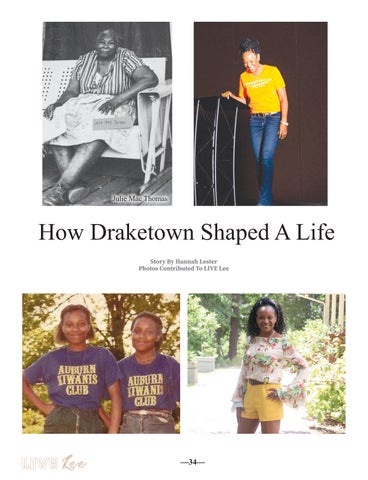
Julie Mae Thomas
How Draketown Shaped A Life Story By Hannah Lester Photos Contributed To LIVE Lee
—34—
A
former Draketown resident, Frankie Bell, has taken the experiences — growing up in Auburn, in Draketown — that shaped her and combined them into a book: Choose to Win. Bell said that there was a photographer who donated old photos of Draketown to Auburn University and no one had been able to identify who was in the photos. “There was this guy who had donated pictures, photos to the university that were from this area called Draketown,” Bell said. “Nobody really knew a lot about it. And somebody called me. They said, ‘Frankie, have you heard that there’s this photographer that has donated artifacts to Auburn University?’ “He was just a student, photography student, and he was going around randomly, white guy from the North, wanted to know about the South; was just going around asking some African-Americans could he take photos of them. And he happened to be in Draketown, which is not far from campus. Of course, see how that works. And so, he came, and just so happened the first picture he took was my great grandmother, Mrs. Julie Mae Thomas. “This was special because I had no photos of my grandmother or the old house, but if you read my book, I can describe both accurately.” When Bell began looking through the photos, however, she recognized not only her grandmother but a host of other residents. The photo of her great-grandmother included a newspaper with the date on it, which is how the photos had been dated. But Bell recognized her own house in the photograph. “I think they were working on trying to preserve some of that and [the Auburn Heritage Association] liked the way I described everything [in the book] about Draketown as a child … in my book, I was very descriptive,” Bell said. “To me, that makes it very personal.” Aspects of Draketown — such as the drink machine in the mechanics house, or the candy lady, were documented in Bell’s book. The history of Draketown is Bell’s own experiences, however, her childhood. “[Residents of Draketown] just loved you, as a family,” she said. “Not strangers. Very personable. Very all in our business. Very compassionate, empathetic. Just a very loving place. Very solid. It’s a place you can always go back home to. “… We remember the dirt roads. We remember walking through the park to Cary Woods; people looking out for one another; nobody really talking down on anybody; just a warm place, very southern, hospitable. I don’t know, it was just all those positive things, that’s all I remember. People looking out for each other. Street light kind of thing, you go in before the dark. Just like you would see in an old movie.” But despite the fondness of her memories, Draketown did change. “A few years back, my aunt, Brenda Lyles, used to live in my grandmother’s house,” she said. “We began
to see the commercialization of [Draketown]. It became commercialized, taken away from the personable atmosphere, taken away from what we stand for in Draketown — the neighbor, the safety. I don’t know, it’s just, it’s almost like it, I don’t want to say it’s forcing the love out, but it is.” Bell said that there is a goal to erect a historical marker in Draketown — to the area, and its people. And Bell has been asked to help find a location for the marker. “I’ve been thinking about what would be a place that would represent all of Draketown, not just one part of it, but all of it, so I’ve been praying about that,” she said. Despite such a loving place to grow up, Bell’s experiences were varied, and traumatic. She was molested as a child. She lost her sister to a car accident. She lost her friend Marie in a car accident, an accident which also left Bell wheel-chair bound for months. She suffered from bulimia. There was a man shot in Draketown in front of her grandmother’s house when she was 5. “I talk about, in my story, choosing to win, about it being a decision, everything I went through,” Bell said. The evening before the accident that took Marie’s life, Marie had been talking to Bell about meeting her at the gym in the morning, and asked her specifically not to be late. “I had left home,” Bell said. “I was teaching at Loachapoka High school then and my husband called … he said, ‘did you get a jacket?’ I said ‘no.’ He said, ‘you know you have a game tonight. You need to go get that jacket because it’s going to be cold.’ I said, ‘I’m going to be late.’ He said, ‘Bell you need to go get that jacket.’ I turn around and I go get the jacket. And often wonder had I just never gone to get the jacket, that car wouldn’t have been there.” Bell returned to campus during her time as an Auburn student in a wheelchair and had to learn to walk again and cope with the loss of Marie. “As I went, shamefully, on campus in a wheelchair, knowing people were saying ‘That’s Frankie Bell, that’s her;’ not in an ugly way, but it drew attention,” Bell said. “And so I said to my professor, ‘just don’t treat me any different.’” On May 4, 2014, after multiple surgeries, Bell walked across the stage with her diploma as Dr. Frankie Bell. Bell had a lot of trouble in school when she was younger because she was sassy, she talked back and had trouble in class. “A lot of people felt sorry for me who don’t know me because of what I had to endure, but it gives the people that believed in me the hope that what they put in me, it was worth it,” Bell said. “Because life was hard — from the teachers, to the community, to anybody who would comb our hair, to anybody that would give us bread, to anybody that would help my grandmother, to Mr. Duke who drove the van. It makes it feel like I wasn’t a lost cause for the people who put time in me. “So there are adults out there, or educators out there who
—35—
STEP BACK IN TIME
may feel like, ‘what you’re doing doesn’t make a difference.’ But it does.” Bell took her experiences and not only combined them into a book, but plans to use what she’s learned to open an outreach center for young boys that others may see as at-risk, but that Bell said she sees as leaders who may need a little push, support and love. “What I have to give back to society is choosing to win,” she said. “My motto is, and my teachers love this, is ‘love is the answer no matter the question,’” she said. “No matter the question, the answer is love. No matter what’s going on with a kid, no matter how bad of a day they’ve had, you can love them through it. And I’m crazy enough to believe that because that’s what happened to me.” Bell said she wants to show children the grace they need as they’re learning. “Some kids need to be taught the way that they learn, so teachers just may need to change their strategy,” she said. “It’s about getting up again and again, so a kid can see that you can overcome what people may say you are and become who God has called you to be.” Bell’s book is available on Amazon: www. amazon.com/Choose-Win-Frankie-Bell-ebook/dp/ B07SCJY49W.
—36—
Step Back
Photos Contributed to LIVE Lee
—38—
In Time
—39—
STEP BACK IN TIME
—40—
—41—
STEP BACK IN TIME
An Opelika Institution Story By Ann Cipperly Photos By Robert Noles and Contributed To LIVE Lee
Then —42—
O
ver the years as Lee County continued to bloom with new restaurants, Mrs. Story’s Dairy Bar in Opelika continued to be run by a single family, serving the same menu. After being open for nearly 69 years, family member Rhonda Booth announced in August of 2021 the business would close due to not being able to find workers and the COVID-19 virus. However, the business reopened in November, much to residents’ delight in Opelika and Auburn. When the business closed, albeit temporarily, fans of the old-fashioned milkshakes and foot-long chili dogs rushed to the dairy bar. By the end of the day, the business was completely sold out. Rhonda’s mother, Cora Reames, began working at the business with her grandparents when she was 12 years old. Originally called Dari-Delight, the business opened in 1952 with owners Dan and Annie Story. Cora recalls her grandfather had visited his sister out west where he saw a Dari-Delight. The 57-year-old came home with a desire to
leave the mill and open a franchise in Opelika. Local banks thought he was foolish and couldn’t make a living selling ice cream and hot dogs. Every loan application was rejected until finally a bank in Auburn took a chance. The 10-year mortgage was paid off in six. The Storys, who already owned the property on Pepperell Parkway, moved their house to the back of the lot so the business could be built near the highway. Signs placed around the small white building advertised “Iced Milk Sold Here” and “Ounce Cup Sugar and Cream — 10 cents.” The foot long chili dogs and fruit milkshakes were 30 cents each, while ice cream cones sold for 5, 10 and 15 cents. Mrs. Story prepared her own chili recipe, which became a guarded secret. When the drive-in opened in the 50s, the Storys refused to have a separate window for blacks and whites as most restaurants during that time. Cora remembers her grandfather saying everyone deserved to be treated the same. Dan and Annie greeted customers in white starched,
Now —43—
STEP BACK IN TIME
pressed uniforms and paper hats. Friendly service and quality food were always important. At age 12, Cora rode her bike from Pepperell to help at the restaurant by picking up paper in the parking lot and emptying trash cans for 25 cents a day. She continued to work there during high school and vocational school. “Back then families didn’t eat out much but did go for ice cream,” Cora said. Annie was known for having a tender, generous heart. If anyone was low on cash, she would run a tab. Dan suffered a stroke after only three years in business. During the following three years, his health declined. He died a few days after the final payment on the mortgage. Cora said she believes he was hanging on to be certain the debt was paid. When the business celebrated its 10th anniversary, the contract with Dari-Delight expired. Annie decided not to renew the franchise, knowing she could do better on her own. She couldn’t decide what to name the business when a man from Dairyland Farms suggested calling it “Mrs. Story’s Dairy Bar” since that was what everyone called it anyway. “My grandmother was very straight-laced,” Cora said. “She didn’t believe in any public display of affection. She
did not allow smooching in her parking lot. She would raise the window and beat on the counter. If that didn’t grab their attention, she would pound on the car hood.” When Annie retired, she refused offers to sell. Cora was working at Ampex at the time. Every time a co-worker passed her, he pleaded for her to open her grandmother’s business because he was craving a hot fudge sundae. Cora was also craving a sundae, which was her first treat at the dairy bar when she was a child. The hot fudge sundae was always her favorite, she said. Annie never would have sold the business to anyone who was not family, but she did lease the business to her granddaughter in 1980, with an option to buy. Cora remembers it being a big step for her since she was raising four children. Cora tore down the grandparents’ old house, which had been used for storage. She added the storage area and office onto the building. She decided to close the business on Sundays. When her four children were in high school, they all worked at the restaurant. The menu remained essentially the same, with the chili dogs and fruit milkshakes being the most popular. Banana splits and flurries were added to the menu, and chili dog toppings were offered. The orange slush was the only item
—44—
she removed from the menu since she lacked storage space for the supplier’s minimum purchase of a hundred cases. Cora knew most of the customers. When someone drove up, she would get busy preparing the order. She couldn’t remember everyone’s name, but she knew what customers always ordered. “It was the personal touch and quality ingredients that kept people coming back,” she said. Her grandmother was a regular customer until her death in 1988. Annie came to the dairy bar nearly every day to visit with customers. After 25 years, Cora felt it was time to retire. Her face had become so well known in the community that people called her Mrs. Story and still do. Rhonda was the only one of her children who was interested in the business. Rhonda’s husband, Bob Boothe, who desired a career change, had been managing a fertilizer plant. Growing up in Opelika, Bob was always a fan of the chili dogs and milkshakes. He and his brother rode bikes from Floral Park to the dairy bar. When Bob was in the Navy, he called home at Christmas and talked to his brother, who wanted to know what the family could do for him. Bob said, “All I want is a Mrs. Story’s chili dog.” His brother sent him one, but it was inedible when it arrived three weeks later. Once he was discharged from the Navy, Mrs. Story’s was one of his first stops after returning home. He attended Southern Union, where he met Rhonda. The Boothes purchased the dairy bar in 1997. Like her grandmother, Cora would only sell to family. While the Boothes made major decisions together, Bob ran the business, while Rhonda worked as an RN at East Alabama Medical Center. He updated the equipment and added tables outside. A year after opening, he and Rhonda received the Small Business of the Year Award from the Chamber of Commerce. He considered expanding the space, but everyone said not to change the front of the existing building. One afternoon, a driver drove into the building. Bob said he was thankful no one was standing outside. But following the accident, however, he decided to add parking poles across the front to protect customers. The menu remained the same, and everything was still prepared using the same method as when the business opened. It was difficult to compete price-wise with restaurants that use a milkshake mix and flavored syrup instead of real fruit. His biggest problem running a small mom-and-pop business was getting supplies from some of his vendors. “Almost everyone is interested in the chains,” he said, after coming in from buying milk at the grocery since one vendor didn’t deliver. Over the years, their largest order was serving 10,000 chili dogs to Uniroyal employees. Some local businesses have
requested as many as 50 chili dogs and milkshakes. After the Boothes took over, the business continued to grow with new customers, which Bob said was primarily by word of mouth. “I always thought if you served a good product at a decent price you would have customers,” he said. The personal touch continued over the years, with the workers knowing their customers. A customer said by the time he gets to the window, his order is waiting. One morning a couple knocked at the window an hour before opening, wanting a milkshake for a terminally-ill friend. Bob stopped what he was doing and quickly made a shake. The pleased customers had been told at the hospital he would open early to fulfill the request. A few days later, Bob received a two-page letter saying how difficult it was to find such personal service these days. Rhonda and Bob’s son Blake, the fifth generation, has worked there since he was 15 years old. In July 2018, Blake and his wife, Amber, purchased the business from his parents. A couple of years later, the couple received the Small Business of the Year Award from the Opelika Chamber. “We have been told so many times that when former Opelikans come back home to visit parents, they have to make a stop at Mrs. Story’s for a chilidog and milkshake,” Rhonda said. With slow-simmered chili-topped footlong hot dogs and made-to-order old-fashioned milkshakes, the small business has received numerous awards over the years. The chili hotdog and milkshake are both listed in 100 Dishes to Eat in Alabama. In 2017, Mrs. Story’s received the honor of being named Alabama’s Best Milkshake. When the dairy bar received the award for best milkshake, the family was featured on the Simply Southern television show accepting the honor. They have been featured in numerous magazines and newspapers. Now, the doors have reopened and Mrs. Story’s is ready to continue its decades-long, award-winning service.
—45—
STEP BACK IN TIME
—46—
NEW LOCATION
Hilyer & Associates, CPAs
1750 Opelika Road, Auburn
COME VISIT OUR NEW STORE.
We're Open 9 a.m. to 6 p.m. Monday through Saturday
Je�fery A. Hilyer,
www.harvestevangelism.org
Attorney at Law and Certified Public Accountant
Jackie H. Moon, CPA Erin K. Arrington, CPA H. David Ennis, SR., CPA Patti C. Davis, CPA Gri���n T. Clark, CPA 614 2nd Ave, Opelika, AL 36801
334-745-2564
Serving Lee County since 2006
Something New Coming Soon Story By Lofton Wheeles Photos Contributed To LIVE Lee
—48—
F
rom the creators of Crepe Myrtle Café, Blooming Colors and Chicken Salad Chick comes a new place that will plant fresh memories and experiences within the community. Botanic is a new business founded by husband-and-wife duo King Braswell and Stacy Brown that will be located at the old Cock of the Walk building near Tiger Town in the future. The building will function as a garden retail center, entertainment area and a farm-to-table restaurant featuring Southern cuisine. “I think Botanic really, in a nutshell, is an embodiment of the passions of a lot of people that are building this place and that are going to work here afterward,” Braswell said. “[These are] passions that they believe in that will ultimately serve others and create life experiences for people who work here and the people that visit here. And I think that, basically, service is an embodiment of what we do.” Brown also discussed her thoughts on how the vision for Botanic came to be. “It’s actually COVID that kind of pushed our ideas into
fruition,” she said. “It became so apparent that we were all craving experiences, and connection and things that technology cannot replace because we were all forced to be in our homes and we really depended on technology so much to continue on with our daily lives and it really showed the need and the void for what we hope to provide here.” Both founders have had experience under their belts when opening and operating businesses. However, according to Brown, Botanic is a bit different from their previous business ventures. “Chicken Salad Chick was geared for a very focused day part … so it was just very focused,” she said. “I’m glad in hindsight that it was a smaller, focused area because I have this experience behind me in building a business, then King has his 20-plus years of experience in his industry. It still gives me the same butterflies about opening a new business and this one is a much larger scope of a business. “So, it’s still a first-time situation just like Chicken Salad Chick was … but we have much more experience behind
—49—
STEP BACK IN TIME
us this time around in creating this kind of business and it’s so much fun. I love to create, and King loves to create, so we’re having a blast coming up with the different things we want to offer.” Braswell, whose passion is all things horticulture and service, described Botanic as “a dream come true.” “It has all the elements that I could ever have wanted for a full circle horticultural business that embodies all of the elements of horticulture that I think are relevant,” he said. “Horticulture, which is my chosen path at Auburn University, embodies a lot of things that people really don’t even understand. If it weren’t for horticulture, you wouldn’t have fruit production, vegetable production, flower production and plant production.” The two are repurposing and bringing new life into the building that formerly housed Cock of the Walk. “We’re embracing a lot of the wonderful things that people remember about this place and then we’re bringing
it back to life in a new way,” she said. “One thing that’s been really great as we’ve been building [is that] people have come in just curious about what’s going on here and they drive in, look around and some come in wanting to talk and a lot of people have shared with us about the memories that they had here when it was Cock of the Walk and how special it was to them and they would come here on special occasions. “So we want to revitalize the property but also continue to be a place where people come to make memories so we will have a lot of geared activities to experiences and that the kids will be able to come feed the fish and the turtles and listen to music under the tree and there are experiences for everybody whether it’s kids, families or a group of friends, there will be something for everyone.” While the revitalization has had some challenges along the way, the two have learned to make the best of the work there is to be done.
—50—
“Preserving the wonderful things about [the old building] and figuring out how to work in the new brings its own challenges, but it’s fun to figure all of those things out,” Brown said. “King is extremely creative and I’m a creative person, so our ideas build off of each other and spur on new thoughts and the entire project has been an evolution of thought and it seems to evolve daily.” The two also strive to create an incomparable experience for the Auburn-Opelika community in several ways with Botanic. “I think the entire visit will be a unique experience from the guest service, from the facility, from our outdoor garden dining with a retractable roof and from dining over the pond, so that’s unique,” Brown said. “Also, the fact you can come in and while you wait for a table, you can enjoy a cocktail, you can shop, you can listen to music, you can do the activities that we’ve provided for outside [that are] all things that families can join in and do together while they wait on their dining experience to begin.
“And there are things to do when you’re finished so if you want to continue to listen to music outside, we have lots of fun things planned that people can make plans to attend.” Overall, the two said they are excited for several aspects regarding Botanic, but there is one that Braswell keeps coming back to: the memories. “I’m really just mostly excited that we can hopefully give lots of people a great experience that they can take with them to savor and lots of memories,” he said. “That’s really what this place is all about, creating memories with your family.” While the business does not have a concrete opening date, Braswell stated that “every day that we complete our work here is one day closer to opening.” Brown also wanted to reassure fans of the now-defunct Cock of the Walk that “the turtles are OK and thriving.” Right now the business plans to open this spring. To get updates on Botanic, head on over to its Facebook page facebook.com/shopbotanic.
Market Street Paint Shop Chalk Paint® by Annie Sloan Stockist 116 South Eighth Street Opelika AL 36801 903-268-6864 jim@marketstreetpaintshop.com
Soup & Sandwiches Daily 700 Second Avenue - Opelika —51—
STEP BACK IN TIME
CAMP OPELIKA
—52—
Story By Ann Cipperly Photos By Hannah Lester and Contributed To LIVE LEe
O
n a hot Thursday afternoon, June 5, 1943, a crowd was gathering near the depot in downtown Opelika, waiting for the train that would bring prisoners of war to a camp two miles outside of town. Anxiety was growing all day in the talk from one shop to another about the camp being near town. Some speculated that the prisoners would be Japanese. Late in the afternoon, the screeching of a train whistle pierced through town. Locals had lined up from the depot to Geneva Street to catch a glimpse of the prisoners. As the prisoners filed out of the train, several townspeople turned to others and whispered that they were Germans, not Japanese. Among those in the crowd was 12-year-old Henry Stern whose family had left Germany to escape the Nazis. His family came to live with kin in Opelika to build a new life. He watched the Germans march down 10th Street on their way to the camp. Plans for the POW camp had begun in the fall of 1942 when land was selected off Marvyn Parkway by the Federal Government. Once the seven families living on the land moved, a construction company from West Palm Beach, Florida, built Camp Opelika on 840 acres bordering a forest with towering pine trees. Three prisoners’ compounds were constructed with 37 buildings in each, housing for the soldiers, mess halls, a hospital and numerous other buildings, all painted Army green. The German prisoners had been captured in the North Africa campaign and disembarked from a ship at Boston, Massachusetts. After arriving in America, some of the prisoners were surprised to learn that New York City had not been destroyed by German bombs as Hitler had reported. They were also puzzled to learn that the Japanese had not wiped out the American Navy. At Camp Opelika, hundreds of Army personnel were standing by to assume their duties. Each of the three compounds held 1,000 prisoners. The third compound held Hitler’s special service “elite” soldiers. This group believed Hitler was going to win the war. Each compound was surrounded by double rows of five feet tall, barbed wire fences with numerous guard towers controlling the narrow land between fences. Later, a railroad siding was installed alongside the camp for unloading prisoners. One of the guards at the camp was Sgt. George “Red” Marlett, originally from Pennsylvania, who was sent to serve as a guard at Camp Opelika on July 4, 1944. After a month of guarding the peaceful prisoners in barracks two, it was discovered that Red had fought against Hitler’s elite in North Africa, who were in the third compound. He was then
assigned as administrative 1st Sgt. of Company 11 in that compound. Although the prisoners knew they had fought against Marlett, he had few problems, except for one prisoner who continued to dress in his full German uniform. The prisoners could wear one garment of their uniform with their issued clothing but not full dress. After disregarding those orders several times, Marlett put the prisoner on a three-day water-and-bread diet. Weekly dances were arranged at the Opelika USO Center. At one of these dances, Marlett met Maxine Mann, who attended with her three sisters. When they were later married, one of the prisoners wanted to paint a picture of them as a wedding gift. He requested supplies, painted a portrait of the couple and made a frame from orange crates. One local, Nelle Horsley, was among those working at the camp. She was employed as a secretary in the engineering office. The building was located to the right of the guard shack but was not fenced into the camp. While Horsley didn’t have contact with soldiers at her work, she met one of the Army guards, Lt. Bruce Taylor, at a party given by Yetta Samford. Since Taylor’s roommate was the son of one of Samford’s friends, the invitation had been extended to include him. Horsley and Taylor began dating and were married in April 1945 at her grandfather’s Spanish-style home in Opelika. After a wedding trip, the couple returned to work at the camp. Taylor was respected by the prisoners he was guarding. One of the prisoners had been a cabinetmaker in Germany and requested materials to construct a table as a wedding gift. The prisoner created a beautiful coffee table with inlaid wood for the newlyweds. Taylor told locals that most of the prisoners were smart and hard-working. Some of the married soldiers lived in apartments in town. When Albert Killian was 15 years old, his parents rented two rooms to married guards. Over the years, they had several soldiers from Georgia to New York stay in their home. The guards took prisoners who agreed to work to farms and lumber mills. They were paid 80 cents a day, while those remaining behind received 10 cents. With the pay, they could purchase cigarettes, candy and personal items at the canteen. When the prisoners were cleaning the park at the corner of Moore’s Stadium and Fifth Street, Stern and his friends rode their bikes to watch them work. Sometimes prisoners would ride their bikes around the block. Stern could speak German and told his friends what they said, but, being Jewish, he never let on that he could understand. When the prisoners were not working, they performed in a theatrical group and played musical instruments in their 32-piece orchestra. When one of the prisoners wanted a trumpet so he could be in the orchestra, Taylor gave him his that he played in the band at Michigan State. Marlett was instrumental in organizing a softball team
—53—
STEP BACK IN TIME
for the soldiers. They played several local teams. Others played soccer and participated in recreational programs. Germans who had been educators held classes for prisoners to advance their education. Most of the prisoners were Catholic and held their own church services, while services for the soldiers were in the recreation hall. Every Saturday evening, Camp Opelika presented a radio program over a local station. Chaplain Schillinger would speak, and sometimes the wife of post Commander G. Cronander sang a solo. A couple of prisoners escaped from the camp twice. Two
said the two prisoners had obtained women’s clothing while in a play at Camp Opelika. A few months after the war, Camp Opelika closed on Dec. 8, 1945. The remaining prisoners were sent to Ft. Benning. Taylor was assigned to Ft. Benning, where he and Horsley lived until he was discharged from the military. Marlett and his wife lived in Opelika for the rest of their lives. An article in the Opelika Daily News on April 22, 1948, reported that Mayor John Louis Whatley was receiving mail from former prisoners at the camp requesting help from residents. The paper ran one letter where the prisoner was
prisoners escaped and went to the capitol in Montgomery, as they thought it was the national capitol. They were returned to camp. Another time, two prisoners escaped and sat in a pine tree overlooking the camp before going back to their barracks, saying they just wanted to get out for a while. Two previous prisoners at Camp Opelika were sent to another camp in Georgia and escaped but were later caught. An article in the Tallahassee Democrat on Aug. 10, 1944,
back in Germany and was requesting clothes, food and two bicycles from the people in Opelika. The city of Opelika acquired the Camp Opelika property. The barracks were turned into veteran housing for returning servicemen. Killian and his family lived in what was one of the dining facilities from 1947 to 1948. His father turned the space into a living room and bedrooms. Auburn University students
—54—
lived in what was the former hospital. Later, the campsite became Opelika’s first industrial park. John Herbert Orr’s tape manufacturing plant was the first business at the site in 1956. A few years ago, the plant was torn down. Several of the prisoners have returned to Opelika to show their families where they were held in the POW camp. They admitted at times they were worried that they would never see their families again. Three buildings are all that remain of Camp Opelika, two of those were used by Ampex. The other building was moved by the tracks in Opelika for a family home. The Museum of East Alabama has artifacts from the camp. A recent donation of a guard uniform and helmet came from a soldiers’ family in New York. His family said he was a photographer at the camp and afterward had a successful career in commercial photography for fashion, advertising and the recording industries. The public is invited to visit the museum and learn more about Camp Opelika. Information for this article was gathered from previous interviews with Nelle Hornsly Taylor, George “Red” Marlett and Henry Stern, as well as from newspaper articles from the Otis Broach collection and a book by Albert Killian for the Museum of East Alabama.
—55—
STEP BACK IN TIME
Observing History
L
Story By Wil Crews Photos Contributed To LIVE Lee
ike any ole’ town, Opelika has changed over the years. Some changes were for the better, some … not as much. Through it all, the building addressed 223 S. 8th St. has remained. According to previous owner Phil Gorham (71), who operated a barbershop at the location from 1985 to December 2020, the building has been serving the community of Opelika as far back (if not further) as the 1930s. “I had one retired judge, Noah Baker, tell me he could remember getting a haircut there in 1938,” Phil said. “So, the shop was there probably 80-plus years [before we owned it].” Born and raised in Opelika, Phil returned to 223 S. 8th St. to share with me his portion of Opelika’s history. A man of average stature, modest clothing — aside from the 4-inch, silver-plated
belt buckle he wore — and without a misplaced smoke-colored hair on his head, Phil certainly looked the part. From the onset of our conversation, he exuded a certain charisma and Southern charm that presumably lent to his longevity as the “go-to” barber in this little railroad town. With him was his wife, Teresa, who was also born and raised in Opelika; she complemented every story he told with a loving perspective that only a spouse of a small business owner could. Prior to the Gorham’s, the building housed a barbershop which belonged to Jerry and Joann Weldon. One side was a beauty shop, the other a barber. Jerry passed away in 1984, and soon after the Gorham’s were approached and asked to purchase the business. “I had many people tell me [Jerry] may have been one the best
—56—
barbers there ever was in Opelika, and a very good man,” Phil said. “I just had hoped that I could live up to his reputation as a barber, and as a person.” At the time, the Gorham’s also owned a bakery just a few doors down — aptly named “The Sweet Shop”. The bakery remained opened until 1990, and for a while, Phil pulled double duty, baking donuts at 2 a.m. then traveling to barber school in Montgomery thereafter. You see, Phil’s grandfather was a barber, too. Cutting hair was always “in the blood” as Phil said. If there was ever any more doubt for Phil’s acumen for hair-cutting, his time in barber school all but laid out his path to a successful career. “The professor told him ‘you don’t need to come over here, you are just a natural,’” Teresa said. Over the next 30-plus years of operating his barber shop, Phil heard thousands of stories come and go through his doors. “It was great,” Phil said. “I met a lot of people. Not only were they customers, they became friends too.” Customers came from near — Macon, Chambers, Russell and Lee County. Customers came from far — France, Germany and Egypt. Blue collar, white collar, no collar … four generations of families … even a number of women who preferred Phil’s style to that of a beautician came and sat in his trademark blue chairs. Phil said he especially enjoyed the stories from WWII veterans and recalled another unique instance when a customer recounted the time his grandfather had a Western-style draw down in the middle of town … many things have changed. The cost of his cuts went from $5 to $14. Shaves became
a thing of the past. Phil’s business persevered through a few failed-attempts at revitalizing downtown Opelika, and carried on through the attempt that finally stuck and has contributed so greatly to the city’s progress since the turn of the century. He started as one of at least five barbershops in the downtown area, and outlasted them all. He was once even featured in a story by the Associated Press in the early 2000s, detailing the fading trend of authentic barbershops. In the end, the unfortunate circumstances of the COVID pandemic and the physical ailments placed on Phil’s body by the nature of the job were eventually too much. He fondly remembers his final haircut — a tender moment with his son, Phillip, who witnessed his dad’s commitment and service to a community for so many years. “[Our son] said he was the first and wanted to be the last,” Teresa said. “It was a good occasion.” In the building which once housed Phil’s shop now sits The Observer, Opelika’s award-winning newspaper publication “for local people, by local people.” The change of ownership was made complete when Phil retired at the end of 2020. The Gorham’s said they are pleased that the history of their business and the buiding can be preserved in this way. “We are glad,” Teresa said. “We were so thrilled. For years, we were like who will want it, what will happen to it?” It is poetic, in a way, that The Observer fills the void left by the Gorham’s shop. Despite Phil’s absence, 223 S. 8th St. is continuing to tell stories of the city he serviced for so many years. A barber and a newspaper are similar in that way. They both require trust, personal connections and attention to detail. It was once said that, “There is nothing more powerful in the world than a good story.” And, “If you need stories, just talk to a barber,” Teresa said. “Or,” I replied, “just pick up a newspaper.”
—57—
Phil giving his son the business' last haircut
STEP BACK IN TIME
Locally owned and operated, Goree's Furniture Express has been bringing you savings for more than 20 years!
www.goreesfurniture.com 334-742-0607 3797 Alabama Highway 169, Opelika —58—
SUBMIT A TIP Have information to SHARE about a crime? You can now send ANONYMOUS tips directly from your cellphone. SCAN THE QR CODE and DOWNLOAD THE LEE COUNTY SHERIFF’S OFFICE APP
STAY INFORMED SUBMIT A REPORT, and SO MUCH MORE
Lee County Sheriff’s Office
1900 Frederick Road, Opelika, AL 36803 334-749-5651
www.LeeCountySheriff.org CRIME STOPPERS 334-215-STOP (7867) —59—
STEP BACK IN TIME
A Church Is Born Story By Natalie Salvatore Photos By Robert Noles and Contributed To LIVE LEe
—60—
O
ne of the many churches in the AuburnOpelika area has quite a history behind it. The building at 1010 India Road, which now holds Trinity Presbyterian Church of Opelika, used to be a nightclub and hangout spot for local teenagers years ago. Now, Trinity represents this community’s congregation of the Presbyterian Church in America. “We seek to glorify God through expository preaching, reverent worship, historic liturgy and warm fellowship in a multi-generational congregation,” said Chris Duncan, who has served as Trinity’s pastor for 15 years after first joining its staff in 2000. Duncan explained how as a whole, the church is dedicated to the “inerrant and infallible” Word of God.
“It is inerrant, our only infallible rule of faith and practice,” he said. “... We are committed to the central importance of the Word, sacraments and prayer as God’s primary means to bring us to faith and grow us in grace,” he said. Before Trinity originally purchased the building in the fall of 1973, the space had a completely different atmosphere. Serving as a dance hall for young adults to be with their friends, the “Shalimar Club” hosted local bands and provided a dance floor with flashing, black lights. Duncan said that it is common to see this business spelled different ways as it is recalled by others. Nevertheless, Duncan said sources knew that a local entrepreneur, who worked on the development, explained
—61—
STEP BACK IN TIME
how the club was struggling to stay afloat. Trinity transformed the building with its original seven acres into what is now one of the community’s local churches. Pews replaced the dance floor, and lights were no longer used for strobe effects. Trinity’s first worship service in its newly renovated church was on Feb. 3, 1974. Duncan referenced a news article, published on Feb. 2, 1974, that documented the church’s beginning. Members of the Opelika First Presbyterian Church voted to withdraw the church from the Presbyterian Church U.S. Trinity’s decision to separate came after two-thirds of First Presbyterian members voted to form a separate church, but under the rules adopted by the parent church. Trinity’s first pastor was the Rev. John Holmes, who once said the church’s first amenities included a seating capacity of “at least 200” in the sanctuary, a kitchen, two bathrooms, 11 classrooms, a fellowship hall and storage spaces. He agreed to join the new church after serving as pastor of the first church. The name “Trinity” was premised on the Christian doctrine of the “triune nature of the one True God.” This confessional church’s doctrine was formulated in the Westminster Confession of Faith, which defines its theology as catholic, evangelical and reformed. According to the reverend, Trinity split off because of the failure of the Presbyterian Church, U.S. “to observe strict adherence ‘to the authoritative and inerrant’ doctrine of the Bible” and to the old church’s national involvement
in other matters, such as political ones, that were not based on the PCUS’ foundational principles. He further explained that at the church’s creation the split, which was “amicable,” came after years and years of reformation attempts. The new church was not much different than the old, except for the fact that the latter’s members tried to reform the church from within, the opposite of what the new church members decided to do by leaving. Trinity marked the town’s shift from having just one Presbyterian church to making room for two. Sources report that First Presbyterian divided up the building fund with Trinity to help with the renovation, and 125 members of the former church became charter members of Trinity. Although the renovation completely transformed the building into a religious space, the building’s past still found ways to peek through over the years. “When we did renovations in the sanctuary in 2009, we found evidence that the interior walls were painted in bright red, yellow and black panels,” Duncan said. Since its creation, the church has had some ups and downs to combat. On July 13, 2013, a lightning strike caused the church to catch fire and lose everything. “As trying as the experience of the fire was, the total loss put our church in the envious position of being able to plan a facility from scratch that will adequately serve our most fundamental commitments and our fellowship for generations to come,” he said.
—62—
Additionally, the church opened its doors wider, beginning the ministry of Trinity Christian School, in 1978. The school started with just a kindergarten class that fall. Now, the school has 265 students enrolled each year from grades K-12. Grades were added gradually over time, such as establishing ninth and tenth grades in 2001. Besides the school’s experience with teaching all different ages, it also welcomes and encourages
approximately 19 denominations and 47 churches within its student body. Duncan said that Trinity school is the church’s largest ministry. The school focuses on education that is “based on the objective truth revealed in the Holy Scriptures.” Shortly after Trinity school opened, the congregation also founded the Covenant University Fellowship at Auburn University in 1982, which later became the Reformed University Fellowship, a thriving campus ministry today.
We offer personalized, comfortable care for your whole family. Dr. Adams and Dr. Neuhart look forward to meeting you. ∎ Cleanings
∎ Dermal Fillers
∎ Fillings
∎ Botox
∎ Veneers
∎ Dentures
∎ Crowns
∎ Bridges
INDIAN INSPIRED EATS
Spreading good with food
Open Monday through Saturday 11 a.m. to 9 p.m. 1409 S. College Street, Auburn 334-246-3144
@augoodkarma www.augoodkarma.com
Monkeying Around Story By Hannah Lester and Harrison Tarr Photos By Hannah Lester and Contributed To LIVE Lee
O
pelika’s Municipal Park houses a wooden monkey statue reminiscent of a much … furrier time, a time when there were monkeys who made their home in the park. Former First Director of the Opelika Board of Parks and Recreation, WJ. (Bill) Calhoun, envisioned bringing monkeys to the park in 1956. “Bill Calhoun was a visionary,” said Matthew C. Battles, municipal area supervisor. “He knew that adding the monkeys and the Rocky Brook Rocket miniature train would make Opelika Parks and Recreation unique.” Eight spider monkeys from Florida were housed in cages in the park until 1980, when they moved to the Montgomery Zoo. “What could be more fun as a child than going to the park to play, ride the train and feed monkeys on a Saturday,” said Lisa Thrift, community development administrator, who spearheaded the effort to bring the monkey statues to the
park in 2016. “I remember many weekends at the park doing just that. We would take a picnic lunch and spend the day with family and friends. Mom would let us take our shoes off and wade in the creek and play on the rocks. We would bring peanuts and feed the monkeys peanuts or grass. They were fun to watch. There were often stories of the monkeys getting out and having to be captured.” While having monkeys at the park was certainly unique, the idea caused a lot of problems for the city. “Vandals would cut the cage open and allow the monkeys to escape,” Battles said. “They would usually just hang out in the trees around the park and when it came time to eat they would come back to the cage. “… The monkeys were being mistreated by vandals and there were several instances where the monkeys had bitten children and it was becoming apparent that Opelika Parks and Recreation was not adequately equipped to handle animals. Bill Calhoun and the Parks and Recreation Board
—65—
STEP BACK IN TIME
decided in June of 1980 to have the monkeys transferred to the Montgomery Zoo.” Monkey Park, or Municipal Park, is still in use today. It is located on Park Road in Opelika. “Municipal “Monkey” Park has been the main city park since the 1950s,” Battles said. “It has multiple playgrounds, swings, the creek, the Salem-Shotwell Covered bridge and, of course, the infamous Rocky Brook Rocket miniature train. It has two covered areas to host picnics, birthday parties and family reunions, as well as a stage where the Summer Swing concert series is hosted every summer.” In 2016, Thrift said she took her idea for monkey statues to the mayor and city administrator. “Someone mentioned commissioning local artist Ken Murphy to carve the monkeys,” she said. “Murphy was
contacted and he agreed to donate his time and talent to the project free of charge.” Thrift said she hopes that by having the monkey, maybe the memory behind the statue will carry on to future generations. “I wanted people to understand why the Municipal Park is called ‘the monkey park,’” Thrift said. “It’s hard to image the cage with monkeys, if you had never seen them. I grew up in Opelika and was able to enjoy visiting the monkeys and have shared the stories with my children. The cage and statue is a way for new residents to enjoy the monkeys too.” Originally, two statues were constructed. But soon after the unveiling, one was stolen. Thrift has said that if anyone has information on Opelika’s missing monkey, to contact her (LThrift@opelika-al.gov).
—66—
—67—
STEP BACK IN TIME
Excellence. Innovation. Compassion. Well Done Class of 2021! East Alabama's "Go-To" Center For Orthopaedic Care Auburn 1800 Lakeside Circle, Auburn Opelika 18 Medical Arts Center 121 North 20th Street, Opelika
www.theorthoclinic.com
334-749-8303 1-800-327-6519
—68—
Need Small Engine parts? Give us a call! Small Engines Servicing Dealer. We sell and service lawn mowers and two-cycle equipment.
Ready for leaf season?
out front mowing
Price sells Walker Mowers, Grasshopper Mowers, Toro Zero Turns, Toro Pushmowers, Echo Professional Equipment, and Shindaiwa Products. We also have parts for Briggs & Stratton Engines, Kohler Engines, MTD, AYP, Snapper, Grasshopper, Walker, Toro, Redmax, Echo, Shindaiwai and etc.
20 Samford Avenue, Opelika
334-742-8011 —69—
STEP BACK IN TIME
—70—
Too Good To Be True?
M
Story By Kara Mautz Photos Contributed To LIVE LEe
r. Gatti’s Pizza is moving back to Lee County. Mr. Gatti’s was founded in 1964 in Stephenville, Texas, by James Eure. Eure opened the first “Mr. Gatti’s” in 1969 after moving to Austin, Texas, as a tribute to his wife’s maiden name and has continued to grow the franchise over the last 50 years throughout the southeastern United States. The popular pizza buffet chain is set to open two new locations, in both Auburn and downtown Opelika. Mr. Gatti’s previously held two locations in Auburn and Opelika during the company’s height of popularity in the 1970s through the 1990s. However, both locations closed their doors in the early 2000s, leaving a pizza-sized hole in the hearts of many fans of Mr. Gatti’s Pizza. Hope is not lost for fans of Mr. Gatti’s, as the company announced in 2019 its plans to bring Mr. Gatti’s back, revitalizing the brand and opening 26 new franchise locations across the country. Many residents of Auburn and Opelika expressed they are thrilled about the announcement of the new locations to the area, and many are counting the days until they can sit in the red vinyl booths once again. Venda Naomi Cowan, a local resident, reminisced on some of her memories of Mr. Gatti’s from back in the day. “I was a small child when we went to Mr. Gatti’s,” Cowan said. “Both of my parents were landscapers that worked extremely hard to keep a roof over our heads and food on the table. Mr. Gatti’s inexpensive pizza made it possible to have weekly dinner dates.” Cowan said that she will absolutely make the trip to one of the new locations once it opens. “This time, I plan to take my parents out,” Cowan said. “I’m not exactly sure what will be on the menu now but as long as it has pizza, I’m game.” Kizmet Dinkins-Calloway, resident of Auburn, said that she used to frequent the Auburn location regularly. “I loved the pizza, nobody had pizza that tasted like it,” she said. “I used to play Pac-Man as soon as I came through the doors. They [the employees] always greeted me and said nobody could knock down my score.” Dinkins-Calloway said that she can’t wait for the new locations to open so she can defend her Pac-Man title once again. Before the closure of the Mr. Gatti’s locations in Auburn and Opelika, the pizzeria was well known for its selection of video games, including Pac-Man, Donkey Kong, Galaxa
and Centipede. The brand new Opelika location will be located on First Avenue in Opelika, down the street from Mama Mochas and Resting Pulse Brewing Company. Mr. Gatti’s previously held two locations in Auburn at South Gay Street and another at the Auburn Mall on Opelika Road. However, the new Auburn location will be located on South College Street. Another local Auburn resident, Mac Matthews, reflected on the fond memories he made at Mr. Gatti’s as a teenager. “I remember both locations very well,” Matthews said. “I would frequent the downtown Auburn one as a place I could tuck in for an hour of pizza while I disappeared into a book.” Matthews said he enjoyed going to the pizza restaurant chain because it was a quiet place where he could spend time and offered food that he could afford as a teenager working a minimum wage job. “It would fill me up and allowed me to get away from things for a while,” Matthews said. He said he visited the Opelika location for a different, special purpose. Matthews said that he played soccer growing up, and Mr. Gatti’s projected soccer games, often European soccer, on a TV in a back room of the restaurant. “Playing soccer in the U.S., especially in the South in the 80s meant you were weird,” Matthews said. “Mr. Gatti’s played some of the only soccer available on TV in town. The reception was terrible, but the feeling of belonging was priceless to a teenage boy.” Matthews said that another enticing part of a trip to Mr. Gatti’s was the pizza-eating contests. “I would meet friends there and have pizza-eating contests,” Matthews said, “I won routinely, downing my 42nd slice one time on the way out the door to break the “41 slice tie” that had occurred a few minutes earlier.” Matthews said he never felt so sick and smug, as he did that moment when he finished that 42nd slice of pizza. Matthews said what he is most excited about with the return of Mr. Gatti’s to the Auburn-Opelika area, is the sense of community that it will bring to residents of Lee County. “I am most excited to return to a sense of Auburn being Auburn,” Matthews said, “So much has changed aesthetically in the Loveliest Village on the Plains, but Mr. Gatti’s reminds me that the things that matter like family and community, have not.” Matthews said he will most definitely be in line for a
—71—
STEP BACK IN TIME
slice of Mr. Gatti’s pizza the day their doors open back up, although he won’t be attempting to break his 42-slice record. Cricket Sizemore Hanna, another local resident of Lee County, said that she fondly remembers the trophy days hosted at Mr. Gatti’s for local softball recreational leagues. “I think every kid team for rec league softball had a trophy day there, and they supported the kids like crazy,” Sizemore-Hanna said. “I think every night was a support night for each elementary school in Auburn.” Richard Mora, another local resident of Lee County recalls spending trophy days for flag football at Mr. Gatti’s. Mora said his friends would often play a trick on him by unscrewing the top to the red pepper flakes jar, just before handing it to him. “I loved that place, and I had so many friends who worked there,” he said. Katelyn Elise Moses, local Lee County resident, remembers a special collaboration between Mr. Gatti’s and Cheeburger Cheeburger, located in downtown Auburn. “One night they did a swap with Cheeburger Cheeburger,” Moses said. “I didn’t really understand what it meant, but they created the best pizza that was totally custom. I have never had anything like it since.” It seems Mr. Gatti’s was also a hotspot for date night, as another local Lee County resident recalls many romantic
nights spent at the pizzeria. “My boyfriend, and now husband, and I went at least once a month while we were at Auburn University,” said Carla Etherton-Moore. She said they went for the pizza, pasta and salad, although the real attraction was the Pac-Man and cartoon room, a room in the back of the restaurant that showcased various cartoons. In addition to the regular pizza menu, Mr. Gatti’s was well known for its dessert pizza, or “pizzert,” as it is known by fans of Mr. Gatti’s. Mr. Gatti’s currently offers two dessert pizzas, a Dutch Apple and a S’mores pizza which are both fan favorites. The Dutch Apple, described per the website as a crispy crust smothered with fresh baked caramel apples, a blanket of sweet streusel crumbs and a cinnamon crumbly twist, seemed especially popular with those who remember Mr. Gatti’s. Lisa McCain, a local Lee County resident said, “I loved their sun tea and apple pizza, nobody could copy their apple pizza.” Another popular item amongst Mr. Gatti’s customers is their house-made ranch dressing. Several members of Lee County recalled their homemade ranch as reason enough to make a trip to the pizza restaurant.
—72—
In fact, the pizzeria recently launched the “Mr. Gatti’s Famous Ranch Dressing” in 16-ounce bottles, which will be sold in-store at select locations or on the website. The new locations of Mr. Gatti’s will feature a more modern twist on the classic restaurant that customers know and love. The restaurant will offer a Coca-Cola Freestyle machine as opposed to the classic soda fountain. Those familiar with the Freestyle, know that it offers hundreds of different soda and beverage options that can be made with classic Coca-Cola products. The new locations will incorporate the vintage arcade games that fans of the pizza chain remember so fondly, as well as more current trendy video games from the modern day. The games and entertainment area, now reimagined as “GattiLand” will offer a mix of games, wild rides and other attractions for both children and adults. There will also be a “GattiLand” prize desk, stocked with toys that can be redeemed with the points collected from the games. The prize desk will offer toys and prizes for all ages, including older kids and adults. The return of Mr. Gatti’s will give those who grew up going to Mr. Gatti’s the opportunity to create new memories in the same pizza restaurant they know and love, reimagined for the 21st century.
—73—
STEP BACK IN TIME
Because We Care
Everywhere you look, you see AuburnBank employees volunteering and serving to make our community better and to help it grow. That’s because AuburnBank cares. Since 1907, AuburnBank has cared about and invested in this community, which is why we have such a strong presence in local charitable organizations like Habitat for Humanity, United Way and the Food Bank of East Alabama, to name a few. We’re a local bank with deep roots. We care deeply about our community, so just imagine how much we care about our customers. AuburnBank. Your Partner. Your Neighbor. Your Friend. BANK OFFICES: AUBURN • OPELIKA • PHENIX CITY • NOTASULGA • VALLEY
Equal Housing Lender MEMBER FDIC
Summer Camp JUNE 6-10 & JUNE 13-17
Advanced Courses | Leadership Training | Community Building Grades 7th-9th | Cost: $430 All Campers must reside overnight for the week they attend
“Our Mission is Your Health”
COURSE SAMPLING
BEAUREGARD DRUGS
3D Printing • ACT Prep • Cyberpatriots Basic Cyber Program • Underwater Robotics Robotics • Creative Chemistry: Workshops of Chaos • Industrial Design Python Basics • Geology – Digging Deeper through Minecraft • Rocketry • And Many More
Register NOW at www.asms.net! Limited spots available!
WE DELIVER!
• Drive Thru • Regular Operating Hours • Please Call Ahead on Refills to Avoid Wait
1255 DAUPHIN ST. • MOBILE, AL 36604 • 251.441.2100 • WWW.ASMS.NET • ADMISSIONS@ASMS.NET
Mention this ad and receive $25.00 off your service.
334-364-9993 | 334-364-9997 7667 Alabama Hwy 51, Suite A, Opelika www.beauregarddrugs.com Mon-Fri 8am–6pm | Sat 9am–12pm | Sunday Closed
An Opelika Time Capsule Photos Contributed To LIVE Lee
—76—
—77—
STEP BACK IN TIME
The Tale Of A City Story By Natalie Salvatore Photos Contributed To LIVE Lee
T
he city of Smiths Station began in the home of LaFaye Dellinger, the first mayor of Smiths Station, who served from 2001 to 2016. The community of Smiths Station began in 1738. Before the city’s incorporation, this community had
a large interest in becoming a city, according to Dellinger. The community worked together, going door to door to get opinions from people about the incorporation effort. A successful vote in 1999 secured the city’s incorporation, but it was not declared a city until a year and a half later, on June
—78—
22, 2001. The reason for the delay was because an opposing group to the incorporation challenged the election, saying it was not fairly executed by the probate judge. However, Dellinger said that the judge over the case confirmed that the election was nevertheless properly done, and everything was correctly carried out by law. At the time, Dellinger was a chairperson for that current incorporation effort. Although she was not the only chairperson, she was there at the time the effort succeeded. That was when people started encouraging her to run for mayor. “I had had no desire and no thoughts to run for that position,” she said. “I had no political experience other than going to the polls and voting and supporting my candidates.” Nevertheless, as the support became stronger and stronger, it started to influence the future mayor in making her decision. “I started thinking about it, and praying about it and one morning at about 3 a.m., I woke up and the message was there to run for mayor, and I did,” Dellinger said. She won against two other male candidates, and her election marked the beginning of the city. She recalled how she turned a room in her own home into a little office, as well as used her home computer and printer to create the space that would serve as the city’s main location for the first several months. “We had absolutely nothing. At that point, we didn’t even have a pen or pencil — everything was borrowed.” After the city was officially incorporated, money started coming in as different citizens made several project contributions to help get things going. Dellinger shared how as time passed, the city got stronger and stronger. One day, Dellinger received a phone call from a man in Auburn that she had once worked with, who was also a senator for Alabama at the time. He offered to sell the city a module home and said that if Dellinger could find some land to put it on, the city could
bring it to Smiths Station to serve as an actual physical location, rather than it being in Dellinger’s home. This addition created the first office for the city, which was originally located next door to the Smiths Water and Sewer Authority. Later on, East Alabama Medical Center sold the city a building that it was no longer using in Smiths Station at a reasonable price. The building the city had been using moved to a park to serve as an office and meeting room for park activities, Dellinger said. After establishing this physical location, the next step was to build the city’s infrastructure and pass ordinances that Dellinger and her team felt were necessary at the time. She said that the city handled the needs as they came and tried to anticipate what was coming. The city also began hiring employees as the need for different things arose. “I think we had a very strong employee base that was very interested in the city, not just because it was an employment place, but also because that’s where they lived and wanted to grow,” she said. Dellinger expressed that the city grew so successfully since its start in part because the community learned from previous incorporation efforts what it needed to do for its effort to be successful. Before the vote came through, there were many efforts for incorporation by different people at different times over the years, but it had the organization and momentum going. “One of the reasons behind the incorporation was that we were about to lose our own identity as Smiths Station, because we were being annexed into different areas, and people did not want that,” Dellinger said. Smiths Station was considered a very large city in Alabama, coming in at nearly 5,000 people versus most cities in the state that have approximately 2,000 or fewer people. Dellinger said the major drive behind the incorporation was that without being a government entity, Smiths Station could not apply for money or receive any of its tax money
—79—
STEP BACK IN TIME
—80—
back. The former mayor said they knew there was a lot of tax money that went into Alabama from the area of Smiths Station before it became incorporated, and without being a city, all the money collected from the area was out of its hands. The tax money was collected, but cities receive money back through grants, which Smiths Station could not participate in because it was not a government entity. “There was a huge need for recreation in Smiths Station — you can go out to the park during the seasons and see how much that park is used by the thousands of kids and adults,” Dellinger said. After the city’s establishment, the community worked with the Lee-Russell Council of Governments, an organization in the county, that helped it with the grant application paperwork, oversaw grants after they were received and helped to monitor the spending of the money overall. “Once we had the park in place, we had to start little there and grow,” Dellinger said. Smiths Station started with two fields and eventually became an almost fully-developed city. Smiths Station was, and still is, “a very, very busy area” during the seasons. Being roughly 30 miles from the Auburn-Opelika area, the city attracts many because of its reputation and excellent school system. The schools were formed before the city was but were backed by the city’s support over the years. “We have had lots of visitors to Smiths Station because of the curiosity of such a small group and community growing so fast,” she said. Dellinger said she looks back on her years in office with
great fondness. She thoroughly enjoyed her time as mayor as she helped shape Smiths Station into the blossoming city it is today, Dellinger said. “The time I served as mayor was probably the most enjoyable years of my life,” she said. “I never dreamed that I would be in that position or anything close to it. I met so many people in Alabama. “People talk about politicians, but they don’t know them until they become one and work with them. I had nothing but success in working with the ones I worked with.” As a new politician, Dellinger said she appreciated the support from the politicians she got to know, as they helped her in her new position, as well as helped the city become a viable one. “I can’t name anything that we have tried to do that failed,” she said. In 2016, Dellinger ran for reelection but withdrew after her doctor medically advised her not to run. “I gave my support to Bubba, who I have known from childhood, and he has always told me that he would run for mayor when my turn was up,” she said. F.L. “Bubba” Copeland has been serving as mayor since. Dellinger has moved away from the city limits to Lee County with her husband. However, she said she misses it. She said that the move was not due to anything negative with the city but due to health reasons for her and her husband. They downsized their home and moved out of Smiths Station in the process. “It is still dear to my heart and always will be,” she said. “That is one thing I regret because I didn’t think I would ever leave Smiths Station.”
—81—
STEP BACK IN TIME
ADVERTISERS INDEX
All-Pro Septic, 75 Alsobrook Law Group, 84 Arbor Springs, 6 ASMS, 75 AuburnBank, 74 Auburn Opelika Dental, 64 Beauregard Drugs, 75 Budget Blinds, 20 Church of Christ at Cunningham Dr., 82 Clear Water Solutions, 68 Closet By Design, 3 Da’Gallery, 2 Day’s Hair Salon, 20 Edward Jones, 6 Franky June’s Weeny Wagon, 21 Glynn Smith Chevrolet-Buick-GMC, 7 Good Karma, 64 Goree’s Furniture Express, 58 Harvest Thrift, 47 Hilyer & Associates, CPAs, 47 Irish Bred Pub, 21 Jay and Susie Gouge Performing Arts, 29 Jay Jones – Lee County Sheriff, 59 Jeffcoat Trant Funeral Home, 37 LIVE Lee, 6 Market Street Paint Shop, 51 Meals Chiropractic, 21 Noles Photography, 4 Oline Price, Lee Co. Revenue Commissioner, 67 Opelika Theatre Company, 82 Orthopedic Clinic, 68 O Town, 51 Pampered Pets, 51 Price Small Engine, 69 Prime Home Health, 33 Richard LaGrand, 33 Rock & Roll Pinball, 64 S & L Auto Glass, 21 Taylor Made Design, 68 Wadkin’s Metal, 47 WoodmenLife, 46 Zen Steak & Sushi, 83
What Is The Best Gift Anyone Can Receive? Come and Find Out.
THE CHURCH OF CHRIST AT CUNNINGHAM DRIVE 2660 CUNNINGHAM DR., OPELIKA SUNDAY BIBLE STUDY 9:30 A.M. SUNDAY WORSHIP 10:30 A.M. / 5 P.M. WEDNESDAY BIBLE STUDY 6:30 P.M.
—82—
—83—
STEP BACK IN TIME
CALL ZACH ALSOBROOK
—84—