JUNE · JULY 2022 | U.S. $3.95
BUILDING BETTER PHUONG NGUYEN
C.A.D.E.
CONSTRUCTION. ARCHITECTURE. DESIGN. ENGINEERING.
LESSONS LEARNED BY DOING JOHN LUND’S FOUR DECADES IN REAL ESTATE
OMAHA URBAN CORE REDEVELOPMENT GROWTH THROUGH INFILL
Inspiring Possibilities
Discover what inspires you at allmakes.com and allsteeloffice.com Featured: Clairty Task Chair & Picnic™ Table ®
2022 Winner
OMAHAMAGAZINE.COM
JUNE
·
JULY | 01
TABLE OF CONTENTS MAIN FEATURE
20
URBAN CORE GROWTH THROUGH INFILL
FEATURES
16
LEADING BETWEEN LINES HIGHWAY SIGNING INC.
26
28
LESSONS LEARNED BY DOING
JOHN LUND
FORGING AHEAD
A&E FIRMS SEE GROWTH
DEPARTMENTS
04 AFTER HOURS
08 IN THE OFFICE
12 ON THE RISE
06 BIZ + GIVING
10 COMING TO omAHA!
14 ROUNDTABLE
KENT THERKELSEN
TIM HOLLAND
COLUMNS
CARLSON WEST POVONDRA
RENORUN ESTABLISHES MAIN OFFICE IN THE BIG O
PHUONG NGUYEN
NEW TECHNOLOGIES IN CONSTRUCTION
SPECIAL SECTIONS JUNE · JULY 2022 |
02 FROM THE EDITOR EXPANSION IN OMAHA
32 OMAHA CVB
TOURISM’S SUCCESSES & PLAN
ABOUT THE COVER
U.S. $3.95
19 C.A.D.E.
Phuong Nguyen has proven herself a rising star in architecture and is particularly passionate about inclusivity and equity. Story page 12.
SPONSORED CONTENT BUILDING BETTER PHUONG NGUYEN
C.A.D.E.
CONSTRUCTION. ARCHITECTURE. DESIGN. ENGINEERING.
LESSONS LEARNED BY DOING JOHN LUND’S FOUR DECADES IN REAL ESTATE
32 CHAMBER BIG MOVES
OMAHA URBAN CORE REDEVELOPMENT GROWTH THROUGH INFILL
02 | B2B MAGAZINE
·
2022
VOLUME 22
ISSUE 3
O
LD
FROM THE EDITOR
S
EXPANSION IN OMAHA
Features: • • • • •
·
Fremont NE Premium E. 23rd St. Location 2.41 AC 30,330 SF 253 ft. off Highway 30 Frontage
Berkshire Hathaway HS Ambassador Real Estate- Commercial Division 331 Village Pointe Plaza, Omaha NE 68118 BHHSAmbCommercial.com | 402.547.5064
EXECUTIVE publisher Todd Lemke
CREATIVE creative director Matt Wieczorek
associate publisher Bill Sitzmann
senior graphic designer Derek Joy
EDITORIAL managing editor Daisy Hutzell-Rodman
graphic designer at-large Mady Besch
associate editor Linda Persigehl
photographers Katie Anderson Keith Binder Scott Drickey Sarah Lemke
digital specialist/editorial assistant Julius Fredrick contributors Ryan Borchers David Brown Tamsen Butler Dwain Hebda Jeff Lacey Sara Locke Sean Robinson Kara Schweiss Scott Stewart Deborah Ward INFORMATION advertising information 402.884.2000 subscribe online omahamagazine.com/ pages/subscribe
FREE TRIAL
New Customer Special. Try Four 5 Gallon Bottles.
Thank you for voting us best water-bottled
B2B Magazine is published six times annually by Omaha Magazine, LTD, P.O. Box 461208, Omaha NE 68046-1208. Telephone: 402.884.2000; fax 402.884.2001. Subscription rates: $12.95 for 4 issues (one year), $19.95 for 8 issues (two years). Multiple subscriptions at different rates are available. No whole or part of the contents herein may be reproduced without prior written permission of B2B Omaha Magazine, excepting individually copyrighted articles and photographs. Unsolicited manuscripts are accepted, however no responsibility will be assumed for such solicitations.
SALES executive vice president sales & marketing Gil Cohen branding specialists Dawn Dennis George Idelman contributing branding specialists Greg Bruns Jillian Dunn Mary Hiatt Tim McCormack assistant to the publisher Sandy Matson senior sales coordinator Alicia Hollins sales coordinator Sandi McCormack appointment setter Taylor Janzen OPERATIONS accounting/operations manager Kyle Fisher ad traffic manager David Trouba
FROM BEAN
digital manager Megan Bartholomew
ONE
distribution manager Damian Ingersoll
TO CUP WITH
C
hange is coming for the city of Omaha. Earlier this year, Mayor Jean Stothert and the Greater Omaha Chamber unveiled their Urban Core Strategic Plan, a 100-page vision for how to increase population density and attract companies to Omaha. Our main feature this issue is about that redevelopment, and what the mayor projects will happen. One of the companies that has already been attracted to Omaha is RenoRun, an e-commerce platform for purchase and delivery of construction materials. They are establishing their sales and marketing headquarters here. Another company that is eyeing growth this year is Highway Signing Inc., which could gain lots of work through the influx of infrastructure dollars promised by the federal government. One CEO who has seen his company grow exponentially is John Lund. This stalwart of Omaha’s development industry transitioned to a chairman role last year, and is looking towards his future. While Lund is looking toward the end of his long career, Phuong Nguyen of BVH Architecture is starting hers. The young architect is passionate about building equitable spaces for underrepresented groups. Carlson West Povondra has occupied a midcentury modern building since the early 1990s, and has updated it three times, the latest in 2017. This firm is our In the Office article. This is our CADE issue, so it features Construction, Architecture, Engineering, and Design in many stories. I hope you enjoy them all. B2B
TOUCH
Daisy Hutzell-Rodman is the
idealpurewater.com | 402.392.2600 mlevine@idealpurewatercom
managing editor of Omaha Publications. She can be reached at daisy@omahapublications.com
OMAHAMAGAZINE.COM
JUNE
Through it all. Business big and small.
·
JULY | 03
SPONSORED CONTENT
Meeting the moment and realizing your dream is easier with a business banking partner you can trust.
Q&A WITH CO-FOUNDERS OF LEAVENWEALTH, CHRIS POMERLEAU AND COLLIN SCHWARTZ Growth Guru works with a variety of companies that are growth-focused. Growth Guru Founder Rick Faber recently sat down with Chris Pomerleau and Collin Schwartz, co-founders of multifamily investment firm LeavenWealth. RF: What is changing at LeavenWealth? LW: With our new name, we have exciting changes coming, including a growing team, the creation of a podcast, the addition of new asset classes, and more.
2022 Winner
RF: What brought you both to this Industry? LW: The ability to discover and receive passive income, which allows for time, freedom, and our mutual passion for helping others do the same. We also enjoy investing into an asset class that provides four wealth providing mechanisms: passive cash flow, natural appreciation, tax write offs, and iEquity pay down
Tipico Helado | Omaha, NE
RF: What is your Vision for LeavenWealth?
/business Member FDIC
LW: Our vision at LeavenWealth is to redefine financial freedom and serve as a leader in passive income and generational wealth building. RF: What do you do to continue to grow as a leader?
28,825 TREES & COUNTING Omaha Magazine, by partnering with PrintReleaf, has reforested 28,825 standard trees since April 2015.
LW: In addition to utilizing the skills learned in Growth Guru, we also provide a monthly forum for real estate investors to provide goals, visions, and a space to collaborate. RF: How has Growth Guru helped you and your Company? LW: Growth Guru has helped us build our company and achieve our yearly business objectives. It also allows us to track our progress and success record, like exceeding our annual managed assets goal of $130 million by $60 million.
04 | B2B MAGAZINE
·
2022
“I TOOK ONE DRINK AND SAID ‘I’VE GOT TO BE HONEST, THAT IS TERRIBLE.’ [RAYMOND] LOOKED PROUD AND SAID, ‘WE’VE ESTABLISHED THAT YOU HAVE A GOOD PALATE. THAT IS A TERRIBLE WINE.’” -KENT THERKELSEN
VOLUME 22
·
ISSUE 3
OMAHAMAGAZINE.COM
05
JUNE
·
JULY | 05
AFTER HOURS | STORY BY SARA LOCKE | PHOTO BY SARAH LEMKE
PROJECT BUILT A NEW PASSION
MILES FROM THE VINE, HE BUILT HIS LOVE OF WINE
T
hose who have commissioned a build from Kent Therkelsen’s business, KRT Construction, are aware that he’s particular about quality. If the work isn’t up to his standards—from the materials he approves, to the team of nearly two dozen he employs—the project isn’t complete. “I love my work, I love design. This is absolutely what I choose to do,” Therkelsen reflected. “But when it’s time to relax, I’m going to be sure I’m relaxing just as hard as I work.” What exactly does Olympic-caliber down-time look like? “When I’m playing golf, spending time by the pool, or drinking wine, then that’s 100% what I’m doing,” he said. “I told my wife that if I’m in the hot tub with a glass of wine, it’s like the rest of the day never happened.” His affinity for fine wines began when a friend requested a unique build. “Donn Raymond is a buddy of mine, and he’d just moved back to town. We play golf together every week in the summer, and one day he asked me to build him a wine cellar.” Therkelsen put his signature enthusiasm into the build, which housed Raymond’s 550-bottle collection. As he worked, his friend began to lean into him about wine. “I was a strict Coors Lite drinker. Wine just never held any interest for me, but a cold Coors after a long day got the job done.”
“HE REALLY WANTS TO TALK THROUGH AND UNDERSTAND HOW TO MAKE ANY DESIGN OR SITUATION OR EVENT BETTER.” -DONN RAYMOND One evening in 2004, after attending a Husker recruitment event, Raymond invited some friends to play cards and see his newly finished basement and wine cellar. “Donn poured me a glass and was determined to find a wine I’d like. I took one drink and said ‘I’ve got to be honest, that is terrible,’” Therkelsen said. “He looked proud and said, ‘We’ve established that you have a good palate. That is a terrible wine.’ Then he poured a different glass and it was pretty good. He said it should be, that bottle is $100.” Therkelsen, the consummate student, set to work becoming as knowledgeable as possible about his new passion. He has crushed grapes at Roar Vineyard, taken vacations to Napa Valley, enjoyed drinking a glass in Australia, and hosted wine makers at his in-home speakeasy.
“For me,” Raymond said, “wine is a time commitment. A way to slow things down and be more intentional about the time you’re spending with a client or a friend.” Raymond and Therkelsen have made wine the savory soundtrack of their friendship. “I built a dozen or so wine cellars after Donn’s, and then in 2017, he told me he had a problem with his. ‘It’s a warranty issue,’ he said. ‘It’s not big enough, I need a new one!’ So, I built him a new one that holds just shy of 1,200 bottles and moved the old build into my house.” These days, Therkelsen has become an experience curator for his friends and associates. Sometimes from his home, sometimes on tours of California vineyards, from Russian River Valley to Monterey Bay. “I like using these flavors to connect with a moment,” he said. “We don’t drink to forget or to escape, we use wine to celebrate. Now when we taste this vintage, we remember that we drank that on Donn’s 50th birthday. We had this bottle on our anniversary. Life is just too short not to drink good wine.” Visit krtconstruction.com for more information.
“Kent has an amazing ability to connect,” Raymond insisted. “He makes friends with everybody, and finds some common ground immediately, from the owner of a vineyard in California to a retailer in Missouri who turned him onto a new bottle. Whether it’s wine or architecture or just hanging out and shooting the breeze, he has this caring heart. He really wants to talk through and understand how to make any design or situation or event better.”
B2B
06 | B2B MAGAZINE
·
2022
06
VOLUME 22
·
ISSUE 3
BIZ + GIVING | STORY BY TAMSEN BUTLER | PHOTO BY BILL SITZMANN
HISTORY REPEATS ITSELF BY DESIGN
TIM HOLLAND HELPS CLUB MEMBERS
T
he Boys & Girls Clubs of the Midlands celebrates its 60th anniversary this year. Of those celebrating, architect Tim Holland may be among the people most grateful for this organization. The nonprofit is also grateful for him, as he has been a facet of this group since he was 9 years old—first as a student, later as a teen volunteer, and now as the chairperson. “The club changed my life—and changed my children’s lives,” Holland said, referencing the transformative experience. Growing up in a working-class family in South Omaha wasn’t necessarily difficult for Holland, but it didn’t lend itself to a future pursuing an advanced college degree and a professional career as an architect. “College was never part of the equation,” Holland recalled. Holland admitted he was “fairly successful” in architecture classes in high school, so a two-year community college education in drafting felt like the right path. One of the club leaders had a different idea for Holland’s future and drove him out to the University of Nebraska-Lincoln to interest him in enrolling in their College of Architecture. Scholarships were arranged, and after Holland graduated from UNL, leaders at Boys & Girls Clubs urged him East for his advanced architecture degree. “Here’s a South Omaha boy who had no idea about going to college,” Holland said. “The club led me not only to Lincoln, but to the East Coast at Harvard.”
“WORKING AS AN INTERN PRESENTED ME THE OPPORTUNITY TO HELP DESIGN THE WESTSIDE BOYS & GIRLS CLUB.” -JONATHAN LEONES Upon graduating from Harvard, Holland received a phone call from one of the founding members at the Boys & Girls Clubs back home. “He said there were employment opportunities for both me and my wife back in Omaha,” Holland said. Within three years of returning home, he started his business. Nowadays, Holland Basham Architects have two offices and are responsible for projects across the country. Holland is also a valued member of the Omaha community and a leader within the Boys & Girls Clubs of the Midlands. “We love Omaha,” he said. “This is our community and our home.” “I had the opportunity to intern and work for Tim Holland’s architecture firm after my freshman year as an architecture student at UNL in the summer of 2017,” said recent graduate Jonathan Leones. “The Boys & Girls Clubs gave me that opportunity, since Tim is an alumnus of the South Boys & Girls Clubs. As an intern at his firm, I had the pleasure of having Tim as a mentor and I knew that I could go to him with any questions I had regarding architecture.”
Leones continued, “Working as an intern presented me the opportunity to help design the Westside Boys & Girls Club. Having the access to these experiences and direct contact with Tim allowed me to develop a sense of what I wanted to pursue in my future. I’ve learned a lot through Tim’s help and I’ll carry it with me as I continue into my architecture career.” Though Holland has helped design many local Boys & Girls Clubs locations, and helped facilitate scholarships and other helpful programs, his passion is helping young members who make it to college find their way. Holland told one story of arriving at UNL to begin his studies, unaware that he was supposed to have already secured a dorm room. “It’s about more than the scholarships,” Holland said. “It’s near and dear to me to help them beyond Boys & Girls Clubs and to get these kids engaged, employed, and helping their community.” Visit hollandbasham.com and bgcomaha.org for more information. B2B
“HERE’S A SOUTH OMAHA BOY WHO HAD NO IDEA ABOUT GOING TO COLLEGE. THE CLUB LED ME NOT ONLY TO LINCOLN, BUT TO THE EAST COAST AT HARVARD.” -TIM HOLLAND
“ARCHITECTURE IS CREATING AN ENVIRONMENT, A WAY OF WORKING. THAT’S WHAT WE SELL TO OUR CLIENTS. WE NEED TO DO THE SAME FOR OURSELVES.” -JAMIE ECKMANN
OMAHAMAGAZINE.COM
09
JUNE
·
JULY | 09
IN THE OFFICE | STORY BY SEAN ROBINSON | PHOTOS PROVIDED
DESIGNED BY ARCHITECTS FOR ARCHITECTS:
CWP’S OFFICE IS PROOF OF WHAT THEY MAKE POSSIBLE
C
arlson West Povondra Architects have helped build the Omaha community since the late ’80s. Car dealerships, churches, schools, and senior housing are some of the city’s visually stunning spaces this expert team has led the design and construction of. They’ve produced dozens and dozens of projects and had decades of success. Their staff has more than tripled in size. Across all that experience, one client has proven to be the most difficult. Turns out…it’s themselves.
“IT WAS INTERESTING, THOUGH, TO FIND A WAY TO MERGE OPINIONS TO GET TO THE FINAL PROJECT.” -JAMIE ECKMANN “Worst. Client. Ever. OK, maybe that’s a slight exaggeration,” said Jamie Eckmann, a partner at the firm. “Everyone here is a designer, so everyone has input. It was interesting, though, to find a way to merge opinions to get to the final project.” CWP’s office at 5060 Dodge St. is a marvel they’ve renovated themselves, giving modern flair to a building that was becoming dated.
Today, it’s made for the way a 21st century architecture and design studio works. The 6,000-square-foot space also shows clients what CWP is capable of creating, and that was apparent right from the very first meeting. “We want people to walk in, be wowed and have them think, ‘If they can do this, what can they do for our space,’” said Matt Krause, a CWP architect and partner. Wow factor certainly lives there. The entrance stuns in various shades of light beige, with wood paneling spanning from the floor across the ceiling and “CWP” spelled out in big, bold letters. The effect creates a bright, inviting welcome to employees and guests alike. Throughout the office are meeting rooms and workspace lofts framed by tempered glass walls, furniture in pops of bright colors, and a U-shaped lobby staircase with a bright blue backsplash. The aesthetic is as innovative and creative as the team that works within the building itself. “Architecture is creating an environment, a way of working,” Eckmann said. “That’s what we sell to our clients. We need to do the same for ourselves.” As the way in which the team designs evolves, so too does the building. Three separate major renovations and updates have taken place—in 1992 when they moved in, then in 2003, and again in 2017.
Initially, the staff wanted individual workstations with large partitions created from bookshelves of sample materials. Today, those catalogs have gone digital, and the partitions are gone. “We captured back that space to become a more open, collaborative environment,” Eckmann said. A large, more formalized conference room was added, and the middle of the lower level has been left open as a working studio space. “Our collaboration space is fairly unique because it’s the center of the office. It’s not something hidden in the corner,” Krause said. “When we have big meetings, everyone just hops up and goes to the middle. If there are presentations, you can continue working and hear them. It makes our entire operations very transparent.” That cornerstone of how they run their business is evident even from the outside looking in. The 5060 Dodge building is a mix of concrete, brick, and right in the center, large glass windows— giving those who drive by a peek of the ingenuity brewing inside. “This space is reflective of who we are as a firm and how we want to work,” Krause said. Visit cwparchitects.com for more information. B2B
10 | B2B MAGAZINE
·
2022
10
VOLUME 22
·
ISSUE 3
COMING TO omAHA! | STORY BY DWAIN HEBDA | PHOTO BY BILL SITZMANN
CANADIAN COMPANY EXPANDS
RENORUN ESTABLISHES SALES, MARKETING HEADQUARTERS IN OMAHA
C
onstruction materials e-commerce company RenoRun has established an Omaha sales and marketing headquarters to support the Montreal-based startup’s continued growth into the U.S. The new office, opened last fall, is expected to grow to employ 100 over the next 12-18 months per Paul Wurth, chief revenue officer. “Starting in October 2020, we opened our first U.S. location in Boston,” Wurth said. “We now have three other locations in the U.S.—Chicago, Philadelphia, and Washington, D.C. All of our outbound sales and marketing to these locations will happen from [Omaha].” He continued, “Omaha is a great place to build a sales organization. There’s a high work ethic here. There’s a great group of young talent. The cost of living is low compared to these other major metros. It’s a great space to build an outbound sales and marketing team.” Launched five years ago, RenoRun (as in “renovation run”) solves an age-old problem in construction: losing time to repeated trips to stores to buy materials. RenoRun’s e-commerce platform allows a customer to order supplies through an app with the materials delivered as directed, avoiding work interruptions at the jobsite. Wurth said the expansion of delivery services during the pandemic has helped spur adoption of the company’s offerings, along with customer service that outpaces competitors.
“We’re building the world’s most contractor-centric brand,” he said. “Contractors have always been sort of dismissed, especially small-to-mediumsized companies. We believe they should get the exact same attention everybody else gets. We hire highly trained, highly skilled people to do all of our delivery fulfillment; people with a ton of construction knowledge who are picking materials as if the contractors themselves were in the store looking at 2x4s. We want to provide the highestlevel experience to our contractors, therefore we own the entire experience.” Seth Lamb, owner of Bull Construction in Philadelphia, attested to the company’s service, which reflects an innate understanding of the needs of a typical contractor.
“THERE’S BEEN TIMES I’VE HAD MY FRAMER ON SITE AND HE’S LIKE, ‘HEY, I GAVE YOU A BAD COUNT. WE NEED 50 MORE 2X4S.’ NO PROBLEM. TWO HOURS LATER, THEY’RE GETTING DROPPED OFF AND THE GUYS CONTINUE WORKING.” -SETH LAMB “If my framer has to leave the job, go to Home Depot, buy 2x4s, stand in line, it’s like an hour of wasted time. An hour and a half, sometimes, of wasted time,” he said. “I don’t have to deal with any of that anymore, I can just get on the app.
I try to put my orders in the day before; I just do it all online and it gets delivered the next day. But there have been many times where they’ve helped me out of a jam. There’s been times I’ve had my framer on site and he’s like, ‘Hey, I gave you a bad count. We need 50 more 2x4s.’ No problem. Two hours later, they’re getting dropped off and the guys continue working.” In February, RenoRun announced it had landed $142 million in Series B funding for its e-commerce platform, ensuring more locations are on the way, including in the U.S. While not divulging specifics, Wurth confirmed the company’s desire to grow rapidly in the coming months. “Being a startup and being under the radar for a long time has really worked well for us,” he said. “Large corporations, much like freightliners, are very hard to change direction. Whereas us, being a small company, we are attacking this problem 100% of the time and we’re doing it from a place of technology first.” “We have some runway to get into new cities and metro areas, but we’ve also got some big competition with big pockets. So, our ability to execute and our ability to move fast—not only fast with actual delivery but moving fast with business strategy—has to serve us well.” Visit renorun.ca for more information. B2B
“THERE’S A HIGH WORK ETHIC HERE. THERE’S A GREAT GROUP OF YOUNG TALENT.” -PAUL WURTH
“BEING AN ARCHITECT OR A DESIGNER WILL GIVE ME THAT OPPORTUNITY TO CREATE BETTER LIVING ENVIRONMENTS FOR PEOPLE OF DIFFERENT CULTURES, NEEDS, AND WANTS.” -PHUONG NGUYEN
OMAHAMAGAZINE.COM
13
JUNE
·
JULY | 13
ON THE RISE | STORY BY RYAN BORCHERS | PHOTO BY BILL SITZMANN
BUILDING BETTER
ONE LOCAL ARCHITECT ADVOCATES FOR THE UNDERREPRESENTED
P
huong Nguyen is someone with a promising start to her career. She’s also someone who wants to help others have strong starts to theirs. The full-time architect for BVH Architecture worked on Charles Drew Health Center’s recently opened clinic in Benson for teens and young adults. The 29-year-old has also assisted with the underconstruction community building in Columbus, Nebraska, which will be the home of a public library, a children’s museum, the Columbus Area Arts Council, and city hall. She was recently accepted into “Next to Lead,” a leadership training program for women created by the American Institute of Architects. “Ever since I was little, I knew that I always had this deep appreciation for art and spaces,” Nguyen said. “The more that I get to study and practice architecture, the more I realize my passions for space, and people, and the environment.”
“OUT OF THAT CURIOSITY COMES A DESIRE TO LEARN. WE CALL HER A RISING ROCK STAR.” -MARK BACON
“Phoung is insatiably curious,” said Mark Bacon, a design principal at BVH. “Out of that curiosity comes a desire to learn. We call her a rising rock star.” This young up-and-comer is passionate about her art, and just as passionate about building more equitable spaces for underrepresented groups in her field. According to the trade website archdaily. com, equity in architecture means accessibility for the disabled, but also means being aware of details such as window heights in areas for young children. “Being an architect or a designer will give me that opportunity to create better living environments for people of different cultures, needs, and wants,” Nguyen said. Architecture as a culture, she said, has traditionally catered to wealthy white men. It has improved, but there needs to be changes, particularly at the academic level. “Design is not just for the privileged and corporate world,” Bacon said. Members of underrepresented communities need to be able to envision themselves working in architecture and other design-related fields. “Good mentorship and opportunities are critical.” Nguyen provides those for others by helping high school students as part of the Architecture, Construction and Engineering Mentor Program of America. This year, she’s working with a group of Omaha North High Magnet School students who are building an interactive model that shows how the different ecological layers of a river system work.
She’s also been reaching out to international students at UNL who are aspiring architects. She left her home in Vietnam at age 17, so she wants to be a supportive presence for people going through similar experiences. “I have been in their shoes before as an international student,” she said. “I understand how isolating it can be to be a member of an underrepresented group.” The relative lack of diversity in the architectural field, Nguyen said, leads to not only inequity, but a loss of business opportunities. Inclusivity is key to changing that reality. “Our world is just getting more and more diverse,” Nguyen said. “The architecture profession needs to catch up. We need to become more diverse in order to stay relevant. “I want to continue to speak up and to advocate for the voices of people of color in our profession, for us to have opportunities to open up, to share our truth, our story, our perspective, and our passion.” Visit bvh.com for more information. B2B
14 | B2B MAGAZINE
·
2022
14
VOLUME 22
·
ISSUE 3
ROUNDTABLE | STORY BY LINDA PERSIGEHL | PHOTOS PROVIDED
NEW TECHNOLOGIES IN CONSTRUCTION
WHAT’S EXCITING
C
utting-edge technologies are helping construction-related companies enhance their design processes and improve project outcomes. We asked three industry leaders what new technology they’re using and how it’s impacting business for the better. Contributing to this round are: Brian Crichton, CEO with CMBA Architects; Jeff Gehring, co-owner of Mercury Builders and Contractors; and Steve Persigehl, owner/ president of Window Innovations. B2B: What construction-related services and/or products does your firm provide, and who are your primary customers? BC: CMBA Architects is recognized as a regional leader in the health care and education sectors. Our services include: management, program management, bond and fundraising promotion, communications strategy and implementation, graphic and wayfinding design, curriculum assessments, facility assessments, code reviews, furniture selection/coordination, and many more. The majority of our customers are healthcare organizations, public and private schools, colleges and universities, cities, counties, and other institutional clients. JG: Mercury Builders and Contractors provides custom home building, roofing, and commercial general contracting services. This would include office, medical, restaurant, retail, and industrial tenant finishes/build-outs. SP: Window Innovations is a window and door retailer that works with homeowners and remodelers in residential replacement; builders in residential new construction; and general contractors in light commercial. While our primary product line is
Marvin Window & Doors, we also deal in vinyl windows, entrance doors, skylights, and other specialty products. B2B: What new technology in your field are you most excited about and why? BC: The technology that I’m most excited about for our work is our use of data analysis packages, such as Microsoft’s PowerBI. For example, we are using educational data points to help shape spaces that will support student outcomes and enhance the teaching environment for teachers and staff. Another example in our health care practice would be using case data or market volumes to determine the ideal number of certain room types in a hospital or clinic facility. JG: With the onset of three-dimensional and virtualreality technology, i.e. Revit, Rhino 3D, AutoCAD, etc, we have been able to help our clients better ascertain how to design their new space to suits their needs. Whether this is achieved with 3-D video created from the proposed set of plans or VR tools, we find that our tenants and our new home buyers better understand the space that we are building for them. SP: We recently developed a projection system that allows us to display window and door units to scale up to 18 feet by 10 feet in our showroom. This will allow us to take any or all windows on a plan and show the builder, remodeler, or homeowner a representation of that unit in actual size. They can even supply a photo of their view that will be seen through the window or door, and we can project that image to scale as well. Scale is one of the hardest aspects to comprehend for people in a showroom setting. This will help eliminate the client’s uncertainty when deciding on window size and style.
B2B: How is this new technology facilitating your business and improving projects? BC: We are using these types of analytics to help inform our design process and understand the metrics that our clients are tracking in their organizations. Our creative design process will use the analysis, but will not be compromised by the data. Our work will still be unique to each client and will bring their vision to life. JG: These tools create a more efficient way to design space and help eliminate square footage they otherwise would not need. In addition, and more importantly, they help eliminate or reduce future change orders. Change orders create additional costs, and some can be quite substantial depending on the amount of change that needs to be made to the house. They also delay the construction process and the date clients can get into their home. So, if they can see how the house lays out in a three-dimensional video or picture in advance of the construction process, they will not need to move walls, add windows, or change cabinets, etc. during the home build. SP: This technology will help us move toward our goal of becoming not just a place where you can buy window and door products, but a place where you come during the project design process to see what’s possible. It will be a great tool for builders and remodelers in helping their clients visualize their projects to make sure they’re getting as close as they can to their desired goal. B2B
OMAHAMAGAZINE.COM
JUNE
Brian Crichton
Jeff Gehring
Steve Persigehl
·
JULY | 15
“WE EVEN TOOK ON INSTALLING RUMBLE STRIPS. WE CAN CUT OUT THE RUMBLE STRIPS YOU SEE ON THE CENTER LINE OR ON THE EDGE LINE.” -MATT FATKA
From left: Operations Manager Sean Christensen, CEO Matt Fatka, and COO Shelly Jochim
OMAHAMAGAZINE.COM
17
JUNE
·
JULY | 17
FEATURE | STORY BY DWAIN HEBDA | PHOTO BY BILL SITZMANN
LEADING BETWEEN THE LINES
HIGHWAY SIGNS COMPANY ADAPTS, MAXIMIZES MARKET OPPORTUNITIES
E
xcept for the name, people who pay Highway Signing Inc. only cursory attention may think little has changed since CEO Matt Fatka bought the assets in 2007 of what was then known as Highway Barricades.
“Pretty much, if it’s anything in a construction zone, we now supply it,” he said. “We even took on installing rumble strips. We can cut out the rumble strips you see on the center line or on the edge line.”
Those who have been watching more closely, however, have seen the Council Bluffs company modernize and expand to include a comprehensive suite of services for the highway construction industry. There’s also a tsunami of federal infrastructural dollars on the way, so opportunity abounds for the 50-person firm in the years to come.
The march toward turnkey highway services reflects Fatka’s single-minded focus on the future, something that’s been his hallmark since the beginning. Joining the firm from a competitor at age 23, he worked his way up through various leadership roles before buying out ownership partners. Once in the driver’s seat, the only direction was forward for the upstart CEO.
“In the past, it used to be everyone kind of had their silo. You had the painting company over here and the concrete barrier company over there,” Fatka said. “When we purchased the company in 2007, all they did was mainly traffic control, putting up signs and putting up barricades.”
“It was definitely an eye-opening purchase, to put it nicely. We learned a lot,” he said. “In our competitive landscape, there are a lot of companies always wanting to move in on our area. There’s always outside state contractors wanting to come in. It goes back to maintaining and building the relationships you’ve already had. On top of that, being able to perform; if you can’t perform, talk is cheap.”
He continued, “Now, we want to supply one package. Instead of clients having to hire five or six subcontractors to come in and do all these little things, they can just hire us, one contractor that can do all of it.” To accomplish this, Fatka has put his money between the rubber and the road, investing in equipment and processes to apply specialized striping. This represents a high capital investment, although Fatka wouldn’t disclose specific numbers.
Highway Signing has worked with Constructors Inc. since 2017, a relationship that has flourished on the strength of quality work and relationships.
“As a prime contractor, I’m not too often hunting down signing companies. We have probably five different competitive bidding sign contractors in our area other than Highway Signing,” said Jarred Horsky, asphalt project manager. “When we first started working with them, some of the guys that are now in management were out in the field. We’ve had the chance to work together and their flexibility and innovation as a company is just awesome.” The company’s performance is all the more impressive given the shortages and price spikes it has endured as a result of supply chain issues. “It’s unbelievable right now,” Fatka said. “Price escalation and supply chain is nuts. There’s product that doesn’t even exist. You can’t even get it. And what is available, the price went through the roof. If we can get a product, we’re paying at least 30 to 100-plus percent more than we were paying a year to two years ago.” CONT. PAGE 18
18 | B2B MAGAZINE
·
2022
VOLUME 22
U NI FORM RENT AL SER VI C E
Serving Our Customers, So They Can Serve Theirs
·
ISSUE 3
“UNFORTUNATELY, WE’RE BIDDING THESE PROJECTS A YEAR OR TWO PREVIOUS, SO WE’RE HAVING TO ABSORB ALL THOSE PRICE INCREASES FOR EVERYTHING.” -MATT FATKA
Our Services Make It Easier For You To Run Your Business
FROM PAGE 17
Entry Mats Keep Your Floors Clean
Clean Uniforms Keep Your Team Looking Sharp
Janitorial, Paper & Restroom Supplies Stocked Weekly
The best part? We just show up and do all the work. Max I. Walker Uniform Rental delivers these items and more to hundreds of businesses in Nebraska, Iowa & South Dakota every single week. Business owners depend on our service to ensure their whole team looks professional in uniforms designed for the duties of each employee, and that their location is able to be clean and presentable for customers. www.maxiwalkeruniform.com
He continued, “Unfortunately, we’re bidding these projects a year or two previous, so we’re having to absorb all those price increases for everything. It’s all the way down to a pickup truck or a roll of tape. Every week, we’re getting notices of a 20% increase.” Highway Signing’s performance under such pressure has earned it legions of satisfied clients throughout its regional marketplace. The company does work in Nebraska, Kansas, South Dakota, northwest Missouri, Iowa, and—now and again—as far away as Kentucky and Indiana. The company’s reputation has also positioned it well to acquire its share of the work that’s coming in the next few years thanks to an influx of federal infrastructure dollars. “Obviously, everyone is excited and very eager to see what it’s going to look like,” Fatka said. “We’ve seen generalities of what this might look like but nothing in stone yet. As far as what we’re doing to be proactive on it, the biggest thing is just making sure we’re putting people in the right seats. One of my failures in the past was ‘next man up’ based solely on tenure. Well, not everybody is meant to be a supervisor or a manager or lead a big crew.” “When you promote people into the wrong seat, unfortunately, you lose what was possibly one of your best operators. I’ve learned how to be better at putting the right people in the right seats, so when these projects do come down the pike, we’re ready to go. I feel like we’ve been building for this moment for years.”
Serving the Great Customers of Omaha for 77 Years!
Thank You
2022 Winner
for Voting Us #1 for 11 Years!
Nefftowing.com | 402.733.5500 4315 South 50th Street
Visit highwaysigning.com for more information. B2B
SPONSORED CONTENT
JUNE
SecretPenguin GRANT MUESSEL
C.A.D.E. PHOTOS AND STORIES PROVIDED
W
e Are All Similar. We Are All Unique.
This tagline from the recently held Common Senses Festival was created by Omaha Experiental Branding Agency SecretPenguin, one of the great design companies in Omaha. They have worked on branding for hundreds of brands, from nationally known Mutual of Omaha’s Wild Kingdom to local favorite Rabble Mill. Oxford Construction Co. has been the place to call for commercial, industrial, & residential services since 2010. This 10-year-old company has helped to build Capital District Marriott and St. Patrick Catholic Church in Council Bluffs. The stories of these two companies appear on this page. B2B
Most company owners and brand managers ignore nearly 90% of what matters: Experience. That includes nearly everything—employee interactions, website usability, or product quality. If any aspect falls short, a customer probably won’t return. In creating and refining 250-plus brands, SecretPenguin has learned that people become loyal based on how they felt over three phases: Before, during, and after. When brand managers only focus on visuals, they miss seven of eight key psychological steps people go through in these phases. This creates inconsistent experiences. Space plays a huge role in experience. SecretPenguin designs brand identities that extend to physical places. This means being intentional about everything—from how customers are greeted to how the colors affect mood to how clients feel spending time at a company. It also means considering sensory details like light, sound, and scent. Experiences should be designed for the whole community—not just neurotypical people. SecretPenguin staff is learning to make environments and experiences inclusive for all people in order to better guide customers. Because they believe we should all work together to make the community better (and more fun) for everyone. SECRETPENGUIN.COM
·
JULY | 19
OXFORD CONSTRUCTION CO. Oxford Construction Co., Inc. is a familyowned concrete contractor business with over 100 years of combined experience serving the Omaha metro area. From large commercial and industrial projects to residential projects, we believe in providing first-rate service and innovative designs. We use only the highest quality cement materials and technology while ensuring that every client’s project is completed on time and within budget. CHASE WOODLE 402.670.0310 INFO@OXFORDCONSTRUCTIONCO.COM
“INFILL DEVELOPMENT IN A NEIGHBORHOOD LEADS TO A LIVELIER NEIGHBORHOOD WHERE THERE ARE MORE THINGS HAPPENING, MORE PLACES TO GO, AND MORE THINGS TO DO.” -STEPHEN OSBERG
OMAHAMAGAZINE.COM
21
JUNE
·
JULY | 21
FEATURE | STORY BY KARA SCHWEISS | PHOTO BY BILL SITZMANN
URBAN CORE REDEVELOPMENT
GROWTH THROUGH INFILL MEANS DENSITY, WALKABILITY, OPPORTUNITY
W
hen it comes to community development, growth doesn’t always mean expansion. City of Omaha planning department figures suggest that in less than 20 years, Omaha will likely be running out of prime land to develop along its suburban borders. In about 30 years, Omaha’s long history of growth through annexation may be halted by legal and physical barriers. According to a recently released strategic plan four years in the making, Omaha’s future growth is expected to be defined as much by the creation of a “vibrant, modern, diverse, and people-forward city center”—focused primarily on eastern parts of the city including downtown and midtown—as suburban spread has characterized the city’s growth in past decades. “Our goal can be summarized as ‘30-30-30.’ Bring 30,000 new jobs and 30,000 new residents to the urban core in 30 years—although we now think we can meet this goal in 20 years,” Omaha Mayor Jean Stothert said. “The momentum we have to change our urban core is undeniable. The core should be, and is, rapidly becoming an urban neighborhood, corporate core, entertainment destination, and center of learning. New development and transit bring greater opportunities for employment, housing, education, and entertainment, creating an environment where businesses can grow and families can thrive.” In late March, the Greater Omaha Chamber announced its Urban Core Strategic Plan. Noddle Companies President & CEO Jay Noddle, who served as chair of the Chamber’s Urban Core
Committee, said the plan’s goal is maximizing the economic development and overall vitality of Omaha’s urban core from midtown Omaha to the western edge of Council Bluffs. The plan is also backed by well-documented, targeted research and analysis; and it includes input from the community, stakeholders, and experts in urban development.
Omaha,” Osberg said, explaining that, despite low general employment regionally, there are pockets of unemployment in the urban core compared to job growth in the community’s western periphery. “There is a spatial mismatch between where people live who would most benefit from some of these jobs and where the jobs are.”
“There have been a lot of people and organizations involved in this, and we see tremendous opportunities to get this done…We’re doing this to strengthen the core, which will in turn strengthen the region, which will in turn help to make us a first-choice community for talent, for employers, and for the arts,” Noddle said, explaining that the plan includes several key initiatives such as 11 “Big Move” projects designed to stimulate economic development; a “Total Mobility System” that considers parking management, street reconfiguration, and public transportation; focused plans for specific important neighborhoods; the seeds of an attainable housing program; and an implementation plan to guide the chamber’s efforts to attract businesses to the core. “These things are achievable, and we’re getting some really good feedback not only from within the community, but from folks who pay attention to these things on a national basis.”
Gentrification (when an influx of affluent businesses and residents changes the character of a neighborhood and pushes out prior inhabitants) has been a documented concern in other cities that have embarked on major urban core redevelopment. The topic has not been off-limits for the parties involved in creating Omaha’s plan, Osberg said.
Stephen Osberg, Greater Omaha Chamber’s director of transportation and urban development, said urban core redevelopment considers business growth, and the effects on residents. “The two primary objectives are economic growth and equitable access to opportunities like jobs…we want to encourage job growth in the eastern part of
“Everything we’ve talked about doing within the core—offering these improvements to transportation, more places for people to live, or more work—that’s attractive to a lot of people, and that means more people are going to want to live there and work there. And that usually means rents are going to go up because of that. The last thing we want to do is turn this into a massive displacement program. So, we’re trying to find ways to focus on housing affordability,” he said. “Within the core in particular, we’re trying to find ways to provide more affordable housing or housing at all levels.” CONT. PAGE 22
22 | B2B MAGAZINE
·
2022
VOLUME 22
·
ISSUE 3
FROM PAGE 21 In early March, the Omaha Planning Board approved the Urban Core Housing and Mobility Redevelopment Plan focusing on transit and mobility improvements, affordable housing, and job growth as part of the development of the modern streetcar system and Mutual of Omaha’s planned downtown headquarters.
Voted Best IT Services
2022 Winner
T H A N K YO U F O R YO U R V O T E S ! Outsource Your IT. Contact us Today! 402.350.0372 | contact@ecs.rocks | www.ecs.rocks
“Infill development is in an area already built up, and it’s much harder to develop those areas,” he explained. “You have to try to assemble parcels of land together; it’s hard to get enough land accumulated to do a project sometimes. There might already be a building there or contaminated ground and things like that. Also, of course, the neighborhood: if there are existing people living there and working there, they have to be consulted about the development process and those communications take time. All these things make it harder and more expensive to develop in the core.”
For all of your facility cleaning needs, Jani-King’s trained and dedicated franchisees deliver beyond expectations. It’s all of the efforts behind the scenes that prepare you for success.
402 .932 .0514 • 58 85 S . 118 CI RCLE O MAHA , N E • JAN I KING .COM
Ansley Fellers
“We have infrastructure and amenities in the core of our community that are great: what’s happening with [Gene Leahy Mall], the Illuminarium, the Steelhouse, the airport, now a new downtown branch library coming. Those things are all phenomenal,” Noddle said. “But it’s kind of like a three-legged stool. It needs to combine jobs, housing, and transportation. And to have jobs, housing, and transportation, you also need to have infrastructure and amenities.” Urban redevelopment has its challenges, Osberg said. By comparison, greenfield development, which usually takes place at the edge of a community, gives a developer a clean slate, and large tracts of land can be acquired all at once.
CLEAN RESULTS.
2022 Winner
The urban core should be accessible to everyone, Osberg said. “We have this goal to improve access and opportunity and bring jobs to the eastern part of Omaha. But if people can’t live close to those jobs at all kinds of income levels, then I think we will have missed the mark.”
WE BUILD COMMUNITIES A BETTER WAY www.weitz.com
Tax Increment Financing (TIF) can provide support, and there are advantages to infill development, like utilizing existing infrastructure and bringing life to vacant or blighted spaces, Osberg said. By attracting missing services for specific neighborhoods, such as grocery and general merchandise retailers, people are more willing to settle in, Noddle added. “Infill development in a neighborhood leads to a livelier neighborhood where there are more things happening, more places to go and more things to do,” Osberg said. “We’ve heard over and over that
OMAHAMAGAZINE.COM
JUNE
·
JULY | 23
people want walkable neighborhoods. And you don’t get that without a certain level of density of people and places to go.” Walkability can be extended, in a sense. Transportation improvements make clusters of individually walkable neighborhoods and commercial districts appealing and accessible to people throughout a diverse region, Osberg said. Urban core redevelopment is also important beyond the neighborhoods and districts involved, Noddle said. “If it’s not ‘your’ neighborhood, it’s ‘your community,’” he said. “So as the core strengthens, it’s going to cause new development to occur outside the core. You know that expression, ‘A rising tide lifts all the boats?’ We believe the quality of life and quality of community will be greatly enhanced by this work: more public spaces or improved public spaces, and public transportation that’s more abundant and more robust…That kind of infrastructure will lead to growth and the kind of growth that will happen, infill development, will bring more retail, more services, and more choices to the residents of the core.” “A healthy, successful urban core benefits the entire city,” Stothert said. “A healthy urban core should include housing, jobs, commerce, education, arts and entertainment; and health and wellness for residents, employees, and visitors; and then connect these areas of focus with mobility.”
t Year! 9 9 Straigh
The revitalized city center is expected to bring in new residents and employers, Osberg said. “We want to offer a range of lifestyle options here, everything from a rural acreage to a suburban development to historic neighborhoods to an urban option,” he said. “The urban piece is where we are kind of lacking right now. We want to boost that up.” “One of the really nice things about what we’re doing is that we’ve been able to take a hard look at what’s happened in other communities when they’ve undertaken initiatives like this,” Noddle said. “The results are real, they’re tangible and the data points are there: It’s going to improve the overall quality of our region, which will make it more attractive to talent to either stay or come here, which will make it more attractive to employers to come here. There are going to be more choices in our community and more offerings. That’s good for everybody.” CONT. PAGE 24
24 HOUR EXPERIENCED PLUMBING SERVICES 20 years of experience serving the Omaha area 402.614.1777 | PLUMBRITEOMAHA.COM 4403 N. 20TH STREET, OMAHA, NE 68111
24 | B2B MAGAZINE
·
2022
VOLUME 22
·
ISSUE 3
FROM PAGE 23 Noddle said the Urban Core Committee saw redevelopment as a key factor in ensuring future vitality of the community. “First and foremost, it’s important that we find a way to put Omaha at the top of the list for firstchoice cities. We want the community to a be a first choice for talent to move to or stay in, and we want the community to be a first-choice city for employers,” he said. “We want to combine our goals of being a first-choice city, which will allow us to grow, with improving the city for those of us who are already here.” “Everyone benefits when we grow the downtown workforce, attract and retain new talent, and bring new businesses to the urban core. Destination public spaces, such as The RiverFront, and transit systems, such as the streetcar, will transform the urban core,” Stothert said. “Vibrant, walkable, livable, urban core neighborhoods and business centers offer the types of lifestyle and business amenities that attract talent.” Growing and successful communities across the country, Noddle said, have a common characteristic.
Largest Durolast Contractor in Nebraska
C O R P
Flat Roof Specialists
Reroofs • Repair • Metal • Skylight 34 Years of Quality, Integrity and Service
“They all have a strong urban core. It’s most often the area that’s the civic center and the center for the arts, and there’s strong housing transportation and employment in the core of most communities. The core sets the heartbeat for the whole region,” he said. “And Omaha/Council Bluffs can use a boost in the core.” The next step is executing the plan.
Visit us online Ciaccioroofing.com or call 402.293.8707 for a FREE estimate!
2022 Winner
4420 Izard St • Omaha, NE
“You have to be strategic, you have to be methodical, and you have to stay on course. And you have to build these plans so you can pivot and have some flexibility within the plan,” Noddle said. “The committee’s work under my leadership is done. The plan is there. It moves now into an implementation phase.” It’s only the beginning, Noddle added. He foresees similar groups taking the evolution of the Omaha/ Council Bluffs metro area even further.
a national and regional powerhouse in meetings and events @planitincevents
MEETINGS CHANGE THE WORLD. WE’RE READY WHEN YOU ARE. www.planitincevents.com
“The urban core committee, I hope, is never in a spot where there isn’t a bunch of big moves they’re considering and trying to solidify and have them become reality,” he said. “They should never run out of work to do.”
OMAHAMAGAZINE.COM
JUNE
“THE CITY’S ROLE IN FACILITATING DEVELOPMENT IS TO BE A GOOD PARTNER. THE URBAN CORE COMMITTEE’S STRATEGIC PLAN RELIES ON THE CITY, PHILANTHROPY, AND BUSINESS WORKING TOGETHER.” -MAYOR JEAN STOTHERT Public support has been exceptional, Osberg said, with engagement from foundations, businesses, governmental entities, and citizens. “It feels like a real cross-sector collaboration that has some momentum behind it and I’m excited to continue to help shepherd it forward,” he said. “The city’s role in facilitating development is to be a good partner. The Urban Core Committee’s strategic plan relies on the city, philanthropy, and business working together,” Stothert said. “Nearly everything we accomplish is the result of strong public-private partnerships. The City of Omaha is a partner in every development underway in the core or in the planning stages, including University of Nebraska Medical Center’s Project NExT, riverfront development, implementation of the streetcar and Total Mobility System, Mutual of Omaha’s downtown headquarters project, Heritage Omaha projects, Creighton University campus development and improvement, the Builders District, and the Millwork District, to name a few.
·
JULY | 25
• 24 Hour Emergency Service • No Commisions Earned by Our Techs = Fair Treatment to Our Customers • 3rd Generation Family Owned Business • Residential and Commercial Contractor
10 YEAR
• Over 70 years in business
PARTS & LABOR WARRANTY ON NEW EQUIPMENT
UP TO
$1000
off
3RD GENERATION FAMILY OWNED BUSINESS
A NEW SYSTEM (based on qualifying system)
402.391.2336 soshvac.com
2022 Winner
8314 Maple St. Omaha, NE 68134
“We’ve got the wisdom of senior leaders in our community—elected, appointed, civic, and business—to tap into. We’ve got a whole group of middle-aged and younger leaders who have the desire the energy and the smarts to accomplish this,” Noddle said. “I firmly believe the future is really bright for our community.” B2B
Independently Owned and Operated / A Member of the Cushman & Wakefield Alliance
2022 Winner
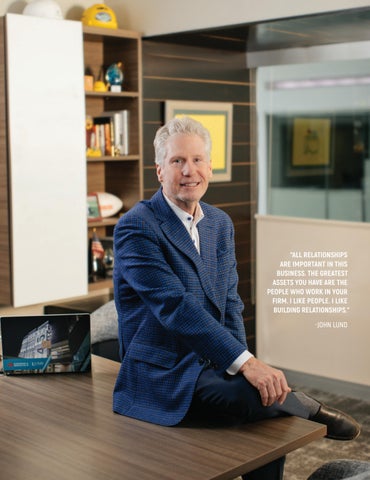
“ALL RELATIONSHIPS ARE IMPORTANT IN THIS BUSINESS. THE GREATEST ASSETS YOU HAVE ARE THE PEOPLE WHO WORK IN YOUR FIRM. I LIKE PEOPLE. I LIKE BUILDING RELATIONSHIPS.” -JOHN LUND
OMAHAMAGAZINE.COM OMAHAMAGAZINE.COM
27
JUNE
·
JULY | 27
FEATURE | STORY BY JEFF LACEY | PHOTO BY BILL SITZMANN
LESSONS LEARNED BY DOING
JOHN LUND’S FOUR DECADES IN REAL ESTATE DEVELOPMENT
W
hen John Lund started in the real estate business in 1981, he rented a small space in a strip mall on 90th and Center streets, near the VIP Lounge. He had virtually no inventory. The prime interest rate was 21%. His only staff member was a part-time receptionist. That startup has grown to become one of the highest profile real estate development companies in Omaha, and perhaps the Midwest. Lund’s organization has nearly 400 employees, manages over 8 million square feet of real estate, works in partnership with international development entities, and has over $1 billion in valued assets. Its portfolio includes Regency Shopping Center, the Landmark Center on 13th and Farnam streets, and Omaha’s PayPal building. Last year, Lund transitioned to chairman of Cushman & Wakefield/The Lund Co., with Jason Fisher installed as CEO and Tanya Shapiro as president. Lund, 71, remains engaged in the work. He said the key to longevity and success in the real estate development industry is the ability to build. He’s not referring to properties, but relationships. “That’s it,” Lund explained. “If not a hundred percent, [building relationships] is 99% of what we do. We’re client-based, and client-driven, and our relationships have sustained. When we get a business, we make sure we don’t lose that business.” Lund thinks relationship building isn’t just about the client. This philosophy carries over into the internal workings of the company. “All relationships are important in this business,” Lund said. “The greatest assets you have are the people who work in your firm. I like people. I like building relationships. I do my best to not disappoint.”
Another thing Lund cited as being key to his success is an ability to take calculated risks. “I somewhat like risk,” Lund explained. “I really like taking calculated chances. I am always looking at what we can do better.” Lund said he steadily studies trends, and thinks about real estate trends mostly in terms of categories of development. He not only examines local trends, but trends in every part of the country. “You can measure risk by knowing interest rates and locking them in, knowing construction costs, and knowing tenants. There are lots of factors to understand. I have made mistakes, but I always learn from them.” One calculated risk that paid off for Lund was entering a partnership with international developer Cushman & Wakefield, a global commercial real estate services firm. The opportunity to do so, however, was the result of a previous lesson learned. “Many years ago, I was offered a similar partnership,” Lund explained, “but we weren’t sure of the future of the firm. We were very local, and were focused on the projects at hand instead of the future.” Lund and his partners passed at the time, but he decided that if they ever got a chance to become associated with another international company, to take it. In 2012, Cushman & Wakefield/The Lund Co. was born. “We made the deal in about 10 minutes,” Lund said. The deal wasn’t a matter of being acquired; it was an alliance, and allowed his company to be independently owned, keep the brand, and be connected to incoming business on a greater scale. Lund takes personal pride in the properties his firm develops. Take, for example, the 450 Regency Parkway Building. When Lund’s firm acquired it, it
sat vacant. Today, it is fully renovated and tenanted, and it is the corporate headquarters of Cushman & Wakefield/The Lund Co. The building was also awarded the development of the year at the 2012 Real Estate Summit. Growing decade after decade takes not only an acute business sense, but a good motor as well. “I think the thing about John is that he’s always had amazing energy,” Fisher explained. “His type of energy always leads to positive interactions and outcomes. Watching and being a part of all those positive things as they build year after year is awesome.” Lund is still excited about the future of his home city, Omaha. “What’s going on in this city is something I’ve never seen,” Lund explained. He is particularly keen on the rebirth of the urban corridor downtown, citing long-term projects like the development of the Blackstone District as a model of what kind of potential could be unlocked in the area. “I had never been a heavy ‘yes’ or ‘no’ about [a streetcar], but other cities have proven that it creates development and connectivity,” Lund explained. Lund sees a streetcar project as producing a form of transportation, as well as a foundation for creating cultural and economic connection in Omaha. Without a doubt, John Lund has made an impact on the face of Omaha. “I like doing things that people recognize,” Lund said. “And I like seeing things work.” Visit lundco.com for more information. B2B
“I CAN SEE THE MISSING MIDDLE ARCHITECTURE ON HOUSING CONTINUE TO EVOLVE. WE’VE SEEN SOME NICE AFFORDABLE OPTIONS FOR ATTACHED HOUSING UNITS THAT CAN PROVIDE THREE BEDROOMS, A TWO-CAR GARAGE AND A NICE PRIVATE DECK OR PATIO—ALL IN THE SAME PRIVATE SPACE.” -JEFF LaMONTAGNE
OMAHAMAGAZINE.COM
29
JUNE
·
JULY | 29
FEATURE | STORY BY SCOTT STEWART | PHOTO BY BILL SITZMANN
FORGING AHEAD
DISRUPTION PROMPTS INNOVATION AS A&E FIRMS SEE GROWTH
S
omething didn’t sit right with Nancy Pridal when she was asked whether her industry is trying to do more with less.
“I wouldn’t characterize it that way,” said Pridal, president and CEO of Lamp Rynearson. “We’re learning how to work differently.” The pandemic was a push for the architectural and engineering industry to explore new ways of working together, even when meetings required physical separation. “Some of those lessons we learned during the pandemic are really benefiting us now,” Pridal said. “We can maximize the efforts that we’re making.” Those innovations are helping firms address the labor shortage in the industry, supply chain disruptions, and the potential for another spike in coronavirus hospitalizations—which create uncertainty in project prices and timelines that would have been unacceptable before COVID-19. Jeff LaMontagne, a project engineer for E & A Consulting Group, said the prices for plastic and ductile iron pipe—integral to finishing many projects—have skyrocketed. “We have seen price increases on these materials jump over 20% in one year,” he said. High prices don’t come with a guarantee of availability, LaMontagne said.
“We have been seeing more and more schedule delays due to the availability of plastic pipe, reinforced concrete pipe, and manholes,” he said. “Probably one of the most significant issues that we hear is still yet to peak is concrete mix for paving roads, parking lots, sidewalks, and trails.” Garage doors have even been in short supply, keeping homes from being finished, Pridal said. “We live in a different world than we did a couple years ago,” Pridal said. “Supply chain disruptions have become a way of life in our industry.” Fortunately, clients are generally more understanding and will work through disruptions when communication is timely and straightforward, she said. The irrevocably changed world also means that clients’ priorities are shifting. “As an example, land availability, labor shortages, limited materials, and difficult access to entrylevel housing have sparked a renewed interest in housing affordability,” Pridal said. Lamp Rynearson is working with Habitat for Humanity of Omaha to build 88 single-family homes at the former site of the Wintergreen Apartments near 51st Street and Sorensen Parkway. Pridal said the firm is helping the nonprofit with platting and planning a subdivision.
“They’re actually developing a community,” Pridal said. “We’re also working with some clients who are doing affordable housing apartment complexes.” LaMontagne said there’s a need in the community for “missing middle” housing options, such as apartments or row homes with two or three bedrooms, aimed at families who cannot afford the higher market prices for single-family homes. “I can see the missing middle architecture on housing continue to evolve,” LaMontagne said. “We’ve seen some nice affordable options for attached housing units that can provide three bedrooms, a two-car garage and a nice private deck or patio—all in the same private space.” A lot also happens behind-the-scenes. Pridal said her firm is building the conversation around affordable housing with clients, such as discussing the City of Omaha’s housing plan. Hoppe Development is building more than 400 units in a neighborhood with a mix of rented and owned housing to address Fremont’s workforce needs, leveraging a sanitary and improvement district with grant funding through national housing programs. Pridal said her firm worked with them on creative ways to add density to the project. CONT. PAGE 30
30 | B2B MAGAZINE
·
2022
VOLUME 22
·
ISSUE 3
FROM PAGE 29 “In creating that increased density, it’s also looking at what does open space look like, what do amenities look like,” she said, stressing the importance of connecting a community with assets in the community, whether that’s jobs, public transportation, or other resources. “We have some developers who are really thinking about that.” 2022 Winner
The goal of those projects is helping people thrive and build wealth, not just building upper-scale apartments that are a relatively safe financial bet for the developer. The result can be built spaces that promote equity in infrastructure. “There was a point in design where neighborhoods weren’t connected with through streets,” Pridal said. “That doesn’t really build the community, and that doesn’t build equity in neighborhoods.” Lamp Rynearson is using the Envision rating system to look at the social sustainability of projects in a similar way that LEED system rates energy and environmental sustainability. Among Envision’s criteria for long-term quality of life is wayfinding—the ability for people to navigate through the built space. Pridal said that could include putting up multilingual signs, instead of assuming what’s always been done before would work for future residents. “If you’ve ever been on a campus and you’re completely lost, and you don’t know where to go, and there’s no way to figure it out, if you have any kind of handicap or language barrier, then that just makes it even more difficult,” Pridal said. Intentionally considering how people will use a space can help promote equity, and it can also help avoid pitfalls for a project, as can the use of technology to help clients better understand their projects. LaMontagne said E & A Consulting recently adopted software to provide 3D renderings of developments early in the design phase.
OMAHAMAGAZINE.COM
“The end product is a short video fly-through of the development, similar to what a drone would provide, if, in fact, the development was already completed,” he said. “This gives clients a chance to review how their residential and commercial lots are graded in 3D without needing to understand grading contours on a 2D plan sheet.”
JUNE
·
JULY | 31
Managing risk.
Building relationships to last.
Scanning technology also helps map sites that might otherwise be dangerous or hard to access, which is why Lamp Rynearson has invested in scanning equipment, Pridal said. “Hand-hand and stationary sensors are our most versatile equipment to produce 3D point clouds that can be used to create 3D representations of the scanned environment,” she said. Avoiding pitfalls also helps control costs, which is critical as inflation is expected to continue to climb, energy prices remain high, and supply chains complicate pricing. Despite those hurdles, Pridal said the future is bright for the architectural and engineering industry.
Thank you for voting us Best Insurance Agency!
Commercial Insurance . Employee Benefits . Farm and Crop Insurance . Personal Insurance 402.861.7000 | fnicgroup.com
The Infrastructure Investments and Jobs Act, for one, provided the largest increase in federal funding in more than six decades. “Forecasts for industry growth remain strong,” Pridal said. “Overall, even with headwinds in this recovery period following the COVID-19 recession, 2022 is expected to have a solid economic outlook.” Visit lamprynearson.com or eacg.com for more information. B2B
2022 Winner
Empowered to make a difference As our landscape continues to change, the ability to respond quickly, creatively and compassionately is essential. At Lockton, our people are empowered to make a difference for our clients, for each other and for our communities. We celebrate our Associates for embodying the independence, creativity and entrepreneurial spirit of Lockton. IT’S OUR PEOPLE WHO MAKE THE DIFFERENCE, and they are the reason Lockton is a Best Place to Work. 13710 FNB Parkway, Suite 400 | Omaha, NE 68154 | 402.970.6100 lockton.com | © 2022 Lockton Companies. All rights reserved.
32 | B2B MAGAZINE
·
2022
VOLUME 22
OMAHA CVB BY DEBORAH WARD
BIG MOVES
W
S
As we look back on 2021, recovery had some twists and turns. The anticipated vaccine rollout with its two-dose regiment had a sequel booster shot. The COVID-19 variants brought new questions: Do we meet? Do we mask? Do we cancel? Do we travel? Health protocols, staff shortages, and increased costs are stilling challenging profitability. However, local tourism had successes as well. The number of meetings and events in Omaha increased 61%, bringing more than $138 million in visitor spending to our community. Visit Omaha secured $96 million in new convention and event business for future years, and online interest in visiting Omaha increased 54%.
With those successes behind us, we look toward a new year with a strategic focus. Our 2022 roadmap includes: hosting focus groups with national meeting planners to better understand their needs in a postpandemic world; utilizing innovative technology to track where out-oftown visitors go in the city and where they are traveling from; creating campaigns to invite meeting planners to Omaha for customized site visits; adding Chicago to the cities we target with advertising; and identifying new target markets by feeding Omaha advertising to audiences who have visited similar cities. If the last two years have taught us anything (and trust us, plenty of lessons were learned) it is that our local tourism industry has an unwavering commitment to our community, and incredible fortitude is overcoming obstacles. B2B
ISSUE 3
GREATER OMAHA CHAMBER BY DAVID BROWN
TOURISM’S 2021 SUCCESSES AND 2022 PLAN e are half way through 2022, and there are more and more signs of recovery in our local tourism industry. Hotel revenues are projected to exceed 2019 levels, our sales team is traveling again—selling Omaha as a destination for future conventions and events—and we are expanding our advertising efforts to reach an even larger audience with the message that Omaha is worth visiting.
·
ince early in 2018, the Chamber’s Urban Core Committee has been diligently working on a master plan for the central part of our city. The boundaries of the urban core are roughly the west end of Council Bluffs east to Saddle Creek Road, Cuming Street on the north and Leavenworth Street on the south. We hired consultants to look at housing, retail opportunities, organizational issues, and transportation needs. The city completed a parking study to complement our work. We also looked at each of the 29 development plans that had been completed for areas within the urban core over the past 20 years and found those projects that still had merit. Finally, we combined all of the relevant information into a master plan that identified some big moves that will help to transform the core and be key instigators of development. I hope you have all seen the Urban Core Master Plan (if not, you can find it on the chamber website at omahachamber.org/urban-core). The short version is that we want to create a denser urban space that is attractive to residents and businesses alike. This dense space will be able to compete for people and investments that exist in other cities and have proven to be attractive to talent and businesses we want to keep and attract. The overall goals are easy to remember: 30,000 residents and 30,000 jobs over the next 20 years.
Deborah Ward is the executive director
David Brown is president and
of Omaha Convention and Visitors Bureau.
CEO of the Greater Omaha Chamber.
Primarily, we will accomplish these goals by creating spaces for development where today we find underutilized infrastructure; providing new transportation infrastructure to move people around the core more efficiently using mass transit; marketing the area for new jobs and talent; and complementing the existing mix of housing options with plans for housing that meet both the income and diverse typology that the market is demanding. We will connect the core to North and South Omaha as well as Council Bluffs and west Omaha. We will build up. We will work with the city to revamp the regulations that deal with parking and street access. Infrastructure projects like the Omaha Street Car are already underway and the market has already responded with announced investments at the head of the Riverfront Park and along the Farnam Street boundary of the park. This is a dramatic vision for the core of our city with room for all developers and investors to make their marks. It is a place that will welcome visitors and residents alike. And it is a vision that will bring jobs back to the core of the city with a transportation network that will make those jobs accessible to everyone. It is an incredible time to be in Omaha. I invite you all to jump in and help make this vision a reality. B2B
The biggest tournament of the Korn Ferry Tour regular season returns to Omaha as the top players battle to secure their PGA TOUR cards for the 2022–2023 season. Don’t miss it!
Learn more at thepinnaclebankchampionship.com
AUGUST 8–14, 2022 | THE CLUB AT INDIAN CREEK | PIN-4154_B2BMagazineAd_v2.indd 1
4/29/22 12:44 PM
PUBLICATION: B2B Magazine SIZE: 7.625” x 4.917” BLEED: None COLOR: 4-Color
A L W A Y S L O C A L, A L W A Y S B E A U T I F U L. Included with an Omaha Magazine Subscription— OmahaMagazine.com/pages/subscribe
Imagine collaboration tools that make working together work better
With collaboration tools from Cox Business, your team can connect and work together from virtually anywhere using Webex or Microsoft Teams, all with 24/7 end-user support.
Seamlessly schedule conference calls and video meetings Easily share files during calls and meetings Instantly chat with internal and external contacts
Call (402) 934-3223 or Visit coxbusiness.com/collaboration Not all services available everywhere. Learn more at coxbusiness.com/collaboration. © 2022 Cox Communications, Inc. All rights reserved.
PAD108446-0002