O J AI M AG A Z I N E | SPRING 2026
He has guided students at New York University, UCLA, CalArts, and beyond, with many now performing in major film and television roles. He describes his work as a bridge between stage, screen, opera, and education, with credits including ABC’s Dancing with the Stars, Center Theatre Group, and Los Angeles Opera, but the accolades and accomplishments don’t mean much to him now. “My philosophy of all that is … it doesn’t particularly matter, because this is where I am right now,” he said. “I’ve had many incarnations. The work I’m doing is really where I belong, because I happen to be filled with faith that, in a very small way, things that happen under the clowning space are necessary, radical, beautiful, and regenerative.”
David launched The Clown School in 2009 with Orlando Pabotoy, and today leads the workshops and classes, occasionally bringing in guest teachers. The school’s mission is “to bring creativity, authenticity, and beauty into the world through the study of clowning and the physical theater arts,” based on the belief that “clowning embraces and celebrates the totality of human experience and offers unparalleled freedom in art.” CHILD’S PLAY “One critical element of clowning I’ve discovered over the years is you’re recovering a younger version of yourself; you’re working backwards,” David said. “There are lots of different terms people utilize to get to the heart of this thing, and I never use ‘inner child.’ I prefer ‘the playful self’ or ‘the unconditioned self.’ We all have our own versions of what conditioning means.” David’s first teacher, Phillipe Gaulier, a world-renowned French master clown, introduced him to clowning in his early 20s and changed his life. “Gaulier was
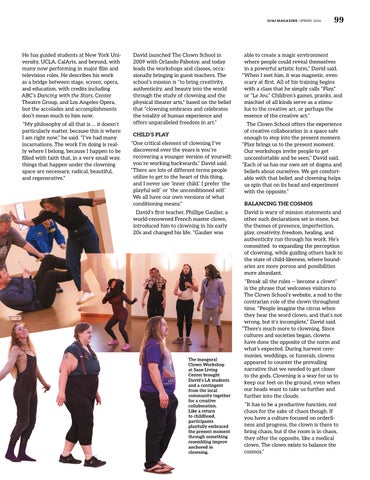
The inaugural Clown Workshop at Sane Living Center brought David’s LA students and a contingent from the local community together for a creative collaboration. Like a return to childhood, participants playfully embraced the present moment through something resembling improv anchored in clowning.
99
able to create a magic environment where people could reveal themselves in a powerful artistic form,” David said. “When I met him, it was magnetic, even scary at first. All of his training begins with a class that he simply calls “Play,” or “Le Jeu.” Children’s games, pranks, and mischief of all kinds serve as a stimulus to the creative act, or perhaps the essence of the creative act.” The Clown School offers the experience of creative collaboration in a space safe enough to step into the present moment. “Play brings us to the present moment. Our workshops invite people to get uncomfortable and be seen,” David said. “Each of us has our own set of dogma and beliefs about ourselves. We get comfortable with that belief, and clowning helps us spin that on its head and experiment with the opposite.” BALANCING THE COSMOS David is wary of mission statements and other such declarations set in stone, but the themes of presence, imperfection, play, creativity, freedom, healing, and authenticity run through his work. He’s committed to expanding the perception of clowning, while guiding others back to the state of child-likeness, where boundaries are more porous and possibilities more abundant. “Break all the rules — become a clown” is the phrase that welcomes visitors to The Clown School’s website, a nod to the contrarian role of the clown throughout time. “People imagine the circus when they hear the word clown, and that’s not wrong, but it’s incomplete,” David said. “There’s much more to clowning. Since cultures and societies began, clowns have done the opposite of the norm and what’s expected. During harvest ceremonies, weddings, or funerals, clowns appeared to counter the prevailing narrative that we needed to get closer to the gods. Clowning is a way for us to keep our feet on the ground, even when our heads want to take us further and further into the clouds. “It has to be a productive function, not chaos for the sake of chaos though. If you have a culture focused on orderliness and progress, the clown is there to bring chaos, but if the room is in chaos, they offer the opposite, like a medical clown. The clown exists to balance the cosmos.”