SPRING 2023 PUBLISHED SINCE 1982 BY OJAI VALLEY NEWS MAGAZINE OJAI • VENTURA • SANTABARBARA • WESTLAKE • MALIBU • SANTA MONICA • LA the Night Heron takes flight PLUS: ON SACRED GROUND / TESORO MIO RADICCHIO / LISA MARIE PRESLEY IN HAPPY VALLEY OJAI’S GET IT DONE TRAIL CREW / THE OJAI TENNIS CHAMPIONS / PHOTOGRAPHING OUR LAND
COMING SOON
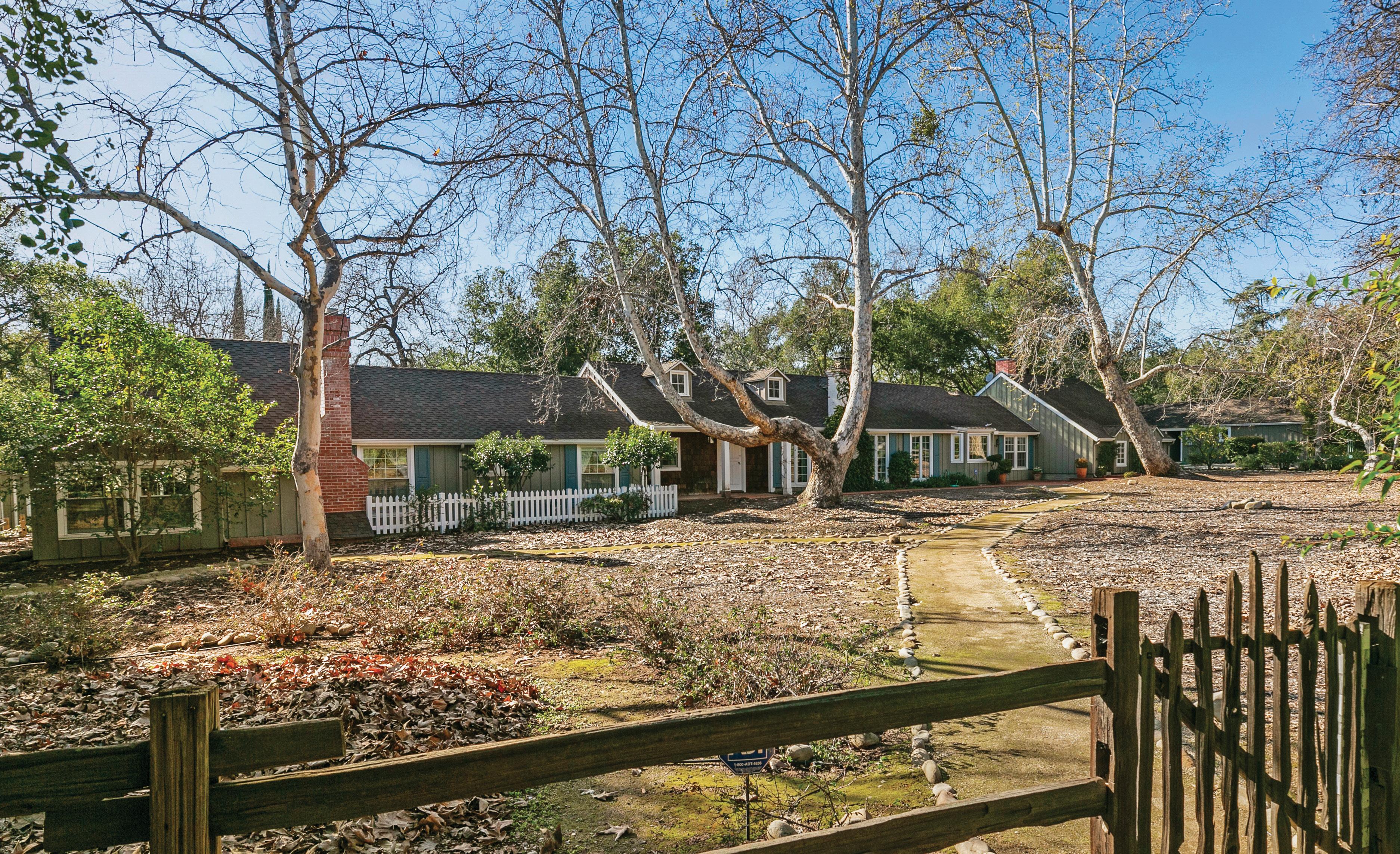
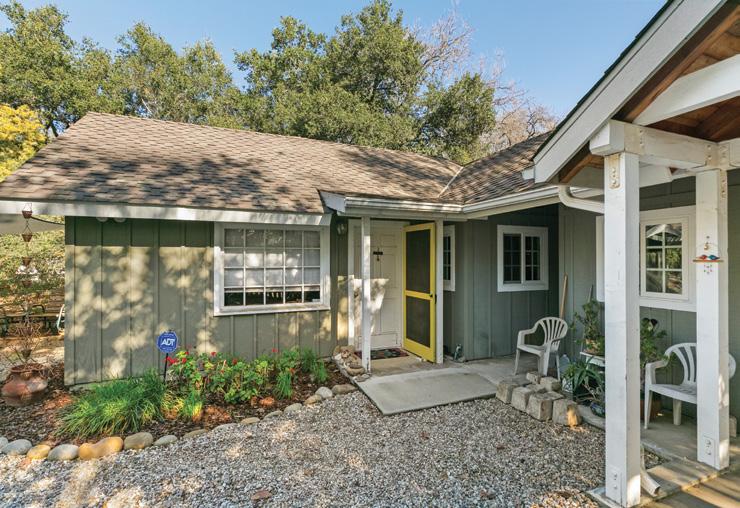
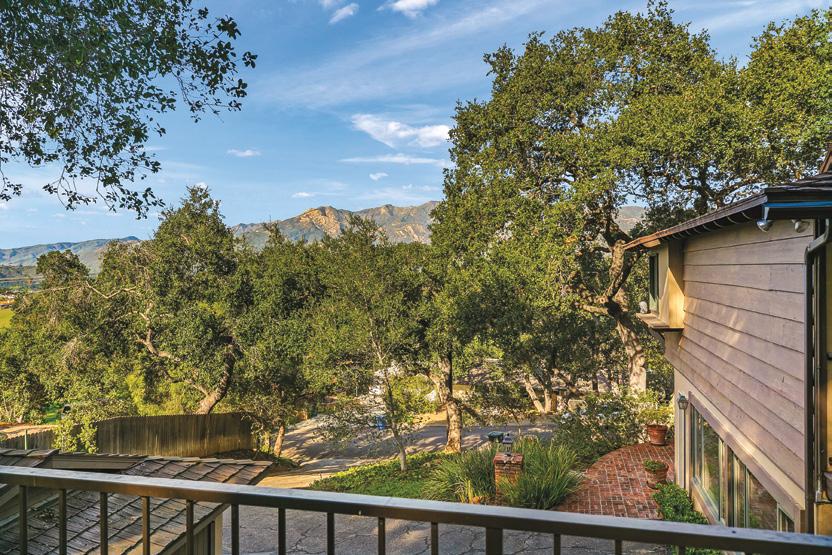
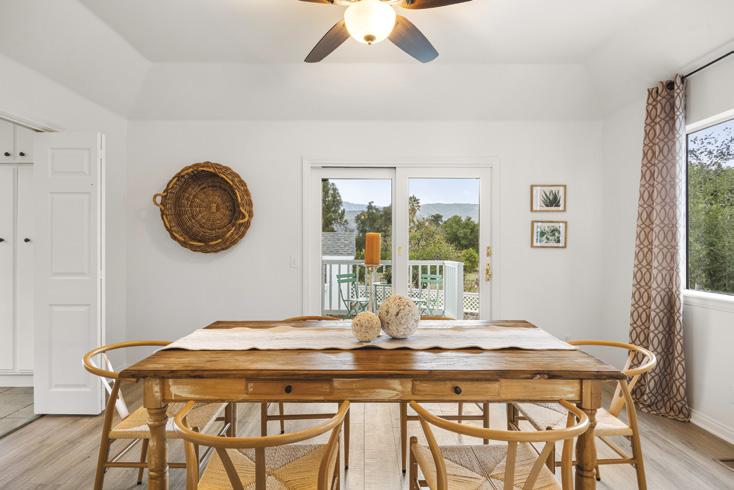
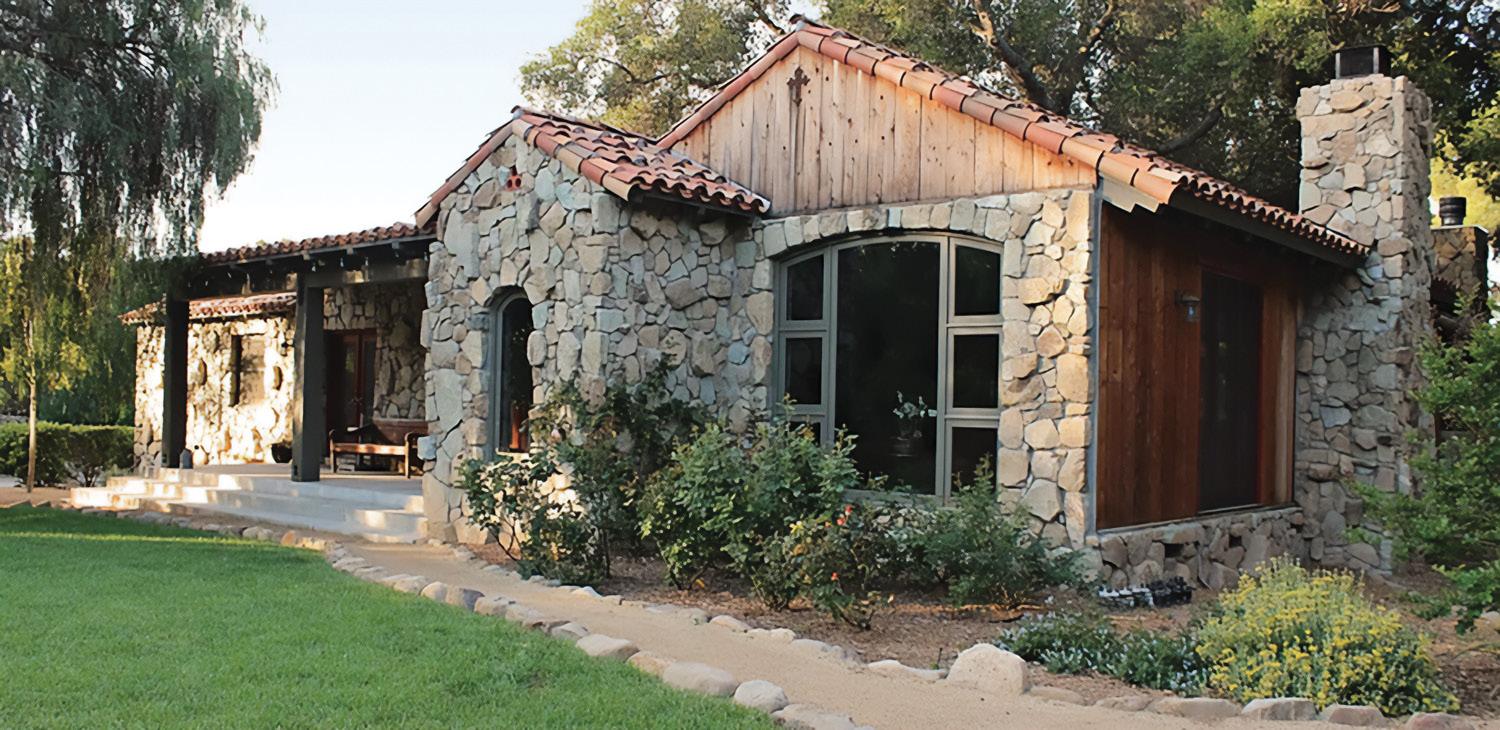
On a premier corner location in the heart of the coveted Arbolada, magnificent sycamore trees frame what might just be the most charming home in the neighborhood! With enviable “curb-appeal”, nearly every room of this approx 3835 sq ft home is bathed in beautiful natural light thanks to it’s unique linear floor plan that includes 3 bedrooms, 2.5 baths, large formal living rm, family rm with 2nd fireplace as well as an inviting ‘eat-in’ kitchen. Warm wood floors, beamed ceilings & whimsical “Dutch doors” add rich character inside, while extensive wood decking expands the living space to the outdoors. Citrus and other mature trees add a lush feel and lend privacy to the darling 1 bedroom cottage with bath, kitchenette, private yard and parking completing the package of this whimsical and playful Arbolada Farmhouse on just under an acre.

$2,449,000

www.MFWrealestate.com • mfwrealtors@gmail.com • 805.669.9933
Storybook Arbolada Farmhouse









3 OJAI MAGAZINE | SPRING 2023
DRE 00878649 | DRE 01708004 | DRE 01414001
205 PIRIE ROAD Immaculate Hitching Post condo with 2 patios. Sold for $815,000
227 S. MONTGOMERY STREET Los Arboles Townhome in the Heart of Downtown. Sold for $1,420,000
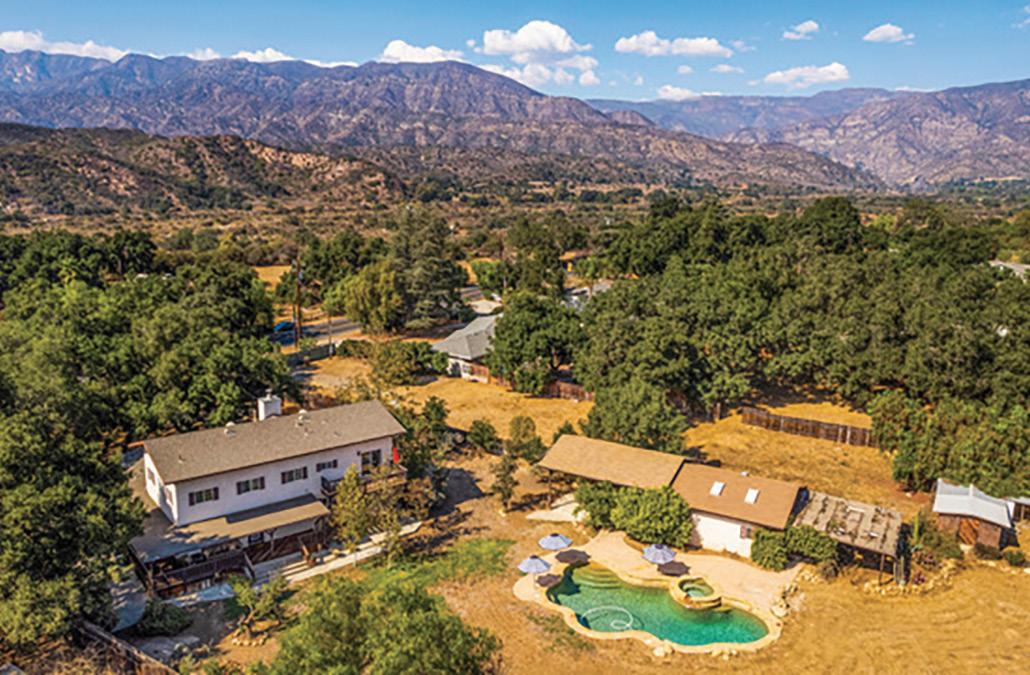
624 S. RICE ROAD 5 Bdrm, Farmhouse with pool & guest quarters on 1.5 acres. Sold for $1,830,00
1157 WOODLAND AVENUE 2 bedroom bungalow featured in Sunset Magazine Sold for $890,000
413 W. MATILIJA STREET Turn-key cottage, just blocks to town. Sold for $1,450,000
509 PALOMAR ROAD Arbolada Mid-Century with pool on 1.5 acres. Sold for $2,080,000
120 ALTO DRIVE Updated 3 Bdrm VIEW home! Sold for $1,250,000
865 COLINA VISTA
New Build custom Ventura hillside home. Sold for $1,800,000
1725 MARISOL DRIVE Fabulous Ventura View home! Sold for $2,215,000
THE MONTGOMERY HOUSE | ESTABLISHED IN 1874
310 E. Matilija Street | Iconic & beloved Historic Victorian | Third oldest building in Downtown Ojai | $3,800,000
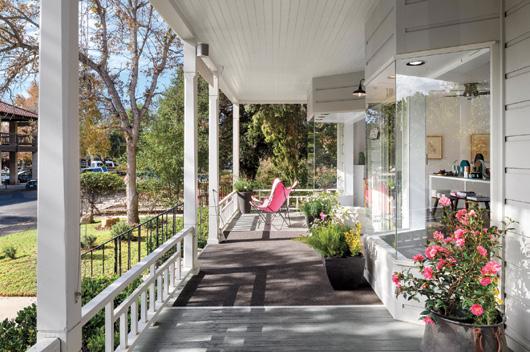

Established in 1874 with its sunny, romantic wrap-around porch & large windows overlooking downtown Ojai, home to the famous Porch Gallery, unique as both a historic residence & eclectic Gallery space! A classic Victorian, the third oldest building in town, was built by Ojai Pioneer John Montgomery. The high-profile community space & residence is zoned VMU & designed as a live/work space. Its living quarters feature a 2/Br unit on the ground floor & another 2/Br occupying the first and second floors. Carefully renovated, it enhances the property’s history & original architecture; the rich contrast of deep wood accents, wainscoting, & high ceilings serve as an ideal canvas for vintage nooks, built-ins, & warm, bright gathering spaces. Brimming with opportunity, ready for the next steward to carry on its storied legacy - SEE YOU ON THE PORCH!
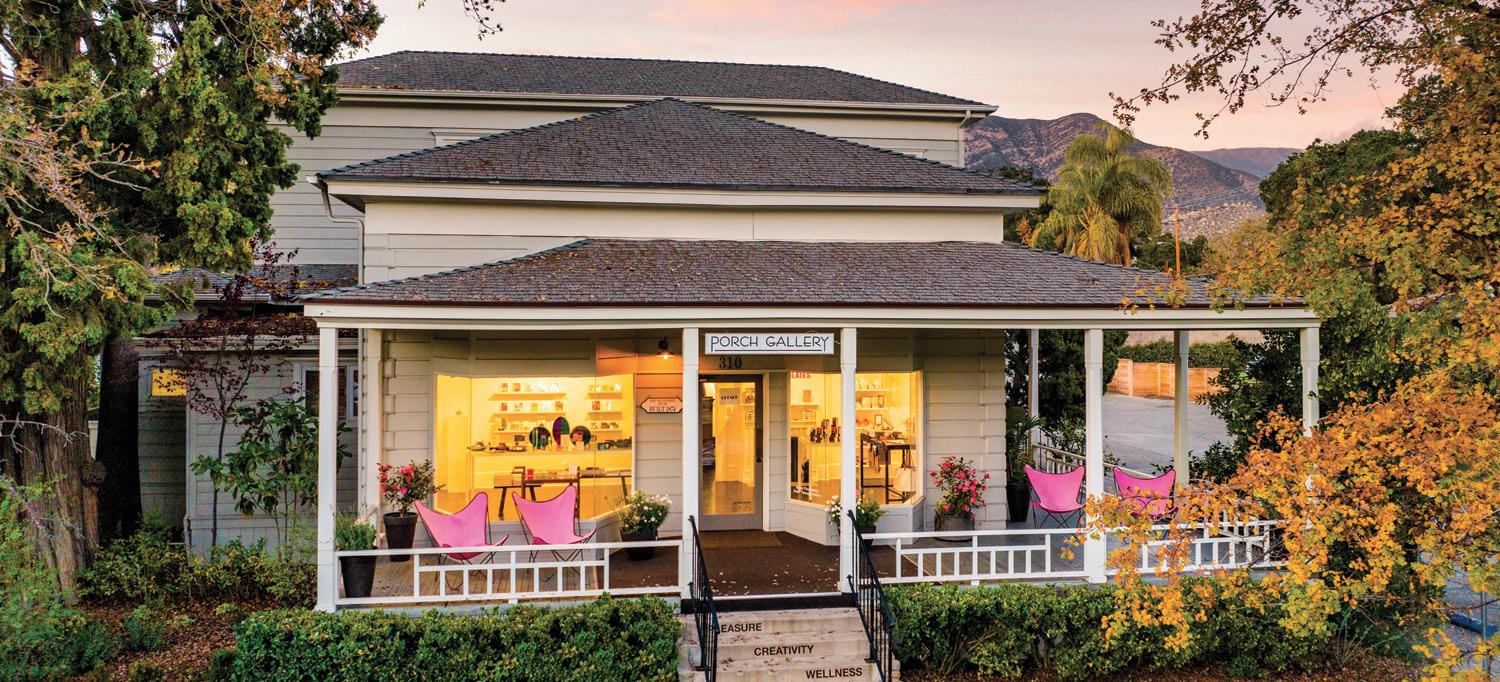
Life is better at the Beach! This delightful Pierpont Beach Bungalow, located only 7 homes away from the beach, will capture your heart and imagination! Featuring an open floor plan, this just under 1000 sqft, cozy 2BR, 1BA move-in ready bungalow with an inviting backyard is conveniently located at Marina Beach Park with its famous sand dunes and surfing. Exquisite dining and Ventura Harbor are right around the corner! Unmatched lifestyle in one of the last remaining affordable Beach cities in California. Blissful Beach Living at its best!

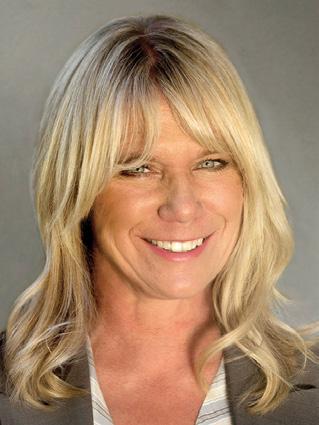
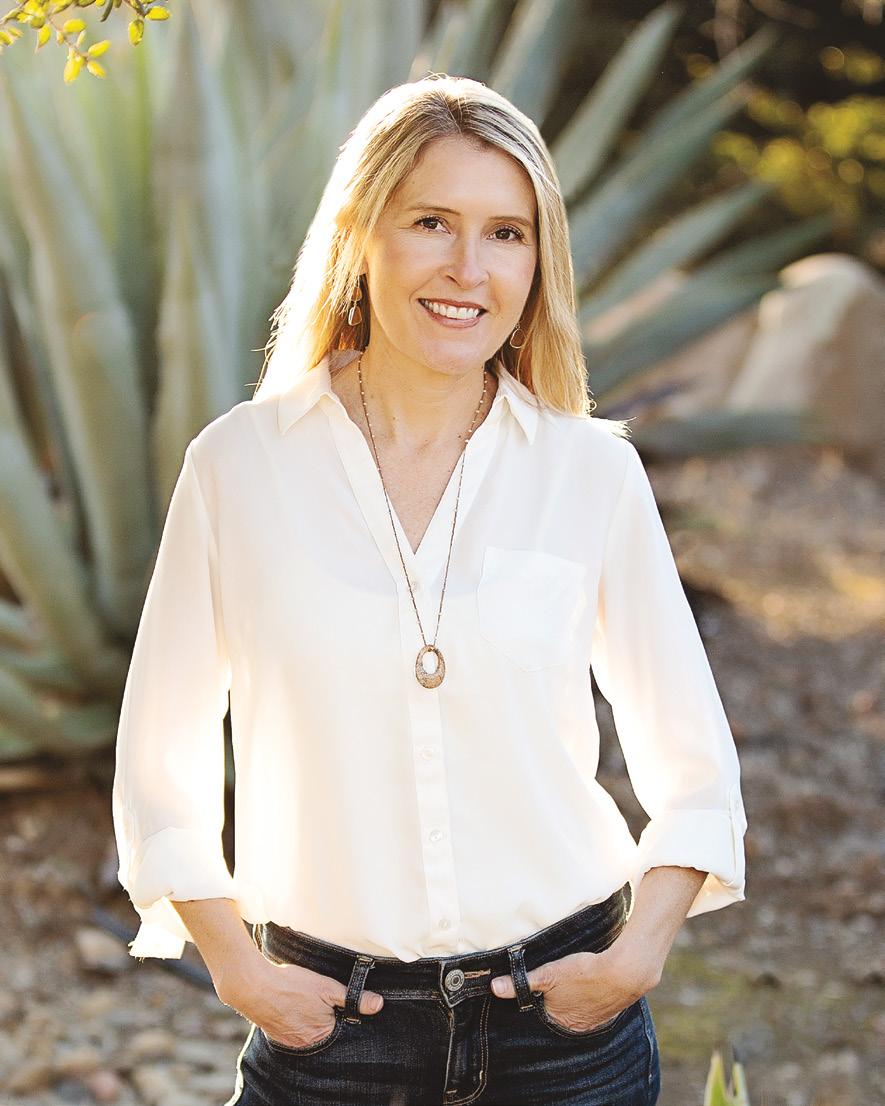
GABRIELA CESEÑA
REALTOR | Luxury Specialist Berkshire Hathaway


Unwavering commitment to my clients’ satisfaction
Driven by passion for the work I do

5 OJAI MAGAZINE | SPRING 2023
1175 Cornwall Lane, Ventura | Pierpont Beach Bungalow | 2 bed, 1 bath | $1,295,000
1 INDIVIDUAL AGENT IN PRODUCTION
VALLEY, VENTURA COUNTY
CA DRE #01983530 NO.
OJAI
ROYAL OAKS RANCH
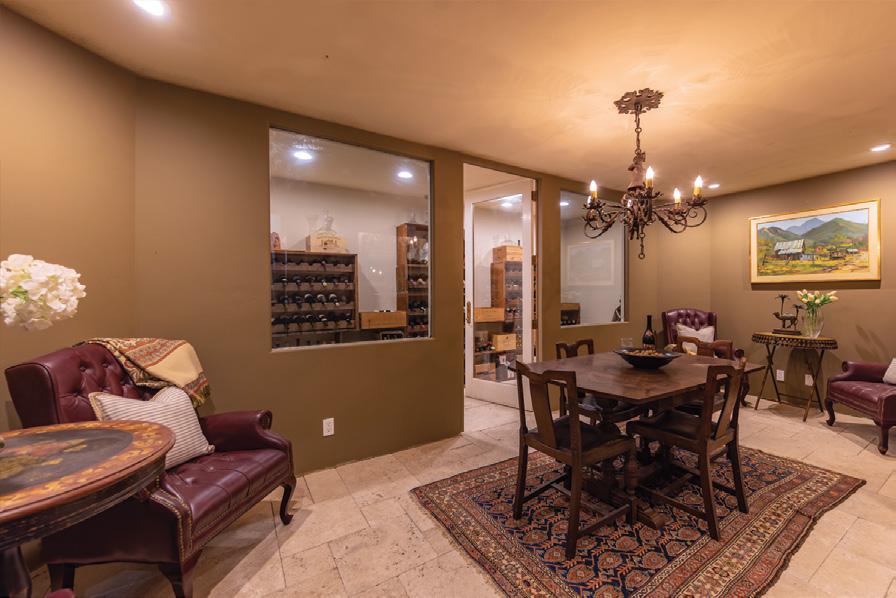
5 gated, private acres close to downtown with wrap-around porch, 5 bedrooms, media room, wine cellar with tasting room, library, gym/massage room, 4 fireplaces, pool and spa, sauna, family orchard, olive tree orchard with approximately 30 trees, Bocce court, putting green, volleyball court, chessboard, gazebos, pasture, private well, 150-year copper roof, copper gutters, RV parking with hookups, six-car garage and workshop, and more.
Price Upon Request | RoyalOaksRanchOjai.com


6 OJAI MAGAZINE | SPRING 2023
knowledge and experience you can
Integrity,
trust
ROCA VISTA RANCH


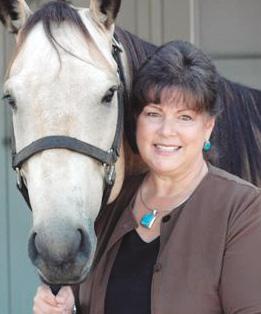
Enjoy resort-style living at this luxurious, private, 10-acre estate in Upper Ojai boasting gated entries, seven-bedroom main house with two guest wings and three fireplaces, pool house, swimming pool with beach entrance and wading pool, spa, gym, artist’s loft, lighted tennis court, horse facilities, outdoor kitchen with pizza oven, patio fireplace, family orchard, three-car garage + two-car garage, and spectacular mountain views.
Price Upon Request | RocaVistaRanchOjai.com

7 OJAI MAGAZINE | SPRING 2023 THE DAVIS GROUP Nora Davis 805.207.6177 nora@ojaivalleyestates.com www.ojaivalleyestates.com 727 Ojai Avenue, Ojai CA 93023 DRE 01046067 Integrity, knowledge and experience you can trust
1458 Foothill Road


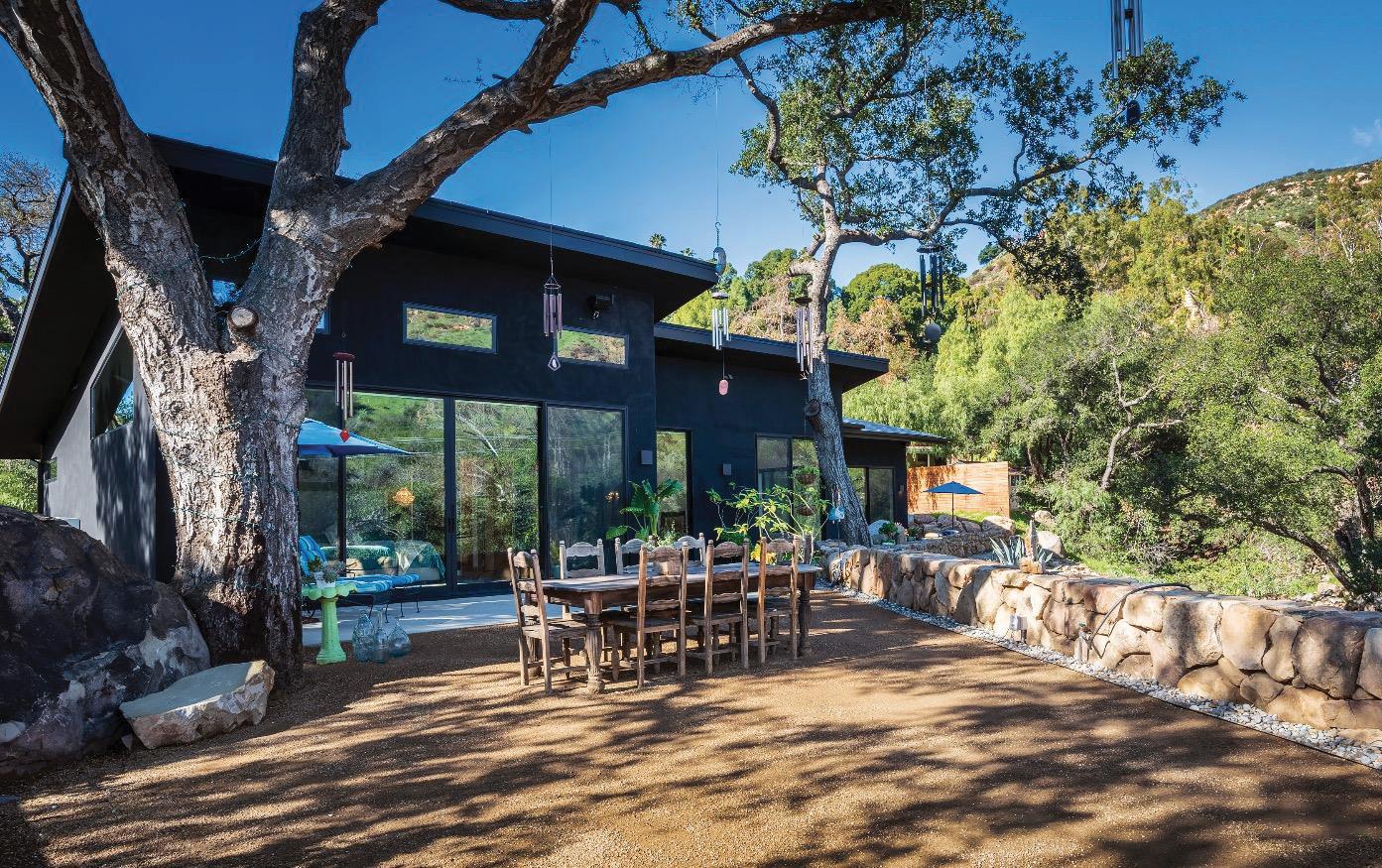
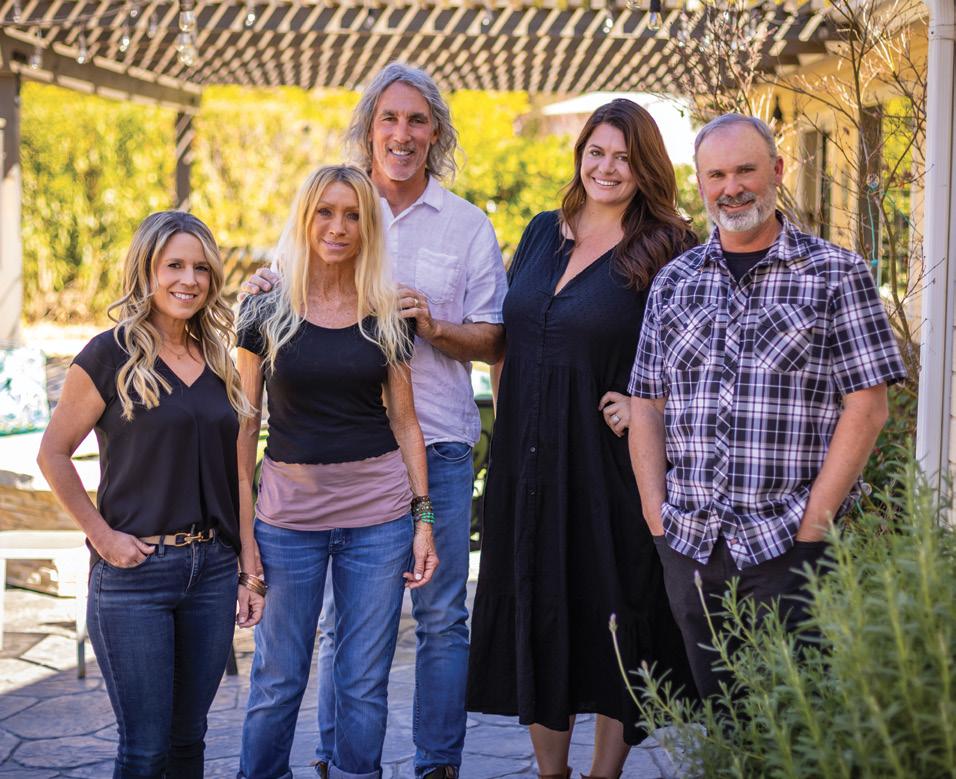
Tucked behind a private gate, nestled amongst oaks on charming Foothill Road is this 2022 single-story Modern/Contemporary new build with 3 beds, 3 1/2 bath, and where no expense was spared. Upon entering you are greeted by an expansive room that invites you into nature with treetops and mountain views. The kitchen is equipped with Wolfe and Sub-Zero appliances, limestone/sandstone countertops, Rift sawn oak cabinetry, fire clay sink, & Newport fixtures. You will enjoy the white oak, marble & limestone flooring throughout. The open concept seamlessly leads from the kitchen to the living-room with massive slider, surround sound, and 10’ Acu-Craft gas fireplace. Other features include a Tesla roof that integrates solar in the shingles, black out shades in the bedrooms and glass garage door. A must see property … $4,679,000 – L to R–

Genevieve Gould
DRE# 01932840
Kellye Lynn
DRE# 01962469
Dave Lynn
DRE# 01962468
Valerie Fasulo
DRE# 02028690
Geoff Wells
Sales, rentals and management

Ojaipropertygroup@gmail.com

Ojaipg.com
DRE# 01034017
8 OJAI MAGAZINE | SPRING 2023






14 OJAI MAGAZINE | SPRING 2023 EDITOR’S NOTE - 20 COVER STORY Night Heron Farm - 24 TRANSFORMATION Loveology Retreat - 32 ART & CULTURE Photographing Our Land - 40 Ojai City Art Tour - 116 Poem: I Met You in April - 129 EDUCATION Ojai to Afghanistan - 56 Krumpschmidt’s Family Adventure - 72 Lisa Marie Presley’s days in Happy Valley - 80 BIG ISSUES On Sacred Ground, the Movie - 62 OUTDOORS Spring Hikes - 50 The Ojai Tennis Champions - 86 Get it Done Trail Crew - 9 FOOD Tesoro Mio Radicchio - 92 EVENTS Ojai Earth Day - 108 Calendar - 113 GARDEN Tomatomania - 122 9 86 108 24 62 122 40 SPRING 2023 Volume 41 No.1 STAY CONNECTED Download the app ojaivalleynews.com

15 OJAI MAGAZINE | SPRING 2023
laurence stephen lowry paintings
february 16 – april 9
canvas and paper
311 n. montgomery street

thursday – sunday
noon – 5 pm
canvasandpaper.org
16 OJAI MAGAZINE | SPRING 2023

17 OJAI MAGAZINE | SPRING 2023

Barbara Bowman

Anthropologists have traced some form of adornment back to Neanderthal’s stringing together animal teeth and shells some 130,000 years ago. Jewelry is one of the oldest types of archaeological artifacts.
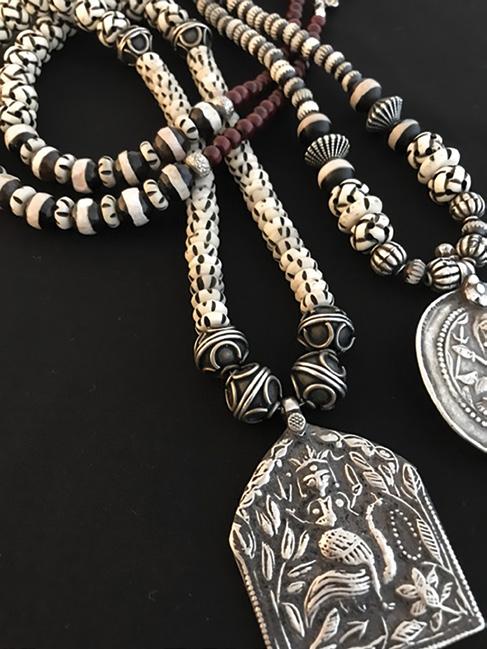
The Indus Valley Civilization, on the Indian subcontinent were, by 1500 BC, creating earrings, necklaces and bangles. Since both gold and silver are considered sacred metals in the Hindu belief, they are the quintessential metal of their jewelry making.
My husband, Sol de la Torre Bueno, an insatiable traveller, explored throughout India, finding remarkable sterling beads and medallions, which he collected for me. His many trips also took him to Tibet and Thailand, where he continued gathering unusual pieces to enhance my new found passion for making unique necklaces.
Once I had the deeply embossed designs of sterling medallions and beads, I chose to combine them with freshwater baroque pearls. The creamy white of the pearls sets o the silver, giving both a fresh look, that is anything but your grandmother’s string of refined dainty pearls.


I have experimented with wearing several necklaces together, even using that hand me down necklace of great sentimental value, with my modern version of “the pearl necklace.” You will find along with single strands of pearls, double strands and triple strands available in our store, the Barbara Bowman boutique. Each necklace is made as an expression of art, very much a statement of the wearers individuality.

Along with the baroque pearls, I continually experiment with using wood, bone, black onyx, shell, semi precious stones, very old coins, anything that piques my interest, like African trade beads. Since the necklaces represent a personal art form for me, they are continually evolving.
19 OJAI MAGAZINE | SPRING 2023
ADVERTISEMENT
Editor’s Note: Spring 2023
The drama of Ojai’s winter rains, which were in fact floods this year, is giving way to the most glorious spring we’ve seen in years. Nature takes center stage as we see Casitas Lake and the aquifers recharge; the regrowth, the green, and the river flow remind us of what matters.
If you live in Ojai, you are likely taking in the expansive views from your veranda, or peeking out through the foggy window of your van’s new 72-hour location. The townspeople — lately divided by dogma, wealth disparity, and opportunity — share the bond of this place. The land, the view, the quiet … the peace we nurture inside ourselves in the pink moment.
Recently, there has been lots of aesthetic-building in our hard and softscapes. And while three new Teslas moved into freshly renovated houses in my hood this year, I’m unconcerned about what you drive, or how carefully uncontrived your style is —as is the Ojai Valley custom. Nor do we care what you did before; from grifters to movie stars … in Ojai everyone gets the same chance to earn respect and value as a neighbor and citizen. To become real and realized, that is the Ojai life we are interested in.
This Spring issue digs into the earth (cover story, Night Heron Farms); how we respect it (On Sacred Ground); how we explore our natural paths over it (Get it Done Trail Crew), and how we see it (Photographing our Land). We also take a look into our interactions: How we strive (The Ojai Tennis Tournament); how we love each other (Loveology Retreat), how we eat (Tesoro Mio Radicchio), and celebrate (Earth Day 2023).

We are lucky to live in, or have access to, an Ojai life. We at Ojai Magazine invite you beneath our cover, to connect you to our community through local stories. Bring an open heart. Sow, then share the blossom of your true self; listen to Spring inside our magnetic emerald Ojai Valley.
EDITOR / PUBLISHER
Laura Rearwin Ward
ASSISTANT EDITOR
Karen Lindell
ART DIRECTOR
Paul Stanton
WRITERS
Karen Lindell
Perry Van Houten
Gregg Stewart
Mimi Walker
Holly Roberts
David LaBelle
Ti any Paige
Catherine Miller

John Fonteyn
PRODUCTION SUPPORT
Georgia Schreiner, Tori Behar, Mimi Walker
ADVERTISING
Linda Snider, director of sales
Catherine Miller, account executive Ally Mills, advertising assistant
CONTACT team@ojaivalleynews.com advertising@ojaivalleynews.com www.ojaivalleynews.com/magazine @ojaimag
© 2023 Ojai Media LLC
MAGAZINE
SPRING 2023 MAGAZINE OJAI VENTURA SANTABARBARA WESTLAKE MALIBU SANTA MONICA LA the Night Heron takes flight PLUS: ON SACRED GROUND TESORO MIO RADICCHIO LISA MARIE PRESLEY IN HAPPY VALLEY
affection,
20 OJAI MAGAZINE | SPRING 2023
Cover photo: Night Heron Farm, by Renee Faia reneefaia.pb.photography
With
LAURA REARWIN WARD



805-646-4110 Tenpennyconstruction.com

THE NIGHT HERON TAKES FLIGHT
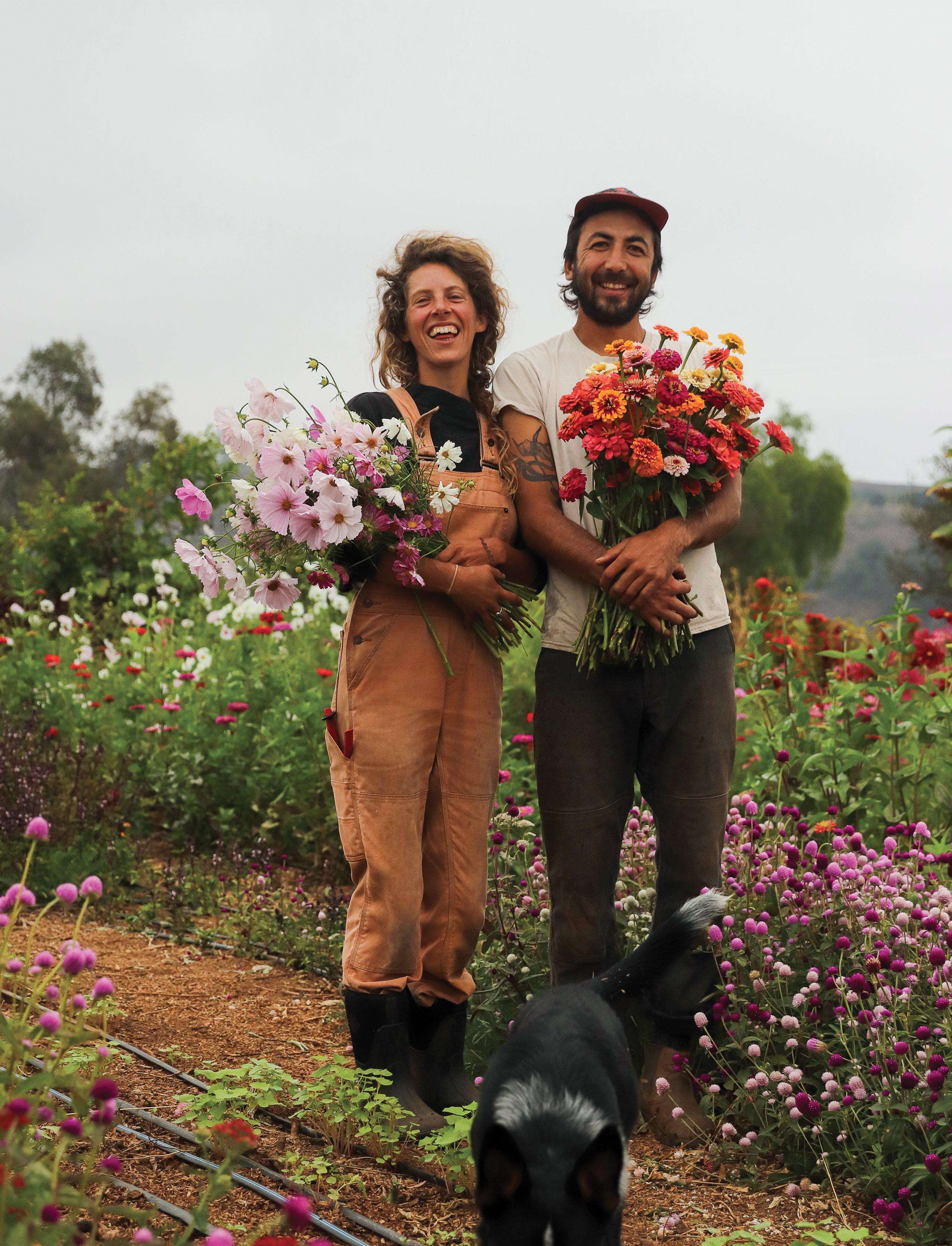
24 OJAI MAGAZINE | SPRING 2023
my wife often reminds me that flowers are visual food to nourish and enliven our living spaces. ojai farmers market regular night heron farm has been a saving grace any time she needs some visual nourishment around our home.
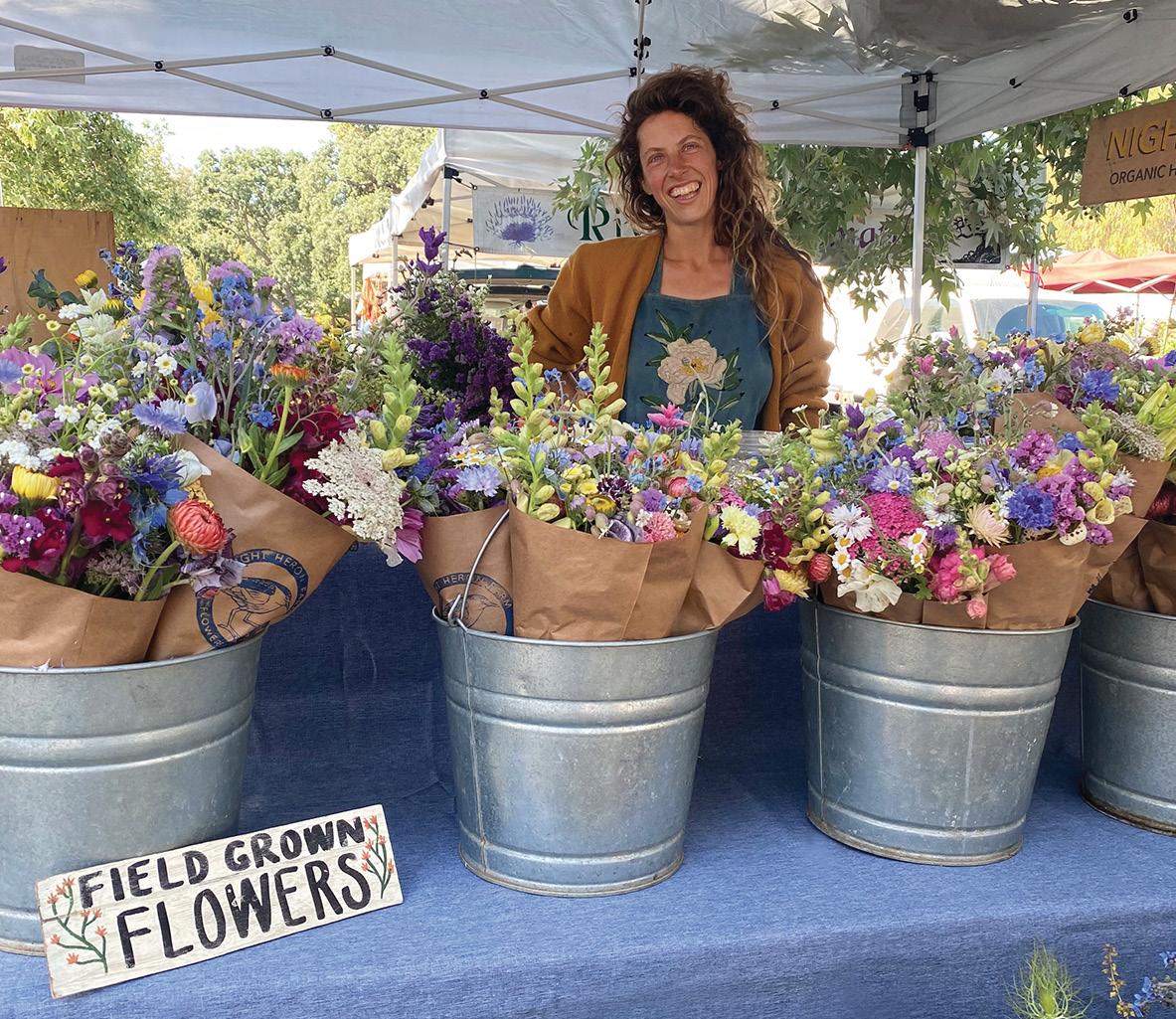
We recently visited with Alena Steen and Danny Shimoda of Night Heron Farm to talk about the over 220 varieties of flowers they grow and sell, and the impact the Ojai community has had on their dream of flower and medicinal herb farming.
Alena and Danny tell us they’ve always felt a close attachment to plants and animals and an attraction to the other-than-human world.
“I never realized I could have a job working with plants and animals until I worked on a farm,” Alena says. “The seasonality of the work appealed to me. Things are changing all the time here, and it’s not based on any human deadline. It’s just natural patterns that you get to be a part of. It’s such a privilege.” She adds, “We’ve had so many experiences of how alive the natural world is, and it’s reflective in how we grow, and how we interact with the flowers when we arrange them.”
I recall the first time my wife and I met Alena. We thought she looked like a wild fairy dropped into a human body. She laughs when I tell her this: “I definitely don’t feel fully human!”
Danny’s journey into farming began when he went to work on a friend’s family farm in a town of 10 in the Ozarks. He calls it a transformative experience. “I was recovering from a lot of city stress, working way too much, and paying o student loans,” he says. “With farming, I loved the whole process of connecting and grounding myself in time through planting and harvesting. The growing season is so helpful to understand how to relate to time.”
The couple met seven years ago at an apprenticeship on a medicinal farm in Oregon.
Seeing that the program lacked enough challenge for them, the two left early and headed for the Klamath River to help a close friend of Danny’s finish her season. Alena says it was the right call to go work with this badass single lady shipping medicinal plants in the mail. “She’s like a second mom,” Danny says.
At the season’s end, the couple traveled to Mendocino to live in a cob house in the middle of the redwoods. Their first business model was growing bulk herbs for the Sonoma County Herb Exchange. “It was kind of hilarious,” Danny recalls, “because we were growing medicinal herbs on a property where they were also growing weed. The amount of work we’d go through to farm, harvest, and dry a pound of anise-hyssop to get $30 at the Exchange, compared to what they made for a pound of weed — it was crazy. But we learned a ton.” The couple decided to begin making tinctures instead.
On a return trip from Baja, they met with a friend in Carpinteria who o ered them land to lease. The couple moved and began growing medicinal herbs, making tinctures, and selling herbal teas at the Ojai Farmers’ Markets. When the pandemic hit, on a whim, Alena asked, “Should we rent a second field and plant a bunch of flowers?
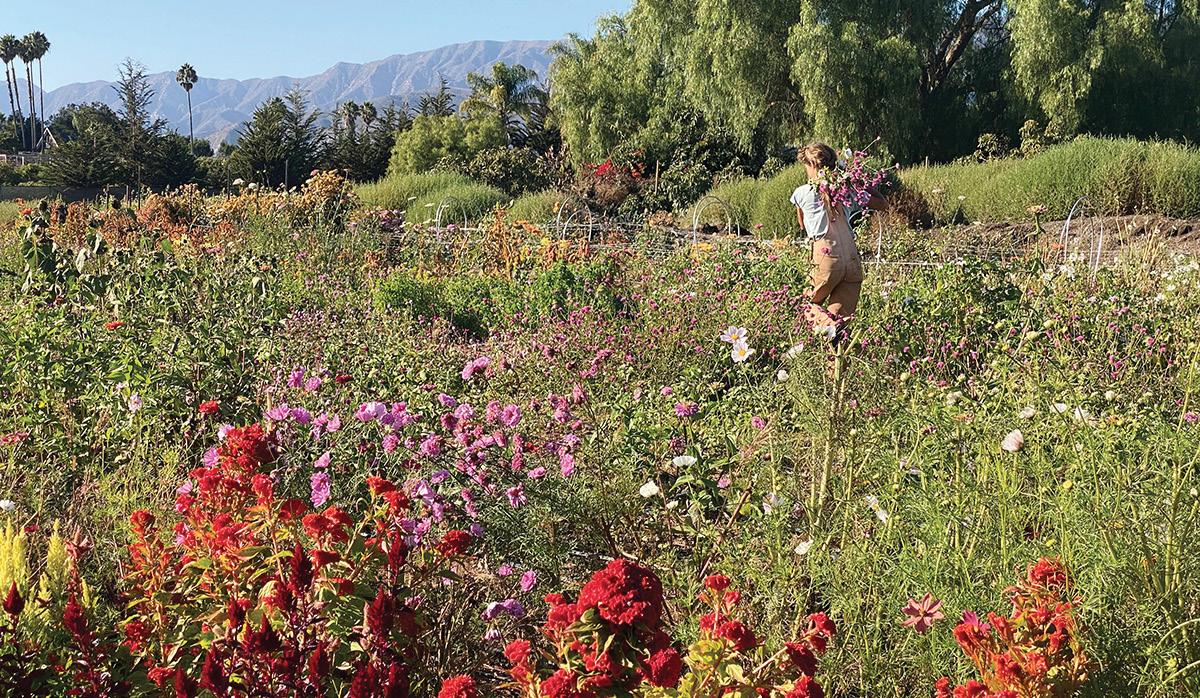
“It felt like something new we could do,” she says. “And flowers were great because you can grow a lot of volume in a small space if you plant well and are e cient.”
“You should see Alena’s crop plans,” Danny says. “With limited space, it’s like, plant 30 feet of this, and two days later, plant 40 feet of this.”
Alena laughs. “It’s not how my brain works, but we have a small space so we want to be as e cient as we can,” she says. “And it’s excellent for the soil to be staying covered and always growing something. That’s been part of our learning curve: succession planting, crop rotation, and transitioning to a no-tillage process, which was new for us.”
by GREGG STEWART photos RENEE FAIA
We’re fascinated by Night Heron Farm’s no-tillage approach. Every farm Alena and Danny had previously worked on involved mechanical disruption of the soil — a tractor or a walk-behind tiller. This process works, but over time, it can harm the living biology of the land. The couple says transitioning away from mechanical disruption was essential for Night Heron Farm to thrive.
25 OJAI MAGAZINE | SPRING 2023
“We think of it more as creating an environment where the infinite beneficial microorganisms are doing a lot of the work of building soil and feeding the plants. We’ve gotten out of their way. We do still add this beautiful compost we buy from a retired farmer who is now a composter in Santa Ynez, but we layer it on top of the soil and allow the plants and rainfall to bring it deeper and do the mixing for us,” Alena said.
The no-tillage process is an excellent example of the power of getting out of the way, being less heavy-handed to force a yield, and letting nature be nature. Honoring the health of the land — that’s the medicinal side of Alena and Danny’s work, asking, “what does the land need to be healthy?” and seeing the land give back.
“It definitely feels aligned with our ethos in terms of trying to
intervene as little as possible,” Alena says. “Being comfortable with wildness, even in a more cultivated space.”

“It was hard at first,” Danny admits. “We were both used to tilling and shaping nice, clean and perfect beds for planting. Now it’s more chaotic and not as aesthetic, but it’s so much healthier and alive. I couldn’t believe the di erence when we switched to growing this way.”
Night Heron Farm now grows 220 varietals, including cosmos, sweet peas, 15 kinds of zinnias, and over 20 types of heirloom anemones and ranunculi. Alena and Danny focus on o ering a greater variety, which is also healthier from a plant-disease perspective. Biodiversity attracts a broad range of pollinators and beneficial insects.
Alena and Danny tell us it takes a ton of research to find the right seeds because so many flowers are becoming rarer due to the global commercial flower industry wanting varietals that only boast long shelf lives.
The flower industry has changed a lot over the past few decades. If you’re buying flowers in a grocery store right now, they’re likely from South or Central America. These store-bought flowers are preferred solely because they can sit in a box in the mail for a week or longer. But what you gain in longevity costs you in color, texture, and scent — arguably, the most remarkable aspects of flowers.
In contrast, the varieties grown at Night Heron Farm are rare in commercial production. The many heirloom varieties are loaded with scent. The blooms may be more fragile and perishable, but they’re worth it because they’re extra-beautiful and extra-fragrant.
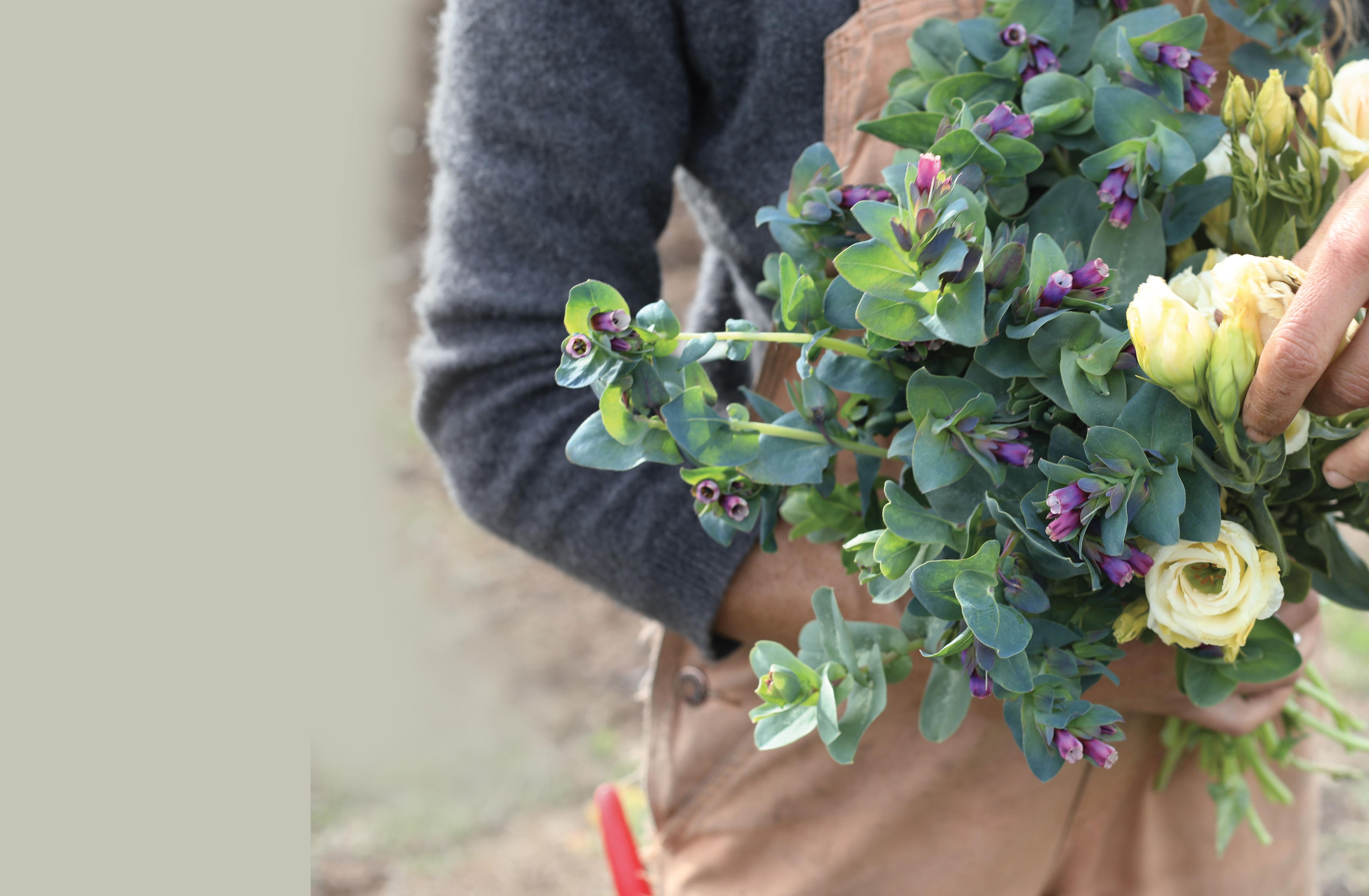
What dictates the flowers we see in grocery stores and even at local florists? What it costs us as far as varietals — we don’t even know what we’re losing. Many farms have ceased planting certain flowers because they don’t o er a profitable shelf life.
“We’re both attracted to unconventional shapes and structures, and wispy things and seedpods and things that you might not normally find in a bouquet,” Alena says. “Which I think comes from being comfortable with the chaos of a no-tillage field.”
It’s true. The bouquets they sell are, in a word, whimsical.
The night heron is an excellent moniker
26 OJAI MAGAZINE | SPRING 2023
for their farm because, as my wife points out, the bouquets look like they’re about to take flight. They’re kinetic. They have movement. That wild whimsy is what spoke to us when we first saw their stand at the Ojai Farmers’ Market. They strike a beautiful balance of texture, shape, and color.
“Growing up in the South, I spent a lot of time on the water canoeing and paddling, so night herons were always special to me,” Alena says. “They’re also here in the Ojai Valley, and along the Ventura River, and in Japan. It felt like a bird that tied us together with the places we’re from and where we are now. Also, they’re intriguing, elusive, and solitary creatures, which we can relate to.”
The greater Ojai Valley holds a special place in their hearts. “For me, one of the best parts of living here is access to the backcountry,” Alena says. “The first time we drove down the 33, I cried the whole time. It was so beautiful and magical. We feel fortunate to live in an area with such wild and incomparable beauty. I’m grateful to be connected to the land and to preserve our resources through farming.”
“I would agree with all that,” Danny says. “We also feel grateful every week for the Ojai community because now we have regulars that come every week, and it means so much to us. Neither of us imagined growing flowers, especially in this area considering the water issues. We’ve had mixed feelings, and it sometimes feels more appropriate to grow food when resources are limited. But, seeing how much joy these flowers bring to everyone at the Ojai markets has been validating.”
“Farming can sometimes be a solitary vocation, so we treasure the market community,” Alena says. “The vendors we’ve befriended and the customers that we feel so connected to, and who appreciate what we’re doing. It’s rewarding to be so supported and to provide such simple joys in a reciprocal way. Whenever we feel unsure about using such precious resources to grow something that some may consider ‘unessential,’ we recall the early weeks at the Sunday market. People would come to the stand with tears in their eyes. Thinking about it now makes me want to cry.”
“We’re proud of how this little idea has grown and impacted the community,” Danny says. “Also, it’s uncommon in this area to be farming on land that isn’t family land. We went out on a limb to be full-time on our own farm, and the only way it’s possible is due to the Ojai community being so supportive. It’s amazing the way these flowers have resonated. Both the flower and medicinal farms are a ordable right now, but when the leases end, it’ll be hard to figure it out. Ideally, we’d love to find two acres of sunny flat land as a long-term solution.”
Night Heron Farm sells at the Ojai Thursday and Sunday markets year-round, and o ers a flower CSA during the 10 busiest weeks of the growing season. Alena and Danny also do weddings and special events, which have grown exponentially this past year. “People are getting in touch for flowers for a year from now. It’s all thanks to the Farmers’ Markets and the Ojai community.”
For more information about their CSA program, ordering flowers for special events, and to shop for medicinal tinctures, visit www.nightheronfarm.org
27 OJAI MAGAZINE | SPRING 2023




www.bartsbooksojai.com WINNERS 10 YEARS IN A ROW! An Ojai tradition for over 50 years 302 W. Matilija Street (805)646-3755 10am-6pm daily 2022
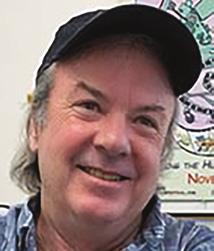
Dr. Ava Cadell is a worldrenowned love guru, relationship expert, author, therapist and lecturer.

Loveology Retreat
In fall 2022, on the site of a former Buddhist temple, Cadell opened the Loveology Retreat, an awe-inspiring 45-acre property in Maricopa, about an hour’s drive north of Ojai. “When I saw this magnificent place I realized that it was meant to be mine, so that I could share it with other people and help them heal or connect or just rejuvenate their mind, body and spirit,” she said.
For more than two decades, “Dr. Ava” has trained students to become certified love coaches — much like how Tony Robbins trains life coaches — through her online program Loveology University®. “I wanted to share all the information that I learned as a therapist specializing in love and human sexuality,” she said. The new retreat is a real-life, in-person extension of the online university, and it’s something she’s dreamed of opening for years. “This manifestation took a little longer than I expected,” said Dr. Ava, “but it happened and I am just so happy that I found this place, purely by chance.”
Left,
In late 2021, she phoned a pair of monks at the Pine Mountain Buddhist Temple Retreat, who for two decades had been teaching Zen meditation and Zen

 by PERRY VAN HOUTEN
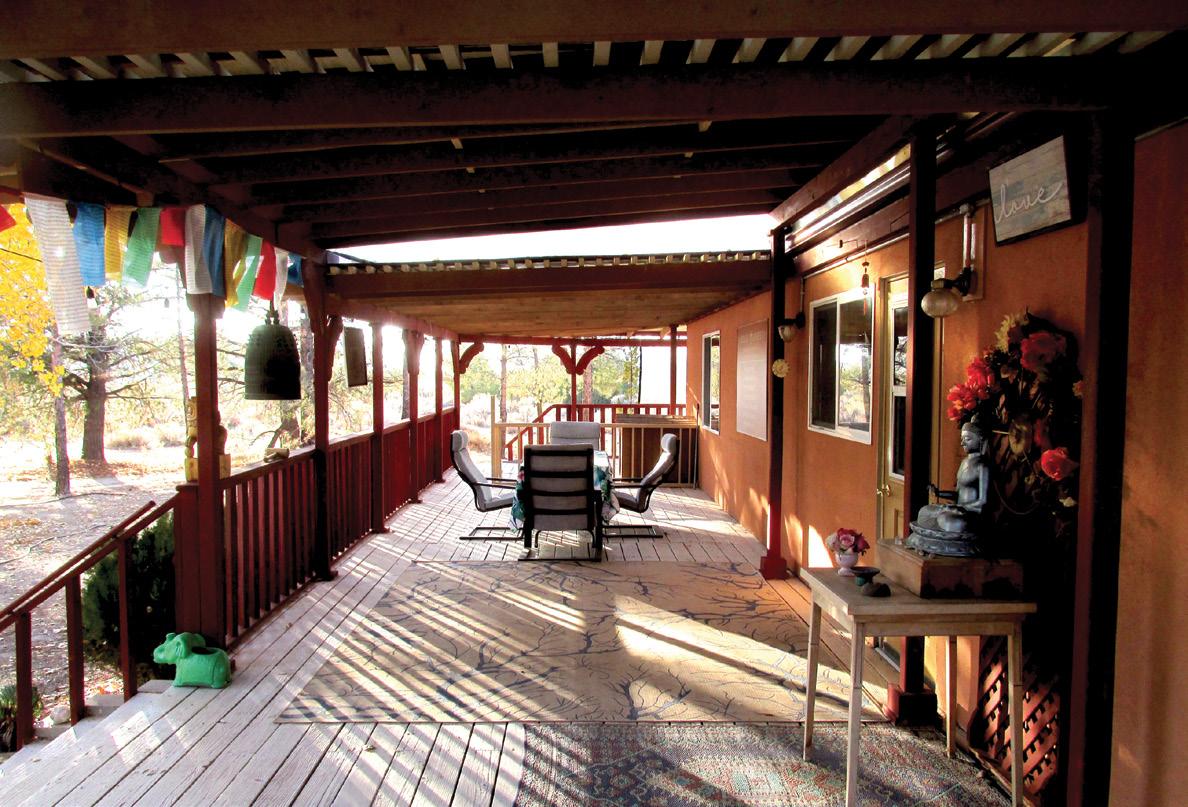
doing some meditation there. The property had just fallen out of escrow, so the monks, determined to sell the property, invited Dr. Ava for a visit. “They were sad to leave but they said they were also ready to leave,” she said. “They wanted to downsize.” She instantly fell in love with the desert landscape, the surrounding mountains, the trees, the wildflowers and the many Buddha
Among the goals of the Loveology Retreat is attracting positive energy. “People who want to escape from reality, where there’s stress, where there are distractions, where there’s too much work,” said Dr. Ava. “So they can come here and they can be one with nature. They can come for yoga, meditation, hiking, stargazing, healing and great food.”
Yoga — good for fitness, balance, strength and flexibility — can also boost intimacy when done by partners, according to Dr. Ava, who created the program “Sexycises by Sexperts: Yin Yang Yoga for Intimacy.” The retreat also o ers a restorative yoga program that teaches relaxation through
Nigerian dwarf goats could be the next addition at the Loveology Retreat.
“I’ve heard that they love yoga, so I’m planning on goat yoga,” said Dr.
In addition to yoga, nine forms of meditation she developed are o ered at the retreat.
Dr. Ava Cadell, who opened her Loveology Retreat last fall on the former site of the Pine Mountain Buddhist Temple Retreat. Also pictured is Marley, one of two cats who live there Right, one of dozens of Buddha statues scattered throughout the Loveology Retreat.
Photo by Perry Van Houten
33 OJAI MAGAZINE | SPRING 2023
The retreat’s cook is Dr. Ava’s partner, “Chef” Je Sundy. “He’s an amazing chef, so I’m so excited that we can do this project together,” she said.
You’re sure to work up an appetite hiking the Loveology Retreat’s three hiking trails, with horseback riding available upon request. There’s the Faith Trail, described by Dr. Ava as “flat for half a mile and then goes way up into the mountains,” and the Peaceful Trail, the easiest of the three that climbs into the mountains to a bench and an overlook with great views.
“And then there’s the Compassion Trail, which actually has no compassion because it’s quite di cult,” said Dr. Ava, who’s frequently joined on her hikes by Marley, one of two cats raised on the property that were gifts from the monks. “She looks back and she makes sure that I’m OK, so I’m convinced she’s a reincarnation of a monk.”
For an activity more competitive than hiking, there’s a disc golf course. Some of the baskets are hidden around the mountains and in the trees. “It’s not really for beginners,” said Dr. Ava. “I haven’t mastered it yet myself.”
The retreat o ers an outdoor swimming pool and the Fun House, with games for kids and adults, and movie nights.
For overnight stays, there’s the Chakra House that sleeps up to 10, and the Llama House, with a meditation room and accommodations for four guests. Or stay in one of four campers, named after flowers on the property such as poppy, bluebell, lily and lavender. “They’re fun and kids love them,” said Dr. Ava. The campers feature queen-sized beds, bunk beds, kitchens and bathrooms.

Buildings, signs and water tanks at the retreat were beautified by mural artist MB Hanrahan.
The pinnacle of the retreat is the 11-foothigh Stupa, a holy monument built by the monks. “As you walk around the Stupa, you can literally feel the enlightenment of every single Buddha as you walk by them,” said Dr. Ava, who encourages guests to find a mantra they can connect with—that makes their heart sing.
“Live to love and love to live” is the mantra at the Loveology Retreat.
“A mantra can be a goal, but you need to think of it as if it’s already happened,” she said. Such a mantra could be, “I am loved, unconditionally. Isn’t that something that every human being wants?” By the time you’ve walked around the Stupa three times, clockwise, “you are loved unconditionally, by yourself.”
The Stupa sits on a square base with the four sides representing north, south, east and west. A spire at the top symbolizes a line through the Earth’s center that the universe is thought to revolve around. “It’s a special place that I really want to share and have it as part of my legacy,” said Dr. Ava. Watch the sunrise, stargaze or meditate at the Stupa, or simply take in the view of 7,500-foot Pine Mountain. “It’s just superlative,” said Dr. Ava. “I’ve never seen anything more beautiful, ever in my life.”
You may be lucky enough to find a crystal while exploring the retreat, she added.
“Which is uncanny but magical.”
Born in Hungary and raised by nuns at an Austrian orphanage, Dr. Ava believes becoming a love guru was her destiny, but it all came out of adversity. “I had a lot of negative programming about love and intimacy,” she said. “And so consequently I had di cult relationships when I was young. When I hit rock bottom I decided I was going to make it my mission to find out everything I could about love and romance, relationships, intimacy and human sexuality.”
She earned two doctorates, one in human sexuality and another in human behavior. “Then I realized that I wanted to help people and share everything that I had learned,” said Dr. Ava, whose latest course is a seven-anda-half hour class on healing, “which I give away, because I think the world needs a lot of healing.” Along with being a love guru, she wants to become more of a healing guru.
34 OJAI MAGAZINE | SPRING 2023
Some of Dr. Ava’s clients say they feel broken, so she asks them what their goals are. “Most of the time it’s something very special. It’s forgiveness, compassion, finding the compassion to forgive themselves for allowing other people to abuse them. And sometimes it’s a couple who are going through a crisis, who did love each other at some point but have since grown apart,” she said.
Broken couples often hold lots of resentment, which builds up when they find it hard to say they’re sorry. “I often say, ‘do you want to be right, or do you want to be in love and enjoy your relationship, mentally, physically, spiritually, sexually, emotionally, all of that?’” Dr. Ava said. “I help them to fall back in love with each other and forgive each other and have deeper intimacy than they ever thought possible. It’s very, very fulfilling for me.”
What the Loveology Retreat o ers is not
actions speak louder than their words. A lot of people are extremely self-destructive,” Dr. Ava said.
The Loveology Retreat helps people avoid the obstacles and find their passion without su ering. “Why go through the pain if you don’t have to?” asked Dr. Ava. Opening the retreat helped her achieve something she was always looking for but never found — peace of mind.
Not everyone who visits the retreat comes for healing. Weddings, birthday parties, movie shoots and other events are all possibilities. “Any kind of celebration. We would be delighted to have them come here,” said Dr. Ava, who last year hosted an Easter egg hunt that she hopes will become an annual event. “You can come on your own and we’ll take good care of you.”
Even the drive from Ojai will put you in relaxation mode. “It’s a beautiful drive,” Dr. Ava said. “The scenery is phenomenal. You really feel like you’re on vacation.”
According to Dr. Ava, all humankind can benefit from a visit to the Loveology Retreat. “Just the energy when you get here is magical and it is rejuvenating,” she said. “You’ll come here to de-stress, and I think you’ll leave having learned something new about yourself.”
For information on accommodations and rates, visit www.loveologyretreatcom taught in schools. “They don’t teach us how to give love, how to receive love, how to overcome di cult emotions, so you can come here and learn all of that.” Plus there are workshops, “to help you with whatever is going on in your life,” said Dr. Ava.
Before guests arrive at the retreat they receive a questionnaire about their expectations. “I want to find out who they are, what it is they’re looking for,” said Dr. Ava. The questionnaire asks if they’ve been to other retreats; what they liked and didn’t like.
Some people have unrealistic expectations and say they want help, but really don’t. “Their
35 OJAI MAGAZINE | SPRING 2023
Left: The 11-foot-tall Stupa built on-site by monks so that all beings may attain enlightenment, according to Loveology Retreat founder Dr. Ava Cadell.
Photo courtesy Loveology Retreat
The front porch of Dr. Ava’s house at the Loveology Retreat, the Loveology House. Guest accommodations include the Lama House, the Chakra House and four state-of-the-art campers. Photo by Perry Van Houten
FOR LOVE AND PASSION EXCITING FINDS AT TRYSTOLOGY

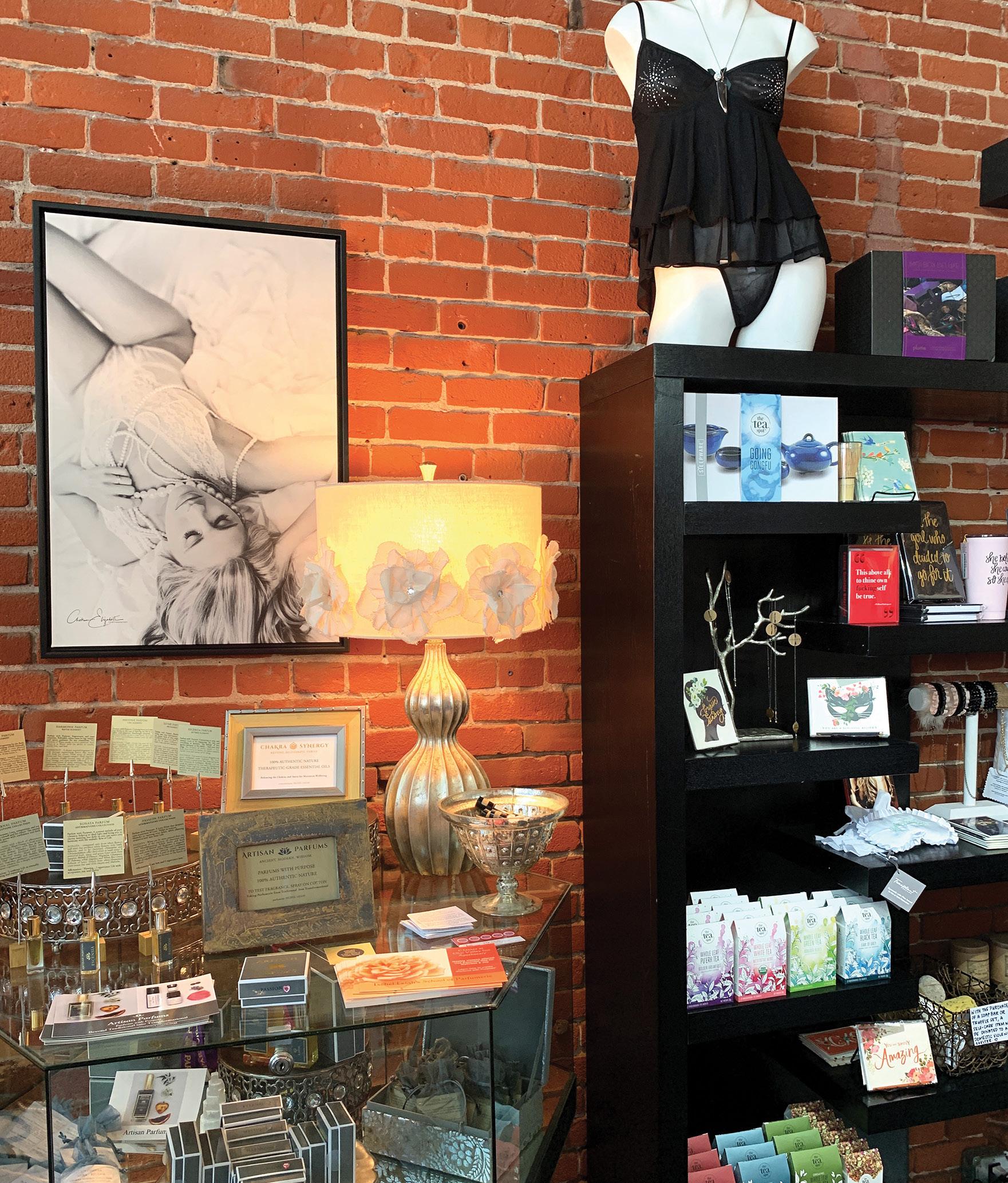

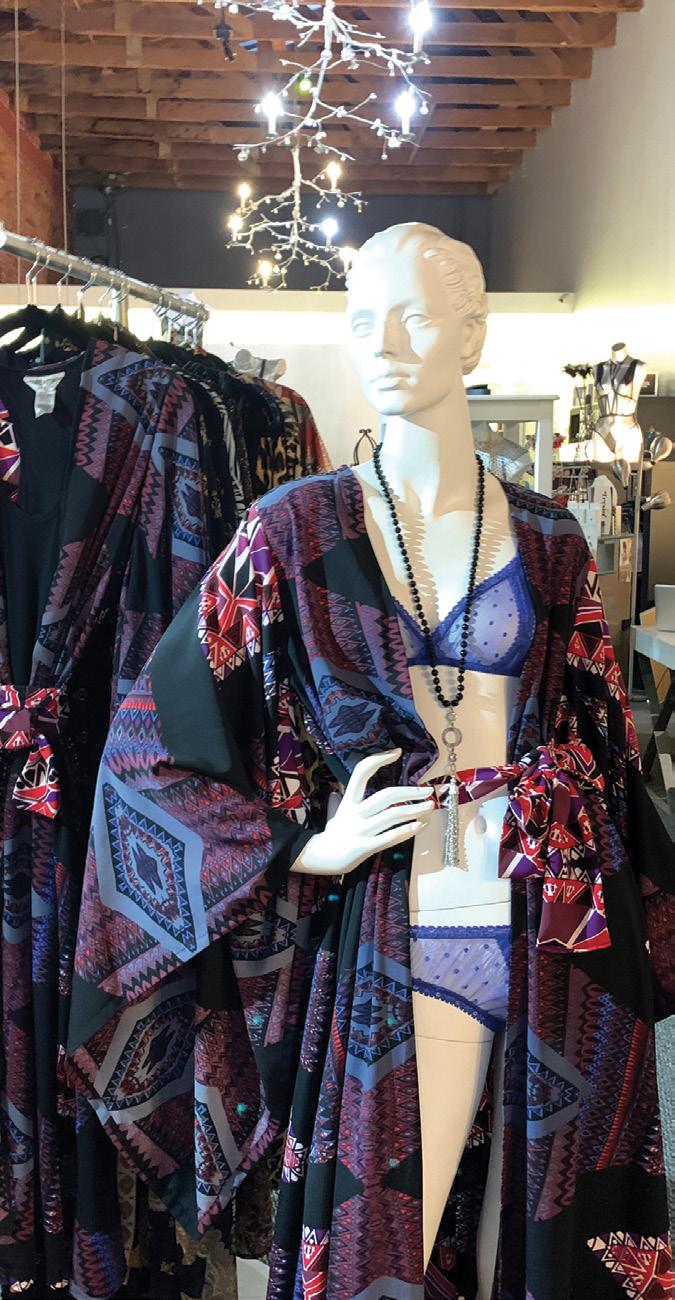

This high-end boutique on Main Street features contemporary, high-quality products for passionate play curated by owner Roylin Downs. Since opening in 2009, Trystology was named best boutique in 2022 by AVN magazine. Today, Trystology is recognized in the industry as a leader and innovator in the budding trend of female-friendly, couple-friendly, and discreet boutiques opening nationwide. From cozy pajamas and bath products to more adventurous finds, pop in and discover something new.


36 OJAI MAGAZINE | SPRING 2023 tryst | a meeting for lovers ology | the knowledge or science of a subject 588 E. Main Street, Ventura CA www.trystology.com 888-801-8952
@trystology AVN BEST BOUTIQUE IN THE NATION 2022



39 OJAI MAGAZINE | SPRING 2023
With the eyes of my heart
story and photos by DAVID LABELLE
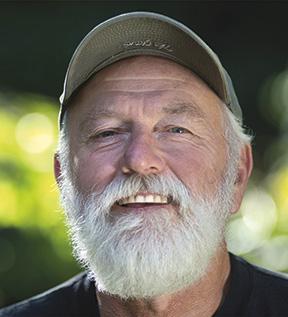
Most of us see what we want to see, whether it is a beautiful landscape or a beautiful person. We see past the flaws, the blemishes. We see with our hearts more than our eyes. Perhaps you have been downtown, maybe sitting by the Libbey Park fountain, when the afterglow of a setting sun softly washes across the face of the Topatopa mountains in what locals call “The Pink Moment.” Your eyes move quickly past the stucco arcade, the red tile roof, beyond treetops or dark wires, up to the magical mountainside landscape.
You are selective seeing, looking through view-blocking distractions to the object of your a ection. In other words, seeing with the eyes of your heart.
But photographing these stunning, light-washed scenes in today’s ever-cluttered world is not so easy.
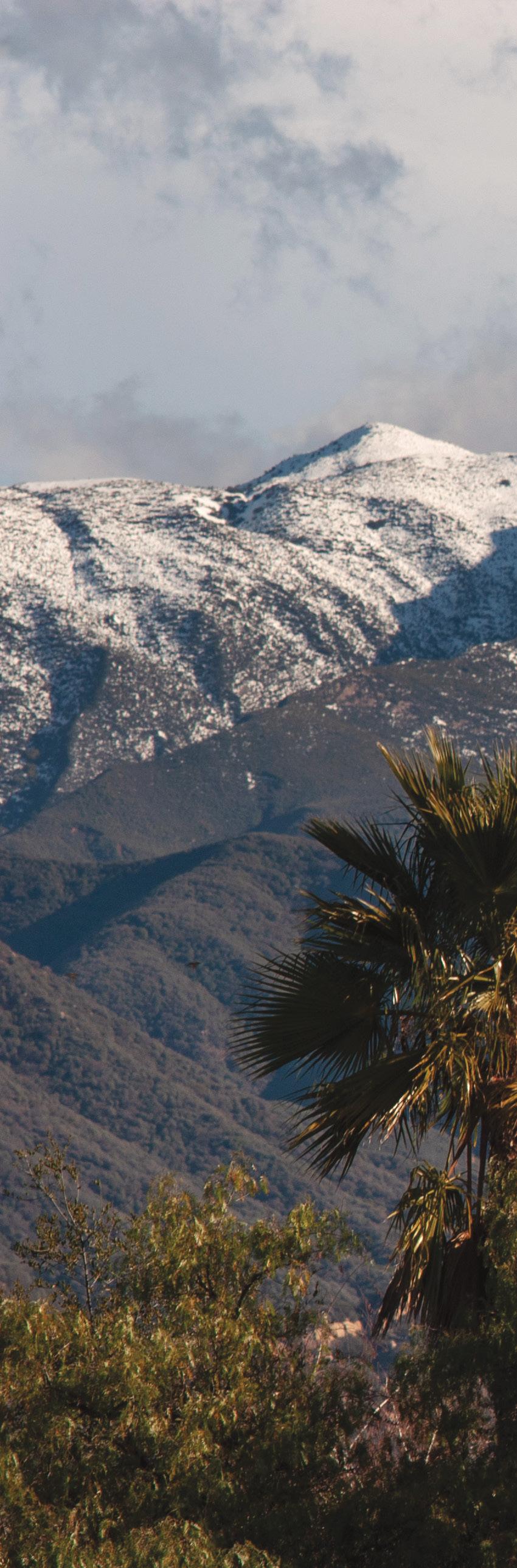
Void of emotion or sentimentality, the camera sees di erently from the human eye; the camera sees everything. It records whatever you point it at — mergers, ugly foregrounds, competing backgrounds, utility poles, and other visual noises.
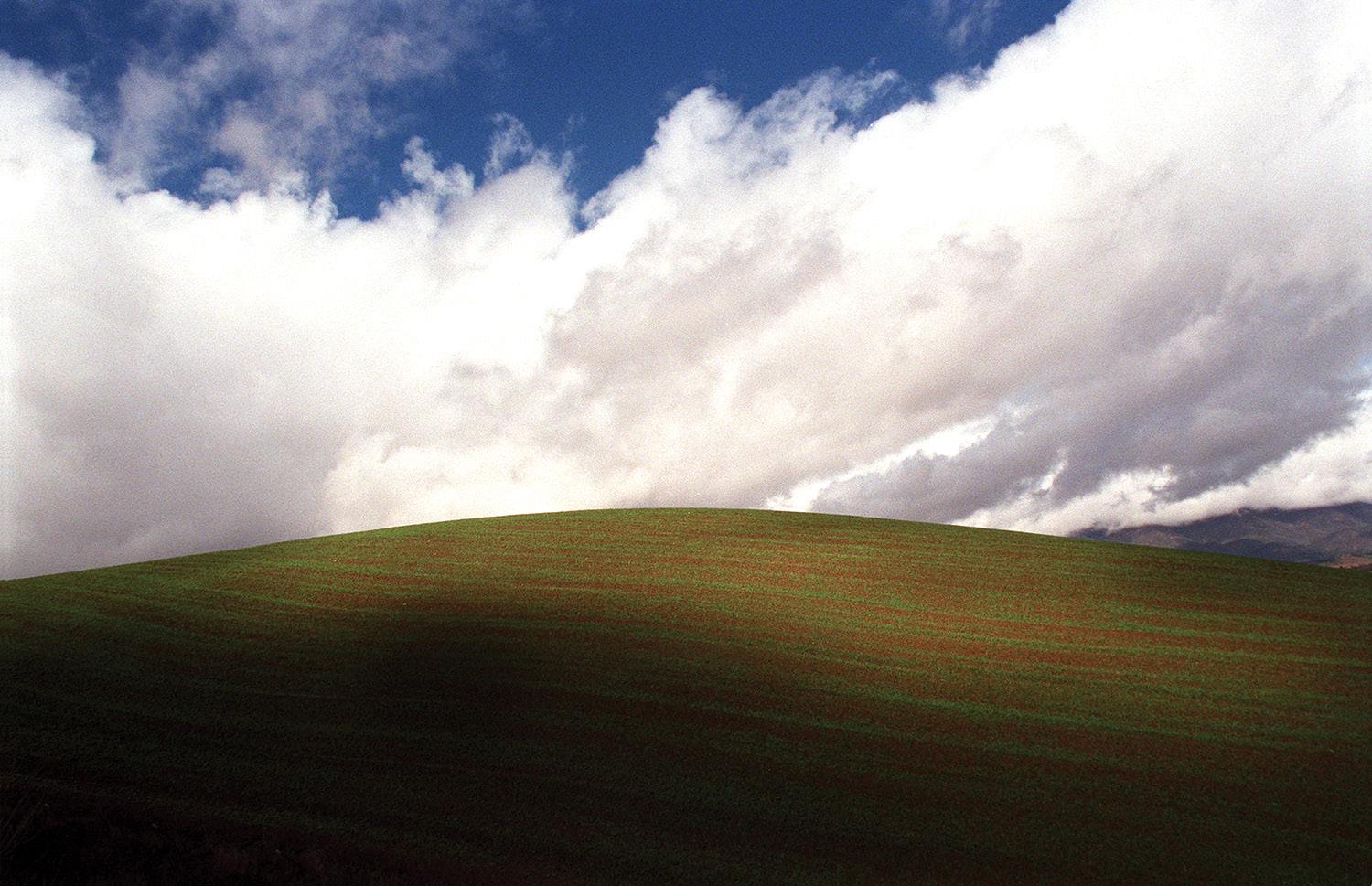
40 OJAI MAGAZINE | SPRING 2023
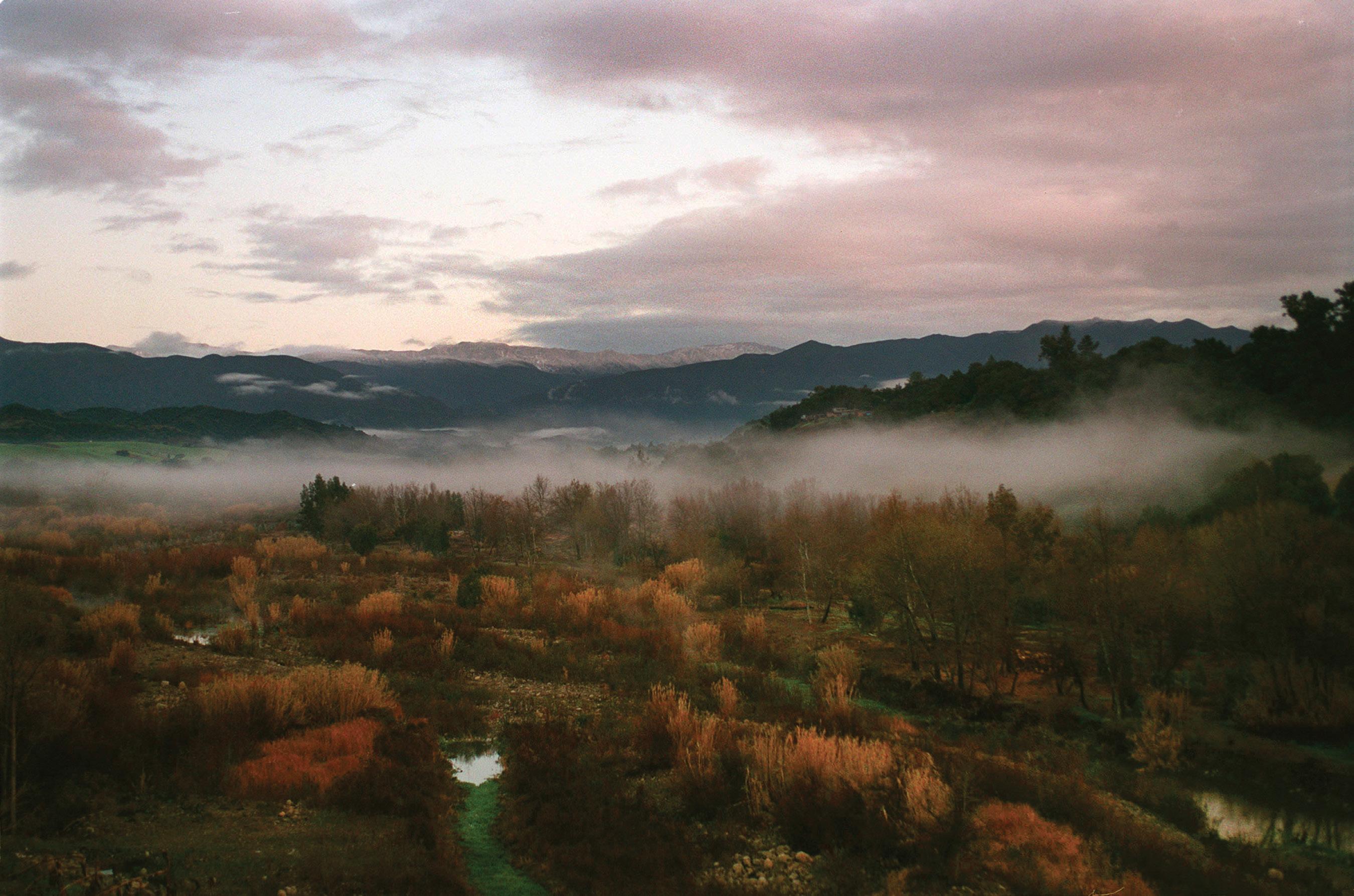
Shot on film in 1999. Low-hanging clouds sweep across the hillsides near Lake Casitas
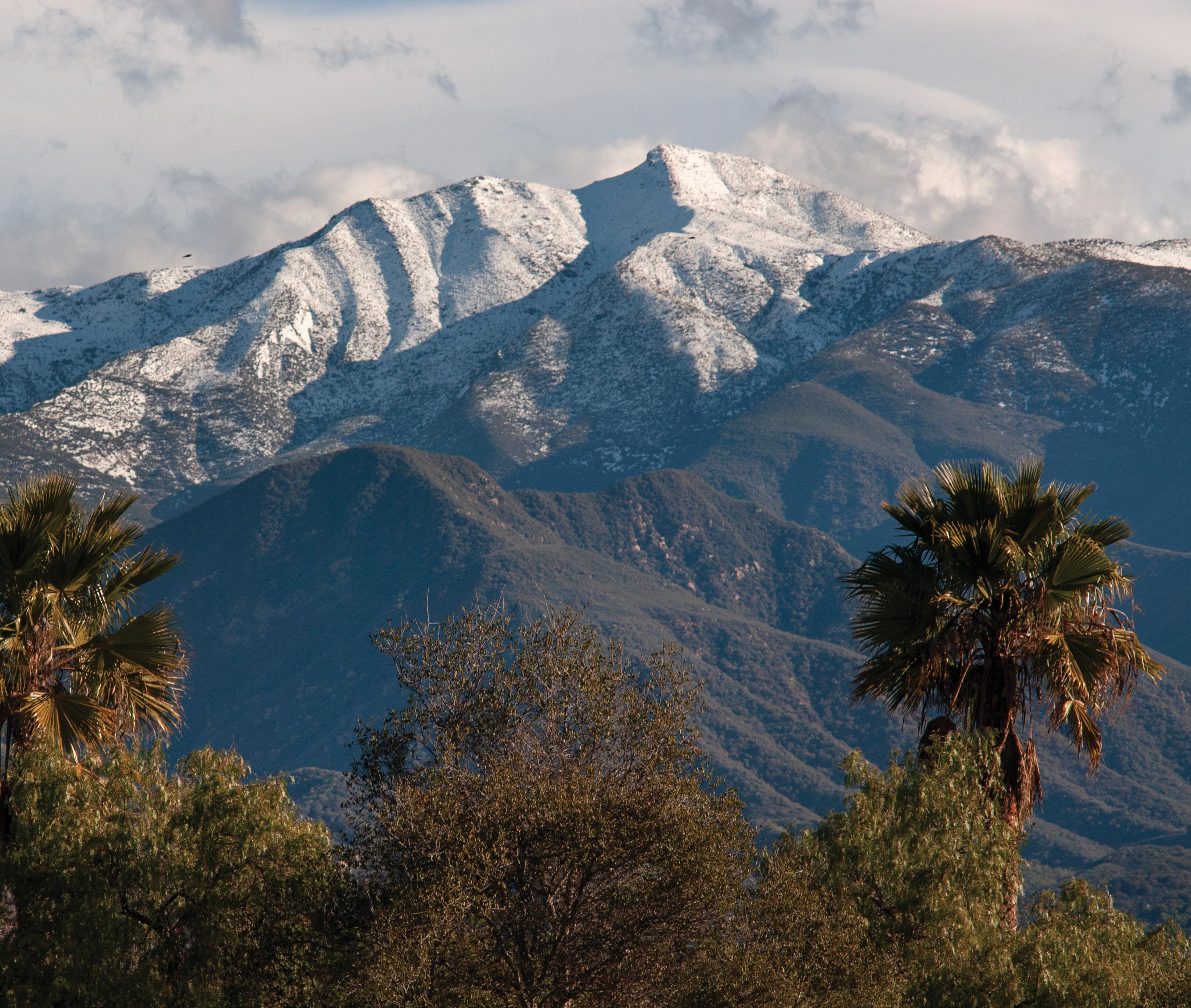
At times I sensed I was channeling the late, great landscape photographer Ansel Adams, who once said he never photographed the way the land looked, but rather how he felt about it.
41 OJAI MAGAZINE | SPRING 2023
December 2008. The view from Highway 33 as a blanket of snow covers the Topatopa Mountain's Chief Peak.
The mission:
Twenty years ago, while the photography director at the Ventura County Star, I began a project photographing the land of my youth beyond the clutter of wires, pavement, signs, fences, etc., our modern world has birthed—to make images that looked and felt natural, virgin, before humans and “progress” had eroded their beauty. The goal was to highlight and celebrate God-made landscapes, without the scars of human encroachment—to show in a photograph what my heart saw, and maybe capture what the indigenous Chumash might have beheld not so many years ago.
But rather than hike into the pristine backcountry, I challenged myself to capture beautiful scenes within 30 feet or so of a paved road or highway.
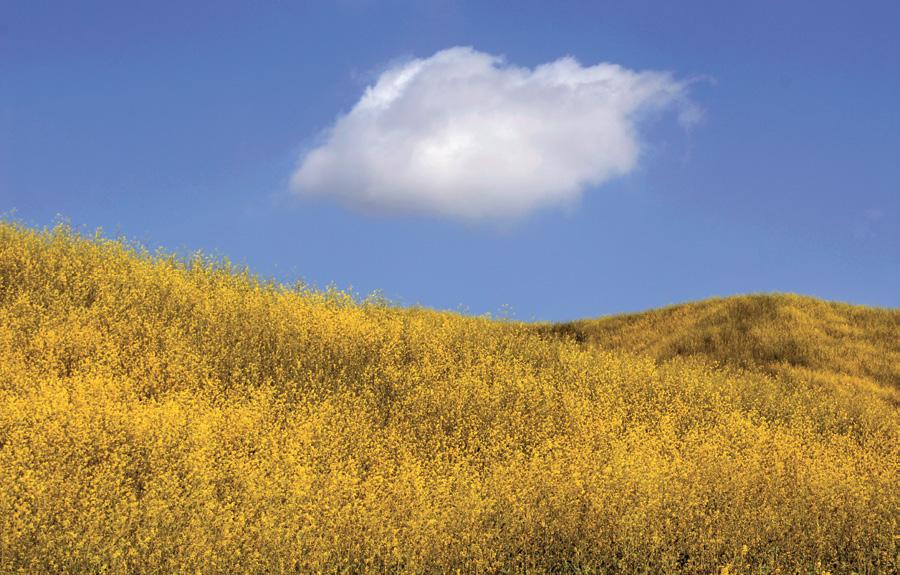
This project became a mission — a calling of sorts — maybe even an obsession. Most mornings, I was out an hour before sunrise, scouting locations. I imagined the potential of a scene in a di erent light or even di erent season, when leafy tree arms or tall grass might help hide visual warts. I did this religiously for years, feeding the creative, photographic side of me while temporarily escaping the desk, fluorescent lights, budgets, meetings, and computers.
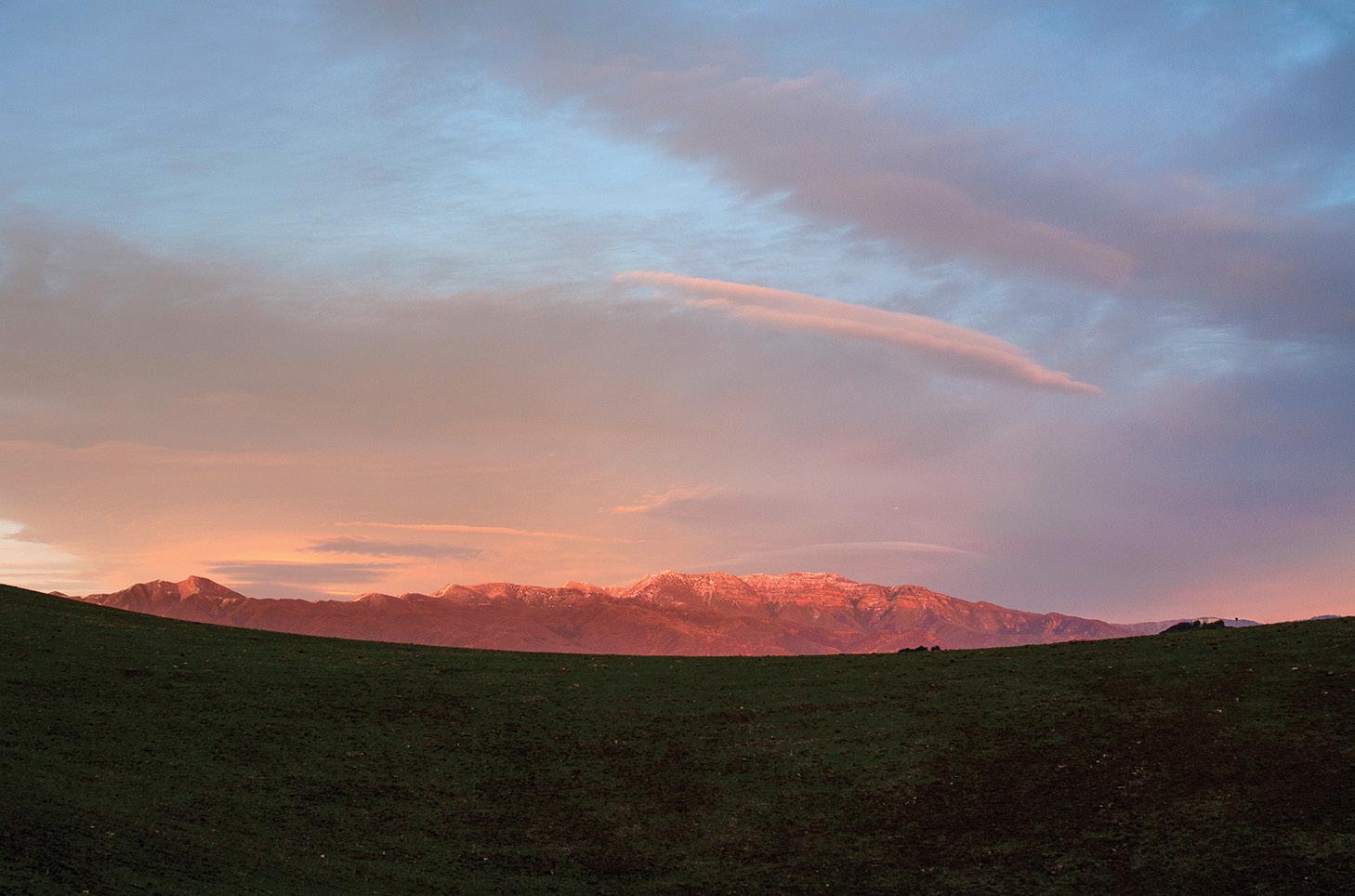 January 2008. The Pink Moment, looking north towards the Topatopa Mountains from a hay field along Santa Ana Road in Oak View.
42 OJAI MAGAZINE | SPRING 2023
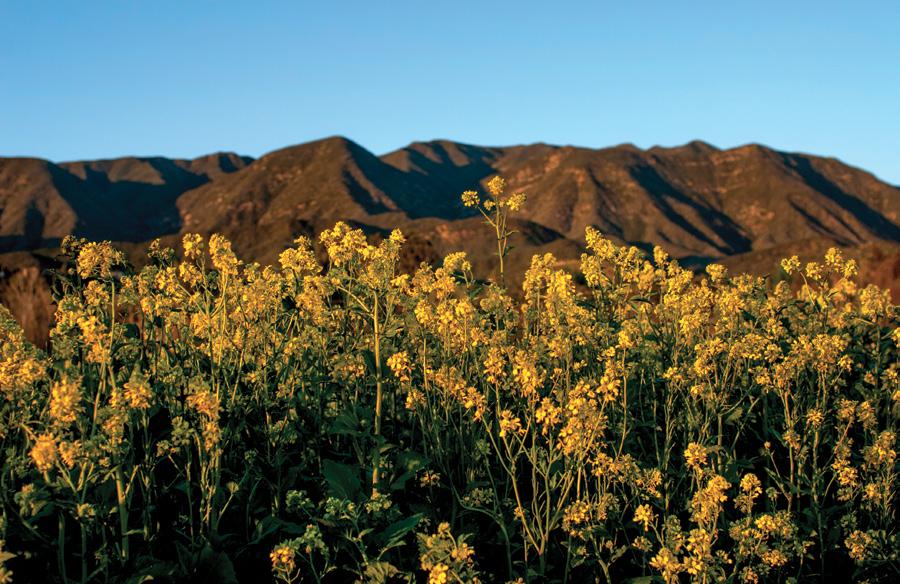
March 2008. Foster Park near the entrance to Cañada Larga explode with yellow from the wild mustard weed brought on by Winter and Spring rains.
As Johnny Cash said in his song “Understand Your Man,” it was a way of “breathing air that ain’t been breathed before.” My eyes were forever fixed on the heavens, always watching cloud patterns, always anticipating how the light might change as the sun rose or dropped. Countless times I raced out of the newsroom or out of my house during dinner, seduced by the golden light.
Most images shot from 1999 to 2001 were made on film. My wife and I left the Ojai Valley in late 2001, but when we returned in 2006, I picked up the project again, digitally. Though I photographed across the county, I focused mostly on the Ojai Valley, where my heart was. I spent thousands of hours and thousands of dollars on film, processing, gas, etc.
The challenge:
By using shadow, composition, light, lens choice, and cropping — without the aid of software programs like Photoshop to remove unwanted clutter, which feels like cheating — I tried to get the camera to see what I saw and felt. At times I sensed I was channeling the late, great landscape photographer Ansel Adams, who once said he never photographed the way the land looked, but rather how he felt about it.
Winter 2008. Looking north towards Casitas Springs, Oak View, Ojai and the distant Santa Ynez and Topatopa Mountains, as seen from the junction of Santa Ana Road in Foster Park.
43 OJAI MAGAZINE | SPRING 2023
2009. Tall mustard plants climb high in the field between Nordhoff High School and Meiners Oaks, hiding wires, structures and Highway 33.
Hiding unnatural elements like signs, metal guardrails, fences, utility poles, electrical wires, or even structures proved to be more di cult than I anticipated. Watching the time of day was critical, not just for saturation of color, but more importantly to allow dark shadows to crawl across valleys and canyons and conceal poles, electrical wires, or structures. And though light is the photographer’s air, composition (how each of us chooses to arrange the elements given to us) was equally important with this endeavor.
Sometimes, moving just inches — one way or another — was enough to eliminate unwanted foreground or background distractions. At other times, carefully using foreground plants, stones, or tree branches not only hid rails, signs, or wires, but also created depth in the photograph. Leafy tree arms can be the perfect makeup to hide the man-made blemishes.
At other times, the only way to make the uncluttered shot was to stick my camera beneath chain-link fences or between the bars of cattle or horse gates. And when the angle called for it (usually to see over tall fences), I climbed on the roof of my car. Crawling fog was also a great help in hiding unnatural elements.
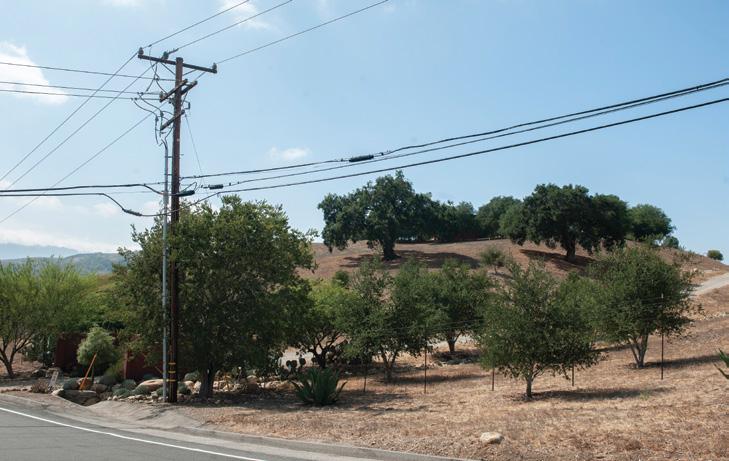
 October 2022. The eastern gate of the Sine Qua Non winery on Santa Ana Road as it appears from the highway. I visited this spot often from 1988 to 2001.
44 OJAI MAGAZINE | SPRING 2023
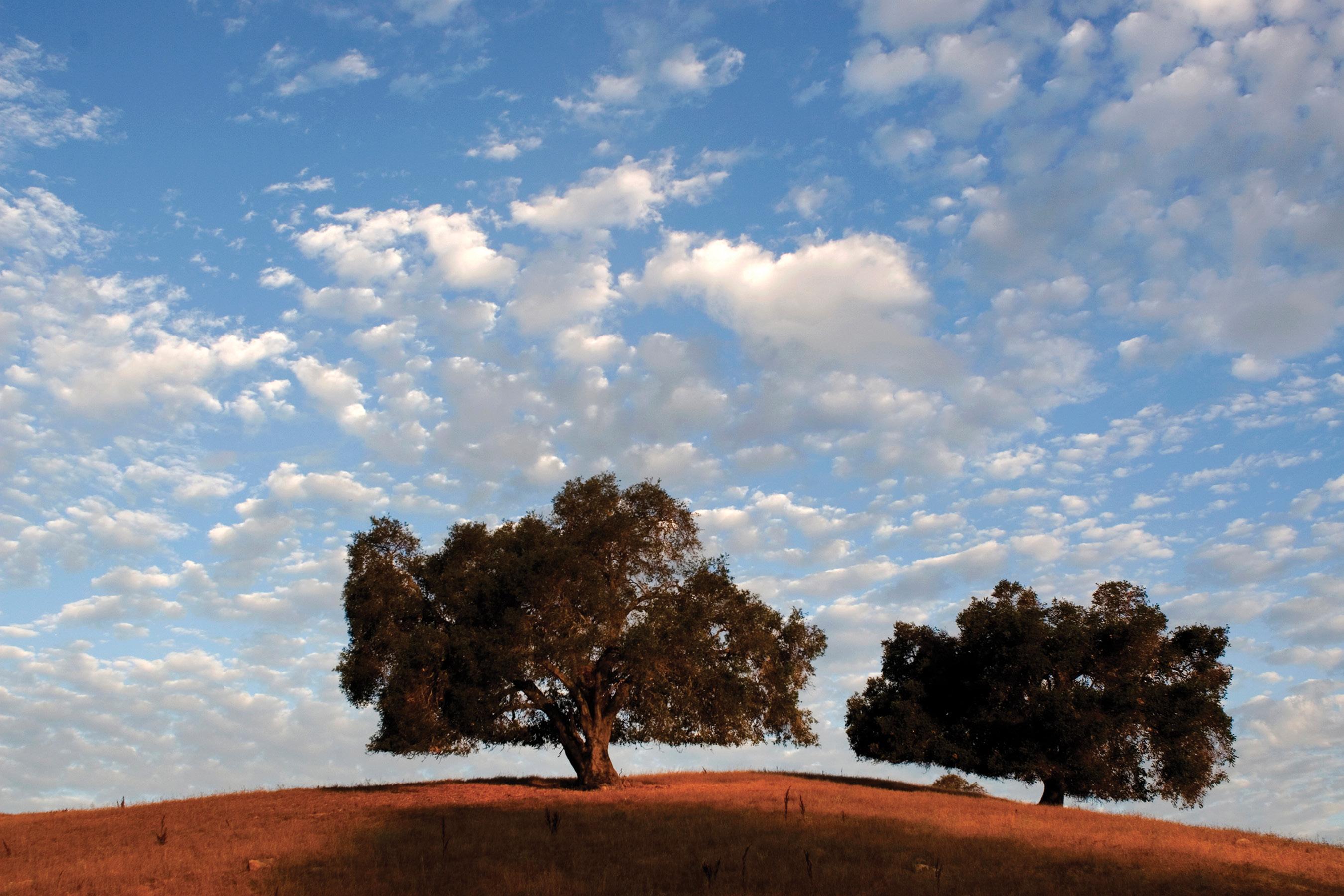
One of my favorite views I visited numerous times through the years, this image of two oak trees on what became the Sine Qua Non winery on Santa Ana Road, was shot by placing my camera under a gate.
A dangerous proposition:
There were too many close calls, especially while shooting on the edge of busy highways. Almost bit by a dog twice, and nearly struck by speeding cars and trucks many times, I also su ered several hard falls climbing along roadsides. One fall left me unable to move for many frightening minutes after I tripped over cable hidden in the grass and was catapulted forward, my chest hitting a metal stake.
I have been chasing the light most of my 71 years. It is a gift I never tire of. Whether photographing the shape of the land, the Topatopas, Sulphur Mountain, or the Laguna Ridge of the Santa Ynez Mountains, I recognize the light never falls on them exactly the same, which means each day o ers a surprise not seen before.
As a scientific project, this has many flaws, particularly when nonindigenous plants and trees have been brought into the valley, altering the landscape natives a century ago might have embraced. Yet the intoxicating beauty of this land still sings to my heart. There is no place I love more.
After all, natural beauty is everywhere if we look close enough. Just as the coyote, the raccoon, and even deer have learned to thrive in cities like New York or L.A., the splendor of the natural creation flourishes in the darkest and most polluted places.
To see more images from this project, both from the Ojai Valley and Ventura County, please see the “Native Son Collection” gallery on my website: www.davidlabelle.com
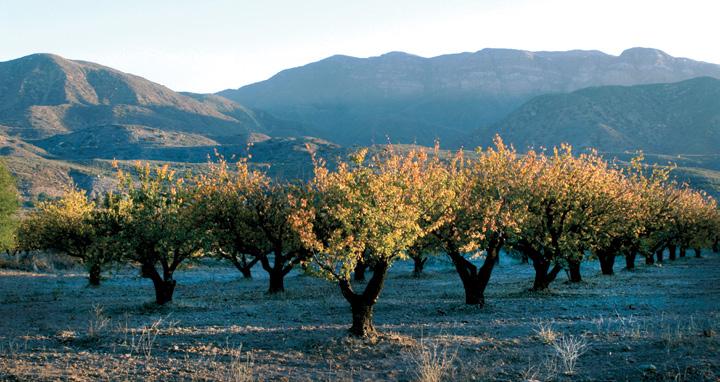
 October 2007. Early morning light washes across Upper Ojai, touching the tops of trees in the K.B. Hall Apricot Ranch.
45 OJAI MAGAZINE | SPRING 2023
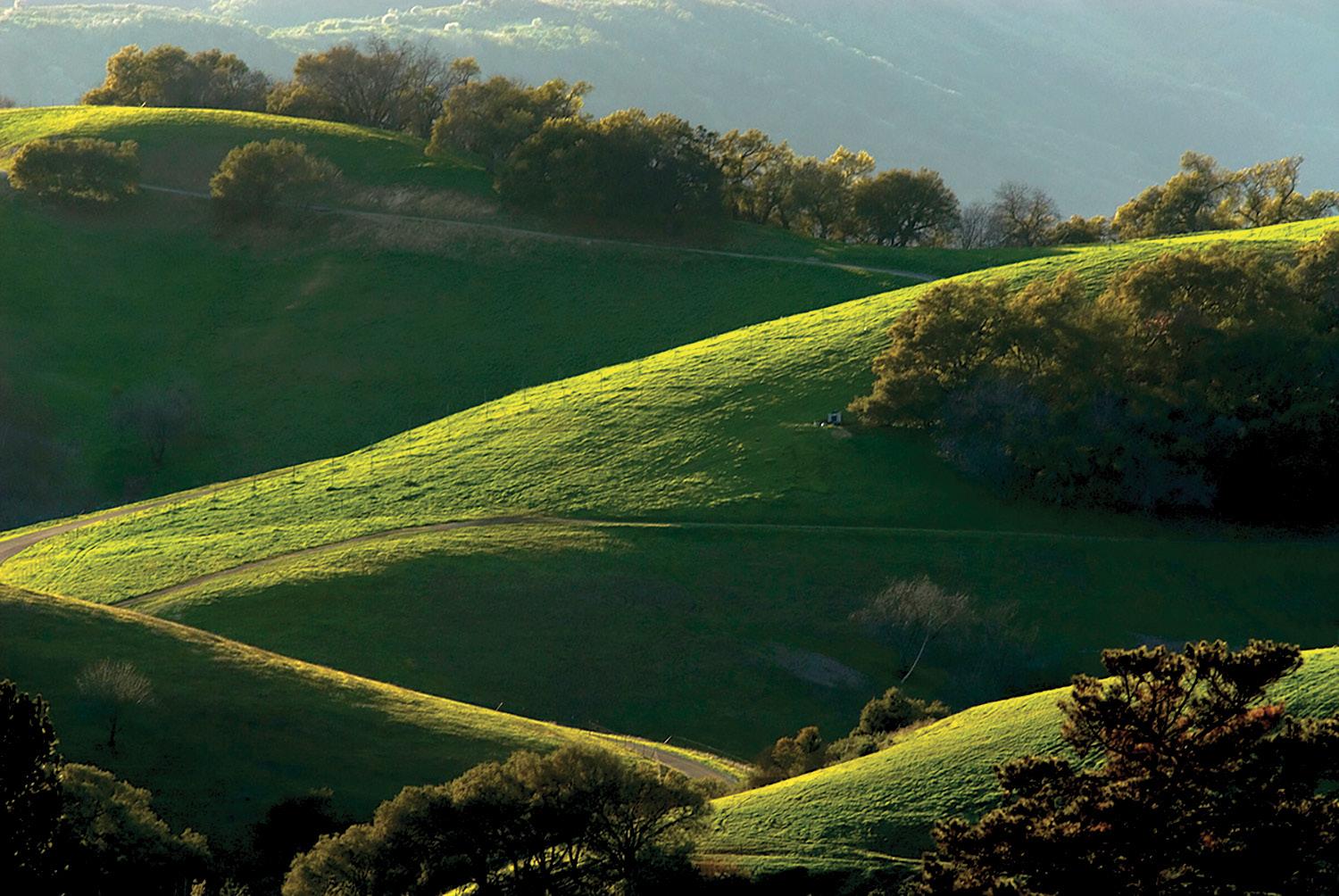
February 2008. The rolling hills near Lake Casitas are covered in green velvet grass after January rains. This was shot in the middle of a road around Hill Street, just east of Ventura Avenue.



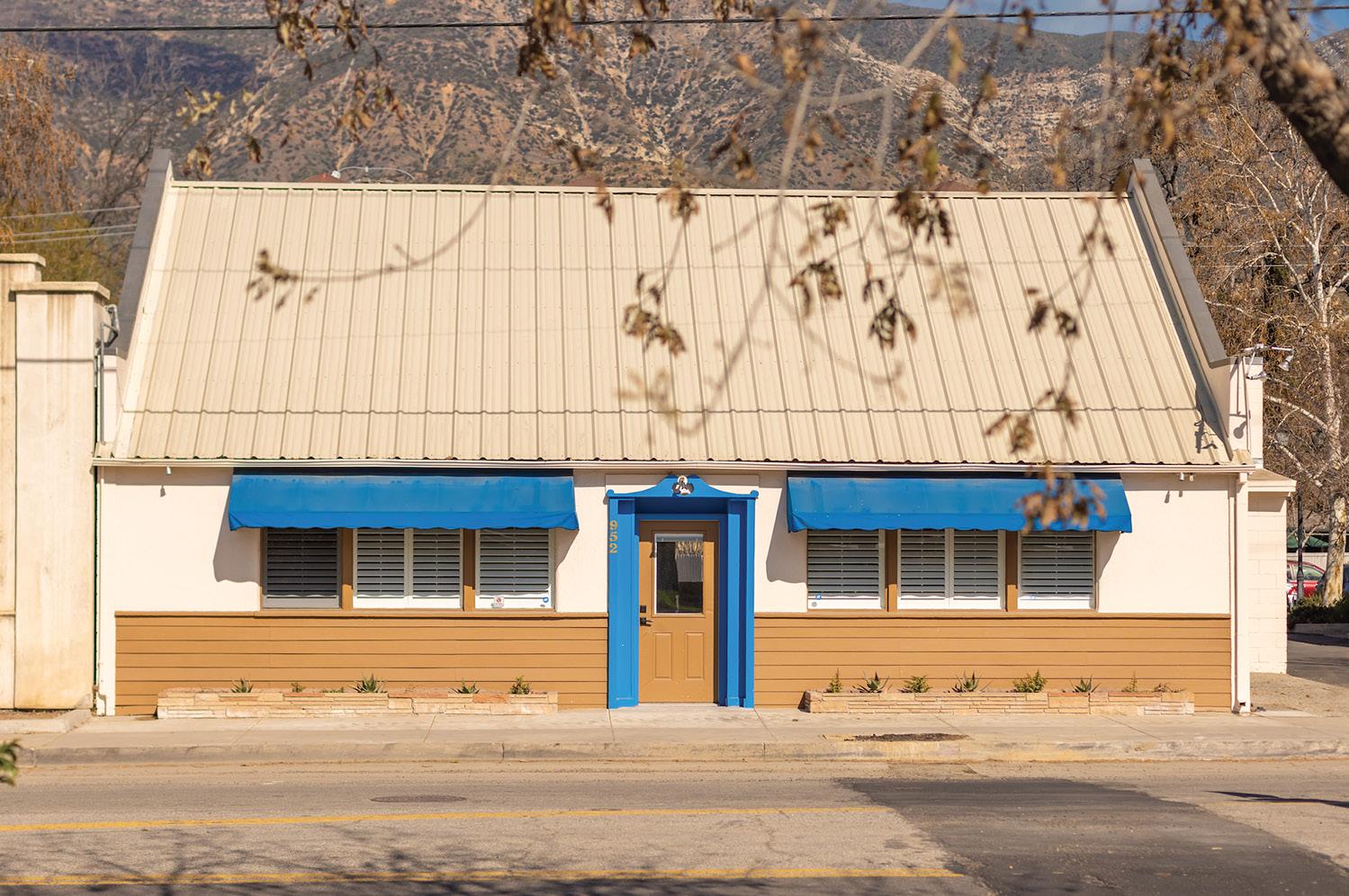
Cathy Titus DRE 01173283 805.798.0960 ctitus@livsothebysrealty.com 110 W. Matilija Street $2,575,000 Mid-Century six unit apartment building in Downtown Ojai 952 E. Ojai Avenue $2,500,000 Commercial building on Ojai Avenue 46 OJAI MAGAZINE | SPRING 2023
© 2023 LIV Sotheby’s International Realty. All rights reserved. All data, including all measurements and calculations are obtained from various sources and has not and will not be veri ed by Broker. All information shall be independently reviewed and veri ed for accuracy. LIV Sotheby’s International Realty is independently owned and operated and supports the principles of the Fair Housing Act.
1175 Moreno Drive $1,500,000
3 bed, 2 bath in great neighborhood with AMAZING panoramic views
12710-12718
3 houses on .5+ acre in Upper Ojai
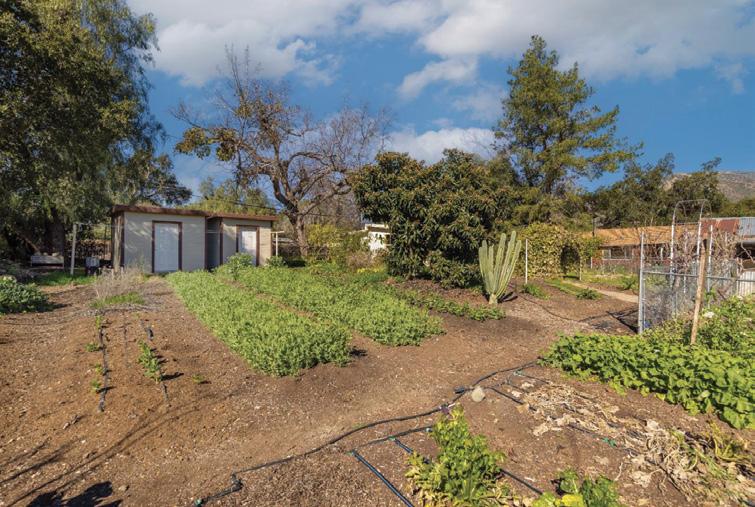
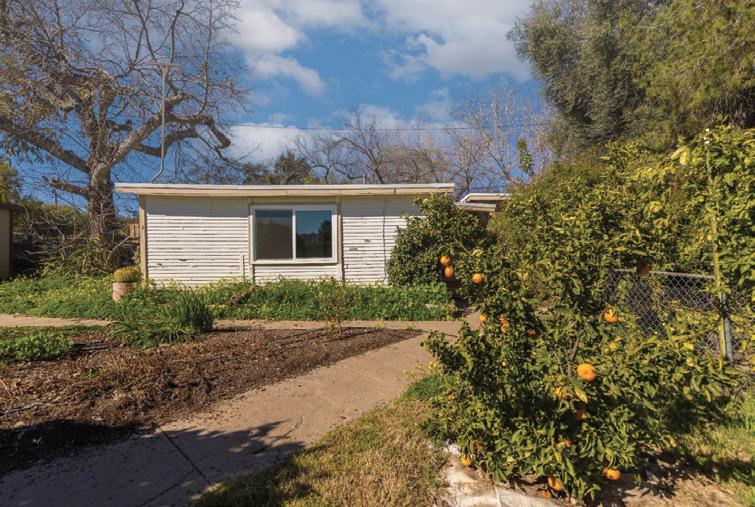
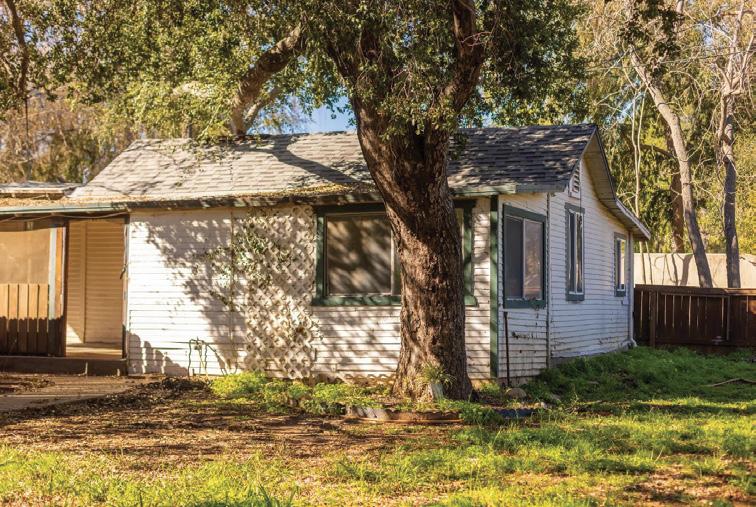
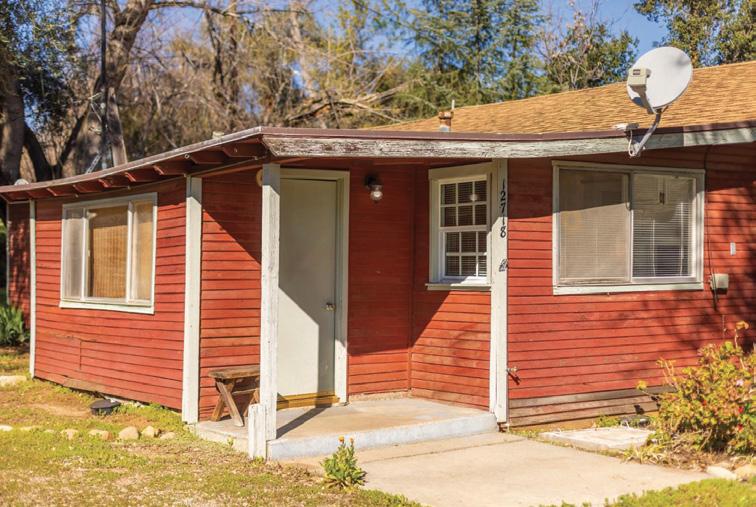
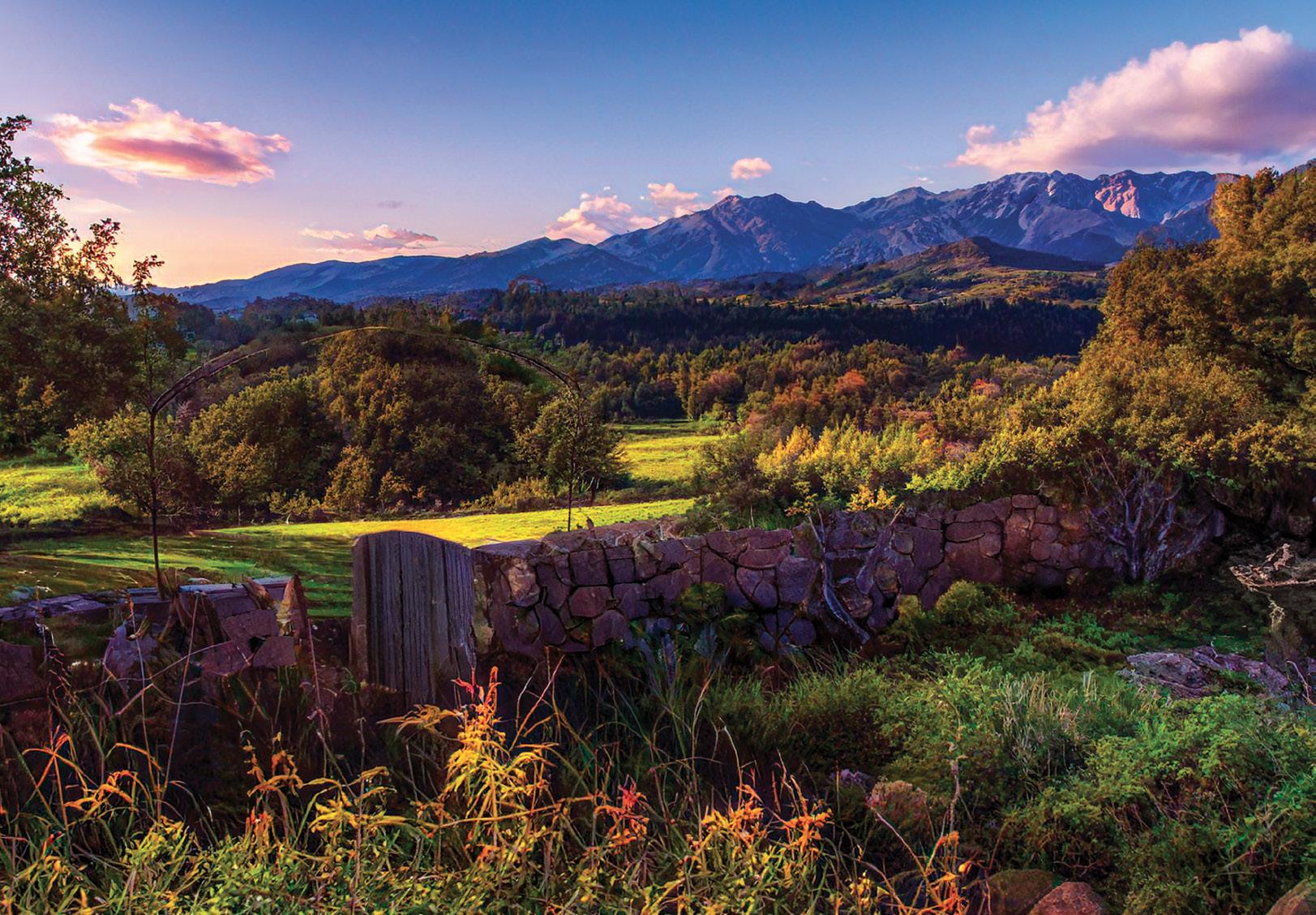 OjaiSanta Paula Road $995,000
47 OJAI MAGAZINE | SPRING 2023

The spring market is coming!
Have you been thinking about changing things up in your life? Do you have a little one on the way? Maybe your kids have flown the coop?
Whether you’re looking to upsize or downsize or just want a change of view, you should start by meeting with a real estate broker you trust.
I can help you get your home market-ready and counsel you about how to price your property considering current market conditions and comparable sales in your neighborhood.

So if you want to make a smooth move into the next chapter of your life, reach out to me with a call today, and let’s get started.

OJAI 805-766-7889 Sharon MaHarry, Broker Associate 2022 Ojai Agent of the Year BRE #01438966 Live The Ojai Dream. OjaiDream.com
HORN CANYON TRAIL (22W08)
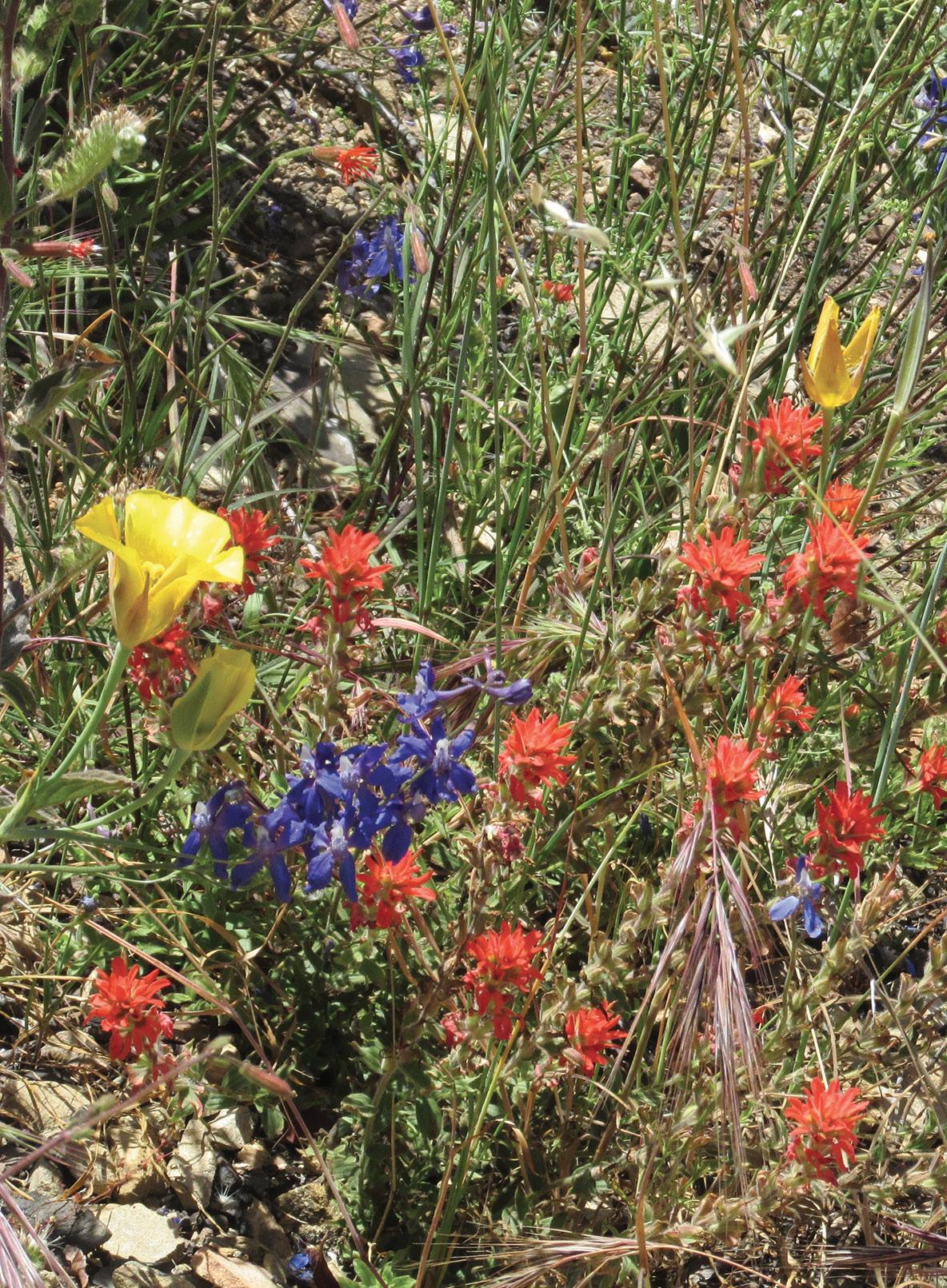
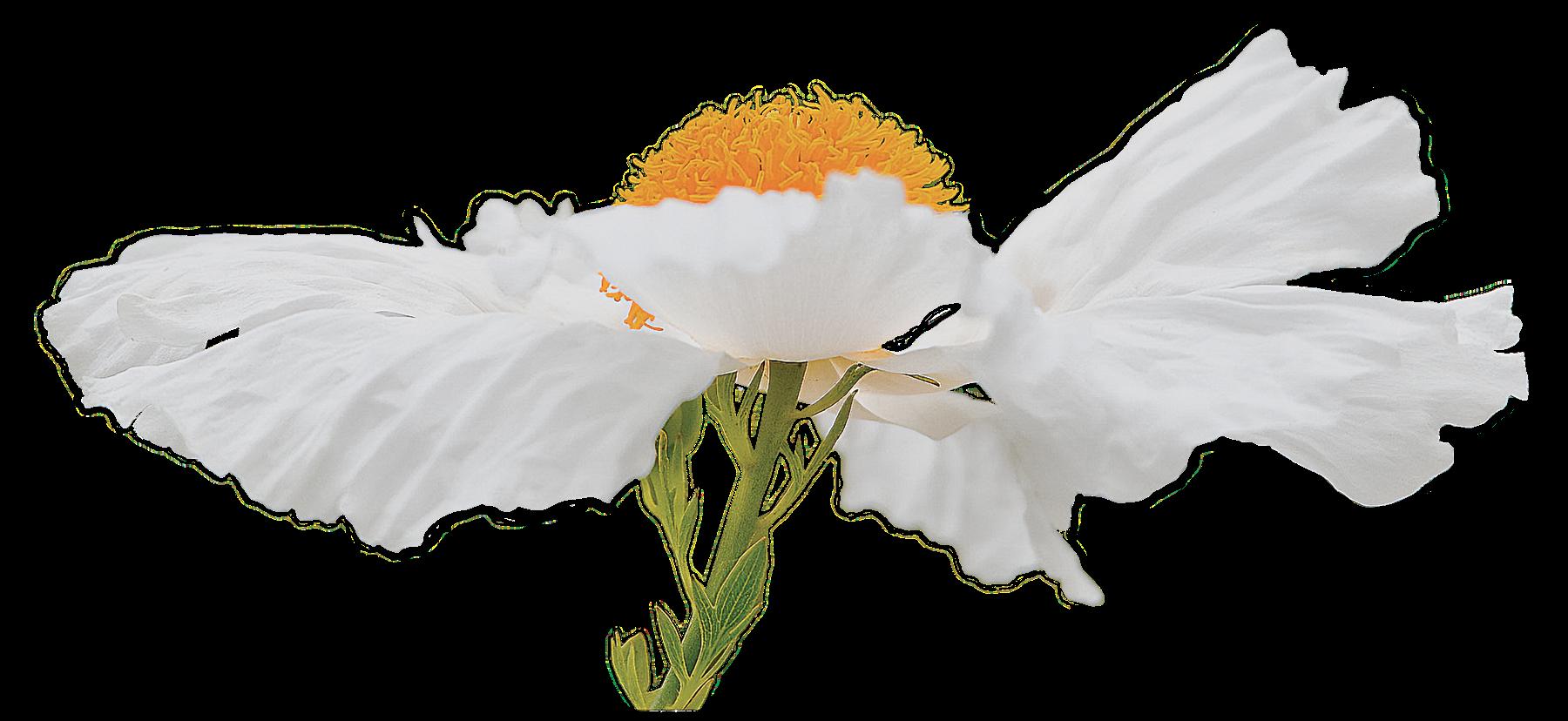
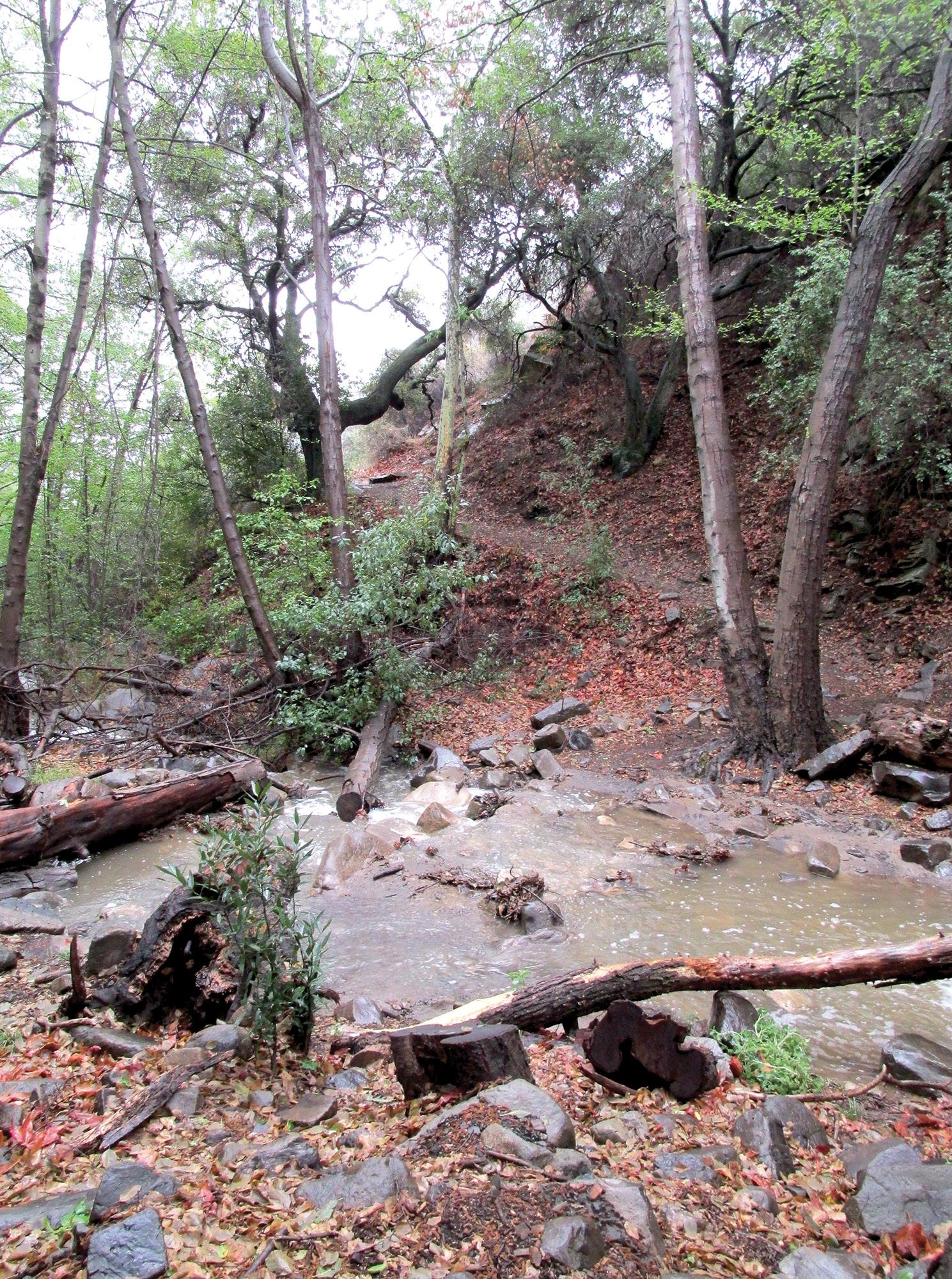
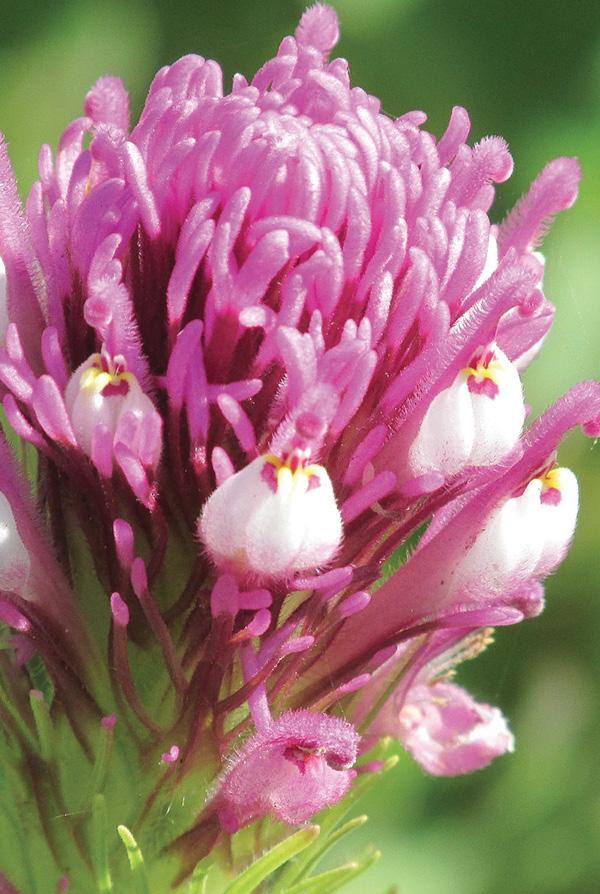
An abundance of blooms and the sound of flowing water along this popular trail make Horn Canyon a great springtime outing. There are four creek crossings very early in the hike, so be prepared for some rock hopping and possible wet feet.
At about 2.5 miles, the trail passes through “The Pines” campground, where a historic grove of Coulter pines stood for many years. Most of the drought-stricken, bark beetle-infested trees were removed a few years ago. What was left burned in the Thomas Fire.
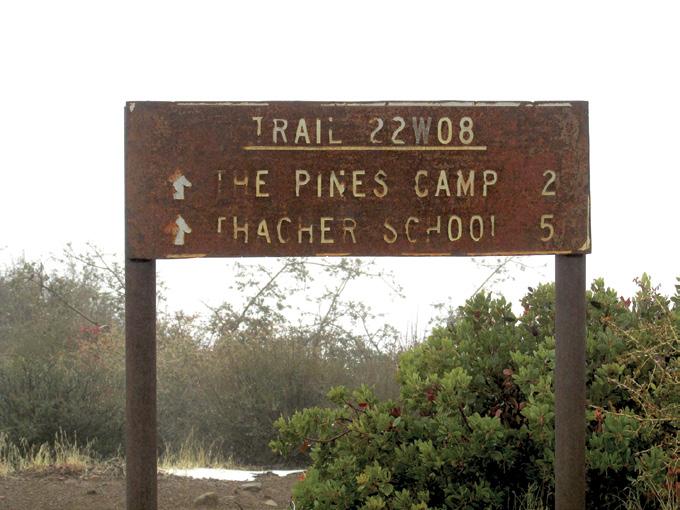
The trailhead is located on McAndrew Road, south of The Thacher School main gate. Follow the signs and pass over the school’s road to the primary access point, approximately a half mile from the trailhead.
Spring
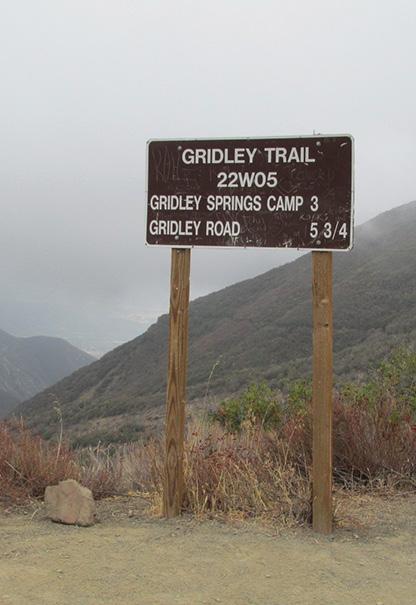
GRIDLEY TRAIL (22W05)
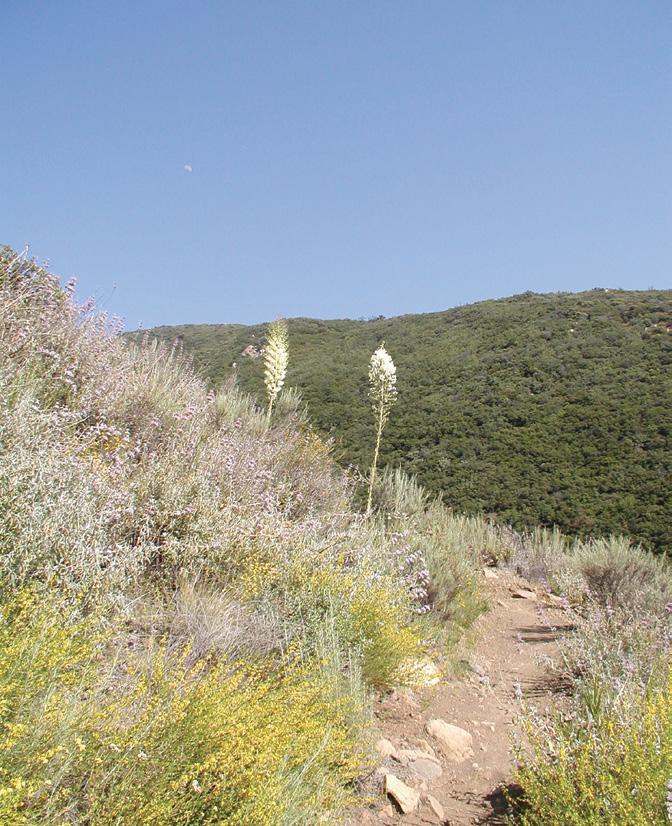
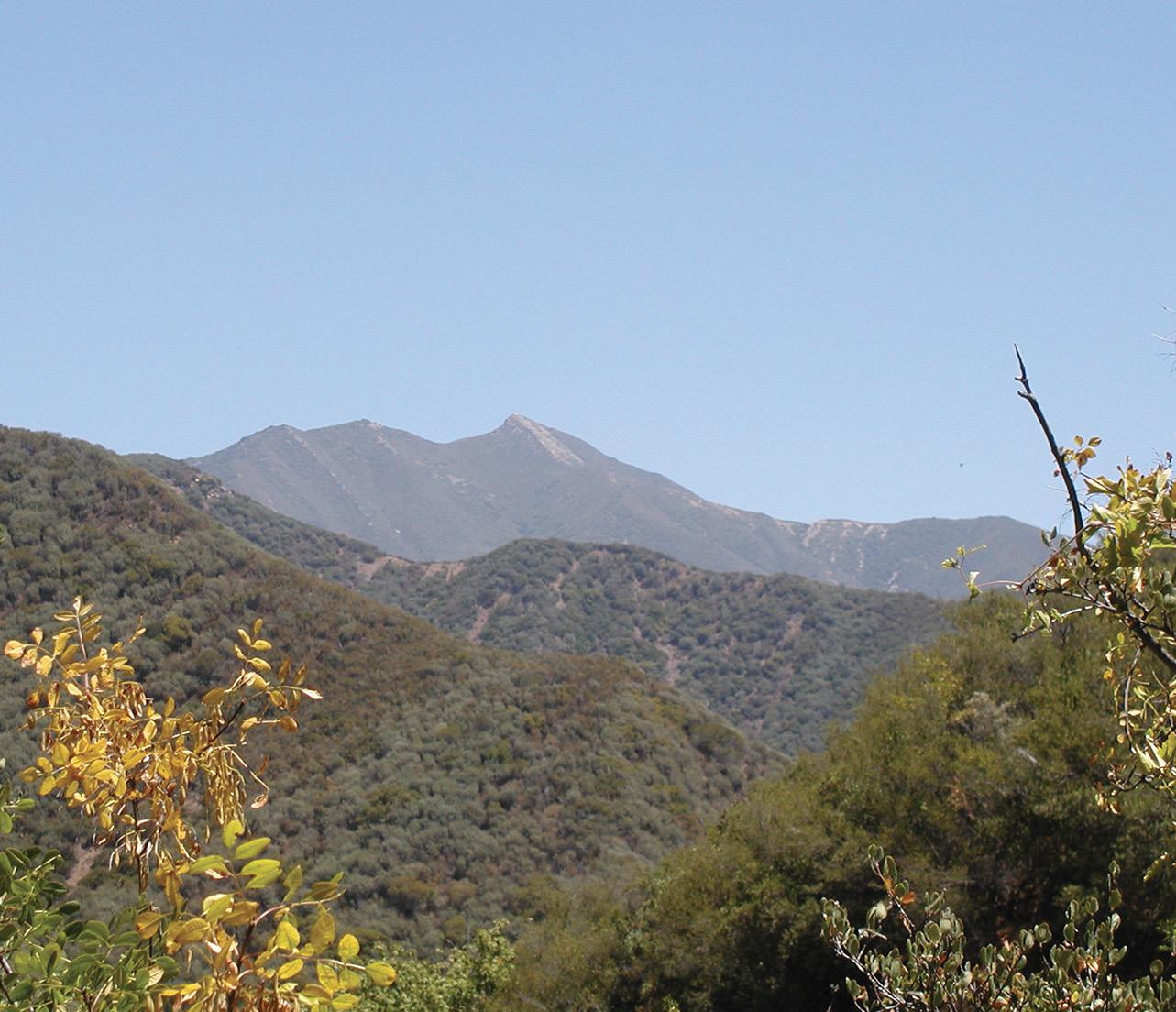
Spring is the ideal time of year to hike this six-mile-long trail in the Ojai front country. Temperatures are bearable and wildflowers typically make a good showing. The rocky trail climbs moderately past avocado orchards into low chaparral and trees, terminating at Nordho Ridge at 3,775 feet elevation. (The avocados are on private property, so don’t pick them!)
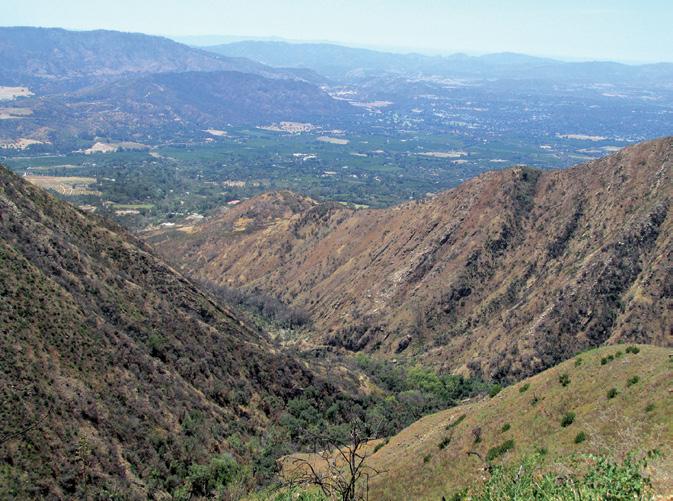
Gridley Springs, three miles up, is the site of a former trail camp removed by the U.S. Forest Service in 2013. It’s still a pleasant spot to stop for lunch. Just south of the spring is a section of trail where ferns, maples and other vegetation uncommon in the area grow.
To get to the trailhead, take Gridley Road north to its end at a private gate. There’s limited parking along the road but no facilities. The first mile of the trail was adopted by the Ojai Valley Land Conservancy in April 2017 under the USFS Adopt-A-Trail Program. The trail provides access to the OVLC’s Valley View Preserve via the Fuelbreak Road Trail.
Hikes
HOUTEN
VENTURA RIVER PRESERVE TRAILS
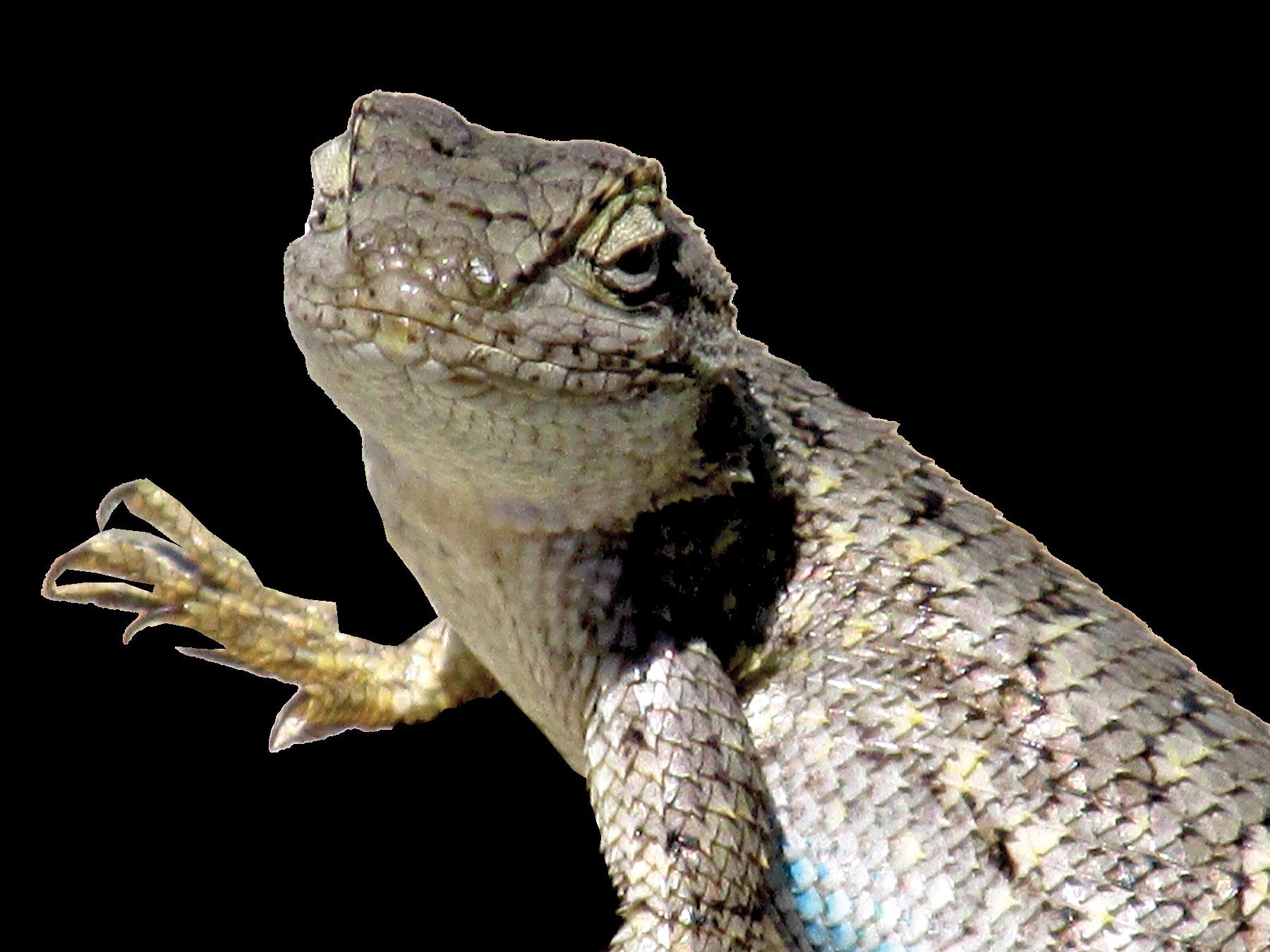
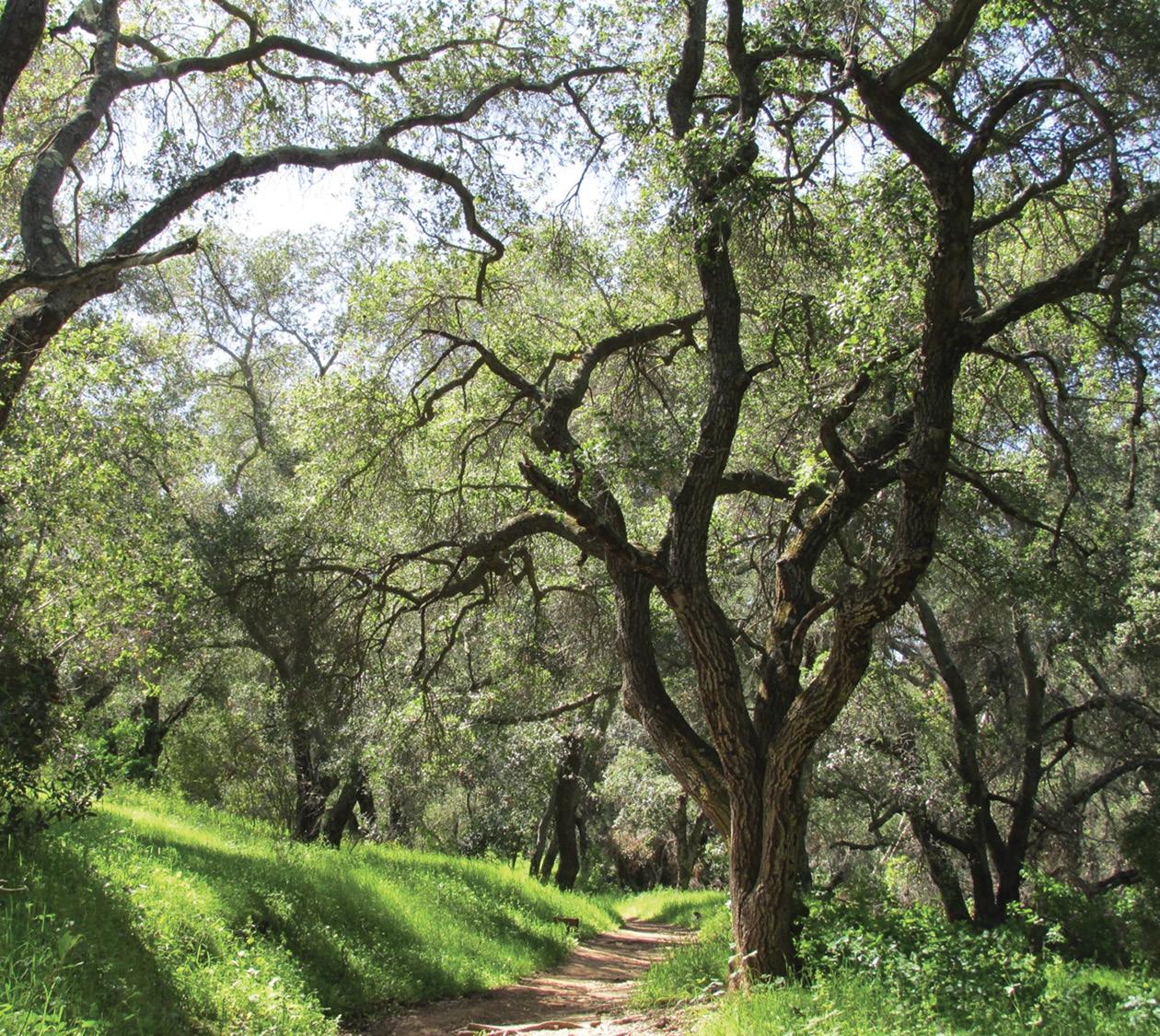
Proximity to town and a network of varied, well-maintained and signed trails make the Ventura River Preserve instantly appealing, especially when the grasses are green and the flowers are blooming. If you want to get away from the hustle and bustle without driving far, head for the nearly 1,600-acre VRP.
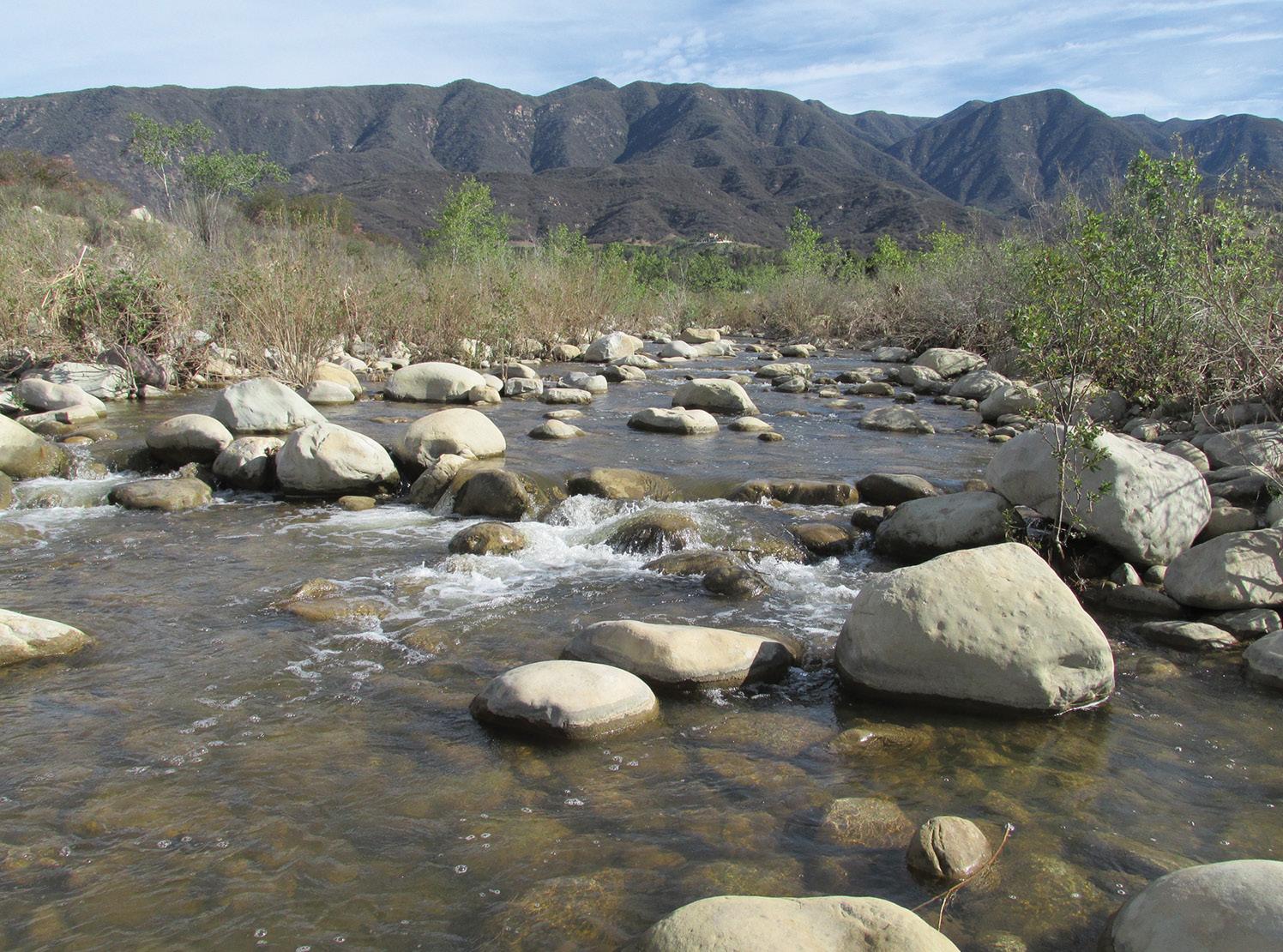
Opened in 2003 by the OVLC, the VRP o ers trails that run along the riverbank, loop trips that take you through oak forests and peaceful meadows, and lofty adventures that take you high above the Ojai Valley. El Nido Meadow, o the Wills Canyon Trail, features an expanse of purple needlegrass, the state grass of California.
The VRP can be accessed from three distinct trailheads: the Oso Trailhead, o Meyer Road; the Riverview Trailhead, on Rice Road; and the Old Baldwin Road Trailhead, o Highway 150. Parking is free at all three trailheads. Spring and summer hours are 7:30 a.m. to 7 p.m.
51 OJAI MAGAZINE | SPRING 2023
story and photos by PERRY VAN


52 OJAI MAGAZINE | SPRING 2023



55 OJAI MAGAZINE | SPRING 2023
As a young teacher in New York in the 1970s, she always had a nagging feeling she was “in the wrong place.” She and other colleagues dreamt of an education system she described as having “daily parental engagement, customized curriculum, and a belief that every child needs to explore their dreams, their goals, and their passions.”
Together, Marilyn and her teaching friends came to the valley in 1974 to start Oak Meadow School. When she first arrived in Ojai, pregnant and carrying a toddler, Marilyn felt at ease. “I thought this is where a child should be raised,” she reflected.
At Oak Meadow School, Marilyn said she and her comrades had a feeling of “purpose.” They used the Waldorf method of education, which Marilyn described as a “beautiful, creative, developmentally appropriate approach, where art, music, crafts, storytelling, and dance are included in the curriculum.”
When Oak Meadow School opened another location in Vermont in the 1980s, most of Marilyn’s co-workers followed. After 17 years at the helm of her first dream, she felt the tide shift again. She wanted to broaden the scope of learning even further, and accommodate all di erent kinds of learning styles.
“Some children are very linear learners, and want to move in a very defined fashion,” Marilyn said. “Yet others need time to invent, or create, perform, or relate. Each style needs to be appreciated.” Marilyn, her late husband, Lee Gordanier, and colleague Ellen Hall decided to start Laurel Springs School in 1991.
The first few years were classified as a “distance-learning/homeschooling program, with regular in-person meetings.” “Some of our students met weekly; others lived at a distance and met with their teachers by phone or mail,” Marilyn said. Even in that first year, Marilyn realized she struck gold with the ambitions of her students. In 1991, a group of Laurel Springs high school students became involved in environmental work, and a class project video called “We Can Make a Di erence” was born. The video won the United Nations’ Global 500 Roll of Honour Award. Soon after, the 26 Laurel Springs students were invited by the U.N. to New York to participate in an environmental youth conference named after their video, which ABC covered in the news.
In 1994, Laurel Springs developed the country’s first online private school. In 1996, Laurel Springs was featured on the Today show; journalist George Lewis said that “it well could be the model for schools of the future.”
More than 30 years later, Laurel Springs School has 7,000 students worldwide across 73 di erent countries in grades K-12.
Marilyn felt she had accomplished one of the biggest educational touchstones she could have ever envisioned. Yet, other aspiring students were waiting for her.
Marilyn’s daughter, film director Ramaa Mosley, lit her new path. Ramaa worked on the 2013 documentary Girl Rising, which depicted nine girls from developing countries set on attaining the schooling they desired. Ramaa directed the Afghan segment of the film about Amina, who was forced to marry at age 11 and gave birth to her first child at age 12.
had $60 a month to feed their children. The program grew slowly and consistently. In almost every case the mothers wanted their daughters to go to school — they just didn’t have the resources. Not only did mothers use their money for food and school; with extra funds they bought sewing machines and started their own businesses. For many of our families, the extra funds became a tipping point in their well-being.”
FROM Ojai
“My daughter came home from filming and she said, ‘Mom, I really feel like I did this project for you … this is something you need to get involved with,’” Marilyn said. Marilyn met with BBC reporter Zarghuna “Zari” Kargar, the writer of Amina’s story in Girl Rising, who told her: “If you empower a mother, then her daughter will go to school. If the mother is not empowered, the daughter will be forced to marry for money.”
In 2013, Marilyn, Ramaa, and Zari started Educate Girls Now, focused on empowering mothers to keep their daughters in school until age 18.
The key was convincing the parents — including fathers, uncles, or cousins. Marilyn tracked the progress reports of the girls in school, provided money to their mothers for the upkeep of the household, and shared intercultural exchanges about healthy living and the importance of education in a woman’s life.
In Afghanistan, “it is very important to gain the support of the community,” Marilyn said. “Family members could see these girls were really doing well. Mothers, often widows,
Educate Girls Now works with Afghan students in countries such as the United Arab Emirates, Egypt, Iran, Bangladesh, Spain, and Germany, until pupils are “acculturated into their new country.”
“We’ve been able to build a bridge for girls in many di erent ways,” Marilyn said. “We work with what we have, whether it’s at-home tutoring or support to go to an afternoon school. If we can save 12 girls, that’s 12 families with new life opportunities. If we can save 100, we’re hopefully building a new culture.
“Educate Girls Now o ers girls huge opportunities. We’re doing more than we’ve ever done. My hope is that we’ll see a renewal in education for girls in Afghanistan to accomplish their dreams, to be productive members of society, whether it’s being a doctor, journalist, biologist, nurse … I think change will happen. There’s a lot of people who really believe in a bright future for girls.”
Educate Girls Now: educategirlsnow.org
Marilyn Mosley
56 OJAI MAGAZINE | SPRING 2023
Gordanier’s calling for global children’s enrichment has taken her further than she could have ever predicted.
TO Afghanistan

57 OJAI MAGAZINE | SPRING 2023
Trolley Service, established in 1989, is owned and operated by the City of Ojai. e Trolley provides daily xed-route transportation to approximately 9,000 riders per month throughout Ojai, Meiners Oaks and Mira Monte.
e Trolley is a well-known feature in the Ojai Valley, and in addition to the daily xed-route services, participates in many local community events, fund raising activities, community service, and educational functions.
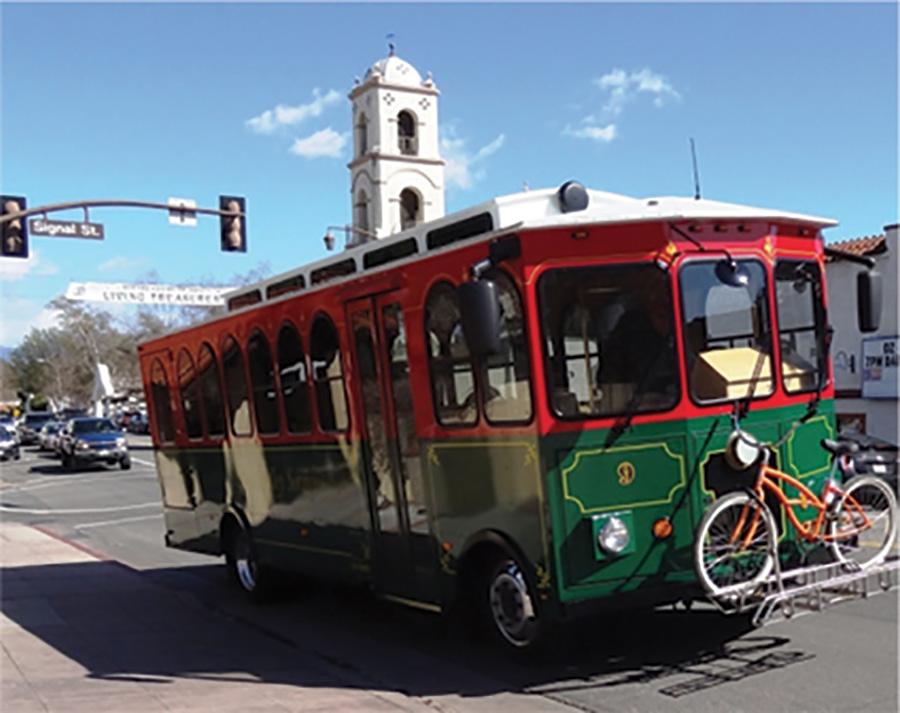
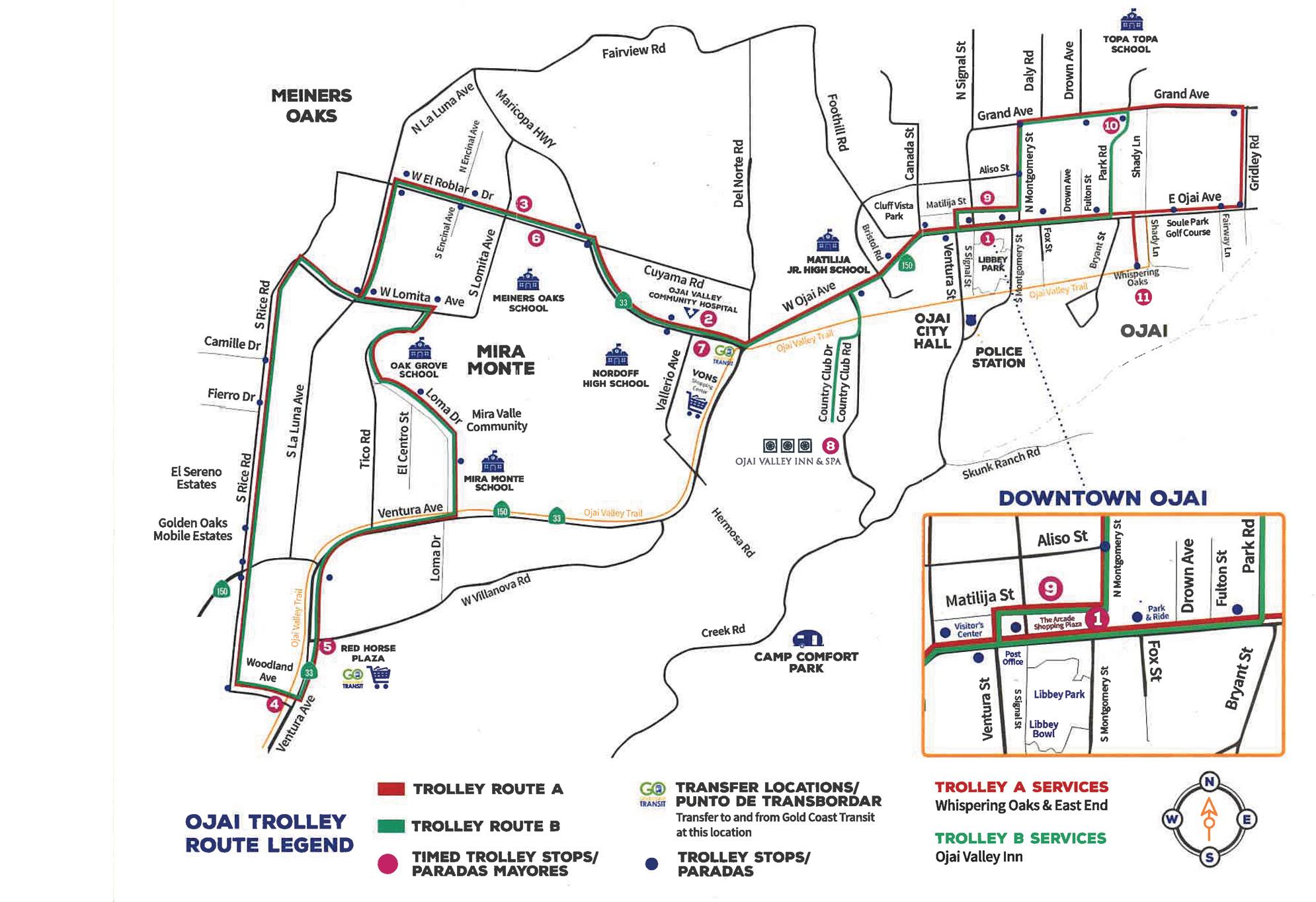

58 OJAI MAGAZINE | SPRING 2023 From and to: Ojai, Meiners Oaks and Mira Monte For Just $1.50! The Ojai Trolley Service Continues to Run Serving the Needs of the Ojai Valley ADA, Medicare Card Holders, and Seniors 65-74 are 1/2 price. Seniors 75 and over, children under 45” tall and all students are FREE riders on the Trolley We’ll get you there! We’ll get you there!
e Ojai
408 South Signal Street, Ojai, CA 93024 Phone (805) 272 3883 • E-mail: transit@ojai.ca.gov • www.ojaitrolley.com

59 OJAI MAGAZINE | SPRING 2023

60 OJAI MAGAZINE | SPRING 2023

61 OJAI MAGAZINE | SPRING 2023

62 OJAI MAGAZINE | SPRING 2023
Dramatic scenes of Indigenous protectors being sprayed with water and tear gas in frigid temperatures and detained by police filled news screens in 2016, and have been the subject of several documentaries.
But until now, no one has told the NoDAPL story through a narrative lens.
On Sacred Ground, produced, directed, and co-written by Josh and Rebecca Tickell of Ojai and their family-owned, Ojai-based Big Picture Ranch studio, is a scripted drama based on events related to construction of the DAPL. (Funding for the film also came from Mark Sims, coowner of Ojai Media LLC, which owns Ojai Magazine and Ojai Valley News.)
In Nov. 2022, the film earned a standing ovation after its Ojai and Hollywood premieres.
The fictional film is a first for the Tickells, who are known for making award-winning documentaries on environmental issues, including FUEL (2008), about alternative fuels; The Big Fix (2011), about the 2010 BP oil spill; and Kiss the Ground (2020), about regenerative agriculture. “We’d always had this dream of making a scripted feature film,” Rebecca says. “The pull was that we could take the message to a much broader audience.”
In 2016, when the events at Standing Rock began, Josh went to the camp with a video camera to be on the ground to document the demonstrators. (Rebecca, pregnant at the time, was advised not to go with him.)
“The experience of being at Standing Rock … forever changed me,” Josh says. Much of On Sacred Ground, he continued, “was inspired by actual events I witnessed, and some of it is word for word taken from transcripts of the footage I filmed there.” Josh says he donated most of his real-life video footage to Indigenous filmmakers who made documentaries about NoDAPL, but the Tickells still wanted to share a story about the historical demonstration — fictional, yet based in truth — for a mainstream audience. Their goal, Rebecca said, was “to o er an opening for people to learn about this issue, America’s history and our Constitution, and America itself.”
On Sacred Ground follows Dan McKinney (played by William Mapother, who also co-wrote the script), an Ohio journalist
63 OJAI MAGAZINE | SPRING 2023
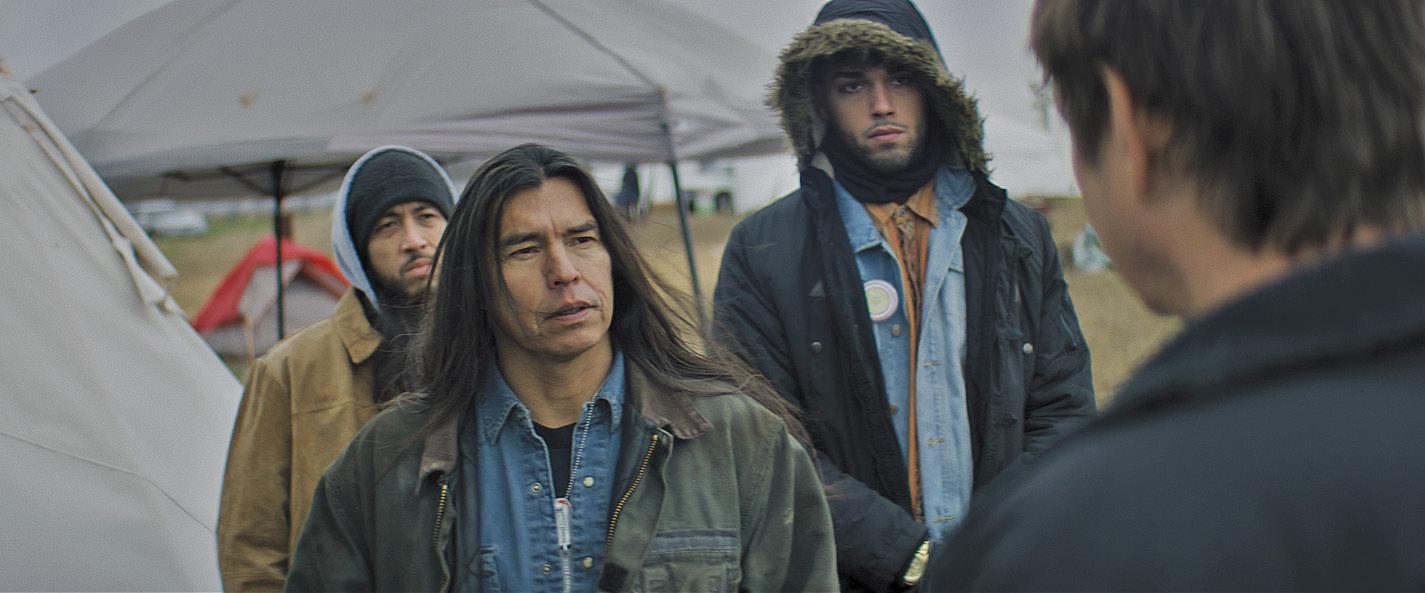

 Right : David Midthunder and William Mapother
Left : Frances Fisher
Right : David Midthunder and William Mapother
Left : Frances Fisher
64 OJAI MAGAZINE | SPRING 2023
Below: Rebecca Tickell with David Arquette
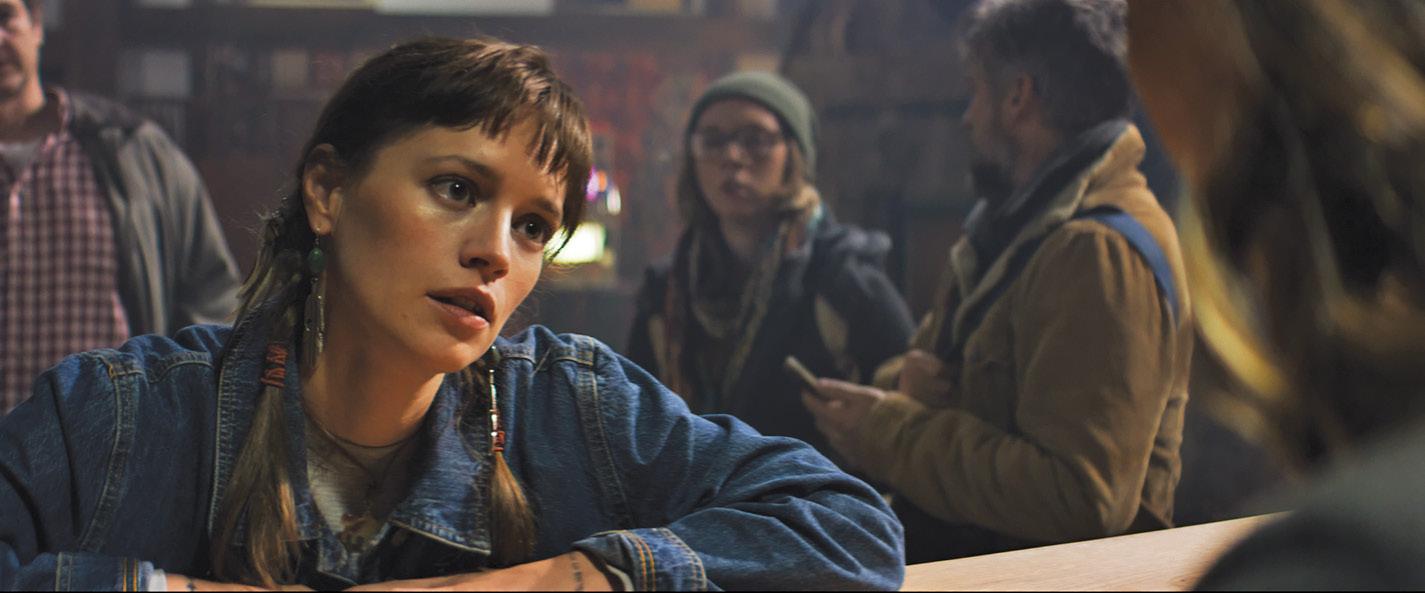
and Iraq War veteran who takes a freelance job writing for the (fictional) Houston Daily about the events at Standing Rock. The paper’s editor, Ricky (played by Frances Fisher), chooses Dan because she learns he is a Republican; previously wrote a story about a Cleveland oil refinery; and is in financial straits with a baby on the way with his pregnant wife, Julie (Amy Smart). When Daniel arrives in North Dakota, he meets with oil company executive Elliot (played by David Arquette), who says he wants Dan to simply tell the truth, but steers him toward a perspective favorable to his company. Pipelines, Elliot reminds him, are safer than trains, and both are safer than no oil. The country has enough oil to last a century, “but not if we can’t move it.” Dan initially writes a mostly pro-oil article (the published headline is “Dakota Pipeline: An American Necessity”), but as he continues to cover the story, he digs deeper. As he spends time at the Standing Rock camp with the Indigenous water protectors, he learns more about what they have endured throughout their past and present history, including abuse by police and treaties broken by the federal government. He also comes to understand their traditional and spiritual ties to the land and water.

Meanwhile, he works on healing his own inner demons as he experiences flashbacks and other symptoms of PTSD from his time in Iraq.
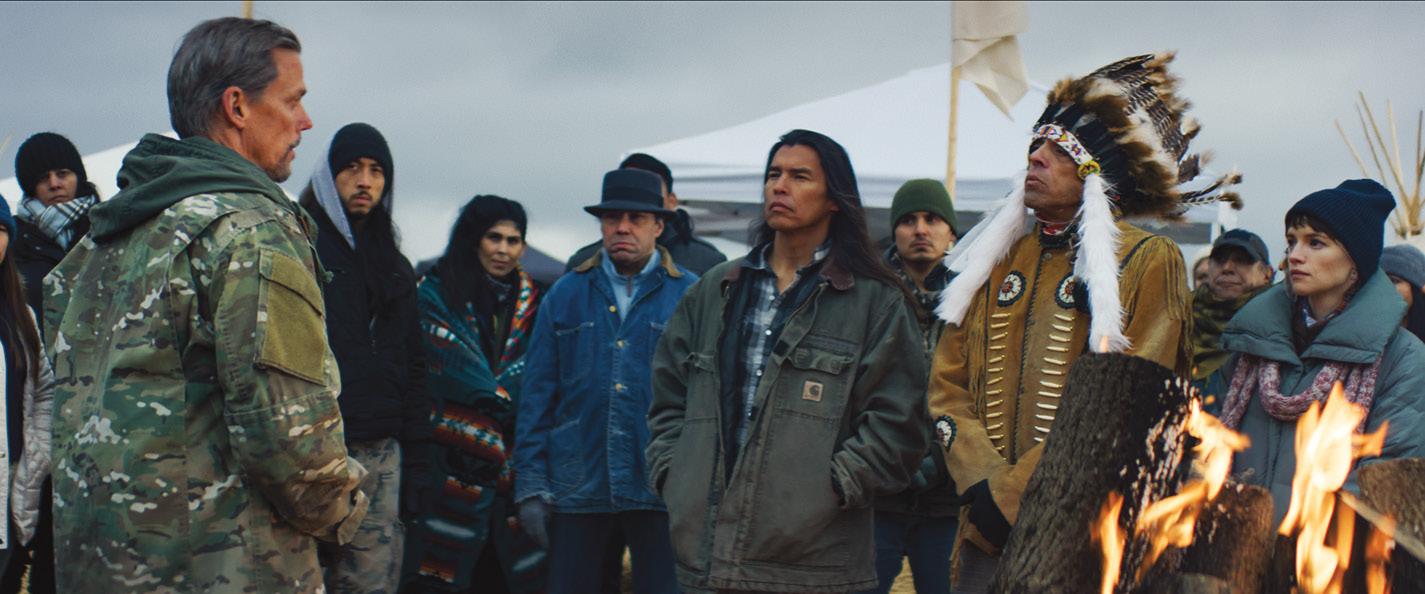
Dan’s character is fictional, but military veterans were among the supporters who helped the water protectors at Standing Rock because they wanted the police to stop intimidating unarmed citizens. “There was a confluence of di erent groups there that you wouldn’t normally see together,” Rebecca says. “The film is ultimately about bringing unlikely people together.”
The audience for the film, she says, is Americans who weren’t at the protests or weren’t aware of them. “Although it is deeply stirring for people who were there … the reality is that we made this movie for the mainstream, for people who don’t necessarily know about murdered Indigenous men, women, and children; broken treaties; or that the pipeline is still flowing right now as we speak.”

65 OJAI MAGAZINE | SPRING 2023
William Mapother
William Mapother with David Arquette
Kerry Knuppe
David Midthunder with Kevin McClatchy
Since 2016, the Standing Rock Sioux Tribe has gone back and forth with the U.S. Army Corps of Engineers and oil company Energy Transfer in court about whether constructing the pipeline under Lake Oahe violates the National Historic Preservation Act or environmental laws. In March 2020, a federal court revoked permits for the DAPL and ordered a full environmental review. In February 2022, after an appeal, the U.S. Supreme Court declined to hear the case, upholding the lower court’s ruling that the Army Corps of Engineers needed to conduct the environmental analysis.

“From day one,” Rebecca says, the filmmakers consulted with Indigenous people and elders about their idea for the film, and continuously sought feedback about the script. With permission, they incorporated elements of people’s real stories from Standing Rock into the characters and plot.
Casting Native Americans in primary roles as water protectors was also important, Rebecca says, including Kerry Knuppe, Irene Bedard, David Midthunder, Marshall Dancing Elk Lucas, and Che Jim. Many of the extras in the film had been real water protectors at Standing Rock. Che Jim had also been there.
“He was the most hesitant to participate, because he worried we would make a Hollywood version of Standing Rock,” Rebecca says. “That was a concern of many, but Indigenous community members who participated in and have seen the film have been supportive.”
Rebecca says they had a small budget for the movie, so they filmed everything on her father’s farm in Lancaster, Ohio, where the community “rallied for the film.” They considered filming on the Standing Rock reservation where the actual events took place, but after consulting with tribal leaders, realized they wouldn’t get a lot of support from local landowners who were hostile to the NoDAPL encampment.
On Nov. 12, On Sacred Ground had its world premiere in Los Angeles at the Red Nation International Film Festival, described as the largest Native American film festival in the U.S. On Sacred Ground won awards at the event for best picture, best director for the Tickells, best actress for Knuppe, and best supporting actor for Midthunder.
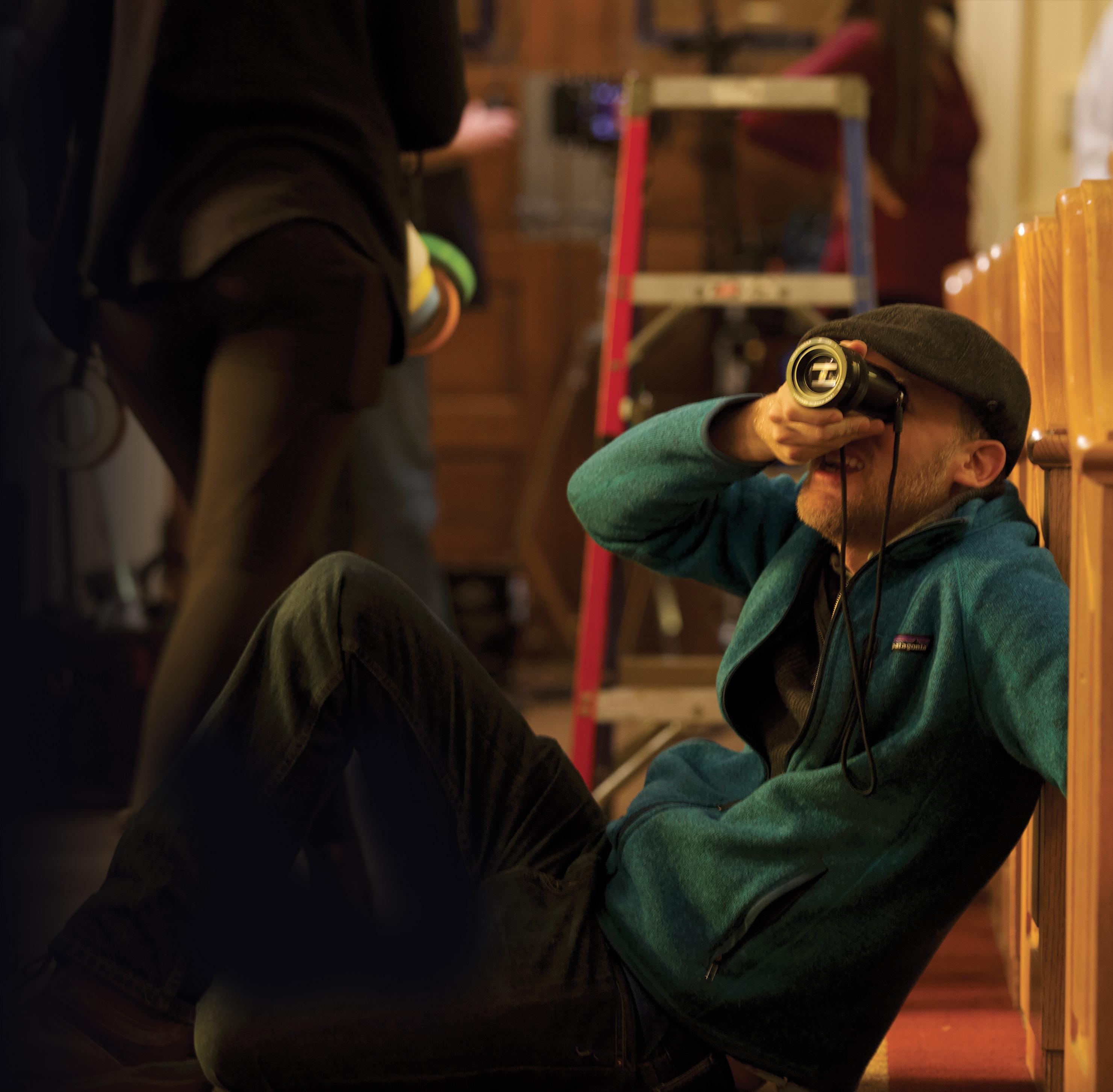
Knuppe (pronounced “Snoopy”) won for her role as Mika, a Sioux woman who gets to know Dan and “serves as the bridge for the water protectors and Washington,” the actress says. “Mika’s power lies in her ability to communicate with both.”
An enrolled Oglala Sioux tribal member from the Pine Ridge Indian Reservation in South Dakota who later moved to California, Knuppe says winning the Red Nation acting honor “was a really big deal for me back home; my parents were really proud. There was a time in my life I had pushed this part of me away, so to get recognition from that side was such an honor.”
Knuppe didn’t participate in the Standing Rock events, but to prepare for On Sacred Ground, she did speak with many people who had been at the camp in 2016.
She says camp participants mainly talked about the sense of the unity they felt — solidarity with members of hundreds of other Indigenous tribes who gathered there, military veterans, and non-Native people who had long been fighting oil companies.
The actress says she has received some negative feedback from people who think the film should have been made by and focused on Indigenous people and their stories.
“It’s disappointing when someone from my world, who should be cheering and supporting somebody from their world, says, “This is our story,” Knuppe says. “But no one else did a narrative movie on this incredible event that happened in our history. Narrative filmmaking can touch an enormous amount of people. Stories are powerful, but only powerful if they are told.”
Rebecca says she has heard some of the same feedback, along with concerns that the film promotes the idea of a “white savior” (i.e., Dan). At one point, she says, the Tickells considered not releasing the film at all because they feared “a big backlash.”
But after some deep soul-searching, she says, “it was obvious that we were going to do everything to bring attention to the issues that compelled us to make the film in the first place. People are entitled to their opinion, and I respect them. But I guess my question is, ‘What are you doing about it?’”
Water protectors of all kinds, united and interconnected, are needed to defy the black snake.
Above: Josh Tickell
Below:A tense confrontation as tempers begin to fray
On Sacred Ground is available to watch on demand via streaming and in theaters in select cities. For more information, visit www.onsacredgroundmovie.com
66 OJAI MAGAZINE | SPRING 2023

67 OJAI MAGAZINE | SPRING 2023
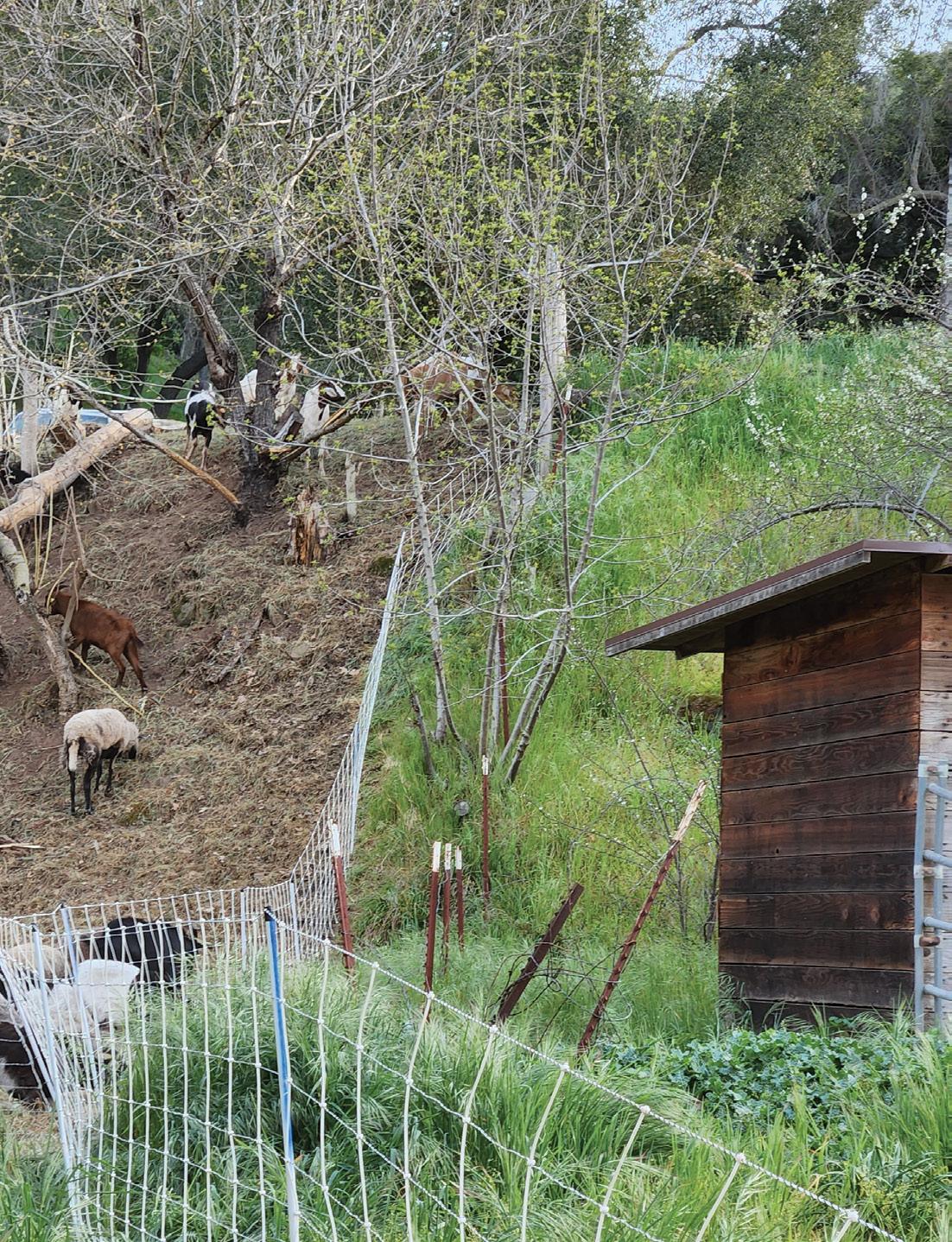



68 OJAI MAGAZINE | SPRING 2023 -vegetation management -wildfire mitigation -ecological improvement VENTURA BRUSHGOATS 805-358-1841 | www.venturabrushgoats.com Follow us @venturabrushgoats



71 OJAI MAGAZINE | SPRING 2023
HECK OFA AdventureFamily

72 OJAI MAGAZINE | SPRING 2023
by MIMI WALKER photos courtesy MICHAEL KRUMPSCHMIDT
their friends had it,” he reminisces. “We wanted to show them that you don’t need to consume like that. Nancy and I wanted to get away from the routine of life; we felt that we had slipped into this routine that was driving us and we weren’t in charge.”
He desired and required enrichment — for the kids, his classroom, and even his family relations. An opportunity to reconnect with
his German birth father, who was living in Sweden, and whom Mr. Krumpschmidt had not seen in 40 of his then-43 years alive, spurred a grand adventure.
After a year-and-a-half-long process of preparing for sabbatical — finding someone to mind their house, gathering his children’s curriculums and designing his own for his own students, then presenting an argument to the school board’s sabbatical committee that it’d all be worth it — in the fall of 1992, Mr. Krumpschmidt was granted permission to take his family on a 10-month, carefully designed journey around the world.

73 OJAI MAGAZINE | SPRING 2023
The Krumpschmidt Family on the rim of Ngorongoro Crater, Tanzania, February 1993.

74 OJAI MAGAZINE | SPRING 2023
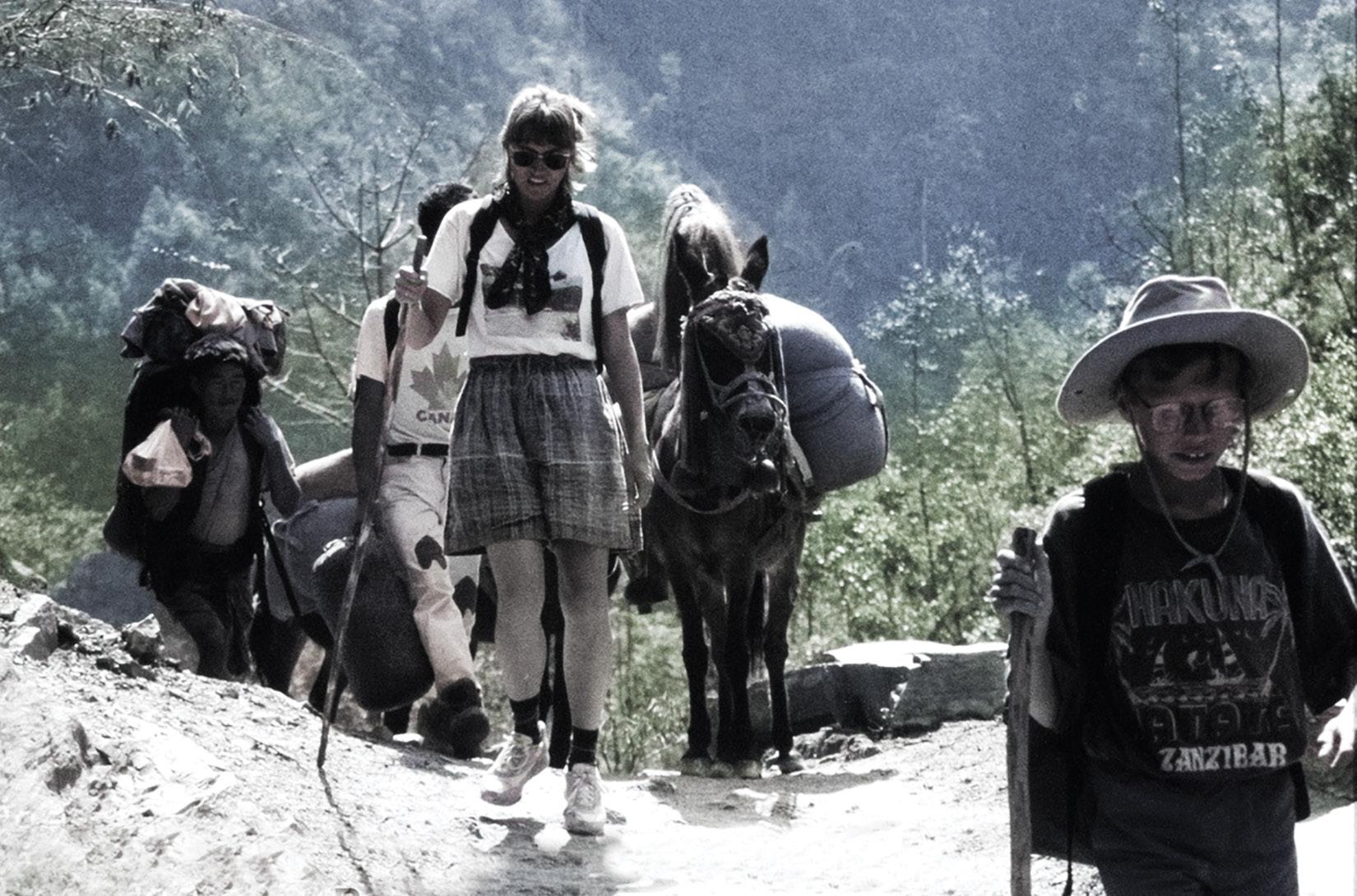
He had to write about staying in Uganda, where he saw some people in “dire” conditions, with care and “sensitivity.” Two of Mr. Krumpschmidt’s students died while he was away — one of them the son of a good friend. The Krumpschmidts had to flee resistance-torn countries after they entered, such as India and Egypt, to escape riots that were occurring there at the time. His wife had a near-death experience in Nepal after contracting what was then called Bornholm disease, a disease of the diaphragm; he had to think on his feet and convince a local youngster and his dad to use their Jeep for a ride to the next village with a good doctor.
“I learned that we were very privileged,” Mr. Krumpschmidt reflects. “We saw so many people struggling while we were traveling on a daily basis — life-and-death struggles, hunger and pain, poor people. We traveled extensively in Third World (countries). I realized how naive and idealistic we were that we could just travel through there. It took its toll; we really understood what these people were up against …. We also learned that we were a very resilient family. We didn’t know that about ourselves. We had quite a few obstacles thrown in our way that we thought,
at the time, were life-and-death obstacles. We pulled together and we dealt with it, and it bonds us still, that we had those experiences all together.
“One of the most powerful things that we enjoyed throughout the trip, day after day after day, is all of us, 90% of the time, were in the same room. That was economically driven — we got one room; everybody got a corner. And we learned to be happy in our corner, but we were privy to each other’s experience and
With each passing year, the kids incorporated lessons learned along the way in their U.S. lives; both children, now adults with families of their own, are still avid travelers today. In fact, Katie is making plans to take her own family on a parallel sabbatical throughout all the American national parks.
Long-distance learning has taken on a whole new definition in this era. But Mr. Krumpschmidt encourages parents by saying they don’t need to plan an aroundthe-world expedition to access that experiential education.
we synthesized them together. Everybody took what they got out of it and then we came up with a cohesive whole.”
As large as this undertaking was, the Krumpschmidts came back “completely renewed.” Mr. Krumpschmidt had a wellspring of verve in his teaching, with a wealth of receptive students; Nancy felt more pride and stability in secure “workat-home” mom domesticity. “Adventuring is a recharge; it can be a real shot in the arm,” says Mr. Krumpschmidt. “And I think a lot of it comes in unexpected ways. What we got from the friendships and relationships became part of us. Nothing monumental changed that made us live our life di erently — they’re subtleties, that we now interpret things di erently than we would’ve otherwise. Some of those (subtleties) are like time-release capsules; they worked on us overtime, not right away, especially for my kids.”
“Just like learners need a teacher, kids need a guide,” he says. “A kid is a kid, and very few kids are self-guided, selfdirected, or self-motivated. They need to be encouraged. If parents want the power of experiential learning, then their responsibility is to provide the experiences. Now, it could be as exotic and romantic as a trip around the world, but it could also be a trip to a local museum. It could be a trip to a geographical point of interest. It could be a simple trip to a tide pool …. It can be an out-and-back. Those kinds of experiences light that fire. If a parent is connected to providing those, then they can take advantage of that. Go to a place that interests you so that you can ignite your kids’ interests, or ask them where they want to go and let their enthusiasm infect you. Our son, when he was a child, was way into Legos. We promised him as soon as we got out of the country that we would go to Legoland. And that was wonderful; after that his attitude was wide open to go elsewhere, because we went somewhere that really interested him, that he wanted to experience. Going there opened the door of willingness. If this was cool, what could the next place be like?”
And so goes the algorithm of the family adventure. It is meticulously budgeted, yet just the same, it is numberless. It is planned and impromptu. There are peaks and there are valleys. It is a vacation and it is work. The strongest seed of an adventure lies in drive and curiosity, and we learn most when we step outside of ourselves. In any endeavor — big or small, on the jet plane or out the back door — to fortify family, one incontrovertible truth holds that superglue power: The time is now.
75 OJAI MAGAZINE | SPRING 2023
The Krumpschmidts trek the Annapurna Range on the Jomsom Trail in Nepal, March 1993.
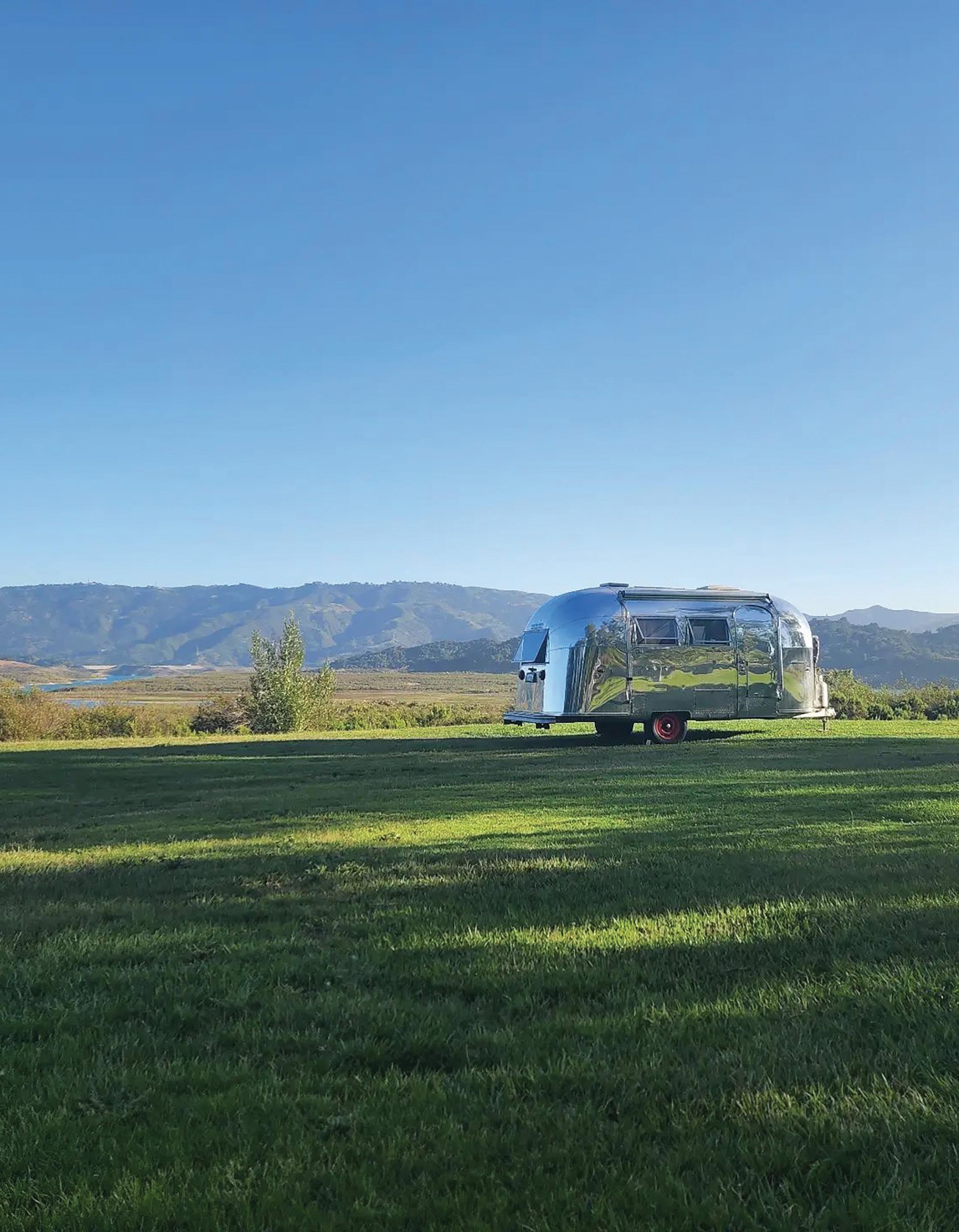

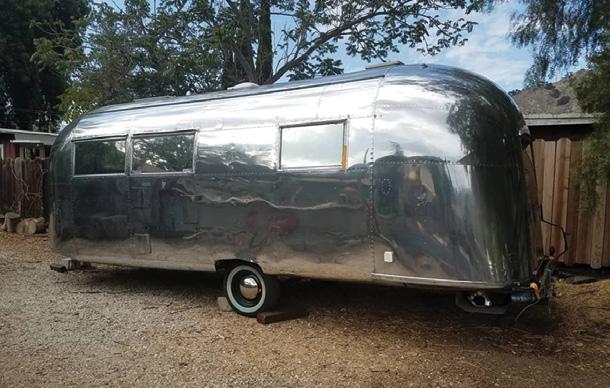
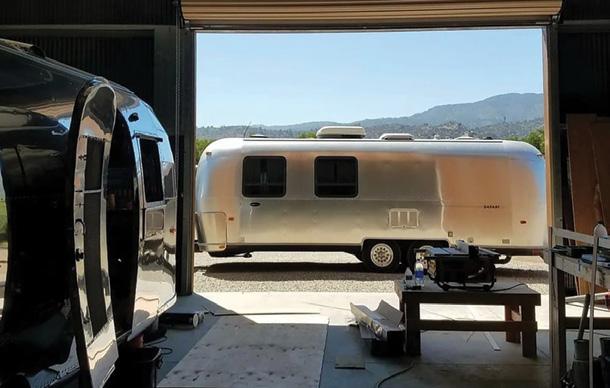
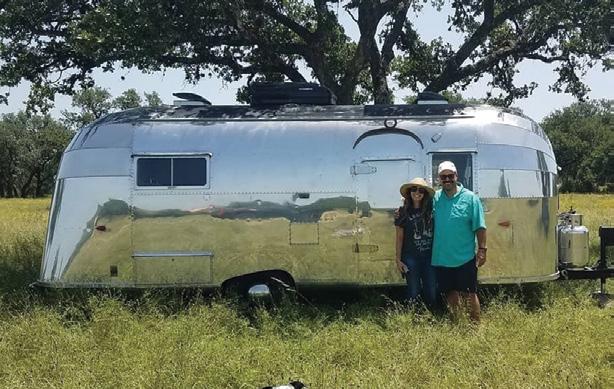


MATILIJ A VINTAG E TRAILE R RESTORATIONS 65 Baldwin Road, Ventura, California 93001, United States 917-673-5971 • Mon - Fri: 7am - 5pm Sat: By appointment Sun: Closed 76 OJAI MAGAZINE | SPRING 2023

77 OJAI MAGAZINE | SPRING 2023 Beautiful Smiles, Naturally. Cosmetic and Biological Dentists 1511 State Street, Santa Barbara CA 93101 805-899-3600 | santabarbaradds.com Lance Grant, DMD | Mark Weiser, DDS




78 OJAI MAGAZINE | SPRING 2023 To schedule an appointment with a licensed insurance agent, please call Lyn Thomas, CA License #0D96309 at 805-646-6409 Monday - Friday, 9:00am - 4:00pm Medicare Informational Seminars Medicare 101 or Turning 65 and Still Working Go to www.LT-ins.com/seminars We help you with Medicare. Let us help at no cost to you. Lyndon Thomas Insurance is a California licensed insurance agency working with Medicare beneficiaries to explain Medicare Supplement, Prescription Drug Programs, and Medicare Advantage Plan options. We do not offer every plan available in your area. Any information we provide is limited to those plans we do offer in your area. Please contact Medicare.gov or 1-800-MEDICARE to get information on all of your options. 1211 Maricopa Hwy, Ste 222, Ojai, CA 93023 www.LT-ins.com This licensee is performing acts for which a real estate license is required. C2 Financial Corporation is licensed by the California Bureau of Real Estate, Broker # 01821025; NMLS # 135622. Loan approval is not guaranteed and is subject to lender review of information. All loan approvals are conditional and all conditions must be met by borrower. Loan is only approved when lender has issued approval in writing and is subject to the Lender conditions. Specified rates may not be available for all borrowers. Rate subject to change with market conditions. C2 Financial Corporation is an Equal Opportunity Mortgage Broker/Lender. (Add this for website disclaimer: The services referred to herein are not available to persons located outside the state of California.) C2 FINANCIAL CORPORATION IS THE #1 BROKER IN THE NATION MORTGAGE EXECUTIVE MAGAZINE 805.798.2158 HEARTLOANS@SBCGLOBAL.NET 236 W. OJAI AVE., SUITE 105, OJAI CA 93023 HEARTLOANS .COM C2 FINANCIAL CORPORATION THERESE HARTMANN CONCIERGE MORTGAGE CONSULTANT FOR 25 YEARS
chadcarperconstruction.com



79 OJAI MAGAZINE | SPRING 2023
Lisa Marie
 A teenage Lisa Marie Presley, left, embraces friend Jane Burn in the mid-’80s on a Happy Valley School camping trip across the Sierras.
80 OJAI MAGAZINE | SPRING 2023
Photo submitted
Lisa Marie Presley handled all the hurdles that come with great fame under that legacy in her own way, reflective of the many wildly eclectic experiences in her life before her untimely passing on Jan. 12 at age 54. For a brief interlude, she lived one of the closest experiences to normalcy in her life right here in the Ojai Valley. From 1983 to 1985, she spent her sophomore and junior years at Happy Valley School (now the Besant Hill School), at last having a chance to do that which usually eluded her: blend in with her peers.
“I think she was so overwhelmed by the notoriety that she didn’t invite, that she just wanted to quietly slip into the school … she just wanted to take a deep breath,” said Dennis Rice, former Happy Valley School headmaster.
Her classmates welcomed her as she was, and were often very protective of her if anyone dared attempt to pry, as one of her closest friends from HVS, Jake Rupp, shared.
Rupp recalled a situation with a former boyfriend of Lisa Marie at that time. It was discovered that this particular boyfriend
from Los Angeles was tipping o paparazzi to Lisa Marie’s whereabouts.
As soon as Lisa Marie broke it o with him, “We were all gathered together ready to get the pitchforks out” if he ever returned to the valley, Rupp joked. But, he added, that’s just the kind of community the HVS student body was: “I have a lot of friends from Happy Valley that I could go for years without talking (to), but I know that if anything ever happened, I could call them and they would be there for me. … I think we were able to help her through it; I do think that she trusted the people on campus.”
Rupp became very close to Lisa Marie. He said she would introduce him as her “best friend from high school” at di erent parties in adulthood — and saw firsthand how she was moving past the “confining” aspects of her young life. “In some respects at the school, she was a blank slate and willing to try all di erent things. So many things were new to her that you wouldn’t expect to be new. …I liked that she was playful. We could just sort of be silly and have fun. She was pretty adventurous.”
Rupp’s memories of Lisa Marie are heartily punctuated with laughter as he detailed the hours of riding scooters around Montecito on days o from school, and, post-high school, dancing to Cameo’s “Word Up!” with pillows stu ed in their shirts in her Westwood apartment. He reflected on “one of the best times” of his life at Happy Valley School — a weeklong school excursion to Santa Cruz Island. “We had the whole island to
ourselves. A group of us, including Lisa, would just take o in the mornings.” They found a bottomless pit to throw rocks in, unearthed archeological ruins, and partook in light rock climbing along the coastline. “We just kept discovering things, and discovering stu for the first time together … we were just so free, with no pressures of anything related to society.”
Although Lisa Marie’s time at Happy Valley School ended after junior year — and she ultimately did not finish high school — Rupp remained in her life, although they only saw each other intermittently and did not fully reconnect until around 2008. Rupp talked of how she always felt “comfortable” in Ojai, and even had an epic birthday weekend in the valley, which replicated a happy weekend spent with Rupp and their other close friend, the late Caitriona Meek Nelson, circa the late-2000s.
“There was one weekend where she came to town … she was doing her music and seemed to be in a good place. We just hung out in Ojai; we went to Antonio’s (Mexican)

Presley’s
by MIMI WALKER
Happy Years at Happy Valley School
Being the daughter of a legend as seismic as Elvis Presley could hardly be construed as a cakewalk.
81 OJAI MAGAZINE | SPRING 2023
Elvis Presley and Priscilla with Lisa Marie, February 1968. Photo courtesy Wikimedia CC
Restaurant and had a really fun dinner.” After an outing at the spa, they had another fun night and had “this crazy time at the Deer Lodge. We just had a really mellow, fun, casual Ojai weekend.”
For the following birthday after this outing, Rupp said she invited some Tinseltown pals and other friends from Los Angeles down to the valley and arranged to rent out the Ojai trolleys, which carted her posse from the Ojai Valley Inn to the wholly rentedout Antonio’s Mexican Restaurant. “Of all places, just to be at Antonio’s with this group of people … that was very cool.” She rented out the Deer Lodge and had friends ride a bucking mechanical bull and play Deer Lodge games. “It was … so Ojai.”
As the years went on, Rupp said he and Lisa Marie emailed and visited once or twice a year. Although Lisa Marie remained “guarded” throughout her life, Rupp said that she often intuitively reached out to him in his own life’s harder moments. “Sometimes, she would just really come through and be the right person to o er support to me that was meaningful.”

Rice, too, reflected on Lisa Marie’s path to support others: “We had discussions at the school — we knew that she was going to be very, very rich one day, and I encouraged her to do something significant with that opportunity.” With that in mind, he cited Lisa Marie’s charity work in Memphis as one of the largest parts of her legacy. Presley Place, a 12-unit housing complex she funded with the Metropolitan Inter-Faith Association to help homeless women and children get back on their feet, is still up and running more than 20 years later. “She did some really wonderful things there. It was really important to her,” Rice said. “Her time at Happy Valley … was a private time,” Rice continued. “It just allowed her to be a teenager; she stepped out of the limelight and was just another kid in the school. ... She had a lot of friends and a lot of people who loved her through that. I think she really appreciated that time that she spent with us.”

Rupp concurred: “I think she developed friendships that she could count on later in life. Even though it was a short period in Ojai, I believe that she developed lifelong connections.”
 Lisa Marie Presley Feb. 1, 1968 — Jan. 12, 2023
Above: Soma Kaplan, left, and Lisa Marie relax on the grass during an HVS day trip. “It was a special time in our lives. We all felt very protective of her...it was a lovely, nice time for all of us,” Kaplan recalled.
Photo submitted
Below: Lisa Marie Presley and her mother, Priscilla, on move-in day at the Happy Valley School dorms in fall 1983.
Photo by Jake Rupp
Lisa Marie Presley Feb. 1, 1968 — Jan. 12, 2023
Above: Soma Kaplan, left, and Lisa Marie relax on the grass during an HVS day trip. “It was a special time in our lives. We all felt very protective of her...it was a lovely, nice time for all of us,” Kaplan recalled.
Photo submitted
Below: Lisa Marie Presley and her mother, Priscilla, on move-in day at the Happy Valley School dorms in fall 1983.
Photo by Jake Rupp
82 OJAI MAGAZINE | SPRING 2023
Right: Lisa Marie in 2014. Photo by David French / Wikimedia CC


83 OJAI MAGAZINE | SPRING 2023

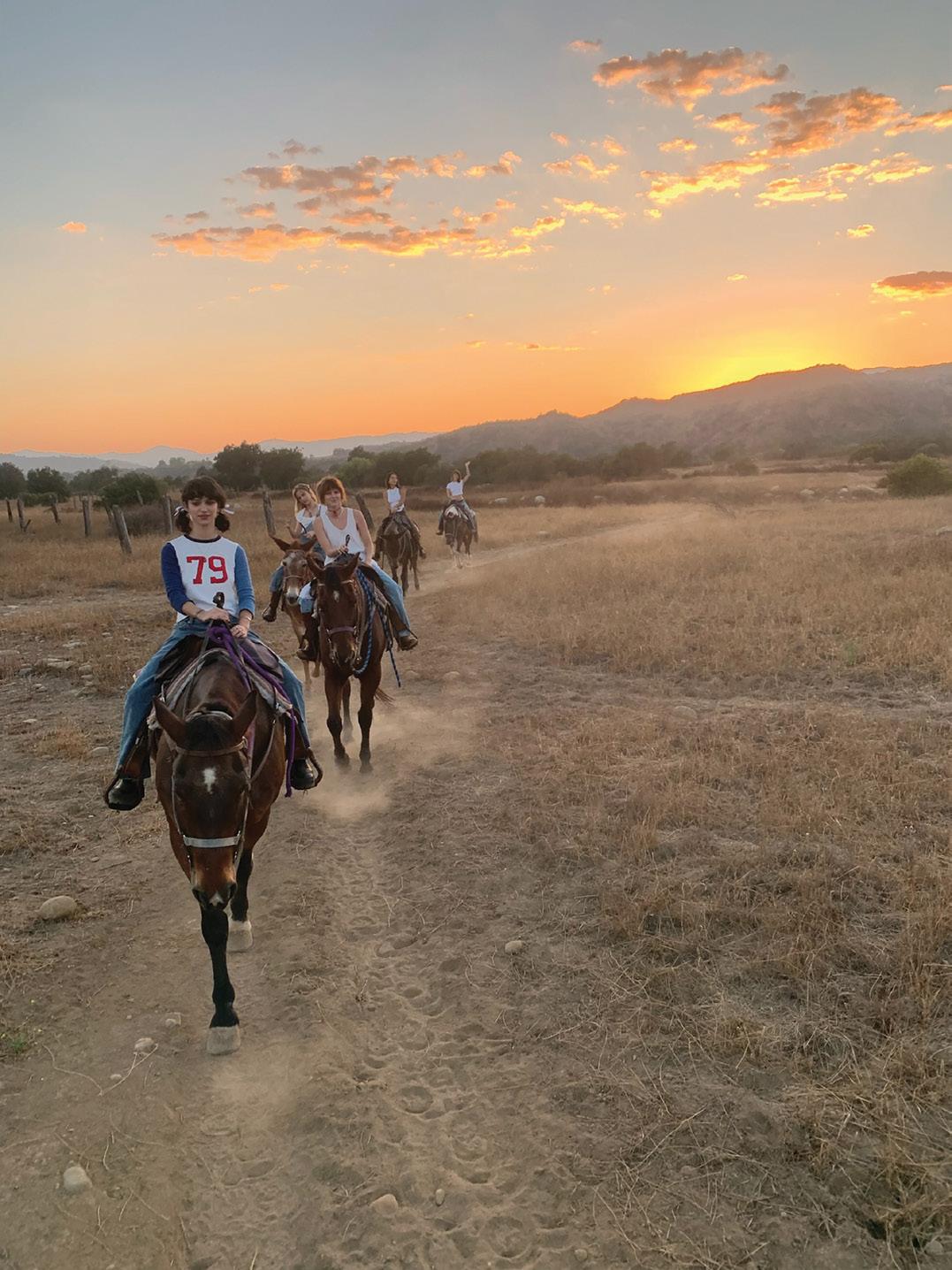

84 OJAI MAGAZINE | SPRING 2023 Premier Horseback Riding Explore California’s Shangri-La with a majestic horseback tour of one of the most beautiful places on Earth. Just 3.5 miles from downtown Ojai, we are open 7 days a week. Call for reservations. 805-890-9340 ojaivalleytrailridingcompany.com ojai valley trail riding company ojai valley trail riding company 2022


85 OJAI MAGAZINE | SPRING 2023
The Ojai
WORLD TENNIS CHAMPIONS ON THE OJAI WALL OF FAME
by HOLLY ROBERTS
Ojai’s historic downtown Libbey Park, with its centuries-old sprawling oaks, adjacent grassy knoll, and blue-on-green city tennis courts, sets the scene for the 121st Ojai Tennis Tournament on April 26 to 30. Founded by William B. Thacher in 1896, one of the oldest tennis tournaments in the United States has hosted some of the greatest tennis players to ever play the game.
To name just a few: May Sutton Bundy, Bill Tilden, Maureen Connolly, Pancho Gonzales, Rosie Casals, Jack Kramer, Billie Jean King, Arthur Ashe, Jimmy Connors, Tracy Austin, Patrick McEnroe, Pete Sampras, Michael Chang, Lindsay Davenport, and Mike and Bob Bryan.
“The Ojai,” as it is fondly called by participants and fans, includes 27 divisions within five di erent events featuring approximately 1,200 players, including Junior, CIF, Independent and Junior Colleges, the Pac-12 Conference Championships, and the Open, where players compete for prize money. The tournament is run entirely by over 600 volunteers who organize everything including competition draws, tennis o cials, facilities maintenance and setup, housing, merchandise, security, ball people, and more. Competition is played on courts throughout Ventura County and at every available court in the Ojai Valley, culminating in the semifinals and finals of each division played at the Libbey Park courts on the final weekend of the tournament.
The Ojai is a community-created event and labor of love for all involved, exemplified by the iconic Tea Tent, where everyone with an entry ticket, whether player, coach, or fan, may sit and enjoy complimentary handpoured hot tea, freshly pressed Ojai pixie orange juice, and cookies between matches. Ninety-three athletes who played in The Ojai from 1899 to 2022 went on to compete and win one of the world’s Grand Slam tennis events — the Nationals (preOpen era), Australian Open, French Open, Wimbledon, or U.S. Open — in singles, doubles, or mixed doubles.
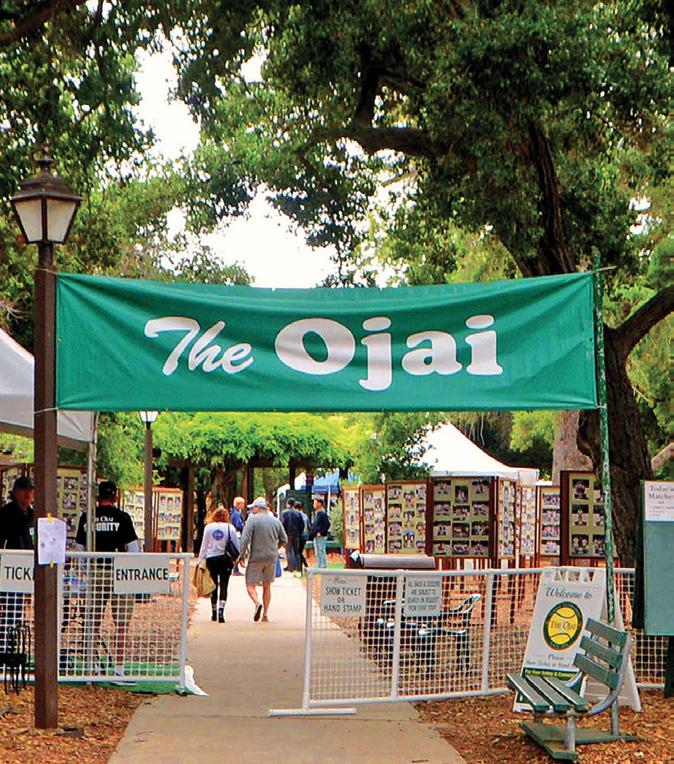
The Ojai Valley Tennis Club (OVTC), a nonprofit organization founded by William Thacher in 1895, sponsors the tournament along with local youth tennis programs throughout the year. In 2000, the OVTC decided to honor the outstanding tennis greats who also played in The Ojai with a Wall of Fame. Located on a series of three plaques mounted on the rock entrance wall to Court 1 at Libbey’s upper courts, The Ojai Wall of Fame was spearheaded by longtime tournament volunteer, board member, and OVTC President Emeritus Alan Rains, in collaboration with a committee including Ojai tennis historians and members of the Southern California Tennis Association.
According to Steve Pratt, The Ojai’s publicity and marketing chairman, the initial committee dove into tennis record books and researched tennis’ earliest champions, including the first name listed on the Wall of Fame: Marion Jones Farquhar from

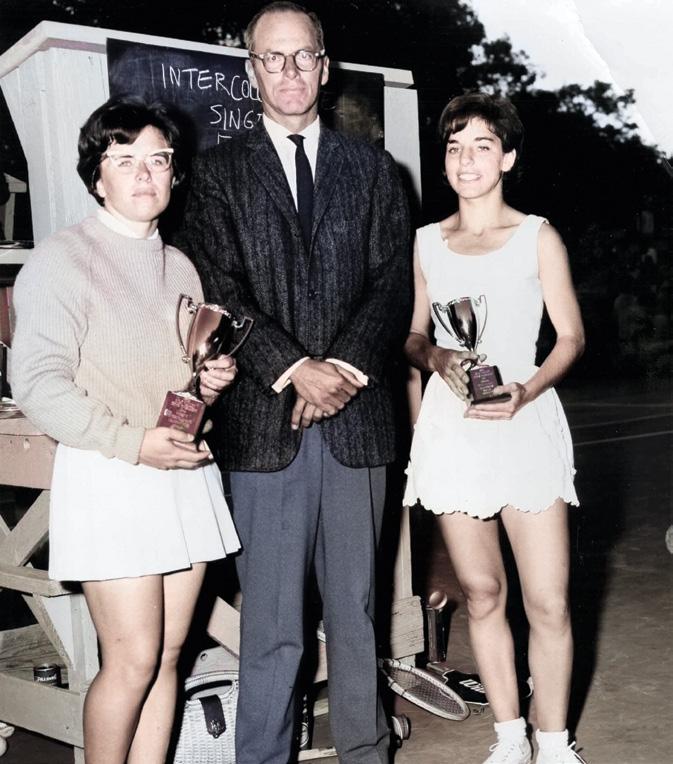
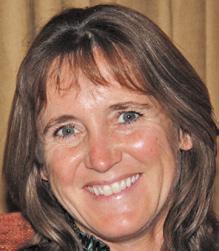
86 OJAI MAGAZINE | SPRING 2023
Historic Photos Courtesy of Ojai Valley Tennis Club
1964 Women’s Independent College Singles champion (Cal State Los Angeles), Billie Jean King, with opponent, Julie Heldman.
Entrance to The Ojai tennis tournament within Ojai’s downtown Libbey Park.
1964 Boys CIF Singles champion from Pasadena, Stan Smith, with opponent Tom Karp from University High School.
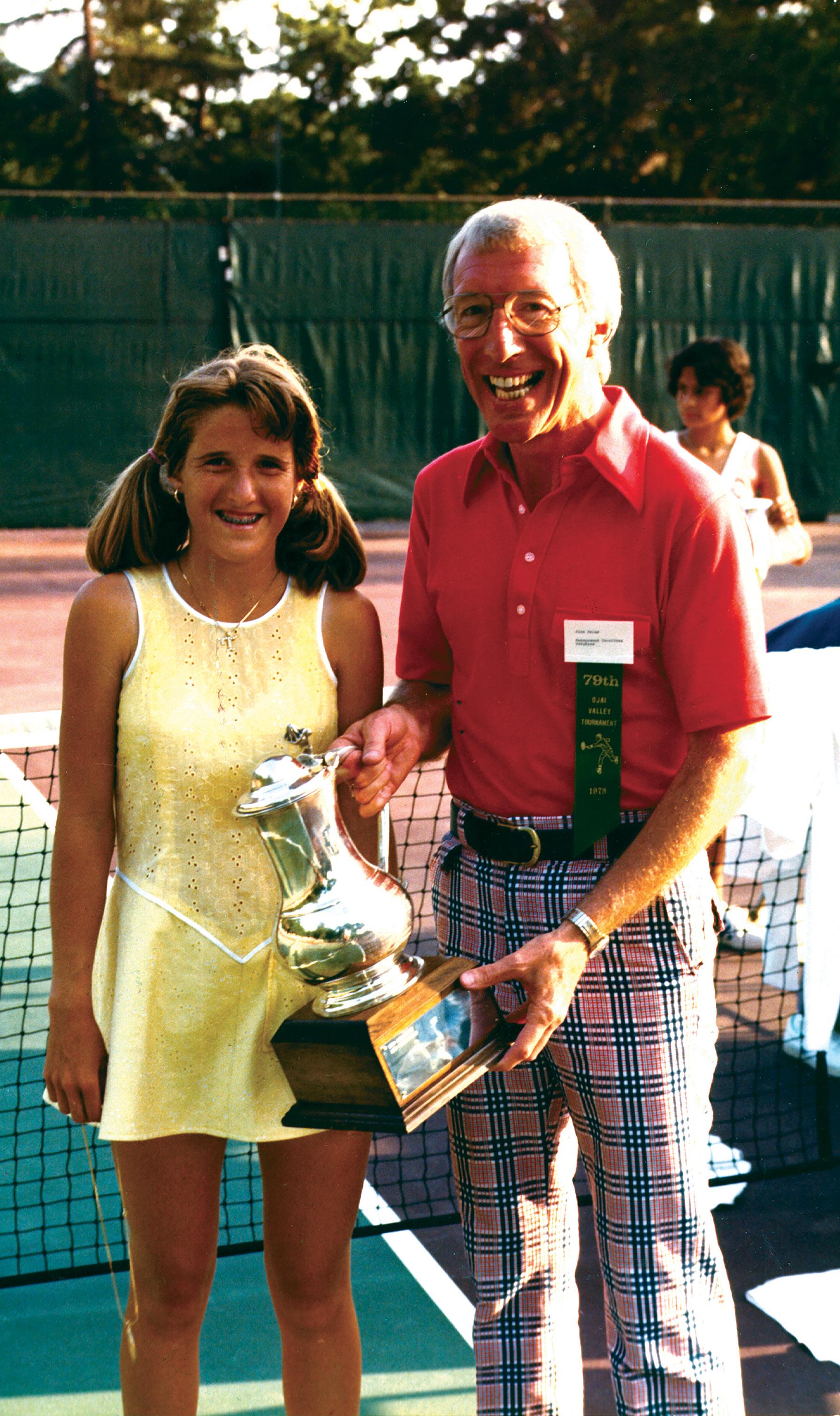
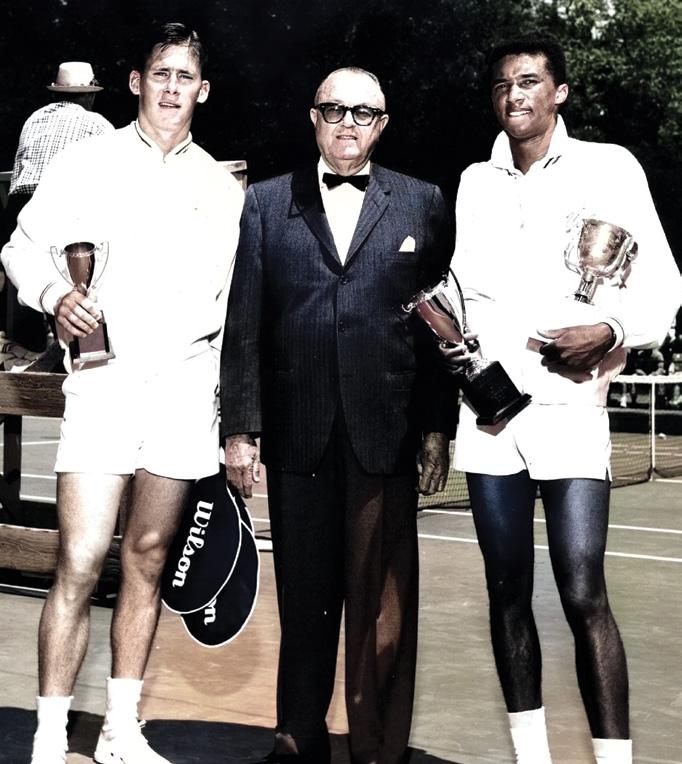
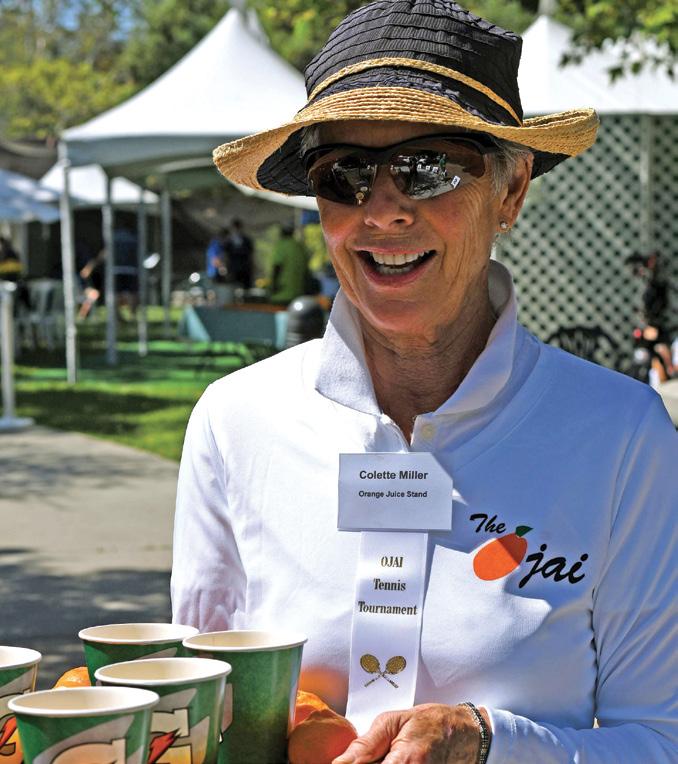
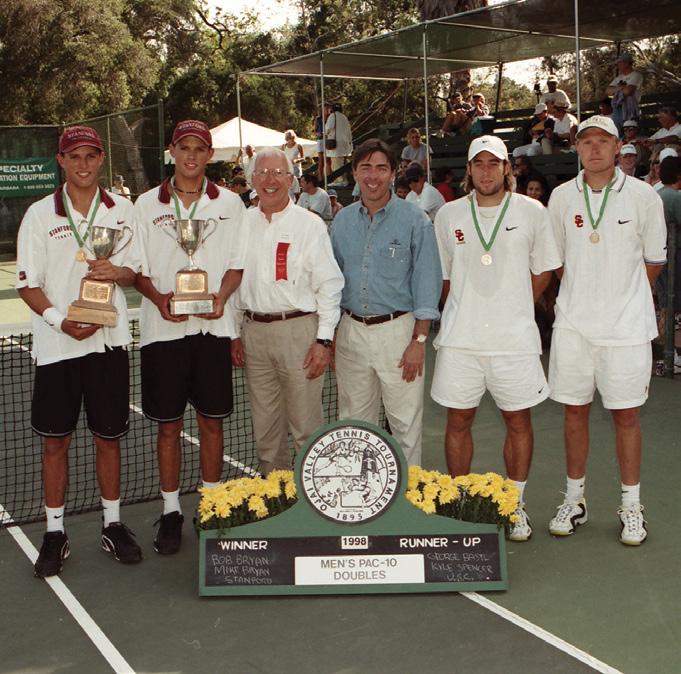
87 OJAI MAGAZINE | SPRING 2023
Runner-up, Dennis Ralston, and Ojai Men’s Collegiate Singles’ champion (UCLA), Arthur Ashe, at The Ojai in 1964.
Ojai Tennis Tournament tea tent volunteer, Colette Miller, serves up fresh squeezed orange juice from Ojai’s Friends Ranch.
1978 Ojai Girls’ 16’s Champion, Tracy Austin, with Ojai Valley Tennis Club trophy presenter, Alan Rains.
1998 Ojai Men’s Pac-10 Doubles champions, Bob and Mike Bryan (Stanford), with opponents, George Bastl and Kyle Spencer (USC).
Santa Monica. Farquhar won an Ojai doubles title in 1909, and before that, won the United States Nationals three times, in 1899, 1901, and 1902.
The original Wall of Fame plaques were cast in bronze, and over the past 22 years, a few errors were discovered regarding names of players who played in The Ojai but had never won a major title, or who had been inadvertently left o the Wall of Fame and should have been honored. Art Larsen, for example, was an Ojai finalist in the Men’s Intercollegiate Singles division playing for the University of Pacific in 1947, and for the University of San Francisco in 1949. A year later in 1950, Larsen captured the U.S. Nationals to gain entry onto The Ojai Wall of Fame, although his name was overlooked in 2000. Phil Dent won the Australian Open in doubles in 1975 and later won The Ojai Open Doubles in 1987 while coaching his son, Taylor Dent. Larsen and Dent were among several Ojai greats initially omitted but who needed to be added to the Wall of Fame.
Following The Ojai in 2019, tournament organizers gathered to discuss updating the Wall of Fame. Pratt spearheaded the project with support from OVTC President Duane Williamson, who agreed that the history and tradition of the players needed to be updated to reflect The Ojai’s ongoing history.
“You’re talking about all-time greats like Bobby Riggs, Jack Kramer, Arthur Ashe, Billie Jean King, Pancho Gonzales, Stan Smith, Jimmy Connors, Tracy Austin, and the list goes on and on,” Williamson said. “We all felt it was so important to keep the Wall of Fame going and that it was time for a fresh new look.”
The Ojai Board of Directors unanimously voted to remove the original bronze plaques in favor of new Laurentian green granite stone panels with the updated names of Ojai tournament players who went on to win Grand Slams. To get it right, Pratt sought help from noted tennis author and International Tennis Hall of Fame historian Joel Drucker, who was commissioned to review all of the names. Through this process, Drucker discovered Clarence Gri n, who had won the U.S. National Doubles title with Ojai Wall of Famer Bill Johnston in 1915, 1916, and 1920. Gri n,
the uncle of TV personality Merv Gri n, had played in the Ojai Men’s Open Singles Final in 1906. “Bingo! Another lost Ojai Wall of Famer was found!” said Pratt.
All-time tennis great and former world No. 1 player Tracy Austin won The Ojai Open Women’s singles and doubles titles in 1977 and Girls 16s in 1978. She went on to win the U.S. Open in 1979, Wimbledon mixed doubles with her brother John Austin in 1980, and another U.S. Open title in 1981. Austin remains the youngest U.S. Open female singles champion. “The Ojai has always done a tremendous job in preserving its history and celebrating all of the great champions who have passed through storied Libbey Park,” Austin said. “Seeing the names on the Wall of Fame provides an inspiration to the juniors and college players who someday hope to achieve the same success as those who have come before them.”
The OVTC commissioned Santa Barbara Monumental to handle all the engraving on the new panels based on artwork files prepared by Katie Fagan, Pratt’s publicity co-chair and a local graphic artist. Fagan left room on the panel for engraving the names of future Ojai greats who will go on to victory at an Open Grand Slam event. The new panel will include the two most recent Ojai players and Grand Slam winners, Desirae Krawczyk (2021) and Ena Shibahara (2022).
Krawczyk won The Ojai’s Women’s Open Doubles title in 2011 as a high school junior, then went on to play for the Arizona State Sun Devils, Pratt said, helping her team win their first-ever Pac-12 team title at The
Ojai in 2016 as a senior. She has since won four Grand Slam mixed doubles titles in the past two years at the French Open (2021), Wimbledon (2021 and 2022), and the U.S. Open (2021).
Shibahara, from Rancho Palos Verdes, is the most recent addition to The Ojai Wall of Fame. She won back-to-back Women’s Open Singles titles in 2015 and 2016 and made three straight Women’s Open Doubles finals with Jada Hart from 2014-2016, all before entering UCLA.
Shibahara played two seasons for the Bruins at The Ojai before turning pro after her sophomore year. Representing Japan, Shibahara has risen up the WTA rankings and reached a career-high No. 4 in the world in March 2022 before capturing her first Grand Slam title in mixed doubles at the French Open.
The Ojai’s new Wall of Fame will be unveiled at Libbey Park, near Court 1, on March 24, followed by a reception for tournament patrons, sponsors, and VIPs. Ojai Valley Museum Executive Director Wendy Barker heard about the removal of the original bronze plaques and quickly moved to secure them for the museum.
Whether you are visiting Ojai for the first time — as a regular attendee of the Ojai Music Festival, The Ojai Tennis Tournament, or your kids simply play daily at Libbey Park’s playground — the Wall of Fame is a reminder of Ojai’s international world standing wrapped in a small community with a big heart.
For more information about The 2023 Ojai Tennis Tournament, visit www.TheOjai.net.
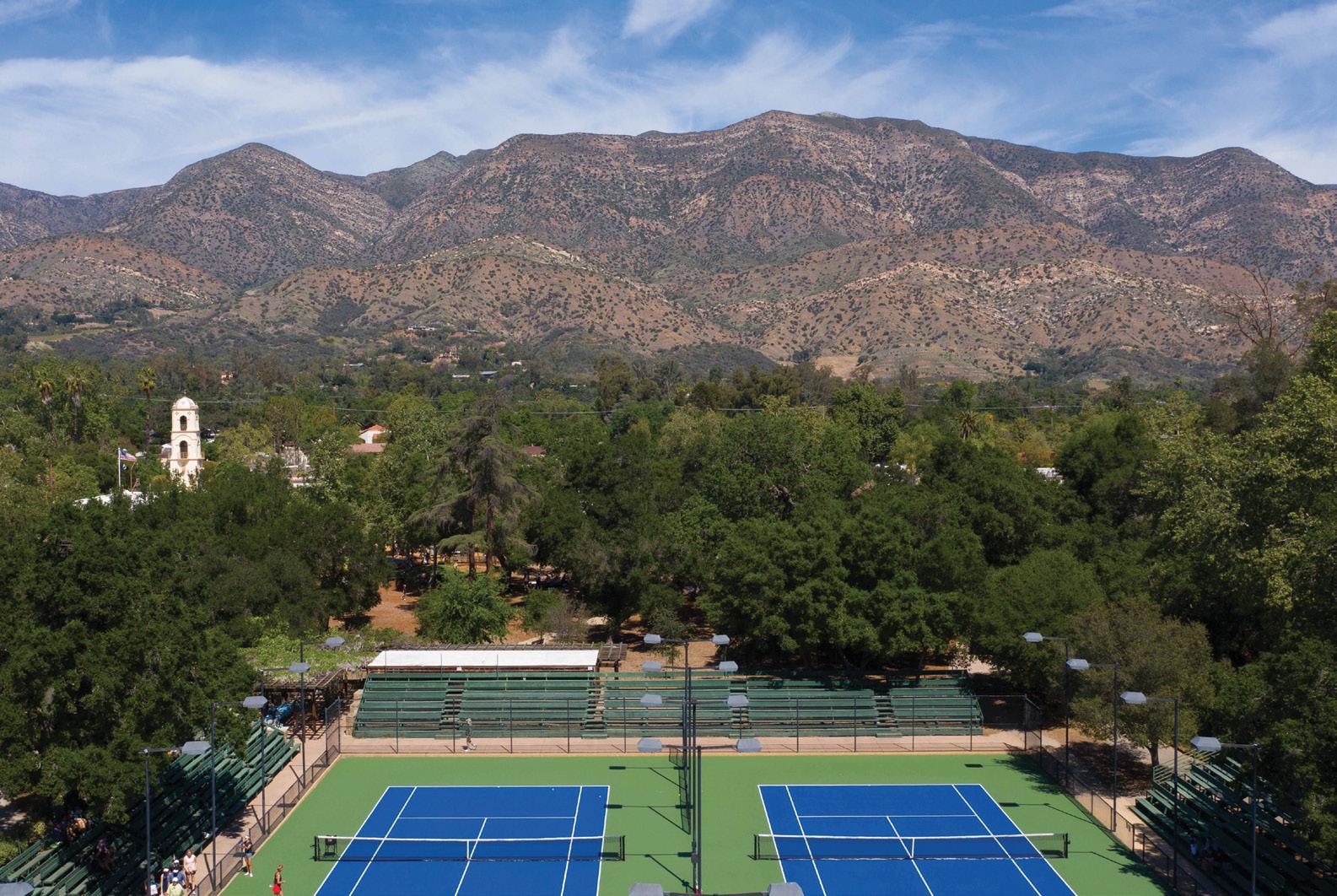
88 OJAI MAGAZINE | SPRING 2023
Aerial view of Ojai’s Libbey Park tennis courts 1 & 2 within the oak canopy, downtown Ojai.

89 OJAI MAGAZINE | SPRING 2023
SEA FRESH SEAFOOD


Seafood - Steak - Sushi
Serving Breakfast Saturday and Sunday 8AM-11AM

Heated Patio - Full Bar
Voted “BEST SEAFOOD” 13 YEARS IN A ROW!
90 OJAI MAGAZINE | SPRING 2023



91 OJAI MAGAZINE | SPRING 2023
Tesoro Mio
by JOHN FONTEYN
It’s normal for a native Southern Californian to get nervous before traveling north to the snow. “Did we pack enough warm clothes? What will the driving conditions be? Is four-wheel drive enough or should we get snow tires? What do we do if the power goes out? And, most importantly, will they have bitter salad greens?”
OK, maybe the last one isn’t something most people think too much about, but as self-professed veggie addicts, it worried both my wife Elizabeth and me. You get spoiled in Ojai, where there are year-round weekly farmers’ markets, large grocery stores like Westridge Markets and Vons with organic food sections, and extraordinary farm-to-table restaurants.
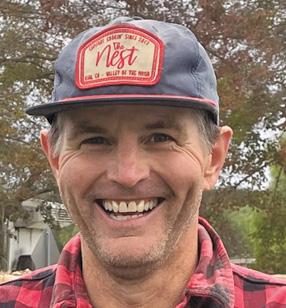
Anyone who has come to Southern California from east of the Rockies and north of Sacramento knows what the produce scene is like between November and February — abysmal. So maybe only they can truly appreciate why Elizabeth and I loaded up our road basket with Fuyu persimmons, escarole, carrots, and Satsuma tangerines, and prayed that we wouldn’t get scurvy on the three-day drive north. When we finally pulled up to the tiny health food store in our favorite little secret town in Washington, after driving 10 hours from Bend through snowdrifts and subzero temperatures, my salad jones was roaring. The polar plunge was on its way over the Christmas holiday, and Elizabeth and I knew this might be our only chance to stock up before being shut in. Visions of canned soups and frozen peas haunted me as we made our way into the market, hoping there might
be something green we recognized and felt good about eating. Perhaps it was the Basic Becky baby salad mix stacked high on the right, or the plastic co n pyramid of premature jaundiced arugula equally high on the left, that allowed the treasure to remain undiscovered. Or maybe it’s radicchio’s forever name tag — “Hello my name is: Bitter” — that left it unadopted until we laid claim to it, huddled lonely in its psychedelic complexity of colors.
Of course, we filled our basket with onion, carrots, Yukon Gold potatoes, organic chocolate, half-and-half from pasturefed cows, and a panettone, but it was our discovery of the Chioggia radicchio for $3.99 a pound that was our early Christmas miracle. Just one shelf over, a bulb of fennel caught my eye at $14.99. I think I audibly gasped; however, you expect the price of fresh vegetables to be exorbitant in the Pacific Northwest in wintertime. In California, radicchio can be $10 a pound, so at $3.99, we struck gold. I found myself furtively stockpiling them into my arms.
I watched the checkout person slowly scan and weigh things with a similar foreboding I had when using my fake ID as a teenager, fully expecting the clerk would look up at any moment and say, “Sorry, I can’t sell these to you.” Had someone put these out by mistake? If it were my store, I would keep them behind the counter. They’re far too precious. I really can’t remember the first time I ate radicchio, any more than I can remember my first cup of co ee. It’s possible that when I was much younger someone dosed my house salad at a restaurant and
Radicchio

92 OJAI MAGAZINE | SPRING 2023
Photo: Korina Matyas
I mistook it for cabbage; I wouldn’t have noticed the bitter treasure hidden at the bottom of an ocean of Thousand Island dressing. And while I’m not a recent convert, I was definitely late to the party.
In my defense, Central Texas in the mid80s wasn’t really a hotbed for less common species of Asteraceae (e.g., chicory, artichoke, dandelion). Never once was I asked if I wanted to substitute chrysanthemum greens for cilantro in my breakfast tacos at Torchy’s. Sunchoke nachos! Dandelion and grits! No, not in San Marcos, Texas, nor in the pre-Whole Foods Austin. Whataburger’s and Taco Cabana’s idea of forging new culinary territory was adding ranch dressing to something, anything … everything. So it’s not like I didn’t like radicchio; it’s more that I didn’t know it even existed. Honestly, I probably wouldn’t have liked it; I was more of a chicken-fried steak and Dr Pepper kind of guy. I remember growing radicchio in the early 2000s with Steve Sprinkel, owner of Farmer and the Cook in Meiners Oaks, and wondering … why? Only the glassy-eyed hippies and snobby chefs seemed to like it, and the seeds, even back then, were expensive. Radicchio, escarole, and frisée were like some weird gang of three that the parents of Little Gems don’t want their sweet tender leaves to hang out with. They were the troubled kids at the wrong end of the salad bar, unimpressed by the patrons reaching over them in favor of bacon bits, hard-boiled eggs, and croutons. Fulfilling some unsatisfactory destiny, the gang, after being neglected for days, will oxidize and go to their maker in the company of used napkins, 2-ounce portion cups, and half-eaten dinner rolls, a truly regrettable outcome for creatures of such brilliant couture and deep soul.
For those few select individuals who are willing to cast a side eye at the 1950s comfort of a tableside Caesar or the diner dependability of a classic wedge, and are adventuresome enough to walk on the wild side, there are rich rewards. Even the two most common radicchios, Chioggia and Bella Treviso, dare you to look beyond their intimidating appearance and let your palate’s freak flag fly. Chioggia, with its Rubenesque figure and shadowy mustache, calls to you from its burgundy parlor, daring you to shred the upholstery and toss the furniture as its acridness slowly disrobes, each layer revealing a subtle new variation
of aching inner beauty that could only be Venusian and leaves a lingering sweetness that calls out for figs, formaggio, and balsamic glaze.
Maybe you’re more into Bella Treviso with its supermodel stature and impossibly long ivory legs, all the more exaggerated by where it stands staring out, disa ected over the Piave sipping an early afternoon prosecco. Its gaze fixed on a future lit by an evening flame intense enough to char the heart of its newly open rib cage, eager to be redecorated with pistachios, ricotta, and honey before finally retiring to the terrace for a ca è normale and tiramisu.
Over the ages, the o spring of the radicchios traveled abroad. They were not the type to stick to the conservative interpretations of their homeland varietals, but instead made their way out of Nona’s kitchen and onto the tiny plates of bicoastal white tablecloth eateries, becoming Sunset magazine centerfolds and Instagram influencers. Here in the States, they have adopted di erent wardrobes: the pretty pinks of the Castelfranco; the mottled beauty marks hidden amongst pale green leaves of the Belle Fiore; and the new star in the scene, the sturdy, independent sugarloaf. Unlike Belgian endive, sugarloaf needs no “forcing,” preferring to blanche on its own. Each new expression keeps its bare feet in the Old World while attracting new followers with TikTok tarantellas.
As with most things, I follow my wife’s lead. Life’s easier that way; she’s Italian. She is also the brave one. So this Christmas Eve, when the thermometer dropped its jaw past -18 degrees and the snow fell over the meadow outside our cozy cabin, she quietly arranged a ribbon-cut Chioggia over a bed of frisée, escarole, fennel, and some perfectly flu ed pillows of Fuyu persimmons, and set it humbly aside a peasant’s meal of lamb, green lentil, and einka stew.
Although a salad can be a side thought on the dinner table, once again, I found myself hopelessly attracted to the complexity imposed by the radicchio on its fellow flavors, its beguiling way of reinventing itself with each bite. Radicchio is capable of loudly talking over every other flavor; however, it glides with purpose like a sunlit gondola chasing shadows from Giudecca to Misericordia.
93 OJAI MAGAZINE | SPRING 2023


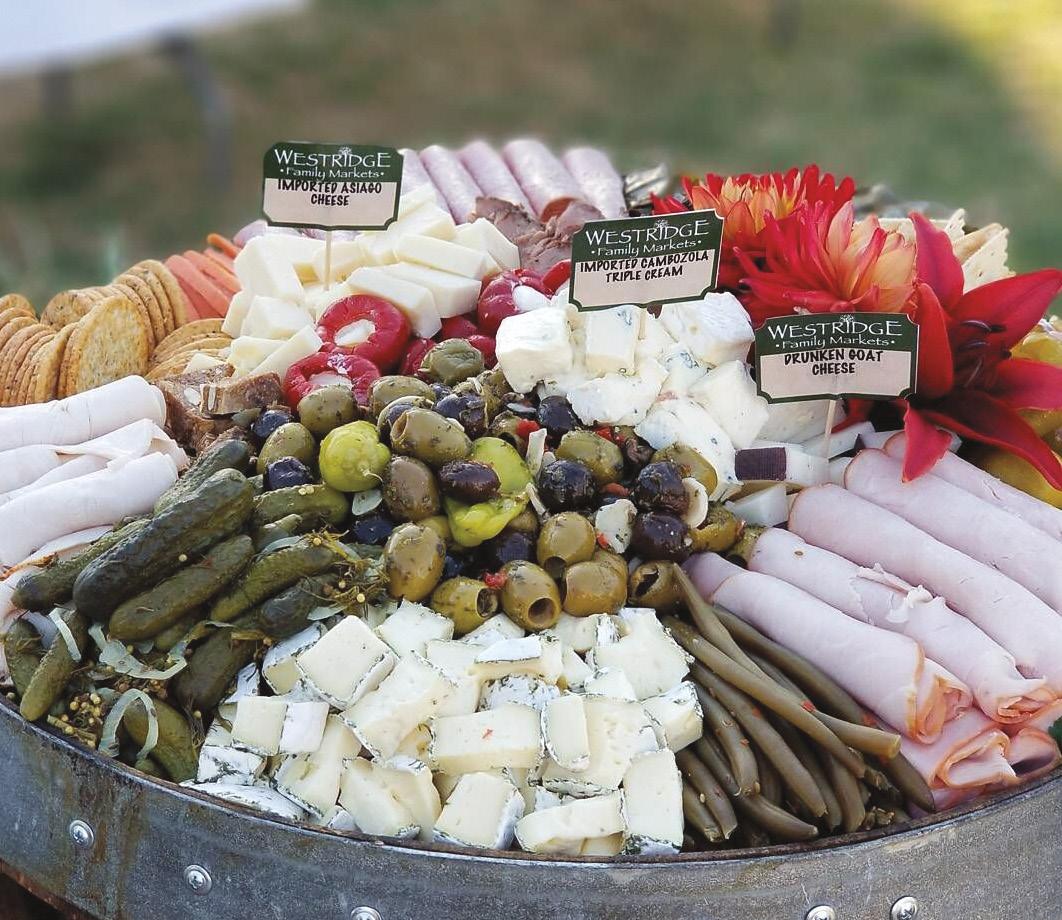
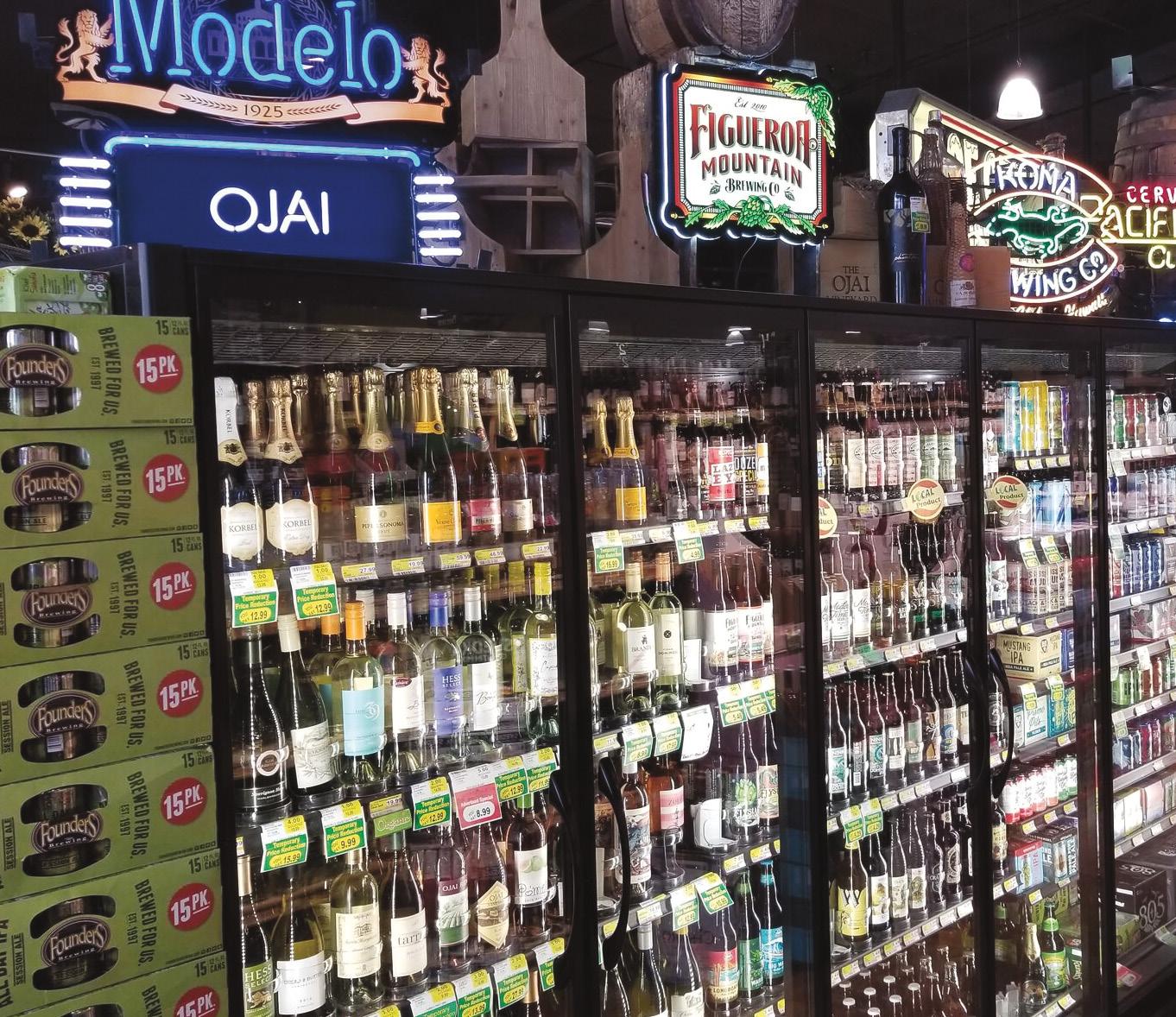


131 W. Ojai Ave • Open Daily 7am - 9pm • Phone 805-646-4082 802 E. Ojai Ave • Open Daily 8am - 8pm • Phone 805-646-2762 westridgemarket.com Westridge Midtown Market Westridge Market


95 OJAI MAGAZINE | SPRING 2023 Wine Tasting THURSDAY | FRIDAY | SATURDAY | SUNDAY 11 AM - 5 PM WALK-INS WELCOME Pet Friendly — Kids Under 2 Yrs & Over 13 Yrs Welcome 10024 Old Creek Rd, Ventura | (805) 649-4132 | www.oldcreekranch.com



96 OJAI MAGAZINE | SPRING 2023 Bryant Circle Mini Storage 412 Bryant Circle, Ojai 805.646.2354 • Free move-in truck • Moving and packing supplies • Security system with TV surveillance • On-site resident managers • Competitive rates • Move-in specials Call us today for our BLUE DOOR SPECIAL 2022


97 OJAI MAGAZINE | SPRING 2023
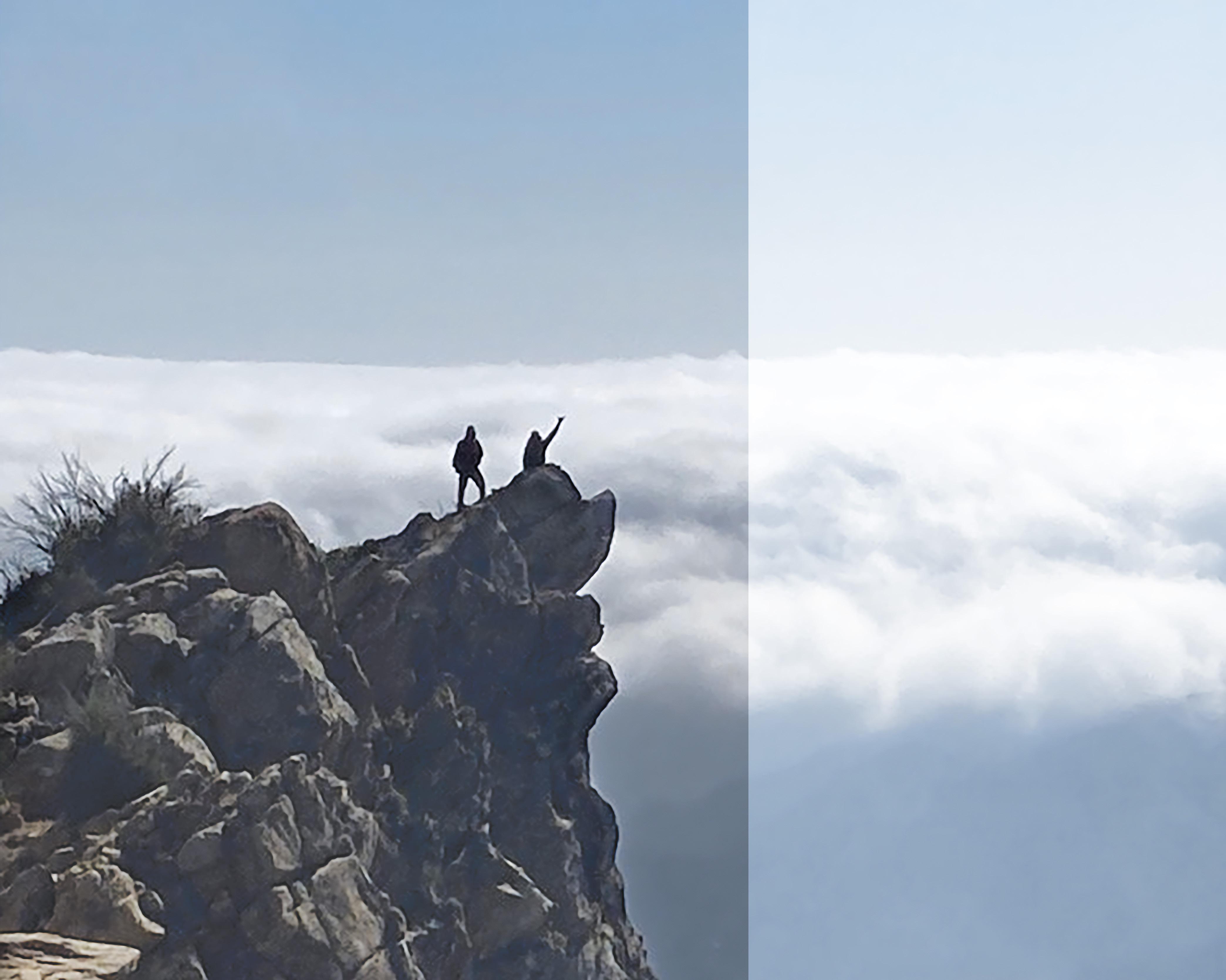
98 OJAI MAGAZINE | SPRING 2023
The first trail work Sean Dana ever did was on the Pratt Trail, following the Thomas Fire in 2017.
“I went up there and had probably the hardest day of work in my life,” said the trail runner and Ojai Get It Done Trail Crew member. “I was spitting out globs of ash.”
The Get It Done crew is an all-volunteer group dedicated to maintaining and preserving Ojai’s trails.
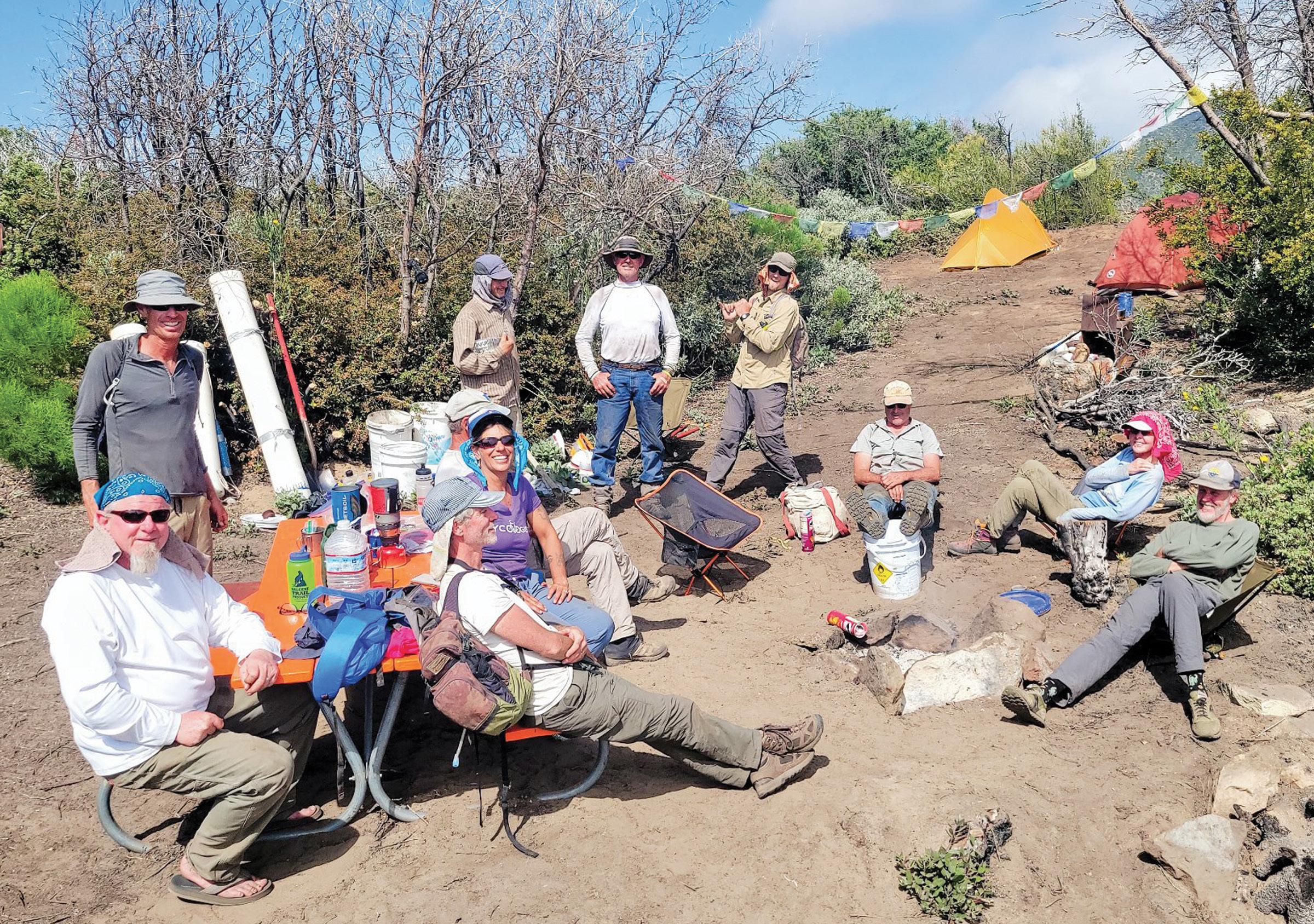
Consisting of a couple dozen men and women ages 26 to 76, crew members put their backs into their work. “Usually we’ll work for six or seven hours doing trail work, then go back to camp and relax and get ready for the next day, then try to get out alive, because you exert yourself,” said Mike Gourley, the crew’s captain.
Gourley’s biggest project so far has been the historic Ocean View Trail (OVT), which after 15 years of work was finally ready for trail users late last year.
The six mile route built by the U.S. Forest Service circa 1903 connects Ventura and Santa Barbara counties via a ridge that runs between Ojai and Carpinteria. “It was originally built because when the ocean level was too high, you couldn’t get from Carpinteria to Ventura on horseback, so they used to come over land in order to get into the Ojai Valley,” Gourley said.
In September 2022, the Get It Done crew installed the last of 11 picnic tables along the trail, which had gone without maintenance for more than 50 years, making it impassable and unusable, according to Gourley. “The trail was fairly well-maintained until probably the early ’60s, and then over time it just got overgrown,” he said.
With lack of use, “it had just gone back to native brush,” and the trail faded away for many years, said Gourley.
Gone but not forgotten, the trail — part of a network of trails that run some 22 miles between the Ojai and Carpinteria areas — saw its first serious restoration work around 2006 to 2007, on the Ojai end of the trail.
Once crews had cleared brush seven miles in, it became easier to backpack to the site and work for two-and-a-half - three-day stints.
Workers used saws to cut the brush back, and shovels and picks to remove scree
and get down to the original trail. “A lot of manual labor, and it’s just absolutely impressive to see what the volunteers have done,” Gourley said. “Without the help of all the volunteers, this would not happen.”
In December 2017, Gourley’s crew had 9 or 10 miles of brush cleared when all their work was erased. “The Thomas Fire came and it was basically unusable again,” he said. At approximately every mile to mile-and-a-
the views make it well worthwhile,” Gourley said. “You can see why they call it Ocean View.” Many points along the trail o er 360-degree views, including Matilija Canyon some 3,000 feet below, Thorn Point far to the north, Lake Casitas to the south, and the Santa Barbara Channel to the southwest, where seven of the islands can be spotted on a clear day.
half of the Camino Cielo and Ocean View Trails, the Get It Done crew placed picnic tables paid for with their own donations.
Seven of the tables starting from the Ojai side are painted standard Forest Service brown, while the four tables on the Carpinteria side are painted gold, pink, orange and green — fluorescent green, as Gourley pointed out. “Which I’m pretty sure you can probably see from Mars,” he said.
The pink bench symbolizes cancer awareness; the orange bench honors former Ojai Ranger District firefighter Mike Porter, who passed away in 2021. Orange was Porter’s favorite color, Gourley said.
Upper Ojai Search and Rescue was provided with the coordinates of all the tables in case someone gets into trouble.
“It’s a good moderate-to-expert hike, but
To ensure the trail followed the historic route, the crew pored over old maps “making sure that we were right on where the old original trail footprint was,” Gourley said. Helping the crew find the old tread beneath the 10- to 15-foot-tall brush were rock borders and other features put in place more than a century ago. “I don’t even think you could have done a better job today of mapping out where the trail should go,” said Gourley, of the route strategically designed to run from boulder outcrop to boulder outcrop.
99 OJAI MAGAZINE | SPRING 2023
The Camino Cielo-Ocean View trail network is accessible via the Kennedy Ridge Trail in the Ventura River Preserve and, in Matilija
The Ojai Get It Done Trail Crew takes a breather at bench #10, the orange bench dedicated to former U.S. Forest Service firefighter Mike Porter, who passed in 2021. Photo by GIDTC
Canyon, the Monte Arido Trail, a one mile connector from Murietta Divide to the ridge that was wiped out when a fire line was built during the 2007 Zaca Fire.
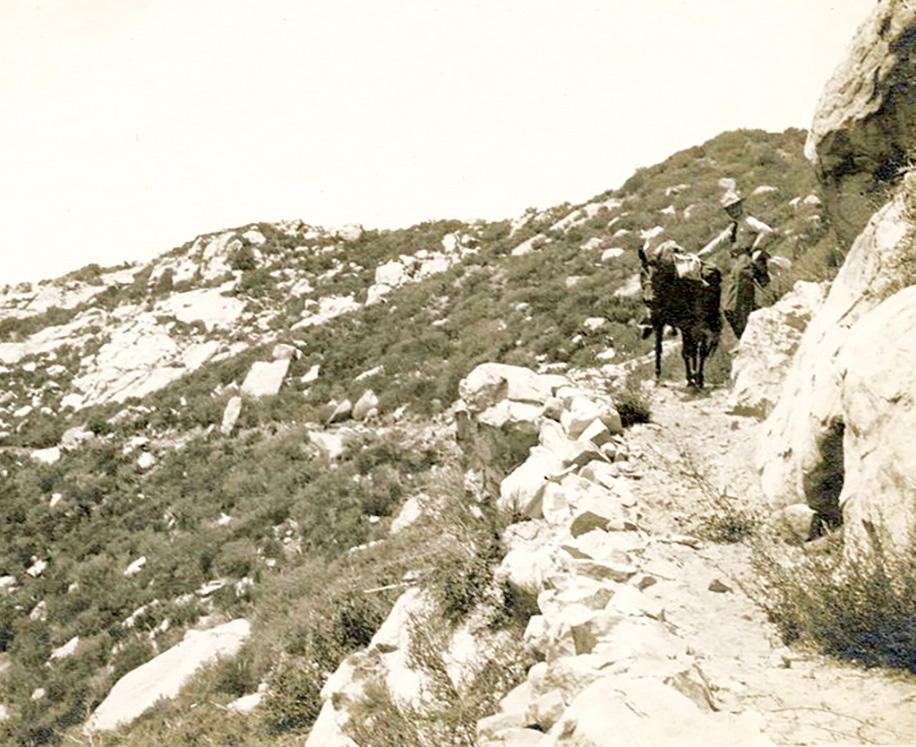
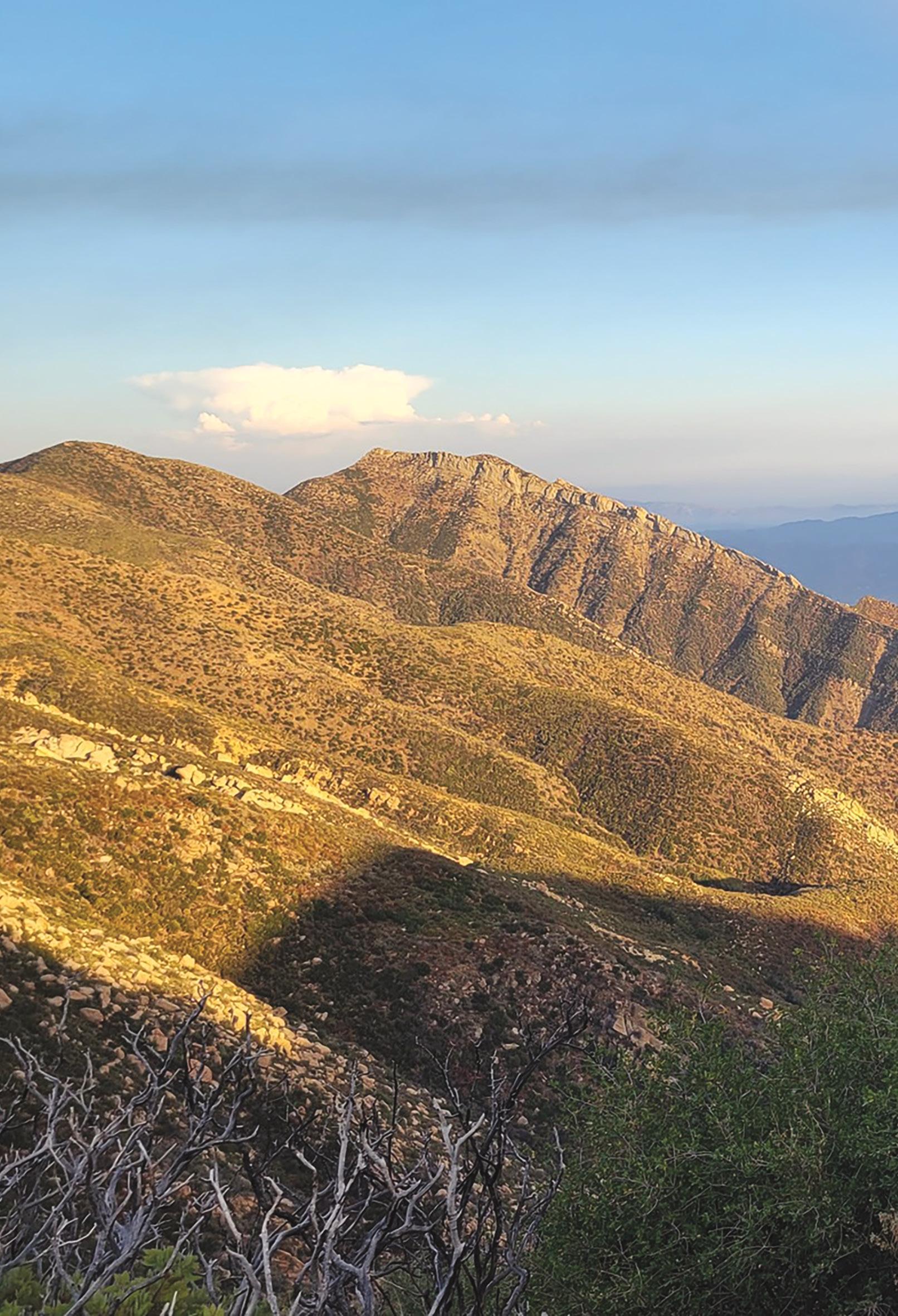
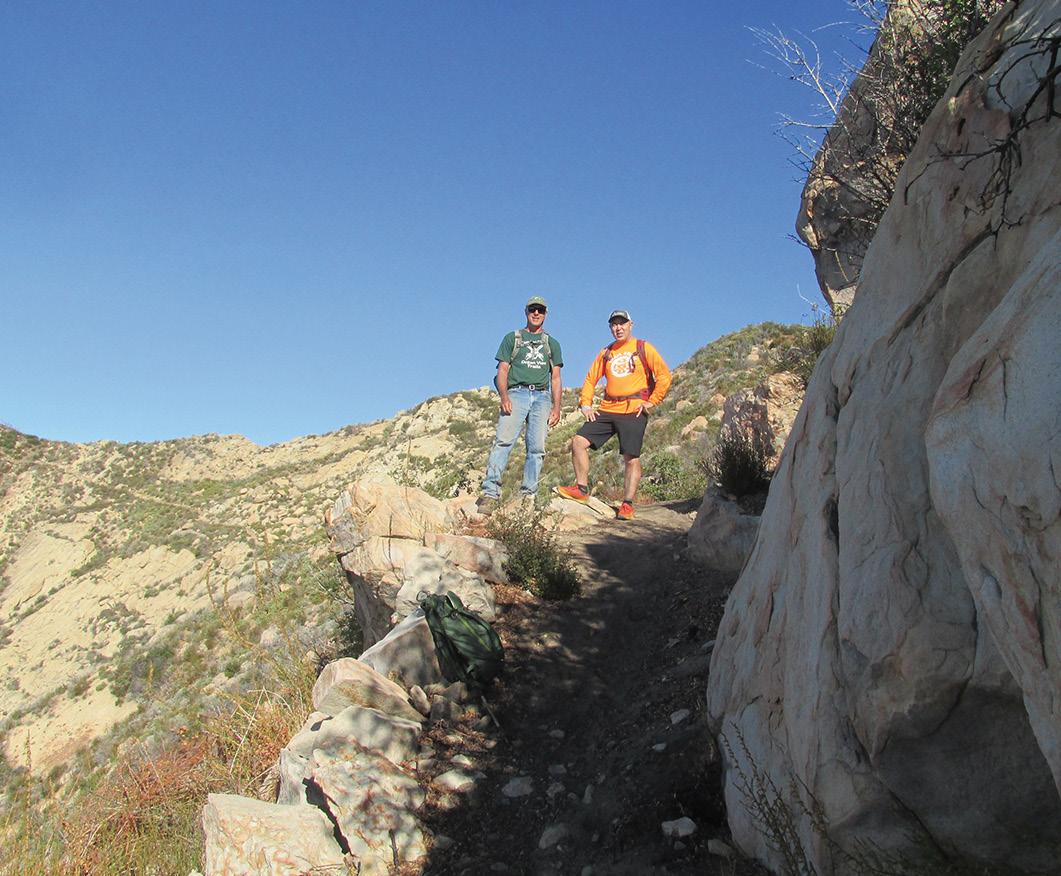
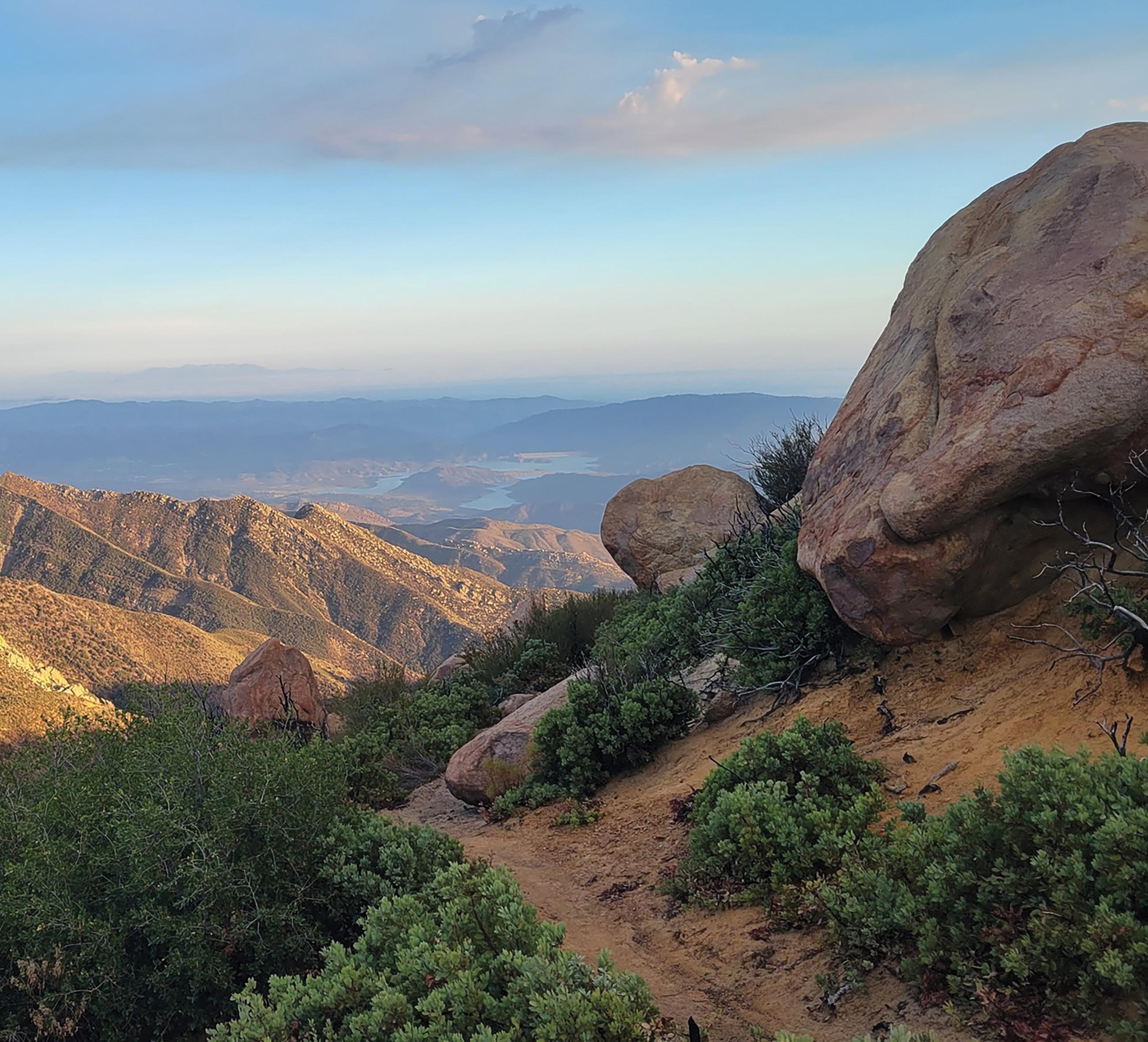
Gourley and his volunteers restored the trail’s original switchbacks, so you no longer slog straight up the steep mountain. “A little less brutal,” Gourley said. “You’re still climbing over a mile and gaining over 1,000 feet of elevation. It’s an honest climb, as we say.” And the downhill hike on the connector is much safer now.
An epic hiking trail, the Ocean View Trail (OVT) is also well-suited for long-distance trail runners, and recently it’s been gaining popularity among hardcore bicyclists looking for a challenge.
Since lack of use contributed to the trail becoming brushed-in, Gourley wants people to use the trail. Ongoing maintenance will help keep it open, but having feet and knobby tires on the tread is essential. “It’s important for me to make sure it’s open for my kids, and then also my grandkids,” he said.
Gourley, who has spent 10 days a month working on the trail, hoped to have the project completely finished by the spring. First to rise every morning, he would often wake other crew members with the sound of his chainsaw, according to Dana. “He’s just like a kid. Immediately he’s swept up by the magic and the majesty of the trail. That helps to keep everybody motivated and energetic about really grueling, unbelievably di cult work,” he said.
It’s work that requires a two- to three-day
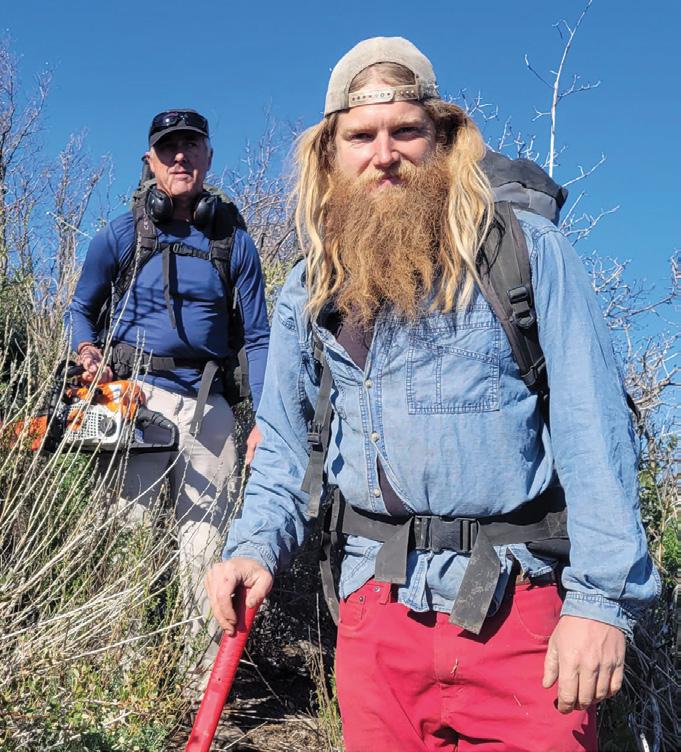
100 OJAI MAGAZINE | SPRING 2023
Right: This 1923 photo shows a U.S. Forest Service ranger and his mule on the Ocean View Trail, presumably on a trail-maintenance project.
Photo by GIDTC
Next right: Mike Gourley, left, and Sean Dana, of the Ojai Get It Done Trail Crew, in the same spot the ranger and his mule stood in 1923.
Photo by Perry Van Houten
Mike Gourley (left), captain of the Ojai Get It Done Trail Crew, with crew member Ian Graham.
Photo courtesy GIDTC
The historic Ocean View Trail, built in 1903, runs from boulder outcrop to boulder outcrop. Visible in the distance is Lake Casitas. Photo by GIDTC
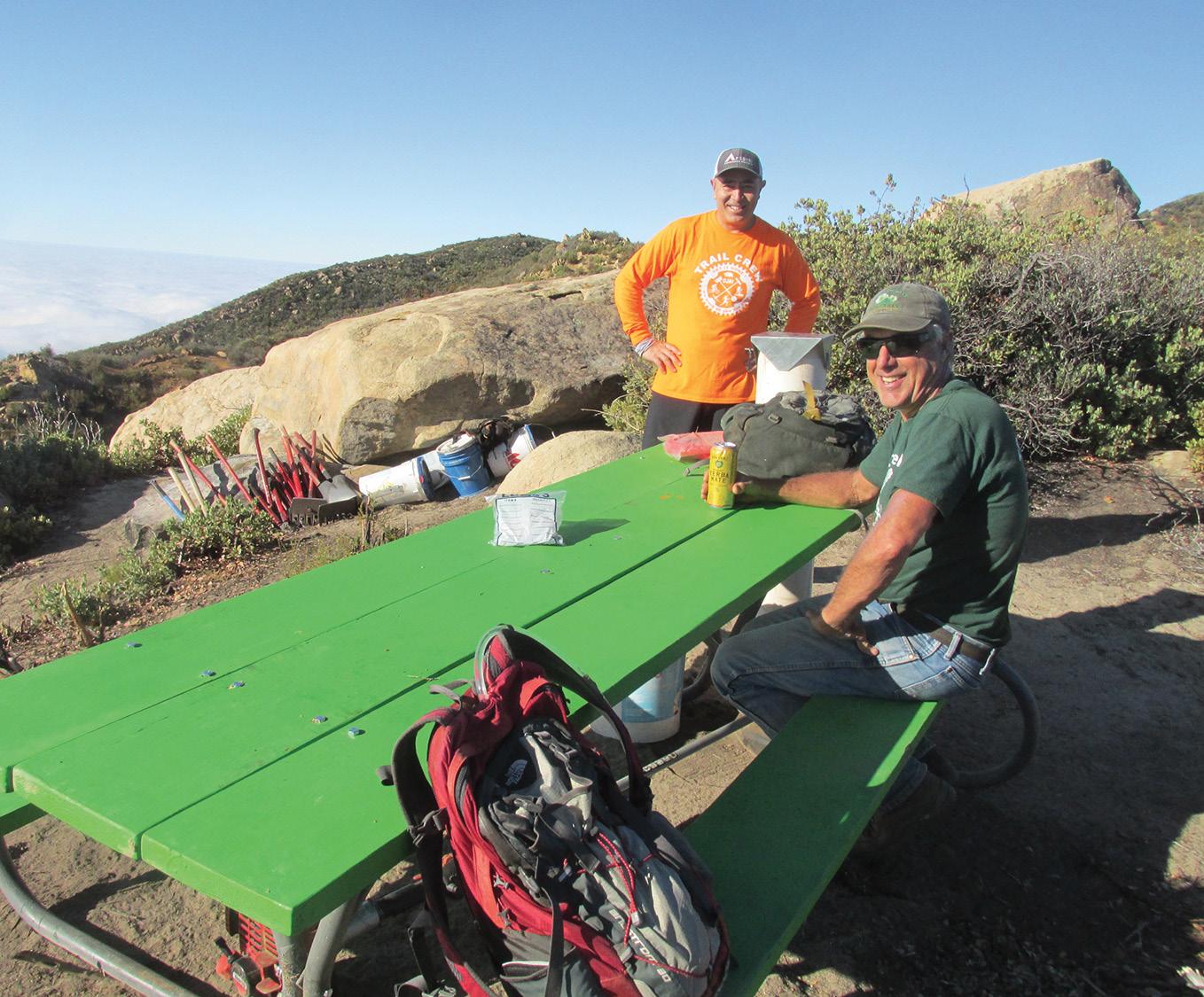
101 OJAI MAGAZINE | SPRING 2023
Taking a break at the green bench, the westernmost bench on the Ocean View Trail, are Sean Dana (left) and Mike Gourley.
Photo by Perry Van Houten
recovery period following a typical four-day stint, he added.
“Mike’s enthusiasm is beyond infectious. His love for this trail and for the area is so profound,” said Dana, who also handles publicity for the group. “It’s astonishing to see how much work is accomplished on each trip. Every time I come up here I’m thoroughly taken aback,” he said.
The morning of Oct. 1, the author and the Get It Done crew were further taken aback by something Gourley had never seen the hundreds of times he’s hiked the OVT. “We actually saw a bald eagle today. Talk about icing on the cake. It was just absolutely phenomenal,” he said. “It’s that mental picture that we’ll have the rest of our lives.”
A fairly technical trail in spots with plenty of elevation gain, there’s no water available on the OVT and trail-users need to be selfsu cient, according to Dana. “It’s nothing to just plunge into. It’s good to take it piece by piece, and that’s where the benches
work well. You get a really good gauge of the e ort it takes and the supplies that you have to bring with you,” he said. Experienced backpackers seeking a genuine adventure can hike from the Oso Trailhead in Meiners Oaks to the Franklin Trail in Carpinteria. “That’s one of those epic two- or three-day hikes which actually ties everything together,” said Gourley. The Get It Done crew has been a busy bunch of trailblazers the past few years. After opening up the Pratt and Gridley trails following the Thomas Fire, they worked on the Howard Creek, Sisar Canyon and lower Red Reef trails. “Most of the time if we see something that mountain bikers or ultra-runners want to utilize, we’ll go ahead and focus on getting brush cut in those areas so they are usable again,” said Gourley.
The OVT project has been funded by GoFundMe, and in September the crew started a new campaign to raise funds for the final push. The money goes toward fuel,
equipment repair and supplies. Those who contribute $50 or more receive an iconic Get It Done T-shirt.
Enthusiasm for the project has been running high, according to Gourley. “All you have to do is ask people,” he said. “They find out about this crazy project and they’re always more than willing to help out to get this trail reopened for the folks of the Ojai Valley.”
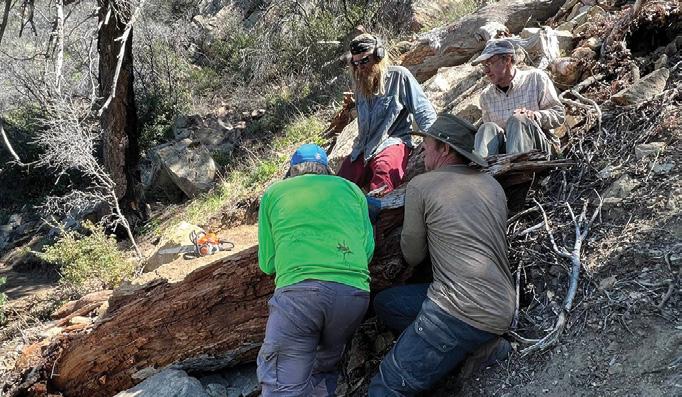
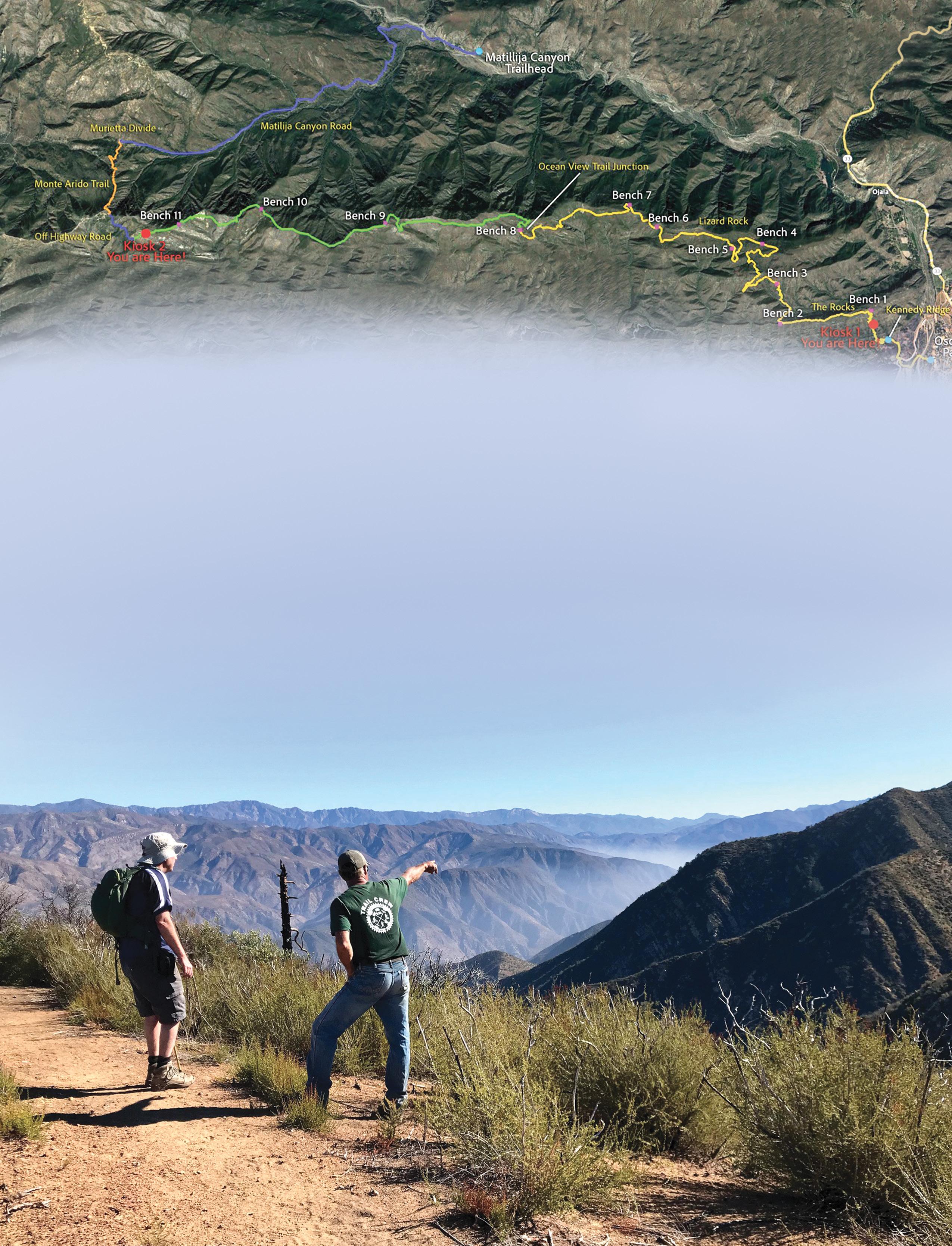 The Ojai Get It Done Trail Crew’s (clockwise from upper left) Ian Graham, Mark Silbernagel, Marty MacDonald and Gary Hirschkron work together to clear a downed tree from the trail.
Photo by GIDTC
The Ojai Get It Done Trail Crew’s (clockwise from upper left) Ian Graham, Mark Silbernagel, Marty MacDonald and Gary Hirschkron work together to clear a downed tree from the trail.
Photo by GIDTC
102 OJAI MAGAZINE | SPRING 2023
On the Ocean View Trail, the author (left) and crew captain Mike Gourley take in views that stretch all the way from Matilija Canyon to Thorn Point. Photo by GIDTC

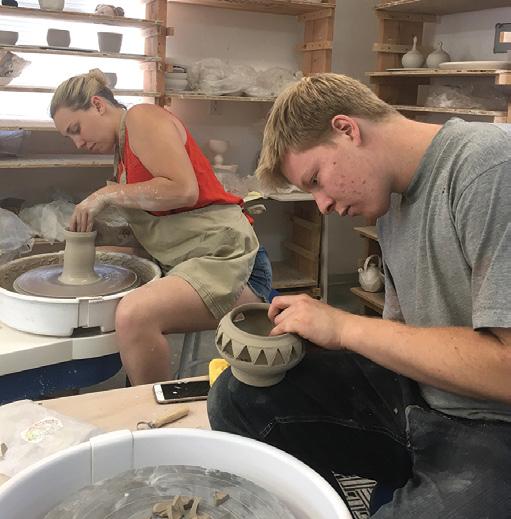


103 OJAI MAGAZINE | SPRING 2023 FIRESTICK POTTERY Creative Workspace Open to Public Gallery Workshops Pottery Parties Free tours Open 10-6 daily 1804 E. Ojai Ave 805-272-8760 firestickpottery3@gmail.com






104 OJAI MAGAZINE | SPRING 2023 Wednesday thru Monday: 11am - 5pm. Closed Tuesday Call us for our most current shop hours 320 East Ojai Avenue • Ojai, CA 93023 On the web at: www.priscillainojai.com On Facebook at: facebook/priscillainojai On Instagram at: @priscillainojai IN OJAI (805) 646-9782



105 OJAI MAGAZINE | SPRING 2023 DO YOU SUFFER FROM Shoulder pain Knee pain Hip pain Low back pain Neck pain Carpal tunnel OUR SERVICES INCLUDE Chiropractic Adjustments Spinal Decompression Cold Laser Shockwave therapy Regenerative Medicine Safe, new, advanced treatments. You don’t have to live with it anymore! EVERGREEN CHIROPRACTIC & WELLNESS 302 N. Montgomery St Ojai CA 93023 (805) 646-9355 www.ojaivalleychiropractic.com LIVE WITHOUT PAIN





106 OJAI MAGAZINE | SPRING 2023 Sustainable Style for Personal Well-being and a Healthy Planet 147 W. El Roblar Dr., Ojai • 805.640.3699 Open Tues-Sat 12-5:30 Organic mattresses, organic cotton sheets, duvet covers, blankets, baby clothes, women’s clothing, wool and down pillows, comforters and toppers. IF YOU LIVE HERE ...YOU GET IT SUBSCRIBE TODAY. 805-646-1476 DOWNLOAD THE APP. OJAIVALLEYNEWS.COM




107 OJAI MAGAZINE | SPRING 2023
EARTH TO FARM TO TABLE
Ojai Earth Day 2023
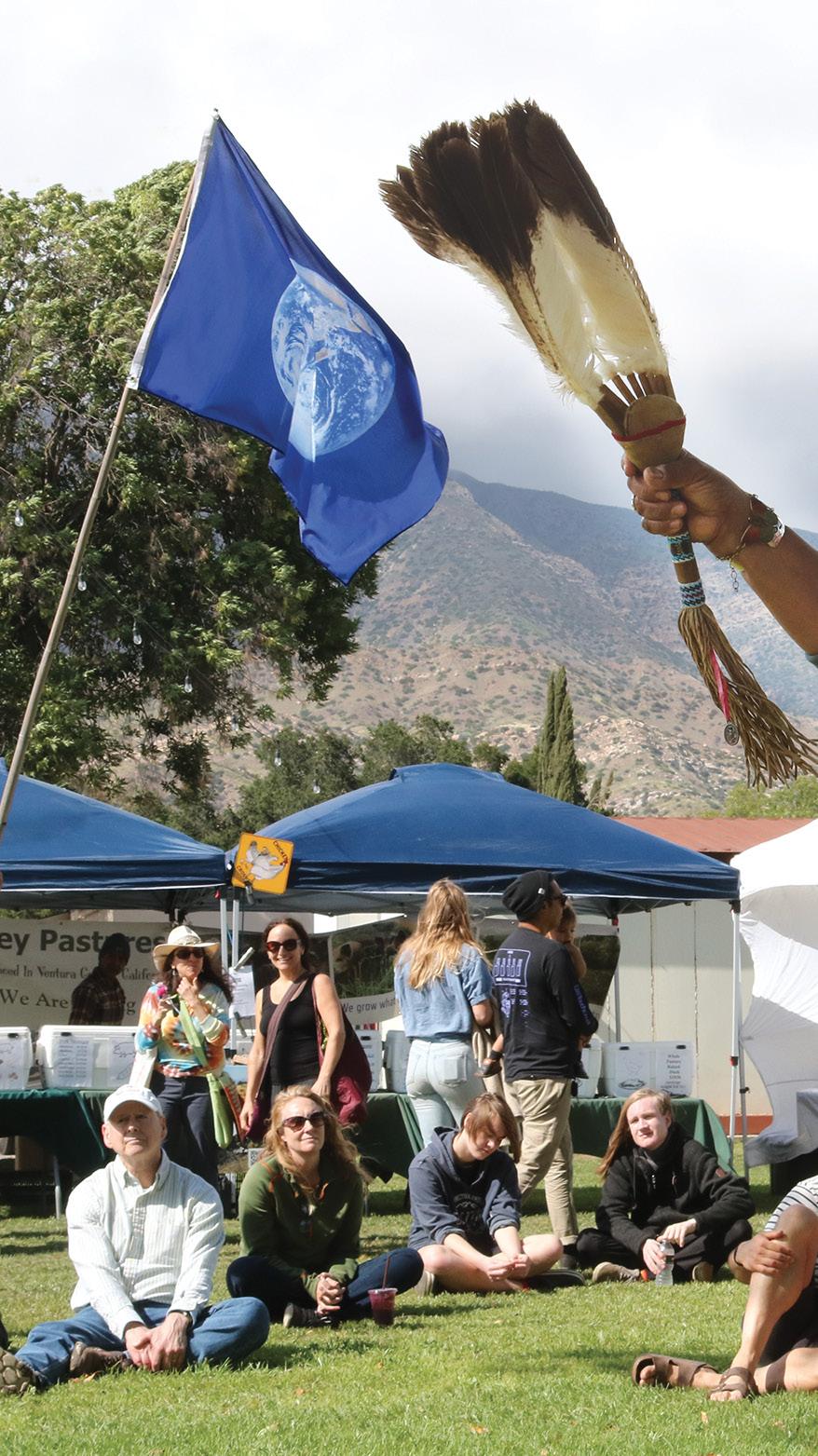
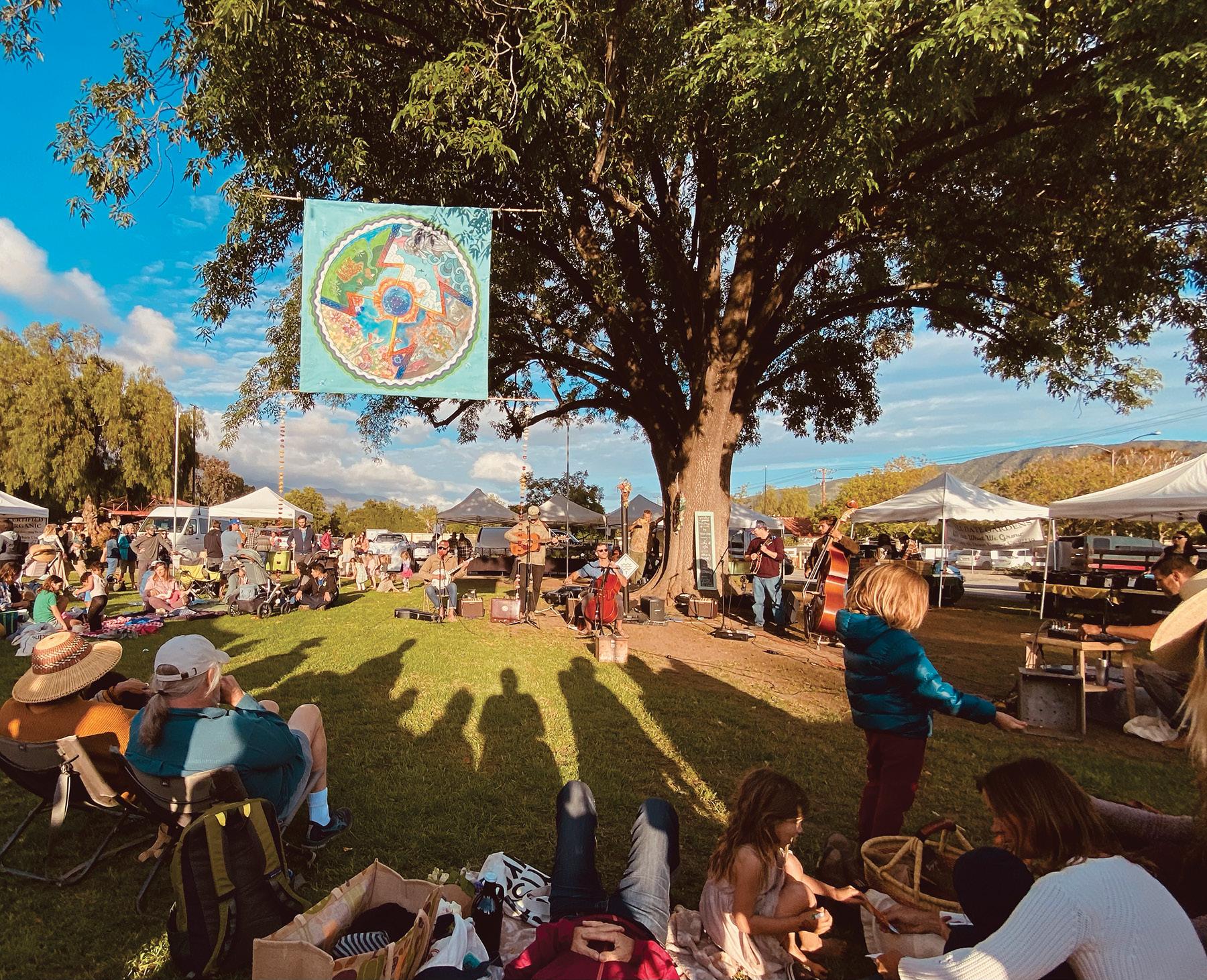
The land, the seed, the farmers … Mother Earth participates the whole way, working together hand-in-hand. What better way to celebrate Mama Earth than with the farmers who tend to her all year long? This year, Earth Day will be celebrated for the second year at the Ojai Community Farmers’ Market. The Thursday farmers’ market that launched in June 2021 is the perfect place to celebrate our Earth and the community that makes Ojai so special.
Although Earth Day is April 22, the Thursday celebration occurs on the market day, Thursday, April 20. Because the Thursday market’s core values are what Earth Day is all about, it’s the ideal pairing. Let’s just say it’s “Earth Week.”
Earth Day was inspired after a massive oil spill on the shores of Santa Barbara, California, in February 1969. The Clean Air Act of 1970 followed, along with the
“Never doubt that a small group of thoughtful committed citizens can change the world. Indeed, it’s the only thing that ever has.”
Clean Water Act and the Endangered Species Act. Earth Day celebrations began in 1970, when United States Sen. Gaylord Nelson from Wisconsin organized a national demonstration to raise awareness about environmental issues, and Earth Day was born. By the end of that year, the U.S. government had created the Environmental Protection Agency. Today, 53 years later, according to earthday.org, Earth Day is the largest secular holiday in the world, engaging more than a billion people every year in an annual celebration that draws attention to the environment and promotes conservation and sustainability. The theme for Earth Day 2023 is “Invest In
Our Planet,” a theme so successful in 2022 that it was chosen again. “In 2023 we must come together again in partnership for the planet,” says Kathleen Rogers, president of earthday.org. And that’s just what the Ojai Community Farmers’ Market does. With four co-founders who had di erent reasons and ideas for getting involved, the goal was to build community and become an incubator for Earth-friendly business development.
Ojai Community Farmers’ Market is a 501(c)(3) nonprofit certified farmers’ market run by a passionate board of local community members who are looking to help local businesses and people by providing them a platform to thrive. These are carefully vetted farmers who don’t use spray or till, and do practice animal rotation. They are as local as possible, with the farthest farm 20 miles away. Julie Gerard, an attorney and one of the co-founders, visits every
108 OJAI MAGAZINE | SPRING 2023
—Margaret Mead
by TIFFANY PAIGE photos HELENA PASQUARELLA

farm and speaks to each farmer who comes to sell their bounty. “Farmers are amazing,” she says. “They feed us. It doesn’t matter if it’s snowing or raining or 110 degrees; they pick, they drive, they show up, and they feed us. I’m super impressed by them.”
Rather than just buy your beautiful, fresh produce and leave, you can make a day and evening of it. Bring your blanket or chairs and set up on the spacious grassy field. The market is tucked away behind the Ojai Unified School District Headquarters in the charming enclosed Legacy High School courtyard, where your kids can play freely and you can eat, hang out, and shop among the vendors, artisans, and makers. Seasonal workshops are o ered, from pie-making to techniques for tending to your chickens.
Every week there is local live music, and for Earth Day some very special well-known artists will perform, along with dancers. An expected 40 to 50 vendors are scheduled for the market, which will also include Earth Day-related activities, additional interactive nonprofits, and handmade Earth-friendly goods. “Music and beauty and all the things that make life joyful,” notes Gerard.
Designated Chumash Elder Julie Tumamait-Stenslie (the Ojai Valley is on Chumash land) will kick o Earth Day’s 53rd celebration at the market during the opening ceremony. Guest speakers will then share snippets of educational information, from the importance of regenerative farming and permaculture, to ways to maintain and preserve oak trees. There is something for everyone, including “The Kids’ Corner,” which o ers di erent activities every week, from storytelling, dance, and face painting, to chess club and art projects. At last year’s event, middle school students built an arcade out of upcycled materials.
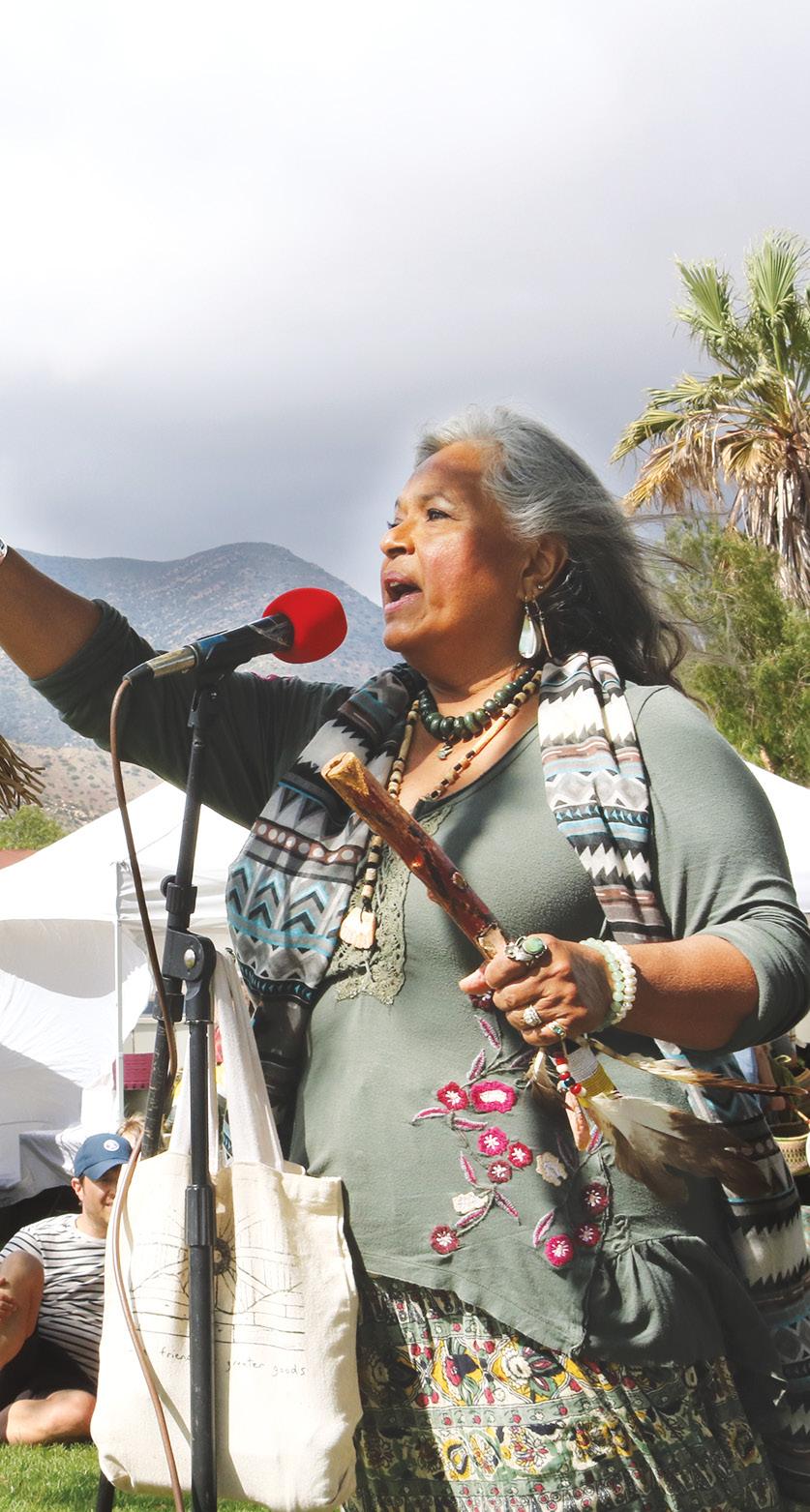
Everything that is planned for Earth Day at the Thursday market is an elevated version of the features that exist there every week: fun, family-friendly, inspiring, educational, and connected. A place where “Earth Day is every day.”

Organizers encourage walking, biking, and riding the Ojai City Trolley, which stops in front of the market, by giving out $2 in “market money” that can be spent on any of the vendors. Parking is available in public lots all around the market or on adjacent streets.
The Ojai Community Farmers’ Market mission is to provide access to healthy food, cultivate community, and promote education. You’ve made Mother Earth proud. Get to know your farmer while celebrating our shared home. This will give visitors a taste of the Ojai Valley, literally. Happy Earth Day!
The Ojai Community Farmers’ Market Earth Day Celebration will take place on Thursday, April 20, from 3 to 7 p.m. in the heart of downtown at 414 E. Ojai Ave. For more information, visit www.ojaicommunityfarmersmarket.com
e Earth gives the farmers their canvas to grow the “fruits” of a self-sustaining Ojai.
109 OJAI MAGAZINE | SPRING 2023
Left: Julie Tumamait-Stenslie, Chumash Elder






110 OJAI MAGAZINE | SPRING 2023 One year, 4 issues, $10 each via priority U.S. Mail Published: March, June, September and December Name ................................................ Address .............................................. ...................................................... Phone ................................................ Please charge my card one time for $40 Credit Card No ........................................ Exp .......................... Or contact: 805-646-1476 | circulation@ojaivalleynews.com Experience the Ojai lifestyle wherever you live with a subscription to the Ojai Magazine. You can get local! Published since 1982 by the Ojai Valley News Mail to: P.O. Box 277, Ojai, California 93024



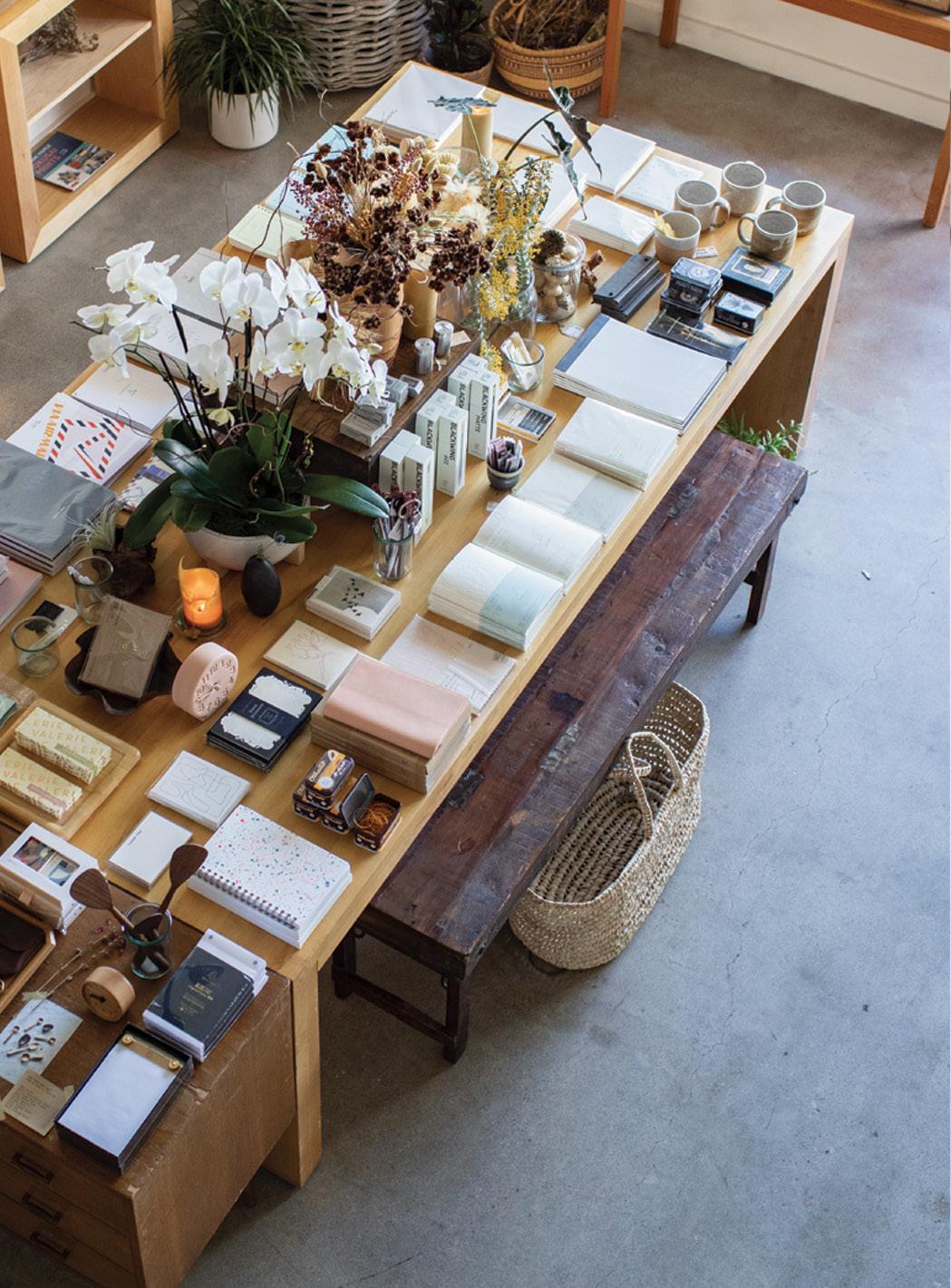
111 OJAI MAGAZINE | SPRING 2023 212 E. Ojai Ave Open Daily 805. 758 9838 oso-ojai . com @osoojai Stationery Cards Gifts noted. 423 E.Ojai Ave. #102 805.272.8576 @noted.ojai


112 OJAI MAGAZINE | SPRING 2023
Beth Hart. Coming to Libbey Bowl May 6.

March
Canvas and Paper Exhibit
Paintings:
Laurence Stephen Lowry through April 9
311 N. Montgomery St. Open: Thursday – Sunday Noon – 5 p.m. Free admission canvasandpaper.org
Exhibiting paintings and drawings from the 20th century and earlier.
The H 2 O Show at Ojai Art Center
March 4 – March 29
SPRING ‘23
CALENDAR
Silent Auction – March 4, 5-8 p.m. 113 S. Montgomery St. www.ojaiartcenter.org
Ash Grove Alumni
Featuring Joe Chambers and Wendy Waldman Beatrice Wood Center for the Arts
March 4, 3 p.m.
8585 Santa Paula Rd. Tickets $30 available at www.beatricewood.com
“Shrek The Musical”
March 9 -12, 6 p.m. Oak Grove School 220 W. Lomita Ave. Purchase tickets at: www.oakgroveschool.org/ theater
Ojai Studio Artists
Second Saturday March 11, 10 a.m. – 5 p.m. Features 14 artists from the East Side of The Valley Visit www.ojaistudioartists.org for free tour map and info.
“RED” at Ojai Art Center Theater
March 17 – April 9 113 S. Montgomery St. www.ojaiact.org
Directed by Aileen-Marie Scott
Ojai Valley Green Coalition
World Café Envisioning the 8-acre campus Free event, includes food and childcare
March 22, 5:30 - 9 p.m.
Kent Hall 111 W. Santa Ana St.
Reservations required by March 17
Ojaivalleygreencoalition.org
Ojai Valley Green Coalition will facilitate focused community conversations in small group roundtable format.
April
Arroyo Hondo Preserve Herb Walk Led by Lanny Kaufer
April 1, 9:30 a.m. - 12:30 p.m.
$40 Register at www.herbwalks.com
805-646-6281
Ojai Studio Artists
Second Saturday April 8, 10 a.m. – 5 p.m. Features artists from downtown Ojai Visit www.ojaistudioartists.org for free tour map and info.
“Elemental” Art Show
Ojai Art Center
April 15-16, 11 a.m. - 4 p.m. 113 S. Montgomery St. www.ojaiartcenter.org thomashardcastleartist.com/ exhibitions
Chamber On The Mountain Presents: Alexander Hersh, Cellist Beatrice Wood Center for the Arts
April 16, 3 p.m. 8585 Ojai-Santa Paula Rd. Tickets $30 available at www.beatricewood.com
May
“Disappearing Act” at Ojai Art Center Theater
May 5 – May 28 113 S. Montgomery St. www.ojaiact.org
Directed by Peter Fox
Beth Hart – Solo at Libbey Bowl
May 6, Doors: 5 p.m., Headliner: 7 p.m. 210 S. Signal St. Tickets: www.axs.com or call 888-645-5006
Spring 2023 Medicinal Plant Workshop with Professor Emeritus
Jim Adams May 13, 9 a.m. - 3 p.m. $100. Register at www.herbwalks.com
805-646-6281
46th Annual Art in the Park May 27-28, 10 a.m. - 5 p.m. Libbey Park 210 S. Signal St. www.ojaiartcenter.org/ artinthepark
June
77th Ojai Music Festival
June 8-11
Libbey Bowl and various Ojai venues.
For Libbey Bowl passes and ticket info. visit: www.ojaifestival.org or contact the box o ce at: boxo ce@ojaifestival.org or call 805-646-2053
Regular
Ojai Community Farmers’ Market
Thursdays 3-7 p.m. 414 E. Ojai Ave. Chaparral School Courtyard in Downtown Ojai (661) 491-0257 www. ojaicommunity farmersmarket.com
The market will be a safe and loving space for our community to gather and support our local farmers, food artisans and makers.
Ojai Certified Farmers’ Market Sundays 9a.m.-1p.m. 300 E. Matilija St., Ojai 805-698-5555ww. ojaicertifiedfarmersmarket. com
Ojai Poetry Series at the Ojai Library
3rd Tuesdays 6p.m. Ojai Library, 111 E. Ojai Ave., Ojai. Contact: Judy Oberlander ojaipoetryseries@gmail.com
113 OJAI MAGAZINE | SPRING 2023
Photo: Bengt Nyman


114 OJAI MAGAZINE | SPRING 2023

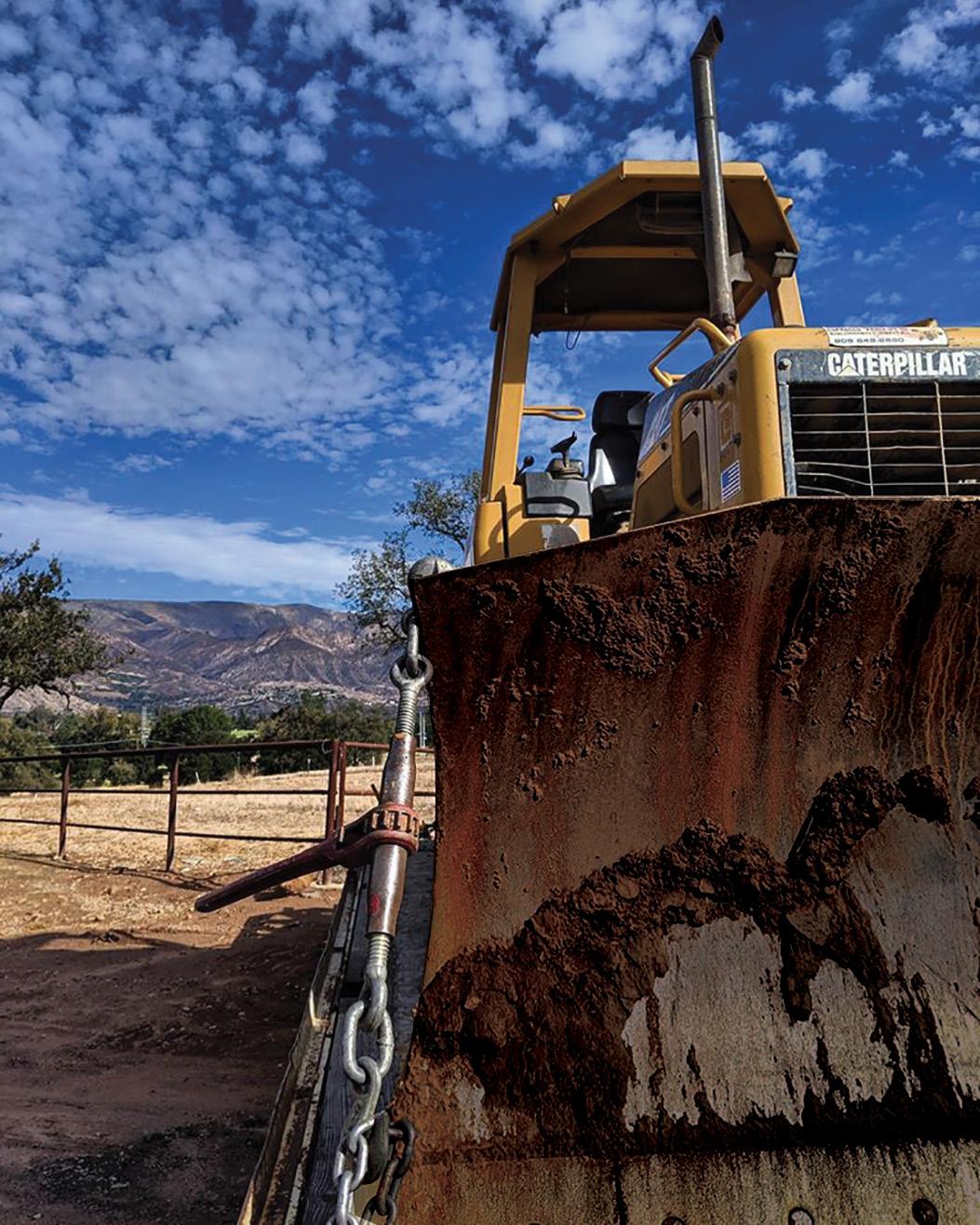

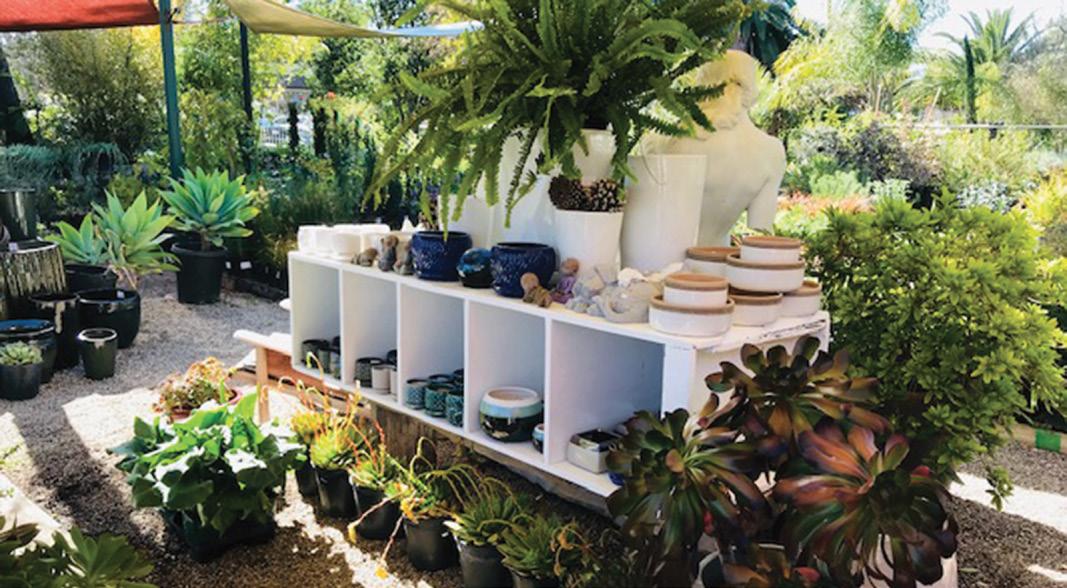
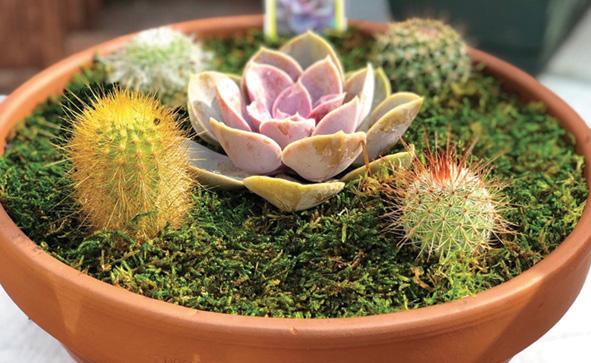
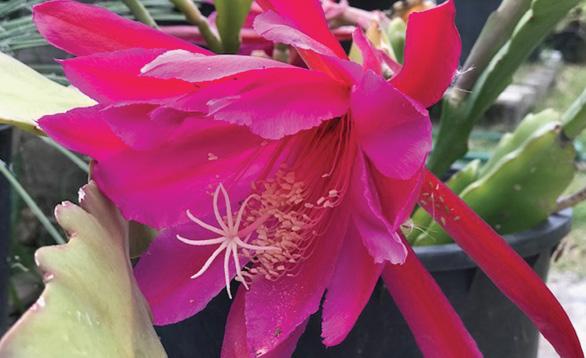


115 OJAI MAGAZINE | SPRING 2023 Our Services include: •Equipment Rental Sales & Repair •Propane Sales •Party Rental •Landscaping Equipment Sales & Rentals •Chain Sharpening •Concrete Products 420 N Ventura Ave, Oak View, CA 93022 (805) 649-2590 | info@gregrents.com
Indoor, Annual, Perennial, Trees, Organic Veggie Starters, Drought Tolerant Soil, Tools, Pottery & More. Hours: Monday - Saturday 9-5 Sunday 9 - 5 312 W. El Roblar 805-646-2546 MOaksNursery
Outdoor,
e City of Ojai Arts Commission is pleased to invite members of the public to enjoy virtual tours of Ojai’s Public Art.

THE East City Tour
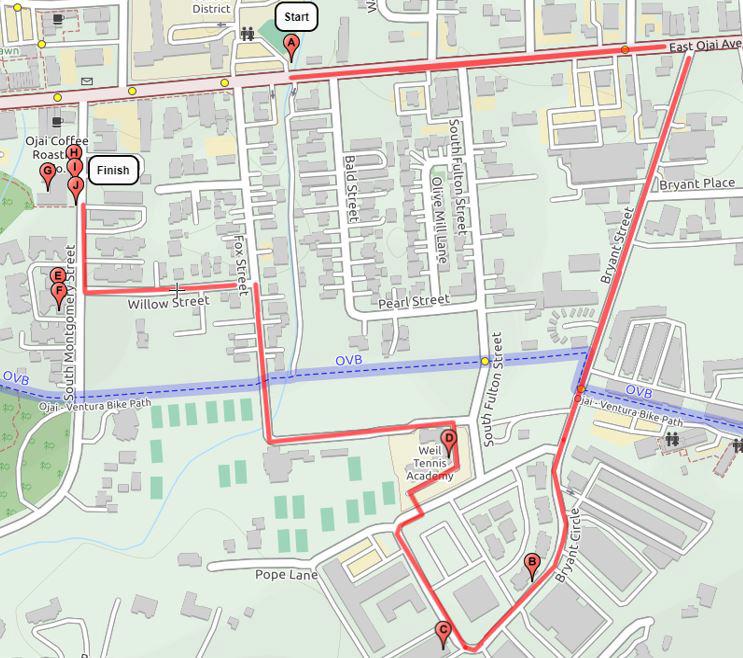
A. THE OJAI SKATE PARK

“Skate Wheel”: Well-known metal sculptor Ted Gall came up with the idea to repurpose an oil wheel from a local well for this public art project. “Skate Wheel,” in the southwest corner of Ojai’s Skate Park on Ojai Avenue, emulates what goes on inside the park — skateboards, in-lines, and roller skates in motion. Painted a bright red (with gra tiresistant paint), it is visible not only to skaters, but also to pedestrians walking along Ojai Avenue. Gall, the same public artist who created “Spirit Chase” in Rotary Park, gifted “Skate Wheel” to the city pro bono.
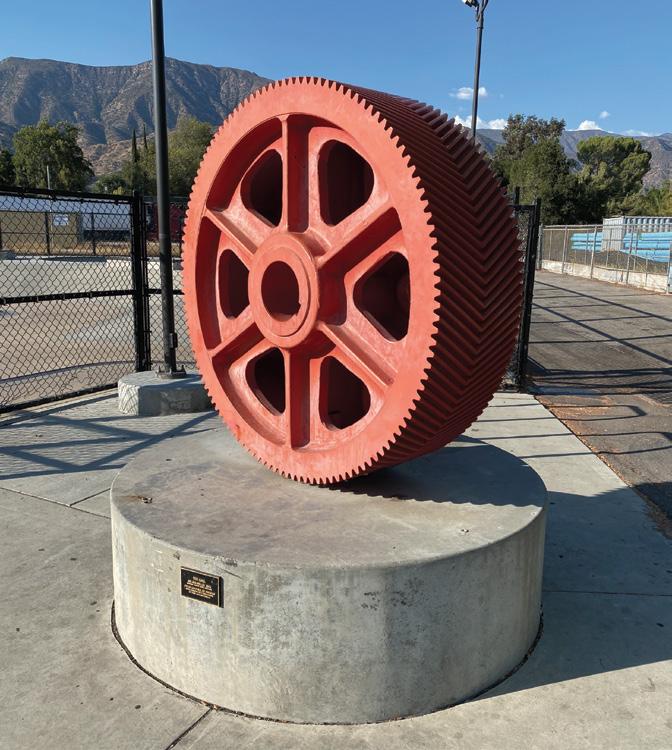
Drive east on Ojai Avenue to Bryant Street and turn right.
B. BRYANT STREET & BRYANT CIRCLE
B1: “The Business of Bees”: The Ojai Valley Business Park in the center of Bryant Circle (407D and 407C) boasts a towering sculpture that honors Ojai’s citrus industry. The sculpture is 8 feet high and weighs 6,000 pounds. Fashioned from golden Peruvian travertine and orange calcite from Utah, it is titled “The Business of Bees.” The travertine represents a honeycomb, and the calcite, an orange. Artist Chris Provenzano, who wanted to bring awareness to bee colony collapse disorder, worked
e Ojai Public Art East City Tour begins at the Skate Park on Ojai Avenue and Fox Street, and ends at the Ojai Art Center.
Welcome to Ojai’s Virtual Public Art Tours Overview
Both residents and visitors alike are surprised when they discover that the little city of Ojai has well over 40 works of public art on display within its less than five square miles! In 2013, the city enacted a Public Art Ordinance that requires qualifying private and public development to contribute what is sometimes called “2% for the Arts.” This gave birth to Ojai’s Public Art Program.
For your enjoyment and edification, we have included in our tours not only artworks funded by city and private development, but also privately funded works and art that predates the passing of the ordinance. We think you may be surprised — and that you will definitely marvel — at the abundance, uniqueness, and quality of public art to be found within Ojai’s city limits. Enjoy! www.artsojai.org/the-east-city-tour
116 OJAI MAGAZINE | SPRING 2023
collaboratively with Paul Lindhard and several other sculptors from Ventura’s Art City on this amazing piece. The glass wings of the bees are by Michael Racine.
B-2: “The Ojai Table”: Down the road at 416 Bryant Circle is a City of Ojaicommissioned piece by G. Ramon Byrne, “The Ojai Table.” A Ventura Art City sculptor, Byrne designed the table to match the architectural style of the building where it is placed and to reflect the Sespe mountain range that flanks the Ojai Valley. The table is made of two types of limestone and sandstone and weighs 12,000 pounds. The tabletop alone weighs more than 5,000 pounds.
C. WEIL TENNIS ACADEMY
“Fortune Cookies”: When the Weil Tennis Academy and Preparatory School underwent a renovation in 2011, a whimsical public art project was installed in the Commons area between the Academy and the Athletic Club’s parking area. Public artist Je Sanders silk-screened over 50 fortune cookie sayings onto 6-by 34-inch porcelain tile pieces using ceramic glazes in a variety of soft pastel colors. The pieces were then fired for durability and eventually fitted flush into the concrete walkways, scattered randomly throughout the Commons’ paths. Sanders and Academy owner Mark Weil selected sayings they felt would be particularly meaningful to the students traveling the walks, such as, “The time is right to reach your goals.”
Continue west through the Ojai Valley
Athletic Club parking lot to Fox Street. Turn left on the first side street, Willow. Take Willow to Montgomery Street. Turn right and park.
D. LOS ARBOLES CONDOMINIUMS
D-1: “Peacock Bench Mural”: Located on South Montgomery, the Mission Revival-style Los Arboles Condominiums incorporate California pottery and tile throughout. In front of the complex sits the extraordinary Peacock Mural bench. Based on an original fountain created at the famous Malibu Potteries, the bench
manganese carbonate and oil. When the tiles are fired, the mixture burns o , leaving the dark outline.
Copper light sconces by Jan Sanchez were incorporated on either side of the door. Hand-carved wooden doors, created in the ’80s by Jack and Karen Chaney, completed the rustic Craftsman look.
E-3: “Peace in Man’s Hand”: In the rear courtyard of the Art Center, a 6-foot tall Peace Pole is crowned by a Ted Gall (creator of “Skate Wheel”) sculpture titled “Peace in Man’s Hand.”
An expressive hand holds an olive branch
and tiles were given as a gift to Ojai by the owner of California Pottery and Tile Works of Los Angeles.
D-2: “The Green Man Fountain”: Adjacent to the “Peacock Bench Mural” is a variation of the Green Man Fountain at the Adamson House in Malibu. It is also known as the Neptune Fountain.
Walk to the Ojai Art Center just down the street.
E. THE OJAI CENTER FOR THE ARTS
E-1: “Big Pear Cactus”: Sculptor Perry Castellano fashioned the 8-foot-tall pear cactus from rusted steel. It sits in the actual cactus garden located in front of the Art Center, the oldest operating art center in California. You might want to go inside the Art Center, which always features interesting art exhibitions. A small shop in front sells art by local artists.
E-2: Tile Doormat, Copper Light Sconces, and Hand-carved Wooden Entry Doors: When the Art Center was renovated in 1997, an exquisitely detailed doormat mural by RTK Studios was added to the floor of the Art Center’s main entry bordered with “cuerda seca,” or “dry cord.” This is an old Spanish Moor technique that Richard Keit and Mary Kennedy, RTK tile owners and artists, learned and used to perfection here and throughout Ojai. A line is drawn around colored areas using a bulb syringe filled with

and spreading dove’s wings. The Peace Pole, a collaborative e ort of 12 Ojai artists, was dedicated in 2006 in a ceremony performed by Chumash Elder Julie Tumamait-Stenslie. “May Peace Prevail on Earth” is written in four languages on the pole’s sides.
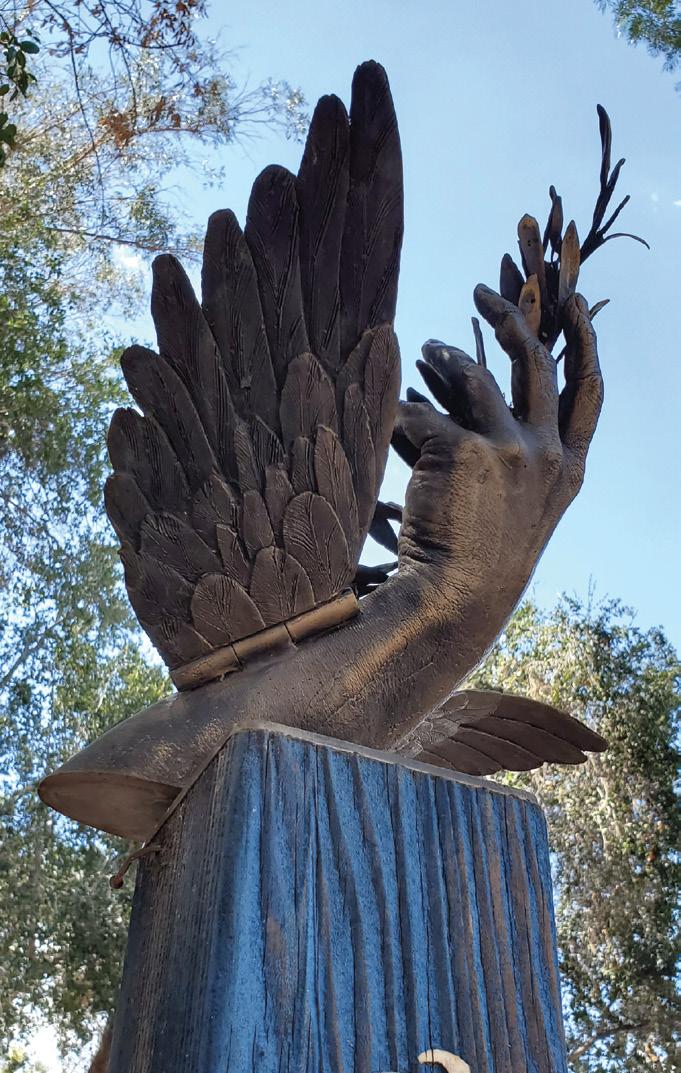
E-4: Wrought-Iron Patio Gate: A wrought-iron gate with serendipitous details forged by metal artist Jan Sanchez in 2001 defines the back patio area. Exiting through this gate will take you across the Walkway Bridge and into the back of Libbey Park, where you may want to pick up the Downtown Ojai Public Art Walk detailed in the Public Art Guide available at the Visitors Center and other locations throughout downtown Ojai.
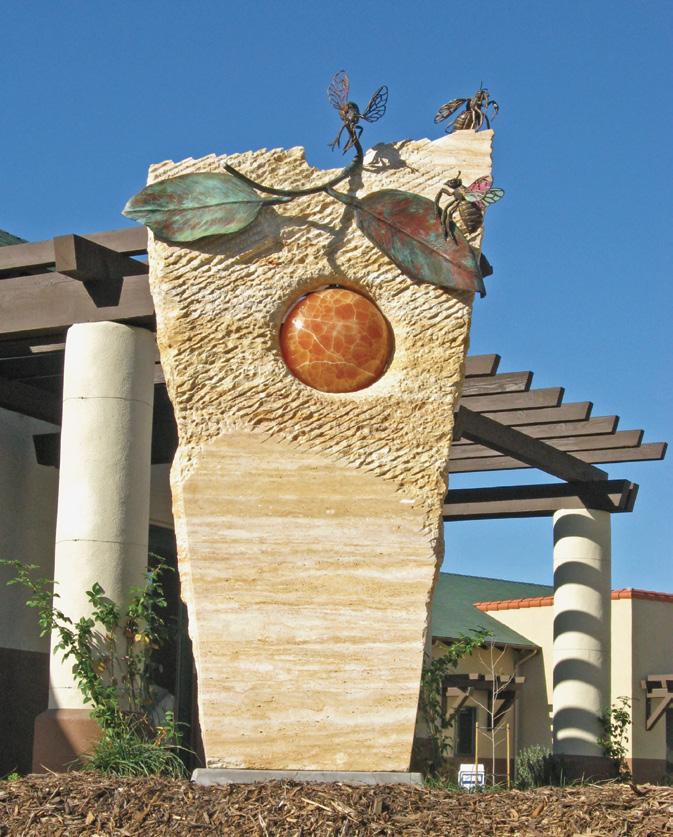
117 OJAI MAGAZINE | SPRING 2023


118 OJAI MAGAZINE | SPRING 2023


119 OJAI MAGAZINE | SPRING 2023


120 OJAI MAGAZINE | SPRING 2023 OJAI MAGAZINE | WINTER 2022



121 OJAI MAGAZINE | SPRING 2023 OJAI MAGAZINE | WINTER 2022 McKay’s Painting 805-746-7725 - Painting - Wood Replacement - Wrought Iron Welding - Interior/Exterior CA LIC #331381
toma
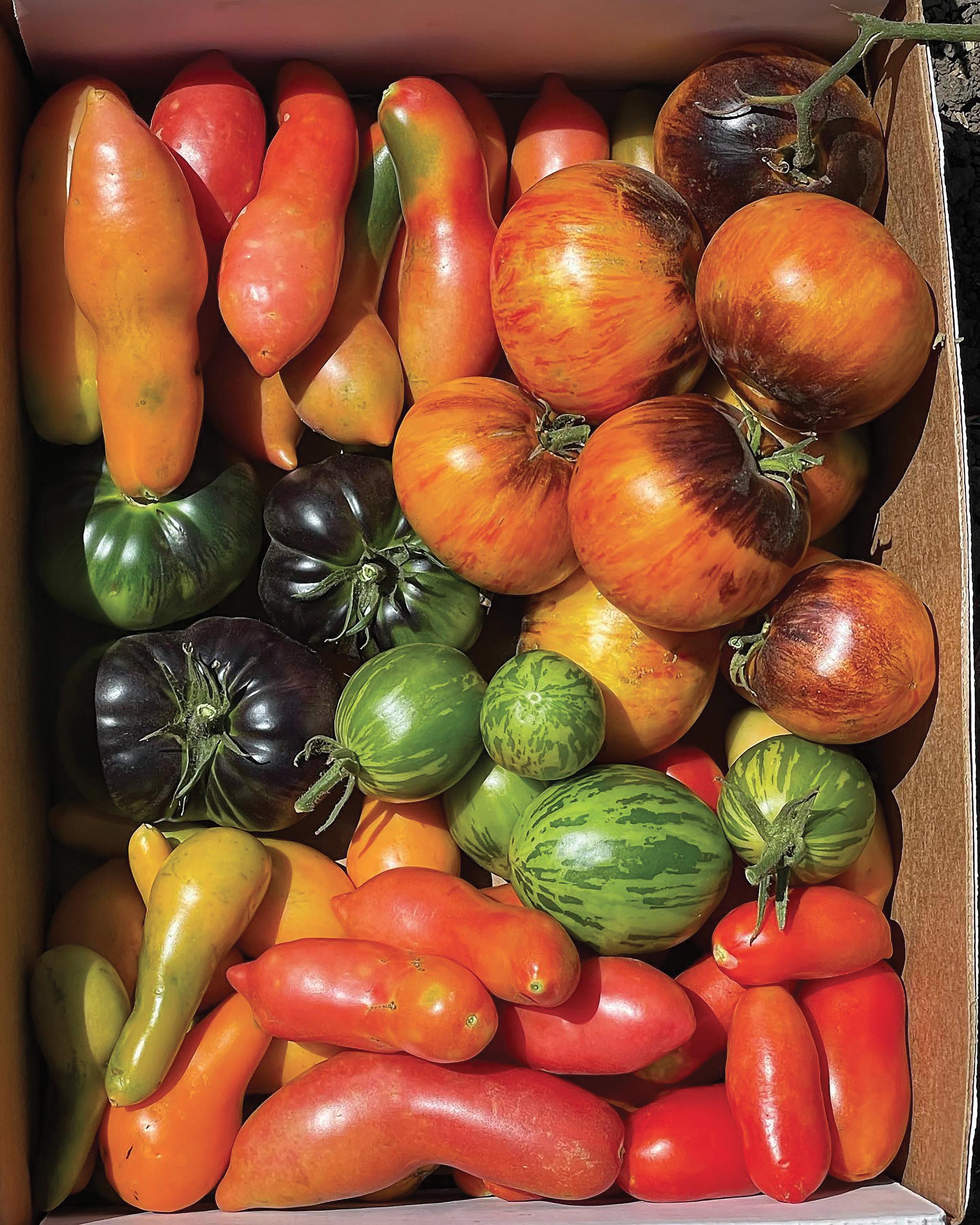
Scott Daigre nurtures a Noah’s Ark of tomatoes right here in Ojai.
by KAREN LINDELL

to
“Two of these … two of those,” he says, referring to the hundreds of pairs of seedling varieties growing in his 30-by-60foot home garden. At first they’re tender green shoots, not yet the fleshy rainbow of red, yellow, orange, pink, and purple veggies that will emerge in early summer. Somewhere in between they’ll be ready for Tomatomania, the monthslong celebration of all things Solanum lycopersicum for home gardeners at sites throughout California.
Tomatomania, which began at the nowclosed Hortus nursery in Pasadena in the 1990s, is run by Daigre and his team at garden centers during the ideal spring planting window from April to May, including in Ojai at Wachter Hay & Grain. At some sites, Tomatomania is a two- or three-day weekend extravaganza; other nurseries present an initial Tomatomania event, then keep a more limited version with seedlings on sale for several weeks, or just host a Tomatomania “residency” without an associated event.
At all sites, up to 300 varieties of classic and heirloom tomato seeds and seedlings are available to buy — many of them rare, and all selected by Daigre, sourced from around the world. Tomatomania also o ers soil, containers, fertilizers, cages, and other tomato implements, plus classes and demonstrations to help growers of all skill levels.
Equally as important as selling seeds and seedlings, Daigre says, is “talking tomatoes. We want clients to be passionate about tomatoes, but also to teach people how to grow well.”
Some tomato varieties return each year to Tomatomania; about 15% are new, says Daigre, who’s also a garden designer, and serves as the culinary gardener artisan-inresidence for the Ojai Valley Inn.
He moved to Ojai about 15 years ago, after becoming enchanted with the town in the 1980s while working a job in Ventura. When he later moved to Los Angeles, Ojai “became my Sunday place to visit,” he says. He and his partner, Sam, moved to Ojai from Los Angeles so they would have more room to garden. They built their home on a bare lot they’d purchased earlier in the Upper Ojai Valley.
Daigre started his vocation as the Noah of tomatoes in Lafayette, Louisiana, where he planted his first garden at age 5, inspired by his grandpa, or “Pa Pa,” who loved growing vegetables. He pursued other interests growing up, then after majoring in communications theory at Louisiana State University, traveled around the country to do marketing and promotions for companies and nonprofits.
Spending a winter in Chicago, he said, “reminded me that I wanted to be a gardener. It was so cold, and all I could do was wait until spring to plant things, so I became an avid indoor gardener, and when spring arrived, I planted everything I could get my hands on.”
Soon after taking a corporate marketing position in L.A., Daigre, who had become deeply involved in tending a community garden, realized he didn’t want the corporate life. He decided to switch his career aspirations to gardening.
mania
123 OJAI MAGAZINE | SPRING 2023
photographs courtesy
Tomatomania
A devotee of nurseries in L.A. County, he went to Hortus in Pasadena, and got hired right away, taking on a range of tasks, from selling plants to designing gardens and directing events, under the mentorship of owner Gary Jones. It was Jones, Daigre said, who came up with the idea for Tomatomania.
According to a 2014 survey by the National Gardening Association, tomatoes are by far the favorite vegetable of amateur horticulturists, grown by 86% of home gardeners, with cucumbers in second place at 47%. But when Tomatomania started, the event’s specialty — heirloom tomatoes — “were just starting to happen,” Daigre says. Heirlooms are grown from seeds that have been passed down through generations and pollinated in the open, rather than hybridized in a laboratory. “You could find seed if you were intrepid,” Daigre says, “but most people had not showcased heirloom tomatoes, and Gary produced plants people lost their minds over.”
Hortus featured 25 varieties at the first Tomatomania; four years later, that number grew to 200 and the event “became a juggernaut,” Daigre says.
He eventually left Hortus to start his own garden design business, and after the nursery closed, bought the rights to Tomatomania, staging the first festival outside Hortus at Tapia Brothers Farm in Encino. “That was the beginning of Tomatomania the road show,” Daigre says. The event has since been held in five states and nearly 30 cities, but has scaled back to sites in California, where the growing season is longer.
Although the tomato types vary each year at Tomatomania, the event’s vibe is “still pretty much the same,” Daigre says. “It’s all about the energy, the magic, the passion, the rarity. Tomatoes are the launching pad of spring.”
Daigre grows many of the varieties available at Tomatomania in his own garden, and at test gardens in Camarillo, Moorpark, and Santa Ynez. He then
contracts with professional growers to grow the seedlings in greenhouses.
He procures the seeds himself, “scouring the seed markets” online throughout the year for rare varieties, keeping an eye on Instagram and Facebook accounts, blogs, news stories, and websites for nonprofits.
The seeds, he says, “come from everywhere, maybe a grandmother in Virginia whose family has grown seeds forever, backyard hybridizers, and enormous multinational seed companies. At any given moment, I have access to 7,000 to 8,000 seed growers in the tomato world.”
The hard part is editing down what he plans to grow each year, based on what he thinks people will like, and which varieties grow well in California.
He’s also enticed by the stories behind each tomato. “We feature several tomatoes named for grandmothers and grandfathers, or regions or cities,” he says. One of the new tomatoes he’ll showcase this year is Council Blu s Heirloom. “I chose it precisely because it’s a family heirloom grown in Iowa by the same family for over 100 years,” he says. Current family members made the seed available to others this year for the first time.
Daigre says Tomatomania showcases classic tomatoes — “we can’t not have Sungold” (a golden-orange cherry tomato) — but also
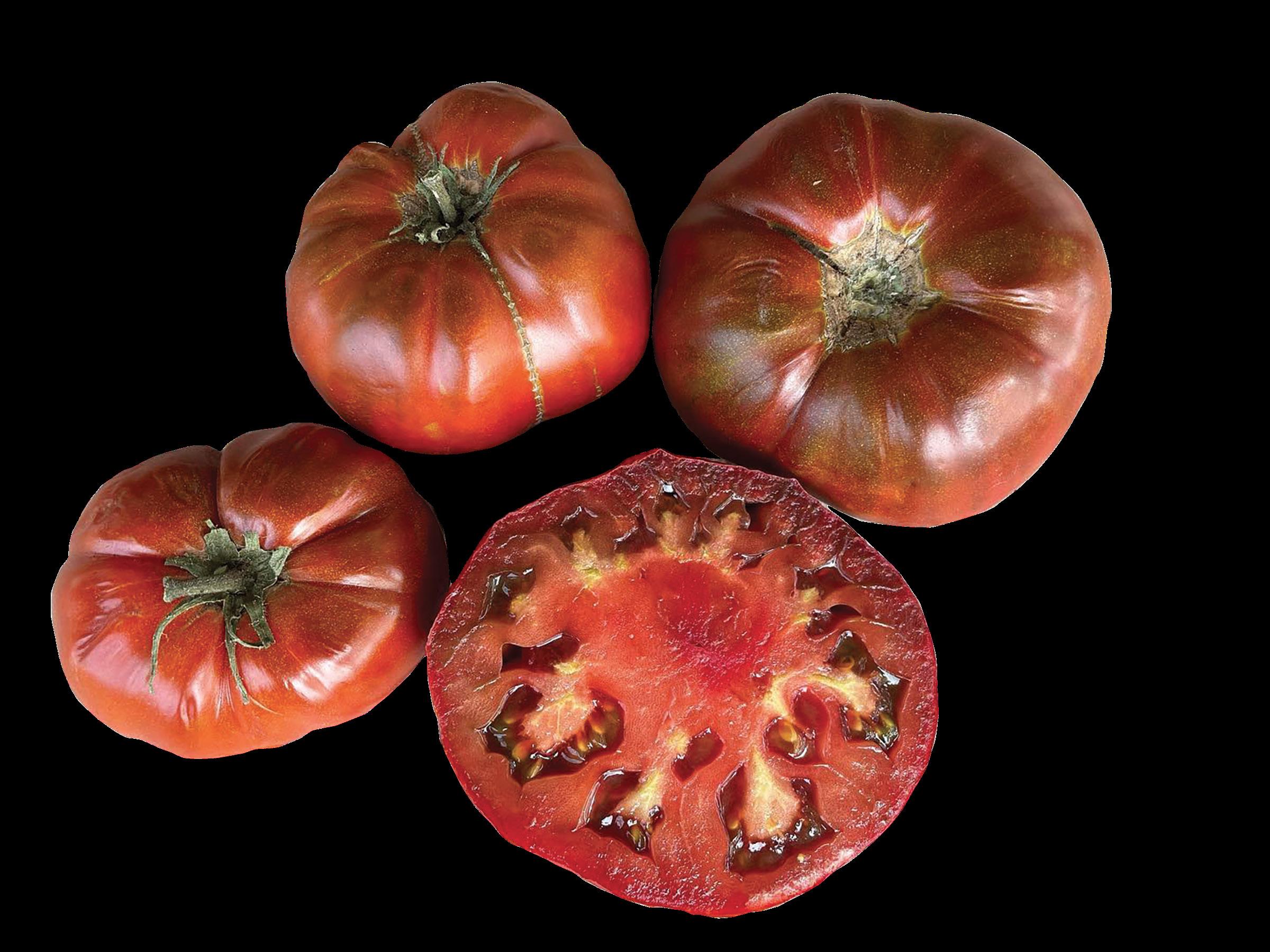
You’ll be dazzled by the di erent shapes and sizes: globe, cherry, grape, beefsteak, plum, oxheart, in all hues as well as striped and multicolored, with tastes from sweet to tangy.
In more recent years, Daigre says, dwarf tomatoes — which refer to the short size of the tomato plant, not the tomatoes themselves — have become popular as more people turn to gardening in containers and small spaces.
Each year Daigre selects a “tomato of the year.” The year’s top tomato doesn’t have to be something new, he said, and there’s no set criteria, “just what we’re most excited about, and think is a terrific tomato.”
The 2023 pick is a dwarf called Melanie’s Ballet, a pink plum type that “is incredibly early and productive and rarely gets above 2 1⁄2 feet tall,” he says.
The Tomatomania website includes tons of tomato-growing tips, but Daigre said his overreaching advice for gardeners isn’t about the tomato plant itself: “It’s all about the soil,” he says. “Whether you’re growing in a container or in the ground, whether you live in the mountains or on a beach, it all depends on the health and vitality of soil. That’s the work you should do all year long.”
During the months after Tomatomania duties subside, Daigre says he does just what every garden should do each year: rest. Even Noah eventually got a break.
Tomatomania in 2023 will take place from April to May at various locations, including Ojai at Wachter Hay & Grain, 114 S. Montgomery St., from April 6 through May. For the latest information, visit tomatomania.com.
Scott Daigre is also the author, with Jenn Garbee, of Tomatomania!: A Fresh Approach to Celebrating Tomatoes in the Garden and in the

124 OJAI MAGAZINE | SPRING 2023







126 OJAI MAGAZINE | SPRING 2023 We care About the Health, Safety & Beauty of Your Trees Owner Mark Crane, member of the American Society of Consulting Arborists, and his team of certified arborists, have been meticulously caring for trees in Ojai, Ventura, Carpinteria, Santa Barbara and Goleta since 1995. • Tree care planting & trimming • Drought services & fire safety • Emergency tree services • Tree evaluation • Hazardous tree & stump removal • Tree pruning & maintenance www.markcranestree.com (805) 646-9484 MON-FRI: 8:00 AM-5:00 PM 24-Hour Emergency Service RCA#592



128 OJAI MAGAZINE | SPRING 2023 Made in USA 5,000 sq ft Showroom Ventura CA 805-654-9000 Walk-Ins Welcome or Call for an Appointment Your Exclusive PowerPool Swim Spa, Vita, American Whirlpool, Bullfrog and Softub Spas Dealer Spa-warehouse.com Coastalsoftub.com Voted Best Spa and Swim Spa Dealership in Ventura County
I met you in April
by CATHERINE MILLER
The cruelest month
Flaunting its tiny white buds and flowers
Sap running, leaves greening, World spinning, Hummingbirds humming, Flashing iridescent, colored breasts
Reds and blues and greens
Like a drag queen in a boa Shameless
Everything stirring—
Everything
But broken hearts
That beg to sleep. Press the snooze button And cry out, “Dear God, what is this? What am I being asked to do now?”
In my dream
I hold my heart in two pieces. “They used to fit together—and pump,” I say
To the man in the white lab coat Who nods, taking notes, Advising me to pace myself. I know this is the wrong person to ask.
He doesn’t know about Spring.
What do I do with this?
I ask my transgressive, wanton self, That pulls on a cigarette While writing poetry and drinking gin
“Just Love, Risk All, It’s the only thing the heart knows to do.”
For so long
We were Battered and tossed on the dark raging seas Athletes in the extreme sport of loving Despite gale force winds
We rode the crests and troughs Until we couldn’t hold on
Finally, we were spat out Onto the shores of a foreign land Faces buried in the sand Coughing, gasping Parched and pummeled by a white-hot afternoon sun
And there we lay Until we caught each other’s eye
And our pupils said, “I’m still alive — What about you?”

And then a terrible silence
Finally, slowly Legs shaking We stood Taking each other by the hand.
You asked, “Do you remember that ancient kiss from God, Who sent us o like schoolchildren— Asking us to be kind and soft no matter what?”
“Yes,” I said. “Well then, let’s start there.”







www.pattywaltcher.com pattywaltcher@mac.com (805) 340-3774 DRE# 01176473 I will help you discover the home that brings peace to your mind and heart © 2022 Berkshire Hathaway HomeServices California Properties (BHHSCP) is a member of the franchise system of BHH Affiliates LLC. BHHS and the BHHS symbol are registered service marks of Columbia Insurance Company, a Berkshire Hathaway affiliate. BHH Affiliates LLC and BHHSCP do not guarantee accuracy of all data including measurements, conditions, and features of property. Information is obtained from various sources and will not be verified by broker or MLS. Buyer is advised to independently verify the accuracy of that information. SOMATIC SANCTUARY 410WestOjaiAve.com This rare commercial property on 1/3 acre, zoned for residential use, could be a gallery, a retail shop, a yoga studio, a healing center or anything you can envision. The main 1br/1.5ba building has a kitchen, reception area, showroom and workroom. A second building is a private studio with wood floors and clerestory windows. Includes 10 parking spaces and beautifully landscaped grounds. Offered at $2,250,000 Over 25 years of experience matching people and property in the Ojai Valley