Issue 1 Spring 2011
OXFORDSHIRE HOME EDUCATORS
Magazine
CHILDREN AND READING Families' experiences of learning to read
PLUS: Reviews Resources What's on in Oxon and lots more...
Oxfordshire Home EDucators Magazine Issue 1
CONTENTS Slow and steady, Maria's Reading journey.........................................................3-4 The Oldest Letter...................................................................................................4 Our Reading Experience.......................................................................................5 Book Review: The Read Aloud Handbook.........................................................6-8 Refrigerator Biscuits Recipes................................................................................9 A Family of Readers............................................................................................10 Our Turning Point was Yu-Gi-Oh....................................................................11-12 Finding Factual Fiction........................................................................................13 Young Readers..............................................................................................14-15 Hanging in there..................................................................................................16 Listen to a good book...all of it.......................................................................17-18 Abridged or Unabridged?....................................................................................18 Audiobook Websites......................................................................................19-20 Librivox................................................................................................................20 Review of REME Museum.............................................................................21-22 In Its Own Time:Our Experience of Reading..................................................23-24 Proud Moments...................................................................................................24 Audiobook Reviews.............................................................................................25 Recommended Audiobooks...........................................................................26-27 Audiobooks from Oxfordshire County Libraries..................................................28 Library Tips.........................................................................................................29 Offered/Wanted...................................................................................................29 Home Education in Oxfordshire..........................................................................30 Please note that the views expressed in this magazine are not necessarily those of the Editor and are not representative of all home educators. Home educating families are all different. There is no one right way to home educate.
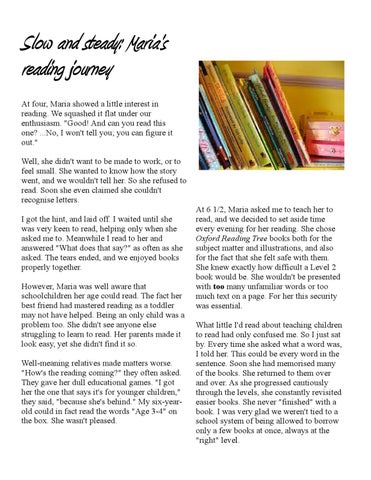
Slow and steady: Maria's reading journey At four, Maria showed a little interest in reading. We squashed it flat under our enthusiasm. "Good! And can you read this one? ...No, I won't tell you; you can figure it out." Well, she didn't want to be made to work, or to feel small. She wanted to know how the story went, and we wouldn't tell her. So she refused to read. Soon she even claimed she couldn't recognise letters. I got the hint, and laid off. I waited until she was very keen to read, helping only when she asked me to. Meanwhile I read to her and answered "What does that say?" as often as she asked. The tears ended, and we enjoyed books properly together. However, Maria was well aware that schoolchildren her age could read. The fact her best friend had mastered reading as a toddler may not have helped. Being an only child was a problem too. She didn't see anyone else struggling to learn to read. Her parents made it look easy, yet she didn't find it so. Well-meaning relatives made matters worse. "How's the reading coming?" they often asked. They gave her dull educational games. "I got her the one that says it's for younger children," they said, "because she's behind." My six-yearold could in fact read the words "Age 3-4" on the box. She wasn't pleased.
At 6 1/2, Maria asked me to teach her to read, and we decided to set aside time every evening for her reading. She chose Oxford Reading Tree books both for the subject matter and illustrations, and also for the fact that she felt safe with them. She knew exactly how difficult a Level 2 book would be. She wouldn't be presented with too many unfamiliar words or too much text on a page. For her this security was essential. What little I'd read about teaching children to read had only confused me. So I just sat by. Every time she asked what a word was, I told her. This could be every word in the sentence. Soon she had memorised many of the books. She returned to them over and over. As she progressed cautiously through the levels, she constantly revisited easier books. She never "finished" with a book. I was very glad we weren't tied to a school system of being allowed to borrow only a few books at once, always at the "right" level.
This repetition did her a world of good. Her confidence grew. With time I could see her noticing patterns, pausing over a word and rummaging frantically in her basket for another book where she remembered something similar. Tales abound of home educated children starting at the age of seven and progressing from zero to Harry Potter in six months. Instead, Maria plodded along slowly and contentedly through the ORT books, touching nothing else. After eighteen months she began trying other books from the library, but found them hard to follow. She lost her place, the text was too small and she got tired. Around her ninth birthday all obstacles disappeared almost overnight. She could read an entire chapter at once, and soon she was devouring a book a day. Looking back, I think she might have found reading easier if she'd felt able to wait until nine or so, when she was really ready. But in our reading-obsessed society she wasn't comfortable waiting any longer. As her mum I guess I'd have felt the pressure too.
THE OLDEST LETTER ?
One of the earliest letters in existence is held in the Bodleian Library, Oxford. It is an Egyptian boy’s letter to his father, written in Greek on papyrus in the 2nd or 3rd
century AD. It was among the many manuscripts discovered by archaeologists at an ancient rubbish dump near Oxyrhynchus in Egypt. This is a translation: ‘It was a fine thing of you not to take me with you to town. If you won’t take me with you to Alexandria I won’t write you a letter or speak to you or greet you...Mother said to Archelaus, ‘He upsets me. Take him away.’ ...So send for me, I implore you. If you don’t, I won’t eat, I won’t drink; so there!’ Google ‘Oxyrhynchus papyri’ for more info. Some of the Oxyrhynchus papyri are held at the Ashmolean Museum in Oxford.
Our Reading Experience
When her peers were in Year One our daughter went to a Montessori school (part-time: we were already thinking about Home Education). There she had good fun doing experiential play, but no formal reading or writing. Her peers in Year One struggled. I was in an NCT group along with six other mothers, and we met weekly which is how I knew that dd was 'behind' (though happy).
Age six, we drove up to Scotland and dd struggled to read us the first few lines of a Famous Five book (many hours later, we were all word perfect on that opening paragraph!) The next term, still aged six, she was introduced to the Oxford Reading Tree, but the adventures of Biff and Chip Aloud I was reading her lots of 'real' books, and did not grab her, and she particularly she had a large collection of audio tapes. I got disliked the poor illustrations. her these after realizing she was following the Woman Hour's serial, an adult book by Noel Streatfield, which probably first attracted her attention as was about a family, albeit one having a harrowing time in the war. She listened to lots of classic children's stories, including all the Narnia books. Bored, therefore, with the Reading Tree, she one day picked up The Magician's Nephew instead and just read it through. There was no looking back; she has continued to read widely ever since. (And had, in one fell swoop, overtaken all the NCT peers who had by now endured over a year of daily Literacy Hour.) I hope this reads not as a boast but as an inspiration. V.
BOOK REVIEW The Read-Aloud Handbook by Jim Trelease Reviewed by Sara
.
When my older daughter was small, she was all ears. And mouth. Give her something to look at or play with, and she was moderately interested. Speak, and she was enthralled. The only time she ever fell silent was when listening.
This was how I got into the habit of reading to her so much. I am a lazy parent, and reading was easier than thinking of things to say, or carrying on a proper conversation. (Of course I did those things too, but there comes a time along about the 2679th question of the day when the parent of a three year old has had all the engagement she can stand. For me, this time was usually about 9am.) Everyone says reading to your child is A Good Thing, so this didn't seem a very dangerous habit. Perhaps I carried it to extremes, but I love stories and I'd rather listen to the sound of my own voice reading a story than engage in yet another exchange about whether my blue picture is better than my green one and do you think they're good pictures and did you REALLY mean that because you sound bored and I don't think you're even listening, are you Mum. Mum?! Mum! I was delighted when I happened upon Jim Trelease's book. I'd picked it up expecting to find lists of enjoyable books to share with children of various ages and temperaments. And so I did. But I found much more. I found an extensive, impassioned and admittedly sometimes long-winded justification of reading aloud. The author argues in favour of reading aloud to children as long as they will let you, right through the teen years. I was very taken by a photo of him lounging in a chair reading to a dish-washing twelve-year-old. Catch them while they're washing up, he proposes, and they'll be so bored they'll listen to you reading, if you choose something they like. He says that if you live with a twelve-year-old and you're still doing your own washing-up, you are doing something wrong. Hmm, I thought, I like this man!
Why read aloud to children? Here are some of the reasons Trelease gives. Reassuringly, he starts with the reason which probably prompted every one of us to start reading to our children. 1.
"We read to children for all the same reasons we talk with children: to reassure, to entertain, to bond, to inform or explain, to arouse curiosity, to inspire.
He then proceeds to explain how being read to helps a child learn to read. 2.
It encourages them to like reading. "This is not a book about teaching a child how to read; it’s about teaching a child to want to read." For many kids, learning to read can be quite hard work. Frequent doses of enjoyable material remind children that there's an intrinsic reward to mastering reading.
3.
It gives background knowledge. Most books contain quite a lot of information, or prompt questions which a child may pursue with parents or elsewhere. This of course is useful out in the real world. A good background knowledge also helps in the process of learning to read.
4.
It builds vocabulary. A good vocabulary for communicating with others is useful in its own right. It's also an essential tool in learning to read. Whether a child is using .
phonics or word recognition, or a combination of the two, or some other method of his own creation, no technique will help him read and understand words if he doesn't actually know those words. Without a strong vocabulary, all the decoding skills in the world would not have helped my daughter make sense of this comic punchline: "Tragically, this serene metropolis lies directly beneath the Hoover Dam." Trelease quotes some remarkable statistics indicating that even simple books usually contain a far wider range of vocabulary than speech. 5. It exposes them to complex grammatical structures. It's debatable to what extent grammar is "caught, not taught." However, there can be no doubt that the more examples of correct grammar children see or hear, the better their chances of understanding and using it correctly. Many grammatical structures are rarely heard in everyday speech, but appear frequently in print. While my daughter was struggling to learn to read, I was startled to hear her read such sentences unhesitatingly. She may have had trouble recognising individual words, but she knew the patterns she could expect. Having heard these patterns many times over the years, she was attuned to them. She also uses them in her writing.
6. Being read to and listening to audiobooks can be a direct aid in teaching reading. Hearing the book while seeing the words can help a child to make the connection. Likewise, reading the book for herself can be easier if she has already heard it. My daughter liked to memorise long passages and mutter them to herself while looking at the book, trying to grasp the correspondence between what she was saying and what she was seeing. (I knew she wasn't actually quite reading yet, because she used to turn the pages at the wrong times!)
Trelease deplores the sacrifice of young children's playtime in favour of endless hours spent drilling early reading skills in modern schools. In reading aloud, he says, he has found an easy, enjoyable, proven way to boost children's reading readiness and level of general educational attainment without cutting into their playtime. Sounds ideal to me! Do you need to read this book? Probably not. Most home educating parents read to their children already, so this is preaching to the choir. Might you enjoy this book? For a parent whose older child isn't too interested in reading for herself just yet, it's reassuring that reading aloud (or using audiobooks) imparts some key literacy skills which are helping prepare the child for the day when she does want to read. The second half of the book contains a great many useful suggestions for readalouds, which could complement lists you can find elsewhere.
This book has been tremendously popular worldwide, having sold some two million copies since it was first published more than 30 years ago. However, it sells less well in the UK, and there is just a single copy in the Oxfordshire library system. Perhaps the author's rather hyped style annoys British readers. However, check out the website or borrow the book and skip the tedious bits, and you'll be rewarded.
Jim Trelease's The Read-Aloud Handbook is published by Penguin Books. It is available to borrow from Oxfordshire Libraries. http://www.trelease-on-reading.com
http://www.amazon.co.uk/Read-Aloud-Handbook-Sixth-Jim-release/dp/0143037390/re
Refrigerator biscuits RECIPE 1 8oz crushed digestive or other plain biscuits 2oz chopped glace cherries (optional) 1-2oz raisins (optional) 2oz flaked almonds (optional) 4oz plain chocolate 4oz butter/marg 2 tbs double cream (optional) Adapted from the Dorling Kindersley Children’s cook book. Fills an 8 inch round cake tin, lined with foil. ‘Very rich, like a cross between dark chocolate fudge and icing and it came away from the tin easily so you didn’t need to line the tin.’ Stir up the biscuits, cherries, raisins and flaked almonds together in a bowl. Melt plain chocolate with butter/marg (optional, add 2 tablespoons of double cream). Add chocolate sauce to digestive mix and stir well. Press into foil-lined tin and cover with foil and press down firmly. Put in fridge for about 2 hours. Said to make 8-10 pieces. .RECIPE 2 ‘gooier and more inclined to be sticky but it was also delicious and you could eat a lot more of it’ 8oz butter 400g tin of condensed milk (doesn’t work if you use semi-skimmed condensed milk or evaporated milk) 12 oz plain chocolate Melt the above 3 ingredients together. Add in a large packet of plain digestive biscuits crushed up. Add approx 8oz of sultanas (optional) Press into a tin and put in fridge till hardened
A Family of Readers My first two children both went to school and learned to read. They didn’t struggle with words and they quickly became addicted to books. They hit their reading stride at the time when Harry Potter was the talk of every playground and all our car journeys were incredibly peaceful, albeit somewhat risky due to the probability of ‘death-by-five-hundred-page-hardback-book’ in the event of an emergency stop. I didn’t think much about how our nonschooled third child would learn to read: I just assumed that she would. She started writing when she was about four years old and started by writing her name on everything she owned. She progressed to writing notes, instructions and demands, but at this time she wasn’t really interested in reading books or in me reading to her as she had better things to do with her time. As time went on, she started recognising words when we were out and she asked us more about words she had read here or there. She played on Starfall online, then Reading Eggs, which I think helped her identify letters and sounds, but did not prompt her to want to read more. It took until she was seven and received several books for her birthday for her to really want me to read to her. She designated a chair in the living room “The Reading Chair”. We squeezed into this chair and I read her the Famous Five, My Naughty Little Sister, Milly Molly Mandy and Amelia Jane Again.
She started reading a sentence every page or so then a paragraph occasionally, but she got tired out with the effort and let me carry on. Then she found a book that she was drawn to in the bookshop called Madame Pamplemousse and Her Incredible Edibles. This book is packed with ridiculously fantastical words from page one which she persevered with on her own without wanting my help. As she read more and more bits of our shared reading, I realised that she could mispronounce a word at one point on the page, but say it correctly further down the page. This confirmed to me that I didn’t need to help her at all and I should just stay quiet. Without knowing it, we had been on a journey described in John Holt’s How Children Learn which I read only a couple of months ago. Now, in the month before she turned eight she suddenly wanted to read a book for herself and went to the mini library that is her brothers’ bedroom. She picked up some Horrible Histories and The Scarecrow and his Servant on the advice of Brother number two. When I asked him why he had given her this book he argued that she knew most of the words in it and she would learn new ones as she read. He was right and now she is addicted too. R
O
ur turning point was
Yu-gi-oh
I’m not sure if my account of my children reading will be useful to anyone, because although it’s similar to a lot of other peoples’, it feels personal and not particularly transferable or actually finished. We have a ten-year-old son and a nearly seven-year-old daughter. With our older child I tried a lot of conventional routes even though we home educate, because I wanted to avoid the ‘pitfalls of school’ as I see them. We borrowed some and used workbooks, looked at phonics and read a lot together. Despite all my best - and worst - efforts at pushing him, he did not show much enthusiasm for reading for himself.
We borrowed a lot of interesting books from the library, primarily with dragons on the covers. I tried him on simple, repetitive books like Oxford Reading Tree. The turning point was Yu-gi-oh. He was seven. Having a natural inclination to all things monstery and dragony, he was drawn to a group of older boys playing Yu-gi-oh at ice-skating one week and asked me to ask them if he could join in. Once they’d showed him the cards and showed him how to play, he was off. He spent his pocket money on a deck and literally pored over the cards every spare moment he had, asking how to read all the text.
The words described monster-attributes and weren’t aimed at children particularly. He persevered and learned how to read them all, committed them to memory and to this day has an encyclopaedic memory of all the information printed on them. Now he’s a voracious reader. He loves books and will read any printed material. So, despite me worrying that he’s not ‘keeping up with school friends and trying my utmost to make it interesting, (pushing him anyway due to some misguided sense that ‘if I try harder’…) he’s got there in the end.
For our daughter we’ve yet to hit on the thing that makes her want to read. She’s always been keen to do things her way and has resisted my attempts to help her read. She has a small vocabulary of 2, 3 and 4-letter words, but has yet to read a whole book. Instead, she prefers to write, beautifully copying text that takes her fancy. And she quite enjoys the odd game of spelling, changing the first letter in a word such as cat to mat to pat etc. I do worry that she’s not further ahead, but I desperately want her to do this in her own time. I’m sitting on my hands, trusting that it’s going to happen soon. She’s told me that she’ll learn to read when she’s eight. Fingers crossed for seven! H.
Finding FACTUAL FICTION
Finding good fiction for children can be difficult. Finding good fiction to fit in with a topic your children are studying or are interested in can be even harder. Other home educators will most likely have their personal recommendations if you ask them, and a good local librarian can be invaluable. But if you still can’t find what you want, try these: HISTORICAL FICTION FOR CHILDREN http://sherbrooke.ndo.co.uk/bibliography/bib.htm Extensive booklist categorised under subject/ historical period of history with brief summary and age/content guidance. Predominantly British history by British authors. SONLIGHT www.sonlight.com Sonlight has a US/Christian emphasis, but with their learning-through-fiction ethos you’ll find some useful treasures among their booklists. ANGLIA YOUNG BOOKS Curriculum-linked historical fiction. Includes a series of history quick reads ideal for lessconfident readers. Publisher’s website unknown, but search for ‘Anglia Young’ under children’s books at www.amazon.co.uk . Some books have accompanying resources. COOL- READS http://www.cool-reads.co.uk Hundreds of 'cool-reads' for 10-15 year olds reviewed by 10-15 year olds. The categorisation is a little chaotic, but it’s still a useful site SCOTTISH BOOKS (Kelpies series) http://www.florisbooks.co.uk/subjects/kelpies The Kelpies series comprises books by Scottish authors and includes some historical novels. JACKET FLAP http://www.jacketflap.com/ ‘A browsable & searchable list of pretty much every Children and Young Adult’s book ever published.’ Filter by age, subject and title. HISTORICAL FICTION (Sparks series) http://www.franklinwatts.co.uk/HISTORY_books_SPARKS_series_26392_56249.htm Part of Franklin Watts, the Sparks series comprises short historical novels, ideal for lessconfident readers. Includes Scottish history.
Young readers
As my first child taught himself to read before he was of school age, I knew it was possible and so had a somewhat relaxed attitude to the others. I am currently not teaching my fourth child to read. Perhaps the most important thing I can say about how my children learned to read is that their methods and ages of learning have all been completely different. We have had one starting with whole word recognition before even entertaining the idea of any letters or letter sounds and others who seemed to turn into readers without anyone even noticing. With my first child I did invest in some early readers from the Oxford Reading Tree (Stage 7 and up) as we were living abroad, the stories were fun and all my subsequent children have enjoyed them too. However so many early readers contain dull stories: I agree with John Holt when he says “In our efforts to make reading easier for children by giving them ever easier books to read, we have only succeeded in making it more dull and false, and therefore harder.”
John stresses that children look for meaning in the stories they read; it is their quest to make sense of the world they live in. Texts that monotonously repeat a set of words without any clear meaning come across as false and unrealistic. He also says “We can hardly ever hurt children by putting too much information within their reach. As long as we don’t try and force them to learn it all, they will use what they need and set the rest aside for later. But we can very easily bore and confuse them by giving them too little information.”
Perhaps as we have become more experienced home educators we have felt less pressure for our children to progress at particular things like reading over other skills. I fully expected to teach my first child to read, but he took me by surprise and beat me to it. I have no doubt that I could teach my fourth child to read before she will do it herself. So why don’t I? Because she hasn’t asked me to. L.
My third child H didn’t use early readers at all it is quite possible to learn to read without them. His first reading materials were Horrid Henry, and Flanimals by Ricky Gervais. H was quite secretive about his reading and could read quite well before he was willing to read out loud to me. He was never introduced to the concept of levels of reading and consequently will have a go at anything. Now aged eight he has read three of Terry Pratchett’s Discworld Novels and has started reading Horatio Hornblower! One trend has been that with each subsequent child, the age at which they start to be fluent has been a little older each time. So is it that with more children I have less time to read to them one to one? Or perhaps they haven’t needed to make the effort because they can always ask someone to read or spell something? I know what it can’t be: it can’t be a lack of books as we have accumulated loads; and it can’t be a lack of examples of the enjoyment of reading, as we are all bookworms.
When I started home educating I assumed that I would teach my children to read and that my children would learn at the ‘right age’ and progress according to the ‘usual expectations’. Perhaps I was naïve, but my experience with my three children was nothing like I expected. I tried very hard to ‘teach’ my eldest to read from the age of five. I tried the ‘look and say’ approach. I tried ‘phonics’. I tried all sorts of reading schemes. If there was a recommended method, I probably tried it. There was little or no progress. He could read a word one day and not even recognise it another day. Writing was equally slow and cumbersome.
The experience with my middle child was very different. I had read anecdotes of children teaching themselves to read, but I didn’t really believe it. That is, until my middle child taught himself to read. He was six years old. One week he wasn’t reading, the next he recognised words like ‘play’ and ‘save’ (from non-educational computer games) and within the same month he was an almost-fluent reader. He progressed steadily to easy novels, and has become an intuitively good speller. All with no teaching, no phonics, no spelling recitals or testing. It is a complete mystery. My youngest, age seven, is a ‘not-yetreader’. Seven feels like an important milestone in literacy expectations. Despite my experience with her siblings the temptation to intervene is strong.
We considered dyslexia testing. I took advice from other home educators. I spent more time simply reading to him. No pressure. No expectations. Just books on shelves...Ok....maybe a few books strategically strewn on arms of sofas and tables. We were getting desperate! He finally became a more fluent reader at the age of nine or ten, quite a few years after I had backed off and let him find his own methods. I don’t know what those methods were, but I doubt you’ll find them in any textbook or classroom.
Some days she expresses frustration: ‘It’s difficult when you can’t read because all writing just looks like squiggles’. Sometimes other adults are unknowingly insensitive: ‘Of course you can read. Don’t be silly. Here, read this.’ And I point out that no, she can’t read yet, but she will when she’s ready. She is clear that she doesn’t want me to teach her and it feels right to respect her wishes, whatever my own anxieties. Watch this space. I’m hanging in there. BMF
LISTEN TO A GOOD BOOK ...all of it By Sara S Call me a snob, but I'll go to great lengths to avoid abridged versions of books. The subject of abridged classics was discussed on the Oxon Home Educators email list not long ago. I'd like to expand on what I wrote then, particularly as it applies to audiobooks, which are very often abridged. Some would disagree with my fussiness. The point, they say, is to give the child whatever he likes to hear. A more accessible version may be more appealing and can get him interested enough to tackle the whole book later. Sometimes an abridgement is even an improvement on the original, especially if the author dashed the original book off under pressure or was paid by the word. Fair enough. I won't deny that good abridgements exist. However, altering a book is quite a skill. There's a lot of rubbish out there, and I don't want to be subjected to it. (In our small house I quite likely will get to hear most books which the kids hear.) And in the case of audio versions, you can't simply pick the book up in the shop and have a quick flip through to see whether you like it. If you want to be sure you will like the content, it's simpler to look out for that magic word "unabridged."
There's another reason I like to hear books complete in all their original glory, and why I want my children to do so: the language. In another article in this issue, I've referred to the way in which children learn complex grammar and new vocabulary by hearing books read aloud. In an abridgement, long sentences and tricky words are first in the firing line. Difficult words are left out to make the book easier for young children to understand. Descriptions are cut short on the basis that everyone wants to skip ahead to the exciting bit. Well, I don't! I want to savour every delicious bit of the book, not tear through it at breakneck speed to find out how it ends. With books, surely the journey is more important than the destination. Leave it all in, I say. If children haven't the attention span for it or can't understand it, put the book back on the shelf and try again in a few years when they're able to appreciate it in all its glory. What's the hurry? A good book is worth waiting for. There's no shortage of excellent accessible books which you can feed to children in the meantime.
Working out whether an audiobook has been left in one piece is not always easy. For obvious reasons, longer books are the most popular targets for abridgement. If you love audiobooks you may develop a feel for how many tapes or CDs a given book is likely to require. Alice in Wonderland is not going to fit on a single cassette, so I won't bother picking it up off the shelf if I see a box with just one cassette. It's often necessary to read the case very carefully to find the words "adapted", "special version", or "dramatisation"; or on the other hand "complete" or "unabridged.” It's been said that The Wind in the Willows is a poor choice for a read-aloud. I couldn't disagree more. Do you remember the mesmerising Sea Rat? If not, you may have read an abridgement. His bewitching talk is left out of most shortened versions of the novel. In closing, I leave you with one of my favourite sentences from the book.
Abridged or Unabridged? Although I agree partly with some of Sara's comments, I don't believe that abridged books and audiobooks should be dismissed. For example, some BBC dramatisations of books are excellent, and while I'd happily listen to Stephen Fry read the entire Harry Potter series there are other books that I'd be just as happy to listen to/read abridged. Take Sara’s example of The Wind in the Willows. I found it a tiresome book, both as a child and as an adult, and I can’t help thinking - however ornate the language - that an abridged version of ‘vermin meets road-rage toad’ might improve the experience!
Of deep-sea fishings he heard tell, and mighty silver gatherings of the mile-long net; of sudden perils, noise of breakers on a moonless night, or the tall bows of the great liner taking shape overhead through the fog; of the merry home-coming, the headland rounded, the harbour lights opened out; the groups seen dimly on the quay, the cheery hail, the splash of the hawser; the trudge up the steep little street towards the comforting glow of red-curtained windows. Sara S.
I also rate highly the Quick Reads series. These are a series of print adaptations, as the website says: ‘by bestselling writers and celebrities…for adults who've stopped reading or find reading tough, and for regular readers who want a short, fast read’ I have found some of these perfect for my eldest child who is twelve. The adult interest, vocabulary, and characterisation haven’t been noticeably toned down (be warned - expletives remain!), but the sentence construction is simpler, the chapters shorter, and the whole layout of the book less daunting for a nonconfident reader. A twelve-year-old doesn’t want to be reading the books that a nine-yearold reads, even if those books are closer to his reading ability. These ‘adult’ books fit the gap perfectly. Quick Reads are available from Oxfordshire County Libraries. Their backlist includes authors such as Andy McNab, Ian Rankin, and titles such as Doctor Who, plus nonfiction titles including Dragon’s Den and Gordon Ramsay’s ‘Humble Pie’
Audiobook websites http://www.learnoutloud.com Has some free content and links to free titles on other sites. http://www.bookdepository.co.uk A modest collection of reasonably-priced new audiobooks. www.audible.com often has good introductory offers for its subscription service. http://www.waterstones.com/ Through Watersone's Marketplace you can browse specifically for all secondhand audiobooks. http://www.thenakedscientists.com/ Science radio. Includes a large collection of archived programmes which you can download as podcasts. Suitable for ages 8+. http://www.wirelesstheatrecompany.co.uk/ Free audio theatre to download. http://www.bbc.co.uk/iplayer/radio BBC iPlayer has most BBC radio programmes from the previous seven days available for ListenAgain. Unlike iPlayer TV programmes, you can only listen to audio content streamed; you cannot download it to listen to after it is removed from the website. However, a "series catch-up" feature, whereby you can listen to all episodes of a series until seven days after the broadcast of the final episode, is now being rolled out. http://www.audiobookradio.net/internetradio/ A free radio station dedicated to broadcasting stories, drama, poetry and author interviews. They sell audiobooks too: receive Charles' Dickens' "The Chimes" for free when you complete a free registration. http://www.audiofilemagazine.com Reviews and news from the world of audiobooks. Check out the Community pages for giveaways! http://www.calibre.org.uk Young Calibre is a free postal library lending out audiobooks to children who have difficulty accessing printed books. "For anyone under 16 who can't see properly, or has dyslexia or a physical disability which makes it difficult to read ordinary print." There is also a corresponding service for adults. http://www.listening-books.org.uk/ Subsidised audio library service available to anyone who finds reading difficult due to illness, physical disability or learning difficulty. Membership starts from ÂŁ20 per year.
http://librivox.org/ For books which are out of copyright, librivox.org has audiobooks you can download for free. Readers are given training, advice and editorial assistance. However, these are amateur recordings - anyone can have a go! - so quality varies. The most popular books often have several versions, so you can try out different readers and find one you like.
Here are some of my
favourites:
Rootabaga Stories by Carl Sandburg, read by Thistlechick. A Lady's Life in the Rocky Mountains by Isabella L. Bird, read by Laura Caldwell. This veteran traveller toured the Rocky Mountains in the 1870s and described the scenery and people of the area in letters to her sister. Likely to appeal to ages 12+. Warning: contains a detailed reference to cannibalism which my daughter found upsetting. Just So Stories by Rudyard Kipling, read by various. The Great Big Treasury of Beatrix Potter, read by various . Rikki Tikki Tavi by Rudyard Kipling, read by Mark Butler. (In LibriVox's Short Story Collection Volume 005). A mongoose battles the local snakes. Some scary bits. Story of a Stuffed Elephant by Laura Lee Hope, read by Vlooi. The Story of my Life by Helen Keller, read by Maria Uther. West African Folk Tales by William H Barker, read by various.
There is an army phone that the kids can communicate with (a good lesson in reading instructions we discovered). There are a few push-button thingimajigs that make whotsits do things. There are plenty of trails/quizzes/ sheets and activities both at the start of the displays and more as you go around the museum. These include making your own ‘helicopter’, making a flick-book and generally things a little more inventive than the usual colouring-in sheets.
Just over an hour’s drive from Oxford and about 8 miles from Reading is the REME Museum of Technology (REME stands for the Corps of the Royal Electrical and Mechanical Engineers.). Having checked out the website I knew that my weapon-mad 12year-old would simply love this place. The museum is next to Arborfield Garrison, and it is easy to feel intimidated as you approach and see uniformed guards at barriers. However the museum itself is unbarriered and you can't miss the large weapon-thingies and plane-thingies outside. (I should of course know their correct name, but I'll leave that to my children!). Parking is easy, a large carpark right by the museum. It’s not a massive museum but plenty to look at. The displays are interesting if you like weapons and machinery and army-type things. (And if you don’t like any of these things then take a good book 'cause it'll be a long day.)
I vaguely remember some dressing up clothes too, but might have imagined that in my attempt to look interested at a missile, which probably wasn’t a missile, but looked like a missile to me. There are machines and models and medals and weapons and some creepy-looking manikins in various uniforms. However the most popular area for my 12-year-old was the weapons room – guns galore! (Look out for the Victoria Cross in a glass case in the corridor on the way to the weapons room).
Outside, at the side of the carpark, you can enter a large hanger-type building which contains various army vehicles, including tanks and a helicopter. Although you can’t go inside any of the vehicles (awww spoilsports!) there are steps up to the helicopter and from there you can launch your home made ‘helicopter’ onto the landing pad below. There are also videos showing film clips, plus some gear-type hands-on activities and a ‘bug-hunt’ activity (my 7-year-old loved hunting for the plastic bugs on the vehicles). Overall the museum is very child-friendly and relatively buggy accessible. There is plenty of space for toddlers to mooch and enough glass cases of weaponry for preteens to smear with their drooling faces.
There is a small café, and shop (supplying replica items such as ration books,etc). Also a slightly sheltered (but not roofed) picnic area with benches. Staff were friendly. The only toilets we saw were at the café, but this isn’t far to walk from anywhere in the museum. We spent over 2 hours at the museum, including lunch. For those who might be interested there is a Blitz Day (to be confirmed)on 3 April 2011. Apparently on some of their open days they have assault courses, shelter building and other activities run by the army chaps and chappesses. Check out their ‘what’s on’ programme for further details. Entrance cost: £5.00 Adult £4.00 Child (under 5’s are free) £15.00 Family Group (2 Adults and up to 3 Children) Opening times Mon to Thur: 9am-4.30pm, Fri 9am-4pm, Sun: 11.00am–4.00pm.Closed Christmas Day & New Years Day. Bank hols – check in advance http://www.rememuseum.org.uk/default.aspx
In its own time:our experience of reading. Here are some observations I have to offer from the process of my three oldest children learning to read. I should say that we are a kind-of autonomous (sometimes not) home educating family, with four children in a house fulll of books. We began to home educate after my eldest daughter had been in primary school for a year and a half. She went to school at five years old. I think she could probably recognise letters and give them sounds. She brought home reading homework every day, just letters and sounds to begin with, progressing to Oxford Reading Tree, and then on to other short books. I could see steady, logical progress. She came out of school aged six and a half. I'd say she could read, but she didn't ever volunteer. A few months after leaving school she realised that she could read for herself and she has been a voracious reader ever since. My second child learnt differently. She learnt to read fluently at eight and a half. I had some early reader books at home and every now and then we would sit on the sofa and do a page. I'd say for a while (a year or so?) we managed a page a month of 'ab, eb, ib, ob, ub' with ever longer gaps in between these sessions. From about age five, I thought she was on the 'cusp' of learning to read. By the time she was seven, I felt that I could see progress, but it didn't seem steady or logical. I wondered about dyslexia. I wondered about the phrase 'whole word recognition'. I thought I ought to look into this and research different learning styles. I still haven't. Meanwhile she was passionate about books, sitting up in bed for hours looking and looking, but not reading. I thought it was quite special to be able to see only pictures, and to be free of the words. For a week or so when she was about seven and a half, we shared paragraphs in reading a bedtime story. I noticed that if I began the sound of the words, she could read the rest of them, but she had little confidence. At eight and a half, she emerged suddenly as a fluent reader. I'm not sure how she did it, but somehow, and over time, she pretty much taught herself. She loves books and reads constantly now.
My third child, a boy, is five, nearly six. He is reading. By this I mean he can read Dr Seuss, though isn't reading chapter books fluently yet. I haven't done anything formal at all to contribute to this learning. I have answered questions of course, but thats it. I'm leaving him to it, and it feels good to do that. Each of the children have learnt differently. I'm not sure whether my - ever decreasing - short bursts of 'teaching reading' had much effect. They have petered out by now and my son doesn't seem to need it. My second eldest daughter definitely taught herself, though I did try to help, and I'm really proud of that. I'd like to think it gives her a feeling of inner strength to know that she did it herself. I don't intend to 'teach' my youngest daughter to read as I now feel confident that it does happen in its own time, and differently with each person. S.
PROUD MOMENTS Dd (aged 12) entered a competition to design the ticket for a camping & music w/e; she didn't win, as she was up against a load of adults (many of them actual designers) but the organizers have given her a free ticket anyway because they liked her entry so much. â—?
I've joined an art group - there are 5 of us and all but me went to art college; finally realizing I no longer have to hold on to my sister being the 'arty one' and me therefore useless at it. â—?
A poem I'd written came runner up in a competition and was published in a national magazine. It's only the third poem I've written as an adult and was the result of a writing course that I've been studying. I think it proves the old adage that 'you're never too old...' â—?
AUDIOBOOK REVIEWS By Sara S
WOOF! by Allan Ahlberg. Read by Mark Williams. Published by Puffin Audiobooks, 1998. Abridged, 2 cassettes. Age: The humour is likely to appeal to ages 7+. Don't be misled by the bland cover: this book is sharp. On the face of it, the plot isn't particularly original: boy muddles through life cursed with a tendency to turn into a dog at inopportune moments. The dialogue, however, is brilliant. We loved the deadpan fast-paced delivery of reader Mark Williams. You may know him from the BBC comedy sketch series "The Fast Show" or as Arthur Weasley in the Harry Potter films. I'm afraid we can't lend it to you: we listened to our copy over and over until it broke, bought another one, and wore it out too. Available secondhand through Amazon from £1.50.
FINN FAMILY MOOMINSTROLL by Tove Jansson. Read by Hugh Laurie. Published by BBC Cover to Cover, 2008. Unabridged, 2 cassettes, 1 CD, or audio download. Age: Likely to appeal to ages 6+. A Swedish friend tells me Tove Jansson is universally known and widely loved in Scandinavia as a master storyteller. Her quirky, wildly imaginative tales are knit together into a loose narrative. The Moomins and their friends are as odd a collection of diverse creatures as you could hope to find. Their acceptance of one another's differences is marvellous to witness. Hugh Laurie clearly had a whale-of-a-time reading this. He held me spellbound with his intensity and wide-eyed wonder. His comic delivery makes every character memorable. Even the petty and peevish among them seem human and strangely likable. I have only one real criticism. Oddly enough in a book written by a woman, nearly every one of the numerous characters is male. The mumsy and long-suffering Moominmamma is likable enough, if a bit of a doormat. The Snork Maiden is vain and silly. But I guess for a book of this quality I can put up with a bit of sexism. Widely available in bookshops. Also available secondhand through Amazon from £5.31, as a download from waterstones.com from £4.75, or to borrow on CD from Oxfordshire County Libraries.
Recommended Audiobooks, by Emily‌ Most of the following were audio tapes I particularly enjoyed listening to between the ages of about 5 and 9 years. THE CHRONICLES OF NARNIA by C. S. Lewis. BBC radio collection. These are fantastic. I acquired the full set of 7 and would listen to them most days. The dramatization made the whole thing exciting. The battle scenes were perhaps a little hard to capture in a tape, but apart from that I found them as magical as they should be. I really got a feel for the people and places and would fully recommend these to anyone who perhaps found the books a little hard going---it's hard not to love Narnia when you listen to the BBC collection. THE RAILWAY CHILDREN by E. Nesbit. BBC radio collection The well meaning, but often slightly mischievous children, are brought to life fantastically by Victoria Carling, Daniel Ison and Kate McEnery, and the adventures never lose thrill. And the awfully sickening but sweet cry: " MY DADDY!" at the end has me crying every time! JUST SO STORIES by Rudyard Kipling. Read by Tony Robinson. Published by puffin audiobooks. What marvellous stories! Read in such a mystical and poetic way, with so much alliteration and rhythm, they are beautiful to listen to. Funny and full of surprises, each story is a witty tale of creation, from how the elephant got its trunk, to how the leopard got its spots. This is campfire storytelling, and gives the impression that he is talking just to you, "oh best beloved". THE GHOST OF THOMAS KEMPE by Penelope Lively. Read by Rosalind Adams. Cover to cover. Set in Eynsham, this is a fantastically-compelling story of a boy who finds he is being haunted by a poltergeist, a former sorcerer, who has decided that James should be his new apprentice. This gets poor James into fearful trouble, as doors slam, things fall off shelves, and the vicar gets covered in tea, thanks to invisible hands. This humorous but slightly disturbing story was a hit with me. It really captured everyday life, and made it fully believable. [NB: this particular edition may no longer be available.]
WHEN HITLER STOLE PINK RABBIT by Judith Kerr and read by Rosemary Leach. Harper Collins I think this is aimed at older children and adults, but I listened to it when I was quite young, and thought it very good. It's a moving story, set in wartime Germany. Full of adventure-sometimes funny and sometimes scary - as one family travel through Europe to eventually end up in England. Although there are deaths,I'm ashamed to say I cried most when the girl left her old toy, pink rabbit, behind in their house when they left in secret, bringing only a few necessary items with them. I recommend this absolutely, but to slightly older children who can handle a bit of death and wartime stuff. THE EVERGREENS by Odds Bodkin. Read by Odds Bodkin. Published by Rivertree Productions. A collection of folk tales and fables from around the world, totally enchanting and gentle, and very in tune with nature. Read (read isn't quite the word, as he apparently didn't use scripts, and performed everything live) by one man who also does all the music for it. A very organic and natural listen.... enjoyable for all ages. JUST WILLIAM by Richmal Crompton. Read by Martin Jarvis. BBC radio collection. Where to start? Anyone who hasn't read or heard these, has an absolute treat in store. They must be read by Martin Jarvis!!! Anyone who has come across Horrid Henry and disliked it, JW is so much funnier. Not just the ridiculously hilarious plots, but also the fantastic language (Richmal Crompton has got to be one of the best English writers ever) will have you falling off your chair with laughter. Real LOL material. NB: Originally written for adults, which is probably why my mum and dad and aunts and uncles and actually everyone in my family love them WINNIE THE POOH by A.A. Milne. Dramatization and published by Hodder Children's Audio. I think everyone must have come across Winnie The Pooh before, but I have listened to many other tapes of those stories and weirdly, nothing really compares with the dramatized Hodder children's audio. It's so completely right. They get the voices spot on, and you really start to love the sweet and unique characters of each animal. Obviously, this is aimed at very young children, but the delight in listening to it never really wears off.
Audiobooks from Oxfordshire County Libraries by S.S. Our library system doesn't have as many audiobooks as one might hope. I can see why: they are expensive and are soon rendered unusable through wear and tear. Still, there's some good stuff out there if you can find it. People with certain disabilities qualify for free audiobook hire and can also borrow more audiobooks at once. I'd only begun to explain to the librarian that the speech therapist had recommended my daughter should hear lots of books read aloud, when she cut me short and just amended her computer record. There were no forms to fill in and I didn't need a doctor's recommendation. I'm not sure which disabilities qualify. However, I would guess children with dyslexia or other reading difficulties would be eligible. It's worth asking! You may be familiar already with the library's online services. If not, take your library card into any library and request a PIN number. You can then search online for books, reserve them (or add them to a wishlist for future reference if you'd rather order later) and have them delivered to your local library. This service is free for children. I find the library catalogue tricky. It took me some time to work out how to search specifically for audiobooks, because I'm told my search is too general and returns too many results. What I really want to say is, "Show me all your audiobooks!" but it won't quite allow that. Here's my method: In an Advanced search, specify a class. (I use FIC because we like fiction.) Tick Children's if that's what you're after. Leave the Library field set to "All libraries." Under Media, select one of the audio formats such as "Audio material, audio cassette." As far as I can tell, the library audiobook collection is mainly fiction. To search for all nonfiction, untick Children's and type in "*.*" for Class. Unfortunately you then get a list of results by Dewey Decimal number rather than title and you have to click each individually to see what it is! Displaying the maximum 50 results per page makes the results more manageable. If anybody has any other tips, I'd love to hear them!
Library tips We use the fabulous search facility of www.amazon.co.uk first to find the books we want. Then using the new-found titles and authors we search for the book on the oxon library catalogue. Once you’ve set up your pin number you can reserve and renew books online. If you ask at the library to be set to 'email notifications' you can be emailed when reservations are waiting for you and sent reminders for nearly overdue loans. If you need to reserve non-junior titles for your child speak to a librarian. Often they are happy for you to reserve these on your child’s ticket (for free, rather than the fee applied to adult reservations) as long as you don’t abuse the system. You can return books to any Oxon library and they will be sent back to the appropriate library. BMF.
OFFERED/WANTED Offered (free):
Collection of 15 Lucy Daniels "Animal Ark" audiobooks on cassette, dramatised version. For Swallows and Amazons fans! Old Admiralty charts covering the route taken in "We Didn't Mean to Go to Sea." (Now useless for navigation, as sanbanks shift often and these charts are not current.) Plot the route taken by the intrepid young travellers, or wallpaper your bedroom with these maps! Large charts with hard cover: you could just about get them home on the bus if you don't have too much else to carry. Purple illuminated globe, mains powered, approximately 9 inches diameter. Basic plastic descant recorder For any of the above collect from East Oxford or arrange to meet me at an HE activity. sara_sengenberger@hotmail.com
Offered (free): BBC Maths Challenge - 6 cassettes of original BBC Schools Radio Programmes. Collect from near Oxford or arrange to meet me at an HE activity.
leiden64@yahoo.co.uk
HOME EDUCATION IN OXFORDSHIRE Home education is legal in the UK. There are thousands of home educated children in the UK, and probably hundreds in Oxfordshire itself. Oxfordshire home educating families meet together at a wide variety of social activities and events. The thriving local home education community offers support, advice and friendship. If you are home educating - or considering home educatiing - in Oxfordshire you may find it useful to join the OxonHE online yahoo group at
http://groups.yahoo.com/group/OxonHE/
The original copper electroplate for Lewis Caroll's poem 'The Mouse's tale' (from Alice's Adventures in Wonderland) is held at Oxford University Press. Apparently the tale/tail was typeset in a straight line with reducing font sizes, then cut and pasted onto a board by Lewis Caroll to show the printer the effect he wanted. (Photo taken during a recent home education group visit to OUP's museum. )