12 minute read
A Love Story of Radical Ambition in the Face of Ecological Catastrophe.

Erik G L’Heureux, AIA LEED AP
This is a love story. It is a story of our own love for Singapore.
Advertisement
It is a narrative of Singapore’s desire to remain relevant. A tale of Singapore’s continued foresight and ambition. As in all love stories, there are seemingly irrational and extravagant ideas that create acts of absurdity. Yet in the context of love, everything seems completely appropriate and entirely plausible.
Singapore’s unique history of perpetual transformation is combined with speculations of a future Singapore illustrated with visions of a Singapore reaching for its logical conclusion. But more than any fiction, this is about Singapore’s survival and the strategies required to overcome its historical burden and self-created geographical challenges.
Scene One: The First Hydrological Nation State Set in 1516, a map of Sir Thomas More’s Utopia, the first Hydrological Nation State.
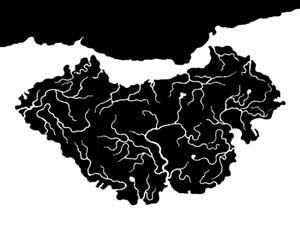
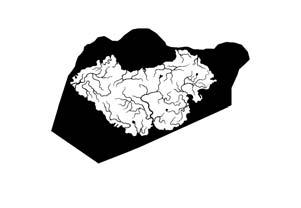
Scene Two: The Most Developed Hydrological Nation State Singapore, 2009 – the most developed hydrological nation state – looks forward to its own radical transformation in the next eighty-eight years, a tripling of the nation’s history of autonomy. The parallels between the two scenes, 1516 and 2009, are shockingly familiar, an uncanny resemblance that resides in one’s architectural subconscious: two islands crossed by rivers and lakes, surrounded by ports and sea traffic, visions of the Garden of Eden. Large landmasses to the North anchor the two island visions where a multitude of new towns are dispersed across the landscape; Utopia has fifty-four, Singapore only twenty-five. But Singapore is only 44 years old, Utopia: 493.
Scene Three: For the Love of Topos, for the Love of Water, for the Love of the City Rudolph De Koninck, in his text “Singapore,AnAtlas of Perpetual Territorial Transformation”, notes of Singapore’s Topophilia. Topophilia is a love of ground, a love of place, a love of topography, and it sets the stage for an amazing history of battle. Land fights sea growing day by day. Sea attacks land in a slow process of erosion. A give and take forming the basis for Singapore’s continued transformation and continual reinvention, fighting ocean currents, monsoon deluges, and territorial reclamation. Topos is fundamental to the island’s existence. Without topos the amazing Singapore Story would be just a seafaring myth awash in the Straits. Then again, for Singapore, land equates with modernity; surely a floating city is bound to sink.
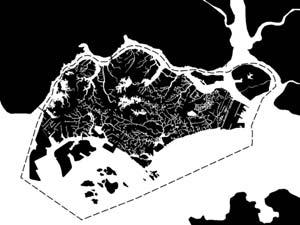
Singapore’s topography has been entirely constructed from its earliest beginnings; at present, at least 25% of its original size has been added. Dredging hoppers form new topos on a 24-hour cycle, “rainbowing” sand to an ever growing island. Albeit at the expense of her neighbors continually shrinking. In South East Asia geopolitics is literally about geology: sand. Singapore is a fully constructed landscape inside as well as out – new territory created from ocean bottoms or a nearby island, a flattened surface topography to make building that much easier and more expedient. Its engorged perimeter retained with a stone beachfront, encloses a 365-day green interior, an average 28°C 80% Humidity atmosphere produces complete atmospheric consistency. In this landscape of continual transformation, we see the traces of Utopian aspirations: a city in self created constant growth, a city that is at once an idea and in a process of becoming, a green garden manicured and constructed, a city of modernist icons sampling the best of everywhere, encapsulated by a glistening blue sea; the lubricant for a frictionless city the envy of the world.
Singapore is now an urban prototype influencing the development and growth of cities and nations the world over: Dubai, Russia China along with its ASEAN neighbours closer to home. It has simulated its city experiments and exported them to Tianjin and Suzhou summoning its internal talent for external expansion. The model is as if Singapore was embedded within the pages of Calvino’s Invisible Cities. Kubla Khan sits in his garden listening to the travels by the Venetian Marco Polo… imagining a city like no other – the envy of all cities. To know Singapore is to know where the urbanized world is heading. And to imagine a future Singapore is to imagine future urban configurations of massive global impact. Singapore represents the biggest wet dream of urban and architectural transformation – a vision of the city for perpetual architectural employment and enjoyment. It is a city constantly reinvented – a radical proposition of a future coming to fruition only to be remade on the peaks and valleys of the shifting tides.
Singapore is one of the greenest cities on earth, and with 2.37 metres of rainfall each year. It is also one of the wettest. Beside its population of 5 million, Singapore’s only other resource that makes it so successful is the water and the ships over its sea lanes. In Singapore, water is everything. Yet in a biblical twist of fate, Singapore has no significant fresh water source. It imports or recycles almost all of its drinkable water. Singapore’s best invention for liberty may well be drinkable water from her own effluence, affectionately embraced as “New Water.” With “New Water”, Singapore literally drinks up to thirty percent of its own discharge – a percentage that grows with every new water reclamation plant. Tremendous quantities of energy are expended to fabricate water, yet it rains more in Singapore than ninety percent of the world’s cities.
In 2011 and 2061 the water treaties between Singapore and Malaysia will expire. Will the tap be shut off permanently? Aquatic autonomy must be the new answer for security in this little red dot. In Singapore, and now the world over, the black gold now appears more and more -- blue.
Despite Singapore’s architectural love for topos, its most important real estate is not land. Le Corbusier and his fascination with Cruise ships a century earlier seem all the more pressing now. Raising an architecture on Pilotes, the ships in the landscape appeared to float over the vegetation. Tranformed into the ubiquitous HDB project, 83 percent of the nations population believes high is the only way to go. A more literal interpretation is what we need now.
In Singapore, water is everything. Aquatic territory gives Singapore its geopolitical power, its functioning port, and its reason for existence. Even the UN knew this in their vision for a hydrologically inspired urban Singapore in 1963 – the “Ring City” with mass transport by rail and sea in concentric circles of developing
urbanism all with a green heart.
The most public of spaces is found at Singapore’s perimeter. Ports are free and open for business 24 hours a day –measured in fractions of a second – with surrounding shipping lanes packed with ships from all over the world. Singapore now has a “New Padang” at the very site of the old harbour, now constructed as Marina Bay. A city square transformed into a constructed lake. A floating arena in the centre of the lake is Singapore’s newest spectacle. A yearly act celebrating nationhood is acted out annually on August 9th in a feat of amazing proportions and choreographic precision the envy of any international performance. And water is its foundation.
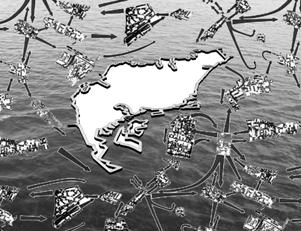
Singapore claims to have one of the highest population densities of any urban environment. Yet it never feels like that on the street. It has planning parameters to grow from today’s size of 4.8 million to 6.5 million or even larger. Yet when compared to Manhattan, Singapore could fit a population the factor of nine. 34 million bodies fighting for blue gold in this utopian island…that is if only everyone loved Singapore as much as “I love New York”. In its quest for urban supremacy and aspiration to be one of the top cities of the world, Singapore competes for tourism dollars, creative talent and investment against Hong Kong, London,
Tokyo, Shanghai, Beijing, Bangkok, and Moscow. The average size of those cities is over 8.1 million. Why isn’t Singapore competing with smaller cities such as Boston, Geneva, Frankfurt, Capetown, Yokohama, which have populations closer to her own? Because Singapore as an idea, fully embraces its slang stereotype: Kiasu-ism – a fundamental fear being left behind. The burden of being irrelevant is too much to ignore. But fundamental to living on this small island is to be threatened, on the verge of erasure, of being irrelevant. Crisis is operative and an instrument for architectural execution. Over in Dubai, an even smaller population before the impeding financial ciris seemed to do a better job at eclipsing Singapore’s shine in their own aspiration to be the best of everything. Dubai’s own hydrological ambitions had momentarily overtaken Singapore’s transformation in every category. The Palm, The World and the planned Universe were the euphoric spectacles of Google Earth. What will Singapore ever do in its own rationed growth?
Will it give up to being second best?
Luckily for the planners of singapore the spectacles in the desert are now coated in a layer of sahahra sand particles, abandoned cars, and empty glass towers. Anna Wintour, the veritable fashion editor states “I don’t think anyone is going to want to be overly flashy, overly glitzy, too Dubai, whatever you want to call it….” Anything Dubai is now a liability.
In Singapore’s state of constant selfconstructed urban and architectural crisis, fear and change are best friends. Singapore fears many things: shifting economies, powerful neighbours, departing talent, interior terrorism, returning poverty. It is also afraid that the water might run out. The one thing it is not afraid of is the consequences of its own ambitions.
Scene Four: That Sinking Feeling
And now more than ever, Singapore is afraid, not of “too Dubai” but that climate will massively reconfigure its landscape, undoing its history of self-modification and extension. The flattened landscape or land reclamation of Singapore has become big but it has also become vulnerable. Volume and area are inextricably linked. The dictums of architectural geometry return with a vengeance. In a landscape of increased area and radically reduced volume, the biggest threat to Singapore’s made form is the sea. It has always been this way. Singapore has been fabricated from the sea and it now very well could undo it.
We know Florida is about to go under. The Netherlands has been fighting for a very long time. New Orleans was inundated in 2005. Malaysia was swamped in 2007. Venice tried to accommodate the Mediterranean but is currently spending billions to hold back the sea in a mechanical wall. And now Singapore, due to its reconfigured topography, is threatened to sink right back in. The flattened landscape is perfectly functional – the ideal tabula rasa for new invention – yet entirely vulnerable to the sea it depends on. A few meters of additional sea will submerge this fantastically functionally flat landscape and undo forty-four years of ambition.
Singapore’s emulation of the Avenue des Champs-Elysees, made for an orgy, not of culture, but of consumption was recently inundated with a tropical flood. Shopping landmarks were filled with a few meters of what it means to live in a tropical jungle: rain and mud. But Singapore with its techonological prowess embraced its own amnesia and forgot where it came from: the equator Even the Minister Mentor Lee Kwan Yew had to respond to the mounting criticism “No amount of engineering can prevent flooding”. This is after 45 years of embracing technology as the means to transform the swamp to the city. Clean up crews were dispatched in effortless expediency and now Hermes if open for business once again. The irony remains to be noticed.
Coupled with Singapore’s sinking shrinking feeling, it plans to grow if only to keep competing with all the top cities of the world. An increase of 1.7 million people by 2050 - 26% more bodies to occupy a limited territory. Where will these bodies go? More importantly, where will they go when the rising sea erodes all that we love: topos. Water and land – it is a constant struggle, a conflict like no other. And it is about to get much worse.
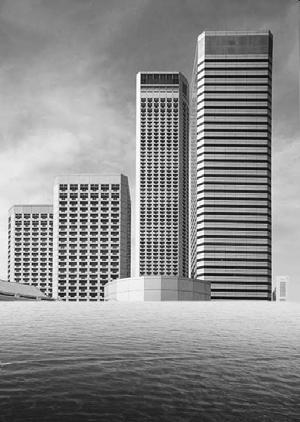
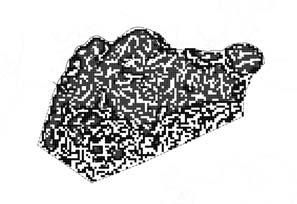
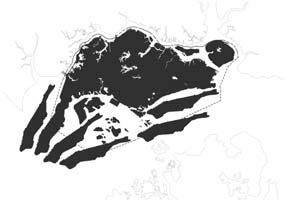
Only a radical transformation of Singapore will save it from this nightmare. Only by imagining such a complete makeover will we reassert Singapore’s ability for massive change, to reassert the constant state of changing relevance, a path to utopia. It is the fulfilment to embrace the history of hydrological urbanism –the uniquely Singaporean experiment in Southeast Asia.
If only now amnesia can be prescribed again, in limited doses to repress its Modern aspirations and embrace its previous equilibrium with its surroundings.
Imagine a city of equilibrium rather than restriction, a city embracing its hydrological past as a beginning for a new future. Imagine a city as a laboratory incorporating its almost theme-park-like ever-changing culture as shopping; where everything and everyone is on the market, where the most economic space on earth reaches its spatial manifestation. Imagine a city with the best of everything and innovation happens as a product of the best shopping market practices. Imagine a city that everyone likes and maybe not immediately love...but eventually does.
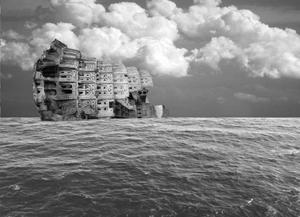
Imagine a city where the extension of this thinking is taken to its logical conclusions, a city that becomes the most amazing, constantly changing fantasy, securing its relevance, if only due to its ambitions and tremendous ability to change. Imagine a city where change is the norm, where architects live out their fantasies, and the Tower of Babel exists – though rather than reaching for the sky, it reaches out to the sea. Imagine the solution to Singapore’s impending irrelevancy found precisely in Singapore’s extraordinary history of transformation projected forward. Imagine a city where the culture of crisis is deployed for positivistic ends.
Scene Five: A Fight for Survival
To love is to fight for survival. Two acts of survival Singapore must take in this battle for her territory:
1. Flood herself
2. Float herself
Act 1: Singapore floods herself in the nation’s largest “New Water” reservoir. Singapore has already started self flooding – a fresh water Marina Bay. Aquatic bigness secures autonomy, sustenance, and recreation. Le Corbusier’s
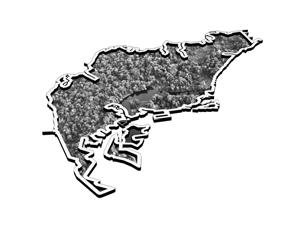
“Machine for Living” in cruise ships finally acknowledges its hydrological beginnings. A heartland where the “void” in the “void deck” returns to sea – a sea of self constructed New Water – and a nation of HDBs embrace their typological lineage. Flooding insures Singapore’s hydrological security. It puts its interior in equilibrium with the rising sea level change and provides for a new landscape of aquatic production.
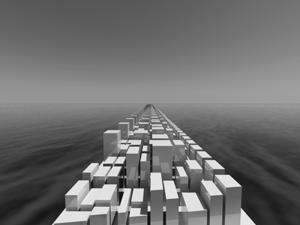
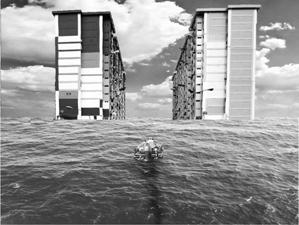
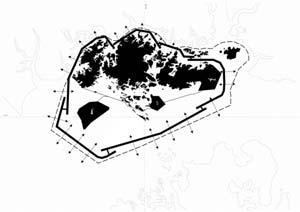
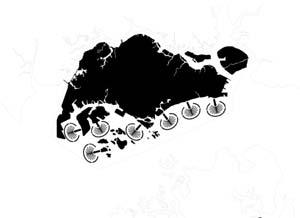
Act 2: Singapore floats herself to establish perfect equilibrium in rising seas. Equilibrium is the only sure act of self defence. Floating future Singapore thrusts new development in equilibrium with its surroundings, an ocean one. Manufacturing is re-tooled for self preservation. In this new engine for growth, urban form meets ocean technology at a colossal scale. In such an absurd act, Singapore dreams for an eventual complete national relocation to more beautiful surroundings. Moving the entire nation to international waters secures the global symbolism of a nation willing to dream and more importantly: to execute.
A short term expense insures long term viability. Singapore does both in this crazy almost plausible story.
And of course on a massive scale.
The Singapore government has already started to act. So have the engineers. Even the scientists are in on it. But where are the urban designers? Where are the architects? Individualistic performance keeps them with eyes which do not see.
Scene Six: Individual Propositions
The new Singapore envisioned; imaginings for the future, “An Hydrological City of Tomorrow”:
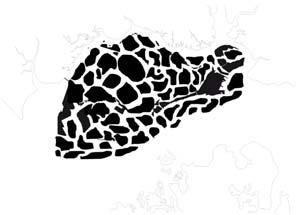
1. A flooded national interior with floating exteriors
2. Floating Density is the way to go
3. Sampling the world over –the best of everywhere; typological imports is the new vogue as a Grand Architectural Sampling.
4. Co-opt international city strategies rather than invent new ones – displacement always forces innovation
5. Floating ideal cities: to be the best of anyplace in a near perfect tabula rasa
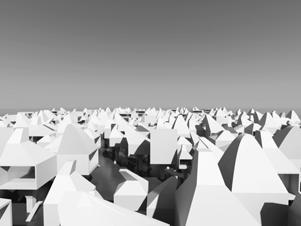
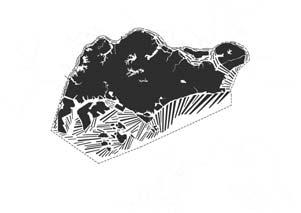
6. Deform idealism for maximum aquatic frontage for a perfect calibration of real estate and value -- A landscape of maximum frontage, minimum environmental impact
7. Create a continuous monument of housing and idealism: 6.5 million people in a 390km perimeter, only five stories high, eight streets deep is required to fit everyone. It consumes only 20% of the nation’s territory permitting complete ecological freedom. Each citizen can walk to the jungle and to the sea.
8. Maintain a continued safe haven for shipping; a port with massive floating docks, safe harbours, and not forgetting, a dramatic form
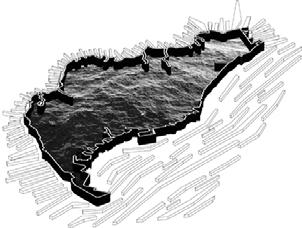
9. Legions of cruise ships go nowhere but change all the time ensures variation and dreams
10. Return Singapore to its ocean faring roots, embracing its uniquely Singaporean history where the kelong is the typology of choice
11. The city embraces itself as nation of objects now in a glistening blue sea: a new field of possibility.
12. The city is of tides and containers, a city of piercing verticals and floating horizontals
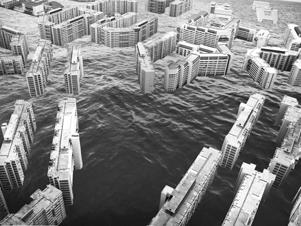
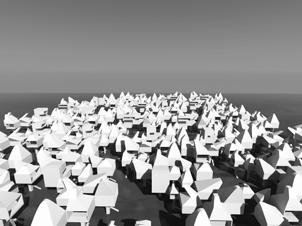
13. Singapore’s green heart becomes an international symbol – Even New York City’s Central Park is jealous.14. Clean green and blue takes on massive proportions.
15. The nation embraces the perfect gated community on a global scale. Bucky Fuller would be envious in a Truman show like display of technology.
16. The garrison city returns where everything is protected inside the gate : even the military planners are happily on board.
17. Imagine a city of leisure and internalized pleasure, of exclusivity and luxury, of autonomy and freedom.
18. Imagine a city of the most advance research occurs in the strangest of spaces.
19. Imagine a city where Wal-Mart and Carrefour is the port on a massive scale.
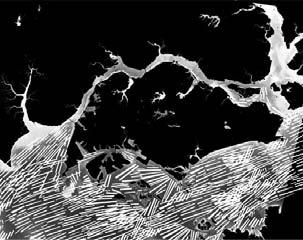
Shopping is direct and package free.
20. Imagine a city which is a host of Dormitories for Everyone….
21. A city of canopies and connectors – there is no other option for spatial interconnectivity
22. A city of absurdity and logic; a scenario of a city that OMA is already building
23. A city of Greenpeace resting on Exxon Mobile; a city of oil and a city of abalone farmers supporting one another; a city of Monsanto and floating rice plantations
24. A city of contrasts and contradictions of big things and small things.
25. A city of architectural dreams waiting to be realized…
A city in love with itself. A city in love with all cities. A city like no other. An Exuberant City. An Exuberant Singapore
