numbers
notes ❯ Use “per thousand” in chapter titles and headings but the abbreviated form “per ‘000” in text, tables and figures.
❯ For web content, write numbers as digits, not words, and do not use a space in
four-digit numbers or above. See also: Abbreviations and acronyms, pp. 52-55; Units of measure, pp. 54-55; Breaks and hard spaces, p. 65; Dates and time, pp. 75-76; Percentages, p. 88.
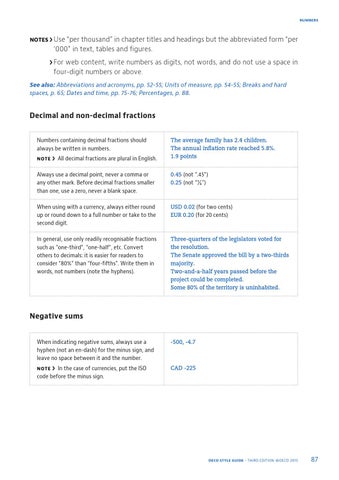
Decimal and non-decimal fractions Numbers containing decimal fractions should always be written in numbers. note ❯ All decimal fractions are plural in English.
The average family has 2.4 children. The annual inflation rate reached 5.8%. 1.9 points
Always use a decimal point, never a comma or any other mark. Before decimal fractions smaller than one, use a zero, never a blank space.
0.45 (not “.45“) 0.25 (not “¼”)
When using with a currency, always either round up or round down to a full number or take to the second digit.
USD 0.02 (for two cents) EUR 0.20 (for 20 cents)
In general, use only readily recognisable fractions such as “one-third”, “one-half”, etc. Convert others to decimals: it is easier for readers to consider “80%” than “four-fifths”. Write them in words, not numbers (note the hyphens).
Three-quarters of the legislators voted for the resolution. The Senate approved the bill by a two-thirds majority. Two-and-a-half years passed before the project could be completed. Some 80% of the territory is uninhabited.
Negative sums When indicating negative sums, always use a hyphen (not an en-dash) for the minus sign, and leave no space between it and the number.
-500, -4.7
note ❯ In the case of currencies, put the ISO code before the minus sign.
CAD -225
oecd style guide - third edition @oecd 2015
87