
Technical Reports
Author Éric Morel
Coordination Florent Germain, Nicolas Jacotot, Stéphane Madou, Huihui Zhou (AFD)

July 2023 No. 70 Impact
Impactstudyofthecreosote banonpowergridprojects Abstract 3 Glossary 4 Introduction 5 1. Whatiscreosoteand whyisitusedinpowerpoles? 6 1.1. Creosote 6 1.2. Creosote: abiocidewithalong historyofuse inpower pole protection 6 2. Thedisadvantagesofcreosote 8 2.1. Creosote, ahazardforpeople 8 2.2. Creosote, invasive pollutant, ahazardforthe environment 10 3. Thecreosotevaluechain 12 3.1. The productionofcreosote (fromcoal-tar) 12 3.2 Woodimpregnationprocesses withcreosote 13 4. Measurestaken,ortobetaken, duringthevariousphasesof thelifecycleofutilitypolesto addressthehazardsofcreosote 15 4.1. Measuresfor the production phase 15 4.2. Measuresconcerning the storage phase 16 4.3. Measuresconcerning the operational phase 17 4.4. Measuresconcerning end-of-life management 17 5. Creosoteregulations 19 5.1. Severalagenciesrecognizethe hazardousnatureofcreosote 19 5.2. InEurope 19 5.3. InFrance 21 5.4. Inthe U.S. 22 5.5 InSouthAfrica 23 6. Fundingforprojectscontaining creosote 24 6.1. Atthe WorldBank 24 6.2. Atthe EuropeanInvestmentBank (EIB) 25 6.3. AtKreditanstalt für Wiederaufbau (KfW) 25 7. Currentstatusofcreosoteuse 27 7.1. Creosote production 27 7.2. Productionofcreosote treatedpoles 28 7.3. Power pole market 30 7.4. Examples oflocal wood utility pole markets 31 7.5. Lobbyingandprofessional associations 32 8. Alternativestocreosote 33 8.1. Alternative woodtreatments 33 8.2. Steel 61 8.3. Concrete 66 8.4. Composite materials 71 8.5. Pole lining 74 9. ComparativeLCAofvarious solutions 75 9.1. Service life ofpoles 75 9.2. LCAconducted by WEI-IEO 76 9.3. LCAconducted in2012by the Treated WoodCouncil (TWC) 80 9.4. LCAconducted in2009 and2012by MartinErlandsson 81 10. Comparingpricesbetween technologies 83 11. Evolutionofsomemarket examples 84 11.1. Long-established markets withafull mix 84 11.2. Strongerwoodpole markets 85 11.3. Woodpole marketsinastate ofchangeorinneed of change 85 11.4. Woodpole marketswith noprospectofchange inthe immediate future 86 12. Summarytable 87 Appendix Estimatingthenumberofpowerpoles ineachcountry 90 Listofabbreviations 99
Agencefrançaisededéveloppement
Rapportstechniques
Lesnombreuxrapports,études de faisabilités, analysesdecasetenquêtesde terrainproduits par l’AFDcontiennentdesinformations très utiles, enparticulierpourlespraticiens dudéveloppement
L’objectif decettesérieestdepartager des informations techniques, géographiqueset sectoriellessurunedimensiondudéveloppement et d’enfaire unretour d’expérience.
Lesopinionsexprimées dansce papier sontcelles deson(ses)auteur(s)etne reflètent pas nécessairementcelles del’AFD.Cedocument estpubliésous l’entièreresponsabilité deson(ses) auteur(s)oudesinstitutionspartenaires
AFDTechnicalreports
The variousreportsproducedbyAFD(feasibility, casestudies andfieldsurveys)containvery useful informations,especiallyfor development practitioners.Thisseries aimstoprovidetechnical, geographicandsectoralinformations on developmentissues andtoshareexperiences.
The opinionsexpressedinthispaperarethose ofthe author(s)anddonotnecessarilyreflect the position ofAFD.Itistherefore published under thesoleresponsibility ofitsauthor(s) or itspartnerinstitutions.
2
Impactstudyofthecreosote banonpowergridprojects
Author EricMorel Mach&TeamAbstract
Throughouttheworld, avast majorityofelectricutilitypoles aremadeofwood.Toincrease theservice lifeofthesepolesand improve theirdurabilityagainst varioustypesofdeterioration (insects,badweather,and humidity),theyareimpregnated withfungicidesandinsecticides thatareoftendangerous for humanhealthand theenvironment.
Themostcommonofthese iscreosote,aproductderived fromthemanufacture ofsteel whichismadefromcoal.
Itsimpactonhumanhealth (itiscarcinogenic,mutagenic andreprotoxic)andonthe environment(itisvery toxic for aquaticorganisms) prompted the EuropeanCommission tobanit.
Thisdecisionispartofaseries ofregulations aimedatstopping theuseofchemicalsthatare too dangerous for humansand theenvironment.
Therefore,theissueofalternative solutions formanufacturing powerpolesarises for power gridmanagersaswell asfor developmentbanks which, likeAFD,fundtheconstruction ofpowergrids
Avarietyofwoodtreatments, allwithvaryingdegreesofhuman healthandenvironmentalhazards, are available andmakeit possible tomanufactureeconomical,easily installedpolesmadefromwood (anatural,renewableresource foundinmanyregions)witha rather favorable lifecycle balance.
Steelpolesare lightweight,canbe easily installedandtransported, arestrongbutcanbesubject tocorrosion, areexpensive,are taxingonour metalresources,and cannotbeeasilymanufactured locally.
Concretepolescanbeeasily manufacturedinmanycountries, arereasonably pricedand extremelystrong,buttheyare heavy(andthereforedifficult totransport), maybesensitiveto certainharshclimates,andhave anunfavorablelife-cycleCO2 balance.
Compositepolesarelight, very strong, have alongservice life butareveryexpensiveandhave aratheraverageLCA.
Thisreportshowsthatchoosing amanufacturingtechnology forelectricutility poles involves choosingbetween:
-economicorCO2 emission reductiongoalsinfavoroftreated woodpoles.
- orhumanhealthand environmentalprotectiongoals infavor ofsteel,wood,or compositematerialpoles. Powergridmanagersmusttake anuancedapproachdepending onthelocationofeachpole, ascertainparameterswill prohibit or makeit difficulttousecertain technologies:the available transmissioninfrastructure,the climate,the typeofsoilinwhich the poleisinstalled,theexposure tofire,stormsorfloods,therisk ofvandalismanddegradation, or the desiretoproducethemlocally. Eachparty will havetomake andrefine theirchoicestoachieve the bestpossiblecompromise betweenthecostof the grid (inthesense offullcostof ownership), theimpactsonhuman healthandtheenvironment, andcontrollingCO2 emissions overtheservicelife ofthe poles
3
Translatedby A.D.T International –L’Agencede traduction –aLanguageWireCompany
Glossary
CAS The CASnumberofachemical substance isitsregistrationnumber withthe American Chemical AbstractsService (CAS)worldwidedatabase. Thisdatabase currently lists nearly150millionsubstances.
CCA CCAisamixture ofcopper, chromiumandarsenic.
CLP EuropeanCLP Regulationonclassification, labelingandpackaging ofchemicalsandmixtures.
CMR Some chemicals, alone orinmixtures, canhave variousharmful effects onhumanhealth.Some ofthemcanbecarcinogenic, mutagenic, ortoxic forreproduction;they are thencalledCMRs.
ECHA EuropeanChemicalsAgency.
EPA The EnvironmentalProtectionAgency isthe US governmentagency thatoversees the environment.
FIFRA The Federal Insecticide,Fungicide, andRodenticideAct isaU.S.federal law thatprovidesthe basisforU.S.pesticideregulationforprotecting people andthe environment.
Half-life Half-life isthe time ittakes forasubstance tolose halfitsphysiological activity.
IARC The International AgencyforResearchonCancer isanintergovernmental researchagencyfoundedbythe World Health Organization(WHO).
LCA The Life Cycle Assessment (LCA)isastandardizedmethod(ISO14040) toconductamulti-criteriaenvironmental assessment ofaproduct, anorganization, orasystem, cumulatedover itsentire life cycle.
Leaching referstoall meansofextractionofsoluble productsbyasolvent, starting withwatercirculatinginthe soil orinasubstrate containingtoxic products.
PAHs Polycyclic aromatic hydrocarbons (PAHs) are asubfamilyofaromatic hydrocarbons(madeup ofcarbonandhydrogenatoms) that have been studiedextensivelybecause ofthe toxicityoftheirconstituentsubstances.
PBT Asubstance issaidtobePBTifitispersistent, bioaccumulative, andtoxic. Forexample, persistentorganic pollutants (POPs)are PBTs.
RAC The RiskAssessment Committee preparesthe opinionsofECHAonthe risksof substances tohumanhealthandthe environmentaspartofREACHandCLP procedures: the final decisionsare made bythe EuropeanCommission.
REACH Registration, Evaluation, AuthorizationandRestrictionof Chemicals (EU Regulation).
SEAC The Socio-Economic Analysis Committee preparesthe opinionsofECHA onthe socio-economic impactofpotential legislative measuresonchemicals aspartofREACHprocedures: the final decisionsare made bythe European Commission.
4
With increasing regulatory pressure on aspects of human health and environmental protectionissues,itisentirelylegitimateformajorpublicinvestorssuchasAgencefrançaise de développement(AFD)toseektomeasure the impactonthe projectsthey fund.
The recent European ban on creosote as a treatment for utility poles has led AFD to explore possiblealternativesformanufacturingthem.The purposeofthisdocumentistoanswer thisquestion.
This document is the most comprehensive, accurate summary possible of the data currently publishedthatisfreelyavailable.
Intermsofanalyzingthe chemicalsusedtotreatutilitypoles,thisdocumentprovidesawell organizedreadingoftheofficialdatapublished,inparticularbytheEuropeanandAmerican publicauthorities.However,itisnotadocumentwrittenbyexpertchemistswhoarequalified togive aninformedopiniononall the substancesmentioned.
5
Introduction
1. Whatiscreosoteandwhyisitused inpowerpoles?
1.1. Creosote
Creosoteisnotaclearlydefinedproductbutratherafamilyofproducts.Thisnamerefersto various oils having a complex composition that are extracted from tars resulting from distillingplant-derivedmaterials(plantsandwood) orminerals(coal).
The most common type of creosote is coal-tar creosote which will be discussed in this document. Thisproductdoesnotoccurnaturally. Itisanindustrialproductderivedfrom coal.
For the sake of simplicity, we will henceforth use the term “creosote” to refer to coal-tar creosote.
Creosote comes from distilling tars produced in a coke oven at temperatures between 200 and 400°C. Its composition is always complex because it is made up of 150 to 300 different elements and varies depending on the origin of the coal and the distillation method.
It is often sold mixed with oil or a solvent, which gives it the appearance of a dark oily liquid with a characteristic smell.
Creosote is a registered substance by the two main chemical management agencies: the Environmental Protection Agency (EPA) in the United States and the European Chemicals Agency (ECHA) in Europe.
1.2. Creosote:abiocidewithalonghistoryofuseinpowerpoleprotection
Since the origin of electric utility poles in the 19th century, the most natural and obvious material for makingthemhasbeenwood.
As we will see repeatedly in this document, wood has multiple advantages that justified its use inthe past andiswhyitcontinues todominate manufacturingtoday:
- woodisabundantlyavailable incountlesscountries.
- woodisaninexpensive material.
- woodpolesareeasytomanufactureandinstall,mainlyduetotheirweight,whichis lightenoughtobenotvery constraining.
Today, the manufacturing of power poles meets demanding but accessible standards: the vastmajorityofspecialized sawmillscanproduce compliantraw poles.
6
Creosote ECHA 100,029,468 CAS 8001-58-9
Onthe other hand, woodpoles are subjectto multiple stresses, especiallyinhotand humid environments:
- byxylophagousinsects, especiallytermites.
- bylignivorousfungi.
- bywoodpeckers.
For the past hundred years, the challenge of extending the life of these poles, avoiding their wear and tear, and having to replace them frequently, has led to protecting the wood against most of these stresses. The service life of the poles was thus extended by 5 to 10 years, varyingfrom40to60yearsdependingonthe woodspecies andthe climate.
Creosote and copper sulfate are two of the pesticides, fungicides, and sporicides that have been used for a long time to treat utility poles
Because ofitsexcellentproperties, creosote has alsolongbeenusedto protect:
- railroadties.
- electric andtelegraphpoles.
- marine pilings.
Withcreosotetreatment,woodpolescanwithstandmoreconstantmoisture,canbedriven directly into the ground, are protected from insects, including termites, and are protected frommold
7
2. Thedisadvantagesofcreosote
TheEuropeanCommission,viaECHA,andtheUnitedStates,viatheEPA,haveconductedand sharednumerousstudiesoncreosote.Theirconclusionsconvergeinall respects
2.1. Creosote,ahazardforpeople
Creosote is a mixture of several hundred compounds that belong to various groups of substances:
- polycyclicaromatic hydrocarbons(PAHs), whichcanmakeupto85% ofcreosote.
- phenols.
- heterocyclic compounds.
- aromatic amines
Many of these substances are toxic to humans, especially PAHs, which naturally make up coal, but are also produced by the incomplete combustion of fuels or wood.
The mostimportanttoxic PAHsfoundincreosote are:
- acenaphthene: usedasabasisforherbicides.
- acenaphthylene: usedasabasisforherbicidesandplastics.
- anthracene: used as a basis for insecticides and wood preservatives - classified as "PBT"(persistent, bioaccumulative andtoxic).
- benzanthracene:listedasacarcinogenbytheInternationalAgencyforResearchon Cancer (IARC).
- benzopyrene: persistent air pollutant, bioaccumulated by some marine animalsclassifiedas"VeryPBT".
- benzo[k]fluoranthene:carcinogenic substance highly toxic toaquatic organisms.
- fluoranthene: includedinthe IARClistofcarcinogens - classifiedas"Very PBT".
- fluorene: usedasabasisformanufacturingpesticidesandplastics.
- naphthalene: usedasabasisformanufacturinginsecticidesandresins.
- phenanthrene:oneofthepersistentorganicpollutants(POPs)-classifiedas"VeryPBT".
Due to its complex composition, the available studies on creosote are scientifically insufficienttoproveitseffectsonhumanhealth.Thecurrentliteratureavailableoncreosote ismainlybasedonstudies performedonitsmaincomponents.
The human health impacts proven for the components of creosote are assumed to be the same or similar for creosote. This generalization of the conclusions calls for caution. However, some further epidemiological studies conducted on workers regularly exposed to creosote have confirmedsome ofthe conclusionsreached.
8
Creosote,a carcinogenic,mutagenic,andreprotoxicproductthat posesrealdangers to humanhealth.
Creosoteisaskin,eye,andrespiratorytractirritant.
This characteristic, regularly seen in workers frequently in contact with creosote, has led, accordingtotheEuropeanCLPregulation,toclassifycreosoteasH315(causesskinirritation) andH319 (causeseye irritation).
Creosotecanbeamutagen.
This toxicity has been demonstrated on animals in proportions that vary depending on the typeofcreosote,theconcentrationlevels,andthefactorsrelatedtotheanimalsthemselves. It is scientifically difficultto reach a conclusion on this issue, butthere isa body of evidence thatleadsustobevery cautiousonthe subject
Creosoteisacarcinogen.
Animal studies have clearly shown an increase in skin cancer in proportions that are highly dependent on exposure. The "general public" literature reports a more extensive risk of cancersinvariousorgans(lungs, prostate, pancreas, throat, etc.)withoutclearevidence.
According to the European CLP regulation, creosote is therefore classified as a class 1B carcinogen (H350 probable carcinogen). This classification is based on a 2A carcinogenic classification by the IARC (limited evidence in humans but sufficient evidence in animals) and on a 1B classification by the EPA (presumption of carcinogenicity in humans based on evidence inanimals)
Creosoteisareproductivetoxicant.
Some studies have shown that creosote may affect early intrauterine fetal development and cause increased fetal deaths. The assessment made on creosote in Europe in 2021 as part of the CLP regulation recommends a classification of H361d (may cause harm to the fetus) asapointofconcern.
In addition, animal studies clearly show the impact of creosote on the offspring of the exposedgenerationwithfertilityproblemsandasignificantlyaffecteddevelopmentoftheir ownoffspring.
This leads to the same assessment as before, consisting in recommending a classification of creosote as H360F (may affect fertility) which points, this time, to impacts deemed to be ahazard.
There are three waysto beexposedtocreosote anditshealthimpacts:
-byingestingcreosote:thisriskisverylimited.Intakeviafoodinvolvesconcentrations toolow tobeconsidereddangerous.
- by breathing in volatile products contained in creosote: this risk exists during the production phases for workers close to the impregnation chambers for hot productionofcreosote-treatedpolesor,worse,close tothe dippingorsprayingareas for cold production.
9
- bycontactwithcreosote:thisriskexistsatallphasesofthelifeofthepolesandconcerns production agents as well as shippers, installers, and individuals responsible forrecycling
The assessmentmade byEuropein2021 1 concludedthat:
- the exposure of installers and workers brushing creosote-treated wood after it has beencutissufficienttocause concernaboutthe healthhazardsmentionedabove.
- the exposure of workers at impregnation plants is high and not acceptable without specific protective measures, especiallysince creosote has negative effectsonthe three components deemed the most dangerous and unacceptable: reprotoxicity, carcinogenicity, andmutagenicity.
Regulations tend to address public health issues in an increasingly urgent manner: the progressive banning of proven dangerous products such as creosote is a sign of this. This movementisdeveloping, firstandforemost, inthe mostdevelopedcountries
2.2. Creosote,invasivepollutant,ahazardfortheenvironment
Creosote is generally not very soluble in water but, because of its complex composition, it containssubstances thatare verysoluble inwaterandothersthatare veryvolatile
The polluting components of creosote are found in all biotic environments where life develops
The impact of creosote on the environment comes mainly from the polluting power of the PAHsitcontains
Inwater,PAHsincreosoteare,atbest,rapidlyphotolyzed(brokendownbylight).Duetolight attenuation in natural aquatic environments, the time required for photolysis of half the quantities (half-life2) of PAHs varies, depending on the PAHs, between one day and almost twoyears.
We find volatile PAHs in the air. While in the atmosphere, they are subjected to various degradation processes: mainly photolysis, secondarily reactions with the various oxidants presentintheatmosphereinagaseousstate.Underthesevariousinfluences,thehalf-lifeof PAHsinairvaries betweenone andsevenhours
Rainfall can cause PAHs in the air to spread to water and land, leading to traces of them being found on plants and animals, and consequently in our food. Since these compounds are not very hydrophilic, they are also found in sediments. PAHs are therefore pollutants, some ofwhichare persistent, thatcontaminate all environments
1 https://echa.europa.eu/documents/10162/fc41edcf-3732-2ba9-6a14-0fb9b423fd6c
2 The half-lifeisthe timeattheendofwhichonlyhalfoftheinitialproductremains,theotherhalf having disappearedasaresultofvariousdecompositionandtransformationmechanisms
10
The air emissions of eight PAHs of particular concern are subject to special monitoring; four of them are used in making creosote. Despite special efforts, emissions of these products in France have stagnated since 2010, reflecting our dependence on them
Creosotealsoposeshazardstosoil,water,andair.
Soil pollution is predominantly widespread and comes from deposits of PAHs in the air. It canalsoresultfrompointsource pollution.
Several stages in the life cycle of creosote-treated poles pose a risk of environmental pollution:
- whenapplyingthe producttothe wood.
- when handling treated wood, shipping it, installing it, and removing it by the various professionalsinthe chainofpersonsinvolved.
- whenusingtreatedwood,duetothediffusionofcreosoteinwater,theair,orthesoil.
- aswaste,whenthe userofthe treatedwoodmustdisposeofit.
Creosote, likemostinsecticidesandfungicides, isparticularlytoxic tomarine organisms.
Theregulationstendtobemoreandmorerestrictivewithregardtocontrollingandreducing the release oftoxic components
11
3. Thecreosotevaluechain
3.1. Theproductionofcreosote(fromcoal-tar)
Creosote isaby-productofthe manufacture of steel fromcoal
The manufacture of creosote involves two main steps (diagram 1). Some manufacturers take care of the whole manufacturing process, others only a part of it: coal-tar production forsome, orcoal-tar distillationforothers

Thefirststepistheproductionofcoal-tar.Thesetarsareproducedbydecantingthe vapors fromcokeovens, which supplycoketosteel mills.
Duringthisstage, the cokingofcoal produces manyproductswithvarioususes,including:
- coke, used in steel mills to reduce iron ore and obtain cast iron, the first step in steel manufacturing.
- coalpitch,usedtomanufactureanodesandcathodesbutalsoasaninsulatingand sealingagent.
- naphthalene, a chemical substance used in the manufacture of plasticizers, dyes, andresins.
- coal-tar, whichisusedinshampoos, soaps, andanti-lice products
12
Diagram1.Completecreosotecircuit,fromproductiontoproductapplication
Source: Mach&Team,basedonNicholasP.Cheremisinoff,PaulRosenfeld,AntonR.Davletshin(2008).
Coal-tar is therefore generally produced in steel mills, i.e. in the leading steel-making countries, or in coal-producing countries for which they are responsible for part of the processing (the coke being delivered to steel mills that do not produce it directly). This production is quite capital-intensive and is increasingly subject to strict health and safety regulations; hence, itisrather concentrated
The second step is the production of creosote by distillation of coal-tar (diagram 2). Depending on the case, one or more distillation steps are required. Creosote is only one of the by-productsofthisdistillationprocess.

Creosote is therefore produced mainly in specialized refining facilities owned by chemical companies.
Creosoteisthenmixedwithasolventoroilandsenttorawpoleimpregnationplantslocated mainly in countries with a large forestry industry. These plants are either large (close to the wood production sites) and export a significant part of their production, or small (close to the consumptionsites).Therefore, the industryis highlyfragmented
3.2. Woodimpregnationprocesseswithcreosote
The treatment of wood is a key step that determines its service life. This treatment consists of impregnating the wood with a fungicidal and insecticidal substance, in this case creosote
Historically, three mainmethodsofimpregnatingwoodhave beenused:
- dippingitinapreservative bath,a processthatresultsinsignificantleachingrates.
- spraying the wood with preservative, which results in high leaching rates, a process thathas now beenvirtuallyabandoned.
- pressure impregnation.
13
Diagram2 Creosotemanufacturingprocess
Source: Mach&Team,basedonNicholasP.Cheremisinoff,PaulRosenfeld,AntonR.Davletshin(2008).
The impregnation method must be adapted to the porosity of the treated wood, to the degree of protection desired, and to the expected service life of the treated wood. The electricpoles,forwhichamaximumlifeexpectancyisexpected,aretherefore allpressure impregnated, regardless of the wood type used
Pressure impregnation is done in sealed chambers in which the creosote and the wood undergocycles ofpressure variationsdesignedtoincrease the qualityofthe impregnation. In Europe, three processes are primarily used (their American equivalents exist under other names), they include:
- the Rüping process which consists of placing the wood under a pressure of 4 bars for 15 minutes before injecting the creosote into the enclosure and increasing the pressureto8barsuntiltherefusal(endoftheimpregnationprocess).Thecycleends with30minutes inavacuumat0.3bar.Thisprocessisusedforimpregnable woods likepine.
- theBethellprocessfirstsubjectsthewoodtoavacuumat0.2barforonehourbefore injecting the creosote into the cylinder and increasing the pressure to between 8 and 12 bar until refusal, then subjecting the treated wood again to a vacuum at 0.2 bar for30minutes.This processisalsousedforimpregnable woodslikepine.
- the Estrade process consists in drying the poles by subjecting them to hot air ventilation at 80-100°C for 48 hours, then impregnating them using the Bethell method (see above). This process is used for wood types that are moderately resistantorresistanttoimpregnation(firandspruce).
Since creosote is not soluble in water, it is usually diluted for the impregnation phase in a petroleum-based solvent, which facilitates penetration of the product into the pile of spaced raw poles heated under pressure in the impregnation chamber.
Depending on the use and the conditions of use, it is therefore possible to use electricity poles made of softer, less dense, more easily impregnated wood (requiring about 92 kg of creosoteperm3 ofwood),orpolesmadeofharderwood,whoseimpregnationwillconsume more energybutlesscreosote (about70kg/m3 ofwood).
During the impregnation process, the wood absorbs a quantity of treatment product, depending on its own properties and the type of treatment desired. Subsequently, the quantity or retention rate is frequently used to indicate the amount of product absorbed and retained by the wood
14
4. Measurestaken,ortobetaken,duringthe variousphasesofthelifecycleofutilitypoles toaddressthehazardsofcreosote
Thehazardsofcreosotetotheenvironmentandhumanhealthhaveledtomeasures,mainly regulatory, limiting the risks of creosote use at each stage of the creosote-treated pole life cycle.Europe,andparticularlyFrance,arepioneeringareasinthisfield.Themeasurestaken and deployed there represent the most advanced solutions for dealing with the dangers of creosote andcreosote-treatedpoles.
Asaresult,Francehasthemostrestrictiveregulationsregardingcreosote.
OutsideEurope,alltypesofscenariosexist:alessadvancedconsiderationofthedangersof creosote leading to less protective solutions for human health and for the environment, or the virtual absence of appropriate solutions. This lack of solutions is also found in countries that have conducted studies on the impact of using creosote-treated poles on their soils, withveryclearresults
4.1. Measuresfortheproductionphase
Duringtheproductionofcreosotetreatedpoles,creosotehasvariouswaysofimpactingthe environmentandthe healthofworkers
Creosote's properties, as described above, make two types of precautionary measures necessary when impregnating creosote-treated poles:
- measures to protect the environment from possible leakage of toxic creosote components.
- measurestoprotectthe workers workingatthe impregnationplants
4.1.1. Incountrieswiththemostextensiveregulations
Wood impregnation plants with creosote are classified facilities subject to authorization. More recently, inEurope, the regulatory authoritiesalsowanted toinclude these facilities as partofthe EuropeanIndustrial EmissionsDirective (IED)toimprove the controlofemissions
With respect to environmental protection, the main constraints imposed on wood impregnationplantsusingcreosote are:
- sealedimpregnation chamberstopreventvolatile components(mainlyPAHs) from beingreleasedintothe air.
- recoverysystemsfor volatile components.
- oxidation systems for these components to destroy them (usually by heating them totemperaturesexceeding900°Cforone totwo seconds).
- biologicalwatertreatmentplantsusedforoperatingandcleaningtheimpregnation plants
15
The mandatory andrecommendedmeasuresforworkers include:
- wearing gloves thick enough to prevent skin contact when handling poles.
- wearingaface shieldorgoggles topreventeye irritation.
- wearingamasktopreventlungirritation.
- wearingsafetyshoes.
These measures apply to all workers, especially those involved in cleaning and maintaining the impregnation chambers, but also to those who work in the control and analysis laboratories linkedtothe productionfacilities
4.1.2. Incountrieswithlessextensiveregulations
More lenient regulations are generally recommended to protect people in close contact with creosote, primarily workers. These provisions are rarely, if ever, mandatory and are not enforced
The workersare therefore veryexposedtothe above-mentioneddangers
As for the environment, it may often not be subject to any particular protection measures againstcreosote andits mostdangerous components
4.2. Measuresconcerningthestoragephase
Thestoragephaseposesagreaterrisktotheenvironmentthantotheworkersatthesorting and storage facilities for creosote-treated poles. Indeed, workers have less direct, less prolonged and more isolated contacts. In the case of end-of-life storage, the creosotetreated poles are older: the volatile hazardous components of creosote have then almost disappeared
4.2.1. Incountrieswiththemostextensiveregulations
The transit, sorting, and storage sites for creosote-treated poles are deemed to be storage sites forhazardousmaterials.
Constraintsare therefore imposedto minimizecontaminationofthe environment:
- reinforcedprotectionagainstfireatthefacilitiesand,moreparticularly,atthestorage buildings.
- reducedexposuretoraintopreventrunofffromwashinghazardousproductsoffthe storedpoles.
- storage areas that avoid soil contamination: storage bins (to avoid contamination betweenproducts)with concrete floors.
- treatment facilities for runoff water that may have been in contact with the poles (i.e., thatmayhave alsorunofffrompole handling, loadingandunloadingareas).
- increasedmonitoringofwaste anddischarges
16
Rail andpower gridmanagers, whoare the mainpartiesinvolved, are oftenexemptedfrom such measures by the regulations: this amounts to leaving them liable for their impact on the environment
4.2.2. Incountrieswithlessextensiveregulations
The storage ofcreosote-impregnatedwoodisnotsubjecttoanyparticularattention
4.3. Measuresconcerningtheoperationalphase
Althoughthecreosote-impregnatedpolesareinstalleddirectlyinthegroundandaretherefore in contact with it, no study has been able to show a significant risk to the soil or to the groundwater
Therearenospecificprovisionsformanagingtheuseofcreosote-treatedpolesduringtheir operational phase
4.4. Measuresconcerningend-of-lifemanagement
4.4.1. Incountrieswiththemostextensiveregulations
The French Environment and Energy Management Agency (ADEME) classifies wood waste intothree categories withrespecttorecyclingrequirements(diagram3).
Type C wood wastes include those treated with hazardous materials, including creosote. They canneither berecyclednorrecovered.

This type C wood waste must be traceable and treated in regulated, classified facilities reservedfor hazardouswaste
Unlike most other wood treatment products, the combustion of creosote does not emit heavy metals.Itsenergy recoveryistherefore a preferable solution
17
Diagram3. ThethreetypesofwoodwasteaccordingtoADEME
Creosote-treated wood must be incinerated in approved facilities that have the following features:
- the grinding may be done by a third party but must be done with a dust collection system.
- incineration is done by pyrolysis at 700°C without oxygen after drying at 200°C in ovensthatcomplywith regulatory requirements.
- these ovens must be able to reach 1,100°C for two seconds with purification of the fumes, ifthe acceptabilitythresholdsfor hazardoussubstances are exceeded.
- theheatproducedbythepyrolysisprocessiscollectedtoheatsteamforgenerating electricity.
Type C wood waste can also be incinerated in cement kilns, making the recycling of creosoted poles more accessible insome emergingcountries
4.4.2. Incountrieswithlessextensiveregulations
Creosote-treated wood is not subject to any special consideration and is generally disposed of in normal landfills without special precautions.
Even in the United States, in most states, despite creosote being classified in the same way as it is in Europe, creosote-treated poles are not deemed to be hazardous waste and can therefore bedisposedof atmunicipal landfills: however, some refuse them
In general, risks to human health are considered before risks to the environment. Ausgrid's (Australia) pole installation guide, for example, states: "Burning CCA-treated power poles emits toxic fumes laden with arsenic and chromium. If you are not required to be on site, keepyour distance and be careful ofany wind"
18
5. Creosoteregulations
5.1. Severalagenciesrecognizethehazardousnatureofcreosote
The classifications of creosote as a hazardous material are converging towards consistent, homogeneousconclusions
The EuropeanChemicalsAgency(ECHA)classifies creosote as:
➢ skin irritant level 2 (H315): human experience or data showing reversible skin damagefollowingexposureforupto4hours.
➢ skinsensitizer level 1B(H317): maycauseskinallergy.
➢ eye irritant2(H319): causessevereeyeirritation.
➢ carcinogen1B(H350): maycausecancer.
➢ reprotoxic 1B (H360): may impair fertility or harm the fetus. Acute aquatic toxicity (H400): verytoxictoaquaticorganisms.
➢ chronicallytoxictotheaquaticenvironment(H410):verytoxictoaquaticorganisms, causeslong-termadverseeffects.
IARC classifies creosote as a type 2A carcinogen: probably carcinogenic to humans (limitedevidenceofcarcinogenicityinhumansandsufficientevidenceinanimals).
The EPAclassifies creosote asa type 1Bcarcinogen: probablycarcinogenictohumans.
5.2. InEurope
European regulations directly or indirectly concerning creosote have been developed for several yearsalongthe followinglines:
5.2.1. Recognitionofcreosoteasahazardousproduct
Creosote is an active substance meeting the criteria of European Regulation (EC) no. 1272/ 2008 for classification as a category 1B carcinogen with no threshold value, reprotoxic 1B (may impair fertility and harm the fetus), reprotoxic 2(likely to impair fertility or harm the fetus), andacute toxicitytocategory 1aquatic organisms
5.2.2. Progressiverestrictiontobanoncreosoteuse
Regulationsaffectingthe production,sale,anduseofcreosotecomefromtwoinitiatives:
- the regulationconcerningbiocidal products
- and, more generally, the regulationofchemical substances
19
In 1998, European Directive no. 98/8/EC concerning the placing of biocidal products on the marketintroducedtheneedforanybiocidalproducttohaveamarketingauthorizationand established the procedure for granting and managing those authorizations. In this regard, creosote islistedinAppendix1asone ofthese products
European Regulation no. 552/2009/EC - concerning the Registration, Evaluation, Authorization and Restriction of Chemicals (REACH) - specifically identifies creosote and prohibits its sale anduse inEurope, butgrantsanexemption:
- for creosote with low phenol and benzo[a]pyrene content: the creosote historically used, known as type A creosote - comprising up to 85% PAHs, 60% of which are volatile carcinogenic compounds such as naphthalene, anthracene, and benzo [a]pyrene - isnow banned
ThetypeBandCcreosotesnowinusehavealowervolatilecontentwithrespective maximums of 20 and 10%. These type B and C creosotes are obtained by raising the distillationtemperature ofthe creosote duringitsmanufacturingprocess.
- forprofessional applications
Thisisthe firststeptowardsapossible banoncreosote.
The EUBiocidal Products Regulation no. 528/2012/EU,which replacesDirective no.98/8/EC, takes another step along the path of hazardous products by banning:
- productsrecognized ascarcinogenic, mutagenic, orreprotoxic.
- endocrine disruptors.
- persistentorganic pollutants(POPs).
In addition, this regulation also lists the conditions for exceptional exemptions from these bans.
Thislastregulationisthusafurthersteptowards apossible banoncreosote
Theregulationgrantstheapprovalofcreosote(activesubstance)inEuropeforamaximum periodoffive years, whichexpiresonApril 30, 2018
Implementing Decisionno. 2017/2334/EUacts asan extension of the approval ofcreosote in Europe, i.e. until October 31, 2020.
By implementing Decision no. 2019/961/EU, the European Commission authorizes a provisional measure takenbyFrance tobanthe use ofcreosote
ImplementingDecisionno.2020/1038/EUactsasanextensionoftheapproval ofcreosote in Europe until October 31, 2021
Implementing Decision no. 2021/1839/EU is a further extension of the approval of creosote in Europeuntil October31,2022.These postponements, certainlydictatedbyinfluential people, are grantedtohave time todocumentthroughstudies apointofexemptionallowedbythe
20
2012 regulation: indeed, an exemption from the ban of a biocidal product can be granted if the risk to humans and the environment from exposure to the active substance under realistic worst-case conditionsisshowntobenegligible
In this context of successive postponements of the creosote ban, in February 2022 France submitted a proposal to extend the creosote ban to Europe, trying to leverage an early French regulation (see paragraph 8.3 below). Evaluation of this proposal by the Risk Assessment Committee (RAC) and the Socio-Economic Analysis Committee (SEAC) began inApril 2022
5.2.3. Establishinganenvironmentalprotectionframeworkforcreosoteproducts
Europeanregulationsalsoincludetopical,generictexts,notspecificallymentioningcreosote, intendedtobuildamore environmentallyprotective Europe.While these textsdonottarget creosote, products containing creosote and facilities using creosote must comply with these texts.These include:
- the directive concerningdrinkingwater.
- the directive concerninggroundwater.
- the directive concerningthe treatment ofwaste.
- the directive onlandfills.
5.3. InFrance
In Europe and in the world, France stands out as a pioneer country in regulating creosote, both in terms of the production, use, and treatment of creosote-treated poles and in terms ofthe banonsellingcreosote treatedproducts
French regulations concerning creosote have been developed for several years along the followinglines:
5.3.1. Recognitionofcreosoteasahazardousproduct
On this point, France adopts the European regulations and uses the same international classifications
5.3.2. ProgressiverestrictiontobanoncreosoteuseinFrance
France followed the European regulation until 2018 and then took the lead by banning creosote for all types of use in France with the Decree dated December 18, 2018. This text prohibits any action of placing new and used products on the market, including by importers
However, this Decree does not prohibit the production of creosote-treated wood in France tobeexported
21
5.3.3. Inspectionandadaptationoffacilitiesproducingandtreatingcreosote-treatedpoles
Frenchregulationshave progressivelyrefinedtheconditionsforproductionunits(classified asICPE2415),storagefacilities,orrecyclingfacilitiesforcreosote-treatedpoles(classifiedas ICPE2718)
As far as treated wood production facilities are concerned, the Decree dated December 17, 2004 specifically defines the desired properties to guarantee safety and environmental protection. These provisions were further strengthened by the Order dated September 8, 2008(watertreatment,emissionsrecovery,wastetreatment,etc.)andenhancedbyalistof the bestavailable techniques inthe OrderdatedJune28, 2021.
The storage of treated wood and, more generally, of hazardous products was regulated by theOrderdatedDecember30,2002,amendedbytheOrderdatedOctober10,2012.Themain pointsaddressed were mentionedinsection7.2 (see above)
The transit and sorting of creosote-treated wood is covered by the provisions of the Order datedJune6,2018
Finally, the incineration of treated wood must be done at facilities that comply with the specifications stated in the Decree dated September 20, 2002 on the co-incineration of hazardous waste, as amended by the decrees dated August 3, 2010, October 3, 2012, and December 18, 2012.
5.4. IntheU.S.
In 2008, the EPA decided that products containing arsenic, creosote, or pentachlorophenol could continue to be used as long as the safeguards recommended in the Reregistration Eligibility Decision (RED) documents were followed. These measures include ventilation of impregnationareasand lockeddoors onwoodtreatmentcylinders
In 2019, the EPA conducted a risk analysis on these same products as part of their reauthorization. Foreachofthese, the EPA highlightedthatthe measuresrecommendedbythe RED documents did reduce worker exposure, but continued to pose a health risk to workers at the impregnation plants. Creosote and arsenic derivatives have also been shown to pose environmental risks.
In 2021, the EPA issued proposed transitional decisions for products containing arsenic, creosote, or pentachlorophenol. The EPA determined that the risks associated with the use of pentachlorophenol outweighed its benefits and therefore proposed it be banned. For creosote and chromate arsenic derivatives, the EPA proposed additional mitigation measurestoprotectthe healthofworkersatwoodtreatmentfacilities
In April 2022, the EPA banned pentachlorophenol which had been discontinued in Europe since the early2000s.
When it comes to creosote, there are no regulations other than recommendations for protective actions with respect to the product: reuse of creosote products is unrestricted; dumpingofcreosoteproductsatpubliclandfillsislefttothe discretionofeachstate(many statesallow it).
22
5.5. InSouthAfrica
South Africa has a significant wood processing industry which supplies southern African countries (Namibia, Zimbabwe, Botswana, Mozambique, and Zambia) and some eastern Africancountries (Kenya).
The country has established an approval procedure for wood treatment products and impregnation plants which allows it to monitor wood treatment activities. However, these proceduresdidnotresultinanysignificantban:creosote isstill widelyusedinthe country
The SAWPA (professional organization of the wood treatment industry) has issued recommendations for recycling creosote-treated wood: do not burn it, incinerate these products at specialized plants, limit landfill disposal to small quantities, and wash your hands after any manual handling. But there is no evidence that these recommendations are widely followed.
23
6. Fundingforprojectscontainingcreosote
6.1. AttheWorldBank 3
Environmental and Social Standard no. 3 (ESS 3 – Resource Efficiency and Pollution PreventionandManagement)appliestoallelementsofaWorldBankfundedproject.Thisstandard prohibitsthe use ofcertainchemical pesticides
In the articles on pesticide use, ESS 3 applies a precautionary principle by deeming a prohibited active ingredient to be a prohibition on the substance (“In addition, the Borrower will also not use any pesticide products that contain active ingredients that are restricted underapplicableinternationalconventionsortheirprotocolsorthatarelistedin,ormeeting, the criteriaoftheir annexes”).
ESS3alsoconsiderscancer,geneticmutation,andreprotoxicityrisksastier1risksrequiring apesticideban:“TheBorrowerwillalsonotuseanyformulatedpesticideproductsthatmeet the criteriaofcarcinogenicity, mutagenicity, or reproductive toxicity as set forthby relevant international agencies.”
Forother productsposingaserioushealthandenvironmental hazard, ESS3:
- deferstonational regulations.
- prohibits the use of the substances by non-professionals and where there are no measures to protect people and "proper" facilities to manage, store and use these products.
Without specifically mentioning creosote, the World Bank prohibits funding for projects thatincludecreosote productsbecause creosote isaknowncarcinogen.
3 https://thedocs.worldbank.org/en/doc/9365315253681939130290022018/original/EnvironmentalSocialFrameworkFrench.pdf#page=53&zoom=80
24
6.2. AttheEuropeanInvestmentBank(EIB)4
At the EIB, all projects must comply with current internal regulations. Standard 1, Section 5 statesthat:
“AllprojectslocatedintheEUandEFTA5,CandidateandpotentialCandidatecountries shall comply with the applicable national and EU legislation. All projects located in the rest of the world shall comply with the applicable national legislation and with thecoreprinciplesandessentialproceduralelementslaiddownbytheEUlegislation thattheEIBconsidersrelevanttotheassessmentandmanagementofenvironmental, climate and/or social impacts and risks.”
“The promoter shall seek to avoid, reduce or eliminate the use and storage of hazardous substances and materials of high concern and consider replacing them by less hazardous substitutes, where suitable economically and technically viable alternatives are available. Furthermore, the promoter is also encouraged to develop projects that lead to the innovative development and use of sustainable substitutes.”
“Where avoidance or substitution is not feasible, the promoter shall consider the safety use and storage ofhazardous substances and materials bystrictly applying/ aligningtotherequirementsofEUhorizontalchemicalslegislationandinternational good practices.”
This obligation of means is therefore not very binding insofar as the promoter's efforts can neither bequantified norevaluated
TheEIBdoesnotimposeanyspecificrestrictionsoncreosote,butencouragesthepromoter ofthe bank-fundedprojecttofindapossible alternative
6.3. AtKreditanstaltfürWiederaufbau(KfW)6
KfW published an exclusion list that targets certain insecticides. According to this list, the followingare excluded:
“Productionortradeinanyproductoractivitysubjecttonationalorinternationalphase-out or prohibitionregulations or toaninternational ban, for example:
- certain pharmaceuticals, pesticides, herbicides, and other toxic substances (under the Rotterdam Convention, Stockholm Convention and WHO "Pharmaceuticals: Restrictions inUse and Availability").
- ozone depleting substances (under the Montreal Protocol).
- prohibited transboundary trade inwaste (under the Basel Convention).”
4 https://www.eib.org/attachments/publications/eib_environmental_and_social_standards_fr.pdf
5 ThecurrentEFTAmemberstatesareIceland,Liechtenstein,Norway,andSwitzerland.
6 https://www.kfw.de/PDF/Download-Center/Konzernthemen/Nachhaltigkeit/Ausschlussliste_EN.pdf
25
Accordingtothislistofexclusions:
- pentachlorophenol, listedinAppendixI ofthe Stockholm Convention7 , is excluded.
- creosoteislistedasasubstancemeetingthecriteriaofAppendixIoftheRotterdam Convention8,followinganotificationfromLatvia,regardingtherestrictionofcreosote toindustrial uses.
KfW does not impose any particular restrictions on creosote because this substance, which is under investigation by the Convention, is not (yet) listed in Appendix III of the Convention.
7 http://chm.pops.int/Implementation/Alternatives/AlternativestoPOPs/ChemicalslistedinAnnexA/ tabid/5837/Default.aspx
8 http://www.pic.int/Implementation/FinalRegulatoryActions/FRAEvaluationToolkit/Notificationsthat SatisfyAnnexI/ListofAnnexInotifications/tabid/5570/language/en-US/Default.aspx
26
7. Currentstatusofcreosoteuse
7.1. Creosoteproduction
World coal-tar productionhasstabilized ataround12milliontons
Map 1 shows some historical production levels and the main producers in each major continental area

Source:
Source: Mach&Teamfromxcellentinsights.com
27
Map1.Maincreosoteproducingareas
Mach&Teamfromxcellentinsights.com
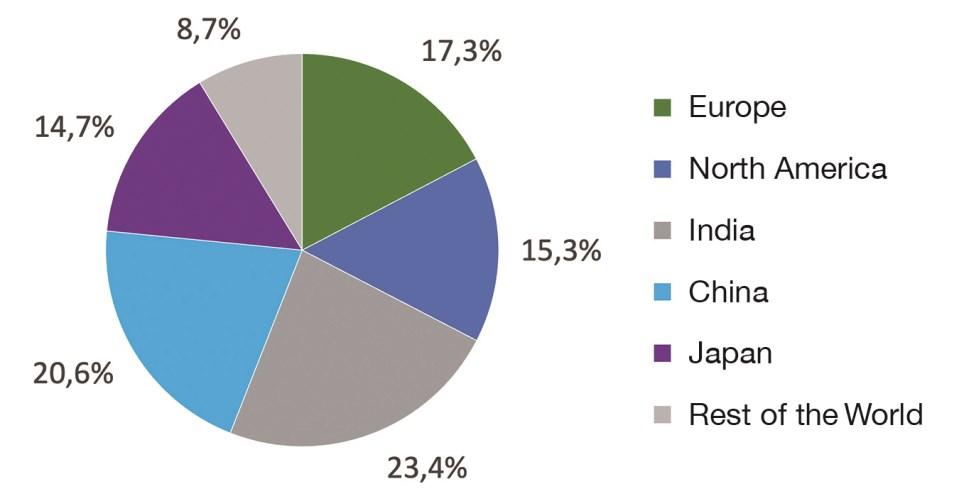
Graph1.Marketsharesofmajorcreosoteproducingareasin2015
The maincreosote manufacturers are amongthe leadingbiocidemanufacturers
The global biocides market in 2018 was split 53% in the Americas, 24% in Asia-Pacific (APAC), and23% inEurope.
It was dominated by two American industry heavyweights: Koppers (19%) and Lonza (15%), followed by Rütgers (4%), Troy, Huntsman Viance, KMG Chemicals (mainly with creosote where itspositionisvery strong)andDow Bytom.
Note that the three world leaders are, in the same order, the three leaders of the major continental markets(American, Europeanand Asian).
The wood impregnation industry therefore buys from these global suppliers, often through theirsales offices locatedaroundthe world.
More specifically, inEurope, creosote productionwasdistributed asfollowsin2016:
Source: basedondatafromSEAFull Report, WEI-IEO(Brussels), August2016.
7.2. Productionofcreosotetreatedpoles
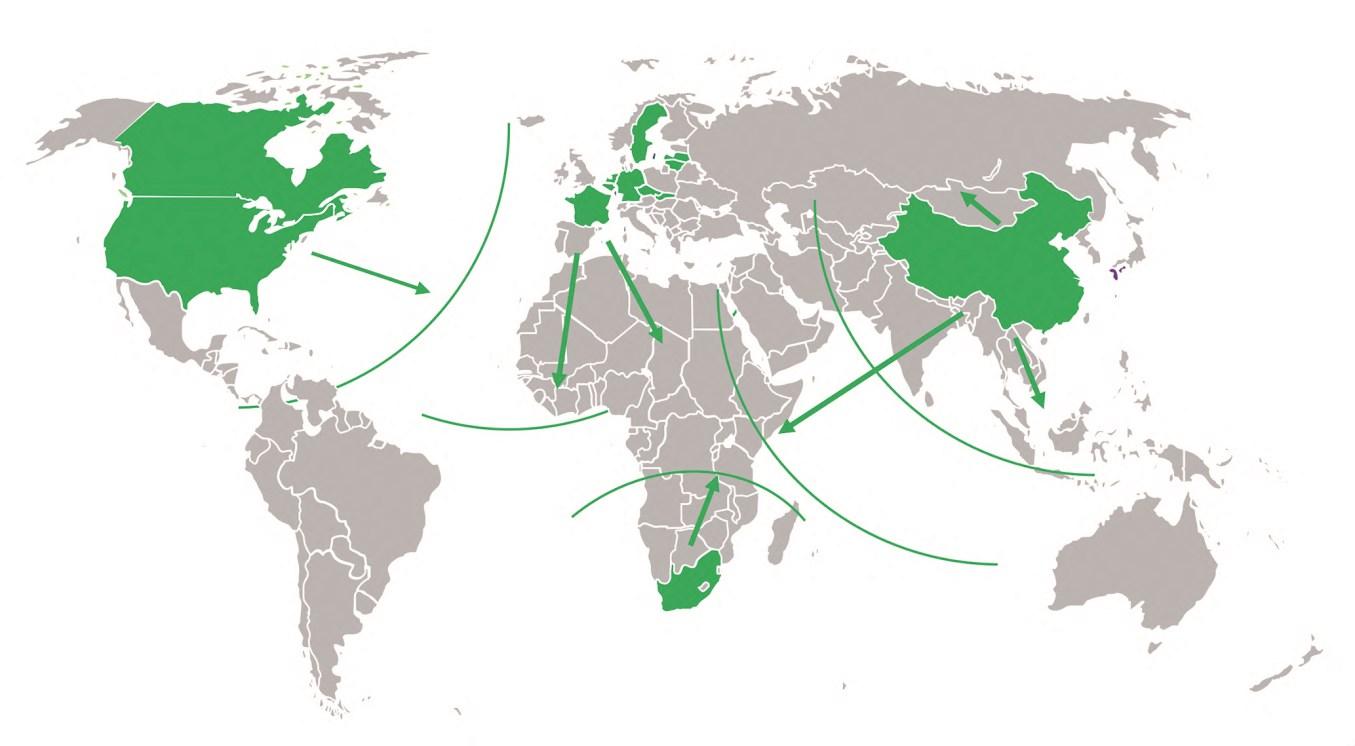
Creosotetreatedpoles areproducedinamuchmore dispersedmanner.Nevertheless,four typesofproducingand exportingcountries canbe identified.
In 2020, most of the major Western countries were exporters as shown in Map 2: the United States (12.5% of world treated wood exports), Canada (9.2%), France (3.8%), and Germany (3.5%).Canadaandthe UnitedStatesare amongthemajorconsumers (theyarethelargest producersoftreatedwood), while France hasonlyanindustrydedicatedtoexports
Some wood-producing countries are among the major exporters. Wood is processed close tothe loggingsites:Lithuania(8.2%), CzechRepublic (4.9%),Sweden(4.9%), andLatvia(2.5%).
28
Producer Location Creosote(tons) CreosoteforEurope Koppers UnitedKingdom, Danemark, The Netherlands 25,000 Rütgers Germany, Poland, Belgium 30,000 Bilbaina Spain 10,000 Dow Bytom Poland 4,000 Others 11,000 Creosoteforexport Exports 40,000
Table1.Europeancreosoteproductionin2016
Countries with historical trade links with emerging countries are also among the main exporters oftreatedwood:Belgium(6.9%)andthe Netherlands(6.1%)
Countrieswitharegionalinfluence,suchasSouthAfrica(5.8%),whichproducesasubstantial amount and exports a significant quantities to Southern Africa. To a lesser degree, Uganda andTanzaniaexporttheirproductiontoneighboringcountries
Apart from South Africa, all major exporting countries are home to processed wood producerswithstronglinkstoLatinAmerican, African, andcertainAsiancountries.
However,averyfragmentedwoodimpregnationindustryexistsinmostcountries,especially whenitcomes tocreosote
North American production is mainly intended for North America. The small percentage of exportsgoes tovarious countries (Europe, Africa, andSoutheastAsia)
EuropeanproductionismainlyexportedtoWest Africaandthe Middle East.
ChineseproductionisprimarilyexportedtoareasofinfluenceclosetoChina(Mongoliaand South-EastAsia)butalsoreaches more distant areasofinfluence (EastAfrica)
SouthAfricanproductionsupplies the entire SouthernandEasternAfricaregion.
29
Map2.Mainexportingcountriesofcreosotetreatedwoodandpoles
Source: Mach&Team.
7.3. Powerpolemarket
Worldwide,woodpolesdominatetheelectricutilitypolesmarket,accountingforover80%of the market. Concrete poles are on the rise in many countries, but in most cases are not the preferredsolution.Steelpolesand,evenmoreso,compositepoles(duetotheirprice)occupy niche markets
30
Pole type Area/ Country Wood Steel Concrete Composite Total Installed base Electrical North America 90% 7% 2% 1% Australia 80% 1,9% 7,5% 10,6% 6.3 million (2004) New Zealand 38% 3% 58% 1% 1.3million (2008) France 33% 67% 15million Telephone Street lighting Total <1% 228MUSD (2018) 1.6 billion
Table2.Utilitypolemarket-technologyshares
Varioussources analyzedandsummarizedbyMach&Team
VarioussourcesanalyzedandsummarizedbyMach&Team
Astudy10 conductedonpowergridscoveringtheperiod1980-2017showed thatthelengthof the lines of a power grid in a country can be approximated with very good accuracy using the followingformula:
➢ Number ofkilometers (km)oflines = 0.03535xnumberof householdsserved +1,459.19 xvolume ofelectricitysupplied(inTWh)
The result of this calculation is shown for all major countries in Appendix (Estimating the number of power poles ineachcountry).
9 Number ofcreosotetreatedwoodpoles.
10 https://www.sciencedirect.com/science/article/pii/S2352340921006351
31
7.4. Examplesoflocalwoodutilitypolemarkets
Country Production Number ofplants Market Installed base Main manufacturers United States 15M –2M 130M –160M 1.StellaJones 2.Koppers South Africa 350k 126 k(2001) Thesens, WoodLine, BolandWood Sweden 2 14k Scanpole, Rundvirke Belgium 2 CCB, CIBB Ireland 1 35k(Cr) 2M(Cr) PDMSaint-Gobain Germany 3 PeterMüller, Hiram, Fürstenberg France 9 Boisimprégnés, France Finland 3 100k 10 M Versowood, Pinar, Livari Mononen Greece 3 90k(Cr9) 4.5M(Cr) Cyprus 20k(Cr) 240k(Cr) Norway 2 30k(Cr) 3,5M(Cr) Scanpole
Table3.Someexamplesofnationalmarketstructures
7.5. Lobbyingandprofessionalassociations
In the major treated wood pole consumer and manufacturing countries, professional associations have been created to bring together the major players in the treated wood industry
Some of these associations are involved in extensive lobbying and advocacy for a profession threatened by regulatory changes tending to exclude most treatment products or, ataminimum, toreduce theirscopeofuse
The mostactive are:
- inthe UnitedStates, AWPA(AmericanWoodProtectionAssociation) (https://awpa.com).
- inSouthAfrica, SAWPA (SouthAfricanWoodPreserversAssociation) (https://sawpa.co.za)
- inAustralia, TPAA(TimberPreservers AssociationofAustralia) (https://www.tpaa.com.au/about/)
- in Europe, WEI-IEO (https://www.wei-ieo.eu/) represents the pressure treated wood industryinEuropeand, more specifically, before the European Commission
Other examples include:
- inthe Scandinaviancountries, NWPC(Nordic WoodPreservation Council) (https://www.nwpc.eu)
- inJapan, JWPA(Japan WoodProtectionAssociation) (http://www.mokuzaihozon.org/english/)
- inthe UnitedKingdom, WPA(WoodProtection Association) (https://www.thewpa.org.uk)
- inNorthAmericaandMexico, WWPI (WesternWoodPreservers Institute) (https://preservedwood.org)
- inNorthAmerica, SPTA (SouthernPressure Treaters’ Association).
- inCanada, WPC(WoodPreservationCanada)(https://woodpreservation.ca/en/).
In addition to their lobbying activities, these associations have several additional missions, dependingonthe case:
- more orlessobjective information onwoodtreatmenttechnologies, methodsand products(all).
- establishingandmanagingaqualityassurance andtestingprogram (TPAA).
- qualitylabel management(WPA, NWPC).
- developingand managingstandards (AWPA, WPC).
- approvingwoodtreatmentsubstances (JWPA).
- researchwork(JWPA).
32
8. Alternativestocreosote
There are several alternatives to creosote-treated poles: wood poles treated with products other thancreosote, steel poles, concrete, orcomposite materials
Atthesametime,complementarysolutions,suchasliningthebaseofpoles,makeitpossible toreduce certaindisadvantagesoftreatedwood.
Wood treatment solutions with non-creosote products have a much lower cost/ effectiveness ratio than other solutions. On the other hand, no wood treatment product is harmless in terms of its impact on health and the environment because it contains potentiallydangerous fungicidesorinsecticides.
The choice ofanalternative istherefore basedon:
- eithertheeconomicaspect,anditisimportanttoapprovetheprecautionarymeasuresassociatedwiththischoice.
- or the level of toxicity and ecotoxicity, and it is important to choose the penalties thathave the leastimpactonthe environment.
8.1. Alternativewoodtreatments
Provided they are effective at protecting the wood, these alternative treatments have the advantage (as a replacement for creosote) of not significantly changing the design of the poles, the manufacturingprocess, orthe installationmethods
Thedesignanddimensioningofthesepolesremainidenticalbecause,whenappliedonthe same woodspecies, these treatmentsdonotmodifythe physical performance.
Asfarasthe manufacturingofthepolesisconcerned,almostallalternativetreatmentsare appliedbypressureimpregnationjustlikecreosote.Thismakesiteasyformanufacturersto adapttothese new products.
Finally, these poles are installed in the same way as creosote-treated poles: their size and weightare identical.
Wood impregnation products are often compounds made with metals with fungicidal and insecticidal properties: arsenic, copper, boron (in the form of borate or boric acid), and chromium.
All of these metals are hazardous, but because they are sometimes diluted in wood treatmentproductsandcombinedwithothersubstances,itisnotpossibletoconcludethat their individual properties are present in the final compound. Only studies specifically designed for each impregnation product can determine with certainty the danger for humansandthe environment.
Arsenic is recognized as a carcinogen by the EPA (carcinogen A), by the ECHA (carcinogen 1), andbythe IARC(carcinogen1).
33
ChromiumVI isrecognized ascarcinogenic bythe IARC(carcinogen1).
Therefore,thefactthatasubstanceisnotclassifiedasahazardousmaterialmayreflectthe fact that the substance is not very harmful or that there is a lack of in-depth studies. This is whythisreportusestheclassificationsoftheEuropeanAgencyfortheControlofChemicals (ECHA)asofJune2022.Itisquiteplausiblethatfurtherresearchwillbeconductedoncertain substances andwill leadtolessfavorable classifications.
In spite of these precautions in interpretation, often emphasized by scientists, many countriesprohibitthepresenceofcertainmetalsorchemicalcompoundsinwoodimpregnation products. For example, the United Kingdom has banned the presence of chromium andarsenic since 2006.
Among the wood impregnating products used for utility poles, the following are the best knownand mostcommonlyused
Important note: The three most common pole treatment solutions (creosote, pentachlorophenol,andCCA)areallbasedonhighlytoxicproducts.OnlyCCAisstillallowed
Historicalproducts
8.1.1.
Reference
Description
Pentachlorophenol isanartificiallyproducedsubstance thathasbeenusedsince the 1930s as a pressure-impregnated oil for treating wood. It has been used extensively and the majority of treated wood utility poles installed in the United States today are treated with pentachlorophenol
Pentachlorophenol is a chlorinated phenolic compound that can release dioxins when burned.However, itdoes notcontainheavymetalsorPAHs
Toxicityandecotoxicity
Itisarelativelypersistentirritant(H315, H319)and astrongendocrine disruptor
Since the late 1960s, pentachlorophenol has been recognized and labeled in Europe as a very hazardous substance for humans and the environment
34
Pentachlorophenol
Pentachlorophenol ECHA 201-778-6 CAS 87-86-5 131-52-2(Salt)
Source: EuropeanChemicals Agency(ECHA) –http://echa.europa.eu(2022)11
Regulations
Its use in consumer products was banned in Europe in 1992. It was completely banned by Denmark in 1996 and listed in 2015 in Appendix A of the Stockholm Convention on Persistent Organic Pollutants, i.e. banned for production, use, and import. Pentachlorophenol has also beenbannedsince 1980inIndonesia, since 1991inIndia(whichhascontinuedtoproduce its saltforitsownneeds),aswellasinNewZealand,Morocco,EcuadorandSriLanka,anditsuse hasbeenrestricted towoodtreatmentsince 1982inChina
Consumercountries
At the same time, pentachlorophenol has long been the leading treatment in the United States where it was banned for residential use in 1987. After being subject to precautionary measuresrecom-mendedbythe EPA, itwasdefinitivelybannedin2022.

Production
Pentachlorophenol has not been produced in Europe since 1992, when Rhône-Poulenc ceased its activities in this field. The last American producer, Cabot Microelectronics Corporation,asubsidiaryofKMGChemicals,wastheworld'slargestproduceruntilrecently,but it ceased production at the end of 2021. However, it is still produced in other countries such asbySigma-Aldrich, aMercksubsidiary, whichstill sellsit,especiallyinChina. 11 ECHA
35
Diagram4.Toxicityprofileofpentachlorophenol
shallnotbeliableforanyconsequencesresultingfromtheuseofECHAdatamentionedinthisreport
Pentachlorophenol cannot be an alternative to creosote for treating utility poles. It is too toxic and already bannedinmanycountries

Acceptabilitysummary 12
Reference
Description
CCA is also a widely used treatment in many countries. CCA is an aqueous combination of copper (23-27% for its fungicidal properties), arsenic13 (30-37% for its insecticidal properties) andchromium(38-45%,usedtobindproductsinwoodandasaprotectoragainstultraviolet rays)
12 Theacceptabilitysummariesproposedinthisreportarenotexpertopinionsbutacompilationofthedata available in July 2022. The CMR risks (see glossary) are in accordance with ECHA publications. A ban in Europeorthe UnitedStates, aswellasaCMRclassification,resultsinanegativeacceptability opinion.The absence of such criteria but a classification as hazardous results in a "yes but" acceptability opinion, requiringtheimplementationofspecific protectivemeasures whenusingthe substance
13 CASNo.: 7440-38-2–ECHANo.:231-148-6
36
8.1.2. Chromecopperarsenate(CCA)
Chrome copperarsenate ECHA Notlisted CAS 37337-13-6 Components
trioxide(As
pentoxide
Lead hydrogenarsenate Triethyl arsenate ECHA ECHA ECHA ECHA 215.481.4 215.116.9 232.064.2 427.700.2 CAS CAS CAS CAS 1327-53-3 1303-28-2 7784-40-9 15606-95-8
Arsenic
2O3) Arsenic
(As2O5)
Diagram5 Toxicity
Source: EuropeanChemicals Agency(ECHA) –http://echa.europa.eu(2022).


37
profileofarsenicderivativesthatmaybepresentinCCA
The impacts of CCA on health and the environment are mainly dictated by the presence of arsenic: the various arsenic-based compounds that can be found in CCA are all classified as highly probable carcinogens (H350), some are confirmed reprotoxic (H360), and all can cause neurological disorders andare highly toxic toaquatic organisms

Source: EuropeanChemicals Agency(ECHA) –http://echa.europa.eu(2022).
Regulations
Therefore, since 2004, European regulations have only authorized the use of arsenic for industrialapplications,includingwood treatment(innon-residentialcontexts)whichare not intended to be in contact with the aquatic environment.
Similarly, in the United States, CCA treatments have been banned since 2003 for all residential usesjustlikeinAustralia.
Strong lobbying by citizen associations (the main one being Beyond Pesticides), backed by localcommunities,hasbeentryingforseveralyearstogetCCAbannedintheUnitedStates, withoutsuccesstodate.
ThesetreatmentsaretotallybannedinDenmark,Switzerland,Vietnam,Indonesia,Israeland the UnitedKingdom(since 2006).
Consumercountries
CCAimpregnationofutilitypoles isthe mostcommontreatmentoption inAfricaandIndia
38
Production
There are manymanufacturers whoproduce CCA:
- Lonza (#1 producer worldwide) (Arxada, Wolman): Wolmanac CCA® and ET® in Europe and NorthAmerica;TanalithCCA®inAsia, Australia,New ZealandandSouthAfrica
- Koppers Performance Chemicals
- Viance: SupaTimber®
- DolphinBay: Permaccure CCA® inSouthAfrica.
CCA treatment cannotbe amedium-term alternative tocreosote fortreatingutilitypoles. Evenifthe productiswidelyavailable andused, itstoxicityissignificantandproven

Acceptabilitysummary
The(alreadylong-standing)widelyusedalternatives
8.1.3.
Reference
Description
Copper naphthenate is a product that is increasingly used in the United States but much less so in Europe, and is presented as an alternative to older products. It is obtained by reacting copper (known for its fungicidal properties) with naphthenic acid, which is a petroleumderivative
Not very soluble in water, naphthenate is mixed with oily solvents before impregnating the wood.Itisrecognized asbeingaseffective ascreosote.
39
Coppernaphthenate
Copper naphthenate (C14H10CuO4) ECHA 215.657.0 CAS 1338-02-9
Toxicityandecotoxicity
Although not well documented, this substance is recognized as an irritant and therefore requires protection when handled. When it is highly concentrated, it can even be very dangerous.Itisalsoflammable andreleasestoxic fumes whenburned
It is simply declared harmful if absorbed in any form (H302, H312, H332). It is also recognized as very toxic to aquatic organisms with long-lasting effects. However, it is considered ten times lesstoxic thanpentachlorophenol, butisalsoslightlylesseffective
Source: EuropeanChemicals Agency(ECHA)
http://echa.europa.eu(2022).
Regulations
In the United States, copper naphthenate has been registered by the EPA since 1951. It is not listed as a hazardous substance under the Clean Air Act and is not listed as a hazardous insecticideorhazardous waste underthe CleanWater Act. ItisnotsubjecttoanyparticularrestrictioninEurope. It cannot be used in countries that have banned the use of copper as a fungicide such as Denmark, Norway, andthe Netherlands

40
Diagram6.Toxicityprofileofcoppernaphthenate
–
Consumercountries
Copper naphthenate is extensively used in the U.S., including by leading wood treatment companies (Stella-Jones), and will benefit from a windfall effect following the ban on pentachlorophenol (Koppers announced in 2020 that it would use it as an alternative to pentachlorophenol). More than one million poles were treated with this product during the 1990s

Itisalsofrequently usedinJapan
TheconsumptionofcoppernaphthenateinEuropedoes notexceedafewtensoftons,soit isnotaverycommonproductfortreatingpower poles.
Production
Note thatthere are several producers:
- inthe US:Nisus: QNAP®, StremChemicals, Troy:Troysan
- aswellasintheUnitedArabEmirates(Optichem),India,China(MinghuanChemical, ZhangMing Chemical)andJapan(NihonMerichem).
Copper naphthenate treatment remains a highly ecotoxic treatment option.
Acceptabilitysummary
41
Reference Copperoxide(11%) Zinc oxide(5.5%) Arsenic pentoxide(55%) ECHA ECHA ECHA 215.270.7 215.222.5 215.116.9 CAS CAS CAS 1317-39-1 1314-13-2 1303-28-2
8.1.4. Ammoniacalcopperzincarsenate(ACZA)
Description
ACZA, better known by one of its trade names, chemonite, is an aqueous combination of copper (for its fungicidal properties), arsenic (for its insecticidal properties), and ammonia (whichfacilitatespenetrationintothewood).Ithasbeenusedsincethe1990smainlyinNorth America
Itisparticularlywell suitedforhardwoodspecies Sinceitcontainsammonia,itiscorrosivetocertainmetalsandthereforetocertainfastening systemsattachedtothe poles
Toxicityandecotoxicity
Just as with CCA, the presence of arsenic makes it a hazardous product for human health andthe environment.

In the United States, ACZA is recognized as a carcinogen (because it contains arsenic pentoxide, which is recognized as a definite carcinogen), corrosive to the skin, irritating to the skin, eyes, andrespiratorytract.
Source: EuropeanChemicals Agency(ECHA) –http://echa.europa.eu(2022).
Regulations
IntheUnitedStates,ACZAisarestrictedusepesticidebyregulation(FIFRA-FederalInsecticide, Fungicide,andRodenticideAct).
42
Diagram7.ToxicityprofileofACZA'scomponents
Consumercountries
ACZAiswidelyusedintheUnitedStates.However,becauseofitstoxicity,itsusehasdeclined inother countries suchasCanada
ItisnotwidelyusedinEurope.
Production
ACZA is produced in the United States by Archwood (Lonza) and in China by several manufacturers including Foshan Liyuan Chemicals. Although invented in Canada, ACZA was discontinued in that country in 2006.

CZA treatment is not an alternative to creosote for treating utility poles. Even if the product is widelyavailableandused,itstoxicityissignificantandproven,aswellasitscarcinogenicity
Acceptabilitysummary
Neweralternativeproducts
8.1.5. Dichlorooctyl-isothiazolinone(DCOI)
Description
Dichlorooctyl-isothiazolinone(4,5-dichloro-2-octyl-2H-isothiazol-3one)isanewersubstance, registered with the EPA in 1996, and is oil-like in that it is mixed with solvents for use. DCOI is soldbecause ofwhatitdoes notcontain:nodioxins, heavymetals, orPAHs.
The wood is treated with DCOI by pressure impregnation with a retention rate between 1.6 and3.2kg/m3
43
Reference DCOI ECHA 264.843.8 CAS 64359-81-5
Toxicityandecotoxicity
DCOIisclassifiedashazardoustohumanhealthinseveralways:itisclassifiedashazardous to swallow (H302) and hazardous to inhale (H330), highly irritating to skin and eyes (H314), andhighlytoxic toaquatic organisms(H410)
The evaluation report, conducted by ECHA in 201414 , mentions the lack of a specific study on the substance's carcinogenicity, but assumes that DCOI is not carcinogenic because this property is not present in the three isothiazolinones making up DCOI. In addition, no reprotoxicityorendocrine disruptingproperties were found

Onthe other hand, the substance (DCOI)isnot verysoluble andpersistentinsoils(half-life15 of4.7days), inwater(half-life of16.5days), orinsediments(half-life of4days).
Source: EuropeanChemicals Agency(ECHA) –http://echa.europa.eu(2022).
Regulations
Nospecial regulations
The UnitedStatesauthorized DCOI in2017forsoil contactuses
Inaddition,Europeconductedanimpactassessmentin2011thatconcludedthatDCOIcould beallowedforindustrial applications
14 http://dissemination.echa.europa.eu/Biocides/ActiveSubstances/0022-21/002221_Assessment_Report.pdf
15 The term"half-life"herereferstothetimeittakes for asubstancetolose halfofitsphysiologicalactivity. The termisthereforemisleading,as itis notusedtorefertohalf alifespan.
44
Diagram8.Toxicityprofileof DCOI
Consumercountries
The UnitedStateshasasubstantial utilizationrate ofDCOI
Production
Koppers (Ex-Osmose), Viance (Ultrapolenxt® and Ultraarmnxt®), Sigma-Aldrich (Merck Group) and Foshan Liyuan are major producers of this substance. Viance is also a very active developerandlobbyistintheUnitedStatesforDCOI.ViancepetitionedtheEPAin2020tohave DCOItreatedproductsnotbeconsideredhazardous.
CCA treatment cannot be a medium-term alternative to creosote for treating utility poles. Evenifthe productiswidelyavailable andused, itstoxicityisstillsignificantandproven
Acceptabilitysummary
8.1.6. Alkalinecopperquaternary(ACQ)
Description
Alkaline copper quaternary is an aqueous mixture of 50-67% copper oxide and 33-50% quaternaryammoniumcompoundtofacilitate penetrationofthe productintothe wood Registered with the EPA in 1985 and first commercially produced in Canada in 2004, ACQ is one ofthe newer woodtreatmentsolutionsandisapproved forconsumeruse
ACQ provides very satisfactory protection results, similar to those of CCA. ACQ is also sold basedonwhatitdoes notcontain(chromiumandarsenic)

45
Reference Boric acid Quaternaryammonia Quaternaryammonia ECHA ECHA ECHA 233.139.2 269.919.4 230.525.2 CAS CAS CAS 10043-35-3 68391-01-5 7173-51-5
Toxicityandecotoxicity
ACQ is a product classified as harmful if swallowed, inhaled, or in contact with skin. It is a skin and eye irritant requiring precautions when handling. It is also a carcinogen and is likely to be reprotoxic as is one of its main components, boric acid

Source: EuropeanChemicals Agency(ECHA) –http://echa.europa.eu(2022).

46
Diagram9.ToxicityprofileofACQ'scomponents
Source: EuropeanChemicals Agency(ECHA) –http://echa.europa.eu(2022).

Regulations
Nospecial regulations.
Consumercountries
On the other hand, the product is very corrosive (because of the ammonia) and requires choosing fastening systems and attachments to the poles that are suited to its properties, otherwise itwill deteriorate rapidly
It is now a widely used product in the United Kingdom, deployed in Europe, the USA, Japan, Australia, andNew Zealand.
Production
Inthe US:
- Viance: PreserveACQ®
- Koppers: Naturewood® ACQ®
InSouthAfrica:
- DolphinBay:Permacure ACQ®
InIndia:
- Dattashri:AmquatSS211®
47
Description
Triadimefonwasunveiledin1976andquicklyusedbecauseofitssystemic,broad-spectrum antifungal properties. Itbelongs to the conazole pesticides category along with propiconazole, acomponentoftannalithE(see Section11.1.9).
Toxicityandecotoxicity
TheEPA'smainfocusistheneurotoxic natureoftriadimefon,whichhasbeendemonstrated innumerouslaboratory experimentswithanimals
Triadimefonisalsosuspectedofbeingacarcinogen(itisclassifiedasacategoryCcarcinogen in the United States) and an endocrine disruptor (it is listed as such by Europe and the WWF 16).
Theimpactoftriadimefononaquaticorganismswasinitiallyestimatedasmoderatebefore field observations in China, where triadimefon is widely used, showed much more harmful effects

48 Acceptabilitysummary
Reference Triadimefon ECHA 256.103.8 CAS 43121-43-3
8.1.7. Triadimefon
16
WorldWildlifeFund
Regulations
In2006, the EPA dramaticallyreducedthe allowable use casesfortriadimefon, excludingall domestic andagricultural uses
TriadimefonisbannedinEuropeforfoodandagricultural uses

Consumercountries
Since2006,theuseoftriadimefonhasbeengreatlyreducedintheUnitedStates.However,it continues tobeusedextensivelyinChina, particularlyforagricultural purposes
Production
Sigma-Aldrichisaproducer ofthe substance, asare several Chinese manufacturers
Acceptabilitysummary

49
Diagram10.Toxicityprofileoftriadimefon
Source: EuropeanChemicals Agency(ECHA) –http://echa.europa.eu(2022).
8.1.8. Disodiumoctoboratetetrahydrate
Reference Disodium
(DOT)
Description
Disodium octoborate tetrahydrate is a boric compound widely used in industry. It is not degradable when in its natural state, is highly soluble in water (making it suitable for use as aspray), andhasalow bioaccumulationpotential
Toxicityandecotoxicity

DOTisclassifiedasH360FD:itisrecognized asbeinghighlytoxic tounbornchildren.Itisalso classifiedascorrosive to the skin(H319)andirritatingtothe respiratory tract(H335).
Source: EuropeanChemicals Agency(ECHA) –http://echa.europa.eu(2022).
Regulations
Duetoitsreprotoxicproperties,DOTisnotauthorizedasapesticideinEuropeorSwitzerland, butcontinuestobeauthorizedforuseinthemanufactureofsealants,modelingcompounds, andplasters.
50
octoborate tetrahydrate (DOT) ECHA 234.541.0 CAS
12280-03-4 (tetrahydrate version) 12008-41-2(anhydrite version)
Diagram11.ToxicityprofileofDOT
Consumercountries
Several thousandtons ofDOTare consumedannuallyinEurope, butnotasapesticide
Itsuse inwoodtreatmentiscommoninthe UnitedStates andChina
Production
In the United States, DOT is produced by Koppers (Advance Guard® and Hi-Bor®), American Borate Company(Etidot 67®), andViance (TimberSaver®).
DOTisalsoproducedbyseveral manufacturers inIndiaandChina
Acceptabilitysummary
Description
Tanalith® E is an aqueous mixture for pressure treating wood with a retention rate between 17and28kg/m3 dependingonthe type ofwood
ItwasdevelopedbyArch(now asubsidiary ofLonza)
Toxicityandecotoxicity
For Europe, some components of Tanalith® E are problematic because their impact on humanhealthisnotnegligible.
Forexample,2-Aminoethanolisclassifiedasharmfulifswallowed(H302)orthroughcontact (H312), corrosive tothe skin(H314), andirritatingtothe respiratrytract.

51
Propiconazole Coppercarbonate Copper Tebuconazole Ethanolamine ECHA ECHA ECHA ECHA ECHA 262.104.4 235.113.6 403.640.2 205.483.3 CAS CAS CAS CAS CAS 60207-90-1 12069-69-1 7440-50-8 107534-96-3 141-43-5
8.1.9. Tanalith® E
Reference
Tanalith® E contains propiconazole, a reprotoxic fungicide banned by the European Commissionsince 2021

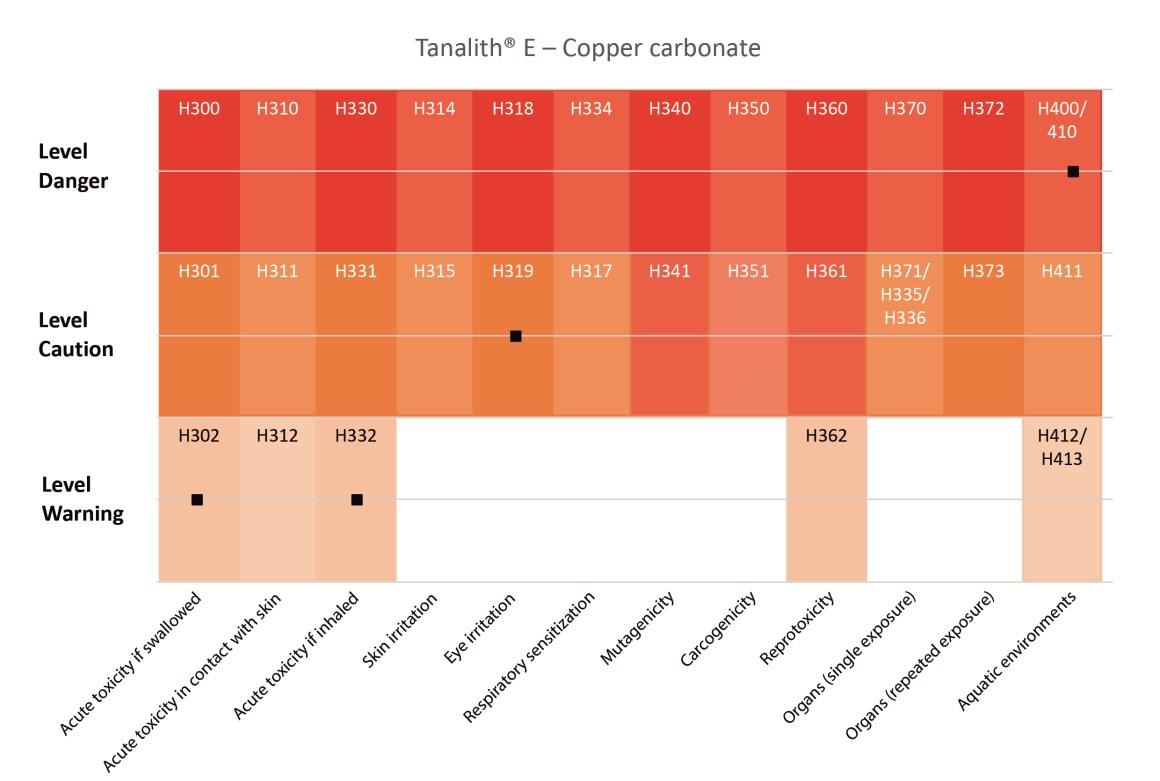
Its presence independently indicates risks identified directly concerning Tanalith® E, classified as harmful if swallowed (H302) or through contact (H312), irritating to the eyes (H318), irritatingtothe respiratorytract, andfinallyverytoxic toaquatic organisms(H410).
Source:EuropeanChemicals Agency(ECHA) –http://echa.europa.eu(2022).
52
Diagram12.ToxicityprofileofTanalith® E
Source: EuropeanChemicals Agency(ECHA) –http://echa.europa.eu(2022).
Regulations
Tanalith® EhasbeenevaluatedbytheEuropeanUnionandhasnotbeenbannedasawood preservative


53
Consumercountries
Tanalith® EiswidelyusedinAsia,Australia,NewZealandandSouthAfrica.Lonzalimitsitsuse to these countries, preferring to promote CCA and ACZA-based solutions for Europe and NorthAmericaatthistime.Itis, however, usedinEurope.
Production
Tanalith®Eisaproductdevelopedandproduced byLonza(Arxada).

Acceptabilitysummary
Description
Koppers Celcure AC 500® is an aqueous mixture developed by Koppers exclusively for treating wood
Toxicityandecotoxicity
The main components of Koppers Celcure AC 500® have a significant impact on human health:
- copper carbonate is harmful if inhaled or swallowed (H302, H332) and very toxic to aquatic organisms(H400, H410).
- boric acidisareprotoxic (H360FD).
However, the low doses in which these constituents are found in Celcure® mitigate their effects. The only classification that has been applied to Celcure® is harmful to aquatic organisms (H412).
54
Coppercarbonate Boric acid ECHA ECHA 235.113.6 233.139.2 CAS CAS 12069-69-1 10043-35-3
8.1.10. KoppersCelcure® AC500
Reference


55
Diagram13.ToxicityprofileoftheKoppersCelcure®AC500'scomponents
Source: EuropeanChemicals Agency(ECHA) –http://echa.europa.eu (2022).
Regulations
From2015to2020,theUnitedKingdomwasinchargeofevaluatingCelcure® forapprovalon behalf of the European Union. During this period, the product's authorization was continuouslyrenewed.
Since 2020, after the United Kingdom's withdrawal from the EU (Brexit), Sweden has been responsible for this assessment. Since the assessment study was not completed, a transitionalauthoriza-tionwasgrantedtoCelcure® inJune2021anditsrenewaldependson the outcome ofthe findingsofthe Swedishstudy
Consumercountries
The productisconsumedinmanycountries locatedonfive continents.
Production
The Koppers Celcure® AC500ismanufacturedbyKoppers

Description
Wolmanit® CX-F is a patented aqueous solution based on 2.8% HDO copper and approximately13% coppercarbonate
Toxicityandecotoxicity
Like all equivalent products, Wolmanit® isa toxic product for the environment, especially for aquatic organisms, and therefore requires precautionary measures
Itisalsoacorrosive andirritant
56
Acceptabilitysummary
Reference Coppercarbonate Cu HDO Ethanolamine ECHA ECHA ECHA 235.113.6 608.595.4 205.483.3 CAS CAS CAS 12069-69-1 312600-89-8 141.43.5
8.1.11. Wolmanit® CX-F
Source: EuropeanChemicals Agency(ECHA)–http://echa.europa.eu(2022).


57
Diagram14.ToxicityprofileofWolmanit® CX-F'scomponents
Regulations
Nospecial regulationsforthisproduct
Consumercountries
Wolmanit® is used in many countries, especially in Europe. The continent where it is least widespreadisprobablyNorthAmerica.
Production
Wolmanit® CX-FisaproductdevelopedandproducedbyBASFWolman

Acceptabilitysummary
8.1.12. Organicproducts
Given the numerous bans on fungicides and insecticides for residential use, alternative woodtreatmentmethodshave beendevelopedtomeetthese markets
The principle is to modify the internal structure of the wood to change its properties, rather thanimpregnatingthe woodwithapreservative.
Chemicalmethodshavebeenexploredbut,todate,nonehavebeendevelopedindustrially because the treatments are tooexpensive (acetylation, furfurylation, DMDHEUtreatment).
On the other hand, various heat treatment processes for wood have been developed in Canada, Finland, France, and the Netherlands. They are all based on a treatment cycle principle (high temperature - drying - high temperature) and differ in the pressure or atmosphere (air, neutral atmosphere, nitrogen and carbon dioxide) in which the treatment isdone.
These includethe Thermowood, Plato, andRetificationprocesses
All have proven to be effective in protecting wood from mold and insects in different climates. However, they have not been used for utility poles, and we have not collected economic data toconfirmthe value ofthese solutions.
58
8.1.13. Pricecomparison
As already mentioned, the choice of wood treatment product does not have a significant impactonthe designofthe poles, norontheirmanufacture orinstallation
However, there are price differences between these substances. The cost of treated wood variesdependingonthecostofthesubstancebutalsoontheamountofsubstanceneeded totreatthe wood.Thus, aninitial comparisonisasfollows:
Source: Mach&TeamaccordingtotheEuropeanChemicalsAgency(ECHA) –http://echa.europa.eu(2022).
The cost of the treatment should be added to the cost of the raw wood to get the net cost ofthe treatedpole.
This comparison can explain differences in sales prices between timber poles treated with differentsubstances.
Wood poles, compared to other alternatives, which will be discussed in the next chapter, often have a lower retail price than poles made with other technologies or materials, but it isimportanttoconsider the final costatdifferent levels:
- the sales price of wooden poles is generally very competitive. However, its competitivenessmayvarydependingonwhetherthepostismanufacturedlocallyfrom localrawwood(favorablescenario)orisimportedfromdistantproducingcountries (unfavorable scenario)asisthe case insome Middle Easterndesertcountries.
- the price of the installed pole, consisting of the above-mentioned sales price and the installation price, depending for example on the weight of the pole or the difficulty of attaching accessories (e.g. crosspieces, cable supports, etc.). At this stage, poles remain competitive, but their competitiveness is limited by installation costs thatremainquitehigh.Thesystemsforattachingaccessoriestosteel,compositeor concrete poles are made in the factory, whereas wood poles require drilling which isoftendone duringinstallation.
- the total cost of ownership which represents all the costs generated by the pole throughoutitslifecycle(possiblyincludingtherecyclingcosts).Thistier,liketheprevious one, takes into account new costs that are not very favorable to wood poles: indeed, these poles require more maintenance and inspections than others, and cantherefore oftenhave ashorterlifespan
59
Treatmentsubstance Priceofthesubstance (EUR/kg) Retention (kg/m3) Costofwood treatment(EUR/m3) ACQ 28 6 168 CCA 28 6 168 WolmanitCX-S 47 4 188 ACZA 38 6 228 Tanalith® E 38 6 228 Koppers AC500 3.8 6 22.8 Creosote 0.75 100 75
Table4.Pricecomparisonofwoodtreatedwithdifferentbiocides
Therefore, it is important not to assess the cost of utility poles by simply looking at their salesprice.
8.1.14. Toxicitycomparison
The above review of the various substances used for treating wood demonstrates that no industrial pesticide or fungicide is hazard-free. Metals used because of their natural(copper, arsenic, and chromium) have impacts on human health and on the environment that are just as significant as industrial derivatives (boric compounds, conazoles, and pentachlorophenol).
Nosubstanceoffersanobviousalternativetocreosoteandsomeevenhavesimilarimpacts
The trendinindustrial countries (Europeleadingthe pack)istoprogressively limitthe useof thesesubstances.TheUnitedStatesisnowmorepermissivebutisfollowingsuit.Ontheother hand,ChinaandIndiacontinuetobemajorproducersandconsumersofthesesubstances, whichthey caneasilyexporttoall countries whose regulationsdonotprohibitit.
Almost all of these products are very toxic, in the short and medium term, for aquatic organisms. Their use must be strictly limited or even forbidden, like wood treatment in bodies ofwaterandrivers.
We canthensuggestthe followingcomparison basedonthree categories ofcriteria:
- carcinogenic, mutagenic, reprotoxic or endocrine disrupting products (or those stronglysuspected ofbeingso)mustbebanned.
- products with very high toxicity (assessed in terms of the hazard level shown in red on the toxicityprofiles)may be prohibitedor, otherwise, be subjecttospecial protection measures (i) for persons likely to be in contact with these products, and (ii)forthe environment, duringtheiruse.
- irritantsmustbe handled, transported, andstoredwithcare.
Theanalysismadebasedonthesecriterialeadstoamajorwarningonmostoftheproducts, which are not acceptable with regard to their properties (highlighted in red in Table 5), with the exception of copper naphthenate, IOCD, andWolmanit CX (which is only manufactured byBASF-Wolman).
60
Steel isa material commonly used for electrical towers supporting transmission lines, more rarelyforpower grids.
Itmakesseveral design variationspossible:

- various shapes (welded mesh or single-pole and, among the single-pole posts, twelve-sidedorround).
- variousfinishes (galvanized steel, weatheringsteel, painted steel).
They can be adapted to the landscape and are sometimes more discreet than wooden posts
61
Table5.Comparativetoxicityofdifferentwoodtreatmentproducts
Source: Mach&Team accordingtoEuropeanChemicals Agency(ECHA) –http://echa.europa.eu (2022).
8.2. STEEL
8.2.1. Physicalproperties
Steel poles are generally lighter than wood poles. Depending on the source, weight savings range from 30 to 70% inthemostfavorablecases. However, these figures cannot be taken as a reference

Some types of steel poles may be heavier. The weight data used in the various available studies should be regarded with caution because the authors of the publications providing weight comparisons between wood and steel poles naturally choose the conditions and factors thatare favorable tothe argumentthey are making.
Thus, the WEI-IEO, a European trade association representing the wood processing industry, seeks toshow the advantagesofwoodpoles andprovidesthe followingcomparison:
62
Photo1.Exampleofametallatticepole
Allrightsreserved All rights reserved
Photo2.Exampleofasinglemetalpole
In 2021, the Oak Ridge National Laboratory (ORNL) in the U.S., perhaps more neutrally, uses a 12.5-meter highreference pole:
- awoodpole weighs1,315kg.
- asteelpole weighs631kg
Beyond the examples given, almost everyone agrees that steel poles are between 30 and 50%lighterthanwoodpoles.Thisrangeshouldbeconsideredrepresentativein95%ofcases
8.2.2. Advantagesanddisadvantagesofsteelpoles
Steel poles have some significant advantagesover treatedwoodpoles:
- they are more easily transported because they are lighter. This can be important whenshippingconditionsare difficult.
- they are fire resistant.
- they are resistanttoinsects.
- duringuse,they donotpose a dangertohumanhealthorthe environment.
- theirphysical properties are stable.
- they require little maintenance.
- inspectingthemisneither destructive norinvasive tothe pole.
- they are 100% recyclable.
- they are usuallyrepairable after an impactcausedbyavehicle, forexample.
63
Poleheight (m) Type Weightofwoodpole (kg) Weightofsteelpole (kg) 8 L 143 262 8 M 157 374 10 M 259 471 10 S 395 879 12 M 356 601 12 S 539 1,068 14 S 686 1,311 18 S 1,110 2,322
Table6.Weightcomparisonofsteelandwoodpoles
Source: basedondatafromSEA Full Report, WEI-IEO(Brussels), August2016
- itiseasytomakeholesinthemforline bracketsoranyother accessory.
- theirservice life canreach80years.
- they canwithstandstressesandshocks.
Onthe other hand, they have disadvantages:
- theirmanufacture requiresnon-renewable resources (metals).
- they have aworse carbonfootprintthanwood poles.
- they are expensive.
- they canbesubjecttocorrosioninanacidic orsaline atmosphere.
- they must be separated from the line brackets by a sufficiently effective insulator to be isolated from possible short circuits.
- they are more difficult to climb and work at the top of the poles requires either a cherry pickerorspecificequipment.
- itisadvisable toavoidinstallingthemon soilswithacidsulphates.
- theirshippingrequiresspecial precautions.
8.2.3. LCAcomparison 17
The LCAprofile ofsteel poles isshownin graph2.
As shown in this graph, the LCA impact of steel poles is strongly influenced by steel manufacturing.Inaddition,thecumulativetoxicitytohumanhealth,landandwaterecosystems isstronglyinfluencedbythegalvanizationofthesteel,whichisnecessaryforenvironmentally andweather resistantpoles.
17 http://www.wei-ieo.eu/wp-content/uploads/2019/02/SEA-SM1_2016_FullReport.pdf
64
8.2.4. Examplesofinstallationanduse
In many countries, including where AFD operates, power grid managers have used steel poles insmall quantities.Despite theiradvantages ofbeinglightweightmakingthemeasier to install and strong, a deterrent to vandalism, steel poles are expensive and difficult to produce locally
Asexamples, however, we note:
- Structa's (South Africa) use of steel poles inmines in the Democratic Republic of Congo (DRC) and Namibia.

- KECInternational'sinstalledsteel poles indowntown N'Djamena(Chad).
- Fuchs Europoles (Germany) installed steel poles in storm-prone areas or due to integration reasons in regional parks in Germany and Switzerland on behalf of ED Netze.
- 6,000steel poles installedbyStructa(SouthAfrica)
forEskom
Metal poles (single-pole type) are now being considered for use in Tanzania and Nigeria to deal withthe increasingdamage towoodpoles
65
Graph2.LCAprofileofsteelpoles
Source: Socioeconomic Analysis(SEA)ofCreosotedWoodPole Applications (Full Report),WEI-IEO(Brussels),August2016.
8.2.5. Producers
Steel poles production is rather concentrated among specialized producers, with well-tried industrial processes, in order to achieve lower costs. These producers are mainly located in industrial countries
The mainproducersare:
- inthe US:Valmont(worldleader).
- inthe Middle East: Al-Bab, El-Sewedy.
- inIndia:KECInternational
- inChina:Metal Utility Poles, Wuxiao(limited presence inthe distribution market).
- inEurope:FuchsEuropoles (Germany)
- inSouthAfrica:Structa
In Morocco, the National Office of Electricity and Drinking Water (ONEE) has listed metal poles from more than ten national manufacturers, thus putting its trust in a network of local semi-industrial craftsmen (Emteyco - the Moroccan leader, Électro Tadart, Fabrilec, Funtan, Geemag, Lumafric, Sara électrique, Somodelco, Zamil) rather than the major international players.
This market structure isan exception and illustrates a replicable pattern in many countries, provided that the emergence of such a network of players is fostered over time by the governmentorlocal power gridmanagers
8.3. Concrete
8.3.1. Physicalproperties
The manufacturing processes for concrete poles make it possible to have a variety of shapesandfeatures.Concrete poles canbe:
- solidorhollow.
- rectangularorH-shaped.
- castorspunforgreaterstrength.
- pre-stressedor simplyreinforced
66
Source: basedondatafromSEAFull Report, WEI-IEO(Brussels), August2016
Furthermore, in2021, ORNLusesa12.5meterhigh reference pole:
- awoodpole weighs1,315kg
- aconcrete pole weighs3,793kg
This data is undisputed and the drawback of the weight of concrete poles is widely acknowledged

67
Photo3.Exampleofanaerated Photo4.Exampleofacylindrical castconcretepole sectionedconcretespunpole
Allrightsreserved
Allrightsreserved
Poleheight (m) Type Weightofwoodpole (kg) Weightofconcretepole (kg) 8 L 143 788 8 M 157 795 10 M 259 1,019 10 S 395 1,103 12 M 356 1,216 12 S 539 1,359 14 S 686 1,612 18 S 1,110 2,573
Table7.Weightcomparisonofconcreteandwoodpoles
8.3.2. Advantagesanddisadvantagesofconcretepoles
Concrete poles alsohave distinctadvantages:
- they are fire resistant.
- they are resistanttoinsects.
- duringuse, they donot pose adangerto humanhealth orthe environment.
- theirphysical properties are stable.
- they require little maintenance.
- inspectingthemisneither destructive norinvasive tothe pole.
- they are fullyrecyclableasconcrete aggregates.
- mostofthe time they canbe repairedafter animpactwithavehicle for example.
- itiseasytomakeholes inthemforline brackets oranyother accessory.
- theirservice life canreach50years.
- they withstandgreatstress.
Onthe other hand, likesteel poles, concrete poles have some significantdisadvantages:
- they are lesseasilytransported because they are muchheavier.Thiscanbe prohibitive whenshippingconditionsare difficult.
- they have aworse carbonfootprintthanwood poles.
- theirmanufacture requiresnon-renewable resources andalotofenergy.
- they are more expensive thanwoodpoles.
- the steel reinforcement maybesubjecttocorrosioninacidic orsaline atmospheres, ifthe post becomes crackedordamaged.
8.3.3. LCAcomparison 18
TheLCAanalysisofthecastconcretepolesresultsinthefollowingprofile:inthecaseofcast concrete (graph 3), a large part of the LCA impact comes from the raw materials used (steel and cement) to which a strong sensitivity to shipping is added, underlining the impact of the weight of materials and poles and the distance, in some cases, from cement productionsites.
68
18 http://www.wei-ieo.eu/wp-content/uploads/2019/02/SEA-SM1_2016_FullReport.pdf
Source: Socioeconomic Analysis(SEA)ofCreosotedWoodPole Applications (Full Report),WEI-IEO(Brussels),August2016.
Similarly, the LCAanalysisofcastconcrete spun poles resultsinthe followingprofile:

Source: Socioeconomic Analysis(SEA)ofCreosotedWoodPole Applications (Full Report),WEI-IEO(Brussels),August2016.

69
Graph3.LCAprofileofcastconcretepoles
Graph4.LCAprofileofcastconcretespunpoles
Graph 4 shows that the LCA impact of cast concrete spun poles comes primarily from the steel
8.3.4. Examplesofinstallationanduse
There are examples of their use in many countries, including in the areas where AFD operates. Despite their drawbacks, concrete poles are a frequent alternative to wood poles whenthelatterposetoomanyconstraints.Theyareeveneasiertoinstallbecauseconcrete poles canbeeasilymanufacturedalmostanywhere.
Concrete poles are used in Japan where they are a more satisfactory solution than wood poles due tothe riskof earthquakes
InNigeria,concretepolesarenowbeingusedtodealwiththevandalismofwoodandmetal poles
8.3.5. Producers
Some countries, where concrete poles are dominant, have seen the emergence of a major manufacturer, amarketleader(example: Nippon Concrete inJapan)
At the same time, some countries, where concrete poles are dominant, have seen the development of an industry made up of strong small and medium enterprises (SMEs) (examples: Electrobéton, OTEP, SIEBA, Stradal in France).
Emergingcountrieshaveanetworkofwell-establishedmanufacturers(examples:AtlasPDA, Atlas Poteaux, Brinell, Électricité Bellet, ENTEG, Mars Industrie, Presud, SAGAP, SEGMO, SGFE, Siwar, ZincoinMorocco).
Other emerging countries have recently developed, under the impetus of the government orthe local energy company, anetwork ofmanufacturers able tomeetemergingdemand:
- CBD, CCCG, Law Brothers, Leader, SCCPandSETinCameroon.
- LesPréfabriquésduFaso,PPI,SIMEEL,SysMasteninBurkinaFaso,withdaily capacities ranging from70to200poles perplant
Marketplayers basedin one countrycanserve neighboring marketssuchasRoclainSouth Africa, whichalsoserves NamibiaandBotswana.
8.3.6. Localproduction
Once accesstothe necessaryraw materials(sand, gravel, andcement) hasbeensecured, settingupaconcretepolemanufacturingplantdoesnotposeanyparticulardifficulty.Local manufacturingofconcrete poles cantherefore beeasilyarranged
Few assets are needed. As an example, a manufacturing plant built in Benin to produce 24 Class A and 3 Class C poles per day requires:
- astorage areafor1,500m3ofgravel.
- astorage areafor1,500m3 ofsand.
70
- astorage areafor400 tonsofcement.
- two600-liter concrete mixers.
- two300-liter pourers each.
- a3.5tonbridge.
- 27molds.
- a1,500m2 storage areaforfinishedpoles.
Itcosts between10 and12million EURtobuildthis type ofmanufacturing plant
8.4. Compositematerials
Many composite materials are used for utility poles: in general, a composite material is a mixture of materials whose properties (especially mechanical strength and rigidity) are better than those of each of its components. It can be a mixture of metals or materials reinforcedwithglass or carbonfiber.
As far as utility poles are concerned, they are mostly fiber reinforced polymers. These poles are relativelynew sincethe firstone wasinstalledin1993
8.4.1. Physicalproperties
The physical properties obviously depend on the type of composite materials. However, there are some commoncharacteristicsthatare apparent.
Ingeneral,thestiffness-to-weightratioismuchhigherthanthatofother materials.Interms ofweightalone, composite poles are lighter than woodpoles.
71
Poleheight(m) Type Weightofwoodpole (kg) Weightofsteelpole (kg) 8 L 143 117 8 M 15710 M 259 213 10 S 395 298 12 M 356 281 12 S 539 402 14 S 686 524 18 S 1,110 -
Table8.Weightcomparisonofcompositeandwoodpoles
Source: basedondatafromthe SEAFullReport,WEI-IEO(Brussels),August2016
8.4.2. Advantagesanddisadvantagesofcompositepoles
The mainadvantagesof composite poles are:
- they are fire resistantwithaprotective coating.
- they are resistanttoinsects.
- duringuse, they donot pose adangertohumanhealth orthe environment.
- theirphysical properties are verystable.
- they are virtuallymaintenance free.
- mostofthe time they canberepairedafter animpactwithavehicle for example.
- itiseasytomakeholes inthemforline brackets oranyother accessory.
- althoughthere isnotenoughtime toaccuratelyestimate this, itisreasonable toexpectthattheirservice life will exceed70years.
- they canbeeasilytransportedandinstalledbecause they are lighter thanother poles
Onthe other hand, they have some significantdrawbacks:
- they are muchmore expensive thanother poles.
- depending on the composite materials, recycling can be tricky and the shredded material ispoorlyreused.
8.4.3. LCAcomparison 19
The profile resulting from the LCA of high fiberglass content composite poles is shown in graph 5; the graph shows that almost all of the LCA impact of poles made of composite materialscomes fromthe manufacture ofthe fiberglass.
19 http://www.wei-ieo.eu/wp-content/uploads/2019/02/SEA-SM1_2016_FullReport.pdf
72
Source: Socioeconomic Analysis(SEA)ofCreosotedWoodPole Applications (Full Report),WEI-IEO(Brussels),August2016.
8.4.4. Examplesofinstallationanduse
Composite poles have been used:
- in highlyhurricane-prone areas, requiring very strong poles (Southern California Edison).

- in drinkingwatercollection areas as with E.ON in Sweden.
- in remote areas, requiring the polestobetransportedbyhelicopter as in Norway with Mørenett
The main implementations are in niche situations, in developed countries, perhaps less sensitive tothe cost ofthese poles.
8.4.5. Producers
Theproductionofthesepolesremainsandwillremainforalongtimeaspecializedbusiness. Given the limited market penetration of this technology, producers are located in industrialized countries, mainly in the USA, and export their production. The main producers of compositepolesareDuratel,Strongwell,Shakespeare(Valmontsubsidiary),PUPI,andJerol
73
Graph5.LCAprofileofcompositepoles
8.5. Polelining
Wood poles installed inwetlands deteriorate faster in the underground part, whilethe open airpartislessprone to mold.
Solutionshavebeendevelopedtoprolongthelifeofthepolesbyprotectingtheburiedpart.
The Polesaver® solution is a thermoplastic sheath surrounding the base of the pole, making itpossibleforitsmanufacturertoclaimagaininlifeexpectancyof20years,foranadditional costofaround1to2% of the costofreplacingapole.
ThePolesaver® sleevehassold7millionunitssince1994andisnowroutinelyappliedbyUKPN tothese woodpoles.
InGermany,Fürstenberg'sPermadur® solutionusesthesameprinciplebywrappingthebase ofthe pole withametal sheetinashrinksleeve.
These solutions are of little value in areas where the life expectancy of wood poles exceeds 50to60years, butcanbe criticalinareasthatare lessfavorable towood poles.
74
9. COMPARATIVELCAOFVARIOUSSOLUTIONS
SeveralLCAshavebeenconductedtocomparetheperformanceofvariouspoletypes.Most of the freely available LCAs have been commissioned to validate a technology and make a case for that technology. The most frequent sponsors of these studies are the steel and woodpreservationtrade associationsandcertainmanufacturers
Theresultsshouldthereforebetakenwithadegreeofcaution.Imentionbelowsomestudies whoseresultsseemtobeconfirmedby"neutral"studies,e.g.conductedbyuniversityteams
9.1. Servicelifeofpoles
A study conducted in Australia illustrates how poles age and how their service life is based onthe materialsthey are made of 20

In Australia, the service life of concrete poles is approximately 35-40 years. This service life canbeaffected bythe country'sweather conditions.Inallcountries, anaverage service life of40to50yearsisacceptable.
20 Pole ServiceLife –AnanalysisofCountryEnergyData(Australia),NathanSpenser KoppersWood Products,Sydney,Australia.
75
Graph6.Speedpolesagedependingonthematerialstheyaremadeof
Source:NathanSpencer&LeithElder,Pole ServiceLife –AnAnalysisofCountryEnergy Data.
Theservicelifeofsteelpolesislonger.Italsodependsonatmosphericconditions(humidity, salinity...). For more than 70% of the poles, the service life is over 70 years but for 5% of the poles, which are more exposed, it does not exceed 40 years. An average service life of 60 yearsunderfavorable conditionsistherefore acceptable
When it comes to wood poles, there are many types of stresses and their service life varies greatly.For5%ofthem,itislessthan10years.Inthiscase,replacingthemwithconcrete,steel, or composite poles is necessary. But for 20% of the wood poles, probably in a very dry atmosphere, the service life exceeds 80 years. An average service life only makes sense for a country and relatively homogeneous conditions: in Sweden, the lifespan taken into account by the power grid managers is 60 years. In equatorial environments, it is only a maximumof20to30years
WEI-IEO isaEuropeantrade associationrepresentingthe woodtreatmentindustry.Withthe title"Treatedwood:asustainablechoice"onitswebsite,theWEI-IEOclearlystatesitsposition. The LCAconducted bythe WEI-IEO hastherefore some reasonstosubscribetothisposition
The main basic assumptions are balanced: the service life of the poles is 80 years for steel (quite advantageous), 60 years for concrete, 50 years for treated wood (valid for Europe) andfinally80yearsforcomposite materials

The LCA excludes the benefits of potentially producing energy by incinerating creosotetreatedwood, whichcouldhave beenafactorintheirfavor
Source: Socioeconomic Analysis(SEA)ofCreosotedWoodPole Applications (Full Report),WEI-IEO(Brussels),August2016.
21 http://www.wei-ieo.eu/wp-content/uploads/2019/02/SEA-SM1_2016_FullReport.pdf
76
9.2. LCACONDUCTEDBYWEI-IEO 21
Graph7.WEI-IEOLCA:humanhealthimpacts
The human health impact of the composite poles is due to the arsenic, antimony, and cadmium emissions generated while the fiberglass is being manufactured. The impact of woodpoles isalsosignificant
Unfortunately,inthemechanicsofanLCA,therelativeweightofthe"humantoxicity"criterion remains limited and does not reflect the reasons that may simultaneously lead to banning awoodtreatmentproduct
Source: Socioeconomic Analysis(SEA)ofCreosotedWoodPole Applications (Full Report),WEI-IEO(Brussels),August2016.

ThemostvisibleimpactsinvolveCO2 emissionswhichwoodpolescontributetheleastto.For the other impacts, the extraction of the raw materials and the manufacturing of the base materials(steel, cement, andfiberglass) produce ahighrate ofemissions.
This result clearly pits a more limited impact of wood poles on CO2 emissions against a significantimpactonhealthandecosystemsdue tothe preservatives used
The benefit on CO2 emissions is the basis for proponents of the treated wood industry's argument
77
Graph8.WEI-IEOLCA:environmentalimpacts
Source: Socioeconomic Analysis(SEA)ofCreosotedWoodPole Applications (Full Report),WEI-IEO(Brussels),August2016.
Source: Socioeconomic Analysis(SEA)ofCreosotedWoodPole Applications (Full Report),WEI-IEO(Brussels),August2016.


78
Graph9.WEI-IEOLCA:impactsonresourceconsumption
Graph10.WEI-IEOLCA:impactsonwaterconsumption
Source: Socioeconomic Analysis(SEA)ofCreosotedWoodPole Applications (Full Report),WEI-IEO(Brussels),August2016.
The global impact, a weighted indicator providing a summary of all the impacts reviewed above,showsaclearadvantageforcreosote-treatedwood.However,oneshouldbecareful, asthisresultisstronglydependentonthe relative weightgiventoeach criterion.According tothisAustralianstudy,creosote-treatedwoodpoleshavealowerimpactonhumanhealth which would then lead to the conclusion that it is the best solution, yet creosote is now bannedinEuropebecause ofthe healthhazardsitposes.

Source: Socioeconomic Analysis(SEA)ofCreosotedWoodPole Applications (Full Report),WEI-IEO(Brussels),August2016.

79
Graph11.WEI-IEOLCA:globalimpact
Graph12.WEILCA:sensitivityoftheoverallresultsforshipping
Graph 12 shows the interest in creating local industrial channels for concrete poles as soon as significant quantities are involved
9.3. LCACONDUCTEDIN2012BYTHETREATEDWOODCOUNCIL(TWC)22
Another LCA, conducted in 2012 in the U.S. context where lobbying by the wood treatment industryisverystrong, confirmsthe previousfindings
The environmental impact of manufacturing the steel, cement, or composite materials neededto makethe poles isgreaterthanthe impactofwoodpoles over theirlife cycle.

Evenwithouttakingintoaccountthelifetimecarboncaptureofthetreesusedtomakepoles, the CO2 emissions associated with wood poles are much lower than the emissions generatedbyother typesofpoles.
Althoughconducted by anassociationdefendingthe interests ofthe woodindustrylikethe previous study, the main conclusions of this study are now universally shared. However, it maybepossibletodiscusstheextentoftheadvantagethatwoodsolutionshaveoncertain criteria?
Source: Conclusions andSummaryReportonanEnvironmental LifeCycleAssessment ofUtilityPoles ©TreatedWoodCouncil(March2012).
22 https://members.southernpine.com/publications/download/52d003da53eb9ac97a00008e/ LCA_UTILITYpoles_March2012.pdf
80
Graph13.TreatedWoodCouncil(TWC)LCA: environmentalimpactsofvarioustypesofpoles
Source: Conclusions andSummaryReportonanEnvironmental LifeCycleAssessment ofUtilityPoles ©TreatedWoodCouncil(March2012).

9.4. LCAconductedin2009and2012byMartinErlandsson 23
A first LCA had been conducted in Sweden by Martin Erlandsson in 2009 and completed in 2012. Even if it was based on debatable hypotheses (50 years of identical service life for all types of poles, presumption of recycling of all poles at the end of their useful life), it already concludedthatwoodpoles hadalower environmental impact
Of course, once again, these conclusions depend on the weight assigned to each criterion. The banon hazardousmaterialssuchascreosote isnotevidentfromthe LCAresults.
Nowadays, more and more wood treatment substances are banned or have strong restrictions on their use. This trend has every reason to continue. In Europe, the strong regulatoryconstraintshaveledtheindustrytolookfornewwoodtreatmentsolutionswhich, more or less, make it possible for wood poles to retain the advantages pointed out by the first LCAs
81
Table9.TreatedWoodCouncil(TWC)LCA: environmentalimpactsofvarioustypesofpoles(continued)
23 https://jerol.se/wp-content/uploads/2015/05/M_Erlandsson_IVL_B2004_EN.pdf


82
Graph14.MartinErlandsson'sLCA: environmentalimpactsofvariouspoletypes
Source: MartinErlandsson(2011), Comparisonofthe environmentalimpacts fromutility polesofdifferentmaterials –alifecycleassessment,IVLSwedishEnvironmentalResearchInstitute.
Table10.MartinErlandsson'sLCA: environmentalandhealthimpactsofvarioustypesofpoles
Source: MartinErlandsson(2011), Comparisonofthe environmentalimpacts fromutility polesofdifferentmaterials –alifecycleassessment,IVLSwedishEnvironmentalResearchInstitute.
10. Comparingpricesbetweentechnologies
Severalsources(PreservedWood,MichiganTech 24,CreosoteCouncil)agreethatwoodpoles have the lowest ex-factory price, while steel poles cost more (+25% or so) and fiberglass poles costthree times more
When transportation costs are added, steel poles are more expensive and, when delivered totheinstallationsite,theycostbetween70and100%morethanwoodpoles.Concretepoles costtwice asmuchaswoodpoles andfiberglass poles cost2.5times asmuch
Apaper 25 presented atCIRED 26 2011 gives slightlydifferentratios:
- cast concrete spun poles cost twice as much as wood poles, cast concrete about thesameaswoodpoles;whilesteelpolescostfourtimesasmuchaswoodpoles.
- butaTCOapproach 27 (i.e.includingend-of-lifecosts)givesaslightadvantagetocast concrete spun poles over wood poles; finally, cast concrete poles cost about 20% more andsteel poles three times more
The TCO approach is not widely used, but it provides a more complete picture of the economic commitmentmadewhenchoosingapole technology.
24 https://www.researchgate.net/publication/304089802_Age-Dependent_Fragility_and_LifeCycle_Cost_Analysis_of_Timber_and_Steel_Distribution_Poles_Subjected_to_Hurricanes
25 http://www.cired.net/publications/cired2011/part1/papers/CIRED2011_0392_final.pdf
26 InternationalCenter for RechearchonEnvironmentandDevelopment
27 TotalCostofOwnership.
83
11. Evolutionofsomemarketexamples
Originally, all electric utility poles were made of wood. It is interesting to note that some countries have not sought to innovate and continue to use the same type of poles with, in some cases, an industry that is reluctant to use other technologies in this area, while other countries have diversifiedthe typesofpoles usedintheirpower grids
11.1. Long-establishedmarketswithafullmix
11.1.1.
InMorocco
Moroccolauncheditselectrification programin 1996
Overthepast25years,theNationalElectricityBoard(NEB)hasbuiltapowergridusingwood poles, steel poles, andconcrete poles.
NEB has been able to identify and expand a network of local manufacturers for each of these technologies
For wood poles, manufacturers (including Amida, Atlasien de traitement de bois - ATB, FBI, Poteaux bois Maroc, SIRA) treat the poles with creosote or CCA (a mixture of copper, chromium, andarsenic).
Steel poles (for transmission lines) are manufactured by specialized workshops including Emteyco, Electro Tadart, Fabrilec, Funtan, Geemag, Lumafric, Sara électrique, Somodelco, andZamil.
Cement poles are manufactured throughout the country by a dozen manufacturers, including Atlas PDA, Atlas Poteaux, Brinell, Électricité Bellet, ENTEG, Mars Industrie, Présud, SAGAP, SEGMO, SGFE, Siwar, andZinco.
Morocco'sexampleshowsthatacompletemixoftechnologiescanbedevelopedinashort time, ifnecessary, relyingmainlyonlocal manufacturers
11.1.2. InFrance
In France, 70% of utility poles are made of concrete and 30% are made of wood (the oldest ones have been treated with creosote, the most recent ones with CCA). Enedis, the main player in the market, relies on a network of manufacturers that have been established for manyyearsinFrance andinneighboringcountries (Belgium, forexample).
Given the size of the French market, Enedis' industrial suppliers have become large enough toexpandtheirexportbusiness.
Rondino and the leading supplier of wooden poles, France Bois Imprégnés (MOULINVEST group), both have several productionsites.
The cementpoles are manufacturedbyÉlectrobéton, OTEP, SIBA, andStradal.
84
11.2. Strongerwoodpolemarkets
These markets are located in countries that produce wood and therefore treated wood poles.They havethereforecreatedacomprehensivewoodindustry,partofwhichisthreatenedbythe new regulationsonwoodtreatment products
Naturally,thewoodindustryisstronglydefendingitselfinthesecountriessoasnottoloseits dominantposition
The mainworldmarketisthe UnitedStates, whichisthe epitome ofthiscategory.
To a lesser degree, South Africa is included in this group of markets. The country has long developed a local manufacturing of wood poles that has supplied all the neighboring countries (Namibia, Zimbabwe, Botswana, Mozambique, and Malawi), exporting its productiontoEastAfrica(KenyaandTanzania).Thisareaofinfluenceistendingtoshrinkdueto countries seekingtoreduce theirreliance onforeignsuppliers
There are many wood pole producers, organized in small production units, organized in a strong, active association.The leaderamongthemisTreatedTimber Products.
Although the South African market is dominated by wood poles, other manufacturers have expanded to provide steel (Sectional Poles), concrete (Rocla), or composite (Saltus) poles. However, itdoes nothave the characteristicsofafull mixmarket.
Having once had South Africa as its main supplier, Tanzania banned treated wood poles from Uganda, South Africa, and Zimbabwe in 2016. This decision has greatly boosted the development of local producers. The number of local producers has increased from two in 2015 to eleven in 2021. The older ones treated the wood with CCA and creosote was allowed asof2017.
Given the deterioration of the poles, Tanesco, the local power grid manager, has been evaluating the possibility of using cement poles since 2020. In response to the threat of this shiftinpoletechnology,thewoodindustryprotestedin2020.Atthesametime,concretepole manufacturers likeTCPMandEverwell are growingrapidly
11.3. Woodpolemarketsinastateofchangeorinneedofchange
Other markets were historically dominated by wood poles until recently. For a variety of reasons, including high operating costs, difficulty in obtaining raw materials, deterioration and vandalism, they have had to initiate a shift and switch to a different technology for a large proportionoftheirutilitypoles installed
In these situations, concrete poles are generally the most frequently chosen alternative, as they can be easily produced locally: this is the case in countries such as Cameroon or BurkinaFaso
85
11.4. Woodpolemarketswithnoprospectofchangeintheimmediatefuture
Dry,desertareashaveaclimateandsoilthatarenotveryharshonutilitypoles.Wood-eating insects do not necessarily thrive there. Although they do not have access to the raw materials (wood), these countries have no reason to change technologies and continue to usewoodpolesasthecheapestsolutionforpurchase.Inthemostextremecasesofdrought, the use ofuntreatedpoles canbeconsideredandexplored
Dependingonthe market, the eventual banofawoodtreatmentsubstance, enacted inthe wake of global regulatory developments, will in most cases result in the local treated wood industryadaptingtotheuseofnewsubstances.Thisimpactwillbeminoraschangingwood preservativesdoes notrequiresignificantchangesinimpregnationprocesses.Eachmanufacturerwill therefore beable toadaptquickly
86
12. Summarytable
Thechoiceoftechnologyforelectricutilitypolesisfirstofallaquestion between:
- economicorCO2 emissionreductiongoals infavoroftreatedwoodpoles.
- or human health and environmental protection goals in favor of steel, wood, or composite material poles
For a power grid manager, it makes little sense to prioritize a single technology. Each technology has advantages and disadvantages depending on the location of the power poles, whichmay influenceageneralpreference betweensavingsandCO2emissionsonthe one hand, andimpactsonhuman healthandthe environment onthe other
The maininfluencingfactors include:
- in areas where transportation is difficult, sandy or muddy roads, cement poles are notrecommended,steelpolesrequirespecialprecautions;also,woodpolescanbe selected asasolution.
- in very dry climates, the economic advantage of wood poles is increased because they have alongerlife span.
- inverywet climates, theadvantage ofwoodpoles isreduced.
- in the case of wood poles installed in wet soils, a liner is recommended or even mandatory toextendthe life ofthe poles
Steel, concrete, or composite poles are more weather-resistant:
- inareasofhighfire risk, cement, steel, orcomposite poles are preferable.
- in areas subject to very heavy storms, cement, steel, or composite poles are also preferable.
- in areas subject to frequent flooding, cement, steel, or composite poles are again preferable.
- in urban areas, where the proximity between people and poles is greater, cement, steel, orcomposite polesare alsopreferable.
- inareaswheredamagetopolesissignificant(vandalism,theftofmaterials),cement orcomposite poles are preferable.
- iflocalmanufacturingofpolesisdesired,woodorcementpolesshouldbepreferred.
Table 11 providesanoverall comparisonofthe solutionsavailable
The color code ranges from green (favorable, suitable solution) to red (problematic, unsuitable oreventobeavoided).
87
The table clearly shows that wood poles pose toxicity and adaptation issues in certain environments, while the other solutions have limitations in terms of cost and LCA criteria, includingCO2 emissions over the life spanofthe poles
Some criteriaare dependent, whichthe table does notshow.Forexample, the service life of wood poles is shorter overall than that of steel or concrete poles, but this is not true in the specific case ofaverydry desertenvironment.
This table thus makes it possible to guide us to the best (or least problematic) choice accordingto(i)environmentalandhumanhealthprotectionneeds,(ii)theenvironmentsin whichthepolesaretobeinstalled,(iii)theeconomicconstraintstobeadheredto,or(iv)the local productionrequirements.
88
Source:compiledfromECHAdata -http://echa.europa.eu(2022) forcolumns1to11, anddiffusedataforcolumns 12to16.

89
Table11.SummaryTable
Appendix. Estimatingthenumberofpowerpoles ineachcountry
A study conducted by the University of Applied Sciences in Vienna (Austria) has shown a strong correlation between the length of a power grid and the energy supplied and the number ofhouseholdsserved.
Numberofkmoflines = 0.03535xnumberofhouseholdsserved+1,459.19xnumberofTWhsupplied
Considering an average distance of 75 meters between two poles, the estimated number of power poles in each country is shown in the table below: (source: Küfeoğlu S., M. Pollitt & K. Anaya, Electric Power Distribution in the World: Today and Tomorrow, University of Cambridge,EnergyPolicyResearchGroup,EPRGWorkingPaper1826,August2018).
90
Country Accessto electricity (2018) (%) Households GWh supplied No. ofkm oflines No. ofpoles (millions) Afghanistan 987% 4,092,477 6,023 153,457 205 SouthAfrica 912% 17,733,119 210,304 933,739 1245 Albania 100% 862,512 4,849 37,565 050 Algeria 100% 62,062 90,560 121 Germany 100% 40,624,971 524,268 2,201,099 2935 Angola 433% 6,463,847 10,364 243,620 325 SaudiArabia 100% 322,372 470,401 6.,27 Argentina 100% 13,925,275 125,030 674,700 900 Armenia 100% 837,896 5,791 38,069 051 Aruba 100% 38,855 899 2,685 004 Australia 100% 10,220,186 241,020 712,977 951 Austria 100% 3,933,516 66,849 236,595 315 Azerbaijan 100% 2,217,398 20,286 107,986 144 Bahamas 100% 114,679 1,770 6,636 0.09 Bahrain 100% 27,447 40,050 053
91 Country Accessto electricity (2018) (%) Households GWh supplied No. ofkm oflines No. ofpoles (millions) Bangladesh 100% 37,957,746 70,594 1,444,816 1926 Belarus 100% 3,789,941 32,736 181,742 242 Belgium 100% 4,883,743 82,051 292,368 390 Belize 99,5% 568 828 001 Benin 415% 2,335,719 1,188 84,301 112 Bermuda 100% 28,314 560 1,818 0.02 Bhutan 100% 2,386 3,481 005 Bolivia 956% 3,295,144 9,057 129,699 173 Bosnia-Herzegovina 100% 12,253 17,879 0.24 Botswana 649% 67,386 3,301 7,198 010 Brazil 100% 64,124,398 597,234 3,138,275 4184 Brunei 100% 3,555 5,187 007 Bulgaria 100% 2,973,737 33,134 153,470 205 BurkinaFaso 144% 3,630,745 1,760 130,915 175 Burundi 11% 2,548,469 339 90,583 121 Cambodia 916% 3,315,050 8,402 129,447 173 Cameroon 627% 4,877,120 6,743 182,245 243 Canada 100% 15,618,491 549,263 1,353,592 1805 Chile 100% 5,440,715 74,992 301,756 4.02 China 100% 522,689,264 8,312,800 30,607,020 40809 Cyprus 100% 318,823 4,524 17,871 0.24 Colombia 99.9% 14,282,545 70,203 607,327 8.10 Comoros 819% 141,171 93 5,126 007
92 Country Accessto electricity (2018) (%) Households GWh supplied No. ofkm oflines No. ofpoles (millions) NorthKorea 485% 6,502,416 12,708 248,403 331 SouthKorea 100% 20,495,634 527,035 1,493,564 19.91 CostaRica 100% 1,476,628 10,065 66,885 089 IvoryCoast 67.0% 5,197,095 6,686 193,473 2.58 Croatia 100% 1,451,732 17,475 76,818 102 Cuba 100% 3,568,550 16,341 149,992 2.00 Denmark 100% 32,703 47,719 064 Djibouti 604% 381 555 001 Dominique 100% 59 86 0.00 Egypt 100% 24,496,076 150,579 1,085,659 1448 ElSalvador 100% 1,662,356 6,212 67,828 090 United ArabEmirates 100% 119,455 174,307 232 Ecuador 100% 4,659,382 24,605 200,612 267 Eritrea 496% 408 595 001 Spain 100% 17,565,288 241,563 973,419 1298 Estonia 100% 57,844 8,858 14,970 0.20 UnitedStates 100% 132,736,055 3,989,566 10,513,754 14018 Ethiopia 45% 21,850,103 8,986 785,513 1047 FijiIslands 99,6% 194,497 997 8,330 011 Finland 100% 2,652,262 84,207 216,631 289 France 100% 30,217,950 449,422 1,723,996 2299 Gabon 93% 53,123 2,230 5,131 007
93 Country Accessto electricity (2018) (%) Households GWh supplied No. ofkm oflines No. ofpoles (millions) Gambia 603% 28,379 291 1,427 002 Georgia 100% 1,113,542 12,179 57,135 0.76 Ghana 82.4% 8,862,356 8,842 326,186 4.35 Gibraltar 100% 196 286 000 Greece 100% 4,394,506 53,635 233,609 3.11 Grenada 953% 198 288 000 Greenland 100% 496 723 001 Guam 100% 1,639 2,391 003 Guatemala 947% 3,507,977 10,570 139,430 186 Guinea 44% 2,009,276 1,983 73,921 099 Equatorial Guinea 67% 1,321 1,927 003 Guinea-Bissau 28,.7% 39 56 0.00 Guyana 918% 19,629 851 1,935 003 Haiti 453% 2,735,164 359 97,211 130 Honduras 919% 2,082,686 6,696 83,393 111 HongKong 100% 2,646,107 44,730 158,809 212 Hungary 100% 3,753,000 41,621 193,401 258 MarshallIslands 964% 562 820 001 SolomonIslands 66.7% 98 143 0.00 India 100% 299,727,860 1,547,000 12,852,746 17137 Indonesia 985% 69,855,344 263,139 2,853,356 3804 Iraq 99.9% 5,212,262 43,971 248,415 3.31 Iran 100% 24,056,109 254,724 1,222,074 1629
94 Country Accessto electricity (2018) (%) Households GWh supplied No. ofkm oflines No. ofpoles (millions) Ireland 100% 1,799,221 27,203 103,296 138 Iceland 100% 18,679 27,256 036 Israel 100% 2,953,648 56,391 186,696 2.49 Italy 100% 25,020,120 297,150 1,318,059 1757 Jamaica 989% 893,225 3,025 35,989 048 Japan 100% 55,704,949 902,842 3,286,587 43.82 Jordan 999% 2,291,955 17,384 106,387 142 Kazakhstan 100% 5,381,052 91,668 323,981 432 Kenya 75% 13,071,338 8,722 474,798 633 Kiribati 100% 27 39 0.00 Kosovo 100% 5,715 8,339 011 Kuwait 100% 59,278 86,497 115 Kyrgyzstan 100% 1,565,200 11,740 72,460 0.97 Laos 979% 1,254,263 4,059 50,261 067 Lesotho 47% 600,072 902 22,528 030 Latvia 100% 73,637 6,877 12,637 017 Lebanon 100% 17,708 25,839 034 Liberia 259% 923,685 348 33,160 044 Libya 25,693 37,490 050 Liechtenstein 100% 167 394 580 001 Lithuania 100% 1 204,383 11,306 59,072 079 Luxembourg 100% 259,519 5,817 17,662 024 Macau 100% 227,031 5,378 15,873 0.21 NorthernMacedonia 100% 7,024 10,249 014
95 Country Accessto electricity (2018) (%) Households GWh supplied No. ofkm oflines No. ofpoles (millions) Madagascar 259% 5,304,084 2,117 190,588 254 Malawi 18% 4,091,853 1,515 146,857 196 Malaysia 100% 7,176,812 147,209 468,506 6.25 Maldives 100% 70,952 565 3,332 004 Mali 509% 3,484,826 3,040 127,624 170 Malta 100% 180,375 2,456 9,960 013 Morocco 100% 6,890,065 29,678 286,869 382 Mauritius 975% 364,285 2,800 16,963 023 Mauritania 445% 882 1,287 002 Mexico 100% 34,167,462 267,910 1,598,751 2132 FederatedStates ofMicronesia 821% 125 182 000 Moldova 100% 914,026 5,957 41,003 055 Mongolia 98.1% 774,771 6,933 37,504 0.50 Montenegro 100% 193,488 2,998 11,214 015 Mozambique 311% 6,885,971 13,390 262,957 351 Myanmar (Burma) 663% 12,978,359 18,024 485,085 647 Namibia 539% 590,931 4,184 26,994 036 Nepal 939% 7,075,702 6,562 259,701 346 Nicaragua 881% 1,326,800 3,738 52,356 070 Niger 176% 3,920,330 1,586 140,897 188 Nigeria 565% 42,057,041 29,011 1,529,048 2039 Norway 100% 2,426,071 124,127 266,886 356
96 Country Accessto electricity (2018) (%) Households GWh supplied No. ofkm oflines No. ofpoles (millions) NewCaledonia 100% 2,741 3,999 005 NewZealand 100% 1,906,474 41,165 127,461 170 Oman 100% 55,443 31,766 48,312 0.64 Uganda 426% 9,170,821 3,534 329,345 439 Uzbekistan 100% 6,586,983 49,204 304,647 406 Pakistan 100% 32,462,785 90,000 1,278,886 1705 Panama 100% 1,165,778 9,258 54,719 073 Papua NewGuinea 59% 1,645,457 3,777 63,678 085 Paraguay 100% 1,565,626 13,097 74,455 099 Netherlands 100% 7,874,258 110,682 439,861 586 Peru 952% 8,695,193 47,409 376,553 502 Philippines 949% 25,893,157 93,354 1,051,544 1402 Poland 100% 13,666,831 152,573 705,755 9.41 FrenchPolynesia 100% 544 793 001 Portugal 100% 3,876,822 48,035 207,137 276 PuertoRico 100% 1,195,915 15,466 64,843 086 Qatar 100% 43,375 63,292 084 Central AfricanRepublic 324% 1,148,086 140 40,789 054 Democratic Republic oftheCongo 19% 19,225,670 8,594 692,167 923 Dominican Republic 100% 3,004,226 16,067 129,644 173
97 Country Accessto electricity (2018) (%) Households GWh supplied No. ofkm oflines No. ofpoles (millions) RepublicoftheCongo 685% 1 ,281,072 2,018 48,230 064 CzechRepublic 100% 4,465,680 63,920 251,133 335 Romania 100% 6,709,224 55,008 317,438 4.23 UnitedKingdom 100% 29,486,179 300,520 1,480,852 1974 Russia 100% 56,771,478 965,156 3,415,217 4554 Rwanda 34.7% 2,973,056 764 106,212 1.42 Samoa 100% 29,995 124 1,241 002 SaoTomeandPrincipe 71% 80 116 000 Senegal 75% 1,928,689 3,842 73,785 098 Serbia 100% 2,405,804 30,292 129,246 172 Seychelles 100% 403 588 001 SierraLeone 261% 1,373,151 242 48,894 065 Singapore 100% 1,727,455 47,583 130,498 174 Slovakia 100% 1,948,989 26,237 107,181 143 Slovenia 100% 851,149 14,023 50,550 067 Somalia 35.3% 323 471 0.01 Sudan 598% 7,691,174 11,463 288,609 385 SriLanka 996% 13,438 19,608 026 SouthSudan 282% 2,227,637 529 79,518 106 Sweden 100% 4,776,239 131,798 361,158 482 Switzerland 100% 3,901,112 56,353 220,134 294 Suriname 974% 149,741 1,663 7,719 010 Eswatini (formerlySwaziland) 23,986 1,682 3,302 004
98 Country Accessto electricity (2018) (%) Households GWh supplied No. ofkm oflines No. ofpoles (millions) Syria 86% 14,263 20,812 028 Tajikistan 99.3% 1,485,317 16,085 75,977 1.01 Tanzania 356% 11,880,255 5,813 428,449 571 Chad 118% 2,811,841 213 99,709 133 Thailand 100% 18,042,640 185,852 909,000 12.12 EastTimor 856% 100 145 000 Togo 519% 1,693,139 1,251 61,677 082 Tonga 989% 51 74 000 TrinidadandTobago 100% 415,308 8,246 26,713 036 Tunisia 998% 15,838 23,110 031 Turkmenistan 100% 15,090 22,019 029 Turkey 100% 20,424,610 251,376 1,088,815 14.52 Ukraine 100% 16,972,715 128,806 787,937 1051 Uruguay 100% 1,269,537 11,812 62,114 083 Vanuatu 619% 65 94 000 Venezuela 100% 6,565,128 64,660 326,428 435 Vietnam 100% 25,503,951 216,994 1,218,200 1624 Yemen 62% 4,469,863 2,653 161,880 216 Zambia 398% 3,485,901 13,097 142,337 190 Zimbabwe 41% 3,795,226 7,401 144,960 193
Listofabbreviations
°C Degree Celsius
ADEME FrenchEnvironmentand Energy ManagementAgency
AFD Agence française dedéveloppement
APAC Asia-Pacific zone
CAS Chemical AbstractsService (US)(see glossary)
CCA Copper, chromium, arsenic (mixture ofthese three elements)
CIRED International Center forResearchon EnvironmentandDevelopment
CLP Classification, Labelling,andPackagingofchemicalsandmixtures (EU regulation)
CO2 Carbondioxide
ECHA EuropeanChemicalsAgency
EFTA EuropeanFree Trade Association
EIB EuropeanInvestmentBank
EPA Environmental ProtectionAgency(US)(see glossary)
EU EuropeanUnion
EUR Euro
FIFRA Federal Insecticide, Fungicide, andRodenticideAct(federal law, US) (see glossary)
GWh Gigawatt-hour(1 GWh= 1millionkWh)
IARC International Agencyfor ResearchonCancer (WHO)(see glossary)
IED Industrial EmissionsDirective (Europeandirective)
ISO International OrganizationforStandardization
k Kilogram(orthousand)
KfW KreditanstaltfürWiederaufbau (Germandevelopmentbank)
km Kilometer
kt Kiloton(equivalenttoone thousand tons)
kWh Kilowatt-hour
99
LCA Life Cycle Assessment(see glossary)
m Meter
M Million
NEB National ElectricityBoard (Morocco)
ORNL OakRidge National Laboratory(US)
PAHs Polycyclic aromatic hydrocarbons(see glossary)
PBT Persistent, bioaccumulative, andtoxic (see glossary)
POP Persistentorganic pollutants
RAC RiskAssessmentCommittee (ECHA)(see glossary)
REACH Registration, Evaluation, AuthorizationandrestrictionofChemicals (EU regulation)
RED ReregistrationEligibilityDecision(EPA)
SEAC Socio-Economic AnalysisCommittee (ECHA)(see glossary)
TCO Total CostofOwnership
TWC TreatedWoodCouncil (U.S.)
TWh Terawatt-hour(1 TWh= 1billionkWh)
USD UnitedStates Dollar
WHO World HealthOrganization(United Nations)
WWF World Wildlife Fund
100
Éditions Agence française de développement (AFD) publishes analysis and research on sustainable development issues.
Conducted with numerous partners in the Global North and South, these publications contribute to a better understanding of the challenges faced by our planet and to the implementation of concerted actions within the framework of the Sustainable Development Goals.
With a catalogue of more than 1,000 titles and an average of 80 new publications published every year, Éditions Agence française de développement promotes the dissemination of knowledge and expertise, both in AFD's own publications and through key partnerships.
Discover all our publications in open access at editions.afd.fr.
Towards a world in common.
5, rue Roland Barthes 75012 Paris l France
www.afd.fr
Disclaimer
The analyses and conclusions of this document are entirely those of its author. They do not necessarily reflect the official views of the Agence française de développement or its partner institutions.
Publishing Director Rémy Rioux Editor-in-Chief Thomas Melonio Graphic creation MeMo, Juliegilles, D. Cazeils Design and production CoquelicotRights and permissions
Creative Commons license

Attribution - No commercialization - No modification
https://creativecommons.org/licenses/by-nc-nd/4.0/
Legal deposit 3rd quarter 2023
ISSN 2492-2838
Printed by the AFD reprographics department
To see other publications in the Technical Reports series, visit: https://www.afd.fr/en/collection/technical-reports
française de
Agence
développement