
# 2 7 1 N O V 2 2 TE MANA TO AUSTRALIA MOET AT EX KAKADU STEWARDS IN TONGA
Navy Today is the official magazine of the Royal New Zealand Navy. Established to inform, inspire and entertain serving and former members of the RNZN, their families, friends and the wider Navy Community.

Published by: Defence Public Affairs HQ NZ Defence Force Wellington, New Zealand
Editor: Andrew Bonallack Email: navytoday@nzdf.mil.nz

Design and Layout: Defence Public Affairs
Printed by: Bluestar Private Bag 39996, Wellington
Distribution: Email: navytoday@nzdf.mil.nz
It’s the sort of damp, drizzling morning when it feels like your ship is in a small pocket of visibility, pitching in rough grey seas that blend into even greyer skies.
Contributions are welcomed, including stories, photographs and letters. Please submit stories and letters by email in Microsoft Word or the body of an email. Articles up to 500 words welcomed, longer if required by the subject. Please consult the editor about long articles. Digital photos submitted by email also welcomed, at least 500kb preferred. Stories published in Navy Today cannot be published elsewhere without permission.
Copy deadline is the 15th of the month for the following issue. Subject to change.

Views expressed in Navy Today are not necessarily those of the RNZN or the NZDF.
But for Anzac frigate HMNZS TE MANA, it’s ideal flying weather. Front

Defence Careers: Phone: 0800 1FORCE (0800 136 723) www.defencecareers.mil.nz
Changing Address? To join or leave our mailing list, please contact: Email: navytoday@nzdf.mil.nz
2 | Navy Today #271 Contents 04 TE MANA to Australia 08 MOET at Ex Kakadu 10 Stewards in Tonga 12 First Timers 14 No. 6 Squadron 18 Our People 20 Naval Supply Depot 22 WELLINGTON Medic 24 Reservist Bayley Macdonald 26 Medic Match 28 Maritime Culture Survey #2 29 Military Justice Online 30 Staying Staunch With Stalwart 31 International Defence Rugby Competition 32 History snapshot 34 Fleet Personnel and Training Badge 35 15 Rounds
LCWS
12 04 NZDefenceForce NZNavy navy.mil.nz 14
Cover:
Kiri Smith performs the 0800 colours ceremony on board HMNZS AOTEAROA at Kure Naval Base, Japan. Photographer: PO Chris Weissenborn
Yours Aye
Chief of Navy
 WODR Lance Graham Warrant Officer of the Navy
Kia Ora Koutou!
WODR Lance Graham Warrant Officer of the Navy
Kia Ora Koutou!
A year ago I had the honour of writing the Yours Aye article while we all lived through the significant impacts of COVID-19 restrictions. I focused on the current environment through a lens of the lived experience, pulling together (E WAKA EKE NOA), leaders creating leaders and diversity. One year on and it has been awesome to see you all reconnecting with the world, undertaking outstanding mahi that will move us forward towards regeneration and getting after it! You directly contribute to global security and prosperity, and as we move forward in restoring the Navy’s combat capability through well-trained and worked up crews I find myself ever more proud of what you all bring to the fight, and the dedication that is shown.
Within this momentum there are a number of exceptional challenges which are keenly felt by you all and your whanau. The ‘Great Resignation’ which is taking root around the world, and is ever present in New Zealand society and indeed the New Zealand Defence Force, has created hollowness within many areas of the Navy. The rising cost of living coupled with remuneration that has not kept pace with inflation further deepens the hurt many feel. The Chief of Navy and senior leadership are keenly aware
of the messaging coming through on these and many other key areas of concern, and your voice has been expressed at the highest level and prioritised to bring improvement for our sailors.
Within this context I am continually humbled and in awe of the many who have braced for the storm, rolled their sleeves up and energetically serve to the highest standard. This draws me to a specific whakatauki which many may have heard me state
NAKU TE ROUROU, NAU TE ROUROU, KA ORA AI TE IWI –WITH YOUR BASKET, AND MY BASKET, THE PEOPLE WILL PROSPER
This whakatauki speaks to the sense of community I see around me, the korero and connection that bind us together, and the strengths and diversity we all bring to the maritime domain. Individually we bring a great deal to the fight and collectively we harness these strengths into a cohesive effect to serve our country and deliver goodness where the need is greatest.
It is this togetherness and whanaungatanga that forms the backbone of our unique culture. We are a Navy of multiple generations and are lucky to serve with many of our ‘salty’ and experienced sailors who have a passion for passing down their expertise and experience, many of whom have coached and mentored me on my journey and continue to do so. Likewise the generations coming through present perspectives which enhance the way we do business, and will help set the conditions for future sailors through the integration, innovation and collaboration.
There is much work to do at every level to realise our shared purpose of implementing the Four Year Regeneration Plan. I ask that we embrace our part within this, support the efforts of all around you, and seek mastery in your lane.
To all sailors past and present thank you for your service! It is with much respect and pride that I reflect on the years gone by, and excitement that I gaze upon the future to come.
HOLD FAST and let’s see this through together!
He heramana ahau.
Navy Today #271 | 3
AW R R A NT OFFIC E R OF THE N YVA

4 | Navy Today #270
ACHIEVING FIRST OF CLASS
What are First of Class Flight Trials? Navy Today catches up with HMNZS TE MANA as it regenerates the Royal New Zealand Navy’s Combat Force aviation capability off the East Australian coast.

Navy Today #271 | 5
TE MANA TO AUSTRALIA

6 | Navy Today #271
The flight deck guard rails are down and members of No. 6 Squadron’s ‘C’ Flight huddle in an alcove, waiting for the ship’s helicopter to work out an approach.
There’s been a four-year gap since helicopter operations involving TE MANA, due to the ship’s extensive Frigate Systems Upgrade in Esquimalt, Canada. And it is precisely because that upgrade – and the considerable changes to the ship’s superstructure – that the ship, its crew and ‘C’ Flight are performing what is usually a oncein-ship’s-lifetime task.
Generally once, for each class of ship, First of Class Flight Trials are conducted. The trials, carried out over three weeks, ascertain the wind, movement and weight parameters for launching and recovering a specific helicopter from a ship, day and night. With TE MANA, that involves the Navy’s maritime attack helicopter, the Seasprite SH-2G(I), while larger ships, such as HMNZ Ships AOTEAROA, CANTERBURY and MANAWANUI, would need to conduct trials for both the Seasprite and No. 3 Squadron’s NH90. Essentially, a FOCFT is done for every helicopter type and every ship combination.
This is different to a SARC, a Sea Acceptance Readiness Check (Aviation), a regular part of building up an aviation-capable ship and its company to be ‘Safe to Operate and Operated Safely’. TE MANA, departing Auckland on October 3, remained in the Hauraki Gulf for a week conducting its SARC, including launching and recovering, winching, vertical replenishment (transport of underslung loads) and Crash On
Deck exercises. It meant the ship’s company and the RNZAF/Navy flight crew became integrated, and with the Maritime Operations Evaluation Team passing the ship’s SARC, she was given the green light to proceed across the Tasman.

TE MANA, commissioned over 20 years ago, has had a FOCFT done before. But the extensive works done to her upper decks have altered the dynamic airflow over the ship, and so new data had to be gathered.
The more variable and challenging the weather, the more complete the data gathered will be, and tranquil sub-tropical waters aren’t going to cut it. So, after calling in at Sydney, TE MANA headed south for some ‘ideal’ weather.
Lieutenant Richard Horne, TE MANA bridge watchkeeper, says as well as gathering the data, the three weeks of flying continues testing the ship’s organisation and ability to safely conduct flying operations in all variations of weather and sea states. “Hence the need to go far south and chase some bad weather! Our goal is to essentially enable the aircraft to be safely operated in various combinations of wind speed and direction, aircraft weight, and deck movement.”
‘Relative wind’ is a huge factor. “Yes, we do turn into the wind for helicopter operations, but essentially we choose a course and speed to manipulate the ‘relative wind’. That’s how the ‘true’ wind actually feels over the ship and flight deck. The FOCFT defines the relative wind within a set of parameters that we know is safe, and usually that chosen course is close to pointing into the wind, but not always.”
“How heavy the aircraft is determines how restrictive those parameters are. When the aircraft is ‘Night Heavy’ (heavy and flying at night) we use parameters that are very restrictive because it’s more difficult for the aircraft to launch in those conditions.”
Since sister ship HMNZS TE KAHA has had the same Frigate Systems Upgrade, and is effectively identical, TE MANA’s hard work in the Tasman will be used to create Ship Helicopter Operating Limits (SHOLs) for both Anzac frigates.
Navy Today #271 | 7
It’s the sort of damp, drizzling morning when it feels like your ship is in a small pocket of visibility, pitching in rough grey seas that blend into even greyer skies. But for Anzac frigate HMNZS TE MANA, it’s ideal flying weather.
TE MANA TO AUSTRALIA
CPOMAA Nicole Mattsen, HMNZS TE MANA’s Flight Deck Officer.
SEA TRAINING TEAMS ENJOY COMMON GROUND
That was the case for a small Maritime Operations Evaluation Team (MOET) detachment embedded with the Royal Australian Navy’s Sea Training Group (STG) across a variety of ships from partner nations during Exercise Kakadu 22 off Northern Australia last month.
Kakadu 22 is the most significant engagement activity on the Royal Australian Navy’s calendar and this was the largest yet, with 15 warships, submarines, 34 aircraft from 22 different nations, and more than 3,000 sailors and officers.
A MOET detachment of Commander Andy Dowling (CDR MOETCommand and Aviation); Warrant Officer Seaman Combat Specialist Gan Elphick-Moon (Boarding and Gunnery); Warrant Officer Medic Mike Wiig (Medical) and Chief Petty Officer Communications Warfare Specialist Charlotte Gallagher (Communications) deployed to Darwin for the two week exercise period.
For the MOET team, it was a chance to work alongside the RAN’s Sea Training Groups North and East (STG-N, STG-E) and Royal Navy’s Fleet Operational Sea Training (FOST) team in what was a tri-nation Sea Training team.
“As well as conducting collective training for the vessels, It was a chance to for us to see how our
practices aligned. A lot of it is the same – medical is medical, comms is comms. It makes working, operating and ultimately fighting together easier,” says CPOCWS Gallagher.
Embarking on RAN vessels HMAS STALWART, HMAS LAUNCESTON, HMAS BROOME and the Royal Navy’s HMS SPEY meant that the team managed to deliver high quality training across a range of vessels and a range of evolutions.
“Despite the small size of our team, MOET have staff that are widely experienced and able to fit seamlessly into larger partner teams. We’ve got to the level where I can pick up the phone to STG and ask for them to send me a Comms specialist or a Damage Control specialist, knowing they will fit right in and the reverse is true. The added resilience it gives each team knowing you can depend on your ally across the Tasman is vital, says CDR Dowling.
Key activities included Aviation, Replenishment at Sea, Boarding, Gunnery, Damage Control and medical casualty handling across all four ships in a multi-national, multi domain task group.
WOSCS Elphick-Moon was very impressed with the RAN’s vessel MV DISCOVERY II, a retro-fitted fishing vessel used as a boarding target vessel. “You can fill it with smoke,
and you can even fill up a whole compartment with seawater without it sinking. It is a flexible, realistic and highly relevant training asset that the RNZN could also use.”
WOMED Mike Wiig, based in STALWART, provided training and coaching to medical staff on board, and he agrees that practices are much the same, especially in medical.
“It’s really pleasing to see that across the Royal Navy and RAN we think and operate largely the same. It means we know, in times of conflict, we can support each other’s vessels where ever we can.”
“Warfare, warfare, warfare and operating in a complex Task Group environment is a fundamental in naval operations and it is where the RNZN needs to get back to. Exercises like this allow me to keep my team sharp and operating in that multi-domain environment so we can deliver the best collective training and assurance that we can to RNZN units.” says CDR Dowling.
8 | Navy Today #271
Interoperability between partner nations doesn’t just apply to ship’s companies. It also applies to those specialist teams who train those crews to the peak of operation.
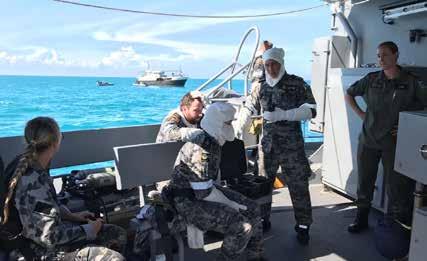


Elite teams come in all shapes and sizes in the Defence Force
We meet the stewarding teams on Defence diplomacy duties in the Pacific.
In Pacific nations, hospitality is an important – and expected – part of sustaining relationships. And while ships carry chefs and stewards, the scale of an intended function could mean assembling a team in New Zealand and getting them there.
That was the case with two recent Ministry of Foreign Affairs and Trade events in Tonga and Fiji. HMNZS MANAWANUI, undertaking a survey of harbour approaches in Tonga, had no stewards on board when it was asked to host Foreign Minister Nanaia Mahuta and the Tongan Prime Minister at a cocktail party on the flight deck. And during Operation Island Chief, HMNZS WELLINGTON was called on to host a function in Fiji – with only one steward in its Ship’s Company.
Able Steward Paige Harvey was among the five-person ‘fly away’ stewarding team sent Tonga (a different team went to Fiji). This was her first experience of a formal function on board a ship.

“We had been given a couple of months’ notice of the opportunity, and had been told what it would involve,” she says.
“For me, it was really exciting. The Crown Prince of Tonga was in attendance, plus the Tongan Prime Minister and Tongan Minister of Foreign Affairs and Trade. New Zealand’s Minister of Foreign Affairs and Trade and other dignitaries were there.”
Event management is a big part of being a steward. The stewarding team booked the gear for the function, organised transport, preordered the food and drinks and made sure everything ran to time. The team set up the marquee, tables and settings, and managed the serving of food and drink.
During the function, Tonga’s Prime Minister talked about the aid provided by the Royal New Zealand Navy and Government of New Zealand during Tonga’s tsunami disaster on 15 January.
“It made me feel immense pride to be part of the NZDF and hear first-hand how we support and help our Island nations.”
The ‘Defence Diplomacy’ theme in fact started a few days earlier, with the team providing talks and teaching sessions with local hospitality students at the Ahopanilolo Techincal Institute, a polytechnic. Students there learn stewarding, cooking, sewing and hairdressing.
“We spent a few days at the school alongside the students, showcasing and teaching what the Navy has taught us in terms of stewarding. This ranged from table setting, napkin folds, producing alcoholic and nonalcoholic drinks, barista services and bed making. They were exceptionally fast learners and had the desire to execute the skills to perfection.”
She says the interaction was very humbling, as the polytechnic’s resources were limited. “The students loved the teaching. They were so engaged with us, so eager to learn as we showed them our day-to-day skills and how we did the cocktail party. They had never seen things like cocktails before. They told us they did a lot of schooling in Tonga before going to Australia or New Zealand for work. We spoke at the school assembly, sharing our journey and experiences to help them feel motivated in the studies they’re doing.
“The other stewards were saying, it was the first time we’d done something like this. We loved it and we’re hoping to do more like it.”
10 | Navy Today #271
ASTD Harvey is from Levin and attended Waiopehu College before joining the Navy in 2020.
“I joined because I wanted to push myself,” she says. “There was a police-run course at school that did a mini-version of basic training. People came and talked about careers in the Defence Force. I thought to myself: I can do this.”
Last year she served in HMNZS TE KAHA for an overseas deployment. Stewards have additional roles while at sea, including boarding party duties and being part of Damage Control teams. COVID restrictions and a tight curfew meant ashore opportunities had been limited.
“I was very excited and fortunate to be in Tonga and I look forward to being able to have many more opportunities such as this throughout my naval career.”
From left: The stewards with students and staff of the Ahopanilolo Technical Institute.
Steward staff on completing the MFAT cocktail party on HMNZS MANAWANUI. From left, CPOSTD Alana McDonald, ASTD Shelby Callaghan, LSTD Dinesty Nathan Patuawa, ASTD Paige Harvey and ASTD Anora Leautuli Talitonu.

The stewards clean up the burial plots of former NZDF members buried in Tonga.

Navy Today #271 | 11
STEWARDS IN TONGA
FIRST TIME AWAY
As HMNZS AOTEAROA progresses to Korea and Japan, we meet some of the personnel who are experiencing their first-ever deployment overseas.

12 | Navy Today #271
Able Medic Daniel Pickles
My name is AMED Daniel Pickles, and I am one of the medics on board HMNZS AOTEAROA. I’m 22 years old and joined the RNZN in 2018 after a short period of university study.

I always wanted a career in healthcare where I could help people both within New Zealand and worldwide, so becoming a medic in the NZDF was a natural path.
As a medic at sea, our primary job is to look after the health and wellbeing of every member of the ship’s company, no matter where in the world we are. Whether we are treating minor illness/injuries, performing medical training or helping refuel other ships, we have to be prepared to respond to a life threatening emergency at any point.
The highlight of our deployment so far has definitely been taking part in the RIMPAC Naval Exercise. It was an amazing opportunity to not only see the capabilities of our partner nations, but also to work with and make friends with people from across the world.

I have had an incredible amount of amazing opportunities and experiences within the Navy that I wouldn’t have gotten anywhere else. If someone is considering joining the Navy I would definitely suggest they make the first step and see what it’s all about.
The photo is unusual as you wouldn’t normally find a medic handling a .50 calibre machinegun. It was a training day and some of us had a chance to have a go.
Able Chef Aimee Pope
I’m ACH Aimee Pope, from Tauranga. I completed my Basic Training in the second half of 2020.
My dad was my drive to join the military, he was always there to motivate me and push me towards the right direction. I always had a passion for cooking especially with the baking side of it, so the Navy was my way of pursuing my passions in cooking and being able to travel the world at the same time. I love the idea that I am a chef but also a sailor, and I have other responsibilities as well as cooking in the galley. Those include being in the flight deck party, weapons handling, and being a part of damage control. My Navy career has only just started and being a part of HMNZS AOTEAROA, it has given me the opportunity to have more experience and gain more skills.
My highlights on board have being a part of RIMPAC, and meeting new people all around the world from different countries. I actually made some really good friends while over in Hawaii. I was a part of RIMPAC sports and attended the 5k run, starting off the run by myself and finishing with an Oppo by my side.
There has been so many highs along the way, including being a part of a team, exploring Hawaii, swimming with turtles, going to the cultural centre and going in a submarine ride.
Our trip has just started and I am looking forward to what the rest of the trip brings me.
Sub Lieutenant Holly Edmonds
I’m SLT Holly Edmonds from Napier. I’m a Maritime Logistics Officer, or Supply Officer in the old terminology. I graduated from Officer Training in 2021.

COVID-19 had hit the job market hard back in 2020. I was coming home from an OE and there were no jobs available when I got back to New Zealand in my career of choice. I wanted a career that was not only stable, but gave me the opportunity to learn skills I never dreamed I would learn like damage control, seamanship and weapons qualifications, for example also wanted a career where I wasn’t always stuck in an office and could get the opportunity to travel. A Navy career has given me the opportunity to do this by deploying with HMNZS AOTEAROA to Hawaii for RIMPAC 22.
Some of the highlights of the deployment so far have been interacting with other Navies. It has been an awesome experience to be able to get to know our foreign counterparts not only in formal environments like cocktail functions but also through playing RIMPAC sports and informal get-togethers like BBQs/Sporties.
Another highlight of RIMPAC was the Photo Exercise day where all the participating ships got together in a massive formation to have a photo taken. It was amazing to see a range of vessels from massive aircraft carriers down to submarines get together so closely to pull off such a complex exercise.
Other highlights have been exploring Hawaii and all it has to offer including snorkelling, swimming with turtles and hiking the many trails around the island.
Navy Today #271 | 13
FIRST TIMERS
Left: HMNZS AOTEAROA conducts a Replenishment at Sea with USS AMERICA.

14 | Navy Today #271
Operating over the horizon
The Air Force’s maritime squadron, No. 6 Squadron, has a rich aviation history spanning 32 years, in two iterations over the past 80 years. We take a look at how integral the squadron is to air operations today.
By Rebecca Quilliam
The squadron is a bridge connecting the Royal New Zealand Air Force and Royal New Zealand Navy and undertakes vital maritime aviation work including anti-surface warfare, underwater warfare, maritime patrols and surveillance, search and rescue, and utility operations (winching and load lifting).
The team also uses its eight SH-2G(I) Seasprite helicopters for domestic tasks for Government agencies, including the Department of Conservation and Ministry of Primary Industries.
“I think that the hybrid nature of No. 6 Squadron makes us unique,” Lieutenant Commander David Roderick says.
“Our personnel really enjoy the smaller squadron – how we are a bit tighter knit than some of the larger fixed wing squadrons. That connection makes a difference when we all go away together for months on a ship.”
The primary mission of the aircraft is anti-surface warfare, which is the key difference from the other Air Force rotary wing squadron, he said.
“We’ve got anti-submarine warfare as well. So we have the ability to visually look for submarines, but also then drop weapons on them if that’s required.
“Aside from the ability to launch weapons, another point of difference for the squadron is the ability to operate in a maritime environment and deploying on Navy ships for significant periods of time – you’re looking at six-month trips.”
The aircraft will also be used by the ship as an “air spotter” when it deploys its own gun on targets beyond the horizon, LTCDR Roderick says.
Alongside that capability is the search and rescue, medical evacuations, and humanitarian aid and disaster relief work performed by the crew.
Earlier this year, the squadron was called to help after a volcanic eruption and tsunami hit Tonga. They flew reconnaissance missions around the islands and reported back to command and Joint Forces Headquarters the extent of the damage.
Another major event the team was involved in was the 2019 Whakaari/ White Island eruption.
“One of our aircraft was on HMNZS WELLINGTON and flying reconnaissance flights to the crater. The island was still in the phase where anything could happen. They flew into the crater a number of times to assess the suitability for landing,” LTCDR Roderick says.
The operation was harrowing, with personnel still dealing with the emotion of the task, he said.
“But it’s something they can all be very proud of and it was great that the work was in conjunction with the Navy.”
Seasprite pilot Lieutenant Commander Sam Williams was the flight commander for the Whakaari/ White Island mission and flew a Seasprite over the crater in the days after the tragic eruption that left 22 dead and 25 injured.
“We ended up being down there for the whole time, on the ship just off the coast a few kilometres from the islands. It was a case of assessing the conditions on the ground, seeing if there was anyone still there and looking for missing remains.”
The conditions were variable and the team had to often wait for the wind to blow the ash away from the route the helicopter needed to fly, he says.
“So we had to pick a moment when it was clear and flying in quite low to stay below the cloud to get to the crater and have a look. The loadmaster in the back had a decent camera and took probably hundreds of photos of the inside of the crater and the island that was covered in debris.”
The squadron trains for these types of missions by doing mountain-flying training in the South Island, LTCDR Williams says.
“In a practical sense we had those skills to fall back on and also general real-time risk assessment skills that you gain as professional aviators. But it was different to normal, especially flying amongst ash and other things in the atmosphere.”
Flying in No. 6 Squadron as a naval aviator is a unique experience where one of the hardest skills to learn was taking off and landing on a moving ship, he says.
“It’s core to our business and we do it in all sorts of different types of weather and sea conditions.”
He described it as a “team sport”.
Navy Today #271 | 15
NO. 6 SQUADRON
“There’s the bridge team putting the ship in the right direction to give you the right winds. You’ve got the flight deck team who are waiting, ready to go out onto the pitching deck in the dark to chain the helicopter down as soon as you land.
“Then there’s the controller and the ops room talking to you on the radio and essentially guiding you – so it’s like a team sport,” LTCDR Williams says.
“When it comes to landing on the ship itself it’s a case of picking your moment really – waiting for the calm in between swells or waiting for the ship to settle down, as it can pitch and roll around quite a bit.”
Working with the Navy made the job unique, he says.
“That’s the kind of thing that most of us want to do and what we trained for.”
Able Helicopter Loadmaster Tyson Turnbull said winching and working with underslung loads on a “moving runway” of a ship’s deck was a dynamic part of his job.

“I’m operating to a moving surface rather than a fixed forest floor, sand dune or top of a mountain. We’re always looking for changes to that environment like the tide coming in the front of the ship or the movement of personnel on the deck.
“We are also listening to the communications that the ship is sending us, giving us clearance to land and briefing us on what the relative wind to the ship is.”
The sea-faring role also provided some special moments, AHLM Turnbull says.
“I’d have to say every time I crack the door and put my head in the wind I get a bit of a smile on my face. It’s pretty cool when you’re out there in
the middle of nowhere and there’s just water. It’s a kind of surreal feeling.
“But I think one of the coolest things I’ve seen is the rising sun in the Pacific from the flight deck of HMNZS AOTEAROA and seeing the silhouette of HMNZS TE KAHA on the horizon.”
Air Force Maintainer Corporal Tobi Johnston-Officer hasn’t had many deployment opportunities yet, aside from a seven-day exercise on HMNZS CANTERBURY.
“You hear stories about the work being fairly tough or the tempo being fairly high. But then it’s funny, with all of the stories about what they went through and what they had to do always end with, ‘But it was so much fun and you’ll love it’.”
The maintainers for the squadron have different challenges to those at No. 3 Squadron, with corrosion and wear and tear from spending time at sea being the major issues, he said.
“The environment is very harsh. The extra maintenance that goes into preventing corrosion of coatings and coverings is quite important.”
The squadron was a unique place where all personnel were trained to perform a number of tasks outside of their trade role, CPL Johnston-Officer says. They all undergo sea survival
16 | Navy Today #271
“We like to think of the Seasprite as a jack of all trades with a focus on that warfare role being the sharp end. They have the extra eyes and ears and teeth for the ship that can go beyond the range of what the ships’ sensors and weapons can do.”
– Lieutenant Commander David Roderick
training as well as a damage control course that teaches firefighting skills in full breathing apparatus and protective clothing.
“If it comes down to it and helicopters are not flying, but the boat is sinking, everybody is involved in all of the emergency scenarios.”
The team works much in the same way as the Air Force’s land-based rotary squadron in term of dispatching and receiving aircraft, and dealing with winched loads.
“But we’re getting the load out on the deck while dealing with 35 knot winds, salt spray and during night or day. It’s a really dynamic experience that keeps you engaged.
“It’s an intense workload, which is what makes No. 6 Squadron interesting and unique.”

Rosie Hardacre operates the Seasprite simulator at Base Auckland. The simulator is a full-mission unit, housing a replica Seasprite cockpit, with all the controls, instruments and electronic equipment.

It also has the same sensors as the helicopter, including its radar, forwardlooking infra-red camera, weapons and electronic surveillance equipment.
“The training tool is fully capable and can simulate pretty much everything the helicopters can do, which makes it a lot easier to train people on,” Ms Hardacre says.
“Instead of getting a newbie pilot to try to land on a ship that’s tilting all over the place, they get to do it in the safety of the simulator.
“It saves a huge amount of money in terms of fuel costs and maintenance of the aircraft itself.”
The machine can simulate all kinds of weather and day or night modes with a “click of a button”. They can also throw all kinds of ship movement at the crew, she says.
“It’s pretty cool to see the kit move with the ships’ motion – it’s so realistic.”
During simulator training the team of pilots and loadmasters take part in the simulated sorties.
“It always helps to take the load off with the full crew on board.”
No. 6 Squadron: A brief history
The squadron was created during World War II as an Army co-operation unit flying Vickers Vildebeest and Hawker Hind aircraft. They were joined by other maritime patrol flying boats including the Consolidated Catalinas.


A base in Tonga followed to protect shipping and later the detachment moved to Vanuatu and then to Halavo Bay, just north of Guadalcanal, where they stayed for the rest of the war.
The squadron had successes with rescue tasks, dubbed Dumbo missions, where they saved dozens of servicemen in 25 missions.
Following the war, the squadron flew Short Sunderland flying boats and Auster light aircraft. But by August 1957 the squadron was disbanded, with the Sunderlands moving to No. 5 Squadron.
Nearly 50 years later in 2005, No. 6 Squadron was re-formed and based at Whenuapai where they flew SH-2G(NZ) Seasprite helicopters, replaced in 2015 by eight SH-2G(I) versions.
The helicopters can embark on HMNZ ships TE KAHA, TE MANA, AOTEAROA, CANTERBURY, WELLINGTON and OTAGO. They can be equipped with Penguin anti-ship missiles, Mk 46 torpedoes and the Mag 58 General Purpose Machine Gun
Navy Today #271 | 17
“We operate well over the horizon. And that’s the work we want to be involved with, being on the back of a ship transiting the South China Sea, conducting warfare exercises in Southeast Asia or at RIMPAC, or looking for drug smuggling dhows in the Indian Ocean. That’s the kind of thing that most of us want to do and what we trained for.”
– Lieutenant Commander Sam Williams
Chief of Army MAJGEN John Boswell and Chief of Navy RADM David Proctor pause during the wrapping of RSA Christmas parcels for personnel serving overseas.


OUR PEOPLE


Deputy Chief of Navy CDRE Melissa Ross chats to her counterpart, RADM Chris Smith, RAN, at Te Taua Moana Marae.

CDR Glenn Avard is awarded a DMSM from Chief of Defence Force AM Kevin Short for his work in bringing HMNZS MANAWANUI into service.

18 | Navy Today #271
WOET Te Kani Te Wiata models items of the NZDF’s new cultural attire.
LSTD Dinesty Nathan Patuawa serves during a function for the Chief of Naval Staff India.
18 | Navy Today #271
LT Rosemary Hebden receives a Chief of Defence Force Commendation for her role with the Managed Isolation and Quarantine operations cell.
OMA
22/02,
MID




PEOPLE
OMT
POSCS
Navy Today #271 | 19
Katie Staines, BCT
gets her boots in top condition for her upcoming kit muster.
Instructor LCSS George Longhurst points out what OET Zachary Wilson has missed during his Kit Muster training.
ACT Nicolas Cannell and Chief of Navy RADM David Proctor share cake-cutting duty for the Navy’s 81st birthday celebration at Defence House.
Lauaki Lotulelei Achilles Division BCT 22/02, goes through the rigours of a kit muster.
Jorja Marshall, JOCT 22/02, looks up during a casualty handling exercise at Tamaki Leadership Centre.
OUR PEOPLE 19 | Navy Today #271
Jermaine Martinovich, HMNZS TE MANA, is awarded a Commanding Officer’s commendation.
SUPPORTING MARITIME LOGISTICS
As part of an ongoing series on the Navy’s behind-the-scenes support organisations, Navy Today showcases the Defence Logistics Command (Maritime), Naval Supply Depot.
The Naval Supply Depot, a massive warehouse structure in the North Yard, is the biggest feature of the Navy’s Supply Chain Group, itself a sub-unit of Defence Logistics Command (Maritime). It’s responsible for delivering operational logistic support for all maritime platforms, HMNZS PHILOMEL (including satellite units) and to wider NZDF operations. In short, NSD provides materiel logistic support in order for maritime units and crews to operate effectively.
In the Defence Force’s largest maritime warehouse, you’ll find most everything you’d need for a Fleet unit to operate, with inventory ranging from nuts, bolts, washers and O rings to ships engines and generators (lower and higher assemblies). You won’t find ammunition or munitions, small arm weapons and parts, rations (food), controlled pharmaceutical items, Defence clothing or bunked fuels.
It’s easy to sense the pride in a team who keep the Navy running. It’s definitely evident in the voice of Lieutenant Commander Chris Smith, Deputy Supply Chain Manager, as he shows us around. But it’s also evident in the prominently-displayed Deputy Chief of Navy commendation on the wall in the NSD reception area. The Supply Chain Group has also had two Civilian of the Year Awards (Andrew Charnley 2020 and Shelley Newland 2021) and a New Zealand Defence Force commendation for the Supply Chain Manager / Fleet Maritime Logistics Officer, Commander
Paula Dacey. Earlier this year, the SCG also received an ISO 9001: 2015 accreditation for operating a quality management system.
The Naval Supply Depot has around 60 staff performing various duties within the Group, comprising both military and civilian personnel. While the civilian staff provide the continuity, Logistics Supply Specialists and Maritime Logistics Officers will rotate through as part of their trade training and career development.
Goods are basically receipted in the warehouse and are either tracked to ships’ shelves, or a unit’s distribution bin or into the warehouse inventory holdings.

Systems Upgrades, essential ship’s stores had to be packaged up and freighted over – not an easy task during the COVID pandemic.
“COVID-related lockdowns and restrictions were a significant challenge for us in terms of the world supply chain issues,” says LTCDR Smith. “Everything went into lockdown. A large percentage of freight coming into and out of New Zealand by air was via passenger aircraft and when they ceased flying, the Defence Force was competing for the same space on the limited aircraft still flying as the rest of New Zealand industry. Fortunately, with the easing of restrictions and increase in freight movement globally, all that has eased now.”
The inventory for an operational ship is complex enough, but the Group is also part of the Maritime Engineering Support Team (MEST). This incorporates Babcock New Zealand Limited, who are tasked with the maintenance, repair and overhaul of ships, equipment and systems. Their shopping list can be substantial.
And it’s not just about replenishing ships alongside at Devonport. When the two Anzac frigates were in Canada, undergoing their Frigate
The NSD is not like a DIY store. You can’t go to an aisle marked ‘Screws’. Everything that arrives is given a barcode, and the item is assigned to a set location in one of many sections, racks and shelves. If an item is needed, a computer search will provide the location code. Because of the size of the racking within the warehouse, many of the items are at height, but there’s a clever way to retrieve them. A specialised packer, rather like a forklift, is operated by a trained storesperson and is electronically guided by wire sensors installed in the warehouse floor. They can fit in the space between racks, placing or retrieving items sideways.
And, like any warehouse, there’s the odd item being sheltered or being ‘Held on Behalf Of’ because there’s nowhere else for it to be adequately stored. In NSD’s case, there’s an entire Wasp helicopter, stored for the Navy Museum.
20 | Navy Today #271
“We are driven by robust and proven processes, which are reviewed and updated on a regular basis,”
– LTCDR Smith.
The upstairs offices are humming, with Inventory Support, Customer Services and Material Data Management teams responding to enquiries and purchase orders. It’s not quite a 24/7 operation, although there is a duty NSD Officer on call outside of normal working hours for anything urgent.


“The staff have been fantastic, especially in the past few years under COVID restrictions,” says LTCDR Smith. “Essential personnel still had to come onto base, working with limited resources to manage demands and maintain outputs, which also included support to Operation Protect. The demands of providing military personnel to Isolation Facilities, Northern and Southern Border checkpoints and wider Operation Protect HQ duties was a challenge for all, as those remaining at NSD were required to fill the gaps, while maintaining essential outputs. Our civilian staff were an excellent support as they allowed the military personnel to support the New Zealand Government’s direction. So when I see the commendation on the wall, and you can read in writing what we have all achieved, you think, yeah, we’ve done a lot. I’m very proud of the way the whole team has operated over this time.”
Second from top: Deputy Supply Chain Manager LTCDR Chris Smith.
Below: Inventory Controller Shelley Newland.

Bottom: CDR Paula Dacey receives an NZDF Commendation from Chief Joint Defence Services, BRIG Rob Krushka

Navy Today #271 | 21
e.
d.
MEDIC ON CALL
Stepping on to the brow of HMNZS WELLINGTON for her first sea posting, Able Medic Celynia Thompson couldn’t help feeling a little unprepared.
After two years and eight months of medical training at Burnham Military Camp in Christchurch, she was well trained, both academically and as a medic in the field, but it had been a long time since she had set foot on a ship.
AMED Thompson was a medic on board WELLINGTON for Operation Mahi Tahi, during the ship’s fisheries patrols in the Western Pacific in August and September. And one month into the operation, she says she could not have picked a better first ship and crew to post with.

Originally from Hastings, AMED Thompson, 22, grew up in Australia. After applying to join the Navy, she moved to New Zealand and two weeks later started with her intake in early 2019. “I was going to be moving away from all my family (apart from her Nan and an Aunty), so joining the Navy was a decision I had made to help push myself into growing.
“I wanted a long-term career, and a career that I could look at and know that every day wouldn’t necessarily be the same. I didn’t want a repetitive 9-5 job. I wanted to work hard and reap the benefits of stepping ashore into different countries.”
On board WELLINGTON, she worked under a Leading Medic to help the Ship’s Company when they needed it. “An average day would be getting up at 0510 for personal Physical Training, then starting work most of the time at 0730 or 0800 with ‘sick parade’, and that’ll go until 0900.” Sick Parade is when crew members present themselves with ailments or issues.
A lot of the day is administration, particularly around care and custody of medical stores, and what will get transferred to other ships or back into base storage when the operation is over. There’s another sick parade at 1300. “I find stores for stocktakes, see patients, and attend Damage Control exercises.
“We work under COVID-19 protocols where necessary, which means doing supervised Rapid Antigen Tests in the hangar or telling people to keep their masks on.”
The hardest aspect of the job is probably the lament of any medical person. “Getting the crew to follow medical advice!”
Having said that, the highlight has been the ship’s company. “I can say with 100 per cent honesty that I don’t think I could have had a better first crew to post with. Another highlight has been learning the ropes through Leading Medic Georgia Boden, who shows no judgement to any question I throw at her and has been quick to teach me as much as she can about being a medic on board.”
AMEDThompson joined the cultural practice group on board. “It’s open to any and all cultures, where we bring in different songs to learn and sing.”
She says she enjoys traveling to new places, whether it’s a new restaurant or a new town. “That fits perfectly with the Navy when on deployment. I have a passion for listening and learning about other cultures and in this job, you get to step ashore into different countries.”
Her advice to others would be to expect the unexpected. “This a career where you will have to adapt to unforeseen circumstances that may not fit personal preference, but people make the best of the situation together and there are amazing experiences when you keep an open mind to what you get at hand.”
22 | Navy Today #271


Navy Today #271 | 23 WELLINGTON MEDIC
Te Puke Teacher Takes Navy Teachings To School
Naval Reservist trainee and school teacher Bayley Macdonald isn’t quite at the point of getting her Year 7s and 8s to do drill, but her Navy training is definitely lending value to her teaching and sports coaching at Te Puke Intermediate School, Bay of Plenty.
Ordinary Maritime Trade Operator Macdonald is one of 24 officers and ratings undertaking the Royal New Zealand Navy’s Naval Reserve Common Training programme this year. The course, aimed at revitalising the Naval Reserve, is designed to ensure the reservists are trained to the same standard as their Regular Force counterparts, while working around their civilian employment.
Ms Macdonald was inspired by her class’s positive reaction to her partner, who was previously a teacher aide at her school and talked to students about his work in the Territorials. “They were really fascinated, and I thought of what opportunities we could provide the students. It could be something for me.”
She initially looked at Army, but thought the Navy was “way cooler”. The NRCT course was brand new and there were places available.
“I don’t know any Navy personnel. I went into this blind and I didn’t know much about the trade.”
OMTO Macdonald and her fellow ratings will train as Maritime Trade Operators after graduating from basic training in December. MTOs are the liaison between maritime industries and the New Zealand Defence Force ashore and at sea. Those training as officers will specialise in roles similar to their day jobs, such as medical, legal and public affairs.
Her course, which started in February, includes residential phases of 10 days at Devonport Naval Base in Auckland. She has online learning and attends parade nights at reserve unit HMNZS Ngapona in Tauranga once a week.
“The residential phase up at Whangaparāoa was definitely a highlight,” she says. “We got to do things that regular forces do in their Basic Training. Another highlight was the Annual Weapons Qualification and learning how to shoot. We went to Christchurch for that. I had never held a rifle or a Glock pistol before.”
She likes the buzz of getting together. “This is where I really thrive, being together with everyone. It’s quite fun, and when you get us all together, you learn from civilians who already work in Defence, from those who are commissioning from the ranks, to people like me, who come brand new. I get to be inquisitive and ask questions and grow more.”
Fitting the training in can be tough, especially travelling up to Ngapona in Tauranga after a school day. “But the training overall is done over an elongated period of time, and it’s been great that the residential courses have been structured around the school holidays. I can’t take leave, so that’s been a big thing for me.”
She’s applied some of her learning to the hockey team she coaches, including ‘Lead Self’, where students accept responsibility to support their own development, as well as growing into people who can lead others. “We get the kids to lead a lot of things, and then come back and report that they are done and ask what happens. We teach them that everything is done for a purpose and a reason. I’m not making them do drill just yet, but we do walk in straight lines around the school.”
The ratings will share a Devonport passing-out parade with the officers, who graduate in April.
24 | Navy Today #271
| Navy Today #271
“I don’t know where this is going to take me,” she says. “But I would love to deploy and get experience serving on a ship.” Her advice to others is to give it a go. “It’s a group of absolute professionals, really intelligent people, and really cool stories in the mix. It makes it more special.”


Navy Today #271 | 25
MEDIC MAT
By Simone Millar, Senior Communications Adviser (North)
Able Medic Abbey Brown was one of three Royal New Zealand Navy medics fighting it out for the title of ‘top medic’ last month, and as the only female to compete in the tri-service event, she let her talents shine.


Fifteen medics from the New Zealand Army (NZ Army), Royal New Zealand Navy (RNZN) and Royal New Zealand Air Force (RNZAF) spent a gruelling three days (October 18-20) testing their skills to their limits at Medic Match 22.

Traditionally held in the Manawatu, this year’s competition was based in Auckland, at Tamaki Leadership Centre, Devonport Naval Base and RNZAF Base Auckland, Whenuapai. The competition is designed to find the best all-round medic and includes physical endurance activity, shooting, advanced medical skills, cognitive problemsolving and public speaking.
On day one, the medics are tested for resilience at the shooting range at Auckland’s Tamaki Leadership Centre, followed by a ‘Rescue Randy’ scenario: dragging an 80kg casualty over 75 meters and applying a tourniquet and pressure bandage.
“I was very nervous at the start of the competition, knowing I’d need to compete against a lot of males. I really wanted to prove a female can do anything a male can. The most challenging part was definitely on day one, trying to keep my mindset strong through the physical challenges and pushing on. I was also really nervous about shooting at the range, because I don’t use weapons that much. But once we did dry drills I was absolutely in to it,” says AMED Brown.
Twenty-two-year-old AMED Brown joined the Navy straight from school and has recently posted from Devonport Naval Base to Waiouru, to work with the NZ Army. All of the medics were competing for the first time and experience ranged from recent graduates of the Defence
26 | Navy Today #271
Health School, who will have just met the full medic competency requirements, through to medics who have spent more than 15 years in the field.
“The competition is designed to find the best all-round medic, there’s something to challenge everyone from any service, whether it’s a physical endurance activity, shooting, advanced medical skills,
cognitive problems, public speaking or just turning up with the right kit. Competitors need resilience, trade skills, and technical excellence to win,” says Medic Match 22 coordinator, Lieutenant Aidan Bilbe, Assistant Training Officer Deployable Health Organisation.

Core skills are focused on in day two of the competition, with competitors completing a swim rescue and resuscitation at Devonport Naval Base, and AMED Brown came in to her own and took out the swim test.
“I really felt at home competing in the swimming event. I was really in my element and could show my skills and abilities more. Working out the best way to drag a dummy in to the pool, I could draw on my techniques I learned from my surf lifesaving, and then working really hard on keeping a consistent CPR rhythm,” says AMED Brown.
Four medics made it through to the third and final day, with clinical and technical excellence the ultimate test, contested at RNZAF Base Auckland, Whenuapai.

First place went to NZ Army medic Staff Sergeant Andrew Kennedy. NZ Army medic LCPL William Wallace took out second place and RNZAF medic LAC Scott Endres came in at third place.
“The participants were very impressive this year and the top spots were hotly contested. It’s the first time the biennial challenge has been spread across more than one day, and the challenges were carefully designed so that they don’t favour one service or another,” says LT Bilbe.
“I’m definitely going to compete in Medic Match again. It was a great experience and I found that I can push myself a lot harder than I thought I could. I’m a lot more mentally tough than I thought I was,” says AMED Brown.
Navy Today #271 | 27
CH“I always wanted to be a medic, I did a lot of surf lifesaving growing up, so combining the Navy and being a medic is so awesome, it’s two of my favourite things.”
Able Medic Abbey Brown
Maritime Culture –Creating our Future
The Maritime Culture Guardianship Group (MCGG) have completed the Understand phase of the culture initiative. The outcome of this phase was to understand the culture we currently have and well as the culture we want. To build this understanding, the MCGG conducted the Maritime Culture survey earlier this year, ran focus groups with Junior Rates and Junior Officers, undertook analysis of Pulse and Exit Survey data, as well as running a number of workshops and facilitated sessions across the Navy – most recently with the Naval Leadership Board and the Warrant Officers Forum.
As part of the work to understand our future culture, the following question was put to groups of Junior Officers, Junior Rates, Warrant Officers, Senior Officers and the Naval Leadership Board:
If you were walking around Devonport Naval Base in five years’ time and the culture of the Navy was good, what would you see, hear, and experience?
This turned out to be a valuable activity and the themes which emerged were similar across the groups. The groups identified that they will know our culture was great because the Base would be busy with a variety of social, cultural and sporting activities occurring, there would be a cohesive sense of purpose, whānau would be active in the Navy community, Ships would be away, there would be investment happening in the Base infrastructure, and there would be new ways of supporting our people to meet the challenges of living and working in Auckland.
From these sessions, the survey data, and the review of recent Pulse and Exit survey data, the MCGG has identified five priority areas for strengthening the culture of the Navy:
• Revitalising our shared sense of purpose – what makes us unique as sailors and civilians in the RNZN
• Improving our internal communications to ensure the right information is flowing up and down the chain of command
• Focusing leaders on prioritising people in their decision-making
• Building effective and empowering career management and development systems
• Strengthening whakawhanaungatanga across the Navy community with a focus on Devonport Naval Base and surrounds.

These five areas will form the basis of the MCGG’s focus for the next one to two years. We will be continuing to ask for your engagement and participation in workshops, focus groups, and working groups to continue the important mahi in strengthening our unique maritime culture.
He waka eke noa / We are all in this together.
28 | Navy Today #271
Military Justice Online
The New Zealand Defence Force has now published its Annual Report on the Military Justice System on its website.

The move is in line with the Defence Force’s policy around transparency and informing the public of its processes.
New Zealand’s military justice system is a separate and parallel system of justice that forms an integral part of the New Zealand legal system. It also shares many of the same underlying principles as the civilian criminal justice system.
The report details data collected on judicial cases over the 2021/22 financial year. During that period a total of 426 Summary Trials (dealing with 590 offences) were heard. There were five appeals to the Summary Appeal Court.
Four trials were heard in the Court Martial of New Zealand and there were two appeals to the Court Martial Appeals Court.
Chief of Defence Force Air Marshal (AM) Kevin Short welcomed the move to make the information public.
“Publishing the report is integral in ensuring our systems and processes are transparent to the public.
“We hold our people to a high standard and publishing the report on the NZDF website shows we are effective in holding the actions of our people to account, should they behave in a manner contradictory to military rules and regulations,” AM Short said.
Alongside transparency, making the report public will also have a deterrent effect on personnel, making it clear that certain actions have defined consequences, he said.
The military justice system currently has a two-tiered structure comprised of a summary system and the Court Martial of New Zealand.
Information about Summary Trials and Court Martials, along with appeal decisions are included in the report. Summary Trial information is categorised by service, rank and gender. The types of offences tried are also listed.
Punishments imposed by Summary Trial and Court Martial are also detailed in the report.
The military justice system is designed to promote the operational effectiveness of the New Zealand Armed Forces by contributing to the maintenance of discipline, efficiency, and morale, while ensuring that justice is administrated fairly and with respect to the rule of law. These objectives give rise to many of the substantive and procedural differences that distinguish the military justice system from the civilian justice system.
The report can be found at nzdf.mil.nz/military-justice-report
Navy Today #271 | 29
MILITARY JUSTICE ONLINE Navy Today #271 | 29
STAYING STAUNCH WITH STALWART
Navy Today catches up with Able Logistics Supply Specialist
Teresa Clair, on exchange with the Royal Australian Navy and seeing the Pacific on board its newest replenishment tanker.
New Zealand Navy skills are proving readily exchangeable with our partners, as ALSS Clair is proving on her exchange with Australia’s new Supply-class replenishment ship HMAS STALWART.
She posted from HMNZS CANTERBURY and has been involved in Exercise Kakadu, followed by an overseas deployment that will take in port visits to Singapore and Japan. Last month STALWART participated in Exercise Sama Sama-Lumbas, involving the Philipines, United States, France, Japan and the United Kingdom, soon to be followed by the International Fleet Review in Japan, which will include HMNZS AOTEAROA.
What ALSS Clair loves about her trade is how inclusive, caring and supportive of everyone is with each other, whether they are Kiwi Logistics Supply Specialists or Australian Maritime Logistics Specialists.
In STALWART, she is an ABML-SC, an Able Seaman Maritime LogisticsSupply Chain.
“A typical day would be breakfast and a morning meeting at 0800 with the ML-SC, also known as the “Storbies”. We discuss what jobs are priority and what jobs we are currently working through. I am usually paired with an
ABML-SC or LSML-SC to learn and assist with various tasks or jobs that they may be working on.”
If the ship is involved in a Replenishment at Sea, she will be on the recovery line, ‘closing up’. “We break for lunch, and then it is straight back into it until the working day finishes at 1600. I end my day with a venture to the Physical Training session that is run on board, and relax for the rest of the evening.”
There are many similarities between the two Navies, she says. “The end goal always remains the same, and that is to do our job professionally and competently.” One small difference is she is the only one on board who irons her uniform.
She says the exchange has been a real eye-opener. “I’m learning new things every day. It has been excellent for my development, both in a professional and personal sense. It has broadened my knowledge as a Logistics Supply Specialist and also my knowledge of the world.”
Originally from Wairoa, Hawke’s Bay, ALSS Clair joined the Navy in 2020.
“I wanted to challenge myself and try something new. I trained as a Meat Inspector at my local Freezing
30 | Navy Today #271
Works straight out of high school, eventually being selected to move into a supervisory role at quite a young age. I felt I still had more to offer though, and I wanted to embrace new opportunities so I looked into a career in the Navy. It’s a decision I haven’t regretted for a moment, and I feel proud every day to serve our country.”
For those who follow her on exchanges with other navies, she would tell them to push themselves outside of their comfort zone.

“This is where the growth happens. I was nervous about this exchange, but I realised that this is where the adventure starts. We’re trained to be resilient, and I wanted to showcase that resilience to the world. I’m so grateful for the opportunity I have been given and to be able represent our Navy. I know the next successful candidate will be too, and I’ll be there to offer a helping hand to them if they should ever need it.”

Navy Today #271 | 31
HISTORY: SNAPSHOT
A
GOOD
AIRFLOW
This image, provided by Navy Today reader Bob Pinker, shows EM1 Pinker, AB Archie Goodfellow and ME1 Merv Tyree in ‘Antarctic underwear’ on board HMNZS ENDEAVOUR I in 1958, during a trip to the ice.


“We didn’t have a lot of the modern stuff you have today,” says Mr Pinker. “All our jackets and pants were made of kapok.” He reckoned without the fishnet underwear the men would sweat badly, not a good idea in freezing temperatures.


The practice continued with ENDEAVOUR II, and former sailor Keith Ingram (editor of Professional Skipper today) provides some context. He was in ENDEAVOUR II’s last supply trip to Antarctica in 1970-71.
“We were issued with air cell fishnet short sleeve T-shirts and trousers. The idea was it trapped a layer of air between your body and long johns worn over the top. The trapped air would quickly warm and added to the insulation of the body and then you just added layers.”
Those layers included a woollen shirt and trousers and woollen seaman jersey which had short sleeves and finally the padded jacket and overpants. “Two pairs of socks - the standard woollen socks which you washed with your knickers and then the large outer bulk knitted white or flecked woollen socks. Finally you had two sizes larger Enson Leather pull-on boots.” It would take 15 minutes to get dressed, to face an outdoor chill factor of minus 40 degrees if the wind was blowing.
ENDEAVOUR I was commissioned to transport the New Zealand section of the Commonwealth Trans-Antarctic expedition, including Sir Edmund Hillary, to McMurdo Sound in 1956. She carried on as an Antarctic research ship with her last trip in the 1960-61 season.

ENDEAVOUR II was a Patapsco-class gasoline tanker, commissioned in 1962 and paying off in 1971.
Today the Navy uses a modern highquality seven-layer clothing system for every person deployed south on a ship. You can read more about Bob Pinker’s adventures in ENDEAVOUR I in Navy Today December 2021.
32 | Navy Today #271
DEFENCE FERNS PIPPED IN THE CLOSING MINUTES
It was heartbreak for the Defence Ferns last month as they were pipped in the final minutes by France in the first ever women’s International Defence Rugby Competition (IDRC).

The Ferns led 8-6 for much of the game, but a penalty meant the French moved one point ahead.
New Zealand’s fortunes looked good after the French lost forward from the kick-off, but the Ferns couldn’t capitalise in the dying minutes.

It was a tough moment for the previously unbeaten Ferns, who had defeated France 22-10 in the opening match of the tournament, hosted at College Rifles Rugby Club in Remuera, Auckland.
Defence teams from Australia, Fiji, France, Tonga, the United Kingdom and a combined Papua New Guinea/ Vanuatu side attended. Fiji came third, defeating Australia, and the United Kingdom took the Plate Final against Tonga.
Sub Lieutenant Kate Williams and Corporal Hayley Hutana (RNZAF) co-captained the Defence Ferns. SLT Williams said the team was a “superdriven bunch of women” constantly pushing themselves to be the best.
“In our jobs we aim to be the best, and I think this translates into our sports. It’s cool that the Defence Force lets us to develop as sportspeople, and to come together and show it off internationally.”
Set against the backdrop of the Womens’ World Rugby World Cup, the IDRC felt like a pinnacle for NZDF women in rugby. “We’ve always talked about something like this, so it’s cool that it is finally happening.”
Winning or losing, the team ethic doesn’t stop for second five-eighths Ordinary Hydrographic Systems
Operator Milania Cairns, the youngest in the team at 19.
“I knew when I joined the Navy I would be in a hands-on environment, where no two days would be the same. I enjoy teamwork and knew that in the NZDF I would have endless opportunities to better myself each day.
“Being able to say I love my job and being able to come into work knowing that I am able to learn something new each day is the highlight of my military career so far.”
Welsh-born SLT Williams didn’t in fact play in the final, owing to an unexpected call-up as an injury replacement for Wales in the Rugby World Cup.
Navy Today #271 | 33
Navy Today #271 | 33
Top: Co-captains SLT Kate Williams and CPL Hayley Hutana (RNZAF).
The Fleet Personnel and Training Badge
Ko ngā Kete o te Wānanga Baskets of Knowledge
The Royal New Zealand Navy’s latest badge is that of the Fleet Personnel and Training Organisation (FPTO), responsible for managing the careers of all uniformed members of the RNZN and the delivery of induction, leadership and environment-specific professional training to all naval personnel. The FPTO is the last major unit within the RNZN to have its own badge.
The concept for the FPTO badge was put together by Commnader Jay Taylor-Innes, who worked with designers at Defence Public Affairs to arrive at the final design.
The FPTO badge is a kete (basket or kit), set upon a background representing the sea and sky. In Māori mythology the kete is a symbol for knowledge, education and wisdom. This is derived from the story of how Tane-te-Wānanga obtained for all mankind three baskets of ancestral knowledge from Io, the supreme spiritual power:
Te Kete Aronui – the basket of knowledge of aroha, peace and the arts and crafts that benefit the Earth and all living things relevant to the enlightenment of people and the preservation of physical, spiritual and mental well-being.
Te Kete Tūāuri – the basket of sacred knowledge relating to the creation of the natural world and knowledge of karakia and the history and practices of human lineages.
Te Kete Tūātea – the basket of ancestral knowledge of the black arts and evil (including war). It also includes agriculture, tree or woodwork, stonework and earthworks.
The symbolism of the kete reflects a core purpose of the FPTO; to provide education and professional knowledge to all sailors throughout their careers.
The badge will come into usage in November/December this year.

34 | Navy Today #271
04
ROUNDS
Job title and description: Director Strategic Engagement (Navy) / RNZN Support Branch Category Commander
Date joined: September 1985
First ship posted to: HMNZS CANTERBURY (F421 Leander-class frigate)
Best deployment(s):
As with many readers there have been so many memorable deployments and postings. I have been very fortunate to spend a bit of time at sea, within MOET duties, deployed with the UN, and have served within JFHQ, HQNZDF and Naval Staff. One to mention would be during 2008 on board HMNZS TE MANA (the better Anzac frigate) during the Gulf Deployment. The ship’s company were fantastic and we truly understood the purpose and the efforts we needed to attain for the deployment. Perhaps I didn’t enjoy the workup or leaving our new born son with my awesome wife so I could deploy, but the trip and experiences as a worked-up ship with a dedicated team were simply fantastic!
My current role within Naval Staff is without doubt another highlight and the great part is being able to source opportunities overseas for our people, many of which you read about in this magazine – again all of which would not be possible without an amazing team.

Hometown: Lyall Bay, Wellington
High school Rongotai College
07
Favourite book: I’m currently reading the book Belonging by New Zealand writer Owen Eastwood. He talks about ‘whakapapa’ and the need to understand your purpose, identity and sharing ownership with your team – I got into this as a way of mentoring people and share it with the Support Leadership Board – highly recommend it.
08
Favourite movie: Reservoir Dogs

Favourite album: Eric Clapton’s Crossroads
10
09 13
Favourite song: Cocaine by Eric Clapton 15
11
Favourite holiday destination: Crete would be my first choice, however around New Zealand our family loves heading to Waihi Beach in the Bay of Plenty, and getting out on the water.
Outside of work, what’s something you enjoy doing?
Spending time with my family. Over the years I have travelled for work quite a bit and realise the one constant that keeps me going is my family. Oh, and the odd DIY project might get in the way together with trying to play the guitar but am still waiting for the WON to help me develop on that one.
What’s something about you that not many people know?
I make pretty good pizzas, and I was a young Leading Writer when I was awarded the British Empire Medal in 1992.
A valuable life/Navy lesson for me is? An old career manager of mine (Mark Ternent) once said to me to volunteer for anything and everything (never have a missed opportunity) . There will be some not-so-good postings but always focus on what can be possible if you put in for things. I have tried to remember this always for all the people I have had work for me and who I have worked with.
How would you describe the Navy in 10 words or less:
A whakapapa/family for all to learn, live and give back.
Navy Today #271 | 35 15 ROUNDS 01 06 02
15
12 03 14 05 WITH COMMANDER COSTA PAPADOPOULOS, BEM
Navy Today #271 | 35

