NEW HORIZONS M AG A Z I N E F RO M U P P S A L A U N I V E R S I T Y
•
ISSUE 2, 2016
In search of new
THEORIES
Page 20
theme CLIMATE
CHANGE
INSIDE:
STUDENTS DRIVE INNOVATIVE COURSES Page 8 HARD TO SOLVE JIHADIST CONFLICTS Page 24 BUSINESS LEADERS MENTOR RESEARCHERS Page 34
1
NEW HORIZONS ISSUE 2, 2016
PHOTO: MIKAEL WALLERSTEDT
IN THIS ISSUE: THEME: CLIMATE CHANGE 4 Keeping an eye on climate change 7 The psychology behind the denial 8 Student-led education on big issues 11 New climate professor in place
The desire to improve BEING A WORLD-LEADING RESEARCH UNIVERSITY has its obligations.
We have an obligation to ourselves and to the rest of the world to continuously work to develop our activities. The evaluations and quality surveys we conduct are not only to confirm that we are up to standard, but also to see how we can improve. Through investments in infrastructure and research centres, we create opportunities for new partnerships across boundaries. The breadth of our University, with high standards in many subject areas, offers great advantages. New perspectives can open up from inquisitive meetings and discussions within our own organisation. But although we are proud of the broad base of expertise we have at the University, we want more. Uppsala University must open doors, to companies and communities in Sweden as well as to academia worldwide. We must invite in researchers and teachers, increase the number of visiting professors (like Kevin Anderson on page 11), and invest in young academics through more career-development positions. Some areas, in which we are particularly strong, get international attention and already attract many. Next year, when we have completed our analysis of the status of quality and innovation-driving processes in our research environments, we will know more about what measures are needed to take our research to the next level. This is another step towards making the greatest contribution we can to society. Success brings self-confidence, but the challenges never let up. Some of our current research initiatives include antibiotic resistance, medical technology, the digital society, migration, integration and racism. In these and in many other areas, the University and the research that is conducted here can play a crucial role. Looking to the future, the University is working intensively to contribute towards solutions to the problems ahead and to those already here. One of the biggest of these is the issue of climate change, which we will continue to work on while you read. n Eva Åkesson, Vice-Chancellor
12 Global democracy – a realistic dream 13 Education for sustainability teaching 18 In focus: Thesis on diet sparked debate 20 Researcher profile Monica Guica: Black holes fascinate 24 The road to peace in jihadist conflicts 26 Open online courses for the whole world 30 Pupils help researchers survey brown water 32 Innovation: A business journey that began in space 34 Business leaders guide young researchers 36 Alumnus Trita Parsi: At the heart of international politics 38 Sara Danius, Permanent Secretary 40 Last word: The mobile game that made it big
New Horizons is Uppsala University’s magazine about research and education. It is issued twice a year, in English and in Swedish (Nya horisonter). The magazine can be ordered free of charge or downloaded as a PDF at www.uu.se/new-horizons Address: Division for Communication and External Relations Uppsala University PO Box 256, SE-751 05 Uppsala, Sweden Editor: Annica Hulth, annica.hulth@uadm.uu.se Editorial board: Magnus Alsne, Anders Berndt, Anneli Björkman, Reihaneh Dehghani, Sara Gredemark, Sarah Havrén Schütz, Linda Koffmar, Anna Malmberg. Executive editor: Urban Lindberg Layout: Torbjörn Gozzi Printing: Danagård Litho English translation: Semantix English language editor: Timothy Chamberlain
Uppsala University must open doors, to companies and communities in Sweden as well as to academia worldwide. 2
The paper is produced in Sweden, and the amount of water used in its production is uniquely low. The raw materials come from Forest Stewardship Council (FSC) forests.
NEW HORIZONS: ISSUE 2.2016
An eye on the climate.
4
Student-led education.
What will be the effects of climate change – for the weather, health, peace?
Sparked debate.
18
Brown water.
8
Where students choose their teachers from academia and outside.
30
At the heart of politics.
36
How do we reverse the trend?
PHOTO: DAVID NAYLOR
CLIMATE CHANGE EXISTS. It is a fact. It might have been a topic for debate a few years ago, but today there is broad consensus among the world’s scientists. The carbon dioxide we emit is causing global warming. There are differing opinions on what and how big the consequences will be, but one thing is sure: more education is needed on the issues of climate change and sustainable development. CEMUS at Uppsala University has worked with education in global development and environment issues since the 1990s. They also have a unique visiting professorship in climate leadership that is bringing new perspectives to the table. The new professor, Kevin Anderson, truly practises what he preaches. He came to Uppsala from Manchester on the train, even though it took 51 hours and he had to change trains and stop overnight along the way. Research on climate change is not only about measuring what is actually happening in nature. It is just as much about psychology and the direction society needs to take to reverse the trend. Keep reading for some examples of the extensive research being conducted. n
Annica Hulth, Editor annica.hulth@uadm.uu.se
3
CLIMATE CHANGE T E X T : A N N I C A H U LT H P H O T O : M I K A E L WA L L E R S T E D T
Keeping an eye on climate change What consequences do climate changes have – for the weather, health, peace? This is a complex question requiring a great deal of research to answer. Uppsala University has a number of researchers working to contribute more knowledge on this issue. METEOROLOGY:
Risk of extreme weather As much as 90 per cent of the carbon dioxide we emit ends up in the seas, so it is important to keep track of the interaction between the seas and the atmosphere. Anna Rutgersson, Professor of Meteorology, conducts extensive research on the role of the seas in the climate system.
Anna Rutgersson, Professor of Meteorology
4
WHEN GLOBAL CLIMATE MODELS began to be drafted, the main focus was on the atmo sphere, but then came the realisation of the important role the ocean plays. “The timescale for what is happening in the seas is much slower,” says Rutgersson. “The atmosphere has become warmer, but it will take much more time before the seas respond to this, so that’s why it’s important that the seas are included in the system.” Anna Rutgersson and her colleagues take measurements of what happens in the interface between sea and atmosphere. What is the exchange of carbon dioxide like and how do the waves affect this exchange? “You could say that the water surface affects how the air and sea interact. There is a friction that allows energy to be transported from the atmosphere to the sea and that friction is influenced by the water surface.” The seas are an important sink for carbon dioxide, explains Rutgersson. “We emit a lot of carbon dioxide and a large portion of that ends up in the seas. But even there,
the timescale is rather slow. Even if we were to stop releasing carbon dioxide now, the seas would continue to absorb it for another 10,000 years. Ninety per cent of our carbon dioxide emissions will end up in the seas sooner or later.” There are also marine areas that emit carbon dioxide. It is not quite clear whether the Baltic Sea acts as a source or a sink for carbon dioxide. It is in the Baltic Sea that the researchers are taking most of their measurements, at a monitoring station on the island of Gotland. “We’re looking at what happens in the Baltic Sea, but much of what we are studying is processes that we don’t view as specific to the Baltic Sea. Our premise is that if you understand the process, you can apply it globally.” IT HAS BEEN PROVEN, for example, that the
temperature difference between air and water is highly significant. The uptake is much more effective if the ocean is warmer than the air, which can be important to know in Arctic regions where there is a large temperature difference between sea and air. NEW HORIZONS: ISSUE 2.2016
Anna Rutgersson’s research group is contributing data to global climate models.
The research findings are then used in large global models made by multi-research team consortia. These climate models can then be used to develop climate scenarios, such as: what happens if it gets two, or four, degrees warmer? “These scenarios are quite good, but they can be improved with more detailed information on the consequences of the warming,” explains Rutgersson. “The climate models provide a good average picture, but if we look at specific things, like storms in Sweden in 100 years, they don’t work quite as well. More detailed information is needed then.” Anna Rutgersson’s research team cooperates with both SMHI and with the European consortium EC-Earth. Can you say anything general about how the climate changes are affecting the weather? “It’s a complex area,” says Rutgersson. “There are a lot of groups looking at different aspects and research that points in different directions, so it’s important to synthesise and consolidate different studies.” A typical example is the IPCC report on the
Baltic Sea. “Based on this report, you can’t say if it will be more stormy or less stormy in Sweden, but it does show that the storm tracks are moving further north so the actual pattern is changing. This affects the average wind conditions in some areas.” Many studies also show a slight increase in persistence, that is, low pressure that remains stationary for a long time over a certain area. Persistence also entails a risk of the weather becoming more extreme. “We have not really been able to see that there will be more storms, but increased persistence is an interesting indication,” says Rutgersson.
This persistence phenomenon could indicate an increased risk of flooding
RUTGERSSON BELIEVES that the media of-
ten presents an exaggerated picture of climate changes leading to storms and flooding. “You can’t really take it that far, but this persistence phenomenon could indicate an increased risk of flooding, for example.” Extreme weather interests researchers even disregarding climate change. “It’s a combination of phenomena that very
5
CONT.
Keeping an eye on climate change rarely occurs. With a flood that comes once every fifty years, it’s difficult to see changes over time. But in combination with changing land use, the consequences of extreme weather become greater.” The climate models are used by both researchers and politicians to predict consequences of temperature increases on Earth. In industry, too, climate scenarios can be interesting. “Not everything in society is affected, but most long-term investments are, such as investments in forests or infrastructure that have longer timescales.”
How quickly is the climate changing? “What we are seeing is a combination of natural variability and climate change,” says Rutgersson. “If we say that there will be a two-degree warming over fifty years, this is not linear but rather varies up and down all the time. It is therefore difficult to say what the average temperature will be in 2030, but we are seeing an upward trend.” Rutgersson has been working on climate models for the past ten years or so and thinks that a lot has changed in terms of acceptance in the research community, and just in general. “It’s less common for climate change to be questioned. There is a consensus that carbon dioxide has increased and that this has led to warming. There are different opinions as to what the consequences will be, but the underlying consensus is there.” n
PEACE AND CONFLICT RESEARCH:
Access to water a source of conflict THE IMPACT OF CLIMATE change is con-
siderable in border areas suffering drought and water shortages. This has major consequences, not only for survival but also for peace. One person who has investigated this in more depth is Ashok Swain, Professor of Peace and Conflict Research. Swain researches on peace and conflict in relation to climate change, particularly water. “Access to fresh water is of course absolutely essential to human survival,” says
Swain. “But in much of the world, fresh water is a scarce commodity and this scarcity often gives rise to various forms of conflict.” His most recently published book, Transboundary Water Management and the Climate Change Debate, explores water management over borders in relation to the climate debate. “This isn’t the case in Sweden, but in other parts of the world many rivers flow through several countries and national borders go right through lakes,” says Swain.
“It is also in the nature of a river to run first through one country and then through the next. And on the way through the countries, the water in the river may have dried up or have become basically unusable due to contamination.” The water in rivers and lakes is therefore a shared and vital resource that often leads to conflict. The book presents concrete advice for those who deal with these types of issues. n
HOUSING RESEARCH:
Big cities tackle climate challenge SOLVING CLIMATE CHANGE isn’t easy, but the big cities are doing more to tackle the problem than the nation-states, which are at a loss in the face of many of the world’s most intractable problems. These are the findings of housing and urban researcher Kristin Ljungkvist in her 2014 doctoral thesis. Over fifty per cent of the world’s population now lives in cities. These global cities amass enormous financial assets and link up global flows and financial systems. Issues that were previously the exclusive domain of the nation-states have now also become
6
an issue for local politics. “In a sense, the cities are the critical infrastructure that makes a globalised world possible,” says Ljungkvist. “In the wake of this, mayors and local political actors have begun to take an increasingly active role in global policy and are conducting what actually in many ways looks like their own foreign and security policies.” One example of this is the climate issue. While the world’s nation-states were still debating the Kyoto Protocol, Toronto, Canada was the first in the world to adopt emissions targets. Other cities and municipali-
ties around the world have since followed suit. In the US, for instance, hundreds of municipalities and states have defied the federal government by endorsing the Kyoto Protocol. “But my study shows that there are also risks,” says Ljungkvist. “When the local authorities in New York developed political strategies for counterterrorism and climate change, there was a lack of both democratic influence and of civil controls and institutional mechanisms for supervision and accountability. This risks causing a democratic deficit.” n NEW HORIZONS: ISSUE 2.2016
T E X T : A N D E R S B E R N D T P H O T O : M I K A E L WA L L E R S T E D T
The psychology
behind the denial
New psychological research from Uppsala University shows that people who deny climate change also often see hierarchies as unavoidable and natural. RESEARCH HAS SHOWN that humans are im-
pacting the climate more today than ever before. But despite the research findings, there are still groups of people who in one way or another deny this knowledge. In the climate debate, conservative men are often regarded as the climate change deniers, which stems from the fact that there is a statistical over-representation of conservative men in this group. But psychological research shows that this is a far too simplified picture. There are psychological factors that are more important than political orientation or gender. “We should stop talking so much about conservative men in the climate issue,” says Kirsti Jylhä, Researcher at the Department of Psychology at Uppsala University. “Our research shows that it is less relevant to think about gender or political ideologies than it is to study people’s social dominance orientation (SDO).” “High SDO is more common among, but not limited to, men and politically conservative individuals. After statistically controlling for the effect of SDO on denial, the effect of gender and political orientation significantly decreases or
disappears completely. Conservative men are not more likely to deny climate changes than other people unless they also have a higher SDO.” Social dominance orientation is a measure of a person’s attitude towards group-based hierarchy and dominance. A person with a high SDO is usually characterised by a dominant personality with low empathy. They accept inequalities between different groups, such as within a country or between countries. They also tend to accept human dominance over nature. Often, they see the world in terms of competition, where hierarchies are inevitable and natural. “People with a high SDO also have a greater tendency to deny the climate problem. This is not necessarily motivated by any type of malice but instead stems from how they view the world, including in hierarchical terms. They often may not see the climate problem as a question of injustice. It is possible that they do not want to change their lifestyle and don’t feel that they need to care about those who are affected because it is natural that some people in the world have it better and others have it worse.” n
Kirsti Jylhä’s research shows that the denial of climate change is not a matter of political orientation or gender.
We should stop talking so much about conservative men in the climate issue
7
CLIMATE CHANGE T E X T : A N N I C A H U LT H P H O T O : M I K A E L WA L L E R S T E D T
Student-led education
ON BIG ISSUES
How do we solve the climate crisis? How do we get a more equitable distribution of the world’s resources? These are the sorts of questions discussed in the courses offered at CEMUS, the Centre for Environment and Development Studies. At CEMUS, students choose their teachers from among different academic fields, according to a unique model that has worked for more than 20 years.
Sanna Gunnarsson, teaching assistant. In the background: Professor Bengt Gustafsson.
8
NEW HORIZONS: ISSUE 2.2016
AN EDUCATION on the major issues, in which
the students choose the teachers, with space for a range of different perspectives and disciplines. This was the starting point for the “People and Nature” course that was the launching pad for CEMUS. In the early 1990s, Bengt Gustafsson, Professor of Astrophysics, was contacted by a few students who wanted to start the programme. He helped them realise their plans, with support from top university management. He has since served on the CEMUS board and given a number of lectures. “I’m actually amazed that it’s still going,” says Gustafsson. “Starting a course is one thing, but that new generations of students have succeeded in taking the centre forward with enthusiasm and quality is really an accomplishment.” Over twenty years later, much is still the same. CEMUS has not become a department, but is instead part of the Centre for Sustainable Development. The students are still involved in the development of the content of the interdisciplinary courses. Other things have changed. There is a larger course offering, for instance, and a third of the students now come from other countries. We gathered a few people with different roles at CEMUS around a table in the courtyard of the
DISCUSSION PARTICIPANTS: Bengt Gustafsson, Professor Emeritus of Astrophysics Anneli Ekblom, teacher, Senior Lecturer in Archaeology Lovisa Håkansson, student Sanna Gunnarsson, teaching assistant Isak Stoddard, Acting Programme Director and coordinator for the Zennström Visiting Professorship in Climate Leadership.
Department of Earth Sciences. They each got to CEMUS in different ways, but one thing they all have in common was the quest for something different than traditional university education. “I had heard that it was student-led and less hierarchical, a place where you could get involved,” says student Lovisa Håkansson. ISAK STODDARD is the Acting Programme Director at CEMUS and has been involved in various assignments over the past ten years. He is an engineer and studied engineering physics. After two years at Uppsala University, he took the course “The Global Economy – Environment, Development and Globalisation,” and a lot of things fell into place. “It was an awakening to see how higher edu cation could be carried out in a different way
It was an awakening to see how higher education could be carried out in a different way than the traditional.
Isak Stoddard is the Acting Programme Director at CEMUS.
9
CONT.
Student-led education
ON BIG ISSUES
than the traditional. It took a while to understand that it was student-led – I only realised after a few months that it was students who were running the courses.” CEMUS is also an important forum for teachers and researchers. Anneli Ekblom conducts research in environmental history and archaeology and is participating in CEMUS’s Global Environmental History course. “I was drawn to CEMUS because disciplines are too narrow for what I want to do. I don’t fit in the traditional system.” What does it mean for teaching that the courses are planned and led by students? Ekblom: As a student, I didn’t understand the idea behind CEMUS’s structure, but once I began working as a teacher and in working groups, I understood. I’ve learned so much about teaching. As a teacher, you often take the initia tive from students from day one, but here, we start from the other direction, with the students. It’s a regular classroom situation here, too, but the students are active and know that how well the course turns out is up to them. The students also have a responsibility to ask critical questions. Håkansson: Exactly. And the lecturers we’ve had came here under that premise. That
CEMUS (CENTRE FOR ENVIRONMENT AND DEVELOPMENT STUDIES) • • • •
was formally established in 1995 as a student-led, interdisciplinary centre at Uppsala University and the Swedish University of Agricultural Sciences. aims to contribute to a more sustainable world. has worked since the early 1990s for interdisciplinary student-led higher education, and for research and collaborative projects across disciplinary borders and across the borders between academia and society. Courses are offered at first-, second- and third-cycle levels, including: Sustainable Development; Global Environmental History; Climate, Energy and the Modern Society; and Climate Change Leadership in Practice.
has never been a problem, though – they’ve been very receptive to questions. We’ve learned a way of thinking that isn’t only about learning facts. It is a systematic thinking process, to consider a problem from different angles and look at how different factors integrate with each other. What is the core problem? Gustafsson: You can’t only see CEMUS as an education for those taking the courses, but also have to look at it as education for the hundreds who have worked here as teaching assistants. They have learned a lot about organising education in a rather complicated world of vary ing interests. Behind every course is a working group of researchers, teachers and students. It is the students, employed as teaching assistants, who set the agenda and make the proposals. There is a good relationship with the teachers, says Sanna Gunnarsson. “It’s a lot about cooperation and dialogue both in the classroom – between students, teaching assistants and lecturers – and behind the scenes in the planning.” AN INTERDISCIPLINARY APPROACH has
been part of the programme since the start and over the years CEMUS has increasingly come to interact with the outside community. “We bring in non-academics as speakers – such as cultural workers, entrepreneurs or artists – to highlight new perspectives on issues. This means that the students also build relationships and work with other stakeholders in the community during their education,” says Stoddard. But what are the links to research like in a place run by students and offering freestanding courses? Well, that link is already an integral part of CEMUS’s educational model and organisation, and has been strengthened since the professorship in climate change leadership was
The students also have a responsibility to ask critical questions.
Anneli Ekblom, teacher.
10
NEW HORIZONS: ISSUE 2.2016
established two years ago after a donation from IT entrepreneur Niklas Zennström. The themes are the same as in the popular CEMUS course in climate leadership. The ten-year professorship has an unusual structure, since each professor has a fixed appointment term of one or two years. There will thus be a total of at least five professors. The first to hold the position was Doreen Stabinsky, Professor of Global Environmental Politics. In late August, she was succeeded by Kevin Anderson, Professor of Energy and Climate Change. What has the climate change professorship meant? Stoddard: We will have different areas of focus with each new professor and hope to build a very exciting research environment around the professorship. Over a ten-year period, we’ll have had a group of world-leading researchers and personalities who have got to know each other and a unique environment on these issues in Sweden. Gustafsson: There has long been discussion about CEMUS and how it would link to research. Researchers are involved in the planning of the courses and there are visiting teachers who also conduct research, but they can only be here to inspire for a short time. So I think it is very natural for CEMUS to have a greater link to research with prominent researchers who are here for a longer period of time. CEMUS can back this up with related courses. THE UNIQUE educational model has received a lot of attention and was actually a contributing factor in the two climate change professors’ decisions to come here. “In the past five years, others have begun to work in similar ways, for example in Ari zona in the US, in Finland and in Austria,” says Stoddard. “Often, they’ve started with one course or a seminar model initiated by a couple of students.” Ekblom sees this as an expression of a frustration among both students and researchers that research alone is never enough to save the world. Action is also required. “I feel that many students I meet are frustrated and think that they have to choose between science and actually doing something. I think that CEMUS is very good at balancing that. You can actually be a scientist and still retain your passion for things. You can be an activist and a scientist at the same time.” n
New climate professor in place Kevin Anderson arrived in Uppsala by train. The trip from Manchester took 51 hours including transfers and overnight stays, but it was worth it. As the new professor of climate change leadership argues, it is important to demonstrate how a busy academic life is possible without contributing to unnecessary carbon dioxide emissions. KEVIN ANDERSON is Professor of Energy and Climate Change at the University of Manchester and Deputy Director of the inter nationally renowned Tyndall Centre for Climate Change Research. In August he moved to Uppsala to become Zennström Professor of Climate Change Leadership at the Uppsala Centre for Sustainable Development. What are you planning to do here at Uppsala University?
“Amongst a range of activities I will be engaging with student groups. Not so much with formal lectures, but rather in interplay with them.” “When it comes to climate change, people of my generation with no hair or grey hair have broadly failed to address the issues. So we need to demonstrate humility when lecturing students. What we can explain is how not to do things and how and why we have failed. There are lessons to be learned both ways.” What are your research interests?
“I want to explore new ways to deal with climate change and clearly there are key cultural distinctions between Sweden and the UK. I intend to interpret the Paris Agreement in relation to Sweden, asking what reductions in carbon emissions does it imply for Sweden and what are the implications for action and leadership within Uppsala University. Building on this I want to engage with policymakers from the muni cipal level through to the national government.”
What is most important to change to reach the climate goals from Paris?
“We have to focus on all sectors, from car transport and aviation through to industry, housing and the consumer goods we buy. It is really important to take account of the emissions and sustainability issues associ ated with what we import and export.” The Paris climate deal – to stay below an increase of 2 and preferably below 1.5 degrees – is quite a big challenge for society. Do we have to change a lot?
“Yes, profound change is necessary for those of us who are high emitters. Globally, 50 per cent of carbon emissions arise from just 10 per cent of the population. We fly a lot, drive large cars, live in big houses and buy lots of consumer goods. Put simply, every tonne of carbon we emit is a tonne a poor person cannot emit.” You come from an engineering background. Can new technology solve some of the climate change problems?
“There are real and important opportunities for engineering and technology to help society transition to a zero-carbon energy system, but that’s insufficient. We have to listen to lessons emerging from the social sciences on how we can make changes to those high carbon habits, routines and behaviours that we have come to regard as normal. This is a huge challenge. We need to make urgent and fundamental changes to our lifestyles, and continue with such change until the transition to a zero-carbon energy system is complete.” n
11
CLIMATE CHANGE T E X T : H E N R I K M Ö L L E R P H O T O : M I K A E L WA L L E R S T E D T
Global democracy – a realistic dream
Folke Tersman wants to help in the climate debate by testing different arguments and determining what consequences they would have.
If we are in favour of national democracy, we should also support the idea of global democracy. Today’s challenges require better institutions on the global level that can help us work together for peace and effective action on climate issues. Folke Tersman, Professor of Practical Philosophy, wants to help make this happen. FOLKE TERSMAN’S book Tillsammans – en fi-
losofisk debattbok om hur vi kan rädda vårt klimat (“Together – A Philosophical Debate Book on How We Can Save Our Climate”) was published in 2009. The book attracted some attention and the seminar invites continue to pour in. “When I wrote the book,” says Tersman, “there was a lot of talk about global warming and the various technologies that could be used to stop it. But I wasn’t seeing a social science perspective. How successful we are with climate issues is largely dependent on how we think about developments on a psychological level.” Here, philosophers can help by testing different arguments and seeing what consequences
12
they have. Are we egoists who can only act altruistically if given the right reward? Or is there also a selfless gene that can be of use now, when the foundation of our existence is at stake? “Philosophers seek precision and can streamline chains of thought to see if we can apply our previously held principles and values to new situations. The climate issue is one such situation and it needs new solutions. If we believe in the arguments that lead us to want democracy at the national level, we must also accept that these arguments apply on a higher, supranational level as well.” Perhaps the time is ripe. After the 2015 UN Climate Conference in Paris, the issue is once NEW HORIZONS: ISSUE 2.2016
TO CONTRIBUTE to a more detailed plan for global democracy, Folke Tersman is on the board of directors for the Global Challenges Foundation. With generous donations from billionaire founder László Szombatfalvy, the foundation will announce a worldwide competition on 15 November 2016. The mission is to develop a solution for realising a global democratic governance model. The prize money will be substantial, in the range of USD 1 million. The hope is that the jury will include influential persons such as Kofi Annan. Folke Tersman looks forward to reviewing the contributions and hopes for broad interest. “We’re inviting institutions from across the globe, but anyone can take part – a bus driver in Tibet, a midwife in Chile. All contributions are welcome.” IN HIS BOOK, the author expected that it would be difficult to convince people to switch over to a sustainable way of living. But after many discussions with people at various lectures and seminars, he has changed his mind. “We’re not as afraid of sacrifice as I had thought. Many people recognise that a change is better for our health, freedom and sense of purpose. A common effort like this for our children and our future also has positive effects for us as individuals.” n
Education for sustainability teaching How do we provide education in sustainable development both to individuals and to public authorities, businesses and organisations? This is a question being asked at Swedesd, the Swedish International Centre of Education for Sustainable Development at Uppsala University.
PHOTO: MIKAEL WALLERSTEDT
again on the political agenda. Those who deny the climate threat have a limited influence in the debate. “At any rate, as long as Donald Trump doesn’t come to power,” says Tersman. “What is important now is to understand that the Paris Agreement is only the beginning. Most of the work is still ahead of us and the developments will lead to major changes in our society.” So, what would a world parliament look like and how would it be governed? Folke Tersman’s solution is based on an increased mandate for the UN. Perhaps with an advisory parliament that is democratically elected alongside the General Assembly. The parliament could then gradually be given more to decide on in relation to the environment, peacekeeping and principles of law. “When parliaments emerged in the nation states, they had very little say. But their recommendations became more and more a source of legitimacy for the decisions of those governing. Their power ultimately became undisputed.”
Swedesd has activities at Campus Gotland. THE COMMON THEME at Swedesd is edu cation for sustainability teaching with a focus on basic structures and research. In practice, this means international and natio nal cooperation to develop policy documents, curricula and tools for cooperation in order to tackle complex societal problems. “Specific issues we work with include how to design teacher education so that it has maximum impact for those learning about education for sustainable development, or how different aspects, such as justice, gender and climate, can be woven together in societal issues to obtain a sufficient basis for making decisions,” says Eva Friman, Director of Swedesd. The United Nations’ Global Goals for Sustainable Development often require a weighing and balancing of demands, such as climate/environment, justice or equality. Tools and methods are thus required to develop a basis for making the best possible decisions. Swedesd’s work has led to the contract education course “Att leda samverkan” (“Leading Cooperation”) for people who lead or deal with complex societal issues. To work with education for sustainability teaching, UNESCO (the UN organisation for education, research and culture) has
initiated the international cooperative partnership Global Action Programme on Education for Sustainable Development (GAP). The Swedish government appointed Swedesd national coordinator for the implementation of the programme in Sweden through to 2019. A first step was taken in July 2016 when Swedesd submitted a proposal to the government on how policy work should be carried out in Sweden. The proposal was developed in consultation with other stakeholders in the field. SWEDESD also participates in the inter national work with GAP. “We work internationally to raise competence in teacher education,” says Friman. “We are participating in a large UNESCO project to build capacity in education for sustainable development in 60 institutions in southern Africa. In Harare, Zimbabwe, we are involved in a project on how GAP will be implemented in southern Africa.” Another example is a research collaboration with Rhodes University in South Africa to develop methods to effectively evaluate, expand, diversify and increase projects and training initiatives in education for sustainable development. n
ANDERS BERNDT 17 GLOBAL GOALS The UN General Assembly has set 17 ambitious global goals for sustainable development, including solving the climate crisis and ending poverty. A key factor in attaining these goals is education, and particularly education for sustainability teaching. Because 2030 is the deadline for reaching the global goals, they are also referred to as Agenda 2030.
13
IN BRIEF T E X T : A N N I C A H U LT H P H O T O : J A N E R I K H E N R I K S S O N , T T
Our focus is more reflective – commenting and putting what happens in its context tive – commenting and putting what happens in its context.” What is special about this specific presidential election?
“US presidential elections all follow the same format of elections, conventions, televised debates and presidential campaigns. What is different this time is that the candidates are older – Hillary Clinton is 68 and Donald Trump is 70. These candidates are some of the oldest who have ever run, in company with Ronald Reagan, who was 69 when he became president in 1981. “Another difference is that one of the main candidates, Donald Trump, is not a politician but a businessman. His way of running a political campaign is like nothing we have witnessed in modern times.” You are the editor of the book Det blågula stjärnbaneret (The Blue and Yellow Stars and Stripes), which is about the Swedish people’s fascination with the United States. How did that start, exactly?
4 QUESTIONS TO ERIK ÅSARD Professor Emeritus of North American Studies and blogger on the presidential election in the US. In February, you co-founded the blog Amerikaanalys.se, which provides com mentary on the presidential election in the United States. Have you had a lot of feedback from readers?
“It’s varied, but there was a lot of interest around the primaries and conventions. The big events in the autumn are the debates and of course the election in November. We plan to continue blogging right up to the inauguration on 20 January. “There are a couple of competing blogs that are doing the same thing, but we set ourselves apart by putting the current events in a specific context – our blog is more academic in nature. We are not a news blog. Our focus is more reflec-
14
“The interest began with the great emigration to the United States, in which over a million Swedes emigrated between 1840 and 1930. Then came an upsurge during World War II. Until then, Germany had a strong influence, but after the war, we turned our collective gaze across the Atlantic. “So there was a receptiveness early on in Sweden for American pop culture, politics and societal developments. But we are ambivalent. We have a huge fascination with the US, but we are also sceptical and critical.” But when it comes to the presidential election, it’s surely not just Swedes who become absorbed?
“No. The US is still the world’s most powerful nation, so everyone has a reason to keep an eye on developments. I think the interest this year is greater than ever before, and that has a lot to do with social media. But it also has to do with Donald Trump, whose candidacy fascinates and troubles the world in an unprecedented way.” n NEW HORIZONS: ISSUE 2.2016
Recipe for fighting stress in women’s magazines YOGA, MEDITATION and mindfulness.
This is what several major women’s magazines suggest women should do to solve their stress-related problems, increase their well-being, and find their identity and lifestyle. Yoga and meditation represent a functioning everyday spirituality that religion cannot offer. In a new thesis in the sociology
of religions, Anneli Winell analyses the image presented by the magazines in terms of women’s spirituality for health and well-being. Her thesis provides a content analysis of four volumes of Amelia Adamo’s magazines Amelia, Tara and M-magasin. n
Plenty of natural light leads to a better night’s sleep
Fragile basis for language education
THE USE OF ELECTRONIC devices that emit blue light (such as mobile phones and tablets) during the evening has been shown in previous research to be associated with sleep problems. The results of a new study in neuro science suggest that exposure to light during
AS THE WORLD becomes more globalised, the need for language skills increases. The challenge is figuring out how to design broad and long-term language education in light of the strapped financial situation of language programmes at Swedish higher education institutions. The Faculty of Languages at Uppsala University has therefore taken the initiative of drafting the report “Responsibility for a unique resource” about the terms and conditions for language education. “What I found surprising when I wrote the report was that Uppsala University is responsible for so much of the breadth of language education in Sweden,” says Björn Melander, Professor of Swedish and lead author of the report. Entry-level instruction is currently offered in 60 languages in Sweden and 40 languages are only available at one higher education institution. And of these 40 languages, 26 entry-level language courses are offered at Uppsala University. n
the day can counteract the adverse effects that may arise as a consequence of exposure to electronic light during the evening. The study of 14 young men and women showed that after exposure to light during the day, the use of a tablet set to maximum brightness for two hours had no effect on sleep. n
New method reduces fear of spiders MANY PEOPLE SUFFER from anxiety and
fears, and a common treatment for these is exposure therapy. In a new study, researchers at Uppsala University have shown how disrupting the reproduction of a fear memory can improve the effect of exposure and reduce fears among persons with arachnophobia. “It’s striking that such a simple mani pulation can have such clear effects on brain activity and behaviour,” says Johannes Björkstrand, doctoral student at the Department of Psychology. n PHOTO: MATTON
How do genetic factors affect political behaviour? IN A NEW research project, researchers are investigating genetic effects on political behaviour. Researchers Sven Oskarsson, Professor at the Department of Government at Uppsala University and David Cesarini, Assistant Professor at the Research Institute of Industrial Economics, have received research funding to investigate the relationship between genetic markers and different economic and social behaviours and attitudes. The field of research is called social-science genomics. “It’s really exciting,” says Sven Oskars-
son. “It gives a new dimension to how we function as social and political beings. It involves the tiny, tiny effects of thousands of gene variations.” In the study, the researchers will send online surveys with questions about political behaviour to people whose genome has been mapped, and then look for statistical correlations. “There are numerous small variations between human genomes that together can help explain differences in political behaviour,” says Oskarsson. n
David Cesarini, Assistant Professor at the Research Institute of Industrial Economics, and Sven Oskarsson, Professor at the Department of Government at Uppsala University. PHOTO: MONA NORMAN
15
IN BRIEF T E X T : M A G N U S A L S N E P H OTO : M AT T O N
Unaccompanied refugee girls:
A FOLLOW-UP
Shortly before the turn of the millennium, 14 Somali girls arrived in Sweden. Magdalena Bjerneld met them both then and now to see what paths their lives have taken, and the reunion offered many interesting insights.
16
THE NUMBER OF unaccompanied children
arriving in Sweden may be on the rise, but the phenomenon is by no means new. Nor is the debate surrounding these children. Who is responsible for taking care of this group? What care do they need? And how should these measures be funded? Shortly before the turn of the millennium, 14 girls fleeing the war in Somalia arrived in Sweden. As soon as they’d crossed the border, they were abandoned by the human smugglers who had accompanied them. Most of the girls had no idea what type of life awaited them in their new country. A few years later, they were contacted by Magdalena Bjerneld, a researcher at Uppsala University, who documented the girls’ lives in Sweden as part of a study. At that time, some were living in a group home, others with relatives, a few in their own flats. All of them yearned for their mothers. Today, a decade and
a half later, Bjerneld once again met the Somali girls, this time to find out how their lives have evolved. “The reunion was in many ways a positive experience,” says Bjerneld. “All of the girls have established themselves in Swedish society, they’ve acquired educations, jobs and families. They’ve also embraced Swedish culture and like to eat Swedish food. Pancakes were a clear favourite.” Why is it that these girls have succeeded so well in becoming integrated in Sweden and Swedish culture? One common denominator for them is their testimony of safe childhoods in loving families in Somalia, who placed great emphasis on education. The girls have another thing in common, though. After their fathers died, their mothers singled them out from among their siblings to be given a chance in Sweden, a choice that was likely due to their being considered to possess the qualities that would allow them to stand on their own feet in a new country. “There are certainly details that set these girls apart,” says Bjerneld, “but in our discussions, a lot of aspects also emerged that can increase our understanding of the needs of unaccompanied immigrant children. One of these is the importance of quickly meeting a person whom they can trust, who can partially replace their mother and who is empathetic, encouraging and caring. Several of the girls would have liked a sort of ‘cultural interpreter’.” The study is already receiving a great deal of attention from authorities and schools, and the results are also being communicated directly to supervisors and teachers at seminars arranged by Uppsala University aimed at improving the reception of unaccompanied immigrant children. n
Magdalena Bjerneld, researcher at the Department of Women’s and Children’s Health, International Maternal and Child Health (IMCH).
NEW HORIZONS: ISSUE 2.2016
Medical school app launched QUIZMED, an app-based quiz game similar to Quizkampen, will be a new optional addition to medical training at Uppsala University. The intention is to enhance the acquisition of the large amount of factual knowledge that a doctor needs to have when practising the profession. “We want to offer students a fun and engaging way to learn and deepen their knowledge of key concepts in medicine,” says initiator Ulf Eriksson, professor and teacher in the Medical Programme. Recent advancements in mobile apps gave Eriksson the idea to develop a smart and competitive app-based quiz game. And the Educational Board of Medicine was in favour. They contacted the company behind the popular game Quizkampen, which
immediately jumped at the idea. Development began and the first beta version was released this autumn. “The teachers wrote hundreds of good questions and answers within our areas of expertise, and our semester-eight students also contributed,” says Eriksson. “Unlike Quizkampen, QuizMed also offers the options of comments and additional information for more in-depth answers.” The questions are divided into different topics and have varying degrees of difficulty. The topics follow the content of the medical education, e.g. anatomy, medicine, psychiatry, cell biology, microbiology. One category is called ‘all’. You can compete with other players and advance through the levels of difficulty. 50 per cent of the
Increased risk of Alzheimer’s disease MEN WHO HAVE LOST the Y chromo-
some in a portion of their blood cells have a higher risk of developing Alzheimer’s disease, and are also at greater risk of dying from other causes, including several forms of cancer. These are the findings of a new study by researchers at Uppsala University, the results of which could lead to a simple test to identify those at risk of developing Alzheimer’s disease. The loss of the Y chromosome in a percentage of blood cells is known to affect approximately 20 per cent of all men over age 80. n
questions will be ‘of general interest’, 40 per cent specific, and the last 10 per cent difficult. n
Cell division is faster than DNA copying
Storage time affects test results THE AMOUNT OF TIME a blood sample
used for medical research has been stored at a biobank may affect the test results as much as the blood sample provider’s age. These are the findings of a new study from Uppsala University, which was published in the scientific journal EBioMedicine. Until now, medical research has taken into account age, sex and health factors of the person providing the sample, but it turns out that storage time is just as important. “This discovery will change the way the entire world works with biobank blood,” says researcher Stefan Enroth, who arrived at the new findings along with Professor Ulf Gyllensten. “All research on, and analysis of, biobank blood going forward should also take into account what we have discovered,
namely the time aspect. This is completely new.” n
ILLUSTRATION: JOHAN ELF
BACTERIA CELLS that grow rapidly do
not have time to copy their entire DNA before it is time to divide again. This means that several copying processes may be taking place simultaneously in a cell. These are the findings of a study led by Johan Elf, professor at the Department of Cell and Molecular Biology. The results explain why, for example, there can be huge variations in cell sizes even for genetically identical bacteria growing under identical conditions. In the study, tens of thousands of individual E. coli bacteria were investigated using specially designed microscopes and image processing methods developed in-house. n
17
IN FOCUS T E X T : A N N I C A H U LT H P H O T O : M I K A E L WA L L E R S T E D T
Thesis on diet SPARKED DEBATE Social media has made it easier to bring research to a broader audience. But it also leaves the doors wide open for attacks and unwarranted criticism. For Lisa Sรถderstrรถm, it led to the presence of security guards at her public defence in clinical nutrition. 18
NEW HORIZONS: ISSUE 2.2016
SÖDERSTRÖM TRIED to address the criticism.
First, she sent out emails encouraging people to contact her directly. When she didn’t get any response, she phoned them instead to discuss and explain what her research was about. “I realised that none of them had read my thesis or the article; they’d just read the press release. It felt like these people were very bent on rejecting the scientific research and it was difficult to get a discussion going.” So, how did it go at the defence then? Well, it actually turned out to be a quiet gathering and the security guards didn’t need to turn away any of the guests. “It was a really pleasant scientific discussion and none of those people showed up – that I saw anyway,” says Söderström. “But they were welcome and I said that to them. It’s so easy to say unwarranted and unpleasant things on the internet, things that you would never say face to face. It would have been nice if we could have had a scientific discussion about this instead of just attacks.” Tommy Cederholm is Professor of Clinical Nutrition at Uppsala University and director of the clinical nutrition and metabolism research group. He recently wrote an article on the dangers of partisan debate on social media, where an entire field of research can be called into question by self-proclaimed experts. “Particularly in our field, there are represent-
Our field of study doesn’t really get the attention that it should have from a public health perspective, partly because there are active counter-movements online among bloggers and on social media atives of various food movements that are very aggressive in their approach and maintain that the traditional upholders of science don’t know what they are talking about.” THIS LEADS TO an uncertainty not only among the general population but also among the politicians who decide on research initiatives and food strategies. They may be reluctant to invest money in research that is being questioned, says Cederholm. “I think that is really tragic because we have so many indications that what we eat and our diets are the absolute most important factors for public health. Our field of study doesn’t really get the attention that it should have from a public health perspective, partly because there are active counter-movements online among bloggers and on social media.” But in fact, there is a scientific consensus today on what types of fats are good for health. “We see in both intervention studies and epi demiological studies that eating vegetable oils instead of animal fats makes people live longer, have less incidence of cardiovascular disease and diabetes, and less fat accumulation in the liver.” It is this body of knowledge that forms the basis for the recommendations from organisations like the National Food Agency and WHO. “This doesn’t mean that we should pat ourselves on the back and say we’re done, though,” says Cederholm. “There is so much more that we need to know and understand about food, but we can’t do that if our methods and knowledge are systematically challenged.” Cederholm also emphasises that the existing dietary recommendations are based on large studies of thousands of people and thus apply at the population level. This means that dietary advice given to specific persons must always be personalised, and that includes taking into account the individual’s own preferences. n
Lisa Söderström’s thesis on older adults and malnutrition provoked heated discussion on social media.
PHOTO: CATARINA DAHLQVIST
“THE PUBLIC were welcome and of course we wanted to conduct a scientific discussion, but we were afraid that there would be unwarranted attacks like there had been both in my work email and on social media,” says Lisa Söderström, who is a researcher at the Centre for Clinical Research in Västerås and recently completed her PhD at Uppsala University. Her doctoral thesis explores older adults and malnutrition and it was one of the four articles that prompted the debate. Her research showed that middle-aged and older healthy people with a diet high in saturated fats are at a greater risk of malnutrition ten years later. In the press release sent out, Söderström commented on the results and said that they were interesting “because there are many people who follow high-fat diets, such as LCHF”. This triggered a lot of rancorous reactions from people who follow the LCHF diet and had misunderstood what the study was about. “I did not study older people on the LCHF diet. I studied middle-aged and older adults in the general population. I tried to explain that, but they didn’t want to hear it. This was fake research, they thought, and done in cahoots with the sugar industry, which was just reprehensible.”
Tommy Cederholm, Professor of Clinical Nutrition, sees dangers in the partisan debate on social media.
FOOTNOTE: Low Carb High Fat (LCHF) is a diet with a low intake of carbohydrates (Low Carb) and a high intake of fat (High Fat).
19
RESEARCHER PROFILE T E X T : A N N I C A H U LT H P H O T O : M I K A E L WA L L E R S T E D T
Black holes fascinate It has been a successful year for theoretical physicist Monica Guica. She has gone from having no research funding of her own to heading a research programme financed from a number of different sources. Its aim is to discover beautiful and interesting theories behind black holes and holography. OUR WORLD, IN A WAY, IS ‘HOLOGRAPHIC’ and black holes are the key to understanding how holography works. This is the theme of Monica Guica’s pioneering research in theoretical physics. During 2015, she was awarded several major grants totalling almost SEK 30 million from the European Research Council (ERC), the Wallenberg Foundation and the Swedish Research Council. “I’ll use the money to put together a team and I have already recruited two researchers to do their postdocs here,” says Guica. We meet at the Ångström Laboratory in the Physics Department, where Guica spends half her time as a teacher and researcher. The other half she spends at the research institute Nordita in Stockholm, whose purpose is to promote Nordic collaboration in the realm of theoretical physics. Recently she organised a month-long programme about black holes that gathered many leading researchers. PHYSICISTS HAVE BEEN FASCINATED by black holes for a long time. A
black hole is a concentration of mass with a gravitational field so strong that not even light can escape it. While there is now astrophysical evidence for the existence of black holes, from a theoretical point of view they still pose a great puzzle: they show that general relativity and quantum mechanics – the world’s two best-tested theories – are mutually incompatible. “Black holes can help us understand holography, a general principle which tells us that the entire world around us can be encoded on a two-dimensional surface. The theory is universal, but our understanding of how it works in the real world is limited. I want to investigate black holes in the cosmos – in particular, maximally spinning ones – as a crutch to understanding holography in our world. Then we can also find how gravity in our world emerges as a holographic effect of black holes,” says Guica. SHE EXPLAINS THINGS CLEARLY but it can’t be helped: it’s hard to keep
up. One thing is clear, however: Guica’s research deals with some of the most fundamental elements of the universe – gravity, time and space. She has always been interested in the interplay between gravitation and
20
NEW HORIZONS: ISSUE 2.2016
MONICA GUICA
Title: Senior Lecturer in Theoretical Physics. Interests: “I used to like reading and going to the cinema. These days, there’s too much work and too little organisation, but our students sometimes organise cinema evenings. I used to like learning languages too… Ha ha, my life isn’t especially interesting.” Hidden talents: “No musical talent, but used to be good at dancing.” Last book read: “A historical book about how Nicolae Ceaucescu came to power in Romania. Communism was very traumatic for my home country so I’m trying to understand it. Especially since we didn’t study those things in history at school. I’m now catching up.” Makes me happy: “Dancing and speaking Spanish. I’ve spent a lot of time in South America.” Makes me angry: “Many things but actually nothing in particular – daily irritants. I’m concentrating on learning how to deal with them.”
21
CONT.
RESEARCHER PROFILE Monica Guica
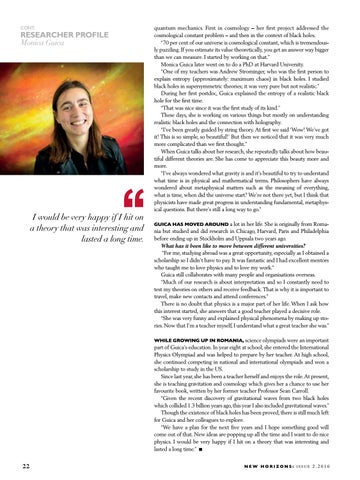
I would be very happy if I hit on a theory that was interesting and lasted a long time.
quantum mechanics. First in cosmology – her first project addressed the cosmological constant problem – and then in the context of black holes. “70 per cent of our universe is cosmological constant, which is tremendously puzzling. If you estimate its value theoretically, you get an answer way bigger than we can measure. I started by working on that.” Monica Guica later went on to do a PhD at Harvard University. “One of my teachers was Andrew Strominger, who was the first person to explain entropy (approximately: maximum chaos) in black holes. I studied black holes in supersymmetric theories; it was very pure but not realistic.” During her first postdoc, Guica explained the entropy of a realistic black hole for the first time. “That was nice since it was the first study of its kind.” These days, she is working on various things but mostly on understanding realistic black holes and the connection with holography. “I’ve been greatly guided by string theory. At first we said ‘Wow! We’ve got it! This is so simple, so beautiful!’ But then we noticed that it was very much more complicated than we first thought.” When Guica talks about her research, she repeatedly talks about how beautiful different theories are. She has come to appreciate this beauty more and more. “I’ve always wondered what gravity is and it’s beautiful to try to understand what time is in physical and mathematical terms. Philosophers have always wondered about metaphysical matters such as the meaning of everything, what is time, when did the universe start? We’re not there yet, but I think that physicists have made great progress in understanding fundamental, metaphysical questions. But there’s still a long way to go.” GUICA HAS MOVED AROUND a lot in her life. She is originally from Romania but studied and did research in Chicago, Harvard, Paris and Philadelphia before ending up in Stockholm and Uppsala two years ago. What has it been like to move between different universities? “For me, studying abroad was a great opportunity, especially as I obtained a scholarship so I didn’t have to pay. It was fantastic and I had excellent mentors who taught me to love physics and to love my work.” Guica still collaborates with many people and organisations overseas. “Much of our research is about interpretation and so I constantly need to test my theories on others and receive feedback. That is why it is important to travel, make new contacts and attend conferences.” There is no doubt that physics is a major part of her life. When I ask how this interest started, she answers that a good teacher played a decisive role. “She was very funny and explained physical phenomena by making up stories. Now that I’m a teacher myself, I understand what a great teacher she was.” WHILE GROWING UP IN ROMANIA, science olympiads were an important
part of Guica’s education. In year eight at school, she entered the International Physics Olympiad and was helped to prepare by her teacher. At high school, she continued competing in national and international olympiads and won a scholarship to study in the US. Since last year, she has been a teacher herself and enjoys the role. At present, she is teaching gravitation and cosmology which gives her a chance to use her favourite book, written by her former teacher Professor Sean Carroll. “Given the recent discovery of gravitational waves from two black holes which collided 1.3 billion years ago, this year I also included gravitational waves.” Though the existence of black holes has been proved, there is still much left for Guica and her colleagues to explore. “We have a plan for the next five years and I hope something good will come out of that. New ideas are popping up all the time and I want to do nice physics. I would be very happy if I hit on a theory that was interesting and lasted a long time.” n
22
NEW HORIZONS: ISSUE 2.2016
IN BRIEF
How did you get the idea to have a dog take part in the treatment?
“I used to work at a clinic for seriously ill children and let some of them meet my trained dog, Livia. It proved to have a beneficial effect on their state of health, and I decided to test this effect scientifically. After two years of preparations, we’ve now begun a study in which we will measure what happens to 50 children at Uppsala University Children’s Hospital when they play with Livia.” What observations have you made so far?
“We’re monitoring physiological and hormonal effects among the children, such as heart rate variability, perspiration and levels of ‘feel-good hormones’. We don’t have sufficient data yet to draw any conclusions, but the observations we’ve made are un deniably fascinating.” Should parents of sick children consider buying a dog?
“Well, Livia is an exceptional dog and we do not have evidence-based results yet. On the other hand, why not try? After their parents, play is the most important thing a child has, and animals and children go hand in hand.” Where do you hope the study will lead?
“If we can prove a positive effect, it would be entirely reasonable for caregivers in the future to begin offering children and young people dog therapy along with play therapy and other already established treatment options”. n MAGNUS ALSNE
More students to learn neutron scattering THE SWEDISH FOUNDATION for Stra-
tegic Research (SFF) has decided to grant SEK 120 million to a graduate school in neutron scattering. This strategic collaboration between six Swedish higher education institutions will be directed by Professor Kristina Edström of Uppsala University (Project Manager) and Senior Lecturer Martin Månsson of KTH Royal Institute of Technology (Director of Studies). Through the European Spallation Source (ESS), Sweden will host one of the very largest research facilities in Europe. Here, neutrons will be used as a tool to investigate functional materials, new medicines and engineering science products. The National Graduate School will train 20 doctoral students in fields of science in which neutron
scattering can make huge breakthroughs. If the half-time evaluation is positive, SSF will invest SEK 100 million for an additional 20 doctoral students. ESS is in a very active construction phase aimed at full-scale operation by 2023. n PHOTO: MIKAEL WALLERSTEDT
PHOTO: JOSEFIN SVENSSON
Consultant at the Department of Women’s and Children’s Health, who is studying the physiological reactions of seriously ill children when they interact with her dog, Livia.
Kristina Edström, Professor of Inorganic Chemistry, will direct a new initiative for a neutron scattering graduate school.
Lichens reassessed after new discovery RESEARCHERS have found another fungal component in lichen. It was previously believed that a lichen consisted of a fungus and algae living in symbiosis, but a group of researchers from Uppsala University along with researchers from the Swedish University of Agricultural Sciences (SLU) and universities in Austria and the US have now shown that there is another integral fungal component. “It’s been amazing to be involved in producing these findings,” says Hanna Johannesson, Professor of Systematic Biology at Uppsala University. “The study shows that the classic textbook example of a lichen as a symbiosis between two players is not correct and must be re-defined.” For 140 years, lichen have been described
as a symbiosis between a fungus, usually an ascomycete (sac fungus), and green algae or cyanobacteria. The fungus that has now been discovered is a basidioycete fungus that exists in the outermost layer of the lichen thallus, the cortex. n
PHOTO: TIM WHEELER
4 QUESTIONS TO ANN EDNER
Lichens, Letharia vulpina.
Fossil X-rayed IN A NEW STUDY, an international research group shows that fossils of the 360 millionyear-old tetrapod (“four-footer”) Acanthostega come from juvenile animals and not adult animals as was previously thought. The microscopic structures in the limb bones of these fossil tetrapods are almost perfectly preserved and were examined using powerful synchrotron X-rays. This method allowed researchers to access microscopic details without damaging these unique fossils. “Like a growing tree, a limb bone has an-
nual growth rings,” says the study’s lead author Sophie Sanchez, researcher at Uppsala University and the European Synchrotron Radiation Facility (ESRF) in France. “These growth rings, which can be seen both in fossils and living tetrapods, are informative about the development and age of the individual.” The tetrapod’s move up to land is one of the most radical adaptive changes in the history of vertebrates. The discovery sheds new light on the life cycle of the species and vertebrates’ first steps on land. n
23
T E X T : A N N I C A H U LT H P H O T O : M I K A E L WA L L E R S T E D T
Conflicts related to jihadism are considered particularly difficult to solve within peace research. What does it really take to solve them? That is the theme of a new international research project headed by Uppsala University.
The road to peace in
JIHADIST CONFLICTS “NEARLY ALL THE BASIC QUESTIONS of
conflict resolution remain unanswered in the case of jihadist conflicts,” says Isak Svensson, Professor of Peace and Conflict Research and leader of the interdisciplinary project. He and his colleagues Desirée Nilsson and Mimmi Söderberg Kovacs conduct research on conflict resolution and are well-versed in which approaches usually work in conflicts. They know which factors commonly result in negotiations and finally peace agreements. The question is why these same approaches are not viable for conflicts involving jihadist groups. “It’s a matter of both seeing what distin guishes them from other conflicts and understanding what makes them particularly difficult to solve,” says Nilsson. They already have some hypotheses to test. “Is it because they can’t solve the religious issue or has it got something to do with the way they’re organised?” Svensson wonders. “Has it got
Interdisciplinary project The project ‘Peaceful solution to jihadist conflicts? Religion, civil war, and prospects of peace’, began this January and will run for five years. The project is funded by the Swedish Central Bank, in the amount of SEK 14.8 million.
24
something to do with popular support and how that is mobilised, or with the increased aggressive targeting of civilians? We don’t know.” CURRENTLY, several conflicts with religious aspects are ongoing. 2014 saw more people killed in armed conflicts than any other year since the end of the Cold War. Another trend is that more and more conflicts are becoming internationalised. Among the most intense conflicts, the ones involving jihadism constitute a majority. “It’s not really that this type of conflict has grown so much more common. However, other types of conflicts have declined, so proportionally, jihadist conflicts have become more dominant. This might be due to the world becoming better at curbing conflicts in general, yet still lacking the methods and knowledge required to handle religiously defined conflicts,” Svensson says. The project will also see the participation of several religious studies specialists, including reli-
The world has become better at managing conflicts in general but needs methods and knowledge to manage religiously defined conflicts. Isak Svensson and Desirée Nilsson conduct research on conflict resolution in jihadist conflicts. NEW HORIZONS: ISSUE 2.2016
gious sociologist Mark Juergensmeyer, who is to conduct several case studies within the context of the project. Professor Ebrahim Mosa at the University of Notre Dame in the US will study conflicts from an Islamological perspective. “As peace researchers, we need to turn outwards and enlist the help of, for instance, researchers in religion. We have the conflict resolution skill set, while they contribute by shedding light on other important perspectives,” Nilsson says. RESEARCH ON conflict resolution has expanded
as a field since the 1990s. Now, insights produced by that research area will be applied to jihadist conflicts. “For instance, previous research has shown that meaningful mediation can be achieved when the parties perceive the conflict as very costly. But religiously motivated actors may well perceive this cost in a different way. If one has martyrdom in mind, it may give one a differing view of the costs one is prepared to pay,” Svensson says. Nilsson conducts research on the different actors in conflicts. Which of them have to be included in an agreement and which can be left out without jeopardising the peace? “In many conflicts the opposition includes different rebel groups. Do they all have to sit
at the negotiating table or can an agreement be reached involving fewer actors? We will study these types of problems and their consequences for the durability of a peace agreement.” The researchers will use data from the Uppsala Conflict Data Program (UCDP), which gathers data on armed conflicts all over the world. In addition, a number of case studies will be conducted in various parts of the world. These have not yet been finalised, but one of the more interesting peace treaties is that reached in 2014 in the Philippines. “It’s actually among the greatest successes in recent years, and indicates that it’s possible to find solutions to conflicts involving jihadist groups,” Svensson says. n
Research on conflict resolution has expanded as a field since the 1990s. Now, insights produced by that research area will be applied to jihadist conflicts.
UNIQUE CONFLICT DATABASE Uppsala Conflict Data Program (UCDP) has been collecting data on ongoing violent conflicts since the 1970s. The database is regarded as one of the most accurate and well-used data resources on global armed conflicts. Its definition of armed conflict has become the standard definition used in systematic studies. The researchers are defining ‘jihadist conflicts’ as ‘armed conflicts with at least 25 battlerelated deaths per year, which include a rebel force with self-described Islamist political goals’.
Isak Svensson and Desirée Nilsson know a lot about conflict resolution but are working with religious studies specialists in this project to improve their understanding of conflicts linked to jihadism.
25
EDUCATION T E X T : J O S E F I N S V E N S S O N , A N N I C A H U LT H P H O T O : M I K A E L WA L L E R S T E D T
Open online courses FOR THE WHOLE WORLD
This autumn, Uppsala University is launching its first Massive Open Online Courses (MOOCs). The three pilot courses will be implemented in two phases and then evaluated. One of the goals is to learn more about how large-scale digital instruction works in practice.
Mats Cullhed, Educational Developer, believes that the open online courses could fill a number of different functions.
IN MID-JULY, registration opened on Uppsala University’s first MOOC. The course explores antibiotic resistance and started in early October. It will be followed by two additional courses offered in November, one on climate leadership and the other on financial crises in a historical perspective. The term MOOC attracted a great deal of attention a few years ago, particularly after 190,000 people signed up for a course on artificial intelligence started by Stanford University. Since this time, the number of open online classes has continued to increase, even if they don’t make quite as big a splash in the headlines. “One of the goals of the pilot courses is to examine what MOOCs can potentially bring to higher education,” says Mats Cullhed. “The online-based courses give us access to tools for statistical analyses that can provide information on how different types of recorded materials work in distance learning.” ANOTHER AIM of the autumn courses is to
The new courses are intended for students all over the world.
26
highlight the areas in which Uppsala University has a strong position and a high level of expertise. They are also seen as part of the collaboration mission and can hopefully become a new international interface. “It is an opportunity for Uppsala University to show what it can do and this might also lead to more students discovering us and applying here,” says Cullhed. First out is a course on antibiotic resistance, “Antibiotic Resistance: the Silent Tsunami”, which is aimed at a broad group of students.
“Antibiotic resistance is a highly topical subject that we believe will interest people with a broad range of backgrounds,” says one of the course directors, Thomas Tängdén, Postdoctoral Research Fellow at the Department of Medical Sciences. “Many people have undoubtedly understood that this is a big problem. The solution lies in individuals, professionals and decision-makers working together, and the first step is to make sure we have an understanding of the situation and what measures are necessary. Our MOOC can play a role in increasing awareness.” THE COURSE is intended for anyone interested
and does not require any prior knowledge or training. But even those who have some expert knowledge can benefit from the course because it addresses many different aspects of the issue, such as what antibiotics, bacteria and resistance are, the impact on health care, and economic models for antibiotic innovation. “The course participants can freely choose what aspects they want to study and there is some in-depth material available for those who want to learn more,” says Tängdén. The course contains interactive elements and discussion forums with the participants. One challenge has been not having a clear picture of who or how many people will take part in the MOOC – and if the course is at the right level. “Because no credits or anything similar are awarded, it’s important to keep the participants interested so that they’ll stay for the whole course,” says Tängdén. “We are competing with everything else available on the internet and TV, NEW HORIZONS: ISSUE 2.2016
Uppsala University can accommodate far more students than fit into the lobby of the University Building.
such as news, documentaries, films and games.” The development of MOOCs has not always been welcomed with open arms by academia. “The strongest criticism has often come from teachers who have been working for the past 15 years to develop distance education,” says Cullhed. “They sometimes think that much of what they have fought for has been lost when courses are suddenly introduced that are largely handled automatically. “There have been doubts as to the quality and the educational value of these types of courses and there has also been a worry that they could take over traditional university education.” Other criticism has dealt with equality. “Concerns have been raised that those who can’t afford to send their children to expensive universities are referred to MOOCs and ex pected to be satisfied with that, which could cement and perpetuate inequalities,” says Cullhed. He thinks that in many cases the debate is far too polarised and emphasises that open online courses have only been around for a few years. “This is still a very new phenomenon. We must give it time to find its niche. MOOCs can fill a number of functions, but they already constitute an amazing library for public education that can stimulate interest and prompt more people to pursue advanced studies.” n
THREE COURSES:
Antibiotic Resistance: the Silent Tsunami About: Antibiotic resistance, a global health crisis. This course provides the tools to understand how antibiotic resistance develops and how it can best be handled, controlled and prevented at both the societal and individual levels. Course start: 3 October 2016
Climate Change Leadership About: Leadership in connection with climate changes. What kind of knowledge and what skills are needed? The course discusses new arenas for climate action from the international level to the local level. Interdisciplinary structure with researchers from different fields. Course start: 7 November 2016
Understanding Financial Crisis: Business Cycles and Policy About: Financial crises, which often have serious consequences, can also be seen as an important component of a developing economy. The course discusses the significance of financial crises, their history, and how they can be interpreted. Course start: later this autumn
MOOCs • • •
The acronym MOOC (massive open online course) was first used in the US and has spread across the globe. No academic credits are offered for the courses and they are open to anyone interested. Registration is available on the external platform Future Learn: www.futurelearn.com
27
COLLABORATION T E X T : J O S E F I N S V E N S S O N P H O T O : M I K A E L WA L L E R S T E D T
NEWCOMERS offered placements To coordinate all of Uppsala University’s activities related to newcomers and integration, Professor Elisabet Nihlfors was appointed coordinator last spring. Together with Anna Sjöström at the Division for Contract Education, she is tasked with clarifying the University’s activities in the field and analysing future needs.
“OUR JOB IS TO COORDINATE the University’s various initiatives in this area,” says Anna Sjöström, Assistant Head of Division for Contract Education at Uppsala University. “We also identify the needs of both newcomers, whom we can assist with education and validation of qualifications, and professionals, who can receive training to handle new situations.” In addition to highlighting what the University already does in terms of research and education, the assignment also involves thinking ahead and analysing in what ways the University can contribute in its role as a major employer in the region. “We may need to do something different or in a different way,” says Elisabet Nihlfors. “Maybe there are new research constellations we should encourage? We all need to look through our course syllabi and analyse if we are really doing what is needed to educate our students for a new social climate.” One concrete example of the University’s engagement is the placements it offers newcom-
ers. Last spring, the Swedish government tasked public agencies with providing placements in 2016–18 to jobseekers newly arrived in Sweden. This concerns newcomers who have residence permits and who are registered with the Swedish Public Employment Service. “We will be able to offer about 30 placements per year and have already handed over 23 placements to the Employment Service, who are responsible for the matching process. All the placements are not filled yet, but we are looking forward to efficiency improvements in the matching process during the autumn. The first person placed under this programme started on 1 September,” says Hooshang Bazrafshan, equal opportunity specialist and coordinator of the placement programme in the Human Resources Division. Bazrafshan expects another ten placements to be offered during the autumn. “Our aim is for Uppsala University to be one of the best public agencies in this initiative,” he says. n
The primary role of coordinators Anna Sjöström and Elisabet Nihlfors is to offer an interface and coordinate the University’s various activities surrounding newcomers to Sweden.
28
NEW HORIZONS: ISSUE 2.2016
Cooperation with the construction industry company NCC have signed an agreement for expanded cooperation in areas such as energy, construction and component technology. Through common activities, they aim to ultimately facilitate the recruitment of highly educated engineers and contribute to research on existing and future technology. These activities include joint research, student projects, internship placements and degree projects. Energy, construction and components engineering are natural areas for cooperation, but a number of workshops are also planned to find more areas for cooperation – not only in other fields of engineering but also in the humanities and social sciences. “Cooperation between universities and industry is mutually beneficial and we look forward to closer cooperation with NCC,” says Uppsala University Vice-Chancellor Eva Åkesson. “The agreement with NCC will give Uppsala University access to key skills in the construction industry and give NCC contact with our talented students and with world-leading researchers in various fields of knowledge.” The partnership agreement is based on
Partnership with municipality UPPSALA MUNICIPALITY and Uppsala
University are deepening their cooperation and have entered a strategic partnership. The objective of the declaration of intent is to further develop the existing good relationships for knowledge development and knowledge building. The partnership will benefit both Uppsala Municipality’s activities and research and education at Uppsala University. There are three areas of focus for the partnership during the 2016–2018 period: • Skills provision and skills development • Sustainable societal development and infrastructure • The business sector and working life “The municipality is an important partner on a myriad of levels: in education, research, culture and a wide range of other areas,” says Vice-Chancellor Eva Åkesson.
PHOTO: TORBJÖRN GOZZI
UPPSALA UNIVERSITY and construction
annual activity plans and the first plan has been drafted for 2016. Beginning next year, an NCC scholarship will also be established to reward efforts promoting advances in the field of construction. “For NCC, the collaboration with Uppsala
University is a strategically important initiative to develop and strengthen our own organisation while enabling students to acquire a clearer link to industry during their studies,” says Svante Hagman, EVP & Head of NCC Infrastructure. n
Scholarships for young athletes FOUR ELITE STUDENT ATHLETES at
Uppsala University have been awarded a newly established scholarship. Lina Sjöberg, full-time student in her fourth semester of the Law Programme, gymnast in the trampoline and DMT events in the Uppsala gymnastics association. Johanna Heldin, full-time student in the Medicine Programme since the autumn semester of 2013, curler in the Fyris Curling sports club. Karl Larsson, full-time student in the Master Programme in Energy Systems Engineering since the autumn semester of 2013, footballer in the Sirius sports club. Rassmus Andersson, full-time student in the Master Programme in Chemical Engineering since the autumn semester of 2011, orienteer in the Linné orienteering club. As part of Uppsala University’s commitment to being a sports-friendly university, the new scholarship programme was estab-
lished in connection with the introduction of new routines for elite athletes in 2015. Every year from 2016 to 2018, four elite student athletes will each receive a scholarship of SEK 25,000. n
29
T E X T : A N N E L I B J Ö R K M A N P H O T O : M I K A E L WA L L E R S T E D T
Pupils help researchers survey brown water Researchers at Uppsala University are currently engaged in analysing water samples sent in by nearly 5000 secondary school pupils. “We hope to learn more about potential threats to freshwater resources, both in Sweden and in the rest of the world,” says Professor Gesa Weyhenmeyer.
30
THROUGHOUT THE COUNTRY, 240 second-
ary school classes began the autumn term by collecting samples of water from lakes and watercourses as part of the Brown Water research project. The project involves measuring the temperature and pH of the surface water and analysing whether there is any connection between the water’s colour and benthic fauna. Gesa Weyhenmeyer, Professor of Limnology, is leading the project. “A previous international study surveyed water colour across the globe,” says Weyhenmeyer. “The study showed that the world’s water is becoming increasingly browner, which, for example, has consequences for our drinking water. An-
NEW HORIZONS: ISSUE 2.2016
other finding was that the lakes here in Sweden are warming up very quickly. That’s how I got the idea to involve the community in finding out more about the state of our water.” The pupils have been equipped with experiment kits, which include thermometers, sinkers, test tubes, plastic trays for collecting water and benthic fauna, and litmus paper for measuring the water’s pH. The teachers received a teacher’s guide showing how they can integrate the project in different subjects or use it in independent laboratory lessons. Anna Magnusson is a science teacher at Vasa skolan in Hedemora. Her class of 14–15-yearolds is one of five classes at the school taking part in the research project. “We’ve incorporated the project into a wider theme in which we’re studying water in chemistry as well,” she says. “It fits in with the curriculum if the pupils can carry out experiments while they’re studying water.” One of the watercourses they have taken samples from is Lake Hovran, which merges with the Dalälven River. “The pupils find it exciting that they’re doing something ‘real’,” says Magnusson, “and the project offers a link between school and research. Of course, we also hope that it will increase the pupils’ interest in science.”
For Eva-Lotta Kvick, maths and science teacher at Vallhallaskolan in Oskarshamn, the project was an opportunity to take up a local issue. “I signed my pupils up because I think it’s important to focus on water and raise awareness among the pupils about our water resources,” says Kvick. “Kalmar County has a water shortage, and has had one all summer, so this study is very relevant.” AT THE DIVISION of Limnology at the Department of Ecology and Genetics, Gesa Weyhenmeyer compares the data submitted by the pupils with previous measurements and modelled data for Swedish waters. If she discovers any interesting or unusual values among the pupils’ data, she will return to the sampling point. “What would be really special is if the water were very brown,” she says. “I have about 150,000 water samples from all over Sweden collected in earlier studies to compare with. We might be sent test tubes containing something we’ve never seen before.” If that happens, new samples will be taken by the Division of Analytical Chemistry at Uppsala University, for example. “One of the questions we will be asking is whether this water sample is normal,” Weyhenmeyer says. “Does it occur in other places on the planet or are we going in a completely new direction?” “What I also want to do is involve the pupils and make them aware of what the brown colour means, that it’s vital we look after our water. Simple things, like that 50 per cent of our drinking water is actually taken from surface water and high standards are required before we can drink it from the tap – it feels really important that everyone in our society is aware of these things.” n
The project offers a link between school and research
BROWN WATER
Professor of Limnology Gesa Weyhenmeyer wants to involve schoolchildren in her research.
• The research on water quality changes is being carried out under the framework of the Global Lake Ecological Observatory Network (GLEON). Of particular interest is the amount of organic carbon in the water, which is what causes the water’s brown colour. Uppsala University has therefore started the Brown Water campaign, in which researchers report Swedish data to the research database. • A global study found that Lake Fräcksjön in Västergötland has shown the most rapid changes over the past 20 years in comparison with almost 300 other lakes across the globe. The water in Fräcksjön is becoming both browner and warmer, and at a higher rate than temperature increases on land. • A shorter ice-covered season and browner water are believed to be the explanation for the rapid warming of the lake. The study findings make it particularly interesting to document Sweden’s water. Because as much as half of Sweden’s population gets its water from lakes and rivers, this research is relevant for society as a whole. • At the end of the campaign, the researchers will report back to the pupils and then we can hopefully see what future threats exist for freshwater resources both in Sweden and in the rest of the world.
31
INNOVATION T E X T : S U S A N N A E R I K S S O N P H O T O : M I K A E L WA L L E R S T E D T
Researchers Anders Persson, Greger Thornell and Martin Berglund are behind the new detector.
A business journey
that began in space Researchers at Uppsala University’s Ångström Laboratory have developed an entirely new type of detector that can be used to detect extremely small quantities of various gases in the air. Detecting poison gases, or explosives in the security industry, analysing exhaled air and measuring greenhouse gases are all examples of its use. But it was space the scientists had in mind when they first came up with their innovative idea. “FINDING OUT whether life exists on other
planets really appeals, but of course we are not alone in wanting to make that discovery. One way of doing so is to try and trace isotopes and possible isotope shifts as a sign of life,” says Ångström Space Technology Centre researcher Anders Persson, who is one of the people behind the new detector, along with colleagues Greger Thornell and Martin Berglund. “A rover equipped with a similar detector is now on Mars,” says Persson, “but it is larger and
32
more fragile. What we have done is to utilise microelectronic technology developed in our lab – including a plasma light source the size of a fingertip – to create a miniaturised detector weighing just a fraction of the one on Mars, and that is far more robust. Furthermore, our instrument doesn’t compromise on measurement quality. It is, in fact, able to analyse considerably smaller samples than is possible today, which is a further competitive advantage. The next step is to test the system’s unique features – those NEW HORIZONS: ISSUE 2.2016
Innovation Prize to Maria Strømme
THE UPPSALA UNIVERSITY Innovation
The technology is robust and weighs a fraction of similar detectors without compromising on measurement quality.
Prize is an award given to recognise successful transference of knowledge. This year, the prize is being awarded to Maria Strømme, Professor of Nanotechnology, for her broad engagement in utilising and communicating research. Maria Strømme was appointed Professor of Nanotechnology in 2004 and has since built up a research team of 35 people. As an innovator and entrepreneur, Strømme has collaborated with companies to develop new types of batteries and materials based on cellulose from algae. Together with research colleagues and experienced industrialists, she also founded the com pany Disruptive Materials, which is based on Upsalite, the unique ultra-absorbent material developed in her research team. n
The paper filter that purifies water
that set it apart from existing instruments – and demonstrate its benefits to the marketplace.” “The applications are extremely broad and everything actually is interesting to test, but we must start somewhere and so we have selected just a few examples to start with,” continues Persson. One chosen application is environmental monitoring, where there is a great need to analyse very small amounts of greenhouse gases. The new detector technology makes it possible to carry out a greater number of measurements and generate more accurate data, which will help us better understand how these gases circulate in nature, and thus more precisely predict the consequences of climate change.
Many environmental scientists have similar requirements for their equipment as space scientists; that it can be used in harsh environments for months on end without supervision and still deliver reliable results, for example. Here, a detector developed with space in mind enjoys a competitive advantage, notes Persson. “As research scientists, we are accustomed to describing problems and limitations, and delving deep down into them. But commercialising our research requires a completely different approach. We have to think the other way round: what is it that is so good and how do we develop it further? Without support from Uppsala University Innovation, we would never have got where we are today,” says Persson. n
A NEW PAPER FILTER can remove viruses from water. This makes it easier to reduce the spread of infection and improve access to clean drinking water across the globe. The ‘mille-feuille’ filter was developed by nanotechnology researchers at Uppsala University. It consists of cellulose nanofibres and was named for the resemblance of its unique layered inner structure to the French pastry mille-feuille (‘thousand leaves’). “With a raw material from nature and simple production methods, we believe that our filter paper can be an affordable water purification system and help to save lives,” says Albert Mihranyan, Professor of Nanotechnology. “Our goal is to develop a filter paper that will remove even the most resistant viruses from water as easily as you could brew coffee.” It is common today to treat water using chemical disinfectants, such as chlorine. Filtration offers an alternative robust and energy efficient method. n
33
T E X T : M A G N U S A L S N E P H O T O : M I K A E L WA L L E R S T E D T
“Sweden can become even better at identifying and utilising the opportunities within academia,” says Mårten Winge, CEO of Medical Vision and one of ten mentors in the Mentor4Research project helping young researchers bring their innovations to market.
Business leaders guide young researchers
Mårten Winge, CEO of Medical Vision, meets Erik Gullberg, researcher in microbiology, at Uppsala Science Park.
34
NEW HORIZONS: ISSUE 2.2016
“ACADEMICS are good at being academics, but
for researchers who want to bring their innovations to the market, a whole new world awaits. Taking yourself past all the pitfalls requires drive, passion, ambition and an openness to learn. If you have all that, Mentor4Research offers invaluable support when it is time to take that step!” Mårten Winge, CEO of Medical Vision, is visiting Uppsala Science Park. On the agenda is a meeting with Erik Gullberg, a researcher in microbiology. Together, they make up one of ten Mentor4Research teams at Uppsala University, a programme in which business-minded mentors help young researchers build networks and learn about commercialisation. Mentor4Research recently transitioned to local programmes after ten years under the na tional direction of the Royal Swedish Academy of Engineering Sciences (IVA). Uppsala University became the first higher-education institution in the country to partner up. “The opportunity to broaden your frames of reference and to see what utilisation possibilities your own research could have is extremely appreciated,” says Moa Fransson, Business Adviser at UU Innovation. “Over the years with IVA, the
number of participants from Uppsala has stead ily increased and interest continues to grow.” HALFWAY THROUGH the programme, Erik Gullberg and Mårten Winge have set a clear direction for their work, but for Erik, the path there wasn’t entirely straight. His innovation – an effective method to measure antibiotics in samples and a possible weapon in the fight against antibiotic resistance – arose out of curiosity and basic research. The realisation of its commercial potential came only with time and in dialogue with Dan I. Andersson, Professor of Medical Bacteriology. “We contacted UU Innovation and I am extremely impressed with the reception and support we’ve encountered,” says Gullberg. “We have received lots of invaluable advice and my goal now is to start a company in which I can devote myself full-time to developing our idea in a way that contributes to better care and treatments.” Mårten Winge’s many years of experience in commercialisation in the life sciences makes him a sought-after resource at Mentor4Research. This year, he is participating for the third time. Both of his previous mentees started their own companies but, Winge emphasises, there is no fixed map for the process. “Of course there are some patterns, but every new project has new challenges,” says Winge. “As a mentor, it’s my responsibility to mobilise external contacts for things like advising and financing. At the same time, I can’t be a schoolmaster dictating how things have to be. But Erik is motivated, eager to learn what is needed, and confident in the process, and that makes my role rewarding.” IN DECEMBER, THIS YEAR’S edition of Mentor4Research will reach its goal. Whether Gullberg takes the step into business life now or later on in his career, he is happy with the returns on his invested time. “None of my academic training has touched on how to commercialise your research, and it is definitely not a simple process, so I would highly recommend any researcher with results they want to take further to apply to the programme.” Winge shares the conviction that Mentor4Research fills an important need. “Sweden can get better at identifying and utilising the opportunities within academia, and in the life sciences among other fields, Uppsala is one of the country’s foremost environments for forging ties between universities and the business sector. But nothing happens on its own, and that is why both UU Innovation and Mentor4Research are absolutely indispensable!” n
None of my academic training has touched on how to commercialise your research, and it is definitely not a simple process
35
ALUMNUS PROFILE T E X T : A N N I C A H U LT H P H O T O : A N D E R S W I K L U N D , T T
Alumnus Trita Parsi
At the heart of INTERNATIONAL POLITICS
Trita Parsi nurtures all three of his cultural identities: the Iranian, the Swedish and the American.
Political adviser and Iran expert Trita Parsi has taken an amazing journey both professionally and personally – from Iran to Uppsala and on to the White House. His studies in Uppsala paved the way for an international career and today, he’s just as much Swedish as he is Iranian and American. TRITA PARSI came to Uppsala as a four-yearold with his family, fleeing the Shah’s Iran. His father was a professor of anthropology and received a visiting professorship at Uppsala University. Shortly thereafter, the revolution broke out in Iran and the family remained in Sweden. They lived in Gottsunda, an area with many
36
immigrants, and although they met a lot of friendly Swedes, Parsi never really felt like he fit in. An Iranian identity therefore became increasingly important during his childhood. And the struggle for democracy in Iran, which had so marked his parents’ lives, also engaged Parsi. This impetus took him all the way to WashNEW HORIZONS: ISSUE 2.2016
ington. Today, he’s a political adviser and Iran expert, and works closely with politicians such as Barack Obama and Hillary Clinton in Washington. As a founder of the National Iranian American Council (NIAC), Parsi has received a lot of attention. AN IMPORTANT STOP along the way was his
time at Uppsala University, where Parsi took the Master Programme in Social Sciences in the 1990s. The programme was so popular that he actually almost didn’t get in. “I don’t remember what my grades were, but admissions figures rose quite significantly that year. I had to fight really hard and ended up on the waiting list. So it was a dramatic start.” Once admitted, he learned a lot of things that have come in handy since. “The strength of the programme was that it was so academically rigorous, especially the methodology. The methodology in the B course in political science was actually on a par with the PhD course in international relations I took later at Johns Hopkins University. The Swedish training from Uppsala University was a huge advantage when I wrote my dissertation.” PARSI GOT HIS FIRST GLIMPSE of American
politics during his time as an exchange student living in the home of a US Senator, who later became a Member of Congress. In 1997, he offered Parsi a job as an intern, prompting a new trip across the Atlantic. “It opened my eyes to working in the US. I had a lot of preconceptions about American politics, but was surprised at how chaotic it was. This was still 20 years ago during the golden years – it’s worse today...” After a period with the UN, the plan was to write his doctoral thesis on Afghanistan. He enrolled in the PhD programme on 27 August 2001 and two weeks later came the terrorist attack on the World Trade Center. “Within 24 hours, everyone in Washington was suddenly an Afghanistan expert. I felt that the market was saturated and asked myself: what is the next big conflict risk that no one knows much about yet?” The choice fell on the charged relationship between Iran and Israel. “The subject is very sensitive in the US so there were a lot of people who advised me against it, including my supervisor, because of the political risks. But it was way too interesting to resist,” says Parsi. This proved to be a wise decision. No one else had really delved into this issue, so when it came up on the agenda, he had unique expertise. Along with a few friends, he founded NIAC,
which advocates cooperation and dialogue between Iran and the US. Within a short period of time, they became very influential. “We had the expertise and were one of few who dared to go out on CNN and really criticise Bush in 2005 and 2006 when the US wanted to stop Iran’s nuclear weapon programme through military means,” says Parsi. “We were able to present facts showing that the American side had done everything to avoid diplomacy and bring about a military conflict.” “When the political climate changed, we were among the first to say ‘there is a diplomatic solution’. This was very controversial in the US, but we could prove that we were right when Obama became President and there was a political will to invest in diplomacy.”
I’m glad that I can still get angry
THE LAST FEW YEARS have been intense, and not just at work. He’s also been settling down in his new homeland, the United States, and raising three children with his Swedish-Moroccan wife. Since becoming a father, he’s tried to nurture all three of his cultural identities – the Iranian, the Swedish and the American. He sings traditional Swedish songs with his children at Midsummer, and celebrates Iranian New Year and American Thanksgiving. “A constant state of confusion,” he says with a laugh. “It was a real clash, for example, when we were watching the Olympics and an Iranian was up against a Swedish woman in taekwondo. My middle son wondered which country he should cheer for. I said that he could choose for himself.” n
Trita Parsi has been named Uppsala University Alumnus of the Year for 2016.
TRITA PARSI Title: Political scientist, author and founder of the National Iranian American Council (NIAC). Education: Master’s Degree in International Relations from Uppsala University. Master’s Degree in Economics from the Stockholm School of Economics. PhD in International Relations from Johns Hopkins University in the US. Age: 42 Family: Wife and three children. Hobbies: I’ve studied taekwondo. The interest is still there, but I haven’t found time. Spend a lot of time driving the kids around to their various activities and keeping up with the boys’ football passion. Favourite place in Uppsala: The Botanical Garden, where my wife and I got married and where we had a picnic this summer. Favourite Uppsala nation: Hung out most at Barowiak when I lived in Uppsala. What makes me happy: My kids, doing things with them. They are my own personal comedy show. No one makes me laugh as much as them. What makes me angry: The politics in the US, while at the same time they’re what drives me. What I have the hardest time with is people who come to Washington because they think it’s exciting to be close to power. If you’re going to come to Washington, you should do it for something you’re really angry about and want to change. I’m glad that I can still get angry.
37
ALUMNA PROFILE T E X T : A N N I C A H U LT H P H O T O : H E L E N A P A U L I N S T R Ö M B E R G
4 QUESTIONS TO SARA DANIUS Sara Danius, Permanent Secretary of the Swedish Academy, who wrote her doctoral thesis at Uppsala University in the 1990s. Do you think that the prize influences the world’s interest in literature?
“Yes, absolutely. Sales of the Nobel laureate’s books always increase, sometimes significantly, sometimes a bit less, and this is true across the globe. Some laureates are already well repre sented in major literary languages – most recently Svetlana Alexievich. Everything she had written had been translated into French and German. In English, on the other hand, she was a marginal figure. After being awarded the prize, the English-speaking world became aware of her powerful writings and the translators are hard at work. Patrick Modiano, who won the prize in 2014, was also peripheral in the English-speaking world and was published by a small university publisher in the US. But that is of course no longer the case.” What is an ordinary day at the Swedish Academy like?
SARA DANIUS Title: Permanent Secretary of the Swedish Academy, Chair no. 7. Professor of Literature at Stockholm University. Education: Bachelor of Arts from Stockholm University, Master of Arts from the University of Nottingham, PhD from Duke University and PhD from Uppsala University. Hobbies: Literature, painting, photography, fashion, costume history. Favourite place in Uppsala: English Park. Hidden talents: Good at knitting. Once upon a time played basketball in the top division. What makes me happy: My son. What makes me angry: Lack of generosity.
“I cannot imagine an ordinary day. There is always something unforeseen that I have to take a position on, sometimes quickly. My work week revolves largely around the weekly meeting on Thursday nights. After the meeting, I am responsible for executing the decisions that the Acad emy has taken. Besides the Nobel Prize, we also give out over sixty awards and grants.” “Otherwise my work consists of maintaining contact with the witty members (like herding cats, my predecessor, Peter Englund, used to say), managing the excellent secretariat and library, supervising the Academy’s dictionary work in Gothenburg (SO, SAOL) and Lund (SAOB), and attending meetings of boards of directors, at the Royal Dramatic Theatre and the Nobel Foundation, for instance. I also have ultimate responsibility for the Academy’s finances and should keep an eye on the stock market.” What do you remember most about your doctoral studies at Uppsala?
How does it feel to step forward and announce the year’s winner of the Nobel Prize in Literature?
“So far I’ve announced the year’s winner just once and that was last year, when Svetlana Alexievich was awarded the prize. I didn’t feel nervous, but there was a tension – and that’s as it should be.”
38
My supervisor, Professor of Literature Bengt Landgren, who was a fantastic person, scholarly, humorous, thoughtful, principled and yet still pragmatic. I also had the privilege of getting to know Thure Stenström, Torsten Pettersson, Johan Svedjedal, Anna Williams and other researchers at the department. Other things I remember are the good interdisciplinary initiatives. Borders are for bureaucrats, not scholars.” n NEW HORIZONS: ISSUE 2.2016
IN BRIEF
Explore Vendel Period Gamla Uppsala GAMLA UPPSALA houses one of Scandi-
navia’s most exciting Iron Age royal estate complexes. The area once held numerous houses and other buildings, which up until now visitors have had to try to imagine with the help of sketches. In late August, however, the “Augmented History: Gamla Uppsala” app was launched, giving visitors to Gamla Uppsala an extraordinary experience. “This is the first time this type of technology has been used to enhance visitor experience at a tourist attraction in Sweden,” says John Ljungkvist, Researcher at the Department of Archaeology and Ancient History at Uppsala University. “It is our hope that the model can be used in more places and in more contexts, both to strengthen the impression and to convey research findings.” Archaeological studies have generated a lot of new knowledge through the years, and researchers have now collaborated with game designers and programmers to
Zorn Museum exhibits University’s art treasures THIS AUTUMN, the Zorn Museum in Mora will open the exhibition Art Treasures from Uppsala University, showcasing a rich selection of works from the University’s art collection. The exhibition is a collaboration between the Zorn Museum and the Upp sala University Museum Gustavianum. “The current renovation of the University Main Building offered a unique opportu nity to bring some of the art normally hung there to a larger audience,” says Mikael Ahlund, University Curator at Museum Gustavianum. “Other important works from the University’s collection are also included in the exhibition, which is accompanied by a richly illustrated catalogue.” In addition to showing works from the University’s collection, both the exhibition and the catalogue will highlight Anders Zorn’s connection to Uppsala and Uppsala University. The exhibition will run from 8 October 2016 to 5 March 2017. n
Archaeologists and game designers have developed the app.
develop a downloadable iPad app. “The app uses GPS, compass and gyro functions in smartphones and tablets to enable visitors to move through ancient eras
and environments,” says Ljungkvist. “As an extra bonus, the user can also make virtual archaeological discoveries with our app, in a way similar to Pokémon Go.” n
Blog on 400 historical objects THE YEAR 1620 could be considered the founding year of the Uppsala University Library. It was also the year the little Swedish prayer book in the picture was printed. The dark green velvet covers of the book are adorned with beautiful embroidery characteristic of the period, using silver and silk thread and a variety of stitches. Velvet and this type of embroidery are also seen in the clothing of the fashionable upper-class during the same period.
As part of the Uppsala University Library’s 400th anniversary celebration in 2020 and 2021, the library is exhibiting 400 objects from its cultural heritage collections. The blog, entitled “400”, tells the story of 400 selected objects as evidence of the breadth of the collections. n 400-blogg.ub.uu.se
Swedish prayer book from the 1600s.
39
PHOTO: MIKAEL WALLERSTEDT
Last word
ANNIKA WAERN Professor at the Department of Informatics and Media
The mobile game that made it big
One thing that is already clear is that the number of Pokémon Go players will decrease dramatically. That won’t be the end of the game, as a core of dedicated players will still be there.
40
NO ONE COULD HAVE FAILED to see them this summer – the people gathering at different spots in Uppsala. Silent or mumbling, they were all focused intently on their phones. They were playing Pokémon Go, a new mobile game that quickly became a huge success. In mid-July, Pokémon Go had 45 million players across the globe – every day. How did this happen? Pokémon Go isn’t better than previous games. It’s not more innovative either; there have been similar predecessors that were more interesting to play. Not even the AR techno logy is new – it has been used in many earlier games. The reasons must therefore be sought elsewhere. A ‘blockbuster’ effect requires first that there is a general understanding of the genre – the game can actually not be the first of its kind! There must have been predecessors, games that people are familiar enough with to begin playing from day one. This awareness existed – built up by forerunners such as GeoCaching, Ingress and FourSquare. Secondly, the fact that it was a Pokémon game was significant. Pokémon is one of the very best examples of how it is possible to build an entire conceptual world by launching stories transmedially (concurrently in several media channels); there are games,
films, TV programmes, collector cards, plastic figures, etc. based on the same basic story. Finally, there is one thing that sets Pokémon Go apart from its predecessors, and that is that there was a lot of content in the game right from the start. Part of this content is the magical creatures, which are adapted to where there are roads and various natural formations. This information is taken from Google Maps. Even more important are the ‘stops’, which are centred around landmarks in the city, usually artworks and important buildings. Information on the location of the landmarks was taken from a previous game, Ingress. Unlike ear lier games, which were often developed by small startup companies (and sometimes entirely on a non-profit basis), there are large investments from giant companies behind Pokémon Go. What should we expect then for the future? One thing that is already clear is that the number of Pokémon Go players will decrease dramatically. That won’t be the end of the game, as a core of dedicated players will still be there. But I hope that the game has also opened the door for other citybased games and storytelling. So many more interesting experiences could be developed with the same technology! n NEW HORIZONS: ISSUE 2.2016