



Convenient travel from the of Belfast to the UK, Europe, and beyond heart


CIPR NI MAGAZINE OF THE YEAR FINALIST 2024 Ambition speaks to Belfast-based Axial3D


Managing Editor: Olivia Stewart Interviews: Emma Deighan Publisher: Chris Sherry Advertising Managers: Lorraine Gill & Julie Patterson Editorial Assistant: Joanne Harkness Email addresses: olivia.stewart@northernirelandchamber.com / l.gill@ulstertatler.com / j.patterson@ulstertatler.com Websites: www.northernirelandchamber.com / www.ulstertatler.com Publisher: Ulster Tatler Group, Unit 26 Ormeau Businss Park, Belfast, BT7 2JA Tel: 028 9066 3311 Printed by: W&G Baird, Antrim. Front Cover Photo by: Elaine Hill.


Over the past year, I have had the privilege of witnessing the resilience of our business community and how challenge is met with imagination and determination across the board. It has been inspiring to observe how local businesses consistently find new ways to grow, adapt, and lead through difficulties.
Our member businesses have navigated a lot of uncertainty this year – from increased employer NICs and National Living Wage to the potential implications of aspects of the proposed ‘Good Jobs’ Bill, and all the risks associated with US tariff threats and subsequent retaliation. This year required more than just strategy; it demanded creativity.
A standout moment of my term as President was the launch of NI Chamber’s manifesto ahead of the UK General Election. At a time when clarity and direction were needed, our manifesto ‘Mission: Business Growth’ set out proposals aimed at unlocking economic growth in NI. Significantly, we were able to present those proposals at the Labour Party Conference.
Importantly, this year we witnessed some meaningful progress in NI’s planning process. However, many more challenges persist and more action is needed to deliver comprehensive reform to planning and to address significant deficiencies in our wastewater infrastructure.
Throughout my term, one key issue on the minds of every business I speak to is getting the right people with the right skills. Over the past year, NI Chamber has consistently called for three key actions to address these issues: the establishment of an All-Island Mobility Task Force to improve cross-border labour movement; the introduction of a fully funded childcare strategy to reduce economic inactivity and support more female participation in the workforce; and the creation of a Workforce Development Agency to ensure training and skills provision align with industry and economic needs.
Partnership has been the theme central to my presidency, and it has been a genuine pleasure to see many great relationships come to fruition and existing relationships develop further. One of the most significant alliances has been the continued collaboration with our colleagues in the North Carolina Chamber in the US. Another personal highlight was driving our strengthening all-island relationship between Cork, Dublin, and NI Chamber.
It has been a privilege and a deeply rewarding experience to serve as President of NI Chamber. As I prepare to hand over the chain, I believe we are at a pivotal moment – one that gives us the chance to focus our collective efforts on shaping a more dynamic, sustainable and competitive economy that meets the needs of business today while creating lasting value for the future.
Caitroina McCusker, President, Northern Ireland Chamber of Commerce and Industry










Sysco has announced the creation of 50 new jobs as it prepares to open Sysco Belfast, its new £23m purpose-built facility, later this year.
The recruitment drive, which will run until September 2025, will see Sysco’s headcount in Northern Ireland rise to more than 300.
Speaking on the job creation and investment, Mark Lee, CEO of Sysco Ireland, said:
“While food is at the heart of what we do at Sysco, our business and the hospitality industry, are powered by people. As Sysco Belfast comes on stream, and our team of foodservice experts grows, we look forward to further enhancing our delivery service and product range proposition for our customers. We are fully committed to our food future and to creating a positive change in our organisation, the environment and the communities we serve. This investment and job creation reinforces our long-standing commitment to expanding our operations in Northern Ireland and we look forward to welcoming new talent to the Sysco Belfast team.”
Apprentices across the sectors in Northern Ireland have overwhelmingly expressed confidence in their future career prospects, according to a recent survey by early talent experts Workplus.
Sponsored by NIE Networks, the Workplus ‘Apprenticeship Pulse: The Voice of Apprentices in Northern Ireland’ survey shows that over 90% of respondents expressed confidence in their career prospects, indicated a significant rise in salary during their apprenticeship, and more than half of apprentices surveyed said they prefer working in-person, citing the benefits of face-to-face collaboration and easier learning opportunities.

Founder and CEO of Workplus Richard Kirk said: “This survey highlights the incredible potential of apprenticeships but also underscores areas where the system can improve to better serve young people and employers. Too many students struggle to find opportunities due to a lack of awareness, fragmented application processes, and limited availability in certain industries.”
Belfast International Airport, member of the VINCI Airports network, has inaugurated phase one of its £100m fiveyear investment programme with a new terminal extension which includes a state-ofthe-art security hall using Next Generation Security Equipment, an immersive new duty-free experience as well as enhancements to the arrivals experience including a new external forecourt area.
Joined by Northern Ireland’s First Minister and Deputy First Minister, Michelle O’Neill and Emma Little-Pengelly, Pierre Anjolras, CEO of VINCI and Nicolas Notebaert, CEO of Concessions at VINCI and president of VINCI Airports outlined ongoing investment plans, which were designed since VINCI Airports’ investment in Belfast International Airport in 2018. With further investment committed over the next three years, Northern Ireland’s busiest airport is expected to record another record year building on the success of 2024.
Marine Hotel Ballycastle has officially joined the global B Corp community, a network of purpose-driven companies committed to balancing profit with social and environmental impact.
For the Marine Hotel, this recognition marks a formal affirmation of values that have been core to its operations since day one. “This isn’t a big shift for us; it’s who
we’ve always been,” said Claire Hunter, director of Marine Hotel Ballycastle.
“We’ve always put people first, supported our community, and taken responsibility for protecting our beautiful coastal environment. Now, as a certified B Corp, we’re wearing that commitment proudly and helping to spread the word about doing business as a force for good.”


As a B Corp, the Marine Hotel is legally committed to considering the impact of its decisions on all stakeholders, not just shareholders, and to operating with equal focus on People, Planet, and Profit. This certification places the hotel among a global group of progressive businesses that sit between traditional for-profit models and non-profit organisations in their purpose and values.


we create trusted connections with communities across Northern Ireland.


A €30m Shared Island Enterprise Scheme is marking a significant step forward in island-wide enterprise collaboration and growth, as three of the leading economic development agencies on the island of Ireland have partnered to deploy the innovative scheme, which focuses on three priority areas: promoting women’s entrepreneurship, supporting networks and clusters, and sustainability and innovation investment.
Supported through the Government of Ireland’s Shared Island Fund, the Shared Island Enterprise Scheme is a collaborative partnership developed by InterTradeIreland, Invest Northern Ireland and Enterprise Ireland. This is the first time the three agencies have worked together on a shared scheme of this nature, and it demonstrates a recognition of the value of island-wide partnerships in strengthening sustainable enterprise growth and harnessing economic opportunity across both jurisdictions on the island of Ireland.
This scheme aligns with each administration’s Programme for Government, placing a focus on strengthening beneficial cross-border cooperation to support sustainable enterprise growth across the island.
Chief Executive of InterTradeIreland Margaret Hearty said:
“Collaboration and cooperation are often the foundation of progress. Developing all-island clusters in high-productivity sectors and harnessing the energy and ambition of women entrepreneurs, as well as the growth potential of the green economy, will create a brighter economic future across the island. We are delighted to partner with Invest Northern Ireland and Enterprise Ireland on this important work.”
Promoting the all-island clustering strand of the Shared Island Enterprise Scheme, later this year, InterTradeIreland, Invest Northern Ireland and Enterprise Ireland will bring The TCI Network’s Global Conference to Dublin – the first time in its 28 years that the conference will work across borders with collaboration between different partners. The conference will be an opportunity to showcase the island’s cluster ecosystems, foster international connections, and enhance the island of Ireland’s reputation as a hub for business and innovation.

Derry-based consultancy HR Team has launched a new software programme to help solve employers’ most time-consuming and stressful tasks – leave management.
The SaaS platform has been carefully designed by HR and employment law specialists to ensure a seamless leave management process.
The user-friendly software platform has been developed by NI-based digital agency Grofuse, who partnered with HR Team to deliver the project.
Speaking at the launch, HR Team Director Martina McAuley says “In dealing with clients over many years, we have seen mismanagement of leave having huge impacts on operations, productivity, team morale, wellbeing and more.”
TL Dallas has doubled the size of its office and made a new appointment to support its continued expansion in Northern Ireland.
The move follows a period of growth at TL Dallas with the firm securing numerous new client wins including a major hotel, a plant hire firm and traffic management business.
Commenting on the investment, Director Gary Proctor said: “Our investment in the Belfast office reflects our ongoing commitment to Northern Ireland and our confidence in the continued growth of our business in the region. We are dedicated to providing the highest level of service to our clients, and this expansion will allow us to further enhance our offering and strengthen our presence as a leading insurance broker in Northern Ireland.”
Hair loss is a concern that can affect anyone and like many conditions, there is no singular explanation.
A hair transplant moves hair to an area of the scalp that is thin or bald. It can be an effective procedure for those who have lost hair and have already tried other hair loss treatments.
The hair transplant technique available at Marlborough Clinic Belfast is called Follicular Unit Extraction (FUE). FUE is a minimally invasive treatment (no cutting of a strip) and is carried out under local anaesthetic by Dr Andrew McCleery.
Our bespoke hair transplants are designed to meet your individual hair restoration goals, beginning with a comprehensive informative clinical consultation with Dr McCleery.

Andrew McCleery

Why Choose Marlborough Clinic Belfast?
RQIA approved clinic for hair transplant surgery
GMC registered hair transplant surgeon
Procedure completed in one day
Accessible aftercare
Local, independently owned


“I had spent a considerable amount of time researching various clinics to have a hair transplant carried out. I decided to book a consultation with Dr McCleery at the clinic. The appointment was everything I had hoped it would be, Dr McCleery was extremely helpful, advising me on what he thought would give me the best end result, I decided there and then I would get the procedure done at Marlborough Clinic.”

The Deluxe Group has been honoured with the prestigious King’s Award for Enterprise in International Trade. This award recognises the company’s short-term growth in global sales over the past three years.
Known for creating story-led interiors for the luxury hospitality, branded residential, cruise and theme park sectors, the County Armagh company has established a world-class reputation for immersive design and fit-out by combining creativity, technology and craftsmanship.
“Everyone at The Deluxe Group is thrilled to win the King’s Award for International Trade for Outstanding Growth in Overseas Sales,” said Colm O’Farrell, executive chairman of The Deluxe Group.
A group of students from Omagh Academy who created a financial management book for children have been named ‘Company of the Year’ at Young Enterprise Northern Ireland’s annual awards – YEA25. Their business ‘Minted Minds’, which aims to teach key money fundamentals to children as they transition from primary to secondary school, wowed judges as they were chosen as overall winners from six student-powered ‘companies’ in the major award ceremony. Minted Minds, which also won the Export Award on the night, will now go forward to represent Northern Ireland at the Young Enterprise UK Company Final Awards, providing the chance to secure their place in the Young Enterprise European Company of the Year final in Athens later this year.
Young Enterprise NI chief executive, Carol Fitzsimons MBE, said: “YEA25 has once again demonstrated the talent, creativity and ambition of Northern Ireland’s young people. We are so proud of all the teams who took part, and particularly of Minted Minds, who developed a product with real purpose and commercial potential. All the teams are shining examples of what can be achieved when young people are given the opportunity to innovate and lead.”
Share Energy has officially joined the EnergyCloud network — a not-for-profit social enterprise that uses surplus renewable electricity to provide free hot water to households struggling with energy poverty. The partnership will see homes across Northern Ireland equipped with EnergyCloud-enabled smart technology. This allows otherwise wasted wind energy to be redirected to heat water tanks during periods of high renewable generation and low electricity demand — offering a practical solution to both energy waste and energy poverty.
“No one should be living in fuel poverty in 2025 - yet too many families are still forced to choose between heating and eating,” said Damian Wilson, Share Energy CEO. “At Share, we’re not interested in doing things the traditional way. We’re here to disrupt a broken system and deliver real, tangible change for the communities we serve. Our partnership with EnergyCloud is a powerful example of that mission in action - using smart technology and surplus renewable energy to reduce waste, cut emissions, and most importantly, put money back in the pockets of those who need it most.”
EnergyCloud Northern Ireland has successfully launched its first project in Northern Ireland with the Northern Ireland Housing Executive, with more projects in the pipeline. The initiative directly supports households experiencing energy poverty — enabling annual savings of over £100 per home, while making practical use of Northern Ireland’s growing renewable energy capacity.














Deloitte has reaffirmed its commitment to Northern Ireland by announcing plans to create 500 new technology-focused jobs in Belfast over the next three years.
The announcement was made as Northern Ireland’s First Minister, Michelle O’Neill, and deputy First Minister, Emma LittlePengelly, officially opened Deloitte’s new Belfast office at The Ewart, alongside Deloitte’s senior leaders from the UK and Ireland. The event was also attended by Economy Minister Dr Caoimhe Archibald.
Deloitte Northern Ireland has a long track record of technology expertise and has grown a large team of highly skilled technologists over the past decade. The firm is now creating 500 additional technology focused jobs, tapping into the rich vein of talent in the region.
The investment is in response to increased client demand for UK-based delivery capabilities and specialist technology expertise. Deloitte is establishing dedicated technology centres across the UK that will create new roles and career opportunities for local talent and will make Deloitte’s Belfast-based technology centre the largest of the firm’s four UK centres – also announced today in Cardiff, Manchester and Newcastle.
Operational from 1 June, the centres will see Deloitte’s highly skilled technologists design, build and run technology solutions that address the evolving needs of UK businesses, from designing apps to embedding artificial intelligence into software, devices or systems such as SAP, helping clients transform their businesses. Deloitte will also launch a series of multi-year technical training

to upskill new joiners to work alongside its worldclass specialists. It will welcome applications from non-technology graduates, career switchers and those returning to work after career breaks.
The announcement was made by Richard Houston, senior partner and CEO of Deloitte UK, alongside Jackie Henry, UK managing partner for People and Purpose and office senior partner at Deloitte in Belfast, in the company of special guests including the First Minister and deputy First Minister, who formally opened Deloitte’s new office.
The new Belfast headquarters has enabled Deloitte to bring its more than 1,300 people in Northern Ireland together in the same office for the first time. Located on Bedford Street in the heart of the city’s Linen Quarter and close to transport links, the office includes space in The Ewart’s modern office tower and the restored Ewart Warehouse.
Richard Houston, senior partner and CEO of Deloitte UK, said: “The firm’s investment in Belfast underscores our confidence in the long-term economic prospects of Northern Ireland and our dedication to its continued success. Alongside our new office building, we’re creating exciting job and training opportunities for the region’s talent to help build careers for the future.
“The creation of our new technology centres reinforces our commitment to digital skills, as well as our support for the UK’s wider ambition to be a global technology leader.”
Deloitte has a long track record of pioneering innovative talent models, including developing the first ever Assured Skills Academy model in Northern Ireland and the first Higher Level 6 Apprenticeship model with its award-winning BrightStart programme. Both pathways continue to be developed and will be used for the new jobs.
The office is designed to enable a culture of engagement and inclusivity, with more shared spaces for team connection and collaborative working. Its dedicated client suite on the 16th floor provides stunning views over Belfast and a number of multi-use spaces to engage with clients. The office also includes a nursing room, multi-faith space, games room and outdoor terrace.
The Ministers and Deloitte leadership team also visited the new innovation hub on the ground floor of the historic Ewart Warehouse, which has been created in partnership with Catalyst, the independent, non-profit science and technology organisation.



Shauna Burns Managing Director, Beyond Business Travel
It’s certainly no secret that corporate travel is evolving faster than ever. Since the global lockdown during COVID-19, we’re glad to see that the industry has made a powerful resurgence. In Ireland and across the globe, companies are embracing face-to-face engagement once again, but with new expectations such as greater flexibility, smarter technology, stronger sustainability credentials, and better value for money.
With such a complex matrix of needs and priorities, it’s little wonder that many businesses are enlisting the help of professional travel management companies (TMCs). Businesses now require innovative solutions that can remove the stress of managing travel while ensuring efficiency, cost control and a seamless experience, especially when issues arise including cancelled flights and incidents like the recent Heathrow Airport fire. In these instances, it’s vitally important that TMCs are able to respond to find suitable solutions for travellers even before they’re impacted. According to industry data, global corporate travel spend is on track to exceed pre-pandemic levels by 2026, driven by renewed business confidence and international expansion. In this landscape, the role of experienced TMCs becomes more critical, helping companies to navigate growth with agility and strategic foresight.
The rapid development of AI and automation tools is transforming how companies book, manage, and optimise travel. From predictive booking to real-time travel, risk alerts and policy compliance monitoring, technology is
empowering faster and more intelligent decision making.
Our approach at Beyond Business Travel uses integrated platforms offering real-time data reporting and actionable insights, helping clients to manage travel spend, monitor carbon emissions, and remain compliant with internal policies. It’s not just about booking a flight, it’s about controlling the entire travel ecosystem with visibility and confidence, and that’s where the personal touch coupled with access to technological assets sees professional TMCs like us, leading the way.
As the landscape becomes more multifaceted, the demand for bespoke travel solutions is growing. One-sizefits-all no longer works. Whether it’s tailoring itineraries, accommodating hybrid work models, or managing last-minute changes, companies want a travel partner that’s responsive and flexible, providing client-first solutions that are scalable and supported by expert teams.
With ESG objectives now front and centre in corporate travel policies, businesses are under pressure to reduce their carbon footprints while still achieving commercial goals. Rail travel is increasingly favoured over short-haul flights with data transparency around emissions now becoming an expectation. Beyond Business Travel supports clients with robust carbon reporting tools, enabling smarter choices at the point of booking and across long-term travel strategies. Traveller well-being is also paramount, with more companies
considering the impact of travel on mental health and work-life balance, particularly as bleisure travel (business and leisure combined) becomes more common. Controlling Costs While Remaining Compliant
Currently, organisations are looking to manage travel budgets more tightly, using dynamic policy tools and automated approval processes. But compliance isn’t just about costs. Companies across all sectors have a duty of care to ensure that employees are safe, informed, and supported during their trips.
Our centralised platforms track each client’s policy adherence, flag risks, and ensure 24/7 support, helping them navigate all aspects of their staff’s journey while giving both finance teams and HR personnel peace of mind.
As business travel continues to evolve, companies need partners that can combine innovation and insight with a personal touch. The ability to identify the right provider to help navigate uncertainty, deliver value, and meet rising expectations around sustainability, safety, and flexibility, will dictate who will turn their travel budget from a cost centre into a commercial asset.
Beyond Business Travel is positioning itself at the forefront of this transformation. Driven by technology, backed by experience, and committed to delivering tailored, human-first solutions, we deliver next level service to remove the burden of travel management, drive efficiencies, and elevate client experiences.


Talk to Musgrave - the leading convenience retail experts. 221
STORES ACROSS SUPERVALU, CENTRA AND MACE IN N.I.
£12m INVESTMENT IN STORE NETWORK 2025
£7m INVESTED IN VALUE
5.2m
CUPS SOLD IN N.I. IN 2024
Whether you’re looking to convert, sell your business, freehold or leasehold, talk to us. We’re an award-winning family owned business that’s redefining convenience. Through our innovation in food-to-go and store design, we are driving new opportunities for growth. Our strong track record for building better brands is highly recognised. In fact, our Frank and Honest on-the-go coffee brand is now the largest on the island of Ireland.
To find out how we could grow good business, contact:
Barry Holland, New Business and Acquisitions Manager barry.holland@musgrave.ie | 07795 965204 Denis McLaughlin, Business Development Manager denismc@musgrave.ie | 07881 938374 Terence Lagan, Business Development Manager terence.lagan@musgrave.ie | 07775 009699
Amy Martin, Business Development Manager, Scaffold Digital
The path into tech isn’t always a straight one, which is why I believe stories like mine are worth sharing. I didn’t start in this industry with a technical background or a computer science degree, but what I brought with me proved just as valuable. My career has taken unexpected turns, and every step has helped shape the path that led me to where I am today.
To give you some background, I spent over ten years building a career in marketing. I loved the creativity, the fast pace, and the ability to connect with people through strategy and storytelling. I worked with clients across a wide range of sectors, including retail, insurance, sport, and healthcare, and was proud to be named Young Digital Business Person of the Year in 2019. In one of my roles, the company had invested in a bespoke SaaS customer engagement platform, supported by an in-house development team. By leveraging the data and insights it provided, I was able to make more informed marketing decisions, particularly around targeting and budget allocation. At the time, I didn’t realise it, but that experience marked my first real step into the world of tech.
Today, I work as business development manager at Scaffold Digital, a Northern Ireland headquartered software company specialising in bespoke software solutions that empower businesses to succeed. I’ve been with the company for over three years, initially joining in a project management role before moving into and leading our business development strategy. Now, just over a year into that position, I can confidently say I’ve found the role that feels like the perfect fit. Business development allows me to bring together everything I love: working with people, building relationships, thinking strategically, embracing innovation, and staying creative. It’s fast-paced, constantly evolving, and full of possibility. While I wouldn’t call myself an expert and still have much to learn, I know my strengths lie in creating opportunities, building relationships, and engaging with clients. What excites me about the tech sector and drives my ambition is the opportunity

to help open more doors for women, particularly those who don’t come from traditional tech backgrounds. Only 23% of the tech workforce is made up of women, and that needs to change. The sector is brimming with opportunities, everything from business development, marketing, sales, strategy, design, and more. My background in marketing didn’t hold me back; it equipped me with the tools to thrive. Skills like clear communication, strategic thinking, and the ability to see the bigger picture have all proven essential. I want more women to see that their experience is not only valid, but invaluable to the future of this industry.
Northern Ireland’s tech industry is thriving. We’ve always punched above our weight, but now more than ever, our companies are building world-class solutions, fuelling economic growth, and gaining recognition on the global stage. From start-ups to established players, there are groundbreaking innovations happening right here. It’s an incredibly exciting industry to be part of!
So, what’s my ambition now? Honestly,
I feel like I’m only just getting started. Business development is where I’ve truly found my stride. I thrive on building meaningful relationships, developing trust, and helping my clients to see how the right software solution can drive real growth. But beyond the day to day, it’s about making an impact. I want to support women who are curious about the tech sector, and I want to champion non-linear career paths to show that you don’t need a traditional background to succeed in tech. I want to keep learning, keep pushing myself, and continue opening doors not just for my own progression, but for others too. I was fortunate to be supported along the way, and now I want to give back: to mentor, to encourage, and to help those just starting out find their place in this industry. Ultimately, I’m working towards a long and meaningful career in tech where I can grow as a leader, drive innovation, and make a difference.
If my story shows anything, it’s this: the path into tech isn’t always straight. But sometimes, it’s the winding road that gives you the best view.


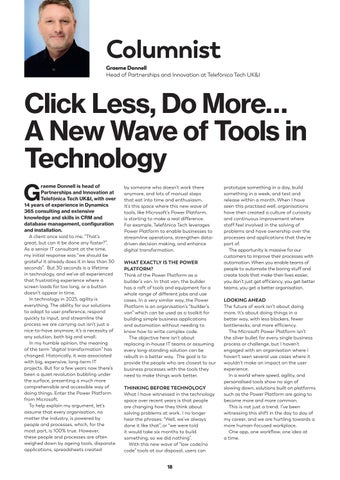
Graeme Donnell Head of Partnerships and Innovation at Telefónica Tech UK&I
Graeme Donnell is head of Partnerships and Innovation at Telefónica Tech UK&I, with over 14 years of experience in Dynamics 365 consulting and extensive knowledge and skills in CRM and database management, configuration and installation.
A client once said to me, “That’s great, but can it be done any faster?”.
As a senior IT consultant at the time, my initial response was “we should be grateful it already does it in less than 30 seconds”. But 30 seconds is a lifetime in technology, and we’ve all experienced that frustrating experience where a screen loads for too long, or a button doesn’t appear in time.
In technology in 2025, agility is everything. The ability for our solutions to adapt to user preference, respond quickly to input, and streamline the process we are carrying out isn’t just a nice-to-have anymore, it’s a necessity of any solution, both big and small.
In my humble opinion, the meaning of the term “digital transformation” has changed. Historically, it was associated with big, expensive, long-term IT projects. But for a few years now there’s been a quiet revolution bubbling under the surface, presenting a much more comprehensible and accessible way of doing things. Enter the Power Platform from Microsoft.
To help explain my argument, let’s assume that every organisation, no matter the industry, is powered by people and processes, which, for the most part, is 100% true. However, these people and processes are often weighed down by ageing tools, disparate applications, spreadsheets created
by someone who doesn’t work there anymore, and lots of manual steps that eat into time and enthusiasm. It’s this space where this new wave of tools, like Microsoft’s Power Platform, is starting to make a real difference. For example, Telefónica Tech leverages Power Platform to enable businesses to streamline operations, strengthen datadriven decision making, and enhance digital transformation.
Think of the Power Platform as a builder’s van. In that van, the builder has a raft of tools and equipment for a whole range of different jobs and use cases. In a very similar way, the Power Platform is an organisation’s “builder’s van” which can be used as a toolkit for building simple business applications and automation without needing to know how to write complex code.
The objective here isn’t about replacing in-house IT teams or assuming every long-standing solution can be rebuilt in a better way. The goal is to provide the people who are closest to our business processes with the tools they need to make things work better.
What I have witnessed in the technology space over recent years is that people are changing how they think about solving problems at work. I no longer hear the phrases: “Well, we’ve always done it like that”, or “we were told it would take six months to build something, so we did nothing”.
With this new wave of “low code/no code” tools at our disposal, users can
prototype something in a day, build something in a week, and test and release within a month. When I have seen this practised well, organisations have then created a culture of curiosity and continuous improvement where staff feel involved in the solving of problems and have ownership over the processes and applications that they’re part of.
The opportunity is massive for our customers to improve their processes with automation. When you enable teams of people to automate the boring stuff and create tools that make their lives easier, you don’t just get efficiency, you get better teams; you get a better organisation.
The future of work isn’t about doing more. It’s about doing things in a better way, with less blockers, fewer bottlenecks, and more efficiency.
The Microsoft Power Platform isn’t the silver bullet for every single business process or challenge, but I haven’t engaged with an organisation where I haven’t seen several use cases where it wouldn’t make an impact on the user experience.
In a world where speed, agility, and personalised tools show no sign of slowing down, solutions built on platforms such as the Power Platform are going to become more and more common.
This is not just a trend. I’ve been witnessing this shift in the day to day of my career, and we are hurtling towards a more human-focused workplace.
One app, one workflow, one idea at a time.
A recent Open University survey found that…
More than one in four employers said that productivity had worsened over the past five years.
But, 75% agreed that leadership and management skills development positively impacts productivity.
The Open University’s MBA helps your senior employees to take your business productivity to the next level.
Practice-based learning that brings education to life in the workplace
Flexible delivery around workplace and personal priorities
Delivered by our triple-accredited Business School
Learners join an international network of over 28,500 alumni

To find out more about how The Open University in Ireland could help your business, please contact Maureen Fox, Business Relationship Manager, The Open University in Ireland.
E-mail: maureen.fox@open.ac.uk Website: business.open.ac.uk


Triple Olympic medallist turned entrepreneur Dr Iain Percy OBE is leading the charge in making the maritime industry greener. In this interview, he discusses Artemis Technologies’ game-changing vessels and why Northern Ireland is poised to become a hub of maritime innovation this autumn.
When Iain Percy transitioned from a world-class sailing career to founding Artemis Technologies in 2017, he wasn’t simply looking for the next chapter; he was setting out to revolutionise maritime transport, and in the process, help decarbonise one of the most stubbornly highemission sectors on the planet.
“There was a number of motivations,” Iain begins. “Sporting careers don’t last forever. One of the beauties of sport is it’s great; you aim towards an event, then it stops. As I got older and the projects became larger and more complex, it was hard to accept that everything we built would just be thrown away when it was over. Around the time of leaving the sport, the International Maritime Organisation announced the level of pollution the maritime industry was putting out. That felt like something we could solve.”
Having created a 100km/ph wind-powered racing yacht with Artemis Racing, Iain and his team knew they had the expertise and the ambition to apply high-performance sailing technology to the wider world. “It was a marriage of two things: doing something with genuine longevity, and tackling maritime pollution.”
Artemis Technologies didn’t launch with a product in mind. “Normally people have an idea, but we started with a mission which was to decarbonise maritime,” Iain says. Initially operating as a consulting company focused on complex sports vehicles and simulation modelling, the team soon realised they needed to invent something with tangible, lasting impact.
Their search focused on three priorities: decarbonisation, financial sustainability, and supply chain viability here and eventually abroad. “We looked at many aspects: wind sails on ships, hydrogen power... always asking, which one could be adopted today without waiting on subsidies? Using physics married to economic models, we found in the niche of highmileage, high-speed, we could offer a product that made economic sense.”
The result: a groundbreaking portfolio of hydrofoil electric vessels, designed primarily for ferries (12–150 passengers) and pilot boats, the workhorses of the maritime sector. “One of our customers saves £1m a year per boat, as well as 5,000 tonnes of CO2,” Iain divulges.
At the heart of Artemis Technologies’ innovation is its hydrofoil system, radically cutting drag and energy consumption.
“The central physics are easy to understand,” he continues. “Our hydrofoil works the same as an aeroplane in that a pressure differential produces lift and takes it out of the water. Boats have a lot of drag from water and waves. Anyone who’s been on a bumpy ride knows you go up and down and use more energy. Hydrofoiling dramatically reduces drag, up to 90%.”
While hydrofoils aren’t new, Artemis Technologies’ vessels are different: “Our vessels are all autonomously controlled, making decisions 100 times a second. That allows a much smoother ride,” Iain explains. Advances in materials science have also allowed thinner, more efficient foils. “The real skill is in our control laws; we’ve made it smooth.”
Artemis Technologies’ recent expansion into the United States hit the headlines recently and marks a pivotal milestone for the business. In March, the company signed a multimillion-dollar Memorandum of Understanding (MoU) with Delta Marine in Washington State, a crucial step under the United States’ Jones Act requirements for domestic shipbuilding.
That Act means any ship carrying goods or passengers between two US ports must be built in the United States, owned by Americans, and crewed mainly by Americans, hence the opening of a business there which has a base of three people and growing.
“Delta Marine is an established yard with great skills. The West Coast has a real desire at a population level to protect carbon,” says Iain. “We’re just back from San Francisco, where we were taking stakeholders around the Bay. We realised early adopters were closer to home at first, but it’s important to be present in these markets.”
Artemis Technologies’ American arm is based at Brooklyn Navy Yard. “We always intended the US to be our second company,” Iain reveals, hinting that the Middle East could be home to the next base given there is “no shortage of appetite and investment there”.
Despite the global reach, Artemis Technologies’ heart remains in Belfast. “We made Belfast our home, and I’ll be a huge advocate for the skills that come out of here,” Iain says, adding, “Let’s be honest: customers care about quality and what it means to them, whether it was from Belfast or Timbuktu. But (being here) it’s a decision that stacks up.”
The company’s continued presence boosts Northern Ireland’s position as a hub for clean maritime innovation. Its upcoming launch, a 150-passenger electric ferry, will be the company’s boldest statement yet.
“It’s going to be a mind-blowing moment. An electric car, a plane, and a boat rolled into one. All designed here in Belfast. There’s no equivalent in technology to support this and this product will solve all the problems of electrifying maritime.”
The new ferry is scheduled to launch in Belfast later this year, with public demonstrations planned once sea trials and checks from the classification societies have been completed. “The people of Belfast are going to be the first to see this flying up and down,” he adds, and, notably, it will create barely any wake. The ferry has been developed through the Belfast Maritime Consortium with support from the UKRI Strength in Places Fund and will operate a three-month demonstration between Belfast and Bangor.
While the maritime industry has historically lagged in decarbonisation, momentum is building and it’s big news for business and growth for Artemis Technologies. “Appetite is growing. The growth potential is when you decarbonise and decongest a city where there is water. It’s an exciting way to solve congestion and carbon challenges because it’s the most costeffective and fastest.”
Artemis Technologies is positioning itself to be at the centre of this shift, helping cities worldwide to transform transport into a clean, efficient reality.
Public-private collaboration remains crucial to make this happen and Iain is candid about it: “We’ve had many countries courting us. These things don’t happen without a public-private partnership.”
The company is scaling rapidly: “one of the highest growth companies in the UK last year,” he points out, but future expansion will require serious investment.
Looking five to ten years ahead, Iain envisions Artemis Technologies continuing to lead in ferries and pilot vessels. “There are physical limits to hydrofoils, for example, we can’t do tanker ships, but for ferries, where there’s a geographical reason against a train or car, this is the cheapest and fastest way to decarbonise a city’s carbon output.”
Reflecting on his journey from Olympic sailor to clean tech entrepreneur, Iain is humble. “It’s never about the individual,” he says. “Winning the gold medal, it’s about discovery and improvement as a team. Sport prepares you well. Things are never as good as they seem when you’re winning, or as bad when you’re not. You have to trust yourself and that’s the same in business.”
His advice to others contemplating similar career leaps? “It’s about the people around you, having a winning team and backing yourself.”
The next chapter for Artemis Technologies and for maritime transport is just beginning. And it’s flying.
“Appetite is growing. The growth potential is when you decarbonise and decongest a city where there is water. It’s an exciting way to solve congestion and carbon challenges because it’s the most cost-e ective and fastest.”

Jane Shaw Health Coach & Therapist
Uncertainty often reigns in times of great global upheaval. Economies fluctuate, societal norms shift, and the pace of technological and environmental change accelerates. Often these periods of transformation can feel overwhelming, even paralysing, however, within this turbulence lies a profound opportunity—a moment to pause, reflect, and begin anew. This can be viewed as an opportunity for growth and a big reset: not a political or economic initiative, but a deeply personal call to reclaim responsibility for our lives, health, and sense of purpose. At its core, a big reset is about sovereignty of the self – the understanding that we are the authors of our lives, not passive recipients of external forces. This sovereignty does not imply isolation or hyper-independence, but rather a conscious commitment to align with our values, care for our well-being, and act from a place of integrity. When the world feels chaotic, the most radical thing we can do is take small, consistent steps toward inner stability and outward authenticity.
The first step in this reset is recognising that personal responsibility is power. In the face of sweeping changes, it’s easy to feel powerless or to wait for someone else to fix things. But waiting is a passive state – and often, it keeps us stuck and immobilised. Reclaiming our lives starts with a mindset shift: moving from blame to ownership, from helplessness to agency.
We may not control the systems we live in, but we can control how we respond. This shift from reaction to response is subtle but significant. It means noticing when we feel triggered, taking a breath before reacting, and choosing a path aligned with our longterm well-being. Over time, this practice rewires our habits and restores a sense of self-trust. As we rebuild this internal foundation, we become better equipped to handle external uncertainties.
Physical, mental, and emotional health form the bedrock of sovereignty. Without well-being, our capacity to act intentionally diminishes. In times of disruption, many people let their health fall to the wayside, overwhelmed by stress or distracted by the noise of the world. But this is precisely when our health matters most.
Taking care of our bodies – through nutrition, sleep, movement, and breath –is not a luxury; it is a necessity. It anchors us in the present moment and gives us the energy and clarity to make better choices. Tending to our mental health –through mindfulness, therapy, journalling, or simply asking for help – builds resilience. Emotional regulation allows us to ride the waves of change without being swept away.
Resetting health does not always require massive overhauls. In fact, the most lasting change often comes through micro actions – small, consistent decisions made daily. A morning stretch, a glass of water, a gratitude practice, a walk outside, or five minutes of deep breathing can reconnect us to our vitality. These acts may seem minor, but repeated over time, they become habits that shape our identity.
As we regain our energy and clarity, we are invited to step into our authentic selves. In times of societal flux, there is often pressure to conform, to stay silent, or to play small. But a Big Reset calls for the opposite: to speak truth, live honestly, and show up as who we really are.
Authenticity is not about perfection or constant confidence. It is about alignment – being clear on our values, expressing our feelings honestly, and living in accordance with our beliefs. It also means embracing our uniqueness without shame. In a world that often rewards conformity, authenticity is an act of courage.
One of the most powerful ways to express authenticity is through creative practice –writing, art, music, movement, or any form of personal expression. Creativity connects us to something larger than ourselves, whether we call it intuition, spirit, or simply flow. It reminds us that we are more than consumers or spectators – we are creators. Again, this doesn’t require dramatic transformation. The path of authenticity is paved with micro choices: choosing to speak up rather than stay silent, to say no rather than please, to follow joy rather than fear. Each act, however small, reaffirms our self-respect.
The Big Reset isn’t a single decision or breakthrough moment. It’s a series of small, intentional steps taken again and again. These micro actions – whether it’s choosing nourishing food, setting boundaries, or turning off the news to take a mindful walk - add up to macro impact. Over time, they reshape how we feel, how we think, and how we engage with the world.
Consistency is key. Grand declarations mean little without action, but tiny shifts practised daily can change everything. Just as a river carves through rock over time, micro actions cut new grooves into our lives. With enough repetition, they become the default.
The world will continue to change. Challenges will arise. But within this landscape of impermanence lies a powerful truth: we are not powerless. Amidst external flux, we can cultivate internal strength. By caring for our health, expressing our truth, and committing to daily micro actions, we step back into our sovereignty.
In doing so, we not only transform our own lives – we ripple that transformation outward. A more grounded, authentic, and responsible self becomes a force of stability and inspiration for others.


EY Northern Ireland has officially opened its new Northwest regional office at Ebrington Plaza in Derry/Londonderry. As the professional services firm continues to expand in Northern Ireland in response to growing client demand and to draw on the outstanding talent available in the Northwest.
The new office was officially opened by the First Minister and deputy First Minister of Northern Ireland, with the Minister for the Economy, the Mayor of Derry and other dignitaries also in attendance.
EY currently employs almost 1,100 people in Northern Ireland and more than 5,200 across the island of Ireland. The new location at Ebrington Plaza will accommodate up to 120 EY people, comprising a mix of new hires and existing EY NI staff.
The new office in Derry/Londonderry will play a crucial role in EY’s strategy to expand its regional presence across Northern Ireland and will be a key driver in delivering EY’s market-leading services for clients. It also reinforces EY Northen Ireland’s commitment made at the Northern Ireland Investment Summit in September 2023 to create 1,000 new jobs in Northern Ireland over the next five years.
The Northwest region is known for its diverse business landscape and offers extensive opportunities for working with leading indigenous and international businesses, entrepreneurs and public sector organisations, as well as access to world-class talent from its educational institutions.
Rob Heron, EY Northern Ireland managing partner, said: “The official opening of our new office at Ebrington Plaza marks a really significant milestone in EY’s growth journey in Northern Ireland. Our expansion into the Northwest reflects our long-term commitment to serving the outstanding businesses in the region solve their most complex challenges and our confidence in the region’s exceptional and deep talent pool.
EY had initially planned to open here in mid-2026 but brought this forward by 12 months as we were so impressed by the
potential and the talent in the Northwest, as well as the welcome from the local community. We’re looking forward to working closely with local businesses, education partners, and the wider community to drive innovation and inclusive economic growth for many years to come.”
Frank O’Keeffe, EY Ireland managing partner, said: “EY has built a resilient business across the island of Ireland of which we are very proud. The opening of our new office in Derry/Londonderry today, our seventh location on the island, will further enhance our ability to address growing client demand in this region and beyond while also allowing us to draw on the incredible talent available in Northern Ireland. In these times of considerable global change and volatility we are committed to being where our clients need us, when they need us with the right skills as we help to find opportunity and to shape the future with confidence.”
Anna Anthony, EY UK&I regional managing partner, said: “Our business and our people in Northern Ireland play a crucial role in EY’s plans for growth across in the UK and Ireland. Our new office in Derry/Londonderry is our latest demonstration of commitment to the region and the exciting opportunities we see ahead. The opportunity for delivering growth and developing outstanding talent across Northern Ireland is clear, and we remain focused on bringing together our global scale with deep local insight and expertise which allows us to bring the best possible service to our clients.”
Minister for the Economy, Dr Caoimhe Archibald MLA, said: “In September 2023, EY committed to creating 1,000 new jobs across the north, supported by my Department’s Assured Skills Academy programme and Invest NI. Today is a key milestone in that investment, which will provide employment opportunities in the Northwest in highly skilled areas such as digital engineering, data analytics and risk and regulatory compliance. I am delighted that companies like EY can see the Northwest’s potential as a vibrant place to live, grow and invest and I wish them every success.”


Accenture
AgriWeb
Alexander Reid & Frazer
AM Logistics Network
Barclay Communications
Black Copper Design Co.
Capitol Essentials
Cavanagh Kelly
Challenge Curve
Chartered Accountants
Northern Ireland
Clandeboye Lodge Hotel
Collins Aerospace
CV6 Therapeutics
CyberLab
D.A Martin Solicitors
Design ID
Desmond Motors
Elizabeth Sands Beauty School
Emerald Urgent Care
*
Expeditors
Fleet Fixation
ForeBee Consulting
Fortior Insight
GrowWeb
Handepay
Hybrid Mail Solutions
John Minnis Estate Agents
Kith and Kin Financial
Wellbeing
Lisnasure Home
Lissah & Boyle
Loughview Health
Lunn’s Jewellers
Mourne Management Systems
Neurovalens
NI Precision
Norsemen Safety
Northern Homes
Ortus Secured Finance
PRO Apprenticeships
Pro Solar NI
PulseSolar Group
Revolucion de Cuba
Rosie’s Trust
Route Media
Scotwork
Select Services
Sensoteq
Share Energy
Silverwood Recruitment
SJ Henderson Fulfilment
Solarfix NI
Sport Changes Life
Succeed With Confidence
T L Dallas NI
Taranto
Tetra Tech
The WIB Group
Suzanne Wylie, Chief Executive, NI Chamber
Iam thrilled that in recent weeks, we have welcomed more than 50 new members to NI Chamber. From med-tech and cyber firms to renewable energy and business services, our ever-expanding membership base represents the best and brightest of Northern Ireland’s business community.
On behalf of members, new and existing, we have been very actively engaged with policy makers, never more so that around the recent UK EY reset. News that the EU and UK have reached an outline agreement which could remove barriers to trade with our nearest markets is a step in the right direction.
With an escalation in geo-political uncertainty and the cost of doing business, we want to see a deal that delivers meaningful change to drive growth and address common challenges like food security, energy, and healthcare.
Whether its removing frictions on the flow of goods that ease GB-NI trade or making progress in areas that support cross-border services, there are many areas that could be beneficial for Northern Ireland.
The agreement announced recently will not solve all the challenges our members face, however we acknowledge that it is the beginning of a process.
Members have our commitment that we will continue engaging with policymakers to ensure that Northern Ireland’s businesses and households stand to benefit from the outworkings of the most recent announcements.


8.





Over 300 business leaders and policymakers gathered at our Momentum Conference to hear from a range of expert speakers, including Economy Minister Dr Caoimhe Archibald and former Chief Economist at the Bank of England, Andy Haldane. Headline sponsor for this event was Ulster Bank with supporting sponsors ESB, BT and Ulster University.


1. Economy Minister, Dr Caoimhe Archibald.
2. Chief Economist of NatWest Group, Sebastian Burnside spoke to business leaders and policymakers.
3. Guests had the opportunity to network before hearing the day’s speakers.
4. Panellists Anne Beggs (Invest NI); Nick Clarke ( NatWest) and Jonathan Walsh (Fortior Insight) focused on practical steps to boost global competitiveness of NI.
5. Paul Murnaghan (BT) ; Cathy Gormley-Heenan (Ulster University); Suzanne Wylie (NI Chamber); Dr Caoimhe Archibald MLA (Economy Minister); Nigel Walsh (Ulster Bank) and Gary Connolly (ESB).
6. 300 business leaders gathered to hear from a range of panellists and speakers at Momentum Conference.
7. Nigel Walsh (Ulster Bank) welcomed guests to the annual Momentum Conference.
8. Former Chief Economist for Bank of England, Andy Haldane, delivered the keynote address.
9. Panellists examined how City and Growth deals can drive innovation for NI businesses.
NI Chamber President Cat McCusker led a group of business leaders on a fundraising hike up Slieve Donard on 5 May. The climb saw over 30 business leaders reach the summit in support of Cancer Fund for Children and Daisy Lodge and the efforts of the 26 Mountains to Mayo team. Before taking off on their journey up the Mourne Mountains, the team were invited to tour the purpose-built therapeutic centre, Daisy Lodge.


Call for policymakers to be ‘courageous’ in supporting NI businesses
NI Chamber has urged policymakers in Stormont and Westminster to be ‘courageous’ in supporting businesses through the challenging weeks and months ahead.
That plea came as NI Chamber and BDO NI published the results of their Quarterly Economic Survey (QES) for Q1 25. The report illustrates that while businesses continue to grapple with high labour costs, inflation and taxes, there were signs of optimism during the first quarter of the year. Northern Ireland’s export performance was strong in Q1, with both Manufacturing and Services businesses surpassing the UK average.
Most businesses who responded to this survey traded either well (31%) or reasonably (49%) in Q1 25, while 20% said they were just covering costs/ struggling. Almost half of them (46%) experienced a slowdown in demand in Q1 25 although for most, this was only a small slowdown.
Employment growth expectations improved across both sectors, signalling positive momentum at the onset of the new year. Recruitment challenges showed signs of easing.

Cashflow balances for both the Manufacturing and Services sectors were negative in Q1 2025 at -3 and -1 respectively. Notably, the Services sector has now experienced four consecutive quarters of negative cashflow balance.
While price pressures eased in Q1, they remained a concern, particularly for Manufacturing businesses. These pressures were largely driven by rising labour costs along with raw material costs for Manufacturers, with inflation and business taxes continuing to pose external challenges.
In Q1 25 a balance of 55% of Manufacturers was expecting to raise prices, compared to 38% of Services. This was +49% for Services in Q4 24, so it was down considerably over the quarter.
In Manufacturing, Northern Ireland ranked in the top three UK regions for eight of the 11 key indicators during Q1 25. The sector’s strongest rankings were around confidence in turnover growth and investment in training, both ranking
first across the UK regions. It was weakest on the domestic (UK) sales and orders balance, ranking seventh.
In Services, Northern Ireland ranked in the top three UK regions for nine of the 11 key indicators. The Services sector’s strongest regional position in Q1 25 was export sales. It ranked first across the UK regions on six balances including domestic sales and orders, export performance, employment growth and confidence in turnover growth. The Services balance was weakest with cashflow, ranking fifth across the UK regions.
Commenting on the report Suzanne Wylie, Chief Executive, NI Chamber, said:
“These results correlate strongly with the most recent NI Composite Index, which indicated that Northern Ireland saw economic growth in 2024. And whilst it is encouraging to report a relatively positive performance during Q1, it is an illustration of how quickly the trading environment can change. The past week has delivered big changes which present a real and substantial test for NI businesses. The Q1 results were positive in many respects –what matters now is how we build on that momentum in the immediate term.
“Whilst it remains a complex picture, we know that US tariffs will have ramifications for businesses in Northern Ireland. In response, our politicians must be both courageous and strategic, working in partnership with businesses to help navigate the uncertainty ahead.
“This is a time for calm heads and careful, constructive assessment. In anticipation of an escalation of US tariffs, NI Chamber has been actively engaging with policymakers in Westminster, Brussels, Stormont and Dublin since January. In all of that, our aim has, and will continue to be, to ensure that Northern Ireland and its unique circumstances are adequately considered as both the UK and EU prepare to respond. Given the complexities involved, we have called on the UK government to stand up a team of experts to support our businesses through this challenge.
“The global Chamber network is unique and provides an important framework to support local businesses with trade issues, market intelligence and introductions to business communities and ecosystems across the globe.
“NI Chamber has been actively investing in strategic partnerships with Chambers of Commerce in our main markets of Great Britain, Ireland and the US over the past year to support our business through these challenging times for global trade.”
BDO PERSPECTIVE
BDO NI Managing Partner, Brian Murphy
Over the last decade, operating in times of uncertainty and upheaval appears to have become the “accepted norm” for Northern Ireland’s business community. Recent global economic developments have only served to fuel further concern and uncertainty. The coming weeks and months will provide clarity – once the headlines fade – about the real and practical implications of what the new tariffs from the US and the UK Chancellor’s Spring Statement will have for local firms.
Until then, it is important to understand where we are at the moment. In terms of business confidence, and looking to the latest QES results, Northern Ireland’s businesses are performing extremely positively, with 80% trading well or reasonably.
Indeed, across the UK regions, NI firms are the most confident about delivering stronger turnovers in 2025. They are also expecting to increase their profitability, even with the challenges they face.
One of the biggest indicators for business confidence has always been recruitment, and it is reassuring that, locally, more than six in ten (62%) firms are recruiting, which is an increase on the previous quarter.
As an overview of the state of the business community, these findings are deeply encouraging and demonstrate the resilience, flexibility and strength that underpins the impressive performance of our local firms.
So does our commitment to innovation, with 55% already using AI, or seeking to invest in it over the next three years. Although 40% are currently not considering using AI, we imagine these numbers will soften as time passes.
Of course, we face challenges – we always do – and not just from harnessing AI to support, not supplant, our businesses. For many local respondents, managing cashflow remains an issue, with labour costs also continuing to cause real concern.
Although the pressure on prices has started to ease, nearly half (46%) are already seeing a slowdown in demand, and manufacturing is experiencing a decline in UK sales.
As we look to the rest of the UK, only 51% of local businesses are aware of the pending “Good Jobs” Employment Rights Bill, due to be introduced by the UK Government. No doubt this will bring many benefits and opportunities for improving relations between employers and staff, however, it could also place restrictions on employers, with 62% of local respondents believing it will make them more cautious about hiring in the future. It will be important for businesses here to be aware of the legislation as it is likely to be adopted in NI in due course.
Most businesses (59%) remain worried about inflation and are concerned about levels of taxation. These issues are consistent across both the manufacturing and the service sectors, with the impact of the last UK government budget being felt and with real fears about further potential tax rises to come – perhaps even later this year.
Rather than see the business community as another source ripe for further taxation, it is hoped that the UK government will realise that our collective pockets are not bottomless and they are already making life hard for so many firms, especially here in Northern Ireland. Instead, we would recommend that the government, and the NI Executive, work in cooperation with the business community to tackle the issues that are holding us back from investing, exporting and recruiting more.
If they are serious about growth then they should remove the barriers to it – such as speeding up the planning process, tackling infrastructure projects, refinancing NI Water, increasing global connectivity, enhancing skills, building more homes and making NI a more attractive place to work, live and invest in.
This will deliver the growth we need to help invest in the reform and repurposing of our public services, and if engaged in collaboration and in partnership, our local business community can play its role in positively reshaping our economy.
“These results correlate strongly with the most recent NI Composite Index, which indicated that Northern Ireland saw economic growth in 2024.”


What began in 1996 as a modest operation under the name Taranto De Pol has, over the past two decades, quietly evolved into a powerhouse in the construction sector. Behind the company’s consistent growth is not a tale of overnight success, but one of considered internal development, long-term investment in people, and a leadership team determined to do things di erently.
Based in Tandragee, Taranto Ltd is a leading provider of piling, foundation, and precast concrete solutions across Ireland and Great Britain. While its product offering remains rooted in durable, reliable construction systems, the company’s ethos and internal culture are anything but conventional.
“We’ve gone through the usual construction cycles of booms and busts,” says John Stenson, managing director, when reflecting on the firm’s history. “It’s easy to go back and talk about the Celtic Tiger years when 85% of our work came from that market. But we’ve processed that. We don’t dwell in the past; we’re about the future.”
Instead, Taranto has focused on forward-thinking strategies to futureproof the business. From redefining internal culture to embracing automation, AI, and lean manufacturing, the company has emerged stronger, sharper, and more agile.
“Construction is a traditional industry,” John says. “Concrete is concrete. Steel is steel. But that doesn’t mean the way we approach business has to stay the same. Change has to come from within, and that’s exactly where we started.”
One of the boldest changes came from a clear-eyed focus on leadership. Taranto invested significantly in upskilling its people through initiatives like the Advanced Leadership Programme with the Timoney Leadership Institute and the San Telmo Global Leadership Programme in Spain. Both initiatives are known for cultivating business leaders who understand the broader societal impact of their decision-making.
“You can be cynical and say leadership training has become a buzzword,” John admits. “But for us, it’s central. Leadership here isn’t about your title or years in the job. It’s about influence, mindset, and attitude. If someone shows potential, we back them.”
That backing includes internal one-toone coaching and mentoring, alongside external sponsorship for academic and professional development. “We’ve put people through law degrees, MBAs, MSc programmes, not because we want letters after names, but because we want competent, rounded, future-focused individuals. If someone has the mindset, we invest.”
John and his leadership team believe that personal growth fuels organisational growth. “We believe that by building better leaders, we build a better company. And by doing that, we play a part in building a better society. That’s something we buy into fully.”
Sales Director David McCartney adds, “There’s a thread that runs through this business and it’s people. John and I have both worked in construction for our whole careers, and when we reflect on our time as young engineers we were lucky that a few experienced and knowledgeable
senior colleagues mentored us. We have chosen to replicate this positive experience by challenging our colleagues to continually work on their personal development, safe in knowledge the company will fully support their efforts.
The results of this philosophy are clear. “We started this journey about six years ago,” says John. “And we’ve seen a real cultural shift. We used to say yes to everything. Now we’ve got the resilience to say no. We understand what our sustainable competitive advantage is. I’d challenge other companies to tell me if they really know theirs.”
One of the areas where that advantage is most visible is in the company’s strategic application of technology. Through a government-backed Knowledge Transfer Partnership (KTP) project with Ulster University, Taranto developed a bespoke AI tool named Autocost. The tool scans architectural drawings, identifies structural features such as doors and windows, and calculates quantities and costings in a matter of seconds.
“It used to take one of our skilled staff about an hour to do that manually,” John says. “Now it takes 90 seconds. This, along with other IT tools, has created a 30% saving in our sales team’s time, time; they can now spend engaging with clients and adding value.”
That added value is part of a wider strategy. “We don’t want to be a one-hit service,” David adds. “We want to be pain relievers. Know the client’s problem, solve it, and stay connected. AI has helped us become more responsive, more precise, and more human in our relationships.”
Another major innovation has been the company’s £3 million investment in a state-of-the-art concrete slipformer. “Traditionally, concrete is moulded,” John explains. “But the slipformer lays it continuously. It’s a game-changer. It gives us a step change in capacity without leaving people idle. And it’s far more efficient and sustainable.”

That sustainability piece is important. “We can’t ignore the embedded carbon in concrete,” John says. “But we can control how we produce it. Less machinery, fewer moving parts, less energy. This method is inherently more efficient. To the best of our knowledge, we’re the only ones using it like this.”
Efficiency is a recurring theme. Taranto’s renewed focus on lean practices has been transformative, but not without its hurdles. “We tried lean three times and it failed,” John admits. “The fourth time, we did it differently. We focused on people. We made it cultural. We empowered staff to look at their own processes and make small changes – even shaving off two seconds matters.”

That small-start approach worked.
“Construction is inherently wasteful,” he adds. “Materials left out, tools everywhere, it’s a race to hit deadlines. Lean helps us hit those deadlines without the waste. And more importantly, it creates a culture of respect and continuous improvement.”
Taranto now holds daily meetings focused on identifying waste and making incremental gains. “It’s not about big flashy changes,” says John. “It’s the aggregation of small improvements that’s changed how we work.”
Currently employing 110 people, Taranto is actively investing in its future workforce. “We’ve got a great team right now,” John says. “We’ve brought in young engineers, strengthened our senior team, and our focus is on attracting the best people. We’re poised for 100% growth over the next four years across the island of Ireland and Great Britain.”
David believes this approach is what sets Taranto apart. “Letting staff try different roles, encouraging cross-learning, and engaging with leaders from other industries, it builds a workforce that’s agile and future-ready. That’s the difference.”
John agrees: “We know where we want to go. We’ve got the people, the culture, the strategy, and the mindset. Now it’s about staying on that path and bringing others with us.”

R R R

In an era where purpose matters as much as profit, orthern reland businesses are rethinking where –and how – they host corporate events. ncreasingly, the answer is the MA .
Located in the heart of Belfast’s athedral uarter, the MA offers more than sleek, flexible spaces and seamless service. As a registered charity and leading arts venue, it gives corporate clients a chance to align their events with values that matter – from environmental responsibility to e uity and inclusion.
There’s a growing awareness that every business decision sends a message – and that includes where you choose to host your events, says achel Leitch, Head of Marketing at the MA . More of our clients are coming to us because they want their spend to reflect their ESG goals.

RThe MA ’s spaces – from contemporary studios to state-of-theart theatres – have been designed with modern sustainability in mind, from efficient energy systems to responsible sourcing. But it’s not just about the building. All income from hires is reinvested into the MA ’s creative and community programmes, supporting everything from free exhibitions to mental health projects and youth outreach.
When a company books with us, they’re not just getting a great venue – they’re funding access to the arts for people who need it most, says achel.
t’s an easy, meaningful way to add social value to your event.
The venue’s accessibility, inclusive ethos, and commitment to using local suppliers make it a natural choice for organisations seeking to deliver on environmental and social commitments.
We’re proud to be a space where businesses can do good while doing business, adds achel.
For companies who want their away days, client meetings, or strategy sessions to leave a lasting impression – and a legacy – the MA offers a uni uely purposeful platform.
Discover how your event can make an impact at the MAC.
Visit hirethemac.com to learn more.


By Lee Surgeoner
Lee Surgeoner, Partner at Endeavour Information Solutions, a Microsoft Solutions Partner based in Belfast, that specialises in bringing customers ICT systems into the Microsoft Cloud using their extensive client project experience gained over the last 15 years with their Cloud First approach.
We see the term “AI or Artificial Intelligence” everywhere—on the news, in social media, at the dinner table even. Generally, there is a lot of excitement but when it comes to why and what the actual benefits are, other than it can be highly creative (and potentially wrong at times) or for automation there isn’t a well established use case, and when you think about it, that is sort of the point.
Everyone and every situation is unique, it’s what makes us who we are, so trying to make technology duplicate the human brain is impossible. However, over the last couple of decades with the evolution of things like the internet and the smartphone, what we do have in abundance is access to vast sources of knowledge (not always factual or correct) which is easily accessible and referenced.
Combined with a continious increase in computing performance over the same period has resulted in the ability of Large Language Models (LLMs) that can comprehend and generate human language responses that ingest, interpret and query that knowledge to do so at a staggering rate. It is this continuing innovation that presents itself as the next industrial revolution.

But what does all that mean in reality for my business? Marketing combined with social media promotion, means there is a lot of awareness of AI platforms out there. And where using an AI tool to remove blemishes from photos is fantastic, there are others that offer far more than than that as a free service. However, there is no such thing as a free lunch and not all services will respect and secure the data you feed them.
We are already used to this concept with search engines and targeted ads, where we provide data to a service we want or need and where we might accept letting that service use your personal data to get something in return, do you as a business owner really want to (or have a keen team member) upload your intellectual property into a service that might take that information and potentially reference it elsewhere? This is where Microsoft Copilot is like having your own in-house service that helps deliver measurable results across your business.
Use Case of Microsoft 365 Copilot: A growing business can sometimes struggle with operational inefficiencies due to time-consuming document management, scattered communication, and a lack of insight into client interactions. Staff can then get overwhelmed with repetitive tasks such as summarising emails, updating proposals, and finding the latest versions of files across SharePoint and OneDrive.
Solution: By integrating Microsoft 365 Copilot into Word, Excel, Outlook, and Teams, the team can get time savings searching repetitive documentation.
Get Improved accuracy and consistency when creating client-facing materials and increased team satisfaction and efficiency through automation of mundane tasks.
Use Case of Creating AI Assistants with Copilot Studio and Azure AI: There are always going to be tasks and service offerings that are time intensive to find and learn, but are based on knowledge already within different systems across the business. The use of time for this is vital to delivering fast and high quality services to customers but is also expensive to setup and maintain.
Solution: Using Copilot Studio, you can create AI assistants that integrate with your business applications. These assistants can handle common customer queries like order tracking, returns, or make product recommendations via web chat or Teams. Using Azure AI and Cognitive Search, you can create internal assistants that staff can use to access real-time data from internal systems, including PDFs, training and policy docs, to provide contextual and accurate answers to specific situations. The impact being that your business can now offer 24/7 intelligent support without hiring more staff while reducing response times and increasing customer satisfaction.
Summary: If you would like to find out more, why not contact us to arrange a free, no commitment consultation, by visiting https:// bit.ly/lets-talk-copilot or calling us on 028 9031 1010 and let’s talk.


Copilot in Word and Outlook helps you draft, summarise, and rewrite content instantly. Turn rough ideas into professional documents and emails in seconds.

Copilot in Excel to identify trends, create formulas, generate visuals and ask natural language questions to get deep insights on your data fast.

Connects with your existing data (emails, calendars, documents, reports, policies and procedures) to provide fast and contextual support to your team whenever they need it.
• Saves your team time working on repetitive tasks;
• Boosts creativity and productivity;
• Increases focus by handling common tasks automatically;
• Provides enterprise-grade security & privacy; and
• Is always available and always learning the best way to deliver value to your business.
* Copilot requires additional license
Harnessing the power of Microsoft’s latest AI innovations, we help our customers unlock new levels of productivity and creativity with Microsoft 365 Copilot. Seamlessly integrated into familiar applications like Word, Excel, Outlook, and Teams, Copilot works alongside you to streamline tasks, accelerate workflows, and turn your ideas into impact. By combining the intelligence of Large Language Models with your business data, Copilot helps to empower your team to work smarter, communicate more effectively, and stay focused on what matters most — helping you stay agile, informed, and ready for the future.
Contact us for more information and a demonstration of how Microsoft 365 powered by Copilot can help to deliver the right results for you and your business.
Northern Ireland 14-18 Great Victoria Street Belfast, BT2 7BA
Scotland Lochrin Square, 92-94 Fountainbridge, Edinburgh, EH3 9QA
England 52 Grosvenor Gardens, London, SW1W 0AU


PRIVATE EQUITY AND DEBT FINANCING IN NORTHERN IRELAND’S BUSINESS LANDSCAPE

Northern Ireland’s business landscape has evolved significantly in recent years, with private equity funding now playing a pivotal role in driving growth, innovation and economic development in the region. Increasingly, businesses are complementing equity investment with debt financing to ensure there is su cient capital and flexibility available to support business needs. In this article, Arthur Cox Partners Richard Armstrong (Corporate and Commercial) and Stuart Mansfield (Finance) examine the growing prominence of private equity and debt finance in Northern Ireland, and the increasing integration between the two.
The growing influence of private equity in Northern Ireland’s economy is evident in recent findings from Experian’s M&A report, which recorded a 23% increase in private equity transactions in 2024 compared to the previous year. This sustained growth – even amid broader global economic uncertainty – highlights just how important private equity has become to the region’s business community.
The upward trend reflects several factors, most notably the increasing number of high-quality, ‘investor-ready’ businesses being established and scaled in Northern Ireland.
As a result, there has been a noticeable rise in interest from

investors based not only in Great Britain and Ireland but also internationally, creating a positive cycle of confidence and capital investment.
At its core, private equity involves investors providing capital to businesses in exchange for an ownership stake, typically with the goal of fuelling sustainable long-term growth. Beyond financial investment, private equity partners will generally deliver significant added value in a number of ways. They often provide strategic guidance, bringing sectoral expertise that helps steer business strategy and operational improvements, while opening connections to potential partners, customers, and acquirers. Private equity partners can also establish clear strategies for future exits, providing shareholders with transparency and direction from the outset.
The Corporate and Commercial Practice at Arthur Cox NI has been pivotal to the rise in prominence of private equity in Northern Ireland, advising on several high-profile investments over the last 18 months. This has included US-based investor WOC Group’s significant investment in the Ballykeel Beg Group, which enabled the development of the five-star Portrush resort at Dunluce Lodge. The resort, due to be at the centre of hospitality for The Open in 2025, is a fantastic example of the benefits that US inward investment can bring to Northern Ireland. Arthur Cox NI has a long and distinguished track record of guiding US companies through their Northern Ireland market entry - and vice versa for our clients expanding into the US.
The Arthur Cox team in Belfast also advised Titanic Distillers on securing £5 million in equity investment from Whiterock. Having opened in Belfast’s historic Thompson Dock in 2023, this funding will enable Titanic Distillers to expand its international presence, grow its sales team, and establish key distribution channels across the US and Europe.
Together, these examples demonstrate Northern Ireland’s growing prominence on the international investment map – and underline the increasingly critical role private equity is playing in the region’s future growth.
The Continuing Importance of Debt Finance
Debt financing remains a critical pillar of business funding. There are various forms of debt finance available to a business including term loans, overdrafts, revolving credit facilities, invoice finance, asset finance and business credit cards. In short, debt finance enables businesses to access capital without diluting ownership.
Typically provided by banks and alternative
lenders for periods of up to five years, debt finance offers structured repayment schedules and potential tax benefits associated with interest payments.
Banks remain the primary source of debt funding for many businesses, typically offering competitive rates and well-established support services.
For more mature businesses with solid trading histories and security to offer, banks can provide structured, cost-effective lending solutions.


Today, many businesses are leveraging a combination of private equity and debt finance to achieve optimal funding structures. A hybrid approach offers the best of both worlds - debt finance to meet immediate capital requirements and equity investment to fuel long-term strategic growth.
This combination can help balance the burden of debt with the desire to avoid excessive equity dilution. The Dunluce Lodge project is an excellent example; in addition to private equity, debt funding was provided by the Northern Ireland Investment Fund. Arthur Cox has also recently advised on several similar transactions across varying sectors (including waste management, manufacturing, infrastructure and hospitality) where equity and debt elements are carefully coordinated
through inter-creditor agreements to align investor and lender interests.
Particularly in the current economic climate, where adaptability is key, access to multiple funding sources allows businesses to tailor solutions that best fit their needs and aspirations.
Northern Ireland’s businesses are increasingly sophisticated in how they approach funding, and the growing convergence of private equity and debt finance reflects a maturing market.
As a leading full-service corporate law firm in Northern Ireland, Arthur Cox stands at the forefront of this dynamic environment, providing specialist advice on private equity and debt financing across all sectors. Should you wish to discuss your specific funding requirements or explore the options available to your business, please do not hesitate to contact us by calling +44 28 9023 0007 or emailing Belfast@arthurcox.com.
“The corporate and commercial practice at Arthur Cox NI has been pivotal to the rise in prominence of private equity in Northern Ireland, advising on several high-profile investments over the last 18 months.”


Jonny Kelly Director, The Foundation
It can represent the end of something or the beginning, depending on your perspective. Seneca captured it perfectly when he said, “Every new beginning comes from some other beginning’s end.” (And yes, Semisonic quoted him in their classic hit ‘Closing Time’, who knew!)
Some people run towards change with excitement, whilst others prefer predictability and cling to the comfort of the familiar. Those that are more resistant often struggle to envisage a different future. They need someone to bring clarity to a vision before they are confident to take steps towards it.
That’s where good leadership comes in. People who can clearly communicate a future that others see themselves in and feel compelled to move towards.
I came across a short story recently by Wallace Ford which resonated strongly with me on the challenges of change. Here’s a summary.
There was once a land where the entire community lived under a giant glass dome. For generations, families lived and died within its walls. No one had ever dared to step outside as it was believed certain death awaited beyond.
Trying to leave was the worst possible crime. The punishment?
Banishment beyond the dome.
One day, a man dared to commit this crime. The community acted swiftly, escorting him to the edge and pushing him out into the unknown.
Then they watched and waited. Slowly, he rolled over, sat up, and looked around. Seeing no danger, he stood. Then, to everyone’s amazement, he began to dance on the soft grass –swinging his arms and legs, laughing with joy.
He called back to his friends: “Come out and dance!”
But they didn’t follow. Instead, overwhelmed and confused, they got buckets of paint and brushes and painted the dome walls solid black, as high as they could reach, to block the view of the dancing man.
Only then did they feel safe enough to return to life as it was before.
What was the man’s crime? Was he disruptive, a threat to the community?
Or was he an innovator who just wanted positive change?
We’ve probably all been holding the paintbrush at times in our lives.
Maybe you’ve been dancing on the grass? Maybe you’ve struggled to encourage your team to step outside the dome?
We live and work in a world where our reality is constant change. It’s where we find our edge, our competitive advantage, our future. However, it can also be where we find friction, fear, and reluctance.
In most cases the obstacle is not change, it is the fear of change.
Rather than confront the possibility that their fears were unfounded, the community in the dome preferred to blot out the truth and paint over the things that made them uncomfortable. Transformative leaders take the time to understand those fears and they possess the clarity of vision to remove the complexity and uncertainty causing them. They give people the courage to see the opportunity that change can bring, fostering a culture where they feel confident enough to put away their brushes and dance on the grass. Businesses with a desire to grow and succeed must change continually.
Evolving their proposition, adjusting position in the market, energising team culture, transforming methods of delivery – it’s all a work in progress towards a vision of a better future. Businesses are stories of change. Is it something that happens to you or something that you make happen? I wonder what the man outside the glass dome did next. Just a thought.
“Businesses with a desire to grow and succeed must change continually. Evolving their proposition, adjusting position in the market, energising team culture, transforming methods of delivery – it’s all a work in progress towards a vision of a better future.”
InspecVision, a Newtownabbey-based manufacturer of precision inspection systems, has received the UK’s highest business accolade – the King’s Award for Enterprise – for its exceptional export performance. It is one of only 197 organisations across the UK and just two in Northern Ireland to receive the award this year.
The company was honoured for its excellence in international trade, having achieved a 126% increase in overseas sales over the past three years with 96% of its products exported to over 40 countries, including the United States, China, and Europe.
Founded in 2003 by Dr. Jan Antonis, InspecVision developed the Planar 2D – the world’s fastest 2D measurement system – drawing on his expertise in vision technology and the sheet metal industry. Today, its advanced inspection systems are used globally by both multinational corporations and SMEs in sectors such as automotive and aerospace to ensure uality, enhance production efficiency, and reduce waste.
InspecVision’s Managing Director, Dr. Jan Antonis, commented: “It’s a tremendous honour to be awarded the King’s Award for Enterprise for International Trade. Overseas growth has been at the heart of our organisation since we began and this award recognises the dedication and resilience of our team and our worldwide distribution partners in delivering innovative solutions to manufacturers around the world.”
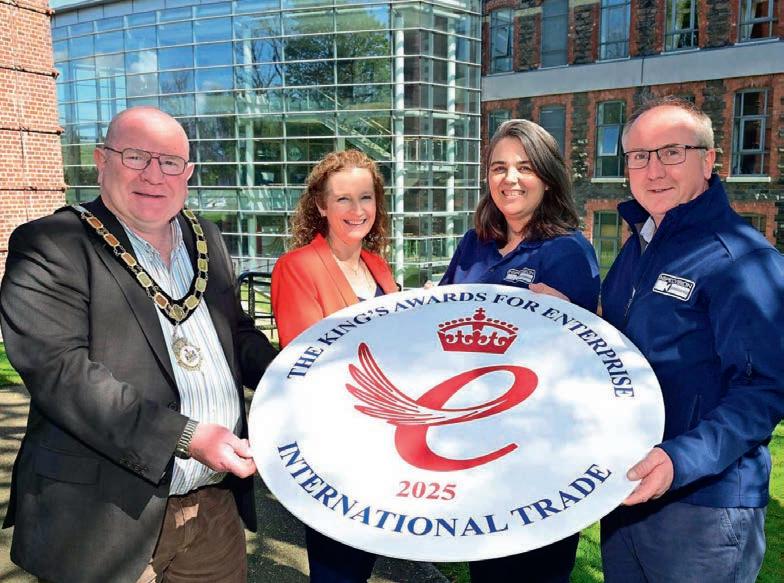
The company previously won the Queen’s Award for Enterprise in 2021 and is now under the ownership of SDI Group plc, while its original leadership team remains at the helm.
Mayor of Antrim and Newtownabbey, Councillor Neil Kelly, praised the achievement: “I would like to congratulate InspecVision on being honoured with the King’s Award for Enterprise: International Trade 2025. This recognition is a testament to their

innovation, expertise, and the high standards they uphold in advanced technology. The Council are proud to have supported their application and are delighted to see their hard work and impact acknowledged at the highest level with this prestigious award.”
Roger Pollen, Head of the Federation of Small Businesses in Northern Ireland, added: “On behalf of the FSB Northern Ireland, I’d like to extend our warmest congratulations to InspecVision on this outstanding achievement... FSB is proud to have supported their journey so far, and we look forward to seeing what they achieve next.”
Renamed in 2023, the King’s Awards for Enterprise honour outstanding UK businesses. Now in its 59th year, it remains the UK’s top business accolade, with winners allowed to use the King’s Awards Emblem for five years.

Dalata Hotel Group’s commitment to people, place and purpose.
That’s the answer you’ll hear from team Dalata - because people are at the heart of everything they do.
As the largest independent four-star hotel operator in the UK and Ireland, Dalata has established itself as a hospitality powerhouse with a portfolio comprising 55 properties across two wellestablished brands: Clayton and Maldron. Dalata continues to grow while staying rooted in its founding values: people, place and purpose.
Dalata Hotel Group is reinforcing its commitment to Northern Ireland with significant developments across its portfolio in the region.
Four of the group’s properties are located within the region: Clayton Hotel Belfast, Maldron Hotel Belfast City, Maldron Hotel Belfast International Airport and Maldron Hotel Derry. These hotels each reflect the company’s ability to balance innovation with time-tested hospitality practices.
These properties highlight Dalata’s approach to regional growth, maintaining consistent brand standards while honouring the unique character of each location.
Maldron Belfast International Airport, the group’s first property in the region, received a £4 million investment in 2024 and achieved a four-star tourism rating, securing its position as a vital hospitality provider at the airport.
In Derry, the Maldron Hotel has become a standout destination –particularly during the city’s annual Halloween festivities, which host Europe’s largest celebration of the holiday. With its prime location inside the historic city walls, the hotel is an integral part of the local experience.
Within Belfast, Dalata operates 407 rooms between the Clayton Hotel and Maldron Belfast City, with plans to expand to 558 rooms as part of its 2030 vision. Opened in 2018, Maldron Belfast City was Dalata’s first new-build hotel and has since served as the blueprint for further developments in cities like Liverpool, Manchester and London.
This summer, Clayton Hotel Belfast celebrates its ten-year anniversary, with festivities and future renovation and expansion plans already underway through 2026.
Established in 2007, Dalata has become Ireland’s largest hotel operator with an ambitious growth strategy. The company is backed by €1.7bn in hotel assets and, combined, the Clayton and Maldron Hotels boast 12,150 rooms and a 2030 vision to reach 21,000 rooms. The current pipeline is over 1,800 rooms, including Maldron Hotel Croke Park, Dublin and Clayton Hotel St Andrew Square, Edinburgh.
For the six-month period ended 30 June 2024, Dalata reported revenue of €302 million. Trading has remained robust and, coupled with the positive impact of recent hotel additions in 2023 and 2024, the Group now expects to deliver Adjusted EBITDA1 in excess of €232 million for the year, c. 4% growth year on year.
Dermot Crowley, CEO, Dalata said: “We are on track to deliver another strong financial performance, headlined by another year of growth in both our revenue and Adjusted EBITDA1 performance. Our focus on innovation over the last three years continues to deliver enhanced productivity and mitigate the impact of cost inflation on our margins.

“We are on track to deliver another strong financial performance, headlined by another year of growth in both our revenue and Adjusted EBITDA1 performance.”


“It is always challenging when external input costs are rising; however, I am delighted with how everyone at Dalata has responded to the challenge.”
“It is always challenging when external input costs are rising; however, I am delighted with how everyone at Dalata has responded to the challenge.”
Dalata’s finances and presence are impressive, and this shows no signs of slowing down, as the group announces that it has exchanged an agreement for lease for a new London-based fourstar Clayton hotel due to open in the second half of 2028. Subject to planning approval, the full-service Clayton hotel will be developed at 20 Old Broad Street in the heart of the city.
On completion of construction, Dalata will commence operations in the hotel through a 25-year Operating Lease, which will be subject to five-year rent reviews linked to the Consumer Price Index.
Going beyond Ireland and the UK, Dalata has also recently begun expanding into Continental Europe, marking a significant milestone in its growth journey and exemplifying its key focus of bringing exceptional experiences to more people than ever before.
Dalata’s commitment to people development took formal shape in 2018 with the founding of the Dalata Academy, a comprehensive learning and training hub designed to empower staff at all career stages. From new graduates to seasoned managers, team members access accredited development programmes tailored to help them advance professionally with support from mentors and colleagues.
February 2025 marked a significant commitment to community involvement as Dalata announced a five-year sponsorship of the GAA Under 20 Football Championship. The championship, titled ‘Dalata Hotel Group GAA Under 20 Football Championship’, represents a meaningful connection to local sporting heritage.
“This is an extremely proud and exciting time for us,” said Dermot Crowley. “Dalata’s difference has always been people, and the same can be said for those who elevate the game
of football. Each Dalata Hotel general manager builds a team that ensures we deliver for all our customers and guests. In the same way that a football manager relies on his players to deliver when expectations are highest, our managers rely upon their teams to meet the high expectations of our guests.”
As Dalata continues its expansion, the company faces the challenge of maintaining its people-first culture across a growing international footprint. The Dalata Academy will play a crucial role in preserving organisational values while adapting to diverse markets.
From its humble beginnings as a small local operator to its current status as an international hospitality group, Dalata’s journey demonstrates that commercial success and human-centred operations need not be mutually exclusive.

Openreach Northern Ireland (NI) today announced that it has successfully reached 90 per cent coverage in its rollout of Full Fibre road and eco in t e rst re ion within the Openreach UK network to hit this milestone.
This achievement is part of Openreach’s significant investment to bring future-proof broadband infrastructure to more than 830,000 homes and businesses across the region - including some of the most rural and previously underserved communities.
Lauren McGaughey, Acting Director of Openreach NI, said: “Reaching 90% Full Fibre coverage is a significant milestone and reflects our commitment to connecting Northern Ireland to worldclass digital infrastructure. We’re not just building for today - we’re building for the future. Our focus is firmly on ensuring that everyone, no matter where they live or work, can benefit from fast, reliable, and sustainable connectivity.”
She added: “The rollout of this technology is helping to level the playing field between urban centres and rural areas, giving people and businesses more freedom to choose where they operate and grow. From enabling more flexible working to driving environmental benefits through reduced commuting, Full Fibre is changing the way we live and work - and we’re proud to have reached this milestone.”
Full Fibre broadband is already being used by over 64% of end customers on the Openreach network in Northern Ireland, with the infrastructure in place for many more to benefit. Openreach’s plans remain on track to reach 97% coverage of Northern Ireland.
Katie Milligan, Deputy CEO & Chief ommercial Officer, Openreach, said This milestone firmly establishes Northern Ireland as the UK’s leader in Full Fibre deployment. We’re proud to play a central role in enabling economic growth, attracting investment, and supporting
communities right across the region. Our continued investment in this digital backbone will keep Northern Ireland connected and competitive for decades to come.”
With Northern Ireland now recognised as the most connected region in the UK, this announcement provides even greater choice for consumers on their selection of Communication Providers. Openreach remains focused on pushing further into rural areas, ensuring no community is left behind in the digital revolution.

Check availability at: openreac co re c ec er
@openreach
@WeAreOpenreach

The Knowledge Transfer Partnership (KTP) programme has been one of the UK’s most successful innovation schemes since its launch in 1975. This year marks its 50th anniversary and Queen’s University Belfast has played a leading role in that success.
Reflecting on the lasting impact on local businesses, graduates, and the wider Northern Ireland economy, Queen’s held a special event on 2 April, bringing together business and innovation leaders, academics, KTP associates and key representatives from Innovate UK and Invest NI.
Having partnered with more businesses than any other UK university, and their projects receiving a total of 25 national awards, Queen’s is recognised as a leading partner for KTP engagement.
Since the first partnership with Bombardier in 1986, Queen’s University has delivered over 450 KTP projects, helping local businesses tackle key challenges, adopt new technologies, and strengthen their competitive edge. These partnerships have contributed over £50 million to the Northern Ireland economy and led to the creation of more than 500 jobs.
KTP enables UK businesses of all sizes to access academic research that would otherwise be inaccessible. Using academic knowledge and expertise and employing ambitious graduates to solve specific, strategic business challenges, embed new capabilities, and drive long-term innovation, each partnership is a unique three-way collaboration: a business
defines a need, an academic partner provides the know-how, and a graduate – known as the KTP Associate – is employed full time to lead the project from within the company.
Co-funded by Innovate UK and regional bodies such as Invest Northern Ireland, KTP supports businesses in accessing specialist knowledge and skills that might otherwise be out of reach. The model is simple, but the results are farreaching. From product development and process improvement to digital transformation and embedding sustainability practices. The result is not only real commercial value for the business, but also research impact for the university, and exceptional career progression for the graduate.
Over the past 50 years, more than 14,000 KTP projects have taken place across the UK, generating billions for the economy. According to Innovate UK, the programme delivers over £5.50 in return for every £1 invested –a testament to its strength as a tool for economic growth and innovation.
In Northern Ireland, KTP makes a particularly strong contribution to sectors like advanced manufacturing, construction, food and agri-tech, life sciences, and engineering, but the programme is sector-agnostic –what matters most is the ambition and readiness of the business to work collaboratively to achieve lasting impact.
Dr Vicky Kell, director of Innovation, Research & Development at Invest NI, said:
“Invest NI is proud to support the KTP programme. Accelerating innovation and skills development are key priorities in our Business Strategy and with more KTP projects than any other UK region, Northern Ireland continues to punch above its weight to support businesses to take their first steps in innovation, strengthen partnerships, and drive longterm success.
“As a former KTP Associate, I have seen first-hand how these partnerships give businesses access to world-class expertise while equipping graduates with valuable industry experience. KTP provides a truly unique opportunity for the company, associate and knowledge provider.”
Queen’s currently has around 30 partnerships with business partners located across Northern Ireland making significant impact in areas including sustainability and health. Many local businesses have returned to partner with Queen’s again and again – a sign of the sustained value they’ve gained from the experience.
One company that exemplifies the long-term value of KTP is Navico Group, now in its third collaboration with Queen’s. Its KTP journey began over 20 years ago with Richard Bovill, who started as a KTP Associate and is now product development and engineering director at Navico. Richard is supervising this latest KTP, led by Associate Claire Wilson, which aims to embed design expertise and

“Invest NI is proud to support the KTP programme. Accelerating innovation and skills development are key priorities in our Business Strategy and with more KTP projects than any other UK region, Northern Ireland continues to punch above its weight to support businesses...”


manufacturing capability for Advanced Rotational Moulding to enable innovative solutions for marine fuel tanks. To go further, this KTP will develop the company’s Industry 4.0 knowledge by exploring the use of AR/ VR robotics and AI.
Reflecting on the successful track record of KTPs at Queen’s, Lorraine Marks, head of KTP and Business Engagement Programmes at Queen’s, said:
“KTP has always been about more than delivering innovation; it’s about building lasting relationships. KTP is often a first step in a longer journey – many partnerships go on to secure further funding, expand their research


links, or collaborate in new and exciting ways. Over the decades, we’ve seen the transformational impact these partnerships have – not just on businesses and universities, but on the individuals involved. KTP continues to evolve, and Queen’s remains committed to playing a leading role in shaping its future.”
As we look ahead to the next 50 years, the case for KTP is stronger than ever. In a climate where innovation is essential for growth and resilience, KTP offers a proven model for de-risking R&D and accelerating progress. It also plays a valuable role in talent retention and skills development, helping keep some of Northern Ireland’s brightest minds in the
region by giving them meaningful, highimpact roles within industry.
For businesses, KTP offers a unique route to accessing new skills and solving key challenges. For academics, it’s an opportunity to deliver real-world impact. And for graduates, it’s a career path unlike any other – combining commercial experience, academic support, and leadership development in one powerful package.
As we celebrate this milestone, we want to thank all of the businesses, academics and Associates who’ve been part of KTP at Queen’s so far and extend a warm invitation to those who’ve not yet explored KTP to find out how it could benefit your business.
GLL, the charitable social enterprise that operates Belfast’s 16 leisure centres under its Better brand in partnership with Belfast City Council, has marked the 10th anniversary of its arrival in Belfast with a ceremony reflecting on its decade in the city and honouring the 158 GLL Sport Foundation recipients for 2025 in Belfast, the largest ever intake for the foundation in the city, amounting to over £115,000 of investment.
These figures also make Belfast the largest of the 78 areas in the UK supported by the GLL Sport Foundation, which is the biggest independent athlete support fund in the UK.
Figures released for Almac’s financial year ending 30 September 2024 reported £1.027 billion of revenues, a £69.5 million (7%) increase from 2023. Pre-tax profits rose by 27% to £119 million, up from £93.8 million in the previous year, and average employee numbers grew by 3% over the same period.
Almac reinvests all profit back into the business and these financial results mark the fourth year of Almac Group’s £400 million+ global capital investment programme, announced in November 2021. This programme has included the development of a Centre of Excellence for Diagnostic development and commercial manufacturing, a state of the art 100,000 sq ft pharmaceutical manufacturing facility, and an expansion of cryogenic and ultralow temperature service capabilities for clinical supply across Durham, North Carolina and Singapore. A major expansion continues to clinical production and distribution capabilities in Souderton, Pennsylvania.


£2 million has been invested to renovate Galgorm’s six junior suites and to refurbish 45 superior rooms, which are due for completion by July 2025. Set to open in autumn 2025, a new Forest Spa Garden represents an additional £1million investment, designed to offer guests a deeper connection to nature.
Colin Johnston, Managing Director, Galgorm Collection, said: “Our guests both from home and overseas can expect even more from Galgorm, and this latest chapter reflects our vision for world-class hospitality here in Northern Ireland.”
The company has announced the acquisition of the trade and assets of the Bathing and Burnett Remould® Divisions from Care & Independence Ltd (C&I), a GBUK Group Company.
The acquired business will now be rebranded as Tierco by Seating Matters—a new division within the Tierco Healthcare Group, dedicated to bathing, patient hygiene and postural support products.
Martin Tierney, Director of Tierco Healthcare Group, shared, “This marks an exciting milestone in our journey. The acquisition allows us to expand on our vision, welcome a highly skilled team and support patients and caregivers in more ways than ever before.
“I’ve seen firsthand how this equipment has been able to help highly dependent patients, and we’re delighted to continue the good work of Care & Independence. We bring our clinical expertise, assessment skills, and manufacturing knowledge to further develop this essential range of equipment so it can better serve patients and caregivers.
“The Tierco Healthcare Group, including Seating Matters, is now strengthened with the addition of the showroom and manufacturing facility in Wigan. This demonstrates our commitment to local employment and customers across England and the UK.”
Growth capital investor BGF has pledged £100 million to Northern Ireland businesses as part of its wider £3 billion UK-wide strategy to support high-potential companies over the next five years. This builds on the £86 million BGF has already invested in Northern Ireland since 2011, underscoring its commitment to backing local business growth with flexible, long-term capital.
Paddy Graham, Regional Partner, Scotland and Northern Ireland, said: “Despite economic headwinds, Northern Ireland’s entrepreneurial spirit remains strong. With our £100 million commitment, we’re deepening our long-standing presence here and reaffirming our mission to support more high-potential businesses with capital and strategic guidance.”
USEL is the leading provider of employee support for people with disabilities or conditions in Northern Ireland.
At USEL, our mission is clear: to create employment opportunities for people with disabilities and health conditions, enabling them to thrive in meaningful, sustainable work. We believe everyone deserves the dignity of a job, and we focus on building pathways into employment that respect everyone’s talents, ambitions, and circumstances. It’s not just about placing people into roles; it’s about helping them flourish.
Ulster Supported Employment Ltd was established in 1962 under the Disabled Persons (Employment) Act (Northern Ireland) 1945. Its primary aim was to provide supported paid employment for people with disabilities, addressing the significant barriers they faced in accessing the labour market. Initially operating from a manufacturing base in Belfast, USEL expanded its reach and impact over the years. A notable development occurred in 1980 when USEL merged with the Workshops for the Blind, an organisation founded in 1871 dedicated to employing individuals with visual impairments. This merger solidified USEL’s position as the largest employer of people with disabilities in Northern

Ireland. Today, USEL continues to uphold its founding mission by offering a range of employment opportunities and support services across Northern Ireland.
We take a person-centred approach. No two people are the same, and neither are their journeys. Whether someone is just beginning to consider employment,

returning after a health setback, or aiming to progress in their career, we build a plan around them and their goals, their pace, their strengths. Our teams offer wraparound support that blends coaching, skills development, and realworld work experience.
USEL delivers a portfolio of high-impact employment programmes across Northern Ireland, each tailored to address the diverse and often complex needs of individuals with disabilities or health conditions. Our Workable (NI) programme enables individuals to sustain long-term employment through bespoke support for both employees and employers, ensuring that workplace environments are inclusive, adaptive, and productive. The Empower programme provides personalised employability coaching, skills development, and targeted job placement which equips participants with the tools and confidence needed to succeed in today’s labour market. Meanwhile, Skills for Life & Work supports young people aged 16–17 (and up to 22 for those with disabilities), combining ualifications, life skills, and vocational preparation to enable a smooth transition into employment or further education. Beyond these programmes, USEL is a recognised leader in the circular economy. Our commercial recycling operations in Belfast divert thousands of tonnes of paper, mattresses,
textiles, and furniture from landfill each year, creating sustainable green jobs and employment pathways in resource recovery and environmental management. Complementing this is our industrial sewing unit, which delivers highquality textile production while providing specialist training and paid placements in a supportive, skill-building environment.
We also operate the Ability Café brand, delivering supported employment in live hospitality settings. This initiative not only builds customer service and teamwork skills, but also provides a welcoming, real-world space for individuals to grow in confidence and independence. Across all of our services, USEL’s approach is personcentred, accessible, and rooted in a deep commitment to inclusion. At every stage, our focus remains constant: to prepare individuals for meaningful, sustainable employment within the open labour market – empowering them to realise their full potential.
We start with listening. Through oneto-one sessions, assessments, and onthe-ground experience, we help people understand their own strengths often uncovering talents they didn’t know they had. We then work closely with our employer partners to identify roles where those strengths can shine. t’s all about fit – skills, interests, and workplace environment.
We don’t just help someone get a job; we stay with them. Our in-work support includes mentoring, job coaching, workplace adaptations, and regular check-ins to make sure both the employee and the employer are supported. Retention is just as important as placement, and we’re proud of the longterm success many of our clients achieve.
We see employers as partners in inclusion. We offer advice, disability awareness training, and tailored recruitment support to help businesses confidently hire and retain disabled talent. We also challenge outdated assumptions and show employers the real value that inclusive workforces bring: loyalty, resilience, and a wider talent pool.
Perception is still a barrier. Some employers fear extra costs, complexity, or risk. We work hard to change that narrative, showing that with the right support, disabled employees are just as productive and often more loyal than their peers. There’s also a need for greater leadership from the top, making inclusion a boardroom priority rather than an HR afterthought.
R R ?
We measure success by impact. That includes how many people we help into jobs, how long they stay, and how their lives change as a result. But we also look at softer metrics including confidence gained, skills developed, and aspirations unlocked. Internally, we track our social value and reinvestment into services, ensuring our business operations serve our mission.
R ?
My values were shaped by a strong sense of community, fairness, and belief in people. I’ve always been drawn to work that delivers impact: not just outputs, but outcomes that matter. At USEL, I get to lead a team whose daily work transforms lives. That’s a privilege.
R R ?
Seeing someone walk through our doors unsure of what’s next and walk out with confidence, purpose, and a job offer in hand. That moment of belief returning, it never gets old. As CEO, I’m proud to lead an organisation that sees people not for what they can’t do, but for everything they can.
R R R

olin lar e andcuttin attresses in preparation or recyclin


SIMON FITZPATRICK, RECENTLY APPOINTED GENERAL MANAGER OF COCA-COLA HBC, TALKS GLOBAL BUSINESS WITH LOCAL ROOTS AND SCOPE FOR DEVELOPMENT IN THE CONSUMER GOODS INDUSTRY.
Simon Fitzpatrick’s journey with Coca-Cola HBC began 23 years ago when he joined the company at just 19 years old. Today, he stands at the forefront of one of the most recognised global brands with a base here, having recently been appointed general manager of Coca-Cola HBC Ireland and Northern Ireland. But despite the brand’s international prestige, he is quick to emphasise its deeply rooted local impact.
“While Coca-Cola is one of the world’s most iconic brands, it’s also very much a local company. We employ 850 people across the island of Ireland, and that includes 550 in Northern Ireland. We’re committed to giving back, driving economic value, and supporting local communities. Behind the international name are local people doing real work, building real careers,” he says.
That connection between global scale and local relevance is something Simon has come to appreciate over two decades of growth, not just within the company, but in himself.
“The growth mindset was ingrained in me from the start,” he reflects. “At 18, I was doing my A-levels. A year later, I was working as part of a sales team. By 24, I was a line manager overseeing people who were often older and more experienced. That’s when I started learning what it truly means to manage and lead.”
Simon’s early roles included launching Deep RiverRock in local stores in County Armagh. “Some people laughed at the idea of paying for water back then,” he recalls, “but we pushed ahead. That role taught me a lot about belief, perseverance, and understanding consumer trends.”
Three pivotal roles with the business have shaped his trajectory: his first field role as a 19 year old, his promotion to a sales team leader at 24, and his position as sales and commercial director, leading nearly 300 people in 2020. “Those roles taught me everything, from how to lead with humility to the importance of having a strong work ethic.”
That ethic is in his DNA, self-earned, he adds. “At Coca-Cola HBC, they can hand you the keys to the car, but you have to learn to drive.”
Before stepping into the GM role, Simon spent time as Group Commercial Director working across 29 different markets. That global exposure, he says, brought invaluable lessons.
“Every market is unique. Retail dynamics, consumer behaviours, cultural expectations all differ. Some markets are emerging, like parts of Africa, where there’s massive opportunity, while others, like Europe, are more mature and capabilities-driven. That experience gave me a holistic understanding of how to build teams, grow brands, and adapt to diverse environments.”
He briefly stepped outside the consumer goods industry to serve as commercial director for the Irish Football Association, a move he says honed his collaborative instincts. “In football, many of your stakeholders are volunteers. The whole dynamic shifts. It taught me that leadership is about collaboration and trust, not just targets and KPIs.”
Now, as general manager, Simon is focused on sustainable growth, both for the business and its people. “We’re a growth company. That means investing in the local economy and our employees. Culture is the foundation of everything we do. I want to build a high-performing organisation that’s defined by its growth mindset.”
That mindset extends to innovation. Simon sees Northern Ireland’s tech leadership as something Coca-Cola HBC NI can emulate. He adds that while Coca-Cola HBC is a large global company, that doesn’t mean its business in Northern Ireland can’t contribute massively to the global fabric.
“Northern Ireland is a hub of innovation, whether it’s in cyber security, advanced technology, or other sectors. We have worldclass examples right here. I’d love to see Coca-Cola HBC NI play an active role in the wider Coca-Cola ecosystem, helping to lead the way and contribute to innovation on a global scale.”
He elaborates, “We’re a global company in a small market, but that doesn’t mean we can’t lead.”
When asked about product growth potential, Simon anticipates opportunities in the sparkling beverages, energy drinks, and coffee segments. “We’re seeing strong category growth there,” he says. “Energy is particularly promising, and we’re focused on making those brands more prominent.”
Asked about the brand’s impact locally in terms of CSR, Simon points to the Coca-Cola Thank You Fund as a powerful example of a global player with local impact. This Fund is a communityfocused initiative aimed at empowering young people across Ireland, north and south. Established in 2011 to commemorate Coca-Cola’s 125th anniversary, the Fund has since awarded over €1.7 million (£1.45 million) to 182 non-profit organisations throughout the island.
The funds are used to support young people aged 16 to 25, particularly those not in employment, education, or training. The focus is on initiatives that promote inclusion and inspiration, helping youth develop skills, confidence, and leadership abilities.
In Northern Ireland, the Fund has supported various organisations, such as the Northern Ireland Youth Forum. “It’s not just about sponsoring events for us. It’s about making a real difference,” Simon adds.
Sustainability also remains at the heart of the business. “Our goal is to be net zero by 2040. In 2019, Deep RiverRock transitioned to recycled plastic. In 2024, we moved our entire soft drinks portfolio to 100% recycled plastic. That’s a 7,000-tonne reduction in plastic usage. We’ve also introduced innovations like the KeelClip to remove plastic wrap from multipacks, and we use energy-efficient coolers in retail outlets.”
Looking ahead to 2025, Simon hints at new sustainability initiatives currently in the planning stages. “We’re still shaping what comes next, but we’ll continue to evolve our strategy. Right now, it’s about embedding the gains we’ve already made.”
When asked how Coca-Cola HBC is adapting to shifting consumer trends, he is clear: “The consumer is more demanding than ever. They want more choice and they want it faster. We’ve doubled our product range since I started working at CCHBC in 2002. Innovation is constant, and our diverse team helps drive that.”
He’s especially excited about the return of the beloved ‘Share a Coke’ campaign in 2025. “Last time, we had people’s names on bottles and cans and it was a massive success. We’re bringing it back, and hopefully with a bit of sunshine to go with it.”
On a personal level, Simon is most energised by the opportunity to see his team thrive and harks back to that growth mindset he had when joining the company. “I look forward to seeing our people develop and for the business to be recognised as a hub of innovation in Europe and beyond. That’s what drives me, to take the business to new heights.”
At the heart of his leadership philosophy is humility and ambition. “You have to be humble and hungry. Coca-Cola HBC is an incredible place to grow a career. I’ve lived it. And now I get to help others do the same.”
“We’re a growth company. That means investing in the local economy and our employees. Culture is the foundation of everything we do.”

Paolina Hawthorne Managing Director, Diversity NI
In today’s fiercely competitive business environment, recruitment has become more than a numbers game. For small and medium-sized enterprises (SMEs) across Northern Ireland, finding and retaining the right people has never been more di cult.
As managing director of Diversity NI, a company providing language services across the region, I work with over 800 professional interpreters covering more than 75 languages. I’ve witnessed firsthand the day-to-day struggles businesses face trying to build a skilled, dependable, and inclusive workforce.
Manufacturers, food producers, healthcare providers, councils, and hospitality venues, many of our region’s most essential industries, now rely heavily on international workers to keep operations running. But with this reliance comes a critical challenge: communication.
We’re in a labour market where the gap between full-time employment and remaining on benefits is narrow. For many, the motivation to enter or stay in employment just isn’t strong enough. This isn’t just a policy problem, it’s a business problem. And one that employers across Northern Ireland are trying to navigate with limited resources.
“The most common problem raised by businesses is access to skilled workers. They simply cannot get the people they need.”
– Health Minister Robin Swann, speaking at a recent workforce development summit.
The Recruitment Challenge: More Than Filling Seats
Hiring is only the beginning. Once new staff are onboard, the real work begins: onboarding, training, integrating, and supporting them in their roles. This is where communication becomes either a bridge or a barrier.
The Health and Safety Executive
Northern Ireland puts it plainly:
“The ability to communicate clearly with all employees isn’t just good practice - it’s essential for safety, productivity, and compliance.”
And yet, it’s not uncommon for businesses to rely on improvised solutions, pulling in a bilingual colleague to interpret or skipping translation altogether. While well-intentioned, these stopgap measures often fall short, especially when legal or safety standards are involved.
Across Northern Ireland, there’s a quiet transformation taking place in how employers approach language and integration. Forward-thinking businesses are looking beyond the basics and recognising that effective communication is a cornerstone of performance, morale, and retention.
One food processing plant recently shared how investing in translated onboarding materials dramatically reduced first-week absenteeism. A council
department noted improvements in customer satisfaction scores after offering multilingual support at reception. In both cases, it wasn’t a big internal structural change that made the difference, but a shift in how they communicated with their teams and service users.
The Human Side of Workforce Integration
Behind every CV is a person trying to navigate life in a new country, often in a second or third language. Employers who understand this, and respond with empathy and structure, are reaping the benefits.
Workshops for managers on how to support multicultural teams, peermentoring schemes for new hires, or simply ensuring that a health and safety briefing is delivered in the right language can transform a workplace. These aren’t luxuries; they’re the foundation that holds up a resilient, motivated team.
Northern Ireland’s businesses have long shown grit and creativity in the face of challenge. The current recruitment landscape is no exception. As employers continue to adapt, language support is emerging not as a “nice to have,” but as a key driver for growth and sustainability. The question is no longer whether to invest in communication, but how.
Rushmere Shopping Centre & Retail Park in Craigavon has become one of Northern Ireland’s most energy efficient shopping centres, qualifying for a Green Loan from Danske Bank to support ongoing development.
A leading shopping destination in the heart of Craigavon, Rushmere boasts some of the top names in retail, with over 60 top brand stores located within the centre.
The centre was acquired in 2023 by Killahoey Ltd, who have invested over £7m to upgrade and improve the scheme, including upgrading the flooring, lighting, toilets and the common areas on site.
A green loan is a type of financing specifically earmarked for projects that have a positive environmental impact, with the borrower required to report on how the funds are being used and the environmental benefits achieved.

Rushmere engaged consultants 360 Energy to carry out a thorough analysis. They established its baseline EPC rating and helped identify and implement improvements that would have the greatest impact on both the building’s energy performance and sustainability credentials.
Some of the improvements included new lighting design in common areas, using LED systems with smart lighting controls that significantly reduced energy consumption, the installation of air source heat pumps to regulate heating and cooling of common areas and reduce overall energy usage, and new hot water systems to reduce energy loss and avoid large volumes of water storage losses.
The owners’ improvements have resulted in the shopping centre receiving
an upgraded EPC certification and achieving a new EPC B rating, making the loan with Danske Bank eligible for redesignation as a green loan.
Stuart Draffin from Killahoey Ltd said:
“Danske Bank has been hugely supportive of our acquisition of Rushmere and the programme of improvements we have undertaken to ensure the centre is a go-to shopping destination for local people. Funding this development using a green loan from Danske Bank aligns with our ethos and sets us on the path of being one of the most energy efficient shopping centres in Northern Ireland.”
Paul Herbison, Corporate Banking manager at Danske Bank, said:
“At Danske we are committed to supporting our customers to take tangible
action to deliver sustainable change. We’re really pleased to support Killahoey Ltd with a Green Loan that has supported energy efficiency improvements aiding the ongoing development of Rushmere.”
Since the acquisition of Rushmere, the owners have attracted a range of new retailers to the centre, including Pandora, Waterstones, Miniso, Mango, Schuh, Mountain Warehouse, and Sostrene Grene, while several existing tenants have relocated to bigger stores within the scheme, including JD Sports, DV8, Superdrug, and Louis Boyd.
Pure Gym has also added a new gym at the centre and new offices have been built in partnership with Pilgrims, providing offices for regionally significant poultry business Moy Park.


Roger Johnston, CEO of Belfast-based Axial3D, is a man on a mission – and not just in business. As the head of a global MedTech company revolutionising patient-specific care, a UK Department for Business and Trade (DBT) Export Champion, a member of NI Chamber, and an active charity advocate, Johnston blends business ambition with a deeply personal sense of purpose.
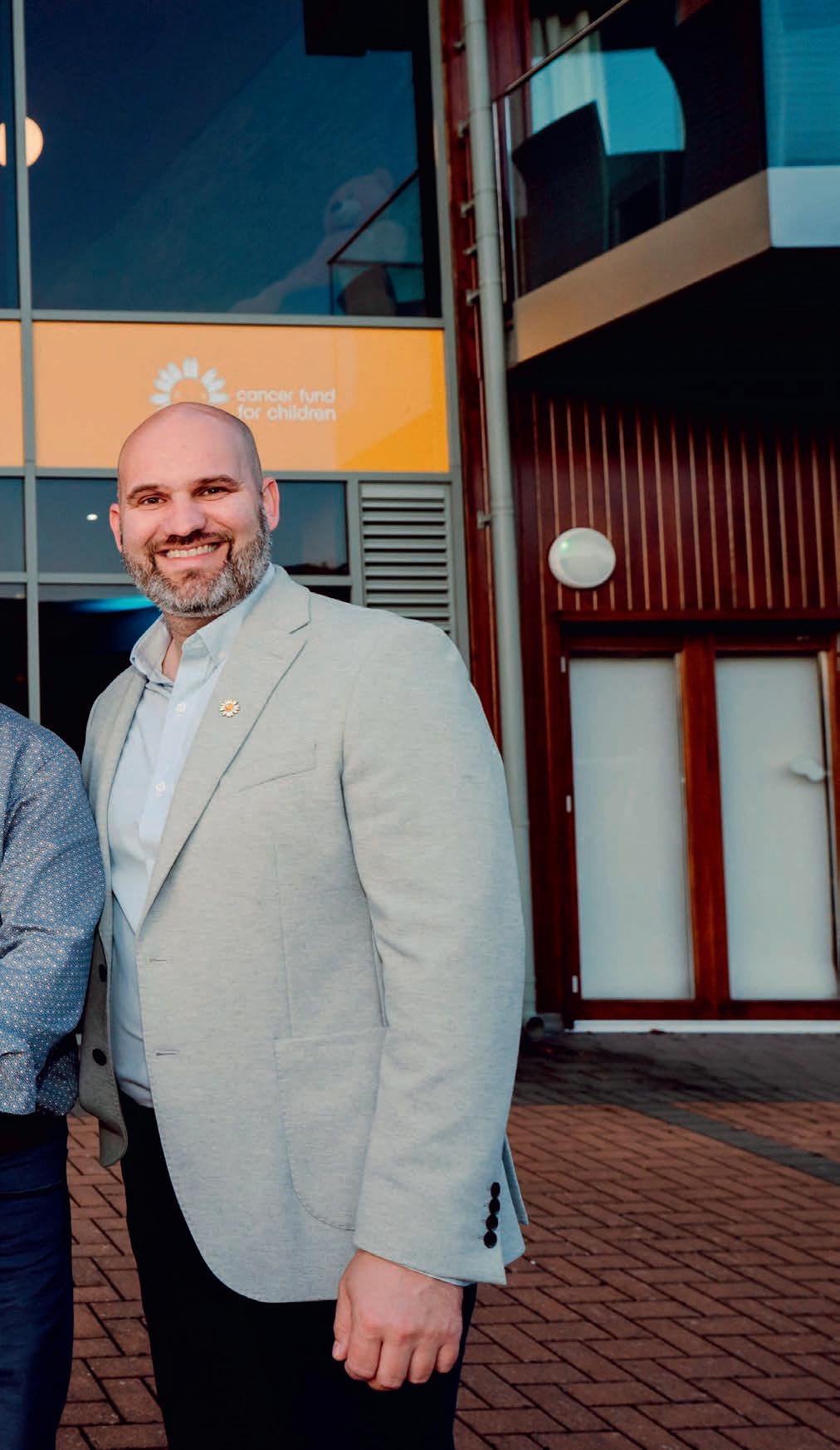
This year, he’s taking that purpose to new heights –literally – with a bold charity initiative: “26 Mountains to Mayo.”
It’s a challenge as intense as it sounds: scaling 26 peaks to raise funds for the Cancer Fund for Children (CFFC), a cause close to his heart. But whether he’s on a summit or in a strategy session, Johnston’s focus remains the same – helping people when and where it matters most.
A BUSINESS BUILT TO SCALE – AND TO SERVE
As CEO of Axial3D, Johnston is leading one of the fastest-growing
MedTech companies in the UK. Axial3D specialises in AI-powered 3D medical image segmentation –a critical process that transforms 2D patient scan data into highprecision 3D models. These models are then used by surgeons and medical device companies for surgical planning, designing patientspecific instrumentation (PSI), and educational purposes.
“We’re not just a software company,” says Johnston. “We’re a clinical enabler. What we provide helps ensure that patients receive treatments that are truly personalised – and that surgeons and engineers can plan with greater
precision, efficiency, and speed.”
The company’s impact is far-reaching. Axial3D now exports to over 30 countries, and demand is booming – especially in the United States, where Johnston currently spends about two weeks every month. “The US MedTech market is moving rapidly toward personalisation and value-based care. What we offer is a scalable way to support that shift, without compromising on quality or speed,” he says.
For large medical device companies, the efficiencies Axial3D enables are game-changing. “We can save their engineers hours – sometimes days – on a single patient-specific case,” Johnston explains. “That time saved isn’t just about productivity; it means those companies can help more patients, faster, and with solutions that are better tailored to the individual.”
As a DBT Export Champion, Johnston shares his experience with other UK businesses looking to grow internationally. He regularly engages the Northern Ireland Chamber of Commerce and other business forums to advocate for innovation, entrepreneurship, and global thinking.
“Exporting isn’t just a business strategy for me – it’s a belief,” he says. “There’s incredible talent and innovation in Northern Ireland, and I want to help showcase that to the world. We’ve proven that a company from Belfast can partner with some of the biggest names in global healthcare.”
But while Johnston’s calendar may be packed with business development meetings and strategic partnerships, he’s just as committed to making time for something else – charity. His upcoming “26 Mountains to Mayo” challenge is the latest in a series of efforts to raise awareness and funds for causes he cares deeply about.
So why 26 mountains? And why Mayo? “Because it’s hard,” Johnston says with a grin. “And because it matters.”
“About six years ago, I got into hiking and during what you might call a mid-life crisis, took the opportunity to travel to places like Kilimanjaro and Everest Base Camp. I also got an opportunity to walk with Rory Best on his second Miles to Mayo challenge in aid of Cancer Fund for Children. What struck me was not only how Rory was engaging with business and individuals to raise a fantastic amount of
money for the charity, but also the way that the charity was able to mobilise to allow him to be as successful in the fundraising as he was.
“Cancer Fund for Children has the infrastructure and resources to be able to support the scaling of very big challenges. I approached the CEO, Phil Alexander, about picking up the fundraising baton and we came up with the Mountains to Mayo Challenge.”
The goal is to raise funds for the Cancer Fund for Children, to raise vital funds and awareness for children and young people impacted by cancer across the island of Ireland. Johnston’s motivation is deeply personal. “As a father, I can’t imagine what some families go through when their child is facing cancer. The strength those kids show is incredible. This challenge is just a small way of saying: we see you, we support you, and we want to help.”
The “26 Mountains to Mayo” campaign will take Johnston across some of the most rugged terrain in Ireland, culminating in Mayo – the symbolic finish line of the journey. It’s both a physical and emotional challenge, one that mirrors the ups and downs of leading a high-growth company.
“There are parallels between business and the mountains,” he says. “You have to keep moving forward. Some days are easier than others. But if your purpose is clear, you’ll always find the energy.”
FINDING BALANCE – OR NOT
So how does he do it all? Spoiler: he doesn’t claim to have the perfect work-life balance. In fact, Johnston is quick to say
“The US MedTech market is moving rapidly toward personalisation and value-based care. What we o er is a scalable way to support that shift, without compromising on quality or speed.”
that “balance” isn’t always the goal. “I’m busy, but I do what I do because I believe I can make a difference to those who need it most,” he explains. “That goes for both my work at Axial3D and my charity work. When your ‘why’ is clear, the rest falls into place.”
He’s also the first to admit that running a global company while training for a major physical challenge isn’t easy. “There are days when I’m jet-lagged, meetings are stacked back to back, and I still need to get in a training hike. But I’m surrounded by a brilliant team at Axial3D, and that makes a huge difference.”
His advice to others? “Don’t wait for the perfect time to do something meaningful – it rarely comes. Start where you are, with what you have, and build from there.”
Putting the team together has been one of the most inspiring parts of this journey. What started as a goal to recruit 15 business leaders quickly grew, he says.
“Today, we’ve got 25 incredible individuals on board. Each one has committed to raising at least £50,000, with a shared goal of reaching £1 million for CFFC. Their energy, creativity, and dedication have been remarkable. These aren’t just individual efforts – they’re rallying their teams, customers, and suppliers to take part in everything from events to donations, creating an incredible ripple effect.
“At a time when public funding is stretched thin, the role of businesses in supporting charities like CFFC is more important than ever. This isn’t just a good thing to do – it’s essential. And the way the business community has stepped up, understanding that urgency and responding with such generosity, has been truly humbling.”
With Axial3D continuing its expansion, particularly in the US, Johnston is focused on scaling both the company and its impact. “The future of healthcare is personalised. That’s not just a buzzword –it’s a better way to care for people. And with the right technology, it’s possible at scale.”
AS FOR THE MOUNTAINS AHEAD – LITERAL AND METAPHORICAL – HE’S READY.
“Every climb is a chance to reflect, to push limits, and to remember why you started,” he says. “Whether I’m in an operating room with a surgeon holding one of our models, or on a mountain raising money for a kid fighting cancer, it always comes back to people. That’s what keeps me going.


A


A delegation of NI Chamber members travelled to Raleigh, North Carolina in March as part of a business mission designed to enhance collaboration between Northern Ireland and the US state.


The mission was led by First Minister, Michelle O’Neill and deputy First Minister, Emma Little-Pengelly. The group enjoyed a series of high-profile engagements including a visit to the globally renowned Research Triangle Park (RTP) and the Poulton Innovation Centre at NC State University’s Centennial Campus before political engagements, including a private meeting between the First Minister and deputy First Minister and North Carolina’s Secretary of State, Elaine F. Marshall and Lieutenant Governor, Rachel Hunt.
The delegation was a result of NI Chamber’s Memorandum of Understanding (MOU) with NC Chamber, which was signed 12 months ago. NC State University hosted a special reception to mark the anniversary and the significant traction it has earned to date.
Speaking from North Carolina, First Minister Michelle O’Neill said: “Growing our economy is our focus for this important visit as we develop business and investment opportunities, strengthening our partnership with North Carolina.
“We have close economic ties with US companies. We have welcomed over
1,300 international companies, creating thousands of good jobs in the process.





“We offer one of the most efficient business environments in Europe. We have a young, dynamic and highly skilled workforce with unique access to trade opportunities in Britain and Europe. The potential we offer is huge, and we compete on the world stage. That is the message I will be bringing to investors.”
Deputy First Minister Emma LittlePengelly said: “The Memorandum of Understanding between both Chambers of Commerce was built on the commitment to work together, to unlock new economic opportunities to drive innovation and to create lasting business relationships. And one year on, it is clear that this partnership is thriving.
“Building the connections between ourselves and the US is key to our economic growth and we are breaking new ground on this visit.
“There are such parallels between our economic strengths and the potential for this approach is huge. Our visit demonstrates our support for this approach as we recognise the benefits of the opportunity to come together, share expertise, explore new markets, and forge meaningful collaborations.”
Suzanne Wylie, Chief Executive, NI Chamber says it is a unique partnership, which works because of the ‘many synergies’ between both Northern Ireland and North Carolina:
“Over the last year, NI Chamber has been working intensively with business, academics and potential investors in North Carolina, a state which we identified as having many synergies with our own economy.
“Now, we are seeing that translate into game-changing opportunities for joint investments and expanding business footprints, research partnerships and alliances. This mission is about expanding those new relationships further and together, showcasing Northern Ireland and North Carolina as regions of joint business opportunity.
“Our MOU with NC Chamber has garnered significant political interest on both sides of the Atlantic, and we are delighted that on our return visit, we are accompanied by the First Minister and deputy First Minister, as well as universities and business leaders. Our mission is about making business-to-business connections, learning from best-practices and business
and politicians together pitching Northern Ireland as a unique and compelling place to invest and do business.”
Gary Salamido, President and CEO, NC Chamber added:
“Since signing our MOU with Northern Ireland Chamber of Commerce and Industry one year ago, the relationship between our two organisations has only strengthened as we work together to realise new opportunities for the diverse set of businesses in each of our memberships. We both offer a great place to live, work, and raise a family and these visits showcase that. They are also an opportunity for our members to find new ways to grow their businesses, invest in their people, and compete in today’s global marketplace.”
The Northern Ireland delegation included business leaders from NI firms including Artemis Technologies, Axial 3D, B-Secur, Carson McDowell, Catalyst, EOS IT Solutions, Neurovalens, Software NI and Teamworks, as well as Head of the NI Civil Service, Jayne Brady, Invest NI’s Head of Trade for USA and Latin America, Mark Reid and Professor Margaret Topping from Queen’s University, Belfast.


By Valerie Ludlow, ASG.
Leadership often gets painted as a finished product – polished, decisive, always a few steps ahead. My experience is far messier. It’s a constant balancing act: between decisiveness and doubt, speed and patience, confidence and humility. And what’s shaped my approach hasn’t come from formal lessons. It’s come from real-world experiences –especially from getting it wrong. I’ve stumbled through egos, blame games, stubbornness (sometimes my own), learned leadership by doing, and learned where I fell short.
THIS IS WHAT I’VE LEARNED – AND I’M STILL LEARNING –ABOUT BALANCING IT ALL.
Lead by Example, But Don’t Be Afraid to Show Vulnerability
Showing up matters. Not just when the cameras are rolling or there’s a credit to be grabbed – but every day, especially on the tough, messy, and unglamorous ones. I work better in the trenches with my team, setting the tone with collegiality, hard work, and a quiet understanding that ego isn’t driving the bus (even though I have to keep checking it hasn’t climbed into the passenger seat).
As an employee, I witnessed firsthand what happens when leadership gets tangled up with fear: errors punished, energy diverted to selfprotection instead of excellence. My leadership isn’t faultless; I’ve made mistakes too – pushing too hard and rushing too fast – and I know it costs more than it ever gains.
Those lessons anchor my approach today: foster trust, treat mistakes as data, and let people focus on doing remarkable work every single day. This isn’t just gut instinct. Research backs it up – from CIPD’s studies on psychological safety to LinkedIn’s insights showing that real learning happens when people aren’t scared to fail.
Truthfully? I’ve learned more from the projects that veered off course than the ones that went smoothly. Playing not to lose can feel safe – but it often means missing the really good stuff.
Embrace Flexibility and Change
There’s a tired old saying that “the only constant is change.” It’s true – but it doesn’t go nearly far enough. Change isn’t just the backdrop; it’s the stage itself.
The last few years gave us all a crash course in this: pandemics, cost-of-living crises, shifting priorities, tighter budgets, shorter deadlines, and cultural tensions that would challenge a UN ambassador. Looking back, if I’d kept trying to lead the way I did in 2019, I’d spend much more time firefighting – and failing.
Good leadership isn’t about defending a plan at all costs. It’s about building habits and mindsets that expect change – and adapt without panic.
That doesn’t mean reacting every time something shifts. Panic leadership creates instability faster than any external shock ever could. It’s about building the muscle memory to course-correct thoughtfully without making the team feel like the wheels are falling off. Most people won’t notice the pivot if you’re doing it right.
Foster a Culture of Collaboration, Not Competition
When I started my career in the early 2000s, the international corporate world taught me that survival went to whoever worked harder, longer, and louder. And for a long time, that model worked. It got me noticed. Promoted. Ahead.
But stepping into leadership forced a reckoning. That old mindset – always needing to prove myself – quickly became a liability. If I’d stayed in gladiator mode, I’d have lost good people.
It took time (and mistakes) to learn that leadership isn’t about constantly showing how busy or brilliant you are. It’s about improving others – investing your time, belief, and knowledge in them. My
proudest legacy won’t be measured in awards or promotions. It will be measured by how many people I helped grow, helped surpass me, and how they helped improve the industry we share. That’s the real prize.
Invest in Yourself and Your Wellbeing
Here’s my hardest lesson: You can’t lead if you’re running on fumes. And yet, my instincts have always been trained to work longer, harder, and faster. Investing in myself still feels uncomfortable sometimes. But I know it’s not about grand gestures. It’s about the small daily choices: Walking the dog at the end of a long day to clear my head, keeping up with CPD to stay sharp in a world that doesn’t stop spinning, listening to podcasts that have nothing to do with work. Booking the holiday – and actually taking it.
I’m realistic: I’m never completely switched off as a leader. Pretending otherwise just sets me up for guilt and frustration. My real goal is better boundaries: understanding that while sacrifice is inevitable, losing yourself isn’t. Some days, work will have to come first. Some days, home life will. Some days, I have to shove my wellbeing needs to the top of the queue.
In Conclusion
I’ve learned that balancing it all isn’t about reaching some perfect end state where everything fits neatly together. It’s about constant recalibration – some days I’ll nail it, some days I’ll miss badly, and most days, I’ll be somewhere in between. I try to lead not through grand gestures, but through daily actions – showing up, staying flexible, backing my team, and learning as I go, especially when things get messy. And maybe that’s the real lesson I can offer: The best leaders don’t balance it all perfectly. They’re the ones who stay in the game – honestly, imperfectly – even when the balance keeps shifting under their feet.

“The best leaders don’t balance it all perfectly. They’re the ones who stay in the game.”

Empowering the next generation of female talent through structured guidance and support.
Mentorship programmes serve as crucial stepping stones for professional development, particularly for young women navigating their career paths. At Concentrix, a global technology and services leader that designs, builds, and runs enterprise-wide technology solutions, the commitment to mentorship stands as a cornerstone of its organisational ethos. The SistersIN Programme, which originated at Assumption Grammar School, exemplifies this commitment through its structured approach to supporting sixth-form girls with leadership development, mentorship, and career-
readiness initiatives. The programme has grown significantly, recently celebrating the achievements of 700 graduating students at The ICC Waterfront Hall in Belfast.
Sarah McKay, Vice-President of Service Delivery at Concentrix, brings a personal dimension to her involvement with SistersIN. “As an alumna of Assumption, I know that the ethos has always been about accelerating and empowering girls, helping everyone to do as well as they possibly can”, Sarah McKay explains. Her observations throughout her career revealed a concerning pattern: “Up until lower mid-management level, we see 50% female to male ratios, but, more senior to that, there is a deficit in women
pushing forward into the higher levels of management. At CEO level, female leaders are hugely underserved, especially in Northern Ireland.”
This realisation fuelled her passion for female mentorship. “I want to share my experiences with those who are coming up”, she states.
The transformation Sarah witnesses in her mentees proves remarkable. “Across the board, the one thing which comes across is how the girls’ confidence grows”, she notes.
She recounts the journey of her first SistersIN mentee: “The first girl I worked with thought she was really shy, that she wasn’t able to stand up in front of a group of people or even ask teachers for

help with things. At the end, she’d set up an entire coding programme, going round every class in school to recruit attendees.”
This growth in confidence mirrors the sentiments expressed during the recent SistersIN graduation ceremony, where one student reflected: “I’ve learned that not only do I have the confidence and ability to stand up and share my opinions, but that there are people who are willing to listen to what I have to say.”
The mentorship experience offers profound benefits for mentors as well. “Personally, it’s really useful to sit and reflect on your own career and the programme forces you to do that”, Sarah shares. “Some of my mentees have given me ideas and I’ve been inspired to learn
and find out more about lots of things from them.”
Sarah also values the networking opportunities the programme provides as she shared, “At this year’s graduation, I sat on a panel with incredible women, making connections with female leaders across Northern Ireland. That female network is so powerful, and it’s not contrived either; when we meet now, there are common conversations based around common goals.”
Sarah’s own career path illustrates the value of mentorship. “I’ve always had mentors, whether deliberately or not”, she reflects. “When I look back, I can identify people who were hugely valuable mentors
to me, even if I didn’t know it at the time.”
She acknowledges that earlier in her career, she might not have maximised these relationships: “I wasn’t confident enough to seek that support out though and say, actually I’d like help with this.”
One standout mentor, Philip, encouraged her to “be really proactive and get out there, lead projects, meet people and just get things done!” His challenges helped shape her understanding of what she wanted from mentorship.
At Concentrix, mentorship has become integral to talent development.
“Mentorship is now strongly encouraged and is available for anyone who wants to develop their career in our business”, Sarah explains. Their programme, ‘iRise’,

combines formal leadership development with mentorship opportunities.
The company takes a structured approach. Sarah shares that “As senior leaders, we are all targeted to open ourselves up as mentors. I have five mentees within our business.” This approach includes educating mentors about their role: “We’re also educating mentors about how to be a mentor and not a manager, recognising that they are very different things.”
The impact of SistersIN continues to grow, with First Minister Michelle O’Neill and Deputy First Minister Emma LittlePengelly announcing their personal commitment to mentor participants in the 2025/2026 SistersIN Leadership Programme during the recent graduation ceremony. Their involvement signals the programme’s increasing recognition and influence.

At the event, our first minister delivered a moving keynote address, saying: “Today’s graduates are tomorrow’s change-makers. Through investing in their potential now, we’re shaping a future where every young woman knows her voice matters, and her leadership is needed.”

The partnership between Concentrix and SistersIN, now in its third year, exemplifies how businesses can actively contribute to developing future talent. Through the Think Human Fund, Concentrix’s global initiative to drive positive change, the company continues to bridge the education-tocareer gap.
For young women considering their career paths, Sarah offers reassurance based on her own experience: “Nobody knows what they are doing when they are 17. So being able to sit someone down, reassure them and say ‘relax, do the things you enjoy doing and your career will form around you. You don’t have to have it all lined up when you go to university. What’s important is staying open to learning opportunities.’”
This perspective, combined with structured mentorship, creates a powerful foundation for nurturing the next generation of female leaders.

Elaine Curran Director of Trade and Investment, Invest NI
Are you a business interested in selling outside of Northern Ireland?
A Trade Action Plan will make you aware of the risks, costs and overall approach you need to be successful in your new market. In this article, I give an overview of how to develop a Trade Action Plan and what you should consider before taking the first step in your exporting journey.
What should my Trade Action Plan include?
Here are five points to include when developing your Trade Action Plan:
1. What are your objectives? Firstly, you should identify what you want to achieve. Consider your sales goals, timescales and forecasted sales figures. Be specific with your objectives as this will determine your targets and act as a measure of your overall success.
Once you have clear objectives, you can start to build on how and where you want to export.
2. What is your value proposition?
A value proposition is why a consumer should buy your product or use your service. You should develop a measurable value proposition for each market you are entering. It should specifically answer: what makes your product or service unique, why should potential customers choose it and how is it different from your
competitors? This unique selling point is what you will market to your customers.
3. What market segments will you target?
Through market research, you need to identify what market segments you will target. Market segmentation is when you divide the market into smaller, distinct groups of customers based on shared characteristics. Who your customers are and what they need should be at the heart of your research.
Then you will need to decide on the best routes to reach your potential customers. For example, do you want to sell directly or sell through re-sellers such as distributors, agents and partners?
Your market research should also include your market entry plan and how you intend to integrate your product or service into your chosen market. Don’t forget to conduct due diligence – your new market will have its own legislation, tax and customs.
4. What is your pricing and promotional strategy for your target market?
At this point, you should know who your customers are, what they want and how you will sell to them.
Next, you need to consider the market price of your product or service. It’s essential to remain competitive while making a profit. Consider what your goods or services cost you, and what they’re
worth to your customers. You might want to consider fixed or variable costs, and whether to use cost-plus or value-based pricing.
5. What extra resources do you need?
Exporting can be costly, and you should identify what extra resources you need as part of your Trade Action Plan. Additional resources might be professional support, added distribution methods, changes to the product or service needed for your chosen market, or scope for future growth.
How do I evaluate success?
Once you have your Trade Action Plan, you will need to consider how you’ll measure your performance to ensure you’re delivering against your objectives.
Key performance indicators and management processes can make tracking and monitoring your progress easier.
Consider after-sales policies and regularly liaise with customers, distributors, export agents and banks. To mitigate risk, monitor the political landscape and any geopolitical issues that may affect sales in your chosen market.
To learn more about Invest NI’s available support and start exporting outside of NI, visit www.investni.com/support-forbusiness for more information.
BT’s Paul Murnaghan on New Devolved Nations Role and Vision for NI Growth.
Paul Murnaghan has recently assumed a significant new role at BT as director of BT Business Devolved Nations, extending his responsibilities beyond Northern Ireland to include Scotland and Wales. He reflects on the importance of this appointment and why Northern Ireland is poised to seize greater opportunities if it takes bold steps.

After close to a decade leading BT Business in Northern Ireland, Paul’s new role involves supporting business customers with over 250 employees across public and private sectors in the three devolved nations. This not only represents a personal career milestone but also signifies a major strategic development for the company.
“It’s a tremendous opportunity,” Paul remarks. “Having worked in NI for many years, I now have responsibility for all our business customers across the devolved nations.
“My objective is to foster trusted partnerships with all BT Group stakeholders. Our products, services, networks, and people are integral to the communities we serve and help bring them together. Building and maintaining relationships within these communities is essential not only to our commercial success but also to our operation as a responsible and sustainable business.”


His appointment underscores the reputation of Northern Ireland’s operations within the broader group, and his pride in that is evident. “Our BT brand in NI is something all colleagues are rightfully proud of. We enjoy strong customer relationships who advocate
strongly, arguably more so than in any other part of the UK. The people, culture, and collaboration here provide us with many of the elements needed to achieve greatness. Colleagues in London often say, ‘Be more Belfast.’ I’m really proud when I hear that.”
Paul’s roots are firmly embedded in Northern Ireland. Educated at St Malachy’s College in North Belfast, then Queen’s University Belfast where he studied Electronic Engineering, followed by postgraduate studies in IT and Business at Ulster University, he built his early career in the challenging job market of the 1990s. “Opportunities were scarce,” he recalls. A graduate management programme helped bridge the gap between academic theory and business reality. From there, he joined Beecom, later moving to B.I.C. Systems, which was Northern Ireland’s largest indigenous IT provider before being acquired by BT in 2004.
“Transitioning from a nimble, entrepreneurial setup to a large corporate entity like BT was a culture shock,” he admits. “But both of us had to adapt. Today, BT is among the most sought-after employers in Northern Ireland.

“We used to be known simply as the telephone company. Now, we are the largest fixed and mobile converged network infrastructure partner and a global leader in cybersecurity, with ambitions to become the trusted connectivity partner of choice for all our customer segments. Our purpose is to connect for good.”

Northern Ireland, he argues, is ahead of the curve in terms of broader


communications infrastructure and over the top services. “We have superior fixed connectivity compared to anywhere else in the UK and Ireland. Our 5G capability is already being tested in real-world scenarios, such as the driverless vehicle pilot, Harlander, being launched by Belfast Harbour Commissioners this month.”
The ‘Harlander’ shuttle service, one of the UK’s first fully driverless transport systems based in Queen’s Island, is backed by £11 million in joint government and industry funding, including £5.5 million from Innovate UK. The project aims to improve last-mile connectivity for residents, employees, and visitors to key sites like Titanic Belfast, Catalyst, and Belfast Met and BT is one of the partners in this.
This testbed or “sandbox” approach, Paul says, is crucial to Northern Ireland’s value proposition within BT and applicable to many other local industry clusters. “Northern Ireland is an ideal region for testing and innovation. With approximately 1.9 million people, we are neither too large nor too small. We are well-connected to key stakeholders, and our talent pool, particularly from our universities, is exceptional. The commitment of those who stay here makes a significant difference.” However, he is honest about the challenges facing the group.
BT’s recent consideration to close its Derry office has faced criticism. This move is part of a broader strategy to reduce BT’s UK office footprint from over 300 to around 30 future fit premises. “What has happened is difficult for everyone involved. This programme began in 2019 to consolidate our office estate into a smaller number of strategically invested buildings, like our flagship office in Lanyon Place, Belfast. Unfortunately, this means we must let go of some smaller, underinvested buildings and locations.”
The Belfast building, known as Riverside Tower, showcases all of BT Group’s operations in Northern Ireland and serves as a regional headquarters for its various divisions, including EE consumer, BT Business, Digital and Networks, and Openreach. It also taps into talent in finance and legal through strategic hubs supporting business across the UK and houses approximately 2,400 BT employees. Recently, BT has reaffirmed its commitment to Northern Ireland by investing significantly in refurbishing the building.
“The plan to relocate some roles to the Belfast headquarters and others to India, is driven by commercial considerations. As we implement our
“My objective is to foster trusted partnerships with all BT Group stakeholders. Our products, services, networks, and people are integral to the communities we serve and help bring them together. Building and maintaining relationships within these communities is essential not only to our commercial success but also to our operation as a responsible and sustainable business.”
next-generation infrastructure, the operational requirements to serve our customers will change. By 2030, we will need fewer people and fewer offices, but the remaining roles will be high-value and high-impact.”
He insists that BT’s commitment to Northern Ireland remains robust. “We employ nearly 3,500 people directly here, with an additional 7,000 indirectly. One in eight people working across both telecoms and tech in Northern Ireland works for BT. That fact speaks volumes.”
Beyond his position at BT, Paul has been a strong advocate for the region, with significant contributions such as his tenure as president of Northern Ireland Chamber of Commerce and Industry in 2021. He continues to serve on its Board, though this is his final year.
“I’ll remain an advocate for Northern Ireland. The Chamber plays a vital role for businesses, especially during politically unstable times, connecting members with policymakers and ensuring the business community is heard.”
He believes Northern Ireland has untapped potential but also needs changes. “There’s a handbrake holding us back. We need the public sector and business community to adopt a more balanced view of risk. Politicians must stop fixating on the past and instead scan for opportunities ahead. A wholeof-government approach to economic growth is essential – the tax revenue from flourishing businesses can provide critical resources for broader societal development.”
He identifies economic ambition and infrastructure as key missing elements. “Productivity growth is the path to prosperity. We’re still lacking vital components like wastewater infrastructure and a strong skills pipeline to match our ambitions. This limits growth. While we’ve enjoyed nearly three decades of peace, our foreign direct investment doesn’t compare to the Republic of Ireland. We need to attract more investment and retain the talent our universities produce so they can thrive here in Northern Ireland.”
Looking to the future, he focuses on technological advancements in AI, data, and cybersecurity. “AI and data are reshaping lives and businesses, but unmanaged risks pose challenges. Safe and secure AI must become the norm. With geopolitical instability impacting the UK, Europe, and beyond, cybersecurity is more critical than ever.”
As chair of the Momentum One Zero Industry Advisory Board, Paul works to foster inclusive growth by driving digital innovation in Northern Ireland’s economy. “Momentum One Zero is tackling business and societal challenges by leveraging secure connected intelligence in areas like digital health, agri-food, space, and wireless. This City Deal-funded initiative, led by Queen’s University Belfast, is focused on secure AI, and Northern Ireland is uniquely positioned to lead. Our cybersecurity sector boasts extraordinary talent, generating over £240 million in direct GVA with more than 2,750 roles, but we need to scale this success.”
Paul acknowledges that Northern Ireland’s risk-averse mindset often hinders progress. “As a society, we’re inherently conservative, often letting others take the lead. But to grow, we need to dial up our willingness to take risks. Not every venture will succeed, but staying static will make us less competitive and lead to poorer outcomes. Northern Ireland has incredible strengths in fintech, digital health, pharma, and cybersecurity, but we do need to release that handbrake. Boldness is crucial.”
The company was established in 1938 to create much-needed employment opportunities during the Great Depression and that community-driven ethos remains in place at the family-owned company.
Recent examples of this work have been the continuing sponsorship agreements with Ulster Rugby and Banbridge Hockey Club.
This year, Ulster Carpets expanded its sponsorship of Banbridge Hockey Club senior men’s side to cover the club’s senior ladies’ team, ensuring both teams will now carry the Ulster Carpets brand across Ulster, Ireland and Europe.
Dr William McCandless, Banbridge Hockey Club president, said, “This is such great news for the Club and our senior hockey programmes as we have developed a very strong connection with Ulster Carpets and the company’s ethos of family values combined with flair, flexibility and quality are very much our own ideals as well. We really appreciate Ulster Carpets’ support across the Club and look forward to carrying its brand on our travels.”
The County Armagh manufacturer has also remained committed to supporting the next generation of rugby players through the Ulster Carpets Club/School Window initiative that is designed to bridge the gap between school and club rugby.
Spearheaded by Ulster Rugby, the Club/School Window provides a unique platform for young players, who typically only participate within the school setting, to join in activities at their local clubs during March and April, effectively extending their playing season and offering a fresh perspective on the sport.
Keith Shorten, head of Commercial at Ulster Rugby, commented, “We are grateful to Ulster Carpets for its continued investment in growing our grassroots game across the province, which will see thousands of young people continue to enjoy playing rugby in the seasons ahead.
“As our rugby coaches travel across Ulster to deliver the sponsored participation programmes, it is fitting that it will be with the support of a local partner who understands the importance of a pipeline
of talented young players for what we are aiming to achieve as both the Governing Body for the sport and a professional rugby club.”
In addition to supporting a variety of different sports, Ulster Carpets backs a range of charity and community initiatives through The John Wilson Memorial Trust.


For decades, ABL Group has been a trusted name in the Northern Ireland insurance market, helping businesses navigate risk with confidence.
Now, as the homegrown broker completes its rebrand to Brown & Brown Northern Ireland, a new chapter begins –one that combines local insight with global scale.
Shauna Graham, area managing director of Brown & Brown Insurance in Northern Ireland, has seen firsthand how the insurance landscape has evolved locally over the past two decades. Now, she’s focused on ensuring that businesses in Northern Ireland benefit from Brown & Brown’s strengths while maintaining the personal, service-driven approach ABL Group has always been known for.
The acquisition of ABL Group by Brown & Brown wasn’t just about expansion – it was about shared values, culture, and a deep-rooted commitment to customers.
“ABL Group has always been about relationships. That’s what has made us successful over the years, and it’s what Brown & Brown saw in us,” Graham explains. “They are a company built on the belief that local teams, with real decision-making power, can deliver the best solutions for customers.”
Brown & Brown’s decentralised model distinguishes it from many large international intermediary groups. Instead of a one-size-fits-all approach, its strategy is to empower local leadership and strengthen regional offices to better serve businesses.
“From the beginning, it was clear that Brown & Brown saw ABL Group as an ideal partner because of how we do business,” Graham says. “They recognised that we understand this market, we understand our customers, and we already have a strong reputation for delivering results. They wanted to add to that – not change it.”
Brown & Brown is one of the world’s leading insurance brokerage firms, with a legacy of delivering risk management solutions since 1939. With over 17,000 teammates across more than 300 locations worldwide, the company combines deep industry knowledge with the agility to respond quickly to customer needs.
In Northern Ireland, the rebrand unites ABL Group’s existing businesses with McGrady Insurance and
Digney Grant, creating a single, integrated team under the Brown & Brown name.
For existing ABL Group customers, this transition means continuity – but with added strength. The same trusted team, personalised service, and deep local knowledge remain, but now with greater access to global markets, expanded risk management solutions, and industry-leading expertise across sectors.
For new customers, Brown & Brown represents an opportunity to work with a brokerage that is both agile and well-resourced – one that understands the complex challenges facing businesses in Northern Ireland today, from economic uncertainty to emerging risks in cyber security, trade, and supply chains.
“This is about evolution, not disruption,” Graham says. “Our customers will continue working with the people they know and trust. But now, we have even more tools, more leverage in the market, and more ways to help businesses protect what matters most.”
ABL Group’s journey to this moment has been one of rapid growth, shaped by strategic acquisitions that expanded its footprint across Northern Ireland and has more than doubled the size of its team. Over the years, the company has integrated several long-established regional brokers into its business, as well as the local businesses of a number of respected global firms – each strategic move strengthening its expertise in commercial, corporate, and specialist insurance solutions.
That history of bringing great businesses together is what makes this transition to Brown & Brown so fitting.
“We’ve always been focused on moving forwardon adapting, improving, and delivering more for our customers,” Graham says. “Joining Brown & Brown is simply the next step in that journey. It gives us the scale and strength of a global leader, but it allows us to continue to operate with the independence, agility, and local focus that made us successful in the first place.”
“We are excited about the future and look forward to continuing to deliver for our customers.”


“We are excited about the future and look forward to continuing to deliver for our customers.”
AARON HUTCHMAN
Recruitment Consultant, Kenect Recruitment

JENNY LENNON
Managing Director of Hyperfast Networks, Fibrus

MATTHEW HIRD
Head of Healthcare, Todd Architects

Managing Director, Fibrus Broadband

NICK BENNETT
Associate, Employment & Immigration, Cleaver Fulton Rankin

ROBIN MCCORMICK
Chairman, Solarfix
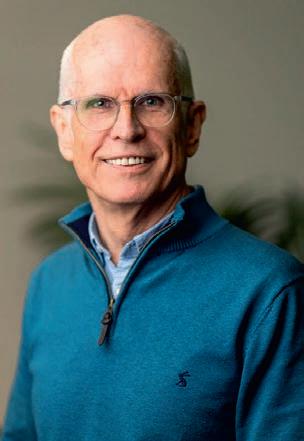
LESTER KELLY
Business Development Manager, A2 Hub, FAST Technologies

RYAN O’NEILL
Finance Director, Greiner Packaging


Financial advisory firm HNH has announced four senior promotions within its Belfast office, reinforcing the company’s continued commitment to growth and client service excellence.
In the Deal Advisory team, Peter Graham has been appointed as director while Kylie Donnelly and Connor McAnallen have been promoted to associate directors. In the Tax team, Christine Altimas has also been promoted to associate director.
These promotions reflect HNH’s ongoing investment in its people, as the firm continues to build on its reputation as a leading corporate finance advisory firm, specialising in corporate finance, strategic business planning, transaction services, and tax advisory. HNH is also ranked by Experian as among the Top 10 most active mergers and acquisitions advisers in both Northern Ireland and Scotland.
ICC Belfast has strengthened its award-winning team with a new appointment and two promotions.
Jill Houlahan has joined the team as head of corporate sales, bringing a wealth of commercial sales experience.
Laurel Gray, who has been with ICC Belfast since 2016 as an event planner and senior manager, has been promoted to head of events. Laurel has a wellestablished international network, built through participation in programmes including AIPC Future Shapers, bringing fresh perspectives to the events industry.
Jenni Yau, who’s been at the venue for eight years, has been promoted to head of association sales. Initially starting out in a leading local hotel group, Jenni is passionate about the MICE industry and helped lead ICC Belfast’s winning bid to host One Young World in 2023.


Ulster Tatler’s Fashion & Beauty Editor, Joanne Harkness, looks at the colour for the season, butter yellow.





BUSINESSWOMAN OF THE YEAR
All we need is the name and company of the person you are voting for along with a statement of up to 500 words on why they should win.

THE COURTYARD, CARRICKFERGUS
BUSINESSMAN OF THE YEAR
All we need is the name and company of the person you are voting for along with a statement of up to 500 words on why they should win.


The Ulster Tatler Group is delighted to announce Belfast City Airport as the title sponsor for the 18th year of the Ulster Tatler Awards, taking place on the 18th of September at Belfast City Hall.
are Chris Sherry (managing director, Ulster
Group), Pamela Ballantine (television presenter and Ulster Tatler Awards host) and Michelle Hatfield (chief people and marketing officer, Belfast City Airport).


The perfect setting for meetings and events of any size and status, the prestigious Titanic Hotel Belfast, awarded Northern Ireland’s Leading Hotel for seven consecutive years, offers a distinctive venue for impressing clients, delegates and guests.
Whether you’re hosting a board meeting in one of the hotel’s elegant heritage rooms or a large-scale conference in the iconic former Harland & Wolff Drawing Office, capable of accommodating up to 300 guests, you’ll find a space that inspires.
Original architectural features are seamlessly blended with contemporary technology and comforts, ensuring every event is both memorable and efficient. Located in Belfast’s historic Titanic Quarter, the hotel benefits from excellent transport links and ample onsite parking. Delegates can enjoy exceptional catering, with options ranging from gourmet dining in the

coffee breaks served in your event space. With expert event planning support and state-of-the-art facilities,
delivers a truly unique backdrop for every corporate occasion.
Get in touch today by emailing events@titanichotelbelfast.com.
Take the driver’s seat with Agnew Leasing’s next-generation Fleet Management software – built to simplify, streamline, and supercharge how you manage your vehicles.
Juggling fleet admin while growing your business? Not anymore. Our intelligent software gives you real-time visibility and control over your entire fleet, backed by the trusted support of our expert coordinators. From MOT and tax scheduling to 24/7 breakdown and accident management, we take care of the admin so you don’t have to. Our easy-to-use software automates the everyday, reduces downtime, and keeps your fleet compliant – without the paperwork. With seamless integration through platforms like 1link, you can book maintenance online, access live updates, and receive clear monthly invoicing – all in one place.
Enjoy the added benefits of discounted servicing, credit terms, and rental vehicle access when needed, while staying focused on your core business.
Smart, stress-free, and scalable –Agnew Fleet Software is the ultimate tool for modern fleet control.
Ready to put your fleet on cruise control? Contact us today: 028 9009 7282


The CX-80 - Mazda’s biggest and most expansive car yetis a worthy flagship model, writes James Stinson.

Hardly a week goes by without a new electric car being launched. From small city cars to MPVs, SUVs and sports tourers, EVs are now available in every shape and size, and at lower prices than ever before.
But despite all this, they still only account for around a quarter of new cars sold and the vast majority of those are company cars. There’s still plenty of life in cutting edge petrol and diesel motors. They can be very economical and exceedingly practical especially for towing and longer journeys.
Mazda is moving into battery power but still sees plenty of potential in petrol and diesel. So perhaps we shouldn’t be surprised about this new Mazda CX-80, a large seven-seat SUV that comes as either a plug-in petrol hybrid or a conventional six-cylinder diesel.
If you’re buying as a company car, the plug-in petrol hybrid makes more sense thanks to the generous benefit-in-kind tax (BIK) rates but it’s the good old diesel that’s the pick of the two.
Built on the same platform as the smaller CX-60 but with larger proportions, the CX-80 is the biggest and most expensive Mazda ever sold in the UK and it’s a worthy flagship model.
It’s very refined, has plenty of space, four-wheel drive and is competitively priced. It goes head-to-head with other seven-seaters like the Kia Sorento and Hyundai Santa Fe and stacks up well against pricier rivals from Volvo, BMW and others.
The 3.3-litre six-cylinder diesel engine pumps out a hefty 251bhp and takes 8.4 seconds to reach 62mph from a standing start. The plug-in hybrid (PHEV) mates a four-cylinder petrol engine with an electric motor and a 17.8kWh battery. It offers 332bhp in total and registers an even more impressive 0-62mph time of 6.8 seconds. It will travel up to 38 miles (officially) on electric only power. The diesel for its part delivers impressive economy of around 50mpg. Of the two, it’s the richer, smoother engine as the four-cylinder PHEV can be noisy under hard acceleration. Both are fitted with an eight-speed automatic gearbox and have an excellent 2500kg towing capacity.
At first glance, the Mazda’s interior feels a bit retro but there’s plenty of tech on offer. There’s a neat 12.3-inch driver’s display and a standard-fit head-up display, which projects vehicle speed, cruise control settings, navigation directions and other info straight on to the windscreen.
Infotainment is on a 12.3-inch central screen, which is navigated by a handy rotary controller between the front seats. Mazda deserves extra brownie points too for retaining a row of physical buttons for controlling the air conditioning and heated seats.
DAB radio, wireless Android Auto and Apple CarPlay smartphone integration, Google Maps and Google Play Music apps are all standard, as is Google
The front seats and driving position are excellent as is space in the middle row of seats. The third row of seats will accommodate kids with ease and all but the tallest adults too with the middle bench slid forward. One intriguing option allows you to order a six-seat version, which replaces the middle row with two armchair-sized seats.
There are five trim levels, with the base Exclusive-line featuring a notable range of standard equipment. This includes black leather interior trim, a heated and leathertrimmed steering wheel, three-zone climate control, 18-inch alloy wheels, front and rear parking sensors, and a rear-view camera.
Other trim levels add things like plusher leather, fancy wheels, a panoramic sunroof, rear privacy glass and a Bose 12 speaker sound system.
Prices start from £49,780 and £52,475 for the entry level PHEV and diesel versions respectively with the ranges topping out at £56,530 and £59,845. BIK rates are just 13% for the PHEV compared with 35-36% for the diesel.



Take command of your company’s fleet more effectively with our new software that simplifies the fleet management experience. Call the Agnew Leasing Team on 028 9568 4662

Leasing for Everyone

Take command of your company’s fleet more effectively with our new software that simplifies the fleet management experience.
To nd out more contact our Agnew Leasing Team on 028 9568 4662

The new CLA coupe shows Mercedes is serious about electric, writes James Stinson.


We’ve lost something with the trend towards bigger, bulkier SUV-type cars. For sure, they’re spacious and practical. They also o er drivers that much sought after high riding seating position from where you can look down on others.
But you could never claim that they’re pretty. They don’t make the pulse race or heart ache the way a svelte looking coupe does. However, some buyers still want beauty and that’s what they are getting with the latest incarnation of Mercedes small saloon, the CLA. Few cars of this size and price look so good.
The CLA has been around since 2013, its highly distinctive looks being a favourite with style conscious buyers who don’t want to break the bank. It turns heads and has legions of happy owners.
The latest version, arriving this summer, is more impressive still, offering more space, more refinement, more comfort, more intelligence, and more efficiency. It’s the cleverest Mercedes-Benz ever and is the first model in a completely new family of vehicles from the German marque.
It’ll be sold as both an electric car and a petrol hybrid. The electric version has an impressive 492 miles of range, and the new CLA also has an all-new, AI-based infotainment system with plenty of clever tech which can be kept fresh using over-the-air updates.
While the old CLA was based on the A-class saloon, the new CLA is an entirely new car. It features a similarly low-slung side profile and downturned front grille to the outgoing CLA with the addition of a new full-width light bar.
The rear looks familiar too, albeit with a new light bar across the tailgate. It’s neat, stylish, distinctive.
The real changes are under the skin with the CLA now offered as an EV for the first time. A petrol-powered version will also be available soon.
At its heart is a new 85kWh battery, and in certain versions of the CLA it can deliver an impressive 492 miles of range. That’s 56 miles more than a Tesla Model 3 can manage and makes the new CLA the longest-range electric car in the UK.
The car also has some new charging tech which allows for very rapid top ups. It can charge at 320kW DC, which means you can gain more than 200 miles in just 10 minutes although that means finding a charger which supports that sort of speed.
Inside, the new CLA features the latest version of Mercedes’ “Superscreen”. As standard you get a 10.25-inch driver’s display and a 14.0-inch touchscreen in the centre. A 14.0-inch passenger screen is also available as an option, and they can use this to watch streaming services or Youtube videos on the move.
Mercedes is also making much of the CLA’s new AI-aided capabilities, including intuitive voice commands which can control most of the car’s functions and an Alexa-type ability to answer pretty much anything you’d like to know.
Prices haven’t been announced yet but we can probably expect to pay a premium on the existing model, which starts at around £33,000.
Take command of your company’s fleet more effectively with our new software that simplifies the fleet management experience. Call
Leasing for Everyone


Andrew Turner Executive Head Chef
This is a classic for the Spring season; fresh duck eggs, finely shaved smoked duck, and duck fat-fried bread, finished with a sweet apple vinegar to cut through it all.
Ingredients: 100ml Chardonnay Vinegar, 200ml Pomace Oil, 2 Cloves Garlic, 1 Shallot , 2 Sprigs Tarragon, Salt & Pepper
Method:
Mix all together and allow to sit for 24hours before use.

Ingredients: 4 Egg Yolks, 50ml White Wine Vinegar, 50ml Dijon Mustard, 250ml Neutral Rapeseed Oil, Salt, Smoked Paprika, Cayenne Pepper
Method: Whisk the yolks, vinegar, mustard together, drizzle in the oil and emulsify, season to taste.
Ingredients: 2 Large Spanish Onions, 100ml White Wine Vinegar, 100ml White Wine, 25 ml Dijon Mustard, 25ml Horseradish Cream, 100ml Crème Fraîche
1. For the plate you’ll need 4 duck eggs, 2 medium sized red onions, mayonnaise, dressing, fried brioche, smoked duck, celery salt, herbs and pea shoot to garnish
2. Bring a medium sized pan of water up to the boil
3. Meanwhile peel and cut your onions in half-length ways.

Method: Finely dice the onions, cover with the white wine and the vinegar and reduce until the pan is dry, cool. When the onions are cold mix in the mustard, horseradish and crème Fresh and season.
Ingredients: Brioche loaf, Duck fat
Method: Break the brioche into small pieces, and fry in duck fat until golden.
Ingredients: 250ml Apple balsamic, 60g sugar, 30g Ultratex

4. When your water is boiling, gentle drop in the duck eggs and onions, allow to simmer for 7mins & 30secs
5. When cooked refresh the eggs in iced water to stop them cooking any further.
6. The onion, remove and allow to drain but do not let it go cold, season with the celery salt and dress while still hot with the dressing.
7. Peal your duck eggs and cut in half the yolk should still be soft, season with the celery salt
1. Spoon a little of the onion in the bottom of the bowl arrange the eggs and red onions on top
2. Add a few dots of mayonnaise and apple balsamic vinegar
3. Arrange the shaved smoked duck and crispy fried bread around the plate
4. Finish with the herbs and pea shoots.

Method: Whisk all together and allow the Ultratex to thicken the vinegar until golden.


John Campbell BBC NI’s Economic & Business Editor
At the start of this year I hosted a discussion on BBC Radio Ulster’s Talkback programme, reflecting on the first quarter of this century. The producer had asked each of us to pick what we considered to be the most consequential event of the last 25 years.
I went for the 9/11 attacks, not just for the impact on that day but for the reactions that followed and continue to echo through global politics at the cost of thousands of lives.
Had it been a discussion concentrating on economics I would have gone for a much less remembered date in 2001: 11 December.
That was the day China became a member of the World Trade Organisation (WTO) and started a new wave of globalisation. A wave which we now see the US attempting, belatedly, to turn back with implications for us all.
At a basic level globalisation is the process which increases the movement of goods, services, people, money and ideas across international borders. It is not a new phenomenon – pre-modern civilisations like Rome or the Mongol Empire created global connections.
The technologies of the Industrial Revolution made possible the mass movement of people and goods over long distances – Belfast’s shipyards contributed mightily to this.
By the end of the 1990s there was some evidence that globalisation was running out of steam with trade growth falling behind overall economic expansion. China’s entry into the global trading system reinvigorated the process.
The WTO describe it as “a textbook case for how global trade integration can drive growth and development – the country’s economic rise has lifted millions
out of poverty, not only within China but also in China’s trading partners across the developing world.”
The success of globalisation for China struck me the day before I recorded that Talkback programme when I noticed a sleek new car in a south Belfast car park and realised it was BYD Seal.
BYD is the Shenzhen-based car company which is now the world’s biggest manufacturer of electric vehicles. It illustrates how in the space of a single generation China has gone from a source of cheap textiles to world leader in sophisticated consumer technologies.
This has been great for consumers in western countries who have seen prices of many goods fall in real terms.
But there have been losers, most obviously producers who could not compete with China and its vast workforce.
In one small way Northern Ireland provides a vivid example of this.
When I joined the BBC in 2001 textile manufacturing was still a significant source of employment in Northern Ireland.
In the years after China’s accession to the WTO one of my predecessors as business editor, James Kerr, spent much of his time reporting on the destruction of that sector.
The pace of job losses was particularly alarming throughout 2003. In the space of a few months James reported on around 1,500 redundancies. This was not just a cyclical downturn: textiles now employ a tiny number of people in Northern Ireland.
In the US this sort of manufacturing decline has become known as ‘The China Shock’ after the study of the same name by the economists David Autor, David Dorn and Gordon Hanson.
They demonstrated how the rise
in Chinese imports caused deep and persistent damage to some US workers and regions and, contrary to orthodox economic theory, workers did not transition easily into new jobs or industries.
The implications of this research have now influenced three successive US governments with both Trump and Biden pursuing policies aimed at “bringing home” manufacturing jobs.
Some of this is about national security. US policymakers were clearly spooked when the Covid pandemic revealed just how dependent the country was on China for the manufacture of critical products.
There is also a degree of nostalgia and sentimentality, pining for an era when a single non-graduate income was enough to live as a middle class family.
So what we have seen since the start of the second Trump presidency is an attempt to roll back some of the globalisation of the past 25 years –to make it harder for goods to flow unimpeded across national borders, particularly from China.
This has led to some commentary suggesting we are now seeing “the death of globalisation” with Brexit held up as another example of this trend.
However, at the time of writing the UK government is positioning itself for a closer relationship with the EU in attempt to ease the flow of goods.
Trump has found that unpicking the dense web of economic connections with China cannot be done easily or in a hurry. The rapid de-escalation in the tariff war between the two powers came as they realised that an embargo on each other’s goods was only going to lead to twin recessions.
The demise of globalisation looks to be greatly exaggerated.
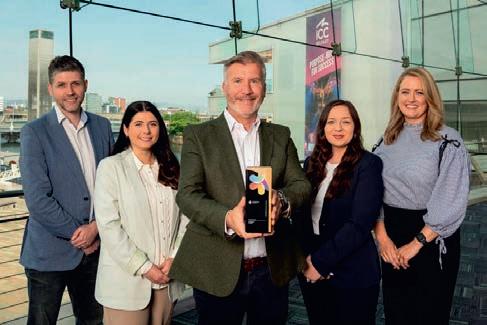
Belfast’s premier business events venue, ICC Belfast, has been awarded a prestigious Platinum accolade in the Convention Centre category at the 2025 Eventex Awards—placing it among the top 1% of venues worldwide. The recognition sets ICC Belfast apart on the global stage, with the venue outshining competition from renowned convention centres in Cape Town, Costa Rica, and Port Aventura, Catalonia. It was the only venue in its category to receive Platinum status. The Eventex Awards are one of the most respected benchmarks in the global events industry. With 1,239 entries from across six continents, ICC Belfast was among just 22 Platinum winners, representing 16 organisations worldwide.
Rob McConnell, Chief Executive of ICC Belfast, hailed the win: “To be the only Convention Centre in the world given Platinum recognition is, in the true sense of the word, outstanding! We’re in the top 1%! “Business events and conventions are a key part of Belfast and Northern Ireland’s business tourism vision. They attract new visitors and forge important business and academic networks and connections, while delegates enjoy the famous Belfast Welcome and all that the hospitality experience in our vibrant city has to offer. “Other top award winners were from the US, UAE, France, Germany, Qatar and Poland. This is very important industry recognition for the work we’re doing in Northern Ireland to bring large scale events to Belfast.
“It’s really rewarding for our fantastic team to receive this independent endorsement that ICC Belfast is not just meeting global standards, it’s way out in front, leading the way.”
Eventex Awards co-founder Ovanes Ovanessian added, “We feel truly inspired having witnessed ground-breaking projects, brought to life by exceptional event professionals… Congratulations ICC Belfast on this truly remarkable achievement.”



Skainos offers a wide range of hi-tech, low cost room hire and conference facilities in an award winning building, in an easily accessible part of Belfast for business, voluntary and community organisations.


sporting/arts/cultural events. Every event is treated individually and professionally regardless of scale with space arranged to suit your exact requirements.
• Single and multi-session, day and evening rates available
• Superb transport links
• On-site catering, fresh and affordable
• Wifi and audio visual facilities
• Disability access to all areas
• Convenient location
• Personalised service
• Flexible spaces
• Natural daylight
• On street parking

Contact East Belfast Mission on 028 9045 8560 or email info@skainos.org for more information, rates and availability.